Nordic Outlook                      Somewhat brighter growth outlook
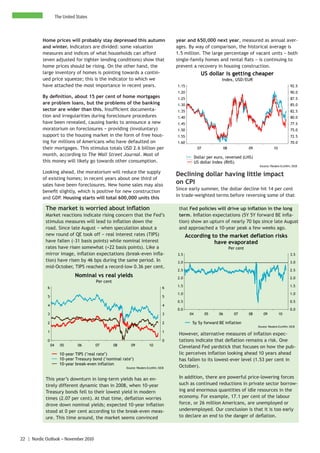
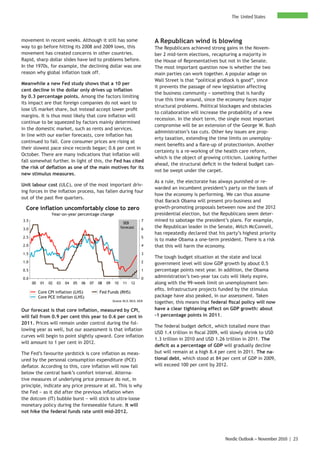
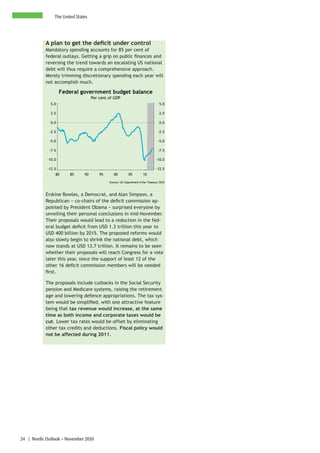
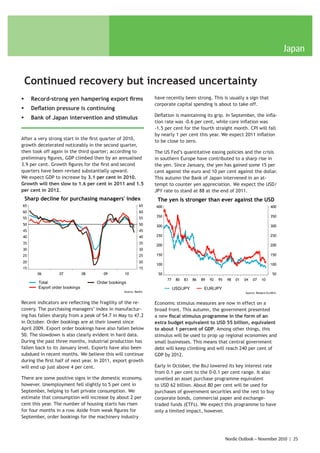
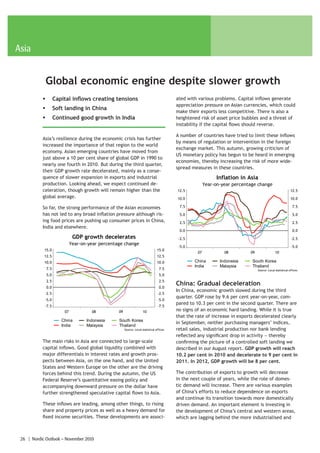
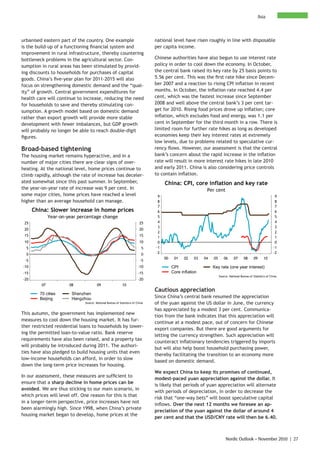
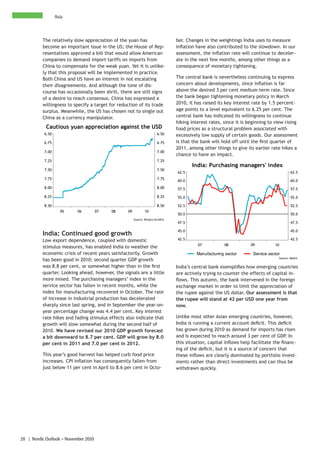
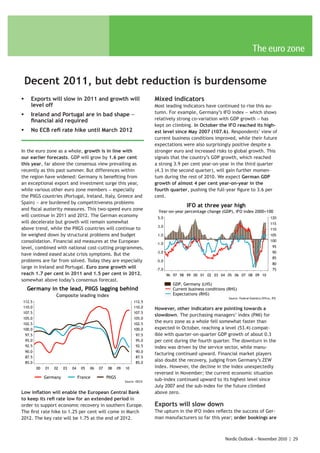
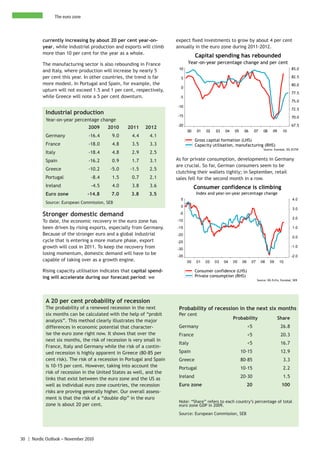
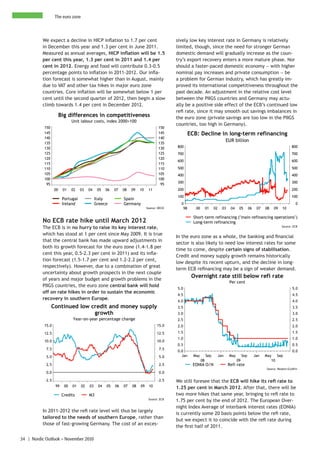
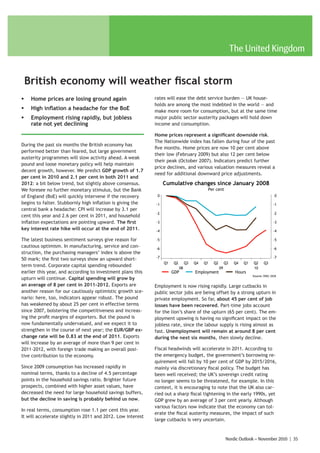
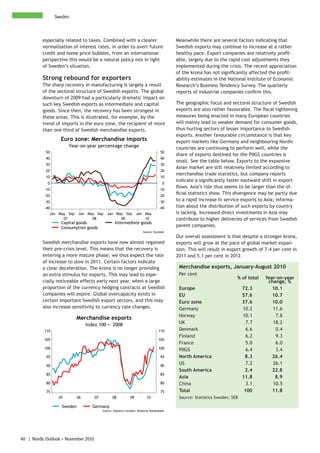
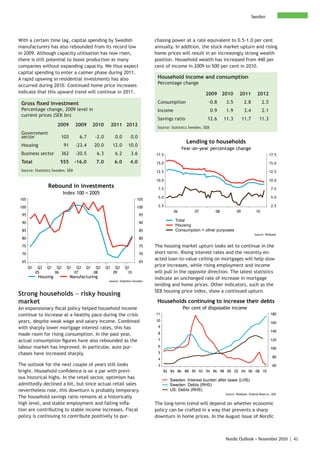
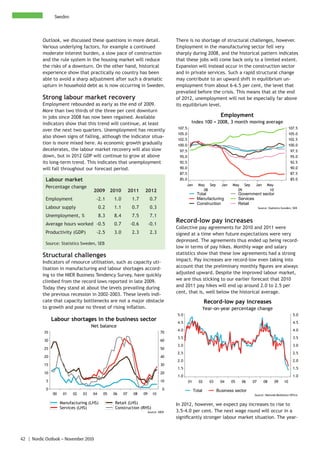
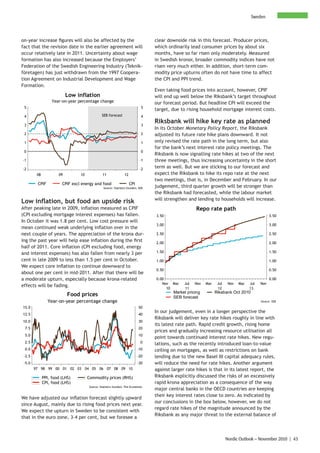
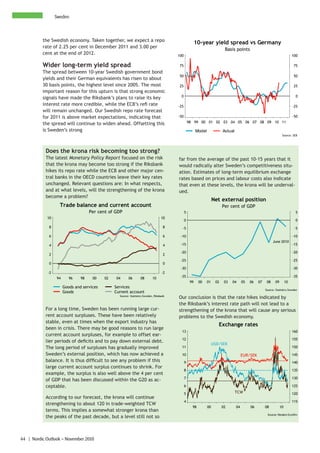
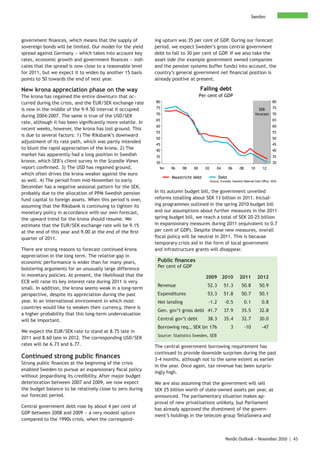
Economic Research – November 2010   — but mounting policy challenges
Contents


International overview                          5

Theme                                          16

The United States                              18

Japan                                          25

Asia                                           26

The euro zone                                  29

The United Kingdom                             35

Eastern Europe                                 36

The Baltics                                    37

Sweden                                         39

Denmark                                        48

Norway                                         49

Finland                                        53

Economic data                                  54


Boxes

Ireland the focus of new debt worries           8
Calmer commodity price trend                   10
Basel III update                               15
Unusually weak recovery                        19
Economy vulnerable to energy price shock       20
Long-term unemployment on the way down         20
QE will push up growth a bit                   21
The market is worried about inflation          22
A plan to get the deficit under control        24
A 20 per cent probability of recession         30
Watered-down sanctions when EU Stability and
Growth Pact is revised                         32
Does the krona risk becoming too strong?       44


                                                    Nordic Outlook – November 2010 | 3
Economic Research


          This report was published on November 24, 2010.

          Cut-off date for calculations and forecasts was November 18, 2010.


          Robert Bergqvist                                       Håkan Frisén
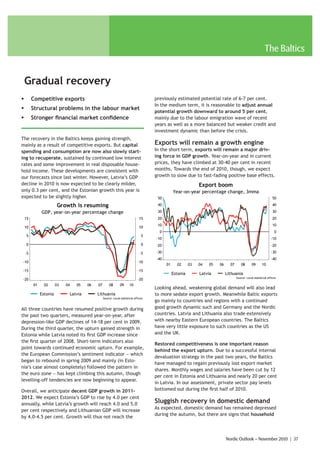
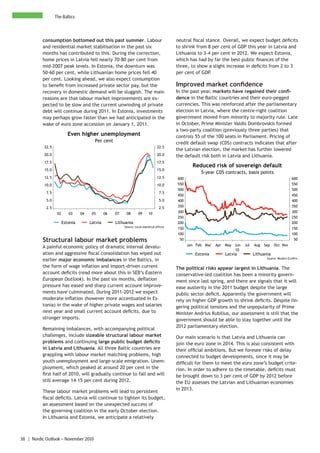
          Chief Economist                                        Head of Economic Research
          + 46 8 506 230 16                                      + 46 8 763 80 67

          Daniel Bergvall                                        Mattias Bruér
          Economist                                              Economist
          +46 8 763 85 94                                        + 46 8 763 85 06

          Ann Enshagen Lavebrink                                 Mikael Johansson
          Editorial Assistant                                    Economist
          + 46 8 763 80 77                                       + 46 8 763 80 93

          Andreas Johnson                                        Tomas Lindström
          Economist                                              Economist
          +46 8 763 80 32                                        + 46 8 763 80 28


          Gunilla Nyström                                        Ingela Hemming
          Global Head of Personal Finance Research               Global Head of Small Business Research
          + 46 8 763 65 81                                       + 46 8 763 82 97

          Susanne Eliasson                                       Johanna Wahlsten
          Personal Finance Analyst                               Small Business Analyst
          + 46 8 763 65 88                                       + 46 8 763 80 72

          SEB Economic Research, K-A3, SE-106 40 Stockholm


          Contributions to this report have been made by Thomas Köbel, Klaus Schrüfer, SEB Frankfurt/M and
          Olle Holmgren, Trading Strategy. Stein Bruun and Erica Blomgren, SEB Oslo are responsible for the Norwe-
          gian analysis. Financial analyses are done in collaboration with Trading Strategy and SEB Enskilda Equi-
          ties.


4 | Nordic Outlook – November 2010
International overview


    Brighter growth outlook, but
    mounting policy challenges

ƒ      Fed’s stimulus programme will help                  During the next couple of years, we foresee no major
                                                           inflation risks in the 33 countries of the Organisation
ƒ      Low inflation despite challenges                    for Economic Cooperation and Development (OECD),
ƒ      Continued debt worries in the euro zone             despite the ultra-loose monetary policies now being
                                                           pursued. Rising commodity prices and the effects of
ƒ      Dilemma for Nordic central banks                    weaker currencies will lead to slightly higher inflation,
                                                           but deflationary forces will continue to predominate.

In recent months the world economic outlook has            This means there is room for central banks in major
become somewhat brighter. Expectations of quantita-        OECD countries to hold off on hiking their key inter-
tive easing (QE) by the US Federal Reserve contributed     est rates for at least another year or so. In addition,
to stronger optimism, reflected among other things in      the effects of quantitative easing by the Fed and other
rising share prices. Meanwhile underlying economic         central banks will also help keep longer-term market
signals in the United States have been more reas-          interest rates down and stimulate asset prices. Over the
suring, after major disappointments during the sum-        next couple of years, fiscal policies in OECD countries
mer. Emerging economies have continued to perform          will not be as contractive as we previously expected,
strongly, and worries about a hard landing in China and    but ongoing debt retirement − mainly in the private
elsewhere have diminished. In Europe, too, economic        sector − and lingering weaknesses in the financial sys-
signals have been positive, for example in Germany, the    tem will help blunt the effects of monetary policy.
United Kingdom and various Nordic countries. At the
same time, though, uncertainty about the government        On the whole, we regard a somewhat higher growth
financial crisis in southern Europe and Ireland has once   forecast than previously as justified. We have raised
again increased alarmingly.                                both our 2010 and 2011 GDP forecast by 0.3 percent-
                                                           age points, both for the OECD and emerging markets.
                                                           Our upward revision for 2012 is somewhat smaller.
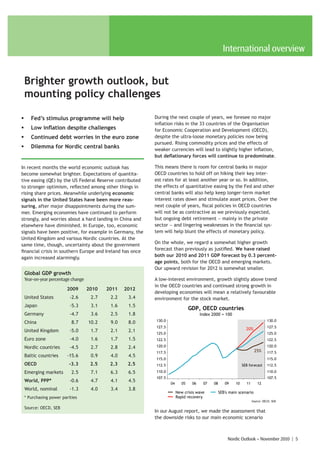
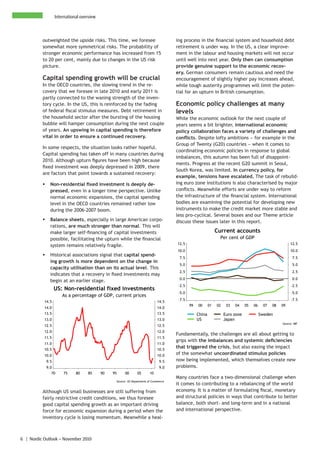
    Global GDP growth
    Year-on-year percentage change                         A low-interest environment, growth slightly above trend
                                                           in the OECD countries and continued strong growth in
                         2009        2010   2011   2012
                                                           developing economies will mean a relatively favourable
    United States          -2.6       2.7    2.2    3.4    environment for the stock market.
    Japan                  -5.3       3.1    1.6    1.5
                                                                                GDP, OECD countries
    Germany                -4.7       3.6    2.5    1.8                               Index 2000 = 100
                                                           130.0                                                                 130.0
    China                   8.7      10.2    9.0    8.0
                                                           127.5                                                                 127.5
    United Kingdom         -5.0       1.7    2.1    2.1                                                           20%
                                                           125.0                                                                 125.0
    Euro zone              -4.0       1.6    1.7    1.5    122.5                                                                 122.5

    Nordic countries       -4.5       2.7    2.8    2.4    120.0                                                                 120.0
                                                           117.5                                                        25%      117.5
    Baltic countries     -15.6        0.9    4.0    4.5
                                                           115.0                                                                 115.0
    OECD                  -3.3        2.5    2.3    2.5    112.5                                                SEB forecast     112.5
    Emerging markets        2.5       7.1    6.3    6.5    110.0                                                                 110.0
                                                           107.5                                                                 107.5
    World, PPP*            -0.6       4.7    4.1    4.5
                                                                   04      05    06    07    08      09    10     11       12
    World, nominal         -1.3       4.0    3.4    3.8
                                                                        New crisis wave           SEB's main scenario
    * Purchasing power parities                                         Rapid recovery
                                                                                                                       Source: OECD, SEB

    Source: OECD, SEB
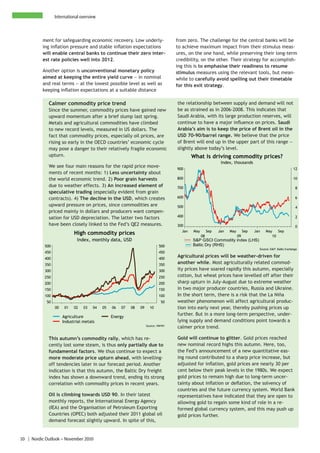
                                                           In our August report, we made the assessment that
                                                           the downside risks to our main economic scenario


                                                                                                       Nordic Outlook – November 2010 | 5
International overview


          outweighted the upside risks. This time, we foresee                          ing process in the financial system and household debt
          somewhat more symmetrical risks. The probability of                          retirement is under way. In the US, a clear improve-
          stronger economic performance has increased from 15                          ment in the labour and housing markets will not occur
          to 20 per cent, mainly due to changes in the US risk                         until well into next year. Only then can consumption
          picture.                                                                     provide genuine support to the economic recov-
                                                                                       ery. German consumers remain cautious and need the
          Capital spending growth will be crucial                                      encouragement of slightly higher pay increases ahead,
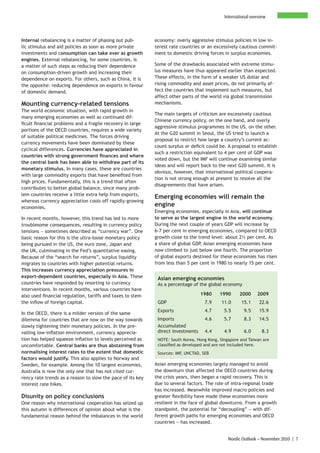
          In the OECD countries, the slowing trend in the re-                          while tough austerity programmes will limit the poten-
          covery that we foresee in late 2010 and early 2011 is                        tial for an upturn in British consumption.
          partly connected to the waning strength of the inven-
          tory cycle. In the US, this is reinforced by the fading                      Economic policy challenges at many
          of federal fiscal stimulus measures. Debt retirement in                      levels
          the household sector after the bursting of the housing                       While the economic outlook for the next couple of
          bubble will hamper consumption during the next couple                        years seems a bit brighter, international economic
          of years. An upswing in capital spending is therefore                        policy collaboration faces a variety of challenges and
          vital in order to ensure a continued recovery.                               conflicts. Despite lofty ambitions − for example in the
                                                                                       Group of Twenty (G20) countries − when it comes to
          In some respects, the situation looks rather hopeful.
                                                                                       coordinating economic policies in response to global
          Capital spending has taken off in many countries during
                                                                                       imbalances, this autumn has been full of disappoint-
          2010. Although upturn figures have been high because
                                                                                       ments. Progress at the recent G20 summit in Seoul,
          fixed investment was deeply depressed in 2009, there
                                                                                       South Korea, was limited. In currency policy, for
          are factors that point towards a sustained recovery:
                                                                                       example, tensions have escalated. The task of rebuild-
          ƒ     Non-residential fixed investment is deeply de-                         ing euro zone institutions is also characterised by major
                pressed, even in a longer time perspective. Unlike                     conflicts. Meanwhile efforts are under way to reform
                normal economic expansions, the capital spending                       the infrastructure of the financial system. International
                level in the OECD countries remained rather low                        bodies are examining the potential for developing new
                during the 2006-2007 boom.                                             instruments to make the credit market more stable and
                                                                                       less pro-cyclical. Several boxes and our Theme article
          ƒ     Balance sheets, especially in large American corpo-                    discuss these issues later in this report.
                rations, are much stronger than normal. This will
                make larger self-financing of capital investments                                                Current accounts
                possible, facilitating the upturn while the financial                                              Per cent of GDP
                                                                                       12.5                                                                 12.5
                system remains relatively fragile.
                                                                                       10.0                                                                 10.0
          ƒ     Historical associations signal that capital spend-
                                                                                        7.5                                                                   7.5
                ing growth is more dependent on the change in
                                                                                        5.0                                                                   5.0
                capacity utilisation than on its actual level. This
                                                                                        2.5                                                                   2.5
                indicates that a recovery in fixed investments may
                                                                                        0.0                                                                   0.0
                begin at an earlier stage.
                                                                                        -2.5                                                                 -2.5
                    US: Non-residential fixed investments
                                                                                        -5.0                                                                 -5.0
                        As a percentage of GDP, current prices
                                                                                        -7.5                                                                 -7.5
           14.5                                                                14.5
                                                                                               99   00      01   02    03   04    05   06    07   08   09
           14.0                                                                14.0
           13.5                                                                13.5                 China             Euro zone             Sweden
           13.0                                                                13.0                 US                Japan
                                                                                                                                                       Source: IMF
           12.5                                                                12.5
           12.0                                                                12.0
                                                                                       Fundamentally, the challenges are all about getting to
           11.5                                                                11.5
                                                                                       grips with the imbalances and systemic deficiencies
           11.0                                                                11.0
           10.5                                                                10.5
                                                                                       that triggered the crisis, but also easing the impact
           10.0                                                                10.0    of the somewhat uncoordinated stimulus policies
              9.5                                                               9.5    now being implemented, which themselves create new
              9.0                                                               9.0    problems.
                70      75     80    85      90   95    00       05       10
                                                                                       Many countries face a two-dimensional challenge when
                                                   Source: US Department of Commerce
                                                                                       it comes to contributing to a rebalancing of the world
          Although US small businesses are still suffering from                        economy. It is a matter of formulating fiscal, monetary
          fairly restrictive credit conditions, we thus foresee                        and structural policies in ways that contribute to better
          good capital spending growth as an important driving                         balance, both short- and long-term and in a national
          force for economic expansion during a period when the                        and international perspective.
          inventory cycle is losing momentum. Meanwhile a heal-


6 | Nordic Outlook – November 2010
International overview


Internal rebalancing is a matter of phasing out pub-        economy: overly aggressive stimulus policies in low in-
lic stimulus and aid policies as soon as more private       terest rate countries or an excessively cautious commit-
investments and consumption can take over as growth         ment to domestic driving forces in surplus economies.
engines. External rebalancing, for some countries, is
a matter of such steps as reducing their dependence         Some of the drawbacks associated with extreme stimu-
on consumption-driven growth and increasing their           lus measures have thus appeared earlier than expected.
dependence on exports. For others, such as China, it is     These effects, in the form of a weaker US dollar and
the opposite: reducing dependence on exports in favour      rising commodity and asset prices, do not primarily af-
of domestic demand.                                         fect the countries that implement such measures, but
                                                            affect other parts of the world via global transmission
Mounting currency-related tensions                          mechanisms.
The world economic situation, with rapid growth in
                                                            The main targets of criticism are excessively cautious
many emerging economies as well as continued dif-
                                                            Chinese currency policy, on the one hand, and overly
ficult financial problems and a fragile recovery in large
                                                            aggressive stimulus programmes in the US, on the other.
portions of the OECD countries, requires a wide variety
                                                            At the G20 summit in Seoul, the US tried to launch a
of suitable political medicines. The forces driving
                                                            proposal to restrict how large a country’s current ac-
currency movements have been dominated by these
                                                            count surplus or deficit could be. A proposal to establish
cyclical differences. Currencies have appreciated in
                                                            such a restriction equivalent to 4 per cent of GDP was
countries with strong government finances and where
                                                            voted down, but the IMF will continue examining similar
the central bank has been able to withdraw part of its
                                                            ideas and will report back to the next G20 summit. It is
monetary stimulus. In many cases, these are countries
                                                            obvious, however, that international political coopera-
with large commodity exports that have benefited from
                                                            tion is not strong enough at present to resolve all the
high prices. Fundamentally, this is a trend that often
                                                            disagreements that have arisen.
contributes to better global balance, since many prob-
lem countries receive a little extra help from exports,
                                                            Emerging economies will remain the
whereas currency appreciation cools off rapidly-growing
economies.
                                                            engine
                                                            Emerging economies, especially in Asia, will continue
In recent months, however, this trend has led to more       to serve as the largest engine in the world economy.
troublesome consequences, resulting in currency policy      During the next couple of years GDP will increase by
tensions − sometimes described as “currency war”. One       6-7 per cent in emerging economies, compared to OECD
basic reason for this is the ultra-loose monetary policy    growth close to the trend level: about 2½ per cent. As
being pursued in the US, the euro zone, Japan and           a share of global GDP, Asian emerging economies have
the UK, culminating in the Fed’s quantitative easing.       now climbed to just below one fourth. The proportion
Because of the “search for returns”, surplus liquidity      of global exports destined for these economies has risen
migrates to countries with higher potential returns.        from less than 5 per cent in 1980 to nearly 15 per cent.
This increases currency appreciation pressures in
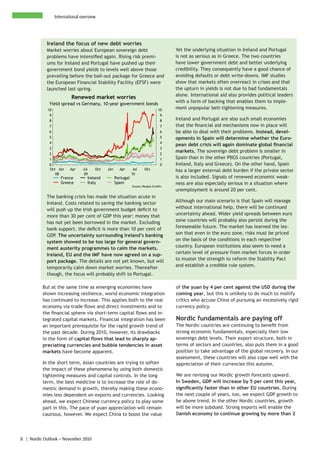
export-dependent countries, especially in Asia. These        Asian emerging economies
countries have responded by resorting to currency            As a percentage of the global economy
interventions. In recent months, various countries have
also used financial regulation, tariffs and taxes to stem                         1980     1990      2000     2009
the inflow of foreign capital.                               GDP                    7.9     11.0      15.1     22.6
                                                             Exports                4.7      5.5       9.5     15.9
In the OECD, there is a milder version of the same
dilemma for countries that are now on the way towards        Imports                4.6      5.7       8.3     14.5
slowly tightening their monetary policies. In the pre-       Accumulated
vailing low-inflation environment, currency apprecia-        direct investments     4.4      4.9       6.0       8.3
tion has helped squeeze inflation to levels perceived as     NOTE: South Korea, Hong Kong, Singapore and Taiwan are
uncomfortable. Central banks are thus abstaining from        classified as developed and are not included here.
normalising interest rates to the extent that domestic       Sources: IMF, UNCTAD, SEB
factors would justify. This also applies to Norway and
Sweden, for example. Among the 10 largest economies,        Asian emerging economies largely managed to avoid
Australia is now the only one that has not cited cur-       the downturn that affected the OECD countries during
rency rate trends as a reason to slow the pace of its key   the crisis years, then began a rapid recovery. This is
interest rate hikes.                                        due to several factors. The role of intra-regional trade
                                                            has increased. Meanwhile improved macro policies and
Disunity on policy conclusions                              greater flexibility have made these economies more
One reason why international cooperation has seized up      resilient in the face of global downturns. From a growth
this autumn is differences of opinion about what is the     standpoint, the potential for “decoupling” − with dif-
fundamental reason behind the imbalances in the world       ferent growth paths for emerging economies and OECD
                                                            countries − has increased.


                                                                                               Nordic Outlook – November 2010 | 7
International overview


            Ireland the focus of new debt worries
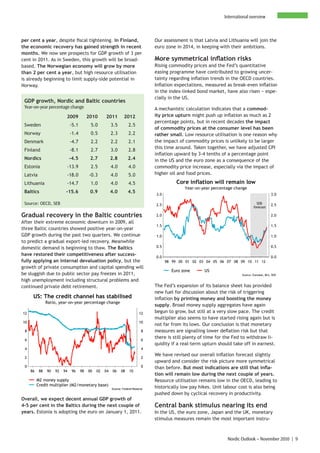
            Market worries about European sovereign debt                               Yet the underlying situation in Ireland and Portugal
            problems have intensified again. Rising risk premi-                        is not as serious as in Greece. The two countries
            ums for Ireland and Portugal have pushed up their                          have lower government debt and better underlying
            government bond yields to levels well above those                          credibility. They consequently have a good chance of
            prevailing before the bail-out package for Greece and                      avoiding defaults or debt write-downs. IMF studies
            the European Financial Stability Facility (EFSF) were                      show that markets often overreact in crises and that
            launched last spring.                                                      the upturn in yields is not due to bad fundamentals
                                                                                       alone. International aid also provides political leaders
                           Renewed market worries
             Yield spread vs Germany, 10-year government bonds
                                                                                       with a form of backing that enables them to imple-
             10                                                                  10    ment unpopular belt-tightening measures.
             9                                                                    9
             8                                                                    8    Ireland and Portugal are also such small economies
             7                                                                    7    that the financial aid mechanisms now in place will
             6                                                                    6    be able to deal with their problems. Instead, devel-
             5                                                                    5    opments in Spain will determine whether the Euro-
             4                                                                    4
                                                                                       pean debt crisis will again dominate global financial
             3                                                                    3
             2                                                                    2
                                                                                       markets. The sovereign debt problem is smaller in
             1                                                                    1    Spain than in the other PIIGS countries (Portugal,
             0                                                                    0    Ireland, Italy and Greece). On the other hand, Spain
             Oct Jan      Apr    Jul   Oct   Jan     Apr       Jul     Oct             has a larger external debt burden if the private sector
                08                09                          10
                     France        Ireland         Portugal                            is also included. Signals of renewed economic weak-
                     Greece        Italy           Spain                               ness are also especially serious in a situation where
                                                              Source: Reuters EcoWin
                                                                                       unemployment is around 20 per cent.
            The banking crisis has made the situation acute in
            Ireland. Costs related to saving the banking sector                        Although our main scenario is that Spain will manage
            will push up the Irish government budget deficit to                        without international help, there will be continued
            more than 30 per cent of GDP this year: money that                         uncertainty ahead. Wider yield spreads between euro
            has not yet been borrowed in the market. Excluding                         zone countries will probably also persist during the
            bank support, the deficit is more than 10 per cent of                      foreseeable future. The market has learned the les-
            GDP. The uncertainty surrounding Ireland’s banking                         son that even in the euro zone, risks must be priced
            system showed to be too large for general govern-                          on the basis of the conditions in each respective
            ment austerity programmes to calm the markets.                             country. European institutions also seem to need a
            Ireland, EU and the IMF have now agreed on a sup-                          certain level of pressure from market forces in order
            port package. The details are not yet known, but will                      to muster the strength to reform the Stability Pact
            temporarily calm down market worries. Thereafter                           and establish a credible rule system.
            though, the focus will probably shift to Portugal.

          But at the same time as emerging economies have                              of the yuan by 4 per cent against the USD during the
          shown increasing resilience, world economic integration                      coming year, but this is unlikely to do much to mollify
          has continued to increase. This applies both to the real                     critics who accuse China of pursuing an excessively rigid
          economy via trade flows and direct investments and to                        currency policy.
          the financial sphere via short-term capital flows and in-
          tegrated capital markets. Financial integration has been                     Nordic fundamentals are paying off
          an important prerequisite for the rapid growth trend of                      The Nordic countries are continuing to benefit from
          the past decade. During 2010, however, its drawbacks                         strong economic fundamentals, especially their low
          in the form of capital flows that lead to sharply ap-                        sovereign debt levels. Their export structure, both in
          preciating currencies and bubble tendencies in asset                         terms of sectors and countries, also puts them in a good
          markets have become apparent.                                                position to take advantage of the global recovery. In our
                                                                                       assessment, these countries will also cope well with the
          In the short term, Asian countries are trying to soften                      appreciation of their currencies this autumn.
          the impact of these phenomena by using both domestic
          tightening measures and capital controls. In the long                        We are revising our Nordic growth forecasts upward.
          term, the best medicine is to increase the role of do-                       In Sweden, GDP will increase by 5 per cent this year,
          mestic demand in growth, thereby making these econo-                         significantly faster than in other EU countries. During
          mies less dependent on exports and currencies. Looking                       the next couple of years, too, we expect GDP growth to
          ahead, we expect Chinese currency policy to play some                        be above trend. In the other Nordic countries, growth
          part in this. The pace of yuan appreciation will remain                      will be more subdued. Strong exports will enable the
          cautious, however. We expect China to boost the value                        Danish economy to continue growing by more than 2


8 | Nordic Outlook – November 2010
International overview


per cent a year, despite fiscal tightening. In Finland,                             Our assessment is that Latvia and Lithuania will join the
the economic recovery has gained strength in recent                                 euro zone in 2014, in keeping with their ambitions.
months. We now see prospects for GDP growth of 3 per
cent in 2011. As in Sweden, this growth will be broad-                              More symmetrical inflation risks
based. The Norwegian economy will grow by more                                      Rising commodity prices and the Fed’s quantitative
than 2 per cent a year, but high resource utilisation                               easing programme have contributed to growing uncer-
is already beginning to limit supply-side potential in                              tainty regarding inflation trends in the OECD countries.
Norway.                                                                             Inflation expectations, measured as break-even inflation
                                                                                    in the index-linked bond market, have also risen − espe-
                                                                                    cially in the US.
 GDP growth, Nordic and Baltic countries
 Year-on-year percentage change                                                     A mechanistic calculation indicates that a commod-
                           2009            2010      2011          2012             ity price upturn might push up inflation as much as 2
                                                                                    percentage points, but in recent decades the impact
 Sweden                        -5.1         5.0           3.5         2.5
                                                                                    of commodity prices at the consumer level has been
 Norway                        -1.4         0.5           2.3         2.2           rather small. Low resource utilisation is one reason why
 Denmark                       -4.7         2.2           2.2         2.1           the impact of commodity prices is unlikely to be larger
                                                                                    this time around. Taken together, we have adjusted CPI
 Finland                       -8.1         2.7           3.0         2.8
                                                                                    inflation upward by 3-4 tenths of a percentage point
 Nordics                       -4.5         2.7           2.8         2.4           in the US and the euro zone as a consequence of the
 Estonia                   -13.9            2.5           4.0         4.0           commodity price increase, especially via the impact of
 Latvia                    -18.0           -0.3           4.0         5.0           higher oil and food prices.

 Lithuania                 -14.7            1.0           4.0         4.5                      Core inflation will remain low
                                                                                                  Year-on-year percentage change
 Baltics                   -15.6            0.9           4.0         4.5
                                                                                    3.0                                                             3.0

 Source: OECD, SEB                                                                  2.5                                                 SEB         2.5
                                                                                                                                      forecast

Gradual recovery in the Baltic countries                                            2.0                                                             2.0
After their extreme economic downturn in 2009, all
                                                                                    1.5                                                             1.5
three Baltic countries showed positive year-on-year
GDP growth during the past two quarters. We continue                                1.0                                                             1.0
to predict a gradual export-led recovery. Meanwhile
domestic demand is beginning to thaw. The Baltics                                   0.5                                                             0.5

have restored their competitiveness after success-                                  0.0                                                             0.0
fully applying an internal devaluation policy, but the                                    98 99 00 01 02 03 04 05 06 07 08 09 10 11 12
growth of private consumption and capital spending will
                                                                                            Euro zone      US
be sluggish due to public sector pay freezes in 2011,                                                                         Source: Eurostat, BLS, SEB

high unemployment including structural problems and
continued private debt retirement.                                                  The Fed’s expansion of its balance sheet has provided
                                                                                    new fuel for discussion about the risk of triggering
      US: The credit channel has stabilised                                         inflation by printing money and boosting the money
                Ratio, year-on-year percentage change
                                                                                    supply. Broad money supply aggregates have again
12                                                                            12    begun to grow, but still at a very slow pace. The credit
                                                                                    multiplier also seems to have started rising again but is
10                                                                            10
                                                                                    not far from its lows. Our conclusion is that monetary
 8                                                                             8    measures are signalling lower deflation risk but that
 6                                                                             6
                                                                                    there is still plenty of time for the Fed to withdraw li-
                                                                                    quidity if a real-term upturn should take off in earnest.
 4                                                                             4
                                                                                    We have revised our overall inflation forecast slightly
 2                                                                             2
                                                                                    upward and consider the risk picture more symmetrical
 0                                                                             0    than before. But most indications are still that infla-
     86    88   90   92   94    96    98   00   02   04    06    08    10
                                                                                    tion will remain low during the next couple of years.
          M2 money supply                                                           Resource utilisation remains low in the OECD, leading to
          Credit multiplier (M2/monetary base)
                                                          Source: Federal Reserve   historically low pay hikes. Unit labour cost is also being
                                                                                    pushed down by cyclical recovery in productivity.
Overall, we expect decent annual GDP growth of
4-5 per cent in the Baltics during the next couple of                               Central bank stimulus nearing its end
years. Estonia is adopting the euro on January 1, 2011.                             In the US, the euro zone, Japan and the UK, monetary
                                                                                    stimulus measures remain the most important instru-


                                                                                                                      Nordic Outlook – November 2010 | 9
International overview


          ment for safeguarding economic recovery. Low underly-                    from zero. The challenge for the central banks will be
          ing inflation pressure and stable inflation expectations                 to achieve maximum impact from their stimulus meas-
          will enable central banks to continue their zero inter-                  ures, on the one hand, while preserving their long-term
          est rate policies well into 2012.                                        credibility, on the other. Their strategy for accomplish-
                                                                                   ing this is to emphasise their readiness to resume
          Another option is unconventional monetary policy                         stimulus measures using the relevant tools, but mean-
          aimed at keeping the entire yield curve − in nominal                     while to carefully avoid spelling out their timetable
          and real terms − at the lowest possible level as well as                 for this exit strategy.
          keeping inflation expectations at a suitable distance

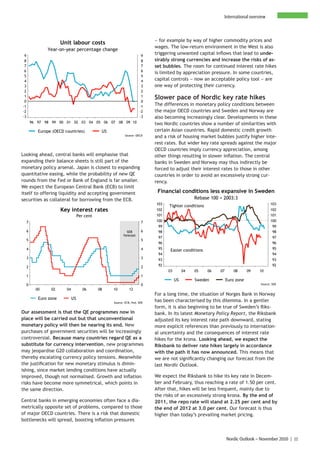
             Calmer commodity price trend                                          the relationship between supply and demand will not
             Since the summer, commodity prices have gained new                    be as strained as in 2006-2008. This indicates that
             upward momentum after a brief slump last spring.                      Saudi Arabia, with its large production reserves, will
             Metals and agricultural commodities have climbed                      continue to have a major influence on prices. Saudi
             to new record levels, measured in US dollars. The                     Arabia’s aim is to keep the price of Brent oil in the
             fact that commodity prices, especially oil prices, are                USD 70-90/barrel range. We believe that the price
             rising so early in the OECD countries’ economic cycle                 of Brent will end up in the upper part of this range −
             may pose a danger to their relatively fragile economic                slightly above today’s level.
             upturn.                                                                       What is driving commodity prices?
                                                                                                             Index, thousands
             We see four main reasons for the rapid price move-                    900                                                                        12
             ments of recent months: 1) Less uncertainty about
             the world economic trend. 2) Poor grain harvests                      800                                                                        10
             due to weather effects. 3) An increased element of                    700                                                                         8
             speculative trading (especially evident from grain
             contracts). 4) The decline in the USD, which creates                  600                                                                         6
             upward pressure on prices, since commodities are                      500                                                                         4
             priced mainly in dollars and producers want compen-
                                                                                   400
             sation for USD depreciation. The latter two factors                                                                                               2

             have been closely linked to the Fed’s QE2 measures.                   300                                                                         0
                                                                                     Jan   May        Sep   Jan   May        Sep   Jan   May   Sep
                            High commodity prices                                                08                     09                  10
                             Index, monthly data, USD                                      S&P GSCI Commodity index (LHS)
           500                                                              500            Baltic Dry (RHS)
                                                                                                                                     Source: S&P, Baltic Exchange
           450                                                              450
           400                                                              400
                                                                                   Agricultural prices will be weather-driven for
           350                                                              350    another while. Most agriculturally related commod-
           300                                                              300    ity prices have soared rapidly this autumn, especially
           250                                                              250    cotton, but wheat prices have levelled off after their
           200                                                              200    sharp upturn in July-August due to extreme weather
           150                                                              150    in two major producer countries, Russia and Ukraine.
           100                                                              100    In the short term, there is a risk that the La Niña
            50                                                               50    weather phenomenon will affect agricultural produc-
                 00    01   02   03   04   05   06   07   08   09     10           tion into early next year, thereby pushing prices up
                      Agriculture               Energy
                                                                                   further. But in a more long-term perspective, under-
                      Industrial metals                                            lying supply and demand conditions point towards a
                                                                    Source: HWWI
                                                                                   calmer price trend.

             This autumn’s commodity rally, which has re-                          Gold will continue to glitter. Gold prices reached
             cently lost some steam, is thus only partially due to                 new nominal record highs this autumn. Here, too,
             fundamental factors. We thus continue to expect a                     the Fed’s announcement of a new quantitative eas-
             more moderate price upturn ahead, with levelling-                     ing round contributed to a sharp price increase, but
             off tendencies later in our forecast period. Another                  adjusted for inflation, gold prices are nearly 30 per
             indication is that this autumn, the Baltic Dry freight                cent below their peak levels in the 1980s. We expect
             index has shown a downward trend, ending its strong                   gold prices to remain high due to long-term uncer-
             correlation with commodity prices in recent years.                    tainty about inflation or deflation, the solvency of
                                                                                   countries and the future currency system. World Bank
             Oil is climbing towards USD 90. In their latest                       representatives have indicated that they are open to
             monthly reports, the International Energy Agency                      allowing gold to regain some kind of role in a re-
             (IEA) and the Organisation of Petroleum Exporting                     formed global currency system, and this may push up
             Countries (OPEC) both adjusted their 2011 global oil                  gold prices further.
             demand forecast slightly upward. In spite of this,


10 | Nordic Outlook – November 2010
International overview


                                                                             − for example by way of higher commodity prices and
                        Unit labour costs
                                                                             wages. The low-return environment in the West is also
                Year-on-year percentage change
 9                                                                      9
                                                                             triggering unwanted capital inflows that lead to unde-
 8                                                                      8    sirably strong currencies and increase the risks of as-
 7                                                                      7    set bubbles. The room for continued interest rate hikes
 6                                                                      6
                                                                             is limited by appreciation pressure. In some countries,
 5                                                                      5
 4                                                                      4    capital controls − now an acceptable policy tool − are
 3                                                                      3    one way of protecting their currency.
 2                                                                      2
 1
 0
                                                                        1
                                                                        0
                                                                             Slower pace of Nordic key rate hikes
-1                                                                     -1
                                                                             The differences in monetary policy conditions between
-2                                                                     -2    the major OECD countries and Sweden and Norway are
-3                                                                     -3    also becoming increasingly clear. Developments in these
         96 97 98 99 00 01 02 03 04 05 06 07 08 09 10                        two Nordic countries show a number of similarities with
            Europe (OECD countries)             US                           certain Asian countries. Rapid domestic credit growth
                                                             Source: OECD
                                                                             and a risk of housing market bubbles justify higher inte-
                                                                             rest rates. But wider key rate spreads against the major
                                                                             OECD countries imply currency appreciation, among
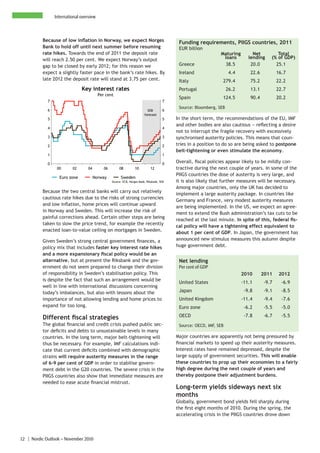
Looking ahead, central banks will emphasise that                             other things resulting in slower inflation. The central
expanding their balance sheets is still part of the                          banks in Sweden and Norway may thus indirectly be
monetary policy arsenal. Japan is closest to expanding                       forced to adjust their interest rates to those in other
quantitative easing, while the probability of new QE                         countries in order to avoid an excessively strong cur-
rounds from the Fed or Bank of England is far smaller.                       rency.
We expect the European Central Bank (ECB) to limit
itself to offering liquidity and accepting government                         Financial conditions less expansive in Sweden
securities as collateral for borrowing from the ECB.                                              Rebase 100 = 2003:3
                                                                             103                                                         103
                                                                                   Tighter conditions
                        Key interest rates                                   102                                                         102
                                    Per cent                                 101                                                         101
     7                                                                  7    100                                                         100
                                                                              99                                                          99
     6                                                        SEB       6     98                                                          98
                                                            forecast
                                                                              97                                                           97
     5                                                                  5
                                                                              96                                                           96
     4                                                                  4     95    Easier conditions                                      95
                                                                              94                                                           94
     3                                                                  3     93                                                           93
     2                                                                  2     92                                                           92
                                                                                   03        04   05    06   07       08      09   10
     1                                                                  1
                                                                                        US        Sweden          Euro zone
     0                                                                  0                                                          Source: SEB
           00     02      04           06      08    10         12
                                                                             For a long time, the situation of Norges Bank in Norway
            Euro zone          US
                                                     Source: ECB, Fed, SEB
                                                                             has been characterised by this dilemma. In a gentler
                                                                             form, it is also beginning to be true of Sweden’s Riks-
Our assessment is that the QE programmes now in                              bank. In its latest Monetary Policy Report, the Riksbank
place will be carried out but that unconventional                            adjusted its key interest rate path downward, stating
monetary policy will then be nearing its end. New                            more explicit references than previously to internation-
purchases of government securities will be increasingly                      al uncertainty and the consequences of interest rate
controversial. Because many countries regard QE as a                         hikes for the krona. Looking ahead, we expect the
substitute for currency intervention, new programmes                         Riksbank to deliver rate hikes largely in accordance
may jeopardise G20 collaboration and coordination,                           with the path it has now announced. This means that
thereby escalating currency policy tensions. Meanwhile                       we are not significantly changing our forecast from the
the justification for new monetary stimulus is dimin-                        last Nordic Outlook.
ishing, since market lending conditions have actually
improved, though not normalised. Growth and inflation                        We expect the Riksbank to hike its key rate in Decem-
risks have become more symmetrical, which points in                          ber and February, thus reaching a rate of 1.50 per cent.
the same direction.                                                          After that, hikes will be less frequent, mainly due to
                                                                             the risks of an excessively strong krona. By the end of
Central banks in emerging economies often face a dia-                        2011, the repo rate will stand at 2.25 per cent and by
metrically opposite set of problems, compared to those                       the end of 2012 at 3.0 per cent. Our forecast is thus
of major OECD countries. There is a risk that domestic                       higher than today’s prevailing market pricing.
bottlenecks will spread, boosting inflation pressures


                                                                                                                  Nordic Outlook – November 2010 | 11
International overview


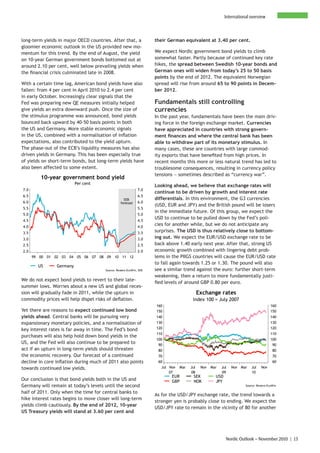
          Because of low inflation in Norway, we expect Norges                               Funding requirements, PIIGS countries, 2011
          Bank to hold off until next summer before resuming                                 EUR billion
          rate hikes. Towards the end of 2011 the deposit rate                                                   Maturing         Net         Total
          will reach 2.50 per cent. We expect Norway’s output                                                     loans         lending    (% of GDP)
          gap to be closed by early 2012; for this reason we                                 Greece                38.5          20.0        25.1
          expect a slightly faster pace in the bank’s rate hikes. By                         Ireland                   4.4       22.6          16.7
          late 2012 the deposit rate will stand at 3.75 per cent.                            Italy                279.4          75.2          22.2
                               Key interest rates                                            Portugal                 26.2       13.1          22.7
                                          Per cent
                                                                                             Spain                124.5          90.4          20.2
             7                                                                         7
                                                                                             Source: Bloomberg, SEB
             6                                                              SEB        6
                                                                          forecast
             5                                                                         5    In the short term, the recommendations of the EU, IMF
                                                                                            and other bodies are also cautious − reflecting a desire
             4                                                                         4
                                                                                            not to interrupt the fragile recovery with excessively
             3                                                                         3    synchronised austerity policies. This means that coun-
             2                                                                         2    tries in a position to do so are being asked to postpone
                                                                                            belt-tightening or even stimulate the economy.
             1                                                                         1

             0                                                                         0    Overall, fiscal policies appear likely to be mildly con-
                  00      02       04        06        08          10          12           tractive during the next couple of years. In some of the
                                                                                            PIIGS countries the dose of austerity is very large, and
                   Euro zone            Norway          Sweden
                                                  Source: ECB, Norges Bank, Riksbank, SEB   it is also likely that further measures will be necessary.
                                                                                            Among major countries, only the UK has decided to
          Because the two central banks will carry out relatively
                                                                                            implement a large austerity package. In countries like
          cautious rate hikes due to the risks of strong currencies
                                                                                            Germany and France, very modest austerity measures
          and low inflation, home prices will continue upward
                                                                                            are being implemented. In the US, we expect an agree-
          in Norway and Sweden. This will increase the risk of
                                                                                            ment to extend the Bush administration’s tax cuts to be
          painful corrections ahead. Certain other steps are being
                                                                                            reached at the last minute. In spite of this, federal fis-
          taken to slow the price trend, for example the recently
                                                                                            cal policy will have a tightening effect equivalent to
          enacted loan-to-value ceiling on mortgages in Sweden.
                                                                                            about 1 per cent of GDP. In Japan, the government has
          Given Sweden’s strong central government finances, a                              announced new stimulus measures this autumn despite
          policy mix that includes faster key interest rate hikes                           huge government debt.
          and a more expansionary fiscal policy would be an
          alternative, but at present the Riksbank and the gov-                              Net lending
          ernment do not seem prepared to change their division                              Per cent of GDP
          of responsibility in Sweden’s stabilisation policy. This                                                           2010       2011    2012
          is despite the fact that such an arrangement would be
                                                                                             United States                   -11.1      -9.7     -6.9
          well in line with international discussions concerning
          today’s imbalances, but also with lessons about the                                Japan                            -9.8      -9.1     -8.5
          importance of not allowing lending and home prices to                              United Kingdom                  -11.4      -9.4     -7.6
          expand for too long.                                                               Euro zone                        -6.2      -5.5     -5.0
          Different fiscal strategies                                                        OECD                             -7.8      -6.7     -5.5
          The global financial and credit crisis pushed public sec-                          Source: OECD, IMF, SEB
          tor deficits and debts to unsustainable levels in many
          countries. In the long term, major belt-tightening will                           Major countries are apparently not being pressured by
          thus be necessary. For example, IMF calculations indi-                            financial markets to speed up their austerity measures.
          cate that current deficits combined with demographic                              Interest rates have remained depressed, despite the
          strains will require austerity measures in the range                              large supply of government securities. This will enable
          of 6-9 per cent of GDP in order to stabilise govern-                              these countries to prop up their economies to a fairly
          ment debt in the G20 countries. The severe crisis in the                          high degree during the next couple of years and
          PIIGS countries also show that immediate measures are                             thereby postpone their adjustment burdens.
          needed to ease acute financial mistrust.
                                                                                            Long-term yields sideways next six
                                                                                            months
                                                                                            Globally, government bond yields fell sharply during
                                                                                            the first eight months of 2010. During the spring, the
                                                                                            accelerating crisis in the PIIGS countries drove down


12 | Nordic Outlook – November 2010
International overview


long-term yields in major OECD countries. After that, a              their German equivalent at 3.40 per cent.
gloomier economic outlook in the US provided new mo-
mentum for this trend. By the end of August, the yield               We expect Nordic government bond yields to climb
on 10-year German government bonds bottomed out at                   somewhat faster. Partly because of continued key rate
around 2.10 per cent, well below prevailing yields when              hikes, the spread between Swedish 10-year bonds and
the financial crisis culminated late in 2008.                        German ones will widen from today’s 25 to 50 basis
                                                                     points by the end of 2012. The equivalent Norwegian
With a certain time lag, American bond yields have also              spread will rise from around 65 to 90 points in Decem-
fallen: from 4 per cent in April 2010 to 2.4 per cent                ber 2012.
in early October. Increasingly clear signals that the
Fed was preparing new QE measures initially helped                   Fundamentals still controlling
give yields an extra downward push. Once the size of                 currencies
the stimulus programme was announced, bond yields                    In the past year, fundamentals have been the main driv-
bounced back upward by 40-50 basis points in both                    ing force in the foreign exchange market. Currencies
the US and Germany. More stable economic signals                     have appreciated in countries with strong govern-
in the US, combined with a normalisation of inflation                ment finances and where the central bank has been
expectations, also contributed to the yield upturn.                  able to withdraw part of its monetary stimulus. In
The phase-out of the ECB’s liquidity measures has also               many cases, these are countries with large commod-
driven yields in Germany. This has been especially true              ity exports that have benefited from high prices. In
of yields on short-term bonds, but long-term yields have             recent months this more or less natural trend has led to
also been affected to some extent.                                   troublesome consequences, resulting in currency policy
                                                                     tensions − sometimes described as “currency war”.
         10-year government bond yield
                          Per cent
                                                                     Looking ahead, we believe that exchange rates will
7.0                                                           7.0
                                                                     continue to be driven by growth and interest rate
6.5                                                           6.5
                                                    SEB              differentials. In this environment, the G3 currencies
6.0                                               forecast    6.0
                                                                     (USD, EUR and JPY) and the British pound will be losers
5.5                                                           5.5
                                                                     in the immediate future. Of this group, we expect the
5.0                                                           5.0
4.5                                                           4.5
                                                                     USD to continue to be pulled down by the Fed’s poli-
4.0                                                           4.0
                                                                     cies for another while, but we do not anticipate any
3.5                                                           3.5
                                                                     surprises. The USD is thus relatively close to bottom-
3.0                                                           3.0    ing out. We expect the EUR/USD exchange rate to be
2.5                                                           2.5    back above 1.40 early next year. After that, strong US
2.0                                                           2.0    economic growth combined with lingering debt prob-
      99 00 01 02 03 04 05 06 07 08 09 10 11 12                      lems in the PIIGS countries will cause the EUR/USD rate
                                                                     to fall again towards 1.25 or 1.30. The pound will also
        US      Germany
                                       Source: Reuters EcoWin, SEB   see a similar trend against the euro: further short-term
                                                                     weakening, then a return to more fundamentally justi-
We do not expect bond yields to revert to their late-
                                                                     fied levels of around GBP 0.80 per euro.
summer lows. Worries about a new US and global reces-
sion will gradually fade in 2011, while the upturn in                                         Exchange rates
commodity prices will help dispel risks of deflation.                                    Index 100 = July 2007
                                                                     160                                                                 160
Yet there are reasons to expect continued low bond                   150                                                                 150
yields ahead. Central banks will be pursuing very                    140                                                                 140
expansionary monetary policies, and a normalisation of               130                                                                 130
key interest rates is far away in time. The Fed’s bond               120                                                                 120
                                                                     110                                                                 110
purchases will also help hold down bond yields in the
                                                                     100                                                                 100
US, and the Fed will also continue to be prepared to                  90                                                                  90
act if an upturn in long-term yields should threaten                  80                                                                   80
the economic recovery. Our forecast of a continued                    70                                                                   70
decline in core inflation during much of 2011 also points             60                                                                   60
towards continued low yields.                                           Jul Nov   Mar   Jul    Nov   Mar   Jul   Nov Mar    Jul    Nov
                                                                            07          08                 09               10
                                                                             EUR         SEK           USD
Our conclusion is that bond yields both in the US and                        GBP         NOK           JPY
Germany will remain at today’s levels until the second                                                                  Source: Reuters EcoWin

half of 2011. Only when the time for central banks to
                                                                     As for the USD/JPY exchange rate, the trend towards a
hike interest rates begins to move closer will long-term
                                                                     stronger yen is probably close to ending. We expect the
yields climb cautiously. By the end of 2012, 10-year
                                                                     USD/JPY rate to remain in the vicinity of 80 for another
US Treasury yields will stand at 3.60 per cent and


                                                                                                             Nordic Outlook – November 2010 | 13
International overview


          while and then gradually move towards 100 as American
                                                                           Stock markets still below 2007 peaks
          long-term yields slowly creep upward.                                          Rebase 100 = 2007:7
                                                                     120                                                               120
          The Riksbank’s lowering of its key interest rate path
                                                                     110                                                               110
          in October contributed to a temporary reversal in
                                                                     100                                                               100
          the Swedish krona appreciation trend, but we expect
                                                                      90                                                                90
          this appreciation to regain its strength as the Riks-
                                                                      80                                                                80
          bank delivers further key rate hikes in December and
                                                                      70                                                                70
          February. We believe that because of continued good
                                                                      60                                                                60
          export growth and a favourable valuation, the EUR/SEK       50                                                                50
          exchange rate will reach 9.00 during the first half of      40                                                                40
          2011 and then continue to 8.75 by the end of 2011.          30                                                                30
                                                                        Oct Feb   Jun Oct   Feb   Jun Oct      Feb    Jun     Oct
          The Norwegian krone has lost ground recently, since             07        08              09                  10
          both monetary policy and the flow outlook have wors-               US              Emerging markets
          ened. Norges Bank has underscored its displeasure while            Euro zone       Sweden
                                                                                                                Source: Reuters EcoWin, SEB
          carrying out large sales of NOK on behalf of the Govern-
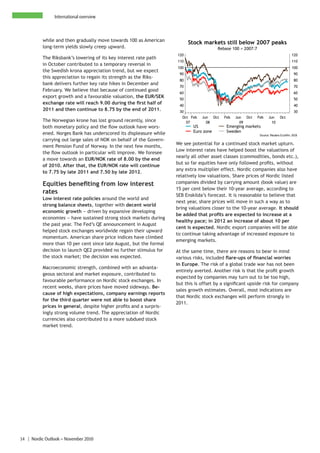
                                                                     We see potential for a continued stock market upturn.
          ment Pension Fund of Norway. In the next few months,
                                                                     Low interest rates have helped boost the valuations of
          the flow outlook in particular will improve. We foresee
                                                                     nearly all other asset classes (commodities, bonds etc.),
          a move towards an EUR/NOK rate of 8.00 by the end
                                                                     but so far equities have only followed profits, without
          of 2010. After that, the EUR/NOK rate will continue
                                                                     any extra multiplier effect. Nordic companies also have
          to 7.75 by late 2011 and 7.50 by late 2012.
                                                                     relatively low valuations. Share prices of Nordic listed
          Equities benefiting from low interest                      companies divided by carrying amount (book value) are
                                                                     15 per cent below their 10-year average, according to
          rates                                                      SEB Enskilda’s forecast. It is reasonable to believe that
          Low interest rate policies around the world and
                                                                     next year, share prices will move in such a way as to
          strong balance sheets, together with decent world
                                                                     bring valuations closer to the 10-year average. It should
          economic growth − driven by expansive developing
                                                                     be added that profits are expected to increase at a
          economies − have sustained strong stock markets during
                                                                     healthy pace; in 2012 an increase of about 10 per
          the past year. The Fed’s QE announcement in August
                                                                     cent is expected. Nordic export companies will be able
          helped stock exchanges worldwide regain their upward
                                                                     to continue taking advantage of increased exposure to
          momentum. American share price indices have climbed
                                                                     emerging markets.
          more than 10 per cent since late August, but the formal
          decision to launch QE2 provided no further stimulus for    At the same time, there are reasons to bear in mind
          the stock market; the decision was expected.               various risks, included flare-ups of financial worries
                                                                     in Europe. The risk of a global trade war has not been
          Macroeconomic strength, combined with an advanta-
                                                                     entirely averted. Another risk is that the profit growth
          geous sectoral and market exposure, contributed to
                                                                     expected by companies may turn out to be too high,
          favourable performance on Nordic stock exchanges. In
                                                                     but this is offset by a significant upside risk for company
          recent weeks, share prices have moved sideways. Be-
                                                                     sales growth estimates. Overall, most indications are
          cause of high expectations, company earnings reports
                                                                     that Nordic stock exchanges will perform strongly in
          for the third quarter were not able to boost share
                                                                     2011.
          prices in general, despite higher profits and a surpris-
          ingly strong volume trend. The appreciation of Nordic
          currencies also contributed to a more subdued stock
          market trend.


14 | Nordic Outlook – November 2010
International overview


Basel III update
In November 2010, the G20 heads of state and gov-          in order to avoid regulatory restrictions on their
ernment who met in Seoul gave the green light to           operations. In addition, depending on economic and
the implementation of Basel III, based on a proposal       financial circumstances, the authorities may imple-
by the Basel Committee on Banking Supervision.             ment a counter-cyclical capital buffer, which may
This decision will mean a gradual phase-in of tighter      vary between 0 and 2.5 per cent. If all these capital
capital adequacy rules (starting in January 2013) and      adequacy requirements are fully implemented, this
new global minimum liquidity rules (starting in 2015)      means that the level of core Tier 1 capital will be
by 2018. The purpose of Basel III is to strengthen the     raised from 2 to a maximum of 9.5 per cent and for
resilience of the banking sector, prevent excessive        Tier 1 capital from 4 to 11 per cent. The situation will
risk-taking and leveraging and reduce the pro-cyclical     also include a stricter definition of what should be
effect of the financial system on the real economy.        regarded as capital.

In the long term, these changes will create greater        The liquidity rules are based on two measures: The
stability both in the financial system and in the real     liquidity coverage ratio and the net stable fund-
economy. Because there will be increased competi-          ing ratio. The first measure requires a bank to hold
tion for capital, however, it will lead to higher inter-   enough liquid assets to survive 30 days of major
est rates, lower capital supply and resulting costs        funding problems. The second measure is aimed at
to the real economy during the transitional period         achieving a better balance between the maturities of
2012-2018. There are strong differences of opinion         a bank’s assets and liabilities, that is, to ensure that
as to the magnitude of these effects, but the exten-       available stable funding will be larger than the need
sion of this transition period compared to the original    for such funding. In addition to these measures, a
December 2009 proposal will reduce such adverse            leverage ratio will be tested, specifying that capital
effects.                                                   must exceed 3 per cent of the bank’s exposures.

In brief, Basel III will mean that the minimum require-    For Nordic banks, the most significant features of
ment for the core Tier 1 capital ratio will be raised      Basel III are the changes in liquidity rules. More
from 2 to 4.5 per cent of a bank’s risk-weighted as-       long-term, stable borrowing via an amended borrow-
sets. The requirement for Tier 1 capital will be raised    ing structure and longer maturities will increase the
from 4 to 6 per cent. In addition, banks must hold a       expenses of banks. This will affect interest rates for
capital conservation buffer of 2.5 per cent of risk-       borrowers as well as the profitability of the banking
weighted assets. This means that banks must have           sector.
total common equity of at least 7 per cent


                                                                                            Nordic Outlook – November 2010 | 15
Theme


              Greater need for new monetary system
          ƒ    Meagre Seoul summit but progress in 2010                The contours of a new monetary system
                                                                       The world has gone without a formal international mon-
          ƒ    New global monetary system on agenda
                                                                       etary system for nearly 40 years. The Bretton Woods
                                                                       (BW) system was ended in 1971 after having been
                                                                       operating since 1945. BW was a global fixed exchange
          This autumn the climate of cooperation among the             rate system anchored by the US dollar, and indirect by
          Group of 20 countries has deteriorated. There are            gold. This system also resulted in the establishment of
          several reasons for this worrisome disunity. The need        the International Monetary Fund. The IMF was assigned
          for private and public debt retirement is hampering the      the task of focusing on balance of payments problems,
          domestic growth dynamic in many countries, increasing        currency policy and free trade in order to promote eco-
          their dependence on exports and thus tempting them to        nomic growth and trade, generate income and jobs and
          weaken their currencies in various ways. There is also       stop competitive devaluations.
          genuine disagreement among G20 countries about the
          actual causes of their shared imbalances and systemic        For four decades, the US dollar has remained the de
          problems. Many countries have weak governments, also         facto anchor in the “non-system” that followed BW.
          making it harder to implement politically demanding          But this question has been raised: Does the world need
          belt-tightening and structural reforms.                      a new multilateral monetary system in order to reduce
                                                                       economic imbalances and return to high and stable eco-
          But on some points, the G20 summit confirmed progress        nomic growth? The G20 has entrusted the IMF − during
          made in recent international discussions, for example,       France’s G20 chairmanship in 2011 − to present propos-
          the decision to introduce new capital adequacy and           als on the mechanisms for a new system.
          liquidity requirements for banks (Basel III). In addition,
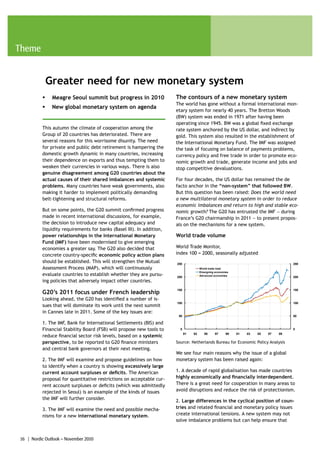
          power relationships in the International Monetary            World trade volume
          Fund (IMF) have been modernised to give emerging
          economies a greater say. The G20 also decided that           World Trade Monitor,
          concrete country-specific economic policy action plans       index 100 = 2000, seasonally adjusted
          should be established. This will strengthen the Mutual       250                                                            250
          Assessment Process (MAP), which will continuously                            World trade total
                                                                                       Emergning economies
          evaluate countries to establish whether they are pursu-      200             Advanced economies
                                                                                                                                      200
          ing policies that adversely impact other countries.
                                                                       150                                                            150
          G20’s 2011 focus under French leadership
          Looking ahead, the G20 has identified a number of is-
                                                                       100                                                            100
          sues that will dominate its work until the next summit
          in Cannes late in 2011. Some of the key issues are:
                                                                        50                                                            50

          1. The IMF, Bank for International Settlements (BIS) and
          Financial Stability Board (FSB) will propose new tools to      0                                                            0
                                                                             91   93      95     97     99   01   03   05   07   09
          reduce financial sector risk levels, based on a systemic
          perspective, to be reported to G20 finance ministers         Source: Netherlands Bureau for Economic Policy Analysis
          and central bank governors at their next meeting.
                                                                       We see four main reasons why the issue of a global
          2. The IMF will examine and propose guidelines on how        monetary system has been raised again:
          to identify when a country is showing excessively large
          current account surpluses or deficits. The American          1. A decade of rapid globalisation has made countries
          proposal for quantitative restrictions on acceptable cur-    highly economically and financially interdependent.
          rent account surpluses or deficits (which was admittedly     There is a great need for cooperation in many areas to
          rejected in Seoul) is an example of the kinds of issues      avoid disruptions and reduce the risk of protectionism.
          the IMF will further consider.
                                                                       2. Large differences in the cyclical position of coun-
          3. The IMF will examine the need and possible mecha-         tries and related financial and monetary policy issues
          nisms for a new international monetary system.               create international tensions. A new system may not
                                                                       solve imbalance problems but can help ensure that


16 | Nordic Outlook – November 2010
Theme


adjustments are not jeopardised by unwanted currency       First steps taken towards a new system
policies or destabilising capital or currency movements.   The steps towards a new international monetary
                                                           system have been halting and tentative. There is an
3. There are worries about the USD’s future stability.
                                                           obvious political dimension. Decisions may have major
4. Weaknesses in today’s system explain why some cen-      consequences for capital flows, currency movements
tral banks build up excessive currency reserves.           and economic growth. The advantages enjoyed today by
                                                           the US (see above) would decrease. But statements by
Reserve status: Privileges, responsibilities               both the US Treasury Department and the Fed indicate
A country whose currency enjoys the privilege of re-       American openness. The dominance of the dollar may
serve status has a high degree of freedom in its eco-      gradually diminish in the future as alternative solutions
nomic policies. This also represents an international      emerge and as other economies − such as China − gain
confirmation of its economic and political strength. The   additional economic and financial clout.
United States has benefited from being able to borrow
                                                           A new international monetary system would not be
internationally in its own currency at relatively low
                                                           a BW type fixed exchange rate system anchored by
cost. Meanwhile US investments in other countries have
                                                           one currency or gold. Fixed exchange rates are old-
yielded good returns. One result is that today the US
                                                           fashioned and make adjustments difficult for countries
has a positive annual net return of USD 160 billion even
                                                           that need to undergo structural reforms. But increased
though its debts exceed its assets by USD 2.9 trillion.
                                                           currency cooperation will impact monetary policy and
Today’s international monetary system is dominated         may also affect room for manoeuvre in fiscal policy.
by the US dollar in a way that is not justified by the     To some extent, these steps have already been initiated
size of the US economy and financial markets. The          by the IMF’s Mutual Assessment Process (MAP)
US economy accounts for 20-25 per cent of the world
                                                                  China's skyrocketing currency reserve
economy, while US equity and fixed income markets ac-
                                                                                  USD billion
count for 30-35 per cent of global financial markets.      3000                                                       3000

                                                           2500                                                       2500
 Current account
 Per cent of GDP                                           2000                                                       2000

                                  2005   2010    2015      1500                                                       1500
 United States                    -5.9    -3.2   -3.3
                                                           1000                                                       1000
 Germany                           5.1    6.1     3.9
                                                            500                                                         500
 Japan                             3.6    3.1     1.9
 Spain                            -7.4    -5.2   -4.3         0                                                           0
                                                                  86 88 90 92 94 96 98 00       02 04 06 08 10
 Greece                           -7.3   -10.8   -4.0
                                                                     China      Japan       Russia
 Portugal                         -9.1   -10.0   -8.4                                                 Source: Reuters EcoWin

 Ireland                          -3.5    -2.7   -1.2
                                                           The IMF’s future may include global agreements on
 Sweden                            6.9    5.9     6.2      reasonable currency movements during periods of ad-
 Norway                           16.3   16.6    15.8      justment and the size of currency reserves, current
                                                           account balances and external financial positions. The
 Denmark                           4.1    3.4     2.5
                                                           US proposal to create a ceiling/floor for a country’s cur-
 Finland                           3.4    1.4     1.7      rent account surplus/deficit is one element of the issues
 Source: IMF, WEO, October 2010                            the IMF will address. The goal is to find an objective
                                                           framework the G20 can agree on for putting pressure
Yet 60-65 per cent of world currency reserves consist of   on an individual country to change economic policies.
US dollars and 85 per cent of global foreign exchange      Some form of sanctions will probably be needed if the
transactions have a “dollar leg”. Over 50 per cent of      system is to be effective.
debts in the global banking system are USD-denomi-
nated. At times of instability, the dollar also assumes    Central banks may also agree on clearer frameworks,
the role of “safe haven” currency, confirming that it      greater currency cooperation and intervention aid.
remains the world’s dominant reserve currency.             But this will require active participation from govern-
                                                           ments, since currency policy is often the responsibility
Among reasons for the USD’s role are lack of credible      of finance ministries, not central banks. The IMF would
alternatives or confidence in one’s own currency. The      continue to strengthen its role, both institutionally
world has relied heavily on the US in economic, finan-     and financially, in order to reduce the need for large
cial and political terms. Worries about the US economy     currency reserves. It could also serve as guarantor of a
and its major adjustment needs are raising questions       new weighted reserve currency that should reasonably
about alternative reserve currencies and ways of ensur-    include such major world currencies as the US dollar,
ing that global monetary stability will not be dependent   British pound, euro, Japanese yen and Chinese yuan.
on one currency.
                                                                                            Nordic Outlook – November 2010 | 17
The United States


               The Fed gives the economy a helping hand
           ƒ       The recovery will gradually strengthen                               account for most of GDP declines, are close to historic
                                                                                        lows as a percentage of GDP, so further declines are
           ƒ       The labour market is healing but the
                                                                                        unlikely, and 2. primarily via a weaker dollar and rising
                   housing market is shaky
                                                                                        asset values, the Fed’s renewed quantitative easing
           ƒ       Low inflation, but deflation threat avoided                          package (“QE2”) will improve growth prospects.
           ƒ       The Fed will hike its key rate in mid-2012                              Most cyclical sectors: not much downside
                                                                                                                      Per cent of GDP
                                                                                        32.5                                                                             32.5
           American GDP growth averaged 1.9 per cent in the
           second and third quarters, compared to an average of                         30.0                                                                             30.0
           4.4 per cent in the two preceding quarters. Growth
                                                                                        27.5                                                                             27.5
           will continue to sputter for another while but will
           strengthen in 2011 when employment growth picks up.                          25.0                                                                             25.0
           Moreover, the Federal Reserve’s stimulus measures will
                                                                                        22.5                                                                             22.5
           help consumption and corporate capital spending to
           recover, despite fiscal tightening. Meanwhile exports                        20.0                                                                             20.0
           are benefiting from a continued weak US dollar. GDP
           growth will reach 2.7 per cent this year, 2.2 per cent                       17.5                                                                             17.5
                                                                                               50    55   60    65    70    75   80   85   90    95     00    05   10
           in 2011 and 3.4 per cent in 2012. Unemployment will
           fall in 2011 but inflation will remain low. The Fed will                                 Durable goods + business inv. + inventory inv.
                                                                                                                                                              Source: BEA, SEB
           not hike its key interest rate until mid-2012.
                           GDP: "Soft patch" for a year                                 A new wave of home price declines is the biggest risk to
               6                                                                   6    continued recovery. Policy mistakes may also throw our
               5                                 SEB forecast                      5    scenario off. Our forecast assumes that the federal tax
               4                                                                   4    cuts now in place will be extended at the last minute.
               3                                                                   3    This will limit the tightening effect of fiscal policy to
               2                                                                   2    around 1 per cent of GDP in 2011. But if the prevailing
               1                                                                   1    political paralysis and deep divide between congression-
               0                                                                   0    al Democrats and Republicans continues, the economy
            -1                                                                    -1    may suffer serious damage as early as 2011.
            -2                                                                    -2
            -3                                                                    -3
                                                                                                    Composite ISM and GDP growth
                                                                                                      Index, year-on-year percentage change
            -4                                                                    -4
                                                                                        62.5                                                                                6
            -5                                                                    -5                                                                           SEB
                                                                                        60.0                                                                                5
                   Q1     Q3    Q1     Q3       Q1     Q3       Q1     Q3                                                                                    forecast
                                                                                        57.5                                                                                4
                        09           10              11              12
                        Annualised          Year-on-year                                55.0                                                                                3
                                                                     Source: BEA, SEB   52.5                                                                                2
                                                                                        50.0                                                    Note: NBER dates            1
                                                                                        47.5                                                                                0
           Recession risk 20 per cent                                                   45.0                                                                               -1
           According to our forecast, GDP growth will remain at                         42.5                                                                               -2
           around 2 per cent in the next few quarters, but such                         40.0                                                                               -3
           a long period of low but positive growth is historically                     37.5                                                                               -4
           unusual. The economy usually grows above trend (2.7                          35.0                                                                               -5
           per cent, according to SEB’s estimates) or is in reces-                             02    03    04        05    06    07   08    09     10        11    12

           sion.                                                                                    ISM Composite index (LHS)                    Real GDP (RHS)
                                                                                                                                                              Source: ISM, SEB

           Our model projections indicate that during the next six
                                                                                        Manufacturing sector steaming ahead
           months, the recession risk is higher than usual, yet
                                                                                        Although the National Federal of Independent Business
           lower than a month ago: about 20 per cent. The main
                                                                                        (NFIB) index has climbed in the past three months, it is
           reasons why there will be no new recession are: 1. the
                                                                                        still at a depressed level. Large companies are more
           most cyclical sectors in the economy, which ordinarily


 18 | Nordic Outlook – November 2010
The United States


optimistic: Contrary to expectations of a decline, the                           Higher saving is holding back
ISM purchasing managers’ index for manufacturing
                                                                                 consumption
rose in October. The service sector index also gained
                                                                                 The living standard of middle class Americans has dete-
strength. Right now our composite indicators show that
                                                                                 riorated in the past decade. The income of the median
GDP will increase at approximately the same rate in
                                                                                 household has fallen slightly in real terms. Access to
the fourth quarter as in the third. The weak dollar will
                                                                                 cheap loans and the accompanying inflation in asset
enable exports to help drive growth in the coming 6-9
                                                                                 prices nevertheless helped prop up the public mood
months, after two quarters of large negative contribu-
                                                                                 and sustain consumption for a long time. The financial
tions from net exports. Annual export growth will
                                                                                 crisis has changed the playing field. Even though a
average 12 per cent in 2010-2012, which is high in a
                                                                                 recovery has been under way for 15 months, household
historical perspective, but the administration’s target
                                                                                 confidence indicators remain depressed, especially the
last spring of doubling exports over a five-year period
                                                                                 Conference Board survey, which is more than 40 points
still seems distant.
                                                                                 below its historical average. Our consumption model,
The recovery in US industrial production is continuing                           which includes the above indicators, shows rather low
at a healthy pace. During the recession, 11 years of                             consumption growth during the next several months.
production upturn were wiped out, but after a strong                                      Contribution to change in real GDP
surge in the past year, the industrial production index                                      Average since Q3 2009, percentage points
is back at its 2004 level. Our forecast is that industrial                        2.0                                                                        2.0
production will increase by 5.4 per cent this year, 4.1                           1.5                                                                        1.5
per cent in 2011 and 5.6 per cent in 2012.
                                                                                  1.0                                                                        1.0
             Consumers are feeling blue                                           0.5                                                                        0.5
      Deviation from the mean, 10-year percentage change
                                                                                  0.0                                                                        0.0
 60                                                                        20
 40                                                                        15    -0.5                                                                       -0.5
                                                                           10
 20                                                                              -1.0                                                                       -1.0
                                                                             5
  0                                                                          0   -1.5                                                                       -1.5

-20                                                                         -5             Inventories       Residential
                                                                          -10              PCE               State and local
-40                                                                                        Eq and S          Net exports
                                                                          -15
-60                                                                                        Federal
                                                                          -20                                                         Source: Reuters EcoWin, SEB
-80                                                                       -25
       80      85     90         95          00         05          10           Even though the stock market has risen sharply since
         Michigan (LHS)
                                                                                 bottoming out, enormous wealth has been wiped out:
         Conference Board (LHS)                                                  on average, households have become USD 100,000
         Median household income (RHS)                                           poorer than before the crisis. This, in turn, points
                        Source: Michigan, Conference Board, Census Bureau, SEB


  Unusually weak recovery                                                        Where we are now − a bit more than one year into the
  According to a new CNN survey, more than 70 per                                recovery − GDP is thus usually growing at close to 7
  cent of the American public believes that the reces-                           per cent year-on-year. Our calculations also indicate
  sion is still under way. The official declaration from                         that private consumption growth averages 5.8 per
  the National Bureau of Economic Research (NBER),                               cent year-on-year: three times stronger than the trend
  however, is that the deepest and longest-lasting                               this time.
  recession of the post-war period ended in June 2009.
  GDP fell more than 4 per cent and the downturn
                                                                                        Weak recovery in historical perspective
                                                                                        Averages cover 9 recession/recovery cycles from 1948
  lasted 18 months. The historical pattern is that GDP
                                                                                 7.0                                                                         7.0
  grows at a rapid pace during the first three years of a
  recovery, followed by a pause for breath in year four.                         6.0                                                                         6.0

  Another rule of thumb is “the deeper the recession,                            5.0                                                                         5.0
  the more powerful the recovery”. This explains why
                                                                                 4.0                                                                         4.0
  the recoveries of the early 1990s and 2000s sput-
  tered: the preceding recessions were unusually mild.                           3.0                                                                         3.0
  The same logic does not apply this time around; dur-                           2.0                                                                         2.0
  ing the first year of recovery, GDP growth has been
                                                                                 1.0       Year 1        Year 2             Year 3             Year 4        1.0
  less than half the historical average, and forecasts
  indicate continued sluggishness over the next few                              0.0                                                                         0.0
  years.                                                                                    Average GDP growth (YoY) 1 to 4 years into recovery
                                                                                            Comparable SEB forecasts in the current cycle
                                                                                            Comparable consensus forecasts in the current cycle
                                                                                                                  Source: BEA, NBER, Consensus Economics Inc.,SEB


                                                                                                                             Nordic Outlook – November 2010 | 19
The United States


          towards a continued slight increase in saving. Our esti-     The jobless rate will be 9.5 per cent in 2011 and 8.4
          mate is that the household savings ratio will continue       per cent in 2012, measured as annual averages.
          upward to an average of 6.3 per cent in 2012.

          One source of near-term concern is that many chroni-          Long-term unemployment on the way
          cally unemployed people are beginning to reach the            down
          maximum period of unemployment benefits, 99 weeks.            There are still more than 6 million chronically unem-
          These payments average USD 300/week. It is a close            ployed people (41.7 per cent of the total), yet the
          call whether Congress will approve another extension          situation looks a little better than during the summer,
          of these benefits. Without another extension some one         when 6.8 million (46 per cent) of those without jobs
          million Americans will reach the end of their benefit         belonged to this category. Falling long-term jobless-
          period each month from December to April. The income          ness is especially positive, since the risk of being
          loss will be sizeable: USD 70 billion or 0.5 per cent of      pushed out of the labour market is diminishing.
          GDP. Meanwhile lower transfer payments will be offset         Many of the long-term unemployed lose both their
          by a gain in private wages and salaries. Our overall as-      willingness and ability to work (hysterisis), and this is
          sessment is that household consumption will rise by           an often permanent effect of a deep recession.
          1.8 per cent in 2011 and 2.8 per cent in 2012.                Long-term unemployment down from peak
                                                                                Per cent of total unemployment, per cent
            Economy vulnerable to energy price shock                   50                                                                12
                                                                       45                                                                11
            Oil prices are flirting with the USD 90 level again. One
                                                                       40                                                                10
            benevolent interpretation is that the upturn is due to
                                                                       35                                                                  9
            stronger demand in the world economy, especially in
                                                                       30                                                                  8
            Asia. But there are many signs that the price increase
                                                                       25                                                                  7
            is connected to the Fed’s new monetary stimulus
                                                                       20                                                                  6
            measures. Since the American central bank began to
                                                                       15                                                                  5
            indicate that quantitative easing was in the pipeline,
                                                                       10                                                                  4
            oil prices (Brent crude) have climbed by 6 per cent.
                                                                        5                                                                  3
                                                                         80     85      90      95        00      05          10
            Rising energy costs squeeze household income in real
            terms. Their ability to absorb the upturn is limited by           Long-term unemployment (LHS)
            all the idle capacity at the production stage and in the          Unemployment rate (RHS)
                                                                                                                           Source: BLS, SEB
            labour market. Oil prices reached USD 90/barrel for
            the first time in October 2007, and a few months            However, the downturn in long-term unemployment is
            later the US recession began. The difference is that        hardly due to any underlying improvement in the la-
            US unemployment was 4.7 per cent in October 2007,           bour market situation. Overall joblessness has moved
            while it is 9.6 per cent today. Capacity utilisation in     sideways in recent months. Instead, the downturn
            the manufacturing sector is below 73 per cent today         seems connected to the fact that more and more of
            (79 per cent three years ago), and consumer confi-          the long-term unemployed are approaching the end
            dence is now at 50 (95 three years ago). A number of        of their benefit period. This leads many of them to
            factors indicate that a new recession is not imminent,      accept jobs that they had previously rejected. Another
            but the American economy is more vulnerable to an           effect is that people lose their motivation to remain
            energy price shock today than in October 2007.              official job seekers, thus dropping out of the regis-
                                                                        tered labour force and not being counted in unem-
          Labour market beginning to heal                               ployment figures.
          The October employment report contained a number
          of bright spots. Above all, non-farm payrolls increased                             Home prices
          significantly faster than expected and income re-                               Index Jan 2006 = 100
          bounded. Other parts of the report indicated a poorly        110                                                              110

          functioning labour market: 1.1 million full-time jobs        105                                                              105
                                                                       100                                                              100
          have disappeared since this past summer, labour market
                                                                        95                                                               95
          participation has fallen to the lowest level for a quarter
                                                                        90                                                               90
          century and the percentage of people with jobs − the
                                                                        85                                                               85
          indicator that many labour market experts consider
                                                                        80                                                               80
          the most important barometer of the situation − is
                                                                        75                                                               75
          approaching earlier lows. Employment will continue to
                                                                        70                                                               70
          climb, according to our forecasts, but weak GDP growth
                                                                        65                                                               65
          over the next six months will not lay the groundwork for             06        07          08          09           10
          any impressive increase in job numbers. Unemployment
          will remain high this winter and then start falling again.          Case-Shiller 20        Existing home sales
                                                                              FHFA
                                                                                                                 Source: Reuters EcoWin, SEB


20 | Nordic Outlook – November 2010
The United States


Companies can still ramp up production without appre-
                                                                        Housing starts at rock bottom
ciably increasing their headcount. In the third quarter,                           Millions, annualised
productivity rose 2.5 per cent year-on-year. The rate of   2.50                                                                    2.50
increase thus remains strong, indicating that clear job    2.25                                                                    2.25
growth will not materialise for another while. Produc-
                                                           2.00                                                                    2.00
tivity will rise 3.4 per cent this year and 1.4 per cent
                                                           1.75                                                                    1.75
in 2011, according to our forecasts.
                                                           1.50                                                                    1.50
Shaky housing market                                       1.25                                                                    1.25
Home prices, measured by the Case-Shiller price change     1.00                                                                    1.00
index in the 20 largest metropolitan areas, have lost      0.75                                                                    0.75
ground in recent months and are now only 4 per cent
                                                           0.50                                                                    0.50
above spring 2009 lows. In the past month, the down-
                                                           0.25                                                                    0.25
turn was broad-based, with prices falling in 19 of 20
                                                                  60   65    70   75   80    85   90   95      00     05     10
metro areas. Some regions have been especially hard
                                                                                                               Source: US Census Bureau
hit: home prices in metropolitan Las Vegas and Detroit
have fallen to 1999 and 1995 levels, respectively.
 QE will push up growth a bit
 The Federal Reserve has decided to buy USD 600 bil-       The estimated stimulus effects vary, depending on the
 lion worth of government bonds over an eight-month        source. Fed calculations show that bond purchases of
 period. The central bank’s balance sheet will thus con-   USD 500 billion are equivalent to a 50-75 basis point
 tinue to swell, reaching 20 per cent of GDP, compared     interest rate cut and that the 2009 QE package low-
 to 6 per cent before the crisis. Having lowered the       ered long-term yields by about 50 per cent. One rule
 price of money (interest rates) to an absolute mini-      of thumb is that an interest rate cut of 75 bps boosts
 mum, the Fed is now pumping up liquidity instead.         GDP by 1.2 per cent in a two-year perspective.
                                                           The impact will probably be smaller this time around,
 In theory, quantitative easing (QE) can stimulate the
                                                           as the recent upturn in long-term yields also indicates.
 economy in several ways: 1) lower interest rates boost
                                                           Important monetary policy channels such as the hous-
 consumption and investments in interest rate-sensitive
                                                           ing market and bank lending are still out of commis-
 sectors, 2) a weaker dollar benefits foreign trade, 3)
                                                           sion. Households are continuing to retire their debts
 rising stock market valuations stimulate consumption
                                                           and − at least those with a good credit history − are
 and capital spending via the wealth effect, 4) home
                                                           already seeing very favourable financing conditions. As
 prices climb, leading to new borrowing and consump-
                                                           long as consumer demand is being squeezed, com-
 tion and 5) looser monetary policy is ordinarily ac-
                                                           panies lack incentives to accelerate capital spend-
 companied by easier credit conditions and an increase
                                                           ing, despite low or even negative real interest rates.
 in bank lending.
                                                           Capital shortages are not a problem at present: the
 Speculation about a new monetary stimulus package         balance sheets of major corporations are in very good
 took off after the Fed’s meeting in Jackson Hole, Wyo-    shape, and banks have more than USD 1 trillion in
 ming late in August, contributing to a rally in many      surplus reserves.
 asset classes. For example, US stock market indices
                                                           Monetary policy has an impact, but it is weaker than
 have gained some 13 per cent since summer.
                                                           usual. The Fed’s QE measures will help boost growth in
                                                           the course of 2011, thereby reducing the likelihood of
 Price changes in various asset classes since
                                                           a Japanese-type deflation scenario.
 Jackson Hole
                                                                            Core inflation comparison
                            Aug 27    Nov 19 Change                          Year-on-year percentage change
 S&P 500                      1,065    1,200   12.7%       3.5                                                                       3.5
                                                           3.0                                                                       3.0
 Dollar index                  82.9     78.5   -5.3%
                                                           2.5                                                                       2.5
 10-yr Treasury bonds (%)      2.65     2.87 +22bps
                                                           2.0                                                                       2.0
 10-yr TIPS (%)                1.03     0.72 -31bps        1.5                                                                       1.5
 10-yr BE (%)                  1.61     2.07 +46bps        1.0                                                                       1.0

 Oil, USD                      78.5     83.6    6.4%       0.5                                                                       0.5
                                                           0.0                                                                       0.0
 Gold, USD                    1,236    1,345    8.8%
                                                           -0.5                                                                     -0.5
 Corp. spread               194bps    174bps -20bps
                                                           -1.0                                                                     -1.0
 Source: SEB                                               -1.5                                                                     -1.5
                                                                       Japan (1989 - 2002)         US (2006 - 2010)
                                                                                                       Source:BLS, Statistics Bureau, SEB


                                                                                                   Nordic Outlook – November 2010 | 21
The United States


          Home prices will probably stay depressed this autumn                          year and 650,000 next year, measured as annual aver-
          and winter. Indicators are divided: some valuation                            ages. By way of comparison, the historical average is
          measures and indices of what households can afford                            1.5 million. The large percentage of vacant units − both
          (even adjusted for tighter lending conditions) show that                      single-family homes and rental flats − is continuing to
          home prices should be rising. On the other hand, the                          prevent a recovery in housing construction.
          large inventory of homes is pointing towards a contin-                                       US dollar is getting cheaper
          ued price squeeze; this is the indicator to which we                                                    Index, USD/EUR
          have attached the most importance in recent years.                            1.15                                                                      92.5
                                                                                        1.20                                                                      90.0
          By definition, about 15 per cent of home mortgages                            1.25                                                                      87.5
          are problem loans, but the problems of the banking                            1.30                                                                      85.0
          sector are wider than this. Insufficient documenta-                           1.35                                                                      82.5
          tion and irregularities during foreclosure procedures                         1.40                                                                      80.0
          have been revealed, causing banks to announce a new                           1.45                                                                      77.5
          moratorium on foreclosures − providing (involuntary)                          1.50                                                                      75.0
          support to the housing market in the form of free hous-                       1.55                                                                      72.5
          ing for millions of Americans who have defaulted on                           1.60                                                                      70.0
          their mortgages. This stimulus totals USD 2.6 billion per                                  07               08              09              10
          month, according to The Wall Street Journal. Most of
                                                                                                    Dollar per euro, reversed (LHS)
          this money will likely go towards other consumption.                                      US dollar Index (RHS)
                                                                                                                                            Source: Reuters EcoWin, SEB

          Looking ahead, the moratorium will reduce the supply
                                                                                        Declining dollar having little impact
          of existing homes; in recent years about one third of
          sales have been foreclosures. New home sales may also
                                                                                        on CPI
                                                                                        Since early summer, the dollar decline hit 14 per cent
          benefit slightly, which is positive for new construction
                                                                                        in trade-weighted terms before reversing some of that
          and GDP. Housing starts will total 600,000 units this

            The market is worried about inflation                                        that Fed policies will drive up inflation in the long
            Market reactions indicate rising concern that the Fed’s                      term. Inflation expectations (5Y 5Y forward BE infla-
            stimulus measures will lead to inflation down the                            tion) show an upturn of nearly 70 bps since late August
            road. Since late August − when speculation about a                           and approached a 10-year peak a few weeks ago.
            new round of QE took off − real interest rates (TIPS)                             According to the market deflation risks
            have fallen (-31 basis points) while nominal interest                                        have evaporated
            rates have risen somewhat (+22 basis points). Like a                                                           Per cent
            mirror image, inflation expectations (break-even infla-                     3.5                                                                       3.5
            tion) have risen by 46 bps during the same period. In                       3.0                                                                       3.0
            mid-October, TIPS reached a record-low 0.36 per cent.
                                                                                        2.5                                                                       2.5
                                Nominal vs real yields                                  2.0                                                                       2.0
                                          Per cent
             6                                                                      6   1.5                                                                       1.5

                                                                                        1.0                                                                       1.0
             5                                                                      5
                                                                                        0.5                                                                       0.5
             4                                                                      4
                                                                                        0.0                                                                       0.0
             3                                                                      3          04         05     06          07       08       09          10

             2                                                                      2           5y 5y forward BE inflation
                                                                                                                                           Source: Reuters EcoWin, SEB
             1                                                                      1
                                                                                         However, alternative measures of inflation expec-
             0                                                                      0    tations indicate that deflation remains a risk. One
                 04     05        06      07         08      09           10             Cleveland Fed yardstick that focuses on how the pub-
                        10-year TIPS ("real rate")                                       lic perceives inflation looking ahead 10 years ahead
                        10-year Treasury bond ("nominal rate")                           has fallen to its lowest-ever level (1.53 per cent in
                        10-year break-even inflation
                                                          Source: Reuters EcoWin, SEB    October).

            This year’s downturn in long-term yields has an en-                          In addition, there are powerful price-lowering forces
            tirely different dynamic than in 2008, when 10-year                          such as continued reductions in private sector borrow-
            Treasury bonds fell to their lowest yield in modern                          ing and enormous quantities of idle resources in the
            times (2.07 per cent). At that time, deflation worries                       economy. For example, 17.1 per cent of the labour
            drove down nominal yields; expected 10-year inflation                        force, or 26 million Americans, are unemployed or
            stood at 0 per cent according to the break-even meas-                        underemployed. Our conclusion is that it is too early
            ure. This time around, the market seems convinced                            to declare an end to the danger of deflation.


22 | Nordic Outlook – November 2010
The United States


movement in recent weeks. Although it still has some                             A Republican wind is blowing
way to go before hitting its 2008 and 2009 lows, this                            The Republicans achieved strong gains in the Novem-
movement has created concerns in other countries.                                ber 2 mid-term elections, recapturing a majority in
Rapid, sharp dollar slides have led to problems before.                          the House of Representatives but not in the Senate.
In the 1970s, for example, the declining dollar was one                          The most important question now is whether the two
reason why global inflation took off.                                            main parties can work together. A popular adage on
                                                                                 Wall Street is that “political gridlock is good”, since
Meanwhile a new Fed study shows that a 10 per
                                                                                 it prevents the passage of new legislation affecting
cent decline in the dollar only drives up inflation
                                                                                 the business community − something that is hardly
by 0.3 percentage points. Among the factors limiting
                                                                                 true this time around, since the economy faces major
its impact are that foreign companies do not want to
                                                                                 structural problems. Political blockages and obstacles
lose US market share, but instead accept lower profit
                                                                                 to collaboration will increase the probability of a new
margins. It is thus most likely that core inflation will
                                                                                 recession. In the short term, the single most important
continue to be squeezed by factors mainly determined
                                                                                 compromise will be an extension of the George W. Bush
in the domestic market, such as rents and services.
                                                                                 administration’s tax cuts. Other key issues are prop-
In line with our earlier forecasts, core inflation has
                                                                                 erty taxation, extending the time limits on unemploy-
continued to fall. Core consumer prices are rising at
                                                                                 ment benefits and a flare-up of protectionism. Another
their slowest pace since records began; 0.6 per cent in
                                                                                 certainty is a re-working of the health care reform,
October. There are many indications that inflation will
                                                                                 which is the object of growing criticism. Looking further
fall somewhat further. In light of this, the Fed has cited
                                                                                 ahead, the structural deficit in the federal budget can-
the risk of deflation as one of the main motives for its
                                                                                 not be swept under the carpet.
new stimulus measures.
                                                                                 As a rule, the electorate has always punished or re-
Unit labour cost (ULC), one of the most important driv-
                                                                                 warded an incumbent president’s party on the basis of
ing forces in the inflation process, has fallen during four
                                                                                 how the economy is performing. We can thus assume
out of the past five quarters.
                                                                                 that Barack Obama will present pro-business and
  Core inflation uncomfortably close to zero                                     growth-promoting proposals between now and the 2012
                  Year-on-year percentage change                                 presidential election, but the Republicans seem deter-
3.5                                                                          7   mined to sabotage the president’s plans. For example,
                                                                 SEB
3.0                                                            forecast      6
                                                                                 the Republican leader in the Senate, Mitch McConnell,
                                                                                 has repeatedly declared that his party’s highest priority
2.5                                                                          5
                                                                                 is to make Obama a one-term president. There is a risk
2.0                                                                          4   that this will harm the economy.
1.5                                                                          3
                                                                                 The tough budget situation at the state and local
1.0                                                                          2   government level will slow GDP growth by about 0.5
0.5                                                                          1   percentage points next year. In addition, the Obama
0.0                                                                          0   administration’s two-year tax cuts will likely expire,
      00    01   02   03   04   05   06   07   08   09    10    11   12          along with the 99-week limit on unemployment ben-
                                                                                 efits. Infrastructure projects funded by the stimulus
           Core CPI inflation (LHS)            Fed Funds (RHS)
           Core PCE inflation (LHS)                                              package have also peaked, in our assessment. Taken
                                                         Source: BLS, BEA, SEB
                                                                                 together, this means that federal fiscal policy will now
Our forecast is that core inflation, measured by CPI,                            have a clear tightening effect on GDP growth: about
will fall from 0.9 per cent this year to 0.6 per cent in                         -1 percentage points in 2011.
2011. Prices will remain under control during the fol-
                                                                                 The federal budget deficit, which totalled more than
lowing year as well, but our assessment is that inflation
                                                                                 USD 1.4 trillion in fiscal 2009, will slowly shrink to USD
curves will begin to point slightly upward. Core inflation
                                                                                 1.3 trillion in 2010 and USD 1.26 trillion in 2011. The
will amount to 1 per cent in 2012.
                                                                                 deficit as a percentage of GDP will gradually decline
The Fed’s favourite yardstick is core inflation as meas-                         but will remain at a high 8.4 per cent in 2011. The na-
ured by the personal consumption expenditure (PCE)                               tional debt, which stood at 84 per cent of GDP in 2009,
deflator. According to this, core inflation will now fall                        will exceed 100 per cent by 2012.
below the central bank’s comfort interval. Alterna-
tive measures of underlying price pressure do not, in
principle, indicate any price pressure at all. This is why
the Fed − as it did after the previous inflation when
the dotcom (IT) bubble burst − will stick to ultra-loose
monetary policy during the foreseeable future. It will
not hike the federal funds rate until mid-2012.


                                                                                                                  Nordic Outlook – November 2010 | 23
The United States


            A plan to get the deficit under control
            Mandatory spending accounts for 85 per cent of
            federal outlays. Getting a grip on public finances and
            reversing the trend towards an escalating US national
            debt will thus require a comprehensive approach.
            Merely trimming discretionary spending each year will
            not accomplish much.

                    Federal government budget balance
                                    Per cent of GDP
              5.0                                                                  5.0

              2.5                                                                  2.5

              0.0                                                                  0.0

             -2.5                                                                 -2.5

             -5.0                                                                 -5.0

             -7.5                                                                 -7.5

            -10.0                                                               -10.0

            -12.5                                                               -12.5
                80      85     90       95      00         05         10

                                             Source: US Department of the Treasury, SEB


            Erskine Bowles, a Democrat, and Alan Simpson, a
            Republican − co-chairs of the deficit commission ap-
            pointed by President Obama − surprised everyone by
            unveiling their personal conclusions in mid-November.
            Their proposals would lead to a reduction in the fed-
            eral budget deficit from USD 1.3 trillion this year to
            USD 400 billion by 2015. The proposed reforms would
            also slowly begin to shrink the national debt, which
            now stands at USD 13.7 trillion. It remains to be seen
            whether their proposals will reach Congress for a vote
            later this year, since the support of least 12 of the
            other 16 deficit commission members will be needed
            first.

            The proposals include cutbacks in the Social Security
            pension and Medicare systems, raising the retirement
            age and lowering defence appropriations. The tax sys-
            tem would be simplified, with one attractive feature
            being that tax revenue would increase, at the same
            time as both income and corporate taxes would be
            cut. Lower tax rates would be offset by eliminating
            other tax credits and deductions. Fiscal policy would
            not be affected during 2011.


24 | Nordic Outlook – November 2010
Japan


    Continued recovery but increased uncertainty
ƒ     Record-strong yen hampering export firms                      have recently been strong. This is usually a sign that
                                                                    corporate capital spending is about to take off.
ƒ     Deflation pressure is continuing
                                                                    Deflation is maintaining its grip. In September, the infla-
ƒ     Bank of Japan intervention and stimulus
                                                                    tion rate was -0.6 per cent, while core inflation was
                                                                    -1.5 per cent for the fourth straight month. CPI will fall
                                                                    by nearly 1 per cent this year. We expect 2011 inflation
After a very strong start in the first quarter of 2010,
                                                                    to be close to zero.
growth decelerated noticeably in the second quarter,
then took off again in the third quarter; according to              The US Fed’s quantitative easing policies and the crisis
preliminary figures, GDP climbed then by an annualised              in southern Europe have contributed to a sharp rise in
3.9 per cent. Growth figures for the first and second               the yen. Since January, the yen has gained some 15 per
quarters have been revised substantially upward.                    cent against the euro and 10 per cent against the dollar.
We expect GDP to increase by 3.1 per cent in 2010.                  This autumn the Bank of Japan intervened in an at-
Growth will then slow to 1.6 per cent in 2011 and 1.5               tempt to counter yen appreciation. We expect the USD/
per cent in 2012.                                                   JPY rate to stand at 88 at the end of 2011.
    Sharp decline for purchasing managers' index                     The yen is stronger than ever against the USD
65                                                            65    400                                                                  400
60                                                            60
55                                                            55    350                                                                  350

50                                                            50    300                                                                  300
45                                                            45
40                                                            40    250                                                                  250

35                                                            35
                                                                    200                                                                  200
30                                                            30
25                                                            25    150                                                                  150
20                                                            20
                                                                    100                                                                  100
15                                                            15
        06         07            08      09        10                50                                                                    50
                                                                          77    80   83   86   89   92   95   98   01   04   07    10
         Total                        Order bookings
         Export order bookings                                                 USD/JPY          EUR/JPY
                                                   Source: Markit                                                       Source: Reuters EcoWin


Recent indicators are reflecting the fragility of the re-           Economic stimulus measures are now in effect on a
covery. The purchasing managers’ index in manufactur-               broad front. This autumn, the government presented
ing has fallen sharply from a peak of 54.7 in May to 47.2           a new fiscal stimulus programme in the form of an
in October. Order bookings are at their lowest since                extra budget equivalent to USD 55 billion, equivalent
April 2009. Export order bookings have also fallen below            to about 1 percent of GDP. Among other things, this
50. The slowdown is also clearly evident in hard data.              stimulus will be used to prop up regional economies and
During the past three months, industrial production has             small businesses. This means that central government
fallen back to its January level. Exports have also been            debt will keep climbing and will reach 240 per cent of
subdued in recent months. We believe this will continue             GDP by 2012.
during the first half of next year. In 2011, export growth
will end up just above 4 per cent.                                  Early in October, the BoJ lowered its key interest rate
                                                                    from 0.1 per cent to the 0-0.1 per cent range. It also
There are some positive signs in the domestic economy,              unveiled an asset purchase programme equivalent
however. Unemployment fell slightly to 5 per cent in                to USD 62 billion. About 80 per cent will be used for
September, helping to fuel private consumption. We                  purchases of government securities and the rest to buy
estimate that consumption will increase by about 2 per              corporate bonds, commercial paper and exchange-
cent this year. The number of housing starts has risen              traded funds (ETFs). We expect this programme to have
for four months in a row. Aside from weak figures for               only a limited impact, however.
September, order bookings for the machinery industry


                                                                                                              Nordic Outlook – November 2010 | 25
Asia


               Global economic engine despite slower growth
           ƒ         Capital inflows creating tensions                                      ated with various problems. Capital inflows generate
                                                                                            appreciation pressure on Asian currencies, which could
           ƒ         Soft landing in China
                                                                                            make their exports less competitive. There is also a
           ƒ         Continued good growth in India                                         heightened risk of asset price bubbles and a threat of
                                                                                            instability if the capital flows should reverse.

                                                                                            A number of countries have tried to limit these inflows
           Asia’s resilience during the economic crisis has further
                                                                                            by means of regulation or intervention in the foreign
           increased the importance of that region to the world
                                                                                            exchange market. This autumn, growing criticism of
           economy. Asian emerging countries have moved from
                                                                                            US monetary policy has begun to be heard in emerging
           just above a 10 per cent share of global GDP in 1990 to
                                                                                            economies, thereby increasing the risk of more wide-
           nearly one fourth in 2010. But during the third quarter,
                                                                                            spread measures in these countries.
           their GDP growth rate decelerated, mainly as a conse-
           quence of slower expansion in exports and industrial                                                  Inflation in Asia
           production. Looking ahead, we expect continued de-                                              Year-on-year percentage change
           celeration, though growth will remain higher than the                            12.5                                                               12.5
           global average.                                                                  10.0                                                               10.0

           So far, the strong performance of the Asian economies                             7.5                                                                7.5

           has not led to any broad inflation pressure although ris-                         5.0                                                                5.0
           ing food prices are pushing up consumer prices in China,                          2.5                                                                2.5
           India and elsewhere.
                                                                                             0.0                                                                0.0
                               GDP growth decelerates                                        -2.5                                                              -2.5
                              Year-on-year percentage change
                                                                                             -5.0                                                              -5.0
            15.0                                                                   15.0
                                                                                                      07            08         09                 10
            12.5                                                                   12.5
            10.0                                                                   10.0             China         Indonesia     South Korea
                                                                                                    India         Malaysia      Thailand
               7.5                                                                  7.5                                             Source: Local statistical offices
               5.0                                                                  5.0
               2.5                                                                  2.5
               0.0                                                                  0.0
                                                                                            China: Gradual deceleration
                                                                                            In China, economic growth slowed during the third
            -2.5                                                                   -2.5
                                                                                            quarter. GDP rose by 9.6 per cent year-on-year, com-
            -5.0                                                                   -5.0
                                                                                            pared to 10.3 per cent in the second quarter. There are
            -7.5                                                                   -7.5
                         07            08          09                  10                   no signs of an economic hard landing. While it is true
                                                                                            that the rate of increase in exports decelerated clearly
                        China        Indonesia     South Korea
                                                                                            in September, neither purchasing managers’ indices,
                        India        Malaysia      Thailand
                                                        Source: Local statistical offices   retail sales, industrial production nor bank lending
                                                                                            reflected any significant drop in activity − thereby
           The main risks in Asia are connected to large-scale                              confirming the picture of a controlled soft landing we
           capital inflows. Good global liquidity combined with                             described in our August report. GDP growth will reach
           major differentials in interest rates and growth pros-                           10.2 per cent in 2010 and decelerate to 9 per cent in
           pects between Asia, on the one hand, and the United                              2011. In 2012, GDP growth will be 8 per cent.
           States and Western Europe on the other are the driving
           forces behind this trend. During the autumn, the US                              The contribution of exports to growth will decrease
           Federal Reserve’s quantitative easing policy and                                 in the next couple of years, while the role of domes-
           accompanying downward pressure on the dollar have                                tic demand will increase. There are various examples
           further strengthened speculative capital flows to Asia.                          of China’s efforts to reduce dependence on exports
                                                                                            and continue its transition towards more domestically
           These inflows are leading, among other things, to rising                         driven demand. An important element is investing in
           share and property prices as well as a heavy demand for                          the development of China’s central and western areas,
           fixed income securities. These developments are associ-                          which are lagging behind the more industrialised and


 26 | Nordic Outlook – November 2010
Asia


urbanised eastern part of the country. One example                             national level have risen roughly in line with disposable
is the build-up of a functioning financial system and                          per capita income.
improvement in rural infrastructure, thereby countering
bottleneck problems in the agricultural sector. Con-                           Chinese authorities have also begun to use interest rate
sumption in rural areas has been stimulated by provid-                         policy in order to cool down the economy. In October,
ing discounts to households for purchases of capital                           the central bank raised its key rate by 25 basis points to
goods. China’s five-year plan for 2011-2015 will also                          5.56 per cent. This was the first rate hike since Decem-
focus on strengthening domestic demand and the “qual-                          ber 2007 and a reaction to rising CPI inflation in recent
ity” of growth. Central government expenditures for                            months. In October, the inflation rate reached 4.4 per
health care will continue to increase, reducing the need                       cent, which was the fastest increase since September
for households to save and thereby stimulating con-                            2008 and well above the central bank’s 3 per cent tar-
sumption. A growth model based on domestic demand                              get for 2010. Rising food prices drove up inflation; core
rather than export growth will provide more stable                             inflation, which excludes food and energy, was 1.1 per
development with fewer imbalances, but GDP growth                              cent in September for the third month in a row. There is
will probably no longer be able to reach double-digit                          limited room for further rate hikes as long as developed
figures.                                                                       economies keep their key interest rates at extremely
                                                                               low levels, due to problems related to speculative cur-
Broad-based tightening                                                         rency flows. However, our assessment is that the central
The housing market remains hyperactive, and in a                               bank’s concern about the rapid increase in the inflation
number of major cities there are clear signs of over-                          rate will result in more interest rate hikes in late 2010
heating. At the national level, home prices continue to                        and early 2011. China is also considering price controls
climb rapidly, although the rate of increase has deceler-                      to contain inflation.
ated somewhat since this past summer. In September,                                 China: CPI, core inflation and key rate
the year-on-year rate of increase was 9 per cent. In                                                       Per cent
some major cities, home prices have reached a level                             9                                                                               9
higher than an average household can manage.                                    8                                                                               8
                                                                                7                                                                               7
      China: Slower increase in home prices                                     6                                                                               6
              Year-on-year percentage change                                    5                                                                               5
 25                                                                      25     4                                                                               4
                                                                                3                                                                               3
 20                                                                      20
                                                                                2                                                                               2
 15                                                                      15     1                                                                               1
 10                                                                      10     0                                                                               0
  5                                                                       5    -1                                                                              -1
  0                                                                       0    -2                                                                              -2
                                                                                    00    01    02   03   04   05      06      07      08      09      10
 -5                                                                      -5
-10                                                                     -10              CPI                   Key rate (one year interest)
-15                                                                     -15              Core inflation
                                                                                                                    Source: National Bureau of Statistics of China
-20                                                                     -20
         07            08              09                  10
                                                                               Cautious appreciation
        70 cities       Shenzhen
        Beijing         Hangzhou                                               Since China’s central bank resumed the appreciation
                              Source: National Bureau of Statistics of China   of the yuan against the US dollar in June, the currency
                                                                               has appreciated by a modest 3 per cent. Communica-
This autumn, the government has implemented new
                                                                               tion from the bank indicates that this appreciation will
measures to cool down the housing market. It has fur-
                                                                               continue at a modest pace, out of concern for Chinese
ther restricted residential loans to households by lower-
                                                                               export companies. But there are good arguments for
ing the permitted loan-to-value ratio. Bank reserve
                                                                               letting the currency strengthen. Such appreciation will
requirements have also been raised, and a property tax
                                                                               counteract inflationary tendencies triggered by imports
will probably be introduced during 2011. The authori-
                                                                               but will also help boost household purchasing power,
ties have also pledged to build housing units that even
                                                                               thereby facilitating the transition to an economy more
low-income households can afford, in order to slow
                                                                               based on domestic demand.
down the long-term price increases for housing.
                                                                               We expect China to keep its promises of continued,
In our assessment, these measures are sufficient to
                                                                               modest-paced yuan appreciation against the dollar. It
ensure that a sharp decline in home prices can be
                                                                               is likely that periods of yuan appreciation will alternate
avoided. We are thus sticking to our main scenario, in
                                                                               with periods of depreciation, in order to decrease the
which prices will level off. One reason for this is that
                                                                               risk that “one-way bets” will boost speculative capital
in a longer-term perspective, price increases have not
                                                                               inflows. Over the next 12 months we foresee an ap-
been alarmingly high. Since 1998, when China’s private
                                                                               preciation of the yuan against the dollar of around 4
housing market began to develop, home prices at the
                                                                               per cent and that the USD/CNY rate will then be 6.40.


                                                                                                                         Nordic Outlook – November 2010 | 27
Asia


          The relatively slow appreciation of the yuan has                      ber. Changes in the weightings India uses to measure
          become an important issue in the US; the House of Rep-                inflation have also contributed to the slowdown. In our
          resentatives approved a bill that would allow American                assessment, the inflation rate will continue to deceler-
          companies to demand import tariffs on imports from                    ate in the next few months, among other things as a
          China to compensate for the weak yuan. Yet it is unlike-              consequence of monetary tightening.
          ly that this proposal will be implemented in practice.
          Both China and US have an interest in not escalating                  The central bank is nevertheless continuing to express
          their disagreements. And although the tone of dis-                    concern about developments, since inflation is far
          course has occasionally been shrill, there are still signs            above the desired 3 per cent medium-term rate. Since
          of a desire to reach consensus. China has expressed a                 the bank began tightening monetary policy in March
          willingness to specify a target for reduction of its trade            2010, it has raised its key interest rate by 1.5 percent-
          surplus. Meanwhile, the US has chosen not to single out               age points to a level equivalent to 6.25 per cent. The
          China as a currency manipulator.                                      central bank has indicated its willingness to continue
                                                                                hiking interest rates, since it is beginning to view rising
            Cautious yuan appreciation against the USD                          food prices as a structural problem associated with
           6.50                                                        6.50     excessively low supply of certain goods. Our assessment
           6.75                                                        6.75     is that the bank will hold off until the first quarter of
                                                                                2011, among other things to give its earlier rate hikes a
           7.00                                                        7.00
                                                                                chance to have an impact.
           7.25                                                        7.25
                                                                                       India: Purchasing managers' index
           7.50                                                        7.50
                                                                                62.5                                                      62.5
           7.75                                                        7.75     60.0                                                      60.0
           8.00                                                        8.00     57.5                                                      57.5

           8.25                                                        8.25     55.0                                                      55.0

           8.50                                                        8.50     52.5                                                      52.5
                    05     06         07   08     09          10
                                                                                50.0                                                      50.0
                                                       Source: Reuters EcoWin
                                                                                47.5                                                      47.5

                                                                                45.0                                                      45.0
          India: Continued good growth
          Low export dependence, coupled with domestic                          42.5                                                      42.5
                                                                                          07           08           09          10
          stimulus measures, has enabled India to weather the
          economic crisis of recent years satisfactorily. Growth                          Manufacturing sector       Service sector
                                                                                                                                  Source: Markit
          has been good in 2010; second quarter GDP growth
          was 8.8 per cent, or somewhat higher than in the first                India’s central bank exemplifies how emerging countries
          quarter. Looking ahead, however, the signals are a little             are actively trying to counter the effects of capital in-
          more mixed. The purchasing managers’ index in the                     flows. This autumn, the bank intervened in the foreign
          service sector has fallen in recent months, while the                 exchange market in order to limit the appreciation of
          index for manufacturing recovered in October. The rate                the rupee against the US dollar. Our assessment is that
          of increase in industrial production has decelerated                  the rupee will stand at 42 per USD one year from
          sharply since last spring, and in September the year-on-              now.
          year percentage change was 4.4 per cent. Key interest
          rate hikes and fading stimulus effects also indicate that             Unlike most other Asian emerging countries, however,
          growth will slow somewhat during the second half of                   India is running a current account deficit. This deficit
          2010. We have revised our 2010 GDP growth forecast                    has grown during 2010 as demand for imports has risen
          a bit downward to 8.7 per cent. GDP will grow by 8.0                  and is expected to reach around 3 per cent of GDP. In
          per cent in 2011 and 7.0 per cent in 2012.                            this situation, capital inflows help facilitate the financ-
                                                                                ing of the deficit, but it is a source of concern that
          This year’s good harvest has helped curb food price                   these inflows are clearly dominated by portfolio invest-
          increases. CPI inflation has consequently fallen from                 ments rather than direct investments and can thus be
          just below 11 per cent in April to 8.6 per cent in Octo-              withdrawn quickly.


28 | Nordic Outlook – November 2010
The euro zone


    Decent 2011, but debt reduction is burdensome
ƒ      Exports will slow in 2011 and growth will                                Mixed indicators
       level off                                                                Most leading indicators have continued to rise this au-
ƒ      Ireland and Portugal are in bad shape −                                  tumn. For example, Germany’s IFO index − which shows
       financial aid required                                                   relatively strong co-variation with GDP growth − has
                                                                                kept on climbing. In October the IFO reached its high-
ƒ      No ECB refi rate hike until March 2012                                   est level since May 2007 (107.6). Respondents’ view of
                                                                                current business conditions improved, while their future
                                                                                expectations were also surprisingly positive despite a
In the euro zone as a whole, growth is in line with                             stronger euro and increased risks to global growth. This
our earlier forecasts. GDP will grow by 1.6 per cent                            signals that the country’s GDP growth, which reached
this year, far above the consensus view prevailing as                           a strong 3.9 per cent year-on-year in the third quarter
recently as this past summer. But differences within                            (4.3 in the second quarter), will gain further momen-
the region have widened: Germany is benefiting from                             tum during the rest of 2010. We expect German GDP
an exceptional export and investment surge this year,                           growth of almost 4 per cent year-on-year in the
while various other euro zone members − especially                              fourth quarter, pushing the full-year figure to 3.6 per
the PIIGS countries (Portugal, Ireland, Italy, Greece and                       cent.
Spain) − are burdened by competitiveness problems
                                                                                                IFO at three year high
and fiscal austerity measures. This two-speed euro zone                          Year-on-year percentage change (GDP), IFO index 2000=100
will continue in 2011 and 2012. The German economy                               5.0                                                                  120
will decelerate but growth will remain somewhat                                                                                                       115
                                                                                 3.0
above trend, while the PIIGS countries will continue to                                                                                               110
be weighed down by structural problems and budget                                1.0                                                                  105
consolidation. Financial aid measures at the European                           -1.0
                                                                                                                                                      100
level, combined with national cost-cutting programmes,                                                                                                  95
                                                                                -3.0                                                                    90
have indeed eased acute crisis symptoms. But the
                                                                                                                                                        85
problems are far from solved. Today they are especially                         -5.0
                                                                                                                                                        80
large in Ireland and Portugal. Euro zone growth will                            -7.0                                                                    75
reach 1.7 per cent in 2011 and 1.5 per cent in 2012,                                   96 97 98 99 00 01 02 03 04 05 06 07 08 09 10
somewhat above today’s consensus forecast.
                                                                                         GDP, Germany (LHS)
    Germany in the lead, PIIGS lagging behind                                            Current business conditions (RHS)
                      Composite leading index                                            Expectations (RHS)
                                                                                                                     Source: Federal Statistics Office, IFO
112.5                                                                  112.5
110.0                                                                  110.0    However, other indicators are pointing towards a
107.5                                                                  107.5
                                                                                slowdown. The purchasing managers’ index (PMI) for
105.0                                                                  105.0
102.5                                                                  102.5
                                                                                the euro zone as a whole fell somewhat faster than
100.0                                                                  100.0    expected in October, reaching a level (53.4) compat-
    97.5                                                                97.5    ible with quarter-on-quarter GDP growth of about 0.3
    95.0                                                                95.0    per cent during the fourth quarter. The downturn in the
    92.5                                                                92.5    index was driven by the service sector, while manu-
    90.0                                                                90.0
                                                                                facturing continued upward. Financial market players
    87.5                                                                87.5
    85.0                                                                85.0
                                                                                also doubt the recovery, judging from Germany’s ZEW
           00   01   02   03   04    05   06   07   08      09   10             index. However, the decline in the index unexpectedly
                                                                                reversed in November; the current economic situation
                Germany             France          PIIGS
                                                                 Source: OECD
                                                                                sub-index continued upward to its highest level since
                                                                                July 2007 and the sub-index for the future climbed
Low inflation will enable the European Central Bank                             above zero.
to keep its refi rate low for an extended period in
order to support economic recovery in southern Europe.                          Exports will slow down
The first rate hike to 1.25 per cent will come in March                         The upturn in the IFO index reflects the success of Ger-
2012. The key rate will be 1.75 at the end of 2012.                             man manufacturers so far this year; order bookings are


                                                                                                                    Nordic Outlook – November 2010 | 29
The euro zone


          currently increasing by about 20 per cent year-on-            expect fixed investments to grow by about 4 per cent
          year, while industrial production and exports will climb      annually in the euro zone during 2011-2012.
          more than 10 per cent for the year as a whole.
                                                                                   Capital spending has rebounded
          The manufacturing sector is also rebounding in France               Year-on-year percentage change and per cent
                                                                         10                                                                       85.0
          and Italy, where production will increase by nearly 5
          per cent this year. In other countries, the trend is far        5                                                                       82.5
          more modest. In Portugal and Spain, for example, the                                                                                    80.0
                                                                          0
          upturn will not exceed 1.5 and 1 per cent, respectively,
                                                                                                                                                  77.5
          while Greece will note a 5 per cent downturn.                  -5
                                                                                                                                                  75.0
                                                                        -10
                                                                                                                                                  72.5
            Industrial production                                       -15                                                                       70.0
            Year-on-year percentage change
                                                                        -20                                                                       67.5
                                2009     2010      2011    2012
                                                                              00    01   02   03   04   05    06       07    08     09     10
            Germany             -16.4      9.0       4.4     4.1
                                                                                   Gross capital formation (LHS)
            France              -18.0      4.8       3.5     3.3                   Capacity utilisation, manufacturing (RHS)
                                                                                                                             Source: Eurostat, DG ECFIN
            Italy               -18.4      4.8       2.9     2.5
            Spain               -16.2      0.9       1.7     3.1        As for private consumption, developments in Germany
                                                                        are crucial. So far, German consumers seem to be
            Greece              -10.2     -5.0      -1.5     2.5
                                                                        clutching their wallets tightly; in September, retail
            Portugal             -8.4      1.5       0.7     2.1        sales fell for the second month in a row.
            Ireland              -4.5      4.0       3.8     3.6                   Consumer confidence is climbing
            Euro zone           -14.8      7.0      3.8      3.5                   Index and year-on-year percentage change
                                                                          5                                                                        4.0
            Source: European Commission, SEB
                                                                          0
                                                                                                                                                   3.0
          Stronger domestic demand                                       -5
                                                                                                                                                   2.0
          To date, the economic recovery in the euro zone has           -10
          been driven by rising exports, especially from Germany.       -15                                                                        1.0
          Because of the stronger euro and a global industrial          -20
                                                                                                                                                   0.0
          cycle that is entering a more mature phase, export            -25
          growth will cool in 2011. To keep the recovery from           -30
                                                                                                                                                  -1.0
          losing momentum, domestic demand will have to be              -35                                                                       -2.0
          capable of taking over as a growth engine.                          00    01   02   03   04   05   06    07       08    09     10

          Rising capacity utilisation indicates that capital spend-                Consumer confidence (LHS)
          ing will accelerate during our forecast period: we                       Private consumption (RHS)
                                                                                                                        Source: DG Ecfin, Eurostat, SEB


            A 20 per cent probability of recession
            The probability of a renewed recession in the next           Probability of recession in the next six months
            six months can be calculated with the help of “probit        Per cent
                                                                                                        Probability                      Share
            analysis”. This method clearly illustrates the major
            differences in economic potential that character-            Germany                                  <5                      26.8
            ise the euro zone right now. It shows that over the          France                                   <5                      20.3
            next six months, the risk of recession is very small in
                                                                         Italy                                    <5                      16.7
            France, Italy and Germany while the risk of a contin-
            ued recession is highly apparent in Greece (80-85 per        Spain                               10-15                        12.9
            cent risk). The risk of a recession in Portugal and Spain    Greece                              80-85                          3.3
            is 10-15 per cent. However, taking into account the          Portugal                            10-15                          2.2
            risk of recession in the United States as well, and the
            links that exist between the euro zone and the US as         Ireland                             20-30                          1.5
            well as individual euro zone countries, the recession        Euro zone                                20                      100
            risks are proving generally higher. Our overall assess-
            ment is that the risk of a “double dip” in the euro
                                                                         Note: “Share” refers to each country’s percentage of total
            zone is about 20 per cent.                                   euro zone GDP in 2009.
                                                                         Source: European Commission, SEB


30 | Nordic Outlook – November 2010
The euro zone


The combination of a stronger labour market, rising                     This autumn, the situation in Ireland has become
consumer confidence and accelerating pay hikes never-                   increasingly acute. This year’s budget deficit will reach
theless indicates that private consumption may soon                     a stunning 32 per cent of GDP due to the government’s
begin making a positive contribution to economic                        concerted efforts to save the banking system. Although
growth in Germany. We anticipate an increase of just                    much of the deficits are due to nonrecurring outlays,
above 1 per cent in both 2011 and 2012 after this year’s                Ireland is in very bad shape. Rapidly rising yields on its
stagnation. In the euro zone as a whole, consumption                    bonds forced the government to announce EUR 6 billion
will rise by about 0.5 per cent this year and roughly 1                 (3.8 per cent of GDP) in further cutbacks on November
per cent in both 2011 and 2012.                                         4, well before publication of next year’s budget sched-
                                                                        uled for December 7. The government hopes to bring
Overall, this forecast implies that GDP growth will                     down the deficit to about 9.5 per cent of GDP in 2011
remain just above 1.5 per cent in 2011-2012, about                      and 3 per cent by 2014. We do not believe it will fully
the same as our forecast in August and slightly higher                  succeed in doing so. Instead, we anticipate a continued
than the consensus forecast. German GDP will grow by                    deficit of more than 10 per cent in 2011 and well above
3.6 per cent this year, 2.5 per cent in 2011 and just                   3 per cent in 2014. There is thus a great risk that Ire-
below 2 per cent in 2012. France will grow by about                     land’s sovereign debt rating will be downgraded from
1.5 per cent a year throughout our forecast period,                     the current Aa2 (according to Moody’s), even after
Italy by around 1 per cent. Spanish GDP will shrink by                  Ireland’s formal request for financial support from
about 0.5 per cent this year, then show positive growth                 the EU and the IMF on November 21.
of more than 0.5 per cent in 2011 and above 1 per cent
in 2012. Greek GDP will fall by 4 per cent this year and                           Fiscal tightening, 2010-2013
by 2 per cent in 2011, with around zero growth in 2012.                                      Per cent of GDP
                                                                        10                                                         10

More austerity required                                                  9                                                          9

Major fiscal austerity programmes are now being                          8                                                          8

implemented in many euro zone countries. Aside from                      7                                                          7

Greece, economic needs − and problems − now look                         6                                                          6

especially great in Ireland and Portugal. Among other                    5                                                          5

things, Greece has slashed wages and salaries and                        4                                                          4

boosted the retirement age in its public sector. Early in                3                                                          3

November, the Portuguese parliament accepted a new                       2                                                          2

budget that includes higher banking fees, a VAT hike,                    1                                                          1

tighter expenditures and the sale of government assets.
According to Prime Minister José Sócrates, the budget                         Portugal      Italy        Spain
                                                                              Ireland       Greece
will enable the country to avoid “the danger zone of                                                                       Source: SEB
financial market turbulence”. In Spain, sharp cutbacks
in the public sector and tax hikes are on the way.                      Total fiscal austerity measures during 2010-2013 cur-
                                                                        rently appear likely to reach about 5 per cent of GDP
 Rising 10-year yield spreads against Germany                           in Portugal, between 7 and 8 per cent in Ireland, just
                   Percentage points                                    above 1 per cent in Italy, about 10 per cent in Greece
 10                                                               10    and about 6 per cent in Spain − and further increases
  9                                                                9
                                                                        cannot be ruled out.
  8                                                                8
  7                                                                7
                                                                        However, German federal tax revenue has provided
  6                                                                6
                                                                        upside surprises so far this year. One effect of the
  5                                                                5
  4                                                                4
                                                                        rapid upswing in the economy has been surging corpo-
  3                                                                3    rate profits and thus large tax payments from compa-
  2                                                                2    nies. The German government has been able to revise
  1                                                                1    its budget deficit forecast downward several times.
  0                                                                0    Early in November, for example, government projec-
  Oct Jan   Apr   Jul   Oct   Jan     Apr       Jul     Oct
     08           09                           10
                                                                        tions indicated that revenue will be a full EUR 62.5
       France       Ireland         Portugal                            billion larger in 2010-2012 (about 2.5 per cent of GDP)
       Greece       Italy           Spain                               than according to its earlier forecast. We are sticking
                                               Source: Reuters EcoWin
                                                                        to our view that Germany will meet the 3 per cent EU
These austerity measures will help ease budget deficit                  budget deficit ceiling as early as next year.
and sovereign debt problems, but in many countries the
situation remains serious. Government debt is continu-
ing upward towards record levels, with lasting uncer-
tainty about long-term solvency as a consequence.


                                                                                                          Nordic Outlook – November 2010 | 31
The euro zone


                                                                        cent since March of this year. The jobless rate appears
            Budget balance and sovereign debt
                                                                        unlikely to rise any higher, despite weak growth in the
            Per cent of GDP
                                Budget                      Debt        PIIGS countries and southern Europe. One major reason
                                                                        why unemployment did not increase was the resilient
                                 2010    2011      2012    2012
                                                                        German labour market (unemployment there fell to
            Ireland              -32.0   -12.1     -10.6   118.2        6.7 per cent in September). The German government’s
            Spain                 -9.8     -8.5     -7.0    78.5        system of “Kurzarbeit” allowances, which enables
            Greece               -10.1     -8.6     -8.0   153.5        potentially redundant employees to work fewer hours
                                                                        but retain most of their normal pay, has surpassed
            Portugal              -8.3     -7.6     -6.1    98.1
                                                                        expectations. Because companies could keep on a large
            France                -7.6     -7.1     -5.6    93.3        percentage of their labour force during last year’s
            Slovakia              -6.0     -5.2     -3.7    50.3        slump, they have now been able to ramp up production
                                                                        quickly again during the upturn phase. These subsidies
            Belgium               -5.0     -5.0     -3.5   107.7
                                                                        may have saved more than 500,000 German jobs.
            Slovenia              -6.0     -5.0     -3.5    49.9
                                                                               Unemployment will fall in 2011-2012
            Netherlands           -6.0     -5.0     -3.5    75.3                                        Per cent
                                                                        11.0                                                                      11.0
            Italy                 -5.3     -4.7     -3.2   129.2
            Austria               -4.7     -4.5     -3.0    79.7        10.0                                                                      10.0

            Germany               -4.0     -2.3     -1.8    81.5         9.0                                                                       9.0

            Finland               -3.4     -2.5     -2.2    51.9         8.0                                                                       8.0
            Euro zone             -6.6    -5.3      -5.0    94.0                                                                        SEB
                                                                         7.0                                                          forecast     7.0

            Source: European Commission, SEB                             6.0                                                                       6.0


          Lower unemployment in 2011-2012                                5.0                                                                       5.0
                                                                               00   01   02   03   04   05   06   07   08   09   10    11   12
          In the euro zone as a whole, unemployment rose to 10.1
          per cent in September after moving sideways at 10 per                     Okun's Law                    NAIRU
                                                                                    Unemployment
                                                                                                                            Source: Eurostat, OECD, SEB


            Watered-down sanctions when EU Stability
            and Growth Pact is revised
            In September the European Commission − led by Olli           fund that would save member countries from financial
            Rehn, Commissioner for Economic and Monetary Policy          crises like the one that hit Greece last spring, Ger-
            − unveiled a series of new economic policy propos-           many proposed a revision of the Lisbon Treaty so the
            als aimed at correcting shortcomings in euro zone            EU could not be forced to pay the cost of getting a
            collaboration. The Commission presented a package of         crisis-ridden country out of its problems. The reason
            measures intended to harmonise and tighten surveil-          is that today’s Lisbon rules forbid bail-outs, which a
            lance of member countries’ fiscal policies. These            permanent version of last spring’s temporary rescue
            proposals are the EU’s most ambitious effort so far to       fund might imply.
            improve the stability and long-term growth forces in
            the economies of EU member countries.                        France also managed to win acceptance for its
                                                                         proposal to sideline the question of automatic and
            For example, the Commission presented a new time-            stricter sanctions against countries that mismanage
            table for budget procedures, with a larger element of        their public finances. This means that today’s arbitrary
            advance budget surveillance, unlike the current sys-         voting rules, in which a qualified majority of mem-
            tem of examination after the fact. Sanctions against         ber countries must vote for sanctions, will remain in
            countries that violate the rules of the Pact will also be    force.
            tightened and made clearly more automatic.
                                                                         These French and German demands imply that the Eu-
            Aside from restoring fiscal stability in the euro zone,      ropean Commission’s proposed new economic policy
            the Commission also wants to mobilise the forces that        legislation will be partly watered down. All member
            drive economic growth by enacting various struc-             countries − and the ECB − seem to agree that a strict-
            tural reforms, for example in the labour and service         er overall approach is needed, with more focus on
            markets.                                                     budget discipline, debt levels, long-term sustainability
                                                                         in public finances and growth-promotion policies, but
            The EU summit meeting in Brussels late in October
                                                                         it remains to be seen whether there is sufficient
            nevertheless revealed major disagreements about
                                                                         political will to actually achieve an improvement.
            the allocation of power in the EU system. In re-
            sponse to a proposal to create a permanent rescue


32 | Nordic Outlook – November 2010
The euro zone


Yet similar systems have not prevented unemployment                              tract for Germany’s metalworkers, which expires in
from climbing in other euro zone countries. In France                            March 2012, pay will rise by 2.7 per cent year-on-year
the jobless rate now stands at 10 per cent, in Italy at                          starting in April 2011. Other unions are likely to make
8.3 per cent. In Spain the trend is disastrous: unemploy-                        similar demands, and the general recommendation by
ment stood at 20.8 per cent in September, more than                              German trade unions is that wages and salaries should
twice the September 2007 level. A strong tourist season                          increase by about 3 per cent year-on-year. This
with fewer lay-off notices nevertheless helped lower                             rate of pay hikes is also quite consistent with our own
Spanish unemployment in the third quarter − the first                            projections, which indicate pay increases of nearly 3
downturn since the second quarter of 2007. We still                              per cent year-on-year by the end of our forecast period
expect euro zone unemployment to end up averag-                                  (see above chart). In Germany there seems to be rather
ing 10 per cent this year, 9.7 per cent in 2011 and 9.4                          widespread acceptance of somewhat higher pay hikes
per cent in 2012 − a somewhat brighter forecast than                             (see the discussion below about internal devaluation).
today’s consensus view, which remains around 10 per
cent both in 2010 and 2011.
                                                                                  Inflation expectations just below 2 per cent
                                                                                                          Net figure and per cent
This forecast is partly based on estimates of what level                          35                                                                                4.5
                                                                                  30                                                                                4.0
of GDP growth is compatible with unchanged unemploy-
                                                                                  25                                                                                3.5
ment (see Nordic Outlook, August 2010). Our estimates                             20                                                                                3.0
indicate that this growth requirement has decreased in                            15                                                                                2.5
the euro zone over the past decade: from 2.3 per cent                             10                                                                                2.0
                                                                                   5                                                                                1.5
in 1990-2000 to 0.9 per cent in 2000-2010. As the above
                                                                                   0                                                                                1.0
chart shows, the jobless rate will fall towards the long-                         -5                                                                                0.5
term non-accelerating inflation rate of unemployment                             -10                                                                                0.0
(NAIRU). Unemployment is now dropping faster than                                -15                                                                               -0.5
                                                                                 -20                                                                               -1.0
assumed by Okun’s Law − which relates unemployment
                                                                                        02      03        04   05        06    07      08         09       10
to the output gap − primarily due to the positive effects
of temporary job-sharing allowances. When these al-                                          Households' expected price trend, next 12 months (LHS)
                                                                                             Break-even inflation, 2012 (RHS)
lowances are phased out, however, there is a risk that                                                                              Source: DG ECFIN, Retuers EcoWin
unemployment will rebound.
                                                                                 Continued low inflation pressure
Pay increases will accelerate                                                    Although euro zone inflation in October, as measured
The sharp economic downturn of 2009 resulted in very
                                                                                 by the Harmonised Index of Consumer Prices (HICP),
limited pay demands from trade unions, which cared
                                                                                 came out at 1.9 per cent − somewhat higher than
more about preserving their members’ jobs than about
                                                                                 expected − most signs indicate continued low inflation
nominal wage and salary hikes. Pay increases in the
                                                                                 pressure. The October figure was pushed upward by a
euro zone manufacturing sector thus decelerated from
                                                                                 temporary jump in food prices. Even with oil prices at
a peak of just over 4 per cent in early 2009 nearly down
                                                                                 today’s level, the contribution of energy to inflation
to 1.5 per cent at present. Total hourly wage hikes have
                                                                                 will decline sharply in the months ahead. Capacity and
fallen from just below 3 per cent in 2009 to about 1.5
                                                                                 resource utilisation are also still low. Current pay agree-
per cent in 2010.
                                                                                 ments are low. In addition, inflation expectations are
       Pay increases will accelerate in 2012                                     relatively restrained, though higher than a year ago.
       Percentage points, year-on-year percentage change                         Break-even inflation is currently just below 2 per cent.
-2.0                                                                      4.5    Core inflation (HICP excluding energy and food prices) is
-1.5                                                                      4.0    also stable at around 1 per cent.
-1.0
                                                                          3.5     Core inflation will bottom out early in 2011
-0.5                                                                                                                Per cent
                                                                          3.0
 0.0                                                                              4.5                                                                             4.5
 0.5                                                                      2.5     4.0                                                                             4.0
 1.0                                                                      2.0     3.5                                                                             3.5
                                                                                                                                                      SEB
                                                                                  3.0                                                               forecast      3.0
 1.5                                                                      1.5     2.5                                                                             2.5
 2.0                                                                              2.0                                                                             2.0
                                                                          1.0
       00   01   02   03   04   05   06   07   08   09   10   11    12            1.5                                                                             1.5
                                                                                  1.0                                                                             1.0
            Change in unemployment, shifted 2 years forward (LHS)                 0.5                                                                             0.5
            Change in total wage and salary cost in industry (RHS)                0.0                                                                             0.0
                                                         Source: Eurostat, SEB
                                                                                 -0.5                                                                            -0.5
                                                                                 -1.0                                                                            -1.0
But the economic recovery in the euro zone, especially
                                                                                        01    02     03   04   05   06    07   08    09     10      11    12
in Germany, will mean somewhat faster pay increases
ahead. For example, according to the collective con-                                         HICP inflation           Core inflation
                                                                                                                                                 Source: Eurostat, SEB


                                                                                                                               Nordic Outlook – November 2010 | 33
The euro zone


          We expect a decline in HICP inflation to 1.7 per cent                            sively low key interest rate in Germany is relatively
          in December this year and 1.3 per cent in June 2011.                             limited, though, since the need for stronger German
          Measured as annual averages, HICP inflation will be 1.5                          domestic demand will gradually increase as the coun-
          per cent this year, 1.3 per cent in 2011 and 1.4 per                             try’s export recovery enters a more mature phase. Nor
          cent in 2012. Energy and food will contribute 0.3-0.5                            should a faster-paced domestic economy − with higher
          percentage points to inflation in 2011-2012. Our infla-                          nominal pay increases and private consumption − be
          tion forecast is somewhat higher than in August, mainly                          a problem for German industry, which has greatly im-
          due to VAT and other tax hikes in major euro zone                                proved its international competitiveness throughout the
          countries. Core inflation will be somewhat below 1 per                           past decade. An adjustment in the relative cost level
          cent until the second quarter of 2012, then begin a slow                         between the PIIGS countries and Germany may actu-
          climb towards 1.4 per cent in December 2012.                                     ally be a positive side effect of the ECB’s continued low
                                                                                           refi rate, since it may smooth out savings imbalances in
                       Big differences in competitiveness                                  the euro zone (private savings are too low in the PIIGS
                              Unit labour costs, index 2000=100
                                                                                           countries, too high in Germany).
           150                                                                      150
           145                                                                      145            ECB: Decline in long-term refinancing
           140                                                                      140
           135                                                                      135
                                                                                                                                 EUR billion
           130                                                                      130    800                                                                                  800
           125                                                                      125    700                                                                                  700
           120                                                                      120
                                                                                           600                                                                                  600
           115                                                                      115
           110                                                                      110    500                                                                                  500
           105                                                                      105    400                                                                                  400
           100                                                                      100
            95                                                                       95    300                                                                                  300

                  00    01    02   03   04    05   06   07   08   09   10    11            200                                                                                  200
                                                                                           100                                                                                  100
                        Portugal             Italy           Spain
                        Ireland              Greece          Germany                         0                                                                                    0
                                                                            Source: OECD      98      00        01    02     03    04    05        06    07   08   09    10

                                                                                                     Short-term refinancing ("main refinancing operations")
          No ECB rate hike until March 2012                                                          Long-term refinancing
          The ECB is in no hurry to raise its key interest rate,                                                                                                        Source: ECB

          which has stood at 1 per cent since May 2009. It is true
                                                                                           In the euro zone as a whole, the banking and financial
          that the central bank has made upward adjustments in
                                                                                           sector is also likely to need low interest rates for some
          both its growth forecast for the euro zone (1.4-1.8 per
                                                                                           time to come, despite certain signs of stabilisation.
          cent this year, 0.5-2.3 per cent in 2011) and its infla-
                                                                                           Credit and money supply growth remains historically
          tion forecast (1.5-1.7 per cent and 1.2-2.2 per cent,
                                                                                           low despite its recent upturn, and the decline in long-
          respectively). However, due to a combination of great
                                                                                           term ECB refinancing may be a sign of weaker demand.
          uncertainty about growth prospects in the next couple
          of years and major budget and growth problems in the
                                                                                                    Overnight rate still below refi rate
                                                                                                                                  Per cent
          PIIGS countries, the euro zone central bank will hold
                                                                                           5.0                                                                                  5.0
          off on rate hikes in order to sustain the economic
                                                                                           4.5                                                                                  4.5
          recovery in southern Europe.                                                     4.0                                                                                  4.0
                 Continued low credit and money supply                                     3.5                                                                                  3.5
                                growth                                                     3.0                                                                                  3.0
                              Year-on-year percentage change                               2.5                                                                                  2.5
           15.0                                                                    15.0    2.0                                                                                  2.0
           12.5                                                                    12.5    1.5                                                                                  1.5
                                                                                           1.0                                                                                  1.0
           10.0                                                                    10.0
                                                                                           0.5                                                                                  0.5
            7.5                                                                     7.5
                                                                                           0.0                                                                                  0.0
            5.0                                                                     5.0      Jan     May        Sep        Jan    May        Sep        Jan   May   Sep
                                                                                                           08                           09                       10
            2.5                                                                     2.5              EONIA O/N                    Refi rate
                                                                                                                                                              Source: Reuters EcoWin
            0.0                                                                     0.0

           -2.5                                                                    -2.5    We still foresee that the ECB will hike its refi rate to
                  99     00   01   02   03    04   05   06   07   08   09    10
                                                                                           1.25 per cent in March 2012. After that, there will be
                        Credits         M3                                                 two more hikes that same year, bringing to refi rate to
                                                                             Source: ECB
                                                                                           1.75 per cent by the end of 2012. The European Over-
                                                                                           night Index Average of interbank interest rates (EONIA)
          In 2011-2012 the refi rate level will thus be largely
                                                                                           is currently some 20 basis points below the refi rate,
          tailored to the needs of southern Europe, rather than
                                                                                           but we expect it to coincide with the refi rate during
          those of fast-growing Germany. The cost of an exces-
                                                                                           the first half of 2011.

34 | Nordic Outlook – November 2010
The United Kingdom


    British economy will weather fiscal storm
ƒ    Home prices are losing ground again                     rates will ease the debt service burden — UK house-
                                                             holds are among the most indebted in the world — and
ƒ    High inflation a headache for the BoE                   make more room for consumption, but at the same time
ƒ    Employment rising rapidly, but jobless                  major public sector austerity packages will hold down
     rate not yet declining                                  income and consumption.

                                                             Home prices represent a significant downside risk.
                                                             The Nationwide index has fallen during four of the past
During the past six months the British economy has
                                                             five months. Home prices are now 10 per cent above
performed better than feared, but large government
                                                             their low (February 2009) but also 12 per cent below
austerity programmes will slow activity ahead. A weak
                                                             their peak (October 2007). Indicators predict further
pound and loose monetary policy will help maintain
                                                             price declines, and various valuation measures reveal a
decent growth, however. We predict GDP growth of 1.7
                                                             need for additional downward price adjustments.
per cent in 2010 and 2.1 per cent in both 2011 and
2012: a bit below trend, but slightly above consensus.            Cumulative changes since January 2008
We foresee no further monetary stimulus, but the Bank                                       Per cent
of England (BoE) will quickly intervene if the recovery       0                                                                         0
begins to falter. Stubbornly high inflation is giving the    -1                                                                        -1
central bank a headache: CPI will increase by 3.1 per
                                                             -2                                                                        -2
cent this year and 2.6 per cent in 2011, and household
inflation expectations are pointing upward. The first        -3                                                                        -3
key interest rate hike will occur at the end of 2011.        -4                                                                        -4

The latest business sentiment surveys give reason for        -5                                                                        -5
cautious optimism. In manufacturing, service and con-        -6                                                                        -6
struction, the purchasing managers’ index is above the
                                                             -7                                                                        -7
50 mark; the first two surveys show an upward short-
                                                                  Q1   Q2        Q3   Q4   Q1   Q2        Q3    Q4   Q1   Q2     Q3
term trend. Corporate capital spending rebounded                            08                       09                   10
earlier this year, and according to investment plans this              GDP            Employment                Hours
                                                                                                                          Source: ONS, SEB
upturn will continue. Capital spending will grow by
an average of 8 per cent in 2011-2012. Exports are           Employment is now rising rapidly. Large cutbacks in
another reason for our cautiously optimistic growth sce-     public sector jobs are being offset by a strong upturn in
nario: here, too, indicators appear robust. The pound        private employment. So far, about 45 per cent of job
has weakened by about 25 per cent in effective terms         losses have been recovered. Part-time jobs account
since 2007, bolstering the competitiveness and increas-      for the lion’s share of the upturn (65 per cent). The em-
ing the profit margins of exporters. But the pound is        ployment upswing is having no significant impact on the
now fundamentally undervalued, and we expect it to           jobless rate, since the labour supply is rising almost as
strengthen in the course of next year; the EUR/GBP ex-       fast. Unemployment will remain at around 8 per cent
change rate will be 0.83 at the end of 2011. Exports         during the next six months, then slowly decline.
will increase by an average of more than 9 per cent in
2011-2012, with foreign trade making an overall posi-        Fiscal headwinds will accelerate in 2011. According to
tive contribution to the economy.                            the emergency budget, the government’s borrowing re-
                                                             quirement will fall by 10 per cent of GDP by 2015/2016,
Since 2009 consumption has increased rapidly in              mainly via discretionary fiscal policy. The budget has
nominal terms, thanks to a decline of 4.5 percentage         been well received; the UK’s sovereign credit rating
points in the household savings ratio. Brighter future       no longer seems to be threatened, for example. In this
prospects, combined with higher asset values, have           context, it is encouraging to note that the UK also car-
decreased the need for large household savings buffers,      ried out a sharp fiscal tightening in the early 1990s, yet
but the decline in saving is probably behind us now.         GDP grew by an average of 3 per cent yearly. Although
                                                             various factors now indicate that the economy can tol-
In real terms, consumption rose 1.1 per cent this year.
                                                             erate the fiscal austerity measures, the impact of such
It will accelerate slightly in 2011 and 2012. Low interest
                                                             large cutbacks is very uncertain.


                                                                                                          Nordic Outlook – November 2010 | 35
Eastern Europe


               Domestic demand awakening despite austerity
           ƒ    Moderate GDP growth                                    Ukraine has bounced back unexpectedly fast after last
                                                                       year’s 15 per cent GDP slide, with the economic upturn
           ƒ    Small public sector debt                               being driven by higher steel prices and a weak currency.
           ƒ    Currencies appreciating                                Growth will slow from 5 per cent this year to 4 per cent
                                                                       in 2012, partly due to budget austerity requirements by
                                                                       Ukraine’s creditor, the IMF, as well as reduced gas price
           The export-led recovery of the past year in Eastern         subsidies to households and businesses.
           Europe − which in many places has been stronger than        The region’s earlier problems with huge current account
           in the West − is continuing. According to leading indica-   deficits have eased greatly. Looking ahead, we expect
           tors, however, the upturn in the manufacturing sector       small current account deficits in most countries (and
           in most countries is about to slow, due to sagging          a surplus in Russia). Inflation will be low but gradu-
           global growth. But there is good potential for domes-       ally rise. In the short term, inflation rates in Russia and
           tic demand to assume a larger role as an economic           Ukraine will surge due to higher grain and gas prices.
           engine. Real wages have again begun to climb, and           Large budget deficits in Eastern Europe will successively
           unemployment is slowly falling. Meanwhile a gradual         shrink and thus help keep public sector debt at rela-
           thaw in tough credit conditions is under way. Overall,      tively low levels compared to Western countries.
           we therefore expect GDP growth to accelerate further
           in most of the region during 2011-2012 (see also SEB’s            Effective exchange rates in selected
           Eastern European Outlook, October 2010).                                       countries
                                                                                                Index 100 = 2005
           However, growth will not reach the unsustainable pace       140                                                                     140
           that prevailed before the crisis. This is because growth    130                                                                     130
           is less credit-driven than before and due to such struc-
                                                                       120                                                                     120
           tural factors as labour market and emigration problems
                                                                       110                                                                     110
           in the Baltic countries and the slow pace of reform
                                                                       100                                                                     100
           in Russia. Many countries in Eastern Europe (includ-
                                                                        90                                                                      90
           ing what is sometimes called Central Europe) are also
           tightening their fiscal policies, if only moderately. The    80                                                                      80

           picture is mixed. In Poland, for example, fiscal tighten-    70                                                                      70
           ing is mainly affecting households. Hungary, however, is          00    01   02   03   04   05   06   07     08     09      10

           targeted its austerity measures to businesses by means                 Russia, RUB          Czech Republic, CZK
           of “crisis taxes” in certain sectors, while planning to                Poland, PLN          Hungary, HUF
                                                                                                                   Source: Local statistical offices
           lower household income taxes.
                                                                       We are adhering to our forecast that key interest rate
           Russia’s GDP, whose growth will be unexpectedly weak        hikes will begin in the first half of 2011. Poland (in
           this year, will increase by 4.3-5.0 per cent in 2011-       Q1) and the Czech Republic will act first to ensure they
           2012, sustained by high commodity prices and in the         can meet their inflation targets. Given the combina-
           short term also by continued expansionary fiscal policy.    tion of early interest rate hikes compared to the West,
           Our oil price forecast of USD 86-89/barrel in 2011-2012     relative growth advantages and relatively low public
           is roughly USD 15 higher than assumed in the Russian        sector debt, we predict further appreciation in most
           government’s medium-term budget plan, which aims at         Eastern European currencies. The Fed’s new quantita-
           achieving fiscal balance by 2015.                           tive easing will also reinforce the trend of capital flows
           Due in part to strong fundamentals in Poland, we are        to high-return emerging market investments.
           sticking to our above-consensus growth forecast. GDP        We expect Polish zloty appreciation to 3.60 per euro by
           growth will climb from 3.5 per cent this year to 4.0-       the end of 2011, which probably means a slight overval-
           4.5 per cent during the next couple of years. Capital       uation in a long-term perspective. The Hungarian forint,
           spending will be a major driving force. Since 2000, fixed   squeezed earlier this year by weak budget policies and
           investment has been lower than in other fast-expanding      tense relations with the IMF, will gain strength and
           economies, averaging only 21 per cent of GDP, which         reach 260 per euro in December 2011.
           means that many needs still remain unmet. Above all,
           we expect growing investments in infrastructure.


 36 | Nordic Outlook – November 2010
The Baltics


    Gradual recovery
ƒ        Competitive exports                                                         previously estimated potential rate of 6-7 per cent.
                                                                                     In the medium term, it is reasonable to adjust annual
ƒ        Structural problems in the labour market
                                                                                     potential growth downward to around 5 per cent,
ƒ        Stronger financial market confidence                                        mainly due to the labour emigration wave of recent
                                                                                     years as well as a more balanced but weaker credit and
                                                                                     investment dynamic than before the crisis.
The recovery in the Baltics keeps gaining strength,
mainly as a result of competitive exports. But capital                               Exports will remain a growth engine
spending and consumption are now also slowly start-                                  In the short term, exports will remain a major driv-
ing to recuperate, sustained by continued low interest                               ing force in GDP growth. Year-on-year and in current
rates and some improvement in real disposable house-                                 prices, they have climbed at 30-40 per cent in recent
hold income. These developments are consistent with                                  months. Towards the end of 2010, though, we expect
our forecasts since last winter. However, Latvia’s GDP                               growth to slow due to fast-fading positive base effects.
decline in 2010 is now expected to be clearly milder,                                                          Export boom
only 0.3 per cent, and the Estonian growth this year is                                         Year-on-year percentage change, 3mma
expected to be slightly higher.                                                       50                                                                           50

                        Growth is resuming                                            40                                                                           40

              GDP, year-on-year percentage change                                     30                                                                           30
    15                                                                         15     20                                                                           20
                                                                                      10                                                                           10
    10                                                                         10
                                                                                       0                                                                            0
    5                                                                           5
                                                                                     -10                                                                         -10
    0                                                                           0    -20                                                                         -20

    -5                                                                         -5    -30                                                                         -30
                                                                                     -40                                                                         -40
-10                                                                          -10
                                                                                           01     02      03   04   05   06     07      08       09       10
-15                                                                          -15
                                                                                                Estonia        Latvia         Lithuania
                                                                                                                                     Source: Local statistical offices
-20                                                                          -20
         01     02      03   04   05   06   07        08       09      10
                                                                                     Looking ahead, weakening global demand will also lead
              Estonia         Latvia        Lithuania                                to more sedate export growth. Meanwhile Baltic exports
                                                 Source: Local statistical offices
                                                                                     go mainly to countries and regions with a continued
All three countries have resumed positive growth during                              good growth dynamic such and Germany and the Nordic
the past two quarters, measured year-on-year, after                                  countries. Latvia and Lithuania also trade extensively
depression-like GDP declines of 14-18 per cent in 2009.                              with nearby Eastern European countries. The Baltics
During the third quarter, the upturn gained strength in                              have very little exposure to such countries as the US
Estonia while Latvia noted its first GDP increase since                              and the UK.
the first quarter of 2008. Short-term indicators also
                                                                                     Restored competitiveness is one important reason
point towards continued economic upturn. For example,
                                                                                     behind the export upturn. Due to a successful internal
the European Commission’s sentiment indicator − which
                                                                                     devaluation strategy in the past two years, the Baltics
began to rebound in spring 2009 and mainly (in Esto-
                                                                                     have managed to regain previously lost export market
nia’s case almost completely) followed the pattern in
                                                                                     shares. Monthly wages and salaries have been cut by 12
the euro zone − has kept climbing this autumn, though
                                                                                     per cent in Estonia and Lithuania and nearly 20 per cent
levelling-off tendencies are now beginning to appear.
                                                                                     in Latvia. In our assessment, private sector pay levels
Overall, we anticipate decent GDP growth in 2011-                                    bottomed out during the first half of 2010.
2012. We expect Estonia’s GDP to rise by 4.0 per cent
annually, while Latvia’s growth will reach 4.0 and 5.0
                                                                                     Sluggish recovery in domestic demand
                                                                                     As expected, domestic demand has remained depressed
per cent respectively and Lithuanian GDP will increase
                                                                                     during the autumn, but there are signs that household
by 4.0-4.5 per cent. Growth will thus not reach the


                                                                                                                              Nordic Outlook – November 2010 | 37
The Baltics


          consumption bottomed out this past summer. Labour                                   neutral fiscal stance. Overall, we expect budget deficits
          and residential market stabilisation in the past six                                to shrink from 8 per cent of GDP this year in Latvia and
          months has contributed to this. During the correction,                              Lithuania to 3-4 per cent in 2012. We expect Estonia,
          home prices in Latvia fell nearly 70-80 per cent from                               which has had by far the best public finances of the
          mid-2007 peak levels. In Estonia, the downturn was                                  three, to show a slight increase in deficits from 2 to 3
          50-60 per cent, while Lithuanian home prices fell 40                                per cent of GDP.
          per cent. Looking ahead, we also expect consumption
          to benefit from increased private sector pay, but the                               Improved market confidence
          recovery in domestic demand will be sluggish. The main                              In the past year, markets have regained their confi-
          reasons are that labour market improvements are ex-                                 dence in the Baltic countries and their euro-pegged
          pected to be slow and the current unwinding of private                              currencies. This was reinforced after the parliamentary
          debt will continue during 2011. In Estonia, investments                             election in Latvia, where the centre-right coalition
          may perhaps grow faster than we had anticipated in the                              government moved from minority to majority rule. Late
          wake of euro zone accession on January 1, 2011.                                     in October, Prime Minister Valdis Dombrovskis formed
                                                                                              a two-party coalition (previously three parties) that
                           Even higher unemployment                                           controls 55 of the 100 seats in Parliament. Pricing of
                                         Per cent                                             credit default swap (CDS) contracts indicates that after
           22.5                                                                      22.5
                                                                                              the Latvian election, the market has further lowered
           20.0                                                                      20.0     the default risk both in Latvia and Lithuania.
           17.5                                                                      17.5
                                                                                                      Reduced risk of sovereign default
           15.0                                                                      15.0
                                                                                                         5-year CDS contracts, basis points
           12.5                                                                      12.5     At present,
                                                                                               600                                                              600
           10.0                                                                      10.0     550                                                               550
                                                                                              500                                                               500
            7.5                                                                       7.5
                                                                                              450                                                               450
            5.0                                                                       5.0     400                                                               400
            2.5                                                                       2.5     350                                                               350
                   02      03     04    05      06   07    08        09       10              300                                                               300
                                                                                              250                                                               250
                        Estonia        Latvia        Lithuania                                200                                                               200
                                                          Source: Local statistical offices
                                                                                              150                                                               150
                                                                                              100                                                               100
          Structural labour market problems                                                    50                                                                50
                                                                                                    Jan Feb Mar   Apr   May Jun   Jul   Aug   Sep   Oct Nov
          A painful economic policy of dramatic internal devalu-
                                                                                                                            10
          ation and aggressive fiscal consolidation has wiped out                                      Estonia          Latvia          Lithuania
          earlier major economic imbalances in the Baltics, in                                                                                 Source: Reuters EcoWin

          the form of wage inflation and import-driven current                                The political risks appear largest in Lithuania. The
          account deficits (read more about this in SEB’s Eastern                             conservative-led coalition has been a minority govern-
          European Outlook). In the past six months, deflation                                ment since last spring, and there are signals that it will
          pressure has eased and sharp current account improve-                               ease austerity in the 2011 budget despite the large
          ments have culminated. During 2011-2012 we expect                                   public sector deficit. Apparently the government will
          moderate inflation (however more accentuated in Es-                                 rely on higher GDP growth to shrink deficits. Despite lin-
          tonia) in the wake of higher private wages and salaries                             gering political tensions and the unpopularity of Prime
          next year and small current account deficits, due to                                Minister Andrius Kubilius, our assessment is still that the
          stronger imports.                                                                   government should be able to stay together until the
                                                                                              2012 parliamentary election.
          Remaining imbalances, with accompanying political
          challenges, include sizeable structural labour market                               Our main scenario is that Latvia and Lithuania can
          problems and continuing large public budget deficits                                join the euro zone in 2014. This is also consistent with
          in Latvia and Lithuania. All three Baltic countries are                             their official ambitions. But we foresee risks of delay
          grappling with labour market matching problems, high                                connected to budget developments, since it may be
          youth unemployment and large-scale emigration. Unem-                                difficult for them to meet the euro zone’s budget crite-
          ployment, which peaked at around 20 per cent in the                                 rion. In order to adhere to the timetable, deficits must
          first half of 2010, will gradually continue to fall and will                        be brought down to 3 per cent of GDP by 2012 before
          still average 14-15 per cent during 2012.                                           the EU assesses the Latvian and Lithuanian economies
                                                                                              in 2013.
          These labour market problems will lead to persistent
          fiscal deficits. Latvia will continue to tighten its budget,
          an assessment based on the unexpected success of
          the governing coalition in the early October election.
          In Lithuania and Estonia, we anticipate a relatively


38 | Nordic Outlook – November 2010
Sweden


    Strong growth creating policy dilemma
ƒ        Rapid GDP growth will decelerate                                       Inflation will remain low, largely due to record-low
                                                                                pay increases during 2010 and 2011, but inflation will
ƒ        Exports can endure a stronger krona
                                                                                rise during 2012 as pay hikes accelerate and resource
ƒ        Debts and home prices pose a future risk                               utilisation normalises. We nevertheless believe that
ƒ        The Riksbank will follow its rate path                                 underlying CPIF inflation will remain below 2 per cent
                                                                                throughout our forecast period.
ƒ        Neutral fiscal policy in 2011, but
         challenges ahead                                                       In the latest Monetary Policy Report, the Riksbank
                                                                                adjusted its interest rate path downward, so it now
                                                                                matches our August forecast. We expect that partly
Sweden’s GDP growth has surpassed expectations so far                           because of good economic growth and continued rapid
during 2010. We predict GDP growth of a full 5.0 per                            credit expansion, the Riksbank will deliver rate hikes
cent in 2010 (4.7 per cent adjusted for the number of                           approximately in line with our forecast. This will mean
working days). This rapid recovery is broadly based. A                          a key interest rate of 1.25 per cent at the end of
favourable export structure and the effects of the pre-                         2010, 2.25 per cent at the end of 2011 and 3.00 at
viously weak krona have given exports an extra push.                            the end of 2012.
The strength of the domestic economy is diverging even
                                                                                The recently re-elected Alliance government has chosen
more clearly from other countries. An expansionary
                                                                                a cautious fiscal policy strategy at the beginning of
fiscal policy and low interest rates helped to rapidly re-
                                                                                its second four-year term. We estimate that the sum
verse the 2009 decline in consumption. Growth will be
                                                                                of new programmes, mainly those announced in this
above trend during the next couple of years, although
                                                                                autumn’s government budget bill for 2011, is SEK 20-25
Sweden will eventually be affected in various ways by
                                                                                billion. But when temporary local government and in-
the absence of a real overall resurgence in the OECD
                                                                                frastructure spending from 2010 fade away, fiscal policy
economies. We expect GDP to grow by 3.5 per cent in
                                                                                for 2011 will be largely neutral. The government has
2011 and by 2.5 per cent in 2012 (3.5 and 2.9 per cent
                                                                                announced that during its term of office there will be
adjusted for the number of working days).
                                                                                limited room for reforms, equivalent to SEK 40 billion.
                   GDP growth peaking in 2010                                   The government’s strategy during the next couple of
    6                                                                      6    years is apparently to assert its control of the political
                                                                                mid-field by being more of a caretaker than a reform-
    4                                                                      4
                                                                                er, but we expect it to pursue a more aggressive fiscal
    2                                                                      2    policy towards the end of its term.
    0                                                                      0
                                                                                Policy mix may need to be re-assessed
-2                                             SEB forecast               -2
                                                                                Because of the international economic policy discourse
-4                                                                        -4    that is now under way, there will be reason to discuss
-6                                                                        -6
                                                                                a suitable policy mix in Sweden. The country can boast
                                                                                a balanced budget, low and falling central government
-8                                                                        -8    debt and large trade surpluses. The current account
        Q1    Q3    Q1    Q3   Q1    Q3   Q1    Q3      Q1      Q3
             08          09         10         11              12
                                                                                balance is well in excess of the 4 per cent of GDP cited
             Quarter-on-quarter percentage change                               as an acceptable level during recent G20 discussions.
             Year-on-year percentage change                                     Meanwhile the absence of a downward adjustment in
                                               Source: Statistics Sweden, SEB
                                                                                Swedish home prices diverges from almost all other
The labour market has improved faster than ex-                                  countries. Instead, the household debt ratio has accel-
pected, even taking Sweden’s strong GDP growth into                             erated and home prices are continuing to climb to new
account. Looking ahead, we expect a continued upturn                            record levels at a rapid pace, posing obvious risks in a
in employment, though at a calmer pace. Resource uti-                           longer perspective.
lisation is on the rise, but the output gap will not close
during our forecast period. At the end of 2012, however,                        Taken together, this may be interpreted as justifying
we foresee unemployment of 7.0 per cent, only 0.5-1                             a more expansionary fiscal policy, with more ag-
per cent above equilibrium level.                                               gressive efforts to resolve important structural issues,


                                                                                                                 Nordic Outlook – November 2010 | 39
Sweden


          especially related to taxes. Combined with a clearer                              Meanwhile there are several factors indicating that
          normalisation of interest rates, in order to avert future                         Swedish exports may continue to increase at a rather
          credit and home price bubbles, from an international                              healthy pace. Export companies are relatively profit-
          perspective this would be a natural policy mix in light                           able, largely due to the rapid cost adjustments they
          of Sweden’s situation.                                                            implemented during the crisis. The recent appreciation
                                                                                            of the krona has not significantly affected the profit-
          Strong rebound for exporters                                                      ability estimates in the National Institute of Economic
          The sharp recovery in manufacturing is largely a result                           Research’s Business Tendency Survey. The quarterly
          of the sectoral structure of Swedish exports. The global                          reports of industrial companies confirm this.
          downturn of 2009 had a particularly dramatic impact on
          such key Swedish exports as intermediate and capital                              The geographic focus and sectoral structure of Swedish
          goods. Since then, the recovery has been strongest in                             exports are also rather favourable. The fiscal tightening
          these areas. This is illustrated, for example, by the                             measures being enacted in many European countries
          trend of imports in the euro zone, the recipient of more                          will mainly lead to weaker demand for consumer goods,
          than one third of Swedish merchandise exports.                                    thus hurting sectors of lesser importance to Swedish
                                                                                            exports. Another favourable circumstance is that key
                   Euro zone: Merchandise imports                                           export markets like Germany and neighbouring Nordic
                       Year-on-year percentage change                                       countries are continuing to perform well, while the
            50                                                                        50
                                                                                            share of exports destined for the PIIGS countries is
            40                                                                        40
                                                                                            small. See the table below. Exports to the expansive
            30                                                                        30
                                                                                            Asian market are still relatively limited according to
            20                                                                        20
                                                                                            merchandise trade statistics, but company reports
            10                                                                        10
                                                                                            indicate a significantly faster eastward shift in export
             0                                                                         0
           -10                                                                       -10
                                                                                            flows. Asia’s role thus seems to be larger than the of-
           -20                                                                       -20
                                                                                            ficial statistics show. This divergence may be partly due
           -30                                                                       -30
                                                                                            to a rapid increase in service exports to Asia; informa-
           -40                                                                       -40    tion about the distribution of such exports by country
             Jan May Sep     Jan May Sep      Jan May Sep           Jan May                 is lacking. Increased direct investments in Asia may
                   07              08               09                  10                  contribute to higher deliveries of services from Swedish
                   Capital goods                    Intermediate goods
                   Consumption goods                                                        parent companies.
                                                                         Source: Eurostat
                                                                                            Our overall assessment is that despite a stronger krona,
          Swedish merchandise exports have now almost regained                              exports will grow at the pace of global market expan-
          their pre-crisis level. This means that the recovery is                           sion. This will result in export growth of 7.4 per cent in
          entering a more mature phase; we thus expect the rate                             2011 and 5.1 per cent in 2012.
          of increase to slow in 2011. Certain factors indicate
          a clear deceleration. The krona is no longer providing                             Merchandise exports, January-August 2010
          an extra stimulus for exports. This may lead to espe-                              Per cent
                                                                                                                          % of total   Year-on-year
          cially noticeable effects early next year, when a large                                                                       change, %
          proportion of the currency hedging contracts at Swedish                            Europe                           72.3        10.1
          companies will expire. Global overcapacity exists in                               EU                               57.6        10.7
          certain important Swedish export sectors, and this may                             Euro zone                        37.6        10.0
          also increase sensitivity to currency rate changes.                                Germany                          10.2        11.6
                                                                                             Norway                           10.1         7.8
                           Merchandise exports
                                  Index 100 = 2008                                           UK                                 7.7       18.2
           110                                                                      110      Denmark                            6.6        0.4
                                                                                             Finland                            6.2        9.3
           105                                                                      105
                                                                                             France                             5.0        6.0
           100                                                                      100      PIIGS                              6.4        3.4
            95                                                                        95     North America                     8.3        26.4
            90                                                                        90
                                                                                             US                                 7.2       26.1
                                                                                             South America                     2.4        22.8
            85                                                                        85
                                                                                             Asia                             11.8         8.9
            80                                                                        80     China                              3.1       10.5
            75                                                                        75     Total                             100        11.8
                  05         06       07          08           09           10               Source: Statistics Sweden, SEB

                    Sweden           Germany
                                           Source: Statistics Sweden, Deutsche Bundesbank


40 | Nordic Outlook – November 2010
Sweden


With a certain time lag, capital spending by Swedish                              chasing power at a rate equivalent to 0.5-1.0 per cent
manufacturers has also rebounded from its record low                              annually. In addition, the stock market upturn and rising
in 2009. Although capacity utilisation has now risen,                             home prices will result in an increasingly strong wealth
there is still potential to boost production at many                              position. Household wealth has increased from 440 per
companies without expanding capacity. We thus expect                              cent of income in 2009 to 500 per cent in 2010.
capital spending to enter a calmer phase during 2011.
A rapid upswing in residential investments has also                                Household income and consumption
                                                                                   Percentage change
occurred during 2010. Continued home price increases
indicate that this upward trend will continue in 2011.                                                        2009 2010              2011         2012

 Gross fixed investment                                                            Consumption                  -0.8        3.5          2.8           2.5
 Percentage change, 2009 level in                                                  Income                           0.9     1.9          3.4           2.1
 current prices (SEK bn)
                                                                                   Savings ratio                12.6       11.3         11.7        11.3
                       2009        2009       2010        2011 2012                Source: Statistics Sweden, SEB
 Government
 sector                 103          6.7      -2.0         0.0        0.0
                                                                                                   Lending to households
 Housing                    91     -23.4      20.0        12.0      10.0
                                                                                                 Year-on-year percentage change
 Business sector        362        -20.5       6.3         6.2        3.6         17.5                                                                       17.5

 Total                  555        -16.0       7.0         6.0       4.0          15.0                                                                       15.0
 Source: Statistics Sweden, SEB                                                   12.5                                                                       12.5

                                                                                  10.0                                                                       10.0
                 Rebound in investments                                            7.5                                                                        7.5
                            Index 100 = 2005
                                                                                   5.0                                                                        5.0
105                                                                       105

100                                                                       100      2.5                                                                        2.5
                                                                                            06          07            08           09             10
 95                                                                         95
                                                                                             Total
 90                                                                         90
                                                                                             Housing
 85                                                                         85               Consumption + other purposes
                                                                                                                                                 Source: Riksbank
 80                                                                         80

 75                                                                         75    The housing market upturn looks set to continue in the
 70                                                                         70    short term. Rising interest rates and the recently en-
                                                                                  acted loan-to-value ceiling on mortgages will help slow
 65                                                                         65
      Q1    Q3   Q1    Q3    Q1     Q3   Q1    Q3    Q1    Q3    Q1
                                                                                  price increases, while rising employment and income
           05         06           07         08          09      10              will pull in the opposite direction. The latest statistics
            Housing              Manufacturing                                    indicate an unchanged rate of increase in mortgage
                                                      Source: Statistics Sweden
                                                                                  lending and home prices. Other indicators, such as the
                                                                                  SEB housing price index, show a continued upturn.
Strong households − risky housing
market                                                                             Households continuing to increase their debts
An expansionary fiscal policy helped household income                                            Per cent of disposable income
continue to increase at a healthy pace during the crisis                          11                                                                         180

years, despite weak wage and salary income. Combined                              10
                                                                                                                                                             160
with sharply lower mortgage interest rates, this has                               9
                                                                                                                                                             140
made room for rising consumption. In the past year,                                8

actual consumption figures have also rebounded as the                              7                                                                         120

labour market has improved. In particular, auto pur-                               6
                                                                                                                                                             100
chases have increased sharply.                                                     5
                                                                                                                                                              80
                                                                                   4
The outlook for the next couple of years still looks                               3                                                                          60
bright. Household confidence is on a par with previ-                                   82 84 86 88 90 92 94 96 98 00 02 04 06 08 10
ous historical highs. In the retail sector, optimism has
                                                                                          Sweden: Interest burden after taxes (LHS)
admittedly declined a bit, but since actual retail sales                                  Sweden: Debts (RHS)
nevertheless rose, this downturn is probably temporary.                                   US: Debts (RHS)
                                                                                                                           Source: Riksbank, Federal Reserve, SEB
The household savings ratio remains at a historically
high level, and stable employment and falling infla-                              The long-term trend will depend on whether economic
tion are contributing to stable income increases. Fiscal                          policy can be crafted in a way that prevents a sharp
policy is continuing to contribute positively to pur-                             downturn in home prices. In the August issue of Nordic


                                                                                                                           Nordic Outlook – November 2010 | 41
Sweden


          Outlook, we discussed these questions in more detail.                        There is no shortage of structural challenges, however.
          Various underlying factors, for example a continued                          Employment in the manufacturing sector fell very
          moderate interest burden, a slow pace of construction                        sharply during 2008, and the historical pattern indicates
          and the rule system in the housing market will reduce                        that these jobs will come back only to a limited extent.
          the risks of a downturn. On the other hand, historical                       Expansion will instead occur in the construction sector
          experience show that practically no country has been                         and in private services. Such a rapid structural change
          able to avoid a sharp adjustment after such a dramatic                       may contribute to an upward shift in equilibrium un-
          upturn in household debt as is now occurring in Sweden.                      employment from about 6-6.5 per cent, the level that
                                                                                       prevailed before the crisis. This means that at the end
          Strong labour market recovery                                                of 2012, unemployment will not be especially far above
          Employment rebounded as early as the end of 2009.                            its equilibrium level.
          More than two thirds of the three per cent downturn
          in jobs since 2008 has now been regained. Available                                                         Employment
          indicators show that this trend will continue, at least                               Index 100 = 2008, 3 month moving average
                                                                                       107.5                                                                         107.5
          over the next two quarters. Unemployment has recently
                                                                                       105.0                                                                         105.0
          also shown signs of falling, although the indicator situa-
                                                                                       102.5                                                                         102.5
          tion is more mixed here. As economic growth gradually                        100.0                                                                         100.0
          decelerates, the labour market recovery will also slow                        97.5                                                                          97.5
          down, but in 2012 GDP will continue to grow at above                          95.0                                                                          95.0
          its long-term trend. This indicates that unemployment                         92.5                                                                          92.5
          will fall throughout our forecast period.                                     90.0                                                                          90.0
                                                                                        87.5                                                                          87.5
            Labour market                                                               85.0                                                                          85.0
                                                                                             Jan      May Sep         Jan   May Sep      Jan      May
            Percentage change
                                      2009 2010             2011   2012                                  08                   09                   10
                                                                                                      Total                      Government sector
            Employment                 -2.1      1.0         1.7         0.7                          Manufacturing              Services
                                                                                                      Construction               Retail
            Labour supply                 0.2    1.1         0.7         0.3                                                                Source: Statistics Sweden, SEB

            Unemployment, %               8.3    8.4         7.5         7.1
            Average hours worked -0.5            0.7        -0.6        -0.1
                                                                                       Record-low pay increases
                                                                                       Collective pay agreements for 2010 and 2011 were
            Productivity (GDP)         -2.5      3.0         2.3         2.3           signed at a time when future expectations were very
                                                                                       depressed. The agreements thus ended up being record-
            Source: Statistics Sweden, SEB
                                                                                       low in terms of pay hikes. Monthly wage and salary
          Structural challenges                                                        statistics show that these low agreements had a strong
          Indicators of resource utilisation, such as capacity uti-                    impact. Pay increases are record-low even taking into
          lisation in manufacturing and labour shortages accord-                       account that the preliminary monthly figures are always
          ing to the NIER Business Tendency Survey, have quickly                       adjusted upward. Despite the improved labour market,
          climbed from the record lows reported in late 2009.                          we are thus sticking to our earlier forecast that 2010
          Today they stand at about the levels prevailing during                       and 2011 pay hikes will end up around 2.0 to 2.5 per
          the previous recession in 2002-2003. These levels indi-                      cent, that is, well below the historical average.
          cate that capacity bottlenecks are not a major obstacle                                           Record-low pay increases
          to growth and pose no threat of rising inflation.                                                 Year-on-year percentage change
                                                                                       5.0                                                                             5.0
                Labour shortages in the business sector                                4.5                                                                             4.5
                                     Net balance
                                                                                       4.0                                                                             4.0
           35                                                                    70
                                                                                       3.5                                                                             3.5
           30                                                                    60
                                                                                       3.0                                                                             3.0
           25                                                                    50
                                                                                       2.5                                                                             2.5
           20                                                                    40
                                                                                       2.0                                                                             2.0
           15                                                                    30
                                                                                       1.5                                                                             1.5
           10                                                                    20
                                                                                       1.0                                                                             1.0
            5                                                                    10            01      02      03     04    05    06   07       08      09      10

            0                                                                     0                 Total           Business sector
                00    01   02   03   04     05   06    07     08   09      10                                                           Source: National Mediation Office

                     Manufacturing (LHS)         Retail (LHS)                          In 2012, however, we expect pay increases to rise to
                     Services (LHS)              Construction (RHS)
                                                                        Source: NIER   3.5-4.0 per cent. The next wage round will occur in a
                                                                                       significantly stronger labour market situation. The year-


42 | Nordic Outlook – November 2010
Sweden


on-year increase figures will also be affected by the                             clear downside risk in this forecast. Producer prices,
fact that the revision date in the earlier agreement will                         which ordinarily lead consumer prices by about six
occur relatively late in 2011. Uncertainty about wage                             months, have so far risen only moderately. Measured
formation has also increased because the Employers’                               in Swedish kronor, broader commodity indices have not
Federation of the Swedish Engineering Industry (Teknik-                           risen very much either. In addition, short-term com-
företagen) has just withdrawn from the 1997 Coopera-                              modity price upturns often do not have time to affect
tion Agreement on Industrial Development and Wage                                 the CPI and PPI trend.
Formation.
                                                                                  Even taking food prices into account, however, CPIF
                           Low inflation                                          will end up well below the Riksbank’s target throughout
                   Year-on-year percentage change                                 our forecast period. But headline CPI will exceed the
 5                                                                            5
                                                                                  target, due to rising household mortgage interest costs.
 4                                              SEB forecast                  4

 3                                                                            3
                                                                                  Riksbank will hike key rate as planned
                                                                                  In its October Monetary Policy Report, the Riksbank
 2                                                                            2   adjusted its future rate hike plans downward. It not
 1                                                                            1   only revised the rate path in the long term, but also
                                                                                  for the bank’s next interest rate policy meetings. The
 0                                                                            0
                                                                                  Riksbank is now signalling rate hikes at two of the next
-1                                                                           -1   three meetings, thus increasing uncertainty in the short
-2                                                                           -2
                                                                                  term as well. But we are sticking to our forecast and
         08           09         10              11              12               expect the Riksbank to hike its repo rate at the next
                                                                                  two meetings, that is, in December and February. In our
         CPIF           CPIF excl energy and food                     CPI
                                                 Source: Statistics Sweden, SEB   judgement, third quarter growth will be stronger than
                                                                                  the Riksbank had forecasted, while the labour market
                                                                                  will strengthen and lending to households will increase.
Low inflation, but food an upside risk
After peaking late in 2009, inflation measured as CPIF                                                 Repo rate path
(CPI excluding mortgage interest expenses) has fallen.                            3.50                                                            3.50
In October it was 1.8 per cent. Low cost pressure will
                                                                                  3.00                                                            3.00
mean continued weak underlying inflation over in the
next couple of years. The appreciation of the krona dur-                          2.50                                                            2.50
ing the past year will help ease inflation during the first                       2.00                                                            2.00
half of 2011. Core inflation (CPI excluding food, energy
and interest expenses) has also fallen from nearly 3 per                          1.50                                                            1.50

cent in late 2009 to less than 1.5 per cent in October.                           1.00                                                            1.00
We expect core inflation to continue downward to
                                                                                  0.50                                                            0.50
about one per cent in mid-2011. After that there will be
a moderate upturn, especially because krona-related                               0.00                                                            0.00
                                                                                     Nov Mar    Jul   Nov   Mar    Jul    Nov   Mar   Jul   Nov
effects will be fading.
                                                                                       10       11                 12                 13
                                                                                           Market pricing         Riksbank Oct 2010
                           Food prices                                                     SEB forecast
                Year-on-year percentage change                                                                                              Source: SEB

15.0                                                                        50
                                                                                  In our judgement, even in a longer perspective the
12.5                                                                        40
                                                                                  Riksbank will deliver key rate hikes roughly in line with
10.0                                                                        30
                                                                                  its latest rate path. Rapid credit growth, rising home
 7.5                                                                        20
                                                                                  prices and gradually increasing resource utilisation all
 5.0                                                                        10
                                                                                  point towards continued interest rate hikes. New regu-
 2.5                                                                         0    lations, such as the recently introduced loan-to-value
 0.0                                                                        -10   ceiling on mortgages, as well as restrictions on bank
 -2.5                                                                       -20   lending due to the new Basel III capital adequacy rules,
 -5.0                                                                       -30   will reduce the need for rate hikes. Another argument
        97 98 99 00 01 02 03 04 05 06 07 08 09 10                                 against larger rate hikes is that in its latest report, the
              PPI, food (LHS)         Commodity prices (RHS)                      Riksbank explicitly discussed the risks of an excessively
              CPI, food (LHS)                                                     rapid krona appreciation as a consequence of the way
                                       Source: Statistics Sweden, The Economist
                                                                                  major central banks in the OECD countries are keeping
                                                                                  their key interest rates close to zero. As indicated by
We have adjusted our inflation forecast slightly upward
                                                                                  our conclusions in the box below, however, we do not
since August, mainly due to rising food prices next year.
                                                                                  regard rate hikes of the magnitude announced by the
We expect the upturn in Sweden to be consistent with
                                                                                  Riksbank as any major threat to the external balance of
that in the euro zone, 3-4 per cent, but we foresee a


                                                                                                                         Nordic Outlook – November 2010 | 43
Sweden


          the Swedish economy. Taken together, we expect a repo
                                                                                                         10-year yield spread vs Germany
          rate of 2.25 per cent in December 2011 and 3.00 per
                                                                                                                             Basis points
          cent at the end of 2012.                                                       100                                                                                   100

          Wider long-term yield spread                                                   75                                                                                    75
          The spread between 10-year Swedish government bond
                                                                                         50                                                                                    50
          yields and their German equivalents has risen to about
          30 basis points, the highest level since 2005. The most                        25                                                                                    25
          important reason for this upturn is that strong economic
          signals have made the Riksbank’s plans to raise its key                         0                                                                                     0

          interest rate more credible, while the ECB’s refi rate                         -25                                                                                   -25
          will remain unchanged. Our Swedish repo rate forecast
          for 2011 is above market expectations, indicating that                         -50                                                                                   -50

          the spread will continue to widen ahead. Offsetting this                                 98 99 00 01 02 03 04 05 06 07 08 09 10 11

          is Sweden’s strong                                                                             Model              Actual
                                                                                                                                                                      Source: SEB


            Does the krona risk becoming too strong?
            The latest Monetary Policy Report focused on the risk                        far from the average of the past 10-15 years that it
            that the krona may become too strong if the Riksbank                         would radically alter Sweden’s competitiveness situ-
            hikes its repo rate while the ECB and other major cen-                       ation. Estimates of long-term equilibrium exchange
            tral banks in the OECD countries leave their key rates                       rates based on prices and labour costs also indicate
            unchanged. Relevant questions are: In what respects,                         that even at these levels, the krona will be underval-
            and at what levels, will the strengthening of the krona                      ued.
            become a problem?
                                                                                                                      Net external position
                    Trade balance and current account                                                                       Per cent of GDP
                                     Per cent of GDP                                           5                                                                                5
            10                                                                     10
                                                                                               0                                                                                0
             8                                                                      8      -5                                                                                   -5

             6                                                                      6     -10                                                                                  -10
                                                                                                                                                               June 2010
             4                                                                      4     -15                                                                                  -15

                                                                                          -20                                                                                  -20
             2                                                                      2
                                                                                          -25                                                                                  -25
             0                                                                      0
                                                                                          -30                                                                                  -30
             -2                                                                    -2
                  94      96    98    00    02    04     06        08       10            -35                                                                                  -35
                                                                                                    99    00     01    02    03   04      05   06   07    08    09        10
                       Goods and services        Services
                                                                                                                                                         Source: Statistics Sweden
                       Goods                     Current account
                                                   Source: Statistics Sweden, Riksbank
                                                                                         Our conclusion is that the rate hikes indicated by
                                                                                         the Riksbank’s interest rate path will not lead to a
            For a long time, Sweden has been running large cur-                          strengthening of the krona that will cause any serious
            rent account surpluses. These have been relatively                           problems to the Swedish economy.
            stable, even at times when the export industry has
                                                                                                                         Exchange rates
            been in crisis. There may be good reasons to run large
                                                                                           13                                                                                  160
            current account surpluses, for example to offset ear-
                                                                                           12                                                                                  155
            lier periods of deficits and to pay down external debt.
                                                                                                                      USD/SEK
            The long period of surpluses has gradually improved                            11                                                                                  150

            Sweden’s external position, which has now achieved a                           10                                             EUR/SEK                              145
            balance. It is thus difficult to see any problem if this                           9                                                                               140
            large current account surplus continues to shrink. For
                                                                                               8                                                                               135
            example, the surplus is also well above the 4 per cent
                                                                                               7                                                                               130
            of GDP that has been discussed within the G20 as ac-
            ceptable.                                                                          6                                                                               125

                                                                                               5                                     TCW                                       120
            According to our forecast, the krona will continue
                                                                                               4                                                                               115
            strengthening to about 120 in trade-weighted TCW
                                                                                                     98          00         02       04        06        08          10
            terms. This implies a somewhat stronger krona than
                                                                                                                                                          Source: Reuters EcoWin
            the peaks of the past decade, but a level still not so


44 | Nordic Outlook – November 2010
Sweden


government finances, which means that the supply of          ing upturn was 35 per cent of GDP. During our forecast
sovereign bonds will be limited. Our model for the yield     period, we expect Sweden’s gross central government
spread against Germany − which takes into account key        debt to fall to 30 per cent of GDP. If we also take the
rates, economic growth and government finances − indi-       asset side (for example government owned companies
cates that the spread is now close to a reasonable level     and the pension systems buffer funds) into account, the
for 2011, but we expect it to widen by another 15 basis      country’s general government net financial position is
points to 50 towards the end of next year.                   already positive at present.

New krona appreciation phase on the way                                              Falling debt
The krona has regained the entire downturn that oc-                                  Per cent of GDP
curred during the crisis, and the EUR/SEK exchange rate      80                                                                             80

is now in the middle of the 9-9.50 interval it occupied      75                                                                     SEB    75
                                                             70                                                                   forecast 70
during 2004-2007. The same is true of the USD/SEK
                                                             65                                                                             65
rate, although it has been significantly more volatile. In
                                                             60                                                                             60
recent weeks, however, the krona has lost ground. This
                                                             55                                                                             55
is due to several factors: 1) The Riksbank’s downward
                                                             50                                                                             50
adjustment of its rate path, which was partly intended
                                                             45                                                                             45
to blunt the rapid appreciation of the krona. 2) The         40                                                                             40
market has apparently had a long position in Swedish         35                                                                             35
kronor, which SEB’s client survey in the Scandie Views       30                                                                             30
report confirmed. 3) The USD has regained ground,              94   96    98    00     02        04       06      08         10      12
which often drives the krona weaker against the euro
                                                                     Maastricht debt              Debt
as well. 4) The period from mid-November to early                                           Source: Eurostat, Swedish National Debt Office, SEB

December has a negative seasonal pattern for the SEK,
probably due to the allocation of PPM Swedish pension        In its autumn budget bill, the government unveiled
fund capital to foreign assets. When this period is over,    reforms totalling about SEK 13 billion in 2011. Includ-
assuming that the Riksbank is continuing to tighten its      ing programmes outlined in the spring 2010 budget bill
monetary policy in accordance with our own forecast,         and our assumptions about further measures in the 2011
the upward trend for the krona should resume. We             spring budget bill, we reach a total of SEK 20-25 billion
estimate that the EUR/SEK exchange rate will be 9.15         in expansionary measures during 2011 (equivalent to 0.7
at the end of this year and 9.00 at the end of the first     per cent of GDP). Despite these new measures, overall
quarter of 2011.                                             fiscal policy will be neutral in 2011. This is because
                                                             temporary crisis aid in the form of local government
There are strong reasons to forecast continued krona         and infrastructure grants will disappear.
appreciation in the long term. The relative gap in
economic performance is wider than for many years,            Public finances
                                                              Per cent of GDP
bolstering arguments for an unusually large difference
in monetary policies. At present, the likelihood that the                               2009 2010                 2011             2012
ECB will raise its key interest rate during 2011 is very
                                                              Revenue                   52.3          51.3          50.8            50.9
small. In addition, the krona seems weak in a long-term
perspective, despite its appreciation during the past         Expenditures              53.3          51.8          50.7            50.1
year. In an international environment in which most           Net lending                -1.2          -0.5            0.1           0.8
countries would like to weaken their currency, there is
                                                              Gen. gov’t gross debt 41.7              37.9          35.5            32.8
a higher probability that this long-term undervaluation
will be important.                                            Central gov’t debt        38.3          35.4          32.7            30.0
                                                              Borrowing req., SEK bn 176                   3           -10           -47
We expect the EUR/SEK rate to stand at 8.75 late in
                                                              Source: Statistics Sweden, SEB
2011 and 8.60 late in 2012. The corresponding USD/SEK
rates will be 6.73 and 6.77.                                 The central government borrowing requirement has
                                                             continued to provide downside surprises during the past
Continued strong public finances                             3-4 months, although not to the same extent as earlier
Strong public finances at the beginning of the crisis
                                                             in the year. Once again, tax revenue has been surpris-
enabled Sweden to pursue an expansionary fiscal policy
                                                             ingly high.
without jeopardising its credibility. After major budget
deterioration between 2007 and 2009, we now expect           We are also assuming that the government will sell
the budget balance to be relatively close to zero during     SEK 25 billion worth of state-owned assets per year, as
our forecast period.                                         announced. The parliamentary situation makes ap-
                                                             proval of new privatisations unlikely, but Parliament
Central government debt rose by about 4 per cent of
                                                             has already approved the divestment of the govern-
GDP between 2008 and 2009 − a very modest upturn
                                                             ment’s holdings in the telecom group TeliaSonera and
compared to the 1990s crisis, when the correspond-


                                                                                                       Nordic Outlook – November 2010 | 45
Sweden


          the banking group Nordea. These holdings are sufficient         that took effect in the mid-1990s makes the situation
          to generate SEK 25 billion per year throughout the              easier for a minority government, since the opposition
          government’s current four-year term of office. Overall,         must join forces and present a common counterpro-
          we expect a very small budget deficit of SEK 3 billion in       posal in order to defeat a government budget bill. It
          2010 and surpluses of SEK 10 billion in 2011 and SEK 37         is highly unlikely that the Social Democrats, Left Party
          billion in 2012. Looking ahead, there should also be a          and Green Party would join with the right-wing populist
          discussion of whether the Riksbank needs its entire ex-         Sweden Democrats to defeat the government’s budget
          tra currency reserve buffer once the crisis has faded. In       bill. The Red-Green coalition (Social Democrats, Left
          any case, we estimate that some of the nearly SEK 100           Party and Greens) that campaigned jointly against the
          billion (equivalent to about 3 per cent of GDP in 2010)         Alliance in the autumn 2010 election has now collapsed,
          that the National Debt Office borrowed on behalf of the         and the Social Democrats are undergoing their own
          Riksbank will be paid back, but that this will occur after      crisis. However, the government may have problems
          2012. We also believe that the Swedish government’s             implementing other bills without negotiating in advance
          lending to Iceland and Latvia, nearly SEK 10 billion, will      to gain support from one or more opposition parties.
          not be implemented.
                                                                          Challenges later in the government’s
            Forecasts of the central government                           term
            borrowing requirement                                         The government’s orderly administration of its finances,
            SEK billion
                                                                          despite international instability, has contributed to
                                           2010        2011       2012    the strong confidence it enjoys among the voters. For
            SEB                               3          -10        -47   as long as possible, the government will remind them
            National Debt Office, November    5          -18        -78   that the crisis is not over and that caution is needed in
            National Institute of Economic                                Sweden’s reform ambitions. Such a policy will make it
            Research (NIER), September       21           22        22    easier to stay in control of the political mid-field. Yet
            National Financial Management                                 the government will certainly need to show its cards
                                                                          more clearly later in its four-year term. Given such a
            Authority (ESV), August          21            0       -25
                                                                          strong public sector balance sheet, the debate about
            Ministry of Finance, October     27           -6       -47
                                                                          what is a suitable level of central government debt will
            Source: National Debt Office, NIER, ESV, Government           probably reappear. In addition, international discourse
            Offices, SEB                                                  about global imbalances includes recommendations
                                                                          that countries like Sweden with large current account
          From reformist government to                                    surpluses and low national debts should pursue a more
          caretaker                                                       expansionary policy. In a situation of persistent high un-
          After its 2006 election victory, the Alliance government        employment, it will then be especially difficult for the
          quickly started pushing through an ambitious reform             government to argue that Swedish public finances must
          programme. Its focus was to strengthen the incentives           show surpluses over an economic cycle.
          to work, for example by means of earned income tax
          credits and reforms of unemployment insurance and               In the budget bill for 2011, Finance Minister Anders Borg
          other transfer payment systems.                                 presented a number of reforms that will enjoy priority
                                                                          if room for further spending becomes available. This list
          The Alliance’s promises for its new term of office were         will serve as a good guide to what may later emerge on
          noticeably more cautious. In the 2011 budget bill, its          the political agenda. It includes corporate tax cuts, re-
          reform measures are scattered among many fields,                moval of a 5 per cent extra income tax on the affluent
          but with some emphasis on funding for local govern-             that was imposed as an austerity measure in the 1990s,
          ments and tax cuts for pensioners. During the rest of its       lower employer payroll fees and venture capital deduc-
          four-year term, the government has signalled relatively         tions (a study commission will examine these taxes and
          modest reforms totalling SEK 40 billion, or a bit above         give advice on what to prioritise).
          1 per cent of GDP. This will be allocated among vari-
          ous fields, with the most costly reform being additional        The government’s choice of strategy will determine the
          earned income tax credits, an increase in the break-            political frontlines for a fairly long time to come. The
          point for paying national income tax and lower VAT on           choice between tax cuts and improvements in the busi-
          restaurant meals. Compared to the Alliance’s reform             ness climate, on the one hand, or a clear commitment
          ambitions in the run-up to the 2006 election, the list          to health and welfare issues, on the other, will create
          seems limited and defensive; the government is shifting         tensions. The government will either open itself up to
          from a reformist role to a caretaker role.                      criticism from some elements of the business commu-
                                                                          nity or to attacks from the opposition, which argued
          The Alliance will be ruling as a minority government            during the 2010 election campaign that the government
          during this term, which is one of the reasons behind            had a hidden tax-cutting agenda.
          its more defensive policies. But the importance of this
          situation should not be exaggerated. The budget law


46 | Nordic Outlook – November 2010
Sweden


Internal tensions within both the four-party Alliance          field, thus opening up their left flank to the Left (for-
government and the opposition also play a part. The            merly Communist) Party. The risk in such a strategy may
Moderate Party, which dominates the governing coali-           be that more traditional leftist voters will view it as an
tion, apparently has the most to gain from a strong fo-        acceptance of elements of the Alliance’s non-socialist
cus on fiscal responsibility. If the signature issues of the   policies. There will also a greater focus on the Green
smaller Alliance parties must constantly be sacrificed         Party. In keeping with its rules, this party will be elect-
because of tight government finances, tensions within          ing two new spokespersons in 2011. During the current
the government are likely to increase − especially if          Parliament, the Alliance government will undoubtedly
there is a continued trend towards growing dominance           seek support from the Greens on a number of occasions.
by the Moderates in public opinion surveys.                    Will the Greens move towards the middle or the left?
                                                               The political landscape seems about to be reshaped in a
Meanwhile the deep crisis within the Social Democratic         way that has not occurred for many years.
Party makes it difficult to assess how the political oppo-
sition will shape its policies. The announced departure
of party chair Mona Sahlin and internal conflicts are
likely to paralyse the party during the coming months.
Yet in our judgement, the process of self-examination
after their heavy election losses in September 2010 will
persuade the Social Democrats to take a step back to-
wards the middle in order to capture the political mid-


                                                                                                 Nordic Outlook – November 2010 | 47
Denmark


               Decent growth despite budget tightening
           ƒ         Growth is reverting to a calmer path                                        Exports will keep growing at a healthy pace in 2011
                                                                                                 but somewhat more slowly than in 2010, due to weaker
           ƒ         Good exports that are more competitive
                                                                                                 global demand and this autumn’s krone upturn following
           ƒ         No increase in key rate spread until 2012                                   earlier depreciation. Meanwhile Danish exporters can
                                                                                                 now tolerate a fair degree of currency appreciation,
                                                                                                 since wage and salary growth has been brought down to
           After an unusually strong second quarter, we are adjust-                              a more modest level in recent years, similar to that of
           ing our 2010 Danish growth forecast upward from 1.8 to                                competitor countries in Europe. Demand is also solid in
           2.2 per cent, but are sticking to our view that growth                                two major export markets, Germany and Sweden.
           will remain modest at just above 2 per cent yearly in
           2011-2012 − mainly due to fiscal tightening.                                          Sluggish upturn in domestic demand
                 Slower growth expected after strong Q2                                          Domestic demand has begun to recover this year and
                          Year-on-year percentage change and index                               will continue rising at a leisurely pace. Consumption
               7.5                                                                        120    will benefit from continued gradual improvement in
                                                                                                 the labour and housing markets, but wage and salary
               5.0                                                                        110
                                                                                                 growth will remain modest. Next year, household spend-
               2.5                                                                        100    ing will be affected by the three-year budget consolida-
                                                                                                 tion that the government announced last spring. This
               0.0                                                                         90
                                                                                                 overall programme is equivalent to 1.5 per cent of
            -2.5                                                                           80    GDP and includes lower indexing of pensions and other
            -5.0                                                                           70
                                                                                                 transfer payments, as well as cancellation of some
                                                                                                 previously planned tax cuts. Corporate capital spending
            -7.5                                                                           60    is rising, but sentiment surveys and capacity utilisation
                      94      96    98    00    02    04        06       08        10
                                                                                                 signal no great needs. The construction industry is also
                            Real GDP, quarterly data (LHS)                                       battered after the sharp downturn of recent years. Pub-
                            EU monthly sentiment indicator (RHS)                                 lic sector investments will be postponed due to budget
                                                          Source: Statistics Denmark, DG ECFIN
                                                                                                 austerity.
           The second quarter GDP increase, 3.7 per cent
                                                                                                 Headline inflation has recently jumped to about 2.5
           year-on-year, was largely due to temporary effects.
                                                                                                 per cent, but core inflation has been calm. The upturn
           A hard-to-assess inventory contribution accounted for
                                                                                                 is mainly due to base effects and higher energy and
           2.1 percentage points. The second quarter of 2009 was
                                                                                                 food prices. In the short term, food prices will probably
           also extremely weak, providing a low base. Declining
                                                                                                 continue upward, partly for global reasons, but over
           sentiment indicators this autumn, after an earlier long
                                                                                                 time inflation will cool. Consumer price increases will
           period of upturns, also signal a slowdown ahead. We
                                                                                                 average about 2 per cent annually in 2011-2012.
           expect the GDP growth rate to fall below 3 per cent.
                 More competitive exports this past year                                         After a rapid, dramatic deterioration, the budget deficit
                     Real effective exchange rate, index 100 = 2005                              will total about 5 per cent of GDP this year. Austerity,
            107.5                                                                       107.5    smaller unemployment outlays and other factors will
                                                                                                 shrink the deficit to 3 per cent in 2012.
            105.0                                                                       105.0

            102.5                                                                       102.5    As expected, the central bank has left its key lending
                                                                                                 rate unchanged at 1.05 per cent, but this autumn it
            100.0                                                                       100.0
                                                                                                 has adjusted other key rates a bit upward in response
               97.5                                                                      97.5    to rising European market interest rates. This is aimed
                                                                                                 at keeping the krone exchange rate stable. Over the
               95.0                                                                      95.0
                                                                                                 next year, the spread against the ECB’s key rate will
               92.5                                                                      92.5    remain at an extremely low 5 basis points. Continued
                                                                                                 robust current account surpluses will allow this, without
               90.0                                                                      90.0
                                                                                                 weakening the krone against the euro. Only in 2012,
                     94     96     98    00    02    04      06       08      10
                                                                                                 once the ECB starts hiking its repo rate, will there be a
                                                                      Source: Reuters EcoWin
                                                                                                 gradual normalisation of the spread towards 20 bps.

 48 | Nordic Outlook – November 2010
Norway


    Above-trend growth in 2011
ƒ    Growth is accelerating again                             2.0 per cent in October. Moreover, interest rates are
                                                              still at low levels and Norges Bank now seems intent on
ƒ    Broad-based growth in domestic demand                    keeping policy rates unchanged to mid-2011.
ƒ    Core inflation to trend higher by mid-2011
                                                                   Consumption of goods and home prices
ƒ    Norges Bank to pause until next June                                     6-month percentage change
                                                               6                                                                              12.0
                                                               5
The outlook for the Norwegian economy is broadly               4                                                                                8.0
                                                               3
unchanged from the August Nordic Outlook. For 2010
                                                               2                                                                                4.0
the forecast for 0.5 per cent growth in overall GDP is         1
slightly lower due to a sharp drop in oil and gas produc-      0                                                                                0.0
tion in the third quarter − exaggerated by maintenance        -1
at some fields − suggesting a more marked drop in such        -2                                                                               -4.0
exports. Overall growth should be 2.3 per cent next           -3
                                                              -4                                                                               -8.0
year and ease to 2.2 per cent in 2012.
                                                                   01    02   03      04      05      06      07       08      09      10
Momentum in mainland GDP − excluding oil/gas and                        Consumption of goods (LHS)
shipping − is stronger: while we are leaving our forecast               Home prices (RHS)
                                                                              Source: Statistics Norway, Norwegian Association of Real Estate Agents
unchanged at 1.6 per cent for the current year, growth
should accelerate to 2.9 per cent in 2011 and 2012,           Growth in private consumption should pick up from
approximately 0.5 per cent above trend.                       2.8 per cent in 2010 to 3.5 per cent in 2011 and
                                                              3.3 per cent in 2012. The forecasts are slightly above
Private consumption recovering                                the expected increase in households’ real disposable
Signs of accelerating economic activity have accu-            income of approximately 3 per cent on average in 2010-
mulated in recent months. The recovery in domestic            12. The household savings ratio is thus set to decline
demand is becoming more broadly based, in line with           slightly, but at 7.9 per cent as of the second quarter, it
our expectations. In particular, private consumption          was well above its long-term average. A possibly larger
rebounded in the third quarter following a surprisingly       decline in the savings ratio is an upside risk to our fore-
soft trajectory over the first half of the year. In the       cast for private consumption.
previous Nordic Outlook, we attributed the “consump-
tion conundrum” first and foremost to higher inflation,       However, household debt remains very elevated com-
driven by sharply higher electricity prices over the          pared to income. Although credit growth to households
winter, which squeezed real disposable income. Based          has yet to show acceleration on the back of low interest
on solid fundamentals, we thus expect consumption to          rates, its year-on-year growth of slightly above 6 per
regain strength going forward.                                cent is still stronger than that of income. Our forecast
                                                              thus assumes some debt consolidation when Norges
Momentum accelerated over the summer, as seen in              Bank re-starts its rate hiking cycle.
the monthly indicator for consumption of goods, which
rose by 1.1 per cent between the second and the third         Unemployment about to peak
quarter, following a slight decline over the first half of    Unemployment is still at rather low levels, even though
the year. This development mirrors the improvement in         the improvement in the labour market situation −
consumer confidence, with the quarterly index rising to       which started in late 2009/early 2010 − seems to have
its highest level since late 2007, slightly above the long-   tapered off. Registered unemployment increased rather
term average. In addition, home prices have regained          markedly in September and October to 3.0 per cent
strength by rising 4.1 per cent in the six months to          of the labour force in seasonally adjusted terms, the
October, while a slowing in the year-on-year rate to 6.2      highest in almost five years. The recent increase does
per cent was due to base effects.                             not reflect a similar turn to the worse. Rather, some of
                                                              the labour market programmes that were added when
The squeeze on household real income has eased as             the financial crisis hit have been scaled back. Including
inflation has moderated, with the year-on-year rate on        people enrolled in such programmes, overall registered
consumer prices slowing from 3.4 per cent in March to


                                                                                                            Nordic Outlook – November 2010 | 49
Norway


          unemployment has thus been stable recently and is                                       below its long-term average. Positively, the capital
          lower than a year ago.                                                                  spending outlook among manufacturers has become
                                                                                                  gradually less pessimistic, according to the latest Busi-
                      Employment and unemployment
                                                                                                  ness Tendency Survey from Statistics Norway. Although
            5                                                                              6.5
                                                                                                  the investment intentions indicator is not back in posi-
                                                                                           6.0
            4                                                                                     tive territory, it hints that the downturn has come to an
                                                                                           5.5
            3
                                                                                                  end. In contrast, capital spending in the utility sector
                                                                                           5.0    looks set to grow strongly, as indicated by Statistics
            2                                                                              4.5    Norway’s latest investment survey.
            1                                                                              4.0
                                                                                           3.5    Moreover, construction orders have showed a strong
            0                                                                                     improvement over the past few quarters and hous-
                                                                                           3.0
           -1                                                                                     ing starts have trended higher as well, suggesting that
                                                                                           2.5
                                                                                                  residential investment has turned the corner. The same
           -2                                                                              2.0
            94        96    98        00        02    04        06      08         10
                                                                                                  is the case for capital spending in the private service
                                                                                                  sector, which accounts for the lion’s share of non-oil
                      Employment, year-on-year percentage change (LHS)                            business investment.
                      LFS unemployment rate (RHS)
                                                                      Source: Statistics Norway
                                                                                                                   Housing starts and orders
          Moreover, unemployment according to the Labour Force                                    1200                                                                     120

          Survey declined slightly from 3.6 per cent in the second                                                                                                         110
                                                                                                  1100
          quarter to 3.4 per cent in the third, due to a marginal                                                                                                          100
                                                                                                  1000                                                                       90
          decline in the labour force. Meanwhile, employment
                                                                                                                                                                             80
          was unchanged for the quarter and up a modest 0.4 per                                    900
                                                                                                                                                                             70
          cent over the past year. This rather small gain reflects                                 800                                                                       60
          the fact that employment did not decline much during
                                                                                                   700                                                                       50
          the downturn, as the public sector added workers and
                                                                                                                                                                             40
          the private sector, except manufacturing and construc-                                   600
                                                                                                                                                                             30
          tion, was somewhat reluctant to reduce its workforce.
                                                                                                   500                                                                       20
          Although we foresee somewhat stronger employment                                               99   00    01   02   03   04   05   06   07   08    09    10
          growth, it will broadly match the increase in the labour
          force, and the LFS unemployment rate should average                                                 Housing starts, 1,000 sqm (LHS)
                                                                                                              Orders, new residential buildings, 2Q earlier (RHS)
          3.4 per cent in 2011 and 3.3 per cent in 2012.                                                                                               Source: Statistics Norway


          Capital spending is turning the corner                                                  We expect residential investment to grow by a solid
          Steep declines in non-oil business and residential fixed                                10 per cent in 2011 and almost as much in 2012,
          investment have weighed heavily on growth in the past                                   although the level will still be almost 20 per cent below
          couple of years, dropping almost 30 per cent from the                                   its 2007 peak. Meanwhile, non-oil business investment
          final quarter of 2007 until the second quarter of 2010.                                 should be up more than 5 per cent next year.

                             Orders have recovered                                                Oil sector investment will probably decline somewhat
                                      Index 100 = 2005                                            more in 2010 than previously expected. However, Sta-
           175                                                                            175     tistics Norway’s most recent survey saw oil companies
                                                                                                  expecting record-high investment in 2011, and we still
           150                                                                            150     expect a 5 per cent growth rate next year.

           125                                                                            125     Exports have underperformed so far
                                                                                                  While domestic demand is on the rise, the volume of
           100                                                                            100     exports of non-oil goods has continued to be surprisingly
                                                                                                  soft. Following an initial strong rebound last summer as
            75                                                                              75    the global economy turned, such exports have remained
                                                                                                  broadly unchanged so far in 2010, according to foreign
            50                                                                              50
                                                                                                  trade statistics.
                 99    00   01   02        03   04   05    06    07    08     09    10

                       Manufacturing orders                Construction orders                    One might suspect that a somewhat stronger currency is
                                                                      Source: Statistics Norway
                                                                                                  partly to blame, as the Norwegian krone has averaged
          Capital spending in the manufacturing sector is likely to                               some four per cent higher in trade-weighted terms than
          decline further between 2010 and 2011. While manu-                                      a year earlier. In addition, the fact that wages continue
          facturing production on a quarterly basis has risen since                               to rise faster than among trading partners − which has
          mid-2009, reaching 4.1 per cent year-on-year as of the                                  been the case for years − adds to the loss of competi-
          third quarter of 2010, capacity utilisation is still well                               tiveness.


50 | Nordic Outlook – November 2010
Norway


However, the lacklustre trend in non-oil exports owes       slowing from 2.6 per cent at end-2009 to 2.1 per cent
a lot to plunging exports of electricity and a decline      according to our calculation. Meanwhile, core import
for refined oil products and non-transportation invest-     prices in October were 1.4 per cent lower than a year
ment goods. Other than that, exports have risen in line     earlier.
with what one would expect considering the recovery in
                                                                               Core inflation very benign
export markets in general and in manufacturing produc-
                                                                               Year-on-year percentage change
tion, in particular since intermediate goods make up a
                                                             6                                                                                   6
lot of such exports.
                                                             5                                                                                   5

                                                             4                                                                                   4
 Merchandise exports excluding oil/gas,
                                                             3                                                                                   3
 ships etc.
                                                             2                                                                                   2
 Per cent of total exports
                                                             1                                                                                   1
                        2000      2010* Year-on-year
                                                             0                                                                                   0
                                          change, %*
                                                            -1                                                                                  -1
 Europe                  77.3      66.9           8.4
   Sweden                12.7      10.7         15.0        -2                                                                                  -2
                                                                   99    00    01   02   03   04    05    06        07        08    09   10
   Germany               11.7       8.5           3.3
   UK                    10.7       8.1         19.0                     CPI         CPI-ATE
                                                                                                                          Source: Statistics Norway
   Denmark                7.3       4.9          -3.3
   France                 6.1       4.5         12.8        To a large extent, the decline in imported inflation re-
   Italy                  3.0       1.7          -3.6       flects the previous appreciation of the Norwegian krone
   PIGS                   5.7       5.2           3.3       by more than 10 per cent, using the import-weighted
 US                       8.4       9.8         31.0        index, between late 2008 and early 2010. The price in-
 Asia                     9.8      17.2         -3.8        dex for imported goods suggests that the downtrend in
   China                  0.8       3.9        -11.1        core import prices has further to run in the near term,
   Japan                  3.9       2.8         22.5        but also that a trough is likely before long. Such a signal
 Total                                            8.5       is also coming from the fact that the import-weighted
                                                            NOK index is slightly weaker at present than a year ago.
 * Jan-Aug.
 Source: Statistics Norway, SEB                                  Strong NOK has dented imported inflation
Manufacturing export orders were up 15 per cent in                             Year-on-year percentage change
                                                             6.0                                                                               -20
the year to the third quarter, but this strong gain was
affected by the rise in commodity prices, since orders       4.5                                                                               -15
are measured in nominal terms. Nonetheless, according        3.0                                                                               -10
to the quarterly Business Tendency Survey, which saw         1.5                                                                                -5
manufacturing sentiment rising to a three-year high,
                                                             0.0                                                                                 0
exports orders increased in both the second and the
third quarter and manufacturers’ expectations were          -1.5                                                                                 5

the most optimistic in almost five years. In addition, in   -3.0                                                                                10
a recent report from Norges Bank’s regional network,        -4.5                                                                                15
export firms reported a marked pickup in production                 99    00   01   02   03   04   05    06    07        08    09    10 11
and expected output to expand at about the same pace
                                                                          Core CPI, imported prices (LHS)
in the near term.                                                         NOK import-weighted, 6-month earlier (RHS)
                                                                                                                    Source: Statistics Norway, SEB
In all, real exports of non-oil goods probably expanded
5 per cent from 2009 to 2010, but mostly due to the         Concerning the downtrend in domestic inflation, some
high entry level going into the current year. Our fore-     of it reflects markedly slower wage and salary growth
cast for 3.5 per cent growth in 2011 thus implies an        in recent years, from more than 6 per cent in 2008 via
accelerating trend.                                         4.5 per cent in 2009 to approximately 3.5 per cent in
                                                            the current year. Other than that and the currency ef-
Core inflation at a trough                                  fect, it is hard to pin the downshift in core inflation to
Core inflation has been surprisingly soft so far in 2010.   any similar weakening in demand, while wage growth is
The year-on-year rate on the CPI-ATE measure − ex-          likely to drift higher in the next couple of years.
cluding indirect taxes and energy − slowed from 2.4 per
cent last December to a four-year low of 0.9 per cent in    Norges Bank: It is all about inflation
September before inching up to 1.0 per cent in October,     Since early summer, core inflation has fallen short of
well below the 2.5 per cent medium-term target. The         Norges Bank’s expectations. The October Monetary Pol-
downshift has been rather broad-based between do-           icy Report sent a clear message that the 2.00 per cent
mestic and import prices, with core domestic inflation      deposit rate, raised most recently in May, is unlikely to


                                                                                                         Nordic Outlook – November 2010 | 51
Norway


          be hiked until inflation shows a trough and starts trend-            the near term has been hampered by weak flows and a
          ing higher again. A lower inflation forecast was the key             dovish Norges Bank.
          reason why the bank again revised its optimal rate path
          downward, although less than the substantial revisions               It is very likely, though, that the period of NOK weak-
          in the two previous reports.                                         ness against the euro will soon end. After passing the
                                                                               expected positive EUR/NOK seasonality in late Novem-
          Norges Bank’s new inflation forecast implies that the                ber/early December, a number of factors support our
          inflation target will not be met until the second half of            forecast of the EUR/NOK exchange rate returning below
          2013. Accordingly, while the previous Monetary Policy                8.00 in the first half of 2011.
          Report implied a hike in the deposit rate around the
          turn of the year, the new one extends the pause until                Firstly, the flow outlook is gradually improving: Norges
          next summer, with two hikes before the end of 2011                   Bank will refrain from selling NOK in December as usual
          and a 3.50 per cent key rate by end-2012.                            (due to more illiquid markets). In 2011 on average, we
                                                                               estimate that Norges Bank will only sell NOK 150 million
                          Norges Bank's rate path                              per day (vs. the current NOK 800 million/day), accord-
           8                                                              8    ing to the 2011 budget. With regard to flows, we also
           7                                                              7    expect continued foreign interest in buying Norwegian
                                                                               equities, with the foreign ownership rate on the Oslo
           6                                                              6
                                                                               Stock Exchange gradually increasing towards 36-38 per
           5                                                              5    cent (versus 35.3 per cent at present).
           4                                                              4
                                                                               Secondly, our expectations of a more broad-based
           3                                                              3
                                                                               recovery and continuing rate normalisation by Norges
           2                                                              2    Bank should support the NOK in 2011. The fact that
           1                                                              1    Norges Bank will not lift key rates until mid-2011 is fully
               98 99 00 01 02 03 04 05 06 07 08 09 10 11 12                    discounted by markets. Hence, monetary policy will be
                                                                               very neutral for the currency and flows will continue to
                 Norges Bank's deposit rate
                 Optimal rate path, MPR 3/10                                   be the most important factor for the NOK. We reiterate
                 Optimal rate path, MPR 2/10                                   our forecasts of EUR/NOK at 8.00 by end-2010 with a
                                                         Source: Norges Bank
                                                                               further decline towards 7.80 in the first half of 2011.
          SEB’s forecast for the CPI-ATE index is only slightly
                                                                                               Exchange rate, EUR/NOK
          above that of Norges Bank. The trough is mostly likely
                                                                               10.0                                                     10.0
          behind us, but any accelerating trend in core inflation
          is unlikely before next summer. However, we do foresee                9.5                                                       9.5
          a somewhat stronger pick-up thereafter. Core inflation
          should average 2.2 per cent in 2012, with core domestic               9.0                                                       9.0
          prices rising approximately 3 per cent while imported
                                                                                8.5                                                       8.5
          inflation should be slightly above zero.
                                                                                8.0                                                       8.0
          In addition to still-low core inflation, Norges Bank’s
          room to manoeuvre on key interest rates will still be
                                                                                7.5                                                       7.5
          constrained by monetary policy elsewhere. Much of
          the core CPI shortfall relative to the bank’s forecast so             7.0                                                       7.0
          far in 2010 has been due to imported deflation, under-                      02      03   04   05   06   07   08    09   10
          scoring its focus on the exchange rate. However, by
                                                                                           SEB regression     EUR/NOK spot
          mid-2011 the recovery in the Norwegian economy will                                                                      Source: SEB

          be well established and growth abroad firmer as well,
          while core inflation should have started to trend higher.            The Norwegian 10-year government bond yield is
                                                                               expected to climb somewhat in the near term, in line
          Hence, we expect the deposit rate to be hiked 25                     with the German bond yield. The spread vs. Germany
          basis points next June, followed by another hike in                  has tightened from historically high levels lately to 66
          October, lifting it to 2.50 per cent by the end of 2011.             bps and is expected to remain stable in the near term.
          Moreover, with the output gap closed by early 2012                   We expect Norges Bank to resume its rate hikes as of
          according to Norges Bank’s projection and with core in-              mid-2011, resulting in a wider key interest rate spread
          flation rising a bit faster in our forecast, the rate hiking         vs. the ECB. This should lead to a gradually widening of
          cycle should accelerate, with the deposit rate ending                the 10-year spread, reaching 90 bps in 2012.
          2012 at 3.75 per cent.

          NOK to regain strength in 2011
          The long-term outlook is still strong for the NOK. How-
          ever, as we concluded in the previous Nordic Outlook,


52 | Nordic Outlook – November 2010
Finland


    Rapid export rebound, faster economic growth
ƒ        Leading indicators climbing higher                                    offs and did not need to terminate these employees.
                                                                               Another important factor is that more people are leav-
ƒ        Unemployment will continue downward
                                                                               ing the labour force than joining it; pensioners make up
         and pay increases will accelerate by 2012
                                                                               a rapidly growing share of the population. We expect a
ƒ        Budget deficit below 3 per cent in 2011                               continued decline in joblessness to below 8 per cent in
                                                                               December 2010 and just above 7 per cent in December
                                                                               2011. Measured as annual averages, it will be 8.4 per
The Finnish economy is continuing to recover. GDP                              cent this year, 7.7 per cent in 2011 and 7.4 per cent in
rose 3.4 per cent year-on-year in the second quarter,                          2012, about the same as our August forecast.
mainly due to a rapid rebound in merchandise and
service exports, which rose 6.1 per cent year-on-year                          The labour market improvement has not yet affected
(-5 per cent in the first quarter), but also due to a 2.7                      wage formation, which was held back by rapidly ris-
per cent rise in private consumption. Capital spend-                           ing unemployment in 2008-2009. Total pay increases
ing remains lower than one year ago but is now also                            slowed from 3.3 per cent year-on-year in the first
increasing. The rapid improvement in the economy is                            quarter of 2010 to 2.3 per cent in the third quarter.
reflected by most leading indicators. Retail sales have                        We expect a cautious rebound in the first half of 2011,
strengthened rapidly so far in 2010, and the con-                              but hourly wage increases will remain below 3 per cent
struction, manufacturing and service sectors have                              throughout our forecast period. HICP inflation has been
all experienced clear improvements. Labour market                              relatively stable between 1.3 and 1.6 per cent so far
prospects have also brightened; hiring plans have risen                        this year (1.4 per cent in September). We expect infla-
rapidly, and unemployment has continued to fall.                               tion to accelerate somewhat later in the winter, due in
                                                                               part to high energy and food prices. Inflation will climb
Overall economic performance is quite consistent with                          a bit more in the first quarter of next year. Measured as
our August forecast. We expect GDP growth of 2.7                               annual averages, HICP inflation will reach 2.1 per cent
per cent this year, a cautious upward revision of 0.2                          in 2011 and 2.0 per cent in 2012.
percentage point since August, 3.0 per cent in 2011
and 2,8 per cent in 2012. Our growth forecast is well                          A favourable pre-crisis economic situation, with low
above the prevailing consensus (2.1 per cent in 2010                           government debt and both budget and current account
and 1.8 per cent in 2011) but in line with the Finnish                         surpluses, helped keep the Finnish economy stable
central bank’s latest forecast in November.                                    despite its record 8 per cent GDP slide last year. The
              Service sector leading the upturn                                fiscal deficit − which will stand at 3.4 per cent of
                                   Index                                       GDP this year, the strongest budget in the whole euro
    70                                                                   70    zone − will decrease to 2.5 per cent next year and
                                                                               2.2 per cent in 2012. Public debt as measured by the
    50                                                                   50
                                                                               Maastricht criteria will grow from 47 per cent of GDP
    30                                                                   30
                                                                               this year to just above 50 per cent in 2012, a cautious
    10                                                                   10    increase compared to many other euro zone countries.
-10                                                                     -10
                                                                               Despite this improvement, Finland needs a long-term
-30                                                                     -30    budget consolidation programme and an economic and
-50                                                                     -50    structural policy plan. This will be the task of the next
-70                                                                     -70    government after the April 2011 parliamentary election.
         00    01   02   03   04     05    06    07   08   09     10

              Construction sector               Service sector
              Manufacturing sector
                                                            Source: DG ECFIN


Unemployment has continued downward since peaking
at 8.9 per cent early in 2010. In September it stood at
8.1 per cent. Unemployment did not climb higher last
year largely because companies used short-term lay-


                                                                                                                Nordic Outlook – November 2010 | 53
Economic data


           DENMARK
           Yearly change in per cent
                                                       2009 level,
                                                         DKK bn       2009     2010     2011     2012
           Gross domestic product                         1,660        -4.7      2.2      2.2      2.1
           Private consumption                               817       -4.3      1.9      2.2      2.6
           Public consumption                                492        3.4      0.8      0.3      0.5
           Gross fixed investment                            312      -14.1     -3.0      4.0      5.5
           Stockbuilding (change as % of GDP)                          -2.4      1.0      0.0      0.0
           Exports                                           784      -10.2      7.0      5.8      5.0
           Imports                                           727      -13.2      5.5      5.7      6.0

           Unemployment (%)                                             3.6      4.2      4.0      3.5
           Consumer prices, harmonised                                  1.1      2.2      2.1      2.1
           Wage cost                                                    3.1      2.3      2.1      3.0
           Current account, % of GDP                                    4.2      3.7      3.0      2.5
           Public sector financial balance, % of GDP                    3.6     -5.2     -3.5     -3.0
           Public sector debt, % of GDP                                41.4     44.0     46.0     48.0

           FINANCIAL FORECASTS                  Nov 18   Dec 10      Jun 11   Dec 11   Jun 12   Dec 12
           Lending rate                           1.05     1.05        1.05     1.05     1.65     1.95
           10-year bond yield                     2.81     2.85        3.00     3.25     3.50     3.60
           10-year spread to Germany, bp            11       15          15       15       20       20
           USD/DKK                                5.47     5.36        5.36     5.73     5.87     5.87
           EUR/DKK                                7.46     7.45        7.45     7.45     7.45     7.45


           NORWAY
           Yearly change in per cent
                                                    2009 level,
                                                      NOK bn          2009     2010     2011     2012
           Gross domestic product                      2,256           -1.4      0.5      2.3      2.2
           Gross domestic product (Mainland Norway)    1,732           -1.4      1.6      2.9      2.9
           Private consumption                            956           0.2      2.8      3.5      3.3
           Public consumption                             487           4.7      2.8      2.0      1.9
           Gross fixed investment                         467          -9.1     -5.2      4.9      4.2
           Stockbuilding (change as % of GDP)
           Exports                                     1,008           -4.0     -0.5      1.1      2.0
           Imports                                        638         -11.4      6.7      3.8      4.5

           Unemployment (%)                                             3.2      3.5      3.4      3.3
           Consumer prices                                              2.1      2.4      1.4      2.2
           CPI-ATE                                                      2.6      1.4      1.6      2.2
           Wage cost                                                    4.5      3.5      3.7      4.0


           FINANCIAL FORECASTS                  Nov 18   Dec 10      Jun 11   Dec 11   Jun 12   Dec 12
           Deposit rate                           2.00     2.00        2.25     2.50     3.25     3.75
           10-year bond yield                     3.33     3.40        3.65     3.95     4.20     4.30
           10-year spread to Germany, bp            63       70          80       85       90       90
           USD/NOK                                5.98     5.76        5.65     5.96     6.02     5.91
           EUR/NOK                                8.16     8.00        7.85     7.75     7.65     7.50


 54 | Nordic Outlook – November 2010
Nordic key economic data


SWEDEN
Yearly change in per cent
                                         2009 level,
                                            SEK bn         2009     2010     2011     2012
Gross domestic product                       3,108          -5.1      5.0      3.5      2.5
Gross domestic product, working day adjusted                -5.0      4.7      3.5      2.9
Private consumption                          1,516          -0.8      3.5      2.8      2.5
Public consumption                             863           1.7      1.1      0.9      0.9
Gross fixed investment                         555         -16.0      7.0      6.0      4.0
Stockbuilding (change as % of GDP)             -41          -1.5      1.7      0.2      0.0
Exports                                      1,507         -12.4     11.0      7.4      5.1
Imports                                      1,294         -13.2     12.7      7.2      5.2

Unemployment (%)                                             8.3      8.4      7.5      7.1
Employment                                                  -2.1      1.0      1.7      0.7
Industrial production                                      -19.1     10.0      7.0      4.0
Consumer prices                                             -0.3      1.2      2.0      2.1
CPIX                                                         1.9      2.0      2.4      1.6
Wage cost                                                    3.4      2.0      2.3      3.9
Household savings ratio (%)                                 12.6     11.3     11.7     11.3
Real disposable income                                       0.9      1.9      3.4      2.1
Trade balance, % of GDP                                      3.5      2.5      2.8      2.8
Current account, % of GDP                                    7.5      6.5      6.0      5.5
Central government borrowing, SEK bn                         176        3      -10      -47
Public sector financial balance, % of GDP                   -1.2     -0.5      0.1      0.8
Public sector debt, % of GDP                                41.7     37.9     35.5     32.8

FINANCIAL FORECASTS                  Nov 18   Dec 10      Jun 11   Dec 11   Jun 12   Dec 12
Repo rate                              1.00     1.25        1.50     2.25     2.50     3.00
3-month interest rate, STIBOR          1.58     1.65        1.90     2.65     2.90     3.40
10-year bond yield                     2.95     3.00        3.25     3.50     3.75     3.90
10-year spread to Germany, bp            25       30          40       40       45       50
USD/SEK                                6.87     6.58        6.47     6.73     6.81     6.77
EUR/SEK                                9.37     9.15        9.00     8.75     8.65     8.60
TCW                                   126.6    123.4       121.1    119.7    118.6    118.1


FINLAND
Yearly change in per cent
                                            2009 level,
                                              EUR bn       2009     2010     2011     2012
Gross domestic product                            171       -8.1      2.7      3.0      2.8
Private consumption                                94       -2.4      2.3      2.4      2.5
Public consumption                                 43        1.2      0.3      0.5      0.8
Gross fixed investment                             34      -14.5      0.9      6.3      6.1
Stockbuilding (change as % of GDP)                          -1.2      0.3      0.1      0.0
Exports                                            62      -20.5      5.8      6.6      5.3
Imports                                            57      -18.1      4.2      6.8      6.0

Unemployment (%)                                             8.2      8.4      7.7      7.4
Consumer prices, harmonised                                  1.6      1.5      2.1      2.0
Wage cost                                                    4.0      2.8      2.4      2.9
Current account, % of GDP                                    2.7      2.0      1.5      1.3
Public sector financial balance, % of GDP                   -2.5     -3.4     -2.5     -2.2
Public sector debt, % of GDP                                43.8     47.1     49.7     51.9


                                                                                       Nordic Outlook – November 2010 | 55
International key economic data


          EURO ZONE
          Yearly change in per cent
                                               2009 level,
                                                 EUR bn      2009    2010    2011    2012
          Gross domestic product                  8,979       -4.0     1.6     1.7     1.5
          Private consumption                     5,170       -1.1     0.6     0.7     1.1
          Public consumption                      1,975        2.4     1.3     0.9     1.1
          Gross fixed investment                  1,773      -11.3     0.2     4.2     3.9
          Stockbuilding (change as % of GDP)                  -0.7     1.0     0.2     0.0
          Exports                                  3,259     -13.1     9.3     5.8     5.3
          Imports                                  3,140     -11.8     9.5     5.9     5.5

          Unemployment (%)                                    9.4    10.0     9.7     9.4
          Consumer prices, harmonised                         0.3     1.5     1.3     1.4
          Household savings ratio (%)                         9.6     9.5     9.3     9.0


          US
          Yearly change in per cent
                                               2009 level,
                                                 USD bn      2009    2010    2011    2012
          Gross domestic product                  14,277      -2.6     2.7     2.2     3.4
          Private consumption                     10,132      -1.2     1.6     1.8     2.7
          Public consumption                       2,934       1.6     1.1     0.4    -0.3
          Gross fixed investment                   1,638     -18.4     3.8     8.4    12.6
          Stockbuilding (change as % of GDP)                  -0.6     1.5     0.1     0.0
          Exports                                  1,690      -9.5    11.5     9.9    13.7
          Imports                                  2,116     -13.8    14.1     9.7    11.4

          Unemployment (%)                                     9.3    9.7     9.5     8.4
          Consumer prices                                     -0.3    1.6     1.2     1.6
          Household savings ratio (%)                          5.9    5.6     5.8     6.3


          LARGE INDUSTRIAL COUNTRIES
          Yearly change in per cent
                                                             2009    2010    2011    2012
          GDP
          United Kingdom                                      -5.0    1.7     2.1     2.1
          Japan                                               -5.3    3.1     1.6     1.5
          Germany                                             -4.7    3.6     2.5     1.8
          France                                              -2.5    1.5     1.4     1.5
          Italy                                               -5.1    1.0     0.9     1.3

          Inflation
          United Kingdom                                       2.2     3.2    2.6     1.9
          Japan                                               -1.3    -0.9    0.1     0.3
          Germany                                              0.2     1.1    1.4     1.5
          France                                               0.1     1.6    1.7     1.9
          Italy                                                0.8     1.6    1.7     1.9

          Unemployment (%)
          United Kingdom                                      7.7     7.9     7.6     7.4
          Japan                                               5.1     5.1     5.2     5.1
          Germany                                             7.5     7.8     7.2     6.9
          France                                              9.5    10.1     9.8     9.6
          Italy                                               7.8     8.4     8.1     7.8


56 | Nordic Outlook – November 2010
International key economic data


EASTERN EUROPE

                                               2009     2010     2011     2012
GDP, yearly change in per cent
Estonia                                        -13.9      2.5      4.0      4.0
Latvia                                         -18.0     -0.3      4.0      5.0
Lithuania                                      -14.7      1.0      4.0      4.5
Poland                                           1.7      3.5      4.0      4.5
Russia                                          -7.9      3.7      4.3      5.0
Ukraine                                        -15.1      5.2      4.4      4.2

Inflation, yearly change in per cent
Estonia                                         0.2       2.7      3.0      4.0
Latvia                                          3.3      -1.2      1.3      1.5
Lithuania                                       4.2       1.0      2.0      3.0
Poland                                          3.5       2.7      2.9      2.9
Russia                                         11.7       6.8      7.5      7.4
Ukraine                                        15.9       9.5     10.9     10.1


FINANCIAL FORECASTS

                                              Nov18    Dec 10   Jun 11   Dec 11     Jun 12      Dec 12
Official interest rates
US                               Fed funds     0.25      0.25     0.25     0.25        0.50        1.00
Japan                      Call money rate     0.10      0.10     0.10     0.10        0.10        0.50
Euro zone                         Refi rate    1.00      1.00     1.00     1.00        1.50        1.75
United Kingdom                   Repo rate     0.50      0.50     0.50     0.75        1.25        2.00

Bond yields
US                                 10 years    2.90      2.90     3.10     3.35        3.40        3.60
Japan                              10 years    1.07      1.10     1.20     1.50        1.70        1.90
Germany                            10 years    2.70      2.70     2.85     3.10        3.30        3.40
United Kingdom                     10 years    3.40      3.45     3.60     3.80        3.90        4.00

Exchange rates
USD/JPY                                          84        81       84       88          95         100
EUR/USD                                        1.36      1.39     1.39     1.30        1.27        1.27
EUR/JPY                                         114       113      117      114         121         127
GBP/USD                                        1.60      1.62     1.60     1.57        1.55        1.59
EUR/GBP                                        0.85      0.86     0.87     0.83        0.82        0.80


GLOBAL KEY INDICATORS
Yearly percentage change
                                               2009     2010     2011     2012
GDP OECD                                        -3,3      2.5      2.3      2.5
GDP world                                       -0,6      4.7      4.1      4.5
CPI OECD                                         0,1      1.4      1.2      1.4
Export market OECD                             -11,5      8.8      6.6      7.8
Oil price, Brent (USD/barrel)                   61,9     79.1     86.0     89.0


                                                                                        Nordic Outlook – November 2010 | 57
Finland
                                                                        St: Petersburg
                                                      Norway
                                                                           Moskva         Russia
                                                               Sweden
                                                                                    Estonia


                                                                                     Latvia
             New York                           Denmark
                                                                                                                Beijing
                                                                                    Lithuania
                                    Dublin
                                                                                                                Shanghai
                                    London                                                          New Delhi
                                                                    Poland
                                                 Germany
                                                                           Warsaw
                                                                                          Ukraine
                                              Luxembourg
                                                                                         Kiev

                                                                                                                 Singapore
                                             Geneve

                                                Nice


                        São Paulo


SEB is a leading Nordic financial services group. As a relationship bank, SEB
in Sweden and the Baltic countries offers financial advice and a wide range
of financial services. In Denmark, Finland, Norway and Germany the bank’s
operations have a strong focus on corporate and investment banking based on
a full-service offering to corporate and institutional clients. The international
nature of SEB’s business is reflected in its presence in 20 countries worldwide.
On 30 September 2010, the Group’s total assets amounted to SEK 2,254bn while
its assets under management totalled SEK 1,343bn. The Group has about 17,000
employees, excluding the German retail operations. Read more about SEB at
www.sebgroup.com.
With capital, knowledge and experience, we generate value for our customers −
a task in which our research activities are highly beneficial.
Macroeconomic assessments are provided by our Economic Research unit.
Based on current conditions, official policies and the long-term performance of
the financial market, the Bank presents its views on the economic situation −
locally, regionally and globally.
One of the key publications from the Economic Research unit is the quarterly
Nordic Outlook, which presents analyses covering the economic situation in the
world as well as Europe and Sweden. Another publication is Eastern European
Outlook, which deals with the Baltics, Poland, Russia and Ukraine and appears
twice a year.
                                                                                                                             SEMB0052 2010.11


                                       www.sebgroup.com

Nordic Outlook November 2010

  • 1.
    Nordic Outlook Somewhat brighter growth outlook Economic Research – November 2010 — but mounting policy challenges
  • 2.
    Contents International overview 5 Theme 16 The United States 18 Japan 25 Asia 26 The euro zone 29 The United Kingdom 35 Eastern Europe 36 The Baltics 37 Sweden 39 Denmark 48 Norway 49 Finland 53 Economic data 54 Boxes Ireland the focus of new debt worries 8 Calmer commodity price trend 10 Basel III update 15 Unusually weak recovery 19 Economy vulnerable to energy price shock 20 Long-term unemployment on the way down 20 QE will push up growth a bit 21 The market is worried about inflation 22 A plan to get the deficit under control 24 A 20 per cent probability of recession 30 Watered-down sanctions when EU Stability and Growth Pact is revised 32 Does the krona risk becoming too strong? 44 Nordic Outlook – November 2010 | 3
  • 3.
    Economic Research This report was published on November 24, 2010. Cut-off date for calculations and forecasts was November 18, 2010. Robert Bergqvist Håkan Frisén Chief Economist Head of Economic Research + 46 8 506 230 16 + 46 8 763 80 67 Daniel Bergvall Mattias Bruér Economist Economist +46 8 763 85 94 + 46 8 763 85 06 Ann Enshagen Lavebrink Mikael Johansson Editorial Assistant Economist + 46 8 763 80 77 + 46 8 763 80 93 Andreas Johnson Tomas Lindström Economist Economist +46 8 763 80 32 + 46 8 763 80 28 Gunilla Nyström Ingela Hemming Global Head of Personal Finance Research Global Head of Small Business Research + 46 8 763 65 81 + 46 8 763 82 97 Susanne Eliasson Johanna Wahlsten Personal Finance Analyst Small Business Analyst + 46 8 763 65 88 + 46 8 763 80 72 SEB Economic Research, K-A3, SE-106 40 Stockholm Contributions to this report have been made by Thomas Köbel, Klaus Schrüfer, SEB Frankfurt/M and Olle Holmgren, Trading Strategy. Stein Bruun and Erica Blomgren, SEB Oslo are responsible for the Norwe- gian analysis. Financial analyses are done in collaboration with Trading Strategy and SEB Enskilda Equi- ties. 4 | Nordic Outlook – November 2010
  • 4.
    International overview Brighter growth outlook, but mounting policy challenges ƒ Fed’s stimulus programme will help During the next couple of years, we foresee no major inflation risks in the 33 countries of the Organisation ƒ Low inflation despite challenges for Economic Cooperation and Development (OECD), ƒ Continued debt worries in the euro zone despite the ultra-loose monetary policies now being pursued. Rising commodity prices and the effects of ƒ Dilemma for Nordic central banks weaker currencies will lead to slightly higher inflation, but deflationary forces will continue to predominate. In recent months the world economic outlook has This means there is room for central banks in major become somewhat brighter. Expectations of quantita- OECD countries to hold off on hiking their key inter- tive easing (QE) by the US Federal Reserve contributed est rates for at least another year or so. In addition, to stronger optimism, reflected among other things in the effects of quantitative easing by the Fed and other rising share prices. Meanwhile underlying economic central banks will also help keep longer-term market signals in the United States have been more reas- interest rates down and stimulate asset prices. Over the suring, after major disappointments during the sum- next couple of years, fiscal policies in OECD countries mer. Emerging economies have continued to perform will not be as contractive as we previously expected, strongly, and worries about a hard landing in China and but ongoing debt retirement − mainly in the private elsewhere have diminished. In Europe, too, economic sector − and lingering weaknesses in the financial sys- signals have been positive, for example in Germany, the tem will help blunt the effects of monetary policy. United Kingdom and various Nordic countries. At the same time, though, uncertainty about the government On the whole, we regard a somewhat higher growth financial crisis in southern Europe and Ireland has once forecast than previously as justified. We have raised again increased alarmingly. both our 2010 and 2011 GDP forecast by 0.3 percent- age points, both for the OECD and emerging markets. Our upward revision for 2012 is somewhat smaller. Global GDP growth Year-on-year percentage change A low-interest environment, growth slightly above trend in the OECD countries and continued strong growth in 2009 2010 2011 2012 developing economies will mean a relatively favourable United States -2.6 2.7 2.2 3.4 environment for the stock market. Japan -5.3 3.1 1.6 1.5 GDP, OECD countries Germany -4.7 3.6 2.5 1.8 Index 2000 = 100 130.0 130.0 China 8.7 10.2 9.0 8.0 127.5 127.5 United Kingdom -5.0 1.7 2.1 2.1 20% 125.0 125.0 Euro zone -4.0 1.6 1.7 1.5 122.5 122.5 Nordic countries -4.5 2.7 2.8 2.4 120.0 120.0 117.5 25% 117.5 Baltic countries -15.6 0.9 4.0 4.5 115.0 115.0 OECD -3.3 2.5 2.3 2.5 112.5 SEB forecast 112.5 Emerging markets 2.5 7.1 6.3 6.5 110.0 110.0 107.5 107.5 World, PPP* -0.6 4.7 4.1 4.5 04 05 06 07 08 09 10 11 12 World, nominal -1.3 4.0 3.4 3.8 New crisis wave SEB's main scenario * Purchasing power parities Rapid recovery Source: OECD, SEB Source: OECD, SEB In our August report, we made the assessment that the downside risks to our main economic scenario Nordic Outlook – November 2010 | 5
  • 5.
    International overview outweighted the upside risks. This time, we foresee ing process in the financial system and household debt somewhat more symmetrical risks. The probability of retirement is under way. In the US, a clear improve- stronger economic performance has increased from 15 ment in the labour and housing markets will not occur to 20 per cent, mainly due to changes in the US risk until well into next year. Only then can consumption picture. provide genuine support to the economic recov- ery. German consumers remain cautious and need the Capital spending growth will be crucial encouragement of slightly higher pay increases ahead, In the OECD countries, the slowing trend in the re- while tough austerity programmes will limit the poten- covery that we foresee in late 2010 and early 2011 is tial for an upturn in British consumption. partly connected to the waning strength of the inven- tory cycle. In the US, this is reinforced by the fading Economic policy challenges at many of federal fiscal stimulus measures. Debt retirement in levels the household sector after the bursting of the housing While the economic outlook for the next couple of bubble will hamper consumption during the next couple years seems a bit brighter, international economic of years. An upswing in capital spending is therefore policy collaboration faces a variety of challenges and vital in order to ensure a continued recovery. conflicts. Despite lofty ambitions − for example in the Group of Twenty (G20) countries − when it comes to In some respects, the situation looks rather hopeful. coordinating economic policies in response to global Capital spending has taken off in many countries during imbalances, this autumn has been full of disappoint- 2010. Although upturn figures have been high because ments. Progress at the recent G20 summit in Seoul, fixed investment was deeply depressed in 2009, there South Korea, was limited. In currency policy, for are factors that point towards a sustained recovery: example, tensions have escalated. The task of rebuild- ƒ Non-residential fixed investment is deeply de- ing euro zone institutions is also characterised by major pressed, even in a longer time perspective. Unlike conflicts. Meanwhile efforts are under way to reform normal economic expansions, the capital spending the infrastructure of the financial system. International level in the OECD countries remained rather low bodies are examining the potential for developing new during the 2006-2007 boom. instruments to make the credit market more stable and less pro-cyclical. Several boxes and our Theme article ƒ Balance sheets, especially in large American corpo- discuss these issues later in this report. rations, are much stronger than normal. This will make larger self-financing of capital investments Current accounts possible, facilitating the upturn while the financial Per cent of GDP 12.5 12.5 system remains relatively fragile. 10.0 10.0 ƒ Historical associations signal that capital spend- 7.5 7.5 ing growth is more dependent on the change in 5.0 5.0 capacity utilisation than on its actual level. This 2.5 2.5 indicates that a recovery in fixed investments may 0.0 0.0 begin at an earlier stage. -2.5 -2.5 US: Non-residential fixed investments -5.0 -5.0 As a percentage of GDP, current prices -7.5 -7.5 14.5 14.5 99 00 01 02 03 04 05 06 07 08 09 14.0 14.0 13.5 13.5 China Euro zone Sweden 13.0 13.0 US Japan Source: IMF 12.5 12.5 12.0 12.0 Fundamentally, the challenges are all about getting to 11.5 11.5 grips with the imbalances and systemic deficiencies 11.0 11.0 10.5 10.5 that triggered the crisis, but also easing the impact 10.0 10.0 of the somewhat uncoordinated stimulus policies 9.5 9.5 now being implemented, which themselves create new 9.0 9.0 problems. 70 75 80 85 90 95 00 05 10 Many countries face a two-dimensional challenge when Source: US Department of Commerce it comes to contributing to a rebalancing of the world Although US small businesses are still suffering from economy. It is a matter of formulating fiscal, monetary fairly restrictive credit conditions, we thus foresee and structural policies in ways that contribute to better good capital spending growth as an important driving balance, both short- and long-term and in a national force for economic expansion during a period when the and international perspective. inventory cycle is losing momentum. Meanwhile a heal- 6 | Nordic Outlook – November 2010
  • 6.
    International overview Internal rebalancingis a matter of phasing out pub- economy: overly aggressive stimulus policies in low in- lic stimulus and aid policies as soon as more private terest rate countries or an excessively cautious commit- investments and consumption can take over as growth ment to domestic driving forces in surplus economies. engines. External rebalancing, for some countries, is a matter of such steps as reducing their dependence Some of the drawbacks associated with extreme stimu- on consumption-driven growth and increasing their lus measures have thus appeared earlier than expected. dependence on exports. For others, such as China, it is These effects, in the form of a weaker US dollar and the opposite: reducing dependence on exports in favour rising commodity and asset prices, do not primarily af- of domestic demand. fect the countries that implement such measures, but affect other parts of the world via global transmission Mounting currency-related tensions mechanisms. The world economic situation, with rapid growth in The main targets of criticism are excessively cautious many emerging economies as well as continued dif- Chinese currency policy, on the one hand, and overly ficult financial problems and a fragile recovery in large aggressive stimulus programmes in the US, on the other. portions of the OECD countries, requires a wide variety At the G20 summit in Seoul, the US tried to launch a of suitable political medicines. The forces driving proposal to restrict how large a country’s current ac- currency movements have been dominated by these count surplus or deficit could be. A proposal to establish cyclical differences. Currencies have appreciated in such a restriction equivalent to 4 per cent of GDP was countries with strong government finances and where voted down, but the IMF will continue examining similar the central bank has been able to withdraw part of its ideas and will report back to the next G20 summit. It is monetary stimulus. In many cases, these are countries obvious, however, that international political coopera- with large commodity exports that have benefited from tion is not strong enough at present to resolve all the high prices. Fundamentally, this is a trend that often disagreements that have arisen. contributes to better global balance, since many prob- lem countries receive a little extra help from exports, Emerging economies will remain the whereas currency appreciation cools off rapidly-growing economies. engine Emerging economies, especially in Asia, will continue In recent months, however, this trend has led to more to serve as the largest engine in the world economy. troublesome consequences, resulting in currency policy During the next couple of years GDP will increase by tensions − sometimes described as “currency war”. One 6-7 per cent in emerging economies, compared to OECD basic reason for this is the ultra-loose monetary policy growth close to the trend level: about 2½ per cent. As being pursued in the US, the euro zone, Japan and a share of global GDP, Asian emerging economies have the UK, culminating in the Fed’s quantitative easing. now climbed to just below one fourth. The proportion Because of the “search for returns”, surplus liquidity of global exports destined for these economies has risen migrates to countries with higher potential returns. from less than 5 per cent in 1980 to nearly 15 per cent. This increases currency appreciation pressures in export-dependent countries, especially in Asia. These Asian emerging economies countries have responded by resorting to currency As a percentage of the global economy interventions. In recent months, various countries have also used financial regulation, tariffs and taxes to stem 1980 1990 2000 2009 the inflow of foreign capital. GDP 7.9 11.0 15.1 22.6 Exports 4.7 5.5 9.5 15.9 In the OECD, there is a milder version of the same dilemma for countries that are now on the way towards Imports 4.6 5.7 8.3 14.5 slowly tightening their monetary policies. In the pre- Accumulated vailing low-inflation environment, currency apprecia- direct investments 4.4 4.9 6.0 8.3 tion has helped squeeze inflation to levels perceived as NOTE: South Korea, Hong Kong, Singapore and Taiwan are uncomfortable. Central banks are thus abstaining from classified as developed and are not included here. normalising interest rates to the extent that domestic Sources: IMF, UNCTAD, SEB factors would justify. This also applies to Norway and Sweden, for example. Among the 10 largest economies, Asian emerging economies largely managed to avoid Australia is now the only one that has not cited cur- the downturn that affected the OECD countries during rency rate trends as a reason to slow the pace of its key the crisis years, then began a rapid recovery. This is interest rate hikes. due to several factors. The role of intra-regional trade has increased. Meanwhile improved macro policies and Disunity on policy conclusions greater flexibility have made these economies more One reason why international cooperation has seized up resilient in the face of global downturns. From a growth this autumn is differences of opinion about what is the standpoint, the potential for “decoupling” − with dif- fundamental reason behind the imbalances in the world ferent growth paths for emerging economies and OECD countries − has increased. Nordic Outlook – November 2010 | 7
  • 7.
    International overview Ireland the focus of new debt worries Market worries about European sovereign debt Yet the underlying situation in Ireland and Portugal problems have intensified again. Rising risk premi- is not as serious as in Greece. The two countries ums for Ireland and Portugal have pushed up their have lower government debt and better underlying government bond yields to levels well above those credibility. They consequently have a good chance of prevailing before the bail-out package for Greece and avoiding defaults or debt write-downs. IMF studies the European Financial Stability Facility (EFSF) were show that markets often overreact in crises and that launched last spring. the upturn in yields is not due to bad fundamentals alone. International aid also provides political leaders Renewed market worries Yield spread vs Germany, 10-year government bonds with a form of backing that enables them to imple- 10 10 ment unpopular belt-tightening measures. 9 9 8 8 Ireland and Portugal are also such small economies 7 7 that the financial aid mechanisms now in place will 6 6 be able to deal with their problems. Instead, devel- 5 5 opments in Spain will determine whether the Euro- 4 4 pean debt crisis will again dominate global financial 3 3 2 2 markets. The sovereign debt problem is smaller in 1 1 Spain than in the other PIIGS countries (Portugal, 0 0 Ireland, Italy and Greece). On the other hand, Spain Oct Jan Apr Jul Oct Jan Apr Jul Oct has a larger external debt burden if the private sector 08 09 10 France Ireland Portugal is also included. Signals of renewed economic weak- Greece Italy Spain ness are also especially serious in a situation where Source: Reuters EcoWin unemployment is around 20 per cent. The banking crisis has made the situation acute in Ireland. Costs related to saving the banking sector Although our main scenario is that Spain will manage will push up the Irish government budget deficit to without international help, there will be continued more than 30 per cent of GDP this year: money that uncertainty ahead. Wider yield spreads between euro has not yet been borrowed in the market. Excluding zone countries will probably also persist during the bank support, the deficit is more than 10 per cent of foreseeable future. The market has learned the les- GDP. The uncertainty surrounding Ireland’s banking son that even in the euro zone, risks must be priced system showed to be too large for general govern- on the basis of the conditions in each respective ment austerity programmes to calm the markets. country. European institutions also seem to need a Ireland, EU and the IMF have now agreed on a sup- certain level of pressure from market forces in order port package. The details are not yet known, but will to muster the strength to reform the Stability Pact temporarily calm down market worries. Thereafter and establish a credible rule system. though, the focus will probably shift to Portugal. But at the same time as emerging economies have of the yuan by 4 per cent against the USD during the shown increasing resilience, world economic integration coming year, but this is unlikely to do much to mollify has continued to increase. This applies both to the real critics who accuse China of pursuing an excessively rigid economy via trade flows and direct investments and to currency policy. the financial sphere via short-term capital flows and in- tegrated capital markets. Financial integration has been Nordic fundamentals are paying off an important prerequisite for the rapid growth trend of The Nordic countries are continuing to benefit from the past decade. During 2010, however, its drawbacks strong economic fundamentals, especially their low in the form of capital flows that lead to sharply ap- sovereign debt levels. Their export structure, both in preciating currencies and bubble tendencies in asset terms of sectors and countries, also puts them in a good markets have become apparent. position to take advantage of the global recovery. In our assessment, these countries will also cope well with the In the short term, Asian countries are trying to soften appreciation of their currencies this autumn. the impact of these phenomena by using both domestic tightening measures and capital controls. In the long We are revising our Nordic growth forecasts upward. term, the best medicine is to increase the role of do- In Sweden, GDP will increase by 5 per cent this year, mestic demand in growth, thereby making these econo- significantly faster than in other EU countries. During mies less dependent on exports and currencies. Looking the next couple of years, too, we expect GDP growth to ahead, we expect Chinese currency policy to play some be above trend. In the other Nordic countries, growth part in this. The pace of yuan appreciation will remain will be more subdued. Strong exports will enable the cautious, however. We expect China to boost the value Danish economy to continue growing by more than 2 8 | Nordic Outlook – November 2010
  • 8.
    International overview per centa year, despite fiscal tightening. In Finland, Our assessment is that Latvia and Lithuania will join the the economic recovery has gained strength in recent euro zone in 2014, in keeping with their ambitions. months. We now see prospects for GDP growth of 3 per cent in 2011. As in Sweden, this growth will be broad- More symmetrical inflation risks based. The Norwegian economy will grow by more Rising commodity prices and the Fed’s quantitative than 2 per cent a year, but high resource utilisation easing programme have contributed to growing uncer- is already beginning to limit supply-side potential in tainty regarding inflation trends in the OECD countries. Norway. Inflation expectations, measured as break-even inflation in the index-linked bond market, have also risen − espe- cially in the US. GDP growth, Nordic and Baltic countries Year-on-year percentage change A mechanistic calculation indicates that a commod- 2009 2010 2011 2012 ity price upturn might push up inflation as much as 2 percentage points, but in recent decades the impact Sweden -5.1 5.0 3.5 2.5 of commodity prices at the consumer level has been Norway -1.4 0.5 2.3 2.2 rather small. Low resource utilisation is one reason why Denmark -4.7 2.2 2.2 2.1 the impact of commodity prices is unlikely to be larger this time around. Taken together, we have adjusted CPI Finland -8.1 2.7 3.0 2.8 inflation upward by 3-4 tenths of a percentage point Nordics -4.5 2.7 2.8 2.4 in the US and the euro zone as a consequence of the Estonia -13.9 2.5 4.0 4.0 commodity price increase, especially via the impact of Latvia -18.0 -0.3 4.0 5.0 higher oil and food prices. Lithuania -14.7 1.0 4.0 4.5 Core inflation will remain low Year-on-year percentage change Baltics -15.6 0.9 4.0 4.5 3.0 3.0 Source: OECD, SEB 2.5 SEB 2.5 forecast Gradual recovery in the Baltic countries 2.0 2.0 After their extreme economic downturn in 2009, all 1.5 1.5 three Baltic countries showed positive year-on-year GDP growth during the past two quarters. We continue 1.0 1.0 to predict a gradual export-led recovery. Meanwhile domestic demand is beginning to thaw. The Baltics 0.5 0.5 have restored their competitiveness after success- 0.0 0.0 fully applying an internal devaluation policy, but the 98 99 00 01 02 03 04 05 06 07 08 09 10 11 12 growth of private consumption and capital spending will Euro zone US be sluggish due to public sector pay freezes in 2011, Source: Eurostat, BLS, SEB high unemployment including structural problems and continued private debt retirement. The Fed’s expansion of its balance sheet has provided new fuel for discussion about the risk of triggering US: The credit channel has stabilised inflation by printing money and boosting the money Ratio, year-on-year percentage change supply. Broad money supply aggregates have again 12 12 begun to grow, but still at a very slow pace. The credit multiplier also seems to have started rising again but is 10 10 not far from its lows. Our conclusion is that monetary 8 8 measures are signalling lower deflation risk but that 6 6 there is still plenty of time for the Fed to withdraw li- quidity if a real-term upturn should take off in earnest. 4 4 We have revised our overall inflation forecast slightly 2 2 upward and consider the risk picture more symmetrical 0 0 than before. But most indications are still that infla- 86 88 90 92 94 96 98 00 02 04 06 08 10 tion will remain low during the next couple of years. M2 money supply Resource utilisation remains low in the OECD, leading to Credit multiplier (M2/monetary base) Source: Federal Reserve historically low pay hikes. Unit labour cost is also being pushed down by cyclical recovery in productivity. Overall, we expect decent annual GDP growth of 4-5 per cent in the Baltics during the next couple of Central bank stimulus nearing its end years. Estonia is adopting the euro on January 1, 2011. In the US, the euro zone, Japan and the UK, monetary stimulus measures remain the most important instru- Nordic Outlook – November 2010 | 9
  • 9.
    International overview ment for safeguarding economic recovery. Low underly- from zero. The challenge for the central banks will be ing inflation pressure and stable inflation expectations to achieve maximum impact from their stimulus meas- will enable central banks to continue their zero inter- ures, on the one hand, while preserving their long-term est rate policies well into 2012. credibility, on the other. Their strategy for accomplish- ing this is to emphasise their readiness to resume Another option is unconventional monetary policy stimulus measures using the relevant tools, but mean- aimed at keeping the entire yield curve − in nominal while to carefully avoid spelling out their timetable and real terms − at the lowest possible level as well as for this exit strategy. keeping inflation expectations at a suitable distance Calmer commodity price trend the relationship between supply and demand will not Since the summer, commodity prices have gained new be as strained as in 2006-2008. This indicates that upward momentum after a brief slump last spring. Saudi Arabia, with its large production reserves, will Metals and agricultural commodities have climbed continue to have a major influence on prices. Saudi to new record levels, measured in US dollars. The Arabia’s aim is to keep the price of Brent oil in the fact that commodity prices, especially oil prices, are USD 70-90/barrel range. We believe that the price rising so early in the OECD countries’ economic cycle of Brent will end up in the upper part of this range − may pose a danger to their relatively fragile economic slightly above today’s level. upturn. What is driving commodity prices? Index, thousands We see four main reasons for the rapid price move- 900 12 ments of recent months: 1) Less uncertainty about the world economic trend. 2) Poor grain harvests 800 10 due to weather effects. 3) An increased element of 700 8 speculative trading (especially evident from grain contracts). 4) The decline in the USD, which creates 600 6 upward pressure on prices, since commodities are 500 4 priced mainly in dollars and producers want compen- 400 sation for USD depreciation. The latter two factors 2 have been closely linked to the Fed’s QE2 measures. 300 0 Jan May Sep Jan May Sep Jan May Sep High commodity prices 08 09 10 Index, monthly data, USD S&P GSCI Commodity index (LHS) 500 500 Baltic Dry (RHS) Source: S&P, Baltic Exchange 450 450 400 400 Agricultural prices will be weather-driven for 350 350 another while. Most agriculturally related commod- 300 300 ity prices have soared rapidly this autumn, especially 250 250 cotton, but wheat prices have levelled off after their 200 200 sharp upturn in July-August due to extreme weather 150 150 in two major producer countries, Russia and Ukraine. 100 100 In the short term, there is a risk that the La Niña 50 50 weather phenomenon will affect agricultural produc- 00 01 02 03 04 05 06 07 08 09 10 tion into early next year, thereby pushing prices up Agriculture Energy further. But in a more long-term perspective, under- Industrial metals lying supply and demand conditions point towards a Source: HWWI calmer price trend. This autumn’s commodity rally, which has re- Gold will continue to glitter. Gold prices reached cently lost some steam, is thus only partially due to new nominal record highs this autumn. Here, too, fundamental factors. We thus continue to expect a the Fed’s announcement of a new quantitative eas- more moderate price upturn ahead, with levelling- ing round contributed to a sharp price increase, but off tendencies later in our forecast period. Another adjusted for inflation, gold prices are nearly 30 per indication is that this autumn, the Baltic Dry freight cent below their peak levels in the 1980s. We expect index has shown a downward trend, ending its strong gold prices to remain high due to long-term uncer- correlation with commodity prices in recent years. tainty about inflation or deflation, the solvency of countries and the future currency system. World Bank Oil is climbing towards USD 90. In their latest representatives have indicated that they are open to monthly reports, the International Energy Agency allowing gold to regain some kind of role in a re- (IEA) and the Organisation of Petroleum Exporting formed global currency system, and this may push up Countries (OPEC) both adjusted their 2011 global oil gold prices further. demand forecast slightly upward. In spite of this, 10 | Nordic Outlook – November 2010
  • 10.
    International overview − for example by way of higher commodity prices and Unit labour costs wages. The low-return environment in the West is also Year-on-year percentage change 9 9 triggering unwanted capital inflows that lead to unde- 8 8 sirably strong currencies and increase the risks of as- 7 7 set bubbles. The room for continued interest rate hikes 6 6 is limited by appreciation pressure. In some countries, 5 5 4 4 capital controls − now an acceptable policy tool − are 3 3 one way of protecting their currency. 2 2 1 0 1 0 Slower pace of Nordic key rate hikes -1 -1 The differences in monetary policy conditions between -2 -2 the major OECD countries and Sweden and Norway are -3 -3 also becoming increasingly clear. Developments in these 96 97 98 99 00 01 02 03 04 05 06 07 08 09 10 two Nordic countries show a number of similarities with Europe (OECD countries) US certain Asian countries. Rapid domestic credit growth Source: OECD and a risk of housing market bubbles justify higher inte- rest rates. But wider key rate spreads against the major OECD countries imply currency appreciation, among Looking ahead, central banks will emphasise that other things resulting in slower inflation. The central expanding their balance sheets is still part of the banks in Sweden and Norway may thus indirectly be monetary policy arsenal. Japan is closest to expanding forced to adjust their interest rates to those in other quantitative easing, while the probability of new QE countries in order to avoid an excessively strong cur- rounds from the Fed or Bank of England is far smaller. rency. We expect the European Central Bank (ECB) to limit itself to offering liquidity and accepting government Financial conditions less expansive in Sweden securities as collateral for borrowing from the ECB. Rebase 100 = 2003:3 103 103 Tighter conditions Key interest rates 102 102 Per cent 101 101 7 7 100 100 99 99 6 SEB 6 98 98 forecast 97 97 5 5 96 96 4 4 95 Easier conditions 95 94 94 3 3 93 93 2 2 92 92 03 04 05 06 07 08 09 10 1 1 US Sweden Euro zone 0 0 Source: SEB 00 02 04 06 08 10 12 For a long time, the situation of Norges Bank in Norway Euro zone US Source: ECB, Fed, SEB has been characterised by this dilemma. In a gentler form, it is also beginning to be true of Sweden’s Riks- Our assessment is that the QE programmes now in bank. In its latest Monetary Policy Report, the Riksbank place will be carried out but that unconventional adjusted its key interest rate path downward, stating monetary policy will then be nearing its end. New more explicit references than previously to internation- purchases of government securities will be increasingly al uncertainty and the consequences of interest rate controversial. Because many countries regard QE as a hikes for the krona. Looking ahead, we expect the substitute for currency intervention, new programmes Riksbank to deliver rate hikes largely in accordance may jeopardise G20 collaboration and coordination, with the path it has now announced. This means that thereby escalating currency policy tensions. Meanwhile we are not significantly changing our forecast from the the justification for new monetary stimulus is dimin- last Nordic Outlook. ishing, since market lending conditions have actually improved, though not normalised. Growth and inflation We expect the Riksbank to hike its key rate in Decem- risks have become more symmetrical, which points in ber and February, thus reaching a rate of 1.50 per cent. the same direction. After that, hikes will be less frequent, mainly due to the risks of an excessively strong krona. By the end of Central banks in emerging economies often face a dia- 2011, the repo rate will stand at 2.25 per cent and by metrically opposite set of problems, compared to those the end of 2012 at 3.0 per cent. Our forecast is thus of major OECD countries. There is a risk that domestic higher than today’s prevailing market pricing. bottlenecks will spread, boosting inflation pressures Nordic Outlook – November 2010 | 11
  • 11.
    International overview Because of low inflation in Norway, we expect Norges Funding requirements, PIIGS countries, 2011 Bank to hold off until next summer before resuming EUR billion rate hikes. Towards the end of 2011 the deposit rate Maturing Net Total will reach 2.50 per cent. We expect Norway’s output loans lending (% of GDP) gap to be closed by early 2012; for this reason we Greece 38.5 20.0 25.1 expect a slightly faster pace in the bank’s rate hikes. By Ireland 4.4 22.6 16.7 late 2012 the deposit rate will stand at 3.75 per cent. Italy 279.4 75.2 22.2 Key interest rates Portugal 26.2 13.1 22.7 Per cent Spain 124.5 90.4 20.2 7 7 Source: Bloomberg, SEB 6 SEB 6 forecast 5 5 In the short term, the recommendations of the EU, IMF and other bodies are also cautious − reflecting a desire 4 4 not to interrupt the fragile recovery with excessively 3 3 synchronised austerity policies. This means that coun- 2 2 tries in a position to do so are being asked to postpone belt-tightening or even stimulate the economy. 1 1 0 0 Overall, fiscal policies appear likely to be mildly con- 00 02 04 06 08 10 12 tractive during the next couple of years. In some of the PIIGS countries the dose of austerity is very large, and Euro zone Norway Sweden Source: ECB, Norges Bank, Riksbank, SEB it is also likely that further measures will be necessary. Among major countries, only the UK has decided to Because the two central banks will carry out relatively implement a large austerity package. In countries like cautious rate hikes due to the risks of strong currencies Germany and France, very modest austerity measures and low inflation, home prices will continue upward are being implemented. In the US, we expect an agree- in Norway and Sweden. This will increase the risk of ment to extend the Bush administration’s tax cuts to be painful corrections ahead. Certain other steps are being reached at the last minute. In spite of this, federal fis- taken to slow the price trend, for example the recently cal policy will have a tightening effect equivalent to enacted loan-to-value ceiling on mortgages in Sweden. about 1 per cent of GDP. In Japan, the government has Given Sweden’s strong central government finances, a announced new stimulus measures this autumn despite policy mix that includes faster key interest rate hikes huge government debt. and a more expansionary fiscal policy would be an alternative, but at present the Riksbank and the gov- Net lending ernment do not seem prepared to change their division Per cent of GDP of responsibility in Sweden’s stabilisation policy. This 2010 2011 2012 is despite the fact that such an arrangement would be United States -11.1 -9.7 -6.9 well in line with international discussions concerning today’s imbalances, but also with lessons about the Japan -9.8 -9.1 -8.5 importance of not allowing lending and home prices to United Kingdom -11.4 -9.4 -7.6 expand for too long. Euro zone -6.2 -5.5 -5.0 Different fiscal strategies OECD -7.8 -6.7 -5.5 The global financial and credit crisis pushed public sec- Source: OECD, IMF, SEB tor deficits and debts to unsustainable levels in many countries. In the long term, major belt-tightening will Major countries are apparently not being pressured by thus be necessary. For example, IMF calculations indi- financial markets to speed up their austerity measures. cate that current deficits combined with demographic Interest rates have remained depressed, despite the strains will require austerity measures in the range large supply of government securities. This will enable of 6-9 per cent of GDP in order to stabilise govern- these countries to prop up their economies to a fairly ment debt in the G20 countries. The severe crisis in the high degree during the next couple of years and PIIGS countries also show that immediate measures are thereby postpone their adjustment burdens. needed to ease acute financial mistrust. Long-term yields sideways next six months Globally, government bond yields fell sharply during the first eight months of 2010. During the spring, the accelerating crisis in the PIIGS countries drove down 12 | Nordic Outlook – November 2010
  • 12.
    International overview long-term yieldsin major OECD countries. After that, a their German equivalent at 3.40 per cent. gloomier economic outlook in the US provided new mo- mentum for this trend. By the end of August, the yield We expect Nordic government bond yields to climb on 10-year German government bonds bottomed out at somewhat faster. Partly because of continued key rate around 2.10 per cent, well below prevailing yields when hikes, the spread between Swedish 10-year bonds and the financial crisis culminated late in 2008. German ones will widen from today’s 25 to 50 basis points by the end of 2012. The equivalent Norwegian With a certain time lag, American bond yields have also spread will rise from around 65 to 90 points in Decem- fallen: from 4 per cent in April 2010 to 2.4 per cent ber 2012. in early October. Increasingly clear signals that the Fed was preparing new QE measures initially helped Fundamentals still controlling give yields an extra downward push. Once the size of currencies the stimulus programme was announced, bond yields In the past year, fundamentals have been the main driv- bounced back upward by 40-50 basis points in both ing force in the foreign exchange market. Currencies the US and Germany. More stable economic signals have appreciated in countries with strong govern- in the US, combined with a normalisation of inflation ment finances and where the central bank has been expectations, also contributed to the yield upturn. able to withdraw part of its monetary stimulus. In The phase-out of the ECB’s liquidity measures has also many cases, these are countries with large commod- driven yields in Germany. This has been especially true ity exports that have benefited from high prices. In of yields on short-term bonds, but long-term yields have recent months this more or less natural trend has led to also been affected to some extent. troublesome consequences, resulting in currency policy tensions − sometimes described as “currency war”. 10-year government bond yield Per cent Looking ahead, we believe that exchange rates will 7.0 7.0 continue to be driven by growth and interest rate 6.5 6.5 SEB differentials. In this environment, the G3 currencies 6.0 forecast 6.0 (USD, EUR and JPY) and the British pound will be losers 5.5 5.5 in the immediate future. Of this group, we expect the 5.0 5.0 4.5 4.5 USD to continue to be pulled down by the Fed’s poli- 4.0 4.0 cies for another while, but we do not anticipate any 3.5 3.5 surprises. The USD is thus relatively close to bottom- 3.0 3.0 ing out. We expect the EUR/USD exchange rate to be 2.5 2.5 back above 1.40 early next year. After that, strong US 2.0 2.0 economic growth combined with lingering debt prob- 99 00 01 02 03 04 05 06 07 08 09 10 11 12 lems in the PIIGS countries will cause the EUR/USD rate to fall again towards 1.25 or 1.30. The pound will also US Germany Source: Reuters EcoWin, SEB see a similar trend against the euro: further short-term weakening, then a return to more fundamentally justi- We do not expect bond yields to revert to their late- fied levels of around GBP 0.80 per euro. summer lows. Worries about a new US and global reces- sion will gradually fade in 2011, while the upturn in Exchange rates commodity prices will help dispel risks of deflation. Index 100 = July 2007 160 160 Yet there are reasons to expect continued low bond 150 150 yields ahead. Central banks will be pursuing very 140 140 expansionary monetary policies, and a normalisation of 130 130 key interest rates is far away in time. The Fed’s bond 120 120 110 110 purchases will also help hold down bond yields in the 100 100 US, and the Fed will also continue to be prepared to 90 90 act if an upturn in long-term yields should threaten 80 80 the economic recovery. Our forecast of a continued 70 70 decline in core inflation during much of 2011 also points 60 60 towards continued low yields. Jul Nov Mar Jul Nov Mar Jul Nov Mar Jul Nov 07 08 09 10 EUR SEK USD Our conclusion is that bond yields both in the US and GBP NOK JPY Germany will remain at today’s levels until the second Source: Reuters EcoWin half of 2011. Only when the time for central banks to As for the USD/JPY exchange rate, the trend towards a hike interest rates begins to move closer will long-term stronger yen is probably close to ending. We expect the yields climb cautiously. By the end of 2012, 10-year USD/JPY rate to remain in the vicinity of 80 for another US Treasury yields will stand at 3.60 per cent and Nordic Outlook – November 2010 | 13
  • 13.
    International overview while and then gradually move towards 100 as American Stock markets still below 2007 peaks long-term yields slowly creep upward. Rebase 100 = 2007:7 120 120 The Riksbank’s lowering of its key interest rate path 110 110 in October contributed to a temporary reversal in 100 100 the Swedish krona appreciation trend, but we expect 90 90 this appreciation to regain its strength as the Riks- 80 80 bank delivers further key rate hikes in December and 70 70 February. We believe that because of continued good 60 60 export growth and a favourable valuation, the EUR/SEK 50 50 exchange rate will reach 9.00 during the first half of 40 40 2011 and then continue to 8.75 by the end of 2011. 30 30 Oct Feb Jun Oct Feb Jun Oct Feb Jun Oct The Norwegian krone has lost ground recently, since 07 08 09 10 both monetary policy and the flow outlook have wors- US Emerging markets ened. Norges Bank has underscored its displeasure while Euro zone Sweden Source: Reuters EcoWin, SEB carrying out large sales of NOK on behalf of the Govern- We see potential for a continued stock market upturn. ment Pension Fund of Norway. In the next few months, Low interest rates have helped boost the valuations of the flow outlook in particular will improve. We foresee nearly all other asset classes (commodities, bonds etc.), a move towards an EUR/NOK rate of 8.00 by the end but so far equities have only followed profits, without of 2010. After that, the EUR/NOK rate will continue any extra multiplier effect. Nordic companies also have to 7.75 by late 2011 and 7.50 by late 2012. relatively low valuations. Share prices of Nordic listed Equities benefiting from low interest companies divided by carrying amount (book value) are 15 per cent below their 10-year average, according to rates SEB Enskilda’s forecast. It is reasonable to believe that Low interest rate policies around the world and next year, share prices will move in such a way as to strong balance sheets, together with decent world bring valuations closer to the 10-year average. It should economic growth − driven by expansive developing be added that profits are expected to increase at a economies − have sustained strong stock markets during healthy pace; in 2012 an increase of about 10 per the past year. The Fed’s QE announcement in August cent is expected. Nordic export companies will be able helped stock exchanges worldwide regain their upward to continue taking advantage of increased exposure to momentum. American share price indices have climbed emerging markets. more than 10 per cent since late August, but the formal decision to launch QE2 provided no further stimulus for At the same time, there are reasons to bear in mind the stock market; the decision was expected. various risks, included flare-ups of financial worries in Europe. The risk of a global trade war has not been Macroeconomic strength, combined with an advanta- entirely averted. Another risk is that the profit growth geous sectoral and market exposure, contributed to expected by companies may turn out to be too high, favourable performance on Nordic stock exchanges. In but this is offset by a significant upside risk for company recent weeks, share prices have moved sideways. Be- sales growth estimates. Overall, most indications are cause of high expectations, company earnings reports that Nordic stock exchanges will perform strongly in for the third quarter were not able to boost share 2011. prices in general, despite higher profits and a surpris- ingly strong volume trend. The appreciation of Nordic currencies also contributed to a more subdued stock market trend. 14 | Nordic Outlook – November 2010
  • 14.
    International overview Basel IIIupdate In November 2010, the G20 heads of state and gov- in order to avoid regulatory restrictions on their ernment who met in Seoul gave the green light to operations. In addition, depending on economic and the implementation of Basel III, based on a proposal financial circumstances, the authorities may imple- by the Basel Committee on Banking Supervision. ment a counter-cyclical capital buffer, which may This decision will mean a gradual phase-in of tighter vary between 0 and 2.5 per cent. If all these capital capital adequacy rules (starting in January 2013) and adequacy requirements are fully implemented, this new global minimum liquidity rules (starting in 2015) means that the level of core Tier 1 capital will be by 2018. The purpose of Basel III is to strengthen the raised from 2 to a maximum of 9.5 per cent and for resilience of the banking sector, prevent excessive Tier 1 capital from 4 to 11 per cent. The situation will risk-taking and leveraging and reduce the pro-cyclical also include a stricter definition of what should be effect of the financial system on the real economy. regarded as capital. In the long term, these changes will create greater The liquidity rules are based on two measures: The stability both in the financial system and in the real liquidity coverage ratio and the net stable fund- economy. Because there will be increased competi- ing ratio. The first measure requires a bank to hold tion for capital, however, it will lead to higher inter- enough liquid assets to survive 30 days of major est rates, lower capital supply and resulting costs funding problems. The second measure is aimed at to the real economy during the transitional period achieving a better balance between the maturities of 2012-2018. There are strong differences of opinion a bank’s assets and liabilities, that is, to ensure that as to the magnitude of these effects, but the exten- available stable funding will be larger than the need sion of this transition period compared to the original for such funding. In addition to these measures, a December 2009 proposal will reduce such adverse leverage ratio will be tested, specifying that capital effects. must exceed 3 per cent of the bank’s exposures. In brief, Basel III will mean that the minimum require- For Nordic banks, the most significant features of ment for the core Tier 1 capital ratio will be raised Basel III are the changes in liquidity rules. More from 2 to 4.5 per cent of a bank’s risk-weighted as- long-term, stable borrowing via an amended borrow- sets. The requirement for Tier 1 capital will be raised ing structure and longer maturities will increase the from 4 to 6 per cent. In addition, banks must hold a expenses of banks. This will affect interest rates for capital conservation buffer of 2.5 per cent of risk- borrowers as well as the profitability of the banking weighted assets. This means that banks must have sector. total common equity of at least 7 per cent Nordic Outlook – November 2010 | 15
  • 15.
    Theme Greater need for new monetary system ƒ Meagre Seoul summit but progress in 2010 The contours of a new monetary system The world has gone without a formal international mon- ƒ New global monetary system on agenda etary system for nearly 40 years. The Bretton Woods (BW) system was ended in 1971 after having been operating since 1945. BW was a global fixed exchange This autumn the climate of cooperation among the rate system anchored by the US dollar, and indirect by Group of 20 countries has deteriorated. There are gold. This system also resulted in the establishment of several reasons for this worrisome disunity. The need the International Monetary Fund. The IMF was assigned for private and public debt retirement is hampering the the task of focusing on balance of payments problems, domestic growth dynamic in many countries, increasing currency policy and free trade in order to promote eco- their dependence on exports and thus tempting them to nomic growth and trade, generate income and jobs and weaken their currencies in various ways. There is also stop competitive devaluations. genuine disagreement among G20 countries about the actual causes of their shared imbalances and systemic For four decades, the US dollar has remained the de problems. Many countries have weak governments, also facto anchor in the “non-system” that followed BW. making it harder to implement politically demanding But this question has been raised: Does the world need belt-tightening and structural reforms. a new multilateral monetary system in order to reduce economic imbalances and return to high and stable eco- But on some points, the G20 summit confirmed progress nomic growth? The G20 has entrusted the IMF − during made in recent international discussions, for example, France’s G20 chairmanship in 2011 − to present propos- the decision to introduce new capital adequacy and als on the mechanisms for a new system. liquidity requirements for banks (Basel III). In addition, power relationships in the International Monetary World trade volume Fund (IMF) have been modernised to give emerging economies a greater say. The G20 also decided that World Trade Monitor, concrete country-specific economic policy action plans index 100 = 2000, seasonally adjusted should be established. This will strengthen the Mutual 250 250 Assessment Process (MAP), which will continuously World trade total Emergning economies evaluate countries to establish whether they are pursu- 200 Advanced economies 200 ing policies that adversely impact other countries. 150 150 G20’s 2011 focus under French leadership Looking ahead, the G20 has identified a number of is- 100 100 sues that will dominate its work until the next summit in Cannes late in 2011. Some of the key issues are: 50 50 1. The IMF, Bank for International Settlements (BIS) and Financial Stability Board (FSB) will propose new tools to 0 0 91 93 95 97 99 01 03 05 07 09 reduce financial sector risk levels, based on a systemic perspective, to be reported to G20 finance ministers Source: Netherlands Bureau for Economic Policy Analysis and central bank governors at their next meeting. We see four main reasons why the issue of a global 2. The IMF will examine and propose guidelines on how monetary system has been raised again: to identify when a country is showing excessively large current account surpluses or deficits. The American 1. A decade of rapid globalisation has made countries proposal for quantitative restrictions on acceptable cur- highly economically and financially interdependent. rent account surpluses or deficits (which was admittedly There is a great need for cooperation in many areas to rejected in Seoul) is an example of the kinds of issues avoid disruptions and reduce the risk of protectionism. the IMF will further consider. 2. Large differences in the cyclical position of coun- 3. The IMF will examine the need and possible mecha- tries and related financial and monetary policy issues nisms for a new international monetary system. create international tensions. A new system may not solve imbalance problems but can help ensure that 16 | Nordic Outlook – November 2010
  • 16.
    Theme adjustments are notjeopardised by unwanted currency First steps taken towards a new system policies or destabilising capital or currency movements. The steps towards a new international monetary system have been halting and tentative. There is an 3. There are worries about the USD’s future stability. obvious political dimension. Decisions may have major 4. Weaknesses in today’s system explain why some cen- consequences for capital flows, currency movements tral banks build up excessive currency reserves. and economic growth. The advantages enjoyed today by the US (see above) would decrease. But statements by Reserve status: Privileges, responsibilities both the US Treasury Department and the Fed indicate A country whose currency enjoys the privilege of re- American openness. The dominance of the dollar may serve status has a high degree of freedom in its eco- gradually diminish in the future as alternative solutions nomic policies. This also represents an international emerge and as other economies − such as China − gain confirmation of its economic and political strength. The additional economic and financial clout. United States has benefited from being able to borrow A new international monetary system would not be internationally in its own currency at relatively low a BW type fixed exchange rate system anchored by cost. Meanwhile US investments in other countries have one currency or gold. Fixed exchange rates are old- yielded good returns. One result is that today the US fashioned and make adjustments difficult for countries has a positive annual net return of USD 160 billion even that need to undergo structural reforms. But increased though its debts exceed its assets by USD 2.9 trillion. currency cooperation will impact monetary policy and Today’s international monetary system is dominated may also affect room for manoeuvre in fiscal policy. by the US dollar in a way that is not justified by the To some extent, these steps have already been initiated size of the US economy and financial markets. The by the IMF’s Mutual Assessment Process (MAP) US economy accounts for 20-25 per cent of the world China's skyrocketing currency reserve economy, while US equity and fixed income markets ac- USD billion count for 30-35 per cent of global financial markets. 3000 3000 2500 2500 Current account Per cent of GDP 2000 2000 2005 2010 2015 1500 1500 United States -5.9 -3.2 -3.3 1000 1000 Germany 5.1 6.1 3.9 500 500 Japan 3.6 3.1 1.9 Spain -7.4 -5.2 -4.3 0 0 86 88 90 92 94 96 98 00 02 04 06 08 10 Greece -7.3 -10.8 -4.0 China Japan Russia Portugal -9.1 -10.0 -8.4 Source: Reuters EcoWin Ireland -3.5 -2.7 -1.2 The IMF’s future may include global agreements on Sweden 6.9 5.9 6.2 reasonable currency movements during periods of ad- Norway 16.3 16.6 15.8 justment and the size of currency reserves, current account balances and external financial positions. The Denmark 4.1 3.4 2.5 US proposal to create a ceiling/floor for a country’s cur- Finland 3.4 1.4 1.7 rent account surplus/deficit is one element of the issues Source: IMF, WEO, October 2010 the IMF will address. The goal is to find an objective framework the G20 can agree on for putting pressure Yet 60-65 per cent of world currency reserves consist of on an individual country to change economic policies. US dollars and 85 per cent of global foreign exchange Some form of sanctions will probably be needed if the transactions have a “dollar leg”. Over 50 per cent of system is to be effective. debts in the global banking system are USD-denomi- nated. At times of instability, the dollar also assumes Central banks may also agree on clearer frameworks, the role of “safe haven” currency, confirming that it greater currency cooperation and intervention aid. remains the world’s dominant reserve currency. But this will require active participation from govern- ments, since currency policy is often the responsibility Among reasons for the USD’s role are lack of credible of finance ministries, not central banks. The IMF would alternatives or confidence in one’s own currency. The continue to strengthen its role, both institutionally world has relied heavily on the US in economic, finan- and financially, in order to reduce the need for large cial and political terms. Worries about the US economy currency reserves. It could also serve as guarantor of a and its major adjustment needs are raising questions new weighted reserve currency that should reasonably about alternative reserve currencies and ways of ensur- include such major world currencies as the US dollar, ing that global monetary stability will not be dependent British pound, euro, Japanese yen and Chinese yuan. on one currency. Nordic Outlook – November 2010 | 17
  • 17.
    The United States The Fed gives the economy a helping hand ƒ The recovery will gradually strengthen account for most of GDP declines, are close to historic lows as a percentage of GDP, so further declines are ƒ The labour market is healing but the unlikely, and 2. primarily via a weaker dollar and rising housing market is shaky asset values, the Fed’s renewed quantitative easing ƒ Low inflation, but deflation threat avoided package (“QE2”) will improve growth prospects. ƒ The Fed will hike its key rate in mid-2012 Most cyclical sectors: not much downside Per cent of GDP 32.5 32.5 American GDP growth averaged 1.9 per cent in the second and third quarters, compared to an average of 30.0 30.0 4.4 per cent in the two preceding quarters. Growth 27.5 27.5 will continue to sputter for another while but will strengthen in 2011 when employment growth picks up. 25.0 25.0 Moreover, the Federal Reserve’s stimulus measures will 22.5 22.5 help consumption and corporate capital spending to recover, despite fiscal tightening. Meanwhile exports 20.0 20.0 are benefiting from a continued weak US dollar. GDP growth will reach 2.7 per cent this year, 2.2 per cent 17.5 17.5 50 55 60 65 70 75 80 85 90 95 00 05 10 in 2011 and 3.4 per cent in 2012. Unemployment will fall in 2011 but inflation will remain low. The Fed will Durable goods + business inv. + inventory inv. Source: BEA, SEB not hike its key interest rate until mid-2012. GDP: "Soft patch" for a year A new wave of home price declines is the biggest risk to 6 6 continued recovery. Policy mistakes may also throw our 5 SEB forecast 5 scenario off. Our forecast assumes that the federal tax 4 4 cuts now in place will be extended at the last minute. 3 3 This will limit the tightening effect of fiscal policy to 2 2 around 1 per cent of GDP in 2011. But if the prevailing 1 1 political paralysis and deep divide between congression- 0 0 al Democrats and Republicans continues, the economy -1 -1 may suffer serious damage as early as 2011. -2 -2 -3 -3 Composite ISM and GDP growth Index, year-on-year percentage change -4 -4 62.5 6 -5 -5 SEB 60.0 5 Q1 Q3 Q1 Q3 Q1 Q3 Q1 Q3 forecast 57.5 4 09 10 11 12 Annualised Year-on-year 55.0 3 Source: BEA, SEB 52.5 2 50.0 Note: NBER dates 1 47.5 0 Recession risk 20 per cent 45.0 -1 According to our forecast, GDP growth will remain at 42.5 -2 around 2 per cent in the next few quarters, but such 40.0 -3 a long period of low but positive growth is historically 37.5 -4 unusual. The economy usually grows above trend (2.7 35.0 -5 per cent, according to SEB’s estimates) or is in reces- 02 03 04 05 06 07 08 09 10 11 12 sion. ISM Composite index (LHS) Real GDP (RHS) Source: ISM, SEB Our model projections indicate that during the next six Manufacturing sector steaming ahead months, the recession risk is higher than usual, yet Although the National Federal of Independent Business lower than a month ago: about 20 per cent. The main (NFIB) index has climbed in the past three months, it is reasons why there will be no new recession are: 1. the still at a depressed level. Large companies are more most cyclical sectors in the economy, which ordinarily 18 | Nordic Outlook – November 2010
  • 18.
    The United States optimistic:Contrary to expectations of a decline, the Higher saving is holding back ISM purchasing managers’ index for manufacturing consumption rose in October. The service sector index also gained The living standard of middle class Americans has dete- strength. Right now our composite indicators show that riorated in the past decade. The income of the median GDP will increase at approximately the same rate in household has fallen slightly in real terms. Access to the fourth quarter as in the third. The weak dollar will cheap loans and the accompanying inflation in asset enable exports to help drive growth in the coming 6-9 prices nevertheless helped prop up the public mood months, after two quarters of large negative contribu- and sustain consumption for a long time. The financial tions from net exports. Annual export growth will crisis has changed the playing field. Even though a average 12 per cent in 2010-2012, which is high in a recovery has been under way for 15 months, household historical perspective, but the administration’s target confidence indicators remain depressed, especially the last spring of doubling exports over a five-year period Conference Board survey, which is more than 40 points still seems distant. below its historical average. Our consumption model, The recovery in US industrial production is continuing which includes the above indicators, shows rather low at a healthy pace. During the recession, 11 years of consumption growth during the next several months. production upturn were wiped out, but after a strong Contribution to change in real GDP surge in the past year, the industrial production index Average since Q3 2009, percentage points is back at its 2004 level. Our forecast is that industrial 2.0 2.0 production will increase by 5.4 per cent this year, 4.1 1.5 1.5 per cent in 2011 and 5.6 per cent in 2012. 1.0 1.0 Consumers are feeling blue 0.5 0.5 Deviation from the mean, 10-year percentage change 0.0 0.0 60 20 40 15 -0.5 -0.5 10 20 -1.0 -1.0 5 0 0 -1.5 -1.5 -20 -5 Inventories Residential -10 PCE State and local -40 Eq and S Net exports -15 -60 Federal -20 Source: Reuters EcoWin, SEB -80 -25 80 85 90 95 00 05 10 Even though the stock market has risen sharply since Michigan (LHS) bottoming out, enormous wealth has been wiped out: Conference Board (LHS) on average, households have become USD 100,000 Median household income (RHS) poorer than before the crisis. This, in turn, points Source: Michigan, Conference Board, Census Bureau, SEB Unusually weak recovery Where we are now − a bit more than one year into the According to a new CNN survey, more than 70 per recovery − GDP is thus usually growing at close to 7 cent of the American public believes that the reces- per cent year-on-year. Our calculations also indicate sion is still under way. The official declaration from that private consumption growth averages 5.8 per the National Bureau of Economic Research (NBER), cent year-on-year: three times stronger than the trend however, is that the deepest and longest-lasting this time. recession of the post-war period ended in June 2009. GDP fell more than 4 per cent and the downturn Weak recovery in historical perspective Averages cover 9 recession/recovery cycles from 1948 lasted 18 months. The historical pattern is that GDP 7.0 7.0 grows at a rapid pace during the first three years of a recovery, followed by a pause for breath in year four. 6.0 6.0 Another rule of thumb is “the deeper the recession, 5.0 5.0 the more powerful the recovery”. This explains why 4.0 4.0 the recoveries of the early 1990s and 2000s sput- tered: the preceding recessions were unusually mild. 3.0 3.0 The same logic does not apply this time around; dur- 2.0 2.0 ing the first year of recovery, GDP growth has been 1.0 Year 1 Year 2 Year 3 Year 4 1.0 less than half the historical average, and forecasts indicate continued sluggishness over the next few 0.0 0.0 years. Average GDP growth (YoY) 1 to 4 years into recovery Comparable SEB forecasts in the current cycle Comparable consensus forecasts in the current cycle Source: BEA, NBER, Consensus Economics Inc.,SEB Nordic Outlook – November 2010 | 19
  • 19.
    The United States towards a continued slight increase in saving. Our esti- The jobless rate will be 9.5 per cent in 2011 and 8.4 mate is that the household savings ratio will continue per cent in 2012, measured as annual averages. upward to an average of 6.3 per cent in 2012. One source of near-term concern is that many chroni- Long-term unemployment on the way cally unemployed people are beginning to reach the down maximum period of unemployment benefits, 99 weeks. There are still more than 6 million chronically unem- These payments average USD 300/week. It is a close ployed people (41.7 per cent of the total), yet the call whether Congress will approve another extension situation looks a little better than during the summer, of these benefits. Without another extension some one when 6.8 million (46 per cent) of those without jobs million Americans will reach the end of their benefit belonged to this category. Falling long-term jobless- period each month from December to April. The income ness is especially positive, since the risk of being loss will be sizeable: USD 70 billion or 0.5 per cent of pushed out of the labour market is diminishing. GDP. Meanwhile lower transfer payments will be offset Many of the long-term unemployed lose both their by a gain in private wages and salaries. Our overall as- willingness and ability to work (hysterisis), and this is sessment is that household consumption will rise by an often permanent effect of a deep recession. 1.8 per cent in 2011 and 2.8 per cent in 2012. Long-term unemployment down from peak Per cent of total unemployment, per cent Economy vulnerable to energy price shock 50 12 45 11 Oil prices are flirting with the USD 90 level again. One 40 10 benevolent interpretation is that the upturn is due to 35 9 stronger demand in the world economy, especially in 30 8 Asia. But there are many signs that the price increase 25 7 is connected to the Fed’s new monetary stimulus 20 6 measures. Since the American central bank began to 15 5 indicate that quantitative easing was in the pipeline, 10 4 oil prices (Brent crude) have climbed by 6 per cent. 5 3 80 85 90 95 00 05 10 Rising energy costs squeeze household income in real terms. Their ability to absorb the upturn is limited by Long-term unemployment (LHS) all the idle capacity at the production stage and in the Unemployment rate (RHS) Source: BLS, SEB labour market. Oil prices reached USD 90/barrel for the first time in October 2007, and a few months However, the downturn in long-term unemployment is later the US recession began. The difference is that hardly due to any underlying improvement in the la- US unemployment was 4.7 per cent in October 2007, bour market situation. Overall joblessness has moved while it is 9.6 per cent today. Capacity utilisation in sideways in recent months. Instead, the downturn the manufacturing sector is below 73 per cent today seems connected to the fact that more and more of (79 per cent three years ago), and consumer confi- the long-term unemployed are approaching the end dence is now at 50 (95 three years ago). A number of of their benefit period. This leads many of them to factors indicate that a new recession is not imminent, accept jobs that they had previously rejected. Another but the American economy is more vulnerable to an effect is that people lose their motivation to remain energy price shock today than in October 2007. official job seekers, thus dropping out of the regis- tered labour force and not being counted in unem- Labour market beginning to heal ployment figures. The October employment report contained a number of bright spots. Above all, non-farm payrolls increased Home prices significantly faster than expected and income re- Index Jan 2006 = 100 bounded. Other parts of the report indicated a poorly 110 110 functioning labour market: 1.1 million full-time jobs 105 105 100 100 have disappeared since this past summer, labour market 95 95 participation has fallen to the lowest level for a quarter 90 90 century and the percentage of people with jobs − the 85 85 indicator that many labour market experts consider 80 80 the most important barometer of the situation − is 75 75 approaching earlier lows. Employment will continue to 70 70 climb, according to our forecasts, but weak GDP growth 65 65 over the next six months will not lay the groundwork for 06 07 08 09 10 any impressive increase in job numbers. Unemployment will remain high this winter and then start falling again. Case-Shiller 20 Existing home sales FHFA Source: Reuters EcoWin, SEB 20 | Nordic Outlook – November 2010
  • 20.
    The United States Companiescan still ramp up production without appre- Housing starts at rock bottom ciably increasing their headcount. In the third quarter, Millions, annualised productivity rose 2.5 per cent year-on-year. The rate of 2.50 2.50 increase thus remains strong, indicating that clear job 2.25 2.25 growth will not materialise for another while. Produc- 2.00 2.00 tivity will rise 3.4 per cent this year and 1.4 per cent 1.75 1.75 in 2011, according to our forecasts. 1.50 1.50 Shaky housing market 1.25 1.25 Home prices, measured by the Case-Shiller price change 1.00 1.00 index in the 20 largest metropolitan areas, have lost 0.75 0.75 ground in recent months and are now only 4 per cent 0.50 0.50 above spring 2009 lows. In the past month, the down- 0.25 0.25 turn was broad-based, with prices falling in 19 of 20 60 65 70 75 80 85 90 95 00 05 10 metro areas. Some regions have been especially hard Source: US Census Bureau hit: home prices in metropolitan Las Vegas and Detroit have fallen to 1999 and 1995 levels, respectively. QE will push up growth a bit The Federal Reserve has decided to buy USD 600 bil- The estimated stimulus effects vary, depending on the lion worth of government bonds over an eight-month source. Fed calculations show that bond purchases of period. The central bank’s balance sheet will thus con- USD 500 billion are equivalent to a 50-75 basis point tinue to swell, reaching 20 per cent of GDP, compared interest rate cut and that the 2009 QE package low- to 6 per cent before the crisis. Having lowered the ered long-term yields by about 50 per cent. One rule price of money (interest rates) to an absolute mini- of thumb is that an interest rate cut of 75 bps boosts mum, the Fed is now pumping up liquidity instead. GDP by 1.2 per cent in a two-year perspective. The impact will probably be smaller this time around, In theory, quantitative easing (QE) can stimulate the as the recent upturn in long-term yields also indicates. economy in several ways: 1) lower interest rates boost Important monetary policy channels such as the hous- consumption and investments in interest rate-sensitive ing market and bank lending are still out of commis- sectors, 2) a weaker dollar benefits foreign trade, 3) sion. Households are continuing to retire their debts rising stock market valuations stimulate consumption and − at least those with a good credit history − are and capital spending via the wealth effect, 4) home already seeing very favourable financing conditions. As prices climb, leading to new borrowing and consump- long as consumer demand is being squeezed, com- tion and 5) looser monetary policy is ordinarily ac- panies lack incentives to accelerate capital spend- companied by easier credit conditions and an increase ing, despite low or even negative real interest rates. in bank lending. Capital shortages are not a problem at present: the Speculation about a new monetary stimulus package balance sheets of major corporations are in very good took off after the Fed’s meeting in Jackson Hole, Wyo- shape, and banks have more than USD 1 trillion in ming late in August, contributing to a rally in many surplus reserves. asset classes. For example, US stock market indices Monetary policy has an impact, but it is weaker than have gained some 13 per cent since summer. usual. The Fed’s QE measures will help boost growth in the course of 2011, thereby reducing the likelihood of Price changes in various asset classes since a Japanese-type deflation scenario. Jackson Hole Core inflation comparison Aug 27 Nov 19 Change Year-on-year percentage change S&P 500 1,065 1,200 12.7% 3.5 3.5 3.0 3.0 Dollar index 82.9 78.5 -5.3% 2.5 2.5 10-yr Treasury bonds (%) 2.65 2.87 +22bps 2.0 2.0 10-yr TIPS (%) 1.03 0.72 -31bps 1.5 1.5 10-yr BE (%) 1.61 2.07 +46bps 1.0 1.0 Oil, USD 78.5 83.6 6.4% 0.5 0.5 0.0 0.0 Gold, USD 1,236 1,345 8.8% -0.5 -0.5 Corp. spread 194bps 174bps -20bps -1.0 -1.0 Source: SEB -1.5 -1.5 Japan (1989 - 2002) US (2006 - 2010) Source:BLS, Statistics Bureau, SEB Nordic Outlook – November 2010 | 21
  • 21.
    The United States Home prices will probably stay depressed this autumn year and 650,000 next year, measured as annual aver- and winter. Indicators are divided: some valuation ages. By way of comparison, the historical average is measures and indices of what households can afford 1.5 million. The large percentage of vacant units − both (even adjusted for tighter lending conditions) show that single-family homes and rental flats − is continuing to home prices should be rising. On the other hand, the prevent a recovery in housing construction. large inventory of homes is pointing towards a contin- US dollar is getting cheaper ued price squeeze; this is the indicator to which we Index, USD/EUR have attached the most importance in recent years. 1.15 92.5 1.20 90.0 By definition, about 15 per cent of home mortgages 1.25 87.5 are problem loans, but the problems of the banking 1.30 85.0 sector are wider than this. Insufficient documenta- 1.35 82.5 tion and irregularities during foreclosure procedures 1.40 80.0 have been revealed, causing banks to announce a new 1.45 77.5 moratorium on foreclosures − providing (involuntary) 1.50 75.0 support to the housing market in the form of free hous- 1.55 72.5 ing for millions of Americans who have defaulted on 1.60 70.0 their mortgages. This stimulus totals USD 2.6 billion per 07 08 09 10 month, according to The Wall Street Journal. Most of Dollar per euro, reversed (LHS) this money will likely go towards other consumption. US dollar Index (RHS) Source: Reuters EcoWin, SEB Looking ahead, the moratorium will reduce the supply Declining dollar having little impact of existing homes; in recent years about one third of sales have been foreclosures. New home sales may also on CPI Since early summer, the dollar decline hit 14 per cent benefit slightly, which is positive for new construction in trade-weighted terms before reversing some of that and GDP. Housing starts will total 600,000 units this The market is worried about inflation that Fed policies will drive up inflation in the long Market reactions indicate rising concern that the Fed’s term. Inflation expectations (5Y 5Y forward BE infla- stimulus measures will lead to inflation down the tion) show an upturn of nearly 70 bps since late August road. Since late August − when speculation about a and approached a 10-year peak a few weeks ago. new round of QE took off − real interest rates (TIPS) According to the market deflation risks have fallen (-31 basis points) while nominal interest have evaporated rates have risen somewhat (+22 basis points). Like a Per cent mirror image, inflation expectations (break-even infla- 3.5 3.5 tion) have risen by 46 bps during the same period. In 3.0 3.0 mid-October, TIPS reached a record-low 0.36 per cent. 2.5 2.5 Nominal vs real yields 2.0 2.0 Per cent 6 6 1.5 1.5 1.0 1.0 5 5 0.5 0.5 4 4 0.0 0.0 3 3 04 05 06 07 08 09 10 2 2 5y 5y forward BE inflation Source: Reuters EcoWin, SEB 1 1 However, alternative measures of inflation expec- 0 0 tations indicate that deflation remains a risk. One 04 05 06 07 08 09 10 Cleveland Fed yardstick that focuses on how the pub- 10-year TIPS ("real rate") lic perceives inflation looking ahead 10 years ahead 10-year Treasury bond ("nominal rate") has fallen to its lowest-ever level (1.53 per cent in 10-year break-even inflation Source: Reuters EcoWin, SEB October). This year’s downturn in long-term yields has an en- In addition, there are powerful price-lowering forces tirely different dynamic than in 2008, when 10-year such as continued reductions in private sector borrow- Treasury bonds fell to their lowest yield in modern ing and enormous quantities of idle resources in the times (2.07 per cent). At that time, deflation worries economy. For example, 17.1 per cent of the labour drove down nominal yields; expected 10-year inflation force, or 26 million Americans, are unemployed or stood at 0 per cent according to the break-even meas- underemployed. Our conclusion is that it is too early ure. This time around, the market seems convinced to declare an end to the danger of deflation. 22 | Nordic Outlook – November 2010
  • 22.
    The United States movementin recent weeks. Although it still has some A Republican wind is blowing way to go before hitting its 2008 and 2009 lows, this The Republicans achieved strong gains in the Novem- movement has created concerns in other countries. ber 2 mid-term elections, recapturing a majority in Rapid, sharp dollar slides have led to problems before. the House of Representatives but not in the Senate. In the 1970s, for example, the declining dollar was one The most important question now is whether the two reason why global inflation took off. main parties can work together. A popular adage on Wall Street is that “political gridlock is good”, since Meanwhile a new Fed study shows that a 10 per it prevents the passage of new legislation affecting cent decline in the dollar only drives up inflation the business community − something that is hardly by 0.3 percentage points. Among the factors limiting true this time around, since the economy faces major its impact are that foreign companies do not want to structural problems. Political blockages and obstacles lose US market share, but instead accept lower profit to collaboration will increase the probability of a new margins. It is thus most likely that core inflation will recession. In the short term, the single most important continue to be squeezed by factors mainly determined compromise will be an extension of the George W. Bush in the domestic market, such as rents and services. administration’s tax cuts. Other key issues are prop- In line with our earlier forecasts, core inflation has erty taxation, extending the time limits on unemploy- continued to fall. Core consumer prices are rising at ment benefits and a flare-up of protectionism. Another their slowest pace since records began; 0.6 per cent in certainty is a re-working of the health care reform, October. There are many indications that inflation will which is the object of growing criticism. Looking further fall somewhat further. In light of this, the Fed has cited ahead, the structural deficit in the federal budget can- the risk of deflation as one of the main motives for its not be swept under the carpet. new stimulus measures. As a rule, the electorate has always punished or re- Unit labour cost (ULC), one of the most important driv- warded an incumbent president’s party on the basis of ing forces in the inflation process, has fallen during four how the economy is performing. We can thus assume out of the past five quarters. that Barack Obama will present pro-business and Core inflation uncomfortably close to zero growth-promoting proposals between now and the 2012 Year-on-year percentage change presidential election, but the Republicans seem deter- 3.5 7 mined to sabotage the president’s plans. For example, SEB 3.0 forecast 6 the Republican leader in the Senate, Mitch McConnell, has repeatedly declared that his party’s highest priority 2.5 5 is to make Obama a one-term president. There is a risk 2.0 4 that this will harm the economy. 1.5 3 The tough budget situation at the state and local 1.0 2 government level will slow GDP growth by about 0.5 0.5 1 percentage points next year. In addition, the Obama 0.0 0 administration’s two-year tax cuts will likely expire, 00 01 02 03 04 05 06 07 08 09 10 11 12 along with the 99-week limit on unemployment ben- efits. Infrastructure projects funded by the stimulus Core CPI inflation (LHS) Fed Funds (RHS) Core PCE inflation (LHS) package have also peaked, in our assessment. Taken Source: BLS, BEA, SEB together, this means that federal fiscal policy will now Our forecast is that core inflation, measured by CPI, have a clear tightening effect on GDP growth: about will fall from 0.9 per cent this year to 0.6 per cent in -1 percentage points in 2011. 2011. Prices will remain under control during the fol- The federal budget deficit, which totalled more than lowing year as well, but our assessment is that inflation USD 1.4 trillion in fiscal 2009, will slowly shrink to USD curves will begin to point slightly upward. Core inflation 1.3 trillion in 2010 and USD 1.26 trillion in 2011. The will amount to 1 per cent in 2012. deficit as a percentage of GDP will gradually decline The Fed’s favourite yardstick is core inflation as meas- but will remain at a high 8.4 per cent in 2011. The na- ured by the personal consumption expenditure (PCE) tional debt, which stood at 84 per cent of GDP in 2009, deflator. According to this, core inflation will now fall will exceed 100 per cent by 2012. below the central bank’s comfort interval. Alterna- tive measures of underlying price pressure do not, in principle, indicate any price pressure at all. This is why the Fed − as it did after the previous inflation when the dotcom (IT) bubble burst − will stick to ultra-loose monetary policy during the foreseeable future. It will not hike the federal funds rate until mid-2012. Nordic Outlook – November 2010 | 23
  • 23.
    The United States A plan to get the deficit under control Mandatory spending accounts for 85 per cent of federal outlays. Getting a grip on public finances and reversing the trend towards an escalating US national debt will thus require a comprehensive approach. Merely trimming discretionary spending each year will not accomplish much. Federal government budget balance Per cent of GDP 5.0 5.0 2.5 2.5 0.0 0.0 -2.5 -2.5 -5.0 -5.0 -7.5 -7.5 -10.0 -10.0 -12.5 -12.5 80 85 90 95 00 05 10 Source: US Department of the Treasury, SEB Erskine Bowles, a Democrat, and Alan Simpson, a Republican − co-chairs of the deficit commission ap- pointed by President Obama − surprised everyone by unveiling their personal conclusions in mid-November. Their proposals would lead to a reduction in the fed- eral budget deficit from USD 1.3 trillion this year to USD 400 billion by 2015. The proposed reforms would also slowly begin to shrink the national debt, which now stands at USD 13.7 trillion. It remains to be seen whether their proposals will reach Congress for a vote later this year, since the support of least 12 of the other 16 deficit commission members will be needed first. The proposals include cutbacks in the Social Security pension and Medicare systems, raising the retirement age and lowering defence appropriations. The tax sys- tem would be simplified, with one attractive feature being that tax revenue would increase, at the same time as both income and corporate taxes would be cut. Lower tax rates would be offset by eliminating other tax credits and deductions. Fiscal policy would not be affected during 2011. 24 | Nordic Outlook – November 2010
  • 24.
    Japan Continued recovery but increased uncertainty ƒ Record-strong yen hampering export firms have recently been strong. This is usually a sign that corporate capital spending is about to take off. ƒ Deflation pressure is continuing Deflation is maintaining its grip. In September, the infla- ƒ Bank of Japan intervention and stimulus tion rate was -0.6 per cent, while core inflation was -1.5 per cent for the fourth straight month. CPI will fall by nearly 1 per cent this year. We expect 2011 inflation After a very strong start in the first quarter of 2010, to be close to zero. growth decelerated noticeably in the second quarter, then took off again in the third quarter; according to The US Fed’s quantitative easing policies and the crisis preliminary figures, GDP climbed then by an annualised in southern Europe have contributed to a sharp rise in 3.9 per cent. Growth figures for the first and second the yen. Since January, the yen has gained some 15 per quarters have been revised substantially upward. cent against the euro and 10 per cent against the dollar. We expect GDP to increase by 3.1 per cent in 2010. This autumn the Bank of Japan intervened in an at- Growth will then slow to 1.6 per cent in 2011 and 1.5 tempt to counter yen appreciation. We expect the USD/ per cent in 2012. JPY rate to stand at 88 at the end of 2011. Sharp decline for purchasing managers' index The yen is stronger than ever against the USD 65 65 400 400 60 60 55 55 350 350 50 50 300 300 45 45 40 40 250 250 35 35 200 200 30 30 25 25 150 150 20 20 100 100 15 15 06 07 08 09 10 50 50 77 80 83 86 89 92 95 98 01 04 07 10 Total Order bookings Export order bookings USD/JPY EUR/JPY Source: Markit Source: Reuters EcoWin Recent indicators are reflecting the fragility of the re- Economic stimulus measures are now in effect on a covery. The purchasing managers’ index in manufactur- broad front. This autumn, the government presented ing has fallen sharply from a peak of 54.7 in May to 47.2 a new fiscal stimulus programme in the form of an in October. Order bookings are at their lowest since extra budget equivalent to USD 55 billion, equivalent April 2009. Export order bookings have also fallen below to about 1 percent of GDP. Among other things, this 50. The slowdown is also clearly evident in hard data. stimulus will be used to prop up regional economies and During the past three months, industrial production has small businesses. This means that central government fallen back to its January level. Exports have also been debt will keep climbing and will reach 240 per cent of subdued in recent months. We believe this will continue GDP by 2012. during the first half of next year. In 2011, export growth will end up just above 4 per cent. Early in October, the BoJ lowered its key interest rate from 0.1 per cent to the 0-0.1 per cent range. It also There are some positive signs in the domestic economy, unveiled an asset purchase programme equivalent however. Unemployment fell slightly to 5 per cent in to USD 62 billion. About 80 per cent will be used for September, helping to fuel private consumption. We purchases of government securities and the rest to buy estimate that consumption will increase by about 2 per corporate bonds, commercial paper and exchange- cent this year. The number of housing starts has risen traded funds (ETFs). We expect this programme to have for four months in a row. Aside from weak figures for only a limited impact, however. September, order bookings for the machinery industry Nordic Outlook – November 2010 | 25
  • 25.
    Asia Global economic engine despite slower growth ƒ Capital inflows creating tensions ated with various problems. Capital inflows generate appreciation pressure on Asian currencies, which could ƒ Soft landing in China make their exports less competitive. There is also a ƒ Continued good growth in India heightened risk of asset price bubbles and a threat of instability if the capital flows should reverse. A number of countries have tried to limit these inflows Asia’s resilience during the economic crisis has further by means of regulation or intervention in the foreign increased the importance of that region to the world exchange market. This autumn, growing criticism of economy. Asian emerging countries have moved from US monetary policy has begun to be heard in emerging just above a 10 per cent share of global GDP in 1990 to economies, thereby increasing the risk of more wide- nearly one fourth in 2010. But during the third quarter, spread measures in these countries. their GDP growth rate decelerated, mainly as a conse- quence of slower expansion in exports and industrial Inflation in Asia production. Looking ahead, we expect continued de- Year-on-year percentage change celeration, though growth will remain higher than the 12.5 12.5 global average. 10.0 10.0 So far, the strong performance of the Asian economies 7.5 7.5 has not led to any broad inflation pressure although ris- 5.0 5.0 ing food prices are pushing up consumer prices in China, 2.5 2.5 India and elsewhere. 0.0 0.0 GDP growth decelerates -2.5 -2.5 Year-on-year percentage change -5.0 -5.0 15.0 15.0 07 08 09 10 12.5 12.5 10.0 10.0 China Indonesia South Korea India Malaysia Thailand 7.5 7.5 Source: Local statistical offices 5.0 5.0 2.5 2.5 0.0 0.0 China: Gradual deceleration In China, economic growth slowed during the third -2.5 -2.5 quarter. GDP rose by 9.6 per cent year-on-year, com- -5.0 -5.0 pared to 10.3 per cent in the second quarter. There are -7.5 -7.5 07 08 09 10 no signs of an economic hard landing. While it is true that the rate of increase in exports decelerated clearly China Indonesia South Korea in September, neither purchasing managers’ indices, India Malaysia Thailand Source: Local statistical offices retail sales, industrial production nor bank lending reflected any significant drop in activity − thereby The main risks in Asia are connected to large-scale confirming the picture of a controlled soft landing we capital inflows. Good global liquidity combined with described in our August report. GDP growth will reach major differentials in interest rates and growth pros- 10.2 per cent in 2010 and decelerate to 9 per cent in pects between Asia, on the one hand, and the United 2011. In 2012, GDP growth will be 8 per cent. States and Western Europe on the other are the driving forces behind this trend. During the autumn, the US The contribution of exports to growth will decrease Federal Reserve’s quantitative easing policy and in the next couple of years, while the role of domes- accompanying downward pressure on the dollar have tic demand will increase. There are various examples further strengthened speculative capital flows to Asia. of China’s efforts to reduce dependence on exports and continue its transition towards more domestically These inflows are leading, among other things, to rising driven demand. An important element is investing in share and property prices as well as a heavy demand for the development of China’s central and western areas, fixed income securities. These developments are associ- which are lagging behind the more industrialised and 26 | Nordic Outlook – November 2010
  • 26.
    Asia urbanised eastern partof the country. One example national level have risen roughly in line with disposable is the build-up of a functioning financial system and per capita income. improvement in rural infrastructure, thereby countering bottleneck problems in the agricultural sector. Con- Chinese authorities have also begun to use interest rate sumption in rural areas has been stimulated by provid- policy in order to cool down the economy. In October, ing discounts to households for purchases of capital the central bank raised its key rate by 25 basis points to goods. China’s five-year plan for 2011-2015 will also 5.56 per cent. This was the first rate hike since Decem- focus on strengthening domestic demand and the “qual- ber 2007 and a reaction to rising CPI inflation in recent ity” of growth. Central government expenditures for months. In October, the inflation rate reached 4.4 per health care will continue to increase, reducing the need cent, which was the fastest increase since September for households to save and thereby stimulating con- 2008 and well above the central bank’s 3 per cent tar- sumption. A growth model based on domestic demand get for 2010. Rising food prices drove up inflation; core rather than export growth will provide more stable inflation, which excludes food and energy, was 1.1 per development with fewer imbalances, but GDP growth cent in September for the third month in a row. There is will probably no longer be able to reach double-digit limited room for further rate hikes as long as developed figures. economies keep their key interest rates at extremely low levels, due to problems related to speculative cur- Broad-based tightening rency flows. However, our assessment is that the central The housing market remains hyperactive, and in a bank’s concern about the rapid increase in the inflation number of major cities there are clear signs of over- rate will result in more interest rate hikes in late 2010 heating. At the national level, home prices continue to and early 2011. China is also considering price controls climb rapidly, although the rate of increase has deceler- to contain inflation. ated somewhat since this past summer. In September, China: CPI, core inflation and key rate the year-on-year rate of increase was 9 per cent. In Per cent some major cities, home prices have reached a level 9 9 higher than an average household can manage. 8 8 7 7 China: Slower increase in home prices 6 6 Year-on-year percentage change 5 5 25 25 4 4 3 3 20 20 2 2 15 15 1 1 10 10 0 0 5 5 -1 -1 0 0 -2 -2 00 01 02 03 04 05 06 07 08 09 10 -5 -5 -10 -10 CPI Key rate (one year interest) -15 -15 Core inflation Source: National Bureau of Statistics of China -20 -20 07 08 09 10 Cautious appreciation 70 cities Shenzhen Beijing Hangzhou Since China’s central bank resumed the appreciation Source: National Bureau of Statistics of China of the yuan against the US dollar in June, the currency has appreciated by a modest 3 per cent. Communica- This autumn, the government has implemented new tion from the bank indicates that this appreciation will measures to cool down the housing market. It has fur- continue at a modest pace, out of concern for Chinese ther restricted residential loans to households by lower- export companies. But there are good arguments for ing the permitted loan-to-value ratio. Bank reserve letting the currency strengthen. Such appreciation will requirements have also been raised, and a property tax counteract inflationary tendencies triggered by imports will probably be introduced during 2011. The authori- but will also help boost household purchasing power, ties have also pledged to build housing units that even thereby facilitating the transition to an economy more low-income households can afford, in order to slow based on domestic demand. down the long-term price increases for housing. We expect China to keep its promises of continued, In our assessment, these measures are sufficient to modest-paced yuan appreciation against the dollar. It ensure that a sharp decline in home prices can be is likely that periods of yuan appreciation will alternate avoided. We are thus sticking to our main scenario, in with periods of depreciation, in order to decrease the which prices will level off. One reason for this is that risk that “one-way bets” will boost speculative capital in a longer-term perspective, price increases have not inflows. Over the next 12 months we foresee an ap- been alarmingly high. Since 1998, when China’s private preciation of the yuan against the dollar of around 4 housing market began to develop, home prices at the per cent and that the USD/CNY rate will then be 6.40. Nordic Outlook – November 2010 | 27
  • 27.
    Asia The relatively slow appreciation of the yuan has ber. Changes in the weightings India uses to measure become an important issue in the US; the House of Rep- inflation have also contributed to the slowdown. In our resentatives approved a bill that would allow American assessment, the inflation rate will continue to deceler- companies to demand import tariffs on imports from ate in the next few months, among other things as a China to compensate for the weak yuan. Yet it is unlike- consequence of monetary tightening. ly that this proposal will be implemented in practice. Both China and US have an interest in not escalating The central bank is nevertheless continuing to express their disagreements. And although the tone of dis- concern about developments, since inflation is far course has occasionally been shrill, there are still signs above the desired 3 per cent medium-term rate. Since of a desire to reach consensus. China has expressed a the bank began tightening monetary policy in March willingness to specify a target for reduction of its trade 2010, it has raised its key interest rate by 1.5 percent- surplus. Meanwhile, the US has chosen not to single out age points to a level equivalent to 6.25 per cent. The China as a currency manipulator. central bank has indicated its willingness to continue hiking interest rates, since it is beginning to view rising Cautious yuan appreciation against the USD food prices as a structural problem associated with 6.50 6.50 excessively low supply of certain goods. Our assessment 6.75 6.75 is that the bank will hold off until the first quarter of 2011, among other things to give its earlier rate hikes a 7.00 7.00 chance to have an impact. 7.25 7.25 India: Purchasing managers' index 7.50 7.50 62.5 62.5 7.75 7.75 60.0 60.0 8.00 8.00 57.5 57.5 8.25 8.25 55.0 55.0 8.50 8.50 52.5 52.5 05 06 07 08 09 10 50.0 50.0 Source: Reuters EcoWin 47.5 47.5 45.0 45.0 India: Continued good growth Low export dependence, coupled with domestic 42.5 42.5 07 08 09 10 stimulus measures, has enabled India to weather the economic crisis of recent years satisfactorily. Growth Manufacturing sector Service sector Source: Markit has been good in 2010; second quarter GDP growth was 8.8 per cent, or somewhat higher than in the first India’s central bank exemplifies how emerging countries quarter. Looking ahead, however, the signals are a little are actively trying to counter the effects of capital in- more mixed. The purchasing managers’ index in the flows. This autumn, the bank intervened in the foreign service sector has fallen in recent months, while the exchange market in order to limit the appreciation of index for manufacturing recovered in October. The rate the rupee against the US dollar. Our assessment is that of increase in industrial production has decelerated the rupee will stand at 42 per USD one year from sharply since last spring, and in September the year-on- now. year percentage change was 4.4 per cent. Key interest rate hikes and fading stimulus effects also indicate that Unlike most other Asian emerging countries, however, growth will slow somewhat during the second half of India is running a current account deficit. This deficit 2010. We have revised our 2010 GDP growth forecast has grown during 2010 as demand for imports has risen a bit downward to 8.7 per cent. GDP will grow by 8.0 and is expected to reach around 3 per cent of GDP. In per cent in 2011 and 7.0 per cent in 2012. this situation, capital inflows help facilitate the financ- ing of the deficit, but it is a source of concern that This year’s good harvest has helped curb food price these inflows are clearly dominated by portfolio invest- increases. CPI inflation has consequently fallen from ments rather than direct investments and can thus be just below 11 per cent in April to 8.6 per cent in Octo- withdrawn quickly. 28 | Nordic Outlook – November 2010
  • 28.
    The euro zone Decent 2011, but debt reduction is burdensome ƒ Exports will slow in 2011 and growth will Mixed indicators level off Most leading indicators have continued to rise this au- ƒ Ireland and Portugal are in bad shape − tumn. For example, Germany’s IFO index − which shows financial aid required relatively strong co-variation with GDP growth − has kept on climbing. In October the IFO reached its high- ƒ No ECB refi rate hike until March 2012 est level since May 2007 (107.6). Respondents’ view of current business conditions improved, while their future expectations were also surprisingly positive despite a In the euro zone as a whole, growth is in line with stronger euro and increased risks to global growth. This our earlier forecasts. GDP will grow by 1.6 per cent signals that the country’s GDP growth, which reached this year, far above the consensus view prevailing as a strong 3.9 per cent year-on-year in the third quarter recently as this past summer. But differences within (4.3 in the second quarter), will gain further momen- the region have widened: Germany is benefiting from tum during the rest of 2010. We expect German GDP an exceptional export and investment surge this year, growth of almost 4 per cent year-on-year in the while various other euro zone members − especially fourth quarter, pushing the full-year figure to 3.6 per the PIIGS countries (Portugal, Ireland, Italy, Greece and cent. Spain) − are burdened by competitiveness problems IFO at three year high and fiscal austerity measures. This two-speed euro zone Year-on-year percentage change (GDP), IFO index 2000=100 will continue in 2011 and 2012. The German economy 5.0 120 will decelerate but growth will remain somewhat 115 3.0 above trend, while the PIIGS countries will continue to 110 be weighed down by structural problems and budget 1.0 105 consolidation. Financial aid measures at the European -1.0 100 level, combined with national cost-cutting programmes, 95 -3.0 90 have indeed eased acute crisis symptoms. But the 85 problems are far from solved. Today they are especially -5.0 80 large in Ireland and Portugal. Euro zone growth will -7.0 75 reach 1.7 per cent in 2011 and 1.5 per cent in 2012, 96 97 98 99 00 01 02 03 04 05 06 07 08 09 10 somewhat above today’s consensus forecast. GDP, Germany (LHS) Germany in the lead, PIIGS lagging behind Current business conditions (RHS) Composite leading index Expectations (RHS) Source: Federal Statistics Office, IFO 112.5 112.5 110.0 110.0 However, other indicators are pointing towards a 107.5 107.5 slowdown. The purchasing managers’ index (PMI) for 105.0 105.0 102.5 102.5 the euro zone as a whole fell somewhat faster than 100.0 100.0 expected in October, reaching a level (53.4) compat- 97.5 97.5 ible with quarter-on-quarter GDP growth of about 0.3 95.0 95.0 per cent during the fourth quarter. The downturn in the 92.5 92.5 index was driven by the service sector, while manu- 90.0 90.0 facturing continued upward. Financial market players 87.5 87.5 85.0 85.0 also doubt the recovery, judging from Germany’s ZEW 00 01 02 03 04 05 06 07 08 09 10 index. However, the decline in the index unexpectedly reversed in November; the current economic situation Germany France PIIGS Source: OECD sub-index continued upward to its highest level since July 2007 and the sub-index for the future climbed Low inflation will enable the European Central Bank above zero. to keep its refi rate low for an extended period in order to support economic recovery in southern Europe. Exports will slow down The first rate hike to 1.25 per cent will come in March The upturn in the IFO index reflects the success of Ger- 2012. The key rate will be 1.75 at the end of 2012. man manufacturers so far this year; order bookings are Nordic Outlook – November 2010 | 29
  • 29.
    The euro zone currently increasing by about 20 per cent year-on- expect fixed investments to grow by about 4 per cent year, while industrial production and exports will climb annually in the euro zone during 2011-2012. more than 10 per cent for the year as a whole. Capital spending has rebounded The manufacturing sector is also rebounding in France Year-on-year percentage change and per cent 10 85.0 and Italy, where production will increase by nearly 5 per cent this year. In other countries, the trend is far 5 82.5 more modest. In Portugal and Spain, for example, the 80.0 0 upturn will not exceed 1.5 and 1 per cent, respectively, 77.5 while Greece will note a 5 per cent downturn. -5 75.0 -10 72.5 Industrial production -15 70.0 Year-on-year percentage change -20 67.5 2009 2010 2011 2012 00 01 02 03 04 05 06 07 08 09 10 Germany -16.4 9.0 4.4 4.1 Gross capital formation (LHS) France -18.0 4.8 3.5 3.3 Capacity utilisation, manufacturing (RHS) Source: Eurostat, DG ECFIN Italy -18.4 4.8 2.9 2.5 Spain -16.2 0.9 1.7 3.1 As for private consumption, developments in Germany are crucial. So far, German consumers seem to be Greece -10.2 -5.0 -1.5 2.5 clutching their wallets tightly; in September, retail Portugal -8.4 1.5 0.7 2.1 sales fell for the second month in a row. Ireland -4.5 4.0 3.8 3.6 Consumer confidence is climbing Euro zone -14.8 7.0 3.8 3.5 Index and year-on-year percentage change 5 4.0 Source: European Commission, SEB 0 3.0 Stronger domestic demand -5 2.0 To date, the economic recovery in the euro zone has -10 been driven by rising exports, especially from Germany. -15 1.0 Because of the stronger euro and a global industrial -20 0.0 cycle that is entering a more mature phase, export -25 growth will cool in 2011. To keep the recovery from -30 -1.0 losing momentum, domestic demand will have to be -35 -2.0 capable of taking over as a growth engine. 00 01 02 03 04 05 06 07 08 09 10 Rising capacity utilisation indicates that capital spend- Consumer confidence (LHS) ing will accelerate during our forecast period: we Private consumption (RHS) Source: DG Ecfin, Eurostat, SEB A 20 per cent probability of recession The probability of a renewed recession in the next Probability of recession in the next six months six months can be calculated with the help of “probit Per cent Probability Share analysis”. This method clearly illustrates the major differences in economic potential that character- Germany <5 26.8 ise the euro zone right now. It shows that over the France <5 20.3 next six months, the risk of recession is very small in Italy <5 16.7 France, Italy and Germany while the risk of a contin- ued recession is highly apparent in Greece (80-85 per Spain 10-15 12.9 cent risk). The risk of a recession in Portugal and Spain Greece 80-85 3.3 is 10-15 per cent. However, taking into account the Portugal 10-15 2.2 risk of recession in the United States as well, and the links that exist between the euro zone and the US as Ireland 20-30 1.5 well as individual euro zone countries, the recession Euro zone 20 100 risks are proving generally higher. Our overall assess- ment is that the risk of a “double dip” in the euro Note: “Share” refers to each country’s percentage of total zone is about 20 per cent. euro zone GDP in 2009. Source: European Commission, SEB 30 | Nordic Outlook – November 2010
  • 30.
    The euro zone Thecombination of a stronger labour market, rising This autumn, the situation in Ireland has become consumer confidence and accelerating pay hikes never- increasingly acute. This year’s budget deficit will reach theless indicates that private consumption may soon a stunning 32 per cent of GDP due to the government’s begin making a positive contribution to economic concerted efforts to save the banking system. Although growth in Germany. We anticipate an increase of just much of the deficits are due to nonrecurring outlays, above 1 per cent in both 2011 and 2012 after this year’s Ireland is in very bad shape. Rapidly rising yields on its stagnation. In the euro zone as a whole, consumption bonds forced the government to announce EUR 6 billion will rise by about 0.5 per cent this year and roughly 1 (3.8 per cent of GDP) in further cutbacks on November per cent in both 2011 and 2012. 4, well before publication of next year’s budget sched- uled for December 7. The government hopes to bring Overall, this forecast implies that GDP growth will down the deficit to about 9.5 per cent of GDP in 2011 remain just above 1.5 per cent in 2011-2012, about and 3 per cent by 2014. We do not believe it will fully the same as our forecast in August and slightly higher succeed in doing so. Instead, we anticipate a continued than the consensus forecast. German GDP will grow by deficit of more than 10 per cent in 2011 and well above 3.6 per cent this year, 2.5 per cent in 2011 and just 3 per cent in 2014. There is thus a great risk that Ire- below 2 per cent in 2012. France will grow by about land’s sovereign debt rating will be downgraded from 1.5 per cent a year throughout our forecast period, the current Aa2 (according to Moody’s), even after Italy by around 1 per cent. Spanish GDP will shrink by Ireland’s formal request for financial support from about 0.5 per cent this year, then show positive growth the EU and the IMF on November 21. of more than 0.5 per cent in 2011 and above 1 per cent in 2012. Greek GDP will fall by 4 per cent this year and Fiscal tightening, 2010-2013 by 2 per cent in 2011, with around zero growth in 2012. Per cent of GDP 10 10 More austerity required 9 9 Major fiscal austerity programmes are now being 8 8 implemented in many euro zone countries. Aside from 7 7 Greece, economic needs − and problems − now look 6 6 especially great in Ireland and Portugal. Among other 5 5 things, Greece has slashed wages and salaries and 4 4 boosted the retirement age in its public sector. Early in 3 3 November, the Portuguese parliament accepted a new 2 2 budget that includes higher banking fees, a VAT hike, 1 1 tighter expenditures and the sale of government assets. According to Prime Minister José Sócrates, the budget Portugal Italy Spain Ireland Greece will enable the country to avoid “the danger zone of Source: SEB financial market turbulence”. In Spain, sharp cutbacks in the public sector and tax hikes are on the way. Total fiscal austerity measures during 2010-2013 cur- rently appear likely to reach about 5 per cent of GDP Rising 10-year yield spreads against Germany in Portugal, between 7 and 8 per cent in Ireland, just Percentage points above 1 per cent in Italy, about 10 per cent in Greece 10 10 and about 6 per cent in Spain − and further increases 9 9 cannot be ruled out. 8 8 7 7 However, German federal tax revenue has provided 6 6 upside surprises so far this year. One effect of the 5 5 4 4 rapid upswing in the economy has been surging corpo- 3 3 rate profits and thus large tax payments from compa- 2 2 nies. The German government has been able to revise 1 1 its budget deficit forecast downward several times. 0 0 Early in November, for example, government projec- Oct Jan Apr Jul Oct Jan Apr Jul Oct 08 09 10 tions indicated that revenue will be a full EUR 62.5 France Ireland Portugal billion larger in 2010-2012 (about 2.5 per cent of GDP) Greece Italy Spain than according to its earlier forecast. We are sticking Source: Reuters EcoWin to our view that Germany will meet the 3 per cent EU These austerity measures will help ease budget deficit budget deficit ceiling as early as next year. and sovereign debt problems, but in many countries the situation remains serious. Government debt is continu- ing upward towards record levels, with lasting uncer- tainty about long-term solvency as a consequence. Nordic Outlook – November 2010 | 31
  • 31.
    The euro zone cent since March of this year. The jobless rate appears Budget balance and sovereign debt unlikely to rise any higher, despite weak growth in the Per cent of GDP Budget Debt PIIGS countries and southern Europe. One major reason why unemployment did not increase was the resilient 2010 2011 2012 2012 German labour market (unemployment there fell to Ireland -32.0 -12.1 -10.6 118.2 6.7 per cent in September). The German government’s Spain -9.8 -8.5 -7.0 78.5 system of “Kurzarbeit” allowances, which enables Greece -10.1 -8.6 -8.0 153.5 potentially redundant employees to work fewer hours but retain most of their normal pay, has surpassed Portugal -8.3 -7.6 -6.1 98.1 expectations. Because companies could keep on a large France -7.6 -7.1 -5.6 93.3 percentage of their labour force during last year’s Slovakia -6.0 -5.2 -3.7 50.3 slump, they have now been able to ramp up production quickly again during the upturn phase. These subsidies Belgium -5.0 -5.0 -3.5 107.7 may have saved more than 500,000 German jobs. Slovenia -6.0 -5.0 -3.5 49.9 Unemployment will fall in 2011-2012 Netherlands -6.0 -5.0 -3.5 75.3 Per cent 11.0 11.0 Italy -5.3 -4.7 -3.2 129.2 Austria -4.7 -4.5 -3.0 79.7 10.0 10.0 Germany -4.0 -2.3 -1.8 81.5 9.0 9.0 Finland -3.4 -2.5 -2.2 51.9 8.0 8.0 Euro zone -6.6 -5.3 -5.0 94.0 SEB 7.0 forecast 7.0 Source: European Commission, SEB 6.0 6.0 Lower unemployment in 2011-2012 5.0 5.0 00 01 02 03 04 05 06 07 08 09 10 11 12 In the euro zone as a whole, unemployment rose to 10.1 per cent in September after moving sideways at 10 per Okun's Law NAIRU Unemployment Source: Eurostat, OECD, SEB Watered-down sanctions when EU Stability and Growth Pact is revised In September the European Commission − led by Olli fund that would save member countries from financial Rehn, Commissioner for Economic and Monetary Policy crises like the one that hit Greece last spring, Ger- − unveiled a series of new economic policy propos- many proposed a revision of the Lisbon Treaty so the als aimed at correcting shortcomings in euro zone EU could not be forced to pay the cost of getting a collaboration. The Commission presented a package of crisis-ridden country out of its problems. The reason measures intended to harmonise and tighten surveil- is that today’s Lisbon rules forbid bail-outs, which a lance of member countries’ fiscal policies. These permanent version of last spring’s temporary rescue proposals are the EU’s most ambitious effort so far to fund might imply. improve the stability and long-term growth forces in the economies of EU member countries. France also managed to win acceptance for its proposal to sideline the question of automatic and For example, the Commission presented a new time- stricter sanctions against countries that mismanage table for budget procedures, with a larger element of their public finances. This means that today’s arbitrary advance budget surveillance, unlike the current sys- voting rules, in which a qualified majority of mem- tem of examination after the fact. Sanctions against ber countries must vote for sanctions, will remain in countries that violate the rules of the Pact will also be force. tightened and made clearly more automatic. These French and German demands imply that the Eu- Aside from restoring fiscal stability in the euro zone, ropean Commission’s proposed new economic policy the Commission also wants to mobilise the forces that legislation will be partly watered down. All member drive economic growth by enacting various struc- countries − and the ECB − seem to agree that a strict- tural reforms, for example in the labour and service er overall approach is needed, with more focus on markets. budget discipline, debt levels, long-term sustainability in public finances and growth-promotion policies, but The EU summit meeting in Brussels late in October it remains to be seen whether there is sufficient nevertheless revealed major disagreements about political will to actually achieve an improvement. the allocation of power in the EU system. In re- sponse to a proposal to create a permanent rescue 32 | Nordic Outlook – November 2010
  • 32.
    The euro zone Yetsimilar systems have not prevented unemployment tract for Germany’s metalworkers, which expires in from climbing in other euro zone countries. In France March 2012, pay will rise by 2.7 per cent year-on-year the jobless rate now stands at 10 per cent, in Italy at starting in April 2011. Other unions are likely to make 8.3 per cent. In Spain the trend is disastrous: unemploy- similar demands, and the general recommendation by ment stood at 20.8 per cent in September, more than German trade unions is that wages and salaries should twice the September 2007 level. A strong tourist season increase by about 3 per cent year-on-year. This with fewer lay-off notices nevertheless helped lower rate of pay hikes is also quite consistent with our own Spanish unemployment in the third quarter − the first projections, which indicate pay increases of nearly 3 downturn since the second quarter of 2007. We still per cent year-on-year by the end of our forecast period expect euro zone unemployment to end up averag- (see above chart). In Germany there seems to be rather ing 10 per cent this year, 9.7 per cent in 2011 and 9.4 widespread acceptance of somewhat higher pay hikes per cent in 2012 − a somewhat brighter forecast than (see the discussion below about internal devaluation). today’s consensus view, which remains around 10 per cent both in 2010 and 2011. Inflation expectations just below 2 per cent Net figure and per cent This forecast is partly based on estimates of what level 35 4.5 30 4.0 of GDP growth is compatible with unchanged unemploy- 25 3.5 ment (see Nordic Outlook, August 2010). Our estimates 20 3.0 indicate that this growth requirement has decreased in 15 2.5 the euro zone over the past decade: from 2.3 per cent 10 2.0 5 1.5 in 1990-2000 to 0.9 per cent in 2000-2010. As the above 0 1.0 chart shows, the jobless rate will fall towards the long- -5 0.5 term non-accelerating inflation rate of unemployment -10 0.0 (NAIRU). Unemployment is now dropping faster than -15 -0.5 -20 -1.0 assumed by Okun’s Law − which relates unemployment 02 03 04 05 06 07 08 09 10 to the output gap − primarily due to the positive effects of temporary job-sharing allowances. When these al- Households' expected price trend, next 12 months (LHS) Break-even inflation, 2012 (RHS) lowances are phased out, however, there is a risk that Source: DG ECFIN, Retuers EcoWin unemployment will rebound. Continued low inflation pressure Pay increases will accelerate Although euro zone inflation in October, as measured The sharp economic downturn of 2009 resulted in very by the Harmonised Index of Consumer Prices (HICP), limited pay demands from trade unions, which cared came out at 1.9 per cent − somewhat higher than more about preserving their members’ jobs than about expected − most signs indicate continued low inflation nominal wage and salary hikes. Pay increases in the pressure. The October figure was pushed upward by a euro zone manufacturing sector thus decelerated from temporary jump in food prices. Even with oil prices at a peak of just over 4 per cent in early 2009 nearly down today’s level, the contribution of energy to inflation to 1.5 per cent at present. Total hourly wage hikes have will decline sharply in the months ahead. Capacity and fallen from just below 3 per cent in 2009 to about 1.5 resource utilisation are also still low. Current pay agree- per cent in 2010. ments are low. In addition, inflation expectations are Pay increases will accelerate in 2012 relatively restrained, though higher than a year ago. Percentage points, year-on-year percentage change Break-even inflation is currently just below 2 per cent. -2.0 4.5 Core inflation (HICP excluding energy and food prices) is -1.5 4.0 also stable at around 1 per cent. -1.0 3.5 Core inflation will bottom out early in 2011 -0.5 Per cent 3.0 0.0 4.5 4.5 0.5 2.5 4.0 4.0 1.0 2.0 3.5 3.5 SEB 3.0 forecast 3.0 1.5 1.5 2.5 2.5 2.0 2.0 2.0 1.0 00 01 02 03 04 05 06 07 08 09 10 11 12 1.5 1.5 1.0 1.0 Change in unemployment, shifted 2 years forward (LHS) 0.5 0.5 Change in total wage and salary cost in industry (RHS) 0.0 0.0 Source: Eurostat, SEB -0.5 -0.5 -1.0 -1.0 But the economic recovery in the euro zone, especially 01 02 03 04 05 06 07 08 09 10 11 12 in Germany, will mean somewhat faster pay increases ahead. For example, according to the collective con- HICP inflation Core inflation Source: Eurostat, SEB Nordic Outlook – November 2010 | 33
  • 33.
    The euro zone We expect a decline in HICP inflation to 1.7 per cent sively low key interest rate in Germany is relatively in December this year and 1.3 per cent in June 2011. limited, though, since the need for stronger German Measured as annual averages, HICP inflation will be 1.5 domestic demand will gradually increase as the coun- per cent this year, 1.3 per cent in 2011 and 1.4 per try’s export recovery enters a more mature phase. Nor cent in 2012. Energy and food will contribute 0.3-0.5 should a faster-paced domestic economy − with higher percentage points to inflation in 2011-2012. Our infla- nominal pay increases and private consumption − be tion forecast is somewhat higher than in August, mainly a problem for German industry, which has greatly im- due to VAT and other tax hikes in major euro zone proved its international competitiveness throughout the countries. Core inflation will be somewhat below 1 per past decade. An adjustment in the relative cost level cent until the second quarter of 2012, then begin a slow between the PIIGS countries and Germany may actu- climb towards 1.4 per cent in December 2012. ally be a positive side effect of the ECB’s continued low refi rate, since it may smooth out savings imbalances in Big differences in competitiveness the euro zone (private savings are too low in the PIIGS Unit labour costs, index 2000=100 countries, too high in Germany). 150 150 145 145 ECB: Decline in long-term refinancing 140 140 135 135 EUR billion 130 130 800 800 125 125 700 700 120 120 600 600 115 115 110 110 500 500 105 105 400 400 100 100 95 95 300 300 00 01 02 03 04 05 06 07 08 09 10 11 200 200 100 100 Portugal Italy Spain Ireland Greece Germany 0 0 Source: OECD 98 00 01 02 03 04 05 06 07 08 09 10 Short-term refinancing ("main refinancing operations") No ECB rate hike until March 2012 Long-term refinancing The ECB is in no hurry to raise its key interest rate, Source: ECB which has stood at 1 per cent since May 2009. It is true In the euro zone as a whole, the banking and financial that the central bank has made upward adjustments in sector is also likely to need low interest rates for some both its growth forecast for the euro zone (1.4-1.8 per time to come, despite certain signs of stabilisation. cent this year, 0.5-2.3 per cent in 2011) and its infla- Credit and money supply growth remains historically tion forecast (1.5-1.7 per cent and 1.2-2.2 per cent, low despite its recent upturn, and the decline in long- respectively). However, due to a combination of great term ECB refinancing may be a sign of weaker demand. uncertainty about growth prospects in the next couple of years and major budget and growth problems in the Overnight rate still below refi rate Per cent PIIGS countries, the euro zone central bank will hold 5.0 5.0 off on rate hikes in order to sustain the economic 4.5 4.5 recovery in southern Europe. 4.0 4.0 Continued low credit and money supply 3.5 3.5 growth 3.0 3.0 Year-on-year percentage change 2.5 2.5 15.0 15.0 2.0 2.0 12.5 12.5 1.5 1.5 1.0 1.0 10.0 10.0 0.5 0.5 7.5 7.5 0.0 0.0 5.0 5.0 Jan May Sep Jan May Sep Jan May Sep 08 09 10 2.5 2.5 EONIA O/N Refi rate Source: Reuters EcoWin 0.0 0.0 -2.5 -2.5 We still foresee that the ECB will hike its refi rate to 99 00 01 02 03 04 05 06 07 08 09 10 1.25 per cent in March 2012. After that, there will be Credits M3 two more hikes that same year, bringing to refi rate to Source: ECB 1.75 per cent by the end of 2012. The European Over- night Index Average of interbank interest rates (EONIA) In 2011-2012 the refi rate level will thus be largely is currently some 20 basis points below the refi rate, tailored to the needs of southern Europe, rather than but we expect it to coincide with the refi rate during those of fast-growing Germany. The cost of an exces- the first half of 2011. 34 | Nordic Outlook – November 2010
  • 34.
    The United Kingdom British economy will weather fiscal storm ƒ Home prices are losing ground again rates will ease the debt service burden — UK house- holds are among the most indebted in the world — and ƒ High inflation a headache for the BoE make more room for consumption, but at the same time ƒ Employment rising rapidly, but jobless major public sector austerity packages will hold down rate not yet declining income and consumption. Home prices represent a significant downside risk. The Nationwide index has fallen during four of the past During the past six months the British economy has five months. Home prices are now 10 per cent above performed better than feared, but large government their low (February 2009) but also 12 per cent below austerity programmes will slow activity ahead. A weak their peak (October 2007). Indicators predict further pound and loose monetary policy will help maintain price declines, and various valuation measures reveal a decent growth, however. We predict GDP growth of 1.7 need for additional downward price adjustments. per cent in 2010 and 2.1 per cent in both 2011 and 2012: a bit below trend, but slightly above consensus. Cumulative changes since January 2008 We foresee no further monetary stimulus, but the Bank Per cent of England (BoE) will quickly intervene if the recovery 0 0 begins to falter. Stubbornly high inflation is giving the -1 -1 central bank a headache: CPI will increase by 3.1 per -2 -2 cent this year and 2.6 per cent in 2011, and household inflation expectations are pointing upward. The first -3 -3 key interest rate hike will occur at the end of 2011. -4 -4 The latest business sentiment surveys give reason for -5 -5 cautious optimism. In manufacturing, service and con- -6 -6 struction, the purchasing managers’ index is above the -7 -7 50 mark; the first two surveys show an upward short- Q1 Q2 Q3 Q4 Q1 Q2 Q3 Q4 Q1 Q2 Q3 term trend. Corporate capital spending rebounded 08 09 10 earlier this year, and according to investment plans this GDP Employment Hours Source: ONS, SEB upturn will continue. Capital spending will grow by an average of 8 per cent in 2011-2012. Exports are Employment is now rising rapidly. Large cutbacks in another reason for our cautiously optimistic growth sce- public sector jobs are being offset by a strong upturn in nario: here, too, indicators appear robust. The pound private employment. So far, about 45 per cent of job has weakened by about 25 per cent in effective terms losses have been recovered. Part-time jobs account since 2007, bolstering the competitiveness and increas- for the lion’s share of the upturn (65 per cent). The em- ing the profit margins of exporters. But the pound is ployment upswing is having no significant impact on the now fundamentally undervalued, and we expect it to jobless rate, since the labour supply is rising almost as strengthen in the course of next year; the EUR/GBP ex- fast. Unemployment will remain at around 8 per cent change rate will be 0.83 at the end of 2011. Exports during the next six months, then slowly decline. will increase by an average of more than 9 per cent in 2011-2012, with foreign trade making an overall posi- Fiscal headwinds will accelerate in 2011. According to tive contribution to the economy. the emergency budget, the government’s borrowing re- quirement will fall by 10 per cent of GDP by 2015/2016, Since 2009 consumption has increased rapidly in mainly via discretionary fiscal policy. The budget has nominal terms, thanks to a decline of 4.5 percentage been well received; the UK’s sovereign credit rating points in the household savings ratio. Brighter future no longer seems to be threatened, for example. In this prospects, combined with higher asset values, have context, it is encouraging to note that the UK also car- decreased the need for large household savings buffers, ried out a sharp fiscal tightening in the early 1990s, yet but the decline in saving is probably behind us now. GDP grew by an average of 3 per cent yearly. Although various factors now indicate that the economy can tol- In real terms, consumption rose 1.1 per cent this year. erate the fiscal austerity measures, the impact of such It will accelerate slightly in 2011 and 2012. Low interest large cutbacks is very uncertain. Nordic Outlook – November 2010 | 35
  • 35.
    Eastern Europe Domestic demand awakening despite austerity ƒ Moderate GDP growth Ukraine has bounced back unexpectedly fast after last year’s 15 per cent GDP slide, with the economic upturn ƒ Small public sector debt being driven by higher steel prices and a weak currency. ƒ Currencies appreciating Growth will slow from 5 per cent this year to 4 per cent in 2012, partly due to budget austerity requirements by Ukraine’s creditor, the IMF, as well as reduced gas price The export-led recovery of the past year in Eastern subsidies to households and businesses. Europe − which in many places has been stronger than The region’s earlier problems with huge current account in the West − is continuing. According to leading indica- deficits have eased greatly. Looking ahead, we expect tors, however, the upturn in the manufacturing sector small current account deficits in most countries (and in most countries is about to slow, due to sagging a surplus in Russia). Inflation will be low but gradu- global growth. But there is good potential for domes- ally rise. In the short term, inflation rates in Russia and tic demand to assume a larger role as an economic Ukraine will surge due to higher grain and gas prices. engine. Real wages have again begun to climb, and Large budget deficits in Eastern Europe will successively unemployment is slowly falling. Meanwhile a gradual shrink and thus help keep public sector debt at rela- thaw in tough credit conditions is under way. Overall, tively low levels compared to Western countries. we therefore expect GDP growth to accelerate further in most of the region during 2011-2012 (see also SEB’s Effective exchange rates in selected Eastern European Outlook, October 2010). countries Index 100 = 2005 However, growth will not reach the unsustainable pace 140 140 that prevailed before the crisis. This is because growth 130 130 is less credit-driven than before and due to such struc- 120 120 tural factors as labour market and emigration problems 110 110 in the Baltic countries and the slow pace of reform 100 100 in Russia. Many countries in Eastern Europe (includ- 90 90 ing what is sometimes called Central Europe) are also tightening their fiscal policies, if only moderately. The 80 80 picture is mixed. In Poland, for example, fiscal tighten- 70 70 ing is mainly affecting households. Hungary, however, is 00 01 02 03 04 05 06 07 08 09 10 targeted its austerity measures to businesses by means Russia, RUB Czech Republic, CZK of “crisis taxes” in certain sectors, while planning to Poland, PLN Hungary, HUF Source: Local statistical offices lower household income taxes. We are adhering to our forecast that key interest rate Russia’s GDP, whose growth will be unexpectedly weak hikes will begin in the first half of 2011. Poland (in this year, will increase by 4.3-5.0 per cent in 2011- Q1) and the Czech Republic will act first to ensure they 2012, sustained by high commodity prices and in the can meet their inflation targets. Given the combina- short term also by continued expansionary fiscal policy. tion of early interest rate hikes compared to the West, Our oil price forecast of USD 86-89/barrel in 2011-2012 relative growth advantages and relatively low public is roughly USD 15 higher than assumed in the Russian sector debt, we predict further appreciation in most government’s medium-term budget plan, which aims at Eastern European currencies. The Fed’s new quantita- achieving fiscal balance by 2015. tive easing will also reinforce the trend of capital flows Due in part to strong fundamentals in Poland, we are to high-return emerging market investments. sticking to our above-consensus growth forecast. GDP We expect Polish zloty appreciation to 3.60 per euro by growth will climb from 3.5 per cent this year to 4.0- the end of 2011, which probably means a slight overval- 4.5 per cent during the next couple of years. Capital uation in a long-term perspective. The Hungarian forint, spending will be a major driving force. Since 2000, fixed squeezed earlier this year by weak budget policies and investment has been lower than in other fast-expanding tense relations with the IMF, will gain strength and economies, averaging only 21 per cent of GDP, which reach 260 per euro in December 2011. means that many needs still remain unmet. Above all, we expect growing investments in infrastructure. 36 | Nordic Outlook – November 2010
  • 36.
    The Baltics Gradual recovery ƒ Competitive exports previously estimated potential rate of 6-7 per cent. In the medium term, it is reasonable to adjust annual ƒ Structural problems in the labour market potential growth downward to around 5 per cent, ƒ Stronger financial market confidence mainly due to the labour emigration wave of recent years as well as a more balanced but weaker credit and investment dynamic than before the crisis. The recovery in the Baltics keeps gaining strength, mainly as a result of competitive exports. But capital Exports will remain a growth engine spending and consumption are now also slowly start- In the short term, exports will remain a major driv- ing to recuperate, sustained by continued low interest ing force in GDP growth. Year-on-year and in current rates and some improvement in real disposable house- prices, they have climbed at 30-40 per cent in recent hold income. These developments are consistent with months. Towards the end of 2010, though, we expect our forecasts since last winter. However, Latvia’s GDP growth to slow due to fast-fading positive base effects. decline in 2010 is now expected to be clearly milder, Export boom only 0.3 per cent, and the Estonian growth this year is Year-on-year percentage change, 3mma expected to be slightly higher. 50 50 Growth is resuming 40 40 GDP, year-on-year percentage change 30 30 15 15 20 20 10 10 10 10 0 0 5 5 -10 -10 0 0 -20 -20 -5 -5 -30 -30 -40 -40 -10 -10 01 02 03 04 05 06 07 08 09 10 -15 -15 Estonia Latvia Lithuania Source: Local statistical offices -20 -20 01 02 03 04 05 06 07 08 09 10 Looking ahead, weakening global demand will also lead Estonia Latvia Lithuania to more sedate export growth. Meanwhile Baltic exports Source: Local statistical offices go mainly to countries and regions with a continued All three countries have resumed positive growth during good growth dynamic such and Germany and the Nordic the past two quarters, measured year-on-year, after countries. Latvia and Lithuania also trade extensively depression-like GDP declines of 14-18 per cent in 2009. with nearby Eastern European countries. The Baltics During the third quarter, the upturn gained strength in have very little exposure to such countries as the US Estonia while Latvia noted its first GDP increase since and the UK. the first quarter of 2008. Short-term indicators also Restored competitiveness is one important reason point towards continued economic upturn. For example, behind the export upturn. Due to a successful internal the European Commission’s sentiment indicator − which devaluation strategy in the past two years, the Baltics began to rebound in spring 2009 and mainly (in Esto- have managed to regain previously lost export market nia’s case almost completely) followed the pattern in shares. Monthly wages and salaries have been cut by 12 the euro zone − has kept climbing this autumn, though per cent in Estonia and Lithuania and nearly 20 per cent levelling-off tendencies are now beginning to appear. in Latvia. In our assessment, private sector pay levels Overall, we anticipate decent GDP growth in 2011- bottomed out during the first half of 2010. 2012. We expect Estonia’s GDP to rise by 4.0 per cent annually, while Latvia’s growth will reach 4.0 and 5.0 Sluggish recovery in domestic demand As expected, domestic demand has remained depressed per cent respectively and Lithuanian GDP will increase during the autumn, but there are signs that household by 4.0-4.5 per cent. Growth will thus not reach the Nordic Outlook – November 2010 | 37
  • 37.
    The Baltics consumption bottomed out this past summer. Labour neutral fiscal stance. Overall, we expect budget deficits and residential market stabilisation in the past six to shrink from 8 per cent of GDP this year in Latvia and months has contributed to this. During the correction, Lithuania to 3-4 per cent in 2012. We expect Estonia, home prices in Latvia fell nearly 70-80 per cent from which has had by far the best public finances of the mid-2007 peak levels. In Estonia, the downturn was three, to show a slight increase in deficits from 2 to 3 50-60 per cent, while Lithuanian home prices fell 40 per cent of GDP. per cent. Looking ahead, we also expect consumption to benefit from increased private sector pay, but the Improved market confidence recovery in domestic demand will be sluggish. The main In the past year, markets have regained their confi- reasons are that labour market improvements are ex- dence in the Baltic countries and their euro-pegged pected to be slow and the current unwinding of private currencies. This was reinforced after the parliamentary debt will continue during 2011. In Estonia, investments election in Latvia, where the centre-right coalition may perhaps grow faster than we had anticipated in the government moved from minority to majority rule. Late wake of euro zone accession on January 1, 2011. in October, Prime Minister Valdis Dombrovskis formed a two-party coalition (previously three parties) that Even higher unemployment controls 55 of the 100 seats in Parliament. Pricing of Per cent credit default swap (CDS) contracts indicates that after 22.5 22.5 the Latvian election, the market has further lowered 20.0 20.0 the default risk both in Latvia and Lithuania. 17.5 17.5 Reduced risk of sovereign default 15.0 15.0 5-year CDS contracts, basis points 12.5 12.5 At present, 600 600 10.0 10.0 550 550 500 500 7.5 7.5 450 450 5.0 5.0 400 400 2.5 2.5 350 350 02 03 04 05 06 07 08 09 10 300 300 250 250 Estonia Latvia Lithuania 200 200 Source: Local statistical offices 150 150 100 100 Structural labour market problems 50 50 Jan Feb Mar Apr May Jun Jul Aug Sep Oct Nov A painful economic policy of dramatic internal devalu- 10 ation and aggressive fiscal consolidation has wiped out Estonia Latvia Lithuania earlier major economic imbalances in the Baltics, in Source: Reuters EcoWin the form of wage inflation and import-driven current The political risks appear largest in Lithuania. The account deficits (read more about this in SEB’s Eastern conservative-led coalition has been a minority govern- European Outlook). In the past six months, deflation ment since last spring, and there are signals that it will pressure has eased and sharp current account improve- ease austerity in the 2011 budget despite the large ments have culminated. During 2011-2012 we expect public sector deficit. Apparently the government will moderate inflation (however more accentuated in Es- rely on higher GDP growth to shrink deficits. Despite lin- tonia) in the wake of higher private wages and salaries gering political tensions and the unpopularity of Prime next year and small current account deficits, due to Minister Andrius Kubilius, our assessment is still that the stronger imports. government should be able to stay together until the 2012 parliamentary election. Remaining imbalances, with accompanying political challenges, include sizeable structural labour market Our main scenario is that Latvia and Lithuania can problems and continuing large public budget deficits join the euro zone in 2014. This is also consistent with in Latvia and Lithuania. All three Baltic countries are their official ambitions. But we foresee risks of delay grappling with labour market matching problems, high connected to budget developments, since it may be youth unemployment and large-scale emigration. Unem- difficult for them to meet the euro zone’s budget crite- ployment, which peaked at around 20 per cent in the rion. In order to adhere to the timetable, deficits must first half of 2010, will gradually continue to fall and will be brought down to 3 per cent of GDP by 2012 before still average 14-15 per cent during 2012. the EU assesses the Latvian and Lithuanian economies in 2013. These labour market problems will lead to persistent fiscal deficits. Latvia will continue to tighten its budget, an assessment based on the unexpected success of the governing coalition in the early October election. In Lithuania and Estonia, we anticipate a relatively 38 | Nordic Outlook – November 2010
  • 38.
    Sweden Strong growth creating policy dilemma ƒ Rapid GDP growth will decelerate Inflation will remain low, largely due to record-low pay increases during 2010 and 2011, but inflation will ƒ Exports can endure a stronger krona rise during 2012 as pay hikes accelerate and resource ƒ Debts and home prices pose a future risk utilisation normalises. We nevertheless believe that ƒ The Riksbank will follow its rate path underlying CPIF inflation will remain below 2 per cent throughout our forecast period. ƒ Neutral fiscal policy in 2011, but challenges ahead In the latest Monetary Policy Report, the Riksbank adjusted its interest rate path downward, so it now matches our August forecast. We expect that partly Sweden’s GDP growth has surpassed expectations so far because of good economic growth and continued rapid during 2010. We predict GDP growth of a full 5.0 per credit expansion, the Riksbank will deliver rate hikes cent in 2010 (4.7 per cent adjusted for the number of approximately in line with our forecast. This will mean working days). This rapid recovery is broadly based. A a key interest rate of 1.25 per cent at the end of favourable export structure and the effects of the pre- 2010, 2.25 per cent at the end of 2011 and 3.00 at viously weak krona have given exports an extra push. the end of 2012. The strength of the domestic economy is diverging even The recently re-elected Alliance government has chosen more clearly from other countries. An expansionary a cautious fiscal policy strategy at the beginning of fiscal policy and low interest rates helped to rapidly re- its second four-year term. We estimate that the sum verse the 2009 decline in consumption. Growth will be of new programmes, mainly those announced in this above trend during the next couple of years, although autumn’s government budget bill for 2011, is SEK 20-25 Sweden will eventually be affected in various ways by billion. But when temporary local government and in- the absence of a real overall resurgence in the OECD frastructure spending from 2010 fade away, fiscal policy economies. We expect GDP to grow by 3.5 per cent in for 2011 will be largely neutral. The government has 2011 and by 2.5 per cent in 2012 (3.5 and 2.9 per cent announced that during its term of office there will be adjusted for the number of working days). limited room for reforms, equivalent to SEK 40 billion. GDP growth peaking in 2010 The government’s strategy during the next couple of 6 6 years is apparently to assert its control of the political mid-field by being more of a caretaker than a reform- 4 4 er, but we expect it to pursue a more aggressive fiscal 2 2 policy towards the end of its term. 0 0 Policy mix may need to be re-assessed -2 SEB forecast -2 Because of the international economic policy discourse -4 -4 that is now under way, there will be reason to discuss -6 -6 a suitable policy mix in Sweden. The country can boast a balanced budget, low and falling central government -8 -8 debt and large trade surpluses. The current account Q1 Q3 Q1 Q3 Q1 Q3 Q1 Q3 Q1 Q3 08 09 10 11 12 balance is well in excess of the 4 per cent of GDP cited Quarter-on-quarter percentage change as an acceptable level during recent G20 discussions. Year-on-year percentage change Meanwhile the absence of a downward adjustment in Source: Statistics Sweden, SEB Swedish home prices diverges from almost all other The labour market has improved faster than ex- countries. Instead, the household debt ratio has accel- pected, even taking Sweden’s strong GDP growth into erated and home prices are continuing to climb to new account. Looking ahead, we expect a continued upturn record levels at a rapid pace, posing obvious risks in a in employment, though at a calmer pace. Resource uti- longer perspective. lisation is on the rise, but the output gap will not close during our forecast period. At the end of 2012, however, Taken together, this may be interpreted as justifying we foresee unemployment of 7.0 per cent, only 0.5-1 a more expansionary fiscal policy, with more ag- per cent above equilibrium level. gressive efforts to resolve important structural issues, Nordic Outlook – November 2010 | 39
  • 39.
    Sweden especially related to taxes. Combined with a clearer Meanwhile there are several factors indicating that normalisation of interest rates, in order to avert future Swedish exports may continue to increase at a rather credit and home price bubbles, from an international healthy pace. Export companies are relatively profit- perspective this would be a natural policy mix in light able, largely due to the rapid cost adjustments they of Sweden’s situation. implemented during the crisis. The recent appreciation of the krona has not significantly affected the profit- Strong rebound for exporters ability estimates in the National Institute of Economic The sharp recovery in manufacturing is largely a result Research’s Business Tendency Survey. The quarterly of the sectoral structure of Swedish exports. The global reports of industrial companies confirm this. downturn of 2009 had a particularly dramatic impact on such key Swedish exports as intermediate and capital The geographic focus and sectoral structure of Swedish goods. Since then, the recovery has been strongest in exports are also rather favourable. The fiscal tightening these areas. This is illustrated, for example, by the measures being enacted in many European countries trend of imports in the euro zone, the recipient of more will mainly lead to weaker demand for consumer goods, than one third of Swedish merchandise exports. thus hurting sectors of lesser importance to Swedish exports. Another favourable circumstance is that key Euro zone: Merchandise imports export markets like Germany and neighbouring Nordic Year-on-year percentage change countries are continuing to perform well, while the 50 50 share of exports destined for the PIIGS countries is 40 40 small. See the table below. Exports to the expansive 30 30 Asian market are still relatively limited according to 20 20 merchandise trade statistics, but company reports 10 10 indicate a significantly faster eastward shift in export 0 0 -10 -10 flows. Asia’s role thus seems to be larger than the of- -20 -20 ficial statistics show. This divergence may be partly due -30 -30 to a rapid increase in service exports to Asia; informa- -40 -40 tion about the distribution of such exports by country Jan May Sep Jan May Sep Jan May Sep Jan May is lacking. Increased direct investments in Asia may 07 08 09 10 contribute to higher deliveries of services from Swedish Capital goods Intermediate goods Consumption goods parent companies. Source: Eurostat Our overall assessment is that despite a stronger krona, Swedish merchandise exports have now almost regained exports will grow at the pace of global market expan- their pre-crisis level. This means that the recovery is sion. This will result in export growth of 7.4 per cent in entering a more mature phase; we thus expect the rate 2011 and 5.1 per cent in 2012. of increase to slow in 2011. Certain factors indicate a clear deceleration. The krona is no longer providing Merchandise exports, January-August 2010 an extra stimulus for exports. This may lead to espe- Per cent % of total Year-on-year cially noticeable effects early next year, when a large change, % proportion of the currency hedging contracts at Swedish Europe 72.3 10.1 companies will expire. Global overcapacity exists in EU 57.6 10.7 certain important Swedish export sectors, and this may Euro zone 37.6 10.0 also increase sensitivity to currency rate changes. Germany 10.2 11.6 Norway 10.1 7.8 Merchandise exports Index 100 = 2008 UK 7.7 18.2 110 110 Denmark 6.6 0.4 Finland 6.2 9.3 105 105 France 5.0 6.0 100 100 PIIGS 6.4 3.4 95 95 North America 8.3 26.4 90 90 US 7.2 26.1 South America 2.4 22.8 85 85 Asia 11.8 8.9 80 80 China 3.1 10.5 75 75 Total 100 11.8 05 06 07 08 09 10 Source: Statistics Sweden, SEB Sweden Germany Source: Statistics Sweden, Deutsche Bundesbank 40 | Nordic Outlook – November 2010
  • 40.
    Sweden With a certaintime lag, capital spending by Swedish chasing power at a rate equivalent to 0.5-1.0 per cent manufacturers has also rebounded from its record low annually. In addition, the stock market upturn and rising in 2009. Although capacity utilisation has now risen, home prices will result in an increasingly strong wealth there is still potential to boost production at many position. Household wealth has increased from 440 per companies without expanding capacity. We thus expect cent of income in 2009 to 500 per cent in 2010. capital spending to enter a calmer phase during 2011. A rapid upswing in residential investments has also Household income and consumption Percentage change occurred during 2010. Continued home price increases indicate that this upward trend will continue in 2011. 2009 2010 2011 2012 Gross fixed investment Consumption -0.8 3.5 2.8 2.5 Percentage change, 2009 level in Income 0.9 1.9 3.4 2.1 current prices (SEK bn) Savings ratio 12.6 11.3 11.7 11.3 2009 2009 2010 2011 2012 Source: Statistics Sweden, SEB Government sector 103 6.7 -2.0 0.0 0.0 Lending to households Housing 91 -23.4 20.0 12.0 10.0 Year-on-year percentage change Business sector 362 -20.5 6.3 6.2 3.6 17.5 17.5 Total 555 -16.0 7.0 6.0 4.0 15.0 15.0 Source: Statistics Sweden, SEB 12.5 12.5 10.0 10.0 Rebound in investments 7.5 7.5 Index 100 = 2005 5.0 5.0 105 105 100 100 2.5 2.5 06 07 08 09 10 95 95 Total 90 90 Housing 85 85 Consumption + other purposes Source: Riksbank 80 80 75 75 The housing market upturn looks set to continue in the 70 70 short term. Rising interest rates and the recently en- acted loan-to-value ceiling on mortgages will help slow 65 65 Q1 Q3 Q1 Q3 Q1 Q3 Q1 Q3 Q1 Q3 Q1 price increases, while rising employment and income 05 06 07 08 09 10 will pull in the opposite direction. The latest statistics Housing Manufacturing indicate an unchanged rate of increase in mortgage Source: Statistics Sweden lending and home prices. Other indicators, such as the SEB housing price index, show a continued upturn. Strong households − risky housing market Households continuing to increase their debts An expansionary fiscal policy helped household income Per cent of disposable income continue to increase at a healthy pace during the crisis 11 180 years, despite weak wage and salary income. Combined 10 160 with sharply lower mortgage interest rates, this has 9 140 made room for rising consumption. In the past year, 8 actual consumption figures have also rebounded as the 7 120 labour market has improved. In particular, auto pur- 6 100 chases have increased sharply. 5 80 4 The outlook for the next couple of years still looks 3 60 bright. Household confidence is on a par with previ- 82 84 86 88 90 92 94 96 98 00 02 04 06 08 10 ous historical highs. In the retail sector, optimism has Sweden: Interest burden after taxes (LHS) admittedly declined a bit, but since actual retail sales Sweden: Debts (RHS) nevertheless rose, this downturn is probably temporary. US: Debts (RHS) Source: Riksbank, Federal Reserve, SEB The household savings ratio remains at a historically high level, and stable employment and falling infla- The long-term trend will depend on whether economic tion are contributing to stable income increases. Fiscal policy can be crafted in a way that prevents a sharp policy is continuing to contribute positively to pur- downturn in home prices. In the August issue of Nordic Nordic Outlook – November 2010 | 41
  • 41.
    Sweden Outlook, we discussed these questions in more detail. There is no shortage of structural challenges, however. Various underlying factors, for example a continued Employment in the manufacturing sector fell very moderate interest burden, a slow pace of construction sharply during 2008, and the historical pattern indicates and the rule system in the housing market will reduce that these jobs will come back only to a limited extent. the risks of a downturn. On the other hand, historical Expansion will instead occur in the construction sector experience show that practically no country has been and in private services. Such a rapid structural change able to avoid a sharp adjustment after such a dramatic may contribute to an upward shift in equilibrium un- upturn in household debt as is now occurring in Sweden. employment from about 6-6.5 per cent, the level that prevailed before the crisis. This means that at the end Strong labour market recovery of 2012, unemployment will not be especially far above Employment rebounded as early as the end of 2009. its equilibrium level. More than two thirds of the three per cent downturn in jobs since 2008 has now been regained. Available Employment indicators show that this trend will continue, at least Index 100 = 2008, 3 month moving average 107.5 107.5 over the next two quarters. Unemployment has recently 105.0 105.0 also shown signs of falling, although the indicator situa- 102.5 102.5 tion is more mixed here. As economic growth gradually 100.0 100.0 decelerates, the labour market recovery will also slow 97.5 97.5 down, but in 2012 GDP will continue to grow at above 95.0 95.0 its long-term trend. This indicates that unemployment 92.5 92.5 will fall throughout our forecast period. 90.0 90.0 87.5 87.5 Labour market 85.0 85.0 Jan May Sep Jan May Sep Jan May Percentage change 2009 2010 2011 2012 08 09 10 Total Government sector Employment -2.1 1.0 1.7 0.7 Manufacturing Services Construction Retail Labour supply 0.2 1.1 0.7 0.3 Source: Statistics Sweden, SEB Unemployment, % 8.3 8.4 7.5 7.1 Average hours worked -0.5 0.7 -0.6 -0.1 Record-low pay increases Collective pay agreements for 2010 and 2011 were Productivity (GDP) -2.5 3.0 2.3 2.3 signed at a time when future expectations were very depressed. The agreements thus ended up being record- Source: Statistics Sweden, SEB low in terms of pay hikes. Monthly wage and salary Structural challenges statistics show that these low agreements had a strong Indicators of resource utilisation, such as capacity uti- impact. Pay increases are record-low even taking into lisation in manufacturing and labour shortages accord- account that the preliminary monthly figures are always ing to the NIER Business Tendency Survey, have quickly adjusted upward. Despite the improved labour market, climbed from the record lows reported in late 2009. we are thus sticking to our earlier forecast that 2010 Today they stand at about the levels prevailing during and 2011 pay hikes will end up around 2.0 to 2.5 per the previous recession in 2002-2003. These levels indi- cent, that is, well below the historical average. cate that capacity bottlenecks are not a major obstacle Record-low pay increases to growth and pose no threat of rising inflation. Year-on-year percentage change 5.0 5.0 Labour shortages in the business sector 4.5 4.5 Net balance 4.0 4.0 35 70 3.5 3.5 30 60 3.0 3.0 25 50 2.5 2.5 20 40 2.0 2.0 15 30 1.5 1.5 10 20 1.0 1.0 5 10 01 02 03 04 05 06 07 08 09 10 0 0 Total Business sector 00 01 02 03 04 05 06 07 08 09 10 Source: National Mediation Office Manufacturing (LHS) Retail (LHS) In 2012, however, we expect pay increases to rise to Services (LHS) Construction (RHS) Source: NIER 3.5-4.0 per cent. The next wage round will occur in a significantly stronger labour market situation. The year- 42 | Nordic Outlook – November 2010
  • 42.
    Sweden on-year increase figureswill also be affected by the clear downside risk in this forecast. Producer prices, fact that the revision date in the earlier agreement will which ordinarily lead consumer prices by about six occur relatively late in 2011. Uncertainty about wage months, have so far risen only moderately. Measured formation has also increased because the Employers’ in Swedish kronor, broader commodity indices have not Federation of the Swedish Engineering Industry (Teknik- risen very much either. In addition, short-term com- företagen) has just withdrawn from the 1997 Coopera- modity price upturns often do not have time to affect tion Agreement on Industrial Development and Wage the CPI and PPI trend. Formation. Even taking food prices into account, however, CPIF Low inflation will end up well below the Riksbank’s target throughout Year-on-year percentage change our forecast period. But headline CPI will exceed the 5 5 target, due to rising household mortgage interest costs. 4 SEB forecast 4 3 3 Riksbank will hike key rate as planned In its October Monetary Policy Report, the Riksbank 2 2 adjusted its future rate hike plans downward. It not 1 1 only revised the rate path in the long term, but also for the bank’s next interest rate policy meetings. The 0 0 Riksbank is now signalling rate hikes at two of the next -1 -1 three meetings, thus increasing uncertainty in the short -2 -2 term as well. But we are sticking to our forecast and 08 09 10 11 12 expect the Riksbank to hike its repo rate at the next two meetings, that is, in December and February. In our CPIF CPIF excl energy and food CPI Source: Statistics Sweden, SEB judgement, third quarter growth will be stronger than the Riksbank had forecasted, while the labour market will strengthen and lending to households will increase. Low inflation, but food an upside risk After peaking late in 2009, inflation measured as CPIF Repo rate path (CPI excluding mortgage interest expenses) has fallen. 3.50 3.50 In October it was 1.8 per cent. Low cost pressure will 3.00 3.00 mean continued weak underlying inflation over in the next couple of years. The appreciation of the krona dur- 2.50 2.50 ing the past year will help ease inflation during the first 2.00 2.00 half of 2011. Core inflation (CPI excluding food, energy and interest expenses) has also fallen from nearly 3 per 1.50 1.50 cent in late 2009 to less than 1.5 per cent in October. 1.00 1.00 We expect core inflation to continue downward to 0.50 0.50 about one per cent in mid-2011. After that there will be a moderate upturn, especially because krona-related 0.00 0.00 Nov Mar Jul Nov Mar Jul Nov Mar Jul Nov effects will be fading. 10 11 12 13 Market pricing Riksbank Oct 2010 Food prices SEB forecast Year-on-year percentage change Source: SEB 15.0 50 In our judgement, even in a longer perspective the 12.5 40 Riksbank will deliver key rate hikes roughly in line with 10.0 30 its latest rate path. Rapid credit growth, rising home 7.5 20 prices and gradually increasing resource utilisation all 5.0 10 point towards continued interest rate hikes. New regu- 2.5 0 lations, such as the recently introduced loan-to-value 0.0 -10 ceiling on mortgages, as well as restrictions on bank -2.5 -20 lending due to the new Basel III capital adequacy rules, -5.0 -30 will reduce the need for rate hikes. Another argument 97 98 99 00 01 02 03 04 05 06 07 08 09 10 against larger rate hikes is that in its latest report, the PPI, food (LHS) Commodity prices (RHS) Riksbank explicitly discussed the risks of an excessively CPI, food (LHS) rapid krona appreciation as a consequence of the way Source: Statistics Sweden, The Economist major central banks in the OECD countries are keeping their key interest rates close to zero. As indicated by We have adjusted our inflation forecast slightly upward our conclusions in the box below, however, we do not since August, mainly due to rising food prices next year. regard rate hikes of the magnitude announced by the We expect the upturn in Sweden to be consistent with Riksbank as any major threat to the external balance of that in the euro zone, 3-4 per cent, but we foresee a Nordic Outlook – November 2010 | 43
  • 43.
    Sweden the Swedish economy. Taken together, we expect a repo 10-year yield spread vs Germany rate of 2.25 per cent in December 2011 and 3.00 per Basis points cent at the end of 2012. 100 100 Wider long-term yield spread 75 75 The spread between 10-year Swedish government bond 50 50 yields and their German equivalents has risen to about 30 basis points, the highest level since 2005. The most 25 25 important reason for this upturn is that strong economic signals have made the Riksbank’s plans to raise its key 0 0 interest rate more credible, while the ECB’s refi rate -25 -25 will remain unchanged. Our Swedish repo rate forecast for 2011 is above market expectations, indicating that -50 -50 the spread will continue to widen ahead. Offsetting this 98 99 00 01 02 03 04 05 06 07 08 09 10 11 is Sweden’s strong Model Actual Source: SEB Does the krona risk becoming too strong? The latest Monetary Policy Report focused on the risk far from the average of the past 10-15 years that it that the krona may become too strong if the Riksbank would radically alter Sweden’s competitiveness situ- hikes its repo rate while the ECB and other major cen- ation. Estimates of long-term equilibrium exchange tral banks in the OECD countries leave their key rates rates based on prices and labour costs also indicate unchanged. Relevant questions are: In what respects, that even at these levels, the krona will be underval- and at what levels, will the strengthening of the krona ued. become a problem? Net external position Trade balance and current account Per cent of GDP Per cent of GDP 5 5 10 10 0 0 8 8 -5 -5 6 6 -10 -10 June 2010 4 4 -15 -15 -20 -20 2 2 -25 -25 0 0 -30 -30 -2 -2 94 96 98 00 02 04 06 08 10 -35 -35 99 00 01 02 03 04 05 06 07 08 09 10 Goods and services Services Source: Statistics Sweden Goods Current account Source: Statistics Sweden, Riksbank Our conclusion is that the rate hikes indicated by the Riksbank’s interest rate path will not lead to a For a long time, Sweden has been running large cur- strengthening of the krona that will cause any serious rent account surpluses. These have been relatively problems to the Swedish economy. stable, even at times when the export industry has Exchange rates been in crisis. There may be good reasons to run large 13 160 current account surpluses, for example to offset ear- 12 155 lier periods of deficits and to pay down external debt. USD/SEK The long period of surpluses has gradually improved 11 150 Sweden’s external position, which has now achieved a 10 EUR/SEK 145 balance. It is thus difficult to see any problem if this 9 140 large current account surplus continues to shrink. For 8 135 example, the surplus is also well above the 4 per cent 7 130 of GDP that has been discussed within the G20 as ac- ceptable. 6 125 5 TCW 120 According to our forecast, the krona will continue 4 115 strengthening to about 120 in trade-weighted TCW 98 00 02 04 06 08 10 terms. This implies a somewhat stronger krona than Source: Reuters EcoWin the peaks of the past decade, but a level still not so 44 | Nordic Outlook – November 2010
  • 44.
    Sweden government finances, whichmeans that the supply of ing upturn was 35 per cent of GDP. During our forecast sovereign bonds will be limited. Our model for the yield period, we expect Sweden’s gross central government spread against Germany − which takes into account key debt to fall to 30 per cent of GDP. If we also take the rates, economic growth and government finances − indi- asset side (for example government owned companies cates that the spread is now close to a reasonable level and the pension systems buffer funds) into account, the for 2011, but we expect it to widen by another 15 basis country’s general government net financial position is points to 50 towards the end of next year. already positive at present. New krona appreciation phase on the way Falling debt The krona has regained the entire downturn that oc- Per cent of GDP curred during the crisis, and the EUR/SEK exchange rate 80 80 is now in the middle of the 9-9.50 interval it occupied 75 SEB 75 70 forecast 70 during 2004-2007. The same is true of the USD/SEK 65 65 rate, although it has been significantly more volatile. In 60 60 recent weeks, however, the krona has lost ground. This 55 55 is due to several factors: 1) The Riksbank’s downward 50 50 adjustment of its rate path, which was partly intended 45 45 to blunt the rapid appreciation of the krona. 2) The 40 40 market has apparently had a long position in Swedish 35 35 kronor, which SEB’s client survey in the Scandie Views 30 30 report confirmed. 3) The USD has regained ground, 94 96 98 00 02 04 06 08 10 12 which often drives the krona weaker against the euro Maastricht debt Debt as well. 4) The period from mid-November to early Source: Eurostat, Swedish National Debt Office, SEB December has a negative seasonal pattern for the SEK, probably due to the allocation of PPM Swedish pension In its autumn budget bill, the government unveiled fund capital to foreign assets. When this period is over, reforms totalling about SEK 13 billion in 2011. Includ- assuming that the Riksbank is continuing to tighten its ing programmes outlined in the spring 2010 budget bill monetary policy in accordance with our own forecast, and our assumptions about further measures in the 2011 the upward trend for the krona should resume. We spring budget bill, we reach a total of SEK 20-25 billion estimate that the EUR/SEK exchange rate will be 9.15 in expansionary measures during 2011 (equivalent to 0.7 at the end of this year and 9.00 at the end of the first per cent of GDP). Despite these new measures, overall quarter of 2011. fiscal policy will be neutral in 2011. This is because temporary crisis aid in the form of local government There are strong reasons to forecast continued krona and infrastructure grants will disappear. appreciation in the long term. The relative gap in economic performance is wider than for many years, Public finances Per cent of GDP bolstering arguments for an unusually large difference in monetary policies. At present, the likelihood that the 2009 2010 2011 2012 ECB will raise its key interest rate during 2011 is very Revenue 52.3 51.3 50.8 50.9 small. In addition, the krona seems weak in a long-term perspective, despite its appreciation during the past Expenditures 53.3 51.8 50.7 50.1 year. In an international environment in which most Net lending -1.2 -0.5 0.1 0.8 countries would like to weaken their currency, there is Gen. gov’t gross debt 41.7 37.9 35.5 32.8 a higher probability that this long-term undervaluation will be important. Central gov’t debt 38.3 35.4 32.7 30.0 Borrowing req., SEK bn 176 3 -10 -47 We expect the EUR/SEK rate to stand at 8.75 late in Source: Statistics Sweden, SEB 2011 and 8.60 late in 2012. The corresponding USD/SEK rates will be 6.73 and 6.77. The central government borrowing requirement has continued to provide downside surprises during the past Continued strong public finances 3-4 months, although not to the same extent as earlier Strong public finances at the beginning of the crisis in the year. Once again, tax revenue has been surpris- enabled Sweden to pursue an expansionary fiscal policy ingly high. without jeopardising its credibility. After major budget deterioration between 2007 and 2009, we now expect We are also assuming that the government will sell the budget balance to be relatively close to zero during SEK 25 billion worth of state-owned assets per year, as our forecast period. announced. The parliamentary situation makes ap- proval of new privatisations unlikely, but Parliament Central government debt rose by about 4 per cent of has already approved the divestment of the govern- GDP between 2008 and 2009 − a very modest upturn ment’s holdings in the telecom group TeliaSonera and compared to the 1990s crisis, when the correspond- Nordic Outlook – November 2010 | 45
  • 45.
    Sweden the banking group Nordea. These holdings are sufficient that took effect in the mid-1990s makes the situation to generate SEK 25 billion per year throughout the easier for a minority government, since the opposition government’s current four-year term of office. Overall, must join forces and present a common counterpro- we expect a very small budget deficit of SEK 3 billion in posal in order to defeat a government budget bill. It 2010 and surpluses of SEK 10 billion in 2011 and SEK 37 is highly unlikely that the Social Democrats, Left Party billion in 2012. Looking ahead, there should also be a and Green Party would join with the right-wing populist discussion of whether the Riksbank needs its entire ex- Sweden Democrats to defeat the government’s budget tra currency reserve buffer once the crisis has faded. In bill. The Red-Green coalition (Social Democrats, Left any case, we estimate that some of the nearly SEK 100 Party and Greens) that campaigned jointly against the billion (equivalent to about 3 per cent of GDP in 2010) Alliance in the autumn 2010 election has now collapsed, that the National Debt Office borrowed on behalf of the and the Social Democrats are undergoing their own Riksbank will be paid back, but that this will occur after crisis. However, the government may have problems 2012. We also believe that the Swedish government’s implementing other bills without negotiating in advance lending to Iceland and Latvia, nearly SEK 10 billion, will to gain support from one or more opposition parties. not be implemented. Challenges later in the government’s Forecasts of the central government term borrowing requirement The government’s orderly administration of its finances, SEK billion despite international instability, has contributed to 2010 2011 2012 the strong confidence it enjoys among the voters. For SEB 3 -10 -47 as long as possible, the government will remind them National Debt Office, November 5 -18 -78 that the crisis is not over and that caution is needed in National Institute of Economic Sweden’s reform ambitions. Such a policy will make it Research (NIER), September 21 22 22 easier to stay in control of the political mid-field. Yet National Financial Management the government will certainly need to show its cards more clearly later in its four-year term. Given such a Authority (ESV), August 21 0 -25 strong public sector balance sheet, the debate about Ministry of Finance, October 27 -6 -47 what is a suitable level of central government debt will Source: National Debt Office, NIER, ESV, Government probably reappear. In addition, international discourse Offices, SEB about global imbalances includes recommendations that countries like Sweden with large current account From reformist government to surpluses and low national debts should pursue a more caretaker expansionary policy. In a situation of persistent high un- After its 2006 election victory, the Alliance government employment, it will then be especially difficult for the quickly started pushing through an ambitious reform government to argue that Swedish public finances must programme. Its focus was to strengthen the incentives show surpluses over an economic cycle. to work, for example by means of earned income tax credits and reforms of unemployment insurance and In the budget bill for 2011, Finance Minister Anders Borg other transfer payment systems. presented a number of reforms that will enjoy priority if room for further spending becomes available. This list The Alliance’s promises for its new term of office were will serve as a good guide to what may later emerge on noticeably more cautious. In the 2011 budget bill, its the political agenda. It includes corporate tax cuts, re- reform measures are scattered among many fields, moval of a 5 per cent extra income tax on the affluent but with some emphasis on funding for local govern- that was imposed as an austerity measure in the 1990s, ments and tax cuts for pensioners. During the rest of its lower employer payroll fees and venture capital deduc- four-year term, the government has signalled relatively tions (a study commission will examine these taxes and modest reforms totalling SEK 40 billion, or a bit above give advice on what to prioritise). 1 per cent of GDP. This will be allocated among vari- ous fields, with the most costly reform being additional The government’s choice of strategy will determine the earned income tax credits, an increase in the break- political frontlines for a fairly long time to come. The point for paying national income tax and lower VAT on choice between tax cuts and improvements in the busi- restaurant meals. Compared to the Alliance’s reform ness climate, on the one hand, or a clear commitment ambitions in the run-up to the 2006 election, the list to health and welfare issues, on the other, will create seems limited and defensive; the government is shifting tensions. The government will either open itself up to from a reformist role to a caretaker role. criticism from some elements of the business commu- nity or to attacks from the opposition, which argued The Alliance will be ruling as a minority government during the 2010 election campaign that the government during this term, which is one of the reasons behind had a hidden tax-cutting agenda. its more defensive policies. But the importance of this situation should not be exaggerated. The budget law 46 | Nordic Outlook – November 2010
  • 46.
    Sweden Internal tensions withinboth the four-party Alliance field, thus opening up their left flank to the Left (for- government and the opposition also play a part. The merly Communist) Party. The risk in such a strategy may Moderate Party, which dominates the governing coali- be that more traditional leftist voters will view it as an tion, apparently has the most to gain from a strong fo- acceptance of elements of the Alliance’s non-socialist cus on fiscal responsibility. If the signature issues of the policies. There will also a greater focus on the Green smaller Alliance parties must constantly be sacrificed Party. In keeping with its rules, this party will be elect- because of tight government finances, tensions within ing two new spokespersons in 2011. During the current the government are likely to increase − especially if Parliament, the Alliance government will undoubtedly there is a continued trend towards growing dominance seek support from the Greens on a number of occasions. by the Moderates in public opinion surveys. Will the Greens move towards the middle or the left? The political landscape seems about to be reshaped in a Meanwhile the deep crisis within the Social Democratic way that has not occurred for many years. Party makes it difficult to assess how the political oppo- sition will shape its policies. The announced departure of party chair Mona Sahlin and internal conflicts are likely to paralyse the party during the coming months. Yet in our judgement, the process of self-examination after their heavy election losses in September 2010 will persuade the Social Democrats to take a step back to- wards the middle in order to capture the political mid- Nordic Outlook – November 2010 | 47
  • 47.
    Denmark Decent growth despite budget tightening ƒ Growth is reverting to a calmer path Exports will keep growing at a healthy pace in 2011 but somewhat more slowly than in 2010, due to weaker ƒ Good exports that are more competitive global demand and this autumn’s krone upturn following ƒ No increase in key rate spread until 2012 earlier depreciation. Meanwhile Danish exporters can now tolerate a fair degree of currency appreciation, since wage and salary growth has been brought down to After an unusually strong second quarter, we are adjust- a more modest level in recent years, similar to that of ing our 2010 Danish growth forecast upward from 1.8 to competitor countries in Europe. Demand is also solid in 2.2 per cent, but are sticking to our view that growth two major export markets, Germany and Sweden. will remain modest at just above 2 per cent yearly in 2011-2012 − mainly due to fiscal tightening. Sluggish upturn in domestic demand Slower growth expected after strong Q2 Domestic demand has begun to recover this year and Year-on-year percentage change and index will continue rising at a leisurely pace. Consumption 7.5 120 will benefit from continued gradual improvement in the labour and housing markets, but wage and salary 5.0 110 growth will remain modest. Next year, household spend- 2.5 100 ing will be affected by the three-year budget consolida- tion that the government announced last spring. This 0.0 90 overall programme is equivalent to 1.5 per cent of -2.5 80 GDP and includes lower indexing of pensions and other -5.0 70 transfer payments, as well as cancellation of some previously planned tax cuts. Corporate capital spending -7.5 60 is rising, but sentiment surveys and capacity utilisation 94 96 98 00 02 04 06 08 10 signal no great needs. The construction industry is also Real GDP, quarterly data (LHS) battered after the sharp downturn of recent years. Pub- EU monthly sentiment indicator (RHS) lic sector investments will be postponed due to budget Source: Statistics Denmark, DG ECFIN austerity. The second quarter GDP increase, 3.7 per cent Headline inflation has recently jumped to about 2.5 year-on-year, was largely due to temporary effects. per cent, but core inflation has been calm. The upturn A hard-to-assess inventory contribution accounted for is mainly due to base effects and higher energy and 2.1 percentage points. The second quarter of 2009 was food prices. In the short term, food prices will probably also extremely weak, providing a low base. Declining continue upward, partly for global reasons, but over sentiment indicators this autumn, after an earlier long time inflation will cool. Consumer price increases will period of upturns, also signal a slowdown ahead. We average about 2 per cent annually in 2011-2012. expect the GDP growth rate to fall below 3 per cent. More competitive exports this past year After a rapid, dramatic deterioration, the budget deficit Real effective exchange rate, index 100 = 2005 will total about 5 per cent of GDP this year. Austerity, 107.5 107.5 smaller unemployment outlays and other factors will shrink the deficit to 3 per cent in 2012. 105.0 105.0 102.5 102.5 As expected, the central bank has left its key lending rate unchanged at 1.05 per cent, but this autumn it 100.0 100.0 has adjusted other key rates a bit upward in response 97.5 97.5 to rising European market interest rates. This is aimed at keeping the krone exchange rate stable. Over the 95.0 95.0 next year, the spread against the ECB’s key rate will 92.5 92.5 remain at an extremely low 5 basis points. Continued robust current account surpluses will allow this, without 90.0 90.0 weakening the krone against the euro. Only in 2012, 94 96 98 00 02 04 06 08 10 once the ECB starts hiking its repo rate, will there be a Source: Reuters EcoWin gradual normalisation of the spread towards 20 bps. 48 | Nordic Outlook – November 2010
  • 48.
    Norway Above-trend growth in 2011 ƒ Growth is accelerating again 2.0 per cent in October. Moreover, interest rates are still at low levels and Norges Bank now seems intent on ƒ Broad-based growth in domestic demand keeping policy rates unchanged to mid-2011. ƒ Core inflation to trend higher by mid-2011 Consumption of goods and home prices ƒ Norges Bank to pause until next June 6-month percentage change 6 12.0 5 The outlook for the Norwegian economy is broadly 4 8.0 3 unchanged from the August Nordic Outlook. For 2010 2 4.0 the forecast for 0.5 per cent growth in overall GDP is 1 slightly lower due to a sharp drop in oil and gas produc- 0 0.0 tion in the third quarter − exaggerated by maintenance -1 at some fields − suggesting a more marked drop in such -2 -4.0 exports. Overall growth should be 2.3 per cent next -3 -4 -8.0 year and ease to 2.2 per cent in 2012. 01 02 03 04 05 06 07 08 09 10 Momentum in mainland GDP − excluding oil/gas and Consumption of goods (LHS) shipping − is stronger: while we are leaving our forecast Home prices (RHS) Source: Statistics Norway, Norwegian Association of Real Estate Agents unchanged at 1.6 per cent for the current year, growth should accelerate to 2.9 per cent in 2011 and 2012, Growth in private consumption should pick up from approximately 0.5 per cent above trend. 2.8 per cent in 2010 to 3.5 per cent in 2011 and 3.3 per cent in 2012. The forecasts are slightly above Private consumption recovering the expected increase in households’ real disposable Signs of accelerating economic activity have accu- income of approximately 3 per cent on average in 2010- mulated in recent months. The recovery in domestic 12. The household savings ratio is thus set to decline demand is becoming more broadly based, in line with slightly, but at 7.9 per cent as of the second quarter, it our expectations. In particular, private consumption was well above its long-term average. A possibly larger rebounded in the third quarter following a surprisingly decline in the savings ratio is an upside risk to our fore- soft trajectory over the first half of the year. In the cast for private consumption. previous Nordic Outlook, we attributed the “consump- tion conundrum” first and foremost to higher inflation, However, household debt remains very elevated com- driven by sharply higher electricity prices over the pared to income. Although credit growth to households winter, which squeezed real disposable income. Based has yet to show acceleration on the back of low interest on solid fundamentals, we thus expect consumption to rates, its year-on-year growth of slightly above 6 per regain strength going forward. cent is still stronger than that of income. Our forecast thus assumes some debt consolidation when Norges Momentum accelerated over the summer, as seen in Bank re-starts its rate hiking cycle. the monthly indicator for consumption of goods, which rose by 1.1 per cent between the second and the third Unemployment about to peak quarter, following a slight decline over the first half of Unemployment is still at rather low levels, even though the year. This development mirrors the improvement in the improvement in the labour market situation − consumer confidence, with the quarterly index rising to which started in late 2009/early 2010 − seems to have its highest level since late 2007, slightly above the long- tapered off. Registered unemployment increased rather term average. In addition, home prices have regained markedly in September and October to 3.0 per cent strength by rising 4.1 per cent in the six months to of the labour force in seasonally adjusted terms, the October, while a slowing in the year-on-year rate to 6.2 highest in almost five years. The recent increase does per cent was due to base effects. not reflect a similar turn to the worse. Rather, some of the labour market programmes that were added when The squeeze on household real income has eased as the financial crisis hit have been scaled back. Including inflation has moderated, with the year-on-year rate on people enrolled in such programmes, overall registered consumer prices slowing from 3.4 per cent in March to Nordic Outlook – November 2010 | 49
  • 49.
    Norway unemployment has thus been stable recently and is below its long-term average. Positively, the capital lower than a year ago. spending outlook among manufacturers has become gradually less pessimistic, according to the latest Busi- Employment and unemployment ness Tendency Survey from Statistics Norway. Although 5 6.5 the investment intentions indicator is not back in posi- 6.0 4 tive territory, it hints that the downturn has come to an 5.5 3 end. In contrast, capital spending in the utility sector 5.0 looks set to grow strongly, as indicated by Statistics 2 4.5 Norway’s latest investment survey. 1 4.0 3.5 Moreover, construction orders have showed a strong 0 improvement over the past few quarters and hous- 3.0 -1 ing starts have trended higher as well, suggesting that 2.5 residential investment has turned the corner. The same -2 2.0 94 96 98 00 02 04 06 08 10 is the case for capital spending in the private service sector, which accounts for the lion’s share of non-oil Employment, year-on-year percentage change (LHS) business investment. LFS unemployment rate (RHS) Source: Statistics Norway Housing starts and orders Moreover, unemployment according to the Labour Force 1200 120 Survey declined slightly from 3.6 per cent in the second 110 1100 quarter to 3.4 per cent in the third, due to a marginal 100 1000 90 decline in the labour force. Meanwhile, employment 80 was unchanged for the quarter and up a modest 0.4 per 900 70 cent over the past year. This rather small gain reflects 800 60 the fact that employment did not decline much during 700 50 the downturn, as the public sector added workers and 40 the private sector, except manufacturing and construc- 600 30 tion, was somewhat reluctant to reduce its workforce. 500 20 Although we foresee somewhat stronger employment 99 00 01 02 03 04 05 06 07 08 09 10 growth, it will broadly match the increase in the labour force, and the LFS unemployment rate should average Housing starts, 1,000 sqm (LHS) Orders, new residential buildings, 2Q earlier (RHS) 3.4 per cent in 2011 and 3.3 per cent in 2012. Source: Statistics Norway Capital spending is turning the corner We expect residential investment to grow by a solid Steep declines in non-oil business and residential fixed 10 per cent in 2011 and almost as much in 2012, investment have weighed heavily on growth in the past although the level will still be almost 20 per cent below couple of years, dropping almost 30 per cent from the its 2007 peak. Meanwhile, non-oil business investment final quarter of 2007 until the second quarter of 2010. should be up more than 5 per cent next year. Orders have recovered Oil sector investment will probably decline somewhat Index 100 = 2005 more in 2010 than previously expected. However, Sta- 175 175 tistics Norway’s most recent survey saw oil companies expecting record-high investment in 2011, and we still 150 150 expect a 5 per cent growth rate next year. 125 125 Exports have underperformed so far While domestic demand is on the rise, the volume of 100 100 exports of non-oil goods has continued to be surprisingly soft. Following an initial strong rebound last summer as 75 75 the global economy turned, such exports have remained broadly unchanged so far in 2010, according to foreign 50 50 trade statistics. 99 00 01 02 03 04 05 06 07 08 09 10 Manufacturing orders Construction orders One might suspect that a somewhat stronger currency is Source: Statistics Norway partly to blame, as the Norwegian krone has averaged Capital spending in the manufacturing sector is likely to some four per cent higher in trade-weighted terms than decline further between 2010 and 2011. While manu- a year earlier. In addition, the fact that wages continue facturing production on a quarterly basis has risen since to rise faster than among trading partners − which has mid-2009, reaching 4.1 per cent year-on-year as of the been the case for years − adds to the loss of competi- third quarter of 2010, capacity utilisation is still well tiveness. 50 | Nordic Outlook – November 2010
  • 50.
    Norway However, the lacklustretrend in non-oil exports owes slowing from 2.6 per cent at end-2009 to 2.1 per cent a lot to plunging exports of electricity and a decline according to our calculation. Meanwhile, core import for refined oil products and non-transportation invest- prices in October were 1.4 per cent lower than a year ment goods. Other than that, exports have risen in line earlier. with what one would expect considering the recovery in Core inflation very benign export markets in general and in manufacturing produc- Year-on-year percentage change tion, in particular since intermediate goods make up a 6 6 lot of such exports. 5 5 4 4 Merchandise exports excluding oil/gas, 3 3 ships etc. 2 2 Per cent of total exports 1 1 2000 2010* Year-on-year 0 0 change, %* -1 -1 Europe 77.3 66.9 8.4 Sweden 12.7 10.7 15.0 -2 -2 99 00 01 02 03 04 05 06 07 08 09 10 Germany 11.7 8.5 3.3 UK 10.7 8.1 19.0 CPI CPI-ATE Source: Statistics Norway Denmark 7.3 4.9 -3.3 France 6.1 4.5 12.8 To a large extent, the decline in imported inflation re- Italy 3.0 1.7 -3.6 flects the previous appreciation of the Norwegian krone PIGS 5.7 5.2 3.3 by more than 10 per cent, using the import-weighted US 8.4 9.8 31.0 index, between late 2008 and early 2010. The price in- Asia 9.8 17.2 -3.8 dex for imported goods suggests that the downtrend in China 0.8 3.9 -11.1 core import prices has further to run in the near term, Japan 3.9 2.8 22.5 but also that a trough is likely before long. Such a signal Total 8.5 is also coming from the fact that the import-weighted NOK index is slightly weaker at present than a year ago. * Jan-Aug. Source: Statistics Norway, SEB Strong NOK has dented imported inflation Manufacturing export orders were up 15 per cent in Year-on-year percentage change 6.0 -20 the year to the third quarter, but this strong gain was affected by the rise in commodity prices, since orders 4.5 -15 are measured in nominal terms. Nonetheless, according 3.0 -10 to the quarterly Business Tendency Survey, which saw 1.5 -5 manufacturing sentiment rising to a three-year high, 0.0 0 exports orders increased in both the second and the third quarter and manufacturers’ expectations were -1.5 5 the most optimistic in almost five years. In addition, in -3.0 10 a recent report from Norges Bank’s regional network, -4.5 15 export firms reported a marked pickup in production 99 00 01 02 03 04 05 06 07 08 09 10 11 and expected output to expand at about the same pace Core CPI, imported prices (LHS) in the near term. NOK import-weighted, 6-month earlier (RHS) Source: Statistics Norway, SEB In all, real exports of non-oil goods probably expanded 5 per cent from 2009 to 2010, but mostly due to the Concerning the downtrend in domestic inflation, some high entry level going into the current year. Our fore- of it reflects markedly slower wage and salary growth cast for 3.5 per cent growth in 2011 thus implies an in recent years, from more than 6 per cent in 2008 via accelerating trend. 4.5 per cent in 2009 to approximately 3.5 per cent in the current year. Other than that and the currency ef- Core inflation at a trough fect, it is hard to pin the downshift in core inflation to Core inflation has been surprisingly soft so far in 2010. any similar weakening in demand, while wage growth is The year-on-year rate on the CPI-ATE measure − ex- likely to drift higher in the next couple of years. cluding indirect taxes and energy − slowed from 2.4 per cent last December to a four-year low of 0.9 per cent in Norges Bank: It is all about inflation September before inching up to 1.0 per cent in October, Since early summer, core inflation has fallen short of well below the 2.5 per cent medium-term target. The Norges Bank’s expectations. The October Monetary Pol- downshift has been rather broad-based between do- icy Report sent a clear message that the 2.00 per cent mestic and import prices, with core domestic inflation deposit rate, raised most recently in May, is unlikely to Nordic Outlook – November 2010 | 51
  • 51.
    Norway be hiked until inflation shows a trough and starts trend- the near term has been hampered by weak flows and a ing higher again. A lower inflation forecast was the key dovish Norges Bank. reason why the bank again revised its optimal rate path downward, although less than the substantial revisions It is very likely, though, that the period of NOK weak- in the two previous reports. ness against the euro will soon end. After passing the expected positive EUR/NOK seasonality in late Novem- Norges Bank’s new inflation forecast implies that the ber/early December, a number of factors support our inflation target will not be met until the second half of forecast of the EUR/NOK exchange rate returning below 2013. Accordingly, while the previous Monetary Policy 8.00 in the first half of 2011. Report implied a hike in the deposit rate around the turn of the year, the new one extends the pause until Firstly, the flow outlook is gradually improving: Norges next summer, with two hikes before the end of 2011 Bank will refrain from selling NOK in December as usual and a 3.50 per cent key rate by end-2012. (due to more illiquid markets). In 2011 on average, we estimate that Norges Bank will only sell NOK 150 million Norges Bank's rate path per day (vs. the current NOK 800 million/day), accord- 8 8 ing to the 2011 budget. With regard to flows, we also 7 7 expect continued foreign interest in buying Norwegian equities, with the foreign ownership rate on the Oslo 6 6 Stock Exchange gradually increasing towards 36-38 per 5 5 cent (versus 35.3 per cent at present). 4 4 Secondly, our expectations of a more broad-based 3 3 recovery and continuing rate normalisation by Norges 2 2 Bank should support the NOK in 2011. The fact that 1 1 Norges Bank will not lift key rates until mid-2011 is fully 98 99 00 01 02 03 04 05 06 07 08 09 10 11 12 discounted by markets. Hence, monetary policy will be very neutral for the currency and flows will continue to Norges Bank's deposit rate Optimal rate path, MPR 3/10 be the most important factor for the NOK. We reiterate Optimal rate path, MPR 2/10 our forecasts of EUR/NOK at 8.00 by end-2010 with a Source: Norges Bank further decline towards 7.80 in the first half of 2011. SEB’s forecast for the CPI-ATE index is only slightly Exchange rate, EUR/NOK above that of Norges Bank. The trough is mostly likely 10.0 10.0 behind us, but any accelerating trend in core inflation is unlikely before next summer. However, we do foresee 9.5 9.5 a somewhat stronger pick-up thereafter. Core inflation should average 2.2 per cent in 2012, with core domestic 9.0 9.0 prices rising approximately 3 per cent while imported 8.5 8.5 inflation should be slightly above zero. 8.0 8.0 In addition to still-low core inflation, Norges Bank’s room to manoeuvre on key interest rates will still be 7.5 7.5 constrained by monetary policy elsewhere. Much of the core CPI shortfall relative to the bank’s forecast so 7.0 7.0 far in 2010 has been due to imported deflation, under- 02 03 04 05 06 07 08 09 10 scoring its focus on the exchange rate. However, by SEB regression EUR/NOK spot mid-2011 the recovery in the Norwegian economy will Source: SEB be well established and growth abroad firmer as well, while core inflation should have started to trend higher. The Norwegian 10-year government bond yield is expected to climb somewhat in the near term, in line Hence, we expect the deposit rate to be hiked 25 with the German bond yield. The spread vs. Germany basis points next June, followed by another hike in has tightened from historically high levels lately to 66 October, lifting it to 2.50 per cent by the end of 2011. bps and is expected to remain stable in the near term. Moreover, with the output gap closed by early 2012 We expect Norges Bank to resume its rate hikes as of according to Norges Bank’s projection and with core in- mid-2011, resulting in a wider key interest rate spread flation rising a bit faster in our forecast, the rate hiking vs. the ECB. This should lead to a gradually widening of cycle should accelerate, with the deposit rate ending the 10-year spread, reaching 90 bps in 2012. 2012 at 3.75 per cent. NOK to regain strength in 2011 The long-term outlook is still strong for the NOK. How- ever, as we concluded in the previous Nordic Outlook, 52 | Nordic Outlook – November 2010
  • 52.
    Finland Rapid export rebound, faster economic growth ƒ Leading indicators climbing higher offs and did not need to terminate these employees. Another important factor is that more people are leav- ƒ Unemployment will continue downward ing the labour force than joining it; pensioners make up and pay increases will accelerate by 2012 a rapidly growing share of the population. We expect a ƒ Budget deficit below 3 per cent in 2011 continued decline in joblessness to below 8 per cent in December 2010 and just above 7 per cent in December 2011. Measured as annual averages, it will be 8.4 per The Finnish economy is continuing to recover. GDP cent this year, 7.7 per cent in 2011 and 7.4 per cent in rose 3.4 per cent year-on-year in the second quarter, 2012, about the same as our August forecast. mainly due to a rapid rebound in merchandise and service exports, which rose 6.1 per cent year-on-year The labour market improvement has not yet affected (-5 per cent in the first quarter), but also due to a 2.7 wage formation, which was held back by rapidly ris- per cent rise in private consumption. Capital spend- ing unemployment in 2008-2009. Total pay increases ing remains lower than one year ago but is now also slowed from 3.3 per cent year-on-year in the first increasing. The rapid improvement in the economy is quarter of 2010 to 2.3 per cent in the third quarter. reflected by most leading indicators. Retail sales have We expect a cautious rebound in the first half of 2011, strengthened rapidly so far in 2010, and the con- but hourly wage increases will remain below 3 per cent struction, manufacturing and service sectors have throughout our forecast period. HICP inflation has been all experienced clear improvements. Labour market relatively stable between 1.3 and 1.6 per cent so far prospects have also brightened; hiring plans have risen this year (1.4 per cent in September). We expect infla- rapidly, and unemployment has continued to fall. tion to accelerate somewhat later in the winter, due in part to high energy and food prices. Inflation will climb Overall economic performance is quite consistent with a bit more in the first quarter of next year. Measured as our August forecast. We expect GDP growth of 2.7 annual averages, HICP inflation will reach 2.1 per cent per cent this year, a cautious upward revision of 0.2 in 2011 and 2.0 per cent in 2012. percentage point since August, 3.0 per cent in 2011 and 2,8 per cent in 2012. Our growth forecast is well A favourable pre-crisis economic situation, with low above the prevailing consensus (2.1 per cent in 2010 government debt and both budget and current account and 1.8 per cent in 2011) but in line with the Finnish surpluses, helped keep the Finnish economy stable central bank’s latest forecast in November. despite its record 8 per cent GDP slide last year. The Service sector leading the upturn fiscal deficit − which will stand at 3.4 per cent of Index GDP this year, the strongest budget in the whole euro 70 70 zone − will decrease to 2.5 per cent next year and 2.2 per cent in 2012. Public debt as measured by the 50 50 Maastricht criteria will grow from 47 per cent of GDP 30 30 this year to just above 50 per cent in 2012, a cautious 10 10 increase compared to many other euro zone countries. -10 -10 Despite this improvement, Finland needs a long-term -30 -30 budget consolidation programme and an economic and -50 -50 structural policy plan. This will be the task of the next -70 -70 government after the April 2011 parliamentary election. 00 01 02 03 04 05 06 07 08 09 10 Construction sector Service sector Manufacturing sector Source: DG ECFIN Unemployment has continued downward since peaking at 8.9 per cent early in 2010. In September it stood at 8.1 per cent. Unemployment did not climb higher last year largely because companies used short-term lay- Nordic Outlook – November 2010 | 53
  • 53.
    Economic data DENMARK Yearly change in per cent 2009 level, DKK bn 2009 2010 2011 2012 Gross domestic product 1,660 -4.7 2.2 2.2 2.1 Private consumption 817 -4.3 1.9 2.2 2.6 Public consumption 492 3.4 0.8 0.3 0.5 Gross fixed investment 312 -14.1 -3.0 4.0 5.5 Stockbuilding (change as % of GDP) -2.4 1.0 0.0 0.0 Exports 784 -10.2 7.0 5.8 5.0 Imports 727 -13.2 5.5 5.7 6.0 Unemployment (%) 3.6 4.2 4.0 3.5 Consumer prices, harmonised 1.1 2.2 2.1 2.1 Wage cost 3.1 2.3 2.1 3.0 Current account, % of GDP 4.2 3.7 3.0 2.5 Public sector financial balance, % of GDP 3.6 -5.2 -3.5 -3.0 Public sector debt, % of GDP 41.4 44.0 46.0 48.0 FINANCIAL FORECASTS Nov 18 Dec 10 Jun 11 Dec 11 Jun 12 Dec 12 Lending rate 1.05 1.05 1.05 1.05 1.65 1.95 10-year bond yield 2.81 2.85 3.00 3.25 3.50 3.60 10-year spread to Germany, bp 11 15 15 15 20 20 USD/DKK 5.47 5.36 5.36 5.73 5.87 5.87 EUR/DKK 7.46 7.45 7.45 7.45 7.45 7.45 NORWAY Yearly change in per cent 2009 level, NOK bn 2009 2010 2011 2012 Gross domestic product 2,256 -1.4 0.5 2.3 2.2 Gross domestic product (Mainland Norway) 1,732 -1.4 1.6 2.9 2.9 Private consumption 956 0.2 2.8 3.5 3.3 Public consumption 487 4.7 2.8 2.0 1.9 Gross fixed investment 467 -9.1 -5.2 4.9 4.2 Stockbuilding (change as % of GDP) Exports 1,008 -4.0 -0.5 1.1 2.0 Imports 638 -11.4 6.7 3.8 4.5 Unemployment (%) 3.2 3.5 3.4 3.3 Consumer prices 2.1 2.4 1.4 2.2 CPI-ATE 2.6 1.4 1.6 2.2 Wage cost 4.5 3.5 3.7 4.0 FINANCIAL FORECASTS Nov 18 Dec 10 Jun 11 Dec 11 Jun 12 Dec 12 Deposit rate 2.00 2.00 2.25 2.50 3.25 3.75 10-year bond yield 3.33 3.40 3.65 3.95 4.20 4.30 10-year spread to Germany, bp 63 70 80 85 90 90 USD/NOK 5.98 5.76 5.65 5.96 6.02 5.91 EUR/NOK 8.16 8.00 7.85 7.75 7.65 7.50 54 | Nordic Outlook – November 2010
  • 54.
    Nordic key economicdata SWEDEN Yearly change in per cent 2009 level, SEK bn 2009 2010 2011 2012 Gross domestic product 3,108 -5.1 5.0 3.5 2.5 Gross domestic product, working day adjusted -5.0 4.7 3.5 2.9 Private consumption 1,516 -0.8 3.5 2.8 2.5 Public consumption 863 1.7 1.1 0.9 0.9 Gross fixed investment 555 -16.0 7.0 6.0 4.0 Stockbuilding (change as % of GDP) -41 -1.5 1.7 0.2 0.0 Exports 1,507 -12.4 11.0 7.4 5.1 Imports 1,294 -13.2 12.7 7.2 5.2 Unemployment (%) 8.3 8.4 7.5 7.1 Employment -2.1 1.0 1.7 0.7 Industrial production -19.1 10.0 7.0 4.0 Consumer prices -0.3 1.2 2.0 2.1 CPIX 1.9 2.0 2.4 1.6 Wage cost 3.4 2.0 2.3 3.9 Household savings ratio (%) 12.6 11.3 11.7 11.3 Real disposable income 0.9 1.9 3.4 2.1 Trade balance, % of GDP 3.5 2.5 2.8 2.8 Current account, % of GDP 7.5 6.5 6.0 5.5 Central government borrowing, SEK bn 176 3 -10 -47 Public sector financial balance, % of GDP -1.2 -0.5 0.1 0.8 Public sector debt, % of GDP 41.7 37.9 35.5 32.8 FINANCIAL FORECASTS Nov 18 Dec 10 Jun 11 Dec 11 Jun 12 Dec 12 Repo rate 1.00 1.25 1.50 2.25 2.50 3.00 3-month interest rate, STIBOR 1.58 1.65 1.90 2.65 2.90 3.40 10-year bond yield 2.95 3.00 3.25 3.50 3.75 3.90 10-year spread to Germany, bp 25 30 40 40 45 50 USD/SEK 6.87 6.58 6.47 6.73 6.81 6.77 EUR/SEK 9.37 9.15 9.00 8.75 8.65 8.60 TCW 126.6 123.4 121.1 119.7 118.6 118.1 FINLAND Yearly change in per cent 2009 level, EUR bn 2009 2010 2011 2012 Gross domestic product 171 -8.1 2.7 3.0 2.8 Private consumption 94 -2.4 2.3 2.4 2.5 Public consumption 43 1.2 0.3 0.5 0.8 Gross fixed investment 34 -14.5 0.9 6.3 6.1 Stockbuilding (change as % of GDP) -1.2 0.3 0.1 0.0 Exports 62 -20.5 5.8 6.6 5.3 Imports 57 -18.1 4.2 6.8 6.0 Unemployment (%) 8.2 8.4 7.7 7.4 Consumer prices, harmonised 1.6 1.5 2.1 2.0 Wage cost 4.0 2.8 2.4 2.9 Current account, % of GDP 2.7 2.0 1.5 1.3 Public sector financial balance, % of GDP -2.5 -3.4 -2.5 -2.2 Public sector debt, % of GDP 43.8 47.1 49.7 51.9 Nordic Outlook – November 2010 | 55
  • 55.
    International key economicdata EURO ZONE Yearly change in per cent 2009 level, EUR bn 2009 2010 2011 2012 Gross domestic product 8,979 -4.0 1.6 1.7 1.5 Private consumption 5,170 -1.1 0.6 0.7 1.1 Public consumption 1,975 2.4 1.3 0.9 1.1 Gross fixed investment 1,773 -11.3 0.2 4.2 3.9 Stockbuilding (change as % of GDP) -0.7 1.0 0.2 0.0 Exports 3,259 -13.1 9.3 5.8 5.3 Imports 3,140 -11.8 9.5 5.9 5.5 Unemployment (%) 9.4 10.0 9.7 9.4 Consumer prices, harmonised 0.3 1.5 1.3 1.4 Household savings ratio (%) 9.6 9.5 9.3 9.0 US Yearly change in per cent 2009 level, USD bn 2009 2010 2011 2012 Gross domestic product 14,277 -2.6 2.7 2.2 3.4 Private consumption 10,132 -1.2 1.6 1.8 2.7 Public consumption 2,934 1.6 1.1 0.4 -0.3 Gross fixed investment 1,638 -18.4 3.8 8.4 12.6 Stockbuilding (change as % of GDP) -0.6 1.5 0.1 0.0 Exports 1,690 -9.5 11.5 9.9 13.7 Imports 2,116 -13.8 14.1 9.7 11.4 Unemployment (%) 9.3 9.7 9.5 8.4 Consumer prices -0.3 1.6 1.2 1.6 Household savings ratio (%) 5.9 5.6 5.8 6.3 LARGE INDUSTRIAL COUNTRIES Yearly change in per cent 2009 2010 2011 2012 GDP United Kingdom -5.0 1.7 2.1 2.1 Japan -5.3 3.1 1.6 1.5 Germany -4.7 3.6 2.5 1.8 France -2.5 1.5 1.4 1.5 Italy -5.1 1.0 0.9 1.3 Inflation United Kingdom 2.2 3.2 2.6 1.9 Japan -1.3 -0.9 0.1 0.3 Germany 0.2 1.1 1.4 1.5 France 0.1 1.6 1.7 1.9 Italy 0.8 1.6 1.7 1.9 Unemployment (%) United Kingdom 7.7 7.9 7.6 7.4 Japan 5.1 5.1 5.2 5.1 Germany 7.5 7.8 7.2 6.9 France 9.5 10.1 9.8 9.6 Italy 7.8 8.4 8.1 7.8 56 | Nordic Outlook – November 2010
  • 56.
    International key economicdata EASTERN EUROPE 2009 2010 2011 2012 GDP, yearly change in per cent Estonia -13.9 2.5 4.0 4.0 Latvia -18.0 -0.3 4.0 5.0 Lithuania -14.7 1.0 4.0 4.5 Poland 1.7 3.5 4.0 4.5 Russia -7.9 3.7 4.3 5.0 Ukraine -15.1 5.2 4.4 4.2 Inflation, yearly change in per cent Estonia 0.2 2.7 3.0 4.0 Latvia 3.3 -1.2 1.3 1.5 Lithuania 4.2 1.0 2.0 3.0 Poland 3.5 2.7 2.9 2.9 Russia 11.7 6.8 7.5 7.4 Ukraine 15.9 9.5 10.9 10.1 FINANCIAL FORECASTS Nov18 Dec 10 Jun 11 Dec 11 Jun 12 Dec 12 Official interest rates US Fed funds 0.25 0.25 0.25 0.25 0.50 1.00 Japan Call money rate 0.10 0.10 0.10 0.10 0.10 0.50 Euro zone Refi rate 1.00 1.00 1.00 1.00 1.50 1.75 United Kingdom Repo rate 0.50 0.50 0.50 0.75 1.25 2.00 Bond yields US 10 years 2.90 2.90 3.10 3.35 3.40 3.60 Japan 10 years 1.07 1.10 1.20 1.50 1.70 1.90 Germany 10 years 2.70 2.70 2.85 3.10 3.30 3.40 United Kingdom 10 years 3.40 3.45 3.60 3.80 3.90 4.00 Exchange rates USD/JPY 84 81 84 88 95 100 EUR/USD 1.36 1.39 1.39 1.30 1.27 1.27 EUR/JPY 114 113 117 114 121 127 GBP/USD 1.60 1.62 1.60 1.57 1.55 1.59 EUR/GBP 0.85 0.86 0.87 0.83 0.82 0.80 GLOBAL KEY INDICATORS Yearly percentage change 2009 2010 2011 2012 GDP OECD -3,3 2.5 2.3 2.5 GDP world -0,6 4.7 4.1 4.5 CPI OECD 0,1 1.4 1.2 1.4 Export market OECD -11,5 8.8 6.6 7.8 Oil price, Brent (USD/barrel) 61,9 79.1 86.0 89.0 Nordic Outlook – November 2010 | 57
  • 57.
    Finland St: Petersburg Norway Moskva Russia Sweden Estonia Latvia New York Denmark Beijing Lithuania Dublin Shanghai London New Delhi Poland Germany Warsaw Ukraine Luxembourg Kiev Singapore Geneve Nice São Paulo SEB is a leading Nordic financial services group. As a relationship bank, SEB in Sweden and the Baltic countries offers financial advice and a wide range of financial services. In Denmark, Finland, Norway and Germany the bank’s operations have a strong focus on corporate and investment banking based on a full-service offering to corporate and institutional clients. The international nature of SEB’s business is reflected in its presence in 20 countries worldwide. On 30 September 2010, the Group’s total assets amounted to SEK 2,254bn while its assets under management totalled SEK 1,343bn. The Group has about 17,000 employees, excluding the German retail operations. Read more about SEB at www.sebgroup.com. With capital, knowledge and experience, we generate value for our customers − a task in which our research activities are highly beneficial. Macroeconomic assessments are provided by our Economic Research unit. Based on current conditions, official policies and the long-term performance of the financial market, the Bank presents its views on the economic situation − locally, regionally and globally. One of the key publications from the Economic Research unit is the quarterly Nordic Outlook, which presents analyses covering the economic situation in the world as well as Europe and Sweden. Another publication is Eastern European Outlook, which deals with the Baltics, Poland, Russia and Ukraine and appears twice a year. SEMB0052 2010.11 www.sebgroup.com