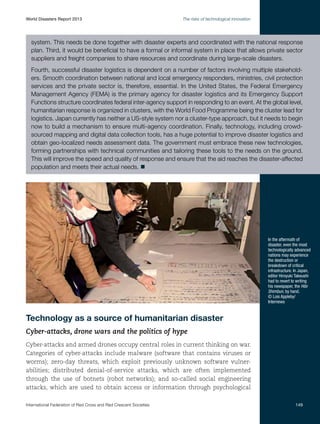
Focus on technology and
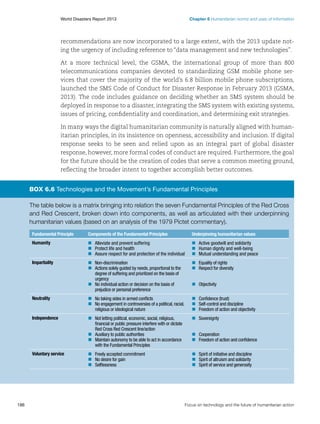
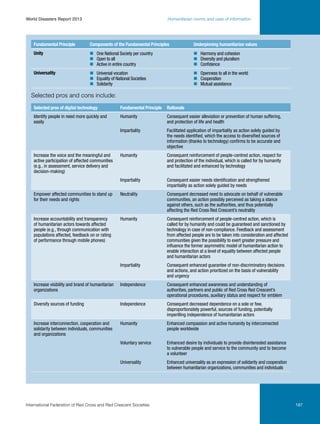
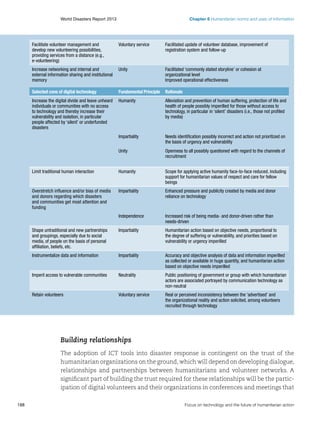
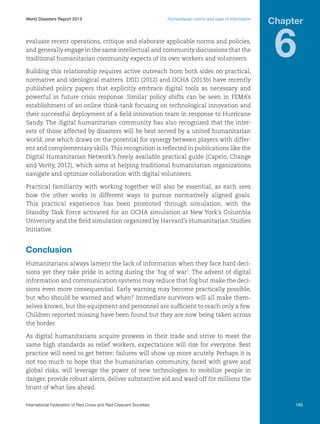
the future of humanitarian action
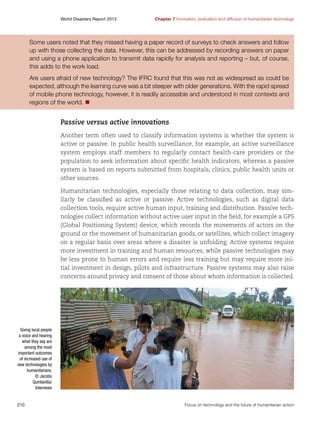
This year’s World Disasters Report focuses on technology and the future of
humanitarian action. The report explores the ways in which information and
communication technologies assist international and national actors, governments,
civil society organizations and communities at risk to prevent, mitigate and prepare
for the impact of a disaster and, in its aftermath, respond, recover and rebuild
affected areas. The report examines how technologies can help put communities
at the centre of humanitarian action and considers the challenges and limitations,
including the diminishing direct interaction between aid workers and communities
at risk, and the emergence of new actors who are not necessarily grounded in
humanitarian principles and ethical guidelines. It also argues for a more systematic
evaluation of the contribution of technology to humanitarian action.
The World Disasters Report 2013 features:
–	 Humanitarian technology
–	 Community-centred humanitarian action
–	 Innovations in humanitarian information
–	 Technology and humanitarian effectiveness
–	 Risks and challenges of humanitarian technology
–	 Technology and humanitarian principles
–	 Evaluation and diffusion of humanitarian technology
–	 Disaster data

2013

World Disasters Report	

World Disasters Report 2013

Swedish International
Development Cooperation
Agency

“

Technology is transforming the world – and how people cope with disasters – in ways
we are only beginning to understand. Humanitarian agencies recognize that as our
operating environment changes, so must we. This World Disasters Report contains a lot
for us to think about and reminds us that the driving force behind change is not
technology, but people.
Valerie Amos,
United Nations Under-Secretary-General for Humanitarian Affairs
and Emergency Relief Coordinator

”

“

The era of hyperconnectivity presents the human race with an invaluable opportunity
to boost its resilience to natural disasters. By harnessing the constructive power of ICT,
we can better manage preparedness, mitigate loss and in so doing help empower
vulnerable populations against some of nature’s harshest effects.
Klaus Schwab,
Founder and Executive Chairman, World Economic Forum

World Disasters Report

”

Focus on technology and the
future of humanitarian action

ISBN 978-92-9139-197-4

2013

Published annually since 1993, the
World Disasters Report brings together
the latest trends, facts and analysis of
contemporary crises and disasters.

The International Federation of Red Cross and Red Crescent Societies would like to express its
gratitude to the following donors for committing to and supporting this publication:

www.ifrc.org
Saving lives, changing minds.
World Disasters Report
2013
Focus on technology
and the future of
humanitarian action

www.ifrc.org
Saving lives, changing minds.
World Disasters Report 2013	Acknowledgements

Acknowledgements
All rights reserved. Except for quotation in a review of the work, no part of this publication may
be reproduced, stored in a retrieval system, or transmitted, in any form or by any means, electronic, mechanical, photocopying, recording or otherwise, without the prior permission of the
International Federation of Red Cross and Red Crescent Societies. This publication is copyright,
but may be reproduced without fee for teaching purposes but not for resale. Formal permission is required for all such uses. For copying in any other circumstances, or for re-use in other
publications, or for translation or adaptation, prior written permission must be obtained from
the publisher.
The opinions expressed in this publication do not necessarily represent the official policy of
the International Federation of Red Cross and Red Crescent Societies or of individual National
Red Cross or Red Crescent Societies. They represent the views of the authors only, but not
necessarily those of their organizations. The designations used do not imply the expression of
any opinion on the part of the International Federation or National Societies concerning the
legal status of a territory or of its authorities.
© International Federation of Red Cross and Red Crescent Societies, 2013
ISBN 978-92-9139-197-4
Senior manager: Matthias Schmale, Under Secretary General
Editor: Patrick Vinck
Main contributors: Sam Brophy-Williams, Jesse Hardman, Jennifer Leaning, Patrick Meier, Gisli
Olafsson, Phuong N. Pham, Jacobo Quintanilla, Kristin Bergtora Sandvik and Nic Segaren
Editorial board and reviewers: Vincent Bernard, Vincenzo Bollettino, Paul Conneally, Maryam
Golnaraghi, Edward Happ, Michael Kleinman, Jehmila Mahmood, Patrick Meier, Sara Pantuliano,
Luc St.-Pierre and Peter Walker
Project manager: Josephine Shields Recass
Design and production team: Philippe Boisson, Sébastien Calmus, Lenka Matousek, Benoit
Matsha-Carpentier, Damien Naylor
Copy-editor and proofreader: Sue Pfiffner
Our sincere appreciation to the Language Unit, to everyone who assisted our contributors during their research for this issue and to the authors of the text boxes.
Typesetting: services-concept.ch. Printed by Imprimerie Chirat, Lyon, France
Contact details:
International Federation of Red Cross and Red Crescent Societies
17, Chemin des Crêts, P.O. Box 303
CH-1211 Geneva 19, Switzerland
Tel.: +41 22 730 4222. Fax: +41 22 733 0395
E-mail: secretariat@ifrc.org
Web: www.ifrc.org
To order copies of the World Disasters Report, please contact wdr@ifrc.org. For more information
on technology and humanitarian action, visit www.ifrc.org/wdr2013.
International Federation of Red Cross and Red Crescent Societies	3
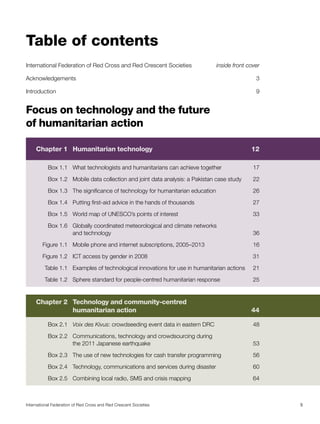
Table of contents
International Federation of Red Cross and Red Crescent Societies	

inside front cover

Acknowledgements	3
Introduction	9

Focus on technology and the future
of humanitarian action
	

Chapter 1	 Humanitarian technology	

12


Box 1.1	 What technologists and humanitarians can achieve together	

17


Box 1.2	 Mobile data collection and joint data analysis: a Pakistan case study	

22


Box 1.3	 The significance of technology for humanitarian education	

26


Box 1.4	 Putting first-aid advice in the hands of thousands	

27


Box 1.5	 World map of UNESCO’s points of interest	

33

	
Box 1.6	 Globally coordinated meteorological and climate networks
		 and technology	

36


Figure 1.1	 Mobile phone and internet subscriptions, 2005–2013	

16


Figure 1.2 	 ICT access by gender in 2008	

31


Table 1.1 	 Examples of technological innovations for use in humanitarian actions 	 21


Table 1.2 	 Sphere standard for people-centred humanitarian response	


Chapter 2	
Technology and community-centred
humanitarian action	

25

44


Box 2.1	 Voix des Kivus: crowdseeding event data in eastern DRC	

48


Box 2.2	
Communications, technology and crowdsourcing during
the 2011 Japanese earthquake	

53


Box 2.3	 The use of new technologies for cash transfer programming	

56


Box 2.4	 Technology, communications and services during disaster	

60


Box 2.5	 Combining local radio, SMS and crisis mapping	

64

International Federation of Red Cross and Red Crescent Societies	5
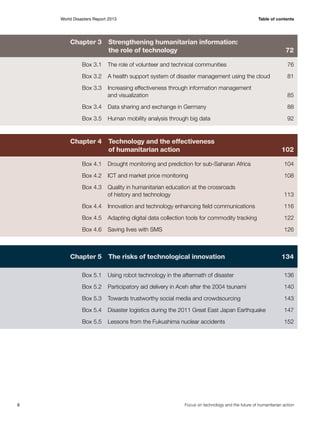
Table of contents

World Disasters Report 2013	

Chapter 3	
Strengthening humanitarian information:
the role of technology	

72

Box 3.1	 The role of volunteer and technical communities	

76

Box 3.2	 health support system of disaster management using the cloud	
A

81

Box 3.3	
Increasing effectiveness through information management
and visualization	

85

Box 3.4	 Data sharing and exchange in Germany	

88

Box 3.5	 Human mobility analysis through big data	

92

Chapter 4	
Technology and the effectiveness
of humanitarian action	

102

Box 4.1	 Drought monitoring and prediction for sub-Saharan Africa	

104

Box 4.2	 and market price monitoring	
ICT

108

Box 4.3	
Quality in humanitarian education at the crossroads
of history and technology	

113

Box 4.4	 Innovation and technology enhancing field communications	

116

Box 4.5	 Adapting digital data collection tools for commodity tracking	

122

Box 4.6	 Saving lives with SMS	

126

Chapter 5	
The risks of technological innovation	

134

Box 5.1	 Using robot technology in the aftermath of disaster	
Box 5.2	 Participatory aid delivery in Aceh after the 2004 tsunami	

140

Box 5.3	
Towards trustworthy social media and crowdsourcing	

143

Box 5.4	 Disaster logistics during the 2011 Great East Japan Earthquake	

147

Box 5.5	 Lessons from the Fukushima nuclear accidents	

6	

136

152

Focus on technology and the future of humanitarian action
World Disasters Report 2013	


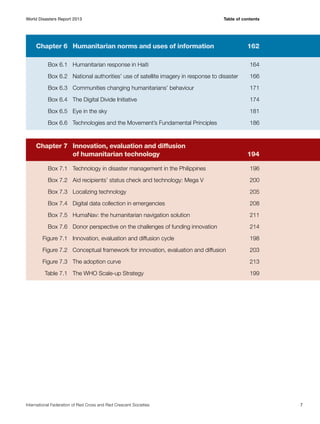
Table of contents

Chapter 6	 Humanitarian norms and uses of information	

162


Box 6.1	 Humanitarian response in Haiti	

164


Box 6.2	
National authorities’ use of satellite imagery in response to disaster	

166


Box 6.3	 Communities changing humanitarians’ behaviour	

171


Box 6.4	 The Digital Divide Initiative	

174


Box 6.5	 Eye in the sky	

181


Box 6.6	 Technologies and the Movement’s Fundamental Principles	

186


Chapter 7	
Innovation, evaluation and diffusion
of humanitarian technology	

194


Box 7.1	 Technology in disaster management in the Philippines	

196


Box 7.2	 recipients’ status check and technology: Mega V	
Aid

200


Box 7.3	 Localizing technology	

205


Box 7.4	 Digital data collection in emergencies	

208


Box 7.5	 HumaNav: the humanitarian navigation solution	

211


Box 7.6	 Donor perspective on the challenges of funding innovation	

214


Figure 7.1	 Innovation, evaluation and diffusion cycle	

198


Figure 7.2	 Conceptual framework for innovation, evaluation and diffusion	

203


Figure 7.3	 The adoption curve	

213


Table 7.1 	 The WHO Scale-up Strategy 	

199

International Federation of Red Cross and Red Crescent Societies	7
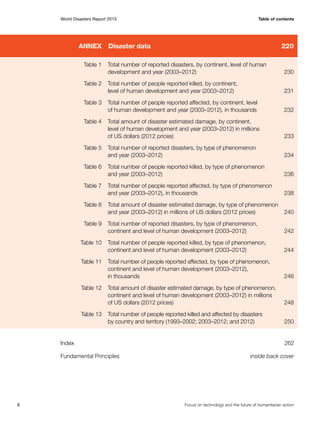
Table of contents

World Disasters Report 2013	

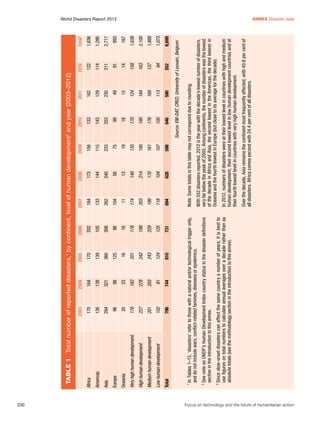
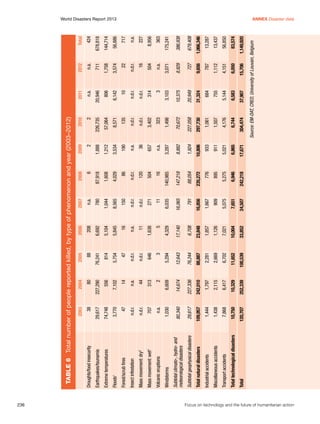
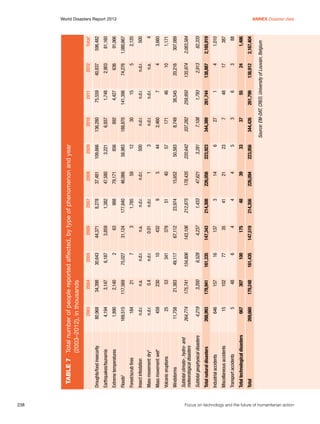
	Annex	Disaster data	

220

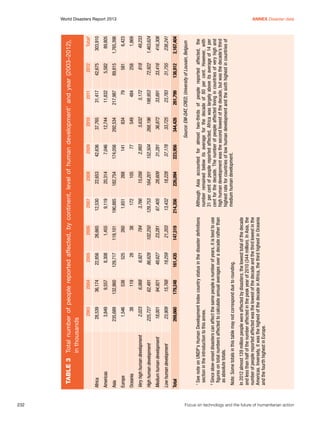
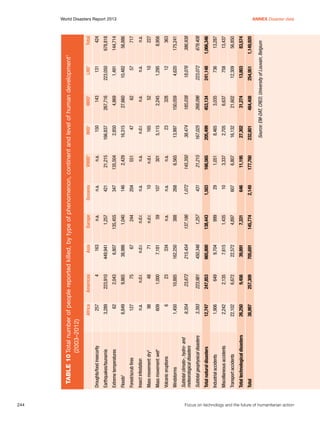
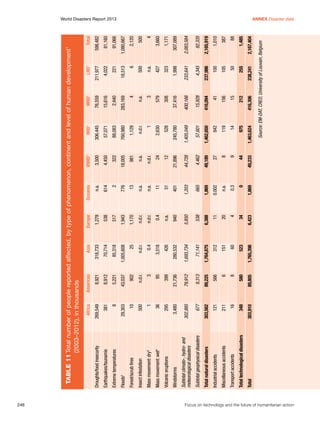
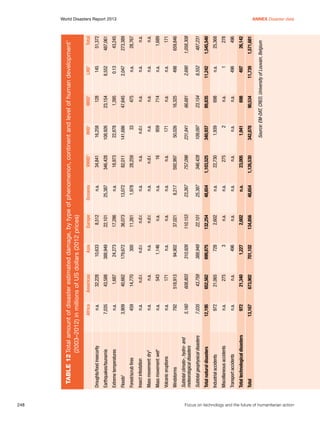
Table 1	
Total number of reported disasters, by continent, level of human
development and year (2003–2012) 	

230

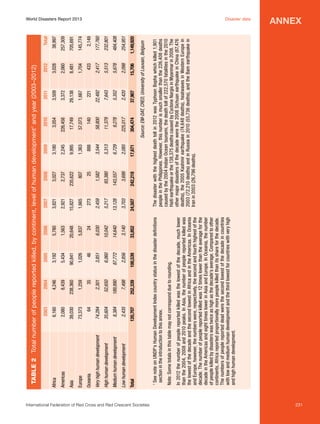
Table 2	
Total number of people reported killed, by continent,
level of human development and year (2003–2012)	

231

Table 3	
Total number of people reported affected, by continent, level
of human development and year (2003–2012), in thousands	

232

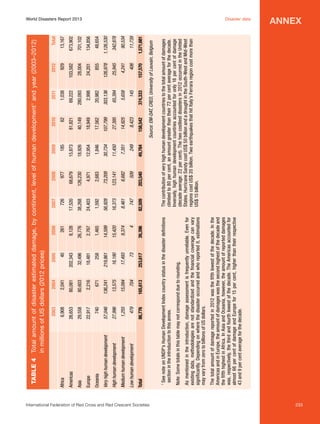
Table 4	
Total amount of disaster estimated damage, by continent,
level of human development and year (2003–2012) in millions
of US dollars (2012 prices)	

233

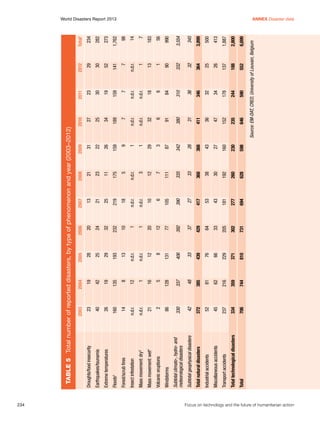
Table 5	
Total number of reported disasters, by type of phenomenon
and year (2003–2012)	

234

Table 6	
Total number of people reported killed, by type of phenomenon
and year (2003–2012)	

236

Table 7	
Total number of people reported affected, by type of phenomenon
and year (2003–2012), in thousands	

238

Table 8	
Total amount of disaster estimated damage, by type of phenomenon
and year (2003–2012) in millions of US dollars (2012 prices) 	

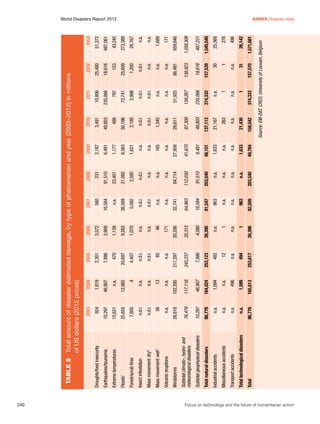
240

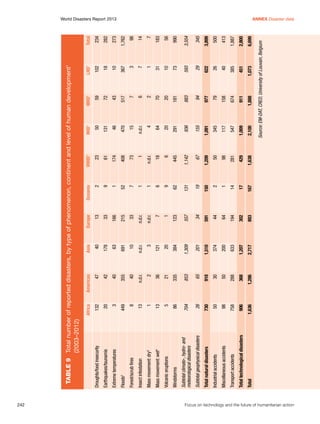
Table 9	
Total number of reported disasters, by type of phenomenon,
continent and level of human development (2003–2012) 	

242

Table 10	
Total number of people reported killed, by type of phenomenon,
continent and level of human development (2003–2012) 	

244

Table 11	
Total number of people reported affected, by type of phenomenon,
continent and level of human development (2003–2012),
in thousands	

246

Table 12	
Total amount of disaster estimated damage, by type of phenomenon,
continent and level of human development (2003–2012) in millions
of US dollars (2012 prices)	

248

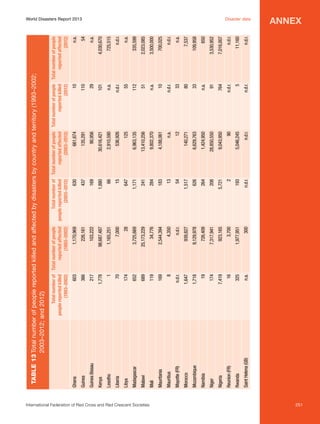
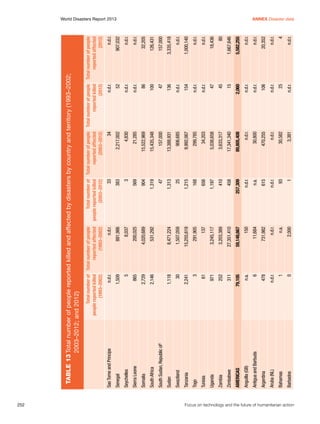
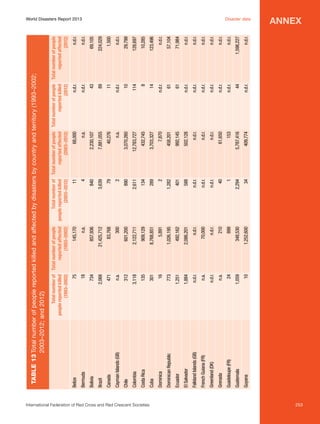
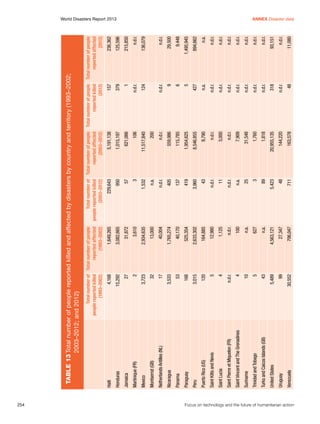
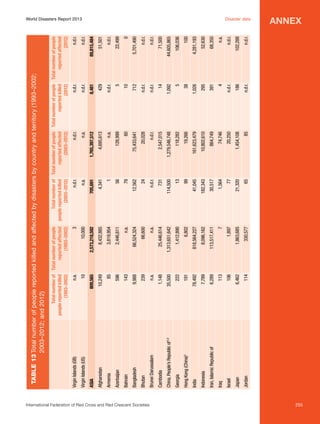
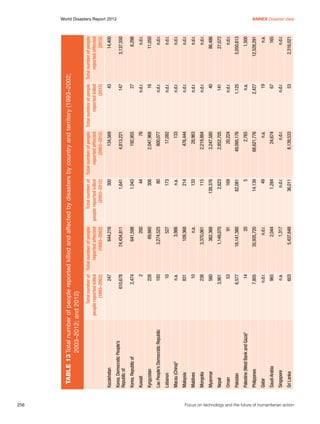
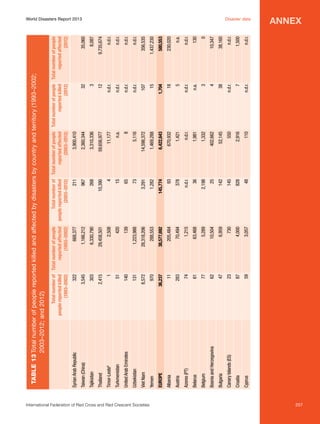
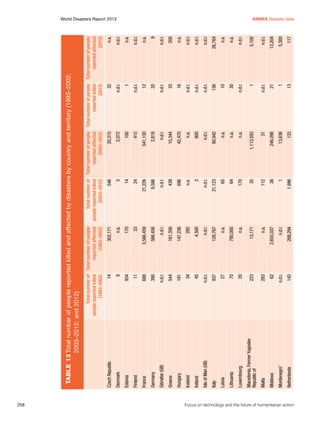
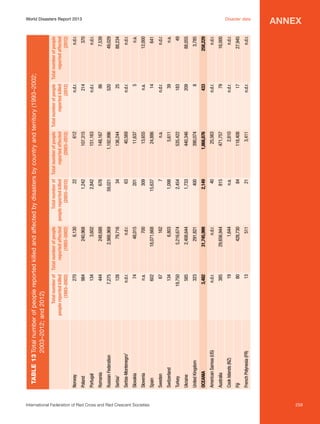
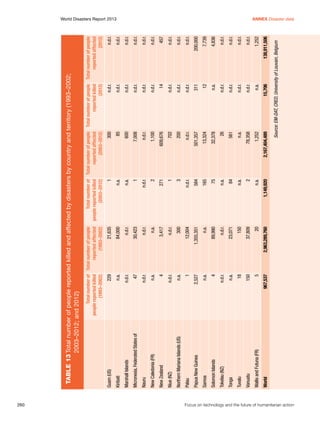
Table 13	
Total number of people reported killed and affected by disasters
by country and territory (1993–2002; 2003–2012; and 2012)	

250

Index 	
Fundamental Principles 	

8	

262
inside back cover

Focus on technology and the future of humanitarian action
World Disasters Report 2013	Introduction

Technology and
humanitarian action
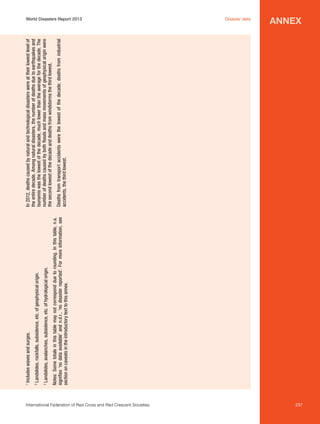
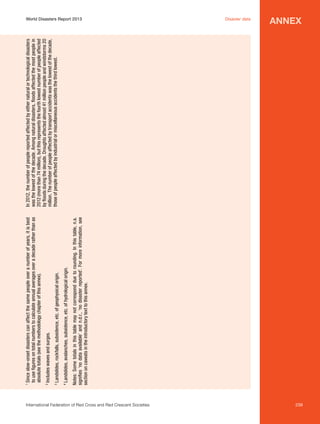
In 2012, fewer people were reported to have died or been affected as a result of disasters than any other year during the previous decade, according to figures presented
in this report. While these numbers are positive news, they also reflect the absence
of major events like the 2004 Indian Ocean tsunami, Cyclone Nargis in Myanmar in
2008 or the 2010 Haiti earthquake.
We have learned from these major disasters. At the same time we must continue
to improve and innovate to make disaster preparedness, mitigation, response
and recovery more effective and accountable. With these objectives in mind, this
year’s World Disasters Report focuses on the rapid spread of technologies, especially
information and communication technologies, which is changing humanitarian
action and humanitarians, too.
The changes are most evident in highly technological environments, such as megacities, or when disasters affect critical infrastructures, resulting in secondary technological disasters, such as nuclear power plant accidents. But technology also enables
affected communities to quickly transform themselves into first responders, send
requests and messages, provide critical information, match assistance needs with
providers or support rapid damage assessments. This is also the case in rural areas
around the world, which are increasingly connected and have access to information
and communication resources that are unprecedented. Local communities are now
becoming more fully engaged in humanitarian action than ever. Finally it is also true
on the web, where individuals are mobilizing in the aftermath of disasters to provide
assistance to affected communities and humanitarian actors.
The International Red Cross and Red Crescent Movement, like many other organizations, explores the potential of new technology in its operations, for example as a
new source of information and early warning, for training and continued education
of its volunteers, to connect and involve communities at risk and to raise awareness
and funds.
The development of a more technology-oriented approach to humanitarian action
is essential – and inescapable – to take advantage of the opportunities to improve,
for example, information gathering, analysis, coordination, action or fund-raising.
This report presents impressive examples where technologies already contribute to
humanitarian action, often with the result of putting affected communities at the
centre of humanitarian action as engaged participants and not merely as witnesses
or recipients of aid.

International Federation of Red Cross and Red Crescent Societies	9
World Disasters Report 2013	Introduction

In Syria, for example, digital data collection tools were adapted and are now used
to serve as a commodity tracking system, monitoring the distribution of supplies
as they are transported and delivered by local partner organizations in areas that
remain inaccessible to international humanitarian agencies. The system improves
efficiency and accountability and helps deliver life-saving supplies.
In the Philippines, the government used social media to help prepare for Typhoon
Pablo. It created information pages accessible from mobile phones to help locate disaster shelters and other assistance. It also created and promoted the use of a Twitter
hashtag for the storm, #PabloPH. Tweets from the population were later mapped to
provide the United Nations Office for the Coordination of Humanitarian Affairs with
early damage assessment information.
Technology is also central to improving early warning systems, whether it is the
World Food Programme relying on mobile phone-based short text messages (SMS)
to monitor food prices at market, or the United Nations Educational, Scientific
and Cultural Organization improving drought monitoring and forecast systems for
sub-Saharan Africa.
However, as new applications of technologies become more prevalent among
humanitarians, the risks, limitations and failures of technology also become more
apparent. In this respect, the World Disasters Report presents a balanced perspective
between optimism and caution and highlights the need for guiding principles and
more rigorous testing and evaluation of solutions that are largely emerging from
non-humanitarian actors.
Some of the key challenges result from unequal access to technologies among both
affected populations and humanitarians. Impressive worldwide or even regional
statistics on mobile phone use, for example (6.8 billion subscribers in 2013 and
double-digit growth), mask important inter- and intra-state disparities. Those least
likely to have access to technology – the poor, the uneducated, women – are also the
most vulnerable to disasters. Similarly, local organizations and even governments
in poor countries, which are most likely to be the first responders when disaster
strikes, are also least likely to be able to take advantage of technologies. For organizations, access is not only limited by financial or human resources, but it can also
result from restrictions on access to information, like satellite imagery for example.
This potentially impacts the balance of power between actors, or access to funds.
Another structural limitation is the limited and/or expensive communication bandwidth which requires improved public–private partnerships so that mobile phone
network operators and internet providers ensure minimum services.
Despite these challenges, the responsible use of technology in humanitarian action
offers concrete ways to make assistance more effective and accountable, and
to reduce vulnerability and strengthen resilience. Distance learning and online
10	

Focus on technology and the future of humanitarian action
World Disasters Report 2013	Introduction

education are good examples of technology supporting these goals. The Red Cross
Red Crescent has been active in this area for many years. Regrettably, however, most
technological innovations still need to be tested and scaled up to demonstrate their
usability and benefits for humanitarians. What matters is not technology, but how
we use it. Affected communities, on the other hand, are already rapidly adopting
social media and other technologies. This is a trend that is unlikely to change and
that humanitarians must embrace – even support – by recognizing access to communication and information as a basic need and priority alongside search and rescue,
protection, health, food, water or shelter. The 2005 World Disasters Report acknowledged this nearly ten years ago. It is even more true today.

Bekele Geleta
Secretary General

International Federation of Red Cross and Red Crescent Societies	11
Chapter 1
Chapter

Humanitarian technology
Humanitarian action is evolving rapidly in response to new applications of technologies. Innovations appear almost daily in almost every aspect of humanitarian
action, from robots being deployed for search and rescue or demining, to remote
surgeries or improvement in vaccine transportation and conservation, water
purification or sanitation. Considering the wide range of innovations, the focus of
this World Disasters Report had to be narrowed to what is rapidly becoming a major
field of humanitarian practice: humanitarian information and communication
technologies (HICT).

1

This 2013 World Disasters Report explores the challenges and opportunities in the
ways in which technologies, especially information and communication technologies (ICT), can assist international and national actors, governments, civil society
organizations and communities at risk more effectively to prevent, mitigate and
prepare for the impact of a disaster and, in its aftermath, respond, recover and
rebuild lives and livelihoods. This set of actions is broadly used to define the term
humanitarian action, with the goal to “save lives, alleviate suffering and maintain
and protect human dignity during and in the aftermath of emergencies” (Global
Humanitarian Assistance, undated).
This first chapter of the report introduces key concepts and issues in humanitarian technology. Chapter 2 focuses on how information and communication
technologies such as mobile phones (also called cell phones) and social media are
creating new ways for disaster-affected communities to organize, coordinate and
respond to their own problems, and enabling people-centred humanitarian action.
Chapter 3 goes further to discuss not just how technologies help put communities
at the centre of humanitarian action, but how the large amount of information
generated by these communities through social media or other means can be
used by outside humanitarian actors to determine and better respond to communities’ needs. Volunteer communities, the chapter author argues, offer invaluable
opportunities to gather and analyse these crisis data from all sources and present
them in usable format. While Chapter 2 and 3 focus specifically on the ‘people’
dimension of humanitarian action, Chapter 4 brings a more general discussion
and overview of HICT which helps understand the variety of potential benefits
and challenges that are rapidly emerging.
Together, Chapters 2, 3 and 4 provide a comprehensive discussion of the existing
and potential contribution of ICT to improving humanitarian action. The authors
acknowledge challenges and limitations, which are the starting point of the following chapters. Chapter 5 provides an overview of key challenges, including
for example unequal access to technologies, the diminishing direct interaction

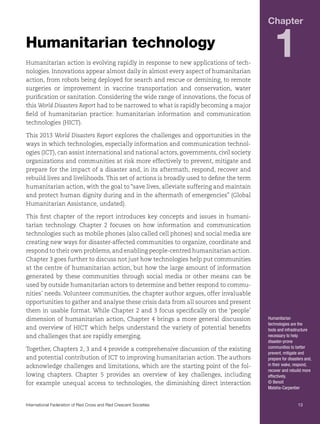
Humanitarian
technologies are the
tools and infrastructure
necessary to help
disaster-prone
communities to better
prevent, mitigate and
prepare for disasters and,
in their wake, respond,
recover and rebuild more
effectively.
© Benoit
Matsha-Carpentier

International Federation of Red Cross and Red Crescent Societies	13
Chapter 1 Humanitarian technology

World Disasters Report 2013	

between aid workers and communities at risk, or the emergence of new actors who
are not necessarily grounded in humanitarian principles. This last point leads to
Chapter 6, which focuses on the challenges that humanitarian technologies are raising for traditional principles and ethical guidelines. Finally, the last chapter examines
key criteria and factors that must be examined to understand the contribution of
technology to humanitarian action, arguing for the need for a more systematic evaluation approach rather than the collection of anecdotal evidence that prevails today.

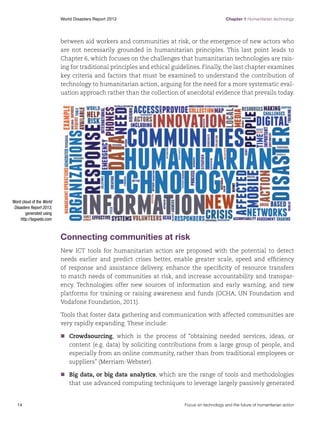
Word cloud of the World
Disasters Report 2013,
generated using
http://tagxedo.com

Connecting communities at risk
New ICT tools for humanitarian action are proposed with the potential to detect
needs earlier and predict crises better, enable greater scale, speed and efficiency
of response and assistance delivery, enhance the specificity of resource transfers
to match needs of communities at risk, and increase accountability and transparency. Technologies offer new sources of information and early warning, and new
platforms for training or raising awareness and funds (OCHA, UN Foundation and
Vodafone Foundation, 2011).
Tools that foster data gathering and communication with affected communities are
very rapidly expanding. These include:
nn
Crowdsourcing, which is the process of “obtaining needed services, ideas, or
content (e.g. data) by soliciting contributions from a large group of people, and
especially from an online community, rather than from traditional employees or
suppliers” (Merriam-Webster).
nn
Big data, or big data analytics, which are the range of tools and methodologies
that use advanced computing techniques to leverage largely passively generated

14	

Focus on technology and the future of humanitarian action
World Disasters Report 2013	

Humanitarian technology

data, for example those resulting from the use of mobile phones or social networks, and the active collection of observed data by satellites for example to
gain insights for decision-making purposes (Letouzé, Meier and Vinck, 2013).

Chapter

1

nn
Crisis mapping, which “leverages mobile  web-based applications, participatory maps  crowdsourced event data, aerial  satellite imagery, geospatial
platforms, advanced visualization, live simulation, and computational  statistical models to power effective early warning for rapid response to complex
humanitarian emergencies” (Crisis Mappers).
nn
Digital data collection, which is the process of replacing traditional assessments conducted with pens and papers by data collection by humanitarian
actors and, where possible, affected populations, supported by widely available and usable digital devices such as smartphones. This results in substantial
gains in terms of speed and quality of the data.
At the same time, communication among affected communities, and between
communities and outside actors, is easier than before, enabling them to organize, coordinate and respond to their own problems. There are now more than
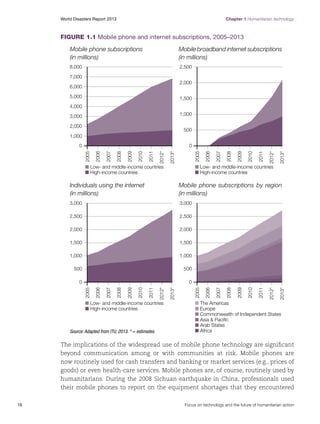
6 billion mobile phone subscriptions and over 2 billion mobile broadband internet
subscriptions (see Figure 1.1). In the five years between 2008 and 2013, low- and
middle-income countries have roughly doubled the number of mobile phone
subscriptions, adding an extra 2.5 billion. There are now almost twice as many
mobile broadband as fixed broadband subscriptions, with mobile broadband
being the fastest-growing information and communication technology. Improved
communication and information for communities at risk also reflect improved
connectivity to the World Wide Web and the emergence of social media. In some
25 years, the web has become a standard communication mode, reaching 2.7 billion people. Social networking is also increasingly popular. Twitter has more than
500 million users generating 400 million messages (tweets) a day.
These numbers mask important disparities between and within countries – an
issue discussed further in this chapter and elsewhere in the report. Nevertheless,
this unprecedented level of connectivity provides avenues for more systematic
two-way communications, for example transparent feedback through social
media or SMS-based systems, as well as fast and real-time life-saving messaging.
The result is progress towards both more resilient communities and people-centred humanitarian action, in which people and their communities are not merely
recipients, but engaged participants. Communities are, for example, alerted faster
of, and better prepared for, impending cyclones or tsunami, and they are able to
hold humanitarians accountable for their actions.

International Federation of Red Cross and Red Crescent Societies	

15
Chapter 1 Humanitarian technology

World Disasters Report 2013	

Figure 1.1 Mobile phone and internet subscriptions, 2005–2013
Mobile phone subscriptions
(in millions)

Mobile broadband internet subscriptions
(in millions)

8,000

2,500

7,000
2,000

6,000
5,000

1,500

4,000
1,000

3,000
2,000

500

1,000

2013*

2012*

2011

2010

2009

2008

2007

2006

2013*

2012*

2011

2010

2009

2008

2007

2006

2005

2005

0

0

■ Low- and middle-income countries
■ High-income countries

■ Low- and middle-income countries
■ High-income countries

■ Low- and middle-income countries
■ High-income countries

Source: Adapted from ITU, 2013. * = estimates.

2013*

2012*

2011

0
2010

0

2009

500

2008

500

2007

1,000

2006

1,000

2005

1,500

2013*

1,500

2012*

2,000

2011

2,000

2010

2,500

2009

2,500

2008

3,000

2007

3,000

2006

Mobile phone subscriptions by region
(in millions)

2005

Individuals using the internet
(in millions)

■ The Americas
■ Europe
■ Commonwealth of Independent States
■ Asia  Pacific
■ Arab States
■ Africa

The implications of the widespread use of mobile phone technology are significant
beyond communication among or with communities at risk. Mobile phones are
now routinely used for cash transfers and banking or market services (e.g., prices of
goods) or even health-care services. Mobile phones are, of course, routinely used by
humanitarians. During the 2008 Sichuan earthquake in China, professionals used
their mobile phones to report on the equipment shortages that they encountered
16	

Focus on technology and the future of humanitarian action
World Disasters Report 2013	

Humanitarian technology

and mobile phones were also used to coordinate the rescue and relief efforts
(Zhou et al., 2012). More recently, during the Rana Plaza garment factory fire in
Bangladesh in April 2013, mobile phone data and SIM cards were used to identify
the deceased. Tweets were used to generate assessment maps and facilitate the
location of people during Typhoon Pablo (also called Typhoon Bopha) in the Philippines in 2012 or to map cases during the 2010 Haitian cholera epidemic.

Chapter

1

The rise of humanitarian technology is also the result of technology fusion or
“the integration of information network, mobile technology hardware and applications, and social media and mapping platforms into a readily available single
mobile device such as a laptop, a mobile smartphone, or a tablet with access to
unlimited amount of data from multiple sources and in multiple formats (big
data)” (Pham and Vinck, 2012). In addition, a generation ago it would have taken
tremendous work to manage to reach a crisis and try something new. In a networked world, however, opportunities to find partners, resources or opportunities
for implementation are easier. This results in a lower barrier of entry for new
actors to become involved in humanitarian action and for technology to be tested
directly in the field.

Box 1.1 What technologists and humanitarians can achieve together
One of the most important contributions that digital technology can make to humanitarian operations is
to ensure that the voices of people affected by disasters and complex emergencies are heard.
Disaster-affected people are not ‘victims’ but a significant force of first responders. They need to be
empowered and engaged as part of the overall aid effort. Their recovery, their future and their lives and
livelihoods are at stake.
The 8.7 earthquake that struck off the coast of the Indonesian island of Sumatra on 11 April 2012 brought
a sense of foreboding that the region might see a repeat of the 2004 Indian Ocean tsunami. The tsunami
never materialized, but it was clear that this time, communities were better prepared. One of the reasons
is that new advances in technology, such as oceanographic radar systems, provided forewarning of
tsunami activity relayed via satellite to Indian Ocean meteorological centres. In addition, mobile phones
have proliferated in the region, making it easier to transmit fast and clear life-saving data.
This highlights the increased importance of standardization to ensure interoperability of technologies
across borders, as well as the harmonization of telecommunication policies and regulations. Cooperation
between public and private sectors can be ramped up. This will ensure a more effective use of emergency
response technologies at the international level.
However, all the information in the world is useless if it cannot be acted upon. A number of organizations
and academic institutions are attempting the difficult task of converting scientific data, such as specialized
meteorological data, into actionable and credible information that can be quickly transmitted to – and
understood by – vulnerable communities. Technologists and data experts can provide major impetus to
this critical area to get data to those who need it most before disaster strikes.

International Federation of Red Cross and Red Crescent Societies	

17
World Disasters Report 2013	

Chapter 1 Humanitarian technology

Over the past 20 years, the ‘mobile miracle’ has brought the benefits of ICTs within reach of nearly
everyone and today there are 6.8 billion mobile phone subscriptions worldwide (ITU, 2013).
There are also now some 2.7 billion internet users (ITU, 2013), but that still leaves 60 per cent of the
world’s people with no access to the internet. Narrowing this ‘digital divide’ by making broadband
internet access available to all is crucial if people everywhere are to take advantage of the economic
and social benefits that connectivity makes possible.
The UN Broadband Commission for Digital Development, a public–private partnership, is currently
championing high-speed connectivity and through it, access to a set of transformative technologies.
In Rwanda, for example, the government recognizes that broadband is the oxygen of an effective
digital economy. Young entrepreneurs, women and men, are working in the digital tech sector with
a focus on digital inclusion, citizen empowerment and creation of local content. It is a model that
could – and should – be replicated across the world.
Mobile technologies, particularly mobile phones, are now considered an essential tool for public
health workers. They are used successfully to gather, collate and transmit data by front-line health
workers. Patients are using apps to monitor their diabetes or heart conditions. Health ministries are
running effective awareness campaigns on issues such as the effects of alcohol, smoking and other
lifestyle-related contributors to the growing epidemic of non-communicable diseases.
In places like Nigeria, the Red Cross is using SMS technology to provide fast and cheap real-time
data, strengthening the national health system and greatly improving community engagement and
the ability to prevent and treat illnesses.
The technology sector can work with humanitarian partners to help them scale up and apply lessons
learned, based on evidence and best practice, to other parts of the world. This is the thrust of a new
mHealth initiative launched in 2012 by ITU and the World Health Organization (WHO, 2012).
Mobile phones are also a tool that can significantly contribute to achieving real gender empowerment. Women make up 40 per cent of the global workforce yet relatively few work in the technology
sector. Mobile education programmes for technology skills designed for women can address the
future labour gap in the tech sector and strike a blow for real equality and economic empowerment.
As people in low- and middle-income countries use digital technologies for more than just mobile
money or emergency SMS, the humanitarian world will have to prepare for communities that have
a greater voice than they have ever had before, communities that will lead, innovate, disrupt and
replace the outdated North-South aid model. The technology sector can provide support to humanitarians to adapt to and navigate through the new, digital reality.
In anticipation of this certainty, aid agencies and their private sector partners need to work with communities and treat communication as a right to be exercised by people in need. They must drive and
facilitate this, and create a new paradigm where humanitarians collaborate and innovate together
with those who are in need of humanitarian assistance.
Article 19 of the Universal Declaration of Human Rights (UN, 1948) enshrines the right to communicate across all frontiers using any media. By advocating for people’s right to access critical
communication infrastructure, aid agencies have the opportunity to ensure realization of this right.

18	

Focus on technology and the future of humanitarian action
World Disasters Report 2013	

Humanitarian technology

The aid model as it is known today is already being disrupted. Decisions and initiatives will take place in
Rwanda or Nigeria not in Geneva or New York. The role of international aid workers and their technology
partners will be to follow and support the local effort, to facilitate or stimulate local innovation, to connect
disparate communities who can learn from each other.
Aid agencies also need to reflect on if and when the private sector is better placed to lead emergency
response or development projects, especially relating to humanitarian technology. Private sector organizations are often on the ground when aid agencies are not, they are often at the heart of the community and
they often have easier access to much-needed funds and resources. This would change the partnership
dynamic whereby aid agencies are supporting the private sector rather than the other way around. While
this would require a shift in thinking, it would arguably also represent much added value for prospective
private sector partners.
At the end of the day, there is maybe nothing more powerful that technologists and humanitarians can
achieve together than enabling people to tell their own stories, advocate in their own interests and design
their own solutions. n

(r)Evolution
The combination of connectivity, technology fusion and new actors is sometimes
called a revolution for humanitarian action (Bernard, 2011). This may be overstating the role of technology and ignores the deeper and long-term reflection about
humanitarian action that led, for example, to the humanitarian reform process
that began in 2005 and the more recent transformative agenda (IASC, 2012). The
evolution of technology has been constant, from the first internet (ARPANET,
1969), first desktop computer (Apple I, 1976) and the first cellular phone (1979),
and arguably today’s innovations are less significant than these milestones. Similarly, the evolution of humanitarian action has been constant and significant
over the years and will continue in the years to come. Through this evolution,
humanitarians have adopted and adapted technologies that showed significant
advantages for their work. The significant shifts for humanitarian action will,
therefore, be the result of a convergence between objectives of more efficient and
effective action and the resources needed to achieve this goal, including technology and new actors, rather than the result of technology alone.
What this convergence will look like is open to debate. Humanitarian technology
enthusiasts tend to be very upbeat about their subjects, suggesting that technology may be simpler and more straightforward to use and deploy than it actually is,
and downplaying the significance of the risks. They may also overstate the effects
and impact on the ground. Sceptics, on the other hand, focus on the worries, concerns and downsides without acknowledging the contribution that technology is
already making to humanitarian action.

International Federation of Red Cross and Red Crescent Societies	

19
World Disasters Report 2013	

Chapter 1 Humanitarian technology

Humanitarian technology
Humanitarian technology refers to the use and new applications of technology to
support efforts at improving access to and quality of prevention, mitigation, preparedness, response, recovery and rebuilding efforts. While much has been learned
from a range of pilot projects and field implementation, the practice of humanitarian technology remains first and foremost defined by its potential contribution
rather than by an actual integration in standard practices. This is rapidly changing – for example, the United Nations Office for the Coordination of Humanitarian
Affairs (OCHA) is increasingly activating networks of volunteers to crowdsource the
collection and analysis of crisis data (see Chapter 3). Similarly, many humanitarian organizations have worked with digital data collection tools. But these efforts
remain predominantly the result of individuals’ engagement within these organizations, with no or little systematic and standardized implementation procedures so
far. This too is changing. NetHope, for example, is a collaboration of 39 international
humanitarian organizations established to foster collaboration and innovation, and
leverage the full potential of ICT.
Nevertheless, the absence of more widespread adoption of technology reflects in
part a lack of systematic evaluation and diffusion efforts, but also the fact that
humanitarian technological innovations are emerging largely outside of traditional humanitarian actors. These actors may be communities at risk or affected by
disaster that are confronted with specific challenges, creating opportunities for innovations. This is, for example, the case of Ushahidi, a civil society response to the 2008
post-electoral violence in Kenya to enable messages from multiple sources, including SMS, e-mail, Twitter and the web, containing geographic references, to be mapped
and serve as a source of information. More recently, it is the case of applications for
mobile phones designed to match assistance from volunteers with those in need.
Efforts in other fields of practice that have similar but distinct needs may also be
a source of humanitarian technological innovation. A good example is digital data
collection which has largely emerged from the health and social sciences, but has
direct applicability for humanitarian data collection. Other examples include social
media and education platforms whose original goals are not to serve humanitarian
purposes, but which are especially well suited to enhance humanitarian action.
The involvement of communities at risk, ‘new’ humanitarians who are emerging
around specific technological innovations, or networks of digital volunteers is one
of the new features of a ‘technology-enabled’ humanitarian world. As such, humanitarian technology brings together actors that have a long tradition of humanitarian
action and principles, but may not be regular users of new technologies, and a new,
fast-growing number of ‘tech-savvy’ actors who may have an intimate and personal
experience of disaster, but lack understanding of humanitarian action and principles.

20	

Focus on technology and the future of humanitarian action
World Disasters Report 2013	

Humanitarian technology

Chapter

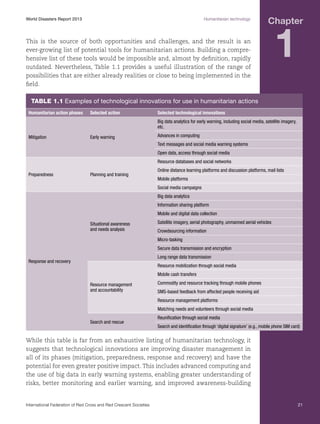
This is the source of both opportunities and challenges, and the result is an
ever-growing list of potential tools for humanitarian actions. Building a comprehensive list of these tools would be impossible and, almost by definition, rapidly
outdated. Nevertheless, Table 1.1 provides a useful illustration of the range of
possibilities that are either already realities or close to being implemented in the
field.

1

Table 1.1 Examples of technological innovations for use in humanitarian actions
Humanitarian action phases

Selected action

Selected technological innovations
Big data analytics for early warning, including social media, satellite imagery,
etc.

Mitigation

Early warning

Advances in computing
Text messages and social media warning systems
Open data, access through social media
Resource databases and social networks

Preparedness

Planning and training

Online distance learning platforms and discussion platforms, mail lists
Mobile platforms
Social media campaigns
Big data analytics
Information sharing platform
Mobile and digital data collection

Situational awareness
and needs analysis

Satellite imagery, aerial photography, unmanned aerial vehicles
Crowdsourcing information
Micro-tasking
Secure data transmission and encryption
Long range data transmission

Response and recovery

Resource mobilization through social media
Mobile cash transfers
Resource management
and accountability

Commodity and resource tracking through mobile phones
SMS-based feedback from affected people receiving aid
Resource management platforms
Matching needs and volunteers through social media

Search and rescue

Reunification through social media
Search and identification through ‘digital signature’ (e.g., mobile phone SIM card)

While this table is far from an exhaustive listing of humanitarian technology, it
suggests that technological innovations are improving disaster management in
all of its phases (mitigation, preparedness, response and recovery) and have the
potential for even greater positive impact. This includes advanced computing and
the use of big data in early warning systems, enabling greater understanding of
risks, better monitoring and earlier warning, and improved awareness-building

International Federation of Red Cross and Red Crescent Societies	

21
World Disasters Report 2013	

Chapter 1 Humanitarian technology

among communities. Technology plays a positive role in both humanitarian response
and post-disaster recovery, including through improved understanding of the situation and needs of the affected community, better coordination of humanitarian
response efforts and mobilization of financial support, and greater involvement of
affected communities. Technological innovations also contribute to greater preparedness, for example through widespread access to training material or planning for
resource mobilization through social networks and flexible resources databases. But
a majority of applications of humanitarian technology appears to focus on response
and recovery. Unfortunately, this trend reflects the decades-long lack of focus on
preparedness in humanitarian action and the need to develop humanitarian technologies that are specific to engaging communities in preparing for disaster rather
than responding to it. Possibly the only exception is the rapid emergence and adoption of people-centred early warning systems, or fourth-generation early warning
and response, which are more bottom–up and decentralized than traditional hierarchical and top–down approaches, and take advantage of ICT (Meier, 2009).

Box 1.2 Mobile data collection and joint data analysis: a Pakistan case study
From Syrian refugees in Lebanon to Somalis in Nairobi, Kenya, the increase of emergency displacement towards urban and peri-urban areas has been a topic of discussion among humanitarians for
more than a decade. Displaced populations in urban areas are often referred to as hidden, as they are
difficult to locate and even more difficult to assist. Gaining access to accurate numbers and reliable
information on the needs of urban internally displaced people (IDPs) and refugees is more complex
than profiling similar populations in camp settings.
Displaced populations often flee to urban areas instead of camps due to a perception of increased
economic and social opportunities. However, data from Pakistan suggest that, although some urban
IDPs succeed at rebuilding their lives in the city, many more find themselves in abject poverty, more
vulnerable to food insecurity and with fewer economic opportunities than those who sought refuge
in displacement camps. While it cannot be assumed that this pattern is consistent across all contexts, this finding highlights the humanitarian community’s awareness that stronger tools are needed
to identify, assess and assist the urban displaced. Some interventions such as food and health
assistance have succeeded in urban displacement contexts because of strong communication and
outreach to displaced populations. Nevertheless, serious concerns remain over accessing populations considered the most vulnerable, including those who cannot travel to distribution points due to
distance or disability, and those who need specialized assistance, such as survivors of gender-based
violence or unaccompanied children. Humanitarian actors need stronger tools not only to identify
and assess, but also to target appropriate assistance to the most vulnerable.
The IDP Vulnerability Assessment and Profiling (IVAP) project in Pakistan made use of technology to
begin addressing some of these concerns. IVAP began as a pilot project in 2010 and is currently in its
third year of assessing and profiling conflict IDPs from Pakistan’s Federally Administered Tribal Areas.
When IVAP was developed, the humanitarian community was facing a large protracted displacement

22	

Focus on technology and the future of humanitarian action
World Disasters Report 2013	

Humanitarian technology

crisis with diminishing resources to assist. The government of Pakistan and aid groups generally agreed
that no one knew how many IDPs were living outside of camps, what their most pressing needs were or
who were the most vulnerable among them. This made the prioritization of scarce humanitarian resources
extremely difficult.
As a result, 14 humanitarian organizations joined together to design and launch the IVAP project. With the
assistance of the humanitarian clusters, these organizations developed a multi-sector profiling questionnaire. A team of assessors was then trained on the questionnaire and the use of smartphones for data
collection, and sent to every urban, peri-urban and rural area where IDPs were expected to be living to
conduct a door-to-door snowball survey. Data from the smartphones were then uploaded to an online
database specifically designed for automated data cleaning and analysis.
This online database, accessible to the entire humanitarian community, hosts the full profiling data of more
than 400,000 conflict IDPs living outside displacement camps, most of whom reside in urban or peri-urban locations. The database allows humanitarian actors to identify the greatest needs, such as cash and
food assistance or child protection, and also to target more accurately families and individuals who need
help most. The most vulnerable are identified through either self-reported vulnerabilities (such as chronic
illness) or more complex analyses of household food and income security. The profiles of individual IDP
families are updated via a ‘call-back and revisit’ system to ensure that the database remains as relevant
and accurate as possible over time.
Systems like IVAP provide a multitude of benefits in addressing urban displacement crises. IVAP removed
the guesswork in planning for the size, locations and needs of urban IDPs in Pakistan. The inclusion of
phone, address and local community informant information made it possible to locate urban IDPs for
both assistance and future profiling, making them less ‘hidden’. In addition, the profiling data have been
used to understand various vulnerability profiles among the population and understand how to maximize
the impact of limited humanitarian resources by targeting assistance to those most vulnerable to specific
threats.
While the concept of profiling and databases is not new to the humanitarian community, the innovative element of IVAP is the scale, quality and depth of data made possible through the use of technology. By using
smartphones, surveyors were able to profile an average of 10 to 15 families a day in urban locations. Paper
was not used, so surveys could not be lost and no data entry was required. Phones were programmed with
specific rules for each question (i.e., age must be between 0 and 105 years) and automated skip patterns
were used to ensure that relevant questions were asked to the appropriate people and that all required
questions were answered. The database was set up to check for duplications automatically (when the
same IDP had been interviewed more than once) and to auto-analyse the data for complex vulnerability
criteria, such as female-headed households with more than four children living in a specific slum. Having
this single database allowed organizations to have a shared understanding of needs.
The possibilities for similar profiling systems are almost endless, such as IDP or refugee registration, joint
agency assistance tracking by family or individual, or information sharing with displaced populations via
mass SMS systems utilizing the database. Additionally, an IVAP-like system does not need to be owned
or run by one organization, but can be used across humanitarian actors. Each actor can borrow the
configured smartphones, use their own staff to profile families in the locations where they are working
and then send the data back to the shared database.

International Federation of Red Cross and Red Crescent Societies	

23
Chapter 1 Humanitarian technology

World Disasters Report 2013	

Pakistan provides a useful example of humanitarian agencies working together not simply to improve
small, one-time surveys with mobile data collection, but to harness the power of technology to solve
large and complex information concerns in emergencies. n

People-centred humanitarian action
Disaster-affected communities have always been the first responders in emergencies. New technologies are greatly increasing their capacity for self-help. The
increased availability of ICT around the world, such as the prevalence of mobile
phones and widespread internet access, are creating new ways for affected communities to organize, coordinate and respond to their own problems and for outside
humanitarian actors to determine and respond to communities’ needs. For communities, this means enhanced abilities to participate in humanitarian action, mobilize
resources, coordinate with humanitarian actors and other stakeholders, self-organize community-based actions and monitor humanitarian actors, making them more
accountable. It also enables non-humanitarian actors to become involved, lowering
the barriers of entry for anyone to participate, even if remotely, in humanitarian
action. Ultimately, and arguably, technology can “empower individuals and communities threatened by hazards to act in sufficient time and in an appropriate manner
so as to reduce the possibility of personal injury, loss of life, damage to property
and the environment, and loss of livelihoods” (UNISDR, 2006), one of the fundamental principles of community-based early warning. More broadly, technology enables
people-centred humanitarian action.
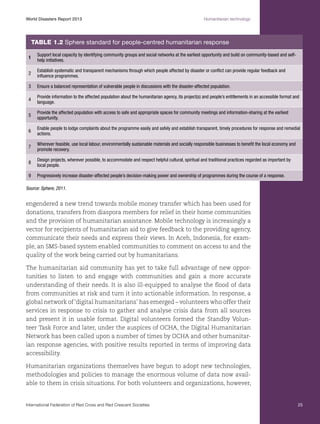
The Sphere Project, established by a group of non-governmental organizations and
the Red Cross Red Crescent Movement to improve the quality of their actions during
disaster response and to be held accountable for them, has defined a number of
minimum standards and core process standards (Sphere, 2011). The first of Sphere’s
core standards is concerned with people-centred humanitarian response, i.e., that
people’s capacity and strategies to survive with dignity are integral to the design
and approach of humanitarian response. The key actions to realize this standard are
shown in Table 1.2.
Populations also produce (voluntarily or not) massive volumes of data, in various formats, through the use of mobile phones, e-mail and social media. These data are
typically not easily accessible in organized modes, but can be used to rapidly generate information that is useful for humanitarian action. Google has a unit devoted
to information access in disaster settings (Google Crisis Response). It created, for
example, the Google Person Finder in response to the 2010 Haiti earthquake. In 2012,
the processing of thousands of Twitter messages that included images and videos of
damages from Typhoon Pablo in the Philippines enabled the rapid creation of damage
assessment maps. The increasing prevalence of mobile phones has also, for example,

24	

Focus on technology and the future of humanitarian action
World Disasters Report 2013	

Humanitarian technology

Table 1.2 Sphere standard for people-centred humanitarian response
1

Support local capacity by identifying community groups and social networks at the earliest opportunity and build on community-based and selfhelp initiatives.

2

Establish systematic and transparent mechanisms through which people affected by disaster or conflict can provide regular feedback and
influence programmes.

3

Ensure a balanced representation of vulnerable people in discussions with the disaster-affected population.

4

Provide information to the affected population about the humanitarian agency, its project(s) and people’s entitlements in an accessible format and
language.

5

Provide the affected population with access to safe and appropriate spaces for community meetings and information-sharing at the earliest
opportunity.

6

Enable people to lodge complaints about the programme easily and safely and establish transparent, timely procedures for response and remedial
actions.

7

Wherever feasible, use local labour, environmentally sustainable materials and socially responsible businesses to benefit the local economy and
promote recovery.

8

Design projects, wherever possible, to accommodate and respect helpful cultural, spiritual and traditional practices regarded as important by
local people.

9

Progressively increase disaster-affected people’s decision-making power and ownership of programmes during the course of a response.

Source: Sphere, 2011.

engendered a new trend towards mobile money transfer which has been used for
donations, transfers from diaspora members for relief in their home communities
and the provision of humanitarian assistance. Mobile technology is increasingly a
vector for recipients of humanitarian aid to give feedback to the providing agency,
communicate their needs and express their views. In Aceh, Indonesia, for example, an SMS-based system enabled communities to comment on access to and the
quality of the work being carried out by humanitarians.
The humanitarian aid community has yet to take full advantage of new opportunities to listen to and engage with communities and gain a more accurate
understanding of their needs. It is also ill-equipped to analyse the flood of data
from communities at risk and turn it into actionable information. In response, a
global network of ‘digital humanitarians’ has emerged – volunteers who offer their
services in response to crisis to gather and analyse crisis data from all sources
and present it in usable format. Digital volunteers formed the Standby Volunteer Task Force and later, under the auspices of OCHA, the Digital Humanitarian
Network has been called upon a number of times by OCHA and other humanitarian response agencies, with positive results reported in terms of improving data
accessibility.
Humanitarian organizations themselves have begun to adopt new technologies,
methodologies and policies to manage the enormous volume of data now available to them in crisis situations. For both volunteers and organizations, however,

International Federation of Red Cross and Red Crescent Societies	

25
Chapter 1 Humanitarian technology

World Disasters Report 2013	

challenges remain in terms of advance preparedness for disasters and the capacity
to process such large volumes of information. Advanced computing solutions can
help respond to these challenges – they include human-driven processes, such as
crowdsourcing and micro-tasking, and machine-driven methods such as data mining and machine learning which go beyond the processing capabilities of humans.

Box 1.3 The significance of technology for humanitarian education
Since the rise of the internet in the early 1990s, the most obvious benefit offered by educational
technology has been its potential ubiquity or the ability to learn anywhere, anytime. In development
contexts, sceptics have asserted that the ‘digital divide’ restricts this benefit to the privileged few,
as only 40 per cent of the world’s population is online. But such analysis neglects the rapid pace of
change in extending mobile (and mobile, 3G-based broadband networks) access in low- and middle-income countries.
Figure 1 Principles of online learning

Source: Cope and Kalantzis, 2012.

In many nations, the majority of web users use only mobile phones; the countries with the highest
rates include Egypt (70 per cent) and India (59 per cent). In Africa, 85 per cent of the mobile-only web
users access the internet with a ‘feature phone’, a device offering some but not all of the features of

26	

Focus on technology and the future of humanitarian action
World Disasters Report 2013	

Humanitarian technology

a smartphone. In high-income nations, a large minority of mobile web users are mobile-only, including the
United States (25 per cent). Where, in many low- and middle-income nations, the mobile-only tend to be
aged under 25, in high-income countries, particularly the United States, many mobile-only users are older
people and many come from lower-income households (ITU, 2013). These statistics imply that for educational technology to be deployed effectively in the contexts of low-, middle- and high-income countries, a
mobile-first strategy building on open, low-cost standards and tools is needed.
Education researchers Bill Cope and Mary Kalantzis (2012) have described the ways in which technology
transforms the economy of effort in education, enabling us to afford (both literally and figuratively) not only
to make learning available anywhere, anytime, but also to provide learners with formative assessment and
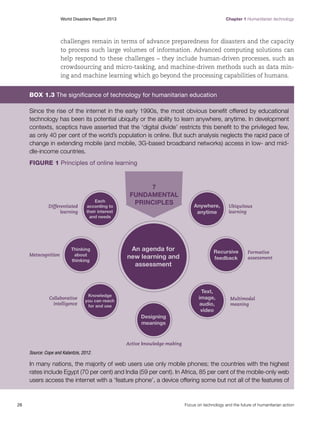
recursive feedback as they work. In this economy of ‘new learning’ (see figure), learners use technology
actively to construct knowledge, designing meanings using multiple media at their disposal. By working
together collaboratively, every learner is also a peer and teacher contributing to collective knowledge
and intelligence that can be used to further thinking and action as well as encouraging ‘metacognition’
(thinking about thinking). Unlike education in the industrial age, which levelled ‘one-size-fits-all’ assumptions, new learning can afford to differentiate based on pre-existing knowledge, competencies and skills.
In a new learning system, learners create together, giving each other feedback (and even feedback
on feedback), sharing their inspirations and discoveries. Within their knowledge communities, they are
connected and can work at their own pace, according to their own interests and capabilities. They are
inspired to create through embedding sound, image and video within their texts for digital storytelling,
situation reports, operational plans and more. This collaborative, flexible, motivating, participatory and
supportive approach is not simply a nicer, kinder and gentler form of learning. Its pedagogical patterns
closely emulate the core competencies of 21st century humanitarian workers, who are expected to be
able to manage complex, overlapping knowledge flows, to work in networked configurations (rather than
command-and-control structures) and to use participatory methodologies to partner with affected populations. If the ways humanitarians teach and learn do not explicitly develop these competencies, then
formal education efforts will become increasingly ineffective. The amazing economy of effort afforded by
educational technology is the only sustainable way to transform learning systems to meet the challenges
of today’s volatile, uncertain, complex and ambiguous world. n

Box 1.4 Putting first-aid advice in the hands of thousands
Having first-aid skills saves lives and learning first aid can increase individual and community resilience
(White and McNulty, 2011) – so how do you put these skills in a population’s hands?
The British Red Cross faced the problem of how to increase resilience across the United Kingdom by
enabling more people to have the confidence and willingness to use first aid. They embarked on a strategy
of making first-aid learning material simple, straightforward, easy to learn, adaptable, relevant to everyone
and available through multiple access points. They developed ‘Everyday First Aid’, an approach to firstaid learning that met these challenges while conforming to the latest evidence-based clinical science. In
addition to first-aid courses, different methods were used to disseminate the skills including web-based
resources, campaigns, press, social media and the development of a smartphone app.

International Federation of Red Cross and Red Crescent Societies	

27
World Disasters Report 2013	

Chapter 1 Humanitarian technology

Developed with everyday people in mind, the presentation of first-aid content was a reversal to the
traditional method of teaching first aid, with the new approach engaging the learner directly with the
intended change, or outcome, for the ill or injured person. This avoids the complicated mechanics,
diagnoses and technicalities which can distract people from learning the principal aim of any first-aid
act: to preserve life, promote recovery and prevent worsening of the condition. Reduced complexity
might also assist the first-aid helper in an emergency, enabling them to adapt to their circumstances
and recall the most important part of the skill they need.
Of course, simplifying the material is only part of the story. The rapid development of smartphone
mobile technology provided the means to make first-aid content more available to potential helpers
by literally putting the information at people’s fingertips.
Analysis of mobile technology trends shows an explosion in its use, with the UK mobile market totalling some 84 million subscribers by the end of 2012 (Paterson and Lane, 2010). By 2016, 65 per
cent of the UK population will access this technology via smartphones (eMarketer, 2013) and, of the
8.06 million app users in the UK in 2010, some 76 per cent accessed via a smartphone (Paterson
and Lane, 2010). In the case of first aid, the mobility of smartphones provides a dual opportunity:
smartphones offer the possibility to provide rapid emergency advice when it is needed and also
permit people to browse and learn from content at their own leisure.
In developing their app, the British Red Cross decided that it should be more than functional – it
needed to be a compelling market leader, of excellent educational quality, free, easy to navigate
and offer wider emergency preparedness advice. Interaction was also important, with different tabs
allowing users to decide what to focus on. The ‘learn’ section is predominantly video-led since
research shows that viewing video demonstrations, even without practising them, enables people to
perform some skills more effectively than untrained individuals could (Eisenburger and Safar, 1999).
The ‘emergency’ section, a defining feature of the app, gives emergency support tools in simple,
straightforward steps, such as calling emergency services, and timing devices for managing burns
and resuscitation. Finally, the ‘test’ section tests skills through quizzes.
Since its launch in December 2011, the first-aid app has won two industry awards, the first for best
app in the Digital Communications Awards (Europe) (Quadriga, 2012) and the second for best use
of digital media in the CorpComms Awards (Dunne, 2012). While these awards are satisfying, it is
the feedback from people who use the app that shows its real contribution to reducing vulnerability.
One person wrote via the ‘tell us your story’ function: “This app is great. I am a fast response paramedic in London and I was called to a category one [life-threatening] call at a school; there was a
student with this app that used it to revive the patient. If this app was not out there then there would
be one less person in the world.”
Billed as building ‘real-world’ resilience via a digital model, the app has certainly succeeded in its aim
to put first-aid advice, literally, in the hands of thousands of people. The target of 30,000 downloads
was shattered within nine days of its launch and the current total number of downloads is more than
500,000.
Analysis shows the app is primarily used to learn first aid before an emergency, using the ‘learn’ or
the equally popular ‘test’ tab. To a lesser extent, people also access the app during emergencies.

28	

Focus on technology and the future of humanitarian action
World Disasters Report 2013	

Humanitarian technology

Interestingly, feedback also shows that the app is referred to after someone has helped in an emergency,
to reassure themselves that they have conducted first aid appropriately.
That users have gone on to learn and access more is clearly evident. Visits to the first-aid web site
increased in the first month after its launch, with users looking at more content and for longer, and mobile
sign-ups to first-aid courses increased by 47 per cent compared to before the app’s launch. This all
implies that users are motivated to learn more and use their knowledge, suggesting an increase in their
ability to prepare for and withstand a crisis situation.
The success of the first-aid app has resulted in several important developments.
The British Red Cross has launched a baby and child first-aid app and work is under way to develop an
app focusing solely on the UK’s chief disaster threat: flooding.
Internationally, the Everyday First Aid approach has had wide acclaim from across the Red Cross Red
Crescent Movement, bringing simplicity while retaining scientific accuracy. The American Red Cross have
licensed the app from the British Red Cross and gone on to develop a suite of additional apps to cover
a range of emergencies.
Since the British and American Red Cross released the app, many other National Societies have asked to
use it. Unfortunately, development costs make the creation of a high-quality app difficult, if not impossible,
for many National Societies. However, in order to make simple first-aid skills available at a global level,
the British Red Cross has worked with the IFRC’s Global Disaster Preparedness Center on the concept
of a ‘universal app’ that would enable every Red Cross Red Crescent society to launch an app in their
country, at a lower cost than it would take to create one from scratch. The opportunity brought by mobile
technology has the potential to put life-saving skills in the hands of millions. n

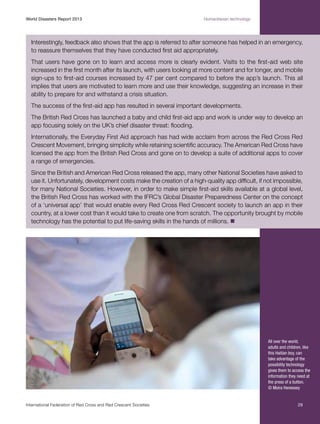
All over the world,
adults and children, like
this Haitian boy, can
take advantage of the
possibility technology
gives them to access the
information they need at
the press of a button.
© Moira Henessey

International Federation of Red Cross and Red Crescent Societies	

29
World Disasters Report 2013	

Chapter 1 Humanitarian technology

Challenges and limitations
Not so connected
Technological innovations are and will continue to transform humanitarian operations in many positive directions. Yet they bring with them inherent risks that often
go unaddressed amid the excitement of new technical possibilities and limitations
on the full effectiveness of technology for humanitarian purposes. Technology is
often assumed to improve not only the efficiency but also the accountability and
transparency of humanitarian aid. However, this is not necessarily the case if access
to technology is unequal, if aid workers no longer interact directly with the population and if new actors are not necessarily grounded in humanitarian principles. More
importantly perhaps, significant portions of populations at risk, especially marginalized or vulnerable groups, may not be regular users of new technologies. This may
make them harder to reach while they are, typically, the most vulnerable.
Indeed, as impressive as the number may seem – 6.8 billion mobile phone subscriptions and more than 2 billion mobile broadband internet subscriptions (ITU,
2013) – the on-the-ground reality is more often than not one of information poverty,
limited mobile phone coverage and little or no access to internet for both humanitarians and communities at risk. There is no doubt that the prevalence of mobile
phones is rapidly growing, but the numbers include inactive connections and multiple connections per user, so that the real number of mobile users worldwide was
estimated at 3.2 billion in 2012 (Wireless Intelligence, 2012) – or less than half the
6.8 billion mobile subscriptions. Furthermore, while the proportion of mobile phone
subscriptions is rapidly growing, it is not the same for all technological indicators.
For example, the proportion of computer ownership in 2011 was only 23 per cent in
low- and middle-income countries, compared to 72 per cent in high-income countries (ITU, 2013). Looking at countries’ income levels, World Bank data show an even
starker picture: while mobile subscriptions reached 114 per cent of the population
in high-income countries in 2011 (owing to multiple subscriptions per individual)
and 86 per cent in middle-income countries, that proportion was only 42 per cent
in low-income countries (World Bank, 2013). According to the same data, only 6 per
cent of the population in low-income countries used the internet in 2011, compared
to 27 per cent in middle-income countries and 76 per cent in high-income countries.
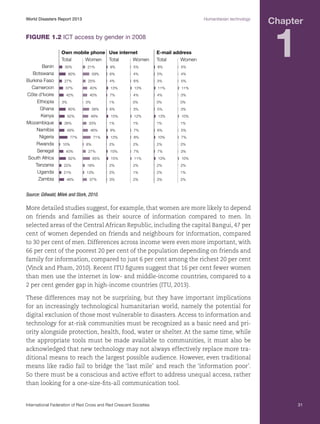
Disaggregated data on access to technology are unfortunately not widely available.
One study showed differences in access to mobile phone, internet or e-mail usage
between men and women (Gillwald, Milek and Stork, 2010; see Figure 1.2). The study
showed gender inequalities across gender, income and urban/rural divides. Education levels are also likely to play an important role. The cost of communications was
identified as a major challenge, especially among women who are more likely to do
unpaid work or generally earn less than their male counterparts.

30	

Focus on technology and the future of humanitarian action
World Disasters Report 2013	

Humanitarian technology

Figure 1.2 ICT access by gender in 2008
Own mobile phone Use internet
Total
Total
Women
Women
Benin
Botswana
Burkina Faso
Cameroon
Côte d'Ivoire
Ethiopia
Ghana
Kenya
Mozambique
Namibia
Nigeria
Rwanda
Senegal
South Africa
Tanzania
Uganda
Zambia

30%

21%

60%
27%

59%

9%

5%

8%

5%

6%

4%

5%

1

4%
5%

4%

6%

3%

37%

40%

13%

13%

11%

11%

42%

40%

7%

4%

4%

3%

3%

25%

E-mail address
Total
Women

Chapter

1%

0%

0%

0%

60%

3%
58%

6%

3%

5%

3%

52%

49%

15%

12%

13%

26%
49%

33%

10%
40%
62%

71%
8%
27%
65%

1%

1%

1%

9%

7%

6%

5%

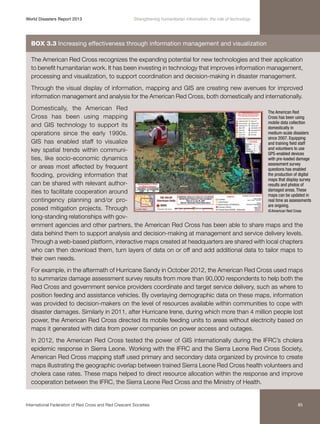
13%

8%

10%

7%

2%

46%

77%

10%

1%

2%

2%

2%

10%

7%

7%

3%

15%

11%

13%

10%

22%

18%

2%

2%

2%

2%

21%

13%

2%

1%

2%

1%

3%

2%

3%

2%

46%

37%

Source: Gillwald, Milek and Stork, 2010.

More detailed studies suggest, for example, that women are more likely to depend
on friends and families as their source of information compared to men. In
selected areas of the Central African Republic, including the capital Bangui, 47 per
cent of women depended on friends and neighbours for information, compared
to 30 per cent of men. Differences across income were even more important, with
66 per cent of the poorest 20 per cent of the population depending on friends and
family for information, compared to just 6 per cent among the richest 20 per cent
(Vinck and Pham, 2010). Recent ITU figures suggest that 16 per cent fewer women
than men use the internet in low- and middle-income countries, compared to a
2 per cent gender gap in high-income countries (ITU, 2013).
These differences may not be surprising, but they have important implications
for an increasingly technological humanitarian world, namely the potential for
digital exclusion of those most vulnerable to disasters. Access to information and
technology for at-risk communities must be recognized as a basic need and priority alongside protection, health, food, water or shelter. At the same time, while
the appropriate tools must be made available to communities, it must also be
acknowledged that new technology may not always effectively replace more traditional means to reach the largest possible audience. However, even traditional
means like radio fail to bridge the ‘last mile’ and reach the ‘information poor’.
So there must be a conscious and active effort to address unequal access, rather
than looking for a one-size-fits-all communication tool.

International Federation of Red Cross and Red Crescent Societies	

31
World Disasters Report 2013	

Chapter 1 Humanitarian technology

Digital exclusion, biases and privacy
One of the consequences of unequal access to technology is potential biases in data
generated by or about communities at risk. This is a separate issue from data accuracy, for which progress is rapidly being made for the verification of crowdsourced
data, for example. Rather, the issue is about the validity of the overall picture obtained
by many HICT efforts.
Somalia Speaks, for example, was set up by Al-Jazeera in 2011 to use mobile phone
text messages to ask Somalis how they were affected by conflict and received more
than 3,000 replies from Somalis. Presented as enabling the voice of people in one of
the most inaccessible and conflict-ridden areas of the world to be heard, the number
of replies was impressive given that, in 2010, the International Telecommunication
Union (ITU) estimated at 648,000 the number of mobile phones in Somalia, giving a
mobile penetration rate of just 7 per cent (ITU, 2013). Other estimates, however, put
the percentage for mobile phone subscription at 39 per cent (Infoasaid). Just onethird of the population is literate (one-quarter for women). In this context, those able
and willing to contribute to Somalia Speaks cannot be considered as representative
of the majority of the population. The potential for such data to be further biased
along structural inequalities is also important.
One common response of humanitarian technology supporters is that all data have
inherent potential biases and that crowdsourced data are very cheap to acquire,
unlike more structured population surveys. In fact one report even states that “new
information sources are no less representative or reliable than more traditional
sources, which are also imperfect in crisis settings” (OCHA, 2013). It is also argued
that humanitarian decision-making often relies on anecdotal evidence so that even
biased data may be better than no data at all. “Even when good data is available,
it is not always used to inform decisions. There are a number of reasons for this,
including data not being available in the right format, not widely dispersed, not easily accessible by users, not being transmitted through training and poor information
management. Also, data may arrive too late to be able to influence decision-making
in real time operations or may not be valued by actors who are more focused on
immediate action” (DfID, 2012; Meier, 2013).
However, there has been tremendous progress towards more rigorous evidence-based
humanitarian decision-making, with standardization of methods and assessments,
indicators and measurements, among others. These trends must continue and a status quo in terms of data quality is not acceptable. What is needed is a more in-depth
analysis of what community-generated data can accurately achieve, where, when
and under what conditions. For example, crisis mapping in highly connected environments like New York or Japan have very different risks of biases compared to
similar applications in remote areas of the Central African Republic, where access

32	

Focus on technology and the future of humanitarian action
World Disasters Report 2013	

Humanitarian technology

to technology may reflect and reinforce structural inequalities. Simply because
some data exist does not necessarily mean that they should be used to support
decisions. What is needed is for humanitarians not only to become aware of new
sources of data, but also to be more educated about their limitations.

Chapter

1

There are other forms of exclusions, too. Humanitarian organizations are confronted with the high initial financial cost and human resources requirements (e.g.,
skills) of many technology solutions, making them prohibitive for many local actors.
Vulnerable populations are confronted with the same limitations, which may hinder their ability to access benefits or services. Any solution offered must be simple
enough for easy adoption by users including in places where levels of literacy and
digital literacy are low. Communities may also mistrust technological solutions due
to fears of fraud or security breaches. Incentives can help ensure uptake of technology-based solutions but should be appropriate to the users’ level of involvement.

Box 1.5 World map of UNESCO’s points of interest
Within the framework of its post-conflict and post-disaster platform, the United Nations Educational,
Scientific and Cultural Organization (UNESCO) has designed and developed a project regarding the use
of ICTs in disaster risk reduction.
Vulnerable communities suffer repeatedly from disasters for a number of reasons, including the lack of
mitigating actions and informed decisions. Risk information is often not available at the local level where
it is much needed to better understand these vulnerabilities, raise public awareness and effectively manage risks.
To date, no comprehensive, openly licensed map of educational, cultural or scientifically relevant installations (such as schools, water wells, sanitation, libraries, etc.) exists. Information, when available, is often
superficial and limited to geo-coordinates. The availability of community-prioritized data, particularly on a
large scale, from the field is undoubtedly a substantial asset in preparedness, planning and response in
post-conflict and post-disaster contexts.
The ‘World map of UNESCO’s points of interests’ project aims to create a free, open and web-based
world map through citizen’s participation (crowdsourcing) with the objective of strengthening both the
resilience of local communities and the response of UNESCO and global organizations to post-conflict
and post-disaster situations through an openly licensed GIS data infrastructure. The project focuses on
developing assessment tools and mapping relevant sites or data in the targeted areas by using locally
available ICT infrastructures, including mobile connections, internet, tablets, TV and radio.
Furthermore, the project seeks to harness the potential of mapping in different UNESCO domains, through
adequate capacity building, targeting especially adolescent girls and boys from low- and middle-income
countries, through crowdsourcing.
This project builds on OpenStreetMap.org, a collaborative and openly licensed mapping initiative which
has been successfully used in several post-conflict and post-disaster situations (e.g., OCHA, Haiti, Japan

International Federation of Red Cross and Red Crescent Societies	

33
World Disasters Report 2013	

Chapter 1 Humanitarian technology

and Pakistan) and in citizen mapping initiatives (e.g., MapKibera in Nairobi, Kenya).
In collaboration with the stakeholders (e.g., youth, students, teachers and decision-makers), the
project aims at developing UNESCO-relevant metadata templates in local languages, to make
geospatial data effective in different post-conflict and post-disaster situations.
Five pilot projects began to be implemented in three regions in 2013: Kenya and Namibia (Africa),
India and Indonesia (Asia) and El Salvador (Latin America).
In Namibia, community participation was key in achieving the Water Supply and Sanitation Policy’s
objectives in 2008. The UNESCO project – run in consultation with the UNESCO national commission
and the Ministry of Rural Affairs – therefore focuses on developing a solid data collecting system
through participatory mapping in order to obtain a clear and transparent picture of the sanitation situation in schools and to promote community engagement in decision-making processes concerning
water management.
In Kenya, the project aims at building a network of communities sensitive to disaster risk reduction
to improve local knowledge of disaster risk and information management. Activities focus on Nairobi’s disaster-prone areas, such as Mathare. In addition, the project seeks to develop and implement
a participatory grass-roots community art and advocacy activity on disaster risk reduction. Social
interaction and income-generating schemes are incorporated through this process to produce a
tangible cultural heritage (moveable educational, cultural and learning materials).
In Indonesia, the project focuses on the lack of community-level information as a key issue for
effective flood management. The project proposes using participatory points of interest mapping to
create maps that represent land and resource use patterns, hazards, community values and perceptions, to gather information on traditional knowledge and practices, to collect data for assessments
or monitoring, to present alternative scenarios and to empower and educate stakeholders, raising
collective disaster risk awareness.
In India the main objective of the project is the empowerment of marginalized communities to represent themselves spatially through open visual maps and monitor public community infrastructure.
Visual maps of public infrastructure can support citizens and communities in post-crisis and post-disaster relief efforts, for example reporting on how basic infrastructure in schools and/or degraded
buildings create unhealthy and unsafe environments which are not conducive to learning. Improving
the current understanding of available facilities in a visual format through OpenStreetMap can also
improve girls’ access to educational facilities and reduce the number of school dropouts, therefore
contributing to gender equality and girls’ empowerment.
In El Salvador, the project integrates UNESCO’s activities to protect school facilities from disasters, as
these facilities may help save children’s lives and can be used as shelters in post-disaster situations.
The concept extends to meet the broader goal of disaster risk management in reducing the impact
of disasters. In partnership with the University of El Salvador and the Ministry of Education, the project seeks to reinforce the existing geospatial inventory of schools developed by the ministry with a
larger, community-implemented school safety assessment and to develop a data collection system,
including mapping tools and relevant training material. The school safety assessment will give local
authorities and the community an overview of the state of local schools and provide decision-making

34	

Focus on technology and the future of humanitarian action
World Disasters Report 2013	

Humanitarian technology

tools for the authorities in order to develop detailed school technical assessments (which may require
professional inputs) and to decide on retrofitting and reallocating schools at very high risk.
Based on the results of these local initiatives, a report on the use of open crowdsourced mapping
for disaster preparedness and risk reduction will be produced at the conclusion of the project at the end
of 2013. n

Other challenges
The World Disasters Report offers detailed discussion of many challenges in
humanitarian technology which, left unaddressed, could temper the enthusiasm
for such new technologies. Greater information sharing and more data collection
bring risks of information misuse and compromised data security and privacy.
Concerns over data protection and the security of information sources (e.g., individuals) are legitimate, but the actual risk may vary and needs to be carefully
analysed in relation to benefits. For example, paper-based collection of protection
data may be riskier than the use of digital methods to collect the same information, even if communication is not encrypted.
Two-way communication may also raise expectations and frustration if bottom–up communication is left unanswered. While new technologies can lead to
humanitarian crisis, caused by drone- or cyber-attacks, for example, excessive
focus on these risks can obscure other genuine and pressing concerns. Increased
dependency on technology may also create new vulnerabilities as post-disaster
environments are highly prone to failure of technological infrastructures. This
may affect not only the population, but humanitarian actors as well. Interventions can become overly reliant on information technology which in turn relies
on a highly vulnerable information infrastructure. Furthermore, that information
infrastructure is increasingly in the hands of private actors who have no duty to
provide minimum services for humanitarian reasons. Ad hoc public–private partnerships have been established, for example to facilitate the distribution of text
messages, but there are no national or international requirements to do so.
Technology has also multiplied the use of narratives of suffering to draw attention to humanitarian crisis, without equivalent focus on the ethics and practical
security risks of publicizing victims’ images and stories.
The emergence and professionalization of new humanitarian actors and the
changing role of the populations at risk themselves are beneficial and should be
encouraged. However, they also raise urgent questions about the risks, responsibilities and ethical challenges of humanitarian work. Humanitarian values are
cultivated within organizations in order to ensure that aid is delivered according
to certain fundamental principles. These principles should not be diminished in

International Federation of Red Cross and Red Crescent Societies	

35
World Disasters Report 2013	

Chapter 1 Humanitarian technology

more decentralized systems where communities and outsiders play as great a role as
professional humanitarians. Something is fundamentally wrong when technologies
are tested in real-time disasters with the participation of an uninformed population.
In this context, the level and extent of data extraction are unprecedented, with few
clear guidelines on how actors should behave. Several of the emerging actors are
already advancing in this reflection but more work is needed on the ethics and principles of humanitarian technology, for example to avoid the duplication of activities
and build the reach, credibility and comprehensiveness that these actors can achieve.

Box 1.6 Globally coordinated meteorological and climate networks and technology
During the period from 1980 to 2007, about 90 per cent of disasters were caused by recurrent events
such as droughts, windstorms, tropical cyclones, storm surges, floods, landslides and extreme
temperatures, or by forest fires, health epidemics and insect infestations, which are linked to meteorological and hydrological conditions (CRED, 2013). According to the Intergovernmental Panel
on Climate Change’s Fourth Assessment Report, the frequency and intensity of weather-, climatewater-related hazards are increasing as a result of climate change (IPCC, 2007).
The emergence of new technology and scientific knowledge provides opportunities to increase the
lead times of predictions of weather-, climate- and water-related hazards. Seasonal climate outlooks
help governments predict – and manage – excessive or deficient rainfall. Historical data have traditionally been used for analysis of hazard patterns. But this is no longer sufficient, because hazard
characteristics are changing as a result of climate change and more severe events could happen
more frequently in the future. Weather and climate services are therefore needed to inform long-term
investments and strategic planning on, for instance, coastal zone management, development of new
building codes and the retrofitting of infrastructure to withstand more frequent and severe hazards
(see Figure 1).
Scientific and technological advances increase the availability and accuracy of user-friendly climate
services to help countries and communities, especially the most vulnerable, adapt and build resilience to the impacts of climate variability and climate change. The Global Framework for Climate
Services, which brings together governments, the World Meteorological Organization (WMO) and
partners, is taking advantage of these new opportunities to serve as a joint platform between providers and users of climate services, and targets disaster risk reduction as one of its top priorities,
along with food security, water resource management and health.
WMO coordinates a global network of the national meteorological and hydrological services (NMHSs)
of its 191 members with more than 50,000 weather reports and several thousand charts and digital
products, which are disseminated every day through the system. The network is comprised of three
interlinked operational components:
n	
WMO Global Integrated Observing System, which collects data from 17 satellites, hundreds of

ocean buoys, thousands of aircrafts and ships and nearly 10,000 land-based stations

36	

Focus on technology and the future of humanitarian action
World Disasters Report 2013	

Humanitarian technology

n	
WMO Global Telecommunication System (GTS) is a dedicated network of surface and satellite-based

telecommunication links and centres operated 24/7, which connects all NMHSs for the collection
and distribution of all meteorological and related data, forecasts and alerts, including tsunami- and
seismic-related information and warnings. The GTS is being expanded through WMO Information
Systems to exchange all weather-, climate- and water-related information including to users outside
the meteorological community
n	
Global Data Processing and Forecasting System, a network of nearly 50 global and regional special-

ized meteorological centres that provides analysis, bulletins and related information to the NMHSs.
Figure 1 Seamless hydro-meteorological and climate services for various risk management and
risk reduction applications

Source: Adapted from WMO, 2011.

Building on this network, WMO is working with its members to strengthen and establish new regional
climate centres and regional drought management centres. WMO also has an emergency response activities programme, established in 1986, to assist NMHSs, governments and international organizations to
respond effectively to environmental emergencies with large-scale dispersion of air-borne hazardous substances. The programme focuses on nuclear facility accidents, but also provides support in emergency
response to smoke dispersion from large fires, atmospheric transport of volcanic ash, chemical releases
from industrial accidents and sand and dust storms. The WMO operational network of meteorological
centres provides specialized atmospheric dispersion-modelling that plays a crucial role in assessing and

International Federation of Red Cross and Red Crescent Societies	

37
World Disasters Report 2013	

Chapter 1 Humanitarian technology

predicting the spread of air- and water-borne hazardous substances. WMO’s system of eight regional
specialized meteorological centres supplies highly specialized computer-based simulations of the
atmosphere that predict the long-range movement of air-borne radioactivity to support environmental
emergency response, when needed. This response system was activated after the Japan earthquake
in March 2011.
As these examples show, building on strategic partnerships facilitated through WMO’s Disaster Risk
Reduction Programme with the international humanitarian community, new technologies are being
leveraged to provide meteorological and climate services for improved humanitarian planning, preparedness and response operations. n

Conclusion
“Consider today’s online world. The Usenet, a worldwide bulletin board,
allows anyone to post messages across the nation. Your word gets out,
leapfrogging editors and publishers. Every voice can be heard cheaply
and instantly. The result? Every voice is heard. The cacophony more
closely resembles citizens band radio, complete with handles, harassment, and anonymous threats. When most everyone shouts, few listen.
How about electronic publishing? Try reading a book on disc. At best, it’s
an unpleasant chore: the myopic glow of a clunky computer replaces
the friendly pages of a book. And you can’t tote that laptop to the beach.
Yet Nicholas Negroponte, director of the MIT Media Lab, predicts that
we’ll soon buy books and newspapers straight over the Internet. Uh,
sure” (Stoll, 1995).
Predicting what today’s innovations, including humanitarian innovations, will bring
tomorrow is impossible. Do they deserve support because of their demonstrated or
potential effect on humanitarian action, or should they be dismissed because of the
inherent risks and challenges they raise for communities and humanitarian actors?
As always, the answer is somewhere in between. Technology is already bringing valuable contributions in key areas of humanitarian action, as a support for learning
or by facilitating citizen participation, empowerment and resilience. The adoption of
such technologies is part of a natural evolution for humanitarian action. However,
this adoption must be cautious, based on rigorous evaluation, and mindful of emerging challenges, such as the risks of technological failure, digital divides and biases,
and threats to humanitarian and ethical principles. Humanitarians must work with
governments, the private sector and technology communities to ensure that humanitarian technologies are used to predict crises better, mobilize communities at risk
and improve response without compromising humanitarian principles.

38	

Focus on technology and the future of humanitarian action
World Disasters Report 2013	

Humanitarian technology

Ultimately, new humanitarian technologies are just tools towards better humanitarian action. Humanitarian agencies must fully commit and invest in developing
the tools, policies and strategies to communicate better with disaster-affected communities and enable their participation and ownership of humanitarian action.
Advances in technology should be used to develop extensive and reliable feedback loops between humanitarian actors and the individuals they are serving, but
there must also be the commitment and capacity to use this feedback to improve
programming.

Chapter

1

Chapter 1 was written by Patrick Vinck, director of the program for vulnerable populations
at the Harvard Humanitarian Initiative and editor of the World Disasters Report 2013.
Box 1.1 was written by Paul Conneally, head of communications and partnership promotion
division at International Telecommunication Union. Box 1.2 was written by Bobi Morris,
Senior Emergency Accountability Coordinator, International Rescue Committee. Box 1.3
was written by Reda Sadki, Senior Officer, Learning Systems, IFRC. Box 1.4 was written
by Alison McNulty, Head of Research, Evaluation and Impact, British Red Cross. Box 1.5
was written by Davide Storti, Knowledge Societies Division, United Nations Educational,
Scientific and Cultural Organization. Box 1.6 was written by Maryam Golnaraghi, Chief
Disaster Risk Reduction Programme, World Meteorological Organization.

International Federation of Red Cross and Red Crescent Societies	

39
Chapter 1 Humanitarian technology

World Disasters Report 2013	

Sources and further information
–	Al-Jazeera. Somalia Speaks. Available online: www.aljazeera.com/indepth/spotlight/
somaliaconflict/somaliaspeaks.html.
–	 Bernard, V. ‘Editorial: The future of humanitarian action’ in International Review of the Red
Cross, Vol. 93, no. 884, pp. 891-897, 2011.
–	 British Red Cross. First Aid App. Available online: www.redcross.org.uk/What-we-do/
First-aid/Mobile-app.
–	 Centre for Research on the Epidemiology of Disasters (CRED). EM-DAT. Brussels: CRED,
2013. Available online: www.emdat.be.
–	 Cope, B. and Kalantzis, M. New Learning: Elements of a Science of Education. Second edition.
Cambridge: Cambridge University Press, 2012.
–	 Crisis Mappers: http://crisismappers.net/.
–	 Department for International Development (DfID). Building resilience and improving our
responses to humanitarian emergencies through innovation and better use of evidence. London:
DfID, 2012. Available online: http://reliefweb.int/sites/reliefweb.int/files/resources/prominnov-evi-bas-appr-build-res-resp-hum-cris.pdf.
–	 Dunne, H. ‘Winner: Best use of digital’, CorpComms Online. Posted 22 November
2012. Available online: www.corpcommsmagazine.co.uk/awards/corpcomms/
winning-entries/2755-winner-best-use-of-digital.
–	 Eisenburger, P. and Safar, P. ‘Life supporting first aid training of the public-review and
recommendations’ in Resuscitation, Vol. 41, no. 1, pp.3-18, 1999.
–	 eMarketer. ‘In the UK, will mobile payments go mainstream?’ Newsletter,
31 January 2013. Available online: www.emarketer.com/Article/
UK-Will-Mobile-Payments-Go-Mainstream/1009641.
–	 Gillwald, A., Milek, A. and Stork, C. Gender Assessment of ICT Access and Usage in Africa
2010. Towards Evidence-based ICT Policy and Regulation – Volume 1, Policy Paper 5.
ReaserchICTafrica.net, 2010. Available online: http://researchictafrica.net/
publications.php.
–	 Global Humanitarian Assistance. Data  Guides. Undated. Available online: www.
globalhumanitarianassistance.org/data-guides/defining-humanitarian-aid.
–	 Google Crisis Response. Making critical information more accessible in times of disaster.
Available online: www.google.org/crisisresponse/.

40	

Focus on technology and the future of humanitarian action
World Disasters Report 2013	

Humanitarian technology

–	 Google Person Finder. Google Person Finder helps people reconnect with friends and loved ones
in the aftermath of natural and humanitarian disasters. Available online: http://google.org/
personfinder/global/home.html.
–	 Humanitarian OpenStreetMap: http://hot.openstreetmap.org.

Chapter

1

–	 Infoasaid. Somalia: telecommunications overview: http://infoasaid.org/guide/somalia/
telecommunications-overview#sthash.PWFi7bJj.dpuf.
–	 Inter‐Agency Standing Committee (IASC). IASC Principles Transformative Agenda.
Geneva: IASC, 2012. Available online: www.humanitarianinfo.org/iasc/pageloader.
aspx?page=content-template-defaultbd=87.
–	 Intergovernmental Panel on Climate Change (IPCC). Climate Change 2007: Synthesis
Report. Contribution of Working Groups I, II and III to the Fourth Assessment Report of the
Intergovernmental Panel on Climate Change. Geneva: IPCC, 2007. Available online:
www.ipcc.ch/publications_and_data/publications_ipcc_fourth_assessment_report_
synthesis_report.htm.
–	 International Federation of Red Cross and Red Crescent Societies (IFRC) Global
Disaster Preparedness Center: www.preparecenter.org.
–	 International Telecommunication Union (ITU). 2013 ITU World Telecommunication/ICT
Indicators database. Available online: www.itu.int/en/ITU-D/Statistics/Pages/default.
aspx.
–	 Letouzé, E., Meier, P. and Vinck, P. ‘Big Data for Conflict Prevention: New Oil and Old
Fires’ in Mancini, F. (ed.), New Technology and the Prevention of Violence and Conflict. New
York: International Peace Institute, 2013. Available online: www.ipinst.org/media/pdf/
publications/ipi_epub_new_technology_final.pdf.
–	 Meier, P. Fourth-Generation Early Warning Systems. Conflict Early Warning and Early
Response blog, posted 6 March 2009. Available online: https://earlywarning.wordpress.
com/2009/03/06/fourth-generation-early-warning-systems.
–	 Meier, P. Humanitarianism in the Network Age: Groundbreaking Study. iRevolution
blog, posted 9 April 2013. Available online: http://irevolution.net/2013/04/09/
humanitarianism-network-age/.
–	 Merriam-Webster. Definition crowdsourcing: www.merriam-webster.com/dictionary/
crowdsourcing.
–	NetHope. About us. Available online: http://nethope.org/.
–	 Paterson, G. and Lane, N. Mobile Market Trends: UK: Data to engage with consumers 20102012. London: Mobile squared, 2010. Available online: www.mobilesquared.co.uk/pdfs/
mobile_market_trends_uk.pdf.

International Federation of Red Cross and Red Crescent Societies	

41
Chapter 1 Humanitarian technology

World Disasters Report 2013	

–	 Pham, P.N. and Vinck, P. ‘Technology, Conflict Early Warning Systems, Public Health, and
Human Rights’ in Health and Human Rights, Vol. 14, no. 2, pp. 2-12, December 2012.
–	Quadriga. Digital Communication Awards 2012: Winners 2012. Accessed 22 February 2013.
Available online: www.digital-awards.eu/files/2012/09/dca_winner_2012.pdf.
–	 Sphere Project. The Sphere Handbook: Humanitarian Charter and Minimum Standards in
Humanitarian Response. Geneva: Sphere Project, 2011. Available online: www.sphereproject.
org/handbook/.
–	 Stoll, C. ‘Why Web Won’t Be Nirvana’ in Newsweek, 26 February 1995. Reproduced by The
Daily Beast. Available online: www.thedailybeast.com/newsweek/1995/02/26/the-internetbah.html.
–	 United Nations (UN). The Universal Declaration of Human Rights. New York: UN, 1948.
Available online: www.un.org/en/documents/udhr/index.shtml.
–	 United Nations International Strategy for Disaster Reduction (UNISDR). Global Survey of
Early Warning Systems. Geneva: UNISDR, 2006. Available online: www.unisdr.org/files/3612_
GlobalSurveyofEarlyWarningSystems.pdf.
–	 United Nations Office for the Coordination of Humanitarian Affairs (OCHA), United
Nations Foundation and Vodafone Foundation. Disaster Relief 2.0: The Future of
Information Sharing in Humanitarian Emergencies. New York: OCHA, UN Foundation and
Vodaphone Foundation, 2011. Available online: www.unocha.org/top-stories/all-stories/
disaster-relief-20-future-information-sharing-humanitarian-emergencies.
–	OCHA. Humanitarianism in the Network Age. OCHA Policy and Studies Series. New York:
OCHA, 2013. Available online: www.unocha.org/hina.
–	 Ushahidi: www.ushahidi.com.
–	 Vinck, P. and Pham, P.N. ‘Outreach Evaluation: The International Criminal Court in the
Central African Republic’ in International Journal of Transitional Justice, Vol. 4, no. 3, pp. 421442, November 2010.
–	 White, J. and McNulty, A. Assessing the links between first aid training and community resilience.
Research, evaluation and impact. London: British Red Cross, 2011.
–	 Wireless Intelligence. Analysis: Global mobile penetration – subscribers versus connections.
2012. Available online: https://wirelessintelligence.com/analysis/2012/10/global-mobilepenetration-subscribers-versus-connections/354/ (WI 2012).
–	 World Bank: Open data 2013 available online: http://data.worldbank.org/.
–	 World Health Organization (WHO). ITU and WHO launch mHealth initiative to combat
noncommunicable diseases. Joint ITU/WHO news release, 17 October 2012. Available online:
www.who.int/mediacentre/news/releases/2012/mHealth_20121017/en/.

42	

Focus on technology and the future of humanitarian action
World Disasters Report 2013	

Humanitarian technology

–	 World Meteorological Organization (WMO). WMO Strategic Plan 2012-2015. Geneva:
WMO, 2011. Available online: www.wmo.int/pages/about/documents/1069_en.pdf.
–	 Zhou, H. et al. ‘Diffusion of new technology, health services and information after a
crisis: a focus group study of the Sichuan “5.12” Earthquake’ in International Journal of

Chapter

1

Health Planning and Management, 2 August 2012 (e-pub).

International Federation of Red Cross and Red Crescent Societies	

43
Chapter 2
Chapter

Technology and communitycentred humanitarian action

2

Technology is changing how humanitarian disasters are prepared for, responded
to and recovered from. More importantly, it is changing how local communities,
who inevitably are the first responders, react and improve their actions. Both the
directly affected populations and the institutions that pledge to support them
are finding new ways to connect, enabling them to better attempt to prevent
catastrophes, save lives and rebuild communities.
Despite living in Chicago, more than 9,700 kilometres (6,000 miles) from his native
Syria, Zaher Sahloul, a medical doctor, has been busy the last two years helping
to treat patients in his war-torn country of origin. He has made six trips on medical missions to refugee camps in Jordan and Turkey and to camps for displaced
people inside Syria. In the United States, he has used social media to organize
medical supplies and donations worth more than US$ 5 million from the Syrian
diaspora in the United States. He has also filmed and uploaded tutorial videos
(SAMS, 2012) in Arabic to YouTube that give physicians inside Syria advice on how
to treat external bleeding, clean wounds and sew injuries common to warfare.
And he has been using a computerized barcode system to track medical supplies
and ensure they arrive safely at their intended locations inside Syria (Sahloul,
personal communication, 2013).
Regardless of the regular phone and internet blackouts and non-secure communication channels in Syria (Reuters, 2013), Sahloul has been able to communicate
with medical personnel on the ground. This has been made possible thanks to
internet system engineers like Salah Mamdouh (name changed to preserve real
identity), who works with an international non-governmental organization (NGO)
that preferred not to be named to preserve their identity. Mamdouh, a Syrian who
was forced to flee the country, has helped to establish encryption tools and virtual
private network (VPN) accounts, to create secure ways for Syrians inside the country to communicate via the internet (Mamdouh, personal communication, 2013).
Mamdouh says Syrians who manage to get online head to YouTube to share footage of the humanitarian disaster they are witnessing. They also flock to Skype
to communicate with family members and to get information and requests to
the humanitarian community. Having open channels for Skype calls has allowed
Sahloul to connect with hospitals and doctors, some of them former classmates
from medical school in Damascus. His organization, Syrian American Medical
Society, has collaborated with both local organizations inside Syria and international humanitarian agencies, like the International Rescue Committee and the

This refugee from
Darfur listens to Radio
Sila in a Chadian camp.
Internews, a media NGO,
trained local journalists
and built radio stations
for people displaced
from Darfur and host
communities. Radio is
effective in getting social
action messages to a
population that is largely
illiterate.
© Meridith Kohut/
Internews

International Federation of Red Cross and Red Crescent Societies	45
World Disasters Report 2013	

Chapter 2 Technology and community-centred humanitarian action

International Committee of the Red Cross, to coordinate aid and make sure the right
kind of assistance is reaching refugee camps and into Syria.
Enabling Syrians to use YouTube, Skype and other online tools has been a useful way
for people inside Syria to organize, coordinate and respond to their own problems,
and for outside actors, particularly when humanitarian access has been so limited,
to try to ascertain need and organize and provide humanitarian assistance.

Your mobile, your life
The collapse of the Rana Plaza garment factory in Dhaka, Bangladesh on 24 April
2013, is another testament to the use of information and communication technologies – in this instance, mobile phones – as a tool for post-disaster recovery. While
searching through the rubble of the Rana Plaza, looking for survivors after the
building collapsed, civilian rescuer Saydia Gulrukh noticed that many individuals
had died clutching identity cards and mobile phones (Gulrukh, personal communication, 2013).
Gulrukh says this response can be tied to another factory disaster in November 2012,
where a fire tore through the Tazreen garment factory, also in Dhaka, killing more
than 100 people. Government estimates of the missing were low, in part because
many families had no records of their loved ones to help identify them. This made it
difficult for them to claim bodies and prove that they qualified for benefits.
Gulrukh, a trained anthropologist who heads a small organization called Activist Anthropologist, was also doing research as she helped with the initial recovery
at the Rana Plaza building. She wanted to try and get an independent count of
the dead, communicate with their families and establish how many people were
still missing. Gulrukh did this by accessing SIM cards of the deceased, putting
them into a second phone and calling a number from the address book, eventually connecting with someone who could confirm the identity of the person.
Activist Anthropologist is trying to hold the government of Bangladesh, in particular
the Ministry of Labour and Employment, and the Bangladeshi Garment Manufacturers
and Exporters Association (BGMEA) more accountable through a parallel investigation. By connecting with families of those affected or missing, the organization aims
to force the government to publish more accurate numbers for missing workers and,
as a result, offer proper compensation amounts for their families.
Imogen Wall, the coordinator for communications with affected communities at the
United Nations Office for the Coordination of Humanitarian Affairs (OCHA), would
not be surprised by the creative use of Skype in Syria’s war zone or that of mobile
phones in response to the Bangladesh factory disaster.

46	

Focus on technology and the future of humanitarian action
World Disasters Report 2013	

Technology and community-centred humanitarian action

“These tools are amplifying the capacity of disaster survivors to find resources
and to find what they need to get them out of whatever situation they’re in,” says
Wall. “Whether that’s being able to call a family member to dig them out or rescue them in a boat in a flood, or the capacity to connect immediately to someone
overseas who might be able to send money, or family reunification, or being able
to just pull a community together to respond really fast” (Wall, personal communication, 2013).

Chapter

2

Are we listening enough?
New technologies – mobile phones, SMS, crisis mapping and social media –
increase the capacity for affected communities, diaspora groups and ordinary
citizens to access, produce, share and disseminate useful and actionable information and also demand accountability outside the traditional humanitarian circuit
(Wall and Chéry, 2011).
Humanitarian actors have begun to adopt some of these tools more systematically in their work, relying on input from affected populations. Yet the question
remains: are we listening enough (Quintanilla, 2013)? And, even more critically,
what happens to those who fall through the cracks of the digital and age divide?
Since the earthquake that shook Japan in March 2011, concerns have been
expressed about those individuals who live beyond that last mile of existing communication infrastructure, who nevertheless can experience the full range of
consequences of a disaster (Internews, 2013).
There has been important progress, including the birth of the Communicating
with Disaster Affected Communities (CDAC) Network, a group of organizations
established in 2009 to promote more effective engagement with communities
affected by crisis, and the Infosaid project which ran from 2010 to 2012 and
aimed to improve information exchange in crisis situations, by making more
accurate and timely information available to both humanitarian responders and
crisis-affected populations. Yet the humanitarian community has yet to fully
realize that communication is one of the most powerful forms of aid and that
humanitarian responses are often still undermined precisely because people’s
information needs are considered a low priority.

International Federation of Red Cross and Red Crescent Societies	

47
World Disasters Report 2013	

Chapter 2 Technology and community-centred humanitarian action

Box 2.1 Voix des Kivus: crowdseeding event data in eastern DRC
In 2009, New York’s Columbia University launched a pilot project called Voix des Kivus in the wartorn province of South Kivu in the Democratic Republic of the Congo (DRC). The project sought to
examine how mobile phone technology could be used to gather representative data about conflict
events in real time.
Data collection projects based on mobile phone technology have become very popular, and often use
a ‘crowdsourcing’ approach in which anyone with the interest and ability can send an SMS message
to a central platform. The Voix des Kivus project chose to use ‘crowdseeding’, i.e., it selected villages
through random sampling and identified specific reporters in each village. These were given mobile
phones, credit and training, and were invited to contribute to the system. This approach has three
benefits for data quality. First, people can participate that otherwise would not, particularly in areas
such as the DRC, where the crowd may be small: many live in hard-to-access villages and lack a
mobile phone or the funds to send an SMS. Second, by selecting a random sample, the information
received is representative of a wider population. Finally, there is reduced scope for faking reports. A
crowdseeding system builds a relationship with the reporters, increases incentives to report truthfully
and offers the opportunity to verify reports.
The project operated in 18 villages. After villagers agreed to participate, three reporters were
selected: the chief of the village, the head of the women’s association and one reporter elected
by the community. Reporters were trained and provided with a phone and a codesheet that listed
possible events. Reporters automatically received a weekly phone credit that they could freely use
and were reimbursed for the number of messages sent, but did not receive private benefits for
sending messages. Sending messages to the system was, therefore, both free and voluntary. The
reporters served as representatives of their villages and could relay information on public events
witnessed by others. There was 100 per cent consent (0 per cent non-response) at both the village
and the reporter levels.
On the receiving side, a standard mobile phone linked to a laptop comprises the necessary
equipment. With freely available software (FrontlineSMS, R and LaTeX), messages received were
automatically filtered, coded for content, cleaned to remove duplication and merged into a database. Translations of non-coded text messages (generally from Swahili) were undertaken manually.
Uptake was enthusiastic. In 18 months the reporters sent more than 4,000 pre-coded messages
about public events and some 1,000 text messages. Moreover, individual rates of sending showed
no signs of abating. The data generated were rich, including regular reports of conflict events
(abductions, looting, shootings, sexual violence, etc.) and non-conflict events (crop failures, flooding, etc.). Qualitative verification and cross-validation between reporters suggest that the data are
of good quality. The system was demonstrably cheap and workable.
Much of the data received, such as information on violence perpetrated by different actors, was
sensitive in nature and this had implications for data dissemination and project scale.
In contrast to a crowdsourcing system, where information is received from an unidentified, anonymous public, a crowdseeding system makes use of identifiable users. This characteristic had three

48	

Focus on technology and the future of humanitarian action
World Disasters Report 2013	

Technology and community-centred humanitarian action

implications. First, to ensure that subjects were not harmed, Voix des Kivus did not make all the event
data public and more sensitive data were only shared with trusted actors in a position to respond. In
practice, data were disseminated through a weekly bulletin in two versions – a non-sensitive version
shared broadly and posted on the web, and a sensitive version shared with development and relief
organizations in the region. Second, although collective participation in a system like Voix des Kivus has
the potential for disparate villages to engage with each other more directly and coordinate on concerted
action, the project’s concern with the protection of participants prevented this type of networking since
participating villages remained mutually anonymous. Finally, Voix des Kivus only worked on a small scale.
If brought to scale, more people – among others, violent groups – would be more likely to hear about
the project which might create risks for reporters.
Experience with Voix des Kivus shows the feasibility of implementing a crowdseeding system to collect
high-quality representative data in real time. However, while proof of concept for the data collection
strategy exists, there is no proof of concept that the data collected are actionable. In the 18 months
of operation, the project is not aware of any instances in which developmental or humanitarian agencies responded to incidents or issues raised by the reporters. It is possible that the weak reaction was
because of the project’s small scale. Voix des Kivus operated in only 18 villages and the researchers
did not want to scale up for security reasons. These problems might be mitigated if the project were
implemented by an NGO that can respond and is able to take responsibility for risks to reporters. n

Mobile information
There are currently 6.8 billion mobile phone subscriptions in the world, according to the International Telecommunication Union (ITU, 2013). That’s almost one
mobile phone subscription per person, a milestone that should be reached by
2014. Mobile phone penetration rates are more than 100 per cent in high-income
countries and around 89 per cent in low- and middle-income countries, as even
the most impoverished and isolated citizens now find ways to obtain mobile
phones and pay for basic coverage.
This proliferation of mobile phones has enabled aid providers to connect with a
volume of affected populations and at a speed that was unimaginable ten years
ago. In Sierra Leone, where 60 to 70 per cent of the 6 million residents are connected via mobile phone, the IFRC has launched the Trilogy Emergency Relief
Application (TERA) project in collaboration with local telecom providers. TERA
allows the Sierra Leone Red Cross Society and IFRC to target specific cell towers
around the country, sending humanitarian information via SMS to communities
in crisis, allowing the agency to connect instantly with affected communities
about floods, wildfires and disease outbreaks.
The IFRC’s beneficiary communications delegate Sharon Reader helped introduce the TERA project with the Sierra Leone Red Cross Society: “We can SMS
up to 36,000 people per hour to tell them that there’s a fire happening in this

International Federation of Red Cross and Red Crescent Societies	

49
World Disasters Report 2013	

Chapter 2 Technology and community-centred humanitarian action

community or this town, where it’s happening, so they can avoid it and not get stuck
in the middle of it” (Reader, personal communication, 2013).
The Sierra Leone Red Cross is looking to use TERA for prevention outreach too, by
sending a series of daily text messages with information about disease prevention
and disaster preparedness. For example, as the rainy season approaches and the risk
of malaria increases, TERA could be used to introduce the topic to SMS recipients,
explain how to prevent it, what the symptoms are and what to do if they become ill.
In the Philippines, with a population of 94 million, there are already more mobile
phone subscriptions than people, driving a culture of connectivity in this nation
of islands where Facebook and Twitter, most commonly accessed by phones, have
become part of everyday life. In December 2012 the government of the Philippines
turned to social media to help prepare for the oncoming Typhoon Bopha (also called
Typhoon Pablo). Before the category 5 storm – the most severe – descended with
258 kph (160 mph) winds, flooding and mudslides, officials began alerting citizens
via television, internet and radio; and they created a special Twitter hashtag for the
storm, #PabloPH, and a mobile-friendly disaster information page that helped people
locate disaster shelters and other assistance (Tech in Asia, 2012).
OCHA’s Imogen Wall was in the Philippines as part of the humanitarian response to
Typhoon Bopha. She says that the reason the tech approach to assisting citizens in the
storm was successful was that it was homegrown and made use of communication
channels that were already widely used in the country. “Technology is just making
visible to us what would have happened anyway,” she says. “Communities talk to each
other, connect to each other and try to leverage resources to get themselves out of the
situation they face. That has always been the case, but when people do it electronically – like in the Philippines where they posted messages on Twitter saying ‘Stuck
here. Help.’ – that makes it visible to us” (Wall, personal communication, 2013).

New media/old media
In October 2012, Hurricane Sandy hit the eastern seaboard of the United States with
a ferocity for which few were prepared, including governments, businesses, utility
companies, aid agencies, transport authorities and residents. Hundreds of thousands
of people lost access to basic resources for weeks. Some residents in the hardest-hit
areas, such as Staten Island, Brooklyn and the New Jersey shoreline, lost everything.
In Brooklyn’s Red Hook neighbourhood, a small enclave that sits on the Atlantic
Ocean and includes that borough’s largest social housing community, residents were
taken unawares. Tide waters rose up and flooded the neighbourhood, filling not only
basements, but first floors of buildings. Thousands of people lost power, heat and
water, and the main local food outlets were inoperable or completely destroyed.

50	

Focus on technology and the future of humanitarian action
World Disasters Report 2013	

Technology and community-centred humanitarian action

For weeks, debris littered the streets of Red Hook, while inhabitants queued for
food aid and the US federal government and aid agencies set up offices in trailers
to help those in need. And this was in New York City, one of the most resource-rich
places in the world.

Chapter

2

Ulyses Bermudez, aged 57, did not evacuate his apartment when the mayor
of New York, Michael Bloomberg, gave warning of the potential damage
a day before Sandy hit. It is the only home he has ever known, and he rarely
leaves his tight-knit neighbourhood. Bermudez spent the first week after
the hurricane in the dark, as ocean waters had flooded the basement of his
building, wrecking its electrical system. Afraid that his apartment might get
looted if he left it, Bermudez stayed put, lit candles and listened to his battery-powered radio, waiting for news of the arrival of assistance in Red Hook.
Bermudez felt isolated. He had a mobile phone, but not a smartphone, no computer and no electricity for a television. His only source of local news was simply
talking to the other residents who stayed behind and messages taped by volunteers
to the doors of his building with phone numbers to call for various forms of aid.
While Bermudez sat in his apartment listening to the radio, the impact of the
storm was being documented and identified on the internet, and a substantial
relief response was being organized online. One Red Hook community organization was even developing a crisis map for the neighbourhood. But Ulyses
Bermudez was clearly never going to access any kind of aid that relied on him
being online (Bermudez, personal communication, 2012).
In the wake of the disaster that hit Japan in March 2011, similar scenarios were
commonplace. Japan is a media- and information-rich, digitally enabled society,
but the regions worst hit by the tsunami – Iwate, Miyagi and Fukushima – were
predominantly fishing and rural areas with declining populations, 30 per cent of
whom were over 60 years old. Many of the inhabitants were, like Bermudez in
Brooklyn’s Red Hook, unaccustomed to accessing information online, unfamiliar
with social media networks and, therefore, unaware of the relief resources available to them.
Knowing what information people need, what channels people use and – very
importantly – trust, and how they communicate within their own communities
and with the outside world is the first step to providing aid more effectively.
Kyla Reid is the head of disaster response for the GSMA, a mobile phone industry
association that brings together more than 800 of the world’s mobile providers.
Reid specializes in ensuring mobile networks are available as essential tools in the
wake of crises. She is well aware that technology is not always a saviour, or even
an available tool, in a disaster situation. “You can prepare the networks as much as
you want,” she says, “but if you get a 100-year storm or a really severe earthquake,

International Federation of Red Cross and Red Crescent Societies	

51
World Disasters Report 2013	

Chapter 2 Technology and community-centred humanitarian action

there are going to be interruptions – service interruptions and other kinds of problems.
And often, it’s actually congestion on the networks of people calling in and calling out
than actual damage to the infrastructure” (Reid, personal communication, 2013).
In addition, communities and responders must also remain acutely aware of the
likelihood of a technology blackout and are often obliged to come up with strategies
to work around the absence of information and communication. In October 2012, in
the Brooklyn neighbourhood of Rockaways – hard hit by Hurricane Sandy – Elizabeth
Knafo worked as part of Occupy Sandy, a relief effort organized out of funds and
networks left over from the resistance movement Occupy Wall Street. While many
‘occupiers’ were busy making sure affected residents were dry, safe and had basic
necessities, Knafo and a small group of other responders went out with notepads
and pens and began to do field research. Knafo says there was no consistent information available to the affected communities and, with mobile phones and internet
down, people were, literally, in the dark. So she and her colleagues began to organize
the information that seemed most essential and in demand from locals, and they
created a bulletin dedicated to what storm-affected communities needed to know.
“It seemed obvious that, in a place that had no electricity and no phones, the little
information that was out there was not going to be acceptable. We just wanted to get
as much of that info as we could and print it onto paper. We also wanted to create a
little more coherence,” she says (Knafo, personal communication, 2013).
The Sandy Relief Bulletin was born and included information about recovery, shelter,
food, transportation, clean-up, emergency benefits and more. Some 50,000 copies
were printed, using funds supplied from the Occupy movements own Occuprint
printing collective, and were distributed in Rockaways, Red Hook and Staten Island,
some of New York’s hardest-hit areas. The bulletins were deposited at aid distribution
hubs and made available along with other assistance. A second bulletin was printed
a week later and included a map of recovery centres and aid agency outposts. It also
published information about disaster unemployment insurance and advice on how
to stay warm as temperatures dropped.
Knafo and her colleagues received e-mails from the US Federal Emergency Management Agency and the American Red Cross, inquiring if the group planned to
print more copies. She says many of the more essential recovery agencies and the
city and federal governments had their forms and deadlines for assistance available only online, where many could not access them due to lack of electricity or
internet access.
Knafo’s experience in New York is corroborated by that of Hiroyuki Takeuchi, editor
of the Hibi Shimbun, a local newspaper in the Ishinomaki area of Japan. Immediately
after the tsunami in 2011, with his newspaper’s offices flooded, no power and the
printer broken, Takeuchi sent his six reporters to gather information from the city

52	

Focus on technology and the future of humanitarian action
World Disasters Report 2013	

Technology and community-centred humanitarian action

hall and affected areas, which they reached on foot. The day after the earthquake,
reporters handwrote headlines on a giant piece of paper. “People were so hungry
for information we could barely stick the paper on the wall at relief sites. If there
is no information after a disaster people become even more stressed and anxious.
Old media works best in emergencies,” he says.

Chapter

2

According to Keiichi Saito, a community radio station manager in Tome, Japan,
who got back on the air immediately after the disaster by relocating his broadcasts to the hill where his antenna was located: “People act more calmly with a
radio. With visual information, people may panic more easily. Also, a radio is good
because it is portable and even old people know how to use it.” In the first few
days after the disaster, Saito’s broadcasts helped people get the information they
needed about the scale of the destruction, basic resources like food and water,
and updates on the local electrical grid.
Japanese citizens outside the impact zones were able to use all kinds of different media to search for loved ones, including the popular Google Person Finder.
But Saito says being connected online was a luxury for those who were safe and
sound. “The internet is useful for people outside of the disaster area, but inside
the area, the power and network are often cut, so it’s not useful right after the
disaster, when we really need information. In addition, too much information can
lead to confusion” (Saito, personal communication, 2013).
In addition to advances in technology, it is necessary to continue to use and
support more traditional methods of information and communication, such as
community radio stations. Their crucial role is under-acknowledged, however,
and funding for them is very limited.

Box 2.2 Communications, technology and crowdsourcing during the 2011 Japanese earthquake
As a leader in both disaster preparedness and advanced technology, Japan’s civil society used everyday
tools in unique ways to communicate and share information in the wake of the March 2011 earthquake
and ensuing tsunami and nuclear accident. Examples of such platforms include Twitter and Sinsai.info.
Some of the worst-affected areas were without power or access to phones and internet for weeks, but
in other areas internet services remained accessible even where mobile phone networks were down.
Japan is the third-largest user of Twitter after the United States and Brazil, and Twitter use rose from an
average of 3,000 inter-country messages per minute to 11,000 on the day of the earthquake (Kondo,
2011). These tweets included urgent pleas for assistance, which were organized by a hashtag spontaneously created by a Japanese user and re-tweeted across Japan; those who saw the messages
contacted rescue centres. Others tweeted assistance requests directly to top officials including the US
ambassador to Japan and the deputy governor of Tokyo, and quickly got their attention (Appelby, 2013;
Sternberg, 2011). Twitter is by nature public, so even if the officials themselves did not notice the tweets

International Federation of Red Cross and Red Crescent Societies	

53
World Disasters Report 2013	

Chapter 2 Technology and community-centred humanitarian action

initially, others around them could bring them to their attention. Before the age of Twitter, it would
have been almost impossible for the average citizen to mobilize critical resources so quickly through
top officials with just a few taps on a smartphone.
Sinsai.info is the Japanese version of Ushahidi, an open-source crowdsourcing platform that was
originally created to document and map eyewitness reports of violence after the 2007 Kenyan presidential election. It was also used after the 2010 Haiti earthquake where survivors texted requests
for assistance, which were in turn translated, organized and mapped by a team of volunteers in
Boston (Heinzelman and Waters, 2010). Sinsai.info was launched four hours after the earthquake,
and volunteers manually geo-tagged and mapped more than 12,000 reports mostly from Twitter
feeds using OpenStreetMap and satellite imagery provided by the Japan Aerospace Exploration
Agency, categorizing them into types of resources such as evacuation shelters, open food stores,
gas (petrol) stations and mobile phone charging centres (Katoh, 2011; Inoue and Seki, 2011). It also
mapped requests for assistance from survivors stranded at nursing homes and hospitals.
In a crisis, individuals need to be able to navigate quickly through information and access what
is relevant for them. For the end user, whether a survivor searching for evacuation shelters or a
responder searching to rescue people stranded in flooded buildings, information must be organized
in such a way that it is intuitive to navigate and offers actionable data. Sinsai.info’s effort to map
reports made it easy for users to visualize quickly what was happening where, thus enhancing
situational awareness. While Sinsai.info may not have been used as often by those hardest hit by
the disaster, possibly due to issues including limited internet access, lower digital literacy in a more
elderly population and low familiarity with the system (Appelby, 2013), there is great potential for
these tools to be used in the future to conduct needs assessments rapidly and map locations of
passable roads and evacuation centres and hospitals with their updated needs.
On the other hand, whether the user actually makes decisions based on the visualized information
depends on a number of factors, including familiarity and level of trust in the system. In terms of
disaster-affected populations in Tohoku, the most frequently used communication tool on the day
of the earthquake was radio (68 per cent), while 38 per cent reported using non-smartphone mobile
phones, 20 per cent used internet on personal computers, and only 6 per cent used smartphones
(Information Support, 2011). Internet use increased to 55 per cent within the first week, but usage
of smartphones remained at 7 per cent and none of the survivors interviewed by a field research
team was aware of the Sinsai.info crisis map (Appelby, 2013). In the worst-affected areas, 26 per
cent of the population is aged over 65 (Statistic Bureau, 2012) – a vulnerable, elderly population
with, probably, low levels of digital literacy. Radios offered real-time local information that affected
decision-making. In Haiti, SMS texts were used to send information and the Ushahidi team could
contact the sender to verify information. In Japan, however, texting is not commonly used, so Sinsai.info mapped tweets, many of which were not directly from people in the worst-affected areas,
but were secondary or tertiary information from people who had heard from the Tohoku survivors
(Asakawa, 2011). Thus, the information was not necessarily real time, and there was no system to
confirm the accuracy of the information.
Sinsai.info’s effectiveness cannot be measured based on its impact on operational decisions, as
it was intended not to transmit information, but to select and organize it (Katoh, 2011). However,

54	

Focus on technology and the future of humanitarian action
World Disasters Report 2013	

Technology and community-centred humanitarian action

it is still important to consider its role and implications. As was the case after the Haiti earthquake, it is
difficult to measure the actual impact of crowdsourced mapping. For Sinsai.info, more than 500,000
users accessed the site, and there were reports of individuals responding to requests for assistance by
connecting them with the Japanese Self Defense Forces (Inoue and Seki, 2011). However, no direct
line of communication existed between those running Sinsai.info and assistance teams. By comparison,
the Ushahidi team had established relationships with responders before the Haiti earthquake (OCHA,
UN Foundation and Vodaphone Foundation, 2011), and there was a system of flagging urgent medical
needs and communicating those needs through a direct line of communication with the US marines
(Heinzelman and Waters, 2010).
Crowdsourced mapping can be a powerful tool to guide decision-making in humanitarian assistance.
In setting up such a platform, it is important to consider carefully its role, purposes and strategic partnerships with different stakeholders before the disaster strikes. While low-tech tools such as radios
remain an important lifeline in disasters, in the future, they need to be combined with newer technology,
including crowdsourced mapping, to improve disaster response. It is also essential to establish a link
between volunteer technical communities, local and national emergency management agencies and
disaster responders. n

Giving and supporting differently
An estimated US$ 43 million was donated by people in the United States via SMS
to help with relief in the aftermath of Haiti’s 2010 earthquake. According to Real
Time Charitable Giving, a Pew Internet Project and Knight Foundation report (Smith,
2012), most of these donations were made through mobile phones, with a majority
of donors using that method for the first time. Since then, around half of those
original donors donated again in the wake of the 2011 Japan earthquake and tsunami. People in the United Kingdom have also been donating millions of pounds to
disaster relief in places like Somalia and Syria through mobile and online networks.
But mobile giving is not only a Western innovation for disaster response. In fact,
it has caught on equally fast, if not faster, in low- and middle-income countries.
Pointing to the Haiti earthquake, the GSMA’s Reid says mobile money transfers also flowed from diaspora communities who could give directly to friends
and relatives.
She also says local communities in low- and middle-income countries have found
mobile money transfer a way to support people in their country of origin. “I think
that there is a reality more important than allowing people to connect with
responders, but now it is allowing people to connect within their own communities before any outside help arrives” (Reid, personal communication, 2013).
During the 2011 famine in East Africa, a coalition of Kenyan government, civil
society groups and businesses set up and promoted a mobile transfer initiative
to help farmers in the north of the country. Asking for the equivalent of 10 US
International Federation of Red Cross and Red Crescent Societies	

55
World Disasters Report 2013	

Chapter 2 Technology and community-centred humanitarian action

cents from donors, they were able to raise hundreds of thousands of dollars in relief
(BBC, 2011). A similar initiative was launched in Turkey, where 100,000 SMS messages
were sent in a campaign to raise funds for Somalis affected by famine (World Bulletin, 2011).
Indeed, Kenya has become a world leader in the use of technology as a development
tool, including through the widespread use of mobile money transfer. “More than 16
million adults in the country utilize M-PESA and majority are in the rural areas,” says
Nicholas Wasunna, a mobile money expert in a leading telecommunications company
in Kenya. Wasunna says it is not just people buying essentials and sharing money
with friends and family. He says users in rural areas, specifically women, have also
found mobile money to be a community development tool, “let’s get together and
raise some funds to dig a borehole in our community, or let’s build a school, or let’s
build a dispensary or hospital, or let’s put some money together to buy some fertilizer
for our produce, or medicine for our families or livestock. Within those communities
you’ll find groupings of 5, or 50, or 100 women, collecting money using different means
and mobile money has provided a useful avenue for such collections” (Wasunna, personal communication, 2013). Electronic cash transfer is also a rapidly growing tool for
humanitarian action, including payment of vouchers for food or shelter.
Increasingly, partnerships are being formed by relief organizations and local Kenyan telecoms to distribute aid more efficiently. The World Food Programme (WFP)
is currently partnering with M-PESA to make sure drought-affected populations in
northern Kenya are getting the food they need (WFP, 2012). Around 16,000 participating families were given a mobile phone, a SIM card and set up with M-PESA accounts
as part of a three-month pilot programme. They receive about 3,000 Kenyan shillings a month (about US$ 35) to buy groceries at local markets. Sara Belfrage, WFP
programme officer, says there was some concern that handing over money, instead
of food, might backfire. “Of course you can never be sure, but if you target right and
reach food insecure people, their first need is to buy food. Women make up an 80 per
cent majority of the beneficiaries. We also monitor the projects and those reports
show that they are spending the majority of the money on the food” (Belfrage, personal communication, 2013).

Box 2.3 The use of new technologies for cash transfer programming
In recent years, advances in new technology in low-income countries are leading to a growing
interest in how they can best serve humanitarian responses (Smith et al., 2011). The world now
has more mobile-connected devices (mostly phones) than it has people and mobile penetration
in Africa is about 70 per cent, reaching 735 million subscribers in 2012, up from 4 million in 1998
(OCHA, 2013). Technology is considered to have the potential to detect needs earlier, enable greater

56	

Focus on technology and the future of humanitarian action
World Disasters Report 2013	

Technology and community-centred humanitarian action

scale and speed of responses, enhance specificity of resource transfers to match needs and increase
accountability while reducing opportunities for corruption and diversion.
The humanitarian sector has also experienced rapid uptake in the use of cash transfer programming
(CTP) as a tool for humanitarian response. From 2007 to 2010, humanitarian aid spending on CTP
increased from US$ 1.8 million (0.7 per cent) to US$ 52 million (25.9 per cent) (Global Humanitarian
Assistance, 2012). This has, in part, been enabled by the advances, availability and adoption of appropriate technology, even in the most remote and insecure areas. The use of electronic transfers for CTP has
increased significantly in the humanitarian sector and is becoming increasingly recognized as an effective
intervention in emergency contexts. The World Food Programme, for example, in 2012 delivered 50 per
cent of the US$ 340 million of cash assistance it provided by electronic means.
CTP is an area where innovative ideas – including those involving new technologies – can have huge
impact. The Cash Learning Partnership (CaLP), a consortium of Oxfam GB, the British Red Cross, Save the
Children, the Norwegian Refugee Council and Action Against Hunger/ACF International, aims to improve
the quality of emergency cash transfer and voucher programming across the humanitarian sector by raising
awareness of CTP as an appropriate and effective mechanism for emergency response, building capacity in the use of cash and vouchers, gathering evidence through research and encouraging learning and
knowledge-sharing among humanitarian actors. CaLP is at the forefront of efforts to improve guidance,
provide tools and build capacity in the use of new technologies that support quality programming.
In 2011, CaLP commissioned and released a research report, New Technologies in Cash Transfer
Programming and Humanitarian Assistance (Smith et al., 2011). Research was undertaken to explore
preconditions for the use of technological mechanisms identified, user-friendliness of the technology for
the recipient and the agency, issues concerning accountability and potential for wider impacts. Three
types of technology currently being used in aid programming – electronic payment systems, use of
mobile phones and digital data-gathering tools – were examined. The report outlines suggested actions
to move towards more systematic adoption of effective and accountable technological solutions in
humanitarian aid and concludes by making recommendations for humanitarian actors in differing technological environments.
There is now growing recognition that electronic payment (e-payment) systems have the potential to
provide more efficient and reliable delivery for cash payments. Almost 50 per cent of social transfer
programmes launched globally in the past decade (mostly in middle-income countries) use electronic
payments (NAO, 2011). Manual payment arrangements are assumed to be inherently prone to inefficiency and risk, particularly in isolated rural areas, to divert staff from core responsibilities and to impose
hidden costs. This change is partly driven by a desire to realize cost savings. An analysis to estimate the
aggregate benefits that would accrue to the Indian government if it connected all poor households to
an e-payment system found that automating all government payment flows could save up to US$ 22.4
billion per year, or 8 per cent of total flows. Inefficiencies were found to be based on leakages (75–80 per
cent of total losses), transaction costs (15–20 per cent of total losses) and administrative and overhead
costs (5–10 per cent of total losses) (Lochan et al., 2010).
The report’s three main conclusions are that where mobile connectivity is already established in an area
and technological solutions exist, agencies and donors should develop standard approaches to support
systematic adoption of new technology in programmes to improve efficiency and effectiveness of aid

International Federation of Red Cross and Red Crescent Societies	

57
World Disasters Report 2013	

Chapter 2 Technology and community-centred humanitarian action

provision. In areas where emergencies are chronic or recurrent, there should be a push to develop
new financing models to meet costs of investment and for preparedness frameworks between
donors, agencies and solutions’ providers. When an area with limited infrastructure or technology
is hit by a sudden-onset disaster, it is not the right time to start implementing new ways of working or try out new technology. However, the humanitarian community operating in these contexts
should stay abreast of developments and seek to advance the development of such solutions and
of network connectivity where possible.
In a context where technology is evolving rapidly, practitioners need to better understand what
options are available, and when and how to access and utilize them. Underlying this is the need to
ensure continued accountability – to both donors and affected populations – and to enable more
systematic adoption of effective and accountable technological solutions in humanitarian aid. n

The ‘exciting’ (and unstoppable) world of two-way
communication
The WFP office in Kenya, having given mobile phones to 16,000 families in droughtstricken northern Kenya, knew they had a captive audience. And they wanted to
do more with the mobiles than just initiate their normal aid mechanism of providing assistance. They saw an opportunity for local community empowerment
and capacity building, and for WFP, the potential for greater transparency and
greater accountability.
Using a WFP mobile accountability pilot project in Pakistan as a model, Belfrage
helped develop a feedback and comment hotline for Kenyan families already receiving the money transfers. Little by little, people began to call: “Complaints come in
about delays in cash, questions about when people would receive cash, or technical
issues. We had a few cases related to fraud and corruption that we also managed to
solve” (Belfrage, personal communication, 2013).
All calls to the WFP feedback service go to a central hub in Kenya’s capital, Nairobi,
and once the problems and solutions are determined, WFP forwards the cases to
regional partners who can then respond in person.
Pakistan-based WFP programme assistant Syeda Zahra manages the original pilot
feedback project. Zahra cites a cash-for-work programme where Pakistani villagers
did not receive payments promised for the road and bridge work they were doing.
They contacted the WFP office through the feedback hotline and WFP was able to fix
both the immediate payment problem and the longer-term problem of monitoring
their local partner better (Zahra, personal communication, 2013).
This idea that humanitarian agencies are opening up to two-way communication
channels with affected people is ‘exciting’ to many. Will Rogers, IFRC’s global coordinator for beneficiary communications, says as local communities continue to
58	

Focus on technology and the future of humanitarian action
World Disasters Report 2013	

Technology and community-centred humanitarian action

connect more, they also begin to assert themselves more with aid agencies. He
says with access to mobile phones and the internet, affected people are already
demanding more transparency and accountability (Rogers, personal communication, 2013).

Chapter

2

“The days of silent, passive recipients of aid are over,” wrote Information and Communication Technologies for Development (ICT4D) expert Wayan Vota in May
2013. “In the future, probably even before 2018, communications in aid will be
more from those in the middle of the crisis situation out to the world than any
of us in development can imagine. What I can imagine is a future where those in
a crisis tell us what they need and want- and don’t – and are loud and forceful
enough in their communications that they drive the development process, not us.”
Vota’s vision echoes that of Toby Porter, Save the Children’s emergencies director,
who said in 2007 what today does not seem such an unachievable dream: “In the
humanitarian operation of the future, beneficiaries of emergency aid will use technology to tell us what they need – cash, food or education – find out from us what
to expect, and track its arrival, just as we track an order from Amazon.com now.”
International aid consultant Paul Currion says that while positive, this transition
to hearing more from local communities may pose problems for humanitarian
agencies. “Because more and more people have access to information, the same
information we do, they can ask, now hold on, why did you decide to do that
instead of that?” he says. “Now that criticism is good, it should open and increase
our accountability, but I do believe we are just not prepared for it. We’re not looking

In Sri Lanka, a boy in
an IDP camp looks
at posters promoting
Lifeline, a service
run by media NGO
Internews. Lifeline’s radio
programmes and free
newspaper carried news
and information for IDPs
and ensured their voices
were heard.
© Jacobo Quintanilla/
Internews

International Federation of Red Cross and Red Crescent Societies	

59
World Disasters Report 2013	

Chapter 2 Technology and community-centred humanitarian action

at how to improve decision-making processes and accountability both upwards and
downward in response to new pressures” (Currion, personal communication, 2013).
The American Red Cross released a survey in 2010 that showed respondents increasingly considered social media, e-mail and web sites as potential alternatives to
dialling 911 (the emergency phone number in the United States) in an emergency
(PR Newswire, 2010). Of those surveyed, 74 per cent said if they posted a call for
help on Facebook or Twitter, they expected a professional response within an hour.

Box 2.4 Technology, communications and services during disaster
Social engagement has brought about a fundamental shift in the way people engage with each
other and with organizations. It has also changed the way the American Red Cross does business: the Red Cross has committed to making social engagement part of its operational DNA,
impacting outreach to the public, engagement with disaster-affected communities and operational
decision-making processes.
One example is the American Red Cross Digital Operations Center (DigiDOC), which opened in
March 2012. Funded by Dell computers, DigiDOC synthesizes ‘big data’ social conversations into
situational awareness and, often, anticipatory awareness. It allows social media posts from the
disaster-affected area to be tracked and integrated into response decision-making. While DigiDOC
is often staffed by the social engagement team, trained digital volunteers work remotely to engage
with affected people, providing information, real-time tips, resources, comfort and confidence via
social media tools. By routing requests for assistance received through social media to the disaster relief operation on the ground, the centre has opened up an easy-to-use channel for affected
populations to communicate directly with the American Red Cross. Their input can be used by
decision-makers in real time to determine the best course of action.
When Hurricane Sandy (although it was no longer technically a hurricane, but a superstorm when
it made landfall) hit the north-eastern coast of the United States in October 2012, DigiDOC’s team
had already been at work for hours, sharing storm safety tips and providing support to those
waiting for the storm to make landfall. For six weeks, 31 digital volunteers, along with American
Red Cross staff, tagged and categorized more than 10,000 social media posts, responding to
2,386 of them. In total, more than 2 million posts were tracked. The team responded to hundreds
of additional posts on the American Red Cross Facebook page and message box. Online conversations informed national headquarters teams about specific needs on the ground, resulting
in adjustments in service delivery plans where needed. The team also pushed out information
on service locations to help community members find the services they needed. In areas where
the American Red Cross’s physical reach was limited, the DigiDOC team helped facilitate neighbour-to-neighbour conversations and direct people to local resources, empowering communities
to help each other and themselves.
The American Red Cross has also used technology to engage with people through a suite of
preparedness apps. Beginning with the First Aid app, which was adapted from the British Red

60	

Focus on technology and the future of humanitarian action
World Disasters Report 2013	

Technology and community-centred humanitarian action

Cross, the American Red Cross released apps for hurricanes, earthquakes, tornadoes and wildfires
that have helped put critical information into the public’s hands before, during and after emergencies
or disasters. Available on both Apple and Android platforms, the apps have been downloaded nearly
3 million times in less than a year, and most have received a 4- or 4.5-star (out of 5) rating for usefulness, content, user experience and ability to save lives.
Before and during Hurricane Sandy, users of the Hurricane app read preparedness information, tracked
the storm’s direction, checked American Red Cross shelter locations and shared early warning messages via social media. Immediately after the storm made landfall, app users could search for open
shelters and let loved ones know that they were safe. The American Red Cross later added recovery
information to the app, including locations of American Red Cross vehicles carrying food and water, locations of government-run disaster recovery centres and open gas (petrol) stations. The ability to update
and add content in direct response to users’ specific needs was a key component of the Hurricane app
platform, and distinguished it from others.

Screenshots from the American Red Cross Hurricane app.
© American Red Cross

To expand the utility of similar tools, the Global Disaster Preparedness Center, established by the
American Red Cross and the IFRC, is piloting a platform to allow Red Cross Red Crescent societies
to localize apps, with translation, content changes, image swapping and branding. This ‘universal
app approach’ will provide access to existing apps to other National Societies that are interested
in accessing the technology for their own use, providing efficient and cost-effective access to app
development. This will be of interest to countries with large urban centres and a high penetration of
mobile subscriptions, but these apps can also provide life-saving information for millions of people in
hard-to-reach places.

International Federation of Red Cross and Red Crescent Societies	

61
World Disasters Report 2013	

Chapter 2 Technology and community-centred humanitarian action

The American Red Cross is also developing a cash grant system for use in international emergency
relief operations. Using mobile banking, this system will provide individuals with increased decision-making power and flexibility by providing cash grants in place of relief items. Although many
people in low- and middle-income countries may not have traditional bank accounts, a growing
proportion does have mobile phones. Mobile banking allows individuals to send and receive funds
securely, pay for goods and services, and withdraw cash using technology that they already own
and use.
In 2013, the American Red Cross is piloting the use of mobile phones for cash transfers in East
Africa in partnership with the IFRC and regional National Societies. This builds on previous programming in Haiti that began in 2010, when the Red Cross used SMS texts and remittance
companies to deliver cash grants to thousands of earthquake survivors. Using a unique PIN
number sent by SMS and government-issued identification, affected people collected cash grants
directly from remittance companies. American Red Cross staff also used mobile devices to monitor
the programme, which allowed for real-time aggregation and reporting of monitoring information.
Through social media and mobile devices, the American Red Cross’s response to Hurricane Sandy
had a virtual presence to support its presence on the ground. This kept individuals informed and
provided critical data that helped inform relief operations. While volunteers provided traditional disaster response services, apps and digital volunteers provided information to affected populations at a
speed and reach unimaginable before social media and mobile devices became ubiquitous. Internationally, the American Red Cross is also using the power of mobile devices, particularly phones, by
making important information and aid itself, in the form of cash, available to disaster-affected people
at the touch of a finger. n

The IFRC’s Will Rogers says this kind of expectation is precarious, especially when
considering almost everyone now has access to a mobile phone. If an organization
solicits requests too openly, it also risks creating expectations that it cannot fulfil.

Tools to the people: DIY
Graphic designer and developer Samia Kallidis says modern humanitarian disasters
are a reminder that governments and aid agencies cannot determine or cover every
need, especially when the volume is so great. “For many little things, individuals
can have the tools and power to do or get help for themselves” (Kallidis, personal
communication, 2013). She says in a lot of ways, local citizens, connecting with
local businesses and resources, can get some of the important recovery work done.
After Hurricane Sandy hit, the New York-based Kallidis began spending time in local disaster zones, talking to residents, volunteers, local
organizations and aid managers. What she saw was an amazing desire and
energy from communities themselves to become problem-solvers, but a lack
of organization and streamlined process to put people and skills to good use.

62	

Focus on technology and the future of humanitarian action
World Disasters Report 2013	

Technology and community-centred humanitarian action

From this experience Kallidis created a mobile application called Jointly, which
helps connect people affected by disaster directly with volunteers who can help.
The start screen invites users to ‘get help’ or ‘give help’. Moving forward through
the application, people can select the specific help they need or skill they have,
and then put a call out to get connected. “It will not solve every problem, but it
gives people tools so they are able to start doing small things that really make the
biggest difference in the recovery process. Even connecting people strengthens
the community, being able to use resources more efficiently,” she says.

Chapter

2

Kallidis’s theory behind Jointly is that communities are capable of dealing with
many facets of disasters. Her app simply organizes the talents and needs available in a geographic area and mobilizes them. It also begins to build a community
before disaster strikes, which enables the community to communicate, organize
and get things done quicker after the event.
Consultant Paul Currion says it is increasingly clear that communities are better
equipped to communicate and share important information with each other.
“In the last five years, humanitarian organizations have become less important, particularly in politicized emergencies” (Currion, personal communication,
2013). Whether it is sending information, remittances, clothes, building materials or food, diasporas and local citizens, aided by technology, are increasingly
creating a do-it-yourself approach, in some ways competing with humanitarian
agencies.
When tornadoes devastated parts of Oklahoma in May 2013, groups of citizens
from New York City areas damaged by Hurricane Sandy jumped in trucks to
transport donations and relief materials to the affected areas. Currion says that
enthusiasm to ‘pitch in’ is a positive trend in many ways. And although he does
not foresee the humanitarian sector becoming totally obsolete, he does worry
that a diminished professional humanitarian presence is problematic in other
ways. “I think the humanitarian sector is not a delivery mechanism for humanitarian assistance, it’s a delivery mechanism for humanitarian values. But, if our
role of deliverers of humanitarian assistance is put by the wayside, becomes less
important and we become less relevant, then we can no longer deliver humanitarian values. So we face this problem: at the same time [as] people are able to
help themselves more, the basis of humanitarianism as we understand it, as a
principled approach to helping people, could itself become eroded” (Currion, personal communication, 2013).
But this debate about who will provide humanitarian assistance in the future has
more than two potential scenarios. Messages of resilience and empowerment –
and information as a form of assistance – are often best delivered by individuals
who have connections to both local communities and humanitarian agencies.

International Federation of Red Cross and Red Crescent Societies	

63
World Disasters Report 2013	

Chapter 2 Technology and community-centred humanitarian action

In the summer of 2008, as Sri Lanka’s decades-long civil war became more heated,
Ramanan Santhirasegaramoorthy’s voice became more and more crucial. He was the
chief editor and host of a daily radio programme, Lifeline, that broadcast news and
information for people displaced by war about their situation, where to find basic
resources, how to stay safe and how to connect with humanitarian and government
agencies that could help them. Internews, an international media development NGO,
trained Santhirasegaramoorthy and his newsroom on humanitarian principles, how
to cover disasters, how to liaise professionally with government officials, military
and humanitarian organizations and how to connect and interact with listeners in
need. When the war ended, Santhirasegaramoorthy, like many other Sri Lankans,
decided to leave the country, settling in Toronto, Canada, home to one of the largest
Sri Lankan Tamil diaspora populations in the world.
A year ago, Santhirasegaramoorthy began broadcasting again, on a new Toronto-based Tamil language station, Vannakam FM. In addition to providing music and
entertainment, he started some programming reminiscent of the Lifeline show that
got people through the war.
His new call-in programme tackles resettlement issues: how to adjust to life in
Canada and how to deal with the stress of living and working in a Western society.

Box 2.5 Combining local radio, SMS and crisis mapping
The Central African Republic is one of the United Nations’ 34 least developed countries and faces
endemic crises, corruption and inexistent infrastructure. In 2012, Internews and its local partner,
the Association of Journalists for Human Rights, launched a crisis map in partnership with Ushahidi
(a non-profit software company) and OCHA to gather real-time, first-hand information from populations across the country through an enclosed network of trusted local media organizations and
community correspondents.
While half of the humanitarians interviewed at the end of the project consulted the map on a regular
basis, all reported improvement in their relations with media, leading to increased contacts and
collaboration. Journalists reported improvement in information collection and sharing.
Humanitarians, however, played a mainly passive role. They consulted the reports and maps, but
contributed little. Of 346 messages featured on the humanitarian map between February and
August 2012, only two were issued by humanitarian organizations. The information from the map
and reports did not directly influence decisions or actions. This is partly due to their reliance on
their own information networks and to mistrust of media and crowdsourced data on the grounds
of validity and risks.
The journalists’ contribution to the humanitarian map also varied greatly. Half of the radios involved
in the project did not send any messages. The lack of training in handling the system, and more

64	

Focus on technology and the future of humanitarian action
World Disasters Report 2013	

Technology and community-centred humanitarian action

generally in journalism, were major issues. However, 4 of the 11 radios involved in the programme
received more than 100 SMS a month from their listeners between May and July 2012. These messages,
once verified and vetted, were sent on to the crisis map.

A crisis map of the Central African Republic was created based on information gathered by a network of local media organizations and community correspondents.
© Internews

The problems encountered in achieving the project’s goal of improved communications with affected
communities had less to do with technology than with the relations between actors and capacity development. Changing behaviours and ways of thinking and doing are, however, always difficult.
The Internews project, entitled ‘Integrating local media and ICTs (information and communication technologies) into humanitarian response in Central African Republic’, and its crisis map of the country, were
cited as good examples of improving information for and communication with affected populations in an
innovative way in the State of the Humanitarian System 2012 report published by the Active Learning
Network for Accountability and Performance. n
Santhirasegaramoorthy says he has been getting calls from listeners telling him
they used to listen to his programmes in Sri Lanka and that it’s comforting them
to hear his voice in their new home, giving them information of the same quality
that they can use to help themselves in their new homes (Santhirasegaramoorthy,
personal communication, 2013).
International Federation of Red Cross and Red Crescent Societies	

65
World Disasters Report 2013	

Chapter 2 Technology and community-centred humanitarian action

Conclusions
To understand the local information ‘ecosytem’, responders need to determine
what technologies and platforms might be useful before, during and after disasters. They must listen to and understand the local environment. The answer may
well include local radio, community mobilizers, SMS or crisis mapping. Responders will also need to foster coherent communication with local communities in
need, by linking up with the people affected by the crisis, local media, government,
business and civic groups, and by listening to how people on the ground are communicating with each other. Does the local community radio station have a loyal
base? Or is the small newspaper considered a more reliable information source?
Who are the local mobile phone providers? Are they already working on ways to
get messaging out? If not, what can be done to help restore different communication networks?
This reaffirms Paul Currion’s advice that the humanitarian sector needs to keep an
eye on what is effective in terms of technology and communication, not just what
is new. In other words, what matters is communication, while the choice of tools
is secondary. New media may not always be more appropriate. It is also important
to avoid using technologies in post-emergency settings in ways that exacerbate
inequalities and create divisions based on levels of technology and access to
information.
This further points to the need to ‘keeping it simple’. Communicating via radio,
print and even word of mouth remains highly efficient. Getting the message out
in a disaster should use all available means. OCHA’s Imogen Wall says that, ultimately, introducing new technologies without listening first to local communities,
especially after an emergency has already occurred, can complicate matters. “In
the first days and weeks, if you actually want to talk to people, it is most effective
to default to old-fashioned, simple, straight-forward low-tech stuff (Wall, personal
communication, 2013).
The greatest implication of opening up new and more accessible methods of communication and opportunities to inform affected people is that humanitarian
agencies will be more scrutinized. IFRC’s Will Rogers says that while the aid sector
might open up to two-way conversations, agencies also need to be prepared when
the questions, and complaints, come in (Rogers, personal communication, 2013).
At the same time, there is a risk of raising expectations and possibly frustrations
among affected populations.
This type of communication will require effective collaboration and coordination among humanitarian agencies, media development organizations and
technology groups, and with local governments. It must also take into consideration more effective partnerships with the private sector. GSMA’s Kyla Reid says
66	

Focus on technology and the future of humanitarian action
World Disasters Report 2013	

Technology and community-centred humanitarian action

that it is time for these kinds of private–public partnerships to become more
common, between humanitarian actors, governments and technology and telecom businesses. “I think it’s in everyone’s interest, especially [that] of the
private sector, to have those partnerships developed before a disaster occurs
because nobody in the immediate aftermath wants to be dealing with MOUs
[memoranda of understanding] and figuring out the right people to talk to in
different agencies. That kind of preparedness and professionalization make
those relationships more sustainable and more predictable when disasters do
happen” (Reid, personal communication, 2013).

Chapter

2

In this sense, it is important to note the role played by the CDAC Network, a
ground-breaking cross-sector initiative between aid agencies, UN organizations, the Red Cross Red Crescent Movement and media development
organizations, that recognizes information and two-way communication as key
humanitarian deliverables.
Ultimately, the best way to create empowerment and resilience within disaster-affected communities is by investing in developing the capacity of community
members to be the responders and organizers of their own relief. When Port-auPrince, Haiti was hit by the 2010 earthquake, one of the most effective responses
was by a radio DJ, Carel Pedre, who realized his station’s signal was still working,
got on the air and, within days, had improvised an internationally accessed family reunification system, using the radio, Facebook, Twitter and a small staff to
locate loved ones around Haiti (Wall, personal communication, 2013). Pedre was
sharing information gathered from the humanitarian sector and was the
ideal messenger, because he was a local voice, with a built-in audience and
community trust.
Chapter 2 was written by Jesse Hardman, an independent reporter, writer and international media development specialist, and Jacobo Quintanilla, Director of Humanitarian
Information Projects at Internews. Box 2.1 was written by Peter van der Windt and
Macartan Humphreys, Center for the Study of Development Strategies, Columbia University, New York. Box 2.2 was written by Maya Arii, International Emergency Medicine
Fellow, Harvard Medical School. Box 2.3 was written by Hélène Juillard, Coordinator
a.i., Cash Learning Partnership. Box 2.4 was written by Omar Abou-Samra, Wendy
Harman and Sheila Thornton of the American Red Cross. Box 2.5 was written by Jacobo
Quintanilla.

International Federation of Red Cross and Red Crescent Societies	

67
World Disasters Report 2013	

Chapter 2 Technology and community-centred humanitarian action

Sources and further information
–	 Active Learning Network for Accountability and Performance (ALNAP). State of the
Humanitarian System 2012. London: ALNAP, 2012. Available online: www.alnap.org/ourwork/
current/sohs.aspx.
–	 Alexandre, C. 10 Things You Thought You Knew about M-PESA. CGAP, posted 2 November 2010.
Available online: www.cgap.org/blog/10-things-you-thought-you-knew-about-m-pesa.
–	 Appleby, L. Connecting the last mile: The role of communications in the Great East Japan Earthquake.
Internews, 2013. Available online: www.internews.org/sites/default/files/resources/
InternewsEurope_Report_Japan_Connecting%20the%20last%20mile%20Japan_2013.pdf.
–	 Asakawa, N. SMS not utilized during the earthquake. Nikkei Electronics, 25 July
2011. Available online (in Japanese): http://techon.nikkeibp.co.jp/article/
TOPCOL/20110725/193611/.
–	BBC. Kenyans donate $200,000 by text for drought victims. BBC News, 28 July 2011.
Available online: www.bbc.co.uk/news/world-africa-14328774.
–	 Communicating with Disaster Affected Communities (CDAC) Network:
www.cdacnetwork.org/.
–	 Global Humanitarian Assistance (GHA). Tracking spending on cash
transfer programming in a humanitarian context. London: GHA, 2012.
Available online: www.globalhumanitarianassistance.org/report/
tracking-spending-on-cash-transfer-programming-in-a-humanitarian-context.
–	 Heinzelman, J. and Waters, C. Crowdsourcing Crisis Information in Disaster-Affected Haiti.
Special Report. Washington DC: United States Institute of Peace, 2010. Available online:
www.usip.org/files/resources/SR252%20-%20Crowdsourcing%20Crisis%20Information%20
in%20Disaster-Affected%20Haiti.pdf.
–	 Infoasaid Project: http://infoasaid.org/.
–	 Information Support pro bono Platform. Great East Japan Earthquake Information
Behavioral Survey. Press release, 26 July 2011. Available online (in Japanese): www.ispp.jp/
archives/839.
–	 Inoue, M. and Seki, H. The Great East Japan Earthquake and what can you do as a
Rubyist? Sinsai.info, 20 July 2011. Available online: www.slideshare.net/inouemak/
sinsai-inforubykaigi.
–	 International Telecommunication Union (ITU). ICT Facts and Figures: The World in 2013.
Geneva: ITU, 2013. Available online: www.itu.int/en/ITU-D/Statistics/Documents/facts/
ICTFactsFigures2013.pdf.

68	

Focus on technology and the future of humanitarian action
World Disasters Report 2013	

Technology and community-centred humanitarian action

–	Internews. Integrating Local Media and ICTs into Humanitarian Response in Central African
Republic. Internews Europe, 2012. Available online: www.humanitarianinnovation.org/
sites/default/files/ieu_hif_final_report.pdf.
–	Internews. Connecting the Last Mile: The Role of Communications in the Great East Japan

Chapter

2

Earthquake. Internews Europe, 2013. Available online: www.internews.eu/News/
Japanreport/.
–	 Jointly: www.jointly.us/.
–	 Katoh, T. Innovation born from adversity. Diamond Online, 11 April 2011. Available online
(in Japanese): http://diamond.jp/articles/-/11847.
–	 Kondo, J. Twitter in Tohoku. TEDxTokyo, May 2011. Available online: www.tedxtokyo.com/
en/talk/james-kondo-twitter-in-tohoku/.
–	 Lochan, R. et al. ‘The Benefits to Government of Connecting Low-Income
Households to an E-Payment System: An Analysis in India’ in Lydian Payments
Journal, No. 2, 2010.
–	 Martin, R. Government, Google, and citizens come together for crisis response in the Philippines.
Tech in Asia, posted 5 December 2012. Available online: www.techinasia.com/
philippines-typhoon-pablo/
–	 National Audit Office (NAO). Department for International Development: Transferring
cash and assets to the poor. London, NAO, 2011. Available online: www.nao.org.uk/
wp-content/uploads/2011/11/10121587.pdf.
–	 Porter, T. ‘Technology is transforming humanitarian relief—and shifting the balance of
power between donors and recipients’ in The Economist, 26 July 2007. Available online:
www.economist.com/node/9546242.
–	 PR Newswire. Web Users Increasingly Rely on Social Media to Seek Help in a Disaster. Posted
9 August 2010. Available online: www.prnewswire.com/news-releases/web-usersincreasingly-rely-on-social-media-to-seek-help-in-a-disaster-100258889.html.
–	 Quintanilla, J. ‘Disaster communications: covering the “last mile”’
in The Guardian, 3 April 2013. Available online: www.guardian.
co.uk/global-development-professionals-network/2013/apr/03/
disaster-communications-ict-internews.
–	Reuters. Syria suffers communications blackout. 15 May 2013. Available online:
www.trust.org/item/20130515093957-65kqc/?source%20=%20hpbreaking.
–	 Smith, A. Real Time Charitable Giving. Washington DC: Pew Internet Project and
Knight Foundation, 2012. Available online: http://knightfoundation.org/publications/
real-time-charitable-giving.

International Federation of Red Cross and Red Crescent Societies	

69
World Disasters Report 2013	

Chapter 2 Technology and community-centred humanitarian action

–	 Smith, G. et al. New Technologies in Cash Transfer Programming and Humanitarian Assistance.
Oxford: CaLP, 2011. Available online: www.cashlearning.org/downloads/resources/calp/
CaLP_New_Technologies.pdf.
–	 Statistic Bureau. Population Statistics 2012. Tokyo: Ministry of Internal Affairs and
Communications Statistic Bureau. Available online: www.stat.go.jp/data/jinsui/2012np/
index.htm.
–	 Sternberg, S. ‘Japan crisis showcases social media’s muscle’ in USA Today, 12 April 2011.
Available online: http://usatoday30.usatoday.com/tech/news/2011-04-11-japan-socialmedia_N.htm.
–	 Syrian American Medical Society (SAMS). Video, posted 12 March 2012. Available
online: www.youtube.com/watch?v=GTqXEAby6t8feature=player_embedded.
–	 Tech in Asia. Government, Google, and Citizens Come Together for Crisis Response in
the Philippines. Posted 5 December 2012. Available online: www.techinasia.com/
philippines-typhoon-pablo/.
–	 United Nations Office for the Coordination of Humanitarian Affairs (OCHA),
United Nations Foundation and Vodafone Foundation. Disaster Relief 2.0:
The Future of Information Sharing in Humanitarian Emergencies.
New York: OCHA, UN Foundation and Vodaphone Foundation,
2011. Available online: www.unocha.org/top-stories/all-stories/
disaster-relief-20-future-information-sharing-humanitarian-emergencies.
–	OCHA. Humanitarianism in the network age. OCHA Policy and Studies Series. New York:
OCHA, 2013. Available online: https://ochanet.unocha.org/p/Documents/WEB%20
Humanitarianism%20in%20the%20Network%20Age%20vF%20single.pdf.
–	 Van der Windt, P. and Humphreys, M. ‘From Crowdsourcing to Crowdseeding: The Cutting
Edge of Empowerment?’ in Livingston, S. and Walter-Drop, G. (eds), Bits and Atoms:
Information and Communication Technology in Areas of Limited Statehood. Oxford: Oxford
University Press, forthcoming.
–	 Van der Windt, P. and Humphreys, M. Voix des Kivus: Reflections on a Crowdseeding
Approach to Conflict Event Data Gathering. Discussion paper. New York: Columbia
University, 2012. Available online: http://cu-csds.org/wp-content/uploads/2012/07/
Voix-des-Kivus-UBC.pdf.
–	 Vota, W. The Future of Communications as Aid. Posted 24 May 2013. Available online:
https://plus.google.com/107034050223228643080/posts/Ur8Mr3edpnH.
–	 Vinck, P. and Dushima, J.P. Final Reflections: Integrating Local Media and ICTs into
Humanitarian Response in the Central African Republic. Internews, 2012. Available online:
www.internews.org/sites/default/files/resources/HIF_CAR_FinalEval_October_2012_PV_
Internews.pdf.
70	

Focus on technology and the future of humanitarian action
World Disasters Report 2013	

Technology and community-centred humanitarian action

–	 Wall, I. and Chéry, Y.G. Ann Kite Yo Pale: Let Them Speak; Best Practice and
Lessons Learned in Communication with Disaster Affected Communities, Haiti 2010.
Internews, posted 1 December 2011. Available online: www.internews.org/
research-publications/ann-kite-yo-pale-let-them-speak.

Chapter

2

–	 World Bulletin. Turkish AK Party sends 100,000 SMS messages for Somalia.
Cihan news agency, 15 August 2011. Available online: www.worldbulletin.
net/?aType=haberArticleID=77550.
–	 World Food Programme (WFP). Mobile Cash For Emergency Response In Kenya. News,
13 December 2012. Available online: www.wfp.org/stories/mobile-cash-emergencyresponse.

International Federation of Red Cross and Red Crescent Societies	

71
Chapter 3
Chapter

Strengthening humanitarian
information:
the role of technology

3

When disaster strikes, access to information is as important as access to food and
water. This link between information, disaster response and aid was formally recognized in the World Disasters Report 2005 (IFRC, 2005). Since then, the vast volume
of crisis information generated and consumed during emergencies is increasingly
digital and user-generated. Indeed, affected populations are increasingly able
to source, share and generate a vast amount of real-time information, which is
transforming the humanitarian information landscape. Humanitarian organizations are also adopting geospatial and mobile technologies such as smartphones
for rapid digital data collection, allowing them to rapidly collect structured and
geo-referenced data in multiple formats, such as text, image, video and voice. And
so, while humanitarian organizations typically faced a vacuum of information
following sudden-onset disasters with limited situational awareness that could
only be filled by humanitarians on the ground or via established news organizations, one of the major challenges today is the colossal volume of big data
produced by affected communities themselves.
That said, disaster-affected populations are not simply passive producers of big
data during disasters. Empirical research has clearly shown that local communities save the most lives following a disaster (Gilbert, 1998). In fact, “no more than
10% of survival in emergencies can be attributed to external sources of relief aid”
(Bankoff, Frerks and Hilhorst, 2004). By definition, disaster-affected communities
are, and always have been, the real first responders. Moreover, disaster-affected
populations have always self-organized in times of crisis regardless of external
intervention. Humanitarian professionals, after all, cannot be everywhere at the
same time; but the ‘crowd’ is always there.
Self-organization in a digital world affords many new opportunities that were
unfeasible in the analogue age. Disaster-affected populations today have greater
access to information and many of their information needs during a crisis can
increasingly be met and responded to locally thanks to mobile technologies. Local
media continue to play a critical role during crises – they are culturally aware
and can disseminate accurate, life-saving information more widely. Together
with local media, the expanded access to user-generated information afforded by
mobile phones and social media can facilitate self-organization and time-critical
mutual aid, which in turn builds resilience. Indeed, as noted in the Haiti Humanitarian Assistance Evaluation, “Resilience is the capacity of the affected community

Information available
both before and
after disasters is
increasingly digital
and user-generated.
Mobile technologies
are used to send early
warnings, such as this
earthquake alert sent to
a mobile phone in Japan,
and allow affected
populations to create and
share localized, real-time
information.
© Lori Appleby/
Internews

International Federation of Red Cross and Red Crescent Societies	73
World Disasters Report 2013	

Chapter 3 Strengthening humanitarian information: the role of technology

to self-organize […]” (Tulane University, 2012). This capacity is in part reliant on available information. But an overflow of information and data can be as paralysing as the
absence of it when it comes to mobilizing response both locally and internationally.
Access to information that is relevant and manageable is thus critical for effective
humanitarian assistance and as a critical lifeline for local self-help operations. In
fact, information is just as important as access to food, water or shelter, for without
information, who would know where the nearest shelter is, or whether the water is
safe to drink? This highlights the imperative of prioritizing two-way communication
with disaster-affected communities. The major consequences of the information
revolution are the rise of self-help actions directed by and for disaster-affected communities, and the unparalleled volume of real-time crisis information generated
following a disaster.

Big crisis data
Almost 250 million people were affected by disasters in 2010 alone (OCHA, 2013a).
Since then, the number of new mobile phone subscriptions has increased by well
over 1 billion. As a result, disaster-affected communities today are increasingly likely
to be ‘digital communities’ as well – that is, both generators and consumers of digital
information. More than 100 countries now have more mobile phone subscriptions
than they have people. In addition, more than 70 per cent of Africa’s total population
already subscribes to a mobile phone service; while one in four individuals in lowand middle-income countries already use the internet, a figure set to double within
the next 20 months (OCHA, 2013a).
In early 2012, Filipinos, for example, sent an average of 2 billion text messages (SMS)
every day and more than 92 per cent of Filipinos who are online have used Facebook (OCHA, 2013a). When disaster strikes, many of these SMS and Facebook posts
relay critical crisis information. Indeed, recent data-driven research on social media
use during disasters has shown that user-generated content posted on Twitter, for
instance, can be informative and relevant for disaster response. In fact, these studies
reveal that 8 per cent to 65 per cent of all tweets generated during disasters were
informative and relevant (Meier, 2012a). This research, however, is typically carried
out months if not years after the disasters in question because collecting, cleaning
and analysing these datasets often takes a disproportionate amount of time. Moreover, the datasets are getting increasingly large. More than half-a-million Instagram
pictures and 20 million tweets were posted during Hurricane Sandy, for example. In
Japan, Twitter users posted more than 177 million disaster-related tweets the day
after the 2011 earthquake – that is, 2,000 tweets a second on average. In addition,
over 500,000 new Twitter accounts were created that same day. Welcome to the rise

74	

Focus on technology and the future of humanitarian action
World Disasters Report 2013	

Strengthening humanitarian information: the role of technology

of big (crisis) data. Finding actionable and life-saving information in this growing
information stack is like finding the proverbial needle in the haystack.
The first innovative response to this big data challenge was the emergence of digital humanitarian volunteers who pioneered early solutions to manage the data
deluge. The evolution of this digital humanitarian phenomenon is the subject of
the next section.

Chapter

3

(Digital) humanitarians
The digital disaster response to the 2010 Haiti earthquake signalled the coming
of a new force in the humanitarian space. Volunteers from The Fletcher School
at Tufts University launched a live crisis map that detailed some of the damage
and resulting needs following the earthquake (Morrow et al., 2011). They populated this map with information from social media, mainstream media and text
messages. In parallel, volunteers from the Humanitarian OpenStreetMap community used satellite imagery to create the most detailed street map of Haiti ever
made, which also depicted the location of humanitarian infrastructure such as
makeshift camps for internally displaced people. The administrator of the United
States Federal Emergency Management Agency (FEMA) described these efforts as
producing the most comprehensive and up-to-date maps available to the humanitarian community. The US Marine Corps even claimed that the live crisis map of
Haiti helped them save hundreds of lives (Meier, 2012b).
This remarkable response was in many ways made possible by the launch of ‘Crisis Mappers: The Humanitarian Technology Network’ just three months before
the devastating earthquake. Many of the volunteers who were instrumental in
the digital disaster response were already connected via Crisis Mappers. The network’s list-serve played a pivotal role in facilitating rapid information sharing
throughout the disaster response phase.
The response to the Haiti earthquake demonstrated a clear potential. The experience was also formative for many digital volunteers who went on to launch
and/or coordinate several more crisis maps that same year in response to the
Chile earthquake, the Pakistan floods and the wildfires in Russia. This additional
experience highlighted the need for a Crisis Mappers Standby Task Force, which
was launched in late 2010. Later renamed the Standby Volunteer Task Force
(SBTF), this initiative resulted in a more prepared and proactive network of
trained digital humanitarian responders. Today, however, the SBTF is only one
of several digital volunteer networks each with different or overlapping areas of
specialization.

International Federation of Red Cross and Red Crescent Societies	

75
World Disasters Report 2013	

Chapter 3 Strengthening humanitarian information: the role of technology

Box 3.1 The role of volunteer and technical communities
Over the past few years, modern technologies have enabled the rise of various volunteer and technical communities (VTCs) around the world with varying mandates and capacities. During this period,
these VTCs have shown their abilities in both real crisis situations and simulations, and traditional
humanitarian actors are beginning to realize their potential positive impact on humanitarian action.
Many of the higher-profile VTC activations by traditional humanitarian organizations have been
mainly to collect, process and generate information products – which sounds like a humanitarian
information officer’s job description. However, the difference is generally that the VTCs are either
dealing with a lot of data that needs to be filtered (i.e., big data) or are searching for specific data
that could be anywhere on the internet (i.e., the needle in a haystack).
Why are these activities especially important? Most decisions are made based on five cues, ranging
from past experience to opinions of colleagues to the latest social media messages. Decision-makers are often either bombarded with too much data or not given enough, which means they are
often paralysed and struggle to make decisions. With modern technologies and the ease of sharing
information through channels like Twitter, decision-makers are finding it even more difficult to make
sense of what is going on and to take the best possible decisions. If a decision-maker is advised to
look at Twitter to help make a decision, they often have no idea how to even start.
To understand the importance of providing appropriate information to decision-makers, it is useful to
keep one simple, yet important, analogy in mind: that of a mystery versus a puzzle. A mystery does
not have a given result and, no matter how much information you gather to help solve it, the challenge will only become more difficult. On the other hand, a puzzle is something with a known result
and requires a specific set of information to complete. Adding more information can help find the
solution. How to get aid from Port-au-Prince to Léogâne in Haiti is a puzzle. The overall effectiveness
of the response to the Haiti earthquake was a mystery until well after the fact and no amount of data
or information during the initial response could have predicted the outcome. The message is that
there is a need to be very mindful of what data are being collected, for what purpose, and for which
decision-maker, in the large taxonomy of decision-makers, are these products.
In this regard, and although their skills and purposes vary, many of the more recently recognized
VTCs are aiming to help collect this increasing amount of data, put it into a digestible format or
structure, and provide it to decision-makers to potentially use as one of their decision cues.
During the December 2012 activation of the Digital Humanitarian Network, for example, the solution
team (Standby Volunteer Task Force and Humanity Road) was asked by OCHA to search through
social media within 12 hours to find pictures or videos of the destruction caused by Typhoon Pablo
in the Philippines. In that time, the team searched through 20,000 messages and returned the information in a structured format as requested. The massive amount of social media had now been
‘filtered’ into something much more manageable for the requesting entity. The data were used to
compile a social media map, to produce a set of analytical graphs and to augment traditional in-person assessments. These big data were effectively distilled into something that a decision-maker
could use as one cue in helping to make a decision. After the fact, it was revealed that MapAction
had been asked to undertake infrastructure damage mapping and that these data would have been

76	

Focus on technology and the future of humanitarian action
World Disasters Report 2013	

Strengthening humanitarian information: the role of technology

a huge asset had they been available in time. An advocacy office noted a few months later that it would
have been extremely valuable material for raising the awareness of the emergency and those affected.
In a more recent DHN activation, Translators Without Borders were asked to rapidly translate the basic
structure of the new UNHCR web portal for Syria into Arabic. With more than 2 million refugees and a
steady exodus of thousands more to neighbouring countries every day, plus the media attention in the
Arabic-speaking world, UNHCR urgently needed to make information about this crisis accessible to an
Arabic-speaking audience. Those affected by the crisis, both directly and indirectly, require information in
their native language. The translation support provided by Translators Without Borders will have a major
impact on humanitarian responders in all countries of the region, refugees outside of Syria, internally displaced populations within the country and the global public and professionals following or supporting this
crisis. In terms of the direct impact, one question must be asked: how much more value is information in
the local language worth than a foreign language when trying to make an informed decision?
As the VTCs tend to be much earlier adopters of new tools and approaches, it is foreseeable that
they will continue to be the ones driving the adoption of such technologies in traditional humanitarian
organizations through constructive collaborations and partnerships like the DHN. They will lead the way
by showing what is possible, how work can be done differently and how we can better enable decision-makers by using modern technology. As modern technology has reduced the barrier-of-entry into
the humanitarian information management world, eventually traditional humanitarian organizations will
realize that such technology is not so hard to adopt as well. Essentially, change will be seen. n
A year after the Haiti crisis, the United Nations Office for the Coordination of
Humanitarian Affairs (OCHA) formally activated the SBTF on 1 March 2011 (SBTF
blog, 2011a). The SBTF was requested to create a live crisis map of Libya sourced
from relevant social media content, such as Twitter, Facebook, Flickr and YouTube. OCHA provided a full list of indicators such as movements of people, health,
logistics and security/threat. More than 150 digital volunteers maintained a live
map over a four-week activation period, collecting, geo-referencing, analysing and
verifying large volumes of crisis information related to these specific categories.
The live – but private and password-protected – map was launched within hours
of the request. A public map was later made available, but without personal identifying information and with a 24-hour time delay for security reasons.
The chief of OCHA’s Information Services Section commended the SBTF for giving
OCHA “an output that is manageable and digestible, which in turn contributes
to better situational awareness and decision-making” (SBTF blog, 2011a). OCHA’s
liaison officer with the SBTF also noted that, “OCHA did not have the idle capacity
to gather, verify and process the enormous amount of available online information” (SBTF blog, 2011b).
Many traditional humanitarian organizations are unaware that social media
content can often be verified. The BBC’s User-Generated Content Hub (UGC), for
example, has been verifying user-generated content shared on social media for
International Federation of Red Cross and Red Crescent Societies	

77
World Disasters Report 2013	

Chapter 3 Strengthening humanitarian information: the role of technology

At OCHA’s request, some
150 digital volunteers
created the Libya
Crisis Map with data
sourced from social
media networks. They
maintained the live map
(no longer available) for
four weeks, collecting
and verifying large
volumes of information
on categories such as
population movements,
health and logistics.
© OCHA

more than eight years – it was set up in 2005, a full year before Twitter was born.
The UGC’s expertise in verification directly informed the SBTF’s verification practices. Moreover, as OCHA has recently acknowledged: “The evidence suggests that
new information sources are no less representative or reliable than more traditional
sources, which are also imperfect in crisis settings” (OCHA, 2013a; emphasis added).
Furthermore, institutionalized crowdsourcing services like national emergency
numbers (911 in the United States and 999 in the United Kingdom) receive millions
of false calls every year. In the UK, only 25 per cent of 999 calls are relevant and
authentic. The vast majority are false or hoaxes. Instead of abolishing these systems,
government institutions seek better ways to manage the verification challenge. Digital humanitarian networks seek the same.
While the Libya crisis map was informative, “the resulting data behind the map
was the ‘gold mine’” (SBTF blog, 2011b). Indeed, the underlying data were directly
integrated into the United Nations’ (UN) official Who-is-doing-What-Where (3W)
products and added to crisis infographics created by OCHA’s information management officers. These were then “printed and shared inside the emergency arena”
(SBTF blog, 2011b). Thanks to the SBTF’s surge capacity, these information products

78	

Focus on technology and the future of humanitarian action
World Disasters Report 2013	

Strengthening humanitarian information: the role of technology

were created and circulated in record time. Indeed, a process that generally took
between two to four weeks was completed in 48 hours.
Since this first activation, OCHA has activated the SBTF another five times. Other
organizations that have used the SBTF’s services include the World Health Organization, the Office of the UN High Commissioner for Refugees (UNHCR), the UN
Operational Satellite Applications Programme, the UN Platform for Space-based
Information for Disaster Management and Emergency Response, the Assessment
Capacities Project, the US Agency for International Development (USAID) and
international media organizations such as the Australian Broadcasting Corporation and Al-Jazeera. The latter two activations emphasize the fact that the media
plays a pivotal role in disaster response, which includes providing the public with
live crisis maps.

Chapter

3

An ‘ecosystem’ of volunteer and technical communities soon began to form, providing humanitarian professionals with the rapid surge capacity necessary, but
often missing, in the hours and days after a sudden-onset disaster. A number of
companies like ESRI and Google also began to offer their skill sets and technologies to support this new wave of digital humanitarian action. OCHA recognized
the value of an interconnected ecosystem and thus led the launch of the Digital
Humanitarian Network (DHN) in April 2012. The DHN’s purpose is to serve as the
official interface between highly skilled volunteer networks and the humanitarian organizations that wish to use this latent surge capacity during disasters. As
a result, formal humanitarian organizations are increasingly working in partnership with DHN.
On 5 December 2012, for example, OCHA activated the DHN to carry out a rapid
damage assessment of Typhoon Pablo’s impact on the Philippines (DHN, 2012).
This assessment was to provide a geo-referenced dataset of pictures and videos
from social media showing evidence of damage within 12 hours. The request met
the DHN activation criteria, and the network was activated within 60 minutes of
receiving the request, with two teams dividing the effort: the SBTF and another
volunteer network called Humanity Road.
Partners at the Qatar Computing Research Institute (QCRI) provided more than
20,000 tweets with links to images and videos that had been generated since
Typhoon Pablo had made landfall. The SBTF worked with CrowdCrafting, an
organization that provides free and open-source micro-tasking solutions, to treat
10,000 tweets. Volunteers accessed a dedicated web site where, after a short tutorial, they were asked to tag tweets. For each tweet, volunteers determined whether
the link pointed to a picture or video, whether that picture or video depicted
damage related to the typhoon, and whether the tweet contained the necessary

International Federation of Red Cross and Red Crescent Societies	

79
World Disasters Report 2013	

Chapter 3 Strengthening humanitarian information: the role of technology

Mobile technologies
allow for crowdsourced
solutions via web sites
such as this one run
by CrowdCrafting,
an organization
that provides free,
open-sourced microtasking assistance to
perform tasks such as
image classification,
transcription and
geo-coding.
© CrowdCrafting

geographical information. If yes, the volunteer was asked to locate the geographical
information on a map.
This rapid micro-tasking solution was an improvement over the previous spreadsheet approach, more prone to errors and more challenging to use. Furthermore
micro-tasking builds in verification mechanisms by asking multiple users to classify
the same tweet to improve consistency. As a result of this successful implementation,
OCHA is partnering with QCRI to launch MicroMappers – a collection of micro-tasking apps for crisis mapping.
For the Philippines, this use of technology meant that for the first time, and within an
unprecedented 12-hour turnaround, OCHA shared with humanitarian staff and partners a crisis map entirely made of crowdsourced, user-generated multi-media content
treated on a micro-tasking platform in support of official humanitarian operations.
While DHN members have been at the front line of innovation vis-à-vis humanitarian
information management, several humanitarian organizations are also experimenting with new information sources, digital data collection technologies and real-time
monitoring platforms. These steps in mainstreaming humanitarian innovation and
technology are described in the following section.

80	

Focus on technology and the future of humanitarian action
World Disasters Report 2013	

Strengthening humanitarian information: the role of technology

Chapter

3

In December 2012,
OCHA asked the Digital
Humanitarian Network
to carry out a rapid
damage assessment of
Typhoon Pablo’s impact
on the Philippines. This
map, created with a georeferenced dataset of
pictures and videos from
social media, is the result
and was available within
12 hours.
© OCHA

Box 3.2 A health support system of disaster management using the cloud
The Great East Japan earthquake of March 2011 raised many issues in medical informatics. Loss of
patient records and communications were major problems, but information sharing at evacuation centres and in registering displaced people also proved problematic. Because of the high turnover among
volunteers and the poor level of information management, for example, the displaced were obliged to
answer the same questions repeatedly as new volunteers stepped in.
A proposal to develop a health management system to address these issues was raised in the third
special budget for the 2011 financial year by the Ministry of Health, Labour and Welfare. As a result,
Japan’s National Institute of Public Health has developed a health management system and a health
policy supporting system for crisis management on the internet ‘cloud’. A cloud-based solution fits the
requirements of this system in terms of both scalability and minimizing costs.
This system relies on a Customer Relations Management (CRM) System, which is used in commercial
companies to share customer information and offers the capability to track people over time. Here, it is
used for displacement and evacuation site management. This program was chosen in order to minimize
the development cost and ensure high security for personal information. A geographic information system (GIS) component was also developed to easily understand and overview the disaster area, disaster
demographics and the locations of evacuation centres and disaster hospitals, among others, along
with their pre-established capacities. Guidelines for operating this system are now being produced at
ministry level.

International Federation of Red Cross and Red Crescent Societies	

81
World Disasters Report 2013	

Chapter 3 Strengthening humanitarian information: the role of technology

Practically, this system is kept on a local server until the onset of disaster to minimize the maintenance cost. However, it can be rapidly copied to the public cloud in the event of a disaster in order
to maximize its scalability and robustness. Several cloud systems are under consideration. However
the final decision on which system to use is likely to be made at the onset of a disaster, depending
on the nature of the situation.

Headquarters training using Discussion Table.
© National Institute of Public Health, Japan

Interview and data input simulation at the evacuation centre.
© National Institute of Public Health, Japan

From a user perspective, digital discussion tables are used for accessing and sharing the information
at the headquarters level. This tool also has the capability to perform multipoint remote conferencing
with video and personal computer (PC) screen capture.
The key component of the system, however, was to find a usable and scalable way to identify individuals and their records uniquely. For this purpose, Felica cards were used for personal identification.
Felica cards are used, for example, as public transport fare tickets in Japan, and include a physical
identity (ID) number. Most cellular phones in Japan also have a Felica card function, making them
widespread and easily available. So if a displaced person had some sort of Felica card, it could be
used for personal identification by their physical ID number. If they are not in possession of a Felica
card, this could easily be provided using a readily available disposable Felica card which they can
then attach to any personal belongings.
Other sources of information included a network of web cameras with remote control functions, used
to remotely monitor disaster-affected areas. These cameras can send images automatically, triggered
by motion detection or at set intervals.
The National Institute of Public Health first used this system in June and October 2012 during its
regular three-day health crisis management training course. Each group simulated entering data on
displaced people using this system. There were many technical issues in the first course, such as
with the ease of entry to the software or network trouble. These were solved in the second course,
however, and many suggestions were made to improve the system, including on the data elements
and simulation settings. An advanced course was held in January 2013, mainly devoted to the planning of disaster management. The GIS was used along with a paper map to summarize and integrate
information coming from the field.

82	

Focus on technology and the future of humanitarian action
World Disasters Report 2013	

Strengthening humanitarian information: the role of technology

Data input by application software.
© National Institute of Public Health, Japan

Real-time summary report by CRM.
© National Institute of Public Health, Japan

Based on this experience, the National Institute of Public Health is now developing a standard curriculum
for disaster management, and the information management system will be incorporated into the content
of training courses. CRM can be accessed by mobile phone and/or smartphone and this interface is now
being developed. However, it is possible that acute phase information will be entered by other means,
such as by satellite phone. Also, health support staff may need to continue to record the results of interviews on paper and enter them in the system later at the office. A summary of the data will be displayed
on the GIS, so that it will be much easier to understand the overview of the disaster.
The Disaster Medical Assistance Team will work during the most acute phase of emergency response,
and they use an Emergency Medical Information System (EMIS) for data sharing. Discussions are ongoing about how to integrate the EMIS with the health management system. Mental health support teams
also work at evacuation centres and use a Disaster Mental Information System to report on their support
activities. The National Institute of Public Health is currently negotiating to share data mutually. Broader
coordination and harmonization are also needed with other institutions, such as local governments and
the Ministry of Internal Affairs. n

GIS demonstration of disaster site (Mie-Prefecture).
© National Institute of Public Health, Japan

International Federation of Red Cross and Red Crescent Societies	

83
World Disasters Report 2013	

Chapter 3 Strengthening humanitarian information: the role of technology

Humanitarian (early) adopters
Perhaps one of the most important developments with respect to humanitarian
innovation in information management among formal humanitarian organization
is the American Red Cross’s Digital Operations Center, launched in partnership with
Dell on 7 March 2012 (Meier, 2012c). This is the first social media centre devoted
exclusively to humanitarian and disaster relief efforts. More than 4,000 tweets reference the Red Cross on an average day, a figure that can easily increase tenfold at
a moment’s notice when disaster strikes. So the centre uses Radian6, proprietary
software to monitor and analyse social media in real time. Radian6’s ‘engagement
console’ is a web-based tool that enables the American Red Cross to customize specific search queries to collect timely, relevant information and to respond accordingly
to users posting the informative content. For example, the Red Cross team can reply
to a specific tweet, Facebook status update or blog post directly from the console. The
engagement console also includes real-time ‘sentiment analysis’ that helps to gauge
the overall ‘emotional state’ or mood of eyewitnesses and disaster-affected populations. These and other metrics are displayed using customized timelines, charts and
world graphics to visualize relevant social media trends over time. Sentiment analysis was also used in response to the Haiti earthquake by analysing the general mood
reflected in the SMS sent by the disaster-affected population. This type of analysis
provides an important feedback loop vis-à-vis the general reaction of the affected
population – be it a reaction to a disaster or a humanitarian intervention.
The Radian6 platform allows for up to 25 users from the American Red Cross, a
number of staff that the organization cannot commit. It therefore turned to digital
volunteers, inspired by the proof of concept demonstrated by the SBTF, which had
already been in operation for 18 months when the Digital Operations Center went
live. It launched a Disaster Digital Volunteer Training Program to train volunteers
on how to use the Radian6 platform for digital disaster response and how the technology fits within the organization’s overall workflow for humanitarian action. Once
certified, volunteers act as an official online Red Cross representative. To date, the
training programme has certified more than 50 digital volunteers who operate at the
forefront of the American Red Cross’s social media response during disasters.
The use of Radian6 does poses a number of challenges for humanitarian organizations. The software licence is particularly expensive and the platform itself was not
developed with humanitarian applications in mind. In addition, the humanitarian
sector does not represent a financially interesting market for software companies
like Salesforce. So these companies rarely invest in maintaining or upgrading the
software for disaster response purposes. This explains why free and/or open-source
software is an important cornerstone of next generation humanitarian technologies.

84	

Focus on technology and the future of humanitarian action
World Disasters Report 2013	

Strengthening humanitarian information: the role of technology

Box 3.3 Increasing effectiveness through information management and visualization
The American Red Cross recognizes the expanding potential for new technologies and their application
to benefit humanitarian work. It has been investing in technology that improves information management,
processing and visualization, to support coordination and decision-making in disaster management.
Through the visual display of information, mapping and GIS are creating new avenues for improved
information management and analysis for the American Red Cross, both domestically and internationally.
Domestically, the American Red
The American Red
Cross has been using mapping
Cross has been using
mobile data collection
and GIS technology to support its
domestically in
medium-scale disasters
operations since the early 1990s.
since 2007. Equipping
GIS has enabled staff to visualize
and training field staff
and volunteers to use
key spatial trends within communiGPS-enabled devices
ties, like socio-economic dynamics
with pre-loaded damage
assessment survey
or areas most affected by frequent
questions has enabled
the production of digital
flooding, providing information that
maps that display survey
can be shared with relevant authorresults and photos of
damaged areas. These
ities to facilitate cooperation around
maps can be updated in
real time as assessments
contingency planning and/or proare ongoing.
posed mitigation projects. Through
© American Red Cross
long-standing relationships with government agencies and other partners, the American Red Cross has been able to share maps and the
data behind them to support analysis and decision-making at management and service delivery levels.
Through a web-based platform, interactive maps created at headquarters are shared with local chapters
who can then download them, turn layers of data on or off and add additional data to tailor maps to
their own needs.
For example, in the aftermath of Hurricane Sandy in October 2012, the American Red Cross used maps
to summarize damage assessment survey results from more than 90,000 respondents to help both the
Red Cross and government service providers coordinate and target service delivery, such as where to
position feeding and assistance vehicles. By overlaying demographic data on these maps, information
was provided to decision-makers on the level of resources available within communities to cope with
disaster damages. Similarly in 2011, after Hurricane Irene, during which more than 4 million people lost
power, the American Red Cross directed its mobile feeding units to areas without electricity based on
maps it generated with data from power companies on power access and outages.
In 2012, the American Red Cross tested the power of GIS internationally during the IFRC’s cholera
epidemic response in Sierra Leone. Working with the IFRC and the Sierra Leone Red Cross Society,
American Red Cross mapping staff used primary and secondary data organized by province to create
maps illustrating the geographic overlap between trained Sierra Leone Red Cross health volunteers and
cholera case rates. These maps helped to direct resource allocation within the response and improve
cooperation between the IFRC, the Sierra Leone Red Cross and the Ministry of Health.

International Federation of Red Cross and Red Crescent Societies	

85
World Disasters Report 2013	

Chapter 3 Strengthening humanitarian information: the role of technology

The American Red Cross is also
piloting the use of GIS to improve
long-term international programming. Basic maps, such as dirt
or stick maps, are a core component of the vulnerability and
capacity assessment process
used by Red Cross Red Crescent societies globally and are
excellent tools to help communities organize information and
discuss their vulnerabilities, but are not easily preserved or communicated outwardly. The American
Red Cross is working with the Uganda Red Cross Society to geo-reference household data from
baseline and monitoring surveys to create digital maps that inform project design and implementation. In Gulu, Uganda’s second largest city, volunteers have helped the Uganda Red Cross select
communities most at risk of fires by digitally mapping the location of huts. In eastern Uganda, opensource data about community assets (churches, schools and evacuation routes) are overlaid onto
sophisticated flood models provided by other agencies to create maps that will help communities
and Red Cross staff identify assets that are most at risk of flooding. This analysis has the potential to
inform early warning systems, helping more precisely identify infrastructure that could be damaged
or disabled during floods.

Maps can be a powerful
tool to help coordinate
disaster response
activities and visualize
relationships between
hazards, vulnerabilities
and existing resources
within communities.
This map illustrates
the geographic overlap
between Red Cross
volunteer health workers
and cholera cases during
an outbreak in Sierra
Leone in August 2012.
© American Red Cross

Whereas traditional
geospatial analysis
performed by national
disaster management
agencies or research
institutions focuses on
the large or medium
scale, local actors
with GIS capacity and
training, including Red
Cross branches or
chapters, can bridge the
information gap at the
local level. By illustrating
the concentration of
grass-thatched huts
in Gulu, Uganda, this
map helped identify
communities most at risk
of fires.
© American Red Cross

Embracing digital mapping also creates unique
opportunities to ‘crowdsource’ tedious but
important mapping tasks
through OpenStreetMap
(OSM), the openly editable
‘Wikipedia of maps’. The
American Red Cross has
worked with Red Cross
staff and volunteers in
Chile, Colombia, Indonesia and Uganda to engage
volunteers in these mapping projects. The volunteers trace roads, buildings and landmarks into OSM while local Red Cross
staff and volunteers map significant community infrastructure, hazards and resources. These exercises increase National Societies’ mapping and GIS capacity and produce high-quality base maps
and data that are freely accessible to all through OSM’s web interface.
The American Red Cross is also working with the IFRC’s Pan-American Disaster Response Unit to
develop an advanced system for registering and serving people affected by disasters. The system
encompasses a range of database tools, which will help disaster response teams quickly register

86	

Focus on technology and the future of humanitarian action
World Disasters Report 2013	

Strengthening humanitarian information: the role of technology

individuals and record the distribution of emergency relief supplies using laptops, tablets, mobile phones
and barcode scanners.
Historically, disaster response operations have relied on basic spreadsheets to track the flow of people
and supplies in a crisis. While passable, it is extremely difficult to use this approach for processes such as
registering large groups, tracking repeat assistance over time, generating real-time reports and verifying
identity and eligibility. Recently, the Red Cross Red Crescent developed and promoted Mega V, a lightweight database application for ticket scanning and registration of affected people. The new joint system
will expand on this initial work. Using barcoded cards and tickets, the system will help quickly deliver
assistance to the right people while allowing teams to coordinate their efforts and better plan operations.
By electronically collecting and managing data, the system will also facilitate better communication with
recipients, making it possible to synchronize data across an entire operation, send alerts and updates via
text messages and integrate with other mobile services, including social media. Ultimately, this means a
more streamlined and efficient relief process, which translates to shorter waits, less duplication, improved
service and ‘distribution with dignity’ for those affected by disaster. The initial version should be launched
in mid-2013.
The system is being developed using open-source and licence-free technologies that allow easy transition and adoption by Red Cross Red Crescent National Societies, allowing for local ownership of all data
concerning recipients, an important consideration for privacy and long-term sustainability. The system will
include parallel paper-based processes for use when technology is inoperable or impractical.
The American Red Cross continues to invest in, explore and develop new technologies because of the
benefits initial investments have yielded in terms of improvements in planning, targeting, implementing
and coordinating operations. While the transition to new information management systems can be challenging, increases in efficiency and effectiveness have demonstrated that overcoming these barriers is
well worth the effort. n
Traditional humanitarian organizations are not just borrowing innovative methodologies pioneered by digital humanitarians; they are also introducing new
solutions of their own. For example, USAID has innovated the concept and practice of ‘crowdseeding’ for the digital collection of information in conflict zones
(Van der Windt and Humphreys, 2012). This approach uses mobile phones and
random sampling methods to collect representative data via SMS from conflict
zones. For example, local communities in the provinces of North and South Kivu
in the Democratic Republic of the Congo (DRC) were randomly selected as part of
a USAID conflict mitigation project. Select individuals within these communities
were provided with mobile phones and trained on how to report conflict incidents
via SMS, thus yielding a statistically significant feed of relevant baseline data.
OCHA is also looking to innovate in the mobile space, proposing to develop a
smartphone app for humanitarians in the field to “check into and out of” a disaster
area. This novel use of technology seeks to facilitate emergency contact management and aid coordination during emergencies. OCHA has already developed one
International Federation of Red Cross and Red Crescent Societies	

87
World Disasters Report 2013	

Chapter 3 Strengthening humanitarian information: the role of technology

innovative app, Humanitarian Kiosk, which facilitates the sharing of key, up-to-date
humanitarian information (OCHA, 2013b). The organization is also partnering with
KoBoToolbox, a digital data collection platform at the Harvard Humanitarian Initiative, and the International Rescue Committee for agile, multi-media data collection
in the field.
Meanwhile, the European Research Center for Information Systems (ERCIS) at the
University of Muenster in Germany has partnered with the European Union’s Joint
Research Centre (JRC) and its Global Disaster Alert and Coordination System (GDACS)
to develop an innovative mobile technology solution for the web-based portal.
GDACSmobile, as the smartphone app is called, is novel in several respects and most
importantly with regards to the technology’s use of ‘bounded crowdsourcing’ for the
rapid collection of crisis information (Meier, 2013a). Coined back in 2009, bounded
crowdsourcing uses ‘snowball sampling’ to develop a crowd of trusted reporters for
the collection of crisis information (Meier, 2009). For example, one person invites
five (or more) trusted reporters to collect relevant information and subsequently ask
each of these to invite five additional users who they fully trust and can vouch for,
and so on. In this way, GDACSmobile can leverage the power of the crowd (open
crowdsourcing) with a bounded but flexible network of trusted reporters (bounded
crowdsourcing). ERCIS researchers believe this hybrid approach to be the most promising. Importantly, GDACSmobile is also built to be open and interoperable with other
data-feeds, which provides for additional flexibility.
Formal humanitarian organizations are also innovating new methodologies for the
verification of non-traditional information sources such as social media. In the United
States, for example, FEMA launched a ‘rumor control’ web site to list and tag rumours
based on whether they were true or false. The web site reads: “There is a lot of misinformation circulating on social networks regarding the response and recovery effort
for Hurricane Sandy. Rumors spread fast: please tell a friend, share this page and help
us provide accurate information about the types of assistance available. Check here
often for an on-going list of rumors and their true or false status” (FEMA, 2012).

Box 3.4 Data sharing and exchange in Germany
Over the past decades, challenges in disaster management have changed in Europe. Due to its high
population density and strong dependency on technological infrastructure, Germany is exposed
to new threats. Robust and self-sufficient solutions are needed. The federal government therefore launched a national programme, ‘Research for Civil Security’. During the period from 2007 to
2012, the Federal Ministry of Education and Research invested 123 million euros in interdisciplinary
projects. After a successful evaluation process of the first programme, the government decided to
launch the second period (2012-2017) with an even bigger budget. The aim is to develop new technologies in order to provide more security without encroaching civil rights. The programme involves
88	

Focus on technology and the future of humanitarian action
World Disasters Report 2013	

Strengthening humanitarian information: the role of technology

application-oriented work within the projects, by incorporating the entire innovation chain – from research
to industry and most importantly to end users, such as governmental authorities, fire brigades, hospitals,
the police and relief and humanitarian organizations. Research is organized with a focus on demand-oriented concepts, along with actual practice in order to fulfil its overall aim: to improve the protection of
people and provide the means to rescue them if necessary.
The German Red Cross was invited to participate in the programme and decided to apply for its pilot
project, SPIDER (Security Systems for Public Institutions in Disastrous Emergency Scenarios), which
was funded from 2009 to 2012 as part of the national research initiative, Scenario-based Civil Security
Research. The objective of research was data exchange in terms of improved communication.
In Germany, civil protection is organized on a federal and inter-organizational basis, so collaboration
among the different stakeholders is crucial. This is especially the case in mass casualty incidents, where
a huge amount of information must be managed and data sharing is key for optimized disaster management. This is, however, not only a technical challenge. Protecting data, especially personal data, must be
treated cautiously, respecting the independence of partners and realizing that the end does not justify the
means. Technology – or new concepts of data sharing possibilities – will only be considered as a change
for the better, if the humanitarian mission and its execution are not impaired. And technological solutions
will survive and prosper only if there is a direct impact in practice. The mutual dependency creates a good
environment for cooperative work.
The German Red Cross, as leader of the project, decided to address the issue holistically and brought
together a consortium of 11 institutions involved in the data sharing discussion such as the fire brigade,
clinics, state police, industrial partners and universities. Within the consortium, the Red Cross worked
closely with the technical coordinator, the Communication Networks Institute (CNI) of Dortmund’s University of Technology. One of the CNI’s main research topics focuses on the development of innovative
communication solutions.
Past disasters and crises have shown the necessity of research in supporting information and communication technology. Organizations have developed a variety of diverse and mutually incompatible crisis
information systems, which make it difficult to work cohesively. To address this problem, SPIDER aimed
at providing a ‘system of systems’, which should guarantee a better interoperability for information sharing between public institutions. Most important in this process is that legacy systems can coexist, for
both financial and usability reasons. Civil protection in Germany is assumed by volunteers, who undergo
various training courses, including in German Red Cross technical systems, to prepare them for their
mission. Maintaining well-known systems for the future, therefore, ensures a broader user acceptance.
Information should be exchanged in a transparent manner across system boundaries in order to create
synergies in the disposition of resources while time-critical processes are accelerated. Within the SPIDER project, the information exchange was achieved by a common XML-based message format, called
Protection and Rescue Markup Language (PRML). The PRML is ‘human readable’ and, therefore, easy
to integrate in existing disaster relief management software. One sample application for PRML-based
intercommunication is the search for missing people, where the databases of, for example, the German
Red Cross, fire brigades and clinics, are brought together via PRML and searched simultaneously.
Another SPIDER project research topic was the deployment of a communications network at the scene
of an incident. The analysis of recent crises has led to the conclusion that infrastructure networks, like the

International Federation of Red Cross and Red Crescent Societies	

89
World Disasters Report 2013	

Chapter 3 Strengthening humanitarian information: the role of technology

public mobile phone network, cannot be used during a crisis, because of panic calls or damaged
infrastructure. Therefore, rescue personnel need to be able to deploy their own ad hoc incident
network. In SPIDER, this network is based on ‘dropped units’, which are battery-powered WiFi
routers. Dropped units build an automatically configured mesh network. To place these units, special process-integrated placement procedures were investigated and, as a result, they have been
integrated into rescue personnel’s standard equipment – a case of technology following tactics. The
mesh network established by the dropped units enables new IP (internet protocol)-based services,
such as video stream transmission from helmet cameras of first responders to the officer in charge.
Another service is an interactive situation map, which shows the current position of first responders,
if GPS signals can be received. The officer in charge can therefore dispatch rescue personnel and
respond quickly to changes during a crisis.
In conclusion, SPIDER enables the federation of diverse disaster relief management using PRML. It
builds a system of systems, which forms a rich database for various new services, supporting rescue
personnel in the field and decision-makers. SPIDER also provides new approaches for networking
first responders at incident scenes. Dropped units can be integrated into the work process and
therefore deploy a communications network, without hindering the first responders from carrying
out their main tasks. n
Local emergency managers are also contributing innovative solutions to manage the
challenge of misinformation on social media. In Australia, for example, the media unit
of the Queensland Police Service (QPS) was particularly proactive during the widespread flooding that has affected the state in the past three years. During the previous
two major floods, QPS’s media unit made active use of Twitter to intervene and counter the spread of rumour and disinformation. They did this by using the #Mythbuster
hashtag to tag every tweet that contained false or misleading information. Here are
just two examples of such tweets: “#Mythbuster: Wivenhoe Dam is NOT about to collapse! #qldfloods” and “#Mythbuster: There is currently NO fuel shortage in Brisbane.
#qldfloods” (Meier, 2013a). While not everyone in the affected areas is connected to this
particular information channel, the fact is that other media channels do exist, such as
traditional television and radio broadcasting. Moreover, social networks based on family, friendship, professional and/or religious ties also serve as a crucial dissemination
channel. This explains why social network analysis is important to understand the
typology of existing social networks in disaster-prone areas is so important.
Local emergency response teams in the United Kingdom and the United States
are also innovating with policy-level changes. In 2012, the London Fire Brigade
announced that it would add Twitter as a communication channel, allowing members of the public to report fires via Twitter in addition to the traditional emergency
telephone system. That same year in the US, the state of Virginia began to roll out the
use of SMS for emergencies. These are notable shifts in both policy-making and attitudes towards the use of new technologies for emergency and disaster response. The
Philippine government is particularly forward-thinking in this respect. Several days
90	

Focus on technology and the future of humanitarian action
World Disasters Report 2013	

Strengthening humanitarian information: the role of technology

before Typhoon Pablo made landfall, the government used their official Twitter
feed (@govPH) to share regular updates and even promoted the use of crisis hashtags for reporting purposes: “Please continue to monitor #PabloPH for updates
on typhoon. For relief and rescue, refer to: #reliefPH #rescuePH. Keep safe and
informed” (Meier, 2012c). In other words, the Philippine government actively used
Twitter as a communication tool and encouraged others to do the same.

Chapter

3

Ultimately, the challenge with crisis data has more to do with ‘filter failure’ than
the actual volume of the data in question. Throwing more manual ‘filters’ (digital volunteers) at big data may not be the solution, however. And while Radian6,
the platform used by the American Red Cross, is definitely a step in the right
direction, it was not developed with humanitarian users or applications in mind,
which explains why the system’s automated filters have important limitations.
Furthermore, these ‘new’ monitoring platforms ignore recent innovations and
breakthroughs in advanced computing. This is the topic of the next section.

Advanced (crisis) computing
The field of ‘advanced computing’ has developed two ways to manage big data:
human computing and machine computing. The former uses crowdsourcing and
micro-tasking platforms to distribute tasks that are easily completed by a ‘crowd’
of humans. In contrast, the latter uses automated data mining and machine learning to manage tasks that are more difficult or virtually impossible for humans to
complete. Both approaches can be used to manage the big crisis data challenge
and the related problem of verifying user-generated content. This section briefly
highlights the potential that advanced computing holds for humanitarian information management and thus for humanitarian action.
SyriaTracker is one of the longest-running crisis maps. It depicts human rights
abuses that have been committed for more than two years now. To collect relevant information, the project uses both human computing (crowdsourcing) and
machine computing (data mining). For the data-mining component, SyriaTracker
‘repurposed’ HealthMap, a data-mining platform developed by Harvard University for the purpose of digital disease detection. Instead of mining through
health-related sources in search of possible symptoms, SyriaTracker’s version
mines through some 2,000 English-based news sources that regularly cover
Syria (including pro-Assad sources) in order to identify references to killings and
other human rights violations. This approach enabled them to automatically
collect more than 40,000 news articles during the first six months of operation.
SyriaTracker triangulates this information with the crowdsourcing results for
verification purposes. Reports of human rights violations are only added when
they can be verified. This in part explains why both USAID and the US Office for

International Federation of Red Cross and Red Crescent Societies	

91
World Disasters Report 2013	

Chapter 3 Strengthening humanitarian information: the role of technology

Foreign Disaster Assistance continue to integrate SyriaTracker data into their own
official crisis maps and information products.
The repurposing of HealthMap for SyriaTracker was a difficult and arduous process,
however. Again, the challenge is one of design. HealthMap was not designed to monitor human rights violations. QCRI’s Crisis Computing Team is thus collaborating with
OCHA, the American Red Cross and other humanitarian organizations to design and
develop a solution specifically geared to their needs. The experimental prototype,
called Artificial Intelligence for Disaster Response, or AIDR, is a free and open-source
platform that uses micro-tasking and real-time machine learning to automatically
identify informative content on Twitter during disasters (Imran et al., 2013). In brief,
users ‘teach’ the platform to recognize what kind information they are specifically
looking for and AIDR automatically returns the desired content in real time. This is
done using micro-tasking. When AIDR returns tweets that do not provide relevant content, the user identifies the error and the machine ‘learns’ not to make the error again.
Early results appear promising. Using Twitter data for Hurricane Sandy, for example,
AIDR is able to automatically identify tweets that relate to infrastructure damage and
the needs of affected individuals, and also which tweets are likely written by eyewitnesses. The accuracy of these algorithms range from 70 per cent to 90 per cent and,
thanks to machine learning, becomes more accurate with more data. Recent research
in advanced computing has also empirically demonstrated that disaster tweets containing non-credible information spread very differently than credible tweets do. In
fact, the credibility of disaster tweets can be predicted with relatively high levels of
accuracy simply by monitoring how they spread across Twitter (Castillo, Mendoza and
Poblete, 2013). The same is true for fake images shared on Twitter (Meier, 2013b). The
team behind AIDR is therefore exploring whether the platform can also be taught to
look for non-credible information such as rumours. While the QCRI’s ultimate goal is
to develop a functional, free and open-source AIDR platform, these early research and
development (RD) efforts are, for now, purely experimental. That said, this is precisely the kind of dedicated RD in next generation humanitarian technology that is
needed to equip humanitarian organizations and digital humanitarian networks with
the technologies needed to leverage big crisis data. These important efforts, however,
cannot happen by themselves. Enlightened leadership is necessary.

Box 3.5 Human mobility analysis through big data
Whereas a specialized public continues to debate whether big data is or isn’t “the answer to solving
the world’s most intractable problems” (Crawford, 2013), little has been done to base these discussions on firm conceptual, empirical and methodological grounds. The state of affairs is changing
fast, as is everything with big data. One area where welcome developments have occurred and

92	

Focus on technology and the future of humanitarian action
World Disasters Report 2013	

Strengthening humanitarian information: the role of technology

promising avenues are emerging is human mobility analysis – population movements and migratory patterns – through the lens of big data.
First, it is useful to clarify what big data refers to in these contexts and what underpins the excitement
it has stirred. As ‘data’ used for public policy and (especially) social science research purposes, ‘big
data’ – in lower case – can be defined as “the traces of human actions picked up by digital devices, or
as the digital translation (understood in its literal sense) of human actions” (Letouzé, Meier and Vinck,
2013). Others have distinguished what they refer to as “digital breadcrumbs” – structured data such as
mobile phone records or credit card transactions – from social media data (Pentland, 2012). Whatever
the definition, the point is that these non-sampled data repositories and streams (Horrigan, 2013) are
produced by individuals as by-products of their daily activities and thereby hold the potential to tell life
stories and show details of social interaction beyond aggregates at high levels of temporal and spatial
granularities (Pentland, 2012). So the ‘revolutionary’ dimension (Mayer-Schönberger and Cukier, 2013)
of big data is not the volume of these streams nor even their velocity or variety (the famous ‘3 Vs’ initially used to describe big data). Rather, the true novelty comes from their specific qualitative nature as
passively generated digital behavioural data – with the 3 Vs or 4 Vs (the fourth V standing for value or
variability) being correlates of this fundamental feature. As importantly, “Big Data is not about the data”
(King, 2013); rather, ‘Big Data’ (as a field, denoted with capital letters) is about the analytics and being
able to extract insights on “how individual people, groups, and societies think and behave” (King, 2013).
Of course, advanced statistical, data mining and/or machine-learning techniques are part of the toolkit.
But the relevance of any analysis relying on big data ultimately depends on its contextual, ethnographic
grounding (Burrell, 2012; Lorentz, 2013).
How does that all play out when attempting to leverage big data to study human mobility? International
migration rates and patterns have recently been studied using Yahoo! e-mail data (Zagheni and Weber,
2012) and web log-ins IP geo-location (State, Weber and Zagheni, 2013). But in low- and middle-income countries, mobile phone data – known as Call Detail Records or CDRs – are an attractive source
of information on human mobility. A growing academic literature has shown the potential of CDR analysis to infer internal migration patterns, study spatial dynamics in urban slums, model malaria spread,
unveil patterns of reciprocity giving after a disaster, etc. Recent CDRs made available by Orange in Côte
d’Ivoire were analysed by IBM researchers to develop a new model for optimizing bus routes (Talbot,
2013a). The commonality of these studies is to rely on and take advantage of “how mobile carriers see
the world” (UN Global Pulse, 2012) through the information contained in CDRs, including caller ID, location through triangulation of cell towers, receiver ID and location, time and duration of call. Thus, with
CDRs it becomes possible to ‘follow’ and map the journey and interactions of an individual – or, rather,
of a phone or SIM card – to look for patterns and trends in the data, especially in conjunction with other
datasets, and attempt to model and understand dynamic behaviours. For example, it could help address
questions such as: how do population movements change in response to rising food prices, weather
shocks, disaster events or large-scale violence? And what does it mean in turn for public policy, humanitarian assistance, etc.?
Importantly, both a consequence and a driver of this growing body of knowledge, the field of data analysis from mobile networks is quickly going through a ‘formalization’ phase. First, specific measures and
variables have been developed or adapted to characterize and quantify individual and collective mobility

International Federation of Red Cross and Red Crescent Societies	

93
World Disasters Report 2013	

Chapter 3 Strengthening humanitarian information: the role of technology

(Nurmi, 2012), to detect, for example, important places, the area of influence or the ‘radius of gyration’ (a measure of average daily distance covered by an individual). Second, this promising strand
of research is being discussed in a growing number of dedicated forums, such as NetMob conferences, and the volume of academic papers using CDRs will almost certainly increase markedly in
future months.
As these examples and common sense suggest, using CDRs for mobility analysis raises significant challenges and risks that are not left unaddressed. One is, of course, gaining access to the
data. Even when the data are stored in ways that would allow relatively easy transfers, telecom
companies are reluctant to share CDRs owing to privacy and reputational considerations. One
important avenue here is to devise privacy-preserving mobile phone data sharing and analysis
protocols (Talbot, 2013b) as part of the broader ‘data philanthropy’ movement (Kirkpatrick, 2011;
Meier, 2012d). Further, an obvious analytical challenge is the non-representativeness of the data
that hinders external validity; in other words the fact that “making population-level inferences
using these data is complicated by differential ownership of phones among different demographic
groups that may exhibit variable mobility” (Buckee et al., 2013). A complementary argument that
highlights the ethnographic requirement of ‘sound’ big data analysis results from the tendency of
many people in low- and middle-income countries to share or exchange phones and SIM cards,
which complicates the task of making inferences as to individuals’ movements. But research and
progress are also happening in response: for example, Buckee et al. (2013) attempted to measure the impact of biases in mobile phone ownership on estimates of human mobility (and found
these estimates to be surprisingly robust). Correction methodologies for biases in e-mail data have
also been proposed (Zagheni and Weber, 2012), although validation is difficult for lack of reliable
‘ground-truthing’ data.
CDR analysis in particular does appear to offer great promise to better understand and quantify human mobility in low- and middle-income countries, including in disaster and crisis settings,
although much more work is needed to develop robust methodologies and institutional partnerships
that will help overcome the challenges, risks, obstacles and gaps alluded to above. But these difficulties should not obscure the fact that the combination of exponential growth rates of mobile phone
penetration and data production in low- and middle-income countries and intense interest and efforts
from social scientists and policy-makers will, in all likelihood, make human mobility based on CDR
analysis standard practice by the end of the decade. n

Conclusion: Enlightened leadership
The role of technology in strengthening humanitarian information faces many major
challenges – but these challenges can be overcome with forward-thinking policies.
In other words, innovation in policy is equally important as innovation in humanitarian technology. The American Red Cross’s Digital Operations Center was possible
thanks to enlightened leadership and vision. The launch of the Digital Humanitarian
Network would not have been possible without OCHA’s leadership. The use of Twitter
by the government of the Philippines and the Queensland Police Service are further examples of forward-thinking leadership, as is the decision by the London Fire
94	

Focus on technology and the future of humanitarian action
World Disasters Report 2013	

Strengthening humanitarian information: the role of technology

Brigade to use Twitter as a public reporting tool. The support of the UK’s Department for International Development (DfID) for the Humanitarian Innovation
Fund and their new partnership with USAID on the Humanitarian Technology
Fund is also the kind of leadership required to usher in the next wave of humanitarian innovation and technology.

Chapter

3

But many challenges remain while new ones are surfacing. These challenges
include communicating with and empowering disaster-affected communities,
ensuring data-driven decision-making, opening up closed, potentially life-saving
data and developing strong protocols for data protection in the network age.
Disaster-affected communities are by definition the first responders. While
empowering second-level responders can save lives, the fact is that most lives are
saved thanks to local agency and resources. This explains why the United Nations
International Strategy for Disaster Reduction has been advocating for a more people-centred approach to early warning and response systems. The purpose of this
approach is to “empower individuals and communities threatened by hazards to
act in sufficient time and in an appropriate manner so as to reduce the possibility
of personal injury, loss of life, damage to property and the environment, and loss
of livelihoods” (UNISDR, 2006). In other words, a people-centred approach to disaster response seeks to increase local capacity for self-organization and mutual
aid, otherwise known as disaster resilience (Tulane University, 2012). Scaling
resilience, however, requires far greater emphasis on disaster preparedness than
currently exists. Correcting this drastic mismatch in policy priorities will take
strong and immediate leadership.
Furthermore, acting in sufficient time, by definition, requires timely, relevant and
actionable information. Many humanitarian organizations readily acknowledge
that listening to affected communities is a pressing humanitarian imperative:
“There is a strong need to systematically involve beneficiaries in the collection
and use of data to inform decision making. Currently the people directly affected
by crises do not routinely have a voice, which makes it difficult for their needs
be effectively addressed” (DfID, 2012). The truth, however, is that the majority do
have a voice. The problem is that humanitarian organizations do not have the
technical skills or advanced computing technologies to listen. “As the 2010 Haiti
crisis revealed, the usefulness of new forms of information gathering is limited by
the awareness of responders that new data sources exist, and their applicability
to existing systems of humanitarian decision-making,” notes OCHA (2013a).
Humanitarian decision-making processes are often not based on empirical data
in the first place, even when that data originate from traditional sources. As DfID
remarks, “Even when good data is available, it is not always used to inform decisions. There are a number of reasons for this, including data not being available

International Federation of Red Cross and Red Crescent Societies	

95
World Disasters Report 2013	

Chapter 3 Strengthening humanitarian information: the role of technology

in the right format, not widely dispersed, not easily accessible by users, not being
transmitted through training and poor information management. Also,  data may
arrive too late to be able to influence decision-making in real time operations or
may not be valued by actors who are more focused on immediate action” (DfID,
2012). Furthermore, information is sporadic during humanitarian crises, which is
why “decisions can be made on the basis of anecdote rather than fact” (OCHA, 2013a;
emphasis added). For example, “Media reports can significantly influence allocations,
often more than directly transmitted community statements of need, because they
are more widely read or better trusted” (OCHA, 2013a).
Clearly, traditional humanitarian information management practices and structures face serious challenges that have nothing to do with the new and ‘unorthodox’
nature of information sources that characterize big crisis data. The fact is that existing information management processes are not very well geared towards actually
making use of good data from good traditional sources in the first place. Until these
systemic issues are resolved, the full potential of digital humanitarian networks and
next generation humanitarian technologies will not be realized. Strong leadership at
all levels of the humanitarian industry is required to address these structural failures in decision-making processes.
The vast majority of relevant crisis information is closed and remains inaccessible to
formal humanitarian organizations and their digital humanitarian partners. Twitter
Inc., for example, limits the number of tweets that can be downloaded (Puschmann
and Burgess, 2013). Getting around this restriction requires technical ‘work-arounds’
(that may violate terms of service) or the ability to pay private sector companies
large amounts for full data access (Puschmann and Burgess, 2013). Data licences for
Facebook data are rarely if ever affordable by humanitarian organizations, let alone
digital volunteers. Telecommunications data, such as SIM card data and Call Record
Data, are also notoriously off-limits to the humanitarian community. And yet, groups
like Flowminder and UN Global Pulse have demonstrated how valuable this realtime, structured and geo-referenced data is for humanitarian action. Public–private
partnerships are critical to create a culture of big data philanthropy for humanitarian action. The forward-thinking efforts of the GSMA’s, or Groupe Spéciale Mobile
Association’s, Disaster Response Programme are imperative in this respect.
Among some human rights researchers and advocates, big data has been described as
the biggest-ever threat to human rights. There is much truth to this statement and the
humanitarian space is certainly not immune to the serious data privacy and protection
challenges that big crisis data pose. That said, “Concern over the protection of information and data is not a sufficient reason to avoid using new communications technologies
in emergencies, but it must be taken into account. To adapt to increased ethical risks,
humanitarian responders and partners need explicit guidelines and codes of conduct
for managing new data sources” (OCHA, 2013a). An example is the recent launch of the
96	

Focus on technology and the future of humanitarian action
World Disasters Report 2013	

Strengthening humanitarian information: the role of technology

first-ever Code of Conduct for the Use of SMS in Disaster Response, which was made possible thanks to the enlightened leadership of GSMA’s Disaster Response Programme
(GSMA, 2013). In 2012, InfoAsAid developed a fully fledged SMS messaging library
containing hundreds of ‘ready-to-go’ SMS tailored for different types of disasters
and specific contexts. These messages were carefully developed with data privacy
and protection principles in mind. These efforts at codifying ‘do no harm’ protocols
to guide the use of SMS for disaster response also need to be extended to complex
humanitarian emergencies. To this end, the 2013 edition of Professional standards for
protection work published by the International Committee of the Red Cross, is an
important step in the right direction (ICRC, 2013). This high-profile policy document
includes (for the first time ever) a short section on ‘Understanding the risks and
advantages linked to new technologies and methodologies’ (ICRC, 2013). This kind
of leadership is absolutely imperative and much work remains to be done. Donors
need to support the research required to develop a fully-fledged policy document
entirely devoted to the use of new technologies for crisis response in conflict situations. After all, the humanitarian imperative ‘do no harm’ does not become any less
important in the network age, but more important than ever before.

Chapter

3

Chapter 3 was written by Patrick Meier, Director of Social Innovation at the Qatar Foundation’s Computing Research Institute (QCRI). Box 3.1 was written by Andrej Verity, Programme
Officer, Information Management, OCHA. Box 3.2 was written by Hiroshi Mizushima, Yasuhiro Ishimine and Yasuhiro Kanatani, National Institute of Public Health, Japan. Box 3.3
was written by Robert Banick, Neil Laslett and Greg Tune, American Red Cross. Box 3.4 was
written by Tina Weber, Head of Unit Security Research, German Red Cross, and Andreas
Wolff, Research Assistant, Communication Networks Institute of Dortmund’s University of
Technology. Box 3.5 was written by Emmanuel Letouzé, University of California, Berkeley,
Non-Resident Adviser at the International Peace Institute and former Senior Development
Economist at UN Global Pulse.

Sources and further information
–	 Bankoff, G., Frerks, G. and Hilhorst, D. Mapping Vulnerability: Disasters, Development 
People. London: Earthscan, 2004.
–	 Blumenstock, J. and Eagle, N. Mobile Divides: Gender, Socioeconomic Status, and Mobile
Phone Use in Rwanda. Paper presented at International Conference on Information
and Communication Technologies and Development (ICTD), London, December
2010. Available online: www.gg.rhul.ac.uk/ict4d/ictd2010/papers/ICTD2010%20
Blumenstock%20et%20al.pdf.
–	BrightLabs. Social Media and its use during the Queensland Floods. Posted 13 January 2011.
Available online: www.brightlabs.com.au/page/Blog/Social_Media_Queensland_
Brisbane_Floods.
International Federation of Red Cross and Red Crescent Societies	

97
World Disasters Report 2013	

Chapter 3 Strengthening humanitarian information: the role of technology

–	 Buckee, C.O. et al. ‘The impact of biases in mobile phone ownership on estimates of
human mobility’ in Interface, Journal of the Royal Society, 6 February 2013. Available
online: www.ncbi.nlm.nih.gov/pubmed/23389897.
–	 Burrell, J. The Ethnographer’s Complete Guide to Big Data: Answers (part 2 of 3). Ethnography
Matters, 11 June 2012. Available online: http://ethnographymatters.net/2012/06/11/
the-ethnographers-complete-guide-to-big-data-part-ii-answers/.
–	 Castillo, C., Mendoza, M. and Poblete, B. ‘Predicting Information Credibility in TimeSensitive Social Media’, accepted for publication in Internet Research, special issue on The
Predictive Power of Social Media, 2013.
–	 Crawford, K. ‘Think Again: Big Data’ in Foreign Policy, 9 May 2013. Available online:
www.foreignpolicy.com/articles/2013/05/09/think_again_big_data.
–	 Crisis Mappers: The humanitarian technology network: www.crisismappers.net.
–	 Department for International Development (DfID). Promoting innovation and evidencebased approaches to building resilience and responding to humanitarian crises: A DfID
Strategy Paper. London: DfID, 2012. Available online: http://reliefweb.int/report/world/
promoting-innovation-and-evidence-based-approaches-building-resilience-andresponding.
–	 Digital Humanitarian Network (DHN). UN Activation for Typhoon Pablo (Philippines). Posted
17 December 2012. Available online: http://digitalhumanitarians.com/profiles/blogs/
typhoon-pablo.
–	 Frias-Martinez, V. On the Relation between Socio-Economic Status and Physical Mobility. 2012.
Available online: www.vanessafriasmartinez.org/uploads/JITDVFrias.pdf.
–	 German Federal Ministry for Education and Research, Framework Programme: Research
for Civil Security: www.bmbf.de/en/6293.php.
–	 Gilbert, C. ‘Studying Disaster: Changes in the Main Conceptual Tools’ in Quarantelli, E.L.
(ed.), What is a Disaster? Perspectives on the Question. London and New York: Routledge, 1998.
–	GSMA. Code of Conduct for Use of SMS in Disaster Response. London: GSMA Disaster Response,
Souktel and The Qatar Foundation, 2013. Available online: www.gsma.com/mobilefor
development/towards-a-code-of-conduct-guidelines-for-the-use-of-sms-in-naturaldisasters.
–	 Horrigan, M.W. Big Data: A Perspective from the BLS [Bureau of Labor Statistics]. Amstatnews:
The membership magazine of the American Statistical Association, 1 January 2013.
Available online: http://magazine.amstat.org/blog/2013/01/01/sci-policy-jan2013/.
–	 Humanitarian OpenStreetMap: http://hot.openstreetmap.org.

98	

Focus on technology and the future of humanitarian action
World Disasters Report 2013	

Strengthening humanitarian information: the role of technology

–	 Imran, M. et al. Practical Extraction of Disaster-Relevant Information from Social Media.
May 2013. Available online: http://iRevolution.files.wordpress.com/2011/07/praticalextraction-paper-2013.pdf.
–	 International Committee of the Red Cross (ICRC). Professional standards for protection

Chapter

3

work carried out by humanitarian and human rights actors in armed conflict and other
situations of violence. Second edition. Geneva: ICRC, 2013. Available online: www.icrc.org/
eng/resources/documents/publication/p0999.htm.
–	 International Federation of Red Cross and Red Crescent Societies (IFRC). World Disasters
Report 2005: Focus on information in disasters. Geneva: IFRC, 2005. Available online: www.
ifrc.org/en/publications-and-reports/world-disasters-report/wdr2005/.
–	 iRevolution: www.iRevolution.net.
–	 King, G. Big Data is Not About the Data! Presentation at the New England Artificial
Intelligence Meetup, 14 May 2013. Available online: http://gking.harvard.edu/
presentations/big-data-not-about-data-1.
–	 Kirkpatrick, R. Data Philanthropy: Public  Private Sector Data Sharing for Global Resilience.
UN Global Pulse blog, posted 16 September 2011. Available online: www.unglobalpulse.
org/blog/data-philanthropy-public-private-sector-data-sharing-global-resilience.
–	 Letouzé, E., Meier, P. and Vinck, P. ‘Big Data for Conflict Prevention: New Oil and Old
Fires’ in Mancini, F. (ed.), New Technology and the Prevention of Violence and Conflict. New
York: International Peace Institute, 2013. Available online: www.ipinst.org/media/pdf/
publications/ipi_epub_new_technology_final.pdf.
–	 Lorentz, A. With Big Data, Context is a Big Issue. Wired, 23 April 2013. Available online:
www.wired.com/insights/2013/04/with-big-data-context-is-a-big-issue/.
–	 Mayer-Schönberger, V. and Cukier, K. Big Data: A Revolution That Will Transform How We
Live, Work, and Think. Boston: Eamon Dolan Houghton Mifflin Harcourt, 2013.
–	 Meier, P. Crowdsourcing in Crisis: A More Critical Reflection. Posted 31 March 2009. Available
online: http://irevolution.net/2009/03/31/crowdsourcing-in-crisis-a-more-critical-reflection/.
–	 Meier, P. Debating the Value of Tweets for Disaster Response (Intelligently). Posted 17 December
2012(a). Available online: http://iRevolution.net/2012/12/17/debating-tweets-disaster.
–	 Meier, P. ‘How Crisis Mapping Saved Lives in Haiti’ in National Geographic Explorers
Journal, 2 July 2012(b). Available online: http://newswatch.nationalgeographic.
com/2012/07/02/crisis-mapping-haiti.
–	 Meier, P. Behind the Scenes: The Digital Operations Center of the American Red Cross. Posted 2
July 2012(c). Available online: http://iRevolution.net/2012/04/17/red-cross-digital-ops.

International Federation of Red Cross and Red Crescent Societies	

99
World Disasters Report 2013	

Chapter 3 Strengthening humanitarian information: the role of technology

–	 Meier, P. Big Data Philanthropy for Humanitarian Response. Posted 4 June 2012(d).
Available online: http://irevolution.net/2012/06/04/big-data-philanthropy-forhumanitarian-response/.
–	 Meier, P. Using #Mythbuster Tweets to Tackle Rumors During Disasters. Posted 27 January 2013a.
Available online: http://iRevolution.net/2013/01/27/mythbuster-tweets
–	 Meier, P. Automatically Identifying Fake Images Shared on Twitter During Disasters.
Posted 1 July 2013(b). Available online: http://iRevolution.net/2013/07/01/
automatically-identifying-fake-images.
–	 MicroMappers: www.MicroMappers.com.
–	 Morrow, N. et al. Independent Evaluation of the Ushahidi Haiti Project: Final Report. Development
Information Systems International, 2011. Available online: https://sites.google.com/site/
haitiushahidieval/news/finalreportindependentevaluationoftheushahidihaitiproject.
–	 NetMob 2013: Third conference on the Analysis of Mobile Phone Datasets, 1–3 May 2013:
http://perso.uclouvain.be/vincent.blondel/netmob/2013/
–	 Nurmi, P. Data Analysis from Mobile Networks. Helsinki: University of Helsinki, 2012. Available
online: www.cs.helsinki.fi/u/ptnurmi/teaching/LA12/Location_Awareness_LECTURE_VIII.pdf.
–	 Pentland, A. Reinventing Society in the Wake of Big Data. Edge, 30 December 2012. Available
online: www.edge.org/conversation/reinventing-society-in-the-wake-of-big-data.
–	 Puschmann, C. and Burgess, J. The Politics of Twitter Data. HIIG Discussion Paper
Series, No. 2013-01, 2013. Available online: https://papers.ssrn.com/sol3/papers.
cfm?abstract_id=2206225.
–	 Security System for Public Institutions in Disastrous Emergency Scenarios: www.spiderfederation.org/en.html.
–	 Standby Task Force (SBTF) blog. Libya Crisis Map Deployment 2011 Report. Posted 1
September 2011(a). Available online: http://standbytaskforce.wordpress.com/2011/09/01/
libya-crisis-map-report/.
–	 Standby Task Force (SBTF) blog. The [unexpected] Impact of the Libya Crisis Map and the
Standby Volunteer Task Force. Posted 19 December 2011(b). Available online: http://
standbytaskforce.wordpress.com/2011/12/19/sbtf-libya-impact/.
–	 State, B., Weber, I. and Zagheni, E. Using IP Geolocation to Study Human Mobility. Stanford
University, 2013. Available online: www.stanford.edu/~bstate/mig_poster.pdf.
–	 Subik, S. et al. SPIDER: Enabling Interoperable Information Sharing between Public Institutions
for Efficient Disaster Recovery and Response. Institute of Electrical and Electronics Engineers
(IEEE) International Conference on Technologies for Homeland Security, Waltham, MA,
USA, November 2010.

100	

Focus on technology and the future of humanitarian action
World Disasters Report 2013	

Strengthening humanitarian information: the role of technology

–	 Talbot, D. African Bus Routes Redrawn Using Cell-Phone Data. MIT Technology Review,
30 April 2013(a). Available online: www.technologyreview.com/news/514211/
african-bus-routes-redrawn-using-cell-phone-data/.
–	 Talbot, D. How to Mine Cell-Phone Data Without Invading Your Privacy. MIT

Chapter

3

Technology Review, 13 May 2013(b). Available online: www.technologyreview.com/
news/514676/how-to-mine-cell-phone-data-without-invading-your-privacy/?utm_
campaign=newslettersutm_source=newsletter-daily-allutm_medium=emailutm_
content=20130513.
–	 Tulane University’s Disaster Resilience Leadership Academy and the State University
of Haiti. Haiti Humanitarian Assistance Evaluation: From a Resilience Perspective. New
Orleans: Tulane University, 2012. Available online: www.drlatulane.org/groups/
haiti-humanitarian-aid-evaluation.
–	 United Nations (UN). ‘Disaster Relief 2.0: What the UN could not have done without
the Volunteer Technical Community’ in UN Dispatch, 30 March 2011. Available online:
www.undispatch.com/disaster-relief-2-0-what-the-un-could-not-have-done-withoutthe-volunteer-technical-community.
–	 United Nations Global Pulse. Big Data for Development: Challenges  Opportunities. New
York: UN Global Pulse, 2012. Available online: www.unglobalpulse.org/sites/default/
files/BigDataforDevelopment-GlobalPulseMay2012.pdf.
–	 United Nations International Strategy for Disaster Response (UNISDR). Global Survey
of Early Warning Systems. Geneva: UNISDR, 2006. Available online: www.unisdr.org/we/
inform/publications/3612.
–	 United Nations Office for the Coordination of Humanitarian Affairs (OCHA).
Humanitarianism in the Network Age. OCHA Policy and Studies Series. New York: OCHA,
2013a. Available online at: www.unocha.org/hina.
–	OCHA. Humanitarian Issues: A new way to access information. Updated 21
March 2013(b). Available online: www.unocha.org/top-stories/all-stories/
humanitarian-issues-new-way-access-information.
–	 United States Federal Emergency Management Agency (FEMA). Hurricane Sandy:
Rumor Control. Updated 3 December 2012. Available online: www.fema.gov/
hurricane-sandy-rumor-control.
–	 Van der Windt, P. and Humphreys, M. Voix des Kivus: Reflections on a Crowdseeding
Approach to Conflict Event Data Gathering. 2012. Available online: http://cu-csds.org/
wp-content/uploads/2012/07/Voix-des-Kivus-UBC.pdf.
–	 Zagheni, E. and Weber, I. You are where you E-mail: Using E-mail Data to Estimate
International Migration Rates. Proceedings of ACM Web Science 2012. New York:
Association for Computing Machinery, 2012.
International Federation of Red Cross and Red Crescent Societies	

101
Chapter 4
Chapter

Technology and the
effectiveness of
humanitarian action

4

Technology holds the promise of an ability to detect needs earlier, enable greater
scale and speed of responses and enhance specificity of resources transferred to
match those needs. It can also increase accountability and reduce the opportunities for corruption and diversion. However, despite overall positive experiences in
their use, these technologies have not been systematically adopted in the humanitarian field.
This chapter looks at the four different phases of disaster management (mitigation, preparedness, response and recovery) and discusses the impact of technology
on the effectiveness of humanitarian action during each of these stages. At each
phase, examples from the field of leveraging technology to improve effectiveness
will give an insight into the successes and failures experienced in those efforts.
After looking at the four different stages, the factors that are limiting current
approaches to using technology in humanitarian action from being effective will
be examined.

Technology for disaster mitigation
The world is full of hazards. When people do not prepare for those hazards, disasters become deadly and cause large-scale destruction. This section will look at
how some aspects of technology are used to mitigate such hazards. In particular, early warning systems and using open data for disaster risk reduction are
examined.

Early warning systems
The importance of timely disaster warning can never be overstated. Although the
international community had been engaged in early warning systems since the
1980s, it was after the devastating Indian Ocean tsunami in 2004, which killed
more than 200,000 people, that the international community made a significant investment in improving early warning systems, particularly early warning
of tsunamis, around the world. In the years that followed, improvements to the
quality, timeliness and lead-time of hazard warnings were manifest. Scientific
and technological advances, particularly in computer science and communication technology, have largely driven these improvements (UN, 2006).

In disaster-prone
countries, technology can
make a critical difference
in giving people early
warning of events
such as earthquakes
and tsunamis. Here, a
Japanese International
Cooperation Agency
(JICA) rescue team
searches through the
rubble of a collapsed
building in Padang,
Indonesia in
October 2009.
© UNDAC

International Federation of Red Cross and Red Crescent Societies	103
World Disasters Report 2013	

Chapter 4 Technology and the effectiveness of humanitarian action

A number of factors are important to make early warning systems effective. In particular, they must fully integrate (UN, 2006):
nn ood scientific knowledge of the risks faced
G
	
nn ighly automated technical monitoring and warning services
H
	
nn eople-centred dissemination of meaningful warning to those at risk
P
	
nn ommunity-driven public awareness building and preparedness in what to do
C
	
when alarms sound.
All of these factors need to be integrated, because the omission of an individual
factor means the overall early warning systems will not function as expected. Technology can play an important role in strengthening each of these factors.

Good scientific knowledge of the risks faced
Advances in high-performance computing and the availability of a large number
of computers in the cloud (a network of remote servers) have made it possible to
compute more complex models for hydrological and seismological risks. This allows
decision-makers to make better-informed decisions sooner about which areas to
evacuate. Emergency managers have used tools that take advantage of computing
technology, for example, the Global Disaster Alert and Coordination System (GDACS),
the Humanitarian Early Warning Service (HEWS), UN Global Pulse and SARWeather.
GDACS provides automatic impact assessments for a wide range of disasters based
on information about the affected area. HEWS collects information about various
types of disasters, both sudden-onset and slow-onset emergencies (IASC, 2013).
UN Global Pulse leverages social media and mobile text messages to detect trends
that could lead to civil unrest and famine (UN Global Pulse, 2013). SARWeather provides high-definition weather forecasts on demand for the affected areas, allowing
emergency managers to make operational decisions based on weather conditions
(SARWeather, 2013).

Box 4.1 Drought monitoring and prediction for sub-Saharan Africa
Drought is one of the leading impediments to development in Africa. Much of the continent is dependent on rain-fed agriculture, which makes it particularly susceptible to climate variability. Recurring
drought conditions in many regions of Africa, most recently in eastern Africa, have had devastating
humanitarian impacts and impose significant reductions in gross domestic product for countries
whose economies are tied to agriculture. Climate change and population pressures make the prospect for continued drought impacts and water scarcity more worrisome. Alleviating the impacts of
drought across sub-Saharan Africa requires a transition from crisis management to risk management and reduction, including developing national drought policies, increasing coping capacity and

104	

Focus on technology and the future of humanitarian action
World Disasters Report 2013	

Technology and the effectiveness of humanitarian action

adapting to likely future changes at local levels. A key element in managing drought risk is the provision of
early warning of developing drought conditions and impacts. Such information can provide governments
with the lead-time necessary to implement drought management policies and reduce impacts at all levels.
Approaches to drought monitoring in many low- and middle-income countries have generally been limited, in part because of unreliable monitoring networks and insufficient national capacity. Operational
seasonal climate forecasts are also deficient and often reliant on statistical regressions, which cannot
provide detailed information relevant for drought assessment. However, the wealth of data from satellites,
real-time telemetry and recent advances in large-scale hydrological modelling and seasonal climate model
predictions have enabled the development of state-of-the-art monitoring and prediction systems that
can help address many of the problems inherent to these regions. Satellite remote sensing in particular
is capable of overcoming differences in data availability across political boundaries that have historically
hindered monitoring of regional phenomena such as drought.
Various methods for characterizing drought from satellites are based on different retrieved variables,
such as vegetation reflectivity, soil moisture, evapotranspiration and water levels, and converted into
indices that represent different aspects of drought. Large-scale modelling has improved because of
advances in the representation of physical processes through, for example, model inter-comparisons,
better input data and validation at various scales. The merging of satellite and model predictions of the
hydrological cycle through assimilation has the potential to improve drought monitoring and observation
of the hydrological cycle in general. In the United States and Europe, this approach has been used
for several years to estimate drought conditions through a combination of hydrological modelling and
satellite remote sensing.
In collaboration with the United Nations Educational, Scientific and Cultural Organization’s International
Hydrological Programme, Princeton University has developed an experimental drought monitoring and
forecast system for sub-Saharan Africa. The system merges climate predictions, hydrological models and
remote sensing data to provide timely and useful information on drought in regions where institutional
capacity is generally lacking and the access to information and technology prevents the development of
systems locally. The system’s key elements are the provision of near real-time evaluations of the terrestrial
water cycle and an assessment of drought conditions.
The system consists of three parts: first, a historic reconstruction of the water cycle for the period from
1950 to 2010. This forms the climatology against which current conditions are compared. Second, the
real-time monitoring system (2011–present) is driven by remotely sensed precipitation and atmospheric
model analysis data, and tracks drought conditions in real time. The simulated predictions are augmented
by satellite remote sensing of soil moisture and vegetation indices. Third, the seasonal forecast component is based on climate predictions from the US National Centers for Environmental Prediction’s Climate
Forecast System (version 2), which are bias-corrected and downscaled in time and space to drive the
land surface model, with initial conditions provided by the real-time monitoring component. The system’s
predictive skill has been evaluated for 30 years of historic hindcasts and shows potential for providing
useful forecasts of developing drought conditions, particularly for the first month.
A key element of the system’s development is the transition and testing of the technology for operational
usage by African collaborators. In 2012, workshops were held in two regional centres – in Niger (for West

International Federation of Red Cross and Red Crescent Societies	

105
World Disasters Report 2013	

Chapter 4 Technology and the effectiveness of humanitarian action

African countries) and in Kenya (covering countries of the Greater Horn of Africa) – where the system
was installed on centre servers. Local scientists were trained to run the system and interpret the
data output. Feedback was also solicited from scientists and managers from national hydrological,
meteorological and agriculture agencies and extension services, who are charged with managing
local water resources systems and providing information to farmers. A third workshop will be held
in southern Africa.
Given the tremendous impact of drought in Africa, where the growing population is mostly dependent
on rain-fed agriculture, the implementation of this system is a key step forward in building capacity
through technology and knowledge transfer. In particular, the application of hydrological and climate
research into transferable technology with minimal overhead has been made possible and has the
potential to reduce the impacts of drought across Africa. However, several challenges to the system’s
continued development and use have been identified from both feedback from the workshops and
ongoing discussion with African collaborators. First, confidence in the predictions of the system is
necessary to ensure uptake by users, and a validation and evaluation strategy has been developed to
determine the accuracy of the system for tracking drought at local levels. Second, the continued and
sustained use of the system is reliant on mechanisms for updating and improving the system, and
training local scientists to interpret predictions. This requires mechanisms for sustained knowledge
exchange and education, and eventual transfer of ownership to locally relevant systems. n

Highly automated technical monitoring and warning services
Automated monitoring and warning services allow emergency managers and other
interested people to subscribe to e-mails or text messages (SMS) for alerts, but also
provide other systems with a standards-based warning message that can be shared
by those other systems in multiple new ways. The most common standard for sharing alerts is the Common Alert Protocol (CAP), which many agencies and countries
have adopted. CAP allows alerts from a wide range of agencies to be transmitted to
broadcasters and software systems in a standardized format. This has allowed for
new channels of distribution of emergency messages, such as smartphone applications and web sites (Google, 2013).

People-centred dissemination of meaningful warning to those at risk
Low-tech specialized weather radios, sirens and public loudspeakers are rapidly joined
by e-mails, SMS or Twitter messages as channels for warning, arguably contributing to
reducing the death toll of disasters. Google started sharing CAP-based alerts on their
home page, a webpage that gets hundreds of millions of views every day (Google, 2013).
The United States Federal Emergency Management Agency (FEMA) has started leveraging features of mobile network systems to broadcast early warning messages to all
mobile phone users within an affected area (Levere, 2013). This, combined with smartphone applications that allow citizens to report their circumstances, gives authorities
new ways to determine what the situation is really like after emergency (Microsoft,

106	

Focus on technology and the future of humanitarian action
World Disasters Report 2013	

Technology and the effectiveness of humanitarian action

2013). More effort must go, however, into covering the last mile of early warning, in
particular, how to reach people in remote villages and other places not covered by
the more traditional public messaging systems.

Chapter

4

Community-driven public awareness building
Even in countries with less developed early warning systems, technology is already
playing a key role in improving the ability of communities to become more resilient to disasters. A few months before the devastating floods in Pakistan in 2010,
a local non-governmental organization (NGO) conducted disaster risk reduction
training in communities along the Indus River in Sindh province. The NGO visited
remote villages and used a laptop computer to show inhabitants a training video,
intended to raise awareness about preparedness. When Pakistani radio broadcast news of the widespread flooding, these villagers used mobile phones to call
friends and relatives living further upriver to get better information about the
severity of the situation. Because of this ad hoc early warning system, they were
able to move all of their belongings to higher ground and salvage most of their
crops before the flood arrived in their area.
The Jalin Merapi early warning network in central Indonesia is another good
example of a community-based effort. The network was set up in 2006 following the eruption of Mount Merapi. A local NGO and three radio stations worked
together to give the surrounding communities better information about the
volcano’s eruptive activity. When the volcano erupted again in late 2010, they
had more than 800 volunteers and were present on both Facebook and Twitter.
Volunteers sorted incoming information, verified and cross-referenced it. Communities made frequent use of the information the volunteers provided and, as
the eruption continued, the focus of the efforts moved from warning people about
impeding eruption to helping to coordinate requests for assistance.

Issues faced in making early warning systems more effective
Although the past decade has seen great advances in the development of early
warning systems, a number of issues still need to be addressed to make them
more effective (UN, 2006). These include:
nn he lack of topical coverage of observation systems for many hazard types
T
	
nn he lack of technical capacity and sustainability of systems, in particular in
T
	
disaster-prone low- and middle-income countries
nn he lack of data interchange standards, policies and procedures for exchangT
	
ing risk-related data
nn he lack of open access to data, especially outside of the affected country
T
	
International Federation of Red Cross and Red Crescent Societies	

107
World Disasters Report 2013	

Chapter 4 Technology and the effectiveness of humanitarian action

nn he lack of collaborative efforts in driving these early warning systems and
T
	
forecast technologies forward.
As mobile phone ownership and coverage becomes commonplace around the
world, communities will become more involved in the monitoring and dissemination of early warning information. In Bangladesh, the government and NGOs have,
for example, started providing communities with better understanding of climate
forecasts and how populations can use them to mitigate the risks they may face.

Box 4.2 ICT and market price monitoring
The ability of the World Food Programme (WFP) to provide food assistance is dependent on reliable,
up-to-date information on the food security situation in a given location. WFP uses a number of tools
to assess these needs. One of the most pragmatic is market price monitoring and analysis.
Market price monitoring and analysis is undertaken to provide critical information on food availability
and access, and on the functioning of markets that households depend upon to acquire food. With
WFP’s corporate strategic shift from food aid to food assistance and the increasing complexity of
food security (e.g., global food, fuel and financial crises in 2008 and 2009), the importance of market
analysis in support of food security analysis has gained prominence.
By keeping a watchful eye on prices of staple foods across markets on a periodic basis, WFP is able
to highlight areas of concern for further action. To monitor market prices, WFP, in conjunction with
governments and partners, sends monitors to markets globally, including remote areas, to record
local price data on a monthly and sometimes even weekly basis. Until recently, the majority of these
data were collected using pen and paper in the market and then entered into spreadsheets and
transmitted by e-mail at a later date. This process is, of course, prone to errors in data entry and
requires several steps which slow the time from data collection to analysis.
To reduce errors and decrease the time lag from collection to entry, WFP began deploying a number
of digital data collection tools. Its earliest endeavours in digital data collection were on personal digital assistants (PDAs) equipped with software developed in-house to collect complex surveys in the
field. The tool, PDASurvey, has been used for several surveys over the past few years and also for
collecting price data. However, PDASurvey pre-dated SMS data transmission and relied on physical
port connections to relay data that were collected on the PDA.
Once SMS data transmission tools such as FrontlineSMS and RapidSMS became available, WFP saw
a clear potential for further reducing data collection time by allowing enumerators in the field to submit
data via SMS to a central repository in real time. While these tools were in their early days, the limiting
factor for adoption was the simple character limit of SMS messages, making complex surveys cumbersome over this data transmission protocol. However, price data collection, which usually includes a few
short codes on location, date, commodity and price, can be managed through SMS data transmission.
Beginning in 2010, WFP, in partnership with the Famine Early Warning Systems Network (FEWS-NET)
and the Food and Agriculture Organization of the United Nations (FAO), piloted the use of SMS for

108	

Focus on technology and the future of humanitarian action
World Disasters Report 2013	

Technology and the effectiveness of humanitarian action

monitoring formal and informal cross-border trade of food commodities and livestock in East Africa, to
inform national and regional food security. Volumes of commodities were collected at border points and
prices at nearby markets, and submitted through SMS to country servers for validation, cleaning and
analysis. General packet radio service (GPRS) and SMS technologies were used to capture trade flow
information on key food commodities and livestock. This information was archived in a regional database
via an inter-agency portal, and online analysis on demand was made possible allowing governments
and humanitarian agencies to analyse and compare the values and quantities of commodities crossing
through key border points over time.
As part of this project, WFP archived historical data, developed and tested regional databases, trained
monitors and maintained servers. The project’s main achievement was real-time price information through
SMS. By the end of 2012, the project had evolved to 36 border points and markets monitored in 11
countries in East Africa. The project harmonized and strengthened price data collection methodology
and captured volumes traded at cross-border markets. It also facilitated development of a data cleaning
tool to improve data quality. Project data have been used, for example, to better understand food availability and access in Somalia and to monitor the impact of the trade ban on cereal flows in Tanzania. The
cross-border trade data are used to produce quarterly updates, which are published online.
Another set of price data collection systems using SMS was deployed in four countries in West Africa
beginning in 2011. In these systems, enumerators are equipped with mobile phones and freehand SMS
messages are sent to a local phone number. Software then ‘translates’ the content of the aggregated
SMS messages and enters the data into a spreadsheet. The system functions with local SMS (keeping
costs low) and does not require a web server. The project has greatly simplified the task of collating and
reporting on prices in countries where it has been implemented.
From these deployments, WFP learned that SMS works well for high-frequency collection of simple data
(such as food prices on a weekly basis) and that national market information systems were able to take on
this innovation. The greatest success in terms of the tool’s adoption was seen in Niger where the national
market information system has switched from paper to SMS for weekly reporting across 70 markets and
is now able to draw on real-time data to produce monthly bulletins, entitled Albichir. The SMS system has
improved the completion rate of weekly bulletins, particularly in remote markets where previously price
information was rarely available. This bulletin, produced in collaboration with WFP and FEWS-NET, is an
important document for monitoring in a shock-prone country.
All WFP price data feed into a global price data store. Launched in 2011, the data store benefits from
several years of price data collection, compiled by WFP country offices, national government agencies
and partner organizations. It contains retail and wholesale prices for key staple food commodities at
sub-national levels. All of the price information can be explored online.
In addition, WFP has recently launched ALPS (Alert for Price Spikes), a new tool which generates price
alerts using the latest available price data for selected markets and commodities. The tool measures how
far the observed prices depart from seasonal price trends and generates alerts when the observed price
is above the seasonal price beyond an expected level of variation. These alerts facilitate early detection
of rising prices and supports decision-making and early action.

International Federation of Red Cross and Red Crescent Societies	

109
World Disasters Report 2013	

Chapter 4 Technology and the effectiveness of humanitarian action

As previously noted, SMS as a transmission modality has its limits, but the lessons learned from
market price monitoring using SMS have proved the value of real-time data acquisition within WFP’s
data collection paradigm. WFP is soon to launch GRASP (geo-referenced real-time acquisition of
statistics using phones), an Android-based data collection tool which transmits data through GPRS
when available but also through a series of SMS messages. This system will also allow real-time data
transmission but will go a step further to include complex surveys and further improve WFP’s ability
to provide assistance to those in need. n

Open data for disaster risk reduction
Getting baseline risk data for communities in disaster-prone low- and middle-income countries is often very difficult. To explore new approaches to address this
issue, the Humanitarian OpenStreetMap team has been piloting an effort to capture
information about buildings and building types in earthquake-prone areas in Indonesia, in partnership with the Australia–Indonesia Facility for Disaster Reduction,
the Global Facility for Disaster Reduction and Recovery, the Australian Community
Development and Civil Society Strengthening Scheme and Indonesia’s National
Agency for Disaster Management. This pilot works with students and volunteers to
map individual buildings with specific attributes. These data feed into risk models
for different parts of the country and help decision-makers and the public to better
understand the impact a strong earthquake can have (Chapman, 2012).
Another important aspect in enabling resilient societies is to make the baseline risk
data publicly available, because policy-makers and the public must have easy access
to the right data and facts to inform good decisions. Sharing these data and creating
open systems promotes transparency and accountability, and ensures a wide range
of actors are able to participate in the challenge of building resilience. This is the
focus of the World Bank’s Open Data for Resilience Initiative, which aims to reduce
the impact of disasters by empowering decision-makers with better information and
the tools to support their decisions.
This move towards open access to data follows an increased push from citizens and
civil society for increased transparency in all sectors of life. In September 2012, eight
governments launched the Open Government Partnership, a multilateral initiative
that aims to secure concrete commitments from governments to promote transparency, empower citizens, fight corruption and employ new technologies to strengthen
governance. By the middle of 2013, another 47 governments have committed to joining this partnership.
To foster a similar effort within the international humanitarian community, NetHope, in partnership with a number of humanitarian organizations, academic
institutions and private sector companies, launched in May 2013 the Open Humanitarian Alliance, which focuses on promoting transparency and information sharing
110	

Focus on technology and the future of humanitarian action
World Disasters Report 2013	

Technology and the effectiveness of humanitarian action

within the humanitarian response community. This alliance aims at promoting
increased information sharing and helping to drive the creation of data standards
for humanitarian response information.

Chapter

4

Technology for disaster preparedness
Once a country has a good understanding of the risks it faces, the next step in its
efforts to strengthen resiliency is to prepare actively for those risks. This includes
creating contingency plans to save lives and property, as well as preparing the
response and rescue services for operations in the case of crisis.
Technology has played an increased role in making preparedness activities more
effective in three areas in particular:
nn
Setting up resource databases and resource mobilization systems that map
the available response resources in the country
nn
Creating knowledge networks that focus on sharing best practices in humanitarian response at both sectoral and geographical levels
nn
Training humanitarian responders and communities at risk through effective
use of technology.

Resource databases
One of the initial technology-related investments that many disaster-prone
low- and middle-income countries have undertaken is to create a database
of all the resources – human, technical and information – which authorities
can call upon during a crisis. A good example of such a database is the India
Disaster Resource Network, which contains more than 92,500 records (Government of India, 2005). These initial efforts, which took significant time and cost
to accomplish, resulted in a database which was not kept up to date and which
authorities were not certain how to use effectively. Later efforts, which focused
on addressing these issues, resulted in more advanced systems that not only
contain a database to document the available resources, but also include an
automated system for mobilizing resources and track information about their
availability. By testing these automated mobilization mechanisms regularly, the
correctness of the information is ensured.
The United Nations Office for the Coordination of Humanitarian Affairs (OCHA)
uses the United Nations Disaster Assessment and Coordination (UNDAC) team, a
group of more than 250 emergency managers from around the world, as their first
responders to sudden-onset disasters such as earthquakes. The Virtual On-Site
Operations Coordination Centre (VOSOCC), which is an automated system and an

International Federation of Red Cross and Red Crescent Societies	

111
World Disasters Report 2013	

Chapter 4 Technology and the effectiveness of humanitarian action

integral part of GDACS, allows OCHA to alert all 250 members of a potential UNDAC
mission. Members can immediately provide information about their availability via
a text message or by visiting the VOSOCC web site. OCHA then uses that information
to mobilize available members based on their experience, information that is stored
in their profile (OCHA, 2013a). The IFRC has a similar system, with more than 1,200
emergency personnel in its Field Assessment and Coordination Team and Emergency
Response Units (ERUs) rosters.

Knowledge networks
Among humanitarians, learning and knowledge sharing web sites have replaced
the old concepts of field operation guides, handbooks and textbooks. People working on similar issues across the world are now able to share their best practices,
processes and mechanisms for making humanitarian action ever more effective.
The original goal was simply to share documents, but in today’s interactive world,
a report or handbook is more likely to get comments or criticism through a number of blog posts or social media streams. This change has led to a more open
discussion and the involvement of a broader community of humanitarian actors
than before. The first handbooks, processes and reports written by a large set of
contributors through an open, collaborative effort are now emerging, rather than
the more typical author, editor, reviewer process that was commonplace until just
a few years ago.
With the introduction of social networks, the concept of ‘communities of practice’
has also taken off. These social networking-based sites, such as the Red de Información
Humanitaria para América Latina y el Caribe (Humanitarian information network for
Latin America and the Caribbean), PreventionWeb, International Network of Crisis
Mappers or the India Disaster Knowledge Network, allow members to share information with each other and to actively discuss in a semi-structured manner the key
topics affecting their sector or geographical interest area, leading to more informed
sharing of best practices. The pitfall is that as social networking systems make it
easier to create such groups, a myriad have appeared in recent years. It is crucial that
the international humanitarian community start providing decision-makers with
guidance as to where they can find the most relevant information about the different
subjects of humanitarian action. OCHA’s work in putting together the humanitarianresponse.info web site is a good first step.

Training of responders
Over the past two decades, there has been a concentrated effort within the humanitarian community to provide training across the globe, especially in disaster-prone
low- and middle-income countries. This effort has been very resource intensive,
relying upon people taught in person at workshops and courses held in the field
112	

Focus on technology and the future of humanitarian action
World Disasters Report 2013	

Technology and the effectiveness of humanitarian action

Chapter

or at regional level, sometimes with a train-the-trainer approach. More recently,
online training courses, consisting of a combination of audio and visual material in conjunction with automated online testing, have emerged as a first wave
of technology-supported training. The IFRC, for example, changed their original
basic delegates’ training course by moving the more theoretical and historical
parts of the training to an online 40-hour course called the World of the Red Cross
and Red Crescent. This enabled them to shorten the in-person course and make it
more interactive (IFRC, 2012). Recently several humanitarian response organizations, in collaboration with a private sector provider of online training solutions,
launched disasterready.org, a site that allows aid workers to get free access to a
large set of online training courses specifically designed for the aid worker community (DisasterReady.org, 2013).

4

There has also been, in the past couple of years, a move towards more social networking-enabled training programmes, such as courses offered by TechChange,
the institute for technology and social change, which combine the two aspects
of traditional in-person training with the power of online training. Humanitarian workers sign up for courses that run over a predefined period. A recording is
made of all lectures given and students are therefore not required to participate
at a given time, but can study at their own pace from their home or place of work.
Through a combination of tools, they are able to interact with teachers and fellow
students and work on assignments either individually or in groups. With the use
of technology, the biggest costs of participating in a training course – travel and
loss of time from work – can be avoided (TechChange, 2013).
As preparedness efforts continue to grow, such support will likely be made available to communities at risk and thereby contribute to improving their resiliency
through the power of technology.

Box 4.3 Quality in humanitarian education at the crossroads of history and technology
Humanitarian education is a huge undertaking. Each year, for example, 17 million trainees learn first-aid
skills through face-to-face (FTF) training programmes run by the 189 National Red Cross and Red Crescent
Societies worldwide. People of varied educational backgrounds join their local Red Cross or Red Crescent
branch because they want to learn how to do first aid, how to prepare for or recover from disaster, or how
to make their community more resilient. They also join to meet other like-minded people, building social ties
and using the power of peer education to learn by doing.
FTF training has been efficient in terms of preparing volunteers to perform the tasks assigned to them, and
social, peer-education training has also been an important component of the identity of volunteers and
their sense of belonging to the organization. However, this formal way of teaching reproduces a one-way,
didactic transmission of information, in which volunteers are given the knowledge they need to perform

International Federation of Red Cross and Red Crescent Societies	

113
World Disasters Report 2013	

Chapter 4 Technology and the effectiveness of humanitarian action

specific tasks. Recent progress in massive open online courses challenge this model, although questions remain about how effective and sustainable such learning approaches are (Daniel, 2012). This
trend generates important questions for the IFRC concerning the use of educational technology while
maintaining the purpose and quality of humanitarian education (Stracke, 2012).
In 2009, the IFRC published its first online course – World of the Red Cross and Red Crescent – to
support the training of its international personnel. Experts developed courses on global health, security
and other thematic areas. These courses were delivered through a single ‘Learning Platform’ which
became part of the Red Cross and Red Crescent Learning and Knowledge Sharing Network in 2010.
The network initially emphasized accredited learning, thus acknowledging that such learning remains
the only valid currency in the professional world, even though Red Cross Red Crescent workers have
acquired skills and knowledge in the field that deserve recognition.
By May 2013, less than 1 per cent of the world’s 13 million Red Cross Red Crescent volunteers
had accessed the Learning Platform. The cost of internet access and the digital divide remain major
obstacles. But the number of learners on the Learning Platform doubled in 2012 and its growth rate
is accelerating. Users have completed nearly 60,000 online courses since the platform’s launch in
October 2009, with more than 5,000 course registrations every month. At almost 50 per cent, the
completion rate is a major success compared to the 20 per cent that is considered an acceptable
rate in e-learning. Eleven National Societies already have more than 1,000 learners on the platform,
with the Canadian, French and Swedish Red Cross among the early adopters. In November 2012,
the Australian Red Cross, which had never used online learning in training, became the first National
Society to adopt the Learning Platform for training all of its 3,300 staff members. It organized a
nationwide roll-out and integrated online education into its workforce development strategy, with
research already scheduled to document impact on performance.
For the first time, the Learning Platform enables volunteers to tap into a global knowledge community
with no intermediaries prescribing or circumscribing what they should learn. By connecting to the
platform, volunteers discover learning opportunities that relate to an essential aspect of their engagement: their thirst for learning as the means to changing their reality.
In 2012, following the Learning Platform’s success, the IFRC offered a ‘new learning’ programme
using dialogue between learners and peer review to promote open, active learning. In its pilot phase
at the Global Youth Conference, 775 people from more than 70 National Societies – four times more
than the number of conference attendees – participated in learning ‘missions’ and ‘live learning
moments’. Fifty-eight per cent of participants worked consistently on the learning activities, producing
more than 140 pages of content. The same percentage said the programme improved their ability to
think critically, analyse, evaluate and apply what they had learned about youth issues.
Questions arose about the learning effectiveness and impact of the IFRC’s online courses. Perhaps
prompted by the legitimate demand that a new medium demonstrate its value, these questions also
reveal an attachment to and assumptions about the comparative advantage of traditional learning
modalities. However, researchers completed two comprehensive comparative meta-analyses in 2010.
Their conclusions were definitive: since 1991, distance learning has delivered equal or better learning
outcomes than traditional FTF programmes (Shachar and Neumann, 2010), while ‘blended learning’

114	

Focus on technology and the future of humanitarian action
World Disasters Report 2013	

Technology and the effectiveness of humanitarian action

(supplementing FTF instruction with online instruction) has not enhanced learning results (US Department
of Education, 2010).
These studies demonstrated that quality is not determined by the means of delivery; however, they did not
determine or assess the quality of the pedagogies used, whatever medium or technology. Many online
learning technologies of the recent past, including the IFRC’s first online courses, were modelled on topdown, legacy training systems – somewhat like early film-making, which started by recording live theatre.
As Bill Cope at the University of Illinois explains: “In their basic approach and use in practice, these are
heavily weighted to the transmission of centralized knowledge from the center to the periphery.” They are
“frequently not effective” as the transmitted knowledge is “often abstract and de-contextualized”, while “the
value of existing local knowledge, practices and understanding” is “not recognized or incorporated into the
learning experience” (Cope and Keitges, 2013).
The IFRC is exploring how innovation in learning connects back to National Societies’ rich history and
culture, how technology might support learning from the local knowledge of National Society volunteers to
strengthen cross-cutting knowledge, skill and competency development, and how collaborative learning
communities might be developed across language and other barriers for National Society volunteers. More
than 50 online courses destined for the Learning Platform are now in the pipeline, with clearly established,
open standards for technology, content and pedagogy, aligned to the ISO 19796-1 quality standard for
learning, education and training. Every course is now required to have an evaluation framework in place,
to collect data that will be used in an annual review process.
But for humanitarian education to truly be transformed, further pedagogical innovation is needed. For
example, online educational resources should also be accessible from mobile devices, notes IFRC’s new
guidelines. This opens up new pedagogical possibilities: non-traditional contexts for learning, reaching
remote constituencies and allowing interaction both between teacher and learner, and between learners.
New courses, like the public health in emergencies modules, use mobile-first responsive technology to
deliver an immersive learning experience to any device (mobile, tablet or desktop) with a modern browser.
These courses are grounded in the field experience of IFRC experts and the evidence base. The pedagogical patterns emphasize application of knowledge, analytical skills and the ability to discover, analyse
and interpret from a multiplicity of data sources through teamwork.
The ability to recollect information still matters, but developing the skills and competencies that will enable
the learner to perform in the face of the unknown takes precedence. n

Technology for disaster response and recovery
The most difficult period of a disaster is in the immediate aftermath. During this
period, humanitarian action needs to be prompt and targeted, and taking the
right decisions can make the difference between life and death. Yet it is during
these times that decision-makers frequently have to make uninformed decisions,
most often due to lack of available information about the situation at hand.
Information and communication technologies can play a key role in these environments and enable better management of the limited resources available to

International Federation of Red Cross and Red Crescent Societies	

115
World Disasters Report 2013	

Chapter 4 Technology and the effectiveness of humanitarian action

respond. Since the technologies used during response and recovery are in many ways
similar, they are considered together, focusing in particular on how technology plays
an ever-increasing role in making humanitarian action in the immediate aftermath
of a disaster more effective through:
nn
Improved understanding of the situation
nn
Improved understanding of the needs of the affected community
nn
Improved coordination of the overall humanitarian response efforts and the
available resources at hand
nn
Improved ability to mobilize financial support to the response efforts
nn
Improved ability to involve the affected communities and enable them to respond
more effectively themselves.

Box 4.4 Innovation and technology enhancing field communications
On behalf of the IFRC, the New Zealand Red Cross hosts an Information Technology and Telecommunications (ITT) ERU. The unit’s task is to deploy at very short notice to major disasters anywhere
in the world and provide the communications tools that facilitate the response. To this end, the
New Zealand Red Cross maintains a stockpile of ITT hardware and a team of trained technicians
(selected for their problem-solving skills). Collectively, they have a wealth of knowledge relating to
the capabilities and limitations of the hardware in challenging circumstances and the difficulties of
importing radio transmitting devices.
Of particular concern, in the immediate aftermath of a disaster, is the safety and coordination of
field personnel as they scope the extent of the damage. The traditional tool for this is the VHF
handheld radio, working through a hilltop repeater. A portable VHF repeater is a flexible tool used,
when and where required, by those who need communications beyond infrastructure. However,
when the unit’s manager started looking for one capable of meeting the regulations and frequency
allocations of different countries, he was unable to find one that met his needs for portability
(IATA, or International Air Transport Association, compliant for personal luggage), simplicity of
tuning (no specialist tools) and ease of deployment (weather tight and self-contained). It turned
out that such a repeater could not be found but, by collaborating with Tait Communications, the
unit has designed a tool that meets its need for international response. This shows that innovation
may not need new technology, merely a new way of combining existing tools and a cooperative
manufacturer.
Notwithstanding the proven benefits of VHF radio, communication tools of astonishing capability are
available today. If a modern radio is placed alongside a modern smartphone, it immediately becomes
apparent that the smartphone is smaller, lighter and vastly more capable – and often much cheaper.
Furthermore, most people are more familiar with a smartphone and need less training to use one.
The weakness of the smartphone is that it cannot communicate where cellular infrastructure is not

116	

Focus on technology and the future of humanitarian action
World Disasters Report 2013	

Technology and the effectiveness of humanitarian action

available. Therefore the ITT ERU’s next project was to free the smartphone from its dependence on
cellular infrastructure. It is, of course, possible to have portable cellular infrastructure (femtocells) but the
unit has avoided this solution given the complexities associated with importing transmitting equipment
and gaining approval from governments and the existing cellular providers.
The unit’s manager has freed the smartphone from the cellular infrastructure using two complementary
technologies: WiFi mesh using ‘store and forward’ data; and text via satellite using the Iridium short-burst
data module.
Project Serval Rhizome is an open-source Android app that sends data between cooperating phones
until the designated target is reached. Because the data are ‘store and forward’, a contiguous path is not
required and carriers of opportunity (a bus, a bicycle, a model plane) can collect the data as they pass
and, in turn, pass them on. In this way large quantities of data may be transferred without an established
network.
As a faster way of transferring less data, the New Zealand Red Cross has also made use of the InReach
device made by DeLorme. This contains the Iridium short-burst data module and can send and receive
text from any place on earth with a view of the sky. Because a smartphone is used as the display and
keyboard, the information can actually be sent in electronic form. This has the advantage of reducing the
quantity of data transmitted as well as sending in a format that can be automatically downloaded into a
database for processing and dissemination, thus removing the opportunity for transcription errors and
making the data available nearly instantaneously.
This collaboration between the New Zealand Red Cross, DeLorme and Serval has created a communications system with many benefits from the complementary capabilities of the three technologies, including
the smarts and sensors of the smartphone; the global reach of Iridium; resilient communications due to
path diversity and the store and forward mechanism; the value for money of commercial off-the-shelf
components; and a familiar interface that can be used before, during and after the disaster.
The New Zealand Red Cross calls this system ‘Succinct Data’ in an effort to manage user expectation. It
is important that the users realize that this is filling the niche currently met by voice radio: facilitating the
safety and management of field personnel, and transmitting their field assessment data to headquarters.
It does not provide the bandwidth and speed that people normally associate with data networks. The
benefit of this lack of bandwidth is a communication system that slips into the pocket and works without
aligning antennae or strict adherence to radio schedules.
Using the same components, a post-disaster public call box could be created. The call box could be
placed on a lamppost at eye level, with printed instructions on the outside explaining how to link to the
phone by WiFi and download the app. Once the app is installed, the phone will link with the outside world
by text over satellite and with local phones, also running the app, by WiFi mesh.
Simple, robust, public communications using existing smartphones and independent of local infrastructure will dramatically increase the contribution that a community can make to help themselves
after a disaster and consequently reduce the effort required from responders to compile a common
operating picture or facilitate communications between those affected and their concerned family and
friends. n

International Federation of Red Cross and Red Crescent Societies	

117
World Disasters Report 2013	

Chapter 4 Technology and the effectiveness of humanitarian action

Situational awareness
In a crisis, getting timely access to information is a matter of life and death. During
periods of conflict or in the aftermath of a disaster, information gathering and analysis can become extremely difficult. As a result, decisions are often made without a
clear picture of the situation.
Initial efforts in leveraging technology to improve situational awareness involved
the use of geographic information systems (GIS). Response organizations and
national disaster management agencies would invest in GIS and hire trained GIS
experts. However, these systems were expensive and the availability of trained
GIS experts, especially in disaster-prone low- and middle-income countries, was
very limited. As a result, situational awareness information provided through the
maps created by the GIS experts were often available so late that the situation they
depicted was outdated. This was particularly true in sudden-onset disasters such
as earthquakes.
During these early years, emergency managers believed the concept of a ‘common
operational picture’ was the holy grail of situational awareness. By bringing all the
information available about the situation to a single map, all the decision-makers would be able to make correct, well-informed decisions. The truth was that
because of the expertise required to create these geospatial situational awareness
maps, they often became overloaded or did not contain all the information in a
format that made the individual decision-maker able to determine the best course
of action.
In 2005, the release of Google Earth, a free, easy-to-use geospatial product aimed at
the average computer user, revolutionized the field of geospatial information. A few
months earlier, Google had released Google Maps, a web-based mapping tool, which
other web sites could integrate. Humanitarian workers quickly started employing
Google Earth and Google Maps to create their own simple-to-use situational awareness
tools. The use of geospatial-based situational awareness tools, which had previously
required substantial investments and were restricted to large response agencies in
high-income countries, now became available to users all around the world.
With new, easy-to-use tools available, the concept of a common operational picture evolved as each decision-maker could view the data most relevant to their
field. A decision-maker interested in shelter, for example, may need to know where
destroyed houses are located, while another, interested in water, may need information about exploitable water sources. Both of them, however, need to have access to
the same information about how many people are affected, where they have gathered and who is operating where. This means that all the decision-makers need to
have access to the same underlying common operational data, while visualization
of that data is very specific to the role each decision-maker has.
118	

Focus on technology and the future of humanitarian action
World Disasters Report 2013	

Technology and the effectiveness of humanitarian action

In the immediate aftermath of the Haiti earthquake in 2010, a group of digital
volunteers around the world worked on a groundbreaking effort called Project
4636 and the Ushahidi Haiti Project, which focused on getting situational awareness information from the people on the ground through text messages and
social media. Although this particular effort’s influence on the humanitarian
response in Haiti was limited, it had a great impact on the way humanitarian
response organizations and aid workers viewed the possibilities of what technology could do to enable better understanding of the situation on the ground
(Morrow et al., 2011).

Chapter

4

Subsequent digital volunteer efforts, run through the Standby Volunteer Task
Force and the Digital Humanitarian Network, have shown the value of situational
awareness gathering using human sensors on the ground. Immediately after
Typhoon Pablo hit the Philippines in December 2012, digital volunteer groups
used social media analysis to provide humanitarian organizations with an early
indicator of where the brunt of the damage had occurred (Meier, 2012).
When Hurricane Sandy devastated the east coast of the United States in October
2012, a project was set up to use aerial photographs taken in the days after the
hurricane. More than 7,000 digital volunteers assessed each photo and rated the
amount of damage they saw. The damage severity rating was used to create heat
maps of the worst-affected areas. Before this project, it normally took the US Federal Emergency Management Agency more than a week to get a clear overview
of which areas were worst hit, but through this effective use of technology, they
were able to get that same information in three days (Cotner, 2012).
In summary, today’s technology makes it possible to provide decision-makers with
high-level information about the situation using myriad information sources,
including satellite and aerial imagery, and automatic and human sensors.

An ICE-SAR (Icelandic
Association for Search
and Rescue) command
post at a supermarket in
Port-au-Prince, Haiti
in January 2010.
© ICE-SAR

International Federation of Red Cross and Red Crescent Societies	

119
World Disasters Report 2013	

Chapter 4 Technology and the effectiveness of humanitarian action

Needs analysis
Many of the current approaches to humanitarian needs assessment do not provide
a coherent picture of humanitarian requirements. This is particularly true in the
initial phases of an emergency. Although the aid community has emphasized the
importance of good needs assessments, very few commonly accepted assessment
methodologies exist within the humanitarian system, which has hampered a wide
use of technology in performing needs assessment. The many different methodologies developed by individual agencies and sectors cannot be compared easily
against the results of other assessments (ACAPS, 2013).
While the humanitarian community is working towards more standardized methodologies for needs assessment, the technology community is attempting to create
tools that enable the data about needs to be collected through commonplace technologies such as mobile phones. A high number of mobile data collection solutions
initially appeared on the market, but most organizations have built their solutions
around a few popular providers in this space. These most commonly used systems
include KoBoToolbox, CommCare HQ, NOMAD, Open Data Kit, Magpi (formerly
known as EpiSurveyor), PSI Mobile and FrontlineSMS.
For the most part, humanitarian agencies have found that these solutions have been
quickly mastered and easily adopted by staff. In most places, these mobile-based
data collection systems have also been well accepted by the affected communities.
There are however a number of challenges faced in leveraging these new solutions,
some of which are examined in more detail below.
Mobile-based data collection systems have proven to increase the speed, efficiency
and accuracy of the data collected. Instead of requiring staff to enter in results from
handwritten survey forms, the data are now available to the decision-makers as soon
as the assessors return from the field.
The main issues faced by humanitarian organizations implementing mobile-based
data collection solutions have been (CaLP, 2011):
nn
Mobile hardware and software not designed to work properly in austere disaster
environments
nn
High initial costs in acquiring hardware and in configuring software properly for
use in different environments and cultures
nn
Problems due to limitations in connectivity for solutions not designed to function
well with intermittent connectivity or off-line
nn
Long period of time required to configure and set up different needs assessments
on the devices

120	

Focus on technology and the future of humanitarian action
World Disasters Report 2013	

Technology and the effectiveness of humanitarian action

nn
Security risks, especially in conflict situations, related to carrying mobile
phones with large amounts of privacy-related information.
As mobile data collection solutions become more resilient to austere environments, prices of smartphones go down and methodologies for needs assessments
are more standardized, many of these issues should become less of a hurdle for
the use of mobile solutions for needs assessment gathering.

Chapter

4

Coordination and resource allocation
In the past decade, some individual humanitarian response organizations have
set up information systems to capture and share information about the needs
observed and the response planned, but these systems are seldom designed to
share information with other humanitarian organizations. At present, if information is shared, it is generally through PDFs and maps. This reduces the ability of
other organizations to use that same information for operational planning and
coordination.
At the same time, the availability of voice and data connectivity for humanitarian organizations has improved radically. Satellite-based connectivity solutions
have become commonplace in humanitarian organizations’ response kits, while
the resilience and availability of mobile networks providing data services have
increased dramatically. This was clearly evident, both in the Japan tsunami of
2011 and Typhoon Pablo in the Philippines in 2012.
Over the past years, attempts to improve information sharing and coordination
of humanitarian response have focused mainly on the creation of web sites
and portals that are either geographical or sectoral in nature. With the introduction of the humanitarian organizations’ cluster system in 2005, the various
cluster lead agencies set up web sites focused on their sector. Most of the
information available on these portals is in the form of documents that seldom contain data in standardized reusable format. Although this has improved
overall access to information, it still requires the decision-maker to search for
and read a large number of documents in order to get a tactical overview of
the situation.
National disaster management agencies in high-income countries have taken
coordination a step further than the international humanitarian community.
A number of solutions have been developed that improve information sharing
among emergency operation centres at either the local or the national level.
These systems often include a link to the resource database mentioned earlier
and allow for resource mobilization and tracking.

International Federation of Red Cross and Red Crescent Societies	

121
World Disasters Report 2013	

Chapter 4 Technology and the effectiveness of humanitarian action

Within the international humanitarian community, the International Search and
Rescue Advisory Group, a group of international urban search-and-rescue teams,

Box 4.5 Adapting digital data collection tools for commodity tracking
In April 2012, a large international aid organization was awarded funding for a cross-border programme to supply its partners in various locations in Syria with medicine and medical equipment
for clinics and hospitals. Other associates acted as couriers to ferry the supplies across the border.
While the aid organization assumed sole responsibility for procuring and storing the supplies in a
neighbouring country, it could not actually cross the border into Syria. Partner organizations and
other groups had to pick up the supplies from the organization’s warehouse, get them across
the border and organize their transport and distribution to clinics and medical facilities in Syria.
A remote verification and monitoring system was, therefore, needed to track and report on the
movement of goods to ensure that they were delivered to the intended recipients.
Because of the lack of access to Syria and the extremely short time frame to the start of the project, the monitoring system made use of creative remote monitoring methods (using open-source
tools such as KoBo for mobile data collection, QR, or quick response, coding and GPS mapping)
that integrate with a web application for administration, management and reporting. This system
is known as the Commodity Tracking System (CTS) (see figure next page).
Owing to continually changing access to various locations in Syria and a large number of partners
for both the transport and the end use of goods, a multi-tiered verification strategy was employed,
which aimed at verifying the handover of goods to the transporting organization, tracking (when
possible) the movement of packages from the aid organization’s warehouse in the neighbouring
country to the final destination, and verifying the receipt of goods by the target recipient.
Many methods of remote monitoring were employed during this project. Transporters used smartphones with customized KoBo forms and QR codes to record the location of the packages, and
the end user confirmed or denied the shipment’s arrival via e-mail, Skype or other means. End
users used smartphones with customized KoBo forms and QR codes to scan shipment on arrival,
and checked in on a weekly basis via e-mail or Skype.
All methods linked into a single database via several ‘bridge’ scripts or processes for ease of
monitoring and reporting.
By April 2013, the size of the shipments, which to begin with were very small packages that could
be concealed easily, had grown. One of the partners, for example, had moved medical supplies
worth about US$ 180,000 in one shipment.
The project has expanded to provide humanitarian aid from another neighbouring country, with
operations from a third country already being planned. Given the accumulation of geo-tagged
data, there is a good opportunity to display shipment information with a robust mapping solution.
Previously, mobile devices were provisioned and linked to every transporter and recipient, but now
a mobile device is included in every shipment and accompanies the shipment to final delivery.

122	

Focus on technology and the future of humanitarian action
World Disasters Report 2013	

Technology and the effectiveness of humanitarian action

The devices are treated as sunk costs and disposable commodities for the project because the data
received are of far greater value.
Figure 1 CTS actors

Tracking system
(KoBoToolbox)

Supply chain
system

Warehouse
system

Field enumerator
KoBoEnum
handheld device

Dropbox
service

KoBoSync

CTS is the parent actor that generally represents the main system, hosted by the aid organization. The
mobile data collection system comprises components of the KoBoToolbox, making use of KoBoForm,
KoBoEnum (an Android application, a stripped-down version of KoBoCollect) and KoBoSync. The form
data gathered via the Android devices are synchronized to a Dropbox folder via the mobile application,
DropSync. Periodically, the system will invoke KoBoSync, which is a stand-alone Java application that
aggregates data collected by KoBoEnum into a CSV (comma-separated values) file, which is easier to
import into the CTS database. Access to the files can be completed by using the Dropbox API (application
programming interface). Some initial set-up is required. n
has long used an online system to share information about the situation following large-scale earthquakes. They use the VOSOCC system developed by OCHA to
share situational information in a structured manner and to track the logistics of
teams deploying to the affected area (OCHA, 2013a).
For a number of years, the IFRC has used their internally developed system, the
Disaster Management Information System (DMIS), to coordinate efforts within
the Red Cross Red Crescent Movement. Both VOSOCC and DMIS usually provide
International Federation of Red Cross and Red Crescent Societies	

123
World Disasters Report 2013	

Chapter 4 Technology and the effectiveness of humanitarian action

current and up-to-date information about the response for the first week of the
response. After that, other systems coordinate the information, such as local web
sites set up by UN country teams or the national disaster management agencies.

Awareness-raising
When blogs and social media first appeared a few years ago, some members
of the humanitarian community saw this new technology as a big threat. It enabled aid workers to communicate directly with a large number of people without the
humanitarian organization having any control over the content shared. A number of
humanitarian organizations put in place strict bans on the use of these technologies
on their networks and a few organizations even went so far as to ban aid workers from using them while on mission. In many cases this was done out of fear of
losing control of what the aid worker was writing, fearing they might jeopardize
the operations of the humanitarian organization in the countries they were working in.
In the last few years, however, these technologies have become an integral part of
humanitarian organizations’ mechanism for creating awareness and raising funds for
their operations. Aid workers are now encouraged to use social media networks such
as Facebook and Twitter to provide an insight into their operations. With increased
availability of cheaper bandwidth, aid organizations now also share images from the
affected areas through social networking sites. Similarly, the availability of low-cost,
high-definition video cameras has pushed organizations towards providing short
video clips from the field.
By bringing the potential supporter closer to the reality of the situation, people get
a much better idea of what is happening on the ground than they do by watching a
one-minute item on the evening news. They get a better understanding of the work
done by the humanitarian organization and that increases their level of trust and
willingness to support these operations. An effective social media awareness-building strategy has become central to the fund-raising efforts of most humanitarian
organizations.
The level of entry for humanitarian organizations to utilize this technology to
improve their ability to raise funds is very low. This has enabled a number of smaller
NGOs to raise funds through their social networks, something that would have taken
significant effort just a few years ago. All the tools needed for driving a successful
awareness- and fund-raising campaign for a humanitarian response operation are
available online, either free or at a very low cost, as cloud-based services.
Tools that enable people to share the information they read within their own
social networks create an opportunity for the message to ‘go viral’. One of the
most successful awareness-building campaigns that went viral was the Kony 2012
campaign, which focused on raising awareness about the war crimes of Joseph
124	

Focus on technology and the future of humanitarian action
World Disasters Report 2013	

Technology and the effectiveness of humanitarian action

Kony, the leader of the Lord’s Resistance Army, in the Democratic Republic of the
Congo, South Sudan and northern Uganda. Through a well-coordinated social
media campaign, the organizers were able to get more than 97 million people
around the world to view a documentary about Kony’s war crimes (Invisible
Children, 2012).

Chapter

4

Many of the larger humanitarian response organizations have many followers
and subscribers on the main social networking sites. They also make use of celebrity spokespersons to spread their message to an even wider audience. On World
Humanitarian Day on 19 August 2012, OCHA, in collaboration with US singer
Beyoncé, launched a social media campaign, which aimed at creating awareness
about the selfless work that humanitarian workers do every day. In less than a
month, the campaign went viral and, with support from other celebrities with
large fan bases, such as singers Justin Bieber and Lady Gaga, the goal of sending
out more than 1 billion messages of hope on various social networks was not only
met but exceeded (OCHA, 2012).

Community-driven response
Most humanitarian organizations agree that it is important to involve the affected
communities more in the humanitarian response. By becoming part of the operational planning and execution, the assistance provided is owned by the affected
community. A community-driven response also ensures that the community
itself better protects those who are helping. This reduces the security issues faced
in many humanitarian operations.
During the Horn of Africa famine in 2011, the BBC, Internews and ActionAid
worked in partnership with communities in Isiolo, Kenya, who were sent text
messages giving them advance notice of aid delivery. This simple involvement of
the community meant that people were better prepared for the arrival of aid supplies and the time taken to offload supplies was reduced from three or four hours
to 30 minutes (Internews, 2011).
The network age has enabled a qualitatively different model of humanitarian
response. Whereas political leaders and aid agencies, often far away from an
emergency, once made assumptions about the needs of people in crisis, those
people now have the tools to communicate their own expectations. New tools to
engage broader social networks, communities and individuals are more effective in determining how people can help themselves and how they want to be
helped by others – mobilizing local, national and sometimes global support to
meet their needs (OCHA, 2013b).

International Federation of Red Cross and Red Crescent Societies	

125
World Disasters Report 2013	

Chapter 4 Technology and the effectiveness of humanitarian action

Box 4.6 Saving lives with SMS
The impact of mobile phones on how people communicate and get information is undeniable.
International Telecommunication Union (ITU) statistics show mobile phone subscriptions grew
by 62 per cent in low- and middle-income countries from 2006 to 2011 (ITU, 2013), and this is
set to continue with 9.4 per cent subscriber growth expected between 2011 and 2016 in Africa
(Portio Research, 2013).
This has a major impact on how humanitarian agencies operate and they have a moral obligation
to explore and maximize the opportunities this explosion in mobile phone use can offer in terms
of saving and improving people’s lives.
After the 2010 Haiti earthquake, the IFRC decided to investigate the potential of SMS as a tool
for early warning and disaster preparedness, response and recovery. There were several reasons
for this: SMS are common and use minimum network resources; they are often the first service
restored after a disaster; and people can keep the information on their phone and share it with
others.
The IFRC approached Trilogy International Partners, the parent company of the Voilà network in
Haiti. Together they developed the Trilogy Emergency Relief Application (TERA).
Unlike traditional SMS services, people do not have to subscribe to TERA to receive messages,
critical for early warning alerts. SMS can also be targeted to a particular region or even a
neighbourhood. The system can also be used for simple surveys and responding to information
requests.
TERA was launched in August 2010 with a campaign providing advice on preparing for the
hurricane season.
Since then, 100 million SMS have been sent – a feat only possible because Trilogy do not charge
the IFRC for the SMS they send. This corporate partnership is critical to ensure that messages
are sent quickly and not on the basis of available budget.
SMS provide simple and practical information to people at each stage of the disaster cycle,
including advice to prepare for disasters and mitigate their impact; health information on common preventable diseases, such as cholera and sexual health; early warning alerts for hurricanes,
floods and epidemics; information on accessing local help services after a disaster; details of
all Red Cross Red Crescent projects and services; and asking for feedback on services and
situations.
Two IFRC evaluations examined the effectiveness of the TERA SMS system in Haiti (Chazaly,
2011; IFRC, 2013). The results are very positive. More than 60 per cent of respondents in the
2013 survey reported receiving an SMS from the Red Cross Red Crescent. Of these, 86 per
cent said the information was useful, 72 per cent said they shared SMS with others and 56 per
cent reported taking action after receiving an SMS. The most popular and memorable topics of
information were disaster preparedness and alerts and advice on cholera. Timeliness, simplicity
and practicality of messages were all rated highly – 68, 76 and 75 per cent respectively.

126	

Focus on technology and the future of humanitarian action
World Disasters Report 2013	

Technology and the effectiveness of humanitarian action

The SMS may also have psychological benefits. In the 2011 evaluation, 12 per cent of respondents
said that the SMS made them ‘feel cared for’.
The system has also been popular with programme staff as a means of helping them extend the
reach and impact of traditional activities. In 2010, the IFRC disaster preparedness team calculated
that SMS helped them reach ten times more people than they would be able to through traditional
methods. SMS also proved a valuable tool for sharing sensitive information, such as where to go for
help after sexual assault – information that would be difficult to share face-to-face.
Following the success in Haiti, the IFRC and the Sierra Leone Red Cross Society launched TERA in
Sierra Leone in May 2013. One of the key elements to success has been the cooperation between
the government, the Sierra Leone Red Cross and mobile operators. From the outset, the government
sponsored the project and three out of the four mobile operators agreed to support it.
Despite TERA’s success, there have been criticisms concerning the lack of literacy and access to
mobile phones, an SMS’s short length and fear that people may consider it ‘spam’. Both evaluations
found that information heard through several sources increased the chances of it being trusted,
remembered and acted upon. SMS should always be in line with the programme aims and work
alongside a suite of other communication channels. Interestingly, the 2013 evaluation found that of
those who classed themselves as illiterate, one-third still reported receiving information through SMS.
One of the biggest challenges is using SMS for two-way communication. SMS surveys carried out
in 2011 received limited responses. Trilogy’s technical experts suggested using an Interactive Voice
Response (IVR) phone line to augment the SMS system. Funding from the Humanitarian Innovation
Fund led to the launch of the phone line in May 2012. It allows people to access detailed recorded
information through a menu-operated system and take part in surveys by pressing buttons on their
phone. The line receives an average 100,000 calls per month.
While there is still plenty of scope to explore how TERA can be used in new ways, it is an excellent
example of what can be achieved when technical experts and humanitarians put their heads together
– and, for the IVR, when donors are willing to take a chance on something new. Despite the limitations, SMS and TERA is helping the IFRC to build community resilience and save lives by delivering
timely, targeted advice to people in a format they like and can easily access. Internally, it helps the
IFRC to be more efficient and effective, but perhaps most importantly of all it lets disaster-affected
people know that somebody really does care what happens to them. n

Factors limiting effective use of technology
A number of issues currently limit the effectiveness of technology adoption in the
humanitarian context (Petursdottir, 2012). These include:
nn
Financial cost in implementing technology solutions
nn
Lack of trust in technologies by intended users
nn
Digital literacy of the intended users

International Federation of Red Cross and Red Crescent Societies	

127
World Disasters Report 2013	

Chapter 4 Technology and the effectiveness of humanitarian action

nn
Technology acceptance by government and humanitarian organizations
nn
Reaching affected communities
nn
Simplicity of solutions
nn
Incentives for participation in technology-based community solutions
nn
Demographic representation of the communities participating in the technology
solutions.

Financial cost
Technology-based solutions often have high initial costs, limiting smaller humanitarian organizations from using technology effectively. However, they provide significant
cost-efficiencies over time that is rarely captured in the aftermath of a sudden-onset
disaster. Two trends are helping address this issue. The first is increased collaboration
among humanitarian organizations through various consortiums such as NetHope,
the Assessment Capacities Project and InterAction. These partnerships enable the
economies of scales required to lower the initial investment costs for new technologies. The second trend is the rise of cloud computing which enables solutions to be
deployed without the requirement to set up large infrastructures to run the solution.

Trust
Information privacy is relatively new to many low- and middle-income countries.
But knowing where the information they share goes and what it is being used for is
also important to improving trust. There is an inherent distrust of mobile technology,
so that messages or surveys sent out by the government or humanitarian organizations, for example, will have to be transmitted in a way that somehow verifies the
authenticity of the sender (Petursdottir, 2012).

Digital literacy
Although mobile phones are widespread among many communities in low- and middle-income countries, many individuals are not experienced in using mobile phones
for anything beyond basic voice calls. Computer literacy is even lower. This is coupled with generic literacy issues, which may further restrict users’ ability to read text
messages or on-screen instructions (Knoche, Rao and Huang, 2010). It is, therefore,
essential to design any interaction with these communities in such a way that it does
not require extensive knowledge of how to use the phones or how to read and write.
One option is to use mobile- or digital-literate facilitators who can perform surveys
inside the affected areas using mobile phones, asking the affected population for
their input (Petursdottir, 2012).

128	

Focus on technology and the future of humanitarian action
World Disasters Report 2013	

Technology and the effectiveness of humanitarian action

Technology acceptance
The willingness of governments to use technology as part of a humanitarian
response effort may be limited. A culture of holding meetings or using paperbased reporting is still very strong in many governments. A survey conducted by
NetHope following the Pakistan floods in 2010 showed that 90 per cent of communication with the government was paper-based. The same may hold true for
many response organizations. Their acceptance for trying out new methods, such
as mobile technology, may face institutional resistance. Further research on and
increased awareness-building about technology-based humanitarian response
may assist in bringing about change in this area (Olafsson, 2011).

Chapter

4

Reaching affected communities
In most cases, the only way of reaching affected communities via mobile phones is
if they are willing to provide you with their mobile numbers for use in the humanitarian response efforts. Without cooperation from mobile phone operators, it is
impossible to reach all mobile phone users within a particular area (Petursdottir,
2012). There are, however, recent examples of this kind of collaboration between
NGOs and mobile operators, where text messages were sent to all mobile phone
users using a particular set of mobile towers. A particularly successful example is
the one in which the mobile phone operator Voilà worked with the IFRC to send
hygiene and cholera awareness information to people in Haiti (IFRC, 2010).

Simplicity of solutions
Any solution developed for humanitarian response needs to be designed in such
a way that it provides a simple and intuitive human-to-mobile interaction. If targeted towards the affected population, the use of symbols and images can be
used to address issues such as literacy. However, it is important that these symbols and images correctly reflect the cultural context and can be understood by
the communities. All text presented by these applications needs to be clear and
written in a language and dialect that is understandable to the intended user
(Petursdottir, 2012).

Incentives for participation
Incentives, such as free mobile airtime or prizes for participation in mobile-based
community efforts, need to be thought through carefully. Compensation should
be appropriate to the time and effort of participating, but the incentive should not
become the only reason people take part. It is also important that the incentive
does not hinder people from giving their opinion out of fear of losing the incentive
opportunity. Simple and small incentives, such as mobile airtime, which can be

International Federation of Red Cross and Red Crescent Societies	

129
World Disasters Report 2013	

Chapter 4 Technology and the effectiveness of humanitarian action

tracked effectively, should be considered as a preferred mechanism for rewarding
people for their time (Petursdottir, 2012).

Demographic representation
It is important to keep in mind that the demographic distribution of mobile phone
users within the affected areas may not represent the demographic distribution of the
inhabitants of that area. Mobile phones, especially more technologically advanced
ones, have higher usage among the younger generation, while older, non-internet-enabled phones will be used by the older generations. In many countries, men may be
more likely to own the only mobile phone in the family. Marginalized or minority
groups that have low mobile phone ownership need to be identified to ensure that
their voice still is heard as part of a mobile phone-enabled disaster response participation (Petursdottir, 2012).
Chapter 4 was written by Gisli Olafsson, Emergency Response Director at NetHope. Box 4.1 was
written by Justin Sheffield and Eric F. Wood, Department of Civil and Environmental Engineering,
Princeton University, USA. Box 4.2 was written by Amit Wadhwa, Food Security Analyst, World
Food Programme, Rome. Box 4.3 was written by Reda Sadki, Senior Officer, Learning Systems,
IFRC. Box 4.4 was written by Matthew Lloyd, Manager, Emergency Telecommunications and
International Disaster Response Capability, New Zealand Red Cross. Box 4.5 was written by
Jake Watson, ICT Solutions Architect, International Rescue Committee. Box 4.6 was written by
Sharon Reader, Beneficiary Communications Delegate, IFRC.

Sources and further information
–	 Albichir (Analyse approfondie des marchés et de la sécurité alimentaire –
Detailed market and food security analysis): www.wfp.org/content/
niger-albichir-analyse-approfondie-des-marches-et-de-la-securite-alimentaire-2012.
–	 Assessment Capacities Project (ACAPS). Who we are. Accessed 3 June 2013.
Available online: http://acaps.org/en/pages/what-is-acaps.
–	 Cash Learning Partnership (CaLP). CALP Research: “New Technology Enhancing Humanitarian
Cash and Voucher Programming”. Nairobi: CaLP, 2011.
–	 Chapman, K. Community Mapping for Exposure in Indonesia. Humanitarian OpenStreetMap
Team, 2012.
–	 Chazaly, C. Beneficiary Communications Evaluation – Haiti Earthquake Operation 2011. Geneva:
IFRC, 2011. Available online: www.ifrc.org/Global/Publications/disasters/reports/IFRCHaiti-Beneficiary-Communications-Evaluation-EN.pdf.

130	

Focus on technology and the future of humanitarian action
World Disasters Report 2013	

Technology and the effectiveness of humanitarian action

–	 Cope, B. and Keitges, M. A doctoral research project to inform the development of IFRC’s
learning, education and training (LET) strategy. Geneva: IFRC, 2013.
–	 Cotner, M. MapMill adds crowdsourcing options to the Google Crisis Map post-Hurricane
Sandy. Brownstoner Queens, 5 December 2012. Available online: http://queens.

Chapter

4

brownstoner.com/2012/12/mapmill-adds-crowdsourcing-options-to-the-google-crisismap-post-hurricane-sandy/.
–	 Daniel, Sir J. Making Sense of MOOCs: Musings in a Maze of Myth, Paradox and Possibility.
Academic Partnerships, 2012. Available online: www.academicpartnerships.com/docs/
default-document-library/moocs.pdf?sfvrsn=0.
–	 DeLorme InReach: www.inreachdelorme.com/product-info/inreachse.php.
–	DisasterReady.org. Who We Are. Accessed 3 June 2013. Available online:
https://disasterready.csod.com/client/disasterready/about.html.
–	 Food Security and Nutrition Working Group. Market analysis quarterly updates. Available
online: www.disasterriskreduction.net/east-central-africa/mas.
–	Google. Public Alerts. Accessed 3 June 2013. Available online: www.google.org/
crisisresponse/publicalerts/.
–	 Humanitarian OpenStreetMap: http://hot.openstreetmap.org.
–	 India, Government of. ICT for Disaster Risk Reduction – The Indian Experience.
Delhi: Government of India, 2005.
–	 Inter-Agency Standing Committee (IASC) Sub-Working Group on Preparedness.
About Us. Accessed 3 June 2013. Available online: www.hewsweb.org/about/.
–	 International Federation of Red Cross and Red Crescent Societies (IFRC). Public health
information remains crucial in battle against cholera. Press release, 17 November 2010.
Available online: www.ifrc.org/en/news-and-media/press-releases/americas/haiti/
public-health-information-remains-crucial-in-battle-against-cholera/.
–	IFRC. Tutorial: How to enroll in the World of Red Cross Red Crescent (WORC) online course.
Red Cross Red Crescent Learning Network, 17 April 2012. Available online:
www.ifrcmedia.org/blog/tutorial-how-to-enroll-in-the-world-of-red-cross-redcrescent-worc-online-course/.
–	IFRC. Haiti Beneficiary Communications Review - April 2013. Geneva: IFRC, 2013. Available
online: www.ifrc.org/PageFiles/121469/1253602-Beneficiary-CommunicationsEvaluation-Report-A4-EN-03.pdf.
–	 International Telecommunication Union (ITU). World Telecommunication/ICT Indicators
Database. Geneva: ITU, 2013. Available online: www.itu.int/en/ITU-D/Statistics/Pages/
stat/default.aspx.

International Federation of Red Cross and Red Crescent Societies	

131
World Disasters Report 2013	

Chapter 4 Technology and the effectiveness of humanitarian action

–	Internews. Information as aid in East Africa's famine. 19 September 2011. Available online:
www.internews.org/our-stories/press/information-aid-east-africas-famine.
–	 Invisible Children. Kony 2012. Available online: www.youtube.com/watch?v=Y4MnpzG5Sqc.
–	 Knoche, H., Rao, P. and Huang, J. Voices in the field: A mobile phone based application
to improve marginal farmers’ livelihoods. Conference on Human-Computer Interaction with
Mobile Devices and Services (MobileHCI). Lisbon, Portugal: ACM, 2010.
–	 Levere, J.L. ‘FEMA Promotes Its Wireless Emergency Alert System’ in The New York Times,
28 May 2013.
–	 Meier, P. How the UN Used Social Media in Response to Typhoon Pablo. The Standby
Task Force, 9 December 2012. Available online: http://blog.standbytaskforce.com/
how-the-un-used-social-media-in-response-to-typhoon-pablo-updated/.
–	Microsoft. Get Help. Give Help. Connect with loved ones. Microsoft Corporate Citizenship,
3 June 2013. Available online: www.microsoft.com/about/corporatecitizenship/en-us/
nonprofits/HelpBridge.aspx.
–	 Morrow, N. et al. Independent Evaluation of the Ushahidi Haiti Project. Development
Information Systems International, 2011.
–	 Olafsson, G.R. Information and Communication Technology Usage in the 2010 Pakistan Floods.
NetHope, 2011.
–	 Petursdottir, S.D. Technology Enabled Citizen Participation in Nairobi Slum Upgrades. Reykjavik,
Iceland: University of Reykjavik, 2012.
–	 Portio Research. Mobile Applications Futures 2013-2017. Chippenham, UK: Portio Research,
2013. Available online: www.portioresearch.com/en/major-reports/current-portfolio/
mobile-applications-futures-2013-2017.aspx.
–	 Project Serval Rhizome: www.servalproject.org/.
–	SARWeather. Supporting Organizations. SARWeather blog, accessed 3 June 2013. Available
online: http://blog.sarweather.com/p/supporting-organisations.html.
–	 Shachar, M. and Neumann, Y. ‘Twenty years of research on the academic performance
differences between traditional and distance learning: summative meta-analysis and
trend examination’ in Merlot Journal of Online Learning and Teaching. Vol 6, No. 2, June 2010.
Available online: http://jolt.merlot.org/Vol6_No2.htm.
–	 Stracke, C.M. (ed.) Learning Innovations and Learning Quality: Relations, Interdependences,
and Future. The Future of Learning Innovations and Learning Quality: How do they fit together?
Proceedings of the European Conference LINQ 2012, Brussels, Belgium, 23 October 2012.
–	 Tait Communications: www.taitradio.com/.

132	

Focus on technology and the future of humanitarian action
World Disasters Report 2013	

Technology and the effectiveness of humanitarian action

–	TechChange. Our Approach: Tech training for social change. Accessed 3 June 2013.
Available online: http://techchange.org/about/.
–	 United Nations (UN). Global Survey of Early Warning Systems. New York: UN, 2006.

Chapter

4

–	 United Nations Global Pulse. About Global Pulse: Overview. Accessed 3 June 2013.
Available online: www.unglobalpulse.org/about-new.
–	 United Nations Office for the Coordination of Humanitarian Affairs (OCHA). Results.
World Humanitarian Day 2012. Accessed 19 August 2012. Available online: www.
thunderclap.it/whd-iwashere.
–	OCHA. The Global Disaster Alert and Coordination System (GDACS). Accessed 3 June
2013(a). Available online: http://vosocc.unocha.org/Documents/20115_GDACS%
20flyer.pdf.
–	OCHA. Humanitarianism in the network age. OCHA Policy and Studies Series. New York:
OCHA, 2013b. Available online: https://ochanet.unocha.org/p/Documents/WEB%20
Humanitarianism%20in%20the%20Network%20Age%20vF%20single.pdf.
–	 United States Department of Education. Evaluation of evidence-based practices in online
learning: a meta-analysis and review of online learning studies. Washington DC:
US Department of Education, 2010.
–	 World Food Programme (WFP) food and commodity prices data store: http://
foodprices.vam.wfp.org/.
–	 WFP Alert for Price Spikes (ALPS): http://foodprices.vam.wfp.org/ALPS-at-aglance.aspx.

International Federation of Red Cross and Red Crescent Societies	

133
Chapter 5
Chapter

The risks of technological
innovation

5

Although technological innovations – including increasingly autonomous robot
technologies and tools developed from nanotechnology – will undoubtedly continue to transform the humanitarian endeavour in new and exciting ways, much
of the optimism currently surrounding the role of technology in the humanitarian enterprise appears to be based on two assumptions: first, that adding
technology is inevitable; and second, that doing so will generate progress.
Despite both great potential and already realized positive effects, technological
innovation can also compromise humanitarian action by leading, directly or
indirectly, to catastrophic events that will require entirely new types of humanitarian response.
This chapter offers a three-part inventory of the risks potentially associated
with technological innovation. The aim is to offer practitioners and policy-makers a set of conceptual categories that will support critical reflection on both the
opportunities and the costs of using technology. The first part explores the relationship between technology, accountability and transparency; the potential
risks of connectivity and openness; and the emergence of data insecurity and
privacy issues as key challenges in humanitarian action. It also considers some
implications for humanitarian procurement, as military technology is marketed
for civilian purposes. The second part evaluates technology as a source of risk,
including the danger of obscuring genuine concerns by focusing on high-profile
topics such as cyber-war and drone attacks. The final part considers the effects
of technology on the traditional humanitarian use of narratives of suffering and
the underlying assumptions that drive the quest for more data to produce such
narratives. The chapter concludes with brief observations on key questions that
are emerging from the humanitarian embrace of technology.

The turn to technology: what costs to
humanitarian action?
Accountability and transparency
Throughout the 1990s, as a result of widespread criticism originating both
within and outside the United Nations (UN) system, accountability gained
prominence on the agendas of donors and humanitarian actors. In an environment in which accountability systems were viewed as crucial to improvements
in humanitarian action, humanitarian organizations began to set standards for

Humanitarians’ use of
new technology to better
respond to the needs of
affected populations is
not without risks, such
as data insecurity and
cyber-attacks. The digital
divide is a real problem,
although solar charging
stations, such as this one
in Liberia, help overcome
it by enabling people to
use technology even in
remote locations.
© Patrick Vinck

International Federation of Red Cross and Red Crescent Societies	135
Chapter 5 The risks of technological innovation

World Disasters Report 2013	

Box 5.1 Using robot technology in the aftermath of disaster
On 11 March 2011, the Great East Japan Earthquake struck north-eastern Japan. The massive
earthquake and associated tsunami devastated the region and led to a nuclear power plant failure.
In the areas affected by this complex disaster, Japanese and US-made reconnaissance robots
were used to search for chemical, biological or radiological anomalies and to traverse rubble and
wreckage. However, no biped walking robots were deployed, even though Japan is a leader in their
design and development.
In Japan, industrial robots are currently used on production and assembly lines in factories, ‘caring’
robots also help people lie down or get out of bed, and housekeeping robots are used for household
cleaning.
In difficult situations, such as after a disaster, special protective accessories are needed to enable
robots to work, but these are still being investigated and are not yet ready for practical use.
At present, in disaster situations, robots can be used for reconnaissance, entering areas where
humans cannot go. After the 2011 catastrophe, however, many of the robots deployed could
not be used for long, as the amount of debris and high levels of radiation soon rendered them
inoperable.
Some high-income countries have developed robots for use in the case of nuclear explosions or
nuclear power plant accidents. In extremely difficult and harsh post-disaster environments, however,
further technological advances are needed to keep the robots working long enough to use them for
rescue and other complicated missions.
Japan is working on the development of tough, mobile biped robots that can tolerate such inhospitable environments and be used in future disaster situations. Once such robots have been perfected,
commercial production will be necessary to ensure sufficient robots are ready to be deployed when
disaster strikes. n
accountability and to engage in self-regulation. The humanitarian reforms of the
mid-2000s were designed to address continued accusations of waste and mismanagement; to strengthen the UN’s Humanitarian Coordinator system; and to ensure,
through the use of the Cluster Approach, more reliable and systematic attention to
the main sectors of response (Holmes, 2007). It was assumed that making humanitarian action more accountable, transparent and efficient would also make it more
legitimate.
This cyclically repeated narrative of institutional and ideological renewal finds
its contemporary expression in the drive towards technological innovation.
Nevertheless, two key objectives of humanitarian reform – accountability and
transparency – are largely absent from discussions about technology. And a third
objective, increased efficiency, is not so much discussed as presumed. Today,
while increasing access to information technology has broadened the range of
stakeholders demanding accountability to include partners, donors and their
136	

Focus on technology and the future of humanitarian action
World Disasters Report 2013	

The risks of technological innovation

political constituencies, the people affected and a virtual ‘global public’,
two questions remain largely unasked: first, to whom does the humanitarian
enterprise owe accountability? Second, how should such accountability be
achieved?

Chapter

5

Technological innovation has given rise to a set of specific issues concerning
assumptions about the transformative effects of technology; technology’s potential to bracket the issue of accountability; and professional identity and level of
commitment among new, technology-based actors.
A 2013 report published by the UN Office for the Coordination of Humanitarian Affairs (OCHA), Humanitarianism in the Network Age, argues that “everyone
agrees that technology has changed how people interact and how power
is distributed”. While technology has undoubtedly altered human interaction, changes in the distribution of power are far from self-evident. In many
parts of the world, the digital divide persists: within communities at risk,
access to information technology continues to follow traditional – and deeply
unequal – patterns of resource distribution and vulnerability, including
variations on the basis of gender. At the same time, settings in which access
to technology is more widespread will tend to generate more data. In some
cases, protection work or relief distribution may be based on biased or
skewed data.
Moreover, even if technological solutions can help to address the challenges
posed by spaces of technological scarcity, two underlying issues remain: first,
the trend towards self-responsibilization for identifying and voicing need has
profound implications for how participation is understood and assessed; second, the ability to use technology to express need does not necessarily imply
the empowerment of individuals or communities. Thus, in practical terms,
it should not be assumed that communication with affected people through
social media or text messaging is inherently equitable or a meaningful way for
humanitarians to achieve the goal of placing these individuals at the centre of
humanitarian action.
Technological improvements – specifically, remote management (Belliveau, 2013) – have enabled humanitarian organizations to ‘stay and deliver’
(OCHA, 2011), instead of suspending operations in insecure areas. But when
humanitarian operations are handled from a distance, what happens to
the practical, tangible aspects of accountability? Face-to-face encounters
between aid workers and the people affected should not be romanticized:
they are by nature deeply hierarchical and frequently disempowering for the
recipient. They nevertheless include, on some level, recognition of the other
as human. Institutionalizing remote management on a broader scale creates

International Federation of Red Cross and Red Crescent Societies	

137
World Disasters Report 2013	

Chapter 5 The risks of technological innovation

a real danger that institutional notions of accountability towards local populations
will cease to take any form that is meaningful from their perspective.
In addition, the attempt to improve humanitarian endeavours through evidence-based action and increasing regularization presents a serious challenge:
advanced technologies have heightened expectations of continuously updated
information from the field, and thus engendered more reporting, more monitoring
and more evaluation. Although the goal is to increase the efficiency and transparency of practice, the energy invested in producing this electronic paper trail should
be critically evaluated with a view to enhancing accountability to stakeholders at
all levels: how much of this information is accessible and/or meaningful to the
populations receiving humanitarian aid?
Another concern relates to the professional identity of new actors in the volunteer
and technical communities (VTCs). Partly because of low barriers to entry, these
VTCs have become involved in activities such as crowdsourcing, internet-based
funding efforts and the development of ‘disaster drones’. While such work is frequently described as a ‘game changer’ for humanitarian action, important issues
remain unaddressed. Skilled volunteers are a fragile and finite resource, frequently
subject to burnout. As mobilization levels fluctuate from crisis to crisis, the level of
trust between professional humanitarians and VTCs may decrease if VTCs are
viewed as unreliable partners.
Moreover, having taken technical know-how and a desire to do good as their starting point, VTCs may not know or care about key humanitarian principles such as
neutrality, impartiality and independence, and may not have enough contextual
understanding to assess effectively the impact of their own work in relation to
the ‘do no harm’ principle. Nor is it clear to what extent VTCs see themselves as
engaged in humanitarian action and, therefore, as accountable according to the
standards and principles of the humanitarian enterprise. While these challenges
are being proactively addressed by part of the VTC community, both VTCs and
traditional humanitarian actors must shoulder more responsibility for developing
common protocols.
While organizations such as the International Committee of the Red Cross (ICRC)
have made enormous strides in developing protection standards (ICRC, 2013) for
the use of information technology in protection work, many organizations still
lack robust guidelines or professional standards for their own use of information
technology or for collaboration with VTCs. The development of such standards
is crucial, both to protect the principles of the humanitarian enterprise and to
encourage the participation of VTCs, who possess valuable skills that they are
willing to contribute on a volunteer basis.

138	

Focus on technology and the future of humanitarian action
World Disasters Report 2013	

The risks of technological innovation

Analogous concerns apply to software development: ‘black-box’ (i.e., a complex system or device whose internal workings are hidden or not readily
understood) decision-making has for some time been considered a core
challenge to the efficacy and legitimacy of humanitarian action. More
advanced software has been seen as crucial for advancing evidence-based
humanitarian action at the expense of decision-making based on anecdotal
evidence or institutional or personal preferences. Nevertheless, as decision-making software proliferates, the prospect arises of ‘black-box humanitarian
decision-making’ 2.0, in which decisions are based on algorithms that may or
may not be based on sufficiently contextualized indicators or in accordance
with humanitarian law and standards of practice. Perhaps more important,
determining whether this is the case may be next to impossible for both administrators and users.

Chapter

5

Yet another challenge originates in the extent to which transparency is construed as a sign of the integrity – and legitimacy – of humanitarian action
(Strathern, 2000). More than a decade ago, OCHA argued that “perhaps the
greatest challenge for this field is creating a culture of information sharing that
promotes the systematic collection, use and free flow of data, information and
ideas, facilitates informed decision-making and builds trust and commitment
among stakeholders” (OCHA, 2002). Today, an avalanche of information on programming and policies available on various platforms seems to answer OCHA’s
call for transparency in information sharing, but it is important to realize that
transparency does not equalize power relations or automatically result in the
unveiling of power.
Traditionally, a paucity of transparency has been regarded as an organizational
problem that needs to be addressed by changes in procedures, by the elimination
of certain institutional structures or habits and, more recently, by the addition
of information technology. But transparency is neither neutral nor natural:
instead, organizational approaches to improving transparency, such as engaging with a constituency on Facebook, are artificial and constructed. Moreover, in
a world characterized by information overload, it is difficult to determine both
what is relevant and what is missing.
Finally, transparency also has an internal aspect: technical challenges to transparency have long been considered a problem. Data silos – systems that are not
designed to facilitate data exchange – have proliferated within the humanitarian community and are believed to greatly complicate transparency.

International Federation of Red Cross and Red Crescent Societies	

139
World Disasters Report 2013	

Chapter 5 The risks of technological innovation

Box 5.2 Participatory aid delivery in Aceh after the 2004 tsunami
The Indonesian province of Aceh was devastated by the 2004 Indian Ocean tsunami. In an effort to
help the population to develop the skills they needed to identify and find solutions to the problems
they faced, the Indonesian Red Cross Society (PMI) and the Irish Red Cross Society set up the
Community Outreach Programme (COP).
The programme consisted of a community advocacy unit (CAU) and a media unit. Affected populations could send information about their problems and unmet needs directly to the CAU via SMS.
Communication conduits – managed by the media unit and including a radio (Radio Rumoh PMI), a
newspaper (Rumoh PMI) and a TV service (Warung Kopi Rumoh PMI) – allowed open discussions
between affected populations and service providers.
Individuals and groups sent SMS to a predefined number advertised on local radio stations
and in newspapers, to which the COP responded within 72 hours. The SMS were used to
drive the actions of project staff. Problems identified included access to basic health services,
shelter, water and livelihood and educational grants. Staff directed respondents to appropriate
service providers and got back to them by phone or, if necessary, arranged face-to-face
interventions.
For more complex requests, such as dealing with local and national authorities and non-governmental organization (NGO) staff, or getting basic services provided to certain, ‘forgotten’
communities, staff followed up where necessary with field visits and training sessions.
Overall, the COP was a successful and effective project. This was due in part to community
involvement in the process. People could voice their opinions and their requests were heard
and, in a majority of cases, satisfactorily resolved. In addition, information received via
SMS and from the field was used to create interactive media sessions and productions, which
in turn relayed the information back to the community via live radio and TV programmes and
newspapers.
The COP did face a number of challenges, however. The programme did not actually deliver the
services the population requested (shelter, water, livelihoods, etc.) but advocated for these services
on behalf of the communities. This meant the team had to approach other, non-Red Cross Red
Crescent or government organizations to provide the services and often had to bring up issues of
access and the quality of the work being carried out. This sometimes caused tensions between the
COP team and staff of the other organizations.
One of the hardest things to overcome was that some service providers took offence at being held
accountable to the affected populations and the COP was perceived to have taken on an auditor’s
role. Some NGOs or donors were delivering services with the best of intentions, but sometimes these
were either substandard or not based on the communities’ needs.
For example, the COP received 40 requests for help relating to houses being built by an NGO. The
houses had unstable roofs and some houses were in a state of ill-repair within months of being built.
The COP brought this to the attention of the NGO, which was aware of the problem and was trying

140	

Focus on technology and the future of humanitarian action
World Disasters Report 2013	

The risks of technological innovation

to rectify it. At the COP’s suggestion, NGO staff participated in a live radio programme to discuss the
problem with the population and explain that they were taking steps to deal with their complaints. The
NGO subsequently repaired the defective houses.
The COP team received very many SMS requests and had to find an effective way of maintaining
the expectations built by the programme and dealing with a vast array of issues. They first
categorized issues according to whether they could be dealt with over the phone or whether they
required face-to-face interventions. What made the operation most efficient, however, was pooling
community issues, which allowed the team to group needs together and thus deal with larger numbers
of cases.
The programme worked because it put advocacy at its core, which meant measurable outputs
were related directly to people’s needs. By using various media channels, communication loops
could be developed across the programme, allowing feedback to be constantly updated.
Another benefit was that senior management in both Aceh and at headquarters were flexible
enough to let the programme evolve as new methodologies were tested and found to deliver the services more effectively.
Team-based responsibilities were the norm. While staff had specific tasks, they also worked across various departments and were able to try their skills at a range of different activities.
A programme officer and an information technology officer, for example, became TV presenters
although neither had any previous TV experience. But they were both extrovert personalities who were
comfortable in front of the camera and a crowd, and they became celebrities in Aceh. A mentorship
programme allowed other volunteers and staff to learn to become, for instance, radio announcers while
working on the job.
COP staff were seen by communities to be part of the community itself. This removed some of the
barriers that other service providers faced. Staff came from Aceh and from other parts of Indonesia and
brought with them their various skills. They felt strongly that they had a responsibility to give the people
who did not have a voice an opportunity to be heard and to deliver on their needs. n

Social media: the limits of sharing
While information sharing and visibility are vital in crises, losing control over
information about disasters – or about organizational reputation – can rapidly
produce dangerous dynamics on the ground. Excessive sharing of logistical
details and procedural standards, for example, can make humanitarian action
more dangerous by giving armed non-state actors information concerning project locations, distribution plans, travel itineraries, the whereabouts of partners
and so forth (OCHA, 2013). And humanitarian organizations that are perceived as
being affiliated with local armed actors or with military stabilization efforts, or
as playing the role of ‘force multipliers’ in an effort to control, contain or manage
armed conflict or complex emergencies may suffer a potentially lethal loss of
credibility (Collinson, Elhawary and Muggah, 2010).
International Federation of Red Cross and Red Crescent Societies	

141
World Disasters Report 2013	

Chapter 5 The risks of technological innovation

Humanitarians in the field have always been at risk from misrepresentation of their
actions and intentions, either by local or national media or by special-interest organizations (Sandvik, 2013). Today, the instant global reach of social media has rendered
the repercussions of misreporting even more serious. Social media, in particular, has
the potential to compromise the security of humanitarian workers and other people
at risk. Anyone – without revealing her or his identity – can post rumours on Twitter
or Facebook (Vis, 2012) regarding the scale or impact of a crisis, the response (or
failure to respond) of the government or the humanitarian community, culturally
inappropriate actions or theories about the causes of a disaster, which may include
the identification of specific culprits or the promulgation of conspiracy theories
concerning the reasons why a certain population has been affected by the disaster.
While the credibility of tweets may be predicted in certain circumstances (Castillo,
Mendoza and Poblete, 2012), in operational terms, the ease with which such
rumours can proliferate means that strategies and capabilities for quickly and
effectively countering or dispelling such rumours need to be part of the humanitarian toolkit. While VTCs are actively addressing this challenge – for example
through the verification team of the Standby Task Force (SBTF) – these efforts need
to be mainstreamed.
Involuntary sharing of information is an increasing problem for humanitarian
organizations, which are regularly targeted by cyber-attacks from governments,
armed non-state actors and ‘black hat’ hackers, as well as being systematically
subjected to GPS tracking and surveillance. A high number of countries with a
history of human rights abuse now employ a range of surveillance technologies,
such as Blue Coat Systems and FinFisher, which are capable of censorship, filtering
and surveillance. The intent is to gather information to entrap and/or harass civil
society actors, including humanitarian organizations (Deibert et al., 2013; Marquis-Boire et al., 2013). Such activities fit into a long-established pattern whereby
authoritarian states have attempted to control or deny access to certain types of
information on the internet (Deibert et al., 2010 and 2008). As information becomes
a key humanitarian resource, control, manipulation and denial of access will inevitably become important operational concerns.
Finally, there is a risk that for humanitarian actors, social media may become
an end rather a means. As field presence is outsourced and more organizational
resources are directed towards fund-raising and public relations, the quest for visibility may gain prominence over substance. In the late 1980s, the advent of 24-hour
broadcasts of emotion-driven stories of humanitarian suffering was criticized
for provoking rash or misguided policy responses; such responses were known
as the ‘CNN effect’. Today, with news of humanitarian disasters and responses
continuously available to a near-global audience, the world is facing what might
be called ‘the CNN effect 3.0’, as populism – including nationalistic, ethnic or

142	

Focus on technology and the future of humanitarian action
World Disasters Report 2013	

The risks of technological innovation

sectarian-inspired calls to action – gains traction by ‘going viral’ on YouTube. A
related challenge concerns actors who take on the mantle of humanitarianism
by using social media to spread a particular message, with little concern for
either humanitarian principles or local realities – a phenomenon most infamously exemplified by Kony 2012. The film was accused of being a simplistic
and misleading comment on a complex conflict (in 2012 Joseph Kony and the
remnants of the Lord’s Resistance Army were thought to be hiding out in the
Central African Republic), encouraging ‘slactivism’ (actions performed via the
internet in support of a political or social cause) and of elevating both Kony and
the filmmakers to celebrity status while being disrespectful to those who had
suffered from his actions.

Chapter

5

Box 5.3 Towards trustworthy social media and crowdsourcing
Individuals and organizations interested in using social media and crowdsourcing currently lack two key
sets of information: a systematic assessment of the vulnerabilities in these technologies and a comprehensive set of best practices describing how to address them. Identifying such vulnerabilities and
developing these best practices are necessary to address a growing number of incidents ranging from
innocent mistakes to targeted attacks that have claimed lives and cost millions of dollars.
Every negative incident involving social media or crowdsourcing can be attributed to one or more vulnerabilities in the way people use them, the platforms themselves or the technologies on which they are built.
In the town of Nuevo Laredo, on the United States-Mexico border, a group of Mexican citizens came
together to track the activity of drug cartels operating in the area by posting information on several web
sites. In retaliation, four people were murdered and their bodies left in public locations around the city.
The bodies were accompanied by signs listing the web sites where the victims were supposedly posting
messages (Los Angeles Times, 2011). While it is unclear whether the individuals assassinated were users
of the site or scapegoats chosen by the cartels, the Nuevo Laredo murders highlight the challenges of
crowdsourcing in areas with actively hostile organizations.
Attackers around the world are learning to find and use information shared online. In Iraq, a mortar strike
targeted and destroyed several Apache helicopters shortly after they had arrived at a remote operating
base. The US army believes the strike became possible after soldiers uploaded geo-tagged photos of the
aircraft to the internet where they were discovered by insurgents, thereby informing the attackers where
to aim their munitions (Rodewig, 2012).
The processes used to crowdsource information can also be manipulated by internet-savvy attackers.
During the 2011 Russian parliamentary elections, the country’s only independent election-monitoring
organization built and deployed a crowdsourced information collection system to track reports of fraud.
During the election, a video was circulated on YouTube attacking the credibility of the site and the reports
it contained. The video’s narrator, a young woman, appeared to submit a series of false reports that were
believed and published by the election-monitoring web site. She then used the published false reports

International Federation of Red Cross and Red Crescent Societies	

143
World Disasters Report 2013	

Chapter 5 The risks of technological innovation

as proof that none of the reports on the site could be trusted, calling the crowdsourcing system yet
another attempt by hostile nations to slander the country’s leadership (YouTube, 2012).
Attackers are also directly targeting online social media platforms. In February 2013, Facebook, Twitter and numerous other high-profile technology companies disclosed that their internal systems had
been compromised in a series of attacks attributed to Eastern European criminals (Riley and Satariano, 2013). Although the companies stated that no user information was lost during the breaches,
another security researcher recently posted a flaw in Facebook’s authentication process that could
be used by attackers to gain full access to a user’s account information (Brook, 2013).
Vulnerabilities in users’ computers can further exacerbate the risks of using crowdsourcing and social
media. In Syria, there have been a series of cyber-attacks using custom-made viruses that target
activists’ computers. Once infected, the computers allow attackers to access the user’s usernames
and passwords to social media sites, Skype and other online platforms. The stolen credentials are
used to impersonate users online in order to spread the virus and compromise other unsuspecting
members of the activists’ social networks (Brumfield, 2012; Perlroth, 2012).
These incidents highlight some of the many vulnerabilities that exist in the use and construction of
social media and crowdsourcing technologies. These vulnerabilities, although numerous, can themselves be used for more than enabling attackers – they can lay the foundation for a robust defence.
The first step in addressing the concerns about these technologies is to find and understand all of
the vulnerabilities involved in their operation and construction. The vulnerability assessment process
would use the incidents that have taken place as a starting point – identifying the underlying vulnerabilities in their use and operation that made the attacks possible.
Being aware of the range of vulnerabilities involved in a given technology can be leveraged to systematically eliminate or mitigate those vulnerabilities – thereby preventing attacks and avoiding negative
consequences.
Professional crowdsourcing organizations are successful because of the extensive work they have
done to identify and mitigate the vulnerabilities associated with their technologies. For example,
Wikipedia maintains the ongoing accuracy of its crowdsourced articles through a review process
that includes alerting reviewers immediately after an article they oversee has been changed so they
can ensure the updates meet the site’s standards (Wikipedia, 2013).
Many of the steps taken to avoid commonly found vulnerabilities in these technologies can be organized into best practices for social media and crowdsourcing. These best practices would be a set
of ready-to-use guidelines that include information about potential vulnerabilities and the actions that
can be taken to avoid them.
Best practices for social media would include guidance on ways to identify sensitive types of information that should not be disclosed and ways to detect and respond to inaccurate or fabricated
information. Best practices for crowdsourcing would include mechanisms for ensuring accurate
judgements from workers and could leverage many of the practices already in use by professional
crowdsourcing organizations.
This will not be an easy process – there are a significant number of vulnerabilities in both the operation of these systems and their underlying technology. Similarly, the best practices must apply to

144	

Focus on technology and the future of humanitarian action
World Disasters Report 2013	

The risks of technological innovation

everything from users sharing photos between friends and family to the collection and processing of
life-or-death information during times of crisis. While it will not be easy, it can be done, and the result will
enable individuals and organizations to trust they have the information necessary to make the best use
of these powerful new technologies.
This article was originally published in longer form by the Commons Lab of the Woodrow Wilson International Center for Scholars, through support from the Alfred P. Sloan Foundation (Chamales, 2013). n

Big data, small data protection?
To facilitate timely response, data must be shared quickly – hence the push for
open source programs, for example. But it is absolutely imperative for humanitarians to understand that poor data security generates real-world insecurity.
Regardless of whether the people receiving humanitarian aid find themselves
in a jurisdiction with a comprehensive legislative framework that can protect
their privacy interests, such interests still exist. Moreover, the right to privacy
applies not only to processed data but to ‘data exhaust’, the unstructured data
that potential and actual recipients generate as a by-product of everyday activities. For example, even people without access to mobile phones or the internet
may passively produce information through contact with various segments of
humanitarian organizations, such as health clinics or food-distribution centres.
And just as data can be aggregated to produce a better overview of a crisis, it can
be disaggregated to reveal information about individuals or local groups (Global
Pulse blog, 2011).
To begin with, in certain contexts, countries may impose extensive information
sharing requirements on humanitarian organizations, as a condition for issuing
host-country agreements. Although the Privacy International blog (Hosein, 2011)
has noted, with respect to the work of the Office of the UN High Commissioner for
Refugees (UNHCR), that “UNHCR deals with an extremely vulnerable population:
once registered by UNHCR, you are ‘protected’”, UNHCR does not have complete
jurisdiction over the information it collects. Many governments – and not always
for benevolent reasons – are interested in integrating UNHCR data into their own
registries and surveillance systems (Jacobsen, 2010).
Humanitarian organizations need clear guidelines and standards for how and
by whom the information that they collect will be processed, used and stored.
The fact that it is possible to build datasets covering particular groups or types
of vulnerability does not mean it is ethical, let alone necessary, to do so. It is
of key importance that sensitive personal information be dealt with correctly.
Specifically, it should not be traceable to the individual, and the integrity of any
information that might subject an individual or a community to violence or other

International Federation of Red Cross and Red Crescent Societies	

145
World Disasters Report 2013	

Chapter 5 The risks of technological innovation

forms of reprisal must be maintained. It must be clear who owns the data, with
whom it will be shared and under what conditions it may be shared with, or sold
to, third parties. Furthermore, liability for computer security breaches that result in
harm to affected populations is not theoretical; humanitarian organizations must
be aware that such breaches are more than mere violations of internal procedures.
International organizations engaged in humanitarian work are slowly catching up.
In 2011, UNHCR announced its aim, with respect to biometric information collected
in the context of refugee registration and verification processes, was to conform
“with UNHCR policies and international standards on security and data protection, with auditable safeguards and controls covering the integrity of the System
and data privacy” (UNHCR, 2011). That same year, the International Organization
for Migration published its data protection manual. The revised 2013 ICRC guidelines on protection data contain elaborate provisions for when, how and by whom
information can be collected – and the responsibilities and obligations involved
in such collection. One can only hope that OCHA’s recent call for humanitarian
organizations to develop ‘do no harm’ standards for the secure and ethical use of
new forms of data, and to address liability issues, will resonate strongly across the
humanitarian field.

Dual-use technologies and humanitarian procurement
Business opportunity is rife in the humanitarian technology business, which means
that competence in humanitarian procurement is more important than ever before.
As the Western military engagements in Iraq and Afghanistan are winding down
and so-called dual-use technologies migrate from military to civilian applications, a
critical eye should be cast on the ways in which manufacturers and vendors try to
reframe their products, and themselves, as humanitarian.
During periods of economic downturn, governments will be interested in assisting
their domestic defence-related industries. By the same token, such industries are
likely to engage in extensive government lobbying, with the goal of encouraging
the procurement of rebranded ‘humanitarian’ products and the inclusion of such
products on the international policy agenda. A pertinent example is the rise of the
‘humanitarian drone’. Drones offer the humanitarian community a range of possibilities with regard to crisis mapping, search and rescue, and, in the future, cargo
and relief drops. Hence, humanitarian organizations will soon begin to engage in
discussions about the politics and logistics of procuring drones. Meanwhile, drone
vendors are struggling to expand their markets by identifying and lobbying for new,
humanitarian uses for their products. In light of criticism from activists and the
news media, the drone industry is also investing in rendering humanitarian drones
acceptable to the general public.

146	

Focus on technology and the future of humanitarian action
World Disasters Report 2013	

The risks of technological innovation

In late 2012, the Association for Unmanned Vehicles Systems International
(AUVSI), the largest drone-related interest group in the United States, stated on its
newly launched web site: “Unmanned systems increase our human potential. They
enable us to execute dangerous and difficult tasks safely and efficiently, saving
time, saving money and, most importantly, saving lives.” Nevertheless, humanitarian drones hold questionable promise. For one thing, the drone industry has
a lacklustre track record with respect to privacy, despite AUVSI’s attempt in 2012
to address the issue by publishing a code of conduct, which pledges to “respect
the privacy of individuals” (AUVSI, 2012). In addition, drone technology is still
relatively expensive and many models experience frequent technical problems or
high rates of loss during missions. These concerns have become particularly pertinent as MONUSCO, the UN’s peacekeeping mission in the Democratic Republic
of the Congo, will begin to use surveillance drones.

Chapter

5

It would be unfortunate if the procurement of drones were to crowd out less ‘sexy’
investments that are vital to, for example, search-and-rescue operations. From a
procurement perspective, attention also needs to be paid to the financial and personnel costs of acquiring these technologies: tenders for bids from commercial
players should include detailed requirements for the qualifications of humanitarian drone pilots, and contractual agreements should contain provisions for
training, skilled imagery analysis and data storage (Sandvik and Lohne, 2013).

Box 5.4 Disaster logistics during the 2011 Great East Japan Earthquake
After the Great East Japan Earthquake in March 2011, the Japan Medical Association (JMA) sent some
1,400 medical teams to the disaster-affected regions of Tohoku and sought to support local medical
providers. Medical supplies were running dangerously low, but the JMA was at a loss as to how to procure and send 8.5 tons of supplies 500 kilometres north of Tokyo. The main bottleneck was the shortage
of fuel. Without sufficient fuel, commercial carriers were unable to travel such a long distance, and the
JMA had difficulty convincing the government to mobilize the Japanese Self Defense Forces, who were
already active in several life-saving missions. Finally, a joint mission involving, among others, the JMA, the
Japanese Pharmaceutical Manufacturers Association, which donated the supplies, and the US military,
which supplied the transport, was able to deliver the supplies to the affected areas and distribute them
to local medical providers, who dispensed them in the evacuation shelters (Kawai, 2012).
Logistics is what gets the right supplies delivered to the right place at the right time, and is crucial in
responding to large-scale humanitarian emergencies. Situated in the Pacific ‘ring of fire’, Japan is no
stranger to disasters and has learned from many previous events. For example, after the 1995 Kobe
earthquake, traffic restrictions were minimal, which led to heavy congestion that prevented emergency
vehicles from reaching the disaster-affected population. After the 2011 earthquake, the Japanese government imposed strict traffic restrictions, which meant emergency vehicles could use major highways,
which were quickly restored (Yano, 2011). As vehicles with GPS navigation systems took passable roads,

International Federation of Red Cross and Red Crescent Societies	

147
World Disasters Report 2013	

Chapter 5 The risks of technological innovation

their coordinates were collected, mapped and shared on the web site of the Ministry of Land, Infrastructure, Transport and Tourism (MLIT) (Japan Logistics Society, 2011).
The Japanese Disaster Relief Act defines ten official relief items and actions, including food and
water, clothing, bedding, educational supplies and health care. These supplies are sent to prefectural primary collection centres and then distributed to secondary centres in cities and towns. Local
emergency response headquarters receive requests for supplies from evacuation centres and hospitals, and communicate needs to the secondary collection centres. Supplies are then distributed
as requested to the affected populations (Yano, 2011; Mine, 2011). This ‘last mile’ of the supply
chain was the most challenging after the earthquake, because of the lack of pre-arranged contracts
between municipalities and freight companies (Mine, 2011), the damage to roads and the shortage
of fuel. Many municipalities depended on the Japanese Self Defense Forces’ specialized vehicles
and helicopters to reach evacuation shelters.
The disaster’s scale, however, meant that supplies did not flow according to plan. The bottleneck
was often at the secondary collection points, where supplies accumulated as they could not be
distributed rapidly because local towns were also devastated and some collection centres were
destroyed or unusable. Ad hoc collection centres in usable buildings did not have functional storage
facilities, and no one was available to manage the inventory and position the supplies correctly (Japan
Logistics Society, 2011). Further complications were caused by badly labelled or incorrectly packed
supplies. The Japanese Self Defense Forces or commercial companies were called in to take over
the logistics in some areas.
Communications and information management also posed difficulties. With critical infrastructure,
including communication lines down, officials faced challenges in locating the 2,000-plus official
and ad hoc evacuation centres and assessing their needs. They were able to ‘push’ supplies to
designated locations during the emergency phase, but once this phase was over, they had no way
of knowing what was needed where. This lack of knowledge fed rumours of, for example, a shortage of bottled water – which resulted in far too much bottled water being sent from all over Japan,
clogging the supply chain and preventing other much needed supplies from being distributed. The
same happened when supply shortages were broadcast by the media and through Twitter feeds, and
well-meaning citizens donated and brought supplies to collection centres and evacuation shelters.
The unprecedented scale of the disaster also affected the shipment and transport of supplies, owing
to the destruction of infrastructure including electrical installations, communication, roads and fuel,
and a shortage of available drivers. Normally when an area is affected by a disaster, supplies are
shipped from adjacent regions. For the Tohoku region, this was the Kanto region, where Tokyo is
situated. In 2011, however, Kanto was also affected by the disaster, so suppliers and delivery services – already trying to respond in Kanto – were unable to help in Tohoku.
Several lessons can be drawn from the 2011 earthquake. First, local municipalities should create, and
store locally, pre-packaged supplies based on data gathered before an emergency, including population demographics and local consumption data. Second, every municipality needs a logistics expert,
preferably from the private sector through public-private partnerships. The expert should be involved
from the start, assembling pre-packaged supplies and positioning them strategically, designating
collection and back-up collection points, and designing and implementing an inventory management

148	

Focus on technology and the future of humanitarian action
World Disasters Report 2013	

The risks of technological innovation

system. This needs be done together with disaster experts and coordinated with the national response
plan. Third, it would be beneficial to have a formal or informal system in place that allows private sector
suppliers and freight companies to share resources and coordinate during large-scale disasters.
Fourth, successful disaster logistics is dependent on a number of factors involving multiple stakeholders. Smooth coordination between national and local emergency responders, ministries, civil protection
services and the private sector is, therefore, essential. In the United States, the Federal Emergency
Management Agency (FEMA) is the primary agency for disaster logistics and its Emergency Support
Functions structure coordinates federal inter-agency support in responding to an event. At the global level,
humanitarian response is organized in clusters, with the World Food Programme being the cluster lead for
logistics. Japan currently has neither a US-style system nor a cluster-type approach, but it needs to begin
now to build a mechanism to ensure multi-agency coordination. Finally, technology, including crowdsourced mapping and digital data collection tools, has a huge potential to improve disaster logistics and
obtain geo-localized needs assessment data. The government must embrace these new technologies,
forming partnerships with technical communities and tailoring these tools to the needs on the ground.
This will improve the speed and quality of response and ensure that the aid reaches the disaster-affected
population and meets their actual needs. n

In the aftermath of
disaster, even the most
technologically advanced
nations may experience
the destruction or
breakdown of critical
infrastructure. In Japan,
editor Hiroyuki Takeushi
had to revert to writing
his newspaper, the Hibi
Shimbun, by hand.
© Lois Appleby/
Internews

Technology as a source of humanitarian disaster
Cyber-attacks, drone wars and the politics of hype
Cyber-attacks and armed drones occupy central roles in current thinking on war.
Categories of cyber-attacks include malware (software that contains viruses or
worms); zero-day threats, which exploit previously unknown software vulnerabilities; distributed denial-of-service attacks, which are often implemented
through the use of botnets (robot networks); and so-called social engineering
attacks, which are used to obtain access or information through psychological
International Federation of Red Cross and Red Crescent Societies	

149
World Disasters Report 2013	

Chapter 5 The risks of technological innovation

manipulation. Cyber-attacks can penetrate, interfere with, disrupt, disable, steal or
destroy communications, vital information and operating systems.
With the 2013 publication of the Tallinn Manual on International Law Applicable to Cyber
Warfare, the international community has begun to see cyber-war as ‘war’, and therefore as subject to the law on the use of force under the UN Charter and international
humanitarian law (Schmitt, 2013). Nevertheless, a number of observers have criticized this development – and the militarization of cyberspace that it entails – and
have expressed scepticism about the appropriateness of the label: despite frequent
media references to cyber-war, hacking and computer viruses never actually kill people – hence, cyber-war “will not take place” (Rid, 2012).
At the moment, armed drones do not present particularly difficult challenges with
respect to the applicability of international law. This equation may change, however, as the now-familiar fleets of Predators and Reapers are gradually replaced by
wholly automated (and partly autonomous) technologies and humans are gradually removed from the loop. Tomorrow’s drones will be able to fly higher and longer,
and through WAAS (wide area aerial surveillance) platforms such as Gorgon Stare
and Argus (Ackerman, 2012), will be able to collect more detailed surveillance data.
Some may be tiny or able to fly in swarms. They will be armed not only with missiles but also with laser weapons, gas, poison or ‘less lethal’ weapons, which can
induce pain through heat or sound (Singer, 2009). Nevertheless, for the present, the
greatest difficulties associated with drones are political: first, because they lower the
political threshold for resorting to military force; second, because they cause civilian
suffering (Stanford Law School and NYU School of Law, 2012; Center for Civilians
in Conflict and Columbia Law School, 2012); and third, because they will inevitably
proliferate among armed non-state actors.
Futuristic scenarios incorporating cyber-war and drones often feature spectacular
events such as ‘Cyber Pearl Harbor’ and ‘Cybergeddon’, or spectacular images, such
as the reference to ‘killer robots’ (Human Rights Watch and Harvard Law School,
2012). Such scenarios tend to be driven by the politics of fear and to be associated
with particular commercial, military or political agendas (Clarke and Knake, 2010).
Although developments in technology and science have been identified as a ‘megatrend’ for humanitarian action, raising “the possibility of a catastrophic event, which
will overwhelm both national capacity and the international humanitarian system”
(Ferris, 2011), it is important to maintain a critical perspective.
There is little doubt that drone campaigns cause severe human suffering or that
reliance on high technology makes the world vulnerable to cyber-attacks. While
humanitarians must be aware of the potential implications of emerging military
technologies, discussions about the potential humanitarian costs of these technologies must remain realistic and sober, and not fall prey to the politics of fear. To

150	

Focus on technology and the future of humanitarian action
World Disasters Report 2013	

The risks of technological innovation

the extent that technology is viewed as a potential source of disaster, the focus
should be on existing vulnerabilities in critical information infrastructure and on
the mundane routines and practices that are required to keep society – including
humanitarian organizations – going. In the realm of mandate, strategy and programming, humanitarian organizations must be prepared to assist in restoring
critical infrastructure, while at the same time managing, through leadership and
solid administrative capacity, to maintain internal operation.

Chapter

5

Urbanization, technological risk and everyday contingency planning
The risks emerging at the intersection between technological dependence and
the danger of critical information infrastructure collapse in the world’s growing
megacities offer a good example of vulnerability to technological disaster. The
world’s population, currently estimated at more than 7 billion people, will be 9.1
billion by 2050. Half the world’s population now lives in cities, a proportion that
will rise to 70 per cent by 2050, and 95 per cent of urban population growth will
occur in low-income countries. As highlighted in the World Disasters Report 2010,
humanitarian agencies increasingly see the need to ‘go urban’ and are struggling
to find new ways to address crisis situations, from natural hazards and epidemics
to urban violence and asymmetrical conflicts.
Yet many of the crisis situations facing humanitarians today are structural: the
pressures of urbanization threaten to overwhelm the critical infrastructure that
supports energy supply, waste collection, sewage systems and access to clean
water, as well as telecommunications, food production, public health, transportation and financial services. In turn, these critical systems are operated by critical
information infrastructure, such as the World Wide Web and supervisory control
and data acquisition (SCADA) systems, the industrial control systems that run
most critical infrastructure.
The crucial role of SCADA systems and global connectivity and the emergence
of an ‘internet of things’, whereby objects embedded with sensors are linked
to the web, render urban areas particularly vulnerable to disturbances in the
functioning of interdependent networks. In addition to the risk of external
attacks, damage to critical information infrastructure may occur through design
errors or manufacturing failures, including mechanical malfunctions or coding errors. Damage can also occur through human error or by a combination
of human and mechanical error. A critical infrastructure collapse could lead to
worst-case scenarios, including fires, flooding, environmental harm and loss of
basic services.
Humanitarian contingency planning must address the needs of the civilian population, while maintaining the integrity of the humanitarian operation in the midst

International Federation of Red Cross and Red Crescent Societies	

151
Chapter 5 The risks of technological innovation

World Disasters Report 2013	

of a breakdown in critical information infrastructure. Instead of perceiving a malfunction in such infrastructure as a ‘sudden-onset crisis’, humanitarian organizations
need to understand that these systems are inherently insecure. Most of the components are developed in the private sector, where profit motives and competition,
not security, drive system design. Furthermore, these systems constitute attractive
targets, making them even more vulnerable (Dunn Cavelty, 2005). As interventions
become increasingly reliant on vulnerable information technology, humanitarians
need to find new ways of ensuring data security. In response, the notion of cyber-resilience has found its way into humanitarian aid, reflecting in many ways a broader
humanitarian concern with resilience. Resilience is here defined as any action that
re-establishes an unsettled equilibrium or successfully copes with stress. In the case
of critical information infrastructure, resilience entails good security practices, flexibility and redundancy (Kaufmann, 2013).

Box 5.5 Lessons from the Fukushima nuclear accidents
The March 2011 nuclear accident in Fukushima, Japan was triggered by the 9.0-magnitude earthquake and devastating, 10- to 15-metre-high tsunami. This nuclear accident shocked the world
because it happened in Japan, the word’s third largest economy and a scientific powerhouse, and
also during the decade of ‘nuclear renaissance’, when nuclear power was considered a source of
alternate low-carbon energy. As a result of the accident, the German, Swiss and Italian governments
decided to phase out the use of nuclear power as an energy source.
The Japanese government set up a ten-member independent commission to investigate the accident in December 2011. The government mandated the commission to investigate direct and indirect
causes of the accident; responses, damages, sequence of events and actions taken and their effectiveness; and the history of decisions and approval processes regarding nuclear energy policies. It
was also mandated to recommend measures to prevent future nuclear accidents
The commission visited nine nuclear power plants, held public meetings, interviewed some 1,000
individuals including prominent politicians, nuclear plant workers, nuclear industry and safety experts
from Japan and elsewhere, and sent out questionnaires to some 20,000 evacuees. It submitted its
report to the government in July 2012.
The report noted that the accident could have been prevented if proper measures had been implemented. These measures were international standards recommended by the International Atomic
Energy Agency (IAEA) and other sources. It also concluded that the Fukushima nuclear accident was
a ‘manmade disaster’ due to the actions of those who were and are involved in and accountable for
the use of nuclear energy in Japan, organizational problems with both TEPCO (Tokyo Electric Power
Company, which operated the Fukushima plants) and the government, and issues concerning a number of subjects from earthquakes, emergency response and evacuation to public health and welfare.
The commission’s report also looked at problems associated with weak governance of TEPCO and
other major utility companies, and Japan’s lack of critical core concepts of nuclear regulation to

152	

Focus on technology and the future of humanitarian action
World Disasters Report 2013	

The risks of technological innovation

protect both people and the environment. It noted that the government had lost the credibility and trust
of the Japanese people, and that it could take decades to regain them. Another point the report made
was that in an ever-more inter-connected and inter-dependent world, transparency is essential for organizations and governments to be taken seriously by people around the world.
The report made seven specific recommendations: the government should monitor the nuclear regulatory
body; crisis management should be reformed; the government should be responsible for public health
and welfare; operators should be monitored; laws relating to nuclear energy should be reformed; a system of independent investigation commissions should be developed; and the criteria for a new regulatory
body should be created.
The commission stressed that its processes had been transparent and that it was important to share its
report and the lessons learned from the Fukushima nuclear accident with people in Japan and the rest
of the world. It urged the Japanese government to consider its recommendations. The commission also
advised all those involved in nuclear energy to increase their efforts to build trust in the safety of nuclear
power by: following and implementing international standards and rules without delay; being transparent
in all actions – transparency is the foundation of accountability and trust; working together at the international level including organizing international training programmes; and setting up a set of international
licensing and standards, similar to that of the airline industry. n

Does knowing (more) about human suffering reduce inertia?
One of the attractions of mapping technology and social media is the possibility
of knowing more about the nature and scale of human misery. Vivid, personalized images of pain and distress are intrinsic to effective communication with a
global audience, and UN agencies and other NGOs spend considerable resources
carefully framing their messages about urgent human needs (Sandvik, 2009).
Observers have noted that a strong narrative and striking visual representations
can generate humanitarian constituencies for particular causes, and that written and visual images of suffering and innocence reliably evoke a compassionate
response (Wilson and Brown, 2009).
Two issues temper the potential benefits of technology in this regard, however.
First, it is worth exploring the ethics of the ‘technological knowing’ of suffering.
In the early 1990s, human rights activists embraced ‘witnessing’ as a strategy,
presenting it as an “act of advocacy that may furnish a response to the plight of
distant victims” (Givoni, 2011). But when does witnessing become a tool of repressive governance? Is it naïve to think that exposure limits inhumane acts? When
do platforms like YouTube put activists or victims in danger? Despite the growing
online circulation of images of victims and survivors, there has been limited discussion of crucial issues, including safety, consent and ethics, particularly with
regard to people who are filmed. These images are reworked and re-contextualized beyond the control of their “humanitarian intention” (Gregory, 2010). A case
in point is the plight of Neda Soltani, an Iranian woman who was forced into exile
International Federation of Red Cross and Red Crescent Societies	

153
World Disasters Report 2013	

Chapter 5 The risks of technological innovation

after mistakenly being identified as a dead protester on Facebook during the 2009
Iranian Green revolution (BBC, 2012).
Second, humanitarians must develop a more nuanced understanding of the links
between technology and politics. Photos and graphics can have a real impact on how
conflicts and disasters are understood, assessed and addressed. Yet there appears
to be an unacknowledged assumption that the more precise and high resolution
the technology, the greater the resulting moral outrage. Further, information is valuable only if humanitarians have the capacity and will to act on it. Otherwise, it
risks creating new expectations (particularly in terms of protection of civilians) that
humanitarians cannot meet. Hence, humanitarian actors must think carefully about
their assumption of a causal relationship between knowledge about suffering and
political action. As is sadly evident from the history of humanitarian (in)action, there
is no necessary link between knowing about human suffering and responding to it.

Conclusion
Whereas the ‘new humanitarianism’ that emerged in the mid-1990s focused on
human rights-based approaches to humanitarian endeavours and later on humanitarian reform, the new humanitarianism of today is about technological innovation.
The goal of human rights-based approaches was to reconstruct power relationships
on an ethical and moral basis, and the goal of humanitarian reform was to improve
humanitarian action through structural change. But much of the optimism currently
surrounding the role of technology in the humanitarian enterprise appears to be
based on two assumptions: first, that adding technology is inevitable; and second,
that doing so will generate progress.
Current discussion of ‘humanitarian technology’ does not look back to a past when
humanitarian action did not rely on technological solutions to crises. Particularly
in the field of early warning, there has been a focus (over several decades) on developing and integrating technological solutions into humanitarian work. Instead,
conversations about the role of technology in humanitarian endeavours focus on
an unprecedented opportunity to understand more about and respond more effectively to humanitarian crises. But some caveats are in order. First, a number of
optimistic assumptions about the role of technology in humanitarian action must be
questioned: that technology shifts or decentralizes power; that it increases accountability; or that local participation through text messaging or the use of social media
automatically equals either an infusion of local knowledge into humanitarian action
or leads to the empowerment of the people affected.
Local knowledge is essential to forecasting, mitigating and coping with disaster. Big
data do not speak for themselves; they are not objective, and proper interpretation
relies heavily on ethnographic contextualization and a critical understanding of how
154	

Focus on technology and the future of humanitarian action
World Disasters Report 2013	

The risks of technological innovation

indicators are generated. Although both legitimacy and political relevance are
increasingly tied to quantitative data, long-running debates about ownership and
participation remain important – perhaps more important than ever. Humanitarians should carefully consider how to ensure that increasingly sophisticated
forecasting models incorporate localized factors and inputs (Peters-Guarin, McCall
and Guan, 2012). Even methodologies that include a participatory element, such
as sentiment analysis, in which affected populations send text messages indicating their location and their urgent needs (Meier, 2010), should only be one part of
the humanitarian toolkit (Srivastava, 2009; Kawasaki, Berman and Guan, 2013).

Chapter

5

In response to the proliferation of both information and crises, the possibility
arises of using technology to crowdsource not only the mapping of relief needs, but
also the distribution of relief itself (Meier, 2012). By its very nature, humanitarian
aid has always been crowdsourced – through family, friends, neighbours, tribesmen and fellow believers. But institutionalizing crowdsourcing of aid distribution
is problematic. First, it might lead agencies or donors to abdicate responsibility
for responding to less ‘sexy’ crises. Second, skilled and trained VTC volunteers
are a scarce and unstable resource – and not trained or prepared to operate in war
and disaster zones.
In tandem with the growth of the humanitarian enterprise in the aftermath of
the cold war, predictions about a humanitarian crisis of legitimacy and concerns
about the integrity of the key humanitarian principles of neutrality, impartiality, universality and humanity have been cropping up at regular intervals. The
embrace of technological innovation presents humanitarians with a new set of
challenges to the sanctity of these principles. It also raises new questions in a very
old discussion: what is humanitarian action and who are the humanitarians?
Chapter 5 was written by Kristin Bergtora Sandvik, senior researcher at the Peace Research
Institute of Oslo and Director, Norwegian Centre for Humanitarian Studies. Box 5.1 was
written by Masanori Fujita, Associate Professor, Division of Environmental Medicine,
National Defence Medical College Research Institute, and Yasuhiro Kanatani, Director,
Department Health Crisis Management, National Institute of Public Health, Japan. Box 5.2
was written by Will Rogers, Global Coordinator, Beneficiary Communications, IFRC. Box
5.3 was written by George Chamales, computer security specialist. Box 5.4 was written by
Maya Arii, Harvard Humanitarian Initiative, Harvard Medical School. Box 5.5 was written
by Kiyoshi Kurokawa, Chair of Fukushima Nuclear Accident Independent Investigation
Commission, Japan.

International Federation of Red Cross and Red Crescent Societies	

155
Chapter 5 The risks of technological innovation

World Disasters Report 2013	

Sources and further information
–	 Ackerman, S. ‘Every Day, Army’s Panopticon Drone Will Collect 80 Years’ Worth of HD Video.
Wired, 17 January 2012.
–	 Association of Unmanned Vehicle Systems International (AUSVI): http://
increasinghumanpotential.org/.
–	AUSVI. Unmanned Aircraft System Operations Industry “Code of Conduct”. Accessed 4 June 2013.
Available online: www.auvsi.org/conduct.
–	 Bariyo, N. and Orden, E. ‘“Kony” Screening Inflames Ugandans’ in The Wall Street Journal, 15
March 2012. Available online: http://online.wsj.com/article/SB100014240527023038634045
77283531931361326.html.
–	BBC. Neda Soltani: ‘The media mix-up that ruined my life’. BBC News, 14 November 2012.
Available online: www.bbc.co.uk/news/magazine-20267989.
–	 Belliveau, J. ‘“Remote management” in Somalia’ in Humanitarian Exchange Magazine, Issue
56, January 2013. Available online: www.odihpn.org/humanitarian-exchange-magazine/
issue-56/remote-management-in-somalia.
–	 Brook, C. Facebook Patches OAuth Authentication Vulnerability. Threat
Post, 26 February 2013. Available online: http://threatpost.com/
facebook-patches-oauth-authentication-vulnerability-022613/.
–	 Brumfield, B. Computer spyware is newest weapon in Syrian conflict. CNN, 17 February 2012.
Available online: http://edition.cnn.com/2012/02/17/tech/web/computer-virus-syria.
–	 Castillo, C., Mendoza, M. and Poblete, B. Predicting Information Credibility in Time-Sensitive
Social Media. Internet Research, 2012.
–	 Center for Civilians in Conflict and Columbia Law School Human Rights Clinic. The
Civilian Impact of Drones: Unexamined Costs, Unanswered Questions. Research report,
September 2012. Available online: http://civiliansinconflict.org/resources/pub/
the-civilian-impact-of-drones.
–	 Chamales, G. Towards Trustworthy Social Media and Crowdsourcing. Policy Memo
Series Vol. 2. Washington DC: Commons Lab of the Woodrow Wilson International
Center for Scholars, 2013. Available online: www.scribd.com/doc/138508756/
Towards-Trustworthy-Social-Media-and-Crowdsourcing.
–	 Clarke, R.A. and Knake, R. Cyber War: The Next Threat to National Security and What to Do
about It. New York: Ecco, 2010.

156	

Focus on technology and the future of humanitarian action
World Disasters Report 2013	

The risks of technological innovation

–	 Collinson, S., Elhawary, S. and Muggah, R. ‘States of fragility: stabilisation and its
implications for humanitarian action’ in Disasters, Vol. 34, Issue S3, S275–S296, 2010.
doi: 10.1111/j.1467-7717.2010.01206.x.
–	 Cone, J. The Promise of Social Media for Humanitarian Action? Program on Humanitarian

Chapter

5

Policy and Conflict Research, Harvard University, 2012. Available online: www.
hpcrresearch.org/blog/hpcr/2012-05-10/promise-social-media-humanitarian-action.
–	 Crowley, J. and Chan, J. Disaster Relief 2.0: The Future of Information Sharing in
Humanitarian Emergencies. New York: Harvard Humanitarian Initiative, United Nations
Foundation and United Nations Office for the Coordination of Humanitarian Affairs,
2011.
–	 Deibert, R.J. et al. Access Denied: The Practice and Policy of Global Internet Filtering.
Cambridge, MA: The MIT Press, 2008.
–	 Deibert R.J. et al. Access Controlled: The Shaping of Power, Rights, and Rule in Cyberspace.
Cambridge, MA: The MIT Press, 2010.
–	 Deibert, R.J. et al. Planet Blue Coat: Mapping Global Censorship and Surveillance Tools. No. 13,
January 2013. CitizenLab, University of Toronto. Available online: https://citizenlab.org/
publications/.
–	 Dunn Cavelty, M. ´The socio-political dimensions of critical information infrastructure
protection (CIIP)’ in International Journal of Critical Infrastructures, Vol. 1, Nos. 2/3, 2005.
–	 Ferris, E. ‘Megatrends and the future of humanitarian action’ in International Review of
the Red Cross, Vol. 93, No. 884, pp. 915-938, December 2011. Available online: www.icrc.
org/eng/assets/files/review/2011/irrc-884-ferris.pdf. doi:10.1017/S181638311200029X.
–	 Forced Migration Review. The Technology Issue. No. 38, October 2011. Available online:
www.fmreview.org/technology.
–	 Givoni, M. ‘Beyond the Humanitarian/Political Divide: Witnessing and the Making of
Humanitarian Ethics’ in Journal of Human Rights, Vol. 10, no. 1, p.58, 2011.
–	 Global Pulse blog. The New Data Landscape. Posted 25 August 2011. Available online:
www.unglobalpulse.org/blog/new-data-landscape.
–	 Global Pulse blog. Big Data for Development: Challenges  Opportunities. May 2012.
Available online: www.unglobalpulse.org/sites/default/files/BigDataforDevelopmentGlobalPulseMay2012.pdf.
–	 Gregory, S. ‘Cameras Everywhere: Ubiquitous Video Documentation of Human Rights,
New Forms of Video Advocacy, and Considerations of Safety, Security, Dignity and
Consent’ in Journal of Human Rights Practice, Vol. 2, no. 2, p.191, 2010.

International Federation of Red Cross and Red Crescent Societies	

157
Chapter 5 The risks of technological innovation

World Disasters Report 2013	

–	 Holmes, J. ‘Humanitarian action: a Western-dominated enterprise in need of change’ in
Forced Migration Review, No. 29, December 2007. Available online: www.fmreview.org/en/
FMRpdfs/FMR29/Full.pdf.
–	 Hosein, G. Why we work on refugee privacy. Privacy International blog, 9 July 2011. Available
online: https://www.privacyinternational.org/blog/why-we-work-on-refugee-privacy.
–	 Human Rights Watch and Harvard Law School Human Rights Clinic. Loosing Humanity, The
Case against Killer Robots. New York: Human Rights Watch, 2012. Available online: www.
hrw.org/reports/2012/11/19/losing-humanity-0.
–	 International Committee of the Red Cross (ICRC). Professional standards for protection work
carried out by humanitarian and human rights actors in armed conflict and other situations of
violence. Second edition. Geneva: ICRC, 2013. Available online: www.icrc.org/eng/resources/
documents/publication/p0999.htm.
–	 International Federation of Red Cross and Red Crescent Societies (IFRC). World Disasters
Report 2010: Focus on urban risk. Geneva: IFRC, 2010. Available online: www.ifrc.org/en/
publications-and-reports/world-disasters-report/wdr2010/.
–	 Invisible Children. Kony 2012. Available online: www.youtube.com/watch?v=Y4MnpzG5Sqc.
–	 Jacobsen, K.L. ‘Making design safe for citizens: A hidden history of humanitarian
experimentation’ in Citizenship Studies, Vol. 14, no. 1, pp.89-103, 2010. Available online:
www.tandfonline.com/doi/abs/10.1080/13621020903466399#.UaRTjZwQf4w. doi:
10.1080/13621020903466399.
–	 Japan, Government of. Disaster Relief Act. Available online (in Japanese): http://law.e-gov.
go.jp/htmldata/S22/S22HO118.html.
–	 Japan Logistics Society. Disaster Logistics: Why didn’t emergency supplies reach affected areas.
Japan Logistics Society Kanto Division Emergency Symposium 2011. Available online (in
Japanese): www.logistics-society.jp/saigai1.pdf.
–	 Kaufmann, M. Embodying Resilience through Exercises – Rehearsing Coordination and
Collaboration for Disaster Management. Abstract prepared for the Red Cross Resilience
Conference, London, 11 April 2013.
–	 Kawai, M. ‘A Japanese female physician mobilized the U.S. military in transporting medical
supplies’ in Sankei Newspaper, 17 March 2012. Available online (in Japanese): http://sankei.
jp.msn.com/politics/news/120317/plc12031721250013-n1.htm.
–	 Kawasaki, A., Berman, M.L. and Guan, W. ‘The growing role of web-based geospatial
technology in disaster response and support’ in Disasters, Vol. 37, no. 2, pp.201–221, 2013.
Available online: http://onlinelibrary.wiley.com/doi/10.1111/j.1467-7717.2012.01302.x/
abstract. doi: 10.1111/j.1467-7717.2012.01302.x.

158	

Focus on technology and the future of humanitarian action
World Disasters Report 2013	

The risks of technological innovation

–	 Letouzé, E., Meier, P. and Vinck, P. ‘Big Data for Conflict Prevention: New Oil and Old
Fires’ in Mancini, F. (ed.), New Technology and the Prevention of Violence and Conflict.
International Peace Institute Policy Papers, 25 April 2013. Available online: www.ipinst.
org/publication/policy-papers/detail/396-new-technology-and-the-prevention-of-

Chapter

5

violence-and-conflict.html.
–	 Linendoll, K. and Kaercher, J. U.S. robots aid Japanese relief efforts. CNN, 23 March 2011.
Available online: http://edition.cnn.com/2011/TECH/innovation/03/23/robots.japan.
relief/index.html?_s=PM:TECH.
–	 Los Angeles Times. ‘Facts also fall victim in Mexico “social media” killings’. 11 November
2011. Available online: http://latimesblogs.latimes.com/world_now/2011/11/socialmedia-mexico-killings-victim-confusion.html.
–	 Lynch, B. ‘Robots to lend Japan a hand’ in Boston Herald, 19 March 2011. Available
online: http://bostonherald.com/business/technology/technology_news/2011/03/
robots_lend_japan_hand.
–	 Marquis-Boire, M. et al. You Only Click Twice: FinFisher’s Global Proliferation. No. 15, March
2013. CitizenLab, Munk School of Global Affairs, University of Toronto. Available
online: https://citizenlab.org/publications/. See also https://citizenlab.org/2013/01/
planet-blue-coat-mapping-global-censorship-and-surveillance-tools/.
–	 Meier, P. Sentiment Analysis of Haiti Text Messages (Updated). iRevolution blog,
posted 8 March 2010. Available online: http://irevolution.net/2010/03/08/
sentiment-analysis-sms/.
–	 Meier, P. Crowdsourcing Humanitarian Convoys in Libya. iRevolution blog, posted 6 April
2012. Available online: http://irevolution.net/2012/04/06/crowdsourcing-convoys-libya/.
–	 Mine, T. ‘Delay of emergency cargo and the fact at the Great East Japan Earthquake’ in
Logistics Research, No. 56, pp.16-21, 2011. Available online (in Japanese): www.rku.ac.jp/
distribution/doc/distribution03_04.pdf.
–	 Perlroth, N. ‘Software Meant to Fight Crime Is Used to Spy on Dissidents’ in The
New York Times, 30 August 2012. Available online: www.nytimes.com/2012/08/31/
technology/finspy-software-is-tracking-political-dissidents.html.
–	 Peters-Guarin, G., McCall, M.K. and van Westen, C. ‘Coping strategies and
risk manageability: using participatory geographical information systems to
represent local knowledge’ in Disasters, Vol. 36, no. 1, pp.1–27, January 2012. doi:
10.1111/j.1467-7717.2011.01247.x.
–	 Rid, T. ‘Cyber War Will Not Take Place’ in Journal of Strategic Studies, Vol. 35, no. 1,
pp.5–32, 2012.

International Federation of Red Cross and Red Crescent Societies	

159
Chapter 5 The risks of technological innovation

World Disasters Report 2013	

–	 Riley, M. and Satariano, A. Malware Attack on Apple Said to Come From Eastern Europe.
Bloomberg, 19 February 2013. Available online: www.bloomberg.com/news/2013-02-19/
apple-says-a-small-number-of-mac-computers-infected-by-malware.html.
–	 Rodewig, C. Geotagging poses security risk. The Official Homepage of the United
States Army, 7 March 2012. Available online: www.army.mil/article/75165/
Geotagging_poses_security_risks/.
–	 Sandvik, K.B. ‘The physicality of legal consciousness: suffering and the production of
credibility in refugee resettlement’ in Wilson, R.A. and Brown, R.D. (eds), Humanitarianism
and Suffering the Mobilization of Empathy. New York: Cambridge University Press, 2009.
–	 Sandvik, K.B. ‘Rights-Based Humanitarianism as Emancipation or Stratification? Rumors
and Procedures of Verification in Urban Refugee Management in Kampala, Uganda’ in
Derman, B., Hellum, A. and Sandvik, K.B. (eds), Worlds of Human Rights, the Ambiguities of
Rights Claiming In Africa. Leiden, The Netherlands: Brill, 2013.
–	 Sandvik, K.B. and Lohne, K. ‘The promise and perils of “disaster drones”’ in Humanitarian
Exchange Magazine, Issue 58, 2013.
–	 Satellite Sentinel Project. Making the World a Witness: Report on the
Pilot Phase. July 2012. Available online: www.satsentinel.org/report/
making-world-witness-report-pilot-phase-report.
–	 Schmitt, M.N. (ed.) Tallinn Manual on the International Law Applicable to Cyber Warfare.
Cambridge: Cambridge University Press, 2013. Available online: www.cambridge.org/ch/
knowledge/isbn/item7102357/.
–	 Singer, P. Wired for War: The Robotics Revolution and Conflict in the 21st Century. New York:
Penguin Press, 2009.
–	 Srivastava, S. K. ‘Making a technological choice for disaster management and poverty
alleviation in India’ in Disasters, Vol. 33, no. 1, pp.58–81, January 2009. Available
online: http://onlinelibrary.wiley.com/doi/10.1111/disa.2008.33.issue-1/issuetoc. doi:
10.1111/j.1467-7717.2008.01062.x.
–	 Stanford Law School Human Rights and Conflict Resolution Clinic and NYU School of
Law Global Justice Clinic. Living under Drones: Death, Injury, and Trauma to Civilians from US
Drone Practices in Pakistan. 2012. Available online: http://livingunderdrones.org/wp-content/
uploads/2012/10/Stanford-NYU-LIVING-UNDER-DRONES.pdf.
–	 Strathern, M. ‘The Tyranny of Transparency’ in British Educational Research Journal, Vol. 26,
no. 3, pp. 309-321, June 2000.

160	

Focus on technology and the future of humanitarian action
World Disasters Report 2013	

The risks of technological innovation

–	 United Nations High Commissioner for Refugees, Office of the (UNHCR). Model
agreement on the sharing of personal data with Governments in the context of registration.
Geneva: UNHCR, 2011. Available online: www.unhcr.org/cgi-bin/texis/vtx/home/
opendocPDFViewer.html?docid=50a646c79query=personal%20data. See also

Chapter

5

www.unhcr.org/50c85dd69.pdf.
–	 United Nations Office for the Coordination of Humanitarian Affairs (OCHA). Final
Statement of the OCHA Symposium on Best Practices in Humanitarian Information Exchange.
Geneva, 5–8 February 2002. Available online (pp.31-36): http://ict4peace.org/pubs/
information.pdf.
–	OCHA. To Stay and Deliver – Good Practice for Humanitarians in Complex Security
Environments. New York: OCHA, 2011. Available online: http://reliefweb.int/report/
world/stay-and-deliver-good-practice-humanitarians-complex-security-environmentsenar.
–	OCHA. Humanitarianism in the Network Age. OCHA Policy and Studies Series. New York:
OCHA, 2013. Available online: www.unocha.org/hina.
–	 United States Federal Emergency Management Agency (FEMA). Glossary. Available
online: http://training.fema.gov/EMIWeb/emischool/EL361Toolkit/glossary.htm.
–	FEMA. IS-807: Emergency Support Function (ESF) #7 – Logistics Management and Resource
Support Annex. Available online: http://training.fema.gov/EMIWeb/IS/courseOverview.
aspx?code=is-807.
–	 Vis, F. Reading the Riots on Twitter: who tweeted the riots? Researching Social Media
blog, posted 24 January 2012. Available online: http://researchingsocialmedia.
org/2012/01/24/reading-the-riots-on-twitter-who-tweeted-the-riots/.
–	Wikipedia. Editorial Oversight and Control. Accessed 21 January 2013. Available online:
http://en.wikipedia.org/wiki/Wikipedia:Editorial_ oversight_and_control.
–	 Wilson, R.A. and Brown, R.D. (eds) Humanitarianism and Suffering the Mobilization of
Empathy. New York: Cambridge University Press, 2009.
–	 Yano, Y. ‘Logistics for Disaster Relief Supply’ in Logistics Research, No. 56, pp. 11-15, 2011.
Available online (in Japanese): www.rku.ac.jp/distribution/doc/distribution03_03.pdf.
–	YouTube. Exposing the Voting Violations of the Voices. Uploaded on 8 January 2012.
Available online: www. youtube.com/watch?v=Xgu38tM47XY.

International Federation of Red Cross and Red Crescent Societies	

161
Chapter 6
Chapter

Humanitarian norms and
uses of information

6

For many years, domestic response to major disasters relied on formal teams and
a loose enterprise consisting of many large and small humanitarian organizations
with defined roles, operating within a clear and organized chain of command.
Specialized rescue workers helped victims at the scene and then internal or
external agencies provided temporary shelter, food and water for the displaced
populations (Noji, 2005).
Since the early 1990s, there has been a significant effort to improve the collective
standards and competence of this humanitarian enterprise (Sphere Project, 2011),
following extensive analysis of the relief operations after the Rwandan genocide
(Eriksson, 1996).
New technological advances now challenge many aspects of this humanitarian
enterprise. The hierarchal information structure of humanitarian response has
been reordered with the advent of technology and perceived lower barriers for
entry into the ‘field of play’. Rapid developments in information and communication technology (ICT), including networks such as Crisis Mappers and Télécoms
sans Frontières, have introduced immediacy and access to the particular disaster
context and have thus allowed more people to engage and enter the aid effort.
Volunteers and private agencies new to the more established and trained humanitarian groups are now undertaking a more direct and intimate role in managing
information flows and connecting to affected populations in many far-flung parts
of the world.
These relatively new advances in all forms of communication carry the possibility
of creating practical improvements in all aspects of relief efforts anywhere in the
world. Yet, despite living in the most technological age ever, the disaster response
seen in the 2010 Haiti earthquake was not optimal (Kirsch, Sauer and Guha-Sapir, 2012). The profusion of medical teams and non-governmental organizations
(NGOs) that responded to the Haitian earthquake undermined coordination
attempts and both technical and ethical standards in acute medical care were
allowed to lapse. Eye-witness accounts emerged of battlefield-style amputations
with limited or no anaesthesia and provision of medical care that would not have
been accepted in high-income countries. Clearly, even hard-won lessons may not
be applied under the pressure of manifest need and large numbers of humanitarian responders, many of them new to the field.
Haiti in 2010 also saw the first field deployment of many technologies with the
potential to support disaster assessment and response. In view of the difficulties

Technological advances
mean that ICTs can be
used in humanitarian
action even in the
most remote locations.
But building and
strengthening a concept
of professionalism
among digital volunteers
and humanitarian actors
will require education,
training and the
development of codes
of conduct.
© Raimondo Chiari/
Internews

International Federation of Red Cross and Red Crescent Societies	163
World Disasters Report 2013	

Chapter 6 Humanitarian norms and uses of information

experienced by seasoned humanitarian agencies, it raises the question whether it is
prudent to first ‘test-drive’ new ICTs in such a large and complex crisis. Nevertheless, the deployment occurred and now offers much opportunity to reflect on the
challenges and opportunities these new technologies present to the humanitarian
community.

Box 6.1 Humanitarian response in Haiti
At 16:53 on 12 January 2010, an earthquake measuring 7.0 on the Richter scale struck approximately
25 kilometres west of Port-au-Prince, the capital city of Haiti, at a depth of 13 km. Around 230,000
people were killed and more than 2 million inhabitants were left homeless. The quest for shelter meant
that 19 per cent of the country’s population was internally displaced (Schultz et al., 2011). In the space
of 35 seconds, the lives of Haitians and the landscapes of their country were permanently altered.
In the next hours and days, Haiti experienced an international humanitarian relief operation where
proximity to the United States lowered barriers to entry and led to an influx of a multitude of outside
teams, many of them entirely inexperienced in disaster response.
The reaction to this cataclysmic act of nature was swift with more than 350 emergency teams from
all over the world attending immediately in the aftermath. Brazil, Canada, Cuba, Dominican Republic,
Israel, Italy, the United Kingdom and the United States sent more than 1,000 people each, comprising
of a mixture of military and disaster relief personnel.
Infrastructure was decimated in Port-au-Prince. Thirteen of the 16 government ministries were
destroyed and 50 hospitals rendered unusable. The major share of immediate medical and surgical
relief was borne by foreign teams.
A number of things worked well in the immediate response in Haiti. For example, a complete multilingual version of Google Person Finder was operational within 72 hours of the earthquake and led
to the formation of the Google Crisis Response team. Ushahidi, in conjunction with Tufts University in
the United States, provided a platform for crowdsourcing via the 4636 SMS Shortcode and plotted
nearly 4,000 distinct events. GIS mapping allowed layered and detailed satellite maps to be created.
These maps included accurate and up-to-date information pertaining to the situation on the ground.
Some things did not work as well, however. These included the seemingly useless public health
messages sent out by the 4636 SMS Shortcode system. Recipients considered that these SMS
lacked personal relevance.
The coordination of hundreds of agencies with differing agendas posed huge logistical barriers and
often resulted in an underuse of valuable assets. The Canadian forces field hospital, for example,
performed 167 operations over 39 days and most of these were unrelated to the initial earthquake
(Talbot et al., 2012).
The rescue effort was expensive by all measures. The United States government deployed four
search-and-rescue teams supported by FEMA, which rescued 47 survivors at a cost of US$ 51
million (FEMA, 2010). n

164	

Focus on technology and the future of humanitarian action
World Disasters Report 2013	

Humanitarian norms and uses of information

Selected humanitarian technologies: opportunities and
challenges
Electronic medical records

Chapter

6

The emergence of technological tools for disaster response serves not just to
connect responders with existing data sources but also to augment response
capabilities within and between responder organizations. The use of electronic
medical records (EMR) in disaster response was reported in detail in the response
to the 2010 Haiti earthquake by two different field hospitals: the field hospital in
Fond Parisien, managed by the Harvard Humanitarian Initiative (HHI), and the
mobile field hospital set up by the Israeli Defense Forces (IDF) and deployed on a
football field in Port-au-Prince.
The two examples highlight opposite ends of a spectrum of the ‘heaviness’ of technology deployed. The HHI Operational Medicine Institute at Fond Parisien used an
existing iPhone app, designed originally in the United States for domestic inpatient
ward use, installed on responders’ personal phones. The IDF deployed three full-time
staff to establish and maintain a wired and wireless network of hospital computers,
barcode scanners and mobile digital X-ray machines. Each of these groups reported
on the benefits gained in census tracking, patient identification and efficiency and
continuity in delivering care (Levy et al., 2010; Callaway et al., 2012).
A particular strength of EMR systems in disaster response, as highlighted by IDF
hospital staff, is in overcoming language barriers. Data collection can be done in
a language familiar to local staff and affected populations, and the results easily
converted to the language of the responding agency (Leaning, personal communication, 2013). EMR systems are becoming commonplace in medical informatics
in high-income countries. Disaster responders from these countries can quickly
introduce such familiar systems into the local disaster-affected situation.
The parallel concern, however, is that deploying such a system creates a high
barrier to entry. Local caregivers must own a smartphone and be computer-literate. The EMR can only be integrated into existing systems if these also have
such capabilities. These requirements risk widening the gap between responder
and local providers, inhibiting the integration of locally trained staff in response
efforts and preserving the existing distance between international disaster medical response and national health systems.
A key value tenet in humanitarian practice is to build a partnership between
aid responders and local staff and to have external resources strengthen existing
health systems, rather than provide temporary replacement separate from the
local network of providers, medical facilities and other humanitarian responders
(HAP, 2010a).
International Federation of Red Cross and Red Crescent Societies	

165
World Disasters Report 2013	

Chapter 6 Humanitarian norms and uses of information

Box 6.2 National authorities’ use of satellite imagery in response to disaster
In the last decade, a number of large-scale disasters have devastated nations – whether low-, middle- or high-income – around the world.
Geospatial data – especially when converted to understandable maps – have proved useful during
the first stages of response operations. Satellite imagery supports the geographic information
management of a disaster by providing data related to the extent and severity of damage, geophysical characteristics of the area, most severely affected locations, access routes and population
settlements.
To tailor satellite imagery to operational needs, satellite sensors and their options must be set for
different types of disaster and situation. For instance, imaging radar has an all-weather capability and
is particularly adapted to hazards such as floods and landslides. Image resolution is also important,
as medium-resolution images provide a snapshot of the overall effect while high-resolution images
can depict damage to road networks or even individual buildings. The usefulness of satellite images,
however, depends on weather conditions and might need verification by direct field observation.
Satellite imagery has been used extensively in the aftermath of disasters. For instance, the first image
of the area affected by the 2011 Japan earthquake was published the day after the event. Satellite
images of the 2004 Indian Ocean tsunami recorded the tsunami’s front wave, assessed the extent
of damage and was useful in coordinating relief operations. When Hurricane Sandy hit the north-east
coast of the United States in 2012, satellite data helped the public to stay ahead of the storm and
be prepared to evacuate. After flash floods in the area of Leh, India in 2010, satellite maps helped
to identify rapidly affected locations.
The International Charter “Space and Major Disasters” was set up in 2000. In collaboration with
the United Nations Office for Outer Space Affairs (UNOOSA) and the UN Institute for Training and
Research’s Operational Satellite Applications Programme (UNOSAT), it works with space agencies
worldwide to make satellite data available for disaster management authorities. Since its inception,
the charter has been activated in response to some 330 disasters, from floods and hurricanes to
earthquakes and ice jams. National disaster management authorities in countries that are not charter
members can also request data, thus maximizing use of the charter’s capabilities and resources to
assist affected populations.
However, use of modern satellite and remote sensing technology is still limited, especially in low- and
middle-income countries. The charter stipulates that the applicant authority in a country must be able
to download and use the maps produced. But many countries lack this capacity. Also, data derived
from the satellite imagery would be more useful for disaster response if it were integrated with other
layers of geographical data and processed by GIS tools. Such data either do not exist in some lowand middle-income countries, or are not accessible by relief organizations.
These limitations are due to several reasons, all interrelated: socio-economic development and
infrastructure; integrated digital data; skilled human resources; political concerns and data security;
accountability; and inter-organizational coordination.

166	

Focus on technology and the future of humanitarian action
World Disasters Report 2013	

Humanitarian norms and uses of information

In general, the development of information and communication technologies is in line with a society’s
socio-economic development. Accessibility to reliable digital data, computer networks and internet connections depends upon well-developed infrastructure. In addition, many low- and middle-income country
governments often lack enough skilled human resources for generating and/or analysing digital and
remote sensing data and turning satellite photos, if available, into actionable data.
Complex political environments and concerns related to data security may also mean military and security services remain in control of the information flow, digital data access and internet broadband speed,
which could result in very limited access for civilian relief organizations and even national disaster management organizations. Basic technological vulnerability and problems with technical security intensify
this problem. If, for example, a disaster hits a location considered important for national security – near a
nuclear plant or an armoury, for example – governments may prefer not to activate the charter to avoid
foreign governments publicly analysing their territory. Similarly, in a disaster affecting several countries,
governments may not want international bodies scrutinizing border areas.
If geospatial data are available, they should be accessible by organizations coordinating operations on the
ground. The 2012 earthquake in north-western Iran affected a vast rural area of scattered settlements.
Satellite images were produced, but were not used by relief organizations and were not linked to other
layers of data like population numbers. As a result, relief organizations had no idea of the number of
people affected until three days after the quake.
The gaps in access to geospatial data also present a challenge in events that require the involvement
of international organizations. The information divide between national and international partners affects
coordination mechanisms, which may result in late and non-efficient service delivery. It also impacts the
balance of power among partners: although national governments are officially in charge of relief coordination, international organizations may have more detailed information about geographical distribution of
damage and resources. The UN cluster system is best placed to bridge this gap.
To increase the use of geospatial data and particularly satellite imagery, several measures should be
taken. International bodies, especially UNOOSA, UNOSAT and the International Charter, should help the
capacity-building efforts of national governments and strengthen regional platforms. In addition, the use
of satellite information by disaster management authorities must be promoted. This requires strengthening
the infrastructure and enhancing national partners’ technical capacities. Raising the awareness of national
governments and further research to demonstrate the technology’s effectiveness and efficiency in relief
operations (focusing on the number of lives and amount of money that can be potentially saved), will help
to encourage national capacity-building investments by both national and international organizations.
To enhance intra-governmental collaboration for generating geospatial data and information sharing,
coordination between national space agencies, disaster management authorities and geo-informatics
organizations is a necessity. This must be included in national disaster management plans and ratified
by the highest authorities. It might call for new arrangements of data integration, security and sharing
inside the government.
The aim of all these efforts is to ensure that the information generated is available and understandable for
direct use by emergency managers whether at headquarters or in the field. n

International Federation of Red Cross and Red Crescent Societies	

167
World Disasters Report 2013	

Chapter 6 Humanitarian norms and uses of information

Mobile phones
The bulk of rapid mobile phone coverage (numbering 6.8 billion in 2013) is occurring in low- and middle-income countries, among populations most likely to be
affected by disasters. Mobile phones have a significant role to play in the ‘democratization’ of disaster response, shrinking the gap between responder and recipient,
and allowing better access to information for all – but only when and where networks are available. Once again the 2010 Haiti earthquake is the best example
of such an opportunity, as it was perhaps the first large disaster affecting a very
‘connected’ population.
The majority of Haitian cellular services before the earthquake were provided by
Haitel, Comcel and Digicel. Only Haitel had built towers to withstand earthquakes
and hurricanes; the others largely used small towers on top of private buildings,
most of which were destroyed in the 2010 quake. Consequently, Haitel was the only
network still running immediately after the earthquake but, quickly overwhelmed
with the volume of traffic, it went down ten days later. By then, the other two networks had restored some service, and although people queued for hours to recharge
their phones at the kiosks of enterprising generator-owners, the volume of mobile
phone traffic out of Haiti over that time shows that the affected population was very
much reconnected. Voilà (formerly called Comcel) was partially operational within
12 hours of the quake and Digicel took about ten days.
The post-disaster analysis of cell services in Haiti varies widely in assessment of
value. Some commentators were critical of the downtime affecting some cell subscribers, claiming that “Haiti’s cellular network failure cost lives” (Highleyman, 2010)
by crippling critical government communication mechanisms and preventing people
from calling for help. Others praised the life-saving utility of mobile phone services
in the same situation (Large, 2010). When mobile phone services were available, they
were used by the affected population to contact friends and relatives for reassurance, reunification, pleas for help and external support.
Text messaging also sprang up in the immediate aftermath of that disaster, as shortcode SMS services enabled people to request help where needed and be kept abreast
of new information via SMS public service announcements.
The Haiti experience with mobile phones warrants close attention to the issue of
how technology innovation without advance preparation of public and professional
users can prove beneficial or harmful in disaster situations. Confusion about roles
and responsibilities in mobile phone use was introduced after the earthquake with
the 4636 SMS Shortcode, which was advertised as a line for texting in urgent information and requests for help. This line was initially to be processed solely by Ushahidi
but then, without much advance notice or discussion, the Thomson-Reuters Foundation began to rely on the same line for public service announcements. This dual use
168	

Focus on technology and the future of humanitarian action
World Disasters Report 2013	

Humanitarian norms and uses of information

resulted in confusion at both ends of the chain, with those in dire need receiving,
as a response to a call for help, a message about hand hygiene, while volunteers
processing messages for Ushahidi were confounded by masses of texts coming to
them apparently in reply to public announcements that they did not know had
been sent out on the same number. This confusion was rectified quickly when the
parties realized that they were sharing a shortcode, but provides a valuable lesson
for future planning and communication (Meier and Munro, 2010).

Chapter

6

The increasing use of and reliance on cellular phone networks, by both responders
and disaster victims, brings new actors into the humanitarian space, particularly
for-profit telecommunications companies which do not ordinarily consider themselves to have a humanitarian mandate or responsibility. Yet access to a powerful
technology carries important responsibilities for all actors to ‘do no harm’ to those
who in all probability will rapidly rely on it for a range of intended and not-intended uses. Major humanitarian norms of accountability, professional training
and role responsibilities come into play with this accelerating, swift and highly
accessible communications technology.
Another concern of relevance to humanitarian norms is the question of anticipatory planning and then longer-term sustainability. As disaster responders and
affected populations increasingly rely on the connectivity established by mobile
phone networks, where should the responsibility lie for creating networks in
disaster-prone areas, building in added redundancy and resilience as the crisis
unfolds and bearing the cost of repairs and maintenance long after the humanitarians have left? Télécoms sans Frontières has occupied a leading position in this
space for 15 years and recently some commercial companies have donated their
networks and resources in acute disasters. But growing demand from responders
and affected populations has recruited an increasingly complex set of technical
actors (from NGOs, governments and commercial communications companies)
who may or may not readily come to the table to participate in discussions about
shared investment and coordinated action.

Mapping and crowdsourcing
One of the most significant outcomes of the rise of digital technologies in disaster
response is the rapid growth in the field of crisis mapping – a relatively new sector,
which held its first international conference in 2009.
The utility of good maps begins with simple orientation. With the expansion of
geographic information systems (GIS) mapping, however, information far beyond
the spatial can be presented, with layers of data showing existing cartography,
satellite images, pre- and post-disaster changes, power outages, population movements, location of people in need, political violence, landslide risk and more.

International Federation of Red Cross and Red Crescent Societies	

169
World Disasters Report 2013	

Chapter 6 Humanitarian norms and uses of information

The term ‘crisis mapping’ refers to just that – creating maps by combining information
from multiple sources. Crisis maps, created by groups like Ushahidi, OpenStreetMap
and Google, are almost universally ‘open’, meaning that they are available and
accessible to all with access to the internet, appropriately configured computer software and modest computer literacy. The premise of openness is in fact complex:
more information, gathered from more diverse and diffuse sources and displayed in
time and space, is more likely to be more accurate and more comprehensive – and
thus better. And such better information will support more timely and appropriate
humanitarian response and, therefore, better outcomes for the affected populations.
The major recent shift in crisis mapping – in terms of how information is gathered
and sourced – was spurred by experience with crowdsourcing during the Kenya election violence in 2007 and then the 2010 Haiti earthquake. Crowdsourcing is a blanket
term covering an array of ways in which many people contribute small amounts of
data to form an aggregated larger dataset, usually via electronic means. For crisis
mapping, crowdsourcing takes the form of people (usually civilian survivors of disaster) texting, e-mailing, posting or tweeting short bits of information about their
situation (e.g., “water point at this location working” or “people trapped under rubble”
or “violent demonstration at this location”). Many thousands of data points like these
are processed centrally by an organization, such as Ushahidi, and used to populate
maps, creating layers of time stamped and in some instances geo-referenced information about events, infrastructure, human movement, services and needs.
These crisis maps, a combination of existing cartography, satellite images, field
reports and crowdsourced data, are used to create information-rich, up-to-date,
dynamic fact-pictures to guide responders on the ground and humanitarian officers
at headquarters.
Crowdsourcing has rapidly become accepted by the mainstream in the corporate
world. In the humanitarian community, where the stakes of acting on misinformation are much higher, gaining trust for crowdsourced data has been more difficult,
although progress is being made in recognizing the value of participatory mapping.
Participatory mapping was practised before modern technology appropriated the
term: humanitarians have always asked people on the ground to draw their own
maps, adding detail and nuance to the overall assessment of the situation. Now that
maps are increasingly created from pictures taken from satellites, capturing groundlevel details is even more important. The local ‘sociology of knowledge’ (Berger and
Luckmann, 1967) lies exactly in those details that cannot be seen from the air nor
apprehended by outsiders. How well maintained is that flood wall? Who lives in that
house and how easily could they evacuate along a particular route? Which social
groups would not be able to stay in that area?

170	

Focus on technology and the future of humanitarian action
World Disasters Report 2013	

Humanitarian norms and uses of information

The value of technology in this sector is in facilitating that input from affected
populations on a much wider scale via crowdsourcing. Where an individual
humanitarian worker previously had to interview people in person to obtain each
piece of that fact-picture, local populations can now contribute to that collective
body of knowledge en masse via SMS, e-mails and tweets.

Chapter

6

Box 6.3 Communities changing humanitarians’ behaviour
Digital technology has changed how the humanitarian sector operates and humanitarians’ ability to communicate with affected populations is no longer impaired by sub-standard communication equipment.
New technologies are giving communities a stronger voice and their expectations are changing. But
humanitarians need to change their behaviour to meet those expectations.
The environment has changed dramatically. No longer is it necessary for humanitarians to travel to remote
villages to ask people if they need help. Satellite images can now be downloaded and supply geographically based, accurate situational reports. This allows humanitarian actors to prioritize delivery. New actors
and players are also on the scene, from the ICT and private sectors to digital volunteers, and play a role
in how humanitarians respond.
Although humanitarians cannot control the amount of information being disseminated, what they can do
is coordinate what happens on the ground. Coordinating a disaster response, following the expectations
of those affected, is a challenging and critical area to manage.
SMS and social media channels are used to deliver messages and information directly to people’s phones.
In some instances, tweets are sent or Facebook pages updated.
Humanitarians see these new technologies as life-saving tools and believe they have the capacity to
deliver aid like never before. It is now a normal procedure for every organization or group responding to
a disaster to tweet information announcing their deployment and to update the world on their activities
as they hit the ground.
A new breed of humanitarian responders have become akin to reality TV stars, updating people and
responding to requests for information in real time as they wander through the carnage of a disaster.
Responders’ careers can be built upon how many followers they have on Facebook and Twitter.
With the new tools available to the humanitarian sector, organizations now have the ability to report on
the inflated numbers of people they communicate with. They work on a scale never experienced before
in the history of humanitarianism, which identifies gaps in the digital humanitarian model. What does this
mean in a hyper-connected disaster and what does it look like if you are part of an affected population?
What does it mean if you are the one receiving the information being disseminated and responding to the
information requests from the many humanitarian responders? How to turn information into outcomes?
Technology should not be the driver, but the tool. Technology should assist in the delivery of outcomes.
Technology should allow responders to listen and gather the information they need to make changes
and informed decisions for those in need or affected by disaster. The information received should identify
ways to deliver services more effectively.

International Federation of Red Cross and Red Crescent Societies	

171
World Disasters Report 2013	

Chapter 6 Humanitarian norms and uses of information

An opportunity exists to redefine the paradigm of humanitarian response. No longer should it be seen
that humanitarians are disseminating information or engaging in order to change the behaviours of
affected people. The information humanitarians receive from those affected should change their own
behaviour. An opportunity exists to break away from the traditional top-down models of aid delivery
and to build responses directly based on the needs of people.
All humanitarian actors are part of this massive shift. The change is not only about the tools they
use to communicate in disasters, but how humanitarians become more accountable to the affected
populations they serve. It should not be about telling people what to do, but about listening to what
they have to say.
Aid organizations will not have a choice about whether they engage with the people they serve – the
question will be how they engage. It should no longer be a debate but a common understanding
that people can be the drivers of their own recovery.
The new technologies allow a broader part of the population to voice their opinions on how services
should be delivered. It will be the communities’ voices that will demand the change.
Along with the voice of the community, the catalyst for change will be funding. As the global pool
of humanitarian funding is used by more players, those who recognize this change by engaging,
listening and delivering effectively will attract the lion’s share of the funds.
When aid organizations arrive in a disaster setting, the fundamental belief is that they are there to
help. This is no different than when responders send a message to people before, during or after a
disaster. As soon as people receive the information, they believe that something is going to change,
that help is on the way. There are expectations. This is amplified when humanitarians ask people to
respond to the message and provide them with information or a coordinate of their location.
In these hyper-connected disasters, humanitarian actors need to focus their attention on these
expectations.
Numerous options are available to set up electronic systems that allow humanitarians to send and
gather information. New systems are being developed daily by the army of programmers looking
at ways to help. As proven during the 2010 Haiti earthquake, anyone with an internet connection
can potentially participate in a disaster. During that disaster, the humanitarian sector accepted and
encouraged the participation of the global community. How to manage the expectations with so
many different players communicating with affected populations?
The information flows cannot be controlled nor do they need to be. But what humanitarians need to
do is capture the information, manage it and present it in a way that allows them to understand the
needs clearly. The needs must be identified and then must be met.
As a collective, the humanitarian sector has to ensure that the focus does not shift too far from
delivery to connectivity. There needs to be a balance. The evolution of technology is moving faster
than the humanitarian sector’s ability to deliver. The future will reflect the sector’s ability to keep up
with the changes and adapt accordingly.

172	

Focus on technology and the future of humanitarian action
World Disasters Report 2013	

Humanitarian norms and uses of information

Somebody needs to do the work. The effective delivery of services is what makes a difference to communities and affected populations. At this point in time, technology, by itself, has not given the humanitarian
world a way to physically deliver outcomes on the ground. n

The example of Hurricane Sandy
The digital humanitarian future envisioned by the United Nations Office for the
Coordination of Humanitarian Affairs (OCHA) could be assessed in nascent action
during Hurricane Sandy, which hit the east coast of the United States in October 2012, after leaving a trail of destruction through the Caribbean. The storm
inflicted severe damage along the New York and New Jersey coastlines and the
technologically well-equipped response highlights some of the strategic and operational advantages and normative pitfalls in humanitarian use of crowdsourced
crisis maps.

Palantir and Team Rubicon
Palantir is a private company that works with large, often ‘dirty’ (i.e., data that
contain errors) datasets in the business and academic arena, including health
care, insurance and other commercial enterprises. Their philanthropic team was
deployed to a site in the Rockaways (in the New York borough of Queens) in the
days after Hurricane Sandy struck the north-east shores. The team immediately
set about modifying their existing programs to suit the situation. The power of
‘big data’ permits filling that critical gap between incomplete or incompatible
data sources and what responders on the ground must have available to organize
and direct their work effort. Palantir provided this link in a partnership with Team
Rubicon, a military veterans’ organization which could deploy thousands of volunteers with different skills but lacked data analytic capabilities. Bringing in data
from satellites, weather stations, the United States Federal Emergency Management Agency (FEMA), locations of open pharmacies and stores, social and medical
vulnerability data, municipal planning, live power information, aerial imagery
of flooding, hospital information and mobile clinics, the Palantir team created
comprehensive maps and situation reports which provided powerful guidance to
Team Rubicon’s response effort (Daniel Tse, Palantir, personal communication,
2013).
Palantir’s philanthropic work highlights the growing role of non-traditional
players: corporate philanthropists who are not yet included in governments’ or
international agencies’ plans and are not among the expected disaster responders. Yet it takes only a few examples of successful humanitarian interaction for
relationships to be built and trust to be established. The chance to integrate new
and innovative digital partners in the humanitarian space is now at hand.

International Federation of Red Cross and Red Crescent Societies	

173
World Disasters Report 2013	

Chapter 6 Humanitarian norms and uses of information

FEMA’s Innovation Team
The move towards a technologically advanced mode of disaster response is coming
from the public sector as well. Hurricane Sandy was the first disaster in which FEMA
deployed their new Innovation Team, which established a centre in the Red Hook
(New York) IKEA store, and set about working with other technology groups, and
directly with affected people, to get them connected to the internet, allowing contact
with loved ones, family reunification and rapid access to FEMA’s online system for
registering for assistance (OCHA, 2013a; Serino, 2013). The provision of connectivity
and communications as a basic need in disaster is a new phenomenon, but one
gaining support. Reflecting this new priority, OCHA (2013b) notes, “Easy access to
data and analysis, through technology, can help people make better life-saving decisions for themselves and mobilize the right types of external support.” Information,
and the technology needed to access and harness it, is necessary for both affected
populations and responders, and is building a place for itself alongside the more traditional needs such as food, shelter and water.

MapMill crowdsourced damage assessment
Within two days of Hurricane Sandy, the US Civil Air Patrol released new aerial
photographs of the affected coastlines to OpenStreetMap at the request of FEMA.
OpenStreetMap set up ‘MapMill’, a crowdsourced damage assessment platform,
designed to map broad trends in storm damage. The platform was open access and
widely publicized. It asked volunteers to look at an aerial photograph and assess storm
damage (with one keystroke) as simply ‘OK’, ‘Not OK’ or ‘Bad’. Without any sort of formal assessment training, more than 3,000 volunteers assessed 24,000 images (Chan,
2012). Each of these small pieces of assessment helped FEMA determine the degree
of damage in different areas along the coast, with the aim of helping the agency plan
post-disaster recovery efforts. The question is though, did it actually help?
Whether FEMA used the findings or not, this particular case offers an example of how
digital tools in disaster response offer an avenue for meaningful contributions from
spontaneous volunteers across the world, even those without disposable income to
donate or formal skills.

Box 6.4 The Digital Divide Initiative
The information technology revolution has profoundly affected the way the IFRC carries out its work.
National Societies and their staff now have unprecedented access to information and the capacity
to engage, interact and influence through their place in the global information environment. Internal
and international coordination is transformed by accessible, low-cost, real-time communications,
bringing benefits in day-to-day work and when responding to emergencies.

174	

Focus on technology and the future of humanitarian action
World Disasters Report 2013	

Humanitarian norms and uses of information

This revolution has not reached everyone equally. The world’s most deprived areas and communities
have watched as new ways of working and communicating have brought opportunities to some, but not
to them.
National Societies in the poorest countries are often the first to respond to disaster. They are located in
parts of the world threatened by floods, tropical storms or earthquakes, and poverty renders their populations vulnerable. They are essential in delivering assistance to the ‘last mile’, but are often deprived of
the technological tools which would allow them to be even more effective. This organizational deprivation
is rendered particularly stark when compared with the capacities of National Societies in high-income
countries, armed with the latest computers, satellite communications and specialists. In a crisis, the
resulting ‘digital divide’, between those with the technology and those without, can reduce the latter to
the status of secondary partners in their own country.
To assess this digital divide’s impact on National Societies, the IFRC carried out a survey of their ICT
capacity and derived an ICT capacity index to indicate the extent to which each National Society could
call on the technology it needed to carry out its functions. The results, averaged by regions, are plotted in
Figure 1 against the UN Development Programme’s Human Development Index to show how a country’s
development level affected its National Society’s ability to benefit from the ICT revolution.
Figure 1 ICT capacity index and Human Development Index
Human Development Index (UNDP 2010)

100
90

W. Europe

80

Ex USSR

70

MENA

Americas

Small island developing states

Asia/Pacific

60
50
Africa (WC)

40

Africa (S)
Africa (E)

30
20
10
0
20

30

40

50

60

70

80

ICT Capacity Index

As might be expected, National Societies in high-income countries, such as western Europe, are benefiting from strong ICT, and those in poor countries are struggling. The scores for National Societies in
the most developed countries in Asia and the Americas are similar to western Europe, pushing up their
regions’ averages and masking their neighbouring countries’ comparative weakness.
National Societies in Africa and in the small island developing states of the Pacific, the Caribbean and the
Indian Ocean face particular challenges in the effective use of ICT. In these areas, resources are scarcest,
ICT skills and education at a premium and the telecommunications infrastructure the least developed.

International Federation of Red Cross and Red Crescent Societies	

175
World Disasters Report 2013	

Chapter 6 Humanitarian norms and uses of information

They also face important humanitarian challenges and their National Societies need to be able to
function effectively with the help of modern technological tools.
Certain barriers to effective ICT use were reported by many National Societies. Chief among these
was access to skills; technical expertise is in short supply in low- and middle-income countries,
and technicians can often command higher salaries than National Societies can afford to pay. Also
at a premium is the management expertise required to identify the ways in which technology can
make a strategic contribution and guide the organization through planning and implementation.
At the technical level, seemingly trivial problems caused real hardship to many. Inability to update the
web site, virus infections, hardware failures and filled hard disks, for example, provided a constant
obstacle to getting work done in too many National Societies. The divide also exists within some
National Societies: headquarters, located in a capital city and with access to connectivity, skills and
support services, may use technology successfully, but the picture may be very different in local
branches.
The study revealed some interesting insights, with some National Societies doing worse than could
be expected from their country’s development level. There are two main reasons for this: some of
these National Societies are in small island developing states and, although income from the tourist
industry elevates the country’s development level, local organizations may be weak due to small
populations, isolation and lack of skills, and disproportionately expensive connectivity and technical
services. In others, leadership struggles to understand the opportunities offered by technology or
perceives it as a threat.
But some National Societies working in poor countries and in challenging conditions are using technology effectively and imaginatively. Their leaders have embraced the possibilities offered by ICT, but
they have also benefited from extensive international assistance in response to disasters affecting
their countries. This indicates that working in a poor country need not be an insuperable obstacle to
effective use of ICTs and that, with the right approach and some help, National Societies can benefit
from modern technology no matter where they are.
This is why the IFRC has created the Digital Divide Initiative. This programme aims to ensure that all
National Societies, no matter how difficult their environment, have the ICT capacities they need to
carry out their vital work. Over a four-year period, 80 National Societies are being helped, often with
very basic support, such as stabilizing and simplifying systems, connecting local branches, training
technical staff and managers, providing antivirus and office automation software and setting up a
support network of service providers. The IFRC is also trying to ensure that the National Societies
can maintain these services in the long term.
The Digital Divide Initiative goes further than just helping the National Societies that face the greatest difficulties. By using the IFRC’s global presence and reputation, it is negotiating agreements
with technology companies to ensure the best deals for all National Societies. It is encouraging
National Societies to help each other, and identifying and helping to develop the technologies
that will revolutionize the delivery of humanitarian assistance in the future. Its ultimate aim is that
the IFRC is the most imaginative, innovative and effective user of technology in the humanitarian
world. n

176	

Focus on technology and the future of humanitarian action
World Disasters Report 2013	

Humanitarian norms and uses of information

The state of the art: humanitarian norms and uses
of information
Humanitarian norms

Chapter

6

Wars and disasters disrupt the normal social and political order and create a
potential ethical vacuum. Large populations flee their homes; communities break
up; responder roles are fluid; boundaries between non-combatants and hostile
forces are murky; urgent needs often outstrip available resources; and rules of
distribution can rapidly become ambiguous. The core norms of current humanitarian response derive from:
nn
Four of the International Red Cross and Red Crescent Movement’s seven Fundamental Principles: humanity; impartiality; neutrality; and independence.
nn
Precepts from international humanitarian law (IHL), international human
rights law (IHRL) and mass casualty experience in war and disaster, which
include protection of civilian populations and assets, capacity to deliver
effective triage, obligation to respect rights of all individuals and attention to
vulnerability, inclusion, ‘voice’, transparency and accountability.
nn
Public health and medical ethics, with an emphasis on autonomy and inherent dignity of patients so that they are seen as ultimate arbiters of their own
fate, informed consent requirements regarding treatment and research, and
exigent standards for overriding autonomy and consent in emergency settings
(e.g., Siracusa Principles).
Within this category of ethics, of particular importance to new entrants to the
humanitarian field, such as ‘digital’ humanitarians, is the requirement that all
providers adhere to the highest standards of professionalism: creation of a relationship with affected populations and peers based on respect and mutual trust;
maintenance of high technical competence and expertise in one’s field; and
agreement to be held accountable for the quality, efficiency and appropriateness
of service delivery.
Seven strategic requirements, common to both conflict and disaster response,
derive from these norms. Each demands sophisticated ethical reasoning and each
can be enhanced or degraded by the quality and quantity of information available.
nn
Access to affected populations must be based on assessed needs, not convenience or political preference. Information is critical to this assessment as
is professional capacity to maintain perceptions of neutrality and non-partisanship in the often extended and incessant negotiations required to sustain
whatever access is initially granted. Similarly, information relating to high levels of ongoing human rights abuses may prove pivotal in decisions to stand
International Federation of Red Cross and Red Crescent Societies	

177
World Disasters Report 2013	

Chapter 6 Humanitarian norms and uses of information

down a humanitarian operation, speak out against the violations and leave the
area. Access and exit decisions are among the most ethically demanding and
often depend on the amount of high-quality information that can be harnessed
to support one choice or the other.
nn
Population-based triage in situations where available resources outstrip the numbers in need may require distributing food, public health inputs or medical care
to those who are most likely to survive. These decisions require experience and
seasoned judgement and are among the most stressful faced by public health and
medical responders.
nn
Aid must be distributed not only to disaster-affected populations, but also to host
and surrounding communities. Issues of equity, particular for crises occurring
in areas of chronic poverty and stress, argue that the international community
cannot focus solely on individuals affected by disaster or conflict, but also on the
communities that take them in.
nn
Attention to vulnerable populations must focus on protecting their rights to life,
safety, health and dignity. During flight and in refugee and internally displaced
people’s settings, women, children and adolescents, and the elderly are often
considered particularly vulnerable to harm, neglect or abuse. In active conflict
settings, young and older men or community leaders may be specific targets of
attack or recruitment.
nn
Family tracing and reunification must be an early priority in all relief operations.
Psychosocial support to survivors, whose distress in large measure comes from
uncertainty about the fate of loved ones, begins with efforts to find out where
relatives may have fled and bringing them back together.
nn
Responding to the needs of the local population requires respectful interaction
and shared responsibility for gathering information, making assessments based
on that information and monitoring and evaluating the effectiveness and fairness of aid delivery. Transparency, accountability and partnership are themes that
should inform all aspects of this process.
nn
Building local capacity among national staff in all sectors has become a major
intermediate-time requirement of humanitarian action in the field. This strategy has developed in response to human rights norms, where mitigation of
gaps in power and resources requires attention to issues of inclusion, voice and
accountability.
These norms and strategic requirements have been codified in multiple ways, most
notably as the Code of Conduct for the Red Cross Red Crescent Movement and NGOs
in disaster relief (IFRC, 1994) and UN General Assembly resolutions 46/182 (UN,
1991) and 58/114 (UN, 2004), and in Sphere’s Humanitarian Charter (2011) and the
178	

Focus on technology and the future of humanitarian action
World Disasters Report 2013	

Humanitarian norms and uses of information

People in Aid Code of Good Practice (2003). These documents all frame humanitarian action in the context of field deployment, which begs the question of their
applicability to digital volunteers, removed in both distance and nature from traditional humanitarians.

Chapter

6

Current digital practice in humanitarian operations – normative and
technical gaps
Digital volunteers come from diverse backgrounds and geographical locations,
and contribute in a variety of ways. For example, the Standby Task Force, an
online community of people ready to assist in digital disaster response, includes
people from 95 countries, speaking 85 languages. Digital volunteers can be part
of prominent companies (Google’s engineers were allocated 20 per cent of their
work time to dedicate to disaster response after the March 2011 earthquake in
Japan). They can come together as NGOs (like Ushahidi) and online communities
(Standby Task Force) or serve as technology practitioners who apply their expertise solely to the humanitarian space. Or, as seen with FEMA’s online volunteers,
they can be concerned non-professionals equipped with some computing knowledge and located anywhere in the world.
New digital volunteers evoke cautionary concerns from seasoned field-based
responders. These volunteers are often not identifiable beyond an internet username yet they seem to have responsibility for processing potentially urgent
requests for help and feeding these back to responders on the ground in the absence
of a system of accountability. They seem relatively ignorant of humanitarian

The KoBoToolbox, shown
here, is a toolkit for
digital data collection in
the field.
© Tino Kreutzer

International Federation of Red Cross and Red Crescent Societies	

179
World Disasters Report 2013	

Chapter 6 Humanitarian norms and uses of information

principles, codes of conduct and historical lessons. They do not understand field
constraints and issues of access and security. They are not familiar with concepts
of vulnerability and voice. They relish problems but resort to technological solutions
without apparent respect for the friction introduced by context, culture and politics.
OCHA recently released Humanitarianism in the Network Age (2013b), a policy document that examines the opportunities and challenges marked by the rising
importance of crowdsourcing, digital humanitarian response and the next generation in humanitarian technology. The changing paradigm is described as: “not
simply a technological shift [but] also a process of rapid decentralization of power.
With extremely low barriers to entry, many new entrants are appearing in the fields
of emergency and disaster response. They are ignoring the traditional hierarchies,
because the new entrants perceive that there is something they can do which benefits others” (OCHA, 2013b).
Crowdsourcing can help affected populations to shape the response to their plight –
the more crowdsourced crisis information there is available, the more it can reflect
the needs and priorities of the citizens in need of help.
But substantial ethical risks are attached to the current methods used to gather and
aggregate crowdsourced data and to the crisis mapping approach more generally.
In terms of gathering information, crowdsourced data can rapidly be crippled by
countermeasures, such as flooding the system with misinformation or invading the
programs with malware. Information obtained through crowdsourcing can also be
used to track backwards, so that individual or aggregated sources, defined by a certain geographic area settled by certain groups of interest, could be identified and
potentially targeted for exposure or reprisal. Reports of human rights abuses, which
are important to obtain, would require layers of encryption to travel on electronic
pathways with a secure veil of confidentiality or anonymity. But this would complicate or vitiate the easy utility of crowdsourcing.
Aggregating crowdsourced data demands substantial technical and ethical expertise. Are all data points of equal relevance, accuracy and substance? What choices
are implied by the selection of a particular unit of analysis – can an individual speak
for a population? How is a community defined? Is one person’s expressed suffering
equivalent to another’s, when lives are at stake?
Taking information building blocks at face value and then building a data edifice on
them may mask some essential errors – is the library map derived from a politicized
source or time? Are there omissions of importance on the map supplied by that one
clan? Are translators reporting key nuances? Do these pre-existing health records
convey adequate information to serve as a baseline?

180	

Focus on technology and the future of humanitarian action
World Disasters Report 2013	

Humanitarian norms and uses of information

The use of satellite technology to inform a crisis map has proved powerful but
problematic, as the HHI’s Satellite Sentinel experience has shown (HHI, 2012).
An apparent fact picture separated by 24 hours may mask important interim
changes on the ground or the area outside the perimeter of the satellite image
may harbour risks that are not anticipated or ascertainable because of the pre-determined GPS grid for the next photo.

Chapter

6

The obligations embedded in the potential of crowdsourcing also require further
consideration. A current overarching uncertainty is when and whether to share
information discernible to the technical and content analysts with the general
public whose lives are and will be affected by this information. If good information
is needed for responders to develop relevant life-saving strategies of early warning
and relief, then it is, at least in some measure, of equal or greater need to the local
affected population. As OCHA (2013b) argues: “The freedom to seek, receive and
impart information is enshrined in the Universal Declaration of Human Rights.
This means that Governments and aid agencies, particularly well-resourced
international actors, have an operational obligation to help communities, local
authorities and NGOs to generate, access and use information. This elevates information to the level of a basic need in humanitarian response. Information is not
water, food or shelter, but in the list of priorities, it must come shortly after these.”
The need to know is conceptually collapsing with the right to know. It has become
evident how poorly this obligation has been fulfilled. The capacity of digital methods to support steps in this positive direction must be very carefully balanced
against the risks of doing harm.

Box 6.5 Eye in the sky
The Satellite Sentinel Project (SSP), launched in December 2010, is a singular example of what is possible
when commercial satellite technologies and global media networks are used to enhance near-real-time
human rights and humanitarian action. SSP had unprecedented access to both satellite imagery and the
resources necessary to disseminate critical information across the globe. But, three years later, important
questions about the ethical and operational implications of the SSP model are beginning to circulate in
academic and humanitarian communities.
The project began “with the goals of deterring a return to full-scale civil war between northern and southern Sudan and deterring and documenting threats to civilians along both sides of the border” (SSP, 2012).
Though publicly characterized as a programme for the protection of vulnerable populations, referencing
deterrence in the mission statement clearly indicated a commitment to monitoring armed actors rather
than just civilian populations. By choosing to focus on the imminent threat of full-scale civil war, SSP operations would inevitably be high tempo and unfold in near-real time. Adopting the classic documentation
posture of mainstream human rights and advocacy NGOs would have hobbled the project’s potential and
ultimately made it irrelevant to the populations it was designed to serve.

International Federation of Red Cross and Red Crescent Societies	

181
World Disasters Report 2013	

Chapter 6 Humanitarian norms and uses of information

Another element positioned SSP to transcend traditional documentation work. Through a partnership with DigitalGlobe, SSP had access to high-resolution satellite imagery over the non-permissive
environment of the contested territories between Sudan and South Sudan. With access to more
non-classified high-resolution imagery than any other academic or NGO programme in history, as
well as priority tasking, SSP had the technical capacity to visually confirm and document threats
to vulnerable populations in near-real time. SSP’s pursuit of an atrocity-deterrence platform raises
important questions about the future of humanitarian action.
While leading operations for SSP, Harvard Humanitarian Initiative researchers faced new challenges
as they attempted to reconcile the gap between SSP’s capacity to inform and unintended consequences that could result from their reports. SSP’s 19th report concerned what was believed to be
an impending attack on the Sudanese town of Kurmuk (HHI, 2011). The operational decisions that
led to the report’s publication highlight the practical and ethical challenges humanitarians will face
as they attempt to engage in these types of early warning activities.
On 19 and 21 September 2011, SSP obtained imagery showing Sudan Armed Forces (SAF) convoys
engaged in operations throughout Blue Nile state. These images coincided with a Sudanese government official’s statement about an impending attack against Kurmuk, the Sudan Peoples’ Liberation
Movement-North (SPLM-N) stronghold. Previous attacks had resulted in reports of widespread violence against, and targeting of, civilians. Based on these indicators, HHI researchers adopted an
early warning posture and began to determine if they could reduce the risk to a vulnerable civilian
population by publishing imagery of SAF forces.
HHI was limited to a diagnostic role in SSP, simply reporting what they could scientifically extrapolate about the situation on the ground using visual, ground and open-source data. The degree of
confidence in their analysis would reflect the reality that the data available were inherently incomplete
and often unverifiable.
All available information related to the armed forces, extant imagery and historical behaviour was
incorporated into theories concerning the potential threat to civilians. Any report released would
only offer an interpretation of available information, not conclusive findings – a nuance likely to be
lost after publication, so HHI needed to anticipate how SSP’s findings might be interpreted by the
media, policy-makers or armed actors on the ground. Once they determined that the forces in the
imagery posed an imminent threat to civilians, HHI had to make crucial decisions concerning SSP’s
role in a shifting situation.
The report’s possible outcome in Sudan should not be understated. Within hours of receiving and
analysing imagery, SSP could broadcast its reports in time for the morning African news cycle, thus
pushing information to affected populations via radio and television broadcast.
Regardless of the final report’s accuracy, HHI had to determine if publishing these images and corresponding analysis could inadvertently cause harm on the ground. The decision-making process
necessary to engage in early warning requires a complex understanding of missing information
rather than connecting data points. Actors can change tactics, targets and tempo. HHI did not
want its report in any way to escalate the conflict, create new military targets or add to civilians’
vulnerability.

182	

Focus on technology and the future of humanitarian action
World Disasters Report 2013	

Humanitarian norms and uses of information

HHI researchers address some of these issues with self-imposed standards, but each report raises new
and unique challenges. For example, previous reports included no coordinates for locations of armed
actors or civilian targets. In the case of Kurmuk, some indicator of the location and vector of SAF units
was essential for informing vulnerable populations. In an early warning context, these challenges are
compounded by countless variables beyond the practitioner’s scope.
If SSP’s report prompted an evacuation of Kurmuk, could a US-based remote sensing operation – which
had no way of knowing exactly what threats civilians in a conflict zone were facing – improve the safety
of the population fleeing the town? Civilian flight from Kurmuk could put an already vulnerable population
in the path of other threats outside the scope of available imagery. Due to the near-real-time reporting,
each additional piece of information could change events on the ground. SSP’s public release strategy
meant all armed actors had equal real-time access to every report. Information about an SAF trajectory
or location might simply result in SAF adapting its strategy. In the case of Kurmuk, SSP’s report may have
led SAF to alter its plans and attack a different target.
On 23 September 2011, SSP released its report warning of the impending attack on Kurmuk (HHI,
2011). The Sudanese government immediately condemned it, while SPLM-N captured media coverage
with corroborative propaganda. The next major SAF attack was on Sali, a nearby town. Kurmuk was not
attacked by the SAF until 3 November. Without an impartial feedback mechanism on the ground, SSP
had no way of determining if the report had accurately predicted SAF intentions, if Kurmuk was ever the
intended SAF target or if SSP prompted civilian flight from Kurmuk.
As civilian access to remote sensing and information dissemination platforms increase, cases like
this demand further study. With the possibility of remote access to conflict zones and vulnerable
populations, the role of human rights and humanitarian actors is rapidly changing. Normative
frameworks, including the Red Cross Red Crescent and NGO code of conduct (IFRC, 1994) or the
Humanitarian Accountability Partnership’s principles (2010b), will become irrelevant if they cannot
adapt to new circumstances and guide the next generation of humanitarian decision-makers. As
new projects use access to technology in an attempt to affect the dynamics of a conflict from afar,
they face a new frontier fraught with risk. Unlike governments or militaries, there are no clear rules
concerning what a civilian programme like SSP can publish, so these challenges must be proactively
addressed by the practitioners themselves. n

Closing the technical gaps
More robust data processing
The current discourse from leading responders, including the United Kingdom’s
Department for International Development (DfID) and OCHA, emphasizes the
inclusion of the voice of affected people in response planning as a humanitarian
imperative. As a recent DfID report states: “Currently the people directly affected
by crises do not routinely have a voice, which makes it difficult for their needs be
effectively addressed” (DfID, 2012). Telecommunications technology can provide
that voice disaggregated, but how can responders and planners actually listen to,
let alone sort, analyse, verify and act on, millions of voices at once? After the 2011
International Federation of Red Cross and Red Crescent Societies	

183
World Disasters Report 2013	

Chapter 6 Humanitarian norms and uses of information

earthquake, Japanese Twitter accounts generated more than 2,000 tweets about the
disaster per second. During Hurricane Sandy, 20 million tweets and half a million
Instagram pictures were posted.
Such information overload in disaster scenarios is overtaking the ability of even
technologically advanced volunteer organizations to make sense of it. Outsourcing the translation and mapping of hundreds, even thousands, of texts to a widely
distributed network of volunteers (micro-tasking) worked in 2010 in Haiti, but as
populations become larger and more connected, and disasters even larger in scale,
human computing reaches its limits.
Beyond direct tweets with information, data can be gleaned from much wider
sources: every text message and posted photo carries a geo-tag, news reports can be
checked against each other to verify rumours about developing situations and satellite images can show population movements. Each one of these is a potential source
of useful information. These multiple sources constitute big data.

More powerful analytics
The next phase in humanitarian technology is harnessing machine learning,
artificial intelligence, to find meaning in big data. The leaders in using machine
learning and artificial intelligence to glean useful information from unstructured
data began in the private sector, but have now moved into the humanitarian space. Crimson Hexagon, a machine learning algorithm for disaster relief,
developed by Gary King at Harvard University, is used by CNN and Bing and has
been deployed with UN Global Pulse to help predict food security emergencies
(King, personal communication, 2013). Ushahidi has developed its SwiftRiver
platform. A forthcoming paper from the Qatar Foundation Computing Research
Institute shows that machine learning can be sufficiently effective to work with
tens of thousands of tweets to correctly identify eye-witness accounts and accurately classify information between 80 and 90 per cent of the time (Imran et al.,
2013).

Improved verification technologies
A barrier to the utility of new digital methods in humanitarian crises is a mistrust
of crowdsourced and other non-traditional data. Yet, the digital volunteer community is leading the way in rigorous fact checking. Social media in disaster scenarios
often provide a mill for rumour and speculation (Meier, 2011), so perhaps the most
interesting development is the potential to use crowdsourced open data from social
media itself to combat the spread of unfounded information in crisis situations. Currently, most verification happens on a case-by-case basis, with volunteers working
to assess the quality of the information source and to triangulate reports with other
sources. Advances are now under way to facilitate verification on a much larger,
184	

Focus on technology and the future of humanitarian action
World Disasters Report 2013	

Humanitarian norms and uses of information

faster scale. Research has shown both in general and in crisis situations that analysing the content and the author of tweets, and how they are re-tweeted and
then criticized, can accurately predict the veracity of the information contained
in the original tweets (Tanaka, Sakamoto and Matsuka, 2012; Mendoza, Poblete
and Castillo, 2010). The next step is incorporating that analytic program into data
processing software and machine learning.

Chapter

6

From digital volunteers to humanitarian professionals
The concept of professionalism is central to the ethos of the modern humanitarian
system. Building and strengthening this concept within the digital humanitarian
community will require committing to education and training, developing professional codes of conduct and building relationships with other actors in the
crowded humanitarian sector. To become a trustworthy partner in the humanitarian world is to be very good at what you do, to deport yourself in close and
respectful compliance with general norms and to work very well with others.

Professional education and training
The inaugural crisis mappers conference in the United States was held in 2009, a
significant milestone in signalling to the international community that the sector
was moving towards professionalism and a long-term role in disaster response.
The annual conference is growing in attendance and profile each year, and is
attracting more attention from the wider humanitarian community.
Training programmes are now beginning to appear: the Standby Task Force was
launched at the 2010 International Conference on Crisis Mapping to organize
digital volunteers into a flexible, trained and prepared network ready to deploy
in crises and MapAction, an open-source mapping platform with deployment
experience in Haiti, Pakistan, Japan and other disasters, has held monthly formal
training sessions for its volunteers and certifies the capability of all team members before deployment.

Development of professional codes of conduct
Momentum for accountability and guiding principles is coming from within the
digital humanitarian community. Some of the most sensitive information pertains
to protection and geographic distance does not diminish the security and protection consequences of handling, using and distributing this information. The
2011 crisis mappers conference recognized the responsibility that protection work
carries and made recommendations for additions to the ICRC’s Professional standards for protection work (ICRC, 2013) to encompass digital humanitarianism. Those

International Federation of Red Cross and Red Crescent Societies	

185
Chapter 6 Humanitarian norms and uses of information

World Disasters Report 2013	

recommendations are now incorporated to a large extent, with the 2013 update noting the urgency of including reference to “data management and new technologies”.
At a more technical level, the GSMA, the international group of more than 800
telecommunications companies devoted to standardizing GSM mobile phone services that cover the majority of the world’s 6.8 billion mobile phone subscriptions,
launched the SMS Code of Conduct for Disaster Response in February 2013 (GSMA,
2013). The code includes guidance on deciding whether an SMS system should be
deployed in response to a disaster, integrating the SMS system with existing systems,
issues of pricing, confidentiality and coordination, and determining exit strategies.
In many ways the digital humanitarian community is naturally aligned with humanitarian principles, in its insistence on openness, accessibility and inclusion. If digital
response seeks to be seen and relied upon as an integral part of global disaster
response, however, more formal codes of conduct are required. Furthermore, the goal
for the future should be the creation of codes that serve a common meeting ground,
reflecting the broader intent to together accomplish better outcomes.

Box 6.6 Technologies and the Movement’s Fundamental Principles
The table below is a matrix bringing into relation the seven Fundamental Principles of the Red Cross
and Red Crescent, broken down into components, as well as articulated with their underpinning
humanitarian values (based on an analysis of the 1979 Pictet commentary).
Fundamental Principle

Components of the Fundamental Principles

Underpinning humanitarian values

Humanity

	 Alleviate and prevent suffering
	 Protect life and health
	 Assure respect for and protection of the individual

	 Active goodwill and solidarity
	 Human dignity and well-being
	 Mutual understanding and peace

Impartiality

	Non-discrimination
	 Actions solely guided by needs, proportional to the
degree of suffering and prioritized on the basis of
urgency
	 No individual action or decision on the basis of
prejudice or personal preference

	 Equality of rights
	 Respect for diversity

Neutrality

	 No taking sides in armed conflicts
	 No engagement in controversies of a political, racial,
religious or ideological nature

	 Confidence (trust)
	 Self-control and discipline
	 Freedom of action and objectivity

Independence

	 Not letting political, economic, social, religious,
financial or public pressure interfere with or dictate
Red Cross Red Crescent line/action
	 Auxiliary to public authorities
	 Maintain autonomy to be able to act in accordance
with the Fundamental Principles

	Sovereignty

	 Freely accepted commitment
	 No desire for gain
	Selflessness

	 Spirit of initiative and discipline
	 Spirit of altruism and solidarity
	 Spirit of service and generosity

Voluntary service

186	

	Objectivity

	Cooperation
	 Freedom of action and confidence

Focus on technology and the future of humanitarian action
World Disasters Report 2013	

Humanitarian norms and uses of information

Fundamental Principle

Components of the Fundamental Principles

Underpinning humanitarian values

Unity

	 One National Society per country
	 Open to all
	 Active in entire country

	 Harmony and cohesion
	 Diversity and pluralism
	Confidence

Universality

	 Universal vocation
	 Equality of National Societies
	Solidarity

	 Openness to all in the world
	Cooperation
	 Mutual assistance

Selected pros and cons include:
Selected pros of digital technology

Fundamental Principle

Rationale

Identify people in need more quickly and
easily

Humanity

Consequent easier alleviation or prevention of human suffering,
and protection of life and health

Impartiality

Facilitated application of impartiality as action solely guided by
the needs identified, which the access to diversified sources of
information (thanks to technology) confirms to be accurate and
objective

Humanity

Consequent reinforcement of people-centred action, respect for
and protection of the individual, which is called for by humanity
and facilitated and enhanced by technology

Impartiality

Consequent easier needs identification and strengthened
impartiality as action solely guided by needs

Empower affected communities to stand up
for their needs and rights

Neutrality

Consequent decreased need to advocate on behalf of vulnerable
communities, an action possibly perceived as taking a stance
against others, such as the authorities, and thus potentially
affecting the Red Cross Red Crescent’s neutrality

Increase accountability and transparency
of humanitarian actors towards affected
people (e.g., through communication with
populations affected, feedback on or rating
of performance through mobile phones)

Humanity

Consequent reinforcement of people-centred action, which is
called for by humanity and could be guaranteed and sanctioned by
technology in case of non-compliance. Feedback and assessment
from affected people are to be taken into consideration and affected
communities given the possibility to exert greater pressure and
influence the former asymmetric model of humanitarian action to
enable interaction at a level of equality between affected people
and humanitarian actors

Impartiality

Consequent enhanced guarantee of non-discriminatory decisions
and actions, and action prioritized on the basis of vulnerability
and urgency

Increase visibility and brand of humanitarian
organizations

Independence

Consequent enhanced awareness and understanding of
authorities, partners and public of Red Cross Red Crescent’s
operational procedures, auxiliary status and respect for emblem

Diversify sources of funding

Independence

Consequent decreased dependence on a sole or few,
disproportionately powerful, sources of funding, potentially
imperilling independence of humanitarian actors

Increase interconnection, cooperation and
solidarity between individuals, communities
and organizations

Humanity

Enhanced compassion and active humanity by interconnected
people worldwide

Voluntary service

Enhanced desire by individuals to provide disinterested assistance
to vulnerable people and service to the community and to become
a volunteer

Universality

Enhanced universality as an expression of solidarity and cooperation
between humanitarian organizations, communities and individuals

Increase the voice and the meaningful and
active participation of affected communities
(e.g., in assessment, service delivery and
decision-making)

International Federation of Red Cross and Red Crescent Societies	

187
Chapter 6 Humanitarian norms and uses of information

World Disasters Report 2013	

Facilitate volunteer management and
develop new volunteering possibilities,
providing services from a distance (e.g.,
e-volunteering)

Voluntary service

Facilitated update of volunteer database, improvement of
registration system and follow-up

Increase networking and internal and
external information sharing and institutional
memory

Unity

Facilitated ‘commonly stated storyline’ or cohesion at
organizational level
Improved operational effectiveness

Selected cons of digital technology

Fundamental Principle

Rationale

Increase the digital divide and leave unheard
individuals or communities with no access
to technology and thereby increase their
vulnerability and isolation, in particular
people affected by ‘silent’ or underfunded
disasters

Humanity

Alleviation and prevention of human suffering, protection of life and
health of people possibly imperilled for those without access to
technology, in particular in ‘silent’ disasters (i.e., those not profiled
by media)

Impartiality

Needs identification possibly incorrect and action not prioritized on
the basis of urgency and vulnerability

Unity

Openness to all possibly questioned with regard to the channels of
recruitment

Limit traditional human interaction

Humanity

Scope for applying active humanity face-to-face reduced, including
support for humanitarian values of respect and care for fellow
beings

Overstretch influence and/or bias of media
and donors regarding which disasters
and communities get most attention and
funding

Impartiality

Enhanced pressure and publicity created by media and donor
reliance on technology

Independence

Increased risk of being media- and donor-driven rather than
needs-driven

Shape untraditional and new partnerships
and groupings, especially due to social
media, of people on the basis of personal
affiliation, beliefs, etc.

Impartiality

Humanitarian action based on objective needs, proportional to
the degree of suffering or vulnerability, and priorities based on
vulnerability or urgency imperilled

Instrumentalize data and information

Impartiality

Accuracy and objective analysis of data and information imperilled
as collected or available in huge quantity, and humanitarian action
based on objective needs imperilled

Imperil access to vulnerable communities

Neutrality

Public positioning of government or group with which humanitarian
actors are associated portrayed by communication technology as
non-neutral

Retain volunteers

Voluntary service

Real or perceived inconsistency between the ‘advertised’ and
the organizational reality and action solicited, among volunteers
recruited through technology

Building relationships
The adoption of ICT tools into disaster response is contingent on the trust of the
humanitarian organizations on the ground, which will depend on developing dialogue,
relationships and partnerships between humanitarians and volunteer networks. A
significant part of building the trust required for these relationships will be the participation of digital volunteers and their organizations in conferences and meetings that
188	

Focus on technology and the future of humanitarian action
World Disasters Report 2013	

Humanitarian norms and uses of information

evaluate recent operations, critique and elaborate applicable norms and policies,
and generally engage in the same intellectual and community discussions that the
traditional humanitarian community expects of its own workers and volunteers.

Chapter

6

Building this relationship requires active outreach from both sides on practical,
normative and ideological matters. DfID (2012) and OCHA (2013b) have recently
published policy papers that explicitly embrace digital tools as necessary and
powerful in future crisis response. Similar policy shifts can be seen in FEMA’s
establishment of an online think-tank focusing on technological innovation and
their successful deployment of a field innovation team in response to Hurricane
Sandy. The digital humanitarian community has also recognized that the interests of those affected by disasters will be best served by a united humanitarian
world, one which draws on the potential for synergy between players with different and complementary skills. This recognition is reflected in publications like the
Digital Humanitarian Network’s freely available practical guide (Capelo, Change
and Verity, 2012), which aims at helping traditional humanitarian organizations
navigate and optimize collaboration with digital volunteers.
Practical familiarity with working together will also be essential, as each sees
how the other works in different ways to pursue normatively aligned goals.
This practical experience has been promoted through simulation, with the
Standby Task Force activated for an OCHA simulation at New York’s Columbia
University and the field simulation organized by Harvard’s Humanitarian Studies
Initiative.

Conclusion
Humanitarians always lament the lack of information when they face hard decisions yet they take pride in acting during the ‘fog of war’. The advent of digital
information and communication systems may reduce that fog but make the decisions even more consequential. Early warning may become practically possible,
but who should be warned and when? Immediate survivors will all make themselves known, but the equipment and personnel are sufficient to reach only a few.
Children reported missing have been found but they are now being taken across
the border.
As digital humanitarians acquire prowess in their trade and strive to meet the
same high standards as relief workers, expectations will rise for everyone. Best
practice will need to get better; failures will show up more acutely. Perhaps it is
not too much to hope that the humanitarian community, faced with grave and
global risks, will leverage the power of new technologies to mobilize people in
danger, provide robust alerts, deliver substantive aid and ward off for millions the
brunt of what lies ahead.
International Federation of Red Cross and Red Crescent Societies	

189
World Disasters Report 2013	

Chapter 6 Humanitarian norms and uses of information

Chapter 6 and Box 6.1 were written by Sam Brophy-Williams, Jennifer Leaning and Nic Segaren,
Harvard School of Public Health and François-Xavier Bagnoud Center for Health and Human
Rights, Harvard University. Box 6.2 was written by Ali Ardalan, Associate Professor, Tehran
University of Medical Sciences, and visiting scientist, Harvard School of Public Health. Box 6.3
was written by Will Rogers, Global Coordinator, Beneficiary Communications, IFRC. Box 6.4 was
written by Jeremy Mortimer, Manager, Advisory Services Unit, Information Services Department, IFRC. Box 6.5 was written by Benjamin Davies, Deputy Director of Operations, Signal
Program for Human Security and Technology, HHI. Box 6.6 was written by Katrien Beeckman,
Head, and Charlotte Tocchio, Officer, Principles and Values Department, IFRC.

Sources and further information
–	 Berger, P. and Luckmann, T. The social construction of reality: A treatise in the sociology of
knowledge. New York: Anchor Books, 1967.
–	 Callaway, D.W. et al. ‘Disaster Mobile Health Technology: Lessons from Haiti’ in Prehospital
and Disaster Medicine, No. 27, pp. 148-152, 2012.
–	 Capelo, L., Chang, N. and Verity, A. Guidance for Collaborating with Volunteer  Technical
Communities: Version 1. August 2012. Available online: http://digitalhumanitarians.com/
collaboration-guidance.
–	 Chan, J. ‘How To Make Crowdsourcing Disaster Relief Work Better’ in US News 
World Report, 23 November 2012. Available online: www.usnews.com/opinion/
articles/2012/11/23/how-to-make-crowdsourcing-disaster-relief-work-better.
–	 Department for International Development (DfID). Promoting innovation and evidence-based
approaches to building resilience and responding to humanitarian crises: A DFID Strategy Paper.
London: DfID, 2012. Available online: www.gov.uk/government/uploads/system/uploads/
attachment_data/file/67438/prom-innov-evi-bas-appr-build-res-resp-hum-cris.pdf.
–	 Eriksson, J. The International Response to Conflict and Genocide: Lessons from the Rwanda
Experience Synthesis Report. Joint Evaluation of Emergency Assistance to Rwanda, March
1996. Available online: https://www1.oecd.org/derec/sweden/50189495.pdf.
–	 Federal Emergency Management Agency (FEMA). Haiti Earthquake Response Quick Look
Report. Washington DC: FEMA, 2010.
–	GSMA.Towards a Code of Conduct: Guidelines for the Use of SMS in Natural Disasters. London:
GSMA Disaster Response, Souktel and The Qatar Foundation, 2013. Available online: www.
gsma.com/mobilefordevelopment/wp-content/uploads/2013/02/Towards-a-Code-ofConduct-SMS-Guidelines.pdf.

190	

Focus on technology and the future of humanitarian action
World Disasters Report 2013	

Humanitarian norms and uses of information

–	 Guha-Sapir, D. et al. Annual Disaster Statistical Review 2011: The numbers and trends. The.
Brussels, Belgium: Centre for Research on the Epidemiology of Disasters (CRED), 2012.
Available online: www.cred.be/publication/annual-disaster-statistical-review-2011.
–	 Harvard Humanitarian Initiative (HHI). Satellite Sentinel Project – State of emergency:

Chapter

6

threat of imminent SAF attack on Kurmuk, Blue Nile. 23 September 2011. Cambridge MA:
HHI, 2011. Available online: http://hhi.harvard.edu/sites/default/files/publications/
publications%20-%20satellite%20-%20state%20of%20em.pdf.
–	HHI. Making the World a Witness: report on the pilot phase, December 2010 - June 2012.
Cambridge, MA: HHI, 2012. Available online: http://hhi.harvard.edu/sites/default/
files/In%20Line%20Images/programs%20-%20crisis%20mapping%20-%20satellite%20
project.pdf.
–	 Highleyman, W.H. ‘Haiti’s Cellular Network Failure Cost Lives’ in The Availability Digest,
March 2010. Available online: www.availabilitydigest.com/public_articles/0503/haiti_
cell_phones.pdf.
–	 Humanitarian Accountability Partnership (HAP). The 2010 HAP Standard in Accountability
and Quality Management. Geneva: HAP, 2010a. Available online:
www.hapinternational.org/pool/files/2010-hap-standard-in-accountability.pdf.
–	HAP. HAP Principles of Accountability. Geneva: HAP, 2010b. Available online:
www.hapinternational.org/pool/files/english-march-2010.pdf.
–	 Imran, M. et al. Practical Extraction of Disaster-Relevant Information from Social Media.
WWW 2013 Companion, 13–17 May 2013, Rio de Janeiro, Brazil. Available online: http://
irevolution.files.wordpress.com/2011/07/pratical-extraction-paper-2013.pdf.
–	 International Committee of the Red Cross (ICRC). Professional standards for protection
work carried out by humanitarian and human rights actors in armed conflict and other
situations of violence. Geneva: ICRC, 2013. Available online: www.icrc.org/eng/assets/
files/other/icrc-002-0999.pdf.
–	 International Federation of Red Cross and Red Crescent Societies (IFRC). Code of conduct
for the International Red Cross and Red Crescent Movement and NGOs in disaster relief.
Geneva: IFRC, 1994. Available online: www.ifrc.org/fr/publications/code-of-conduct/.
–	 Kirsch, T., Sauer, L. and Guha-Sapir, D. ‘Analysis of the international and US response
to the Haiti earthquake: recommendations for change’ in Disaster Medicine and Public
Health Preparedness, Vol. 6, no. 3, pp. 200-208, October 2012.
–	 Large, T. Cell phones and radios help save lives after Haiti earthquake, Reuters,
25 January 2010. Available online: www.reuters.com/article/2010/01/25/
us-haiti-telecoms-idUSTRE60O07M20100125.

International Federation of Red Cross and Red Crescent Societies	

191
Chapter 6 Humanitarian norms and uses of information

World Disasters Report 2013	

–	 Levy, G. et al. ‘Application of information technology within a field hospital deployment
following the January 2010 Haiti earthquake disaster’ in Journal of the American Medical
Informatics Association, No. 17, pp. 626-630, 2010.
–	 Meier, P. Verifying Crowdsourced Social Media Reports for Live Crisis Mapping: An Introduction to
Information Forensics. 2011. Available online: http://irevolution.files.wordpress.com/2011/11/
meier-verifying-crowdsourced-data-case-studies.pdf.
–	 Meier, P. and Munro, R. ‘The Unprecedented Role of SMS in Disaster Response: Learning
from Haiti’ in SAIS Review, Vol. 30, no. 2, pp. 91-103, Summer-Fall 2010.
–	 Mendoza, M., Poblete, B. and Castillo, C. Twitter Under Crisis: Can We Trust What We ReTweet?
1st Workshop on Social Media Analytics (SOMA ’10), Washington DC, July 2010.
–	 Noji, E.K. ‘Disasters: Introduction and state of the art’ in Epidemiologic Reviews, No. 27, pp.
3-8, 2005.
–	 People in Aid. Code of good practice in the management and support of aid personnel. Second
edition. London: People in Aid, 2003. Available online: www.peopleinaid.org/pool/files/code/
code-en.pdf.
–	 Pictet, J. The Fundamental Principles of the Red Cross. Commentary. Geneva, 1979. Available
online: www.ifrc.org/PageFiles/40669/Pictet%20Commentary.pdf.
–	 Satellite Sentinel Project (SSP). Our Story. 2012. Available online: www.satsentinel.org/
our-story.
–	 Serino, R. Lessons from Sandy: A Word on Innovation. FEMA blog, January 2013. Available
online: www.fema.gov/blog/2013-01-15/lessons-sandy-word-innovation.
–	 Schultz, J. et al. ‘The “Trauma Signature”: understanding the psychological consequences
of the 2010 earthquake’ in Prehospital and Disaster Medicine, Vol. 26, no. 5, pp. 353-366,
October 2011.
–	 Sphere Project. The Sphere Handbook: Humanitarian Charter and Minimum Standards in
Humanitarian Response. Geneva: Sphere Project, 2011. Available online: www.sphereproject.
org/handbook/.
–	 Talbot, M. et al. ‘Canadian Field Hospital in Haiti: surgical experience in earthquake relief’
in Canadian Journal of Surgery, Vol. 55, no. 4, pp. 271-271, August 2012.
–	 Tanaka, Y., Sakamoto, Y. and Matsuka, T. Towards a Social-Technological System that Inactivates
False Rumours Through the Critical Thinking of Crowds. Proceedings of the 46th Hawaii
International Conference on System Sciences (HICSS-46), pp. 649-658, September 2012.
–	 United Nations (UN). Strengthening of the coordination of humanitarian emergency assistance of
the United Nations. UN General Assembly resolution 14/182. New York: UN, 1991. Available
online: www.un.org/documents/ga/res/46/a46r182.htm.

192	

Focus on technology and the future of humanitarian action
World Disasters Report 2013	

Humanitarian norms and uses of information

–	UN. Strengthening of the coordination of humanitarian emergency assistance of the United
Nations. UN General Assembly resolution 58/114. New York: UN, 2004. Available online:
www.undemocracy.com/A-RES-58-114.pdf.
–	 United Nations Development Programme. Human Development Report 2010: The Real

Chapter

6

Wealth of Nations: Pathways to Human Development. New York: UNDP, 2010. Available
online: http://hdr.undp.org/en/reports/global/hdr2010/.
–	 United Nations Economic and Social Council (ECOSOC) and UN Sub-Commission on
Prevention of Discrimination and Protection of Minorities. Siracusa Principles on the
Limitation and Derogation of Provisions in the International Covenant on Civil and Political
Rights. Annex, UN Doc E/CN.4/1984/4. New York: UN, 1984. Available online: http://
graduateinstitute.ch/faculty/clapham/hrdoc/docs/siracusa.html.
–	 United Nations Office for the Coordination of Humanitarian Affairs (OCHA).
Hurricane Sandy: Hackers, a satellite dish and an IKEA canteen. OCHA blog,
April 2013(a). Available online: www.unocha.org/top-stories/all-stories/
hurricane-sandy-hackers-satellite-dish-and-ikea-canteen.
–	OCHA. Humanitarianism in the Network Age. Policy and Studies Series. New York:
OCHA, 2013b. Available online: https://ochanet.unocha.org/p/Documents/WEB%20
Humanitarianism%20in%20the%20Network%20Age%20vF%20single.pdf.

International Federation of Red Cross and Red Crescent Societies	

193
Chapter 7
Chapter

Innovation, evaluation
and diffusion of
humanitarian technology

7

Digital technologies such as computers, cellular phones and internet, introduced
since the late 1970s, have become an integral part of operations for disaster preparedness, mitigation, response and recovery. Although these technologies have
been around for three decades and are widely used among humanitarians, several new trends in technological innovations are cause for great excitement, but
are also the source of scepticism within the humanitarian community. These new
trends are:
nn
The dramatic increase in accessibility to mobile technologies (due to a
decrease in the costs of these devices), increased connectivity (especially
in Africa and Asia), an increase in available open-source technology and
improved usability
nn
Technology fusion, which is the integration of information networks, mobile
technology hardware and applications, and social media and mapping platforms into readily available single mobile devices such as laptops, mobile
smartphones or tablets with access to unlimited data from multiple sources
and in multiple formats (big data).
Increased accessibility (to data, networks, technology) and technology fusion
are transforming the range of tools and data sources available to humanitarian
actors (Pham and Vinck, 2012).
This World Disasters Report has, so far, discussed how increased access, networking and technology fusion impact coordination, information management and
action in disaster prevention, mitigation, response and recovery. One of the most
powerful arguments made is how, in an increasingly connected world, disaster
communities can be engaged directly in dialogue and two-way communication,
rapidly improving humanitarians’ understanding of the needs of affected communities and the local context, and enabling communities to build their own
response. This local information and communication, together with the rise of
global data from satellites or social networks for example, provide an unprecedented ability to prepare, prevent and respond to crisis. Local communities,
which have always been the primary source of information and response, are
now becoming more fully engaged in humanitarian action than ever before. At
the same time, the rise in information and communication also provides unique
abilities to coordinate humanitarian action and be more accountable to local

Greater accessibility to
mobile technologies,
increased connectivity
and improved usability
mean that information
and communication
technologies are used
increasingly in disaster
situations. While some
humanitarians embrace
these new technological
trends, others are
sceptical of their utility
and acceptability by both
humanitarian actors
and disaster-prone
communities.
© Patrick Vinck

International Federation of Red Cross and Red Crescent Societies	195
World Disasters Report 2013	

Chapter 7 Innovation, evaluation and diffusion of humanitarian technology

communities. Finally, it provides unique tools to mobilize financial support and
volunteer communities to support response efforts.
The report further highlights some of the risks and challenges that may emerge
as a result of technological innovations. It also cautions about the risks involved
and the barriers to successful integration and deployment of technology, such as
the financial cost of technology solutions, the lack of trust by users, the digital
competency of users and implementers, acceptance of technology by key stakeholders and the level of complexity in the solution. To address these barriers, the
report recommends, among others, to build a better understanding of information ecosystems in disaster-affected communities, keep solutions simple, improve
transparency and coordination, develop incentives for participants and, more generally, be mindful of the characteristics of the communities participating in the
technology solutions, including demographic representation.
This chapter will elaborate on some of these points and propose a framework to
address a gap in the discussion around humanitarian technologies: what are the
criteria and factors that should be considered when evaluating technological innovations applied to humanitarian action and what are the factors that can influence
the rapid diffusion of some technologies versus others?
In a world where humanitarians are presented with new ideas and new technologies
every day, they need to be able to distinguish what is promising, what works and
what is very likely to fail; what has the potential for wider application and diffusion, and what does not. The recent ‘evaluation paradigm shift’ experienced in the
humanitarian field is a welcome trend, but when it comes to evaluating technologies
themselves, the record is rather poor – even through non-systematic means. What
is left is first and foremost a growing body of anecdotes or weak science, but little
concrete evidence thus far. This chapter’s aim is to provide a systematic approach
to identify, prioritize and implement the appropriate technological innovations and
evaluate their impact and scalability.

Box 7.1 Technology in disaster management in the Philippines
Over the past few years, the Philippine Red Cross has modernized its response, risk reduction,
recovery and preparedness activities. These efforts include the distribution of relief items using
cash vouchers where applicable to reduce shipment and overhead costs, as well as electronic
cash transfers for livelihood and shelter repair kit grants which capitalize on SMS technology in
transferring money to affected populations. The Philippine Red Cross’s disaster risk reduction
activities use modern early warning notification and mapping using GIS (geographic information
systems) and web-based data management systems to store community baseline data.

196	

Focus on technology and the future of humanitarian action
World Disasters Report 2013	

Innovation, evaluation and diffusion of humanitarian technology

The Red Cross has also been developing ways to improve the condition of vulnerable communities
and using technology to make the National Society more accessible. These include the development
of information, education and communication materials for both adults and children, and of mobile
phone games and apps for online registration of volunteers, as well as using social media and ‘text
blasts’ (sending mass text messages to a group of people) to disseminate early warning notifications
to the public.
Furthermore, the Philippine Red Cross has reorganized its operations centre to serve the Philippine
population and fulfil its mandate as the government’s auxiliary. The operations centre has three main
objectives: monitoring of possible disaster occurrences; coordination between the field and headquarters; and early warning notification.
The operations centre uses ‘powertext’, a telecommunications tool, for early warning and field communication. The tool enables the Red Cross to send SMS to volunteers, staff and disaster-affected
communities, and to receive distress signals and feedback from affected people. The tool helps the
Philippine Red Cross to bridge the ‘last mile’ gap and ensure that end-to-end early warning has been
achieved.
Technology has proved very useful in emergency response, search and rescue and assessments. In
data gathering and analysis, the use of GPS and GIS to map out affected areas where the Red Cross
and other organizations are working makes it easier for decision-makers to approve recommendations
for interventions. During an emergency response, when all cell networks and power lines are down, the
use of satellite phones has proved to be very efficient in communicating with the operations centre in
order to send updated reports and receive commands from management.
In areas where applicable, the Philippine Red Cross also uses technology in its recovery efforts such
as livelihood and shelter repair kit grants. These cash transfers are sent through SMS and recipients
can withdraw the items at identified merchants in their area. These initiatives lessen the security risks
for humanitarian workers bringing money into remote areas and contribute to the local economy of the
affected region. It may also empower families who can decide how best to spend the money in order
to improve their living conditions. The Red Cross ensures proper monitoring of such schemes.
Lastly, in the Philippine Red Cross’s disaster risk reduction programmes, technology has been used
to create community maps – a fusion of local knowledge and science. The community maps are now
being combined with those produced by national mapping and early warning agencies. This makes
it easier than before to safeguard and retrieve a community’s vulnerability and capacity assessments.
The use of computers and web-based tools makes the work faster and easier.
Using the internet through web-based groups has also proven valuable in learning from other communities and countries in the region by sharing experiences and good practices in disaster risk reduction.
E-learning platforms and online courses are the best tools for humanitarian workers to study even when
they are working in the field.
The Philippine Red Cross’s experience shows that technology makes humanitarian response activities
more efficient. Evaluations are needed to identify the areas where improvements have been greatest.
Continued research, evaluation and development are core to the activities of the Philippine Red Cross,
in order to take advantage of existing opportunities and improve its action. n

International Federation of Red Cross and Red Crescent Societies	

197
World Disasters Report 2013	

Chapter 7 Innovation, evaluation and diffusion of humanitarian technology

Towards an evaluation framework for humanitarian
technology
To generate the type of evaluation and evidence that should ground the use and
diffusion of humanitarian technologies, existing approaches must be developed to
manage, evaluate and diffuse evaluations in a broader context. Two principles underpinning these approaches are that innovation, its evaluation and diffusion are active
and dynamic processes, and that these processes involve evolving interactions among
individuals, institutions and situational factors as well as attributes of the innovation
itself. Barriers and risk for failures can enter at any stage of these processes. As such,
ongoing monitoring of development and implementation is essential to troubleshoot
and address problems as they arise. In addition, each of these stages should be part
of a learning environment for subsequent actions – thus creating a continual cycle of
learning for the entire process of innovation, evaluation and diffusion.
The three key action points in successful technology deployment in humanitarian
actions are innovation, evaluation and diffusion.

Figure 7.1 Innovation, evaluation and diffusion cycle

Stage 1
Evaluation

Stage 1
Need problem
and contextual
assessment

INNOVATION

Relevance and
appropriateness,
coverage,
effectiveness,
efficiency

Stage 2
Evaluation

Stage 2
Need problem
and contextual
assessment

ADOPTION 
SCALE UP

Relevance and
appropriateness,
coverage, impact

Innovation is “an idea, practice, or object that is perceived as new by the individual
or other unit of adaption” (Rogers, 2003). From this definition, innovation is relative.
The Humanitarian Innovation Fund (HIF), which supports the identification and
sharing of solutions to the challenges facing effective humanitarian assistance,
took this definition one step further by including the purpose and outcomes of
the innovation, which in turn imply that innovation is a process: “Innovations are
dynamic processes which focus on the creation and implementation of new or
improved products and services, processes, positions and paradigms. Successful
innovations are those that result in improvements in efficiency, effectiveness, quality or social outcomes/impacts” (HIF, 2013a).
198	

Focus on technology and the future of humanitarian action
World Disasters Report 2013	

Innovation, evaluation and diffusion of humanitarian technology

The most successful innovations usually begin when a problem or challenge is recognized, defined and articulated. This provides an innovation opportunity space for
a solution or an idea which helps address the problem or challenge. A humanitarian
crisis, almost by nature, provides many opportunities for innovation as the problems
and needs are unprecedented and the sense of urgency during the crisis offers space
for rapid innovative thinking and development. On the other hand, although many
successful innovations arise in the midst of a crisis, for example Ushahidi, it is not
ideal in terms of potential risks for failure and untoward impact on humanitarian
operations (OCHA, UN Foundation and Vodaphone Foundation, 2011).

Chapter

7

Most successful innovations arise from research, evaluation and commitment to
learning from the process. Documenting and learning from success and failure
are essential to the innovation and diffusion process. Innovative ideas need to be
tested or prototyped before they are piloted in the field and, ultimately, if proven
successful, fully integrated into humanitarian programmes. These ideas also must
match the needs of the affected community and the problems at hand; this is consistent with the Sphere standard of having disaster-affected populations actively
participate in the design, implementation and evaluation of humanitarian programmes (Sphere Project, 2011).
To manage this process, a technology roadmap is needed. “A technology roadmap
is a plan that matches short-term and long-term goals with specific technology
solutions to help meet those goals. It is a plan that applies to a new product or process, or to an emerging technology. It helps reach a consensus about a set of needs
and the technologies required to satisfy those needs; it provides a mechanism to
help forecast technology developments and it provides a framework to help plan
and coordinate technology developments” (Garcia and Bray, 1997).
Technology, however, can show promise and success in its proof of concept or pilot
phase, but may not scale up or be diffused to large applications. The effective diffusion of technologies will require strategic and deliberate communication between
actors, gathering support and capacity building. The key words here are strategic
and deliberate. The World Health Organization (WHO) has outlined the fundamental elements of the process in developing effective scale-up strategies (WHO, 2010;
see Table 7.1).

Table 7.1 The WHO Scale-up Strategy
Step 1

Plan actions to increase scalability. Issues significant to the scale-up process include credibility (if the innovation has sound evidence or
proven advocates), relevancy (if the innovation adequately addresses problems-at-hand), advantage (if the innovation is advantageous over
other alternatives) and appropriateness (if the innovation fits the needs and context of the user).

Step 2

Increase capacity of implementing user organization. The type of user organization will vary, from public to private or singular to combined
institutions. Regardless of institution size or association, the user organizations most prepared for scale-up are composed of members with a
perceived need for the innovation and the motivation to advocate for its introduction.

International Federation of Red Cross and Red Crescent Societies	

199
World Disasters Report 2013	

Chapter 7 Innovation, evaluation and diffusion of humanitarian technology

Table 7.1 The WHO Scale-up Strategy
Step 3

Assess environment and coordinate planning actions around success. Through ongoing assessment, it will be important to analyse
environmental factors influencing scale-up. Understanding the political system, policy infrastructure, donor culture, relationship between
government and civilians, and socio-economic context of the site where expansion should occur is critical for providing a realistic
understanding of outcomes.

Step 4

Increase capacity of resource team to support scale-up. Identifying an appropriate resource team involves recruiting individuals who had
previously helped facilitate the development and testing of innovation. However, it is beneficial to add to that skill set other competencies such
as managerial expertise and advocacy.

Step 5

Make strategic choices to support vertical scale-up. Scale-up on the vertical platform requires an understanding of macro-level policy,
development and financing. Given that many activities must institutionalize the innovation according to broad-based changes in the system,
the first consideration is national programme advocacy.

Step 6

Make strategic choices to support horizontal scale-up. The connotation of horizontal scale-up indicates wide-scale reproduction of innovation.
Yet rather than the all-too-common ‘mechanical repetition’ of innovation, truly effective horizontal scale-up calls for expansion that will adapt
to different environments.

Step 7

Determine the role of diversification. Diversification, or ‘functional scale-up’, may be applicable if relevant needs are identified that can
supplement the original innovation. Often, the added intervention may promote scale-up efforts by drawing attention to a previously
unidentified issue, creating demand for increased implementation.

Step 8

Plan actions to address spontaneous scale-up. Unplanned dissemination of innovation may occur when either the user organization or
resource team determines an unforeseen need or an event that creates a need. Although ‘spontaneous’ scale-up is possible to wield using
similar strategies as ‘planned’ scale-up, implementation efforts done hastily may lead to situations where the innovation is incompletely
replicated and therefore does not yield the same results.

Step 9

Finalize scale-up strategy and identify the next steps. Effective strategy for scale-up requires more than a raw sum of the previous eight steps.
It is necessary to balance different elements of the process, combining ingenuity with organization, prioritizing what is important, when it is
needed and what is feasible. When finalizing the scale-up strategy, an appropriate operational plan will identify effective action steps that
address each recommended component of scale-up.

Source: WHO, 2010.

Box 7.2 Aid recipients’ status check and technology: Mega V
Following the 2010 Haiti earthquake, National Red Cross and Red Crescent Societies were faced
with the immense challenge of delivering aid to 400,000 affected people every month.
The normal procedure for a relief operation is to deliver cards to targeted families and to plan relief
distributions accordingly. The cards are used to ensure that people present themselves to the right
distribution point and that items are collected only once per recipient.
Rapidly, however, people in the camps started making very high-quality duplicates of the recipients’
cards, which made them difficult to distinguish from the original ones. This resulted in critical security
issues during the distributions, as people ended up having to fight for their items and many legitimate
recipients with original cards lost out because items were no longer available due to the scam.
As a result, a careful screening and verification process was established, requiring every card to be
manually checked against the list of affected people, a process that could take an average of three
minutes per person. As a result, it was not uncommon to see lines of recipients (including the elderly
and pregnant women) waiting for up to six hours (depending on the camp). IFRC personnel were
often exhausted at having to work under such difficult conditions. This process proved unmanageable in camps with more than 1,000 families. Unfortunately, most of the camps housed between
2,000 and 8,000 families.

200	

Focus on technology and the future of humanitarian action
World Disasters Report 2013	

Innovation, evaluation and diffusion of humanitarian technology

In order to resolve this problem, the Mexican Red Cross created a tool, Mega V, to make the verification
process more efficient and rapid. A digital barcode scanning tool was created that could be used to
quickly scan and verify the recipient’s status, rather than manually reviewing registration documents. The
change was immediate and revolutionary, with a reduction of the validation process from two to three
minutes per person to just a few second on average, increasing both the security and dignity of the distribution and the affected population’s satisfaction in the process.

At a training session,
a Mexican Red Cross
emergency responder
uses the Mega V to scan
a barcode, which will
give him immediate
information about a
recipient’s status.
© IFRC

As a result of the increased speed of validation, the rate of hygiene kit distribution also dramatically
increased to more than 25,000 kits a week by five teams of local Haiti Red Cross Society volunteers,
compared to an earlier rate of 10,000 kits per week distributed by more than seven international Emergency Response Units and participant National Society teams.

The Mega V tool
contains easy-to-follow
instructions and is
thus accessible to all
volunteers and staff,
whether or not they
are used to working
with smartphones and
scanners.
© IFRC

International Federation of Red Cross and Red Crescent Societies	

201
World Disasters Report 2013	

Chapter 7 Innovation, evaluation and diffusion of humanitarian technology

The overall procedure implies a huge reduction in both time and cost of resources (less than 2 per
cent of the time it took before for checking affected people, and more than twice the rate of kit
distributions), saving volunteers and staff time. Furthermore, the process is easily replicable and
transferable for other relief activities with no additional development time.
Having proved successful in Haiti, the barcode scanning tool was improved by the IFRC and used in
Guatemala, following a tropical depression in 2011 which unleashed torrential rain, causing landslides
and flooding across the country. Once again barcode scanning was used during distributions and
the results were similar: delivery times were reduced and recipient satisfaction significantly increased.
As a result of the implementation of these tools, the Guatemalan Red Cross’s aid delivery was also
more efficient which saved time and money.
The tool was most recently used in Bolivia following floods in early 2013. Ramon Flores, a Regional
Intervention Team member who specializes in assisting National Societies in the implementation
of these new tools, went to Bolivia to support the operation and implementation of the distribution
tool. Flores explains that in past operations the Bolivian Red Cross conducted distribution with lists
compiled and checked manually using the recipients’ name and identification document. Then on the
day in which the distribution was scheduled to take place, each person’s name had to be found on
the lists in order to receive the aid, which was a sluggish process. Once again the resulting change
was astonishing. “By using the barcode registration system the Bolivian Red Cross was able to
gather 1,230 families from 30 communities in a single location, and was able to deliver aid to them
in a record 29 seconds per family,” says Flores. This positive change is perhaps best expressed in
the reaction of two women who spoke with Flores after they had received their aid. They said they
had originally planned on being at the distribution for three hours and were pleasantly surprised when
the distribution was completed after only one hour. n

Conceptual framework for innovation,
evaluation and diffusion
Applying the above innovation process, funding and evaluation criteria to the
humanitarian context, Figure 7.2 provides a conceptual framework outlining the
factors affecting the innovation, evaluation and diffusion of technologies based on
the Active Learning Network for Accountability and Performance in Humanitarian
Action (ALNAP) 8th Review of Humanitarian Action (ALNAP, 2009), theories of innovation
management (Bessant and Tidd, 2008) and diffusion of innovation (Rogers, 2003).
Whether an organization is in an innovation stage, evaluation stage or scale-up
stage, a similar framework for assessment can be used throughout the project. As
the case studies in this report and the literature show, five major factors affect the
level of success of developing innovation, its evaluation and its diffusion: the type
of disaster humanitarian actors are responding to; the characteristics of the innovation; the actors involved; the project resources and capacity; and the socio-political
environment in which it operates.
202	

Focus on technology and the future of humanitarian action
World Disasters Report 2013	

Innovation, evaluation and diffusion of humanitarian technology

Figure 7.2 Conceptual framework for innovation, evaluation and diffusion
· Volatility of the situation
· Physical access to affected areas
· Virtual access to the affected areas

Chapter

7

· Culture of risk
· Openness to change

· Objective characteristics: type of
innovation, 4 Ps (product, processes,
positions and paradigm)

· Incentive system
· Financing policy and availability
· Codes, principles and standard of conduct

SOCIO-POLITICAL
CONTEXT

· Subjective characteristics: perceived
characteristics (relative advantage,
compatibility, compatibility, triability
and observability)

· Natural v. technological v. manmade
hazards

· Stage in the innovation process
(development, proof of concept,
scaling-up)

· Slow-onset v. rapid-onset

· Passive v. active

DISASTER

INNOVATION

ACTORS

RESOURCES /
CAPACITY

· Affected individuals
· Affected communities
· Local, national and
international governments
· Response organizations
· Donors
· Private sector

· Affected individual and
community (user capacity)
· Implementer internal capacity
(field staff, organization leadership)
· Donor-dedicated resources
for innovation

· Volunteers (online)

Source: Adapted from Ramalingam, Scriven and Foley, 2009.

Type of disaster
Humanitarian actors operate in environments that are intrinsically dynamic and
unstable. This contrasts with the typical technology design environment in other
settings such as the private sector, where development, deployment, operation
and maintenance take place in fairly familiar and stable environments and where
requirements are better understood. As illustrated by the various case studies in
this report, different technologies are needed for different environments and at
different phases of humanitarian action. When an area with limited infrastructure or technology is hit by a sudden-onset disaster, it is not the right time to
start implementing new ways of working or testing new technology. For example,
certain technologies may operate well in slow-onset disasters but not in rapid-onset events. In a slow-onset disaster environment, more time is available for
innovation design and deployment. The case study on using new technologies for
cash transfer programming by the Cash Learning Partnership (see Box 2.3) also
highlights the issues. It shows that when a sudden-onset disaster strikes an area
with limited infrastructure or technology, the use of electronic payment systems

International Federation of Red Cross and Red Crescent Societies	

203
World Disasters Report 2013	

Chapter 7 Innovation, evaluation and diffusion of humanitarian technology

through mobile phones is unlikely to succeed. Slow-onset disasters and/or areas of
chronic crisis, on the other hand, offer opportunities to support systematic adoption
of new technology and the development of new electronic cash transfer models.

Innovation or technology attributes
Types of innovation
The words ‘innovation’ and ‘technology’ are sometimes used interchangeably. The
HIF adapted Bessant and Tidd’s model (2008) for characterizing various types of
innovations using their inherent attributes. These are product innovations, process
innovations, position innovations and paradigm innovations.
Product innovation is defined as changes in the things (products or services) that
an organization offers. These may be as significant as the introduction of personal
computers or mobile phones for example, but may also refer to new services like
electronic cash transfers or new online training.
A second category of innovation is identified as process innovation, or changes in the
ways in which products and services are created or delivered. Digital data collection
using handheld devices as an alternative to paper-based methods is a good example
in the humanitarian sphere.
The delivery of online humanitarian training introduced over the last few years by
the IFRC, for example, illustrates a mix of both product and process innovations:
new product and content were created for online education, but first and foremost,
it was an innovative process to deliver existing training material adapted for online
learning (see Box 4.3).
Third, position innovation is defined as the changes in the context in which the products or services are framed and communicated, or even used. The repurposing of
mobile phones in the hands of communities at risk to serve as tools for humanitarian accountability (e.g., via feedback to humanitarians) or as a source of information
for damage assessments (e.g., via information crowdsourcing) are examples of such
innovations.
Finally, paradigm innovations are changes in the underlying mental models which
shape what the organization does. The delivery of humanitarian training mentioned as
an example of product and process innovations was also arguably a paradigm innovation. For the IFRC, it meant moving away from traditional person-to-person models of
education through their network of National Societies and volunteers towards online
communities. Technologies enabling two-way communication and local participation
and ownership in humanitarian action are also paradigm innovations enabling people-centred humanitarian action rather than the traditional top-down approach.

204	

Focus on technology and the future of humanitarian action
World Disasters Report 2013	

Innovation, evaluation and diffusion of humanitarian technology

Box 7.3 Localizing technology
Technological innovation in humanitarian aid has accelerated rapidly, even in the last five years. SMS
alerts for community information services have been widely adopted, mobile data collection using
handheld devices has become a feature of many humanitarian operations and satellite imagery is
used to support responses. Yet the investigation and development of these approaches have, by and
large, focused on the needs of relatively wealthy agencies based in mainly high-income countries
and often specifically for large-scale emergencies and sudden-onset disasters.
There are excellent reasons for this. Mega-emergencies such as the response to the 2010 Haiti earthquake are often more fully funded, and so have room for innovation. Agencies are extremely stretched,
so are forced to look outside their usual avenues of operation to get aid where it is needed. Higher-income agencies are more likely to be aware of, and meet, the innovators who are part of the wave of
new tools and ideas. But now, when the sector has begun to take information and communication
technology tools seriously, it is an excellent time to think critically about the missed opportunities
inherent in the way humanitarians are targeting the development and adoption of these technologies.
Most emergencies do not make the news. The vast majority of crises are responded to by local actors
– the ‘last-mile’ responders who generally live locally and get there first, and who may belong to local
religious or civil society groups rather than one of the major humanitarian alliances. Even when a crisis
makes the international radar, many emergencies are ‘neglected’: underfunded, underreported and
consequently underserved by the mainstream humanitarian sector. Local actors are not only crucial
to emergency response, they are often the only show in town. In a world facing climate change-related shifts in weather patterns, more frequent extreme weather events and severe challenges to the
livelihoods and safety of billions of people, preparedness and resilience at the local level should be
the focus of significant and concerted investment. Yet, in technology innovation, what has happened
is just the opposite.
There are, however, significant opportunities. Local and national humanitarian organizations all over
the world struggle to communicate with staff and manage information, particularly where connectivity
is poor. Information gaps cripple effective management, staff performance and situational awareness. Supporting low-cost data collection, community engagement, operational management and
accountability mechanisms could transform the capacity and effectiveness of emergency responders
in low- and middle-income countries.
The three examples given above – bulk SMS messaging, smartphone or PDA (personal digital assistant) data collection, and satellite imagery – are remarkable developments and save time, money and
lives. But consider the infrastructure they require. SMS is expensive and needs excellent targeting
and management to be used effectively. Relationships with operators are time-consuming to build
and may not be fruitful for an unknown community group. Most alternatives require a steady internet
connection. Mobile data collection requires the right handset, which may be expensive and relatively
fragile, and may require regular charging. Most require a GPRS (or general packet radio service) signal
or direct upload to get data back to a central point. And satellite imagery without interpretation by
skilled technicians is less than useful, even if small responders could get access to such resources.

International Federation of Red Cross and Red Crescent Societies	

205
World Disasters Report 2013	

Chapter 7 Innovation, evaluation and diffusion of humanitarian technology

By thinking first and foremost about the context in which such organizations operate, it is possible
to identify the tools that will work for them, sustainably, without ongoing intervention by outside
actors. Hardware should be low-cost, ideally rugged, and easy to repair or replace locally. It should
be able to operate without steady power – laptops are good for this – and any fuel should be locally
available and not prohibitively expensive (airtime top-ups or recharges count in this category). Tools
that are easy to use, if possible without training, are best and, ideally, the interface should be easy
to translate into a local language. If the technology is intended to be used by a community, it is
also necessary to consider how accessible the platform is for them.
Focusing on local and national response agencies builds community resilience to crisis, a critical
element of global preparedness. SMS, used thoughtfully, could bridge the gap between remote
branches, staff and their management by supporting robust data flows that can be used to understand and improve response efforts and help respond to increasing demands from donors for
monitoring data and value for money (DfID, 2011). These are data humanitarians have never had
before, which would radically alter their ability to make statements about the volume and effects
of emergencies globally and pool their collective ingenuity in responding to them. n

Attributes of innovation
A separate, useful way to think about technologies is the perceived attributes of
the innovation: the diffusion of innovation theory pointed out five attributes of
innovation that impact adoption and diffusion, including their relative advantage,
compatibility, complexity, ‘trialability’ and ‘observability’ (Rogers, 2003). These
attributes are useful for developing evaluation criteria.
The relative advantage simply describes the degree to which the innovation is perceived as better than the idea it supersedes. New technologies are often perceived
as having an inherent advantage over traditional approaches. However, this may
not always be the case, especially in the short term, for several reasons. First, a
learning curve is often associated with each technology adoption, i.e., the technology may make a programme less efficient and effective at the beginning. These
issues will resolve over time and, in the end, the project will reap the potential
benefits, but it is important to be able to establish the relative advantage early on
and identify constraints to prevent abandonment of the project.
Furthermore, sometimes a proposed technology does not match the needs of the
situation. For example, analysis has shown that digital data collection is superior
to paper-based data collection in almost every way (speed, quality, security, ability to do complex questions and computations within forms), but that paper still
offers some flexibility (e.g., making notes beside responses to provide more detailed
explanation) that, for now, are less practical on handheld devices. Thus, digital
data collection has clear comparative advantages for collecting structured and
semi-structured data but in certain situations where data are mostly unstructured,

206	

Focus on technology and the future of humanitarian action
World Disasters Report 2013	

Innovation, evaluation and diffusion of humanitarian technology

paper might be best suited. Adoption of digital data collection, nevertheless, is
increasingly widespread because of the significant advantages it offers.
Adoption and diffusion of humanitarian technology also depend on a second
attribute, its compatibility, the degree to which the innovation is perceived
as being consistent with the existing values, past experiences and needs
of local populations. The relative success of digital data collection using mobile
phones is not only the result of its inherent comparative advantages over
a paper-based approach, but also results from a high level of compatibility.
The process of collecting data is ultimately the same as a paper-based
approach – questionnaires can even be made to look alike. While data entry
is replaced by data synchronization, the processes of creating forms and collecting and analysing data remain very similar. Compatibility, on the other
hand, may be one of the main hurdles to the use of methods to crowdsource
information. Humanitarians are used to their needs assessment approaches
and rarely rely on outside sources for the purpose of decision-making. Many
of the concerns about privacy and the use of big data or drones for humanitarian purposes also reflect issues of compatibility with prevailing standards
and principles.

Chapter

7

A third factor is the complexity, the degree to which the innovation is perceived
as difficult to understand and apply to the local context. ‘Advanced’ or ‘cuttingedge’ technology is sometimes misconceived as more complex – and, as such,
unsuited for organizations without considerable in-house technology expertise
and/or more resources. This is sometimes true: the use of satellite imagery for
humanitarian purposes, such as estimating damage or population displacement, will remain limited to a few actors that have the capability to conduct
these analyses and the means to acquire imagery. But in many cases, information technologies are developed to specifically address these concerns and are
aimed at reducing complexity from the standpoint of those acquiring, managing
or using the technology. This natural tendency to avoid advanced technology
and new developments could be counter-productive and translate into a failure
to adopt systems that are more robust, reliable and usable and have a greater
impact.
Finally, trialability, the degree to which the innovation may be experimented
with on a limited basis and is flexible to modification, and observability, the
degree to which the innovations are visible and tangible to key stakeholders and
the local population, are also important attributes and criteria for evaluation.
Digital data collection on handheld devices, crisis maps or online humanitarian
training all have very evident outputs and are easy to interact with from a user’s
standpoint.

International Federation of Red Cross and Red Crescent Societies	

207
World Disasters Report 2013	

Chapter 7 Innovation, evaluation and diffusion of humanitarian technology

Box 7.4 Digital data collection in emergencies
Data collection has often been a weak point in the work of humanitarian organizations. Actual assistance, it is argued, is of greater value than tracking or monitoring the activities carried out. The IFRC
has recognized the potential for digital data collection and has worked with partners to design a
survey methodology and improve the timeliness of the entire data collection cycle.
In 2011, the Rapid Mobile Phone-based (RAMP) survey methodology was piloted in malaria prevention programming in Kenya, Namibia and Nigeria. Using the experience of these pilots, the IFRC
(2012) published the RAMP survey toolkit, which includes the technical considerations in designing
a RAMP survey, a practical field guide for implementing a RAMP survey and a guide for instructors
training a RAMP survey team.
RAMP survey questionnaires are created using web-based, freely accessible mobile phone-based Magpi
(previously EpiSurveyor) software. Once the application has been downloaded to compatible mobile
phones via a 2G network connection, questionnaire forms can be downloaded to the phone. In the field,
data can be collected and stored on the phone without the need for a network connection. Following data
collection and when in 2G range, data can be sent in real time to the secure server for storage. All parties
with viewing access to the EpiSurveyor account can view the data at any time in any place in the world.
Data can be exported for analysis in txt, xls or mdb format. Figure 1 summarizes the RAMP process.
Figure 1 How does RAMP work?

Data management and rapid data analysis continue to be a challenge in emergency contexts. The
Red Cross Red Crescent may be implementing more than 100 emergency operations at any one time.
While many of these are small, local incidents that rely on volunteers and communities for response
and recovery activities, some are large-scale disasters involving many Movement partners. In this
complex environment, there is a growing need to demonstrate impact, improve performance and
deliver activities across a broad range of contexts and a variety of scale, but with consistent quality.
Part of this process includes improving assessments and ensuring baselines are conducted, regular
monitoring occurs and operations are critically evaluated to ensure improvement and dissemination
of best practice.

208	

Focus on technology and the future of humanitarian action
World Disasters Report 2013	

Innovation, evaluation and diffusion of humanitarian technology

Although piloted in malaria prevention, RAMP will be expanded and used in other programme areas. For
example, the IFRC is exploring the use of mobile data collection in emergency contexts to carry out health
surveys and SMS monitoring of health status for rapid results for programme managers.
The RAMP methodology and Magpi platform were tested recently in a field-based training course of
the Emergency Response Unit’s community health module and psychosocial support component for
deployment in rural Zimbabwe. The system was tested in a number of contexts, including performance
of knowledge, attitude and practice surveys, and the results were extremely positive. The system was
easy to use, provided rapid data collection and management of information and real-time analysis.
The IFRC has also explored the use of SMS for community-based disease surveillance systems. Community health workers and volunteers sent SMS reports on key health indicators on a weekly and monthly
basis. This model is highly cost-effective and scalable because it uses simple mobile phones that users
already possess. Diseases are tracked in a similar way, with data collected on a limited number of diseases and reported on a daily, weekly or monthly basis. This allows for real-time disease surveillance and
data management. Health programme managers can share the data with health ministries and other local
authorities in order to decide on an appropriate response.
RAMP has the potential to address a variety of areas in the context of emergencies, including baseline
and site needs assessments; registration; distribution of relief items; community-based disease surveillance; health management information systems’ monitoring of programme outputs; communications and
monitoring of affected populations; and monitoring early warning systems.
The IFRC has identified multiple benefits in its experience with digital data collection. Using mobile phones
means data are available more rapidly for analysis, reporting and decision-making. Daily bulletins and
complete reports can be generated and made available via direct e-mails or posted on a dedicated
web site.
The web-based platform allows for a shared, online library of survey forms that can be rapidly adjusted to
the emergency context for immediate use in the field. The electronic database can also be used to compare
responses across contexts and with partners to build a body of evidence related to impact in emergencies.
In addition, the use of mobile phones can enhance quality control in data collection. Real-time error analysis and field correction are possible, using automatic skip patterns, custom logic and validation when
completing the survey forms. The work rate, productivity and quality of survey teams can be remotely
monitored and feedback provided. It is also easier to back up data, and directly transferring data from
phone to an online platform (which can then be exported to Excel and a statistical programme) reduces
potential errors of repetitive data entry.
The IFRC also found it to be more cost-effective as it reduces use of paper, data entry, transportation
and associated costs.
But adopting a new technology also brings challenges. The technology is always changing in both
capacity and cost, which makes it difficult to develop guidance, training and budgeting. As an organization adopts better and more affordable technology, guidance, protocol and training courses need to
be revised accordingly. Competition among software providers is rife, and it can be difficult to determine
which option is best suited for particular organizational and contextual needs.

International Federation of Red Cross and Red Crescent Societies	

209
World Disasters Report 2013	

Chapter 7 Innovation, evaluation and diffusion of humanitarian technology

Some users noted that they missed having a paper record of surveys to check answers and follow
up with those collecting the data. However, this can be addressed by recording answers on paper
and using a phone application to transmit data rapidly for analysis and reporting – but, of course,
this adds to the work load.
Are users afraid of new technology? The IFRC found that this was not as widespread as could be
expected, although the learning curve was a bit steeper with older generations. With the rapid spread
of mobile phone technology, however, it is readily accessible and understood in most contexts and
regions of the world. n

Passive versus active innovations
Another term often used to classify information systems is whether the system is
active or passive. In public health surveillance, for example, an active surveillance
system employs staff members to regularly contact health-care providers or the
population to seek information about specific health indicators, whereas a passive
system is based on reports submitted from hospitals, clinics, public health units or
other sources.
Humanitarian technologies, especially those relating to data collection, may similarly be classified as active or passive. Active technologies, such as digital data
collection tools, require active human input, training and distribution. Passive technologies collect information without active user input in the field, for example a GPS
(Global Positioning System) device, which records the movements of actors on the
ground or the movement of humanitarian goods, or satellites, which collect imagery
on a regular basis over areas where a disaster is unfolding. Active systems require
more investment in training and human resources, while passive technologies may
be less prone to human errors and require less training but may require more initial investment in design, pilots and infrastructure. Passive systems may also raise
concerns around privacy and consent of those about whom information is collected.

Giving local people
a voice and hearing
what they say are
among the most
important outcomes
of increased use of
new technologies by
humanitarians.
© Jacobo
Quintanilla/
Internews

210	

Focus on technology and the future of humanitarian action
World Disasters Report 2013	

Innovation, evaluation and diffusion of humanitarian technology

Box 7.5 HumaNav: the humanitarian navigation solution
The problems posed by the delivery of development and humanitarian aid are a reflection of the multiplicity
of complex challenges faced in situations of disaster. The uncertainty and unpredictability of events, the
difficulty of access from a geographical, political and security perspective are ever greater. Thus, increasing
emphasis is now placed on the safety and security of staff on the ground and on vehicle fleet management.
The aid and development community operates an estimated combined global fleet of more than 70,000
units. Confronted with both the need to be more efficient in increasingly complex environments and the
demand for increased accountability of aid and development organizations to donors, affected populations and staff, traditional means of communication for monitoring and locating assets on the field are
no longer sufficient.
While the aid and development community is increasingly aware of the value and utility of satellite-based
technologies in addressing these challenges, they generally do not have the in-house knowledge and
experience to implement and fully benefit from them. The United Nations (UN) General Assembly mandated the UN Institute for Training and Research (UNITAR) to provide UN organizations with applied
research and solutions to support their functions and objectives. UNITAR’s Operational Satellite Applications Programme (UNOSAT) delivers integrated satellite-based solutions for humanitarian relief, security,
peace and socio-economic development. Based on identified needs, UNOSAT decided to create the
Humanitarian Navigation Solution (HumaNav) in partnership with a French company, Novacom Services.
HumaNav aims to bridge the gap between security, safety and the effectiveness of humanitarian transport
missions by providing tracking, navigation and data capture for the aid community’s vehicles by combining various spatial and terrestrial technologies to address four principal needs. The first concerns security
for staff, vehicles and cargo, with 24/7 real-time GPS tracking and transmission of critical information by
SMS or voice communication between drivers and their base. Routes can also be monitored and ‘geofences’ (or virtual perimeters) created, with alerts or notification. Road safety is the second requirement.
Transportation is the greatest single occupational health and safety risk faced by field staff. The monitoring
and control of speeding and of drivers’ behaviour, hours and performance through onboard data capture
results in significantly fewer crashes. Third, effectiveness of the fleet is essential. For example, HumaNav
can analyse vehicle utilization rates in order to make fleet management more effective: the larger the
fleet, the greater the impact reduced fuel consumption and costs can have on the organization’s bottom
line. Finally, HumaNav can help reduce the environmental footprint of fleets. Improved fleet effectiveness
and journey management will lead to smaller fleets and fewer kilometres travelled with a commensurate
reduction in fuel consumption and CO2 emissions.
In March 2012, HumaNav was endorsed at the annual conference of the Working Group on Emergency
Telecommunication as a real-time geo-localization system adapted to meet minimum requirements to
address humanitarian fleet security and safety issues.
HumaNav is the result of more than four years of development and discussions with the humanitarian
community and the fleet forum, including a two-year pilot phase, undertaken with the support of CNES,
the French Space Agency, in which 100 ICRC and UNHCR (Office of the UN High Commissioner for
Refugees) vehicles were tested in six countries in Africa and Asia.

International Federation of Red Cross and Red Crescent Societies	

211
World Disasters Report 2013	

Chapter 7 Innovation, evaluation and diffusion of humanitarian technology

To ensure real-time monitoring of humanitarian vehicles at any point on the planet, HumaNav incorporates different spatial and terrestrial technologies. The onboard vehicle equipment provides an
accurate position (GPS) at any time and transmits this position by means of wireless telecommunication systems (GPRS GSM mobile phone system covering all urban areas) or satellite (for areas not
covered by GSM networks). The information transmitted in real time by the vehicles is received via
the internet, reviewed, treated and analysed on the HumaNav platform.
HumaNav is the most advanced worldwide, multi-source humanitarian navigation system, regardless
of the location, the telecommunication channel or the type of vehicle. The system responds to the
needs of users because it is a customized solution based on tried and tested methodologies and
offers a single point of contact to assist and train users. HumaNav is also a neutral solution in that it
is not bound to any proprietary hard- or software, but works with several hardware companies and
telecom operators. HumaNav’s offer is also evolutive and open to the latest technology. It allows
users already equipped with different terminals to be connected to the HumaNav platform. Finally it
is a participative effort and is updated regularly based on feedback received from the humanitarian
and development community.
HumaNav assembles available commercial solutions in order to respond to the actual needs in
humanitarian and development fleet operations. The HumaNav community aims to address the
needs expressed by partner organizations, whatever their size or geographical location, and to share
best practices among users.
The HumaNav community is forum of exchange for humanitarian fleet managers and security officers, who meet periodically during workshops to discuss innovative products, services and technical
developments with independent experts and the private sector.
More than 1,000 vehicles are now equipped with HumaNav systems. The solution has already been
adopted by UNHCR, ICRC, the World Food Programme and non-governmental organizations and
humanitarian operations. n

Actors
Actors involved in implementing and testing humanitarian technologies can have a
small or a great influence on the innovation’s adoption and its adoption rate. These
actors can be affected individuals or communities, response organizations or people implementing the innovation and their institution, donors, the private sector or
government entities. These actors possess varying levels of support, attitudes and
perceptions of the innovation’s advantages or disadvantages. Each actor has different capacities, personal and institutional interests, cultures, beliefs and values,
and other attributes that may shape and contribute to difficulties encountered in
successfully adopting these technologies. A systematic strategy for the gathering
of information concerning these numerous influencing factors could be valuable in
guiding innovation and diffusion.

212	

Focus on technology and the future of humanitarian action
World Disasters Report 2013	

Innovation, evaluation and diffusion of humanitarian technology

Rogers’ individual innovativeness theory (2003) can help to assess each actor’s
characteristics. The theory is based on who adopts the innovation and when. A bellshaped curve is often used to illustrate the distribution of individuals that adopt
an innovation (see Figure 7.3). The first group to adopt the technology is labelled
the innovators. Innovators are known as visionaries, risk-takers and pioneers who
lead the way. Early adopters, the second group, adopt the technology early on and
are instrumental in scaling up the process by spreading the innovation to others.
The innovators and early adopters persuade the third group, the early majority. The fourth group, the late majority, waits to make sure that adoption is in
their best interests. The laggards make up the final group. These actors are highly
sceptical and resist adopting until absolutely necessary and, in many cases, may
never adopt the innovation (Rogers, 2003). It is important to identify this last group
early on as they may be the ones who prevent technology from being adopted
and diffused.

Chapter

7

Figure 7.3 The adoption curve

2.5%
Innovators

Early
adopters
13.5%

Early majority
34%

Late majority
34%

Laggards
16%

Source: Rogers, 2003.

The role of actors is also essential in responding to the outputs of humanitarian
technology. For example, crowdsourced and crowdseeded information platforms
in places like the Central African Republic (see Box 2.5) or eastern Democratic
Republic of the Congo (see Box 2.1) have shown that data collection works –
affected communities may be willing to send information, although this may be
conditioned by incentives (e.g., payment per SMS) or expectations (e.g., aid will
come). Other actors, including humanitarian organizations, are typically less willing to share information, either because of confidentiality concerns or because
they see no benefits from participating. Perhaps more importantly, there is no
evidence that humanitarian actors use or respond to the information available
to them on these platforms. This may reflect a range of issues, from availability of resources to respond, to trust in the information available. Regardless of
their motives, understanding these actors’ behaviour is essential for successful
innovation.
International Federation of Red Cross and Red Crescent Societies	

213
World Disasters Report 2013	

Chapter 7 Innovation, evaluation and diffusion of humanitarian technology

Resources
By design, most humanitarian funds are only available once an emergency or disaster
is declared and most of these funds are restricted for specific uses within a certain time
period. Experienced humanitarian actors are aware of these windows of opportunity
(as well as space for innovation) and will have the capacity and resources ready to seize
them; others will not. The limitation of this mode of operation is that investment in technology is based on immediate concerns rather than long-term considerations. However,
implementing new technology requires new knowledge and skills for all actors involved.
Implementers need to define appropriate use for the technology and how to use it for
their programmes, donors need to know the technology’s capability, benefits and limitations, and affected populations need to know how to adopt it. This process requires time
and advance investment. It means some organizations need to have the initial innovation already designed and have proof of concept or completed a pilot project.
Obtaining financial funding to test and pilot new applications of technology can be
challenging. Two notable funding sources exist for these specific innovation, evaluation and evaluation processes: the Humanitarian Innovation Fund (HIF, 2013b) and
the Humanitarian Innovation Initiative, a joint project of the United States Agency
for International Development (USAID) and the United Kingdom’s Department for
International Development (DfID) (USAID/DfID, 2013). Both HIF and USAID/DfID make
small amounts of seed funding available to projects at the problem-recognition and
innovation stage. This is part of HIF’s small grant competition and USAID/DfID’s Stage
1 funding. Both funding sources also offer larger grants to evaluate the innovation in
real settings and to assess its potential impact (HIF’s large grant facility and USAID/
DfID’s Stage 2 funding). Finally, both also offer mechanisms to fund the refinement,
diffusion and scale-up of an innovation (HIF’s small grant facility and USAID/DfID’s
Stage 3 funding). Both of these funding sources require rigorous documentation of
lessons learned in terms of the innovation based on six evaluation criteria: relevance;
appropriateness; cost effectiveness; efficiency; coverage; and impact. In addition to
these major funding sources, ‘challenges’ are hosted by foundations and other specialized funding agencies.

Box 7.6 Donor perspective on the challenges of funding innovation
Humanity United, a US-based foundation, and USAID together launched the Tech Challenge for
Atrocity Prevention, which offered prizes for innovative technical solutions to some of the most
intractable problems in the field of atrocity prevention. The lessons from this experience might be
useful to funders thinking of using a similar approach to spur innovation in the humanitarian field.
The organizers used a challenge format for a number of reasons. As grant-makers are normally
constrained in terms of what kind of organizations they support (not-for-profits, etc.), the challenge
format allowed them to reach out to a much wider range of actors – including individuals and

214	

Focus on technology and the future of humanitarian action
World Disasters Report 2013	

Innovation, evaluation and diffusion of humanitarian technology

companies – that have technological skills, but might never have worked on human rights issues before.
The format also allowed them to offer prizes (ranging from US$ 2,000 to US$ 10,000) that are far smaller
than their normal grants, without dramatically increasing transaction costs.
The process started in 2012, when a joint Humanity United–USAID working group came up with a list of
potential challenge statements, i.e., problems in the atrocity-prevention field that might be amenable to
technological solutions. These draft challenge statements were sent out to subject and technical experts
for their comments.
Based on their feedback Humanity United–USAID finalized five specific challenge statements, including:
1. develop technologies to better identify, spotlight and deter intentional or unintentional third-party enablers
of atrocities (e.g., non-state actors such as multinational corporations, financial institutions or those who
provide logistical support); 2. develop technologies that can enable the documentation of relevant evidence
that may be used to deter or hold perpetrators accountable, while minimizing the risk posed to those collecting this information; 3. create a model to help identify community-level risk factors that make communities
more or less likely to experience acts of violence, using existing public datasets on national and sub-national
violence; 4. improve secure communications with and between conflict-affected communities or those at
imminent risk; and 5. develop affordable, trainable and scalable technologies to allow non-governmental
organizations and human rights activists to gather more information or verify existing information from hardto-access areas (i.e., where governments intentionally try to prohibit access).
The Tech Challenge was split into two rounds: the first round was launched in October 2012 and featured
two of the sub-challenges above (third-party enablers and documentation of evidence). InnoCentive, a
third-party challenge platform, hosted these two sub-challenges. Winners received cash prizes.
Overall, 88 submissions from participants in 22 countries were received for the two sub-challenges. These
were judged against four criteria: innovation; potential impact; feasibility; and scalability.
While Humanity United–USAID were pleased with the submissions, they wanted to increase both the
quantity and the quality before the second round. The main lessons learned were as follows:
Outreach is everything
Outreach efforts for the first round were somewhat wholesale and ad hoc – an e-mail blast to partners,
social media and a press release. Humanity United–USAID assumed that many of the participants would
come from within InnoCentive’s own community of registered users.
In order to increase the quantity and quality of submissions for the second round, they realized they would
not only have to reach a larger audience, but also spend much more time proactively identifying possible
participants and urging them to submit their ideas.
Before the second round, Humanity United–USAID changed their approach to focus much more on
targeted outreach. They compiled a list of 299 organizations that could either contribute or could put
them in touch with others who might be interested. They then reached out to each of these individually,
explaining the Tech Challenge and offering to answer any questions. In addition, they also increased
media outreach. Finally, they diversified the number of third-party platforms that were used for the second
round, in order to access a greater number of potential participants. Whereas in the first round they had
only used InnoCentive, in the second round the three remaining sub-challenges were split between three
different platforms (InnoCentive, OpenIDEO and TopCoder).

International Federation of Red Cross and Red Crescent Societies	

215
World Disasters Report 2013	

Chapter 7 Innovation, evaluation and diffusion of humanitarian technology

Provide as much context as possible
Following the first round, Humanity United–USAID realized that many of the participants had struggled for the simple and understandable reason that, while they had a technological background,
they did not fully understand the situations in which their innovations might be used. They lacked
the necessary context. Although some level of background information was provided during the first
round, it wasn’t enough. The organizers had fallen into the trap of assuming that everyone would
have a certain baseline knowledge about human rights and conflict situations. This came through
most clearly, for instance, in their use of human rights jargon.
For the second round, the challenges were framed with a specific participant in mind – someone
who had technological skill, but had never worked on human rights issues before. This meant the
organizers had to include far more background and contextual information than they had originally
thought necessary.
Be clear as to expectations
In the first round, many of the submissions were overly broad. For the second round, more guidance was given about what kinds of tools and technologies might be appropriate, including, where
possible, technical specs. Humanity United–USAID also asked applicants to be more explicit about
how their ideas might overcome significant implementation challenges. Finally, they clarified that they
would favour more developed ideas (i.e., those that were close to prototypes).
The second round of the Tech Challenge was launched in March 2013 and announced the winners
in July. The changes above were successful in increasing the number and quality of submissions,
compared to the earlier round. For instance, the secure communications sub-challenge received 111
submissions and the sub-challenge on gathering information from hard-to-access areas received
166. That said, the challenge format is still something of a blunt instrument – a wide net is cast, in
hopes of finding a few interesting ideas. Actually developing, piloting and scaling an innovation is a
separate process altogether. n

Socio-political and environmental context
Of course, innovation does not take place in a vacuum. The context in which it
occurs is important. Non-permissive environments may, for example, prevent the
deployment of technology as common as smartphones equipped with GPS capabilities or long-range data transmission that could bypass state control. Search and
rescue robots, for example, were shown to be ineffective in the highly challenging
context of the nuclear disaster at Fukushima (see Box 5.1). Depending on the technology, basic infrastructure may be needed, but not available. SMS-based systems,
for example, assume the availability of network and devices in the community. In
the Central African Republic, an assessment of efforts at improving communications
between humanitarians and affected communities showed that some of the major
challenges had to do with basic availability of spare parts for radio equipment or fuel
to run the generators (see Box 2.5). But the assessment also showed that less obvious
factors must also examined in evaluating the success of a technology. Organizations’
216	

Focus on technology and the future of humanitarian action
World Disasters Report 2013	

Innovation, evaluation and diffusion of humanitarian technology

behaviours and culture must be examined. In this case, the mutual distrust
between humanitarians and local media, and the humanitarians’ tendency to
trust only their own source of information, were major challenges and continue
to be hurdles for the widespread adoption of data-sharing technologies.

Chapter

7

Conclusion: Bringing it together
The conceptual framework outlined in this chapter provides guidance in the
assessment of humanitarian technology – its potential for success and impact.
This provides insight into the design and development of appropriate technology
in a given context; it also provides a means to assess the success of a prototype or
small-scale pilot implementation and directions for scaling-up.
By carefully documenting each stage, powerful and insightful data can help design
the following stages and assess the impact. Lessons learned from the case studies
in this report, as well as the literature, suggest that baseline data and assessment
are rare but essential to the success of humanitarian technology innovation, evaluation and diffusion. Systematic documentation and assessment of the factors
outlined help clarify the purpose of the technology, what it is expected to do, why
and for whom. This defines the scope of the deployment by having a clear understanding of the implementing organization’s internal capacity and limitations
and provides insights into the environment in terms of openness to the technology and capacity to adopt it. This then helps base the innovation process within a
theory of change and provides a baseline for future comparison and evaluation. It
should also be noted that the evaluation’s timing is essential. Often, when technology is introduced, the project may be less efficient and effective for a period
because staff and users are learning to use the system. Thus, evaluating too soon
might result in a perception that the technology is not working and induce some
organizations to abandon it prematurely.
During the early stages of a programme, it is essential to organize training courses
for staff, with experts guiding the process. Without technology support and training, the programme can turn to failure. Yet one of the challenges is that most
humanitarian technologies are created by non-humanitarian actors who do not
always have the resources to provide such guidance and support. Another, and
quite widespread, problem for humanitarian organizations is that staff trained
in specific technologies may move to other organizations. As the knowledge is
not institutionalized, it may be quickly lost. Each actor or potential adopter must
become knowledgeable technology adopters in order to scale up activities.
In summary, appropriate implementation of the innovation, evaluation and diffusion processes requires being responsive to disaster situations by matching
the approach to the needs, constraints and opportunities available. In a time of
International Federation of Red Cross and Red Crescent Societies	

217
World Disasters Report 2013	

Chapter 7 Innovation, evaluation and diffusion of humanitarian technology

financial crisis and renewed focus on humanitarian accountability, assessment of
trade-offs, costs and resources must be measured against benefits of investing in
technology for humanitarian actions. Ultimately, the most important benefits are the
reduction of suffering, preservation of family stability and human dignity, and prevention of lives lost. Whether or not humanitarian technology contributes to these
objectives must be rigorously evaluated.
Chapter 7 was written by Phuong N. Pham, Director of Evaluation and Implementation Science, Harvard Humanitarian Initiative. Box 7.1 was written by Gwendolyn Pang, Secretary
General, Philippine Red Cross. Box 7.2 was written by Alberto Cabrera, Innovation Delegate,
IFRC Americas Zone Office, and Enrique Jair Guevara, Communications Officer, IFRC Americas
Zone Office. Box 7.3 was written by Laura Walker Hudson, Chief Executive Officer, Foundation, Frontline SMS. Box 7.4 was written by Scott Chaplowe, ME Senior Officer, Planning and
Evaluation Department (PED), IFRC. Box 7.5 was written by Olivier Sénégas, HumaNav coordinator, UNOSAT/ UNITAR. Box 7.6 was written by Michael Kleinman, Director, Investments
Team, Humanity United.

Sources and further information
–	 Active Learning Network for Accountability and Performance in Humanitarian Action
(ALNAP). 8th Review of Humanitarian Action: Performance, Impact and Innovation. London:
ALNAP, 2009. Available online: www.alnap.org/ourwork/rha/8.aspx.
–	 Bessant, J. and Tidd, J. Managing Innovation: Integrating Technological, Market, and Organization
Change. Fourth edition. London: John Wiley  Sons, 2008.
–	 Department for International Development (DfID). DFID’s Approach to Value for Money (VfM).
London: DfID, 2011. Available online: www.gov.uk/government/uploads/system/uploads/
attachment_data/file/49551/DFID-approach-value-money.pdf.
–	 Garcia, M.L. and Bray, O.H. Fundamentals of Technology Roadmapping. Albuqueque, USA:
Strategic Business Development Department, Sandia National Laboratories, 1997.
–	 Humanitarian Innovation Fund (HIF). Innovation explained. Accessed 19 June 2013(a).
Available online: www.humanitarianinnovation.org/innovation.
–	HIF. Available awards. Accessed 19 June 2013(b). Available online: www.
humanitarianinnovation.org/funding/awards.
–	 International Federation of Red Cross and Red Crescent Societies (IFRC). Rapid Mobile
Phone-based (RAMP) survey. Geneva: IFRC, 2012. Available online: www.ifrc.org/en/
what-we-do/health/ramp/.

218	

Focus on technology and the future of humanitarian action
World Disasters Report 2013	

Innovation, evaluation and diffusion of humanitarian technology

–	 Pham, P.N. and Vinck, P. ‘Technology, Conflict Early Warning Systems, Public Health,
and Human Rights’ in Health and Human Rights, Vol. 14, no. 2, pp. 2-12, December 2012.
–	 Ramalingam, B., Scriven, K. and Foley, C. ‘Innovations in international humanitarian
action' in ALNAP, 8th Review of Humanitarian Action: Performance, Impact and Innovation.

Chapter

7

London: ALNAP, 2009. Available online: www.alnap.org/ourwork/rha/8.aspx.
–	 Rogers, E. Diffusion of Innovations. Fifth edition. New York: Free Press, 2003.
–	 Sphere Project. The Sphere Handbook: Humanitarian Charter and Minimum Standards
in Humanitarian Response. Geneva: Sphere Project, 2011. Available online: www.
sphereproject.org/handbook/.
–	 United Nations Office for the Coordination of Humanitarian Affairs (OCHA), United
Nations Foundation and Vodafone Foundation. Disaster Relief 2.0: The Future of
Information Sharing in Humanitarian Emergencies. New York: OCHA, UN Foundation
and Vodaphone Foundation, 2011. Available online: www.unocha.org/top-stories/
all-stories/disaster-relief-20-future-information-sharing-humanitarian-emergencies.
–	 United States Agency for International Development (USAID) and United Kingdom
Department for International Development (DfID). The USAID/DFID Humanitarian
Innovation Initiative: Scaling Innovations in the Humanitarian Sector. Updated 22 February
2013. Available online: www.usaid.gov/div/humanitarian-initiative.
–	 United Nations Institute for Training and Research (UNITAR)/Operational Satellite
Applications Programme (UNOSAT) HumaNav: www.humanav.org.
–	 World Health Organization (WHO). Nine steps for developing a scaling-up strategy. Geneva:
WHO, 2010. Available online: www.who.int/reproductivehealth/publications/strategic_
approach/9789241500319/en/index.html.

International Federation of Red Cross and Red Crescent Societies	

219
Annex

220	

Focus on Technology and the future of humanitarian action
Annex

Disclaimer
The data and opinions expressed in this annex
do not necessarily represent the official policy
of the International Federation of Red Cross and
Red Crescent Societies nor of individual National
Red Cross or Red Crescent Societies. For further
information regarding the figures, data and analysis
provided, please contact the Centre for Research on
the Epidemiology of Disasters (CRED).

Solar power enables
remote communities
to use new information
and communication
technologies, such as
here in Liberia. With
people on the ground
better able to supply
information about a
disaster’s immediate
effects, humanitarian
actors will be able to
better target and improve
their response.
© Tino Kreutzer

International Federation of Red Cross and Red Crescent Societies	221
World Disasters Report 2013	

Annex Disaster data

Disaster data
According to the Centre for Research on the Epidemiology of Disasters (CRED),
364 natural disasters and 188 technological disasters were reported worldwide
in 2012.
The number of natural disasters is the second lowest of the decade, while the number of technological disasters is the lowest of the decade, almost half the number for
the peak year of 2005.
The number of deaths caused by both natural and technological disasters was the
lowest of the decade.
The number of deaths caused by natural disasters (9,656) is 90 per cent below the
average for the decade, much lower than the peaks of 2004 (242,010 deaths), 2008
(235,272 deaths) and 2010 (297,730 deaths).

Early warning saves
lives. Philippine
Red Cross staff and
volunteers issue typhoon
warnings from their
amphibian.
© Mollie Godinez/
Philippine Red Cross

222	

Focus on technology and the future of humanitarian action
World Disasters Report 2013	

Disaster data

annex

The deadliest natural disaster was Typhoon Bopha which hit the Philippines in
December killing 1,901 people. Although deadly, this disaster caused far fewer
fatalities than the Indian Ocean tsunami in December 2004 (226,408 deaths) or
the January 2010 earthquake in Haiti (222,570 deaths). The second deadliest natural disaster of 2012 was a flood triggered by monsoon rain which killed 480 people
in Pakistan. Eighteen natural disasters each caused the death of at least 100 people, for a total of 5,348 or 55 per cent of all deaths from natural disasters. Floods
accounted for 37 per cent of deaths caused by natural disasters and windstorms
for 32 per cent.
The number of people killed by technological disasters (6,050) is 28 per cent
lower than the decade’s average. The event that resulted in the highest number
of deaths (366) was a fire at a penitentiary centre in Honduras. The sinking of a
ferry-boat in Papua New Guinea was the deadliest transport accident with an
estimated 246 deaths and missing, while the deadliest industrial accident was a
fire in a textile factory in Pakistan (240 deaths).
In 2012, the numbers of people reported affected by both natural and technological disasters were the lowest of the decade.
The number of people reported affected by natural disasters (139 million) is much
lower than the peaks of 2003, 2010 and 2011. In 2012, floods accounted for 53 per
cent of the number of people reported affected by natural disasters. The most
severe occurred in April and June in China, affecting respectively 17 and 13 million people. Eight other floods affected between 1 million and 9 million people for
a total of 36 million. The drought in Kenya, Sudan and Ethiopia affected 8 million
people. Thirteen droughts affected more than 1 million people each, for a total of
28 million. Typhoon Bopha affected 6.3 million people in the Philippines. In China,
typhoons Haikui and Damsey affected, respectively, 6 million and 3.8 million people. An earthquake in Guatemala affected 1.3 million people.
Technological disasters affected, proportionally, very few people. Moreover, the
year’s total of 24,000 people affected is 80 per cent lower than the decade’s average. Three disasters affected more than 1,000 individuals: an explosion in an
ammunition depot in the Republic of Congo (13,323); a gas leak in the Republic of
Korea (3,178); and a fire in a village in Nepal (2,067).
In 2012, natural disasters cost US$ 157.5 billion, the fifth highest of the decade.
Hurricane Sandy cost US$ 50 billion, a drought affecting the South-West and MidWest of the United States cost US$ 20 billion, and two consecutive earthquakes
in the Ferrara region of Italy in May, US$ 15.8 billion. Twenty-three natural disasters (12 storms, 6 floods, 4 droughts and 1 earthquake) caused damages costing
between US$ 1 billion and US$ 8 billion for a total of US$ 53.5 billion. The costliest

International Federation of Red Cross and Red Crescent Societies	

223
Annex Disaster data

World Disasters Report 2013	

wildfire caused damages amounting to US$ 600 million in Colorado, USA, and a cold
wave in northern Italy cost US$ 132 million.
For technological disasters, in 2012, damages are reported only for the gas leak
in the Republic of Korea (US$ 30 million) and for the fire in a village in Nepal
(US$ 1 million).

EM-DAT: a specialized disaster database
Tables 1–13 on natural and technological disasters and their human impact over the
last decade were drawn and documented from CRED’s EM-DAT: International Disasters Database (www.emdat.be). Established in 1973 as a non-profit institution, CRED
is based at the School of Public Health of the Catholic University of Louvain in Belgium and became a World Health Organization (WHO) collaborating centre in 1980.
Although CRED’s main focus is on public health, it also studies the socio-economic
and long-term effects of large-scale disasters.
Since 1988, CRED has maintained EM-DAT, a worldwide database on disasters. It contains essential core data on the occurrence and effects of more than 20,000 natural
and technological disasters in the world from 1900 to the present. In 1999, a collaboration between the United States Agency for International Development’s Office of
Foreign Disaster Assistance (USAID/OFDA) and CRED was initiated.
The database is compiled from various sources, including United Nations (UN) agencies, non-governmental organizations, insurance companies, research institutes and
press agencies. Priority is given to data from UN agencies, followed by OFDA, governments and IFRC. This prioritization is not a reflection of the quality or value of
the data but the recognition that most reporting sources do not cover all disasters
or may have political limitations that could affect the figures. The entries are constantly reviewed for redundancies, inconsistencies and the completion of missing
data. CRED consolidates and updates data on a daily basis. A further check is made
at monthly intervals. Revisions are made annually at the end of the calendar year.
The database’s main objectives are to assist humanitarian action at both national
and international levels, to rationalize decision-making for disaster preparedness
and to provide an objective basis for vulnerability assessment and priority setting.

Data definitions and methodology
CRED defines a disaster as “a situation or event, which overwhelms local capacity,
necessitating a request to national or international level for external assistance (definition considered in EM-DAT); an unforeseen and often sudden event that causes
great damage, destruction and human suffering”.

224	

Focus on technology and the future of humanitarian action
World Disasters Report 2013	

Disaster data

annex

For a disaster to be entered into the database, at least one of the following criteria
must be fulfilled:
n	 Ten or more people reported killed
n	 100 people or more reported affected
n	 Declaration of a state of emergency
n	 Call for international assistance.
The number of people killed includes people confirmed as dead and people missing and presumed dead. People affected are those requiring immediate assistance
during a period of emergency (i.e., requiring basic survival needs such as food,
water, shelter, sanitation and immediate medical assistance). People reported
injured or homeless are aggregated with those reported affected to produce a
‘total number of people affected’.
The economic impact of a disaster usually consists of direct consequences on the
local economy (e.g., damage to infrastructure, crops, housing) and indirect consequences (e.g., loss of revenues, unemployment, market destabilization). In EM-DAT,
the registered figure corresponds to the damage value at the moment of the event
and usually only to the direct damage, expressed in US dollars (2012 prices).
In 2007, a new natural disaster category classification was introduced in EM-DAT.
This new classification was initiated by CRED and Munich Re, and brought
together CRED, Munich Re, Swiss Re, the Asian Disaster Reduction Center (ADRC)
and the UN Development Programme (UNDP). The goals were to create and agree
on a common hierarchy and terminology for all global and regional databases on
natural disasters and to establish a common and agreed definition of sub-events
that is simple and self-explanatory.
This classification is a first step in the development of a standardized international classification of disasters. It distinguishes two generic categories for
disasters (natural and technological). Natural disasters are divided into five subgroups, which in turn cover 12 disaster types and more than 32 sub-types. The five
sub-groups and 12 types are as follows:
n	 Biological disasters: Insect infestations, epidemics and animal attacks (the
two last categories are not included in the World Disasters Report);
n	 Geophysical disasters: Earthquakes and tsunamis, volcanic eruptions, dry
mass movements (avalanches, landslides, rockfalls and subsidence of geophysical origin)
n	 Climatological disasters: Droughts (with associated food insecurities), extreme
temperatures and wildfires
International Federation of Red Cross and Red Crescent Societies	

225
Annex Disaster data

World Disasters Report 2013	

n	 Hydrological disasters: Floods (including waves and surges), wet mass movements (avalanches, landslides, rockfalls and subsidence of hydrological origin)
n	 Meteorological disasters: Storms (divided into nine sub-categories).
Technological disasters remained unchanged and comprise three groups:
n	 Industrial accidents: Chemical spills, collapse of industrial infrastructure, explosions, fires, gas leaks, poisoning and radiation
n	 Transport accidents: Transportation by air, rail, road or water
n	 Miscellaneous accidents: Collapse of domestic or non-industrial structures,
explosions and fires.
In Tables 1–13, ‘disasters’ refer to disasters with a natural and technological trigger
only, and do not include wars, conflict-related famines, diseases or epidemics.
The classification of countries as ‘very high, ‘high’, ‘medium’ or ‘low human development’ is based on UNDP’s 2012 Human Development Index (HDI). For a small
number of countries, which do not appear in the HDI, the World Bank’s classification
of economies by the countries’ level of income is used as reference (‘high’, ‘upper
middle’ ‘lower middle’ and ‘low’).
In both EM-DAT and the tables in this annex, data are considered at country level for
many reasons, including the fact that it is at this level that they are reported most
of the time and also due to issues regarding possible aggregation and disaggregation
of data. For droughts or food insecurities, which are often multi-year events, their
impact over time is taken into account.
Bearing in mind that data on deaths and economic damage from drought are infrequently reported, CRED has adopted the following rules as regards data for droughts:
n	 The total number of deaths reported for a drought is divided by the number of
years for which the drought persists. The resulting number is registered for each
year of the drought’s duration.
n	 The same calculation is done for the reported economic damages.
n	 For the total number of people reported to be affected, CRED considers that the
same number is affected each year that the disaster persists.
Some disasters begin at the end of a year and may last some weeks or months into
the following year. In such cases, CRED has adopted the following rules:
n	 With regard to the number of people reported affected, the total number is
recorded for both the start year and the end year.

226	

Focus on technology and the future of humanitarian action
World Disasters Report 2013	

Disaster data

annex

n	 For the number of people reported killed, CRED distinguishes between sudden-onset disasters (earthquakes, flash floods, landslides, etc.) and slow-onset
disasters (wildfires, some floods, extreme temperatures, etc.) as follows:
–	 Sudden-onset disasters: All those killed are registered according to start
year of the disaster
–	 Slow-onset disasters: The total of all those killed is divided by two and a
half is attributed to each year of persistence.
n	 Reported economic damages are always attributed to the end year of the disaster. This is because damage is related to both the strength of a disaster and
its duration.
By using these rules, some data bias correction is attempted. However, they are
far from perfect and CRED will try to improve them, as well as the database as a
whole, in the future.

Caveats
Key problems with disaster data include the lack of standardized collection methodologies and definitions. The original information, collected from a variety of
public sources, is not specifically gathered for statistical purposes. So, even when
the compilation applies strict definitions for disaster events and parameters, the
original suppliers of information may not. Moreover, data are not always complete for each disaster. The quality of completion may vary according to the type
of disaster (for example, the number of people affected by transport accidents is
rarely reported) or its country of occurrence.
Data on deaths are usually available because they are an immediate proxy for the
severity of the disaster. However, the numbers put forward immediately after a
disaster may sometimes be seriously revised, occasionally several months later.
Data on the numbers of people affected by a disaster can provide some of the
most potentially useful figures, for planning both disaster preparedness and
response, but they are sometimes poorly reported. Moreover, the definition of
people affected remains open to interpretation, political or otherwise. Even in the
absence of manipulation, data may be extrapolated from old census information,
with assumptions being made about percentages of an area’s population affected.
Data can also be skewed because of the rationale behind data gathering. Reinsurance companies, for instance, systematically gather data on disaster occurrence
in order to assess insurance risk, but with a priority in areas of the world where
disaster insurance is widespread. Their data may therefore miss out poor, disaster-affected regions where insurance is unaffordable or unavailable.
International Federation of Red Cross and Red Crescent Societies	

227
World Disasters Report 2013	

Annex Disaster data

For natural disasters over the last decade, data on deaths are missing for around 20
per cent of reported disasters, data on people affected are missing for some 25 per
cent of disasters and data on economic damages are missing for 82 per cent of disasters. The figures should therefore be regarded as indicative. Relative changes and
trends are more useful to look at than absolute, isolated figures.
Dates can be a source of ambiguity. For example, a declared date for a famine is both
necessary and meaningless – a famine does not occur on a single day. In such cases,
the date the appropriate body declares an official emergency has been used. Changes
in national boundaries cause ambiguities in the data and may make long-term trend
analysis more complicated.
However, in some cases, available data may differ greatly according to sources, be
more or less documented estimations and/or subject to controversies. In these cases,
CRED always compiles all available data or analysis to try to make its own documented estimation, which can be revised when more accurate data are provided.
Information systems have improved vastly in the last 25 years and statistical data
are now more easily available, intensified by an increasing sensitivity to disaster
occurrence and consequences. Nevertheless there are still discrepancies. An analysis
of quality and accuracy of disaster data, performed by CRED in 2002, showed that
occasionally, for the same disaster, differences of more than 20 per cent may exist
between the quantitative data reported by the three major databases – EM-DAT
(CRED), NatCat (Munich Re) and Sigma (Swiss Re).
Despite efforts to verify and review data, the quality of disaster databases can only
be as good as the reporting system. This, combined with the different aims of the
major disaster databases (risk and economic risk analysis for reinsurance companies, development agenda for CRED) may explain differences between data provided
for some disasters. However, in spite of these differences, the overall trends indicated
by the three databases remain similar.
The lack of systematization and standardization of data collection is a major weakness when it comes to long-term planning. Fortunately, due to increased pressures
for accountability from various sources, many donors and development agencies
have started paying attention to data collection and its methodologies.
Part of the solution to this data problem lies in retrospective analysis. Data are most
often publicly quoted and reported during a disaster event, but it is only long after
the event, once the relief operation is over, that estimates of damage and death can
be verified. Some data gatherers, like CRED, revisit the data; this accounts for retrospective annual disaster figures changing one, two and sometimes even three years
after the event.

228	

Focus on technology and the future of humanitarian action
World Disasters Report 2013	

Disaster data

annex

Philippe Hoyois, senior research fellow with CRED, Regina Below, manager of CRED’s
EM-DAT disaster database, and Debarati Guha-Sapir, director of CRED, prepared this
annex. For further information, please contact: Centre for Research on the Epidemiology of
Disasters (CRED), Institute of Health and Society, Catholic University of Louvain, 30.15,
Clos Chapelle-aux-Champs, 1200 Brussels, Belgium. Tel. +32 2 764 3327, fax: +32 2 764
3441, e-mail: contact@emdat.be, web site: www.emdat.be.

International Federation of Red Cross and Red Crescent Societies	

229
230	

744

810

124
731

125

229

199

178

18

98

308

105

202

2006

I
n Tables 1–13, ‘disasters’ refer to those with a natural and/or technological trigger only,
and do not include wars, conflict-related famines, diseases or epidemics.

706

Total

81

243

242

201

16

125

360

139

170

2005

S
 ee note on UNDP’s Human Development Index country status in the disaster definitions
section in the introduction to this annex.

S
 ince slow-onset disasters can affect the same country a number of years, it is best to
use figures on total numbers to calculate annual averages over a decade rather than as
absolute totals (see the methodology section in the introduction to this annex).

1

102

Low human development

278
203

23
182

20
176

Oceania

Very high human development
227

98

96

201

321

294

Asia

Europe

High human development

164
138

170
126

Africa

Americas

Medium human development

2004

2003

2

3

628

104

170

214

140

13

58

240

144

173

2008

598

107

161

195

135

19

75

233

115

156

2009

590

113

169

184

124

15

49

235

129

162

2011

552

94

137

163

158

14

91

211

114

122

2012

6,699

1,073

1,888

2,100

1,638

167

893

2,717

1,286

1,636

Total3

Source: EM-DAT, CRED, University of Louvain, Belgium

646

105

176

195

170

18

99

253

143

133

2010

Over the decade, Asia remains the continent most frequently affected, with 40.6 per cent of
all disasters. Africa comes second with 24.4 per cent of all disasters.

In 2012, numbers of disasters were at their lowest level in countries with high and medium
human development, their second lowest level in low human development countries and at
their fourth lowest level in countries with very high human development.

With 552 disasters reported, 2012 is the year with the decade’s lowest number of disasters,
very far below the peak of 2005. Among continents, the number of disasters was the lowest
of the decade in Africa and Asia, the second lowest in the Americas, the third lowest in
Oceania and the fourth lowest in Europe (but close to its average for the decade).

Note: Some totals in this table may not correspond due to rounding.

694

118

199

203

174

11

104

262

133

184

2007

Table 1	 Total number of reported disasters,1 by continent, level of human development2 and year (2003–2012)

World Disasters Report 2013	
Annex Disaster data

Focus on technology and the future of humanitarian action
2004

35

64

2,435

Low human development

International Federation of Red Cross and Red Crescent Societies	

7,498

5,434

100,539

2,856

87,772

6,060

3,851

46

1,026

90,841

2006

33,852

3,140

14,640

10,042

6,030

24

5,837

20,648

1,563

5,780

S
 ee note on UNDP’s Human Development Index country status in the disaster definitions
section in the introduction to this annex.

252,339

2005
3,192

In 2012 the number of people reported killed was the lowest of the decade, much lower
than the 2004, 2008 and 2010 peaks. In Asia, the number of people reported killed was
the lowest of the decade and the second lowest in Africa and in the Americas. In Oceania
and Europe, however, the numbers were, respectively, the second and fourth highest of the
decade. The number of people reported killed was 12 times lower than the average for the
decade in the Americas and eight times lower in Asia and Europe. In Oceania, the number
of people killed by disasters was twice as high as the decade’s average. Compared to other
continents, Africa reported proportionally more people killed than its share for the decade.
The numbers of people reported dead were the second lowest of the decade in countries
with low and medium human development and the third lowest for countries with very high
and high human development.

Note: Some totals in this table may not correspond due to rounding.

1

120,707

8,384

Total

52,650

35,604

High human development

Medium human development

189,890

2,301

74,284

Very high human development

Oceania

1,259

73,373

Europe

8,439
238,360

2,080
39,030

Americas

4,246

Asia

6,160

Africa

2003

2008

242,218

3,699

143,557

93,380

1,582

25

807

235,622

2,737

3,027

2009

17,671

2,085

6,729

5,313

3,544

888

1,363

9,995

2,245

3,180

2010

2011

37,907

2,420

5,352

7,643

22,492

221

1,667

29,138

3,372

3,509

2012

15,706

2,098

5,678

5,513

2,417

433

1,704

8,481

2,060

3,028

Total

1,149,920

254,951

484,408

232,801

177,760

2,149

145,774

705,691

257,309

38,997

Source: EM-DAT, CRED, University of Louvain, Belgium

304,474

225,017

9,278

11,379

58,800

140

57,073

17,749

226,458

3,054

The disaster with the highest death toll in 2012 was Typhoon Bopha which killed 1,901
people in the Philippines. However, this number is much smaller than the 226,408 deaths
caused by the 2004 Indian Ocean tsunami, the death toll of 222,570 fatalities in the 2010
Haiti earthquake or the 138,375 deaths caused by Cyclone Nargis in Myanmar in 2008. The
other major disasters of the decade were the 2008 Sichuan earthquake in China (87,476
deaths), the 2005 Kashmir earthquake (74,648 deaths), heatwaves in Western Europe in
2003 (72,210 deaths) and in Russia in 2010 (55,736 deaths), and the Bam earthquake in
Iran in 2003 (26,796 deaths).

24,507

3,703

13,128

5,217

2,459

273

1,665

15,827

2,921

3,821

2007

Table 2	 Total number of people reported killed, by continent, level of human development1 and year (2003–2012)

World Disasters Report 2013	
Disaster data

annex

231
232	

3,849

94,921
179,248

15,768

6,921

161,435

19,259

48,627

86,628

147,519

21,203

23,281

102,250

784

38

260

119,101

1,455

26,665

2006

S
 ee note on UNDP’s Human Development Index country status in the disaster definitions
section in the introduction to this annex.

269,660

Total

6,068
62,491

28

525

129,717

8,308

22,856

2005

2

In 2012 almost 139 million people were affected by disasters; the lowest total of the decade
and less than half of the number affected in the peak year of 2010 (344 million). In Asia, the
number of people reported affected was the lowest of the decade and the third lowest in the
Americas. Inversely, it was the highest of the decade in Africa, the third highest in Oceania
and the fourth highest in Europe.

Note: Some totals in this table may not correspond due to rounding.

S
 ince slow-onset disasters can affect the same people a number of years, it is best to use
figures on total numbers affected to calculate annual averages over a decade rather than
as absolute totals.

1

18,001
23,909

Medium human development

Low human development

225,727

High human development

2,023

38

Very high human development

538

1,546

Europe

Oceania

119

132,860

235,689

Asia

36,174

28,539

Africa

Americas

9,557

2004

2003

226,094

18,228

28,609

164,201

15,056

105

268

182,754

20,314

22,653

2008

223,956

37,178

31,281

152,504

2,993

77

141

174,056

7,046

42,636

2009

261,799

23,783

33,891

198,953

5,172

484

79

217,987

11,832

31,417

2011

138,912

31,755

33,416

72,922

818

258

581

89,815

5,582

42,675

2012

2,167,404

238,241

416,306

1,463,624

49,233

1,869

6,423

1,765,398

89,805

303,910

Total2

Source: EM-DAT, CRED, University of Louvain, Belgium

344,426

33,725

36,872

268,196

5,632

549

834

292,534

12,744

37,765

2010

Although Asia accounted for almost two-thirds of people reported affected, the
number remained below its average for the decade of 80 per cent. However, with
31 per cent of people reported affected, Africa was largely above its average of 14 per
cent for the decade. The number of people affected living in countries of very high and
high human development was the second lowest of the decade, but was the decade’s third
highest rate for countries of low human development and the sixth highest in countries of
medium human development.

214,356

13,432

67,405

129,753

3,766

172

1,651

190,885

9,119

12,530

2007

Table 3	 Total number of people reported affected, by continent, level of human development1 and year (2003–2012),
	
in thousands

World Disasters Report 2013	
Annex Disaster data

Focus on technology and the future of humanitarian action
80,603
2,216
671

29,558
22,917
740

Asia

Europe

1,255

Medium human development

International Federation of Red Cross and Red Crescent Societies	

165,613

253,617

73

17,493

16,190

39,396

4

9,374

15,420

14,599

1,465

2,767

26,776

8,128

261

2006

S
 ee note on UNDP’s Human Development Index country status in the disaster definitions
section in the introduction to this annex.

86,776

704

15,094

13,575

219,861

258

18,481

32,496

202,343

40

2005

The total amount of damage reported in 2012 was the fifth lowest of the decade. In the
Americas and in Europe, the amount of damages was the second highest of the decade and
the fifth highest in Africa. In Asia and Oceania, however, the amount of reported damages
was, respectively, the third and fourth lowest of the decade. The Americas accounted for
almost 66 per cent of damage and Europe for 15 per cent, higher than their respective
43 and 9 per cent average for the decade.

As mentioned in the introduction, damage assessment is frequently unreliable. Even for
existing data, methodologies are not standardized and the financial coverage can vary
significantly. Depending on where the disaster occurred and who reported it, estimations
may vary from zero to billions of US dollars.

Note: Some totals in this table may not correspond due to rounding.

1

Total

479

27,996

High human development

Low human development

57,046

Very high human development

136,241

2,041
80,081

6,908
26,653

Africa

Americas

Oceania

2004

2003

203,540

509

6,682

123,141

73,209

2,683

4,971

126,230

68,679

977

2008

49,784

249

7,351

11,450

30,734

1,846

12,954

18,926

15,873

185

2009

374,333

145

5,658

65,394

303,136

20,982

2,998

280,093

69,222

1,038

2011

157,570

406

4,241

25,945

126,978

855

24,201

28,004

103,582

929

2012

1,571,681

11,739

90,534

342,878

1,126,530

48,654

134,856

701,102

673,902

13,167

Total

Source: EM-DAT, CRED, University of Louvain, Belgium

158,542

8,423

14,925

27,395

107,799

17,562

18,949

40,149

81,821

62

2010

The contribution of very high human development countries to the total amount of damages
climbed to 80 per cent, an amount greater than their 72 per cent average for the decade.
Inversely, high human development countries accounted for only 16 per cent of damage
(decade average: 22 per cent). The two costliest disasters in 2012 occurred in the United
States. Hurricane Sandy cost US$ 50 billion and a drought in the South-West and Mid-West
regions cost US$ 20 billion. Two earthquakes that hit Italy’s Ferrara region cost more than
US$ 15 billion.

82,509

747

8,461

16,373

56,928

1,592

24,403

38,268

17,520

726

2007

Table 4	 Total amount of disaster estimated damage, by continent, level of human development 1 and year (2003–2012)
	
in millions of US dollars (2012 prices)

World Disasters Report 2013	
Disaster data

annex

233
234	

5
128

21
2
86
330

Mass movement: wet4

Volcanic eruptions

Windstorms

Subtotal climato-, hydro- and
meteorological disasters

237
334
706

Transport accidents

Total technological disasters

Total

744

359

216

62

81

52
45

Industrial accidents

Miscellaneous accidents

Total natural disasters

48
385

42
372

Subtotal geophysical disasters

337

1
16

n.d.r.

Mass movement: dry3

8
12

14
n.d.r.

Forest/scrub fires

Insect infestation

19
135

26
160

Extreme temperatures

42

19

2004

Floods2

23
40

Droughts/food insecurity

Earthquakes/tsunamis

2003

810

371

229

66

76

439

33

406

131

8

12

n.d.r.

n.d.r.

13

193

29

25

28

2005

731

302

205

33

64

429

37

392

77

12

20

1

1

10

232

32

24

20

2006

694

277

181

43

53

417

27

390

105

6

10

n.d.r.

n.d.r.

18

219

25

21

13

2007

628

260

192

30

38

368

33

335

111

7

12

3

n.d.r.

5

175

11

23

21

2008

598

230

160

27

43

368

26

342

87

3

29

1

1

9

159

26

22

31

2009

646

235

152

47

36

411

31

380

91

6

32

n.d.r.

n.d.r.

7

189

34

25

27

2010

590

244

178

34

32

346

36

310

84

6

18

n.d.r.

n.d.r.

7

159

19

30

23

2011

552

188

137

26

25

364

32

332

90

1

13

1

n.d.r.

7

141

52

30

29

2012

6,699

2,800

1,887

413

500

3,899

345

3,554

990

56

183

7

14

98

1,762

273

282

234

Total1

Source: EM-DAT, CRED, University of Louvain, Belgium

Table 5	 Total number of reported disasters, by type of phenomenon and year (2003–2012)

World Disasters Report 2013	
Annex Disaster data

Focus on technology and the future of humanitarian action
I
ncludes waves and surges.

L
 andslides, rockfalls, subsidence, etc. of geophysical origin.

L
 andslides, avalanches, subsidence, etc. of hydrological origin.

2

3

4

In 2012, the number of natural disasters was the second lowest of the decade and the
number of technological disasters the lowest. The number of volcanic eruptions and floods
was, respectively, the lowest and second lowest of the decade. However, the number of
extreme temperature episodes, droughts and earthquakes was, respectively, the highest,
second highest and third highest of the decade.

Notes: Some totals in this table may not correspond due to rounding. In this table, n.d.r.
signifies ‘no disaster reported’. For more information, see section on caveats in the
introductory text to this annex.

S
 ince slow-onset disasters can affect the same country a number of years, it is best to
use figures on total numbers to calculate annual averages over a decade rather than as
absolute totals (see the methodology chapter of this annex).

1

The numbers of all types technological disasters were the lowest of the decade, with
transport accidents remaining the most frequent.

Among natural disasters, floods were the most frequent disaster (39 per cent), although their
number was the second lowest of the decade. The second most frequent disasters were
windstorms (24.7 per cent), close to their 25.4 per cent average for the decade. Extreme
temperatures, which were the third most frequent disasters in 2012, represent 14 per cent
of all natural disasters, double their decade’s average of 7 per cent.

World Disasters Report 2013	
Disaster data

International Federation of Red Cross and Red Crescent Societies	

annex

235
236	

3,770

2
6,609

707
n.a.
1,030
80,340

Volcanic eruptions

Windstorms

Subtotal climato-, hydro- and
meteorological disasters

7,868
10,750

120,707

Transport accidents

Total technological disasters

Total

252,339

10,329

6,417

2,115

1,797

1,444
1,438

Industrial accidents

Miscellaneous accidents

Total natural disasters

227,336
242,010

29,617

109,957

Subtotal geophysical disasters

14,674

44
313

n.d.r.

Mass movement: wet3

Mass movement: dry

Forest/scrub fires

Insect infestation

14
n.a.

47
n.d.r.

2

556
7,102

74,748

Extreme temperatures

Floods1

80
227,290

29,617

38

2004

Earthquakes/tsunamis

Droughts/food insecurity

2003

100,539

11,652

6,702

2,669

2,281

88,887

76,244

12,643

5,294

3

646

n.d.r.

n.d.r.

47

5,754

814

76,241

88

2005

33,852

10,004

7,021

1,126

1,857

23,848

6,708

17,140

4,329

5

1,638

11

n.a.

16

5,845

5,104

6,692

208

2006

24,507

7,651

5,075

909

1,667

16,856

791

16,065

6,035

11

271

n.d.r.

n.d.r.

150

8,565

1,044

780

n.a.

2007

242,218

6,946

5,275

895

776

235,272

88,054

147,218

140,985

16

504

120

n.d.r.

86

4,029

1,608

87,918

6

2008

17,671

6,865

5,021

911

933

10,806

1,924

8,882

3,287

n.a.

657

36

n.a.

190

3,534

1,212

1,888

2

2009

37,907

6,583

5,144

755

684

31,324

20,949

10,375

3,103

3

314

n.d.r.

n.d.r.

10

6,142

806

20,946

n.a.

2011

15,706

6,050

4,151

1,112

787

9,656

727

8,929

3,071

n.a.

504

16

n.d.r.

22

3,574

1,758

711

n.a.

2012

1,149,920

83,574

56,850

13,437

13,287

1,066,346

679,408

386,938

175,241

363

8,956

227

n.a.

717

56,886

144,714

678,818

424

Total

Source: EM-DAT, CRED, University of Louvain, Belgium

304,474

6,744

4,176

1,507

1,061

297,730

227,058

70,672

1,498

323

3,402

n.d.r.

n.d.r.

135

8,571

57,064

226,735

2

2010

Table 6	 Total number of people reported killed, by type of phenomenon and year (2003–2012)

World Disasters Report 2013	
Annex Disaster data

Focus on technology and the future of humanitarian action
L
 andslides, rockfalls, subsidence, etc. of geophysical origin.

L
 andslides, avalanches, subsidence, etc. of hydrological origin.

2

3

Notes: Some totals in this table may not correspond due to rounding. In this table, n.a.
signifies ‘no data available’ and n.d.r., ‘no disaster reported’. For more information, see
section on caveats in the introductory text to this annex.

I
ncludes waves and surges.

1

Deaths from transport accidents were the lowest of the decade; deaths from industrial
accidents, the third lowest.

In 2012, deaths caused by natural and technological disasters were at their lowest level of
the entire decade. Among natural disasters, the number of deaths due to earthquakes and
tsunamis was the lowest of the decade, much lower than the average for the decade. The
number of deaths caused by both floods and mass movements of geophysical origin were
the second lowest of the decade and deaths from windstorms the third lowest.

World Disasters Report 2013	

International Federation of Red Cross and Red Crescent Societies	

Disaster data

annex

237
238	

117,569

169,515
n.a.
0.4
230

n.d.r.
n.d.r.
459

4

Insect infestation

Mass movement: dry3

4,219

Subtotal geophysical disasters

5

Total

269,660

667

15

Miscellaneous accidents

Transport accidents

Total technological disasters

646

Industrial accidents

268,993

264,774

Total natural disasters

21,383

11,758

Windstorms

Subtotal climato-, hydro- and
meteorological disasters

179,248

307

48

102

157

178,941

3,200

175,741

53

25

Volcanic eruptions

Mass movement: wet

21

184

Forest/scrub fires

2

Floods

2,140

1,890

Extreme temperatures

3,147

4,194

34,398

80,968

Droughts/food insecurity

2004

Earthquakes/tsunamis

2003

161,435

100

6

77

16

161,335

6,528

154,806

49,117

341

10

n.d.r.

n.d.r.

7

75,027

2

6,187

30,643

2005

147,519

175

4

35

137

147,343

4,237

143,106

67,112

379

432

0.01

n.a.

3

31,124

63

3,859

44,371

2006

214,356

48

4

41

3

214,308

1,433

212,875

23,974

51

9

n.d.r.

n.d.r.

1,785

177,840

988

1,382

8,278

2007

226,094

39

4

21

14

226,056

47,621

178,435

15,652

40

5

1

n.d.r.

59

46,066

79,171

47,580

37,481

2008

223,956

33

5

23

6

223,923

3,281

220,642

50,583

57

44

3

500

12

58,983

856

3,221

109,666

2009

Table 7	 Total number of people reported affected, by type of phenomenon and year
	
(2003–2012), in thousands

261,799

55

6

48

1

261,744

1,793

259,950

38,545

46

7

n.d.r.

n.d.r.

15

141,398

4,427

1,748

75,559

2011

138,912

24

3

17

4

138,887

2,913

135,974

20,216

10

4

n.a.

n.d.r.

5

74,276

636

2,903

40,837

2012

2,167,404

1,486

88

387

1,010

2,165,919

82,335

2,083,584

307,089

1,171

3,660

4

500

2,120

1,080,667

91,066

81,160

598,482

Total1

Source: EM-DAT, CRED, University of Louvain, Belgium

344,426

37

3

7

27

344,389

7,108

337,282

8,749

171

2,460

n.d.r.

n.d.r.

30

188,870

892

6,937

136,280

2010

World Disasters Report 2013	
Annex Disaster data

Focus on technology and the future of humanitarian action
I
ncludes waves and surges.

L
 andslides, rockfalls, subsidence, etc. of geophysical origin.

L
 andslides, avalanches, subsidence, etc. of hydrological origin.

2

3

4

Notes: Some totals in this table may not correspond due to rounding. In this table, n.a.
signifies ‘no data available’ and n.d.r., ‘no disaster reported’. For more information, see
section on caveats in the introductory text to this annex.

S
 ince slow-onset disasters can affect the same people over a number of years, it is best
to use figures on total numbers to calculate annual averages over a decade rather than as
absolute totals (see the methodology chapter of this annex).

1

In 2012, the number of people reported affected by either natural or technological disasters
was the lowest of the decade. Among natural disasters, floods affected the most people in
2012 (more than 74 million), but this represents the fourth lowest number of people affected
by floods during the decade. Droughts affected almost 41 million people and windstorms 20
million. The number of people affected by transport accidents was the lowest of the decade,
those of people affected by industrial or miscellaneous accidents the third lowest.

World Disasters Report 2013	

International Federation of Red Cross and Red Crescent Societies	

Disaster data

annex

239
240	

12,985

25,655
n.a.
n.a.
13

n.d.r.
n.d.r.
56

3

Insect infestation

Mass movement: dry2

10,297
86,776

Subtotal geophysical disasters

Total natural disasters

n.a.
86,776

Total technological disasters

Total

n.a.
n.a.

Miscellaneous accidents

Transport accidents

n.a.

76,479

Industrial accidents

102,295

26,618

Windstorms

Subtotal climato-, hydro- and
meteorological disasters

165,613

1,589

496

n.a.

1,094

164,024

46,907

117,116

n.a.

n.a.

Volcanic eruptions

Mass movement: wet

4

7,605

Forest/scrub fires

1

Floods

n.a.

15,621

Extreme temperatures

1,819
46,907

10,297

924

2004

Earthquakes/tsunamis

Droughts/food insecurity

2003

253,617

494

n.a.

12

482

253,123

7,886

245,237

217,297

n.a.

65

n.d.r.

n.d.r.

4,407

20,697

470

7,886

2,301

2005

39,396

1

n.a.

1

n.a.

39,395

4,080

35,315

20,206

171

46

n.a.

n.a.

1,070

9,283

1,139

3,909

3,572

2006

82,509

963

n.a.

n.a.

963

81,547

16,584

64,963

32,741

n.a.

n.a.

n.d.r.

n.d.r.

5,092

26,569

n.a.

16,584

560

2007

203,540

n.a.

n.a.

n.a.

n.a.

203,540

91,510

112,030

64,714

n.a.

n.a.

n.a.

n.d.r.

2,592

21,092

23,401

91,510

231

2008

49,784

1,633

n.a.

n.a.

1,633

48,151

6,481

41,670

27,958

n.a.

165

n.a.

n.a.

1,621

8,563

1,177

6,481

2,187

2009

374,333

1

n.a.

1

n.a.

374,332

235,066

139,267

51,925

n.a.

n.a.

n.d.r.

n.d.r.

2,998

72,741

797

235,066

10,806

2011

157,570

31

n.a.

1

30

157,539

18,616

138,923

86,481

n.a.

n.a.

n.a.

n.d.r.

1,200

25,609

153

18,616

25,480

2012

1,571,681

26,142

496

278

25,368

1,545,540

487,231

1,058,308

659,846

171

1,689

n.a.

n.a.

28,767

273,389

43,245

487,061

51,372

Total

Source: EM-DAT, CRED, University of Louvain, Belgium

158,542

21,430

n.a.

263

21,167

137,113

49,803

87,309

29,611

n.a.

1,345

n.d.r.

n.d.r.

2,180

50,196

486

49,803

3,491

2010

Table 8	 Total amount of disaster estimated damage, by type of phenomenon and year (2003–2012) in millions
	
of US dollars (2012 prices)

World Disasters Report 2013	
Annex Disaster data

Focus on technology and the future of humanitarian action
L
 andslides, rockfalls, subsidence, etc. of geophysical origin.

L
 andslides, avalanches, subsidence, etc. of hydrological origin.

2

3

Estimates of disaster damage must be treated with caution, as the financial value attached
to infrastructure in high-income countries is much greater than in low- and middle-income
countries. While reporting is better for large disasters, the low reporting rates of direct
damage make analysis difficult.

Notes: Some totals in this table may not correspond due to rounding. In this table, n.a.
signifies ‘no data available’ and n.d.r., ‘no disaster reported’. For more information, see
section on caveats in the introductory text to this annex.

I
ncludes waves and surges.

1

In 2012, estimated damages from natural disasters were the fifth highest of the decade,
with the amounts close to their average for the decade. The greatest estimated damage was
caused by windstorms; the estimated amount for 2012 was the third highest of the decade.
Hurricane Sandy accounted for almost 60 per cent of all damages from storms. Floods were
the second greatest cause of reported damages; the amounts were the fifth highest of the
decade, but close to their average for the decade. Droughts were third cause of damage but
78 per cent of their reported amounts must be attributed to the drought in the SouthWest and Mid-West regions of the United States. The fourth major cause of damages was
earthquakes, but the two tremors in Italy’s Ferrara region accounted for 85 per cent of all
earthquake damages.

World Disasters Report 2013	

International Federation of Red Cross and Red Crescent Societies	

Disaster data

annex

241
242	

355

449
n.d.r.
2
36

13
1
13

4

Insect infestation

Mass movement: dry3

1,636

906

Total

Total technological disasters

50
98

730

Total natural disasters

Industrial accidents
758

26

Subtotal geophysical disasters

Miscellaneous accidents

704

Transport accidents

335

86

Windstorms

Subtotal climato-, hydro- and
meteorological disasters

1,286

368

288

50

30

918

65

853

21

5

Volcanic eruptions

Mass movement: wet

40

8

Forest/scrub fires

2

Floods

40

3

Extreme temperatures

47

20

42

132

Droughts/food insecurity

Americas

Earthquakes/tsunamis

Africa

2,717

1,207

633

200

374

1,510

201

1,309

384

20

121

3

n.d.r.

10

691

63

178

40

Asia

893

302

194

64

44

591

34

557

123

1

7

n.d.r.

n.d.r.

33

215

166

33

13

Europe

167

17

14

1

2

150

19

131

62

9

6

1

1

7

52

1

9

2

Oceania

1,638

429

281

98

50

1,209

67

1,142

445

6

18

n.d.r.

1

73

408

174

61

23

VHHD1

1,888

911

674

158

79

977

94

883

181

20

70

2

6

7

517

43

72

59

MHD1

1,073

451

385

40

26

622

29

593

73

10

31

1

7

3

367

10

18

102

LHD1

6,699

2,800

1,887

413

500

3,899

345

3,554

990

56

183

7

14

98

1,762

273

282

234

Total

Source: EM-DAT, CRED, University of Louvain, Belgium

2,100

1,009

547

117

345

1,091

155

936

291

20

64

4

n.d.r.

15

470

46

131

50

HHD1

Table 9	 Total number of reported disasters, by type of phenomenon, continent and level of human development1
	(2003–2012)

World Disasters Report 2013	
Annex Disaster data

Focus on technology and the future of humanitarian action
I
ncludes waves and surges.

L
 andslides, rock falls, subsidence, etc. of geophysical origin.

L
 andslides, avalanches, subsidence, etc. of hydrological origin.

2

3

4

Notes: Some totals in this table may not correspond due to rounding. In this table, n.a.
signifies ‘no data available’ and n.d.r., ‘no disaster reported’. For more information, see
section on caveats in the introductory text to this annex.

S
 ee note on UNDP’s Human Development Index country status in the disaster definitions
section in the introduction to this annex. VHHD stands for very high human development,
HHD for high human development, MHD for medium human development and LHD for low
human development.

1

During the decade, Asia accounted for 41 per cent of the total number of disasters but for 75
per cent of industrial accidents, 66 per cent of mass movements of hydrological origin, 63
per cent of earthquakes/tsunamis, 48 per cent of miscellaneous accidents and 39 per cent
of windstorms. Africa accounted for 24 per cent of the total number of disasters but for 92
per cent of insect infestations, 56 per cent of droughts/food insecurities and 40 per cent of
transport accidents. The Americas accounted for 19 per cent of the total number of disasters
but for 41 per cent of wildfires and 34 per cent of windstorms. Europe accounted for 13 per
cent of the total number of disasters but for 61 per cent of extreme temperatures and for
34 per cent of wildfires. Oceania accounted for 2.5 per cent of the total number of disasters
but for 16 per cent of volcanic eruptions, 7 per cent of wildfires and insect infestations, and
6 per cent of windstorms.

World Disasters Report 2013	

International Federation of Red Cross and Red Crescent Societies	

Disaster data

annex

243
244	

9,865

6,849

2,242
26,250
38,997

Total technological disasters

Total

1,906
22,102

12,747

Total natural disasters

Industrial accidents

Miscellaneous accidents

3,393

Subtotal geophysical disasters

Transport accidents

9,354

257,309

9,456

6,672

2,135

649

247,853

223,981

23,872

10,885

1,450

Windstorms

Subtotal climato-, hydro- and
meteorological disasters

1,000

609

Mass movement: wet4
23

48

98
6

n.d.r.

n.a.

Insect infestation

Mass movement: dry3

Volcanic eruptions

75

127

Forest/scrub fires

2

Floods

2,043

62

Extreme temperatures

4
223,910

257
3,289

Droughts/food insecurity

Americas

Earthquakes/tsunamis

Africa

705,691

39,891

22,572

7,615

9,704

665,800

450,346

215,454

162,250

334

7,181

71

n.d.r.

67

38,986

6,807

449,941

163

Asia

145,774

7,331

4,897

1,435

999

138,443

1,257

137,186

388

n.a.

59

n.d.r.

n.d.r.

244

1,040

135,455

1,257

n.a.

Europe

2,149

646

607

10

29

1,503

431

1,072

268

n.a.

107

10

n.a.

204

146

347

421

n.a.

Oceania

177,760

11,195

6,807

3,337

1,051

166,565

21,215

145,350

6,565

n.a.

301

n.d.r.

n.a.

551

2,429

135,504

21,215

n.a.

VHHD1

484,408

31,274

21,602

6,637

3,035

453,134

268,096

185,038

150,059

328

2,245

52

n.a.

62

27,660

4,869

267,716

143

MHD1

254,951

13,803

12,309

758

736

241,148

223,072

18,076

4,620

12

1,295

10

n.a.

57

10,482

1,491

223,050

131

LHD1

1,149,920

83,574

56,850

13,437

13,287

1,066,346

679,408

386,938

175,241

363

8,956

227

n.a.

717

56,886

144,714

678,818

424

Total

Source: EM-DAT, CRED, University of Louvain, Belgium

232,801

27,302

16,132

2,705

8,465

205,499

167,025

38,474

13,997

23

5,115

165

n.d.r.

47

16,315

2,850

166,837

150

HHD1

Table 10	Total number of people reported killed, by type of phenomenon, continent and level of human development1
	(2003–2012)

World Disasters Report 2013	
Annex Disaster data

Focus on technology and the future of humanitarian action
I
ncludes waves and surges.

L
 andslides, rock falls, subsidence, etc. of geophysical origin.

L
 andslides, avalanches, subsidence, etc. of hydrological origin.

2

3

4

Notes: Some totals in this table may not correspond due to rounding. In this table, n.a.
signifies ‘no data available’ and n.d.r., ‘no disaster reported’. For more information, see
section on caveats in the introductory text to this annex.

S
 ee note on UNDP’s Human Development Index country status in the disaster definitions
section in the introduction to this annex. VHHD stands for very high human development,
HHD for high human development, MHD for medium human development and LHD for low
human development.

1

During the decade, Asia accounted for 61 per cent of people reported killed by
disasters, but for 93 per cent of deaths from windstorms, 92 per cent of deaths
from volcanic eruptions, 80 per cent of deaths from mass movement of hydrological
origin and 73 per cent of industrial accidents. The Americas accounted for
22 per cent of deaths from disasters but 33 per cent of fatalities caused by earthquakes.
Thirteen per cent of deaths occurred in Europe but the proportion is of 94 per cent
for deaths from extreme temperatures and 34 per cent for wildfires. Africa accounted
for 3 per cent of deaths from disasters, but for 61 per cent of those caused by droughts,
39 per cent of deaths caused by transport accidents, 17 per cent of those from miscellaneous
accidents and 14 per cent of those from industrial accidents. Around one death from disaster
per thousand occurred in Oceania but this region concentrates 28 per cent of deaths from
wildfires and more than 1 per cent of deaths from mass movements of hydrological origin
and from transport accidents.

World Disasters Report 2013	

International Federation of Red Cross and Red Crescent Societies	

Disaster data

annex

245
246	

16
348

Total technological disasters
303,910

211

Miscellaneous accidents

Transport accidents

Total

121

303,562

Industrial accidents

Total natural disasters

677

Subtotal geophysical disasters

89,805

580

8

6

566

89,225

9,313

79,912

21,736

302,885

Windstorms

Subtotal climato-, hydro- and
meteorological disasters

3,480

95

Volcanic eruptions

399

36

4

295

3

1

Mass movement: wet

n.d.r.

500

Insect infestation

Mass movement: dry3

902

43,037

10

29,303

Forest/scrub fires

2

Floods

5,221

8

Extreme temperatures

8,921
8,912

381

269,549

Americas

Earthquakes/tsunamis

Droughts/food insecurity

Africa

1,765,398

523

60

151

312

1,764,875

71,141

1,693,734

280,532

426

3,518

0.4

n.d.r.

25

1,005,608

85,318

70,714

318,733

Asia

6,423

34

4

20

11

6,388

538

5,850

940

n.a.

0.4

n.d.r.

n.d.r.

1,170

1,943

517

538

1,279

Europe

1,869

0

0.3

n.a.

0.002

1,869

665

1,203

401

51

11

n.a.

n.a.

13

776

2

614

n.a.

Oceania

49,233

44

9

8

27

49,189

4,462

44,728

21,896

12

24

n.d.r.

n.a.

981

18,005

322

4,450

3,500

VHHD1

416,306

212

15

156

41

416,094

15,928

400,166

37,416

308

579

3

n.a.

4

283,169

2,440

15,616

76,559

MHD1

238,241

255

50

105

100

237,986

4,345

233,641

1,998

323

427

n.a.

500

6

18,513

221

4,022

211,977

LHD1

2,167,404

1,485

88

387

1,010

2,165,919

82,335

2,083,584

307,089

1,171

3,660

4

500

2,120

1,080,667

91,066

81,160

598,482

Total

Source: EM-DAT, CRED, University of Louvain, Belgium

1,463,624

975

14

119

842

1,462,650

57,601

1,405,049

245,780

528

2,630

1

n.d.r.

1,129

760,980

88,083

57,071

306,445

HHD1

Table 11	Total number of people reported affected, by type of phenomenon, continent and level of human development1
	
(2003–2012), in thousands

World Disasters Report 2013	
Annex Disaster data

Focus on technology and the future of humanitarian action
I
ncludes waves and surges.

L
 andslides, rock falls, subsidence, etc. of geophysical origin.

L
 andslides, avalanches, subsidence, etc. of hydrological origin.

2

3

4

During the decade, the highest proportion of people reported affected by disaster was in Asia
(81 per cent), but Asia accounted for 96 per cent of people affected by mass movements
of hydrological origin, 94 per cent of those affected by extreme temperatures, 93 per cent
of those affected by floods, 91 per cent of those affected by windstorms and 87 per cent
of those affected by earthquakes. Africa accounted for 14 per cent of people affected by
disasters but for 55 per cent of those affected by miscellaneous accidents, 45 per cent of
those affected by droughts and 25 per cent of those affected by volcanic eruptions. The
Americas accounted for 4 per cent of people affected by disasters but for 74 per cent of
those affected by mass movement of geological origin, 56 per cent of those affected by
industrial accidents and 43 per cent of those affected by wildfires. Less than 1 per cent of
people affected by disasters were located in Europe but they accounted for 55 per cent of
those affected by wildfires, 5 per cent of those affected by miscellaneous accidents, almost
4 per cent of those affected by transport accidents and 1 per cent of those affected by
industrial accidents. Fewer than one person affected by disaster in a thousand were located
in Oceania, but they accounted for 4 per cent of those affected by volcanic eruptions.

Notes: Some totals in this table may not correspond due to rounding. In this table, n.a.
signifies ‘no data available’ and n.d.r., ‘no disaster reported’. For more information, see
section on caveats in the introductory text to this annex.

S
 ee note on UNDP’s Human Development Index country status in the disaster definitions
section in the introduction to this annex. VHHD stands for very high human development,
HHD for high human development, MHD for medium human development and LHD for low
human development.

1

High human development countries accounted for 68 per cent of the total number of people
reported affected by disasters but for 97 per cent of those affected by extreme temperatures,
83 per cent of those affected by industrial accidents and 80 per cent of those affected by
windstorms. Medium human development countries accounted for 19 per cent of the total
number of people reported affected by disasters but for 74 per cent of those affected by mass
movements of geological origin, 40 per cent of those affected by miscellaneous accidents
and 26 per cent of those affected by volcanic eruptions. Low human development countries
represented 11 per cent of the total number of people reported affected by disasters but
for 56 per cent of those affected by transport accidents, 28 per cent of those affected
by volcanic eruptions and 27 per cent by miscellaneous accidents. Very high human
development countries accounted for only 2 per cent of the total number of people reported
affected by disasters but for 46 per cent of those affected by wildfires, 10 per cent of those
affected by transport accidents and 7 per cent of those affected by windstorms.

World Disasters Report 2013	
Disaster data

International Federation of Red Cross and Red Crescent Societies	

annex

247
248	

40,662

3,909

12,195

Total natural disasters

972
13,167

Total technological disasters

Total

n.a.
n.a.

Miscellaneous accidents

Transport accidents

972

7,035

Subtotal geophysical disasters

Industrial accidents

5,160

673,902

21,340

n.a.

275

21,065

652,562

43,759

608,803

518,913

Subtotal climato-, hydro- and
meteorological disasters

Windstorms

Volcanic eruptions
792

543

n.a.

4

171

n.a.

n.a.
n.a.

n.d.r.

n.a.

Insect infestation

Mass movement: dry3

Mass movement: wet

14,770

459

Forest/scrub fires

2

Floods

1,687

n.a.

Extreme temperatures

32,228
43,588

n.a.
7,035

Droughts/food insecurity

Americas

Earthquakes/tsunamis

Africa

701,102

1,227

496

3

728

699,875

388,949

310,926

94,902

n.a.

1,146

n.a.

n.d.r.

300

179,672

24,273

388,949

10,633

Asia

134,856

2,602

n.a.

n.a.

2,602

132,254

22,101

110,153

37,021

n.a.

n.a.

n.d.r.

n.d.r.

11,261

36,073

17,286

22,101

8,512

Europe

48,654

n.a.

n.a.

n.a.

n.a.

48,654

25,387

23,267

8,217

n.a.

n.a.

n.a.

n.a.

1,978

13,072

n.a.

25,387

n.a.

Oceania

1,126,530

23,005

n.a.

275

22,730

1,103,525

346,428

757,096

592,997

n.a.

16

n.d.r.

n.a.

28,259

82,011

18,973

346,428

34,841

VHHD1

90,534

698

n.a.

n.a.

698

89,835

23,154

66,681

16,325

n.a.

714

n.a.

n.a.

475

47,645

1,395

23,154

128

MHD1

11,739

497

496

1

n.a.

11,242

8,552

2,690

498

n.a.

n.a.

n.a.

n.a.

n.a.

2,047

0.13

8,552

145

LHD1

1,571,681

26,142

496

278

25,368

1,545,540

487,231

1,058,308

659,846

171

1,689

n.a.

n.a.

28,767

273,389

43,245

487,061

51,372

Total

Source: EM-DAT, CRED, University of Louvain, Belgium

342,878

1,941

n.a.

2

1,939

340,937

109,097

231,841

50,026

171

959

n.a.

n.d.r.

33

141,686

22,878

108,926

16,258

HHD1

Table 12	Total amount of disaster estimated damage, by type of phenomenon, continent and level of human development1
	
(2003–2012) in millions of US dollars (2012 prices)

World Disasters Report 2013	
Annex Disaster data

Focus on technology and the future of humanitarian action
I
ncludes waves and surges.

L
 andslides, rock falls, subsidence, etc. of geophysical origin.

L
 andslides, avalanches, subsidence, etc. of hydrological origin.

2

3

4

Estimates of disaster damage must be treated with caution, as the financial value attached
to infrastructure in high-income countries is much greater than in low- and middle-income
countries. While reporting is better for large disasters, the low reporting rates of direct
damage make analysis difficult.

Notes: Some totals in this table may not correspond due to rounding. In this table, n.a.
signifies ‘no data available’ and n.d.r., ‘no disaster reported’. For more information, see
section on caveats in the introductory text to this annex.

S
 ee note on UNDP’s Human Development Index country status in the disaster definitions
section in the introduction to this annex. VHHD stands for very high human development,
HHD for high human development, MHD for medium human development and LHD for low
human development.

1

During the decade, Asia accounted for 45 per cent of the reported damages but for 80
per cent of costs attributed to earthquakes/tsunamis, 68 per cent of those related to mass
movements of hydrological origin, 66 per cent of those caused by floods and 56 per cent
of those caused by extreme temperatures. The Americas accounted for 43 per cent of the
reported damages but for 99 per cent of costs related to miscellaneous accidents, 83 per
cent of those related to industrial accidents, 79 per cent of those related to windstorms and
51 per cent of those caused by wildfires. Europe accounted for 9 per cent of the reported
damages but for 40 per cent of those caused by extreme temperatures, 39 per cent of those
caused by wildfires and 17 per cent of costs caused by droughts. Oceania accounted for 3
per cent of reported damages but for 7 per cent of those caused by wildfires and 5 per cent
of costs caused by earthquakes. Africa accounted for less than 1 per cent of the reported
damages but for 3 per cent of those caused by industrial accidents. Almost 72 per cent
of costs related to estimated damage were reported from very high human development
countries and 22 per cent in countries with high human development.

World Disasters Report 2013	
Disaster data

International Federation of Red Cross and Red Crescent Societies	

annex

249
250	

24,362,532

905
44
63

Gabon

Gambia

37,250

n.a.

10,815,725

133

Ethiopia1

170,379

Eritrea1

2,356

Egypt

290
341,125
850

146

Djibouti

131,631

240,347

n.a.

46,306

2

406

Côte d’Ivoire

Equatorial Guinea

567

Congo, Republic of

1,785

1,886,977

131
256

Chad

Comoros

Congo, Democratic Republic of the

80,396

18
126

6,234

1,989,349

239,940

144,276

Central African Republic

28

Burkina Faso

Cape Verde

23

Botswana

329,321
834,283

59

126

Benin

637

1,364

Angola

111,903

260,598,810

Cameroon

1,568

Algeria

Burundi

39,148

AFRICA

Total number of Total number of people
people reported killed
reported affected
(1993–2002)
(1993–2002)

61

94

1,504

56

103

2,627

196

277

473

3,663

486

175

245

60

856

444

475

n.a.

375

646

3,160

38,997

498,746

80,421

67,491,824

4,007,043

4,450

7,828

1,523,339

114,064

109,904

231,689

352,085

7,358,763

79,775

1

92,706

6,917,372

6,170,007

10,016

1,182,578

2,867,503

364,846

303,910,050

n.a.

1

n.a.

n.d.r.

n.d.r.

92

n.d.r.

36

337

110

40

20

28

n.d.r.

25

n.d.r.

53

n.d.r.

21

16

83

3,028

428,000

77,845

5,805,679

n.d.r.

n.d.r.

66

n.d.r.

n.a.

22,967

4,535

65,156

2,213,631

3,893

n.d.r.

51,980

n.d.r.

2,871,030

n.d.r.

55,000

1,839,500

103

42,674,985

Total number of Total number of people Total number of people Total number of people
people reported killed
reported affected
reported killed
reported affected
(2003–2012)
(2003–2012)
(2012)
(2012)

Table 13	Total number of people reported killed and affected by disasters by country and territory (1993–2002;
	
2003–2012; and 2012)

World Disasters Report 2013	
Annex Disaster data

Focus on technology and the future of humanitarian action
217

Guinea Bissau

International Federation of Red Cross and Red Crescent Societies	

8

Mauritius

16
325
n.a.

Reunion (FR)

Rwanda

Saint Helena (GB)

7,317,941

174
7,419

Niger

Nigeria

300

1,977,951

3,700

923,165

726,409

9,129,978

939,827

n.d.r.

4,350

2,544,394

34,776

25,173,229

3,725,669

28

7,000

1,165,251

98,687,487

103,222

226,161

1,170,969

19

Namibia

1,718

169

Mauritania

Mozambique

119

Mali

n.d.r.

689

Malawi

1,647

652

Madagascar

Morocco

174

Libya

Mayotte (FR)

1
70

Lesotho

Liberia

1,778

366

Guinea

Kenya

603

Ghana

Total number of Total number of people
people reported killed
reported affected
(1993–2002)
(1993–2002)

n.d.r.

193

2

5,721

208

264

626

1,517

54

13

183

284

241

1,171

647

15

66

1,880

169

437

630

n.d.r.

5,046,245

90

9,043,950

28,850,550

1,424,950

6,629,763

140,271

12

n.a.

4,188,061

9,802,370

13,410,256

6,963,135

125

536,926

2,910,590

30,616,421

90,956

135,291

661,674

n.d.r.

5

n.d.r.

764

91

n.a.

33

80

33

n.d.r.

10

n.a.

51

112

55

n.d.r.

n.a.

101

29

110

10

n.d.r.

11,160

n.d.r.

7,016,007

3,530,952

650

109,958

7,537

n.a.

n.d.r.

700,025

3,500,000

2,023,085

335,599

n.a.

n.d.r.

725,515

4,030,670

n.a.

54

n.a.

Total number of Total number of people Total number of people Total number of people
people reported killed
reported affected
reported killed
reported affected
(2003–2012)
(2003–2012)
(2012)
(2012)

Table 13	Total number of people reported killed and affected by disasters by country and territory (1993–2002;
	
2003–2012; and 2012)

World Disasters Report 2013	
Disaster data

annex

251
252	

n.d.r.

252
311
79,105
n.a.

Uganda

Zambia

Zimbabwe

AMERICAS

Anguilla (GB)
478
n.d.r.
1
0

Argentina

Aruba (NL)

Bahamas

Barbados

6

971

Tunisia

Antigua and Barbuda

3
61

Togo

30
2,241

Tanzania

1,118

Swaziland

Sudan

South Sudan, Republic of2

2,000

n.a.

n.d.r.

731,982

11,684

150

59,148,667

27,351,410

3,203,389

3,245,117

137

291,905

15,255,619

1,507,059

8,471,224

531,292

4,020,689

2,729
2,146

Somalia

South Africa

8,037
200,025

5
865

881,986

Sierra Leone

Senegal

Seychelles

n.d.r.
1,509

Sao Tome and Principe

Total number of Total number of people
people reported killed
reported affected
(1993–2002)
(1993–2002)
34

157,000

25

1

93

n.d.r.

615

n.a.

n.d.r.

257,309

458

410

1,197

656

168

1,215

3,381

30,582

n.d.r.

470,255

30,800

n.d.r.

89,805,408

17,341,340

3,633,317

5,038,658

34,203

299,785

9,992,067

906,685

13,388,931

47
1,313

15,435,348

15,522,969

21,285

4,830

2,217,002

1,319

904

569

3

383

33

n.d.r.

25

n.d.r.

106

n.d.r.

n.d.r.

2,060

15

45

47

n.d.r.

n.d.r.

154

n.d.r.

136

47

100

86

n.d.r.

n.d.r.

52

n.d.r.

n.d.r.

4

n.d.r.

20,352

n.d.r.

n.d.r.

5,582,255

1,667,646

80

18,436

n.d.r.

n.d.r.

1,000,140

n.d.r.

3,335,418

157,000

126,431

32,205

n.d.r.

n.d.r.

907,032

n.d.r.

Total number of Total number of people Total number of people Total number of people
people reported killed
reported affected
reported killed
reported affected
(2003–2012)
(2003–2012)
(2012)
(2012)

Table 13	Total number of people reported killed and affected by disasters by country and territory (1993–2002;
	
2003–2012; and 2012)

World Disasters Report 2013	
Annex Disaster data

Focus on technology and the future of humanitarian action
International Federation of Red Cross and Red Crescent Societies	

n.a.
n.d.r.
n.a.
24

French Guiana (FR)

Greenland (DK)

Grenada

Guadeloupe (FR)

Guyana

10

1,059

n.d.r.

Falkland Islands (GB)

Guatemala

1,884

Dominican Republic
1,251

16
773

Dominica

El Salvador

301

Ecuador

135

Cuba

312

Chile

Costa Rica

n.a.

Canada

Cayman Islands (GB)
3,118

83,768

471

Brazil

Colombia

21,425,712

734
2,068

Bolivia

1,252,600

348,530

899

210

n.d.r.

70,000

n.d.r.

2,086,201

492,162

1,026,195

5,891

8,768,851

909,129

2,122,711

601,200

300

857,936

n.a.

18

Bermuda

145,170

75

Belize

Total number of Total number of people
people reported killed
reported affected
(1993–2002)
(1993–2002)

34

2,294

1

40

n.d.r.

n.d.r.

n.d.r.

588

401

1,282

2

289

134

2,611

890

2

79

3,639

840

4

11

409,774

5,787,416

153

61,650

n.d.r.

n.d.r.

n.d.r.

502,128

992,145

458,201

7,870

3,703,327

432,745

12,783,727

3,070,260

n.a.

40,276

7,881,055

2,230,107

n.a.

68,000

n.d.r.

44

n.d.r.

n.d.r.

n.d.r.

n.d.r.

n.d.r.

n.d.r.

61

61

n.d.r.

14

8

114

10

n.d.r.

11

89

43

n.d.r.

n.d.r.

n.d.r.

1,598,227

n.d.r.

n.d.r.

n.d.r.

n.d.r.

n.d.r.

n.d.r.

71,984

57,104

n.d.r.

123,496

10,285

128,697

29,799

n.d.r.

1,500

224,029

69,105

n.d.r.

n.d.r.

Total number of Total number of people Total number of people Total number of people
people reported killed
reported affected
reported killed
reported affected
(2003–2012)
(2003–2012)
(2012)
(2012)

Table 13	Total number of people reported killed and affected by disasters by country and territory (1993–2002;
	
2003–2012; and 2012)

World Disasters Report 2013	
Disaster data

annex

253
254	

2

Jamaica

Martinique (FR)

Trinidad and Tobago

Turks and Caicos Islands (GB)

Venezuela

Uruguay

30,552

99

5,489

5
43

Suriname

United States

4
10

Saint Vincent and The Grenadines

n.d.r.

4

Saint Pierre et Miquelon (FR)

5

Saint Lucia

120

3,015

Saint Kitts and Nevis

Puerto Rico (US)

Peru

40,170

706,047

27,347

4,563,121

n.a.

627

n.a.

100

n.d.r.

1,125

12,980

164,885

2,633,302

525,354

53
168

Panama

Paraguay

40,004
1,765,274

17

13,000

2,934,635

3,610

31,872

3,082,665

1,649,265

3,533

Netherlands Antilles (NL)

Nicaragua

32

Montserrat (GB)

3,723

27

Honduras

Mexico

4,168
15,292

Haiti

Total number of Total number of people
people reported killed
reported affected
(1993–2002)
(1993–2002)

711

48

5,423

89

3

25

n.a.

n.d.r.

11

n.d.r.

43

3,960

419

137

405

n.d.r.

n.a.

1,532

3

57

950

229,643

163,578

144,220

20,955,135

1,818

1,760

31,548

7,909

n.d.r.

3,000

n.d.r.

9,790

8,546,855

1,954,625

115,785

559,986

n.d.r.

200

11,517,840

106

621,066

1,015,197

5,191,138

48

n.d.r.

318

n.d.r.

n.d.r.

n.d.r.

n.d.r.

n.d.r.

n.d.r.

n.d.r.

n.a.

427

5

6

9

n.d.r.

124

n.d.r.

1

379

157

11,080

n.d.r.

93,151

n.d.r.

n.d.r.

n.d.r.

n.d.r.

n.d.r.

n.d.r.

n.d.r.

n.a.

894,662

1,495,945

9,448

29,500

n.d.r.

136,079

n.d.r.

215,850

125,596

236,362

Total number of Total number of people Total number of people Total number of people
people reported killed
reported affected
reported killed
reported affected
(2003–2012)
(2003–2012)
(2012)
(2012)

Table 13	Total number of people reported killed and affected by disasters by country and territory (1993–2002;
	
2003–2012; and 2012)

World Disasters Report 2013	
Annex Disaster data

Focus on technology and the future of humanitarian action
809,565
10,249

ASIA

Afghanistan

International Federation of Red Cross and Red Crescent Societies	

818,564,227

78,492
7,789
6,289

India

Indonesia

Iran, Islamic Republic of
106
6,462
114

Israel

Japan

Jordan

113

6,802

Iraq

1,412,890

222
191

Georgia

Hong Kong (China)3

330,577

1,863,685

1,897

7

113,517,411

8,096,162

25,446,614
1,313,651,642

1,148
35,500

n.a.

66,600

China, People’s Republic of 3,4

n.a.

Brunei Darussalam

Cambodia

239

Bhutan

66,524,324

n.a.

9,988

143

Bangladesh

Bahrain

2,446,611

Azerbaijan

3,819,954

85
596

Armenia

8,432,885

2,573,218,592

10

Virgin Islands (US)

3
10,000

n.a.

Virgin Islands (GB)

Total number of Total number of people
people reported killed
reported affected
(1993–2002)
(1993–2002)

65

21,320

77

1,564

30,517

182,343

41,045

99

13

114,500

731

n.d.r.

24

12,562

79

56

1

4,341

705,691

n.a.

n.d.r.

85

1,454,108

20,250

74,746

864,749

10,802,610

161,623,479

19,266

118,282

1,279,546,748

2,547,015

n.d.r.

20,028

75,433,641

60

128,999

n.a.

4,695,613

1,765,397,512

n.a.

n.d.r.

n.d.r.

186

n.d.r.

4

391

295

1,026

38

5

1,092

14

n.d.r.

n.d.r.

712

10

5

n.d.r.

429

8,481

n.d.r.

n.d.r.

n.d.r.

102,288

n.d.r.

n.a.

68,350

52,630

4,281,193

100

106,036

44,605,865

71,500

n.d.r.

n.d.r.

5,701,490

0

22,499

n.d.r.

51,501

89,815,484

n.d.r.

n.d.r.

Total number of Total number of people Total number of people Total number of people
people reported killed
reported affected
reported killed
reported affected
(2003–2012)
(2003–2012)
(2012)
(2012)

Table 13	Total number of people reported killed and affected by disasters by country and territory (1993–2002;
	
2003–2012; and 2012)

World Disasters Report 2013	
Disaster data

annex

255
256	

n.d.r.
965
n.a.
603

Qatar

Saudi Arabia

Singapore

Sri Lanka

20

5,437,648

1,317

2,044

n.d.r.

35,935,720

14
7,805

16,141,380

91

1,149,070

362,368

3,370,061

n.a.

6,577

Philippines

Palestine (West Bank and Gaza)5

Pakistan

53

560

Myanmar

Oman

238

Mongolia
3,901

10

Maldives

Nepal

831

Malaysia

109,368

527
3,986

10
n.a.

3,274,525

Macau (China)4

193

Lao People’s Democratic Republic

69,660

200

641,598

74,434,811

644,216

Lebanon

228

2

2,474

610,678

247

Kyrgyzstan

Kuwait

Korea, Republic of

Korea, Democratic People’s
Republic of

Kazakhstan

Total number of Total number of people
people reported killed
reported affected
(1993–2002)
(1993–2002)

36,011

n.d.r.

1,284

49

14,139

5

82,081

169

2,623

139,376

115

133

214

n.a.

173

80

308

44

1,043

1,641

300

8,139,533

n.d.r.

24,674

n.a.

68,621,776

2,765

49,095,176

20,224

2,852,705

3,247,580

2,219,884

28,963

476,444

133

17,082

800,077

2,047,968

76

192,955

4,813,221

134,569

53

n.d.r.

67

19

2,427

n.a.

1,125

n.d.r.

141

40

n.d.r.

n.d.r.

n.d.r.

n.d.r.

n.d.r.

n.d.r.

16

n.d.r.

27

147

43

2,316,021

n.d.r.

165

n.a.

12,528,291

1,500

5,050,613

n.d.r.

27,072

86,486

n.d.r.

n.d.r.

n.d.r.

n.d.r.

n.d.r.

n.d.r.

11,050

n.d.r.

6,298

3,137,550

14,400

Total number of Total number of people Total number of people Total number of people
people reported killed
reported affected
reported killed
reported affected
(2003–2012)
(2003–2012)
(2012)
(2012)

Table 13	Total number of people reported killed and affected by disasters by country and territory (1993–2002;
	
2003–2012; and 2012)

World Disasters Report 2013	
Annex Disaster data

Focus on technology and the future of humanitarian action
Syrian Arab Republic

322

International Federation of Red Cross and Red Crescent Societies	

283
74
61
77
62
47
23
87
59

Azores (PT)

Belarus

Belgium

Bosnia and Herzegovina

Bulgaria

Canary Islands (ES)

Croatia

Cyprus

Yemen

Austria

970

Viet Nam

11

8,572

Uzbekistan

36,237

131

United Arab Emirates

Albania

140

Turkmenistan

EUROPE

1
51

Timor-Leste6

303
2,415

Thailand

3,545

Tajikistan

Taiwan (China)

3,057

4,000

730

6,959

10,504

5,289

63,468

1,215

70,494

205,484

38,577,692

288,553

28,318,206

1,223,988

139

420

2,508

29,458,501

6,330,790

1,166,212

668,377

Total number of Total number of people
people reported killed
reported affected
(1993–2002)
(1993–2002)

48

828

145

142

25

2,198

36

n.d.r.

378

93

145,774

1,282

3,291

73

65

15

4

10,390

268

967

211

110

2,916

550

52,145

402,662

1,332

1,981

n.d.r.

1,421

670,932

6,422,643

1,469,288

14,598,372

5,116

8

n.a.

11,177

59,656,977

3,310,336

2,360,344

3,900,410

n.d.r.

7

n.d.r.

38

4

3

n.a.

n.d.r.

5

18

1,704

15

107

n.d.r.

n.d.r.

n.d.r.

n.d.r.

12

3

32

n.d.r.

1,500

n.d.r.

38,160

10,347

0

130

n.d.r.

n.a.

230,020

580,553

1,437,230

356,535

n.d.r.

n.d.r.

n.d.r.

n.d.r.

9,735,674

8,087

35,060

Total number of Total number of people Total number of people Total number of people
people reported killed
reported affected
reported killed
reported affected
(2003–2012)
(2003–2012)
(2012)
(2012)

Table 13	Total number of people reported killed and affected by disasters by country and territory (1993–2002;
	
2003–2012; and 2012)

World Disasters Report 2013	
Disaster data

annex

257
258	

34

191

Hungary

2,655,037
n.d.r.

27
70
20
223
283
62
n.d.r.
142

Latvia

Lithuania

Luxembourg

Macedonia, Former Yugoslav
Republic of

Malta

Moldova

Montenegro7

Netherlands

268,294

n.a.

13,171

n.a.

780,000

n.a.

128,767

937

Italy

n.d.r.

4,500

n.d.r.

Ireland

282

147,236

161,356

n.d.r.

33

170

Isle of Man (GB)

45

Iceland

544

Greece

566,456

390
n.d.r.

France

Germany

11
688

Finland

Gibraltar (GB)

3,566,459

934

Estonia

n.a.

8

Denmark

302,171

74

Czech Republic

Total number of Total number of people
people reported killed
reported affected
(1993–2002)
(1993–2002)

1,996

1

38

112

35

170

64

65

21,123

n.d.r.

2

n.a.

696

439

n.d.r.

9,586

21,226

24

14

5

546

133

13,636

246,098

31

1,113,593

n.a.

n.a.

n.a.

90,942

n.d.r.

800

n.a.

42,470

15,344

n.d.r.

2,818

541,130

415

100

2,072

20,315

13

1

21

n.d.r.

1

n.d.r.

30

10

136

n.d.r.

n.d.r.

n.d.r.

16

33

n.d.r.

20

12

n.d.r.

1

n.d.r.

32

117

5,300

13,204

n.d.r.

5,100

n.d.r.

n.a.

n.a.

26,764

n.d.r.

n.d.r.

n.d.r.

n.a.

200

n.d.r.

9

n.a.

n.d.r.

n.a.

n.d.r.

n.a.

Total number of Total number of people Total number of people Total number of people
people reported killed
reported affected
reported killed
reported affected
(2003–2012)
(2003–2012)
(2012)
(2012)

Table 13	Total number of people reported killed and affected by disasters by country and territory (1993–2002;
	
2003–2012; and 2012)

World Disasters Report 2013	
Annex Disaster data

Focus on technology and the future of humanitarian action
134
444

Portugal

Romania

6,130

International Federation of Red Cross and Red Crescent Societies	

n.d.r.
385
19
80
13

Australia

Cook Islands (NZ)

Fiji

French Polynesia (FR)

323

United Kingdom

American Samoa (US)

585

Turkey

Ukraine
3,482

5,216,674

19,750

Switzerland

OCEANIA

6,803

67
134

Sweden

700

511

428,730

1,644

29,656,944

n.d.r.

31,745,999

291,821

2,408,644

162

18,071,668

n.a.
602

Spain

48,015

n.d.r.

79,716

2,988,969

248,688

3,602

240,968

Slovenia

74

n.d.r.

Serbia-Montenegro7

Slovakia

128

Serbia7

7,275

984

Poland

Russian Federation

270

Norway

Total number of Total number of people
people reported killed
reported affected
(1993–2002)
(1993–2002)

21

84

n.a.

815

40

2,149

400

1,733

2,454

1,098

7

15,637

309

201

63

34

59,021

676

2,842

1,242

22

3,411

118,408

2,810

471,757

25,563

1,868,876

390,074

440,346

535,422

5,611

n.a.

24,886

13,655

11,637

40,569

136,244

1,192,996

148,167

151,163

107,315

612

n.d.r.

17

n.d.r.

79

n.d.r.

433

8

209

183

39

n.d.r.

14

n.a.

5

n.d.r.

25

520

86

n.d.r.

214

n.d.r.

n.d.r.

27,945

n.d.r.

16,000

n.d.r.

258,229

3,785

88,055

49

n.a.

n.d.r.

641

12,000

n.a.

n.d.r.

88,234

49,029

7,539

n.d.r.

370

n.d.r.

Total number of Total number of people Total number of people Total number of people
people reported killed
reported affected
reported killed
reported affected
(2003–2012)
(2003–2012)
(2012)
(2012)

Table 13	Total number of people reported killed and affected by disasters by country and territory (1993–2002;
	
2003–2012; and 2012)

World Disasters Report 2013	
Disaster data

annex

259
260	

n.d.r.

Marshall Islands

18
150

Tuvalu

Vanuatu

World

967,537

5

n.a.

Tonga

Wallis and Futuna (FR)

n.d.r.

4

n.a.

2,527

Tokelau (NZ)

Solomon Islands

Samoa

Papua New Guinea

1

n.a.

Northern Mariana Islands (US)

Palau

n.d.r.

Niue (NZ)

4

n.a.

New Caledonia (FR)

New Zealand

n.d.r.

Nauru

47

n.a.

Kiribati

Micronesia, Federated States of

229

Guam (US)

2,963,289,760

20

37,809

150

23,071

n.d.r.

89,990

n.a.

1,355,351

12,004

300

n.d.r.

3,417

n.a.

n.d.r.

30,423

n.d.r.

84,000

21,635

Total number of Total number of people
people reported killed
reported affected
(1993–2002)
(1993–2002)

1,149,920

n.a.

2

n.a.

84

n.a.

75

165

584

n.d.r.

3

1

271

2

n.d.r.

1

n.a.

n.a.

1

15,706

n.a.

n.d.r.

n.d.r.

n.d.r.

n.d.r.

n.a.

12

311

n.d.r.

n.d.r.

n.d.r.

14

n.d.r.

n.d.r.

n.d.r.

n.d.r.

n.d.r.

n.d.r.

138,911,506

1,252

n.d.r.

n.d.r.

n.d.r.

n.d.r.

4,836

7,739

200,000

n.d.r.

n.d.r.

n.d.r.

457

n.d.r.

n.d.r.

n.d.r.

n.d.r.

n.d.r.

n.d.r.

Source: EM-DAT, CRED, University of Louvain, Belgium

2,167,404,489

1,252

78,358

n.a.

561

26

32,378

13,324

501,357

n.d.r.

200

702

609,676

1,100

n.d.r.

7,008

600

85

300

Total number of Total number of people Total number of people Total number of people
people reported killed
reported affected
reported killed
reported affected
(2003–2012)
(2003–2012)
(2012)
(2012)

Table 13	Total number of people reported killed and affected by disasters by country and territory (1993–2002;
	
2003–2012; and 2012)

World Disasters Report 2013	
Annex Disaster data

Focus on technology and the future of humanitarian action
P
 rior to 1993, Ethiopia was considered one country, after this date separate countries:
Eritrea and Ethiopia.

I
n July 2011, South Sudan separated from Sudan and became an independent country.

S
 ince July 1997, Hong Kong has been included in China as a Special Administrative Region
(SAR).

S
 ince December 1999, Macau has been included in China as a Special Administrative
Region (SAR).

S
 ince September 1993 and the Israel-PLO Declaration of Principles, the Gaza Strip and
the West Bank have a Palestinian self-government. Direct negotiations to determine
the permanent status of these territories began in September 1999 but are far from a
permanent agreement.

S
 ince May 2002, Timor-Leste has been an independent country.

U
 ntil 2006, Serbia and Montenegro formed first the Federal Republic of Yugoslavia followed
by a more decentralized state union named Serbia and Montenegro. In 2006, Montenegro
proclaimed its independence.

1

2

3

4

5

6

7

Over the last decade, the highest numbers of deaths per continent were reported in Nigeria
(Africa), Haiti (the Americas), Indonesia (Asia), the Russian Federation (Europe) and Australia
(Oceania). The highest numbers of disaster-affected people per continent were reported
in Kenya (Africa), the United States of America (the Americas), China (Asia), the Russian
Federation (Europe) and Papua New Guinea (Oceania). Compared to 1992–2003, the past
decade has seen the number of deaths caused by disasters rise by 19 per cent; the number
of people affected by disasters, however, has decreased by 27 per cent.

Notes: Some totals in this table may not correspond due to rounding. In this table, n.a.
signifies ‘no data available’ and n.d.r., ‘no disaster reported’. For more information, see the
section on caveats in the introductory text to this annex.

World Disasters Report 2013	
Disaster data

International Federation of Red Cross and Red Crescent Societies	

annex

261
World Disasters Report 2013	Index

Index
A
access to information 9, 11, 59, 66, 73,
74, 105, 118, 121, 142, 168, 187
see also information; information
and communication
technology(ies)
access to technology(ies) 10, 17, 18, 30,
32, 105, 137, 169, 183, 188
accountability 9, 10, 14, 15, 21, 24, 30,
46, 57-60, 103, 110, 135-138, 140,
152-154, 166, 169, 172, 177-179, 183,
185, 187, 195, 202, 204, 205, 211, 215,
218, 228
see also transparency
Aceh 25, 140, 141
see also Indonesia
Action Against Hunger/ACF
International 57
ActionAid 125
Active Learning Network for
Accountability and Performance in
Humanitarian Action (ALNAP) 65, 202
8th Review of Humanitarian Action
202
State of the Humanitarian System
2012 65
Activist Anthropologist 46
advanced computing 14, 21, 26, 91, 92,
95
aerial imagery 119, 173
see also satellite imagery

262	

affected people/population(s)10, 15, 17,
21, 25, 27, 45, 47, 54, 56, 58-60, 62, 65,
66, 73, 84, 87, 127-129, 137, 140, 146149, 155, 163, 165, 166, 168-174, 177,
178, 180-183, 187, 196, 197, 199, 200,
202, 209, 211, 214
empowerment of 17, 18, 24, 34, 38,
58, 60, 67, 95, 110, 137, 154, 187, 197
right to be heard 17, 32, 141, 188
‘voice’ 17, 18, 32, 95, 130, 141, 171,
172, 177, 178, 180, 183, 187
see also community(ies) at risk;
vulnerable population(s)
Afghanistan 146
Africa 26, 34, 56, 74, 104, 106, 126, 175,
195, 211
see also East Africa; Horn of Africa;
sub-Saharan Africa; West Africa
aid 9, 17, 21, 35, 46, 47, 51, 52, 56, 57, 59,
62, 66, 73, 76, 87, 120, 125, 140, 149, 155,
163, 171, 172, 178, 189, 200, 202, 205,
211, 213
see also food aid; humanitarian aid
aid agency(ies) 18, 19, 50-52, 59, 62, 67,
125, 181
see also humanitarian agency(ies)
aid worker(s) 14, 19, 30, 113, 119, 124,
137
see also humanitarian(s)
Al-Jazeera 32, 79
Somalia Speaks 32
American Red Cross 29, 52, 60-62,
84-87, 91, 92, 94
Digital Operations Center
(DigiDOC) 60, 84, 94
Disaster Digital Volunteer Training
Program 84
see also United States of America
Focus on technology and the future of humanitarian action
World Disasters Report 2013	Index

Americas 175
see also Latin America
Android app(s)/platform(s) 61, 110, 117,
123
app(s)/application(s) 15, 17, 18, 20, 27,
29, 60, 63, 80, 87-89, 106, 117, 122, 123,
165, 195, 197, 208, 210
see also smartphone(s)
Apple/iPhone app(s)/platform(s) 19, 61,
165
Argus 150
Artificial Intelligence for Disaster
Response (AIDR) 92
Asia 34, 375, 195, 211
Asian Disaster Reduction Center
(ADRC) 225
Assessment Capacities Project 79, 128
assessment(s) 15, 17, 32, 34, 35, 76, 104,
105, 117, 120, 143, 144, 163, 177, 178,
187, 197, 202, 208, 216-218, 224
damage 9, 10, 24, 79, 85, 174, 204
vulnerability and capacity 86, 144,
197, 224
see also needs assessment(s)
Association for Unmanned Vehicles
Systems International (AUVSI) 147
Association of Journalists for Human
Rights 64
Atlantic Ocean 50
Australia 90
Australia–Indonesia Facility for
Disaster Reduction 110
Australian Broadcasting Corporation 79

Australian Community Development
and Civil Society Strengthening
Scheme 110
Australian Red Cross 114
awareness-raising 9, 14, 18, 33, 34, 54,
57, 77, 104, 107, 124, 135, 167
B
Bangladesh 17, 46, 108
see also Dhaka; Rana Plaza garment
factory
Bangladeshi Garment Manufacturers
and Exporters Association (BGMEA) 46
Bangui 31
see also Central African Republic
barcode(s) 45, 87, 165, 201, 202
BBC 77, 125
User-Generated Content Hub (UGC)
77
Belfrage, Sara 56, 58
Bermudez, Ulyses 51
Beyoncé 125
Bieber, Justin 125
big data 14, 17, 21, 60, 73, 75, 76, 91-94,
96, 145, 154, 173, 184, 195, 207
big crisis data 74, 75, 91, 92, 96
Big Data 93
3Vs/4Vs 93
see also data
Bing 184
blog(s) 84, 112, 124, 145
Bloomberg, Michael 51
Blue Coat Systems 142

International Federation of Red Cross and Red Crescent Societies	263
World Disasters Report 2013	Index

Blue Nile province 182
see also Sudan
Bolivia 202
Bolivian Red Cross 202
botnet(s) 149
Brazil 53, 164
British Red Cross 27-29, 57, 60
Everyday First Aid 27-29
First Aid app 27-29, 60
see also United Kingdom
broadband connection(s) 15, 18, 26, 30,
167
subscription(s) 15, 30
see also internet
Brooklyn 50-52
see also Hurricane Sandy; United
States of America
C
Call Detail Records (CDRs) 93, 94

Centre for Research on the
Epidemiology of Disasters (CRED)
221-229
see also EM-DAT database
Chicago 45
see also United States
child(ren) 22, 23, 29, 34, 178, 189, 197
see also vulnerable population(s)
Chile 75, 86
China 16, 223
cholera 17, 85, 126, 129
civil protection 89, 149
civil rights 88
civil society 20, 53, 55, 110, 142, 205
civil society organization(s) 13
climate change 36, 104, 205
cloud (computing) 81, 82, 104, 124, 128

Canada 64, 164

cluster system 121, 167
see also United Nations (UN)

Canadian Red Cross 114

CNES (French Space Agency) 211

Caribbean 112, 173, 175

CNN 184
CNN effect 142

Cash Learning Partnership (CaLP) 57,
203
cash transfer(s) 16, 21, 57, 62, 197
electronic 56, 196, 204
programming (CTP) 56, 57, 203
see also mobile money transfer(s);
voucher(s)
cell phone(s) see mobile phone(s)
Central African Republic 31, 32, 64, 65,
143, 213, 216

264	

code(s) of conduct/standard(s) 24, 96,
97, 106, 107, 111, 115, 135, 138, 139, 141,
145-147, 152, 153, 163, 177, 180, 183,
185, 186, 189, 207
see also humanitarian norms;
Sphere
Colombia 86
Columbia University 48, 189
CommCare HQ 120

Focus on technology and the future of humanitarian action
World Disasters Report 2013	Index

commodity tracking 10, 122
Commodity Tracking System (CTS)
122, 123
Common Alert Protocol (CAP) 106
Communicating with Disaster Affected
Communities (CDAC) Network 47
communication infrastructure 18, 33,
47, 52, 90, 116, 117, 148, 175
see also last mile
community radio station(s) 53, 66
see also radio
community(ies) at risk 9, 13-16, 20, 25,
30-32, 38, 111, 113, 137, 204
hard-to-reach/remote 32, 57, 61,
107-109, 115, 171, 197
see also affected people/
population(s); vulnerable
population(s)
community-based action(s) 24, 107
complex emergencies 17, 141
computer(s) 19, 30, 38, 51, 54, 82, 104,
118, 144, 150, 165, 175, 195, 197, 204
see also hardware; laptop(s);
tablet(s)
computer literacy see digital literacy
conflict(s) 25, 32-34, 48, 87, 97, 118, 121,
141, 143, 151, 154, 177, 178, 182, 183,
186, 215, 216
see also war(s)
Congo, Democratic Republic of the
(DRC) 48, 87, 125, 147, 213
Congo, Republic of 223
connectivity 15, 18, 19, 50, 57, 58, 120,
121, 135, 151, 169, 172, 174, 176, 195,
205

Cope, Bill 27, 115
CorpComms Awards 28
corruption 57, 58, 64, 103, 110
Côte d’Ivoire 93
Crimson Hexagon 184
crisis data 13, 20, 25, 91
see also data
crisis map(s)/mapping 15, 32, 47, 51, 54,
64-66, 75, 78, 80, 91, 92, 146, 169, 170,
173, 180, 181, 185, 207
live 75, 77, 79
International Conference on Crisis
Mapping 185
see also map(s)/mapping
Crisis Mappers: The Humanitarian
Technology Network 75, 163
Crisis Mappers Standby Task Force
75
crisis(es) 14, 17, 23, 25, 29, 32, 34, 35, 38,
47, 49, 51, 54, 59, 64, 66, 73, 76-78, 81, 87,
89, 90, 94, 95, 97, 104, 108, 111, 118, 125,
138, 141, 142, 145, 151, 153-155, 164, 169,
175, 178, 183-185, 189, 195, 204-206, 218
see also disaster(s); humanitarian
crisis(es)
CrowdCrafting 79
crowdseed(ing) 48, 49, 87, 213
crowdsource(ing) 14, 15, 20, 21, 26, 32,
33, 35, 48, 53-55, 64, 78, 80, 86, 88, 91,
138, 143, 144, 149, 155, 164, 169-171,
173, 174, 180, 181, 184, 204, 207, 213
4636 SMS Shortcode 164, 168
bounded 88
open 35, 54, 88, 184
vulnerability(ies) of 143, 144, 180

International Federation of Red Cross and Red Crescent Societies	265
World Disasters Report 2013	Index

Cuba 164
Currion, Paul 59, 63, 66
Customer Relations Management
(CRM) System 81, 83

security (of) 21, 35, 145, 152, 166,
167
see also big data

cyber-attack(s) 35, 142, 144, 149, 150

data collection system(s) 34, 109, 110,
120, 121, 123
mobile-based 120, 121, 123

cyber-resilience 152

data exhaust 145

cyber-war 135, 150
Tallinn Manual on International Law
Applicable to Cyber Warfare 150

data mining 26, 91, 93
data sharing 83, 88, 89, 94, 110, 145,
167, 217

Cyclone Nargis 9
see also Myanmar

data silo(s) 139

cyclone(s) 9, 15, 36

database(s) 22, 23, 48, 87, 89, 90, 109,
111, 117, 121-123, 188, 209, 224

D
Damascus 45
see also Syria
data 13-15, 17, 18, 21-25, 30, 32-37, 48,
49, 54, 57, 62, 73-76, 78, 82, 83, 85-89,
91-97, 105-111, 115, 117, 118, 120-123,
135, 137, 139, 145-151, 154, 155, 165167, 169, 170, 173, 174, 180, 182-188,
195-197, 205-211, 216, 217, 221-229
accessibility (of) 25, 195
accuracy (of) 32, 120, 180
analysis (of ) 22, 23, 25, 93, 108, 173,
174, 188, 197, 207, 208
(potential) biases in 32, 137
collection (of) 10, 15, 22-24, 34-36,
48, 49, 73, 76, 87, 88, 108, 110, 120,
122, 149, 165, 204-210, 213
exchange of 139
insecurity of 135
open(-source) 21, 86, 103, 107, 110,
182, 184
privacy (of) 35, 48, 96, 97, 146
protection (of) 35, 89, 95-97, 145,
146

266	

dataset(s) 74, 79, 93, 145, 170, 173, 215
decision-maker(s)/making 15, 25, 32,
54, 55, 60, 62, 76, 77, 85, 90, 95, 96, 104,
109, 110, 112, 115, 118-121, 139, 182,
183, 187, 197, 207, 209, 224
Dell computer(s) 60, 84
DeLorme 117
InReach device 117
Dhaka 46
see also Bangladesh
diaspora 25, 45, 47, 55, 63, 64
diffusion of innovation 202, 206
see also technology(ies)
Digicel 168
Digital Communications Awards
(Europe) 28
digital data 57, 166, 167
collection (of) 10, 15, 20, 21, 73, 80,
88, 108, 122, 149, 204, 206-208, 210

Focus on technology and the future of humanitarian action
World Disasters Report 2013	Index

digital divide 18, 26, 38, 114, 137, 174176, 188
Digital Divide Initiative 174-176
Digital Humanitarian Network (DHN)
25, 76, 77, 79, 80, 94, 119, 189
see also Humanity Road; Standby
Task Force (SBTF)
digital humanitarian(s) 25, 75, 78, 87,
92, 96, 171, 173, 177, 180, 185, 186, 189
see also Humanity Road; Standby
Task Force (SBTF)
digital literacy 33, 54, 127, 128, 165, 170
DigitalGlobe 182
disaster logistics 147-149
disaster management 21, 81-83, 85, 88,
89, 103, 166, 167, 196
see also national disaster
management agencies
disaster mitigation 9, 20, 21, 85, 103,
195
disaster preparedness 9, 20, 21, 26, 33,
35, 38, 50, 53, 61, 67, 95, 103, 104, 107,
111, 113, 126, 127, 195, 196, 205, 206,
224, 227
disaster recovery 9, 20, 21, 22, 25, 46,
61, 88, 103, 115, 116, 126, 174, 195-197,
208
disaster response 9, 20-22, 24, 25, 33,
38, 51, 55, 57, 62, 73-76, 79, 84, 86-88,
90, 95, 97, 103, 115, 116, 118, 126, 130,
136, 142, 163-166, 168, 169, 171, 173,
174, 176, 177, 179, 180, 185, 186, 188,
195-197, 205, 208, 227
digital 75, 84, 179, 186
disaster risk reduction (DRR) 33-36,
103, 107, 110, 196, 197

disaster shelter(s) 10, 50, 74, 140, 163, 164
disaster(s) 9, 10, 13, 17, 20, 22, 24, 25,
29, 31, 33, 34, 36, 45-47, 50-55, 60-64, 66,
67, 73, 74, 79, 81-87, 89, 92-94, 97, 103,
104, 106, 107, 110-113, 115-117, 126,
127, 136, 141, 142, 147-149, 151, 152,
154, 186, 188, 189, 195, 197, 199, 202,
203, 208, 210, 211, 214, 217, 222-228
rapid/sudden-onset 58, 73, 79, 104,
111, 118, 128, 203, 205
slow-onset 104, 203, 204
disaster-affected people/population(s)
see affected people/population(s)
disease(s) 18, 49, 50, 91, 126, 209, 226
displaced people/population(s) see
internally displaced persons (IDPs)/
population(s)
‘do no harm’ see humanitarian values
Dominican Republic 164
donor(s) 55-58, 97, 127, 135, 136, 140,
155, 188, 200, 206, 211, 212, 214, 228
drone(s) 35, 138, 146, 147, 149, 150, 207
attack(s) 35, 135
WAAS (wide area aerial
surveillance) platform(s) 150
drought(s) 10, 36, 37, 56, 58, 104-105,
223, 225, 226
E
early warning (system(s)) 9, 10, 14, 15,
21, 22, 24, 61, 86, 95, 103-108, 126, 154,
181-183, 189, 196, 197, 209
earthquake(s) 16, 17, 51, 61, 62, 75, 110,
111, 118, 123, 166, 175, 223, 225, 227
see also Great East Japan Earthquake
(2011); Haiti 2010 earthquake

International Federation of Red Cross and Red Crescent Societies	267
World Disasters Report 2013	Index

East Africa 55, 62, 104, 109
see also Africa
education 9, 18, 20, 26, 27, 30, 59, 106,
113-115, 175, 197, 204
online 11, 114, 115, 185, 204
see also humanitarian education;
training

evaluation(s) 10, 14, 20, 38, 88, 105, 106,
114, 115, 126, 127, 138, 178, 195-199,
202, 206-208, 214, 217, 218
F

Egypt 26

Facebook 50, 60, 67, 74, 77, 84, 96, 107,
124, 139, 142, 144, 154, 171
see also information technology(ies);
Twitter, YouTube

El Salvador 34

famine 55, 56, 104, 125, 226, 228

elderly people/population(s) 54, 178,
200
see also vulnerable population(s)

Famine Early Warning Systems
Network (FEWS-NET) 108, 109,

e-learning see education
electronic medical record(s) (EMR) 165
see also humanitarian
technology(ies)
e-mail(s) 20, 24, 30, 52, 60, 93, 94, 106,
108, 122, 170, 171, 209, 215
EM-DAT database 224-227
see also Centre for Research on the
Epidemiology of Disasters (CRED)
encryption (tool(s)) 21, 45, 180
ESRI 79

Felica card(s) 82
financial crisis(es) 108, 218
FinFisher 142
first aid 27-29, 60, 113
see also app(s)/application(s)
first responder(s) 9, 10, 17, 24, 45, 73,
90, 95, 111
see also affected people/
population(s); community(ies) at
risk
Flickr 77

ethical guideline(s) see humanitarian
principles
Ethiopia 223

Flores, Ramon 202

Europe 88, 105, 144, 175

FlowMinder 96

European Research Center for
Information Systems (ERCIS) 88

Fond Parisien 165
see also Haiti

European Union 88
Joint Research Centre (JRC) 88

food aid 51, 108
see also aid; humanitarian aid

evacuation (centre(s)/shelter(s)) 54, 81,
83, 86, 147, 148, 152, 183

268	

flood(s) 29, 34, 47-52, 54, 75, 85, 86, 90,
107, 126, 129, 151, 166, 173, 175, 180,
202, 223, 226, 227

Food and Agriculture Organization of
the United Nations (FAO) 108

Focus on technology and the future of humanitarian action
World Disasters Report 2013	Index

food security 23, 36, 108, 109, 184

Germany 88, 89, 152

food 22, 23, 50, 52-54, 56, 59, 61, 63, 93,
108, 109, 145, 148, 151, 163, 174, 178,
181, 184, 225, 226
(lack of) access to 11, 31, 73, 74, 108,
109

Global Disaster Alert and Coordination
System (GDACS) 88, 104, 112

French Red Cross 114
FrontlineSMS 48, 108, 120
Fukushima 51, 152, 153, 216
see also Great East Japan
Earthquake (2011); Japan; nuclear
accident(s); TEPCO (Tokyo Electric
Power Company)
Fundamental Principles see
International Red Cross and Red
Crescent Movement
funding 53, 122, 127, 138, 172, 187, 188,
202, 214
fund-raising 9, 124, 142
G
gender 18, 20, 31, 34, 137
see also women
gender-based violence (GBV) 22
general packet radio service (GPRS)
109, 110, 205, 212
geographic information system (GIS)
33, 81-83, 85, 86, 118, 164, 166, 169, 196,
197
geospatial (data/technology(ies)) 15, 34,
73, 118, 166, 167
see also satellite imagery
geo-tag(ging) 54, 122, 143, 184

Global Facility for Disaster Reduction
and Recovery 110
Global Framework for Climate Services
36
Global Positioning System (GPS) 90,
122, 142, 147, 181, 197, 210-212, 216
global warming see climate change
Google 24, 79, 106, 118, 170, 179
Google Crisis Response 24, 164
Google Earth 118
Google Maps 118
Google Person Finder 24, 53, 164
Gorgon Stare 150
government(s) 10, 13, 36-38, 50, 52, 62,
64, 66, 67, 78, 83, 85, 105, 108-110, 117,
128, 129, 140, 142, 145, 146, 152, 167169, 173, 181, 183, 200, 212, 215, 224
Great East Japan Earthquake (2011) 38,
47, 53-55, 74, 81-83, 136, 147-149, 152,
166, 179, 184
see also earthquake(s); Fukushima;
Japan; nuclear accident(s); TEPCO
(Tokyo Electric Power Company)
GSMA (Groupe Spéciale Mobile
Association) 51, 55, 66, 97, 186
Code of Conduct for the Use of SMS in
Disaster Response 97, 186
Guatemala 202, 223
Guatemalan Red Cross 202
Gulrukh, Saydia 46

German Red Cross 89

International Federation of Red Cross and Red Crescent Societies	269
World Disasters Report 2013	Index

Gulu 86
see also Uganda
H
Haitel 168
Haiti 9, 17, 33, 54, 62, 67, 75-77, 119, 126,
127, 129, 163, 164, 168, 184, 185, 202, 223
2010 earthquake 9, 24, 54, 55, 67,
75, 76, 84, 95, 119, 126, 163-165, 168,
170, 172, 184, 200, 223
Haiti Humanitarian Assistance
Evaluation 73
Project 4636 119
Haiti Red Cross Society 201
hardware 17, 116, 120, 176, 195, 206,
212
see also computer(s); software
Harvard Humanitarian Initiative 88,
165, 181-183
Harvard University 91, 184, 189
HealthMap 91
Humanitarian Studies Initiative 189
hashtag(s) 10, 50, 53, 90, 91
see also Twitter
health care see public health
Hibi Shimbun 52
high-income country(ies) 27, 30, 31, 49,
118, 121, 136, 163, 165, 166, 175, 205
see also low-income country(ies);
middle-income country(ies)
Horn of Africa 106, 125
see also Africa
Human Development Index (HDI) 175,
226
see also United Nations
Development Programme (UNDP)
270	

human dignity 3, 186, 218
human rights 18, 64, 96, 153, 154, 178,
181, 183, 215, 216
abuse(s)/violation(s) of 91, 92, 142,
177, 180
Humanitarian Accountability
Partnership (HAP) (principles) 183
humanitarian action 9, 10, 13, 14, 17,
19-22, 24, 38, 39, 45, 56, 76, 79, 84, 91,
96, 103, 112, 115, 116, 135-139, 141, 150,
154, 155, 178, 179, 181, 182, 187, 188,
195, 196, 198, 203, 204, 218
effectiveness of 103, 112, 116, 136
improvement(s) in 13, 135, 154
community/people-centred 9, 13,
15, 24, 45, 137, 204
humanitarian actor(s) see
humanitarian agency(ies)
humanitarian agency(ies) 10, 24, 25, 39,
45, 49, 58, 59, 63, 66, 109, 120, 126, 151,
164
see also aid agency(ies)
humanitarian aid 25, 30, 57, 58, 122,
138, 145, 152, 155, 205, 211
see also aid; food aid
humanitarian crisis(es) 35, 96, 154, 155,
184, 199
see also crisis(es)
Humanitarian Early Warning Service
(HEWS) 104
humanitarian education 26, 113-115
see also education; training
humanitarian enterprise, the see
humanitarian action
humanitarian information and
communication technologies (HICT)
Focus on technology and the future of humanitarian action
World Disasters Report 2013	Index

see information and communication
technologies (ICT); information
technology(ies)
Humanitarian Innovation Fund (HIF)
95, 127, 198, 204, 214
Humanitarian Innovation Initiative 214
see also United Kingdom; United
States Agency for International
Development (USAID)
humanitarian norms 163, 169, 177
see also code(s) of conduct/
standards; Sphere
Humanitarian OpenStreetMap see
OpenStreetMap
humanitarian principles 14, 30, 38, 64,
138, 143, 155, 186
(humanitarian actor(s)) lack of 14,
30
Humanitarian Technology Fund 95
humanitarian technology(ies) 13, 14,
17, 19-22, 32, 35, 36, 38, 39, 84, 92, 94,
96, 146, 154, 165, 180, 184, 195, 196, 198,
207, 210, 212, 213, 217, 218
diffusion of 195, 198, 207
ethics/principles of 36
evaluation of 195, 198
innovation in 20, 21, 94, 195, 217
risk(s)/challenge(s) of 14, 35, 217
humanitarian values 35, 63, 186-188
‘do no harm’ 97, 138, 146, 169
humanitarian(s) 9-11, 15-20, 22, 25, 27,
30, 33, 36, 38, 64, 73, 75, 87, 112, 127,
137, 138, 142, 145, 150-152, 154, 155,
169-172, 177, 179, 182, 188, 189, 195,
196, 204-207, 216, 217
see also aid worker(s)

Humanity Road 76, 79
see also digital humanitarian(s);
Digital Humanitarian Network
(DHN)
Humanity United 214-216
Tech Challenge for Atrocity
Prevention 214
see also United States Agency for
International Development (USAID)
Hurricane Irene 85
see also United States of America
Hurricane Sandy 50-52, 60-63, 74, 85,
88, 92, 119, 166, 173, 174, 184, 189, 223
see also Brooklyn; New York; United
States of America
hurricane(s) 61, 126, 166, 168
I
I project 47
IBM 93
IDP Vulnerability Assessment and
Profiling (IVAP) project 22, 23
IKEA 174
India 26, 34, 57, 166
India Disaster Knowledge Network
112
India Disaster Resource Network
111
Indian Ocean 17, 175
Indian Ocean tsunami (2004) 9, 17, 103,
140, 166, 223
see also tsunami
Indonesia 17, 25, 34, 86, 107, 110, 140,
141
National Agency for Disaster
Management 110

International Federation of Red Cross and Red Crescent Societies	271
World Disasters Report 2013	Index

Indonesian Red Cross (PMI) 140, 141
Indus River 107
see also Pakistan
information and communication
technology(ies) (ICT) 9, 13-15, 18, 20, 22,
24, 32, 33, 46, 52, 65, 89, 108, 115, 163,
164, 167, 171, 175, 176, 188, 189, 205
see also new technology(ies);
technology(ies)
Information and Communication
Technologies for Development (ICT4D)
59
information technology(ies) 35, 138,
139, 141, 152, 174, 207
access to 136, 137
blackout(s) 45, 52
see also new technology(ies);
technology(ies)
information gathering 9, 34, 52, 67, 95,
118, 142, 170, 172, 178, 180, 216
information sharing 21, 23, 25, 35, 53,
67, 75, 76, 81, 89, 110-112, 121, 123, 139,
141, 143, 145, 167, 181, 188, 213
information 9, 10, 13-15, 17, 20-26, 28,
31-35, 37, 45, 47-54, 59-67, 73-78, 80-96,
104-113, 115, 117-119, 121-124, 126-129,
138-146, 149, 150, 154, 155, 163, 164,
166-174, 177, 178, 180-185, 187-189,
195-197, 204, 205, 207, 210-213, 215-217
exchange 47, 89
management (of) 32, 34, 77, 80, 81,
83-85, 87, 89, 91, 96, 148, 163, 195,
205, 209
misuse of 35
poverty 30, 31
real-time 54, 73
revolution 74

272	

infrastructure 9, 33-35, 47, 64, 75, 86,
89, 92, 116, 117, 128, 148, 151, 152, 164,
166, 167, 170, 175, 200, 203, 205, 210,
216, 225, 226
damage (to) 52, 58, 76, 90, 92, 148,
151, 164, 205, 226
technological 35, 88
InnoCentive 215
Instagram (picture(s)) 74, 184
insurance 52, 173, 224, 227
InterAction 128
Intergovernmental Panel on Climate
Change 36
internally displaced persons (IDPs)/
population(s) 22, 23, 75, 77, 164, 178
see also refugee(s)
International Air Transport Association
(IATA) 116
International Atomic Energy Agency
(IAEA) 152
International Charter “Space and Major
Disasters” 166, 167
International Committee of the Red
Cross (ICRC) 46, 97, 138, 146, 185, 211,
212
Professional standards for protection
work 97, 146, 185
see also International Federation
of Red Cross and Red Crescent
Societies (IFRC); International Red
Cross and Red Crescent Movement;
National Red Cross and Red
Crescent Societies
International Federation of Red Cross
and Red Crescent Societies (IFRC) 29,
49, 58, 61, 62, 66, 85, 86, 112-116, 123,
Focus on technology and the future of humanitarian action
World Disasters Report 2013	Index

126, 127, 129, 174-176, 200-202, 204,
208-210, 224
Code of Conduct for the Red Cross
Red Crescent Movement and NGOs
in disaster relief 178, 183
Disaster Management Information
System (DMIS) 123
Emergency Response Unit(s) (ERU)
112, 116, 117, 201
Field Assessment and Coordination
Team 112
Global Disaster Preparedness
Center 29, 61
Global Youth Conference 114
Learning Platform 114, 115
Pan-American Disaster Response
Unit 86, 87
Rapid Mobile Phone-based (RAMP)
survey 208-210
Red Cross and Red Crescent
Learning and Knowledge Sharing
Network 114
Trilogy Emergency Response
Application (TERA) 49, 126, 127
World Disasters Report 2005 73
World Disasters Report 2010 151
World of the Red Cross and Red
Crescent 113, 114
see also International Committee of
the Red Cross (ICRC); International
Red Cross and Red Crescent
Movement; National Red Cross and
Red Crescent Societies
international humanitarian law (IHL)
139, 150, 177
International Network of Crisis
Mappers 112
International Organization for
Migration 146

International Red Cross and Red
Crescent Movement 9, 24, 29, 67, 177,
178, 186-188, 208
Fundamental Principles 177,
186-188
see also International Committee of
the Red Cross (ICRC); International
Federation of Red Cross and Red
Crescent Societies (IFRC); National
Red Cross and Red Crescent
Societies
International Rescue Committee (IRC)
45, 88
International Search and Rescue
Advisory Group 122
International Telecommunication
Union (ITU) 18, 31, 32, 49, 126
internet 10, 15, 18, 19, 24, 26, 30, 31, 33,
38, 45, 50-54, 59, 74, 76, 81, 90, 130, 138,
142, 143, 151, 167, 170, 172, 174, 179,
195, 197, 205, 212
(lack of) access to 18, 24, 30, 52-54,
59, 114, 145, 167, 170
see also WiFi
Internews 64, 65, 125
Iran 153, 154, 167
Iraq 143, 146
Irish Red Cross Society 140
Ishinomaki 52
see also Japan
Isiolo 125
see also Kenya
Israel 164, 165
Israeli Defense Forces 164, 165
Italy 152, 164, 223, 224

International Federation of Red Cross and Red Crescent Societies	273
World Disasters Report 2013	Index

Iwate 51
see also Japan
J
Jalin Merapi 107
see also Indonesia
Japan 32, 33, 38, 47, 51-55, 74, 81, 121,
136, 147-149, 152, 153, 166, 179, 184,
185
Japanese Disaster Relief Act 148
see also Fukushima; Great East
Japan Earthquake (2011); nuclear
accident(s); TEPCO (Tokyo Electric
Power Company)
Japan Aerospace Exploration Agency 54
Japan Medical Association (JMA) 147
Japanese Pharmaceutical
Manufacturers Association 147

Kony, Joseph 125, 143
Kony 2012 124, 143
see also Lord’s Resistance Army
Korea, Republic of 223, 224
Kurmuk 182, 183
see also Sudan
L
Lady Gaga 125
landslide(s)/landslip(s) 36, 166, 169,
202, 225-227
laptop(s) 17, 38, 48, 87, 107, 195, 206
see also computer(s); tablet(s)
last mile 31, 47, 107, 148, 175, 197, 205
see also communication
infrastructure
LaTeX 48

Japanese Self Defense Forces 55, 147,
148

Latin America 34, 112
see also Americas

Jointly 63

Lebanon 22

Jordan 45

Leh 166
see also India

K
Kalantzis, Mary 27
Kallidis, Samia 62, 63
Kenya 20, 22, 34, 54-56, 58, 106, 125,
170, 208, 223
post-election violence 20, 54, 170
see also Ushahidi
King, Gary 184
Knafo, Elizabeth 52
Kobe earthquake 147
see also Japan

Léogâne 76
see also Haiti
Libya 77, 78
Lifeline 64
livelihood(s) 13, 17, 24, 95, 140, 196, 197,
205
London 28
London Fire Brigade 90, 94
see also United Kingdom
Lord’s Resistance Army 125, 143
see also Kony, Joseph

KoBoToolbox 88, 120, 123
274	

Focus on technology and the future of humanitarian action
World Disasters Report 2013	Index

low-income country(ies) 15, 18, 26, 27,
30, 31, 33, 49, 55, 56, 62, 93, 94, 105, 107,
110-112, 118, 126, 128, 151, 166, 167,
168, 176, 205
see also high-income country(ies);
middle-income country(ies)
M
machine learning 26, 91-93, 184, 185
Magpi (formerly EpiSurveyor) 120, 208,
209
malaria 50, 93, 208, 209
malware see software
Mamdouh, Salah 45
map(s)/mapping 10, 15, 17, 20, 24, 33,
34, 52, 54, 55, 64, 75-78, 80, 82, 85, 86,
90, 93, 110, 111, 118, 119, 121, 122, 148,
149, 153, 155, 164, 166, 169, 170, 173,
174, 180, 184, 195-197, 199
see also crisis map(s); satellite
imagery
MapAction 76, 185
MapKibera 34
market price monitoring see World
Food Programme (WFP)
media 18, 27, 28, 50, 51, 53, 64, 66, 67,
77, 79, 90, 96, 140, 141, 146, 148, 150,
181-183, 188, 215
local 64-66, 73, 142, 217
see also social media
medical supply(ies) (tracking of) 45,
122, 147
methodology(ies) 14, 25, 27, 87, 88, 94,
97, 109, 120, 121, 141, 155, 208, 209, 212,
224, 227, 228
see also tool(s)

Mexican Red Cross 201
Mega V 87, 200-202
Mexico 143
MicroMappers 80
micro-task(ing) 21, 26, 80, 92, 184
platform(s) 80, 91
solution(s) 79, 80
middle-income country(ies) 15, 18, 26,
27, 30, 31, 33, 49, 55, 57, 62, 74, 93, 94,
105, 107, 110-112, 118, 126, 128, 166168, 176, 205
see also high-income country(ies);
low-income country(ies)
military technology 135, 150
see also new technology(ies);
technology(ies)
Miyagi 51
see also Japan
mobile money transfer(s) 25, 55, 56
see also cash transfer(s); voucher(s)
mobile phone(s) 10, 13, 15-18, 20, 21,
24, 26, 30, 32, 46-49, 51, 52, 54-59, 62,
73, 74, 83, 87, 93, 94, 106-109, 120, 121,
126-130, 145, 168, 169, 186, 187, 197,
204, 207-210, 212
app(s)/application(s) 20, 197
networks 10, 53, 90, 169
provider(s) 66, 129
SMS (short message service) 10, 126
subscription(s) 15, 18, 30, 32, 49, 50,
74, 126, 168, 186
see also information technology(ies);
radio; smartphone(s)
Mount Merapi 107
see also Indonesia
M-PESA 56

International Federation of Red Cross and Red Crescent Societies	275
World Disasters Report 2013	Index

Muenster, University of 88

Myanmar 9

New York 19, 32, 48, 51, 52, 62, 63, 173,
174, 189
see also Hurricane Sandy; United
States of America

N

New Zealand Red Cross 116, 117

Nairobi 22, 34, 58
see also Kenya

Niger 105, 109
Albichir 109

Namibia 34, 208

Nigeria 18, 19, 208

national disaster management
agencies 118, 121, 124, 166, 167
see also disaster management

NOMAD 120

Munich Re 225, 228

National Red Cross and Red Crescent
Societies 29, 61, 62, 86, 87, 113-115, 174176, 187, 202, 204
see also International Committee of
the Red Cross (ICRC); International
Federation of Red Cross and
Red Crescent Societies (IFRC);
International Red Cross and Red
Crescent Movement
needs assessment(s) 54, 120, 121, 149,
207, 209
see also assessment(s)
NetHope 20, 110, 128, 129
NetMob conference(s) 94
New Jersey 50, 173
see also Hurricane Sandy; United
States of America
new technology(ies) 9, 20, 24, 30, 31, 35,
36, 38, 47, 56-58, 66, 85, 87, 88, 90, 97,
110, 116, 124, 128, 137, 145, 149, 163,
164, 171, 172, 186, 189, 196, 203, 204,
206, 209, 210, 214
see also information and
communication technology(ies)
(ICT); technology(ies)

276	

non-governmental organization(s)
(NGOs) 24, 45, 49, 64, 107, 108, 124, 129,
140, 141, 153, 163, 169, 178, 179, 181183, 212, 215, 224
North Kivu 87
see also Congo, Democratic Republic
of the (DRC)
Norwegian Refugee Council (NRC) 57
Novacom Services 211
nuclear accident(s) 9, 37, 53, 136, 152,
153, 167, 216
see also Fukushima
Nuevo Laredo 143
see also Mexico
O
Occupy Sandy 52
Sandy Relief Bulletin 52
see also Hurricane Sandy
Oklahoma 63
see also United States of America
Open Data Kit 120
Open Government Partnership 110
Open Humanitarian Alliance 110
OpenIDEO 215
Focus on technology and the future of humanitarian action
World Disasters Report 2013	Index

OpenStreetMap 33, 34, 54, 75, 86, 110,
170, 174
MapMill 174
Orange 93
Oxfam GB 57
P
Pacific Ocean 147, 175
Pakistan 22-24, 34, 58, 75, 107, 129, 185,
223
2010 floods 75, 107, 129
Federally Administered Tribal Areas
22
Palantir 173
see also Hurricane Sandy
Pedre, Carel 67
People in Aid Code of Good Practice 179
personal computer(s) (PC) see
computer(s)
personal digital assistant(s) (PDAs) 108,
205
Pew Internet Project/Knight
Foundation report 55
Philippine Red Cross 196, 197
Philippines 10, 17, 24, 50, 76, 79, 80, 90,
91, 94, 121, 196, 197, 223
population movement(s) 77, 93, 169,
170, 184
Port-au-Prince 67, 70, 164, 165
see also Haiti
Porter, Toby 59
poverty 22, 30, 175, 178
PreventionWeb 112

Princeton University 105
Privacy International 145
Project Serval Rhizome 117
Protection and Rescue Markup
Language (PRML) 89, 90
PSI Mobile 120
public health 18, 115, 151-153, 164, 177,
178, 210, 224
public–private partnership(s) 10, 18, 35,
96, 148
Q
Qatar Computing Research Institute
(QCRI) 79, 80, 92, 184
Crisis Computing Team 92
QR (quick response) code/coding 122
Queensland Police Service (QPS) 90, 94
see also Australia
R
R (software) 48
Radian6 84, 91
radio 31, 33, 38, 50, 51, 53-55, 64-67, 90,
106, 107, 109, 116, 117, 140, 141, 182,
205, 216
see also information technology(ies);
mobile phone(s)
radioactivity 38
Rana Plaza garment factory 17, 46
see also Bangladesh; Dhaka
RapidSMS 108
Reader, Sharon 49
Red de Información Humanitaria para
América Latina y el Caribe (Humanitarian

International Federation of Red Cross and Red Crescent Societies	277
World Disasters Report 2013	Index

information network for Latin America
and the Caribbean) 112

see also aerial imagery; map(s)/
mapping

Red Hook 50-52, 174
see also Brooklyn; Hurricane Sandy

Satellite Sentinel Project (SSP) 181-183

refugee(s) (camp(s) 45, 46, 77, 146, 178
see also internally displaced people
(IDPs)
Reid, Kyla 51, 55, 66
resilience 10, 27, 28, 33, 36, 38, 63, 67,
73, 95, 110, 121, 127, 152, 169, 205, 208
robot(s) 13, 135, 136, 149, 150, 216
Rockaways 52, 173
see also Brooklyn; Hurricane Sandy
Rogers, E. 213

satellite(s) 15, 17, 36, 37, 83, 105, 117,
121, 164, 166, 167, 170, 173, 175, 181,
182, 195, 197, 210-212
Save the Children 57, 59
search and rescue 11, 13, 21, 122, 146,
147, 163, 197, 216
security 23, 33, 35, 49, 77, 81, 88, 114,
121, 125, 142, 144, 146, 152, 167, 180,
185, 197, 200, 201, 206, 211, 212
see also data; information
technology(ies)

Rogers, Will 58, 62, 66

Sichuan earthquake (2008) 16
see also China

rumour(s) 88, 90, 92, 142, 148, 184

Sierra Leone 49, 85, 127

Russian Federation 75, 143

Sierra Leone Red Cross Society 49, 50,
85, 127

Rwanda 18, 19, 163
S
Sahloul, Zaher 45

SIM card(s) 17, 21, 46, 56, 93, 94, 96
see also mobile phone(s)

Saito, Keiichi 53

Sindh province 107
see also Pakistan

Salesforce 84

Sinsai.info 53-55

Sali 183
see also Sudan

Siracusa Principles 177

sanitation 13, 33, 34, 225
Santhirasegaramoorthy, Ramanan 64,
65
SARWeather 104
satellite imagery 10, 15, 21, 54, 75, 119,
166, 167, 169-171, 181, 182, 184, 205,
207

278	

Skype 45, 46, 122, 144
see also social media
small island developing states 175, 176
smartphone(s) 15, 17, 23, 27, 28, 51, 54,
73, 83, 88, 106, 116, 117, 121, 122, 165,
195, 205, 216
see also mobile phone(s)

Focus on technology and the future of humanitarian action
World Disasters Report 2013	Index

SMS (short message service) 10, 15, 18,
20, 21, 23, 25, 47-50, 54-56, 62, 64-66,
74, 84, 87, 90, 97, 106, 108-110, 126, 127,
140, 141, 164, 168, 171, 186, 196, 197,
205, 206, 209, 211, 213, 216
see also text message(s)/messaging
social media 10, 11, 13, 15, 17, 20, 21,
23, 25, 45, 47, 50, 60-62, 73-77, 79, 84,
87, 88, 90, 93, 104, 112, 119, 124, 137,
141-144, 153, 154, 171, 184, 188, 195,
197, 215
campaign(s) 21, 125
network(s) 51, 124
see also media
social network(s)/networking 15, 21, 22,
25, 88, 90, 112, 113, 124, 125, 144, 195
software 48, 64, 82, 84, 89, 106, 108, 109,
120, 139, 149, 170, 176, 185, 208, 209,
212
open-source 48, 84, 208
see also hardware

standard(s)of practice see code(s) of
conduct/standards
Standby Volunteer Task Force (SBTF)
25, 75-79, 84, 119, 142, 179, 185, 189
see also digital humanitarian(s);
Humanity Road
Staten Island 50, 52
see also Hurricane Sandy; United
States of America
storm surge(s) 36
sub-Saharan Africa 10, 104, 105
see also Africa
Sudan 181-183, 223
Sudan Armed Forces (SAF) 182, 183
Sudan Peoples’ Liberation MovementNorth (SPLM-N) 182, 183
supervisory control and data
acquisition (SCADA) system 151
see also infrastructure

Soltani, Neda 153

sustainability 87, 107, 169, 206

Somalia 32, 55, 109

Swedish Red Cross 114

South Kivu 48, 87
see also Congo, Democratic Republic
of the (DRC)

Swiss Re 225, 228
Switzerland 152

South Sudan 125, 182

Syria 10, 22, 45, 46, 55, 77, 91, 122, 144
refugee(s) from 22, 45, 46, 77

Sphere Project 24, 25, 178, 199
see also code(s) of conduct/
standards

Syrian American Medical Society
(SAMS) 45

SPIDER (Security Systems for Public
Institutions in Disastrous Emergency
Scenarios) 89, 90
see also Germany
Sri Lanka 64, 65

SyriaTracker 91, 92
T
tablet(s) 17, 22, 87, 115, 195
see also computer(s); laptop(s)
Tait Communications 116

International Federation of Red Cross and Red Crescent Societies	279
World Disasters Report 2013	Index

Takeuchi, Hiroyuki 52

Télécoms sans Frontières 163, 169

Tanzania 109

TEPCO (Tokyo Electric Power Company)
152
see also Fukushima; Great East
Japan Earthquake (2011); Japan;
nuclear accident(s)

Tazreen garment factory 46
see also Dhaka; Bangladesh
Team Rubicon 173
see also Hurricane Sandy
TechChange 113
technological innovation 11, 20-22, 30,
135-137, 154, 155, 189, 195, 196, 205
risk(s) of 135, 195
technology fusion 17, 19, 195
technology(ies) 9-11, 13, 14, 16-20,
22-28, 30-33, 35, 36, 39, 45, 40-53, 56-63,
65, 66, 73, 76, 77, 79, 80, 84, 85, 87-90,
92, 94, 95, 97, 103-108, 111, 113-120,
124, 127-129, 135-138, 142-147, 149-151,
153-155, 163-165, 167, 169-176, 179,
183, 184, 186-188, 195-197, 199, 200,
203-207, 209-218
compatibility of 206, 207
complexity of 196, 206, 207
contribution(s) of 9, 14
diffusion of 196, 198, 202
evaluation of 135, 196, 198, 202
innovation(s) in 11, 20-22, 135-137,
154, 155, 168, 195, 196, 198, 202,
204, 205
open-source 87, 195
risk(s)/challenge(s) of 10, 12, 38, 66,
97, 135-155, 165
scepticism towards 176, 213
trust in 22, 127, 196
see also information and
communication technology(ies);
new technology(ies)
telecom(munications) company(ies) 49,
56, 67, 94, 169, 186, 212

280	

text message(s)/messaging 10, 21, 32,
35, 48, 50, 74, 75, 87, 104, 106, 112, 119,
125, 128, 129, 137, 154, 155, 168, 184,
197
see also SMS
Thomson-Reuters Foundation 168
Tohoku 54, 147, 148
see also Fukushima; Great East
Japan Earthquake (2011); Japan
Tokyo 53, 147, 148, 152
see also Japan
Tome 53
see also Japan
tool(s) 10, 14, 18, 20-22, 27, 28, 31,
33-35, 39, 45-47, 51, 53-57, 60-63, 66, 77,
82, 84, 86, 91, 95, 104, 108-110, 113, 116,
118, 120, 122, 124-127, 135, 149, 153,
165, 166, 171, 172, 174-176, 188, 189,
195-197, 201, 202, 204-206, 210, 216
see also methodology(ies)
TopCoder 215
tornado(es) 61, 63
Toronto 64
see also Canada
training 9, 14, 21, 22, 32, 34, 48, 64,
82-84, 89, 96, 106, 107, 111-116, 140,
147, 153, 169, 174, 176, 185, 204, 206210, 217
face-to-face (FTF) programme(s)
113-115
Focus on technology and the future of humanitarian action
World Disasters Report 2013	Index

online 113-115, 204, 207
see also education; humanitarian
education
Translators Without Borders 77
transparency 14, 30, 58, 59, 110, 135,
136, 138, 139, 153, 177, 178, 187, 196
see also accountability
Trilogy International Partners 126, 127
Interactive Voice Response (IVR)
127
Voilà (formerly Comcel) 126
tsunami 15, 17, 37, 103, 225
see also Indian Ocean tsunami
(2004); Japan 2011 tsunami
Tufts University 75, 164
The Fletcher School 75
Turkey 45, 56
Twitter 10, 15, 20, 24, 50, 53, 54, 60, 67,
74, 76-78, 90-92, 94-96, 106, 107, 124,
142, 144, 148, 171, 184
tweet(s) 10, 15, 17, 53, 54, 74, 80, 84,
90, 92, 96, 142, 170, 171, 184, 185
see also hashtag(s); information
technology(ies)
Typhoon Bopha/Pablo 10, 17, 24, 50, 76,
79, 91, 119, 121, 123
see also Philippines
U
Uganda 86, 125
Uganda Red Cross Society 86
United Kingdom 27-29, 55, 78, 90, 95,
164, 183, 214
Department for International
Development (DfID) 95, 183, 189,
214

United Nations (UN) 64, 67, 78, 124,
135, 136, 147, 150, 153, 167, 211, 224
Broadband Commission for Digital
Development 18
Cluster Approach 136
General Assembly 178, 211
Global Pulse 96, 104, 184
Humanitarian Coordinator system
136
MONUSCO 147
Who-is-doing-What-Where (3W) 78
United Nations Development
Programme (UNDP) 175, 225, 226
United Nations Disaster Assessment
and Coordination (UNDAC) 111, 112
United Nations Educational, Scientific
and Cultural Organization (UNESCO)
33, 34, 105
International Hydrological
Programme 105
United Nations High Commissioner for
Refugees, Office of the (UNHCR) (UN
Refugee Agency) 77, 79, 145, 146, 211,
212
United Nations Institute for Training
and Research (UNITAR) 166, 211, 212
Operational Satellite Applications
Programme (UNOSAT) 166, 167,
211, 212
Humanitarian Navigation Solution
(HumaNav) 211, 212
United Nations Office for Disaster Risk
Reduction (UNISDR) (formerly United
Nations International Strategy for
Disaster Reduction) 95
United Nations Office for Outer Space
Affairs (UNOOSA) 166, 167

International Federation of Red Cross and Red Crescent Societies	281
World Disasters Report 2013	Index

United Nations Office for the
Coordination of Humanitarian Affairs
(OCHA) 10, 20, 25, 33, 46, 64, 76-80, 87,
92, 95, 111, 112, 123, 125, 137, 139, 173,
174, 180, 181, 183, 189
Humanitarianism in the Network Age
137, 180
Humanitarian Kiosk 88

Ushahidi 20, 54, 55, 64, 119, 164, 168170, 179, 184, 199
SwiftRiver platform 184
Ushahidi Haiti Project 119
see also information technology(ies)

United Nations Platform for Spacebased Information for Disaster
Management and Emergency Response
79

video(s) 24, 27, 28, 45, 73, 76, 79, 82, 90,
107, 143
camera(s)/clip(s) 124

United States Agency for International
Development (USAID) 79, 87, 91, 95,
214, 215, 224
Office of Foreign Disaster
Assistance (OFDA) 91, 224
United States Federal Emergency
Management Agency (FEMA) 52, 75, 88,
106, 119, 149, 164, 173, 174, 179, 189
Innovation Team 174
United States National Centers for
Environmental Prediction 105
Climate Forecast System 105
United States of America 27, 45, 50, 51,
53, 55, 60, 78, 88, 90, 105, 119, 125, 136,
143, 147, 149, 164-166, 173, 183, 185,
214, 223
Civil Air Patrol 174
US army/Marine Corps/military 55,
75, 143, 147

V
Vannakam FM 64

Virginia 90
see also United States of America
Virtual On-Site Operations
Coordination Centre (VOSOCC) 112,
113, 123
virtual private network(s) (VPN) 45
Voix des Kivus 48, 49
see also Congo, Democratic Republic
of the (DRC)
volcanic eruption(s) 107, 225
volunteer and technical communities
(VTCs) 76, 77, 79, 138, 142, 155
volunteer(s) 9, 13, 20, 21, 25, 51, 54, 55,
62, 63, 75, 76, 79-81, 84-86, 89, 107, 110,
113-115, 138, 141, 155, 163, 169, 173,
174, 179, 184, 185, 187-189, 196, 197,
201, 202, 204, 208, 209
digital 20, 25, 60, 62, 75, 77, 84, 91,
96, 119, 171, 184, 185, 188, 189

Universal Declaration of Human Rights
18, 181

Vota, Wayan 59

University of Illinois 115

voucher(s) 56, 57, 196
see also cash transfer(s)

University of Technology, Dortmund 89
urbanization 151

282	

vulnerability(ies) 10, 22, 23, 28, 33, 35,
86, 137, 143-145, 149, 151, 167, 173, 177,
180, 182, 187, 188
Focus on technology and the future of humanitarian action
World Disasters Report 2013	Index

vulnerable population(s) 10, 17, 22, 23,
25, 30, 31, 33, 36, 54, 145, 175, 178, 181183, 187, 188, 197
see also affected people/
population(s); community(ies) at risk

GRASP (geo-referenced real-time
acquisition of statistics using
phones) 110
market price monitoring and
analysis 108-110
PDASurvey 108

W
Wall, Imogen 46, 47, 50, 66
war(s) 45, 46, 64, 149, 150, 155, 177, 181,
189
see also conflict(s)
water 11, 13, 31, 33, 34, 36, 50, 53, 61,
73, 74, 104-106, 118, 140, 148, 151, 163,
170, 174, 181, 225, 226
web site(s) 29, 60, 79, 88, 106, 112, 118,
121, 124, 143, 147, 148, 179, 209
see also internet
West Africa 109
see also Africa
WiFi 90, 117
see also internet

World Health Organization (WHO) 18,
79, 199, 224
Scale-up Strategy 199, 200
World Humanitarian Day 125
World Meteorological Organization
(WMO) 36-38
Global Data Processing and
Forecasting System 37
Global Integrated Observing
System 36
Global Telecommunication System
(GTS) 37
World Wide Web/the web 9, 15, 20, 49,
151
Y

Wikipedia 86, 144

Yahoo! 93

wildfire(s) 49, 61, 75, 224, 225, 227

YouTube 45, 46, 143, 153
see also Facebook; information
technology(ies); Twitter

windstorm(s) 36, 223
women 10, 18, 30-32, 48, 56, 178, 200, 202
see also gender; vulnerable
population(s)
World Bank 30, 110, 226
Open Data for Resilience Initiative
110

Z
Zahra, Syeda 58
Zimbabwe 209

World Food Programme (WFP) 10,
56-58, 108, 110, 149, 212
ALPS (Alert for Price Spikes) 109
feedback project 58

International Federation of Red Cross and Red Crescent Societies	283
The International Federation of Red Cross and
Red Crescent Societies (IFRC) is the world’s largest volunteer-based humanitarian network,
reaching 150 million people each year through
our 189 member National Societies. Together, we
act before, during and after disasters and health
emergencies to meet the needs and improve the
lives of vulnerable people. We do so with impartiality as to nationality, race, gender, religious
beliefs, class and political opinions.

Our strength lies in our volunteer network,
our community-based expertise and our independence and neutrality. We work to improve
humanitarian standards, as partners in development and in response to disasters. We persuade
decision-makers to act at all times in the interests of vulnerable people. The result: we enable
healthy and safe communities, reduce vulnerabilities, strengthen resilience and foster a culture
of peace around the world.

The Fundamental Principles of the International
Red Cross and Red Crescent Movement

Guided by Strategy 2020 – our collective plan of
action to tackle the major humanitarian and
development challenges of this decade – we are
committed to ‘saving lives and changing minds’.

Humanity The International Red Cross and Red
Crescent Movement, born of a desire to bring assistance without discrimination to the wounded on
the battlefield, endeavours, in its international and
national capacity, to prevent and alleviate human
suffering wherever it may be found. Its purpose
is to protect life and health and to ensure respect
for the human being. It promotes mutual understanding, friendship, cooperation and lasting peace
among all peoples.

Independence The Movement is independent. The
National Societies, while auxiliaries in the humanitarian services of their governments and subject
to the laws of their respective countries, must always maintain their autonomy so that they may
be able at all times to act in accordance with the
principles of the Movement.
Voluntary service It is a voluntary relief movement not prompted in any manner by desire for
gain.

Impartiality It makes no discrimination as to nationality, race, religious beliefs, class or political
opinions. It endeavours to relieve the suffering of
individuals, being guided solely by their needs, and
to give priority to the most urgent cases of distress.
Cover photo: Digital technologies have become an integral part of humanitarian action and are important in giving affected people
a central place in disaster preparedness, mitigation, response and recovery. Great strides have been made in connecting even remote
locations and supplying local people with appropriate hardware. But a digital world leaves room for, and may even boost, the impressive
ingenuity of children, such as this boy in an IDP camp in Chad.
© Benoit Matsha-Carpentier

Unity There can be only one Red Cross or Red Crescent Society in any one country. It must be open
to all. It must carry on its humanitarian work
throughout its territory.

Neutrality In order to continue to enjoy the confidence of all, the Movement may not take sides in
hostilities or engage at any time in controversies
of a political, racial, religious or ideological nature.

Universality The International Red Cross and Red
Crescent Movement, in which all societies have
equal status and share equal responsibilities and
duties in helping each other, is worldwide.
Focus on technology and
the future of humanitarian action
This year’s World Disasters Report focuses on technology and the future of
humanitarian action. The report explores the ways in which information and
communication technologies assist international and national actors, governments,
civil society organizations and communities at risk to prevent, mitigate and prepare
for the impact of a disaster and, in its aftermath, respond, recover and rebuild
affected areas. The report examines how technologies can help put communities
at the centre of humanitarian action and considers the challenges and limitations,
including the diminishing direct interaction between aid workers and communities
at risk, and the emergence of new actors who are not necessarily grounded in
humanitarian principles and ethical guidelines. It also argues for a more systematic
evaluation of the contribution of technology to humanitarian action.
The World Disasters Report 2013 features:
–	 Humanitarian technology
–	 Community-centred humanitarian action
–	 Innovations in humanitarian information
–	 Technology and humanitarian effectiveness
–	 Risks and challenges of humanitarian technology
–	 Technology and humanitarian principles
–	 Evaluation and diffusion of humanitarian technology
–	 Disaster data

2013

World Disasters Report	

World Disasters Report 2013

Swedish International
Development Cooperation
Agency

“

Technology is transforming the world – and how people cope with disasters – in ways
we are only beginning to understand. Humanitarian agencies recognize that as our
operating environment changes, so must we. This World Disasters Report contains a lot
for us to think about and reminds us that the driving force behind change is not
technology, but people.
Valerie Amos,
United Nations Under-Secretary-General for Humanitarian Affairs
and Emergency Relief Coordinator

”

“

The era of hyperconnectivity presents the human race with an invaluable opportunity
to boost its resilience to natural disasters. By harnessing the constructive power of ICT,
we can better manage preparedness, mitigate loss and in so doing help empower
vulnerable populations against some of nature’s harshest effects.
Klaus Schwab,
Founder and Executive Chairman, World Economic Forum

World Disasters Report

”

Focus on technology and the
future of humanitarian action

ISBN 978-92-9139-197-4

2013

Published annually since 1993, the
World Disasters Report brings together
the latest trends, facts and analysis of
contemporary crises and disasters.

The International Federation of Red Cross and Red Crescent Societies would like to express its
gratitude to the following donors for committing to and supporting this publication:

www.ifrc.org
Saving lives, changing minds.

World disaster report 2013

  • 1.
    Focus on technologyand the future of humanitarian action This year’s World Disasters Report focuses on technology and the future of humanitarian action. The report explores the ways in which information and communication technologies assist international and national actors, governments, civil society organizations and communities at risk to prevent, mitigate and prepare for the impact of a disaster and, in its aftermath, respond, recover and rebuild affected areas. The report examines how technologies can help put communities at the centre of humanitarian action and considers the challenges and limitations, including the diminishing direct interaction between aid workers and communities at risk, and the emergence of new actors who are not necessarily grounded in humanitarian principles and ethical guidelines. It also argues for a more systematic evaluation of the contribution of technology to humanitarian action. The World Disasters Report 2013 features: – Humanitarian technology – Community-centred humanitarian action – Innovations in humanitarian information – Technology and humanitarian effectiveness – Risks and challenges of humanitarian technology – Technology and humanitarian principles – Evaluation and diffusion of humanitarian technology – Disaster data 2013 World Disasters Report World Disasters Report 2013 Swedish International Development Cooperation Agency “ Technology is transforming the world – and how people cope with disasters – in ways we are only beginning to understand. Humanitarian agencies recognize that as our operating environment changes, so must we. This World Disasters Report contains a lot for us to think about and reminds us that the driving force behind change is not technology, but people. Valerie Amos, United Nations Under-Secretary-General for Humanitarian Affairs and Emergency Relief Coordinator ” “ The era of hyperconnectivity presents the human race with an invaluable opportunity to boost its resilience to natural disasters. By harnessing the constructive power of ICT, we can better manage preparedness, mitigate loss and in so doing help empower vulnerable populations against some of nature’s harshest effects. Klaus Schwab, Founder and Executive Chairman, World Economic Forum World Disasters Report ” Focus on technology and the future of humanitarian action ISBN 978-92-9139-197-4 2013 Published annually since 1993, the World Disasters Report brings together the latest trends, facts and analysis of contemporary crises and disasters. The International Federation of Red Cross and Red Crescent Societies would like to express its gratitude to the following donors for committing to and supporting this publication: www.ifrc.org Saving lives, changing minds.
  • 2.
    World Disasters Report 2013 Focuson technology and the future of humanitarian action www.ifrc.org Saving lives, changing minds.
  • 3.
    World Disasters Report2013 Acknowledgements Acknowledgements All rights reserved. Except for quotation in a review of the work, no part of this publication may be reproduced, stored in a retrieval system, or transmitted, in any form or by any means, electronic, mechanical, photocopying, recording or otherwise, without the prior permission of the International Federation of Red Cross and Red Crescent Societies. This publication is copyright, but may be reproduced without fee for teaching purposes but not for resale. Formal permission is required for all such uses. For copying in any other circumstances, or for re-use in other publications, or for translation or adaptation, prior written permission must be obtained from the publisher. The opinions expressed in this publication do not necessarily represent the official policy of the International Federation of Red Cross and Red Crescent Societies or of individual National Red Cross or Red Crescent Societies. They represent the views of the authors only, but not necessarily those of their organizations. The designations used do not imply the expression of any opinion on the part of the International Federation or National Societies concerning the legal status of a territory or of its authorities. © International Federation of Red Cross and Red Crescent Societies, 2013 ISBN 978-92-9139-197-4 Senior manager: Matthias Schmale, Under Secretary General Editor: Patrick Vinck Main contributors: Sam Brophy-Williams, Jesse Hardman, Jennifer Leaning, Patrick Meier, Gisli Olafsson, Phuong N. Pham, Jacobo Quintanilla, Kristin Bergtora Sandvik and Nic Segaren Editorial board and reviewers: Vincent Bernard, Vincenzo Bollettino, Paul Conneally, Maryam Golnaraghi, Edward Happ, Michael Kleinman, Jehmila Mahmood, Patrick Meier, Sara Pantuliano, Luc St.-Pierre and Peter Walker Project manager: Josephine Shields Recass Design and production team: Philippe Boisson, Sébastien Calmus, Lenka Matousek, Benoit Matsha-Carpentier, Damien Naylor Copy-editor and proofreader: Sue Pfiffner Our sincere appreciation to the Language Unit, to everyone who assisted our contributors during their research for this issue and to the authors of the text boxes. Typesetting: services-concept.ch. Printed by Imprimerie Chirat, Lyon, France Contact details: International Federation of Red Cross and Red Crescent Societies 17, Chemin des Crêts, P.O. Box 303 CH-1211 Geneva 19, Switzerland Tel.: +41 22 730 4222. Fax: +41 22 733 0395 E-mail: secretariat@ifrc.org Web: www.ifrc.org To order copies of the World Disasters Report, please contact wdr@ifrc.org. For more information on technology and humanitarian action, visit www.ifrc.org/wdr2013. International Federation of Red Cross and Red Crescent Societies 3
  • 4.
    Table of contents InternationalFederation of Red Cross and Red Crescent Societies inside front cover Acknowledgements 3 Introduction 9 Focus on technology and the future of humanitarian action Chapter 1 Humanitarian technology 12 Box 1.1 What technologists and humanitarians can achieve together 17 Box 1.2 Mobile data collection and joint data analysis: a Pakistan case study 22 Box 1.3 The significance of technology for humanitarian education 26 Box 1.4 Putting first-aid advice in the hands of thousands 27 Box 1.5 World map of UNESCO’s points of interest 33 Box 1.6 Globally coordinated meteorological and climate networks and technology 36 Figure 1.1 Mobile phone and internet subscriptions, 2005–2013 16 Figure 1.2 ICT access by gender in 2008 31 Table 1.1 Examples of technological innovations for use in humanitarian actions 21 Table 1.2 Sphere standard for people-centred humanitarian response Chapter 2 Technology and community-centred humanitarian action 25 44 Box 2.1 Voix des Kivus: crowdseeding event data in eastern DRC 48 Box 2.2 Communications, technology and crowdsourcing during the 2011 Japanese earthquake 53 Box 2.3 The use of new technologies for cash transfer programming 56 Box 2.4 Technology, communications and services during disaster 60 Box 2.5 Combining local radio, SMS and crisis mapping 64 International Federation of Red Cross and Red Crescent Societies 5
  • 5.
    Table of contents WorldDisasters Report 2013 Chapter 3 Strengthening humanitarian information: the role of technology 72 Box 3.1 The role of volunteer and technical communities 76 Box 3.2 health support system of disaster management using the cloud A 81 Box 3.3 Increasing effectiveness through information management and visualization 85 Box 3.4 Data sharing and exchange in Germany 88 Box 3.5 Human mobility analysis through big data 92 Chapter 4 Technology and the effectiveness of humanitarian action 102 Box 4.1 Drought monitoring and prediction for sub-Saharan Africa 104 Box 4.2 and market price monitoring ICT 108 Box 4.3 Quality in humanitarian education at the crossroads of history and technology 113 Box 4.4 Innovation and technology enhancing field communications 116 Box 4.5 Adapting digital data collection tools for commodity tracking 122 Box 4.6 Saving lives with SMS 126 Chapter 5 The risks of technological innovation 134 Box 5.1 Using robot technology in the aftermath of disaster Box 5.2 Participatory aid delivery in Aceh after the 2004 tsunami 140 Box 5.3 Towards trustworthy social media and crowdsourcing 143 Box 5.4 Disaster logistics during the 2011 Great East Japan Earthquake 147 Box 5.5 Lessons from the Fukushima nuclear accidents 6 136 152 Focus on technology and the future of humanitarian action
  • 6.
    World Disasters Report2013 Table of contents Chapter 6 Humanitarian norms and uses of information 162 Box 6.1 Humanitarian response in Haiti 164 Box 6.2 National authorities’ use of satellite imagery in response to disaster 166 Box 6.3 Communities changing humanitarians’ behaviour 171 Box 6.4 The Digital Divide Initiative 174 Box 6.5 Eye in the sky 181 Box 6.6 Technologies and the Movement’s Fundamental Principles 186 Chapter 7 Innovation, evaluation and diffusion of humanitarian technology 194 Box 7.1 Technology in disaster management in the Philippines 196 Box 7.2 recipients’ status check and technology: Mega V Aid 200 Box 7.3 Localizing technology 205 Box 7.4 Digital data collection in emergencies 208 Box 7.5 HumaNav: the humanitarian navigation solution 211 Box 7.6 Donor perspective on the challenges of funding innovation 214 Figure 7.1 Innovation, evaluation and diffusion cycle 198 Figure 7.2 Conceptual framework for innovation, evaluation and diffusion 203 Figure 7.3 The adoption curve 213 Table 7.1 The WHO Scale-up Strategy 199 International Federation of Red Cross and Red Crescent Societies 7
  • 7.
    Table of contents WorldDisasters Report 2013 Annex Disaster data 220 Table 1 Total number of reported disasters, by continent, level of human development and year (2003–2012) 230 Table 2 Total number of people reported killed, by continent, level of human development and year (2003–2012) 231 Table 3 Total number of people reported affected, by continent, level of human development and year (2003–2012), in thousands 232 Table 4 Total amount of disaster estimated damage, by continent, level of human development and year (2003–2012) in millions of US dollars (2012 prices) 233 Table 5 Total number of reported disasters, by type of phenomenon and year (2003–2012) 234 Table 6 Total number of people reported killed, by type of phenomenon and year (2003–2012) 236 Table 7 Total number of people reported affected, by type of phenomenon and year (2003–2012), in thousands 238 Table 8 Total amount of disaster estimated damage, by type of phenomenon and year (2003–2012) in millions of US dollars (2012 prices) 240 Table 9 Total number of reported disasters, by type of phenomenon, continent and level of human development (2003–2012) 242 Table 10 Total number of people reported killed, by type of phenomenon, continent and level of human development (2003–2012) 244 Table 11 Total number of people reported affected, by type of phenomenon, continent and level of human development (2003–2012), in thousands 246 Table 12 Total amount of disaster estimated damage, by type of phenomenon, continent and level of human development (2003–2012) in millions of US dollars (2012 prices) 248 Table 13 Total number of people reported killed and affected by disasters by country and territory (1993–2002; 2003–2012; and 2012) 250 Index Fundamental Principles 8 262 inside back cover Focus on technology and the future of humanitarian action
  • 8.
    World Disasters Report2013 Introduction Technology and humanitarian action In 2012, fewer people were reported to have died or been affected as a result of disasters than any other year during the previous decade, according to figures presented in this report. While these numbers are positive news, they also reflect the absence of major events like the 2004 Indian Ocean tsunami, Cyclone Nargis in Myanmar in 2008 or the 2010 Haiti earthquake. We have learned from these major disasters. At the same time we must continue to improve and innovate to make disaster preparedness, mitigation, response and recovery more effective and accountable. With these objectives in mind, this year’s World Disasters Report focuses on the rapid spread of technologies, especially information and communication technologies, which is changing humanitarian action and humanitarians, too. The changes are most evident in highly technological environments, such as megacities, or when disasters affect critical infrastructures, resulting in secondary technological disasters, such as nuclear power plant accidents. But technology also enables affected communities to quickly transform themselves into first responders, send requests and messages, provide critical information, match assistance needs with providers or support rapid damage assessments. This is also the case in rural areas around the world, which are increasingly connected and have access to information and communication resources that are unprecedented. Local communities are now becoming more fully engaged in humanitarian action than ever. Finally it is also true on the web, where individuals are mobilizing in the aftermath of disasters to provide assistance to affected communities and humanitarian actors. The International Red Cross and Red Crescent Movement, like many other organizations, explores the potential of new technology in its operations, for example as a new source of information and early warning, for training and continued education of its volunteers, to connect and involve communities at risk and to raise awareness and funds. The development of a more technology-oriented approach to humanitarian action is essential – and inescapable – to take advantage of the opportunities to improve, for example, information gathering, analysis, coordination, action or fund-raising. This report presents impressive examples where technologies already contribute to humanitarian action, often with the result of putting affected communities at the centre of humanitarian action as engaged participants and not merely as witnesses or recipients of aid. International Federation of Red Cross and Red Crescent Societies 9
  • 9.
    World Disasters Report2013 Introduction In Syria, for example, digital data collection tools were adapted and are now used to serve as a commodity tracking system, monitoring the distribution of supplies as they are transported and delivered by local partner organizations in areas that remain inaccessible to international humanitarian agencies. The system improves efficiency and accountability and helps deliver life-saving supplies. In the Philippines, the government used social media to help prepare for Typhoon Pablo. It created information pages accessible from mobile phones to help locate disaster shelters and other assistance. It also created and promoted the use of a Twitter hashtag for the storm, #PabloPH. Tweets from the population were later mapped to provide the United Nations Office for the Coordination of Humanitarian Affairs with early damage assessment information. Technology is also central to improving early warning systems, whether it is the World Food Programme relying on mobile phone-based short text messages (SMS) to monitor food prices at market, or the United Nations Educational, Scientific and Cultural Organization improving drought monitoring and forecast systems for sub-Saharan Africa. However, as new applications of technologies become more prevalent among humanitarians, the risks, limitations and failures of technology also become more apparent. In this respect, the World Disasters Report presents a balanced perspective between optimism and caution and highlights the need for guiding principles and more rigorous testing and evaluation of solutions that are largely emerging from non-humanitarian actors. Some of the key challenges result from unequal access to technologies among both affected populations and humanitarians. Impressive worldwide or even regional statistics on mobile phone use, for example (6.8 billion subscribers in 2013 and double-digit growth), mask important inter- and intra-state disparities. Those least likely to have access to technology – the poor, the uneducated, women – are also the most vulnerable to disasters. Similarly, local organizations and even governments in poor countries, which are most likely to be the first responders when disaster strikes, are also least likely to be able to take advantage of technologies. For organizations, access is not only limited by financial or human resources, but it can also result from restrictions on access to information, like satellite imagery for example. This potentially impacts the balance of power between actors, or access to funds. Another structural limitation is the limited and/or expensive communication bandwidth which requires improved public–private partnerships so that mobile phone network operators and internet providers ensure minimum services. Despite these challenges, the responsible use of technology in humanitarian action offers concrete ways to make assistance more effective and accountable, and to reduce vulnerability and strengthen resilience. Distance learning and online 10 Focus on technology and the future of humanitarian action
  • 10.
    World Disasters Report2013 Introduction education are good examples of technology supporting these goals. The Red Cross Red Crescent has been active in this area for many years. Regrettably, however, most technological innovations still need to be tested and scaled up to demonstrate their usability and benefits for humanitarians. What matters is not technology, but how we use it. Affected communities, on the other hand, are already rapidly adopting social media and other technologies. This is a trend that is unlikely to change and that humanitarians must embrace – even support – by recognizing access to communication and information as a basic need and priority alongside search and rescue, protection, health, food, water or shelter. The 2005 World Disasters Report acknowledged this nearly ten years ago. It is even more true today. Bekele Geleta Secretary General International Federation of Red Cross and Red Crescent Societies 11
  • 11.
  • 12.
    Chapter Humanitarian technology Humanitarian actionis evolving rapidly in response to new applications of technologies. Innovations appear almost daily in almost every aspect of humanitarian action, from robots being deployed for search and rescue or demining, to remote surgeries or improvement in vaccine transportation and conservation, water purification or sanitation. Considering the wide range of innovations, the focus of this World Disasters Report had to be narrowed to what is rapidly becoming a major field of humanitarian practice: humanitarian information and communication technologies (HICT). 1 This 2013 World Disasters Report explores the challenges and opportunities in the ways in which technologies, especially information and communication technologies (ICT), can assist international and national actors, governments, civil society organizations and communities at risk more effectively to prevent, mitigate and prepare for the impact of a disaster and, in its aftermath, respond, recover and rebuild lives and livelihoods. This set of actions is broadly used to define the term humanitarian action, with the goal to “save lives, alleviate suffering and maintain and protect human dignity during and in the aftermath of emergencies” (Global Humanitarian Assistance, undated). This first chapter of the report introduces key concepts and issues in humanitarian technology. Chapter 2 focuses on how information and communication technologies such as mobile phones (also called cell phones) and social media are creating new ways for disaster-affected communities to organize, coordinate and respond to their own problems, and enabling people-centred humanitarian action. Chapter 3 goes further to discuss not just how technologies help put communities at the centre of humanitarian action, but how the large amount of information generated by these communities through social media or other means can be used by outside humanitarian actors to determine and better respond to communities’ needs. Volunteer communities, the chapter author argues, offer invaluable opportunities to gather and analyse these crisis data from all sources and present them in usable format. While Chapter 2 and 3 focus specifically on the ‘people’ dimension of humanitarian action, Chapter 4 brings a more general discussion and overview of HICT which helps understand the variety of potential benefits and challenges that are rapidly emerging. Together, Chapters 2, 3 and 4 provide a comprehensive discussion of the existing and potential contribution of ICT to improving humanitarian action. The authors acknowledge challenges and limitations, which are the starting point of the following chapters. Chapter 5 provides an overview of key challenges, including for example unequal access to technologies, the diminishing direct interaction Humanitarian technologies are the tools and infrastructure necessary to help disaster-prone communities to better prevent, mitigate and prepare for disasters and, in their wake, respond, recover and rebuild more effectively. © Benoit Matsha-Carpentier International Federation of Red Cross and Red Crescent Societies 13
  • 13.
    Chapter 1 Humanitariantechnology World Disasters Report 2013 between aid workers and communities at risk, or the emergence of new actors who are not necessarily grounded in humanitarian principles. This last point leads to Chapter 6, which focuses on the challenges that humanitarian technologies are raising for traditional principles and ethical guidelines. Finally, the last chapter examines key criteria and factors that must be examined to understand the contribution of technology to humanitarian action, arguing for the need for a more systematic evaluation approach rather than the collection of anecdotal evidence that prevails today. Word cloud of the World Disasters Report 2013, generated using http://tagxedo.com Connecting communities at risk New ICT tools for humanitarian action are proposed with the potential to detect needs earlier and predict crises better, enable greater scale, speed and efficiency of response and assistance delivery, enhance the specificity of resource transfers to match needs of communities at risk, and increase accountability and transparency. Technologies offer new sources of information and early warning, and new platforms for training or raising awareness and funds (OCHA, UN Foundation and Vodafone Foundation, 2011). Tools that foster data gathering and communication with affected communities are very rapidly expanding. These include: nn Crowdsourcing, which is the process of “obtaining needed services, ideas, or content (e.g. data) by soliciting contributions from a large group of people, and especially from an online community, rather than from traditional employees or suppliers” (Merriam-Webster). nn Big data, or big data analytics, which are the range of tools and methodologies that use advanced computing techniques to leverage largely passively generated 14 Focus on technology and the future of humanitarian action
  • 14.
    World Disasters Report2013 Humanitarian technology data, for example those resulting from the use of mobile phones or social networks, and the active collection of observed data by satellites for example to gain insights for decision-making purposes (Letouzé, Meier and Vinck, 2013). Chapter 1 nn Crisis mapping, which “leverages mobile web-based applications, participatory maps crowdsourced event data, aerial satellite imagery, geospatial platforms, advanced visualization, live simulation, and computational statistical models to power effective early warning for rapid response to complex humanitarian emergencies” (Crisis Mappers). nn Digital data collection, which is the process of replacing traditional assessments conducted with pens and papers by data collection by humanitarian actors and, where possible, affected populations, supported by widely available and usable digital devices such as smartphones. This results in substantial gains in terms of speed and quality of the data. At the same time, communication among affected communities, and between communities and outside actors, is easier than before, enabling them to organize, coordinate and respond to their own problems. There are now more than 6 billion mobile phone subscriptions and over 2 billion mobile broadband internet subscriptions (see Figure 1.1). In the five years between 2008 and 2013, low- and middle-income countries have roughly doubled the number of mobile phone subscriptions, adding an extra 2.5 billion. There are now almost twice as many mobile broadband as fixed broadband subscriptions, with mobile broadband being the fastest-growing information and communication technology. Improved communication and information for communities at risk also reflect improved connectivity to the World Wide Web and the emergence of social media. In some 25 years, the web has become a standard communication mode, reaching 2.7 billion people. Social networking is also increasingly popular. Twitter has more than 500 million users generating 400 million messages (tweets) a day. These numbers mask important disparities between and within countries – an issue discussed further in this chapter and elsewhere in the report. Nevertheless, this unprecedented level of connectivity provides avenues for more systematic two-way communications, for example transparent feedback through social media or SMS-based systems, as well as fast and real-time life-saving messaging. The result is progress towards both more resilient communities and people-centred humanitarian action, in which people and their communities are not merely recipients, but engaged participants. Communities are, for example, alerted faster of, and better prepared for, impending cyclones or tsunami, and they are able to hold humanitarians accountable for their actions. International Federation of Red Cross and Red Crescent Societies 15
  • 15.
    Chapter 1 Humanitariantechnology World Disasters Report 2013 Figure 1.1 Mobile phone and internet subscriptions, 2005–2013 Mobile phone subscriptions (in millions) Mobile broadband internet subscriptions (in millions) 8,000 2,500 7,000 2,000 6,000 5,000 1,500 4,000 1,000 3,000 2,000 500 1,000 2013* 2012* 2011 2010 2009 2008 2007 2006 2013* 2012* 2011 2010 2009 2008 2007 2006 2005 2005 0 0 ■ Low- and middle-income countries ■ High-income countries ■ Low- and middle-income countries ■ High-income countries ■ Low- and middle-income countries ■ High-income countries Source: Adapted from ITU, 2013. * = estimates. 2013* 2012* 2011 0 2010 0 2009 500 2008 500 2007 1,000 2006 1,000 2005 1,500 2013* 1,500 2012* 2,000 2011 2,000 2010 2,500 2009 2,500 2008 3,000 2007 3,000 2006 Mobile phone subscriptions by region (in millions) 2005 Individuals using the internet (in millions) ■ The Americas ■ Europe ■ Commonwealth of Independent States ■ Asia Pacific ■ Arab States ■ Africa The implications of the widespread use of mobile phone technology are significant beyond communication among or with communities at risk. Mobile phones are now routinely used for cash transfers and banking or market services (e.g., prices of goods) or even health-care services. Mobile phones are, of course, routinely used by humanitarians. During the 2008 Sichuan earthquake in China, professionals used their mobile phones to report on the equipment shortages that they encountered 16 Focus on technology and the future of humanitarian action
  • 16.
    World Disasters Report2013 Humanitarian technology and mobile phones were also used to coordinate the rescue and relief efforts (Zhou et al., 2012). More recently, during the Rana Plaza garment factory fire in Bangladesh in April 2013, mobile phone data and SIM cards were used to identify the deceased. Tweets were used to generate assessment maps and facilitate the location of people during Typhoon Pablo (also called Typhoon Bopha) in the Philippines in 2012 or to map cases during the 2010 Haitian cholera epidemic. Chapter 1 The rise of humanitarian technology is also the result of technology fusion or “the integration of information network, mobile technology hardware and applications, and social media and mapping platforms into a readily available single mobile device such as a laptop, a mobile smartphone, or a tablet with access to unlimited amount of data from multiple sources and in multiple formats (big data)” (Pham and Vinck, 2012). In addition, a generation ago it would have taken tremendous work to manage to reach a crisis and try something new. In a networked world, however, opportunities to find partners, resources or opportunities for implementation are easier. This results in a lower barrier of entry for new actors to become involved in humanitarian action and for technology to be tested directly in the field. Box 1.1 What technologists and humanitarians can achieve together One of the most important contributions that digital technology can make to humanitarian operations is to ensure that the voices of people affected by disasters and complex emergencies are heard. Disaster-affected people are not ‘victims’ but a significant force of first responders. They need to be empowered and engaged as part of the overall aid effort. Their recovery, their future and their lives and livelihoods are at stake. The 8.7 earthquake that struck off the coast of the Indonesian island of Sumatra on 11 April 2012 brought a sense of foreboding that the region might see a repeat of the 2004 Indian Ocean tsunami. The tsunami never materialized, but it was clear that this time, communities were better prepared. One of the reasons is that new advances in technology, such as oceanographic radar systems, provided forewarning of tsunami activity relayed via satellite to Indian Ocean meteorological centres. In addition, mobile phones have proliferated in the region, making it easier to transmit fast and clear life-saving data. This highlights the increased importance of standardization to ensure interoperability of technologies across borders, as well as the harmonization of telecommunication policies and regulations. Cooperation between public and private sectors can be ramped up. This will ensure a more effective use of emergency response technologies at the international level. However, all the information in the world is useless if it cannot be acted upon. A number of organizations and academic institutions are attempting the difficult task of converting scientific data, such as specialized meteorological data, into actionable and credible information that can be quickly transmitted to – and understood by – vulnerable communities. Technologists and data experts can provide major impetus to this critical area to get data to those who need it most before disaster strikes. International Federation of Red Cross and Red Crescent Societies 17
  • 17.
    World Disasters Report2013 Chapter 1 Humanitarian technology Over the past 20 years, the ‘mobile miracle’ has brought the benefits of ICTs within reach of nearly everyone and today there are 6.8 billion mobile phone subscriptions worldwide (ITU, 2013). There are also now some 2.7 billion internet users (ITU, 2013), but that still leaves 60 per cent of the world’s people with no access to the internet. Narrowing this ‘digital divide’ by making broadband internet access available to all is crucial if people everywhere are to take advantage of the economic and social benefits that connectivity makes possible. The UN Broadband Commission for Digital Development, a public–private partnership, is currently championing high-speed connectivity and through it, access to a set of transformative technologies. In Rwanda, for example, the government recognizes that broadband is the oxygen of an effective digital economy. Young entrepreneurs, women and men, are working in the digital tech sector with a focus on digital inclusion, citizen empowerment and creation of local content. It is a model that could – and should – be replicated across the world. Mobile technologies, particularly mobile phones, are now considered an essential tool for public health workers. They are used successfully to gather, collate and transmit data by front-line health workers. Patients are using apps to monitor their diabetes or heart conditions. Health ministries are running effective awareness campaigns on issues such as the effects of alcohol, smoking and other lifestyle-related contributors to the growing epidemic of non-communicable diseases. In places like Nigeria, the Red Cross is using SMS technology to provide fast and cheap real-time data, strengthening the national health system and greatly improving community engagement and the ability to prevent and treat illnesses. The technology sector can work with humanitarian partners to help them scale up and apply lessons learned, based on evidence and best practice, to other parts of the world. This is the thrust of a new mHealth initiative launched in 2012 by ITU and the World Health Organization (WHO, 2012). Mobile phones are also a tool that can significantly contribute to achieving real gender empowerment. Women make up 40 per cent of the global workforce yet relatively few work in the technology sector. Mobile education programmes for technology skills designed for women can address the future labour gap in the tech sector and strike a blow for real equality and economic empowerment. As people in low- and middle-income countries use digital technologies for more than just mobile money or emergency SMS, the humanitarian world will have to prepare for communities that have a greater voice than they have ever had before, communities that will lead, innovate, disrupt and replace the outdated North-South aid model. The technology sector can provide support to humanitarians to adapt to and navigate through the new, digital reality. In anticipation of this certainty, aid agencies and their private sector partners need to work with communities and treat communication as a right to be exercised by people in need. They must drive and facilitate this, and create a new paradigm where humanitarians collaborate and innovate together with those who are in need of humanitarian assistance. Article 19 of the Universal Declaration of Human Rights (UN, 1948) enshrines the right to communicate across all frontiers using any media. By advocating for people’s right to access critical communication infrastructure, aid agencies have the opportunity to ensure realization of this right. 18 Focus on technology and the future of humanitarian action
  • 18.
    World Disasters Report2013 Humanitarian technology The aid model as it is known today is already being disrupted. Decisions and initiatives will take place in Rwanda or Nigeria not in Geneva or New York. The role of international aid workers and their technology partners will be to follow and support the local effort, to facilitate or stimulate local innovation, to connect disparate communities who can learn from each other. Aid agencies also need to reflect on if and when the private sector is better placed to lead emergency response or development projects, especially relating to humanitarian technology. Private sector organizations are often on the ground when aid agencies are not, they are often at the heart of the community and they often have easier access to much-needed funds and resources. This would change the partnership dynamic whereby aid agencies are supporting the private sector rather than the other way around. While this would require a shift in thinking, it would arguably also represent much added value for prospective private sector partners. At the end of the day, there is maybe nothing more powerful that technologists and humanitarians can achieve together than enabling people to tell their own stories, advocate in their own interests and design their own solutions. n (r)Evolution The combination of connectivity, technology fusion and new actors is sometimes called a revolution for humanitarian action (Bernard, 2011). This may be overstating the role of technology and ignores the deeper and long-term reflection about humanitarian action that led, for example, to the humanitarian reform process that began in 2005 and the more recent transformative agenda (IASC, 2012). The evolution of technology has been constant, from the first internet (ARPANET, 1969), first desktop computer (Apple I, 1976) and the first cellular phone (1979), and arguably today’s innovations are less significant than these milestones. Similarly, the evolution of humanitarian action has been constant and significant over the years and will continue in the years to come. Through this evolution, humanitarians have adopted and adapted technologies that showed significant advantages for their work. The significant shifts for humanitarian action will, therefore, be the result of a convergence between objectives of more efficient and effective action and the resources needed to achieve this goal, including technology and new actors, rather than the result of technology alone. What this convergence will look like is open to debate. Humanitarian technology enthusiasts tend to be very upbeat about their subjects, suggesting that technology may be simpler and more straightforward to use and deploy than it actually is, and downplaying the significance of the risks. They may also overstate the effects and impact on the ground. Sceptics, on the other hand, focus on the worries, concerns and downsides without acknowledging the contribution that technology is already making to humanitarian action. International Federation of Red Cross and Red Crescent Societies 19
  • 19.
    World Disasters Report2013 Chapter 1 Humanitarian technology Humanitarian technology Humanitarian technology refers to the use and new applications of technology to support efforts at improving access to and quality of prevention, mitigation, preparedness, response, recovery and rebuilding efforts. While much has been learned from a range of pilot projects and field implementation, the practice of humanitarian technology remains first and foremost defined by its potential contribution rather than by an actual integration in standard practices. This is rapidly changing – for example, the United Nations Office for the Coordination of Humanitarian Affairs (OCHA) is increasingly activating networks of volunteers to crowdsource the collection and analysis of crisis data (see Chapter 3). Similarly, many humanitarian organizations have worked with digital data collection tools. But these efforts remain predominantly the result of individuals’ engagement within these organizations, with no or little systematic and standardized implementation procedures so far. This too is changing. NetHope, for example, is a collaboration of 39 international humanitarian organizations established to foster collaboration and innovation, and leverage the full potential of ICT. Nevertheless, the absence of more widespread adoption of technology reflects in part a lack of systematic evaluation and diffusion efforts, but also the fact that humanitarian technological innovations are emerging largely outside of traditional humanitarian actors. These actors may be communities at risk or affected by disaster that are confronted with specific challenges, creating opportunities for innovations. This is, for example, the case of Ushahidi, a civil society response to the 2008 post-electoral violence in Kenya to enable messages from multiple sources, including SMS, e-mail, Twitter and the web, containing geographic references, to be mapped and serve as a source of information. More recently, it is the case of applications for mobile phones designed to match assistance from volunteers with those in need. Efforts in other fields of practice that have similar but distinct needs may also be a source of humanitarian technological innovation. A good example is digital data collection which has largely emerged from the health and social sciences, but has direct applicability for humanitarian data collection. Other examples include social media and education platforms whose original goals are not to serve humanitarian purposes, but which are especially well suited to enhance humanitarian action. The involvement of communities at risk, ‘new’ humanitarians who are emerging around specific technological innovations, or networks of digital volunteers is one of the new features of a ‘technology-enabled’ humanitarian world. As such, humanitarian technology brings together actors that have a long tradition of humanitarian action and principles, but may not be regular users of new technologies, and a new, fast-growing number of ‘tech-savvy’ actors who may have an intimate and personal experience of disaster, but lack understanding of humanitarian action and principles. 20 Focus on technology and the future of humanitarian action
  • 20.
    World Disasters Report2013 Humanitarian technology Chapter This is the source of both opportunities and challenges, and the result is an ever-growing list of potential tools for humanitarian actions. Building a comprehensive list of these tools would be impossible and, almost by definition, rapidly outdated. Nevertheless, Table 1.1 provides a useful illustration of the range of possibilities that are either already realities or close to being implemented in the field. 1 Table 1.1 Examples of technological innovations for use in humanitarian actions Humanitarian action phases Selected action Selected technological innovations Big data analytics for early warning, including social media, satellite imagery, etc. Mitigation Early warning Advances in computing Text messages and social media warning systems Open data, access through social media Resource databases and social networks Preparedness Planning and training Online distance learning platforms and discussion platforms, mail lists Mobile platforms Social media campaigns Big data analytics Information sharing platform Mobile and digital data collection Situational awareness and needs analysis Satellite imagery, aerial photography, unmanned aerial vehicles Crowdsourcing information Micro-tasking Secure data transmission and encryption Long range data transmission Response and recovery Resource mobilization through social media Mobile cash transfers Resource management and accountability Commodity and resource tracking through mobile phones SMS-based feedback from affected people receiving aid Resource management platforms Matching needs and volunteers through social media Search and rescue Reunification through social media Search and identification through ‘digital signature’ (e.g., mobile phone SIM card) While this table is far from an exhaustive listing of humanitarian technology, it suggests that technological innovations are improving disaster management in all of its phases (mitigation, preparedness, response and recovery) and have the potential for even greater positive impact. This includes advanced computing and the use of big data in early warning systems, enabling greater understanding of risks, better monitoring and earlier warning, and improved awareness-building International Federation of Red Cross and Red Crescent Societies 21
  • 21.
    World Disasters Report2013 Chapter 1 Humanitarian technology among communities. Technology plays a positive role in both humanitarian response and post-disaster recovery, including through improved understanding of the situation and needs of the affected community, better coordination of humanitarian response efforts and mobilization of financial support, and greater involvement of affected communities. Technological innovations also contribute to greater preparedness, for example through widespread access to training material or planning for resource mobilization through social networks and flexible resources databases. But a majority of applications of humanitarian technology appears to focus on response and recovery. Unfortunately, this trend reflects the decades-long lack of focus on preparedness in humanitarian action and the need to develop humanitarian technologies that are specific to engaging communities in preparing for disaster rather than responding to it. Possibly the only exception is the rapid emergence and adoption of people-centred early warning systems, or fourth-generation early warning and response, which are more bottom–up and decentralized than traditional hierarchical and top–down approaches, and take advantage of ICT (Meier, 2009). Box 1.2 Mobile data collection and joint data analysis: a Pakistan case study From Syrian refugees in Lebanon to Somalis in Nairobi, Kenya, the increase of emergency displacement towards urban and peri-urban areas has been a topic of discussion among humanitarians for more than a decade. Displaced populations in urban areas are often referred to as hidden, as they are difficult to locate and even more difficult to assist. Gaining access to accurate numbers and reliable information on the needs of urban internally displaced people (IDPs) and refugees is more complex than profiling similar populations in camp settings. Displaced populations often flee to urban areas instead of camps due to a perception of increased economic and social opportunities. However, data from Pakistan suggest that, although some urban IDPs succeed at rebuilding their lives in the city, many more find themselves in abject poverty, more vulnerable to food insecurity and with fewer economic opportunities than those who sought refuge in displacement camps. While it cannot be assumed that this pattern is consistent across all contexts, this finding highlights the humanitarian community’s awareness that stronger tools are needed to identify, assess and assist the urban displaced. Some interventions such as food and health assistance have succeeded in urban displacement contexts because of strong communication and outreach to displaced populations. Nevertheless, serious concerns remain over accessing populations considered the most vulnerable, including those who cannot travel to distribution points due to distance or disability, and those who need specialized assistance, such as survivors of gender-based violence or unaccompanied children. Humanitarian actors need stronger tools not only to identify and assess, but also to target appropriate assistance to the most vulnerable. The IDP Vulnerability Assessment and Profiling (IVAP) project in Pakistan made use of technology to begin addressing some of these concerns. IVAP began as a pilot project in 2010 and is currently in its third year of assessing and profiling conflict IDPs from Pakistan’s Federally Administered Tribal Areas. When IVAP was developed, the humanitarian community was facing a large protracted displacement 22 Focus on technology and the future of humanitarian action
  • 22.
    World Disasters Report2013 Humanitarian technology crisis with diminishing resources to assist. The government of Pakistan and aid groups generally agreed that no one knew how many IDPs were living outside of camps, what their most pressing needs were or who were the most vulnerable among them. This made the prioritization of scarce humanitarian resources extremely difficult. As a result, 14 humanitarian organizations joined together to design and launch the IVAP project. With the assistance of the humanitarian clusters, these organizations developed a multi-sector profiling questionnaire. A team of assessors was then trained on the questionnaire and the use of smartphones for data collection, and sent to every urban, peri-urban and rural area where IDPs were expected to be living to conduct a door-to-door snowball survey. Data from the smartphones were then uploaded to an online database specifically designed for automated data cleaning and analysis. This online database, accessible to the entire humanitarian community, hosts the full profiling data of more than 400,000 conflict IDPs living outside displacement camps, most of whom reside in urban or peri-urban locations. The database allows humanitarian actors to identify the greatest needs, such as cash and food assistance or child protection, and also to target more accurately families and individuals who need help most. The most vulnerable are identified through either self-reported vulnerabilities (such as chronic illness) or more complex analyses of household food and income security. The profiles of individual IDP families are updated via a ‘call-back and revisit’ system to ensure that the database remains as relevant and accurate as possible over time. Systems like IVAP provide a multitude of benefits in addressing urban displacement crises. IVAP removed the guesswork in planning for the size, locations and needs of urban IDPs in Pakistan. The inclusion of phone, address and local community informant information made it possible to locate urban IDPs for both assistance and future profiling, making them less ‘hidden’. In addition, the profiling data have been used to understand various vulnerability profiles among the population and understand how to maximize the impact of limited humanitarian resources by targeting assistance to those most vulnerable to specific threats. While the concept of profiling and databases is not new to the humanitarian community, the innovative element of IVAP is the scale, quality and depth of data made possible through the use of technology. By using smartphones, surveyors were able to profile an average of 10 to 15 families a day in urban locations. Paper was not used, so surveys could not be lost and no data entry was required. Phones were programmed with specific rules for each question (i.e., age must be between 0 and 105 years) and automated skip patterns were used to ensure that relevant questions were asked to the appropriate people and that all required questions were answered. The database was set up to check for duplications automatically (when the same IDP had been interviewed more than once) and to auto-analyse the data for complex vulnerability criteria, such as female-headed households with more than four children living in a specific slum. Having this single database allowed organizations to have a shared understanding of needs. The possibilities for similar profiling systems are almost endless, such as IDP or refugee registration, joint agency assistance tracking by family or individual, or information sharing with displaced populations via mass SMS systems utilizing the database. Additionally, an IVAP-like system does not need to be owned or run by one organization, but can be used across humanitarian actors. Each actor can borrow the configured smartphones, use their own staff to profile families in the locations where they are working and then send the data back to the shared database. International Federation of Red Cross and Red Crescent Societies 23
  • 23.
    Chapter 1 Humanitariantechnology World Disasters Report 2013 Pakistan provides a useful example of humanitarian agencies working together not simply to improve small, one-time surveys with mobile data collection, but to harness the power of technology to solve large and complex information concerns in emergencies. n People-centred humanitarian action Disaster-affected communities have always been the first responders in emergencies. New technologies are greatly increasing their capacity for self-help. The increased availability of ICT around the world, such as the prevalence of mobile phones and widespread internet access, are creating new ways for affected communities to organize, coordinate and respond to their own problems and for outside humanitarian actors to determine and respond to communities’ needs. For communities, this means enhanced abilities to participate in humanitarian action, mobilize resources, coordinate with humanitarian actors and other stakeholders, self-organize community-based actions and monitor humanitarian actors, making them more accountable. It also enables non-humanitarian actors to become involved, lowering the barriers of entry for anyone to participate, even if remotely, in humanitarian action. Ultimately, and arguably, technology can “empower individuals and communities threatened by hazards to act in sufficient time and in an appropriate manner so as to reduce the possibility of personal injury, loss of life, damage to property and the environment, and loss of livelihoods” (UNISDR, 2006), one of the fundamental principles of community-based early warning. More broadly, technology enables people-centred humanitarian action. The Sphere Project, established by a group of non-governmental organizations and the Red Cross Red Crescent Movement to improve the quality of their actions during disaster response and to be held accountable for them, has defined a number of minimum standards and core process standards (Sphere, 2011). The first of Sphere’s core standards is concerned with people-centred humanitarian response, i.e., that people’s capacity and strategies to survive with dignity are integral to the design and approach of humanitarian response. The key actions to realize this standard are shown in Table 1.2. Populations also produce (voluntarily or not) massive volumes of data, in various formats, through the use of mobile phones, e-mail and social media. These data are typically not easily accessible in organized modes, but can be used to rapidly generate information that is useful for humanitarian action. Google has a unit devoted to information access in disaster settings (Google Crisis Response). It created, for example, the Google Person Finder in response to the 2010 Haiti earthquake. In 2012, the processing of thousands of Twitter messages that included images and videos of damages from Typhoon Pablo in the Philippines enabled the rapid creation of damage assessment maps. The increasing prevalence of mobile phones has also, for example, 24 Focus on technology and the future of humanitarian action
  • 24.
    World Disasters Report2013 Humanitarian technology Table 1.2 Sphere standard for people-centred humanitarian response 1 Support local capacity by identifying community groups and social networks at the earliest opportunity and build on community-based and selfhelp initiatives. 2 Establish systematic and transparent mechanisms through which people affected by disaster or conflict can provide regular feedback and influence programmes. 3 Ensure a balanced representation of vulnerable people in discussions with the disaster-affected population. 4 Provide information to the affected population about the humanitarian agency, its project(s) and people’s entitlements in an accessible format and language. 5 Provide the affected population with access to safe and appropriate spaces for community meetings and information-sharing at the earliest opportunity. 6 Enable people to lodge complaints about the programme easily and safely and establish transparent, timely procedures for response and remedial actions. 7 Wherever feasible, use local labour, environmentally sustainable materials and socially responsible businesses to benefit the local economy and promote recovery. 8 Design projects, wherever possible, to accommodate and respect helpful cultural, spiritual and traditional practices regarded as important by local people. 9 Progressively increase disaster-affected people’s decision-making power and ownership of programmes during the course of a response. Source: Sphere, 2011. engendered a new trend towards mobile money transfer which has been used for donations, transfers from diaspora members for relief in their home communities and the provision of humanitarian assistance. Mobile technology is increasingly a vector for recipients of humanitarian aid to give feedback to the providing agency, communicate their needs and express their views. In Aceh, Indonesia, for example, an SMS-based system enabled communities to comment on access to and the quality of the work being carried out by humanitarians. The humanitarian aid community has yet to take full advantage of new opportunities to listen to and engage with communities and gain a more accurate understanding of their needs. It is also ill-equipped to analyse the flood of data from communities at risk and turn it into actionable information. In response, a global network of ‘digital humanitarians’ has emerged – volunteers who offer their services in response to crisis to gather and analyse crisis data from all sources and present it in usable format. Digital volunteers formed the Standby Volunteer Task Force and later, under the auspices of OCHA, the Digital Humanitarian Network has been called upon a number of times by OCHA and other humanitarian response agencies, with positive results reported in terms of improving data accessibility. Humanitarian organizations themselves have begun to adopt new technologies, methodologies and policies to manage the enormous volume of data now available to them in crisis situations. For both volunteers and organizations, however, International Federation of Red Cross and Red Crescent Societies 25
  • 25.
    Chapter 1 Humanitariantechnology World Disasters Report 2013 challenges remain in terms of advance preparedness for disasters and the capacity to process such large volumes of information. Advanced computing solutions can help respond to these challenges – they include human-driven processes, such as crowdsourcing and micro-tasking, and machine-driven methods such as data mining and machine learning which go beyond the processing capabilities of humans. Box 1.3 The significance of technology for humanitarian education Since the rise of the internet in the early 1990s, the most obvious benefit offered by educational technology has been its potential ubiquity or the ability to learn anywhere, anytime. In development contexts, sceptics have asserted that the ‘digital divide’ restricts this benefit to the privileged few, as only 40 per cent of the world’s population is online. But such analysis neglects the rapid pace of change in extending mobile (and mobile, 3G-based broadband networks) access in low- and middle-income countries. Figure 1 Principles of online learning Source: Cope and Kalantzis, 2012. In many nations, the majority of web users use only mobile phones; the countries with the highest rates include Egypt (70 per cent) and India (59 per cent). In Africa, 85 per cent of the mobile-only web users access the internet with a ‘feature phone’, a device offering some but not all of the features of 26 Focus on technology and the future of humanitarian action
  • 26.
    World Disasters Report2013 Humanitarian technology a smartphone. In high-income nations, a large minority of mobile web users are mobile-only, including the United States (25 per cent). Where, in many low- and middle-income nations, the mobile-only tend to be aged under 25, in high-income countries, particularly the United States, many mobile-only users are older people and many come from lower-income households (ITU, 2013). These statistics imply that for educational technology to be deployed effectively in the contexts of low-, middle- and high-income countries, a mobile-first strategy building on open, low-cost standards and tools is needed. Education researchers Bill Cope and Mary Kalantzis (2012) have described the ways in which technology transforms the economy of effort in education, enabling us to afford (both literally and figuratively) not only to make learning available anywhere, anytime, but also to provide learners with formative assessment and recursive feedback as they work. In this economy of ‘new learning’ (see figure), learners use technology actively to construct knowledge, designing meanings using multiple media at their disposal. By working together collaboratively, every learner is also a peer and teacher contributing to collective knowledge and intelligence that can be used to further thinking and action as well as encouraging ‘metacognition’ (thinking about thinking). Unlike education in the industrial age, which levelled ‘one-size-fits-all’ assumptions, new learning can afford to differentiate based on pre-existing knowledge, competencies and skills. In a new learning system, learners create together, giving each other feedback (and even feedback on feedback), sharing their inspirations and discoveries. Within their knowledge communities, they are connected and can work at their own pace, according to their own interests and capabilities. They are inspired to create through embedding sound, image and video within their texts for digital storytelling, situation reports, operational plans and more. This collaborative, flexible, motivating, participatory and supportive approach is not simply a nicer, kinder and gentler form of learning. Its pedagogical patterns closely emulate the core competencies of 21st century humanitarian workers, who are expected to be able to manage complex, overlapping knowledge flows, to work in networked configurations (rather than command-and-control structures) and to use participatory methodologies to partner with affected populations. If the ways humanitarians teach and learn do not explicitly develop these competencies, then formal education efforts will become increasingly ineffective. The amazing economy of effort afforded by educational technology is the only sustainable way to transform learning systems to meet the challenges of today’s volatile, uncertain, complex and ambiguous world. n Box 1.4 Putting first-aid advice in the hands of thousands Having first-aid skills saves lives and learning first aid can increase individual and community resilience (White and McNulty, 2011) – so how do you put these skills in a population’s hands? The British Red Cross faced the problem of how to increase resilience across the United Kingdom by enabling more people to have the confidence and willingness to use first aid. They embarked on a strategy of making first-aid learning material simple, straightforward, easy to learn, adaptable, relevant to everyone and available through multiple access points. They developed ‘Everyday First Aid’, an approach to firstaid learning that met these challenges while conforming to the latest evidence-based clinical science. In addition to first-aid courses, different methods were used to disseminate the skills including web-based resources, campaigns, press, social media and the development of a smartphone app. International Federation of Red Cross and Red Crescent Societies 27
  • 27.
    World Disasters Report2013 Chapter 1 Humanitarian technology Developed with everyday people in mind, the presentation of first-aid content was a reversal to the traditional method of teaching first aid, with the new approach engaging the learner directly with the intended change, or outcome, for the ill or injured person. This avoids the complicated mechanics, diagnoses and technicalities which can distract people from learning the principal aim of any first-aid act: to preserve life, promote recovery and prevent worsening of the condition. Reduced complexity might also assist the first-aid helper in an emergency, enabling them to adapt to their circumstances and recall the most important part of the skill they need. Of course, simplifying the material is only part of the story. The rapid development of smartphone mobile technology provided the means to make first-aid content more available to potential helpers by literally putting the information at people’s fingertips. Analysis of mobile technology trends shows an explosion in its use, with the UK mobile market totalling some 84 million subscribers by the end of 2012 (Paterson and Lane, 2010). By 2016, 65 per cent of the UK population will access this technology via smartphones (eMarketer, 2013) and, of the 8.06 million app users in the UK in 2010, some 76 per cent accessed via a smartphone (Paterson and Lane, 2010). In the case of first aid, the mobility of smartphones provides a dual opportunity: smartphones offer the possibility to provide rapid emergency advice when it is needed and also permit people to browse and learn from content at their own leisure. In developing their app, the British Red Cross decided that it should be more than functional – it needed to be a compelling market leader, of excellent educational quality, free, easy to navigate and offer wider emergency preparedness advice. Interaction was also important, with different tabs allowing users to decide what to focus on. The ‘learn’ section is predominantly video-led since research shows that viewing video demonstrations, even without practising them, enables people to perform some skills more effectively than untrained individuals could (Eisenburger and Safar, 1999). The ‘emergency’ section, a defining feature of the app, gives emergency support tools in simple, straightforward steps, such as calling emergency services, and timing devices for managing burns and resuscitation. Finally, the ‘test’ section tests skills through quizzes. Since its launch in December 2011, the first-aid app has won two industry awards, the first for best app in the Digital Communications Awards (Europe) (Quadriga, 2012) and the second for best use of digital media in the CorpComms Awards (Dunne, 2012). While these awards are satisfying, it is the feedback from people who use the app that shows its real contribution to reducing vulnerability. One person wrote via the ‘tell us your story’ function: “This app is great. I am a fast response paramedic in London and I was called to a category one [life-threatening] call at a school; there was a student with this app that used it to revive the patient. If this app was not out there then there would be one less person in the world.” Billed as building ‘real-world’ resilience via a digital model, the app has certainly succeeded in its aim to put first-aid advice, literally, in the hands of thousands of people. The target of 30,000 downloads was shattered within nine days of its launch and the current total number of downloads is more than 500,000. Analysis shows the app is primarily used to learn first aid before an emergency, using the ‘learn’ or the equally popular ‘test’ tab. To a lesser extent, people also access the app during emergencies. 28 Focus on technology and the future of humanitarian action
  • 28.
    World Disasters Report2013 Humanitarian technology Interestingly, feedback also shows that the app is referred to after someone has helped in an emergency, to reassure themselves that they have conducted first aid appropriately. That users have gone on to learn and access more is clearly evident. Visits to the first-aid web site increased in the first month after its launch, with users looking at more content and for longer, and mobile sign-ups to first-aid courses increased by 47 per cent compared to before the app’s launch. This all implies that users are motivated to learn more and use their knowledge, suggesting an increase in their ability to prepare for and withstand a crisis situation. The success of the first-aid app has resulted in several important developments. The British Red Cross has launched a baby and child first-aid app and work is under way to develop an app focusing solely on the UK’s chief disaster threat: flooding. Internationally, the Everyday First Aid approach has had wide acclaim from across the Red Cross Red Crescent Movement, bringing simplicity while retaining scientific accuracy. The American Red Cross have licensed the app from the British Red Cross and gone on to develop a suite of additional apps to cover a range of emergencies. Since the British and American Red Cross released the app, many other National Societies have asked to use it. Unfortunately, development costs make the creation of a high-quality app difficult, if not impossible, for many National Societies. However, in order to make simple first-aid skills available at a global level, the British Red Cross has worked with the IFRC’s Global Disaster Preparedness Center on the concept of a ‘universal app’ that would enable every Red Cross Red Crescent society to launch an app in their country, at a lower cost than it would take to create one from scratch. The opportunity brought by mobile technology has the potential to put life-saving skills in the hands of millions. n All over the world, adults and children, like this Haitian boy, can take advantage of the possibility technology gives them to access the information they need at the press of a button. © Moira Henessey International Federation of Red Cross and Red Crescent Societies 29
  • 29.
    World Disasters Report2013 Chapter 1 Humanitarian technology Challenges and limitations Not so connected Technological innovations are and will continue to transform humanitarian operations in many positive directions. Yet they bring with them inherent risks that often go unaddressed amid the excitement of new technical possibilities and limitations on the full effectiveness of technology for humanitarian purposes. Technology is often assumed to improve not only the efficiency but also the accountability and transparency of humanitarian aid. However, this is not necessarily the case if access to technology is unequal, if aid workers no longer interact directly with the population and if new actors are not necessarily grounded in humanitarian principles. More importantly perhaps, significant portions of populations at risk, especially marginalized or vulnerable groups, may not be regular users of new technologies. This may make them harder to reach while they are, typically, the most vulnerable. Indeed, as impressive as the number may seem – 6.8 billion mobile phone subscriptions and more than 2 billion mobile broadband internet subscriptions (ITU, 2013) – the on-the-ground reality is more often than not one of information poverty, limited mobile phone coverage and little or no access to internet for both humanitarians and communities at risk. There is no doubt that the prevalence of mobile phones is rapidly growing, but the numbers include inactive connections and multiple connections per user, so that the real number of mobile users worldwide was estimated at 3.2 billion in 2012 (Wireless Intelligence, 2012) – or less than half the 6.8 billion mobile subscriptions. Furthermore, while the proportion of mobile phone subscriptions is rapidly growing, it is not the same for all technological indicators. For example, the proportion of computer ownership in 2011 was only 23 per cent in low- and middle-income countries, compared to 72 per cent in high-income countries (ITU, 2013). Looking at countries’ income levels, World Bank data show an even starker picture: while mobile subscriptions reached 114 per cent of the population in high-income countries in 2011 (owing to multiple subscriptions per individual) and 86 per cent in middle-income countries, that proportion was only 42 per cent in low-income countries (World Bank, 2013). According to the same data, only 6 per cent of the population in low-income countries used the internet in 2011, compared to 27 per cent in middle-income countries and 76 per cent in high-income countries. Disaggregated data on access to technology are unfortunately not widely available. One study showed differences in access to mobile phone, internet or e-mail usage between men and women (Gillwald, Milek and Stork, 2010; see Figure 1.2). The study showed gender inequalities across gender, income and urban/rural divides. Education levels are also likely to play an important role. The cost of communications was identified as a major challenge, especially among women who are more likely to do unpaid work or generally earn less than their male counterparts. 30 Focus on technology and the future of humanitarian action
  • 30.
    World Disasters Report2013 Humanitarian technology Figure 1.2 ICT access by gender in 2008 Own mobile phone Use internet Total Total Women Women Benin Botswana Burkina Faso Cameroon Côte d'Ivoire Ethiopia Ghana Kenya Mozambique Namibia Nigeria Rwanda Senegal South Africa Tanzania Uganda Zambia 30% 21% 60% 27% 59% 9% 5% 8% 5% 6% 4% 5% 1 4% 5% 4% 6% 3% 37% 40% 13% 13% 11% 11% 42% 40% 7% 4% 4% 3% 3% 25% E-mail address Total Women Chapter 1% 0% 0% 0% 60% 3% 58% 6% 3% 5% 3% 52% 49% 15% 12% 13% 26% 49% 33% 10% 40% 62% 71% 8% 27% 65% 1% 1% 1% 9% 7% 6% 5% 13% 8% 10% 7% 2% 46% 77% 10% 1% 2% 2% 2% 10% 7% 7% 3% 15% 11% 13% 10% 22% 18% 2% 2% 2% 2% 21% 13% 2% 1% 2% 1% 3% 2% 3% 2% 46% 37% Source: Gillwald, Milek and Stork, 2010. More detailed studies suggest, for example, that women are more likely to depend on friends and families as their source of information compared to men. In selected areas of the Central African Republic, including the capital Bangui, 47 per cent of women depended on friends and neighbours for information, compared to 30 per cent of men. Differences across income were even more important, with 66 per cent of the poorest 20 per cent of the population depending on friends and family for information, compared to just 6 per cent among the richest 20 per cent (Vinck and Pham, 2010). Recent ITU figures suggest that 16 per cent fewer women than men use the internet in low- and middle-income countries, compared to a 2 per cent gender gap in high-income countries (ITU, 2013). These differences may not be surprising, but they have important implications for an increasingly technological humanitarian world, namely the potential for digital exclusion of those most vulnerable to disasters. Access to information and technology for at-risk communities must be recognized as a basic need and priority alongside protection, health, food, water or shelter. At the same time, while the appropriate tools must be made available to communities, it must also be acknowledged that new technology may not always effectively replace more traditional means to reach the largest possible audience. However, even traditional means like radio fail to bridge the ‘last mile’ and reach the ‘information poor’. So there must be a conscious and active effort to address unequal access, rather than looking for a one-size-fits-all communication tool. International Federation of Red Cross and Red Crescent Societies 31
  • 31.
    World Disasters Report2013 Chapter 1 Humanitarian technology Digital exclusion, biases and privacy One of the consequences of unequal access to technology is potential biases in data generated by or about communities at risk. This is a separate issue from data accuracy, for which progress is rapidly being made for the verification of crowdsourced data, for example. Rather, the issue is about the validity of the overall picture obtained by many HICT efforts. Somalia Speaks, for example, was set up by Al-Jazeera in 2011 to use mobile phone text messages to ask Somalis how they were affected by conflict and received more than 3,000 replies from Somalis. Presented as enabling the voice of people in one of the most inaccessible and conflict-ridden areas of the world to be heard, the number of replies was impressive given that, in 2010, the International Telecommunication Union (ITU) estimated at 648,000 the number of mobile phones in Somalia, giving a mobile penetration rate of just 7 per cent (ITU, 2013). Other estimates, however, put the percentage for mobile phone subscription at 39 per cent (Infoasaid). Just onethird of the population is literate (one-quarter for women). In this context, those able and willing to contribute to Somalia Speaks cannot be considered as representative of the majority of the population. The potential for such data to be further biased along structural inequalities is also important. One common response of humanitarian technology supporters is that all data have inherent potential biases and that crowdsourced data are very cheap to acquire, unlike more structured population surveys. In fact one report even states that “new information sources are no less representative or reliable than more traditional sources, which are also imperfect in crisis settings” (OCHA, 2013). It is also argued that humanitarian decision-making often relies on anecdotal evidence so that even biased data may be better than no data at all. “Even when good data is available, it is not always used to inform decisions. There are a number of reasons for this, including data not being available in the right format, not widely dispersed, not easily accessible by users, not being transmitted through training and poor information management. Also, data may arrive too late to be able to influence decision-making in real time operations or may not be valued by actors who are more focused on immediate action” (DfID, 2012; Meier, 2013). However, there has been tremendous progress towards more rigorous evidence-based humanitarian decision-making, with standardization of methods and assessments, indicators and measurements, among others. These trends must continue and a status quo in terms of data quality is not acceptable. What is needed is a more in-depth analysis of what community-generated data can accurately achieve, where, when and under what conditions. For example, crisis mapping in highly connected environments like New York or Japan have very different risks of biases compared to similar applications in remote areas of the Central African Republic, where access 32 Focus on technology and the future of humanitarian action
  • 32.
    World Disasters Report2013 Humanitarian technology to technology may reflect and reinforce structural inequalities. Simply because some data exist does not necessarily mean that they should be used to support decisions. What is needed is for humanitarians not only to become aware of new sources of data, but also to be more educated about their limitations. Chapter 1 There are other forms of exclusions, too. Humanitarian organizations are confronted with the high initial financial cost and human resources requirements (e.g., skills) of many technology solutions, making them prohibitive for many local actors. Vulnerable populations are confronted with the same limitations, which may hinder their ability to access benefits or services. Any solution offered must be simple enough for easy adoption by users including in places where levels of literacy and digital literacy are low. Communities may also mistrust technological solutions due to fears of fraud or security breaches. Incentives can help ensure uptake of technology-based solutions but should be appropriate to the users’ level of involvement. Box 1.5 World map of UNESCO’s points of interest Within the framework of its post-conflict and post-disaster platform, the United Nations Educational, Scientific and Cultural Organization (UNESCO) has designed and developed a project regarding the use of ICTs in disaster risk reduction. Vulnerable communities suffer repeatedly from disasters for a number of reasons, including the lack of mitigating actions and informed decisions. Risk information is often not available at the local level where it is much needed to better understand these vulnerabilities, raise public awareness and effectively manage risks. To date, no comprehensive, openly licensed map of educational, cultural or scientifically relevant installations (such as schools, water wells, sanitation, libraries, etc.) exists. Information, when available, is often superficial and limited to geo-coordinates. The availability of community-prioritized data, particularly on a large scale, from the field is undoubtedly a substantial asset in preparedness, planning and response in post-conflict and post-disaster contexts. The ‘World map of UNESCO’s points of interests’ project aims to create a free, open and web-based world map through citizen’s participation (crowdsourcing) with the objective of strengthening both the resilience of local communities and the response of UNESCO and global organizations to post-conflict and post-disaster situations through an openly licensed GIS data infrastructure. The project focuses on developing assessment tools and mapping relevant sites or data in the targeted areas by using locally available ICT infrastructures, including mobile connections, internet, tablets, TV and radio. Furthermore, the project seeks to harness the potential of mapping in different UNESCO domains, through adequate capacity building, targeting especially adolescent girls and boys from low- and middle-income countries, through crowdsourcing. This project builds on OpenStreetMap.org, a collaborative and openly licensed mapping initiative which has been successfully used in several post-conflict and post-disaster situations (e.g., OCHA, Haiti, Japan International Federation of Red Cross and Red Crescent Societies 33
  • 33.
    World Disasters Report2013 Chapter 1 Humanitarian technology and Pakistan) and in citizen mapping initiatives (e.g., MapKibera in Nairobi, Kenya). In collaboration with the stakeholders (e.g., youth, students, teachers and decision-makers), the project aims at developing UNESCO-relevant metadata templates in local languages, to make geospatial data effective in different post-conflict and post-disaster situations. Five pilot projects began to be implemented in three regions in 2013: Kenya and Namibia (Africa), India and Indonesia (Asia) and El Salvador (Latin America). In Namibia, community participation was key in achieving the Water Supply and Sanitation Policy’s objectives in 2008. The UNESCO project – run in consultation with the UNESCO national commission and the Ministry of Rural Affairs – therefore focuses on developing a solid data collecting system through participatory mapping in order to obtain a clear and transparent picture of the sanitation situation in schools and to promote community engagement in decision-making processes concerning water management. In Kenya, the project aims at building a network of communities sensitive to disaster risk reduction to improve local knowledge of disaster risk and information management. Activities focus on Nairobi’s disaster-prone areas, such as Mathare. In addition, the project seeks to develop and implement a participatory grass-roots community art and advocacy activity on disaster risk reduction. Social interaction and income-generating schemes are incorporated through this process to produce a tangible cultural heritage (moveable educational, cultural and learning materials). In Indonesia, the project focuses on the lack of community-level information as a key issue for effective flood management. The project proposes using participatory points of interest mapping to create maps that represent land and resource use patterns, hazards, community values and perceptions, to gather information on traditional knowledge and practices, to collect data for assessments or monitoring, to present alternative scenarios and to empower and educate stakeholders, raising collective disaster risk awareness. In India the main objective of the project is the empowerment of marginalized communities to represent themselves spatially through open visual maps and monitor public community infrastructure. Visual maps of public infrastructure can support citizens and communities in post-crisis and post-disaster relief efforts, for example reporting on how basic infrastructure in schools and/or degraded buildings create unhealthy and unsafe environments which are not conducive to learning. Improving the current understanding of available facilities in a visual format through OpenStreetMap can also improve girls’ access to educational facilities and reduce the number of school dropouts, therefore contributing to gender equality and girls’ empowerment. In El Salvador, the project integrates UNESCO’s activities to protect school facilities from disasters, as these facilities may help save children’s lives and can be used as shelters in post-disaster situations. The concept extends to meet the broader goal of disaster risk management in reducing the impact of disasters. In partnership with the University of El Salvador and the Ministry of Education, the project seeks to reinforce the existing geospatial inventory of schools developed by the ministry with a larger, community-implemented school safety assessment and to develop a data collection system, including mapping tools and relevant training material. The school safety assessment will give local authorities and the community an overview of the state of local schools and provide decision-making 34 Focus on technology and the future of humanitarian action
  • 34.
    World Disasters Report2013 Humanitarian technology tools for the authorities in order to develop detailed school technical assessments (which may require professional inputs) and to decide on retrofitting and reallocating schools at very high risk. Based on the results of these local initiatives, a report on the use of open crowdsourced mapping for disaster preparedness and risk reduction will be produced at the conclusion of the project at the end of 2013. n Other challenges The World Disasters Report offers detailed discussion of many challenges in humanitarian technology which, left unaddressed, could temper the enthusiasm for such new technologies. Greater information sharing and more data collection bring risks of information misuse and compromised data security and privacy. Concerns over data protection and the security of information sources (e.g., individuals) are legitimate, but the actual risk may vary and needs to be carefully analysed in relation to benefits. For example, paper-based collection of protection data may be riskier than the use of digital methods to collect the same information, even if communication is not encrypted. Two-way communication may also raise expectations and frustration if bottom–up communication is left unanswered. While new technologies can lead to humanitarian crisis, caused by drone- or cyber-attacks, for example, excessive focus on these risks can obscure other genuine and pressing concerns. Increased dependency on technology may also create new vulnerabilities as post-disaster environments are highly prone to failure of technological infrastructures. This may affect not only the population, but humanitarian actors as well. Interventions can become overly reliant on information technology which in turn relies on a highly vulnerable information infrastructure. Furthermore, that information infrastructure is increasingly in the hands of private actors who have no duty to provide minimum services for humanitarian reasons. Ad hoc public–private partnerships have been established, for example to facilitate the distribution of text messages, but there are no national or international requirements to do so. Technology has also multiplied the use of narratives of suffering to draw attention to humanitarian crisis, without equivalent focus on the ethics and practical security risks of publicizing victims’ images and stories. The emergence and professionalization of new humanitarian actors and the changing role of the populations at risk themselves are beneficial and should be encouraged. However, they also raise urgent questions about the risks, responsibilities and ethical challenges of humanitarian work. Humanitarian values are cultivated within organizations in order to ensure that aid is delivered according to certain fundamental principles. These principles should not be diminished in International Federation of Red Cross and Red Crescent Societies 35
  • 35.
    World Disasters Report2013 Chapter 1 Humanitarian technology more decentralized systems where communities and outsiders play as great a role as professional humanitarians. Something is fundamentally wrong when technologies are tested in real-time disasters with the participation of an uninformed population. In this context, the level and extent of data extraction are unprecedented, with few clear guidelines on how actors should behave. Several of the emerging actors are already advancing in this reflection but more work is needed on the ethics and principles of humanitarian technology, for example to avoid the duplication of activities and build the reach, credibility and comprehensiveness that these actors can achieve. Box 1.6 Globally coordinated meteorological and climate networks and technology During the period from 1980 to 2007, about 90 per cent of disasters were caused by recurrent events such as droughts, windstorms, tropical cyclones, storm surges, floods, landslides and extreme temperatures, or by forest fires, health epidemics and insect infestations, which are linked to meteorological and hydrological conditions (CRED, 2013). According to the Intergovernmental Panel on Climate Change’s Fourth Assessment Report, the frequency and intensity of weather-, climatewater-related hazards are increasing as a result of climate change (IPCC, 2007). The emergence of new technology and scientific knowledge provides opportunities to increase the lead times of predictions of weather-, climate- and water-related hazards. Seasonal climate outlooks help governments predict – and manage – excessive or deficient rainfall. Historical data have traditionally been used for analysis of hazard patterns. But this is no longer sufficient, because hazard characteristics are changing as a result of climate change and more severe events could happen more frequently in the future. Weather and climate services are therefore needed to inform long-term investments and strategic planning on, for instance, coastal zone management, development of new building codes and the retrofitting of infrastructure to withstand more frequent and severe hazards (see Figure 1). Scientific and technological advances increase the availability and accuracy of user-friendly climate services to help countries and communities, especially the most vulnerable, adapt and build resilience to the impacts of climate variability and climate change. The Global Framework for Climate Services, which brings together governments, the World Meteorological Organization (WMO) and partners, is taking advantage of these new opportunities to serve as a joint platform between providers and users of climate services, and targets disaster risk reduction as one of its top priorities, along with food security, water resource management and health. WMO coordinates a global network of the national meteorological and hydrological services (NMHSs) of its 191 members with more than 50,000 weather reports and several thousand charts and digital products, which are disseminated every day through the system. The network is comprised of three interlinked operational components: n WMO Global Integrated Observing System, which collects data from 17 satellites, hundreds of ocean buoys, thousands of aircrafts and ships and nearly 10,000 land-based stations 36 Focus on technology and the future of humanitarian action
  • 36.
    World Disasters Report2013 Humanitarian technology n WMO Global Telecommunication System (GTS) is a dedicated network of surface and satellite-based telecommunication links and centres operated 24/7, which connects all NMHSs for the collection and distribution of all meteorological and related data, forecasts and alerts, including tsunami- and seismic-related information and warnings. The GTS is being expanded through WMO Information Systems to exchange all weather-, climate- and water-related information including to users outside the meteorological community n Global Data Processing and Forecasting System, a network of nearly 50 global and regional special- ized meteorological centres that provides analysis, bulletins and related information to the NMHSs. Figure 1 Seamless hydro-meteorological and climate services for various risk management and risk reduction applications Source: Adapted from WMO, 2011. Building on this network, WMO is working with its members to strengthen and establish new regional climate centres and regional drought management centres. WMO also has an emergency response activities programme, established in 1986, to assist NMHSs, governments and international organizations to respond effectively to environmental emergencies with large-scale dispersion of air-borne hazardous substances. The programme focuses on nuclear facility accidents, but also provides support in emergency response to smoke dispersion from large fires, atmospheric transport of volcanic ash, chemical releases from industrial accidents and sand and dust storms. The WMO operational network of meteorological centres provides specialized atmospheric dispersion-modelling that plays a crucial role in assessing and International Federation of Red Cross and Red Crescent Societies 37
  • 37.
    World Disasters Report2013 Chapter 1 Humanitarian technology predicting the spread of air- and water-borne hazardous substances. WMO’s system of eight regional specialized meteorological centres supplies highly specialized computer-based simulations of the atmosphere that predict the long-range movement of air-borne radioactivity to support environmental emergency response, when needed. This response system was activated after the Japan earthquake in March 2011. As these examples show, building on strategic partnerships facilitated through WMO’s Disaster Risk Reduction Programme with the international humanitarian community, new technologies are being leveraged to provide meteorological and climate services for improved humanitarian planning, preparedness and response operations. n Conclusion “Consider today’s online world. The Usenet, a worldwide bulletin board, allows anyone to post messages across the nation. Your word gets out, leapfrogging editors and publishers. Every voice can be heard cheaply and instantly. The result? Every voice is heard. The cacophony more closely resembles citizens band radio, complete with handles, harassment, and anonymous threats. When most everyone shouts, few listen. How about electronic publishing? Try reading a book on disc. At best, it’s an unpleasant chore: the myopic glow of a clunky computer replaces the friendly pages of a book. And you can’t tote that laptop to the beach. Yet Nicholas Negroponte, director of the MIT Media Lab, predicts that we’ll soon buy books and newspapers straight over the Internet. Uh, sure” (Stoll, 1995). Predicting what today’s innovations, including humanitarian innovations, will bring tomorrow is impossible. Do they deserve support because of their demonstrated or potential effect on humanitarian action, or should they be dismissed because of the inherent risks and challenges they raise for communities and humanitarian actors? As always, the answer is somewhere in between. Technology is already bringing valuable contributions in key areas of humanitarian action, as a support for learning or by facilitating citizen participation, empowerment and resilience. The adoption of such technologies is part of a natural evolution for humanitarian action. However, this adoption must be cautious, based on rigorous evaluation, and mindful of emerging challenges, such as the risks of technological failure, digital divides and biases, and threats to humanitarian and ethical principles. Humanitarians must work with governments, the private sector and technology communities to ensure that humanitarian technologies are used to predict crises better, mobilize communities at risk and improve response without compromising humanitarian principles. 38 Focus on technology and the future of humanitarian action
  • 38.
    World Disasters Report2013 Humanitarian technology Ultimately, new humanitarian technologies are just tools towards better humanitarian action. Humanitarian agencies must fully commit and invest in developing the tools, policies and strategies to communicate better with disaster-affected communities and enable their participation and ownership of humanitarian action. Advances in technology should be used to develop extensive and reliable feedback loops between humanitarian actors and the individuals they are serving, but there must also be the commitment and capacity to use this feedback to improve programming. Chapter 1 Chapter 1 was written by Patrick Vinck, director of the program for vulnerable populations at the Harvard Humanitarian Initiative and editor of the World Disasters Report 2013. Box 1.1 was written by Paul Conneally, head of communications and partnership promotion division at International Telecommunication Union. Box 1.2 was written by Bobi Morris, Senior Emergency Accountability Coordinator, International Rescue Committee. Box 1.3 was written by Reda Sadki, Senior Officer, Learning Systems, IFRC. Box 1.4 was written by Alison McNulty, Head of Research, Evaluation and Impact, British Red Cross. Box 1.5 was written by Davide Storti, Knowledge Societies Division, United Nations Educational, Scientific and Cultural Organization. Box 1.6 was written by Maryam Golnaraghi, Chief Disaster Risk Reduction Programme, World Meteorological Organization. International Federation of Red Cross and Red Crescent Societies 39
  • 39.
    Chapter 1 Humanitariantechnology World Disasters Report 2013 Sources and further information – Al-Jazeera. Somalia Speaks. Available online: www.aljazeera.com/indepth/spotlight/ somaliaconflict/somaliaspeaks.html. – Bernard, V. ‘Editorial: The future of humanitarian action’ in International Review of the Red Cross, Vol. 93, no. 884, pp. 891-897, 2011. – British Red Cross. First Aid App. Available online: www.redcross.org.uk/What-we-do/ First-aid/Mobile-app. – Centre for Research on the Epidemiology of Disasters (CRED). EM-DAT. Brussels: CRED, 2013. Available online: www.emdat.be. – Cope, B. and Kalantzis, M. New Learning: Elements of a Science of Education. Second edition. Cambridge: Cambridge University Press, 2012. – Crisis Mappers: http://crisismappers.net/. – Department for International Development (DfID). Building resilience and improving our responses to humanitarian emergencies through innovation and better use of evidence. London: DfID, 2012. Available online: http://reliefweb.int/sites/reliefweb.int/files/resources/prominnov-evi-bas-appr-build-res-resp-hum-cris.pdf. – Dunne, H. ‘Winner: Best use of digital’, CorpComms Online. Posted 22 November 2012. Available online: www.corpcommsmagazine.co.uk/awards/corpcomms/ winning-entries/2755-winner-best-use-of-digital. – Eisenburger, P. and Safar, P. ‘Life supporting first aid training of the public-review and recommendations’ in Resuscitation, Vol. 41, no. 1, pp.3-18, 1999. – eMarketer. ‘In the UK, will mobile payments go mainstream?’ Newsletter, 31 January 2013. Available online: www.emarketer.com/Article/ UK-Will-Mobile-Payments-Go-Mainstream/1009641. – Gillwald, A., Milek, A. and Stork, C. Gender Assessment of ICT Access and Usage in Africa 2010. Towards Evidence-based ICT Policy and Regulation – Volume 1, Policy Paper 5. ReaserchICTafrica.net, 2010. Available online: http://researchictafrica.net/ publications.php. – Global Humanitarian Assistance. Data Guides. Undated. Available online: www. globalhumanitarianassistance.org/data-guides/defining-humanitarian-aid. – Google Crisis Response. Making critical information more accessible in times of disaster. Available online: www.google.org/crisisresponse/. 40 Focus on technology and the future of humanitarian action
  • 40.
    World Disasters Report2013 Humanitarian technology – Google Person Finder. Google Person Finder helps people reconnect with friends and loved ones in the aftermath of natural and humanitarian disasters. Available online: http://google.org/ personfinder/global/home.html. – Humanitarian OpenStreetMap: http://hot.openstreetmap.org. Chapter 1 – Infoasaid. Somalia: telecommunications overview: http://infoasaid.org/guide/somalia/ telecommunications-overview#sthash.PWFi7bJj.dpuf. – Inter‐Agency Standing Committee (IASC). IASC Principles Transformative Agenda. Geneva: IASC, 2012. Available online: www.humanitarianinfo.org/iasc/pageloader. aspx?page=content-template-defaultbd=87. – Intergovernmental Panel on Climate Change (IPCC). Climate Change 2007: Synthesis Report. Contribution of Working Groups I, II and III to the Fourth Assessment Report of the Intergovernmental Panel on Climate Change. Geneva: IPCC, 2007. Available online: www.ipcc.ch/publications_and_data/publications_ipcc_fourth_assessment_report_ synthesis_report.htm. – International Federation of Red Cross and Red Crescent Societies (IFRC) Global Disaster Preparedness Center: www.preparecenter.org. – International Telecommunication Union (ITU). 2013 ITU World Telecommunication/ICT Indicators database. Available online: www.itu.int/en/ITU-D/Statistics/Pages/default. aspx. – Letouzé, E., Meier, P. and Vinck, P. ‘Big Data for Conflict Prevention: New Oil and Old Fires’ in Mancini, F. (ed.), New Technology and the Prevention of Violence and Conflict. New York: International Peace Institute, 2013. Available online: www.ipinst.org/media/pdf/ publications/ipi_epub_new_technology_final.pdf. – Meier, P. Fourth-Generation Early Warning Systems. Conflict Early Warning and Early Response blog, posted 6 March 2009. Available online: https://earlywarning.wordpress. com/2009/03/06/fourth-generation-early-warning-systems. – Meier, P. Humanitarianism in the Network Age: Groundbreaking Study. iRevolution blog, posted 9 April 2013. Available online: http://irevolution.net/2013/04/09/ humanitarianism-network-age/. – Merriam-Webster. Definition crowdsourcing: www.merriam-webster.com/dictionary/ crowdsourcing. – NetHope. About us. Available online: http://nethope.org/. – Paterson, G. and Lane, N. Mobile Market Trends: UK: Data to engage with consumers 20102012. London: Mobile squared, 2010. Available online: www.mobilesquared.co.uk/pdfs/ mobile_market_trends_uk.pdf. International Federation of Red Cross and Red Crescent Societies 41
  • 41.
    Chapter 1 Humanitariantechnology World Disasters Report 2013 – Pham, P.N. and Vinck, P. ‘Technology, Conflict Early Warning Systems, Public Health, and Human Rights’ in Health and Human Rights, Vol. 14, no. 2, pp. 2-12, December 2012. – Quadriga. Digital Communication Awards 2012: Winners 2012. Accessed 22 February 2013. Available online: www.digital-awards.eu/files/2012/09/dca_winner_2012.pdf. – Sphere Project. The Sphere Handbook: Humanitarian Charter and Minimum Standards in Humanitarian Response. Geneva: Sphere Project, 2011. Available online: www.sphereproject. org/handbook/. – Stoll, C. ‘Why Web Won’t Be Nirvana’ in Newsweek, 26 February 1995. Reproduced by The Daily Beast. Available online: www.thedailybeast.com/newsweek/1995/02/26/the-internetbah.html. – United Nations (UN). The Universal Declaration of Human Rights. New York: UN, 1948. Available online: www.un.org/en/documents/udhr/index.shtml. – United Nations International Strategy for Disaster Reduction (UNISDR). Global Survey of Early Warning Systems. Geneva: UNISDR, 2006. Available online: www.unisdr.org/files/3612_ GlobalSurveyofEarlyWarningSystems.pdf. – United Nations Office for the Coordination of Humanitarian Affairs (OCHA), United Nations Foundation and Vodafone Foundation. Disaster Relief 2.0: The Future of Information Sharing in Humanitarian Emergencies. New York: OCHA, UN Foundation and Vodaphone Foundation, 2011. Available online: www.unocha.org/top-stories/all-stories/ disaster-relief-20-future-information-sharing-humanitarian-emergencies. – OCHA. Humanitarianism in the Network Age. OCHA Policy and Studies Series. New York: OCHA, 2013. Available online: www.unocha.org/hina. – Ushahidi: www.ushahidi.com. – Vinck, P. and Pham, P.N. ‘Outreach Evaluation: The International Criminal Court in the Central African Republic’ in International Journal of Transitional Justice, Vol. 4, no. 3, pp. 421442, November 2010. – White, J. and McNulty, A. Assessing the links between first aid training and community resilience. Research, evaluation and impact. London: British Red Cross, 2011. – Wireless Intelligence. Analysis: Global mobile penetration – subscribers versus connections. 2012. Available online: https://wirelessintelligence.com/analysis/2012/10/global-mobilepenetration-subscribers-versus-connections/354/ (WI 2012). – World Bank: Open data 2013 available online: http://data.worldbank.org/. – World Health Organization (WHO). ITU and WHO launch mHealth initiative to combat noncommunicable diseases. Joint ITU/WHO news release, 17 October 2012. Available online: www.who.int/mediacentre/news/releases/2012/mHealth_20121017/en/. 42 Focus on technology and the future of humanitarian action
  • 42.
    World Disasters Report2013 Humanitarian technology – World Meteorological Organization (WMO). WMO Strategic Plan 2012-2015. Geneva: WMO, 2011. Available online: www.wmo.int/pages/about/documents/1069_en.pdf. – Zhou, H. et al. ‘Diffusion of new technology, health services and information after a crisis: a focus group study of the Sichuan “5.12” Earthquake’ in International Journal of Chapter 1 Health Planning and Management, 2 August 2012 (e-pub). International Federation of Red Cross and Red Crescent Societies 43
  • 43.
  • 44.
    Chapter Technology and communitycentredhumanitarian action 2 Technology is changing how humanitarian disasters are prepared for, responded to and recovered from. More importantly, it is changing how local communities, who inevitably are the first responders, react and improve their actions. Both the directly affected populations and the institutions that pledge to support them are finding new ways to connect, enabling them to better attempt to prevent catastrophes, save lives and rebuild communities. Despite living in Chicago, more than 9,700 kilometres (6,000 miles) from his native Syria, Zaher Sahloul, a medical doctor, has been busy the last two years helping to treat patients in his war-torn country of origin. He has made six trips on medical missions to refugee camps in Jordan and Turkey and to camps for displaced people inside Syria. In the United States, he has used social media to organize medical supplies and donations worth more than US$ 5 million from the Syrian diaspora in the United States. He has also filmed and uploaded tutorial videos (SAMS, 2012) in Arabic to YouTube that give physicians inside Syria advice on how to treat external bleeding, clean wounds and sew injuries common to warfare. And he has been using a computerized barcode system to track medical supplies and ensure they arrive safely at their intended locations inside Syria (Sahloul, personal communication, 2013). Regardless of the regular phone and internet blackouts and non-secure communication channels in Syria (Reuters, 2013), Sahloul has been able to communicate with medical personnel on the ground. This has been made possible thanks to internet system engineers like Salah Mamdouh (name changed to preserve real identity), who works with an international non-governmental organization (NGO) that preferred not to be named to preserve their identity. Mamdouh, a Syrian who was forced to flee the country, has helped to establish encryption tools and virtual private network (VPN) accounts, to create secure ways for Syrians inside the country to communicate via the internet (Mamdouh, personal communication, 2013). Mamdouh says Syrians who manage to get online head to YouTube to share footage of the humanitarian disaster they are witnessing. They also flock to Skype to communicate with family members and to get information and requests to the humanitarian community. Having open channels for Skype calls has allowed Sahloul to connect with hospitals and doctors, some of them former classmates from medical school in Damascus. His organization, Syrian American Medical Society, has collaborated with both local organizations inside Syria and international humanitarian agencies, like the International Rescue Committee and the This refugee from Darfur listens to Radio Sila in a Chadian camp. Internews, a media NGO, trained local journalists and built radio stations for people displaced from Darfur and host communities. Radio is effective in getting social action messages to a population that is largely illiterate. © Meridith Kohut/ Internews International Federation of Red Cross and Red Crescent Societies 45
  • 45.
    World Disasters Report2013 Chapter 2 Technology and community-centred humanitarian action International Committee of the Red Cross, to coordinate aid and make sure the right kind of assistance is reaching refugee camps and into Syria. Enabling Syrians to use YouTube, Skype and other online tools has been a useful way for people inside Syria to organize, coordinate and respond to their own problems, and for outside actors, particularly when humanitarian access has been so limited, to try to ascertain need and organize and provide humanitarian assistance. Your mobile, your life The collapse of the Rana Plaza garment factory in Dhaka, Bangladesh on 24 April 2013, is another testament to the use of information and communication technologies – in this instance, mobile phones – as a tool for post-disaster recovery. While searching through the rubble of the Rana Plaza, looking for survivors after the building collapsed, civilian rescuer Saydia Gulrukh noticed that many individuals had died clutching identity cards and mobile phones (Gulrukh, personal communication, 2013). Gulrukh says this response can be tied to another factory disaster in November 2012, where a fire tore through the Tazreen garment factory, also in Dhaka, killing more than 100 people. Government estimates of the missing were low, in part because many families had no records of their loved ones to help identify them. This made it difficult for them to claim bodies and prove that they qualified for benefits. Gulrukh, a trained anthropologist who heads a small organization called Activist Anthropologist, was also doing research as she helped with the initial recovery at the Rana Plaza building. She wanted to try and get an independent count of the dead, communicate with their families and establish how many people were still missing. Gulrukh did this by accessing SIM cards of the deceased, putting them into a second phone and calling a number from the address book, eventually connecting with someone who could confirm the identity of the person. Activist Anthropologist is trying to hold the government of Bangladesh, in particular the Ministry of Labour and Employment, and the Bangladeshi Garment Manufacturers and Exporters Association (BGMEA) more accountable through a parallel investigation. By connecting with families of those affected or missing, the organization aims to force the government to publish more accurate numbers for missing workers and, as a result, offer proper compensation amounts for their families. Imogen Wall, the coordinator for communications with affected communities at the United Nations Office for the Coordination of Humanitarian Affairs (OCHA), would not be surprised by the creative use of Skype in Syria’s war zone or that of mobile phones in response to the Bangladesh factory disaster. 46 Focus on technology and the future of humanitarian action
  • 46.
    World Disasters Report2013 Technology and community-centred humanitarian action “These tools are amplifying the capacity of disaster survivors to find resources and to find what they need to get them out of whatever situation they’re in,” says Wall. “Whether that’s being able to call a family member to dig them out or rescue them in a boat in a flood, or the capacity to connect immediately to someone overseas who might be able to send money, or family reunification, or being able to just pull a community together to respond really fast” (Wall, personal communication, 2013). Chapter 2 Are we listening enough? New technologies – mobile phones, SMS, crisis mapping and social media – increase the capacity for affected communities, diaspora groups and ordinary citizens to access, produce, share and disseminate useful and actionable information and also demand accountability outside the traditional humanitarian circuit (Wall and Chéry, 2011). Humanitarian actors have begun to adopt some of these tools more systematically in their work, relying on input from affected populations. Yet the question remains: are we listening enough (Quintanilla, 2013)? And, even more critically, what happens to those who fall through the cracks of the digital and age divide? Since the earthquake that shook Japan in March 2011, concerns have been expressed about those individuals who live beyond that last mile of existing communication infrastructure, who nevertheless can experience the full range of consequences of a disaster (Internews, 2013). There has been important progress, including the birth of the Communicating with Disaster Affected Communities (CDAC) Network, a group of organizations established in 2009 to promote more effective engagement with communities affected by crisis, and the Infosaid project which ran from 2010 to 2012 and aimed to improve information exchange in crisis situations, by making more accurate and timely information available to both humanitarian responders and crisis-affected populations. Yet the humanitarian community has yet to fully realize that communication is one of the most powerful forms of aid and that humanitarian responses are often still undermined precisely because people’s information needs are considered a low priority. International Federation of Red Cross and Red Crescent Societies 47
  • 47.
    World Disasters Report2013 Chapter 2 Technology and community-centred humanitarian action Box 2.1 Voix des Kivus: crowdseeding event data in eastern DRC In 2009, New York’s Columbia University launched a pilot project called Voix des Kivus in the wartorn province of South Kivu in the Democratic Republic of the Congo (DRC). The project sought to examine how mobile phone technology could be used to gather representative data about conflict events in real time. Data collection projects based on mobile phone technology have become very popular, and often use a ‘crowdsourcing’ approach in which anyone with the interest and ability can send an SMS message to a central platform. The Voix des Kivus project chose to use ‘crowdseeding’, i.e., it selected villages through random sampling and identified specific reporters in each village. These were given mobile phones, credit and training, and were invited to contribute to the system. This approach has three benefits for data quality. First, people can participate that otherwise would not, particularly in areas such as the DRC, where the crowd may be small: many live in hard-to-access villages and lack a mobile phone or the funds to send an SMS. Second, by selecting a random sample, the information received is representative of a wider population. Finally, there is reduced scope for faking reports. A crowdseeding system builds a relationship with the reporters, increases incentives to report truthfully and offers the opportunity to verify reports. The project operated in 18 villages. After villagers agreed to participate, three reporters were selected: the chief of the village, the head of the women’s association and one reporter elected by the community. Reporters were trained and provided with a phone and a codesheet that listed possible events. Reporters automatically received a weekly phone credit that they could freely use and were reimbursed for the number of messages sent, but did not receive private benefits for sending messages. Sending messages to the system was, therefore, both free and voluntary. The reporters served as representatives of their villages and could relay information on public events witnessed by others. There was 100 per cent consent (0 per cent non-response) at both the village and the reporter levels. On the receiving side, a standard mobile phone linked to a laptop comprises the necessary equipment. With freely available software (FrontlineSMS, R and LaTeX), messages received were automatically filtered, coded for content, cleaned to remove duplication and merged into a database. Translations of non-coded text messages (generally from Swahili) were undertaken manually. Uptake was enthusiastic. In 18 months the reporters sent more than 4,000 pre-coded messages about public events and some 1,000 text messages. Moreover, individual rates of sending showed no signs of abating. The data generated were rich, including regular reports of conflict events (abductions, looting, shootings, sexual violence, etc.) and non-conflict events (crop failures, flooding, etc.). Qualitative verification and cross-validation between reporters suggest that the data are of good quality. The system was demonstrably cheap and workable. Much of the data received, such as information on violence perpetrated by different actors, was sensitive in nature and this had implications for data dissemination and project scale. In contrast to a crowdsourcing system, where information is received from an unidentified, anonymous public, a crowdseeding system makes use of identifiable users. This characteristic had three 48 Focus on technology and the future of humanitarian action
  • 48.
    World Disasters Report2013 Technology and community-centred humanitarian action implications. First, to ensure that subjects were not harmed, Voix des Kivus did not make all the event data public and more sensitive data were only shared with trusted actors in a position to respond. In practice, data were disseminated through a weekly bulletin in two versions – a non-sensitive version shared broadly and posted on the web, and a sensitive version shared with development and relief organizations in the region. Second, although collective participation in a system like Voix des Kivus has the potential for disparate villages to engage with each other more directly and coordinate on concerted action, the project’s concern with the protection of participants prevented this type of networking since participating villages remained mutually anonymous. Finally, Voix des Kivus only worked on a small scale. If brought to scale, more people – among others, violent groups – would be more likely to hear about the project which might create risks for reporters. Experience with Voix des Kivus shows the feasibility of implementing a crowdseeding system to collect high-quality representative data in real time. However, while proof of concept for the data collection strategy exists, there is no proof of concept that the data collected are actionable. In the 18 months of operation, the project is not aware of any instances in which developmental or humanitarian agencies responded to incidents or issues raised by the reporters. It is possible that the weak reaction was because of the project’s small scale. Voix des Kivus operated in only 18 villages and the researchers did not want to scale up for security reasons. These problems might be mitigated if the project were implemented by an NGO that can respond and is able to take responsibility for risks to reporters. n Mobile information There are currently 6.8 billion mobile phone subscriptions in the world, according to the International Telecommunication Union (ITU, 2013). That’s almost one mobile phone subscription per person, a milestone that should be reached by 2014. Mobile phone penetration rates are more than 100 per cent in high-income countries and around 89 per cent in low- and middle-income countries, as even the most impoverished and isolated citizens now find ways to obtain mobile phones and pay for basic coverage. This proliferation of mobile phones has enabled aid providers to connect with a volume of affected populations and at a speed that was unimaginable ten years ago. In Sierra Leone, where 60 to 70 per cent of the 6 million residents are connected via mobile phone, the IFRC has launched the Trilogy Emergency Relief Application (TERA) project in collaboration with local telecom providers. TERA allows the Sierra Leone Red Cross Society and IFRC to target specific cell towers around the country, sending humanitarian information via SMS to communities in crisis, allowing the agency to connect instantly with affected communities about floods, wildfires and disease outbreaks. The IFRC’s beneficiary communications delegate Sharon Reader helped introduce the TERA project with the Sierra Leone Red Cross Society: “We can SMS up to 36,000 people per hour to tell them that there’s a fire happening in this International Federation of Red Cross and Red Crescent Societies 49
  • 49.
    World Disasters Report2013 Chapter 2 Technology and community-centred humanitarian action community or this town, where it’s happening, so they can avoid it and not get stuck in the middle of it” (Reader, personal communication, 2013). The Sierra Leone Red Cross is looking to use TERA for prevention outreach too, by sending a series of daily text messages with information about disease prevention and disaster preparedness. For example, as the rainy season approaches and the risk of malaria increases, TERA could be used to introduce the topic to SMS recipients, explain how to prevent it, what the symptoms are and what to do if they become ill. In the Philippines, with a population of 94 million, there are already more mobile phone subscriptions than people, driving a culture of connectivity in this nation of islands where Facebook and Twitter, most commonly accessed by phones, have become part of everyday life. In December 2012 the government of the Philippines turned to social media to help prepare for the oncoming Typhoon Bopha (also called Typhoon Pablo). Before the category 5 storm – the most severe – descended with 258 kph (160 mph) winds, flooding and mudslides, officials began alerting citizens via television, internet and radio; and they created a special Twitter hashtag for the storm, #PabloPH, and a mobile-friendly disaster information page that helped people locate disaster shelters and other assistance (Tech in Asia, 2012). OCHA’s Imogen Wall was in the Philippines as part of the humanitarian response to Typhoon Bopha. She says that the reason the tech approach to assisting citizens in the storm was successful was that it was homegrown and made use of communication channels that were already widely used in the country. “Technology is just making visible to us what would have happened anyway,” she says. “Communities talk to each other, connect to each other and try to leverage resources to get themselves out of the situation they face. That has always been the case, but when people do it electronically – like in the Philippines where they posted messages on Twitter saying ‘Stuck here. Help.’ – that makes it visible to us” (Wall, personal communication, 2013). New media/old media In October 2012, Hurricane Sandy hit the eastern seaboard of the United States with a ferocity for which few were prepared, including governments, businesses, utility companies, aid agencies, transport authorities and residents. Hundreds of thousands of people lost access to basic resources for weeks. Some residents in the hardest-hit areas, such as Staten Island, Brooklyn and the New Jersey shoreline, lost everything. In Brooklyn’s Red Hook neighbourhood, a small enclave that sits on the Atlantic Ocean and includes that borough’s largest social housing community, residents were taken unawares. Tide waters rose up and flooded the neighbourhood, filling not only basements, but first floors of buildings. Thousands of people lost power, heat and water, and the main local food outlets were inoperable or completely destroyed. 50 Focus on technology and the future of humanitarian action
  • 50.
    World Disasters Report2013 Technology and community-centred humanitarian action For weeks, debris littered the streets of Red Hook, while inhabitants queued for food aid and the US federal government and aid agencies set up offices in trailers to help those in need. And this was in New York City, one of the most resource-rich places in the world. Chapter 2 Ulyses Bermudez, aged 57, did not evacuate his apartment when the mayor of New York, Michael Bloomberg, gave warning of the potential damage a day before Sandy hit. It is the only home he has ever known, and he rarely leaves his tight-knit neighbourhood. Bermudez spent the first week after the hurricane in the dark, as ocean waters had flooded the basement of his building, wrecking its electrical system. Afraid that his apartment might get looted if he left it, Bermudez stayed put, lit candles and listened to his battery-powered radio, waiting for news of the arrival of assistance in Red Hook. Bermudez felt isolated. He had a mobile phone, but not a smartphone, no computer and no electricity for a television. His only source of local news was simply talking to the other residents who stayed behind and messages taped by volunteers to the doors of his building with phone numbers to call for various forms of aid. While Bermudez sat in his apartment listening to the radio, the impact of the storm was being documented and identified on the internet, and a substantial relief response was being organized online. One Red Hook community organization was even developing a crisis map for the neighbourhood. But Ulyses Bermudez was clearly never going to access any kind of aid that relied on him being online (Bermudez, personal communication, 2012). In the wake of the disaster that hit Japan in March 2011, similar scenarios were commonplace. Japan is a media- and information-rich, digitally enabled society, but the regions worst hit by the tsunami – Iwate, Miyagi and Fukushima – were predominantly fishing and rural areas with declining populations, 30 per cent of whom were over 60 years old. Many of the inhabitants were, like Bermudez in Brooklyn’s Red Hook, unaccustomed to accessing information online, unfamiliar with social media networks and, therefore, unaware of the relief resources available to them. Knowing what information people need, what channels people use and – very importantly – trust, and how they communicate within their own communities and with the outside world is the first step to providing aid more effectively. Kyla Reid is the head of disaster response for the GSMA, a mobile phone industry association that brings together more than 800 of the world’s mobile providers. Reid specializes in ensuring mobile networks are available as essential tools in the wake of crises. She is well aware that technology is not always a saviour, or even an available tool, in a disaster situation. “You can prepare the networks as much as you want,” she says, “but if you get a 100-year storm or a really severe earthquake, International Federation of Red Cross and Red Crescent Societies 51
  • 51.
    World Disasters Report2013 Chapter 2 Technology and community-centred humanitarian action there are going to be interruptions – service interruptions and other kinds of problems. And often, it’s actually congestion on the networks of people calling in and calling out than actual damage to the infrastructure” (Reid, personal communication, 2013). In addition, communities and responders must also remain acutely aware of the likelihood of a technology blackout and are often obliged to come up with strategies to work around the absence of information and communication. In October 2012, in the Brooklyn neighbourhood of Rockaways – hard hit by Hurricane Sandy – Elizabeth Knafo worked as part of Occupy Sandy, a relief effort organized out of funds and networks left over from the resistance movement Occupy Wall Street. While many ‘occupiers’ were busy making sure affected residents were dry, safe and had basic necessities, Knafo and a small group of other responders went out with notepads and pens and began to do field research. Knafo says there was no consistent information available to the affected communities and, with mobile phones and internet down, people were, literally, in the dark. So she and her colleagues began to organize the information that seemed most essential and in demand from locals, and they created a bulletin dedicated to what storm-affected communities needed to know. “It seemed obvious that, in a place that had no electricity and no phones, the little information that was out there was not going to be acceptable. We just wanted to get as much of that info as we could and print it onto paper. We also wanted to create a little more coherence,” she says (Knafo, personal communication, 2013). The Sandy Relief Bulletin was born and included information about recovery, shelter, food, transportation, clean-up, emergency benefits and more. Some 50,000 copies were printed, using funds supplied from the Occupy movements own Occuprint printing collective, and were distributed in Rockaways, Red Hook and Staten Island, some of New York’s hardest-hit areas. The bulletins were deposited at aid distribution hubs and made available along with other assistance. A second bulletin was printed a week later and included a map of recovery centres and aid agency outposts. It also published information about disaster unemployment insurance and advice on how to stay warm as temperatures dropped. Knafo and her colleagues received e-mails from the US Federal Emergency Management Agency and the American Red Cross, inquiring if the group planned to print more copies. She says many of the more essential recovery agencies and the city and federal governments had their forms and deadlines for assistance available only online, where many could not access them due to lack of electricity or internet access. Knafo’s experience in New York is corroborated by that of Hiroyuki Takeuchi, editor of the Hibi Shimbun, a local newspaper in the Ishinomaki area of Japan. Immediately after the tsunami in 2011, with his newspaper’s offices flooded, no power and the printer broken, Takeuchi sent his six reporters to gather information from the city 52 Focus on technology and the future of humanitarian action
  • 52.
    World Disasters Report2013 Technology and community-centred humanitarian action hall and affected areas, which they reached on foot. The day after the earthquake, reporters handwrote headlines on a giant piece of paper. “People were so hungry for information we could barely stick the paper on the wall at relief sites. If there is no information after a disaster people become even more stressed and anxious. Old media works best in emergencies,” he says. Chapter 2 According to Keiichi Saito, a community radio station manager in Tome, Japan, who got back on the air immediately after the disaster by relocating his broadcasts to the hill where his antenna was located: “People act more calmly with a radio. With visual information, people may panic more easily. Also, a radio is good because it is portable and even old people know how to use it.” In the first few days after the disaster, Saito’s broadcasts helped people get the information they needed about the scale of the destruction, basic resources like food and water, and updates on the local electrical grid. Japanese citizens outside the impact zones were able to use all kinds of different media to search for loved ones, including the popular Google Person Finder. But Saito says being connected online was a luxury for those who were safe and sound. “The internet is useful for people outside of the disaster area, but inside the area, the power and network are often cut, so it’s not useful right after the disaster, when we really need information. In addition, too much information can lead to confusion” (Saito, personal communication, 2013). In addition to advances in technology, it is necessary to continue to use and support more traditional methods of information and communication, such as community radio stations. Their crucial role is under-acknowledged, however, and funding for them is very limited. Box 2.2 Communications, technology and crowdsourcing during the 2011 Japanese earthquake As a leader in both disaster preparedness and advanced technology, Japan’s civil society used everyday tools in unique ways to communicate and share information in the wake of the March 2011 earthquake and ensuing tsunami and nuclear accident. Examples of such platforms include Twitter and Sinsai.info. Some of the worst-affected areas were without power or access to phones and internet for weeks, but in other areas internet services remained accessible even where mobile phone networks were down. Japan is the third-largest user of Twitter after the United States and Brazil, and Twitter use rose from an average of 3,000 inter-country messages per minute to 11,000 on the day of the earthquake (Kondo, 2011). These tweets included urgent pleas for assistance, which were organized by a hashtag spontaneously created by a Japanese user and re-tweeted across Japan; those who saw the messages contacted rescue centres. Others tweeted assistance requests directly to top officials including the US ambassador to Japan and the deputy governor of Tokyo, and quickly got their attention (Appelby, 2013; Sternberg, 2011). Twitter is by nature public, so even if the officials themselves did not notice the tweets International Federation of Red Cross and Red Crescent Societies 53
  • 53.
    World Disasters Report2013 Chapter 2 Technology and community-centred humanitarian action initially, others around them could bring them to their attention. Before the age of Twitter, it would have been almost impossible for the average citizen to mobilize critical resources so quickly through top officials with just a few taps on a smartphone. Sinsai.info is the Japanese version of Ushahidi, an open-source crowdsourcing platform that was originally created to document and map eyewitness reports of violence after the 2007 Kenyan presidential election. It was also used after the 2010 Haiti earthquake where survivors texted requests for assistance, which were in turn translated, organized and mapped by a team of volunteers in Boston (Heinzelman and Waters, 2010). Sinsai.info was launched four hours after the earthquake, and volunteers manually geo-tagged and mapped more than 12,000 reports mostly from Twitter feeds using OpenStreetMap and satellite imagery provided by the Japan Aerospace Exploration Agency, categorizing them into types of resources such as evacuation shelters, open food stores, gas (petrol) stations and mobile phone charging centres (Katoh, 2011; Inoue and Seki, 2011). It also mapped requests for assistance from survivors stranded at nursing homes and hospitals. In a crisis, individuals need to be able to navigate quickly through information and access what is relevant for them. For the end user, whether a survivor searching for evacuation shelters or a responder searching to rescue people stranded in flooded buildings, information must be organized in such a way that it is intuitive to navigate and offers actionable data. Sinsai.info’s effort to map reports made it easy for users to visualize quickly what was happening where, thus enhancing situational awareness. While Sinsai.info may not have been used as often by those hardest hit by the disaster, possibly due to issues including limited internet access, lower digital literacy in a more elderly population and low familiarity with the system (Appelby, 2013), there is great potential for these tools to be used in the future to conduct needs assessments rapidly and map locations of passable roads and evacuation centres and hospitals with their updated needs. On the other hand, whether the user actually makes decisions based on the visualized information depends on a number of factors, including familiarity and level of trust in the system. In terms of disaster-affected populations in Tohoku, the most frequently used communication tool on the day of the earthquake was radio (68 per cent), while 38 per cent reported using non-smartphone mobile phones, 20 per cent used internet on personal computers, and only 6 per cent used smartphones (Information Support, 2011). Internet use increased to 55 per cent within the first week, but usage of smartphones remained at 7 per cent and none of the survivors interviewed by a field research team was aware of the Sinsai.info crisis map (Appelby, 2013). In the worst-affected areas, 26 per cent of the population is aged over 65 (Statistic Bureau, 2012) – a vulnerable, elderly population with, probably, low levels of digital literacy. Radios offered real-time local information that affected decision-making. In Haiti, SMS texts were used to send information and the Ushahidi team could contact the sender to verify information. In Japan, however, texting is not commonly used, so Sinsai.info mapped tweets, many of which were not directly from people in the worst-affected areas, but were secondary or tertiary information from people who had heard from the Tohoku survivors (Asakawa, 2011). Thus, the information was not necessarily real time, and there was no system to confirm the accuracy of the information. Sinsai.info’s effectiveness cannot be measured based on its impact on operational decisions, as it was intended not to transmit information, but to select and organize it (Katoh, 2011). However, 54 Focus on technology and the future of humanitarian action
  • 54.
    World Disasters Report2013 Technology and community-centred humanitarian action it is still important to consider its role and implications. As was the case after the Haiti earthquake, it is difficult to measure the actual impact of crowdsourced mapping. For Sinsai.info, more than 500,000 users accessed the site, and there were reports of individuals responding to requests for assistance by connecting them with the Japanese Self Defense Forces (Inoue and Seki, 2011). However, no direct line of communication existed between those running Sinsai.info and assistance teams. By comparison, the Ushahidi team had established relationships with responders before the Haiti earthquake (OCHA, UN Foundation and Vodaphone Foundation, 2011), and there was a system of flagging urgent medical needs and communicating those needs through a direct line of communication with the US marines (Heinzelman and Waters, 2010). Crowdsourced mapping can be a powerful tool to guide decision-making in humanitarian assistance. In setting up such a platform, it is important to consider carefully its role, purposes and strategic partnerships with different stakeholders before the disaster strikes. While low-tech tools such as radios remain an important lifeline in disasters, in the future, they need to be combined with newer technology, including crowdsourced mapping, to improve disaster response. It is also essential to establish a link between volunteer technical communities, local and national emergency management agencies and disaster responders. n Giving and supporting differently An estimated US$ 43 million was donated by people in the United States via SMS to help with relief in the aftermath of Haiti’s 2010 earthquake. According to Real Time Charitable Giving, a Pew Internet Project and Knight Foundation report (Smith, 2012), most of these donations were made through mobile phones, with a majority of donors using that method for the first time. Since then, around half of those original donors donated again in the wake of the 2011 Japan earthquake and tsunami. People in the United Kingdom have also been donating millions of pounds to disaster relief in places like Somalia and Syria through mobile and online networks. But mobile giving is not only a Western innovation for disaster response. In fact, it has caught on equally fast, if not faster, in low- and middle-income countries. Pointing to the Haiti earthquake, the GSMA’s Reid says mobile money transfers also flowed from diaspora communities who could give directly to friends and relatives. She also says local communities in low- and middle-income countries have found mobile money transfer a way to support people in their country of origin. “I think that there is a reality more important than allowing people to connect with responders, but now it is allowing people to connect within their own communities before any outside help arrives” (Reid, personal communication, 2013). During the 2011 famine in East Africa, a coalition of Kenyan government, civil society groups and businesses set up and promoted a mobile transfer initiative to help farmers in the north of the country. Asking for the equivalent of 10 US International Federation of Red Cross and Red Crescent Societies 55
  • 55.
    World Disasters Report2013 Chapter 2 Technology and community-centred humanitarian action cents from donors, they were able to raise hundreds of thousands of dollars in relief (BBC, 2011). A similar initiative was launched in Turkey, where 100,000 SMS messages were sent in a campaign to raise funds for Somalis affected by famine (World Bulletin, 2011). Indeed, Kenya has become a world leader in the use of technology as a development tool, including through the widespread use of mobile money transfer. “More than 16 million adults in the country utilize M-PESA and majority are in the rural areas,” says Nicholas Wasunna, a mobile money expert in a leading telecommunications company in Kenya. Wasunna says it is not just people buying essentials and sharing money with friends and family. He says users in rural areas, specifically women, have also found mobile money to be a community development tool, “let’s get together and raise some funds to dig a borehole in our community, or let’s build a school, or let’s build a dispensary or hospital, or let’s put some money together to buy some fertilizer for our produce, or medicine for our families or livestock. Within those communities you’ll find groupings of 5, or 50, or 100 women, collecting money using different means and mobile money has provided a useful avenue for such collections” (Wasunna, personal communication, 2013). Electronic cash transfer is also a rapidly growing tool for humanitarian action, including payment of vouchers for food or shelter. Increasingly, partnerships are being formed by relief organizations and local Kenyan telecoms to distribute aid more efficiently. The World Food Programme (WFP) is currently partnering with M-PESA to make sure drought-affected populations in northern Kenya are getting the food they need (WFP, 2012). Around 16,000 participating families were given a mobile phone, a SIM card and set up with M-PESA accounts as part of a three-month pilot programme. They receive about 3,000 Kenyan shillings a month (about US$ 35) to buy groceries at local markets. Sara Belfrage, WFP programme officer, says there was some concern that handing over money, instead of food, might backfire. “Of course you can never be sure, but if you target right and reach food insecure people, their first need is to buy food. Women make up an 80 per cent majority of the beneficiaries. We also monitor the projects and those reports show that they are spending the majority of the money on the food” (Belfrage, personal communication, 2013). Box 2.3 The use of new technologies for cash transfer programming In recent years, advances in new technology in low-income countries are leading to a growing interest in how they can best serve humanitarian responses (Smith et al., 2011). The world now has more mobile-connected devices (mostly phones) than it has people and mobile penetration in Africa is about 70 per cent, reaching 735 million subscribers in 2012, up from 4 million in 1998 (OCHA, 2013). Technology is considered to have the potential to detect needs earlier, enable greater 56 Focus on technology and the future of humanitarian action
  • 56.
    World Disasters Report2013 Technology and community-centred humanitarian action scale and speed of responses, enhance specificity of resource transfers to match needs and increase accountability while reducing opportunities for corruption and diversion. The humanitarian sector has also experienced rapid uptake in the use of cash transfer programming (CTP) as a tool for humanitarian response. From 2007 to 2010, humanitarian aid spending on CTP increased from US$ 1.8 million (0.7 per cent) to US$ 52 million (25.9 per cent) (Global Humanitarian Assistance, 2012). This has, in part, been enabled by the advances, availability and adoption of appropriate technology, even in the most remote and insecure areas. The use of electronic transfers for CTP has increased significantly in the humanitarian sector and is becoming increasingly recognized as an effective intervention in emergency contexts. The World Food Programme, for example, in 2012 delivered 50 per cent of the US$ 340 million of cash assistance it provided by electronic means. CTP is an area where innovative ideas – including those involving new technologies – can have huge impact. The Cash Learning Partnership (CaLP), a consortium of Oxfam GB, the British Red Cross, Save the Children, the Norwegian Refugee Council and Action Against Hunger/ACF International, aims to improve the quality of emergency cash transfer and voucher programming across the humanitarian sector by raising awareness of CTP as an appropriate and effective mechanism for emergency response, building capacity in the use of cash and vouchers, gathering evidence through research and encouraging learning and knowledge-sharing among humanitarian actors. CaLP is at the forefront of efforts to improve guidance, provide tools and build capacity in the use of new technologies that support quality programming. In 2011, CaLP commissioned and released a research report, New Technologies in Cash Transfer Programming and Humanitarian Assistance (Smith et al., 2011). Research was undertaken to explore preconditions for the use of technological mechanisms identified, user-friendliness of the technology for the recipient and the agency, issues concerning accountability and potential for wider impacts. Three types of technology currently being used in aid programming – electronic payment systems, use of mobile phones and digital data-gathering tools – were examined. The report outlines suggested actions to move towards more systematic adoption of effective and accountable technological solutions in humanitarian aid and concludes by making recommendations for humanitarian actors in differing technological environments. There is now growing recognition that electronic payment (e-payment) systems have the potential to provide more efficient and reliable delivery for cash payments. Almost 50 per cent of social transfer programmes launched globally in the past decade (mostly in middle-income countries) use electronic payments (NAO, 2011). Manual payment arrangements are assumed to be inherently prone to inefficiency and risk, particularly in isolated rural areas, to divert staff from core responsibilities and to impose hidden costs. This change is partly driven by a desire to realize cost savings. An analysis to estimate the aggregate benefits that would accrue to the Indian government if it connected all poor households to an e-payment system found that automating all government payment flows could save up to US$ 22.4 billion per year, or 8 per cent of total flows. Inefficiencies were found to be based on leakages (75–80 per cent of total losses), transaction costs (15–20 per cent of total losses) and administrative and overhead costs (5–10 per cent of total losses) (Lochan et al., 2010). The report’s three main conclusions are that where mobile connectivity is already established in an area and technological solutions exist, agencies and donors should develop standard approaches to support systematic adoption of new technology in programmes to improve efficiency and effectiveness of aid International Federation of Red Cross and Red Crescent Societies 57
  • 57.
    World Disasters Report2013 Chapter 2 Technology and community-centred humanitarian action provision. In areas where emergencies are chronic or recurrent, there should be a push to develop new financing models to meet costs of investment and for preparedness frameworks between donors, agencies and solutions’ providers. When an area with limited infrastructure or technology is hit by a sudden-onset disaster, it is not the right time to start implementing new ways of working or try out new technology. However, the humanitarian community operating in these contexts should stay abreast of developments and seek to advance the development of such solutions and of network connectivity where possible. In a context where technology is evolving rapidly, practitioners need to better understand what options are available, and when and how to access and utilize them. Underlying this is the need to ensure continued accountability – to both donors and affected populations – and to enable more systematic adoption of effective and accountable technological solutions in humanitarian aid. n The ‘exciting’ (and unstoppable) world of two-way communication The WFP office in Kenya, having given mobile phones to 16,000 families in droughtstricken northern Kenya, knew they had a captive audience. And they wanted to do more with the mobiles than just initiate their normal aid mechanism of providing assistance. They saw an opportunity for local community empowerment and capacity building, and for WFP, the potential for greater transparency and greater accountability. Using a WFP mobile accountability pilot project in Pakistan as a model, Belfrage helped develop a feedback and comment hotline for Kenyan families already receiving the money transfers. Little by little, people began to call: “Complaints come in about delays in cash, questions about when people would receive cash, or technical issues. We had a few cases related to fraud and corruption that we also managed to solve” (Belfrage, personal communication, 2013). All calls to the WFP feedback service go to a central hub in Kenya’s capital, Nairobi, and once the problems and solutions are determined, WFP forwards the cases to regional partners who can then respond in person. Pakistan-based WFP programme assistant Syeda Zahra manages the original pilot feedback project. Zahra cites a cash-for-work programme where Pakistani villagers did not receive payments promised for the road and bridge work they were doing. They contacted the WFP office through the feedback hotline and WFP was able to fix both the immediate payment problem and the longer-term problem of monitoring their local partner better (Zahra, personal communication, 2013). This idea that humanitarian agencies are opening up to two-way communication channels with affected people is ‘exciting’ to many. Will Rogers, IFRC’s global coordinator for beneficiary communications, says as local communities continue to 58 Focus on technology and the future of humanitarian action
  • 58.
    World Disasters Report2013 Technology and community-centred humanitarian action connect more, they also begin to assert themselves more with aid agencies. He says with access to mobile phones and the internet, affected people are already demanding more transparency and accountability (Rogers, personal communication, 2013). Chapter 2 “The days of silent, passive recipients of aid are over,” wrote Information and Communication Technologies for Development (ICT4D) expert Wayan Vota in May 2013. “In the future, probably even before 2018, communications in aid will be more from those in the middle of the crisis situation out to the world than any of us in development can imagine. What I can imagine is a future where those in a crisis tell us what they need and want- and don’t – and are loud and forceful enough in their communications that they drive the development process, not us.” Vota’s vision echoes that of Toby Porter, Save the Children’s emergencies director, who said in 2007 what today does not seem such an unachievable dream: “In the humanitarian operation of the future, beneficiaries of emergency aid will use technology to tell us what they need – cash, food or education – find out from us what to expect, and track its arrival, just as we track an order from Amazon.com now.” International aid consultant Paul Currion says that while positive, this transition to hearing more from local communities may pose problems for humanitarian agencies. “Because more and more people have access to information, the same information we do, they can ask, now hold on, why did you decide to do that instead of that?” he says. “Now that criticism is good, it should open and increase our accountability, but I do believe we are just not prepared for it. We’re not looking In Sri Lanka, a boy in an IDP camp looks at posters promoting Lifeline, a service run by media NGO Internews. Lifeline’s radio programmes and free newspaper carried news and information for IDPs and ensured their voices were heard. © Jacobo Quintanilla/ Internews International Federation of Red Cross and Red Crescent Societies 59
  • 59.
    World Disasters Report2013 Chapter 2 Technology and community-centred humanitarian action at how to improve decision-making processes and accountability both upwards and downward in response to new pressures” (Currion, personal communication, 2013). The American Red Cross released a survey in 2010 that showed respondents increasingly considered social media, e-mail and web sites as potential alternatives to dialling 911 (the emergency phone number in the United States) in an emergency (PR Newswire, 2010). Of those surveyed, 74 per cent said if they posted a call for help on Facebook or Twitter, they expected a professional response within an hour. Box 2.4 Technology, communications and services during disaster Social engagement has brought about a fundamental shift in the way people engage with each other and with organizations. It has also changed the way the American Red Cross does business: the Red Cross has committed to making social engagement part of its operational DNA, impacting outreach to the public, engagement with disaster-affected communities and operational decision-making processes. One example is the American Red Cross Digital Operations Center (DigiDOC), which opened in March 2012. Funded by Dell computers, DigiDOC synthesizes ‘big data’ social conversations into situational awareness and, often, anticipatory awareness. It allows social media posts from the disaster-affected area to be tracked and integrated into response decision-making. While DigiDOC is often staffed by the social engagement team, trained digital volunteers work remotely to engage with affected people, providing information, real-time tips, resources, comfort and confidence via social media tools. By routing requests for assistance received through social media to the disaster relief operation on the ground, the centre has opened up an easy-to-use channel for affected populations to communicate directly with the American Red Cross. Their input can be used by decision-makers in real time to determine the best course of action. When Hurricane Sandy (although it was no longer technically a hurricane, but a superstorm when it made landfall) hit the north-eastern coast of the United States in October 2012, DigiDOC’s team had already been at work for hours, sharing storm safety tips and providing support to those waiting for the storm to make landfall. For six weeks, 31 digital volunteers, along with American Red Cross staff, tagged and categorized more than 10,000 social media posts, responding to 2,386 of them. In total, more than 2 million posts were tracked. The team responded to hundreds of additional posts on the American Red Cross Facebook page and message box. Online conversations informed national headquarters teams about specific needs on the ground, resulting in adjustments in service delivery plans where needed. The team also pushed out information on service locations to help community members find the services they needed. In areas where the American Red Cross’s physical reach was limited, the DigiDOC team helped facilitate neighbour-to-neighbour conversations and direct people to local resources, empowering communities to help each other and themselves. The American Red Cross has also used technology to engage with people through a suite of preparedness apps. Beginning with the First Aid app, which was adapted from the British Red 60 Focus on technology and the future of humanitarian action
  • 60.
    World Disasters Report2013 Technology and community-centred humanitarian action Cross, the American Red Cross released apps for hurricanes, earthquakes, tornadoes and wildfires that have helped put critical information into the public’s hands before, during and after emergencies or disasters. Available on both Apple and Android platforms, the apps have been downloaded nearly 3 million times in less than a year, and most have received a 4- or 4.5-star (out of 5) rating for usefulness, content, user experience and ability to save lives. Before and during Hurricane Sandy, users of the Hurricane app read preparedness information, tracked the storm’s direction, checked American Red Cross shelter locations and shared early warning messages via social media. Immediately after the storm made landfall, app users could search for open shelters and let loved ones know that they were safe. The American Red Cross later added recovery information to the app, including locations of American Red Cross vehicles carrying food and water, locations of government-run disaster recovery centres and open gas (petrol) stations. The ability to update and add content in direct response to users’ specific needs was a key component of the Hurricane app platform, and distinguished it from others. Screenshots from the American Red Cross Hurricane app. © American Red Cross To expand the utility of similar tools, the Global Disaster Preparedness Center, established by the American Red Cross and the IFRC, is piloting a platform to allow Red Cross Red Crescent societies to localize apps, with translation, content changes, image swapping and branding. This ‘universal app approach’ will provide access to existing apps to other National Societies that are interested in accessing the technology for their own use, providing efficient and cost-effective access to app development. This will be of interest to countries with large urban centres and a high penetration of mobile subscriptions, but these apps can also provide life-saving information for millions of people in hard-to-reach places. International Federation of Red Cross and Red Crescent Societies 61
  • 61.
    World Disasters Report2013 Chapter 2 Technology and community-centred humanitarian action The American Red Cross is also developing a cash grant system for use in international emergency relief operations. Using mobile banking, this system will provide individuals with increased decision-making power and flexibility by providing cash grants in place of relief items. Although many people in low- and middle-income countries may not have traditional bank accounts, a growing proportion does have mobile phones. Mobile banking allows individuals to send and receive funds securely, pay for goods and services, and withdraw cash using technology that they already own and use. In 2013, the American Red Cross is piloting the use of mobile phones for cash transfers in East Africa in partnership with the IFRC and regional National Societies. This builds on previous programming in Haiti that began in 2010, when the Red Cross used SMS texts and remittance companies to deliver cash grants to thousands of earthquake survivors. Using a unique PIN number sent by SMS and government-issued identification, affected people collected cash grants directly from remittance companies. American Red Cross staff also used mobile devices to monitor the programme, which allowed for real-time aggregation and reporting of monitoring information. Through social media and mobile devices, the American Red Cross’s response to Hurricane Sandy had a virtual presence to support its presence on the ground. This kept individuals informed and provided critical data that helped inform relief operations. While volunteers provided traditional disaster response services, apps and digital volunteers provided information to affected populations at a speed and reach unimaginable before social media and mobile devices became ubiquitous. Internationally, the American Red Cross is also using the power of mobile devices, particularly phones, by making important information and aid itself, in the form of cash, available to disaster-affected people at the touch of a finger. n The IFRC’s Will Rogers says this kind of expectation is precarious, especially when considering almost everyone now has access to a mobile phone. If an organization solicits requests too openly, it also risks creating expectations that it cannot fulfil. Tools to the people: DIY Graphic designer and developer Samia Kallidis says modern humanitarian disasters are a reminder that governments and aid agencies cannot determine or cover every need, especially when the volume is so great. “For many little things, individuals can have the tools and power to do or get help for themselves” (Kallidis, personal communication, 2013). She says in a lot of ways, local citizens, connecting with local businesses and resources, can get some of the important recovery work done. After Hurricane Sandy hit, the New York-based Kallidis began spending time in local disaster zones, talking to residents, volunteers, local organizations and aid managers. What she saw was an amazing desire and energy from communities themselves to become problem-solvers, but a lack of organization and streamlined process to put people and skills to good use. 62 Focus on technology and the future of humanitarian action
  • 62.
    World Disasters Report2013 Technology and community-centred humanitarian action From this experience Kallidis created a mobile application called Jointly, which helps connect people affected by disaster directly with volunteers who can help. The start screen invites users to ‘get help’ or ‘give help’. Moving forward through the application, people can select the specific help they need or skill they have, and then put a call out to get connected. “It will not solve every problem, but it gives people tools so they are able to start doing small things that really make the biggest difference in the recovery process. Even connecting people strengthens the community, being able to use resources more efficiently,” she says. Chapter 2 Kallidis’s theory behind Jointly is that communities are capable of dealing with many facets of disasters. Her app simply organizes the talents and needs available in a geographic area and mobilizes them. It also begins to build a community before disaster strikes, which enables the community to communicate, organize and get things done quicker after the event. Consultant Paul Currion says it is increasingly clear that communities are better equipped to communicate and share important information with each other. “In the last five years, humanitarian organizations have become less important, particularly in politicized emergencies” (Currion, personal communication, 2013). Whether it is sending information, remittances, clothes, building materials or food, diasporas and local citizens, aided by technology, are increasingly creating a do-it-yourself approach, in some ways competing with humanitarian agencies. When tornadoes devastated parts of Oklahoma in May 2013, groups of citizens from New York City areas damaged by Hurricane Sandy jumped in trucks to transport donations and relief materials to the affected areas. Currion says that enthusiasm to ‘pitch in’ is a positive trend in many ways. And although he does not foresee the humanitarian sector becoming totally obsolete, he does worry that a diminished professional humanitarian presence is problematic in other ways. “I think the humanitarian sector is not a delivery mechanism for humanitarian assistance, it’s a delivery mechanism for humanitarian values. But, if our role of deliverers of humanitarian assistance is put by the wayside, becomes less important and we become less relevant, then we can no longer deliver humanitarian values. So we face this problem: at the same time [as] people are able to help themselves more, the basis of humanitarianism as we understand it, as a principled approach to helping people, could itself become eroded” (Currion, personal communication, 2013). But this debate about who will provide humanitarian assistance in the future has more than two potential scenarios. Messages of resilience and empowerment – and information as a form of assistance – are often best delivered by individuals who have connections to both local communities and humanitarian agencies. International Federation of Red Cross and Red Crescent Societies 63
  • 63.
    World Disasters Report2013 Chapter 2 Technology and community-centred humanitarian action In the summer of 2008, as Sri Lanka’s decades-long civil war became more heated, Ramanan Santhirasegaramoorthy’s voice became more and more crucial. He was the chief editor and host of a daily radio programme, Lifeline, that broadcast news and information for people displaced by war about their situation, where to find basic resources, how to stay safe and how to connect with humanitarian and government agencies that could help them. Internews, an international media development NGO, trained Santhirasegaramoorthy and his newsroom on humanitarian principles, how to cover disasters, how to liaise professionally with government officials, military and humanitarian organizations and how to connect and interact with listeners in need. When the war ended, Santhirasegaramoorthy, like many other Sri Lankans, decided to leave the country, settling in Toronto, Canada, home to one of the largest Sri Lankan Tamil diaspora populations in the world. A year ago, Santhirasegaramoorthy began broadcasting again, on a new Toronto-based Tamil language station, Vannakam FM. In addition to providing music and entertainment, he started some programming reminiscent of the Lifeline show that got people through the war. His new call-in programme tackles resettlement issues: how to adjust to life in Canada and how to deal with the stress of living and working in a Western society. Box 2.5 Combining local radio, SMS and crisis mapping The Central African Republic is one of the United Nations’ 34 least developed countries and faces endemic crises, corruption and inexistent infrastructure. In 2012, Internews and its local partner, the Association of Journalists for Human Rights, launched a crisis map in partnership with Ushahidi (a non-profit software company) and OCHA to gather real-time, first-hand information from populations across the country through an enclosed network of trusted local media organizations and community correspondents. While half of the humanitarians interviewed at the end of the project consulted the map on a regular basis, all reported improvement in their relations with media, leading to increased contacts and collaboration. Journalists reported improvement in information collection and sharing. Humanitarians, however, played a mainly passive role. They consulted the reports and maps, but contributed little. Of 346 messages featured on the humanitarian map between February and August 2012, only two were issued by humanitarian organizations. The information from the map and reports did not directly influence decisions or actions. This is partly due to their reliance on their own information networks and to mistrust of media and crowdsourced data on the grounds of validity and risks. The journalists’ contribution to the humanitarian map also varied greatly. Half of the radios involved in the project did not send any messages. The lack of training in handling the system, and more 64 Focus on technology and the future of humanitarian action
  • 64.
    World Disasters Report2013 Technology and community-centred humanitarian action generally in journalism, were major issues. However, 4 of the 11 radios involved in the programme received more than 100 SMS a month from their listeners between May and July 2012. These messages, once verified and vetted, were sent on to the crisis map. A crisis map of the Central African Republic was created based on information gathered by a network of local media organizations and community correspondents. © Internews The problems encountered in achieving the project’s goal of improved communications with affected communities had less to do with technology than with the relations between actors and capacity development. Changing behaviours and ways of thinking and doing are, however, always difficult. The Internews project, entitled ‘Integrating local media and ICTs (information and communication technologies) into humanitarian response in Central African Republic’, and its crisis map of the country, were cited as good examples of improving information for and communication with affected populations in an innovative way in the State of the Humanitarian System 2012 report published by the Active Learning Network for Accountability and Performance. n Santhirasegaramoorthy says he has been getting calls from listeners telling him they used to listen to his programmes in Sri Lanka and that it’s comforting them to hear his voice in their new home, giving them information of the same quality that they can use to help themselves in their new homes (Santhirasegaramoorthy, personal communication, 2013). International Federation of Red Cross and Red Crescent Societies 65
  • 65.
    World Disasters Report2013 Chapter 2 Technology and community-centred humanitarian action Conclusions To understand the local information ‘ecosytem’, responders need to determine what technologies and platforms might be useful before, during and after disasters. They must listen to and understand the local environment. The answer may well include local radio, community mobilizers, SMS or crisis mapping. Responders will also need to foster coherent communication with local communities in need, by linking up with the people affected by the crisis, local media, government, business and civic groups, and by listening to how people on the ground are communicating with each other. Does the local community radio station have a loyal base? Or is the small newspaper considered a more reliable information source? Who are the local mobile phone providers? Are they already working on ways to get messaging out? If not, what can be done to help restore different communication networks? This reaffirms Paul Currion’s advice that the humanitarian sector needs to keep an eye on what is effective in terms of technology and communication, not just what is new. In other words, what matters is communication, while the choice of tools is secondary. New media may not always be more appropriate. It is also important to avoid using technologies in post-emergency settings in ways that exacerbate inequalities and create divisions based on levels of technology and access to information. This further points to the need to ‘keeping it simple’. Communicating via radio, print and even word of mouth remains highly efficient. Getting the message out in a disaster should use all available means. OCHA’s Imogen Wall says that, ultimately, introducing new technologies without listening first to local communities, especially after an emergency has already occurred, can complicate matters. “In the first days and weeks, if you actually want to talk to people, it is most effective to default to old-fashioned, simple, straight-forward low-tech stuff (Wall, personal communication, 2013). The greatest implication of opening up new and more accessible methods of communication and opportunities to inform affected people is that humanitarian agencies will be more scrutinized. IFRC’s Will Rogers says that while the aid sector might open up to two-way conversations, agencies also need to be prepared when the questions, and complaints, come in (Rogers, personal communication, 2013). At the same time, there is a risk of raising expectations and possibly frustrations among affected populations. This type of communication will require effective collaboration and coordination among humanitarian agencies, media development organizations and technology groups, and with local governments. It must also take into consideration more effective partnerships with the private sector. GSMA’s Kyla Reid says 66 Focus on technology and the future of humanitarian action
  • 66.
    World Disasters Report2013 Technology and community-centred humanitarian action that it is time for these kinds of private–public partnerships to become more common, between humanitarian actors, governments and technology and telecom businesses. “I think it’s in everyone’s interest, especially [that] of the private sector, to have those partnerships developed before a disaster occurs because nobody in the immediate aftermath wants to be dealing with MOUs [memoranda of understanding] and figuring out the right people to talk to in different agencies. That kind of preparedness and professionalization make those relationships more sustainable and more predictable when disasters do happen” (Reid, personal communication, 2013). Chapter 2 In this sense, it is important to note the role played by the CDAC Network, a ground-breaking cross-sector initiative between aid agencies, UN organizations, the Red Cross Red Crescent Movement and media development organizations, that recognizes information and two-way communication as key humanitarian deliverables. Ultimately, the best way to create empowerment and resilience within disaster-affected communities is by investing in developing the capacity of community members to be the responders and organizers of their own relief. When Port-auPrince, Haiti was hit by the 2010 earthquake, one of the most effective responses was by a radio DJ, Carel Pedre, who realized his station’s signal was still working, got on the air and, within days, had improvised an internationally accessed family reunification system, using the radio, Facebook, Twitter and a small staff to locate loved ones around Haiti (Wall, personal communication, 2013). Pedre was sharing information gathered from the humanitarian sector and was the ideal messenger, because he was a local voice, with a built-in audience and community trust. Chapter 2 was written by Jesse Hardman, an independent reporter, writer and international media development specialist, and Jacobo Quintanilla, Director of Humanitarian Information Projects at Internews. Box 2.1 was written by Peter van der Windt and Macartan Humphreys, Center for the Study of Development Strategies, Columbia University, New York. Box 2.2 was written by Maya Arii, International Emergency Medicine Fellow, Harvard Medical School. Box 2.3 was written by Hélène Juillard, Coordinator a.i., Cash Learning Partnership. Box 2.4 was written by Omar Abou-Samra, Wendy Harman and Sheila Thornton of the American Red Cross. Box 2.5 was written by Jacobo Quintanilla. International Federation of Red Cross and Red Crescent Societies 67
  • 67.
    World Disasters Report2013 Chapter 2 Technology and community-centred humanitarian action Sources and further information – Active Learning Network for Accountability and Performance (ALNAP). State of the Humanitarian System 2012. London: ALNAP, 2012. Available online: www.alnap.org/ourwork/ current/sohs.aspx. – Alexandre, C. 10 Things You Thought You Knew about M-PESA. CGAP, posted 2 November 2010. Available online: www.cgap.org/blog/10-things-you-thought-you-knew-about-m-pesa. – Appleby, L. Connecting the last mile: The role of communications in the Great East Japan Earthquake. Internews, 2013. Available online: www.internews.org/sites/default/files/resources/ InternewsEurope_Report_Japan_Connecting%20the%20last%20mile%20Japan_2013.pdf. – Asakawa, N. SMS not utilized during the earthquake. Nikkei Electronics, 25 July 2011. Available online (in Japanese): http://techon.nikkeibp.co.jp/article/ TOPCOL/20110725/193611/. – BBC. Kenyans donate $200,000 by text for drought victims. BBC News, 28 July 2011. Available online: www.bbc.co.uk/news/world-africa-14328774. – Communicating with Disaster Affected Communities (CDAC) Network: www.cdacnetwork.org/. – Global Humanitarian Assistance (GHA). Tracking spending on cash transfer programming in a humanitarian context. London: GHA, 2012. Available online: www.globalhumanitarianassistance.org/report/ tracking-spending-on-cash-transfer-programming-in-a-humanitarian-context. – Heinzelman, J. and Waters, C. Crowdsourcing Crisis Information in Disaster-Affected Haiti. Special Report. Washington DC: United States Institute of Peace, 2010. Available online: www.usip.org/files/resources/SR252%20-%20Crowdsourcing%20Crisis%20Information%20 in%20Disaster-Affected%20Haiti.pdf. – Infoasaid Project: http://infoasaid.org/. – Information Support pro bono Platform. Great East Japan Earthquake Information Behavioral Survey. Press release, 26 July 2011. Available online (in Japanese): www.ispp.jp/ archives/839. – Inoue, M. and Seki, H. The Great East Japan Earthquake and what can you do as a Rubyist? Sinsai.info, 20 July 2011. Available online: www.slideshare.net/inouemak/ sinsai-inforubykaigi. – International Telecommunication Union (ITU). ICT Facts and Figures: The World in 2013. Geneva: ITU, 2013. Available online: www.itu.int/en/ITU-D/Statistics/Documents/facts/ ICTFactsFigures2013.pdf. 68 Focus on technology and the future of humanitarian action
  • 68.
    World Disasters Report2013 Technology and community-centred humanitarian action – Internews. Integrating Local Media and ICTs into Humanitarian Response in Central African Republic. Internews Europe, 2012. Available online: www.humanitarianinnovation.org/ sites/default/files/ieu_hif_final_report.pdf. – Internews. Connecting the Last Mile: The Role of Communications in the Great East Japan Chapter 2 Earthquake. Internews Europe, 2013. Available online: www.internews.eu/News/ Japanreport/. – Jointly: www.jointly.us/. – Katoh, T. Innovation born from adversity. Diamond Online, 11 April 2011. Available online (in Japanese): http://diamond.jp/articles/-/11847. – Kondo, J. Twitter in Tohoku. TEDxTokyo, May 2011. Available online: www.tedxtokyo.com/ en/talk/james-kondo-twitter-in-tohoku/. – Lochan, R. et al. ‘The Benefits to Government of Connecting Low-Income Households to an E-Payment System: An Analysis in India’ in Lydian Payments Journal, No. 2, 2010. – Martin, R. Government, Google, and citizens come together for crisis response in the Philippines. Tech in Asia, posted 5 December 2012. Available online: www.techinasia.com/ philippines-typhoon-pablo/ – National Audit Office (NAO). Department for International Development: Transferring cash and assets to the poor. London, NAO, 2011. Available online: www.nao.org.uk/ wp-content/uploads/2011/11/10121587.pdf. – Porter, T. ‘Technology is transforming humanitarian relief—and shifting the balance of power between donors and recipients’ in The Economist, 26 July 2007. Available online: www.economist.com/node/9546242. – PR Newswire. Web Users Increasingly Rely on Social Media to Seek Help in a Disaster. Posted 9 August 2010. Available online: www.prnewswire.com/news-releases/web-usersincreasingly-rely-on-social-media-to-seek-help-in-a-disaster-100258889.html. – Quintanilla, J. ‘Disaster communications: covering the “last mile”’ in The Guardian, 3 April 2013. Available online: www.guardian. co.uk/global-development-professionals-network/2013/apr/03/ disaster-communications-ict-internews. – Reuters. Syria suffers communications blackout. 15 May 2013. Available online: www.trust.org/item/20130515093957-65kqc/?source%20=%20hpbreaking. – Smith, A. Real Time Charitable Giving. Washington DC: Pew Internet Project and Knight Foundation, 2012. Available online: http://knightfoundation.org/publications/ real-time-charitable-giving. International Federation of Red Cross and Red Crescent Societies 69
  • 69.
    World Disasters Report2013 Chapter 2 Technology and community-centred humanitarian action – Smith, G. et al. New Technologies in Cash Transfer Programming and Humanitarian Assistance. Oxford: CaLP, 2011. Available online: www.cashlearning.org/downloads/resources/calp/ CaLP_New_Technologies.pdf. – Statistic Bureau. Population Statistics 2012. Tokyo: Ministry of Internal Affairs and Communications Statistic Bureau. Available online: www.stat.go.jp/data/jinsui/2012np/ index.htm. – Sternberg, S. ‘Japan crisis showcases social media’s muscle’ in USA Today, 12 April 2011. Available online: http://usatoday30.usatoday.com/tech/news/2011-04-11-japan-socialmedia_N.htm. – Syrian American Medical Society (SAMS). Video, posted 12 March 2012. Available online: www.youtube.com/watch?v=GTqXEAby6t8feature=player_embedded. – Tech in Asia. Government, Google, and Citizens Come Together for Crisis Response in the Philippines. Posted 5 December 2012. Available online: www.techinasia.com/ philippines-typhoon-pablo/. – United Nations Office for the Coordination of Humanitarian Affairs (OCHA), United Nations Foundation and Vodafone Foundation. Disaster Relief 2.0: The Future of Information Sharing in Humanitarian Emergencies. New York: OCHA, UN Foundation and Vodaphone Foundation, 2011. Available online: www.unocha.org/top-stories/all-stories/ disaster-relief-20-future-information-sharing-humanitarian-emergencies. – OCHA. Humanitarianism in the network age. OCHA Policy and Studies Series. New York: OCHA, 2013. Available online: https://ochanet.unocha.org/p/Documents/WEB%20 Humanitarianism%20in%20the%20Network%20Age%20vF%20single.pdf. – Van der Windt, P. and Humphreys, M. ‘From Crowdsourcing to Crowdseeding: The Cutting Edge of Empowerment?’ in Livingston, S. and Walter-Drop, G. (eds), Bits and Atoms: Information and Communication Technology in Areas of Limited Statehood. Oxford: Oxford University Press, forthcoming. – Van der Windt, P. and Humphreys, M. Voix des Kivus: Reflections on a Crowdseeding Approach to Conflict Event Data Gathering. Discussion paper. New York: Columbia University, 2012. Available online: http://cu-csds.org/wp-content/uploads/2012/07/ Voix-des-Kivus-UBC.pdf. – Vota, W. The Future of Communications as Aid. Posted 24 May 2013. Available online: https://plus.google.com/107034050223228643080/posts/Ur8Mr3edpnH. – Vinck, P. and Dushima, J.P. Final Reflections: Integrating Local Media and ICTs into Humanitarian Response in the Central African Republic. Internews, 2012. Available online: www.internews.org/sites/default/files/resources/HIF_CAR_FinalEval_October_2012_PV_ Internews.pdf. 70 Focus on technology and the future of humanitarian action
  • 70.
    World Disasters Report2013 Technology and community-centred humanitarian action – Wall, I. and Chéry, Y.G. Ann Kite Yo Pale: Let Them Speak; Best Practice and Lessons Learned in Communication with Disaster Affected Communities, Haiti 2010. Internews, posted 1 December 2011. Available online: www.internews.org/ research-publications/ann-kite-yo-pale-let-them-speak. Chapter 2 – World Bulletin. Turkish AK Party sends 100,000 SMS messages for Somalia. Cihan news agency, 15 August 2011. Available online: www.worldbulletin. net/?aType=haberArticleID=77550. – World Food Programme (WFP). Mobile Cash For Emergency Response In Kenya. News, 13 December 2012. Available online: www.wfp.org/stories/mobile-cash-emergencyresponse. International Federation of Red Cross and Red Crescent Societies 71
  • 71.
  • 72.
    Chapter Strengthening humanitarian information: the roleof technology 3 When disaster strikes, access to information is as important as access to food and water. This link between information, disaster response and aid was formally recognized in the World Disasters Report 2005 (IFRC, 2005). Since then, the vast volume of crisis information generated and consumed during emergencies is increasingly digital and user-generated. Indeed, affected populations are increasingly able to source, share and generate a vast amount of real-time information, which is transforming the humanitarian information landscape. Humanitarian organizations are also adopting geospatial and mobile technologies such as smartphones for rapid digital data collection, allowing them to rapidly collect structured and geo-referenced data in multiple formats, such as text, image, video and voice. And so, while humanitarian organizations typically faced a vacuum of information following sudden-onset disasters with limited situational awareness that could only be filled by humanitarians on the ground or via established news organizations, one of the major challenges today is the colossal volume of big data produced by affected communities themselves. That said, disaster-affected populations are not simply passive producers of big data during disasters. Empirical research has clearly shown that local communities save the most lives following a disaster (Gilbert, 1998). In fact, “no more than 10% of survival in emergencies can be attributed to external sources of relief aid” (Bankoff, Frerks and Hilhorst, 2004). By definition, disaster-affected communities are, and always have been, the real first responders. Moreover, disaster-affected populations have always self-organized in times of crisis regardless of external intervention. Humanitarian professionals, after all, cannot be everywhere at the same time; but the ‘crowd’ is always there. Self-organization in a digital world affords many new opportunities that were unfeasible in the analogue age. Disaster-affected populations today have greater access to information and many of their information needs during a crisis can increasingly be met and responded to locally thanks to mobile technologies. Local media continue to play a critical role during crises – they are culturally aware and can disseminate accurate, life-saving information more widely. Together with local media, the expanded access to user-generated information afforded by mobile phones and social media can facilitate self-organization and time-critical mutual aid, which in turn builds resilience. Indeed, as noted in the Haiti Humanitarian Assistance Evaluation, “Resilience is the capacity of the affected community Information available both before and after disasters is increasingly digital and user-generated. Mobile technologies are used to send early warnings, such as this earthquake alert sent to a mobile phone in Japan, and allow affected populations to create and share localized, real-time information. © Lori Appleby/ Internews International Federation of Red Cross and Red Crescent Societies 73
  • 73.
    World Disasters Report2013 Chapter 3 Strengthening humanitarian information: the role of technology to self-organize […]” (Tulane University, 2012). This capacity is in part reliant on available information. But an overflow of information and data can be as paralysing as the absence of it when it comes to mobilizing response both locally and internationally. Access to information that is relevant and manageable is thus critical for effective humanitarian assistance and as a critical lifeline for local self-help operations. In fact, information is just as important as access to food, water or shelter, for without information, who would know where the nearest shelter is, or whether the water is safe to drink? This highlights the imperative of prioritizing two-way communication with disaster-affected communities. The major consequences of the information revolution are the rise of self-help actions directed by and for disaster-affected communities, and the unparalleled volume of real-time crisis information generated following a disaster. Big crisis data Almost 250 million people were affected by disasters in 2010 alone (OCHA, 2013a). Since then, the number of new mobile phone subscriptions has increased by well over 1 billion. As a result, disaster-affected communities today are increasingly likely to be ‘digital communities’ as well – that is, both generators and consumers of digital information. More than 100 countries now have more mobile phone subscriptions than they have people. In addition, more than 70 per cent of Africa’s total population already subscribes to a mobile phone service; while one in four individuals in lowand middle-income countries already use the internet, a figure set to double within the next 20 months (OCHA, 2013a). In early 2012, Filipinos, for example, sent an average of 2 billion text messages (SMS) every day and more than 92 per cent of Filipinos who are online have used Facebook (OCHA, 2013a). When disaster strikes, many of these SMS and Facebook posts relay critical crisis information. Indeed, recent data-driven research on social media use during disasters has shown that user-generated content posted on Twitter, for instance, can be informative and relevant for disaster response. In fact, these studies reveal that 8 per cent to 65 per cent of all tweets generated during disasters were informative and relevant (Meier, 2012a). This research, however, is typically carried out months if not years after the disasters in question because collecting, cleaning and analysing these datasets often takes a disproportionate amount of time. Moreover, the datasets are getting increasingly large. More than half-a-million Instagram pictures and 20 million tweets were posted during Hurricane Sandy, for example. In Japan, Twitter users posted more than 177 million disaster-related tweets the day after the 2011 earthquake – that is, 2,000 tweets a second on average. In addition, over 500,000 new Twitter accounts were created that same day. Welcome to the rise 74 Focus on technology and the future of humanitarian action
  • 74.
    World Disasters Report2013 Strengthening humanitarian information: the role of technology of big (crisis) data. Finding actionable and life-saving information in this growing information stack is like finding the proverbial needle in the haystack. The first innovative response to this big data challenge was the emergence of digital humanitarian volunteers who pioneered early solutions to manage the data deluge. The evolution of this digital humanitarian phenomenon is the subject of the next section. Chapter 3 (Digital) humanitarians The digital disaster response to the 2010 Haiti earthquake signalled the coming of a new force in the humanitarian space. Volunteers from The Fletcher School at Tufts University launched a live crisis map that detailed some of the damage and resulting needs following the earthquake (Morrow et al., 2011). They populated this map with information from social media, mainstream media and text messages. In parallel, volunteers from the Humanitarian OpenStreetMap community used satellite imagery to create the most detailed street map of Haiti ever made, which also depicted the location of humanitarian infrastructure such as makeshift camps for internally displaced people. The administrator of the United States Federal Emergency Management Agency (FEMA) described these efforts as producing the most comprehensive and up-to-date maps available to the humanitarian community. The US Marine Corps even claimed that the live crisis map of Haiti helped them save hundreds of lives (Meier, 2012b). This remarkable response was in many ways made possible by the launch of ‘Crisis Mappers: The Humanitarian Technology Network’ just three months before the devastating earthquake. Many of the volunteers who were instrumental in the digital disaster response were already connected via Crisis Mappers. The network’s list-serve played a pivotal role in facilitating rapid information sharing throughout the disaster response phase. The response to the Haiti earthquake demonstrated a clear potential. The experience was also formative for many digital volunteers who went on to launch and/or coordinate several more crisis maps that same year in response to the Chile earthquake, the Pakistan floods and the wildfires in Russia. This additional experience highlighted the need for a Crisis Mappers Standby Task Force, which was launched in late 2010. Later renamed the Standby Volunteer Task Force (SBTF), this initiative resulted in a more prepared and proactive network of trained digital humanitarian responders. Today, however, the SBTF is only one of several digital volunteer networks each with different or overlapping areas of specialization. International Federation of Red Cross and Red Crescent Societies 75
  • 75.
    World Disasters Report2013 Chapter 3 Strengthening humanitarian information: the role of technology Box 3.1 The role of volunteer and technical communities Over the past few years, modern technologies have enabled the rise of various volunteer and technical communities (VTCs) around the world with varying mandates and capacities. During this period, these VTCs have shown their abilities in both real crisis situations and simulations, and traditional humanitarian actors are beginning to realize their potential positive impact on humanitarian action. Many of the higher-profile VTC activations by traditional humanitarian organizations have been mainly to collect, process and generate information products – which sounds like a humanitarian information officer’s job description. However, the difference is generally that the VTCs are either dealing with a lot of data that needs to be filtered (i.e., big data) or are searching for specific data that could be anywhere on the internet (i.e., the needle in a haystack). Why are these activities especially important? Most decisions are made based on five cues, ranging from past experience to opinions of colleagues to the latest social media messages. Decision-makers are often either bombarded with too much data or not given enough, which means they are often paralysed and struggle to make decisions. With modern technologies and the ease of sharing information through channels like Twitter, decision-makers are finding it even more difficult to make sense of what is going on and to take the best possible decisions. If a decision-maker is advised to look at Twitter to help make a decision, they often have no idea how to even start. To understand the importance of providing appropriate information to decision-makers, it is useful to keep one simple, yet important, analogy in mind: that of a mystery versus a puzzle. A mystery does not have a given result and, no matter how much information you gather to help solve it, the challenge will only become more difficult. On the other hand, a puzzle is something with a known result and requires a specific set of information to complete. Adding more information can help find the solution. How to get aid from Port-au-Prince to Léogâne in Haiti is a puzzle. The overall effectiveness of the response to the Haiti earthquake was a mystery until well after the fact and no amount of data or information during the initial response could have predicted the outcome. The message is that there is a need to be very mindful of what data are being collected, for what purpose, and for which decision-maker, in the large taxonomy of decision-makers, are these products. In this regard, and although their skills and purposes vary, many of the more recently recognized VTCs are aiming to help collect this increasing amount of data, put it into a digestible format or structure, and provide it to decision-makers to potentially use as one of their decision cues. During the December 2012 activation of the Digital Humanitarian Network, for example, the solution team (Standby Volunteer Task Force and Humanity Road) was asked by OCHA to search through social media within 12 hours to find pictures or videos of the destruction caused by Typhoon Pablo in the Philippines. In that time, the team searched through 20,000 messages and returned the information in a structured format as requested. The massive amount of social media had now been ‘filtered’ into something much more manageable for the requesting entity. The data were used to compile a social media map, to produce a set of analytical graphs and to augment traditional in-person assessments. These big data were effectively distilled into something that a decision-maker could use as one cue in helping to make a decision. After the fact, it was revealed that MapAction had been asked to undertake infrastructure damage mapping and that these data would have been 76 Focus on technology and the future of humanitarian action
  • 76.
    World Disasters Report2013 Strengthening humanitarian information: the role of technology a huge asset had they been available in time. An advocacy office noted a few months later that it would have been extremely valuable material for raising the awareness of the emergency and those affected. In a more recent DHN activation, Translators Without Borders were asked to rapidly translate the basic structure of the new UNHCR web portal for Syria into Arabic. With more than 2 million refugees and a steady exodus of thousands more to neighbouring countries every day, plus the media attention in the Arabic-speaking world, UNHCR urgently needed to make information about this crisis accessible to an Arabic-speaking audience. Those affected by the crisis, both directly and indirectly, require information in their native language. The translation support provided by Translators Without Borders will have a major impact on humanitarian responders in all countries of the region, refugees outside of Syria, internally displaced populations within the country and the global public and professionals following or supporting this crisis. In terms of the direct impact, one question must be asked: how much more value is information in the local language worth than a foreign language when trying to make an informed decision? As the VTCs tend to be much earlier adopters of new tools and approaches, it is foreseeable that they will continue to be the ones driving the adoption of such technologies in traditional humanitarian organizations through constructive collaborations and partnerships like the DHN. They will lead the way by showing what is possible, how work can be done differently and how we can better enable decision-makers by using modern technology. As modern technology has reduced the barrier-of-entry into the humanitarian information management world, eventually traditional humanitarian organizations will realize that such technology is not so hard to adopt as well. Essentially, change will be seen. n A year after the Haiti crisis, the United Nations Office for the Coordination of Humanitarian Affairs (OCHA) formally activated the SBTF on 1 March 2011 (SBTF blog, 2011a). The SBTF was requested to create a live crisis map of Libya sourced from relevant social media content, such as Twitter, Facebook, Flickr and YouTube. OCHA provided a full list of indicators such as movements of people, health, logistics and security/threat. More than 150 digital volunteers maintained a live map over a four-week activation period, collecting, geo-referencing, analysing and verifying large volumes of crisis information related to these specific categories. The live – but private and password-protected – map was launched within hours of the request. A public map was later made available, but without personal identifying information and with a 24-hour time delay for security reasons. The chief of OCHA’s Information Services Section commended the SBTF for giving OCHA “an output that is manageable and digestible, which in turn contributes to better situational awareness and decision-making” (SBTF blog, 2011a). OCHA’s liaison officer with the SBTF also noted that, “OCHA did not have the idle capacity to gather, verify and process the enormous amount of available online information” (SBTF blog, 2011b). Many traditional humanitarian organizations are unaware that social media content can often be verified. The BBC’s User-Generated Content Hub (UGC), for example, has been verifying user-generated content shared on social media for International Federation of Red Cross and Red Crescent Societies 77
  • 77.
    World Disasters Report2013 Chapter 3 Strengthening humanitarian information: the role of technology At OCHA’s request, some 150 digital volunteers created the Libya Crisis Map with data sourced from social media networks. They maintained the live map (no longer available) for four weeks, collecting and verifying large volumes of information on categories such as population movements, health and logistics. © OCHA more than eight years – it was set up in 2005, a full year before Twitter was born. The UGC’s expertise in verification directly informed the SBTF’s verification practices. Moreover, as OCHA has recently acknowledged: “The evidence suggests that new information sources are no less representative or reliable than more traditional sources, which are also imperfect in crisis settings” (OCHA, 2013a; emphasis added). Furthermore, institutionalized crowdsourcing services like national emergency numbers (911 in the United States and 999 in the United Kingdom) receive millions of false calls every year. In the UK, only 25 per cent of 999 calls are relevant and authentic. The vast majority are false or hoaxes. Instead of abolishing these systems, government institutions seek better ways to manage the verification challenge. Digital humanitarian networks seek the same. While the Libya crisis map was informative, “the resulting data behind the map was the ‘gold mine’” (SBTF blog, 2011b). Indeed, the underlying data were directly integrated into the United Nations’ (UN) official Who-is-doing-What-Where (3W) products and added to crisis infographics created by OCHA’s information management officers. These were then “printed and shared inside the emergency arena” (SBTF blog, 2011b). Thanks to the SBTF’s surge capacity, these information products 78 Focus on technology and the future of humanitarian action
  • 78.
    World Disasters Report2013 Strengthening humanitarian information: the role of technology were created and circulated in record time. Indeed, a process that generally took between two to four weeks was completed in 48 hours. Since this first activation, OCHA has activated the SBTF another five times. Other organizations that have used the SBTF’s services include the World Health Organization, the Office of the UN High Commissioner for Refugees (UNHCR), the UN Operational Satellite Applications Programme, the UN Platform for Space-based Information for Disaster Management and Emergency Response, the Assessment Capacities Project, the US Agency for International Development (USAID) and international media organizations such as the Australian Broadcasting Corporation and Al-Jazeera. The latter two activations emphasize the fact that the media plays a pivotal role in disaster response, which includes providing the public with live crisis maps. Chapter 3 An ‘ecosystem’ of volunteer and technical communities soon began to form, providing humanitarian professionals with the rapid surge capacity necessary, but often missing, in the hours and days after a sudden-onset disaster. A number of companies like ESRI and Google also began to offer their skill sets and technologies to support this new wave of digital humanitarian action. OCHA recognized the value of an interconnected ecosystem and thus led the launch of the Digital Humanitarian Network (DHN) in April 2012. The DHN’s purpose is to serve as the official interface between highly skilled volunteer networks and the humanitarian organizations that wish to use this latent surge capacity during disasters. As a result, formal humanitarian organizations are increasingly working in partnership with DHN. On 5 December 2012, for example, OCHA activated the DHN to carry out a rapid damage assessment of Typhoon Pablo’s impact on the Philippines (DHN, 2012). This assessment was to provide a geo-referenced dataset of pictures and videos from social media showing evidence of damage within 12 hours. The request met the DHN activation criteria, and the network was activated within 60 minutes of receiving the request, with two teams dividing the effort: the SBTF and another volunteer network called Humanity Road. Partners at the Qatar Computing Research Institute (QCRI) provided more than 20,000 tweets with links to images and videos that had been generated since Typhoon Pablo had made landfall. The SBTF worked with CrowdCrafting, an organization that provides free and open-source micro-tasking solutions, to treat 10,000 tweets. Volunteers accessed a dedicated web site where, after a short tutorial, they were asked to tag tweets. For each tweet, volunteers determined whether the link pointed to a picture or video, whether that picture or video depicted damage related to the typhoon, and whether the tweet contained the necessary International Federation of Red Cross and Red Crescent Societies 79
  • 79.
    World Disasters Report2013 Chapter 3 Strengthening humanitarian information: the role of technology Mobile technologies allow for crowdsourced solutions via web sites such as this one run by CrowdCrafting, an organization that provides free, open-sourced microtasking assistance to perform tasks such as image classification, transcription and geo-coding. © CrowdCrafting geographical information. If yes, the volunteer was asked to locate the geographical information on a map. This rapid micro-tasking solution was an improvement over the previous spreadsheet approach, more prone to errors and more challenging to use. Furthermore micro-tasking builds in verification mechanisms by asking multiple users to classify the same tweet to improve consistency. As a result of this successful implementation, OCHA is partnering with QCRI to launch MicroMappers – a collection of micro-tasking apps for crisis mapping. For the Philippines, this use of technology meant that for the first time, and within an unprecedented 12-hour turnaround, OCHA shared with humanitarian staff and partners a crisis map entirely made of crowdsourced, user-generated multi-media content treated on a micro-tasking platform in support of official humanitarian operations. While DHN members have been at the front line of innovation vis-à-vis humanitarian information management, several humanitarian organizations are also experimenting with new information sources, digital data collection technologies and real-time monitoring platforms. These steps in mainstreaming humanitarian innovation and technology are described in the following section. 80 Focus on technology and the future of humanitarian action
  • 80.
    World Disasters Report2013 Strengthening humanitarian information: the role of technology Chapter 3 In December 2012, OCHA asked the Digital Humanitarian Network to carry out a rapid damage assessment of Typhoon Pablo’s impact on the Philippines. This map, created with a georeferenced dataset of pictures and videos from social media, is the result and was available within 12 hours. © OCHA Box 3.2 A health support system of disaster management using the cloud The Great East Japan earthquake of March 2011 raised many issues in medical informatics. Loss of patient records and communications were major problems, but information sharing at evacuation centres and in registering displaced people also proved problematic. Because of the high turnover among volunteers and the poor level of information management, for example, the displaced were obliged to answer the same questions repeatedly as new volunteers stepped in. A proposal to develop a health management system to address these issues was raised in the third special budget for the 2011 financial year by the Ministry of Health, Labour and Welfare. As a result, Japan’s National Institute of Public Health has developed a health management system and a health policy supporting system for crisis management on the internet ‘cloud’. A cloud-based solution fits the requirements of this system in terms of both scalability and minimizing costs. This system relies on a Customer Relations Management (CRM) System, which is used in commercial companies to share customer information and offers the capability to track people over time. Here, it is used for displacement and evacuation site management. This program was chosen in order to minimize the development cost and ensure high security for personal information. A geographic information system (GIS) component was also developed to easily understand and overview the disaster area, disaster demographics and the locations of evacuation centres and disaster hospitals, among others, along with their pre-established capacities. Guidelines for operating this system are now being produced at ministry level. International Federation of Red Cross and Red Crescent Societies 81
  • 81.
    World Disasters Report2013 Chapter 3 Strengthening humanitarian information: the role of technology Practically, this system is kept on a local server until the onset of disaster to minimize the maintenance cost. However, it can be rapidly copied to the public cloud in the event of a disaster in order to maximize its scalability and robustness. Several cloud systems are under consideration. However the final decision on which system to use is likely to be made at the onset of a disaster, depending on the nature of the situation. Headquarters training using Discussion Table. © National Institute of Public Health, Japan Interview and data input simulation at the evacuation centre. © National Institute of Public Health, Japan From a user perspective, digital discussion tables are used for accessing and sharing the information at the headquarters level. This tool also has the capability to perform multipoint remote conferencing with video and personal computer (PC) screen capture. The key component of the system, however, was to find a usable and scalable way to identify individuals and their records uniquely. For this purpose, Felica cards were used for personal identification. Felica cards are used, for example, as public transport fare tickets in Japan, and include a physical identity (ID) number. Most cellular phones in Japan also have a Felica card function, making them widespread and easily available. So if a displaced person had some sort of Felica card, it could be used for personal identification by their physical ID number. If they are not in possession of a Felica card, this could easily be provided using a readily available disposable Felica card which they can then attach to any personal belongings. Other sources of information included a network of web cameras with remote control functions, used to remotely monitor disaster-affected areas. These cameras can send images automatically, triggered by motion detection or at set intervals. The National Institute of Public Health first used this system in June and October 2012 during its regular three-day health crisis management training course. Each group simulated entering data on displaced people using this system. There were many technical issues in the first course, such as with the ease of entry to the software or network trouble. These were solved in the second course, however, and many suggestions were made to improve the system, including on the data elements and simulation settings. An advanced course was held in January 2013, mainly devoted to the planning of disaster management. The GIS was used along with a paper map to summarize and integrate information coming from the field. 82 Focus on technology and the future of humanitarian action
  • 82.
    World Disasters Report2013 Strengthening humanitarian information: the role of technology Data input by application software. © National Institute of Public Health, Japan Real-time summary report by CRM. © National Institute of Public Health, Japan Based on this experience, the National Institute of Public Health is now developing a standard curriculum for disaster management, and the information management system will be incorporated into the content of training courses. CRM can be accessed by mobile phone and/or smartphone and this interface is now being developed. However, it is possible that acute phase information will be entered by other means, such as by satellite phone. Also, health support staff may need to continue to record the results of interviews on paper and enter them in the system later at the office. A summary of the data will be displayed on the GIS, so that it will be much easier to understand the overview of the disaster. The Disaster Medical Assistance Team will work during the most acute phase of emergency response, and they use an Emergency Medical Information System (EMIS) for data sharing. Discussions are ongoing about how to integrate the EMIS with the health management system. Mental health support teams also work at evacuation centres and use a Disaster Mental Information System to report on their support activities. The National Institute of Public Health is currently negotiating to share data mutually. Broader coordination and harmonization are also needed with other institutions, such as local governments and the Ministry of Internal Affairs. n GIS demonstration of disaster site (Mie-Prefecture). © National Institute of Public Health, Japan International Federation of Red Cross and Red Crescent Societies 83
  • 83.
    World Disasters Report2013 Chapter 3 Strengthening humanitarian information: the role of technology Humanitarian (early) adopters Perhaps one of the most important developments with respect to humanitarian innovation in information management among formal humanitarian organization is the American Red Cross’s Digital Operations Center, launched in partnership with Dell on 7 March 2012 (Meier, 2012c). This is the first social media centre devoted exclusively to humanitarian and disaster relief efforts. More than 4,000 tweets reference the Red Cross on an average day, a figure that can easily increase tenfold at a moment’s notice when disaster strikes. So the centre uses Radian6, proprietary software to monitor and analyse social media in real time. Radian6’s ‘engagement console’ is a web-based tool that enables the American Red Cross to customize specific search queries to collect timely, relevant information and to respond accordingly to users posting the informative content. For example, the Red Cross team can reply to a specific tweet, Facebook status update or blog post directly from the console. The engagement console also includes real-time ‘sentiment analysis’ that helps to gauge the overall ‘emotional state’ or mood of eyewitnesses and disaster-affected populations. These and other metrics are displayed using customized timelines, charts and world graphics to visualize relevant social media trends over time. Sentiment analysis was also used in response to the Haiti earthquake by analysing the general mood reflected in the SMS sent by the disaster-affected population. This type of analysis provides an important feedback loop vis-à-vis the general reaction of the affected population – be it a reaction to a disaster or a humanitarian intervention. The Radian6 platform allows for up to 25 users from the American Red Cross, a number of staff that the organization cannot commit. It therefore turned to digital volunteers, inspired by the proof of concept demonstrated by the SBTF, which had already been in operation for 18 months when the Digital Operations Center went live. It launched a Disaster Digital Volunteer Training Program to train volunteers on how to use the Radian6 platform for digital disaster response and how the technology fits within the organization’s overall workflow for humanitarian action. Once certified, volunteers act as an official online Red Cross representative. To date, the training programme has certified more than 50 digital volunteers who operate at the forefront of the American Red Cross’s social media response during disasters. The use of Radian6 does poses a number of challenges for humanitarian organizations. The software licence is particularly expensive and the platform itself was not developed with humanitarian applications in mind. In addition, the humanitarian sector does not represent a financially interesting market for software companies like Salesforce. So these companies rarely invest in maintaining or upgrading the software for disaster response purposes. This explains why free and/or open-source software is an important cornerstone of next generation humanitarian technologies. 84 Focus on technology and the future of humanitarian action
  • 84.
    World Disasters Report2013 Strengthening humanitarian information: the role of technology Box 3.3 Increasing effectiveness through information management and visualization The American Red Cross recognizes the expanding potential for new technologies and their application to benefit humanitarian work. It has been investing in technology that improves information management, processing and visualization, to support coordination and decision-making in disaster management. Through the visual display of information, mapping and GIS are creating new avenues for improved information management and analysis for the American Red Cross, both domestically and internationally. Domestically, the American Red The American Red Cross has been using mapping Cross has been using mobile data collection and GIS technology to support its domestically in medium-scale disasters operations since the early 1990s. since 2007. Equipping GIS has enabled staff to visualize and training field staff and volunteers to use key spatial trends within communiGPS-enabled devices ties, like socio-economic dynamics with pre-loaded damage assessment survey or areas most affected by frequent questions has enabled the production of digital flooding, providing information that maps that display survey can be shared with relevant authorresults and photos of damaged areas. These ities to facilitate cooperation around maps can be updated in real time as assessments contingency planning and/or proare ongoing. posed mitigation projects. Through © American Red Cross long-standing relationships with government agencies and other partners, the American Red Cross has been able to share maps and the data behind them to support analysis and decision-making at management and service delivery levels. Through a web-based platform, interactive maps created at headquarters are shared with local chapters who can then download them, turn layers of data on or off and add additional data to tailor maps to their own needs. For example, in the aftermath of Hurricane Sandy in October 2012, the American Red Cross used maps to summarize damage assessment survey results from more than 90,000 respondents to help both the Red Cross and government service providers coordinate and target service delivery, such as where to position feeding and assistance vehicles. By overlaying demographic data on these maps, information was provided to decision-makers on the level of resources available within communities to cope with disaster damages. Similarly in 2011, after Hurricane Irene, during which more than 4 million people lost power, the American Red Cross directed its mobile feeding units to areas without electricity based on maps it generated with data from power companies on power access and outages. In 2012, the American Red Cross tested the power of GIS internationally during the IFRC’s cholera epidemic response in Sierra Leone. Working with the IFRC and the Sierra Leone Red Cross Society, American Red Cross mapping staff used primary and secondary data organized by province to create maps illustrating the geographic overlap between trained Sierra Leone Red Cross health volunteers and cholera case rates. These maps helped to direct resource allocation within the response and improve cooperation between the IFRC, the Sierra Leone Red Cross and the Ministry of Health. International Federation of Red Cross and Red Crescent Societies 85
  • 85.
    World Disasters Report2013 Chapter 3 Strengthening humanitarian information: the role of technology The American Red Cross is also piloting the use of GIS to improve long-term international programming. Basic maps, such as dirt or stick maps, are a core component of the vulnerability and capacity assessment process used by Red Cross Red Crescent societies globally and are excellent tools to help communities organize information and discuss their vulnerabilities, but are not easily preserved or communicated outwardly. The American Red Cross is working with the Uganda Red Cross Society to geo-reference household data from baseline and monitoring surveys to create digital maps that inform project design and implementation. In Gulu, Uganda’s second largest city, volunteers have helped the Uganda Red Cross select communities most at risk of fires by digitally mapping the location of huts. In eastern Uganda, opensource data about community assets (churches, schools and evacuation routes) are overlaid onto sophisticated flood models provided by other agencies to create maps that will help communities and Red Cross staff identify assets that are most at risk of flooding. This analysis has the potential to inform early warning systems, helping more precisely identify infrastructure that could be damaged or disabled during floods. Maps can be a powerful tool to help coordinate disaster response activities and visualize relationships between hazards, vulnerabilities and existing resources within communities. This map illustrates the geographic overlap between Red Cross volunteer health workers and cholera cases during an outbreak in Sierra Leone in August 2012. © American Red Cross Whereas traditional geospatial analysis performed by national disaster management agencies or research institutions focuses on the large or medium scale, local actors with GIS capacity and training, including Red Cross branches or chapters, can bridge the information gap at the local level. By illustrating the concentration of grass-thatched huts in Gulu, Uganda, this map helped identify communities most at risk of fires. © American Red Cross Embracing digital mapping also creates unique opportunities to ‘crowdsource’ tedious but important mapping tasks through OpenStreetMap (OSM), the openly editable ‘Wikipedia of maps’. The American Red Cross has worked with Red Cross staff and volunteers in Chile, Colombia, Indonesia and Uganda to engage volunteers in these mapping projects. The volunteers trace roads, buildings and landmarks into OSM while local Red Cross staff and volunteers map significant community infrastructure, hazards and resources. These exercises increase National Societies’ mapping and GIS capacity and produce high-quality base maps and data that are freely accessible to all through OSM’s web interface. The American Red Cross is also working with the IFRC’s Pan-American Disaster Response Unit to develop an advanced system for registering and serving people affected by disasters. The system encompasses a range of database tools, which will help disaster response teams quickly register 86 Focus on technology and the future of humanitarian action
  • 86.
    World Disasters Report2013 Strengthening humanitarian information: the role of technology individuals and record the distribution of emergency relief supplies using laptops, tablets, mobile phones and barcode scanners. Historically, disaster response operations have relied on basic spreadsheets to track the flow of people and supplies in a crisis. While passable, it is extremely difficult to use this approach for processes such as registering large groups, tracking repeat assistance over time, generating real-time reports and verifying identity and eligibility. Recently, the Red Cross Red Crescent developed and promoted Mega V, a lightweight database application for ticket scanning and registration of affected people. The new joint system will expand on this initial work. Using barcoded cards and tickets, the system will help quickly deliver assistance to the right people while allowing teams to coordinate their efforts and better plan operations. By electronically collecting and managing data, the system will also facilitate better communication with recipients, making it possible to synchronize data across an entire operation, send alerts and updates via text messages and integrate with other mobile services, including social media. Ultimately, this means a more streamlined and efficient relief process, which translates to shorter waits, less duplication, improved service and ‘distribution with dignity’ for those affected by disaster. The initial version should be launched in mid-2013. The system is being developed using open-source and licence-free technologies that allow easy transition and adoption by Red Cross Red Crescent National Societies, allowing for local ownership of all data concerning recipients, an important consideration for privacy and long-term sustainability. The system will include parallel paper-based processes for use when technology is inoperable or impractical. The American Red Cross continues to invest in, explore and develop new technologies because of the benefits initial investments have yielded in terms of improvements in planning, targeting, implementing and coordinating operations. While the transition to new information management systems can be challenging, increases in efficiency and effectiveness have demonstrated that overcoming these barriers is well worth the effort. n Traditional humanitarian organizations are not just borrowing innovative methodologies pioneered by digital humanitarians; they are also introducing new solutions of their own. For example, USAID has innovated the concept and practice of ‘crowdseeding’ for the digital collection of information in conflict zones (Van der Windt and Humphreys, 2012). This approach uses mobile phones and random sampling methods to collect representative data via SMS from conflict zones. For example, local communities in the provinces of North and South Kivu in the Democratic Republic of the Congo (DRC) were randomly selected as part of a USAID conflict mitigation project. Select individuals within these communities were provided with mobile phones and trained on how to report conflict incidents via SMS, thus yielding a statistically significant feed of relevant baseline data. OCHA is also looking to innovate in the mobile space, proposing to develop a smartphone app for humanitarians in the field to “check into and out of” a disaster area. This novel use of technology seeks to facilitate emergency contact management and aid coordination during emergencies. OCHA has already developed one International Federation of Red Cross and Red Crescent Societies 87
  • 87.
    World Disasters Report2013 Chapter 3 Strengthening humanitarian information: the role of technology innovative app, Humanitarian Kiosk, which facilitates the sharing of key, up-to-date humanitarian information (OCHA, 2013b). The organization is also partnering with KoBoToolbox, a digital data collection platform at the Harvard Humanitarian Initiative, and the International Rescue Committee for agile, multi-media data collection in the field. Meanwhile, the European Research Center for Information Systems (ERCIS) at the University of Muenster in Germany has partnered with the European Union’s Joint Research Centre (JRC) and its Global Disaster Alert and Coordination System (GDACS) to develop an innovative mobile technology solution for the web-based portal. GDACSmobile, as the smartphone app is called, is novel in several respects and most importantly with regards to the technology’s use of ‘bounded crowdsourcing’ for the rapid collection of crisis information (Meier, 2013a). Coined back in 2009, bounded crowdsourcing uses ‘snowball sampling’ to develop a crowd of trusted reporters for the collection of crisis information (Meier, 2009). For example, one person invites five (or more) trusted reporters to collect relevant information and subsequently ask each of these to invite five additional users who they fully trust and can vouch for, and so on. In this way, GDACSmobile can leverage the power of the crowd (open crowdsourcing) with a bounded but flexible network of trusted reporters (bounded crowdsourcing). ERCIS researchers believe this hybrid approach to be the most promising. Importantly, GDACSmobile is also built to be open and interoperable with other data-feeds, which provides for additional flexibility. Formal humanitarian organizations are also innovating new methodologies for the verification of non-traditional information sources such as social media. In the United States, for example, FEMA launched a ‘rumor control’ web site to list and tag rumours based on whether they were true or false. The web site reads: “There is a lot of misinformation circulating on social networks regarding the response and recovery effort for Hurricane Sandy. Rumors spread fast: please tell a friend, share this page and help us provide accurate information about the types of assistance available. Check here often for an on-going list of rumors and their true or false status” (FEMA, 2012). Box 3.4 Data sharing and exchange in Germany Over the past decades, challenges in disaster management have changed in Europe. Due to its high population density and strong dependency on technological infrastructure, Germany is exposed to new threats. Robust and self-sufficient solutions are needed. The federal government therefore launched a national programme, ‘Research for Civil Security’. During the period from 2007 to 2012, the Federal Ministry of Education and Research invested 123 million euros in interdisciplinary projects. After a successful evaluation process of the first programme, the government decided to launch the second period (2012-2017) with an even bigger budget. The aim is to develop new technologies in order to provide more security without encroaching civil rights. The programme involves 88 Focus on technology and the future of humanitarian action
  • 88.
    World Disasters Report2013 Strengthening humanitarian information: the role of technology application-oriented work within the projects, by incorporating the entire innovation chain – from research to industry and most importantly to end users, such as governmental authorities, fire brigades, hospitals, the police and relief and humanitarian organizations. Research is organized with a focus on demand-oriented concepts, along with actual practice in order to fulfil its overall aim: to improve the protection of people and provide the means to rescue them if necessary. The German Red Cross was invited to participate in the programme and decided to apply for its pilot project, SPIDER (Security Systems for Public Institutions in Disastrous Emergency Scenarios), which was funded from 2009 to 2012 as part of the national research initiative, Scenario-based Civil Security Research. The objective of research was data exchange in terms of improved communication. In Germany, civil protection is organized on a federal and inter-organizational basis, so collaboration among the different stakeholders is crucial. This is especially the case in mass casualty incidents, where a huge amount of information must be managed and data sharing is key for optimized disaster management. This is, however, not only a technical challenge. Protecting data, especially personal data, must be treated cautiously, respecting the independence of partners and realizing that the end does not justify the means. Technology – or new concepts of data sharing possibilities – will only be considered as a change for the better, if the humanitarian mission and its execution are not impaired. And technological solutions will survive and prosper only if there is a direct impact in practice. The mutual dependency creates a good environment for cooperative work. The German Red Cross, as leader of the project, decided to address the issue holistically and brought together a consortium of 11 institutions involved in the data sharing discussion such as the fire brigade, clinics, state police, industrial partners and universities. Within the consortium, the Red Cross worked closely with the technical coordinator, the Communication Networks Institute (CNI) of Dortmund’s University of Technology. One of the CNI’s main research topics focuses on the development of innovative communication solutions. Past disasters and crises have shown the necessity of research in supporting information and communication technology. Organizations have developed a variety of diverse and mutually incompatible crisis information systems, which make it difficult to work cohesively. To address this problem, SPIDER aimed at providing a ‘system of systems’, which should guarantee a better interoperability for information sharing between public institutions. Most important in this process is that legacy systems can coexist, for both financial and usability reasons. Civil protection in Germany is assumed by volunteers, who undergo various training courses, including in German Red Cross technical systems, to prepare them for their mission. Maintaining well-known systems for the future, therefore, ensures a broader user acceptance. Information should be exchanged in a transparent manner across system boundaries in order to create synergies in the disposition of resources while time-critical processes are accelerated. Within the SPIDER project, the information exchange was achieved by a common XML-based message format, called Protection and Rescue Markup Language (PRML). The PRML is ‘human readable’ and, therefore, easy to integrate in existing disaster relief management software. One sample application for PRML-based intercommunication is the search for missing people, where the databases of, for example, the German Red Cross, fire brigades and clinics, are brought together via PRML and searched simultaneously. Another SPIDER project research topic was the deployment of a communications network at the scene of an incident. The analysis of recent crises has led to the conclusion that infrastructure networks, like the International Federation of Red Cross and Red Crescent Societies 89
  • 89.
    World Disasters Report2013 Chapter 3 Strengthening humanitarian information: the role of technology public mobile phone network, cannot be used during a crisis, because of panic calls or damaged infrastructure. Therefore, rescue personnel need to be able to deploy their own ad hoc incident network. In SPIDER, this network is based on ‘dropped units’, which are battery-powered WiFi routers. Dropped units build an automatically configured mesh network. To place these units, special process-integrated placement procedures were investigated and, as a result, they have been integrated into rescue personnel’s standard equipment – a case of technology following tactics. The mesh network established by the dropped units enables new IP (internet protocol)-based services, such as video stream transmission from helmet cameras of first responders to the officer in charge. Another service is an interactive situation map, which shows the current position of first responders, if GPS signals can be received. The officer in charge can therefore dispatch rescue personnel and respond quickly to changes during a crisis. In conclusion, SPIDER enables the federation of diverse disaster relief management using PRML. It builds a system of systems, which forms a rich database for various new services, supporting rescue personnel in the field and decision-makers. SPIDER also provides new approaches for networking first responders at incident scenes. Dropped units can be integrated into the work process and therefore deploy a communications network, without hindering the first responders from carrying out their main tasks. n Local emergency managers are also contributing innovative solutions to manage the challenge of misinformation on social media. In Australia, for example, the media unit of the Queensland Police Service (QPS) was particularly proactive during the widespread flooding that has affected the state in the past three years. During the previous two major floods, QPS’s media unit made active use of Twitter to intervene and counter the spread of rumour and disinformation. They did this by using the #Mythbuster hashtag to tag every tweet that contained false or misleading information. Here are just two examples of such tweets: “#Mythbuster: Wivenhoe Dam is NOT about to collapse! #qldfloods” and “#Mythbuster: There is currently NO fuel shortage in Brisbane. #qldfloods” (Meier, 2013a). While not everyone in the affected areas is connected to this particular information channel, the fact is that other media channels do exist, such as traditional television and radio broadcasting. Moreover, social networks based on family, friendship, professional and/or religious ties also serve as a crucial dissemination channel. This explains why social network analysis is important to understand the typology of existing social networks in disaster-prone areas is so important. Local emergency response teams in the United Kingdom and the United States are also innovating with policy-level changes. In 2012, the London Fire Brigade announced that it would add Twitter as a communication channel, allowing members of the public to report fires via Twitter in addition to the traditional emergency telephone system. That same year in the US, the state of Virginia began to roll out the use of SMS for emergencies. These are notable shifts in both policy-making and attitudes towards the use of new technologies for emergency and disaster response. The Philippine government is particularly forward-thinking in this respect. Several days 90 Focus on technology and the future of humanitarian action
  • 90.
    World Disasters Report2013 Strengthening humanitarian information: the role of technology before Typhoon Pablo made landfall, the government used their official Twitter feed (@govPH) to share regular updates and even promoted the use of crisis hashtags for reporting purposes: “Please continue to monitor #PabloPH for updates on typhoon. For relief and rescue, refer to: #reliefPH #rescuePH. Keep safe and informed” (Meier, 2012c). In other words, the Philippine government actively used Twitter as a communication tool and encouraged others to do the same. Chapter 3 Ultimately, the challenge with crisis data has more to do with ‘filter failure’ than the actual volume of the data in question. Throwing more manual ‘filters’ (digital volunteers) at big data may not be the solution, however. And while Radian6, the platform used by the American Red Cross, is definitely a step in the right direction, it was not developed with humanitarian users or applications in mind, which explains why the system’s automated filters have important limitations. Furthermore, these ‘new’ monitoring platforms ignore recent innovations and breakthroughs in advanced computing. This is the topic of the next section. Advanced (crisis) computing The field of ‘advanced computing’ has developed two ways to manage big data: human computing and machine computing. The former uses crowdsourcing and micro-tasking platforms to distribute tasks that are easily completed by a ‘crowd’ of humans. In contrast, the latter uses automated data mining and machine learning to manage tasks that are more difficult or virtually impossible for humans to complete. Both approaches can be used to manage the big crisis data challenge and the related problem of verifying user-generated content. This section briefly highlights the potential that advanced computing holds for humanitarian information management and thus for humanitarian action. SyriaTracker is one of the longest-running crisis maps. It depicts human rights abuses that have been committed for more than two years now. To collect relevant information, the project uses both human computing (crowdsourcing) and machine computing (data mining). For the data-mining component, SyriaTracker ‘repurposed’ HealthMap, a data-mining platform developed by Harvard University for the purpose of digital disease detection. Instead of mining through health-related sources in search of possible symptoms, SyriaTracker’s version mines through some 2,000 English-based news sources that regularly cover Syria (including pro-Assad sources) in order to identify references to killings and other human rights violations. This approach enabled them to automatically collect more than 40,000 news articles during the first six months of operation. SyriaTracker triangulates this information with the crowdsourcing results for verification purposes. Reports of human rights violations are only added when they can be verified. This in part explains why both USAID and the US Office for International Federation of Red Cross and Red Crescent Societies 91
  • 91.
    World Disasters Report2013 Chapter 3 Strengthening humanitarian information: the role of technology Foreign Disaster Assistance continue to integrate SyriaTracker data into their own official crisis maps and information products. The repurposing of HealthMap for SyriaTracker was a difficult and arduous process, however. Again, the challenge is one of design. HealthMap was not designed to monitor human rights violations. QCRI’s Crisis Computing Team is thus collaborating with OCHA, the American Red Cross and other humanitarian organizations to design and develop a solution specifically geared to their needs. The experimental prototype, called Artificial Intelligence for Disaster Response, or AIDR, is a free and open-source platform that uses micro-tasking and real-time machine learning to automatically identify informative content on Twitter during disasters (Imran et al., 2013). In brief, users ‘teach’ the platform to recognize what kind information they are specifically looking for and AIDR automatically returns the desired content in real time. This is done using micro-tasking. When AIDR returns tweets that do not provide relevant content, the user identifies the error and the machine ‘learns’ not to make the error again. Early results appear promising. Using Twitter data for Hurricane Sandy, for example, AIDR is able to automatically identify tweets that relate to infrastructure damage and the needs of affected individuals, and also which tweets are likely written by eyewitnesses. The accuracy of these algorithms range from 70 per cent to 90 per cent and, thanks to machine learning, becomes more accurate with more data. Recent research in advanced computing has also empirically demonstrated that disaster tweets containing non-credible information spread very differently than credible tweets do. In fact, the credibility of disaster tweets can be predicted with relatively high levels of accuracy simply by monitoring how they spread across Twitter (Castillo, Mendoza and Poblete, 2013). The same is true for fake images shared on Twitter (Meier, 2013b). The team behind AIDR is therefore exploring whether the platform can also be taught to look for non-credible information such as rumours. While the QCRI’s ultimate goal is to develop a functional, free and open-source AIDR platform, these early research and development (RD) efforts are, for now, purely experimental. That said, this is precisely the kind of dedicated RD in next generation humanitarian technology that is needed to equip humanitarian organizations and digital humanitarian networks with the technologies needed to leverage big crisis data. These important efforts, however, cannot happen by themselves. Enlightened leadership is necessary. Box 3.5 Human mobility analysis through big data Whereas a specialized public continues to debate whether big data is or isn’t “the answer to solving the world’s most intractable problems” (Crawford, 2013), little has been done to base these discussions on firm conceptual, empirical and methodological grounds. The state of affairs is changing fast, as is everything with big data. One area where welcome developments have occurred and 92 Focus on technology and the future of humanitarian action
  • 92.
    World Disasters Report2013 Strengthening humanitarian information: the role of technology promising avenues are emerging is human mobility analysis – population movements and migratory patterns – through the lens of big data. First, it is useful to clarify what big data refers to in these contexts and what underpins the excitement it has stirred. As ‘data’ used for public policy and (especially) social science research purposes, ‘big data’ – in lower case – can be defined as “the traces of human actions picked up by digital devices, or as the digital translation (understood in its literal sense) of human actions” (Letouzé, Meier and Vinck, 2013). Others have distinguished what they refer to as “digital breadcrumbs” – structured data such as mobile phone records or credit card transactions – from social media data (Pentland, 2012). Whatever the definition, the point is that these non-sampled data repositories and streams (Horrigan, 2013) are produced by individuals as by-products of their daily activities and thereby hold the potential to tell life stories and show details of social interaction beyond aggregates at high levels of temporal and spatial granularities (Pentland, 2012). So the ‘revolutionary’ dimension (Mayer-Schönberger and Cukier, 2013) of big data is not the volume of these streams nor even their velocity or variety (the famous ‘3 Vs’ initially used to describe big data). Rather, the true novelty comes from their specific qualitative nature as passively generated digital behavioural data – with the 3 Vs or 4 Vs (the fourth V standing for value or variability) being correlates of this fundamental feature. As importantly, “Big Data is not about the data” (King, 2013); rather, ‘Big Data’ (as a field, denoted with capital letters) is about the analytics and being able to extract insights on “how individual people, groups, and societies think and behave” (King, 2013). Of course, advanced statistical, data mining and/or machine-learning techniques are part of the toolkit. But the relevance of any analysis relying on big data ultimately depends on its contextual, ethnographic grounding (Burrell, 2012; Lorentz, 2013). How does that all play out when attempting to leverage big data to study human mobility? International migration rates and patterns have recently been studied using Yahoo! e-mail data (Zagheni and Weber, 2012) and web log-ins IP geo-location (State, Weber and Zagheni, 2013). But in low- and middle-income countries, mobile phone data – known as Call Detail Records or CDRs – are an attractive source of information on human mobility. A growing academic literature has shown the potential of CDR analysis to infer internal migration patterns, study spatial dynamics in urban slums, model malaria spread, unveil patterns of reciprocity giving after a disaster, etc. Recent CDRs made available by Orange in Côte d’Ivoire were analysed by IBM researchers to develop a new model for optimizing bus routes (Talbot, 2013a). The commonality of these studies is to rely on and take advantage of “how mobile carriers see the world” (UN Global Pulse, 2012) through the information contained in CDRs, including caller ID, location through triangulation of cell towers, receiver ID and location, time and duration of call. Thus, with CDRs it becomes possible to ‘follow’ and map the journey and interactions of an individual – or, rather, of a phone or SIM card – to look for patterns and trends in the data, especially in conjunction with other datasets, and attempt to model and understand dynamic behaviours. For example, it could help address questions such as: how do population movements change in response to rising food prices, weather shocks, disaster events or large-scale violence? And what does it mean in turn for public policy, humanitarian assistance, etc.? Importantly, both a consequence and a driver of this growing body of knowledge, the field of data analysis from mobile networks is quickly going through a ‘formalization’ phase. First, specific measures and variables have been developed or adapted to characterize and quantify individual and collective mobility International Federation of Red Cross and Red Crescent Societies 93
  • 93.
    World Disasters Report2013 Chapter 3 Strengthening humanitarian information: the role of technology (Nurmi, 2012), to detect, for example, important places, the area of influence or the ‘radius of gyration’ (a measure of average daily distance covered by an individual). Second, this promising strand of research is being discussed in a growing number of dedicated forums, such as NetMob conferences, and the volume of academic papers using CDRs will almost certainly increase markedly in future months. As these examples and common sense suggest, using CDRs for mobility analysis raises significant challenges and risks that are not left unaddressed. One is, of course, gaining access to the data. Even when the data are stored in ways that would allow relatively easy transfers, telecom companies are reluctant to share CDRs owing to privacy and reputational considerations. One important avenue here is to devise privacy-preserving mobile phone data sharing and analysis protocols (Talbot, 2013b) as part of the broader ‘data philanthropy’ movement (Kirkpatrick, 2011; Meier, 2012d). Further, an obvious analytical challenge is the non-representativeness of the data that hinders external validity; in other words the fact that “making population-level inferences using these data is complicated by differential ownership of phones among different demographic groups that may exhibit variable mobility” (Buckee et al., 2013). A complementary argument that highlights the ethnographic requirement of ‘sound’ big data analysis results from the tendency of many people in low- and middle-income countries to share or exchange phones and SIM cards, which complicates the task of making inferences as to individuals’ movements. But research and progress are also happening in response: for example, Buckee et al. (2013) attempted to measure the impact of biases in mobile phone ownership on estimates of human mobility (and found these estimates to be surprisingly robust). Correction methodologies for biases in e-mail data have also been proposed (Zagheni and Weber, 2012), although validation is difficult for lack of reliable ‘ground-truthing’ data. CDR analysis in particular does appear to offer great promise to better understand and quantify human mobility in low- and middle-income countries, including in disaster and crisis settings, although much more work is needed to develop robust methodologies and institutional partnerships that will help overcome the challenges, risks, obstacles and gaps alluded to above. But these difficulties should not obscure the fact that the combination of exponential growth rates of mobile phone penetration and data production in low- and middle-income countries and intense interest and efforts from social scientists and policy-makers will, in all likelihood, make human mobility based on CDR analysis standard practice by the end of the decade. n Conclusion: Enlightened leadership The role of technology in strengthening humanitarian information faces many major challenges – but these challenges can be overcome with forward-thinking policies. In other words, innovation in policy is equally important as innovation in humanitarian technology. The American Red Cross’s Digital Operations Center was possible thanks to enlightened leadership and vision. The launch of the Digital Humanitarian Network would not have been possible without OCHA’s leadership. The use of Twitter by the government of the Philippines and the Queensland Police Service are further examples of forward-thinking leadership, as is the decision by the London Fire 94 Focus on technology and the future of humanitarian action
  • 94.
    World Disasters Report2013 Strengthening humanitarian information: the role of technology Brigade to use Twitter as a public reporting tool. The support of the UK’s Department for International Development (DfID) for the Humanitarian Innovation Fund and their new partnership with USAID on the Humanitarian Technology Fund is also the kind of leadership required to usher in the next wave of humanitarian innovation and technology. Chapter 3 But many challenges remain while new ones are surfacing. These challenges include communicating with and empowering disaster-affected communities, ensuring data-driven decision-making, opening up closed, potentially life-saving data and developing strong protocols for data protection in the network age. Disaster-affected communities are by definition the first responders. While empowering second-level responders can save lives, the fact is that most lives are saved thanks to local agency and resources. This explains why the United Nations International Strategy for Disaster Reduction has been advocating for a more people-centred approach to early warning and response systems. The purpose of this approach is to “empower individuals and communities threatened by hazards to act in sufficient time and in an appropriate manner so as to reduce the possibility of personal injury, loss of life, damage to property and the environment, and loss of livelihoods” (UNISDR, 2006). In other words, a people-centred approach to disaster response seeks to increase local capacity for self-organization and mutual aid, otherwise known as disaster resilience (Tulane University, 2012). Scaling resilience, however, requires far greater emphasis on disaster preparedness than currently exists. Correcting this drastic mismatch in policy priorities will take strong and immediate leadership. Furthermore, acting in sufficient time, by definition, requires timely, relevant and actionable information. Many humanitarian organizations readily acknowledge that listening to affected communities is a pressing humanitarian imperative: “There is a strong need to systematically involve beneficiaries in the collection and use of data to inform decision making. Currently the people directly affected by crises do not routinely have a voice, which makes it difficult for their needs be effectively addressed” (DfID, 2012). The truth, however, is that the majority do have a voice. The problem is that humanitarian organizations do not have the technical skills or advanced computing technologies to listen. “As the 2010 Haiti crisis revealed, the usefulness of new forms of information gathering is limited by the awareness of responders that new data sources exist, and their applicability to existing systems of humanitarian decision-making,” notes OCHA (2013a). Humanitarian decision-making processes are often not based on empirical data in the first place, even when that data originate from traditional sources. As DfID remarks, “Even when good data is available, it is not always used to inform decisions. There are a number of reasons for this, including data not being available International Federation of Red Cross and Red Crescent Societies 95
  • 95.
    World Disasters Report2013 Chapter 3 Strengthening humanitarian information: the role of technology in the right format, not widely dispersed, not easily accessible by users, not being transmitted through training and poor information management. Also,  data may arrive too late to be able to influence decision-making in real time operations or may not be valued by actors who are more focused on immediate action” (DfID, 2012). Furthermore, information is sporadic during humanitarian crises, which is why “decisions can be made on the basis of anecdote rather than fact” (OCHA, 2013a; emphasis added). For example, “Media reports can significantly influence allocations, often more than directly transmitted community statements of need, because they are more widely read or better trusted” (OCHA, 2013a). Clearly, traditional humanitarian information management practices and structures face serious challenges that have nothing to do with the new and ‘unorthodox’ nature of information sources that characterize big crisis data. The fact is that existing information management processes are not very well geared towards actually making use of good data from good traditional sources in the first place. Until these systemic issues are resolved, the full potential of digital humanitarian networks and next generation humanitarian technologies will not be realized. Strong leadership at all levels of the humanitarian industry is required to address these structural failures in decision-making processes. The vast majority of relevant crisis information is closed and remains inaccessible to formal humanitarian organizations and their digital humanitarian partners. Twitter Inc., for example, limits the number of tweets that can be downloaded (Puschmann and Burgess, 2013). Getting around this restriction requires technical ‘work-arounds’ (that may violate terms of service) or the ability to pay private sector companies large amounts for full data access (Puschmann and Burgess, 2013). Data licences for Facebook data are rarely if ever affordable by humanitarian organizations, let alone digital volunteers. Telecommunications data, such as SIM card data and Call Record Data, are also notoriously off-limits to the humanitarian community. And yet, groups like Flowminder and UN Global Pulse have demonstrated how valuable this realtime, structured and geo-referenced data is for humanitarian action. Public–private partnerships are critical to create a culture of big data philanthropy for humanitarian action. The forward-thinking efforts of the GSMA’s, or Groupe Spéciale Mobile Association’s, Disaster Response Programme are imperative in this respect. Among some human rights researchers and advocates, big data has been described as the biggest-ever threat to human rights. There is much truth to this statement and the humanitarian space is certainly not immune to the serious data privacy and protection challenges that big crisis data pose. That said, “Concern over the protection of information and data is not a sufficient reason to avoid using new communications technologies in emergencies, but it must be taken into account. To adapt to increased ethical risks, humanitarian responders and partners need explicit guidelines and codes of conduct for managing new data sources” (OCHA, 2013a). An example is the recent launch of the 96 Focus on technology and the future of humanitarian action
  • 96.
    World Disasters Report2013 Strengthening humanitarian information: the role of technology first-ever Code of Conduct for the Use of SMS in Disaster Response, which was made possible thanks to the enlightened leadership of GSMA’s Disaster Response Programme (GSMA, 2013). In 2012, InfoAsAid developed a fully fledged SMS messaging library containing hundreds of ‘ready-to-go’ SMS tailored for different types of disasters and specific contexts. These messages were carefully developed with data privacy and protection principles in mind. These efforts at codifying ‘do no harm’ protocols to guide the use of SMS for disaster response also need to be extended to complex humanitarian emergencies. To this end, the 2013 edition of Professional standards for protection work published by the International Committee of the Red Cross, is an important step in the right direction (ICRC, 2013). This high-profile policy document includes (for the first time ever) a short section on ‘Understanding the risks and advantages linked to new technologies and methodologies’ (ICRC, 2013). This kind of leadership is absolutely imperative and much work remains to be done. Donors need to support the research required to develop a fully-fledged policy document entirely devoted to the use of new technologies for crisis response in conflict situations. After all, the humanitarian imperative ‘do no harm’ does not become any less important in the network age, but more important than ever before. Chapter 3 Chapter 3 was written by Patrick Meier, Director of Social Innovation at the Qatar Foundation’s Computing Research Institute (QCRI). Box 3.1 was written by Andrej Verity, Programme Officer, Information Management, OCHA. Box 3.2 was written by Hiroshi Mizushima, Yasuhiro Ishimine and Yasuhiro Kanatani, National Institute of Public Health, Japan. Box 3.3 was written by Robert Banick, Neil Laslett and Greg Tune, American Red Cross. Box 3.4 was written by Tina Weber, Head of Unit Security Research, German Red Cross, and Andreas Wolff, Research Assistant, Communication Networks Institute of Dortmund’s University of Technology. Box 3.5 was written by Emmanuel Letouzé, University of California, Berkeley, Non-Resident Adviser at the International Peace Institute and former Senior Development Economist at UN Global Pulse. Sources and further information – Bankoff, G., Frerks, G. and Hilhorst, D. Mapping Vulnerability: Disasters, Development People. London: Earthscan, 2004. – Blumenstock, J. and Eagle, N. Mobile Divides: Gender, Socioeconomic Status, and Mobile Phone Use in Rwanda. Paper presented at International Conference on Information and Communication Technologies and Development (ICTD), London, December 2010. Available online: www.gg.rhul.ac.uk/ict4d/ictd2010/papers/ICTD2010%20 Blumenstock%20et%20al.pdf. – BrightLabs. Social Media and its use during the Queensland Floods. Posted 13 January 2011. Available online: www.brightlabs.com.au/page/Blog/Social_Media_Queensland_ Brisbane_Floods. International Federation of Red Cross and Red Crescent Societies 97
  • 97.
    World Disasters Report2013 Chapter 3 Strengthening humanitarian information: the role of technology – Buckee, C.O. et al. ‘The impact of biases in mobile phone ownership on estimates of human mobility’ in Interface, Journal of the Royal Society, 6 February 2013. Available online: www.ncbi.nlm.nih.gov/pubmed/23389897. – Burrell, J. The Ethnographer’s Complete Guide to Big Data: Answers (part 2 of 3). Ethnography Matters, 11 June 2012. Available online: http://ethnographymatters.net/2012/06/11/ the-ethnographers-complete-guide-to-big-data-part-ii-answers/. – Castillo, C., Mendoza, M. and Poblete, B. ‘Predicting Information Credibility in TimeSensitive Social Media’, accepted for publication in Internet Research, special issue on The Predictive Power of Social Media, 2013. – Crawford, K. ‘Think Again: Big Data’ in Foreign Policy, 9 May 2013. Available online: www.foreignpolicy.com/articles/2013/05/09/think_again_big_data. – Crisis Mappers: The humanitarian technology network: www.crisismappers.net. – Department for International Development (DfID). Promoting innovation and evidencebased approaches to building resilience and responding to humanitarian crises: A DfID Strategy Paper. London: DfID, 2012. Available online: http://reliefweb.int/report/world/ promoting-innovation-and-evidence-based-approaches-building-resilience-andresponding. – Digital Humanitarian Network (DHN). UN Activation for Typhoon Pablo (Philippines). Posted 17 December 2012. Available online: http://digitalhumanitarians.com/profiles/blogs/ typhoon-pablo. – Frias-Martinez, V. On the Relation between Socio-Economic Status and Physical Mobility. 2012. Available online: www.vanessafriasmartinez.org/uploads/JITDVFrias.pdf. – German Federal Ministry for Education and Research, Framework Programme: Research for Civil Security: www.bmbf.de/en/6293.php. – Gilbert, C. ‘Studying Disaster: Changes in the Main Conceptual Tools’ in Quarantelli, E.L. (ed.), What is a Disaster? Perspectives on the Question. London and New York: Routledge, 1998. – GSMA. Code of Conduct for Use of SMS in Disaster Response. London: GSMA Disaster Response, Souktel and The Qatar Foundation, 2013. Available online: www.gsma.com/mobilefor development/towards-a-code-of-conduct-guidelines-for-the-use-of-sms-in-naturaldisasters. – Horrigan, M.W. Big Data: A Perspective from the BLS [Bureau of Labor Statistics]. Amstatnews: The membership magazine of the American Statistical Association, 1 January 2013. Available online: http://magazine.amstat.org/blog/2013/01/01/sci-policy-jan2013/. – Humanitarian OpenStreetMap: http://hot.openstreetmap.org. 98 Focus on technology and the future of humanitarian action
  • 98.
    World Disasters Report2013 Strengthening humanitarian information: the role of technology – Imran, M. et al. Practical Extraction of Disaster-Relevant Information from Social Media. May 2013. Available online: http://iRevolution.files.wordpress.com/2011/07/praticalextraction-paper-2013.pdf. – International Committee of the Red Cross (ICRC). Professional standards for protection Chapter 3 work carried out by humanitarian and human rights actors in armed conflict and other situations of violence. Second edition. Geneva: ICRC, 2013. Available online: www.icrc.org/ eng/resources/documents/publication/p0999.htm. – International Federation of Red Cross and Red Crescent Societies (IFRC). World Disasters Report 2005: Focus on information in disasters. Geneva: IFRC, 2005. Available online: www. ifrc.org/en/publications-and-reports/world-disasters-report/wdr2005/. – iRevolution: www.iRevolution.net. – King, G. Big Data is Not About the Data! Presentation at the New England Artificial Intelligence Meetup, 14 May 2013. Available online: http://gking.harvard.edu/ presentations/big-data-not-about-data-1. – Kirkpatrick, R. Data Philanthropy: Public Private Sector Data Sharing for Global Resilience. UN Global Pulse blog, posted 16 September 2011. Available online: www.unglobalpulse. org/blog/data-philanthropy-public-private-sector-data-sharing-global-resilience. – Letouzé, E., Meier, P. and Vinck, P. ‘Big Data for Conflict Prevention: New Oil and Old Fires’ in Mancini, F. (ed.), New Technology and the Prevention of Violence and Conflict. New York: International Peace Institute, 2013. Available online: www.ipinst.org/media/pdf/ publications/ipi_epub_new_technology_final.pdf. – Lorentz, A. With Big Data, Context is a Big Issue. Wired, 23 April 2013. Available online: www.wired.com/insights/2013/04/with-big-data-context-is-a-big-issue/. – Mayer-Schönberger, V. and Cukier, K. Big Data: A Revolution That Will Transform How We Live, Work, and Think. Boston: Eamon Dolan Houghton Mifflin Harcourt, 2013. – Meier, P. Crowdsourcing in Crisis: A More Critical Reflection. Posted 31 March 2009. Available online: http://irevolution.net/2009/03/31/crowdsourcing-in-crisis-a-more-critical-reflection/. – Meier, P. Debating the Value of Tweets for Disaster Response (Intelligently). Posted 17 December 2012(a). Available online: http://iRevolution.net/2012/12/17/debating-tweets-disaster. – Meier, P. ‘How Crisis Mapping Saved Lives in Haiti’ in National Geographic Explorers Journal, 2 July 2012(b). Available online: http://newswatch.nationalgeographic. com/2012/07/02/crisis-mapping-haiti. – Meier, P. Behind the Scenes: The Digital Operations Center of the American Red Cross. Posted 2 July 2012(c). Available online: http://iRevolution.net/2012/04/17/red-cross-digital-ops. International Federation of Red Cross and Red Crescent Societies 99
  • 99.
    World Disasters Report2013 Chapter 3 Strengthening humanitarian information: the role of technology – Meier, P. Big Data Philanthropy for Humanitarian Response. Posted 4 June 2012(d). Available online: http://irevolution.net/2012/06/04/big-data-philanthropy-forhumanitarian-response/. – Meier, P. Using #Mythbuster Tweets to Tackle Rumors During Disasters. Posted 27 January 2013a. Available online: http://iRevolution.net/2013/01/27/mythbuster-tweets – Meier, P. Automatically Identifying Fake Images Shared on Twitter During Disasters. Posted 1 July 2013(b). Available online: http://iRevolution.net/2013/07/01/ automatically-identifying-fake-images. – MicroMappers: www.MicroMappers.com. – Morrow, N. et al. Independent Evaluation of the Ushahidi Haiti Project: Final Report. Development Information Systems International, 2011. Available online: https://sites.google.com/site/ haitiushahidieval/news/finalreportindependentevaluationoftheushahidihaitiproject. – NetMob 2013: Third conference on the Analysis of Mobile Phone Datasets, 1–3 May 2013: http://perso.uclouvain.be/vincent.blondel/netmob/2013/ – Nurmi, P. Data Analysis from Mobile Networks. Helsinki: University of Helsinki, 2012. Available online: www.cs.helsinki.fi/u/ptnurmi/teaching/LA12/Location_Awareness_LECTURE_VIII.pdf. – Pentland, A. Reinventing Society in the Wake of Big Data. Edge, 30 December 2012. Available online: www.edge.org/conversation/reinventing-society-in-the-wake-of-big-data. – Puschmann, C. and Burgess, J. The Politics of Twitter Data. HIIG Discussion Paper Series, No. 2013-01, 2013. Available online: https://papers.ssrn.com/sol3/papers. cfm?abstract_id=2206225. – Security System for Public Institutions in Disastrous Emergency Scenarios: www.spiderfederation.org/en.html. – Standby Task Force (SBTF) blog. Libya Crisis Map Deployment 2011 Report. Posted 1 September 2011(a). Available online: http://standbytaskforce.wordpress.com/2011/09/01/ libya-crisis-map-report/. – Standby Task Force (SBTF) blog. The [unexpected] Impact of the Libya Crisis Map and the Standby Volunteer Task Force. Posted 19 December 2011(b). Available online: http:// standbytaskforce.wordpress.com/2011/12/19/sbtf-libya-impact/. – State, B., Weber, I. and Zagheni, E. Using IP Geolocation to Study Human Mobility. Stanford University, 2013. Available online: www.stanford.edu/~bstate/mig_poster.pdf. – Subik, S. et al. SPIDER: Enabling Interoperable Information Sharing between Public Institutions for Efficient Disaster Recovery and Response. Institute of Electrical and Electronics Engineers (IEEE) International Conference on Technologies for Homeland Security, Waltham, MA, USA, November 2010. 100 Focus on technology and the future of humanitarian action
  • 100.
    World Disasters Report2013 Strengthening humanitarian information: the role of technology – Talbot, D. African Bus Routes Redrawn Using Cell-Phone Data. MIT Technology Review, 30 April 2013(a). Available online: www.technologyreview.com/news/514211/ african-bus-routes-redrawn-using-cell-phone-data/. – Talbot, D. How to Mine Cell-Phone Data Without Invading Your Privacy. MIT Chapter 3 Technology Review, 13 May 2013(b). Available online: www.technologyreview.com/ news/514676/how-to-mine-cell-phone-data-without-invading-your-privacy/?utm_ campaign=newslettersutm_source=newsletter-daily-allutm_medium=emailutm_ content=20130513. – Tulane University’s Disaster Resilience Leadership Academy and the State University of Haiti. Haiti Humanitarian Assistance Evaluation: From a Resilience Perspective. New Orleans: Tulane University, 2012. Available online: www.drlatulane.org/groups/ haiti-humanitarian-aid-evaluation. – United Nations (UN). ‘Disaster Relief 2.0: What the UN could not have done without the Volunteer Technical Community’ in UN Dispatch, 30 March 2011. Available online: www.undispatch.com/disaster-relief-2-0-what-the-un-could-not-have-done-withoutthe-volunteer-technical-community. – United Nations Global Pulse. Big Data for Development: Challenges Opportunities. New York: UN Global Pulse, 2012. Available online: www.unglobalpulse.org/sites/default/ files/BigDataforDevelopment-GlobalPulseMay2012.pdf. – United Nations International Strategy for Disaster Response (UNISDR). Global Survey of Early Warning Systems. Geneva: UNISDR, 2006. Available online: www.unisdr.org/we/ inform/publications/3612. – United Nations Office for the Coordination of Humanitarian Affairs (OCHA). Humanitarianism in the Network Age. OCHA Policy and Studies Series. New York: OCHA, 2013a. Available online at: www.unocha.org/hina. – OCHA. Humanitarian Issues: A new way to access information. Updated 21 March 2013(b). Available online: www.unocha.org/top-stories/all-stories/ humanitarian-issues-new-way-access-information. – United States Federal Emergency Management Agency (FEMA). Hurricane Sandy: Rumor Control. Updated 3 December 2012. Available online: www.fema.gov/ hurricane-sandy-rumor-control. – Van der Windt, P. and Humphreys, M. Voix des Kivus: Reflections on a Crowdseeding Approach to Conflict Event Data Gathering. 2012. Available online: http://cu-csds.org/ wp-content/uploads/2012/07/Voix-des-Kivus-UBC.pdf. – Zagheni, E. and Weber, I. You are where you E-mail: Using E-mail Data to Estimate International Migration Rates. Proceedings of ACM Web Science 2012. New York: Association for Computing Machinery, 2012. International Federation of Red Cross and Red Crescent Societies 101
  • 101.
  • 102.
    Chapter Technology and the effectivenessof humanitarian action 4 Technology holds the promise of an ability to detect needs earlier, enable greater scale and speed of responses and enhance specificity of resources transferred to match those needs. It can also increase accountability and reduce the opportunities for corruption and diversion. However, despite overall positive experiences in their use, these technologies have not been systematically adopted in the humanitarian field. This chapter looks at the four different phases of disaster management (mitigation, preparedness, response and recovery) and discusses the impact of technology on the effectiveness of humanitarian action during each of these stages. At each phase, examples from the field of leveraging technology to improve effectiveness will give an insight into the successes and failures experienced in those efforts. After looking at the four different stages, the factors that are limiting current approaches to using technology in humanitarian action from being effective will be examined. Technology for disaster mitigation The world is full of hazards. When people do not prepare for those hazards, disasters become deadly and cause large-scale destruction. This section will look at how some aspects of technology are used to mitigate such hazards. In particular, early warning systems and using open data for disaster risk reduction are examined. Early warning systems The importance of timely disaster warning can never be overstated. Although the international community had been engaged in early warning systems since the 1980s, it was after the devastating Indian Ocean tsunami in 2004, which killed more than 200,000 people, that the international community made a significant investment in improving early warning systems, particularly early warning of tsunamis, around the world. In the years that followed, improvements to the quality, timeliness and lead-time of hazard warnings were manifest. Scientific and technological advances, particularly in computer science and communication technology, have largely driven these improvements (UN, 2006). In disaster-prone countries, technology can make a critical difference in giving people early warning of events such as earthquakes and tsunamis. Here, a Japanese International Cooperation Agency (JICA) rescue team searches through the rubble of a collapsed building in Padang, Indonesia in October 2009. © UNDAC International Federation of Red Cross and Red Crescent Societies 103
  • 103.
    World Disasters Report2013 Chapter 4 Technology and the effectiveness of humanitarian action A number of factors are important to make early warning systems effective. In particular, they must fully integrate (UN, 2006): nn ood scientific knowledge of the risks faced G nn ighly automated technical monitoring and warning services H nn eople-centred dissemination of meaningful warning to those at risk P nn ommunity-driven public awareness building and preparedness in what to do C when alarms sound. All of these factors need to be integrated, because the omission of an individual factor means the overall early warning systems will not function as expected. Technology can play an important role in strengthening each of these factors. Good scientific knowledge of the risks faced Advances in high-performance computing and the availability of a large number of computers in the cloud (a network of remote servers) have made it possible to compute more complex models for hydrological and seismological risks. This allows decision-makers to make better-informed decisions sooner about which areas to evacuate. Emergency managers have used tools that take advantage of computing technology, for example, the Global Disaster Alert and Coordination System (GDACS), the Humanitarian Early Warning Service (HEWS), UN Global Pulse and SARWeather. GDACS provides automatic impact assessments for a wide range of disasters based on information about the affected area. HEWS collects information about various types of disasters, both sudden-onset and slow-onset emergencies (IASC, 2013). UN Global Pulse leverages social media and mobile text messages to detect trends that could lead to civil unrest and famine (UN Global Pulse, 2013). SARWeather provides high-definition weather forecasts on demand for the affected areas, allowing emergency managers to make operational decisions based on weather conditions (SARWeather, 2013). Box 4.1 Drought monitoring and prediction for sub-Saharan Africa Drought is one of the leading impediments to development in Africa. Much of the continent is dependent on rain-fed agriculture, which makes it particularly susceptible to climate variability. Recurring drought conditions in many regions of Africa, most recently in eastern Africa, have had devastating humanitarian impacts and impose significant reductions in gross domestic product for countries whose economies are tied to agriculture. Climate change and population pressures make the prospect for continued drought impacts and water scarcity more worrisome. Alleviating the impacts of drought across sub-Saharan Africa requires a transition from crisis management to risk management and reduction, including developing national drought policies, increasing coping capacity and 104 Focus on technology and the future of humanitarian action
  • 104.
    World Disasters Report2013 Technology and the effectiveness of humanitarian action adapting to likely future changes at local levels. A key element in managing drought risk is the provision of early warning of developing drought conditions and impacts. Such information can provide governments with the lead-time necessary to implement drought management policies and reduce impacts at all levels. Approaches to drought monitoring in many low- and middle-income countries have generally been limited, in part because of unreliable monitoring networks and insufficient national capacity. Operational seasonal climate forecasts are also deficient and often reliant on statistical regressions, which cannot provide detailed information relevant for drought assessment. However, the wealth of data from satellites, real-time telemetry and recent advances in large-scale hydrological modelling and seasonal climate model predictions have enabled the development of state-of-the-art monitoring and prediction systems that can help address many of the problems inherent to these regions. Satellite remote sensing in particular is capable of overcoming differences in data availability across political boundaries that have historically hindered monitoring of regional phenomena such as drought. Various methods for characterizing drought from satellites are based on different retrieved variables, such as vegetation reflectivity, soil moisture, evapotranspiration and water levels, and converted into indices that represent different aspects of drought. Large-scale modelling has improved because of advances in the representation of physical processes through, for example, model inter-comparisons, better input data and validation at various scales. The merging of satellite and model predictions of the hydrological cycle through assimilation has the potential to improve drought monitoring and observation of the hydrological cycle in general. In the United States and Europe, this approach has been used for several years to estimate drought conditions through a combination of hydrological modelling and satellite remote sensing. In collaboration with the United Nations Educational, Scientific and Cultural Organization’s International Hydrological Programme, Princeton University has developed an experimental drought monitoring and forecast system for sub-Saharan Africa. The system merges climate predictions, hydrological models and remote sensing data to provide timely and useful information on drought in regions where institutional capacity is generally lacking and the access to information and technology prevents the development of systems locally. The system’s key elements are the provision of near real-time evaluations of the terrestrial water cycle and an assessment of drought conditions. The system consists of three parts: first, a historic reconstruction of the water cycle for the period from 1950 to 2010. This forms the climatology against which current conditions are compared. Second, the real-time monitoring system (2011–present) is driven by remotely sensed precipitation and atmospheric model analysis data, and tracks drought conditions in real time. The simulated predictions are augmented by satellite remote sensing of soil moisture and vegetation indices. Third, the seasonal forecast component is based on climate predictions from the US National Centers for Environmental Prediction’s Climate Forecast System (version 2), which are bias-corrected and downscaled in time and space to drive the land surface model, with initial conditions provided by the real-time monitoring component. The system’s predictive skill has been evaluated for 30 years of historic hindcasts and shows potential for providing useful forecasts of developing drought conditions, particularly for the first month. A key element of the system’s development is the transition and testing of the technology for operational usage by African collaborators. In 2012, workshops were held in two regional centres – in Niger (for West International Federation of Red Cross and Red Crescent Societies 105
  • 105.
    World Disasters Report2013 Chapter 4 Technology and the effectiveness of humanitarian action African countries) and in Kenya (covering countries of the Greater Horn of Africa) – where the system was installed on centre servers. Local scientists were trained to run the system and interpret the data output. Feedback was also solicited from scientists and managers from national hydrological, meteorological and agriculture agencies and extension services, who are charged with managing local water resources systems and providing information to farmers. A third workshop will be held in southern Africa. Given the tremendous impact of drought in Africa, where the growing population is mostly dependent on rain-fed agriculture, the implementation of this system is a key step forward in building capacity through technology and knowledge transfer. In particular, the application of hydrological and climate research into transferable technology with minimal overhead has been made possible and has the potential to reduce the impacts of drought across Africa. However, several challenges to the system’s continued development and use have been identified from both feedback from the workshops and ongoing discussion with African collaborators. First, confidence in the predictions of the system is necessary to ensure uptake by users, and a validation and evaluation strategy has been developed to determine the accuracy of the system for tracking drought at local levels. Second, the continued and sustained use of the system is reliant on mechanisms for updating and improving the system, and training local scientists to interpret predictions. This requires mechanisms for sustained knowledge exchange and education, and eventual transfer of ownership to locally relevant systems. n Highly automated technical monitoring and warning services Automated monitoring and warning services allow emergency managers and other interested people to subscribe to e-mails or text messages (SMS) for alerts, but also provide other systems with a standards-based warning message that can be shared by those other systems in multiple new ways. The most common standard for sharing alerts is the Common Alert Protocol (CAP), which many agencies and countries have adopted. CAP allows alerts from a wide range of agencies to be transmitted to broadcasters and software systems in a standardized format. This has allowed for new channels of distribution of emergency messages, such as smartphone applications and web sites (Google, 2013). People-centred dissemination of meaningful warning to those at risk Low-tech specialized weather radios, sirens and public loudspeakers are rapidly joined by e-mails, SMS or Twitter messages as channels for warning, arguably contributing to reducing the death toll of disasters. Google started sharing CAP-based alerts on their home page, a webpage that gets hundreds of millions of views every day (Google, 2013). The United States Federal Emergency Management Agency (FEMA) has started leveraging features of mobile network systems to broadcast early warning messages to all mobile phone users within an affected area (Levere, 2013). This, combined with smartphone applications that allow citizens to report their circumstances, gives authorities new ways to determine what the situation is really like after emergency (Microsoft, 106 Focus on technology and the future of humanitarian action
  • 106.
    World Disasters Report2013 Technology and the effectiveness of humanitarian action 2013). More effort must go, however, into covering the last mile of early warning, in particular, how to reach people in remote villages and other places not covered by the more traditional public messaging systems. Chapter 4 Community-driven public awareness building Even in countries with less developed early warning systems, technology is already playing a key role in improving the ability of communities to become more resilient to disasters. A few months before the devastating floods in Pakistan in 2010, a local non-governmental organization (NGO) conducted disaster risk reduction training in communities along the Indus River in Sindh province. The NGO visited remote villages and used a laptop computer to show inhabitants a training video, intended to raise awareness about preparedness. When Pakistani radio broadcast news of the widespread flooding, these villagers used mobile phones to call friends and relatives living further upriver to get better information about the severity of the situation. Because of this ad hoc early warning system, they were able to move all of their belongings to higher ground and salvage most of their crops before the flood arrived in their area. The Jalin Merapi early warning network in central Indonesia is another good example of a community-based effort. The network was set up in 2006 following the eruption of Mount Merapi. A local NGO and three radio stations worked together to give the surrounding communities better information about the volcano’s eruptive activity. When the volcano erupted again in late 2010, they had more than 800 volunteers and were present on both Facebook and Twitter. Volunteers sorted incoming information, verified and cross-referenced it. Communities made frequent use of the information the volunteers provided and, as the eruption continued, the focus of the efforts moved from warning people about impeding eruption to helping to coordinate requests for assistance. Issues faced in making early warning systems more effective Although the past decade has seen great advances in the development of early warning systems, a number of issues still need to be addressed to make them more effective (UN, 2006). These include: nn he lack of topical coverage of observation systems for many hazard types T nn he lack of technical capacity and sustainability of systems, in particular in T disaster-prone low- and middle-income countries nn he lack of data interchange standards, policies and procedures for exchangT ing risk-related data nn he lack of open access to data, especially outside of the affected country T International Federation of Red Cross and Red Crescent Societies 107
  • 107.
    World Disasters Report2013 Chapter 4 Technology and the effectiveness of humanitarian action nn he lack of collaborative efforts in driving these early warning systems and T forecast technologies forward. As mobile phone ownership and coverage becomes commonplace around the world, communities will become more involved in the monitoring and dissemination of early warning information. In Bangladesh, the government and NGOs have, for example, started providing communities with better understanding of climate forecasts and how populations can use them to mitigate the risks they may face. Box 4.2 ICT and market price monitoring The ability of the World Food Programme (WFP) to provide food assistance is dependent on reliable, up-to-date information on the food security situation in a given location. WFP uses a number of tools to assess these needs. One of the most pragmatic is market price monitoring and analysis. Market price monitoring and analysis is undertaken to provide critical information on food availability and access, and on the functioning of markets that households depend upon to acquire food. With WFP’s corporate strategic shift from food aid to food assistance and the increasing complexity of food security (e.g., global food, fuel and financial crises in 2008 and 2009), the importance of market analysis in support of food security analysis has gained prominence. By keeping a watchful eye on prices of staple foods across markets on a periodic basis, WFP is able to highlight areas of concern for further action. To monitor market prices, WFP, in conjunction with governments and partners, sends monitors to markets globally, including remote areas, to record local price data on a monthly and sometimes even weekly basis. Until recently, the majority of these data were collected using pen and paper in the market and then entered into spreadsheets and transmitted by e-mail at a later date. This process is, of course, prone to errors in data entry and requires several steps which slow the time from data collection to analysis. To reduce errors and decrease the time lag from collection to entry, WFP began deploying a number of digital data collection tools. Its earliest endeavours in digital data collection were on personal digital assistants (PDAs) equipped with software developed in-house to collect complex surveys in the field. The tool, PDASurvey, has been used for several surveys over the past few years and also for collecting price data. However, PDASurvey pre-dated SMS data transmission and relied on physical port connections to relay data that were collected on the PDA. Once SMS data transmission tools such as FrontlineSMS and RapidSMS became available, WFP saw a clear potential for further reducing data collection time by allowing enumerators in the field to submit data via SMS to a central repository in real time. While these tools were in their early days, the limiting factor for adoption was the simple character limit of SMS messages, making complex surveys cumbersome over this data transmission protocol. However, price data collection, which usually includes a few short codes on location, date, commodity and price, can be managed through SMS data transmission. Beginning in 2010, WFP, in partnership with the Famine Early Warning Systems Network (FEWS-NET) and the Food and Agriculture Organization of the United Nations (FAO), piloted the use of SMS for 108 Focus on technology and the future of humanitarian action
  • 108.
    World Disasters Report2013 Technology and the effectiveness of humanitarian action monitoring formal and informal cross-border trade of food commodities and livestock in East Africa, to inform national and regional food security. Volumes of commodities were collected at border points and prices at nearby markets, and submitted through SMS to country servers for validation, cleaning and analysis. General packet radio service (GPRS) and SMS technologies were used to capture trade flow information on key food commodities and livestock. This information was archived in a regional database via an inter-agency portal, and online analysis on demand was made possible allowing governments and humanitarian agencies to analyse and compare the values and quantities of commodities crossing through key border points over time. As part of this project, WFP archived historical data, developed and tested regional databases, trained monitors and maintained servers. The project’s main achievement was real-time price information through SMS. By the end of 2012, the project had evolved to 36 border points and markets monitored in 11 countries in East Africa. The project harmonized and strengthened price data collection methodology and captured volumes traded at cross-border markets. It also facilitated development of a data cleaning tool to improve data quality. Project data have been used, for example, to better understand food availability and access in Somalia and to monitor the impact of the trade ban on cereal flows in Tanzania. The cross-border trade data are used to produce quarterly updates, which are published online. Another set of price data collection systems using SMS was deployed in four countries in West Africa beginning in 2011. In these systems, enumerators are equipped with mobile phones and freehand SMS messages are sent to a local phone number. Software then ‘translates’ the content of the aggregated SMS messages and enters the data into a spreadsheet. The system functions with local SMS (keeping costs low) and does not require a web server. The project has greatly simplified the task of collating and reporting on prices in countries where it has been implemented. From these deployments, WFP learned that SMS works well for high-frequency collection of simple data (such as food prices on a weekly basis) and that national market information systems were able to take on this innovation. The greatest success in terms of the tool’s adoption was seen in Niger where the national market information system has switched from paper to SMS for weekly reporting across 70 markets and is now able to draw on real-time data to produce monthly bulletins, entitled Albichir. The SMS system has improved the completion rate of weekly bulletins, particularly in remote markets where previously price information was rarely available. This bulletin, produced in collaboration with WFP and FEWS-NET, is an important document for monitoring in a shock-prone country. All WFP price data feed into a global price data store. Launched in 2011, the data store benefits from several years of price data collection, compiled by WFP country offices, national government agencies and partner organizations. It contains retail and wholesale prices for key staple food commodities at sub-national levels. All of the price information can be explored online. In addition, WFP has recently launched ALPS (Alert for Price Spikes), a new tool which generates price alerts using the latest available price data for selected markets and commodities. The tool measures how far the observed prices depart from seasonal price trends and generates alerts when the observed price is above the seasonal price beyond an expected level of variation. These alerts facilitate early detection of rising prices and supports decision-making and early action. International Federation of Red Cross and Red Crescent Societies 109
  • 109.
    World Disasters Report2013 Chapter 4 Technology and the effectiveness of humanitarian action As previously noted, SMS as a transmission modality has its limits, but the lessons learned from market price monitoring using SMS have proved the value of real-time data acquisition within WFP’s data collection paradigm. WFP is soon to launch GRASP (geo-referenced real-time acquisition of statistics using phones), an Android-based data collection tool which transmits data through GPRS when available but also through a series of SMS messages. This system will also allow real-time data transmission but will go a step further to include complex surveys and further improve WFP’s ability to provide assistance to those in need. n Open data for disaster risk reduction Getting baseline risk data for communities in disaster-prone low- and middle-income countries is often very difficult. To explore new approaches to address this issue, the Humanitarian OpenStreetMap team has been piloting an effort to capture information about buildings and building types in earthquake-prone areas in Indonesia, in partnership with the Australia–Indonesia Facility for Disaster Reduction, the Global Facility for Disaster Reduction and Recovery, the Australian Community Development and Civil Society Strengthening Scheme and Indonesia’s National Agency for Disaster Management. This pilot works with students and volunteers to map individual buildings with specific attributes. These data feed into risk models for different parts of the country and help decision-makers and the public to better understand the impact a strong earthquake can have (Chapman, 2012). Another important aspect in enabling resilient societies is to make the baseline risk data publicly available, because policy-makers and the public must have easy access to the right data and facts to inform good decisions. Sharing these data and creating open systems promotes transparency and accountability, and ensures a wide range of actors are able to participate in the challenge of building resilience. This is the focus of the World Bank’s Open Data for Resilience Initiative, which aims to reduce the impact of disasters by empowering decision-makers with better information and the tools to support their decisions. This move towards open access to data follows an increased push from citizens and civil society for increased transparency in all sectors of life. In September 2012, eight governments launched the Open Government Partnership, a multilateral initiative that aims to secure concrete commitments from governments to promote transparency, empower citizens, fight corruption and employ new technologies to strengthen governance. By the middle of 2013, another 47 governments have committed to joining this partnership. To foster a similar effort within the international humanitarian community, NetHope, in partnership with a number of humanitarian organizations, academic institutions and private sector companies, launched in May 2013 the Open Humanitarian Alliance, which focuses on promoting transparency and information sharing 110 Focus on technology and the future of humanitarian action
  • 110.
    World Disasters Report2013 Technology and the effectiveness of humanitarian action within the humanitarian response community. This alliance aims at promoting increased information sharing and helping to drive the creation of data standards for humanitarian response information. Chapter 4 Technology for disaster preparedness Once a country has a good understanding of the risks it faces, the next step in its efforts to strengthen resiliency is to prepare actively for those risks. This includes creating contingency plans to save lives and property, as well as preparing the response and rescue services for operations in the case of crisis. Technology has played an increased role in making preparedness activities more effective in three areas in particular: nn Setting up resource databases and resource mobilization systems that map the available response resources in the country nn Creating knowledge networks that focus on sharing best practices in humanitarian response at both sectoral and geographical levels nn Training humanitarian responders and communities at risk through effective use of technology. Resource databases One of the initial technology-related investments that many disaster-prone low- and middle-income countries have undertaken is to create a database of all the resources – human, technical and information – which authorities can call upon during a crisis. A good example of such a database is the India Disaster Resource Network, which contains more than 92,500 records (Government of India, 2005). These initial efforts, which took significant time and cost to accomplish, resulted in a database which was not kept up to date and which authorities were not certain how to use effectively. Later efforts, which focused on addressing these issues, resulted in more advanced systems that not only contain a database to document the available resources, but also include an automated system for mobilizing resources and track information about their availability. By testing these automated mobilization mechanisms regularly, the correctness of the information is ensured. The United Nations Office for the Coordination of Humanitarian Affairs (OCHA) uses the United Nations Disaster Assessment and Coordination (UNDAC) team, a group of more than 250 emergency managers from around the world, as their first responders to sudden-onset disasters such as earthquakes. The Virtual On-Site Operations Coordination Centre (VOSOCC), which is an automated system and an International Federation of Red Cross and Red Crescent Societies 111
  • 111.
    World Disasters Report2013 Chapter 4 Technology and the effectiveness of humanitarian action integral part of GDACS, allows OCHA to alert all 250 members of a potential UNDAC mission. Members can immediately provide information about their availability via a text message or by visiting the VOSOCC web site. OCHA then uses that information to mobilize available members based on their experience, information that is stored in their profile (OCHA, 2013a). The IFRC has a similar system, with more than 1,200 emergency personnel in its Field Assessment and Coordination Team and Emergency Response Units (ERUs) rosters. Knowledge networks Among humanitarians, learning and knowledge sharing web sites have replaced the old concepts of field operation guides, handbooks and textbooks. People working on similar issues across the world are now able to share their best practices, processes and mechanisms for making humanitarian action ever more effective. The original goal was simply to share documents, but in today’s interactive world, a report or handbook is more likely to get comments or criticism through a number of blog posts or social media streams. This change has led to a more open discussion and the involvement of a broader community of humanitarian actors than before. The first handbooks, processes and reports written by a large set of contributors through an open, collaborative effort are now emerging, rather than the more typical author, editor, reviewer process that was commonplace until just a few years ago. With the introduction of social networks, the concept of ‘communities of practice’ has also taken off. These social networking-based sites, such as the Red de Información Humanitaria para América Latina y el Caribe (Humanitarian information network for Latin America and the Caribbean), PreventionWeb, International Network of Crisis Mappers or the India Disaster Knowledge Network, allow members to share information with each other and to actively discuss in a semi-structured manner the key topics affecting their sector or geographical interest area, leading to more informed sharing of best practices. The pitfall is that as social networking systems make it easier to create such groups, a myriad have appeared in recent years. It is crucial that the international humanitarian community start providing decision-makers with guidance as to where they can find the most relevant information about the different subjects of humanitarian action. OCHA’s work in putting together the humanitarianresponse.info web site is a good first step. Training of responders Over the past two decades, there has been a concentrated effort within the humanitarian community to provide training across the globe, especially in disaster-prone low- and middle-income countries. This effort has been very resource intensive, relying upon people taught in person at workshops and courses held in the field 112 Focus on technology and the future of humanitarian action
  • 112.
    World Disasters Report2013 Technology and the effectiveness of humanitarian action Chapter or at regional level, sometimes with a train-the-trainer approach. More recently, online training courses, consisting of a combination of audio and visual material in conjunction with automated online testing, have emerged as a first wave of technology-supported training. The IFRC, for example, changed their original basic delegates’ training course by moving the more theoretical and historical parts of the training to an online 40-hour course called the World of the Red Cross and Red Crescent. This enabled them to shorten the in-person course and make it more interactive (IFRC, 2012). Recently several humanitarian response organizations, in collaboration with a private sector provider of online training solutions, launched disasterready.org, a site that allows aid workers to get free access to a large set of online training courses specifically designed for the aid worker community (DisasterReady.org, 2013). 4 There has also been, in the past couple of years, a move towards more social networking-enabled training programmes, such as courses offered by TechChange, the institute for technology and social change, which combine the two aspects of traditional in-person training with the power of online training. Humanitarian workers sign up for courses that run over a predefined period. A recording is made of all lectures given and students are therefore not required to participate at a given time, but can study at their own pace from their home or place of work. Through a combination of tools, they are able to interact with teachers and fellow students and work on assignments either individually or in groups. With the use of technology, the biggest costs of participating in a training course – travel and loss of time from work – can be avoided (TechChange, 2013). As preparedness efforts continue to grow, such support will likely be made available to communities at risk and thereby contribute to improving their resiliency through the power of technology. Box 4.3 Quality in humanitarian education at the crossroads of history and technology Humanitarian education is a huge undertaking. Each year, for example, 17 million trainees learn first-aid skills through face-to-face (FTF) training programmes run by the 189 National Red Cross and Red Crescent Societies worldwide. People of varied educational backgrounds join their local Red Cross or Red Crescent branch because they want to learn how to do first aid, how to prepare for or recover from disaster, or how to make their community more resilient. They also join to meet other like-minded people, building social ties and using the power of peer education to learn by doing. FTF training has been efficient in terms of preparing volunteers to perform the tasks assigned to them, and social, peer-education training has also been an important component of the identity of volunteers and their sense of belonging to the organization. However, this formal way of teaching reproduces a one-way, didactic transmission of information, in which volunteers are given the knowledge they need to perform International Federation of Red Cross and Red Crescent Societies 113
  • 113.
    World Disasters Report2013 Chapter 4 Technology and the effectiveness of humanitarian action specific tasks. Recent progress in massive open online courses challenge this model, although questions remain about how effective and sustainable such learning approaches are (Daniel, 2012). This trend generates important questions for the IFRC concerning the use of educational technology while maintaining the purpose and quality of humanitarian education (Stracke, 2012). In 2009, the IFRC published its first online course – World of the Red Cross and Red Crescent – to support the training of its international personnel. Experts developed courses on global health, security and other thematic areas. These courses were delivered through a single ‘Learning Platform’ which became part of the Red Cross and Red Crescent Learning and Knowledge Sharing Network in 2010. The network initially emphasized accredited learning, thus acknowledging that such learning remains the only valid currency in the professional world, even though Red Cross Red Crescent workers have acquired skills and knowledge in the field that deserve recognition. By May 2013, less than 1 per cent of the world’s 13 million Red Cross Red Crescent volunteers had accessed the Learning Platform. The cost of internet access and the digital divide remain major obstacles. But the number of learners on the Learning Platform doubled in 2012 and its growth rate is accelerating. Users have completed nearly 60,000 online courses since the platform’s launch in October 2009, with more than 5,000 course registrations every month. At almost 50 per cent, the completion rate is a major success compared to the 20 per cent that is considered an acceptable rate in e-learning. Eleven National Societies already have more than 1,000 learners on the platform, with the Canadian, French and Swedish Red Cross among the early adopters. In November 2012, the Australian Red Cross, which had never used online learning in training, became the first National Society to adopt the Learning Platform for training all of its 3,300 staff members. It organized a nationwide roll-out and integrated online education into its workforce development strategy, with research already scheduled to document impact on performance. For the first time, the Learning Platform enables volunteers to tap into a global knowledge community with no intermediaries prescribing or circumscribing what they should learn. By connecting to the platform, volunteers discover learning opportunities that relate to an essential aspect of their engagement: their thirst for learning as the means to changing their reality. In 2012, following the Learning Platform’s success, the IFRC offered a ‘new learning’ programme using dialogue between learners and peer review to promote open, active learning. In its pilot phase at the Global Youth Conference, 775 people from more than 70 National Societies – four times more than the number of conference attendees – participated in learning ‘missions’ and ‘live learning moments’. Fifty-eight per cent of participants worked consistently on the learning activities, producing more than 140 pages of content. The same percentage said the programme improved their ability to think critically, analyse, evaluate and apply what they had learned about youth issues. Questions arose about the learning effectiveness and impact of the IFRC’s online courses. Perhaps prompted by the legitimate demand that a new medium demonstrate its value, these questions also reveal an attachment to and assumptions about the comparative advantage of traditional learning modalities. However, researchers completed two comprehensive comparative meta-analyses in 2010. Their conclusions were definitive: since 1991, distance learning has delivered equal or better learning outcomes than traditional FTF programmes (Shachar and Neumann, 2010), while ‘blended learning’ 114 Focus on technology and the future of humanitarian action
  • 114.
    World Disasters Report2013 Technology and the effectiveness of humanitarian action (supplementing FTF instruction with online instruction) has not enhanced learning results (US Department of Education, 2010). These studies demonstrated that quality is not determined by the means of delivery; however, they did not determine or assess the quality of the pedagogies used, whatever medium or technology. Many online learning technologies of the recent past, including the IFRC’s first online courses, were modelled on topdown, legacy training systems – somewhat like early film-making, which started by recording live theatre. As Bill Cope at the University of Illinois explains: “In their basic approach and use in practice, these are heavily weighted to the transmission of centralized knowledge from the center to the periphery.” They are “frequently not effective” as the transmitted knowledge is “often abstract and de-contextualized”, while “the value of existing local knowledge, practices and understanding” is “not recognized or incorporated into the learning experience” (Cope and Keitges, 2013). The IFRC is exploring how innovation in learning connects back to National Societies’ rich history and culture, how technology might support learning from the local knowledge of National Society volunteers to strengthen cross-cutting knowledge, skill and competency development, and how collaborative learning communities might be developed across language and other barriers for National Society volunteers. More than 50 online courses destined for the Learning Platform are now in the pipeline, with clearly established, open standards for technology, content and pedagogy, aligned to the ISO 19796-1 quality standard for learning, education and training. Every course is now required to have an evaluation framework in place, to collect data that will be used in an annual review process. But for humanitarian education to truly be transformed, further pedagogical innovation is needed. For example, online educational resources should also be accessible from mobile devices, notes IFRC’s new guidelines. This opens up new pedagogical possibilities: non-traditional contexts for learning, reaching remote constituencies and allowing interaction both between teacher and learner, and between learners. New courses, like the public health in emergencies modules, use mobile-first responsive technology to deliver an immersive learning experience to any device (mobile, tablet or desktop) with a modern browser. These courses are grounded in the field experience of IFRC experts and the evidence base. The pedagogical patterns emphasize application of knowledge, analytical skills and the ability to discover, analyse and interpret from a multiplicity of data sources through teamwork. The ability to recollect information still matters, but developing the skills and competencies that will enable the learner to perform in the face of the unknown takes precedence. n Technology for disaster response and recovery The most difficult period of a disaster is in the immediate aftermath. During this period, humanitarian action needs to be prompt and targeted, and taking the right decisions can make the difference between life and death. Yet it is during these times that decision-makers frequently have to make uninformed decisions, most often due to lack of available information about the situation at hand. Information and communication technologies can play a key role in these environments and enable better management of the limited resources available to International Federation of Red Cross and Red Crescent Societies 115
  • 115.
    World Disasters Report2013 Chapter 4 Technology and the effectiveness of humanitarian action respond. Since the technologies used during response and recovery are in many ways similar, they are considered together, focusing in particular on how technology plays an ever-increasing role in making humanitarian action in the immediate aftermath of a disaster more effective through: nn Improved understanding of the situation nn Improved understanding of the needs of the affected community nn Improved coordination of the overall humanitarian response efforts and the available resources at hand nn Improved ability to mobilize financial support to the response efforts nn Improved ability to involve the affected communities and enable them to respond more effectively themselves. Box 4.4 Innovation and technology enhancing field communications On behalf of the IFRC, the New Zealand Red Cross hosts an Information Technology and Telecommunications (ITT) ERU. The unit’s task is to deploy at very short notice to major disasters anywhere in the world and provide the communications tools that facilitate the response. To this end, the New Zealand Red Cross maintains a stockpile of ITT hardware and a team of trained technicians (selected for their problem-solving skills). Collectively, they have a wealth of knowledge relating to the capabilities and limitations of the hardware in challenging circumstances and the difficulties of importing radio transmitting devices. Of particular concern, in the immediate aftermath of a disaster, is the safety and coordination of field personnel as they scope the extent of the damage. The traditional tool for this is the VHF handheld radio, working through a hilltop repeater. A portable VHF repeater is a flexible tool used, when and where required, by those who need communications beyond infrastructure. However, when the unit’s manager started looking for one capable of meeting the regulations and frequency allocations of different countries, he was unable to find one that met his needs for portability (IATA, or International Air Transport Association, compliant for personal luggage), simplicity of tuning (no specialist tools) and ease of deployment (weather tight and self-contained). It turned out that such a repeater could not be found but, by collaborating with Tait Communications, the unit has designed a tool that meets its need for international response. This shows that innovation may not need new technology, merely a new way of combining existing tools and a cooperative manufacturer. Notwithstanding the proven benefits of VHF radio, communication tools of astonishing capability are available today. If a modern radio is placed alongside a modern smartphone, it immediately becomes apparent that the smartphone is smaller, lighter and vastly more capable – and often much cheaper. Furthermore, most people are more familiar with a smartphone and need less training to use one. The weakness of the smartphone is that it cannot communicate where cellular infrastructure is not 116 Focus on technology and the future of humanitarian action
  • 116.
    World Disasters Report2013 Technology and the effectiveness of humanitarian action available. Therefore the ITT ERU’s next project was to free the smartphone from its dependence on cellular infrastructure. It is, of course, possible to have portable cellular infrastructure (femtocells) but the unit has avoided this solution given the complexities associated with importing transmitting equipment and gaining approval from governments and the existing cellular providers. The unit’s manager has freed the smartphone from the cellular infrastructure using two complementary technologies: WiFi mesh using ‘store and forward’ data; and text via satellite using the Iridium short-burst data module. Project Serval Rhizome is an open-source Android app that sends data between cooperating phones until the designated target is reached. Because the data are ‘store and forward’, a contiguous path is not required and carriers of opportunity (a bus, a bicycle, a model plane) can collect the data as they pass and, in turn, pass them on. In this way large quantities of data may be transferred without an established network. As a faster way of transferring less data, the New Zealand Red Cross has also made use of the InReach device made by DeLorme. This contains the Iridium short-burst data module and can send and receive text from any place on earth with a view of the sky. Because a smartphone is used as the display and keyboard, the information can actually be sent in electronic form. This has the advantage of reducing the quantity of data transmitted as well as sending in a format that can be automatically downloaded into a database for processing and dissemination, thus removing the opportunity for transcription errors and making the data available nearly instantaneously. This collaboration between the New Zealand Red Cross, DeLorme and Serval has created a communications system with many benefits from the complementary capabilities of the three technologies, including the smarts and sensors of the smartphone; the global reach of Iridium; resilient communications due to path diversity and the store and forward mechanism; the value for money of commercial off-the-shelf components; and a familiar interface that can be used before, during and after the disaster. The New Zealand Red Cross calls this system ‘Succinct Data’ in an effort to manage user expectation. It is important that the users realize that this is filling the niche currently met by voice radio: facilitating the safety and management of field personnel, and transmitting their field assessment data to headquarters. It does not provide the bandwidth and speed that people normally associate with data networks. The benefit of this lack of bandwidth is a communication system that slips into the pocket and works without aligning antennae or strict adherence to radio schedules. Using the same components, a post-disaster public call box could be created. The call box could be placed on a lamppost at eye level, with printed instructions on the outside explaining how to link to the phone by WiFi and download the app. Once the app is installed, the phone will link with the outside world by text over satellite and with local phones, also running the app, by WiFi mesh. Simple, robust, public communications using existing smartphones and independent of local infrastructure will dramatically increase the contribution that a community can make to help themselves after a disaster and consequently reduce the effort required from responders to compile a common operating picture or facilitate communications between those affected and their concerned family and friends. n International Federation of Red Cross and Red Crescent Societies 117
  • 117.
    World Disasters Report2013 Chapter 4 Technology and the effectiveness of humanitarian action Situational awareness In a crisis, getting timely access to information is a matter of life and death. During periods of conflict or in the aftermath of a disaster, information gathering and analysis can become extremely difficult. As a result, decisions are often made without a clear picture of the situation. Initial efforts in leveraging technology to improve situational awareness involved the use of geographic information systems (GIS). Response organizations and national disaster management agencies would invest in GIS and hire trained GIS experts. However, these systems were expensive and the availability of trained GIS experts, especially in disaster-prone low- and middle-income countries, was very limited. As a result, situational awareness information provided through the maps created by the GIS experts were often available so late that the situation they depicted was outdated. This was particularly true in sudden-onset disasters such as earthquakes. During these early years, emergency managers believed the concept of a ‘common operational picture’ was the holy grail of situational awareness. By bringing all the information available about the situation to a single map, all the decision-makers would be able to make correct, well-informed decisions. The truth was that because of the expertise required to create these geospatial situational awareness maps, they often became overloaded or did not contain all the information in a format that made the individual decision-maker able to determine the best course of action. In 2005, the release of Google Earth, a free, easy-to-use geospatial product aimed at the average computer user, revolutionized the field of geospatial information. A few months earlier, Google had released Google Maps, a web-based mapping tool, which other web sites could integrate. Humanitarian workers quickly started employing Google Earth and Google Maps to create their own simple-to-use situational awareness tools. The use of geospatial-based situational awareness tools, which had previously required substantial investments and were restricted to large response agencies in high-income countries, now became available to users all around the world. With new, easy-to-use tools available, the concept of a common operational picture evolved as each decision-maker could view the data most relevant to their field. A decision-maker interested in shelter, for example, may need to know where destroyed houses are located, while another, interested in water, may need information about exploitable water sources. Both of them, however, need to have access to the same information about how many people are affected, where they have gathered and who is operating where. This means that all the decision-makers need to have access to the same underlying common operational data, while visualization of that data is very specific to the role each decision-maker has. 118 Focus on technology and the future of humanitarian action
  • 118.
    World Disasters Report2013 Technology and the effectiveness of humanitarian action In the immediate aftermath of the Haiti earthquake in 2010, a group of digital volunteers around the world worked on a groundbreaking effort called Project 4636 and the Ushahidi Haiti Project, which focused on getting situational awareness information from the people on the ground through text messages and social media. Although this particular effort’s influence on the humanitarian response in Haiti was limited, it had a great impact on the way humanitarian response organizations and aid workers viewed the possibilities of what technology could do to enable better understanding of the situation on the ground (Morrow et al., 2011). Chapter 4 Subsequent digital volunteer efforts, run through the Standby Volunteer Task Force and the Digital Humanitarian Network, have shown the value of situational awareness gathering using human sensors on the ground. Immediately after Typhoon Pablo hit the Philippines in December 2012, digital volunteer groups used social media analysis to provide humanitarian organizations with an early indicator of where the brunt of the damage had occurred (Meier, 2012). When Hurricane Sandy devastated the east coast of the United States in October 2012, a project was set up to use aerial photographs taken in the days after the hurricane. More than 7,000 digital volunteers assessed each photo and rated the amount of damage they saw. The damage severity rating was used to create heat maps of the worst-affected areas. Before this project, it normally took the US Federal Emergency Management Agency more than a week to get a clear overview of which areas were worst hit, but through this effective use of technology, they were able to get that same information in three days (Cotner, 2012). In summary, today’s technology makes it possible to provide decision-makers with high-level information about the situation using myriad information sources, including satellite and aerial imagery, and automatic and human sensors. An ICE-SAR (Icelandic Association for Search and Rescue) command post at a supermarket in Port-au-Prince, Haiti in January 2010. © ICE-SAR International Federation of Red Cross and Red Crescent Societies 119
  • 119.
    World Disasters Report2013 Chapter 4 Technology and the effectiveness of humanitarian action Needs analysis Many of the current approaches to humanitarian needs assessment do not provide a coherent picture of humanitarian requirements. This is particularly true in the initial phases of an emergency. Although the aid community has emphasized the importance of good needs assessments, very few commonly accepted assessment methodologies exist within the humanitarian system, which has hampered a wide use of technology in performing needs assessment. The many different methodologies developed by individual agencies and sectors cannot be compared easily against the results of other assessments (ACAPS, 2013). While the humanitarian community is working towards more standardized methodologies for needs assessment, the technology community is attempting to create tools that enable the data about needs to be collected through commonplace technologies such as mobile phones. A high number of mobile data collection solutions initially appeared on the market, but most organizations have built their solutions around a few popular providers in this space. These most commonly used systems include KoBoToolbox, CommCare HQ, NOMAD, Open Data Kit, Magpi (formerly known as EpiSurveyor), PSI Mobile and FrontlineSMS. For the most part, humanitarian agencies have found that these solutions have been quickly mastered and easily adopted by staff. In most places, these mobile-based data collection systems have also been well accepted by the affected communities. There are however a number of challenges faced in leveraging these new solutions, some of which are examined in more detail below. Mobile-based data collection systems have proven to increase the speed, efficiency and accuracy of the data collected. Instead of requiring staff to enter in results from handwritten survey forms, the data are now available to the decision-makers as soon as the assessors return from the field. The main issues faced by humanitarian organizations implementing mobile-based data collection solutions have been (CaLP, 2011): nn Mobile hardware and software not designed to work properly in austere disaster environments nn High initial costs in acquiring hardware and in configuring software properly for use in different environments and cultures nn Problems due to limitations in connectivity for solutions not designed to function well with intermittent connectivity or off-line nn Long period of time required to configure and set up different needs assessments on the devices 120 Focus on technology and the future of humanitarian action
  • 120.
    World Disasters Report2013 Technology and the effectiveness of humanitarian action nn Security risks, especially in conflict situations, related to carrying mobile phones with large amounts of privacy-related information. As mobile data collection solutions become more resilient to austere environments, prices of smartphones go down and methodologies for needs assessments are more standardized, many of these issues should become less of a hurdle for the use of mobile solutions for needs assessment gathering. Chapter 4 Coordination and resource allocation In the past decade, some individual humanitarian response organizations have set up information systems to capture and share information about the needs observed and the response planned, but these systems are seldom designed to share information with other humanitarian organizations. At present, if information is shared, it is generally through PDFs and maps. This reduces the ability of other organizations to use that same information for operational planning and coordination. At the same time, the availability of voice and data connectivity for humanitarian organizations has improved radically. Satellite-based connectivity solutions have become commonplace in humanitarian organizations’ response kits, while the resilience and availability of mobile networks providing data services have increased dramatically. This was clearly evident, both in the Japan tsunami of 2011 and Typhoon Pablo in the Philippines in 2012. Over the past years, attempts to improve information sharing and coordination of humanitarian response have focused mainly on the creation of web sites and portals that are either geographical or sectoral in nature. With the introduction of the humanitarian organizations’ cluster system in 2005, the various cluster lead agencies set up web sites focused on their sector. Most of the information available on these portals is in the form of documents that seldom contain data in standardized reusable format. Although this has improved overall access to information, it still requires the decision-maker to search for and read a large number of documents in order to get a tactical overview of the situation. National disaster management agencies in high-income countries have taken coordination a step further than the international humanitarian community. A number of solutions have been developed that improve information sharing among emergency operation centres at either the local or the national level. These systems often include a link to the resource database mentioned earlier and allow for resource mobilization and tracking. International Federation of Red Cross and Red Crescent Societies 121
  • 121.
    World Disasters Report2013 Chapter 4 Technology and the effectiveness of humanitarian action Within the international humanitarian community, the International Search and Rescue Advisory Group, a group of international urban search-and-rescue teams, Box 4.5 Adapting digital data collection tools for commodity tracking In April 2012, a large international aid organization was awarded funding for a cross-border programme to supply its partners in various locations in Syria with medicine and medical equipment for clinics and hospitals. Other associates acted as couriers to ferry the supplies across the border. While the aid organization assumed sole responsibility for procuring and storing the supplies in a neighbouring country, it could not actually cross the border into Syria. Partner organizations and other groups had to pick up the supplies from the organization’s warehouse, get them across the border and organize their transport and distribution to clinics and medical facilities in Syria. A remote verification and monitoring system was, therefore, needed to track and report on the movement of goods to ensure that they were delivered to the intended recipients. Because of the lack of access to Syria and the extremely short time frame to the start of the project, the monitoring system made use of creative remote monitoring methods (using open-source tools such as KoBo for mobile data collection, QR, or quick response, coding and GPS mapping) that integrate with a web application for administration, management and reporting. This system is known as the Commodity Tracking System (CTS) (see figure next page). Owing to continually changing access to various locations in Syria and a large number of partners for both the transport and the end use of goods, a multi-tiered verification strategy was employed, which aimed at verifying the handover of goods to the transporting organization, tracking (when possible) the movement of packages from the aid organization’s warehouse in the neighbouring country to the final destination, and verifying the receipt of goods by the target recipient. Many methods of remote monitoring were employed during this project. Transporters used smartphones with customized KoBo forms and QR codes to record the location of the packages, and the end user confirmed or denied the shipment’s arrival via e-mail, Skype or other means. End users used smartphones with customized KoBo forms and QR codes to scan shipment on arrival, and checked in on a weekly basis via e-mail or Skype. All methods linked into a single database via several ‘bridge’ scripts or processes for ease of monitoring and reporting. By April 2013, the size of the shipments, which to begin with were very small packages that could be concealed easily, had grown. One of the partners, for example, had moved medical supplies worth about US$ 180,000 in one shipment. The project has expanded to provide humanitarian aid from another neighbouring country, with operations from a third country already being planned. Given the accumulation of geo-tagged data, there is a good opportunity to display shipment information with a robust mapping solution. Previously, mobile devices were provisioned and linked to every transporter and recipient, but now a mobile device is included in every shipment and accompanies the shipment to final delivery. 122 Focus on technology and the future of humanitarian action
  • 122.
    World Disasters Report2013 Technology and the effectiveness of humanitarian action The devices are treated as sunk costs and disposable commodities for the project because the data received are of far greater value. Figure 1 CTS actors Tracking system (KoBoToolbox) Supply chain system Warehouse system Field enumerator KoBoEnum handheld device Dropbox service KoBoSync CTS is the parent actor that generally represents the main system, hosted by the aid organization. The mobile data collection system comprises components of the KoBoToolbox, making use of KoBoForm, KoBoEnum (an Android application, a stripped-down version of KoBoCollect) and KoBoSync. The form data gathered via the Android devices are synchronized to a Dropbox folder via the mobile application, DropSync. Periodically, the system will invoke KoBoSync, which is a stand-alone Java application that aggregates data collected by KoBoEnum into a CSV (comma-separated values) file, which is easier to import into the CTS database. Access to the files can be completed by using the Dropbox API (application programming interface). Some initial set-up is required. n has long used an online system to share information about the situation following large-scale earthquakes. They use the VOSOCC system developed by OCHA to share situational information in a structured manner and to track the logistics of teams deploying to the affected area (OCHA, 2013a). For a number of years, the IFRC has used their internally developed system, the Disaster Management Information System (DMIS), to coordinate efforts within the Red Cross Red Crescent Movement. Both VOSOCC and DMIS usually provide International Federation of Red Cross and Red Crescent Societies 123
  • 123.
    World Disasters Report2013 Chapter 4 Technology and the effectiveness of humanitarian action current and up-to-date information about the response for the first week of the response. After that, other systems coordinate the information, such as local web sites set up by UN country teams or the national disaster management agencies. Awareness-raising When blogs and social media first appeared a few years ago, some members of the humanitarian community saw this new technology as a big threat. It enabled aid workers to communicate directly with a large number of people without the humanitarian organization having any control over the content shared. A number of humanitarian organizations put in place strict bans on the use of these technologies on their networks and a few organizations even went so far as to ban aid workers from using them while on mission. In many cases this was done out of fear of losing control of what the aid worker was writing, fearing they might jeopardize the operations of the humanitarian organization in the countries they were working in. In the last few years, however, these technologies have become an integral part of humanitarian organizations’ mechanism for creating awareness and raising funds for their operations. Aid workers are now encouraged to use social media networks such as Facebook and Twitter to provide an insight into their operations. With increased availability of cheaper bandwidth, aid organizations now also share images from the affected areas through social networking sites. Similarly, the availability of low-cost, high-definition video cameras has pushed organizations towards providing short video clips from the field. By bringing the potential supporter closer to the reality of the situation, people get a much better idea of what is happening on the ground than they do by watching a one-minute item on the evening news. They get a better understanding of the work done by the humanitarian organization and that increases their level of trust and willingness to support these operations. An effective social media awareness-building strategy has become central to the fund-raising efforts of most humanitarian organizations. The level of entry for humanitarian organizations to utilize this technology to improve their ability to raise funds is very low. This has enabled a number of smaller NGOs to raise funds through their social networks, something that would have taken significant effort just a few years ago. All the tools needed for driving a successful awareness- and fund-raising campaign for a humanitarian response operation are available online, either free or at a very low cost, as cloud-based services. Tools that enable people to share the information they read within their own social networks create an opportunity for the message to ‘go viral’. One of the most successful awareness-building campaigns that went viral was the Kony 2012 campaign, which focused on raising awareness about the war crimes of Joseph 124 Focus on technology and the future of humanitarian action
  • 124.
    World Disasters Report2013 Technology and the effectiveness of humanitarian action Kony, the leader of the Lord’s Resistance Army, in the Democratic Republic of the Congo, South Sudan and northern Uganda. Through a well-coordinated social media campaign, the organizers were able to get more than 97 million people around the world to view a documentary about Kony’s war crimes (Invisible Children, 2012). Chapter 4 Many of the larger humanitarian response organizations have many followers and subscribers on the main social networking sites. They also make use of celebrity spokespersons to spread their message to an even wider audience. On World Humanitarian Day on 19 August 2012, OCHA, in collaboration with US singer Beyoncé, launched a social media campaign, which aimed at creating awareness about the selfless work that humanitarian workers do every day. In less than a month, the campaign went viral and, with support from other celebrities with large fan bases, such as singers Justin Bieber and Lady Gaga, the goal of sending out more than 1 billion messages of hope on various social networks was not only met but exceeded (OCHA, 2012). Community-driven response Most humanitarian organizations agree that it is important to involve the affected communities more in the humanitarian response. By becoming part of the operational planning and execution, the assistance provided is owned by the affected community. A community-driven response also ensures that the community itself better protects those who are helping. This reduces the security issues faced in many humanitarian operations. During the Horn of Africa famine in 2011, the BBC, Internews and ActionAid worked in partnership with communities in Isiolo, Kenya, who were sent text messages giving them advance notice of aid delivery. This simple involvement of the community meant that people were better prepared for the arrival of aid supplies and the time taken to offload supplies was reduced from three or four hours to 30 minutes (Internews, 2011). The network age has enabled a qualitatively different model of humanitarian response. Whereas political leaders and aid agencies, often far away from an emergency, once made assumptions about the needs of people in crisis, those people now have the tools to communicate their own expectations. New tools to engage broader social networks, communities and individuals are more effective in determining how people can help themselves and how they want to be helped by others – mobilizing local, national and sometimes global support to meet their needs (OCHA, 2013b). International Federation of Red Cross and Red Crescent Societies 125
  • 125.
    World Disasters Report2013 Chapter 4 Technology and the effectiveness of humanitarian action Box 4.6 Saving lives with SMS The impact of mobile phones on how people communicate and get information is undeniable. International Telecommunication Union (ITU) statistics show mobile phone subscriptions grew by 62 per cent in low- and middle-income countries from 2006 to 2011 (ITU, 2013), and this is set to continue with 9.4 per cent subscriber growth expected between 2011 and 2016 in Africa (Portio Research, 2013). This has a major impact on how humanitarian agencies operate and they have a moral obligation to explore and maximize the opportunities this explosion in mobile phone use can offer in terms of saving and improving people’s lives. After the 2010 Haiti earthquake, the IFRC decided to investigate the potential of SMS as a tool for early warning and disaster preparedness, response and recovery. There were several reasons for this: SMS are common and use minimum network resources; they are often the first service restored after a disaster; and people can keep the information on their phone and share it with others. The IFRC approached Trilogy International Partners, the parent company of the Voilà network in Haiti. Together they developed the Trilogy Emergency Relief Application (TERA). Unlike traditional SMS services, people do not have to subscribe to TERA to receive messages, critical for early warning alerts. SMS can also be targeted to a particular region or even a neighbourhood. The system can also be used for simple surveys and responding to information requests. TERA was launched in August 2010 with a campaign providing advice on preparing for the hurricane season. Since then, 100 million SMS have been sent – a feat only possible because Trilogy do not charge the IFRC for the SMS they send. This corporate partnership is critical to ensure that messages are sent quickly and not on the basis of available budget. SMS provide simple and practical information to people at each stage of the disaster cycle, including advice to prepare for disasters and mitigate their impact; health information on common preventable diseases, such as cholera and sexual health; early warning alerts for hurricanes, floods and epidemics; information on accessing local help services after a disaster; details of all Red Cross Red Crescent projects and services; and asking for feedback on services and situations. Two IFRC evaluations examined the effectiveness of the TERA SMS system in Haiti (Chazaly, 2011; IFRC, 2013). The results are very positive. More than 60 per cent of respondents in the 2013 survey reported receiving an SMS from the Red Cross Red Crescent. Of these, 86 per cent said the information was useful, 72 per cent said they shared SMS with others and 56 per cent reported taking action after receiving an SMS. The most popular and memorable topics of information were disaster preparedness and alerts and advice on cholera. Timeliness, simplicity and practicality of messages were all rated highly – 68, 76 and 75 per cent respectively. 126 Focus on technology and the future of humanitarian action
  • 126.
    World Disasters Report2013 Technology and the effectiveness of humanitarian action The SMS may also have psychological benefits. In the 2011 evaluation, 12 per cent of respondents said that the SMS made them ‘feel cared for’. The system has also been popular with programme staff as a means of helping them extend the reach and impact of traditional activities. In 2010, the IFRC disaster preparedness team calculated that SMS helped them reach ten times more people than they would be able to through traditional methods. SMS also proved a valuable tool for sharing sensitive information, such as where to go for help after sexual assault – information that would be difficult to share face-to-face. Following the success in Haiti, the IFRC and the Sierra Leone Red Cross Society launched TERA in Sierra Leone in May 2013. One of the key elements to success has been the cooperation between the government, the Sierra Leone Red Cross and mobile operators. From the outset, the government sponsored the project and three out of the four mobile operators agreed to support it. Despite TERA’s success, there have been criticisms concerning the lack of literacy and access to mobile phones, an SMS’s short length and fear that people may consider it ‘spam’. Both evaluations found that information heard through several sources increased the chances of it being trusted, remembered and acted upon. SMS should always be in line with the programme aims and work alongside a suite of other communication channels. Interestingly, the 2013 evaluation found that of those who classed themselves as illiterate, one-third still reported receiving information through SMS. One of the biggest challenges is using SMS for two-way communication. SMS surveys carried out in 2011 received limited responses. Trilogy’s technical experts suggested using an Interactive Voice Response (IVR) phone line to augment the SMS system. Funding from the Humanitarian Innovation Fund led to the launch of the phone line in May 2012. It allows people to access detailed recorded information through a menu-operated system and take part in surveys by pressing buttons on their phone. The line receives an average 100,000 calls per month. While there is still plenty of scope to explore how TERA can be used in new ways, it is an excellent example of what can be achieved when technical experts and humanitarians put their heads together – and, for the IVR, when donors are willing to take a chance on something new. Despite the limitations, SMS and TERA is helping the IFRC to build community resilience and save lives by delivering timely, targeted advice to people in a format they like and can easily access. Internally, it helps the IFRC to be more efficient and effective, but perhaps most importantly of all it lets disaster-affected people know that somebody really does care what happens to them. n Factors limiting effective use of technology A number of issues currently limit the effectiveness of technology adoption in the humanitarian context (Petursdottir, 2012). These include: nn Financial cost in implementing technology solutions nn Lack of trust in technologies by intended users nn Digital literacy of the intended users International Federation of Red Cross and Red Crescent Societies 127
  • 127.
    World Disasters Report2013 Chapter 4 Technology and the effectiveness of humanitarian action nn Technology acceptance by government and humanitarian organizations nn Reaching affected communities nn Simplicity of solutions nn Incentives for participation in technology-based community solutions nn Demographic representation of the communities participating in the technology solutions. Financial cost Technology-based solutions often have high initial costs, limiting smaller humanitarian organizations from using technology effectively. However, they provide significant cost-efficiencies over time that is rarely captured in the aftermath of a sudden-onset disaster. Two trends are helping address this issue. The first is increased collaboration among humanitarian organizations through various consortiums such as NetHope, the Assessment Capacities Project and InterAction. These partnerships enable the economies of scales required to lower the initial investment costs for new technologies. The second trend is the rise of cloud computing which enables solutions to be deployed without the requirement to set up large infrastructures to run the solution. Trust Information privacy is relatively new to many low- and middle-income countries. But knowing where the information they share goes and what it is being used for is also important to improving trust. There is an inherent distrust of mobile technology, so that messages or surveys sent out by the government or humanitarian organizations, for example, will have to be transmitted in a way that somehow verifies the authenticity of the sender (Petursdottir, 2012). Digital literacy Although mobile phones are widespread among many communities in low- and middle-income countries, many individuals are not experienced in using mobile phones for anything beyond basic voice calls. Computer literacy is even lower. This is coupled with generic literacy issues, which may further restrict users’ ability to read text messages or on-screen instructions (Knoche, Rao and Huang, 2010). It is, therefore, essential to design any interaction with these communities in such a way that it does not require extensive knowledge of how to use the phones or how to read and write. One option is to use mobile- or digital-literate facilitators who can perform surveys inside the affected areas using mobile phones, asking the affected population for their input (Petursdottir, 2012). 128 Focus on technology and the future of humanitarian action
  • 128.
    World Disasters Report2013 Technology and the effectiveness of humanitarian action Technology acceptance The willingness of governments to use technology as part of a humanitarian response effort may be limited. A culture of holding meetings or using paperbased reporting is still very strong in many governments. A survey conducted by NetHope following the Pakistan floods in 2010 showed that 90 per cent of communication with the government was paper-based. The same may hold true for many response organizations. Their acceptance for trying out new methods, such as mobile technology, may face institutional resistance. Further research on and increased awareness-building about technology-based humanitarian response may assist in bringing about change in this area (Olafsson, 2011). Chapter 4 Reaching affected communities In most cases, the only way of reaching affected communities via mobile phones is if they are willing to provide you with their mobile numbers for use in the humanitarian response efforts. Without cooperation from mobile phone operators, it is impossible to reach all mobile phone users within a particular area (Petursdottir, 2012). There are, however, recent examples of this kind of collaboration between NGOs and mobile operators, where text messages were sent to all mobile phone users using a particular set of mobile towers. A particularly successful example is the one in which the mobile phone operator Voilà worked with the IFRC to send hygiene and cholera awareness information to people in Haiti (IFRC, 2010). Simplicity of solutions Any solution developed for humanitarian response needs to be designed in such a way that it provides a simple and intuitive human-to-mobile interaction. If targeted towards the affected population, the use of symbols and images can be used to address issues such as literacy. However, it is important that these symbols and images correctly reflect the cultural context and can be understood by the communities. All text presented by these applications needs to be clear and written in a language and dialect that is understandable to the intended user (Petursdottir, 2012). Incentives for participation Incentives, such as free mobile airtime or prizes for participation in mobile-based community efforts, need to be thought through carefully. Compensation should be appropriate to the time and effort of participating, but the incentive should not become the only reason people take part. It is also important that the incentive does not hinder people from giving their opinion out of fear of losing the incentive opportunity. Simple and small incentives, such as mobile airtime, which can be International Federation of Red Cross and Red Crescent Societies 129
  • 129.
    World Disasters Report2013 Chapter 4 Technology and the effectiveness of humanitarian action tracked effectively, should be considered as a preferred mechanism for rewarding people for their time (Petursdottir, 2012). Demographic representation It is important to keep in mind that the demographic distribution of mobile phone users within the affected areas may not represent the demographic distribution of the inhabitants of that area. Mobile phones, especially more technologically advanced ones, have higher usage among the younger generation, while older, non-internet-enabled phones will be used by the older generations. In many countries, men may be more likely to own the only mobile phone in the family. Marginalized or minority groups that have low mobile phone ownership need to be identified to ensure that their voice still is heard as part of a mobile phone-enabled disaster response participation (Petursdottir, 2012). Chapter 4 was written by Gisli Olafsson, Emergency Response Director at NetHope. Box 4.1 was written by Justin Sheffield and Eric F. Wood, Department of Civil and Environmental Engineering, Princeton University, USA. Box 4.2 was written by Amit Wadhwa, Food Security Analyst, World Food Programme, Rome. Box 4.3 was written by Reda Sadki, Senior Officer, Learning Systems, IFRC. Box 4.4 was written by Matthew Lloyd, Manager, Emergency Telecommunications and International Disaster Response Capability, New Zealand Red Cross. Box 4.5 was written by Jake Watson, ICT Solutions Architect, International Rescue Committee. Box 4.6 was written by Sharon Reader, Beneficiary Communications Delegate, IFRC. Sources and further information – Albichir (Analyse approfondie des marchés et de la sécurité alimentaire – Detailed market and food security analysis): www.wfp.org/content/ niger-albichir-analyse-approfondie-des-marches-et-de-la-securite-alimentaire-2012. – Assessment Capacities Project (ACAPS). Who we are. Accessed 3 June 2013. Available online: http://acaps.org/en/pages/what-is-acaps. – Cash Learning Partnership (CaLP). CALP Research: “New Technology Enhancing Humanitarian Cash and Voucher Programming”. Nairobi: CaLP, 2011. – Chapman, K. Community Mapping for Exposure in Indonesia. Humanitarian OpenStreetMap Team, 2012. – Chazaly, C. Beneficiary Communications Evaluation – Haiti Earthquake Operation 2011. Geneva: IFRC, 2011. Available online: www.ifrc.org/Global/Publications/disasters/reports/IFRCHaiti-Beneficiary-Communications-Evaluation-EN.pdf. 130 Focus on technology and the future of humanitarian action
  • 130.
    World Disasters Report2013 Technology and the effectiveness of humanitarian action – Cope, B. and Keitges, M. A doctoral research project to inform the development of IFRC’s learning, education and training (LET) strategy. Geneva: IFRC, 2013. – Cotner, M. MapMill adds crowdsourcing options to the Google Crisis Map post-Hurricane Sandy. Brownstoner Queens, 5 December 2012. Available online: http://queens. Chapter 4 brownstoner.com/2012/12/mapmill-adds-crowdsourcing-options-to-the-google-crisismap-post-hurricane-sandy/. – Daniel, Sir J. Making Sense of MOOCs: Musings in a Maze of Myth, Paradox and Possibility. Academic Partnerships, 2012. Available online: www.academicpartnerships.com/docs/ default-document-library/moocs.pdf?sfvrsn=0. – DeLorme InReach: www.inreachdelorme.com/product-info/inreachse.php. – DisasterReady.org. Who We Are. Accessed 3 June 2013. Available online: https://disasterready.csod.com/client/disasterready/about.html. – Food Security and Nutrition Working Group. Market analysis quarterly updates. Available online: www.disasterriskreduction.net/east-central-africa/mas. – Google. Public Alerts. Accessed 3 June 2013. Available online: www.google.org/ crisisresponse/publicalerts/. – Humanitarian OpenStreetMap: http://hot.openstreetmap.org. – India, Government of. ICT for Disaster Risk Reduction – The Indian Experience. Delhi: Government of India, 2005. – Inter-Agency Standing Committee (IASC) Sub-Working Group on Preparedness. About Us. Accessed 3 June 2013. Available online: www.hewsweb.org/about/. – International Federation of Red Cross and Red Crescent Societies (IFRC). Public health information remains crucial in battle against cholera. Press release, 17 November 2010. Available online: www.ifrc.org/en/news-and-media/press-releases/americas/haiti/ public-health-information-remains-crucial-in-battle-against-cholera/. – IFRC. Tutorial: How to enroll in the World of Red Cross Red Crescent (WORC) online course. Red Cross Red Crescent Learning Network, 17 April 2012. Available online: www.ifrcmedia.org/blog/tutorial-how-to-enroll-in-the-world-of-red-cross-redcrescent-worc-online-course/. – IFRC. Haiti Beneficiary Communications Review - April 2013. Geneva: IFRC, 2013. Available online: www.ifrc.org/PageFiles/121469/1253602-Beneficiary-CommunicationsEvaluation-Report-A4-EN-03.pdf. – International Telecommunication Union (ITU). World Telecommunication/ICT Indicators Database. Geneva: ITU, 2013. Available online: www.itu.int/en/ITU-D/Statistics/Pages/ stat/default.aspx. International Federation of Red Cross and Red Crescent Societies 131
  • 131.
    World Disasters Report2013 Chapter 4 Technology and the effectiveness of humanitarian action – Internews. Information as aid in East Africa's famine. 19 September 2011. Available online: www.internews.org/our-stories/press/information-aid-east-africas-famine. – Invisible Children. Kony 2012. Available online: www.youtube.com/watch?v=Y4MnpzG5Sqc. – Knoche, H., Rao, P. and Huang, J. Voices in the field: A mobile phone based application to improve marginal farmers’ livelihoods. Conference on Human-Computer Interaction with Mobile Devices and Services (MobileHCI). Lisbon, Portugal: ACM, 2010. – Levere, J.L. ‘FEMA Promotes Its Wireless Emergency Alert System’ in The New York Times, 28 May 2013. – Meier, P. How the UN Used Social Media in Response to Typhoon Pablo. The Standby Task Force, 9 December 2012. Available online: http://blog.standbytaskforce.com/ how-the-un-used-social-media-in-response-to-typhoon-pablo-updated/. – Microsoft. Get Help. Give Help. Connect with loved ones. Microsoft Corporate Citizenship, 3 June 2013. Available online: www.microsoft.com/about/corporatecitizenship/en-us/ nonprofits/HelpBridge.aspx. – Morrow, N. et al. Independent Evaluation of the Ushahidi Haiti Project. Development Information Systems International, 2011. – Olafsson, G.R. Information and Communication Technology Usage in the 2010 Pakistan Floods. NetHope, 2011. – Petursdottir, S.D. Technology Enabled Citizen Participation in Nairobi Slum Upgrades. Reykjavik, Iceland: University of Reykjavik, 2012. – Portio Research. Mobile Applications Futures 2013-2017. Chippenham, UK: Portio Research, 2013. Available online: www.portioresearch.com/en/major-reports/current-portfolio/ mobile-applications-futures-2013-2017.aspx. – Project Serval Rhizome: www.servalproject.org/. – SARWeather. Supporting Organizations. SARWeather blog, accessed 3 June 2013. Available online: http://blog.sarweather.com/p/supporting-organisations.html. – Shachar, M. and Neumann, Y. ‘Twenty years of research on the academic performance differences between traditional and distance learning: summative meta-analysis and trend examination’ in Merlot Journal of Online Learning and Teaching. Vol 6, No. 2, June 2010. Available online: http://jolt.merlot.org/Vol6_No2.htm. – Stracke, C.M. (ed.) Learning Innovations and Learning Quality: Relations, Interdependences, and Future. The Future of Learning Innovations and Learning Quality: How do they fit together? Proceedings of the European Conference LINQ 2012, Brussels, Belgium, 23 October 2012. – Tait Communications: www.taitradio.com/. 132 Focus on technology and the future of humanitarian action
  • 132.
    World Disasters Report2013 Technology and the effectiveness of humanitarian action – TechChange. Our Approach: Tech training for social change. Accessed 3 June 2013. Available online: http://techchange.org/about/. – United Nations (UN). Global Survey of Early Warning Systems. New York: UN, 2006. Chapter 4 – United Nations Global Pulse. About Global Pulse: Overview. Accessed 3 June 2013. Available online: www.unglobalpulse.org/about-new. – United Nations Office for the Coordination of Humanitarian Affairs (OCHA). Results. World Humanitarian Day 2012. Accessed 19 August 2012. Available online: www. thunderclap.it/whd-iwashere. – OCHA. The Global Disaster Alert and Coordination System (GDACS). Accessed 3 June 2013(a). Available online: http://vosocc.unocha.org/Documents/20115_GDACS% 20flyer.pdf. – OCHA. Humanitarianism in the network age. OCHA Policy and Studies Series. New York: OCHA, 2013b. Available online: https://ochanet.unocha.org/p/Documents/WEB%20 Humanitarianism%20in%20the%20Network%20Age%20vF%20single.pdf. – United States Department of Education. Evaluation of evidence-based practices in online learning: a meta-analysis and review of online learning studies. Washington DC: US Department of Education, 2010. – World Food Programme (WFP) food and commodity prices data store: http:// foodprices.vam.wfp.org/. – WFP Alert for Price Spikes (ALPS): http://foodprices.vam.wfp.org/ALPS-at-aglance.aspx. International Federation of Red Cross and Red Crescent Societies 133
  • 133.
  • 134.
    Chapter The risks oftechnological innovation 5 Although technological innovations – including increasingly autonomous robot technologies and tools developed from nanotechnology – will undoubtedly continue to transform the humanitarian endeavour in new and exciting ways, much of the optimism currently surrounding the role of technology in the humanitarian enterprise appears to be based on two assumptions: first, that adding technology is inevitable; and second, that doing so will generate progress. Despite both great potential and already realized positive effects, technological innovation can also compromise humanitarian action by leading, directly or indirectly, to catastrophic events that will require entirely new types of humanitarian response. This chapter offers a three-part inventory of the risks potentially associated with technological innovation. The aim is to offer practitioners and policy-makers a set of conceptual categories that will support critical reflection on both the opportunities and the costs of using technology. The first part explores the relationship between technology, accountability and transparency; the potential risks of connectivity and openness; and the emergence of data insecurity and privacy issues as key challenges in humanitarian action. It also considers some implications for humanitarian procurement, as military technology is marketed for civilian purposes. The second part evaluates technology as a source of risk, including the danger of obscuring genuine concerns by focusing on high-profile topics such as cyber-war and drone attacks. The final part considers the effects of technology on the traditional humanitarian use of narratives of suffering and the underlying assumptions that drive the quest for more data to produce such narratives. The chapter concludes with brief observations on key questions that are emerging from the humanitarian embrace of technology. The turn to technology: what costs to humanitarian action? Accountability and transparency Throughout the 1990s, as a result of widespread criticism originating both within and outside the United Nations (UN) system, accountability gained prominence on the agendas of donors and humanitarian actors. In an environment in which accountability systems were viewed as crucial to improvements in humanitarian action, humanitarian organizations began to set standards for Humanitarians’ use of new technology to better respond to the needs of affected populations is not without risks, such as data insecurity and cyber-attacks. The digital divide is a real problem, although solar charging stations, such as this one in Liberia, help overcome it by enabling people to use technology even in remote locations. © Patrick Vinck International Federation of Red Cross and Red Crescent Societies 135
  • 135.
    Chapter 5 Therisks of technological innovation World Disasters Report 2013 Box 5.1 Using robot technology in the aftermath of disaster On 11 March 2011, the Great East Japan Earthquake struck north-eastern Japan. The massive earthquake and associated tsunami devastated the region and led to a nuclear power plant failure. In the areas affected by this complex disaster, Japanese and US-made reconnaissance robots were used to search for chemical, biological or radiological anomalies and to traverse rubble and wreckage. However, no biped walking robots were deployed, even though Japan is a leader in their design and development. In Japan, industrial robots are currently used on production and assembly lines in factories, ‘caring’ robots also help people lie down or get out of bed, and housekeeping robots are used for household cleaning. In difficult situations, such as after a disaster, special protective accessories are needed to enable robots to work, but these are still being investigated and are not yet ready for practical use. At present, in disaster situations, robots can be used for reconnaissance, entering areas where humans cannot go. After the 2011 catastrophe, however, many of the robots deployed could not be used for long, as the amount of debris and high levels of radiation soon rendered them inoperable. Some high-income countries have developed robots for use in the case of nuclear explosions or nuclear power plant accidents. In extremely difficult and harsh post-disaster environments, however, further technological advances are needed to keep the robots working long enough to use them for rescue and other complicated missions. Japan is working on the development of tough, mobile biped robots that can tolerate such inhospitable environments and be used in future disaster situations. Once such robots have been perfected, commercial production will be necessary to ensure sufficient robots are ready to be deployed when disaster strikes. n accountability and to engage in self-regulation. The humanitarian reforms of the mid-2000s were designed to address continued accusations of waste and mismanagement; to strengthen the UN’s Humanitarian Coordinator system; and to ensure, through the use of the Cluster Approach, more reliable and systematic attention to the main sectors of response (Holmes, 2007). It was assumed that making humanitarian action more accountable, transparent and efficient would also make it more legitimate. This cyclically repeated narrative of institutional and ideological renewal finds its contemporary expression in the drive towards technological innovation. Nevertheless, two key objectives of humanitarian reform – accountability and transparency – are largely absent from discussions about technology. And a third objective, increased efficiency, is not so much discussed as presumed. Today, while increasing access to information technology has broadened the range of stakeholders demanding accountability to include partners, donors and their 136 Focus on technology and the future of humanitarian action
  • 136.
    World Disasters Report2013 The risks of technological innovation political constituencies, the people affected and a virtual ‘global public’, two questions remain largely unasked: first, to whom does the humanitarian enterprise owe accountability? Second, how should such accountability be achieved? Chapter 5 Technological innovation has given rise to a set of specific issues concerning assumptions about the transformative effects of technology; technology’s potential to bracket the issue of accountability; and professional identity and level of commitment among new, technology-based actors. A 2013 report published by the UN Office for the Coordination of Humanitarian Affairs (OCHA), Humanitarianism in the Network Age, argues that “everyone agrees that technology has changed how people interact and how power is distributed”. While technology has undoubtedly altered human interaction, changes in the distribution of power are far from self-evident. In many parts of the world, the digital divide persists: within communities at risk, access to information technology continues to follow traditional – and deeply unequal – patterns of resource distribution and vulnerability, including variations on the basis of gender. At the same time, settings in which access to technology is more widespread will tend to generate more data. In some cases, protection work or relief distribution may be based on biased or skewed data. Moreover, even if technological solutions can help to address the challenges posed by spaces of technological scarcity, two underlying issues remain: first, the trend towards self-responsibilization for identifying and voicing need has profound implications for how participation is understood and assessed; second, the ability to use technology to express need does not necessarily imply the empowerment of individuals or communities. Thus, in practical terms, it should not be assumed that communication with affected people through social media or text messaging is inherently equitable or a meaningful way for humanitarians to achieve the goal of placing these individuals at the centre of humanitarian action. Technological improvements – specifically, remote management (Belliveau, 2013) – have enabled humanitarian organizations to ‘stay and deliver’ (OCHA, 2011), instead of suspending operations in insecure areas. But when humanitarian operations are handled from a distance, what happens to the practical, tangible aspects of accountability? Face-to-face encounters between aid workers and the people affected should not be romanticized: they are by nature deeply hierarchical and frequently disempowering for the recipient. They nevertheless include, on some level, recognition of the other as human. Institutionalizing remote management on a broader scale creates International Federation of Red Cross and Red Crescent Societies 137
  • 137.
    World Disasters Report2013 Chapter 5 The risks of technological innovation a real danger that institutional notions of accountability towards local populations will cease to take any form that is meaningful from their perspective. In addition, the attempt to improve humanitarian endeavours through evidence-based action and increasing regularization presents a serious challenge: advanced technologies have heightened expectations of continuously updated information from the field, and thus engendered more reporting, more monitoring and more evaluation. Although the goal is to increase the efficiency and transparency of practice, the energy invested in producing this electronic paper trail should be critically evaluated with a view to enhancing accountability to stakeholders at all levels: how much of this information is accessible and/or meaningful to the populations receiving humanitarian aid? Another concern relates to the professional identity of new actors in the volunteer and technical communities (VTCs). Partly because of low barriers to entry, these VTCs have become involved in activities such as crowdsourcing, internet-based funding efforts and the development of ‘disaster drones’. While such work is frequently described as a ‘game changer’ for humanitarian action, important issues remain unaddressed. Skilled volunteers are a fragile and finite resource, frequently subject to burnout. As mobilization levels fluctuate from crisis to crisis, the level of trust between professional humanitarians and VTCs may decrease if VTCs are viewed as unreliable partners. Moreover, having taken technical know-how and a desire to do good as their starting point, VTCs may not know or care about key humanitarian principles such as neutrality, impartiality and independence, and may not have enough contextual understanding to assess effectively the impact of their own work in relation to the ‘do no harm’ principle. Nor is it clear to what extent VTCs see themselves as engaged in humanitarian action and, therefore, as accountable according to the standards and principles of the humanitarian enterprise. While these challenges are being proactively addressed by part of the VTC community, both VTCs and traditional humanitarian actors must shoulder more responsibility for developing common protocols. While organizations such as the International Committee of the Red Cross (ICRC) have made enormous strides in developing protection standards (ICRC, 2013) for the use of information technology in protection work, many organizations still lack robust guidelines or professional standards for their own use of information technology or for collaboration with VTCs. The development of such standards is crucial, both to protect the principles of the humanitarian enterprise and to encourage the participation of VTCs, who possess valuable skills that they are willing to contribute on a volunteer basis. 138 Focus on technology and the future of humanitarian action
  • 138.
    World Disasters Report2013 The risks of technological innovation Analogous concerns apply to software development: ‘black-box’ (i.e., a complex system or device whose internal workings are hidden or not readily understood) decision-making has for some time been considered a core challenge to the efficacy and legitimacy of humanitarian action. More advanced software has been seen as crucial for advancing evidence-based humanitarian action at the expense of decision-making based on anecdotal evidence or institutional or personal preferences. Nevertheless, as decision-making software proliferates, the prospect arises of ‘black-box humanitarian decision-making’ 2.0, in which decisions are based on algorithms that may or may not be based on sufficiently contextualized indicators or in accordance with humanitarian law and standards of practice. Perhaps more important, determining whether this is the case may be next to impossible for both administrators and users. Chapter 5 Yet another challenge originates in the extent to which transparency is construed as a sign of the integrity – and legitimacy – of humanitarian action (Strathern, 2000). More than a decade ago, OCHA argued that “perhaps the greatest challenge for this field is creating a culture of information sharing that promotes the systematic collection, use and free flow of data, information and ideas, facilitates informed decision-making and builds trust and commitment among stakeholders” (OCHA, 2002). Today, an avalanche of information on programming and policies available on various platforms seems to answer OCHA’s call for transparency in information sharing, but it is important to realize that transparency does not equalize power relations or automatically result in the unveiling of power. Traditionally, a paucity of transparency has been regarded as an organizational problem that needs to be addressed by changes in procedures, by the elimination of certain institutional structures or habits and, more recently, by the addition of information technology. But transparency is neither neutral nor natural: instead, organizational approaches to improving transparency, such as engaging with a constituency on Facebook, are artificial and constructed. Moreover, in a world characterized by information overload, it is difficult to determine both what is relevant and what is missing. Finally, transparency also has an internal aspect: technical challenges to transparency have long been considered a problem. Data silos – systems that are not designed to facilitate data exchange – have proliferated within the humanitarian community and are believed to greatly complicate transparency. International Federation of Red Cross and Red Crescent Societies 139
  • 139.
    World Disasters Report2013 Chapter 5 The risks of technological innovation Box 5.2 Participatory aid delivery in Aceh after the 2004 tsunami The Indonesian province of Aceh was devastated by the 2004 Indian Ocean tsunami. In an effort to help the population to develop the skills they needed to identify and find solutions to the problems they faced, the Indonesian Red Cross Society (PMI) and the Irish Red Cross Society set up the Community Outreach Programme (COP). The programme consisted of a community advocacy unit (CAU) and a media unit. Affected populations could send information about their problems and unmet needs directly to the CAU via SMS. Communication conduits – managed by the media unit and including a radio (Radio Rumoh PMI), a newspaper (Rumoh PMI) and a TV service (Warung Kopi Rumoh PMI) – allowed open discussions between affected populations and service providers. Individuals and groups sent SMS to a predefined number advertised on local radio stations and in newspapers, to which the COP responded within 72 hours. The SMS were used to drive the actions of project staff. Problems identified included access to basic health services, shelter, water and livelihood and educational grants. Staff directed respondents to appropriate service providers and got back to them by phone or, if necessary, arranged face-to-face interventions. For more complex requests, such as dealing with local and national authorities and non-governmental organization (NGO) staff, or getting basic services provided to certain, ‘forgotten’ communities, staff followed up where necessary with field visits and training sessions. Overall, the COP was a successful and effective project. This was due in part to community involvement in the process. People could voice their opinions and their requests were heard and, in a majority of cases, satisfactorily resolved. In addition, information received via SMS and from the field was used to create interactive media sessions and productions, which in turn relayed the information back to the community via live radio and TV programmes and newspapers. The COP did face a number of challenges, however. The programme did not actually deliver the services the population requested (shelter, water, livelihoods, etc.) but advocated for these services on behalf of the communities. This meant the team had to approach other, non-Red Cross Red Crescent or government organizations to provide the services and often had to bring up issues of access and the quality of the work being carried out. This sometimes caused tensions between the COP team and staff of the other organizations. One of the hardest things to overcome was that some service providers took offence at being held accountable to the affected populations and the COP was perceived to have taken on an auditor’s role. Some NGOs or donors were delivering services with the best of intentions, but sometimes these were either substandard or not based on the communities’ needs. For example, the COP received 40 requests for help relating to houses being built by an NGO. The houses had unstable roofs and some houses were in a state of ill-repair within months of being built. The COP brought this to the attention of the NGO, which was aware of the problem and was trying 140 Focus on technology and the future of humanitarian action
  • 140.
    World Disasters Report2013 The risks of technological innovation to rectify it. At the COP’s suggestion, NGO staff participated in a live radio programme to discuss the problem with the population and explain that they were taking steps to deal with their complaints. The NGO subsequently repaired the defective houses. The COP team received very many SMS requests and had to find an effective way of maintaining the expectations built by the programme and dealing with a vast array of issues. They first categorized issues according to whether they could be dealt with over the phone or whether they required face-to-face interventions. What made the operation most efficient, however, was pooling community issues, which allowed the team to group needs together and thus deal with larger numbers of cases. The programme worked because it put advocacy at its core, which meant measurable outputs were related directly to people’s needs. By using various media channels, communication loops could be developed across the programme, allowing feedback to be constantly updated. Another benefit was that senior management in both Aceh and at headquarters were flexible enough to let the programme evolve as new methodologies were tested and found to deliver the services more effectively. Team-based responsibilities were the norm. While staff had specific tasks, they also worked across various departments and were able to try their skills at a range of different activities. A programme officer and an information technology officer, for example, became TV presenters although neither had any previous TV experience. But they were both extrovert personalities who were comfortable in front of the camera and a crowd, and they became celebrities in Aceh. A mentorship programme allowed other volunteers and staff to learn to become, for instance, radio announcers while working on the job. COP staff were seen by communities to be part of the community itself. This removed some of the barriers that other service providers faced. Staff came from Aceh and from other parts of Indonesia and brought with them their various skills. They felt strongly that they had a responsibility to give the people who did not have a voice an opportunity to be heard and to deliver on their needs. n Social media: the limits of sharing While information sharing and visibility are vital in crises, losing control over information about disasters – or about organizational reputation – can rapidly produce dangerous dynamics on the ground. Excessive sharing of logistical details and procedural standards, for example, can make humanitarian action more dangerous by giving armed non-state actors information concerning project locations, distribution plans, travel itineraries, the whereabouts of partners and so forth (OCHA, 2013). And humanitarian organizations that are perceived as being affiliated with local armed actors or with military stabilization efforts, or as playing the role of ‘force multipliers’ in an effort to control, contain or manage armed conflict or complex emergencies may suffer a potentially lethal loss of credibility (Collinson, Elhawary and Muggah, 2010). International Federation of Red Cross and Red Crescent Societies 141
  • 141.
    World Disasters Report2013 Chapter 5 The risks of technological innovation Humanitarians in the field have always been at risk from misrepresentation of their actions and intentions, either by local or national media or by special-interest organizations (Sandvik, 2013). Today, the instant global reach of social media has rendered the repercussions of misreporting even more serious. Social media, in particular, has the potential to compromise the security of humanitarian workers and other people at risk. Anyone – without revealing her or his identity – can post rumours on Twitter or Facebook (Vis, 2012) regarding the scale or impact of a crisis, the response (or failure to respond) of the government or the humanitarian community, culturally inappropriate actions or theories about the causes of a disaster, which may include the identification of specific culprits or the promulgation of conspiracy theories concerning the reasons why a certain population has been affected by the disaster. While the credibility of tweets may be predicted in certain circumstances (Castillo, Mendoza and Poblete, 2012), in operational terms, the ease with which such rumours can proliferate means that strategies and capabilities for quickly and effectively countering or dispelling such rumours need to be part of the humanitarian toolkit. While VTCs are actively addressing this challenge – for example through the verification team of the Standby Task Force (SBTF) – these efforts need to be mainstreamed. Involuntary sharing of information is an increasing problem for humanitarian organizations, which are regularly targeted by cyber-attacks from governments, armed non-state actors and ‘black hat’ hackers, as well as being systematically subjected to GPS tracking and surveillance. A high number of countries with a history of human rights abuse now employ a range of surveillance technologies, such as Blue Coat Systems and FinFisher, which are capable of censorship, filtering and surveillance. The intent is to gather information to entrap and/or harass civil society actors, including humanitarian organizations (Deibert et al., 2013; Marquis-Boire et al., 2013). Such activities fit into a long-established pattern whereby authoritarian states have attempted to control or deny access to certain types of information on the internet (Deibert et al., 2010 and 2008). As information becomes a key humanitarian resource, control, manipulation and denial of access will inevitably become important operational concerns. Finally, there is a risk that for humanitarian actors, social media may become an end rather a means. As field presence is outsourced and more organizational resources are directed towards fund-raising and public relations, the quest for visibility may gain prominence over substance. In the late 1980s, the advent of 24-hour broadcasts of emotion-driven stories of humanitarian suffering was criticized for provoking rash or misguided policy responses; such responses were known as the ‘CNN effect’. Today, with news of humanitarian disasters and responses continuously available to a near-global audience, the world is facing what might be called ‘the CNN effect 3.0’, as populism – including nationalistic, ethnic or 142 Focus on technology and the future of humanitarian action
  • 142.
    World Disasters Report2013 The risks of technological innovation sectarian-inspired calls to action – gains traction by ‘going viral’ on YouTube. A related challenge concerns actors who take on the mantle of humanitarianism by using social media to spread a particular message, with little concern for either humanitarian principles or local realities – a phenomenon most infamously exemplified by Kony 2012. The film was accused of being a simplistic and misleading comment on a complex conflict (in 2012 Joseph Kony and the remnants of the Lord’s Resistance Army were thought to be hiding out in the Central African Republic), encouraging ‘slactivism’ (actions performed via the internet in support of a political or social cause) and of elevating both Kony and the filmmakers to celebrity status while being disrespectful to those who had suffered from his actions. Chapter 5 Box 5.3 Towards trustworthy social media and crowdsourcing Individuals and organizations interested in using social media and crowdsourcing currently lack two key sets of information: a systematic assessment of the vulnerabilities in these technologies and a comprehensive set of best practices describing how to address them. Identifying such vulnerabilities and developing these best practices are necessary to address a growing number of incidents ranging from innocent mistakes to targeted attacks that have claimed lives and cost millions of dollars. Every negative incident involving social media or crowdsourcing can be attributed to one or more vulnerabilities in the way people use them, the platforms themselves or the technologies on which they are built. In the town of Nuevo Laredo, on the United States-Mexico border, a group of Mexican citizens came together to track the activity of drug cartels operating in the area by posting information on several web sites. In retaliation, four people were murdered and their bodies left in public locations around the city. The bodies were accompanied by signs listing the web sites where the victims were supposedly posting messages (Los Angeles Times, 2011). While it is unclear whether the individuals assassinated were users of the site or scapegoats chosen by the cartels, the Nuevo Laredo murders highlight the challenges of crowdsourcing in areas with actively hostile organizations. Attackers around the world are learning to find and use information shared online. In Iraq, a mortar strike targeted and destroyed several Apache helicopters shortly after they had arrived at a remote operating base. The US army believes the strike became possible after soldiers uploaded geo-tagged photos of the aircraft to the internet where they were discovered by insurgents, thereby informing the attackers where to aim their munitions (Rodewig, 2012). The processes used to crowdsource information can also be manipulated by internet-savvy attackers. During the 2011 Russian parliamentary elections, the country’s only independent election-monitoring organization built and deployed a crowdsourced information collection system to track reports of fraud. During the election, a video was circulated on YouTube attacking the credibility of the site and the reports it contained. The video’s narrator, a young woman, appeared to submit a series of false reports that were believed and published by the election-monitoring web site. She then used the published false reports International Federation of Red Cross and Red Crescent Societies 143
  • 143.
    World Disasters Report2013 Chapter 5 The risks of technological innovation as proof that none of the reports on the site could be trusted, calling the crowdsourcing system yet another attempt by hostile nations to slander the country’s leadership (YouTube, 2012). Attackers are also directly targeting online social media platforms. In February 2013, Facebook, Twitter and numerous other high-profile technology companies disclosed that their internal systems had been compromised in a series of attacks attributed to Eastern European criminals (Riley and Satariano, 2013). Although the companies stated that no user information was lost during the breaches, another security researcher recently posted a flaw in Facebook’s authentication process that could be used by attackers to gain full access to a user’s account information (Brook, 2013). Vulnerabilities in users’ computers can further exacerbate the risks of using crowdsourcing and social media. In Syria, there have been a series of cyber-attacks using custom-made viruses that target activists’ computers. Once infected, the computers allow attackers to access the user’s usernames and passwords to social media sites, Skype and other online platforms. The stolen credentials are used to impersonate users online in order to spread the virus and compromise other unsuspecting members of the activists’ social networks (Brumfield, 2012; Perlroth, 2012). These incidents highlight some of the many vulnerabilities that exist in the use and construction of social media and crowdsourcing technologies. These vulnerabilities, although numerous, can themselves be used for more than enabling attackers – they can lay the foundation for a robust defence. The first step in addressing the concerns about these technologies is to find and understand all of the vulnerabilities involved in their operation and construction. The vulnerability assessment process would use the incidents that have taken place as a starting point – identifying the underlying vulnerabilities in their use and operation that made the attacks possible. Being aware of the range of vulnerabilities involved in a given technology can be leveraged to systematically eliminate or mitigate those vulnerabilities – thereby preventing attacks and avoiding negative consequences. Professional crowdsourcing organizations are successful because of the extensive work they have done to identify and mitigate the vulnerabilities associated with their technologies. For example, Wikipedia maintains the ongoing accuracy of its crowdsourced articles through a review process that includes alerting reviewers immediately after an article they oversee has been changed so they can ensure the updates meet the site’s standards (Wikipedia, 2013). Many of the steps taken to avoid commonly found vulnerabilities in these technologies can be organized into best practices for social media and crowdsourcing. These best practices would be a set of ready-to-use guidelines that include information about potential vulnerabilities and the actions that can be taken to avoid them. Best practices for social media would include guidance on ways to identify sensitive types of information that should not be disclosed and ways to detect and respond to inaccurate or fabricated information. Best practices for crowdsourcing would include mechanisms for ensuring accurate judgements from workers and could leverage many of the practices already in use by professional crowdsourcing organizations. This will not be an easy process – there are a significant number of vulnerabilities in both the operation of these systems and their underlying technology. Similarly, the best practices must apply to 144 Focus on technology and the future of humanitarian action
  • 144.
    World Disasters Report2013 The risks of technological innovation everything from users sharing photos between friends and family to the collection and processing of life-or-death information during times of crisis. While it will not be easy, it can be done, and the result will enable individuals and organizations to trust they have the information necessary to make the best use of these powerful new technologies. This article was originally published in longer form by the Commons Lab of the Woodrow Wilson International Center for Scholars, through support from the Alfred P. Sloan Foundation (Chamales, 2013). n Big data, small data protection? To facilitate timely response, data must be shared quickly – hence the push for open source programs, for example. But it is absolutely imperative for humanitarians to understand that poor data security generates real-world insecurity. Regardless of whether the people receiving humanitarian aid find themselves in a jurisdiction with a comprehensive legislative framework that can protect their privacy interests, such interests still exist. Moreover, the right to privacy applies not only to processed data but to ‘data exhaust’, the unstructured data that potential and actual recipients generate as a by-product of everyday activities. For example, even people without access to mobile phones or the internet may passively produce information through contact with various segments of humanitarian organizations, such as health clinics or food-distribution centres. And just as data can be aggregated to produce a better overview of a crisis, it can be disaggregated to reveal information about individuals or local groups (Global Pulse blog, 2011). To begin with, in certain contexts, countries may impose extensive information sharing requirements on humanitarian organizations, as a condition for issuing host-country agreements. Although the Privacy International blog (Hosein, 2011) has noted, with respect to the work of the Office of the UN High Commissioner for Refugees (UNHCR), that “UNHCR deals with an extremely vulnerable population: once registered by UNHCR, you are ‘protected’”, UNHCR does not have complete jurisdiction over the information it collects. Many governments – and not always for benevolent reasons – are interested in integrating UNHCR data into their own registries and surveillance systems (Jacobsen, 2010). Humanitarian organizations need clear guidelines and standards for how and by whom the information that they collect will be processed, used and stored. The fact that it is possible to build datasets covering particular groups or types of vulnerability does not mean it is ethical, let alone necessary, to do so. It is of key importance that sensitive personal information be dealt with correctly. Specifically, it should not be traceable to the individual, and the integrity of any information that might subject an individual or a community to violence or other International Federation of Red Cross and Red Crescent Societies 145
  • 145.
    World Disasters Report2013 Chapter 5 The risks of technological innovation forms of reprisal must be maintained. It must be clear who owns the data, with whom it will be shared and under what conditions it may be shared with, or sold to, third parties. Furthermore, liability for computer security breaches that result in harm to affected populations is not theoretical; humanitarian organizations must be aware that such breaches are more than mere violations of internal procedures. International organizations engaged in humanitarian work are slowly catching up. In 2011, UNHCR announced its aim, with respect to biometric information collected in the context of refugee registration and verification processes, was to conform “with UNHCR policies and international standards on security and data protection, with auditable safeguards and controls covering the integrity of the System and data privacy” (UNHCR, 2011). That same year, the International Organization for Migration published its data protection manual. The revised 2013 ICRC guidelines on protection data contain elaborate provisions for when, how and by whom information can be collected – and the responsibilities and obligations involved in such collection. One can only hope that OCHA’s recent call for humanitarian organizations to develop ‘do no harm’ standards for the secure and ethical use of new forms of data, and to address liability issues, will resonate strongly across the humanitarian field. Dual-use technologies and humanitarian procurement Business opportunity is rife in the humanitarian technology business, which means that competence in humanitarian procurement is more important than ever before. As the Western military engagements in Iraq and Afghanistan are winding down and so-called dual-use technologies migrate from military to civilian applications, a critical eye should be cast on the ways in which manufacturers and vendors try to reframe their products, and themselves, as humanitarian. During periods of economic downturn, governments will be interested in assisting their domestic defence-related industries. By the same token, such industries are likely to engage in extensive government lobbying, with the goal of encouraging the procurement of rebranded ‘humanitarian’ products and the inclusion of such products on the international policy agenda. A pertinent example is the rise of the ‘humanitarian drone’. Drones offer the humanitarian community a range of possibilities with regard to crisis mapping, search and rescue, and, in the future, cargo and relief drops. Hence, humanitarian organizations will soon begin to engage in discussions about the politics and logistics of procuring drones. Meanwhile, drone vendors are struggling to expand their markets by identifying and lobbying for new, humanitarian uses for their products. In light of criticism from activists and the news media, the drone industry is also investing in rendering humanitarian drones acceptable to the general public. 146 Focus on technology and the future of humanitarian action
  • 146.
    World Disasters Report2013 The risks of technological innovation In late 2012, the Association for Unmanned Vehicles Systems International (AUVSI), the largest drone-related interest group in the United States, stated on its newly launched web site: “Unmanned systems increase our human potential. They enable us to execute dangerous and difficult tasks safely and efficiently, saving time, saving money and, most importantly, saving lives.” Nevertheless, humanitarian drones hold questionable promise. For one thing, the drone industry has a lacklustre track record with respect to privacy, despite AUVSI’s attempt in 2012 to address the issue by publishing a code of conduct, which pledges to “respect the privacy of individuals” (AUVSI, 2012). In addition, drone technology is still relatively expensive and many models experience frequent technical problems or high rates of loss during missions. These concerns have become particularly pertinent as MONUSCO, the UN’s peacekeeping mission in the Democratic Republic of the Congo, will begin to use surveillance drones. Chapter 5 It would be unfortunate if the procurement of drones were to crowd out less ‘sexy’ investments that are vital to, for example, search-and-rescue operations. From a procurement perspective, attention also needs to be paid to the financial and personnel costs of acquiring these technologies: tenders for bids from commercial players should include detailed requirements for the qualifications of humanitarian drone pilots, and contractual agreements should contain provisions for training, skilled imagery analysis and data storage (Sandvik and Lohne, 2013). Box 5.4 Disaster logistics during the 2011 Great East Japan Earthquake After the Great East Japan Earthquake in March 2011, the Japan Medical Association (JMA) sent some 1,400 medical teams to the disaster-affected regions of Tohoku and sought to support local medical providers. Medical supplies were running dangerously low, but the JMA was at a loss as to how to procure and send 8.5 tons of supplies 500 kilometres north of Tokyo. The main bottleneck was the shortage of fuel. Without sufficient fuel, commercial carriers were unable to travel such a long distance, and the JMA had difficulty convincing the government to mobilize the Japanese Self Defense Forces, who were already active in several life-saving missions. Finally, a joint mission involving, among others, the JMA, the Japanese Pharmaceutical Manufacturers Association, which donated the supplies, and the US military, which supplied the transport, was able to deliver the supplies to the affected areas and distribute them to local medical providers, who dispensed them in the evacuation shelters (Kawai, 2012). Logistics is what gets the right supplies delivered to the right place at the right time, and is crucial in responding to large-scale humanitarian emergencies. Situated in the Pacific ‘ring of fire’, Japan is no stranger to disasters and has learned from many previous events. For example, after the 1995 Kobe earthquake, traffic restrictions were minimal, which led to heavy congestion that prevented emergency vehicles from reaching the disaster-affected population. After the 2011 earthquake, the Japanese government imposed strict traffic restrictions, which meant emergency vehicles could use major highways, which were quickly restored (Yano, 2011). As vehicles with GPS navigation systems took passable roads, International Federation of Red Cross and Red Crescent Societies 147
  • 147.
    World Disasters Report2013 Chapter 5 The risks of technological innovation their coordinates were collected, mapped and shared on the web site of the Ministry of Land, Infrastructure, Transport and Tourism (MLIT) (Japan Logistics Society, 2011). The Japanese Disaster Relief Act defines ten official relief items and actions, including food and water, clothing, bedding, educational supplies and health care. These supplies are sent to prefectural primary collection centres and then distributed to secondary centres in cities and towns. Local emergency response headquarters receive requests for supplies from evacuation centres and hospitals, and communicate needs to the secondary collection centres. Supplies are then distributed as requested to the affected populations (Yano, 2011; Mine, 2011). This ‘last mile’ of the supply chain was the most challenging after the earthquake, because of the lack of pre-arranged contracts between municipalities and freight companies (Mine, 2011), the damage to roads and the shortage of fuel. Many municipalities depended on the Japanese Self Defense Forces’ specialized vehicles and helicopters to reach evacuation shelters. The disaster’s scale, however, meant that supplies did not flow according to plan. The bottleneck was often at the secondary collection points, where supplies accumulated as they could not be distributed rapidly because local towns were also devastated and some collection centres were destroyed or unusable. Ad hoc collection centres in usable buildings did not have functional storage facilities, and no one was available to manage the inventory and position the supplies correctly (Japan Logistics Society, 2011). Further complications were caused by badly labelled or incorrectly packed supplies. The Japanese Self Defense Forces or commercial companies were called in to take over the logistics in some areas. Communications and information management also posed difficulties. With critical infrastructure, including communication lines down, officials faced challenges in locating the 2,000-plus official and ad hoc evacuation centres and assessing their needs. They were able to ‘push’ supplies to designated locations during the emergency phase, but once this phase was over, they had no way of knowing what was needed where. This lack of knowledge fed rumours of, for example, a shortage of bottled water – which resulted in far too much bottled water being sent from all over Japan, clogging the supply chain and preventing other much needed supplies from being distributed. The same happened when supply shortages were broadcast by the media and through Twitter feeds, and well-meaning citizens donated and brought supplies to collection centres and evacuation shelters. The unprecedented scale of the disaster also affected the shipment and transport of supplies, owing to the destruction of infrastructure including electrical installations, communication, roads and fuel, and a shortage of available drivers. Normally when an area is affected by a disaster, supplies are shipped from adjacent regions. For the Tohoku region, this was the Kanto region, where Tokyo is situated. In 2011, however, Kanto was also affected by the disaster, so suppliers and delivery services – already trying to respond in Kanto – were unable to help in Tohoku. Several lessons can be drawn from the 2011 earthquake. First, local municipalities should create, and store locally, pre-packaged supplies based on data gathered before an emergency, including population demographics and local consumption data. Second, every municipality needs a logistics expert, preferably from the private sector through public-private partnerships. The expert should be involved from the start, assembling pre-packaged supplies and positioning them strategically, designating collection and back-up collection points, and designing and implementing an inventory management 148 Focus on technology and the future of humanitarian action
  • 148.
    World Disasters Report2013 The risks of technological innovation system. This needs be done together with disaster experts and coordinated with the national response plan. Third, it would be beneficial to have a formal or informal system in place that allows private sector suppliers and freight companies to share resources and coordinate during large-scale disasters. Fourth, successful disaster logistics is dependent on a number of factors involving multiple stakeholders. Smooth coordination between national and local emergency responders, ministries, civil protection services and the private sector is, therefore, essential. In the United States, the Federal Emergency Management Agency (FEMA) is the primary agency for disaster logistics and its Emergency Support Functions structure coordinates federal inter-agency support in responding to an event. At the global level, humanitarian response is organized in clusters, with the World Food Programme being the cluster lead for logistics. Japan currently has neither a US-style system nor a cluster-type approach, but it needs to begin now to build a mechanism to ensure multi-agency coordination. Finally, technology, including crowdsourced mapping and digital data collection tools, has a huge potential to improve disaster logistics and obtain geo-localized needs assessment data. The government must embrace these new technologies, forming partnerships with technical communities and tailoring these tools to the needs on the ground. This will improve the speed and quality of response and ensure that the aid reaches the disaster-affected population and meets their actual needs. n In the aftermath of disaster, even the most technologically advanced nations may experience the destruction or breakdown of critical infrastructure. In Japan, editor Hiroyuki Takeushi had to revert to writing his newspaper, the Hibi Shimbun, by hand. © Lois Appleby/ Internews Technology as a source of humanitarian disaster Cyber-attacks, drone wars and the politics of hype Cyber-attacks and armed drones occupy central roles in current thinking on war. Categories of cyber-attacks include malware (software that contains viruses or worms); zero-day threats, which exploit previously unknown software vulnerabilities; distributed denial-of-service attacks, which are often implemented through the use of botnets (robot networks); and so-called social engineering attacks, which are used to obtain access or information through psychological International Federation of Red Cross and Red Crescent Societies 149
  • 149.
    World Disasters Report2013 Chapter 5 The risks of technological innovation manipulation. Cyber-attacks can penetrate, interfere with, disrupt, disable, steal or destroy communications, vital information and operating systems. With the 2013 publication of the Tallinn Manual on International Law Applicable to Cyber Warfare, the international community has begun to see cyber-war as ‘war’, and therefore as subject to the law on the use of force under the UN Charter and international humanitarian law (Schmitt, 2013). Nevertheless, a number of observers have criticized this development – and the militarization of cyberspace that it entails – and have expressed scepticism about the appropriateness of the label: despite frequent media references to cyber-war, hacking and computer viruses never actually kill people – hence, cyber-war “will not take place” (Rid, 2012). At the moment, armed drones do not present particularly difficult challenges with respect to the applicability of international law. This equation may change, however, as the now-familiar fleets of Predators and Reapers are gradually replaced by wholly automated (and partly autonomous) technologies and humans are gradually removed from the loop. Tomorrow’s drones will be able to fly higher and longer, and through WAAS (wide area aerial surveillance) platforms such as Gorgon Stare and Argus (Ackerman, 2012), will be able to collect more detailed surveillance data. Some may be tiny or able to fly in swarms. They will be armed not only with missiles but also with laser weapons, gas, poison or ‘less lethal’ weapons, which can induce pain through heat or sound (Singer, 2009). Nevertheless, for the present, the greatest difficulties associated with drones are political: first, because they lower the political threshold for resorting to military force; second, because they cause civilian suffering (Stanford Law School and NYU School of Law, 2012; Center for Civilians in Conflict and Columbia Law School, 2012); and third, because they will inevitably proliferate among armed non-state actors. Futuristic scenarios incorporating cyber-war and drones often feature spectacular events such as ‘Cyber Pearl Harbor’ and ‘Cybergeddon’, or spectacular images, such as the reference to ‘killer robots’ (Human Rights Watch and Harvard Law School, 2012). Such scenarios tend to be driven by the politics of fear and to be associated with particular commercial, military or political agendas (Clarke and Knake, 2010). Although developments in technology and science have been identified as a ‘megatrend’ for humanitarian action, raising “the possibility of a catastrophic event, which will overwhelm both national capacity and the international humanitarian system” (Ferris, 2011), it is important to maintain a critical perspective. There is little doubt that drone campaigns cause severe human suffering or that reliance on high technology makes the world vulnerable to cyber-attacks. While humanitarians must be aware of the potential implications of emerging military technologies, discussions about the potential humanitarian costs of these technologies must remain realistic and sober, and not fall prey to the politics of fear. To 150 Focus on technology and the future of humanitarian action
  • 150.
    World Disasters Report2013 The risks of technological innovation the extent that technology is viewed as a potential source of disaster, the focus should be on existing vulnerabilities in critical information infrastructure and on the mundane routines and practices that are required to keep society – including humanitarian organizations – going. In the realm of mandate, strategy and programming, humanitarian organizations must be prepared to assist in restoring critical infrastructure, while at the same time managing, through leadership and solid administrative capacity, to maintain internal operation. Chapter 5 Urbanization, technological risk and everyday contingency planning The risks emerging at the intersection between technological dependence and the danger of critical information infrastructure collapse in the world’s growing megacities offer a good example of vulnerability to technological disaster. The world’s population, currently estimated at more than 7 billion people, will be 9.1 billion by 2050. Half the world’s population now lives in cities, a proportion that will rise to 70 per cent by 2050, and 95 per cent of urban population growth will occur in low-income countries. As highlighted in the World Disasters Report 2010, humanitarian agencies increasingly see the need to ‘go urban’ and are struggling to find new ways to address crisis situations, from natural hazards and epidemics to urban violence and asymmetrical conflicts. Yet many of the crisis situations facing humanitarians today are structural: the pressures of urbanization threaten to overwhelm the critical infrastructure that supports energy supply, waste collection, sewage systems and access to clean water, as well as telecommunications, food production, public health, transportation and financial services. In turn, these critical systems are operated by critical information infrastructure, such as the World Wide Web and supervisory control and data acquisition (SCADA) systems, the industrial control systems that run most critical infrastructure. The crucial role of SCADA systems and global connectivity and the emergence of an ‘internet of things’, whereby objects embedded with sensors are linked to the web, render urban areas particularly vulnerable to disturbances in the functioning of interdependent networks. In addition to the risk of external attacks, damage to critical information infrastructure may occur through design errors or manufacturing failures, including mechanical malfunctions or coding errors. Damage can also occur through human error or by a combination of human and mechanical error. A critical infrastructure collapse could lead to worst-case scenarios, including fires, flooding, environmental harm and loss of basic services. Humanitarian contingency planning must address the needs of the civilian population, while maintaining the integrity of the humanitarian operation in the midst International Federation of Red Cross and Red Crescent Societies 151
  • 151.
    Chapter 5 Therisks of technological innovation World Disasters Report 2013 of a breakdown in critical information infrastructure. Instead of perceiving a malfunction in such infrastructure as a ‘sudden-onset crisis’, humanitarian organizations need to understand that these systems are inherently insecure. Most of the components are developed in the private sector, where profit motives and competition, not security, drive system design. Furthermore, these systems constitute attractive targets, making them even more vulnerable (Dunn Cavelty, 2005). As interventions become increasingly reliant on vulnerable information technology, humanitarians need to find new ways of ensuring data security. In response, the notion of cyber-resilience has found its way into humanitarian aid, reflecting in many ways a broader humanitarian concern with resilience. Resilience is here defined as any action that re-establishes an unsettled equilibrium or successfully copes with stress. In the case of critical information infrastructure, resilience entails good security practices, flexibility and redundancy (Kaufmann, 2013). Box 5.5 Lessons from the Fukushima nuclear accidents The March 2011 nuclear accident in Fukushima, Japan was triggered by the 9.0-magnitude earthquake and devastating, 10- to 15-metre-high tsunami. This nuclear accident shocked the world because it happened in Japan, the word’s third largest economy and a scientific powerhouse, and also during the decade of ‘nuclear renaissance’, when nuclear power was considered a source of alternate low-carbon energy. As a result of the accident, the German, Swiss and Italian governments decided to phase out the use of nuclear power as an energy source. The Japanese government set up a ten-member independent commission to investigate the accident in December 2011. The government mandated the commission to investigate direct and indirect causes of the accident; responses, damages, sequence of events and actions taken and their effectiveness; and the history of decisions and approval processes regarding nuclear energy policies. It was also mandated to recommend measures to prevent future nuclear accidents The commission visited nine nuclear power plants, held public meetings, interviewed some 1,000 individuals including prominent politicians, nuclear plant workers, nuclear industry and safety experts from Japan and elsewhere, and sent out questionnaires to some 20,000 evacuees. It submitted its report to the government in July 2012. The report noted that the accident could have been prevented if proper measures had been implemented. These measures were international standards recommended by the International Atomic Energy Agency (IAEA) and other sources. It also concluded that the Fukushima nuclear accident was a ‘manmade disaster’ due to the actions of those who were and are involved in and accountable for the use of nuclear energy in Japan, organizational problems with both TEPCO (Tokyo Electric Power Company, which operated the Fukushima plants) and the government, and issues concerning a number of subjects from earthquakes, emergency response and evacuation to public health and welfare. The commission’s report also looked at problems associated with weak governance of TEPCO and other major utility companies, and Japan’s lack of critical core concepts of nuclear regulation to 152 Focus on technology and the future of humanitarian action
  • 152.
    World Disasters Report2013 The risks of technological innovation protect both people and the environment. It noted that the government had lost the credibility and trust of the Japanese people, and that it could take decades to regain them. Another point the report made was that in an ever-more inter-connected and inter-dependent world, transparency is essential for organizations and governments to be taken seriously by people around the world. The report made seven specific recommendations: the government should monitor the nuclear regulatory body; crisis management should be reformed; the government should be responsible for public health and welfare; operators should be monitored; laws relating to nuclear energy should be reformed; a system of independent investigation commissions should be developed; and the criteria for a new regulatory body should be created. The commission stressed that its processes had been transparent and that it was important to share its report and the lessons learned from the Fukushima nuclear accident with people in Japan and the rest of the world. It urged the Japanese government to consider its recommendations. The commission also advised all those involved in nuclear energy to increase their efforts to build trust in the safety of nuclear power by: following and implementing international standards and rules without delay; being transparent in all actions – transparency is the foundation of accountability and trust; working together at the international level including organizing international training programmes; and setting up a set of international licensing and standards, similar to that of the airline industry. n Does knowing (more) about human suffering reduce inertia? One of the attractions of mapping technology and social media is the possibility of knowing more about the nature and scale of human misery. Vivid, personalized images of pain and distress are intrinsic to effective communication with a global audience, and UN agencies and other NGOs spend considerable resources carefully framing their messages about urgent human needs (Sandvik, 2009). Observers have noted that a strong narrative and striking visual representations can generate humanitarian constituencies for particular causes, and that written and visual images of suffering and innocence reliably evoke a compassionate response (Wilson and Brown, 2009). Two issues temper the potential benefits of technology in this regard, however. First, it is worth exploring the ethics of the ‘technological knowing’ of suffering. In the early 1990s, human rights activists embraced ‘witnessing’ as a strategy, presenting it as an “act of advocacy that may furnish a response to the plight of distant victims” (Givoni, 2011). But when does witnessing become a tool of repressive governance? Is it naïve to think that exposure limits inhumane acts? When do platforms like YouTube put activists or victims in danger? Despite the growing online circulation of images of victims and survivors, there has been limited discussion of crucial issues, including safety, consent and ethics, particularly with regard to people who are filmed. These images are reworked and re-contextualized beyond the control of their “humanitarian intention” (Gregory, 2010). A case in point is the plight of Neda Soltani, an Iranian woman who was forced into exile International Federation of Red Cross and Red Crescent Societies 153
  • 153.
    World Disasters Report2013 Chapter 5 The risks of technological innovation after mistakenly being identified as a dead protester on Facebook during the 2009 Iranian Green revolution (BBC, 2012). Second, humanitarians must develop a more nuanced understanding of the links between technology and politics. Photos and graphics can have a real impact on how conflicts and disasters are understood, assessed and addressed. Yet there appears to be an unacknowledged assumption that the more precise and high resolution the technology, the greater the resulting moral outrage. Further, information is valuable only if humanitarians have the capacity and will to act on it. Otherwise, it risks creating new expectations (particularly in terms of protection of civilians) that humanitarians cannot meet. Hence, humanitarian actors must think carefully about their assumption of a causal relationship between knowledge about suffering and political action. As is sadly evident from the history of humanitarian (in)action, there is no necessary link between knowing about human suffering and responding to it. Conclusion Whereas the ‘new humanitarianism’ that emerged in the mid-1990s focused on human rights-based approaches to humanitarian endeavours and later on humanitarian reform, the new humanitarianism of today is about technological innovation. The goal of human rights-based approaches was to reconstruct power relationships on an ethical and moral basis, and the goal of humanitarian reform was to improve humanitarian action through structural change. But much of the optimism currently surrounding the role of technology in the humanitarian enterprise appears to be based on two assumptions: first, that adding technology is inevitable; and second, that doing so will generate progress. Current discussion of ‘humanitarian technology’ does not look back to a past when humanitarian action did not rely on technological solutions to crises. Particularly in the field of early warning, there has been a focus (over several decades) on developing and integrating technological solutions into humanitarian work. Instead, conversations about the role of technology in humanitarian endeavours focus on an unprecedented opportunity to understand more about and respond more effectively to humanitarian crises. But some caveats are in order. First, a number of optimistic assumptions about the role of technology in humanitarian action must be questioned: that technology shifts or decentralizes power; that it increases accountability; or that local participation through text messaging or the use of social media automatically equals either an infusion of local knowledge into humanitarian action or leads to the empowerment of the people affected. Local knowledge is essential to forecasting, mitigating and coping with disaster. Big data do not speak for themselves; they are not objective, and proper interpretation relies heavily on ethnographic contextualization and a critical understanding of how 154 Focus on technology and the future of humanitarian action
  • 154.
    World Disasters Report2013 The risks of technological innovation indicators are generated. Although both legitimacy and political relevance are increasingly tied to quantitative data, long-running debates about ownership and participation remain important – perhaps more important than ever. Humanitarians should carefully consider how to ensure that increasingly sophisticated forecasting models incorporate localized factors and inputs (Peters-Guarin, McCall and Guan, 2012). Even methodologies that include a participatory element, such as sentiment analysis, in which affected populations send text messages indicating their location and their urgent needs (Meier, 2010), should only be one part of the humanitarian toolkit (Srivastava, 2009; Kawasaki, Berman and Guan, 2013). Chapter 5 In response to the proliferation of both information and crises, the possibility arises of using technology to crowdsource not only the mapping of relief needs, but also the distribution of relief itself (Meier, 2012). By its very nature, humanitarian aid has always been crowdsourced – through family, friends, neighbours, tribesmen and fellow believers. But institutionalizing crowdsourcing of aid distribution is problematic. First, it might lead agencies or donors to abdicate responsibility for responding to less ‘sexy’ crises. Second, skilled and trained VTC volunteers are a scarce and unstable resource – and not trained or prepared to operate in war and disaster zones. In tandem with the growth of the humanitarian enterprise in the aftermath of the cold war, predictions about a humanitarian crisis of legitimacy and concerns about the integrity of the key humanitarian principles of neutrality, impartiality, universality and humanity have been cropping up at regular intervals. The embrace of technological innovation presents humanitarians with a new set of challenges to the sanctity of these principles. It also raises new questions in a very old discussion: what is humanitarian action and who are the humanitarians? Chapter 5 was written by Kristin Bergtora Sandvik, senior researcher at the Peace Research Institute of Oslo and Director, Norwegian Centre for Humanitarian Studies. Box 5.1 was written by Masanori Fujita, Associate Professor, Division of Environmental Medicine, National Defence Medical College Research Institute, and Yasuhiro Kanatani, Director, Department Health Crisis Management, National Institute of Public Health, Japan. Box 5.2 was written by Will Rogers, Global Coordinator, Beneficiary Communications, IFRC. Box 5.3 was written by George Chamales, computer security specialist. Box 5.4 was written by Maya Arii, Harvard Humanitarian Initiative, Harvard Medical School. Box 5.5 was written by Kiyoshi Kurokawa, Chair of Fukushima Nuclear Accident Independent Investigation Commission, Japan. International Federation of Red Cross and Red Crescent Societies 155
  • 155.
    Chapter 5 Therisks of technological innovation World Disasters Report 2013 Sources and further information – Ackerman, S. ‘Every Day, Army’s Panopticon Drone Will Collect 80 Years’ Worth of HD Video. Wired, 17 January 2012. – Association of Unmanned Vehicle Systems International (AUSVI): http:// increasinghumanpotential.org/. – AUSVI. Unmanned Aircraft System Operations Industry “Code of Conduct”. Accessed 4 June 2013. Available online: www.auvsi.org/conduct. – Bariyo, N. and Orden, E. ‘“Kony” Screening Inflames Ugandans’ in The Wall Street Journal, 15 March 2012. Available online: http://online.wsj.com/article/SB100014240527023038634045 77283531931361326.html. – BBC. Neda Soltani: ‘The media mix-up that ruined my life’. BBC News, 14 November 2012. Available online: www.bbc.co.uk/news/magazine-20267989. – Belliveau, J. ‘“Remote management” in Somalia’ in Humanitarian Exchange Magazine, Issue 56, January 2013. Available online: www.odihpn.org/humanitarian-exchange-magazine/ issue-56/remote-management-in-somalia. – Brook, C. Facebook Patches OAuth Authentication Vulnerability. Threat Post, 26 February 2013. Available online: http://threatpost.com/ facebook-patches-oauth-authentication-vulnerability-022613/. – Brumfield, B. Computer spyware is newest weapon in Syrian conflict. CNN, 17 February 2012. Available online: http://edition.cnn.com/2012/02/17/tech/web/computer-virus-syria. – Castillo, C., Mendoza, M. and Poblete, B. Predicting Information Credibility in Time-Sensitive Social Media. Internet Research, 2012. – Center for Civilians in Conflict and Columbia Law School Human Rights Clinic. The Civilian Impact of Drones: Unexamined Costs, Unanswered Questions. Research report, September 2012. Available online: http://civiliansinconflict.org/resources/pub/ the-civilian-impact-of-drones. – Chamales, G. Towards Trustworthy Social Media and Crowdsourcing. Policy Memo Series Vol. 2. Washington DC: Commons Lab of the Woodrow Wilson International Center for Scholars, 2013. Available online: www.scribd.com/doc/138508756/ Towards-Trustworthy-Social-Media-and-Crowdsourcing. – Clarke, R.A. and Knake, R. Cyber War: The Next Threat to National Security and What to Do about It. New York: Ecco, 2010. 156 Focus on technology and the future of humanitarian action
  • 156.
    World Disasters Report2013 The risks of technological innovation – Collinson, S., Elhawary, S. and Muggah, R. ‘States of fragility: stabilisation and its implications for humanitarian action’ in Disasters, Vol. 34, Issue S3, S275–S296, 2010. doi: 10.1111/j.1467-7717.2010.01206.x. – Cone, J. The Promise of Social Media for Humanitarian Action? Program on Humanitarian Chapter 5 Policy and Conflict Research, Harvard University, 2012. Available online: www. hpcrresearch.org/blog/hpcr/2012-05-10/promise-social-media-humanitarian-action. – Crowley, J. and Chan, J. Disaster Relief 2.0: The Future of Information Sharing in Humanitarian Emergencies. New York: Harvard Humanitarian Initiative, United Nations Foundation and United Nations Office for the Coordination of Humanitarian Affairs, 2011. – Deibert, R.J. et al. Access Denied: The Practice and Policy of Global Internet Filtering. Cambridge, MA: The MIT Press, 2008. – Deibert R.J. et al. Access Controlled: The Shaping of Power, Rights, and Rule in Cyberspace. Cambridge, MA: The MIT Press, 2010. – Deibert, R.J. et al. Planet Blue Coat: Mapping Global Censorship and Surveillance Tools. No. 13, January 2013. CitizenLab, University of Toronto. Available online: https://citizenlab.org/ publications/. – Dunn Cavelty, M. ´The socio-political dimensions of critical information infrastructure protection (CIIP)’ in International Journal of Critical Infrastructures, Vol. 1, Nos. 2/3, 2005. – Ferris, E. ‘Megatrends and the future of humanitarian action’ in International Review of the Red Cross, Vol. 93, No. 884, pp. 915-938, December 2011. Available online: www.icrc. org/eng/assets/files/review/2011/irrc-884-ferris.pdf. doi:10.1017/S181638311200029X. – Forced Migration Review. The Technology Issue. No. 38, October 2011. Available online: www.fmreview.org/technology. – Givoni, M. ‘Beyond the Humanitarian/Political Divide: Witnessing and the Making of Humanitarian Ethics’ in Journal of Human Rights, Vol. 10, no. 1, p.58, 2011. – Global Pulse blog. The New Data Landscape. Posted 25 August 2011. Available online: www.unglobalpulse.org/blog/new-data-landscape. – Global Pulse blog. Big Data for Development: Challenges Opportunities. May 2012. Available online: www.unglobalpulse.org/sites/default/files/BigDataforDevelopmentGlobalPulseMay2012.pdf. – Gregory, S. ‘Cameras Everywhere: Ubiquitous Video Documentation of Human Rights, New Forms of Video Advocacy, and Considerations of Safety, Security, Dignity and Consent’ in Journal of Human Rights Practice, Vol. 2, no. 2, p.191, 2010. International Federation of Red Cross and Red Crescent Societies 157
  • 157.
    Chapter 5 Therisks of technological innovation World Disasters Report 2013 – Holmes, J. ‘Humanitarian action: a Western-dominated enterprise in need of change’ in Forced Migration Review, No. 29, December 2007. Available online: www.fmreview.org/en/ FMRpdfs/FMR29/Full.pdf. – Hosein, G. Why we work on refugee privacy. Privacy International blog, 9 July 2011. Available online: https://www.privacyinternational.org/blog/why-we-work-on-refugee-privacy. – Human Rights Watch and Harvard Law School Human Rights Clinic. Loosing Humanity, The Case against Killer Robots. New York: Human Rights Watch, 2012. Available online: www. hrw.org/reports/2012/11/19/losing-humanity-0. – International Committee of the Red Cross (ICRC). Professional standards for protection work carried out by humanitarian and human rights actors in armed conflict and other situations of violence. Second edition. Geneva: ICRC, 2013. Available online: www.icrc.org/eng/resources/ documents/publication/p0999.htm. – International Federation of Red Cross and Red Crescent Societies (IFRC). World Disasters Report 2010: Focus on urban risk. Geneva: IFRC, 2010. Available online: www.ifrc.org/en/ publications-and-reports/world-disasters-report/wdr2010/. – Invisible Children. Kony 2012. Available online: www.youtube.com/watch?v=Y4MnpzG5Sqc. – Jacobsen, K.L. ‘Making design safe for citizens: A hidden history of humanitarian experimentation’ in Citizenship Studies, Vol. 14, no. 1, pp.89-103, 2010. Available online: www.tandfonline.com/doi/abs/10.1080/13621020903466399#.UaRTjZwQf4w. doi: 10.1080/13621020903466399. – Japan, Government of. Disaster Relief Act. Available online (in Japanese): http://law.e-gov. go.jp/htmldata/S22/S22HO118.html. – Japan Logistics Society. Disaster Logistics: Why didn’t emergency supplies reach affected areas. Japan Logistics Society Kanto Division Emergency Symposium 2011. Available online (in Japanese): www.logistics-society.jp/saigai1.pdf. – Kaufmann, M. Embodying Resilience through Exercises – Rehearsing Coordination and Collaboration for Disaster Management. Abstract prepared for the Red Cross Resilience Conference, London, 11 April 2013. – Kawai, M. ‘A Japanese female physician mobilized the U.S. military in transporting medical supplies’ in Sankei Newspaper, 17 March 2012. Available online (in Japanese): http://sankei. jp.msn.com/politics/news/120317/plc12031721250013-n1.htm. – Kawasaki, A., Berman, M.L. and Guan, W. ‘The growing role of web-based geospatial technology in disaster response and support’ in Disasters, Vol. 37, no. 2, pp.201–221, 2013. Available online: http://onlinelibrary.wiley.com/doi/10.1111/j.1467-7717.2012.01302.x/ abstract. doi: 10.1111/j.1467-7717.2012.01302.x. 158 Focus on technology and the future of humanitarian action
  • 158.
    World Disasters Report2013 The risks of technological innovation – Letouzé, E., Meier, P. and Vinck, P. ‘Big Data for Conflict Prevention: New Oil and Old Fires’ in Mancini, F. (ed.), New Technology and the Prevention of Violence and Conflict. International Peace Institute Policy Papers, 25 April 2013. Available online: www.ipinst. org/publication/policy-papers/detail/396-new-technology-and-the-prevention-of- Chapter 5 violence-and-conflict.html. – Linendoll, K. and Kaercher, J. U.S. robots aid Japanese relief efforts. CNN, 23 March 2011. Available online: http://edition.cnn.com/2011/TECH/innovation/03/23/robots.japan. relief/index.html?_s=PM:TECH. – Los Angeles Times. ‘Facts also fall victim in Mexico “social media” killings’. 11 November 2011. Available online: http://latimesblogs.latimes.com/world_now/2011/11/socialmedia-mexico-killings-victim-confusion.html. – Lynch, B. ‘Robots to lend Japan a hand’ in Boston Herald, 19 March 2011. Available online: http://bostonherald.com/business/technology/technology_news/2011/03/ robots_lend_japan_hand. – Marquis-Boire, M. et al. You Only Click Twice: FinFisher’s Global Proliferation. No. 15, March 2013. CitizenLab, Munk School of Global Affairs, University of Toronto. Available online: https://citizenlab.org/publications/. See also https://citizenlab.org/2013/01/ planet-blue-coat-mapping-global-censorship-and-surveillance-tools/. – Meier, P. Sentiment Analysis of Haiti Text Messages (Updated). iRevolution blog, posted 8 March 2010. Available online: http://irevolution.net/2010/03/08/ sentiment-analysis-sms/. – Meier, P. Crowdsourcing Humanitarian Convoys in Libya. iRevolution blog, posted 6 April 2012. Available online: http://irevolution.net/2012/04/06/crowdsourcing-convoys-libya/. – Mine, T. ‘Delay of emergency cargo and the fact at the Great East Japan Earthquake’ in Logistics Research, No. 56, pp.16-21, 2011. Available online (in Japanese): www.rku.ac.jp/ distribution/doc/distribution03_04.pdf. – Perlroth, N. ‘Software Meant to Fight Crime Is Used to Spy on Dissidents’ in The New York Times, 30 August 2012. Available online: www.nytimes.com/2012/08/31/ technology/finspy-software-is-tracking-political-dissidents.html. – Peters-Guarin, G., McCall, M.K. and van Westen, C. ‘Coping strategies and risk manageability: using participatory geographical information systems to represent local knowledge’ in Disasters, Vol. 36, no. 1, pp.1–27, January 2012. doi: 10.1111/j.1467-7717.2011.01247.x. – Rid, T. ‘Cyber War Will Not Take Place’ in Journal of Strategic Studies, Vol. 35, no. 1, pp.5–32, 2012. International Federation of Red Cross and Red Crescent Societies 159
  • 159.
    Chapter 5 Therisks of technological innovation World Disasters Report 2013 – Riley, M. and Satariano, A. Malware Attack on Apple Said to Come From Eastern Europe. Bloomberg, 19 February 2013. Available online: www.bloomberg.com/news/2013-02-19/ apple-says-a-small-number-of-mac-computers-infected-by-malware.html. – Rodewig, C. Geotagging poses security risk. The Official Homepage of the United States Army, 7 March 2012. Available online: www.army.mil/article/75165/ Geotagging_poses_security_risks/. – Sandvik, K.B. ‘The physicality of legal consciousness: suffering and the production of credibility in refugee resettlement’ in Wilson, R.A. and Brown, R.D. (eds), Humanitarianism and Suffering the Mobilization of Empathy. New York: Cambridge University Press, 2009. – Sandvik, K.B. ‘Rights-Based Humanitarianism as Emancipation or Stratification? Rumors and Procedures of Verification in Urban Refugee Management in Kampala, Uganda’ in Derman, B., Hellum, A. and Sandvik, K.B. (eds), Worlds of Human Rights, the Ambiguities of Rights Claiming In Africa. Leiden, The Netherlands: Brill, 2013. – Sandvik, K.B. and Lohne, K. ‘The promise and perils of “disaster drones”’ in Humanitarian Exchange Magazine, Issue 58, 2013. – Satellite Sentinel Project. Making the World a Witness: Report on the Pilot Phase. July 2012. Available online: www.satsentinel.org/report/ making-world-witness-report-pilot-phase-report. – Schmitt, M.N. (ed.) Tallinn Manual on the International Law Applicable to Cyber Warfare. Cambridge: Cambridge University Press, 2013. Available online: www.cambridge.org/ch/ knowledge/isbn/item7102357/. – Singer, P. Wired for War: The Robotics Revolution and Conflict in the 21st Century. New York: Penguin Press, 2009. – Srivastava, S. K. ‘Making a technological choice for disaster management and poverty alleviation in India’ in Disasters, Vol. 33, no. 1, pp.58–81, January 2009. Available online: http://onlinelibrary.wiley.com/doi/10.1111/disa.2008.33.issue-1/issuetoc. doi: 10.1111/j.1467-7717.2008.01062.x. – Stanford Law School Human Rights and Conflict Resolution Clinic and NYU School of Law Global Justice Clinic. Living under Drones: Death, Injury, and Trauma to Civilians from US Drone Practices in Pakistan. 2012. Available online: http://livingunderdrones.org/wp-content/ uploads/2012/10/Stanford-NYU-LIVING-UNDER-DRONES.pdf. – Strathern, M. ‘The Tyranny of Transparency’ in British Educational Research Journal, Vol. 26, no. 3, pp. 309-321, June 2000. 160 Focus on technology and the future of humanitarian action
  • 160.
    World Disasters Report2013 The risks of technological innovation – United Nations High Commissioner for Refugees, Office of the (UNHCR). Model agreement on the sharing of personal data with Governments in the context of registration. Geneva: UNHCR, 2011. Available online: www.unhcr.org/cgi-bin/texis/vtx/home/ opendocPDFViewer.html?docid=50a646c79query=personal%20data. See also Chapter 5 www.unhcr.org/50c85dd69.pdf. – United Nations Office for the Coordination of Humanitarian Affairs (OCHA). Final Statement of the OCHA Symposium on Best Practices in Humanitarian Information Exchange. Geneva, 5–8 February 2002. Available online (pp.31-36): http://ict4peace.org/pubs/ information.pdf. – OCHA. To Stay and Deliver – Good Practice for Humanitarians in Complex Security Environments. New York: OCHA, 2011. Available online: http://reliefweb.int/report/ world/stay-and-deliver-good-practice-humanitarians-complex-security-environmentsenar. – OCHA. Humanitarianism in the Network Age. OCHA Policy and Studies Series. New York: OCHA, 2013. Available online: www.unocha.org/hina. – United States Federal Emergency Management Agency (FEMA). Glossary. Available online: http://training.fema.gov/EMIWeb/emischool/EL361Toolkit/glossary.htm. – FEMA. IS-807: Emergency Support Function (ESF) #7 – Logistics Management and Resource Support Annex. Available online: http://training.fema.gov/EMIWeb/IS/courseOverview. aspx?code=is-807. – Vis, F. Reading the Riots on Twitter: who tweeted the riots? Researching Social Media blog, posted 24 January 2012. Available online: http://researchingsocialmedia. org/2012/01/24/reading-the-riots-on-twitter-who-tweeted-the-riots/. – Wikipedia. Editorial Oversight and Control. Accessed 21 January 2013. Available online: http://en.wikipedia.org/wiki/Wikipedia:Editorial_ oversight_and_control. – Wilson, R.A. and Brown, R.D. (eds) Humanitarianism and Suffering the Mobilization of Empathy. New York: Cambridge University Press, 2009. – Yano, Y. ‘Logistics for Disaster Relief Supply’ in Logistics Research, No. 56, pp. 11-15, 2011. Available online (in Japanese): www.rku.ac.jp/distribution/doc/distribution03_03.pdf. – YouTube. Exposing the Voting Violations of the Voices. Uploaded on 8 January 2012. Available online: www. youtube.com/watch?v=Xgu38tM47XY. International Federation of Red Cross and Red Crescent Societies 161
  • 161.
  • 162.
    Chapter Humanitarian norms and usesof information 6 For many years, domestic response to major disasters relied on formal teams and a loose enterprise consisting of many large and small humanitarian organizations with defined roles, operating within a clear and organized chain of command. Specialized rescue workers helped victims at the scene and then internal or external agencies provided temporary shelter, food and water for the displaced populations (Noji, 2005). Since the early 1990s, there has been a significant effort to improve the collective standards and competence of this humanitarian enterprise (Sphere Project, 2011), following extensive analysis of the relief operations after the Rwandan genocide (Eriksson, 1996). New technological advances now challenge many aspects of this humanitarian enterprise. The hierarchal information structure of humanitarian response has been reordered with the advent of technology and perceived lower barriers for entry into the ‘field of play’. Rapid developments in information and communication technology (ICT), including networks such as Crisis Mappers and Télécoms sans Frontières, have introduced immediacy and access to the particular disaster context and have thus allowed more people to engage and enter the aid effort. Volunteers and private agencies new to the more established and trained humanitarian groups are now undertaking a more direct and intimate role in managing information flows and connecting to affected populations in many far-flung parts of the world. These relatively new advances in all forms of communication carry the possibility of creating practical improvements in all aspects of relief efforts anywhere in the world. Yet, despite living in the most technological age ever, the disaster response seen in the 2010 Haiti earthquake was not optimal (Kirsch, Sauer and Guha-Sapir, 2012). The profusion of medical teams and non-governmental organizations (NGOs) that responded to the Haitian earthquake undermined coordination attempts and both technical and ethical standards in acute medical care were allowed to lapse. Eye-witness accounts emerged of battlefield-style amputations with limited or no anaesthesia and provision of medical care that would not have been accepted in high-income countries. Clearly, even hard-won lessons may not be applied under the pressure of manifest need and large numbers of humanitarian responders, many of them new to the field. Haiti in 2010 also saw the first field deployment of many technologies with the potential to support disaster assessment and response. In view of the difficulties Technological advances mean that ICTs can be used in humanitarian action even in the most remote locations. But building and strengthening a concept of professionalism among digital volunteers and humanitarian actors will require education, training and the development of codes of conduct. © Raimondo Chiari/ Internews International Federation of Red Cross and Red Crescent Societies 163
  • 163.
    World Disasters Report2013 Chapter 6 Humanitarian norms and uses of information experienced by seasoned humanitarian agencies, it raises the question whether it is prudent to first ‘test-drive’ new ICTs in such a large and complex crisis. Nevertheless, the deployment occurred and now offers much opportunity to reflect on the challenges and opportunities these new technologies present to the humanitarian community. Box 6.1 Humanitarian response in Haiti At 16:53 on 12 January 2010, an earthquake measuring 7.0 on the Richter scale struck approximately 25 kilometres west of Port-au-Prince, the capital city of Haiti, at a depth of 13 km. Around 230,000 people were killed and more than 2 million inhabitants were left homeless. The quest for shelter meant that 19 per cent of the country’s population was internally displaced (Schultz et al., 2011). In the space of 35 seconds, the lives of Haitians and the landscapes of their country were permanently altered. In the next hours and days, Haiti experienced an international humanitarian relief operation where proximity to the United States lowered barriers to entry and led to an influx of a multitude of outside teams, many of them entirely inexperienced in disaster response. The reaction to this cataclysmic act of nature was swift with more than 350 emergency teams from all over the world attending immediately in the aftermath. Brazil, Canada, Cuba, Dominican Republic, Israel, Italy, the United Kingdom and the United States sent more than 1,000 people each, comprising of a mixture of military and disaster relief personnel. Infrastructure was decimated in Port-au-Prince. Thirteen of the 16 government ministries were destroyed and 50 hospitals rendered unusable. The major share of immediate medical and surgical relief was borne by foreign teams. A number of things worked well in the immediate response in Haiti. For example, a complete multilingual version of Google Person Finder was operational within 72 hours of the earthquake and led to the formation of the Google Crisis Response team. Ushahidi, in conjunction with Tufts University in the United States, provided a platform for crowdsourcing via the 4636 SMS Shortcode and plotted nearly 4,000 distinct events. GIS mapping allowed layered and detailed satellite maps to be created. These maps included accurate and up-to-date information pertaining to the situation on the ground. Some things did not work as well, however. These included the seemingly useless public health messages sent out by the 4636 SMS Shortcode system. Recipients considered that these SMS lacked personal relevance. The coordination of hundreds of agencies with differing agendas posed huge logistical barriers and often resulted in an underuse of valuable assets. The Canadian forces field hospital, for example, performed 167 operations over 39 days and most of these were unrelated to the initial earthquake (Talbot et al., 2012). The rescue effort was expensive by all measures. The United States government deployed four search-and-rescue teams supported by FEMA, which rescued 47 survivors at a cost of US$ 51 million (FEMA, 2010). n 164 Focus on technology and the future of humanitarian action
  • 164.
    World Disasters Report2013 Humanitarian norms and uses of information Selected humanitarian technologies: opportunities and challenges Electronic medical records Chapter 6 The emergence of technological tools for disaster response serves not just to connect responders with existing data sources but also to augment response capabilities within and between responder organizations. The use of electronic medical records (EMR) in disaster response was reported in detail in the response to the 2010 Haiti earthquake by two different field hospitals: the field hospital in Fond Parisien, managed by the Harvard Humanitarian Initiative (HHI), and the mobile field hospital set up by the Israeli Defense Forces (IDF) and deployed on a football field in Port-au-Prince. The two examples highlight opposite ends of a spectrum of the ‘heaviness’ of technology deployed. The HHI Operational Medicine Institute at Fond Parisien used an existing iPhone app, designed originally in the United States for domestic inpatient ward use, installed on responders’ personal phones. The IDF deployed three full-time staff to establish and maintain a wired and wireless network of hospital computers, barcode scanners and mobile digital X-ray machines. Each of these groups reported on the benefits gained in census tracking, patient identification and efficiency and continuity in delivering care (Levy et al., 2010; Callaway et al., 2012). A particular strength of EMR systems in disaster response, as highlighted by IDF hospital staff, is in overcoming language barriers. Data collection can be done in a language familiar to local staff and affected populations, and the results easily converted to the language of the responding agency (Leaning, personal communication, 2013). EMR systems are becoming commonplace in medical informatics in high-income countries. Disaster responders from these countries can quickly introduce such familiar systems into the local disaster-affected situation. The parallel concern, however, is that deploying such a system creates a high barrier to entry. Local caregivers must own a smartphone and be computer-literate. The EMR can only be integrated into existing systems if these also have such capabilities. These requirements risk widening the gap between responder and local providers, inhibiting the integration of locally trained staff in response efforts and preserving the existing distance between international disaster medical response and national health systems. A key value tenet in humanitarian practice is to build a partnership between aid responders and local staff and to have external resources strengthen existing health systems, rather than provide temporary replacement separate from the local network of providers, medical facilities and other humanitarian responders (HAP, 2010a). International Federation of Red Cross and Red Crescent Societies 165
  • 165.
    World Disasters Report2013 Chapter 6 Humanitarian norms and uses of information Box 6.2 National authorities’ use of satellite imagery in response to disaster In the last decade, a number of large-scale disasters have devastated nations – whether low-, middle- or high-income – around the world. Geospatial data – especially when converted to understandable maps – have proved useful during the first stages of response operations. Satellite imagery supports the geographic information management of a disaster by providing data related to the extent and severity of damage, geophysical characteristics of the area, most severely affected locations, access routes and population settlements. To tailor satellite imagery to operational needs, satellite sensors and their options must be set for different types of disaster and situation. For instance, imaging radar has an all-weather capability and is particularly adapted to hazards such as floods and landslides. Image resolution is also important, as medium-resolution images provide a snapshot of the overall effect while high-resolution images can depict damage to road networks or even individual buildings. The usefulness of satellite images, however, depends on weather conditions and might need verification by direct field observation. Satellite imagery has been used extensively in the aftermath of disasters. For instance, the first image of the area affected by the 2011 Japan earthquake was published the day after the event. Satellite images of the 2004 Indian Ocean tsunami recorded the tsunami’s front wave, assessed the extent of damage and was useful in coordinating relief operations. When Hurricane Sandy hit the north-east coast of the United States in 2012, satellite data helped the public to stay ahead of the storm and be prepared to evacuate. After flash floods in the area of Leh, India in 2010, satellite maps helped to identify rapidly affected locations. The International Charter “Space and Major Disasters” was set up in 2000. In collaboration with the United Nations Office for Outer Space Affairs (UNOOSA) and the UN Institute for Training and Research’s Operational Satellite Applications Programme (UNOSAT), it works with space agencies worldwide to make satellite data available for disaster management authorities. Since its inception, the charter has been activated in response to some 330 disasters, from floods and hurricanes to earthquakes and ice jams. National disaster management authorities in countries that are not charter members can also request data, thus maximizing use of the charter’s capabilities and resources to assist affected populations. However, use of modern satellite and remote sensing technology is still limited, especially in low- and middle-income countries. The charter stipulates that the applicant authority in a country must be able to download and use the maps produced. But many countries lack this capacity. Also, data derived from the satellite imagery would be more useful for disaster response if it were integrated with other layers of geographical data and processed by GIS tools. Such data either do not exist in some lowand middle-income countries, or are not accessible by relief organizations. These limitations are due to several reasons, all interrelated: socio-economic development and infrastructure; integrated digital data; skilled human resources; political concerns and data security; accountability; and inter-organizational coordination. 166 Focus on technology and the future of humanitarian action
  • 166.
    World Disasters Report2013 Humanitarian norms and uses of information In general, the development of information and communication technologies is in line with a society’s socio-economic development. Accessibility to reliable digital data, computer networks and internet connections depends upon well-developed infrastructure. In addition, many low- and middle-income country governments often lack enough skilled human resources for generating and/or analysing digital and remote sensing data and turning satellite photos, if available, into actionable data. Complex political environments and concerns related to data security may also mean military and security services remain in control of the information flow, digital data access and internet broadband speed, which could result in very limited access for civilian relief organizations and even national disaster management organizations. Basic technological vulnerability and problems with technical security intensify this problem. If, for example, a disaster hits a location considered important for national security – near a nuclear plant or an armoury, for example – governments may prefer not to activate the charter to avoid foreign governments publicly analysing their territory. Similarly, in a disaster affecting several countries, governments may not want international bodies scrutinizing border areas. If geospatial data are available, they should be accessible by organizations coordinating operations on the ground. The 2012 earthquake in north-western Iran affected a vast rural area of scattered settlements. Satellite images were produced, but were not used by relief organizations and were not linked to other layers of data like population numbers. As a result, relief organizations had no idea of the number of people affected until three days after the quake. The gaps in access to geospatial data also present a challenge in events that require the involvement of international organizations. The information divide between national and international partners affects coordination mechanisms, which may result in late and non-efficient service delivery. It also impacts the balance of power among partners: although national governments are officially in charge of relief coordination, international organizations may have more detailed information about geographical distribution of damage and resources. The UN cluster system is best placed to bridge this gap. To increase the use of geospatial data and particularly satellite imagery, several measures should be taken. International bodies, especially UNOOSA, UNOSAT and the International Charter, should help the capacity-building efforts of national governments and strengthen regional platforms. In addition, the use of satellite information by disaster management authorities must be promoted. This requires strengthening the infrastructure and enhancing national partners’ technical capacities. Raising the awareness of national governments and further research to demonstrate the technology’s effectiveness and efficiency in relief operations (focusing on the number of lives and amount of money that can be potentially saved), will help to encourage national capacity-building investments by both national and international organizations. To enhance intra-governmental collaboration for generating geospatial data and information sharing, coordination between national space agencies, disaster management authorities and geo-informatics organizations is a necessity. This must be included in national disaster management plans and ratified by the highest authorities. It might call for new arrangements of data integration, security and sharing inside the government. The aim of all these efforts is to ensure that the information generated is available and understandable for direct use by emergency managers whether at headquarters or in the field. n International Federation of Red Cross and Red Crescent Societies 167
  • 167.
    World Disasters Report2013 Chapter 6 Humanitarian norms and uses of information Mobile phones The bulk of rapid mobile phone coverage (numbering 6.8 billion in 2013) is occurring in low- and middle-income countries, among populations most likely to be affected by disasters. Mobile phones have a significant role to play in the ‘democratization’ of disaster response, shrinking the gap between responder and recipient, and allowing better access to information for all – but only when and where networks are available. Once again the 2010 Haiti earthquake is the best example of such an opportunity, as it was perhaps the first large disaster affecting a very ‘connected’ population. The majority of Haitian cellular services before the earthquake were provided by Haitel, Comcel and Digicel. Only Haitel had built towers to withstand earthquakes and hurricanes; the others largely used small towers on top of private buildings, most of which were destroyed in the 2010 quake. Consequently, Haitel was the only network still running immediately after the earthquake but, quickly overwhelmed with the volume of traffic, it went down ten days later. By then, the other two networks had restored some service, and although people queued for hours to recharge their phones at the kiosks of enterprising generator-owners, the volume of mobile phone traffic out of Haiti over that time shows that the affected population was very much reconnected. Voilà (formerly called Comcel) was partially operational within 12 hours of the quake and Digicel took about ten days. The post-disaster analysis of cell services in Haiti varies widely in assessment of value. Some commentators were critical of the downtime affecting some cell subscribers, claiming that “Haiti’s cellular network failure cost lives” (Highleyman, 2010) by crippling critical government communication mechanisms and preventing people from calling for help. Others praised the life-saving utility of mobile phone services in the same situation (Large, 2010). When mobile phone services were available, they were used by the affected population to contact friends and relatives for reassurance, reunification, pleas for help and external support. Text messaging also sprang up in the immediate aftermath of that disaster, as shortcode SMS services enabled people to request help where needed and be kept abreast of new information via SMS public service announcements. The Haiti experience with mobile phones warrants close attention to the issue of how technology innovation without advance preparation of public and professional users can prove beneficial or harmful in disaster situations. Confusion about roles and responsibilities in mobile phone use was introduced after the earthquake with the 4636 SMS Shortcode, which was advertised as a line for texting in urgent information and requests for help. This line was initially to be processed solely by Ushahidi but then, without much advance notice or discussion, the Thomson-Reuters Foundation began to rely on the same line for public service announcements. This dual use 168 Focus on technology and the future of humanitarian action
  • 168.
    World Disasters Report2013 Humanitarian norms and uses of information resulted in confusion at both ends of the chain, with those in dire need receiving, as a response to a call for help, a message about hand hygiene, while volunteers processing messages for Ushahidi were confounded by masses of texts coming to them apparently in reply to public announcements that they did not know had been sent out on the same number. This confusion was rectified quickly when the parties realized that they were sharing a shortcode, but provides a valuable lesson for future planning and communication (Meier and Munro, 2010). Chapter 6 The increasing use of and reliance on cellular phone networks, by both responders and disaster victims, brings new actors into the humanitarian space, particularly for-profit telecommunications companies which do not ordinarily consider themselves to have a humanitarian mandate or responsibility. Yet access to a powerful technology carries important responsibilities for all actors to ‘do no harm’ to those who in all probability will rapidly rely on it for a range of intended and not-intended uses. Major humanitarian norms of accountability, professional training and role responsibilities come into play with this accelerating, swift and highly accessible communications technology. Another concern of relevance to humanitarian norms is the question of anticipatory planning and then longer-term sustainability. As disaster responders and affected populations increasingly rely on the connectivity established by mobile phone networks, where should the responsibility lie for creating networks in disaster-prone areas, building in added redundancy and resilience as the crisis unfolds and bearing the cost of repairs and maintenance long after the humanitarians have left? Télécoms sans Frontières has occupied a leading position in this space for 15 years and recently some commercial companies have donated their networks and resources in acute disasters. But growing demand from responders and affected populations has recruited an increasingly complex set of technical actors (from NGOs, governments and commercial communications companies) who may or may not readily come to the table to participate in discussions about shared investment and coordinated action. Mapping and crowdsourcing One of the most significant outcomes of the rise of digital technologies in disaster response is the rapid growth in the field of crisis mapping – a relatively new sector, which held its first international conference in 2009. The utility of good maps begins with simple orientation. With the expansion of geographic information systems (GIS) mapping, however, information far beyond the spatial can be presented, with layers of data showing existing cartography, satellite images, pre- and post-disaster changes, power outages, population movements, location of people in need, political violence, landslide risk and more. International Federation of Red Cross and Red Crescent Societies 169
  • 169.
    World Disasters Report2013 Chapter 6 Humanitarian norms and uses of information The term ‘crisis mapping’ refers to just that – creating maps by combining information from multiple sources. Crisis maps, created by groups like Ushahidi, OpenStreetMap and Google, are almost universally ‘open’, meaning that they are available and accessible to all with access to the internet, appropriately configured computer software and modest computer literacy. The premise of openness is in fact complex: more information, gathered from more diverse and diffuse sources and displayed in time and space, is more likely to be more accurate and more comprehensive – and thus better. And such better information will support more timely and appropriate humanitarian response and, therefore, better outcomes for the affected populations. The major recent shift in crisis mapping – in terms of how information is gathered and sourced – was spurred by experience with crowdsourcing during the Kenya election violence in 2007 and then the 2010 Haiti earthquake. Crowdsourcing is a blanket term covering an array of ways in which many people contribute small amounts of data to form an aggregated larger dataset, usually via electronic means. For crisis mapping, crowdsourcing takes the form of people (usually civilian survivors of disaster) texting, e-mailing, posting or tweeting short bits of information about their situation (e.g., “water point at this location working” or “people trapped under rubble” or “violent demonstration at this location”). Many thousands of data points like these are processed centrally by an organization, such as Ushahidi, and used to populate maps, creating layers of time stamped and in some instances geo-referenced information about events, infrastructure, human movement, services and needs. These crisis maps, a combination of existing cartography, satellite images, field reports and crowdsourced data, are used to create information-rich, up-to-date, dynamic fact-pictures to guide responders on the ground and humanitarian officers at headquarters. Crowdsourcing has rapidly become accepted by the mainstream in the corporate world. In the humanitarian community, where the stakes of acting on misinformation are much higher, gaining trust for crowdsourced data has been more difficult, although progress is being made in recognizing the value of participatory mapping. Participatory mapping was practised before modern technology appropriated the term: humanitarians have always asked people on the ground to draw their own maps, adding detail and nuance to the overall assessment of the situation. Now that maps are increasingly created from pictures taken from satellites, capturing groundlevel details is even more important. The local ‘sociology of knowledge’ (Berger and Luckmann, 1967) lies exactly in those details that cannot be seen from the air nor apprehended by outsiders. How well maintained is that flood wall? Who lives in that house and how easily could they evacuate along a particular route? Which social groups would not be able to stay in that area? 170 Focus on technology and the future of humanitarian action
  • 170.
    World Disasters Report2013 Humanitarian norms and uses of information The value of technology in this sector is in facilitating that input from affected populations on a much wider scale via crowdsourcing. Where an individual humanitarian worker previously had to interview people in person to obtain each piece of that fact-picture, local populations can now contribute to that collective body of knowledge en masse via SMS, e-mails and tweets. Chapter 6 Box 6.3 Communities changing humanitarians’ behaviour Digital technology has changed how the humanitarian sector operates and humanitarians’ ability to communicate with affected populations is no longer impaired by sub-standard communication equipment. New technologies are giving communities a stronger voice and their expectations are changing. But humanitarians need to change their behaviour to meet those expectations. The environment has changed dramatically. No longer is it necessary for humanitarians to travel to remote villages to ask people if they need help. Satellite images can now be downloaded and supply geographically based, accurate situational reports. This allows humanitarian actors to prioritize delivery. New actors and players are also on the scene, from the ICT and private sectors to digital volunteers, and play a role in how humanitarians respond. Although humanitarians cannot control the amount of information being disseminated, what they can do is coordinate what happens on the ground. Coordinating a disaster response, following the expectations of those affected, is a challenging and critical area to manage. SMS and social media channels are used to deliver messages and information directly to people’s phones. In some instances, tweets are sent or Facebook pages updated. Humanitarians see these new technologies as life-saving tools and believe they have the capacity to deliver aid like never before. It is now a normal procedure for every organization or group responding to a disaster to tweet information announcing their deployment and to update the world on their activities as they hit the ground. A new breed of humanitarian responders have become akin to reality TV stars, updating people and responding to requests for information in real time as they wander through the carnage of a disaster. Responders’ careers can be built upon how many followers they have on Facebook and Twitter. With the new tools available to the humanitarian sector, organizations now have the ability to report on the inflated numbers of people they communicate with. They work on a scale never experienced before in the history of humanitarianism, which identifies gaps in the digital humanitarian model. What does this mean in a hyper-connected disaster and what does it look like if you are part of an affected population? What does it mean if you are the one receiving the information being disseminated and responding to the information requests from the many humanitarian responders? How to turn information into outcomes? Technology should not be the driver, but the tool. Technology should assist in the delivery of outcomes. Technology should allow responders to listen and gather the information they need to make changes and informed decisions for those in need or affected by disaster. The information received should identify ways to deliver services more effectively. International Federation of Red Cross and Red Crescent Societies 171
  • 171.
    World Disasters Report2013 Chapter 6 Humanitarian norms and uses of information An opportunity exists to redefine the paradigm of humanitarian response. No longer should it be seen that humanitarians are disseminating information or engaging in order to change the behaviours of affected people. The information humanitarians receive from those affected should change their own behaviour. An opportunity exists to break away from the traditional top-down models of aid delivery and to build responses directly based on the needs of people. All humanitarian actors are part of this massive shift. The change is not only about the tools they use to communicate in disasters, but how humanitarians become more accountable to the affected populations they serve. It should not be about telling people what to do, but about listening to what they have to say. Aid organizations will not have a choice about whether they engage with the people they serve – the question will be how they engage. It should no longer be a debate but a common understanding that people can be the drivers of their own recovery. The new technologies allow a broader part of the population to voice their opinions on how services should be delivered. It will be the communities’ voices that will demand the change. Along with the voice of the community, the catalyst for change will be funding. As the global pool of humanitarian funding is used by more players, those who recognize this change by engaging, listening and delivering effectively will attract the lion’s share of the funds. When aid organizations arrive in a disaster setting, the fundamental belief is that they are there to help. This is no different than when responders send a message to people before, during or after a disaster. As soon as people receive the information, they believe that something is going to change, that help is on the way. There are expectations. This is amplified when humanitarians ask people to respond to the message and provide them with information or a coordinate of their location. In these hyper-connected disasters, humanitarian actors need to focus their attention on these expectations. Numerous options are available to set up electronic systems that allow humanitarians to send and gather information. New systems are being developed daily by the army of programmers looking at ways to help. As proven during the 2010 Haiti earthquake, anyone with an internet connection can potentially participate in a disaster. During that disaster, the humanitarian sector accepted and encouraged the participation of the global community. How to manage the expectations with so many different players communicating with affected populations? The information flows cannot be controlled nor do they need to be. But what humanitarians need to do is capture the information, manage it and present it in a way that allows them to understand the needs clearly. The needs must be identified and then must be met. As a collective, the humanitarian sector has to ensure that the focus does not shift too far from delivery to connectivity. There needs to be a balance. The evolution of technology is moving faster than the humanitarian sector’s ability to deliver. The future will reflect the sector’s ability to keep up with the changes and adapt accordingly. 172 Focus on technology and the future of humanitarian action
  • 172.
    World Disasters Report2013 Humanitarian norms and uses of information Somebody needs to do the work. The effective delivery of services is what makes a difference to communities and affected populations. At this point in time, technology, by itself, has not given the humanitarian world a way to physically deliver outcomes on the ground. n The example of Hurricane Sandy The digital humanitarian future envisioned by the United Nations Office for the Coordination of Humanitarian Affairs (OCHA) could be assessed in nascent action during Hurricane Sandy, which hit the east coast of the United States in October 2012, after leaving a trail of destruction through the Caribbean. The storm inflicted severe damage along the New York and New Jersey coastlines and the technologically well-equipped response highlights some of the strategic and operational advantages and normative pitfalls in humanitarian use of crowdsourced crisis maps. Palantir and Team Rubicon Palantir is a private company that works with large, often ‘dirty’ (i.e., data that contain errors) datasets in the business and academic arena, including health care, insurance and other commercial enterprises. Their philanthropic team was deployed to a site in the Rockaways (in the New York borough of Queens) in the days after Hurricane Sandy struck the north-east shores. The team immediately set about modifying their existing programs to suit the situation. The power of ‘big data’ permits filling that critical gap between incomplete or incompatible data sources and what responders on the ground must have available to organize and direct their work effort. Palantir provided this link in a partnership with Team Rubicon, a military veterans’ organization which could deploy thousands of volunteers with different skills but lacked data analytic capabilities. Bringing in data from satellites, weather stations, the United States Federal Emergency Management Agency (FEMA), locations of open pharmacies and stores, social and medical vulnerability data, municipal planning, live power information, aerial imagery of flooding, hospital information and mobile clinics, the Palantir team created comprehensive maps and situation reports which provided powerful guidance to Team Rubicon’s response effort (Daniel Tse, Palantir, personal communication, 2013). Palantir’s philanthropic work highlights the growing role of non-traditional players: corporate philanthropists who are not yet included in governments’ or international agencies’ plans and are not among the expected disaster responders. Yet it takes only a few examples of successful humanitarian interaction for relationships to be built and trust to be established. The chance to integrate new and innovative digital partners in the humanitarian space is now at hand. International Federation of Red Cross and Red Crescent Societies 173
  • 173.
    World Disasters Report2013 Chapter 6 Humanitarian norms and uses of information FEMA’s Innovation Team The move towards a technologically advanced mode of disaster response is coming from the public sector as well. Hurricane Sandy was the first disaster in which FEMA deployed their new Innovation Team, which established a centre in the Red Hook (New York) IKEA store, and set about working with other technology groups, and directly with affected people, to get them connected to the internet, allowing contact with loved ones, family reunification and rapid access to FEMA’s online system for registering for assistance (OCHA, 2013a; Serino, 2013). The provision of connectivity and communications as a basic need in disaster is a new phenomenon, but one gaining support. Reflecting this new priority, OCHA (2013b) notes, “Easy access to data and analysis, through technology, can help people make better life-saving decisions for themselves and mobilize the right types of external support.” Information, and the technology needed to access and harness it, is necessary for both affected populations and responders, and is building a place for itself alongside the more traditional needs such as food, shelter and water. MapMill crowdsourced damage assessment Within two days of Hurricane Sandy, the US Civil Air Patrol released new aerial photographs of the affected coastlines to OpenStreetMap at the request of FEMA. OpenStreetMap set up ‘MapMill’, a crowdsourced damage assessment platform, designed to map broad trends in storm damage. The platform was open access and widely publicized. It asked volunteers to look at an aerial photograph and assess storm damage (with one keystroke) as simply ‘OK’, ‘Not OK’ or ‘Bad’. Without any sort of formal assessment training, more than 3,000 volunteers assessed 24,000 images (Chan, 2012). Each of these small pieces of assessment helped FEMA determine the degree of damage in different areas along the coast, with the aim of helping the agency plan post-disaster recovery efforts. The question is though, did it actually help? Whether FEMA used the findings or not, this particular case offers an example of how digital tools in disaster response offer an avenue for meaningful contributions from spontaneous volunteers across the world, even those without disposable income to donate or formal skills. Box 6.4 The Digital Divide Initiative The information technology revolution has profoundly affected the way the IFRC carries out its work. National Societies and their staff now have unprecedented access to information and the capacity to engage, interact and influence through their place in the global information environment. Internal and international coordination is transformed by accessible, low-cost, real-time communications, bringing benefits in day-to-day work and when responding to emergencies. 174 Focus on technology and the future of humanitarian action
  • 174.
    World Disasters Report2013 Humanitarian norms and uses of information This revolution has not reached everyone equally. The world’s most deprived areas and communities have watched as new ways of working and communicating have brought opportunities to some, but not to them. National Societies in the poorest countries are often the first to respond to disaster. They are located in parts of the world threatened by floods, tropical storms or earthquakes, and poverty renders their populations vulnerable. They are essential in delivering assistance to the ‘last mile’, but are often deprived of the technological tools which would allow them to be even more effective. This organizational deprivation is rendered particularly stark when compared with the capacities of National Societies in high-income countries, armed with the latest computers, satellite communications and specialists. In a crisis, the resulting ‘digital divide’, between those with the technology and those without, can reduce the latter to the status of secondary partners in their own country. To assess this digital divide’s impact on National Societies, the IFRC carried out a survey of their ICT capacity and derived an ICT capacity index to indicate the extent to which each National Society could call on the technology it needed to carry out its functions. The results, averaged by regions, are plotted in Figure 1 against the UN Development Programme’s Human Development Index to show how a country’s development level affected its National Society’s ability to benefit from the ICT revolution. Figure 1 ICT capacity index and Human Development Index Human Development Index (UNDP 2010) 100 90 W. Europe 80 Ex USSR 70 MENA Americas Small island developing states Asia/Pacific 60 50 Africa (WC) 40 Africa (S) Africa (E) 30 20 10 0 20 30 40 50 60 70 80 ICT Capacity Index As might be expected, National Societies in high-income countries, such as western Europe, are benefiting from strong ICT, and those in poor countries are struggling. The scores for National Societies in the most developed countries in Asia and the Americas are similar to western Europe, pushing up their regions’ averages and masking their neighbouring countries’ comparative weakness. National Societies in Africa and in the small island developing states of the Pacific, the Caribbean and the Indian Ocean face particular challenges in the effective use of ICT. In these areas, resources are scarcest, ICT skills and education at a premium and the telecommunications infrastructure the least developed. International Federation of Red Cross and Red Crescent Societies 175
  • 175.
    World Disasters Report2013 Chapter 6 Humanitarian norms and uses of information They also face important humanitarian challenges and their National Societies need to be able to function effectively with the help of modern technological tools. Certain barriers to effective ICT use were reported by many National Societies. Chief among these was access to skills; technical expertise is in short supply in low- and middle-income countries, and technicians can often command higher salaries than National Societies can afford to pay. Also at a premium is the management expertise required to identify the ways in which technology can make a strategic contribution and guide the organization through planning and implementation. At the technical level, seemingly trivial problems caused real hardship to many. Inability to update the web site, virus infections, hardware failures and filled hard disks, for example, provided a constant obstacle to getting work done in too many National Societies. The divide also exists within some National Societies: headquarters, located in a capital city and with access to connectivity, skills and support services, may use technology successfully, but the picture may be very different in local branches. The study revealed some interesting insights, with some National Societies doing worse than could be expected from their country’s development level. There are two main reasons for this: some of these National Societies are in small island developing states and, although income from the tourist industry elevates the country’s development level, local organizations may be weak due to small populations, isolation and lack of skills, and disproportionately expensive connectivity and technical services. In others, leadership struggles to understand the opportunities offered by technology or perceives it as a threat. But some National Societies working in poor countries and in challenging conditions are using technology effectively and imaginatively. Their leaders have embraced the possibilities offered by ICT, but they have also benefited from extensive international assistance in response to disasters affecting their countries. This indicates that working in a poor country need not be an insuperable obstacle to effective use of ICTs and that, with the right approach and some help, National Societies can benefit from modern technology no matter where they are. This is why the IFRC has created the Digital Divide Initiative. This programme aims to ensure that all National Societies, no matter how difficult their environment, have the ICT capacities they need to carry out their vital work. Over a four-year period, 80 National Societies are being helped, often with very basic support, such as stabilizing and simplifying systems, connecting local branches, training technical staff and managers, providing antivirus and office automation software and setting up a support network of service providers. The IFRC is also trying to ensure that the National Societies can maintain these services in the long term. The Digital Divide Initiative goes further than just helping the National Societies that face the greatest difficulties. By using the IFRC’s global presence and reputation, it is negotiating agreements with technology companies to ensure the best deals for all National Societies. It is encouraging National Societies to help each other, and identifying and helping to develop the technologies that will revolutionize the delivery of humanitarian assistance in the future. Its ultimate aim is that the IFRC is the most imaginative, innovative and effective user of technology in the humanitarian world. n 176 Focus on technology and the future of humanitarian action
  • 176.
    World Disasters Report2013 Humanitarian norms and uses of information The state of the art: humanitarian norms and uses of information Humanitarian norms Chapter 6 Wars and disasters disrupt the normal social and political order and create a potential ethical vacuum. Large populations flee their homes; communities break up; responder roles are fluid; boundaries between non-combatants and hostile forces are murky; urgent needs often outstrip available resources; and rules of distribution can rapidly become ambiguous. The core norms of current humanitarian response derive from: nn Four of the International Red Cross and Red Crescent Movement’s seven Fundamental Principles: humanity; impartiality; neutrality; and independence. nn Precepts from international humanitarian law (IHL), international human rights law (IHRL) and mass casualty experience in war and disaster, which include protection of civilian populations and assets, capacity to deliver effective triage, obligation to respect rights of all individuals and attention to vulnerability, inclusion, ‘voice’, transparency and accountability. nn Public health and medical ethics, with an emphasis on autonomy and inherent dignity of patients so that they are seen as ultimate arbiters of their own fate, informed consent requirements regarding treatment and research, and exigent standards for overriding autonomy and consent in emergency settings (e.g., Siracusa Principles). Within this category of ethics, of particular importance to new entrants to the humanitarian field, such as ‘digital’ humanitarians, is the requirement that all providers adhere to the highest standards of professionalism: creation of a relationship with affected populations and peers based on respect and mutual trust; maintenance of high technical competence and expertise in one’s field; and agreement to be held accountable for the quality, efficiency and appropriateness of service delivery. Seven strategic requirements, common to both conflict and disaster response, derive from these norms. Each demands sophisticated ethical reasoning and each can be enhanced or degraded by the quality and quantity of information available. nn Access to affected populations must be based on assessed needs, not convenience or political preference. Information is critical to this assessment as is professional capacity to maintain perceptions of neutrality and non-partisanship in the often extended and incessant negotiations required to sustain whatever access is initially granted. Similarly, information relating to high levels of ongoing human rights abuses may prove pivotal in decisions to stand International Federation of Red Cross and Red Crescent Societies 177
  • 177.
    World Disasters Report2013 Chapter 6 Humanitarian norms and uses of information down a humanitarian operation, speak out against the violations and leave the area. Access and exit decisions are among the most ethically demanding and often depend on the amount of high-quality information that can be harnessed to support one choice or the other. nn Population-based triage in situations where available resources outstrip the numbers in need may require distributing food, public health inputs or medical care to those who are most likely to survive. These decisions require experience and seasoned judgement and are among the most stressful faced by public health and medical responders. nn Aid must be distributed not only to disaster-affected populations, but also to host and surrounding communities. Issues of equity, particular for crises occurring in areas of chronic poverty and stress, argue that the international community cannot focus solely on individuals affected by disaster or conflict, but also on the communities that take them in. nn Attention to vulnerable populations must focus on protecting their rights to life, safety, health and dignity. During flight and in refugee and internally displaced people’s settings, women, children and adolescents, and the elderly are often considered particularly vulnerable to harm, neglect or abuse. In active conflict settings, young and older men or community leaders may be specific targets of attack or recruitment. nn Family tracing and reunification must be an early priority in all relief operations. Psychosocial support to survivors, whose distress in large measure comes from uncertainty about the fate of loved ones, begins with efforts to find out where relatives may have fled and bringing them back together. nn Responding to the needs of the local population requires respectful interaction and shared responsibility for gathering information, making assessments based on that information and monitoring and evaluating the effectiveness and fairness of aid delivery. Transparency, accountability and partnership are themes that should inform all aspects of this process. nn Building local capacity among national staff in all sectors has become a major intermediate-time requirement of humanitarian action in the field. This strategy has developed in response to human rights norms, where mitigation of gaps in power and resources requires attention to issues of inclusion, voice and accountability. These norms and strategic requirements have been codified in multiple ways, most notably as the Code of Conduct for the Red Cross Red Crescent Movement and NGOs in disaster relief (IFRC, 1994) and UN General Assembly resolutions 46/182 (UN, 1991) and 58/114 (UN, 2004), and in Sphere’s Humanitarian Charter (2011) and the 178 Focus on technology and the future of humanitarian action
  • 178.
    World Disasters Report2013 Humanitarian norms and uses of information People in Aid Code of Good Practice (2003). These documents all frame humanitarian action in the context of field deployment, which begs the question of their applicability to digital volunteers, removed in both distance and nature from traditional humanitarians. Chapter 6 Current digital practice in humanitarian operations – normative and technical gaps Digital volunteers come from diverse backgrounds and geographical locations, and contribute in a variety of ways. For example, the Standby Task Force, an online community of people ready to assist in digital disaster response, includes people from 95 countries, speaking 85 languages. Digital volunteers can be part of prominent companies (Google’s engineers were allocated 20 per cent of their work time to dedicate to disaster response after the March 2011 earthquake in Japan). They can come together as NGOs (like Ushahidi) and online communities (Standby Task Force) or serve as technology practitioners who apply their expertise solely to the humanitarian space. Or, as seen with FEMA’s online volunteers, they can be concerned non-professionals equipped with some computing knowledge and located anywhere in the world. New digital volunteers evoke cautionary concerns from seasoned field-based responders. These volunteers are often not identifiable beyond an internet username yet they seem to have responsibility for processing potentially urgent requests for help and feeding these back to responders on the ground in the absence of a system of accountability. They seem relatively ignorant of humanitarian The KoBoToolbox, shown here, is a toolkit for digital data collection in the field. © Tino Kreutzer International Federation of Red Cross and Red Crescent Societies 179
  • 179.
    World Disasters Report2013 Chapter 6 Humanitarian norms and uses of information principles, codes of conduct and historical lessons. They do not understand field constraints and issues of access and security. They are not familiar with concepts of vulnerability and voice. They relish problems but resort to technological solutions without apparent respect for the friction introduced by context, culture and politics. OCHA recently released Humanitarianism in the Network Age (2013b), a policy document that examines the opportunities and challenges marked by the rising importance of crowdsourcing, digital humanitarian response and the next generation in humanitarian technology. The changing paradigm is described as: “not simply a technological shift [but] also a process of rapid decentralization of power. With extremely low barriers to entry, many new entrants are appearing in the fields of emergency and disaster response. They are ignoring the traditional hierarchies, because the new entrants perceive that there is something they can do which benefits others” (OCHA, 2013b). Crowdsourcing can help affected populations to shape the response to their plight – the more crowdsourced crisis information there is available, the more it can reflect the needs and priorities of the citizens in need of help. But substantial ethical risks are attached to the current methods used to gather and aggregate crowdsourced data and to the crisis mapping approach more generally. In terms of gathering information, crowdsourced data can rapidly be crippled by countermeasures, such as flooding the system with misinformation or invading the programs with malware. Information obtained through crowdsourcing can also be used to track backwards, so that individual or aggregated sources, defined by a certain geographic area settled by certain groups of interest, could be identified and potentially targeted for exposure or reprisal. Reports of human rights abuses, which are important to obtain, would require layers of encryption to travel on electronic pathways with a secure veil of confidentiality or anonymity. But this would complicate or vitiate the easy utility of crowdsourcing. Aggregating crowdsourced data demands substantial technical and ethical expertise. Are all data points of equal relevance, accuracy and substance? What choices are implied by the selection of a particular unit of analysis – can an individual speak for a population? How is a community defined? Is one person’s expressed suffering equivalent to another’s, when lives are at stake? Taking information building blocks at face value and then building a data edifice on them may mask some essential errors – is the library map derived from a politicized source or time? Are there omissions of importance on the map supplied by that one clan? Are translators reporting key nuances? Do these pre-existing health records convey adequate information to serve as a baseline? 180 Focus on technology and the future of humanitarian action
  • 180.
    World Disasters Report2013 Humanitarian norms and uses of information The use of satellite technology to inform a crisis map has proved powerful but problematic, as the HHI’s Satellite Sentinel experience has shown (HHI, 2012). An apparent fact picture separated by 24 hours may mask important interim changes on the ground or the area outside the perimeter of the satellite image may harbour risks that are not anticipated or ascertainable because of the pre-determined GPS grid for the next photo. Chapter 6 The obligations embedded in the potential of crowdsourcing also require further consideration. A current overarching uncertainty is when and whether to share information discernible to the technical and content analysts with the general public whose lives are and will be affected by this information. If good information is needed for responders to develop relevant life-saving strategies of early warning and relief, then it is, at least in some measure, of equal or greater need to the local affected population. As OCHA (2013b) argues: “The freedom to seek, receive and impart information is enshrined in the Universal Declaration of Human Rights. This means that Governments and aid agencies, particularly well-resourced international actors, have an operational obligation to help communities, local authorities and NGOs to generate, access and use information. This elevates information to the level of a basic need in humanitarian response. Information is not water, food or shelter, but in the list of priorities, it must come shortly after these.” The need to know is conceptually collapsing with the right to know. It has become evident how poorly this obligation has been fulfilled. The capacity of digital methods to support steps in this positive direction must be very carefully balanced against the risks of doing harm. Box 6.5 Eye in the sky The Satellite Sentinel Project (SSP), launched in December 2010, is a singular example of what is possible when commercial satellite technologies and global media networks are used to enhance near-real-time human rights and humanitarian action. SSP had unprecedented access to both satellite imagery and the resources necessary to disseminate critical information across the globe. But, three years later, important questions about the ethical and operational implications of the SSP model are beginning to circulate in academic and humanitarian communities. The project began “with the goals of deterring a return to full-scale civil war between northern and southern Sudan and deterring and documenting threats to civilians along both sides of the border” (SSP, 2012). Though publicly characterized as a programme for the protection of vulnerable populations, referencing deterrence in the mission statement clearly indicated a commitment to monitoring armed actors rather than just civilian populations. By choosing to focus on the imminent threat of full-scale civil war, SSP operations would inevitably be high tempo and unfold in near-real time. Adopting the classic documentation posture of mainstream human rights and advocacy NGOs would have hobbled the project’s potential and ultimately made it irrelevant to the populations it was designed to serve. International Federation of Red Cross and Red Crescent Societies 181
  • 181.
    World Disasters Report2013 Chapter 6 Humanitarian norms and uses of information Another element positioned SSP to transcend traditional documentation work. Through a partnership with DigitalGlobe, SSP had access to high-resolution satellite imagery over the non-permissive environment of the contested territories between Sudan and South Sudan. With access to more non-classified high-resolution imagery than any other academic or NGO programme in history, as well as priority tasking, SSP had the technical capacity to visually confirm and document threats to vulnerable populations in near-real time. SSP’s pursuit of an atrocity-deterrence platform raises important questions about the future of humanitarian action. While leading operations for SSP, Harvard Humanitarian Initiative researchers faced new challenges as they attempted to reconcile the gap between SSP’s capacity to inform and unintended consequences that could result from their reports. SSP’s 19th report concerned what was believed to be an impending attack on the Sudanese town of Kurmuk (HHI, 2011). The operational decisions that led to the report’s publication highlight the practical and ethical challenges humanitarians will face as they attempt to engage in these types of early warning activities. On 19 and 21 September 2011, SSP obtained imagery showing Sudan Armed Forces (SAF) convoys engaged in operations throughout Blue Nile state. These images coincided with a Sudanese government official’s statement about an impending attack against Kurmuk, the Sudan Peoples’ Liberation Movement-North (SPLM-N) stronghold. Previous attacks had resulted in reports of widespread violence against, and targeting of, civilians. Based on these indicators, HHI researchers adopted an early warning posture and began to determine if they could reduce the risk to a vulnerable civilian population by publishing imagery of SAF forces. HHI was limited to a diagnostic role in SSP, simply reporting what they could scientifically extrapolate about the situation on the ground using visual, ground and open-source data. The degree of confidence in their analysis would reflect the reality that the data available were inherently incomplete and often unverifiable. All available information related to the armed forces, extant imagery and historical behaviour was incorporated into theories concerning the potential threat to civilians. Any report released would only offer an interpretation of available information, not conclusive findings – a nuance likely to be lost after publication, so HHI needed to anticipate how SSP’s findings might be interpreted by the media, policy-makers or armed actors on the ground. Once they determined that the forces in the imagery posed an imminent threat to civilians, HHI had to make crucial decisions concerning SSP’s role in a shifting situation. The report’s possible outcome in Sudan should not be understated. Within hours of receiving and analysing imagery, SSP could broadcast its reports in time for the morning African news cycle, thus pushing information to affected populations via radio and television broadcast. Regardless of the final report’s accuracy, HHI had to determine if publishing these images and corresponding analysis could inadvertently cause harm on the ground. The decision-making process necessary to engage in early warning requires a complex understanding of missing information rather than connecting data points. Actors can change tactics, targets and tempo. HHI did not want its report in any way to escalate the conflict, create new military targets or add to civilians’ vulnerability. 182 Focus on technology and the future of humanitarian action
  • 182.
    World Disasters Report2013 Humanitarian norms and uses of information HHI researchers address some of these issues with self-imposed standards, but each report raises new and unique challenges. For example, previous reports included no coordinates for locations of armed actors or civilian targets. In the case of Kurmuk, some indicator of the location and vector of SAF units was essential for informing vulnerable populations. In an early warning context, these challenges are compounded by countless variables beyond the practitioner’s scope. If SSP’s report prompted an evacuation of Kurmuk, could a US-based remote sensing operation – which had no way of knowing exactly what threats civilians in a conflict zone were facing – improve the safety of the population fleeing the town? Civilian flight from Kurmuk could put an already vulnerable population in the path of other threats outside the scope of available imagery. Due to the near-real-time reporting, each additional piece of information could change events on the ground. SSP’s public release strategy meant all armed actors had equal real-time access to every report. Information about an SAF trajectory or location might simply result in SAF adapting its strategy. In the case of Kurmuk, SSP’s report may have led SAF to alter its plans and attack a different target. On 23 September 2011, SSP released its report warning of the impending attack on Kurmuk (HHI, 2011). The Sudanese government immediately condemned it, while SPLM-N captured media coverage with corroborative propaganda. The next major SAF attack was on Sali, a nearby town. Kurmuk was not attacked by the SAF until 3 November. Without an impartial feedback mechanism on the ground, SSP had no way of determining if the report had accurately predicted SAF intentions, if Kurmuk was ever the intended SAF target or if SSP prompted civilian flight from Kurmuk. As civilian access to remote sensing and information dissemination platforms increase, cases like this demand further study. With the possibility of remote access to conflict zones and vulnerable populations, the role of human rights and humanitarian actors is rapidly changing. Normative frameworks, including the Red Cross Red Crescent and NGO code of conduct (IFRC, 1994) or the Humanitarian Accountability Partnership’s principles (2010b), will become irrelevant if they cannot adapt to new circumstances and guide the next generation of humanitarian decision-makers. As new projects use access to technology in an attempt to affect the dynamics of a conflict from afar, they face a new frontier fraught with risk. Unlike governments or militaries, there are no clear rules concerning what a civilian programme like SSP can publish, so these challenges must be proactively addressed by the practitioners themselves. n Closing the technical gaps More robust data processing The current discourse from leading responders, including the United Kingdom’s Department for International Development (DfID) and OCHA, emphasizes the inclusion of the voice of affected people in response planning as a humanitarian imperative. As a recent DfID report states: “Currently the people directly affected by crises do not routinely have a voice, which makes it difficult for their needs be effectively addressed” (DfID, 2012). Telecommunications technology can provide that voice disaggregated, but how can responders and planners actually listen to, let alone sort, analyse, verify and act on, millions of voices at once? After the 2011 International Federation of Red Cross and Red Crescent Societies 183
  • 183.
    World Disasters Report2013 Chapter 6 Humanitarian norms and uses of information earthquake, Japanese Twitter accounts generated more than 2,000 tweets about the disaster per second. During Hurricane Sandy, 20 million tweets and half a million Instagram pictures were posted. Such information overload in disaster scenarios is overtaking the ability of even technologically advanced volunteer organizations to make sense of it. Outsourcing the translation and mapping of hundreds, even thousands, of texts to a widely distributed network of volunteers (micro-tasking) worked in 2010 in Haiti, but as populations become larger and more connected, and disasters even larger in scale, human computing reaches its limits. Beyond direct tweets with information, data can be gleaned from much wider sources: every text message and posted photo carries a geo-tag, news reports can be checked against each other to verify rumours about developing situations and satellite images can show population movements. Each one of these is a potential source of useful information. These multiple sources constitute big data. More powerful analytics The next phase in humanitarian technology is harnessing machine learning, artificial intelligence, to find meaning in big data. The leaders in using machine learning and artificial intelligence to glean useful information from unstructured data began in the private sector, but have now moved into the humanitarian space. Crimson Hexagon, a machine learning algorithm for disaster relief, developed by Gary King at Harvard University, is used by CNN and Bing and has been deployed with UN Global Pulse to help predict food security emergencies (King, personal communication, 2013). Ushahidi has developed its SwiftRiver platform. A forthcoming paper from the Qatar Foundation Computing Research Institute shows that machine learning can be sufficiently effective to work with tens of thousands of tweets to correctly identify eye-witness accounts and accurately classify information between 80 and 90 per cent of the time (Imran et al., 2013). Improved verification technologies A barrier to the utility of new digital methods in humanitarian crises is a mistrust of crowdsourced and other non-traditional data. Yet, the digital volunteer community is leading the way in rigorous fact checking. Social media in disaster scenarios often provide a mill for rumour and speculation (Meier, 2011), so perhaps the most interesting development is the potential to use crowdsourced open data from social media itself to combat the spread of unfounded information in crisis situations. Currently, most verification happens on a case-by-case basis, with volunteers working to assess the quality of the information source and to triangulate reports with other sources. Advances are now under way to facilitate verification on a much larger, 184 Focus on technology and the future of humanitarian action
  • 184.
    World Disasters Report2013 Humanitarian norms and uses of information faster scale. Research has shown both in general and in crisis situations that analysing the content and the author of tweets, and how they are re-tweeted and then criticized, can accurately predict the veracity of the information contained in the original tweets (Tanaka, Sakamoto and Matsuka, 2012; Mendoza, Poblete and Castillo, 2010). The next step is incorporating that analytic program into data processing software and machine learning. Chapter 6 From digital volunteers to humanitarian professionals The concept of professionalism is central to the ethos of the modern humanitarian system. Building and strengthening this concept within the digital humanitarian community will require committing to education and training, developing professional codes of conduct and building relationships with other actors in the crowded humanitarian sector. To become a trustworthy partner in the humanitarian world is to be very good at what you do, to deport yourself in close and respectful compliance with general norms and to work very well with others. Professional education and training The inaugural crisis mappers conference in the United States was held in 2009, a significant milestone in signalling to the international community that the sector was moving towards professionalism and a long-term role in disaster response. The annual conference is growing in attendance and profile each year, and is attracting more attention from the wider humanitarian community. Training programmes are now beginning to appear: the Standby Task Force was launched at the 2010 International Conference on Crisis Mapping to organize digital volunteers into a flexible, trained and prepared network ready to deploy in crises and MapAction, an open-source mapping platform with deployment experience in Haiti, Pakistan, Japan and other disasters, has held monthly formal training sessions for its volunteers and certifies the capability of all team members before deployment. Development of professional codes of conduct Momentum for accountability and guiding principles is coming from within the digital humanitarian community. Some of the most sensitive information pertains to protection and geographic distance does not diminish the security and protection consequences of handling, using and distributing this information. The 2011 crisis mappers conference recognized the responsibility that protection work carries and made recommendations for additions to the ICRC’s Professional standards for protection work (ICRC, 2013) to encompass digital humanitarianism. Those International Federation of Red Cross and Red Crescent Societies 185
  • 185.
    Chapter 6 Humanitariannorms and uses of information World Disasters Report 2013 recommendations are now incorporated to a large extent, with the 2013 update noting the urgency of including reference to “data management and new technologies”. At a more technical level, the GSMA, the international group of more than 800 telecommunications companies devoted to standardizing GSM mobile phone services that cover the majority of the world’s 6.8 billion mobile phone subscriptions, launched the SMS Code of Conduct for Disaster Response in February 2013 (GSMA, 2013). The code includes guidance on deciding whether an SMS system should be deployed in response to a disaster, integrating the SMS system with existing systems, issues of pricing, confidentiality and coordination, and determining exit strategies. In many ways the digital humanitarian community is naturally aligned with humanitarian principles, in its insistence on openness, accessibility and inclusion. If digital response seeks to be seen and relied upon as an integral part of global disaster response, however, more formal codes of conduct are required. Furthermore, the goal for the future should be the creation of codes that serve a common meeting ground, reflecting the broader intent to together accomplish better outcomes. Box 6.6 Technologies and the Movement’s Fundamental Principles The table below is a matrix bringing into relation the seven Fundamental Principles of the Red Cross and Red Crescent, broken down into components, as well as articulated with their underpinning humanitarian values (based on an analysis of the 1979 Pictet commentary). Fundamental Principle Components of the Fundamental Principles Underpinning humanitarian values Humanity  Alleviate and prevent suffering  Protect life and health  Assure respect for and protection of the individual  Active goodwill and solidarity  Human dignity and well-being  Mutual understanding and peace Impartiality  Non-discrimination  Actions solely guided by needs, proportional to the degree of suffering and prioritized on the basis of urgency  No individual action or decision on the basis of prejudice or personal preference  Equality of rights  Respect for diversity Neutrality  No taking sides in armed conflicts  No engagement in controversies of a political, racial, religious or ideological nature  Confidence (trust)  Self-control and discipline  Freedom of action and objectivity Independence  Not letting political, economic, social, religious, financial or public pressure interfere with or dictate Red Cross Red Crescent line/action  Auxiliary to public authorities  Maintain autonomy to be able to act in accordance with the Fundamental Principles  Sovereignty  Freely accepted commitment  No desire for gain  Selflessness  Spirit of initiative and discipline  Spirit of altruism and solidarity  Spirit of service and generosity Voluntary service 186  Objectivity  Cooperation  Freedom of action and confidence Focus on technology and the future of humanitarian action
  • 186.
    World Disasters Report2013 Humanitarian norms and uses of information Fundamental Principle Components of the Fundamental Principles Underpinning humanitarian values Unity  One National Society per country  Open to all  Active in entire country  Harmony and cohesion  Diversity and pluralism  Confidence Universality  Universal vocation  Equality of National Societies  Solidarity  Openness to all in the world  Cooperation  Mutual assistance Selected pros and cons include: Selected pros of digital technology Fundamental Principle Rationale Identify people in need more quickly and easily Humanity Consequent easier alleviation or prevention of human suffering, and protection of life and health Impartiality Facilitated application of impartiality as action solely guided by the needs identified, which the access to diversified sources of information (thanks to technology) confirms to be accurate and objective Humanity Consequent reinforcement of people-centred action, respect for and protection of the individual, which is called for by humanity and facilitated and enhanced by technology Impartiality Consequent easier needs identification and strengthened impartiality as action solely guided by needs Empower affected communities to stand up for their needs and rights Neutrality Consequent decreased need to advocate on behalf of vulnerable communities, an action possibly perceived as taking a stance against others, such as the authorities, and thus potentially affecting the Red Cross Red Crescent’s neutrality Increase accountability and transparency of humanitarian actors towards affected people (e.g., through communication with populations affected, feedback on or rating of performance through mobile phones) Humanity Consequent reinforcement of people-centred action, which is called for by humanity and could be guaranteed and sanctioned by technology in case of non-compliance. Feedback and assessment from affected people are to be taken into consideration and affected communities given the possibility to exert greater pressure and influence the former asymmetric model of humanitarian action to enable interaction at a level of equality between affected people and humanitarian actors Impartiality Consequent enhanced guarantee of non-discriminatory decisions and actions, and action prioritized on the basis of vulnerability and urgency Increase visibility and brand of humanitarian organizations Independence Consequent enhanced awareness and understanding of authorities, partners and public of Red Cross Red Crescent’s operational procedures, auxiliary status and respect for emblem Diversify sources of funding Independence Consequent decreased dependence on a sole or few, disproportionately powerful, sources of funding, potentially imperilling independence of humanitarian actors Increase interconnection, cooperation and solidarity between individuals, communities and organizations Humanity Enhanced compassion and active humanity by interconnected people worldwide Voluntary service Enhanced desire by individuals to provide disinterested assistance to vulnerable people and service to the community and to become a volunteer Universality Enhanced universality as an expression of solidarity and cooperation between humanitarian organizations, communities and individuals Increase the voice and the meaningful and active participation of affected communities (e.g., in assessment, service delivery and decision-making) International Federation of Red Cross and Red Crescent Societies 187
  • 187.
    Chapter 6 Humanitariannorms and uses of information World Disasters Report 2013 Facilitate volunteer management and develop new volunteering possibilities, providing services from a distance (e.g., e-volunteering) Voluntary service Facilitated update of volunteer database, improvement of registration system and follow-up Increase networking and internal and external information sharing and institutional memory Unity Facilitated ‘commonly stated storyline’ or cohesion at organizational level Improved operational effectiveness Selected cons of digital technology Fundamental Principle Rationale Increase the digital divide and leave unheard individuals or communities with no access to technology and thereby increase their vulnerability and isolation, in particular people affected by ‘silent’ or underfunded disasters Humanity Alleviation and prevention of human suffering, protection of life and health of people possibly imperilled for those without access to technology, in particular in ‘silent’ disasters (i.e., those not profiled by media) Impartiality Needs identification possibly incorrect and action not prioritized on the basis of urgency and vulnerability Unity Openness to all possibly questioned with regard to the channels of recruitment Limit traditional human interaction Humanity Scope for applying active humanity face-to-face reduced, including support for humanitarian values of respect and care for fellow beings Overstretch influence and/or bias of media and donors regarding which disasters and communities get most attention and funding Impartiality Enhanced pressure and publicity created by media and donor reliance on technology Independence Increased risk of being media- and donor-driven rather than needs-driven Shape untraditional and new partnerships and groupings, especially due to social media, of people on the basis of personal affiliation, beliefs, etc. Impartiality Humanitarian action based on objective needs, proportional to the degree of suffering or vulnerability, and priorities based on vulnerability or urgency imperilled Instrumentalize data and information Impartiality Accuracy and objective analysis of data and information imperilled as collected or available in huge quantity, and humanitarian action based on objective needs imperilled Imperil access to vulnerable communities Neutrality Public positioning of government or group with which humanitarian actors are associated portrayed by communication technology as non-neutral Retain volunteers Voluntary service Real or perceived inconsistency between the ‘advertised’ and the organizational reality and action solicited, among volunteers recruited through technology Building relationships The adoption of ICT tools into disaster response is contingent on the trust of the humanitarian organizations on the ground, which will depend on developing dialogue, relationships and partnerships between humanitarians and volunteer networks. A significant part of building the trust required for these relationships will be the participation of digital volunteers and their organizations in conferences and meetings that 188 Focus on technology and the future of humanitarian action
  • 188.
    World Disasters Report2013 Humanitarian norms and uses of information evaluate recent operations, critique and elaborate applicable norms and policies, and generally engage in the same intellectual and community discussions that the traditional humanitarian community expects of its own workers and volunteers. Chapter 6 Building this relationship requires active outreach from both sides on practical, normative and ideological matters. DfID (2012) and OCHA (2013b) have recently published policy papers that explicitly embrace digital tools as necessary and powerful in future crisis response. Similar policy shifts can be seen in FEMA’s establishment of an online think-tank focusing on technological innovation and their successful deployment of a field innovation team in response to Hurricane Sandy. The digital humanitarian community has also recognized that the interests of those affected by disasters will be best served by a united humanitarian world, one which draws on the potential for synergy between players with different and complementary skills. This recognition is reflected in publications like the Digital Humanitarian Network’s freely available practical guide (Capelo, Change and Verity, 2012), which aims at helping traditional humanitarian organizations navigate and optimize collaboration with digital volunteers. Practical familiarity with working together will also be essential, as each sees how the other works in different ways to pursue normatively aligned goals. This practical experience has been promoted through simulation, with the Standby Task Force activated for an OCHA simulation at New York’s Columbia University and the field simulation organized by Harvard’s Humanitarian Studies Initiative. Conclusion Humanitarians always lament the lack of information when they face hard decisions yet they take pride in acting during the ‘fog of war’. The advent of digital information and communication systems may reduce that fog but make the decisions even more consequential. Early warning may become practically possible, but who should be warned and when? Immediate survivors will all make themselves known, but the equipment and personnel are sufficient to reach only a few. Children reported missing have been found but they are now being taken across the border. As digital humanitarians acquire prowess in their trade and strive to meet the same high standards as relief workers, expectations will rise for everyone. Best practice will need to get better; failures will show up more acutely. Perhaps it is not too much to hope that the humanitarian community, faced with grave and global risks, will leverage the power of new technologies to mobilize people in danger, provide robust alerts, deliver substantive aid and ward off for millions the brunt of what lies ahead. International Federation of Red Cross and Red Crescent Societies 189
  • 189.
    World Disasters Report2013 Chapter 6 Humanitarian norms and uses of information Chapter 6 and Box 6.1 were written by Sam Brophy-Williams, Jennifer Leaning and Nic Segaren, Harvard School of Public Health and François-Xavier Bagnoud Center for Health and Human Rights, Harvard University. Box 6.2 was written by Ali Ardalan, Associate Professor, Tehran University of Medical Sciences, and visiting scientist, Harvard School of Public Health. Box 6.3 was written by Will Rogers, Global Coordinator, Beneficiary Communications, IFRC. Box 6.4 was written by Jeremy Mortimer, Manager, Advisory Services Unit, Information Services Department, IFRC. Box 6.5 was written by Benjamin Davies, Deputy Director of Operations, Signal Program for Human Security and Technology, HHI. Box 6.6 was written by Katrien Beeckman, Head, and Charlotte Tocchio, Officer, Principles and Values Department, IFRC. Sources and further information – Berger, P. and Luckmann, T. The social construction of reality: A treatise in the sociology of knowledge. New York: Anchor Books, 1967. – Callaway, D.W. et al. ‘Disaster Mobile Health Technology: Lessons from Haiti’ in Prehospital and Disaster Medicine, No. 27, pp. 148-152, 2012. – Capelo, L., Chang, N. and Verity, A. Guidance for Collaborating with Volunteer Technical Communities: Version 1. August 2012. Available online: http://digitalhumanitarians.com/ collaboration-guidance. – Chan, J. ‘How To Make Crowdsourcing Disaster Relief Work Better’ in US News World Report, 23 November 2012. Available online: www.usnews.com/opinion/ articles/2012/11/23/how-to-make-crowdsourcing-disaster-relief-work-better. – Department for International Development (DfID). Promoting innovation and evidence-based approaches to building resilience and responding to humanitarian crises: A DFID Strategy Paper. London: DfID, 2012. Available online: www.gov.uk/government/uploads/system/uploads/ attachment_data/file/67438/prom-innov-evi-bas-appr-build-res-resp-hum-cris.pdf. – Eriksson, J. The International Response to Conflict and Genocide: Lessons from the Rwanda Experience Synthesis Report. Joint Evaluation of Emergency Assistance to Rwanda, March 1996. Available online: https://www1.oecd.org/derec/sweden/50189495.pdf. – Federal Emergency Management Agency (FEMA). Haiti Earthquake Response Quick Look Report. Washington DC: FEMA, 2010. – GSMA.Towards a Code of Conduct: Guidelines for the Use of SMS in Natural Disasters. London: GSMA Disaster Response, Souktel and The Qatar Foundation, 2013. Available online: www. gsma.com/mobilefordevelopment/wp-content/uploads/2013/02/Towards-a-Code-ofConduct-SMS-Guidelines.pdf. 190 Focus on technology and the future of humanitarian action
  • 190.
    World Disasters Report2013 Humanitarian norms and uses of information – Guha-Sapir, D. et al. Annual Disaster Statistical Review 2011: The numbers and trends. The. Brussels, Belgium: Centre for Research on the Epidemiology of Disasters (CRED), 2012. Available online: www.cred.be/publication/annual-disaster-statistical-review-2011. – Harvard Humanitarian Initiative (HHI). Satellite Sentinel Project – State of emergency: Chapter 6 threat of imminent SAF attack on Kurmuk, Blue Nile. 23 September 2011. Cambridge MA: HHI, 2011. Available online: http://hhi.harvard.edu/sites/default/files/publications/ publications%20-%20satellite%20-%20state%20of%20em.pdf. – HHI. Making the World a Witness: report on the pilot phase, December 2010 - June 2012. Cambridge, MA: HHI, 2012. Available online: http://hhi.harvard.edu/sites/default/ files/In%20Line%20Images/programs%20-%20crisis%20mapping%20-%20satellite%20 project.pdf. – Highleyman, W.H. ‘Haiti’s Cellular Network Failure Cost Lives’ in The Availability Digest, March 2010. Available online: www.availabilitydigest.com/public_articles/0503/haiti_ cell_phones.pdf. – Humanitarian Accountability Partnership (HAP). The 2010 HAP Standard in Accountability and Quality Management. Geneva: HAP, 2010a. Available online: www.hapinternational.org/pool/files/2010-hap-standard-in-accountability.pdf. – HAP. HAP Principles of Accountability. Geneva: HAP, 2010b. Available online: www.hapinternational.org/pool/files/english-march-2010.pdf. – Imran, M. et al. Practical Extraction of Disaster-Relevant Information from Social Media. WWW 2013 Companion, 13–17 May 2013, Rio de Janeiro, Brazil. Available online: http:// irevolution.files.wordpress.com/2011/07/pratical-extraction-paper-2013.pdf. – International Committee of the Red Cross (ICRC). Professional standards for protection work carried out by humanitarian and human rights actors in armed conflict and other situations of violence. Geneva: ICRC, 2013. Available online: www.icrc.org/eng/assets/ files/other/icrc-002-0999.pdf. – International Federation of Red Cross and Red Crescent Societies (IFRC). Code of conduct for the International Red Cross and Red Crescent Movement and NGOs in disaster relief. Geneva: IFRC, 1994. Available online: www.ifrc.org/fr/publications/code-of-conduct/. – Kirsch, T., Sauer, L. and Guha-Sapir, D. ‘Analysis of the international and US response to the Haiti earthquake: recommendations for change’ in Disaster Medicine and Public Health Preparedness, Vol. 6, no. 3, pp. 200-208, October 2012. – Large, T. Cell phones and radios help save lives after Haiti earthquake, Reuters, 25 January 2010. Available online: www.reuters.com/article/2010/01/25/ us-haiti-telecoms-idUSTRE60O07M20100125. International Federation of Red Cross and Red Crescent Societies 191
  • 191.
    Chapter 6 Humanitariannorms and uses of information World Disasters Report 2013 – Levy, G. et al. ‘Application of information technology within a field hospital deployment following the January 2010 Haiti earthquake disaster’ in Journal of the American Medical Informatics Association, No. 17, pp. 626-630, 2010. – Meier, P. Verifying Crowdsourced Social Media Reports for Live Crisis Mapping: An Introduction to Information Forensics. 2011. Available online: http://irevolution.files.wordpress.com/2011/11/ meier-verifying-crowdsourced-data-case-studies.pdf. – Meier, P. and Munro, R. ‘The Unprecedented Role of SMS in Disaster Response: Learning from Haiti’ in SAIS Review, Vol. 30, no. 2, pp. 91-103, Summer-Fall 2010. – Mendoza, M., Poblete, B. and Castillo, C. Twitter Under Crisis: Can We Trust What We ReTweet? 1st Workshop on Social Media Analytics (SOMA ’10), Washington DC, July 2010. – Noji, E.K. ‘Disasters: Introduction and state of the art’ in Epidemiologic Reviews, No. 27, pp. 3-8, 2005. – People in Aid. Code of good practice in the management and support of aid personnel. Second edition. London: People in Aid, 2003. Available online: www.peopleinaid.org/pool/files/code/ code-en.pdf. – Pictet, J. The Fundamental Principles of the Red Cross. Commentary. Geneva, 1979. Available online: www.ifrc.org/PageFiles/40669/Pictet%20Commentary.pdf. – Satellite Sentinel Project (SSP). Our Story. 2012. Available online: www.satsentinel.org/ our-story. – Serino, R. Lessons from Sandy: A Word on Innovation. FEMA blog, January 2013. Available online: www.fema.gov/blog/2013-01-15/lessons-sandy-word-innovation. – Schultz, J. et al. ‘The “Trauma Signature”: understanding the psychological consequences of the 2010 earthquake’ in Prehospital and Disaster Medicine, Vol. 26, no. 5, pp. 353-366, October 2011. – Sphere Project. The Sphere Handbook: Humanitarian Charter and Minimum Standards in Humanitarian Response. Geneva: Sphere Project, 2011. Available online: www.sphereproject. org/handbook/. – Talbot, M. et al. ‘Canadian Field Hospital in Haiti: surgical experience in earthquake relief’ in Canadian Journal of Surgery, Vol. 55, no. 4, pp. 271-271, August 2012. – Tanaka, Y., Sakamoto, Y. and Matsuka, T. Towards a Social-Technological System that Inactivates False Rumours Through the Critical Thinking of Crowds. Proceedings of the 46th Hawaii International Conference on System Sciences (HICSS-46), pp. 649-658, September 2012. – United Nations (UN). Strengthening of the coordination of humanitarian emergency assistance of the United Nations. UN General Assembly resolution 14/182. New York: UN, 1991. Available online: www.un.org/documents/ga/res/46/a46r182.htm. 192 Focus on technology and the future of humanitarian action
  • 192.
    World Disasters Report2013 Humanitarian norms and uses of information – UN. Strengthening of the coordination of humanitarian emergency assistance of the United Nations. UN General Assembly resolution 58/114. New York: UN, 2004. Available online: www.undemocracy.com/A-RES-58-114.pdf. – United Nations Development Programme. Human Development Report 2010: The Real Chapter 6 Wealth of Nations: Pathways to Human Development. New York: UNDP, 2010. Available online: http://hdr.undp.org/en/reports/global/hdr2010/. – United Nations Economic and Social Council (ECOSOC) and UN Sub-Commission on Prevention of Discrimination and Protection of Minorities. Siracusa Principles on the Limitation and Derogation of Provisions in the International Covenant on Civil and Political Rights. Annex, UN Doc E/CN.4/1984/4. New York: UN, 1984. Available online: http:// graduateinstitute.ch/faculty/clapham/hrdoc/docs/siracusa.html. – United Nations Office for the Coordination of Humanitarian Affairs (OCHA). Hurricane Sandy: Hackers, a satellite dish and an IKEA canteen. OCHA blog, April 2013(a). Available online: www.unocha.org/top-stories/all-stories/ hurricane-sandy-hackers-satellite-dish-and-ikea-canteen. – OCHA. Humanitarianism in the Network Age. Policy and Studies Series. New York: OCHA, 2013b. Available online: https://ochanet.unocha.org/p/Documents/WEB%20 Humanitarianism%20in%20the%20Network%20Age%20vF%20single.pdf. International Federation of Red Cross and Red Crescent Societies 193
  • 193.
  • 194.
    Chapter Innovation, evaluation and diffusionof humanitarian technology 7 Digital technologies such as computers, cellular phones and internet, introduced since the late 1970s, have become an integral part of operations for disaster preparedness, mitigation, response and recovery. Although these technologies have been around for three decades and are widely used among humanitarians, several new trends in technological innovations are cause for great excitement, but are also the source of scepticism within the humanitarian community. These new trends are: nn The dramatic increase in accessibility to mobile technologies (due to a decrease in the costs of these devices), increased connectivity (especially in Africa and Asia), an increase in available open-source technology and improved usability nn Technology fusion, which is the integration of information networks, mobile technology hardware and applications, and social media and mapping platforms into readily available single mobile devices such as laptops, mobile smartphones or tablets with access to unlimited data from multiple sources and in multiple formats (big data). Increased accessibility (to data, networks, technology) and technology fusion are transforming the range of tools and data sources available to humanitarian actors (Pham and Vinck, 2012). This World Disasters Report has, so far, discussed how increased access, networking and technology fusion impact coordination, information management and action in disaster prevention, mitigation, response and recovery. One of the most powerful arguments made is how, in an increasingly connected world, disaster communities can be engaged directly in dialogue and two-way communication, rapidly improving humanitarians’ understanding of the needs of affected communities and the local context, and enabling communities to build their own response. This local information and communication, together with the rise of global data from satellites or social networks for example, provide an unprecedented ability to prepare, prevent and respond to crisis. Local communities, which have always been the primary source of information and response, are now becoming more fully engaged in humanitarian action than ever before. At the same time, the rise in information and communication also provides unique abilities to coordinate humanitarian action and be more accountable to local Greater accessibility to mobile technologies, increased connectivity and improved usability mean that information and communication technologies are used increasingly in disaster situations. While some humanitarians embrace these new technological trends, others are sceptical of their utility and acceptability by both humanitarian actors and disaster-prone communities. © Patrick Vinck International Federation of Red Cross and Red Crescent Societies 195
  • 195.
    World Disasters Report2013 Chapter 7 Innovation, evaluation and diffusion of humanitarian technology communities. Finally, it provides unique tools to mobilize financial support and volunteer communities to support response efforts. The report further highlights some of the risks and challenges that may emerge as a result of technological innovations. It also cautions about the risks involved and the barriers to successful integration and deployment of technology, such as the financial cost of technology solutions, the lack of trust by users, the digital competency of users and implementers, acceptance of technology by key stakeholders and the level of complexity in the solution. To address these barriers, the report recommends, among others, to build a better understanding of information ecosystems in disaster-affected communities, keep solutions simple, improve transparency and coordination, develop incentives for participants and, more generally, be mindful of the characteristics of the communities participating in the technology solutions, including demographic representation. This chapter will elaborate on some of these points and propose a framework to address a gap in the discussion around humanitarian technologies: what are the criteria and factors that should be considered when evaluating technological innovations applied to humanitarian action and what are the factors that can influence the rapid diffusion of some technologies versus others? In a world where humanitarians are presented with new ideas and new technologies every day, they need to be able to distinguish what is promising, what works and what is very likely to fail; what has the potential for wider application and diffusion, and what does not. The recent ‘evaluation paradigm shift’ experienced in the humanitarian field is a welcome trend, but when it comes to evaluating technologies themselves, the record is rather poor – even through non-systematic means. What is left is first and foremost a growing body of anecdotes or weak science, but little concrete evidence thus far. This chapter’s aim is to provide a systematic approach to identify, prioritize and implement the appropriate technological innovations and evaluate their impact and scalability. Box 7.1 Technology in disaster management in the Philippines Over the past few years, the Philippine Red Cross has modernized its response, risk reduction, recovery and preparedness activities. These efforts include the distribution of relief items using cash vouchers where applicable to reduce shipment and overhead costs, as well as electronic cash transfers for livelihood and shelter repair kit grants which capitalize on SMS technology in transferring money to affected populations. The Philippine Red Cross’s disaster risk reduction activities use modern early warning notification and mapping using GIS (geographic information systems) and web-based data management systems to store community baseline data. 196 Focus on technology and the future of humanitarian action
  • 196.
    World Disasters Report2013 Innovation, evaluation and diffusion of humanitarian technology The Red Cross has also been developing ways to improve the condition of vulnerable communities and using technology to make the National Society more accessible. These include the development of information, education and communication materials for both adults and children, and of mobile phone games and apps for online registration of volunteers, as well as using social media and ‘text blasts’ (sending mass text messages to a group of people) to disseminate early warning notifications to the public. Furthermore, the Philippine Red Cross has reorganized its operations centre to serve the Philippine population and fulfil its mandate as the government’s auxiliary. The operations centre has three main objectives: monitoring of possible disaster occurrences; coordination between the field and headquarters; and early warning notification. The operations centre uses ‘powertext’, a telecommunications tool, for early warning and field communication. The tool enables the Red Cross to send SMS to volunteers, staff and disaster-affected communities, and to receive distress signals and feedback from affected people. The tool helps the Philippine Red Cross to bridge the ‘last mile’ gap and ensure that end-to-end early warning has been achieved. Technology has proved very useful in emergency response, search and rescue and assessments. In data gathering and analysis, the use of GPS and GIS to map out affected areas where the Red Cross and other organizations are working makes it easier for decision-makers to approve recommendations for interventions. During an emergency response, when all cell networks and power lines are down, the use of satellite phones has proved to be very efficient in communicating with the operations centre in order to send updated reports and receive commands from management. In areas where applicable, the Philippine Red Cross also uses technology in its recovery efforts such as livelihood and shelter repair kit grants. These cash transfers are sent through SMS and recipients can withdraw the items at identified merchants in their area. These initiatives lessen the security risks for humanitarian workers bringing money into remote areas and contribute to the local economy of the affected region. It may also empower families who can decide how best to spend the money in order to improve their living conditions. The Red Cross ensures proper monitoring of such schemes. Lastly, in the Philippine Red Cross’s disaster risk reduction programmes, technology has been used to create community maps – a fusion of local knowledge and science. The community maps are now being combined with those produced by national mapping and early warning agencies. This makes it easier than before to safeguard and retrieve a community’s vulnerability and capacity assessments. The use of computers and web-based tools makes the work faster and easier. Using the internet through web-based groups has also proven valuable in learning from other communities and countries in the region by sharing experiences and good practices in disaster risk reduction. E-learning platforms and online courses are the best tools for humanitarian workers to study even when they are working in the field. The Philippine Red Cross’s experience shows that technology makes humanitarian response activities more efficient. Evaluations are needed to identify the areas where improvements have been greatest. Continued research, evaluation and development are core to the activities of the Philippine Red Cross, in order to take advantage of existing opportunities and improve its action. n International Federation of Red Cross and Red Crescent Societies 197
  • 197.
    World Disasters Report2013 Chapter 7 Innovation, evaluation and diffusion of humanitarian technology Towards an evaluation framework for humanitarian technology To generate the type of evaluation and evidence that should ground the use and diffusion of humanitarian technologies, existing approaches must be developed to manage, evaluate and diffuse evaluations in a broader context. Two principles underpinning these approaches are that innovation, its evaluation and diffusion are active and dynamic processes, and that these processes involve evolving interactions among individuals, institutions and situational factors as well as attributes of the innovation itself. Barriers and risk for failures can enter at any stage of these processes. As such, ongoing monitoring of development and implementation is essential to troubleshoot and address problems as they arise. In addition, each of these stages should be part of a learning environment for subsequent actions – thus creating a continual cycle of learning for the entire process of innovation, evaluation and diffusion. The three key action points in successful technology deployment in humanitarian actions are innovation, evaluation and diffusion. Figure 7.1 Innovation, evaluation and diffusion cycle Stage 1 Evaluation Stage 1 Need problem and contextual assessment INNOVATION Relevance and appropriateness, coverage, effectiveness, efficiency Stage 2 Evaluation Stage 2 Need problem and contextual assessment ADOPTION SCALE UP Relevance and appropriateness, coverage, impact Innovation is “an idea, practice, or object that is perceived as new by the individual or other unit of adaption” (Rogers, 2003). From this definition, innovation is relative. The Humanitarian Innovation Fund (HIF), which supports the identification and sharing of solutions to the challenges facing effective humanitarian assistance, took this definition one step further by including the purpose and outcomes of the innovation, which in turn imply that innovation is a process: “Innovations are dynamic processes which focus on the creation and implementation of new or improved products and services, processes, positions and paradigms. Successful innovations are those that result in improvements in efficiency, effectiveness, quality or social outcomes/impacts” (HIF, 2013a). 198 Focus on technology and the future of humanitarian action
  • 198.
    World Disasters Report2013 Innovation, evaluation and diffusion of humanitarian technology The most successful innovations usually begin when a problem or challenge is recognized, defined and articulated. This provides an innovation opportunity space for a solution or an idea which helps address the problem or challenge. A humanitarian crisis, almost by nature, provides many opportunities for innovation as the problems and needs are unprecedented and the sense of urgency during the crisis offers space for rapid innovative thinking and development. On the other hand, although many successful innovations arise in the midst of a crisis, for example Ushahidi, it is not ideal in terms of potential risks for failure and untoward impact on humanitarian operations (OCHA, UN Foundation and Vodaphone Foundation, 2011). Chapter 7 Most successful innovations arise from research, evaluation and commitment to learning from the process. Documenting and learning from success and failure are essential to the innovation and diffusion process. Innovative ideas need to be tested or prototyped before they are piloted in the field and, ultimately, if proven successful, fully integrated into humanitarian programmes. These ideas also must match the needs of the affected community and the problems at hand; this is consistent with the Sphere standard of having disaster-affected populations actively participate in the design, implementation and evaluation of humanitarian programmes (Sphere Project, 2011). To manage this process, a technology roadmap is needed. “A technology roadmap is a plan that matches short-term and long-term goals with specific technology solutions to help meet those goals. It is a plan that applies to a new product or process, or to an emerging technology. It helps reach a consensus about a set of needs and the technologies required to satisfy those needs; it provides a mechanism to help forecast technology developments and it provides a framework to help plan and coordinate technology developments” (Garcia and Bray, 1997). Technology, however, can show promise and success in its proof of concept or pilot phase, but may not scale up or be diffused to large applications. The effective diffusion of technologies will require strategic and deliberate communication between actors, gathering support and capacity building. The key words here are strategic and deliberate. The World Health Organization (WHO) has outlined the fundamental elements of the process in developing effective scale-up strategies (WHO, 2010; see Table 7.1). Table 7.1 The WHO Scale-up Strategy Step 1 Plan actions to increase scalability. Issues significant to the scale-up process include credibility (if the innovation has sound evidence or proven advocates), relevancy (if the innovation adequately addresses problems-at-hand), advantage (if the innovation is advantageous over other alternatives) and appropriateness (if the innovation fits the needs and context of the user). Step 2 Increase capacity of implementing user organization. The type of user organization will vary, from public to private or singular to combined institutions. Regardless of institution size or association, the user organizations most prepared for scale-up are composed of members with a perceived need for the innovation and the motivation to advocate for its introduction. International Federation of Red Cross and Red Crescent Societies 199
  • 199.
    World Disasters Report2013 Chapter 7 Innovation, evaluation and diffusion of humanitarian technology Table 7.1 The WHO Scale-up Strategy Step 3 Assess environment and coordinate planning actions around success. Through ongoing assessment, it will be important to analyse environmental factors influencing scale-up. Understanding the political system, policy infrastructure, donor culture, relationship between government and civilians, and socio-economic context of the site where expansion should occur is critical for providing a realistic understanding of outcomes. Step 4 Increase capacity of resource team to support scale-up. Identifying an appropriate resource team involves recruiting individuals who had previously helped facilitate the development and testing of innovation. However, it is beneficial to add to that skill set other competencies such as managerial expertise and advocacy. Step 5 Make strategic choices to support vertical scale-up. Scale-up on the vertical platform requires an understanding of macro-level policy, development and financing. Given that many activities must institutionalize the innovation according to broad-based changes in the system, the first consideration is national programme advocacy. Step 6 Make strategic choices to support horizontal scale-up. The connotation of horizontal scale-up indicates wide-scale reproduction of innovation. Yet rather than the all-too-common ‘mechanical repetition’ of innovation, truly effective horizontal scale-up calls for expansion that will adapt to different environments. Step 7 Determine the role of diversification. Diversification, or ‘functional scale-up’, may be applicable if relevant needs are identified that can supplement the original innovation. Often, the added intervention may promote scale-up efforts by drawing attention to a previously unidentified issue, creating demand for increased implementation. Step 8 Plan actions to address spontaneous scale-up. Unplanned dissemination of innovation may occur when either the user organization or resource team determines an unforeseen need or an event that creates a need. Although ‘spontaneous’ scale-up is possible to wield using similar strategies as ‘planned’ scale-up, implementation efforts done hastily may lead to situations where the innovation is incompletely replicated and therefore does not yield the same results. Step 9 Finalize scale-up strategy and identify the next steps. Effective strategy for scale-up requires more than a raw sum of the previous eight steps. It is necessary to balance different elements of the process, combining ingenuity with organization, prioritizing what is important, when it is needed and what is feasible. When finalizing the scale-up strategy, an appropriate operational plan will identify effective action steps that address each recommended component of scale-up. Source: WHO, 2010. Box 7.2 Aid recipients’ status check and technology: Mega V Following the 2010 Haiti earthquake, National Red Cross and Red Crescent Societies were faced with the immense challenge of delivering aid to 400,000 affected people every month. The normal procedure for a relief operation is to deliver cards to targeted families and to plan relief distributions accordingly. The cards are used to ensure that people present themselves to the right distribution point and that items are collected only once per recipient. Rapidly, however, people in the camps started making very high-quality duplicates of the recipients’ cards, which made them difficult to distinguish from the original ones. This resulted in critical security issues during the distributions, as people ended up having to fight for their items and many legitimate recipients with original cards lost out because items were no longer available due to the scam. As a result, a careful screening and verification process was established, requiring every card to be manually checked against the list of affected people, a process that could take an average of three minutes per person. As a result, it was not uncommon to see lines of recipients (including the elderly and pregnant women) waiting for up to six hours (depending on the camp). IFRC personnel were often exhausted at having to work under such difficult conditions. This process proved unmanageable in camps with more than 1,000 families. Unfortunately, most of the camps housed between 2,000 and 8,000 families. 200 Focus on technology and the future of humanitarian action
  • 200.
    World Disasters Report2013 Innovation, evaluation and diffusion of humanitarian technology In order to resolve this problem, the Mexican Red Cross created a tool, Mega V, to make the verification process more efficient and rapid. A digital barcode scanning tool was created that could be used to quickly scan and verify the recipient’s status, rather than manually reviewing registration documents. The change was immediate and revolutionary, with a reduction of the validation process from two to three minutes per person to just a few second on average, increasing both the security and dignity of the distribution and the affected population’s satisfaction in the process. At a training session, a Mexican Red Cross emergency responder uses the Mega V to scan a barcode, which will give him immediate information about a recipient’s status. © IFRC As a result of the increased speed of validation, the rate of hygiene kit distribution also dramatically increased to more than 25,000 kits a week by five teams of local Haiti Red Cross Society volunteers, compared to an earlier rate of 10,000 kits per week distributed by more than seven international Emergency Response Units and participant National Society teams. The Mega V tool contains easy-to-follow instructions and is thus accessible to all volunteers and staff, whether or not they are used to working with smartphones and scanners. © IFRC International Federation of Red Cross and Red Crescent Societies 201
  • 201.
    World Disasters Report2013 Chapter 7 Innovation, evaluation and diffusion of humanitarian technology The overall procedure implies a huge reduction in both time and cost of resources (less than 2 per cent of the time it took before for checking affected people, and more than twice the rate of kit distributions), saving volunteers and staff time. Furthermore, the process is easily replicable and transferable for other relief activities with no additional development time. Having proved successful in Haiti, the barcode scanning tool was improved by the IFRC and used in Guatemala, following a tropical depression in 2011 which unleashed torrential rain, causing landslides and flooding across the country. Once again barcode scanning was used during distributions and the results were similar: delivery times were reduced and recipient satisfaction significantly increased. As a result of the implementation of these tools, the Guatemalan Red Cross’s aid delivery was also more efficient which saved time and money. The tool was most recently used in Bolivia following floods in early 2013. Ramon Flores, a Regional Intervention Team member who specializes in assisting National Societies in the implementation of these new tools, went to Bolivia to support the operation and implementation of the distribution tool. Flores explains that in past operations the Bolivian Red Cross conducted distribution with lists compiled and checked manually using the recipients’ name and identification document. Then on the day in which the distribution was scheduled to take place, each person’s name had to be found on the lists in order to receive the aid, which was a sluggish process. Once again the resulting change was astonishing. “By using the barcode registration system the Bolivian Red Cross was able to gather 1,230 families from 30 communities in a single location, and was able to deliver aid to them in a record 29 seconds per family,” says Flores. This positive change is perhaps best expressed in the reaction of two women who spoke with Flores after they had received their aid. They said they had originally planned on being at the distribution for three hours and were pleasantly surprised when the distribution was completed after only one hour. n Conceptual framework for innovation, evaluation and diffusion Applying the above innovation process, funding and evaluation criteria to the humanitarian context, Figure 7.2 provides a conceptual framework outlining the factors affecting the innovation, evaluation and diffusion of technologies based on the Active Learning Network for Accountability and Performance in Humanitarian Action (ALNAP) 8th Review of Humanitarian Action (ALNAP, 2009), theories of innovation management (Bessant and Tidd, 2008) and diffusion of innovation (Rogers, 2003). Whether an organization is in an innovation stage, evaluation stage or scale-up stage, a similar framework for assessment can be used throughout the project. As the case studies in this report and the literature show, five major factors affect the level of success of developing innovation, its evaluation and its diffusion: the type of disaster humanitarian actors are responding to; the characteristics of the innovation; the actors involved; the project resources and capacity; and the socio-political environment in which it operates. 202 Focus on technology and the future of humanitarian action
  • 202.
    World Disasters Report2013 Innovation, evaluation and diffusion of humanitarian technology Figure 7.2 Conceptual framework for innovation, evaluation and diffusion · Volatility of the situation · Physical access to affected areas · Virtual access to the affected areas Chapter 7 · Culture of risk · Openness to change · Objective characteristics: type of innovation, 4 Ps (product, processes, positions and paradigm) · Incentive system · Financing policy and availability · Codes, principles and standard of conduct SOCIO-POLITICAL CONTEXT · Subjective characteristics: perceived characteristics (relative advantage, compatibility, compatibility, triability and observability) · Natural v. technological v. manmade hazards · Stage in the innovation process (development, proof of concept, scaling-up) · Slow-onset v. rapid-onset · Passive v. active DISASTER INNOVATION ACTORS RESOURCES / CAPACITY · Affected individuals · Affected communities · Local, national and international governments · Response organizations · Donors · Private sector · Affected individual and community (user capacity) · Implementer internal capacity (field staff, organization leadership) · Donor-dedicated resources for innovation · Volunteers (online) Source: Adapted from Ramalingam, Scriven and Foley, 2009. Type of disaster Humanitarian actors operate in environments that are intrinsically dynamic and unstable. This contrasts with the typical technology design environment in other settings such as the private sector, where development, deployment, operation and maintenance take place in fairly familiar and stable environments and where requirements are better understood. As illustrated by the various case studies in this report, different technologies are needed for different environments and at different phases of humanitarian action. When an area with limited infrastructure or technology is hit by a sudden-onset disaster, it is not the right time to start implementing new ways of working or testing new technology. For example, certain technologies may operate well in slow-onset disasters but not in rapid-onset events. In a slow-onset disaster environment, more time is available for innovation design and deployment. The case study on using new technologies for cash transfer programming by the Cash Learning Partnership (see Box 2.3) also highlights the issues. It shows that when a sudden-onset disaster strikes an area with limited infrastructure or technology, the use of electronic payment systems International Federation of Red Cross and Red Crescent Societies 203
  • 203.
    World Disasters Report2013 Chapter 7 Innovation, evaluation and diffusion of humanitarian technology through mobile phones is unlikely to succeed. Slow-onset disasters and/or areas of chronic crisis, on the other hand, offer opportunities to support systematic adoption of new technology and the development of new electronic cash transfer models. Innovation or technology attributes Types of innovation The words ‘innovation’ and ‘technology’ are sometimes used interchangeably. The HIF adapted Bessant and Tidd’s model (2008) for characterizing various types of innovations using their inherent attributes. These are product innovations, process innovations, position innovations and paradigm innovations. Product innovation is defined as changes in the things (products or services) that an organization offers. These may be as significant as the introduction of personal computers or mobile phones for example, but may also refer to new services like electronic cash transfers or new online training. A second category of innovation is identified as process innovation, or changes in the ways in which products and services are created or delivered. Digital data collection using handheld devices as an alternative to paper-based methods is a good example in the humanitarian sphere. The delivery of online humanitarian training introduced over the last few years by the IFRC, for example, illustrates a mix of both product and process innovations: new product and content were created for online education, but first and foremost, it was an innovative process to deliver existing training material adapted for online learning (see Box 4.3). Third, position innovation is defined as the changes in the context in which the products or services are framed and communicated, or even used. The repurposing of mobile phones in the hands of communities at risk to serve as tools for humanitarian accountability (e.g., via feedback to humanitarians) or as a source of information for damage assessments (e.g., via information crowdsourcing) are examples of such innovations. Finally, paradigm innovations are changes in the underlying mental models which shape what the organization does. The delivery of humanitarian training mentioned as an example of product and process innovations was also arguably a paradigm innovation. For the IFRC, it meant moving away from traditional person-to-person models of education through their network of National Societies and volunteers towards online communities. Technologies enabling two-way communication and local participation and ownership in humanitarian action are also paradigm innovations enabling people-centred humanitarian action rather than the traditional top-down approach. 204 Focus on technology and the future of humanitarian action
  • 204.
    World Disasters Report2013 Innovation, evaluation and diffusion of humanitarian technology Box 7.3 Localizing technology Technological innovation in humanitarian aid has accelerated rapidly, even in the last five years. SMS alerts for community information services have been widely adopted, mobile data collection using handheld devices has become a feature of many humanitarian operations and satellite imagery is used to support responses. Yet the investigation and development of these approaches have, by and large, focused on the needs of relatively wealthy agencies based in mainly high-income countries and often specifically for large-scale emergencies and sudden-onset disasters. There are excellent reasons for this. Mega-emergencies such as the response to the 2010 Haiti earthquake are often more fully funded, and so have room for innovation. Agencies are extremely stretched, so are forced to look outside their usual avenues of operation to get aid where it is needed. Higher-income agencies are more likely to be aware of, and meet, the innovators who are part of the wave of new tools and ideas. But now, when the sector has begun to take information and communication technology tools seriously, it is an excellent time to think critically about the missed opportunities inherent in the way humanitarians are targeting the development and adoption of these technologies. Most emergencies do not make the news. The vast majority of crises are responded to by local actors – the ‘last-mile’ responders who generally live locally and get there first, and who may belong to local religious or civil society groups rather than one of the major humanitarian alliances. Even when a crisis makes the international radar, many emergencies are ‘neglected’: underfunded, underreported and consequently underserved by the mainstream humanitarian sector. Local actors are not only crucial to emergency response, they are often the only show in town. In a world facing climate change-related shifts in weather patterns, more frequent extreme weather events and severe challenges to the livelihoods and safety of billions of people, preparedness and resilience at the local level should be the focus of significant and concerted investment. Yet, in technology innovation, what has happened is just the opposite. There are, however, significant opportunities. Local and national humanitarian organizations all over the world struggle to communicate with staff and manage information, particularly where connectivity is poor. Information gaps cripple effective management, staff performance and situational awareness. Supporting low-cost data collection, community engagement, operational management and accountability mechanisms could transform the capacity and effectiveness of emergency responders in low- and middle-income countries. The three examples given above – bulk SMS messaging, smartphone or PDA (personal digital assistant) data collection, and satellite imagery – are remarkable developments and save time, money and lives. But consider the infrastructure they require. SMS is expensive and needs excellent targeting and management to be used effectively. Relationships with operators are time-consuming to build and may not be fruitful for an unknown community group. Most alternatives require a steady internet connection. Mobile data collection requires the right handset, which may be expensive and relatively fragile, and may require regular charging. Most require a GPRS (or general packet radio service) signal or direct upload to get data back to a central point. And satellite imagery without interpretation by skilled technicians is less than useful, even if small responders could get access to such resources. International Federation of Red Cross and Red Crescent Societies 205
  • 205.
    World Disasters Report2013 Chapter 7 Innovation, evaluation and diffusion of humanitarian technology By thinking first and foremost about the context in which such organizations operate, it is possible to identify the tools that will work for them, sustainably, without ongoing intervention by outside actors. Hardware should be low-cost, ideally rugged, and easy to repair or replace locally. It should be able to operate without steady power – laptops are good for this – and any fuel should be locally available and not prohibitively expensive (airtime top-ups or recharges count in this category). Tools that are easy to use, if possible without training, are best and, ideally, the interface should be easy to translate into a local language. If the technology is intended to be used by a community, it is also necessary to consider how accessible the platform is for them. Focusing on local and national response agencies builds community resilience to crisis, a critical element of global preparedness. SMS, used thoughtfully, could bridge the gap between remote branches, staff and their management by supporting robust data flows that can be used to understand and improve response efforts and help respond to increasing demands from donors for monitoring data and value for money (DfID, 2011). These are data humanitarians have never had before, which would radically alter their ability to make statements about the volume and effects of emergencies globally and pool their collective ingenuity in responding to them. n Attributes of innovation A separate, useful way to think about technologies is the perceived attributes of the innovation: the diffusion of innovation theory pointed out five attributes of innovation that impact adoption and diffusion, including their relative advantage, compatibility, complexity, ‘trialability’ and ‘observability’ (Rogers, 2003). These attributes are useful for developing evaluation criteria. The relative advantage simply describes the degree to which the innovation is perceived as better than the idea it supersedes. New technologies are often perceived as having an inherent advantage over traditional approaches. However, this may not always be the case, especially in the short term, for several reasons. First, a learning curve is often associated with each technology adoption, i.e., the technology may make a programme less efficient and effective at the beginning. These issues will resolve over time and, in the end, the project will reap the potential benefits, but it is important to be able to establish the relative advantage early on and identify constraints to prevent abandonment of the project. Furthermore, sometimes a proposed technology does not match the needs of the situation. For example, analysis has shown that digital data collection is superior to paper-based data collection in almost every way (speed, quality, security, ability to do complex questions and computations within forms), but that paper still offers some flexibility (e.g., making notes beside responses to provide more detailed explanation) that, for now, are less practical on handheld devices. Thus, digital data collection has clear comparative advantages for collecting structured and semi-structured data but in certain situations where data are mostly unstructured, 206 Focus on technology and the future of humanitarian action
  • 206.
    World Disasters Report2013 Innovation, evaluation and diffusion of humanitarian technology paper might be best suited. Adoption of digital data collection, nevertheless, is increasingly widespread because of the significant advantages it offers. Adoption and diffusion of humanitarian technology also depend on a second attribute, its compatibility, the degree to which the innovation is perceived as being consistent with the existing values, past experiences and needs of local populations. The relative success of digital data collection using mobile phones is not only the result of its inherent comparative advantages over a paper-based approach, but also results from a high level of compatibility. The process of collecting data is ultimately the same as a paper-based approach – questionnaires can even be made to look alike. While data entry is replaced by data synchronization, the processes of creating forms and collecting and analysing data remain very similar. Compatibility, on the other hand, may be one of the main hurdles to the use of methods to crowdsource information. Humanitarians are used to their needs assessment approaches and rarely rely on outside sources for the purpose of decision-making. Many of the concerns about privacy and the use of big data or drones for humanitarian purposes also reflect issues of compatibility with prevailing standards and principles. Chapter 7 A third factor is the complexity, the degree to which the innovation is perceived as difficult to understand and apply to the local context. ‘Advanced’ or ‘cuttingedge’ technology is sometimes misconceived as more complex – and, as such, unsuited for organizations without considerable in-house technology expertise and/or more resources. This is sometimes true: the use of satellite imagery for humanitarian purposes, such as estimating damage or population displacement, will remain limited to a few actors that have the capability to conduct these analyses and the means to acquire imagery. But in many cases, information technologies are developed to specifically address these concerns and are aimed at reducing complexity from the standpoint of those acquiring, managing or using the technology. This natural tendency to avoid advanced technology and new developments could be counter-productive and translate into a failure to adopt systems that are more robust, reliable and usable and have a greater impact. Finally, trialability, the degree to which the innovation may be experimented with on a limited basis and is flexible to modification, and observability, the degree to which the innovations are visible and tangible to key stakeholders and the local population, are also important attributes and criteria for evaluation. Digital data collection on handheld devices, crisis maps or online humanitarian training all have very evident outputs and are easy to interact with from a user’s standpoint. International Federation of Red Cross and Red Crescent Societies 207
  • 207.
    World Disasters Report2013 Chapter 7 Innovation, evaluation and diffusion of humanitarian technology Box 7.4 Digital data collection in emergencies Data collection has often been a weak point in the work of humanitarian organizations. Actual assistance, it is argued, is of greater value than tracking or monitoring the activities carried out. The IFRC has recognized the potential for digital data collection and has worked with partners to design a survey methodology and improve the timeliness of the entire data collection cycle. In 2011, the Rapid Mobile Phone-based (RAMP) survey methodology was piloted in malaria prevention programming in Kenya, Namibia and Nigeria. Using the experience of these pilots, the IFRC (2012) published the RAMP survey toolkit, which includes the technical considerations in designing a RAMP survey, a practical field guide for implementing a RAMP survey and a guide for instructors training a RAMP survey team. RAMP survey questionnaires are created using web-based, freely accessible mobile phone-based Magpi (previously EpiSurveyor) software. Once the application has been downloaded to compatible mobile phones via a 2G network connection, questionnaire forms can be downloaded to the phone. In the field, data can be collected and stored on the phone without the need for a network connection. Following data collection and when in 2G range, data can be sent in real time to the secure server for storage. All parties with viewing access to the EpiSurveyor account can view the data at any time in any place in the world. Data can be exported for analysis in txt, xls or mdb format. Figure 1 summarizes the RAMP process. Figure 1 How does RAMP work? Data management and rapid data analysis continue to be a challenge in emergency contexts. The Red Cross Red Crescent may be implementing more than 100 emergency operations at any one time. While many of these are small, local incidents that rely on volunteers and communities for response and recovery activities, some are large-scale disasters involving many Movement partners. In this complex environment, there is a growing need to demonstrate impact, improve performance and deliver activities across a broad range of contexts and a variety of scale, but with consistent quality. Part of this process includes improving assessments and ensuring baselines are conducted, regular monitoring occurs and operations are critically evaluated to ensure improvement and dissemination of best practice. 208 Focus on technology and the future of humanitarian action
  • 208.
    World Disasters Report2013 Innovation, evaluation and diffusion of humanitarian technology Although piloted in malaria prevention, RAMP will be expanded and used in other programme areas. For example, the IFRC is exploring the use of mobile data collection in emergency contexts to carry out health surveys and SMS monitoring of health status for rapid results for programme managers. The RAMP methodology and Magpi platform were tested recently in a field-based training course of the Emergency Response Unit’s community health module and psychosocial support component for deployment in rural Zimbabwe. The system was tested in a number of contexts, including performance of knowledge, attitude and practice surveys, and the results were extremely positive. The system was easy to use, provided rapid data collection and management of information and real-time analysis. The IFRC has also explored the use of SMS for community-based disease surveillance systems. Community health workers and volunteers sent SMS reports on key health indicators on a weekly and monthly basis. This model is highly cost-effective and scalable because it uses simple mobile phones that users already possess. Diseases are tracked in a similar way, with data collected on a limited number of diseases and reported on a daily, weekly or monthly basis. This allows for real-time disease surveillance and data management. Health programme managers can share the data with health ministries and other local authorities in order to decide on an appropriate response. RAMP has the potential to address a variety of areas in the context of emergencies, including baseline and site needs assessments; registration; distribution of relief items; community-based disease surveillance; health management information systems’ monitoring of programme outputs; communications and monitoring of affected populations; and monitoring early warning systems. The IFRC has identified multiple benefits in its experience with digital data collection. Using mobile phones means data are available more rapidly for analysis, reporting and decision-making. Daily bulletins and complete reports can be generated and made available via direct e-mails or posted on a dedicated web site. The web-based platform allows for a shared, online library of survey forms that can be rapidly adjusted to the emergency context for immediate use in the field. The electronic database can also be used to compare responses across contexts and with partners to build a body of evidence related to impact in emergencies. In addition, the use of mobile phones can enhance quality control in data collection. Real-time error analysis and field correction are possible, using automatic skip patterns, custom logic and validation when completing the survey forms. The work rate, productivity and quality of survey teams can be remotely monitored and feedback provided. It is also easier to back up data, and directly transferring data from phone to an online platform (which can then be exported to Excel and a statistical programme) reduces potential errors of repetitive data entry. The IFRC also found it to be more cost-effective as it reduces use of paper, data entry, transportation and associated costs. But adopting a new technology also brings challenges. The technology is always changing in both capacity and cost, which makes it difficult to develop guidance, training and budgeting. As an organization adopts better and more affordable technology, guidance, protocol and training courses need to be revised accordingly. Competition among software providers is rife, and it can be difficult to determine which option is best suited for particular organizational and contextual needs. International Federation of Red Cross and Red Crescent Societies 209
  • 209.
    World Disasters Report2013 Chapter 7 Innovation, evaluation and diffusion of humanitarian technology Some users noted that they missed having a paper record of surveys to check answers and follow up with those collecting the data. However, this can be addressed by recording answers on paper and using a phone application to transmit data rapidly for analysis and reporting – but, of course, this adds to the work load. Are users afraid of new technology? The IFRC found that this was not as widespread as could be expected, although the learning curve was a bit steeper with older generations. With the rapid spread of mobile phone technology, however, it is readily accessible and understood in most contexts and regions of the world. n Passive versus active innovations Another term often used to classify information systems is whether the system is active or passive. In public health surveillance, for example, an active surveillance system employs staff members to regularly contact health-care providers or the population to seek information about specific health indicators, whereas a passive system is based on reports submitted from hospitals, clinics, public health units or other sources. Humanitarian technologies, especially those relating to data collection, may similarly be classified as active or passive. Active technologies, such as digital data collection tools, require active human input, training and distribution. Passive technologies collect information without active user input in the field, for example a GPS (Global Positioning System) device, which records the movements of actors on the ground or the movement of humanitarian goods, or satellites, which collect imagery on a regular basis over areas where a disaster is unfolding. Active systems require more investment in training and human resources, while passive technologies may be less prone to human errors and require less training but may require more initial investment in design, pilots and infrastructure. Passive systems may also raise concerns around privacy and consent of those about whom information is collected. Giving local people a voice and hearing what they say are among the most important outcomes of increased use of new technologies by humanitarians. © Jacobo Quintanilla/ Internews 210 Focus on technology and the future of humanitarian action
  • 210.
    World Disasters Report2013 Innovation, evaluation and diffusion of humanitarian technology Box 7.5 HumaNav: the humanitarian navigation solution The problems posed by the delivery of development and humanitarian aid are a reflection of the multiplicity of complex challenges faced in situations of disaster. The uncertainty and unpredictability of events, the difficulty of access from a geographical, political and security perspective are ever greater. Thus, increasing emphasis is now placed on the safety and security of staff on the ground and on vehicle fleet management. The aid and development community operates an estimated combined global fleet of more than 70,000 units. Confronted with both the need to be more efficient in increasingly complex environments and the demand for increased accountability of aid and development organizations to donors, affected populations and staff, traditional means of communication for monitoring and locating assets on the field are no longer sufficient. While the aid and development community is increasingly aware of the value and utility of satellite-based technologies in addressing these challenges, they generally do not have the in-house knowledge and experience to implement and fully benefit from them. The United Nations (UN) General Assembly mandated the UN Institute for Training and Research (UNITAR) to provide UN organizations with applied research and solutions to support their functions and objectives. UNITAR’s Operational Satellite Applications Programme (UNOSAT) delivers integrated satellite-based solutions for humanitarian relief, security, peace and socio-economic development. Based on identified needs, UNOSAT decided to create the Humanitarian Navigation Solution (HumaNav) in partnership with a French company, Novacom Services. HumaNav aims to bridge the gap between security, safety and the effectiveness of humanitarian transport missions by providing tracking, navigation and data capture for the aid community’s vehicles by combining various spatial and terrestrial technologies to address four principal needs. The first concerns security for staff, vehicles and cargo, with 24/7 real-time GPS tracking and transmission of critical information by SMS or voice communication between drivers and their base. Routes can also be monitored and ‘geofences’ (or virtual perimeters) created, with alerts or notification. Road safety is the second requirement. Transportation is the greatest single occupational health and safety risk faced by field staff. The monitoring and control of speeding and of drivers’ behaviour, hours and performance through onboard data capture results in significantly fewer crashes. Third, effectiveness of the fleet is essential. For example, HumaNav can analyse vehicle utilization rates in order to make fleet management more effective: the larger the fleet, the greater the impact reduced fuel consumption and costs can have on the organization’s bottom line. Finally, HumaNav can help reduce the environmental footprint of fleets. Improved fleet effectiveness and journey management will lead to smaller fleets and fewer kilometres travelled with a commensurate reduction in fuel consumption and CO2 emissions. In March 2012, HumaNav was endorsed at the annual conference of the Working Group on Emergency Telecommunication as a real-time geo-localization system adapted to meet minimum requirements to address humanitarian fleet security and safety issues. HumaNav is the result of more than four years of development and discussions with the humanitarian community and the fleet forum, including a two-year pilot phase, undertaken with the support of CNES, the French Space Agency, in which 100 ICRC and UNHCR (Office of the UN High Commissioner for Refugees) vehicles were tested in six countries in Africa and Asia. International Federation of Red Cross and Red Crescent Societies 211
  • 211.
    World Disasters Report2013 Chapter 7 Innovation, evaluation and diffusion of humanitarian technology To ensure real-time monitoring of humanitarian vehicles at any point on the planet, HumaNav incorporates different spatial and terrestrial technologies. The onboard vehicle equipment provides an accurate position (GPS) at any time and transmits this position by means of wireless telecommunication systems (GPRS GSM mobile phone system covering all urban areas) or satellite (for areas not covered by GSM networks). The information transmitted in real time by the vehicles is received via the internet, reviewed, treated and analysed on the HumaNav platform. HumaNav is the most advanced worldwide, multi-source humanitarian navigation system, regardless of the location, the telecommunication channel or the type of vehicle. The system responds to the needs of users because it is a customized solution based on tried and tested methodologies and offers a single point of contact to assist and train users. HumaNav is also a neutral solution in that it is not bound to any proprietary hard- or software, but works with several hardware companies and telecom operators. HumaNav’s offer is also evolutive and open to the latest technology. It allows users already equipped with different terminals to be connected to the HumaNav platform. Finally it is a participative effort and is updated regularly based on feedback received from the humanitarian and development community. HumaNav assembles available commercial solutions in order to respond to the actual needs in humanitarian and development fleet operations. The HumaNav community aims to address the needs expressed by partner organizations, whatever their size or geographical location, and to share best practices among users. The HumaNav community is forum of exchange for humanitarian fleet managers and security officers, who meet periodically during workshops to discuss innovative products, services and technical developments with independent experts and the private sector. More than 1,000 vehicles are now equipped with HumaNav systems. The solution has already been adopted by UNHCR, ICRC, the World Food Programme and non-governmental organizations and humanitarian operations. n Actors Actors involved in implementing and testing humanitarian technologies can have a small or a great influence on the innovation’s adoption and its adoption rate. These actors can be affected individuals or communities, response organizations or people implementing the innovation and their institution, donors, the private sector or government entities. These actors possess varying levels of support, attitudes and perceptions of the innovation’s advantages or disadvantages. Each actor has different capacities, personal and institutional interests, cultures, beliefs and values, and other attributes that may shape and contribute to difficulties encountered in successfully adopting these technologies. A systematic strategy for the gathering of information concerning these numerous influencing factors could be valuable in guiding innovation and diffusion. 212 Focus on technology and the future of humanitarian action
  • 212.
    World Disasters Report2013 Innovation, evaluation and diffusion of humanitarian technology Rogers’ individual innovativeness theory (2003) can help to assess each actor’s characteristics. The theory is based on who adopts the innovation and when. A bellshaped curve is often used to illustrate the distribution of individuals that adopt an innovation (see Figure 7.3). The first group to adopt the technology is labelled the innovators. Innovators are known as visionaries, risk-takers and pioneers who lead the way. Early adopters, the second group, adopt the technology early on and are instrumental in scaling up the process by spreading the innovation to others. The innovators and early adopters persuade the third group, the early majority. The fourth group, the late majority, waits to make sure that adoption is in their best interests. The laggards make up the final group. These actors are highly sceptical and resist adopting until absolutely necessary and, in many cases, may never adopt the innovation (Rogers, 2003). It is important to identify this last group early on as they may be the ones who prevent technology from being adopted and diffused. Chapter 7 Figure 7.3 The adoption curve 2.5% Innovators Early adopters 13.5% Early majority 34% Late majority 34% Laggards 16% Source: Rogers, 2003. The role of actors is also essential in responding to the outputs of humanitarian technology. For example, crowdsourced and crowdseeded information platforms in places like the Central African Republic (see Box 2.5) or eastern Democratic Republic of the Congo (see Box 2.1) have shown that data collection works – affected communities may be willing to send information, although this may be conditioned by incentives (e.g., payment per SMS) or expectations (e.g., aid will come). Other actors, including humanitarian organizations, are typically less willing to share information, either because of confidentiality concerns or because they see no benefits from participating. Perhaps more importantly, there is no evidence that humanitarian actors use or respond to the information available to them on these platforms. This may reflect a range of issues, from availability of resources to respond, to trust in the information available. Regardless of their motives, understanding these actors’ behaviour is essential for successful innovation. International Federation of Red Cross and Red Crescent Societies 213
  • 213.
    World Disasters Report2013 Chapter 7 Innovation, evaluation and diffusion of humanitarian technology Resources By design, most humanitarian funds are only available once an emergency or disaster is declared and most of these funds are restricted for specific uses within a certain time period. Experienced humanitarian actors are aware of these windows of opportunity (as well as space for innovation) and will have the capacity and resources ready to seize them; others will not. The limitation of this mode of operation is that investment in technology is based on immediate concerns rather than long-term considerations. However, implementing new technology requires new knowledge and skills for all actors involved. Implementers need to define appropriate use for the technology and how to use it for their programmes, donors need to know the technology’s capability, benefits and limitations, and affected populations need to know how to adopt it. This process requires time and advance investment. It means some organizations need to have the initial innovation already designed and have proof of concept or completed a pilot project. Obtaining financial funding to test and pilot new applications of technology can be challenging. Two notable funding sources exist for these specific innovation, evaluation and evaluation processes: the Humanitarian Innovation Fund (HIF, 2013b) and the Humanitarian Innovation Initiative, a joint project of the United States Agency for International Development (USAID) and the United Kingdom’s Department for International Development (DfID) (USAID/DfID, 2013). Both HIF and USAID/DfID make small amounts of seed funding available to projects at the problem-recognition and innovation stage. This is part of HIF’s small grant competition and USAID/DfID’s Stage 1 funding. Both funding sources also offer larger grants to evaluate the innovation in real settings and to assess its potential impact (HIF’s large grant facility and USAID/ DfID’s Stage 2 funding). Finally, both also offer mechanisms to fund the refinement, diffusion and scale-up of an innovation (HIF’s small grant facility and USAID/DfID’s Stage 3 funding). Both of these funding sources require rigorous documentation of lessons learned in terms of the innovation based on six evaluation criteria: relevance; appropriateness; cost effectiveness; efficiency; coverage; and impact. In addition to these major funding sources, ‘challenges’ are hosted by foundations and other specialized funding agencies. Box 7.6 Donor perspective on the challenges of funding innovation Humanity United, a US-based foundation, and USAID together launched the Tech Challenge for Atrocity Prevention, which offered prizes for innovative technical solutions to some of the most intractable problems in the field of atrocity prevention. The lessons from this experience might be useful to funders thinking of using a similar approach to spur innovation in the humanitarian field. The organizers used a challenge format for a number of reasons. As grant-makers are normally constrained in terms of what kind of organizations they support (not-for-profits, etc.), the challenge format allowed them to reach out to a much wider range of actors – including individuals and 214 Focus on technology and the future of humanitarian action
  • 214.
    World Disasters Report2013 Innovation, evaluation and diffusion of humanitarian technology companies – that have technological skills, but might never have worked on human rights issues before. The format also allowed them to offer prizes (ranging from US$ 2,000 to US$ 10,000) that are far smaller than their normal grants, without dramatically increasing transaction costs. The process started in 2012, when a joint Humanity United–USAID working group came up with a list of potential challenge statements, i.e., problems in the atrocity-prevention field that might be amenable to technological solutions. These draft challenge statements were sent out to subject and technical experts for their comments. Based on their feedback Humanity United–USAID finalized five specific challenge statements, including: 1. develop technologies to better identify, spotlight and deter intentional or unintentional third-party enablers of atrocities (e.g., non-state actors such as multinational corporations, financial institutions or those who provide logistical support); 2. develop technologies that can enable the documentation of relevant evidence that may be used to deter or hold perpetrators accountable, while minimizing the risk posed to those collecting this information; 3. create a model to help identify community-level risk factors that make communities more or less likely to experience acts of violence, using existing public datasets on national and sub-national violence; 4. improve secure communications with and between conflict-affected communities or those at imminent risk; and 5. develop affordable, trainable and scalable technologies to allow non-governmental organizations and human rights activists to gather more information or verify existing information from hardto-access areas (i.e., where governments intentionally try to prohibit access). The Tech Challenge was split into two rounds: the first round was launched in October 2012 and featured two of the sub-challenges above (third-party enablers and documentation of evidence). InnoCentive, a third-party challenge platform, hosted these two sub-challenges. Winners received cash prizes. Overall, 88 submissions from participants in 22 countries were received for the two sub-challenges. These were judged against four criteria: innovation; potential impact; feasibility; and scalability. While Humanity United–USAID were pleased with the submissions, they wanted to increase both the quantity and the quality before the second round. The main lessons learned were as follows: Outreach is everything Outreach efforts for the first round were somewhat wholesale and ad hoc – an e-mail blast to partners, social media and a press release. Humanity United–USAID assumed that many of the participants would come from within InnoCentive’s own community of registered users. In order to increase the quantity and quality of submissions for the second round, they realized they would not only have to reach a larger audience, but also spend much more time proactively identifying possible participants and urging them to submit their ideas. Before the second round, Humanity United–USAID changed their approach to focus much more on targeted outreach. They compiled a list of 299 organizations that could either contribute or could put them in touch with others who might be interested. They then reached out to each of these individually, explaining the Tech Challenge and offering to answer any questions. In addition, they also increased media outreach. Finally, they diversified the number of third-party platforms that were used for the second round, in order to access a greater number of potential participants. Whereas in the first round they had only used InnoCentive, in the second round the three remaining sub-challenges were split between three different platforms (InnoCentive, OpenIDEO and TopCoder). International Federation of Red Cross and Red Crescent Societies 215
  • 215.
    World Disasters Report2013 Chapter 7 Innovation, evaluation and diffusion of humanitarian technology Provide as much context as possible Following the first round, Humanity United–USAID realized that many of the participants had struggled for the simple and understandable reason that, while they had a technological background, they did not fully understand the situations in which their innovations might be used. They lacked the necessary context. Although some level of background information was provided during the first round, it wasn’t enough. The organizers had fallen into the trap of assuming that everyone would have a certain baseline knowledge about human rights and conflict situations. This came through most clearly, for instance, in their use of human rights jargon. For the second round, the challenges were framed with a specific participant in mind – someone who had technological skill, but had never worked on human rights issues before. This meant the organizers had to include far more background and contextual information than they had originally thought necessary. Be clear as to expectations In the first round, many of the submissions were overly broad. For the second round, more guidance was given about what kinds of tools and technologies might be appropriate, including, where possible, technical specs. Humanity United–USAID also asked applicants to be more explicit about how their ideas might overcome significant implementation challenges. Finally, they clarified that they would favour more developed ideas (i.e., those that were close to prototypes). The second round of the Tech Challenge was launched in March 2013 and announced the winners in July. The changes above were successful in increasing the number and quality of submissions, compared to the earlier round. For instance, the secure communications sub-challenge received 111 submissions and the sub-challenge on gathering information from hard-to-access areas received 166. That said, the challenge format is still something of a blunt instrument – a wide net is cast, in hopes of finding a few interesting ideas. Actually developing, piloting and scaling an innovation is a separate process altogether. n Socio-political and environmental context Of course, innovation does not take place in a vacuum. The context in which it occurs is important. Non-permissive environments may, for example, prevent the deployment of technology as common as smartphones equipped with GPS capabilities or long-range data transmission that could bypass state control. Search and rescue robots, for example, were shown to be ineffective in the highly challenging context of the nuclear disaster at Fukushima (see Box 5.1). Depending on the technology, basic infrastructure may be needed, but not available. SMS-based systems, for example, assume the availability of network and devices in the community. In the Central African Republic, an assessment of efforts at improving communications between humanitarians and affected communities showed that some of the major challenges had to do with basic availability of spare parts for radio equipment or fuel to run the generators (see Box 2.5). But the assessment also showed that less obvious factors must also examined in evaluating the success of a technology. Organizations’ 216 Focus on technology and the future of humanitarian action
  • 216.
    World Disasters Report2013 Innovation, evaluation and diffusion of humanitarian technology behaviours and culture must be examined. In this case, the mutual distrust between humanitarians and local media, and the humanitarians’ tendency to trust only their own source of information, were major challenges and continue to be hurdles for the widespread adoption of data-sharing technologies. Chapter 7 Conclusion: Bringing it together The conceptual framework outlined in this chapter provides guidance in the assessment of humanitarian technology – its potential for success and impact. This provides insight into the design and development of appropriate technology in a given context; it also provides a means to assess the success of a prototype or small-scale pilot implementation and directions for scaling-up. By carefully documenting each stage, powerful and insightful data can help design the following stages and assess the impact. Lessons learned from the case studies in this report, as well as the literature, suggest that baseline data and assessment are rare but essential to the success of humanitarian technology innovation, evaluation and diffusion. Systematic documentation and assessment of the factors outlined help clarify the purpose of the technology, what it is expected to do, why and for whom. This defines the scope of the deployment by having a clear understanding of the implementing organization’s internal capacity and limitations and provides insights into the environment in terms of openness to the technology and capacity to adopt it. This then helps base the innovation process within a theory of change and provides a baseline for future comparison and evaluation. It should also be noted that the evaluation’s timing is essential. Often, when technology is introduced, the project may be less efficient and effective for a period because staff and users are learning to use the system. Thus, evaluating too soon might result in a perception that the technology is not working and induce some organizations to abandon it prematurely. During the early stages of a programme, it is essential to organize training courses for staff, with experts guiding the process. Without technology support and training, the programme can turn to failure. Yet one of the challenges is that most humanitarian technologies are created by non-humanitarian actors who do not always have the resources to provide such guidance and support. Another, and quite widespread, problem for humanitarian organizations is that staff trained in specific technologies may move to other organizations. As the knowledge is not institutionalized, it may be quickly lost. Each actor or potential adopter must become knowledgeable technology adopters in order to scale up activities. In summary, appropriate implementation of the innovation, evaluation and diffusion processes requires being responsive to disaster situations by matching the approach to the needs, constraints and opportunities available. In a time of International Federation of Red Cross and Red Crescent Societies 217
  • 217.
    World Disasters Report2013 Chapter 7 Innovation, evaluation and diffusion of humanitarian technology financial crisis and renewed focus on humanitarian accountability, assessment of trade-offs, costs and resources must be measured against benefits of investing in technology for humanitarian actions. Ultimately, the most important benefits are the reduction of suffering, preservation of family stability and human dignity, and prevention of lives lost. Whether or not humanitarian technology contributes to these objectives must be rigorously evaluated. Chapter 7 was written by Phuong N. Pham, Director of Evaluation and Implementation Science, Harvard Humanitarian Initiative. Box 7.1 was written by Gwendolyn Pang, Secretary General, Philippine Red Cross. Box 7.2 was written by Alberto Cabrera, Innovation Delegate, IFRC Americas Zone Office, and Enrique Jair Guevara, Communications Officer, IFRC Americas Zone Office. Box 7.3 was written by Laura Walker Hudson, Chief Executive Officer, Foundation, Frontline SMS. Box 7.4 was written by Scott Chaplowe, ME Senior Officer, Planning and Evaluation Department (PED), IFRC. Box 7.5 was written by Olivier Sénégas, HumaNav coordinator, UNOSAT/ UNITAR. Box 7.6 was written by Michael Kleinman, Director, Investments Team, Humanity United. Sources and further information – Active Learning Network for Accountability and Performance in Humanitarian Action (ALNAP). 8th Review of Humanitarian Action: Performance, Impact and Innovation. London: ALNAP, 2009. Available online: www.alnap.org/ourwork/rha/8.aspx. – Bessant, J. and Tidd, J. Managing Innovation: Integrating Technological, Market, and Organization Change. Fourth edition. London: John Wiley Sons, 2008. – Department for International Development (DfID). DFID’s Approach to Value for Money (VfM). London: DfID, 2011. Available online: www.gov.uk/government/uploads/system/uploads/ attachment_data/file/49551/DFID-approach-value-money.pdf. – Garcia, M.L. and Bray, O.H. Fundamentals of Technology Roadmapping. Albuqueque, USA: Strategic Business Development Department, Sandia National Laboratories, 1997. – Humanitarian Innovation Fund (HIF). Innovation explained. Accessed 19 June 2013(a). Available online: www.humanitarianinnovation.org/innovation. – HIF. Available awards. Accessed 19 June 2013(b). Available online: www. humanitarianinnovation.org/funding/awards. – International Federation of Red Cross and Red Crescent Societies (IFRC). Rapid Mobile Phone-based (RAMP) survey. Geneva: IFRC, 2012. Available online: www.ifrc.org/en/ what-we-do/health/ramp/. 218 Focus on technology and the future of humanitarian action
  • 218.
    World Disasters Report2013 Innovation, evaluation and diffusion of humanitarian technology – Pham, P.N. and Vinck, P. ‘Technology, Conflict Early Warning Systems, Public Health, and Human Rights’ in Health and Human Rights, Vol. 14, no. 2, pp. 2-12, December 2012. – Ramalingam, B., Scriven, K. and Foley, C. ‘Innovations in international humanitarian action' in ALNAP, 8th Review of Humanitarian Action: Performance, Impact and Innovation. Chapter 7 London: ALNAP, 2009. Available online: www.alnap.org/ourwork/rha/8.aspx. – Rogers, E. Diffusion of Innovations. Fifth edition. New York: Free Press, 2003. – Sphere Project. The Sphere Handbook: Humanitarian Charter and Minimum Standards in Humanitarian Response. Geneva: Sphere Project, 2011. Available online: www. sphereproject.org/handbook/. – United Nations Office for the Coordination of Humanitarian Affairs (OCHA), United Nations Foundation and Vodafone Foundation. Disaster Relief 2.0: The Future of Information Sharing in Humanitarian Emergencies. New York: OCHA, UN Foundation and Vodaphone Foundation, 2011. Available online: www.unocha.org/top-stories/ all-stories/disaster-relief-20-future-information-sharing-humanitarian-emergencies. – United States Agency for International Development (USAID) and United Kingdom Department for International Development (DfID). The USAID/DFID Humanitarian Innovation Initiative: Scaling Innovations in the Humanitarian Sector. Updated 22 February 2013. Available online: www.usaid.gov/div/humanitarian-initiative. – United Nations Institute for Training and Research (UNITAR)/Operational Satellite Applications Programme (UNOSAT) HumaNav: www.humanav.org. – World Health Organization (WHO). Nine steps for developing a scaling-up strategy. Geneva: WHO, 2010. Available online: www.who.int/reproductivehealth/publications/strategic_ approach/9789241500319/en/index.html. International Federation of Red Cross and Red Crescent Societies 219
  • 219.
    Annex 220 Focus on Technologyand the future of humanitarian action
  • 220.
    Annex Disclaimer The data andopinions expressed in this annex do not necessarily represent the official policy of the International Federation of Red Cross and Red Crescent Societies nor of individual National Red Cross or Red Crescent Societies. For further information regarding the figures, data and analysis provided, please contact the Centre for Research on the Epidemiology of Disasters (CRED). Solar power enables remote communities to use new information and communication technologies, such as here in Liberia. With people on the ground better able to supply information about a disaster’s immediate effects, humanitarian actors will be able to better target and improve their response. © Tino Kreutzer International Federation of Red Cross and Red Crescent Societies 221
  • 221.
    World Disasters Report2013 Annex Disaster data Disaster data According to the Centre for Research on the Epidemiology of Disasters (CRED), 364 natural disasters and 188 technological disasters were reported worldwide in 2012. The number of natural disasters is the second lowest of the decade, while the number of technological disasters is the lowest of the decade, almost half the number for the peak year of 2005. The number of deaths caused by both natural and technological disasters was the lowest of the decade. The number of deaths caused by natural disasters (9,656) is 90 per cent below the average for the decade, much lower than the peaks of 2004 (242,010 deaths), 2008 (235,272 deaths) and 2010 (297,730 deaths). Early warning saves lives. Philippine Red Cross staff and volunteers issue typhoon warnings from their amphibian. © Mollie Godinez/ Philippine Red Cross 222 Focus on technology and the future of humanitarian action
  • 222.
    World Disasters Report2013 Disaster data annex The deadliest natural disaster was Typhoon Bopha which hit the Philippines in December killing 1,901 people. Although deadly, this disaster caused far fewer fatalities than the Indian Ocean tsunami in December 2004 (226,408 deaths) or the January 2010 earthquake in Haiti (222,570 deaths). The second deadliest natural disaster of 2012 was a flood triggered by monsoon rain which killed 480 people in Pakistan. Eighteen natural disasters each caused the death of at least 100 people, for a total of 5,348 or 55 per cent of all deaths from natural disasters. Floods accounted for 37 per cent of deaths caused by natural disasters and windstorms for 32 per cent. The number of people killed by technological disasters (6,050) is 28 per cent lower than the decade’s average. The event that resulted in the highest number of deaths (366) was a fire at a penitentiary centre in Honduras. The sinking of a ferry-boat in Papua New Guinea was the deadliest transport accident with an estimated 246 deaths and missing, while the deadliest industrial accident was a fire in a textile factory in Pakistan (240 deaths). In 2012, the numbers of people reported affected by both natural and technological disasters were the lowest of the decade. The number of people reported affected by natural disasters (139 million) is much lower than the peaks of 2003, 2010 and 2011. In 2012, floods accounted for 53 per cent of the number of people reported affected by natural disasters. The most severe occurred in April and June in China, affecting respectively 17 and 13 million people. Eight other floods affected between 1 million and 9 million people for a total of 36 million. The drought in Kenya, Sudan and Ethiopia affected 8 million people. Thirteen droughts affected more than 1 million people each, for a total of 28 million. Typhoon Bopha affected 6.3 million people in the Philippines. In China, typhoons Haikui and Damsey affected, respectively, 6 million and 3.8 million people. An earthquake in Guatemala affected 1.3 million people. Technological disasters affected, proportionally, very few people. Moreover, the year’s total of 24,000 people affected is 80 per cent lower than the decade’s average. Three disasters affected more than 1,000 individuals: an explosion in an ammunition depot in the Republic of Congo (13,323); a gas leak in the Republic of Korea (3,178); and a fire in a village in Nepal (2,067). In 2012, natural disasters cost US$ 157.5 billion, the fifth highest of the decade. Hurricane Sandy cost US$ 50 billion, a drought affecting the South-West and MidWest of the United States cost US$ 20 billion, and two consecutive earthquakes in the Ferrara region of Italy in May, US$ 15.8 billion. Twenty-three natural disasters (12 storms, 6 floods, 4 droughts and 1 earthquake) caused damages costing between US$ 1 billion and US$ 8 billion for a total of US$ 53.5 billion. The costliest International Federation of Red Cross and Red Crescent Societies 223
  • 223.
    Annex Disaster data WorldDisasters Report 2013 wildfire caused damages amounting to US$ 600 million in Colorado, USA, and a cold wave in northern Italy cost US$ 132 million. For technological disasters, in 2012, damages are reported only for the gas leak in the Republic of Korea (US$ 30 million) and for the fire in a village in Nepal (US$ 1 million). EM-DAT: a specialized disaster database Tables 1–13 on natural and technological disasters and their human impact over the last decade were drawn and documented from CRED’s EM-DAT: International Disasters Database (www.emdat.be). Established in 1973 as a non-profit institution, CRED is based at the School of Public Health of the Catholic University of Louvain in Belgium and became a World Health Organization (WHO) collaborating centre in 1980. Although CRED’s main focus is on public health, it also studies the socio-economic and long-term effects of large-scale disasters. Since 1988, CRED has maintained EM-DAT, a worldwide database on disasters. It contains essential core data on the occurrence and effects of more than 20,000 natural and technological disasters in the world from 1900 to the present. In 1999, a collaboration between the United States Agency for International Development’s Office of Foreign Disaster Assistance (USAID/OFDA) and CRED was initiated. The database is compiled from various sources, including United Nations (UN) agencies, non-governmental organizations, insurance companies, research institutes and press agencies. Priority is given to data from UN agencies, followed by OFDA, governments and IFRC. This prioritization is not a reflection of the quality or value of the data but the recognition that most reporting sources do not cover all disasters or may have political limitations that could affect the figures. The entries are constantly reviewed for redundancies, inconsistencies and the completion of missing data. CRED consolidates and updates data on a daily basis. A further check is made at monthly intervals. Revisions are made annually at the end of the calendar year. The database’s main objectives are to assist humanitarian action at both national and international levels, to rationalize decision-making for disaster preparedness and to provide an objective basis for vulnerability assessment and priority setting. Data definitions and methodology CRED defines a disaster as “a situation or event, which overwhelms local capacity, necessitating a request to national or international level for external assistance (definition considered in EM-DAT); an unforeseen and often sudden event that causes great damage, destruction and human suffering”. 224 Focus on technology and the future of humanitarian action
  • 224.
    World Disasters Report2013 Disaster data annex For a disaster to be entered into the database, at least one of the following criteria must be fulfilled: n Ten or more people reported killed n 100 people or more reported affected n Declaration of a state of emergency n Call for international assistance. The number of people killed includes people confirmed as dead and people missing and presumed dead. People affected are those requiring immediate assistance during a period of emergency (i.e., requiring basic survival needs such as food, water, shelter, sanitation and immediate medical assistance). People reported injured or homeless are aggregated with those reported affected to produce a ‘total number of people affected’. The economic impact of a disaster usually consists of direct consequences on the local economy (e.g., damage to infrastructure, crops, housing) and indirect consequences (e.g., loss of revenues, unemployment, market destabilization). In EM-DAT, the registered figure corresponds to the damage value at the moment of the event and usually only to the direct damage, expressed in US dollars (2012 prices). In 2007, a new natural disaster category classification was introduced in EM-DAT. This new classification was initiated by CRED and Munich Re, and brought together CRED, Munich Re, Swiss Re, the Asian Disaster Reduction Center (ADRC) and the UN Development Programme (UNDP). The goals were to create and agree on a common hierarchy and terminology for all global and regional databases on natural disasters and to establish a common and agreed definition of sub-events that is simple and self-explanatory. This classification is a first step in the development of a standardized international classification of disasters. It distinguishes two generic categories for disasters (natural and technological). Natural disasters are divided into five subgroups, which in turn cover 12 disaster types and more than 32 sub-types. The five sub-groups and 12 types are as follows: n Biological disasters: Insect infestations, epidemics and animal attacks (the two last categories are not included in the World Disasters Report); n Geophysical disasters: Earthquakes and tsunamis, volcanic eruptions, dry mass movements (avalanches, landslides, rockfalls and subsidence of geophysical origin) n Climatological disasters: Droughts (with associated food insecurities), extreme temperatures and wildfires International Federation of Red Cross and Red Crescent Societies 225
  • 225.
    Annex Disaster data WorldDisasters Report 2013 n Hydrological disasters: Floods (including waves and surges), wet mass movements (avalanches, landslides, rockfalls and subsidence of hydrological origin) n Meteorological disasters: Storms (divided into nine sub-categories). Technological disasters remained unchanged and comprise three groups: n Industrial accidents: Chemical spills, collapse of industrial infrastructure, explosions, fires, gas leaks, poisoning and radiation n Transport accidents: Transportation by air, rail, road or water n Miscellaneous accidents: Collapse of domestic or non-industrial structures, explosions and fires. In Tables 1–13, ‘disasters’ refer to disasters with a natural and technological trigger only, and do not include wars, conflict-related famines, diseases or epidemics. The classification of countries as ‘very high, ‘high’, ‘medium’ or ‘low human development’ is based on UNDP’s 2012 Human Development Index (HDI). For a small number of countries, which do not appear in the HDI, the World Bank’s classification of economies by the countries’ level of income is used as reference (‘high’, ‘upper middle’ ‘lower middle’ and ‘low’). In both EM-DAT and the tables in this annex, data are considered at country level for many reasons, including the fact that it is at this level that they are reported most of the time and also due to issues regarding possible aggregation and disaggregation of data. For droughts or food insecurities, which are often multi-year events, their impact over time is taken into account. Bearing in mind that data on deaths and economic damage from drought are infrequently reported, CRED has adopted the following rules as regards data for droughts: n The total number of deaths reported for a drought is divided by the number of years for which the drought persists. The resulting number is registered for each year of the drought’s duration. n The same calculation is done for the reported economic damages. n For the total number of people reported to be affected, CRED considers that the same number is affected each year that the disaster persists. Some disasters begin at the end of a year and may last some weeks or months into the following year. In such cases, CRED has adopted the following rules: n With regard to the number of people reported affected, the total number is recorded for both the start year and the end year. 226 Focus on technology and the future of humanitarian action
  • 226.
    World Disasters Report2013 Disaster data annex n For the number of people reported killed, CRED distinguishes between sudden-onset disasters (earthquakes, flash floods, landslides, etc.) and slow-onset disasters (wildfires, some floods, extreme temperatures, etc.) as follows: – Sudden-onset disasters: All those killed are registered according to start year of the disaster – Slow-onset disasters: The total of all those killed is divided by two and a half is attributed to each year of persistence. n Reported economic damages are always attributed to the end year of the disaster. This is because damage is related to both the strength of a disaster and its duration. By using these rules, some data bias correction is attempted. However, they are far from perfect and CRED will try to improve them, as well as the database as a whole, in the future. Caveats Key problems with disaster data include the lack of standardized collection methodologies and definitions. The original information, collected from a variety of public sources, is not specifically gathered for statistical purposes. So, even when the compilation applies strict definitions for disaster events and parameters, the original suppliers of information may not. Moreover, data are not always complete for each disaster. The quality of completion may vary according to the type of disaster (for example, the number of people affected by transport accidents is rarely reported) or its country of occurrence. Data on deaths are usually available because they are an immediate proxy for the severity of the disaster. However, the numbers put forward immediately after a disaster may sometimes be seriously revised, occasionally several months later. Data on the numbers of people affected by a disaster can provide some of the most potentially useful figures, for planning both disaster preparedness and response, but they are sometimes poorly reported. Moreover, the definition of people affected remains open to interpretation, political or otherwise. Even in the absence of manipulation, data may be extrapolated from old census information, with assumptions being made about percentages of an area’s population affected. Data can also be skewed because of the rationale behind data gathering. Reinsurance companies, for instance, systematically gather data on disaster occurrence in order to assess insurance risk, but with a priority in areas of the world where disaster insurance is widespread. Their data may therefore miss out poor, disaster-affected regions where insurance is unaffordable or unavailable. International Federation of Red Cross and Red Crescent Societies 227
  • 227.
    World Disasters Report2013 Annex Disaster data For natural disasters over the last decade, data on deaths are missing for around 20 per cent of reported disasters, data on people affected are missing for some 25 per cent of disasters and data on economic damages are missing for 82 per cent of disasters. The figures should therefore be regarded as indicative. Relative changes and trends are more useful to look at than absolute, isolated figures. Dates can be a source of ambiguity. For example, a declared date for a famine is both necessary and meaningless – a famine does not occur on a single day. In such cases, the date the appropriate body declares an official emergency has been used. Changes in national boundaries cause ambiguities in the data and may make long-term trend analysis more complicated. However, in some cases, available data may differ greatly according to sources, be more or less documented estimations and/or subject to controversies. In these cases, CRED always compiles all available data or analysis to try to make its own documented estimation, which can be revised when more accurate data are provided. Information systems have improved vastly in the last 25 years and statistical data are now more easily available, intensified by an increasing sensitivity to disaster occurrence and consequences. Nevertheless there are still discrepancies. An analysis of quality and accuracy of disaster data, performed by CRED in 2002, showed that occasionally, for the same disaster, differences of more than 20 per cent may exist between the quantitative data reported by the three major databases – EM-DAT (CRED), NatCat (Munich Re) and Sigma (Swiss Re). Despite efforts to verify and review data, the quality of disaster databases can only be as good as the reporting system. This, combined with the different aims of the major disaster databases (risk and economic risk analysis for reinsurance companies, development agenda for CRED) may explain differences between data provided for some disasters. However, in spite of these differences, the overall trends indicated by the three databases remain similar. The lack of systematization and standardization of data collection is a major weakness when it comes to long-term planning. Fortunately, due to increased pressures for accountability from various sources, many donors and development agencies have started paying attention to data collection and its methodologies. Part of the solution to this data problem lies in retrospective analysis. Data are most often publicly quoted and reported during a disaster event, but it is only long after the event, once the relief operation is over, that estimates of damage and death can be verified. Some data gatherers, like CRED, revisit the data; this accounts for retrospective annual disaster figures changing one, two and sometimes even three years after the event. 228 Focus on technology and the future of humanitarian action
  • 228.
    World Disasters Report2013 Disaster data annex Philippe Hoyois, senior research fellow with CRED, Regina Below, manager of CRED’s EM-DAT disaster database, and Debarati Guha-Sapir, director of CRED, prepared this annex. For further information, please contact: Centre for Research on the Epidemiology of Disasters (CRED), Institute of Health and Society, Catholic University of Louvain, 30.15, Clos Chapelle-aux-Champs, 1200 Brussels, Belgium. Tel. +32 2 764 3327, fax: +32 2 764 3441, e-mail: contact@emdat.be, web site: www.emdat.be. International Federation of Red Cross and Red Crescent Societies 229
  • 229.
    230 744 810 124 731 125 229 199 178 18 98 308 105 202 2006 I n Tables 1–13,‘disasters’ refer to those with a natural and/or technological trigger only, and do not include wars, conflict-related famines, diseases or epidemics. 706 Total 81 243 242 201 16 125 360 139 170 2005 S ee note on UNDP’s Human Development Index country status in the disaster definitions section in the introduction to this annex. S ince slow-onset disasters can affect the same country a number of years, it is best to use figures on total numbers to calculate annual averages over a decade rather than as absolute totals (see the methodology section in the introduction to this annex). 1 102 Low human development 278 203 23 182 20 176 Oceania Very high human development 227 98 96 201 321 294 Asia Europe High human development 164 138 170 126 Africa Americas Medium human development 2004 2003 2 3 628 104 170 214 140 13 58 240 144 173 2008 598 107 161 195 135 19 75 233 115 156 2009 590 113 169 184 124 15 49 235 129 162 2011 552 94 137 163 158 14 91 211 114 122 2012 6,699 1,073 1,888 2,100 1,638 167 893 2,717 1,286 1,636 Total3 Source: EM-DAT, CRED, University of Louvain, Belgium 646 105 176 195 170 18 99 253 143 133 2010 Over the decade, Asia remains the continent most frequently affected, with 40.6 per cent of all disasters. Africa comes second with 24.4 per cent of all disasters. In 2012, numbers of disasters were at their lowest level in countries with high and medium human development, their second lowest level in low human development countries and at their fourth lowest level in countries with very high human development. With 552 disasters reported, 2012 is the year with the decade’s lowest number of disasters, very far below the peak of 2005. Among continents, the number of disasters was the lowest of the decade in Africa and Asia, the second lowest in the Americas, the third lowest in Oceania and the fourth lowest in Europe (but close to its average for the decade). Note: Some totals in this table may not correspond due to rounding. 694 118 199 203 174 11 104 262 133 184 2007 Table 1 Total number of reported disasters,1 by continent, level of human development2 and year (2003–2012) World Disasters Report 2013 Annex Disaster data Focus on technology and the future of humanitarian action
  • 230.
    2004 35 64 2,435 Low human development InternationalFederation of Red Cross and Red Crescent Societies 7,498 5,434 100,539 2,856 87,772 6,060 3,851 46 1,026 90,841 2006 33,852 3,140 14,640 10,042 6,030 24 5,837 20,648 1,563 5,780 S ee note on UNDP’s Human Development Index country status in the disaster definitions section in the introduction to this annex. 252,339 2005 3,192 In 2012 the number of people reported killed was the lowest of the decade, much lower than the 2004, 2008 and 2010 peaks. In Asia, the number of people reported killed was the lowest of the decade and the second lowest in Africa and in the Americas. In Oceania and Europe, however, the numbers were, respectively, the second and fourth highest of the decade. The number of people reported killed was 12 times lower than the average for the decade in the Americas and eight times lower in Asia and Europe. In Oceania, the number of people killed by disasters was twice as high as the decade’s average. Compared to other continents, Africa reported proportionally more people killed than its share for the decade. The numbers of people reported dead were the second lowest of the decade in countries with low and medium human development and the third lowest for countries with very high and high human development. Note: Some totals in this table may not correspond due to rounding. 1 120,707 8,384 Total 52,650 35,604 High human development Medium human development 189,890 2,301 74,284 Very high human development Oceania 1,259 73,373 Europe 8,439 238,360 2,080 39,030 Americas 4,246 Asia 6,160 Africa 2003 2008 242,218 3,699 143,557 93,380 1,582 25 807 235,622 2,737 3,027 2009 17,671 2,085 6,729 5,313 3,544 888 1,363 9,995 2,245 3,180 2010 2011 37,907 2,420 5,352 7,643 22,492 221 1,667 29,138 3,372 3,509 2012 15,706 2,098 5,678 5,513 2,417 433 1,704 8,481 2,060 3,028 Total 1,149,920 254,951 484,408 232,801 177,760 2,149 145,774 705,691 257,309 38,997 Source: EM-DAT, CRED, University of Louvain, Belgium 304,474 225,017 9,278 11,379 58,800 140 57,073 17,749 226,458 3,054 The disaster with the highest death toll in 2012 was Typhoon Bopha which killed 1,901 people in the Philippines. However, this number is much smaller than the 226,408 deaths caused by the 2004 Indian Ocean tsunami, the death toll of 222,570 fatalities in the 2010 Haiti earthquake or the 138,375 deaths caused by Cyclone Nargis in Myanmar in 2008. The other major disasters of the decade were the 2008 Sichuan earthquake in China (87,476 deaths), the 2005 Kashmir earthquake (74,648 deaths), heatwaves in Western Europe in 2003 (72,210 deaths) and in Russia in 2010 (55,736 deaths), and the Bam earthquake in Iran in 2003 (26,796 deaths). 24,507 3,703 13,128 5,217 2,459 273 1,665 15,827 2,921 3,821 2007 Table 2 Total number of people reported killed, by continent, level of human development1 and year (2003–2012) World Disasters Report 2013 Disaster data annex 231
  • 231.
    232 3,849 94,921 179,248 15,768 6,921 161,435 19,259 48,627 86,628 147,519 21,203 23,281 102,250 784 38 260 119,101 1,455 26,665 2006 S ee noteon UNDP’s Human Development Index country status in the disaster definitions section in the introduction to this annex. 269,660 Total 6,068 62,491 28 525 129,717 8,308 22,856 2005 2 In 2012 almost 139 million people were affected by disasters; the lowest total of the decade and less than half of the number affected in the peak year of 2010 (344 million). In Asia, the number of people reported affected was the lowest of the decade and the third lowest in the Americas. Inversely, it was the highest of the decade in Africa, the third highest in Oceania and the fourth highest in Europe. Note: Some totals in this table may not correspond due to rounding. S ince slow-onset disasters can affect the same people a number of years, it is best to use figures on total numbers affected to calculate annual averages over a decade rather than as absolute totals. 1 18,001 23,909 Medium human development Low human development 225,727 High human development 2,023 38 Very high human development 538 1,546 Europe Oceania 119 132,860 235,689 Asia 36,174 28,539 Africa Americas 9,557 2004 2003 226,094 18,228 28,609 164,201 15,056 105 268 182,754 20,314 22,653 2008 223,956 37,178 31,281 152,504 2,993 77 141 174,056 7,046 42,636 2009 261,799 23,783 33,891 198,953 5,172 484 79 217,987 11,832 31,417 2011 138,912 31,755 33,416 72,922 818 258 581 89,815 5,582 42,675 2012 2,167,404 238,241 416,306 1,463,624 49,233 1,869 6,423 1,765,398 89,805 303,910 Total2 Source: EM-DAT, CRED, University of Louvain, Belgium 344,426 33,725 36,872 268,196 5,632 549 834 292,534 12,744 37,765 2010 Although Asia accounted for almost two-thirds of people reported affected, the number remained below its average for the decade of 80 per cent. However, with 31 per cent of people reported affected, Africa was largely above its average of 14 per cent for the decade. The number of people affected living in countries of very high and high human development was the second lowest of the decade, but was the decade’s third highest rate for countries of low human development and the sixth highest in countries of medium human development. 214,356 13,432 67,405 129,753 3,766 172 1,651 190,885 9,119 12,530 2007 Table 3 Total number of people reported affected, by continent, level of human development1 and year (2003–2012), in thousands World Disasters Report 2013 Annex Disaster data Focus on technology and the future of humanitarian action
  • 232.
    80,603 2,216 671 29,558 22,917 740 Asia Europe 1,255 Medium human development InternationalFederation of Red Cross and Red Crescent Societies 165,613 253,617 73 17,493 16,190 39,396 4 9,374 15,420 14,599 1,465 2,767 26,776 8,128 261 2006 S ee note on UNDP’s Human Development Index country status in the disaster definitions section in the introduction to this annex. 86,776 704 15,094 13,575 219,861 258 18,481 32,496 202,343 40 2005 The total amount of damage reported in 2012 was the fifth lowest of the decade. In the Americas and in Europe, the amount of damages was the second highest of the decade and the fifth highest in Africa. In Asia and Oceania, however, the amount of reported damages was, respectively, the third and fourth lowest of the decade. The Americas accounted for almost 66 per cent of damage and Europe for 15 per cent, higher than their respective 43 and 9 per cent average for the decade. As mentioned in the introduction, damage assessment is frequently unreliable. Even for existing data, methodologies are not standardized and the financial coverage can vary significantly. Depending on where the disaster occurred and who reported it, estimations may vary from zero to billions of US dollars. Note: Some totals in this table may not correspond due to rounding. 1 Total 479 27,996 High human development Low human development 57,046 Very high human development 136,241 2,041 80,081 6,908 26,653 Africa Americas Oceania 2004 2003 203,540 509 6,682 123,141 73,209 2,683 4,971 126,230 68,679 977 2008 49,784 249 7,351 11,450 30,734 1,846 12,954 18,926 15,873 185 2009 374,333 145 5,658 65,394 303,136 20,982 2,998 280,093 69,222 1,038 2011 157,570 406 4,241 25,945 126,978 855 24,201 28,004 103,582 929 2012 1,571,681 11,739 90,534 342,878 1,126,530 48,654 134,856 701,102 673,902 13,167 Total Source: EM-DAT, CRED, University of Louvain, Belgium 158,542 8,423 14,925 27,395 107,799 17,562 18,949 40,149 81,821 62 2010 The contribution of very high human development countries to the total amount of damages climbed to 80 per cent, an amount greater than their 72 per cent average for the decade. Inversely, high human development countries accounted for only 16 per cent of damage (decade average: 22 per cent). The two costliest disasters in 2012 occurred in the United States. Hurricane Sandy cost US$ 50 billion and a drought in the South-West and Mid-West regions cost US$ 20 billion. Two earthquakes that hit Italy’s Ferrara region cost more than US$ 15 billion. 82,509 747 8,461 16,373 56,928 1,592 24,403 38,268 17,520 726 2007 Table 4 Total amount of disaster estimated damage, by continent, level of human development 1 and year (2003–2012) in millions of US dollars (2012 prices) World Disasters Report 2013 Disaster data annex 233
  • 233.
    234 5 128 21 2 86 330 Mass movement: wet4 Volcaniceruptions Windstorms Subtotal climato-, hydro- and meteorological disasters 237 334 706 Transport accidents Total technological disasters Total 744 359 216 62 81 52 45 Industrial accidents Miscellaneous accidents Total natural disasters 48 385 42 372 Subtotal geophysical disasters 337 1 16 n.d.r. Mass movement: dry3 8 12 14 n.d.r. Forest/scrub fires Insect infestation 19 135 26 160 Extreme temperatures 42 19 2004 Floods2 23 40 Droughts/food insecurity Earthquakes/tsunamis 2003 810 371 229 66 76 439 33 406 131 8 12 n.d.r. n.d.r. 13 193 29 25 28 2005 731 302 205 33 64 429 37 392 77 12 20 1 1 10 232 32 24 20 2006 694 277 181 43 53 417 27 390 105 6 10 n.d.r. n.d.r. 18 219 25 21 13 2007 628 260 192 30 38 368 33 335 111 7 12 3 n.d.r. 5 175 11 23 21 2008 598 230 160 27 43 368 26 342 87 3 29 1 1 9 159 26 22 31 2009 646 235 152 47 36 411 31 380 91 6 32 n.d.r. n.d.r. 7 189 34 25 27 2010 590 244 178 34 32 346 36 310 84 6 18 n.d.r. n.d.r. 7 159 19 30 23 2011 552 188 137 26 25 364 32 332 90 1 13 1 n.d.r. 7 141 52 30 29 2012 6,699 2,800 1,887 413 500 3,899 345 3,554 990 56 183 7 14 98 1,762 273 282 234 Total1 Source: EM-DAT, CRED, University of Louvain, Belgium Table 5 Total number of reported disasters, by type of phenomenon and year (2003–2012) World Disasters Report 2013 Annex Disaster data Focus on technology and the future of humanitarian action
  • 234.
    I ncludes waves andsurges. L andslides, rockfalls, subsidence, etc. of geophysical origin. L andslides, avalanches, subsidence, etc. of hydrological origin. 2 3 4 In 2012, the number of natural disasters was the second lowest of the decade and the number of technological disasters the lowest. The number of volcanic eruptions and floods was, respectively, the lowest and second lowest of the decade. However, the number of extreme temperature episodes, droughts and earthquakes was, respectively, the highest, second highest and third highest of the decade. Notes: Some totals in this table may not correspond due to rounding. In this table, n.d.r. signifies ‘no disaster reported’. For more information, see section on caveats in the introductory text to this annex. S ince slow-onset disasters can affect the same country a number of years, it is best to use figures on total numbers to calculate annual averages over a decade rather than as absolute totals (see the methodology chapter of this annex). 1 The numbers of all types technological disasters were the lowest of the decade, with transport accidents remaining the most frequent. Among natural disasters, floods were the most frequent disaster (39 per cent), although their number was the second lowest of the decade. The second most frequent disasters were windstorms (24.7 per cent), close to their 25.4 per cent average for the decade. Extreme temperatures, which were the third most frequent disasters in 2012, represent 14 per cent of all natural disasters, double their decade’s average of 7 per cent. World Disasters Report 2013 Disaster data International Federation of Red Cross and Red Crescent Societies annex 235
  • 235.
    236 3,770 2 6,609 707 n.a. 1,030 80,340 Volcanic eruptions Windstorms Subtotal climato-,hydro- and meteorological disasters 7,868 10,750 120,707 Transport accidents Total technological disasters Total 252,339 10,329 6,417 2,115 1,797 1,444 1,438 Industrial accidents Miscellaneous accidents Total natural disasters 227,336 242,010 29,617 109,957 Subtotal geophysical disasters 14,674 44 313 n.d.r. Mass movement: wet3 Mass movement: dry Forest/scrub fires Insect infestation 14 n.a. 47 n.d.r. 2 556 7,102 74,748 Extreme temperatures Floods1 80 227,290 29,617 38 2004 Earthquakes/tsunamis Droughts/food insecurity 2003 100,539 11,652 6,702 2,669 2,281 88,887 76,244 12,643 5,294 3 646 n.d.r. n.d.r. 47 5,754 814 76,241 88 2005 33,852 10,004 7,021 1,126 1,857 23,848 6,708 17,140 4,329 5 1,638 11 n.a. 16 5,845 5,104 6,692 208 2006 24,507 7,651 5,075 909 1,667 16,856 791 16,065 6,035 11 271 n.d.r. n.d.r. 150 8,565 1,044 780 n.a. 2007 242,218 6,946 5,275 895 776 235,272 88,054 147,218 140,985 16 504 120 n.d.r. 86 4,029 1,608 87,918 6 2008 17,671 6,865 5,021 911 933 10,806 1,924 8,882 3,287 n.a. 657 36 n.a. 190 3,534 1,212 1,888 2 2009 37,907 6,583 5,144 755 684 31,324 20,949 10,375 3,103 3 314 n.d.r. n.d.r. 10 6,142 806 20,946 n.a. 2011 15,706 6,050 4,151 1,112 787 9,656 727 8,929 3,071 n.a. 504 16 n.d.r. 22 3,574 1,758 711 n.a. 2012 1,149,920 83,574 56,850 13,437 13,287 1,066,346 679,408 386,938 175,241 363 8,956 227 n.a. 717 56,886 144,714 678,818 424 Total Source: EM-DAT, CRED, University of Louvain, Belgium 304,474 6,744 4,176 1,507 1,061 297,730 227,058 70,672 1,498 323 3,402 n.d.r. n.d.r. 135 8,571 57,064 226,735 2 2010 Table 6 Total number of people reported killed, by type of phenomenon and year (2003–2012) World Disasters Report 2013 Annex Disaster data Focus on technology and the future of humanitarian action
  • 236.
    L andslides, rockfalls,subsidence, etc. of geophysical origin. L andslides, avalanches, subsidence, etc. of hydrological origin. 2 3 Notes: Some totals in this table may not correspond due to rounding. In this table, n.a. signifies ‘no data available’ and n.d.r., ‘no disaster reported’. For more information, see section on caveats in the introductory text to this annex. I ncludes waves and surges. 1 Deaths from transport accidents were the lowest of the decade; deaths from industrial accidents, the third lowest. In 2012, deaths caused by natural and technological disasters were at their lowest level of the entire decade. Among natural disasters, the number of deaths due to earthquakes and tsunamis was the lowest of the decade, much lower than the average for the decade. The number of deaths caused by both floods and mass movements of geophysical origin were the second lowest of the decade and deaths from windstorms the third lowest. World Disasters Report 2013 International Federation of Red Cross and Red Crescent Societies Disaster data annex 237
  • 237.
    238 117,569 169,515 n.a. 0.4 230 n.d.r. n.d.r. 459 4 Insect infestation Mass movement:dry3 4,219 Subtotal geophysical disasters 5 Total 269,660 667 15 Miscellaneous accidents Transport accidents Total technological disasters 646 Industrial accidents 268,993 264,774 Total natural disasters 21,383 11,758 Windstorms Subtotal climato-, hydro- and meteorological disasters 179,248 307 48 102 157 178,941 3,200 175,741 53 25 Volcanic eruptions Mass movement: wet 21 184 Forest/scrub fires 2 Floods 2,140 1,890 Extreme temperatures 3,147 4,194 34,398 80,968 Droughts/food insecurity 2004 Earthquakes/tsunamis 2003 161,435 100 6 77 16 161,335 6,528 154,806 49,117 341 10 n.d.r. n.d.r. 7 75,027 2 6,187 30,643 2005 147,519 175 4 35 137 147,343 4,237 143,106 67,112 379 432 0.01 n.a. 3 31,124 63 3,859 44,371 2006 214,356 48 4 41 3 214,308 1,433 212,875 23,974 51 9 n.d.r. n.d.r. 1,785 177,840 988 1,382 8,278 2007 226,094 39 4 21 14 226,056 47,621 178,435 15,652 40 5 1 n.d.r. 59 46,066 79,171 47,580 37,481 2008 223,956 33 5 23 6 223,923 3,281 220,642 50,583 57 44 3 500 12 58,983 856 3,221 109,666 2009 Table 7 Total number of people reported affected, by type of phenomenon and year (2003–2012), in thousands 261,799 55 6 48 1 261,744 1,793 259,950 38,545 46 7 n.d.r. n.d.r. 15 141,398 4,427 1,748 75,559 2011 138,912 24 3 17 4 138,887 2,913 135,974 20,216 10 4 n.a. n.d.r. 5 74,276 636 2,903 40,837 2012 2,167,404 1,486 88 387 1,010 2,165,919 82,335 2,083,584 307,089 1,171 3,660 4 500 2,120 1,080,667 91,066 81,160 598,482 Total1 Source: EM-DAT, CRED, University of Louvain, Belgium 344,426 37 3 7 27 344,389 7,108 337,282 8,749 171 2,460 n.d.r. n.d.r. 30 188,870 892 6,937 136,280 2010 World Disasters Report 2013 Annex Disaster data Focus on technology and the future of humanitarian action
  • 238.
    I ncludes waves andsurges. L andslides, rockfalls, subsidence, etc. of geophysical origin. L andslides, avalanches, subsidence, etc. of hydrological origin. 2 3 4 Notes: Some totals in this table may not correspond due to rounding. In this table, n.a. signifies ‘no data available’ and n.d.r., ‘no disaster reported’. For more information, see section on caveats in the introductory text to this annex. S ince slow-onset disasters can affect the same people over a number of years, it is best to use figures on total numbers to calculate annual averages over a decade rather than as absolute totals (see the methodology chapter of this annex). 1 In 2012, the number of people reported affected by either natural or technological disasters was the lowest of the decade. Among natural disasters, floods affected the most people in 2012 (more than 74 million), but this represents the fourth lowest number of people affected by floods during the decade. Droughts affected almost 41 million people and windstorms 20 million. The number of people affected by transport accidents was the lowest of the decade, those of people affected by industrial or miscellaneous accidents the third lowest. World Disasters Report 2013 International Federation of Red Cross and Red Crescent Societies Disaster data annex 239
  • 239.
    240 12,985 25,655 n.a. n.a. 13 n.d.r. n.d.r. 56 3 Insect infestation Mass movement:dry2 10,297 86,776 Subtotal geophysical disasters Total natural disasters n.a. 86,776 Total technological disasters Total n.a. n.a. Miscellaneous accidents Transport accidents n.a. 76,479 Industrial accidents 102,295 26,618 Windstorms Subtotal climato-, hydro- and meteorological disasters 165,613 1,589 496 n.a. 1,094 164,024 46,907 117,116 n.a. n.a. Volcanic eruptions Mass movement: wet 4 7,605 Forest/scrub fires 1 Floods n.a. 15,621 Extreme temperatures 1,819 46,907 10,297 924 2004 Earthquakes/tsunamis Droughts/food insecurity 2003 253,617 494 n.a. 12 482 253,123 7,886 245,237 217,297 n.a. 65 n.d.r. n.d.r. 4,407 20,697 470 7,886 2,301 2005 39,396 1 n.a. 1 n.a. 39,395 4,080 35,315 20,206 171 46 n.a. n.a. 1,070 9,283 1,139 3,909 3,572 2006 82,509 963 n.a. n.a. 963 81,547 16,584 64,963 32,741 n.a. n.a. n.d.r. n.d.r. 5,092 26,569 n.a. 16,584 560 2007 203,540 n.a. n.a. n.a. n.a. 203,540 91,510 112,030 64,714 n.a. n.a. n.a. n.d.r. 2,592 21,092 23,401 91,510 231 2008 49,784 1,633 n.a. n.a. 1,633 48,151 6,481 41,670 27,958 n.a. 165 n.a. n.a. 1,621 8,563 1,177 6,481 2,187 2009 374,333 1 n.a. 1 n.a. 374,332 235,066 139,267 51,925 n.a. n.a. n.d.r. n.d.r. 2,998 72,741 797 235,066 10,806 2011 157,570 31 n.a. 1 30 157,539 18,616 138,923 86,481 n.a. n.a. n.a. n.d.r. 1,200 25,609 153 18,616 25,480 2012 1,571,681 26,142 496 278 25,368 1,545,540 487,231 1,058,308 659,846 171 1,689 n.a. n.a. 28,767 273,389 43,245 487,061 51,372 Total Source: EM-DAT, CRED, University of Louvain, Belgium 158,542 21,430 n.a. 263 21,167 137,113 49,803 87,309 29,611 n.a. 1,345 n.d.r. n.d.r. 2,180 50,196 486 49,803 3,491 2010 Table 8 Total amount of disaster estimated damage, by type of phenomenon and year (2003–2012) in millions of US dollars (2012 prices) World Disasters Report 2013 Annex Disaster data Focus on technology and the future of humanitarian action
  • 240.
    L andslides, rockfalls,subsidence, etc. of geophysical origin. L andslides, avalanches, subsidence, etc. of hydrological origin. 2 3 Estimates of disaster damage must be treated with caution, as the financial value attached to infrastructure in high-income countries is much greater than in low- and middle-income countries. While reporting is better for large disasters, the low reporting rates of direct damage make analysis difficult. Notes: Some totals in this table may not correspond due to rounding. In this table, n.a. signifies ‘no data available’ and n.d.r., ‘no disaster reported’. For more information, see section on caveats in the introductory text to this annex. I ncludes waves and surges. 1 In 2012, estimated damages from natural disasters were the fifth highest of the decade, with the amounts close to their average for the decade. The greatest estimated damage was caused by windstorms; the estimated amount for 2012 was the third highest of the decade. Hurricane Sandy accounted for almost 60 per cent of all damages from storms. Floods were the second greatest cause of reported damages; the amounts were the fifth highest of the decade, but close to their average for the decade. Droughts were third cause of damage but 78 per cent of their reported amounts must be attributed to the drought in the SouthWest and Mid-West regions of the United States. The fourth major cause of damages was earthquakes, but the two tremors in Italy’s Ferrara region accounted for 85 per cent of all earthquake damages. World Disasters Report 2013 International Federation of Red Cross and Red Crescent Societies Disaster data annex 241
  • 241.
    242 355 449 n.d.r. 2 36 13 1 13 4 Insect infestation Mass movement:dry3 1,636 906 Total Total technological disasters 50 98 730 Total natural disasters Industrial accidents 758 26 Subtotal geophysical disasters Miscellaneous accidents 704 Transport accidents 335 86 Windstorms Subtotal climato-, hydro- and meteorological disasters 1,286 368 288 50 30 918 65 853 21 5 Volcanic eruptions Mass movement: wet 40 8 Forest/scrub fires 2 Floods 40 3 Extreme temperatures 47 20 42 132 Droughts/food insecurity Americas Earthquakes/tsunamis Africa 2,717 1,207 633 200 374 1,510 201 1,309 384 20 121 3 n.d.r. 10 691 63 178 40 Asia 893 302 194 64 44 591 34 557 123 1 7 n.d.r. n.d.r. 33 215 166 33 13 Europe 167 17 14 1 2 150 19 131 62 9 6 1 1 7 52 1 9 2 Oceania 1,638 429 281 98 50 1,209 67 1,142 445 6 18 n.d.r. 1 73 408 174 61 23 VHHD1 1,888 911 674 158 79 977 94 883 181 20 70 2 6 7 517 43 72 59 MHD1 1,073 451 385 40 26 622 29 593 73 10 31 1 7 3 367 10 18 102 LHD1 6,699 2,800 1,887 413 500 3,899 345 3,554 990 56 183 7 14 98 1,762 273 282 234 Total Source: EM-DAT, CRED, University of Louvain, Belgium 2,100 1,009 547 117 345 1,091 155 936 291 20 64 4 n.d.r. 15 470 46 131 50 HHD1 Table 9 Total number of reported disasters, by type of phenomenon, continent and level of human development1 (2003–2012) World Disasters Report 2013 Annex Disaster data Focus on technology and the future of humanitarian action
  • 242.
    I ncludes waves andsurges. L andslides, rock falls, subsidence, etc. of geophysical origin. L andslides, avalanches, subsidence, etc. of hydrological origin. 2 3 4 Notes: Some totals in this table may not correspond due to rounding. In this table, n.a. signifies ‘no data available’ and n.d.r., ‘no disaster reported’. For more information, see section on caveats in the introductory text to this annex. S ee note on UNDP’s Human Development Index country status in the disaster definitions section in the introduction to this annex. VHHD stands for very high human development, HHD for high human development, MHD for medium human development and LHD for low human development. 1 During the decade, Asia accounted for 41 per cent of the total number of disasters but for 75 per cent of industrial accidents, 66 per cent of mass movements of hydrological origin, 63 per cent of earthquakes/tsunamis, 48 per cent of miscellaneous accidents and 39 per cent of windstorms. Africa accounted for 24 per cent of the total number of disasters but for 92 per cent of insect infestations, 56 per cent of droughts/food insecurities and 40 per cent of transport accidents. The Americas accounted for 19 per cent of the total number of disasters but for 41 per cent of wildfires and 34 per cent of windstorms. Europe accounted for 13 per cent of the total number of disasters but for 61 per cent of extreme temperatures and for 34 per cent of wildfires. Oceania accounted for 2.5 per cent of the total number of disasters but for 16 per cent of volcanic eruptions, 7 per cent of wildfires and insect infestations, and 6 per cent of windstorms. World Disasters Report 2013 International Federation of Red Cross and Red Crescent Societies Disaster data annex 243
  • 243.
    244 9,865 6,849 2,242 26,250 38,997 Total technological disasters Total 1,906 22,102 12,747 Totalnatural disasters Industrial accidents Miscellaneous accidents 3,393 Subtotal geophysical disasters Transport accidents 9,354 257,309 9,456 6,672 2,135 649 247,853 223,981 23,872 10,885 1,450 Windstorms Subtotal climato-, hydro- and meteorological disasters 1,000 609 Mass movement: wet4 23 48 98 6 n.d.r. n.a. Insect infestation Mass movement: dry3 Volcanic eruptions 75 127 Forest/scrub fires 2 Floods 2,043 62 Extreme temperatures 4 223,910 257 3,289 Droughts/food insecurity Americas Earthquakes/tsunamis Africa 705,691 39,891 22,572 7,615 9,704 665,800 450,346 215,454 162,250 334 7,181 71 n.d.r. 67 38,986 6,807 449,941 163 Asia 145,774 7,331 4,897 1,435 999 138,443 1,257 137,186 388 n.a. 59 n.d.r. n.d.r. 244 1,040 135,455 1,257 n.a. Europe 2,149 646 607 10 29 1,503 431 1,072 268 n.a. 107 10 n.a. 204 146 347 421 n.a. Oceania 177,760 11,195 6,807 3,337 1,051 166,565 21,215 145,350 6,565 n.a. 301 n.d.r. n.a. 551 2,429 135,504 21,215 n.a. VHHD1 484,408 31,274 21,602 6,637 3,035 453,134 268,096 185,038 150,059 328 2,245 52 n.a. 62 27,660 4,869 267,716 143 MHD1 254,951 13,803 12,309 758 736 241,148 223,072 18,076 4,620 12 1,295 10 n.a. 57 10,482 1,491 223,050 131 LHD1 1,149,920 83,574 56,850 13,437 13,287 1,066,346 679,408 386,938 175,241 363 8,956 227 n.a. 717 56,886 144,714 678,818 424 Total Source: EM-DAT, CRED, University of Louvain, Belgium 232,801 27,302 16,132 2,705 8,465 205,499 167,025 38,474 13,997 23 5,115 165 n.d.r. 47 16,315 2,850 166,837 150 HHD1 Table 10 Total number of people reported killed, by type of phenomenon, continent and level of human development1 (2003–2012) World Disasters Report 2013 Annex Disaster data Focus on technology and the future of humanitarian action
  • 244.
    I ncludes waves andsurges. L andslides, rock falls, subsidence, etc. of geophysical origin. L andslides, avalanches, subsidence, etc. of hydrological origin. 2 3 4 Notes: Some totals in this table may not correspond due to rounding. In this table, n.a. signifies ‘no data available’ and n.d.r., ‘no disaster reported’. For more information, see section on caveats in the introductory text to this annex. S ee note on UNDP’s Human Development Index country status in the disaster definitions section in the introduction to this annex. VHHD stands for very high human development, HHD for high human development, MHD for medium human development and LHD for low human development. 1 During the decade, Asia accounted for 61 per cent of people reported killed by disasters, but for 93 per cent of deaths from windstorms, 92 per cent of deaths from volcanic eruptions, 80 per cent of deaths from mass movement of hydrological origin and 73 per cent of industrial accidents. The Americas accounted for 22 per cent of deaths from disasters but 33 per cent of fatalities caused by earthquakes. Thirteen per cent of deaths occurred in Europe but the proportion is of 94 per cent for deaths from extreme temperatures and 34 per cent for wildfires. Africa accounted for 3 per cent of deaths from disasters, but for 61 per cent of those caused by droughts, 39 per cent of deaths caused by transport accidents, 17 per cent of those from miscellaneous accidents and 14 per cent of those from industrial accidents. Around one death from disaster per thousand occurred in Oceania but this region concentrates 28 per cent of deaths from wildfires and more than 1 per cent of deaths from mass movements of hydrological origin and from transport accidents. World Disasters Report 2013 International Federation of Red Cross and Red Crescent Societies Disaster data annex 245
  • 245.
    246 16 348 Total technological disasters 303,910 211 Miscellaneousaccidents Transport accidents Total 121 303,562 Industrial accidents Total natural disasters 677 Subtotal geophysical disasters 89,805 580 8 6 566 89,225 9,313 79,912 21,736 302,885 Windstorms Subtotal climato-, hydro- and meteorological disasters 3,480 95 Volcanic eruptions 399 36 4 295 3 1 Mass movement: wet n.d.r. 500 Insect infestation Mass movement: dry3 902 43,037 10 29,303 Forest/scrub fires 2 Floods 5,221 8 Extreme temperatures 8,921 8,912 381 269,549 Americas Earthquakes/tsunamis Droughts/food insecurity Africa 1,765,398 523 60 151 312 1,764,875 71,141 1,693,734 280,532 426 3,518 0.4 n.d.r. 25 1,005,608 85,318 70,714 318,733 Asia 6,423 34 4 20 11 6,388 538 5,850 940 n.a. 0.4 n.d.r. n.d.r. 1,170 1,943 517 538 1,279 Europe 1,869 0 0.3 n.a. 0.002 1,869 665 1,203 401 51 11 n.a. n.a. 13 776 2 614 n.a. Oceania 49,233 44 9 8 27 49,189 4,462 44,728 21,896 12 24 n.d.r. n.a. 981 18,005 322 4,450 3,500 VHHD1 416,306 212 15 156 41 416,094 15,928 400,166 37,416 308 579 3 n.a. 4 283,169 2,440 15,616 76,559 MHD1 238,241 255 50 105 100 237,986 4,345 233,641 1,998 323 427 n.a. 500 6 18,513 221 4,022 211,977 LHD1 2,167,404 1,485 88 387 1,010 2,165,919 82,335 2,083,584 307,089 1,171 3,660 4 500 2,120 1,080,667 91,066 81,160 598,482 Total Source: EM-DAT, CRED, University of Louvain, Belgium 1,463,624 975 14 119 842 1,462,650 57,601 1,405,049 245,780 528 2,630 1 n.d.r. 1,129 760,980 88,083 57,071 306,445 HHD1 Table 11 Total number of people reported affected, by type of phenomenon, continent and level of human development1 (2003–2012), in thousands World Disasters Report 2013 Annex Disaster data Focus on technology and the future of humanitarian action
  • 246.
    I ncludes waves andsurges. L andslides, rock falls, subsidence, etc. of geophysical origin. L andslides, avalanches, subsidence, etc. of hydrological origin. 2 3 4 During the decade, the highest proportion of people reported affected by disaster was in Asia (81 per cent), but Asia accounted for 96 per cent of people affected by mass movements of hydrological origin, 94 per cent of those affected by extreme temperatures, 93 per cent of those affected by floods, 91 per cent of those affected by windstorms and 87 per cent of those affected by earthquakes. Africa accounted for 14 per cent of people affected by disasters but for 55 per cent of those affected by miscellaneous accidents, 45 per cent of those affected by droughts and 25 per cent of those affected by volcanic eruptions. The Americas accounted for 4 per cent of people affected by disasters but for 74 per cent of those affected by mass movement of geological origin, 56 per cent of those affected by industrial accidents and 43 per cent of those affected by wildfires. Less than 1 per cent of people affected by disasters were located in Europe but they accounted for 55 per cent of those affected by wildfires, 5 per cent of those affected by miscellaneous accidents, almost 4 per cent of those affected by transport accidents and 1 per cent of those affected by industrial accidents. Fewer than one person affected by disaster in a thousand were located in Oceania, but they accounted for 4 per cent of those affected by volcanic eruptions. Notes: Some totals in this table may not correspond due to rounding. In this table, n.a. signifies ‘no data available’ and n.d.r., ‘no disaster reported’. For more information, see section on caveats in the introductory text to this annex. S ee note on UNDP’s Human Development Index country status in the disaster definitions section in the introduction to this annex. VHHD stands for very high human development, HHD for high human development, MHD for medium human development and LHD for low human development. 1 High human development countries accounted for 68 per cent of the total number of people reported affected by disasters but for 97 per cent of those affected by extreme temperatures, 83 per cent of those affected by industrial accidents and 80 per cent of those affected by windstorms. Medium human development countries accounted for 19 per cent of the total number of people reported affected by disasters but for 74 per cent of those affected by mass movements of geological origin, 40 per cent of those affected by miscellaneous accidents and 26 per cent of those affected by volcanic eruptions. Low human development countries represented 11 per cent of the total number of people reported affected by disasters but for 56 per cent of those affected by transport accidents, 28 per cent of those affected by volcanic eruptions and 27 per cent by miscellaneous accidents. Very high human development countries accounted for only 2 per cent of the total number of people reported affected by disasters but for 46 per cent of those affected by wildfires, 10 per cent of those affected by transport accidents and 7 per cent of those affected by windstorms. World Disasters Report 2013 Disaster data International Federation of Red Cross and Red Crescent Societies annex 247
  • 247.
    248 40,662 3,909 12,195 Total natural disasters 972 13,167 Totaltechnological disasters Total n.a. n.a. Miscellaneous accidents Transport accidents 972 7,035 Subtotal geophysical disasters Industrial accidents 5,160 673,902 21,340 n.a. 275 21,065 652,562 43,759 608,803 518,913 Subtotal climato-, hydro- and meteorological disasters Windstorms Volcanic eruptions 792 543 n.a. 4 171 n.a. n.a. n.a. n.d.r. n.a. Insect infestation Mass movement: dry3 Mass movement: wet 14,770 459 Forest/scrub fires 2 Floods 1,687 n.a. Extreme temperatures 32,228 43,588 n.a. 7,035 Droughts/food insecurity Americas Earthquakes/tsunamis Africa 701,102 1,227 496 3 728 699,875 388,949 310,926 94,902 n.a. 1,146 n.a. n.d.r. 300 179,672 24,273 388,949 10,633 Asia 134,856 2,602 n.a. n.a. 2,602 132,254 22,101 110,153 37,021 n.a. n.a. n.d.r. n.d.r. 11,261 36,073 17,286 22,101 8,512 Europe 48,654 n.a. n.a. n.a. n.a. 48,654 25,387 23,267 8,217 n.a. n.a. n.a. n.a. 1,978 13,072 n.a. 25,387 n.a. Oceania 1,126,530 23,005 n.a. 275 22,730 1,103,525 346,428 757,096 592,997 n.a. 16 n.d.r. n.a. 28,259 82,011 18,973 346,428 34,841 VHHD1 90,534 698 n.a. n.a. 698 89,835 23,154 66,681 16,325 n.a. 714 n.a. n.a. 475 47,645 1,395 23,154 128 MHD1 11,739 497 496 1 n.a. 11,242 8,552 2,690 498 n.a. n.a. n.a. n.a. n.a. 2,047 0.13 8,552 145 LHD1 1,571,681 26,142 496 278 25,368 1,545,540 487,231 1,058,308 659,846 171 1,689 n.a. n.a. 28,767 273,389 43,245 487,061 51,372 Total Source: EM-DAT, CRED, University of Louvain, Belgium 342,878 1,941 n.a. 2 1,939 340,937 109,097 231,841 50,026 171 959 n.a. n.d.r. 33 141,686 22,878 108,926 16,258 HHD1 Table 12 Total amount of disaster estimated damage, by type of phenomenon, continent and level of human development1 (2003–2012) in millions of US dollars (2012 prices) World Disasters Report 2013 Annex Disaster data Focus on technology and the future of humanitarian action
  • 248.
    I ncludes waves andsurges. L andslides, rock falls, subsidence, etc. of geophysical origin. L andslides, avalanches, subsidence, etc. of hydrological origin. 2 3 4 Estimates of disaster damage must be treated with caution, as the financial value attached to infrastructure in high-income countries is much greater than in low- and middle-income countries. While reporting is better for large disasters, the low reporting rates of direct damage make analysis difficult. Notes: Some totals in this table may not correspond due to rounding. In this table, n.a. signifies ‘no data available’ and n.d.r., ‘no disaster reported’. For more information, see section on caveats in the introductory text to this annex. S ee note on UNDP’s Human Development Index country status in the disaster definitions section in the introduction to this annex. VHHD stands for very high human development, HHD for high human development, MHD for medium human development and LHD for low human development. 1 During the decade, Asia accounted for 45 per cent of the reported damages but for 80 per cent of costs attributed to earthquakes/tsunamis, 68 per cent of those related to mass movements of hydrological origin, 66 per cent of those caused by floods and 56 per cent of those caused by extreme temperatures. The Americas accounted for 43 per cent of the reported damages but for 99 per cent of costs related to miscellaneous accidents, 83 per cent of those related to industrial accidents, 79 per cent of those related to windstorms and 51 per cent of those caused by wildfires. Europe accounted for 9 per cent of the reported damages but for 40 per cent of those caused by extreme temperatures, 39 per cent of those caused by wildfires and 17 per cent of costs caused by droughts. Oceania accounted for 3 per cent of reported damages but for 7 per cent of those caused by wildfires and 5 per cent of costs caused by earthquakes. Africa accounted for less than 1 per cent of the reported damages but for 3 per cent of those caused by industrial accidents. Almost 72 per cent of costs related to estimated damage were reported from very high human development countries and 22 per cent in countries with high human development. World Disasters Report 2013 Disaster data International Federation of Red Cross and Red Crescent Societies annex 249
  • 249.
    250 24,362,532 905 44 63 Gabon Gambia 37,250 n.a. 10,815,725 133 Ethiopia1 170,379 Eritrea1 2,356 Egypt 290 341,125 850 146 Djibouti 131,631 240,347 n.a. 46,306 2 406 Côte d’Ivoire Equatorial Guinea 567 Congo,Republic of 1,785 1,886,977 131 256 Chad Comoros Congo, Democratic Republic of the 80,396 18 126 6,234 1,989,349 239,940 144,276 Central African Republic 28 Burkina Faso Cape Verde 23 Botswana 329,321 834,283 59 126 Benin 637 1,364 Angola 111,903 260,598,810 Cameroon 1,568 Algeria Burundi 39,148 AFRICA Total number of Total number of people people reported killed reported affected (1993–2002) (1993–2002) 61 94 1,504 56 103 2,627 196 277 473 3,663 486 175 245 60 856 444 475 n.a. 375 646 3,160 38,997 498,746 80,421 67,491,824 4,007,043 4,450 7,828 1,523,339 114,064 109,904 231,689 352,085 7,358,763 79,775 1 92,706 6,917,372 6,170,007 10,016 1,182,578 2,867,503 364,846 303,910,050 n.a. 1 n.a. n.d.r. n.d.r. 92 n.d.r. 36 337 110 40 20 28 n.d.r. 25 n.d.r. 53 n.d.r. 21 16 83 3,028 428,000 77,845 5,805,679 n.d.r. n.d.r. 66 n.d.r. n.a. 22,967 4,535 65,156 2,213,631 3,893 n.d.r. 51,980 n.d.r. 2,871,030 n.d.r. 55,000 1,839,500 103 42,674,985 Total number of Total number of people Total number of people Total number of people people reported killed reported affected reported killed reported affected (2003–2012) (2003–2012) (2012) (2012) Table 13 Total number of people reported killed and affected by disasters by country and territory (1993–2002; 2003–2012; and 2012) World Disasters Report 2013 Annex Disaster data Focus on technology and the future of humanitarian action
  • 250.
    217 Guinea Bissau International Federationof Red Cross and Red Crescent Societies 8 Mauritius 16 325 n.a. Reunion (FR) Rwanda Saint Helena (GB) 7,317,941 174 7,419 Niger Nigeria 300 1,977,951 3,700 923,165 726,409 9,129,978 939,827 n.d.r. 4,350 2,544,394 34,776 25,173,229 3,725,669 28 7,000 1,165,251 98,687,487 103,222 226,161 1,170,969 19 Namibia 1,718 169 Mauritania Mozambique 119 Mali n.d.r. 689 Malawi 1,647 652 Madagascar Morocco 174 Libya Mayotte (FR) 1 70 Lesotho Liberia 1,778 366 Guinea Kenya 603 Ghana Total number of Total number of people people reported killed reported affected (1993–2002) (1993–2002) n.d.r. 193 2 5,721 208 264 626 1,517 54 13 183 284 241 1,171 647 15 66 1,880 169 437 630 n.d.r. 5,046,245 90 9,043,950 28,850,550 1,424,950 6,629,763 140,271 12 n.a. 4,188,061 9,802,370 13,410,256 6,963,135 125 536,926 2,910,590 30,616,421 90,956 135,291 661,674 n.d.r. 5 n.d.r. 764 91 n.a. 33 80 33 n.d.r. 10 n.a. 51 112 55 n.d.r. n.a. 101 29 110 10 n.d.r. 11,160 n.d.r. 7,016,007 3,530,952 650 109,958 7,537 n.a. n.d.r. 700,025 3,500,000 2,023,085 335,599 n.a. n.d.r. 725,515 4,030,670 n.a. 54 n.a. Total number of Total number of people Total number of people Total number of people people reported killed reported affected reported killed reported affected (2003–2012) (2003–2012) (2012) (2012) Table 13 Total number of people reported killed and affected by disasters by country and territory (1993–2002; 2003–2012; and 2012) World Disasters Report 2013 Disaster data annex 251
  • 251.
    252 n.d.r. 252 311 79,105 n.a. Uganda Zambia Zimbabwe AMERICAS Anguilla (GB) 478 n.d.r. 1 0 Argentina Aruba (NL) Bahamas Barbados 6 971 Tunisia Antiguaand Barbuda 3 61 Togo 30 2,241 Tanzania 1,118 Swaziland Sudan South Sudan, Republic of2 2,000 n.a. n.d.r. 731,982 11,684 150 59,148,667 27,351,410 3,203,389 3,245,117 137 291,905 15,255,619 1,507,059 8,471,224 531,292 4,020,689 2,729 2,146 Somalia South Africa 8,037 200,025 5 865 881,986 Sierra Leone Senegal Seychelles n.d.r. 1,509 Sao Tome and Principe Total number of Total number of people people reported killed reported affected (1993–2002) (1993–2002) 34 157,000 25 1 93 n.d.r. 615 n.a. n.d.r. 257,309 458 410 1,197 656 168 1,215 3,381 30,582 n.d.r. 470,255 30,800 n.d.r. 89,805,408 17,341,340 3,633,317 5,038,658 34,203 299,785 9,992,067 906,685 13,388,931 47 1,313 15,435,348 15,522,969 21,285 4,830 2,217,002 1,319 904 569 3 383 33 n.d.r. 25 n.d.r. 106 n.d.r. n.d.r. 2,060 15 45 47 n.d.r. n.d.r. 154 n.d.r. 136 47 100 86 n.d.r. n.d.r. 52 n.d.r. n.d.r. 4 n.d.r. 20,352 n.d.r. n.d.r. 5,582,255 1,667,646 80 18,436 n.d.r. n.d.r. 1,000,140 n.d.r. 3,335,418 157,000 126,431 32,205 n.d.r. n.d.r. 907,032 n.d.r. Total number of Total number of people Total number of people Total number of people people reported killed reported affected reported killed reported affected (2003–2012) (2003–2012) (2012) (2012) Table 13 Total number of people reported killed and affected by disasters by country and territory (1993–2002; 2003–2012; and 2012) World Disasters Report 2013 Annex Disaster data Focus on technology and the future of humanitarian action
  • 252.
    International Federation ofRed Cross and Red Crescent Societies n.a. n.d.r. n.a. 24 French Guiana (FR) Greenland (DK) Grenada Guadeloupe (FR) Guyana 10 1,059 n.d.r. Falkland Islands (GB) Guatemala 1,884 Dominican Republic 1,251 16 773 Dominica El Salvador 301 Ecuador 135 Cuba 312 Chile Costa Rica n.a. Canada Cayman Islands (GB) 3,118 83,768 471 Brazil Colombia 21,425,712 734 2,068 Bolivia 1,252,600 348,530 899 210 n.d.r. 70,000 n.d.r. 2,086,201 492,162 1,026,195 5,891 8,768,851 909,129 2,122,711 601,200 300 857,936 n.a. 18 Bermuda 145,170 75 Belize Total number of Total number of people people reported killed reported affected (1993–2002) (1993–2002) 34 2,294 1 40 n.d.r. n.d.r. n.d.r. 588 401 1,282 2 289 134 2,611 890 2 79 3,639 840 4 11 409,774 5,787,416 153 61,650 n.d.r. n.d.r. n.d.r. 502,128 992,145 458,201 7,870 3,703,327 432,745 12,783,727 3,070,260 n.a. 40,276 7,881,055 2,230,107 n.a. 68,000 n.d.r. 44 n.d.r. n.d.r. n.d.r. n.d.r. n.d.r. n.d.r. 61 61 n.d.r. 14 8 114 10 n.d.r. 11 89 43 n.d.r. n.d.r. n.d.r. 1,598,227 n.d.r. n.d.r. n.d.r. n.d.r. n.d.r. n.d.r. 71,984 57,104 n.d.r. 123,496 10,285 128,697 29,799 n.d.r. 1,500 224,029 69,105 n.d.r. n.d.r. Total number of Total number of people Total number of people Total number of people people reported killed reported affected reported killed reported affected (2003–2012) (2003–2012) (2012) (2012) Table 13 Total number of people reported killed and affected by disasters by country and territory (1993–2002; 2003–2012; and 2012) World Disasters Report 2013 Disaster data annex 253
  • 253.
    254 2 Jamaica Martinique (FR) Trinidad andTobago Turks and Caicos Islands (GB) Venezuela Uruguay 30,552 99 5,489 5 43 Suriname United States 4 10 Saint Vincent and The Grenadines n.d.r. 4 Saint Pierre et Miquelon (FR) 5 Saint Lucia 120 3,015 Saint Kitts and Nevis Puerto Rico (US) Peru 40,170 706,047 27,347 4,563,121 n.a. 627 n.a. 100 n.d.r. 1,125 12,980 164,885 2,633,302 525,354 53 168 Panama Paraguay 40,004 1,765,274 17 13,000 2,934,635 3,610 31,872 3,082,665 1,649,265 3,533 Netherlands Antilles (NL) Nicaragua 32 Montserrat (GB) 3,723 27 Honduras Mexico 4,168 15,292 Haiti Total number of Total number of people people reported killed reported affected (1993–2002) (1993–2002) 711 48 5,423 89 3 25 n.a. n.d.r. 11 n.d.r. 43 3,960 419 137 405 n.d.r. n.a. 1,532 3 57 950 229,643 163,578 144,220 20,955,135 1,818 1,760 31,548 7,909 n.d.r. 3,000 n.d.r. 9,790 8,546,855 1,954,625 115,785 559,986 n.d.r. 200 11,517,840 106 621,066 1,015,197 5,191,138 48 n.d.r. 318 n.d.r. n.d.r. n.d.r. n.d.r. n.d.r. n.d.r. n.d.r. n.a. 427 5 6 9 n.d.r. 124 n.d.r. 1 379 157 11,080 n.d.r. 93,151 n.d.r. n.d.r. n.d.r. n.d.r. n.d.r. n.d.r. n.d.r. n.a. 894,662 1,495,945 9,448 29,500 n.d.r. 136,079 n.d.r. 215,850 125,596 236,362 Total number of Total number of people Total number of people Total number of people people reported killed reported affected reported killed reported affected (2003–2012) (2003–2012) (2012) (2012) Table 13 Total number of people reported killed and affected by disasters by country and territory (1993–2002; 2003–2012; and 2012) World Disasters Report 2013 Annex Disaster data Focus on technology and the future of humanitarian action
  • 254.
    809,565 10,249 ASIA Afghanistan International Federation ofRed Cross and Red Crescent Societies 818,564,227 78,492 7,789 6,289 India Indonesia Iran, Islamic Republic of 106 6,462 114 Israel Japan Jordan 113 6,802 Iraq 1,412,890 222 191 Georgia Hong Kong (China)3 330,577 1,863,685 1,897 7 113,517,411 8,096,162 25,446,614 1,313,651,642 1,148 35,500 n.a. 66,600 China, People’s Republic of 3,4 n.a. Brunei Darussalam Cambodia 239 Bhutan 66,524,324 n.a. 9,988 143 Bangladesh Bahrain 2,446,611 Azerbaijan 3,819,954 85 596 Armenia 8,432,885 2,573,218,592 10 Virgin Islands (US) 3 10,000 n.a. Virgin Islands (GB) Total number of Total number of people people reported killed reported affected (1993–2002) (1993–2002) 65 21,320 77 1,564 30,517 182,343 41,045 99 13 114,500 731 n.d.r. 24 12,562 79 56 1 4,341 705,691 n.a. n.d.r. 85 1,454,108 20,250 74,746 864,749 10,802,610 161,623,479 19,266 118,282 1,279,546,748 2,547,015 n.d.r. 20,028 75,433,641 60 128,999 n.a. 4,695,613 1,765,397,512 n.a. n.d.r. n.d.r. 186 n.d.r. 4 391 295 1,026 38 5 1,092 14 n.d.r. n.d.r. 712 10 5 n.d.r. 429 8,481 n.d.r. n.d.r. n.d.r. 102,288 n.d.r. n.a. 68,350 52,630 4,281,193 100 106,036 44,605,865 71,500 n.d.r. n.d.r. 5,701,490 0 22,499 n.d.r. 51,501 89,815,484 n.d.r. n.d.r. Total number of Total number of people Total number of people Total number of people people reported killed reported affected reported killed reported affected (2003–2012) (2003–2012) (2012) (2012) Table 13 Total number of people reported killed and affected by disasters by country and territory (1993–2002; 2003–2012; and 2012) World Disasters Report 2013 Disaster data annex 255
  • 255.
    256 n.d.r. 965 n.a. 603 Qatar Saudi Arabia Singapore Sri Lanka 20 5,437,648 1,317 2,044 n.d.r. 35,935,720 14 7,805 16,141,380 91 1,149,070 362,368 3,370,061 n.a. 6,577 Philippines Palestine(West Bank and Gaza)5 Pakistan 53 560 Myanmar Oman 238 Mongolia 3,901 10 Maldives Nepal 831 Malaysia 109,368 527 3,986 10 n.a. 3,274,525 Macau (China)4 193 Lao People’s Democratic Republic 69,660 200 641,598 74,434,811 644,216 Lebanon 228 2 2,474 610,678 247 Kyrgyzstan Kuwait Korea, Republic of Korea, Democratic People’s Republic of Kazakhstan Total number of Total number of people people reported killed reported affected (1993–2002) (1993–2002) 36,011 n.d.r. 1,284 49 14,139 5 82,081 169 2,623 139,376 115 133 214 n.a. 173 80 308 44 1,043 1,641 300 8,139,533 n.d.r. 24,674 n.a. 68,621,776 2,765 49,095,176 20,224 2,852,705 3,247,580 2,219,884 28,963 476,444 133 17,082 800,077 2,047,968 76 192,955 4,813,221 134,569 53 n.d.r. 67 19 2,427 n.a. 1,125 n.d.r. 141 40 n.d.r. n.d.r. n.d.r. n.d.r. n.d.r. n.d.r. 16 n.d.r. 27 147 43 2,316,021 n.d.r. 165 n.a. 12,528,291 1,500 5,050,613 n.d.r. 27,072 86,486 n.d.r. n.d.r. n.d.r. n.d.r. n.d.r. n.d.r. 11,050 n.d.r. 6,298 3,137,550 14,400 Total number of Total number of people Total number of people Total number of people people reported killed reported affected reported killed reported affected (2003–2012) (2003–2012) (2012) (2012) Table 13 Total number of people reported killed and affected by disasters by country and territory (1993–2002; 2003–2012; and 2012) World Disasters Report 2013 Annex Disaster data Focus on technology and the future of humanitarian action
  • 256.
    Syrian Arab Republic 322 InternationalFederation of Red Cross and Red Crescent Societies 283 74 61 77 62 47 23 87 59 Azores (PT) Belarus Belgium Bosnia and Herzegovina Bulgaria Canary Islands (ES) Croatia Cyprus Yemen Austria 970 Viet Nam 11 8,572 Uzbekistan 36,237 131 United Arab Emirates Albania 140 Turkmenistan EUROPE 1 51 Timor-Leste6 303 2,415 Thailand 3,545 Tajikistan Taiwan (China) 3,057 4,000 730 6,959 10,504 5,289 63,468 1,215 70,494 205,484 38,577,692 288,553 28,318,206 1,223,988 139 420 2,508 29,458,501 6,330,790 1,166,212 668,377 Total number of Total number of people people reported killed reported affected (1993–2002) (1993–2002) 48 828 145 142 25 2,198 36 n.d.r. 378 93 145,774 1,282 3,291 73 65 15 4 10,390 268 967 211 110 2,916 550 52,145 402,662 1,332 1,981 n.d.r. 1,421 670,932 6,422,643 1,469,288 14,598,372 5,116 8 n.a. 11,177 59,656,977 3,310,336 2,360,344 3,900,410 n.d.r. 7 n.d.r. 38 4 3 n.a. n.d.r. 5 18 1,704 15 107 n.d.r. n.d.r. n.d.r. n.d.r. 12 3 32 n.d.r. 1,500 n.d.r. 38,160 10,347 0 130 n.d.r. n.a. 230,020 580,553 1,437,230 356,535 n.d.r. n.d.r. n.d.r. n.d.r. 9,735,674 8,087 35,060 Total number of Total number of people Total number of people Total number of people people reported killed reported affected reported killed reported affected (2003–2012) (2003–2012) (2012) (2012) Table 13 Total number of people reported killed and affected by disasters by country and territory (1993–2002; 2003–2012; and 2012) World Disasters Report 2013 Disaster data annex 257
  • 257.
    258 34 191 Hungary 2,655,037 n.d.r. 27 70 20 223 283 62 n.d.r. 142 Latvia Lithuania Luxembourg Macedonia, Former Yugoslav Republicof Malta Moldova Montenegro7 Netherlands 268,294 n.a. 13,171 n.a. 780,000 n.a. 128,767 937 Italy n.d.r. 4,500 n.d.r. Ireland 282 147,236 161,356 n.d.r. 33 170 Isle of Man (GB) 45 Iceland 544 Greece 566,456 390 n.d.r. France Germany 11 688 Finland Gibraltar (GB) 3,566,459 934 Estonia n.a. 8 Denmark 302,171 74 Czech Republic Total number of Total number of people people reported killed reported affected (1993–2002) (1993–2002) 1,996 1 38 112 35 170 64 65 21,123 n.d.r. 2 n.a. 696 439 n.d.r. 9,586 21,226 24 14 5 546 133 13,636 246,098 31 1,113,593 n.a. n.a. n.a. 90,942 n.d.r. 800 n.a. 42,470 15,344 n.d.r. 2,818 541,130 415 100 2,072 20,315 13 1 21 n.d.r. 1 n.d.r. 30 10 136 n.d.r. n.d.r. n.d.r. 16 33 n.d.r. 20 12 n.d.r. 1 n.d.r. 32 117 5,300 13,204 n.d.r. 5,100 n.d.r. n.a. n.a. 26,764 n.d.r. n.d.r. n.d.r. n.a. 200 n.d.r. 9 n.a. n.d.r. n.a. n.d.r. n.a. Total number of Total number of people Total number of people Total number of people people reported killed reported affected reported killed reported affected (2003–2012) (2003–2012) (2012) (2012) Table 13 Total number of people reported killed and affected by disasters by country and territory (1993–2002; 2003–2012; and 2012) World Disasters Report 2013 Annex Disaster data Focus on technology and the future of humanitarian action
  • 258.
    134 444 Portugal Romania 6,130 International Federation ofRed Cross and Red Crescent Societies n.d.r. 385 19 80 13 Australia Cook Islands (NZ) Fiji French Polynesia (FR) 323 United Kingdom American Samoa (US) 585 Turkey Ukraine 3,482 5,216,674 19,750 Switzerland OCEANIA 6,803 67 134 Sweden 700 511 428,730 1,644 29,656,944 n.d.r. 31,745,999 291,821 2,408,644 162 18,071,668 n.a. 602 Spain 48,015 n.d.r. 79,716 2,988,969 248,688 3,602 240,968 Slovenia 74 n.d.r. Serbia-Montenegro7 Slovakia 128 Serbia7 7,275 984 Poland Russian Federation 270 Norway Total number of Total number of people people reported killed reported affected (1993–2002) (1993–2002) 21 84 n.a. 815 40 2,149 400 1,733 2,454 1,098 7 15,637 309 201 63 34 59,021 676 2,842 1,242 22 3,411 118,408 2,810 471,757 25,563 1,868,876 390,074 440,346 535,422 5,611 n.a. 24,886 13,655 11,637 40,569 136,244 1,192,996 148,167 151,163 107,315 612 n.d.r. 17 n.d.r. 79 n.d.r. 433 8 209 183 39 n.d.r. 14 n.a. 5 n.d.r. 25 520 86 n.d.r. 214 n.d.r. n.d.r. 27,945 n.d.r. 16,000 n.d.r. 258,229 3,785 88,055 49 n.a. n.d.r. 641 12,000 n.a. n.d.r. 88,234 49,029 7,539 n.d.r. 370 n.d.r. Total number of Total number of people Total number of people Total number of people people reported killed reported affected reported killed reported affected (2003–2012) (2003–2012) (2012) (2012) Table 13 Total number of people reported killed and affected by disasters by country and territory (1993–2002; 2003–2012; and 2012) World Disasters Report 2013 Disaster data annex 259
  • 259.
    260 n.d.r. Marshall Islands 18 150 Tuvalu Vanuatu World 967,537 5 n.a. Tonga Wallis andFutuna (FR) n.d.r. 4 n.a. 2,527 Tokelau (NZ) Solomon Islands Samoa Papua New Guinea 1 n.a. Northern Mariana Islands (US) Palau n.d.r. Niue (NZ) 4 n.a. New Caledonia (FR) New Zealand n.d.r. Nauru 47 n.a. Kiribati Micronesia, Federated States of 229 Guam (US) 2,963,289,760 20 37,809 150 23,071 n.d.r. 89,990 n.a. 1,355,351 12,004 300 n.d.r. 3,417 n.a. n.d.r. 30,423 n.d.r. 84,000 21,635 Total number of Total number of people people reported killed reported affected (1993–2002) (1993–2002) 1,149,920 n.a. 2 n.a. 84 n.a. 75 165 584 n.d.r. 3 1 271 2 n.d.r. 1 n.a. n.a. 1 15,706 n.a. n.d.r. n.d.r. n.d.r. n.d.r. n.a. 12 311 n.d.r. n.d.r. n.d.r. 14 n.d.r. n.d.r. n.d.r. n.d.r. n.d.r. n.d.r. 138,911,506 1,252 n.d.r. n.d.r. n.d.r. n.d.r. 4,836 7,739 200,000 n.d.r. n.d.r. n.d.r. 457 n.d.r. n.d.r. n.d.r. n.d.r. n.d.r. n.d.r. Source: EM-DAT, CRED, University of Louvain, Belgium 2,167,404,489 1,252 78,358 n.a. 561 26 32,378 13,324 501,357 n.d.r. 200 702 609,676 1,100 n.d.r. 7,008 600 85 300 Total number of Total number of people Total number of people Total number of people people reported killed reported affected reported killed reported affected (2003–2012) (2003–2012) (2012) (2012) Table 13 Total number of people reported killed and affected by disasters by country and territory (1993–2002; 2003–2012; and 2012) World Disasters Report 2013 Annex Disaster data Focus on technology and the future of humanitarian action
  • 260.
    P rior to1993, Ethiopia was considered one country, after this date separate countries: Eritrea and Ethiopia. I n July 2011, South Sudan separated from Sudan and became an independent country. S ince July 1997, Hong Kong has been included in China as a Special Administrative Region (SAR). S ince December 1999, Macau has been included in China as a Special Administrative Region (SAR). S ince September 1993 and the Israel-PLO Declaration of Principles, the Gaza Strip and the West Bank have a Palestinian self-government. Direct negotiations to determine the permanent status of these territories began in September 1999 but are far from a permanent agreement. S ince May 2002, Timor-Leste has been an independent country. U ntil 2006, Serbia and Montenegro formed first the Federal Republic of Yugoslavia followed by a more decentralized state union named Serbia and Montenegro. In 2006, Montenegro proclaimed its independence. 1 2 3 4 5 6 7 Over the last decade, the highest numbers of deaths per continent were reported in Nigeria (Africa), Haiti (the Americas), Indonesia (Asia), the Russian Federation (Europe) and Australia (Oceania). The highest numbers of disaster-affected people per continent were reported in Kenya (Africa), the United States of America (the Americas), China (Asia), the Russian Federation (Europe) and Papua New Guinea (Oceania). Compared to 1992–2003, the past decade has seen the number of deaths caused by disasters rise by 19 per cent; the number of people affected by disasters, however, has decreased by 27 per cent. Notes: Some totals in this table may not correspond due to rounding. In this table, n.a. signifies ‘no data available’ and n.d.r., ‘no disaster reported’. For more information, see the section on caveats in the introductory text to this annex. World Disasters Report 2013 Disaster data International Federation of Red Cross and Red Crescent Societies annex 261
  • 261.
    World Disasters Report2013 Index Index A access to information 9, 11, 59, 66, 73, 74, 105, 118, 121, 142, 168, 187 see also information; information and communication technology(ies) access to technology(ies) 10, 17, 18, 30, 32, 105, 137, 169, 183, 188 accountability 9, 10, 14, 15, 21, 24, 30, 46, 57-60, 103, 110, 135-138, 140, 152-154, 166, 169, 172, 177-179, 183, 185, 187, 195, 202, 204, 205, 211, 215, 218, 228 see also transparency Aceh 25, 140, 141 see also Indonesia Action Against Hunger/ACF International 57 ActionAid 125 Active Learning Network for Accountability and Performance in Humanitarian Action (ALNAP) 65, 202 8th Review of Humanitarian Action 202 State of the Humanitarian System 2012 65 Activist Anthropologist 46 advanced computing 14, 21, 26, 91, 92, 95 aerial imagery 119, 173 see also satellite imagery 262 affected people/population(s)10, 15, 17, 21, 25, 27, 45, 47, 54, 56, 58-60, 62, 65, 66, 73, 84, 87, 127-129, 137, 140, 146149, 155, 163, 165, 166, 168-174, 177, 178, 180-183, 187, 196, 197, 199, 200, 202, 209, 211, 214 empowerment of 17, 18, 24, 34, 38, 58, 60, 67, 95, 110, 137, 154, 187, 197 right to be heard 17, 32, 141, 188 ‘voice’ 17, 18, 32, 95, 130, 141, 171, 172, 177, 178, 180, 183, 187 see also community(ies) at risk; vulnerable population(s) Afghanistan 146 Africa 26, 34, 56, 74, 104, 106, 126, 175, 195, 211 see also East Africa; Horn of Africa; sub-Saharan Africa; West Africa aid 9, 17, 21, 35, 46, 47, 51, 52, 56, 57, 59, 62, 66, 73, 76, 87, 120, 125, 140, 149, 155, 163, 171, 172, 178, 189, 200, 202, 205, 211, 213 see also food aid; humanitarian aid aid agency(ies) 18, 19, 50-52, 59, 62, 67, 125, 181 see also humanitarian agency(ies) aid worker(s) 14, 19, 30, 113, 119, 124, 137 see also humanitarian(s) Al-Jazeera 32, 79 Somalia Speaks 32 American Red Cross 29, 52, 60-62, 84-87, 91, 92, 94 Digital Operations Center (DigiDOC) 60, 84, 94 Disaster Digital Volunteer Training Program 84 see also United States of America Focus on technology and the future of humanitarian action
  • 262.
    World Disasters Report2013 Index Americas 175 see also Latin America Android app(s)/platform(s) 61, 110, 117, 123 app(s)/application(s) 15, 17, 18, 20, 27, 29, 60, 63, 80, 87-89, 106, 117, 122, 123, 165, 195, 197, 208, 210 see also smartphone(s) Apple/iPhone app(s)/platform(s) 19, 61, 165 Argus 150 Artificial Intelligence for Disaster Response (AIDR) 92 Asia 34, 375, 195, 211 Asian Disaster Reduction Center (ADRC) 225 Assessment Capacities Project 79, 128 assessment(s) 15, 17, 32, 34, 35, 76, 104, 105, 117, 120, 143, 144, 163, 177, 178, 187, 197, 202, 208, 216-218, 224 damage 9, 10, 24, 79, 85, 174, 204 vulnerability and capacity 86, 144, 197, 224 see also needs assessment(s) Association for Unmanned Vehicles Systems International (AUVSI) 147 Association of Journalists for Human Rights 64 Atlantic Ocean 50 Australia 90 Australia–Indonesia Facility for Disaster Reduction 110 Australian Broadcasting Corporation 79 Australian Community Development and Civil Society Strengthening Scheme 110 Australian Red Cross 114 awareness-raising 9, 14, 18, 33, 34, 54, 57, 77, 104, 107, 124, 135, 167 B Bangladesh 17, 46, 108 see also Dhaka; Rana Plaza garment factory Bangladeshi Garment Manufacturers and Exporters Association (BGMEA) 46 Bangui 31 see also Central African Republic barcode(s) 45, 87, 165, 201, 202 BBC 77, 125 User-Generated Content Hub (UGC) 77 Belfrage, Sara 56, 58 Bermudez, Ulyses 51 Beyoncé 125 Bieber, Justin 125 big data 14, 17, 21, 60, 73, 75, 76, 91-94, 96, 145, 154, 173, 184, 195, 207 big crisis data 74, 75, 91, 92, 96 Big Data 93 3Vs/4Vs 93 see also data Bing 184 blog(s) 84, 112, 124, 145 Bloomberg, Michael 51 Blue Coat Systems 142 International Federation of Red Cross and Red Crescent Societies 263
  • 263.
    World Disasters Report2013 Index Blue Nile province 182 see also Sudan Bolivia 202 Bolivian Red Cross 202 botnet(s) 149 Brazil 53, 164 British Red Cross 27-29, 57, 60 Everyday First Aid 27-29 First Aid app 27-29, 60 see also United Kingdom broadband connection(s) 15, 18, 26, 30, 167 subscription(s) 15, 30 see also internet Brooklyn 50-52 see also Hurricane Sandy; United States of America C Call Detail Records (CDRs) 93, 94 Centre for Research on the Epidemiology of Disasters (CRED) 221-229 see also EM-DAT database Chicago 45 see also United States child(ren) 22, 23, 29, 34, 178, 189, 197 see also vulnerable population(s) Chile 75, 86 China 16, 223 cholera 17, 85, 126, 129 civil protection 89, 149 civil rights 88 civil society 20, 53, 55, 110, 142, 205 civil society organization(s) 13 climate change 36, 104, 205 cloud (computing) 81, 82, 104, 124, 128 Canada 64, 164 cluster system 121, 167 see also United Nations (UN) Canadian Red Cross 114 CNES (French Space Agency) 211 Caribbean 112, 173, 175 CNN 184 CNN effect 142 Cash Learning Partnership (CaLP) 57, 203 cash transfer(s) 16, 21, 57, 62, 197 electronic 56, 196, 204 programming (CTP) 56, 57, 203 see also mobile money transfer(s); voucher(s) cell phone(s) see mobile phone(s) Central African Republic 31, 32, 64, 65, 143, 213, 216 264 code(s) of conduct/standard(s) 24, 96, 97, 106, 107, 111, 115, 135, 138, 139, 141, 145-147, 152, 153, 163, 177, 180, 183, 185, 186, 189, 207 see also humanitarian norms; Sphere Colombia 86 Columbia University 48, 189 CommCare HQ 120 Focus on technology and the future of humanitarian action
  • 264.
    World Disasters Report2013 Index commodity tracking 10, 122 Commodity Tracking System (CTS) 122, 123 Common Alert Protocol (CAP) 106 Communicating with Disaster Affected Communities (CDAC) Network 47 communication infrastructure 18, 33, 47, 52, 90, 116, 117, 148, 175 see also last mile community radio station(s) 53, 66 see also radio community(ies) at risk 9, 13-16, 20, 25, 30-32, 38, 111, 113, 137, 204 hard-to-reach/remote 32, 57, 61, 107-109, 115, 171, 197 see also affected people/ population(s); vulnerable population(s) community-based action(s) 24, 107 complex emergencies 17, 141 computer(s) 19, 30, 38, 51, 54, 82, 104, 118, 144, 150, 165, 175, 195, 197, 204 see also hardware; laptop(s); tablet(s) computer literacy see digital literacy conflict(s) 25, 32-34, 48, 87, 97, 118, 121, 141, 143, 151, 154, 177, 178, 182, 183, 186, 215, 216 see also war(s) Congo, Democratic Republic of the (DRC) 48, 87, 125, 147, 213 Congo, Republic of 223 connectivity 15, 18, 19, 50, 57, 58, 120, 121, 135, 151, 169, 172, 174, 176, 195, 205 Cope, Bill 27, 115 CorpComms Awards 28 corruption 57, 58, 64, 103, 110 Côte d’Ivoire 93 Crimson Hexagon 184 crisis data 13, 20, 25, 91 see also data crisis map(s)/mapping 15, 32, 47, 51, 54, 64-66, 75, 78, 80, 91, 92, 146, 169, 170, 173, 180, 181, 185, 207 live 75, 77, 79 International Conference on Crisis Mapping 185 see also map(s)/mapping Crisis Mappers: The Humanitarian Technology Network 75, 163 Crisis Mappers Standby Task Force 75 crisis(es) 14, 17, 23, 25, 29, 32, 34, 35, 38, 47, 49, 51, 54, 59, 64, 66, 73, 76-78, 81, 87, 89, 90, 94, 95, 97, 104, 108, 111, 118, 125, 138, 141, 142, 145, 151, 153-155, 164, 169, 175, 178, 183-185, 189, 195, 204-206, 218 see also disaster(s); humanitarian crisis(es) CrowdCrafting 79 crowdseed(ing) 48, 49, 87, 213 crowdsource(ing) 14, 15, 20, 21, 26, 32, 33, 35, 48, 53-55, 64, 78, 80, 86, 88, 91, 138, 143, 144, 149, 155, 164, 169-171, 173, 174, 180, 181, 184, 204, 207, 213 4636 SMS Shortcode 164, 168 bounded 88 open 35, 54, 88, 184 vulnerability(ies) of 143, 144, 180 International Federation of Red Cross and Red Crescent Societies 265
  • 265.
    World Disasters Report2013 Index Cuba 164 Currion, Paul 59, 63, 66 Customer Relations Management (CRM) System 81, 83 security (of) 21, 35, 145, 152, 166, 167 see also big data cyber-attack(s) 35, 142, 144, 149, 150 data collection system(s) 34, 109, 110, 120, 121, 123 mobile-based 120, 121, 123 cyber-resilience 152 data exhaust 145 cyber-war 135, 150 Tallinn Manual on International Law Applicable to Cyber Warfare 150 data mining 26, 91, 93 data sharing 83, 88, 89, 94, 110, 145, 167, 217 Cyclone Nargis 9 see also Myanmar data silo(s) 139 cyclone(s) 9, 15, 36 database(s) 22, 23, 48, 87, 89, 90, 109, 111, 117, 121-123, 188, 209, 224 D Damascus 45 see also Syria data 13-15, 17, 18, 21-25, 30, 32-37, 48, 49, 54, 57, 62, 73-76, 78, 82, 83, 85-89, 91-97, 105-111, 115, 117, 118, 120-123, 135, 137, 139, 145-151, 154, 155, 165167, 169, 170, 173, 174, 180, 182-188, 195-197, 205-211, 216, 217, 221-229 accessibility (of) 25, 195 accuracy (of) 32, 120, 180 analysis (of ) 22, 23, 25, 93, 108, 173, 174, 188, 197, 207, 208 (potential) biases in 32, 137 collection (of) 10, 15, 22-24, 34-36, 48, 49, 73, 76, 87, 88, 108, 110, 120, 122, 149, 165, 204-210, 213 exchange of 139 insecurity of 135 open(-source) 21, 86, 103, 107, 110, 182, 184 privacy (of) 35, 48, 96, 97, 146 protection (of) 35, 89, 95-97, 145, 146 266 dataset(s) 74, 79, 93, 145, 170, 173, 215 decision-maker(s)/making 15, 25, 32, 54, 55, 60, 62, 76, 77, 85, 90, 95, 96, 104, 109, 110, 112, 115, 118-121, 139, 182, 183, 187, 197, 207, 209, 224 Dell computer(s) 60, 84 DeLorme 117 InReach device 117 Dhaka 46 see also Bangladesh diaspora 25, 45, 47, 55, 63, 64 diffusion of innovation 202, 206 see also technology(ies) Digicel 168 Digital Communications Awards (Europe) 28 digital data 57, 166, 167 collection (of) 10, 15, 20, 21, 73, 80, 88, 108, 122, 149, 204, 206-208, 210 Focus on technology and the future of humanitarian action
  • 266.
    World Disasters Report2013 Index digital divide 18, 26, 38, 114, 137, 174176, 188 Digital Divide Initiative 174-176 Digital Humanitarian Network (DHN) 25, 76, 77, 79, 80, 94, 119, 189 see also Humanity Road; Standby Task Force (SBTF) digital humanitarian(s) 25, 75, 78, 87, 92, 96, 171, 173, 177, 180, 185, 186, 189 see also Humanity Road; Standby Task Force (SBTF) digital literacy 33, 54, 127, 128, 165, 170 DigitalGlobe 182 disaster logistics 147-149 disaster management 21, 81-83, 85, 88, 89, 103, 166, 167, 196 see also national disaster management agencies disaster mitigation 9, 20, 21, 85, 103, 195 disaster preparedness 9, 20, 21, 26, 33, 35, 38, 50, 53, 61, 67, 95, 103, 104, 107, 111, 113, 126, 127, 195, 196, 205, 206, 224, 227 disaster recovery 9, 20, 21, 22, 25, 46, 61, 88, 103, 115, 116, 126, 174, 195-197, 208 disaster response 9, 20-22, 24, 25, 33, 38, 51, 55, 57, 62, 73-76, 79, 84, 86-88, 90, 95, 97, 103, 115, 116, 118, 126, 130, 136, 142, 163-166, 168, 169, 171, 173, 174, 176, 177, 179, 180, 185, 186, 188, 195-197, 205, 208, 227 digital 75, 84, 179, 186 disaster risk reduction (DRR) 33-36, 103, 107, 110, 196, 197 disaster shelter(s) 10, 50, 74, 140, 163, 164 disaster(s) 9, 10, 13, 17, 20, 22, 24, 25, 29, 31, 33, 34, 36, 45-47, 50-55, 60-64, 66, 67, 73, 74, 79, 81-87, 89, 92-94, 97, 103, 104, 106, 107, 110-113, 115-117, 126, 127, 136, 141, 142, 147-149, 151, 152, 154, 186, 188, 189, 195, 197, 199, 202, 203, 208, 210, 211, 214, 217, 222-228 rapid/sudden-onset 58, 73, 79, 104, 111, 118, 128, 203, 205 slow-onset 104, 203, 204 disaster-affected people/population(s) see affected people/population(s) disease(s) 18, 49, 50, 91, 126, 209, 226 displaced people/population(s) see internally displaced persons (IDPs)/ population(s) ‘do no harm’ see humanitarian values Dominican Republic 164 donor(s) 55-58, 97, 127, 135, 136, 140, 155, 188, 200, 206, 211, 212, 214, 228 drone(s) 35, 138, 146, 147, 149, 150, 207 attack(s) 35, 135 WAAS (wide area aerial surveillance) platform(s) 150 drought(s) 10, 36, 37, 56, 58, 104-105, 223, 225, 226 E early warning (system(s)) 9, 10, 14, 15, 21, 22, 24, 61, 86, 95, 103-108, 126, 154, 181-183, 189, 196, 197, 209 earthquake(s) 16, 17, 51, 61, 62, 75, 110, 111, 118, 123, 166, 175, 223, 225, 227 see also Great East Japan Earthquake (2011); Haiti 2010 earthquake International Federation of Red Cross and Red Crescent Societies 267
  • 267.
    World Disasters Report2013 Index East Africa 55, 62, 104, 109 see also Africa education 9, 18, 20, 26, 27, 30, 59, 106, 113-115, 175, 197, 204 online 11, 114, 115, 185, 204 see also humanitarian education; training evaluation(s) 10, 14, 20, 38, 88, 105, 106, 114, 115, 126, 127, 138, 178, 195-199, 202, 206-208, 214, 217, 218 F Egypt 26 Facebook 50, 60, 67, 74, 77, 84, 96, 107, 124, 139, 142, 144, 154, 171 see also information technology(ies); Twitter, YouTube El Salvador 34 famine 55, 56, 104, 125, 226, 228 elderly people/population(s) 54, 178, 200 see also vulnerable population(s) Famine Early Warning Systems Network (FEWS-NET) 108, 109, e-learning see education electronic medical record(s) (EMR) 165 see also humanitarian technology(ies) e-mail(s) 20, 24, 30, 52, 60, 93, 94, 106, 108, 122, 170, 171, 209, 215 EM-DAT database 224-227 see also Centre for Research on the Epidemiology of Disasters (CRED) encryption (tool(s)) 21, 45, 180 ESRI 79 Felica card(s) 82 financial crisis(es) 108, 218 FinFisher 142 first aid 27-29, 60, 113 see also app(s)/application(s) first responder(s) 9, 10, 17, 24, 45, 73, 90, 95, 111 see also affected people/ population(s); community(ies) at risk Flickr 77 ethical guideline(s) see humanitarian principles Ethiopia 223 Flores, Ramon 202 Europe 88, 105, 144, 175 FlowMinder 96 European Research Center for Information Systems (ERCIS) 88 Fond Parisien 165 see also Haiti European Union 88 Joint Research Centre (JRC) 88 food aid 51, 108 see also aid; humanitarian aid evacuation (centre(s)/shelter(s)) 54, 81, 83, 86, 147, 148, 152, 183 268 flood(s) 29, 34, 47-52, 54, 75, 85, 86, 90, 107, 126, 129, 151, 166, 173, 175, 180, 202, 223, 226, 227 Food and Agriculture Organization of the United Nations (FAO) 108 Focus on technology and the future of humanitarian action
  • 268.
    World Disasters Report2013 Index food security 23, 36, 108, 109, 184 Germany 88, 89, 152 food 22, 23, 50, 52-54, 56, 59, 61, 63, 93, 108, 109, 145, 148, 151, 163, 174, 178, 181, 184, 225, 226 (lack of) access to 11, 31, 73, 74, 108, 109 Global Disaster Alert and Coordination System (GDACS) 88, 104, 112 French Red Cross 114 FrontlineSMS 48, 108, 120 Fukushima 51, 152, 153, 216 see also Great East Japan Earthquake (2011); Japan; nuclear accident(s); TEPCO (Tokyo Electric Power Company) Fundamental Principles see International Red Cross and Red Crescent Movement funding 53, 122, 127, 138, 172, 187, 188, 202, 214 fund-raising 9, 124, 142 G gender 18, 20, 31, 34, 137 see also women gender-based violence (GBV) 22 general packet radio service (GPRS) 109, 110, 205, 212 geographic information system (GIS) 33, 81-83, 85, 86, 118, 164, 166, 169, 196, 197 geospatial (data/technology(ies)) 15, 34, 73, 118, 166, 167 see also satellite imagery geo-tag(ging) 54, 122, 143, 184 Global Facility for Disaster Reduction and Recovery 110 Global Framework for Climate Services 36 Global Positioning System (GPS) 90, 122, 142, 147, 181, 197, 210-212, 216 global warming see climate change Google 24, 79, 106, 118, 170, 179 Google Crisis Response 24, 164 Google Earth 118 Google Maps 118 Google Person Finder 24, 53, 164 Gorgon Stare 150 government(s) 10, 13, 36-38, 50, 52, 62, 64, 66, 67, 78, 83, 85, 105, 108-110, 117, 128, 129, 140, 142, 145, 146, 152, 167169, 173, 181, 183, 200, 212, 215, 224 Great East Japan Earthquake (2011) 38, 47, 53-55, 74, 81-83, 136, 147-149, 152, 166, 179, 184 see also earthquake(s); Fukushima; Japan; nuclear accident(s); TEPCO (Tokyo Electric Power Company) GSMA (Groupe Spéciale Mobile Association) 51, 55, 66, 97, 186 Code of Conduct for the Use of SMS in Disaster Response 97, 186 Guatemala 202, 223 Guatemalan Red Cross 202 Gulrukh, Saydia 46 German Red Cross 89 International Federation of Red Cross and Red Crescent Societies 269
  • 269.
    World Disasters Report2013 Index Gulu 86 see also Uganda H Haitel 168 Haiti 9, 17, 33, 54, 62, 67, 75-77, 119, 126, 127, 129, 163, 164, 168, 184, 185, 202, 223 2010 earthquake 9, 24, 54, 55, 67, 75, 76, 84, 95, 119, 126, 163-165, 168, 170, 172, 184, 200, 223 Haiti Humanitarian Assistance Evaluation 73 Project 4636 119 Haiti Red Cross Society 201 hardware 17, 116, 120, 176, 195, 206, 212 see also computer(s); software Harvard Humanitarian Initiative 88, 165, 181-183 Harvard University 91, 184, 189 HealthMap 91 Humanitarian Studies Initiative 189 hashtag(s) 10, 50, 53, 90, 91 see also Twitter health care see public health Hibi Shimbun 52 high-income country(ies) 27, 30, 31, 49, 118, 121, 136, 163, 165, 166, 175, 205 see also low-income country(ies); middle-income country(ies) Horn of Africa 106, 125 see also Africa Human Development Index (HDI) 175, 226 see also United Nations Development Programme (UNDP) 270 human dignity 3, 186, 218 human rights 18, 64, 96, 153, 154, 178, 181, 183, 215, 216 abuse(s)/violation(s) of 91, 92, 142, 177, 180 Humanitarian Accountability Partnership (HAP) (principles) 183 humanitarian action 9, 10, 13, 14, 17, 19-22, 24, 38, 39, 45, 56, 76, 79, 84, 91, 96, 103, 112, 115, 116, 135-139, 141, 150, 154, 155, 178, 179, 181, 182, 187, 188, 195, 196, 198, 203, 204, 218 effectiveness of 103, 112, 116, 136 improvement(s) in 13, 135, 154 community/people-centred 9, 13, 15, 24, 45, 137, 204 humanitarian actor(s) see humanitarian agency(ies) humanitarian agency(ies) 10, 24, 25, 39, 45, 49, 58, 59, 63, 66, 109, 120, 126, 151, 164 see also aid agency(ies) humanitarian aid 25, 30, 57, 58, 122, 138, 145, 152, 155, 205, 211 see also aid; food aid humanitarian crisis(es) 35, 96, 154, 155, 184, 199 see also crisis(es) Humanitarian Early Warning Service (HEWS) 104 humanitarian education 26, 113-115 see also education; training humanitarian enterprise, the see humanitarian action humanitarian information and communication technologies (HICT) Focus on technology and the future of humanitarian action
  • 270.
    World Disasters Report2013 Index see information and communication technologies (ICT); information technology(ies) Humanitarian Innovation Fund (HIF) 95, 127, 198, 204, 214 Humanitarian Innovation Initiative 214 see also United Kingdom; United States Agency for International Development (USAID) humanitarian norms 163, 169, 177 see also code(s) of conduct/ standards; Sphere Humanitarian OpenStreetMap see OpenStreetMap humanitarian principles 14, 30, 38, 64, 138, 143, 155, 186 (humanitarian actor(s)) lack of 14, 30 Humanitarian Technology Fund 95 humanitarian technology(ies) 13, 14, 17, 19-22, 32, 35, 36, 38, 39, 84, 92, 94, 96, 146, 154, 165, 180, 184, 195, 196, 198, 207, 210, 212, 213, 217, 218 diffusion of 195, 198, 207 ethics/principles of 36 evaluation of 195, 198 innovation in 20, 21, 94, 195, 217 risk(s)/challenge(s) of 14, 35, 217 humanitarian values 35, 63, 186-188 ‘do no harm’ 97, 138, 146, 169 humanitarian(s) 9-11, 15-20, 22, 25, 27, 30, 33, 36, 38, 64, 73, 75, 87, 112, 127, 137, 138, 142, 145, 150-152, 154, 155, 169-172, 177, 179, 182, 188, 189, 195, 196, 204-207, 216, 217 see also aid worker(s) Humanity Road 76, 79 see also digital humanitarian(s); Digital Humanitarian Network (DHN) Humanity United 214-216 Tech Challenge for Atrocity Prevention 214 see also United States Agency for International Development (USAID) Hurricane Irene 85 see also United States of America Hurricane Sandy 50-52, 60-63, 74, 85, 88, 92, 119, 166, 173, 174, 184, 189, 223 see also Brooklyn; New York; United States of America hurricane(s) 61, 126, 166, 168 I I project 47 IBM 93 IDP Vulnerability Assessment and Profiling (IVAP) project 22, 23 IKEA 174 India 26, 34, 57, 166 India Disaster Knowledge Network 112 India Disaster Resource Network 111 Indian Ocean 17, 175 Indian Ocean tsunami (2004) 9, 17, 103, 140, 166, 223 see also tsunami Indonesia 17, 25, 34, 86, 107, 110, 140, 141 National Agency for Disaster Management 110 International Federation of Red Cross and Red Crescent Societies 271
  • 271.
    World Disasters Report2013 Index Indonesian Red Cross (PMI) 140, 141 Indus River 107 see also Pakistan information and communication technology(ies) (ICT) 9, 13-15, 18, 20, 22, 24, 32, 33, 46, 52, 65, 89, 108, 115, 163, 164, 167, 171, 175, 176, 188, 189, 205 see also new technology(ies); technology(ies) Information and Communication Technologies for Development (ICT4D) 59 information technology(ies) 35, 138, 139, 141, 152, 174, 207 access to 136, 137 blackout(s) 45, 52 see also new technology(ies); technology(ies) information gathering 9, 34, 52, 67, 95, 118, 142, 170, 172, 178, 180, 216 information sharing 21, 23, 25, 35, 53, 67, 75, 76, 81, 89, 110-112, 121, 123, 139, 141, 143, 145, 167, 181, 188, 213 information 9, 10, 13-15, 17, 20-26, 28, 31-35, 37, 45, 47-54, 59-67, 73-78, 80-96, 104-113, 115, 117-119, 121-124, 126-129, 138-146, 149, 150, 154, 155, 163, 164, 166-174, 177, 178, 180-185, 187-189, 195-197, 204, 205, 207, 210-213, 215-217 exchange 47, 89 management (of) 32, 34, 77, 80, 81, 83-85, 87, 89, 91, 96, 148, 163, 195, 205, 209 misuse of 35 poverty 30, 31 real-time 54, 73 revolution 74 272 infrastructure 9, 33-35, 47, 64, 75, 86, 89, 92, 116, 117, 128, 148, 151, 152, 164, 166, 167, 170, 175, 200, 203, 205, 210, 216, 225, 226 damage (to) 52, 58, 76, 90, 92, 148, 151, 164, 205, 226 technological 35, 88 InnoCentive 215 Instagram (picture(s)) 74, 184 insurance 52, 173, 224, 227 InterAction 128 Intergovernmental Panel on Climate Change 36 internally displaced persons (IDPs)/ population(s) 22, 23, 75, 77, 164, 178 see also refugee(s) International Air Transport Association (IATA) 116 International Atomic Energy Agency (IAEA) 152 International Charter “Space and Major Disasters” 166, 167 International Committee of the Red Cross (ICRC) 46, 97, 138, 146, 185, 211, 212 Professional standards for protection work 97, 146, 185 see also International Federation of Red Cross and Red Crescent Societies (IFRC); International Red Cross and Red Crescent Movement; National Red Cross and Red Crescent Societies International Federation of Red Cross and Red Crescent Societies (IFRC) 29, 49, 58, 61, 62, 66, 85, 86, 112-116, 123, Focus on technology and the future of humanitarian action
  • 272.
    World Disasters Report2013 Index 126, 127, 129, 174-176, 200-202, 204, 208-210, 224 Code of Conduct for the Red Cross Red Crescent Movement and NGOs in disaster relief 178, 183 Disaster Management Information System (DMIS) 123 Emergency Response Unit(s) (ERU) 112, 116, 117, 201 Field Assessment and Coordination Team 112 Global Disaster Preparedness Center 29, 61 Global Youth Conference 114 Learning Platform 114, 115 Pan-American Disaster Response Unit 86, 87 Rapid Mobile Phone-based (RAMP) survey 208-210 Red Cross and Red Crescent Learning and Knowledge Sharing Network 114 Trilogy Emergency Response Application (TERA) 49, 126, 127 World Disasters Report 2005 73 World Disasters Report 2010 151 World of the Red Cross and Red Crescent 113, 114 see also International Committee of the Red Cross (ICRC); International Red Cross and Red Crescent Movement; National Red Cross and Red Crescent Societies international humanitarian law (IHL) 139, 150, 177 International Network of Crisis Mappers 112 International Organization for Migration 146 International Red Cross and Red Crescent Movement 9, 24, 29, 67, 177, 178, 186-188, 208 Fundamental Principles 177, 186-188 see also International Committee of the Red Cross (ICRC); International Federation of Red Cross and Red Crescent Societies (IFRC); National Red Cross and Red Crescent Societies International Rescue Committee (IRC) 45, 88 International Search and Rescue Advisory Group 122 International Telecommunication Union (ITU) 18, 31, 32, 49, 126 internet 10, 15, 18, 19, 24, 26, 30, 31, 33, 38, 45, 50-54, 59, 74, 76, 81, 90, 130, 138, 142, 143, 151, 167, 170, 172, 174, 179, 195, 197, 205, 212 (lack of) access to 18, 24, 30, 52-54, 59, 114, 145, 167, 170 see also WiFi Internews 64, 65, 125 Iran 153, 154, 167 Iraq 143, 146 Irish Red Cross Society 140 Ishinomaki 52 see also Japan Isiolo 125 see also Kenya Israel 164, 165 Israeli Defense Forces 164, 165 Italy 152, 164, 223, 224 International Federation of Red Cross and Red Crescent Societies 273
  • 273.
    World Disasters Report2013 Index Iwate 51 see also Japan J Jalin Merapi 107 see also Indonesia Japan 32, 33, 38, 47, 51-55, 74, 81, 121, 136, 147-149, 152, 153, 166, 179, 184, 185 Japanese Disaster Relief Act 148 see also Fukushima; Great East Japan Earthquake (2011); nuclear accident(s); TEPCO (Tokyo Electric Power Company) Japan Aerospace Exploration Agency 54 Japan Medical Association (JMA) 147 Japanese Pharmaceutical Manufacturers Association 147 Kony, Joseph 125, 143 Kony 2012 124, 143 see also Lord’s Resistance Army Korea, Republic of 223, 224 Kurmuk 182, 183 see also Sudan L Lady Gaga 125 landslide(s)/landslip(s) 36, 166, 169, 202, 225-227 laptop(s) 17, 38, 48, 87, 107, 195, 206 see also computer(s); tablet(s) last mile 31, 47, 107, 148, 175, 197, 205 see also communication infrastructure LaTeX 48 Japanese Self Defense Forces 55, 147, 148 Latin America 34, 112 see also Americas Jointly 63 Lebanon 22 Jordan 45 Leh 166 see also India K Kalantzis, Mary 27 Kallidis, Samia 62, 63 Kenya 20, 22, 34, 54-56, 58, 106, 125, 170, 208, 223 post-election violence 20, 54, 170 see also Ushahidi King, Gary 184 Knafo, Elizabeth 52 Kobe earthquake 147 see also Japan Léogâne 76 see also Haiti Libya 77, 78 Lifeline 64 livelihood(s) 13, 17, 24, 95, 140, 196, 197, 205 London 28 London Fire Brigade 90, 94 see also United Kingdom Lord’s Resistance Army 125, 143 see also Kony, Joseph KoBoToolbox 88, 120, 123 274 Focus on technology and the future of humanitarian action
  • 274.
    World Disasters Report2013 Index low-income country(ies) 15, 18, 26, 27, 30, 31, 33, 49, 55, 56, 62, 93, 94, 105, 107, 110-112, 118, 126, 128, 151, 166, 167, 168, 176, 205 see also high-income country(ies); middle-income country(ies) M machine learning 26, 91-93, 184, 185 Magpi (formerly EpiSurveyor) 120, 208, 209 malaria 50, 93, 208, 209 malware see software Mamdouh, Salah 45 map(s)/mapping 10, 15, 17, 20, 24, 33, 34, 52, 54, 55, 64, 75-78, 80, 82, 85, 86, 90, 93, 110, 111, 118, 119, 121, 122, 148, 149, 153, 155, 164, 166, 169, 170, 173, 174, 180, 184, 195-197, 199 see also crisis map(s); satellite imagery MapAction 76, 185 MapKibera 34 market price monitoring see World Food Programme (WFP) media 18, 27, 28, 50, 51, 53, 64, 66, 67, 77, 79, 90, 96, 140, 141, 146, 148, 150, 181-183, 188, 215 local 64-66, 73, 142, 217 see also social media medical supply(ies) (tracking of) 45, 122, 147 methodology(ies) 14, 25, 27, 87, 88, 94, 97, 109, 120, 121, 141, 155, 208, 209, 212, 224, 227, 228 see also tool(s) Mexican Red Cross 201 Mega V 87, 200-202 Mexico 143 MicroMappers 80 micro-task(ing) 21, 26, 80, 92, 184 platform(s) 80, 91 solution(s) 79, 80 middle-income country(ies) 15, 18, 26, 27, 30, 31, 33, 49, 55, 57, 62, 74, 93, 94, 105, 107, 110-112, 118, 126, 128, 166168, 176, 205 see also high-income country(ies); low-income country(ies) military technology 135, 150 see also new technology(ies); technology(ies) Miyagi 51 see also Japan mobile money transfer(s) 25, 55, 56 see also cash transfer(s); voucher(s) mobile phone(s) 10, 13, 15-18, 20, 21, 24, 26, 30, 32, 46-49, 51, 52, 54-59, 62, 73, 74, 83, 87, 93, 94, 106-109, 120, 121, 126-130, 145, 168, 169, 186, 187, 197, 204, 207-210, 212 app(s)/application(s) 20, 197 networks 10, 53, 90, 169 provider(s) 66, 129 SMS (short message service) 10, 126 subscription(s) 15, 18, 30, 32, 49, 50, 74, 126, 168, 186 see also information technology(ies); radio; smartphone(s) Mount Merapi 107 see also Indonesia M-PESA 56 International Federation of Red Cross and Red Crescent Societies 275
  • 275.
    World Disasters Report2013 Index Muenster, University of 88 Myanmar 9 New York 19, 32, 48, 51, 52, 62, 63, 173, 174, 189 see also Hurricane Sandy; United States of America N New Zealand Red Cross 116, 117 Nairobi 22, 34, 58 see also Kenya Niger 105, 109 Albichir 109 Namibia 34, 208 Nigeria 18, 19, 208 national disaster management agencies 118, 121, 124, 166, 167 see also disaster management NOMAD 120 Munich Re 225, 228 National Red Cross and Red Crescent Societies 29, 61, 62, 86, 87, 113-115, 174176, 187, 202, 204 see also International Committee of the Red Cross (ICRC); International Federation of Red Cross and Red Crescent Societies (IFRC); International Red Cross and Red Crescent Movement needs assessment(s) 54, 120, 121, 149, 207, 209 see also assessment(s) NetHope 20, 110, 128, 129 NetMob conference(s) 94 New Jersey 50, 173 see also Hurricane Sandy; United States of America new technology(ies) 9, 20, 24, 30, 31, 35, 36, 38, 47, 56-58, 66, 85, 87, 88, 90, 97, 110, 116, 124, 128, 137, 145, 149, 163, 164, 171, 172, 186, 189, 196, 203, 204, 206, 209, 210, 214 see also information and communication technology(ies) (ICT); technology(ies) 276 non-governmental organization(s) (NGOs) 24, 45, 49, 64, 107, 108, 124, 129, 140, 141, 153, 163, 169, 178, 179, 181183, 212, 215, 224 North Kivu 87 see also Congo, Democratic Republic of the (DRC) Norwegian Refugee Council (NRC) 57 Novacom Services 211 nuclear accident(s) 9, 37, 53, 136, 152, 153, 167, 216 see also Fukushima Nuevo Laredo 143 see also Mexico O Occupy Sandy 52 Sandy Relief Bulletin 52 see also Hurricane Sandy Oklahoma 63 see also United States of America Open Data Kit 120 Open Government Partnership 110 Open Humanitarian Alliance 110 OpenIDEO 215 Focus on technology and the future of humanitarian action
  • 276.
    World Disasters Report2013 Index OpenStreetMap 33, 34, 54, 75, 86, 110, 170, 174 MapMill 174 Orange 93 Oxfam GB 57 P Pacific Ocean 147, 175 Pakistan 22-24, 34, 58, 75, 107, 129, 185, 223 2010 floods 75, 107, 129 Federally Administered Tribal Areas 22 Palantir 173 see also Hurricane Sandy Pedre, Carel 67 People in Aid Code of Good Practice 179 personal computer(s) (PC) see computer(s) personal digital assistant(s) (PDAs) 108, 205 Pew Internet Project/Knight Foundation report 55 Philippine Red Cross 196, 197 Philippines 10, 17, 24, 50, 76, 79, 80, 90, 91, 94, 121, 196, 197, 223 population movement(s) 77, 93, 169, 170, 184 Port-au-Prince 67, 70, 164, 165 see also Haiti Porter, Toby 59 poverty 22, 30, 175, 178 PreventionWeb 112 Princeton University 105 Privacy International 145 Project Serval Rhizome 117 Protection and Rescue Markup Language (PRML) 89, 90 PSI Mobile 120 public health 18, 115, 151-153, 164, 177, 178, 210, 224 public–private partnership(s) 10, 18, 35, 96, 148 Q Qatar Computing Research Institute (QCRI) 79, 80, 92, 184 Crisis Computing Team 92 QR (quick response) code/coding 122 Queensland Police Service (QPS) 90, 94 see also Australia R R (software) 48 Radian6 84, 91 radio 31, 33, 38, 50, 51, 53-55, 64-67, 90, 106, 107, 109, 116, 117, 140, 141, 182, 205, 216 see also information technology(ies); mobile phone(s) radioactivity 38 Rana Plaza garment factory 17, 46 see also Bangladesh; Dhaka RapidSMS 108 Reader, Sharon 49 Red de Información Humanitaria para América Latina y el Caribe (Humanitarian International Federation of Red Cross and Red Crescent Societies 277
  • 277.
    World Disasters Report2013 Index information network for Latin America and the Caribbean) 112 see also aerial imagery; map(s)/ mapping Red Hook 50-52, 174 see also Brooklyn; Hurricane Sandy Satellite Sentinel Project (SSP) 181-183 refugee(s) (camp(s) 45, 46, 77, 146, 178 see also internally displaced people (IDPs) Reid, Kyla 51, 55, 66 resilience 10, 27, 28, 33, 36, 38, 63, 67, 73, 95, 110, 121, 127, 152, 169, 205, 208 robot(s) 13, 135, 136, 149, 150, 216 Rockaways 52, 173 see also Brooklyn; Hurricane Sandy Rogers, E. 213 satellite(s) 15, 17, 36, 37, 83, 105, 117, 121, 164, 166, 167, 170, 173, 175, 181, 182, 195, 197, 210-212 Save the Children 57, 59 search and rescue 11, 13, 21, 122, 146, 147, 163, 197, 216 security 23, 33, 35, 49, 77, 81, 88, 114, 121, 125, 142, 144, 146, 152, 167, 180, 185, 197, 200, 201, 206, 211, 212 see also data; information technology(ies) Rogers, Will 58, 62, 66 Sichuan earthquake (2008) 16 see also China rumour(s) 88, 90, 92, 142, 148, 184 Sierra Leone 49, 85, 127 Russian Federation 75, 143 Sierra Leone Red Cross Society 49, 50, 85, 127 Rwanda 18, 19, 163 S Sahloul, Zaher 45 SIM card(s) 17, 21, 46, 56, 93, 94, 96 see also mobile phone(s) Saito, Keiichi 53 Sindh province 107 see also Pakistan Salesforce 84 Sinsai.info 53-55 Sali 183 see also Sudan Siracusa Principles 177 sanitation 13, 33, 34, 225 Santhirasegaramoorthy, Ramanan 64, 65 SARWeather 104 satellite imagery 10, 15, 21, 54, 75, 119, 166, 167, 169-171, 181, 182, 184, 205, 207 278 Skype 45, 46, 122, 144 see also social media small island developing states 175, 176 smartphone(s) 15, 17, 23, 27, 28, 51, 54, 73, 83, 88, 106, 116, 117, 121, 122, 165, 195, 205, 216 see also mobile phone(s) Focus on technology and the future of humanitarian action
  • 278.
    World Disasters Report2013 Index SMS (short message service) 10, 15, 18, 20, 21, 23, 25, 47-50, 54-56, 62, 64-66, 74, 84, 87, 90, 97, 106, 108-110, 126, 127, 140, 141, 164, 168, 171, 186, 196, 197, 205, 206, 209, 211, 213, 216 see also text message(s)/messaging social media 10, 11, 13, 15, 17, 20, 21, 23, 25, 45, 47, 50, 60-62, 73-77, 79, 84, 87, 88, 90, 93, 104, 112, 119, 124, 137, 141-144, 153, 154, 171, 184, 188, 195, 197, 215 campaign(s) 21, 125 network(s) 51, 124 see also media social network(s)/networking 15, 21, 22, 25, 88, 90, 112, 113, 124, 125, 144, 195 software 48, 64, 82, 84, 89, 106, 108, 109, 120, 139, 149, 170, 176, 185, 208, 209, 212 open-source 48, 84, 208 see also hardware standard(s)of practice see code(s) of conduct/standards Standby Volunteer Task Force (SBTF) 25, 75-79, 84, 119, 142, 179, 185, 189 see also digital humanitarian(s); Humanity Road Staten Island 50, 52 see also Hurricane Sandy; United States of America storm surge(s) 36 sub-Saharan Africa 10, 104, 105 see also Africa Sudan 181-183, 223 Sudan Armed Forces (SAF) 182, 183 Sudan Peoples’ Liberation MovementNorth (SPLM-N) 182, 183 supervisory control and data acquisition (SCADA) system 151 see also infrastructure Soltani, Neda 153 sustainability 87, 107, 169, 206 Somalia 32, 55, 109 Swedish Red Cross 114 South Kivu 48, 87 see also Congo, Democratic Republic of the (DRC) Swiss Re 225, 228 Switzerland 152 South Sudan 125, 182 Syria 10, 22, 45, 46, 55, 77, 91, 122, 144 refugee(s) from 22, 45, 46, 77 Sphere Project 24, 25, 178, 199 see also code(s) of conduct/ standards Syrian American Medical Society (SAMS) 45 SPIDER (Security Systems for Public Institutions in Disastrous Emergency Scenarios) 89, 90 see also Germany Sri Lanka 64, 65 SyriaTracker 91, 92 T tablet(s) 17, 22, 87, 115, 195 see also computer(s); laptop(s) Tait Communications 116 International Federation of Red Cross and Red Crescent Societies 279
  • 279.
    World Disasters Report2013 Index Takeuchi, Hiroyuki 52 Télécoms sans Frontières 163, 169 Tanzania 109 TEPCO (Tokyo Electric Power Company) 152 see also Fukushima; Great East Japan Earthquake (2011); Japan; nuclear accident(s) Tazreen garment factory 46 see also Dhaka; Bangladesh Team Rubicon 173 see also Hurricane Sandy TechChange 113 technological innovation 11, 20-22, 30, 135-137, 154, 155, 189, 195, 196, 205 risk(s) of 135, 195 technology fusion 17, 19, 195 technology(ies) 9-11, 13, 14, 16-20, 22-28, 30-33, 35, 36, 39, 45, 40-53, 56-63, 65, 66, 73, 76, 77, 79, 80, 84, 85, 87-90, 92, 94, 95, 97, 103-108, 111, 113-120, 124, 127-129, 135-138, 142-147, 149-151, 153-155, 163-165, 167, 169-176, 179, 183, 184, 186-188, 195-197, 199, 200, 203-207, 209-218 compatibility of 206, 207 complexity of 196, 206, 207 contribution(s) of 9, 14 diffusion of 196, 198, 202 evaluation of 135, 196, 198, 202 innovation(s) in 11, 20-22, 135-137, 154, 155, 168, 195, 196, 198, 202, 204, 205 open-source 87, 195 risk(s)/challenge(s) of 10, 12, 38, 66, 97, 135-155, 165 scepticism towards 176, 213 trust in 22, 127, 196 see also information and communication technology(ies); new technology(ies) telecom(munications) company(ies) 49, 56, 67, 94, 169, 186, 212 280 text message(s)/messaging 10, 21, 32, 35, 48, 50, 74, 75, 87, 104, 106, 112, 119, 125, 128, 129, 137, 154, 155, 168, 184, 197 see also SMS Thomson-Reuters Foundation 168 Tohoku 54, 147, 148 see also Fukushima; Great East Japan Earthquake (2011); Japan Tokyo 53, 147, 148, 152 see also Japan Tome 53 see also Japan tool(s) 10, 14, 18, 20-22, 27, 28, 31, 33-35, 39, 45-47, 51, 53-57, 60-63, 66, 77, 82, 84, 86, 91, 95, 104, 108-110, 113, 116, 118, 120, 122, 124-127, 135, 149, 153, 165, 166, 171, 172, 174-176, 188, 189, 195-197, 201, 202, 204-206, 210, 216 see also methodology(ies) TopCoder 215 tornado(es) 61, 63 Toronto 64 see also Canada training 9, 14, 21, 22, 32, 34, 48, 64, 82-84, 89, 96, 106, 107, 111-116, 140, 147, 153, 169, 174, 176, 185, 204, 206210, 217 face-to-face (FTF) programme(s) 113-115 Focus on technology and the future of humanitarian action
  • 280.
    World Disasters Report2013 Index online 113-115, 204, 207 see also education; humanitarian education Translators Without Borders 77 transparency 14, 30, 58, 59, 110, 135, 136, 138, 139, 153, 177, 178, 187, 196 see also accountability Trilogy International Partners 126, 127 Interactive Voice Response (IVR) 127 Voilà (formerly Comcel) 126 tsunami 15, 17, 37, 103, 225 see also Indian Ocean tsunami (2004); Japan 2011 tsunami Tufts University 75, 164 The Fletcher School 75 Turkey 45, 56 Twitter 10, 15, 20, 24, 50, 53, 54, 60, 67, 74, 76-78, 90-92, 94-96, 106, 107, 124, 142, 144, 148, 171, 184 tweet(s) 10, 15, 17, 53, 54, 74, 80, 84, 90, 92, 96, 142, 170, 171, 184, 185 see also hashtag(s); information technology(ies) Typhoon Bopha/Pablo 10, 17, 24, 50, 76, 79, 91, 119, 121, 123 see also Philippines U Uganda 86, 125 Uganda Red Cross Society 86 United Kingdom 27-29, 55, 78, 90, 95, 164, 183, 214 Department for International Development (DfID) 95, 183, 189, 214 United Nations (UN) 64, 67, 78, 124, 135, 136, 147, 150, 153, 167, 211, 224 Broadband Commission for Digital Development 18 Cluster Approach 136 General Assembly 178, 211 Global Pulse 96, 104, 184 Humanitarian Coordinator system 136 MONUSCO 147 Who-is-doing-What-Where (3W) 78 United Nations Development Programme (UNDP) 175, 225, 226 United Nations Disaster Assessment and Coordination (UNDAC) 111, 112 United Nations Educational, Scientific and Cultural Organization (UNESCO) 33, 34, 105 International Hydrological Programme 105 United Nations High Commissioner for Refugees, Office of the (UNHCR) (UN Refugee Agency) 77, 79, 145, 146, 211, 212 United Nations Institute for Training and Research (UNITAR) 166, 211, 212 Operational Satellite Applications Programme (UNOSAT) 166, 167, 211, 212 Humanitarian Navigation Solution (HumaNav) 211, 212 United Nations Office for Disaster Risk Reduction (UNISDR) (formerly United Nations International Strategy for Disaster Reduction) 95 United Nations Office for Outer Space Affairs (UNOOSA) 166, 167 International Federation of Red Cross and Red Crescent Societies 281
  • 281.
    World Disasters Report2013 Index United Nations Office for the Coordination of Humanitarian Affairs (OCHA) 10, 20, 25, 33, 46, 64, 76-80, 87, 92, 95, 111, 112, 123, 125, 137, 139, 173, 174, 180, 181, 183, 189 Humanitarianism in the Network Age 137, 180 Humanitarian Kiosk 88 Ushahidi 20, 54, 55, 64, 119, 164, 168170, 179, 184, 199 SwiftRiver platform 184 Ushahidi Haiti Project 119 see also information technology(ies) United Nations Platform for Spacebased Information for Disaster Management and Emergency Response 79 video(s) 24, 27, 28, 45, 73, 76, 79, 82, 90, 107, 143 camera(s)/clip(s) 124 United States Agency for International Development (USAID) 79, 87, 91, 95, 214, 215, 224 Office of Foreign Disaster Assistance (OFDA) 91, 224 United States Federal Emergency Management Agency (FEMA) 52, 75, 88, 106, 119, 149, 164, 173, 174, 179, 189 Innovation Team 174 United States National Centers for Environmental Prediction 105 Climate Forecast System 105 United States of America 27, 45, 50, 51, 53, 55, 60, 78, 88, 90, 105, 119, 125, 136, 143, 147, 149, 164-166, 173, 183, 185, 214, 223 Civil Air Patrol 174 US army/Marine Corps/military 55, 75, 143, 147 V Vannakam FM 64 Virginia 90 see also United States of America Virtual On-Site Operations Coordination Centre (VOSOCC) 112, 113, 123 virtual private network(s) (VPN) 45 Voix des Kivus 48, 49 see also Congo, Democratic Republic of the (DRC) volcanic eruption(s) 107, 225 volunteer and technical communities (VTCs) 76, 77, 79, 138, 142, 155 volunteer(s) 9, 13, 20, 21, 25, 51, 54, 55, 62, 63, 75, 76, 79-81, 84-86, 89, 107, 110, 113-115, 138, 141, 155, 163, 169, 173, 174, 179, 184, 185, 187-189, 196, 197, 201, 202, 204, 208, 209 digital 20, 25, 60, 62, 75, 77, 84, 91, 96, 119, 171, 184, 185, 188, 189 Universal Declaration of Human Rights 18, 181 Vota, Wayan 59 University of Illinois 115 voucher(s) 56, 57, 196 see also cash transfer(s) University of Technology, Dortmund 89 urbanization 151 282 vulnerability(ies) 10, 22, 23, 28, 33, 35, 86, 137, 143-145, 149, 151, 167, 173, 177, 180, 182, 187, 188 Focus on technology and the future of humanitarian action
  • 282.
    World Disasters Report2013 Index vulnerable population(s) 10, 17, 22, 23, 25, 30, 31, 33, 36, 54, 145, 175, 178, 181183, 187, 188, 197 see also affected people/ population(s); community(ies) at risk GRASP (geo-referenced real-time acquisition of statistics using phones) 110 market price monitoring and analysis 108-110 PDASurvey 108 W Wall, Imogen 46, 47, 50, 66 war(s) 45, 46, 64, 149, 150, 155, 177, 181, 189 see also conflict(s) water 11, 13, 31, 33, 34, 36, 50, 53, 61, 73, 74, 104-106, 118, 140, 148, 151, 163, 170, 174, 181, 225, 226 web site(s) 29, 60, 79, 88, 106, 112, 118, 121, 124, 143, 147, 148, 179, 209 see also internet West Africa 109 see also Africa WiFi 90, 117 see also internet World Health Organization (WHO) 18, 79, 199, 224 Scale-up Strategy 199, 200 World Humanitarian Day 125 World Meteorological Organization (WMO) 36-38 Global Data Processing and Forecasting System 37 Global Integrated Observing System 36 Global Telecommunication System (GTS) 37 World Wide Web/the web 9, 15, 20, 49, 151 Y Wikipedia 86, 144 Yahoo! 93 wildfire(s) 49, 61, 75, 224, 225, 227 YouTube 45, 46, 143, 153 see also Facebook; information technology(ies); Twitter windstorm(s) 36, 223 women 10, 18, 30-32, 48, 56, 178, 200, 202 see also gender; vulnerable population(s) World Bank 30, 110, 226 Open Data for Resilience Initiative 110 Z Zahra, Syeda 58 Zimbabwe 209 World Food Programme (WFP) 10, 56-58, 108, 110, 149, 212 ALPS (Alert for Price Spikes) 109 feedback project 58 International Federation of Red Cross and Red Crescent Societies 283
  • 283.
    The International Federationof Red Cross and Red Crescent Societies (IFRC) is the world’s largest volunteer-based humanitarian network, reaching 150 million people each year through our 189 member National Societies. Together, we act before, during and after disasters and health emergencies to meet the needs and improve the lives of vulnerable people. We do so with impartiality as to nationality, race, gender, religious beliefs, class and political opinions. Our strength lies in our volunteer network, our community-based expertise and our independence and neutrality. We work to improve humanitarian standards, as partners in development and in response to disasters. We persuade decision-makers to act at all times in the interests of vulnerable people. The result: we enable healthy and safe communities, reduce vulnerabilities, strengthen resilience and foster a culture of peace around the world. The Fundamental Principles of the International Red Cross and Red Crescent Movement Guided by Strategy 2020 – our collective plan of action to tackle the major humanitarian and development challenges of this decade – we are committed to ‘saving lives and changing minds’. Humanity The International Red Cross and Red Crescent Movement, born of a desire to bring assistance without discrimination to the wounded on the battlefield, endeavours, in its international and national capacity, to prevent and alleviate human suffering wherever it may be found. Its purpose is to protect life and health and to ensure respect for the human being. It promotes mutual understanding, friendship, cooperation and lasting peace among all peoples. Independence The Movement is independent. The National Societies, while auxiliaries in the humanitarian services of their governments and subject to the laws of their respective countries, must always maintain their autonomy so that they may be able at all times to act in accordance with the principles of the Movement. Voluntary service It is a voluntary relief movement not prompted in any manner by desire for gain. Impartiality It makes no discrimination as to nationality, race, religious beliefs, class or political opinions. It endeavours to relieve the suffering of individuals, being guided solely by their needs, and to give priority to the most urgent cases of distress. Cover photo: Digital technologies have become an integral part of humanitarian action and are important in giving affected people a central place in disaster preparedness, mitigation, response and recovery. Great strides have been made in connecting even remote locations and supplying local people with appropriate hardware. But a digital world leaves room for, and may even boost, the impressive ingenuity of children, such as this boy in an IDP camp in Chad. © Benoit Matsha-Carpentier Unity There can be only one Red Cross or Red Crescent Society in any one country. It must be open to all. It must carry on its humanitarian work throughout its territory. Neutrality In order to continue to enjoy the confidence of all, the Movement may not take sides in hostilities or engage at any time in controversies of a political, racial, religious or ideological nature. Universality The International Red Cross and Red Crescent Movement, in which all societies have equal status and share equal responsibilities and duties in helping each other, is worldwide.
  • 284.
    Focus on technologyand the future of humanitarian action This year’s World Disasters Report focuses on technology and the future of humanitarian action. The report explores the ways in which information and communication technologies assist international and national actors, governments, civil society organizations and communities at risk to prevent, mitigate and prepare for the impact of a disaster and, in its aftermath, respond, recover and rebuild affected areas. The report examines how technologies can help put communities at the centre of humanitarian action and considers the challenges and limitations, including the diminishing direct interaction between aid workers and communities at risk, and the emergence of new actors who are not necessarily grounded in humanitarian principles and ethical guidelines. It also argues for a more systematic evaluation of the contribution of technology to humanitarian action. The World Disasters Report 2013 features: – Humanitarian technology – Community-centred humanitarian action – Innovations in humanitarian information – Technology and humanitarian effectiveness – Risks and challenges of humanitarian technology – Technology and humanitarian principles – Evaluation and diffusion of humanitarian technology – Disaster data 2013 World Disasters Report World Disasters Report 2013 Swedish International Development Cooperation Agency “ Technology is transforming the world – and how people cope with disasters – in ways we are only beginning to understand. Humanitarian agencies recognize that as our operating environment changes, so must we. This World Disasters Report contains a lot for us to think about and reminds us that the driving force behind change is not technology, but people. Valerie Amos, United Nations Under-Secretary-General for Humanitarian Affairs and Emergency Relief Coordinator ” “ The era of hyperconnectivity presents the human race with an invaluable opportunity to boost its resilience to natural disasters. By harnessing the constructive power of ICT, we can better manage preparedness, mitigate loss and in so doing help empower vulnerable populations against some of nature’s harshest effects. Klaus Schwab, Founder and Executive Chairman, World Economic Forum World Disasters Report ” Focus on technology and the future of humanitarian action ISBN 978-92-9139-197-4 2013 Published annually since 1993, the World Disasters Report brings together the latest trends, facts and analysis of contemporary crises and disasters. The International Federation of Red Cross and Red Crescent Societies would like to express its gratitude to the following donors for committing to and supporting this publication: www.ifrc.org Saving lives, changing minds.