
WORLD BANK
-- Prof. Uday Lakhani
History of World Bank
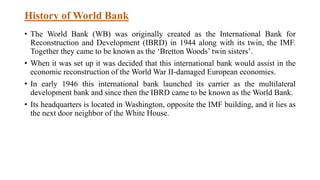
• The World Bank (WB) was originally created as the International Bank for
Reconstruction and Development (IBRD) in 1944 along with its twin, the IMF.
Together they came to be known as the ‘Bretton Woods’ twin sisters’.
• When it was set up it was decided that this international bank would assist in the
economic reconstruction of the World War II-damaged European economies.
• In early 1946 this international bank launched its carrier as the multilateral
development bank and since then the IBRD came to be known as the World Bank.
• Its headquarters is located in Washington, opposite the IMF building, and it lies as
the next door neighbor of the White House.
• The World Bank is an international financial institution that provides loans
and grants to the governments of poorer countries for the purpose of
pursuing capital projects.
• It comprises two institutions: the International Bank for Reconstruction
and Development (IBRD), and the International Development
Association (IDA). The World Bank is a component of the World Bank
Group.
• World Bank Group
1. International Bank for Reconstruction and Development (IBRD)
2. International Development Association (IDA)
3. International Finance Corporation (IFC)
4. Multilateral Investment Guarantee Agency (MIGA)
5. International Centre for Settlement of Investment Disputes (ICSID)
Functions of the World Bank
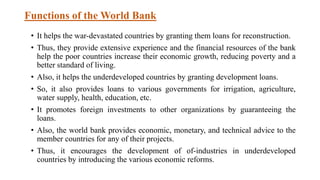
• It helps the war-devastated countries by granting them loans for reconstruction.
• Thus, they provide extensive experience and the financial resources of the bank
help the poor countries increase their economic growth, reducing poverty and a
better standard of living.
• Also, it helps the underdeveloped countries by granting development loans.
• So, it also provides loans to various governments for irrigation, agriculture,
water supply, health, education, etc.
• It promotes foreign investments to other organizations by guaranteeing the
loans.
• Also, the world bank provides economic, monetary, and technical advice to the
member countries for any of their projects.
• Thus, it encourages the development of of-industries in underdeveloped
countries by introducing the various economic reforms.
Objectives of the World Bank
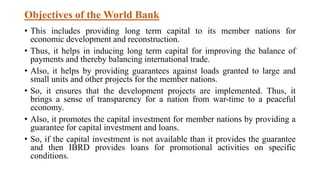
• This includes providing long term capital to its member nations for
economic development and reconstruction.
• Thus, it helps in inducing long term capital for improving the balance of
payments and thereby balancing international trade.
• Also, it helps by providing guarantees against loads granted to large and
small units and other projects for the member nations.
• So, it ensures that the development projects are implemented. Thus, it
brings a sense of transparency for a nation from war-time to a peaceful
economy.
• Also, it promotes the capital investment for member nations by providing a
guarantee for capital investment and loans.
• So, if the capital investment is not available than it provides the guarantee
and then IBRD provides loans for promotional activities on specific
conditions.

World bank

  • 1.
    WORLD BANK -- Prof.Uday Lakhani
  • 2.
    History of WorldBank • The World Bank (WB) was originally created as the International Bank for Reconstruction and Development (IBRD) in 1944 along with its twin, the IMF. Together they came to be known as the ‘Bretton Woods’ twin sisters’. • When it was set up it was decided that this international bank would assist in the economic reconstruction of the World War II-damaged European economies. • In early 1946 this international bank launched its carrier as the multilateral development bank and since then the IBRD came to be known as the World Bank. • Its headquarters is located in Washington, opposite the IMF building, and it lies as the next door neighbor of the White House.
  • 3.
    • The WorldBank is an international financial institution that provides loans and grants to the governments of poorer countries for the purpose of pursuing capital projects. • It comprises two institutions: the International Bank for Reconstruction and Development (IBRD), and the International Development Association (IDA). The World Bank is a component of the World Bank Group. • World Bank Group 1. International Bank for Reconstruction and Development (IBRD) 2. International Development Association (IDA) 3. International Finance Corporation (IFC) 4. Multilateral Investment Guarantee Agency (MIGA) 5. International Centre for Settlement of Investment Disputes (ICSID)
  • 4.
    Functions of theWorld Bank • It helps the war-devastated countries by granting them loans for reconstruction. • Thus, they provide extensive experience and the financial resources of the bank help the poor countries increase their economic growth, reducing poverty and a better standard of living. • Also, it helps the underdeveloped countries by granting development loans. • So, it also provides loans to various governments for irrigation, agriculture, water supply, health, education, etc. • It promotes foreign investments to other organizations by guaranteeing the loans. • Also, the world bank provides economic, monetary, and technical advice to the member countries for any of their projects. • Thus, it encourages the development of of-industries in underdeveloped countries by introducing the various economic reforms.
  • 5.
    Objectives of theWorld Bank • This includes providing long term capital to its member nations for economic development and reconstruction. • Thus, it helps in inducing long term capital for improving the balance of payments and thereby balancing international trade. • Also, it helps by providing guarantees against loads granted to large and small units and other projects for the member nations. • So, it ensures that the development projects are implemented. Thus, it brings a sense of transparency for a nation from war-time to a peaceful economy. • Also, it promotes the capital investment for member nations by providing a guarantee for capital investment and loans. • So, if the capital investment is not available than it provides the guarantee and then IBRD provides loans for promotional activities on specific conditions.