The World Bank is an international financial
institution that provides loans to
developing countries for capital programs
????
“Working for a World Free of Poverty”
 Monetary International Financial Organization
 Formed on July 1944
 Headquarters – Washington D.C,United States
 Parent organization : The World Bank Group
362 members
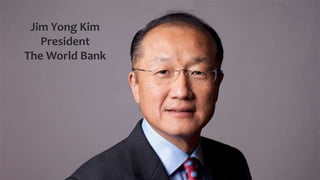
Jim Yong Kim
President
The World Bank
1. The World Bank Group (WBG) is a family of
five international organizations that make leveraged loans to
developing countries. It is the largest and most famous
development bank in the world and is an observer at
the United Nations Development Group.
2. Its five organizations are the International Bank for
Reconstruction and Development (IBRD), the International
Development Association (IDA), the International Finance
Corporation (IFC), the Multilateral Investment Guarantee
Agency (MIGA) and the International Centre for Settlement
of Investment Disputes (ICSID).
The World Bank operates under the leadership and
direction of the president and organizational units
responsible for regions, sectors, and general
management.
World Bank is playing main role of providing loans
for development works to member countries,
especially to underdeveloped countries.
The World Bank provides long-term loans for various
development projects of 5 to 20 years duration.
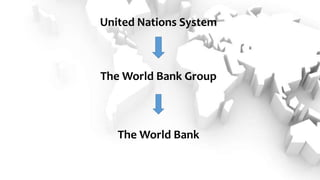
United Nations System
The World Bank Group
The World Bank
International Development Association (IDA)
International Bank for Reconstruction and
Development (IBRD)
+
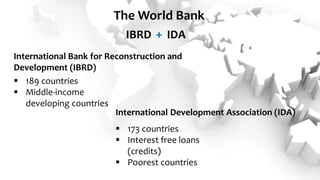
The World Bank
IBRD IDA
 189 countries
 Middle-income
developing countries
 173 countries
 Interest free loans
(credits)
 Poorest countries
Objectives
 To provide long-run capital to member countries for economic
reconstruction and development.
 To induce long-run capital investment for assuring Balance of
Payments (BoP) equilibrium and balanced development of
international trade.
 To provide guarantee for loans granted to small and large units
and other projects of member countries.
 To ensure the implementation of development
projects so as to bring about a smooth transference
from a war-time to peace economy
 To promote capital investment in member countries
by the following ways;
1. To provide guarantee on private loans or capital
investment.
2. If private capital is not available even after
providing guarantee, then IBRD provides loans for
productive activities on considerate conditions.
Functions
 World Bank provides various technical services to
the member countries. For this purpose, the
Bank has established “The Economic
Development Institute” and a Staff College in
Washington
 Bank can grant loans to a member country up to
20% of its share in the paid-up capital
 The quantities of loans, interest rate and terms
and conditions are determined by the Bank itself.
 Generally, Bank grants loans for a particular
project duly submitted to the Bank by the
member country.
 The debtor nation has to repay either in
reserve currencies or in the currency in which
the loan was sanctioned
 Bank also provides loan to private investors
belonging to member countries on its own
guarantee, but for this loan private investors
have to seek prior permission from those
counties where this amount will be collected.
 India is a founder-member of the Bretten Woods twins, i.e., the IMF
and the World Bank; it has a permanent place on the Bank's Executive
Board
 India has been the largest recipient of development finance from the
Bank. India's share in the Bank's total lending to all countries in 1988
was 15%.
 World Bank's subsidiary institution international development
Association (IDA) provides loans from its soft window.
 In 1950, the World Bank founded Aid India Club to provide massive
assistance to finance India's developmental plans. Aid India Club is a
consortium of the major lending countries, such as, U.K., U.S A.,
Germany, France, Japan, Canada, etc.
World Bank’s Contributions to India
 The World Bank's assistance to India has been mainly for
development purposes. The major projects finance by the Bank
are railway, generation of power, multi-purpose projects, port
development, development of aviation, iron and steel industry,
coal mining, agriculture, telecommunication, etc.
 the World Bank has also extended loans to the financial
institutions like Industrial Development Bank of India (IDBI) and
Industrial Credit and Investment Corporation of India (ICICI).
 The World Bank has also provided useful technical assistance in
India's development plans. It has sent a number of missions to
India to evaluate the working and progress of her Five Year Plans
and to asses the foreign exchange requirements of the country
The World Bank Group has set two goals for the
world to achieve by 2030:
 End extreme poverty by decreasing the
percentage of people living on less than $1.90 a
day to no more than 3%
 Promote shared prosperity by fostering the
income growth of the bottom 40% for every
country
worldbank-170328140509.pdf

worldbank-170328140509.pdf

  • 2.
    The World Bankis an international financial institution that provides loans to developing countries for capital programs
  • 3.
    ???? “Working for aWorld Free of Poverty”
  • 4.
     Monetary InternationalFinancial Organization  Formed on July 1944  Headquarters – Washington D.C,United States  Parent organization : The World Bank Group 362 members
  • 6.
  • 7.
    1. The WorldBank Group (WBG) is a family of five international organizations that make leveraged loans to developing countries. It is the largest and most famous development bank in the world and is an observer at the United Nations Development Group. 2. Its five organizations are the International Bank for Reconstruction and Development (IBRD), the International Development Association (IDA), the International Finance Corporation (IFC), the Multilateral Investment Guarantee Agency (MIGA) and the International Centre for Settlement of Investment Disputes (ICSID).
  • 8.
    The World Bankoperates under the leadership and direction of the president and organizational units responsible for regions, sectors, and general management. World Bank is playing main role of providing loans for development works to member countries, especially to underdeveloped countries. The World Bank provides long-term loans for various development projects of 5 to 20 years duration.
  • 9.
    United Nations System TheWorld Bank Group The World Bank
  • 10.
    International Development Association(IDA) International Bank for Reconstruction and Development (IBRD) + The World Bank IBRD IDA  189 countries  Middle-income developing countries  173 countries  Interest free loans (credits)  Poorest countries
  • 11.
    Objectives  To providelong-run capital to member countries for economic reconstruction and development.  To induce long-run capital investment for assuring Balance of Payments (BoP) equilibrium and balanced development of international trade.  To provide guarantee for loans granted to small and large units and other projects of member countries.
  • 12.
     To ensurethe implementation of development projects so as to bring about a smooth transference from a war-time to peace economy  To promote capital investment in member countries by the following ways; 1. To provide guarantee on private loans or capital investment. 2. If private capital is not available even after providing guarantee, then IBRD provides loans for productive activities on considerate conditions.
  • 13.
    Functions  World Bankprovides various technical services to the member countries. For this purpose, the Bank has established “The Economic Development Institute” and a Staff College in Washington  Bank can grant loans to a member country up to 20% of its share in the paid-up capital  The quantities of loans, interest rate and terms and conditions are determined by the Bank itself.
  • 14.
     Generally, Bankgrants loans for a particular project duly submitted to the Bank by the member country.  The debtor nation has to repay either in reserve currencies or in the currency in which the loan was sanctioned  Bank also provides loan to private investors belonging to member countries on its own guarantee, but for this loan private investors have to seek prior permission from those counties where this amount will be collected.
  • 15.
     India isa founder-member of the Bretten Woods twins, i.e., the IMF and the World Bank; it has a permanent place on the Bank's Executive Board  India has been the largest recipient of development finance from the Bank. India's share in the Bank's total lending to all countries in 1988 was 15%.  World Bank's subsidiary institution international development Association (IDA) provides loans from its soft window.  In 1950, the World Bank founded Aid India Club to provide massive assistance to finance India's developmental plans. Aid India Club is a consortium of the major lending countries, such as, U.K., U.S A., Germany, France, Japan, Canada, etc. World Bank’s Contributions to India
  • 16.
     The WorldBank's assistance to India has been mainly for development purposes. The major projects finance by the Bank are railway, generation of power, multi-purpose projects, port development, development of aviation, iron and steel industry, coal mining, agriculture, telecommunication, etc.  the World Bank has also extended loans to the financial institutions like Industrial Development Bank of India (IDBI) and Industrial Credit and Investment Corporation of India (ICICI).  The World Bank has also provided useful technical assistance in India's development plans. It has sent a number of missions to India to evaluate the working and progress of her Five Year Plans and to asses the foreign exchange requirements of the country
  • 17.
    The World BankGroup has set two goals for the world to achieve by 2030:  End extreme poverty by decreasing the percentage of people living on less than $1.90 a day to no more than 3%  Promote shared prosperity by fostering the income growth of the bottom 40% for every country