April 29, 2013 3rd International Business Complexity and Global Leadership Conference 1/37
WARNING!
Network Science is extremely
contagious ONCE YOU LEARN IT you. ,
START seeing Networks everywhere.
D Zinoviev.
April 29, 2013 3rd International Business Complexity and Global Leadership Conference 2/37
Outline
●
What Is Network Science?
●
Terms and Definitions
●
Measures
●
Formation
●
Complex Behavior
●
Tools of the Craft
●
Unusual Applications of Network Science
April 29, 2013 3rd International Business Complexity and Global Leadership Conference 3/37
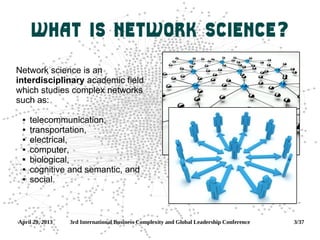
What is Network Science?
Network science is an
interdisciplinary academic field
which studies complex networks
such as:
 telecommunication,
 transportation,
 electrical,
 computer,
 biological,
 cognitive and semantic, and
 social.
April 29, 2013 3rd International Business Complexity and Global Leadership Conference 4/37
What is it based upon?
The field draws on theories and methods including:
 Graph theory from mathematics (Erdős, Rényi, Strogatz),
 Game theory from economics (Jackson),
 Statistical mechanics from physics (Barabási, Newman, Vespignani,
Watts),
 Data mining and information visualization from computer science
(Adamic), and
 Social structure from sociology (Watts).
April 29, 2013 3rd International Business Complexity and Global Leadership Conference 5/37
Terms and definitions
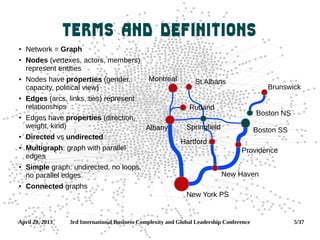
● Network = Graph
● Nodes (vertexes, actors, members)
represent entities
● Nodes have properties (gender,
capacity, political view)
● Edges (arcs, links, ties) represent
relationships
● Edges have properties (direction,
weight, kind)
● Directed vs undirected
● Multigraph: graph with parallel
edges
● Simple graph: undirected, no loops,
no parallel edges
● Connected graphs
Boston SSAlbany
Brunswick
Boston NS
St Albans
Providence
Hartford
Springfield
New Haven
New York PS
Montreal
Rutland
April 29, 2013 3rd International Business Complexity and Global Leadership Conference 6/37
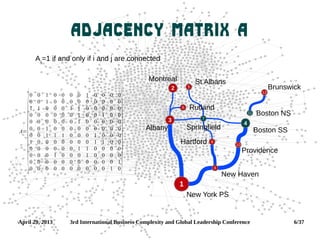
Adjacency Matrix A
7
5
Boston SSAlbany
Brunswick
Boston NS
St Albans
Providence
Hartford
Springfield
New Haven
New York PS
Montreal
6 Rutland
9
12
11
4
8
1
3
2
10
A=

0 0 1 0 0 0 0 1 0 0 0 0
0 0 1 0 0 0 0 0 0 0 0 0
1 1 0 0 0 1 1 0 0 0 0 0
0 0 0 0 0 0 1 0 0 1 0 0
0 0 0 0 0 0 1 0 0 0 0 0
0 0 1 0 0 0 0 0 0 0 0 0
0 0 1 1 1 0 0 0 1 0 0 0
1 0 0 0 0 0 0 0 1 1 0 0
0 0 0 0 0 0 1 1 0 0 0 0
0 0 0 1 0 0 0 1 0 0 0 0
0 0 0 0 0 0 0 0 0 0 0 1
0 0 0 0 0 0 0 0 0 0 1 0

Aij
=1 if and only if i and j are connected
April 29, 2013 3rd International Business Complexity and Global Leadership Conference 7/37
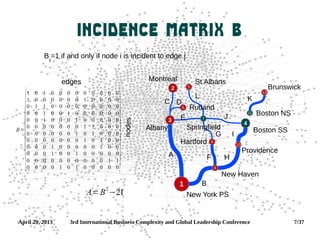
Incidence Matrix B
B=

1 0 1 0 0 0 0 0 0 0 0 0
1 0 0 0 0 0 0 1 0 0 0 0
0 1 1 0 0 0 0 0 0 0 0 0
0 0 1 0 0 1 0 0 0 0 0 0
0 0 1 0 0 0 1 0 0 0 0 0
0 0 0 0 0 0 0 1 1 0 0 0
0 0 0 0 0 0 1 0 1 0 0 0
0 0 0 0 0 0 0 1 0 1 0 0
0 0 0 1 0 0 0 0 0 1 0 0
0 0 0 1 0 0 1 0 0 0 0 0
0 0 0 0 0 0 0 0 0 0 1 1
0 0 0 0 1 0 1 0 0 0 0 0
 7
5
Boston SSAlbany
Brunswick
Boston NS
St Albans
Providence
Hartford
Springfield
New Haven
New York PS
Montreal
6 Rutland
9
12
11
4
8
1
3
2
10
A
B
C D
E
F
G
H
I
J
KL
Bij
=1 if and only if node i is incident to edge j
edges
nodes
A=B2
−2I
April 29, 2013 3rd International Business Complexity and Global Leadership Conference 8/37
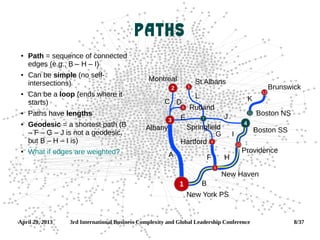
PATHS
7
5
Boston SSAlbany
Brunswick
Boston NS
St Albans
Providence
Hartford
Springfield
New Haven
New York PS
Montreal
6 Rutland
9
12
11
4
8
1
3
2
10
A
B
C D
E
F
G
H
I
J
KL
 Path = sequence of connected
edges (e.g., B – H – I)
 Can be simple (no self-
intersections)
 Can be a loop (ends where it
starts)
 Paths have lengths
 Geodesic = a shortest path (B
– F – G – J is not a geodesic,
but B – H – I is)
 What if edges are weighted?
April 29, 2013 3rd International Business Complexity and Global Leadership Conference 9/37
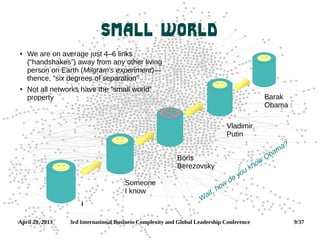
Small World
 We are on average just 4–6 links
(“handshakes”) away from any other living
person on Earth (Milgram's experiment)—
thence, “six degrees of separation”
 Not all networks have the “small world”
property
I
Someone
I know
Boris
Berezovsky
Vladimir
Putin
Barak
Obama
W
ait, how
do you know
Obama?
April 29, 2013 3rd International Business Complexity and Global Leadership Conference 10/37
Centrality
●
How “central” is a node
in the network?
●
Possibly affects
influence, resilience,
susceptibility, etc.
●
Several flavors: degree,
closeness,
betweenness,
eigenvalue, etc.
April 29, 2013 3rd International Business Complexity and Global Leadership Conference 11/37
Degree Centrality[ ]
7
5
Boston SS (2)Albany (4)
Brunswick
(1)
Boston NS (1)
St Albans (1)
Providence (2)
Springfield (4)
New Haven (3)
New York PS (2)
Montreal (1)
6 Rutland (1)
9
12
11
4
8
1
3
2
10
Hartford (2)
 Just count the neighbors!
 More neighbors = more
“friends” = more importance
 Distinguish in-degree, out-
degree, and [total] degree
 Can be defined in two ways (N
is the total number of nodes,
aij
∈A):
di=∑j
aij
di=∑j
aij / N −1
April 29, 2013 3rd International Business Complexity and Global Leadership Conference 12/37
Degree Distribution
 Degree [centrality]
distribution is an
important network
measure—it relates
to the network
formation process
 Most common
distributions in
complex networks:
binomial (Poisson
for n→∞) and
power law (a.k.a.
Pareto, Zipf, scale
free)
 Why it is what it
is?
April 29, 2013 3rd International Business Complexity and Global Leadership Conference 13/37
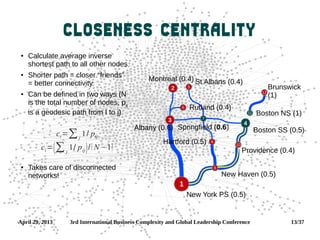
Closeness Centrality
7
5
Boston SS (0.5)
Brunswick
(1)
Boston NS (1)
St Albans (0.4)
Providence (0.4)
Springfield (0.6)
New Haven (0.5)
New York PS (0.5)
Montreal (0.4)
6 Rutland (0.4)
9
12
11
4
8
1
3
2
10
Hartford (0.5)
Albany (0.6)
 Calculate average inverse
shortest path to all other nodes
 Shorter path = closer “friends”
= better connectivity
 Can be defined in two ways (N
is the total number of nodes, pij
is a geodesic path from I to j)
 Takes care of disconnected
networks!
ci=∑j
1/ pij
ci=∑j
1/ pij/ N −1
April 29, 2013 3rd International Business Complexity and Global Leadership Conference 14/37
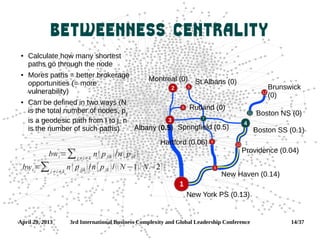
Betweenness Centrality
7
5
Boston SS (0.1)
Brunswick
(0)
Boston NS (0)
St Albans (0)
Providence (0.04)
Springfield (0.5)
New Haven (0.14)
New York PS (0.13)
Montreal (0)
6 Rutland (0)
9
12
11
4
8
1
3
2
10Hartford (0.06)
Albany (0.5)
 Calculate how many shortest
paths go through the node
 Mores paths = better brokerage
opportunities (= more
vulnerability)
 Can be defined in two ways (N
is the total number of nodes, pij
is a geodesic path from I to j, n
is the number of such paths)
bwi=∑j≠i≠k
n pjik /n p jk 
bwi=∑j≠i≠k
n p jik /n pjk /N −1 N −2
April 29, 2013 3rd International Business Complexity and Global Leadership Conference 15/37
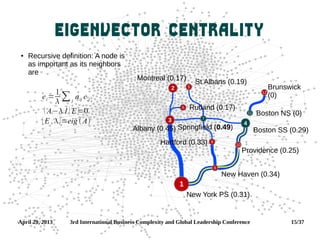
Eigenvector Centrality
7
5
Boston SS (0.29)
Brunswick
(0)
Boston NS (0)
St Albans (0.19)
Providence (0.25)
Springfield (0.49)
New Haven (0.34)
New York PS (0.31)
Montreal (0.17)
6 Rutland (0.17)
9
12
11
4
8
1
3
2
10Hartford (0.33)
Albany (0.45)
 Recursive definition: A node is
as important as its neighbors
are
ei=
1
 ∑j
aij e j
 A− I  E=0
 E ,=eig A
April 29, 2013 3rd International Business Complexity and Global Leadership Conference 16/37
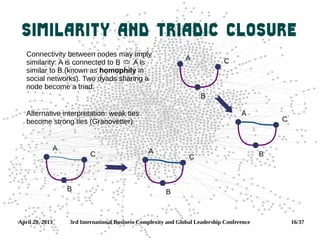
Similarity and Triadic Closure
Connectivity between nodes may imply
similarity: A is connected to B  A is
similar to B (known as homophily in
social networks). Two dyads sharing a
node become a triad.
A
B
C
A
B
C
Alternative interpretation: weak ties
become strong ties (Granovetter).
A
B
C A
B
C
April 29, 2013 3rd International Business Complexity and Global Leadership Conference 17/37
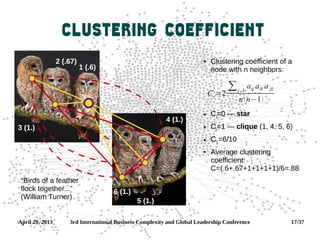
Clustering Coefficient
 Clustering coefficient of a
node with n neighbors:
 Ci
=0 — star
 Ci
=1 — clique (1, 4, 5, 6)
 C1
=6/10
 Average clustering
coefficient:
C=(.6+.67+1+1+1+1)/6=.88
Ci=2
∑j , k
aij aik a jk
nn−1
“Birds of a feather
flock together...”
(William Turner)
1 (.6)
2 (.67)
3 (1.)
4 (1.)
5 (1.)
6 (1.)
April 29, 2013 3rd International Business Complexity and Global Leadership Conference 18/37
Modularity and Components
 NSSI (self-cutters) online
communities in LiveJournal (blogging
social Web site) form six
components
 If these two components are merged,
they form a giant component
 Modularity Q∈[-1, 1] measures the
density of links inside clusters as
compared to links between clusters:
Q=
∑ij
[aij −
∑i
aij ∑j
aij
∑ij
aij ]ij
∑ij
aij
April 29, 2013 3rd International Business Complexity and Global Leadership Conference 19/37
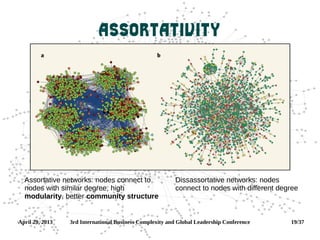
Assortativity
Assortative networks: nodes connect to
nodes with similar degree; high
modularity, better community structure
Dissassortative networks: nodes
connect to nodes with different degree
April 29, 2013 3rd International Business Complexity and Global Leadership Conference 20/37
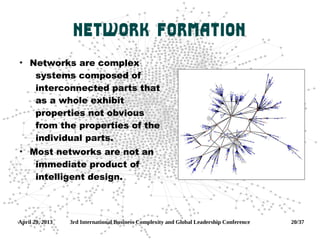
Network Formation
●
Networks are complex
systems composed of
interconnected parts that
as a whole exhibit
properties not obvious
from the properties of the
individual parts.
●
Most networks are not an
immediate product of
intelligent design.
April 29, 2013 3rd International Business Complexity and Global Leadership Conference 21/37
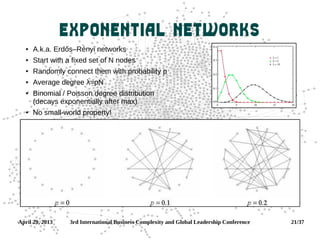
exponential Networks
 A.k.a. Erdős–Rényi networks
 Start with a fixed set of N nodes
 Randomly connect them with probability p
 Average degree λ=pN
 Binomial / Poisson degree distribution
(decays exponentially after max)
 No small-world property!
April 29, 2013 3rd International Business Complexity and Global Leadership Conference 22/37
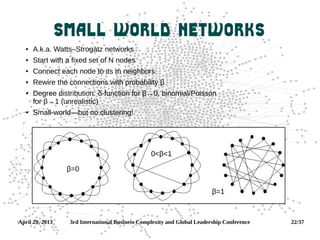
Small World Networks
 A.k.a. Watts–Strogatz networks
 Start with a fixed set of N nodes
 Connect each node to its m neighbors
 Rewire the connections with probability β
 Degree distribution: δ-function for β→0, binomial/Poisson
for β→1 (unrealistic)
 Small-world—but no clustering!
β=0
0<β<1
β=1
April 29, 2013 3rd International Business Complexity and Global Leadership Conference 23/37
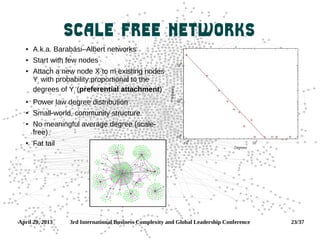
Scale Free Networks
 A.k.a. Barabási–Albert networks
 Start with few nodes
 Attach a new node X to m existing nodes
Yi
with probability proportional to the
degrees of Yi
(preferential attachment)
 Power law degree distribution
 Small-world, community structure
 No meaningful average degree (scale-
free)
 Fat tail
April 29, 2013 3rd International Business Complexity and Global Leadership Conference 24/37
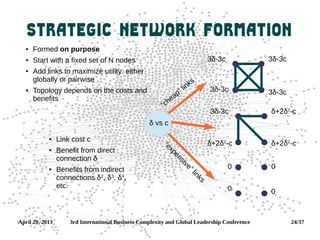
Strategic Network formation
 Formed on purpose
 Start with a fixed set of N nodes
 Add links to maximize utility: either
globally or pairwise
 Topology depends on the costs and
benefits
 Link cost c
 Benefit from direct
connection δ
 Benefits from indirect
connections δ2
, δ3
, δ4
,
etc.
3δ-3c
3δ-3c
3δ-3c
3δ-3c
δ+2δ2
-c3δ-3c
δ+2δ2
-cδ+2δ2
-c
0
0
0
0
δ vs c
“cheap” links
“expensive”links
April 29, 2013 3rd International Business Complexity and Global Leadership Conference 25/37
Complex Behaviors
●
Simple contagion: epidemics, rumor
propagation
●
Complex contagion: collective action,
political views, fashion
●
Information diffusion: effect of
feedback
●
Resilience
April 29, 2013 3rd International Business Complexity and Global Leadership Conference 26/37
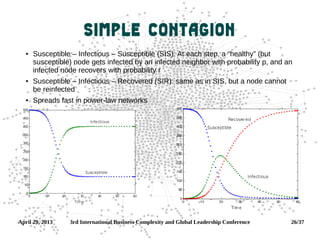
Simple Contagion
 Susceptible – Infectious – Susceptible (SIS): At each step, a “healthy” (but
susceptible) node gets infected by an infected neighbor with probability p, and an
infected node recovers with probability r
 Susceptible – Infectious – Recovered (SIR): same as in SIS, but a node cannot
be reinfected
 Spreads fast in power-law networks
April 29, 2013 3rd International Business Complexity and Global Leadership Conference 27/37
Collective Action
 A node becomes infected with probability p when either a certain
number M or a certain fraction m of its neighbors is infectious
✔ “I will wear red pants if at least 50% of my friends wear red
pants.”
✔ “I will use protocol X if at least 10 of my partners support
protocol X.”
✔ “I will go to protest tax hikes if all my friends go with me.”
✔ “I will feel happy if people around me are happy.”
 Supported by community structure:
✔ Structural trapping (few external links)
✔ Social reinforcement (many internal links)
✔ Homophily (“connected” means “similar”)
 Success depends on the point of origin
April 29, 2013 3rd International Business Complexity and Global Leadership Conference 28/37
Information Diffusion
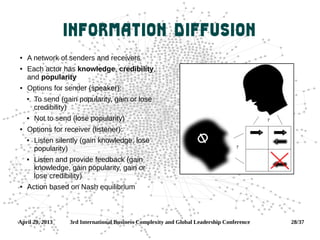
 A network of senders and receivers
 Each actor has knowledge, credibility,
and popularity
 Options for sender (speaker):
 To send (gain popularity, gain or lose
credibility)
 Not to send (lose popularity)
 Options for receiver (listener):
 Listen silently (gain knowledge, lose
popularity)
 Listen and provide feedback (gain
knowledge, gain popularity, gain or
lose credibility)
 Action based on Nash equilibrium
April 29, 2013 3rd International Business Complexity and Global Leadership Conference 29/37
Resilience
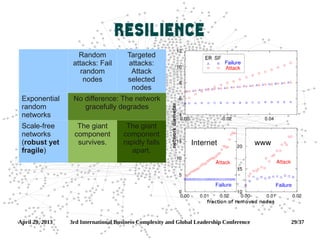
Random
attacks: Fail
random
nodes
Targeted
attacks:
Attack
selected
nodes
Exponential
random
networks
No difference: The network
gracefully degrades
Scale-free
networks
(robust yet
fragile)
The giant
component
survives.
The giant
component
rapidly falls
apart.
April 29, 2013 3rd International Business Complexity and Global Leadership Conference 30/37
Tools of the Craft
●
Gephi—graph visualization
●
Pajek—network algorithms and some
visualization
●
NetLogo—simple simulation environment (good
for small-scale experiments)
●
CFinder—community finder
●
NodeXL—network visualization plugin for Excel
●
networkx—Python library for network
algorithms
April 29, 2013 3rd International Business Complexity and Global Leadership Conference 31/37
Gephi
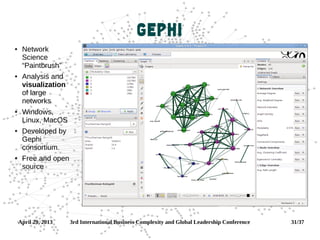
 Network
Science
“Paintbrush”
 Analysis and
visualization
of large
networks
 Windows,
Linux, MacOS
 Developed by
Gephi
consortium
 Free and open
source
April 29, 2013 3rd International Business Complexity and Global Leadership Conference 32/37
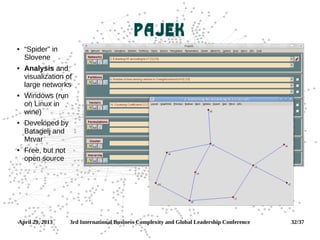
Pajek
 “Spider” in
Slovene
 Analysis and
visualization of
large networks
 Windows (run
on Linux in
wine)
 Developed by
Batagelj and
Mrvar
 Free, but not
open source
April 29, 2013 3rd International Business Complexity and Global Leadership Conference 33/37
Unusual applications
Reminder:
If all you know is Network Science
everything looks like a Network.
April 29, 2013 3rd International Business Complexity and Global Leadership Conference 34/37
Unusual networks
●
Networks of recipes and cooking ingredients
(Adamic)
●
Product space networks (Hidalgo)
●
Human disease networks (Barabási)
●
Flavor networks (Ahn)
●
Soccer player networks (Onody / de Castro)
●
And more!..
April 29, 2013 3rd International Business Complexity and Global Leadership Conference 35/37
Semantic networks
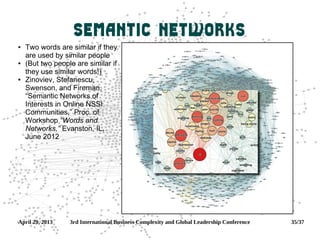
 Two words are similar if they
are used by similar people
 (But two people are similar if
they use similar words!)
 Zinoviev, Stefanescu,
Swenson, and Fireman,
“Semantic Networks of
Interests in Online NSSI
Communities,” Proc. of
Workshop “Words and
Networks,” Evanston, IL,
June 2012
April 29, 2013 3rd International Business Complexity and Global Leadership Conference 36/37
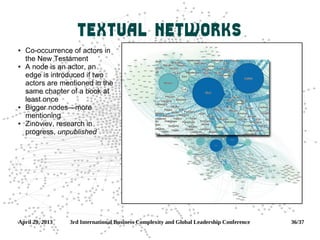
Textual Networks
 Co-occurrence of actors in
the New Testament
 A node is an actor, an
edge is introduced if two
actors are mentioned in the
same chapter of a book at
least once
 Bigger nodes—more
mentioning
 Zinoviev, research in
progress, unpublished
April 29, 2013 3rd International Business Complexity and Global Leadership Conference 37/37
Thank you!

Network Science workshop

  • 1.
    April 29, 20133rd International Business Complexity and Global Leadership Conference 1/37 WARNING! Network Science is extremely contagious ONCE YOU LEARN IT you. , START seeing Networks everywhere. D Zinoviev.
  • 2.
    April 29, 20133rd International Business Complexity and Global Leadership Conference 2/37 Outline ● What Is Network Science? ● Terms and Definitions ● Measures ● Formation ● Complex Behavior ● Tools of the Craft ● Unusual Applications of Network Science
  • 3.
    April 29, 20133rd International Business Complexity and Global Leadership Conference 3/37 What is Network Science? Network science is an interdisciplinary academic field which studies complex networks such as:  telecommunication,  transportation,  electrical,  computer,  biological,  cognitive and semantic, and  social.
  • 4.
    April 29, 20133rd International Business Complexity and Global Leadership Conference 4/37 What is it based upon? The field draws on theories and methods including:  Graph theory from mathematics (Erdős, Rényi, Strogatz),  Game theory from economics (Jackson),  Statistical mechanics from physics (Barabási, Newman, Vespignani, Watts),  Data mining and information visualization from computer science (Adamic), and  Social structure from sociology (Watts).
  • 5.
    April 29, 20133rd International Business Complexity and Global Leadership Conference 5/37 Terms and definitions ● Network = Graph ● Nodes (vertexes, actors, members) represent entities ● Nodes have properties (gender, capacity, political view) ● Edges (arcs, links, ties) represent relationships ● Edges have properties (direction, weight, kind) ● Directed vs undirected ● Multigraph: graph with parallel edges ● Simple graph: undirected, no loops, no parallel edges ● Connected graphs Boston SSAlbany Brunswick Boston NS St Albans Providence Hartford Springfield New Haven New York PS Montreal Rutland
  • 6.
    April 29, 20133rd International Business Complexity and Global Leadership Conference 6/37 Adjacency Matrix A 7 5 Boston SSAlbany Brunswick Boston NS St Albans Providence Hartford Springfield New Haven New York PS Montreal 6 Rutland 9 12 11 4 8 1 3 2 10 A=  0 0 1 0 0 0 0 1 0 0 0 0 0 0 1 0 0 0 0 0 0 0 0 0 1 1 0 0 0 1 1 0 0 0 0 0 0 0 0 0 0 0 1 0 0 1 0 0 0 0 0 0 0 0 1 0 0 0 0 0 0 0 1 0 0 0 0 0 0 0 0 0 0 0 1 1 1 0 0 0 1 0 0 0 1 0 0 0 0 0 0 0 1 1 0 0 0 0 0 0 0 0 1 1 0 0 0 0 0 0 0 1 0 0 0 1 0 0 0 0 0 0 0 0 0 0 0 0 0 0 0 1 0 0 0 0 0 0 0 0 0 0 1 0  Aij =1 if and only if i and j are connected
  • 7.
    April 29, 20133rd International Business Complexity and Global Leadership Conference 7/37 Incidence Matrix B B=  1 0 1 0 0 0 0 0 0 0 0 0 1 0 0 0 0 0 0 1 0 0 0 0 0 1 1 0 0 0 0 0 0 0 0 0 0 0 1 0 0 1 0 0 0 0 0 0 0 0 1 0 0 0 1 0 0 0 0 0 0 0 0 0 0 0 0 1 1 0 0 0 0 0 0 0 0 0 1 0 1 0 0 0 0 0 0 0 0 0 0 1 0 1 0 0 0 0 0 1 0 0 0 0 0 1 0 0 0 0 0 1 0 0 1 0 0 0 0 0 0 0 0 0 0 0 0 0 0 0 1 1 0 0 0 0 1 0 1 0 0 0 0 0  7 5 Boston SSAlbany Brunswick Boston NS St Albans Providence Hartford Springfield New Haven New York PS Montreal 6 Rutland 9 12 11 4 8 1 3 2 10 A B C D E F G H I J KL Bij =1 if and only if node i is incident to edge j edges nodes A=B2 −2I
  • 8.
    April 29, 20133rd International Business Complexity and Global Leadership Conference 8/37 PATHS 7 5 Boston SSAlbany Brunswick Boston NS St Albans Providence Hartford Springfield New Haven New York PS Montreal 6 Rutland 9 12 11 4 8 1 3 2 10 A B C D E F G H I J KL  Path = sequence of connected edges (e.g., B – H – I)  Can be simple (no self- intersections)  Can be a loop (ends where it starts)  Paths have lengths  Geodesic = a shortest path (B – F – G – J is not a geodesic, but B – H – I is)  What if edges are weighted?
  • 9.
    April 29, 20133rd International Business Complexity and Global Leadership Conference 9/37 Small World  We are on average just 4–6 links (“handshakes”) away from any other living person on Earth (Milgram's experiment)— thence, “six degrees of separation”  Not all networks have the “small world” property I Someone I know Boris Berezovsky Vladimir Putin Barak Obama W ait, how do you know Obama?
  • 10.
    April 29, 20133rd International Business Complexity and Global Leadership Conference 10/37 Centrality ● How “central” is a node in the network? ● Possibly affects influence, resilience, susceptibility, etc. ● Several flavors: degree, closeness, betweenness, eigenvalue, etc.
  • 11.
    April 29, 20133rd International Business Complexity and Global Leadership Conference 11/37 Degree Centrality[ ] 7 5 Boston SS (2)Albany (4) Brunswick (1) Boston NS (1) St Albans (1) Providence (2) Springfield (4) New Haven (3) New York PS (2) Montreal (1) 6 Rutland (1) 9 12 11 4 8 1 3 2 10 Hartford (2)  Just count the neighbors!  More neighbors = more “friends” = more importance  Distinguish in-degree, out- degree, and [total] degree  Can be defined in two ways (N is the total number of nodes, aij ∈A): di=∑j aij di=∑j aij / N −1
  • 12.
    April 29, 20133rd International Business Complexity and Global Leadership Conference 12/37 Degree Distribution  Degree [centrality] distribution is an important network measure—it relates to the network formation process  Most common distributions in complex networks: binomial (Poisson for n→∞) and power law (a.k.a. Pareto, Zipf, scale free)  Why it is what it is?
  • 13.
    April 29, 20133rd International Business Complexity and Global Leadership Conference 13/37 Closeness Centrality 7 5 Boston SS (0.5) Brunswick (1) Boston NS (1) St Albans (0.4) Providence (0.4) Springfield (0.6) New Haven (0.5) New York PS (0.5) Montreal (0.4) 6 Rutland (0.4) 9 12 11 4 8 1 3 2 10 Hartford (0.5) Albany (0.6)  Calculate average inverse shortest path to all other nodes  Shorter path = closer “friends” = better connectivity  Can be defined in two ways (N is the total number of nodes, pij is a geodesic path from I to j)  Takes care of disconnected networks! ci=∑j 1/ pij ci=∑j 1/ pij/ N −1
  • 14.
    April 29, 20133rd International Business Complexity and Global Leadership Conference 14/37 Betweenness Centrality 7 5 Boston SS (0.1) Brunswick (0) Boston NS (0) St Albans (0) Providence (0.04) Springfield (0.5) New Haven (0.14) New York PS (0.13) Montreal (0) 6 Rutland (0) 9 12 11 4 8 1 3 2 10Hartford (0.06) Albany (0.5)  Calculate how many shortest paths go through the node  Mores paths = better brokerage opportunities (= more vulnerability)  Can be defined in two ways (N is the total number of nodes, pij is a geodesic path from I to j, n is the number of such paths) bwi=∑j≠i≠k n pjik /n p jk  bwi=∑j≠i≠k n p jik /n pjk /N −1 N −2
  • 15.
    April 29, 20133rd International Business Complexity and Global Leadership Conference 15/37 Eigenvector Centrality 7 5 Boston SS (0.29) Brunswick (0) Boston NS (0) St Albans (0.19) Providence (0.25) Springfield (0.49) New Haven (0.34) New York PS (0.31) Montreal (0.17) 6 Rutland (0.17) 9 12 11 4 8 1 3 2 10Hartford (0.33) Albany (0.45)  Recursive definition: A node is as important as its neighbors are ei= 1  ∑j aij e j  A− I  E=0  E ,=eig A
  • 16.
    April 29, 20133rd International Business Complexity and Global Leadership Conference 16/37 Similarity and Triadic Closure Connectivity between nodes may imply similarity: A is connected to B  A is similar to B (known as homophily in social networks). Two dyads sharing a node become a triad. A B C A B C Alternative interpretation: weak ties become strong ties (Granovetter). A B C A B C
  • 17.
    April 29, 20133rd International Business Complexity and Global Leadership Conference 17/37 Clustering Coefficient  Clustering coefficient of a node with n neighbors:  Ci =0 — star  Ci =1 — clique (1, 4, 5, 6)  C1 =6/10  Average clustering coefficient: C=(.6+.67+1+1+1+1)/6=.88 Ci=2 ∑j , k aij aik a jk nn−1 “Birds of a feather flock together...” (William Turner) 1 (.6) 2 (.67) 3 (1.) 4 (1.) 5 (1.) 6 (1.)
  • 18.
    April 29, 20133rd International Business Complexity and Global Leadership Conference 18/37 Modularity and Components  NSSI (self-cutters) online communities in LiveJournal (blogging social Web site) form six components  If these two components are merged, they form a giant component  Modularity Q∈[-1, 1] measures the density of links inside clusters as compared to links between clusters: Q= ∑ij [aij − ∑i aij ∑j aij ∑ij aij ]ij ∑ij aij
  • 19.
    April 29, 20133rd International Business Complexity and Global Leadership Conference 19/37 Assortativity Assortative networks: nodes connect to nodes with similar degree; high modularity, better community structure Dissassortative networks: nodes connect to nodes with different degree
  • 20.
    April 29, 20133rd International Business Complexity and Global Leadership Conference 20/37 Network Formation ● Networks are complex systems composed of interconnected parts that as a whole exhibit properties not obvious from the properties of the individual parts. ● Most networks are not an immediate product of intelligent design.
  • 21.
    April 29, 20133rd International Business Complexity and Global Leadership Conference 21/37 exponential Networks  A.k.a. Erdős–Rényi networks  Start with a fixed set of N nodes  Randomly connect them with probability p  Average degree λ=pN  Binomial / Poisson degree distribution (decays exponentially after max)  No small-world property!
  • 22.
    April 29, 20133rd International Business Complexity and Global Leadership Conference 22/37 Small World Networks  A.k.a. Watts–Strogatz networks  Start with a fixed set of N nodes  Connect each node to its m neighbors  Rewire the connections with probability β  Degree distribution: δ-function for β→0, binomial/Poisson for β→1 (unrealistic)  Small-world—but no clustering! β=0 0<β<1 β=1
  • 23.
    April 29, 20133rd International Business Complexity and Global Leadership Conference 23/37 Scale Free Networks  A.k.a. Barabási–Albert networks  Start with few nodes  Attach a new node X to m existing nodes Yi with probability proportional to the degrees of Yi (preferential attachment)  Power law degree distribution  Small-world, community structure  No meaningful average degree (scale- free)  Fat tail
  • 24.
    April 29, 20133rd International Business Complexity and Global Leadership Conference 24/37 Strategic Network formation  Formed on purpose  Start with a fixed set of N nodes  Add links to maximize utility: either globally or pairwise  Topology depends on the costs and benefits  Link cost c  Benefit from direct connection δ  Benefits from indirect connections δ2 , δ3 , δ4 , etc. 3δ-3c 3δ-3c 3δ-3c 3δ-3c δ+2δ2 -c3δ-3c δ+2δ2 -cδ+2δ2 -c 0 0 0 0 δ vs c “cheap” links “expensive”links
  • 25.
    April 29, 20133rd International Business Complexity and Global Leadership Conference 25/37 Complex Behaviors ● Simple contagion: epidemics, rumor propagation ● Complex contagion: collective action, political views, fashion ● Information diffusion: effect of feedback ● Resilience
  • 26.
    April 29, 20133rd International Business Complexity and Global Leadership Conference 26/37 Simple Contagion  Susceptible – Infectious – Susceptible (SIS): At each step, a “healthy” (but susceptible) node gets infected by an infected neighbor with probability p, and an infected node recovers with probability r  Susceptible – Infectious – Recovered (SIR): same as in SIS, but a node cannot be reinfected  Spreads fast in power-law networks
  • 27.
    April 29, 20133rd International Business Complexity and Global Leadership Conference 27/37 Collective Action  A node becomes infected with probability p when either a certain number M or a certain fraction m of its neighbors is infectious ✔ “I will wear red pants if at least 50% of my friends wear red pants.” ✔ “I will use protocol X if at least 10 of my partners support protocol X.” ✔ “I will go to protest tax hikes if all my friends go with me.” ✔ “I will feel happy if people around me are happy.”  Supported by community structure: ✔ Structural trapping (few external links) ✔ Social reinforcement (many internal links) ✔ Homophily (“connected” means “similar”)  Success depends on the point of origin
  • 28.
    April 29, 20133rd International Business Complexity and Global Leadership Conference 28/37 Information Diffusion  A network of senders and receivers  Each actor has knowledge, credibility, and popularity  Options for sender (speaker):  To send (gain popularity, gain or lose credibility)  Not to send (lose popularity)  Options for receiver (listener):  Listen silently (gain knowledge, lose popularity)  Listen and provide feedback (gain knowledge, gain popularity, gain or lose credibility)  Action based on Nash equilibrium
  • 29.
    April 29, 20133rd International Business Complexity and Global Leadership Conference 29/37 Resilience Random attacks: Fail random nodes Targeted attacks: Attack selected nodes Exponential random networks No difference: The network gracefully degrades Scale-free networks (robust yet fragile) The giant component survives. The giant component rapidly falls apart.
  • 30.
    April 29, 20133rd International Business Complexity and Global Leadership Conference 30/37 Tools of the Craft ● Gephi—graph visualization ● Pajek—network algorithms and some visualization ● NetLogo—simple simulation environment (good for small-scale experiments) ● CFinder—community finder ● NodeXL—network visualization plugin for Excel ● networkx—Python library for network algorithms
  • 31.
    April 29, 20133rd International Business Complexity and Global Leadership Conference 31/37 Gephi  Network Science “Paintbrush”  Analysis and visualization of large networks  Windows, Linux, MacOS  Developed by Gephi consortium  Free and open source
  • 32.
    April 29, 20133rd International Business Complexity and Global Leadership Conference 32/37 Pajek  “Spider” in Slovene  Analysis and visualization of large networks  Windows (run on Linux in wine)  Developed by Batagelj and Mrvar  Free, but not open source
  • 33.
    April 29, 20133rd International Business Complexity and Global Leadership Conference 33/37 Unusual applications Reminder: If all you know is Network Science everything looks like a Network.
  • 34.
    April 29, 20133rd International Business Complexity and Global Leadership Conference 34/37 Unusual networks ● Networks of recipes and cooking ingredients (Adamic) ● Product space networks (Hidalgo) ● Human disease networks (Barabási) ● Flavor networks (Ahn) ● Soccer player networks (Onody / de Castro) ● And more!..
  • 35.
    April 29, 20133rd International Business Complexity and Global Leadership Conference 35/37 Semantic networks  Two words are similar if they are used by similar people  (But two people are similar if they use similar words!)  Zinoviev, Stefanescu, Swenson, and Fireman, “Semantic Networks of Interests in Online NSSI Communities,” Proc. of Workshop “Words and Networks,” Evanston, IL, June 2012
  • 36.
    April 29, 20133rd International Business Complexity and Global Leadership Conference 36/37 Textual Networks  Co-occurrence of actors in the New Testament  A node is an actor, an edge is introduced if two actors are mentioned in the same chapter of a book at least once  Bigger nodes—more mentioning  Zinoviev, research in progress, unpublished
  • 37.
    April 29, 20133rd International Business Complexity and Global Leadership Conference 37/37 Thank you!