Download to read offline
![Lists and List Operations
● Empty list
○ [] or list()
● Non-empty list
○ l1 = [“Mary”, “had”, “a”, “little”, “lamb”]; l2 = [1, 2, 3.14]; l3 = [[1,2,3.14], [“Mary”, “had”]]
● List indexing
○ l1[0] → “Mary”; l2[-1] = 3; l2[2] → 3; l3[0][0] → “Mary”; l3[-1][-1][-1] → “d”
● List alternation
○ l1.append(item) → None; l1.extend(list) → None; l1.sort() → None; l1.remove(item) → None 3](https://image.slidesharecdn.com/pythonoverview-170420070109/85/Python-overview-3-320.jpg)
![● Empty tuple
○ (,) or tuple()
● Non-empty tuple
○ t1 = (“Mary”, “had”, “a”, “little”, “lamb”); t2 = (1, 2, 3.14); t3 = ([1,2,3.14], [“Mary”, “had”])
● Tuple indexing
○ t1[0] → “Mary”; t2[-1] = 3; t2[2] → 3.14; t3[0][0] → “Mary”; t3[-1][-1][-1] → “d”
● Other tuple operations
○ t1.count(item) → int; t1.index(item) → item
Tuples and Tuple Operations
4
IMMUTABLE!](https://image.slidesharecdn.com/pythonoverview-170420070109/85/Python-overview-4-320.jpg)
![Dictionaries and Dictionary Operations
● Empty dictionary
○ {} or dict()
● Non-empty dictionary
○ d = {“Mary” : 1, “had” : 2, “a” : 3, “little” : 4, “lamb” : 5}; d = dict([(“Mary”, 1), (“had”, 2), (“a”, 3)])
● Dictionary indexing
○ d[“Mary”] → 1; d[“lamb”] = None; d[“lamb”] → None
● Dictionary alternation
○ d.update({key:value}) → None; d[newkey]=newvalue; del d[key] 5
All keys must be different and
immutable.](https://image.slidesharecdn.com/pythonoverview-170420070109/85/Python-overview-5-320.jpg)
![Sets and Set Operations
● Empty set
○ set()
● Non-empty set
○ s = set([“Mary”, “had”, “a”, “little”, “lamb”])
● Set alternation
○ s.add(item) → set; s.remove(item) → set; s.clear() → set
● Set theoretic operations
○ s1 | s2 → union of sets; s1 & s2 → intersection of sets; s1 - s2 → difference of sets 6
Cannot be indexed. All elements
unique.](https://image.slidesharecdn.com/pythonoverview-170420070109/85/Python-overview-6-320.jpg)
![Generator Functions (“lazy” functions)
● Produce one item at a time; more efficient that lists
● Most common generators:
○ range(x=0,y,z=1) → numbers from y (inclusive) to x (not inclusive) with step z
○ enumerate(l) → tuples (0, l[0]), (1, l[1]), (2, l[2]), …
○ zip(l1, l2) → tuples (l1[0], l2[0]), (l1[1], l2[1]), (l2[1], l2[2]), …
● Lists and dictionaries from generators:
○ list(range(n)); list(enumerate(items)); list(zip(first_items, second_items))
○ dict(enumerate(values)); dict(zip(keys, values))
7](https://image.slidesharecdn.com/pythonoverview-170420070109/85/Python-overview-7-320.jpg)
![List Comprehensions
● A concise and powerful way of running a “foreach” loop
○ result = [action(item) for item in collection if condition(item)]
Apply action() to each item in the collection (string, list, set, tuple, dictionary), for which the
condition is True, and collect the results into a list. The condition is optional (default: True).
● Examples:
○ [c.upper() for c in “Hello, world!”] → list of upper-cased characters
○ “”.join([c for c in “Mary had a little lamb”] if c not in “aouie”]) → string with removed vowels
○ [x**2 for x in range(10) if x % 3 == 0] → list of squares if divisible by 3
○ [key[0] for key in some_dict] → list of first characters of all keys
8](https://image.slidesharecdn.com/pythonoverview-170420070109/85/Python-overview-8-320.jpg)
![Cool Idioms
● Remove duplicates from list l
○ list(set(l))
● Remove multiple spaces from string s
○ “ ”.join(s.split())
● Swap keys and values in dictionary d (duplicate value will be removed)
○ dict([(v,k) for (k,v) in d.items()])
● Nested list comprehension: read all lines from file and remove all leading and
trailing white spaces and empty lines
9](https://image.slidesharecdn.com/pythonoverview-170420070109/85/Python-overview-9-320.jpg)
![Counters
● Creation
○ from collections import Counter
○ cntr = Counter(any_collection) → Counter object
● Use
○ freqs.most_common(n=all) → list of tuples (item, frequency), ordered by decreasing frequency
○ cntr = Counter(‘mary had a little lamb’)
○ cntr.most_common(5) → [(' ', 4), ('a', 4), ('l', 3), ('m', 2), ('t', 2)]
● Frequency dictionary
10](https://image.slidesharecdn.com/pythonoverview-170420070109/85/Python-overview-10-320.jpg)
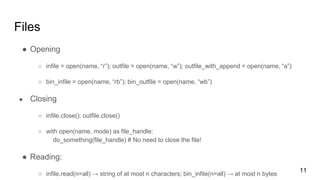
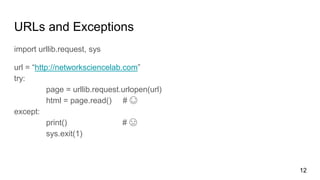

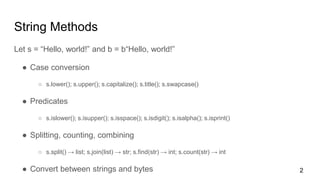
This document provides an overview of essential Python functions across several topics: 1) String methods for case conversion, predicates, splitting/joining strings, and converting between strings and bytes. 2) Common list and tuple operations like indexing, appending, sorting, and counting. 3) Creating and updating dictionaries through indexing, adding key-value pairs, and deleting keys. 4) Set operations like unions, intersections, and differences between sets.


