June 2022
PaCSS 2022
1
Using Complex Network Analysis for Periodization of
Post-Colonial African History
Dmitry Zinoviev
Mathematics and Computer Science Department
Suffolk University, Boston, U.S.A.
June 2022
PaCSS 2022
2
Using Complex Network Analysis for Periodization of
Post-Colonial African History
Dmitry Zinoviev
Mathematics and Computer Science Department
Suffolk University, Boston, U.S.A.
June 2022
PaCSS 2022
3
What Is Historical Periodization?
● Periodization is the process of categorizing the past into discrete, contiguous, quantified,
and named blocks of time and the results of such a process.
● Pertains to history (“the past”).
● Corresponds to classification in machine learning (“categorizing … into discretem quantified
blocks”).
● Mostly subjective and arbitrary (though claimed to be “quantified”).
● Periodization is used for understanding and communicating historical phenomena.
● History as a sequence of social formations (Marx, 1844).
● “[History] can exist as a discipline if it develops a theory of periodization” (Koselleck, 2000).
● Also, confronted by some historians as superficial: History is continuous (Jordheim, 2012).
June 2022
PaCSS 2022
4
Formal Definition
● Given:
● [Historical] state St at a discrete time t that includes essential aspects of the society in a specific
territory (Africa, USA, whole world, etc.).
● A measure of similarity of two states mij = m(Si, Sj), such that mij=mji≥0 and mii=0.
● An ordered sequence of states H=S0, S1, S2, … (the history as such).
● Periodization is:
● A mapping {S P}, where P
→P}, where P ⊆ℕ is a set of at least two periods (non-trivial!).
● Such that if Si P
→P}, where P a and Sj P
→P}, where P a, then Sk P
→P}, where P a ∀*k: i<k<j (non-overlapping!).
*Ideally, for all k; practically, for most k’s.
● That minimizes the goal function: F(H, P)=min.
June 2022
PaCSS 2022
5
The Goal Function
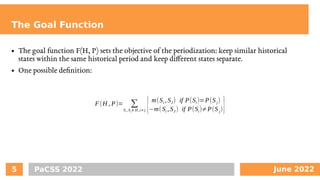
● The goal function F(H, P) sets the objective of the periodization: keep similar historical
states within the same historical period and keep different states separate.
● One possible definition:
F(H , P)= ∑
Si ,Sj∈H ,i> j {m(Si , SJ) if P(Si)=P(S j)
−m(Si , SJ ) if P(Si)≠P(S j)}
June 2022
PaCSS 2022
6
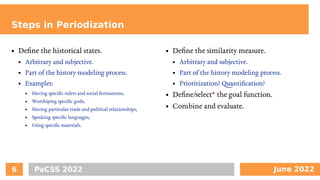
Steps in Periodization
● Define the historical states.
● Arbitrary and subjective.
● Part of the history modeling process.
● Examples:
● Having specific rulers and social formations;
● Worshiping specific gods;
● Having particular trade and political relationships;
● Speaking specific languages;
● Using specific materials.
● Define the similarity measure.
● Arbitrary and subjective.
● Part of the history modeling process.
● Prioritization? Quantification?
● Define/select* the goal function.
● Combine and evaluate.
June 2022
PaCSS 2022
7
Proposed Approach
● Model historical states as complex networks and use complex network analysis (CNA) for
periodization.
● Complex networks model binary (and higher degree) relationships that are common in
humanities, as opposed to quantitative relationships.
● Complex networks are intuitive to build and visually appealing.
● Complex networks have established apparatus for community detection.
● Convert periodization to community detection and win!
● Disclosure: I am the author of Complex Network Analysis in Python, published by The
Pragmatic Bookshelf.
June 2022
PaCSS 2022
8
Two Case Studies
June 2022
PaCSS 2022
9
Case Study 1: Federal/State Voting in the U.S.A.
● Time frame: from 1796 to 2022.
● Time step: 4 years.
● Historical state: each U.S. state voting for a particular party at presidential and/or
gubernatorial elections.
● Mathematically: a mapping of U.S. states U to political parties R, Si={Uj R
→P}, where P kP⨉RkG}.
● Similarity measure: the number of U.S. states that changed their voting preferences (Jaccard
distance).
● Construct a dissimilarity-based weighted network of YEARS.
● Apply community detection (e.g., Louvain algorithm that maximizes Newmann
modularity).
June 2022
PaCSS 2022
10
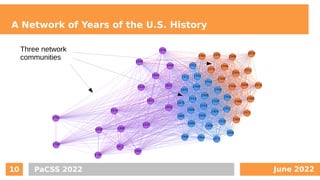
A Network of Years of the U.S. History
1792
1789
1796
1800
1804
1808
1812
1816
1820
1828
1832
1836
1840
1844
1848
1852
1856
1860 1864
1868
1872
1876
1880
1884
1888
1892
1896
1900
1904
1908
1912
1916
1920
1924
1928
1932
1936
1940
1944
1948
1952
1956
1960
1964
1968
1972
1976
1980
1984
1988
1992
1996
2000
2004
2008
2012
2016
2020
Three network
communities
June 2022
PaCSS 2022
11
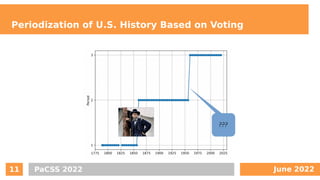
Periodization of U.S. History Based on Voting
???
June 2022
PaCSS 2022
12
Case Study 2: Post-Colonial Africa
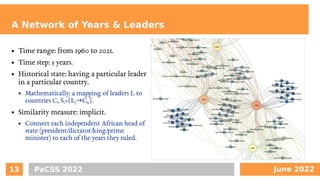
● Time range: from 1960 to 2021.
● Time step: 5 years.
● Historical state: having a particular leader
in a particular country.
● Mathematically: a mapping of leaders L to
countries C, Si={Lj C
→P}, where P k}.
● Similarity measure: implicit.
● Connect each independent African head of
state (president/dictator/king/prime
minister) to each of the years they ruled.
June 2022
PaCSS 2022
13
A Network of Years & Leaders
● Time range: from 1960 to 2021.
● Time step: 5 years.
● Historical state: having a particular leader
in a particular country.
● Mathematically: a mapping of leaders L to
countries C, Si={Lj C
→P}, where P k}.
● Similarity measure: implicit.
● Connect each independent African head of
state (president/dictator/king/prime
minister) to each of the years they ruled.
June 2022
PaCSS 2022
14
Projecting the Network
● The network is bipartite: years are connected to leaders but not to other years (which would
be desirable for community detection!)
● Perform two-way projection:
● Use generalized similarity (Kovacs, 2010).
● Construct a single-mode, weighted network of years connected to similar leaders.
● Construct a single-mode, weighted network of leaders that were in power in similar years.
● Eliminate negative weights.
● Eliminate small weights (<W) to avoid cluttered spaghetti-like graphs.
● Perform community detection, as before.
June 2022
PaCSS 2022
15
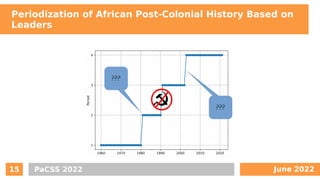
Periodization of African Post-Colonial History Based on
Leaders
???
???
June 2022
PaCSS 2022
16
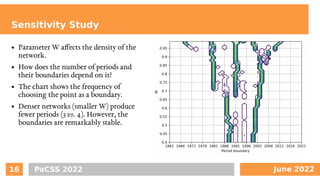
Sensitivity Study
● Parameter W affects the density of the
network.
● How does the number of periods and
their boundaries depend on it?
● The chart shows the frequency of
choosing the point as a boundary.
● Denser networks (smaller W) produce
fewer periods (3 vs. 4). However, the
boundaries are remarkably stable.
June 2022
PaCSS 2022
17
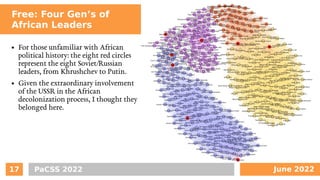
Free: Four Gen’s of
African Leaders
● For those unfamiliar with African
political history: the eight red circles
represent the eight Soviet/Russian
leaders, from Khrushchev to Putin.
● Given the extraordinary involvement
of the USSR in the African
decolonization process, I thought they
belonged here.
June 2022
PaCSS 2022
18
Conclusion
● Complex networks can be used to model historical states.
● Complex network analysis can be used to calculate historical periodization.

Using Complex Network Analysis for Periodization

  • 1.
    June 2022 PaCSS 2022 1 UsingComplex Network Analysis for Periodization of Post-Colonial African History Dmitry Zinoviev Mathematics and Computer Science Department Suffolk University, Boston, U.S.A.
  • 2.
    June 2022 PaCSS 2022 2 UsingComplex Network Analysis for Periodization of Post-Colonial African History Dmitry Zinoviev Mathematics and Computer Science Department Suffolk University, Boston, U.S.A.
  • 3.
    June 2022 PaCSS 2022 3 WhatIs Historical Periodization? ● Periodization is the process of categorizing the past into discrete, contiguous, quantified, and named blocks of time and the results of such a process. ● Pertains to history (“the past”). ● Corresponds to classification in machine learning (“categorizing … into discretem quantified blocks”). ● Mostly subjective and arbitrary (though claimed to be “quantified”). ● Periodization is used for understanding and communicating historical phenomena. ● History as a sequence of social formations (Marx, 1844). ● “[History] can exist as a discipline if it develops a theory of periodization” (Koselleck, 2000). ● Also, confronted by some historians as superficial: History is continuous (Jordheim, 2012).
  • 4.
    June 2022 PaCSS 2022 4 FormalDefinition ● Given: ● [Historical] state St at a discrete time t that includes essential aspects of the society in a specific territory (Africa, USA, whole world, etc.). ● A measure of similarity of two states mij = m(Si, Sj), such that mij=mji≥0 and mii=0. ● An ordered sequence of states H=S0, S1, S2, … (the history as such). ● Periodization is: ● A mapping {S P}, where P →P}, where P ⊆ℕ is a set of at least two periods (non-trivial!). ● Such that if Si P →P}, where P a and Sj P →P}, where P a, then Sk P →P}, where P a ∀*k: i<k<j (non-overlapping!). *Ideally, for all k; practically, for most k’s. ● That minimizes the goal function: F(H, P)=min.
  • 5.
    June 2022 PaCSS 2022 5 TheGoal Function ● The goal function F(H, P) sets the objective of the periodization: keep similar historical states within the same historical period and keep different states separate. ● One possible definition: F(H , P)= ∑ Si ,Sj∈H ,i> j {m(Si , SJ) if P(Si)=P(S j) −m(Si , SJ ) if P(Si)≠P(S j)}
  • 6.
    June 2022 PaCSS 2022 6 Stepsin Periodization ● Define the historical states. ● Arbitrary and subjective. ● Part of the history modeling process. ● Examples: ● Having specific rulers and social formations; ● Worshiping specific gods; ● Having particular trade and political relationships; ● Speaking specific languages; ● Using specific materials. ● Define the similarity measure. ● Arbitrary and subjective. ● Part of the history modeling process. ● Prioritization? Quantification? ● Define/select* the goal function. ● Combine and evaluate.
  • 7.
    June 2022 PaCSS 2022 7 ProposedApproach ● Model historical states as complex networks and use complex network analysis (CNA) for periodization. ● Complex networks model binary (and higher degree) relationships that are common in humanities, as opposed to quantitative relationships. ● Complex networks are intuitive to build and visually appealing. ● Complex networks have established apparatus for community detection. ● Convert periodization to community detection and win! ● Disclosure: I am the author of Complex Network Analysis in Python, published by The Pragmatic Bookshelf.
  • 8.
  • 9.
    June 2022 PaCSS 2022 9 CaseStudy 1: Federal/State Voting in the U.S.A. ● Time frame: from 1796 to 2022. ● Time step: 4 years. ● Historical state: each U.S. state voting for a particular party at presidential and/or gubernatorial elections. ● Mathematically: a mapping of U.S. states U to political parties R, Si={Uj R →P}, where P kP⨉RkG}. ● Similarity measure: the number of U.S. states that changed their voting preferences (Jaccard distance). ● Construct a dissimilarity-based weighted network of YEARS. ● Apply community detection (e.g., Louvain algorithm that maximizes Newmann modularity).
  • 10.
    June 2022 PaCSS 2022 10 ANetwork of Years of the U.S. History 1792 1789 1796 1800 1804 1808 1812 1816 1820 1828 1832 1836 1840 1844 1848 1852 1856 1860 1864 1868 1872 1876 1880 1884 1888 1892 1896 1900 1904 1908 1912 1916 1920 1924 1928 1932 1936 1940 1944 1948 1952 1956 1960 1964 1968 1972 1976 1980 1984 1988 1992 1996 2000 2004 2008 2012 2016 2020 Three network communities
  • 11.
    June 2022 PaCSS 2022 11 Periodizationof U.S. History Based on Voting ???
  • 12.
    June 2022 PaCSS 2022 12 CaseStudy 2: Post-Colonial Africa ● Time range: from 1960 to 2021. ● Time step: 5 years. ● Historical state: having a particular leader in a particular country. ● Mathematically: a mapping of leaders L to countries C, Si={Lj C →P}, where P k}. ● Similarity measure: implicit. ● Connect each independent African head of state (president/dictator/king/prime minister) to each of the years they ruled.
  • 13.
    June 2022 PaCSS 2022 13 ANetwork of Years & Leaders ● Time range: from 1960 to 2021. ● Time step: 5 years. ● Historical state: having a particular leader in a particular country. ● Mathematically: a mapping of leaders L to countries C, Si={Lj C →P}, where P k}. ● Similarity measure: implicit. ● Connect each independent African head of state (president/dictator/king/prime minister) to each of the years they ruled.
  • 14.
    June 2022 PaCSS 2022 14 Projectingthe Network ● The network is bipartite: years are connected to leaders but not to other years (which would be desirable for community detection!) ● Perform two-way projection: ● Use generalized similarity (Kovacs, 2010). ● Construct a single-mode, weighted network of years connected to similar leaders. ● Construct a single-mode, weighted network of leaders that were in power in similar years. ● Eliminate negative weights. ● Eliminate small weights (<W) to avoid cluttered spaghetti-like graphs. ● Perform community detection, as before.
  • 15.
    June 2022 PaCSS 2022 15 Periodizationof African Post-Colonial History Based on Leaders ??? ???
  • 16.
    June 2022 PaCSS 2022 16 SensitivityStudy ● Parameter W affects the density of the network. ● How does the number of periods and their boundaries depend on it? ● The chart shows the frequency of choosing the point as a boundary. ● Denser networks (smaller W) produce fewer periods (3 vs. 4). However, the boundaries are remarkably stable.
  • 17.
    June 2022 PaCSS 2022 17 Free:Four Gen’s of African Leaders ● For those unfamiliar with African political history: the eight red circles represent the eight Soviet/Russian leaders, from Khrushchev to Putin. ● Given the extraordinary involvement of the USSR in the African decolonization process, I thought they belonged here.
  • 18.
    June 2022 PaCSS 2022 18 Conclusion ●Complex networks can be used to model historical states. ● Complex network analysis can be used to calculate historical periodization.