WORKPLACE
DEVELOPMENT
COURSES
JJOSEPHGLOBAL
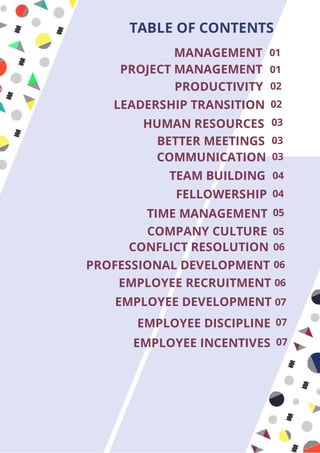
MANAGEMENT 01
PROJECT MANAGEMENT 01
PRODUCTIVITY 02
LEADERSHIP TRANSITION 02
HUMAN RESOURCES
BETTER MEETINGS
COMMUNICATION
TEAM BUILDING
FELLOWERSHIP
TIME MANAGEMENT
COMPANY CULTURE
CONFLICT RESOLUTION
PROFESSIONAL DEVELOPMENT
EMPLOYEE DEVELOPMENT
EMPLOYEE INCENTIVES
EMPLOYEE DISCIPLINE
EMPLOYEE RECRUITMENT
03
03
03
04
04
05
05
06
06
06
07
07
07
TABLE OF CONTENTS
  Page 1
Project Management requires you to balance a lot of di cult variables in your business
and the stakes are high. In many cases the very life of a business itself may depend on
the ability of it's project managers to keep operations running smoothly and e ciently.
Project Management can be described as the art of initiating, planning, executing,
controlling and closing the work of a team to achieve speci c goals and meet speci c
success criteria by a speci ed time. But how can you ensure that you or the project
manager's in your organisation are operating to a high performance.
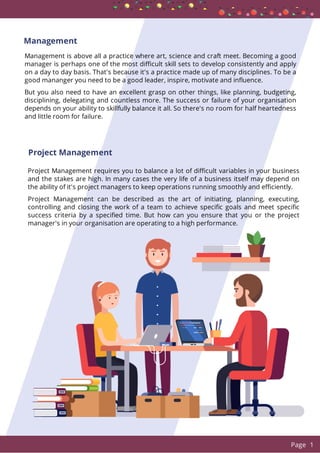
Project Management
Management is above all a practice where art, science and craft meet. Becoming a good
manager is perhaps one of the most di cult skill sets to develop consistently and apply
on a day to day basis. That's because it's a practice made up of many disciplines. To be a
good mananger you need to be a good leader, inspire, motivate and in uence.
But you also need to have an excellent grasp on other things, like planning, budgeting,
disciplining, delegating and countless more. The success or failure of your organisation
depends on your ability to skillfully balance it all. So there's no room for half heartedness
and little room for failure.
Management
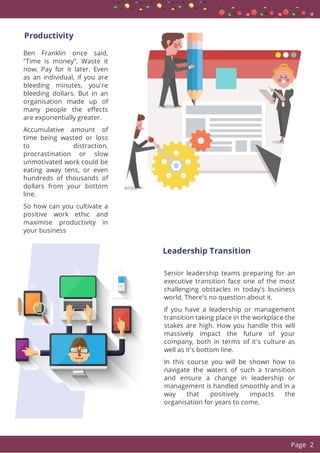
Productivity
Ben Franklin once said,
"Time is money". Waste it
now, Pay for it later. Even
as an individual, if you are
bleeding minutes, you're
bleeding dollars. But in an
organisation made up of
many people the e ects
are exponentially greater.
Accumulative amount of
time being wasted or loss
to distraction,
procrastination or slow
unmotivated work could be
eating away tens, or even
hundreds of thousands of
dollars from your bottom
line.
So how can you cultivate a
positive work ethic and
maximise productivity in
your business
 
Leadership Transition
Senior leadership teams preparing for an
executive transition face one of the most
challenging obstacles in today's business
world. There's no question about it.
If you have a leadership or management
transition taking place in the workplace the
stakes are high. How you handle this will
massively impact the future of your
company, both in terms of it's culture as
well as it's bottom line.
In this course you will be shown how to
navigate the waters of such a transition
and ensure a change in leadership or
management is handled smoothly and in a
way that positively impacts the
organisation for years to come.
  Page 2
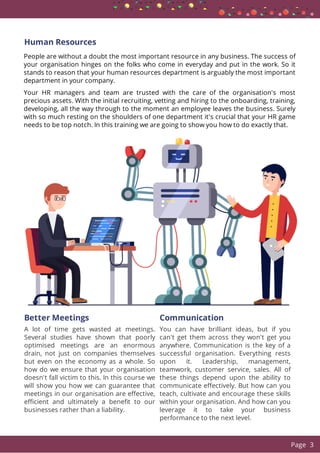
Human Resources
People are without a doubt the most important resource in any business. The success of
your organisation hinges on the folks who come in everyday and put in the work. So it
stands to reason that your human resources department is arguably the most important
department in your company.
Your HR managers and team are trusted with the care of the organisation's most
precious assets. With the initial recruiting, vetting and hiring to the onboarding, training,
developing, all the way through to the moment an employee leaves the business. Surely
with so much resting on the shoulders of one department it's crucial that your HR game
needs to be top notch. In this training we are going to show you how to do exactly that.
Better Meetings
A lot of time gets wasted at meetings.
Several studies have shown that poorly
optimised meetings are an enormous
drain, not just on companies themselves
but even on the economy as a whole. So
how do we ensure that your organisation
doesn't fall victim to this. In this course we
will show you how we can guarantee that
meetings in our organisation are e ective,
e cient and ultimately a bene t to our
businesses rather than a liability.
Communication
You can have brilliant ideas, but if you
can't get them across they won't get you
anywhere. Communication is the key of a
successful organisation. Everything rests
upon it. Leadership, management,
teamwork, customer service, sales. All of
these things depend upon the ability to
communicate e ectively. But how can you
teach, cultivate and encourage these skills
within your organisation. And how can you
leverage it to take your business
performance to the next level.
  Page 3
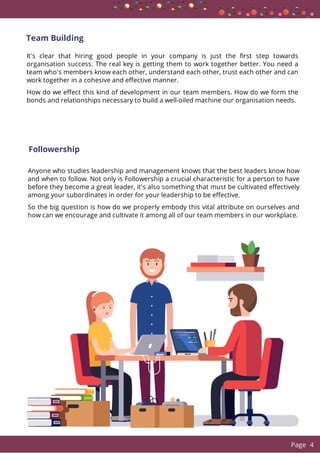
Team Building
It's clear that hiring good people in your company is just the rst step towards
organisation success. The real key is getting them to work together better. You need a
team who's members know each other, understand each other, trust each other and can
work together in a cohesive and e ective manner.
How do we e ect this kind of development in our team members. How do we form the
bonds and relationships necessary to build a well-oiled machine our organisation needs.
Anyone who studies leadership and management knows that the best leaders know how
and when to follow. Not only is Followership a crucial characteristic for a person to have
before they become a great leader, it's also something that must be cultivated e ectively
among your subordinates in order for your leadership to be e ective.
So the big question is how do we properly embody this vital attribute on ourselves and
how can we encourage and cultivate it among all of our team members in our workplace.
Followership
  Page 4
 
Time Management
Time is the most valuable
asset we have at our
disposal. Every hour in our
work days translate to
dollars spent, dollars
gained or dollars wasted.
Our ability to produce, to
pro t, to grow and scale
are all dependant on our
ability to manage and
dominate time. But how
can we truly take command
of this golden asset?
How can we ensure we're
making the absolute best
use of the minutes and
hours in both our
businesses and in our
personal lives. This course
will show you how.
 
Company Culture
Being a great place to work is the
di erence to being a good company and a
great company.
The success of your business is largely
dependant on your company culture.
The atmosphere of your workplace, the
traditions, the routines and the values all
have an undeniable e ect on the
performance of your teams, the morale of
your workers and even your bottom line.
So what can you do to foster a positive
company culture? How do you ensure that
when your people show up in the morning
they are both happy and proud to be
there.
  Page 5
Con ict Resolution
Handling con icts in the workplace can be an intimidating and unattractive prospect, but
handling them badly or not handling them at all is sure to make things even worse.
Con icts, whether they involve you or other member's of your team can seriously
damage your organisation's climate if not dealt with right away. In this course you are
going to learn how we properly resolve con icts and disputes in a way that minimises
dissatisfaction from both parties and possibly impacts our organisation.
Professional Development
No one reaches the top unless they
develop themselves personally and
professionally.
If you want to climb the corporate ladder
or take your organisation to new heights,
you must always be bettering yourself.
So how do we stay on top of Professional
Development in our busy lives? How do we
incorporate growth in our daily routines?
Employee Recruitment
Hire character and trained skill. Do not
hire a man or woman who does your work
for money but for the love of it.
Hiring new employees is one of the most
important responsiblities in your business
and there is very little room for bad
choices here.
This course will teach you how to get this
right the rst time.
  Page 6
Employee Development
Employee Incentives
Employee Discipline
As managers of people we want to do two things, help them become better and keep
them in our organisation. The harsh reality is your company will su er if you can't do
both of those things. But how exactly do we do that?
How do we approach employee development in a way that maximises each team
member's full potential and keeps them interested and motivated about their
development.
In this course you will learn, once we have invested our company's time, energy and
capital developing them, how can we best ensure to retain them in our organisation.
Dealing with employee issues can be di cult, but not dealing with them can be worse. If
you run a business and responsible for a lot of people, you come to grips with reality that
you must have discipline to protect the enterprise.
It's di cult to think about, but undeniably neccessary. If you want your workplace to
remain a well-oiled machine you will need to correct problematic personnel from time to
time. But how can we be sure to handle this critcal aspect of leadership and management
the right way.
In this course you will learn the most e ective way to correct or even terminate an
employee without negatively impacting morale.
Show me the incentive and I will show you the outcome. There is no question that a well
thought out incentive can massively motivate your workforce and generate signi cant
gains for your company.
Nothing gets people enthusiastic about a goal like telling them there's something special
in it for them. Whether it's money, prizes, a day o or even a better parking space.
Incentives are one of the most powerful forces you can introduce into your workplace.
This course will show you how to leverage this phenomenon in the most e cient manner
and a way that delivers massive results. Not costing a disproportionate amount of
money or resources.
  Page 7
Learn the business skills
your
your 
 company needs to thrive 
company needs to thrive 
&
& 
 be successful with our
be successful with our
eLearning Online Training!
Get The Complete 
Get The Complete Courses Of
Courses Of
All The Titles Above + Much More 
Available At:
Available At:
https://jjosephglobalmarketing.com

Workplace Development Online Courses

  • 1.
  • 2.
    MANAGEMENT 01 PROJECT MANAGEMENT01 PRODUCTIVITY 02 LEADERSHIP TRANSITION 02 HUMAN RESOURCES BETTER MEETINGS COMMUNICATION TEAM BUILDING FELLOWERSHIP TIME MANAGEMENT COMPANY CULTURE CONFLICT RESOLUTION PROFESSIONAL DEVELOPMENT EMPLOYEE DEVELOPMENT EMPLOYEE INCENTIVES EMPLOYEE DISCIPLINE EMPLOYEE RECRUITMENT 03 03 03 04 04 05 05 06 06 06 07 07 07 TABLE OF CONTENTS
  • 3.
      Page 1 ProjectManagement requires you to balance a lot of di cult variables in your business and the stakes are high. In many cases the very life of a business itself may depend on the ability of it's project managers to keep operations running smoothly and e ciently. Project Management can be described as the art of initiating, planning, executing, controlling and closing the work of a team to achieve speci c goals and meet speci c success criteria by a speci ed time. But how can you ensure that you or the project manager's in your organisation are operating to a high performance. Project Management Management is above all a practice where art, science and craft meet. Becoming a good manager is perhaps one of the most di cult skill sets to develop consistently and apply on a day to day basis. That's because it's a practice made up of many disciplines. To be a good mananger you need to be a good leader, inspire, motivate and in uence. But you also need to have an excellent grasp on other things, like planning, budgeting, disciplining, delegating and countless more. The success or failure of your organisation depends on your ability to skillfully balance it all. So there's no room for half heartedness and little room for failure. Management
  • 4.
    Productivity Ben Franklin oncesaid, "Time is money". Waste it now, Pay for it later. Even as an individual, if you are bleeding minutes, you're bleeding dollars. But in an organisation made up of many people the e ects are exponentially greater. Accumulative amount of time being wasted or loss to distraction, procrastination or slow unmotivated work could be eating away tens, or even hundreds of thousands of dollars from your bottom line. So how can you cultivate a positive work ethic and maximise productivity in your business   Leadership Transition Senior leadership teams preparing for an executive transition face one of the most challenging obstacles in today's business world. There's no question about it. If you have a leadership or management transition taking place in the workplace the stakes are high. How you handle this will massively impact the future of your company, both in terms of it's culture as well as it's bottom line. In this course you will be shown how to navigate the waters of such a transition and ensure a change in leadership or management is handled smoothly and in a way that positively impacts the organisation for years to come.   Page 2
  • 5.
    Human Resources People arewithout a doubt the most important resource in any business. The success of your organisation hinges on the folks who come in everyday and put in the work. So it stands to reason that your human resources department is arguably the most important department in your company. Your HR managers and team are trusted with the care of the organisation's most precious assets. With the initial recruiting, vetting and hiring to the onboarding, training, developing, all the way through to the moment an employee leaves the business. Surely with so much resting on the shoulders of one department it's crucial that your HR game needs to be top notch. In this training we are going to show you how to do exactly that. Better Meetings A lot of time gets wasted at meetings. Several studies have shown that poorly optimised meetings are an enormous drain, not just on companies themselves but even on the economy as a whole. So how do we ensure that your organisation doesn't fall victim to this. In this course we will show you how we can guarantee that meetings in our organisation are e ective, e cient and ultimately a bene t to our businesses rather than a liability. Communication You can have brilliant ideas, but if you can't get them across they won't get you anywhere. Communication is the key of a successful organisation. Everything rests upon it. Leadership, management, teamwork, customer service, sales. All of these things depend upon the ability to communicate e ectively. But how can you teach, cultivate and encourage these skills within your organisation. And how can you leverage it to take your business performance to the next level.   Page 3
  • 6.
    Team Building It's clearthat hiring good people in your company is just the rst step towards organisation success. The real key is getting them to work together better. You need a team who's members know each other, understand each other, trust each other and can work together in a cohesive and e ective manner. How do we e ect this kind of development in our team members. How do we form the bonds and relationships necessary to build a well-oiled machine our organisation needs. Anyone who studies leadership and management knows that the best leaders know how and when to follow. Not only is Followership a crucial characteristic for a person to have before they become a great leader, it's also something that must be cultivated e ectively among your subordinates in order for your leadership to be e ective. So the big question is how do we properly embody this vital attribute on ourselves and how can we encourage and cultivate it among all of our team members in our workplace. Followership   Page 4
  • 7.
      Time Management Time isthe most valuable asset we have at our disposal. Every hour in our work days translate to dollars spent, dollars gained or dollars wasted. Our ability to produce, to pro t, to grow and scale are all dependant on our ability to manage and dominate time. But how can we truly take command of this golden asset? How can we ensure we're making the absolute best use of the minutes and hours in both our businesses and in our personal lives. This course will show you how.   Company Culture Being a great place to work is the di erence to being a good company and a great company. The success of your business is largely dependant on your company culture. The atmosphere of your workplace, the traditions, the routines and the values all have an undeniable e ect on the performance of your teams, the morale of your workers and even your bottom line. So what can you do to foster a positive company culture? How do you ensure that when your people show up in the morning they are both happy and proud to be there.   Page 5
  • 8.
    Con ict Resolution Handlingcon icts in the workplace can be an intimidating and unattractive prospect, but handling them badly or not handling them at all is sure to make things even worse. Con icts, whether they involve you or other member's of your team can seriously damage your organisation's climate if not dealt with right away. In this course you are going to learn how we properly resolve con icts and disputes in a way that minimises dissatisfaction from both parties and possibly impacts our organisation. Professional Development No one reaches the top unless they develop themselves personally and professionally. If you want to climb the corporate ladder or take your organisation to new heights, you must always be bettering yourself. So how do we stay on top of Professional Development in our busy lives? How do we incorporate growth in our daily routines? Employee Recruitment Hire character and trained skill. Do not hire a man or woman who does your work for money but for the love of it. Hiring new employees is one of the most important responsiblities in your business and there is very little room for bad choices here. This course will teach you how to get this right the rst time.   Page 6
  • 9.
    Employee Development Employee Incentives EmployeeDiscipline As managers of people we want to do two things, help them become better and keep them in our organisation. The harsh reality is your company will su er if you can't do both of those things. But how exactly do we do that? How do we approach employee development in a way that maximises each team member's full potential and keeps them interested and motivated about their development. In this course you will learn, once we have invested our company's time, energy and capital developing them, how can we best ensure to retain them in our organisation. Dealing with employee issues can be di cult, but not dealing with them can be worse. If you run a business and responsible for a lot of people, you come to grips with reality that you must have discipline to protect the enterprise. It's di cult to think about, but undeniably neccessary. If you want your workplace to remain a well-oiled machine you will need to correct problematic personnel from time to time. But how can we be sure to handle this critcal aspect of leadership and management the right way. In this course you will learn the most e ective way to correct or even terminate an employee without negatively impacting morale. Show me the incentive and I will show you the outcome. There is no question that a well thought out incentive can massively motivate your workforce and generate signi cant gains for your company. Nothing gets people enthusiastic about a goal like telling them there's something special in it for them. Whether it's money, prizes, a day o or even a better parking space. Incentives are one of the most powerful forces you can introduce into your workplace. This course will show you how to leverage this phenomenon in the most e cient manner and a way that delivers massive results. Not costing a disproportionate amount of money or resources.   Page 7
  • 10.
    Learn the businessskills Learn the business skills your your   company needs to thrive  company needs to thrive  & &   be successful with our be successful with our eLearning Online Training! eLearning Online Training! Get The Complete  Get The Complete Courses Of Courses Of All The Titles Above + Much More  All The Titles Above + Much More  Available At: Available At: https://jjosephglobalmarketing.com