Working to a Brief
LO1
Rachel Kent – purple
&
Chloe Smith - blue
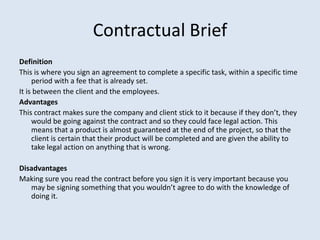
Contractual Brief
Definition
This is where you sign an agreement to complete a specific task, within a specific time
period with a fee that is already set.
It is between the client and the employees.
Advantages
This contract makes sure the company and client stick to it because if they don’t, they
would be going against the contract and so they could face legal action. This
means that a product is almost guaranteed at the end of the project, so that the
client is certain that their product will be completed and are given the ability to
take legal action on anything that is wrong.
Disadvantages
Making sure you read the contract before you sign it is very important because you
may be signing something that you wouldn’t agree to do with the knowledge of
doing it.
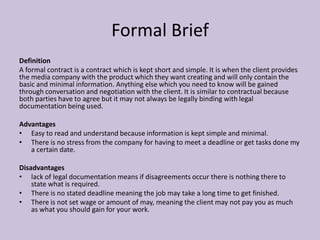
Formal Brief
Definition
A formal contract is a contract which is kept short and simple. It is when the client provides
the media company with the product which they want creating and will only contain the
basic and minimal information. Anything else which you need to know will be gained
through conversation and negotiation with the client. It is similar to contractual because
both parties have to agree but it may not always be legally binding with legal
documentation being used.
Advantages
• Easy to read and understand because information is kept simple and minimal.
• There is no stress from the company for having to meet a deadline or get tasks done my
a certain date.
Disadvantages
• lack of legal documentation means if disagreements occur there is nothing there to
state what is required.
• There is no stated deadline meaning the job may take a long time to get finished.
• There is not set wage or amount of may, meaning the client may not pay you as much
as what you should gain for your work.
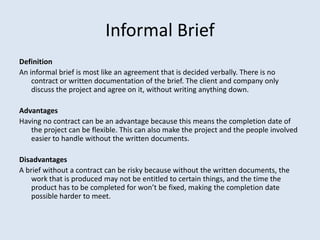
Informal Brief
Definition
An informal brief is most like an agreement that is decided verbally. There is no
contract or written documentation of the brief. The client and company only
discuss the project and agree on it, without writing anything down.
Advantages
Having no contract can be an advantage because this means the completion date of
the project can be flexible. This can also make the project and the people involved
easier to handle without the written documents.
Disadvantages
A brief without a contract can be risky because without the written documents, the
work that is produced may not be entitled to certain things, and the time the
product has to be completed for won’t be fixed, making the completion date
possible harder to meet.
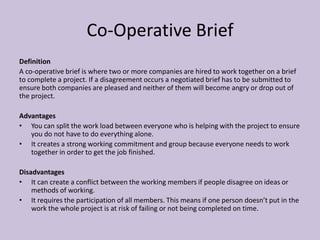
Co-Operative Brief
Definition
A co-operative brief is where two or more companies are hired to work together on a brief
to complete a project. If a disagreement occurs a negotiated brief has to be submitted to
ensure both companies are pleased and neither of them will become angry or drop out of
the project.
Advantages
• You can split the work load between everyone who is helping with the project to ensure
you do not have to do everything alone.
• It creates a strong working commitment and group because everyone needs to work
together in order to get the job finished.
Disadvantages
• It can create a conflict between the working members if people disagree on ideas or
methods of working.
• It requires the participation of all members. This means if one person doesn’t put in the
work the whole project is at risk of failing or not being completed on time.
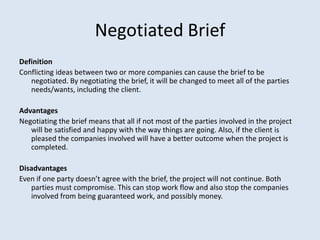
Negotiated Brief
Definition
Conflicting ideas between two or more companies can cause the brief to be
negotiated. By negotiating the brief, it will be changed to meet all of the parties
needs/wants, including the client.
Advantages
Negotiating the brief means that all if not most of the parties involved in the project
will be satisfied and happy with the way things are going. Also, if the client is
pleased the companies involved will have a better outcome when the project is
completed.
Disadvantages
Even if one party doesn’t agree with the brief, the project will not continue. Both
parties must compromise. This can stop work flow and also stop the companies
involved from being guaranteed work, and possibly money.
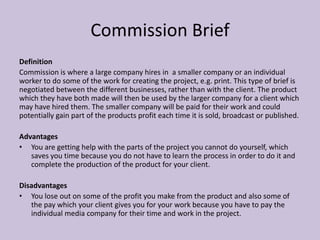
Commission Brief
Definition
Commission is where a large company hires in a smaller company or an individual
worker to do some of the work for creating the project, e.g. print. This type of brief is
negotiated between the different businesses, rather than with the client. The product
which they have both made will then be used by the larger company for a client which
may have hired them. The smaller company will be paid for their work and could
potentially gain part of the products profit each time it is sold, broadcast or published.
Advantages
• You are getting help with the parts of the project you cannot do yourself, which
saves you time because you do not have to learn the process in order to do it and
complete the production of the product for your client.
Disadvantages
• You lose out on some of the profit you make from the product and also some of
the pay which your client gives you for your work because you have to pay the
individual media company for their time and work in the project.
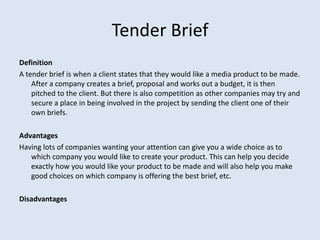
Tender Brief
Definition
A tender brief is when a client states that they would like a media product to be made.
After a company creates a brief, proposal and works out a budget, it is then
pitched to the client. But there is also competition as other companies may try and
secure a place in being involved in the project by sending the client one of their
own briefs.
Advantages
Having lots of companies wanting your attention can give you a wide choice as to
which company you would like to create your product. This can help you decide
exactly how you would like your product to be made and will also help you make
good choices on which company is offering the best brief, etc.
Disadvantages
Competition Brief
Definition
A brief is created and then made available for all of the participating production companies.
Each company then has to try and complete the brief as best as they can. Once this has
been done all of the completed projects will be judged and the best one is awarded with
the project or having their project published. The client only has to pay the winning
company for their time and work on the project since it is the product they will be using in
the end.
Advantages
• Gives everyone a fair chance at getting their ideas to the client and working for them
on the project.
• Because people are having to compete in order for their idea to be chosen they are
more likely to put in a lot of work and effort in order for it to be really good and the
best standard they can get it to.
Disadvantages
• Only the chosen company or business gets paid, this means that most people will lose
out on money as they have to pay for all the materials etc. and are not going to be
making any money back.
My Brief
Which structure/structures will the Vegetarian Recipe Cards brief use?
Reference your reasons for choice/choices
Our brief is co-operative because we are both working on it together and creating our
own recipe cards, and we are also working as a team with different roles that will
all come together to make the product.
Our brief is informal because there are no written documents that make the brief
official. This means that we was given the brief verbally. We agreed on the brief
and how we was going to create the product without writing anything down.
There are a few other people who are competing and creating recipe cards for the
same company. This means that our brief can also be classed as a competition
brief.
Reading the Brief
Why is it important you thoroughly read a brief before starting the project?
• It is important that you thoroughly read the brief before starting any project
because it will allow you to complete the project whilst fully understanding what is
being asked of you.
• Reading a brief before starting any project or job is also important because it
enables you to understand the practicality of the work and ensures you are able to
carry out the work without it costing you too much or you losing out on money.
• Everything you need to know about a job and the work required of you is stated in
the brief so it is crucial you understand the brief fully so that you do not miss
anything out or do something wrong due to lack of understanding.
• The project brief will also state your budget for the work which is important
because it tells you how much money you are able to spend on the project and still
be able to make a profit. It is the set amount which the client gives you for the
project or that you are allowed to spend and you need to ensure you can afford
everything required without going over your allowed budget.
Reading the Brief
What is the nature and demand of the Vegetarian Recipe Cards brief?
We have been asked by a company to produce 8 recipe cards for vegetarians. They
wish to see unique and creative designs with a matching theme across the cards so
that it is easy to distinguish that they are a set. Basing the theme on a certain
ingredient in the foods you produce or the food found in a certain country will give
the recipe cards a more definite theme and will make them more interesting, and
hopefully more appealing.
Negotiating a Brief
Why is it important to discuss the brief with your client prior to production?
This is important because you need to be on an even level with your client to ensure
you both fully understand the job at hand and no disagreements will occur later on.
Discussing the brief with your client gives you the opportunity to raise any concerns or
ask questions if there is something you do not fully understand. It also gives you as a
company the chance to offer the client some of your own ideas and initiatives and to
see what they think and whether they’ll approve or not of your own ideas.
Negotiating a Brief
What are the advantages and disadvantages of employing discretion with a brief?
Employing discretion lets you add things to the brief that you think may be interesting or
something that you would like to try. If you wish to do this, make sure what you want to add
does not conflict or go against what has already been briefed. You can add ideas to the brief
where the information supplied is already quite vague. Sometimes the brief will allow for
your own interpretation of what has been asked which means you can be more creative with
your project. However, since we are being told to make vegetarian recipe cards, we will not
use discretion and we will not choose to add meat to our food.
Negotiating a Brief
Are there any potential legal/ethical/regulatory issues with the brief’s proposed product?
An ethical issue that may come with this proposed project could be that since these recipes are
al vegetarian friendly, they have to be meat-free since they think eating meat is morally wrong
and that animals should not be bred to be slaughtered. They believe animals should have the
same rights as humans do and that they deserve a chance at life just as much as we do. This
could also cause issues with dieticians who say you need to eat meat to gain the protein from
them and stay healthy and keeping up a well balanced diet. Another problem with vegetarian
foods would be that due to the lack of meat you are not gaining enough iron.
Although there are no legal definitions for the terms ‘vegetarian’ and ‘vegan’ there are legal
acts which may concern them. One of these would be the Trade Descriptions Act 1968 which
prohibits false or misleading trade descriptions.
One of the main legal requirements is that the term ‘suitable for vegetarians’ should not be
found on any product which has been derived/made from animals which have died, been
slaughtered, died from being eaten or any animal meat/body part. The term animal includes
poultry, game, fish, crustacean, molluscs etc.
Any vegetarian product to be found containing any of these products will most likely be sued
and be done for false advertisement. Manufacturers should ensure their food is never cross
contaminated. Food which has been presented as being ‘vegetarian’ or ‘vegan’ should not have
been contaminated by any form of meat or non-suitable food products during
preparation, storage, cooking and displaying.
Negotiating a Brief
Amendments you have considered to;
The Product
We could improve our product by strictly sticking to ingredients that are vegetarian
friendly, which will hopefully draw more people in and encourage them to make the recipes.
We will also make sure that our product does not break the regulations of The ASA.
The Budget
We will aim to not be wasteful with the food that we use because this can affect the budget
(buying more than you need). Also, by restricting the amount of resources we use and being
careful with our money, we will see that we do not exceed or spend an over the top amount
of money.
The Conditions
If we were paid too little or too much for our work, the conditions would have to be amended
because otherwise we may not be able to get the money that we deserve for the work we
have done if the project overruns its original deadline or if we need more resources to
complete the project.
Opportunities
What opportunities could this brief allow you to explore?
Self Development
Self development is developing the skills you already possess and becoming stronger at them. It is taking the things you are good
at and putting them into practice in order to become stronger. You are developing yourself and your skills in order to become
better. Self development would give me the chance and opportunity to improve the skills I already possess and become stronger
within them so that I am more experienced and have a stronger chance at getting the jobs I want to work on.
Learning new skills
This brief would help you learn new skills because it requires you to do a variety of jobs and take on different tasks to what you
would normally be used to doing. The tasks for the brief vary from graphic design and photography to maybe having to cook and
prepare the foods ourselves. It will allow me to develop new skills which will in the future open up more pathways and chances at
different projects I would have not been able to work on before. An example of this may be that I am a qualified food
photographer but by developing the new skills I can also cook the products I intend to photograph.
Multi-skilling
Multi-skilling is similar to learning new skills because you are developing what you already know and are doing tasks you would
not normally do but multi-skilling is putting them into practice and becoming more experienced at them through doing them.
Multi-skilling will give me the opportunity to put trial and error into place and work towards developing new skills at the same
time as practicing and developing current skills at the same time. I would be able to for example photograph a food source and
then use Photoshop to enhance it or learn hat the various tools do in order to create various manipulations I didn’t know how to
do before hand.
Contributing to a brief
Contributing to a brief gives you the opportunity to ask any questions for things you are not sure of and also allows you to put
your own ideas for the project forward and voice them to see if anyone will agree with you or if they are feasible. It will allow me
to voice my opinions and ideas on various projects and be able to have my say in things. By doing this and speaking up I will be
benefiting myself because my ideas will be listened to and possibly used but doing this will also allow me to improve my
confidence and become less shy.

Working to a brief pro forma

  • 1.
    Working to aBrief LO1 Rachel Kent – purple & Chloe Smith - blue
  • 2.
    Contractual Brief Definition This iswhere you sign an agreement to complete a specific task, within a specific time period with a fee that is already set. It is between the client and the employees. Advantages This contract makes sure the company and client stick to it because if they don’t, they would be going against the contract and so they could face legal action. This means that a product is almost guaranteed at the end of the project, so that the client is certain that their product will be completed and are given the ability to take legal action on anything that is wrong. Disadvantages Making sure you read the contract before you sign it is very important because you may be signing something that you wouldn’t agree to do with the knowledge of doing it.
  • 3.
    Formal Brief Definition A formalcontract is a contract which is kept short and simple. It is when the client provides the media company with the product which they want creating and will only contain the basic and minimal information. Anything else which you need to know will be gained through conversation and negotiation with the client. It is similar to contractual because both parties have to agree but it may not always be legally binding with legal documentation being used. Advantages • Easy to read and understand because information is kept simple and minimal. • There is no stress from the company for having to meet a deadline or get tasks done my a certain date. Disadvantages • lack of legal documentation means if disagreements occur there is nothing there to state what is required. • There is no stated deadline meaning the job may take a long time to get finished. • There is not set wage or amount of may, meaning the client may not pay you as much as what you should gain for your work.
  • 4.
    Informal Brief Definition An informalbrief is most like an agreement that is decided verbally. There is no contract or written documentation of the brief. The client and company only discuss the project and agree on it, without writing anything down. Advantages Having no contract can be an advantage because this means the completion date of the project can be flexible. This can also make the project and the people involved easier to handle without the written documents. Disadvantages A brief without a contract can be risky because without the written documents, the work that is produced may not be entitled to certain things, and the time the product has to be completed for won’t be fixed, making the completion date possible harder to meet.
  • 5.
    Co-Operative Brief Definition A co-operativebrief is where two or more companies are hired to work together on a brief to complete a project. If a disagreement occurs a negotiated brief has to be submitted to ensure both companies are pleased and neither of them will become angry or drop out of the project. Advantages • You can split the work load between everyone who is helping with the project to ensure you do not have to do everything alone. • It creates a strong working commitment and group because everyone needs to work together in order to get the job finished. Disadvantages • It can create a conflict between the working members if people disagree on ideas or methods of working. • It requires the participation of all members. This means if one person doesn’t put in the work the whole project is at risk of failing or not being completed on time.
  • 6.
    Negotiated Brief Definition Conflicting ideasbetween two or more companies can cause the brief to be negotiated. By negotiating the brief, it will be changed to meet all of the parties needs/wants, including the client. Advantages Negotiating the brief means that all if not most of the parties involved in the project will be satisfied and happy with the way things are going. Also, if the client is pleased the companies involved will have a better outcome when the project is completed. Disadvantages Even if one party doesn’t agree with the brief, the project will not continue. Both parties must compromise. This can stop work flow and also stop the companies involved from being guaranteed work, and possibly money.
  • 7.
    Commission Brief Definition Commission iswhere a large company hires in a smaller company or an individual worker to do some of the work for creating the project, e.g. print. This type of brief is negotiated between the different businesses, rather than with the client. The product which they have both made will then be used by the larger company for a client which may have hired them. The smaller company will be paid for their work and could potentially gain part of the products profit each time it is sold, broadcast or published. Advantages • You are getting help with the parts of the project you cannot do yourself, which saves you time because you do not have to learn the process in order to do it and complete the production of the product for your client. Disadvantages • You lose out on some of the profit you make from the product and also some of the pay which your client gives you for your work because you have to pay the individual media company for their time and work in the project.
  • 8.
    Tender Brief Definition A tenderbrief is when a client states that they would like a media product to be made. After a company creates a brief, proposal and works out a budget, it is then pitched to the client. But there is also competition as other companies may try and secure a place in being involved in the project by sending the client one of their own briefs. Advantages Having lots of companies wanting your attention can give you a wide choice as to which company you would like to create your product. This can help you decide exactly how you would like your product to be made and will also help you make good choices on which company is offering the best brief, etc. Disadvantages
  • 9.
    Competition Brief Definition A briefis created and then made available for all of the participating production companies. Each company then has to try and complete the brief as best as they can. Once this has been done all of the completed projects will be judged and the best one is awarded with the project or having their project published. The client only has to pay the winning company for their time and work on the project since it is the product they will be using in the end. Advantages • Gives everyone a fair chance at getting their ideas to the client and working for them on the project. • Because people are having to compete in order for their idea to be chosen they are more likely to put in a lot of work and effort in order for it to be really good and the best standard they can get it to. Disadvantages • Only the chosen company or business gets paid, this means that most people will lose out on money as they have to pay for all the materials etc. and are not going to be making any money back.
  • 10.
    My Brief Which structure/structureswill the Vegetarian Recipe Cards brief use? Reference your reasons for choice/choices Our brief is co-operative because we are both working on it together and creating our own recipe cards, and we are also working as a team with different roles that will all come together to make the product. Our brief is informal because there are no written documents that make the brief official. This means that we was given the brief verbally. We agreed on the brief and how we was going to create the product without writing anything down. There are a few other people who are competing and creating recipe cards for the same company. This means that our brief can also be classed as a competition brief.
  • 11.
    Reading the Brief Whyis it important you thoroughly read a brief before starting the project? • It is important that you thoroughly read the brief before starting any project because it will allow you to complete the project whilst fully understanding what is being asked of you. • Reading a brief before starting any project or job is also important because it enables you to understand the practicality of the work and ensures you are able to carry out the work without it costing you too much or you losing out on money. • Everything you need to know about a job and the work required of you is stated in the brief so it is crucial you understand the brief fully so that you do not miss anything out or do something wrong due to lack of understanding. • The project brief will also state your budget for the work which is important because it tells you how much money you are able to spend on the project and still be able to make a profit. It is the set amount which the client gives you for the project or that you are allowed to spend and you need to ensure you can afford everything required without going over your allowed budget.
  • 12.
    Reading the Brief Whatis the nature and demand of the Vegetarian Recipe Cards brief? We have been asked by a company to produce 8 recipe cards for vegetarians. They wish to see unique and creative designs with a matching theme across the cards so that it is easy to distinguish that they are a set. Basing the theme on a certain ingredient in the foods you produce or the food found in a certain country will give the recipe cards a more definite theme and will make them more interesting, and hopefully more appealing.
  • 13.
    Negotiating a Brief Whyis it important to discuss the brief with your client prior to production? This is important because you need to be on an even level with your client to ensure you both fully understand the job at hand and no disagreements will occur later on. Discussing the brief with your client gives you the opportunity to raise any concerns or ask questions if there is something you do not fully understand. It also gives you as a company the chance to offer the client some of your own ideas and initiatives and to see what they think and whether they’ll approve or not of your own ideas.
  • 14.
    Negotiating a Brief Whatare the advantages and disadvantages of employing discretion with a brief? Employing discretion lets you add things to the brief that you think may be interesting or something that you would like to try. If you wish to do this, make sure what you want to add does not conflict or go against what has already been briefed. You can add ideas to the brief where the information supplied is already quite vague. Sometimes the brief will allow for your own interpretation of what has been asked which means you can be more creative with your project. However, since we are being told to make vegetarian recipe cards, we will not use discretion and we will not choose to add meat to our food.
  • 15.
    Negotiating a Brief Arethere any potential legal/ethical/regulatory issues with the brief’s proposed product? An ethical issue that may come with this proposed project could be that since these recipes are al vegetarian friendly, they have to be meat-free since they think eating meat is morally wrong and that animals should not be bred to be slaughtered. They believe animals should have the same rights as humans do and that they deserve a chance at life just as much as we do. This could also cause issues with dieticians who say you need to eat meat to gain the protein from them and stay healthy and keeping up a well balanced diet. Another problem with vegetarian foods would be that due to the lack of meat you are not gaining enough iron. Although there are no legal definitions for the terms ‘vegetarian’ and ‘vegan’ there are legal acts which may concern them. One of these would be the Trade Descriptions Act 1968 which prohibits false or misleading trade descriptions. One of the main legal requirements is that the term ‘suitable for vegetarians’ should not be found on any product which has been derived/made from animals which have died, been slaughtered, died from being eaten or any animal meat/body part. The term animal includes poultry, game, fish, crustacean, molluscs etc. Any vegetarian product to be found containing any of these products will most likely be sued and be done for false advertisement. Manufacturers should ensure their food is never cross contaminated. Food which has been presented as being ‘vegetarian’ or ‘vegan’ should not have been contaminated by any form of meat or non-suitable food products during preparation, storage, cooking and displaying.
  • 16.
    Negotiating a Brief Amendmentsyou have considered to; The Product We could improve our product by strictly sticking to ingredients that are vegetarian friendly, which will hopefully draw more people in and encourage them to make the recipes. We will also make sure that our product does not break the regulations of The ASA. The Budget We will aim to not be wasteful with the food that we use because this can affect the budget (buying more than you need). Also, by restricting the amount of resources we use and being careful with our money, we will see that we do not exceed or spend an over the top amount of money. The Conditions If we were paid too little or too much for our work, the conditions would have to be amended because otherwise we may not be able to get the money that we deserve for the work we have done if the project overruns its original deadline or if we need more resources to complete the project.
  • 17.
    Opportunities What opportunities couldthis brief allow you to explore? Self Development Self development is developing the skills you already possess and becoming stronger at them. It is taking the things you are good at and putting them into practice in order to become stronger. You are developing yourself and your skills in order to become better. Self development would give me the chance and opportunity to improve the skills I already possess and become stronger within them so that I am more experienced and have a stronger chance at getting the jobs I want to work on. Learning new skills This brief would help you learn new skills because it requires you to do a variety of jobs and take on different tasks to what you would normally be used to doing. The tasks for the brief vary from graphic design and photography to maybe having to cook and prepare the foods ourselves. It will allow me to develop new skills which will in the future open up more pathways and chances at different projects I would have not been able to work on before. An example of this may be that I am a qualified food photographer but by developing the new skills I can also cook the products I intend to photograph. Multi-skilling Multi-skilling is similar to learning new skills because you are developing what you already know and are doing tasks you would not normally do but multi-skilling is putting them into practice and becoming more experienced at them through doing them. Multi-skilling will give me the opportunity to put trial and error into place and work towards developing new skills at the same time as practicing and developing current skills at the same time. I would be able to for example photograph a food source and then use Photoshop to enhance it or learn hat the various tools do in order to create various manipulations I didn’t know how to do before hand. Contributing to a brief Contributing to a brief gives you the opportunity to ask any questions for things you are not sure of and also allows you to put your own ideas for the project forward and voice them to see if anyone will agree with you or if they are feasible. It will allow me to voice my opinions and ideas on various projects and be able to have my say in things. By doing this and speaking up I will be benefiting myself because my ideas will be listened to and possibly used but doing this will also allow me to improve my confidence and become less shy.