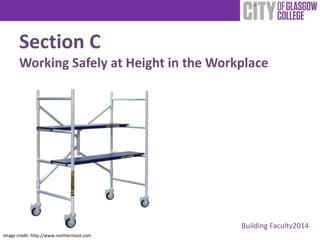
Section C 
Working Safely at Height in the Workplace 
Building Faculty2014 
Image credit: http://www.northerntool.com
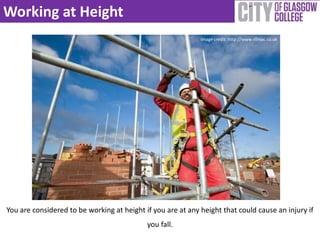
You are considered to be working at height if you are at any height that could cause an injury if 
you fall. 
Working at Height 
Image credit: http://www.rilmac.co.uk
Working at Height Regulations 
The Working at Height Regulations 2005 outline the legal responsibilities of employers and 
employees in relation to working at height within the UK. The purpose of these regulations is to 
prevent death and injuries caused by falls from height..
Definition of Access Equipment 
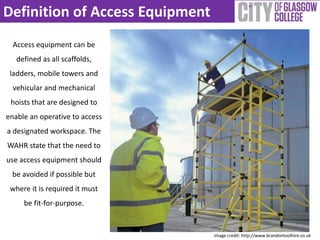
Access equipment can be 
defined as all scaffolds, 
ladders, mobile towers and 
vehicular and mechanical 
hoists that are designed to 
enable an operative to access 
a designated workspace. The 
WAHR state that the need to 
use access equipment should 
be avoided if possible but 
where it is required it must 
be fit-for-purpose. 
Image credit: http://www.brandontoolhire.co.uk
Amendments 
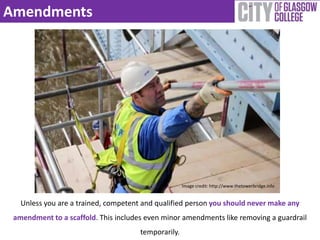
Unless you are a trained, competent and qualified person you should never make any 
amendment to a scaffold. This includes even minor amendments like removing a guardrail 
temporarily. 
Image credit: http://www.thetowerbridge.info
Guardrails and Handrails 
Image credit: http://www.generationhireandsale.co.uk 
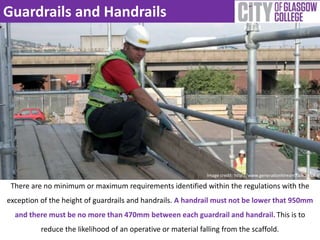
There are no minimum or maximum requirements identified within the regulations with the 
exception of the height of guardrails and handrails. A handrail must not be lower that 950mm 
and there must be no more than 470mm between each guardrail and handrail. This is to 
reduce the likelihood of an operative or material falling from the scaffold.
Tower Scaffolds 
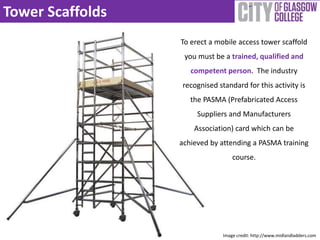
To erect a mobile access tower scaffold 
you must be a trained, qualified and 
competent person. The industry 
recognised standard for this activity is 
the PASMA (Prefabricated Access 
Suppliers and Manufacturers 
Association) card which can be 
achieved by attending a PASMA training 
course. 
Image credit: http://www.midlandladders.com
Using a Ladder 
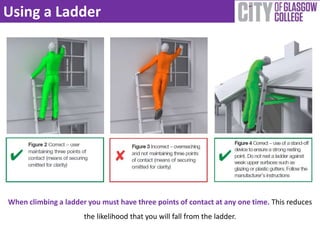
When climbing a ladder you must have three points of contact at any one time. This reduces 
the likelihood that you will fall from the ladder.
Using a Ladder 
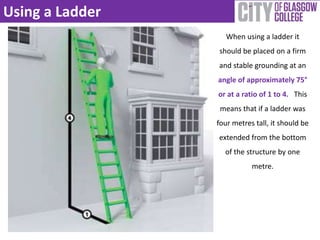
When using a ladder it 
should be placed on a firm 
and stable grounding at an 
angle of approximately 75° 
or at a ratio of 1 to 4. This 
means that if a ladder was 
four metres tall, it should be 
extended from the bottom 
of the structure by one 
metre.
Scaffold Inspection 
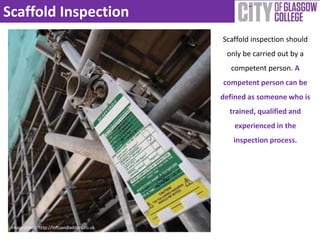
Scaffold inspection should 
only be carried out by a 
competent person. A 
competent person can be 
defined as someone who is 
trained, qualified and 
experienced in the 
inspection process. 
Image credit: http://loftsandladders.co.uk
Pedestrian Safety 
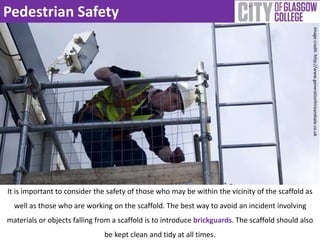
It is important to consider the safety of those who may be within the vicinity of the scaffold as 
well as those who are working on the scaffold. The best way to avoid an incident involving 
materials or objects falling from a scaffold is to introduce brickguards. The scaffold should also 
be kept clean and tidy at all times. 
Image credit: http://www.generationhireandsale.co.uk
Working at Height Signage 
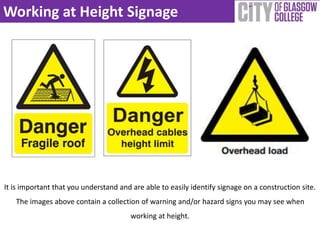
It is important that you understand and are able to easily identify signage on a construction site. 
The images above contain a collection of warning and/or hazard signs you may see when 
working at height.
Working at Heights Safety 
Image credit: http://www.steelconstruction.info 
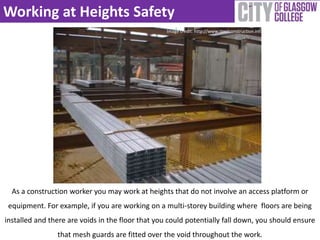
As a construction worker you may work at heights that do not involve an access platform or 
equipment. For example, if you are working on a multi-storey building where floors are being 
installed and there are voids in the floor that you could potentially fall down, you should ensure 
that mesh guards are fitted over the void throughout the work.

Working Safely at Height in the Workplace

  • 1.
    Section C WorkingSafely at Height in the Workplace Building Faculty2014 Image credit: http://www.northerntool.com
  • 2.
    You are consideredto be working at height if you are at any height that could cause an injury if you fall. Working at Height Image credit: http://www.rilmac.co.uk
  • 3.
    Working at HeightRegulations The Working at Height Regulations 2005 outline the legal responsibilities of employers and employees in relation to working at height within the UK. The purpose of these regulations is to prevent death and injuries caused by falls from height..
  • 4.
    Definition of AccessEquipment Access equipment can be defined as all scaffolds, ladders, mobile towers and vehicular and mechanical hoists that are designed to enable an operative to access a designated workspace. The WAHR state that the need to use access equipment should be avoided if possible but where it is required it must be fit-for-purpose. Image credit: http://www.brandontoolhire.co.uk
  • 5.
    Amendments Unless youare a trained, competent and qualified person you should never make any amendment to a scaffold. This includes even minor amendments like removing a guardrail temporarily. Image credit: http://www.thetowerbridge.info
  • 6.
    Guardrails and Handrails Image credit: http://www.generationhireandsale.co.uk There are no minimum or maximum requirements identified within the regulations with the exception of the height of guardrails and handrails. A handrail must not be lower that 950mm and there must be no more than 470mm between each guardrail and handrail. This is to reduce the likelihood of an operative or material falling from the scaffold.
  • 7.
    Tower Scaffolds Toerect a mobile access tower scaffold you must be a trained, qualified and competent person. The industry recognised standard for this activity is the PASMA (Prefabricated Access Suppliers and Manufacturers Association) card which can be achieved by attending a PASMA training course. Image credit: http://www.midlandladders.com
  • 8.
    Using a Ladder When climbing a ladder you must have three points of contact at any one time. This reduces the likelihood that you will fall from the ladder.
  • 9.
    Using a Ladder When using a ladder it should be placed on a firm and stable grounding at an angle of approximately 75° or at a ratio of 1 to 4. This means that if a ladder was four metres tall, it should be extended from the bottom of the structure by one metre.
  • 10.
    Scaffold Inspection Scaffoldinspection should only be carried out by a competent person. A competent person can be defined as someone who is trained, qualified and experienced in the inspection process. Image credit: http://loftsandladders.co.uk
  • 11.
    Pedestrian Safety Itis important to consider the safety of those who may be within the vicinity of the scaffold as well as those who are working on the scaffold. The best way to avoid an incident involving materials or objects falling from a scaffold is to introduce brickguards. The scaffold should also be kept clean and tidy at all times. Image credit: http://www.generationhireandsale.co.uk
  • 12.
    Working at HeightSignage It is important that you understand and are able to easily identify signage on a construction site. The images above contain a collection of warning and/or hazard signs you may see when working at height.
  • 13.
    Working at HeightsSafety Image credit: http://www.steelconstruction.info As a construction worker you may work at heights that do not involve an access platform or equipment. For example, if you are working on a multi-storey building where floors are being installed and there are voids in the floor that you could potentially fall down, you should ensure that mesh guards are fitted over the void throughout the work.