*
    By James O’Brien
*

* Define Work Flow Planning

* Discuss its sub-systems

* Benefits achieved

* Kepler Scientific Work Flow System

* Conclusions
* Workflow   Planning maps out the steps needed

 to successfully achieve a specific or continuous

 objective, derived from a firm’s strategy.

* Important to set deadlines


                               *
*

* Work Flow documentation always changes, and
 therefore, need to be adaptive

     Monitoring

     Measuring

* Technology helps to measure the process

* Important to assign a designated leader to manage
 the process & be accountable
*
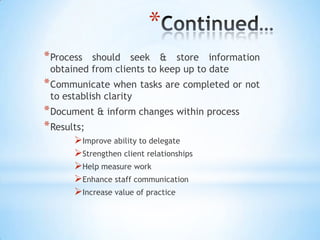
* Process should seek & store information
 obtained from clients to keep up to date
* Communicate when tasks are completed or not
 to establish clarity
* Document & inform changes within process
* Results;
       Improve ability to delegate
       Strengthen client relationships
       Help measure work
       Enhance staff communication
       Increase value of practice
*

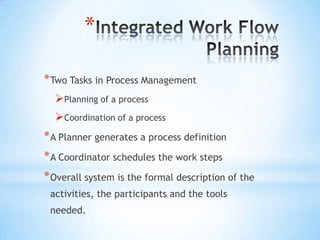
* Two Tasks in Process Management
  Planning of a process
  Coordination of a process
* A Planner generates a process definition
* A Coordinator schedules the work steps
* Overall system is the formal description of the
 activities, the participants and the tools
 needed.
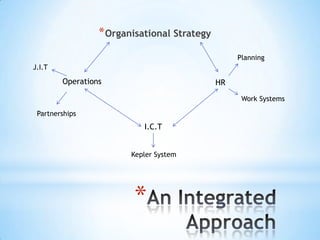
* Organisational Strategy
                                                  Planning
J.I.T

        Operations                           HR
                                                   Work Systems

 Partnerships
                           I.C.T


                        Kepler System


                        *
*

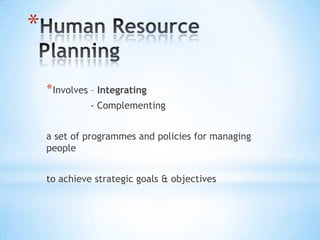
    * Involves – Integrating
              - Complementing


    a set of programmes and policies for managing
    people


    to achieve strategic goals & objectives
*
* Overall Planning should be coordinated with all key
    actors to ensure

               - Clarity within Organisation

               - Asset utilisation
*

    * Prevent Over & Under- Staffing
    * Ensure the org. has right people, with right
     skills in right places at the right time

    * Ensure Org. is responsive to change
    * Provide direction to all HR activities & systems
    * Unite the perspectives of line & staff managers
*
    * Overstaffing - increase costs + inefficiencies
    * Understaffing – reduce revenue
    * Right Employees – productivity gains
    * Responsiveness – Reduce risk exposure
                      - BUT, have to speculate

    * Direction – provides clarity of systems
    * Unite – integrates key components for success
*
    * Assigning & Designing specific tasks

    * Ensure

           - employees not overwhelmed

           - are motivated & productive

    * Need to assess skills, knowledge & ability
*
    * Job specialisation important

                                  – cost minimization

                                  - improved efficiencies

    * Job rotation – motivation

                  - flexibility
*

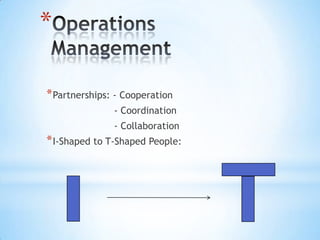
* Partnerships: - Cooperation
               - Coordination
               - Collaboration
* I-Shaped to T-Shaped People:
*
*
    * Japanese Approach Post-WWII

        Maximise use of people

        Simplify first, add technology second

        Minimise waste

    * Lean Production

        Doing more with less
*
    * Improved Service Quality

    * Lower Costs

    * Increased Productivity

    * Greater Flexibility
*

    * Software system for designing, executing, reusing,
     evolving, archiving and sharing workflows
    * Models the flow from one step to another in a series
     of computations that achieve a specific goal
    * Example
     – Invoice automation
      Invoice imaging or electronic invoicing or both
    * Benefits
       Reduces costs
*
    * An integrated approach essential to achieve
     success

    * Cost & Risk Minimization

    * Increased Productivity & Efficiencies

    * Improved workforce communication

    * Client Satisfaction
*Questions?

Work flow planning

  • 1.
    * By James O’Brien
  • 2.
    * * Define WorkFlow Planning * Discuss its sub-systems * Benefits achieved * Kepler Scientific Work Flow System * Conclusions
  • 3.
    * Workflow Planning maps out the steps needed to successfully achieve a specific or continuous objective, derived from a firm’s strategy. * Important to set deadlines *
  • 4.
    * * Work Flowdocumentation always changes, and therefore, need to be adaptive Monitoring Measuring * Technology helps to measure the process * Important to assign a designated leader to manage the process & be accountable
  • 5.
    * * Process shouldseek & store information obtained from clients to keep up to date * Communicate when tasks are completed or not to establish clarity * Document & inform changes within process * Results; Improve ability to delegate Strengthen client relationships Help measure work Enhance staff communication Increase value of practice
  • 6.
    * * Two Tasksin Process Management Planning of a process Coordination of a process * A Planner generates a process definition * A Coordinator schedules the work steps * Overall system is the formal description of the activities, the participants and the tools needed.
  • 7.
    * Organisational Strategy Planning J.I.T Operations HR Work Systems Partnerships I.C.T Kepler System *
  • 8.
    * * Involves – Integrating - Complementing a set of programmes and policies for managing people to achieve strategic goals & objectives
  • 9.
    * * Overall Planningshould be coordinated with all key actors to ensure - Clarity within Organisation - Asset utilisation
  • 10.
    * * Prevent Over & Under- Staffing * Ensure the org. has right people, with right skills in right places at the right time * Ensure Org. is responsive to change * Provide direction to all HR activities & systems * Unite the perspectives of line & staff managers
  • 11.
    * * Overstaffing - increase costs + inefficiencies * Understaffing – reduce revenue * Right Employees – productivity gains * Responsiveness – Reduce risk exposure - BUT, have to speculate * Direction – provides clarity of systems * Unite – integrates key components for success
  • 12.
    * * Assigning & Designing specific tasks * Ensure - employees not overwhelmed - are motivated & productive * Need to assess skills, knowledge & ability
  • 13.
    * * Job specialisation important – cost minimization - improved efficiencies * Job rotation – motivation - flexibility
  • 14.
    * * Partnerships: -Cooperation - Coordination - Collaboration * I-Shaped to T-Shaped People:
  • 15.
  • 16.
    * * Japanese Approach Post-WWII Maximise use of people Simplify first, add technology second Minimise waste * Lean Production Doing more with less
  • 17.
    * * Improved Service Quality * Lower Costs * Increased Productivity * Greater Flexibility
  • 18.
    * * Software system for designing, executing, reusing, evolving, archiving and sharing workflows * Models the flow from one step to another in a series of computations that achieve a specific goal * Example – Invoice automation Invoice imaging or electronic invoicing or both * Benefits Reduces costs
  • 19.
    * * An integrated approach essential to achieve success * Cost & Risk Minimization * Increased Productivity & Efficiencies * Improved workforce communication * Client Satisfaction
  • 20.