Women’s  Movement and Legislative Coordination -WomenPowerConnect   Dr. Vibhuti Patel Centre for Women’s Studies,  Department of Economics,  Member Secretary,  Women Development cell,  University of Mumbai,  Kalina, Santacruz (East), Mumbai-400098. E-mail -  [email_address]  Fax- 26528198. WDC Telefax-26527949  Phone- 26770227 ®
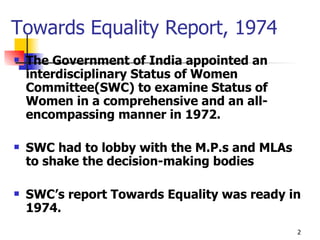
Towards Equality Report, 1974 The Government of India appointed an interdisciplinary Status of Women Committee(SWC) to examine Status of Women in a comprehensive and an all-encompassing manner in 1972.   SWC had to lobby with the M.P.s and MLAs to shake the decision-making bodies SWC’s report Towards Equality was ready in 1974.
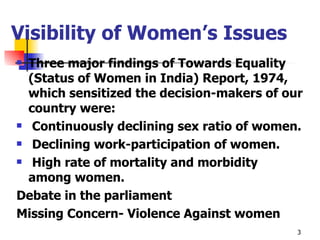
Visibility of Women’s Issues Three major findings of Towards Equality (Status of Women in India) Report, 1974, which sensitized the decision-makers of our country were: Continuously declining sex ratio of women. Declining work-participation of women. High rate of mortality and morbidity among women. Debate in the parliament Missing Concern- Violence Against women
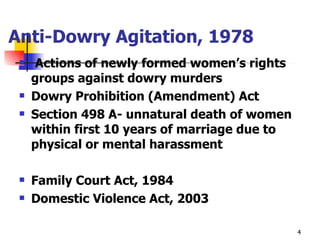
Anti-Dowry Agitation, 1978 Actions of newly formed women’s rights groups against dowry murders Dowry Prohibition (Amendment) Act Section 498 A- unnatural death of women within first 10 years of marriage due to physical or mental harassment Family Court Act, 1984 Domestic Violence Act, 2003
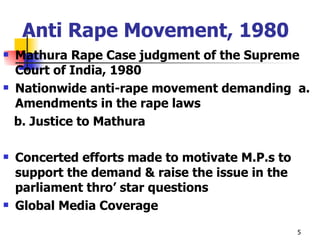
Anti Rape Movement, 1980 Mathura Rape Case judgment of the Supreme Court of India, 1980 Nationwide anti-rape movement demanding  a. Amendments in the rape laws b. Justice to Mathura Concerted efforts made to motivate M.P.s to support the demand & raise the issue in the parliament thro’ star questions Global Media Coverage
Gender Just Family Laws Mary Roy, Syrian Christian Personal law Shahbano- Maintenance for divored muslim women Response of the ruling party Muslim Women’s Protection of Rights on Divorce Act, 1986 angered the women’s movement Face-saving measures Anti-obscenity Act, 1986  Sati Prevention Act, 1987 NPPW, 1988
Maternity Benefits (MB)  Unmarried pregnant women’s right to maternity benefits- Case of a woman employee in LIC Debate in the parliament 1993- NEP-Women economists met the finance minister to ensure safety net in the context of SAP Umbrella legislation, State funded MB  ILO’s initiative-120 days of paid maternity leaves and other benefits
Shram Shakti Report, 1988 In 1988, women’s studies centres and women activists throughout the country made important contribution for preparation of two important documents- Shramshakti (Report of the Committee on Self-employment women and women in the Unorganised Sector) and
National Perspective Plan for Women, NPPW 1988-2000 Women’s movement felt being cheated and a document called  “ Response from the Women’s Movement” was prepared to focus on the limitations of the official  NPPW document and CWDS circulated it all over India.  India ratified CEDAW Collaborative work between NGOs and legislators at Beijing Conference
Round Tables on   Women in Decision Making During 1990s, CSR organised round tables for women in decision making in which legislators, political and social activists, academicians, administrators, researchers and policy makes were invited to discus pressing problems of women. Rapport building to deal with sex-selective abortions, reforms in the family laws, population policy, formation of NCW and 33% reservation of seats in the local self government bodies .
Women in Electoral Bodies Women’s strength in the Panchayati Raj institutions had increased and gender audit of budgets has become an important exercise for grass-roots groups.  All attempts are made to sabotage the bill asking for 33% reservation of seats for women in the legislative assembly and the parliament.
Government Initiatives Department of Women & Child Development National and State Commissions for Women. States came up with Policy for Women In 2001, the Government of India adopted a National policy for Empowerment of Women.  Contribution of women’s studies and women’s movement
Grey Areas of Legislative Coordination- Impact of Economic Globalisation Economic globalisation has enhanced miseries of women from the marginalized communities.  Trafficking of women and child-prostitution has increased at an alarming rate.  Portrayal of women in Media Production of alcohol  Malnutrition & starvation deaths
Women’s Issues in Mass Media Advertisements, television serials and the commercial film industries are projecting women as  spare-parts for sale  and also perpetuating extremely  regressive and obscurantist patriarchal values.   Cultural revivalism  perpetuating stereotypical sexist image of women as home-makers.  Virtuous versus Vamp Absence of legislative coordination
ICPD, RR of W & Population Policy Implications of population control policies have been devastating for poor women as they have been targeted for long acting, hormone based contraceptive injections and implants. Violation of International Convention of Population and Development, reproductive rights of women Class, caste and communal biases in the population policies need to be challenged. Common Minimum Programme and two child norm
State Commissions for Women Maharashtra, Kerala, Delhi and West Bengal have effective coordination between women’s movement and M.P.s & M.L.A.s Successful results : State policy for women Investigation of VAW
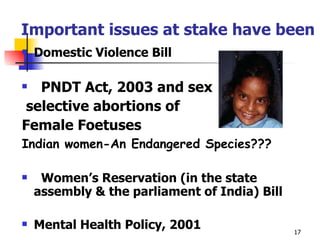
  Important issues at stake have been Domestic Violence Bill PNDT Act, 2003 and sex selective abortions of  Female Foetuses Indian women-An Endangered Species???      Women’s Reservation (in the state assembly & the parliament of India) Bill  Mental Health Policy, 2001
Sexual Harassment at workplace Supreme court directive on Vishaka Judgment Role of National Commission of Women Sexual Harassment at Workplace Bill Star questions in legislative assembly and the parliament Cases against politically powerful men- need for equally powerful opposition
Every issue is women’s Issue Women in Panchayati Raj Institutions Gender Audit of Budgets Environmental Safety Population Policy & Missing Girls Tourism & environmental damage Displacement due to mega projects Housing Rights
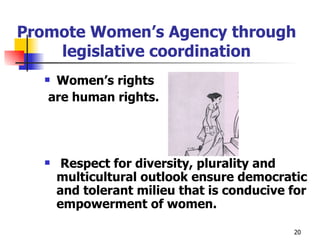
Promote Women’s Agency through legislative coordination Women’s rights are human rights. Respect for diversity, plurality and multicultural outlook ensure democratic and tolerant milieu that is conducive for empowerment of women.
Thank You

Women's Movement & Legislative Coordination 8 10-04

  • 1.
    Women’s Movementand Legislative Coordination -WomenPowerConnect Dr. Vibhuti Patel Centre for Women’s Studies, Department of Economics, Member Secretary, Women Development cell, University of Mumbai, Kalina, Santacruz (East), Mumbai-400098. E-mail - [email_address] Fax- 26528198. WDC Telefax-26527949 Phone- 26770227 ®
  • 2.
    Towards Equality Report,1974 The Government of India appointed an interdisciplinary Status of Women Committee(SWC) to examine Status of Women in a comprehensive and an all-encompassing manner in 1972. SWC had to lobby with the M.P.s and MLAs to shake the decision-making bodies SWC’s report Towards Equality was ready in 1974.
  • 3.
    Visibility of Women’sIssues Three major findings of Towards Equality (Status of Women in India) Report, 1974, which sensitized the decision-makers of our country were: Continuously declining sex ratio of women. Declining work-participation of women. High rate of mortality and morbidity among women. Debate in the parliament Missing Concern- Violence Against women
  • 4.
    Anti-Dowry Agitation, 1978Actions of newly formed women’s rights groups against dowry murders Dowry Prohibition (Amendment) Act Section 498 A- unnatural death of women within first 10 years of marriage due to physical or mental harassment Family Court Act, 1984 Domestic Violence Act, 2003
  • 5.
    Anti Rape Movement,1980 Mathura Rape Case judgment of the Supreme Court of India, 1980 Nationwide anti-rape movement demanding a. Amendments in the rape laws b. Justice to Mathura Concerted efforts made to motivate M.P.s to support the demand & raise the issue in the parliament thro’ star questions Global Media Coverage
  • 6.
    Gender Just FamilyLaws Mary Roy, Syrian Christian Personal law Shahbano- Maintenance for divored muslim women Response of the ruling party Muslim Women’s Protection of Rights on Divorce Act, 1986 angered the women’s movement Face-saving measures Anti-obscenity Act, 1986 Sati Prevention Act, 1987 NPPW, 1988
  • 7.
    Maternity Benefits (MB) Unmarried pregnant women’s right to maternity benefits- Case of a woman employee in LIC Debate in the parliament 1993- NEP-Women economists met the finance minister to ensure safety net in the context of SAP Umbrella legislation, State funded MB ILO’s initiative-120 days of paid maternity leaves and other benefits
  • 8.
    Shram Shakti Report,1988 In 1988, women’s studies centres and women activists throughout the country made important contribution for preparation of two important documents- Shramshakti (Report of the Committee on Self-employment women and women in the Unorganised Sector) and
  • 9.
    National Perspective Planfor Women, NPPW 1988-2000 Women’s movement felt being cheated and a document called “ Response from the Women’s Movement” was prepared to focus on the limitations of the official NPPW document and CWDS circulated it all over India. India ratified CEDAW Collaborative work between NGOs and legislators at Beijing Conference
  • 10.
    Round Tables on Women in Decision Making During 1990s, CSR organised round tables for women in decision making in which legislators, political and social activists, academicians, administrators, researchers and policy makes were invited to discus pressing problems of women. Rapport building to deal with sex-selective abortions, reforms in the family laws, population policy, formation of NCW and 33% reservation of seats in the local self government bodies .
  • 11.
    Women in ElectoralBodies Women’s strength in the Panchayati Raj institutions had increased and gender audit of budgets has become an important exercise for grass-roots groups. All attempts are made to sabotage the bill asking for 33% reservation of seats for women in the legislative assembly and the parliament.
  • 12.
    Government Initiatives Departmentof Women & Child Development National and State Commissions for Women. States came up with Policy for Women In 2001, the Government of India adopted a National policy for Empowerment of Women. Contribution of women’s studies and women’s movement
  • 13.
    Grey Areas ofLegislative Coordination- Impact of Economic Globalisation Economic globalisation has enhanced miseries of women from the marginalized communities. Trafficking of women and child-prostitution has increased at an alarming rate. Portrayal of women in Media Production of alcohol Malnutrition & starvation deaths
  • 14.
    Women’s Issues inMass Media Advertisements, television serials and the commercial film industries are projecting women as spare-parts for sale and also perpetuating extremely regressive and obscurantist patriarchal values. Cultural revivalism perpetuating stereotypical sexist image of women as home-makers. Virtuous versus Vamp Absence of legislative coordination
  • 15.
    ICPD, RR ofW & Population Policy Implications of population control policies have been devastating for poor women as they have been targeted for long acting, hormone based contraceptive injections and implants. Violation of International Convention of Population and Development, reproductive rights of women Class, caste and communal biases in the population policies need to be challenged. Common Minimum Programme and two child norm
  • 16.
    State Commissions forWomen Maharashtra, Kerala, Delhi and West Bengal have effective coordination between women’s movement and M.P.s & M.L.A.s Successful results : State policy for women Investigation of VAW
  • 17.
    Importantissues at stake have been Domestic Violence Bill PNDT Act, 2003 and sex selective abortions of Female Foetuses Indian women-An Endangered Species???     Women’s Reservation (in the state assembly & the parliament of India) Bill Mental Health Policy, 2001
  • 18.
    Sexual Harassment atworkplace Supreme court directive on Vishaka Judgment Role of National Commission of Women Sexual Harassment at Workplace Bill Star questions in legislative assembly and the parliament Cases against politically powerful men- need for equally powerful opposition
  • 19.
    Every issue iswomen’s Issue Women in Panchayati Raj Institutions Gender Audit of Budgets Environmental Safety Population Policy & Missing Girls Tourism & environmental damage Displacement due to mega projects Housing Rights
  • 20.
    Promote Women’s Agencythrough legislative coordination Women’s rights are human rights. Respect for diversity, plurality and multicultural outlook ensure democratic and tolerant milieu that is conducive for empowerment of women.
  • 21.