WOMEN & CHILD
DEVELOPMENT
Protect, Educate & Empower
Girls…….
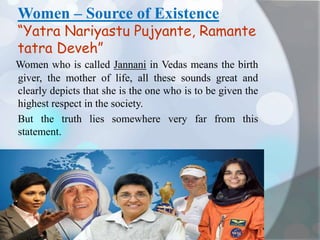
Women – Source of Existence
“Yatra Nariyastu Pujyante, Ramante
tatra Deveh”
Women who is called Jannani in Vedas means the birth
giver, the mother of life, all these sounds great and
clearly depicts that she is the one who is to be given the
highest respect in the society.
But the truth lies somewhere very far from this
statement.
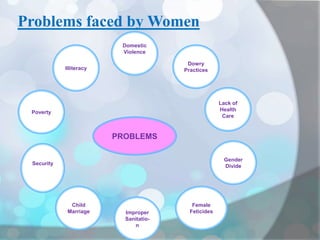
Problems faced by Women
PROBLEMS
Domestic
Violence
Female
Feticides
Poverty
Lack of
Health
Care
Illiteracy
Gender
Divide
Dowry
Practices
Improper
Sanitatio-
n
Child
Marriage
Security
Significant steps taken
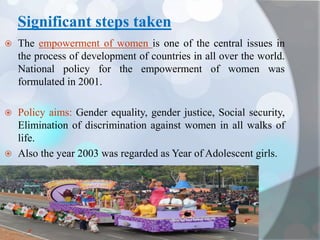
 The empowerment of women is one of the central issues in
the process of development of countries in all over the world.
National policy for the empowerment of women was
formulated in 2001.
 Policy aims: Gender equality, gender justice, Social security,
Elimination of discrimination against women in all walks of
life.
 Also the year 2003 was regarded as Year of Adolescent girls.
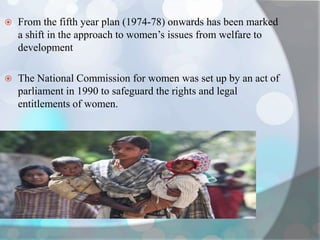
 From the fifth year plan (1974-78) onwards has been marked
a shift in the approach to women’s issues from welfare to
development
 The National Commission for women was set up by an act of
parliament in 1990 to safeguard the rights and legal
entitlements of women.
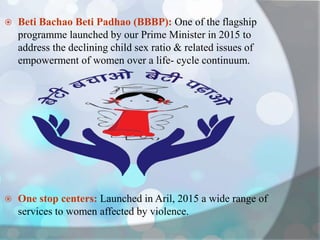
 Beti Bachao Beti Padhao (BBBP): One of the flagship
programme launched by our Prime Minister in 2015 to
address the declining child sex ratio & related issues of
empowerment of women over a life- cycle continuum.
 One stop centers: Launched in Aril, 2015 a wide range of
services to women affected by violence.
 Universalization of women helpline: It’s intended to
provide 24 hours emergency and non emergency response to
women affected by violence and also to provide information
about women related welfare schemes across the country
through a single uniform number (181).
 Panic button on mobile phones: to provide emergency
response to women in distress MWCD has taken up the
installation of panic button (5 or 9)on mobile handsets under
rule2016. it will be helpful in identifying the location.
 Mahila Police Volunteers: A scheme that aims to establish
zero tolerance with regard to safety & security of women
launched in 2016. And it already started 33% reservation of
women in police force in 8 states & 5 Uts.
 Guidelines for matrimonial websites: With consultation of
MeITY, MHA & Service providers an advisory on functioning
of matrimonial website was formulated to cut down the no. of
crimes. MWCD has prepared SOPs for women involved in
NRI MM disputes which narrates the stepwise legal recourse
to be undertaken by women and also court and police officials
across the country.
 Sexual Harassment of women at workplace: Mandatory
internal complain committees (ICCs) in workplace with 10+
employees. 29 institutions empanelled to impart training on
Sexual harassment at workplace act, 2013.
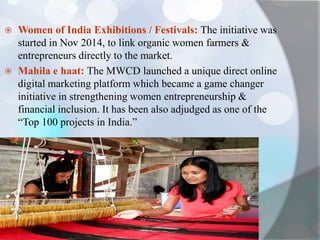
 Women of India Exhibitions / Festivals: The initiative was
started in Nov 2014, to link organic women farmers &
entrepreneurs directly to the market.
 Mahila e haat: The MWCD launched a unique direct online
digital marketing platform which became a game changer
initiative in strengthening women entrepreneurship &
financial inclusion. It has been also adjudged as one of the
“Top 100 projects in India.”
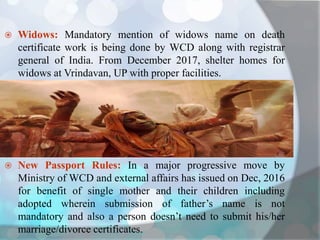
 Widows: Mandatory mention of widows name on death
certificate work is being done by WCD along with registrar
general of India. From December 2017, shelter homes for
widows at Vrindavan, UP with proper facilities.
 New Passport Rules: In a major progressive move by
Ministry of WCD and external affairs has issued on Dec, 2016
for benefit of single mother and their children including
adopted wherein submission of father’s name is not
mandatory and also a person doesn’t need to submit his/her
marriage/divorce certificates.
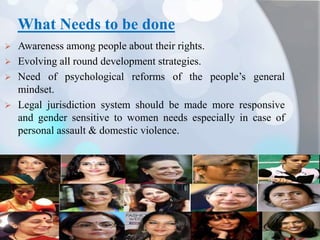
What Needs to be done
 Awareness among people about their rights.
 Evolving all round development strategies.
 Need of psychological reforms of the people’s general
mindset.
 Legal jurisdiction system should be made more responsive
and gender sensitive to women needs especially in case of
personal assault & domestic violence.
Children
World’s most valuable
resource…..
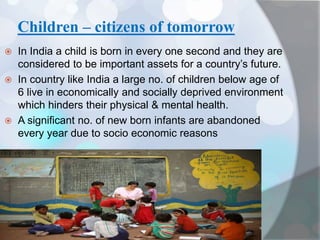
Children – citizens of tomorrow
 In India a child is born in every one second and they are
considered to be important assets for a country’s future.
 In country like India a large no. of children below age of
6 live in economically and socially deprived environment
which hinders their physical & mental health.
 A significant no. of new born infants are abandoned
every year due to socio economic reasons
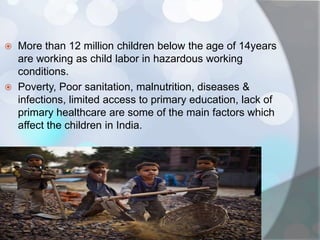
 More than 12 million children below the age of 14years
are working as child labor in hazardous working
conditions.
 Poverty, Poor sanitation, malnutrition, diseases &
infections, limited access to primary education, lack of
primary healthcare are some of the main factors which
affect the children in India.
Significant Steps Undertaken
 Steps taken on missing/ trafficked/ runaway children:
Khoya- Paya Portal is a citizen based website to exchange
information on missing children. Between June 2015 – 17,
7671 missing/ sighted children cases were closed on the
portal.
Child line 1098 is a national 24 hour free emergency
telephone helpline and outreach service for children in need of
care & protection.
MoU signed between Ministry of WCD and railways for
rescue, rehabilitation, restoration of missing children from
railway stations.
 POCSO e-box: Since its launch in August 2016, 300
complaints received & handled to tackle child sexual abuse.
As soon as the complaint is filed a trained counselor
immediately contacts the child and provide assistance.
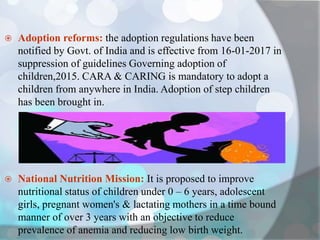
 Adoption reforms: the adoption regulations have been
notified by Govt. of India and is effective from 16-01-2017 in
suppression of guidelines Governing adoption of
children,2015. CARA & CARING is mandatory to adopt a
children from anywhere in India. Adoption of step children
has been brought in.
 National Nutrition Mission: It is proposed to improve
nutritional status of children under 0 – 6 years, adolescent
girls, pregnant women's & lactating mothers in a time bound
manner of over 3 years with an objective to reduce
prevalence of anemia and reducing low birth weight.
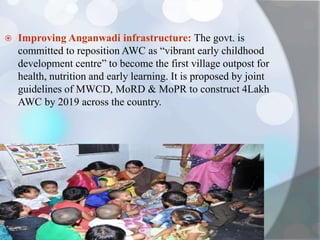
 Improving Anganwadi infrastructure: The govt. is
committed to reposition AWC as “vibrant early childhood
development centre” to become the first village outpost for
health, nutrition and early learning. It is proposed by joint
guidelines of MWCD, MoRD & MoPR to construct 4Lakh
AWC by 2019 across the country.
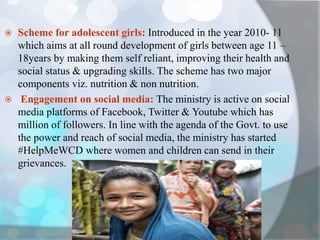
 Scheme for adolescent girls: Introduced in the year 2010- 11
which aims at all round development of girls between age 11 –
18years by making them self reliant, improving their health and
social status & upgrading skills. The scheme has two major
components viz. nutrition & non nutrition.
 Engagement on social media: The ministry is active on social
media platforms of Facebook, Twitter & Youtube which has
million of followers. In line with the agenda of the Govt. to use
the power and reach of social media, the ministry has started
#HelpMeWCD where women and children can send in their
grievances.
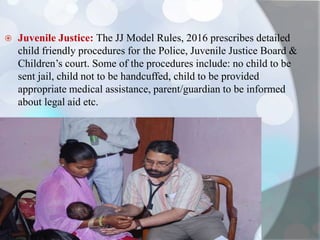
 Juvenile Justice: The JJ Model Rules, 2016 prescribes detailed
child friendly procedures for the Police, Juvenile Justice Board &
Children’s court. Some of the procedures include: no child to be
sent jail, child not to be handcuffed, child to be provided
appropriate medical assistance, parent/guardian to be informed
about legal aid etc.
Last Note
 It would be wrong to say that there are no steps being taken,
but the effect due with them is gradual.
 In our country women constitute 48.5% of population.
 As per NFHS- 3 at all India level 52.5% of currently married
women participate in household decisions.
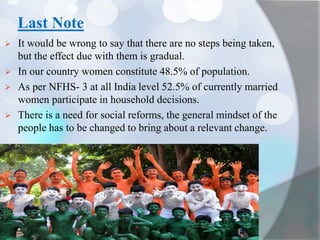
 There is a need for social reforms, the general mindset of the
people has to be changed to bring about a relevant change.
Women and child development ppt

Women and child development ppt

  • 1.
    WOMEN & CHILD DEVELOPMENT Protect,Educate & Empower Girls…….
  • 2.
    Women – Sourceof Existence “Yatra Nariyastu Pujyante, Ramante tatra Deveh” Women who is called Jannani in Vedas means the birth giver, the mother of life, all these sounds great and clearly depicts that she is the one who is to be given the highest respect in the society. But the truth lies somewhere very far from this statement.
  • 3.
    Problems faced byWomen PROBLEMS Domestic Violence Female Feticides Poverty Lack of Health Care Illiteracy Gender Divide Dowry Practices Improper Sanitatio- n Child Marriage Security
  • 4.
    Significant steps taken The empowerment of women is one of the central issues in the process of development of countries in all over the world. National policy for the empowerment of women was formulated in 2001.  Policy aims: Gender equality, gender justice, Social security, Elimination of discrimination against women in all walks of life.  Also the year 2003 was regarded as Year of Adolescent girls.
  • 5.
     From thefifth year plan (1974-78) onwards has been marked a shift in the approach to women’s issues from welfare to development  The National Commission for women was set up by an act of parliament in 1990 to safeguard the rights and legal entitlements of women.
  • 6.
     Beti BachaoBeti Padhao (BBBP): One of the flagship programme launched by our Prime Minister in 2015 to address the declining child sex ratio & related issues of empowerment of women over a life- cycle continuum.  One stop centers: Launched in Aril, 2015 a wide range of services to women affected by violence.
  • 7.
     Universalization ofwomen helpline: It’s intended to provide 24 hours emergency and non emergency response to women affected by violence and also to provide information about women related welfare schemes across the country through a single uniform number (181).  Panic button on mobile phones: to provide emergency response to women in distress MWCD has taken up the installation of panic button (5 or 9)on mobile handsets under rule2016. it will be helpful in identifying the location.  Mahila Police Volunteers: A scheme that aims to establish zero tolerance with regard to safety & security of women launched in 2016. And it already started 33% reservation of women in police force in 8 states & 5 Uts.
  • 8.
     Guidelines formatrimonial websites: With consultation of MeITY, MHA & Service providers an advisory on functioning of matrimonial website was formulated to cut down the no. of crimes. MWCD has prepared SOPs for women involved in NRI MM disputes which narrates the stepwise legal recourse to be undertaken by women and also court and police officials across the country.  Sexual Harassment of women at workplace: Mandatory internal complain committees (ICCs) in workplace with 10+ employees. 29 institutions empanelled to impart training on Sexual harassment at workplace act, 2013.
  • 9.
     Women ofIndia Exhibitions / Festivals: The initiative was started in Nov 2014, to link organic women farmers & entrepreneurs directly to the market.  Mahila e haat: The MWCD launched a unique direct online digital marketing platform which became a game changer initiative in strengthening women entrepreneurship & financial inclusion. It has been also adjudged as one of the “Top 100 projects in India.”
  • 10.
     Widows: Mandatorymention of widows name on death certificate work is being done by WCD along with registrar general of India. From December 2017, shelter homes for widows at Vrindavan, UP with proper facilities.  New Passport Rules: In a major progressive move by Ministry of WCD and external affairs has issued on Dec, 2016 for benefit of single mother and their children including adopted wherein submission of father’s name is not mandatory and also a person doesn’t need to submit his/her marriage/divorce certificates.
  • 11.
    What Needs tobe done  Awareness among people about their rights.  Evolving all round development strategies.  Need of psychological reforms of the people’s general mindset.  Legal jurisdiction system should be made more responsive and gender sensitive to women needs especially in case of personal assault & domestic violence.
  • 12.
  • 13.
    Children – citizensof tomorrow  In India a child is born in every one second and they are considered to be important assets for a country’s future.  In country like India a large no. of children below age of 6 live in economically and socially deprived environment which hinders their physical & mental health.  A significant no. of new born infants are abandoned every year due to socio economic reasons
  • 14.
     More than12 million children below the age of 14years are working as child labor in hazardous working conditions.  Poverty, Poor sanitation, malnutrition, diseases & infections, limited access to primary education, lack of primary healthcare are some of the main factors which affect the children in India.
  • 15.
    Significant Steps Undertaken Steps taken on missing/ trafficked/ runaway children: Khoya- Paya Portal is a citizen based website to exchange information on missing children. Between June 2015 – 17, 7671 missing/ sighted children cases were closed on the portal. Child line 1098 is a national 24 hour free emergency telephone helpline and outreach service for children in need of care & protection. MoU signed between Ministry of WCD and railways for rescue, rehabilitation, restoration of missing children from railway stations.  POCSO e-box: Since its launch in August 2016, 300 complaints received & handled to tackle child sexual abuse. As soon as the complaint is filed a trained counselor immediately contacts the child and provide assistance.
  • 16.
     Adoption reforms:the adoption regulations have been notified by Govt. of India and is effective from 16-01-2017 in suppression of guidelines Governing adoption of children,2015. CARA & CARING is mandatory to adopt a children from anywhere in India. Adoption of step children has been brought in.  National Nutrition Mission: It is proposed to improve nutritional status of children under 0 – 6 years, adolescent girls, pregnant women's & lactating mothers in a time bound manner of over 3 years with an objective to reduce prevalence of anemia and reducing low birth weight.
  • 17.
     Improving Anganwadiinfrastructure: The govt. is committed to reposition AWC as “vibrant early childhood development centre” to become the first village outpost for health, nutrition and early learning. It is proposed by joint guidelines of MWCD, MoRD & MoPR to construct 4Lakh AWC by 2019 across the country.
  • 18.
     Scheme foradolescent girls: Introduced in the year 2010- 11 which aims at all round development of girls between age 11 – 18years by making them self reliant, improving their health and social status & upgrading skills. The scheme has two major components viz. nutrition & non nutrition.  Engagement on social media: The ministry is active on social media platforms of Facebook, Twitter & Youtube which has million of followers. In line with the agenda of the Govt. to use the power and reach of social media, the ministry has started #HelpMeWCD where women and children can send in their grievances.
  • 19.
     Juvenile Justice:The JJ Model Rules, 2016 prescribes detailed child friendly procedures for the Police, Juvenile Justice Board & Children’s court. Some of the procedures include: no child to be sent jail, child not to be handcuffed, child to be provided appropriate medical assistance, parent/guardian to be informed about legal aid etc.
  • 20.
    Last Note  Itwould be wrong to say that there are no steps being taken, but the effect due with them is gradual.  In our country women constitute 48.5% of population.  As per NFHS- 3 at all India level 52.5% of currently married women participate in household decisions.  There is a need for social reforms, the general mindset of the people has to be changed to bring about a relevant change.