Welcome to the Presentation on Women
Empowerment based on SDG in Bangladesh
Nasima Begum ndc
Secretary
Ministry of Women & Children Affairs 1
Sheikh Hasina’s Commitment
Parity to Men & Women
Vision & Mission of MoWCA
Vision: Society with gender equality and child protection.
Mission: Establishing the rights of women and children and
women empowerment through mainstreaming in
development
2
Planning and Implementation of SDGs
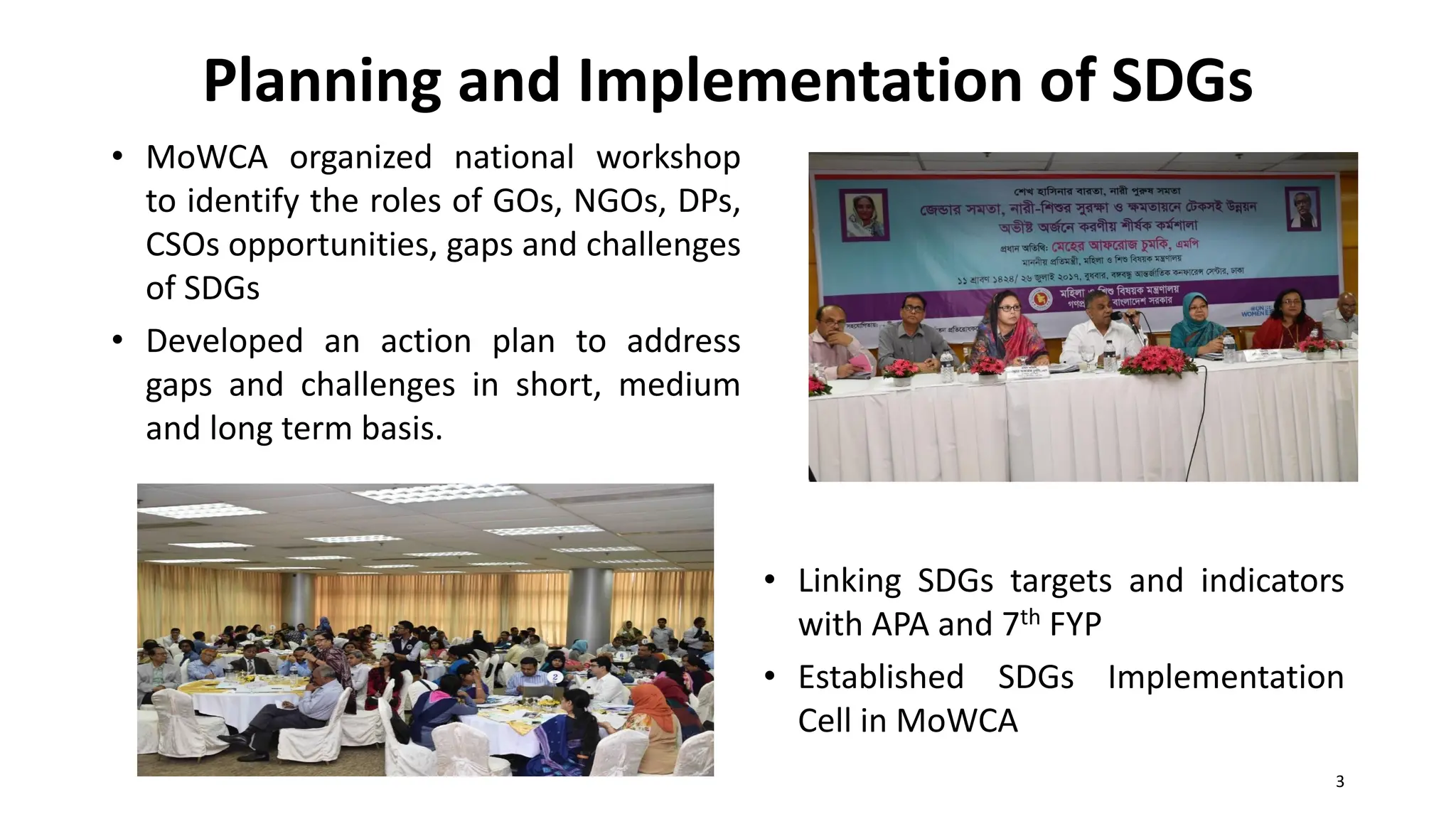
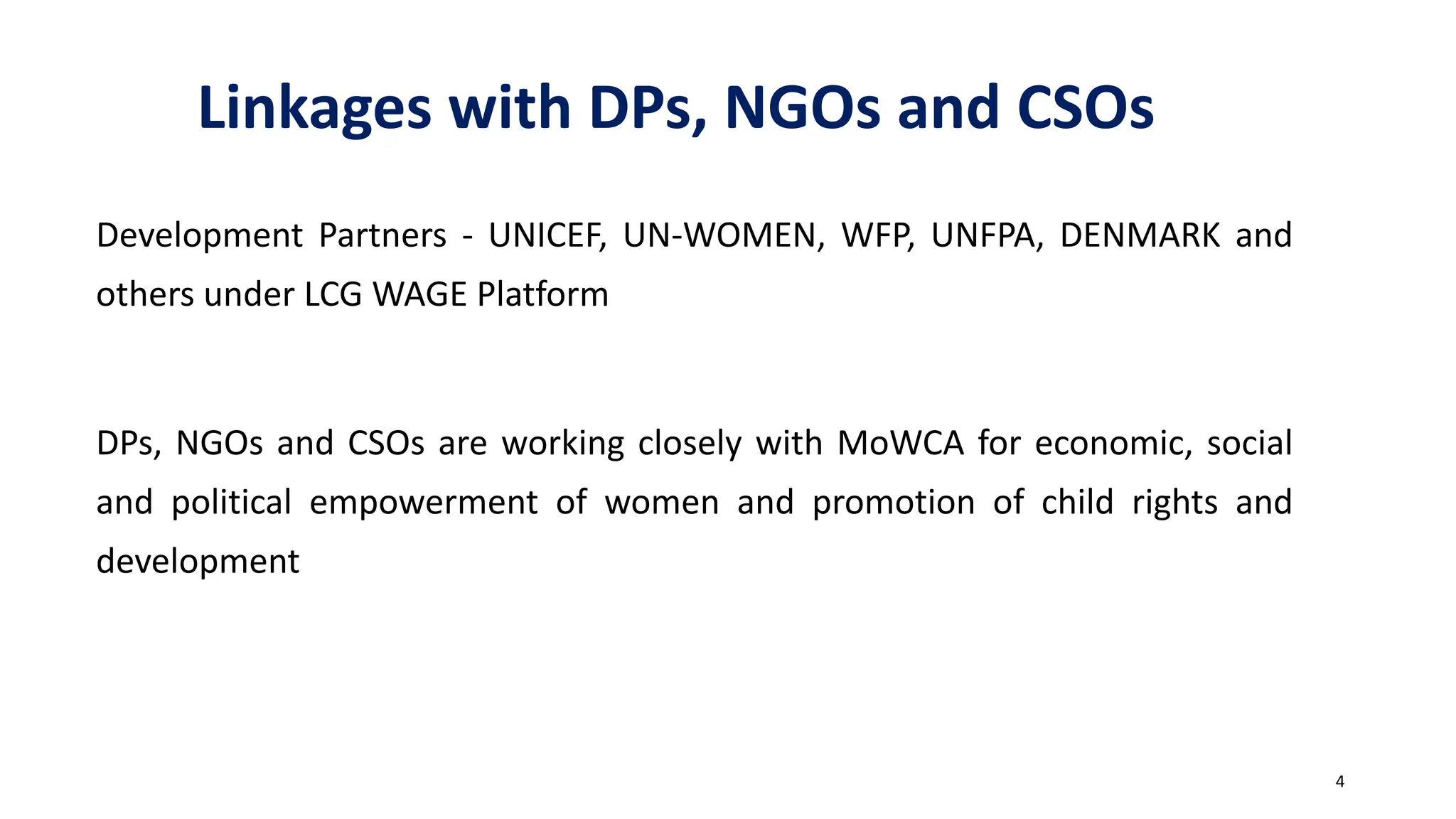
• MoWCA organized national workshop
to identify the roles of GOs, NGOs, DPs,
CSOs opportunities, gaps and challenges
of SDGs
• Developed an action plan to address
gaps and challenges in short, medium
and long term basis.
• Linking SDGs targets and indicators
with APA and 7th FYP
• Established SDGs Implementation
Cell in MoWCA
3
Linkages with DPs, NGOs and CSOs
Development Partners - UNICEF, UN-WOMEN, WFP, UNFPA, DENMARK and
others under LCG WAGE Platform
DPs, NGOs and CSOs are working closely with MoWCA for economic, social
and political empowerment of women and promotion of child rights and
development
4
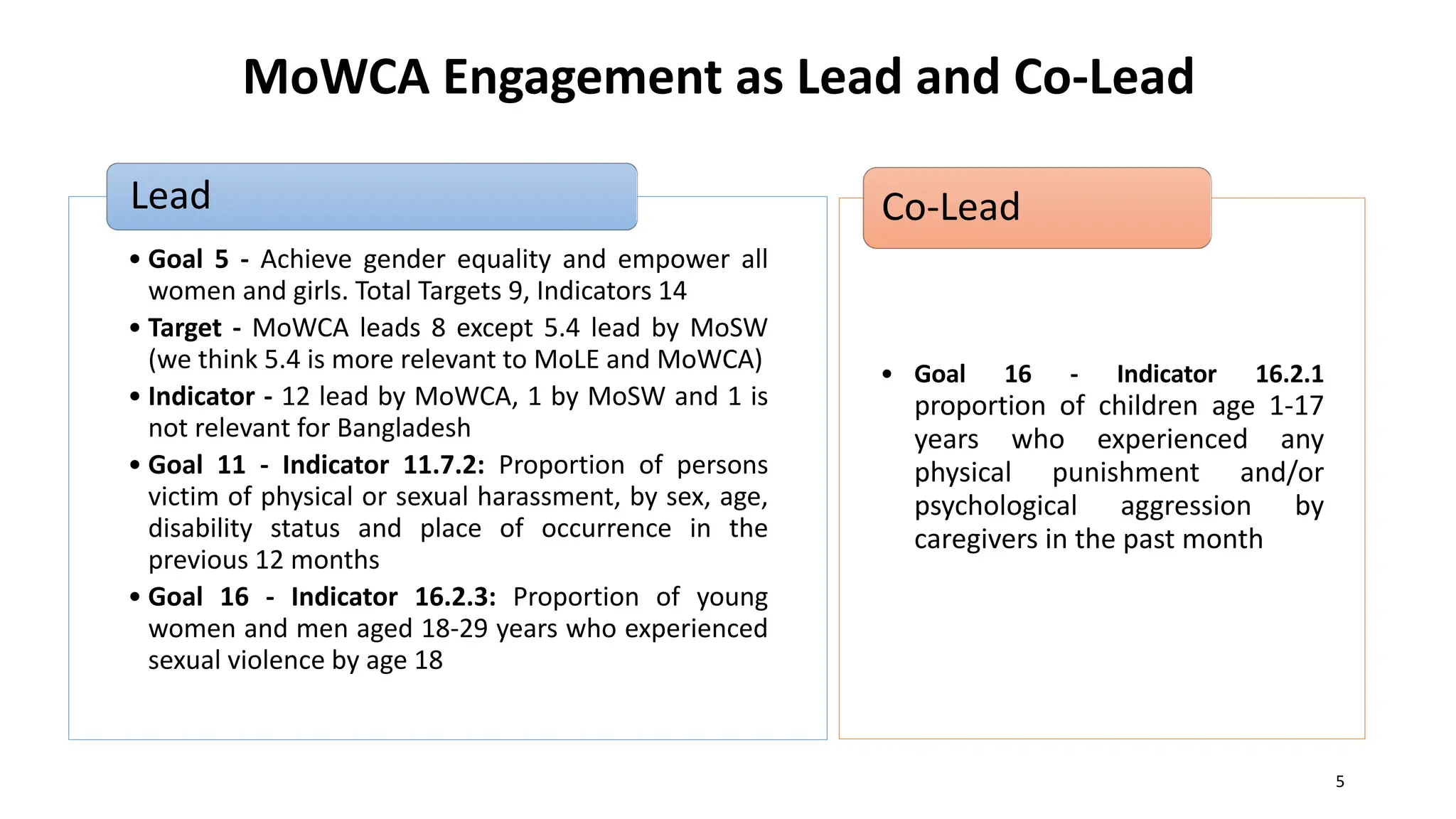
MoWCA Engagement as Lead and Co-Lead
• Goal 5 - Achieve gender equality and empower all
women and girls. Total Targets 9, Indicators 14
• Target - MoWCA leads 8 except 5.4 lead by MoSW
(we think 5.4 is more relevant to MoLE and MoWCA)
• Indicator - 12 lead by MoWCA, 1 by MoSW and 1 is
not relevant for Bangladesh
• Goal 11 - Indicator 11.7.2: Proportion of persons
victim of physical or sexual harassment, by sex, age,
disability status and place of occurrence in the
previous 12 months
• Goal 16 - Indicator 16.2.3: Proportion of young
women and men aged 18-29 years who experienced
sexual violence by age 18
Lead
• Goal 16 - Indicator 16.2.1
proportion of children age 1-17
years who experienced any
physical punishment and/or
psychological aggression by
caregivers in the past month
Co-Lead
5
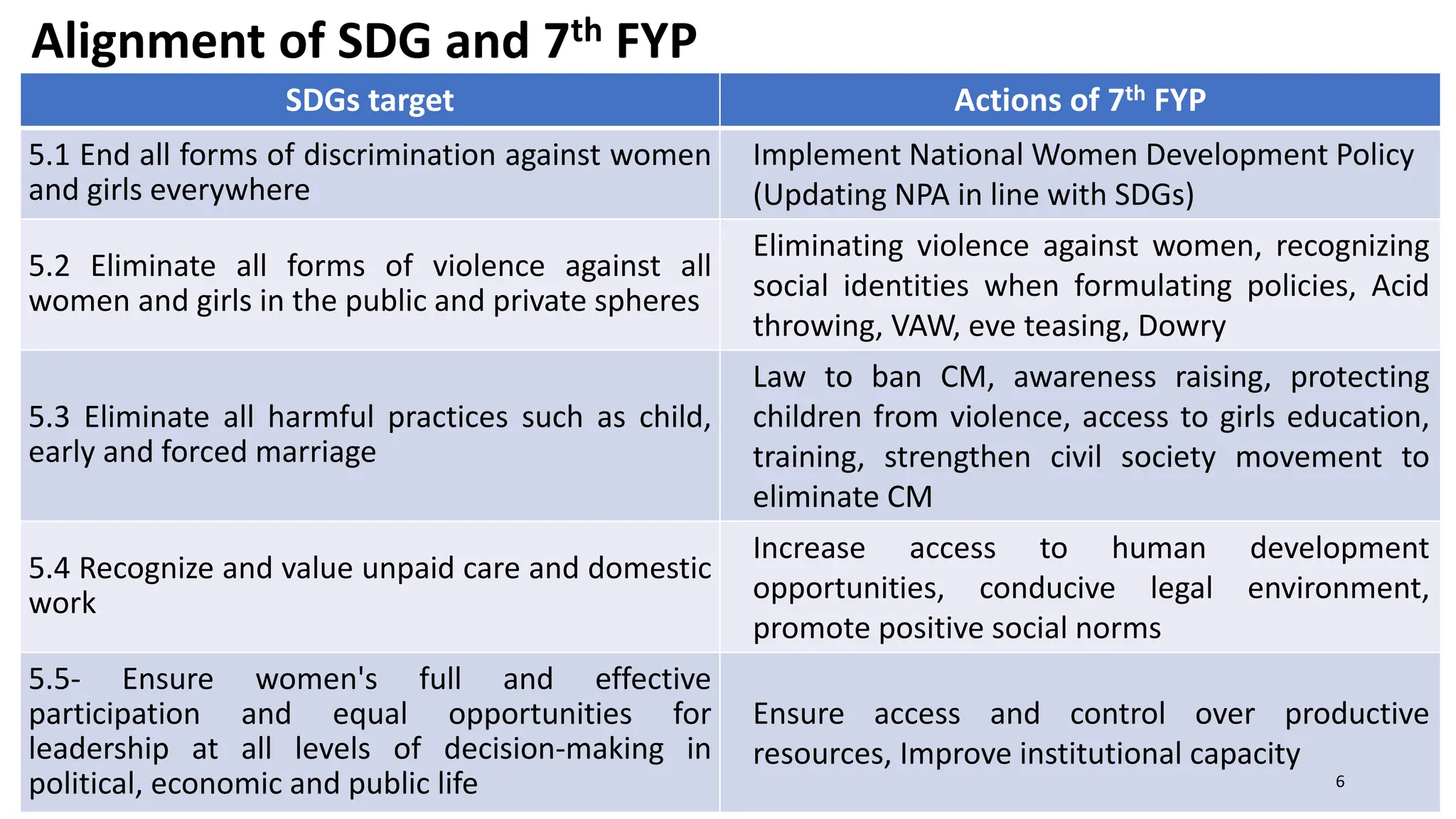
Alignment of SDG and 7th FYP
SDGs target Actions of 7th FYP
5.1 End all forms of discrimination against women
and girls everywhere
Implement National Women Development Policy
(Updating NPA in line with SDGs)
5.2 Eliminate all forms of violence against all
women and girls in the public and private spheres
Eliminating violence against women, recognizing
social identities when formulating policies, Acid
throwing, VAW, eve teasing, Dowry
5.3 Eliminate all harmful practices such as child,
early and forced marriage
Law to ban CM, awareness raising, protecting
children from violence, access to girls education,
training, strengthen civil society movement to
eliminate CM
5.4 Recognize and value unpaid care and domestic
work
Increase access to human development
opportunities, conducive legal environment,
promote positive social norms
5.5- Ensure women's full and effective
participation and equal opportunities for
leadership at all levels of decision-making in
political, economic and public life
Ensure access and control over productive
resources, Improve institutional capacity
6
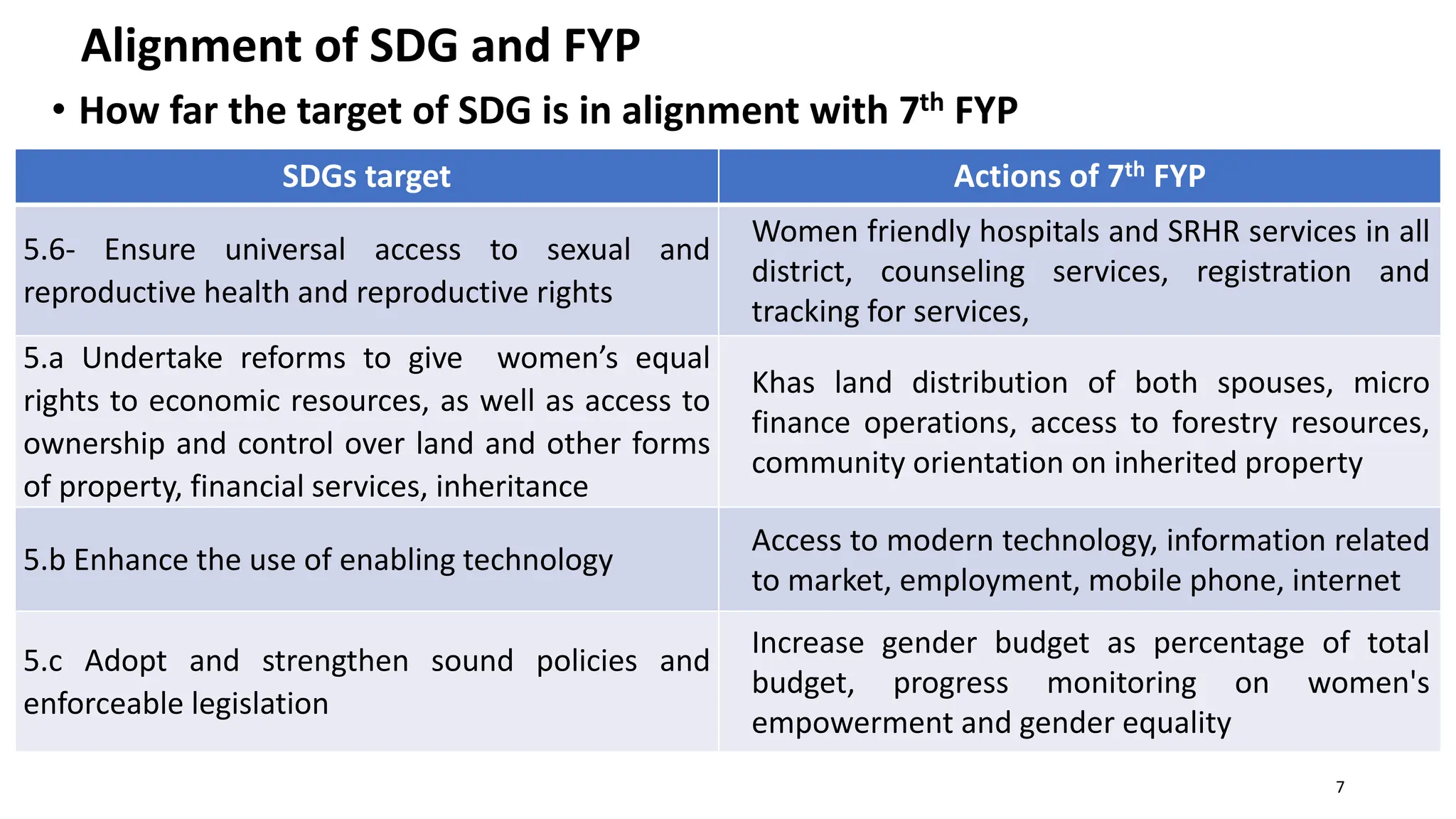
Alignment of SDG and FYP
• How far the target of SDG is in alignment with 7th FYP
SDGs target Actions of 7th FYP
5.6- Ensure universal access to sexual and
reproductive health and reproductive rights
Women friendly hospitals and SRHR services in all
district, counseling services, registration and
tracking for services,
5.a Undertake reforms to give women’s equal
rights to economic resources, as well as access to
ownership and control over land and other forms
of property, financial services, inheritance
Khas land distribution of both spouses, micro
finance operations, access to forestry resources,
community orientation on inherited property
5.b Enhance the use of enabling technology
Access to modern technology, information related
to market, employment, mobile phone, internet
5.c Adopt and strengthen sound policies and
enforceable legislation
Increase gender budget as percentage of total
budget, progress monitoring on women's
empowerment and gender equality
7
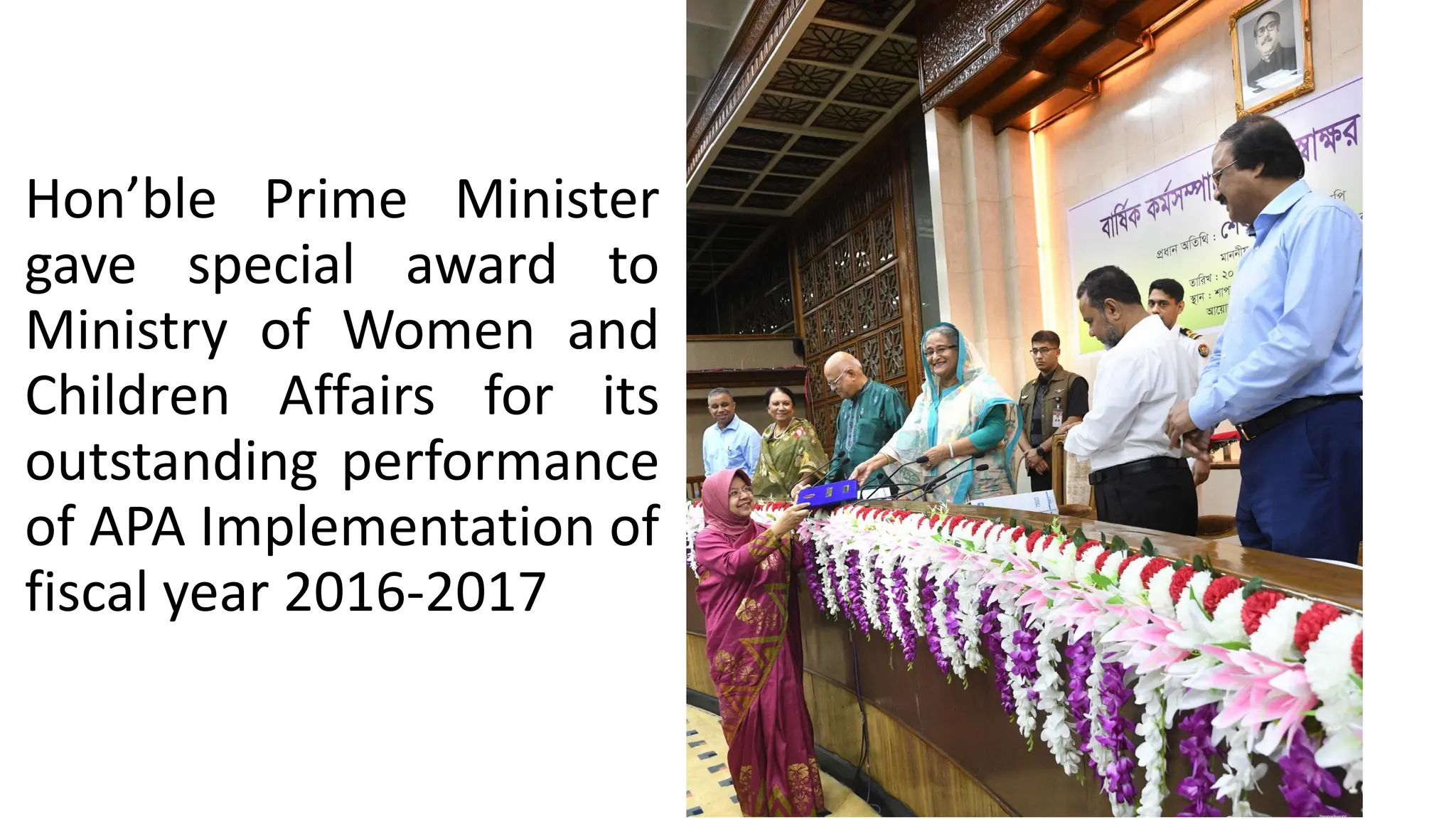
Hon’ble Prime Minister
gave special award to
Ministry of Women and
Children Affairs for its
outstanding performance
of APA Implementation of
fiscal year 2016-2017
8
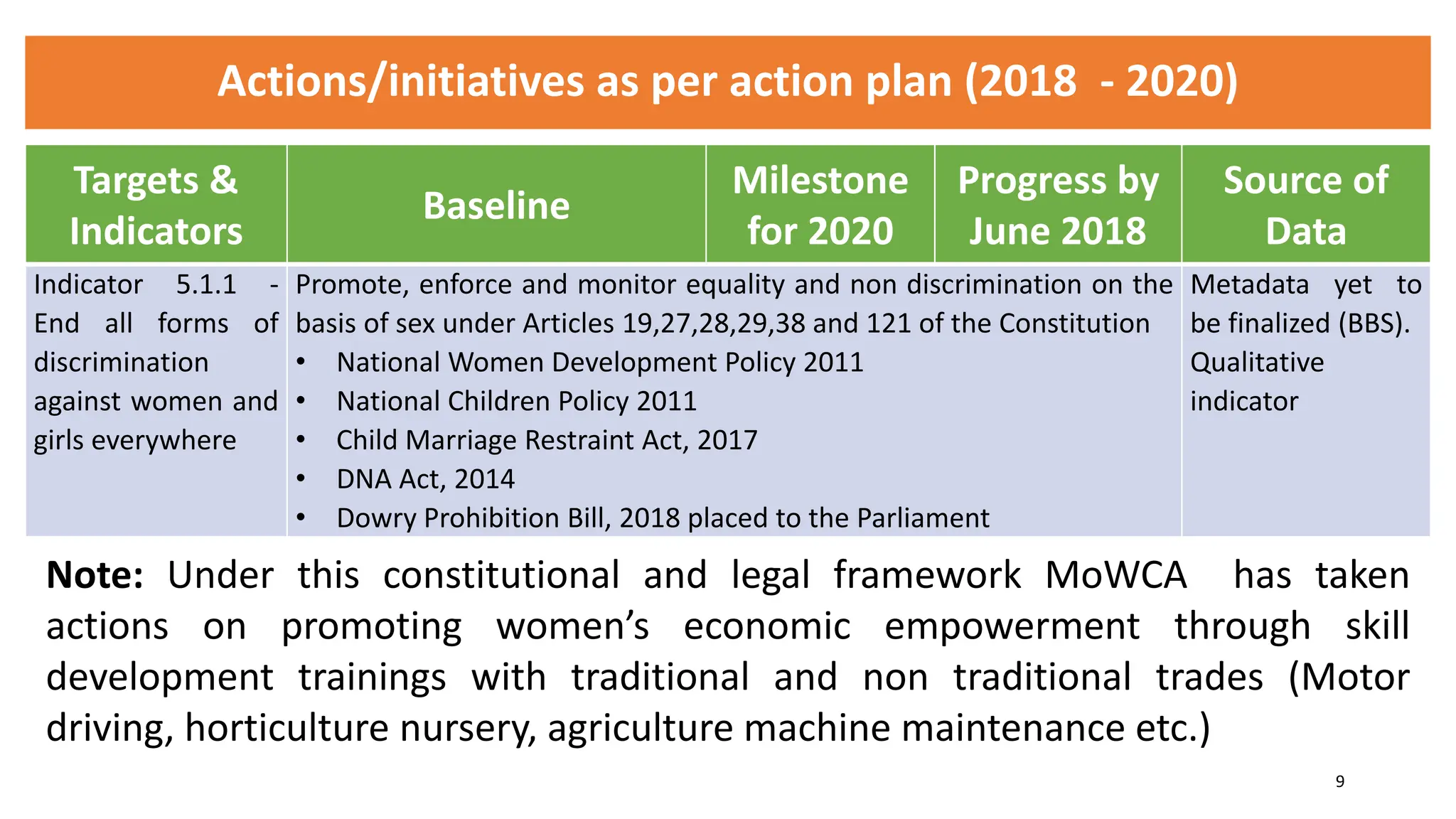
Actions/initiatives as per action plan (2018 - 2020)
Targets &
Indicators
Baseline
Milestone
for 2020
Progress by
June 2018
Source of
Data
Indicator 5.1.1 -
End all forms of
discrimination
against women and
girls everywhere
Promote, enforce and monitor equality and non discrimination on the
basis of sex under Articles 19,27,28,29,38 and 121 of the Constitution
• National Women Development Policy 2011
• National Children Policy 2011
• Child Marriage Restraint Act, 2017
• DNA Act, 2014
• Dowry Prohibition Bill, 2018 placed to the Parliament
Metadata yet to
be finalized (BBS).
Qualitative
indicator
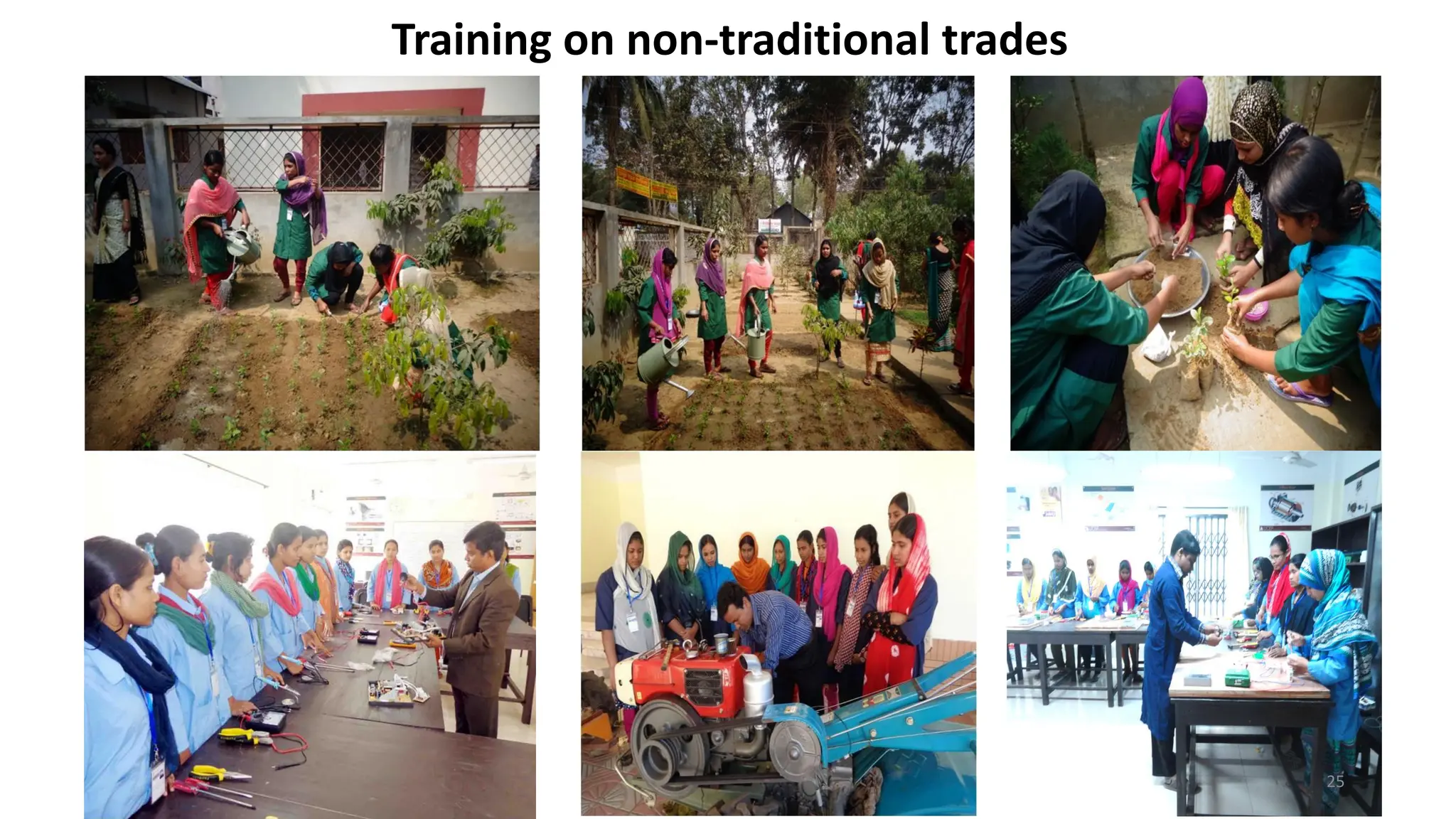
Note: Under this constitutional and legal framework MoWCA has taken
actions on promoting women’s economic empowerment through skill
development trainings with traditional and non traditional trades (Motor
driving, horticulture nursery, agriculture machine maintenance etc.)
9
Indicators (Quantitative ) Baseline
Milestone for
2020
Progress by June
2018
Source of
Data
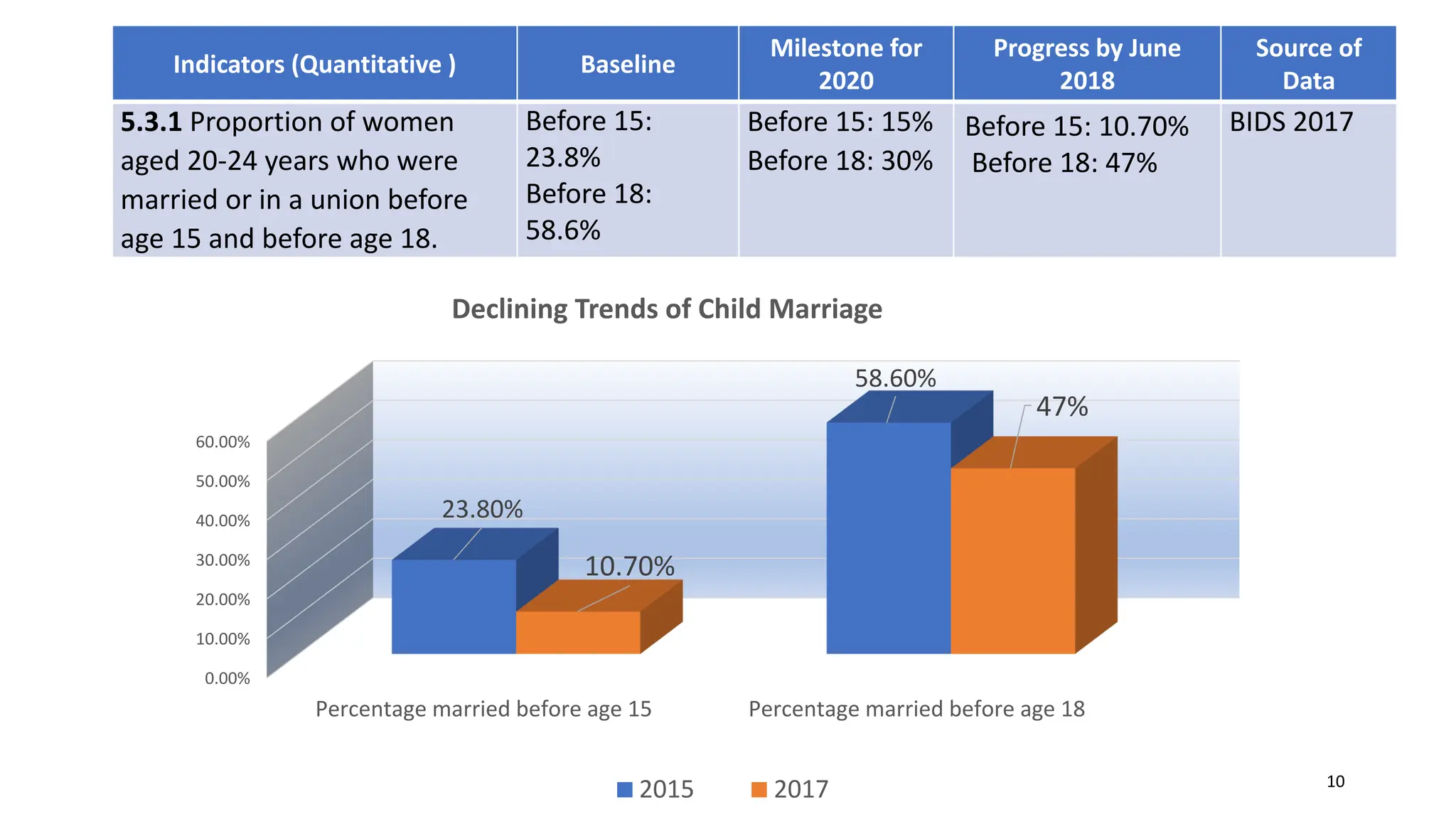
5.3.1 Proportion of women
aged 20-24 years who were
married or in a union before
age 15 and before age 18.
Before 15:
23.8%
Before 18:
58.6%
Before 15: 15%
Before 18: 30%
Before 15: 10.70%
Before 18: 47%
BIDS 2017
0.00%
10.00%
20.00%
30.00%
40.00%
50.00%
60.00%
Percentage married before age 15 Percentage married before age 18
23.80%
58.60%
10.70%
47%
Declining Trends of Child Marriage
2015 2017 10
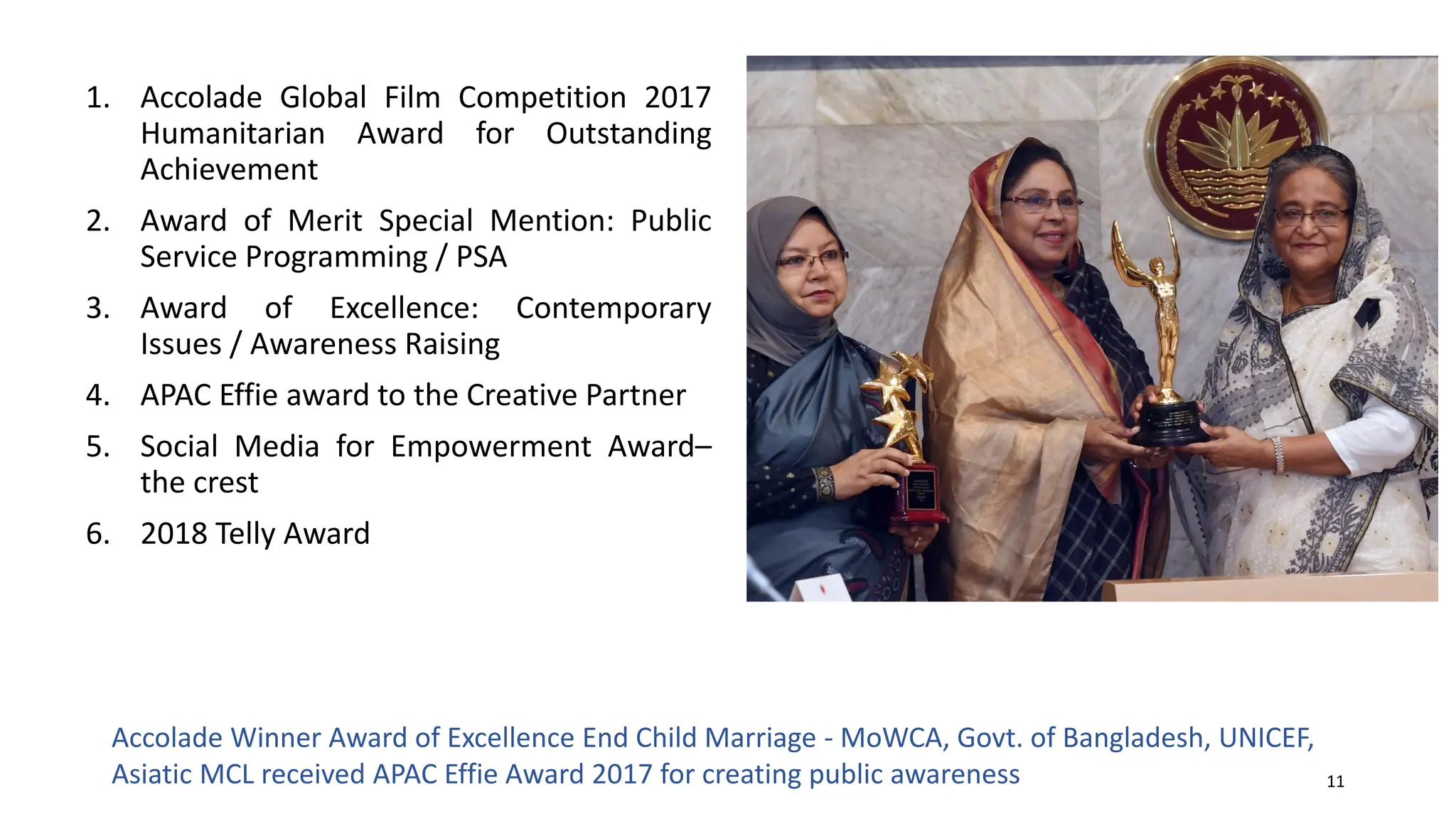
1. Accolade Global Film Competition 2017
Humanitarian Award for Outstanding
Achievement
2. Award of Merit Special Mention: Public
Service Programming / PSA
3. Award of Excellence: Contemporary
Issues / Awareness Raising
4. APAC Effie award to the Creative Partner
5. Social Media for Empowerment Award–
the crest
6. 2018 Telly Award
Accolade Winner Award of Excellence End Child Marriage - MoWCA, Govt. of Bangladesh, UNICEF,
Asiatic MCL received APAC Effie Award 2017 for creating public awareness 11
Targets & Indicators (Quantitative) Baseline
Milestone for
2020
Progress by June
2018
Source of Data
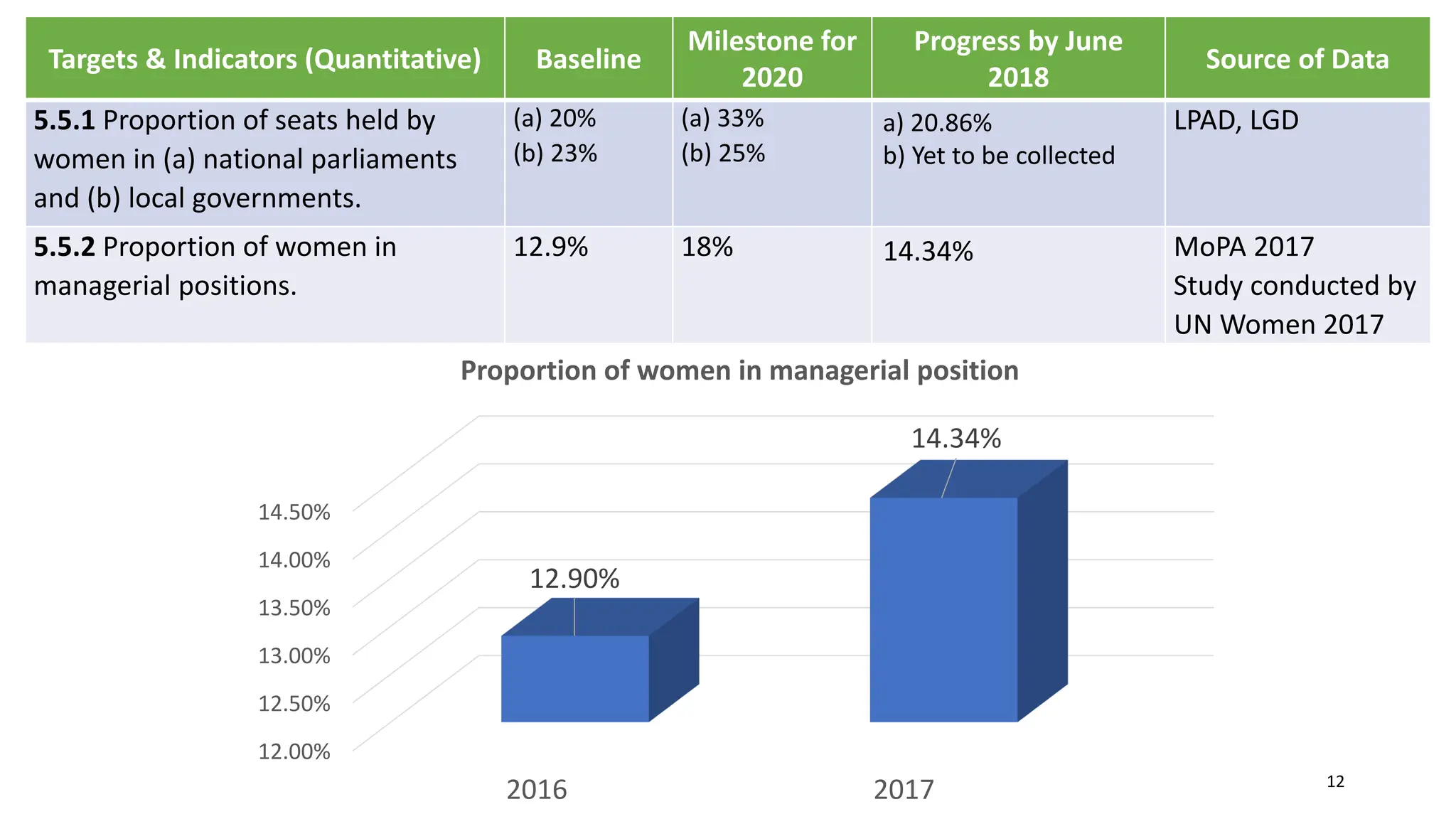
5.5.1 Proportion of seats held by
women in (a) national parliaments
and (b) local governments.
(a) 20%
(b) 23%
(a) 33%
(b) 25%
a) 20.86%
b) Yet to be collected
LPAD, LGD
5.5.2 Proportion of women in
managerial positions.
12.9% 18% 14.34% MoPA 2017
Study conducted by
UN Women 2017
12.00%
12.50%
13.00%
13.50%
14.00%
14.50%
2016 2017
12.90%
14.34%
Proportion of women in managerial position
12
Targets & Indicators
(Quantitative) Baseline
Milestone
for 2020
Progress by
June 2018
Source of
Data
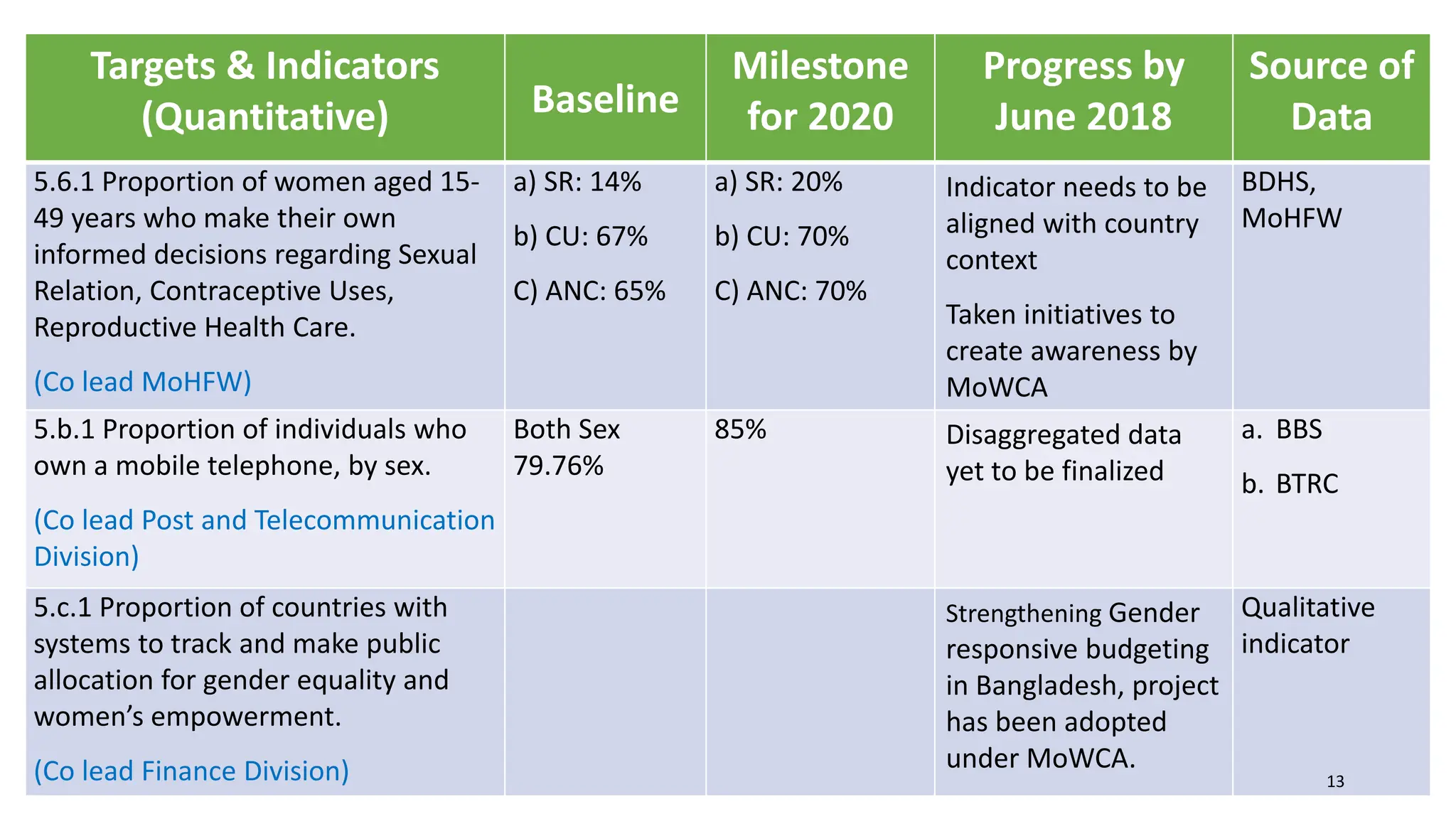
5.6.1 Proportion of women aged 15-
49 years who make their own
informed decisions regarding Sexual
Relation, Contraceptive Uses,
Reproductive Health Care.
(Co lead MoHFW)
a) SR: 14%
b) CU: 67%
C) ANC: 65%
a) SR: 20%
b) CU: 70%
C) ANC: 70%
Indicator needs to be
aligned with country
context
Taken initiatives to
create awareness by
MoWCA
BDHS,
MoHFW
5.b.1 Proportion of individuals who
own a mobile telephone, by sex.
(Co lead Post and Telecommunication
Division)
Both Sex
79.76%
85% Disaggregated data
yet to be finalized
a. BBS
b. BTRC
5.c.1 Proportion of countries with
systems to track and make public
allocation for gender equality and
women’s empowerment.
(Co lead Finance Division)
Strengthening Gender
responsive budgeting
in Bangladesh, project
has been adopted
under MoWCA.
Qualitative
indicator
13
Targets & Indicators
(Quantitative)
Baseline
Milestone
for 2020
Progress by
June 2018
Source of
Data
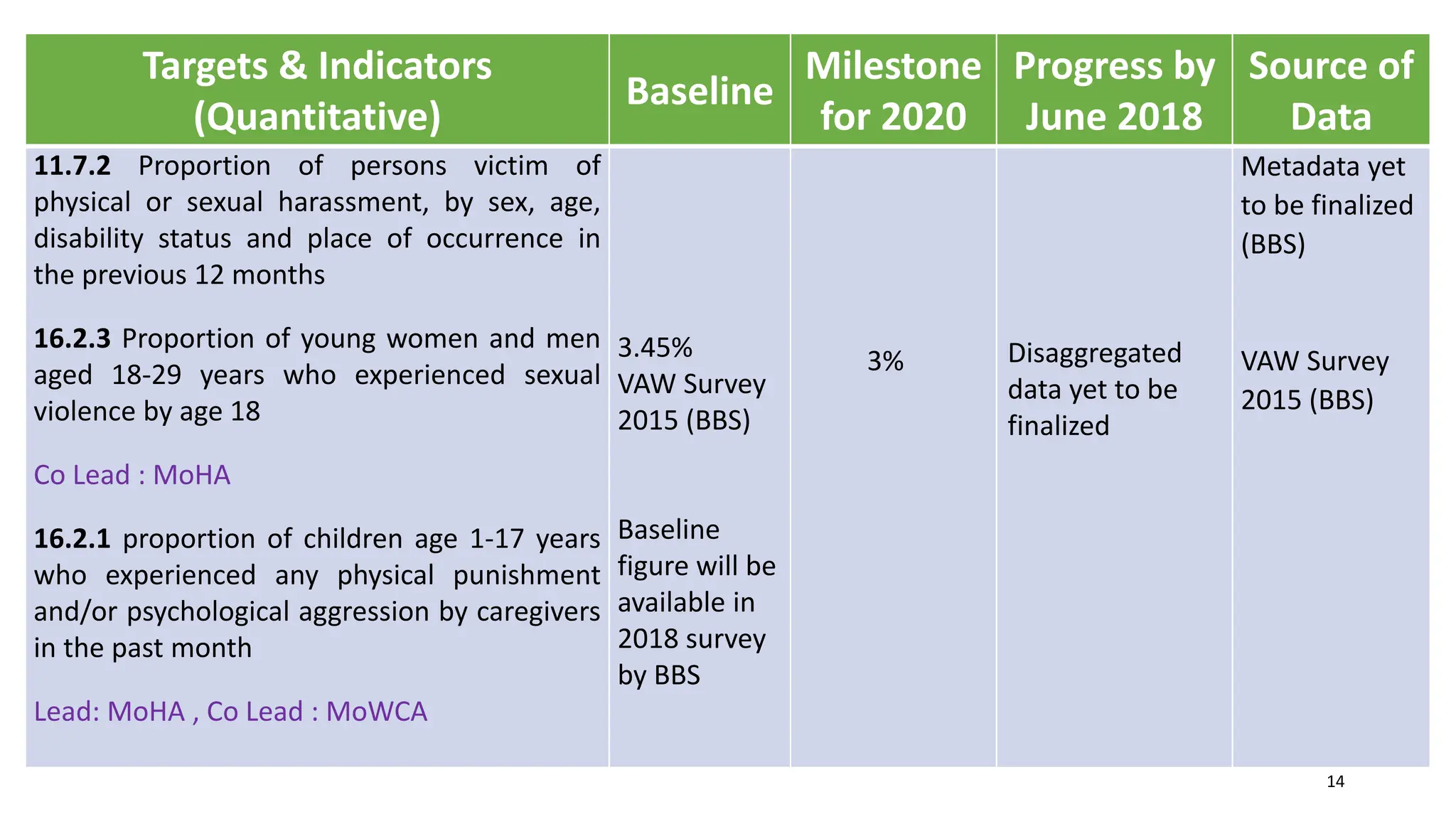
11.7.2 Proportion of persons victim of
physical or sexual harassment, by sex, age,
disability status and place of occurrence in
the previous 12 months
16.2.3 Proportion of young women and men
aged 18-29 years who experienced sexual
violence by age 18
Co Lead : MoHA
16.2.1 proportion of children age 1-17 years
who experienced any physical punishment
and/or psychological aggression by caregivers
in the past month
Lead: MoHA , Co Lead : MoWCA
3.45%
VAW Survey
2015 (BBS)
Baseline
figure will be
available in
2018 survey
by BBS
3% Disaggregated
data yet to be
finalized
Metadata yet
to be finalized
(BBS)
VAW Survey
2015 (BBS)
14
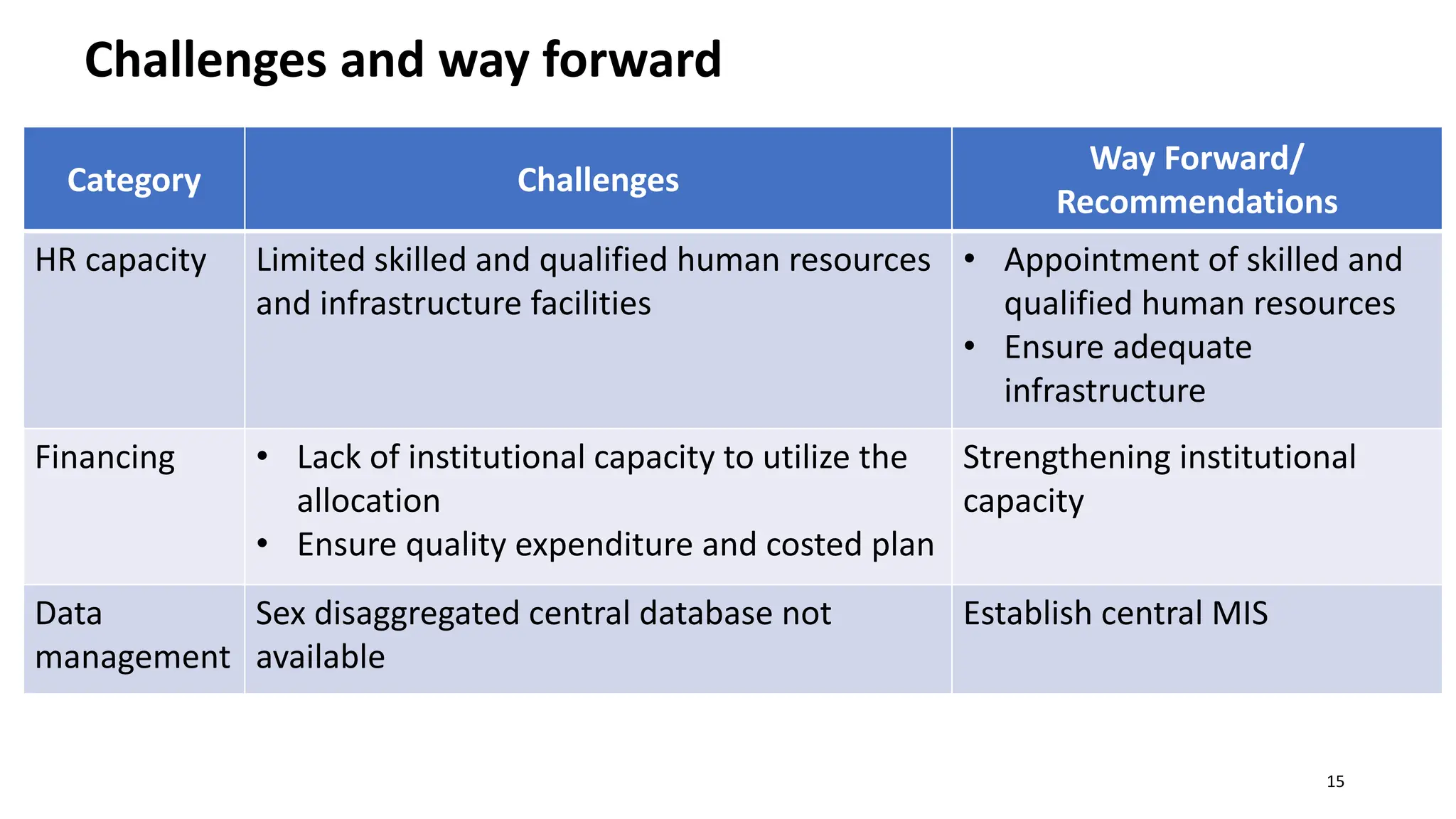
Challenges and way forward
Category Challenges
Way Forward/
Recommendations
HR capacity Limited skilled and qualified human resources
and infrastructure facilities
• Appointment of skilled and
qualified human resources
• Ensure adequate
infrastructure
Financing • Lack of institutional capacity to utilize the
allocation
• Ensure quality expenditure and costed plan
Strengthening institutional
capacity
Data
management
Sex disaggregated central database not
available
Establish central MIS
15
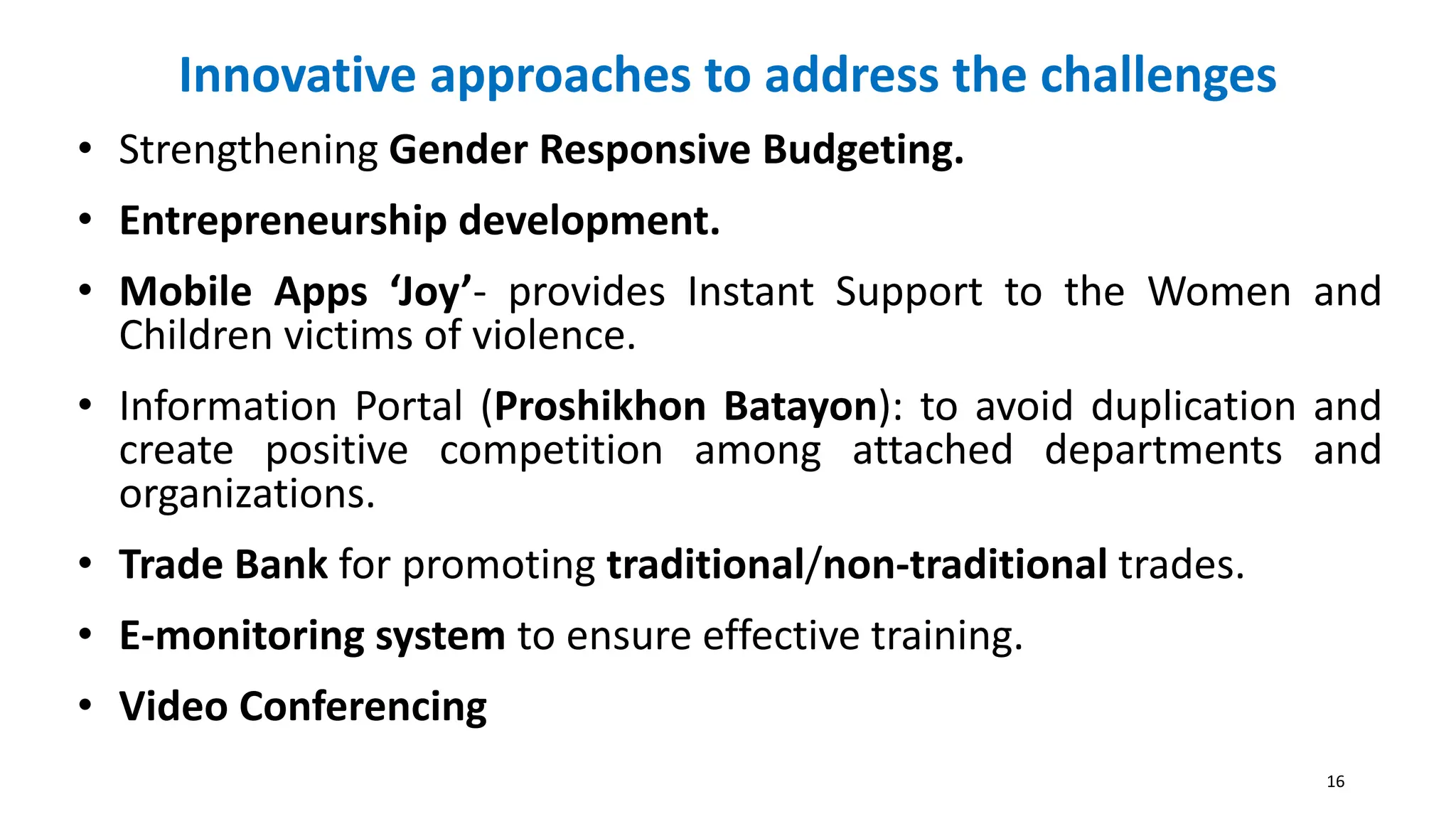
Innovative approaches to address the challenges
• Strengthening Gender Responsive Budgeting.
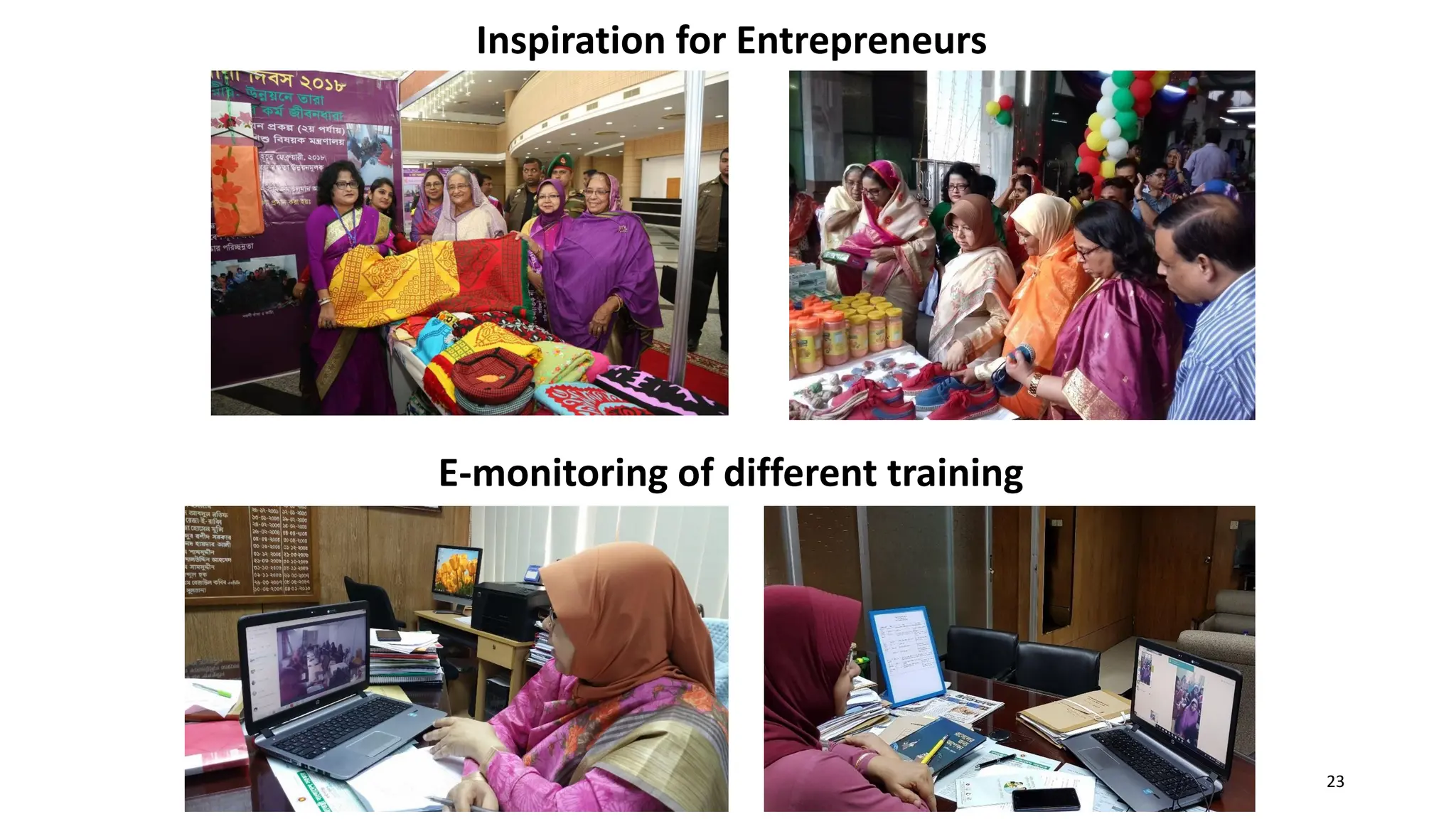
• Entrepreneurship development.
• Mobile Apps ‘Joy’- provides Instant Support to the Women and
Children victims of violence.
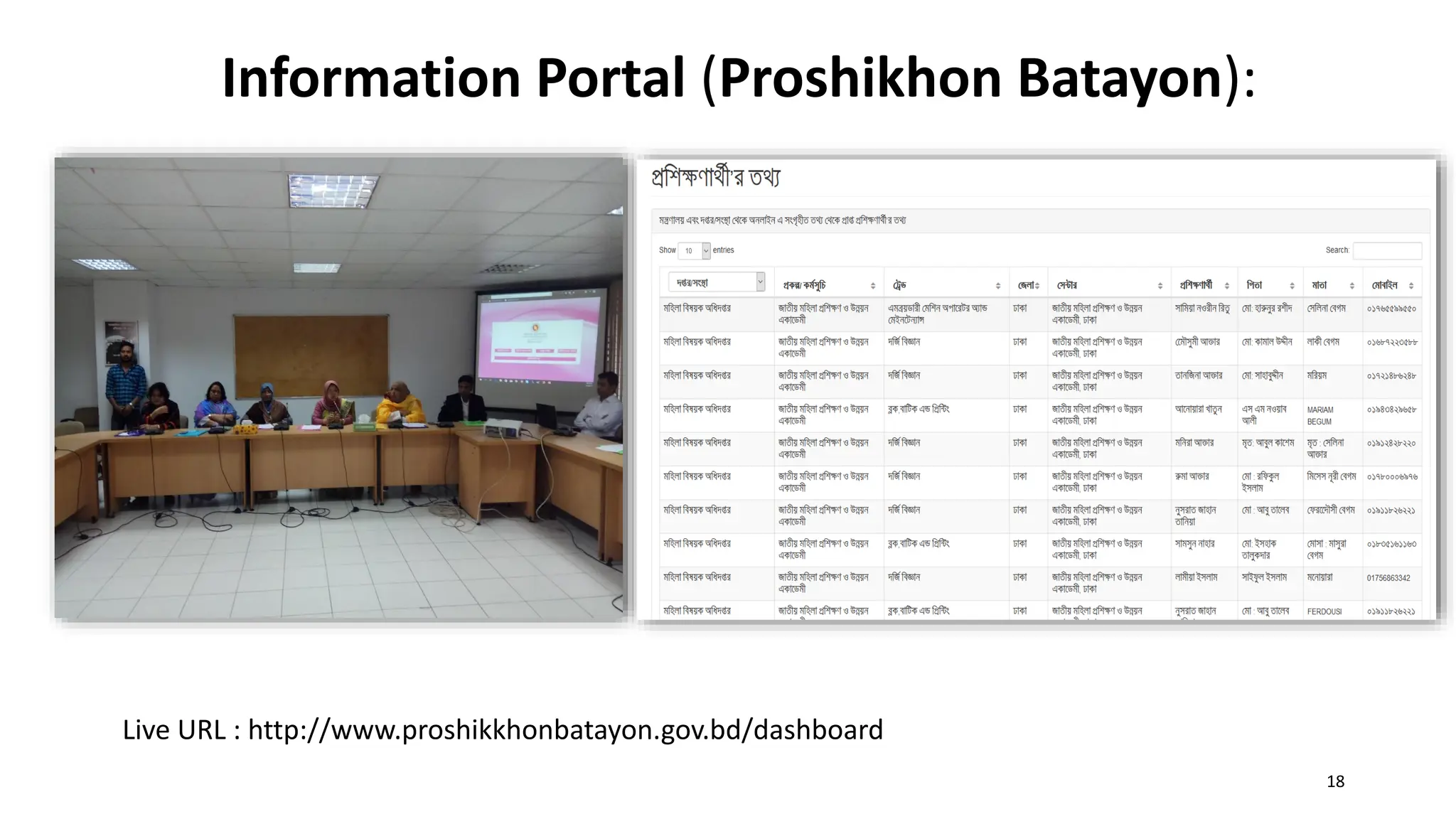
• Information Portal (Proshikhon Batayon): to avoid duplication and
create positive competition among attached departments and
organizations.
• Trade Bank for promoting traditional/non-traditional trades.
• E-monitoring system to ensure effective training.
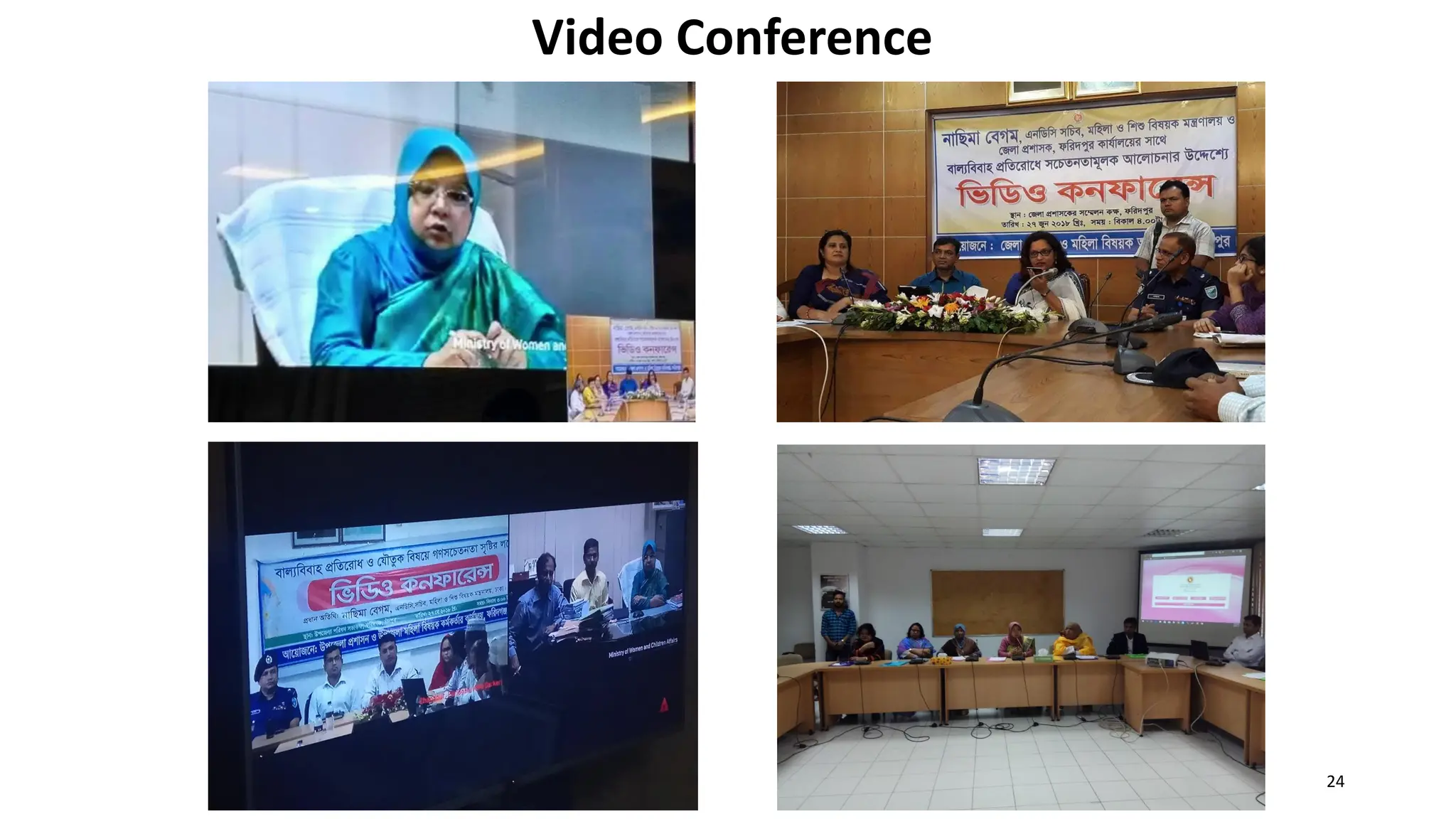
• Video Conferencing
16
“Joyeeta” an Unique Effort of MoWCA
17
 To expedite the economic empowerment process Joyeeta
Foundation initiated for direct marketing of products produced by
women entrepreneurs from remote to urban areas.
Information Portal (Proshikhon Batayon):
Live URL : http://www.proshikkhonbatayon.gov.bd/dashboard
18
Income Generating Activities (IGA)
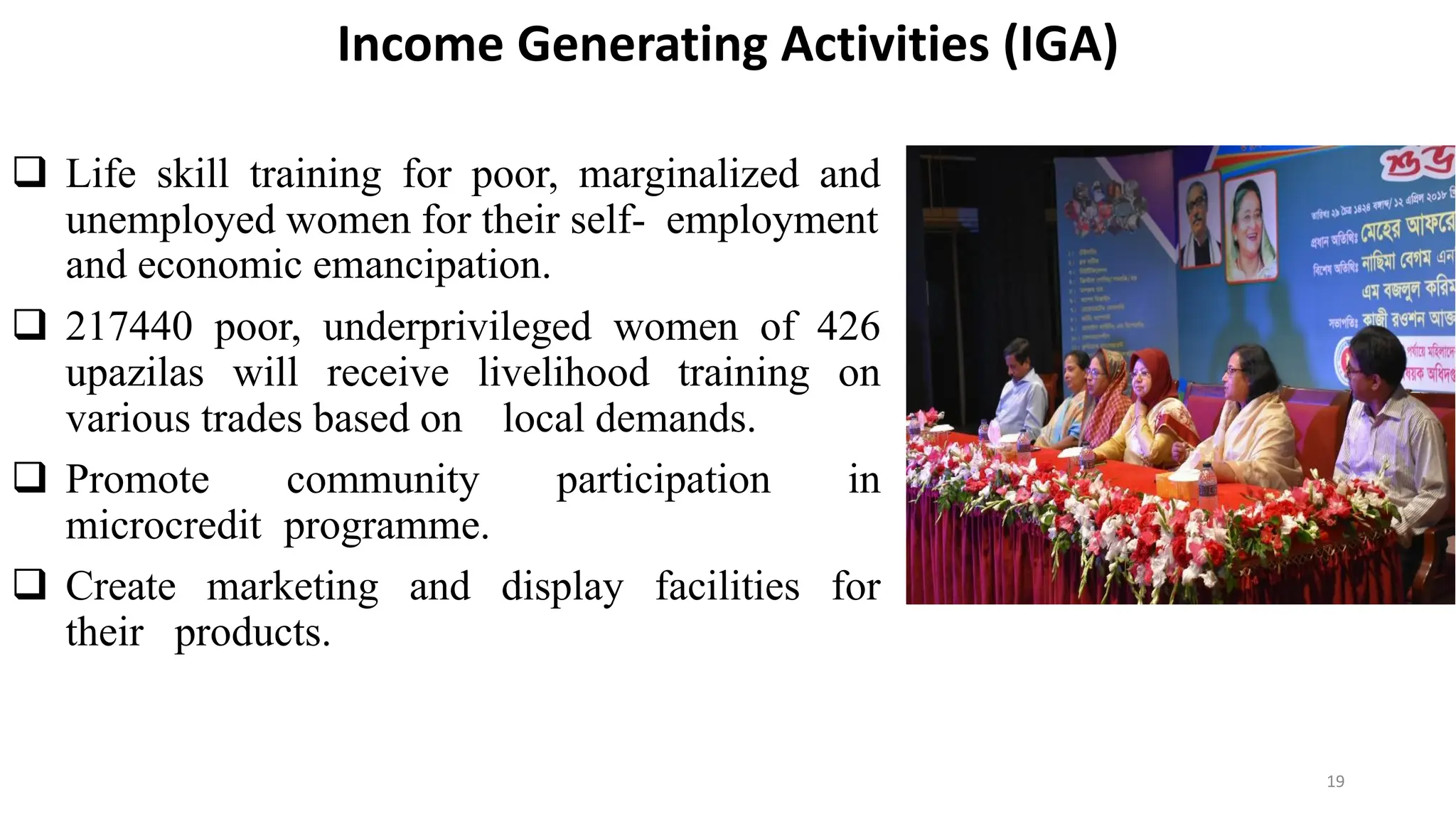
 Life skill training for poor, marginalized and
unemployed women for their self- employment
and economic emancipation.
 217440 poor, underprivileged women of 426
upazilas will receive livelihood training on
various trades based on local demands.
 Promote community participation in
microcredit programme.
 Create marketing and display facilities for
their products.
19
Trade Bank
 Computer Office and Application
 Tailoring
 Block, Batik and Tie-dye
 Embroidery
 House Keeping and Care giving
 Beautification
 Modern Garments (non-
residence)
 Mushroom and Organic
Cultivation
 Pastry and Bakery products
 Dress making and tailoring
 Basic Computer
 Horticulture and Nursery
 Mobile Phone Servicing
 Computer Office Application
 Catering
 Fashion Design
 Interior Design and Event
Management
 Tailoring
 Motor Driving
 Virtual Training
 B and Mushroom Cultivation
 Business Management
 Agriculture Machine
Maintenance
 Electrician
 Food Processing and
Preservation
 Electronics Assembling
 Industrial Sewing Machine
Operator
20
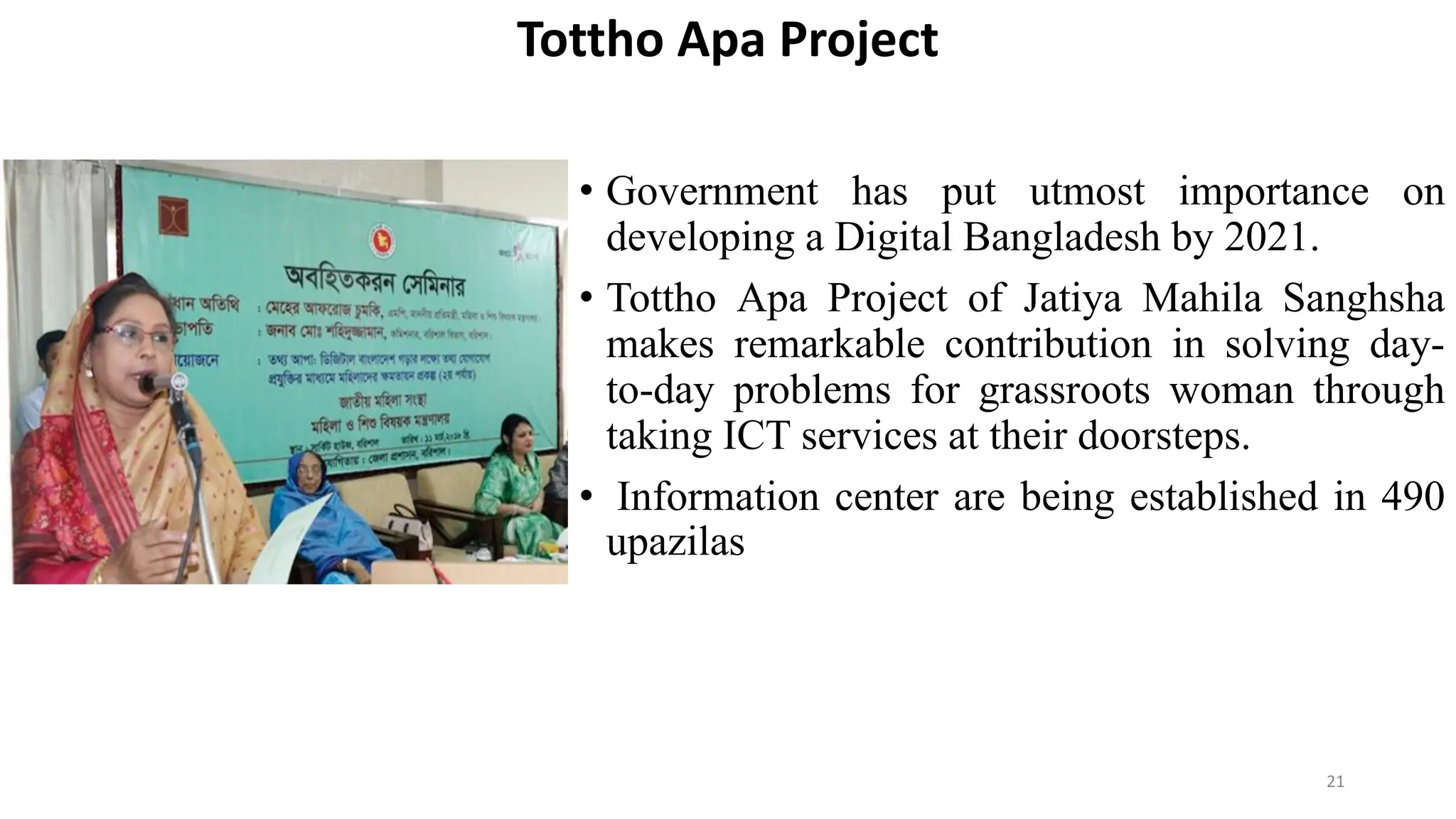
Tottho Apa Project
• Government has put utmost importance on
developing a Digital Bangladesh by 2021.
• Tottho Apa Project of Jatiya Mahila Sanghsha
makes remarkable contribution in solving day-
to-day problems for grassroots woman through
taking ICT services at their doorsteps.
• Information center are being established in 490
upazilas
21
Adolescent Clubs
 Adolescent boys and girls act as change agent in each union to prevent
violence against women and children
 Through these clubs children learn about life skill, games and other
cultural activities.
 Adolescent are motivated themselves not to get married before permissible age
limit and motivate their classmates and peers against early marriage.
 Adolescent persuaded the parents and made strong lobby with school
authority and people’s representative of the local government institutions to
join them in case of such endeavor.
 At present government has taken initiative to establish more 4883 adolescent
clubs at union and pourasavas.
22
E-monitoring of different training
Inspiration for Entrepreneurs
23
Video Conference
24
Training on non-traditional trades
25
Thank You
26

Presentation for SDG Coordinator of india

  • 1.
    Welcome to thePresentation on Women Empowerment based on SDG in Bangladesh Nasima Begum ndc Secretary Ministry of Women & Children Affairs 1 Sheikh Hasina’s Commitment Parity to Men & Women
  • 2.
    Vision & Missionof MoWCA Vision: Society with gender equality and child protection. Mission: Establishing the rights of women and children and women empowerment through mainstreaming in development 2
  • 3.
    Planning and Implementationof SDGs • MoWCA organized national workshop to identify the roles of GOs, NGOs, DPs, CSOs opportunities, gaps and challenges of SDGs • Developed an action plan to address gaps and challenges in short, medium and long term basis. • Linking SDGs targets and indicators with APA and 7th FYP • Established SDGs Implementation Cell in MoWCA 3
  • 4.
    Linkages with DPs,NGOs and CSOs Development Partners - UNICEF, UN-WOMEN, WFP, UNFPA, DENMARK and others under LCG WAGE Platform DPs, NGOs and CSOs are working closely with MoWCA for economic, social and political empowerment of women and promotion of child rights and development 4
  • 5.
    MoWCA Engagement asLead and Co-Lead • Goal 5 - Achieve gender equality and empower all women and girls. Total Targets 9, Indicators 14 • Target - MoWCA leads 8 except 5.4 lead by MoSW (we think 5.4 is more relevant to MoLE and MoWCA) • Indicator - 12 lead by MoWCA, 1 by MoSW and 1 is not relevant for Bangladesh • Goal 11 - Indicator 11.7.2: Proportion of persons victim of physical or sexual harassment, by sex, age, disability status and place of occurrence in the previous 12 months • Goal 16 - Indicator 16.2.3: Proportion of young women and men aged 18-29 years who experienced sexual violence by age 18 Lead • Goal 16 - Indicator 16.2.1 proportion of children age 1-17 years who experienced any physical punishment and/or psychological aggression by caregivers in the past month Co-Lead 5
  • 6.
    Alignment of SDGand 7th FYP SDGs target Actions of 7th FYP 5.1 End all forms of discrimination against women and girls everywhere Implement National Women Development Policy (Updating NPA in line with SDGs) 5.2 Eliminate all forms of violence against all women and girls in the public and private spheres Eliminating violence against women, recognizing social identities when formulating policies, Acid throwing, VAW, eve teasing, Dowry 5.3 Eliminate all harmful practices such as child, early and forced marriage Law to ban CM, awareness raising, protecting children from violence, access to girls education, training, strengthen civil society movement to eliminate CM 5.4 Recognize and value unpaid care and domestic work Increase access to human development opportunities, conducive legal environment, promote positive social norms 5.5- Ensure women's full and effective participation and equal opportunities for leadership at all levels of decision-making in political, economic and public life Ensure access and control over productive resources, Improve institutional capacity 6
  • 7.
    Alignment of SDGand FYP • How far the target of SDG is in alignment with 7th FYP SDGs target Actions of 7th FYP 5.6- Ensure universal access to sexual and reproductive health and reproductive rights Women friendly hospitals and SRHR services in all district, counseling services, registration and tracking for services, 5.a Undertake reforms to give women’s equal rights to economic resources, as well as access to ownership and control over land and other forms of property, financial services, inheritance Khas land distribution of both spouses, micro finance operations, access to forestry resources, community orientation on inherited property 5.b Enhance the use of enabling technology Access to modern technology, information related to market, employment, mobile phone, internet 5.c Adopt and strengthen sound policies and enforceable legislation Increase gender budget as percentage of total budget, progress monitoring on women's empowerment and gender equality 7
  • 8.
    Hon’ble Prime Minister gavespecial award to Ministry of Women and Children Affairs for its outstanding performance of APA Implementation of fiscal year 2016-2017 8
  • 9.
    Actions/initiatives as peraction plan (2018 - 2020) Targets & Indicators Baseline Milestone for 2020 Progress by June 2018 Source of Data Indicator 5.1.1 - End all forms of discrimination against women and girls everywhere Promote, enforce and monitor equality and non discrimination on the basis of sex under Articles 19,27,28,29,38 and 121 of the Constitution • National Women Development Policy 2011 • National Children Policy 2011 • Child Marriage Restraint Act, 2017 • DNA Act, 2014 • Dowry Prohibition Bill, 2018 placed to the Parliament Metadata yet to be finalized (BBS). Qualitative indicator Note: Under this constitutional and legal framework MoWCA has taken actions on promoting women’s economic empowerment through skill development trainings with traditional and non traditional trades (Motor driving, horticulture nursery, agriculture machine maintenance etc.) 9
  • 10.
    Indicators (Quantitative )Baseline Milestone for 2020 Progress by June 2018 Source of Data 5.3.1 Proportion of women aged 20-24 years who were married or in a union before age 15 and before age 18. Before 15: 23.8% Before 18: 58.6% Before 15: 15% Before 18: 30% Before 15: 10.70% Before 18: 47% BIDS 2017 0.00% 10.00% 20.00% 30.00% 40.00% 50.00% 60.00% Percentage married before age 15 Percentage married before age 18 23.80% 58.60% 10.70% 47% Declining Trends of Child Marriage 2015 2017 10
  • 11.
    1. Accolade GlobalFilm Competition 2017 Humanitarian Award for Outstanding Achievement 2. Award of Merit Special Mention: Public Service Programming / PSA 3. Award of Excellence: Contemporary Issues / Awareness Raising 4. APAC Effie award to the Creative Partner 5. Social Media for Empowerment Award– the crest 6. 2018 Telly Award Accolade Winner Award of Excellence End Child Marriage - MoWCA, Govt. of Bangladesh, UNICEF, Asiatic MCL received APAC Effie Award 2017 for creating public awareness 11
  • 12.
    Targets & Indicators(Quantitative) Baseline Milestone for 2020 Progress by June 2018 Source of Data 5.5.1 Proportion of seats held by women in (a) national parliaments and (b) local governments. (a) 20% (b) 23% (a) 33% (b) 25% a) 20.86% b) Yet to be collected LPAD, LGD 5.5.2 Proportion of women in managerial positions. 12.9% 18% 14.34% MoPA 2017 Study conducted by UN Women 2017 12.00% 12.50% 13.00% 13.50% 14.00% 14.50% 2016 2017 12.90% 14.34% Proportion of women in managerial position 12
  • 13.
    Targets & Indicators (Quantitative)Baseline Milestone for 2020 Progress by June 2018 Source of Data 5.6.1 Proportion of women aged 15- 49 years who make their own informed decisions regarding Sexual Relation, Contraceptive Uses, Reproductive Health Care. (Co lead MoHFW) a) SR: 14% b) CU: 67% C) ANC: 65% a) SR: 20% b) CU: 70% C) ANC: 70% Indicator needs to be aligned with country context Taken initiatives to create awareness by MoWCA BDHS, MoHFW 5.b.1 Proportion of individuals who own a mobile telephone, by sex. (Co lead Post and Telecommunication Division) Both Sex 79.76% 85% Disaggregated data yet to be finalized a. BBS b. BTRC 5.c.1 Proportion of countries with systems to track and make public allocation for gender equality and women’s empowerment. (Co lead Finance Division) Strengthening Gender responsive budgeting in Bangladesh, project has been adopted under MoWCA. Qualitative indicator 13
  • 14.
    Targets & Indicators (Quantitative) Baseline Milestone for2020 Progress by June 2018 Source of Data 11.7.2 Proportion of persons victim of physical or sexual harassment, by sex, age, disability status and place of occurrence in the previous 12 months 16.2.3 Proportion of young women and men aged 18-29 years who experienced sexual violence by age 18 Co Lead : MoHA 16.2.1 proportion of children age 1-17 years who experienced any physical punishment and/or psychological aggression by caregivers in the past month Lead: MoHA , Co Lead : MoWCA 3.45% VAW Survey 2015 (BBS) Baseline figure will be available in 2018 survey by BBS 3% Disaggregated data yet to be finalized Metadata yet to be finalized (BBS) VAW Survey 2015 (BBS) 14
  • 15.
    Challenges and wayforward Category Challenges Way Forward/ Recommendations HR capacity Limited skilled and qualified human resources and infrastructure facilities • Appointment of skilled and qualified human resources • Ensure adequate infrastructure Financing • Lack of institutional capacity to utilize the allocation • Ensure quality expenditure and costed plan Strengthening institutional capacity Data management Sex disaggregated central database not available Establish central MIS 15
  • 16.
    Innovative approaches toaddress the challenges • Strengthening Gender Responsive Budgeting. • Entrepreneurship development. • Mobile Apps ‘Joy’- provides Instant Support to the Women and Children victims of violence. • Information Portal (Proshikhon Batayon): to avoid duplication and create positive competition among attached departments and organizations. • Trade Bank for promoting traditional/non-traditional trades. • E-monitoring system to ensure effective training. • Video Conferencing 16
  • 17.
    “Joyeeta” an UniqueEffort of MoWCA 17  To expedite the economic empowerment process Joyeeta Foundation initiated for direct marketing of products produced by women entrepreneurs from remote to urban areas.
  • 18.
    Information Portal (ProshikhonBatayon): Live URL : http://www.proshikkhonbatayon.gov.bd/dashboard 18
  • 19.
    Income Generating Activities(IGA)  Life skill training for poor, marginalized and unemployed women for their self- employment and economic emancipation.  217440 poor, underprivileged women of 426 upazilas will receive livelihood training on various trades based on local demands.  Promote community participation in microcredit programme.  Create marketing and display facilities for their products. 19
  • 20.
    Trade Bank  ComputerOffice and Application  Tailoring  Block, Batik and Tie-dye  Embroidery  House Keeping and Care giving  Beautification  Modern Garments (non- residence)  Mushroom and Organic Cultivation  Pastry and Bakery products  Dress making and tailoring  Basic Computer  Horticulture and Nursery  Mobile Phone Servicing  Computer Office Application  Catering  Fashion Design  Interior Design and Event Management  Tailoring  Motor Driving  Virtual Training  B and Mushroom Cultivation  Business Management  Agriculture Machine Maintenance  Electrician  Food Processing and Preservation  Electronics Assembling  Industrial Sewing Machine Operator 20
  • 21.
    Tottho Apa Project •Government has put utmost importance on developing a Digital Bangladesh by 2021. • Tottho Apa Project of Jatiya Mahila Sanghsha makes remarkable contribution in solving day- to-day problems for grassroots woman through taking ICT services at their doorsteps. • Information center are being established in 490 upazilas 21
  • 22.
    Adolescent Clubs  Adolescentboys and girls act as change agent in each union to prevent violence against women and children  Through these clubs children learn about life skill, games and other cultural activities.  Adolescent are motivated themselves not to get married before permissible age limit and motivate their classmates and peers against early marriage.  Adolescent persuaded the parents and made strong lobby with school authority and people’s representative of the local government institutions to join them in case of such endeavor.  At present government has taken initiative to establish more 4883 adolescent clubs at union and pourasavas. 22
  • 23.
    E-monitoring of differenttraining Inspiration for Entrepreneurs 23
  • 24.
  • 25.
  • 26.