Capstone Presentation
Lindsay Bellinger
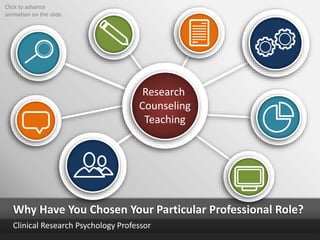
Why Have You Chosen Your Particular Professional Role?
Clinical Research Psychology Professor
Research
Counseling
Teaching
Click to advance
animation on the slide.
This slide is static and
does not animate.
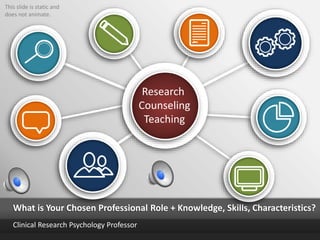
What is Your Chosen Professional Role + Knowledge, Skills, Characteristics?
Clinical Research Psychology Professor
Research
Counseling
Teaching
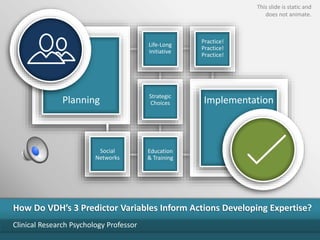
Planning Implementation
How Do VDH’s 3 Predictor Variables Inform Actions Developing Expertise?
Clinical Research Psychology Professor
Social
Networks
Education
& Training
Life-Long
Initiative
Practice!
Practice!
Practice!
Strategic
Choices
This slide is static and
does not animate.
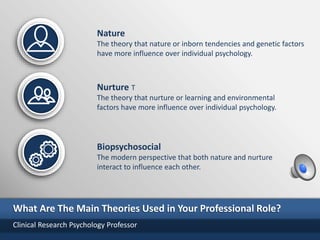
Nature
The theory that nature or inborn tendencies and genetic factors
have more influence over individual psychology.
Biopsychosocial
The modern perspective that both nature and nurture
interact to influence each other.
What Are The Main Theories Used in Your Professional Role?
Clinical Research Psychology Professor
Nurture T
The theory that nurture or learning and environmental
factors have more influence over individual psychology.
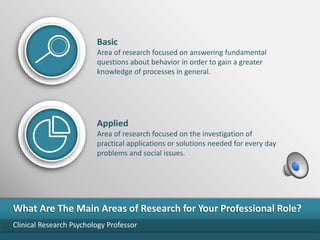
Basic
Area of research focused on answering fundamental
questions about behavior in order to gain a greater
knowledge of processes in general.
Applied
Area of research focused on the investigation of
practical applications or solutions needed for every day
problems and social issues.
What Are The Main Areas of Research for Your Professional Role?
Clinical Research Psychology Professor
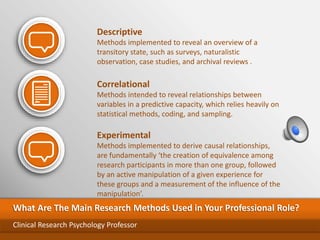
Descriptive
Methods implemented to reveal an overview of a
transitory state, such as surveys, naturalistic
observation, case studies, and archival reviews .
Experimental
Methods implemented to derive causal relationships,
are fundamentally ‘the creation of equivalence among
research participants in more than one group, followed
by an active manipulation of a given experience for
these groups and a measurement of the influence of the
manipulation’.
What Are The Main Research Methods Used in Your Professional Role?
Clinical Research Psychology Professor
Correlational
Methods intended to reveal relationships between
variables in a predictive capacity, which relies heavily on
statistical methods, coding, and sampling.
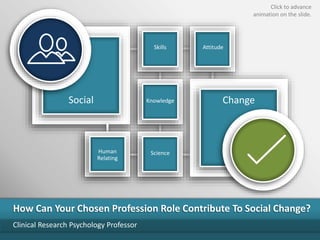
Social Change
How Can Your Chosen Profession Role Contribute To Social Change?
Clinical Research Psychology Professor
Human
Relating
Science
Skills Attitude
Knowledge
Click to advance
animation on the slide.
Capstone Presentation
Lindsay Bellinger
References
Appleby, D. C., Millspaugh, B. S., & Hammersley, M.J. (2011). An online resource
to enable undergraduate psychology majors to identify and investigate
172 psychology and psychology related careers. Retrieved from:
http:teachpsych .org/ resources/Documents/otrp/resources/
appleby11.pdf
Callahan, D., Wilson, E. Birdsall, I., Estabrook-Fishinghawk, B., Carson, G., Ford, S.,
Ouzts, K., Yob, I. (2012). Expanding our understanding of social change:
A report from the definition task force of the HLC special emphasis
project. Retrieved from http://my.campuscruiser.com/StreamServlet/
Special+Emphasis+Expanding+Our+Understanding+of+Social+Change
+2012July.pdf?n=fmgr&ts=1379010387220&sig=ZZ4miUxI7ulC9
eJU1p1xv5H4We%3D&v=H4sIAAAAAAAAAK2MTQrCMBS
ErxIvYNJAFy6yqnUhWoXQdXikL23gNQ1JC3p7488R3Mw3MwzjNqI7rJPi1
vKmOXlC %2FpYrBBgxCW6MjfJQF0ZMlRBV8%2FIWnAd0Xog1s5x
guwzax8RwuDDyG5bYn0YMOX11yyO6eUzbyYIIzIpKnne6LmP
Collier, W. (2008). Nature versus nurture. In S. Davis, & W. Buskist (Eds.), 21st
century psychology: A reference handbook. (pp. II-72-II-79). Thousand
Oaks, CA: SAGE Publications, Inc. doi:
http:dx.doi.org.ezp.waldenulibrary
.org/10.4135/9781412956321.n60
Dictionary of Occupational Titles. (2003). Faculty member, college or university
(education). Retrieved from: http://www.occupationalinfo.org/
09/090227010.html
Myers, D. G. (2011). Exploring psychology in modules (8th ed.). New York, NY:
Worth
Outofservice.com. (2015). The Big Five Personality Test, [Your Results]. Retrieved
from: http://www.outofservice.com/bigfive/
Psychologycareercenter.org. (2015). Psychology professor among top jobs in the
United States. Retrieved from:
http://www.psychologycareercenter.org/ psychology-professor-jobs.html
Stangor, C. (2011). Research methods for the behavioral sciences. (4th ed.).
Boston Houghton Mifflin.
Thomson, P. (2005). The sage handbook of educational leadership. advances in
theory, research and practice. The International Journal of Educational
Management, 19(6), 533-536. Retrieved from: http://search.proquest
.com/docview/ 229136938?accountid=14872
U.S. Department of Labor, Bureau of Labor Statistics. (n.d.). Occupational outlook
handbook. Retrieved March 3, 2015, from http://www.bls.gov/ooh/
Van der Heijden, B. I. J. M. (2002). Individual career initiatives and their influence
upon professional expertise development throughout the career.
International Journal of Training and Development, 6(2), 54–79.
Retrieved from: http://web.b.ebscohost.com.ezp.waldenulibrary.org
/ehost/detail/detail?sid=e3c310ac-c9bc-44f2-b699-e070b909f75c
%40sessionmgr112&vid=0&hid=118&bdata=JnNjb3BlPXNpdGU%
3d#db=bth&AN=6632794
Vondracek, F. W., and Ferreira, J.A.G. (2010). Vocational behavior and
development in times of social change: New perspectives for theory and
practice. International Journal for Educational and Vocational Guidance,
10(2), 125-138. Doi: http://dx.doi.org.ezp.waldenulibrary.org/10.1007/
s10775-010-9176-x

Wk5 discl bellinger

  • 1.
  • 2.
    Why Have YouChosen Your Particular Professional Role? Clinical Research Psychology Professor Research Counseling Teaching Click to advance animation on the slide.
  • 3.
    This slide isstatic and does not animate. What is Your Chosen Professional Role + Knowledge, Skills, Characteristics? Clinical Research Psychology Professor Research Counseling Teaching
  • 4.
    Planning Implementation How DoVDH’s 3 Predictor Variables Inform Actions Developing Expertise? Clinical Research Psychology Professor Social Networks Education & Training Life-Long Initiative Practice! Practice! Practice! Strategic Choices This slide is static and does not animate.
  • 5.
    Nature The theory thatnature or inborn tendencies and genetic factors have more influence over individual psychology. Biopsychosocial The modern perspective that both nature and nurture interact to influence each other. What Are The Main Theories Used in Your Professional Role? Clinical Research Psychology Professor Nurture T The theory that nurture or learning and environmental factors have more influence over individual psychology.
  • 6.
    Basic Area of researchfocused on answering fundamental questions about behavior in order to gain a greater knowledge of processes in general. Applied Area of research focused on the investigation of practical applications or solutions needed for every day problems and social issues. What Are The Main Areas of Research for Your Professional Role? Clinical Research Psychology Professor
  • 7.
    Descriptive Methods implemented toreveal an overview of a transitory state, such as surveys, naturalistic observation, case studies, and archival reviews . Experimental Methods implemented to derive causal relationships, are fundamentally ‘the creation of equivalence among research participants in more than one group, followed by an active manipulation of a given experience for these groups and a measurement of the influence of the manipulation’. What Are The Main Research Methods Used in Your Professional Role? Clinical Research Psychology Professor Correlational Methods intended to reveal relationships between variables in a predictive capacity, which relies heavily on statistical methods, coding, and sampling.
  • 8.
    Social Change How CanYour Chosen Profession Role Contribute To Social Change? Clinical Research Psychology Professor Human Relating Science Skills Attitude Knowledge Click to advance animation on the slide.
  • 9.
    Capstone Presentation Lindsay Bellinger References Appleby,D. C., Millspaugh, B. S., & Hammersley, M.J. (2011). An online resource to enable undergraduate psychology majors to identify and investigate 172 psychology and psychology related careers. Retrieved from: http:teachpsych .org/ resources/Documents/otrp/resources/ appleby11.pdf Callahan, D., Wilson, E. Birdsall, I., Estabrook-Fishinghawk, B., Carson, G., Ford, S., Ouzts, K., Yob, I. (2012). Expanding our understanding of social change: A report from the definition task force of the HLC special emphasis project. Retrieved from http://my.campuscruiser.com/StreamServlet/ Special+Emphasis+Expanding+Our+Understanding+of+Social+Change +2012July.pdf?n=fmgr&ts=1379010387220&sig=ZZ4miUxI7ulC9 eJU1p1xv5H4We%3D&v=H4sIAAAAAAAAAK2MTQrCMBS ErxIvYNJAFy6yqnUhWoXQdXikL23gNQ1JC3p7488R3Mw3MwzjNqI7rJPi1 vKmOXlC %2FpYrBBgxCW6MjfJQF0ZMlRBV8%2FIWnAd0Xog1s5x guwzax8RwuDDyG5bYn0YMOX11yyO6eUzbyYIIzIpKnne6LmP Collier, W. (2008). Nature versus nurture. In S. Davis, & W. Buskist (Eds.), 21st century psychology: A reference handbook. (pp. II-72-II-79). Thousand Oaks, CA: SAGE Publications, Inc. doi: http:dx.doi.org.ezp.waldenulibrary .org/10.4135/9781412956321.n60 Dictionary of Occupational Titles. (2003). Faculty member, college or university (education). Retrieved from: http://www.occupationalinfo.org/ 09/090227010.html Myers, D. G. (2011). Exploring psychology in modules (8th ed.). New York, NY: Worth Outofservice.com. (2015). The Big Five Personality Test, [Your Results]. Retrieved from: http://www.outofservice.com/bigfive/ Psychologycareercenter.org. (2015). Psychology professor among top jobs in the United States. Retrieved from: http://www.psychologycareercenter.org/ psychology-professor-jobs.html Stangor, C. (2011). Research methods for the behavioral sciences. (4th ed.). Boston Houghton Mifflin. Thomson, P. (2005). The sage handbook of educational leadership. advances in theory, research and practice. The International Journal of Educational Management, 19(6), 533-536. Retrieved from: http://search.proquest .com/docview/ 229136938?accountid=14872 U.S. Department of Labor, Bureau of Labor Statistics. (n.d.). Occupational outlook handbook. Retrieved March 3, 2015, from http://www.bls.gov/ooh/ Van der Heijden, B. I. J. M. (2002). Individual career initiatives and their influence upon professional expertise development throughout the career. International Journal of Training and Development, 6(2), 54–79. Retrieved from: http://web.b.ebscohost.com.ezp.waldenulibrary.org /ehost/detail/detail?sid=e3c310ac-c9bc-44f2-b699-e070b909f75c %40sessionmgr112&vid=0&hid=118&bdata=JnNjb3BlPXNpdGU% 3d#db=bth&AN=6632794 Vondracek, F. W., and Ferreira, J.A.G. (2010). Vocational behavior and development in times of social change: New perspectives for theory and practice. International Journal for Educational and Vocational Guidance, 10(2), 125-138. Doi: http://dx.doi.org.ezp.waldenulibrary.org/10.1007/ s10775-010-9176-x

Editor's Notes

  • #3 (Outofservice.com, 2015).
  • #4 (Dictionary of Occupational Titles [DOT], 2015). (Occupational Outlook Hand-book [OOH], 2015). (Psychologycareercenter.org).
  • #5 (van der Heijden, 2002).
  • #6 (Collier, 2008). (Myers, 2011). (Stangor, 2011).
  • #7 Collier, 2008). (Myers, 2011). (Stangor, 2011).
  • #9 (Callahan, Wilson, Birdsall, Estabrook-Fishinghawk, Carson, Ford, Ouzts, and Yob, 2012). (OOH, 2015). (Thomson, 2005, [Bringing Wholeness to Leadership]). (Vondracek and Ferreira, 2010).