

Dr Natalie Torbolov
August 2013
WITTLE LEAKS
Case Presentation
• 10 year old girl
PSX
• Nocturnal Bedwetting
– nightly
–  rouseability
– Being toiletted 2 hourly
– No other urinary Sx
– Pull ups
– Dry by day since 3 years old
Case Presentation (cont.)
HPI
• Has only ever had a few dry nights in her life
• Social issues developing
PMHx - Nil, no problems at school
Reg Meds - Nil
Allergies - NKA
No positive family Hx
Examination
• Well looking
• Wt. 37.6 kg Ht. 132.2 cm
• No Sacral pit
• Abdo - NAD
• Normal Neurological examination
• External Genitalia - NAD
Management
• Discussion / explanation to mother of DX:
 Monosymptomatic Nocturnal Envresis
 Trial of Envresis Alarm
• MSU - NAD
• Renal US - NAD
• Abdo - NAD
• Paediatric Consult – Confirmation of DX
- Assistance with Alarm
Childhood Nocturnal Enuresis
• Definition: Involuntary wetting while
asleep 2 x week after 5 years of age
• 2nd most common chronic childhood
complaint (after allergies)
• 18.9% of children
• 20% of 5 year olds
• 10% of 10 year olds
Childhood Nocturnal Enuresis (Cont.)
• Spontaneous remission 14% per year
• Self esteem & psychosocial function
• Suggestion of impaired cognitive
performance which improves with
treatment
• Only 34% seek professional help
• 2-3% persistent incontinence into
adulthood
Classification
• Primary – never been dry for 6 months
• Secondary – Enuresis after 6 months of being
dry
– Psychological
– Organic DS – eg DM, UTI
• Mono Symptomatic – no day time
incontinence
– No urinary tract Sx
• Non Monosymptomatic – daytime voiding & Sx
of urgency, frequency
Causes
• Family Hx – 4/10 with affected family member
- Genetic factors – links to Chrom
8,12,13, 22 Auto Dom
• Bladder & Brain Connection
–  Cortical arousal
– Inability to arouse to a full bladder
sensation
–- Detrusor over activity
– Small capacity Bladder
Causes (Cont.)
• Nocturnal Polyuria -  anti-direutic
hormone secretion
• Chronic Constipation – eg soiling
• Other Medical Conditions – OSA, DM,
UTI, ADHD
• Sex M:F 2:1
Management of Nocturnal E
• Education & Reassurance – high rate of
spontaneous remission
• Motivational Therapy – 1st line for <7 year
olds who are not wetting nightly
- enlist co-operation of child eg. Record
progress diary
- Rewards – don’t focus on dryness
- For agreed upon behaviours
- Penalties – counter productive
Management of Nocturnal E (Cont.)
• Motivational Therapy (Cont.)
- 25% success rate ie. dry for 14 consecutive
nights
- 70% - improvement
- No fault emphasis
- Trial 3 – 6 months before moving on
Enuresis Alarms
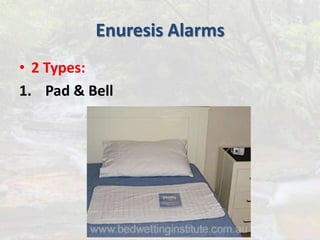
• 2 Types:
1. Pad & Bell
Enuresis Alarms (Cont.)
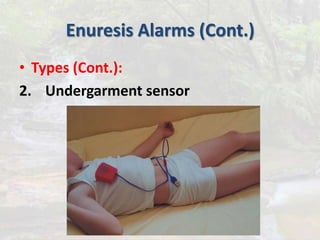
• Types (Cont.):
2. Undergarment sensor
Enuresis Alarms (Cont.)
• For motivated families
• Frequent enuresis
• Most effective
- 66% achieve 14 consecutive nights cf 4%
of no Rx controls
• Child in charge of alarm
- Testing
- Setting
- Follow up
Enuresis Alarms (Cont.)
• 12 – 16 weeks to achieve 14 dry
consecutive nights
• Range 5 – 24 weeks
• Can be reinstated after relapse
Other Measures
• Monitoring Daily Fluid Intake (80% prior to
5PM)
• Avoid sugar drinks and caffeine, especially
after 5 PM
• Treat Constipation
• No Pull-ups – instead regular toiletting
schedule
• Discourage parental toiletting of child
during night
Medical Treatment - Desmopression
• 200 – 400 mcg dose
• Children > 5 years
• Refractory to alternative methods
• Alternative for rapid or short term
improvement
• When failed / refused alarm
Medical Treatment – Desmopression
(Cont.)
• Indications
- Nocturnal Polyuria & normal functional
bladder capacity
• Efficacy
- 30% - total dryness
- 40% -  in wetting
- High relapse rate after cessation 60 -70%
Medical Treatment – Desmopression
(Cont.)
• Administration & SFx
- 1 hour before bed
- Dose titrated to best effect
- Dilutional Hyponatrema – limit fluids
240ml 1 hour prior to bed
- Cease if NVD
Medical Treatment – Desmopression
(Cont.)
• Administration & SFx (Cont.)
- Lack of response – due to  nocturnal
bladder capacity
- Taper rather than stop abruptly
- Can be used in combination with alarm
Medical Treatment – Tricyclic
Antidepressants
-  time in REM sleep
- Stimulate Vasopressin secretion
- Relax Detrusor mm
- 3rd Line
- SFx – Cardiac conduction disturbance
- Similar efficacy to Desmopressin
- Imipramine 10mg – 25mg 1 hour before bed
Medical Treatment – Anticholinergic
Drugs
• Not effective in nocturnal enuress
• Better for day time wetting or if both
persist
• Used with Desmopressin to increase
bladder capacity
When to Refer
• Suspicion of neurological or urological
anomalies
• Persistent Uti’s
• No response after 8-12 weeks
• Presence of significant daytime
incontinence
Useful Resources
• Continence Foundation of Australia
–www.continence.org.au
–Helpline – 1800 330 066
– Information on alarm purchase / hire
• The International Children’s Continence
Society
–www.i-c-c-s.org
Useful Resources (Cont.)
• Children’s Hospital Westmead
– The nocturnal enuresis clinic (bedwetting
clinic)
– http://www.chw.edu.au/site/directory/entrie
s/bedwetting.htm
– Enuresis Clinic Wed & Thurs PM
Dr Patricia Cauldwell
Ph 9845 1462
Fax 9845 1491
Referrals from GP or paediatricians by fax
References
• Bottomley G. Treating Nocturnal Enuresis in
Children Practitioner June 2011 255 (1741) 23-
6, 2-3
• Hjalmas K. Nocturnal Enuresis in Children Nord
Med 1998 Jan 113(1) 13-5; 15
• Tan ND, Baskin LS, Management of Nocturnal
Enuresis in Children Up to Date – Lit R/V to June
2013
• Caldwell P, Claudia NG, Management of Childhood
Enuresis Medicine Today, August 2008, Vol
9, Number 8, 16-22
View online at www.slideshare.net/jburke/wittle
Or view and download at https://businessphysician.box.com/wittleleaks

Wittle Leaks - GP's Guide to Management of Nocturnal Enuresis in Children

  • 2.
    Dr Natalie Torbolov August2013 WITTLE LEAKS
  • 3.
    Case Presentation • 10year old girl PSX • Nocturnal Bedwetting – nightly –  rouseability – Being toiletted 2 hourly – No other urinary Sx – Pull ups – Dry by day since 3 years old
  • 4.
    Case Presentation (cont.) HPI •Has only ever had a few dry nights in her life • Social issues developing PMHx - Nil, no problems at school Reg Meds - Nil Allergies - NKA No positive family Hx
  • 5.
    Examination • Well looking •Wt. 37.6 kg Ht. 132.2 cm • No Sacral pit • Abdo - NAD • Normal Neurological examination • External Genitalia - NAD
  • 6.
    Management • Discussion /explanation to mother of DX:  Monosymptomatic Nocturnal Envresis  Trial of Envresis Alarm • MSU - NAD • Renal US - NAD • Abdo - NAD • Paediatric Consult – Confirmation of DX - Assistance with Alarm
  • 7.
    Childhood Nocturnal Enuresis •Definition: Involuntary wetting while asleep 2 x week after 5 years of age • 2nd most common chronic childhood complaint (after allergies) • 18.9% of children • 20% of 5 year olds • 10% of 10 year olds
  • 8.
    Childhood Nocturnal Enuresis(Cont.) • Spontaneous remission 14% per year • Self esteem & psychosocial function • Suggestion of impaired cognitive performance which improves with treatment • Only 34% seek professional help • 2-3% persistent incontinence into adulthood
  • 9.
    Classification • Primary –never been dry for 6 months • Secondary – Enuresis after 6 months of being dry – Psychological – Organic DS – eg DM, UTI • Mono Symptomatic – no day time incontinence – No urinary tract Sx • Non Monosymptomatic – daytime voiding & Sx of urgency, frequency
  • 10.
    Causes • Family Hx– 4/10 with affected family member - Genetic factors – links to Chrom 8,12,13, 22 Auto Dom • Bladder & Brain Connection –  Cortical arousal – Inability to arouse to a full bladder sensation –- Detrusor over activity – Small capacity Bladder
  • 11.
    Causes (Cont.) • NocturnalPolyuria -  anti-direutic hormone secretion • Chronic Constipation – eg soiling • Other Medical Conditions – OSA, DM, UTI, ADHD • Sex M:F 2:1
  • 13.
    Management of NocturnalE • Education & Reassurance – high rate of spontaneous remission • Motivational Therapy – 1st line for <7 year olds who are not wetting nightly - enlist co-operation of child eg. Record progress diary - Rewards – don’t focus on dryness - For agreed upon behaviours - Penalties – counter productive
  • 14.
    Management of NocturnalE (Cont.) • Motivational Therapy (Cont.) - 25% success rate ie. dry for 14 consecutive nights - 70% - improvement - No fault emphasis - Trial 3 – 6 months before moving on
  • 15.
    Enuresis Alarms • 2Types: 1. Pad & Bell
  • 16.
    Enuresis Alarms (Cont.) •Types (Cont.): 2. Undergarment sensor
  • 17.
    Enuresis Alarms (Cont.) •For motivated families • Frequent enuresis • Most effective - 66% achieve 14 consecutive nights cf 4% of no Rx controls • Child in charge of alarm - Testing - Setting - Follow up
  • 18.
    Enuresis Alarms (Cont.) •12 – 16 weeks to achieve 14 dry consecutive nights • Range 5 – 24 weeks • Can be reinstated after relapse
  • 19.
    Other Measures • MonitoringDaily Fluid Intake (80% prior to 5PM) • Avoid sugar drinks and caffeine, especially after 5 PM • Treat Constipation • No Pull-ups – instead regular toiletting schedule • Discourage parental toiletting of child during night
  • 20.
    Medical Treatment -Desmopression • 200 – 400 mcg dose • Children > 5 years • Refractory to alternative methods • Alternative for rapid or short term improvement • When failed / refused alarm
  • 21.
    Medical Treatment –Desmopression (Cont.) • Indications - Nocturnal Polyuria & normal functional bladder capacity • Efficacy - 30% - total dryness - 40% -  in wetting - High relapse rate after cessation 60 -70%
  • 22.
    Medical Treatment –Desmopression (Cont.) • Administration & SFx - 1 hour before bed - Dose titrated to best effect - Dilutional Hyponatrema – limit fluids 240ml 1 hour prior to bed - Cease if NVD
  • 23.
    Medical Treatment –Desmopression (Cont.) • Administration & SFx (Cont.) - Lack of response – due to  nocturnal bladder capacity - Taper rather than stop abruptly - Can be used in combination with alarm
  • 24.
    Medical Treatment –Tricyclic Antidepressants -  time in REM sleep - Stimulate Vasopressin secretion - Relax Detrusor mm - 3rd Line - SFx – Cardiac conduction disturbance - Similar efficacy to Desmopressin - Imipramine 10mg – 25mg 1 hour before bed
  • 25.
    Medical Treatment –Anticholinergic Drugs • Not effective in nocturnal enuress • Better for day time wetting or if both persist • Used with Desmopressin to increase bladder capacity
  • 26.
    When to Refer •Suspicion of neurological or urological anomalies • Persistent Uti’s • No response after 8-12 weeks • Presence of significant daytime incontinence
  • 27.
    Useful Resources • ContinenceFoundation of Australia –www.continence.org.au –Helpline – 1800 330 066 – Information on alarm purchase / hire • The International Children’s Continence Society –www.i-c-c-s.org
  • 28.
    Useful Resources (Cont.) •Children’s Hospital Westmead – The nocturnal enuresis clinic (bedwetting clinic) – http://www.chw.edu.au/site/directory/entrie s/bedwetting.htm – Enuresis Clinic Wed & Thurs PM Dr Patricia Cauldwell Ph 9845 1462 Fax 9845 1491 Referrals from GP or paediatricians by fax
  • 29.
    References • Bottomley G.Treating Nocturnal Enuresis in Children Practitioner June 2011 255 (1741) 23- 6, 2-3 • Hjalmas K. Nocturnal Enuresis in Children Nord Med 1998 Jan 113(1) 13-5; 15 • Tan ND, Baskin LS, Management of Nocturnal Enuresis in Children Up to Date – Lit R/V to June 2013 • Caldwell P, Claudia NG, Management of Childhood Enuresis Medicine Today, August 2008, Vol 9, Number 8, 16-22
  • 30.
    View online atwww.slideshare.net/jburke/wittle Or view and download at https://businessphysician.box.com/wittleleaks