Customizable Training Material
Onboarding: The Essential Rules for a Successful Onboarding
Program
Fully Customizable
Print on Demand
Unlimited Number of Users
No Annual Renewal Fees PowerPoint
Slides
Agenda: Day One
8:30-8:45 Icebreaker: Shoe Closet
8:45-9:00 Session One: Course Overview
9:00-10:00 Session Two: Defining Onboarding
10:00-10:15 Break
10:15-10:30 Session Three: Creating the Onboarding Steering Team
10:30-11:30 Session Four: Gathering Supporting Information
11:30-11:45 Session Five: Setting Goals
11:45-12:00 Morning Wrap-Up
12:00-1:00 Lunch
1:00-1:15 Energizer: Packing a Picnic
1:15-3:45 Session Six: Developing the Program
3:45-4:15 Session Seven: A Personal Onboarding Plan
4:15-4:30 Day One Wrap-Up
Session One: Course Overview
• Define onboarding and describe how it is different from orientation
• Identify the business benefits of onboarding
• List the factors that contribute to a successful onboarding program
• Build a team to create an onboarding program
• Prepare a vision statement and goals for an onboarding program
• Design a framework for an onboarding program that includes program
setup, various types of training, games, progress tracking, and follow-up
• Customize your onboarding framework
• Identify which metrics you should track to evaluate program results
• Create a branded, unique program that will strengthen your company’s
image and market position
Learning Objectives
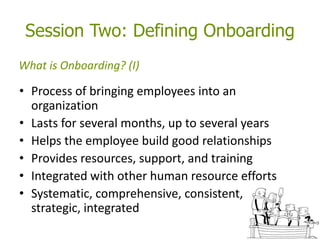
Session Two: Defining Onboarding
• Process of bringing employees into an
organization
• Lasts for several months, up to several years
• Helps the employee build good relationships
• Provides resources, support, and training
• Integrated with other human resource efforts
• Systematic, comprehensive, consistent,
strategic, integrated
What is Onboarding? (I)
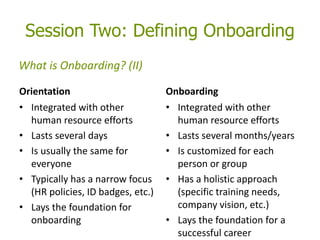
Orientation
• Integrated with other
human resource efforts
• Lasts several days
• Is usually the same for
everyone
• Typically has a narrow focus
(HR policies, ID badges, etc.)
• Lays the foundation for
onboarding
Onboarding
• Integrated with other
human resource efforts
• Lasts several months/years
• Is customized for each
person or group
• Has a holistic approach
(specific training needs,
company vision, etc.)
• Lays the foundation for a
successful career
Session Two: Defining Onboarding
What is Onboarding? (II)
Session Two: Defining Onboarding
What is Onboarding? (III)
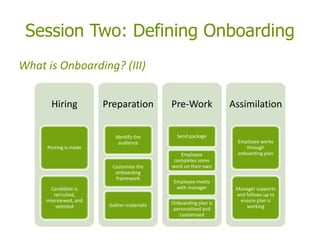
Hiring
Posting is made
Candidate is
recruited,
interviewed, and
selected
Preparation
Identify the
audience
Customize the
onboarding
framework
Gather materialls
Pre-Work
Send package
Employee
completes some
work on their own
Employee meets
with manager
Onboarding plan is
personalized and
customized
Assimilation
Employee works
through
onboarding plan
Manager supports
and follows up to
ensure plan is
working
Session Two: Defining Onboarding
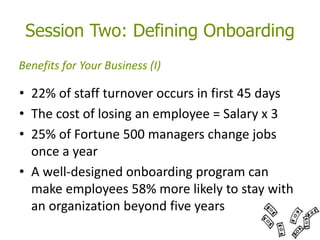
• 22% of staff turnover occurs in first 45 days
• The cost of losing an employee = Salary x 3
• 25% of Fortune 500 managers change jobs
once a year
• A well-designed onboarding program can
make employees 58% more likely to stay with
an organization beyond five years
Benefits for Your Business (I)
Session Two: Defining Onboarding
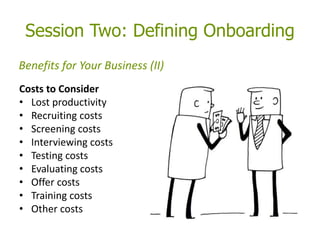
Costs to Consider
• Lost productivity
• Recruiting costs
• Screening costs
• Interviewing costs
• Testing costs
• Evaluating costs
• Offer costs
• Training costs
• Other costs
Benefits for Your Business (II)
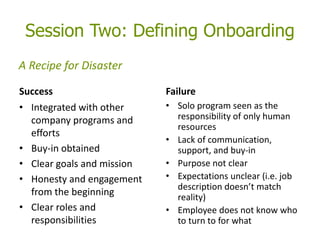
Success
• Integrated with other
company programs and
efforts
• Buy-in obtained
• Clear goals and mission
• Honesty and engagement
from the beginning
• Clear roles and
responsibilities
Failure
• Solo program seen as the
responsibility of only human
resources
• Lack of communication,
support, and buy-in
• Purpose not clear
• Expectations unclear (i.e. job
description doesn’t match
reality)
• Employee does not know who
to turn to for what
Session Two: Defining Onboarding
A Recipe for Disaster
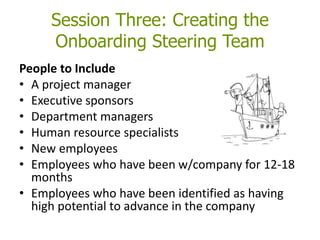
Session Three: Creating the
Onboarding Steering Team
People to Include
• A project manager
• Executive sponsors
• Department managers
• Human resource specialists
• New employees
• Employees who have been w/company for 12-18
months
• Employees who have been identified as having
high potential to advance in the company
Session Four:
Gathering Supporting Information
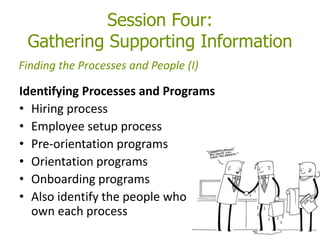
Identifying Processes and Programs
• Hiring process
• Employee setup process
• Pre-orientation programs
• Orientation programs
• Onboarding programs
• Also identify the people who
own each process
Finding the Processes and People (I)
Session Four:
Gathering Supporting Information
Vision Summary Questions
1. Currently our onboarding strategy looks like…
2. We typically hire ____ employees per year.
3. We would like to focus on these employees:
4. We are currently doing these things well: ________
5. We need to improve in these areas: ________
6. We would like our strategy to look like…
7. We are going to measure results by…
Finding the Processes and People (II)
Session Four:
Gathering Supporting Information
1. We do not currently have a strategy.
2. We typically hire 2 employees per year.
3. We would like to focus on these employees: Tour guides
4. We are currently doing these things well: Giving
employees an opportunity to shadow other guides
5. We need to improve in these areas: First day activities,
ongoing training
6. We would like our strategy to look like: A comprehensive
program covering the big picture
7. We are going to measure results by: Customer and
employee satisfaction ratings
Vision Summary Sample
Session Five: Setting Goals
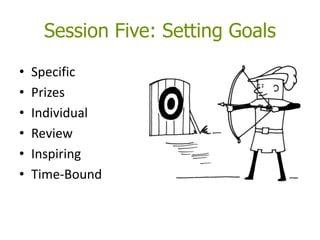
• Specific
• Prizes
• Individual
• Review
• Inspiring
• Time-Bound
Session Six:
Developing the Framework
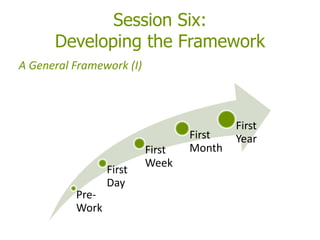
Pre-
Work
First
Day
First
Week
First
Month
First
Year
A General Framework (I)
Session Six:
Developing the Framework
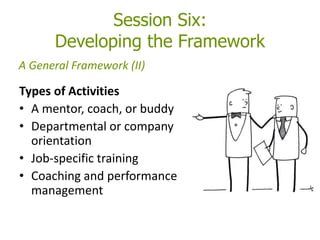
Types of Activities
• A mentor, coach, or buddy
• Departmental or company
orientation
• Job-specific training
• Coaching and performance
management
A General Framework (II)
Pre-work tasks for the manager:
• Completing internal hiring
processes
• Filling out paperwork
• Getting employees logon
information for the network
and security clearance
• Setting up their workspace
• Communicating the new
employee’s start date, who
they will be reporting to, and
their responsibilities
• Completing a draft onboarding
plan for the employee
Pre-work tasks for the employee:
• Filling out paperwork
• Doing self-paced training
• Reviewing job descriptions,
policies, procedures,
company reports, etc.
• Getting their personal life
settled so that they can
focus on the new job
• Completing a draft
onboarding plan
Session Six:
Developing the Framework
A General Framework (III)
Session Six:
Developing the Framework
• About a week before the employee is scheduled to
start, the manager sets up a meeting with the
employee to:
– Meet and greet
– Answer any questions that they employee has
– Review the onboarding plans and finalize it
• At this time, the manager should also provide a quick-
start guide for their first day: how to dress, where to
park, where to go, and what the day will look like.
A General Framework (IV)
Session Six:
Developing the Framework
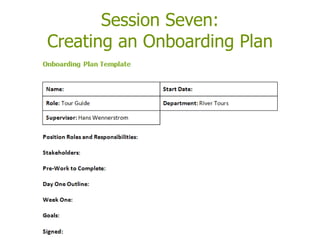
 Basic information such as the employee’s start date,
their role, their department, and their supervisor
 Two-line job description
 List of stakeholders that they will meet
 Summary of pre-work
 Summary of Day One and Week One events and tasks
 Training plan
 Goals for the first 30, 60, and 90 days
Creating an Onboarding Plan Template
Session Six:
Developing the Framework
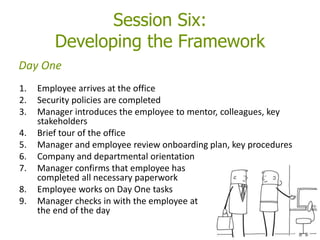
1. Employee arrives at the office
2. Security policies are completed
3. Manager introduces the employee to mentor, colleagues, key
stakeholders
4. Brief tour of the office
5. Manager and employee review onboarding plan, key procedures
6. Company and departmental orientation
7. Manager confirms that employee has
completed all necessary paperwork
8. Employee works on Day One tasks
9. Manager checks in with the employee at
the end of the day
Day One
Session Six:
Developing the Framework
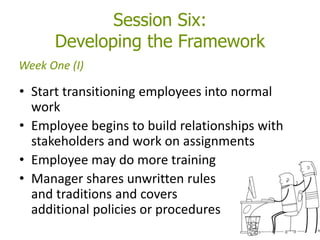
• Start transitioning employees into normal
work
• Employee begins to build relationships with
stakeholders and work on assignments
• Employee may do more training
• Manager shares unwritten rules
and traditions and covers
additional policies or procedures
Week One (I)
Session Six:
Developing the Framework
Checking In
• Ask the employees’ colleagues, “How is Joe
doing?”
• Check in with the employee each day
• Informal onboarding review should take place
at end of the week
Week One (II)
Session Six:
Developing the Framework
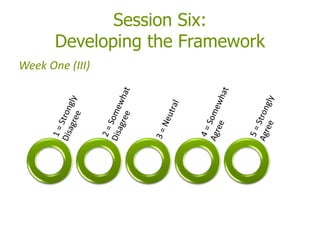
Week One (III)
Session Six:
Developing the Framework
Sample Evaluation Questions
• I feel that the onboarding plan has been useful during my
first week.
• I feel that I am fitting in well with my new team.
• So far, the position meets my expectations.
• The training that I have received so far has been useful.
• I had all the tools I needed on time.
• The tools that I received were useful.
• I have a good understanding of my department.
• I have a good understanding of my organization.
• I have reviewed all HR policies and signed all documents.
Week One (IV)
Session Six:
Developing the Framework
Useful Open-Ended Questions
• What was your favorite thing about this week?
• What was your least favorite thing about this
week?
• What would you change for future
employees?
• How would you rate your first week on a scale
of one (terrible) to ten (amazing)?
Week One (V)
Session Six:
Developing the Framework
• Work through onboarding plan
• Work with mentor, coach, or buddy to achieve goals
and complete assignments
• Adapt to their new role
• Build relationships with colleagues and stakeholders
• Complete training (if applicable)
• Check in with their manager at least once per week
• Bring any issues to their manager that they need help
resolving
Month One (I)
Session Six:
Developing the Framework
• Formal Review
• End of the first month
• Many types of reviews
• Prepare a short evaluation form
• Invite the employee, their coach, and any other
stakeholders
• Half-hour meeting
• All attendees complete the evaluation form
beforehand
• Check in with colleagues and other stakeholders
Month One (II)
Session Six:
Developing the Framework
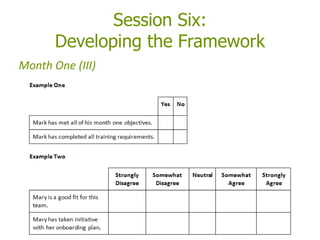
Month One (III)
Session Six:
Developing the Framework
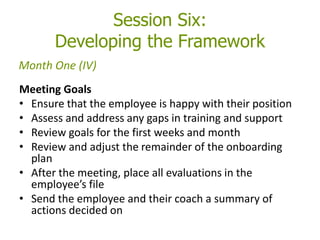
Meeting Goals
• Ensure that the employee is happy with their position
• Assess and address any gaps in training and support
• Review goals for the first weeks and month
• Review and adjust the remainder of the onboarding
plan
• After the meeting, place all evaluations in the
employee’s file
• Send the employee and their coach a summary of
actions decided on
Month One (IV)
Session Six:
Developing the Framework
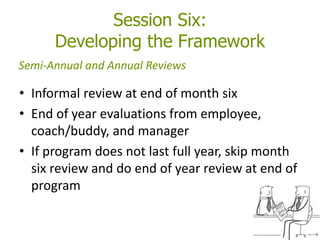
• Informal review at end of month six
• End of year evaluations from employee,
coach/buddy, and manager
• If program does not last full year, skip month
six review and do end of year review at end of
program
Semi-Annual and Annual Reviews
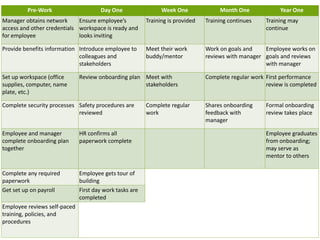
Pre-Work Day One Week One Month One Year One
Manager obtains network
access and other credentials
for employee
Ensure employee’s
workspace is ready and
looks inviting
Training is provided Training continues Training may
continue
Provide benefits information Introduce employee to
colleagues and
stakeholders
Meet their work
buddy/mentor
Work on goals and
reviews with manager
Employee works on
goals and reviews
with manager
Set up workspace (office
supplies, computer, name
plate, etc.)
Review onboarding plan Meet with
stakeholders
Complete regular work First performance
review is completed
Complete security processes Safety procedures are
reviewed
Complete regular
work
Shares onboarding
feedback with
manager
Formal onboarding
review takes place
Employee and manager
complete onboarding plan
together
HR confirms all
paperwork complete
Employee graduates
from onboarding;
may serve as
mentor to others
Complete any required
paperwork
Employee gets tour of
building
Get set up on payroll First day work tasks are
completed
Employee reviews self-paced
training, policies, and
procedures
Session Seven:
Creating an Onboarding Plan
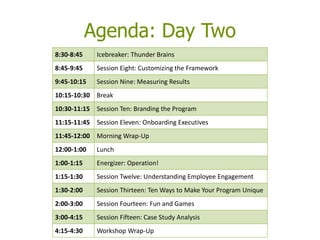
Agenda: Day Two
8:30-8:45 Icebreaker: Thunder Brains
8:45-9:45 Session Eight: Customizing the Framework
9:45-10:15 Session Nine: Measuring Results
10:15-10:30 Break
10:30-11:15 Session Ten: Branding the Program
11:15-11:45 Session Eleven: Onboarding Executives
11:45-12:00 Morning Wrap-Up
12:00-1:00 Lunch
1:00-1:15 Energizer: Operation!
1:15-1:30 Session Twelve: Understanding Employee Engagement
1:30-2:00 Session Thirteen: Ten Ways to Make Your Program Unique
2:00-3:00 Session Fourteen: Fun and Games
3:00-4:15 Session Fifteen: Case Study Analysis
4:15-4:30 Workshop Wrap-Up
Session Eight:
Customizing the Framework
• Pre-work
• First day
• First week
• First month
• Six month review (end of program)
Session Nine: Measuring Results
• Employee productivity
• Ramp-up time
• Employee turnover
• Employee satisfaction
• Customer satisfaction
• Employee engagement
• Safety metrics
• Compliance w/industry requirements
• Legal costs
• Job objectives
• Referrals from new employees
Measuring Metrics
Session Nine: Measuring Results
• Objective-specific surveys
• Feedback from the onboarding process (or
other business processes)
• Business documents
• Market analysis
• Data gathering and analysis
• Focus groups
Debrief
Session Ten: Branding the Program
A well-designed brand can:
• Make a strong statement about what the
onboarding program is
• Bring all elements of the onboarding program
together into one unified package
• Make your onboarding program instantly
recognizable
• Increase your competitive advantage by making
your recruiting program unique
Making the Onboarding Program All Your Own
Session Ten: Branding the Program
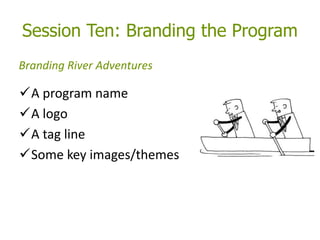
A program name
A logo
A tag line
Some key images/themes
Branding River Adventures
Session Eleven:
Onboarding Executives
• Two to five years long
• Leadership workshops
• Training in legal issues
• Hands-on guidance about the company policy
and culture
• More involvement from a mentor and the
board of directors
• Focused on company-wide goals
• Intensely focused on relationship building
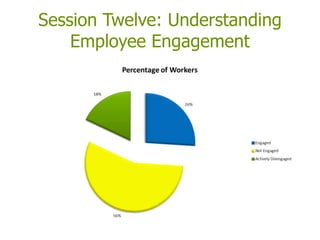
Session Twelve: Understanding
Employee Engagement
Session Twelve: Understanding
Employee Engagement
1. Connect with your employees
2. Give your employees the opportunity to advance their
career
3. Create a clear vision
4. Convey your vision, your expectations, and feedback
5. Congratulate employees when they make a contribution or
do something positive
6. Give employees a chance to contribute to the organization
7. Give employees control over their jobs as much as possible
8. Create a collaborative atmosphere
9. Ensure your company is credible and has a good reputation
10. Create confidence in your employees and in your company
Session Thirteen: Ten Ways to
Make Your Program Unique
1. Create a welcoming workspace
2. Free gifts
3. Lunch and learns
4. Tenderfoot teas
5. Virtual tools
6. Incorporate fun and games
7. Field trips
8. Hands-on activities
9. Skip meetings
10.Train the trainer
Session Fourteen: Fun and Games
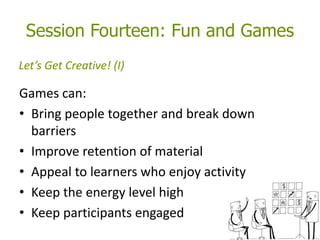
Games can:
• Bring people together and break down
barriers
• Improve retention of material
• Appeal to learners who enjoy activity
• Keep the energy level high
• Keep participants engaged
Let’s Get Creative! (I)
Session Fourteen: Fun and Games
• Different types of games and activities that serve different
purposes.
– Energizers
– Icebreakers
– Formal games
• Don’t select activities that would annoy you if you were a
participant.
• Adjust the length and type of game to suit the length of the
session.
• People who know each other very well will find some
exercises redundant.
• Don’t re-invent the wheel!
Let’s Get Creative! (II)
Session Fourteen: Fun and Games
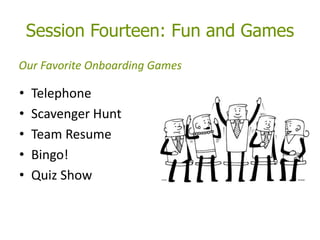
• Telephone
• Scavenger Hunt
• Team Resume
• Bingo!
• Quiz Show
Our Favorite Onboarding Games
Session Fifteen:
Case Study Analysis
1. Each participant will present their case study to
their small group.
2. Each small group will create a list of best
practices.
3. The small groups will reconvene.
4. Each small group will present their list.
5. The large group will create a final list of best
practices.
Group Case Studies
Session Fifteen:
Case Study Analysis
• Be consistent, systematic, comprehensive,
strategic, and integrated
• Tie in with the organization’s message and
mission
• Be customized for your organization, and then
customized for each audience and each individual
• Include pre-work, first day and week
assignments, goal setting, feedback, and follow
up
• Cover at least the employee’s probation period
Debrief

Onboarding: The Essential Rules for a Successful Onboarding Program

  • 1.
    Customizable Training Material Onboarding:The Essential Rules for a Successful Onboarding Program Fully Customizable Print on Demand Unlimited Number of Users No Annual Renewal Fees PowerPoint Slides
  • 2.
    Agenda: Day One 8:30-8:45Icebreaker: Shoe Closet 8:45-9:00 Session One: Course Overview 9:00-10:00 Session Two: Defining Onboarding 10:00-10:15 Break 10:15-10:30 Session Three: Creating the Onboarding Steering Team 10:30-11:30 Session Four: Gathering Supporting Information 11:30-11:45 Session Five: Setting Goals 11:45-12:00 Morning Wrap-Up 12:00-1:00 Lunch 1:00-1:15 Energizer: Packing a Picnic 1:15-3:45 Session Six: Developing the Program 3:45-4:15 Session Seven: A Personal Onboarding Plan 4:15-4:30 Day One Wrap-Up
  • 3.
    Session One: CourseOverview • Define onboarding and describe how it is different from orientation • Identify the business benefits of onboarding • List the factors that contribute to a successful onboarding program • Build a team to create an onboarding program • Prepare a vision statement and goals for an onboarding program • Design a framework for an onboarding program that includes program setup, various types of training, games, progress tracking, and follow-up • Customize your onboarding framework • Identify which metrics you should track to evaluate program results • Create a branded, unique program that will strengthen your company’s image and market position Learning Objectives
  • 4.
    Session Two: DefiningOnboarding • Process of bringing employees into an organization • Lasts for several months, up to several years • Helps the employee build good relationships • Provides resources, support, and training • Integrated with other human resource efforts • Systematic, comprehensive, consistent, strategic, integrated What is Onboarding? (I)
  • 5.
    Orientation • Integrated withother human resource efforts • Lasts several days • Is usually the same for everyone • Typically has a narrow focus (HR policies, ID badges, etc.) • Lays the foundation for onboarding Onboarding • Integrated with other human resource efforts • Lasts several months/years • Is customized for each person or group • Has a holistic approach (specific training needs, company vision, etc.) • Lays the foundation for a successful career Session Two: Defining Onboarding What is Onboarding? (II)
  • 6.
    Session Two: DefiningOnboarding What is Onboarding? (III) Hiring Posting is made Candidate is recruited, interviewed, and selected Preparation Identify the audience Customize the onboarding framework Gather materialls Pre-Work Send package Employee completes some work on their own Employee meets with manager Onboarding plan is personalized and customized Assimilation Employee works through onboarding plan Manager supports and follows up to ensure plan is working
  • 7.
    Session Two: DefiningOnboarding • 22% of staff turnover occurs in first 45 days • The cost of losing an employee = Salary x 3 • 25% of Fortune 500 managers change jobs once a year • A well-designed onboarding program can make employees 58% more likely to stay with an organization beyond five years Benefits for Your Business (I)
  • 8.
    Session Two: DefiningOnboarding Costs to Consider • Lost productivity • Recruiting costs • Screening costs • Interviewing costs • Testing costs • Evaluating costs • Offer costs • Training costs • Other costs Benefits for Your Business (II)
  • 9.
    Success • Integrated withother company programs and efforts • Buy-in obtained • Clear goals and mission • Honesty and engagement from the beginning • Clear roles and responsibilities Failure • Solo program seen as the responsibility of only human resources • Lack of communication, support, and buy-in • Purpose not clear • Expectations unclear (i.e. job description doesn’t match reality) • Employee does not know who to turn to for what Session Two: Defining Onboarding A Recipe for Disaster
  • 10.
    Session Three: Creatingthe Onboarding Steering Team People to Include • A project manager • Executive sponsors • Department managers • Human resource specialists • New employees • Employees who have been w/company for 12-18 months • Employees who have been identified as having high potential to advance in the company
  • 11.
    Session Four: Gathering SupportingInformation Identifying Processes and Programs • Hiring process • Employee setup process • Pre-orientation programs • Orientation programs • Onboarding programs • Also identify the people who own each process Finding the Processes and People (I)
  • 12.
    Session Four: Gathering SupportingInformation Vision Summary Questions 1. Currently our onboarding strategy looks like… 2. We typically hire ____ employees per year. 3. We would like to focus on these employees: 4. We are currently doing these things well: ________ 5. We need to improve in these areas: ________ 6. We would like our strategy to look like… 7. We are going to measure results by… Finding the Processes and People (II)
  • 13.
    Session Four: Gathering SupportingInformation 1. We do not currently have a strategy. 2. We typically hire 2 employees per year. 3. We would like to focus on these employees: Tour guides 4. We are currently doing these things well: Giving employees an opportunity to shadow other guides 5. We need to improve in these areas: First day activities, ongoing training 6. We would like our strategy to look like: A comprehensive program covering the big picture 7. We are going to measure results by: Customer and employee satisfaction ratings Vision Summary Sample
  • 14.
    Session Five: SettingGoals • Specific • Prizes • Individual • Review • Inspiring • Time-Bound
  • 15.
    Session Six: Developing theFramework Pre- Work First Day First Week First Month First Year A General Framework (I)
  • 16.
    Session Six: Developing theFramework Types of Activities • A mentor, coach, or buddy • Departmental or company orientation • Job-specific training • Coaching and performance management A General Framework (II)
  • 17.
    Pre-work tasks forthe manager: • Completing internal hiring processes • Filling out paperwork • Getting employees logon information for the network and security clearance • Setting up their workspace • Communicating the new employee’s start date, who they will be reporting to, and their responsibilities • Completing a draft onboarding plan for the employee Pre-work tasks for the employee: • Filling out paperwork • Doing self-paced training • Reviewing job descriptions, policies, procedures, company reports, etc. • Getting their personal life settled so that they can focus on the new job • Completing a draft onboarding plan Session Six: Developing the Framework A General Framework (III)
  • 18.
    Session Six: Developing theFramework • About a week before the employee is scheduled to start, the manager sets up a meeting with the employee to: – Meet and greet – Answer any questions that they employee has – Review the onboarding plans and finalize it • At this time, the manager should also provide a quick- start guide for their first day: how to dress, where to park, where to go, and what the day will look like. A General Framework (IV)
  • 19.
    Session Six: Developing theFramework  Basic information such as the employee’s start date, their role, their department, and their supervisor  Two-line job description  List of stakeholders that they will meet  Summary of pre-work  Summary of Day One and Week One events and tasks  Training plan  Goals for the first 30, 60, and 90 days Creating an Onboarding Plan Template
  • 20.
    Session Six: Developing theFramework 1. Employee arrives at the office 2. Security policies are completed 3. Manager introduces the employee to mentor, colleagues, key stakeholders 4. Brief tour of the office 5. Manager and employee review onboarding plan, key procedures 6. Company and departmental orientation 7. Manager confirms that employee has completed all necessary paperwork 8. Employee works on Day One tasks 9. Manager checks in with the employee at the end of the day Day One
  • 21.
    Session Six: Developing theFramework • Start transitioning employees into normal work • Employee begins to build relationships with stakeholders and work on assignments • Employee may do more training • Manager shares unwritten rules and traditions and covers additional policies or procedures Week One (I)
  • 22.
    Session Six: Developing theFramework Checking In • Ask the employees’ colleagues, “How is Joe doing?” • Check in with the employee each day • Informal onboarding review should take place at end of the week Week One (II)
  • 23.
    Session Six: Developing theFramework Week One (III)
  • 24.
    Session Six: Developing theFramework Sample Evaluation Questions • I feel that the onboarding plan has been useful during my first week. • I feel that I am fitting in well with my new team. • So far, the position meets my expectations. • The training that I have received so far has been useful. • I had all the tools I needed on time. • The tools that I received were useful. • I have a good understanding of my department. • I have a good understanding of my organization. • I have reviewed all HR policies and signed all documents. Week One (IV)
  • 25.
    Session Six: Developing theFramework Useful Open-Ended Questions • What was your favorite thing about this week? • What was your least favorite thing about this week? • What would you change for future employees? • How would you rate your first week on a scale of one (terrible) to ten (amazing)? Week One (V)
  • 26.
    Session Six: Developing theFramework • Work through onboarding plan • Work with mentor, coach, or buddy to achieve goals and complete assignments • Adapt to their new role • Build relationships with colleagues and stakeholders • Complete training (if applicable) • Check in with their manager at least once per week • Bring any issues to their manager that they need help resolving Month One (I)
  • 27.
    Session Six: Developing theFramework • Formal Review • End of the first month • Many types of reviews • Prepare a short evaluation form • Invite the employee, their coach, and any other stakeholders • Half-hour meeting • All attendees complete the evaluation form beforehand • Check in with colleagues and other stakeholders Month One (II)
  • 28.
    Session Six: Developing theFramework Month One (III)
  • 29.
    Session Six: Developing theFramework Meeting Goals • Ensure that the employee is happy with their position • Assess and address any gaps in training and support • Review goals for the first weeks and month • Review and adjust the remainder of the onboarding plan • After the meeting, place all evaluations in the employee’s file • Send the employee and their coach a summary of actions decided on Month One (IV)
  • 30.
    Session Six: Developing theFramework • Informal review at end of month six • End of year evaluations from employee, coach/buddy, and manager • If program does not last full year, skip month six review and do end of year review at end of program Semi-Annual and Annual Reviews
  • 31.
    Pre-Work Day OneWeek One Month One Year One Manager obtains network access and other credentials for employee Ensure employee’s workspace is ready and looks inviting Training is provided Training continues Training may continue Provide benefits information Introduce employee to colleagues and stakeholders Meet their work buddy/mentor Work on goals and reviews with manager Employee works on goals and reviews with manager Set up workspace (office supplies, computer, name plate, etc.) Review onboarding plan Meet with stakeholders Complete regular work First performance review is completed Complete security processes Safety procedures are reviewed Complete regular work Shares onboarding feedback with manager Formal onboarding review takes place Employee and manager complete onboarding plan together HR confirms all paperwork complete Employee graduates from onboarding; may serve as mentor to others Complete any required paperwork Employee gets tour of building Get set up on payroll First day work tasks are completed Employee reviews self-paced training, policies, and procedures
  • 32.
  • 33.
    Agenda: Day Two 8:30-8:45Icebreaker: Thunder Brains 8:45-9:45 Session Eight: Customizing the Framework 9:45-10:15 Session Nine: Measuring Results 10:15-10:30 Break 10:30-11:15 Session Ten: Branding the Program 11:15-11:45 Session Eleven: Onboarding Executives 11:45-12:00 Morning Wrap-Up 12:00-1:00 Lunch 1:00-1:15 Energizer: Operation! 1:15-1:30 Session Twelve: Understanding Employee Engagement 1:30-2:00 Session Thirteen: Ten Ways to Make Your Program Unique 2:00-3:00 Session Fourteen: Fun and Games 3:00-4:15 Session Fifteen: Case Study Analysis 4:15-4:30 Workshop Wrap-Up
  • 34.
    Session Eight: Customizing theFramework • Pre-work • First day • First week • First month • Six month review (end of program)
  • 35.
    Session Nine: MeasuringResults • Employee productivity • Ramp-up time • Employee turnover • Employee satisfaction • Customer satisfaction • Employee engagement • Safety metrics • Compliance w/industry requirements • Legal costs • Job objectives • Referrals from new employees Measuring Metrics
  • 36.
    Session Nine: MeasuringResults • Objective-specific surveys • Feedback from the onboarding process (or other business processes) • Business documents • Market analysis • Data gathering and analysis • Focus groups Debrief
  • 37.
    Session Ten: Brandingthe Program A well-designed brand can: • Make a strong statement about what the onboarding program is • Bring all elements of the onboarding program together into one unified package • Make your onboarding program instantly recognizable • Increase your competitive advantage by making your recruiting program unique Making the Onboarding Program All Your Own
  • 38.
    Session Ten: Brandingthe Program A program name A logo A tag line Some key images/themes Branding River Adventures
  • 39.
    Session Eleven: Onboarding Executives •Two to five years long • Leadership workshops • Training in legal issues • Hands-on guidance about the company policy and culture • More involvement from a mentor and the board of directors • Focused on company-wide goals • Intensely focused on relationship building
  • 40.
  • 41.
    Session Twelve: Understanding EmployeeEngagement 1. Connect with your employees 2. Give your employees the opportunity to advance their career 3. Create a clear vision 4. Convey your vision, your expectations, and feedback 5. Congratulate employees when they make a contribution or do something positive 6. Give employees a chance to contribute to the organization 7. Give employees control over their jobs as much as possible 8. Create a collaborative atmosphere 9. Ensure your company is credible and has a good reputation 10. Create confidence in your employees and in your company
  • 42.
    Session Thirteen: TenWays to Make Your Program Unique 1. Create a welcoming workspace 2. Free gifts 3. Lunch and learns 4. Tenderfoot teas 5. Virtual tools 6. Incorporate fun and games 7. Field trips 8. Hands-on activities 9. Skip meetings 10.Train the trainer
  • 43.
    Session Fourteen: Funand Games Games can: • Bring people together and break down barriers • Improve retention of material • Appeal to learners who enjoy activity • Keep the energy level high • Keep participants engaged Let’s Get Creative! (I)
  • 44.
    Session Fourteen: Funand Games • Different types of games and activities that serve different purposes. – Energizers – Icebreakers – Formal games • Don’t select activities that would annoy you if you were a participant. • Adjust the length and type of game to suit the length of the session. • People who know each other very well will find some exercises redundant. • Don’t re-invent the wheel! Let’s Get Creative! (II)
  • 45.
    Session Fourteen: Funand Games • Telephone • Scavenger Hunt • Team Resume • Bingo! • Quiz Show Our Favorite Onboarding Games
  • 46.
    Session Fifteen: Case StudyAnalysis 1. Each participant will present their case study to their small group. 2. Each small group will create a list of best practices. 3. The small groups will reconvene. 4. Each small group will present their list. 5. The large group will create a final list of best practices. Group Case Studies
  • 47.
    Session Fifteen: Case StudyAnalysis • Be consistent, systematic, comprehensive, strategic, and integrated • Tie in with the organization’s message and mission • Be customized for your organization, and then customized for each audience and each individual • Include pre-work, first day and week assignments, goal setting, feedback, and follow up • Cover at least the employee’s probation period Debrief

Editor's Notes

  • #6 In other words, orientation gets the employee off on the right foot, while onboarding guides them on the journey.
  • #11 This committee should meet yearly to review the program, look at feedback submitted, and make changes and updates as necessary. You’ll want to keep the program fresh, up-to-date, and in line with organizational and industry changes.
  • #25 Don’t forget to review the onboarding plan, particularly their day one tasks and week one goals.