Wireless Charging
Seminar Presentation
Presented by Swapnil Nagpure , Rajrshi Shahu College, Buldana
Introduction to Wireless Charging
1 What is Wireless Charging?
Wireless charging is the process of transferring electrical
power from a power source to a device without the use of
physical cables or wires.
2 Significance
Wireless charging offers increased convenience, reduced
clutter, and improved device portability compared to
traditional wired charging.
History of Wireless Charging
1 Early Concepts
The idea of wireless power transmission was pioneered by
Nikola Tesla in the late 19th century.
2 Technological Advancements
Over the years, various technologies have been developed to
enable practical wireless charging applications.
3 Modern Applications
Wireless charging is now widely used in consumer
electronics, electric vehicles, and industrial applications.
How Wireless Charging Works
Basic Principle
Wireless charging relies on the principle of electromagnetic
induction to transfer energy without physical contact between
the power source and the device.
Energy Transfer
The transmitter coil in the charging station generates an
alternating electromagnetic field, which induces a current in the
receiver coil of the device, allowing it to charge.
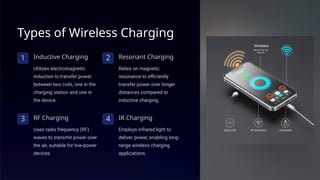
Types of Wireless Charging
1 Inductive Charging
Utilizes electromagnetic
induction to transfer power
between two coils, one in the
charging station and one in
the device.
2 Resonant Charging
Relies on magnetic
resonance to efficiently
transfer power over longer
distances compared to
inductive charging.
3 RF Charging
Uses radio frequency (RF)
waves to transmit power over
the air, suitable for low-power
devices.
4 IR Charging
Employs infrared light to
deliver power, enabling long-
range wireless charging
applications.
Inductive Charging Technology
How it Works
Inductive charging uses two coils, one in the charging station
(transmitter) and one in the device (receiver). An alternating
current in the transmitter coil generates a magnetic field, which
induces a current in the receiver coil, allowing the device to
charge.
Key Components
The transmitter coil generates the magnetic field, while the
receiver coil in the device converts the magnetic field back into
an electric current to charge the battery.
Resonant Wireless Charging
How it Works
Resonant charging uses two coils that are tuned to the same
resonant frequency, allowing for more efficient power transfer
over longer distances compared to inductive charging.
Benefits
Resonant charging can maintain high efficiency even when the
alignment between the transmitter and receiver coils is not
perfect, providing greater flexibility in device placement.
RF Wireless Charging
Working Principle
RF wireless charging uses radio
frequency waves to transmit
power through the air, allowing
for small, low-power devices to
be charged without physical
contact.
Applications
RF charging is often used for
devices like wearables, remote
controls, and other small
electronics that require low-
power charging solutions.
Infrared (IR) Wireless
Charging
Working Principle
IR wireless charging uses infrared light to transmit power over
longer distances, making it suitable for applications that
require charging from a distance.
Long-Range Charging
The infrared beam can deliver power over several meters,
enabling charging of devices without the need for physical
contact or close proximity.
Magnetic Induction vs. Magnetic Resonance
Magnetic Induction Magnetic Resonance
Requires close proximity between transmitter and receiver
coils
Can maintain high efficiency over longer distances
Limited to short-range power transfer Enables longer-range wireless charging
Sensitive to coil misalignment Less sensitive to coil misalignment
Applications of
Wireless Charging
Wireless charging has revolutionized the way we power our devices, from
smartphones and mobile gadgets to electric vehicles and medical implants.
This innovative technology offers convenience, efficiency, and a clutter-free
experience across a wide range of applications.
Wireless Charging for Electric Vehicles (EVs)
Working Principle
Wireless EV charging uses electromagnetic induction to
transfer energy from a charging pad on the ground to a receiver
in the vehicle, eliminating the need for physical plugs.
Charging Infrastructure
Wireless charging stations are being deployed in homes,
workplaces, and public spaces to enable seamless, hands-free
charging for electric vehicles.
Wireless Charging in
Consumer Electronics
Smartphones and
Tablets
Wireless charging has become a
standard feature in many
flagship smartphones and
tablets, allowing users to simply
place their devices on a
charging pad for a convenient
power-up.
Laptops and Wearables
The potential for wireless
charging extends to laptops,
smartwatches, and other
wearable devices, as the
technology continues to evolve
and become more widely
adopted.
Wearable Devices and
Wireless Charging
Smartwatches
Wireless charging is crucial for
smartwatches, enabling seamless
and effortless power replenishment
without the need for physical ports
or cables.
Fitness Trackers
Wireless charging allows fitness
trackers and other wearable devices
to maintain their compact and sleek
designs while providing a
convenient charging solution.
Healthcare and Medical
Applications
1 Implantable Devices
Wireless charging enables
the powering of implantable
medical devices, such as
pacemakers and neural
stimulators, without the need
for invasive procedures.
2 Convenience and
Safety
Wireless charging in
healthcare settings improves
patient comfort and reduces
the risk of infection by
eliminating the need for
physical connections.
Advantages of Wireless
Charging
Convenience
Wireless charging eliminates
the need to physically plug in
devices, providing a seamless
and effortless charging
experience.
Durability
Wireless charging systems have
no physical connectors,
reducing wear and tear on the
devices and charging interfaces.
Challenges in Wireless
Charging
1 Efficiency
Wireless charging can
experience energy loss and
heat generation, leading to
lower overall efficiency
compared to wired charging.
2 Alignment
Precise positioning of the
device on the charging pad is
required for optimal power
transfer, which can be a
challenge for users.
Range Limitations
Short-Range
Current wireless charging technologies typically require the
device to be in close proximity to the charging pad, often
within a few centimeters.
Advancements
Researchers are exploring ways to increase the charging
range, such as using resonant inductive coupling and other
innovative techniques.
Future Potential
As the technology continues to evolve, the goal is to achieve
wireless charging over larger distances, providing even greater
convenience and flexibility.
Efficiency of Wireless Charging
Energy Loss
Wireless charging can experience energy losses due to factors
like electromagnetic field leakage and heat generation,
reducing the overall efficiency.
Comparison
While wired charging typically has higher efficiency,
advancements in wireless charging technology are steadily
improving the efficiency gap.
Standards for Wireless Charging
1
Qi Standard
The Qi standard, developed by the Wireless Power Consortium (WPC), is the
most widely adopted wireless charging technology for consumer electronics.
2
AirFuel Alliance
The AirFuel Alliance is another prominent standard, focusing on wireless
charging for a range of devices, including electric vehicles and industrial
applications.
3
Ongoing Development
As the wireless charging industry continues to evolve, these standards and
alliances are working to ensure interoperability and drive further
advancements.
Qi Wireless Charging
Technology
Qi is a popular wireless charging standard that allows devices to be charged
without physical contact. It uses magnetic induction to transfer power from
a charging pad to compatible smartphones, tablets, and other gadgets.
AirFuel Wireless Charging Standard
Overview
AirFuel is an alternative wireless charging standard that uses
resonant inductive coupling to transfer power over a distance
of several centimeters.
Differences from Qi
AirFuel offers higher power transfer, broader compatibility, and
the ability to charge multiple devices simultaneously, unlike the
more limited Qi standard.
Safety Concerns and
Mitigation
1 Electromagnetic
Exposure
Wireless charging devices
emit electromagnetic fields
that can raise safety
concerns about potential
health risks.
2 Safety Measures
Standards bodies have
implemented strict guidelines
to limit electromagnetic
exposure and ensure user
safety during wireless
charging.
Recent Developments and Research
Magnetic Resonance
Researchers are exploring magnetic resonance techniques to improve efficiency and range of
wireless power transfer.
Radio Frequency
Radio frequency-based wireless charging is being developed to enable over-the-air power delivery to
multiple devices.
Laser Power
Laser-based wireless charging is a promising approach for long-distance power transmission,
though safety remains a concern.
Wireless Charging for IoT
Devices
Seamless Integration
Wireless charging is well-suited
for the Internet of Things,
enabling seamless power
supply to a variety of connected
devices.
Smart Home
Applications
Wireless charging can power
smart home devices like
sensors, lighting, and
appliances without the need for
cables.
Energy Efficiency
Wireless charging can improve energy efficiency by reducing power
conversion losses and enabling smart power management.
Future Trends in Wireless
Charging
Mid-Range Charging
Advances in technologies like magnetic resonance are enabling
wireless charging over distances of several meters.
Over-the-Air Charging
Researchers are working on wireless power transmission over the
air, which could eventually charge devices without physical contact.
Dynamic Charging
Wireless charging while on the move, such as in electric vehicles, is
an emerging trend that could revolutionize mobility.
Environmental Impact
1 Energy Efficiency
Wireless charging can be
more energy-efficient than
traditional wired charging,
reducing overall power
consumption.
2 Sustainable Design
Wireless charging systems
are being designed with
sustainable materials and
manufacturing processes to
minimize environmental
impact.
Market Growth and Industry
Trends
Global Market Size $20.5 billion by 2026
Key Players Apple, Samsung, Qualcomm,
Energous, Powercast
Adoption Drivers Convenience, Increasing
Smartphone Penetration,
Government Initiatives
Barriers to Adoption
Efficiency Limitations
Wireless charging is generally less
efficient than wired charging, resulting in
higher power losses and heat
generation.
Technological Constraints
Issues like charging distance, device
alignment, and power output must be
overcome to drive widespread adoption.
Cost Concerns
Wireless charging systems are currently
more expensive than traditional wired
chargers, hindering mass market
adoption.
Conclusion
Wireless charging technology has made significant advancements in recent
years, with growing adoption across various industries. As the technology
continues to evolve, it promises to revolutionize the way we power our
devices, paving the way for a more convenient and sustainable future.

Wireless-Charging power point presentation .pptx

  • 1.
    Wireless Charging Seminar Presentation Presentedby Swapnil Nagpure , Rajrshi Shahu College, Buldana
  • 2.
    Introduction to WirelessCharging 1 What is Wireless Charging? Wireless charging is the process of transferring electrical power from a power source to a device without the use of physical cables or wires. 2 Significance Wireless charging offers increased convenience, reduced clutter, and improved device portability compared to traditional wired charging.
  • 3.
    History of WirelessCharging 1 Early Concepts The idea of wireless power transmission was pioneered by Nikola Tesla in the late 19th century. 2 Technological Advancements Over the years, various technologies have been developed to enable practical wireless charging applications. 3 Modern Applications Wireless charging is now widely used in consumer electronics, electric vehicles, and industrial applications.
  • 4.
    How Wireless ChargingWorks Basic Principle Wireless charging relies on the principle of electromagnetic induction to transfer energy without physical contact between the power source and the device. Energy Transfer The transmitter coil in the charging station generates an alternating electromagnetic field, which induces a current in the receiver coil of the device, allowing it to charge.
  • 5.
    Types of WirelessCharging 1 Inductive Charging Utilizes electromagnetic induction to transfer power between two coils, one in the charging station and one in the device. 2 Resonant Charging Relies on magnetic resonance to efficiently transfer power over longer distances compared to inductive charging. 3 RF Charging Uses radio frequency (RF) waves to transmit power over the air, suitable for low-power devices. 4 IR Charging Employs infrared light to deliver power, enabling long- range wireless charging applications.
  • 6.
    Inductive Charging Technology Howit Works Inductive charging uses two coils, one in the charging station (transmitter) and one in the device (receiver). An alternating current in the transmitter coil generates a magnetic field, which induces a current in the receiver coil, allowing the device to charge. Key Components The transmitter coil generates the magnetic field, while the receiver coil in the device converts the magnetic field back into an electric current to charge the battery.
  • 7.
    Resonant Wireless Charging Howit Works Resonant charging uses two coils that are tuned to the same resonant frequency, allowing for more efficient power transfer over longer distances compared to inductive charging. Benefits Resonant charging can maintain high efficiency even when the alignment between the transmitter and receiver coils is not perfect, providing greater flexibility in device placement.
  • 8.
    RF Wireless Charging WorkingPrinciple RF wireless charging uses radio frequency waves to transmit power through the air, allowing for small, low-power devices to be charged without physical contact. Applications RF charging is often used for devices like wearables, remote controls, and other small electronics that require low- power charging solutions.
  • 9.
    Infrared (IR) Wireless Charging WorkingPrinciple IR wireless charging uses infrared light to transmit power over longer distances, making it suitable for applications that require charging from a distance. Long-Range Charging The infrared beam can deliver power over several meters, enabling charging of devices without the need for physical contact or close proximity.
  • 10.
    Magnetic Induction vs.Magnetic Resonance Magnetic Induction Magnetic Resonance Requires close proximity between transmitter and receiver coils Can maintain high efficiency over longer distances Limited to short-range power transfer Enables longer-range wireless charging Sensitive to coil misalignment Less sensitive to coil misalignment
  • 11.
    Applications of Wireless Charging Wirelesscharging has revolutionized the way we power our devices, from smartphones and mobile gadgets to electric vehicles and medical implants. This innovative technology offers convenience, efficiency, and a clutter-free experience across a wide range of applications.
  • 12.
    Wireless Charging forElectric Vehicles (EVs) Working Principle Wireless EV charging uses electromagnetic induction to transfer energy from a charging pad on the ground to a receiver in the vehicle, eliminating the need for physical plugs. Charging Infrastructure Wireless charging stations are being deployed in homes, workplaces, and public spaces to enable seamless, hands-free charging for electric vehicles.
  • 13.
    Wireless Charging in ConsumerElectronics Smartphones and Tablets Wireless charging has become a standard feature in many flagship smartphones and tablets, allowing users to simply place their devices on a charging pad for a convenient power-up. Laptops and Wearables The potential for wireless charging extends to laptops, smartwatches, and other wearable devices, as the technology continues to evolve and become more widely adopted.
  • 14.
    Wearable Devices and WirelessCharging Smartwatches Wireless charging is crucial for smartwatches, enabling seamless and effortless power replenishment without the need for physical ports or cables. Fitness Trackers Wireless charging allows fitness trackers and other wearable devices to maintain their compact and sleek designs while providing a convenient charging solution.
  • 15.
    Healthcare and Medical Applications 1Implantable Devices Wireless charging enables the powering of implantable medical devices, such as pacemakers and neural stimulators, without the need for invasive procedures. 2 Convenience and Safety Wireless charging in healthcare settings improves patient comfort and reduces the risk of infection by eliminating the need for physical connections.
  • 16.
    Advantages of Wireless Charging Convenience Wirelesscharging eliminates the need to physically plug in devices, providing a seamless and effortless charging experience. Durability Wireless charging systems have no physical connectors, reducing wear and tear on the devices and charging interfaces.
  • 17.
    Challenges in Wireless Charging 1Efficiency Wireless charging can experience energy loss and heat generation, leading to lower overall efficiency compared to wired charging. 2 Alignment Precise positioning of the device on the charging pad is required for optimal power transfer, which can be a challenge for users.
  • 18.
    Range Limitations Short-Range Current wirelesscharging technologies typically require the device to be in close proximity to the charging pad, often within a few centimeters. Advancements Researchers are exploring ways to increase the charging range, such as using resonant inductive coupling and other innovative techniques. Future Potential As the technology continues to evolve, the goal is to achieve wireless charging over larger distances, providing even greater convenience and flexibility.
  • 19.
    Efficiency of WirelessCharging Energy Loss Wireless charging can experience energy losses due to factors like electromagnetic field leakage and heat generation, reducing the overall efficiency. Comparison While wired charging typically has higher efficiency, advancements in wireless charging technology are steadily improving the efficiency gap.
  • 20.
    Standards for WirelessCharging 1 Qi Standard The Qi standard, developed by the Wireless Power Consortium (WPC), is the most widely adopted wireless charging technology for consumer electronics. 2 AirFuel Alliance The AirFuel Alliance is another prominent standard, focusing on wireless charging for a range of devices, including electric vehicles and industrial applications. 3 Ongoing Development As the wireless charging industry continues to evolve, these standards and alliances are working to ensure interoperability and drive further advancements.
  • 21.
    Qi Wireless Charging Technology Qiis a popular wireless charging standard that allows devices to be charged without physical contact. It uses magnetic induction to transfer power from a charging pad to compatible smartphones, tablets, and other gadgets.
  • 22.
    AirFuel Wireless ChargingStandard Overview AirFuel is an alternative wireless charging standard that uses resonant inductive coupling to transfer power over a distance of several centimeters. Differences from Qi AirFuel offers higher power transfer, broader compatibility, and the ability to charge multiple devices simultaneously, unlike the more limited Qi standard.
  • 23.
    Safety Concerns and Mitigation 1Electromagnetic Exposure Wireless charging devices emit electromagnetic fields that can raise safety concerns about potential health risks. 2 Safety Measures Standards bodies have implemented strict guidelines to limit electromagnetic exposure and ensure user safety during wireless charging.
  • 24.
    Recent Developments andResearch Magnetic Resonance Researchers are exploring magnetic resonance techniques to improve efficiency and range of wireless power transfer. Radio Frequency Radio frequency-based wireless charging is being developed to enable over-the-air power delivery to multiple devices. Laser Power Laser-based wireless charging is a promising approach for long-distance power transmission, though safety remains a concern.
  • 25.
    Wireless Charging forIoT Devices Seamless Integration Wireless charging is well-suited for the Internet of Things, enabling seamless power supply to a variety of connected devices. Smart Home Applications Wireless charging can power smart home devices like sensors, lighting, and appliances without the need for cables. Energy Efficiency Wireless charging can improve energy efficiency by reducing power conversion losses and enabling smart power management.
  • 26.
    Future Trends inWireless Charging Mid-Range Charging Advances in technologies like magnetic resonance are enabling wireless charging over distances of several meters. Over-the-Air Charging Researchers are working on wireless power transmission over the air, which could eventually charge devices without physical contact. Dynamic Charging Wireless charging while on the move, such as in electric vehicles, is an emerging trend that could revolutionize mobility.
  • 27.
    Environmental Impact 1 EnergyEfficiency Wireless charging can be more energy-efficient than traditional wired charging, reducing overall power consumption. 2 Sustainable Design Wireless charging systems are being designed with sustainable materials and manufacturing processes to minimize environmental impact.
  • 28.
    Market Growth andIndustry Trends Global Market Size $20.5 billion by 2026 Key Players Apple, Samsung, Qualcomm, Energous, Powercast Adoption Drivers Convenience, Increasing Smartphone Penetration, Government Initiatives
  • 29.
    Barriers to Adoption EfficiencyLimitations Wireless charging is generally less efficient than wired charging, resulting in higher power losses and heat generation. Technological Constraints Issues like charging distance, device alignment, and power output must be overcome to drive widespread adoption. Cost Concerns Wireless charging systems are currently more expensive than traditional wired chargers, hindering mass market adoption.
  • 30.
    Conclusion Wireless charging technologyhas made significant advancements in recent years, with growing adoption across various industries. As the technology continues to evolve, it promises to revolutionize the way we power our devices, paving the way for a more convenient and sustainable future.