SREE DATTHA GROUP OF INSTITUTIONS
Sheriguda (v),ibrahimpatnam(M),Telangana ,501510
DEPARTMENT OF ELECTRONICS AND COMMUNICATION ENGINEERING
SEMINAR ON
WIRELESS CHARGING SYSTEM
Presented by
N. Saikiran
(209P1A0406)
❖Content
➢ What is wireless charging ?
➢ components of wireless charging
▪ Transmitter
▪ Receiver
▪ Rectenna
➢ How it works ?
➢ Methods of charging
▪ Resonance
▪ Inductive
▪ Radio
➢ Applications
➢ Advantages
➢ Disadvantages
➢ Conclusion
❖ What is wireless charging?
➢ Wireles charging is one of the several methods of charging batteries without the use of
cable or device specific AC adaptors.
➢ Wireless charging can be used for a wide variety of devices including cell phones laptop
computers and MP3 players as well as larger objects such as robots and electric cars.
➢ Wireless charging is the transfer of power from a power outlet to your
device, without the need for a connecting cable.
➢ Wireless charging uses electromagnetic fields to safely transfer power from a
transmitting source to a receving device for the purposes of charging a battery.
❖Components of wireless charging
▪ Transmitter
▪ Receiver
▪ Rectenna
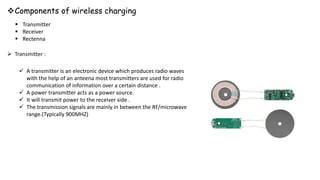
➢ Transmitter :
✓ A transmitter is an electronic device which produces radio waves
with the help of an anteena most transmitters are used for radio
communication of information over a certain distance .
✓ A power transmitter acts as a power source.
✓ It will transmit power to the receiver side .
✓ The transmission signals are mainly in between the RF/microwave
range.(Typically 900MHZ)
➢ Receiver :
✓ A receiver is the device that receives the message .it can be a
computer ,workstation ,telephone handset ,television.
✓ A device that receives electrical sinals ,waves .as the part of a
telephone held to the ear ,a radio receiving set or a television
receiving set.
✓ For charging AC signal (microwave signal with a typical value of
900 MHZ) is taken and fed to a rectifier circuit to get a D.C signal.
❖How it works?
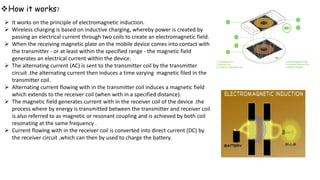
➢ It works on the principle of electromagnetic induction.
➢ Wireless charging is based on inductive charging, whereby power is created by
passing an electrical current through two coils to create an electromagnetic field.
➢ When the receiving magnetic plate on the mobile device comes into contact with
the transmitter - or at least within the specified range - the magnetic field
generates an electrical current within the device.
➢ The alternating current (AC) is sent to the transmitter coil by the transmitter
circuit .the alternating current then induces a time varying magnetic filed in the
transmitter coil.
➢ Alternating current flowing with in the transmitter coil induces a magnetic field
which extends to the receiver coil (when with in a specified distance).
➢ The magnetic field generates current with in the receiver coil of the device .the
process where by energy is transmitted between the transmitter and receiver coil
is also referred to as magnetic or resonant coupling and is achieved by both coil
resonating at the same frequency .
➢ Current flowing with in the receiver coil is converted into direct current (DC) by
the receiver circuit ,which can then by used to charge the battery.
❖ Types of charging:
➢ Resonance charging .
✓ It uses phenomenon of ‘RESONANCE’ that causes
an object to vibrate when energy of certain
frequency is applied.
✓ Two copper coils are used one attached to
transmitter and another to receiver .
✓ Both coils are tuned to same electromagnetic
frequency.
✓ These coils are placed close to one another
power is transferred.
➢ Inductive charging .
✓ Inductive charging is one kind of short distance
wireless charging.
✓ This method works on the principle of
‘ELECTROMAGNETIC INDUCTION’ where the
charger device will create an E.M field with
alternating polarity using a coil of insulated copper
wire & a similar coil will be placed inside the mobile
device which will convert E.M field back to electric
current there by charging the battery.
➢ Radio charging .
✓ This method is on the basis that radio waves are widely in use of
to transmit and receive cellular telephone , television ,radio and
wi-fi.
✓ A radio wave once transmitted ,propagates in all directions until it
reaches an antenna tuned to proper frequency to receive it.
✓ A transmitter plugged in to a socket ,generates radio waves ,when
the receiver attached to the device is set to the same frequency
as the transmitter ,it will charge the devices battery.
❖ Applications:
➢ Electric cars.
➢ Laptops.
➢ Mobiles.
➢ Robots.
➢ Home appliances
➢ Watches.
➢A safe way to transfer power to your phone.
➢We can save time for charging mobiles.
➢Puts less strain on the charging port of your phone.
.
➢Wastage of power is less.
➢Charging of mobile phone is done wirelessly.
.
❖Advantages of wireless charging?
➢Wireless charging is usually slower than wired - plugging
into a wall outlet will be much quicker for a lot of devices,
particularly via USB-C.
➢If you've got your phone charging via a cable, you can still
hold it and use it as normal. If you take your phone off a
wireless charging pad to use it, it stops charging.
➢Not all phones have it.
❖Disadvantages of wireless charging?
❖Conclusions :
➢ Thus we understand the concepts of wireless charging .how this concept Is
useful to us ,and the types of wireless charging,its components. tcharging
will one day become a simple matter of dropping devices into the nearest
charging pad.
Thank you …

WIRELESS CHARGING SYSTEM ppt.pdf

  • 1.
    SREE DATTHA GROUPOF INSTITUTIONS Sheriguda (v),ibrahimpatnam(M),Telangana ,501510 DEPARTMENT OF ELECTRONICS AND COMMUNICATION ENGINEERING SEMINAR ON WIRELESS CHARGING SYSTEM Presented by N. Saikiran (209P1A0406)
  • 2.
    ❖Content ➢ What iswireless charging ? ➢ components of wireless charging ▪ Transmitter ▪ Receiver ▪ Rectenna ➢ How it works ? ➢ Methods of charging ▪ Resonance ▪ Inductive ▪ Radio ➢ Applications ➢ Advantages ➢ Disadvantages ➢ Conclusion
  • 3.
    ❖ What iswireless charging? ➢ Wireles charging is one of the several methods of charging batteries without the use of cable or device specific AC adaptors. ➢ Wireless charging can be used for a wide variety of devices including cell phones laptop computers and MP3 players as well as larger objects such as robots and electric cars. ➢ Wireless charging is the transfer of power from a power outlet to your device, without the need for a connecting cable. ➢ Wireless charging uses electromagnetic fields to safely transfer power from a transmitting source to a receving device for the purposes of charging a battery.
  • 4.
    ❖Components of wirelesscharging ▪ Transmitter ▪ Receiver ▪ Rectenna ➢ Transmitter : ✓ A transmitter is an electronic device which produces radio waves with the help of an anteena most transmitters are used for radio communication of information over a certain distance . ✓ A power transmitter acts as a power source. ✓ It will transmit power to the receiver side . ✓ The transmission signals are mainly in between the RF/microwave range.(Typically 900MHZ)
  • 5.
    ➢ Receiver : ✓A receiver is the device that receives the message .it can be a computer ,workstation ,telephone handset ,television. ✓ A device that receives electrical sinals ,waves .as the part of a telephone held to the ear ,a radio receiving set or a television receiving set. ✓ For charging AC signal (microwave signal with a typical value of 900 MHZ) is taken and fed to a rectifier circuit to get a D.C signal.
  • 6.
    ❖How it works? ➢It works on the principle of electromagnetic induction. ➢ Wireless charging is based on inductive charging, whereby power is created by passing an electrical current through two coils to create an electromagnetic field. ➢ When the receiving magnetic plate on the mobile device comes into contact with the transmitter - or at least within the specified range - the magnetic field generates an electrical current within the device. ➢ The alternating current (AC) is sent to the transmitter coil by the transmitter circuit .the alternating current then induces a time varying magnetic filed in the transmitter coil. ➢ Alternating current flowing with in the transmitter coil induces a magnetic field which extends to the receiver coil (when with in a specified distance). ➢ The magnetic field generates current with in the receiver coil of the device .the process where by energy is transmitted between the transmitter and receiver coil is also referred to as magnetic or resonant coupling and is achieved by both coil resonating at the same frequency . ➢ Current flowing with in the receiver coil is converted into direct current (DC) by the receiver circuit ,which can then by used to charge the battery.
  • 7.
    ❖ Types ofcharging: ➢ Resonance charging . ✓ It uses phenomenon of ‘RESONANCE’ that causes an object to vibrate when energy of certain frequency is applied. ✓ Two copper coils are used one attached to transmitter and another to receiver . ✓ Both coils are tuned to same electromagnetic frequency. ✓ These coils are placed close to one another power is transferred. ➢ Inductive charging . ✓ Inductive charging is one kind of short distance wireless charging. ✓ This method works on the principle of ‘ELECTROMAGNETIC INDUCTION’ where the charger device will create an E.M field with alternating polarity using a coil of insulated copper wire & a similar coil will be placed inside the mobile device which will convert E.M field back to electric current there by charging the battery.
  • 8.
    ➢ Radio charging. ✓ This method is on the basis that radio waves are widely in use of to transmit and receive cellular telephone , television ,radio and wi-fi. ✓ A radio wave once transmitted ,propagates in all directions until it reaches an antenna tuned to proper frequency to receive it. ✓ A transmitter plugged in to a socket ,generates radio waves ,when the receiver attached to the device is set to the same frequency as the transmitter ,it will charge the devices battery.
  • 9.
    ❖ Applications: ➢ Electriccars. ➢ Laptops. ➢ Mobiles. ➢ Robots. ➢ Home appliances ➢ Watches.
  • 10.
    ➢A safe wayto transfer power to your phone. ➢We can save time for charging mobiles. ➢Puts less strain on the charging port of your phone. . ➢Wastage of power is less. ➢Charging of mobile phone is done wirelessly. . ❖Advantages of wireless charging?
  • 11.
    ➢Wireless charging isusually slower than wired - plugging into a wall outlet will be much quicker for a lot of devices, particularly via USB-C. ➢If you've got your phone charging via a cable, you can still hold it and use it as normal. If you take your phone off a wireless charging pad to use it, it stops charging. ➢Not all phones have it. ❖Disadvantages of wireless charging?
  • 12.
    ❖Conclusions : ➢ Thuswe understand the concepts of wireless charging .how this concept Is useful to us ,and the types of wireless charging,its components. tcharging will one day become a simple matter of dropping devices into the nearest charging pad.
  • 13.