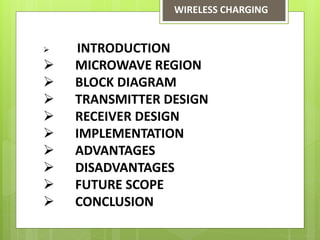
WIRELESS CHARGING
OF MOBILE PHONES
USING MICROWAVE
BY
PRIYANKA V
1ST SEM ,E & C , Mtech
PONDICHERRY UNIVERSITY
 INTRODUCTION
 MICROWAVE REGION
 BLOCK DIAGRAM
 TRANSMITTER DESIGN
 RECEIVER DESIGN
 IMPLEMENTATION
 ADVANTAGES
 DISADVANTAGES
 FUTURE SCOPE
 CONCLUSION
WIRELESS CHARGING
• Mobile phones becoming basic part of life
• Recharging of mobile phones is a big
problem
• Objective—to recharge any mobile phone
independent of manufacturer and battery
make
• Achieved by recharging battery while talking
using microwaves
INTRODUCTION
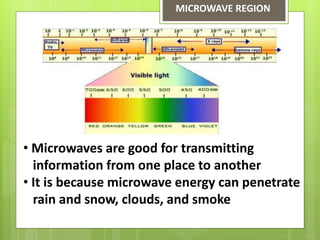
MICROWAVE REGION
• Microwaves are good for transmitting
information from one place to another
• It is because microwave energy can penetrate
rain and snow, clouds, and smoke
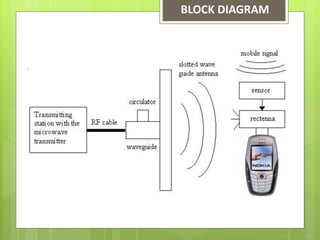
BLOCK DIAGRAM
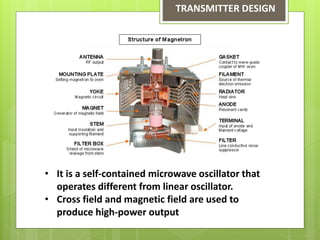
TRANSMITTER DESIGN
• It is a self-contained microwave oscillator that
operates different from linear oscillator.
• Cross field and magnetic field are used to
produce high-power output
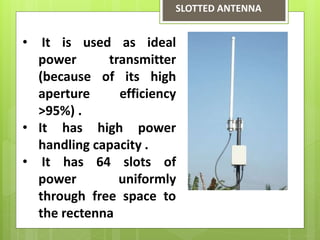
SLOTTED ANTENNA
• It is used as ideal
power transmitter
(because of its high
aperture efficiency
>95%) .
• It has high power
handling capacity .
• It has 64 slots of
power uniformly
through free space to
the rectenna
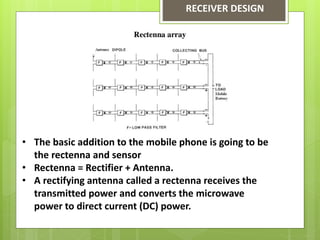
RECEIVER DESIGN
• The basic addition to the mobile phone is going to be
the rectenna and sensor
• Rectenna = Rectifier + Antenna.
• A rectifying antenna called a rectenna receives the
transmitted power and converts the microwave
power to direct current (DC) power.
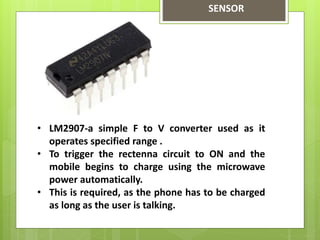
SENSOR
• LM2907-a simple F to V converter used as it
operates specified range .
• To trigger the rectenna circuit to ON and the
mobile begins to charge using the microwave
power automatically.
• This is required, as the phone has to be charged
as long as the user is talking.
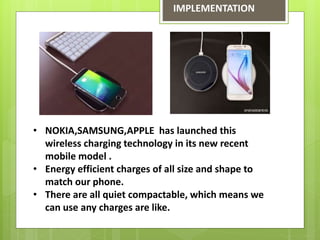
IMPLEMENTATION
• NOKIA,SAMSUNG,APPLE has launched this
wireless charging technology in its new recent
mobile model .
• Energy efficient charges of all size and shape to
match our phone.
• There are all quiet compactable, which means we
can use any charges are like.
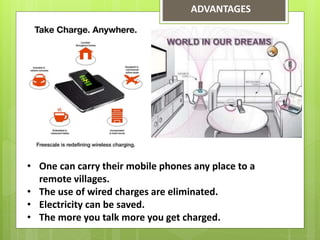
ADVANTAGES
• One can carry their mobile phones any place to a
remote villages.
• The use of wired charges are eliminated.
• Electricity can be saved.
• The more you talk more you get charged.
DISADVANTAGES
• Wireless transmission of the energy causes
some effects to human body, because of its
radiation.
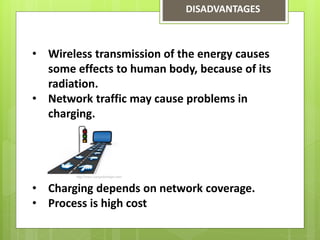
• Network traffic may cause problems in
charging.
• Charging depends on network coverage.
• Process is high cost
FUTURE SCOPE
• In future RECTENNA is used to produce large-scale power
from microwaves beam.
• This technology is also applicable for electronic gadgets
which works on batteries and thus save electricity.
• Currently researches are going on, to implement this
technology for laptops.
CONCLUSION
• A novel use of RECTENNA and a SANSOR in
mobile phone could provide a new
dimension in the revelation of mobile
phones.
• Thus a great advantage is to carry their
mobile phones to any place is devoid of
facilities for charging.
REFERENCE
• www.slideshare.com
• www.wikipedia.org
• www.seminarsonly.com
• Theodore .S.Rappaport, “Wireless
communications principles and practice”.

Wireless charger

  • 1.
    WIRELESS CHARGING OF MOBILEPHONES USING MICROWAVE BY PRIYANKA V 1ST SEM ,E & C , Mtech PONDICHERRY UNIVERSITY
  • 2.
     INTRODUCTION  MICROWAVEREGION  BLOCK DIAGRAM  TRANSMITTER DESIGN  RECEIVER DESIGN  IMPLEMENTATION  ADVANTAGES  DISADVANTAGES  FUTURE SCOPE  CONCLUSION WIRELESS CHARGING
  • 3.
    • Mobile phonesbecoming basic part of life • Recharging of mobile phones is a big problem • Objective—to recharge any mobile phone independent of manufacturer and battery make • Achieved by recharging battery while talking using microwaves INTRODUCTION
  • 4.
    MICROWAVE REGION • Microwavesare good for transmitting information from one place to another • It is because microwave energy can penetrate rain and snow, clouds, and smoke
  • 5.
  • 6.
    TRANSMITTER DESIGN • Itis a self-contained microwave oscillator that operates different from linear oscillator. • Cross field and magnetic field are used to produce high-power output
  • 7.
    SLOTTED ANTENNA • Itis used as ideal power transmitter (because of its high aperture efficiency >95%) . • It has high power handling capacity . • It has 64 slots of power uniformly through free space to the rectenna
  • 8.
    RECEIVER DESIGN • Thebasic addition to the mobile phone is going to be the rectenna and sensor • Rectenna = Rectifier + Antenna. • A rectifying antenna called a rectenna receives the transmitted power and converts the microwave power to direct current (DC) power.
  • 9.
    SENSOR • LM2907-a simpleF to V converter used as it operates specified range . • To trigger the rectenna circuit to ON and the mobile begins to charge using the microwave power automatically. • This is required, as the phone has to be charged as long as the user is talking.
  • 10.
    IMPLEMENTATION • NOKIA,SAMSUNG,APPLE haslaunched this wireless charging technology in its new recent mobile model . • Energy efficient charges of all size and shape to match our phone. • There are all quiet compactable, which means we can use any charges are like.
  • 11.
    ADVANTAGES • One cancarry their mobile phones any place to a remote villages. • The use of wired charges are eliminated. • Electricity can be saved. • The more you talk more you get charged.
  • 12.
    DISADVANTAGES • Wireless transmissionof the energy causes some effects to human body, because of its radiation. • Network traffic may cause problems in charging. • Charging depends on network coverage. • Process is high cost
  • 13.
    FUTURE SCOPE • Infuture RECTENNA is used to produce large-scale power from microwaves beam. • This technology is also applicable for electronic gadgets which works on batteries and thus save electricity. • Currently researches are going on, to implement this technology for laptops.
  • 14.
    CONCLUSION • A noveluse of RECTENNA and a SANSOR in mobile phone could provide a new dimension in the revelation of mobile phones. • Thus a great advantage is to carry their mobile phones to any place is devoid of facilities for charging.
  • 15.
    REFERENCE • www.slideshare.com • www.wikipedia.org •www.seminarsonly.com • Theodore .S.Rappaport, “Wireless communications principles and practice”.