New Frontiers in Ubiquitous
   Mobile Computing
    UT Austin Silicon Valley Event
                 March 6, 2013

  Robert Heath, Gustavo de Veciana, Jeff Andrews,
      Sriram Vishwanath, and Ahmed Tewfik

     Wireless Networking and Communications Group
                   http://www.wncg.org
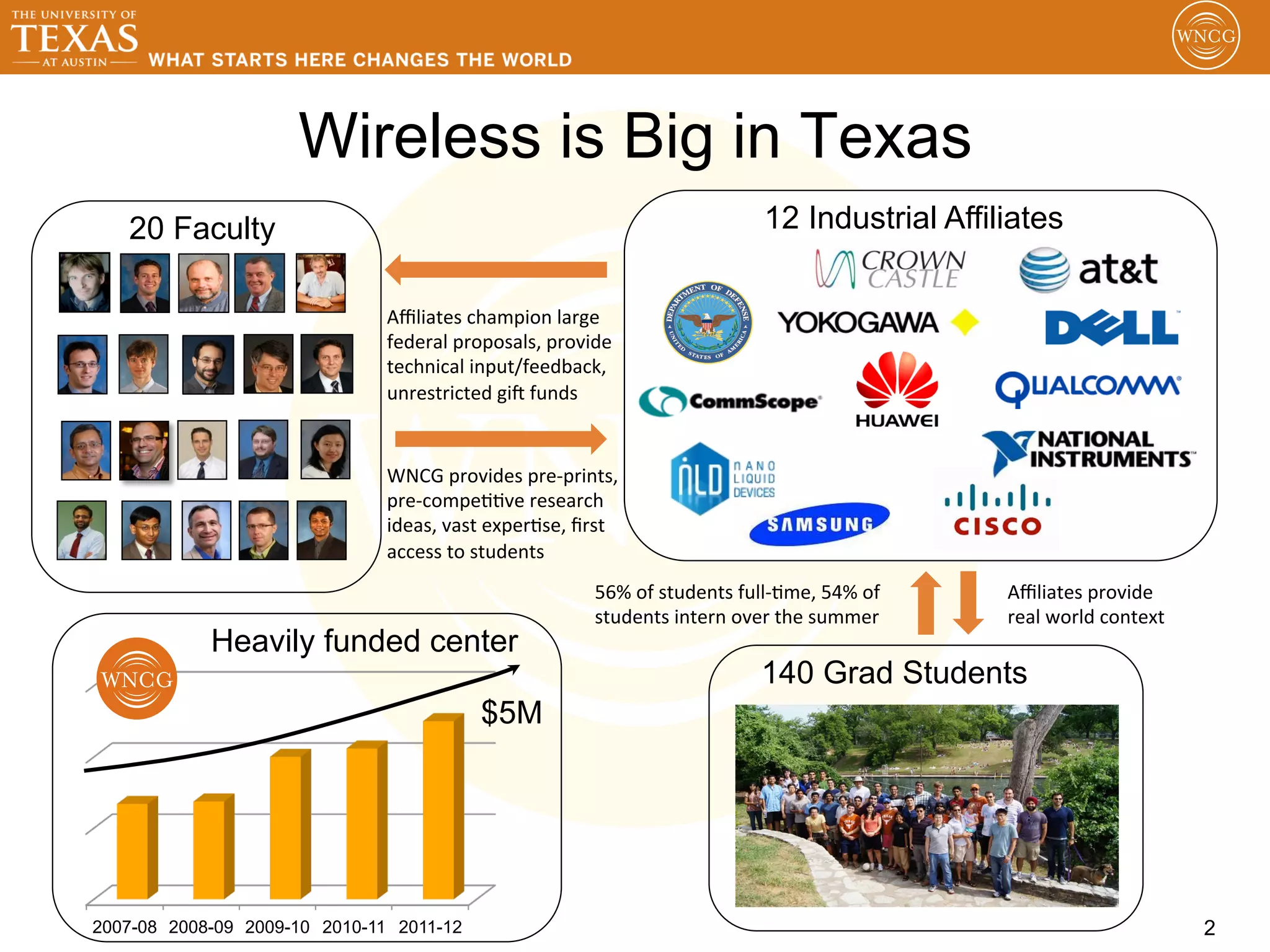
Wireless is Big in Texas
   20 Faculty                                                                                  12 Industrial Affiliates


                               Affiliates	
  champion	
  large	
  
                               federal	
  proposals,	
  provide	
  
                               technical	
  input/feedback,	
  
                               unrestricted	
  gi:	
  funds	


                               WNCG	
  provides	
  pre-­‐prints,	
  
                               pre-­‐compe@@ve	
  research	
  
                               ideas,	
  vast	
  exper@se,	
  first	
  
                               access	
  to	
  students	
  
                                                                 56%	
  of	
  students	
  full-­‐@me,	
  54%	
  of	
     Affiliates	
  provide	
  
                                                                 students	
  intern	
  over	
  the	
  summer	
           real	
  world	
  context	
  
            Heavily funded center
                                                                                               140 Grad Students
                                              $5M


2007-08 2008-09 2009-10 2010-11 2011-12                                                                                                                 2
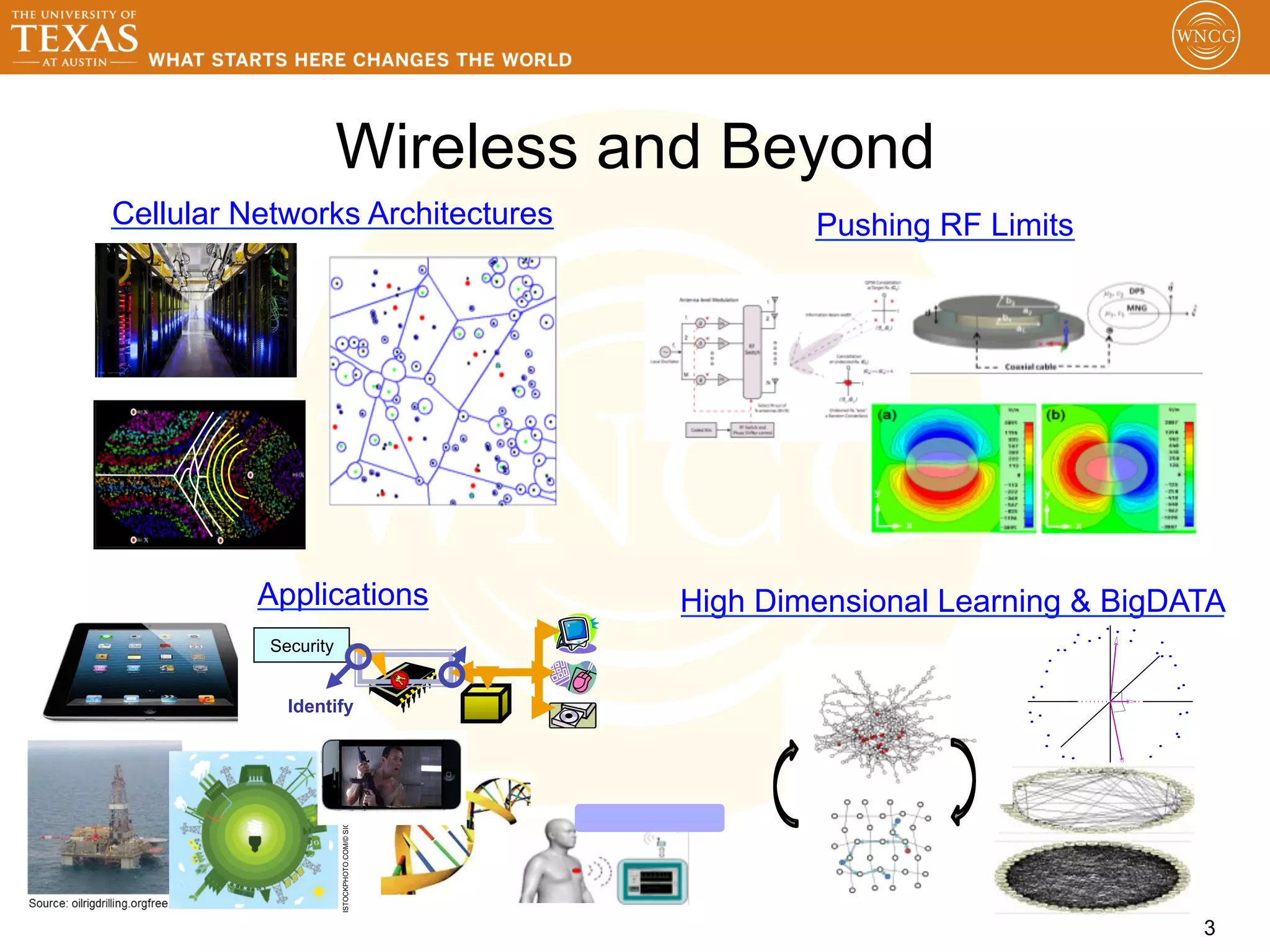
Wireless and Beyond
Cellular Networks Architectures                                      Pushing RF Limits


          Applications                                       High Dimensional Learning & BigDATA
           Security


             Identify
                      ISTOCKPHOTO.COM/© SIGAL SUHLER MORAN


                                                                                              3
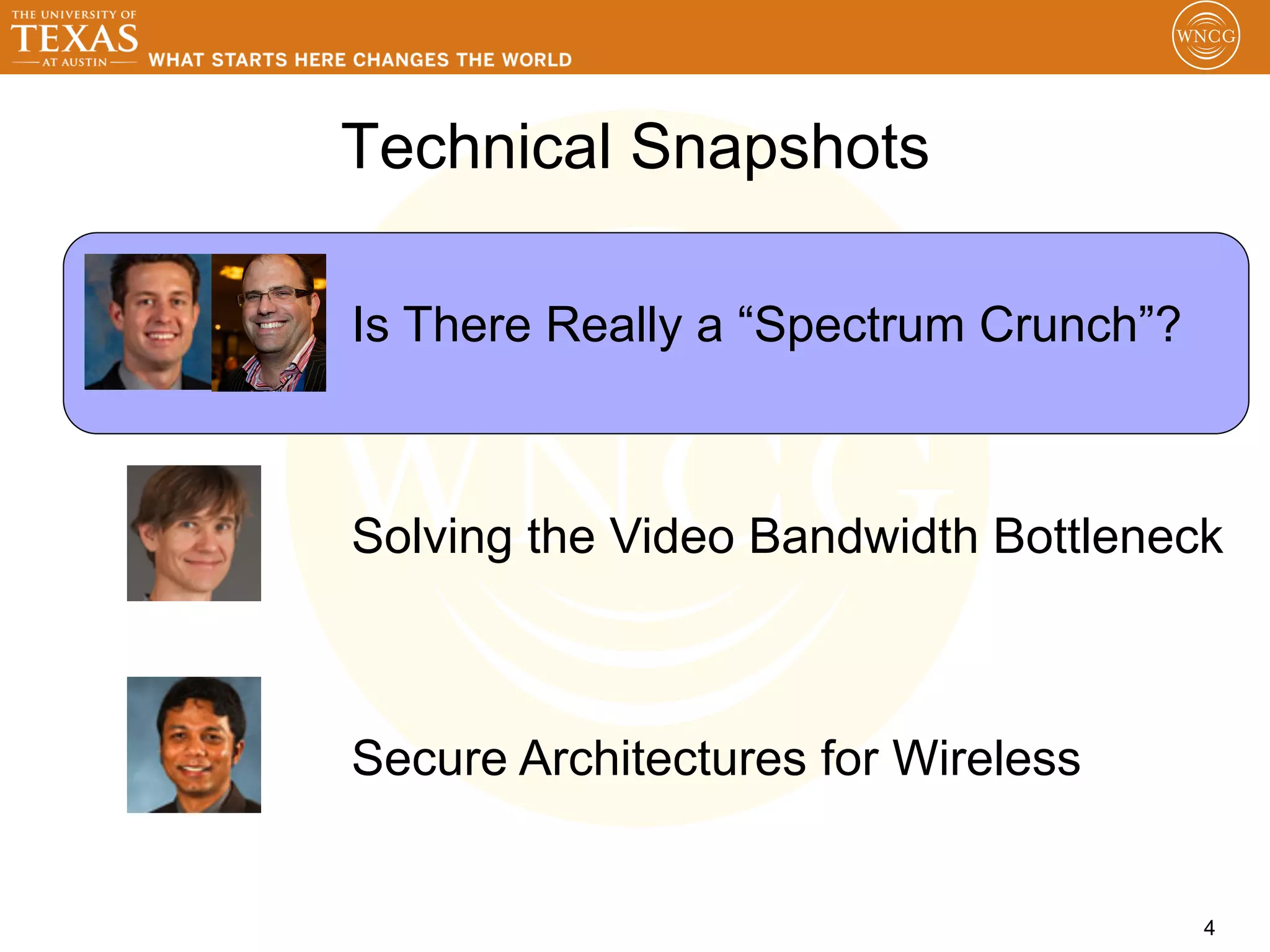
Technical Snapshots

Is There Really a “Spectrum Crunch”?


Solving the Video Bandwidth Bottleneck


Secure Architectures for Wireless


                                       4
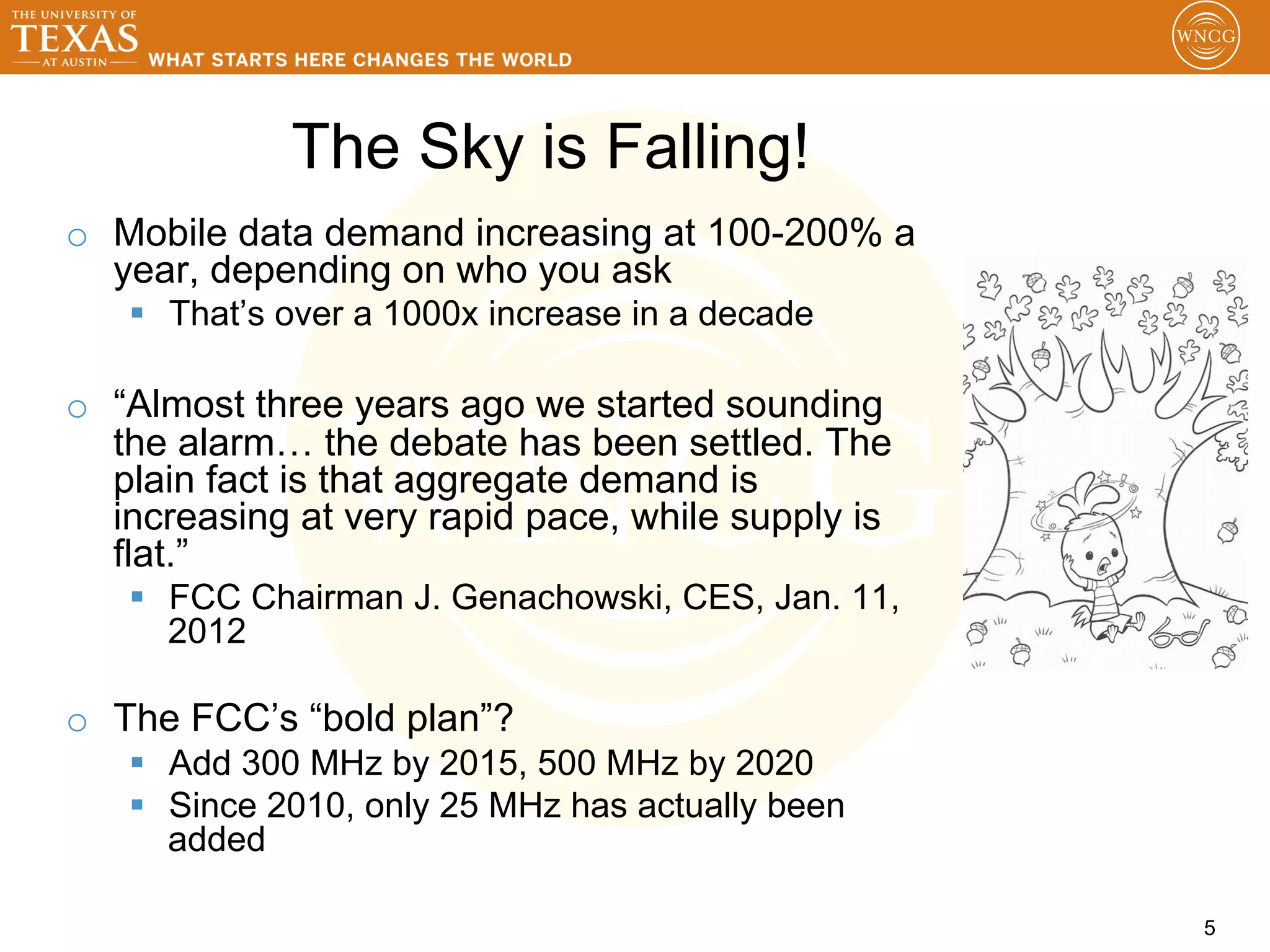
The Sky is Falling!
o  Mobile data demand increasing at 100-200% a
   year, depending on who you ask
   §  That’s over a 1000x increase in a decade

o  “Almost three years ago we started sounding
   the alarm… the debate has been settled. The
   plain fact is that aggregate demand is
   increasing at very rapid pace, while supply is
   flat.”
   §  FCC Chairman J. Genachowski, CES, Jan. 11,
       2012

o  The FCC’s “bold plan”?
   §  Add 300 MHz by 2015, 500 MHz by 2020
   §  Since 2010, only 25 MHz has actually been
       added

                                                    5
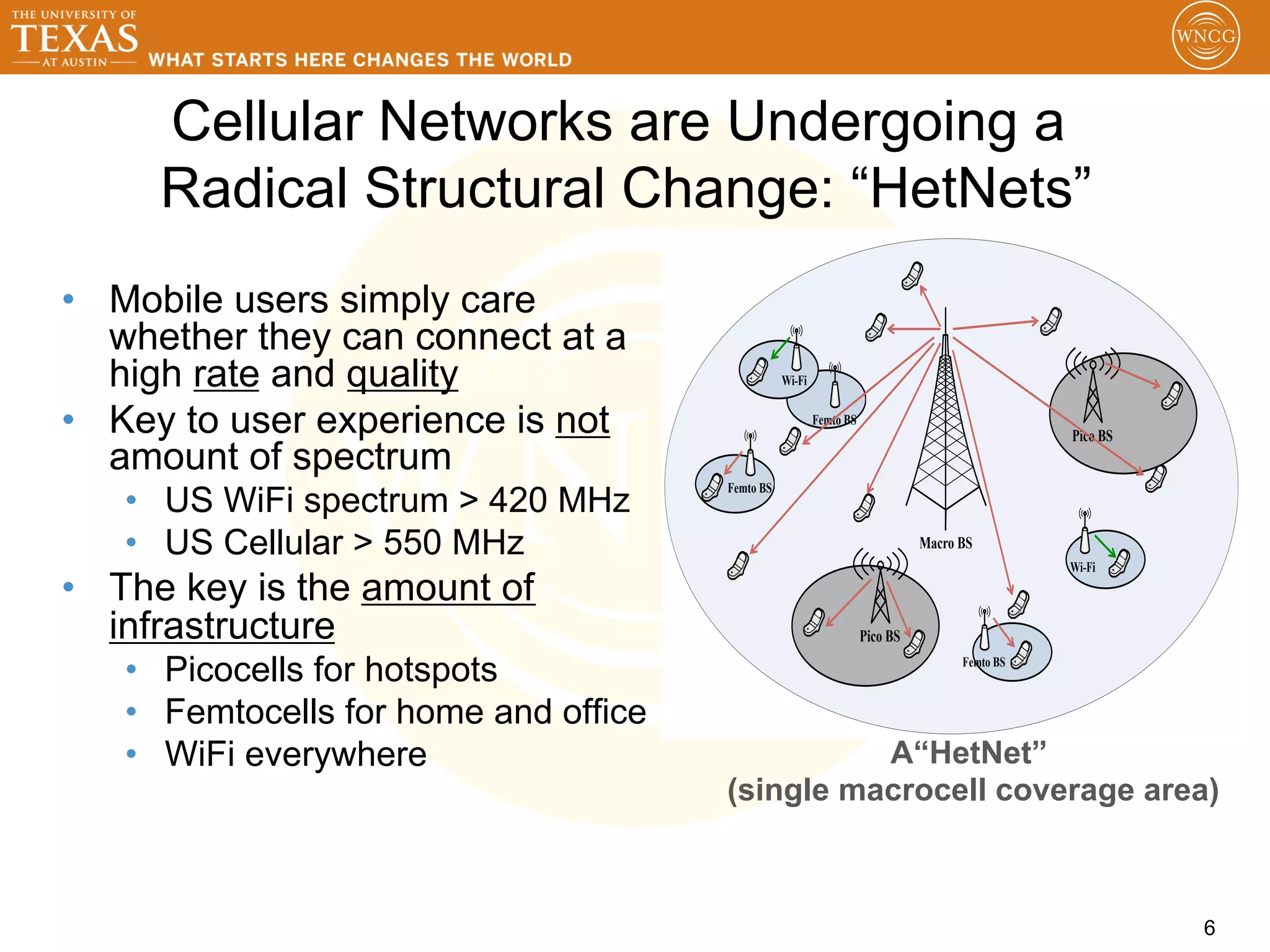
Cellular Networks are Undergoing a
     Radical Structural Change: “HetNets”
•  Mobile users simply care
   whether they can connect at a
   high rate and quality                           Wi-Fi
                                                  Femto BS


•  Key to user experience is not                        Femto BS
                                                                                               Pico BS
   amount of spectrum
                                       Femto BS
   •  US WiFi spectrum > 420 MHz
   •  US Cellular > 550 MHz                                                  Macro BS
                                                                                              Femto BS
                                                                                               Wi-Fi

•  The key is the amount of
   infrastructure                                                  Pico BS

   •  Picocells for hotspots                                                       Femto BS


   •  Femtocells for home and office
   •  WiFi everywhere                            A“HetNet”
                                       (single macrocell coverage area)


                                                                                                         6
Understanding User Rate in HetNets
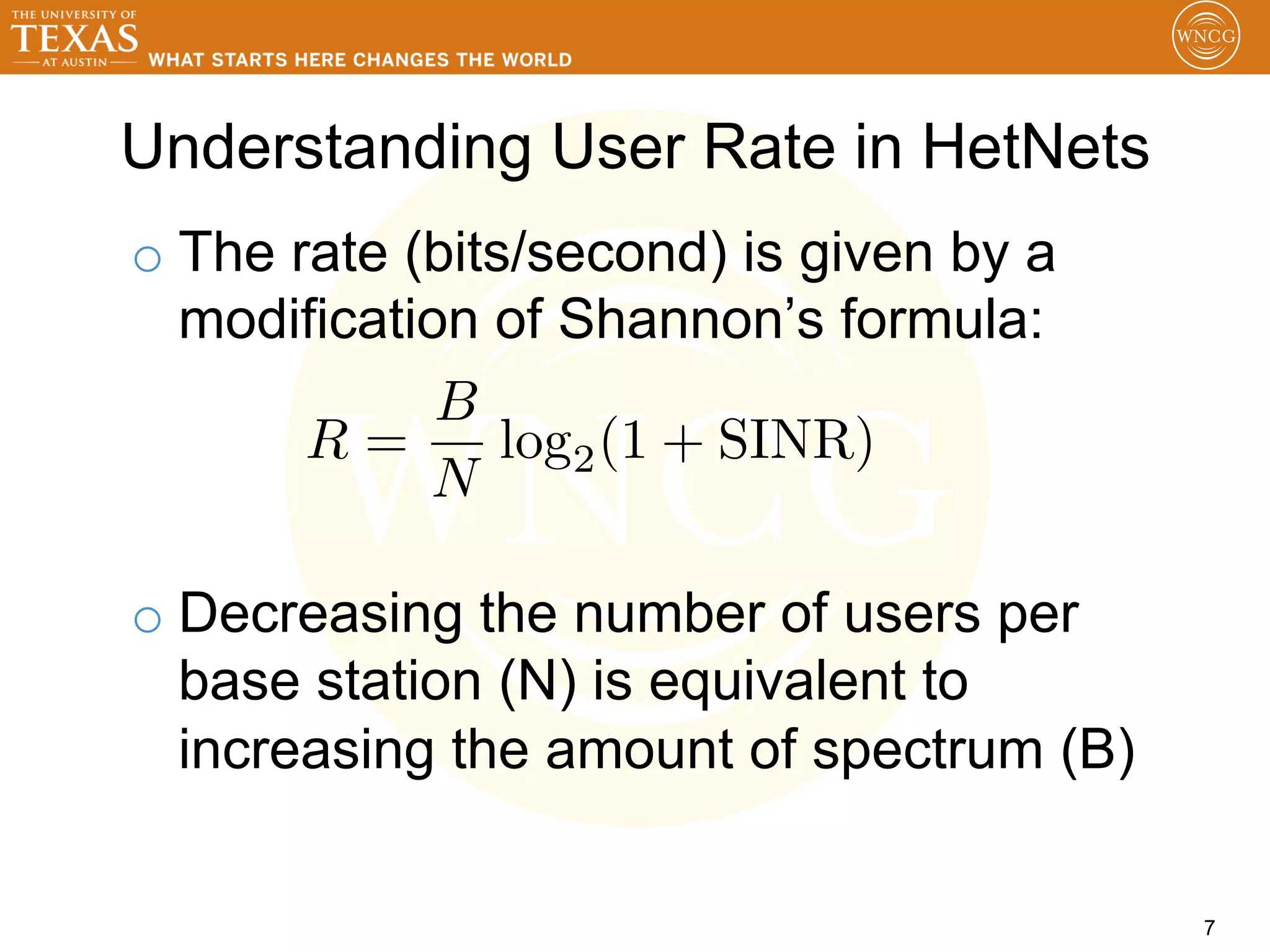
o  The rate (bits/second) is given by a
   modification of Shannon’s formula:
              B
        R=       log2 (1 + SINR)
             N

o  Decreasing the number of users per
   base station (N) is equivalent to
   increasing the amount of spectrum (B)

                                           7
One Answer is More Base Stations
Typical Counter-Arguments
o  Won’t adding more
   base stations be really
   expensive?
o  Won’t adding more
   base stations increase
   the amount of
   interference, and result
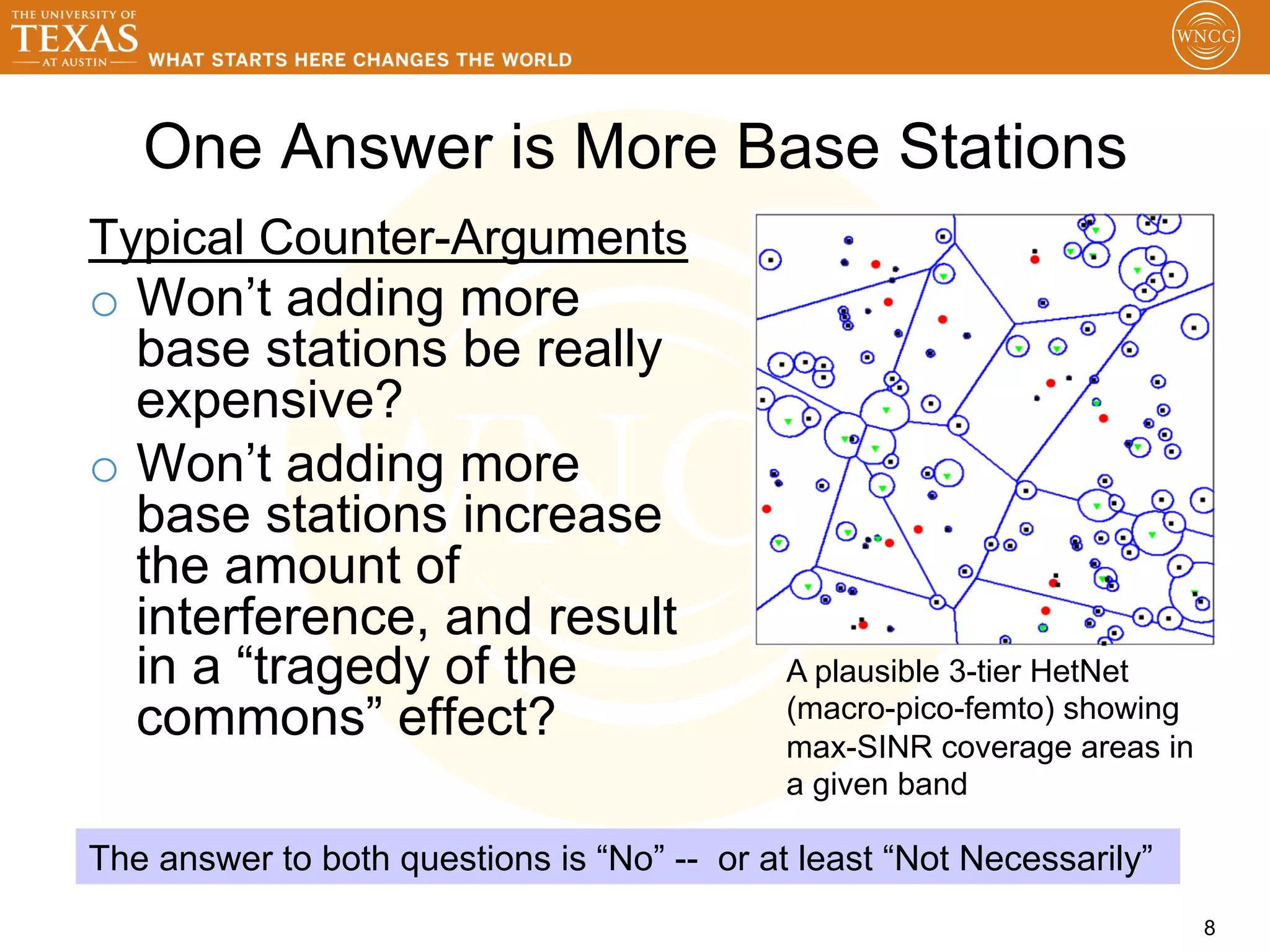
   in a “tragedy of the                      A plausible 3-tier HetNet
   commons” effect?                          (macro-pico-femto) showing
                                             max-SINR coverage areas in
                                             a given band

The answer to both questions is “No” -- or at least “Not Necessarily”
                                                                          8
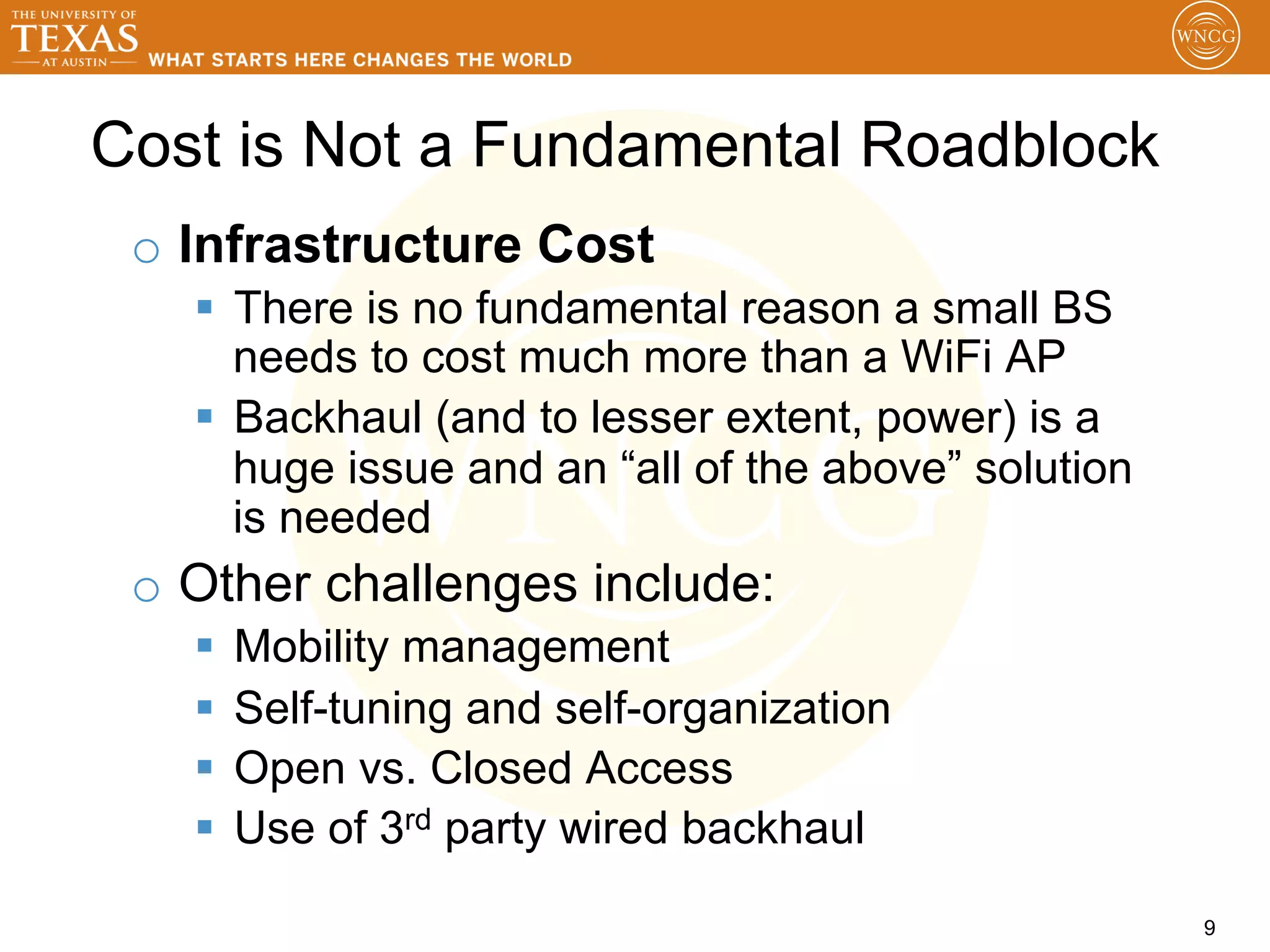
Cost is Not a Fundamental Roadblock
 o  Infrastructure Cost
   §  There is no fundamental reason a small BS
       needs to cost much more than a WiFi AP
   §  Backhaul (and to lesser extent, power) is a
       huge issue and an “all of the above” solution
       is needed
 o  Other challenges include:
   §  Mobility management
   §  Self-tuning and self-organization
   §  Open vs. Closed Access
   §  Use of 3rd party wired backhaul

                                                       9
HetNets Can Only Increase Rate
Our research in WNCG at UT Austin has proven:
o  Adding base stations of any power, even at random
   locations, actually does not change the SINR
   distribution in the network (breakthrough HetNet
   result)
o  Optimal load balancing – pushing users intelligently
   onto the smaller cells – in a HetNet is easy and has
   a 3x gain
o  There is no “interference overload” issue in HetNets
o  Our results have been borne out by findings from
   Qualcomm, NSN, Samsung, Huawei, NTT Docomo,
   and AT&T

 J. G. Andrews, “Seven Ways that HetNets are a Cellular
 Paradigm Shift”, IEEE Communications Magazine, Mar. 2013.
                                                             10
Is HetNet the End of the Road?
o  mmWave: More spectrum is still good
   §  Plenty at mmWave bands that could be exploited
   §  Larger bandwidth, reduced interference,
   §  Useful for both backhaul and access links
o  Antennas: More MIMO doesn’t hurt
   §  A few antennas can multiply the bandwidth efficiency
   §  Massive numbers of antennas can support many users
       and can even simplify processing in massive MIMO
o  Coordination: Managing interference makes sense
   §  Coordinated interference may cease to be interference
   §  Price of coordination does not always outweigh costs
   §  Centralized infrastructure is easier to coordinate (cloud)

 M. Dohler, R. W. Heath, Jr., A. Lozano, C. Papadias, R. A. Valenzuela, ``Is the PHY Layer
 Dead?,'' IEEE Communications Magazine, vol. 49, no. 4, pp. 159-165, April 2011.

                                                                                             11
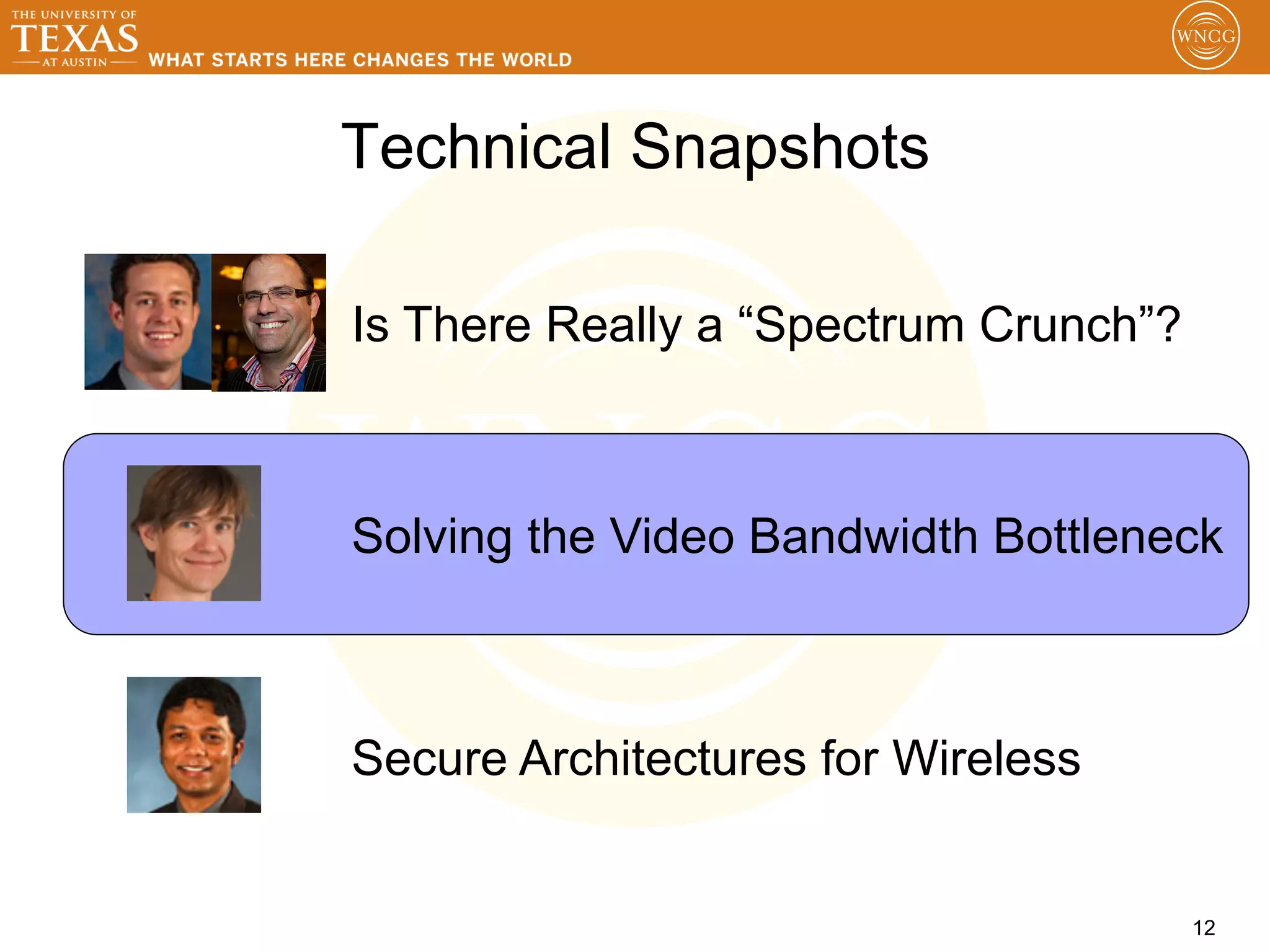
Technical Snapshots

Is There Really a “Spectrum Crunch”?


Solving the Video Bandwidth Bottleneck


Secure Architectures for Wireless


                                       12
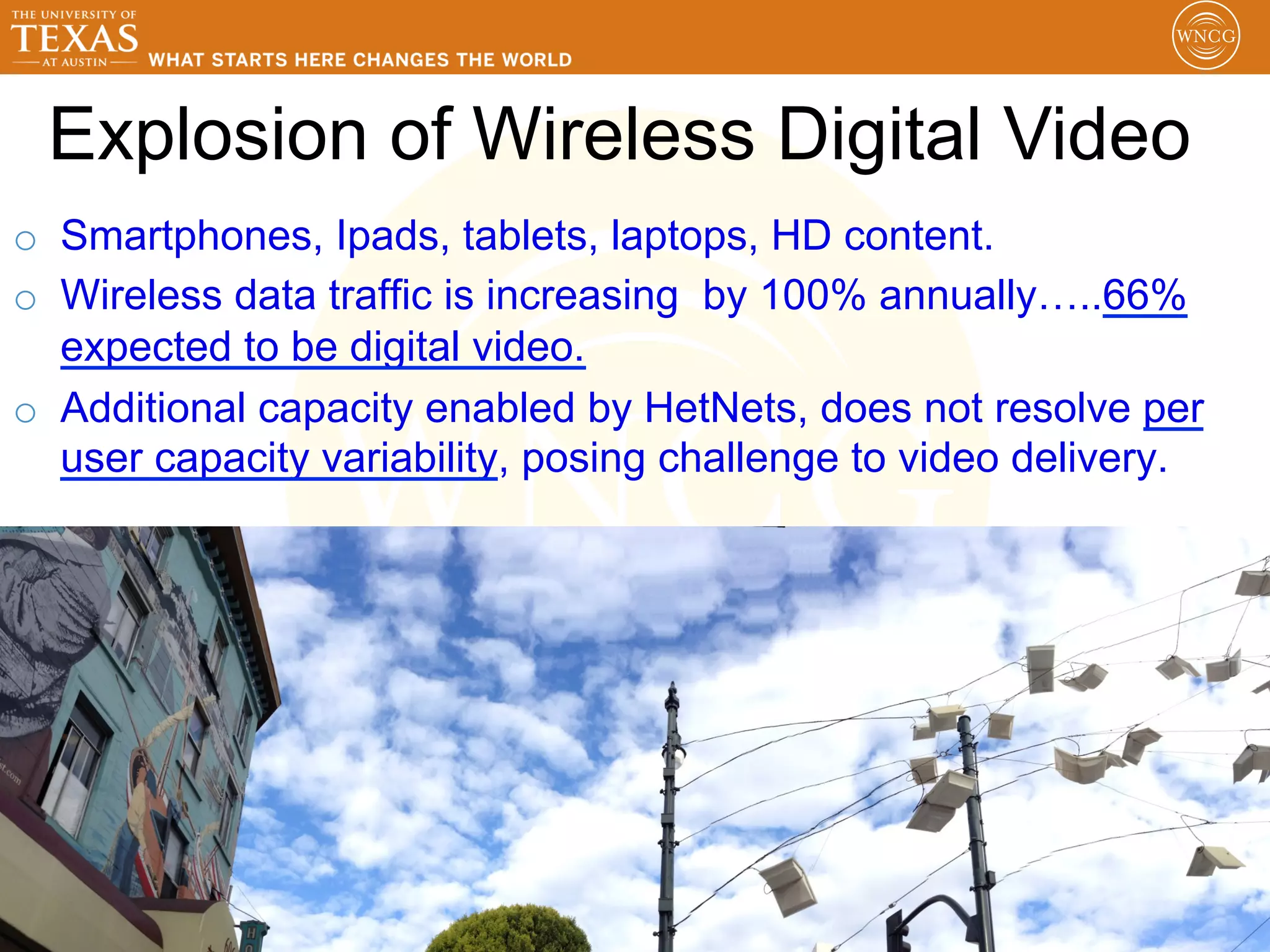
Explosion of Wireless Digital Video
o  Smartphones, Ipads, tablets, laptops, HD content.
o  Wireless data traffic is increasing by 100% annually…..66%
   expected to be digital video.
o  Additional capacity enabled by HetNets, does not resolve per
   user capacity variability, posing challenge to video delivery.


                                                               13
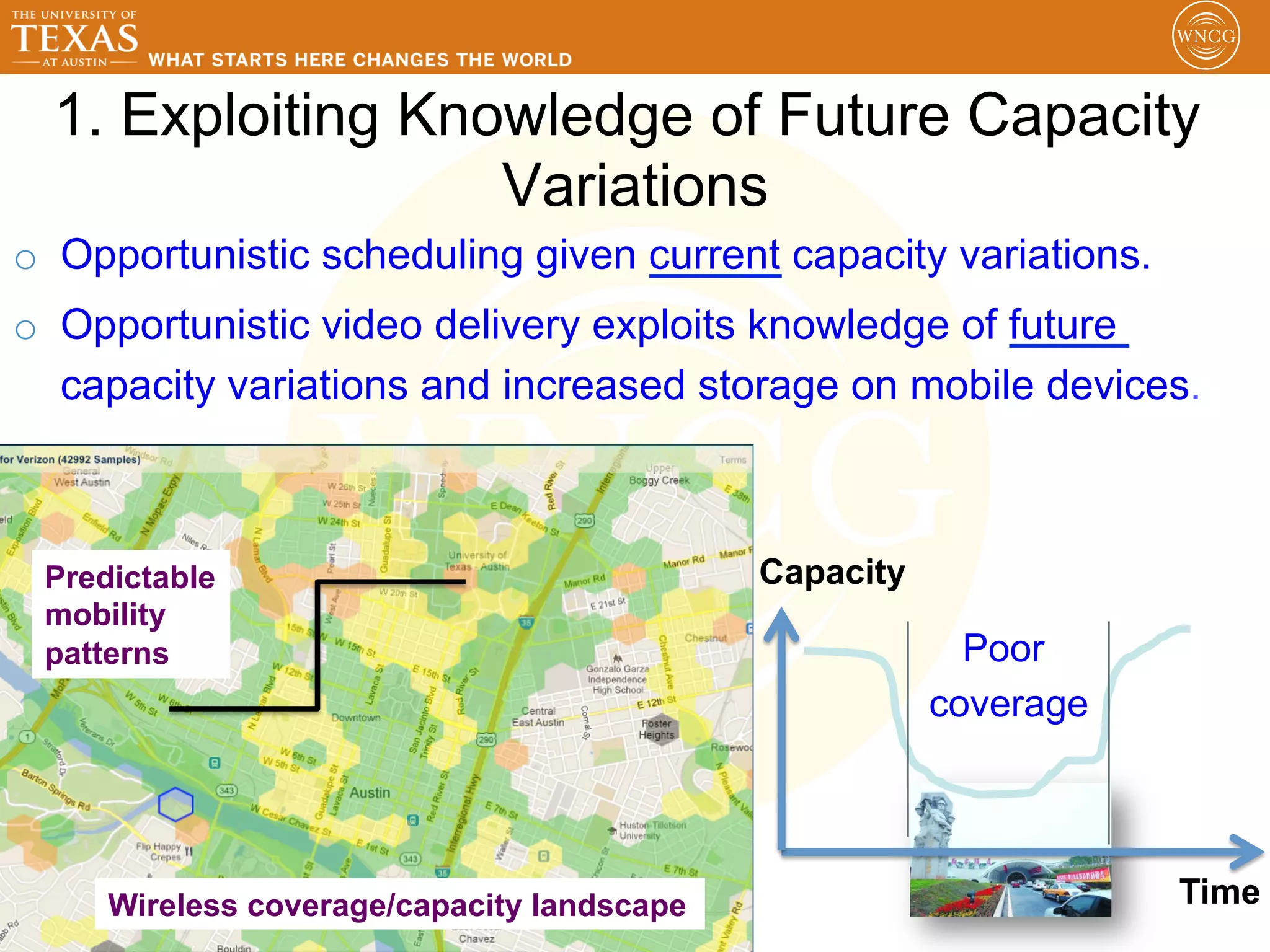
1. Exploiting Knowledge of Future Capacity
                   Variations
o  Opportunistic scheduling given current capacity variations.
o  Opportunistic video delivery exploits knowledge of future
   capacity variations and increased storage on mobile devices.


 Predictable                                Capacity
                                                   	
 mobility
 patterns                                                 Poor
                                                        coverage


     Wireless coverage/capacity landscape                          Time
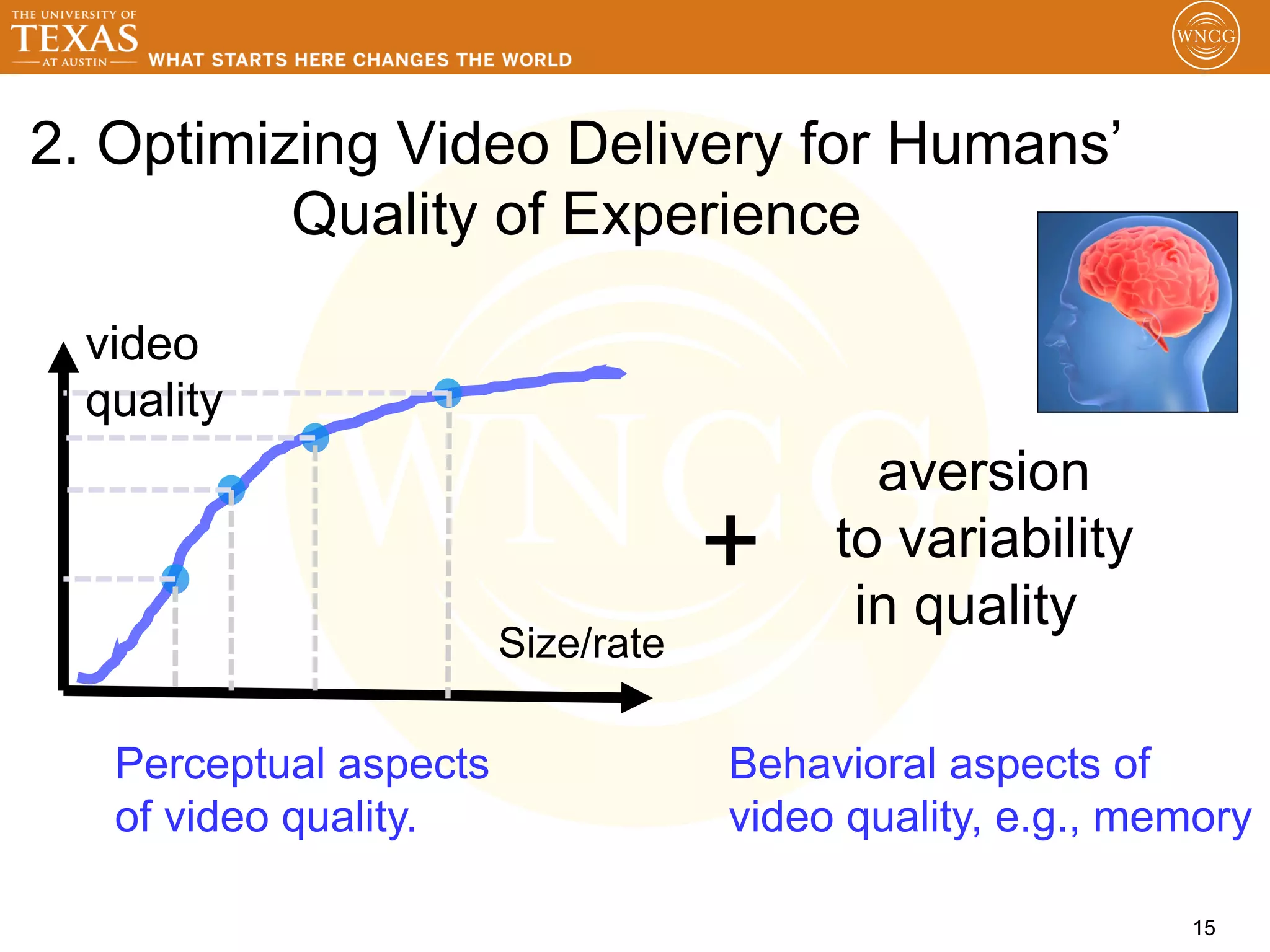
2. Optimizing Video Delivery for Humans’
          Quality of Experience

  video
  quality
                                           aversion
                                    +    to variability
                                          in quality
                        Size/rate

   Perceptual aspects               Behavioral aspects of
   of video quality.                video quality, e.g., memory

                                                           15
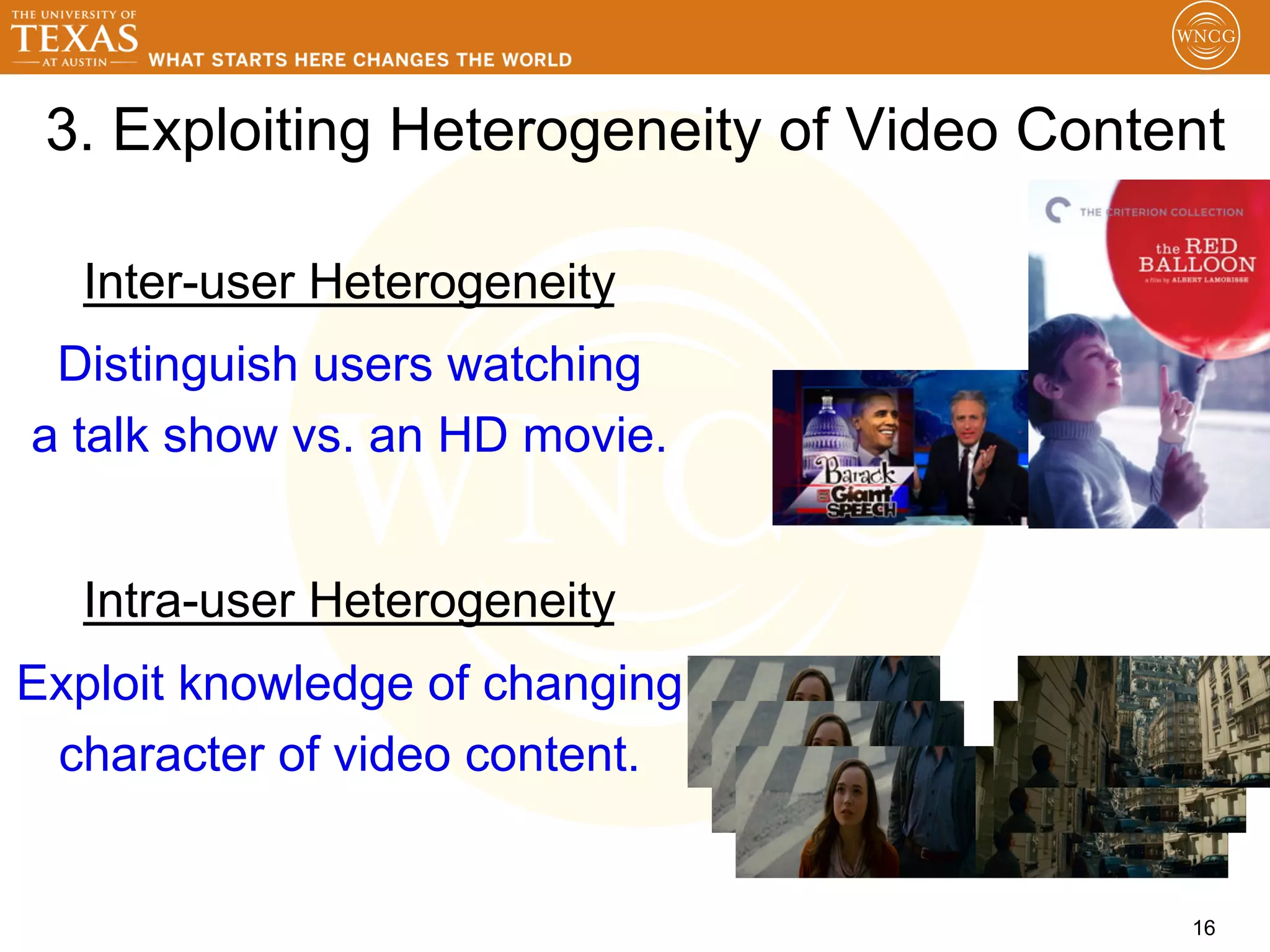
3. Exploiting Heterogeneity of Video Content

  Inter-user Heterogeneity
 Distinguish users watching
a talk show vs. an HD movie.


  Intra-user Heterogeneity
Exploit knowledge of changing
 character of video content.


                                           16
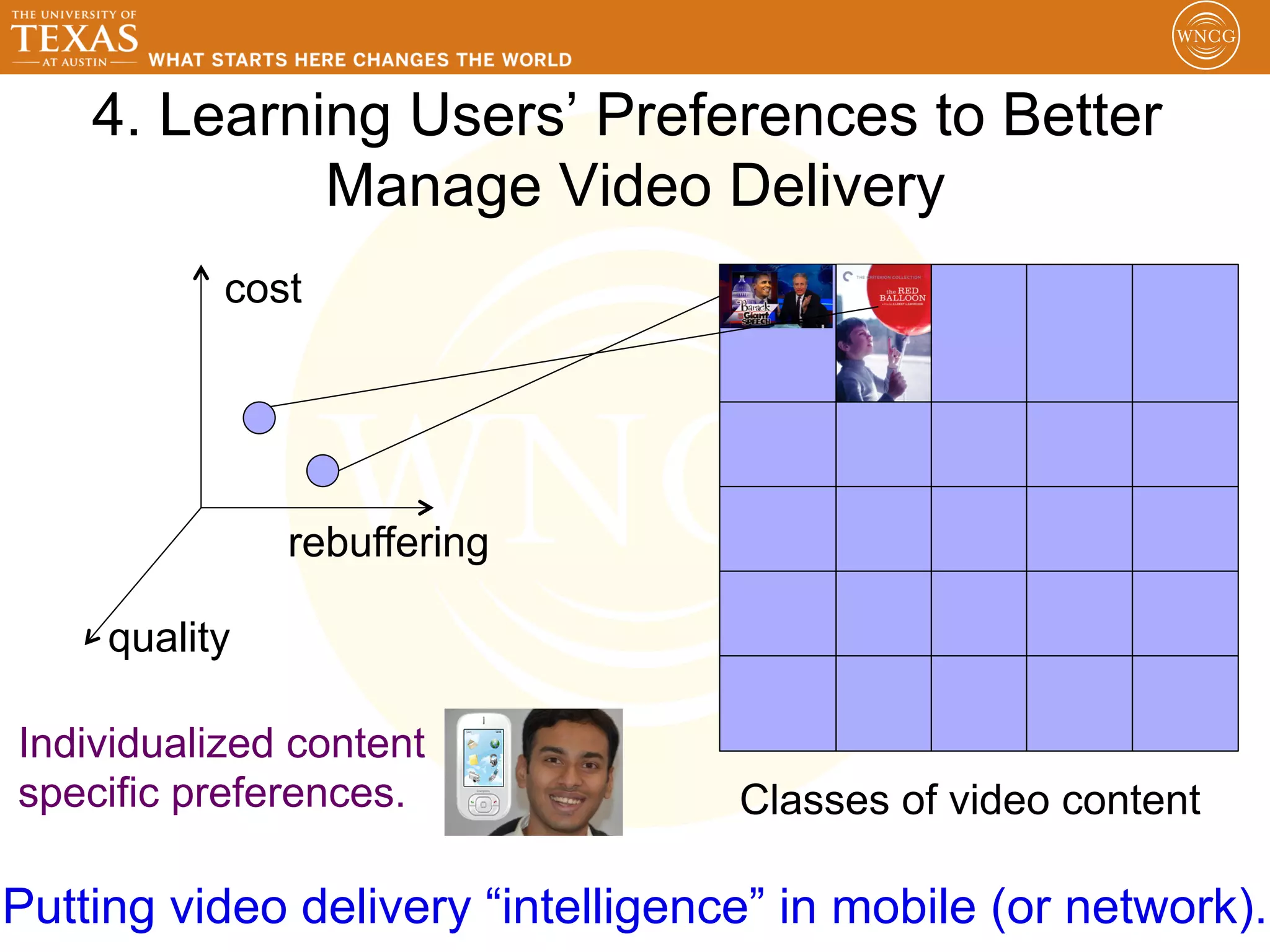
4. Learning Users’ Preferences to Better
             Manage Video Delivery
           cost


               rebuffering

     quality

Individualized content
specific preferences.              Classes of video content

Putting video delivery “intelligence” in mobile (or network).
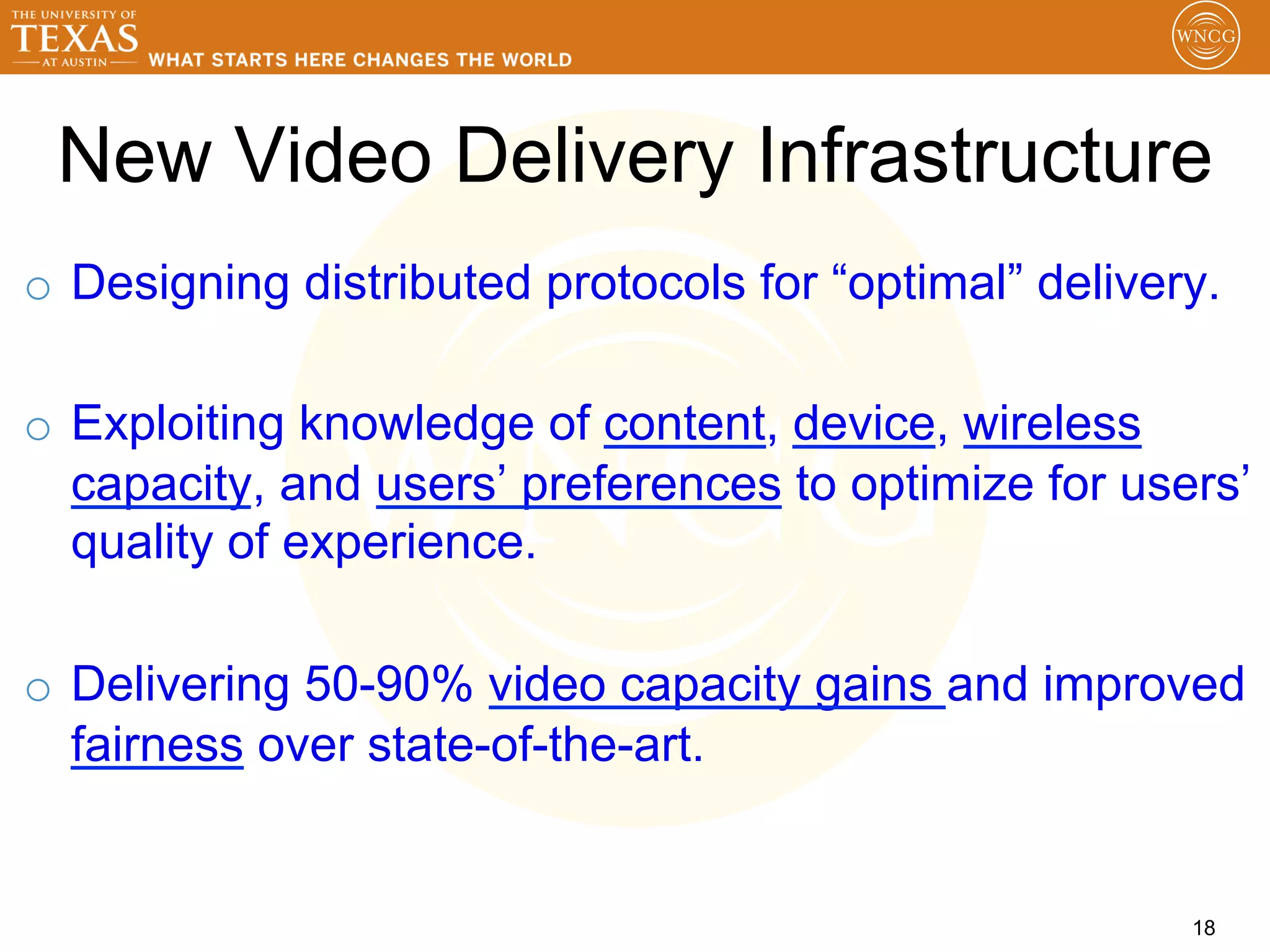
New Video Delivery Infrastructure
o  Designing distributed protocols for “optimal” delivery.

o  Exploiting knowledge of content, device, wireless
   capacity, and users’ preferences to optimize for users’
   quality of experience.

o  Delivering 50-90% video capacity gains and improved
   fairness over state-of-the-art.


                                                        18
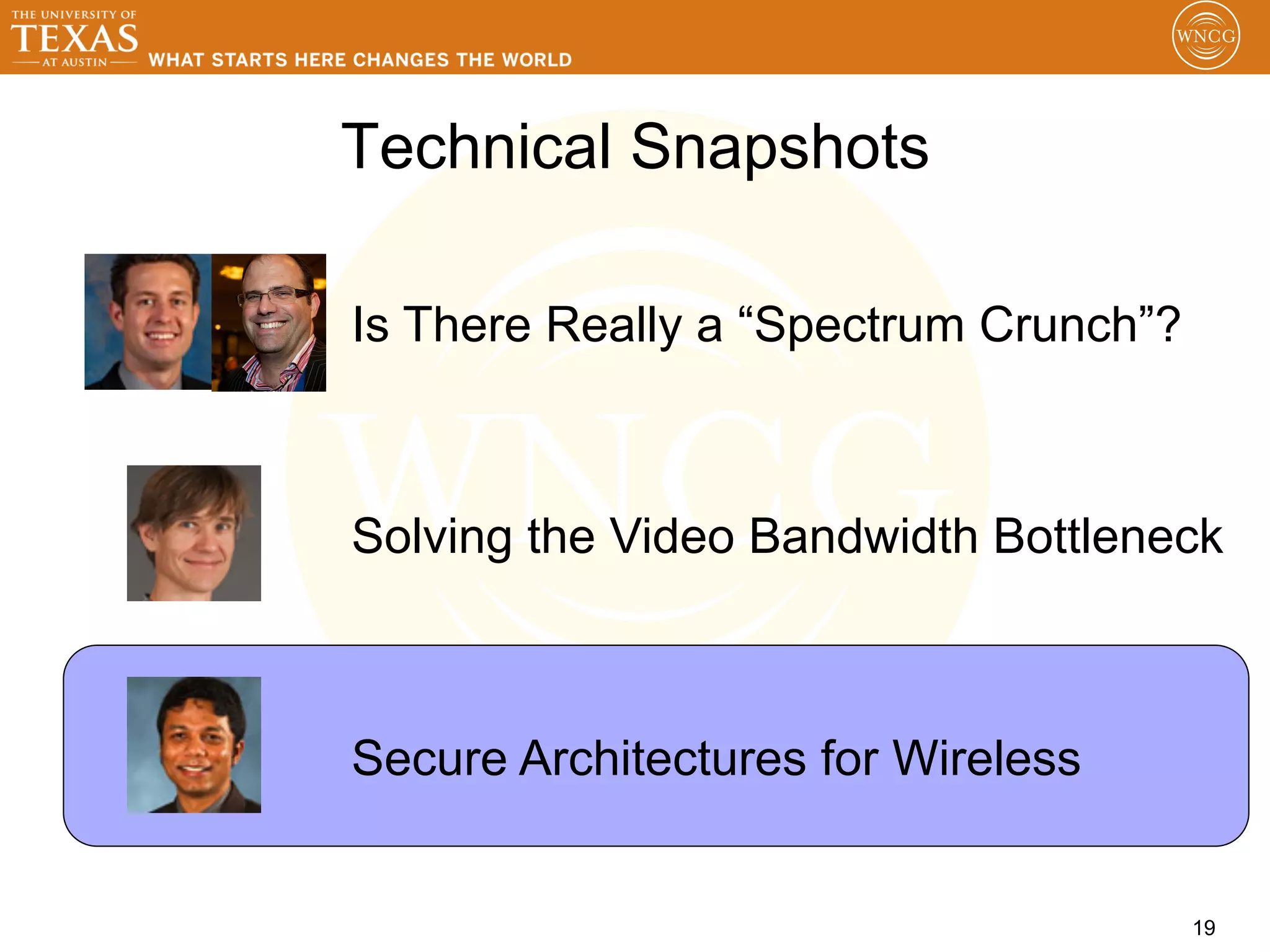
Technical Snapshots

Is There Really a “Spectrum Crunch”?


Solving the Video Bandwidth Bottleneck


Secure Architectures for Wireless


                                       19
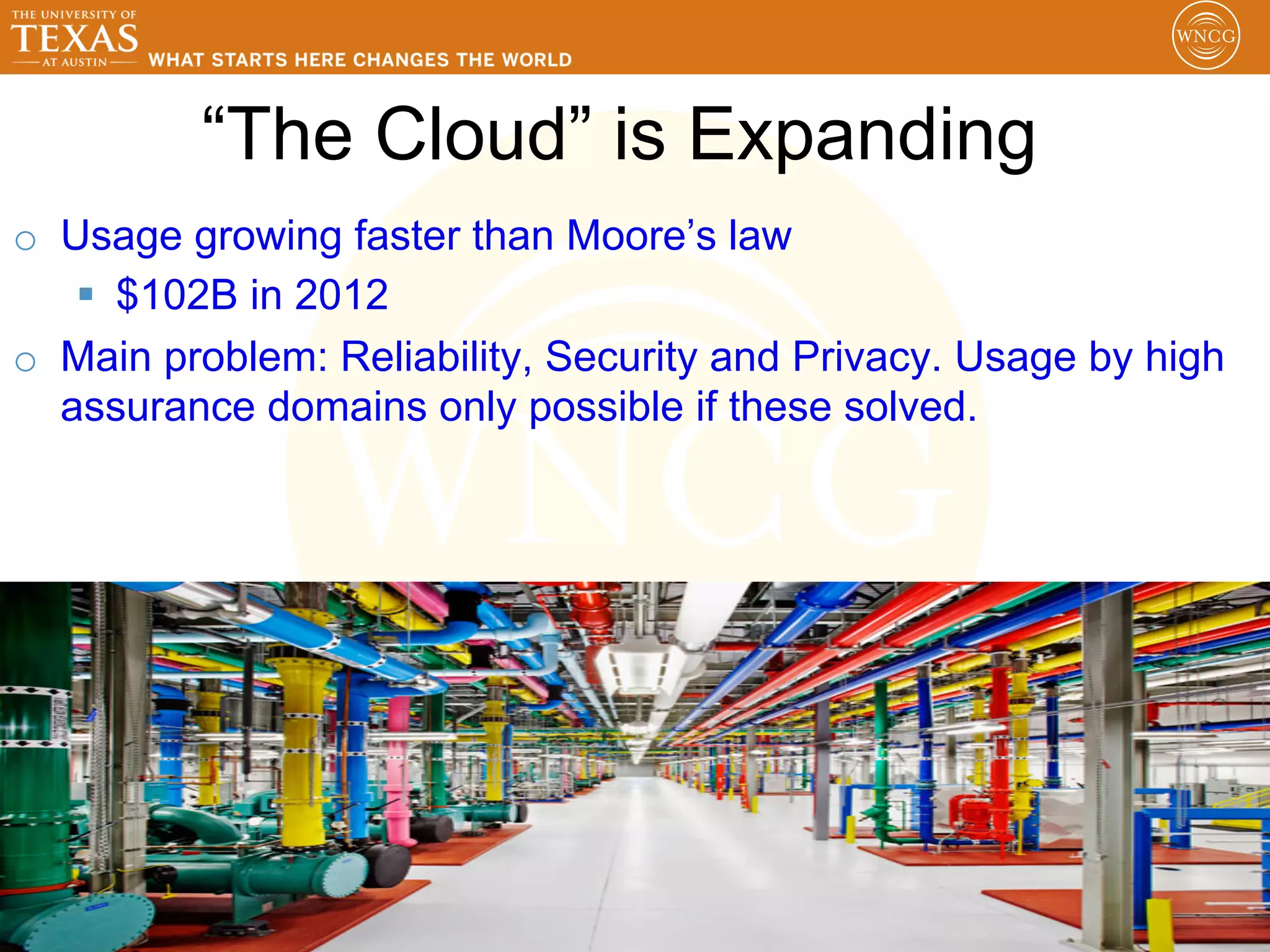
“The Cloud” is Expanding
o  Usage growing faster than Moore’s law
    §  $102B in 2012
o  Main problem: Reliability, Security and Privacy. Usage by high
   assurance domains only possible if these solved.


                                                              20
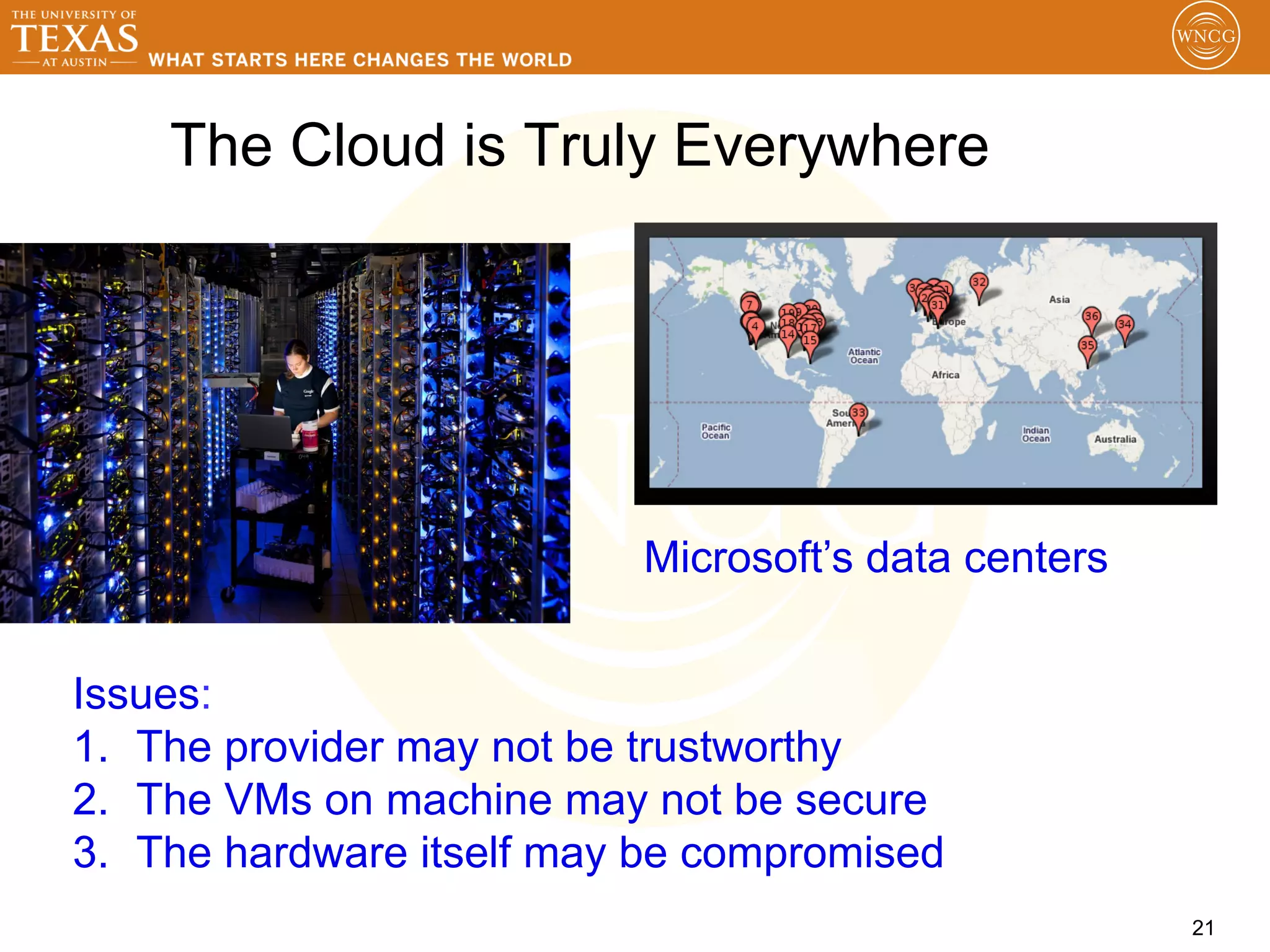
The Cloud is Truly Everywhere


                           Microsoft’s data centers


Issues:
1.  The provider may not be trustworthy
2.  The VMs on machine may not be secure
3.  The hardware itself may be compromised
                                                      21
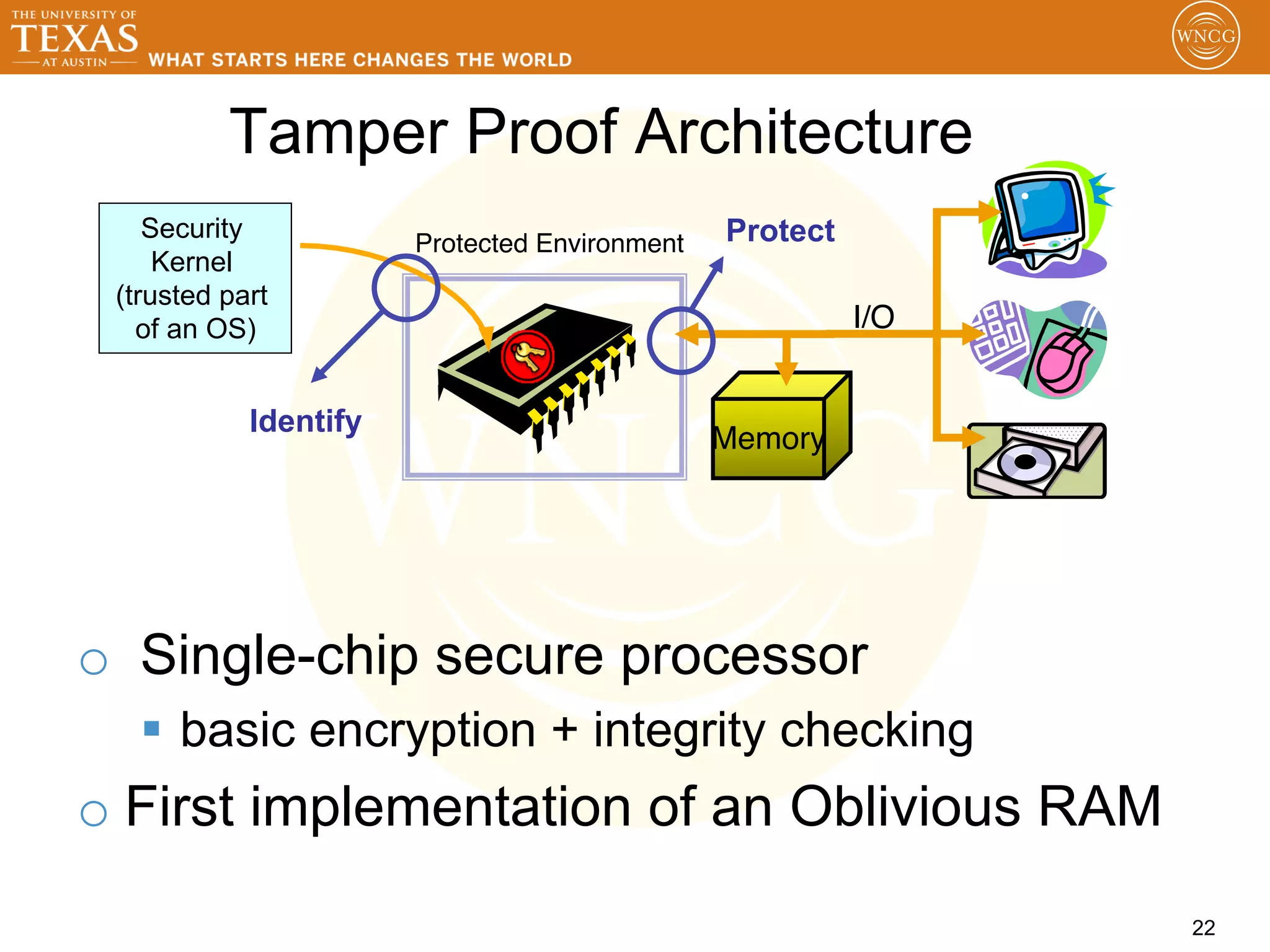
Tamper Proof Architecture
    Security                                    Protect
                       Protected Environment"
     Kernel
 (trusted part
   of an OS)                                              I/O"


            Identify
                                                Memory"


o  Single-chip secure processor
   §  basic encryption + integrity checking
o  First implementation of an Oblivious RAM
                                                                 22
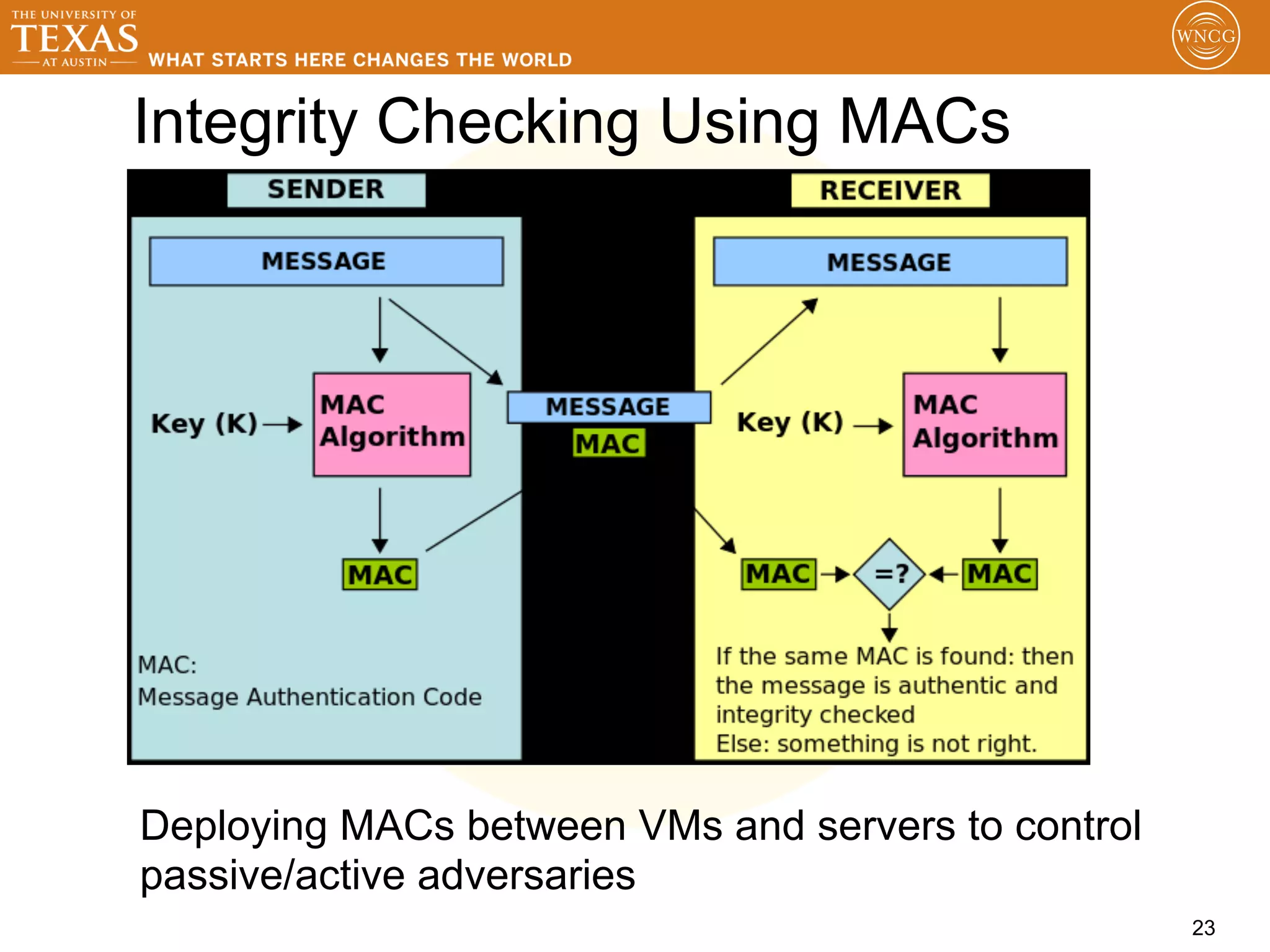
Integrity Checking Using MACs


Deploying MACs between VMs and servers to control
passive/active adversaries
                                                    23
Coded Data Storage & Access
o  Current approach for storage: replicate
   data across servers
o  Both wasteful in space and insecure
o  Coded strategy:
  §  store coded data across servers
  §  Require secure collaboration to reconstruct
      data
  §  Results in simultaneous network and node
      security advantages
                                                    24
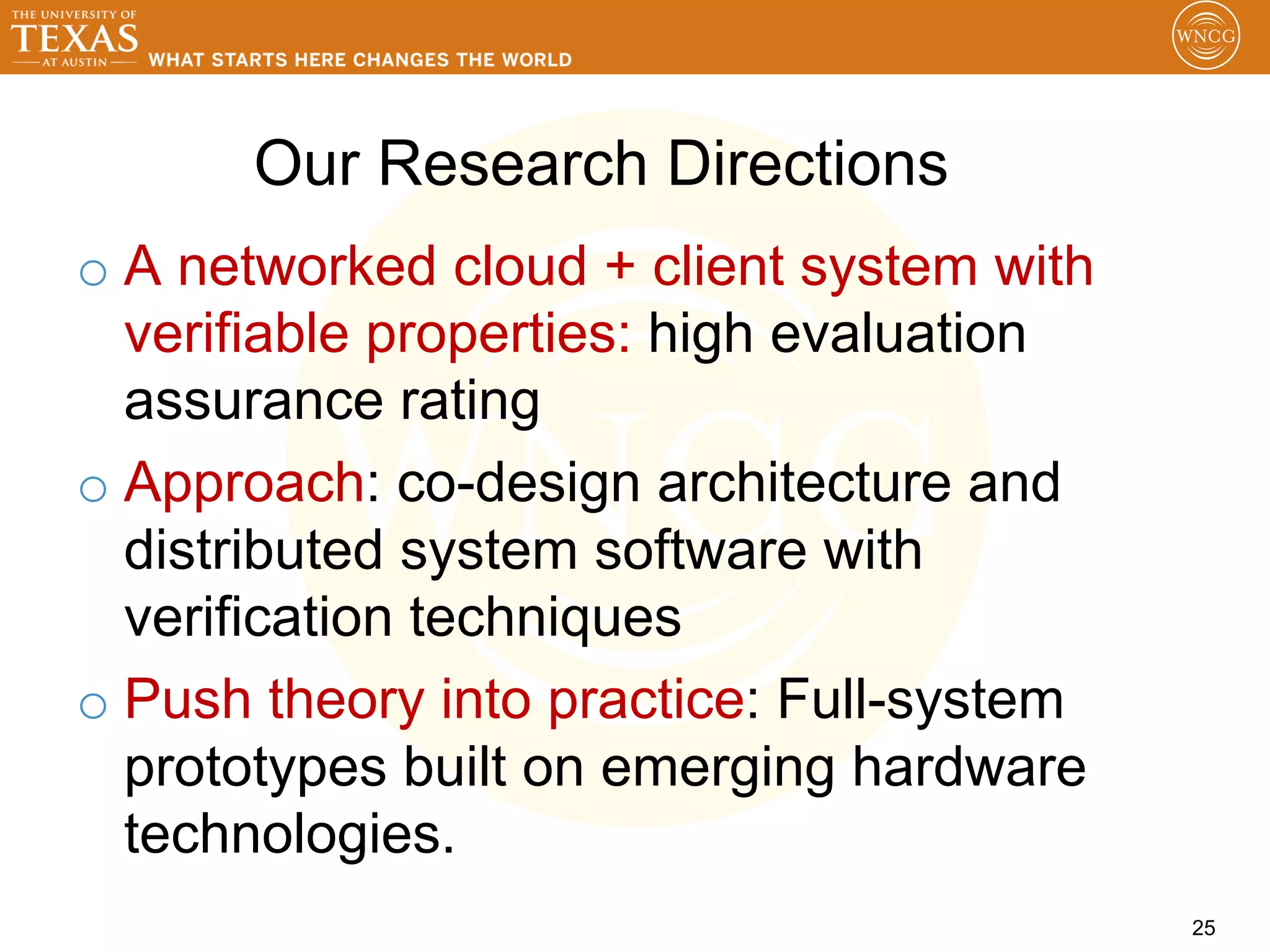
Our Research Directions
o  A networked cloud + client system with
   verifiable properties: high evaluation
   assurance rating
o  Approach: co-design architecture and
   distributed system software with
   verification techniques
o  Push theory into practice: Full-system
   prototypes built on emerging hardware
   technologies.
                                            25
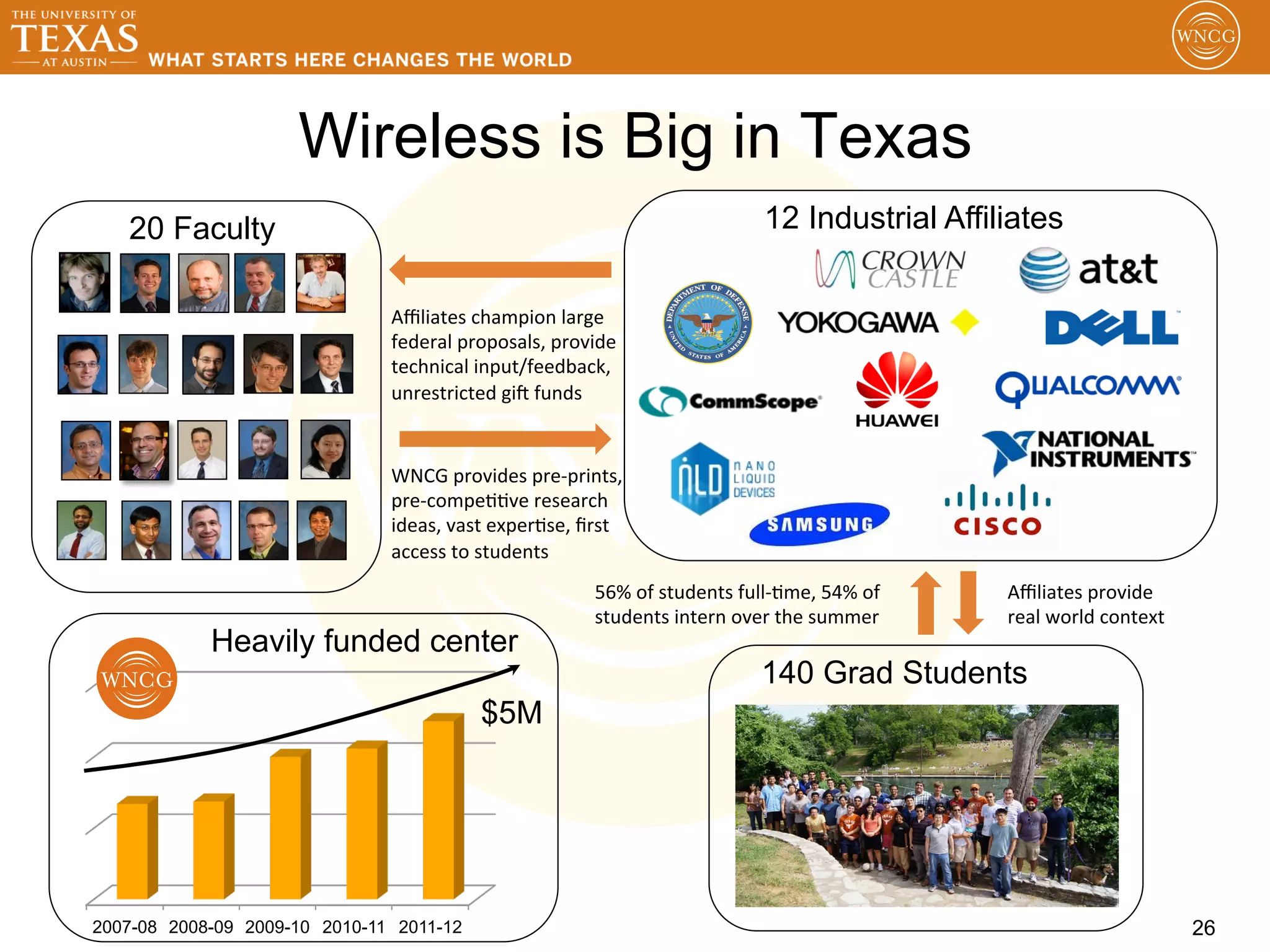
Wireless is Big in Texas
   20 Faculty                                                                                 12 Industrial Affiliates


                               Affiliates	
  champion	
  large	
  
                               federal	
  proposals,	
  provide	
  
                               technical	
  input/feedback,	
  
                               unrestricted	
  gi:	
  funds	


                               WNCG	
  provides	
  pre-­‐prints,	
  
                               pre-­‐compe@@ve	
  research	
  
                               ideas,	
  vast	
  exper@se,	
  first	
  
                               access	
  to	
  students	
  
                                                                56%	
  of	
  students	
  full-­‐@me,	
  54%	
  of	
     Affiliates	
  provide	
  
                                                                students	
  intern	
  over	
  the	
  summer	
           real	
  world	
  context	
  
            Heavily funded center
                                                                                              140 Grad Students
                                             $5M


2007-08 2008-09 2009-10 2010-11 2011-12                                                                                                                26
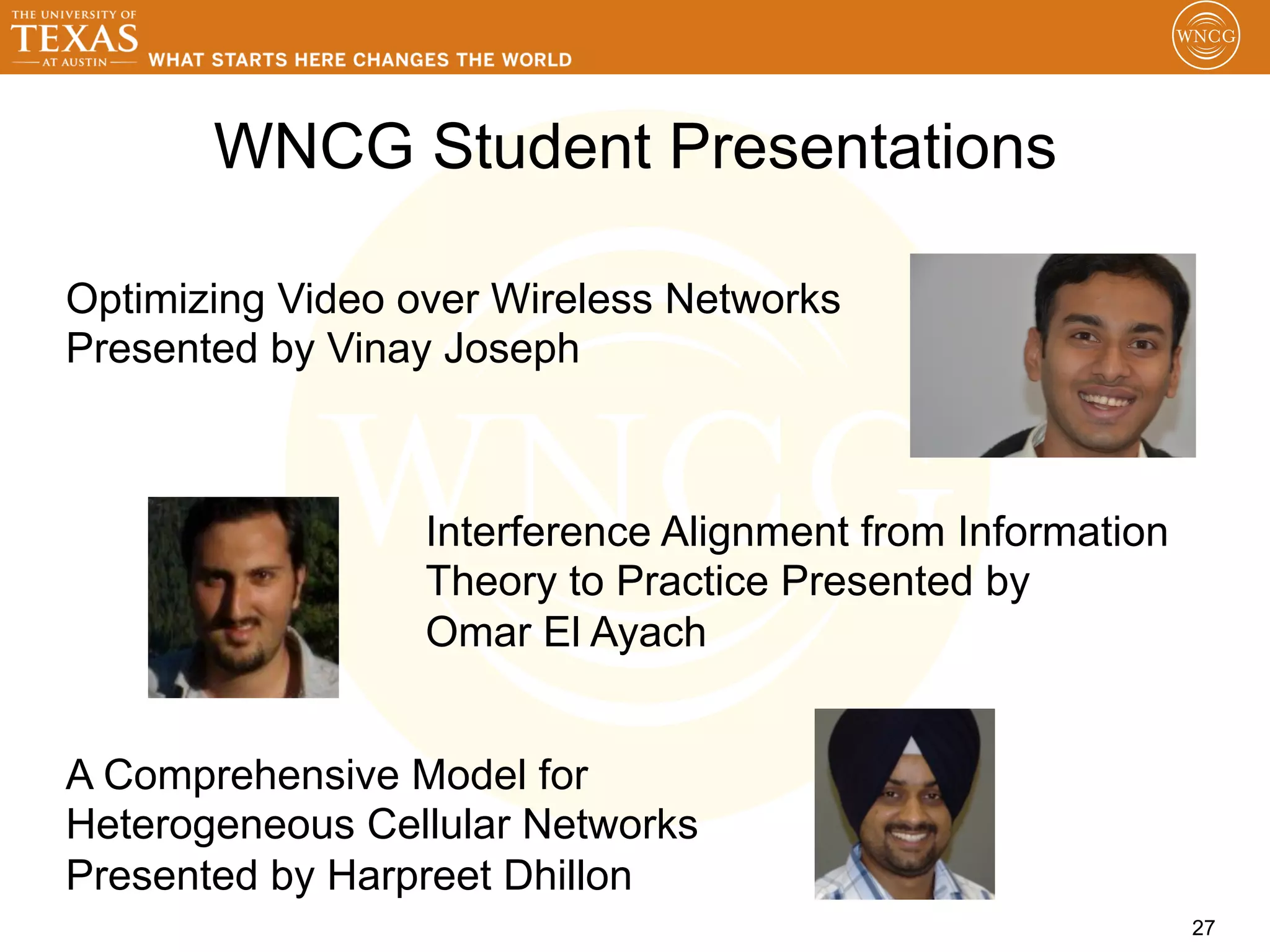
WNCG Student Presentations

Optimizing Video over Wireless Networks
Presented by Vinay Joseph


                  Interference Alignment from Information
                  Theory to Practice Presented by
                  Omar El Ayach


A Comprehensive Model for
Heterogeneous Cellular Networks
Presented by Harpreet Dhillon
                                                            27

Wireless Presentation for UT in Silicon Valley 2013

  • 1.
    New Frontiers inUbiquitous Mobile Computing UT Austin Silicon Valley Event March 6, 2013 Robert Heath, Gustavo de Veciana, Jeff Andrews, Sriram Vishwanath, and Ahmed Tewfik Wireless Networking and Communications Group http://www.wncg.org
  • 2.
    Wireless is Bigin Texas 20 Faculty 12 Industrial Affiliates Affiliates  champion  large   federal  proposals,  provide   technical  input/feedback,   unrestricted  gi:  funds   WNCG  provides  pre-­‐prints,   pre-­‐compe@@ve  research   ideas,  vast  exper@se,  first   access  to  students   56%  of  students  full-­‐@me,  54%  of   Affiliates  provide   students  intern  over  the  summer   real  world  context   Heavily funded center 140 Grad Students $5M 2007-08 2008-09 2009-10 2010-11 2011-12 2
  • 3.
    Wireless and Beyond CellularNetworks Architectures Pushing RF Limits Applications High Dimensional Learning & BigDATA Security Identify ISTOCKPHOTO.COM/© SIGAL SUHLER MORAN 3
  • 4.
    Technical Snapshots Is ThereReally a “Spectrum Crunch”? Solving the Video Bandwidth Bottleneck Secure Architectures for Wireless 4
  • 5.
    The Sky isFalling! o  Mobile data demand increasing at 100-200% a year, depending on who you ask §  That’s over a 1000x increase in a decade o  “Almost three years ago we started sounding the alarm… the debate has been settled. The plain fact is that aggregate demand is increasing at very rapid pace, while supply is flat.” §  FCC Chairman J. Genachowski, CES, Jan. 11, 2012 o  The FCC’s “bold plan”? §  Add 300 MHz by 2015, 500 MHz by 2020 §  Since 2010, only 25 MHz has actually been added 5
  • 6.
    Cellular Networks areUndergoing a Radical Structural Change: “HetNets” •  Mobile users simply care whether they can connect at a high rate and quality Wi-Fi Femto BS •  Key to user experience is not Femto BS Pico BS amount of spectrum Femto BS •  US WiFi spectrum > 420 MHz •  US Cellular > 550 MHz Macro BS Femto BS Wi-Fi •  The key is the amount of infrastructure Pico BS •  Picocells for hotspots Femto BS •  Femtocells for home and office •  WiFi everywhere A“HetNet” (single macrocell coverage area) 6
  • 7.
    Understanding User Ratein HetNets o  The rate (bits/second) is given by a modification of Shannon’s formula: B R= log2 (1 + SINR) N o  Decreasing the number of users per base station (N) is equivalent to increasing the amount of spectrum (B) 7
  • 8.
    One Answer isMore Base Stations Typical Counter-Arguments o  Won’t adding more base stations be really expensive? o  Won’t adding more base stations increase the amount of interference, and result in a “tragedy of the A plausible 3-tier HetNet commons” effect? (macro-pico-femto) showing max-SINR coverage areas in a given band The answer to both questions is “No” -- or at least “Not Necessarily” 8
  • 9.
    Cost is Nota Fundamental Roadblock o  Infrastructure Cost §  There is no fundamental reason a small BS needs to cost much more than a WiFi AP §  Backhaul (and to lesser extent, power) is a huge issue and an “all of the above” solution is needed o  Other challenges include: §  Mobility management §  Self-tuning and self-organization §  Open vs. Closed Access §  Use of 3rd party wired backhaul 9
  • 10.
    HetNets Can OnlyIncrease Rate Our research in WNCG at UT Austin has proven: o  Adding base stations of any power, even at random locations, actually does not change the SINR distribution in the network (breakthrough HetNet result) o  Optimal load balancing – pushing users intelligently onto the smaller cells – in a HetNet is easy and has a 3x gain o  There is no “interference overload” issue in HetNets o  Our results have been borne out by findings from Qualcomm, NSN, Samsung, Huawei, NTT Docomo, and AT&T J. G. Andrews, “Seven Ways that HetNets are a Cellular Paradigm Shift”, IEEE Communications Magazine, Mar. 2013. 10
  • 11.
    Is HetNet theEnd of the Road? o  mmWave: More spectrum is still good §  Plenty at mmWave bands that could be exploited §  Larger bandwidth, reduced interference, §  Useful for both backhaul and access links o  Antennas: More MIMO doesn’t hurt §  A few antennas can multiply the bandwidth efficiency §  Massive numbers of antennas can support many users and can even simplify processing in massive MIMO o  Coordination: Managing interference makes sense §  Coordinated interference may cease to be interference §  Price of coordination does not always outweigh costs §  Centralized infrastructure is easier to coordinate (cloud) M. Dohler, R. W. Heath, Jr., A. Lozano, C. Papadias, R. A. Valenzuela, ``Is the PHY Layer Dead?,'' IEEE Communications Magazine, vol. 49, no. 4, pp. 159-165, April 2011. 11
  • 12.
    Technical Snapshots Is ThereReally a “Spectrum Crunch”? Solving the Video Bandwidth Bottleneck Secure Architectures for Wireless 12
  • 13.
    Explosion of WirelessDigital Video o  Smartphones, Ipads, tablets, laptops, HD content. o  Wireless data traffic is increasing by 100% annually…..66% expected to be digital video. o  Additional capacity enabled by HetNets, does not resolve per user capacity variability, posing challenge to video delivery. 13
  • 14.
    1. Exploiting Knowledgeof Future Capacity Variations o  Opportunistic scheduling given current capacity variations. o  Opportunistic video delivery exploits knowledge of future capacity variations and increased storage on mobile devices. Predictable Capacity mobility patterns Poor coverage Wireless coverage/capacity landscape Time
  • 15.
    2. Optimizing VideoDelivery for Humans’ Quality of Experience video quality aversion + to variability in quality Size/rate Perceptual aspects Behavioral aspects of of video quality. video quality, e.g., memory 15
  • 16.
    3. Exploiting Heterogeneityof Video Content Inter-user Heterogeneity Distinguish users watching a talk show vs. an HD movie. Intra-user Heterogeneity Exploit knowledge of changing character of video content. 16
  • 17.
    4. Learning Users’Preferences to Better Manage Video Delivery cost rebuffering quality Individualized content specific preferences. Classes of video content Putting video delivery “intelligence” in mobile (or network).
  • 18.
    New Video DeliveryInfrastructure o  Designing distributed protocols for “optimal” delivery. o  Exploiting knowledge of content, device, wireless capacity, and users’ preferences to optimize for users’ quality of experience. o  Delivering 50-90% video capacity gains and improved fairness over state-of-the-art. 18
  • 19.
    Technical Snapshots Is ThereReally a “Spectrum Crunch”? Solving the Video Bandwidth Bottleneck Secure Architectures for Wireless 19
  • 20.
    “The Cloud” isExpanding o  Usage growing faster than Moore’s law §  $102B in 2012 o  Main problem: Reliability, Security and Privacy. Usage by high assurance domains only possible if these solved. 20
  • 21.
    The Cloud isTruly Everywhere Microsoft’s data centers Issues: 1.  The provider may not be trustworthy 2.  The VMs on machine may not be secure 3.  The hardware itself may be compromised 21
  • 22.
    Tamper Proof Architecture Security Protect Protected Environment" Kernel (trusted part of an OS) I/O" Identify Memory" o  Single-chip secure processor §  basic encryption + integrity checking o  First implementation of an Oblivious RAM 22
  • 23.
    Integrity Checking UsingMACs Deploying MACs between VMs and servers to control passive/active adversaries 23
  • 24.
    Coded Data Storage& Access o  Current approach for storage: replicate data across servers o  Both wasteful in space and insecure o  Coded strategy: §  store coded data across servers §  Require secure collaboration to reconstruct data §  Results in simultaneous network and node security advantages 24
  • 25.
    Our Research Directions o A networked cloud + client system with verifiable properties: high evaluation assurance rating o  Approach: co-design architecture and distributed system software with verification techniques o  Push theory into practice: Full-system prototypes built on emerging hardware technologies. 25
  • 26.
    Wireless is Bigin Texas 20 Faculty 12 Industrial Affiliates Affiliates  champion  large   federal  proposals,  provide   technical  input/feedback,   unrestricted  gi:  funds   WNCG  provides  pre-­‐prints,   pre-­‐compe@@ve  research   ideas,  vast  exper@se,  first   access  to  students   56%  of  students  full-­‐@me,  54%  of   Affiliates  provide   students  intern  over  the  summer   real  world  context   Heavily funded center 140 Grad Students $5M 2007-08 2008-09 2009-10 2010-11 2011-12 26
  • 27.
    WNCG Student Presentations OptimizingVideo over Wireless Networks Presented by Vinay Joseph Interference Alignment from Information Theory to Practice Presented by Omar El Ayach A Comprehensive Model for Heterogeneous Cellular Networks Presented by Harpreet Dhillon 27