WIPAC MONTHLY
The Monthly Update from Water Industry Process Automation & Control
	www.wipac.org.uk										Issue 10/2021- October2021
Page 2
In this Issue
WIPAC Monthly is a publication of the Water Industry Process Automation & Control Group. It is produced by the group
manager and WIPAC Monthly Editor, Oliver Grievson. This is a free publication for the benefit of the Water Industry and please feel
free to distribute to any who you may feel benefit. However due to the ongoing costs of WIPAC Monthly a donation website has
been set up to allow readers to contribute to the running of WIPAC & WIPAC Monthly, For those wishing to donate then please visit
https://www.patreon.com/Wipac all donations will be used solely for the benefit and development of WIPAC.
All enquires about WIPAC Monthly, including those who want to publish news or articles within these pages, should be directed 	
to the publications editor, Oliver Grievson at olivergrievson@hotmail.com
From the editor............................................................................................................. 3
Industry news..............................................................................................................
Highlights of the news of the month from the global water industry centred around the successes of a few
of the companies in the global market.
4 - 11
The cost of monitoring our rivers...................................................................................
Currently going through the political process is the need to monitor the river environment to help manage the
pollution problem we have in England & Wales. As part of this is the need to monitor up and downstream of all
discharges. In this feature article we attempt to understand the practicalities and cost of this approach to the
customer.
12 - 14
Advanced flow rate monitoring of a wastewater system in Kuwait................................
In this case study from ISCO we look at the flow monitoring of an extensive wastewater collection network in
Kuwait City with the challenges that the environment brings and how non-contact area velocity flow monitoring
has been used to great effect
15 - 16
MobileSensorManagementanditsproactiveusedtomanagekeyinstrumentation..........
In our second case study of the month we look at the use of mobile sensor management to help maintain critical
instrumentation at a liquor treatment plant at a wastewater treatment works. The technology has helped keep
instrumentation correctly maintained and help in insight at the operational level
17
Workshops, conferences & seminars............................................................................
The highlights of the conferences and workshops in the coming months. 18 - 19
Page 3
From the Editor
	 		 	
What a month it has been. Firstly all of the discussions at WWEM were something special. We had four fantastic
panels talking about some of the pressing issues within the modern water industry and what insights there were
from the need to take risk-based approaches to the monitoring that we need to do to the rising importance of citizen
science and the need for eNGOs (environmental non-governmental organisations) within the industry. In England & Wales
at least we have legislation coming in to force that gives me significant cause for concern. The water industry in England
has been well-known to be DRIP (data rich-information poor) and with more monitoring coming in we are effectively
hugely increasing the data richness. To me at least, this is incredibly dangerous as what we risk heading towards is
instrumentation blindness and furthering the risk of "the resistance to the effective use of instrumentation," a subject
that this group discussed ten years ago now.
Where am I heading with this? As a technologist and engineer shouldn't I be a staunch advocate of yet more monitoring,
shouldn't I be an advocate of a national Digital Twin where we can tell exactly what is going on and a 20:20 vision in terms
of situational awareness.
In an ideal world then of course I am going to be shouting a resounding yes of course we should. The frequent readers of WIPAC will remember the paper that I
wrote on the anthropogenic (man-made) water cycle. I've seen over the years within the water companies a desire to expand out into the natural environment
and be guardians of the water environment. When I've been out in the field I see that reactions of operators on the ground and there is a passion to get things
absolutely right and a frustration that not everything works perfectly all of the time. However, despite all of this I also recognise the cost to do it all and there
has to be a value for not just the environment but people too. The practical person within me that has been out and surveyed well into a thousand wastewater
treatment works, pumping stations and the likes realises that, if we install all of this instrumentation, can we manage it and can we get the value from the data.
For me at least that is the key point. In England and Wales we installed thousands of event duration monitors in the last asset management period and that is
what is informing the current discussions on river pollution. However, I also know that the data out there is a raw form lacking context and in reality, without
the technical insight the data can mislead the situation. This is the double-edged sword of data and the Digital Transformation of the water industry as far as
if the data that we get is wrong then it has the potential to lie to us and portray a situation that isn't necessarily the case. To get true data that is useable and
publishable (within an hour) you have to follow the technology triangle of having not just the right technology installed in the right way but also have both
the people and the processes to get the best value out of it. If any of the aspects of the triangle are missing then we might as well put all the money that we
are going to spend on monitoring in a great big pile and set fire to it. In fact this would be more productive as to not do things properly increases the risk of
throwing good money after bad.
This may seem to be a bit of a naysayer negative point of view and I'll firmly state that we must monitor and we must manage the water environment alot
better than evidently we have done but we must do it in the right way, use the right technologies installed properly in the right place, we must have the right
people and the right system to ensure that we get the true story. The alternative is we will waste precious time and precious money that in reality we don't
have in abundance.
Have a good month,
Oliver
Digital Water Startup Qatium Onboards 150 Utilities Ahead Of
Launch
Digital water company Qatium (Kay-tee-um) has onboarded over 150 water utilities in the last three months, and will be launching its water management
platform at Aquatech Amsterdam on November 2nd.
Qatium gives utilities of all sizes the visibility to improve network performance, identify efficiencies and ensure continuity of service. By combining hydraulic
models with SCADA, AMI and GIS data, Qatium can simulate demand spikes and water shutdowns, predict bottlenecks, identify leaks, run flushing scenarios to
reduce solids and monitor water quality.
Today, Qatium provides municipalities and water utilities with deep analytics for managing their networks regardless of their size, expertise or resources. Qatium
Founder and CEO Roberto Tórtola set out the company’s long term goals: “Qatium aims to be the single-source of truth for water professionals and a global
marketplace for water utilities, open source software developers, service providers and technology vendors.”
Since the launch of its early adopter program less than three months ago, over 150 utilities from around the world have started using Qatium to improve the
management and delivery of their water systems.
Gavin Van Tonder, Executive Director of Water at NEOM, explains the early success of the platform: “We were impressed by Qatium’s simplicity and unique
visualization capabilities. With Qatium, we were able to see results from day one.”
Qatium will be unveiled on November 2nd at 5PM CET at the Digital Hub’s Aquastage at Aquatech Amsterdam. Aquatech Amsterdam is the world’s leading water
trade show, bringing together more than 15,000 water professionals to discuss issues relevant to the clean water and wastewater industries.
Kevin Wyckoff of the Lakewood Water District in Washington, one of the many utilities in the US to use Qatium says: “In addition to the network insights it
provides, Qatium is an intuitive and collaborative tool to test new ideas, facilitate training and transfer knowledge.”
“Visibility is key to making water systems more efficient, safer, and more affordable. With Qatium, operators can better understand network behavior, optimize
system performance, and ensure continuity and resilience by proactively protecting assets and communities.” says Dragan Savic, CEO at KWR Water Research
Institute, Professor of Hydroinformatics at the University of Exeter, and a member of Qatium’s advisory board.
Jeffrey Kightlinger, the former GM of the Metropolitan Water District of Southern California and a member of Qatium’s advisory board concurs: “Qatium is
changing the face of the water industry with tools that help water managers optimize their systems and meet the challenge of climate change.”
Idrica Nominated For The Prestigious Aquatech Innovation
Award 2021
The GoAigua SARS Analytics solution, marketed by the multinational Idrica, has been nominated in the Transport and Process & Control category of the prestigious
Aquatech Innovation Award 2021.
GoAigua SARS Analytics is an Early Warning System (EWS) that facilitates decision-making in COVID-19 outbreaks. This solution is built on the GoAigua platform
and integrates wastewater parameters, socio-sanitary and geographical variables, providing a holistic overview of virus concentration in neighbourhoods and
cities.
This award recognizes the most innovative products, services and concepts in the water industry. The jury of experts considers the international and disruptive
potential of each company’s value proposition in each of the five categories: Water Supply, Wastewater Treatment, Transport and Process & Control, Green
Chemicals for Water Technology, and Innovation. Additionally, for the first time, the entry with the largest number of votes from the public will receive the
community award.
Page 4
Industry News
Benefits of Open Data in UK water sector - Ofwat makes case for
change
Ofwat has this month published a discussion paper setting out the case for how open data can enable water companies to create value for water customers,
communities and the environment.
Introducing the paper, H2Open – Open data in the water industry: a case for change, the water sector regulator said open data means making data freely
available to everyone to access, use and share, unless there is a really strong justification for not doing so.
According to Ofwat, the use of open data could transform water and wastewater service delivery by increasing transparency, increasing efficiency, enhancing
customer experience, and stimulating innovation.
However, “very few companies have introduced open access to their data sets. There is currently a huge untapped opportunities through open data for the
industry”, the regulator said.
Working alongside the water industry, consumer groups and the Open data Institute, Ofwat has sought to understand the benefits of open data and how it
could be used to help address some of the challenges the water sector faces:climate change, the need to protect the environment, responding to changing
customer demands and protecting the most vulnerable.
Via engagement with stakeholders, the regulator has identified key enablers needed to unlock the best outcomes from open data:
•	 a strong data culture and the development of capability and skills – A strong individual company and industry-wide vision and strategy
is essential for delivering open data. Strong senior leadership ensures strategic focus, and that data and analytics capability is developed
•	 improved collaboration on open data across the industry – Working together to collect, share and use data can help to address challenges,
improve decision making and adapt to changing environments; and
•	 established data infrastructure – Open and accessible datasets, technology, training and processes that collect, maintain and use the data
to gain insights and solve problems
The report says no water company has opened large numbers of data sets beyond what is required by Government or a regulator for regulatory purposes.
Ofwat wants to see the industry keep pace, make open data more of a priority and work together to embrace open data for the benefit of customers, society
and the environment.
The regulator would like to see the sector make measurable progress in delivering open data over the next 12 months.
Lisa Commane, Senior Director at Ofwat said:
“Other sectors have showcased the power of open data in delivering huge benefits for people and the planet. Open data plays a central role in stimulating new
thinking and the use of open data is vital for the water sector to innovate and address some of the challenges and opportunities that exist.
“We need to unleash the untapped potential of open data and we’ve heard there is appetite for doing that. This can be done if the water sector works together
to lead this work and to develop the skills, technology and culture we have heard are essential. We’re really looking forward to seeing how the sector responds
over the next 12 months and the benefits it brings.”
While the paper is primarily focussed on the 17 incumbent regional monopoly companies, in Ofwat’s view many of the benefits of this approach to open data
could – and should – apply to data held by all operators including business retailers and new appointees and variations.
The regulator wants to see those businesses also explore the opportunities and benefits that a more open approach to market data could present to business
customers and the environment.
Ofwat said:
“We intend this paper to supercharge a public discussion about the benefits of open data and how it could be used to help address some of the challenges the
water sector faces.”
Page 5
FIDO and United Utilities launch new breakthrough in leak
detection using AI and cloud correlation
In collaboration with United Utilities, FIDO has launched a new breakthrough in leak detection - Cloud Correlation – which uses AI in the cloud to accurately
locate leaks in the field to under 1m. According to FIDO, the development marks a significant step forward in leak detection technology - with no need to
manually input information like pipe material, it further removes the potential for human error from the leak detection process - like AI leak detection and leak
sizing before it.
FIDO Cloud Correlation is a new technique which uses FIDO AI in the cloud to simplify and cut the cost of leak location on any network and, in tests, is accurate
to within a metre.
The technique is the result of an ongoing collaborative innovation partnership between FIDO Tech Ltd and United Utilities - reduces room for human error and
eliminates the need for additional specialist equipment.
Simple free palm-sized samplers called FIDO Bugs collect all the acoustic data, removing the need for multiple, proprietary devices. Super accurate analysis is
done by FIDO AI in the cloud, with instant results direct to an engineer’s phone.
United Utilities development partnership with FIDO Tech emerged from its respected Innovation Lab in 2019.
CEO of FIDO Tech, Victoria Edwards said Cloud Correlation would do for leak location what FIDO AI had already done for accurate leak analysis and leak-sizing.
“AI has removed human error from acoustic and kinetic leak data analysis because extraneous noises, or sounds below the threshold of human hearing, don’t
matter. Plus, it can tell a leak’s size just by listening. No human, or any other tech, can do that.
“With Cloud Correlation, FIDO AI uses this knowledge to automatically decide which sequence from a range of complex calculations will give the most accurate
result. The phenomenal computing power of the cloud is what enables this. It is beyond the capability of an independent device in the street. With no need to
enter any technical, location or pipe material data, there is no need for specialist training.”
Where GIS network data is also available, FIDO will auto-calculate the distance between assets further removing the need for human interaction.
Leakage Technical Manager for United Utilities Paul Parr said:
“As a leakage manager I am always pushing the boundaries on technology to help us in our drive to be more efficient and accurate when marking leaks for our
repair teams, whilst keeping our teams as safe as possible. I never thought I would see the day where our technicians had a pocket correlator, but it is here. The
power of Cloud Correlation will help us become more efficient on site and drive leakage down.”
FIDO Cloud Correlation is the latest function of FIDO AI, a deep-learning neural network which has become one of the most successful alumni of United Utilities’
much-heralded Innovation Lab.
Inflowmatix helps Portsmouth Water achieve historically low
leakage performance
Portsmouth Water has partnered with Inflowmatix to deploy arboricity™ at the core of its ‘Digital Twin’ strategy – the tech company has worked collaboratively
with the water company to provide support throughout the Covid-19 crisis and to strategically develop and trial its new product and service offerings.
Providing online, automated analytical tools to monitor critical assets such as pressure reducing valves (PRVs) which feed large pressure managed areas
(PMAs) has enabled a substantial improvement in key customer metrics in the first year of the AMP7 period.
Both leakage at 23Ml/d and interruptions to supply at 2 mins 49 seconds are at their lowest levels in recent history – this being achieved against a backdrop
of some extremely challenging supply periods with both Covid and a cold winter. The Inflowmatix high frequency technology not only captures and localises
significant pressure events within a network using leading edge analytics but now enables calibrated, and near-real time maintained hydraulic models as a
core element of its arboricity™ ‘service’ based offering.
Such models allow higher level automated analytical services to be brought online which are cognisant of the hydraulics of the network and therefore not
ignored, increasing confidence in operational decision making and providing actionable insight. Integrating these models with the Innovyze WS Pro and IW
Live core modelling platform has created the heart of a Digital Twin providing live network information at the point of need.
Jim Barker, Head of Water Resources, Leakage and Smart Networks – Portsmouth Water commented:
“Working collaboratively with Inflowmatix to understand our network in more detail and to mitigate the effects of dynamic pressure variations has proved
highly beneficial and has positively impacted our performance in the first year of a very challenging AMP7.
“We could not have delivered our historically low leakage performance in particular without the timely insight into network performance that working with
Inflowmatix gave us. Our strategy to continue to improve this performance relies on harnessing this insight even further and we are doing this by putting a
digital twin, using arboricity™, at the core of our operations. We are delighted to be taking this next step of the journey working closely with Inflowmatix.”
Page 6
Regulator And Utilities To Explore Open Data Opportunities
British Water will welcome Anita Payne, director of insights and impact at industry regulator Ofwat, as keynote speaker as its 2021 data conference.
The role open data could play in the transformation of water is at the centre of discussions being had across the UK sector and the trade association is keen to
move the dialogue forward. UK utilities will also take the conference stage on 25 November 2021 in London to present their open data strategies.
A new discussion paper from Ofwat, H2Open, intends to supercharge a public discussion about the benefits of open data and how it could be used to help
address some of the challenges the water sector faces.
"I am excited to speak about open data at the British Water conference,” says Payne, speaking prior to the event. “Open data can enable companies to deliver
better outcomes for customers, communities and the environment. We see open data as central to driving efficiencies, catalysing innovation and increasing
transparency."
Ofwat describes open data as “making data freely available to everyone to access, use and share, unless there's a really strong justification for not doing so”. The
H2Open document says the opening of data could transform water and wastewater by increasing transparency and efficiency, enhancing customer experience
and stimulating innovation, helping the sector adapt to climate change, protect the environment and meet customer expectations.
Following the keynote, the event will see Thames Water, Anglian Water, Northumbrian Water and MOSL present their open data strategies. There will also be a
discussion on what changes in procurement, business models and innovation are needed to match the fast-changing pace of data developments. The conference
will conclude with a new talent competition for start-ups in collaboration with the Hartree Center and IBM.
British Water chief executive Lila Thompson said: “Digitalisation of the water sector has already had a positive impact on the way we work and deliver for society
and the environment. However, as detailed in Ofwat’s H2Open paper, there are so many more benefits to be gained by embracing open data, including the
sparking of innovation. This is vital as we adapt to climate change and aim to achieve net zero carbon by 2030.
“Open data collaboration may require some bold changes to internal process and policy but my conversations with utilities and the supply chain confirm there
is a willingness to grasp the opportunities to enable the sector to move forward at pace.
“Our data conference will provide an excellent face-to-face forum for sharing knowledge and results in theory, methodology and applications of open data,
smart collaboration and data analytics techniques. I am hopeful that these conversations will be the catalyst for tangible progress that is now expected.”
South East Water, the Melbourne based progressive utility will pilot the TaKaDu’s Central Event Management (CEM) solution for a period of 18 months.
“South East Water is continuously looking at enhancing the way we manage leak detection and reduction. We have good systems and processes in place, but
we’re always looking for ways to improve. This trial is a great opportunity to explore improvements we could make by tapping into the TaKaDu CEM offering”
says Charlie Littlefair, South East Water’s General Manager Liveable Water Solutions.
“TaKaDu is very active in Australia with leading satisfied customers for almost a decade. We are very proud to now receive this vote of confidence from South
East Water, one of the most progressive water utilities in the world” said Udi Geismar, TaKaDu’s VP Enterprise Solutions. “Deploying our cutting edge CEM
solution in South East Water, is part of their digital journey with an intent on improving operational efficiency, improve customer service, and reduce water
loss”.
South East Water To Implement A Trial Of TaKaDu's CEM To
Reduce Water Loss And Improve Efficiency
Xylem, Dragos partner to offer water utilities cybersecurity
The global water technology company and global cybersecurity company will now provide a co-branded incident response service for water utilities worldwide.
Xylem Inc., a global water technology company, and Dragos Inc., a global cybersecurity company for industrial controls systems and operational technology,
today announced they have partnered to bring industrial cybersecurity to critical infrastructure in the water sector.
TheagreementwillseeXylemandDragosofferingco-brandedincidentresponseandincidentpreventionservicestoXylem’swaterutilitycustomersworldwide.
The partnership brings water utilities experienced teams of both digital water experts and industrial cybersecurity practitioners.
Nick Nedostup, Xylem’s chief information security officer, said, “Modernizing water infrastructure with digital technology delivers dramatic benefits – lowering
costs and reducing both energy and emissions while also making communities more resilient in the face of climate change. And because water is so essential,
water infrastructure deserves the very best security against cyber threats.”
The Xylem-Dragos Incident Response Service builds on Xylem’s current product security framework and works in conjunction with utilities’ existing security
systems, providing an extra layer of protection. The service is available on a retainer basis.
Page 7
Affinity Water in second award win from Ofwat’s £200m
Innovation Fund
Affinity Water has won a second Ofwat Innovation Award bringing the total of its awards this year to share with its partners to over £3.2 million – the company
gained its first Ofwat Innovation Award in May 2021. The Innovation in Water Challenge – run by Nesta Challenges as part of Ofwat’s £200 million Innovation
Fund –awarded Affinity Water £249,791 of funding for its ‘Seagrass Seeds of Recovery’ bid and £94,500 for its ‘Smarter Tanks’ project.
Affinity Water’s two winning initiatives were produced in collaboration with other water companies, UK Universities and government agencies to improve the
efficiency and resilience of its water supplies.
The two entries employed new and novel nature-based solutions to improve the resilience of existing infrastructure.
Affinity Water will also contribute to the two projects from its own funds: £31,644 for Seagrass, and £10,500 for Smarter Tanks.
Ellie Powers, Head of Water Resources and Environment explained:
“Our strategy was to bring broad-based experienced teams together to examine possible solutions to the pressing problems the water industry faces and to
come up with solutions that are truly innovative.
“As we enter the UN Decade On Ecosystem Restoration (2021-2030), ‘Nature-based solutions’ (NbS) have become recognised as a key way to address the
problems of both a nature crisis, and a climate emergency. Nature-based solutions provide many wide-ranging environmental benefits beyond their immediate
solution. At Affinity Water we already undertake significant nature-based activities through our long-standing catchment management and river restoration
programmes.”
Affinity Water and its project partners won £2.9 million in Ofwat’s first Water Breakthrough Challenge to deliver a sustainable, water-saving solution in response
to new housing developments being built.
The project will minimise water demand and offset water consumption with new technologies, to ensure the total water use in three communities remains the
same as it was before the new homes were built.
Stuart Ledger, Interim CEO at Affinity Water said:
“We need water neutrality to be delivered in the UK. Sustainable growth is essential given the ongoing impact of climate change and our pledge to net zero
operational emissions by 2030. Thanks to Ofwat’s Breakthrough Challenge, we will kick start the launch of water neutrality in the UK with the world’s first at
scale project.
“Our partnership of industry leading providers will install water reduction and recycling technologies and engage communities to ensure water savings, carbon
reductions and support NAV partnerships.”
Just four months later at the end of September 2021 it gained another innovation award from Ofwat’s Challenges.
Entries to the Water Breakthrough Challenge were encouraged from water companies in England and Wales in partnerships with organisations in and outside the
water sector, including universities and institutes, retailers, start-ups, or small businesses in sectors such as energy, manufacturing, health, or financial services.
Affinity Water’s collaboration with others has also been acknowledged in other Ofwat awards as part of other Water Breakthrough Challenge winners:
•	 with a consortium called the Catchment Systems Thinking Cooperative (CaSTCo). This is a partnership led by United Utilities between the Rivers Trust, twelve
water and sewerage companies as well as academia and environmental charities. It has been awarded £7.1 million to revolutionise the way crucial data
about England and Wales’ water environment is gathered and shared, in particular on the health of the nation’s rivers.
•	 in a project led by Anglian Water and its partners Jacobs, Skanska, Imperial College, Airbus Defence and Space, Microsoft and the University of Sheffield.
Alongside fellow water companies South West Water, and Portsmouth Water which have been awarded £7.5 million for their Safe Smart Systems project.
The project will use artificial intelligence and mathematical optimisation to improve long-term operational resilience in the face of climate change and rapid
population growth.
Affinity also jointly won funding in the first Innovation in Water Challenge led by Northumbrian Water with a UK Water Sector Innovation Centre of Excellence.
A virtual innovation accelerator hub to promote collaboration in and beyond the water sector and drive transformational innovation.
Page 8
Seeq Expands Machine Learning Support To Democratize Data
Science Innovation
Seeq Corporation, a leader in manufacturing and Industrial Internet of Things (IIoT) advanced analytics software, announces the expansion of its efforts to
integrate machine learning algorithms into Seeq applications. These improvements will enable organizations to operationalize their data science investments,
and their open source and third-party machine learning algorithms, for easy access by front-line employees.
Seeq customers include companies in the oil & gas, pharmaceutical, chemical, energy, mining, food and beverage, and other process industries. Investors in
Seeq, which has raised over $100M to date, include Insight Ventures, Saudi Aramco Energy Ventures, Altira Group, Chevron Technology Ventures, and Cisco
Investments.
Seeq’s strategy for enabling machine learning innovation provides end user access to algorithms from a variety of sources, rather than forcing users to rely on a
single machine learning vendor or platform. This addresses the diversity and types of algorithms available to organizations, including:
•	 Open sources algorithms and other public resources. For example, this week Seeq will publish two Seeq Add-ons to GitHub, including
algorithms and workflows, for correlation and clustering analytics, which users can modify and improve based on their needs.
•	 Customer-developed algorithms in Seeq Data Lab—or machine learning operations platforms such as Microsoft Azure Machine Learning,
Amazon SageMaker, Anaconda, and others—as part of data science or digital transformation initiatives.
•	 Third-party algorithms provided by software vendors, partners, and academic institutions. AWS’s Lookout for Equipment, Microsoft Azure
AutoML, BKO Services’ Pump Prediction, and Brigham Young University’s open-source offerings are examples of the emerging marketplace
for industry and vertical market specific algorithms.
The Seeq initiative also address the critical ‘last mile’ challenge of scaling and deploying algorithms in manufacturing organization by putting data science
innovation in the hands of plant employees in easy-to-use applications: Seeq Workbench for advanced analytics, Organizer for publishing insights, and Seeq Data
Lab for ad hoc Python scripting.
This is in addition to Seeq support for the foundational elements of success with machine learning. This includes access to all manufacturing data sources—
historian, contextual, and manufacturing applications—for data cleansing and modelling, support for employee collaboration and knowledge capture, quick
iteration, and performance-based continuous improvement workflows.
“Data science innovation in manufacturing organizations has the potential to deliver a step change in plant sustainability, productivity, and availability metrics,”
says Kevin Prouty, VP Industrials, IDC Corporation. “But to land this opportunity, companies must be able to deploy data science innovation to front-line engineers
with the expertise, data, and plant context to make decisions on insights provided by these new algorithms.”
Examples of customers using Seeq applications to access and integrate data science innovation include an oil & gas company deploying a deep-learning-based
emissions prediction algorithm, a pharmaceutical company using an unsupervised learning algorithm to pro-actively detect sensor drift in sensitive batch
processes, and a chemical company using pattern learning to identify root causes of process instability and extend cycle time.
“Seeq provides a bridge between data science teams and their algorithms to front-line employees in hundreds of plants around the world,” says Brian Parsonnet,
CTO at Seeq Corporation. “Deploying algorithms is now as simple as registering them in Seeq, and then defining which employees have access to each algorithm
in their Seeq applications.”
Seeq first shipped machine learning features in 2017 in Seeq Workbench, and then in 2020 introduced Seeq Data Lab for Python scripting and access to any
machine learning algorithm. This support for multiple audiences—with point-and-click features for process engineers, low code scripting, and a programming
environment for data scientists engaged in feature engineering and data reduction efforts—delivers an end-to-end solution for organizations with all levels of
analytics sophistication.
Seeq is available worldwide through a global partner network of system integrators, which provides training and resale support for Seeq in over 40 countries, in
addition to its direct sales organization in North America and Europe.
Page 9
Water management installs new resource planning service
Industry cloud company Infor recently announced that Metito, a global water management company, has installed their resource planning service Infor LN.
Metito, a global water management company recently installed a resource planning service by industry cloud company Infor.
Infor’s product provides a cloud-based analytics and process management system for several industries. Metito has now customized several external applications
and integrated them into the Infor suite, delivering projects with unique key performance indicators (KPIs). Technology partner Godrej deployed the product,
named Infor LN, across Metito's operations with the project taking about six months to complete.
Boosted by population growth and investment in megaprojects, water demand is set to rise by 62% by 2025 in the Gulf Cooperation Council (GCC) countries
alone, and about $80 billion worth of water and wastewater projects are planned or underway across the GCC, according to Research and Markets.
"As the demand for global water security increases and we continue to expand our global footprint, we saw the need to upgrade our existing integrated
management system to gain enhanced operational agility. Infor LN provides us with a tool to streamline and unify our processes across all aspects of the business
including CRM, supply chains, projects, purchasing, financial analysis and human resources, through utilizing cloud-based technology and advanced analytics,"
said Arnab Debroy, Metito information systems manager.
Metito has operations covering many facets of water management. The company has expanded rapidly in recent years and has operations in countries across
Africa, Asia, and Eastern Europe. Metito has established many industry milestones, including the El Hammam agricultural drainage, recycling, and reuse plant in
Egypt, the largest plant of its kind in the world.
Recently, Metito has been recognised by the CIO Awards 2020 for its innovative IT management demonstrating digital business transformation for ERP upgrade
and other digitization initiatives.
Real-time phosphate monitoring to combat toxic algae bloom
LG Sonic launched a high-tech Phosphate (PO4) sensor during the water technology
trade fair WEFTEC. Fully autonomously, the sensor monitors PO4 in real-time, at
different water depths, using lab-on-chip technology. Phosphate (PO4) flows into
surface water where it fuels harmful algae blooms (HABs). Some algae produce toxic
substances and others take all the oxygen out of the water.
LG Sonic’s PO4 sensor monitors phosphate real-time, at different water depths.
This allows for gaining insight in the PO4-source and enables treatment of algae
blooms more effectively. The sensor provides highly accurate readings over a larger
measurement range. It operates autonomously and uses high durability of reagents.
For easy use and minimal maintenance, it cleans and calibrates automatically.
The real-time PO4 monitoring complements the MPC-View online software delivered
by LG Sonic for parameters such as temperature, pH, dissolved oxygen, turbidity and
different types of algae. The software has been developed by LG Sonic to monitor the
progress in algae growth and the treatment with the MPC-Buoy that uses ultrasound
technology to eliminate the algae.
Truly fulfilling to witness the launch of the PO4 sensor after 1.5 years of in-house development’, says Rahul Shenoy, R&D Manager at LG Sonic. ‘The complete
design is a result of putting our customers' needs first and taking into account their invaluable feedback. The ability to measure at different depths enables our
customers to have a phosphate profile of their water body’, Shenoy adds.
Recently LG Sonic installed MPC-Buoys at two locations in Texas. The lone star state is heavily impacted by droughts which contributes to the growth of harmful
algae in surface water. Toxic blue-green algae bloom in lakes and creeks alerted Environmental organisations in Texas that started to push authorities to control
the reduction of water pollution in the state.
LG Sonic delivered its MPC Buoys to combat the algae blooms in Houston and Little Field. Other states where MPC Buoys are operational include California, New
York, Florida, New Jersey, Illinois, Pennsylvania, Colorado, and Georgia.
Page 10
UK Geospatial Commissions appoints Atkins to deliver UK-wide
digital map of underground utilities
Atkins – a member of the SNC-Lavalin Group – has been appointed by the UK Government’s Geospatial Commission to help create a digital map of underground
pipes and cables which will revolutionise construction and development across the country. The National Underground Asset Register forms part of the
Government’s efforts to build back better and greener and speed up the delivery of housing and infrastructure projects from design to build. Fast and secure
access to data will save utilities companies and local authorities time and money, help improve efficiencies in construction and development, reduce disruption,
and improve workers’ safety.
Atkins, working with UK mapping agency Ordnance Survey, and global leader in geospatial data management 1Spatial, will deliver the build phase of the project
to create a ground-breaking nationwide geospatial platform to view all underground asset data, helping to tackle the £2.4 billion in lost value to the economy
each year from accidental utility strikes.
Guy Ledger, Digital Director at Atkins, said:
“By harnessing technology to enable data sharing, we’re able to transform how we deliver projects and infrastructure by unlocking improvements in safety,
certainty and efficiency, We now look forward to working with the Geospatial Commission and partners to develop the National Underground Asset Register – a
truly exciting and transformative project for the infrastructure sector.”
The digital map – which will be built over the next three years, starting in the North East of England, Wales and London – adds to Atkins’ portfolio of digitally-
driven planning solutions, including the London Planning Data Hub – a real-time planning data service which is accessible to the public.
Future Water is calling for a wider range of duties to be part of the remit of water sector regulator Ofwat, supporting a more agile, future looking approach. The
callcomesintheassociation'sresponsetoDefra’sconsultationaspartofitsreviewoftheStrategicPolicyStatement(SPS)forOfwat.Accordingtotheassociation,
the increasing challenges that the water sector faces from climate change, ageing infrastructure, increasing population and workforce demographics, requires
a more agile, innovative approach to regulation. “The opportunity to have the forward-looking system that is essential for the future”, the response says.
The SPS has set out the priorities areas as:
•	 Protecting and enhancing the environment
•	 A resilient water sector
•	 Serving and protecting customers
•	 Driving markets to deliver for customers
Future Water says it supports these priorities but argues that Defra should go further and recognise that a ‘systems approach’ is key to supporting the water
sector because water is essential to agriculture, energy, people, the environment etc. Such an approach should be linked to establishing longer term Outcome
Delivery Incentives (ODIs) that are in place across two- or three -AMP periods, reflecting the nature of the challenges faced by the sector, which are not
time limited. There also needs to be a different approach linked to innovation, one that supports and foster an IP (Intellectual Property) market, thereby
encouraging new ideas from existing supply-chain players and supporting new entrants into the sector, this could be underpinned with a metric to measure
innovation intensity.
Future Water's CEO Paul Horton, added: “Agility and flexibility are crucial to how the sector is regulated going forward – this SPS is great start but needs to go
further, there are some specific areas where we feel additional duties are requirement, for example:
•	 resilience risks in terms of workforce, as the number set to leave the sector by the end of 2025 is 45%, there should be a sector-wide
approach to this challenge;
•	 recognition of the major Cyber Risk to operations going forward;
•	 risk registers should be developed with regard to the supply chain, thereby reflecting the whole sector;
•	 establishing a version of RAPID (or adapting RAPID) to fast-track critical wastewater and drainage projects which improve resilience to
major weather impacts
These are just some of the additions which would help support a more flexible approach to regulating the sector,” he concluded.
Future Water calls for wide ranging duties for Ofwat to support
agile regulation
Page 11
Feature Article:
The cost of monitoring our rivers
The wastewater industry has come into a lot of criticism at the moment for the poor state of rivers in the UK. The actual state of the rivers is not in contention,
the fact that they are polluted and not of good chemical or biological status is a fact and it is a fact that must change. The Environment Bill that is currently going
through the various layers of government and is set to change everything. Hopefully some good learning points will come from the results of the Environment
Audit Committee. Watching the proceedings over the past few months has been a mix of interesting, disturbing, and down-right infuriating as the various
reasons for the state of our rivers have been highlighted.
Monitoring has been put front and centre as a must do but, for me at least, there is a concern that the monitoring that is being proposed is to some extent not
enough and to another extent too much. In the rest of this article I am going to give a potted history of monitoring of the wastewater system as it currently
stands including some of the plans moving forward, a cost analysis of what I think the current Environment Bill monitoring demands will cost and my opinion of
at least some of the steps that I personally thing we should do to help monitor the grave situation in the aquatic environment.
Monitoring the wastewater system
Traditionally. monitoring of the wastewater system has concentrated on monitoring the wastewater treatment works. This after all is where monitoring has a
clearly defined purpose of telling operators how their treatment works are performing. For example, how much flow is being treated and whether a filter arm
is turning round or a tank has reached its capacity. The data that is produced is used to action something whether it is a tanker going to site to empty a tank
or, through a bit of number crunching and analysis, whether a site needs a capital scheme to make it larger or the pipework needs maintenance to remove
infiltration from the system. The actions from instrumentation can be tactical or strategic depending upon what the short to long term results are.
The wastewater network has traditionally been largely unmonitored apart from a few level sensors are pumping stations or perhaps a flow meter or two with
some companies installing much more in areas due to particular reasons but on a case by case basis. There are exceptions of course to this but in the main it
is fair to say that this has been the state of the water industry. This changed in the past asset management period when under a ministerial direction which
empowered the water companies to take action a large number of event duration monitors were installed on the “relief valves” of the sewerage network – the
CSOs.
Now let’s take a diversion into what a CSO is and why it is there. Largely CSOs or combined sewer overflows are a historic artefact of the construction of the
gravity section of the wastewater network. The combined sewer network is designed to take wastewater and stormwater. It should cope absolutely fine in dry
weather but in extreme wet weather the CSO is there to protect the customer from experiencing the contents of the sewer from entering their house by backing
up toilets. Protecting the customer of course is paramount. Of course, in the past twenty years or so the advent of increased bad weather and almost more
importantly for the combined sewer the advent of serious sewer misuse has meant that the sewerage system has been stretched to its limit and the advent of
dry weather spilling or spilling in less than extreme conditions has become more and more common.
All this led to the ministerial direction on Event Duration Monitors to tell everybody how often and for how long the contents of the sewerage network was
spilling to the environment. From 2015 -2020, if these monitors hadn’t already been installed on the sewerage network then, as the ministerial direction stated,
they were installed on the vast majority of the approximately 18,000 CSOs that are present on the hundreds of thousands of miles of sewer in the UK. Practically
the vast majority has become everything as water companies are currently finishing off installing EDMs on every CSO asset.
Its this EDM data that has been published as “open data” that is the source of the headlines by the various national newspapers that have splashed the fact
that in 2020 there were 400,000 spills to the aquatic environment. Here comes the first problem – the EDM programme was one of the few truly national
programmes with no real standards set at a national level. There has been no independent inspections as to the data quality and although it was an excellent
thing to do doubts over the absolute validity of the “400,000” figure has got to be questioned. However, at the moment, the data is what it is and it has to be
taken as read. On the back of this data there have been some excellent visualisation work by The Rivers Trust to disseminate the information to the public. On a
coastal basis this was already being done by the water companies, one of the exceptions to the rule of the “largely unmonitored” statement and the data was
shared with organisations such as Surfers Against Sewage.
Now with CSOs, in an ideal world, this is where there is an opportunity to actually provide more data. With modern technology we have hyper-local forecasting,
we have the potential to make the EDM data as near to real-time as needed. Thorough collaboration we can actually share with the public what is happening
with the state of the wastewater collection network and show the public how it is performing in a variety of conditions. By proving this point we are collecting
vital asset data, showing where the investment in the sewer or in rainfall delay schemes using sustainable urban drainage system can mitigate the environmental
damage. By refining the work that was done by the water companies in 2015-2020 we can collect some very valuable insight. This isn’t necessarily installing
more sensors but utilising the data that is already there. The question is why?
The 400,000 spills to the river environment is a figure that most people will be familiar with in England & Wales as it has been splashed across the newspapers
and is regularly used however it is actually a crude number as that number will comprise of:
•	 Genuine spills in extreme wet weather that has happened to protect customers properties from flooding.
•	 Spills that are due to sewer misuse and are down to blockages caused by wet wipes & fats, oils and greases that the water company either
don’t know about or haven`t found out about in time. There are some good techniques to discover sewer blockages but it does take a bit
of detective work to find them, this takes time.
•	 Asset failure – sometimes things break or even worse partly fail – this can cause pollution incidents and is within the remit of the water
company but again can be difficult to detect when you have hundreds of thousands of miles of sewer to look after
•	 Are genuine pollution events cause by a failure in the system – for example a pump in a pumping station failing that cause a back up of the
sewer in a related gravity sewer
•	 A combination of the above
Page 12
So how do we refine the data? A first step would be to combine the EDM data with meteorological data. A simple hydrograph from the nearest rain gauge to a
CSO will actually show if a spill from a CSO was in wet weather or dry weather. To this you can also add the flow rate that was entering the receiving wastewater
treatment works at the time and this will relatively quickly show whether a spill happened in wet weather or not. Of course, not all of the receiving wastewater
treatment works have flow meter at the inlet but this is changing at the current time with the programme of flow meter installations that was developed by the
Environment Agency and the Water & Sewerage Companies under the U_MON3 and U_MON4 programmes that will show when a treatment works is spilling
over its storm weir and how much flow was being treated by the wastewater treatment works at the time.
From this we can categorise the 400,000 spills to the environment into three main categories
•	 Genuine spills caused by extreme rainfall events
•	 Pollution events caused by dry spilling – this could be further refined into sewer blockages and genuine spills
•	 Sensor error events – where the sensor isn’t working as it should be
•	 No data events – where there is a lack of data due to telemetry or instrument failure
This will help both the public and the industry to understand where things are going wrong.
There has been a call for yet more monitoring in the sewer and wastewater treatment environments and yes there can be more monitoring done but you do
have to question the worth. An example of this is to record the flow from CSOs during a storm event. This was actually an eventuality that the Environment
Agency proposed in their risk-based approach to event duration monitoring on the highest risk CSOs which were frequently spilling in order to measure the
impact, at least volumetrically, that the water company was having. The problem with this approach is the practicality and the cost of doing. Firstly power and
telemetry aren’t available at CSOs and so power would have to be put in at the highest spilling assets and then from a technological point of view there isn’t
necessarily the measurement technology to achieve the measurement.
As a flow measurement expert, the technology I would look to consider:
•	 Level based flow measurement technology – however the accuracy of this measurement is going to be poor as the distance behind the
weir of the CSO isn’t going to be sufficient and often the weirs of CSOs aren’t level enough (although this could be corrected). In short, a
lack of physical space means that the accuracy of measurement isn’t sufficient and small spills wouldn’t be captured – any measurement
would be a guess.
•	 Non-Contact area velocity flow measurement – the problem is that this method, under the Environment Agency’s guidelines under Bulletin
27 requires either fully developed flow or 25 channel widths. This makes this methodology impractical too.
From this we can conclude that to measure the flow from a CSO is either going to be expensive to achieve as major adaptations are going to need to be made
or are going to be so inaccurate as to be of little or no use.
Measuring the river
In recent amendments to the Environment Bill there has been a call to measure the impact on the river by the wastewater industry which is being passed
through as part of the bill requiring
Water quality upstream and downstream of storm overflows and wastewater treatment works to be monitored for dissolved oxygen,
temperature, pH, turbidity, ammonia and “anything else specified in regulations made by the secretary of state”.
This is a catch all amendment with huge implications. Firstly, the
parameters that are being measured are necessarily the correct ones to
actually measure. Dissolved Oxygen is being based upon the oxygen lag
curve that happens after a pollution incident and can be effective but
in a stormwater discharge there will be little or no impact, temperature
and pH in this circumstance will provide little value. Turbidity is quite
variable and will depend upon how much the river and sediments
are being churned during a storm and ammonia is rightly there but
arguably so should phosphorus too as it is usually the limiting factor in
terms of eutrophication which is why both ammonia and phosphorus
are regulated and normally monitored. However, there is a catch all
statement in place that can give power to add. The problem with the bill
at the moment is by mentioning specific parameters those parameters
will need to be monitored. A phrase such as “sufficient parameters to
monitor the impact that discharges have on the river environment”
would allow experts in DEFRA, the Environment Agency and the Water
Companies to decide what is most appropriate with consultation to
ensure that the right things are being monitored.
Secondly, the sheer volume of monitoring has to be considered. Within
England and Wales there is approximately 18,000 combined storm
overflows and approximately `10,000 wastewater treatment works of
which 3,500 are above 50m3/day (the limit for MCERTS). These are
operated by water companies. There are also a significant number of
privately operated sewage treatment works mainly MoD treatment
works but there are a significant number of industrial treatment works
too that discharge to the environment. Bringing these discharges
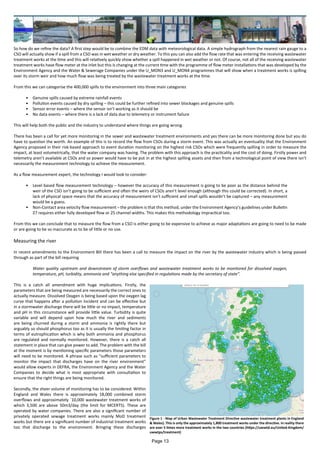
Figure 1 - Map of Urban Wastewater Treatment Directive wastewater treatment plants in England
& Wales). This is only the approximately 1,800 treatment works under the directive. In reality there
are over 5 times more treatment works in the two countries (https://uwwtd.eu/United-Kingdom/
uwwtps/treatment)
Page 13
together there are around 28,000 discharges to the environment from wastewater treatment systems on a national basis. If we measure both upstream and
downstream this is in the region of 56,000 measurement locations. This would equate to a measurement location for every 1.27 square miles in England &
Wales.
Let’s look at the options for monitoring. For me at least there are three main options all with advantages and disadvantages:
Option 1 – Scrap river monitoring at look at monitoring the wastewater treatment works discharges as a first step.
Option 2 – Measure upstream and downstream of every discharge using sonde-based technology
Option 3 – Measure upstream and downstream of every discharge using analytical-based technology.
If we look at Option 1 the immediate problem with the option is that it doesn’t monitor the quality of the discharges from CSOs which is the whole point. It
does however quite closely control how water companies are performing and should cover the discharges from the storm tanks or be made to cover these
discharges. The current EDM data should cover the time of any discharges within the network and is enough encouragement for the water companies to
address these discharges. It will encourage the water industry, together with the various other targets down to drivers such as “net zero” to go down a route
where they monitor and control much more effectively for environmental gain.
Option 2 is where the thoughts of the majority are and those who have proposed the amendments have thought that this option can be installed. After all it’s
a short metal pole that can quite easily sit 20m upstream and 20m downstream of a discharge and is already set up to monitor the river environment. After
all the technology exists already. This is also why phosphorus has been left out as a measurement parameter as most sondes will measure ammonium but not
phosphorus
This is the misconception and is there because the difficulties of installation, operation and maintenance are not widely understood. Of this one of the largest
difficulties will be calibration. In reality sondes need a significant amount of maintenance. Re-calibration of sondes would at a minimum need to be done
every six weeks. If we use this figure and estimate that a single person could calibrate three sites (6 measurement locations) per day. This would equate to a
permanent job for 311 people to service and maintain all of the sondes in the network. However, on a health & safety basis, they can’t be alone so this doubles
the need to 622 people but of course all of these people need holidays too and so you have to increase the need for people by at least 10% and so this increases
to an absolute minimum of 684 people. Once you factor the cost of these people to the business plus what they need to do their job the annual operational
expenditure cost is close to £50 million per year. This doesn’t include the cost of chemicals to calibrate the instruments.
Foroption 2thisisbeforethecapitalexpenditureofactualbuyingtheinstrumentsthemselvesandtheninstalling theminasafewaywithin theriverenvironment.
Reasonably a sonde device with all of the sensors on board measuring what is going to be needed to measure the impact on the river environment including
pH, temperature, turbidity, ammonia and phosphorus is going to cost around £15,000. This is a reasonable cost and there is the argument that this might get
cheaper however this is a cost that has come down considerably since the technologies were first introduced. Multiply this by the number of measurement
points and the cost is £840 million not including installation. The cost of instrument for a simple installation is approximately half the price. From one of cost
point of view we are now talking about in the region of £1.68 billion. Where does this half the price come from? Well, a civil structure will be needed to anchor
the sonde too and will be needed to provide a local communications station so that all of the data can be communicated back to the corporate infrastructure.
There is also the cost of an outstation which is in the region of £1000 per measurement site increasing the cost by another £26 million.
In terms of ongoing costs the sonde will realistically last 5-7 years and so there is an additional cost of around £100 million/year in terms of the cost to replace.
Bringing the cost of option 2 together there is an initial capital cost in the region of £1.9 billion including the cost to deliver and an ongoing operational cost
(including the cost to replace) of in the region of £180 million/annum. Initially in the next asset management period this would equate to a cost increase of £20
per household per year for a five year period with the ongoing operational costs increasing customers bills by approximately £9.30 per year.
Lastly if we look at Option 3 the costs increase even more in terms of the capital expenditure but lessen in terms of the operational expenditure. The analytical
equipment that is needed to satisfy the amendment would cost in the region of £40,000 and using the same cost to install rule we are looking at approximately
£80,000 per measurement point. There could be some efficiencies in delivery as the upstream and downstream points are in close proximity but for a ball-park
estimate the double the instrument cost is a fair estimate to use. This would equate to a capital investment of £4.5 billion. The advantage of most of these
technologies is that they are self-calibrating and so don’t need as much attention as a sonde. However they do need chemicals to work and so there would still
need to be operational staff to top up chemicals on a continuous basis. However the job is significantly simpler and so less staff are needed. This means the
staffing burden is reduced to approximately 100 people resulting in a opex cost of approximately £4million per year.
If we add the costs of this option together then the initial capital cost per household increase to £46/annum in the next asset management period and then an
ongoing cost, including the cost to replace, of approximately £16 per annum.
In reality this exercise is only a ball park estimate and can easily be argued away but the point was to demonstrate the cost of the decisions that we are making
and allow us time to stop and think. By installing instrumentation at this scale and this level we are actually not solving the problem and the real costs of solving
the pollution problem within our river environment is going to be at least an order of magnitude greater if not more. This is being currently played out right now
as the EDM programme that was installed in the past five years has opened up and informed us all about an issue that we weren’t really aware of. This isn’t a
reason not to monitor as situational awareness is an absolute must but we must realise that these costs are only a beginning and the true cost is still to come.
The recent discussion on pollution at WWEM revealed that there is an absolute need to monitor after all in order to manage the situation we must monitor
however let us monitor with a purpose, let us monitor with a scientific rigour that is going to provide value to the monitoring that we undertake as otherwise
what is going to happen is what has always happened insofar as we have a massive drive to install instrumentation only for the quality of the data we eventually
receive to let us down. Before we embark on all of this lets us concentrate on the monitoring that we truly need using a risk-based approach rather than the
monitoring that is a nice to have that way the quality of the data that we will get and the insight that it will give will enable us to make the right decisions moving
forward that will eventually have a much greater environmental benefit.
Page 14
Case Study:
Advanced Flow Rate Monitoring of a
Wastewater System in Kuwait
Teledyne ISCO provided a complete flow monitoring solution that helped the Kuwaiti Ministry of Public Works manage their wastewater reclamation system from
a data control centre. More than 250 Teledyne ISCO non-contact LaserFlow® sensors and Signature® flowmeters were installed.
Project Overview
The project, named SE157, included the supply,installation, operation, and maintenance of permanent flow monitors, permanent water quality monitors, and
associated equipment at 250 sites in the sanitary network of the state of Kuwait, with the majority of sites located within the Kuwait Metropolitan Area. It also
included the supply of all supervision, labour, construction facilities, detailed design and logistic support necessary to provide a complete operating system and
its maintenance for two years.
The preliminary stage of the project was an in-depth evaluation of available flow techniques that could be used in the existing difficult conditions, plus site surveys
to identify suitable manholes and other installation locations. One LaserFlow sensor and Signature flow logger were installed first in 2017 for demonstration
purposes. After six months of continuous operation and in-depth data analysis, Hydrotek Engineering Company, the contractor for Kuwait MPW, demonstrated
that Teledyne ISCO technology was superior to other commercial solutions in terms of ease of installation, quality of data recorded, and resistance to harsh
environmental conditions, such as extreme temperatures.
Site Challenges
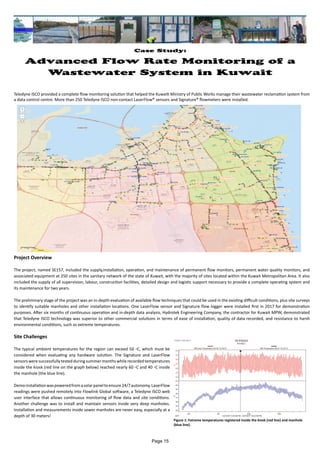
The typical ambient temperatures for the region can exceed 50 ◦C, which must be
considered when evaluating any hardware solution. The Signature and LaserFlow
sensorsweresuccessfullytestedduringsummermonthswhilerecordedtemperatures
inside the kiosk (red line on the graph below) reached nearly 60 ◦C and 40 ◦C inside
the manhole (the blue line).
Demoinstallationwaspoweredfromasolarpaneltoensure24/7autonomy.LaserFlow
readings were pushed remotely into Flowlink Global software, a Teledyne ISCO web
user interface that allows continuous monitoring of flow data and site conditions.
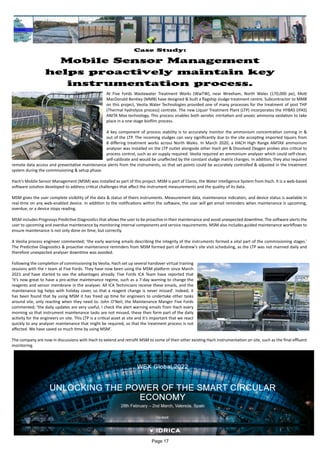
Another challenge was to install and maintain sensors inside very deep manholes.
Installation and measurements inside sewer manholes are never easy, especially at a
depth of 30 meters!
Figure 1: Extreme temperatures registered inside the kiosk (red line) and manhole
(blue line).
Page 15
Teledyne ISCO therefore offered an adjustable mounting system with a street level sensor retrieval tool
that helps the service personnel during maintenance. This solution made the safety and PPE requirements
less strict and less expensive as no personnel are required to enter the manhole. With this adjustment
tool the sensor can be removed simply by releasing the lock and then pulling it up to ground level.
Outside the installation, the primary requirement was to offer an accurate and reliable flow measurement
system that would be able to handle various flow condition such as: low levels, near zero and high
velocities, large and small channels, urban and industrial wastewater, surcharge conditions, and Ex zones,
all of which had to be considered when evaluating the best solution.
“We sought a solution that could accurately measure the flow, even in harsh conditions, with ease of
installation. Teledyne ISCO had the expertise and equipment that allowed us to achieve this,” said Prem
Kumar, Automation Division Manager for Hydrotek Engineering Company.
Flow monitoring results in costs savings
The installation of flow monitoring covering the entire Kuwait Metropolitan Area is designed as an early
detection system to better control the impact of rainfall as well as the capacity of the entire collection
system, which, if not sufficient, would result in backflow and flooding of households. Flow rate monitoring
in the industrial areas further allows effective control of contamination and other environmental impacts.
The system was able to save money by more effectively managing certain resources that
should be used only when absolutely necessary. This was made possible by real-time
analysis of the information continuously being collected remotely from key measurement
points.
The LaserFlow sensor diagnostics data quickly alerts management to critical events,
for example a manhole surcharge, allowing remedial actions to be taken by a network
supervisor with no delay. Data collection systems and GIS software are integral parts of our
monitoring instruments, allowing historical and real time data to be transmitted regularly
to each of the Governorates in the State of Kuwait.
Consistent flow monitoring throughout the entire sewerage network provides the
information needed for sustainable city development, helping to determine the level of
investments required to maintain the existing wastewater infrastructure efficiently and
plan properly for expansion.
Customer feedback
Teledyne ISCO non-contact laser technology was recognized by the customer as a key to
successfully completing the project. “The Teledyne ISCO LaserFlow sensors and Signature
flowmeters have been providing an accurate, reliable, and continuous measurement
solution since 2019”, said Engineer Jaber Mohammed Hassan Barwiz, Project Engineer at
Kuwait Ministry of Public Works.
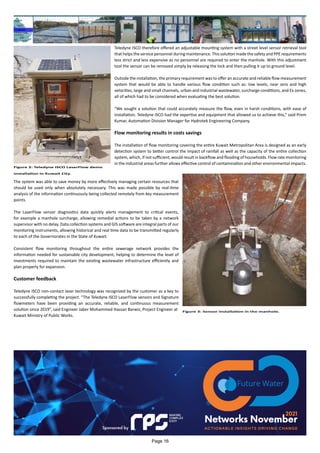
Figure 2: Teledyne ISCO LaserFlow demo
installation in Kuwait City.
Figure 3: Sensor installation in the manhole.
Page 16
Case Study:
Mobile Sensor Management
helps proactively maintain key
instrumentation process.
At Five Fords Wastewater Treatment Works (WwTW), near Wrexham, North Wales (170,000 pe), Mott
MacDonald Bentley (MMB) have designed & built a flagship sludge treatment centre. Subcontractor to MMB
on this project, Veolia Water Technologies provided one of many processes for the treatment of post THP
(Thermal hydrolysis process) centrate. The new Liquor Treatment Plant (LTP) incorporates the HYBAS (IFAS)
ANITA Mox technology. This process enables both aerobic nitritation and anoxic ammonia oxidation to take
place in a one-stage biofilm process.
A key component of process stability is to accurately monitor the ammonium concentration coming in &
out of the LTP. The incoming sludges can vary significantly due to the site accepting imported liquors from
8 differing treatment works across North Wales. In March 2020, a HACH High Range AMTAX ammonium
analyser was installed on the LTP outlet alongside other Hach pH & Dissolved Oxygen probes also critical to
process control, such as air supply required. Veolia required an ammonium analyser which could self-clean,
self-calibrate and would be unaffected by the constant sludge matrix changes. In addition, they also required
remote data access and preventative maintenance alerts from the instruments, so that set points could be accurately controlled & adjusted in the treatment
system during the commissioning & setup phase.
Hach’s Mobile Sensor Management (MSM) was installed as part of this project. MSM is part of Claros, the Water Intelligence System from Hach. It is a web-based
software solution developed to address critical challenges that affect the instrument measurements and the quality of its data.
MSM gives the user complete visibility of the data & status of theirs instruments. Measurement data, maintenance indicators, and device status is available in
real-time on any web-enabled device. In addition to the notifications within the software, the user will get email reminders when maintenance is upcoming,
overdue, or a device stops reading.
MSM includes Prognosys Predictive Diagnostics that allows the user to be proactive in their maintenance and avoid unexpected downtime. The software alerts the
user to upcoming and overdue maintenance by monitoring internal components and service requirements. MSM also includes guided maintenance workflows to
ensure maintenance is not only done on time, but correctly.
A Veolia process engineer commented; ‘the early warning emails describing the integrity of the instruments formed a vital part of the commissioning stages.’
The Predictive Diagnostics & proactive maintenance reminders from MSM formed part of Andrew’s site visit scheduling, as the LTP was not manned daily and
therefore unexpected analyser downtime was avoided.
Following the completion of commissioning by Veolia, Hach set up several handover virtual training
sessions with the r team at Five Fords. They have now been using the MSM platform since March
2021 and have started to see the advantages already. Five Fords ICA Team have reported that
‘It’s now great to have a pro-active maintenance regime, such as a 7-day warning to change the
reagents and sensor membrane in the analyser. All ICA Technicians receive these emails, and the
maintenance log helps with holiday cover, so that a reagent change is never missed’. Indeed, it
has been found that by using MSM it has freed up time for engineers to undertake other tasks
around site, only reacting when they need to. John O’Neil, the Maintenance Manger Five Fords
commented; ‘the daily updates are very useful, I check the alert warning emails from Hach every
morning so that instrument maintenance tasks are not missed, these then form part of the daily
activity for the engineers on site. This LTP is a critical asset at site and it’s important that we react
quickly to any analyser maintenance that might be required, so that the treatment process is not
affected. We have saved so much time by using MSM’.
The company are now in discussions with Hach to extend and retrofit MSM to some of their other existing Hach instrumentation on site, such as the final effluent
monitoring.
Page 17
Water, Wastewater & Environmental Monitoring
Telford, UK
12th - 13th October 2022
The WWEM Conference & Exhibition has been changed to a virtual conference and exhibition for 2021 and a physical conference
and exhibition in 2022. Details on WWEM Virtual will be released in the coming months but it is sure to include huge amount of
technical workshops and events for attendees to enjoy.
Sensor for Water Interest Group Workshops
The Sensors for Water Interest Group has moved their workshops for the foreseeable future to an online webinar format. The next
workshops are
24th November 2021 - SWIG/KTN Sensor Sprint
2nd February 2021 - Leakage Workshop - Sandy Park Rugby Club, Exeter
Future Water Association - Network November 2021
5th - 25th November 2021
Future Water is excited to introduce Networks November 2021 – a series of webinars comprising of leading industry keynotes,
knowledge bites and technical presentations, taking place on 5th, 19th, and 26th November. Following on from the success of
Future Water Networks, we are launching Networks November to be a focal point for forward thinking about all things water, pipes
and sewers!
WEX Global 2022
Valencia, Spain
28th February - 2nd March 2022 - Valencia, Spain
The WEX Global Conference. Sponsored by Idrica is currently due to take place in Valencia in Spain in March 2022. The conference
concentrates on the circular economy and smart solutions to resolve some of the global water industry's issues
Page 18
Conferences, Events,
Seminars & Studies
Conferences, Seminars & Events
2021 - 22 Conference Calendar
Due to the current international crisis there has been a large amount of disruption in the conference calendar. A lot of workshops have
moved online at least in the interim and a lot of organisations are using alternative means of getting the knowledge out there such as
webinars popping up at short notice. Do check your regular channels about information and events that are going on. Also do check on
the dates provided here as they are the best at the time of publishing but as normal things are subject to change.
Page 19

WIPAC Monthly - October 2021

  • 1.
    WIPAC MONTHLY The MonthlyUpdate from Water Industry Process Automation & Control www.wipac.org.uk Issue 10/2021- October2021
  • 2.
    Page 2 In thisIssue WIPAC Monthly is a publication of the Water Industry Process Automation & Control Group. It is produced by the group manager and WIPAC Monthly Editor, Oliver Grievson. This is a free publication for the benefit of the Water Industry and please feel free to distribute to any who you may feel benefit. However due to the ongoing costs of WIPAC Monthly a donation website has been set up to allow readers to contribute to the running of WIPAC & WIPAC Monthly, For those wishing to donate then please visit https://www.patreon.com/Wipac all donations will be used solely for the benefit and development of WIPAC. All enquires about WIPAC Monthly, including those who want to publish news or articles within these pages, should be directed to the publications editor, Oliver Grievson at olivergrievson@hotmail.com From the editor............................................................................................................. 3 Industry news.............................................................................................................. Highlights of the news of the month from the global water industry centred around the successes of a few of the companies in the global market. 4 - 11 The cost of monitoring our rivers................................................................................... Currently going through the political process is the need to monitor the river environment to help manage the pollution problem we have in England & Wales. As part of this is the need to monitor up and downstream of all discharges. In this feature article we attempt to understand the practicalities and cost of this approach to the customer. 12 - 14 Advanced flow rate monitoring of a wastewater system in Kuwait................................ In this case study from ISCO we look at the flow monitoring of an extensive wastewater collection network in Kuwait City with the challenges that the environment brings and how non-contact area velocity flow monitoring has been used to great effect 15 - 16 MobileSensorManagementanditsproactiveusedtomanagekeyinstrumentation.......... In our second case study of the month we look at the use of mobile sensor management to help maintain critical instrumentation at a liquor treatment plant at a wastewater treatment works. The technology has helped keep instrumentation correctly maintained and help in insight at the operational level 17 Workshops, conferences & seminars............................................................................ The highlights of the conferences and workshops in the coming months. 18 - 19
  • 3.
    Page 3 From theEditor What a month it has been. Firstly all of the discussions at WWEM were something special. We had four fantastic panels talking about some of the pressing issues within the modern water industry and what insights there were from the need to take risk-based approaches to the monitoring that we need to do to the rising importance of citizen science and the need for eNGOs (environmental non-governmental organisations) within the industry. In England & Wales at least we have legislation coming in to force that gives me significant cause for concern. The water industry in England has been well-known to be DRIP (data rich-information poor) and with more monitoring coming in we are effectively hugely increasing the data richness. To me at least, this is incredibly dangerous as what we risk heading towards is instrumentation blindness and furthering the risk of "the resistance to the effective use of instrumentation," a subject that this group discussed ten years ago now. Where am I heading with this? As a technologist and engineer shouldn't I be a staunch advocate of yet more monitoring, shouldn't I be an advocate of a national Digital Twin where we can tell exactly what is going on and a 20:20 vision in terms of situational awareness. In an ideal world then of course I am going to be shouting a resounding yes of course we should. The frequent readers of WIPAC will remember the paper that I wrote on the anthropogenic (man-made) water cycle. I've seen over the years within the water companies a desire to expand out into the natural environment and be guardians of the water environment. When I've been out in the field I see that reactions of operators on the ground and there is a passion to get things absolutely right and a frustration that not everything works perfectly all of the time. However, despite all of this I also recognise the cost to do it all and there has to be a value for not just the environment but people too. The practical person within me that has been out and surveyed well into a thousand wastewater treatment works, pumping stations and the likes realises that, if we install all of this instrumentation, can we manage it and can we get the value from the data. For me at least that is the key point. In England and Wales we installed thousands of event duration monitors in the last asset management period and that is what is informing the current discussions on river pollution. However, I also know that the data out there is a raw form lacking context and in reality, without the technical insight the data can mislead the situation. This is the double-edged sword of data and the Digital Transformation of the water industry as far as if the data that we get is wrong then it has the potential to lie to us and portray a situation that isn't necessarily the case. To get true data that is useable and publishable (within an hour) you have to follow the technology triangle of having not just the right technology installed in the right way but also have both the people and the processes to get the best value out of it. If any of the aspects of the triangle are missing then we might as well put all the money that we are going to spend on monitoring in a great big pile and set fire to it. In fact this would be more productive as to not do things properly increases the risk of throwing good money after bad. This may seem to be a bit of a naysayer negative point of view and I'll firmly state that we must monitor and we must manage the water environment alot better than evidently we have done but we must do it in the right way, use the right technologies installed properly in the right place, we must have the right people and the right system to ensure that we get the true story. The alternative is we will waste precious time and precious money that in reality we don't have in abundance. Have a good month, Oliver
  • 4.
    Digital Water StartupQatium Onboards 150 Utilities Ahead Of Launch Digital water company Qatium (Kay-tee-um) has onboarded over 150 water utilities in the last three months, and will be launching its water management platform at Aquatech Amsterdam on November 2nd. Qatium gives utilities of all sizes the visibility to improve network performance, identify efficiencies and ensure continuity of service. By combining hydraulic models with SCADA, AMI and GIS data, Qatium can simulate demand spikes and water shutdowns, predict bottlenecks, identify leaks, run flushing scenarios to reduce solids and monitor water quality. Today, Qatium provides municipalities and water utilities with deep analytics for managing their networks regardless of their size, expertise or resources. Qatium Founder and CEO Roberto Tórtola set out the company’s long term goals: “Qatium aims to be the single-source of truth for water professionals and a global marketplace for water utilities, open source software developers, service providers and technology vendors.” Since the launch of its early adopter program less than three months ago, over 150 utilities from around the world have started using Qatium to improve the management and delivery of their water systems. Gavin Van Tonder, Executive Director of Water at NEOM, explains the early success of the platform: “We were impressed by Qatium’s simplicity and unique visualization capabilities. With Qatium, we were able to see results from day one.” Qatium will be unveiled on November 2nd at 5PM CET at the Digital Hub’s Aquastage at Aquatech Amsterdam. Aquatech Amsterdam is the world’s leading water trade show, bringing together more than 15,000 water professionals to discuss issues relevant to the clean water and wastewater industries. Kevin Wyckoff of the Lakewood Water District in Washington, one of the many utilities in the US to use Qatium says: “In addition to the network insights it provides, Qatium is an intuitive and collaborative tool to test new ideas, facilitate training and transfer knowledge.” “Visibility is key to making water systems more efficient, safer, and more affordable. With Qatium, operators can better understand network behavior, optimize system performance, and ensure continuity and resilience by proactively protecting assets and communities.” says Dragan Savic, CEO at KWR Water Research Institute, Professor of Hydroinformatics at the University of Exeter, and a member of Qatium’s advisory board. Jeffrey Kightlinger, the former GM of the Metropolitan Water District of Southern California and a member of Qatium’s advisory board concurs: “Qatium is changing the face of the water industry with tools that help water managers optimize their systems and meet the challenge of climate change.” Idrica Nominated For The Prestigious Aquatech Innovation Award 2021 The GoAigua SARS Analytics solution, marketed by the multinational Idrica, has been nominated in the Transport and Process & Control category of the prestigious Aquatech Innovation Award 2021. GoAigua SARS Analytics is an Early Warning System (EWS) that facilitates decision-making in COVID-19 outbreaks. This solution is built on the GoAigua platform and integrates wastewater parameters, socio-sanitary and geographical variables, providing a holistic overview of virus concentration in neighbourhoods and cities. This award recognizes the most innovative products, services and concepts in the water industry. The jury of experts considers the international and disruptive potential of each company’s value proposition in each of the five categories: Water Supply, Wastewater Treatment, Transport and Process & Control, Green Chemicals for Water Technology, and Innovation. Additionally, for the first time, the entry with the largest number of votes from the public will receive the community award. Page 4 Industry News
  • 5.
    Benefits of OpenData in UK water sector - Ofwat makes case for change Ofwat has this month published a discussion paper setting out the case for how open data can enable water companies to create value for water customers, communities and the environment. Introducing the paper, H2Open – Open data in the water industry: a case for change, the water sector regulator said open data means making data freely available to everyone to access, use and share, unless there is a really strong justification for not doing so. According to Ofwat, the use of open data could transform water and wastewater service delivery by increasing transparency, increasing efficiency, enhancing customer experience, and stimulating innovation. However, “very few companies have introduced open access to their data sets. There is currently a huge untapped opportunities through open data for the industry”, the regulator said. Working alongside the water industry, consumer groups and the Open data Institute, Ofwat has sought to understand the benefits of open data and how it could be used to help address some of the challenges the water sector faces:climate change, the need to protect the environment, responding to changing customer demands and protecting the most vulnerable. Via engagement with stakeholders, the regulator has identified key enablers needed to unlock the best outcomes from open data: • a strong data culture and the development of capability and skills – A strong individual company and industry-wide vision and strategy is essential for delivering open data. Strong senior leadership ensures strategic focus, and that data and analytics capability is developed • improved collaboration on open data across the industry – Working together to collect, share and use data can help to address challenges, improve decision making and adapt to changing environments; and • established data infrastructure – Open and accessible datasets, technology, training and processes that collect, maintain and use the data to gain insights and solve problems The report says no water company has opened large numbers of data sets beyond what is required by Government or a regulator for regulatory purposes. Ofwat wants to see the industry keep pace, make open data more of a priority and work together to embrace open data for the benefit of customers, society and the environment. The regulator would like to see the sector make measurable progress in delivering open data over the next 12 months. Lisa Commane, Senior Director at Ofwat said: “Other sectors have showcased the power of open data in delivering huge benefits for people and the planet. Open data plays a central role in stimulating new thinking and the use of open data is vital for the water sector to innovate and address some of the challenges and opportunities that exist. “We need to unleash the untapped potential of open data and we’ve heard there is appetite for doing that. This can be done if the water sector works together to lead this work and to develop the skills, technology and culture we have heard are essential. We’re really looking forward to seeing how the sector responds over the next 12 months and the benefits it brings.” While the paper is primarily focussed on the 17 incumbent regional monopoly companies, in Ofwat’s view many of the benefits of this approach to open data could – and should – apply to data held by all operators including business retailers and new appointees and variations. The regulator wants to see those businesses also explore the opportunities and benefits that a more open approach to market data could present to business customers and the environment. Ofwat said: “We intend this paper to supercharge a public discussion about the benefits of open data and how it could be used to help address some of the challenges the water sector faces.” Page 5
  • 6.
    FIDO and UnitedUtilities launch new breakthrough in leak detection using AI and cloud correlation In collaboration with United Utilities, FIDO has launched a new breakthrough in leak detection - Cloud Correlation – which uses AI in the cloud to accurately locate leaks in the field to under 1m. According to FIDO, the development marks a significant step forward in leak detection technology - with no need to manually input information like pipe material, it further removes the potential for human error from the leak detection process - like AI leak detection and leak sizing before it. FIDO Cloud Correlation is a new technique which uses FIDO AI in the cloud to simplify and cut the cost of leak location on any network and, in tests, is accurate to within a metre. The technique is the result of an ongoing collaborative innovation partnership between FIDO Tech Ltd and United Utilities - reduces room for human error and eliminates the need for additional specialist equipment. Simple free palm-sized samplers called FIDO Bugs collect all the acoustic data, removing the need for multiple, proprietary devices. Super accurate analysis is done by FIDO AI in the cloud, with instant results direct to an engineer’s phone. United Utilities development partnership with FIDO Tech emerged from its respected Innovation Lab in 2019. CEO of FIDO Tech, Victoria Edwards said Cloud Correlation would do for leak location what FIDO AI had already done for accurate leak analysis and leak-sizing. “AI has removed human error from acoustic and kinetic leak data analysis because extraneous noises, or sounds below the threshold of human hearing, don’t matter. Plus, it can tell a leak’s size just by listening. No human, or any other tech, can do that. “With Cloud Correlation, FIDO AI uses this knowledge to automatically decide which sequence from a range of complex calculations will give the most accurate result. The phenomenal computing power of the cloud is what enables this. It is beyond the capability of an independent device in the street. With no need to enter any technical, location or pipe material data, there is no need for specialist training.” Where GIS network data is also available, FIDO will auto-calculate the distance between assets further removing the need for human interaction. Leakage Technical Manager for United Utilities Paul Parr said: “As a leakage manager I am always pushing the boundaries on technology to help us in our drive to be more efficient and accurate when marking leaks for our repair teams, whilst keeping our teams as safe as possible. I never thought I would see the day where our technicians had a pocket correlator, but it is here. The power of Cloud Correlation will help us become more efficient on site and drive leakage down.” FIDO Cloud Correlation is the latest function of FIDO AI, a deep-learning neural network which has become one of the most successful alumni of United Utilities’ much-heralded Innovation Lab. Inflowmatix helps Portsmouth Water achieve historically low leakage performance Portsmouth Water has partnered with Inflowmatix to deploy arboricity™ at the core of its ‘Digital Twin’ strategy – the tech company has worked collaboratively with the water company to provide support throughout the Covid-19 crisis and to strategically develop and trial its new product and service offerings. Providing online, automated analytical tools to monitor critical assets such as pressure reducing valves (PRVs) which feed large pressure managed areas (PMAs) has enabled a substantial improvement in key customer metrics in the first year of the AMP7 period. Both leakage at 23Ml/d and interruptions to supply at 2 mins 49 seconds are at their lowest levels in recent history – this being achieved against a backdrop of some extremely challenging supply periods with both Covid and a cold winter. The Inflowmatix high frequency technology not only captures and localises significant pressure events within a network using leading edge analytics but now enables calibrated, and near-real time maintained hydraulic models as a core element of its arboricity™ ‘service’ based offering. Such models allow higher level automated analytical services to be brought online which are cognisant of the hydraulics of the network and therefore not ignored, increasing confidence in operational decision making and providing actionable insight. Integrating these models with the Innovyze WS Pro and IW Live core modelling platform has created the heart of a Digital Twin providing live network information at the point of need. Jim Barker, Head of Water Resources, Leakage and Smart Networks – Portsmouth Water commented: “Working collaboratively with Inflowmatix to understand our network in more detail and to mitigate the effects of dynamic pressure variations has proved highly beneficial and has positively impacted our performance in the first year of a very challenging AMP7. “We could not have delivered our historically low leakage performance in particular without the timely insight into network performance that working with Inflowmatix gave us. Our strategy to continue to improve this performance relies on harnessing this insight even further and we are doing this by putting a digital twin, using arboricity™, at the core of our operations. We are delighted to be taking this next step of the journey working closely with Inflowmatix.” Page 6
  • 7.
    Regulator And UtilitiesTo Explore Open Data Opportunities British Water will welcome Anita Payne, director of insights and impact at industry regulator Ofwat, as keynote speaker as its 2021 data conference. The role open data could play in the transformation of water is at the centre of discussions being had across the UK sector and the trade association is keen to move the dialogue forward. UK utilities will also take the conference stage on 25 November 2021 in London to present their open data strategies. A new discussion paper from Ofwat, H2Open, intends to supercharge a public discussion about the benefits of open data and how it could be used to help address some of the challenges the water sector faces. "I am excited to speak about open data at the British Water conference,” says Payne, speaking prior to the event. “Open data can enable companies to deliver better outcomes for customers, communities and the environment. We see open data as central to driving efficiencies, catalysing innovation and increasing transparency." Ofwat describes open data as “making data freely available to everyone to access, use and share, unless there's a really strong justification for not doing so”. The H2Open document says the opening of data could transform water and wastewater by increasing transparency and efficiency, enhancing customer experience and stimulating innovation, helping the sector adapt to climate change, protect the environment and meet customer expectations. Following the keynote, the event will see Thames Water, Anglian Water, Northumbrian Water and MOSL present their open data strategies. There will also be a discussion on what changes in procurement, business models and innovation are needed to match the fast-changing pace of data developments. The conference will conclude with a new talent competition for start-ups in collaboration with the Hartree Center and IBM. British Water chief executive Lila Thompson said: “Digitalisation of the water sector has already had a positive impact on the way we work and deliver for society and the environment. However, as detailed in Ofwat’s H2Open paper, there are so many more benefits to be gained by embracing open data, including the sparking of innovation. This is vital as we adapt to climate change and aim to achieve net zero carbon by 2030. “Open data collaboration may require some bold changes to internal process and policy but my conversations with utilities and the supply chain confirm there is a willingness to grasp the opportunities to enable the sector to move forward at pace. “Our data conference will provide an excellent face-to-face forum for sharing knowledge and results in theory, methodology and applications of open data, smart collaboration and data analytics techniques. I am hopeful that these conversations will be the catalyst for tangible progress that is now expected.” South East Water, the Melbourne based progressive utility will pilot the TaKaDu’s Central Event Management (CEM) solution for a period of 18 months. “South East Water is continuously looking at enhancing the way we manage leak detection and reduction. We have good systems and processes in place, but we’re always looking for ways to improve. This trial is a great opportunity to explore improvements we could make by tapping into the TaKaDu CEM offering” says Charlie Littlefair, South East Water’s General Manager Liveable Water Solutions. “TaKaDu is very active in Australia with leading satisfied customers for almost a decade. We are very proud to now receive this vote of confidence from South East Water, one of the most progressive water utilities in the world” said Udi Geismar, TaKaDu’s VP Enterprise Solutions. “Deploying our cutting edge CEM solution in South East Water, is part of their digital journey with an intent on improving operational efficiency, improve customer service, and reduce water loss”. South East Water To Implement A Trial Of TaKaDu's CEM To Reduce Water Loss And Improve Efficiency Xylem, Dragos partner to offer water utilities cybersecurity The global water technology company and global cybersecurity company will now provide a co-branded incident response service for water utilities worldwide. Xylem Inc., a global water technology company, and Dragos Inc., a global cybersecurity company for industrial controls systems and operational technology, today announced they have partnered to bring industrial cybersecurity to critical infrastructure in the water sector. TheagreementwillseeXylemandDragosofferingco-brandedincidentresponseandincidentpreventionservicestoXylem’swaterutilitycustomersworldwide. The partnership brings water utilities experienced teams of both digital water experts and industrial cybersecurity practitioners. Nick Nedostup, Xylem’s chief information security officer, said, “Modernizing water infrastructure with digital technology delivers dramatic benefits – lowering costs and reducing both energy and emissions while also making communities more resilient in the face of climate change. And because water is so essential, water infrastructure deserves the very best security against cyber threats.” The Xylem-Dragos Incident Response Service builds on Xylem’s current product security framework and works in conjunction with utilities’ existing security systems, providing an extra layer of protection. The service is available on a retainer basis. Page 7
  • 8.
    Affinity Water insecond award win from Ofwat’s £200m Innovation Fund Affinity Water has won a second Ofwat Innovation Award bringing the total of its awards this year to share with its partners to over £3.2 million – the company gained its first Ofwat Innovation Award in May 2021. The Innovation in Water Challenge – run by Nesta Challenges as part of Ofwat’s £200 million Innovation Fund –awarded Affinity Water £249,791 of funding for its ‘Seagrass Seeds of Recovery’ bid and £94,500 for its ‘Smarter Tanks’ project. Affinity Water’s two winning initiatives were produced in collaboration with other water companies, UK Universities and government agencies to improve the efficiency and resilience of its water supplies. The two entries employed new and novel nature-based solutions to improve the resilience of existing infrastructure. Affinity Water will also contribute to the two projects from its own funds: £31,644 for Seagrass, and £10,500 for Smarter Tanks. Ellie Powers, Head of Water Resources and Environment explained: “Our strategy was to bring broad-based experienced teams together to examine possible solutions to the pressing problems the water industry faces and to come up with solutions that are truly innovative. “As we enter the UN Decade On Ecosystem Restoration (2021-2030), ‘Nature-based solutions’ (NbS) have become recognised as a key way to address the problems of both a nature crisis, and a climate emergency. Nature-based solutions provide many wide-ranging environmental benefits beyond their immediate solution. At Affinity Water we already undertake significant nature-based activities through our long-standing catchment management and river restoration programmes.” Affinity Water and its project partners won £2.9 million in Ofwat’s first Water Breakthrough Challenge to deliver a sustainable, water-saving solution in response to new housing developments being built. The project will minimise water demand and offset water consumption with new technologies, to ensure the total water use in three communities remains the same as it was before the new homes were built. Stuart Ledger, Interim CEO at Affinity Water said: “We need water neutrality to be delivered in the UK. Sustainable growth is essential given the ongoing impact of climate change and our pledge to net zero operational emissions by 2030. Thanks to Ofwat’s Breakthrough Challenge, we will kick start the launch of water neutrality in the UK with the world’s first at scale project. “Our partnership of industry leading providers will install water reduction and recycling technologies and engage communities to ensure water savings, carbon reductions and support NAV partnerships.” Just four months later at the end of September 2021 it gained another innovation award from Ofwat’s Challenges. Entries to the Water Breakthrough Challenge were encouraged from water companies in England and Wales in partnerships with organisations in and outside the water sector, including universities and institutes, retailers, start-ups, or small businesses in sectors such as energy, manufacturing, health, or financial services. Affinity Water’s collaboration with others has also been acknowledged in other Ofwat awards as part of other Water Breakthrough Challenge winners: • with a consortium called the Catchment Systems Thinking Cooperative (CaSTCo). This is a partnership led by United Utilities between the Rivers Trust, twelve water and sewerage companies as well as academia and environmental charities. It has been awarded £7.1 million to revolutionise the way crucial data about England and Wales’ water environment is gathered and shared, in particular on the health of the nation’s rivers. • in a project led by Anglian Water and its partners Jacobs, Skanska, Imperial College, Airbus Defence and Space, Microsoft and the University of Sheffield. Alongside fellow water companies South West Water, and Portsmouth Water which have been awarded £7.5 million for their Safe Smart Systems project. The project will use artificial intelligence and mathematical optimisation to improve long-term operational resilience in the face of climate change and rapid population growth. Affinity also jointly won funding in the first Innovation in Water Challenge led by Northumbrian Water with a UK Water Sector Innovation Centre of Excellence. A virtual innovation accelerator hub to promote collaboration in and beyond the water sector and drive transformational innovation. Page 8
  • 9.
    Seeq Expands MachineLearning Support To Democratize Data Science Innovation Seeq Corporation, a leader in manufacturing and Industrial Internet of Things (IIoT) advanced analytics software, announces the expansion of its efforts to integrate machine learning algorithms into Seeq applications. These improvements will enable organizations to operationalize their data science investments, and their open source and third-party machine learning algorithms, for easy access by front-line employees. Seeq customers include companies in the oil & gas, pharmaceutical, chemical, energy, mining, food and beverage, and other process industries. Investors in Seeq, which has raised over $100M to date, include Insight Ventures, Saudi Aramco Energy Ventures, Altira Group, Chevron Technology Ventures, and Cisco Investments. Seeq’s strategy for enabling machine learning innovation provides end user access to algorithms from a variety of sources, rather than forcing users to rely on a single machine learning vendor or platform. This addresses the diversity and types of algorithms available to organizations, including: • Open sources algorithms and other public resources. For example, this week Seeq will publish two Seeq Add-ons to GitHub, including algorithms and workflows, for correlation and clustering analytics, which users can modify and improve based on their needs. • Customer-developed algorithms in Seeq Data Lab—or machine learning operations platforms such as Microsoft Azure Machine Learning, Amazon SageMaker, Anaconda, and others—as part of data science or digital transformation initiatives. • Third-party algorithms provided by software vendors, partners, and academic institutions. AWS’s Lookout for Equipment, Microsoft Azure AutoML, BKO Services’ Pump Prediction, and Brigham Young University’s open-source offerings are examples of the emerging marketplace for industry and vertical market specific algorithms. The Seeq initiative also address the critical ‘last mile’ challenge of scaling and deploying algorithms in manufacturing organization by putting data science innovation in the hands of plant employees in easy-to-use applications: Seeq Workbench for advanced analytics, Organizer for publishing insights, and Seeq Data Lab for ad hoc Python scripting. This is in addition to Seeq support for the foundational elements of success with machine learning. This includes access to all manufacturing data sources— historian, contextual, and manufacturing applications—for data cleansing and modelling, support for employee collaboration and knowledge capture, quick iteration, and performance-based continuous improvement workflows. “Data science innovation in manufacturing organizations has the potential to deliver a step change in plant sustainability, productivity, and availability metrics,” says Kevin Prouty, VP Industrials, IDC Corporation. “But to land this opportunity, companies must be able to deploy data science innovation to front-line engineers with the expertise, data, and plant context to make decisions on insights provided by these new algorithms.” Examples of customers using Seeq applications to access and integrate data science innovation include an oil & gas company deploying a deep-learning-based emissions prediction algorithm, a pharmaceutical company using an unsupervised learning algorithm to pro-actively detect sensor drift in sensitive batch processes, and a chemical company using pattern learning to identify root causes of process instability and extend cycle time. “Seeq provides a bridge between data science teams and their algorithms to front-line employees in hundreds of plants around the world,” says Brian Parsonnet, CTO at Seeq Corporation. “Deploying algorithms is now as simple as registering them in Seeq, and then defining which employees have access to each algorithm in their Seeq applications.” Seeq first shipped machine learning features in 2017 in Seeq Workbench, and then in 2020 introduced Seeq Data Lab for Python scripting and access to any machine learning algorithm. This support for multiple audiences—with point-and-click features for process engineers, low code scripting, and a programming environment for data scientists engaged in feature engineering and data reduction efforts—delivers an end-to-end solution for organizations with all levels of analytics sophistication. Seeq is available worldwide through a global partner network of system integrators, which provides training and resale support for Seeq in over 40 countries, in addition to its direct sales organization in North America and Europe. Page 9
  • 10.
    Water management installsnew resource planning service Industry cloud company Infor recently announced that Metito, a global water management company, has installed their resource planning service Infor LN. Metito, a global water management company recently installed a resource planning service by industry cloud company Infor. Infor’s product provides a cloud-based analytics and process management system for several industries. Metito has now customized several external applications and integrated them into the Infor suite, delivering projects with unique key performance indicators (KPIs). Technology partner Godrej deployed the product, named Infor LN, across Metito's operations with the project taking about six months to complete. Boosted by population growth and investment in megaprojects, water demand is set to rise by 62% by 2025 in the Gulf Cooperation Council (GCC) countries alone, and about $80 billion worth of water and wastewater projects are planned or underway across the GCC, according to Research and Markets. "As the demand for global water security increases and we continue to expand our global footprint, we saw the need to upgrade our existing integrated management system to gain enhanced operational agility. Infor LN provides us with a tool to streamline and unify our processes across all aspects of the business including CRM, supply chains, projects, purchasing, financial analysis and human resources, through utilizing cloud-based technology and advanced analytics," said Arnab Debroy, Metito information systems manager. Metito has operations covering many facets of water management. The company has expanded rapidly in recent years and has operations in countries across Africa, Asia, and Eastern Europe. Metito has established many industry milestones, including the El Hammam agricultural drainage, recycling, and reuse plant in Egypt, the largest plant of its kind in the world. Recently, Metito has been recognised by the CIO Awards 2020 for its innovative IT management demonstrating digital business transformation for ERP upgrade and other digitization initiatives. Real-time phosphate monitoring to combat toxic algae bloom LG Sonic launched a high-tech Phosphate (PO4) sensor during the water technology trade fair WEFTEC. Fully autonomously, the sensor monitors PO4 in real-time, at different water depths, using lab-on-chip technology. Phosphate (PO4) flows into surface water where it fuels harmful algae blooms (HABs). Some algae produce toxic substances and others take all the oxygen out of the water. LG Sonic’s PO4 sensor monitors phosphate real-time, at different water depths. This allows for gaining insight in the PO4-source and enables treatment of algae blooms more effectively. The sensor provides highly accurate readings over a larger measurement range. It operates autonomously and uses high durability of reagents. For easy use and minimal maintenance, it cleans and calibrates automatically. The real-time PO4 monitoring complements the MPC-View online software delivered by LG Sonic for parameters such as temperature, pH, dissolved oxygen, turbidity and different types of algae. The software has been developed by LG Sonic to monitor the progress in algae growth and the treatment with the MPC-Buoy that uses ultrasound technology to eliminate the algae. Truly fulfilling to witness the launch of the PO4 sensor after 1.5 years of in-house development’, says Rahul Shenoy, R&D Manager at LG Sonic. ‘The complete design is a result of putting our customers' needs first and taking into account their invaluable feedback. The ability to measure at different depths enables our customers to have a phosphate profile of their water body’, Shenoy adds. Recently LG Sonic installed MPC-Buoys at two locations in Texas. The lone star state is heavily impacted by droughts which contributes to the growth of harmful algae in surface water. Toxic blue-green algae bloom in lakes and creeks alerted Environmental organisations in Texas that started to push authorities to control the reduction of water pollution in the state. LG Sonic delivered its MPC Buoys to combat the algae blooms in Houston and Little Field. Other states where MPC Buoys are operational include California, New York, Florida, New Jersey, Illinois, Pennsylvania, Colorado, and Georgia. Page 10
  • 11.
    UK Geospatial Commissionsappoints Atkins to deliver UK-wide digital map of underground utilities Atkins – a member of the SNC-Lavalin Group – has been appointed by the UK Government’s Geospatial Commission to help create a digital map of underground pipes and cables which will revolutionise construction and development across the country. The National Underground Asset Register forms part of the Government’s efforts to build back better and greener and speed up the delivery of housing and infrastructure projects from design to build. Fast and secure access to data will save utilities companies and local authorities time and money, help improve efficiencies in construction and development, reduce disruption, and improve workers’ safety. Atkins, working with UK mapping agency Ordnance Survey, and global leader in geospatial data management 1Spatial, will deliver the build phase of the project to create a ground-breaking nationwide geospatial platform to view all underground asset data, helping to tackle the £2.4 billion in lost value to the economy each year from accidental utility strikes. Guy Ledger, Digital Director at Atkins, said: “By harnessing technology to enable data sharing, we’re able to transform how we deliver projects and infrastructure by unlocking improvements in safety, certainty and efficiency, We now look forward to working with the Geospatial Commission and partners to develop the National Underground Asset Register – a truly exciting and transformative project for the infrastructure sector.” The digital map – which will be built over the next three years, starting in the North East of England, Wales and London – adds to Atkins’ portfolio of digitally- driven planning solutions, including the London Planning Data Hub – a real-time planning data service which is accessible to the public. Future Water is calling for a wider range of duties to be part of the remit of water sector regulator Ofwat, supporting a more agile, future looking approach. The callcomesintheassociation'sresponsetoDefra’sconsultationaspartofitsreviewoftheStrategicPolicyStatement(SPS)forOfwat.Accordingtotheassociation, the increasing challenges that the water sector faces from climate change, ageing infrastructure, increasing population and workforce demographics, requires a more agile, innovative approach to regulation. “The opportunity to have the forward-looking system that is essential for the future”, the response says. The SPS has set out the priorities areas as: • Protecting and enhancing the environment • A resilient water sector • Serving and protecting customers • Driving markets to deliver for customers Future Water says it supports these priorities but argues that Defra should go further and recognise that a ‘systems approach’ is key to supporting the water sector because water is essential to agriculture, energy, people, the environment etc. Such an approach should be linked to establishing longer term Outcome Delivery Incentives (ODIs) that are in place across two- or three -AMP periods, reflecting the nature of the challenges faced by the sector, which are not time limited. There also needs to be a different approach linked to innovation, one that supports and foster an IP (Intellectual Property) market, thereby encouraging new ideas from existing supply-chain players and supporting new entrants into the sector, this could be underpinned with a metric to measure innovation intensity. Future Water's CEO Paul Horton, added: “Agility and flexibility are crucial to how the sector is regulated going forward – this SPS is great start but needs to go further, there are some specific areas where we feel additional duties are requirement, for example: • resilience risks in terms of workforce, as the number set to leave the sector by the end of 2025 is 45%, there should be a sector-wide approach to this challenge; • recognition of the major Cyber Risk to operations going forward; • risk registers should be developed with regard to the supply chain, thereby reflecting the whole sector; • establishing a version of RAPID (or adapting RAPID) to fast-track critical wastewater and drainage projects which improve resilience to major weather impacts These are just some of the additions which would help support a more flexible approach to regulating the sector,” he concluded. Future Water calls for wide ranging duties for Ofwat to support agile regulation Page 11
  • 12.
    Feature Article: The costof monitoring our rivers The wastewater industry has come into a lot of criticism at the moment for the poor state of rivers in the UK. The actual state of the rivers is not in contention, the fact that they are polluted and not of good chemical or biological status is a fact and it is a fact that must change. The Environment Bill that is currently going through the various layers of government and is set to change everything. Hopefully some good learning points will come from the results of the Environment Audit Committee. Watching the proceedings over the past few months has been a mix of interesting, disturbing, and down-right infuriating as the various reasons for the state of our rivers have been highlighted. Monitoring has been put front and centre as a must do but, for me at least, there is a concern that the monitoring that is being proposed is to some extent not enough and to another extent too much. In the rest of this article I am going to give a potted history of monitoring of the wastewater system as it currently stands including some of the plans moving forward, a cost analysis of what I think the current Environment Bill monitoring demands will cost and my opinion of at least some of the steps that I personally thing we should do to help monitor the grave situation in the aquatic environment. Monitoring the wastewater system Traditionally. monitoring of the wastewater system has concentrated on monitoring the wastewater treatment works. This after all is where monitoring has a clearly defined purpose of telling operators how their treatment works are performing. For example, how much flow is being treated and whether a filter arm is turning round or a tank has reached its capacity. The data that is produced is used to action something whether it is a tanker going to site to empty a tank or, through a bit of number crunching and analysis, whether a site needs a capital scheme to make it larger or the pipework needs maintenance to remove infiltration from the system. The actions from instrumentation can be tactical or strategic depending upon what the short to long term results are. The wastewater network has traditionally been largely unmonitored apart from a few level sensors are pumping stations or perhaps a flow meter or two with some companies installing much more in areas due to particular reasons but on a case by case basis. There are exceptions of course to this but in the main it is fair to say that this has been the state of the water industry. This changed in the past asset management period when under a ministerial direction which empowered the water companies to take action a large number of event duration monitors were installed on the “relief valves” of the sewerage network – the CSOs. Now let’s take a diversion into what a CSO is and why it is there. Largely CSOs or combined sewer overflows are a historic artefact of the construction of the gravity section of the wastewater network. The combined sewer network is designed to take wastewater and stormwater. It should cope absolutely fine in dry weather but in extreme wet weather the CSO is there to protect the customer from experiencing the contents of the sewer from entering their house by backing up toilets. Protecting the customer of course is paramount. Of course, in the past twenty years or so the advent of increased bad weather and almost more importantly for the combined sewer the advent of serious sewer misuse has meant that the sewerage system has been stretched to its limit and the advent of dry weather spilling or spilling in less than extreme conditions has become more and more common. All this led to the ministerial direction on Event Duration Monitors to tell everybody how often and for how long the contents of the sewerage network was spilling to the environment. From 2015 -2020, if these monitors hadn’t already been installed on the sewerage network then, as the ministerial direction stated, they were installed on the vast majority of the approximately 18,000 CSOs that are present on the hundreds of thousands of miles of sewer in the UK. Practically the vast majority has become everything as water companies are currently finishing off installing EDMs on every CSO asset. Its this EDM data that has been published as “open data” that is the source of the headlines by the various national newspapers that have splashed the fact that in 2020 there were 400,000 spills to the aquatic environment. Here comes the first problem – the EDM programme was one of the few truly national programmes with no real standards set at a national level. There has been no independent inspections as to the data quality and although it was an excellent thing to do doubts over the absolute validity of the “400,000” figure has got to be questioned. However, at the moment, the data is what it is and it has to be taken as read. On the back of this data there have been some excellent visualisation work by The Rivers Trust to disseminate the information to the public. On a coastal basis this was already being done by the water companies, one of the exceptions to the rule of the “largely unmonitored” statement and the data was shared with organisations such as Surfers Against Sewage. Now with CSOs, in an ideal world, this is where there is an opportunity to actually provide more data. With modern technology we have hyper-local forecasting, we have the potential to make the EDM data as near to real-time as needed. Thorough collaboration we can actually share with the public what is happening with the state of the wastewater collection network and show the public how it is performing in a variety of conditions. By proving this point we are collecting vital asset data, showing where the investment in the sewer or in rainfall delay schemes using sustainable urban drainage system can mitigate the environmental damage. By refining the work that was done by the water companies in 2015-2020 we can collect some very valuable insight. This isn’t necessarily installing more sensors but utilising the data that is already there. The question is why? The 400,000 spills to the river environment is a figure that most people will be familiar with in England & Wales as it has been splashed across the newspapers and is regularly used however it is actually a crude number as that number will comprise of: • Genuine spills in extreme wet weather that has happened to protect customers properties from flooding. • Spills that are due to sewer misuse and are down to blockages caused by wet wipes & fats, oils and greases that the water company either don’t know about or haven`t found out about in time. There are some good techniques to discover sewer blockages but it does take a bit of detective work to find them, this takes time. • Asset failure – sometimes things break or even worse partly fail – this can cause pollution incidents and is within the remit of the water company but again can be difficult to detect when you have hundreds of thousands of miles of sewer to look after • Are genuine pollution events cause by a failure in the system – for example a pump in a pumping station failing that cause a back up of the sewer in a related gravity sewer • A combination of the above Page 12
  • 13.
    So how dowe refine the data? A first step would be to combine the EDM data with meteorological data. A simple hydrograph from the nearest rain gauge to a CSO will actually show if a spill from a CSO was in wet weather or dry weather. To this you can also add the flow rate that was entering the receiving wastewater treatment works at the time and this will relatively quickly show whether a spill happened in wet weather or not. Of course, not all of the receiving wastewater treatment works have flow meter at the inlet but this is changing at the current time with the programme of flow meter installations that was developed by the Environment Agency and the Water & Sewerage Companies under the U_MON3 and U_MON4 programmes that will show when a treatment works is spilling over its storm weir and how much flow was being treated by the wastewater treatment works at the time. From this we can categorise the 400,000 spills to the environment into three main categories • Genuine spills caused by extreme rainfall events • Pollution events caused by dry spilling – this could be further refined into sewer blockages and genuine spills • Sensor error events – where the sensor isn’t working as it should be • No data events – where there is a lack of data due to telemetry or instrument failure This will help both the public and the industry to understand where things are going wrong. There has been a call for yet more monitoring in the sewer and wastewater treatment environments and yes there can be more monitoring done but you do have to question the worth. An example of this is to record the flow from CSOs during a storm event. This was actually an eventuality that the Environment Agency proposed in their risk-based approach to event duration monitoring on the highest risk CSOs which were frequently spilling in order to measure the impact, at least volumetrically, that the water company was having. The problem with this approach is the practicality and the cost of doing. Firstly power and telemetry aren’t available at CSOs and so power would have to be put in at the highest spilling assets and then from a technological point of view there isn’t necessarily the measurement technology to achieve the measurement. As a flow measurement expert, the technology I would look to consider: • Level based flow measurement technology – however the accuracy of this measurement is going to be poor as the distance behind the weir of the CSO isn’t going to be sufficient and often the weirs of CSOs aren’t level enough (although this could be corrected). In short, a lack of physical space means that the accuracy of measurement isn’t sufficient and small spills wouldn’t be captured – any measurement would be a guess. • Non-Contact area velocity flow measurement – the problem is that this method, under the Environment Agency’s guidelines under Bulletin 27 requires either fully developed flow or 25 channel widths. This makes this methodology impractical too. From this we can conclude that to measure the flow from a CSO is either going to be expensive to achieve as major adaptations are going to need to be made or are going to be so inaccurate as to be of little or no use. Measuring the river In recent amendments to the Environment Bill there has been a call to measure the impact on the river by the wastewater industry which is being passed through as part of the bill requiring Water quality upstream and downstream of storm overflows and wastewater treatment works to be monitored for dissolved oxygen, temperature, pH, turbidity, ammonia and “anything else specified in regulations made by the secretary of state”. This is a catch all amendment with huge implications. Firstly, the parameters that are being measured are necessarily the correct ones to actually measure. Dissolved Oxygen is being based upon the oxygen lag curve that happens after a pollution incident and can be effective but in a stormwater discharge there will be little or no impact, temperature and pH in this circumstance will provide little value. Turbidity is quite variable and will depend upon how much the river and sediments are being churned during a storm and ammonia is rightly there but arguably so should phosphorus too as it is usually the limiting factor in terms of eutrophication which is why both ammonia and phosphorus are regulated and normally monitored. However, there is a catch all statement in place that can give power to add. The problem with the bill at the moment is by mentioning specific parameters those parameters will need to be monitored. A phrase such as “sufficient parameters to monitor the impact that discharges have on the river environment” would allow experts in DEFRA, the Environment Agency and the Water Companies to decide what is most appropriate with consultation to ensure that the right things are being monitored. Secondly, the sheer volume of monitoring has to be considered. Within England and Wales there is approximately 18,000 combined storm overflows and approximately `10,000 wastewater treatment works of which 3,500 are above 50m3/day (the limit for MCERTS). These are operated by water companies. There are also a significant number of privately operated sewage treatment works mainly MoD treatment works but there are a significant number of industrial treatment works too that discharge to the environment. Bringing these discharges Figure 1 - Map of Urban Wastewater Treatment Directive wastewater treatment plants in England & Wales). This is only the approximately 1,800 treatment works under the directive. In reality there are over 5 times more treatment works in the two countries (https://uwwtd.eu/United-Kingdom/ uwwtps/treatment) Page 13
  • 14.
    together there arearound 28,000 discharges to the environment from wastewater treatment systems on a national basis. If we measure both upstream and downstream this is in the region of 56,000 measurement locations. This would equate to a measurement location for every 1.27 square miles in England & Wales. Let’s look at the options for monitoring. For me at least there are three main options all with advantages and disadvantages: Option 1 – Scrap river monitoring at look at monitoring the wastewater treatment works discharges as a first step. Option 2 – Measure upstream and downstream of every discharge using sonde-based technology Option 3 – Measure upstream and downstream of every discharge using analytical-based technology. If we look at Option 1 the immediate problem with the option is that it doesn’t monitor the quality of the discharges from CSOs which is the whole point. It does however quite closely control how water companies are performing and should cover the discharges from the storm tanks or be made to cover these discharges. The current EDM data should cover the time of any discharges within the network and is enough encouragement for the water companies to address these discharges. It will encourage the water industry, together with the various other targets down to drivers such as “net zero” to go down a route where they monitor and control much more effectively for environmental gain. Option 2 is where the thoughts of the majority are and those who have proposed the amendments have thought that this option can be installed. After all it’s a short metal pole that can quite easily sit 20m upstream and 20m downstream of a discharge and is already set up to monitor the river environment. After all the technology exists already. This is also why phosphorus has been left out as a measurement parameter as most sondes will measure ammonium but not phosphorus This is the misconception and is there because the difficulties of installation, operation and maintenance are not widely understood. Of this one of the largest difficulties will be calibration. In reality sondes need a significant amount of maintenance. Re-calibration of sondes would at a minimum need to be done every six weeks. If we use this figure and estimate that a single person could calibrate three sites (6 measurement locations) per day. This would equate to a permanent job for 311 people to service and maintain all of the sondes in the network. However, on a health & safety basis, they can’t be alone so this doubles the need to 622 people but of course all of these people need holidays too and so you have to increase the need for people by at least 10% and so this increases to an absolute minimum of 684 people. Once you factor the cost of these people to the business plus what they need to do their job the annual operational expenditure cost is close to £50 million per year. This doesn’t include the cost of chemicals to calibrate the instruments. Foroption 2thisisbeforethecapitalexpenditureofactualbuyingtheinstrumentsthemselvesandtheninstalling theminasafewaywithin theriverenvironment. Reasonably a sonde device with all of the sensors on board measuring what is going to be needed to measure the impact on the river environment including pH, temperature, turbidity, ammonia and phosphorus is going to cost around £15,000. This is a reasonable cost and there is the argument that this might get cheaper however this is a cost that has come down considerably since the technologies were first introduced. Multiply this by the number of measurement points and the cost is £840 million not including installation. The cost of instrument for a simple installation is approximately half the price. From one of cost point of view we are now talking about in the region of £1.68 billion. Where does this half the price come from? Well, a civil structure will be needed to anchor the sonde too and will be needed to provide a local communications station so that all of the data can be communicated back to the corporate infrastructure. There is also the cost of an outstation which is in the region of £1000 per measurement site increasing the cost by another £26 million. In terms of ongoing costs the sonde will realistically last 5-7 years and so there is an additional cost of around £100 million/year in terms of the cost to replace. Bringing the cost of option 2 together there is an initial capital cost in the region of £1.9 billion including the cost to deliver and an ongoing operational cost (including the cost to replace) of in the region of £180 million/annum. Initially in the next asset management period this would equate to a cost increase of £20 per household per year for a five year period with the ongoing operational costs increasing customers bills by approximately £9.30 per year. Lastly if we look at Option 3 the costs increase even more in terms of the capital expenditure but lessen in terms of the operational expenditure. The analytical equipment that is needed to satisfy the amendment would cost in the region of £40,000 and using the same cost to install rule we are looking at approximately £80,000 per measurement point. There could be some efficiencies in delivery as the upstream and downstream points are in close proximity but for a ball-park estimate the double the instrument cost is a fair estimate to use. This would equate to a capital investment of £4.5 billion. The advantage of most of these technologies is that they are self-calibrating and so don’t need as much attention as a sonde. However they do need chemicals to work and so there would still need to be operational staff to top up chemicals on a continuous basis. However the job is significantly simpler and so less staff are needed. This means the staffing burden is reduced to approximately 100 people resulting in a opex cost of approximately £4million per year. If we add the costs of this option together then the initial capital cost per household increase to £46/annum in the next asset management period and then an ongoing cost, including the cost to replace, of approximately £16 per annum. In reality this exercise is only a ball park estimate and can easily be argued away but the point was to demonstrate the cost of the decisions that we are making and allow us time to stop and think. By installing instrumentation at this scale and this level we are actually not solving the problem and the real costs of solving the pollution problem within our river environment is going to be at least an order of magnitude greater if not more. This is being currently played out right now as the EDM programme that was installed in the past five years has opened up and informed us all about an issue that we weren’t really aware of. This isn’t a reason not to monitor as situational awareness is an absolute must but we must realise that these costs are only a beginning and the true cost is still to come. The recent discussion on pollution at WWEM revealed that there is an absolute need to monitor after all in order to manage the situation we must monitor however let us monitor with a purpose, let us monitor with a scientific rigour that is going to provide value to the monitoring that we undertake as otherwise what is going to happen is what has always happened insofar as we have a massive drive to install instrumentation only for the quality of the data we eventually receive to let us down. Before we embark on all of this lets us concentrate on the monitoring that we truly need using a risk-based approach rather than the monitoring that is a nice to have that way the quality of the data that we will get and the insight that it will give will enable us to make the right decisions moving forward that will eventually have a much greater environmental benefit. Page 14
  • 15.
    Case Study: Advanced FlowRate Monitoring of a Wastewater System in Kuwait Teledyne ISCO provided a complete flow monitoring solution that helped the Kuwaiti Ministry of Public Works manage their wastewater reclamation system from a data control centre. More than 250 Teledyne ISCO non-contact LaserFlow® sensors and Signature® flowmeters were installed. Project Overview The project, named SE157, included the supply,installation, operation, and maintenance of permanent flow monitors, permanent water quality monitors, and associated equipment at 250 sites in the sanitary network of the state of Kuwait, with the majority of sites located within the Kuwait Metropolitan Area. It also included the supply of all supervision, labour, construction facilities, detailed design and logistic support necessary to provide a complete operating system and its maintenance for two years. The preliminary stage of the project was an in-depth evaluation of available flow techniques that could be used in the existing difficult conditions, plus site surveys to identify suitable manholes and other installation locations. One LaserFlow sensor and Signature flow logger were installed first in 2017 for demonstration purposes. After six months of continuous operation and in-depth data analysis, Hydrotek Engineering Company, the contractor for Kuwait MPW, demonstrated that Teledyne ISCO technology was superior to other commercial solutions in terms of ease of installation, quality of data recorded, and resistance to harsh environmental conditions, such as extreme temperatures. Site Challenges The typical ambient temperatures for the region can exceed 50 ◦C, which must be considered when evaluating any hardware solution. The Signature and LaserFlow sensorsweresuccessfullytestedduringsummermonthswhilerecordedtemperatures inside the kiosk (red line on the graph below) reached nearly 60 ◦C and 40 ◦C inside the manhole (the blue line). Demoinstallationwaspoweredfromasolarpaneltoensure24/7autonomy.LaserFlow readings were pushed remotely into Flowlink Global software, a Teledyne ISCO web user interface that allows continuous monitoring of flow data and site conditions. Another challenge was to install and maintain sensors inside very deep manholes. Installation and measurements inside sewer manholes are never easy, especially at a depth of 30 meters! Figure 1: Extreme temperatures registered inside the kiosk (red line) and manhole (blue line). Page 15
  • 16.
    Teledyne ISCO thereforeoffered an adjustable mounting system with a street level sensor retrieval tool that helps the service personnel during maintenance. This solution made the safety and PPE requirements less strict and less expensive as no personnel are required to enter the manhole. With this adjustment tool the sensor can be removed simply by releasing the lock and then pulling it up to ground level. Outside the installation, the primary requirement was to offer an accurate and reliable flow measurement system that would be able to handle various flow condition such as: low levels, near zero and high velocities, large and small channels, urban and industrial wastewater, surcharge conditions, and Ex zones, all of which had to be considered when evaluating the best solution. “We sought a solution that could accurately measure the flow, even in harsh conditions, with ease of installation. Teledyne ISCO had the expertise and equipment that allowed us to achieve this,” said Prem Kumar, Automation Division Manager for Hydrotek Engineering Company. Flow monitoring results in costs savings The installation of flow monitoring covering the entire Kuwait Metropolitan Area is designed as an early detection system to better control the impact of rainfall as well as the capacity of the entire collection system, which, if not sufficient, would result in backflow and flooding of households. Flow rate monitoring in the industrial areas further allows effective control of contamination and other environmental impacts. The system was able to save money by more effectively managing certain resources that should be used only when absolutely necessary. This was made possible by real-time analysis of the information continuously being collected remotely from key measurement points. The LaserFlow sensor diagnostics data quickly alerts management to critical events, for example a manhole surcharge, allowing remedial actions to be taken by a network supervisor with no delay. Data collection systems and GIS software are integral parts of our monitoring instruments, allowing historical and real time data to be transmitted regularly to each of the Governorates in the State of Kuwait. Consistent flow monitoring throughout the entire sewerage network provides the information needed for sustainable city development, helping to determine the level of investments required to maintain the existing wastewater infrastructure efficiently and plan properly for expansion. Customer feedback Teledyne ISCO non-contact laser technology was recognized by the customer as a key to successfully completing the project. “The Teledyne ISCO LaserFlow sensors and Signature flowmeters have been providing an accurate, reliable, and continuous measurement solution since 2019”, said Engineer Jaber Mohammed Hassan Barwiz, Project Engineer at Kuwait Ministry of Public Works. Figure 2: Teledyne ISCO LaserFlow demo installation in Kuwait City. Figure 3: Sensor installation in the manhole. Page 16
  • 17.
    Case Study: Mobile SensorManagement helps proactively maintain key instrumentation process. At Five Fords Wastewater Treatment Works (WwTW), near Wrexham, North Wales (170,000 pe), Mott MacDonald Bentley (MMB) have designed & built a flagship sludge treatment centre. Subcontractor to MMB on this project, Veolia Water Technologies provided one of many processes for the treatment of post THP (Thermal hydrolysis process) centrate. The new Liquor Treatment Plant (LTP) incorporates the HYBAS (IFAS) ANITA Mox technology. This process enables both aerobic nitritation and anoxic ammonia oxidation to take place in a one-stage biofilm process. A key component of process stability is to accurately monitor the ammonium concentration coming in & out of the LTP. The incoming sludges can vary significantly due to the site accepting imported liquors from 8 differing treatment works across North Wales. In March 2020, a HACH High Range AMTAX ammonium analyser was installed on the LTP outlet alongside other Hach pH & Dissolved Oxygen probes also critical to process control, such as air supply required. Veolia required an ammonium analyser which could self-clean, self-calibrate and would be unaffected by the constant sludge matrix changes. In addition, they also required remote data access and preventative maintenance alerts from the instruments, so that set points could be accurately controlled & adjusted in the treatment system during the commissioning & setup phase. Hach’s Mobile Sensor Management (MSM) was installed as part of this project. MSM is part of Claros, the Water Intelligence System from Hach. It is a web-based software solution developed to address critical challenges that affect the instrument measurements and the quality of its data. MSM gives the user complete visibility of the data & status of theirs instruments. Measurement data, maintenance indicators, and device status is available in real-time on any web-enabled device. In addition to the notifications within the software, the user will get email reminders when maintenance is upcoming, overdue, or a device stops reading. MSM includes Prognosys Predictive Diagnostics that allows the user to be proactive in their maintenance and avoid unexpected downtime. The software alerts the user to upcoming and overdue maintenance by monitoring internal components and service requirements. MSM also includes guided maintenance workflows to ensure maintenance is not only done on time, but correctly. A Veolia process engineer commented; ‘the early warning emails describing the integrity of the instruments formed a vital part of the commissioning stages.’ The Predictive Diagnostics & proactive maintenance reminders from MSM formed part of Andrew’s site visit scheduling, as the LTP was not manned daily and therefore unexpected analyser downtime was avoided. Following the completion of commissioning by Veolia, Hach set up several handover virtual training sessions with the r team at Five Fords. They have now been using the MSM platform since March 2021 and have started to see the advantages already. Five Fords ICA Team have reported that ‘It’s now great to have a pro-active maintenance regime, such as a 7-day warning to change the reagents and sensor membrane in the analyser. All ICA Technicians receive these emails, and the maintenance log helps with holiday cover, so that a reagent change is never missed’. Indeed, it has been found that by using MSM it has freed up time for engineers to undertake other tasks around site, only reacting when they need to. John O’Neil, the Maintenance Manger Five Fords commented; ‘the daily updates are very useful, I check the alert warning emails from Hach every morning so that instrument maintenance tasks are not missed, these then form part of the daily activity for the engineers on site. This LTP is a critical asset at site and it’s important that we react quickly to any analyser maintenance that might be required, so that the treatment process is not affected. We have saved so much time by using MSM’. The company are now in discussions with Hach to extend and retrofit MSM to some of their other existing Hach instrumentation on site, such as the final effluent monitoring. Page 17
  • 18.
    Water, Wastewater &Environmental Monitoring Telford, UK 12th - 13th October 2022 The WWEM Conference & Exhibition has been changed to a virtual conference and exhibition for 2021 and a physical conference and exhibition in 2022. Details on WWEM Virtual will be released in the coming months but it is sure to include huge amount of technical workshops and events for attendees to enjoy. Sensor for Water Interest Group Workshops The Sensors for Water Interest Group has moved their workshops for the foreseeable future to an online webinar format. The next workshops are 24th November 2021 - SWIG/KTN Sensor Sprint 2nd February 2021 - Leakage Workshop - Sandy Park Rugby Club, Exeter Future Water Association - Network November 2021 5th - 25th November 2021 Future Water is excited to introduce Networks November 2021 – a series of webinars comprising of leading industry keynotes, knowledge bites and technical presentations, taking place on 5th, 19th, and 26th November. Following on from the success of Future Water Networks, we are launching Networks November to be a focal point for forward thinking about all things water, pipes and sewers! WEX Global 2022 Valencia, Spain 28th February - 2nd March 2022 - Valencia, Spain The WEX Global Conference. Sponsored by Idrica is currently due to take place in Valencia in Spain in March 2022. The conference concentrates on the circular economy and smart solutions to resolve some of the global water industry's issues Page 18 Conferences, Events, Seminars & Studies Conferences, Seminars & Events 2021 - 22 Conference Calendar Due to the current international crisis there has been a large amount of disruption in the conference calendar. A lot of workshops have moved online at least in the interim and a lot of organisations are using alternative means of getting the knowledge out there such as webinars popping up at short notice. Do check your regular channels about information and events that are going on. Also do check on the dates provided here as they are the best at the time of publishing but as normal things are subject to change.
  • 19.