WIPAC MONTHLY
The Monthly Update from Water Industry Process Automation & Control
www.wipac.org.uk												Issue 5/2022- May 2022
Page 2
In this Issue
WIPAC Monthly is a publication of the Water Industry Process Automation & Control Group. It is produced by the group
manager and WIPAC Monthly Editor, Oliver Grievson. This is a free publication for the benefit of the Water Industry and please feel
free to distribute to any who you may feel benefit. However due to the ongoing costs of WIPAC Monthly a donation website has
been set up to allow readers to contribute to the running of WIPAC & WIPAC Monthly, For those wishing to donate then please visit
https://www.patreon.com/Wipac all donations will be used solely for the benefit and development of WIPAC.
All enquires about WIPAC Monthly, including those who want to publish news or articles within these pages, should be directed 	
to the publications editor, Oliver Grievson at olivergrievson@hotmail.com
From the editor............................................................................................................. 3
Industry news..............................................................................................................
Highlights of the news of the month from the global water industry centred around the successes of a few
of the companies in the global market.
4 - 11
Solids measurement for Drinking Water Sludge Control................................................
In the first of this month's case studies we have a look at the use of solids measurement at a Water Treatment
works in the UK and how solids measurement has been used to relieve a production bottle neck in the treatment
works caused by varying raw water quality
12 -13
How clamp-on ultrasonic flow meters are keeping drinking water healthy....................
In our second case study of the month we look at the application of clamp-on ultrasonic flow meters and there
ability to measure at low flow velocities for chemical dosing.
14
Cybersecurity : A marathon not a sprint........................................................................
In this article we look at the risks of cybersecurity to the water industry and how it is not something that will ever
be fixed overnight and can more be compared to a race that will never quite finish. With the advent of the digital
water industry the cyber-protection of the industry itself is more important than ever
15 - 16
Focus on: Phosphorus Measurement and its control in wastewater..............................
In this revival of the "Focus On" series we have another look on the principles of phosphorus measurement in
wastewater and how it is controlled.
17 -19
Workshops, conferences & seminars............................................................................
The highlights of the conferences and workshops in the coming months. 20 - 21
Page 3
From the Editor
	 		 	
Its a bit of a double celebration this month for me on a personal/professional level. Firstly from the perspective of the
Water Industry Process Automation & Control Group reaching both its 11th year and also its 11,000th member and
secondly being asked to Chair the International Water Association Digital Water Programmme. It`s something that I've
actually been involved with since its inception four years ago and its been a real pleasure serving under Dragan Savic who
is the CEO at KWR and when I first met him an esteemed Professor of Hydroinformatics at the University of Exeter.
Having a chat this month on one of the boards that I serve on in my spare time we've been discussing the subject of
competence and how we develop as professionals over the years. In the UK we have the Chartership system after which
there seems to be a full stop on professional development with no real set path to follow. In reality the majority in the
water industry are passionate about one area or another. For me its instrumentation, data and its relationship to control
systems and process operation (amongst other things). For someone else it will be something entirely different and that
is the beauty of the water industry. It is through passion for my subject areas that I have grown as a professional over the
years and through being who I am and doing what I do the opportunities to do things and to grow develop. Sometimes I
wish I knew how to stop.
The passion for the water industry is what I saw earlier this month at the Digital Water Programme steering committee. Some members were retiring from the
committee and some members were joining as fresh faces. As is typical in these sort of meetings everyone was introducing themselves and stories of Digital
Transformation were starting to appear before my very eyes. Some were academics, some were in the supply chain and some where on the sharp end of
delivery. By the very nature of the modern world some were in the middle of nowhere on mobile phones with somewhat of a spotty signal. However it made
me think back to the days when I worked abroad in the Falkland Islands around 20 years ago and mobile phones didn't exist (in the islands) and communication
was by dial-up - to be involved in a multi-national video call would have something fantastical. This goes to show that developments in the past 20 years,
although they haven't felt like it, have been revolutionary.....but back to the meeting. As everyone introduced themselves the feeling was that there were
stories of Digital Transformation ready to be told and this is how we are going to achieve the Digital Transformation of the Water Industry. There does need
to be a need, a driver or a reason for doing it. I think it is fair to say you don't have to go far to look for a reason to Digitally Transform. After that it needs the
passion of the people who are willing to tell a story, to show others how they've done it and how that can be done to help solve the problems of others.
I think one of the most important thing to do over the next two years is start getting the stories out, the case studies developed so that the tool that Digital
Transformation is can be realised to its full potential.
Have a good month
Oliver
WIPAC celebrates 11th anniversary as its all change at the IWA Digital
Water Programme
This month saw the Water Industry Process Automation & Control Group celebrate its 11th anniversary and also its 11,000 member. The water industry has truly
changed since the group was first set up on 17th May 2011. Six months later it celebrated its 1,000 member and now 11 years later it has celebrated its 11,000
member a few days before the group turned 11 years. There have been over 120 editions of WIPAC Monthly with over 2,000 pages sent out to members over
the years with hundreds of articles, case studies and of course news articles.
In other news this month, Oliver Grievson, the Executive Director of WIPAC has taken over the Chairmanship of the International Water Association Digital Water
Programme. Set up 4 years the programme is there to share the knowledge of Digital Transformation across the global water industry creating content for people
to learn the different ways that countries are adopting Digital Transformation and learn from the benefits reaped and the challenges that have been faced. The
IWA Digital Water Programme Committee has also changed membership with some existing committee members staying on and some newer members too. The
new committee has representatives from academia and practice across the world and includes Ann Piyamarn Sisomphon, Biju George, Cecilia Wennberg, Deepa
Karthykeyan, Enrique Cabrera, Eunice Namirembe, Frank Kizito, Jyoti Gautam, Hélène Hauduc, Marina Batalini de Macedo, Rachel Peletz, Randolf Waters, Rik
Thijssen, Sheilla de Carvalho, Stuart Hamilton, Vladan Babovic, Yufeng Guo, Zoran Kapelan.
Yorkshire Water expands AI use against pollution
Yorkshire Water is expanding its use of artificial intelligence (AI) to predict blockages within its sewer network and reduce pollution risks. A successful pilot of a
solution co-created by Yorkshire Water, Siemens and The University of Sheffield has been completed and will now be rolled out to Yorkshire Water’s network of
more than 2,000 combined sewer overflows (CSOs).
Combined sewers carry both foul water from homes and businesses as well as rainwater which falls onto impermeable areas such as paved areas, roofs and
highways. As the weather can be unpredictable, CSOs are permitted on sewer networks to reduce the pressure on sewers during heavy rainfall events and stop
the system from backing up and flooding homes and gardens by allowing heavily diluted wastewater to be discharged into watercourses. The integrated sensing,
communication, analytics and reporting solution works by using sensors to feed water level data into SIWA Blockage Predictor, an application on Siemens’
cloud-based, open Internet of Things (IoT) operating system, MindSphere. The performance of the sewer network is analysed in real time and predicts problems
like network blockages before they happen, enabling Yorkshire Water to quickly investigate the predicted blockage and prevent them developing into sewage
pollution in the environment.
Analysis of 21,300 days of data by the University of Sheffield found the blockage predictor can provide up to two weeks’ notice of problems within the sewer
network and identify 9 out of 10 potential issues – three times more successful than existing pollution prediction processes, while reducing the number of false
positive alerts by 50%.
Heather Sheffield, integrated planning and central control manager at Yorkshire Water said: “Much of our network in Yorkshire is combined, taking both waste
from toilets and sinks in home and surface water from rainfall. Periods of prolonged or intense rainfall can significantly increase the flows in our network and
there is a risk of sewage flooding in homes, the environment, and the potential for damage at wastewater treatment works.
“This challenge is compounded by population growth, climate change and consumer behaviour which puts non-flushable items like wipes into sewers, causing
or accelerating blockages. Reducing intermittent discharges from CSOs is a key priority for us and our partnership with Siemens illustrates Yorkshire Water’s
commitment to investing in cutting-edge technology to reduce pollution incidents by 50%, a key goal of our Pollution Incident Reduction Plan 2020-2025."
“Our customers expect us to use the latest technologies. This solution, developed in partnership with Siemens and the University of Sheffield, will change our
visibility of the sewer network and improve how we identify and tackle blockages. Rolling out the solution to 2,000 assets across the entire county will have a
significant role in reducing the number of pollution incidents, which can have a negative impact on the environment, as well as increasing our efficiency and
providing improved value to our customers.”
The innovative solution recently won the Data Analytics, Cloud and AI Project of the Year at the 2021 Water Industry Awards.
Steve Hanslow, head of water for Siemens Digital Industries UK, said: “The challenge of moving from a Proof of Concept to scale are considerable. Through
partnership we have been able to develop a solution that is secure, scalable, cost effective and can be deployed at pace.
“Keeping sewers free from blockages and reducing river pollution is a wide-ranging and complex issue, and Siemens is happy to help the water industry to meet
the technological challenge.”
Siemens is now engaging with water companies to support the ambitions of Water UK, the trade association, to eliminate pollution incidents in the sewer
network by 2050.
Adam Cartwright, Head of IoT Application Delivery at Siemens, added: “SIWA Blockage Predictor is a step change in how water companies can avoid pollution
incidents.
“The AI can work on existing or new sensors in the network. Integrated reporting of spills and overflow events will support water companies as they rise to the
challenge set by the Storm Overflows Taskforce for greater transparency and open data.”
Page 4
Industry News
Anglian Water opts for Ovarro cloud based technology to detect rising
main sewer bursts
Anglian Water has become the first utility to adopt new cloud-based technology to detect rising main sewer bursts. In a world-first, the UK utility is implementing
early-warning system BurstDetect from technology company Ovarro, as part of its drive to eliminate serious pollution events in its region by 2025.
Through a dashboard, BurstDetect provides an overview of system status together with current and historical burst alerts. If data suggests a potential burst, an
alert is sent to control rooms for early response.
Such early action can prevent the escape of sewage and resulting environmental damage, ensuring companies fulfil their environmental obligations and avoid
fines, regulatory penalties and prosecutions, and long-term reputational damage.
Claire Moore, head of water recycling networks at Anglian Water, said:
“With ‘zero sewage pollution’ as one of our 12 ambitious business goals, we have committed to eliminating serious pollutions by 2025, and to reducing the
number of less significant incidents by at least 45 per cent.
“Working with the supply chain to develop innovation and adopt new solutions will revolutionise our ability to meet these goals. Implementing BurstDetect will
enable us to respond rapidly should a rising main burst occur, and take proactive action to prevent pollution and protect the environment.”
BurstDetect uses unique algorithms to detect bursts using existing data from wastewater pumping stations. The technology can be applied to nearly all
pumping stations –even those with just basic pump status monitoring – and requires no additional hardware, with the aim of achieving 100% coverage in
networks being monitored.
The system accepts data at a range of monitoring frequencies with algorithms being applied to understand and characterise ‘normal’ pumping station behaviour.
This training and testing approach to machine learning is becoming increasingly important to water companies, giving them more actionable insight than ever
before, utilising data that may not have been fully harnessed otherwise.
George Heywood, analytics innovation lead for Ovarro, said:
“We are proud that Anglian Water has become the first utility to implement BurstDetect as part of its pollution prevention strategy.
“The technology was developed in collaboration with UK water companies, in direct response to the sector’s challenge to cut pollutions in a sustainable and
cost-effective way.
“Rising main sewers pose a unique challenge to water companies. The pumped wastewater they convey can have a catastrophic ecological impact in the event
of a burst, causing major disruption to customers, resulting in expensive tankering and clean-up operations and serious reputational damage - such events are
just not acceptable in the eyes of customers and regulators.
“By being the first utility to invest in BurstDetect, Anglian Water is leading the way, proving its commitment to cutting pollutions by embracing innovation.”
While this is Anglian Water’s first purchase of a wastewater management solution from Ovarro, the two organisations have worked in partnership to reduce
leakage for many years, with the utility installing Ovarro acoustic loggers across its network of water mains.
The collaboration led to the development of game-changing remote leak detection device Enigma3hyQ and cloud-based analytics platform LeakVision, which
saw Anglian Water and Ovarro win the award for Alliancing and Partnership Initiative of the Year at the Water Industry Achievement Awards 2021.
Wessex Water is investing £3 million a month to tackle storm overflows and reduce how often they operate. The company’s Storm Overflows Improvement Plan
will see every overflow in the region monitored by 2023, while the number of hours storm overflows discharge will be reduced by 25%. New storm tanks will
be built; nature-based solutions, like wetlands and reed-beds in rural locations introduced; and work will be carried out to separate rainwater from the sewer
system. There will also be continuing investment in artificial intelligence monitoring at wild swimming sites to provide near real time information. A WebApp for
Warleigh Weir, near Bath, is already being tested.
Capacity is being increased at the company’s two largest water recycling centres, serving Bristol and Bournemouth, to enable more stormwater to be stored and
treated, with work due to start early next year. Storm overflows have always been part of the UK’s sewerage network because most sewers carry both rainwater
and foul sewage. The overflows prevent contaminated rainwater backing up and flooding people’s homes. Published river water quality data shows their impact
on the water environment is minimal because of the significant dilution during rainfall. All overflows are licensed by the Environment Agency and rarely cause
pollution.
Matt Wheeldon, Director of Asset Strategy and Compliance said:
“We understand the concerns about storm overflows and agree they should have no place in a 21st century sewerage system. This major investment is the start
of decisive action to tackle storm overflows, and our longer-term improvement plan sets out the further progress we will make over the coming years.
“We have 1,300 overflows across the Wessex Water region, so it will take time and significant resources to eliminate them. By committing to spend £3 million
every month on overflows, starting with those that discharge most frequently and those that have any environmental impact, we will make a good start.”
Page 5
SWAN Forum launches the Water Industry's First Digital Twin
Readiness Guide To Aid Utility Transformation
A diverse group of global utilities, solution providers, academia, and thought leaders have developed a ground-breaking Digital Twin Readiness Guide, the first-
of-its-kind roadmap for Digital Twin implementation to advance the water industry.
Spearheaded by the SWAN Forum, Brown and Caldwell, DHI, and with contributions from numerous partners, the zero-cost guide was launched at the SWAN
Annual Conference this month. At its core, the guide applies SWAN’s state-of-the-art Digital Twin architecture, the water industry standard for planning and
implementing Digital Twins.
The SWAN Digital Twin Utility Advisory Group, consisting of representatives from Global Omnium, Sydney Water, Aarhus Vand, Clean Water Services, and DC
Water, hailed the guide’s potential:
A Digital Twin is a real-time digital counterpart of a physical object or process. Akin to an airplane’s co-pilot, Digital Twin uses analytical and predictive modelling
to speed up and validate decision-making to automate time-consuming and manual engineering or operator processes.
Benefits to utilities include better prediction and preparedness for seasonal or climate-driven condition changes, asset and operational health analysis for
investment optimization, and what-if scenario simulations for safer training environments.
While Digital Twin implementation is unique to each utility, deployment steps are foundational to achieving optimized, cost-efficient water and wastewater
systems. Digital Twin readiness is scalable, iterative, and likely phased over time, depending on the utility’s unique needs, budget, infrastructure, and software
requirements.
The Digital Twin Readiness Guide provides the framework, steps, and path to achieve essential insights leading to more intuitive water systems operations,
making the utility more efficient.
Global case studies detailing the successful implementation of SWAN’s Digital Twin architecture are included in the guide. Projects include a Singapore-based
water reclamation plant, an urban drainage project for Denmark’s largest wastewater utility, and several water treatment and network projects in Spain and
Italy.
New Way To Trace Algae Origins Could ID Sources Of Water Pollution
New research conducted by Stroud™ Water Research Centre scientists shows how real-time chlorophyll sensors can be used to determine the origins of algae
in rivers and streams, and in turn, identify the sources of pollution that algae sometimes signal. The study, by scientists Marc Peipoch, Ph.D., and Scott Ensign,
Ph.D., is the first to test and support the use of existing sensor technology in analyzing the concentration of chlorophyll and its movement over time to then infer
algae origins in a freshwater environment.
Existing methods for measuring algae via chlorophyll concentration in waterways are simple and commonly used to indicate possible water pollution. But from
where the algae came and when has remained something of a mystery. A rise in chlorophyll concentration could simply be the result of heavy stormflow dragging
algae from the riverbed and into the water column. More ominously, it could indicate nutrients from farms, a leaking septic tank, or a sewage treatment plant
are flowing into fresh water and stimulating algae to grow faster.
The researchers decided to test the use of EnviroDIY™ Monitoring Stations, a combination sensor and Mayfly Data Logger, to collect water quality data every few
minutes during storms, when algae would more rapidly move, mix, and flow down Brandywine Creek, a tributary to the Christina River, in Pennsylvania. Their
theory was that if algae were abundant close to the point of detection (in this case, the sensors), chlorophyll concentration would change more quickly during
storms than if the algae came from farther away.
“Whether the chlorophyll concentration initially increases or decreases can indicate whether the algae were growing attached to the streambed or floating in
the water above,” says Peipoch.
The data confirmed what the scientists had suspected, and their findings­were published in the peer-reviewed journal Limnology and Oceanography Letters.
While not all algae are harmful, too much, no matter the variety, can be deadly. When algae blooms eventually die, they feed bacteria that rob the water of
oxygen, leading to fish kills and the death of other aquatic life. Algae outbreaks can also sicken humans, their pets, and marine animals.
Warming temperatures from climate change, excess sunlight from deforestation, and fertilizer from agricultural runoff can fuel algae growth. Ensign says, “This
is an exciting discovery. We’ve demonstrated for the first time a method to identify the sources of algae using the existing sensor technology. We believe that
this method should be applicable at a variety of scales — from small shallow streams we see in our backyards to rivers as mighty as the Mississippi.”
Page 6
Gradiant Acquires Synauta, Machine Learning Company, To Advance
AI Technology In Water
Gradiant, a global solutions provider and developer for cleantech water, today announced it has acquired Canadian artificial intelligence (AI) water technology
company Synauta, to accelerate the use of digital twin technology in water. The use of digital twins in industrial water treatment and desalination and water
reuse has been pioneered by Gradiant. The acquisition strengthens Gradiant’s position as a technology leader in end-to-end water solutions and accelerates
deployment of digital twin technologies to build a digitized water future.
“Digital water is the fastest-growing area in the global water industry and this acquisition brings together the very latest technologies,” said Prakash Govindan,
COO of Gradiant. “The application of digital twins in water will grow even more rapidly as we further leverage 5G communications, industrial automation, and
predictive analytics. Combined with Synauta’s AI data models, industrial water treatment just got smarter, cleaner, and significantly more efficient.”
Spun out of the Massachusetts Institute of Technology, Gradiant is an end-to-end water solutions provider offering design, operations, and asset optimization
integrated on to a single digital platform for clients that include Micron, Glaxo Smith Kline, Pfizer, Rio Tinto, and Coca-Cola. An estimated $1.5 trillion per year is
required to address global water infrastructure, and digital solutions play a major role. Recent market research forecasts annual capital expenditures for digital
water to reach $10 billion by 2030, with investments in artificial intelligence technologies to account for $6.3 billion. Industrial and municipal customers are
increasingly adopting AI platforms for their water and wastewater operations to address challenges from sustainability and cost pressures, business continuity,
regulatory compliance, and climate events.
Synauta’s proprietary machine learning AI algorithms are deployed in municipal and industrial desalination facilities around the world. Synauta’s technologies
reduce operating costs by determining optimal operating conditions and maintenance programs based on real-time process data and are trusted by leading
clients such as Singapore’s PUB, Veolia, Aqualia, Engie, and GHD.
“JoiningGradiantgivesSynautatheabilitytoscaletheuseofdataandAIinindustrialdeploymentswithglobalclients.Thisacquisition createsadigitalpowerhouse
for the water industry that will bring the goal of industrial water sustainability closer to realization,” said Mike Dixon, CEO of Synauta.
The transaction is subject to customary closing conditions and is expected to close in the second quarter of 2022.
‘Machine Learning' Improves Rainfall Mapping, Water Plans
Rainfall map accuracy is vital in climate and hydraulic modeling and supports environmental management decision making, water resource planning and
weather forecasting. University of Hawaiʻi and East-West Centre researchers have developed more accurate monthly rainfall maps by using machine learning.
According to IBM, machine learning is a branch of artificial intelligence (AI) and computer science that focuses on the use of data and algorithms to imitate the
way that humans learn, gradually improving its accuracy. Funded by the National Science Foundation’s Hawaiʻi EPSCoR ʻIke Wai project, a team of researchers
used a machine learning technique to detect erroneous rainfall maps. The results of this study were recently published in the Journal of Hydrometeorology.
“This approach demonstrates how, with a moderate amount of data, a low-level machine learning algorithm can be used to train, evaluate and classify
an unrealistic map output,” said lead author Matthew Lucas, a climate data analyst for the UH Water Resources Research Centre. “This allows for minor
corrections of automated interpolation (the process of calculating an approximate value based on values that are already known) that can produce a much
more accurate and realistic map of the spatial patterns of rainfall. If this workflow can work in Hawaiʻi with its extreme climate gradients it can definitely work
elsewhere.”
Supported with computational resources from Mana, the UH high performance computing cluster, this finding was made during the development of the
Hawaiʻi Climate Data Portal (HCDP), which was made publicly available this past March. The online portal offers an innovative automated solution that works
well and preserves the overall accuracy of the map outputs.
The study resulted in high-resolution, gridded monthly rainfall time series data for the state of Hawaiʻi spanning a period of 30 years. Rainfall maps range from
as early as 1990 up to 2019 using data from more than 600 weather observation stations located throughout the islands.
“Having a wide range of gridded products will allow researchers the opportunity to develop important decision support for the state such as fire, flood and
drought risk and early warning systems,” said co-author Ryan Longman, an Oceania research fellow at East-West Centre. “Now that high-quality rainfall
maps are available in near-real-time, researchers can spend less time processing data and more time answering important questions that can help us better
understand and adapt to changing environmental conditions.”
In addition to ongoing improvements of current climate data products, researchers are in the process of developing methods to automate the production of
daily rainfall maps and other gridded climate products for the state of Hawaiʻi. All data products are available for data visualization and download to the public
through the Hawaiʻi Climate Data Portal.
Page 7
How IoT Could Open The Floodgates To Innovative Water Management
Projects
As the water industry continues to adopt more high-tech and data-centric solutions, it is important to consider the communications infrastructure that supports
such investments. The use of Internet of Things (IoT) technology in the water sector is no longer in its infancy. A new Wi-SUN study of UK and U.S. information
technology (IT) decision- makers reveals that half of all companies with smart utility1 strategies have now delivered projects, up from 38% five years ago. But
there’s still a long way to go as the industry gradually matures.
U.S. providers have a huge opportunity coming their way after Congress last year passed a landmark $1 trillion infrastructure spending bill. And IoT technology
should sit front and centre in their proposed projects. But success will depend a great deal on the quality of the underlying communications infrastructure on
which such initiatives are built.
Why We Need Tech Innovation
These are challenging times to be a water operator in the U.S. According to the latest stats released in March, over three-fifths of the contiguous United States is
now classified as suffering some form of drought. In just a month, the portion of the country in drought increased by an area larger than the state of California. In
this context, it’s never been more important to find and fix leaks and encourage more responsible and efficient use of water by customers. Technology can help
with both. In fact, we found that advanced meter infrastructure (AMI) is now the third most likely use case for IoT deployments, cited by 80% of respondents.
That’s up from 67% back in 2017.
Water companies aren’t only looking to technology innovation to help conserve water use. Driving operational and cost efficiencies remains important, and
increasing competitive advantage has become even more so over recent years. Some 92% of organizations, including utilities firms, now agree that they must
invest in IoT over the next 12 months in order to stay competitive.
Yet there remain roadblocks. According to our research, only half (47%) of organizations polled in 2022 say they’ve fully implemented their IoT strategy, down
from the 55% who said the same five years ago. It could be that projects and plans are becoming more ambitious, which is to be welcomed. But security,
complexity, and the need to see proven ROI remain persistent technical challenges.
How The Right IoT Can Help
The benefits of IoT in the water industry are well recognized by now. With judicious use of edge computing sensors and other devices placed at strategic points
of the network, operators can monitor flow and pressure to pinpoint with great accuracy and speed where leaks occur. Temperature readings can even be taken
of the soil surrounding pipes, to detect when water is escaping.
Research tells us that a staggering 17% of water is lost from the average U.S. urban water utility before it even reaches end users.2 Such technology rollouts
could substantially lower this figure, not only helping to conserve valuable water resources but also saving companies the costs associated with excessive leaks.
They also save on costs and disruption linked to traditional methods of leak detection, such as the drilling of “dry holes” down to pipes, which can impact local
traffic flows.
Similarly, intelligent IoT devices could help to monitor water purity levels to ensure compliance with sanitation standards and the management of grey-water.
The latter can help providers meet environmental mandates to optimize water use and support the requirements of agricultural customers for irrigation water.
Finally, there are customer smart metering systems, which utilize IoT technology to deliver more transparency and control to the end user. Both commercial
users and consumers can leverage this enhanced visibility and control to limit their water usage and reduce wastage. For the provider, it’s not only about
delivering an improved end user experience but also reducing costs otherwise spent on meter readings and other callouts.
Why Open Standards Matter
Yet not all IoT systems are created equal. The communications backbone that such devices connect to is critical. Using 5G communications won’t work in these
scenarios: It isn’t cost-effective or energy-efficient enough for the kind of devices used around the water network. Instead, field area networks (FANs) based on
wireless mesh topologies offer the most reliable, cost-effective, and secure option.
They’re specifically designed for very large-scale outdoor networks and built on open standards, meaning a range of IoT devices such as advanced metering
and pressure sensors could be plugged in without any concerns about interoperability. Open standards also mean more choice of device manufacturers, driving
cost efficiencies and reducing the risk of vendor lock-in. And they open the door to cross-industry collaboration. Wi-SUN FANs can be incorporated into citywide
smart street-lighting, for example, to create a canopy network off which water providers could hang leaf nodes for their edge devices. That means commercial
opportunities with energy companies and local municipalities, which could reduce upfront CAPEX.
Because devices must be certified to rigorous standards, there’s added reliability, robustness, and security. The latter is particularly important for water providers
in light of ongoing cyber threats3 to the water industry. IEEE-certified encryption and device certification ensures devices and networks can’t be spoofed and
data cannot be intercepted, reducing the risk of sabotage, ransom-based attacks, or data theft. According to our research, security and safety remains the most
common technical challenge among IoT project managers.
There’s a wealth of choice, innovation, and opportunity for U.S. water providers that know where to look. To optimize projects from the get-go, it pays to start
from the ground up with secure, open, and standards-based networks.
Page 8
World's Largest Cybersecurity Benchmarking Study Finds That
Organizations Are Not Prepared For New Era Of Risk
ThoughtLab, a leading global research firm, today announced the findings of its 2022 cybersecurity benchmarking study, Cybersecurity Solutions for a Riskier
World. The study analyzed the cybersecurity strategies and results of 1,200 large organizations across 14 different sectors and 16 countries, representing
$125.2B of annual cybersecurity spending.
Theresearchrevealedthatthepandemichasbroughtcybersecuritytoacriticalinflectionpoint.Thenumberofmaterialbreachesrespondentssufferedrose20.5%
from 2020 to 2021, and cybersecurity budgets as a percentage of firms’ total revenue jumped 51%, from 0.53% to 0.80%. During that time, cybersecurity became
a strategic business imperative, requiring CEOs and their management teams to work together to meet the higher expectations of regulators, shareholders, and
the board. In addition, the role of the chief information security officer (CISO) expanded, with many taking on responsibility for data security (49%), customer
and insider fraud (44%), supply chain management (34%), enterprise and geopolitical risk management (30%), and digital transformation and business strategy
(29%).
Yet 29% of CEOs and CISOs and 40% of chief security officers admit their organizations are unprepared for a rapidly changing threat landscape. The reasons
cited include the complexity of supply chains (44%), the fast pace of digital innovation (41%), inadequate cybersecurity budgets and lack of executive support
(both 28%), convergence of digital and physical assets (25%), and shortage of talent (24%). The highest percentages of unprepared organizations were in critical
infrastructure industries: healthcare (35%), the public sector (34%), telecoms (31%), and aerospace and defence (31%).
Over the next two years, security executives expect an increase in attacks from social engineering and ransomware as nation-states and cybercriminals become
more prolific. Executives anticipate that these attacks will target weak spots primarily caused by software misconfigurations (49%), human error (40%), poor
maintenance (40%), and unknown assets (30%).
Ground-breaking analysis reveals industry metrics and best-performing cybersecurity strategies
As part of ThoughtLab’s evidence-based research, its economists assessed the cybersecurity performance of corporate and government organizations against
26 metrics, including times to detect, respond to, and mitigate a cybersecurity breach, as well as the number of material breaches suffered. The benchmarking
study revealed 10 best practices that can reduce the probability of a material breach and the time it takes to find and respond to those that happen:
1.	 Take cybersecurity maturity to the highest level. Organizations that are most advanced in applying the NIST cybersecurity framework
outperform others on key metrics, such as time to detect a breach (119 days for advanced vs. 132 days for others). They also have fewer
annual material breaches (0.76 for advanced vs. 0.81 for others).
2.	 Ensure cybersecurity budgets are adequate. ThoughtLab’s analysis found a clear correlation between investment and results. Respondents
reporting multiple material breaches in 2021 spent 12.3% of their total IT spending on cybersecurity, while those reporting no material
breaches in 2021 spent an average of 12.8%, or $4.7M more. Organizations that spent more also reported faster times to detect and
mitigate a breach.
3.	 Build a rigorous risk-based approach. On average, risk-based leaders—i.e., those most advanced in quantitative analysis of risk probabilities
and impacts—saw 22.5 incidents and 0.75 material breaches in 2021, vs. 27.1 incidents and 0.88 material breaches for risk-based beginners.
In addition, 50% of top performers in time to mitigate took a risk-based approach vs. 17% of poor performers.
4.	 Make cybersecurity people centric. Cybersecurity is as much about humans as it is about technology. Organizations see fewer breaches and
faster times to respond when they build a “human layer” of security, create a culture sensitive to cybersecurity risks, build more effective
training programs, and develop clear processes for recruiting and retaining cyber staff.
5.	 Secure the supply chain. For 44% of respondents, the growing use of suppliers is exposing them to major cybersecurity risks. Top performers
in time to detect, respond, and mitigate are far more mature in supply chain security. For example, over half of organizations with excellent
times to detect are advanced in supply chain security vs. 25% of those with poor times to detect.
6.	 Drawonlatesttechnologiesbutavoidproductproliferation.Organizationswithnobreachesinvestinamixofsolutions,fromthefundamentals
such as email security and identity management, to more specialized tools such as security information and event management systems
(SIEMs). These organizations are also more likely to take a multi-layered, multi-vendor security approach to monitor and manage risks
better through a strong infrastructure.
7.	 Prioritize protection of links between information and operating technologies. With digital and physical worlds converging, the attack
surfaces for respondents are widening. Organizations that prioritize protection of interconnected IT and OT assets experience fewer material
breaches and faster times to detect and respond.
8.	 Harness intelligent automation. Automation, combined with AI and orchestration, helps CISOs deliver results while freeing up staff from
mundane tasks. For example, about three out of 10 organizations with excellent dwell times (the time to detect and remediate) use smart
automation vs. 17% of organizations with poor dwell times.
9.	 Improve security controls for expanded attack surfaces. Attack surfaces widened during the pandemic because of greater digital
transformation, cloud migration, remote working, and supply chain complexity. Our research shows that more companies need to put
security controls in place to cover their expanding technology environments.
10.	. Do more to measure performance. Currently organizations track just 4.2 cybersecurity metrics on average. Executive teams that are more
assiduous—monitoring six or more metrics—experience fewer incidents and material breaches. They also respond faster to attacks.
The research program drew on the expertise of a diverse group of cybersecurity leaders and experts from across the private sector, government, and academia.
The group includes global consulting sponsor Booz Allen Hamilton; lead sponsors Elastic, KnowBe4, Skybox Security, Securonix, Claroty, Axis Communications,
Votiro, and Zenkey; supporting sponsors ServiceNow, CyberCube, and Resolute Strategic Services; and research partners Internet Security Alliance and ISF. The
advisory board consists of CISOs and other cybersecurity experts from a cross-section of industries.
“The move to digital during the pandemic—and now escalating geopolitical tensions—are ushering in a new era of cybersecurity risk that will require stronger
leadership and wider teamwork among C-Suite executives and their staffs,” said Lou Celi, CEO of ThoughtLab and the program’s research director. “While there
is no silver bullet, our evidence-based research reveals that organizations need to take their cybersecurity programs to a higher level of excellence by ensuring
they are proactive, risk-based, human-centric, digitally advanced, and properly resourced.
Page 9
National Geographic and Utrecht University launch World Water Map
project
Utrecht water and drought expert Marc Bierkens and Utrecht Young Academy member Niko Wanders announced the launch of the World Water Map project,
in cooperation with the National Geographic Society. Over the next five years they will be mapping the global water supplies and demands, and identifying
'hotspot' areas where water scarcity is most prevalent.
Bierkens and Wanders will not only examine where the current 'hotspots' are located but also why those areas become vulnerable to water scarcity. "If we know
the why, we can also make better predictions about where and how new hotspots will emerge in the future, for example, in the sub-Sahara and metropolises in
Asia", say the researchers.
Merging the power of science, education, and storytelling
Informed by data and insights from the World Water Map, the National Geographic Society will fund creative and impactful new projects in storytelling,
education, and conservation as part of its World Freshwater Initiative. The Initiative will highlight freshwater-related stories from around the world, amplifying
diverse stories and storytellers.
Alex Tait, Geographer at National Geographic Society: "Access to freshwater will be a defining issue for future generations. Understanding its sources and uses
and how they change over time is critical to living sustainably on Earth, and is well-aligned with our mission: to illuminate and protect the wonder of our world.
Our work with Utrecht University presents a unique opportunity to merge the power of science, education, and storytelling to inspire people to have a more
sustainable relationship with freshwater and our planet."
Collecting data
Bierkens and Wanders will use the latest techniques, models, and satellite data to expand current datasets and collect new data - providing views into the
current state and potential fate of the world’s freshwater supply. For example, they will collect data on different factors affecting freshwater supply, including
temperature, quality, and its use in households and in sectors such as agriculture and energy production. The results of the World Water Map project will be
made available to policymakers to help inform future freshwater conservation decisions.
Northern Ireland Water Expands Asset Monitoring Program With AI
Technology From Samotics
emissions of submerged pumps, enabling long-term reliability and efficiency of its critical infrastructure.”
Samotics, a leading provider of real-time actionable insights to eliminate industrial energy waste and unplanned downtime, has grown the deployment of its
AI-driven SAM4 system across Northern Ireland Water’s submerged assets to support the delivery of a more cost efficient and sustainable service. Samotics
was initially selected by Northern Ireland Water to provide continuous insight into the health, performance and energy efficiency of its sewage pumps as part
of a pilot. After seeing early successes in the program, Northern Ireland Water plans to roll out the SAM4 system to additional sites to further explore all its
capabilities across a variety of pump types and processes.
Ensuring the health of submerged pumps is vital to avoid costly, disruptive repairs and prevent damaging pollution events, but assets’ remote location makes it
hard to acquire high-quality, high-frequency data. SAM4 solves this problem by analyzing the current and voltage signals of electric-driven motor systems using
a technique called electrical signature analysis (ESA). The system’s sensors install in the motor control cabinet, rather than on the pump itself, enabling reliable,
remote capture of asset health data. The system also provides superior detection performance for both electrical and mechanical faults, allowing Northern
Ireland Water to detect over 90% of developing failures up to five months in advance.
The decision to scale the number of assets monitored by SAM4 was made as a result of significant successes across the program. In the months following
installation, Samotics detected developing faults in two pumps that could have resulted in the complete failure of these assets. Through early intervention,
Northern Ireland Water successfully resolved issues and prevented estimated direct damage to the pumps of over £44,000. Most important, Northern Ireland
Water minimized the risk of potential pollution events and their significant environmental impact.
Paul Foley, M&E field manager at Northern Ireland Water said: “Northern Ireland Water has been adopting predictive maintenance at the problem sites. We
selected Samotics and its SAM4 technology as it’s easy to install the hardware in our existing MCC panels, and because the SAM4 dashboard provides us with
a lot of useful information. For example, SAM4 brought to my attention issues with one of our submersible pumps located in a busy office carpark. This insight
helped me to plan crews, issue notifications and permits, as well as organize a 25-ton crane, which allowed us to lift and inspect the pump at the most optimal
time, minimizing downtime and maintaining pump resilience.”
In addition to monitoring the health of critical assets, Samotics is also enabling Northern Ireland Water to track pump performance and efficiency in support
of its ambitious zero carbon strategy. Using SAM4’s real-time pump performance curve and energy monitor, Northern Ireland Water can identify targeted
interventions that improve energy efficiency with a demonstrable return on investment. This includes optimizing operational processes to reflect performance
requirements and replacing pumps with more efficient or appropriate models to realize cost-savings. “SAM4 allowed me to build a CAPEX business case using
actual pump data,” said Paul Foley. “This helped us select more suitable, energy-efficient pumps at our problem site.”
Jasper Hoogeweegen, chief executive officer at Samotics said: “We are delighted to be supporting Northern Ireland Water in its pursuit of securing long-term
water infrastructure resilience. This is vital to ensure it can continue to provide the best possible service to its customers today and in the future in a cost-
effective manner. With SAM4, the team can now focus on utilizing real-time, data-driven insights to anticipate faults, improve performance and reduce carbon
Page 10
Machine learning can help protect urban water
Freshwater sourced from rivers and streams can be used for various purposes: commercial, domestic, emergency, and industrial. Given this versatility, and a
scarcity is driven by climate change, freshwater has become a point of contention in countries and cities with an expanding urban population. To ensure a steady
water supply, good urban governance, and urban resilience, it is imperative for cities to have a robust water infrastructure.
A critical component of the urban water infrastructure is the water distribution network. An efficient water distribution network bears the capacity to meet the
demand for potable water with minimum or no losses. A leading cause of losses in the distribution network, and subsequent demand-supply gap especially in
cities, is water leakage. Water leakage can occur at any stage in the network – transmission, treatment, distribution, or storage. To an extent, the issue of water
leakage has been addressed in various ways in cities, especially since decreasing the amount of non-revenue water (water lost in transit) can lead to better
socioeconomic, environmental, health and safety outcomes for cities.
Cities generally focus on water leakage source identification and magnitude of leakage through water management systems. Broadly, these management systems
focus on quantifying the amount of water lost, detection of leakage hotspots, and effective control of current and future leakage levels. Despite these measures,
according to the World Bank, developing countries lose about 45 million cubic meters of water daily. This water, pumped but lost or unaccounted for, can cost
as much as $3 billion USD per year. Being able to save even half these losses can lead to sufficient water supply for at least 90 million people. This is a significant
amount, especially for a country like India, which, according to a NITI Aayog report, is expected to witness a two-fold surge in demand for water supply by 2030.
There is a dire need to forego the traditional and existing methods of water leakage management for three main reasons.
Firstly, the existing methods are mostly corrective and not predictive. The predictive component in the current water distribution network is predictive
maintenance, which is pre-scheduled, conducted manually, and is time-consuming. Even to implement corrective measures for larger water leakages, major
sections of the water supply systems are often shut down, adversely affecting the daily lives of citizens especially those who already lack an uninterrupted water
supply.
Secondly, while the scale of water leakages in cities vary in magnitude, most corrective measures are taken for larger water leakages while the smaller leakages
are often unchecked for a prolonged period. As a result, smaller and unchecked leakages cause water losses of significant magnitude, in volume and revenue..
Civic bodies can lose between a hundred thousand to a million dollars in revenue over a five-year period.
Thirdly, in worse instances, a leakage in major water pipelines has also led to short circuits of high-intensity cables thereby posing a lethal threat to the mass
population. Such limitations raise a need for more efficient and effective water management systems which are simultaneously corrective and predictive.
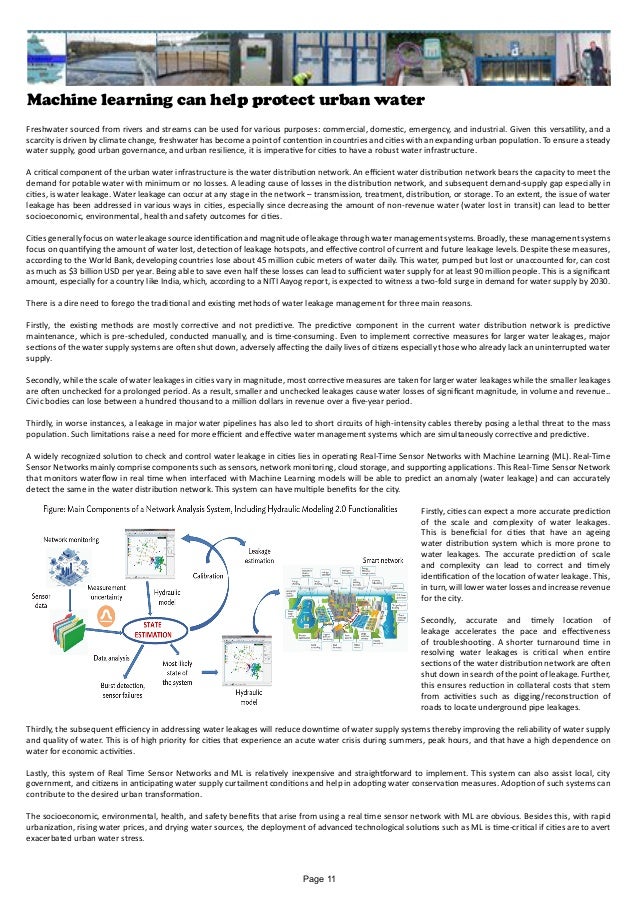
A widely recognized solution to check and control water leakage in cities lies in operating Real-Time Sensor Networks with Machine Learning (ML). Real-Time
Sensor Networks mainly comprise components such as sensors, network monitoring, cloud storage, and supporting applications. This Real-Time Sensor Network
that monitors waterflow in real time when interfaced with Machine Learning models will be able to predict an anomaly (water leakage) and can accurately
detect the same in the water distribution network. This system can have multiple benefits for the city.
Firstly, cities can expect a more accurate prediction
of the scale and complexity of water leakages.
This is beneficial for cities that have an ageing
water distribution system which is more prone to
water leakages. The accurate prediction of scale
and complexity can lead to correct and timely
identification of the location of water leakage. This,
in turn, will lower water losses and increase revenue
for the city.
Secondly, accurate and timely location of
leakage accelerates the pace and effectiveness
of troubleshooting. A shorter turnaround time in
resolving water leakages is critical when entire
sections of the water distribution network are often
shut down in search of the point of leakage. Further,
this ensures reduction in collateral costs that stem
from activities such as digging/reconstruction of
roads to locate underground pipe leakages.
Thirdly, the subsequent efficiency in addressing water leakages will reduce downtime of water supply systems thereby improving the reliability of water supply
and quality of water. This is of high priority for cities that experience an acute water crisis during summers, peak hours, and that have a high dependence on
water for economic activities.
Lastly, this system of Real Time Sensor Networks and ML is relatively inexpensive and straightforward to implement. This system can also assist local, city
government, and citizens in anticipating water supply curtailment conditions and help in adopting water conservation measures. Adoption of such systems can
contribute to the desired urban transformation.
The socioeconomic, environmental, health, and safety benefits that arise from using a real time sensor network with ML are obvious. Besides this, with rapid
urbanization, rising water prices, and drying water sources, the deployment of advanced technological solutions such as ML is time-critical if cities are to avert
exacerbated urban water stress.
Page 11
Case Study:
Solids measurement for
Drinking Water Sludge Control
In a recent project with Northumbrian Water Ltd, a Hach Solitax solids measurement probe was used to monitor and control the sludge recirculation flow rate
to maintain a solids setpoint via SCADA on two Lamella clarifiers.
The site at which the work was conducted on was constructed in 2003 and was designed to treat water for over 200,000 customers in Sunderland, Wearside,
Bishop Auckland and the villages in the Upper Wear Valley. The works was originally designed to supply up to 25 Mld of drinking water by gravity, utilising the
existing distribution network, and has the capacity to supply over 35Mld into the network by use of a booster pump arrangement. The works incorporate a
turbine on the inlet to utilise renewable energy from the raw water to generate up to 200kW of power. Additionally, the works includes the facility for the stand-
by generator to be used to ‘peak-lop’ power requirements enhancing the environmental benefits of the project.
From the inlet area raw water proceeds to the clarification process which utilises lamella settlement technology. This clarification process has been subject to
extensive pilot plant trials on the anticipated seasonal fluctuations in raw water quality, to gain confidence and knowledge for use during process commissioning
and optimisation.
Filter wash water is clarified using a lamella settlement process and then recirculated. A separate building houses sludge handling plant and equipment to press
(de-water) the sludge which is generated by the clarification and washwater sludge removal systems.
The clarified water then proceeds to a suite of six rapid gravity sand filters, which incorporate a process of catalytic oxidation in the media. The clarified and
filtered water will then be subject to a primary chlorination disinfection before proceeding to the treated water reservoir and into supply
Wear Valley WTW, suffered from flow restrictions during peak demand periods due to clarifier performance even with large increases in coagulant use. Recently
the site has seen the raw water quality deteriorate due to extreme weather events. Raw water in Burnhope reservoir supplying the site is challenging to treat
with a combination of very low conductivity and alkalinity and long periods of very high colour/organic content.
The change in raw water quality has increased pressure on the coagulant and lime systems, increasing chemical consumption and reducing output. This has
required other higher cost sites to maintain customer demand. Wear Valley is a gravity fed works, and higher production here reduces the overall company
carbon footprint.
Previous work with Hach at a wastewater treatment site showed that controlling the solids flow rate of a sludge with varying thickness improves process efficiency.
It was hypothesised that this work could be reapplied to a Lamella clarifier drinking water plant to improve the quantity and quality of supplied water.
Wear Valley uses two Lamella clarifiers in parallel. The trial allowed one Lamella to be used as a reference throughout the process for comparison. The Solitax
data was used to evaluate a varying sludge thickness which was known to cause treatment issues. While this was not being monitored, it was difficult to draw
trends and understand the process completely.
After creating a calculator using the Solitax data and flow data, sludge was recirculated to maintain a constant solids dose by manually altering the pump speed.
Settled water quality was compared to the uncontrolled Lamella 2. As a result of the significant improvement in quality from Lamella 1, the process was adopted
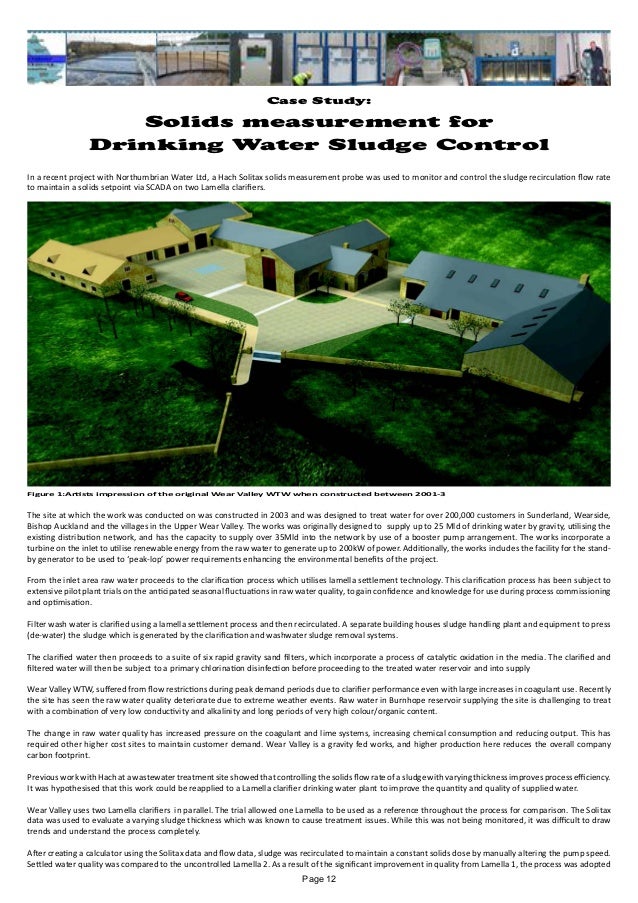
Figure 1:Artists impression of the original Wear Valley WTW when constructed between 2001-3
Page 12
across the whole plant and implemented into SCADA for automatic control.
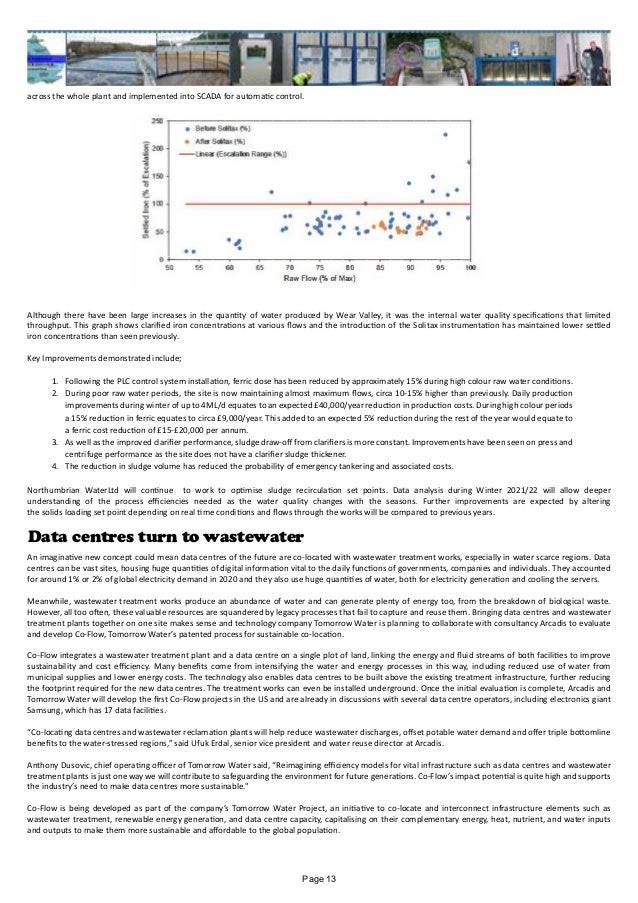
Although there have been large increases in the quantity of water produced by Wear Valley, it was the internal water quality specifications that limited
throughput. This graph shows clarified iron concentrations at various flows and the introduction of the Solitax instrumentation has maintained lower settled
iron concentrations than seen previously.
Key Improvements demonstrated include;
1.	 Following the PLC control system installation, ferric dose has been reduced by approximately 15% during high colour raw water conditions.
2.	 During poor raw water periods, the site is now maintaining almost maximum flows, circa 10-15% higher than previously. Daily production
improvements during winter of up to 4ML/d equates to an expected £40,000/year reduction in production costs. During high colour periods
a 15% reduction in ferric equates to circa £9,000/year. This added to an expected 5% reduction during the rest of the year would equate to
a ferric cost reduction of £15-£20,000 per annum.
3.	 As well as the improved clarifier performance, sludge draw-off from clarifiers is more constant. Improvements have been seen on press and
centrifuge performance as the site does not have a clarifier sludge thickener.
4.	 The reduction in sludge volume has reduced the probability of emergency tankering and associated costs.
Northumbrian WaterLtd will continue to work to optimise sludge recirculation set points. Data analysis during Winter 2021/22 will allow deeper
understanding of the process efficiencies needed as the water quality changes with the seasons. Further improvements are expected by altering
the solids loading set point depending on real time conditions and flows through the works will be compared to previous years.
Data centres turn to wastewater
An imaginative new concept could mean data centres of the future are co-located with wastewater treatment works, especially in water scarce regions. Data
centres can be vast sites, housing huge quantities of digital information vital to the daily functions of governments, companies and individuals. They accounted
for around 1% or 2% of global electricity demand in 2020 and they also use huge quantities of water, both for electricity generation and cooling the servers.
Meanwhile, wastewater treatment works produce an abundance of water and can generate plenty of energy too, from the breakdown of biological waste.
However, all too often, these valuable resources are squandered by legacy processes that fail to capture and reuse them. Bringing data centres and wastewater
treatment plants together on one site makes sense and technology company Tomorrow Water is planning to collaborate with consultancy Arcadis to evaluate
and develop Co-Flow, Tomorrow Water’s patented process for sustainable co-location.
Co-Flow integrates a wastewater treatment plant and a data centre on a single plot of land, linking the energy and fluid streams of both facilities to improve
sustainability and cost efficiency. Many benefits come from intensifying the water and energy processes in this way, including reduced use of water from
municipal supplies and lower energy costs. The technology also enables data centres to be built above the existing treatment infrastructure, further reducing
the footprint required for the new data centres. The treatment works can even be installed underground. Once the initial evaluation is complete, Arcadis and
Tomorrow Water will develop the first Co-Flow projects in the US and are already in discussions with several data centre operators, including electronics giant
Samsung, which has 17 data facilities.
“Co-locating data centres and wastewater reclamation plants will help reduce wastewater discharges, offset potable water demand and offer triple bottomline
benefits to the water-stressed regions,” said Ufuk Erdal, senior vice president and water reuse director at Arcadis.
Anthony Dusovic, chief operating officer of Tomorrow Water said, “Reimagining efficiency models for vital infrastructure such as data centres and wastewater
treatment plants is just one way we will contribute to safeguarding the environment for future generations. Co-Flow’s impact potential is quite high and supports
the industry’s need to make data centres more sustainable."
Co-Flow is being developed as part of the company’s Tomorrow Water Project, an initiative to co-locate and interconnect infrastructure elements such as
wastewater treatment, renewable energy generation, and data centre capacity, capitalising on their complementary energy, heat, nutrient, and water inputs
and outputs to make them more sustainable and affordable to the global population.
Page 13
Case Study:
How clamp-on ultrasonic flowmeters
are keeping drinking water healthy
Non-invasive clamp-on ultrasonic flowmeters are attached to the outside of the pipe, enabling the volume flow to be measured without process interruption.
By using sound waves to calculate the transit time of a liquid, changes in upstream or downstream flow can be accurately monitored. This technology is proving
invaluable to drinking water plants, where public safety is the number one priority. No longer is there the risk of under or overdosing of chlorine that could
present a potential health hazard.
A chlorine analyser alone is not enough to ensure public safety.
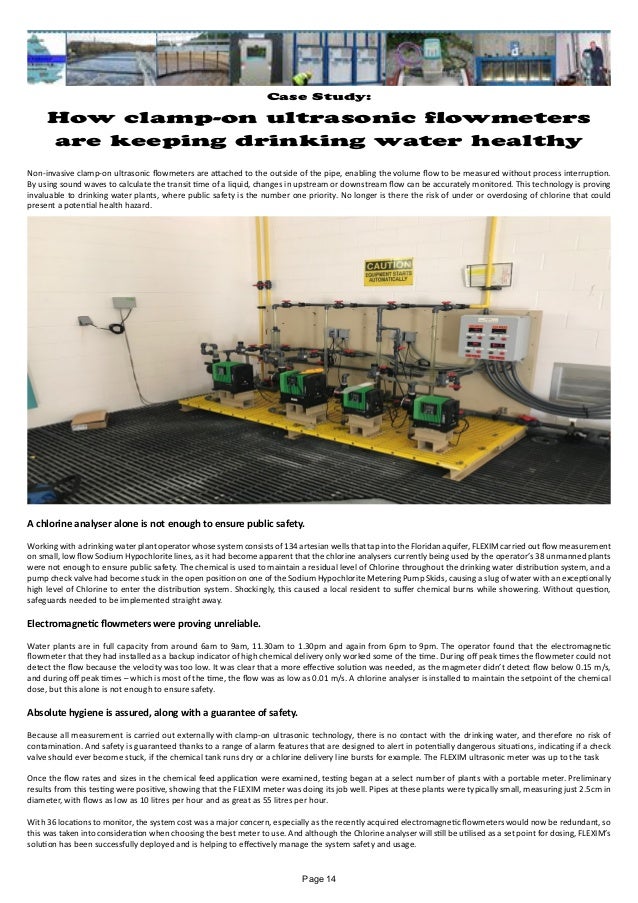
Working with a drinking water plant operator whose system consists of 134 artesian wells that tap into the Floridan aquifer, FLEXIM carried out flow measurement
on small, low flow Sodium Hypochlorite lines, as it had become apparent that the chlorine analysers currently being used by the operator’s 38 unmanned plants
were not enough to ensure public safety. The chemical is used to maintain a residual level of Chlorine throughout the drinking water distribution system, and a
pump check valve had become stuck in the open position on one of the Sodium Hypochlorite Metering Pump Skids, causing a slug of water with an exceptionally
high level of Chlorine to enter the distribution system. Shockingly, this caused a local resident to suffer chemical burns while showering. Without question,
safeguards needed to be implemented straight away.
Electromagnetic flowmeters were proving unreliable.
Water plants are in full capacity from around 6am to 9am, 11.30am to 1.30pm and again from 6pm to 9pm. The operator found that the electromagnetic
flowmeter that they had installed as a backup indicator of high chemical delivery only worked some of the time. During off peak times the flowmeter could not
detect the flow because the velocity was too low. It was clear that a more effective solution was needed, as the magmeter didn’t detect flow below 0.15 m/s,
and during off peak times – which is most of the time, the flow was as low as 0.01 m/s. A chlorine analyser is installed to maintain the setpoint of the chemical
dose, but this alone is not enough to ensure safety.
Absolute hygiene is assured, along with a guarantee of safety.
Because all measurement is carried out externally with clamp-on ultrasonic technology, there is no contact with the drinking water, and therefore no risk of
contamination. And safety is guaranteed thanks to a range of alarm features that are designed to alert in potentially dangerous situations, indicating if a check
valve should ever become stuck, if the chemical tank runs dry or a chlorine delivery line bursts for example. The FLEXIM ultrasonic meter was up to the task
Once the flow rates and sizes in the chemical feed application were examined, testing began at a select number of plants with a portable meter. Preliminary
results from this testing were positive, showing that the FLEXIM meter was doing its job well. Pipes at these plants were typically small, measuring just 2.5cm in
diameter, with flows as low as 10 litres per hour and as great as 55 litres per hour.
With 36 locations to monitor, the system cost was a major concern, especially as the recently acquired electromagnetic flowmeters would now be redundant, so
this was taken into consideration when choosing the best meter to use. And although the Chlorine analyser will still be utilised as a set point for dosing, FLEXIM’s
solution has been successfully deployed and is helping to effectively manage the system safety and usage.
Page 14
Article:
Cybersecurity:
A Marathon, Not A Sprint
To become more resilient against increasing cyber threats, water and wastewater utilities should employ a multi-barrier approach.
Digital technologies are fundamental to solving major water and resource challenges. However, as more water operators and users adopt these increasingly
connected and integrated solutions, there is also a growing need to strengthen cybersecurity protections and build resilience to cyberattacks across their
networks.
In recognition of the increasing threat to water systems, and following a number of high-profile cyberattacks, the U.S. Congress and the Biden-Harris
Administration have rolled out initiatives to strengthen cybersecurity in the water sector.
For example, having already established industrial control system (ICS) initiatives for the electric and natural gas pipeline sub-sectors, the administration has
expanded its efforts to the water sector with the creation of the Water and Wastewater Sector Action Plan. The plan, which is currently in development, is a
collaborative effort between the federal government and the critical infrastructure community to facilitate the deployment of technologies and systems that
provide cyber-related threat visibility, indicators, detections, and warnings. Developed in partnership with the U.S. EPA, the Cybersecurity and Infrastructure
Security Agency (CISA), and the Water Sector Coordinating Council (WSCC), the plan outlines actions to confront cyber threats and address cybersecurity gaps
within the water utility industry. The 100-day sprint to establish the plan includes the creation of a task force of water utility leaders. The EPA and CISA will
work with water utilities and invite them to participate in a pilot program for ICS monitoring and information sharing. The initiative will also engage with the
task force and use these learnings to inform future regulations and proposed statutes.
In further efforts to prevent disruption due to cyberattacks, the Cyber Incident Reporting for Critical Infrastructure Act of 2022 contained in the Strengthening
American Cybersecurity Act will require critical infrastructure companies to report any substantial cybersecurity incidents or ransom payments to the federal
government within 72 and 24 hours, respectively. Before these reporting requirements come into effect, CISA has up to 24 months to establish clear guidelines
and rules — e.g., for defining what “critical infrastructure” entities must comply with and what constitutes a “covered cyber incident” — providing sufficient
clarity to ensure that the act successfully disadvantages attackers by improving reporting and analysis, offering better protections to critical infrastructure
and the citizens that they serve.
Shared Responsibility
These initiatives represent a positive step toward building resilience across the sector. However, as cyber threats become more sophisticated, the risk to
infrastructure networks, including water systems, increases. We need a more holistic, integrated approach to protecting our water systems, with a sense of
shared responsibility across the supply chain.
Traditional cybersecurity models whereby the owner or operator has sole responsibility for evaluating and protecting their own control equipment are not
adequate without sufficient cybersecurity professionals who can understand and respond to threats. There are over 153,000 public drinking water systems
and 16,000 publicly owned wastewater treatment systems in the U.S., according to CISA.1 The majority of these are owned/run by small municipal operators
who, more often than not, don’t have the capacity to screen all technologies or hire cybersecurity expertise in the way that an electric or oil and gas utility
might. While the plan intends to develop protocols for sharing information with operators of all sizes, operators are still faced with the challenge of deploying
unfamiliar technologies and systems.
Shifting this amount of responsibility and investment onto water utilities could significantly harm the viability of the water sector and exacerbate issues
associated with water rates and aging infrastructure in the U.S.
Water utilities are lean, and the security and resilience model must recognize their resources and, in some cases, limitations. We need to look beyond the
operators to the entire sector if we really want to secure the water sector in a cost-efficient way.
A Multi-barrier Approach
Page 15
An alternative to the historical cybersecurity model is a “multi-barrier approach” with collaborative outcomes, community partnerships, shared responsibilities,
and communication channels all clearly defined from the outset. This model enables a broader distribution of responsibility, removing some of the burden from
utilities.
This multi-barrier approach is not a new concept to the water sector — it is frequently used by water treatment systems to improve water safety and reduce
health risks associated with contaminated drinking water. This layered depth of defence is also highlighted in a recommended set of safeguards as aligned with
ISA/IEC 62443,2 which is an industry standard for securing ICS assets. These standards form the backbone of Xylem’s recommended cybersecurity approach:
•	 Secure Products – Enhance protections for user identities by leveraging strong authentication and authorization along critical paths to ICS
assets such as remote access channels.
•	 Secure Deployment – Execute a multi-barrier approach to keep assets resilient to attack.
•	 Continuous Health and Monitoring – Employ a security-relevant monitoring approach that includes active threat detection and response
based on traceable events.
•	 Incident Response Services – Establish capabilities that pre-empt operational risks, including backup and recovery, cybersecurity incident
planning, training, and awareness for critical staff. Leverage relevant expertise as offered by industry associations, partners, and retained
service providers
As active participants in digital transformation, we are all responsible for managing risk. Within these guidelines, responsibility is spread across the product
makers, integrators, and utilities, with the burden of continuous monitoring and incident response falling on utilities.
Once connected, digital systems provide opportunities to shift some of those responsibilities to integrators and product makers that are providing services, thus
reducing the cybersecurity headcount requirements on water utilities. Integrators and product makers can understand and apply cloud software, CloudSCADA,
and conditional monitoring, enabling enhanced visibility and rapid detection and incident response — thus expanding security and resilience. This model will
enable the vendor to protect thousands of utilities with greater effectiveness due to centralization of expertise and greater ability to distribute costs of security
across products in a way that does not yet exist in the water sector.
Xylem is a member of the ISA Global Cybersecurity Alliance, where we are working across multiple product-making vendors of controllers to establish standards
for cybersecurity of connected digital technology that leverages what has been learned during the creation of the IEC 62443 standards, and what we are learning
now from the effectiveness of cloud-connected systems, to ensure that we can create connected digital technology for the water sector.
We believe this shared responsibility, multi-barrier approach to cybersecurity will empower the water sector to combat cybersecurity threats in a way that is
consistent with the sector’s values and unique challenges.
Prioritizing Cybersecurity Across The Water Cycle
As we continue to adapt our ways of working to maximize the digital opportunity, we must put cybersecurity at the centre of the conversation and we must all
do our part to help mitigate cybersecurity threats. This means collectively including cybersecurity in all critical phases of water, from product development and
supply chain management through to sustainability efforts, so that assets stay current with regard to security best practices and standards. This also means
keeping an open mind for new cybersecurity models built on shared responsibilities that specifically address the unique challenges the water sector faces. This
approach will require innovation and evaluation to accomplish successful collaborative cybersecurity outcomes.
Xylem is partnering with customers around the world to help them build resilient networks. We embed cybersecurity in every new connected digital product
and have a suite of cybersecurity assessment services available that can enable water utilities to understand their cybersecurity capabilities.
References:
https://www.cisa.gov/water-and-wastewater-systems-sector
https://www.isa.org/intech-home/2018/september-october/departments/newstandard-specifies-security-capabilities-for-c
Page 16
Focus on:
Phosphorus measurement and
it’s control in wastewater
Introduction
Phosphorus is one of the key regulated parameters in wastewater treatment and the newest investigations from the Chemical Investigation Programme in the
UK have shown that the best available technology is capable of removing the pollutant down to a concentration of 0.25mg/L of Total Phosphorus. This is going
to need an unprecedented amount of control of the treatment system so that these ultra-low concentrations are achieved.
So what’s the problem with phosphorus – what are the key questions that we need to ask:
•	 Why is regulated to the level that it is regulated to?
•	 How do we treat it at the moment?
•	 How do we measure and what are the problems with measuring it?
•	 How we do control it?
•	 Where is phosphorus removal going, how are we going to monitor and control the removal system?
Phosphorus is one of the major nutrients along with Nitrogen and Potassium. It is present in fertilisers and is globally used in agriculture. As a result it is
something that is quite often washed into rivers through diffused pollution and the phosphorus becomes an aquatic pollutant. This along with Nitrogen in the
form of nitrate is the root cause of eutrophication which is a major aquatic pollution problem and is a root cause for algal blooms. Phosphorus is often regulated
as it is often the limiting factor with eutrophication as its absence even when an excess of nitrogen will prevent the algal growth. Basically without phosphorus
present you won’t get eutrophication. Phosphorus has been cited as being the major reason why water-bodies in the UK have failed to achieve good ecological
status. So it’s important to remove phosphorus and the practicality of reducing the pollutant load from diffuse pollution makes the wastewater treatment
system the most convenient place to remove it. As a result the removal of phosphorus from the wastewater stream has become a priority and the regulated
levels are approaching 10 times lower that the 1989 Potable Water Quality Standard (where phosphorus was regulated to 2.2mg/L P).
The difficulty is that Phosphates are sub-categorized into:
•	 Orthophosphates
•	 Condensed phosphates – Metaphosphates – Pyrophosphates – Polyphosphates
•	 Organophosphorus compounds
Orthophosphate is always determined if samples are not digested as only orthophosphate can be detected directly by photometric means. This is also known
as determination of the “reactive” phosphorous. The measurement results can be indicated in a variety of ways:
•	 PO4, phosphate
•	 PO₄-P, phosphate-phosphorous
•	 P₂O₅, phosphorus pentoxide
The way we tend to treat phosphorus at the current time is by either using chemical precipitation methodologies (in the main) or biological techniques such as
Enhanced Biological Phosphorus Removal in Activated Sludge (EBPR). The former method using chemical precipitation with iron or aluminium salts being much
simpler and cheaper but has the limitation of using chemicals. These chemicals, ideally, need to be controlled and to control the chemical dosing we need to
measure the concentration of phosphorus.
Measuring Phosphorus
Measuring phosphorus is where the problems start to creep in with special reference
as to “what phosphorus are you measuring?” When phosphorus is regulated it is
regulated to the total phosphorus that is present in water. This is very simple to
regulate but much more difficult to measure and so often the soluble reactive
phosphorous is actually measured and a safety factor for the insoluble non-reactive
phosphorus taken into account in this factor. This is especially possible as it is regulated
to annual average so if the annual average is running to close for comfort then greater
treatment can be applied. The reverse is also true although not a popular operational
strategy from an environmental point of view.
When you look at the laboratory method and the different fractions of phosphorus and
its analysis (figure 1) an appreciation of the complications can be seen. It is a case of pick
a fraction, any fraction and see what you come up with.
In reality in wastewater the fraction that is regulated is total phosphorus, quite often
in the field total reactive phosphorus will be measured as the practicalities of filtering
samples in the field usually is the limiting factor.
Page 17
So what is the basic methodology?
For measuring Total Phosphorus the methodology is to oxidise the sample to soluble reactive phosphorus generally (but not exclusively) using acid digestion.
Even this method is not necessarily using just one method as the standard methods list:
•	 Perchloric acid method for the most difficult of samples that need an aggressive digestion technique
•	 Nitric acid – sulphuric acid method for most samples
•	 Persulphate oxidation with UV as the most convenient method as long as stable results in comparison to the other methods are obtained.
This is basically to convert the total phosphorus to reactive phosphorus. If the partioning between Total and Reactive Phosphorus needs to be understood then
the reactive test needs to be run with and without digestion.
The colourmetric method for the analysis of reactive phosphorus is not easy either with several methods available here as well with three main methods
including:
•	 Vanadomolybdophosphoric acid method
•	 Stannous Chloride method
•	 Ascorbic Acid method
Before the recent changes in wastewater regulation around phosphorus the Vanadomolybdophosphoric acid method would have been the most appropriate
as it has a range between 1-20mg/L P. However with increasingly tight standards and regulated phosphorus methods dropping below 1mg/L phosphorus the
dilution of the sample will become necessary but with this the chances of error and interferences increase.
The vanadomolybdophosphoric acid method with the potential for dilution is still the most applicable. The principle of this method is that ammonium
molybdate reacts under acid conditions to form heteropoly acid, molybdophosphoric acid. In the presence of vanadium a yellow vanadomolybdophosphoric
acid is formed. The intensity of the yellow colour is proportional to the phosphate concentration.
Iron and sulphide do interfere with this method but the former over concentrations of 100mg/L where the latter is a problem so this should be taken into
account where septicity is a problem and hydrogen sulphide concentrations are high.
All of these differing variations in the laboratory
methods bring about complications when moving
to an online methodology of analysis but the most
common method for online measurement of soluble
reactive phosphorous is a conversion of the high range
laboratory method using vanadomolybdophosphoric
acid method and for the measurement of total
phosphorus the conversion of the total phosphorus
to reactive phosphorus using the Persulphate
oxidation method using UV followed or either of
the acid digestion methods by the Ascorbic Acid
Molybdenum Blue method.
The principle components of the soluble reactive
measurement system are:
•	 The sample collection system
•	 The sample filtration system
•	 The reagent addition system
•	 The photometric detector
When it comes to the total phosphorus method the additional complication is in the digestion methodology be it an oven system with the acid phase digestion
or with the UV system with the oxidation methodology.
The key potential sources of error for any of these methods are:
Sampling – The sampling methodology is key to the success of any online analytical method. Be it a vacuum sampling method or a peristaltic pump method the
key is to ensure that the sampling system does not block (especially with crude sewage) and samples consistently. The sources of error can be limited by locating
the analyser as close as possible to the medium being analysed and potentially using a method of pre-filtration.
Reagent edition – The correct amount of reagent being added to the sample is also crucial.
Digestion Process – If the digestion process is incomplete there will be errors in the amount of total phosphorus measured.
Errors in the photometric detection are rare and will not have a significant effect.
Page 18
Controlling phosphorus
In phosphorus removal the most common method is to use a chemical precipitation method using either aluminium or iron salts of which the latter is the most
prevalent due to the toxicity of aluminium in the aquatic environment. There is a well defined stoichiometric relationship between iron and phosphorus with 7
parts of iron required to remove 1 part of phosphorus. This is often used when designing chemical phosphorus removal systems. What is important is how the
chemical dosing system is controlled, if it is controlled.
Without any chemical dosing control system there is the potential for either under or over dosing iron salts. This can actually cause damage to structures within
the treatment works this especially the case with flow measurement flumes which are sensitive to any damage. As a result of the risk of under or over dosing
especially with the ultra-low phosphorus consents that are being put in place there is a need for increasing control over phosphorus removal chemically based
systems.
The simplest method of control is to use flow based control and presumes that the concentration of phosphorus is stable. In this methodology the amount of
iron is dosed proportionally to the flow rate. The method is simple but does need a form of flow measurement but does not require online phosphorus analysis.
The next method is to manually establish phosphorus concentrations over time and work on a assumed concentration profile and use flow measurement to
establish a assumed load profile. In this way a more advanced dosing control system is put in place without the need for online phosphorus measurement.
The last method is to measure the online phosphorus load and use the results to calculate the amount of chemical that needs to be added with the potential
of a downstream feedback control loop working on a nudge and wait system. This is obviously the most accurate and best control system but it comes with
additional complexity and cost.
However this additional complexity and cost, especially on a chemical dosing system is worth it when there is the potential for multiple chemical dosing
stages which is common when ultra-low consents are in place necessitating tertiary treatment processes which will be sensitive to the incoming pollutant load
(phosphorus in this particular case).
The future of phosphorus treatment
What is clear with the current trends within the water industry is that the permitted levels of phosphorus are going to get lower and this is where the
factory approach and the circular economy become more of a feasible solution either through the use of phosphorus in sewage sludges or the extraction of
phosphorus from sewage sludge and conversion to a useable product.
Up until the economics of recovering phosphorus from all but the largest of wastewater treatment works has not been financially viable. However as
treatment costs rise, the technical development of phosphorus recovery technologies and improvements in monitoring and control technologies means that
accurate phosphorus loading can be measured in an online format. Through the measurement of phosphorus through the treatment works what can be a
problem substance can actually converted into a raw material produced in a factory-based system approach.
A Smart Transition To Tablet-Based Leakage Detection
The ability to access network information on tablets and smartphones is another step forward in the digitalisation of the water sector, writes Chris Moore,
product line manager at Ovarro.
A tablet-based leakage detection system has been launched by technology company Ovarro.
Next generation leak noise correlator Eureka5 will become the basis for Ovarro's leak detection platform. The system displays information on an android tablet
and does not require a dedicated processor or laptop, cutting down the number of devices field teams need to have in their vans.
Digital transformation of the UK water sector is well underway, with utilities now widely integrating smart, data-driven solutions to manage their water and
wastewater networks. When it comes to leakage reduction, smart technology is giving the sector the ability to pinpoint precise locations of leaks, in real time.
Utilities are seeing the benefit of this switch, with 13 water companies in England and Wales achieving their 2020-2021 performance targets for leakage.
A major driver of this transition is consumer use of smartphones and tablets – nearly everyone uses some kind of digital device, a shift that has been replicated
by water companies, accelerated by the skills of digital natives joining the sector, who have never known a time without the internet and digital devices.
This has made the development and implementation of smart, user-friendly technology easier and faster. At the same time, the cost of these technologies is also
coming down while they become more and intuitive, robust and secure.
In terms of hardware, Eureka5 comprises two radio transmitters: a radio receiver with signal-processing electronics which interconnects with the bespoke
Eureka Go app, as well as Ovarro’s existing cloud-based portal, PrimeWeb. GPS technology enables precise pinpointing of leaks, including in difficult conditions,
such as where there is substantial background noise, where only the quietest of leak noise is present, and on a variety of pipe materials, including plastic.
Eureka5 enables users to listen to noise on the pipe, upload this data directly to Eureka Go and view the data instantly on a tablet, rather than the bespoke
processing unit used previously. As well simpler functionality for operators, who Ovarro liaised with closely when developing the product, the solution reduces
capex costs. Why have multiple different versions of a PC in the back of a van when operators can work off one tablet?
Smart networks are already significantly improving leakage performance. The ability to carry out multiple tasks on just one device will further streamline
processes, making processes simpler and faster for operators.
Looking forward to the water industry’s 2025-2030 asset management period - AMP 8 - we can expect a full rollout of app-based network management tools,
all accessible on a single tablet or smartphone.
Page 19
Water, Wastewater & Environmental Monitoring
Telford, UK
12th - 13th October 2022
The WWEM Conference & Exhibition is returning as a physical conference & exhibition in 2022 and is bigger and better than before
with the return of the Flow Forum, a new Pollution Forum, a Learning & Development Zone and this year a Digital Zone. All available
to everyone for absolutely free.
Sensor for Water Interest Group Workshops
The Sensors for Water Interest Group has moved their workshops for the foreseeable future to an online webinar format. The next
workshops are
6th July 2022 - Monitoring the production Factory - Vega - Crawley
28th September - Instrumentation & Asset Management - London
30th November - Sensor Driver AI for the Water Industry - Sandy Park, Exeter
WEX Global 2022
Valencia, Spain
27th - 29th June 2022 - Valencia, Spain
The WEX Global Conference. Sponsored by Idrica is currently due to take place in Valencia in Spain in June 2022. The conference
concentrates on the circular economy and smart solutions to resolve some of the global water industry's issues
Global Leakage Summit
5th - 6th July 2022
Now in its 12th year, the Global Leakage Summit returns to London as a LIVE and ONLINE event in July 2022 with a Pre-Conference
Workshop on 4th July and a two day Summit on 5th - 6th July, focussing on the latest advances in technology and software for data
analysis featuring the most innovative and successful examples of delivering and maintaining reduced leakage levels across the
world.
IWA Digital Water Summit
Bilbao, Spain
29th November - 2nd December 2022
The long awaited Digital Summit the premium event of the IWA Digital Water Programme is due to take place in Bilbao at the end
of November 2022. Four days of discussion about the Digital Transformation of the Water Industry....what is not to love.
Page 20
Conferences, Events,
Seminars & Studies
Conferences, Seminars & Events
2022 Conference Calendar
Page 21

WIPAC Monthly - May 2022

  • 1.
    WIPAC MONTHLY The MonthlyUpdate from Water Industry Process Automation & Control www.wipac.org.uk Issue 5/2022- May 2022
  • 2.
    Page 2 In thisIssue WIPAC Monthly is a publication of the Water Industry Process Automation & Control Group. It is produced by the group manager and WIPAC Monthly Editor, Oliver Grievson. This is a free publication for the benefit of the Water Industry and please feel free to distribute to any who you may feel benefit. However due to the ongoing costs of WIPAC Monthly a donation website has been set up to allow readers to contribute to the running of WIPAC & WIPAC Monthly, For those wishing to donate then please visit https://www.patreon.com/Wipac all donations will be used solely for the benefit and development of WIPAC. All enquires about WIPAC Monthly, including those who want to publish news or articles within these pages, should be directed to the publications editor, Oliver Grievson at olivergrievson@hotmail.com From the editor............................................................................................................. 3 Industry news.............................................................................................................. Highlights of the news of the month from the global water industry centred around the successes of a few of the companies in the global market. 4 - 11 Solids measurement for Drinking Water Sludge Control................................................ In the first of this month's case studies we have a look at the use of solids measurement at a Water Treatment works in the UK and how solids measurement has been used to relieve a production bottle neck in the treatment works caused by varying raw water quality 12 -13 How clamp-on ultrasonic flow meters are keeping drinking water healthy.................... In our second case study of the month we look at the application of clamp-on ultrasonic flow meters and there ability to measure at low flow velocities for chemical dosing. 14 Cybersecurity : A marathon not a sprint........................................................................ In this article we look at the risks of cybersecurity to the water industry and how it is not something that will ever be fixed overnight and can more be compared to a race that will never quite finish. With the advent of the digital water industry the cyber-protection of the industry itself is more important than ever 15 - 16 Focus on: Phosphorus Measurement and its control in wastewater.............................. In this revival of the "Focus On" series we have another look on the principles of phosphorus measurement in wastewater and how it is controlled. 17 -19 Workshops, conferences & seminars............................................................................ The highlights of the conferences and workshops in the coming months. 20 - 21
  • 3.
    Page 3 From theEditor Its a bit of a double celebration this month for me on a personal/professional level. Firstly from the perspective of the Water Industry Process Automation & Control Group reaching both its 11th year and also its 11,000th member and secondly being asked to Chair the International Water Association Digital Water Programmme. It`s something that I've actually been involved with since its inception four years ago and its been a real pleasure serving under Dragan Savic who is the CEO at KWR and when I first met him an esteemed Professor of Hydroinformatics at the University of Exeter. Having a chat this month on one of the boards that I serve on in my spare time we've been discussing the subject of competence and how we develop as professionals over the years. In the UK we have the Chartership system after which there seems to be a full stop on professional development with no real set path to follow. In reality the majority in the water industry are passionate about one area or another. For me its instrumentation, data and its relationship to control systems and process operation (amongst other things). For someone else it will be something entirely different and that is the beauty of the water industry. It is through passion for my subject areas that I have grown as a professional over the years and through being who I am and doing what I do the opportunities to do things and to grow develop. Sometimes I wish I knew how to stop. The passion for the water industry is what I saw earlier this month at the Digital Water Programme steering committee. Some members were retiring from the committee and some members were joining as fresh faces. As is typical in these sort of meetings everyone was introducing themselves and stories of Digital Transformation were starting to appear before my very eyes. Some were academics, some were in the supply chain and some where on the sharp end of delivery. By the very nature of the modern world some were in the middle of nowhere on mobile phones with somewhat of a spotty signal. However it made me think back to the days when I worked abroad in the Falkland Islands around 20 years ago and mobile phones didn't exist (in the islands) and communication was by dial-up - to be involved in a multi-national video call would have something fantastical. This goes to show that developments in the past 20 years, although they haven't felt like it, have been revolutionary.....but back to the meeting. As everyone introduced themselves the feeling was that there were stories of Digital Transformation ready to be told and this is how we are going to achieve the Digital Transformation of the Water Industry. There does need to be a need, a driver or a reason for doing it. I think it is fair to say you don't have to go far to look for a reason to Digitally Transform. After that it needs the passion of the people who are willing to tell a story, to show others how they've done it and how that can be done to help solve the problems of others. I think one of the most important thing to do over the next two years is start getting the stories out, the case studies developed so that the tool that Digital Transformation is can be realised to its full potential. Have a good month Oliver
  • 4.
    WIPAC celebrates 11thanniversary as its all change at the IWA Digital Water Programme This month saw the Water Industry Process Automation & Control Group celebrate its 11th anniversary and also its 11,000 member. The water industry has truly changed since the group was first set up on 17th May 2011. Six months later it celebrated its 1,000 member and now 11 years later it has celebrated its 11,000 member a few days before the group turned 11 years. There have been over 120 editions of WIPAC Monthly with over 2,000 pages sent out to members over the years with hundreds of articles, case studies and of course news articles. In other news this month, Oliver Grievson, the Executive Director of WIPAC has taken over the Chairmanship of the International Water Association Digital Water Programme. Set up 4 years the programme is there to share the knowledge of Digital Transformation across the global water industry creating content for people to learn the different ways that countries are adopting Digital Transformation and learn from the benefits reaped and the challenges that have been faced. The IWA Digital Water Programme Committee has also changed membership with some existing committee members staying on and some newer members too. The new committee has representatives from academia and practice across the world and includes Ann Piyamarn Sisomphon, Biju George, Cecilia Wennberg, Deepa Karthykeyan, Enrique Cabrera, Eunice Namirembe, Frank Kizito, Jyoti Gautam, Hélène Hauduc, Marina Batalini de Macedo, Rachel Peletz, Randolf Waters, Rik Thijssen, Sheilla de Carvalho, Stuart Hamilton, Vladan Babovic, Yufeng Guo, Zoran Kapelan. Yorkshire Water expands AI use against pollution Yorkshire Water is expanding its use of artificial intelligence (AI) to predict blockages within its sewer network and reduce pollution risks. A successful pilot of a solution co-created by Yorkshire Water, Siemens and The University of Sheffield has been completed and will now be rolled out to Yorkshire Water’s network of more than 2,000 combined sewer overflows (CSOs). Combined sewers carry both foul water from homes and businesses as well as rainwater which falls onto impermeable areas such as paved areas, roofs and highways. As the weather can be unpredictable, CSOs are permitted on sewer networks to reduce the pressure on sewers during heavy rainfall events and stop the system from backing up and flooding homes and gardens by allowing heavily diluted wastewater to be discharged into watercourses. The integrated sensing, communication, analytics and reporting solution works by using sensors to feed water level data into SIWA Blockage Predictor, an application on Siemens’ cloud-based, open Internet of Things (IoT) operating system, MindSphere. The performance of the sewer network is analysed in real time and predicts problems like network blockages before they happen, enabling Yorkshire Water to quickly investigate the predicted blockage and prevent them developing into sewage pollution in the environment. Analysis of 21,300 days of data by the University of Sheffield found the blockage predictor can provide up to two weeks’ notice of problems within the sewer network and identify 9 out of 10 potential issues – three times more successful than existing pollution prediction processes, while reducing the number of false positive alerts by 50%. Heather Sheffield, integrated planning and central control manager at Yorkshire Water said: “Much of our network in Yorkshire is combined, taking both waste from toilets and sinks in home and surface water from rainfall. Periods of prolonged or intense rainfall can significantly increase the flows in our network and there is a risk of sewage flooding in homes, the environment, and the potential for damage at wastewater treatment works. “This challenge is compounded by population growth, climate change and consumer behaviour which puts non-flushable items like wipes into sewers, causing or accelerating blockages. Reducing intermittent discharges from CSOs is a key priority for us and our partnership with Siemens illustrates Yorkshire Water’s commitment to investing in cutting-edge technology to reduce pollution incidents by 50%, a key goal of our Pollution Incident Reduction Plan 2020-2025." “Our customers expect us to use the latest technologies. This solution, developed in partnership with Siemens and the University of Sheffield, will change our visibility of the sewer network and improve how we identify and tackle blockages. Rolling out the solution to 2,000 assets across the entire county will have a significant role in reducing the number of pollution incidents, which can have a negative impact on the environment, as well as increasing our efficiency and providing improved value to our customers.” The innovative solution recently won the Data Analytics, Cloud and AI Project of the Year at the 2021 Water Industry Awards. Steve Hanslow, head of water for Siemens Digital Industries UK, said: “The challenge of moving from a Proof of Concept to scale are considerable. Through partnership we have been able to develop a solution that is secure, scalable, cost effective and can be deployed at pace. “Keeping sewers free from blockages and reducing river pollution is a wide-ranging and complex issue, and Siemens is happy to help the water industry to meet the technological challenge.” Siemens is now engaging with water companies to support the ambitions of Water UK, the trade association, to eliminate pollution incidents in the sewer network by 2050. Adam Cartwright, Head of IoT Application Delivery at Siemens, added: “SIWA Blockage Predictor is a step change in how water companies can avoid pollution incidents. “The AI can work on existing or new sensors in the network. Integrated reporting of spills and overflow events will support water companies as they rise to the challenge set by the Storm Overflows Taskforce for greater transparency and open data.” Page 4 Industry News
  • 5.
    Anglian Water optsfor Ovarro cloud based technology to detect rising main sewer bursts Anglian Water has become the first utility to adopt new cloud-based technology to detect rising main sewer bursts. In a world-first, the UK utility is implementing early-warning system BurstDetect from technology company Ovarro, as part of its drive to eliminate serious pollution events in its region by 2025. Through a dashboard, BurstDetect provides an overview of system status together with current and historical burst alerts. If data suggests a potential burst, an alert is sent to control rooms for early response. Such early action can prevent the escape of sewage and resulting environmental damage, ensuring companies fulfil their environmental obligations and avoid fines, regulatory penalties and prosecutions, and long-term reputational damage. Claire Moore, head of water recycling networks at Anglian Water, said: “With ‘zero sewage pollution’ as one of our 12 ambitious business goals, we have committed to eliminating serious pollutions by 2025, and to reducing the number of less significant incidents by at least 45 per cent. “Working with the supply chain to develop innovation and adopt new solutions will revolutionise our ability to meet these goals. Implementing BurstDetect will enable us to respond rapidly should a rising main burst occur, and take proactive action to prevent pollution and protect the environment.” BurstDetect uses unique algorithms to detect bursts using existing data from wastewater pumping stations. The technology can be applied to nearly all pumping stations –even those with just basic pump status monitoring – and requires no additional hardware, with the aim of achieving 100% coverage in networks being monitored. The system accepts data at a range of monitoring frequencies with algorithms being applied to understand and characterise ‘normal’ pumping station behaviour. This training and testing approach to machine learning is becoming increasingly important to water companies, giving them more actionable insight than ever before, utilising data that may not have been fully harnessed otherwise. George Heywood, analytics innovation lead for Ovarro, said: “We are proud that Anglian Water has become the first utility to implement BurstDetect as part of its pollution prevention strategy. “The technology was developed in collaboration with UK water companies, in direct response to the sector’s challenge to cut pollutions in a sustainable and cost-effective way. “Rising main sewers pose a unique challenge to water companies. The pumped wastewater they convey can have a catastrophic ecological impact in the event of a burst, causing major disruption to customers, resulting in expensive tankering and clean-up operations and serious reputational damage - such events are just not acceptable in the eyes of customers and regulators. “By being the first utility to invest in BurstDetect, Anglian Water is leading the way, proving its commitment to cutting pollutions by embracing innovation.” While this is Anglian Water’s first purchase of a wastewater management solution from Ovarro, the two organisations have worked in partnership to reduce leakage for many years, with the utility installing Ovarro acoustic loggers across its network of water mains. The collaboration led to the development of game-changing remote leak detection device Enigma3hyQ and cloud-based analytics platform LeakVision, which saw Anglian Water and Ovarro win the award for Alliancing and Partnership Initiative of the Year at the Water Industry Achievement Awards 2021. Wessex Water is investing £3 million a month to tackle storm overflows and reduce how often they operate. The company’s Storm Overflows Improvement Plan will see every overflow in the region monitored by 2023, while the number of hours storm overflows discharge will be reduced by 25%. New storm tanks will be built; nature-based solutions, like wetlands and reed-beds in rural locations introduced; and work will be carried out to separate rainwater from the sewer system. There will also be continuing investment in artificial intelligence monitoring at wild swimming sites to provide near real time information. A WebApp for Warleigh Weir, near Bath, is already being tested. Capacity is being increased at the company’s two largest water recycling centres, serving Bristol and Bournemouth, to enable more stormwater to be stored and treated, with work due to start early next year. Storm overflows have always been part of the UK’s sewerage network because most sewers carry both rainwater and foul sewage. The overflows prevent contaminated rainwater backing up and flooding people’s homes. Published river water quality data shows their impact on the water environment is minimal because of the significant dilution during rainfall. All overflows are licensed by the Environment Agency and rarely cause pollution. Matt Wheeldon, Director of Asset Strategy and Compliance said: “We understand the concerns about storm overflows and agree they should have no place in a 21st century sewerage system. This major investment is the start of decisive action to tackle storm overflows, and our longer-term improvement plan sets out the further progress we will make over the coming years. “We have 1,300 overflows across the Wessex Water region, so it will take time and significant resources to eliminate them. By committing to spend £3 million every month on overflows, starting with those that discharge most frequently and those that have any environmental impact, we will make a good start.” Page 5
  • 6.
    SWAN Forum launchesthe Water Industry's First Digital Twin Readiness Guide To Aid Utility Transformation A diverse group of global utilities, solution providers, academia, and thought leaders have developed a ground-breaking Digital Twin Readiness Guide, the first- of-its-kind roadmap for Digital Twin implementation to advance the water industry. Spearheaded by the SWAN Forum, Brown and Caldwell, DHI, and with contributions from numerous partners, the zero-cost guide was launched at the SWAN Annual Conference this month. At its core, the guide applies SWAN’s state-of-the-art Digital Twin architecture, the water industry standard for planning and implementing Digital Twins. The SWAN Digital Twin Utility Advisory Group, consisting of representatives from Global Omnium, Sydney Water, Aarhus Vand, Clean Water Services, and DC Water, hailed the guide’s potential: A Digital Twin is a real-time digital counterpart of a physical object or process. Akin to an airplane’s co-pilot, Digital Twin uses analytical and predictive modelling to speed up and validate decision-making to automate time-consuming and manual engineering or operator processes. Benefits to utilities include better prediction and preparedness for seasonal or climate-driven condition changes, asset and operational health analysis for investment optimization, and what-if scenario simulations for safer training environments. While Digital Twin implementation is unique to each utility, deployment steps are foundational to achieving optimized, cost-efficient water and wastewater systems. Digital Twin readiness is scalable, iterative, and likely phased over time, depending on the utility’s unique needs, budget, infrastructure, and software requirements. The Digital Twin Readiness Guide provides the framework, steps, and path to achieve essential insights leading to more intuitive water systems operations, making the utility more efficient. Global case studies detailing the successful implementation of SWAN’s Digital Twin architecture are included in the guide. Projects include a Singapore-based water reclamation plant, an urban drainage project for Denmark’s largest wastewater utility, and several water treatment and network projects in Spain and Italy. New Way To Trace Algae Origins Could ID Sources Of Water Pollution New research conducted by Stroud™ Water Research Centre scientists shows how real-time chlorophyll sensors can be used to determine the origins of algae in rivers and streams, and in turn, identify the sources of pollution that algae sometimes signal. The study, by scientists Marc Peipoch, Ph.D., and Scott Ensign, Ph.D., is the first to test and support the use of existing sensor technology in analyzing the concentration of chlorophyll and its movement over time to then infer algae origins in a freshwater environment. Existing methods for measuring algae via chlorophyll concentration in waterways are simple and commonly used to indicate possible water pollution. But from where the algae came and when has remained something of a mystery. A rise in chlorophyll concentration could simply be the result of heavy stormflow dragging algae from the riverbed and into the water column. More ominously, it could indicate nutrients from farms, a leaking septic tank, or a sewage treatment plant are flowing into fresh water and stimulating algae to grow faster. The researchers decided to test the use of EnviroDIY™ Monitoring Stations, a combination sensor and Mayfly Data Logger, to collect water quality data every few minutes during storms, when algae would more rapidly move, mix, and flow down Brandywine Creek, a tributary to the Christina River, in Pennsylvania. Their theory was that if algae were abundant close to the point of detection (in this case, the sensors), chlorophyll concentration would change more quickly during storms than if the algae came from farther away. “Whether the chlorophyll concentration initially increases or decreases can indicate whether the algae were growing attached to the streambed or floating in the water above,” says Peipoch. The data confirmed what the scientists had suspected, and their findings­were published in the peer-reviewed journal Limnology and Oceanography Letters. While not all algae are harmful, too much, no matter the variety, can be deadly. When algae blooms eventually die, they feed bacteria that rob the water of oxygen, leading to fish kills and the death of other aquatic life. Algae outbreaks can also sicken humans, their pets, and marine animals. Warming temperatures from climate change, excess sunlight from deforestation, and fertilizer from agricultural runoff can fuel algae growth. Ensign says, “This is an exciting discovery. We’ve demonstrated for the first time a method to identify the sources of algae using the existing sensor technology. We believe that this method should be applicable at a variety of scales — from small shallow streams we see in our backyards to rivers as mighty as the Mississippi.” Page 6
  • 7.
    Gradiant Acquires Synauta,Machine Learning Company, To Advance AI Technology In Water Gradiant, a global solutions provider and developer for cleantech water, today announced it has acquired Canadian artificial intelligence (AI) water technology company Synauta, to accelerate the use of digital twin technology in water. The use of digital twins in industrial water treatment and desalination and water reuse has been pioneered by Gradiant. The acquisition strengthens Gradiant’s position as a technology leader in end-to-end water solutions and accelerates deployment of digital twin technologies to build a digitized water future. “Digital water is the fastest-growing area in the global water industry and this acquisition brings together the very latest technologies,” said Prakash Govindan, COO of Gradiant. “The application of digital twins in water will grow even more rapidly as we further leverage 5G communications, industrial automation, and predictive analytics. Combined with Synauta’s AI data models, industrial water treatment just got smarter, cleaner, and significantly more efficient.” Spun out of the Massachusetts Institute of Technology, Gradiant is an end-to-end water solutions provider offering design, operations, and asset optimization integrated on to a single digital platform for clients that include Micron, Glaxo Smith Kline, Pfizer, Rio Tinto, and Coca-Cola. An estimated $1.5 trillion per year is required to address global water infrastructure, and digital solutions play a major role. Recent market research forecasts annual capital expenditures for digital water to reach $10 billion by 2030, with investments in artificial intelligence technologies to account for $6.3 billion. Industrial and municipal customers are increasingly adopting AI platforms for their water and wastewater operations to address challenges from sustainability and cost pressures, business continuity, regulatory compliance, and climate events. Synauta’s proprietary machine learning AI algorithms are deployed in municipal and industrial desalination facilities around the world. Synauta’s technologies reduce operating costs by determining optimal operating conditions and maintenance programs based on real-time process data and are trusted by leading clients such as Singapore’s PUB, Veolia, Aqualia, Engie, and GHD. “JoiningGradiantgivesSynautatheabilitytoscaletheuseofdataandAIinindustrialdeploymentswithglobalclients.Thisacquisition createsadigitalpowerhouse for the water industry that will bring the goal of industrial water sustainability closer to realization,” said Mike Dixon, CEO of Synauta. The transaction is subject to customary closing conditions and is expected to close in the second quarter of 2022. ‘Machine Learning' Improves Rainfall Mapping, Water Plans Rainfall map accuracy is vital in climate and hydraulic modeling and supports environmental management decision making, water resource planning and weather forecasting. University of Hawaiʻi and East-West Centre researchers have developed more accurate monthly rainfall maps by using machine learning. According to IBM, machine learning is a branch of artificial intelligence (AI) and computer science that focuses on the use of data and algorithms to imitate the way that humans learn, gradually improving its accuracy. Funded by the National Science Foundation’s Hawaiʻi EPSCoR ʻIke Wai project, a team of researchers used a machine learning technique to detect erroneous rainfall maps. The results of this study were recently published in the Journal of Hydrometeorology. “This approach demonstrates how, with a moderate amount of data, a low-level machine learning algorithm can be used to train, evaluate and classify an unrealistic map output,” said lead author Matthew Lucas, a climate data analyst for the UH Water Resources Research Centre. “This allows for minor corrections of automated interpolation (the process of calculating an approximate value based on values that are already known) that can produce a much more accurate and realistic map of the spatial patterns of rainfall. If this workflow can work in Hawaiʻi with its extreme climate gradients it can definitely work elsewhere.” Supported with computational resources from Mana, the UH high performance computing cluster, this finding was made during the development of the Hawaiʻi Climate Data Portal (HCDP), which was made publicly available this past March. The online portal offers an innovative automated solution that works well and preserves the overall accuracy of the map outputs. The study resulted in high-resolution, gridded monthly rainfall time series data for the state of Hawaiʻi spanning a period of 30 years. Rainfall maps range from as early as 1990 up to 2019 using data from more than 600 weather observation stations located throughout the islands. “Having a wide range of gridded products will allow researchers the opportunity to develop important decision support for the state such as fire, flood and drought risk and early warning systems,” said co-author Ryan Longman, an Oceania research fellow at East-West Centre. “Now that high-quality rainfall maps are available in near-real-time, researchers can spend less time processing data and more time answering important questions that can help us better understand and adapt to changing environmental conditions.” In addition to ongoing improvements of current climate data products, researchers are in the process of developing methods to automate the production of daily rainfall maps and other gridded climate products for the state of Hawaiʻi. All data products are available for data visualization and download to the public through the Hawaiʻi Climate Data Portal. Page 7
  • 8.
    How IoT CouldOpen The Floodgates To Innovative Water Management Projects As the water industry continues to adopt more high-tech and data-centric solutions, it is important to consider the communications infrastructure that supports such investments. The use of Internet of Things (IoT) technology in the water sector is no longer in its infancy. A new Wi-SUN study of UK and U.S. information technology (IT) decision- makers reveals that half of all companies with smart utility1 strategies have now delivered projects, up from 38% five years ago. But there’s still a long way to go as the industry gradually matures. U.S. providers have a huge opportunity coming their way after Congress last year passed a landmark $1 trillion infrastructure spending bill. And IoT technology should sit front and centre in their proposed projects. But success will depend a great deal on the quality of the underlying communications infrastructure on which such initiatives are built. Why We Need Tech Innovation These are challenging times to be a water operator in the U.S. According to the latest stats released in March, over three-fifths of the contiguous United States is now classified as suffering some form of drought. In just a month, the portion of the country in drought increased by an area larger than the state of California. In this context, it’s never been more important to find and fix leaks and encourage more responsible and efficient use of water by customers. Technology can help with both. In fact, we found that advanced meter infrastructure (AMI) is now the third most likely use case for IoT deployments, cited by 80% of respondents. That’s up from 67% back in 2017. Water companies aren’t only looking to technology innovation to help conserve water use. Driving operational and cost efficiencies remains important, and increasing competitive advantage has become even more so over recent years. Some 92% of organizations, including utilities firms, now agree that they must invest in IoT over the next 12 months in order to stay competitive. Yet there remain roadblocks. According to our research, only half (47%) of organizations polled in 2022 say they’ve fully implemented their IoT strategy, down from the 55% who said the same five years ago. It could be that projects and plans are becoming more ambitious, which is to be welcomed. But security, complexity, and the need to see proven ROI remain persistent technical challenges. How The Right IoT Can Help The benefits of IoT in the water industry are well recognized by now. With judicious use of edge computing sensors and other devices placed at strategic points of the network, operators can monitor flow and pressure to pinpoint with great accuracy and speed where leaks occur. Temperature readings can even be taken of the soil surrounding pipes, to detect when water is escaping. Research tells us that a staggering 17% of water is lost from the average U.S. urban water utility before it even reaches end users.2 Such technology rollouts could substantially lower this figure, not only helping to conserve valuable water resources but also saving companies the costs associated with excessive leaks. They also save on costs and disruption linked to traditional methods of leak detection, such as the drilling of “dry holes” down to pipes, which can impact local traffic flows. Similarly, intelligent IoT devices could help to monitor water purity levels to ensure compliance with sanitation standards and the management of grey-water. The latter can help providers meet environmental mandates to optimize water use and support the requirements of agricultural customers for irrigation water. Finally, there are customer smart metering systems, which utilize IoT technology to deliver more transparency and control to the end user. Both commercial users and consumers can leverage this enhanced visibility and control to limit their water usage and reduce wastage. For the provider, it’s not only about delivering an improved end user experience but also reducing costs otherwise spent on meter readings and other callouts. Why Open Standards Matter Yet not all IoT systems are created equal. The communications backbone that such devices connect to is critical. Using 5G communications won’t work in these scenarios: It isn’t cost-effective or energy-efficient enough for the kind of devices used around the water network. Instead, field area networks (FANs) based on wireless mesh topologies offer the most reliable, cost-effective, and secure option. They’re specifically designed for very large-scale outdoor networks and built on open standards, meaning a range of IoT devices such as advanced metering and pressure sensors could be plugged in without any concerns about interoperability. Open standards also mean more choice of device manufacturers, driving cost efficiencies and reducing the risk of vendor lock-in. And they open the door to cross-industry collaboration. Wi-SUN FANs can be incorporated into citywide smart street-lighting, for example, to create a canopy network off which water providers could hang leaf nodes for their edge devices. That means commercial opportunities with energy companies and local municipalities, which could reduce upfront CAPEX. Because devices must be certified to rigorous standards, there’s added reliability, robustness, and security. The latter is particularly important for water providers in light of ongoing cyber threats3 to the water industry. IEEE-certified encryption and device certification ensures devices and networks can’t be spoofed and data cannot be intercepted, reducing the risk of sabotage, ransom-based attacks, or data theft. According to our research, security and safety remains the most common technical challenge among IoT project managers. There’s a wealth of choice, innovation, and opportunity for U.S. water providers that know where to look. To optimize projects from the get-go, it pays to start from the ground up with secure, open, and standards-based networks. Page 8
  • 9.
    World's Largest CybersecurityBenchmarking Study Finds That Organizations Are Not Prepared For New Era Of Risk ThoughtLab, a leading global research firm, today announced the findings of its 2022 cybersecurity benchmarking study, Cybersecurity Solutions for a Riskier World. The study analyzed the cybersecurity strategies and results of 1,200 large organizations across 14 different sectors and 16 countries, representing $125.2B of annual cybersecurity spending. Theresearchrevealedthatthepandemichasbroughtcybersecuritytoacriticalinflectionpoint.Thenumberofmaterialbreachesrespondentssufferedrose20.5% from 2020 to 2021, and cybersecurity budgets as a percentage of firms’ total revenue jumped 51%, from 0.53% to 0.80%. During that time, cybersecurity became a strategic business imperative, requiring CEOs and their management teams to work together to meet the higher expectations of regulators, shareholders, and the board. In addition, the role of the chief information security officer (CISO) expanded, with many taking on responsibility for data security (49%), customer and insider fraud (44%), supply chain management (34%), enterprise and geopolitical risk management (30%), and digital transformation and business strategy (29%). Yet 29% of CEOs and CISOs and 40% of chief security officers admit their organizations are unprepared for a rapidly changing threat landscape. The reasons cited include the complexity of supply chains (44%), the fast pace of digital innovation (41%), inadequate cybersecurity budgets and lack of executive support (both 28%), convergence of digital and physical assets (25%), and shortage of talent (24%). The highest percentages of unprepared organizations were in critical infrastructure industries: healthcare (35%), the public sector (34%), telecoms (31%), and aerospace and defence (31%). Over the next two years, security executives expect an increase in attacks from social engineering and ransomware as nation-states and cybercriminals become more prolific. Executives anticipate that these attacks will target weak spots primarily caused by software misconfigurations (49%), human error (40%), poor maintenance (40%), and unknown assets (30%). Ground-breaking analysis reveals industry metrics and best-performing cybersecurity strategies As part of ThoughtLab’s evidence-based research, its economists assessed the cybersecurity performance of corporate and government organizations against 26 metrics, including times to detect, respond to, and mitigate a cybersecurity breach, as well as the number of material breaches suffered. The benchmarking study revealed 10 best practices that can reduce the probability of a material breach and the time it takes to find and respond to those that happen: 1. Take cybersecurity maturity to the highest level. Organizations that are most advanced in applying the NIST cybersecurity framework outperform others on key metrics, such as time to detect a breach (119 days for advanced vs. 132 days for others). They also have fewer annual material breaches (0.76 for advanced vs. 0.81 for others). 2. Ensure cybersecurity budgets are adequate. ThoughtLab’s analysis found a clear correlation between investment and results. Respondents reporting multiple material breaches in 2021 spent 12.3% of their total IT spending on cybersecurity, while those reporting no material breaches in 2021 spent an average of 12.8%, or $4.7M more. Organizations that spent more also reported faster times to detect and mitigate a breach. 3. Build a rigorous risk-based approach. On average, risk-based leaders—i.e., those most advanced in quantitative analysis of risk probabilities and impacts—saw 22.5 incidents and 0.75 material breaches in 2021, vs. 27.1 incidents and 0.88 material breaches for risk-based beginners. In addition, 50% of top performers in time to mitigate took a risk-based approach vs. 17% of poor performers. 4. Make cybersecurity people centric. Cybersecurity is as much about humans as it is about technology. Organizations see fewer breaches and faster times to respond when they build a “human layer” of security, create a culture sensitive to cybersecurity risks, build more effective training programs, and develop clear processes for recruiting and retaining cyber staff. 5. Secure the supply chain. For 44% of respondents, the growing use of suppliers is exposing them to major cybersecurity risks. Top performers in time to detect, respond, and mitigate are far more mature in supply chain security. For example, over half of organizations with excellent times to detect are advanced in supply chain security vs. 25% of those with poor times to detect. 6. Drawonlatesttechnologiesbutavoidproductproliferation.Organizationswithnobreachesinvestinamixofsolutions,fromthefundamentals such as email security and identity management, to more specialized tools such as security information and event management systems (SIEMs). These organizations are also more likely to take a multi-layered, multi-vendor security approach to monitor and manage risks better through a strong infrastructure. 7. Prioritize protection of links between information and operating technologies. With digital and physical worlds converging, the attack surfaces for respondents are widening. Organizations that prioritize protection of interconnected IT and OT assets experience fewer material breaches and faster times to detect and respond. 8. Harness intelligent automation. Automation, combined with AI and orchestration, helps CISOs deliver results while freeing up staff from mundane tasks. For example, about three out of 10 organizations with excellent dwell times (the time to detect and remediate) use smart automation vs. 17% of organizations with poor dwell times. 9. Improve security controls for expanded attack surfaces. Attack surfaces widened during the pandemic because of greater digital transformation, cloud migration, remote working, and supply chain complexity. Our research shows that more companies need to put security controls in place to cover their expanding technology environments. 10. . Do more to measure performance. Currently organizations track just 4.2 cybersecurity metrics on average. Executive teams that are more assiduous—monitoring six or more metrics—experience fewer incidents and material breaches. They also respond faster to attacks. The research program drew on the expertise of a diverse group of cybersecurity leaders and experts from across the private sector, government, and academia. The group includes global consulting sponsor Booz Allen Hamilton; lead sponsors Elastic, KnowBe4, Skybox Security, Securonix, Claroty, Axis Communications, Votiro, and Zenkey; supporting sponsors ServiceNow, CyberCube, and Resolute Strategic Services; and research partners Internet Security Alliance and ISF. The advisory board consists of CISOs and other cybersecurity experts from a cross-section of industries. “The move to digital during the pandemic—and now escalating geopolitical tensions—are ushering in a new era of cybersecurity risk that will require stronger leadership and wider teamwork among C-Suite executives and their staffs,” said Lou Celi, CEO of ThoughtLab and the program’s research director. “While there is no silver bullet, our evidence-based research reveals that organizations need to take their cybersecurity programs to a higher level of excellence by ensuring they are proactive, risk-based, human-centric, digitally advanced, and properly resourced. Page 9
  • 10.
    National Geographic andUtrecht University launch World Water Map project Utrecht water and drought expert Marc Bierkens and Utrecht Young Academy member Niko Wanders announced the launch of the World Water Map project, in cooperation with the National Geographic Society. Over the next five years they will be mapping the global water supplies and demands, and identifying 'hotspot' areas where water scarcity is most prevalent. Bierkens and Wanders will not only examine where the current 'hotspots' are located but also why those areas become vulnerable to water scarcity. "If we know the why, we can also make better predictions about where and how new hotspots will emerge in the future, for example, in the sub-Sahara and metropolises in Asia", say the researchers. Merging the power of science, education, and storytelling Informed by data and insights from the World Water Map, the National Geographic Society will fund creative and impactful new projects in storytelling, education, and conservation as part of its World Freshwater Initiative. The Initiative will highlight freshwater-related stories from around the world, amplifying diverse stories and storytellers. Alex Tait, Geographer at National Geographic Society: "Access to freshwater will be a defining issue for future generations. Understanding its sources and uses and how they change over time is critical to living sustainably on Earth, and is well-aligned with our mission: to illuminate and protect the wonder of our world. Our work with Utrecht University presents a unique opportunity to merge the power of science, education, and storytelling to inspire people to have a more sustainable relationship with freshwater and our planet." Collecting data Bierkens and Wanders will use the latest techniques, models, and satellite data to expand current datasets and collect new data - providing views into the current state and potential fate of the world’s freshwater supply. For example, they will collect data on different factors affecting freshwater supply, including temperature, quality, and its use in households and in sectors such as agriculture and energy production. The results of the World Water Map project will be made available to policymakers to help inform future freshwater conservation decisions. Northern Ireland Water Expands Asset Monitoring Program With AI Technology From Samotics emissions of submerged pumps, enabling long-term reliability and efficiency of its critical infrastructure.” Samotics, a leading provider of real-time actionable insights to eliminate industrial energy waste and unplanned downtime, has grown the deployment of its AI-driven SAM4 system across Northern Ireland Water’s submerged assets to support the delivery of a more cost efficient and sustainable service. Samotics was initially selected by Northern Ireland Water to provide continuous insight into the health, performance and energy efficiency of its sewage pumps as part of a pilot. After seeing early successes in the program, Northern Ireland Water plans to roll out the SAM4 system to additional sites to further explore all its capabilities across a variety of pump types and processes. Ensuring the health of submerged pumps is vital to avoid costly, disruptive repairs and prevent damaging pollution events, but assets’ remote location makes it hard to acquire high-quality, high-frequency data. SAM4 solves this problem by analyzing the current and voltage signals of electric-driven motor systems using a technique called electrical signature analysis (ESA). The system’s sensors install in the motor control cabinet, rather than on the pump itself, enabling reliable, remote capture of asset health data. The system also provides superior detection performance for both electrical and mechanical faults, allowing Northern Ireland Water to detect over 90% of developing failures up to five months in advance. The decision to scale the number of assets monitored by SAM4 was made as a result of significant successes across the program. In the months following installation, Samotics detected developing faults in two pumps that could have resulted in the complete failure of these assets. Through early intervention, Northern Ireland Water successfully resolved issues and prevented estimated direct damage to the pumps of over £44,000. Most important, Northern Ireland Water minimized the risk of potential pollution events and their significant environmental impact. Paul Foley, M&E field manager at Northern Ireland Water said: “Northern Ireland Water has been adopting predictive maintenance at the problem sites. We selected Samotics and its SAM4 technology as it’s easy to install the hardware in our existing MCC panels, and because the SAM4 dashboard provides us with a lot of useful information. For example, SAM4 brought to my attention issues with one of our submersible pumps located in a busy office carpark. This insight helped me to plan crews, issue notifications and permits, as well as organize a 25-ton crane, which allowed us to lift and inspect the pump at the most optimal time, minimizing downtime and maintaining pump resilience.” In addition to monitoring the health of critical assets, Samotics is also enabling Northern Ireland Water to track pump performance and efficiency in support of its ambitious zero carbon strategy. Using SAM4’s real-time pump performance curve and energy monitor, Northern Ireland Water can identify targeted interventions that improve energy efficiency with a demonstrable return on investment. This includes optimizing operational processes to reflect performance requirements and replacing pumps with more efficient or appropriate models to realize cost-savings. “SAM4 allowed me to build a CAPEX business case using actual pump data,” said Paul Foley. “This helped us select more suitable, energy-efficient pumps at our problem site.” Jasper Hoogeweegen, chief executive officer at Samotics said: “We are delighted to be supporting Northern Ireland Water in its pursuit of securing long-term water infrastructure resilience. This is vital to ensure it can continue to provide the best possible service to its customers today and in the future in a cost- effective manner. With SAM4, the team can now focus on utilizing real-time, data-driven insights to anticipate faults, improve performance and reduce carbon Page 10
  • 11.
    Machine learning canhelp protect urban water Freshwater sourced from rivers and streams can be used for various purposes: commercial, domestic, emergency, and industrial. Given this versatility, and a scarcity is driven by climate change, freshwater has become a point of contention in countries and cities with an expanding urban population. To ensure a steady water supply, good urban governance, and urban resilience, it is imperative for cities to have a robust water infrastructure. A critical component of the urban water infrastructure is the water distribution network. An efficient water distribution network bears the capacity to meet the demand for potable water with minimum or no losses. A leading cause of losses in the distribution network, and subsequent demand-supply gap especially in cities, is water leakage. Water leakage can occur at any stage in the network – transmission, treatment, distribution, or storage. To an extent, the issue of water leakage has been addressed in various ways in cities, especially since decreasing the amount of non-revenue water (water lost in transit) can lead to better socioeconomic, environmental, health and safety outcomes for cities. Cities generally focus on water leakage source identification and magnitude of leakage through water management systems. Broadly, these management systems focus on quantifying the amount of water lost, detection of leakage hotspots, and effective control of current and future leakage levels. Despite these measures, according to the World Bank, developing countries lose about 45 million cubic meters of water daily. This water, pumped but lost or unaccounted for, can cost as much as $3 billion USD per year. Being able to save even half these losses can lead to sufficient water supply for at least 90 million people. This is a significant amount, especially for a country like India, which, according to a NITI Aayog report, is expected to witness a two-fold surge in demand for water supply by 2030. There is a dire need to forego the traditional and existing methods of water leakage management for three main reasons. Firstly, the existing methods are mostly corrective and not predictive. The predictive component in the current water distribution network is predictive maintenance, which is pre-scheduled, conducted manually, and is time-consuming. Even to implement corrective measures for larger water leakages, major sections of the water supply systems are often shut down, adversely affecting the daily lives of citizens especially those who already lack an uninterrupted water supply. Secondly, while the scale of water leakages in cities vary in magnitude, most corrective measures are taken for larger water leakages while the smaller leakages are often unchecked for a prolonged period. As a result, smaller and unchecked leakages cause water losses of significant magnitude, in volume and revenue.. Civic bodies can lose between a hundred thousand to a million dollars in revenue over a five-year period. Thirdly, in worse instances, a leakage in major water pipelines has also led to short circuits of high-intensity cables thereby posing a lethal threat to the mass population. Such limitations raise a need for more efficient and effective water management systems which are simultaneously corrective and predictive. A widely recognized solution to check and control water leakage in cities lies in operating Real-Time Sensor Networks with Machine Learning (ML). Real-Time Sensor Networks mainly comprise components such as sensors, network monitoring, cloud storage, and supporting applications. This Real-Time Sensor Network that monitors waterflow in real time when interfaced with Machine Learning models will be able to predict an anomaly (water leakage) and can accurately detect the same in the water distribution network. This system can have multiple benefits for the city. Firstly, cities can expect a more accurate prediction of the scale and complexity of water leakages. This is beneficial for cities that have an ageing water distribution system which is more prone to water leakages. The accurate prediction of scale and complexity can lead to correct and timely identification of the location of water leakage. This, in turn, will lower water losses and increase revenue for the city. Secondly, accurate and timely location of leakage accelerates the pace and effectiveness of troubleshooting. A shorter turnaround time in resolving water leakages is critical when entire sections of the water distribution network are often shut down in search of the point of leakage. Further, this ensures reduction in collateral costs that stem from activities such as digging/reconstruction of roads to locate underground pipe leakages. Thirdly, the subsequent efficiency in addressing water leakages will reduce downtime of water supply systems thereby improving the reliability of water supply and quality of water. This is of high priority for cities that experience an acute water crisis during summers, peak hours, and that have a high dependence on water for economic activities. Lastly, this system of Real Time Sensor Networks and ML is relatively inexpensive and straightforward to implement. This system can also assist local, city government, and citizens in anticipating water supply curtailment conditions and help in adopting water conservation measures. Adoption of such systems can contribute to the desired urban transformation. The socioeconomic, environmental, health, and safety benefits that arise from using a real time sensor network with ML are obvious. Besides this, with rapid urbanization, rising water prices, and drying water sources, the deployment of advanced technological solutions such as ML is time-critical if cities are to avert exacerbated urban water stress. Page 11
  • 12.
    Case Study: Solids measurementfor Drinking Water Sludge Control In a recent project with Northumbrian Water Ltd, a Hach Solitax solids measurement probe was used to monitor and control the sludge recirculation flow rate to maintain a solids setpoint via SCADA on two Lamella clarifiers. The site at which the work was conducted on was constructed in 2003 and was designed to treat water for over 200,000 customers in Sunderland, Wearside, Bishop Auckland and the villages in the Upper Wear Valley. The works was originally designed to supply up to 25 Mld of drinking water by gravity, utilising the existing distribution network, and has the capacity to supply over 35Mld into the network by use of a booster pump arrangement. The works incorporate a turbine on the inlet to utilise renewable energy from the raw water to generate up to 200kW of power. Additionally, the works includes the facility for the stand- by generator to be used to ‘peak-lop’ power requirements enhancing the environmental benefits of the project. From the inlet area raw water proceeds to the clarification process which utilises lamella settlement technology. This clarification process has been subject to extensive pilot plant trials on the anticipated seasonal fluctuations in raw water quality, to gain confidence and knowledge for use during process commissioning and optimisation. Filter wash water is clarified using a lamella settlement process and then recirculated. A separate building houses sludge handling plant and equipment to press (de-water) the sludge which is generated by the clarification and washwater sludge removal systems. The clarified water then proceeds to a suite of six rapid gravity sand filters, which incorporate a process of catalytic oxidation in the media. The clarified and filtered water will then be subject to a primary chlorination disinfection before proceeding to the treated water reservoir and into supply Wear Valley WTW, suffered from flow restrictions during peak demand periods due to clarifier performance even with large increases in coagulant use. Recently the site has seen the raw water quality deteriorate due to extreme weather events. Raw water in Burnhope reservoir supplying the site is challenging to treat with a combination of very low conductivity and alkalinity and long periods of very high colour/organic content. The change in raw water quality has increased pressure on the coagulant and lime systems, increasing chemical consumption and reducing output. This has required other higher cost sites to maintain customer demand. Wear Valley is a gravity fed works, and higher production here reduces the overall company carbon footprint. Previous work with Hach at a wastewater treatment site showed that controlling the solids flow rate of a sludge with varying thickness improves process efficiency. It was hypothesised that this work could be reapplied to a Lamella clarifier drinking water plant to improve the quantity and quality of supplied water. Wear Valley uses two Lamella clarifiers in parallel. The trial allowed one Lamella to be used as a reference throughout the process for comparison. The Solitax data was used to evaluate a varying sludge thickness which was known to cause treatment issues. While this was not being monitored, it was difficult to draw trends and understand the process completely. After creating a calculator using the Solitax data and flow data, sludge was recirculated to maintain a constant solids dose by manually altering the pump speed. Settled water quality was compared to the uncontrolled Lamella 2. As a result of the significant improvement in quality from Lamella 1, the process was adopted Figure 1:Artists impression of the original Wear Valley WTW when constructed between 2001-3 Page 12
  • 13.
    across the wholeplant and implemented into SCADA for automatic control. Although there have been large increases in the quantity of water produced by Wear Valley, it was the internal water quality specifications that limited throughput. This graph shows clarified iron concentrations at various flows and the introduction of the Solitax instrumentation has maintained lower settled iron concentrations than seen previously. Key Improvements demonstrated include; 1. Following the PLC control system installation, ferric dose has been reduced by approximately 15% during high colour raw water conditions. 2. During poor raw water periods, the site is now maintaining almost maximum flows, circa 10-15% higher than previously. Daily production improvements during winter of up to 4ML/d equates to an expected £40,000/year reduction in production costs. During high colour periods a 15% reduction in ferric equates to circa £9,000/year. This added to an expected 5% reduction during the rest of the year would equate to a ferric cost reduction of £15-£20,000 per annum. 3. As well as the improved clarifier performance, sludge draw-off from clarifiers is more constant. Improvements have been seen on press and centrifuge performance as the site does not have a clarifier sludge thickener. 4. The reduction in sludge volume has reduced the probability of emergency tankering and associated costs. Northumbrian WaterLtd will continue to work to optimise sludge recirculation set points. Data analysis during Winter 2021/22 will allow deeper understanding of the process efficiencies needed as the water quality changes with the seasons. Further improvements are expected by altering the solids loading set point depending on real time conditions and flows through the works will be compared to previous years. Data centres turn to wastewater An imaginative new concept could mean data centres of the future are co-located with wastewater treatment works, especially in water scarce regions. Data centres can be vast sites, housing huge quantities of digital information vital to the daily functions of governments, companies and individuals. They accounted for around 1% or 2% of global electricity demand in 2020 and they also use huge quantities of water, both for electricity generation and cooling the servers. Meanwhile, wastewater treatment works produce an abundance of water and can generate plenty of energy too, from the breakdown of biological waste. However, all too often, these valuable resources are squandered by legacy processes that fail to capture and reuse them. Bringing data centres and wastewater treatment plants together on one site makes sense and technology company Tomorrow Water is planning to collaborate with consultancy Arcadis to evaluate and develop Co-Flow, Tomorrow Water’s patented process for sustainable co-location. Co-Flow integrates a wastewater treatment plant and a data centre on a single plot of land, linking the energy and fluid streams of both facilities to improve sustainability and cost efficiency. Many benefits come from intensifying the water and energy processes in this way, including reduced use of water from municipal supplies and lower energy costs. The technology also enables data centres to be built above the existing treatment infrastructure, further reducing the footprint required for the new data centres. The treatment works can even be installed underground. Once the initial evaluation is complete, Arcadis and Tomorrow Water will develop the first Co-Flow projects in the US and are already in discussions with several data centre operators, including electronics giant Samsung, which has 17 data facilities. “Co-locating data centres and wastewater reclamation plants will help reduce wastewater discharges, offset potable water demand and offer triple bottomline benefits to the water-stressed regions,” said Ufuk Erdal, senior vice president and water reuse director at Arcadis. Anthony Dusovic, chief operating officer of Tomorrow Water said, “Reimagining efficiency models for vital infrastructure such as data centres and wastewater treatment plants is just one way we will contribute to safeguarding the environment for future generations. Co-Flow’s impact potential is quite high and supports the industry’s need to make data centres more sustainable." Co-Flow is being developed as part of the company’s Tomorrow Water Project, an initiative to co-locate and interconnect infrastructure elements such as wastewater treatment, renewable energy generation, and data centre capacity, capitalising on their complementary energy, heat, nutrient, and water inputs and outputs to make them more sustainable and affordable to the global population. Page 13
  • 14.
    Case Study: How clamp-onultrasonic flowmeters are keeping drinking water healthy Non-invasive clamp-on ultrasonic flowmeters are attached to the outside of the pipe, enabling the volume flow to be measured without process interruption. By using sound waves to calculate the transit time of a liquid, changes in upstream or downstream flow can be accurately monitored. This technology is proving invaluable to drinking water plants, where public safety is the number one priority. No longer is there the risk of under or overdosing of chlorine that could present a potential health hazard. A chlorine analyser alone is not enough to ensure public safety. Working with a drinking water plant operator whose system consists of 134 artesian wells that tap into the Floridan aquifer, FLEXIM carried out flow measurement on small, low flow Sodium Hypochlorite lines, as it had become apparent that the chlorine analysers currently being used by the operator’s 38 unmanned plants were not enough to ensure public safety. The chemical is used to maintain a residual level of Chlorine throughout the drinking water distribution system, and a pump check valve had become stuck in the open position on one of the Sodium Hypochlorite Metering Pump Skids, causing a slug of water with an exceptionally high level of Chlorine to enter the distribution system. Shockingly, this caused a local resident to suffer chemical burns while showering. Without question, safeguards needed to be implemented straight away. Electromagnetic flowmeters were proving unreliable. Water plants are in full capacity from around 6am to 9am, 11.30am to 1.30pm and again from 6pm to 9pm. The operator found that the electromagnetic flowmeter that they had installed as a backup indicator of high chemical delivery only worked some of the time. During off peak times the flowmeter could not detect the flow because the velocity was too low. It was clear that a more effective solution was needed, as the magmeter didn’t detect flow below 0.15 m/s, and during off peak times – which is most of the time, the flow was as low as 0.01 m/s. A chlorine analyser is installed to maintain the setpoint of the chemical dose, but this alone is not enough to ensure safety. Absolute hygiene is assured, along with a guarantee of safety. Because all measurement is carried out externally with clamp-on ultrasonic technology, there is no contact with the drinking water, and therefore no risk of contamination. And safety is guaranteed thanks to a range of alarm features that are designed to alert in potentially dangerous situations, indicating if a check valve should ever become stuck, if the chemical tank runs dry or a chlorine delivery line bursts for example. The FLEXIM ultrasonic meter was up to the task Once the flow rates and sizes in the chemical feed application were examined, testing began at a select number of plants with a portable meter. Preliminary results from this testing were positive, showing that the FLEXIM meter was doing its job well. Pipes at these plants were typically small, measuring just 2.5cm in diameter, with flows as low as 10 litres per hour and as great as 55 litres per hour. With 36 locations to monitor, the system cost was a major concern, especially as the recently acquired electromagnetic flowmeters would now be redundant, so this was taken into consideration when choosing the best meter to use. And although the Chlorine analyser will still be utilised as a set point for dosing, FLEXIM’s solution has been successfully deployed and is helping to effectively manage the system safety and usage. Page 14
  • 15.
    Article: Cybersecurity: A Marathon, NotA Sprint To become more resilient against increasing cyber threats, water and wastewater utilities should employ a multi-barrier approach. Digital technologies are fundamental to solving major water and resource challenges. However, as more water operators and users adopt these increasingly connected and integrated solutions, there is also a growing need to strengthen cybersecurity protections and build resilience to cyberattacks across their networks. In recognition of the increasing threat to water systems, and following a number of high-profile cyberattacks, the U.S. Congress and the Biden-Harris Administration have rolled out initiatives to strengthen cybersecurity in the water sector. For example, having already established industrial control system (ICS) initiatives for the electric and natural gas pipeline sub-sectors, the administration has expanded its efforts to the water sector with the creation of the Water and Wastewater Sector Action Plan. The plan, which is currently in development, is a collaborative effort between the federal government and the critical infrastructure community to facilitate the deployment of technologies and systems that provide cyber-related threat visibility, indicators, detections, and warnings. Developed in partnership with the U.S. EPA, the Cybersecurity and Infrastructure Security Agency (CISA), and the Water Sector Coordinating Council (WSCC), the plan outlines actions to confront cyber threats and address cybersecurity gaps within the water utility industry. The 100-day sprint to establish the plan includes the creation of a task force of water utility leaders. The EPA and CISA will work with water utilities and invite them to participate in a pilot program for ICS monitoring and information sharing. The initiative will also engage with the task force and use these learnings to inform future regulations and proposed statutes. In further efforts to prevent disruption due to cyberattacks, the Cyber Incident Reporting for Critical Infrastructure Act of 2022 contained in the Strengthening American Cybersecurity Act will require critical infrastructure companies to report any substantial cybersecurity incidents or ransom payments to the federal government within 72 and 24 hours, respectively. Before these reporting requirements come into effect, CISA has up to 24 months to establish clear guidelines and rules — e.g., for defining what “critical infrastructure” entities must comply with and what constitutes a “covered cyber incident” — providing sufficient clarity to ensure that the act successfully disadvantages attackers by improving reporting and analysis, offering better protections to critical infrastructure and the citizens that they serve. Shared Responsibility These initiatives represent a positive step toward building resilience across the sector. However, as cyber threats become more sophisticated, the risk to infrastructure networks, including water systems, increases. We need a more holistic, integrated approach to protecting our water systems, with a sense of shared responsibility across the supply chain. Traditional cybersecurity models whereby the owner or operator has sole responsibility for evaluating and protecting their own control equipment are not adequate without sufficient cybersecurity professionals who can understand and respond to threats. There are over 153,000 public drinking water systems and 16,000 publicly owned wastewater treatment systems in the U.S., according to CISA.1 The majority of these are owned/run by small municipal operators who, more often than not, don’t have the capacity to screen all technologies or hire cybersecurity expertise in the way that an electric or oil and gas utility might. While the plan intends to develop protocols for sharing information with operators of all sizes, operators are still faced with the challenge of deploying unfamiliar technologies and systems. Shifting this amount of responsibility and investment onto water utilities could significantly harm the viability of the water sector and exacerbate issues associated with water rates and aging infrastructure in the U.S. Water utilities are lean, and the security and resilience model must recognize their resources and, in some cases, limitations. We need to look beyond the operators to the entire sector if we really want to secure the water sector in a cost-efficient way. A Multi-barrier Approach Page 15
  • 16.
    An alternative tothe historical cybersecurity model is a “multi-barrier approach” with collaborative outcomes, community partnerships, shared responsibilities, and communication channels all clearly defined from the outset. This model enables a broader distribution of responsibility, removing some of the burden from utilities. This multi-barrier approach is not a new concept to the water sector — it is frequently used by water treatment systems to improve water safety and reduce health risks associated with contaminated drinking water. This layered depth of defence is also highlighted in a recommended set of safeguards as aligned with ISA/IEC 62443,2 which is an industry standard for securing ICS assets. These standards form the backbone of Xylem’s recommended cybersecurity approach: • Secure Products – Enhance protections for user identities by leveraging strong authentication and authorization along critical paths to ICS assets such as remote access channels. • Secure Deployment – Execute a multi-barrier approach to keep assets resilient to attack. • Continuous Health and Monitoring – Employ a security-relevant monitoring approach that includes active threat detection and response based on traceable events. • Incident Response Services – Establish capabilities that pre-empt operational risks, including backup and recovery, cybersecurity incident planning, training, and awareness for critical staff. Leverage relevant expertise as offered by industry associations, partners, and retained service providers As active participants in digital transformation, we are all responsible for managing risk. Within these guidelines, responsibility is spread across the product makers, integrators, and utilities, with the burden of continuous monitoring and incident response falling on utilities. Once connected, digital systems provide opportunities to shift some of those responsibilities to integrators and product makers that are providing services, thus reducing the cybersecurity headcount requirements on water utilities. Integrators and product makers can understand and apply cloud software, CloudSCADA, and conditional monitoring, enabling enhanced visibility and rapid detection and incident response — thus expanding security and resilience. This model will enable the vendor to protect thousands of utilities with greater effectiveness due to centralization of expertise and greater ability to distribute costs of security across products in a way that does not yet exist in the water sector. Xylem is a member of the ISA Global Cybersecurity Alliance, where we are working across multiple product-making vendors of controllers to establish standards for cybersecurity of connected digital technology that leverages what has been learned during the creation of the IEC 62443 standards, and what we are learning now from the effectiveness of cloud-connected systems, to ensure that we can create connected digital technology for the water sector. We believe this shared responsibility, multi-barrier approach to cybersecurity will empower the water sector to combat cybersecurity threats in a way that is consistent with the sector’s values and unique challenges. Prioritizing Cybersecurity Across The Water Cycle As we continue to adapt our ways of working to maximize the digital opportunity, we must put cybersecurity at the centre of the conversation and we must all do our part to help mitigate cybersecurity threats. This means collectively including cybersecurity in all critical phases of water, from product development and supply chain management through to sustainability efforts, so that assets stay current with regard to security best practices and standards. This also means keeping an open mind for new cybersecurity models built on shared responsibilities that specifically address the unique challenges the water sector faces. This approach will require innovation and evaluation to accomplish successful collaborative cybersecurity outcomes. Xylem is partnering with customers around the world to help them build resilient networks. We embed cybersecurity in every new connected digital product and have a suite of cybersecurity assessment services available that can enable water utilities to understand their cybersecurity capabilities. References: https://www.cisa.gov/water-and-wastewater-systems-sector https://www.isa.org/intech-home/2018/september-october/departments/newstandard-specifies-security-capabilities-for-c Page 16
  • 17.
    Focus on: Phosphorus measurementand it’s control in wastewater Introduction Phosphorus is one of the key regulated parameters in wastewater treatment and the newest investigations from the Chemical Investigation Programme in the UK have shown that the best available technology is capable of removing the pollutant down to a concentration of 0.25mg/L of Total Phosphorus. This is going to need an unprecedented amount of control of the treatment system so that these ultra-low concentrations are achieved. So what’s the problem with phosphorus – what are the key questions that we need to ask: • Why is regulated to the level that it is regulated to? • How do we treat it at the moment? • How do we measure and what are the problems with measuring it? • How we do control it? • Where is phosphorus removal going, how are we going to monitor and control the removal system? Phosphorus is one of the major nutrients along with Nitrogen and Potassium. It is present in fertilisers and is globally used in agriculture. As a result it is something that is quite often washed into rivers through diffused pollution and the phosphorus becomes an aquatic pollutant. This along with Nitrogen in the form of nitrate is the root cause of eutrophication which is a major aquatic pollution problem and is a root cause for algal blooms. Phosphorus is often regulated as it is often the limiting factor with eutrophication as its absence even when an excess of nitrogen will prevent the algal growth. Basically without phosphorus present you won’t get eutrophication. Phosphorus has been cited as being the major reason why water-bodies in the UK have failed to achieve good ecological status. So it’s important to remove phosphorus and the practicality of reducing the pollutant load from diffuse pollution makes the wastewater treatment system the most convenient place to remove it. As a result the removal of phosphorus from the wastewater stream has become a priority and the regulated levels are approaching 10 times lower that the 1989 Potable Water Quality Standard (where phosphorus was regulated to 2.2mg/L P). The difficulty is that Phosphates are sub-categorized into: • Orthophosphates • Condensed phosphates – Metaphosphates – Pyrophosphates – Polyphosphates • Organophosphorus compounds Orthophosphate is always determined if samples are not digested as only orthophosphate can be detected directly by photometric means. This is also known as determination of the “reactive” phosphorous. The measurement results can be indicated in a variety of ways: • PO4, phosphate • PO₄-P, phosphate-phosphorous • P₂O₅, phosphorus pentoxide The way we tend to treat phosphorus at the current time is by either using chemical precipitation methodologies (in the main) or biological techniques such as Enhanced Biological Phosphorus Removal in Activated Sludge (EBPR). The former method using chemical precipitation with iron or aluminium salts being much simpler and cheaper but has the limitation of using chemicals. These chemicals, ideally, need to be controlled and to control the chemical dosing we need to measure the concentration of phosphorus. Measuring Phosphorus Measuring phosphorus is where the problems start to creep in with special reference as to “what phosphorus are you measuring?” When phosphorus is regulated it is regulated to the total phosphorus that is present in water. This is very simple to regulate but much more difficult to measure and so often the soluble reactive phosphorous is actually measured and a safety factor for the insoluble non-reactive phosphorus taken into account in this factor. This is especially possible as it is regulated to annual average so if the annual average is running to close for comfort then greater treatment can be applied. The reverse is also true although not a popular operational strategy from an environmental point of view. When you look at the laboratory method and the different fractions of phosphorus and its analysis (figure 1) an appreciation of the complications can be seen. It is a case of pick a fraction, any fraction and see what you come up with. In reality in wastewater the fraction that is regulated is total phosphorus, quite often in the field total reactive phosphorus will be measured as the practicalities of filtering samples in the field usually is the limiting factor. Page 17
  • 18.
    So what isthe basic methodology? For measuring Total Phosphorus the methodology is to oxidise the sample to soluble reactive phosphorus generally (but not exclusively) using acid digestion. Even this method is not necessarily using just one method as the standard methods list: • Perchloric acid method for the most difficult of samples that need an aggressive digestion technique • Nitric acid – sulphuric acid method for most samples • Persulphate oxidation with UV as the most convenient method as long as stable results in comparison to the other methods are obtained. This is basically to convert the total phosphorus to reactive phosphorus. If the partioning between Total and Reactive Phosphorus needs to be understood then the reactive test needs to be run with and without digestion. The colourmetric method for the analysis of reactive phosphorus is not easy either with several methods available here as well with three main methods including: • Vanadomolybdophosphoric acid method • Stannous Chloride method • Ascorbic Acid method Before the recent changes in wastewater regulation around phosphorus the Vanadomolybdophosphoric acid method would have been the most appropriate as it has a range between 1-20mg/L P. However with increasingly tight standards and regulated phosphorus methods dropping below 1mg/L phosphorus the dilution of the sample will become necessary but with this the chances of error and interferences increase. The vanadomolybdophosphoric acid method with the potential for dilution is still the most applicable. The principle of this method is that ammonium molybdate reacts under acid conditions to form heteropoly acid, molybdophosphoric acid. In the presence of vanadium a yellow vanadomolybdophosphoric acid is formed. The intensity of the yellow colour is proportional to the phosphate concentration. Iron and sulphide do interfere with this method but the former over concentrations of 100mg/L where the latter is a problem so this should be taken into account where septicity is a problem and hydrogen sulphide concentrations are high. All of these differing variations in the laboratory methods bring about complications when moving to an online methodology of analysis but the most common method for online measurement of soluble reactive phosphorous is a conversion of the high range laboratory method using vanadomolybdophosphoric acid method and for the measurement of total phosphorus the conversion of the total phosphorus to reactive phosphorus using the Persulphate oxidation method using UV followed or either of the acid digestion methods by the Ascorbic Acid Molybdenum Blue method. The principle components of the soluble reactive measurement system are: • The sample collection system • The sample filtration system • The reagent addition system • The photometric detector When it comes to the total phosphorus method the additional complication is in the digestion methodology be it an oven system with the acid phase digestion or with the UV system with the oxidation methodology. The key potential sources of error for any of these methods are: Sampling – The sampling methodology is key to the success of any online analytical method. Be it a vacuum sampling method or a peristaltic pump method the key is to ensure that the sampling system does not block (especially with crude sewage) and samples consistently. The sources of error can be limited by locating the analyser as close as possible to the medium being analysed and potentially using a method of pre-filtration. Reagent edition – The correct amount of reagent being added to the sample is also crucial. Digestion Process – If the digestion process is incomplete there will be errors in the amount of total phosphorus measured. Errors in the photometric detection are rare and will not have a significant effect. Page 18
  • 19.
    Controlling phosphorus In phosphorusremoval the most common method is to use a chemical precipitation method using either aluminium or iron salts of which the latter is the most prevalent due to the toxicity of aluminium in the aquatic environment. There is a well defined stoichiometric relationship between iron and phosphorus with 7 parts of iron required to remove 1 part of phosphorus. This is often used when designing chemical phosphorus removal systems. What is important is how the chemical dosing system is controlled, if it is controlled. Without any chemical dosing control system there is the potential for either under or over dosing iron salts. This can actually cause damage to structures within the treatment works this especially the case with flow measurement flumes which are sensitive to any damage. As a result of the risk of under or over dosing especially with the ultra-low phosphorus consents that are being put in place there is a need for increasing control over phosphorus removal chemically based systems. The simplest method of control is to use flow based control and presumes that the concentration of phosphorus is stable. In this methodology the amount of iron is dosed proportionally to the flow rate. The method is simple but does need a form of flow measurement but does not require online phosphorus analysis. The next method is to manually establish phosphorus concentrations over time and work on a assumed concentration profile and use flow measurement to establish a assumed load profile. In this way a more advanced dosing control system is put in place without the need for online phosphorus measurement. The last method is to measure the online phosphorus load and use the results to calculate the amount of chemical that needs to be added with the potential of a downstream feedback control loop working on a nudge and wait system. This is obviously the most accurate and best control system but it comes with additional complexity and cost. However this additional complexity and cost, especially on a chemical dosing system is worth it when there is the potential for multiple chemical dosing stages which is common when ultra-low consents are in place necessitating tertiary treatment processes which will be sensitive to the incoming pollutant load (phosphorus in this particular case). The future of phosphorus treatment What is clear with the current trends within the water industry is that the permitted levels of phosphorus are going to get lower and this is where the factory approach and the circular economy become more of a feasible solution either through the use of phosphorus in sewage sludges or the extraction of phosphorus from sewage sludge and conversion to a useable product. Up until the economics of recovering phosphorus from all but the largest of wastewater treatment works has not been financially viable. However as treatment costs rise, the technical development of phosphorus recovery technologies and improvements in monitoring and control technologies means that accurate phosphorus loading can be measured in an online format. Through the measurement of phosphorus through the treatment works what can be a problem substance can actually converted into a raw material produced in a factory-based system approach. A Smart Transition To Tablet-Based Leakage Detection The ability to access network information on tablets and smartphones is another step forward in the digitalisation of the water sector, writes Chris Moore, product line manager at Ovarro. A tablet-based leakage detection system has been launched by technology company Ovarro. Next generation leak noise correlator Eureka5 will become the basis for Ovarro's leak detection platform. The system displays information on an android tablet and does not require a dedicated processor or laptop, cutting down the number of devices field teams need to have in their vans. Digital transformation of the UK water sector is well underway, with utilities now widely integrating smart, data-driven solutions to manage their water and wastewater networks. When it comes to leakage reduction, smart technology is giving the sector the ability to pinpoint precise locations of leaks, in real time. Utilities are seeing the benefit of this switch, with 13 water companies in England and Wales achieving their 2020-2021 performance targets for leakage. A major driver of this transition is consumer use of smartphones and tablets – nearly everyone uses some kind of digital device, a shift that has been replicated by water companies, accelerated by the skills of digital natives joining the sector, who have never known a time without the internet and digital devices. This has made the development and implementation of smart, user-friendly technology easier and faster. At the same time, the cost of these technologies is also coming down while they become more and intuitive, robust and secure. In terms of hardware, Eureka5 comprises two radio transmitters: a radio receiver with signal-processing electronics which interconnects with the bespoke Eureka Go app, as well as Ovarro’s existing cloud-based portal, PrimeWeb. GPS technology enables precise pinpointing of leaks, including in difficult conditions, such as where there is substantial background noise, where only the quietest of leak noise is present, and on a variety of pipe materials, including plastic. Eureka5 enables users to listen to noise on the pipe, upload this data directly to Eureka Go and view the data instantly on a tablet, rather than the bespoke processing unit used previously. As well simpler functionality for operators, who Ovarro liaised with closely when developing the product, the solution reduces capex costs. Why have multiple different versions of a PC in the back of a van when operators can work off one tablet? Smart networks are already significantly improving leakage performance. The ability to carry out multiple tasks on just one device will further streamline processes, making processes simpler and faster for operators. Looking forward to the water industry’s 2025-2030 asset management period - AMP 8 - we can expect a full rollout of app-based network management tools, all accessible on a single tablet or smartphone. Page 19
  • 20.
    Water, Wastewater &Environmental Monitoring Telford, UK 12th - 13th October 2022 The WWEM Conference & Exhibition is returning as a physical conference & exhibition in 2022 and is bigger and better than before with the return of the Flow Forum, a new Pollution Forum, a Learning & Development Zone and this year a Digital Zone. All available to everyone for absolutely free. Sensor for Water Interest Group Workshops The Sensors for Water Interest Group has moved their workshops for the foreseeable future to an online webinar format. The next workshops are 6th July 2022 - Monitoring the production Factory - Vega - Crawley 28th September - Instrumentation & Asset Management - London 30th November - Sensor Driver AI for the Water Industry - Sandy Park, Exeter WEX Global 2022 Valencia, Spain 27th - 29th June 2022 - Valencia, Spain The WEX Global Conference. Sponsored by Idrica is currently due to take place in Valencia in Spain in June 2022. The conference concentrates on the circular economy and smart solutions to resolve some of the global water industry's issues Global Leakage Summit 5th - 6th July 2022 Now in its 12th year, the Global Leakage Summit returns to London as a LIVE and ONLINE event in July 2022 with a Pre-Conference Workshop on 4th July and a two day Summit on 5th - 6th July, focussing on the latest advances in technology and software for data analysis featuring the most innovative and successful examples of delivering and maintaining reduced leakage levels across the world. IWA Digital Water Summit Bilbao, Spain 29th November - 2nd December 2022 The long awaited Digital Summit the premium event of the IWA Digital Water Programme is due to take place in Bilbao at the end of November 2022. Four days of discussion about the Digital Transformation of the Water Industry....what is not to love. Page 20 Conferences, Events, Seminars & Studies Conferences, Seminars & Events 2022 Conference Calendar
  • 21.