WIPAC MONTHLY
The Monthly Update from Water Industry Process Automation & Control
www.wipac.org.uk											Issue 9/2022- September 2022
Page 2
In this Issue
WIPAC Monthly is a publication of the Water Industry Process Automation & Control Group. It is produced by the group
manager and WIPAC Monthly Editor, Oliver Grievson. This is a free publication for the benefit of the Water Industry and please feel
free to distribute to any who you may feel benefit. However due to the ongoing costs of WIPAC Monthly a donation website has
been set up to allow readers to contribute to the running of WIPAC & WIPAC Monthly, For those wishing to donate then please visit
https://www.patreon.com/Wipac all donations will be used solely for the benefit and development of WIPAC.
All enquires about WIPAC Monthly, including those who want to publish news or articles within these pages, should be directed
to the publications editor, Oliver Grievson at olivergrievson@hotmail.com
From the editor............................................................................................................. 3
Industry news..............................................................................................................
Highlights of the news of the month from the global water industry centred around the successes of a few
of the companies in the global market.
4 - 11
Data quality and instrumentation maintenance............................................................
As data becomes more and more open the regulatory monitoring that is being undertaken is coming under
more and more scrutiny. In this article by Oliver Grievson who is the executive director of WIPAC, we look at the
importance of correct installation and maintenance for both Event Duration and Flow Monitoring.
12 - 14
Ultrasonic non-invasive flow measurement is conserving precious water.....................
When you have really large pipes for water distribution then changing your monitoring method can be nearly
impossible and a lengthy and expensive process when it is possible. In this article we look at the use of ultrasonic
time of flight flow meters for accurate and rapid installation of flow monitoring which of course helps in saving
water.
15 - 16
Monitoring storm overflows and our river environment..................................................
The pollution crisis in England & Wales has meant that the pressure to install both event detection and quality
monitoring on our river environments is higher than ever. This article looks at what the industry is being obliged
to do and questions, for the investment that its going to take, are we doing the right thing or does a more holistic
approach need to be taken.
17 - 18
Workshops, conferences & seminars............................................................................
The highlights of the conferences and workshops in the coming months.
19 - 20
Page 3
From the Editor
		 		
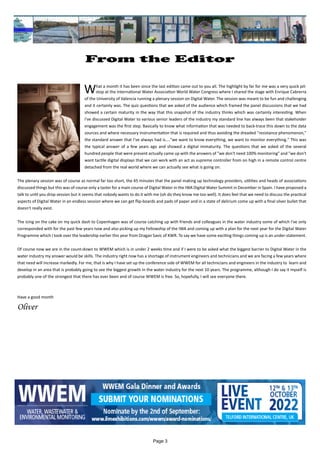
What a month it has been since the last edition came out to you all. The highlight by far for me was a very quick pit-
stop at the International Water Association World Water Congress where I shared the stage with Enrique Cabrerra
of the University of Valencia running a plenary session on Digital Water. The session was meant to be fun and challenging
and it certainly was. The quiz questions that we asked of the audience which framed the panel discussions that we had
showed a certain maturity in the way that this snapshot of the industry thinks which was certainly interesting. When
I've discussed Digital Water to various senior leaders of the industry my standard line has always been that stakeholder
engagement was the first step. Basically to know what information that was needed to back-trace this down to the data
sources and where necessary instrumentation that is required and thus avoiding the dreaded "resistance phenomenon,"
the standard answer that I’ve always had is...."we want to know everything, we want to monitor everything." This was
the typical answer of a few years ago and showed a digital immaturity. The questions that we asked of the several
hundred people that were present actually came up with the answers of "we don't need 100% monitoring" and "we don't
want tactile digital displays that we can work with an act as supreme controller from on high in a remote control centre
detached from the real world where we can actually see what is going on.
The plenary session was of course as normal far too short, the 45 minutes that the panel making up technology providers, utilities and heads of associations
discussed things but this was of course only a taster for a main course of Digital Water in the IWA Digital Water Summit in December in Spain. I have proposed a
talk to until you drop session but it seems that nobody wants to do it with me (oh do they know me too well). It does feel that we need to discuss the practical
aspects of Digital Water in an endless session where we can get flip-boards and pads of paper and in a state of delirium come up with a final silver bullet that
doesn't really exist.
The icing on the cake on my quick dash to Copenhagen was of course catching up with friends and colleagues in the water industry some of which I've only
corresponded with for the past few years now and also picking up my Fellowship of the IWA and coming up with a plan for the next year for the Digital Water
Programme which I took over the leadership earlier this year from Dragan Savic of KWR. To say we have some exciting things coming up is an under-statement.
Of course now we are in the count-down to WWEM which is in under 2 weeks time and if I were to be asked what the biggest barrier to Digital Water in the
water industry my answer would be skills. The industry right now has a shortage of instrument engineers and technicians and we are facing a few years where
that need will increase markedly. For me, that is why I have set up the conference side of WWEM for all technicians and engineers in the industry to learn and
develop in an area that is probably going to see the biggest growth in the water industry for the next 10 years. The programme, although I do say it myself is
probably one of the strongest that there has ever been and of course WWEM is free. So, hopefully, I will see everyone there.
Have a good month
Oliver
An invitation to WWEM
Marcus Pattison the organiser of WWEM would like to invite WIPAC members to join the team at WWEM on the 12th & 13th
October. WWEM is the largest dedicated water monitoring event held in the UK with over 100 hours of technical talks and
workshops on all aspects of water monitoring and an exhibition of over 150 instrument and service providers. Marcus says
“I would like to thank all our industry partners who have again excelled themselves in putting together a superb and very
informative programme, we have presentations on an inclusive range of monitoring subjects including, The Environment Act
2021, Flow measurement, PFAS and Emerging chemical screening, Sewage overflow, Smart water, IoT and Digitalisation and
more. WWEM has been designed for experienced process operators, plant managers, laboratory scientists, instrument users as
well as for apprentices and early careers”.
Already WWEM has attracted registrations from attendees from 61 different countries with visitors coming from North, South and Central America, Europe,
Africa, Asia, and the Middle East.
Plan your time well, our Free to attend technical programmes include the ever-popular Flow and Pollution Forums, the WIPAC learning and development
rooms, presentations by the SWAN Forum talks on the digital transformation of water and IT. Please join in and attend these free events as your questions,
opinions and input will be highly appreciated by presenters and fellow participants alike.
This year WWEM is running at the same time as AQE ‘The Air Quality and Emissions Show’. If you have an interest in air monitoring your WWEM badge will
allow you free entry into AQE.
Please register today to get your “Fast Track pass”
Entry to the WWEM conference programme and exhibition is Free of Charge, you pass will also give you Free onsite parking and lunches at the venue.
FIDO Tech UK undergoes acquisition and major investment to
accelerate growth
UK-based software firm FIDO Tech Ltd today announced its multi-million pound (GBP) acquisition by SKion Water GmbH and a follow-on investment led by
Emerald Technology Ventures to accelerate growth of its disruptive water leak technology.
The investment will allow the rapid scaling and adoption of its pioneering artificial intelligence FIDO AI which accurately detects, sizes and locates water leaks
in real-time on any pipeline network.
Reinhard Huebner, the CEO of SKion Water GmbH, and Charles Vaslet, a Senior Partner at Emerald Technology Ventures, will join FIDO CEO Victoria Edwards
and fellow founder Neil Edwards, who is also FIDO’s chief technology officer, on the board of FIDO Tech, along with non-executive board member Andrew
Blatherwick.
Victoria Edwards, FIDO CEO, said: “We are very excited to announce this investment in FIDO from some of the world’s biggest names in water sector impact
investment. It means that our disruptive approach to solving water leakage has come of age and we can quickly scale globally. I am particularly pleased
that Reinhard and Charles are joining the FIDO board. They bring a wealth of expertise and knowledge about critical innovation and adoption in the water
sector, and really believe in what we are trying to achieve. At least a third of the world’s piped water is lost to leaks. This is a tragedy, but it is also an amazing
opportunity. Leakage is a cheap, low-carbon source of water but until now it has always been in the ‘too hard to do’ box. New disruptive technologies like FIDO
AI are the only way to drive down leakage and non-revenue water and to challenge the climate change disaster that is pushing our communities towards Day
Zero; the day communities run out of water.”
Reinhard Huebner, SKion Water CEO, said: “Having run a leakage reduction crisis management project for a major UK water utility myself, I took one night out
with a detection crew to understand the way FIDO revolutionizes leakage detection. The simplicity and precision of the FIDO solution in combination with the
no capex business model will also allow utilities in poorer countries to find leaks and prioritize the largest ones for repair. Our operational companies in Asia
Pacific and Latin America already started to bring FIDO to utilities in their regions successfully. We are convinced that FIDO will be a major contribution to
reducing network leakage losses and look forward to helping them deploy their solution across the world together with Emerald.”
Charles Vaslet, Senior Partner at Emerald, said: “FIDO Tech is rapidly winning business with its hardware agnostic AI platform that removes human fallibility
from determining what is and is not a genuine leak with high accuracy. The company is skilfully led by Victoria Edwards, a seasoned entrepreneur, whose team
has delivered rapid commercial traction through successive product innovation.”
Unlike conventional smart leak detection technologies, FIDO AI is a totally sensor-agnostic data-as-a-service technology which optionally includes free, easy to
deploy sensors – giving it the potential to transform leakage outcomes even in the majority of global water networks with no existing digitisation.
Since emerging from UK water company United Utilities’ Innovation Lab in 2019, FIDO Tech has been named a top UK and Global Tech Innovator by KMPG and
its technology is now used on five continents, having amassed what is believed to be the world’s largest and growing data library consisting of more than 2.5
million leak and non-leak samples and achieving an accuracy rate of over 92%.
Page 4
Industry News
AnglianWaterhiddenleakseasiertospotduringdroughtusingdrones
to find and fix
Anglian Water is carrying out innovative drone surveys around Ardleigh reservoir,
Colchester, to identify difficult to find leaks and fix them - this year’s drought has
presented an opportunity to spot leaks in a new way. Colchester lies in the driest
region in the UK and is particularly vulnerable to climate change. This summer has
been the East of England’s driest year since 1976. In the last 8 months, the region
has had just 74 per cent of its average rainfall -117mm less than normal.
The teams in Colchester will use drones to take images, which are then stitched
together for geospatial analysis. Teams can then use these images to identify
unusual flora growth which may be caused by leaks on water mains. Part of
the reason for carrying out this work now is the dry weather, which makes any
unexpected foliage easier to spot.
While its leakage rates per kilometre of water main are already half the industry
average, despite having the biggest geographical region of any water company,
Anglian Water said it is determined to keep pushing boundaries.
The company is investing millions of pounds in advanced technology, including
pressure management and system optimisation, to help it achieve its challenging
targets – which have never been achieved before in the UK.
With nearly 24,000 miles of water pipe to monitor, much of it in rural and remote areas, the aerial technology will help reduce the cost and time taken to find
a leak by pinpointing its location more precisely.
Chris Utton, Leakage Delivery Support Manager for Anglian Water, said:
“We’ve been using drones to find underground, hidden leaks since 2017. Our previous work usually focused on thermal imaging, to find different temperature
patterns – but this year’s drought has given us the opportunity to spot leaks in a new way.
“Our drones are looking for unusual flora growth which, during periods of dry weather like we’ve seen this summer, can indicate leaks on our water mains.
These leaks are usually really difficult to find. In the past, drones have helped us find and fix leaks on sections of pipe that we had previously planned to replace.
This technology can save us up to £7,000 per flight in water lost through leakage and tens of thousands of pounds preventing unnecessary pipe replacements,
helping us keep customers’ bills low.”
Another benefit of the drone technology is that it helps to minimise disruption for customers, by covering large lengths of the water pipeline in a short space
of time. This means the job can be carried out faster and more precisely – meaning less digging, lower costs, less water lost and less disruption to customers.
To help make Colchester more resilient to the impacts of climate change and population growth, Anglian Water is already ensuring leaks are detected and
fixed sooner through its transformative smart metering programme. So far, more than 80 per cent of homes in Colchester and the surrounding area have been
upgraded to a smart meter as part of Anglian Water’s investment, which also gives customers more visibility of their usage, helping to reduce the cost of their
water bills.
The water company is also investing £400 million into laying hundreds of kilometres of new, interconnecting pipes that will bring water from the wettest areas
in the north of its region to the driest areas in the south and east, including Essex, by 2025.
Yorkshire Water - pollutions prevented by early alert system
An early alert system implemented by Yorkshire Water to detect equipment failure before it occurs has successfully prevented possible pollution incidents in
Gargrave, near Skipton and Balby, Doncaster. The Samotics system alerted Yorkshire Water to problems with pumps at two sewage pumping stations, allowing
teams to be sent to the sites to investigate.
On both occasions blockages caused by foreign objects and wet wipes incorrectly flushed into the network were found to be the cause of the issue.
The blockages could have caused the pump to fail and led to pollution of the local environment, but the quick intervention prevented any pollution and wider
impact on local customers.
Matt Armitage, from Yorkshire Water, said:
“We take our responsibility for the environment seriously and are always looking at new ways of tackling blockages to prevent pollution of local watercourses.
Our work with Samotics means our teams are alerted before an equipment failure and they can quickly take action to correct issues before they develop into
something more serious.
“In these instances, wet wipes and other objects flushed into the network had begun to impact the pumps at our pumping stations in Gargrave and Balby. By
having early alerts in place our teams were able to attend, remove the blockages and ultimately prevent the failure of the pumps and the potential pollution
that would cause.”
Page 5
In the Finals - the IET recognises RDN’s Retrofit Wastewater Flow
Regulator
Against tough competition, the Wastewater Flow Regulator has been selected by the IET for its Smart Tech, plus Sustainability and Net Zero Innovation Awards to
be held this November for its ability to reduce pollution, sewer flooding and ultimately plastics in the oceans. The latter has been the subject of several previous
IET innovation awards. https://eandtinnovationawards.theiet.org/the-awards/finalists/
Recently in receipt of its UK patent last April, the Wastewater (Sewer) Flow Regulator has already been successfully deployed by Anglian Water at several
locations and is now looking for a home in sewers across the UK.
RDN’s founder and managing director Eur Ing Brian M Back stated that deployed in the right location, the Wastewater Flow Regulator can make a real difference.
Compared to penstocks, the regulator from its onset was designed to be retrofit, low carbon, lightweight, easy to control and maintain as the regulator part
can be removed from the surface using a key. A key part of its patent is its failsafe overflow weir, and the use of the existing invert as part of the seal thereby
eliminating any discontinuity in the invert that could lead to rags or FOG build-up leading to a blockage.
As there is no need to construct a dedicated chamber or to provide mains power, the embodied carbon and installed costs can be as low as 10% of fitting an
equal sized penstock. Plus, installation timescales and disruption can be significantly reduced too. The opening and closing of the regulator can be via any
downstream level sensor. These are usually deployed at the pinch point in the network and are linked back using real-time radio telemetry.
RDN are actively looking for partners and distributors across the UK, to support their mission of improving environmental sustainability.
ABB Partners With Samotics To Expand Its Condition Monitoring
Services
ABB and Samotics, a leading provider of ESA technology that is a high-growth scaleup company based in the Netherlands, have entered a strategic long-term
partnership to provide enhanced condition monitoring services. The approach will leverage each company’s capabilities to deliver more insight into machine
health and energy efficiency. As a first step, ABB will integrate Samotics’ plug-and-play monitoring solution into its digital portfolio. The financial terms of the
agreement were not disclosed.
Samotics’ technology is complementary to the well-established ABB Ability Condition Monitoring service for powertrains, a sensor-based solution that analyses
the health and performance of rotating equipment. Samotics’ SAM4 technology, based on electrical signature analysis (ESA), will expand ABB’s application of asset
health monitoring of motor-driven industrial equipment as it does not rely on mounting sensors in the field. This means that SAM4 can be deployed on machines
in harsh and submerged environments.
Adrian Guggisberg, President of ABB Motion Services said: “Our strategy is to build an ecosystem with leading service providers who can contribute to our
customers’ overall success. With Samotics, we share the ambition to co-develop digital services that will offer even greater insight across a wider range of
applications to help our customers taking better decisions. The partnership will also create even more value from digital service solutions to grow our annual
recurring revenues.”
Jasper Hoogeweegen, CEO of Samotics said: “Entering into a strategic partnership with ABB will open doors with potential customers around the world and help
us scale our business. At the same time, we share a mindset and commitment to help solve reliability and energy efficiency challenges.”
Ultimately, developing a system that uses both datasets will provide industrial operators with a more detailed view of asset health so that they can make better
decisions to optimize maintenance, boost reliability and reduce downtime.
Samotics has established SAM4 as a robust and scalable system. It is already being implemented across the wastewater and water, steel, and chemical sectors and
has established a fast-growing base with thousands of assets monitored. ABB plans to roll out Samotics’ technology to customers before the end of 2022 as part
of its growing service portfolio for rotating equipment.
Sewage Flow Regulators installed in various locations across England. The two examples on the left are 160mm regulators installed at Woodham Ferris (Centre) and on housing estate
(right)
Page 6
Idrica Develops New Technologies Using Big Data Techniques And
Advanced Data Analytics
Idrica has developed a new digital solution for end-to-end management of agricultural irrigation infrastructures and networks. The multinational, with an
extensive track record in the digital transformation of drinking water and sanitation infrastructures, is now transferring its know-how to the agricultural sector
with the GoAigua Agro Twin module, which centralizes the main elements of agricultural irrigation management.
This solution, which has already been successfully deployed in Spain and Qatar, is based on Big Data and data analytics techniques, and provides a smart system
that supports decision-making, optimizing infrastructure control and field work monitoring.
Given the importance of energy and operational efficiency today, Idrica's smart solution brings process and infrastructure information together in a single model
that facilitates data acquisition, processing and standardization, providing specific technological solutions for irrigation, and centrally displaying key indicators.
The key to this project was to build an artificial intelligence algorithm for irrigation. This was developed in conjunction with Agrow Analytics, a company backed
by GoHub Ventures, Global Omnium's investment fund.
The use of this data-integrated algorithm facilitates real-time control and monitoring of assets, improves decision-making, optimizes irrigation schedules, and
provides early detection of leaks, fraud, and consumption that exceeds the established allocations. Along with comprehensive work order management, GoAigua
Agro Twin boosts operational results and records interactions with irrigation associations through an online office and mobile application.
This technology can also program irrigation, pumping and fertilizer systems from the control centre. It can also analyse soil water status and optimize crop water
consumption; manage the network of meters, devices, communications, asset energy consumption and set up customized alarms that can be configured by the
user. It also facilitates real-time data visualization, including the creation of dashboards and management indicators, and provides advanced water efficiency
management, both in the distribution network and at the supply points.
Digital sustainability, crucial for the sector in the coming years
Irrigated agriculture is the world's largest consumer of water, accounting for 70% of water withdrawals and 90% of water consumption, according to the FAO.
This is why it is key to find sustainable solutions that foster efficient water resource management, bring environmental and digital sustainability, are valid for
longer, and include a level of service adapted to the needs and digital and financial capabilities of each user.
According to Idrica's Business Development Director, Chema Nebot, "over the next few years we will see the agricultural sector taking digital transformation
on board. Process automation and advanced algorithms will be two of the key components to guarantee the sustainability of this sector in a context of water
scarcity and a huge increase in the amount of irrigated land". This all comes at a time when the use of new technologies in farming is being pushed hard, as
shown by the number of government schemes launched around the world.
International expansion
The increase in technological developments for the water cycle will enable Idrica to break into new markets as part of its international expansion plan. In 2021,
the Spanish firm opened five new subsidiaries in Hong Kong, Chile, Canada, Brazil and Saudi Arabia, adding to those in the USA, Mexico, Colombia, Ecuador, Peru,
Qatar and Romania that had been set up in 2020. In just two years, the Spanish-based multinational has established operations in 14 countries in Europe, North
America, the Middle East, Asia, Africa and Latin America.
Electro Scan (UK) Ltd. Wins 2022 UKSTT Detection, Location &
Inspection Award
Electro Scan (UK) Ltd., a wholly-owned subsidiary of US-based Electro Scan Inc. was honoured at the Annual United Kingdom Society of Trenchless Technology
(UKSTT) for its 51km (32 mile) inspection and condition assessment project for Southern Water, working with Framework Contractor, Cappagh Browne.
Electro Scan UK won the 2022 Detection, Location & Inspection Award using its innovative machine-intelligent technology that replaces Acoustic sensors and
CCTV cameras to accurately locate and quantify sewer defects and leakage that are major contributors to sewer back-ups, overflows, and flooding.
"We are honoured to win this prestigious award," stated Brad Weston, Managing Director, Electro Scan (UK) Ltd. "British water companies have been plagued
by the lack of actionable data provided by Closed-Circuit Television (CCTV) and Electro Scan is delighted to bring the pinpoint accuracy needed to find infiltration
and certify repairs as watertight."
According to UK Water Industry Research (UKWIR) , water companies are coming under increasing pressure from regulators and the public to provide better
value for money for their customers through more sustainable solutions. Infiltration is a major problem across all water company networks and significantly
increases operational costs through conveyance and treatment of unnecessary flows and can also increase levels of flood risk.
Page 7
Hackers Tackle Water Crisis At Europe's Biggest Hackathon
Global water technology company, Xylem, has awarded a team of hackathon participants who developed an innovative app to promote sustainable water
consumption. Team WatApp won HackZurich 2022’s Xylem Water Challenge with their social gaming app that helps people make smart water choices in their
everyday lives, build long-term water-saving habits, and share their results with friends.
Having sponsored the event for the last two years, Xylem continues to challenge teams to solve global water issues with a unique, digital approach. This year,
Xylem asked hackathon participants to develop a multi-faceted solution to change the public’s water habits and increase awareness of water threats through a
revolutionary social gaming app that would improve water sustainability. WatApp achieved this over a non-stop 40-hour hackathon event in Zurich, Switzerland.
With water scarcity affecting billions of people globally each year, the WatApp team created an app that would improve water consumption habits by suggesting
more sustainable choices using educational gaming features. The recommendations are generated from answers to personalized weekly challenges, taking data
on current habits and location into consideration. The app also presents water savings within a local context, for example, if you live in Switzerland the app will
compare the amount of water you save to the daily average water consumption of a Swiss person.
“This year, Europe experienced the worst drought in 500 years. It has never been clearer how urgently we need to develop new, innovative, digital solutions to
improve water sustainability,” said Hayati Yarkadas, Xylem’s President for Europe. “The participants in the annual Xylem Water Challenge are inspiring examples
of the potential within the next generation of innovators. Their passion for solving real-world water problems will help make our world more sustainable.”
“I would never have imagined how much water goes into the development of consumer goods, particularly through indirect consumption. If we can make more
people aware of sustainable water consumption, we can drive meaningful change.” said Konstantinos Samaras-Tsakiris, a member of the WatApp team.
Xylem’s partnership with HackZurich is part of the Xylem Ignite program, a global initiative to build and empower a network of student leaders passionate about
water solutions and driving change in the water industry. The program has already engaged more than 6,600 students in learning about and solving water
challenges.
Anglian Water Pilots Transformative AI Technology
Transformation of Anglian Water’s treatment and recycling processes is being made possible by trials of artificial intelligence (AI) driven software developed by
Norwegian technology company InfoTiles. The digital analytics company is collaborating with the UK utility on a 12-month pilot project focusing on biofilters
and anaerobic digestion.
Both types of biological processes and assets are integral to the treatment of wastewater and a key aim of the collaboration is to enhance operational visibility
and decision-making around asset management.
The initial trial of the InfoTiles software will monitor the rotating arms of biofilters at 15 sites to assess whether they are rotating when needed. It will also
involve measuring sludge blanket levels in primary settlement tanks at a further 15 sites, to ensure they stay within optimal ranges for effective operation.
The data, collected from a mix of new and existing sensors through Anglian's existing supervisory control & data acquisition (SCADA) systems, will be combined
with flow rates and publicly available weather data to build a rich contextual overview of what is happening at the water recycling plants in real-time.
What is more, InfoTiles can also combine Anglian Water’s existing SCADA systems into one event streaming platform that can aggregate, compare and visualise
reliability of the equipment. This same platform also allows Anglian Water to trial different sensor technology and easily compare the reliability and accuracy of
the different sensors undergoing testing.
InfoTiles’ strength is in the ability to visualise and model process data through machine learning to show the likelihood of critical failures in wastewater
treatment, such as potential stoppages and breakdowns.
This will give Anglian Water, one of the UK’s largest water utilities, the ability to anticipate, detect and resolve potential problems. By continually assessing the
health and effectiveness of assets, maintenance teams can be deployed much more efficiently.
The two companies were brought together through WaterStart, a US-based membership platform which seeks to remove common barriers to the adoption of
innovative technologies, and connects utilities and municipalities with solution providers globally.
"We are so proud to be involved in this pilot programme, which will transform the way we manage our water recycling sites,” said Adam Jessop, optimisation
technologist at Anglian Water. “Collaborating with international companies through WaterStart has helped the team to work at pace to find solutions and ways
to improve the service provided."
The overall aim of the collaboration is to enhance operational visibility, create more informed decision-making, and understand where and how to prioritise
maintenance of the water company’s assets.
Adam Wood, chief product officer at InfoTiles said, “Our Nordic customers use InfoTiles to guide their maintenance decisions with real-time data. Our team is
enthusiastic to collaborate with the technicians and analysts at Anglian Water to tailor the InfoTiles platform to enable better, data-driven, maintenance at this
major UK utility.”
Nathan Allen, executive director at WaterStart, said, “InfoTiles have proven the technology works in the Nordics, and WaterStart is thrilled to support the
company’s expansion into the UK market. Effective data management is a global challenge for water utilities and it is exciting to see the outcomes of the pilot as
the technology is expected to be broadly scalable among our global membership base.”
Page 8
How IoT Sensors Reduce Water Waste
To stretch water resources as scarcity intensifies, utilities and industry should lean on the latest sensing technology, enabled by the Internet of Things (IoT).
Water is vital to every aspect of our lives, and water usage has continued to increase as manufacturing and food production expand to meet the needs of a
growing population. Water is a precious natural commodity and is wasted at distressing levels. In domestic settings alone, the U.S. EPA reports1 that leaks can
waste nearly 1 trillion gallons of water annually. This waste has to be prevented to ensure sustainability and to reduce costs.
Data from Bluefield Research indicates that water costs are increasing faster than any other household utility, at an average of 4.2%2 per year. As water costs
rise, it becomes critical to examine water usage and how waste impacts consumption costs. When leaks occur, added costs follow due to service interruptions
and the labour required to fix the leak. Energy used transporting and treating water is ultimately wasted.
Routine preventative maintenance is a common way of curbing waste, but this approach creates waste of its own, as it requires replacing parts and machinery
while they’re still useful. It also only accounts for preventing wear-and-tear, and may not catch issues caused by isolated incidents of damage. Equipping
machinery with technology that continuously monitors performance can prevent water waste by detecting leaks and anomalies the moment they happen.
The Internet of Things (IoT) refers to equipping physical objects with sensors, providing remote visibility and control into processes that were previously analog.
Whether used in manufacturing plants or in household settings, IoT sensors can be attached to multiple equipment types, including water pipelines. Once
connected, sensors can detect a variety of issues, including leaks, deviations from optimal settings, and equipment malfunctions.
Sensor capability depends on the network through which they are connected. Several network options for IoT sensors are available in today’s market, each with
various pros and cons. Wi-Fi or cellular networks are useful for sensors that need to transmit large amounts of data continuously, including high-bandwidth
information like video. Wi-Fi networks are high bandwidth, but have short ranges, so they are typically available in household settings. However, high bandwidth
requires more power. These sensors must be powered through hard-wiring, which can be expensive to install and must be installed in an easy-to-access location
as they require frequent battery replacements.
Low-power, wide-area networks (LPWANs) are another popular means of connectivity, especially in use cases that benefit from a set-it-and-forget-it approach.
LPWAN-connected sensors can last years on a single battery. In contrast to Wi-Fi and 5G, LPWAN sensors only transmit small amounts of information at a time,
so they require a low bandwidth and a lower amount of power. This allows data to travel long distances and penetrate dense building materials. None of the data
analysis is completed on the sensor itself — data are transmitted to the cloud at regular intervals. For applications that require a regular stream of low-bandwidth
information, LPWANs are a popular choice due to their lower cost and easier installation as compared to other available networks.
Wholesale retailer Costco is a prime example of a commercial environment that realized water efficiency by implementing IoT. When the company was plagued
by unnoticed water leaks, the project started as a pilot in Southern California — an arid geographic area where water preservation is critical — to reduce
expensive water waste. Costco utilized Apana,3 a water management solution that runs on an LPWAN network, to equip its retail locations with battery-powered
IoT sensors. The sensors were set to measure flow and pressure through piping networks and equipment, and transmit data at one-minute intervals. This
monitors process drift, mechanical malfunctions, and failure points, alerting administrators when an anomaly is detected. Once a malfunction occurs, the alert
also provides issue location as well as repair instructions. The pilot generated 22% savings in water bills, and the technology was later expanded to all of Costco’s
U.S. stores.
How might LPWAN systems support an urban environment, where data must penetrate substantial building infrastructure? In the city of Panaji, India, sensors
provide smart water metering to promote efficient water use.
Panaji Municipal Corporation (PMC) utilized home water management company Cranberry Analytics4 to integrate IoT sensors into their ultrasonic water meters.
These sensors enabled the availability of remote metering and consumption data, allowing PMC to diagnose issues and update its meters without physical
intervention. LPWANs’ abilities to transmit signals through dense building materials and last years on a single battery enabled a highly efficient maintenance
solution for the city of Panaji.
Whether industrial, residential, or agricultural, a real-time view into water use can dramatically improve efficiency. IoT sensors provide accurate, real-time data
visibility to multiple industries in order to prevent waste and ultimately provide a return on the investment in the technology — and sustainable use of our
planet’s precious water.
Page 9
Bentley Systems announces Going Digital Awards finalists
Bentley Systems, an infrastructure engineering software company, has announced the finalists for its 2022 Going Digital Awards in Infrastructure. The annual
awards program honors the work of Bentley software users advancing infrastructure design, construction, and operations throughout the world. Eleven
independent jury panels selected the 36 finalists from over 300 nominations submitted by more than 180 organizations from 47 countries encompassing 12
categories.
The winners will be revealed on November 15 during the 2022 Going Digital Awards in Infrastructure celebrations in London at the Intercontinental Park Lane
in front of invited press members and industry executives. Finalists’ presentations will be available for viewing using this link on November 7, 2022. “After two
years of hosting the event virtually, we are excited to reunite in person with the Going Digital Awards’ finalists to celebrate their accomplishments along with
press members and industry analysts,” said Nicholas Cumins, Bentley’s chief operating officer. “Bentley executives will share insights about digital advancements
in infrastructure along with updates on Bentley applications and technology innovations.”
For the categories related to water, the Going Digital Awards in Infrastructure finalists are:
Water and Wastewater
Jacobs – Tuas Water Reclamation Plant (TWRP) for PUB, Singapore’s National Water Agency, Singapore
L&T Construction – Utility Development and Management for Nadaprabhu Kempegowda Layout (NPKL), Bangalore, Karnataka, India
MWH Treatment, as part of Advance Plus Framework JV with J Murphys & Sons – Burnley WwTW Capital Investment Project, Burnley, United Kingdom
Surveying and Monitoring
Aegea – Brazil’s Largest 3D Sanitation Map (Digitalization of Rio de Janeiro), Rio de Janeiro, Brazil
HDR – Murray Dam Condition Assessment, San Diego County, Calif., United States
Why Reliable Communication Is Key To The Future Of Water
The world has become a lot less predictable in the past few decades. This is particularly true of the weather. Droughts on the West Coast, freezing temperatures
in Texas, severe storms on the East Coast, and other weather events are pushing utilities to the brink. Beyond natural disasters, water utilities are also increasingly
experiencing threats to their operations in the form of cyberattacks, energy insecurity, and more.
It’s unlikely that the world will go back to the way it was, which means water utilities will have to adapt in order to minimize risk to normal service. One key to
doing this is to have a reliable communication system. The system must be able to continuously provide information about operations throughout and after an
event, all while allowing utility workers to send relevant information to the appropriate parties, including repair teams, municipal leaders, and ratepayers.
• Communication technology is far more capable than it was just two decades ago. But reliable communication is about more than just a
single device –– it requires a complete network, incorporating everything from cell phones to endpoints to sensors, as well as the supporting
infrastructure. A reliable communications network maintains a delicate balance of these four features:
• Robustness. This refers to how tough the system is. In other words, how much can an individual component withstand? For example, at
what temperature range can a sensor operate without failure? Similarly, how durable are the communication towers that transmit the
data? Robustness also refers to how protected a system is, both physically (e.g., fencing) and digitally (e.g., security protocols).
• Redundancy. No system component is immune to failure. Therefore, a reliable system will have sufficient redundancy in place. This may
mean access to backup towers or enough proliferation of sensors to ensure that the infrastructure can be adequately monitored even if
some go down. It also means having sufficient backup generators to support operations should the utility lose power.
• Reconnaissance. Water utilities must be able to react to an event quickly. For example, if the utility manages one or more stormwater
reservoirs, the ability to quickly lower the basin level during a storm to prevent overflow and flooding represents a form of agility. The same
is true of the utility’s ability to identify pipe bursts, inform the necessary personnel, and issue repair orders.
• Resiliency. A system’s resiliency is defined by how quickly it can bounce back from an event. This brings all of the above factors together.
Perhaps the problem can’t be avoided, but how fast can it be remedied?
4 Steps To Build A Reliable Communication Network
1. Ensure balance. While the network must have elements of robustness, redundancy, agility, and resiliency, keeping each aspect in balance is crucial. For
example, a water tower can be designed to withstand 250-mph winds. However, it might cost three times as much as one that can withstand 140-mph
winds. Thus, it may be more prudent to have contingency plans and cross ties to mitigate the risk.
2. Monitor performance. It isn’t enough to use the network to monitor the assets; utilities must also have visibility into the performance of the
communications network itself. Personnel must be able to ascertain whether communication nodes are connected and whether the network has
enough bandwidth to send the volume of data needed before, during, and after an event.
3. Account for maintenance and updates. Technology evolves at an astounding pace. From electronics, to batteries, to software, to interconnectivity and
compatibility, it is critical to ensure the network can evolve and grow with the speed of innovation.
4. Plan for growth. There are two kinds of growth that water utilities must prepare for. The first is population and associated demand. The second is the
amount of data needed by software and other systems to provide maximum ROI. The network needs to be flexible and expandable so that as needs
grow the communication bandwidth and capability can grow with it.
This may seem like a lot for a water utility to take on. Water utilities don’t generally employ network engineers. But there are options that allow them to take
advantage of a reliable communications network without having to install and maintain one. For example, some vendors offer network as a service (NaaS)
packages. Under this model, the water utility can install sensors, endpoints, and other assets throughout the distribution and treatment system while using an
established communications network to handle the data. Using this article as a guide, water utilities can then vet NaaS vendors to determine which have the
robustness, redundancy, agility, and resiliency needed to help them now and into the future.
Page 10
Ground-breaking digital tool on sustainable water management gets
a global boost
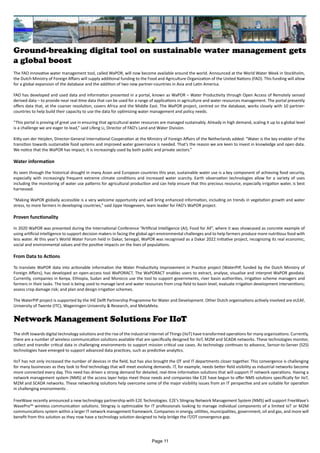
The FAO innovative water management tool, called WaPOR, will now become available around the world. Announced at the World Water Week in Stockholm,
the Dutch Ministry of Foreign Affairs will supply additional funding to the Food and Agriculture Organization of the United Nations (FAO). This funding will allow
for a global expansion of the database and the addition of two new partner-countries in Asia and Latin America.
FAO has developed and used data and information presented in a portal, known as WaPOR – Water Productivity through Open Access of Remotely sensed
derived data – to provide near real-time data that can be used for a range of applications in agriculture and water resources management. The portal presently
offers data that, at the coarser resolution, covers Africa and the Middle East. The WaPOR project, centred on the database, works closely with 10 partner-
countries to help build their capacity to use the data for optimizing water management and policy needs.
“This portal is proving of great use in ensuring that agricultural water resources are managed sustainably. Already in high demand, scaling it up to a global level
is a challenge we are eager to lead,” said Lifeng Li, Director of FAO’s Land and Water Division.
Kitty van der Heijden, Director-General International Cooperation at the Ministry of Foreign Affairs of the Netherlands added: “Water is the key enabler of the
transition towards sustainable food systems and improved water governance is needed. That’s the reason we are keen to invest in knowledge and open data.
We notice that the WaPOR has impact; it is increasingly used by both public and private sectors.”
Water information
As seen through the historical drought in many Asian and European countries this year, sustainable water use is a key component of achieving food security,
especially with increasingly frequent extreme climate conditions and increased water scarcity. Earth observation technologies allow for a variety of uses
including the monitoring of water use patterns for agricultural production and can help ensure that this precious resource, especially irrigation water, is best
harnessed.
“Making WaPOR globally accessible is a very welcome opportunity and will bring enhanced information, including on trends in vegetation growth and water
stress, to more farmers in developing countries,” said Jippe Hoogeveen, team leader for FAO’s WaPOR project.
Proven functionality
In 2020 WaPOR was presented during the International Conference “Artificial Intelligence (AI), Food for All”, where it was showcased as concrete example of
using artificial intelligence to support decision makers in facing the global agri-environmental challenges and to help farmers produce more nutritious food with
less water. At this year's World Water Forum held in Dakar, Senegal, WaPOR was recognised as a Dakar 2022 Initiative project, recognizing its real economic,
social and environmental values and the positive impacts on the lives of populations.
From Data to Actions
To translate WaPOR data into actionable information the Water Productivity Improvement in Practice project (WaterPIP, funded by the Dutch Ministry of
Foreign Affairs), has developed an open-access tool WaPORACT. The WaPORACT enables users to extract, analyse, visualise and interpret WaPOR geodata.
Currently, companies in Kenya, Ethiopia, Sudan and Morocco use the tool to support governments, river basin authorities, irrigation scheme managers and
farmers in their tasks. The tool is being used to manage land and water resources from crop field to basin level; evaluate irrigation development interventions;
assess crop damage risk; and plan and design irrigation schemes.
The WaterPIP project is supported by the IHE Delft Partnership Programme for Water and Development. Other Dutch organisations actively involved are eLEAF,
University of Twente (ITC), Wageningen University & Research, and MetaMeta.
Network Management Solutions For IIoT
The shift towards digital technology solutions and the rise of the industrial Internet of Things (IIoT) have transformed operations for many organizations. Currently,
there are a number of wireless communication solutions available that are specifically designed for IIoT, M2M and SCADA networks. These technologies monitor,
collect and transfer critical data in challenging environments to support mission critical use cases. As technology continues to advance, Sensor-to-Server (S2S)
technologies have emerged to support advanced data practices, such as predictive analytics.
IIoT has not only increased the number of devices in the field, but has also brought the OT and IT departments closer together. This convergence is challenging
for many businesses as they look to find technology that will meet evolving demands. IT, for example, needs better field visibility as industrial networks become
more connected every day. This need has driven a strong demand for detailed, real-time information solutions that will support IT network operations. Having a
network management system (NMS) at the access layer helps meet those needs and companies like E2E have begun to offer NMS solutions specifically for IIoT,
M2M and SCADA networks. These networking solutions help overcome some of the major visibility issues from an IT perspective and are suitable for operation
in challenging environments .
FreeWave recently announced a new technology partnership with E2E Technologies. E2E’s Stingray Network Management System (NMS) will support FreeWave’s
WavePro™ wireless communication solutions. Stingray is optimizable for IT professionals looking to manage individual components of a limited IoT or M2M
communications system within a larger IT network management framework. Companies in energy, utilities, municipalities, government, oil and gas, and more will
benefit from this solution as they now have a technology solution designed to help bridge the IT/OT convergence gap.
Page 11
Article:
Data quality and instrumentation
maintenance
Combined Storm overflows have become a major national issue over the past couple of years with over 400,000
overflow events reported using the 12/24 method in 2020 and slightly over 370,000 reported for 2021. This is all
because we have started monitoring overflows after the ministerial direction in 2013. As a result of this the water
industry installed thousands of event duration monitors in the last asset management period and the data has
started to show results.
Millions of hours of overflow events are recorded each year and the challenge that the water industry is facing over
the next few years is how to reduce these overflows and finding out what the root causes are. The government
have indicate that the overflows must stop with a target of zero harm and reducing actual overflow events to less
than 10 per CSO which is a tough ask when over spills from over 7,500 CSOs are going to have to be reduced down
to this level.
The industry is also entering a period of time when most of the data is open, it has to be published. This is something
that the water companies are openly embracing as by publishing the data they are able to get on and do the job
they do rather than answer environmental information requests. All of this makes a very clear and transparent
water industry.
The downside to all of this is that the data that is published has to be right, this takes work in proper installation and
proper maintenance to ensure that all of the instruments are installed give the correct information to the public,
the customer. When the Water Industry installed thousands of monitors between 2015 and 2020 it wasn’t given the
opportunity to learn from its mistakes and ensure that the instruments that were installed were necessarily giving
the right information or the technology that was used was fit for purpose.
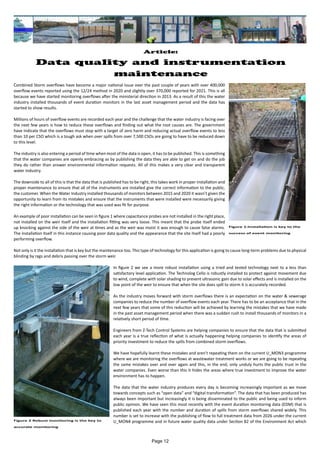
An example of poor installation can be seen in figure 1 where capacitance probes are not installed in the right place,
not installed on the weir itself and the installation fitting was very loose. This meant that the probe itself ended
up knocking against the side of the weir at times and as the weir was moist it was enough to cause false alarms.
The installation itself in this instance causing poor data quality and the appearance that the site itself had a poorly
performing overflow.
Not only is it the installation that is key but the maintenance too. This type of technology for this application is going to cause long-term problems due to physical
blinding by rags and debris passing over the storm weir.
In figure 2 we see a more robust installation using a tried and tested technology next to a less than
satisfactory level application. The Technolog Cello is robustly installed to protect against movement due
to wind, complete with solar shading to prevent ultrasonic gain due to solar effects and is installed on the
low point of the weir to ensure that when the site does spill to storm it is accurately recorded.
As the industry moves forward with storm overflows there is an expectation on the water & sewerage
companies to reduce the number of overflow events each year. There has to be an acceptance that in the
next few years that some of this reduction will be achieved by learning the mistakes that we have made
in the past asset management period when there was a sudden rush to install thousands of monitors in a
relatively short period of time.
Engineers from Z-Tech Control Systems are helping companies to ensure that the data that is submitted
each year is a true reflection of what is actually happening helping companies to identify the areas of
priority investment to reduce the spills from combined storm overflows.
We have hopefully learnt these mistakes and aren’t repeating them on the current U_MON3 programme
where we are monitoring the overflows at wastewater treatment works or we are going to be repeating
the same mistakes over and over again and this, in the end, only unduly hurts the public trust in the
water companies. Even worse than this it hides the areas where true investment to improve the water
environment has to happen.
The data that the water industry produces every day is becoming increasingly important as we move
towards concepts such as “open data” and “digital transformation”. The data that has been produced has
always been important but increasingly it is being disseminated to the public and being used to inform
public opinion. We have seen this most recently with the event duration monitoring data (EDM) that is
published each year with the number and duration of spills from storm overflows shared widely. This
number is set to increase with the publishing of flow to full treatment data from 2026 under the current
U_MON4 programme and in future water quality data under Section 82 of the Environment Act which
Figure 1:Installation is key to the
success of event monitoring
Figure 2 Robust monitoring is the key to
accurate monitoring
Page 12
will place a duty on the water companies to monitor water quality upstream and downstream
of storm overflows.
The problem with this data that is produced is that if there is no quality standard sitting behind
it then quite inadvertently errors can creep in and the data that is published can fail to portray
the true situation. This is especially the case where a “fix on fail strategy” is employed with
monitoring equipment. This was the situation with wastewater flow monitoring before the
instigation of the Monitoring Certification System (MCERTS). The data that was being collected
and used for monitoring compliance with dry weather flow permits and deciding the need for
growth schemes was of a poor quality and as a result investment schemes to increase the size of
works had a higher level of risk.
With the instigation of MCERTS there was a duty to get an installation inspected to measure the
level of uncertainty and there was a duty, in between inspections to ensure that the data being
collected was accurate by implementing a management system.
This put a duty on the water companies to check and verify that the data that was being collected
was accurate by undertaking tasks on site to ensure that the monitoring equipment being used
had been checked using both electronic verification techniques and physical techniques with
traceable equipment (for example a simple traceable ruler on a small flume installation).
Simple verification checks of instrumentation means that the level of uncertainty associated
with the data is known and the quality of that data can be quantified and guaranteed. This gives
confidence that the data being reported to either the regulator or the general public reflects the
true situation.
The maintenance of instrumentation and the data that it produces is vitally important and this level of importance is only going to grow as the water industry
transitions into an era of “Digital Water” where we use the data that we collect for more advanced techniques such as machine learning and Digital Twins. It was
in 1950s when William Mellin of the US Army coined the phrase “Garbage In Garbage Out” and this especially apt in the modern water industry insofar as the
data that we collect, if not maintained and verified, if utilised for more and more advanced tasks and put into a computer to train a machine learning system will
naturally result in errors creeping and mistakes being made.
The water industry is no longer in a situation where we can use maintenance strategies such as “fix on fail” the data that we collect is increasingly being used for
regulatory purposes and used to inform public opinion or used in more and more advanced ways and as such the maintenance of the instrumentation and the
data that it produces is becoming more and more vital.
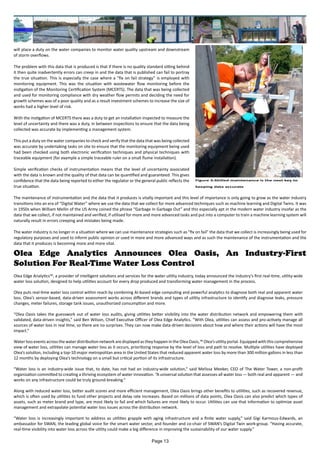
Figure 3:Skilled maintenance is the next key to
keeping data accurate
Olea Edge Analytics Announces Olea Oasis, An Industry-First
Solution For Real-Time Water Loss Control
Olea Edge Analytics™, a provider of intelligent solutions and services for the water utility industry, today announced the industry’s first real-time, utility-wide
water loss solution, designed to help utilities account for every drop produced and transforming water management in the process.
Olea puts real-time water loss control within reach by combining AI-based edge computing and powerful analytics to diagnose both real and apparent water
loss. Olea’s sensor-based, data-driven assessment works across different brands and types of utility infrastructure to identify and diagnose leaks, pressure
changes, meter failures, storage tank issues, unauthorized consumption and more.
“Olea Oasis takes the guesswork out of water loss audits, giving utilities better visibility into the water distribution network and empowering them with
validated, data-driven insights,” said Ben Wilson, Chief Executive Officer of Olea Edge Analytics. “With Olea, utilities can assess and pro-actively manage all
sources of water loss in real time, so there are no surprises. They can now make data-driven decisions about how and where their actions will have the most
impact.”
Water loss events across the water distribution network are displayed as they happen in the Olea Oasis,™ Olea’s utility portal. Equipped with this comprehensive
view of water loss, utilities can manage water loss as it occurs, prioritizing response by the level of loss and path to resolve. Multiple utilities have deployed
Olea’s solution, including a top-10 major metropolitan area in the United States that reduced apparent water loss by more than 300 million gallons in less than
12 months by deploying Olea’s technology on a small but critical portion of its infrastructure.
“Water loss is an industry-wide issue that, to date, has not had an industry-wide solution,” said Melissa Meeker, CEO of The Water Tower, a non-profit
organization committed to creating a thriving ecosystem of water innovation. “A universal solution that assesses all water loss — both real and apparent — and
works on any infrastructure could be truly ground-breaking.”
Along with reduced water loss, better audit scores and more efficient management, Olea Oasis brings other benefits to utilities, such as recovered revenue,
which is often used by utilities to fund other projects and delay rate increases. Based on millions of data points, Olea Oasis can also predict which types of
assets, such as meter brand and type, are most likely to fail and which failures are most likely to occur. Utilities can use that information to optimize asset
management and extrapolate potential water loss issues across the distribution network.
“Water loss is increasingly important to address as utilities grapple with aging infrastructure and a finite water supply,” said Gigi Karmous-Edwards, an
ambassador for SWAN, the leading global voice for the smart water sector, and founder and co-chair of SWAN’s Digital Twin work-group. “Having accurate,
real-time visibility into water loss across the utility could make a big difference in improving the sustainability of our water supply.”
Page 13
Page 14
Article:
Ultrasonic non-invasive
flow measurement is
conserving precious water
It’s impossible to manage leakage or unaccounted losses if you don’t measure.
Clamp-on ultrasonic flowmeters are proving to be an essential water management tool in the targeted water loss initiatives of water and wastewater service
providers around the globe. Because measurement is carried out safely from the outside of the pipe, there is no risk of costly and disruptive pipe damage due
to the invasive techniques involved in the installation of conventional wetted flowmeters.
With two measuring channels, which in reflect mode provide four paths through the flow profile, or even four measuring channels, producing eight paths
through the fluid in reflect mode, the flowmeter is able to reliably average the result of two or four planes.
Performing under even the most challenging conditions and finely tuned to low flow velocities, ultrasonic flowmeters are simply attached to the outside of the
pipe wall, offering a highly versatile and accurate measurement solution for the water and wastewater industries.
What are the accuracies of ultrasonic, clamp-on measurement?
While doppler measurement is frequently recommended for wastewater flow measurement, as performance is stated as having an accuracy of ±2% of readings
on liquids with entrained particles, or gases of 100 microns or larger and minimum concentrations of 75 ppm, this is rarely the case in practise. Despite
specification claims, with constantly varying percentages of entrained air or suspended solids, doppler installed accuracy seldom exceeds 10%.
Ultrasonic transit time measurement on the other hand, uses transducers that typically operate in the 0.2-2 MHz frequencies, and works by sending two
ultrasonic pulses through the medium – one in the direction of flow, and a second one against it. The transducers are alternately working as a transmitter and
a receiver; ultrasound sent with the flow direction speeds up, whilst against the flow slows down, and the time difference, t, is directly proportionate to the
flow rate.
So, what accuracies can be expected? The following table gives an indication:
Installed accuracy with recommended straight lengths, e.g. 10Ø up/3Ø down after 90 degree elbow
Meter accuracy (lab or field calibrated) ±0.3% of reading, ±0.01 m/s
Installed Accuracy ±1.0% of reading, ±0.01 m/s
Repeatability 0.15% of reading, ±0.01 m/s
Maximum pipe diameter Up to 6.5m
And because it’s not always possible to achieve optimum installation away from valves, bends and other in-line disturbances, FLEXIM’s automatic flow disturbance
correction feature is highly advantageous. In situations where recommended straight runs can be difficult to find, the usually required 10D upstream straight
length to achieve ±1.0% installed accuracy is reduced to a much more achievable 2D upstream and 3D downstream. There’s no downtime, and no reduction in
accuracy.
How ultrasonic technology is helping to curb the flow of non-revenue water.
A major headache for many water utilities, non-revenue water is water that has been
treated, but lost before it reaches the consumer, through issues such as leaks or even
theft from illegal connections in the distribution lines.
A chief water concessionaire in the Philippines had tasked FLEXIM with flow
measurement on a 3.2m concrete pipe at the inflow to a reservoir, as they were keen to
greatly reduce non-revenue water. They had already had some success by employing
state of the art leak detection equipment, bringing DMA NRW down to an average
of 29.78 percent in 2018 from 66 percent in 2006, but were very much focused on
achieving an even greater reduction.
Managing three water treatment facilities, all of which meet the Philippine National
Standards for Drinking Water of the Department of Health, surface water is processed
severalwaysattwoofthewateroperator’streatmentplants.Theseincludecoagulation,
flocculation, clarification, filtration, turbidity removal and chlorination. The water
treated in plant 1 is then sent through a 3.2m pre-stressed concrete cylinder pipe
(PCCP) to a reservoir that has a 200 MLD capacity.
The 3.2m transport pipe was interconnected with a similar transport pipe in a second
plant, so to carry out accurate measurement, conduct water balance and identify
any losses within that particular segment, water engineers were looking for a way to
retrofit a flowmeter that wouldn’t involve having to make modifications to the pipe. Any
alterations could potentially weaken or damage the pipe, so non-invasive technology
Page 15
such as clamp-on ultrasonic measurement was the obvious solution. Precise installation of four pairs of transducers would also need to be carried out, which on
a 3.2m pipe is not always an easy feat.
Accuracy is crucial
With reliability and accuracy both essential, measuring engineers at the plant’s
Integrated Meter Management (IMM) were intent on subjecting clamp-on ultrasonic
systems of several providers to an in-depth comparative test. Getting reliable signals
on the challenging pipe material was key, and FLEXIM’s flowmeter did not disappoint.
Onceidentifiedasthemostconvincingmeasuringsolution,aseriesofon-sitetrialsand
tests were carried out to properly examine the functionality and appropriate design
of the transducers to be used. Because of the importance of the flow measurement,
coupled with the high demands on both dependability and precision, it was decided
that FLEXIM’s high-end flowmeter would be the most appropriate solution. With four
measuring channels, which in reflect mode provide eight paths through the fluid,
the meter is able to average the result of four planes, delivering unrivalled accuracy,
repeatability and reliability.
Reliable and precise recording of water flow to the reservoir
Following this series of on-site trials and testing, ultrasonic clamp-on technology
was proven to be up to the challenge of delivering reliable and accurate flow
measurement on a permanent basis. After almost two years of intense collaboration,
the perfect solution is now in place for the water operator’s somewhat challenging
measuring problem. Precisely recording the water flow to the reservoir, measuring
data is relayed to the plant’s process control system via HART protocol.
City Of London Corporation Wins Itron Innovator Award
Itron, Inc. which is innovating the way utilities and cities manage energy and water, announced that the City of London Corporation (City Corporation) is the
winner of the 2022 Itron Innovator Award for pro-actively addressing the City’s most pressing needs related to climate disruption and disaster recovery. The
award, presented at Itron Inspire 2022, recognizes a customer that has taken advantage of Itron’s partner enablement programs to deliver a breakthrough
solution that solves challenges in energy and water efficiencies and smart communities. The City Corporation was recognized for its collaboration with Itron
partner Urban Control to utilize the existing smart street-light communications network along with IIoT sensors and smart applications to gather and analyse
data to help determine the best way to manage and prepare for severe weather events before they become catastrophic. The project is being carried out as part
of the City Corporation’s Climate Action Strategy.
Urban Control has worked with Itron and the City Corporation to identify new IoT applications and solutions that can be added to the existing industrial IoT (IIoT)
mesh network canopy, including temperature, humidity and soil moisture sensors. Upon deployment, the sensors will monitor trends over the next 20 years to
identify whether interventions, such as sustainable drainage systems (SuDS) and urban greening of “heat islands”, are helping to avoid disruptive temperatures
and flooding of the City’s streets. Ongoing monitoring of street temperatures and soil moisture will help reduce the costs of maintenance and irrigation and
provide real-time data to help the City Corporation evaluate which climate resilience interventions are the most effective in the face of severe weather patterns.
“The City of London Corporation is very deserving of the Itron Innovator Award. The collaboration between Itron, Urban Control, the City Corporation and
other community stakeholders is an excellent example of how diverse groups can come together to address the evolving needs and challenges of communities
across the globe. It is also a great example of the power of Itron’s extensive partner ecosystem,” said Ben Huggins, senior vice president of Customer and Market
Experience at Itron.
“We are pleased to be recognised for our work with Urban Control on this innovative sensor network, which will help the City of London avoid disruption from
climate change-related weather events such as flooding, heat-waves and drought. This scheme forms part of the City Corporation’s ambitious Climate Action
Strategy, which commits us to achieving net zero carbon emissions for our own operations by 2027 and supporting the achievement of net zero for the City as a
whole by 2040,” said Keith Bottomley, Chairman of the City of London Corporation's Port Health & Environmental Services Committee.
The Itron Innovator Award recognizes a utility or city customer that has leveraged Itron’s partner enablement programs to deploy a breakthrough solution. The
solution demonstrates an Itron customer’s use of ecosystem tools and services such as development kits and innovation challenges or the customer’s selection
of a partner that has done so. Additionally, the solution has been successfully integrated with Itron technology and utilizes Itron’s networks, software solutions
or distributed intelligence capabilities. Past winners include CPS Energy in 2021 and Western Power in 2020.
Itron’s vibrant partner ecosystem is essential in delivering innovative industrial IoT solutions to create a more resourceful world. With Itron’s ecosystem, cities
and utilities are taking advantage of Itron’s partner network to deliver best-in-class solutions for today’s challenges such as improved operations and resource
efficiency, enhanced safety and smart connected communities.
Page 16
Article:
Monitoring storm overflows and the
river environment
InthepastyearortwothewatercompaniesinEngland&Waleshavebecomeentangledinthevariousargumentsaboutpollutionoftheaquaticenvironment.
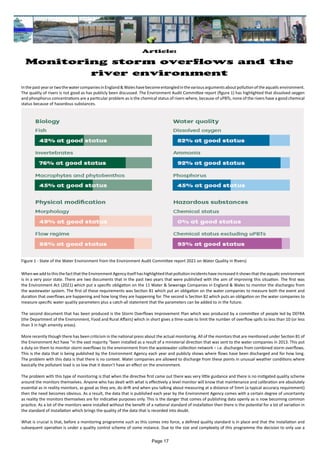
The quality of rivers is not good as has publicly been discussed. The Environment Audit Committee report (figure 1) has highlighted that dissolved oxygen
and phosphorus concentrations are a particular problem as is the chemical status of rivers where, because of uPBTs, none of the rivers have a good chemical
status because of hazardous substances.
WhenweaddtothisthefactthattheEnvironmentAgencyitselfhashighlightedthatpollutionincidentshaveincreaseditshowsthattheaquaticenvironment
is in a very poor state. There are two documents that in the past two years that were published with the aim of improving this situation. The first was
the Environment Act (2021) which put a specific obligation on the 11 Water & Sewerage Companies in England & Wales to monitor the discharges from
the wastewater system. The first of these requirements was Section 81 which put an obligation on the water companies to measure both the event and
duration that overflows are happening and how long they are happening for. The second is Section 82 which puts an obligation on the water companies to
measure specific water quality parameters plus a catch-all statement that the parameters can be added to in the future.
The second document that has been produced is the Storm Overflows Improvement Plan which was produced by a committee of people led by DEFRA
(the Department of the Environment, Food and Rural Affairs) which in short gives a time-scale to limit the number of overflow spills to less than 10 (or less
than 3 in high amenity areas).
More recently though there has been criticism in the national press about the actual monitoring. All of the monitors that are mentioned under Section 81 of
the Environment Act have “in the vast majority “been installed as a result of a ministerial direction that was sent to the water companies in 2013. This put
a duty on them to monitor storm overflows to the environment from the wastewater collection network – i.e. discharges from combined storm overflows.
This is the data that is being published by the Environment Agency each year and publicly shows where flows have been discharged and for how long.
The problem with this data is that there is no context. Water companies are allowed to discharge from these points in unusual weather conditions where
basically the pollutant load is so low that it doesn’t have an effect on the environment.
The problem with this type of monitoring is that when the directive first came out there was very little guidance and there is no instigated quality scheme
around the monitors themselves. Anyone who has dealt with what is effectively a level monitor will know that maintenance and calibration are absolutely
essential as in reality monitors, as good as they are, do drift and when you talking about measuring at a distance of 5mm (a typical accuracy requirement)
then the need becomes obvious. As a result, the data that is published each year by the Environment Agency comes with a certain degree of uncertainty
as reality the monitors themselves are for indicative purposes only. This is the danger that comes of publishing data openly as is now becoming common
practice. As a lot of the monitors were installed without the benefit of a national standard of installation then there is the potential for a lot of variation in
the standard of installation which brings the quality of the data that is recorded into doubt.
What is crucial is that, before a monitoring programme such as this comes into force, a defined quality standard is in place and that the installation and
subsequent operation is under a quality control scheme of some instance. Due to the size and complexity of this programme the decision to only use a
Figure 1 - State of the Water Environment from the Environment Audit Committee report 2021 on Water Quality in Rivers)
Page 17
Good Practice Guide approach was taken as this represented the easiest method of getting monitoring in place.
The criticism that has been levelled about the reliability of this data and the fact that the storm overflow reduction plan relies on it has an element of truth to it
insofar as the data has to be accurate. This level of accuracy is set to be subject to scrutiny when it belatedly comes under the Environment Agency’s Monitoring
Certification Scheme (MCERTS) when the installed based is replaced when the current devices come to the end of their asset life (typically approximately 10
years).
The Event Duration Monitors that have been installed under firstly the ministerial direction and now secondly (almost retrospectively) under Section 81 of the
Environment Act are actually one of the simplest forms of monitoring present within the water industry. The monitoring that is now a requirement under Section
82 of the Environment Act is a completely different picture
Monitoring water quality
The monitoring of water quality, especially in a river, is somewhat of a different picture to that of simply monitoring that an event is happening and for how long
it is happening especially in what is being termed “real time.” The first question is – what is “real time?” I once had a supplier have a conversation with me about
fibre-optic cable in sewers and there comments were that with fibre optic cables the temperature of the sewage could be measured several thousand times a
second. My response was simply? Why. The industry has got to the point of measuring things simply because we can do and can measure things at a very high
accuracy and at speed. This doesn’t mean that the water industry has a use for measuring that particular element over a particular time-scale. This is the case
for river water monitoring under Section 82.
To take a step-back river water quality is assessed via the FIS standards or the fundamental intermittent standards. This just uses Dissolved Oxygen and un-
ionised ammonia as detailed in Section 2 of the Urban Pollution Management (UPM) Manual (which is available on the FWR website). This looks at water quality
over a long period of time and makes an assessment of whether the water quality is improving or not. So why are parameters such as temperature, pH and
turbidity contained with Section 82 and how does it impact on the impact that discharges from storm overflows have on the riverine environment especially at
the distance away that the monitoring points are going to have to be from the overflows themselves to manage the actual impact on the river.
Also, as we can see from figure 1 the impact of phosphorus on the river environment is a main cause for poor quality. Why isn’t phosphorus being monitored.
Add to this the main cause for chemical failures are UPBTs (chemicals like mercury, pBDE, TBT and PAHs) accounting for 97% of the chemical failures. Now to
measure this online across all of the overflows would be highly impractical but if they are a cause for environmental harm them maybe consideration for their
monitoring needs to be done.
From all of this we can consider that what we should monitor in the riverine environment to help protect the environment hasn’t been very well considered. If
we accept this then the question of what we should be monitoring the river for in terms of water quality needs to be discussed and understood.
Looking at a different scenario is there a case for the online monitoring rivers, lakes and our coastlines for pollution from any source and what impact would
this have on the number of monitors that are required. Talking to a water industry colleague this might actually give a better picture of the state of our riverine
environment using less monitors and using the right parameters.
Conclusions
Whatever happens there is no doubt that we need to improve the health of our water environments whether they be freshwater rivers and lakes or estuaries
or coastal sites. There is no use assigning blame as this will lead to arguments that can ramble on for years without much happening. A true picture of the state
of our “blue spaces” as they have been called needs to happen and happen quickly. From there the improvements can be driven to understand where the
regulation needs to take over to enforce water quality standards through regulation and punitive actions as necessary. Some of the work can start now, there is
knowledge through the use of event duration monitoring the areas of highest concern and the citizen scientists have been doing an excellent voluntary job in
highlighting where some of the problem areas lie.
In the meantime, the areas without such visible pollution also need to be identified and this we can only do with collaboration and support. Helping and
supporting citizen science on one hand and collecting verifiable online monitoring using the right parameters to a standard that can be verifiable by independent
techniques and identify the root causes of pollution in the aquatic environment and use a mixture of support (for agriculture for instance) and punitive methods
where illegal activity is found.
In the meantime, the discussions will rage on. Do join the WIPAC Pollution Form at the Water, Wastewater & Environmental Monitoring (WWEM) conference
and exhibition on 13th October 2022 to join the discussion.
Page 18
Water, Wastewater & Environmental Monitoring
Telford, UK
12th - 13th October 2022
The WWEM Conference & Exhibition is returning as a physical conference & exhibition in 2022 and is bigger and better than before
with the return of the Flow Forum, a new Pollution Forum, a Learning & Development Zone and this year a Digital Zone. All available
to everyone for absolutely free.
Sensor for Water Interest Group Workshops
The Sensors for Water Interest Group has moved their workshops for the foreseeable future to an online webinar format. The next
workshops are
30th November 2022 - Sensor Driver AI for the Water Industry - Sandy Park, Exeter
25th January 2023 - Sensors for AMP7 and PR24 - Peterborough
IWA Digital Water Summit
Bilbao, Spain
29th November - 2nd December 2022
The long awaited Digital Summit the premium event of the IWA Digital Water Programme is due to take place in Bilbao at the end
of November 2022. Four days of discussion about the Digital Transformation of the Water Industry....what is not to love.
Future Water Association - Network November 2022
Bringing together the latest thinking, new ideas, a mix of presenters and a view from those new to the sector – Networks November
offers a month of webinars, face-to-face sessions, water dragons and how to classes!
Its year two of the initiative that sets out to challenge thinking on all things pipes & sewers! Exploring the latest policies, the latest
research, the latest technology and latest ideas, the month will be holding up a mirror to what happens now.
Page 19
Conferences, Events,
Seminars & Studies
Conferences, Seminars & Events
2022 Conference Calendar
WHAT IS WWEM? WHAT ARE THE TOPICS? WHO SHOULD ATTEND?
WWEM The Water, Wastewater and Environmental
Monitoring event is an in person event that
focuses on Instrumentation and services for water
and wastewater process monitoring. WWEM
offers a technical program aimed at keeping you
up to date with the latest trends, regulations,
methods, techniques and technologies.
Furthermore, you can also network with all industry
stakeholders including suppliers, regulators and
end-users from industry that need to test, monitor
and analyse water and wastewater.
Process Monitoring, Laboratory analysis, Current
and Future regulation, MCerts, Gas detection,
Field testing, Portable instruments, Operator
Monitoring, Data acquisition, Odour monitoring
and treatment, Big Data, Online monitoring,
Flow/Level Measurement, Leak Detection,
Pumping solutions, Control and Instrumentation.
• Industry, Process operators, Environmental
Managers, Control and Instrument users and
Planners from across all industries who test,
analyse, monitor or treat water and wastewater
now or in the future.
• Policy makers and regulators from local
authorities and Environment agencies
• Scientists and academics
• Solution providers and consultants
www.wwem.uk.com
E: info@wwem.uk.com
Supporting Trade Organisations
WWEM WATER, WASTEWATER &
ENVIRONMENTAL MONITORING
REGISTRATION
NOW OPEN
12TH & 13TH
OCTOBER
2022
LIVE
EVENT
TELFORD, UNITED KINGDOM
FREE entry, FREE parking, FREE lunches
Over 100 hours of FREE technical presentations and training sessions
Plus great networking opportunities with over 150 exhibitors
FREE
Page 20

WIPAC Monthly - September 2022.pdf

  • 1.
    WIPAC MONTHLY The MonthlyUpdate from Water Industry Process Automation & Control www.wipac.org.uk Issue 9/2022- September 2022
  • 2.
    Page 2 In thisIssue WIPAC Monthly is a publication of the Water Industry Process Automation & Control Group. It is produced by the group manager and WIPAC Monthly Editor, Oliver Grievson. This is a free publication for the benefit of the Water Industry and please feel free to distribute to any who you may feel benefit. However due to the ongoing costs of WIPAC Monthly a donation website has been set up to allow readers to contribute to the running of WIPAC & WIPAC Monthly, For those wishing to donate then please visit https://www.patreon.com/Wipac all donations will be used solely for the benefit and development of WIPAC. All enquires about WIPAC Monthly, including those who want to publish news or articles within these pages, should be directed to the publications editor, Oliver Grievson at olivergrievson@hotmail.com From the editor............................................................................................................. 3 Industry news.............................................................................................................. Highlights of the news of the month from the global water industry centred around the successes of a few of the companies in the global market. 4 - 11 Data quality and instrumentation maintenance............................................................ As data becomes more and more open the regulatory monitoring that is being undertaken is coming under more and more scrutiny. In this article by Oliver Grievson who is the executive director of WIPAC, we look at the importance of correct installation and maintenance for both Event Duration and Flow Monitoring. 12 - 14 Ultrasonic non-invasive flow measurement is conserving precious water..................... When you have really large pipes for water distribution then changing your monitoring method can be nearly impossible and a lengthy and expensive process when it is possible. In this article we look at the use of ultrasonic time of flight flow meters for accurate and rapid installation of flow monitoring which of course helps in saving water. 15 - 16 Monitoring storm overflows and our river environment.................................................. The pollution crisis in England & Wales has meant that the pressure to install both event detection and quality monitoring on our river environments is higher than ever. This article looks at what the industry is being obliged to do and questions, for the investment that its going to take, are we doing the right thing or does a more holistic approach need to be taken. 17 - 18 Workshops, conferences & seminars............................................................................ The highlights of the conferences and workshops in the coming months. 19 - 20
  • 3.
    Page 3 From theEditor What a month it has been since the last edition came out to you all. The highlight by far for me was a very quick pit- stop at the International Water Association World Water Congress where I shared the stage with Enrique Cabrerra of the University of Valencia running a plenary session on Digital Water. The session was meant to be fun and challenging and it certainly was. The quiz questions that we asked of the audience which framed the panel discussions that we had showed a certain maturity in the way that this snapshot of the industry thinks which was certainly interesting. When I've discussed Digital Water to various senior leaders of the industry my standard line has always been that stakeholder engagement was the first step. Basically to know what information that was needed to back-trace this down to the data sources and where necessary instrumentation that is required and thus avoiding the dreaded "resistance phenomenon," the standard answer that I’ve always had is...."we want to know everything, we want to monitor everything." This was the typical answer of a few years ago and showed a digital immaturity. The questions that we asked of the several hundred people that were present actually came up with the answers of "we don't need 100% monitoring" and "we don't want tactile digital displays that we can work with an act as supreme controller from on high in a remote control centre detached from the real world where we can actually see what is going on. The plenary session was of course as normal far too short, the 45 minutes that the panel making up technology providers, utilities and heads of associations discussed things but this was of course only a taster for a main course of Digital Water in the IWA Digital Water Summit in December in Spain. I have proposed a talk to until you drop session but it seems that nobody wants to do it with me (oh do they know me too well). It does feel that we need to discuss the practical aspects of Digital Water in an endless session where we can get flip-boards and pads of paper and in a state of delirium come up with a final silver bullet that doesn't really exist. The icing on the cake on my quick dash to Copenhagen was of course catching up with friends and colleagues in the water industry some of which I've only corresponded with for the past few years now and also picking up my Fellowship of the IWA and coming up with a plan for the next year for the Digital Water Programme which I took over the leadership earlier this year from Dragan Savic of KWR. To say we have some exciting things coming up is an under-statement. Of course now we are in the count-down to WWEM which is in under 2 weeks time and if I were to be asked what the biggest barrier to Digital Water in the water industry my answer would be skills. The industry right now has a shortage of instrument engineers and technicians and we are facing a few years where that need will increase markedly. For me, that is why I have set up the conference side of WWEM for all technicians and engineers in the industry to learn and develop in an area that is probably going to see the biggest growth in the water industry for the next 10 years. The programme, although I do say it myself is probably one of the strongest that there has ever been and of course WWEM is free. So, hopefully, I will see everyone there. Have a good month Oliver
  • 4.
    An invitation toWWEM Marcus Pattison the organiser of WWEM would like to invite WIPAC members to join the team at WWEM on the 12th & 13th October. WWEM is the largest dedicated water monitoring event held in the UK with over 100 hours of technical talks and workshops on all aspects of water monitoring and an exhibition of over 150 instrument and service providers. Marcus says “I would like to thank all our industry partners who have again excelled themselves in putting together a superb and very informative programme, we have presentations on an inclusive range of monitoring subjects including, The Environment Act 2021, Flow measurement, PFAS and Emerging chemical screening, Sewage overflow, Smart water, IoT and Digitalisation and more. WWEM has been designed for experienced process operators, plant managers, laboratory scientists, instrument users as well as for apprentices and early careers”. Already WWEM has attracted registrations from attendees from 61 different countries with visitors coming from North, South and Central America, Europe, Africa, Asia, and the Middle East. Plan your time well, our Free to attend technical programmes include the ever-popular Flow and Pollution Forums, the WIPAC learning and development rooms, presentations by the SWAN Forum talks on the digital transformation of water and IT. Please join in and attend these free events as your questions, opinions and input will be highly appreciated by presenters and fellow participants alike. This year WWEM is running at the same time as AQE ‘The Air Quality and Emissions Show’. If you have an interest in air monitoring your WWEM badge will allow you free entry into AQE. Please register today to get your “Fast Track pass” Entry to the WWEM conference programme and exhibition is Free of Charge, you pass will also give you Free onsite parking and lunches at the venue. FIDO Tech UK undergoes acquisition and major investment to accelerate growth UK-based software firm FIDO Tech Ltd today announced its multi-million pound (GBP) acquisition by SKion Water GmbH and a follow-on investment led by Emerald Technology Ventures to accelerate growth of its disruptive water leak technology. The investment will allow the rapid scaling and adoption of its pioneering artificial intelligence FIDO AI which accurately detects, sizes and locates water leaks in real-time on any pipeline network. Reinhard Huebner, the CEO of SKion Water GmbH, and Charles Vaslet, a Senior Partner at Emerald Technology Ventures, will join FIDO CEO Victoria Edwards and fellow founder Neil Edwards, who is also FIDO’s chief technology officer, on the board of FIDO Tech, along with non-executive board member Andrew Blatherwick. Victoria Edwards, FIDO CEO, said: “We are very excited to announce this investment in FIDO from some of the world’s biggest names in water sector impact investment. It means that our disruptive approach to solving water leakage has come of age and we can quickly scale globally. I am particularly pleased that Reinhard and Charles are joining the FIDO board. They bring a wealth of expertise and knowledge about critical innovation and adoption in the water sector, and really believe in what we are trying to achieve. At least a third of the world’s piped water is lost to leaks. This is a tragedy, but it is also an amazing opportunity. Leakage is a cheap, low-carbon source of water but until now it has always been in the ‘too hard to do’ box. New disruptive technologies like FIDO AI are the only way to drive down leakage and non-revenue water and to challenge the climate change disaster that is pushing our communities towards Day Zero; the day communities run out of water.” Reinhard Huebner, SKion Water CEO, said: “Having run a leakage reduction crisis management project for a major UK water utility myself, I took one night out with a detection crew to understand the way FIDO revolutionizes leakage detection. The simplicity and precision of the FIDO solution in combination with the no capex business model will also allow utilities in poorer countries to find leaks and prioritize the largest ones for repair. Our operational companies in Asia Pacific and Latin America already started to bring FIDO to utilities in their regions successfully. We are convinced that FIDO will be a major contribution to reducing network leakage losses and look forward to helping them deploy their solution across the world together with Emerald.” Charles Vaslet, Senior Partner at Emerald, said: “FIDO Tech is rapidly winning business with its hardware agnostic AI platform that removes human fallibility from determining what is and is not a genuine leak with high accuracy. The company is skilfully led by Victoria Edwards, a seasoned entrepreneur, whose team has delivered rapid commercial traction through successive product innovation.” Unlike conventional smart leak detection technologies, FIDO AI is a totally sensor-agnostic data-as-a-service technology which optionally includes free, easy to deploy sensors – giving it the potential to transform leakage outcomes even in the majority of global water networks with no existing digitisation. Since emerging from UK water company United Utilities’ Innovation Lab in 2019, FIDO Tech has been named a top UK and Global Tech Innovator by KMPG and its technology is now used on five continents, having amassed what is believed to be the world’s largest and growing data library consisting of more than 2.5 million leak and non-leak samples and achieving an accuracy rate of over 92%. Page 4 Industry News
  • 5.
    AnglianWaterhiddenleakseasiertospotduringdroughtusingdrones to find andfix Anglian Water is carrying out innovative drone surveys around Ardleigh reservoir, Colchester, to identify difficult to find leaks and fix them - this year’s drought has presented an opportunity to spot leaks in a new way. Colchester lies in the driest region in the UK and is particularly vulnerable to climate change. This summer has been the East of England’s driest year since 1976. In the last 8 months, the region has had just 74 per cent of its average rainfall -117mm less than normal. The teams in Colchester will use drones to take images, which are then stitched together for geospatial analysis. Teams can then use these images to identify unusual flora growth which may be caused by leaks on water mains. Part of the reason for carrying out this work now is the dry weather, which makes any unexpected foliage easier to spot. While its leakage rates per kilometre of water main are already half the industry average, despite having the biggest geographical region of any water company, Anglian Water said it is determined to keep pushing boundaries. The company is investing millions of pounds in advanced technology, including pressure management and system optimisation, to help it achieve its challenging targets – which have never been achieved before in the UK. With nearly 24,000 miles of water pipe to monitor, much of it in rural and remote areas, the aerial technology will help reduce the cost and time taken to find a leak by pinpointing its location more precisely. Chris Utton, Leakage Delivery Support Manager for Anglian Water, said: “We’ve been using drones to find underground, hidden leaks since 2017. Our previous work usually focused on thermal imaging, to find different temperature patterns – but this year’s drought has given us the opportunity to spot leaks in a new way. “Our drones are looking for unusual flora growth which, during periods of dry weather like we’ve seen this summer, can indicate leaks on our water mains. These leaks are usually really difficult to find. In the past, drones have helped us find and fix leaks on sections of pipe that we had previously planned to replace. This technology can save us up to £7,000 per flight in water lost through leakage and tens of thousands of pounds preventing unnecessary pipe replacements, helping us keep customers’ bills low.” Another benefit of the drone technology is that it helps to minimise disruption for customers, by covering large lengths of the water pipeline in a short space of time. This means the job can be carried out faster and more precisely – meaning less digging, lower costs, less water lost and less disruption to customers. To help make Colchester more resilient to the impacts of climate change and population growth, Anglian Water is already ensuring leaks are detected and fixed sooner through its transformative smart metering programme. So far, more than 80 per cent of homes in Colchester and the surrounding area have been upgraded to a smart meter as part of Anglian Water’s investment, which also gives customers more visibility of their usage, helping to reduce the cost of their water bills. The water company is also investing £400 million into laying hundreds of kilometres of new, interconnecting pipes that will bring water from the wettest areas in the north of its region to the driest areas in the south and east, including Essex, by 2025. Yorkshire Water - pollutions prevented by early alert system An early alert system implemented by Yorkshire Water to detect equipment failure before it occurs has successfully prevented possible pollution incidents in Gargrave, near Skipton and Balby, Doncaster. The Samotics system alerted Yorkshire Water to problems with pumps at two sewage pumping stations, allowing teams to be sent to the sites to investigate. On both occasions blockages caused by foreign objects and wet wipes incorrectly flushed into the network were found to be the cause of the issue. The blockages could have caused the pump to fail and led to pollution of the local environment, but the quick intervention prevented any pollution and wider impact on local customers. Matt Armitage, from Yorkshire Water, said: “We take our responsibility for the environment seriously and are always looking at new ways of tackling blockages to prevent pollution of local watercourses. Our work with Samotics means our teams are alerted before an equipment failure and they can quickly take action to correct issues before they develop into something more serious. “In these instances, wet wipes and other objects flushed into the network had begun to impact the pumps at our pumping stations in Gargrave and Balby. By having early alerts in place our teams were able to attend, remove the blockages and ultimately prevent the failure of the pumps and the potential pollution that would cause.” Page 5
  • 6.
    In the Finals- the IET recognises RDN’s Retrofit Wastewater Flow Regulator Against tough competition, the Wastewater Flow Regulator has been selected by the IET for its Smart Tech, plus Sustainability and Net Zero Innovation Awards to be held this November for its ability to reduce pollution, sewer flooding and ultimately plastics in the oceans. The latter has been the subject of several previous IET innovation awards. https://eandtinnovationawards.theiet.org/the-awards/finalists/ Recently in receipt of its UK patent last April, the Wastewater (Sewer) Flow Regulator has already been successfully deployed by Anglian Water at several locations and is now looking for a home in sewers across the UK. RDN’s founder and managing director Eur Ing Brian M Back stated that deployed in the right location, the Wastewater Flow Regulator can make a real difference. Compared to penstocks, the regulator from its onset was designed to be retrofit, low carbon, lightweight, easy to control and maintain as the regulator part can be removed from the surface using a key. A key part of its patent is its failsafe overflow weir, and the use of the existing invert as part of the seal thereby eliminating any discontinuity in the invert that could lead to rags or FOG build-up leading to a blockage. As there is no need to construct a dedicated chamber or to provide mains power, the embodied carbon and installed costs can be as low as 10% of fitting an equal sized penstock. Plus, installation timescales and disruption can be significantly reduced too. The opening and closing of the regulator can be via any downstream level sensor. These are usually deployed at the pinch point in the network and are linked back using real-time radio telemetry. RDN are actively looking for partners and distributors across the UK, to support their mission of improving environmental sustainability. ABB Partners With Samotics To Expand Its Condition Monitoring Services ABB and Samotics, a leading provider of ESA technology that is a high-growth scaleup company based in the Netherlands, have entered a strategic long-term partnership to provide enhanced condition monitoring services. The approach will leverage each company’s capabilities to deliver more insight into machine health and energy efficiency. As a first step, ABB will integrate Samotics’ plug-and-play monitoring solution into its digital portfolio. The financial terms of the agreement were not disclosed. Samotics’ technology is complementary to the well-established ABB Ability Condition Monitoring service for powertrains, a sensor-based solution that analyses the health and performance of rotating equipment. Samotics’ SAM4 technology, based on electrical signature analysis (ESA), will expand ABB’s application of asset health monitoring of motor-driven industrial equipment as it does not rely on mounting sensors in the field. This means that SAM4 can be deployed on machines in harsh and submerged environments. Adrian Guggisberg, President of ABB Motion Services said: “Our strategy is to build an ecosystem with leading service providers who can contribute to our customers’ overall success. With Samotics, we share the ambition to co-develop digital services that will offer even greater insight across a wider range of applications to help our customers taking better decisions. The partnership will also create even more value from digital service solutions to grow our annual recurring revenues.” Jasper Hoogeweegen, CEO of Samotics said: “Entering into a strategic partnership with ABB will open doors with potential customers around the world and help us scale our business. At the same time, we share a mindset and commitment to help solve reliability and energy efficiency challenges.” Ultimately, developing a system that uses both datasets will provide industrial operators with a more detailed view of asset health so that they can make better decisions to optimize maintenance, boost reliability and reduce downtime. Samotics has established SAM4 as a robust and scalable system. It is already being implemented across the wastewater and water, steel, and chemical sectors and has established a fast-growing base with thousands of assets monitored. ABB plans to roll out Samotics’ technology to customers before the end of 2022 as part of its growing service portfolio for rotating equipment. Sewage Flow Regulators installed in various locations across England. The two examples on the left are 160mm regulators installed at Woodham Ferris (Centre) and on housing estate (right) Page 6
  • 7.
    Idrica Develops NewTechnologies Using Big Data Techniques And Advanced Data Analytics Idrica has developed a new digital solution for end-to-end management of agricultural irrigation infrastructures and networks. The multinational, with an extensive track record in the digital transformation of drinking water and sanitation infrastructures, is now transferring its know-how to the agricultural sector with the GoAigua Agro Twin module, which centralizes the main elements of agricultural irrigation management. This solution, which has already been successfully deployed in Spain and Qatar, is based on Big Data and data analytics techniques, and provides a smart system that supports decision-making, optimizing infrastructure control and field work monitoring. Given the importance of energy and operational efficiency today, Idrica's smart solution brings process and infrastructure information together in a single model that facilitates data acquisition, processing and standardization, providing specific technological solutions for irrigation, and centrally displaying key indicators. The key to this project was to build an artificial intelligence algorithm for irrigation. This was developed in conjunction with Agrow Analytics, a company backed by GoHub Ventures, Global Omnium's investment fund. The use of this data-integrated algorithm facilitates real-time control and monitoring of assets, improves decision-making, optimizes irrigation schedules, and provides early detection of leaks, fraud, and consumption that exceeds the established allocations. Along with comprehensive work order management, GoAigua Agro Twin boosts operational results and records interactions with irrigation associations through an online office and mobile application. This technology can also program irrigation, pumping and fertilizer systems from the control centre. It can also analyse soil water status and optimize crop water consumption; manage the network of meters, devices, communications, asset energy consumption and set up customized alarms that can be configured by the user. It also facilitates real-time data visualization, including the creation of dashboards and management indicators, and provides advanced water efficiency management, both in the distribution network and at the supply points. Digital sustainability, crucial for the sector in the coming years Irrigated agriculture is the world's largest consumer of water, accounting for 70% of water withdrawals and 90% of water consumption, according to the FAO. This is why it is key to find sustainable solutions that foster efficient water resource management, bring environmental and digital sustainability, are valid for longer, and include a level of service adapted to the needs and digital and financial capabilities of each user. According to Idrica's Business Development Director, Chema Nebot, "over the next few years we will see the agricultural sector taking digital transformation on board. Process automation and advanced algorithms will be two of the key components to guarantee the sustainability of this sector in a context of water scarcity and a huge increase in the amount of irrigated land". This all comes at a time when the use of new technologies in farming is being pushed hard, as shown by the number of government schemes launched around the world. International expansion The increase in technological developments for the water cycle will enable Idrica to break into new markets as part of its international expansion plan. In 2021, the Spanish firm opened five new subsidiaries in Hong Kong, Chile, Canada, Brazil and Saudi Arabia, adding to those in the USA, Mexico, Colombia, Ecuador, Peru, Qatar and Romania that had been set up in 2020. In just two years, the Spanish-based multinational has established operations in 14 countries in Europe, North America, the Middle East, Asia, Africa and Latin America. Electro Scan (UK) Ltd. Wins 2022 UKSTT Detection, Location & Inspection Award Electro Scan (UK) Ltd., a wholly-owned subsidiary of US-based Electro Scan Inc. was honoured at the Annual United Kingdom Society of Trenchless Technology (UKSTT) for its 51km (32 mile) inspection and condition assessment project for Southern Water, working with Framework Contractor, Cappagh Browne. Electro Scan UK won the 2022 Detection, Location & Inspection Award using its innovative machine-intelligent technology that replaces Acoustic sensors and CCTV cameras to accurately locate and quantify sewer defects and leakage that are major contributors to sewer back-ups, overflows, and flooding. "We are honoured to win this prestigious award," stated Brad Weston, Managing Director, Electro Scan (UK) Ltd. "British water companies have been plagued by the lack of actionable data provided by Closed-Circuit Television (CCTV) and Electro Scan is delighted to bring the pinpoint accuracy needed to find infiltration and certify repairs as watertight." According to UK Water Industry Research (UKWIR) , water companies are coming under increasing pressure from regulators and the public to provide better value for money for their customers through more sustainable solutions. Infiltration is a major problem across all water company networks and significantly increases operational costs through conveyance and treatment of unnecessary flows and can also increase levels of flood risk. Page 7
  • 8.
    Hackers Tackle WaterCrisis At Europe's Biggest Hackathon Global water technology company, Xylem, has awarded a team of hackathon participants who developed an innovative app to promote sustainable water consumption. Team WatApp won HackZurich 2022’s Xylem Water Challenge with their social gaming app that helps people make smart water choices in their everyday lives, build long-term water-saving habits, and share their results with friends. Having sponsored the event for the last two years, Xylem continues to challenge teams to solve global water issues with a unique, digital approach. This year, Xylem asked hackathon participants to develop a multi-faceted solution to change the public’s water habits and increase awareness of water threats through a revolutionary social gaming app that would improve water sustainability. WatApp achieved this over a non-stop 40-hour hackathon event in Zurich, Switzerland. With water scarcity affecting billions of people globally each year, the WatApp team created an app that would improve water consumption habits by suggesting more sustainable choices using educational gaming features. The recommendations are generated from answers to personalized weekly challenges, taking data on current habits and location into consideration. The app also presents water savings within a local context, for example, if you live in Switzerland the app will compare the amount of water you save to the daily average water consumption of a Swiss person. “This year, Europe experienced the worst drought in 500 years. It has never been clearer how urgently we need to develop new, innovative, digital solutions to improve water sustainability,” said Hayati Yarkadas, Xylem’s President for Europe. “The participants in the annual Xylem Water Challenge are inspiring examples of the potential within the next generation of innovators. Their passion for solving real-world water problems will help make our world more sustainable.” “I would never have imagined how much water goes into the development of consumer goods, particularly through indirect consumption. If we can make more people aware of sustainable water consumption, we can drive meaningful change.” said Konstantinos Samaras-Tsakiris, a member of the WatApp team. Xylem’s partnership with HackZurich is part of the Xylem Ignite program, a global initiative to build and empower a network of student leaders passionate about water solutions and driving change in the water industry. The program has already engaged more than 6,600 students in learning about and solving water challenges. Anglian Water Pilots Transformative AI Technology Transformation of Anglian Water’s treatment and recycling processes is being made possible by trials of artificial intelligence (AI) driven software developed by Norwegian technology company InfoTiles. The digital analytics company is collaborating with the UK utility on a 12-month pilot project focusing on biofilters and anaerobic digestion. Both types of biological processes and assets are integral to the treatment of wastewater and a key aim of the collaboration is to enhance operational visibility and decision-making around asset management. The initial trial of the InfoTiles software will monitor the rotating arms of biofilters at 15 sites to assess whether they are rotating when needed. It will also involve measuring sludge blanket levels in primary settlement tanks at a further 15 sites, to ensure they stay within optimal ranges for effective operation. The data, collected from a mix of new and existing sensors through Anglian's existing supervisory control & data acquisition (SCADA) systems, will be combined with flow rates and publicly available weather data to build a rich contextual overview of what is happening at the water recycling plants in real-time. What is more, InfoTiles can also combine Anglian Water’s existing SCADA systems into one event streaming platform that can aggregate, compare and visualise reliability of the equipment. This same platform also allows Anglian Water to trial different sensor technology and easily compare the reliability and accuracy of the different sensors undergoing testing. InfoTiles’ strength is in the ability to visualise and model process data through machine learning to show the likelihood of critical failures in wastewater treatment, such as potential stoppages and breakdowns. This will give Anglian Water, one of the UK’s largest water utilities, the ability to anticipate, detect and resolve potential problems. By continually assessing the health and effectiveness of assets, maintenance teams can be deployed much more efficiently. The two companies were brought together through WaterStart, a US-based membership platform which seeks to remove common barriers to the adoption of innovative technologies, and connects utilities and municipalities with solution providers globally. "We are so proud to be involved in this pilot programme, which will transform the way we manage our water recycling sites,” said Adam Jessop, optimisation technologist at Anglian Water. “Collaborating with international companies through WaterStart has helped the team to work at pace to find solutions and ways to improve the service provided." The overall aim of the collaboration is to enhance operational visibility, create more informed decision-making, and understand where and how to prioritise maintenance of the water company’s assets. Adam Wood, chief product officer at InfoTiles said, “Our Nordic customers use InfoTiles to guide their maintenance decisions with real-time data. Our team is enthusiastic to collaborate with the technicians and analysts at Anglian Water to tailor the InfoTiles platform to enable better, data-driven, maintenance at this major UK utility.” Nathan Allen, executive director at WaterStart, said, “InfoTiles have proven the technology works in the Nordics, and WaterStart is thrilled to support the company’s expansion into the UK market. Effective data management is a global challenge for water utilities and it is exciting to see the outcomes of the pilot as the technology is expected to be broadly scalable among our global membership base.” Page 8
  • 9.
    How IoT SensorsReduce Water Waste To stretch water resources as scarcity intensifies, utilities and industry should lean on the latest sensing technology, enabled by the Internet of Things (IoT). Water is vital to every aspect of our lives, and water usage has continued to increase as manufacturing and food production expand to meet the needs of a growing population. Water is a precious natural commodity and is wasted at distressing levels. In domestic settings alone, the U.S. EPA reports1 that leaks can waste nearly 1 trillion gallons of water annually. This waste has to be prevented to ensure sustainability and to reduce costs. Data from Bluefield Research indicates that water costs are increasing faster than any other household utility, at an average of 4.2%2 per year. As water costs rise, it becomes critical to examine water usage and how waste impacts consumption costs. When leaks occur, added costs follow due to service interruptions and the labour required to fix the leak. Energy used transporting and treating water is ultimately wasted. Routine preventative maintenance is a common way of curbing waste, but this approach creates waste of its own, as it requires replacing parts and machinery while they’re still useful. It also only accounts for preventing wear-and-tear, and may not catch issues caused by isolated incidents of damage. Equipping machinery with technology that continuously monitors performance can prevent water waste by detecting leaks and anomalies the moment they happen. The Internet of Things (IoT) refers to equipping physical objects with sensors, providing remote visibility and control into processes that were previously analog. Whether used in manufacturing plants or in household settings, IoT sensors can be attached to multiple equipment types, including water pipelines. Once connected, sensors can detect a variety of issues, including leaks, deviations from optimal settings, and equipment malfunctions. Sensor capability depends on the network through which they are connected. Several network options for IoT sensors are available in today’s market, each with various pros and cons. Wi-Fi or cellular networks are useful for sensors that need to transmit large amounts of data continuously, including high-bandwidth information like video. Wi-Fi networks are high bandwidth, but have short ranges, so they are typically available in household settings. However, high bandwidth requires more power. These sensors must be powered through hard-wiring, which can be expensive to install and must be installed in an easy-to-access location as they require frequent battery replacements. Low-power, wide-area networks (LPWANs) are another popular means of connectivity, especially in use cases that benefit from a set-it-and-forget-it approach. LPWAN-connected sensors can last years on a single battery. In contrast to Wi-Fi and 5G, LPWAN sensors only transmit small amounts of information at a time, so they require a low bandwidth and a lower amount of power. This allows data to travel long distances and penetrate dense building materials. None of the data analysis is completed on the sensor itself — data are transmitted to the cloud at regular intervals. For applications that require a regular stream of low-bandwidth information, LPWANs are a popular choice due to their lower cost and easier installation as compared to other available networks. Wholesale retailer Costco is a prime example of a commercial environment that realized water efficiency by implementing IoT. When the company was plagued by unnoticed water leaks, the project started as a pilot in Southern California — an arid geographic area where water preservation is critical — to reduce expensive water waste. Costco utilized Apana,3 a water management solution that runs on an LPWAN network, to equip its retail locations with battery-powered IoT sensors. The sensors were set to measure flow and pressure through piping networks and equipment, and transmit data at one-minute intervals. This monitors process drift, mechanical malfunctions, and failure points, alerting administrators when an anomaly is detected. Once a malfunction occurs, the alert also provides issue location as well as repair instructions. The pilot generated 22% savings in water bills, and the technology was later expanded to all of Costco’s U.S. stores. How might LPWAN systems support an urban environment, where data must penetrate substantial building infrastructure? In the city of Panaji, India, sensors provide smart water metering to promote efficient water use. Panaji Municipal Corporation (PMC) utilized home water management company Cranberry Analytics4 to integrate IoT sensors into their ultrasonic water meters. These sensors enabled the availability of remote metering and consumption data, allowing PMC to diagnose issues and update its meters without physical intervention. LPWANs’ abilities to transmit signals through dense building materials and last years on a single battery enabled a highly efficient maintenance solution for the city of Panaji. Whether industrial, residential, or agricultural, a real-time view into water use can dramatically improve efficiency. IoT sensors provide accurate, real-time data visibility to multiple industries in order to prevent waste and ultimately provide a return on the investment in the technology — and sustainable use of our planet’s precious water. Page 9
  • 10.
    Bentley Systems announcesGoing Digital Awards finalists Bentley Systems, an infrastructure engineering software company, has announced the finalists for its 2022 Going Digital Awards in Infrastructure. The annual awards program honors the work of Bentley software users advancing infrastructure design, construction, and operations throughout the world. Eleven independent jury panels selected the 36 finalists from over 300 nominations submitted by more than 180 organizations from 47 countries encompassing 12 categories. The winners will be revealed on November 15 during the 2022 Going Digital Awards in Infrastructure celebrations in London at the Intercontinental Park Lane in front of invited press members and industry executives. Finalists’ presentations will be available for viewing using this link on November 7, 2022. “After two years of hosting the event virtually, we are excited to reunite in person with the Going Digital Awards’ finalists to celebrate their accomplishments along with press members and industry analysts,” said Nicholas Cumins, Bentley’s chief operating officer. “Bentley executives will share insights about digital advancements in infrastructure along with updates on Bentley applications and technology innovations.” For the categories related to water, the Going Digital Awards in Infrastructure finalists are: Water and Wastewater Jacobs – Tuas Water Reclamation Plant (TWRP) for PUB, Singapore’s National Water Agency, Singapore L&T Construction – Utility Development and Management for Nadaprabhu Kempegowda Layout (NPKL), Bangalore, Karnataka, India MWH Treatment, as part of Advance Plus Framework JV with J Murphys & Sons – Burnley WwTW Capital Investment Project, Burnley, United Kingdom Surveying and Monitoring Aegea – Brazil’s Largest 3D Sanitation Map (Digitalization of Rio de Janeiro), Rio de Janeiro, Brazil HDR – Murray Dam Condition Assessment, San Diego County, Calif., United States Why Reliable Communication Is Key To The Future Of Water The world has become a lot less predictable in the past few decades. This is particularly true of the weather. Droughts on the West Coast, freezing temperatures in Texas, severe storms on the East Coast, and other weather events are pushing utilities to the brink. Beyond natural disasters, water utilities are also increasingly experiencing threats to their operations in the form of cyberattacks, energy insecurity, and more. It’s unlikely that the world will go back to the way it was, which means water utilities will have to adapt in order to minimize risk to normal service. One key to doing this is to have a reliable communication system. The system must be able to continuously provide information about operations throughout and after an event, all while allowing utility workers to send relevant information to the appropriate parties, including repair teams, municipal leaders, and ratepayers. • Communication technology is far more capable than it was just two decades ago. But reliable communication is about more than just a single device –– it requires a complete network, incorporating everything from cell phones to endpoints to sensors, as well as the supporting infrastructure. A reliable communications network maintains a delicate balance of these four features: • Robustness. This refers to how tough the system is. In other words, how much can an individual component withstand? For example, at what temperature range can a sensor operate without failure? Similarly, how durable are the communication towers that transmit the data? Robustness also refers to how protected a system is, both physically (e.g., fencing) and digitally (e.g., security protocols). • Redundancy. No system component is immune to failure. Therefore, a reliable system will have sufficient redundancy in place. This may mean access to backup towers or enough proliferation of sensors to ensure that the infrastructure can be adequately monitored even if some go down. It also means having sufficient backup generators to support operations should the utility lose power. • Reconnaissance. Water utilities must be able to react to an event quickly. For example, if the utility manages one or more stormwater reservoirs, the ability to quickly lower the basin level during a storm to prevent overflow and flooding represents a form of agility. The same is true of the utility’s ability to identify pipe bursts, inform the necessary personnel, and issue repair orders. • Resiliency. A system’s resiliency is defined by how quickly it can bounce back from an event. This brings all of the above factors together. Perhaps the problem can’t be avoided, but how fast can it be remedied? 4 Steps To Build A Reliable Communication Network 1. Ensure balance. While the network must have elements of robustness, redundancy, agility, and resiliency, keeping each aspect in balance is crucial. For example, a water tower can be designed to withstand 250-mph winds. However, it might cost three times as much as one that can withstand 140-mph winds. Thus, it may be more prudent to have contingency plans and cross ties to mitigate the risk. 2. Monitor performance. It isn’t enough to use the network to monitor the assets; utilities must also have visibility into the performance of the communications network itself. Personnel must be able to ascertain whether communication nodes are connected and whether the network has enough bandwidth to send the volume of data needed before, during, and after an event. 3. Account for maintenance and updates. Technology evolves at an astounding pace. From electronics, to batteries, to software, to interconnectivity and compatibility, it is critical to ensure the network can evolve and grow with the speed of innovation. 4. Plan for growth. There are two kinds of growth that water utilities must prepare for. The first is population and associated demand. The second is the amount of data needed by software and other systems to provide maximum ROI. The network needs to be flexible and expandable so that as needs grow the communication bandwidth and capability can grow with it. This may seem like a lot for a water utility to take on. Water utilities don’t generally employ network engineers. But there are options that allow them to take advantage of a reliable communications network without having to install and maintain one. For example, some vendors offer network as a service (NaaS) packages. Under this model, the water utility can install sensors, endpoints, and other assets throughout the distribution and treatment system while using an established communications network to handle the data. Using this article as a guide, water utilities can then vet NaaS vendors to determine which have the robustness, redundancy, agility, and resiliency needed to help them now and into the future. Page 10
  • 11.
    Ground-breaking digital toolon sustainable water management gets a global boost The FAO innovative water management tool, called WaPOR, will now become available around the world. Announced at the World Water Week in Stockholm, the Dutch Ministry of Foreign Affairs will supply additional funding to the Food and Agriculture Organization of the United Nations (FAO). This funding will allow for a global expansion of the database and the addition of two new partner-countries in Asia and Latin America. FAO has developed and used data and information presented in a portal, known as WaPOR – Water Productivity through Open Access of Remotely sensed derived data – to provide near real-time data that can be used for a range of applications in agriculture and water resources management. The portal presently offers data that, at the coarser resolution, covers Africa and the Middle East. The WaPOR project, centred on the database, works closely with 10 partner- countries to help build their capacity to use the data for optimizing water management and policy needs. “This portal is proving of great use in ensuring that agricultural water resources are managed sustainably. Already in high demand, scaling it up to a global level is a challenge we are eager to lead,” said Lifeng Li, Director of FAO’s Land and Water Division. Kitty van der Heijden, Director-General International Cooperation at the Ministry of Foreign Affairs of the Netherlands added: “Water is the key enabler of the transition towards sustainable food systems and improved water governance is needed. That’s the reason we are keen to invest in knowledge and open data. We notice that the WaPOR has impact; it is increasingly used by both public and private sectors.” Water information As seen through the historical drought in many Asian and European countries this year, sustainable water use is a key component of achieving food security, especially with increasingly frequent extreme climate conditions and increased water scarcity. Earth observation technologies allow for a variety of uses including the monitoring of water use patterns for agricultural production and can help ensure that this precious resource, especially irrigation water, is best harnessed. “Making WaPOR globally accessible is a very welcome opportunity and will bring enhanced information, including on trends in vegetation growth and water stress, to more farmers in developing countries,” said Jippe Hoogeveen, team leader for FAO’s WaPOR project. Proven functionality In 2020 WaPOR was presented during the International Conference “Artificial Intelligence (AI), Food for All”, where it was showcased as concrete example of using artificial intelligence to support decision makers in facing the global agri-environmental challenges and to help farmers produce more nutritious food with less water. At this year's World Water Forum held in Dakar, Senegal, WaPOR was recognised as a Dakar 2022 Initiative project, recognizing its real economic, social and environmental values and the positive impacts on the lives of populations. From Data to Actions To translate WaPOR data into actionable information the Water Productivity Improvement in Practice project (WaterPIP, funded by the Dutch Ministry of Foreign Affairs), has developed an open-access tool WaPORACT. The WaPORACT enables users to extract, analyse, visualise and interpret WaPOR geodata. Currently, companies in Kenya, Ethiopia, Sudan and Morocco use the tool to support governments, river basin authorities, irrigation scheme managers and farmers in their tasks. The tool is being used to manage land and water resources from crop field to basin level; evaluate irrigation development interventions; assess crop damage risk; and plan and design irrigation schemes. The WaterPIP project is supported by the IHE Delft Partnership Programme for Water and Development. Other Dutch organisations actively involved are eLEAF, University of Twente (ITC), Wageningen University & Research, and MetaMeta. Network Management Solutions For IIoT The shift towards digital technology solutions and the rise of the industrial Internet of Things (IIoT) have transformed operations for many organizations. Currently, there are a number of wireless communication solutions available that are specifically designed for IIoT, M2M and SCADA networks. These technologies monitor, collect and transfer critical data in challenging environments to support mission critical use cases. As technology continues to advance, Sensor-to-Server (S2S) technologies have emerged to support advanced data practices, such as predictive analytics. IIoT has not only increased the number of devices in the field, but has also brought the OT and IT departments closer together. This convergence is challenging for many businesses as they look to find technology that will meet evolving demands. IT, for example, needs better field visibility as industrial networks become more connected every day. This need has driven a strong demand for detailed, real-time information solutions that will support IT network operations. Having a network management system (NMS) at the access layer helps meet those needs and companies like E2E have begun to offer NMS solutions specifically for IIoT, M2M and SCADA networks. These networking solutions help overcome some of the major visibility issues from an IT perspective and are suitable for operation in challenging environments . FreeWave recently announced a new technology partnership with E2E Technologies. E2E’s Stingray Network Management System (NMS) will support FreeWave’s WavePro™ wireless communication solutions. Stingray is optimizable for IT professionals looking to manage individual components of a limited IoT or M2M communications system within a larger IT network management framework. Companies in energy, utilities, municipalities, government, oil and gas, and more will benefit from this solution as they now have a technology solution designed to help bridge the IT/OT convergence gap. Page 11
  • 12.
    Article: Data quality andinstrumentation maintenance Combined Storm overflows have become a major national issue over the past couple of years with over 400,000 overflow events reported using the 12/24 method in 2020 and slightly over 370,000 reported for 2021. This is all because we have started monitoring overflows after the ministerial direction in 2013. As a result of this the water industry installed thousands of event duration monitors in the last asset management period and the data has started to show results. Millions of hours of overflow events are recorded each year and the challenge that the water industry is facing over the next few years is how to reduce these overflows and finding out what the root causes are. The government have indicate that the overflows must stop with a target of zero harm and reducing actual overflow events to less than 10 per CSO which is a tough ask when over spills from over 7,500 CSOs are going to have to be reduced down to this level. The industry is also entering a period of time when most of the data is open, it has to be published. This is something that the water companies are openly embracing as by publishing the data they are able to get on and do the job they do rather than answer environmental information requests. All of this makes a very clear and transparent water industry. The downside to all of this is that the data that is published has to be right, this takes work in proper installation and proper maintenance to ensure that all of the instruments are installed give the correct information to the public, the customer. When the Water Industry installed thousands of monitors between 2015 and 2020 it wasn’t given the opportunity to learn from its mistakes and ensure that the instruments that were installed were necessarily giving the right information or the technology that was used was fit for purpose. An example of poor installation can be seen in figure 1 where capacitance probes are not installed in the right place, not installed on the weir itself and the installation fitting was very loose. This meant that the probe itself ended up knocking against the side of the weir at times and as the weir was moist it was enough to cause false alarms. The installation itself in this instance causing poor data quality and the appearance that the site itself had a poorly performing overflow. Not only is it the installation that is key but the maintenance too. This type of technology for this application is going to cause long-term problems due to physical blinding by rags and debris passing over the storm weir. In figure 2 we see a more robust installation using a tried and tested technology next to a less than satisfactory level application. The Technolog Cello is robustly installed to protect against movement due to wind, complete with solar shading to prevent ultrasonic gain due to solar effects and is installed on the low point of the weir to ensure that when the site does spill to storm it is accurately recorded. As the industry moves forward with storm overflows there is an expectation on the water & sewerage companies to reduce the number of overflow events each year. There has to be an acceptance that in the next few years that some of this reduction will be achieved by learning the mistakes that we have made in the past asset management period when there was a sudden rush to install thousands of monitors in a relatively short period of time. Engineers from Z-Tech Control Systems are helping companies to ensure that the data that is submitted each year is a true reflection of what is actually happening helping companies to identify the areas of priority investment to reduce the spills from combined storm overflows. We have hopefully learnt these mistakes and aren’t repeating them on the current U_MON3 programme where we are monitoring the overflows at wastewater treatment works or we are going to be repeating the same mistakes over and over again and this, in the end, only unduly hurts the public trust in the water companies. Even worse than this it hides the areas where true investment to improve the water environment has to happen. The data that the water industry produces every day is becoming increasingly important as we move towards concepts such as “open data” and “digital transformation”. The data that has been produced has always been important but increasingly it is being disseminated to the public and being used to inform public opinion. We have seen this most recently with the event duration monitoring data (EDM) that is published each year with the number and duration of spills from storm overflows shared widely. This number is set to increase with the publishing of flow to full treatment data from 2026 under the current U_MON4 programme and in future water quality data under Section 82 of the Environment Act which Figure 1:Installation is key to the success of event monitoring Figure 2 Robust monitoring is the key to accurate monitoring Page 12
  • 13.
    will place aduty on the water companies to monitor water quality upstream and downstream of storm overflows. The problem with this data that is produced is that if there is no quality standard sitting behind it then quite inadvertently errors can creep in and the data that is published can fail to portray the true situation. This is especially the case where a “fix on fail strategy” is employed with monitoring equipment. This was the situation with wastewater flow monitoring before the instigation of the Monitoring Certification System (MCERTS). The data that was being collected and used for monitoring compliance with dry weather flow permits and deciding the need for growth schemes was of a poor quality and as a result investment schemes to increase the size of works had a higher level of risk. With the instigation of MCERTS there was a duty to get an installation inspected to measure the level of uncertainty and there was a duty, in between inspections to ensure that the data being collected was accurate by implementing a management system. This put a duty on the water companies to check and verify that the data that was being collected was accurate by undertaking tasks on site to ensure that the monitoring equipment being used had been checked using both electronic verification techniques and physical techniques with traceable equipment (for example a simple traceable ruler on a small flume installation). Simple verification checks of instrumentation means that the level of uncertainty associated with the data is known and the quality of that data can be quantified and guaranteed. This gives confidence that the data being reported to either the regulator or the general public reflects the true situation. The maintenance of instrumentation and the data that it produces is vitally important and this level of importance is only going to grow as the water industry transitions into an era of “Digital Water” where we use the data that we collect for more advanced techniques such as machine learning and Digital Twins. It was in 1950s when William Mellin of the US Army coined the phrase “Garbage In Garbage Out” and this especially apt in the modern water industry insofar as the data that we collect, if not maintained and verified, if utilised for more and more advanced tasks and put into a computer to train a machine learning system will naturally result in errors creeping and mistakes being made. The water industry is no longer in a situation where we can use maintenance strategies such as “fix on fail” the data that we collect is increasingly being used for regulatory purposes and used to inform public opinion or used in more and more advanced ways and as such the maintenance of the instrumentation and the data that it produces is becoming more and more vital. Figure 3:Skilled maintenance is the next key to keeping data accurate Olea Edge Analytics Announces Olea Oasis, An Industry-First Solution For Real-Time Water Loss Control Olea Edge Analytics™, a provider of intelligent solutions and services for the water utility industry, today announced the industry’s first real-time, utility-wide water loss solution, designed to help utilities account for every drop produced and transforming water management in the process. Olea puts real-time water loss control within reach by combining AI-based edge computing and powerful analytics to diagnose both real and apparent water loss. Olea’s sensor-based, data-driven assessment works across different brands and types of utility infrastructure to identify and diagnose leaks, pressure changes, meter failures, storage tank issues, unauthorized consumption and more. “Olea Oasis takes the guesswork out of water loss audits, giving utilities better visibility into the water distribution network and empowering them with validated, data-driven insights,” said Ben Wilson, Chief Executive Officer of Olea Edge Analytics. “With Olea, utilities can assess and pro-actively manage all sources of water loss in real time, so there are no surprises. They can now make data-driven decisions about how and where their actions will have the most impact.” Water loss events across the water distribution network are displayed as they happen in the Olea Oasis,™ Olea’s utility portal. Equipped with this comprehensive view of water loss, utilities can manage water loss as it occurs, prioritizing response by the level of loss and path to resolve. Multiple utilities have deployed Olea’s solution, including a top-10 major metropolitan area in the United States that reduced apparent water loss by more than 300 million gallons in less than 12 months by deploying Olea’s technology on a small but critical portion of its infrastructure. “Water loss is an industry-wide issue that, to date, has not had an industry-wide solution,” said Melissa Meeker, CEO of The Water Tower, a non-profit organization committed to creating a thriving ecosystem of water innovation. “A universal solution that assesses all water loss — both real and apparent — and works on any infrastructure could be truly ground-breaking.” Along with reduced water loss, better audit scores and more efficient management, Olea Oasis brings other benefits to utilities, such as recovered revenue, which is often used by utilities to fund other projects and delay rate increases. Based on millions of data points, Olea Oasis can also predict which types of assets, such as meter brand and type, are most likely to fail and which failures are most likely to occur. Utilities can use that information to optimize asset management and extrapolate potential water loss issues across the distribution network. “Water loss is increasingly important to address as utilities grapple with aging infrastructure and a finite water supply,” said Gigi Karmous-Edwards, an ambassador for SWAN, the leading global voice for the smart water sector, and founder and co-chair of SWAN’s Digital Twin work-group. “Having accurate, real-time visibility into water loss across the utility could make a big difference in improving the sustainability of our water supply.” Page 13
  • 14.
  • 15.
    Article: Ultrasonic non-invasive flow measurementis conserving precious water It’s impossible to manage leakage or unaccounted losses if you don’t measure. Clamp-on ultrasonic flowmeters are proving to be an essential water management tool in the targeted water loss initiatives of water and wastewater service providers around the globe. Because measurement is carried out safely from the outside of the pipe, there is no risk of costly and disruptive pipe damage due to the invasive techniques involved in the installation of conventional wetted flowmeters. With two measuring channels, which in reflect mode provide four paths through the flow profile, or even four measuring channels, producing eight paths through the fluid in reflect mode, the flowmeter is able to reliably average the result of two or four planes. Performing under even the most challenging conditions and finely tuned to low flow velocities, ultrasonic flowmeters are simply attached to the outside of the pipe wall, offering a highly versatile and accurate measurement solution for the water and wastewater industries. What are the accuracies of ultrasonic, clamp-on measurement? While doppler measurement is frequently recommended for wastewater flow measurement, as performance is stated as having an accuracy of ±2% of readings on liquids with entrained particles, or gases of 100 microns or larger and minimum concentrations of 75 ppm, this is rarely the case in practise. Despite specification claims, with constantly varying percentages of entrained air or suspended solids, doppler installed accuracy seldom exceeds 10%. Ultrasonic transit time measurement on the other hand, uses transducers that typically operate in the 0.2-2 MHz frequencies, and works by sending two ultrasonic pulses through the medium – one in the direction of flow, and a second one against it. The transducers are alternately working as a transmitter and a receiver; ultrasound sent with the flow direction speeds up, whilst against the flow slows down, and the time difference, t, is directly proportionate to the flow rate. So, what accuracies can be expected? The following table gives an indication: Installed accuracy with recommended straight lengths, e.g. 10Ø up/3Ø down after 90 degree elbow Meter accuracy (lab or field calibrated) ±0.3% of reading, ±0.01 m/s Installed Accuracy ±1.0% of reading, ±0.01 m/s Repeatability 0.15% of reading, ±0.01 m/s Maximum pipe diameter Up to 6.5m And because it’s not always possible to achieve optimum installation away from valves, bends and other in-line disturbances, FLEXIM’s automatic flow disturbance correction feature is highly advantageous. In situations where recommended straight runs can be difficult to find, the usually required 10D upstream straight length to achieve ±1.0% installed accuracy is reduced to a much more achievable 2D upstream and 3D downstream. There’s no downtime, and no reduction in accuracy. How ultrasonic technology is helping to curb the flow of non-revenue water. A major headache for many water utilities, non-revenue water is water that has been treated, but lost before it reaches the consumer, through issues such as leaks or even theft from illegal connections in the distribution lines. A chief water concessionaire in the Philippines had tasked FLEXIM with flow measurement on a 3.2m concrete pipe at the inflow to a reservoir, as they were keen to greatly reduce non-revenue water. They had already had some success by employing state of the art leak detection equipment, bringing DMA NRW down to an average of 29.78 percent in 2018 from 66 percent in 2006, but were very much focused on achieving an even greater reduction. Managing three water treatment facilities, all of which meet the Philippine National Standards for Drinking Water of the Department of Health, surface water is processed severalwaysattwoofthewateroperator’streatmentplants.Theseincludecoagulation, flocculation, clarification, filtration, turbidity removal and chlorination. The water treated in plant 1 is then sent through a 3.2m pre-stressed concrete cylinder pipe (PCCP) to a reservoir that has a 200 MLD capacity. The 3.2m transport pipe was interconnected with a similar transport pipe in a second plant, so to carry out accurate measurement, conduct water balance and identify any losses within that particular segment, water engineers were looking for a way to retrofit a flowmeter that wouldn’t involve having to make modifications to the pipe. Any alterations could potentially weaken or damage the pipe, so non-invasive technology Page 15
  • 16.
    such as clamp-onultrasonic measurement was the obvious solution. Precise installation of four pairs of transducers would also need to be carried out, which on a 3.2m pipe is not always an easy feat. Accuracy is crucial With reliability and accuracy both essential, measuring engineers at the plant’s Integrated Meter Management (IMM) were intent on subjecting clamp-on ultrasonic systems of several providers to an in-depth comparative test. Getting reliable signals on the challenging pipe material was key, and FLEXIM’s flowmeter did not disappoint. Onceidentifiedasthemostconvincingmeasuringsolution,aseriesofon-sitetrialsand tests were carried out to properly examine the functionality and appropriate design of the transducers to be used. Because of the importance of the flow measurement, coupled with the high demands on both dependability and precision, it was decided that FLEXIM’s high-end flowmeter would be the most appropriate solution. With four measuring channels, which in reflect mode provide eight paths through the fluid, the meter is able to average the result of four planes, delivering unrivalled accuracy, repeatability and reliability. Reliable and precise recording of water flow to the reservoir Following this series of on-site trials and testing, ultrasonic clamp-on technology was proven to be up to the challenge of delivering reliable and accurate flow measurement on a permanent basis. After almost two years of intense collaboration, the perfect solution is now in place for the water operator’s somewhat challenging measuring problem. Precisely recording the water flow to the reservoir, measuring data is relayed to the plant’s process control system via HART protocol. City Of London Corporation Wins Itron Innovator Award Itron, Inc. which is innovating the way utilities and cities manage energy and water, announced that the City of London Corporation (City Corporation) is the winner of the 2022 Itron Innovator Award for pro-actively addressing the City’s most pressing needs related to climate disruption and disaster recovery. The award, presented at Itron Inspire 2022, recognizes a customer that has taken advantage of Itron’s partner enablement programs to deliver a breakthrough solution that solves challenges in energy and water efficiencies and smart communities. The City Corporation was recognized for its collaboration with Itron partner Urban Control to utilize the existing smart street-light communications network along with IIoT sensors and smart applications to gather and analyse data to help determine the best way to manage and prepare for severe weather events before they become catastrophic. The project is being carried out as part of the City Corporation’s Climate Action Strategy. Urban Control has worked with Itron and the City Corporation to identify new IoT applications and solutions that can be added to the existing industrial IoT (IIoT) mesh network canopy, including temperature, humidity and soil moisture sensors. Upon deployment, the sensors will monitor trends over the next 20 years to identify whether interventions, such as sustainable drainage systems (SuDS) and urban greening of “heat islands”, are helping to avoid disruptive temperatures and flooding of the City’s streets. Ongoing monitoring of street temperatures and soil moisture will help reduce the costs of maintenance and irrigation and provide real-time data to help the City Corporation evaluate which climate resilience interventions are the most effective in the face of severe weather patterns. “The City of London Corporation is very deserving of the Itron Innovator Award. The collaboration between Itron, Urban Control, the City Corporation and other community stakeholders is an excellent example of how diverse groups can come together to address the evolving needs and challenges of communities across the globe. It is also a great example of the power of Itron’s extensive partner ecosystem,” said Ben Huggins, senior vice president of Customer and Market Experience at Itron. “We are pleased to be recognised for our work with Urban Control on this innovative sensor network, which will help the City of London avoid disruption from climate change-related weather events such as flooding, heat-waves and drought. This scheme forms part of the City Corporation’s ambitious Climate Action Strategy, which commits us to achieving net zero carbon emissions for our own operations by 2027 and supporting the achievement of net zero for the City as a whole by 2040,” said Keith Bottomley, Chairman of the City of London Corporation's Port Health & Environmental Services Committee. The Itron Innovator Award recognizes a utility or city customer that has leveraged Itron’s partner enablement programs to deploy a breakthrough solution. The solution demonstrates an Itron customer’s use of ecosystem tools and services such as development kits and innovation challenges or the customer’s selection of a partner that has done so. Additionally, the solution has been successfully integrated with Itron technology and utilizes Itron’s networks, software solutions or distributed intelligence capabilities. Past winners include CPS Energy in 2021 and Western Power in 2020. Itron’s vibrant partner ecosystem is essential in delivering innovative industrial IoT solutions to create a more resourceful world. With Itron’s ecosystem, cities and utilities are taking advantage of Itron’s partner network to deliver best-in-class solutions for today’s challenges such as improved operations and resource efficiency, enhanced safety and smart connected communities. Page 16
  • 17.
    Article: Monitoring storm overflowsand the river environment InthepastyearortwothewatercompaniesinEngland&Waleshavebecomeentangledinthevariousargumentsaboutpollutionoftheaquaticenvironment. The quality of rivers is not good as has publicly been discussed. The Environment Audit Committee report (figure 1) has highlighted that dissolved oxygen and phosphorus concentrations are a particular problem as is the chemical status of rivers where, because of uPBTs, none of the rivers have a good chemical status because of hazardous substances. WhenweaddtothisthefactthattheEnvironmentAgencyitselfhashighlightedthatpollutionincidentshaveincreaseditshowsthattheaquaticenvironment is in a very poor state. There are two documents that in the past two years that were published with the aim of improving this situation. The first was the Environment Act (2021) which put a specific obligation on the 11 Water & Sewerage Companies in England & Wales to monitor the discharges from the wastewater system. The first of these requirements was Section 81 which put an obligation on the water companies to measure both the event and duration that overflows are happening and how long they are happening for. The second is Section 82 which puts an obligation on the water companies to measure specific water quality parameters plus a catch-all statement that the parameters can be added to in the future. The second document that has been produced is the Storm Overflows Improvement Plan which was produced by a committee of people led by DEFRA (the Department of the Environment, Food and Rural Affairs) which in short gives a time-scale to limit the number of overflow spills to less than 10 (or less than 3 in high amenity areas). More recently though there has been criticism in the national press about the actual monitoring. All of the monitors that are mentioned under Section 81 of the Environment Act have “in the vast majority “been installed as a result of a ministerial direction that was sent to the water companies in 2013. This put a duty on them to monitor storm overflows to the environment from the wastewater collection network – i.e. discharges from combined storm overflows. This is the data that is being published by the Environment Agency each year and publicly shows where flows have been discharged and for how long. The problem with this data is that there is no context. Water companies are allowed to discharge from these points in unusual weather conditions where basically the pollutant load is so low that it doesn’t have an effect on the environment. The problem with this type of monitoring is that when the directive first came out there was very little guidance and there is no instigated quality scheme around the monitors themselves. Anyone who has dealt with what is effectively a level monitor will know that maintenance and calibration are absolutely essential as in reality monitors, as good as they are, do drift and when you talking about measuring at a distance of 5mm (a typical accuracy requirement) then the need becomes obvious. As a result, the data that is published each year by the Environment Agency comes with a certain degree of uncertainty as reality the monitors themselves are for indicative purposes only. This is the danger that comes of publishing data openly as is now becoming common practice. As a lot of the monitors were installed without the benefit of a national standard of installation then there is the potential for a lot of variation in the standard of installation which brings the quality of the data that is recorded into doubt. What is crucial is that, before a monitoring programme such as this comes into force, a defined quality standard is in place and that the installation and subsequent operation is under a quality control scheme of some instance. Due to the size and complexity of this programme the decision to only use a Figure 1 - State of the Water Environment from the Environment Audit Committee report 2021 on Water Quality in Rivers) Page 17
  • 18.
    Good Practice Guideapproach was taken as this represented the easiest method of getting monitoring in place. The criticism that has been levelled about the reliability of this data and the fact that the storm overflow reduction plan relies on it has an element of truth to it insofar as the data has to be accurate. This level of accuracy is set to be subject to scrutiny when it belatedly comes under the Environment Agency’s Monitoring Certification Scheme (MCERTS) when the installed based is replaced when the current devices come to the end of their asset life (typically approximately 10 years). The Event Duration Monitors that have been installed under firstly the ministerial direction and now secondly (almost retrospectively) under Section 81 of the Environment Act are actually one of the simplest forms of monitoring present within the water industry. The monitoring that is now a requirement under Section 82 of the Environment Act is a completely different picture Monitoring water quality The monitoring of water quality, especially in a river, is somewhat of a different picture to that of simply monitoring that an event is happening and for how long it is happening especially in what is being termed “real time.” The first question is – what is “real time?” I once had a supplier have a conversation with me about fibre-optic cable in sewers and there comments were that with fibre optic cables the temperature of the sewage could be measured several thousand times a second. My response was simply? Why. The industry has got to the point of measuring things simply because we can do and can measure things at a very high accuracy and at speed. This doesn’t mean that the water industry has a use for measuring that particular element over a particular time-scale. This is the case for river water monitoring under Section 82. To take a step-back river water quality is assessed via the FIS standards or the fundamental intermittent standards. This just uses Dissolved Oxygen and un- ionised ammonia as detailed in Section 2 of the Urban Pollution Management (UPM) Manual (which is available on the FWR website). This looks at water quality over a long period of time and makes an assessment of whether the water quality is improving or not. So why are parameters such as temperature, pH and turbidity contained with Section 82 and how does it impact on the impact that discharges from storm overflows have on the riverine environment especially at the distance away that the monitoring points are going to have to be from the overflows themselves to manage the actual impact on the river. Also, as we can see from figure 1 the impact of phosphorus on the river environment is a main cause for poor quality. Why isn’t phosphorus being monitored. Add to this the main cause for chemical failures are UPBTs (chemicals like mercury, pBDE, TBT and PAHs) accounting for 97% of the chemical failures. Now to measure this online across all of the overflows would be highly impractical but if they are a cause for environmental harm them maybe consideration for their monitoring needs to be done. From all of this we can consider that what we should monitor in the riverine environment to help protect the environment hasn’t been very well considered. If we accept this then the question of what we should be monitoring the river for in terms of water quality needs to be discussed and understood. Looking at a different scenario is there a case for the online monitoring rivers, lakes and our coastlines for pollution from any source and what impact would this have on the number of monitors that are required. Talking to a water industry colleague this might actually give a better picture of the state of our riverine environment using less monitors and using the right parameters. Conclusions Whatever happens there is no doubt that we need to improve the health of our water environments whether they be freshwater rivers and lakes or estuaries or coastal sites. There is no use assigning blame as this will lead to arguments that can ramble on for years without much happening. A true picture of the state of our “blue spaces” as they have been called needs to happen and happen quickly. From there the improvements can be driven to understand where the regulation needs to take over to enforce water quality standards through regulation and punitive actions as necessary. Some of the work can start now, there is knowledge through the use of event duration monitoring the areas of highest concern and the citizen scientists have been doing an excellent voluntary job in highlighting where some of the problem areas lie. In the meantime, the areas without such visible pollution also need to be identified and this we can only do with collaboration and support. Helping and supporting citizen science on one hand and collecting verifiable online monitoring using the right parameters to a standard that can be verifiable by independent techniques and identify the root causes of pollution in the aquatic environment and use a mixture of support (for agriculture for instance) and punitive methods where illegal activity is found. In the meantime, the discussions will rage on. Do join the WIPAC Pollution Form at the Water, Wastewater & Environmental Monitoring (WWEM) conference and exhibition on 13th October 2022 to join the discussion. Page 18
  • 19.
    Water, Wastewater &Environmental Monitoring Telford, UK 12th - 13th October 2022 The WWEM Conference & Exhibition is returning as a physical conference & exhibition in 2022 and is bigger and better than before with the return of the Flow Forum, a new Pollution Forum, a Learning & Development Zone and this year a Digital Zone. All available to everyone for absolutely free. Sensor for Water Interest Group Workshops The Sensors for Water Interest Group has moved their workshops for the foreseeable future to an online webinar format. The next workshops are 30th November 2022 - Sensor Driver AI for the Water Industry - Sandy Park, Exeter 25th January 2023 - Sensors for AMP7 and PR24 - Peterborough IWA Digital Water Summit Bilbao, Spain 29th November - 2nd December 2022 The long awaited Digital Summit the premium event of the IWA Digital Water Programme is due to take place in Bilbao at the end of November 2022. Four days of discussion about the Digital Transformation of the Water Industry....what is not to love. Future Water Association - Network November 2022 Bringing together the latest thinking, new ideas, a mix of presenters and a view from those new to the sector – Networks November offers a month of webinars, face-to-face sessions, water dragons and how to classes! Its year two of the initiative that sets out to challenge thinking on all things pipes & sewers! Exploring the latest policies, the latest research, the latest technology and latest ideas, the month will be holding up a mirror to what happens now. Page 19 Conferences, Events, Seminars & Studies Conferences, Seminars & Events 2022 Conference Calendar
  • 20.
    WHAT IS WWEM?WHAT ARE THE TOPICS? WHO SHOULD ATTEND? WWEM The Water, Wastewater and Environmental Monitoring event is an in person event that focuses on Instrumentation and services for water and wastewater process monitoring. WWEM offers a technical program aimed at keeping you up to date with the latest trends, regulations, methods, techniques and technologies. Furthermore, you can also network with all industry stakeholders including suppliers, regulators and end-users from industry that need to test, monitor and analyse water and wastewater. Process Monitoring, Laboratory analysis, Current and Future regulation, MCerts, Gas detection, Field testing, Portable instruments, Operator Monitoring, Data acquisition, Odour monitoring and treatment, Big Data, Online monitoring, Flow/Level Measurement, Leak Detection, Pumping solutions, Control and Instrumentation. • Industry, Process operators, Environmental Managers, Control and Instrument users and Planners from across all industries who test, analyse, monitor or treat water and wastewater now or in the future. • Policy makers and regulators from local authorities and Environment agencies • Scientists and academics • Solution providers and consultants www.wwem.uk.com E: info@wwem.uk.com Supporting Trade Organisations WWEM WATER, WASTEWATER & ENVIRONMENTAL MONITORING REGISTRATION NOW OPEN 12TH & 13TH OCTOBER 2022 LIVE EVENT TELFORD, UNITED KINGDOM FREE entry, FREE parking, FREE lunches Over 100 hours of FREE technical presentations and training sessions Plus great networking opportunities with over 150 exhibitors FREE Page 20