WIPAC MONTHLY
The Monthly Update from Water Industry Process Automation & Control
www.wipac.org.uk											Issue 10/2022- October 2022
Page 2
In this Issue
WIPAC Monthly is a publication of the Water Industry Process Automation & Control Group. It is produced by the group
manager and WIPAC Monthly Editor, Oliver Grievson. This is a free publication for the benefit of the Water Industry and please feel
free to distribute to any who you may feel benefit. However due to the ongoing costs of WIPAC Monthly a donation website has
been set up to allow readers to contribute to the running of WIPAC & WIPAC Monthly, For those wishing to donate then please visit
https://www.patreon.com/Wipac all donations will be used solely for the benefit and development of WIPAC.
All enquires about WIPAC Monthly, including those who want to publish news or articles within these pages, should be directed
to the publications editor, Oliver Grievson at olivergrievson@hotmail.com
From the editor............................................................................................................. 3
Industry news..............................................................................................................
Highlights of the news of the month from the global water industry centred around the successes of a few
of the companies in the global market.
4 - 11
A look at CSOs, screens and storm overflow discharge incidents...................................
In this article by screen manufacturer Huber we look at the solutions that can be utilised to minimise the impact
of storm overflows when they do happen and what can be done to CSOs to minimise the environmental impact.
12 - 13
Digital Water....are we there yet?................................................................................
In this article, a prequel to the discussions that will be happening at next month's Digital Water summit, we look
at where the industry is in terms of Digital Water and answer the question as to why we aren't there yet.
14 - 15
Transforming holistic watershed management through digital solutions.......................
In this article by Ting Lu and Jeff Van Note we look at managing water resources through utilising Digital Solutions.
The article looks at Clean Water Services inn Washington looking at there use of dark data and implementing
digital solutions to help manage the utility
16 - 17
Workshops, conferences & seminars............................................................................
The highlights of the conferences and workshops in the coming months.
18 - 19
Page 3
From the Editor
		 		
If last month had a wow factor then this month was somewhat super-charged and the main reason for it was the return
of the Water, Wastewater & Environmental Monitoring (WWEM) Conference & Exhibition that returned to Telford after
a four year (physical) gap due to the pandemic. The highlights for me where the Early Career Researcher Competition that
is run by the Sensors for Water Interest Group. There were three great short-listed candidates who I had the pleasure of
sharing a table with at the gala dinner. Although not the eventual winner the competitor whose work resonated with me
the most was that of Thomas Homan from the University of Bath. He is currently studying water quality in chalk streams
as part of his PhD and when he was presenting he talked about the resolution of quality monitoring which is a subject
of particular interest at the moment on a national basis. There is a very good question here in terms of "what resolution
of monitoring do we actually need to protect the water environment. A question that is going to have to be answered
moving forward as the current answer isn't necessarily going to work for a number of reasons.
Of course we can't forget the other things that go on at WWEM with the Instrumentation Apprentice Competition which
this year hosted 6 teams and had lots of support from the industry. We all know with the industry that the instrumentation
skill is something that we struggle with and so to hear the feedback from the sponsors that the teams absolutely out did
themselves in the competition. The eventual winners were United Utillities with their technicians Alex Ward and Dan
Alty who showed an amazing promise winning two of the rounds and coming second in the third round of the competition. What does amaze me though is
probably one of the most difficult part of organising the competition is getting the teams to compete. This year we had free membership of the Institute of
Measurement & Control and some technical books just for turning up. For winning the competion both Alex and Dan will be treated to a year that will hone
their skills with some of the leading companies within the water industry so why oh why is it always a struggle to get people to take part, take the risk of
measuring their skills against others. The feedback from those taking part is always fantastic...is there a technical lethargy within the industry? Do we need to
get excited about being technically competent.
Of course this was just the competitive fun part of WWEM, this year the Flow Forum and Pollution Forum were recorded and are available for all WIPAC
members to view for free and what a time we had with Carl Wordsworth from NEL discussing flow measurement and its uncertainty updates on the current
pain points on flow measurement, and case studies of flow measurement installations - this enabled me to be the true geek that I am. If I thought the Flow
Forum was good then the pollution form on Day 2 was even better with a keynote from the wonderfully kind and generous Phillip Dunne MP who set the scene
beautifully for the day. On top of all of this with other sessions around WWEM featuring the Digital Forum, the Learning Zones and everything else that was
going on I think everyone had a good time.
The cherry on top personally was being given an award from Marcus and David recognising the things that I do day to day. Next time is the NEC in 2024 and
I've already started planning.....
Have a good month and mark October 2024 in your diary.
Oliver
A trio of awards at WWEM...and more
This year’s Water, Wastewater & Environmental Monitoring Conference & Exhibition
was a resounding success all around with hundreds of exhibitors visited by thousands
of attendees over the two days of the event.
After a four year break due to the 2020 event being cancelled due to the Covid
pandemic the competitions which have become a mainstay of the event also returned
with 6 teams from a selection of the Water & Sewerage Companies competing in the
Instrumentation Apprentice Competition and a shortlisted three competitors in the
Sensors for Water Interest Group Early Career Researcher Competition.
In this year’s Instrumentation Apprentice Competition there were representatives
from Anglian Water, Thames Water, Severn Trent Water, United Utillities, WRc and
Z-Tech Control Systems. The winners were Dan Alty and Alex Water from United
Utilities who received their trophies at the Gala Dinner from Oliver Grievson of WIPAC
and Andy Godley of the WRC who organise the competion. All the teams taking part
received free membership of the Institute of Measurement and Control and Dan
& Alex will be to receive advanced instrumentation training from the sponsors of
the competition which included ABB, Siemens, Badger Meter, Insitu, RS Hydro, Vega
Control Systems, Siris Environmental and Hach.
The Early Career Researcher Competition which is organised by the Sensors
for Water Interest Group at each WWEM conference and exhibition saw
competitors from the University of Bath, Exeter and Edinburgh all competing
for the £1200 prize.
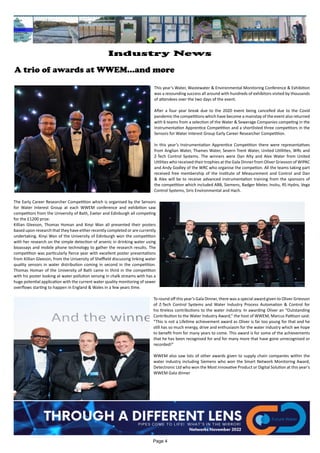
Killian Gleeson, Thomas Homan and Xinyi Wan all presented their posters
based upon research that they have either recently completed or are currently
undertaking. Xinyi Wan of the University of Edinburgh won the competition
with her research on the simple detection of arsenic in drinking water using
bioassays and mobile phone technology to gather the research results. The
competition was particularly fierce year with excellent poster presentations
from Killian Gleeson, from the University of Sheffield discussing linking water
quality sensors in water distribution coming in second in the competition.
Thomas Homan of the University of Bath came in third in the competition
with his poster looking at water pollution sensing in chalk streams with has a
huge potential application with the current water quality monitoring of sewer
overflows starting to happen in England & Wales in a few years time.
To round off this year’s Gala Dinner, there was a special award given to Oliver Grievson
of Z-Tech Control Systems and Water Industry Process Automation & Control for
his tireless contributions to the water industry. In awarding Oliver an “Outstanding
Contribution to the Water Industry Award,” the host of WWEM, Marcus Pattison said:
“This is not a Lifetime achievement award as Oliver is far too young for that and he
still has so much energy, drive and enthusiasm for the water industry which we hope
to benefit from for many years to come. This award is for some of the achievements
that he has been recognised for and for many more that have gone unrecognised or
recorded!”
WWEM also saw lots of other awards given to supply chain companies within the
water industry including Siemens who won the Smart Network Monitoring Award,
Detectronic Ltd who won the Most innovative Product or Digital Solution at this year's
WWEM Gala dinner
Page 4
Industry News
United Utilities trials UK water sector first with 3D-printed concrete
wastewater chamber
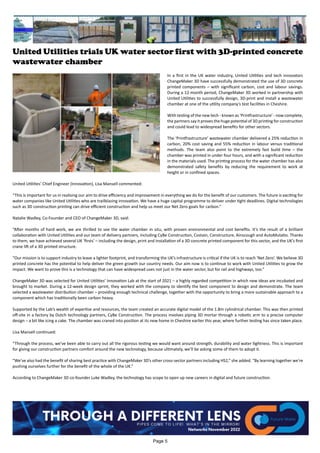
In a first in the UK water industry, United Utilities and tech innovators
ChangeMaker 3D have successfully demonstrated the use of 3D concrete
printed components – with significant carbon, cost and labour savings.
During a 12-month period, ChangeMaker 3D worked in partnership with
United Utilities to successfully design, 3D-print and install a wastewater
chamber at one of the utility company’s test facilities in Cheshire.
With testing of the new tech - known as ‘Printfrastructure’ - now complete,
the partners say it proves the huge potential of 3D printing for construction
and could lead to widespread benefits for other sectors.
The ‘Printfrastructure’ wastewater chamber delivered a 25% reduction in
carbon, 20% cost saving and 55% reduction in labour versus traditional
methods. The team also point to the extremely fast build time – the
chamber was printed in under four hours, and with a significant reduction
in the materials used. The printing process for the water chamber has also
demonstrated safety benefits by reducing the requirement to work at
height or in confined spaces.
United Utilities’ Chief Engineer (Innovation), Lisa Mansell commented:
“This is important for us in realising our aim to drive efficiency and improvement in everything we do for the benefit of our customers. The future is exciting for
water companies like United Utilities who are trailblazing innovation. We have a huge capital programme to deliver under tight deadlines. Digital technologies
such as 3D construction printing can drive efficient construction and help us meet our Net Zero goals for carbon.”
Natalie Wadley, Co-Founder and CEO of ChangeMaker 3D, said:
“After months of hard work, we are thrilled to see the water chamber in situ, with proven environmental and cost benefits. It’s the result of a brilliant
collaboration with United Utilities and our team of delivery partners, including CyBe Construction, Costain, Constructure, Ainscough and AutoMutatio. Thanks
to them, we have achieved several UK ‘firsts’ – including the design, print and installation of a 3D concrete printed component for this sector, and the UK’s first
crane lift of a 3D printed structure.
“Our mission is to support industry to leave a lighter footprint, and transforming the UK’s infrastructure is critical if the UK is to reach ‘Net Zero’. We believe 3D
printed concrete has the potential to help deliver the green growth our country needs. Our aim now is to continue to work with United Utilities to grow the
impact. We want to prove this is a technology that can have widespread uses not just in the water sector, but for rail and highways, too.”
ChangeMaker 3D was selected for United Utilities’ Innovation Lab at the start of 2021 – a highly regarded competition in which new ideas are incubated and
brought to market. During a 12-week design sprint, they worked with the company to identify the best component to design and demonstrate. The team
selected a wastewater distribution chamber – providing enough technical challenge, together with the opportunity to bring a more sustainable approach to a
component which has traditionally been carbon heavy.
Supported by the Lab’s wealth of expertise and resources, the team created an accurate digital model of the 1.8m cylindrical chamber. This was then printed
off-site in a factory by Dutch technology partners, CyBe Construction. The process involves piping 3D mortar through a robotic arm to a precise computer
design – a bit like icing a cake. The chamber was craned into position at its new home in Cheshire earlier this year, where further testing has since taken place.
Lisa Mansell continued:
“Through the process, we’ve been able to carry out all the rigorous testing we would want around strength, durability and water tightness. This is important
for giving our construction partners comfort around the new technology, because ultimately, we’ll be asking some of them to adopt it.
“We’ve also had the benefit of sharing best practice with ChangeMaker 3D’s other cross-sector partners including HS2,” she added. “By learning together we’re
pushing ourselves further for the benefit of the whole of the UK.”
According to ChangeMaker 3D co-founder Luke Wadley, the technology has scope to open up new careers in digital and future construction.
Page 5
Siemens Demonstrates The Next Generation Of Digital Technologies
At The Water Tower
Detectronic Scoops Most Innovative Instrumentation Product Or
Digital Solution At WWEM Awards 2022
Wastewater monitoring specialists, Detectronic, are celebrating after the company won
the title of Most Innovative Instrumentation Product or Digital Solution for its LIDoTT
Smart System at the UK’s WWEM Awards 2022.
Responding to the UK water utilities growing need for a range of low-cost sewer and
wastewater monitoring sensors, the company commenced an ambitious research and
development project to design, build and manufacture a range of highly affordable
sewer network level monitoring products for widespread deployment across entire
networks.
Four years in development, Detectronic worked closely with wastewater network
management teams across the sector to understand their pain points. In 2021, the
LIDoTT Smart System was launched and now provides global water companies with
everything needed to deliver a truly smart sewer network solution.
Commenting on the award win, Detectronic’s managing director, Neil Butler, said: “Just
months after its debut, the LIDoTT Smart System became our fastest selling monitoring system; we are all really proud of that. In January, the LIDoTT technology
was granted patent number GB2591274, which covers open channel fluid level monitoring apparatus comprising two level sensors with overlapping monitoring
ranges. And the developments continue with the soon to be released LIDoTT Alarm; watch this space.
“Water companies across the globe continue to place orders for thousands of LIDoTT Smart Systems. Thanks to its unrivalled accuracy and incredibly high-quality
data, it has truly transformed the industry’s approach to smart network monitoring. Plus, it’s made it affordable.”
Concludes Neil: “We’re delighted that the LIDoTT Smart System has been formally recognised amongst its peers with this prestigious WWEM award. We look
forward to working alongside even more water companies to implement the product and watch it provide complete, real time network visibility and forecasting
which will result in zero spills and pollutions.”
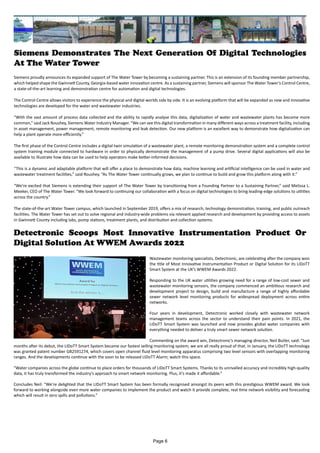
Siemens proudly announces its expanded support of The Water Tower by becoming a sustaining partner. This is an extension of its founding member partnership,
which helped shape the Gwinnett County, Georgia-based water innovation centre. As a sustaining partner, Siemens will sponsor The Water Tower’s Control Centre,
a state-of-the-art learning and demonstration centre for automation and digital technologies.
The Control Centre allows visitors to experience the physical and digital worlds side by side. It is an evolving platform that will be expanded as new and innovative
technologies are developed for the water and wastewater industries.
“With the vast amount of process data collected and the ability to rapidly analyse this data, digitalization of water and wastewater plants has become more
common,” said Jack Roushey, Siemens Water Industry Manager. “We can see this digital transformation in many different ways across a treatment facility, including
in asset management, power management, remote monitoring and leak detection. Our new platform is an excellent way to demonstrate how digitalization can
help a plant operate more efficiently.”
The first phase of the Control Centre includes a digital twin simulation of a wastewater plant, a remote monitoring demonstration system and a complete control
system training module connected to hardware in order to physically demonstrate the management of a pump drive. Several digital applications will also be
available to illustrate how data can be used to help operators make better-informed decisions.
“This is a dynamic and adaptable platform that will offer a place to demonstrate how data, machine learning and artificial intelligence can be used in water and
wastewater treatment facilities,” said Roushey. “As The Water Tower continually grows, we plan to continue to build and grow this platform along with it.”
“We’re excited that Siemens is extending their support of The Water Tower by transitioning from a Founding Partner to a Sustaining Partner,” said Melissa L.
Meeker, CEO of The Water Tower. “We look forward to continuing our collaboration with a focus on digital technologies to bring leading-edge solutions to utilities
across the country.”
The state-of-the-art Water Tower campus, which launched in September 2019, offers a mix of research, technology demonstration, training, and public outreach
facilities. The Water Tower has set out to solve regional and industry-wide problems via relevant applied research and development by providing access to assets
in Gwinnett County including labs, pump stations, treatment plants, and distribution and collection systems.
Page 6
Giving Digital Twins The IMPETUS To Become Regional
• Region-wide digital twins could help utilities, industries and government co-create future policies, says leading professor
• Four-year H2020 project, IMPETUS, works on designing climate adaptation pathways
• Political, financial and cyber security challenges remain.
The phrase "Digital Twins" has become more common in the water industry to describe creating virtual replicas of physical assets, such as water treatment
plants or water networks.
However,anotherpotentialliesin"digitaltwinning"anentireregion,initiallyconnecting‘hard’groundsensorsand‘soft’satellitesensorstoregionalenvironmental
and infrastructure models. This could help eventually connect multiple utility digital twin models to help with long-term water decision-making.
That's according to Christos Makropoulos, a professor at the National Technical University of Athens and a principal scientist at KWR, involved in the Horizon
2020-funded project IMPETUS.
The project’s goal is to turn high level climate commitments into tangible actions to protect local communities.
Tangible, urgent actions
A four-year project as part of the EU Water topic "Climate-resilient Innovation Packages for EU regions", IMPETUS brings together a multi-disciplinary consortium
of 32 partners.
"Thesolutionswedevelopaspiretohelpregionsdevelopadaptationpathways–andregionaldigitaltwinsareanimportantpieceofthispuzzle"saidMakropoulos.
"Rather than ‘twining’ a particular treatment plant or water solution network, this is about a digital representation at a regional scale."
In the context of water, digital twins are an "actively integrated, accurate digital representation of our physical assets, systems, and processes with a constant
stream of data linking them to the physical counterparts for continuous model update and calibration – and vice versa".
Taking a broader view, Makropoulos believes that a digital twin of a region could eventually be used as evidence-base for discussions between stakeholders.
"Imagine a region as a puzzle board, with the environmental situation updated in real-time. Relevant information can be added so that the stakeholders can
access a shared picture of what is currently happening and how things may evolve." he added.
One of the aims of IMPETUS is to help turn climate commitments into tangible, urgent actions to protect communities. This includes helping accelerate Europe's
climate adaptation strategy and meet ambitions to become the world's first climate-neutral continent by 2050.
The professor believes that we are witnessing the convergence of software ‘worlds’: BIM (building information modelling), GIS (geographic information systems)
and environmental and infrastructure modelling (e.g. simulations of water distribution systems)
"The term digital twin has caught up faster than the technology has matured. But it promoted an increased realisation that more system integration is needed
to see real value. Although we don't have full blown (off the shelf) digital twin technologies, we are taking steps toward this integration. The idea of digital twins
provides a point in the horizon to help with our integration course," he added.
Despite the ambitions, legislative and commercial challenges remain, as well as cyber security issues.
Makropoulos participated in a previous, related H2020 EU project called STOP-IT (Strategic, Tactical, Operational Protection of water Infrastructure against cyber-
physical Threats), which addressed water infrastructure as cyber-physical infrastructure. A tool-kit was developed that allowed utilities to explore interactions
between the cyber and physical systems from a security perspective.
"The more we create digital twins, the more relevant cyber, physical and whole system approaches to security becomes – it's important to go in with our eyes
open," the professor concludes.
KWR Water Research Institute generates knowledge to enable the water sector to operate water-wisely in our urbanised society. At KWR, we have a sense of
professional and social responsibility for the quality of water. Our scientific findings and the resulting practical innovations contribute worldwide to sustainable
water provision in the urban water cycle. KWR has a staff of about 170 and is owned by the shareholders' organisation KWH Water BV.
Page 7
Dreaming The Possible – Data And The Future Of Water
AstheUKmovestowardsthenextregulatoryassetmanagementperiod–AMP8-startingin2025,thesectorfaceshigherexpectationsthaneverforenvironmental
protection and provision of safe and consistent services. This comes against the backdrop of an intensifying climate emergency and increasing water scarcity.
Data and analytics have a vital role in response to these challenges - helping to transform water and wastewater operations and services, and stimulate
innovation across utilities and the supplier community.
It is a growing market - according to Bluefield Research’s global digital water forecast 2022-2030, emerging and developing markets will account for roughly 30%
of the US$387.5B in total global digital water spend expected over the next decade. In addition, digital water expenditure in emerging markets is projected to
scale at an annual rate of 11.4%, compared to 7.7% for advanced economies.
Mark Enzer, strategic advisor at consultancy Mott MacDonald and former head of the National Digital Twin Programme at the Centre for Digital Built Britain says
that with interest in data-driven solutions at an all-time high, technologies for digital twinning, intelligent asset management, geographical information systems
(GIS) and artificial intelligence (AI) are helping companies gain insight, make informed decisions and improve services at an unprecedented rate. Enzer is the
keynote speaker at British Water’s upcoming data conference in London on 3 November 2022, which looks at how boosting collaboration on data and analytics
can help the sector to meet AMP8 challenges.
“The water sector is focussed on achieving the urgent environmental, social and economic outcomes needed to make us fit for purpose in AMP8 and further into
the future,” says Enzer. “Technology, data and analytics will play a leading role in getting us there. However, it’s very rare that an individual technology can be a
silver bullet and tackle all the water sector’s problems. They key is companies taking a number of different technologies and joining them up with a purpose to
achieve better outcomes.”
Presently data is often split across multiple platforms using SCADA software, which remotely controls and monitors the condition of field-based assets from a
central location; GIS mapping, remote sensors and computerised maintenance management system. By bringing together these datasets, they can be fed into
a digital twin model. Companies must invest the time and money to build robust data management processes and governance models so data can be captured
correctly and consistently across the entire organisation.
“The water sector has traditionally been an outlier in that the adoption of digital technologies and digital transformation has moved at a slower pace due to the
risk-averse nature,” agrees Gigi Karmous Edwards, who is speaking at the conference on digital twins and next steps for the water sector.
Karmous Edwards is an independent consultant and founder and co-chair of the Digital Twin for H2O Work Group at SWAN – the Smart Water Networks Forum.
She works with utilities and technology companies around the world on digital transformation and in particular digital twins.
“However, the pace of change is now increasing, and we are seeing greater interest and uptake as the sector understands we need a holistic view of what's
happening remotely in the system,” she added.
The industry is facing unprecedented scrutiny from governments and customers and must use this as an opportunity to drive innovation, said Karmous Edwards.
New technologies have the capability to deliver multiple benefits, not only for utilities and suppliers but also for the environment and wider society. Data
and analytics are becoming a more fundamental part of how water companies drive outcomes for customers and the environment. According to Fionn Boyle,
strategic innovation lead at Anglian Water, the industry has matured a lot through the last couple of AMPs and is embracing a digital, data driven mindset in
readiness for AMP8.Anglian is the largest water and wastewater company in England and Wales geographically, supplying over four million people with drinking
water and treating wastewater from over six million customers.
“Data unlocks the opportunity to change the way that we operate as an industry. It has been challenging for the sector to embrace digital technologies but
our capabilities are maturing quickly,” explained Boyle. “We’re incumbent organisations with legacy assets. Companies who start up as digital companies have
a blank slate and can be setup as ‘digital first’ from the onset, but water companies have to integrate those digital capabilities within those legacy assets. At
Anglian we’ve invested in a number of enabling capabilities including systems and platforms that take care of data management and data governance as well as
creating processes and ways of working to ensure we can manage this data effectively through the organisation. As a result of well-placed and well thought out
investments we are now in a place to fully maximize the potential of digital and become a truly digital first organisation."
“As water companies invest in digital tools like artificial intelligence and remote sensors, and harness the ways that data then flows through the organisation, all
this information can fused together and can help us make informed decisions to ensure the best possible outcomes for customers and the environment.”
Sharing data across organisations and the supply chain will be critical in the future. While it is recognised that it can still be challenging to get standardised data
within an organisation – let alone across multiple businesses – there is increasing consensus that the sector must come together to agree common standards
for defining and modelling key datapoints that can be shared across information systems.
“How our industry shares and drives value from data has never been of greater focus and we must come together as a water community to ensure that the
insights we provide and the decisions we make are based on sound, actionable insights," said Mark Kaney, managing director of utility service provider Ipsum,
which is sponsoring the event.
The conference will host speakers from across the global water community. Talks and Q&As will explore topics including - how emerging technologies are
meeting water industry demands, and industry data frameworks, and explore how data can help. “With utilities ready to harness the benefits of digital water
solutions - collaboration and knowledge sharing will be key to its success moving forward,” said Mar Batista, head of programmes at British Water.
“This year’s event will continue the discussion on ways to realise digital transformation for the water industry. It will provide an excellent forum for discussion
around how collaboration can boost the use of data and analytics to drive efficiency and sustainability.”
For more information, visit https://www.britishwater.co.uk/events/eventdetails.aspx?id=1646904.
Page 8
Pulsar Measurement launch ReflectTM
two wire radar sensor
Pulsar Measurement is pleased to announce the launch of our BRAND NEW REFLECT™ two-wire radar sensors!
A first in the Pulsar Measurement product portfolio, these sensors have been designed to provide the highest
confidence in level measurement in the most challenging conditions. Providing accurate monitoring of liquids and
solids in critical measurement applications, ensuring complete peace of mind with a product that requires minimal
skills and human intervention.
This brand new innovative low-power radar level measurement sensor automatically optimizes performance
from installation through to decommissioning, using Pulsar Measurement’s patented REFLECTTILT™ functionality.
REFLECTTILT™ ensures optimal measurement by using the built-in LEDs to signal when the sensor is level and giving
the greatest signal strength. These lights are also used to give an early indication of a change in measurement
integrity, providing confidence in the accuracy of your data.
Reflect level sensors have been designed to be an ally to the long-standing ultrasonic measurement that Pulsar
Measurement is renowned for worldwide. There is a place for both radar and ultrasonic sensors and at Pulsar
Measurement, you now get the choice of both – coupled with our award-winning technical knowledge and
customer service.
Pressure is on for hydrostatic pipeline testing
In August 2022, a 30-year-old woman was taken to hospital with serious leg injuries after an explosion damaged a road in the village of Cropston, north of
Leicester. Two employees of a water industry contractor also sustained injuries. While Health & Safety Executive enquiries and a full investigation are on-going,
initial reports indicate that a pressure test was being undertaken on a pipeline when an uncontrolled burst occurred. Hydrostatic pressure testing is a highly
specialised process and is required to test joints and connections where new pipelines are installed. The test is carried out by applying pressures to the pipeline,
using water as the test medium, to assess the quality of the installation and ensure a leak-free system.
It is imperative that water companies and their contractors are all working to best practice standards and guidelines to ensure air is totally or virtually eliminated
from the pipeline during testing. By applying the relevant standards and guidelines rigorously, risk is mitigated and can be eliminated. The potential energy
contained in compressed air is substantially greater than water. Should a pipe fail with air entrapped, the impact is substantial due to the rapid release of this
stored energy.
As seen at Cropston, such failure poses an extreme health and safety risk and can cause extensive and costly infrastructure damage above the surface. The key
standard and information and guidance note (IGN) for hydrostatic pipeline testing are:
• British Standard - EN 805:2000 Water supply - requirements for systems and components outside buildings
• Water UK - IGN 4-01-03 Issue 2 Guide to pressure testing of pressure pipes and fittings for use by public water suppliers
Avoiding a repeat of the tragic incident at Cropston will require a tightening up of practice across the sector, and water companies and main contractors need
to review the capabilities of their pressure testing service providers. Some of the questions that should be asked include:
Is pressure testing being undertaken in line with the prevailing standards?
Prior to a test, are there tools available that can estimate ramp-up times compared with air content, to ensure a test can be abandoned before any safety
breaches occur?
• Whose equipment is being used, and how is it maintained?
• What data is being collected and is the technology being used capable of measuring air content?
• Will pressure test data be analysed in real-time to ensure potentially dangerous or ineffectual tests are abandoned?
• Can data records and certificates be accessed at any time, and does the platform display all the critical data?
Digital technologies, like Ant-Hire’s Pipeline Installation Performance Evaluation tool - PIPE - are continually being enhanced, which allows for granular test data
to be captured on multiple parameters accessible by the client. These include water leakage, trapped air, pressure and temperature. Going further, the record of
individual contractors, and even operatives, can also be analysed, identifying potential needs for targeted training and skills enhancement to ensure safety and
improve the productivity of individuals and teams. Contractors following procedures correctly are more likely to get pressure testing right, building resilience
in the network from the outset.
Further, if a pipe is prepared properly in readiness for a test, with all air extracted, hours can be shaved off a pressure test, compared with a test where air is
present. Other benefits accrue for those companies operating at the highest standard, including extended pipeline lifespan, reduced water loss due to leakage,
and the lower carbon footprint around those two indicators. Greater resilience in the network can be achieved by engaging the pressure testing contractor at
the earliest possible stage of the design process for new pipelines, helping avoid pitfalls and keeping project costs down.
In the wake of the Leicestershire incident, Ant-Hire is already seeing an up-tick in downloads of its Experts Guide to Pressure Pipeline Testing. This 12-page
document includes a planning checklist, equipment guide, air content management guide, assessment criteria for data-logger capability and risk management
checklist. This shows that there is already an appetite for getting the process right. Now water companies and contractors need to ensure their operatives and
managers are resourced to do the job at the highest possible standard.
This can be achieved by giving them access to training to continually build skills, and by ensuring that the time is available to carry out best practice working. It
also means identifying those service providers with a proven track record of operating to the highest possible standards.
Page 9
The GoAigua smart irrigation solution wins "Green Award" for its
work in sustainability
Idrica Qatar (Aguas de Valencia WLL) was awarded first prize in the Green Awards’ Green Design category, thanks to the smart irrigation pilot program in which
the GoAigua Smart Green solution was implemented in two parks in the city of Al Khor. Ashghal thus acknowledged the hard work carried out by the company in
a project regarded as a Sustainable Development initiative, in line with the Qatar National Vision 2030, as well as with environmental and sustainability policies.
Enrique J. Fernandez, General Manager of Idrica Qatar, was delighted to receive the award, saying "this is a fantastic way to recognize the many years of hard
work we have put in to becoming more efficient, and is an incentive for us to continue to lead the way in smart and sustainable solutions, based on the global
vision of O&M experts in the water cycle".
The award-winning project revolves around an autonomous smart irrigation system that optimizes the use of treated water and energy consumption thanks to
the use of advanced algorithms and machine learning. The system focuses on increasing environmental sustainability, reducing operating costs and the use of
fossil fuels, doing away with the digital divide and promoting sustainable urban development.
The project, known as TSE Connection Customer – Intelligent Irrigation, focused on the deployment of a smart irrigation platform in the Al Tawasul and MME
Private Garden parks in Al Khor, designed to reduce the volume of water used in these landscaped areas. The platform provides a comprehensive monitoring and
smart management hub for irrigation infrastructures which integrates all the relevant data to create the best irrigation schedule, automate it and implement a
decision support system.
In the opinion of Severino Ramos, VP Middle East, "the project brings substantial environmental benefits, cost savings, innovation and technology, which are
precisely the cornerstones the project is based on i.e., economy, technology and society".
Water savings in the parks where the award-winning solution has been implemented range from 21% to 27%, depending on the type of irrigation. In turn, the
irrigation network's hydraulic efficiency has been improved by 10%, whilst the motors’ energy consumption has dropped by between 20% and 70%, thanks to
the use of less water and the installation of pumping systems equipped with frequency converters.
The Green Awards aim precisely to promote and appraise contractors' environmental and sustainability management at working construction sites. As such,
the awards have five categories - Green Design, Green Project, Waste Management Excellence, Building Material Recycling Excellence, and Energy Efficiency
Excellence (Carbon Footprint Reduction). This edition was held on October 3 in Doha, Qatar.
The Green Awards were launched in 2018 by Ashghal's Quality and Safety Department (QSD) and Road Projects Department (RPD), and are a unique initiative
designed to raise awareness of sustainable practices in construction and help eradicate or reduce their impact.
This year, a total of 43 companies participated in the event, a number that marks a new record every year given the importance that these awards are gaining
on the international stage.
Page 10
An ultrafine network for rivers
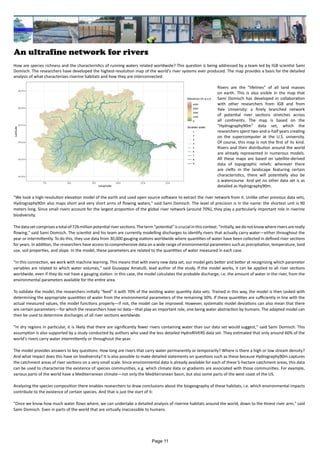
How are species richness and the characteristics of running waters related worldwide? This question is being addressed by a team led by IGB scientist Sami
Domisch. The researchers have developed the highest-resolution map of the world's river systems ever produced. The map provides a basis for the detailed
analysis of what characterizes riverine habitats and how they are interconnected.
Rivers are the "lifelines" of all land masses
on earth. This is also visible in the map that
Sami Domisch has developed in collaboration
with other researchers from IGB and from
Yale University: a finely branched network
of potential river sections stretches across
all continents. The map is based on the
"Hydrography90m" data set, which the
researchers spent two-and-a-half years creating
on the supercomputer at the U.S. university.
Of course, this map is not the first of its kind.
Rivers and their distribution around the world
are already represented in numerous models.
All these maps are based on satellite-derived
data of topographic reliefs: wherever there
are clefts in the landscape featuring certain
characteristics, there will potentially also be
a watercourse. And yet no other data set is as
detailed as Hydrography90m.
"We took a high-resolution elevation model of the earth and used open source software to extract the river network from it. Unlike other previous data sets,
Hydrography90m also maps short and very short arms of flowing waters," said Sami Domisch. The level of precision is in the name: the shortest unit is 90
meters long. Since small rivers account for the largest proportion of the global river network (around 70%), they play a particularly important role in riverine
biodiversity.
Thedatasetcomprisesatotalof726million potentialriversections.Theterm"potential"iscrucialinthiscontext:"Initially,wedonotknowwhereriversarereally
flowing," said Sami Domisch. The scientist and his team are currently modelling discharges to identify rivers that actually carry water—either throughout the
year or intermittently. To do this, they use data from 30,000 gauging stations worldwide where quantities of water have been collected in defined river sections
for years. In addition, the researchers have access to comprehensive data on a wide range of environmental parameters such as precipitation, temperature, land
use, soil properties, and slope. In the model, these parameters are related to the quantities of water measured in each case.
"In this connection, we work with machine learning. This means that with every new data set, our model gets better and better at recognizing which parameter
variables are related to which water volumes," said Giuseppe Amatulli, lead author of the study. If the model works, it can be applied to all river sections
worldwide, even if they do not have a gauging station: in this case, the model calculates the probable discharge, i.e. the amount of water in the river, from the
environmental parameters available for the entire area.
To validate the model, the researchers initially "feed" it with 70% of the existing water quantity data sets. Trained in this way, the model is then tasked with
determining the appropriate quantities of water from the environmental parameters of the remaining 30%. If these quantities are sufficiently in line with the
actual measured values, the model functions properly—if not, the model can be improved. However, systematic model deviations can also mean that there
are certain parameters—for which the researchers have no data—that play an important role, one being water abstraction by humans. The adapted model can
then be used to determine discharges of all river sections worldwide.
"In dry regions in particular, it is likely that there are significantly fewer rivers containing water than our data set would suggest," said Sami Domisch. This
assumption is also supported by a study conducted by authors who used the less detailed HydroRIVERS data set. They estimated that only around 60% of the
world's rivers carry water intermittently or throughout the year.
The model provides answers to key questions: How long are rivers that carry water permanently or temporarily? Where is there a high or low stream density?
And what impact does this have on biodiversity? It is also possible to make detailed statements on questions such as these because Hydrography90m captures
the catchment areas of river sections on a very small scale. Since environmental data is already available for each of these 5-hectare catchment areas, this data
can be used to characterize the existence of species communities, e.g. which climate data or gradients are associated with those communities. For example,
various parts of the world have a Mediterranean climate—not only the Mediterranean basin, but also some parts of the west coast of the US.
Analyzing the species composition there enables researchers to draw conclusions about the biogeography of these habitats, i.e. which environmental impacts
contribute to the existence of certain species. And that is just the start of it:
"Once we know how much water flows where, we can undertake a detailed analysis of riverine habitats around the world, down to the tiniest river arm," said
Sami Domisch. Even in parts of the world that are virtually inaccessible to humans.
Page 11
Article:
A look at CSOs, screens and
stormwater discharge incidents
In the context of ongoing criticism from regulators, NGOs, Parliamentary Committees and the public of the water companies’ unsatisfactory environmental
performance, HUBER Technology talks about the key role sewage screens play in mitigating the impacts of unauthorised sewage discharges into rivers, lakes and
the sea.
With ongoing public and regulatory pressure on the water companies, Adrian Heneghan from HUBER Technology looks at practical measures which can help the
water companies take improve their operational performance.
Adrian Heneghan: Recent months have seen the publication of Ofwat’s draft methodology for the upcoming Price Review in 2024, and yet more criticism from
regulators, NGOs, Parliamentary Committees and the public of the water companies’ unsatisfactory environmental performance.
In addition, the companies are also currently subject to two ongoing separate investigations by Ofwat and the Environment Agency on how Combined Sewer
Overflows (CSOs) are being used across their networks.
The sole purpose of CSOs is to discharge untreated human sewage and waste-water when the sewerage system is overloaded – currently there are approximately
21,462 CSOs and pumping stations in the UK (excluding Scotland) (Environment Agency, 2020).
The Government is now getting tougher, saying its Storm Overflows Discharge Reduction Plan Consultation “will revolutionise how water companies will tackle
the number of discharges of untreated sewage, which the Government and the public have made clear are completely unacceptable.”
Under the plan, the water companies will face strict limits on when they can use CSOs and must completely eliminate the harm any sewage discharge causes to
the environment. Proposals in the plan include:
• By 2035 - the environmental impacts of 75% of overflows affecting our most important protected sites will have been eliminated and there
will be 70% fewer discharges into bathing waters;
• By 2040 - on average approximately 160,000 discharges will have been eliminated;
• By 2050 - on average approximately 320,000 discharges will have been eliminated.
The water companies are now facing significant increases in both the levels of investment and practical measures they will need to put in place to tackle the
issues which are leading to ever –greater fines, ODI penalties and reputational damage. The Environment Agency is piling on the pressure with a call for prison
sentences for company directors in the worst cases and to be struck off.
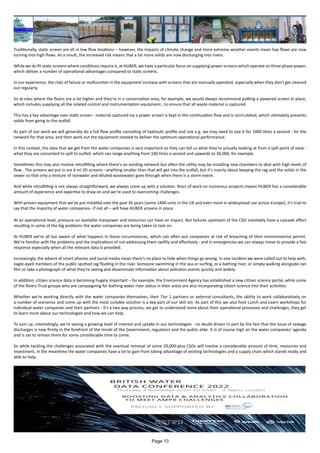
These are major challenges for water companies which they need to
address as a matter of urgency but the reality is they won't be able to do
it all immediately.
As the saying goes, Rome wasn’t built in a day, so what can they do
in meantime to strengthen the resilience of their existing systems
and reduce the risk of the operational failures which lead to pollution
incidents?
From a supplier point of view, the key area which immediately springs to
mind is ensuring that equipment and infrastructure at all points of the
wastewater treatment process are monitored and maintained regularly.
Looking at a range of pollution incidents during the last decade, initial
equipment failure at a single point in the process which has the potential
to cascade and amplify the impacts further downstream has all too
frequently been a significant contributory factor.
Screens play a key role in this process, an area where HUBER has developed expertise and industry-leading technologies over years of working with many of the
water companies.
Based on our experience, maintaining existing equipment and technologies in place is fundamental to ensure it is in proper working order and stays that way.
Simply put, when the risks are ODI penalties, reputational damage, prosecution by the Environment Agency and eye-watering fines, when it comes to asset
health, prevention is always better than cure.
The risks are only too real – recent months have seen some significant fines levied on water companies. And this situation is likely to get tougher – the EA has
recently called for even bigger fines, prison sentences and company directors being struck off.
Different sites have different requirements – for example, some sites only have static screens with a grill which periodically have to be cleaned manually – these
have generally been put in place to prevent waste matter getting to the outfalls which feed into the sea and rivers.
Page 12
Traditionally, static screen are all in low flow locations – however, the impacts of climate change and more extreme weather events mean low flows are now
turning into high flows. As a result, the increased risk means that a lot more solids are now discharging into rivers.
While we do fit static screens where conditions require it, at HUBER, we have a particular focus on supplying power screens which operate on three phase power,
which deliver a number of operational advantages compared to static screens.
In our experience, the risks of failure or malfunction in the equipment increase with screens that are manually operated, especially when they don't get cleaned
out regularly.
So at sites where the floors are a lot higher and they're in a conservation area, for example, we would always recommend putting a powered screen in place,
which includes supplying all the related control and instrumentation equipment , to ensure that all waste material is captured.
This has a key advantage over static screen - material captured via a power screen is kept in the continuation flow and is recirculated, which ultimately prevents
solids from going to the outfall.
As part of our work we will generally do a full flow profile consisting of hydraulic profile and size e.g. we may need to size it for 1000 litres a second - for the
network for that area, and then work out the equipment needed to deliver the optimum operational performance.
In this context, the data that we get from the water companies is very important so they can tell us what they're actually looking at from a spill point of view -
what they are consented to spill to outfall, which can range anything from 100 litres a second and upwards to 30,000, for example.
Sometimes this may also involve retrofitting where there's an existing network but often the utility may be installing new chambers to deal with high levels of
flow . The screens we put in are 6 ml 2D screens - anything smaller than that will get into the outfall, but it's mainly about keeping the rag and the solids in the
sewer so that only a mixture of rainwater and diluted wastewater goes through when there is a storm event.
And while retrofitting is not always straightforward, we always come up with a solution. Years of work on numerous projects means HUBER has a considerable
amount of experience and expertise to draw on and we’re used to overcoming challenges.
With proven equipment that we’ve put installed over the past 30 years (some 1400 units in the UK and even more in widespread use across Europe), it’s true to
say that the majority of water companies– if not all – will have HUBER screens in place.
At an operational level, pressure on available manpower and resources can have an impact. But failures upstream of the CSO inevitably have a cascade effect
resulting in some of the big problems the water companies are being taken to task on.
At HUBER we’re all too aware of what happens in those circumstances, which can often put companies at risk of breaching of their environmental permit.
We’re familiar with the problems and the implications of not addressing them swiftly and effectively - and in emergencies we can always move to provide a fast
response especially when all the relevant data is provided.
Increasingly, the advent of smart phones and social media mean there’s no place to hide when things go wrong. In one incident we were called out to help with,
eagle-eyed members of the public spotted rag floating in the river. Someone swimming in the sea or surfing, or a bathing river, or simply walking alongside can
film or take a photograph of what they're seeing and disseminate information about pollution events quickly and widely.
In addition, citizen science data is becoming hugely important – for example, the Environment Agency has established a new citizen science portal, while some
of the Rivers Trust groups who are campaigning for bathing water river status in their areas are also incorporating citizen science into their activities.
Whether we’re working directly with the water companies themselves, their Tier 1 partners or external consultants, the ability to work collaboratively on
a number of scenarios and come up with the most suitable solution is a key part of our skill set. As part of this we also host Lunch and Learn workshops for
individual water companies and their partners - it's a two way process, we get to understand more about their operational processes and challenges, they get
to learn more about our technologies and how we can help.
To sum up, interestingly, we're seeing a growing level of interest and uptake in our technologies - no doubt driven in part by the fact that the issue of sewage
discharges is now firmly in the forefront of the minds of the Government, regulators and the public alike. It is of course high on the water companies’ agenda
and is set to remain there for some considerable time to come.
So while tackling the challenges associated with the eventual removal of some 20,000-plus CSOs will involve a considerable amount of time, resources and
investment, in the meantime the water companies have a lot to gain from taking advantage of existing technologies and a supply chain which stands ready and
able to help.
Page 13
Article:
Delivering Digital Water -
Are we there yet?
Digital Water, Water 4.0, Smart Water – whatever you want to call it has been a concept that has been around for many years. I was challenged at a conference
over around 6-7 years ago when I started talking about smart wastewater networks. The person in the audience heckled – “but we’ve talking about smart
wastewater networks for 10 years now and we still haven’t delivered many.
This is of course the truth about the concept of Digital Water, it is something that we’ve struggled to grasp the concept, we have struggled to grasp the tangibility,
and this is because the benefits of Digital Water are not very well known and the opinion of most is that “Digital Water” is a buzz word for the latest technology.
In some regards people are right in saying that and there are a lot of water companies out there who will pick up the latest fad in technological innovations and
run with it for a few years and when they get bored of it or an even newer technology comes along then that will get adopted instead. The attraction of pretty,
shiny things that look good but only deliver some of what they have promised.
At the moment within the water industry and for a few years now I hear “Artificial Intelligence” being hailed as the thing of the future and people saying – “We
can use AI to solve this problem or that problem,” without much of a clue as to what AI can actually do. This is half of the problem with Digital Water insofar
as that most people do not realise that Digital Water is a collection of tools to use to get the best out of a data set in order to glean insight into what is actually
happening within a real-world scenario.
So, what is Digital Water?
If you have a room with a hundred people in it then you will probably get a hundred different answers. In this article you will get mine. To me, Digital Water
is using the data that all water companies collect in its many forms and utilise it to gain insight and situational awareness of how a system is performing. This
system can be a wastewater collection network or entire wastewater treatment system or it can be the entire anthropogenic water cycle (although the scale
of this is somewhat daunting).
The Water Industry has always suffered from the DRIP phenomenon (Data Rich Information Poor) and it is true. It can be argued that there is data poverty too
depending on the data quality and how a company looks after its data sources (mainly its instruments). What the companies usually fail to do as they simply
don’t have time is to use the data in its many forms and bring it together into insight.
An example of this is in my past I’ve conducted investigations into why a treatment works is receiving too much flow when compared to the number of people
that it is thought to serve. In these investigations you tend to look at your data source and see if they are right and usually find that one of them is wrong or
out of date. The conclusion of the investigation usually results in either an instrument error through it not being set up correctly or the amount of people has
steadily increased without anyone knowing or some sort of infiltration into the network. By looking at the flow data alone and understanding the system you
can understand what is happening and whether its down to a cracked pipe, a faulty instrument or a lack of communication with planning authorities. All of these
investigations were manual tasks and to actually resolve the situation cost a lot of money but what if that could be all be done automatically…wouldn’t this be
a value case of actually using the data that is already collected.
So, what are the steps to achieving Digital Water?
I’ve heard in the past that it doesn’t matter where you start with Digital Water. The important thing is that you start. This is something that I don’t agree with.
Realistically Digital Water is a mixture of policies, people and yes, technology. For me the start of any Digital Water process is understanding any informational
requirements that you may need within the business. This isn’t the standard thing of “we want everything.” The organisations who say this are somewhat
immature in their approach and aren’t ready. However, for those that have reached that level of maturity the first step in any Digital Water journey is about the
people, it is about stakeholder engagement from the CEO of the water company to the operator on the ground. It is about understanding the operational and
engineering needs of the organisation.
An example of this is the CEO of the organisation will want to relatively high-level data about how the company is performing, is it doing what it is meant to be
doing or is there going to be a knock on the door by the regulator with the potential of a big fine. The CEO also wants to know how the business is performing
financially and whether the board and shareholders are going to be content too. If we trickle this down to the manager of say a water treatment plant they are
going to want to know what asset is about to fail that is going to prevent them from producing enough water to keep the customers happy. If we trickle down
even further to the operator on the front-line of the business they are going to want to know how an individual treatment plant is performing and what is the
next priority on their list to manage or fire-fight.
This is the first step and of course the information that is given to people has to be absolutely correct and thus the source of data where that information comes
from have to be correct too. If they are a world of efficiencies are available to a water operator and to mine the data that they collect has a huge value to it.
This value is largely un-tapped.
Once the stakeholder engagement piece is done then a water operator can get more advanced and the use the Digital Tools that are available. An example of this
is the Digital Twin that is in Valencia which is arguably one of the most advanced Water Digital Twins in the world. This was built up by ensuring that the model
that it is based on was correct and the monitoring was correct too. Once it was put into practice problems were exposed due to lack of depth of data or a lack
of calibration in the model. This resulted in a fine-tuning state going back and forth between instrumentation and model to get things right for the first uses of
the Digital Twin. As more functionality was added so was the complexity. In the end real-time insight in the performance of the water distribution network is
possible as is forecasting of what is going to happen in the future if certain steps are taken. This is Digital Water.
We have of course only started the journey as an industry and there will be many practicalities to iron out but it will also take a lot of discussion and do join
me at the IWA Digital Water Summit in Bilbao (https://digitalwatersummit.org) from the 30th November – 2nd December 2022 to expand in much greater detail
that I can possibly go into here.
Page 14
Page 15
Article:
Transforming Holistic Watershed
Management Through Digital Solutions
A data-driven utility culture is forward-looking in more ways than one, leveraging the latest technology to protect water resources for years to come.
Clean Water Services (CWS) is a special service district that provides wastewater treatment, stormwater management, and watershed management, serving
nearly 600,000 customers in Washington County, Oregon. Like other utilities, CWS is facing water resource management challenges, extreme weather patterns
such as drought and flooding, stringent permit requirements, population growth, and aging infrastructure. CWS is applying technological innovation where
practical to create solutions for these pressing problems. CWS has embarked on this journey with the goal of uncovering dark data, implementing digital solutions,
and providing quantitative decision support for utility management in all aspects. However, a holistic implementation of successful digital solutions is more than
just technology. This paper demonstrates that CWS’s documented progress was achieved by integrating people, process, and technology, with special emphasis
on our people and our customers.
Cultivating a culture that supports data-driven decision-making and transparent knowledge-sharing is crucial to support the Digital Solutions of the Future initiative
at CWS. To begin this transformation, the Data Management Hub was established in 2016 to provide a collaborative space for business analysts, process engineers,
and business leaders from various departments (including Operational Technology and Engineering Technology) and the software engineers and program analysts
from the Information Technology Division to integrate. The team meets monthly to discuss and provide updates on data-related activities and learn about the
latest technologies such as artificial intelligence, virtual reality, and storyboards. Awareness of these is useful when teams explore innovative technologies. In
addition, hub members have a better understanding of what other members are working on.
The culture change has produced more efficient and holistic results. Dark data started to become uncovered and leveraged to provide more value for Clean Water
Services. For example, the initial use of sewer system monitoring is to inform sewer cleaning and sewer replacement capital projects. Through collaboration, the
use of data has been extended to our Source Control group to provide real-time flow data to track slugs of flow discharged from industries and inform wastewater
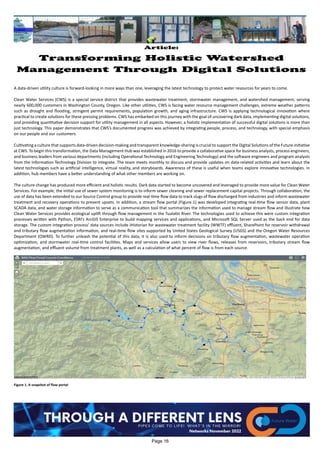
treatment and recovery operations to prevent upsets. In addition, a stream flow portal (Figure 1) was developed integrating real-time flow sensor data, plant
SCADA data, and water storage information to serve as a communication tool that summarizes the information used to manage stream flow and illustrate how
Clean Water Services provides ecological uplift through flow management in the Tualatin River. The technologies used to achieve this were custom integration
processes written with Python, ESRI’s ArcGIS Enterprise to build mapping services and applications, and Microsoft SQL Server used as the back end for data
storage. The custom integration process’ data sources include iHistorian for wastewater treatment facility (WWTF) effluent, SharePoint for reservoir withdrawal
and tributary flow augmentation information, and real-time flow sites supported by United States Geological Survey (USGS) and the Oregon Water Resources
Department (OWRD). To further unleash the potential of this data, it is also used to inform decisions on tributary flow augmentation, wastewater operation
optimization, and stormwater real-time control facilities. Maps and services allow users to view river flows, releases from reservoirs, tributary stream flow
augmentation, and effluent volume from treatment plants, as well as a calculation of what percent of flow is from each source.
Figure 1. A snapshot of flow portal
Page 16
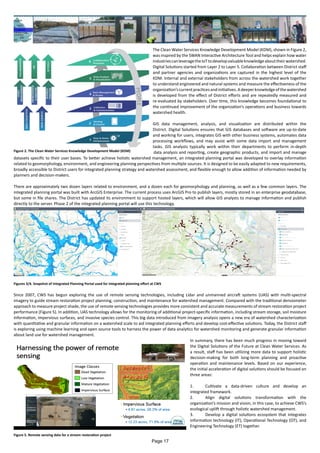
The Clean Water Services Knowledge Development Model (KDM), shown in Figure 2,
was inspired by the SWAN Interactive Architecture Tool and helps explain how water
industriescanleveragetheIoTtodevelopvaluableknowledgeabouttheirwatershed.
Digital Solutions started from Layer 2 to Layer 5. Collaboration between District staff
and partner agencies and organizations are captured in the highest level of the
KDM. Internal and external stakeholders from across the watershed work together
to understand engineered and natural systems and measure the effectiveness of the
organization’scurrentpracticesandinitiatives.Adeeperknowledgeofthewatershed
is developed from the effect of District efforts and are repeatedly measured and
re-evaluated by stakeholders. Over time, this knowledge becomes foundational to
the continued improvement of the organization’s operations and business towards
watershed health.
GIS data management, analysis, and visualization are distributed within the
District. Digital Solutions ensures that GIS databases and software are up-to-date
and working for users, integrates GIS with other business systems, automates data
processing workflows, and may assist with some data import and management
tasks. GIS analysts typically work within their departments to perform in-depth
data analysis and reporting, create geographic products, and import and manage
datasets specific to their user bases. To better achieve holistic watershed management, an integrated planning portal was developed to overlay information
related to geomorphology, environment, and engineering planning perspectives from multiple sources. It is designed to be easily adapted to new requirements,
broadly accessible to District users for integrated planning strategy and watershed assessment, and flexible enough to allow addition of information needed by
planners and decision-makers.
There are approximately two dozen layers related to environment, and a dozen each for geomorphology and planning, as well as a few common layers. The
integrated planning portal was built with ArcGIS Enterprise. The current process uses ArcGIS Pro to publish layers, mostly stored in an enterprise geodatabase,
but some in file shares. The District has updated its environment to support hosted layers, which will allow GIS analysts to manage information and publish
directly to the server. Phase 2 of the integrated planning portal will use this technology.
Figures 3/4. Snapshot of Integrated Planning Portal used for integrated planning effort at CWS
Since 2007, CWS has begun exploring the use of remote sensing technologies, including Lidar and unmanned aircraft systems (UAS) with multi-spectral
imagery to guide stream restoration project planning, construction, and maintenance for watershed management. Compared with the traditional densiometer
approach to measure project shade, the use of remote sensing technologies provides more consistent and accurate measurements of stream restoration project
performance (Figure 5). In addition, UAS technology allows for the monitoring of additional project-specific information, including stream storage, soil moisture
information, impervious surfaces, and invasive species control. This big data introduced from imagery analysis opens a new era of watershed characterization
with quantitative and granular information on a watershed scale to aid integrated planning efforts and develop cost-effective solutions. Today, the District staff
is exploring using machine learning and open source tools to harness the power of data analytics for watershed monitoring and generate granular information
about land use for watershed management.
In summary, there has been much progress in moving toward
the Digital Solutions of the Future at Clean Water Services. As
a result, staff has been utilizing more data to support holistic
decision-making for both long-term planning and proactive
operation and maintenance levels. Based on our experience,
the initial acceleration of digital solutions should be focused on
three areas:
1. Cultivate a data-driven culture and develop an
integrated framework.
2. Align digital solutions transformation with the
organization’s mission and vision, in this case, to achieve CWS’s
ecological uplift through holistic watershed management.
3. Develop a digital solutions ecosystem that integrates
information technology (IT), Operational Technology (OT), and
Engineering Technology (ET) together.
Figure 2. The Clean Water Services Knowledge Development Model (KDM)
Figure 5. Remote sensing data for a stream restoration project
Page 17
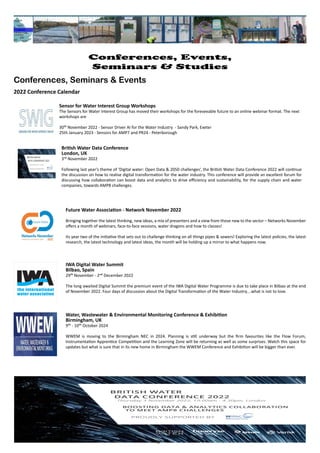
Water, Wastewater & Environmental Monitoring Conference & Exhibition
Birmingham, UK
9th - 10th October 2024
WWEM is moving to the Birmingham NEC in 2024. Planning is still underway but the firm favourites like the Flow Forum,
Instrumentation Apprentice Competition and the Learning Zone will be returning as well as some surprises. Watch this space for
updates but what is sure that in its new home in Birmingham the WWEM Conference and Exhibition will be bigger than ever.
Sensor for Water Interest Group Workshops
The Sensors for Water Interest Group has moved their workshops for the foreseeable future to an online webinar format. The next
workshops are
30th November 2022 - Sensor Driver AI for the Water Industry - Sandy Park, Exeter
25th January 2023 - Sensors for AMP7 and PR24 - Peterborough
IWA Digital Water Summit
Bilbao, Spain
29th November - 2nd December 2022
The long awaited Digital Summit the premium event of the IWA Digital Water Programme is due to take place in Bilbao at the end
of November 2022. Four days of discussion about the Digital Transformation of the Water Industry....what is not to love.
Future Water Association - Network November 2022
Bringing together the latest thinking, new ideas, a mix of presenters and a view from those new to the sector – Networks November
offers a month of webinars, face-to-face sessions, water dragons and how to classes!
Its year two of the initiative that sets out to challenge thinking on all things pipes & sewers! Exploring the latest policies, the latest
research, the latest technology and latest ideas, the month will be holding up a mirror to what happens now.
British Water Data Conference
London, UK
3rd November 2022
Following last year's theme of ‘Digital water: Open Data & 2050 challenges’, the British Water Data Conference 2022 will continue
the discussion on how to realise digital transformation for the water industry. This conference will provide an excellent forum for
discussing how collaboration can boost data and analytics to drive efficiency and sustainability, for the supply chain and water
companies, towards AMP8 challenges.
Page 18
Conferences, Events,
Seminars & Studies
Conferences, Seminars & Events
2022 Conference Calendar
Page 19

WIPAC Monthly - October 2022.pdf

  • 1.
    WIPAC MONTHLY The MonthlyUpdate from Water Industry Process Automation & Control www.wipac.org.uk Issue 10/2022- October 2022
  • 2.
    Page 2 In thisIssue WIPAC Monthly is a publication of the Water Industry Process Automation & Control Group. It is produced by the group manager and WIPAC Monthly Editor, Oliver Grievson. This is a free publication for the benefit of the Water Industry and please feel free to distribute to any who you may feel benefit. However due to the ongoing costs of WIPAC Monthly a donation website has been set up to allow readers to contribute to the running of WIPAC & WIPAC Monthly, For those wishing to donate then please visit https://www.patreon.com/Wipac all donations will be used solely for the benefit and development of WIPAC. All enquires about WIPAC Monthly, including those who want to publish news or articles within these pages, should be directed to the publications editor, Oliver Grievson at olivergrievson@hotmail.com From the editor............................................................................................................. 3 Industry news.............................................................................................................. Highlights of the news of the month from the global water industry centred around the successes of a few of the companies in the global market. 4 - 11 A look at CSOs, screens and storm overflow discharge incidents................................... In this article by screen manufacturer Huber we look at the solutions that can be utilised to minimise the impact of storm overflows when they do happen and what can be done to CSOs to minimise the environmental impact. 12 - 13 Digital Water....are we there yet?................................................................................ In this article, a prequel to the discussions that will be happening at next month's Digital Water summit, we look at where the industry is in terms of Digital Water and answer the question as to why we aren't there yet. 14 - 15 Transforming holistic watershed management through digital solutions....................... In this article by Ting Lu and Jeff Van Note we look at managing water resources through utilising Digital Solutions. The article looks at Clean Water Services inn Washington looking at there use of dark data and implementing digital solutions to help manage the utility 16 - 17 Workshops, conferences & seminars............................................................................ The highlights of the conferences and workshops in the coming months. 18 - 19
  • 3.
    Page 3 From theEditor If last month had a wow factor then this month was somewhat super-charged and the main reason for it was the return of the Water, Wastewater & Environmental Monitoring (WWEM) Conference & Exhibition that returned to Telford after a four year (physical) gap due to the pandemic. The highlights for me where the Early Career Researcher Competition that is run by the Sensors for Water Interest Group. There were three great short-listed candidates who I had the pleasure of sharing a table with at the gala dinner. Although not the eventual winner the competitor whose work resonated with me the most was that of Thomas Homan from the University of Bath. He is currently studying water quality in chalk streams as part of his PhD and when he was presenting he talked about the resolution of quality monitoring which is a subject of particular interest at the moment on a national basis. There is a very good question here in terms of "what resolution of monitoring do we actually need to protect the water environment. A question that is going to have to be answered moving forward as the current answer isn't necessarily going to work for a number of reasons. Of course we can't forget the other things that go on at WWEM with the Instrumentation Apprentice Competition which this year hosted 6 teams and had lots of support from the industry. We all know with the industry that the instrumentation skill is something that we struggle with and so to hear the feedback from the sponsors that the teams absolutely out did themselves in the competition. The eventual winners were United Utillities with their technicians Alex Ward and Dan Alty who showed an amazing promise winning two of the rounds and coming second in the third round of the competition. What does amaze me though is probably one of the most difficult part of organising the competition is getting the teams to compete. This year we had free membership of the Institute of Measurement & Control and some technical books just for turning up. For winning the competion both Alex and Dan will be treated to a year that will hone their skills with some of the leading companies within the water industry so why oh why is it always a struggle to get people to take part, take the risk of measuring their skills against others. The feedback from those taking part is always fantastic...is there a technical lethargy within the industry? Do we need to get excited about being technically competent. Of course this was just the competitive fun part of WWEM, this year the Flow Forum and Pollution Forum were recorded and are available for all WIPAC members to view for free and what a time we had with Carl Wordsworth from NEL discussing flow measurement and its uncertainty updates on the current pain points on flow measurement, and case studies of flow measurement installations - this enabled me to be the true geek that I am. If I thought the Flow Forum was good then the pollution form on Day 2 was even better with a keynote from the wonderfully kind and generous Phillip Dunne MP who set the scene beautifully for the day. On top of all of this with other sessions around WWEM featuring the Digital Forum, the Learning Zones and everything else that was going on I think everyone had a good time. The cherry on top personally was being given an award from Marcus and David recognising the things that I do day to day. Next time is the NEC in 2024 and I've already started planning..... Have a good month and mark October 2024 in your diary. Oliver
  • 4.
    A trio ofawards at WWEM...and more This year’s Water, Wastewater & Environmental Monitoring Conference & Exhibition was a resounding success all around with hundreds of exhibitors visited by thousands of attendees over the two days of the event. After a four year break due to the 2020 event being cancelled due to the Covid pandemic the competitions which have become a mainstay of the event also returned with 6 teams from a selection of the Water & Sewerage Companies competing in the Instrumentation Apprentice Competition and a shortlisted three competitors in the Sensors for Water Interest Group Early Career Researcher Competition. In this year’s Instrumentation Apprentice Competition there were representatives from Anglian Water, Thames Water, Severn Trent Water, United Utillities, WRc and Z-Tech Control Systems. The winners were Dan Alty and Alex Water from United Utilities who received their trophies at the Gala Dinner from Oliver Grievson of WIPAC and Andy Godley of the WRC who organise the competion. All the teams taking part received free membership of the Institute of Measurement and Control and Dan & Alex will be to receive advanced instrumentation training from the sponsors of the competition which included ABB, Siemens, Badger Meter, Insitu, RS Hydro, Vega Control Systems, Siris Environmental and Hach. The Early Career Researcher Competition which is organised by the Sensors for Water Interest Group at each WWEM conference and exhibition saw competitors from the University of Bath, Exeter and Edinburgh all competing for the £1200 prize. Killian Gleeson, Thomas Homan and Xinyi Wan all presented their posters based upon research that they have either recently completed or are currently undertaking. Xinyi Wan of the University of Edinburgh won the competition with her research on the simple detection of arsenic in drinking water using bioassays and mobile phone technology to gather the research results. The competition was particularly fierce year with excellent poster presentations from Killian Gleeson, from the University of Sheffield discussing linking water quality sensors in water distribution coming in second in the competition. Thomas Homan of the University of Bath came in third in the competition with his poster looking at water pollution sensing in chalk streams with has a huge potential application with the current water quality monitoring of sewer overflows starting to happen in England & Wales in a few years time. To round off this year’s Gala Dinner, there was a special award given to Oliver Grievson of Z-Tech Control Systems and Water Industry Process Automation & Control for his tireless contributions to the water industry. In awarding Oliver an “Outstanding Contribution to the Water Industry Award,” the host of WWEM, Marcus Pattison said: “This is not a Lifetime achievement award as Oliver is far too young for that and he still has so much energy, drive and enthusiasm for the water industry which we hope to benefit from for many years to come. This award is for some of the achievements that he has been recognised for and for many more that have gone unrecognised or recorded!” WWEM also saw lots of other awards given to supply chain companies within the water industry including Siemens who won the Smart Network Monitoring Award, Detectronic Ltd who won the Most innovative Product or Digital Solution at this year's WWEM Gala dinner Page 4 Industry News
  • 5.
    United Utilities trialsUK water sector first with 3D-printed concrete wastewater chamber In a first in the UK water industry, United Utilities and tech innovators ChangeMaker 3D have successfully demonstrated the use of 3D concrete printed components – with significant carbon, cost and labour savings. During a 12-month period, ChangeMaker 3D worked in partnership with United Utilities to successfully design, 3D-print and install a wastewater chamber at one of the utility company’s test facilities in Cheshire. With testing of the new tech - known as ‘Printfrastructure’ - now complete, the partners say it proves the huge potential of 3D printing for construction and could lead to widespread benefits for other sectors. The ‘Printfrastructure’ wastewater chamber delivered a 25% reduction in carbon, 20% cost saving and 55% reduction in labour versus traditional methods. The team also point to the extremely fast build time – the chamber was printed in under four hours, and with a significant reduction in the materials used. The printing process for the water chamber has also demonstrated safety benefits by reducing the requirement to work at height or in confined spaces. United Utilities’ Chief Engineer (Innovation), Lisa Mansell commented: “This is important for us in realising our aim to drive efficiency and improvement in everything we do for the benefit of our customers. The future is exciting for water companies like United Utilities who are trailblazing innovation. We have a huge capital programme to deliver under tight deadlines. Digital technologies such as 3D construction printing can drive efficient construction and help us meet our Net Zero goals for carbon.” Natalie Wadley, Co-Founder and CEO of ChangeMaker 3D, said: “After months of hard work, we are thrilled to see the water chamber in situ, with proven environmental and cost benefits. It’s the result of a brilliant collaboration with United Utilities and our team of delivery partners, including CyBe Construction, Costain, Constructure, Ainscough and AutoMutatio. Thanks to them, we have achieved several UK ‘firsts’ – including the design, print and installation of a 3D concrete printed component for this sector, and the UK’s first crane lift of a 3D printed structure. “Our mission is to support industry to leave a lighter footprint, and transforming the UK’s infrastructure is critical if the UK is to reach ‘Net Zero’. We believe 3D printed concrete has the potential to help deliver the green growth our country needs. Our aim now is to continue to work with United Utilities to grow the impact. We want to prove this is a technology that can have widespread uses not just in the water sector, but for rail and highways, too.” ChangeMaker 3D was selected for United Utilities’ Innovation Lab at the start of 2021 – a highly regarded competition in which new ideas are incubated and brought to market. During a 12-week design sprint, they worked with the company to identify the best component to design and demonstrate. The team selected a wastewater distribution chamber – providing enough technical challenge, together with the opportunity to bring a more sustainable approach to a component which has traditionally been carbon heavy. Supported by the Lab’s wealth of expertise and resources, the team created an accurate digital model of the 1.8m cylindrical chamber. This was then printed off-site in a factory by Dutch technology partners, CyBe Construction. The process involves piping 3D mortar through a robotic arm to a precise computer design – a bit like icing a cake. The chamber was craned into position at its new home in Cheshire earlier this year, where further testing has since taken place. Lisa Mansell continued: “Through the process, we’ve been able to carry out all the rigorous testing we would want around strength, durability and water tightness. This is important for giving our construction partners comfort around the new technology, because ultimately, we’ll be asking some of them to adopt it. “We’ve also had the benefit of sharing best practice with ChangeMaker 3D’s other cross-sector partners including HS2,” she added. “By learning together we’re pushing ourselves further for the benefit of the whole of the UK.” According to ChangeMaker 3D co-founder Luke Wadley, the technology has scope to open up new careers in digital and future construction. Page 5
  • 6.
    Siemens Demonstrates TheNext Generation Of Digital Technologies At The Water Tower Detectronic Scoops Most Innovative Instrumentation Product Or Digital Solution At WWEM Awards 2022 Wastewater monitoring specialists, Detectronic, are celebrating after the company won the title of Most Innovative Instrumentation Product or Digital Solution for its LIDoTT Smart System at the UK’s WWEM Awards 2022. Responding to the UK water utilities growing need for a range of low-cost sewer and wastewater monitoring sensors, the company commenced an ambitious research and development project to design, build and manufacture a range of highly affordable sewer network level monitoring products for widespread deployment across entire networks. Four years in development, Detectronic worked closely with wastewater network management teams across the sector to understand their pain points. In 2021, the LIDoTT Smart System was launched and now provides global water companies with everything needed to deliver a truly smart sewer network solution. Commenting on the award win, Detectronic’s managing director, Neil Butler, said: “Just months after its debut, the LIDoTT Smart System became our fastest selling monitoring system; we are all really proud of that. In January, the LIDoTT technology was granted patent number GB2591274, which covers open channel fluid level monitoring apparatus comprising two level sensors with overlapping monitoring ranges. And the developments continue with the soon to be released LIDoTT Alarm; watch this space. “Water companies across the globe continue to place orders for thousands of LIDoTT Smart Systems. Thanks to its unrivalled accuracy and incredibly high-quality data, it has truly transformed the industry’s approach to smart network monitoring. Plus, it’s made it affordable.” Concludes Neil: “We’re delighted that the LIDoTT Smart System has been formally recognised amongst its peers with this prestigious WWEM award. We look forward to working alongside even more water companies to implement the product and watch it provide complete, real time network visibility and forecasting which will result in zero spills and pollutions.” Siemens proudly announces its expanded support of The Water Tower by becoming a sustaining partner. This is an extension of its founding member partnership, which helped shape the Gwinnett County, Georgia-based water innovation centre. As a sustaining partner, Siemens will sponsor The Water Tower’s Control Centre, a state-of-the-art learning and demonstration centre for automation and digital technologies. The Control Centre allows visitors to experience the physical and digital worlds side by side. It is an evolving platform that will be expanded as new and innovative technologies are developed for the water and wastewater industries. “With the vast amount of process data collected and the ability to rapidly analyse this data, digitalization of water and wastewater plants has become more common,” said Jack Roushey, Siemens Water Industry Manager. “We can see this digital transformation in many different ways across a treatment facility, including in asset management, power management, remote monitoring and leak detection. Our new platform is an excellent way to demonstrate how digitalization can help a plant operate more efficiently.” The first phase of the Control Centre includes a digital twin simulation of a wastewater plant, a remote monitoring demonstration system and a complete control system training module connected to hardware in order to physically demonstrate the management of a pump drive. Several digital applications will also be available to illustrate how data can be used to help operators make better-informed decisions. “This is a dynamic and adaptable platform that will offer a place to demonstrate how data, machine learning and artificial intelligence can be used in water and wastewater treatment facilities,” said Roushey. “As The Water Tower continually grows, we plan to continue to build and grow this platform along with it.” “We’re excited that Siemens is extending their support of The Water Tower by transitioning from a Founding Partner to a Sustaining Partner,” said Melissa L. Meeker, CEO of The Water Tower. “We look forward to continuing our collaboration with a focus on digital technologies to bring leading-edge solutions to utilities across the country.” The state-of-the-art Water Tower campus, which launched in September 2019, offers a mix of research, technology demonstration, training, and public outreach facilities. The Water Tower has set out to solve regional and industry-wide problems via relevant applied research and development by providing access to assets in Gwinnett County including labs, pump stations, treatment plants, and distribution and collection systems. Page 6
  • 7.
    Giving Digital TwinsThe IMPETUS To Become Regional • Region-wide digital twins could help utilities, industries and government co-create future policies, says leading professor • Four-year H2020 project, IMPETUS, works on designing climate adaptation pathways • Political, financial and cyber security challenges remain. The phrase "Digital Twins" has become more common in the water industry to describe creating virtual replicas of physical assets, such as water treatment plants or water networks. However,anotherpotentialliesin"digitaltwinning"anentireregion,initiallyconnecting‘hard’groundsensorsand‘soft’satellitesensorstoregionalenvironmental and infrastructure models. This could help eventually connect multiple utility digital twin models to help with long-term water decision-making. That's according to Christos Makropoulos, a professor at the National Technical University of Athens and a principal scientist at KWR, involved in the Horizon 2020-funded project IMPETUS. The project’s goal is to turn high level climate commitments into tangible actions to protect local communities. Tangible, urgent actions A four-year project as part of the EU Water topic "Climate-resilient Innovation Packages for EU regions", IMPETUS brings together a multi-disciplinary consortium of 32 partners. "Thesolutionswedevelopaspiretohelpregionsdevelopadaptationpathways–andregionaldigitaltwinsareanimportantpieceofthispuzzle"saidMakropoulos. "Rather than ‘twining’ a particular treatment plant or water solution network, this is about a digital representation at a regional scale." In the context of water, digital twins are an "actively integrated, accurate digital representation of our physical assets, systems, and processes with a constant stream of data linking them to the physical counterparts for continuous model update and calibration – and vice versa". Taking a broader view, Makropoulos believes that a digital twin of a region could eventually be used as evidence-base for discussions between stakeholders. "Imagine a region as a puzzle board, with the environmental situation updated in real-time. Relevant information can be added so that the stakeholders can access a shared picture of what is currently happening and how things may evolve." he added. One of the aims of IMPETUS is to help turn climate commitments into tangible, urgent actions to protect communities. This includes helping accelerate Europe's climate adaptation strategy and meet ambitions to become the world's first climate-neutral continent by 2050. The professor believes that we are witnessing the convergence of software ‘worlds’: BIM (building information modelling), GIS (geographic information systems) and environmental and infrastructure modelling (e.g. simulations of water distribution systems) "The term digital twin has caught up faster than the technology has matured. But it promoted an increased realisation that more system integration is needed to see real value. Although we don't have full blown (off the shelf) digital twin technologies, we are taking steps toward this integration. The idea of digital twins provides a point in the horizon to help with our integration course," he added. Despite the ambitions, legislative and commercial challenges remain, as well as cyber security issues. Makropoulos participated in a previous, related H2020 EU project called STOP-IT (Strategic, Tactical, Operational Protection of water Infrastructure against cyber- physical Threats), which addressed water infrastructure as cyber-physical infrastructure. A tool-kit was developed that allowed utilities to explore interactions between the cyber and physical systems from a security perspective. "The more we create digital twins, the more relevant cyber, physical and whole system approaches to security becomes – it's important to go in with our eyes open," the professor concludes. KWR Water Research Institute generates knowledge to enable the water sector to operate water-wisely in our urbanised society. At KWR, we have a sense of professional and social responsibility for the quality of water. Our scientific findings and the resulting practical innovations contribute worldwide to sustainable water provision in the urban water cycle. KWR has a staff of about 170 and is owned by the shareholders' organisation KWH Water BV. Page 7
  • 8.
    Dreaming The Possible– Data And The Future Of Water AstheUKmovestowardsthenextregulatoryassetmanagementperiod–AMP8-startingin2025,thesectorfaceshigherexpectationsthaneverforenvironmental protection and provision of safe and consistent services. This comes against the backdrop of an intensifying climate emergency and increasing water scarcity. Data and analytics have a vital role in response to these challenges - helping to transform water and wastewater operations and services, and stimulate innovation across utilities and the supplier community. It is a growing market - according to Bluefield Research’s global digital water forecast 2022-2030, emerging and developing markets will account for roughly 30% of the US$387.5B in total global digital water spend expected over the next decade. In addition, digital water expenditure in emerging markets is projected to scale at an annual rate of 11.4%, compared to 7.7% for advanced economies. Mark Enzer, strategic advisor at consultancy Mott MacDonald and former head of the National Digital Twin Programme at the Centre for Digital Built Britain says that with interest in data-driven solutions at an all-time high, technologies for digital twinning, intelligent asset management, geographical information systems (GIS) and artificial intelligence (AI) are helping companies gain insight, make informed decisions and improve services at an unprecedented rate. Enzer is the keynote speaker at British Water’s upcoming data conference in London on 3 November 2022, which looks at how boosting collaboration on data and analytics can help the sector to meet AMP8 challenges. “The water sector is focussed on achieving the urgent environmental, social and economic outcomes needed to make us fit for purpose in AMP8 and further into the future,” says Enzer. “Technology, data and analytics will play a leading role in getting us there. However, it’s very rare that an individual technology can be a silver bullet and tackle all the water sector’s problems. They key is companies taking a number of different technologies and joining them up with a purpose to achieve better outcomes.” Presently data is often split across multiple platforms using SCADA software, which remotely controls and monitors the condition of field-based assets from a central location; GIS mapping, remote sensors and computerised maintenance management system. By bringing together these datasets, they can be fed into a digital twin model. Companies must invest the time and money to build robust data management processes and governance models so data can be captured correctly and consistently across the entire organisation. “The water sector has traditionally been an outlier in that the adoption of digital technologies and digital transformation has moved at a slower pace due to the risk-averse nature,” agrees Gigi Karmous Edwards, who is speaking at the conference on digital twins and next steps for the water sector. Karmous Edwards is an independent consultant and founder and co-chair of the Digital Twin for H2O Work Group at SWAN – the Smart Water Networks Forum. She works with utilities and technology companies around the world on digital transformation and in particular digital twins. “However, the pace of change is now increasing, and we are seeing greater interest and uptake as the sector understands we need a holistic view of what's happening remotely in the system,” she added. The industry is facing unprecedented scrutiny from governments and customers and must use this as an opportunity to drive innovation, said Karmous Edwards. New technologies have the capability to deliver multiple benefits, not only for utilities and suppliers but also for the environment and wider society. Data and analytics are becoming a more fundamental part of how water companies drive outcomes for customers and the environment. According to Fionn Boyle, strategic innovation lead at Anglian Water, the industry has matured a lot through the last couple of AMPs and is embracing a digital, data driven mindset in readiness for AMP8.Anglian is the largest water and wastewater company in England and Wales geographically, supplying over four million people with drinking water and treating wastewater from over six million customers. “Data unlocks the opportunity to change the way that we operate as an industry. It has been challenging for the sector to embrace digital technologies but our capabilities are maturing quickly,” explained Boyle. “We’re incumbent organisations with legacy assets. Companies who start up as digital companies have a blank slate and can be setup as ‘digital first’ from the onset, but water companies have to integrate those digital capabilities within those legacy assets. At Anglian we’ve invested in a number of enabling capabilities including systems and platforms that take care of data management and data governance as well as creating processes and ways of working to ensure we can manage this data effectively through the organisation. As a result of well-placed and well thought out investments we are now in a place to fully maximize the potential of digital and become a truly digital first organisation." “As water companies invest in digital tools like artificial intelligence and remote sensors, and harness the ways that data then flows through the organisation, all this information can fused together and can help us make informed decisions to ensure the best possible outcomes for customers and the environment.” Sharing data across organisations and the supply chain will be critical in the future. While it is recognised that it can still be challenging to get standardised data within an organisation – let alone across multiple businesses – there is increasing consensus that the sector must come together to agree common standards for defining and modelling key datapoints that can be shared across information systems. “How our industry shares and drives value from data has never been of greater focus and we must come together as a water community to ensure that the insights we provide and the decisions we make are based on sound, actionable insights," said Mark Kaney, managing director of utility service provider Ipsum, which is sponsoring the event. The conference will host speakers from across the global water community. Talks and Q&As will explore topics including - how emerging technologies are meeting water industry demands, and industry data frameworks, and explore how data can help. “With utilities ready to harness the benefits of digital water solutions - collaboration and knowledge sharing will be key to its success moving forward,” said Mar Batista, head of programmes at British Water. “This year’s event will continue the discussion on ways to realise digital transformation for the water industry. It will provide an excellent forum for discussion around how collaboration can boost the use of data and analytics to drive efficiency and sustainability.” For more information, visit https://www.britishwater.co.uk/events/eventdetails.aspx?id=1646904. Page 8
  • 9.
    Pulsar Measurement launchReflectTM two wire radar sensor Pulsar Measurement is pleased to announce the launch of our BRAND NEW REFLECT™ two-wire radar sensors! A first in the Pulsar Measurement product portfolio, these sensors have been designed to provide the highest confidence in level measurement in the most challenging conditions. Providing accurate monitoring of liquids and solids in critical measurement applications, ensuring complete peace of mind with a product that requires minimal skills and human intervention. This brand new innovative low-power radar level measurement sensor automatically optimizes performance from installation through to decommissioning, using Pulsar Measurement’s patented REFLECTTILT™ functionality. REFLECTTILT™ ensures optimal measurement by using the built-in LEDs to signal when the sensor is level and giving the greatest signal strength. These lights are also used to give an early indication of a change in measurement integrity, providing confidence in the accuracy of your data. Reflect level sensors have been designed to be an ally to the long-standing ultrasonic measurement that Pulsar Measurement is renowned for worldwide. There is a place for both radar and ultrasonic sensors and at Pulsar Measurement, you now get the choice of both – coupled with our award-winning technical knowledge and customer service. Pressure is on for hydrostatic pipeline testing In August 2022, a 30-year-old woman was taken to hospital with serious leg injuries after an explosion damaged a road in the village of Cropston, north of Leicester. Two employees of a water industry contractor also sustained injuries. While Health & Safety Executive enquiries and a full investigation are on-going, initial reports indicate that a pressure test was being undertaken on a pipeline when an uncontrolled burst occurred. Hydrostatic pressure testing is a highly specialised process and is required to test joints and connections where new pipelines are installed. The test is carried out by applying pressures to the pipeline, using water as the test medium, to assess the quality of the installation and ensure a leak-free system. It is imperative that water companies and their contractors are all working to best practice standards and guidelines to ensure air is totally or virtually eliminated from the pipeline during testing. By applying the relevant standards and guidelines rigorously, risk is mitigated and can be eliminated. The potential energy contained in compressed air is substantially greater than water. Should a pipe fail with air entrapped, the impact is substantial due to the rapid release of this stored energy. As seen at Cropston, such failure poses an extreme health and safety risk and can cause extensive and costly infrastructure damage above the surface. The key standard and information and guidance note (IGN) for hydrostatic pipeline testing are: • British Standard - EN 805:2000 Water supply - requirements for systems and components outside buildings • Water UK - IGN 4-01-03 Issue 2 Guide to pressure testing of pressure pipes and fittings for use by public water suppliers Avoiding a repeat of the tragic incident at Cropston will require a tightening up of practice across the sector, and water companies and main contractors need to review the capabilities of their pressure testing service providers. Some of the questions that should be asked include: Is pressure testing being undertaken in line with the prevailing standards? Prior to a test, are there tools available that can estimate ramp-up times compared with air content, to ensure a test can be abandoned before any safety breaches occur? • Whose equipment is being used, and how is it maintained? • What data is being collected and is the technology being used capable of measuring air content? • Will pressure test data be analysed in real-time to ensure potentially dangerous or ineffectual tests are abandoned? • Can data records and certificates be accessed at any time, and does the platform display all the critical data? Digital technologies, like Ant-Hire’s Pipeline Installation Performance Evaluation tool - PIPE - are continually being enhanced, which allows for granular test data to be captured on multiple parameters accessible by the client. These include water leakage, trapped air, pressure and temperature. Going further, the record of individual contractors, and even operatives, can also be analysed, identifying potential needs for targeted training and skills enhancement to ensure safety and improve the productivity of individuals and teams. Contractors following procedures correctly are more likely to get pressure testing right, building resilience in the network from the outset. Further, if a pipe is prepared properly in readiness for a test, with all air extracted, hours can be shaved off a pressure test, compared with a test where air is present. Other benefits accrue for those companies operating at the highest standard, including extended pipeline lifespan, reduced water loss due to leakage, and the lower carbon footprint around those two indicators. Greater resilience in the network can be achieved by engaging the pressure testing contractor at the earliest possible stage of the design process for new pipelines, helping avoid pitfalls and keeping project costs down. In the wake of the Leicestershire incident, Ant-Hire is already seeing an up-tick in downloads of its Experts Guide to Pressure Pipeline Testing. This 12-page document includes a planning checklist, equipment guide, air content management guide, assessment criteria for data-logger capability and risk management checklist. This shows that there is already an appetite for getting the process right. Now water companies and contractors need to ensure their operatives and managers are resourced to do the job at the highest possible standard. This can be achieved by giving them access to training to continually build skills, and by ensuring that the time is available to carry out best practice working. It also means identifying those service providers with a proven track record of operating to the highest possible standards. Page 9
  • 10.
    The GoAigua smartirrigation solution wins "Green Award" for its work in sustainability Idrica Qatar (Aguas de Valencia WLL) was awarded first prize in the Green Awards’ Green Design category, thanks to the smart irrigation pilot program in which the GoAigua Smart Green solution was implemented in two parks in the city of Al Khor. Ashghal thus acknowledged the hard work carried out by the company in a project regarded as a Sustainable Development initiative, in line with the Qatar National Vision 2030, as well as with environmental and sustainability policies. Enrique J. Fernandez, General Manager of Idrica Qatar, was delighted to receive the award, saying "this is a fantastic way to recognize the many years of hard work we have put in to becoming more efficient, and is an incentive for us to continue to lead the way in smart and sustainable solutions, based on the global vision of O&M experts in the water cycle". The award-winning project revolves around an autonomous smart irrigation system that optimizes the use of treated water and energy consumption thanks to the use of advanced algorithms and machine learning. The system focuses on increasing environmental sustainability, reducing operating costs and the use of fossil fuels, doing away with the digital divide and promoting sustainable urban development. The project, known as TSE Connection Customer – Intelligent Irrigation, focused on the deployment of a smart irrigation platform in the Al Tawasul and MME Private Garden parks in Al Khor, designed to reduce the volume of water used in these landscaped areas. The platform provides a comprehensive monitoring and smart management hub for irrigation infrastructures which integrates all the relevant data to create the best irrigation schedule, automate it and implement a decision support system. In the opinion of Severino Ramos, VP Middle East, "the project brings substantial environmental benefits, cost savings, innovation and technology, which are precisely the cornerstones the project is based on i.e., economy, technology and society". Water savings in the parks where the award-winning solution has been implemented range from 21% to 27%, depending on the type of irrigation. In turn, the irrigation network's hydraulic efficiency has been improved by 10%, whilst the motors’ energy consumption has dropped by between 20% and 70%, thanks to the use of less water and the installation of pumping systems equipped with frequency converters. The Green Awards aim precisely to promote and appraise contractors' environmental and sustainability management at working construction sites. As such, the awards have five categories - Green Design, Green Project, Waste Management Excellence, Building Material Recycling Excellence, and Energy Efficiency Excellence (Carbon Footprint Reduction). This edition was held on October 3 in Doha, Qatar. The Green Awards were launched in 2018 by Ashghal's Quality and Safety Department (QSD) and Road Projects Department (RPD), and are a unique initiative designed to raise awareness of sustainable practices in construction and help eradicate or reduce their impact. This year, a total of 43 companies participated in the event, a number that marks a new record every year given the importance that these awards are gaining on the international stage. Page 10
  • 11.
    An ultrafine networkfor rivers How are species richness and the characteristics of running waters related worldwide? This question is being addressed by a team led by IGB scientist Sami Domisch. The researchers have developed the highest-resolution map of the world's river systems ever produced. The map provides a basis for the detailed analysis of what characterizes riverine habitats and how they are interconnected. Rivers are the "lifelines" of all land masses on earth. This is also visible in the map that Sami Domisch has developed in collaboration with other researchers from IGB and from Yale University: a finely branched network of potential river sections stretches across all continents. The map is based on the "Hydrography90m" data set, which the researchers spent two-and-a-half years creating on the supercomputer at the U.S. university. Of course, this map is not the first of its kind. Rivers and their distribution around the world are already represented in numerous models. All these maps are based on satellite-derived data of topographic reliefs: wherever there are clefts in the landscape featuring certain characteristics, there will potentially also be a watercourse. And yet no other data set is as detailed as Hydrography90m. "We took a high-resolution elevation model of the earth and used open source software to extract the river network from it. Unlike other previous data sets, Hydrography90m also maps short and very short arms of flowing waters," said Sami Domisch. The level of precision is in the name: the shortest unit is 90 meters long. Since small rivers account for the largest proportion of the global river network (around 70%), they play a particularly important role in riverine biodiversity. Thedatasetcomprisesatotalof726million potentialriversections.Theterm"potential"iscrucialinthiscontext:"Initially,wedonotknowwhereriversarereally flowing," said Sami Domisch. The scientist and his team are currently modelling discharges to identify rivers that actually carry water—either throughout the year or intermittently. To do this, they use data from 30,000 gauging stations worldwide where quantities of water have been collected in defined river sections for years. In addition, the researchers have access to comprehensive data on a wide range of environmental parameters such as precipitation, temperature, land use, soil properties, and slope. In the model, these parameters are related to the quantities of water measured in each case. "In this connection, we work with machine learning. This means that with every new data set, our model gets better and better at recognizing which parameter variables are related to which water volumes," said Giuseppe Amatulli, lead author of the study. If the model works, it can be applied to all river sections worldwide, even if they do not have a gauging station: in this case, the model calculates the probable discharge, i.e. the amount of water in the river, from the environmental parameters available for the entire area. To validate the model, the researchers initially "feed" it with 70% of the existing water quantity data sets. Trained in this way, the model is then tasked with determining the appropriate quantities of water from the environmental parameters of the remaining 30%. If these quantities are sufficiently in line with the actual measured values, the model functions properly—if not, the model can be improved. However, systematic model deviations can also mean that there are certain parameters—for which the researchers have no data—that play an important role, one being water abstraction by humans. The adapted model can then be used to determine discharges of all river sections worldwide. "In dry regions in particular, it is likely that there are significantly fewer rivers containing water than our data set would suggest," said Sami Domisch. This assumption is also supported by a study conducted by authors who used the less detailed HydroRIVERS data set. They estimated that only around 60% of the world's rivers carry water intermittently or throughout the year. The model provides answers to key questions: How long are rivers that carry water permanently or temporarily? Where is there a high or low stream density? And what impact does this have on biodiversity? It is also possible to make detailed statements on questions such as these because Hydrography90m captures the catchment areas of river sections on a very small scale. Since environmental data is already available for each of these 5-hectare catchment areas, this data can be used to characterize the existence of species communities, e.g. which climate data or gradients are associated with those communities. For example, various parts of the world have a Mediterranean climate—not only the Mediterranean basin, but also some parts of the west coast of the US. Analyzing the species composition there enables researchers to draw conclusions about the biogeography of these habitats, i.e. which environmental impacts contribute to the existence of certain species. And that is just the start of it: "Once we know how much water flows where, we can undertake a detailed analysis of riverine habitats around the world, down to the tiniest river arm," said Sami Domisch. Even in parts of the world that are virtually inaccessible to humans. Page 11
  • 12.
    Article: A look atCSOs, screens and stormwater discharge incidents In the context of ongoing criticism from regulators, NGOs, Parliamentary Committees and the public of the water companies’ unsatisfactory environmental performance, HUBER Technology talks about the key role sewage screens play in mitigating the impacts of unauthorised sewage discharges into rivers, lakes and the sea. With ongoing public and regulatory pressure on the water companies, Adrian Heneghan from HUBER Technology looks at practical measures which can help the water companies take improve their operational performance. Adrian Heneghan: Recent months have seen the publication of Ofwat’s draft methodology for the upcoming Price Review in 2024, and yet more criticism from regulators, NGOs, Parliamentary Committees and the public of the water companies’ unsatisfactory environmental performance. In addition, the companies are also currently subject to two ongoing separate investigations by Ofwat and the Environment Agency on how Combined Sewer Overflows (CSOs) are being used across their networks. The sole purpose of CSOs is to discharge untreated human sewage and waste-water when the sewerage system is overloaded – currently there are approximately 21,462 CSOs and pumping stations in the UK (excluding Scotland) (Environment Agency, 2020). The Government is now getting tougher, saying its Storm Overflows Discharge Reduction Plan Consultation “will revolutionise how water companies will tackle the number of discharges of untreated sewage, which the Government and the public have made clear are completely unacceptable.” Under the plan, the water companies will face strict limits on when they can use CSOs and must completely eliminate the harm any sewage discharge causes to the environment. Proposals in the plan include: • By 2035 - the environmental impacts of 75% of overflows affecting our most important protected sites will have been eliminated and there will be 70% fewer discharges into bathing waters; • By 2040 - on average approximately 160,000 discharges will have been eliminated; • By 2050 - on average approximately 320,000 discharges will have been eliminated. The water companies are now facing significant increases in both the levels of investment and practical measures they will need to put in place to tackle the issues which are leading to ever –greater fines, ODI penalties and reputational damage. The Environment Agency is piling on the pressure with a call for prison sentences for company directors in the worst cases and to be struck off. These are major challenges for water companies which they need to address as a matter of urgency but the reality is they won't be able to do it all immediately. As the saying goes, Rome wasn’t built in a day, so what can they do in meantime to strengthen the resilience of their existing systems and reduce the risk of the operational failures which lead to pollution incidents? From a supplier point of view, the key area which immediately springs to mind is ensuring that equipment and infrastructure at all points of the wastewater treatment process are monitored and maintained regularly. Looking at a range of pollution incidents during the last decade, initial equipment failure at a single point in the process which has the potential to cascade and amplify the impacts further downstream has all too frequently been a significant contributory factor. Screens play a key role in this process, an area where HUBER has developed expertise and industry-leading technologies over years of working with many of the water companies. Based on our experience, maintaining existing equipment and technologies in place is fundamental to ensure it is in proper working order and stays that way. Simply put, when the risks are ODI penalties, reputational damage, prosecution by the Environment Agency and eye-watering fines, when it comes to asset health, prevention is always better than cure. The risks are only too real – recent months have seen some significant fines levied on water companies. And this situation is likely to get tougher – the EA has recently called for even bigger fines, prison sentences and company directors being struck off. Different sites have different requirements – for example, some sites only have static screens with a grill which periodically have to be cleaned manually – these have generally been put in place to prevent waste matter getting to the outfalls which feed into the sea and rivers. Page 12
  • 13.
    Traditionally, static screenare all in low flow locations – however, the impacts of climate change and more extreme weather events mean low flows are now turning into high flows. As a result, the increased risk means that a lot more solids are now discharging into rivers. While we do fit static screens where conditions require it, at HUBER, we have a particular focus on supplying power screens which operate on three phase power, which deliver a number of operational advantages compared to static screens. In our experience, the risks of failure or malfunction in the equipment increase with screens that are manually operated, especially when they don't get cleaned out regularly. So at sites where the floors are a lot higher and they're in a conservation area, for example, we would always recommend putting a powered screen in place, which includes supplying all the related control and instrumentation equipment , to ensure that all waste material is captured. This has a key advantage over static screen - material captured via a power screen is kept in the continuation flow and is recirculated, which ultimately prevents solids from going to the outfall. As part of our work we will generally do a full flow profile consisting of hydraulic profile and size e.g. we may need to size it for 1000 litres a second - for the network for that area, and then work out the equipment needed to deliver the optimum operational performance. In this context, the data that we get from the water companies is very important so they can tell us what they're actually looking at from a spill point of view - what they are consented to spill to outfall, which can range anything from 100 litres a second and upwards to 30,000, for example. Sometimes this may also involve retrofitting where there's an existing network but often the utility may be installing new chambers to deal with high levels of flow . The screens we put in are 6 ml 2D screens - anything smaller than that will get into the outfall, but it's mainly about keeping the rag and the solids in the sewer so that only a mixture of rainwater and diluted wastewater goes through when there is a storm event. And while retrofitting is not always straightforward, we always come up with a solution. Years of work on numerous projects means HUBER has a considerable amount of experience and expertise to draw on and we’re used to overcoming challenges. With proven equipment that we’ve put installed over the past 30 years (some 1400 units in the UK and even more in widespread use across Europe), it’s true to say that the majority of water companies– if not all – will have HUBER screens in place. At an operational level, pressure on available manpower and resources can have an impact. But failures upstream of the CSO inevitably have a cascade effect resulting in some of the big problems the water companies are being taken to task on. At HUBER we’re all too aware of what happens in those circumstances, which can often put companies at risk of breaching of their environmental permit. We’re familiar with the problems and the implications of not addressing them swiftly and effectively - and in emergencies we can always move to provide a fast response especially when all the relevant data is provided. Increasingly, the advent of smart phones and social media mean there’s no place to hide when things go wrong. In one incident we were called out to help with, eagle-eyed members of the public spotted rag floating in the river. Someone swimming in the sea or surfing, or a bathing river, or simply walking alongside can film or take a photograph of what they're seeing and disseminate information about pollution events quickly and widely. In addition, citizen science data is becoming hugely important – for example, the Environment Agency has established a new citizen science portal, while some of the Rivers Trust groups who are campaigning for bathing water river status in their areas are also incorporating citizen science into their activities. Whether we’re working directly with the water companies themselves, their Tier 1 partners or external consultants, the ability to work collaboratively on a number of scenarios and come up with the most suitable solution is a key part of our skill set. As part of this we also host Lunch and Learn workshops for individual water companies and their partners - it's a two way process, we get to understand more about their operational processes and challenges, they get to learn more about our technologies and how we can help. To sum up, interestingly, we're seeing a growing level of interest and uptake in our technologies - no doubt driven in part by the fact that the issue of sewage discharges is now firmly in the forefront of the minds of the Government, regulators and the public alike. It is of course high on the water companies’ agenda and is set to remain there for some considerable time to come. So while tackling the challenges associated with the eventual removal of some 20,000-plus CSOs will involve a considerable amount of time, resources and investment, in the meantime the water companies have a lot to gain from taking advantage of existing technologies and a supply chain which stands ready and able to help. Page 13
  • 14.
    Article: Delivering Digital Water- Are we there yet? Digital Water, Water 4.0, Smart Water – whatever you want to call it has been a concept that has been around for many years. I was challenged at a conference over around 6-7 years ago when I started talking about smart wastewater networks. The person in the audience heckled – “but we’ve talking about smart wastewater networks for 10 years now and we still haven’t delivered many. This is of course the truth about the concept of Digital Water, it is something that we’ve struggled to grasp the concept, we have struggled to grasp the tangibility, and this is because the benefits of Digital Water are not very well known and the opinion of most is that “Digital Water” is a buzz word for the latest technology. In some regards people are right in saying that and there are a lot of water companies out there who will pick up the latest fad in technological innovations and run with it for a few years and when they get bored of it or an even newer technology comes along then that will get adopted instead. The attraction of pretty, shiny things that look good but only deliver some of what they have promised. At the moment within the water industry and for a few years now I hear “Artificial Intelligence” being hailed as the thing of the future and people saying – “We can use AI to solve this problem or that problem,” without much of a clue as to what AI can actually do. This is half of the problem with Digital Water insofar as that most people do not realise that Digital Water is a collection of tools to use to get the best out of a data set in order to glean insight into what is actually happening within a real-world scenario. So, what is Digital Water? If you have a room with a hundred people in it then you will probably get a hundred different answers. In this article you will get mine. To me, Digital Water is using the data that all water companies collect in its many forms and utilise it to gain insight and situational awareness of how a system is performing. This system can be a wastewater collection network or entire wastewater treatment system or it can be the entire anthropogenic water cycle (although the scale of this is somewhat daunting). The Water Industry has always suffered from the DRIP phenomenon (Data Rich Information Poor) and it is true. It can be argued that there is data poverty too depending on the data quality and how a company looks after its data sources (mainly its instruments). What the companies usually fail to do as they simply don’t have time is to use the data in its many forms and bring it together into insight. An example of this is in my past I’ve conducted investigations into why a treatment works is receiving too much flow when compared to the number of people that it is thought to serve. In these investigations you tend to look at your data source and see if they are right and usually find that one of them is wrong or out of date. The conclusion of the investigation usually results in either an instrument error through it not being set up correctly or the amount of people has steadily increased without anyone knowing or some sort of infiltration into the network. By looking at the flow data alone and understanding the system you can understand what is happening and whether its down to a cracked pipe, a faulty instrument or a lack of communication with planning authorities. All of these investigations were manual tasks and to actually resolve the situation cost a lot of money but what if that could be all be done automatically…wouldn’t this be a value case of actually using the data that is already collected. So, what are the steps to achieving Digital Water? I’ve heard in the past that it doesn’t matter where you start with Digital Water. The important thing is that you start. This is something that I don’t agree with. Realistically Digital Water is a mixture of policies, people and yes, technology. For me the start of any Digital Water process is understanding any informational requirements that you may need within the business. This isn’t the standard thing of “we want everything.” The organisations who say this are somewhat immature in their approach and aren’t ready. However, for those that have reached that level of maturity the first step in any Digital Water journey is about the people, it is about stakeholder engagement from the CEO of the water company to the operator on the ground. It is about understanding the operational and engineering needs of the organisation. An example of this is the CEO of the organisation will want to relatively high-level data about how the company is performing, is it doing what it is meant to be doing or is there going to be a knock on the door by the regulator with the potential of a big fine. The CEO also wants to know how the business is performing financially and whether the board and shareholders are going to be content too. If we trickle this down to the manager of say a water treatment plant they are going to want to know what asset is about to fail that is going to prevent them from producing enough water to keep the customers happy. If we trickle down even further to the operator on the front-line of the business they are going to want to know how an individual treatment plant is performing and what is the next priority on their list to manage or fire-fight. This is the first step and of course the information that is given to people has to be absolutely correct and thus the source of data where that information comes from have to be correct too. If they are a world of efficiencies are available to a water operator and to mine the data that they collect has a huge value to it. This value is largely un-tapped. Once the stakeholder engagement piece is done then a water operator can get more advanced and the use the Digital Tools that are available. An example of this is the Digital Twin that is in Valencia which is arguably one of the most advanced Water Digital Twins in the world. This was built up by ensuring that the model that it is based on was correct and the monitoring was correct too. Once it was put into practice problems were exposed due to lack of depth of data or a lack of calibration in the model. This resulted in a fine-tuning state going back and forth between instrumentation and model to get things right for the first uses of the Digital Twin. As more functionality was added so was the complexity. In the end real-time insight in the performance of the water distribution network is possible as is forecasting of what is going to happen in the future if certain steps are taken. This is Digital Water. We have of course only started the journey as an industry and there will be many practicalities to iron out but it will also take a lot of discussion and do join me at the IWA Digital Water Summit in Bilbao (https://digitalwatersummit.org) from the 30th November – 2nd December 2022 to expand in much greater detail that I can possibly go into here. Page 14
  • 15.
  • 16.
    Article: Transforming Holistic Watershed ManagementThrough Digital Solutions A data-driven utility culture is forward-looking in more ways than one, leveraging the latest technology to protect water resources for years to come. Clean Water Services (CWS) is a special service district that provides wastewater treatment, stormwater management, and watershed management, serving nearly 600,000 customers in Washington County, Oregon. Like other utilities, CWS is facing water resource management challenges, extreme weather patterns such as drought and flooding, stringent permit requirements, population growth, and aging infrastructure. CWS is applying technological innovation where practical to create solutions for these pressing problems. CWS has embarked on this journey with the goal of uncovering dark data, implementing digital solutions, and providing quantitative decision support for utility management in all aspects. However, a holistic implementation of successful digital solutions is more than just technology. This paper demonstrates that CWS’s documented progress was achieved by integrating people, process, and technology, with special emphasis on our people and our customers. Cultivating a culture that supports data-driven decision-making and transparent knowledge-sharing is crucial to support the Digital Solutions of the Future initiative at CWS. To begin this transformation, the Data Management Hub was established in 2016 to provide a collaborative space for business analysts, process engineers, and business leaders from various departments (including Operational Technology and Engineering Technology) and the software engineers and program analysts from the Information Technology Division to integrate. The team meets monthly to discuss and provide updates on data-related activities and learn about the latest technologies such as artificial intelligence, virtual reality, and storyboards. Awareness of these is useful when teams explore innovative technologies. In addition, hub members have a better understanding of what other members are working on. The culture change has produced more efficient and holistic results. Dark data started to become uncovered and leveraged to provide more value for Clean Water Services. For example, the initial use of sewer system monitoring is to inform sewer cleaning and sewer replacement capital projects. Through collaboration, the use of data has been extended to our Source Control group to provide real-time flow data to track slugs of flow discharged from industries and inform wastewater treatment and recovery operations to prevent upsets. In addition, a stream flow portal (Figure 1) was developed integrating real-time flow sensor data, plant SCADA data, and water storage information to serve as a communication tool that summarizes the information used to manage stream flow and illustrate how Clean Water Services provides ecological uplift through flow management in the Tualatin River. The technologies used to achieve this were custom integration processes written with Python, ESRI’s ArcGIS Enterprise to build mapping services and applications, and Microsoft SQL Server used as the back end for data storage. The custom integration process’ data sources include iHistorian for wastewater treatment facility (WWTF) effluent, SharePoint for reservoir withdrawal and tributary flow augmentation information, and real-time flow sites supported by United States Geological Survey (USGS) and the Oregon Water Resources Department (OWRD). To further unleash the potential of this data, it is also used to inform decisions on tributary flow augmentation, wastewater operation optimization, and stormwater real-time control facilities. Maps and services allow users to view river flows, releases from reservoirs, tributary stream flow augmentation, and effluent volume from treatment plants, as well as a calculation of what percent of flow is from each source. Figure 1. A snapshot of flow portal Page 16
  • 17.
    The Clean WaterServices Knowledge Development Model (KDM), shown in Figure 2, was inspired by the SWAN Interactive Architecture Tool and helps explain how water industriescanleveragetheIoTtodevelopvaluableknowledgeabouttheirwatershed. Digital Solutions started from Layer 2 to Layer 5. Collaboration between District staff and partner agencies and organizations are captured in the highest level of the KDM. Internal and external stakeholders from across the watershed work together to understand engineered and natural systems and measure the effectiveness of the organization’scurrentpracticesandinitiatives.Adeeperknowledgeofthewatershed is developed from the effect of District efforts and are repeatedly measured and re-evaluated by stakeholders. Over time, this knowledge becomes foundational to the continued improvement of the organization’s operations and business towards watershed health. GIS data management, analysis, and visualization are distributed within the District. Digital Solutions ensures that GIS databases and software are up-to-date and working for users, integrates GIS with other business systems, automates data processing workflows, and may assist with some data import and management tasks. GIS analysts typically work within their departments to perform in-depth data analysis and reporting, create geographic products, and import and manage datasets specific to their user bases. To better achieve holistic watershed management, an integrated planning portal was developed to overlay information related to geomorphology, environment, and engineering planning perspectives from multiple sources. It is designed to be easily adapted to new requirements, broadly accessible to District users for integrated planning strategy and watershed assessment, and flexible enough to allow addition of information needed by planners and decision-makers. There are approximately two dozen layers related to environment, and a dozen each for geomorphology and planning, as well as a few common layers. The integrated planning portal was built with ArcGIS Enterprise. The current process uses ArcGIS Pro to publish layers, mostly stored in an enterprise geodatabase, but some in file shares. The District has updated its environment to support hosted layers, which will allow GIS analysts to manage information and publish directly to the server. Phase 2 of the integrated planning portal will use this technology. Figures 3/4. Snapshot of Integrated Planning Portal used for integrated planning effort at CWS Since 2007, CWS has begun exploring the use of remote sensing technologies, including Lidar and unmanned aircraft systems (UAS) with multi-spectral imagery to guide stream restoration project planning, construction, and maintenance for watershed management. Compared with the traditional densiometer approach to measure project shade, the use of remote sensing technologies provides more consistent and accurate measurements of stream restoration project performance (Figure 5). In addition, UAS technology allows for the monitoring of additional project-specific information, including stream storage, soil moisture information, impervious surfaces, and invasive species control. This big data introduced from imagery analysis opens a new era of watershed characterization with quantitative and granular information on a watershed scale to aid integrated planning efforts and develop cost-effective solutions. Today, the District staff is exploring using machine learning and open source tools to harness the power of data analytics for watershed monitoring and generate granular information about land use for watershed management. In summary, there has been much progress in moving toward the Digital Solutions of the Future at Clean Water Services. As a result, staff has been utilizing more data to support holistic decision-making for both long-term planning and proactive operation and maintenance levels. Based on our experience, the initial acceleration of digital solutions should be focused on three areas: 1. Cultivate a data-driven culture and develop an integrated framework. 2. Align digital solutions transformation with the organization’s mission and vision, in this case, to achieve CWS’s ecological uplift through holistic watershed management. 3. Develop a digital solutions ecosystem that integrates information technology (IT), Operational Technology (OT), and Engineering Technology (ET) together. Figure 2. The Clean Water Services Knowledge Development Model (KDM) Figure 5. Remote sensing data for a stream restoration project Page 17
  • 18.
    Water, Wastewater &Environmental Monitoring Conference & Exhibition Birmingham, UK 9th - 10th October 2024 WWEM is moving to the Birmingham NEC in 2024. Planning is still underway but the firm favourites like the Flow Forum, Instrumentation Apprentice Competition and the Learning Zone will be returning as well as some surprises. Watch this space for updates but what is sure that in its new home in Birmingham the WWEM Conference and Exhibition will be bigger than ever. Sensor for Water Interest Group Workshops The Sensors for Water Interest Group has moved their workshops for the foreseeable future to an online webinar format. The next workshops are 30th November 2022 - Sensor Driver AI for the Water Industry - Sandy Park, Exeter 25th January 2023 - Sensors for AMP7 and PR24 - Peterborough IWA Digital Water Summit Bilbao, Spain 29th November - 2nd December 2022 The long awaited Digital Summit the premium event of the IWA Digital Water Programme is due to take place in Bilbao at the end of November 2022. Four days of discussion about the Digital Transformation of the Water Industry....what is not to love. Future Water Association - Network November 2022 Bringing together the latest thinking, new ideas, a mix of presenters and a view from those new to the sector – Networks November offers a month of webinars, face-to-face sessions, water dragons and how to classes! Its year two of the initiative that sets out to challenge thinking on all things pipes & sewers! Exploring the latest policies, the latest research, the latest technology and latest ideas, the month will be holding up a mirror to what happens now. British Water Data Conference London, UK 3rd November 2022 Following last year's theme of ‘Digital water: Open Data & 2050 challenges’, the British Water Data Conference 2022 will continue the discussion on how to realise digital transformation for the water industry. This conference will provide an excellent forum for discussing how collaboration can boost data and analytics to drive efficiency and sustainability, for the supply chain and water companies, towards AMP8 challenges. Page 18 Conferences, Events, Seminars & Studies Conferences, Seminars & Events 2022 Conference Calendar
  • 19.