Page 1
WIPAC MONTHLYThe Monthly Update from Water Industry Process Automation & Control
	www.wipac.org.uk												Issue 10/2016 - October 2016
Page 2
In this Issue
	 From the Editor....................................................................................................................	 3
	 Industry News.....................................................................................................................	 4 - 11	
	 Highlights of the news of the month from the global water industry centred around the successes of a few of the
	 companies in the global market.
	 Flow Profile Explained........................................................................................................ 12-13
	 In this article by David Bowers of ABB the basics of the flow profile is explained and why it is important when considering
	 flow monitoring.
	
	 Improving Water/Wastewater Asset Performance using Operational Analytics................ 	 14-16	
	 In this article by the software solutions engineering company, Bentley, the use of operational analytics and the data that
	 we collect, is examined with particular reference to a case study in South Australia. By undertaking data convergence and
	 converting data to useful information the performance of the business was improved.	 r
	 The Use of Online THM Analysers for maintaining water quality....................................... 	 16-17	
	 This case study from AMS looks at the use of THM analysers in an application in Scotland to not only monitor THM levels
	 in the treated water but to control the Trihaomethane removal system
	 Building the business case for a Smart Grid for Water.........................................................	 18-19
	 An article by Fathom on the fact that decreasing water use & efficiency in the way that water is used and consumed is
	 driving the need for a Smart Grid for the Water Industry
	 Smart Flood Alleviation system protects Portsmouth...................................................... 	 19-20
	 An update from OTT on the Smart Wastewater Network scheme that Southern Water has been instigating over the past
	 few years in order to control the network and protect the customers including the Royal Navy Base at Portsmouth.
	 Workshops, Conferences & Seminars................................................................................... 	21-22	
	 The highlights of the conferences and workshops in the coming months
	
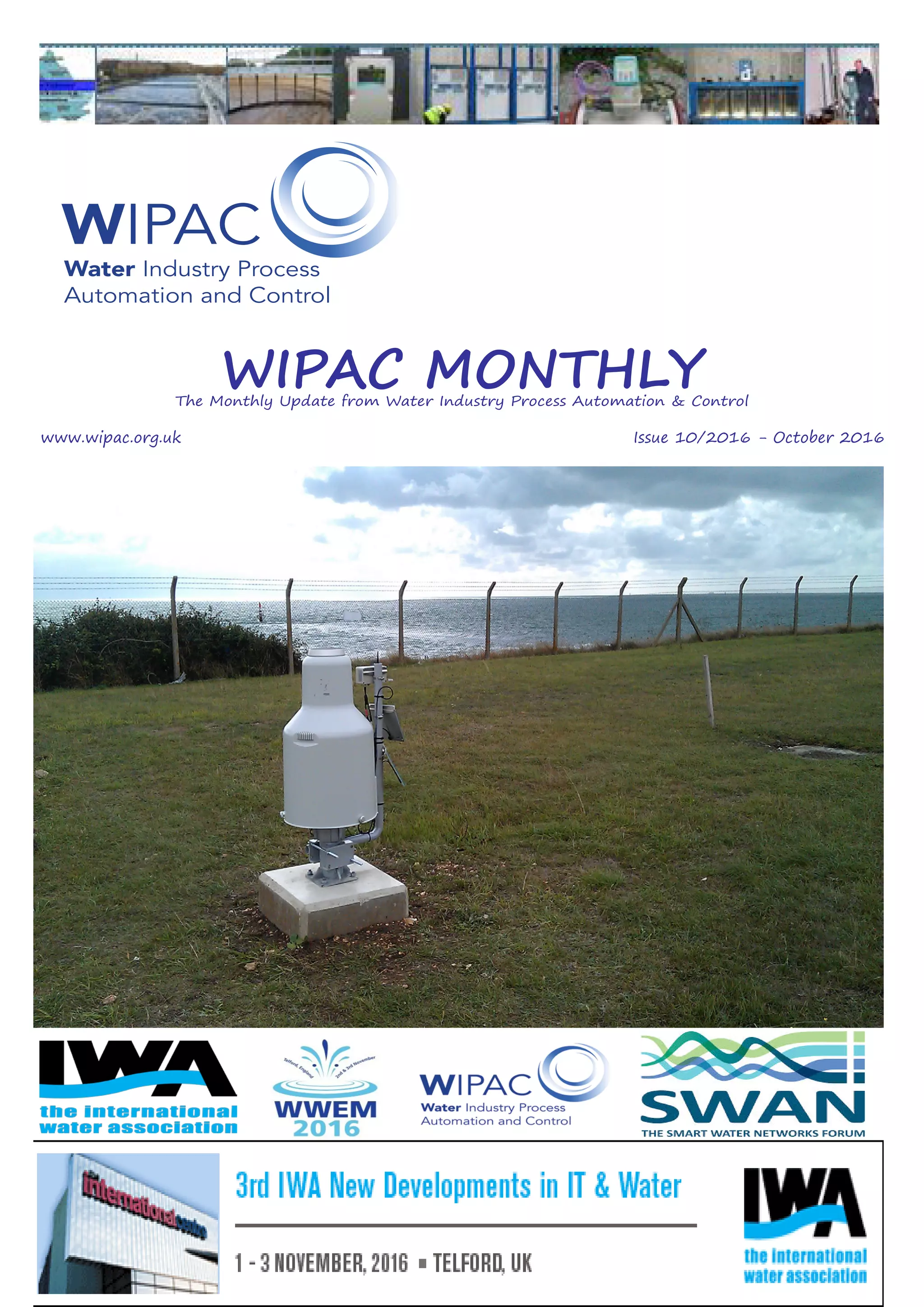
	 The photograph on the Front Cover has been provided by OTT Hydrometry and features a Pluvio2 rainfall measurement device 		
	 that is part of Southern Water’s Smart Wastewater Network in the south of the England.
	 WIPAC Monthly is a publication of the Water Industry Process Automation & Control Group. It is produced by the group
manager and WIPAC Monthly Editor, Oliver Grievson. This is a free publication for the benefit of the Water Industry and please 	
	 feel free to distribute to any who you may feel benefit.
	 All enquires about WIPAC Monthly, including those who want to publish news or articles within these pages, should be directed 	
	 to the publications editor, Oliver Grievson
Page 3
From the Editor
					
The past month has been spent in speaking to people and sitting down the some who have rarely presented before
and giving them tips in how to speak in front of audiences to speaking to those at International Labmate, the people
who organise the WWEM Conference and Exhibition. It is the UK’s answer to WEFTEC and it is our way of getting to know
the instrumentation that has been developed. What’s been updated and through the various workshops what develop-
ments we saw two (or more) years ago and how its working well. It is for those who “do” instrumentation in the UK Water
Industry to have a chat and learn what works. It is my idea of heaven.
Of course before it even begins I’ve been having meetings with those who can’t wait to tell me about the new
developments that they are going to launch and this year especially is going to be year where alot is launched by
the suppliers that are there. More and more though it is about learning and development and last time we had the
Instrumentation Apprentice Competition to encourage the technicians in the industry to compete and learn together.
This, in the global industry is becoming more and more important as the industry moves forward into an era where we
don’t just install instruments to monitor, or just to control but provide a holistic service of seeing what is going on.
The big thing for the Water Industry Process Automation & Control Group this year is two fold. The first is the WIPAC Flow Forum at WWEM where we have
10 speakers giving nine presentations all about a wider variety of flow related issues. The format has got so popular that over 500 people have signed up to
come and I am already talking to people about the next WWEM in 2018. It seems that operation and maintenance is going to be a key theme with a special
emphasis on calibration. We’ll see what comes about but first things first there is the 2016 event first. The second big thing for WIPAC is the International
Water Association event on the New Developments in IT & Water. In reality it includes this but includes so much more as well.
The industry whether we like it or not is moving forward in to a “Smart Future,” something that is very poorly defined as to what that means but to me one
of the first ways of getting there is to take baby steps and improve the instrumentation that we have in the field. This is not necessarily technology related as
personally I think that the instrumentation companies have some of the hardest working research and developments sections within the industry and I am full
of admiration for this particular group of industry professionals. My main bug bear is around installation and this is where things fall down.
If I were to gaze in to a crystal ball and get my professional desire it would be an instrumentation asset base that is asset managed producing data that can be
relied upon. We often say in the Water Industry that we are “data rich,” something that I question as the quality of that data is often suspect actually giving us
a situation where we have lots of data that is more or less fit for the scrap heap. If we have a situation where we have quality reliable data then that is where
the Water Industry can begin to do the more complex things. Once the industry has broken through “Level 2 - Instrumentation” on the SWAN Layers diagram
we can start our journey of SMART.
Of course as an industry we need to run before we can walk and we, as an industry, operate on all of the layers together and I’ve seen at various conferences
people invent their own layers (usually what has already been said in Layer 4 or 5). There is alot to learn with the concept of the “Smart” Water Industry and
to be honest in my humble opinion we are an industry that is struggling to understand what we want as we have always been set on building concrete boxes
which are applicable in some situations but like instrumentation selection is not applicable to all applications. There are different ways to crack a nut and we
have, as an industry, used the proverbial sledge hammer where we could be using the “scalpel of instrumentation.” The key to “Smart” is to be “Smart” is to
know what is going on and the start of that is of course using the old adage of “Measure to Manage,” which is so often quoted.
All of this we are sure to discuss not only next week at WWEM & the IWA Conference but also next month, next year and in reality over the next few years.
The instrumentation suppliers should be front and centre in this discussion as should the automation suppliers and everyone else to from instrumentation
technician and operator to manager to the Director all identifying their needs of what they want to know as knowledge is at the absolute centre of being
Smart.
I hope to see at least some of you next week at WWEM and if not then please have a good month
Oliver
The Instrumentation Apprentice Competition at WWEM –
Supporting the Future of Instrumentation in the Water Industry
After a hugely successful debut in 2014 the Instrumentation Apprentice Competition will return to the Wastewater & Environmental Monitoring Conference
(WWEM) on the 2nd November. Six teams from the major UK water companies are confirmed with others expected to sign up in the next few days.
The competition is specifically for apprentices from the Water and Water & Sewerage Companies. It will give an opportunity for the entrants to extend their
knowledge and demonstrate their skills by competing in a series of problem solving, practical and question based exercises. The competition is organised by
WRc and SWIG with support from Siemens, ABB, SIRIS, ATi and the organisers of WWEM. The winners and their companies will be announced at the WWEM
gala dinner.
If you are attending WWEM on the 2nd
of November look out for the apprentices, given then your support. At 14:30 the final part of the day is a quick fire quiz
open to everyone not just the apprentices. Come along to the demonstration area in the main hall and challenge yourself and meet the people who are the
future of instrumentation in the water industry.
Full details available at www.wwem.uk.com
WIPAC Flow Forum@WWEM
to break records
The WIPAC Flow Forum that started at the Water, Wastewater &
Environmental Monitoring Conference & Exhibition in 2014 is set to
break its own attendance records in 2016. To date the free conference
that will take place at WWEM has had over 500 people register to attend.
The conference, which is being sponsored by RS Hydro this year is set to
kick off the Instrumentation & Apprentice Competition before a full day
of nine presentations in three distinct sessions.
The first session includes three speakers discussing the inspection,
construction & management of flow systems. This is to be followed by a
session on the value of flow measurement before finishing on a specialist
session on Area Velocity Flow Measurement.
The conference will take place on the first day of WWEM, 2nd
November
and the programme can be downloaded here
SWIG Announces the three
finalists for the ECR competition
The three finalists for the Sensors for Water Interest Group Early Career Competition
have been announced. The three finalists will present their posters at the Water,
Wastewater & Environmental Monitoring (WWEM) conference & exhibition and the
winner will be announced at the conference gala dinner that evening. The winner
receives a cheque for £1,200. The finalists are:
Elena Koutsoumpeli, University of York - Antibody-mimetics for the detection of
environmental contaminants
Kevin Martins, University of Bath - Wave propagation in the surf zone
Zoe Goddard, University of East Anglia - Optically-Profiling Diffusible Iron
Concentrations in Sediment Pore Water.
Page 4
Industry News
Severlec Business Optimisation Experts to speak at 3rd IWA New
Developments IT & Water
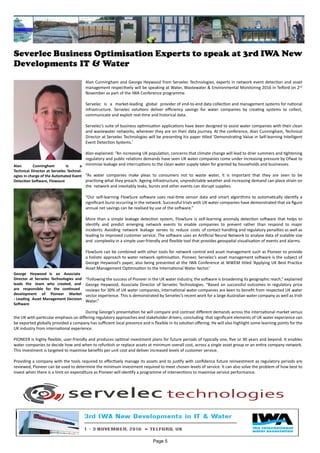
Alan Cunningham and George Heywood from Servelec Technologies, experts in network event detection and asset
management respectively will be speaking at Water, Wastewater & Environmental Monitoring 2016 in Telford on 2nd
November as part of the IWA Conference programme.
Servelec is a market-leading global provider of end-to-end data collection and management systems for national
infrastructure. Servelec solutions deliver efficiency savings for water companies by creating systems to collect,
communicate and exploit real-time and historical data.
Servelec’s suite of business optimisation applications have been designed to assist water companies with their clean
and wastewater networks, wherever they are on their data journey. At the conference, Alan Cunningham, Technical
Director at Servelec Technologies will be presenting his paper titled ‘Demonstrating Value in Self-learning Intelligent
Event Detection Systems.’
Alan explained: “An increasing UK population, concerns that climate change will lead to drier summers and tightening
regulatory and public relations demands have seen UK water companies come under increasing pressure by Ofwat to
minimise leakage and interruptions to the clean water supply taken for granted by households and businesses.
“As water companies make pleas to consumers not to waste water, it is important that they are seen to be
practising what they preach. Ageing infrastructure, unpredictable weather and increasing demand can place strain on
the network and inevitably leaks, bursts and other events can disrupt supplies.
“Our self-learning FlowSure software uses real-time sensor data and smart algorithms to automatically identify a
significant burst occurring in the network. Successful trials with UK water companies have demonstrated that six figure
annual net savings can be realised by use of the software.”
More than a simple leakage detection system, FlowSure is self-learning anomaly detection software that helps to
identify and predict emerging network events to enable companies to prevent rather than respond to major
incidents. Avoiding network leakage serves to reduce costs of contact handling and regulatory penalties as well as
leading to improved customer service. The software uses an Artificial Neural Network to analyse data of scalable size
and complexity in a simple user-friendly and flexible tool that provides geospatial visualisation of events and alarms.
FlowSure can be combined with other tools for network control and asset management such as Pioneer to provide
a holistic approach to water network optimisation. Pioneer, Servelec’s asset management software is the subject of
George Heywood’s paper, also being presented at the IWA Conference at WWEM titled ‘Applying UK Best Practice
Asset Management Optimisation to the International Water Sector.’
“Following the success of Pioneer in the UK water industry, the software is broadening its geographic reach,” explained
George Heywood, Associate Director of Servelec Technologies. “Based on successful outcomes in regulatory price
reviews for 30% of UK water companies, international water companies are keen to benefit from respected UK water
sector experience. This is demonstrated by Servelec’s recent work for a large Australian water company as well as Irish
Water.”
During George’s presentation he will compare and contrast different demands across the international market versus
the UK with particular emphasis on differing regulatory approaches and stakeholder drivers, concluding that significant elements of UK water experience can
be exported globally provided a company has sufficient local presence and is flexible in its solution offering. He will also highlight some learning points for the
UK industry from international experience.
PIONEER is highly flexible, user-friendly and produces optimal investment plans for future periods of typically one, five or 30 years and beyond. It enables
water companies to decide how and when to refurbish or replace assets at minimum overall cost, across a single asset group or an entire company network.
This investment is targeted to maximise benefits per unit cost and deliver increased levels of customer service.
Providing a company with the tools required to effectively manage its assets and to justify with confidence future reinvestment as regulatory periods are
reviewed, Pioneer can be used to determine the minimum investment required to meet chosen levels of service. It can also solve the problem of how best to
invest when there is a limit on expenditure as Pioneer will identify a programme of interventions to maximise service performance.
Alan Cunningham is a
Technical Director at Servelec Technol-
ogies in charge of the Automated Event
Detection Software, Flowsure
George Heywood is an Associate
Director at Servelec Technologies and
leads the team who created, and
are responsible for the continued
development of Pioneer Market
- Leading Asset Management Decision
Software
Page 5
NIVUS GmbH gain certification to ISO 14001
The measurement systems manufacturer regularly invests in optimum process design. In addition
to certification according to ISO 9001-2015 the company was certified according to the ISO 14001
environmental standard this year for the first time. Managing director Marcus Fischer says:
“As a provider of measurement systems whose products are mainly used in the fields of water
supply, water treatment and wastewater disposal, we consider it our responsibility to conserve
resources by optimising our internal processes“.
Apart from developing a future environment policy and training all employees accordingly, the
company this year has set itself concrete goals to conserve environments. For example, the entire
headquarters lighting system was updated to latest LED technology combined with smart lighting
controls. Another measure is the re-placement of the entire printer fleet by energy-efficient units
and systems featuring very low power consumption particularly during standby.
“We want to minimise the environmental impacts even in the future by optimising our processes.
We will gladly take up according ideas and suggestions from our employees“, Fischer says.
The new construction of the headquarters in Eppingen-Muehlbach 2017 is planned to exceed the current statutory requirements regarding environmental
protection by far. Solar power, the use of latest construction materials as well as energy-efficient systems for heating and ventilation enable very low energy
consumption.
The NIVUS products themselves are resource-friendly too. The company has developed a measurement system which is significantly more sustainable in
terms of material consumption and use of resources regarding units and installation than other systems available on the market today. To measure the flow
of water and wastewater in full pipes the manufacturer relies on ultrasonic systems. Particularly in large pipes an extreme reduction of raw materials of up
to 98% in contrast to commonly used magnetic-inductive measurement systems can be achieved with the same accuracy by using ultrasonic systems. More
benefits such as easier and more convenient logistics and installation can be found on the assets side of the environ-mental balance sheet too.
Resource-optimised measurement systems by NIVUS to ret-
rofit malfunctioning electro-magnetic flowmeter
New Expansion for Pulsar Process Measurement in China
British non-contacting measurement and control specialists Pulsar Process Measurement have strengthened the team in
China with the appointment of Eric Shi as National Sales Manager. He joins the growing Pulsar team who support customers
and distributors throughout Asia, supported by the Regional Head Office in Kuala Lumpur, Malaysia.
Eric joins Pulsar after ten years experience working with a leading Chinese distributor of Pulsar equipment, so he already
has a wealth of experience in Pulsar’s equipment and applications, and with experience in both sales and training, he is
perfectly placed. He sees great opportunities for Pulsar equipment throughout China as government increases its investment
in infrastructure such as water and wastewater treatment plants.
Helping to promote Pulsar’s world-leading range of non-contacting ultrasonic devices for level and flow control along with
Sludge Blanket detection and non-invasive flow measurement, he will be focussed on supporting an existing network of
distributors and developing new representation and distribution partnerships throughout China.
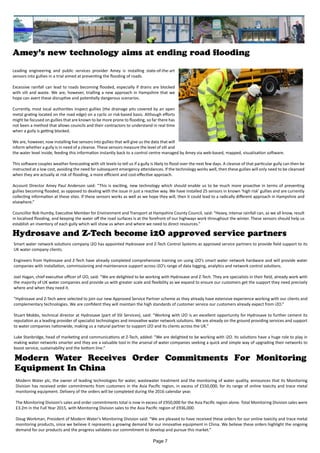
Eric Shi, Pulsar’s new National
Sales Manager in China
Ten candidates start digital apprenticeships with Northumbrian
Water
Ten candidates specialising in information technology have joined Northumbrian Water Group on ‘earn as you learn’ higher degree apprenticeships.
The ten learners will split their time between working and learning on the job with Northumbrian Water and academic studies, working towards a BSc
(Hons) Digital and Technology Solutions degree, delivered in partnership with the University of Sunderland. Higher degree apprenticeships are paid for jointly
between government and the employer, ensuring the learner gets paid to undertake academic studies, as well as the vocational learning, throughout the
course.
The apprentices will work on industry-leading technology to create and modify screens and reports for more than 600 users within Northumbrian Water
and mobile applications for employees and customers. Digital Apprentice Kyle Taylor said the Degree Apprentice role at Northumbrian Water is an incredible
opportunity, both qualification-wise but also primarily for vital industry experience, describing Northumbrian Water as at the forefront in leading IS
technologies and solutions within the water services industry.
Northumbrian Water programme director Nigel Watson commented:
“These ten young people will get the best of both worlds on the higher degree apprenticeships, learning and earning at the same time. This is a great
opportunity for them to gain invaluable on-the-job experience, getting a solid foot in the world of work and boosting their CV right from the start.”
Page 6
Amey’s new technology aims at ending road flooding
Leading engineering and public services provider Amey is installing state-of-the-art
sensors into gullies in a trial aimed at preventing the flooding of roads.
Excessive rainfall can lead to roads becoming flooded, especially if drains are blocked
with silt and waste. We are, however, trialling a new approach in Hampshire that we
hope can avert these disruptive and potentially dangerous scenarios.
Currently, most local authorities inspect gullies (the drainage pits covered by an open
metal grating located on the road edge) on a cyclic or risk-based basis. Although efforts
might be focused on gullies that are known to be more prone to flooding, so far there has
not been a method that allows councils and their contractors to understand in real time
when a gully is getting blocked.
We are, however, now installing live sensors into gullies that will give us the data that will
inform whether a gully is in need of a cleanse. These sensors measure the level of silt and
the water level inside, feeding this information instantly back to a control centre managed by Amey via web-based, mapped, visualisation software.
This software couples weather forecasting with silt levels to tell us if a gully is likely to flood over the next few days. A cleanse of that particular gully can then be
instructed at a low cost, avoiding the need for subsequent emergency attendances. If the technology works well, then these gullies will only need to be cleansed
when they are actually at risk of flooding, a more efficient and cost-effective approach.
Account Director Amey Paul Anderson said: “This is exciting, new technology which should enable us to be much more proactive in terms of preventing
gullies becoming flooded, as opposed to dealing with the issue in just a reactive way. We have installed 25 sensors in known ‘high risk’ gullies and are currently
collecting information at these sites. If these sensors works as well as we hope they will, then it could lead to a radically different approach in Hampshire and
elsewhere.”
Councillor Rob Humby, Executive Member for Environment and Transport at Hampshire County Council, said: “Heavy, intense rainfall can, as we all know, result
in localised flooding, and keeping the water off the road surfaces is at the forefront of our highways work throughout the winter. These sensors should help us
establish an inventory of each gully which will show us when and where we need to direct resources.”
Hydrosave and Z-Tech become i2O approved service partners
Smart water network solutions company i2O has appointed Hydrosave and Z-Tech Control Systems as approved service partners to provide field support to its
UK water company clients.
Engineers from Hydrosave and Z-Tech have already completed comprehensive training on using i2O’s smart water network hardware and will provide water
companies with installation, commissioning and maintenance support across i2O’s range of data logging, analytics and network control solutions.
Joel Hagan, chief executive officer of i2O, said: “We are delighted to be working with Hydrosave and Z-Tech. They are specialists in their field, already work with
the majority of UK water companies and provide us with greater scale and flexibility as we expand to ensure our customers get the support they need precisely
where and when they need it.
“Hydrosave and Z-Tech were selected to join our new Approved Service Partner scheme as they already have extensive experience working with our clients and
complementary technologies. We are confident they will maintain the high standards of customer service our customers already expect from i2O.”
Stuart Mobbs, technical director at Hydrosave (part of SSI Services), said: “Working with i2O is an excellent opportunity for Hydrosave to further cement its
reputation as a leading provider of specialist technologies and innovative water network solutions. We are already on the ground providing services and support
to water companies nationwide, making us a natural partner to support i2O and its clients across the UK.”
Luke Stanbridge, head of marketing and communications at Z-Tech, added: “We are delighted to be working with i2O. Its solutions have a huge role to play in
making water networks smarter and they are a valuable tool in the arsenal of water companies seeking a quick and simple way of upgrading their networks to
boost service, sustainability and the bottom line.”
Modern Water Receives Order Commitments For Monitoring
Equipment In China
Modern Water plc, the owner of leading technologies for water, wastewater treatment and the monitoring of water quality, announces that its Monitoring
Division has received order commitments from customers in the Asia Pacific region, in excess of £550,000, for its range of online toxicity and trace metal
monitoring equipment. Delivery of the orders will be completed during the 2016 calendar year.
The Monitoring Division’s sales and order commitments total is now in excess of £950,000 for the Asia Pacific region alone. Total Monitoring Division sales were
£3.2m in the Full Year 2015, with Monitoring Division sales to the Asia Pacific region of £936,000.
Doug Workman, President of Modern Water’s Monitoring Division said: “We are pleased to have received these orders for our online toxicity and trace metal
monitoring products, since we believe it represents a growing demand for our innovative equipment in China. We believe these orders highlight the ongoing
demand for our products and the progress validates our commitment to develop and pursue this market.”
Page 7
Researchers from KWR water recycle institute, MicroLAN, water company Vitens and Het Waterlaboratorium started a study on the adoption of the
BACTcontrol monitoring device for almost real time measurement of low concentrations of enterococci bacteria in drinking and surface water.
MicroLAN’s BACTcontrol already measures E.coli. Regulations however often requires the
measuring of both E.coli and enterococci bacteria as the two main microbial parameters for the
monitoring of drinking and bathing water quality.
These methods however take one or two days to produce a result. Especially for detection of
faecal contamination drinking water companies need faster methods.
The joint study is part of a project by Dutch consortium TKI Water technology that draws on
knowledge institutes, industry and water authorities to develop new water technologies.
Faecal contamination
Contamination with faecal microorganisms is the principal water-related health threat worldwide.
This is why the main microbial parameters for the monitoring of drinking and bathing water
quality are Escherichia coli (E. Coli) and enterococci, two species of microorganisms that occur
in large amounts in faeces.
Regulations today require that drinking and bathing water be analysed for the presence of E. Coli
and enterococci using culture methods.
A more rapidly detection of contaminations resulting from pipe fractures or work on the network, allows water supply companies to react immediately.
Moreover, fast detection methods could be used to monitor the effectiveness of management measures in the event of contamination incidents, and to
determine more rapidly whether surface and bathing water is safe for recreation.
Rapid E. Coli and enterococci detection
The rapid detection of E.coli by MicroLAN’s BACTcontrol is based on the detection of ß-D-glucuronidase enzyme. At the moment it is already possible to make a
reliable measurement in 2.5 to 4 hours. A new version, which only takes 1 to 2 hours to produce a result, will soon be available on the market. The researchers
use this new version to be adapted for the detection of enterococci which also contain the ß-D-glucosidase enzyme.
Further research required
On lab scale the adapated version showed producible results when applied to surface water samples and to drinking water, to which the diluted
ß-D-glucosidase enzyme has been added. Because the method is still subject to interference from the water matrix, particularly at low (under 10 kve)
concentrations of enterococci, the results are not solid enough for its immediate, reliable application in practice.
KWR and MicroLAN to develop rapid detection method for
enterococci bacteria in drinking water
Current BACTControl device for rapide measurement of
E.coli.
IWA publish their Global Trends report predicting areas of
research & development need
The global water challenge is unprecedented. Climate change, rapid urbanisation, increasing consumption and demand for food and energy, and changing
land use, will leave few countries and communities unaffected. The demand for water and sanitation services is greater than it has ever been, and water has
never been higher on the agenda. The Sustainable Development Goals (SDG) not only provide a framework to address water challenges, they put water at
the centre of the global agenda on sustainable development. This presents opportunities for the water sector to develop innovative solutions and scale-up
best practice.
Water management is a complex multi-disciplinary topic, and water professionals come in many different shapes. One of the unique strengths of IWA is
bringing together experts from across the globe and specialisations into communities of practice, IWA’s Specialist Groups. Connecting people from across
disciplines and across national boundaries accelerates the science, innovation and practice that can make a difference in addressing water challenges and
pushes the sustainability agenda.
The Global Trends and Challenges in Water Science, Research and Management compendium, draws upon the expertise of IWA’s specialist groups who have
identified the hot topics, innovations and global trends in water science, research and management that will have impact in solving global water challenges.
The compendium highlights a diversity of approaches, from detailed technical and scientific aspects to more integrated approaches.
To access the report click here
Page 8
New Water-Quality Station Is A Step Forward For Baltimore
Water Pollution Clean-Up
In a first for Baltimore and the nation, the U.S. Geological Survey and the Environmental Protection Agency will soon be installing a suite of sensors that will
provide the public and scientists with the first comprehensive, real time look at water quality in Baltimore’s Inner Harbour.
Baltimore’s Inner Harbour and the urban rivers that flow into it are important sources of water to Chesapeake Bay, popular recreation sites for residents and
tourists, and the targets of an ambitious clean-up plan to make the harbour swimmable and fishable by the year 2020. But until now, the city has lacked mon-
itoring systems where key water pollution indicators are continuously measured and made available to the public in real time.
A pilot program, announced by the EPA and USGS at today’s (Oct. 14) White House roundtable on environmental restoration in Baltimore, is designed to change
that.
“The water quality information provided by the U.S. Geological Survey and Environmental Protection Agency will inform the collective efforts of other federal,
state and local officials all working to make Baltimore Harbour safe for swimming and fishing,” said Don Cline, the USGS Associate Director for Water, from
USGS headquarters in Reston, Virginia. “Everyone deserves clean water, and the sensors will provide the local community a real-time look at water quality in
the harbour, informing efforts to improve it.”
Two instruments to be mounted near a pedestrian bridge across the mouth of the Jones Falls, overlooking the Baltimore Harbour Water Wheel (aka “Mr. Trash
Wheel”), will continuously monitor the water’s flow and quality. That information will automatically feed into two online networks: the USGS’ nationwide
water quality monitoring website, used by scientists, water quality managers, and citizens; and an EPA pilot project called “Village Blue,” which seeks to increase
public awareness of water quality issues.
“This initiative will provide the public with access to and understanding of water quality data they can use in a number of important ways,” said EPA Regional
Administrator Shawn M. Garvin. “The information will help people become better stewards of their local waterways and take actions to protect their health by
reducing exposure to contaminants.”
The Baltimore “Village Blue” station is the first of its kind in the nation. Modelled on an existing EPA air quality awareness program called “Village Green,” with
air pollution monitoring stations in six US cities, it will make flow and water-quality information from the Jones Falls available to the public in an easy-to-read
format on a soon to be live special EPA website. The information will also be available at the USGS water data website, where information from about 1.5 million
water monitoring sites nationwide is made public and searchable.
“We see this as more than a set of new scientific instruments. It is also a step forward in helping Baltimore meet its goal of a cleaner, healthier, more accessible
Inner Harbour,” said Mary Kay Foley, director of the USGS’ Maryland-Delaware-DC Water Science Centre, which collaborated on the project with the EPA
“The information we’re gathering will help scientists better understand how to clean up the Chesapeake Bay,” Foley said. “And it will empower the citizens of
Baltimore by giving them real time water quality and hydrologic information about the current status of their historic waterfront.”
The USGS operates more than a dozen continuous, comprehensive water-quality monitoring stations in Maryland, including several in the Baltimore metro
area. Information from these monitoring stations helps USGS hydrologists quantify the amount, types, and sources of pollution into the Chesapeake Bay, and
that information in turn helps guide Chesapeake Bay restoration efforts.
The new monitoring station will be equipped with a flow meter, and five water-quality sensors. The sensors will continuously measure water temperature,
salinity, oxygen content, pH (acidity or alkalinity) and turbidity (cloudiness). A sixth sensor, to be added later, will measure dissolved nitrogen compounds, which
act as a fertilizer for algae blooms. The equipment was paid for with funds appropriated by Congress after Superstorm Sandy struck the Northeast Coast in
October 2012. The EPA will provide funds to operate the station, and will also maintain the “Village Blue” website where its data will be displayed. The station
is also designed to serve as a test site for a new generation of low-cost water monitoring sensors being developed by the EPA.
Schneider Electric Ranked Top Asset Performance Management
(APM) Provider By Navigant Research
Schneider Electric, the global specialist in energy management and automation, recently announced that it has been named an industry leader in Navigant
Research’s report on Asset Performance Management (APM). In the report’s inaugural edition, Schneider Electric was positioned as a leading contender and a
top three provider among the 10 companies that were considered in the report. Scoring was based on product strategy and ability to execute.
“We are a pioneer in the Industrial Internet of Things (IIoT), and our placement in this Navigant Research report is a testament to the breadth and versatility of
our Enterprise APM platform and the value it provides for our customers,” said Kim Custeau, Director of Asset Management, Schneider Electric. “Our proven
ability to seamlessly integrate with existing systems and deliver continuous return on asset investments has enabled our customers to achieve significant savings
in maintenance costs and move from reactive to predictive maintenance strategies.”
Schneider Electric’s Enterprise APM leverages IIoT to close the loop between business and operations in an end-to-end platform that allows for open integration.
With Enterprise APM, industrial customers in the power, oil and gas, water wastewater, metals, mining and minerals, and other industries are able to maximize
their return on assets by reducing unscheduled downtime, increasing asset utilization and streamlining operations.
Page 9
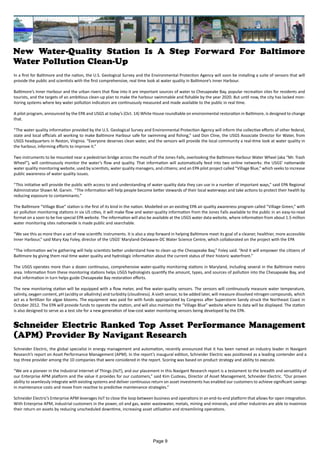
Vauxhall Motors in trade effluent deal with Detectronic
Flood and pollution prevention specialist Detectronic has secured a maintenance contract with Vauxhall Motors to deliver ongoing trade effluent monitoring
at the company’s Ellesmere Port plant.
Detectronic first supplied trade effluent monitoring equipment for Ellesmere Port 20 years ago, but has recently extended its relationship after supplying two
MSFM Lite Ultrasonic level monitors for stormwater monitoring to the plant last summer.
Phill Tuxford, sales and technical support engineer for Detectronic, said that he discussed with John Kenny, mechanical planning engineer for Vauxhall moni-
tors, how the supplier could further help with the company’s monitoring, analysis and delivery of accurate results for the company’s trade effluent.
“John hired one of our MSFM monitors for an 8 week period to verify exactly what type of results it could provide and after just two weeks, he decided to buy
the unit outright,” said Tuxford. “We now have three maintenance contracts for each of the three units and we also screen the data from those monitors on a
daily basis on behalf of Vauxhall. Our dedicated data centre team is able to inform John immediately if there are any oddities in the data that comes through
enabling him to deal quickly and efficiently with any issues before they even arise.
“The latest trade effluent unit we installed has also been set up on a separate login so that the representative from our respective water company can see the
data directly for himself which is of great benefit for both parties.
“We are now in the process of setting up some bespoke alarms and a monthly export of data (with daily consumption totals) for the same water company
representative, to provide even more robust trade effluent monitoring for the plant.”
John Kenny, mechanical planning engineer for Vauxhall Motors added: “Detectronic were recommended to me and from our initial work with Phill and the
team last year to this latest project, I have been very impressed with their highly professional, step-by-step approach to all aspects of our requirements.
“We’re a very busy plant and we rely on Detectronic’s daily verification data to sense check exactly what’s happening with our trade effluent – I can rely on
them to report even the slightest anomalies so we can address any issues before they even arise.
“At the same time, the monitors are important financially because they enable the water company to work out exact volumes of water in and effluent, they
can then charge us accordingly. Having such accurate data is very useful because we can verify ourselves that we are being charged for the right amount, no
more and no less.”
“Our environmental team also depends on the data the monitors provide. Compliance is a key factor in our industry – we must comply with numerous
discharge limits to ensure we are not breaching too much effluent so having the monitors and data they deliver enables us to keep an extremely close eye on
our trade effluent.”
Concludes Tuxford: “By working in partnership with John and his team, we have implemented a highly effective trade effluent monitoring system. As such,
we’re focused on enabling companies just like Vauxhall Motors to manage their water consumption and wastewater disposal more efficiently with the aim of
saving them money.”
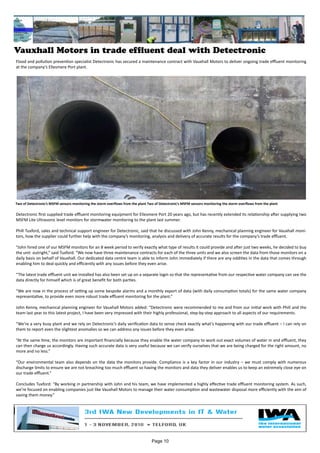
Two of Detectronic’s MSFM sensors monitoring the storm overflows from the plant Two of Detectronic’s MSFM sensors monitoring the storm overflows from the plant
Page 10
WRc Assess & Address®
completes 10,000th Sahara Survey
WRc, the innovation consultancy working in the Water, Environment, Gas and Resource Management sectors, is delighted to announce that their Assess &
Address® business specialising in pipeline condition assessment has completed its 10,000th Sahara survey.
Since 1998, WRc have been providing trunk main inspections for the water industry using their proprietary under-pressure inspection system, Sahara®. The
Sahara® platform has evolved over the last 18 years to include a variety of condition assessment techniques such as gross metal loss, sonar and conductivity,
building on its successful acoustic leakage detection, CCTV and deep main tracing capabilities.
Keith Walker, Head of Commercial Enterprise for WRc: “We have been experiencing steady growth and interest in trunk main leak detection and condition
assessment services. Improved understanding and recognition of trunk main losses across the industry, coupled with an ever increasing need to manage risk
of these critical assets, has led to a tripling of our operational teams. We are all delighted to have reached this milestone.”
Online Hexavalent Chromium Analyzer Validates RCOF
Treatment Process Piloted At California Water Utility
A California Water Utility experiencing elevated levels of hexavalent chromium [Cr(VI)] in their drinking water supply is the first commercial application to use
a real-time water quality monitor developed by Aqua Metrology Systems Ltd (AMS) to provide high frequency, reliable, and accurate data on hexavalent and
total chromium.
The Utility obtains water from a groundwater source where Cr(VI) is naturally occurring and has dissolved into the supply exceeding the regulatory MCL at 8
of their 12 inland wells. Whereas the regulatory MCL has been set at 10 ppb with a January 1, 2020 compliance deadline, these 8 wells average 13 ppb Cr(VI).
Under the technical guidance of Corona Environmental Consulting, LLC., a Reduction/Coagulation/Oxidation/Filtration (RCOF) process is being pilot tested to
verify a treatment approach for the Utility. The MetalGuard™ Cr(VI) monitor has been installed to provide real-time and multi-stream analysis of influent and
effluent hexavalent chromium levels for a variety of simulated operational conditions (e.g., varying chemical feed doses, contact time, and backwash frequen-
cies) being applied to the RCOF process.
The MetalGuard Cr(VI) monitor uses a self-calibrated voltammetric detector specifically developed to allow selective determination for hexavalent and total
chromium down to 1 ppb. The monitor evaluates multiple process streams, in this instance 1 raw water and 4 sample streams, and produces results in 30 min-
utes. The monitor operates fully unattended and continuously, 24/7, delivering between 45 and 50 analytical readings per day.
“The access to reliable near real time data in the field has been a valuable tool,” said Craig Gorman, Water Process Engineer, Corona Environmental Consulting,
LLC. “Using the MetalGuard analyzer allows us to adjust operational conditions in the field without having to wait for confirmatory laboratory results. Ultimately
this has allowed us to quickly progress through our testing matrix with the end goal of identifying a cost-effective and efficient treatment design for full-scale
implementation.”
Rick Bacon, CEO of Aqua Metrology Systems, added “Only online monitors can deliver the level of high frequency real time water quality data necessary for
engineering firms to assess ‘what if’ scenarios during pilot studies in a timely and cost-effective manner. The data collected during the pilot study will continue
to prove beneficial to the Utility once their remediation system is fully operational. The information can be used to control the dose rate and cost of treatment
chemicals and to detect quickly any signs of a failure in the treatment system that may put water quality at risk.
WITS Protocol hosts “WITS Expo”
The Water Industry Telemetry Standard (WITS) Protocol Association hosted its first WITS Expo on 18th October 2016. WITS was formed in 2003 with the aim
of developing a single telemetry protocol allowing any Field Device to connect to any Master System. Seven years later WITS-DNP3 protocol development was
completed and to date some 8,400 outstations have gone into service across five UK water companies.
Management of the new protocol was handed over to the WITS Protocol Standards Association (PSA) in 2010 and an elected group of volunteer users and
vendors formed the PSAC who manage all aspects of the PSA on behalf of the members. Users of WITS-DNP3 had realised many of the business benefits original-
ly documented, however they faced continual challenges to drive efficiency into their operational activities which means WITS also needs to react and develop
new features that meet future requirements.
The interactive event covered the WITS history and background, updated attendees on water industry adoption with “Good News Stories” from a number of
users, current protocol shortcomings and gave an exciting announcement on future developments. The day included plenty of opportunities for networking,
live vendor demonstrations of WITS-DNP3 Field Devices and Master Stations and active discussions and feedback helping to ultimately determine the future
path of the PSA.
Page 11
Article:
Flow Profile Explained
There are many different factors that can influence the final choice of flowmeter for an application. Of these factors, the flow profile is one of the most
important, but often least understood. This article explains how flow profiling can help you choose the best flowmeter for your application.
Flowmeter selection would certainly be a lot easier if every application behaved in the same way. Unfortunately, every fluid behaves differently when flowing
through the pipeline, meaning that there is no single flowmeter suitable for every job.
Understanding how this behaviour can affect flowmeter performance is crucial to ensuring that you get a flowmeter that matches your needs.
In simple terms, the flow profile explains the way in which the flow of a fluid behaves or is likely to behave in a pipeline based on its velocity and viscosity.
Once this is known, it is possible to start to decide which of the many different types of flowmeter available is best suited to the demands of the application.
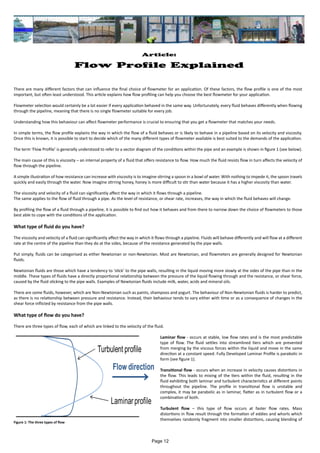
The term ‘Flow Profile’ is generally understood to refer to a vector diagram of the conditions within the pipe and an example is shown in figure 1 (see below).
The main cause of this is viscosity – an internal property of a fluid that offers resistance to flow. How much the fluid resists flow in turn affects the velocity of
flow through the pipeline.
A simple illustration of how resistance can increase with viscosity is to imagine stirring a spoon in a bowl of water. With nothing to impede it, the spoon travels
quickly and easily through the water. Now imagine stirring honey, honey is more difficult to stir than water because it has a higher viscosity than water.
The viscosity and velocity of a fluid can significantly affect the way in which it flows through a pipeline.
The same applies to the flow of fluid through a pipe. As the level of resistance, or shear rate, increases, the way in which the fluid behaves will change.
By profiling the flow of a fluid through a pipeline, it is possible to find out how it behaves and from there to narrow down the choice of flowmeters to those
best able to cope with the conditions of the application.
What type of fluid do you have?
The viscosity and velocity of a fluid can significantly affect the way in which it flows through a pipeline. Fluids will behave differently and will flow at a different
rate at the centre of the pipeline than they do at the sides, because of the resistance generated by the pipe walls.
Put simply, fluids can be categorised as either Newtonian or non-Newtonian. Most are Newtonian, and flowmeters are generally designed for Newtonian
fluids.
Newtonian fluids are those which have a tendency to ‘stick’ to the pipe walls, resulting in the liquid moving more slowly at the sides of the pipe than in the
middle. These types of fluids have a directly proportional relationship between the pressure of the liquid flowing through and the resistance, or shear force,
caused by the fluid sticking to the pipe walls. Examples of Newtonian fluids include milk, water, acids and mineral oils.
There are some fluids, however, which are Non-Newtonian such as paints, shampoos and yogurt. The behaviour of Non-Newtonian fluids is harder to predict,
as there is no relationship between pressure and resistance. Instead, their behaviour tends to vary either with time or as a consequence of changes in the
shear force inflicted by resistance from the pipe walls.
What type of flow do you have?
There are three types of flow, each of which are linked to the velocity of the fluid.
Laminar flow - occurs at stable, low flow rates and is the most predictable
type of flow. The fluid settles into streamlined tiers which are prevented
from merging by the viscous forces within the liquid and move in the same
direction at a constant speed. Fully Developed Laminar Profile is parabolic in
form (see figure 1).
Transitional flow - occurs when an increase in velocity causes distortions in
the flow. This leads to mixing of the tiers within the fluid, resulting in the
fluid exhibiting both laminar and turbulent characteristics at different points
throughout the pipeline. The profile in transitional flow is unstable and
complex, it may be parabolic as in laminar, flatter as in turbulent flow or a
combination of both.
Turbulent flow – this type of flow occurs at faster flow rates. Mass
distortions in flow result through the formation of eddies and whorls which
themselves randomly fragment into smaller distortions, causing blending of
Figure 1: The three types of flow
Page 12
the tiers within the fluid. Fully Developed Turbulent Profile is not fixed, but changes with the Reynolds number, approximating a flatter shape than the
parabolic, as also shown in the diagram below.
Turbulent flow is the flow regime found in almost all applications, and is the preferred condition for a flowmeter installation as flowmeters are all calibrated in
such conditions and it provides the best situation for the flowmeter to achieve repeatable and accurate flow measurements.
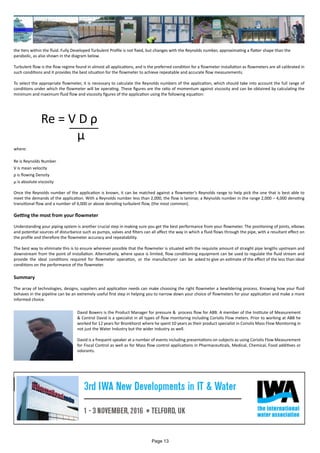
To select the appropriate flowmeter, it is necessary to calculate the Reynolds numbers of the application, which should take into account the full range of
conditions under which the flowmeter will be operating. These figures are the ratio of momentum against viscosity and can be obtained by calculating the
minimum and maximum fluid flow and viscosity figures of the application using the following equation:
		Re = V D ρ
			
where:
Re is Reynolds Number
V is mean velocity
ρ is flowing Density
µ is absolute viscosity
Once the Reynolds number of the application is known, it can be matched against a flowmeter’s Reynolds range to help pick the one that is best able to
meet the demands of the application. With a Reynolds number less than 2,000, the flow is laminar, a Reynolds number in the range 2,000 – 4,000 denoting
transitional flow and a number of 4,000 or above denoting turbulent flow, (the most common).
Getting the most from your flowmeter
Understanding your piping system is another crucial step in making sure you get the best performance from your flowmeter. The positioning of joints, elbows
and potential sources of disturbance such as pumps, valves and filters can all affect the way in which a fluid flows through the pipe, with a resultant effect on
the profile and therefore the flowmeter accuracy and repeatability.
The best way to eliminate this is to ensure wherever possible that the flowmeter is situated with the requisite amount of straight pipe lengths upstream and
downstream from the point of installation. Alternatively, where space is limited, flow conditioning equipment can be used to regulate the fluid stream and
provide the ideal conditions required for flowmeter operation, or the manufacturer can be asked to give an estimate of the effect of the less than ideal
conditions on the performance of the flowmeter.
Summary
The array of technologies, designs, suppliers and application needs can make choosing the right flowmeter a bewildering process. Knowing how your fluid
behaves in the pipeline can be an extremely useful first step in helping you to narrow down your choice of flowmeters for your application and make a more
informed choice.
μ
David Bowers is the Product Manager for pressure & process flow for ABB. A member of the Institute of Measurement
& Control David is a specialist in all types of flow monitoring including Coriolis Flow meters. Prior to working at ABB he
worked for 12 years for Bronkhorst where he spent 10 years as their product specialist in Coriolis Mass Flow Monitoring in
not just the Water Industry but the wider industry as well.
David is a frequent speaker at a number of events including presentations on subjects as using Coriolis Flow Measurement
for Fiscal Control as well as for Mass flow control applications in Pharmaceuticals, Medical, Chemical, Food additives or
odorants.
Page 13
Article:
Improving Water/Wastewater
Infrastructure Performance with
Operational Analytics
Operational analytics is rapidly emerging as an effective system for capturing and evaluating the high-impact, high-value data for better business outcomes.
It helps infrastructure professionals to better design, operate, and maintain water and wastewater infrastructure at a level of excellence that improves
performance, return on investment and efficiency; cuts OPEX; and minimizes unplanned downtime. Operational analytics affords a deep understanding of how
and why infrastructure system networks yield given results, and what can be done to deliver against complex business imperatives.
For this system to work best, it is necessary to integrate data gathered from various sources. By integrating data from information technology (IT) and
operational technology (OT), and further adding engineering technology (ET), asset owners can realize intelligence in near real-time. Several steps must be
taken for this to happen.
Firstly, the role of infrastructure engineers is of paramount importance to any successful operational strategy. The future of engineering for infrastructure is
evolving; meaning they are more vested in the performance of assets than ever before. Engineers are now moving into the information management business,
ensuring data created in early phases can be collaboratively passed through the supply chain for useful asset performance management and decision making
capabilities. An example would be the models created by engineers to build infrastructure assets. Future engineers must deliver “digital engineering models,”
whose features can deliver optimal operating performance from the asset. Moreover, the model’s digital DNA that is the foundation of early-stage design/build
must be able to anticipate and predict asset characteristics and performance in order to support effective engineering and operational decision making.
(It is important to note that while gathering and using the data, that data is sometimes problematic and prone to redundancy. Yet, the IT component of the
convergence process contains self-regulating, self-optimizing algorithms that produce and apply original data to manage increasingly complex operating system
controls and processes.)
By converging IT, OT, and ET data, an operational analytics system can be realized by maximizing the potential of data, people, equipment, and processes.
An operational analytics system is particularly relevant across the water and wastewater lifecycle. This is because water utilities and wastewater plants have
specific business imperatives and business outcomes they need to achieve as part of their operational strategy. These outcomes can be met with better decision
making based on quantitative methods derived from algorithmic techniques to allow for better clarity and timeliness that results in performance-enhancing
adjustments and initiatives when and where they’re needed.
The aim is to achieve improved asset performance management with predictive capabilities that ensure maximum lifetime and nimble, cost-effective
functioning without interruption.
A pioneering approach in South Australia
The charter example of how seamless IT, OT, and ET comes together is a desalination plant in Adelaide, South Australia. Here, Bentley Systems’ AssetWise
Amulet software implemented a real-time, predictive operational analytics that improved customer service and cut operating costs. The operator, SA Water,
can import diverse inputs, such as weather and population data, and display them on easily configured, interactive dashboards to present a very granular per-
spective that helps it gauge and plan for network water demands.
Since AssetWise Amulet converges data from multiple systems, SA Water can get and view demand forecasts on an hourly, daily, weekly, monthly, and annual
basis, making it possible to predict long-term demand as far out as 10 years. Its digital engineering model becomes the foundation for a network operations
model that lets the utility deploy its plant and reservoirs for pump storage that optimizes metrics, such as electricity consumption.
Demand forecasting and distribution tools and an energy portfolio management system were rolled out in stages to predict water and power usage, visualize
water availability, and optimize water distribution. The trio of systems saved the water authority AUD 3 million by predicting tariff increases and moving water
accordingly, and cut AUD 800,000 from network operations costs.
This analytics deployment gives SA Water total plant and network visibility and the ability to sync up with the volatile forward market for purchasing electricity.
Now, it can look at the spot market to predict prices and have its control room operators choose the best times of day to operate the pumps for moving water
across the network – and take maximum advantage of the fluctuating price trends.
The catalyst for what happened in Adelaide, the user-driven AssetWise platform, realizes the full potential of operational analytics to predict performance,
pre-empt dangers, and take advantage of business opportunities. It can find, capture, and control operational data across the enterprise to make infrastructure
safer, more efficient and productive. It combines and transforms data from multiple points and devices – including metering systems and sensors – into useful
intelligence for gauging costs and change impacts. The AssetWise platform can perform calculations based on its performance-monitoring capability to make
business processes pro-active instead of re-active. Additionally, it gets operating personnel the information they need, when they need it, to make smarter
decisions more quickly, through automation.
Operational analytics of this type is premised on foresight and fail safe protection – i.e., the prescience to spot operational and asset performance data trends
and act accordingly, and the power to validate data integrity by checking, via calculations, for any suspect anomalies in new data. It makes comprehensive and
regularly updated predictions of core asset behaviours, such as flows, pressures, water quality, and tank levels, so that network configurations and equipment
calibrations are optimal for systems operations.
Page 14
Next-generation digital DNA
Technological advancement and the development of the skills sets needed to use them have created a conducive environment for a convergence of IT, OT, and
ET that bridges the gap between data formats to make infrastructure assets more powerful, efficient, and reliable by exploiting the big data potential. Indeed,
SA Water’s experience hints at how digital engineering models are evolving toward an upgrade to the Industrial Internet of Things (IIoT): digital engineering
tools that go beyond observing and monitoring the asset’s performance to modelling its desired behaviour. The models of the near future can connect the
intelligent hardware – such as unmanned aerial vehicles (UAVs) and drones – that is available for computing, mobility, positioning, and imaging to – for example
– continuously monitor and analyze a substation’s performance and the associated changes over time. Armed with this potential, operators can continuously
survey their assets. In this way, ET can complete the third part of the convergence triad.
Bentley’s ContextCapture is bringing ET into the triad through continuous surveying, where UAVs take ordinary digital photographs or employ video to create
a 3D reality mesh that puts the data in context – i.e., geo-coordinates it positionally – within a 3D digital engineering model or frame of reference. This kind
of model can even be derived from a thermographic imagery.
What’s clear is that either photography or videography can capture an asset’s 3D “virtuality” and apply it to the “reality” of the existing infrastructure. The
continuous survey enabled can be invaluable in the field, where it can monitor impacts such as corrosion, and deliver the operational insights that all of the
participating engineers – in maintenance, operations, and design – can view and synchronize and, if need be, correct for optimal asset performance modelling.
Prescriptive and predictive analytics can determine actual asset performance, compare it to the envisioned performance, and meld it with right-now
information from the IIoT, OT-driven Big Data streams and historical (IT-driven) and engineering data to improve the quality, productivity, and efficacy of wa-
ter and wastewater treatment, distribution and storage operations. Practically speaking, this speeds the time-sensitive identification and resolution of critical
issues.
Now, there is a direct and actionable link between digital engineering models and physical assets. This creates more and greater degrees of connectivity and
knowledge that smooths the transition from predicting to prescriptively optimizing operations, and then to making them self-governing and self-correcting.1
IIoT and supervisory control and data acquisition (SCADA) software have had a harmonic convergence of their own in enriching the oversight value of
operational analytics for far-flung treatment, distribution, and collection facilities.
SCADA systems help supervise the operation of remote telemetry units (RTUs) and programmable logic controllers (PLCs) and manage the information they
generate throughout water management processes. Leveraging IIoT to connect smart meters, water quality sensors, and other assets makes it possible to send
data to a cloud historian platform that processes, analyzes, and reports on utility and facility operations to all operations personnel who need to know and use
that information.2
Hydraulic modelling for the comprehensive lifecycle
Simulating a water network has been prevalent in the design and management, and, more recently, the operational phases of the infrastructure water lifecycle.
An analytics-driven ability to model and predict the performance of water and wastewater distribution systems and networks has immense, positive
implications for master planning networks, saving energy and impeccably responding to emergencies and disruptions of any kind.
In that regard, hydraulic modelling can effectively complement the operational analytics function in a number of ways. It simplifies and accelerates the
otherwise-tedious calculations needed to determine how much energy and money can be saved by a system improvement, such as the installation of a
new pump to meet changing topographical conditions or usage demands. Likewise, it can model complex pump combinations and variable speed pumps to
show how they would impact energy usage. Hydraulic modelling can also give the strategic basis for locating and routing new transmission mains, pumping
stations, and storage facilities.
In tandem with engineering GIS, hydraulic modelling can digest a rich historical combination of inspections, repairs and defects to inform decisions for renew-
ing,
rehabilitating, expanding, or replacing network systems. This pairing also tells operators where to site and how to size pipes, storage, pump stations, and pumps
to meet anticipated capacity and supply needs and regulatory requirements. In effect, they can make design and build plans that will foreshadow and reliably
accommodate future land use change, population growth, and climate change impacts.
Hydraulic modellers can use a network model to do risk-free testing of different emergency protocols, tactics, and operational strategies. And, they can identify
low-cost, low-risk ways to help water transmission and distribution (T&D) networks adapt more flexibly and readily to shifting circumstances.
Back at the desalination plant, optimization analytics turned data from the demand forecasting tool into a live hydraulic model that determines network-wide
water pressures and flows, so that SA Water can know how much water to move, where to transfer it, and what pumps and valves it needs for that operation.
Thanks to the hydraulic model, SA Water can ensure a reliable water supply by quickly spotting and solving problems – a benefit that has cut problem-response
times by 90 percent. This has greatly reduced the risk of shutdowns and the escalation of repair-and-shutdown-related issues into major events.
Data convergence:
The right data vs. too much data It’s no secret that the amount of data being produced is more than organizations and systems have the capacity or
methodology to process effectively. Driven by the digitization requirements generated through advancements in technology and the need for better delivery of
business imperatives, infrastructure professionals are needing near-scientific examinations of the data in order to mine it effectively. Advanced automation is
helping to deliver actionable information to improve the asset with greater confidence in the machine. Yet importing a bunch of data stored in disparate, siloed
SCADA, computerized maintenance management software (CMMS), GIS, and hydraulic monitoring databases can result in confusion instead of insight unless
the information serves clear operational goals,3
so data integration must be easy to understand and interpret, as well as intuitive and pertinent.
Page 15
Embracing data convergence of this kind is a paradigm shift for many organizations in the water and wastewater industries who are under the impression
that data analytics is complex and, hence, too difficult to understand and apply to their own business.4
Companies that don’t grasp the value of analytics may
be reluctant to invest in the technologies and talent that can harness it. The trick is convincing them that making the business decisions that drive growth,
performance integrity, and asset health depends upon finding and processing the right data to get the fresh intelligence necessary for solving problems. The
tripartite technology symbiosis for melding data and predictive, operational analytics into the decision-making process is in a formative stage, but the time is
coming when it will become mature, and commonplace.
References
1.	 Operational Analytics in Water and Wastewater, WaterWorld, 2016.
2.	 SCADA for Water & Wastewater, Schneider Electric Software, 2016.
3.	 Hatchett, Sam, Uber, Jim, Real-Time Predictive Analytics for Smart Water Infrastructure, Water Online, 2015.
4.	 Water 2.0: The Top Trends in the Global Water Sector, Deloitte, 2016.
Case Study:
The use of online THM Analysers for
maintaining water quality
Bentley is a global leader dedicated to providing architects, engineers, geospatial professionals, constructors, and owner-
operators with comprehensive software solutions for advancing infrastructure. Founded in 1984, Bentley has more than 3,000
colleagues in over 50 countries, more than $600 million in annual revenues, and since 2008 has invested more than $1 billion
in research, development, and acquisitions
Introduction
Over the past decade the more than 200 water treatment works (WTWs) sources
managed by the Scottish Water Utility have been affected by deterioration in water qual-
ity caused by environmental factors including climate change. The deterioration has pri-
marily been observed through increased water colour and natural organic matter levels
which pose a significant treatment challenge because of the resulting formation of
disinfection by-products (DBPs). To ensure deteriorating source quality does not
affect customer’s drinking water, Scottish Water has used operational enhancements
and online water quality analyzers to meet the strict trihalomethane (THM) discharge
requirements needed to guarantee DBP regulatory compliance.
In 2010 Scottish Water began continuous online monitoring of THM levels with the
THM-100™ manufactured by Aqua Metrology Systems (AMS). In total, three THM-100
units have been purchased and used to optimize a number of Scottish Water systems
since 2010; one unit was installed at the Bradan WTWs, another at the Tullich WTWs,
and one was transported throughout the region as needed at other Scottish Water
facilities. Prior to the purchase of the online THM monitors Scottish Water relied on
standard laboratory analysis. Analytical results could take up to a week to be returned,
making it very difficult for operations staff to fully optimize the treatment processes at
any given facility since they were working off THM results that were a week old. The
THM-100 monitor enabled Scottish Water to have visibility of process improvement
changes and their impact on DBP formation by providing the operational staff with
immediate and accurate daily reports on THM levels. The THM-100 proved
especially valuable at the Tullich WTWs when the facility tested and implemented an
aeration system to further minimize THM formation.
Online THM Monitor Validates TRS Process
The Tullich Water Treatment Works in Oban, Scotland services the needs of approximately 13,000 inhabitants through a 2.64 MGD (11 MLD) plant consisting
of pre-filtration using microstrainers, pre-ozonation, granular activated carbon and post-ozonation. Chlorine gas is used as the primary disinfectant. THMs are
formed when natural organic matter present in the water reacts with the chlorine disinfectant during the water treatment process. When Tullich was built in
1970s it was a state-of-the-art WTWs designed to meet the challenges for that period. New water quality regulations introduced to protect and improve public
health require Scottish Water to invest in a new WTW that will be commissioned by the end of 2017. Until then a concerted effort by staff is required to optimize
treatment processes and keep the current facility in compliance with all quality standards.
Over the past decade the more than 200 water treatment works (WTWs) sources managed by the Scottish Water Utility have been affected by deterioration in wa-
ter quality caused by environmental factors including climate change. The deterioration has primarily been observed through increased water colour and natural
organic matter levels which pose a significant treatment challenge because of the resulting formation of disinfection by-products (DBPs). To ensure deteriorating
source quality does not affect customer’s drinking water, Scottish Water has used operational enhancements and online water quality analyzers to meet the strict
trihalomethane (THM) discharge requirements needed to guarantee DBP regulatory compliance.
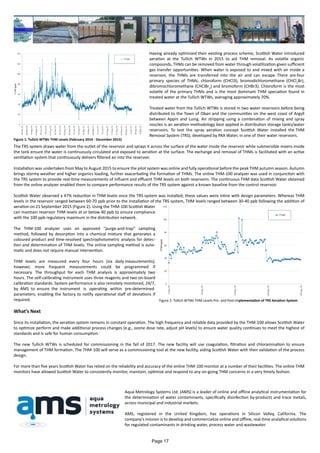
A profile of the THM levels at the Tullich WTWs from February 2014 to December 2015 is detailed in Figure 1, data was provided by the online THM-100 monitor.
Page 16
Having already optimized their existing process scheme, Scottish Water introduced
aeration at the Tullich WTWs in 2015 to aid THM removal. As volatile organic
compounds, THMs can be removed from water through volatilization given sufficient
gas transfer opportunities. When water is exposed to and mixed with air inside a
reservoir, the THMs are transferred into the air and can escape. There are four
primary species of THMs; chloroform (CHCl3), bromodichloromethane (CHCl2
Br),
dibromochloromethane (CHClBr2
) and bromoform (CHBr3). Chloroform is the most
volatile of the primary THMs and is the most dominant THM speciation found in
treated water at the Tullich WTWs, averaging approximately 70%.
Treated water from the Tullich WTWs is stored in two water reservoirs before being
distributed to the Town of Oban and the communities on the west coast of Argyll
between Appin and Luing. Air stripping using a combination of mixing and spray
nozzles is an aeration methodology best applied in distribution storage tanks/water
reservoirs. To test the spray aeration concept Scottish Water installed the THM
Removal System (TRS), developed by PAX Water, in one of their water reservoirs.
The TRS system draws water from the outlet of the reservoir and sprays it across the surface of the water inside the reservoir while submersible mixers inside
the tank ensure the water is continuously circulated and exposed to aeration at the surface. The exchange and removal of THMs is facilitated with an active
ventilation system that continuously delivers filtered air into the reservoir.
Installation was undertaken from May to August 2015 to ensure the pilot system was online and fully operational before the peak THM autumn season. Autumn
brings stormy weather and higher organics loading, further exacerbating the formation of THMs. The online THM-100 analyzer was used in conjunction with
the TRS system to provide real-time measurements of influent and effluent THM levels on both reservoirs. The continuous THM data Scottish Water obtained
from the online analyzer enabled them to compare performance results of the TRS system against a known baseline from the control reservoir.
Scottish Water observed a 47% reduction in THM levels once the TRS system was installed; these values were inline with design parameters. Whereas THM
levels in the reservoir ranged between 60-70 ppb prior to the installation of the TRS system, THM levels ranged between 30-40 ppb following the addition of
aeration on 21 September 2015 (Figure 2). Using the THM-100 Scottish Water
can maintain reservoir THM levels at or below 40 ppb to ensure compliance
with the 100 ppb regulatory maximum in the distribution network.
The THM-100 analyzer uses an approved “purge-and-trap” sampling
method, followed by desorption into a chemical mixture that generates a
coloured product and time-resolved spectrophotometric analysis for detec-
tion and determination of THM levels. The online sampling method is auto-
matic and does not require manual intervention.
THM levels are measured every four hours (six daily measurements);
however, more frequent measurements could be programmed if
necessary. The throughput for each THM analysis is approximately two
hours. The self-calibrating instrument uses three reagents and two on-board
calibration standards. System performance is also remotely monitored, 24/7,
by AMS to ensure the instrument is operating within pre-determined
parameters; enabling the factory to notify operational staff of deviations if
required.
What’s Next
Since its installation, the aeration system remains in constant operation. The high frequency and reliable data provided by the THM-100 allows Scottish Water
to optimize perform and make additional process changes (e.g., ozone dose rate, adjust pH levels) to ensure water quality continues to meet the highest of
standards and is safe for human consumption.
The new Tullich WTWs is scheduled for commissioning in the fall of 2017. The new facility will use coagulation, filtration and chloramination to ensure
management of THM formation. The THM-100 will serve as a commissioning tool at the new facility, aiding Scottish Water with their validation of the process
design.
For more than five years Scottish Water has relied on the reliability and accuracy of the online THM-100 monitor at a number of their facilities. The online THM
monitors have allowed Scottish Water to consistently monitor, maintain, optimize and respond to any on-going THM concerns in a very timely fashion.
Aqua Metrology Systems Ltd. (AMS) is a leader of online and offline analytical instrumentation for
the determination of water contaminants, specifically disinfection by-products and trace metals,
across municipal and industrial markets.
AMS, registered in the United Kingdom, has operations in Silicon Valley, California. The
company’s mission is to develop and commercialize online and offline, real-time analytical solutions
for regulated contaminants in drinking water, process water and wastewater.
Figure 1: Tullich WTWs THM Levels (February 2014 - December 2015)
Figure 2: Tullich WTWs THM Levels Pre- and Post-Implementation of TRS Aeration System
Page 17
Article:
Building The Business Case For The
Smart Grid For Water
By and large, utilities make decisions based on costs. And as most of our municipal utilities operate as enterprise funds, they must ensure that the costs of
operations, administration, and capital improvements can be serviced by the revenue generated from utility customers. Given that water consumption is
decreasing (as a function of fixture efficiency, voluntary and mandatory conservation, and increasing costs to the consumer), utilities find themselves in an
increasingly tenuous financial condition. This financial instability impedes the adoption of technology, potentially isolating utilities from the benefits of the
Smart Grid for Water.
It is these conditions that drive the urgency for the adoption of the Smart Grid for Water. At the intersection of the meter and customer, we can generate
significant financial benefits while reducing costs, resulting in platforms that are self-funding. With this approach, utilities can get new meters, highly functional
data management, billing, and customer presentment tools — all at less than the costs of providing those services today. How is this possible? By leveraging
the power and economies of scale of cloud-based, software-as-a-service (SaaS) platforms, and taking advantage of the low cost of capital available in today’s
market.
I Spend How Much?!
There is a myriad of activities that can go into the provision of billing and remittance
management in water utilities, and understanding these “business as usual” costs is key
to unlocking the potential for savings.
The cost of billing is much more than the cost of paper and stamps. Many utilities
employ a cadre of meter reading staff, or use operations staff in the meter reading
process. Further, the costs of customer service call centres, physical costs of truck rolls
for meter reading and re-reads, maintenance and license fees for on-premise software
systems, meter repair and replacement programs, insurance and administrative costs,
bad debt, and collections management all add to the cost of the bill. Add in the fact
that, in most utilities, customer information systems are antiquated, with customer
engagement usually accomplished with significant human resources, as well as costs
incurred from data errors and remediation, and we can see the costs skyrocket.
All told, the median cost of generating an invoice and getting paid in a water utility in the
U.S. is in the range of $8 to $12 per account per month. That’s a staggering percentage of
the customers’ actual bill. And as the utility size gets smaller (the reality of water utilities
in the U.S.), the cost of this business increases — it’s a function of scale.
This represents a utility vertical that is ripe for innovation to drive the cost of service
down while improving service levels and functionality.
While this situation may seem irreparable, the fact that most of the costs of performing these activities are already baked into utility financials, budgets, and
rates today. We have, therefore, a source of funds to work with: by modernizing this process for less than current costs, we can liberate significant funds for
continued innovation in the Smart Grid for Water.
In fact, the economics rapidly become extremely attractive, with an immediate “return on investment.”
Page 18
Save Money With Better Service
The advent of software-as-a-service platforms now allows utilities to access modern, highly-functioning, and easy-to-use tools to manage billing without the
investment in licenses, specialized IT resources, and dedicated server and communication hardware. Using SaaS-based systems, the costs of modernization of
billing and customer service are not a long-term, complicated, and risky capital project, but an operational expense that provides high reliability, security, and
guaranteed service levels for a low cost. In fact, with the appropriate solution, the costs can be less than 50 percent of what many utilities incur today.
And that frees up the funds to invest in another cost-saving component of the Smart Grid for Water: advanced metering infrastructure (AMI).
Consider a community of 12,000 connections that currently has manually read meters and has been shown to have a cost of $11 per meter per month. Under
a SaaS services model, the real costs for putting a bill out the door and managing the billing/remittance process can be reduced by 20 percent or more —
including the cost of capital for new metering infrastructure.
As a result, for a total cost in the order of $9 per meter per month, the utility actually saves $2 per meter per month in their billing process. That’s $288,000
annually that can be invested in system improvements, replacing aging infrastructure or other efficiency-generating projects, while receiving the benefit of new
infrastructure, new billing systems, and improving the customer-utility interaction.
The adoption of AMI drives further efficiencies into the utility. While AMI eliminates the costs of routine meter reading, more importantly, when combined
with geospatial meter data management, it increases the accuracy and precision of the meter read, reducing re-reads and re-work. The result is 100 percent
accurate and timely reads ready for billing at all times, and identification of failed and failing meters well before billing, improving the utility’s cash flow.
And this is before the found revenue aspects of the Smart Grid for Water and the impact of these systems on the cash flow of the utility are realized.
Based in Phoenix, AZ with offices in and Austin, TX and Alpharetta, GA, FATHOM is a software-as-a-service company
helping water utilities do more with declining resources. With rapidly deployable, risk-free, cloud-based solutions that
address all aspects of the meter-to-cash verticals for water utilities, FATHOM increases revenue, decreases costs and
delights customers. FATHOM was built by a water utility, for water utilities and delivers a risk-free solution to more
than 160 organizations around the world. There is strength in numbers. To learn more, visit www.gwfathom.com.
‘Smart’ flood alleviation system
protects Portsmouth
In late 2014, Southern Water completed a major project to reduce the risk of sewer flooding in parts of Portsmouth and Southsea. Substantial works were
undertaken to divert runoff and tidal ingress, and a ‘smart’ hydrometeorological monitoring system was installed to enable prompt diversion of excess water
during periods of high rainfall. Sewer level monitoring is undertaken in real-time and intelligent raingauges (smart sensors) combine with radio telemetry to
inform a computer based catchment-wide water model. This decision support system provides advance notice for staff at the Eastney pumping station that
diverts large quantities of water to storage tanks during periods of heavy rain. Through the development of a smart sewer network, Southern Water has
dramatically reduced the risk of flooding in Portsmouth whilst also delivering substantial environmental benefits.
Background
Portsmouth was one of the first cities in the UK to benefit from a dedicated sewerage
system in 1865. At that time, the system combined foul and surface water systems,
and was adequate because with less paved areas the flows were lower, and because
flows were discharged into the sea untreated. Since that time, the City of Portsmouth’s
drainage network has continued to develop but has remained dependent on the use
of combined sewers and the Eastney Pumping Station. The city is now served by two
interceptor sewers that run north to south on the western and eastern sides of the
island. These interceptor sewers carry the combined sewage flows to Eastney. In dry
weather, flows arriving at Eastney are screened and pumped to Budds Farm WwTW for
treatment. These flows, together with treated flows from the Havant catchment, then
gravitate back to Eastney and are pumped down the long sea outfall.
Historically, during periods of high rainfall, the incoming flows exceeded the capacity
of the system and excess flow was pumped from the Eastney pump station to storm
tanks at Fort Cumberland. These tanks have a capacity of 40,000m3
and are filled be-
fore any flows are discharged to the sea via the short sea outfall, and then emptied
back to Eastney after the storm has passed. However, due to the quantity of
storm water arriving at Eastney prior to the flood alleviation project, and allowing
for filling and emptying the tanks, in a typical year 650,000m3 of screened wastewater
was discharged via the outfall at Fort Cumberland, in the South East of Portsmouth at
the mouth of the Langstone Harbour.
Page 19
Approximately 60% of the catchment consists of built up areas, 80% of which drain to the Eastney pump station. This means that nearly half of the entire
surface area of Portsmouth drains to Eastney, which causes extremely large flows during storm conditions. In dry weather, flows are less than 1,000 l/s.
However, in storm conditions flows increase to more than 20,000 l/s.
On 15 September 2000 an exceptionally severe storm overwhelmed the Eastney pump station, causing the pump room to be flooded, which stopped the
pumps and over 750 properties were flooded. Considerable investment has subsequently taken place at Eastney with the provision of a new standby pump
station. However, with half of all rain that falls on the island ending up at Eastney there is still a major risk that the capacity of the pump station will be exceeded.
Portsmouth Flood Alleviations Scheme
The majority of the flow in wet weather is surface water, so the
Portsmouth Flood Alleviations Scheme was created to divert surface water to
the sea instead of entering the combined sewer. This would free up capacity
in the existing infrastructure, allowing it to be used to provide protection
against larger storms. In total, surface flow from 34 Hectares of paved area was
diverted by the project.
The flow reduction initiatives have reduced the flow arriving at Eastney to
the extent that the required flood risk protection level has been achieved. In
order to reduce tidal infiltration and tidal restriction of CSO operation, new
surface water pipes, culverts and swales were created, and several sections of
the public sewer were remediated.
Pump management
The large diesel pumps at Eastney have an enormous capacity, with a combined ability to remove 6,500 litres per second. However, they take 15 to 30 minutes
to build up to full speed so advance notice is necessary. The pump station is manned 24 hours/day and a network of 4 sewer water level sensors and 10 rainfall
monitors delivers data via OTT Adcon radio telemetry to a catchment software model developed by Innovyze.
Employing the latest technology, OTT Pluvio2 rain gauges are able
to measure both rainfall amount and rainfall intensity. This is important
because traditional raingauges simply supply historical data on the amount
of precipitation, whereas near real-time access to precipitation intensity
dramatically increases the speed with which the monitoring system is able
to deliver storm warnings. Another key feature of these smart rain gauges
is their ability to operate reliably without the level of maintenance that is
required by traditional raingauges. For example, they are able to issue alerts
when maintenance is necessary.
Summarising, Rob McTaggart, technical lead at MWH says: “Collaboration
with the community, and other stakeholders in Portsmouth, made it
possible for the project consortium to design and implement a solution that
separated surface water to provide resilience, significantly boost flood
protection and benefit the environment with the minimum of new
infrastructure.
“Clearly, the flood alleviation scheme has been a success and as a result, the pumps at Eastney are called into action less often.
“The early warning system appears to be working very well. Some of the rainfall prediction data, provided by external sources, can sometimes provide
erroneous projections because of the localised nature of precipitation events, so it is important to have a sufficient number of raingauges to ‘calibrate’
projections and deliver the level of precision required.”
OTT Hydrometry manufactures products that enable water professionals to monitor the planet’s most precious
resource. Through the delivery of accurate reliable data, OTT’s instruments and services provide essential tools to help
protect the environment.
From precipitation through surface and ground water to marine monitoring applications, OTT’s measurement and
communication technologies provide a complete picture of the water cycle. Adcon Telemetry was acquired in 2011,
and Sutron and Lufft joined the OTT Hydromet Group in 2015, which means that the company is able to offer the best
sensors and data handling technology for every application.
Completely focused on hydro-meteorology and water quality, OTT products have been market leaders for over 140
years and coupled with modern communications technology provide remote access to continuous monitoring data.
Page 20
November 2016
IWA New Developments in IT in Water Conference
1st -3rd November 2016
Telford, UK
Hosted by the International Water Association
Water, Wastewater & Environmental Monitoring Conference (WWEM)
2nd
-3rd
November 2016
Telford, UK
Hosted by International Labmate
Flow Forum @ WWEM
2nd
November 2016
Telford, UK
Hosted by Water Industry Process Automation Control Group
SWIG @ WWEM
3rd
November 2016
Telford, UK
Hosted by the Sensors for Water Interest Group
January 2017
Institute of Water - Eastern Section - Dragon’s Den
30th January 2017
Cranfield University , UK
Hosted by Institute of Water & Cranfield University
March/April 2017
Smart Wastewater Networks
8th March 2017
Merseyside Maritime Museum, Liverpool, UK
Hosted by the Sensors for Water Interest Group
Smart Water Networks
21st March 2017
Hilton Birmingham Metropole, Birmingham, UK
Hosted by the Faversham House Group
Smart Water Systems
24th -25th April 2017
London, UK
Hosted by the SMi Group
Page 21
Conferences, Events,
Seminars & Studies
Conferences, Seminars & Events
Resilience Of Networks & the use of sensors in
challenging applications
Where: 	 WWEM, Telford, UK
When: 		 3rd November 2016
Description
Keeping the Country Running is the current UK Government guidance on
resilience. It considers resilience as the ability of assets, networks and
systems to anticipate, absorb, adapt to and/or rapidly recover from a
disruptive event. Monitoring and control systems are fundamental to the
operation of the water utilities and have, in recent years, become increasingly
important in the protection of water industry assets against the effects climate
change. This morning session will look at examples of where technology and
processes have been put in place to provide the required resilience.
IWA New Developments in IT & Water
Where: 	 Telford, UK
When: 		 1st
-3rd
November 2016
There has never been so important a time for IT in the Water Industry as there
is in today’s Water Industry. Instrumentation has proved to be reliable in the
modern water industry for a significant amount of time and collects hundreds
of millions of pieces of data across the globe everyday. As a result of this the
Water Industry has got the reputation of being Data Rich & Information Poor
and the situation with Advanced Process Control and Smart Meters is only
going to get worse.
For the third time the International Water Association will be hosting its “New
Developments in IT in Water” conference, this time co-joined with the highly
popular Water, Wastewater & Environmental Monitoring Conference bringing
both instrumentation, automation, control & IT all in the same conference
venue.
With a two keynote speakers, 38 presentations in 12 sessions, a gala dinner, a
welcome cocktail party set over a total of three days this is an event not to be
missed in this year’s event calendar.
The 7th International
Conference and Exhibition
on water, wastewater
and environmental
monitoring
2nd & 3rd November 2016
The Water, Wastewater
& Environmental
Monitoring Event
Juan Antonio Baeza Labat, Brunel University London
Bas Boorsma, Cisco
Dave Carlisle, Project Manager, Southern Water
Leo Carswell, WRc/SWIG
Stuart Combellack, WITS PSA
Andy Godley, WRC
Paul Gribble, Technical Director, Alcontrol Labs
Oliver Grievson, Anglian Water
Tony Harrington, Director of Environment, Dwr Cymru Welsh Water
Pernille Ingildsen, Kalundborg
Sarah Jenner, Environmental Strategy Manager, United Utilities
Cyrille Lemoine, Veolia
Mathieu Lepot, TU Delft
Annemarie Mink, Delft University of Technology
Steven Morris, Policy Advisor, DEFRA
AJ Nair, Accenture
Lorenzo Pompa, Anglian Water
Jose Porro, Lequia Research Group
Clive Thompson, Chief Scientist, ALcontrol Labs
Christian Thuerlimann, Eawag
Kris Villez, Eawag
Mohamed S. Zaghloul, University of Calgary
Speakers at WWEM 2016 include:
British Water -
Monitoring for
Hydraulic Fracturing,
sub topics Setting the
Baseline and Ongoing
Monitoring
Conference Sessions
at WWEM include:
IWA - International
Water Association
will hold a two day
conference on
“New developments
in IT & Water”
SWIG are holding a one
day conference covering
the Resilience of Sensor
Networks and Sensors in
Challenging applications.
BMSS special interest
group will present on
Mass Spectrometry and
Chromatography for
Water and Environmental
monitoring
WIPAC will once
again host the highly
successful “Flow forum”
CIWEM - A Step to
the future…Water
and Environmental
Management 2050
REGISTRATION NOW OPEN
REGISTER NOW TO BENEFIT FROM:
FREE LUNCHES • FREE REFRESHMENT • FREE PARKING
• FREE ENTRY TO OVER 90 WORSHOPS
www.wwem.uk.com
Tel: +44 (0)1727 858840 • email: info@wwem.uk.com • Follow us: @WWEM_Exhibition
Laboratory Conference
Priority Pollutants
Legislation: Resulting
Issues for Industry and
Potential Solutions
Building
Information
modelling
awareness day
+ Over 80 more!
Supporting Trade Associations
Page 22

WIPAC Monthly October 2016

  • 1.
    Page 1 WIPAC MONTHLYTheMonthly Update from Water Industry Process Automation & Control www.wipac.org.uk Issue 10/2016 - October 2016
  • 2.
    Page 2 In thisIssue From the Editor.................................................................................................................... 3 Industry News..................................................................................................................... 4 - 11 Highlights of the news of the month from the global water industry centred around the successes of a few of the companies in the global market. Flow Profile Explained........................................................................................................ 12-13 In this article by David Bowers of ABB the basics of the flow profile is explained and why it is important when considering flow monitoring. Improving Water/Wastewater Asset Performance using Operational Analytics................ 14-16 In this article by the software solutions engineering company, Bentley, the use of operational analytics and the data that we collect, is examined with particular reference to a case study in South Australia. By undertaking data convergence and converting data to useful information the performance of the business was improved. r The Use of Online THM Analysers for maintaining water quality....................................... 16-17 This case study from AMS looks at the use of THM analysers in an application in Scotland to not only monitor THM levels in the treated water but to control the Trihaomethane removal system Building the business case for a Smart Grid for Water......................................................... 18-19 An article by Fathom on the fact that decreasing water use & efficiency in the way that water is used and consumed is driving the need for a Smart Grid for the Water Industry Smart Flood Alleviation system protects Portsmouth...................................................... 19-20 An update from OTT on the Smart Wastewater Network scheme that Southern Water has been instigating over the past few years in order to control the network and protect the customers including the Royal Navy Base at Portsmouth. Workshops, Conferences & Seminars................................................................................... 21-22 The highlights of the conferences and workshops in the coming months The photograph on the Front Cover has been provided by OTT Hydrometry and features a Pluvio2 rainfall measurement device that is part of Southern Water’s Smart Wastewater Network in the south of the England. WIPAC Monthly is a publication of the Water Industry Process Automation & Control Group. It is produced by the group manager and WIPAC Monthly Editor, Oliver Grievson. This is a free publication for the benefit of the Water Industry and please feel free to distribute to any who you may feel benefit. All enquires about WIPAC Monthly, including those who want to publish news or articles within these pages, should be directed to the publications editor, Oliver Grievson
  • 3.
    Page 3 From theEditor The past month has been spent in speaking to people and sitting down the some who have rarely presented before and giving them tips in how to speak in front of audiences to speaking to those at International Labmate, the people who organise the WWEM Conference and Exhibition. It is the UK’s answer to WEFTEC and it is our way of getting to know the instrumentation that has been developed. What’s been updated and through the various workshops what develop- ments we saw two (or more) years ago and how its working well. It is for those who “do” instrumentation in the UK Water Industry to have a chat and learn what works. It is my idea of heaven. Of course before it even begins I’ve been having meetings with those who can’t wait to tell me about the new developments that they are going to launch and this year especially is going to be year where alot is launched by the suppliers that are there. More and more though it is about learning and development and last time we had the Instrumentation Apprentice Competition to encourage the technicians in the industry to compete and learn together. This, in the global industry is becoming more and more important as the industry moves forward into an era where we don’t just install instruments to monitor, or just to control but provide a holistic service of seeing what is going on. The big thing for the Water Industry Process Automation & Control Group this year is two fold. The first is the WIPAC Flow Forum at WWEM where we have 10 speakers giving nine presentations all about a wider variety of flow related issues. The format has got so popular that over 500 people have signed up to come and I am already talking to people about the next WWEM in 2018. It seems that operation and maintenance is going to be a key theme with a special emphasis on calibration. We’ll see what comes about but first things first there is the 2016 event first. The second big thing for WIPAC is the International Water Association event on the New Developments in IT & Water. In reality it includes this but includes so much more as well. The industry whether we like it or not is moving forward in to a “Smart Future,” something that is very poorly defined as to what that means but to me one of the first ways of getting there is to take baby steps and improve the instrumentation that we have in the field. This is not necessarily technology related as personally I think that the instrumentation companies have some of the hardest working research and developments sections within the industry and I am full of admiration for this particular group of industry professionals. My main bug bear is around installation and this is where things fall down. If I were to gaze in to a crystal ball and get my professional desire it would be an instrumentation asset base that is asset managed producing data that can be relied upon. We often say in the Water Industry that we are “data rich,” something that I question as the quality of that data is often suspect actually giving us a situation where we have lots of data that is more or less fit for the scrap heap. If we have a situation where we have quality reliable data then that is where the Water Industry can begin to do the more complex things. Once the industry has broken through “Level 2 - Instrumentation” on the SWAN Layers diagram we can start our journey of SMART. Of course as an industry we need to run before we can walk and we, as an industry, operate on all of the layers together and I’ve seen at various conferences people invent their own layers (usually what has already been said in Layer 4 or 5). There is alot to learn with the concept of the “Smart” Water Industry and to be honest in my humble opinion we are an industry that is struggling to understand what we want as we have always been set on building concrete boxes which are applicable in some situations but like instrumentation selection is not applicable to all applications. There are different ways to crack a nut and we have, as an industry, used the proverbial sledge hammer where we could be using the “scalpel of instrumentation.” The key to “Smart” is to be “Smart” is to know what is going on and the start of that is of course using the old adage of “Measure to Manage,” which is so often quoted. All of this we are sure to discuss not only next week at WWEM & the IWA Conference but also next month, next year and in reality over the next few years. The instrumentation suppliers should be front and centre in this discussion as should the automation suppliers and everyone else to from instrumentation technician and operator to manager to the Director all identifying their needs of what they want to know as knowledge is at the absolute centre of being Smart. I hope to see at least some of you next week at WWEM and if not then please have a good month Oliver
  • 4.
    The Instrumentation ApprenticeCompetition at WWEM – Supporting the Future of Instrumentation in the Water Industry After a hugely successful debut in 2014 the Instrumentation Apprentice Competition will return to the Wastewater & Environmental Monitoring Conference (WWEM) on the 2nd November. Six teams from the major UK water companies are confirmed with others expected to sign up in the next few days. The competition is specifically for apprentices from the Water and Water & Sewerage Companies. It will give an opportunity for the entrants to extend their knowledge and demonstrate their skills by competing in a series of problem solving, practical and question based exercises. The competition is organised by WRc and SWIG with support from Siemens, ABB, SIRIS, ATi and the organisers of WWEM. The winners and their companies will be announced at the WWEM gala dinner. If you are attending WWEM on the 2nd of November look out for the apprentices, given then your support. At 14:30 the final part of the day is a quick fire quiz open to everyone not just the apprentices. Come along to the demonstration area in the main hall and challenge yourself and meet the people who are the future of instrumentation in the water industry. Full details available at www.wwem.uk.com WIPAC Flow Forum@WWEM to break records The WIPAC Flow Forum that started at the Water, Wastewater & Environmental Monitoring Conference & Exhibition in 2014 is set to break its own attendance records in 2016. To date the free conference that will take place at WWEM has had over 500 people register to attend. The conference, which is being sponsored by RS Hydro this year is set to kick off the Instrumentation & Apprentice Competition before a full day of nine presentations in three distinct sessions. The first session includes three speakers discussing the inspection, construction & management of flow systems. This is to be followed by a session on the value of flow measurement before finishing on a specialist session on Area Velocity Flow Measurement. The conference will take place on the first day of WWEM, 2nd November and the programme can be downloaded here SWIG Announces the three finalists for the ECR competition The three finalists for the Sensors for Water Interest Group Early Career Competition have been announced. The three finalists will present their posters at the Water, Wastewater & Environmental Monitoring (WWEM) conference & exhibition and the winner will be announced at the conference gala dinner that evening. The winner receives a cheque for £1,200. The finalists are: Elena Koutsoumpeli, University of York - Antibody-mimetics for the detection of environmental contaminants Kevin Martins, University of Bath - Wave propagation in the surf zone Zoe Goddard, University of East Anglia - Optically-Profiling Diffusible Iron Concentrations in Sediment Pore Water. Page 4 Industry News
  • 5.
    Severlec Business OptimisationExperts to speak at 3rd IWA New Developments IT & Water Alan Cunningham and George Heywood from Servelec Technologies, experts in network event detection and asset management respectively will be speaking at Water, Wastewater & Environmental Monitoring 2016 in Telford on 2nd November as part of the IWA Conference programme. Servelec is a market-leading global provider of end-to-end data collection and management systems for national infrastructure. Servelec solutions deliver efficiency savings for water companies by creating systems to collect, communicate and exploit real-time and historical data. Servelec’s suite of business optimisation applications have been designed to assist water companies with their clean and wastewater networks, wherever they are on their data journey. At the conference, Alan Cunningham, Technical Director at Servelec Technologies will be presenting his paper titled ‘Demonstrating Value in Self-learning Intelligent Event Detection Systems.’ Alan explained: “An increasing UK population, concerns that climate change will lead to drier summers and tightening regulatory and public relations demands have seen UK water companies come under increasing pressure by Ofwat to minimise leakage and interruptions to the clean water supply taken for granted by households and businesses. “As water companies make pleas to consumers not to waste water, it is important that they are seen to be practising what they preach. Ageing infrastructure, unpredictable weather and increasing demand can place strain on the network and inevitably leaks, bursts and other events can disrupt supplies. “Our self-learning FlowSure software uses real-time sensor data and smart algorithms to automatically identify a significant burst occurring in the network. Successful trials with UK water companies have demonstrated that six figure annual net savings can be realised by use of the software.” More than a simple leakage detection system, FlowSure is self-learning anomaly detection software that helps to identify and predict emerging network events to enable companies to prevent rather than respond to major incidents. Avoiding network leakage serves to reduce costs of contact handling and regulatory penalties as well as leading to improved customer service. The software uses an Artificial Neural Network to analyse data of scalable size and complexity in a simple user-friendly and flexible tool that provides geospatial visualisation of events and alarms. FlowSure can be combined with other tools for network control and asset management such as Pioneer to provide a holistic approach to water network optimisation. Pioneer, Servelec’s asset management software is the subject of George Heywood’s paper, also being presented at the IWA Conference at WWEM titled ‘Applying UK Best Practice Asset Management Optimisation to the International Water Sector.’ “Following the success of Pioneer in the UK water industry, the software is broadening its geographic reach,” explained George Heywood, Associate Director of Servelec Technologies. “Based on successful outcomes in regulatory price reviews for 30% of UK water companies, international water companies are keen to benefit from respected UK water sector experience. This is demonstrated by Servelec’s recent work for a large Australian water company as well as Irish Water.” During George’s presentation he will compare and contrast different demands across the international market versus the UK with particular emphasis on differing regulatory approaches and stakeholder drivers, concluding that significant elements of UK water experience can be exported globally provided a company has sufficient local presence and is flexible in its solution offering. He will also highlight some learning points for the UK industry from international experience. PIONEER is highly flexible, user-friendly and produces optimal investment plans for future periods of typically one, five or 30 years and beyond. It enables water companies to decide how and when to refurbish or replace assets at minimum overall cost, across a single asset group or an entire company network. This investment is targeted to maximise benefits per unit cost and deliver increased levels of customer service. Providing a company with the tools required to effectively manage its assets and to justify with confidence future reinvestment as regulatory periods are reviewed, Pioneer can be used to determine the minimum investment required to meet chosen levels of service. It can also solve the problem of how best to invest when there is a limit on expenditure as Pioneer will identify a programme of interventions to maximise service performance. Alan Cunningham is a Technical Director at Servelec Technol- ogies in charge of the Automated Event Detection Software, Flowsure George Heywood is an Associate Director at Servelec Technologies and leads the team who created, and are responsible for the continued development of Pioneer Market - Leading Asset Management Decision Software Page 5
  • 6.
    NIVUS GmbH gaincertification to ISO 14001 The measurement systems manufacturer regularly invests in optimum process design. In addition to certification according to ISO 9001-2015 the company was certified according to the ISO 14001 environmental standard this year for the first time. Managing director Marcus Fischer says: “As a provider of measurement systems whose products are mainly used in the fields of water supply, water treatment and wastewater disposal, we consider it our responsibility to conserve resources by optimising our internal processes“. Apart from developing a future environment policy and training all employees accordingly, the company this year has set itself concrete goals to conserve environments. For example, the entire headquarters lighting system was updated to latest LED technology combined with smart lighting controls. Another measure is the re-placement of the entire printer fleet by energy-efficient units and systems featuring very low power consumption particularly during standby. “We want to minimise the environmental impacts even in the future by optimising our processes. We will gladly take up according ideas and suggestions from our employees“, Fischer says. The new construction of the headquarters in Eppingen-Muehlbach 2017 is planned to exceed the current statutory requirements regarding environmental protection by far. Solar power, the use of latest construction materials as well as energy-efficient systems for heating and ventilation enable very low energy consumption. The NIVUS products themselves are resource-friendly too. The company has developed a measurement system which is significantly more sustainable in terms of material consumption and use of resources regarding units and installation than other systems available on the market today. To measure the flow of water and wastewater in full pipes the manufacturer relies on ultrasonic systems. Particularly in large pipes an extreme reduction of raw materials of up to 98% in contrast to commonly used magnetic-inductive measurement systems can be achieved with the same accuracy by using ultrasonic systems. More benefits such as easier and more convenient logistics and installation can be found on the assets side of the environ-mental balance sheet too. Resource-optimised measurement systems by NIVUS to ret- rofit malfunctioning electro-magnetic flowmeter New Expansion for Pulsar Process Measurement in China British non-contacting measurement and control specialists Pulsar Process Measurement have strengthened the team in China with the appointment of Eric Shi as National Sales Manager. He joins the growing Pulsar team who support customers and distributors throughout Asia, supported by the Regional Head Office in Kuala Lumpur, Malaysia. Eric joins Pulsar after ten years experience working with a leading Chinese distributor of Pulsar equipment, so he already has a wealth of experience in Pulsar’s equipment and applications, and with experience in both sales and training, he is perfectly placed. He sees great opportunities for Pulsar equipment throughout China as government increases its investment in infrastructure such as water and wastewater treatment plants. Helping to promote Pulsar’s world-leading range of non-contacting ultrasonic devices for level and flow control along with Sludge Blanket detection and non-invasive flow measurement, he will be focussed on supporting an existing network of distributors and developing new representation and distribution partnerships throughout China. Eric Shi, Pulsar’s new National Sales Manager in China Ten candidates start digital apprenticeships with Northumbrian Water Ten candidates specialising in information technology have joined Northumbrian Water Group on ‘earn as you learn’ higher degree apprenticeships. The ten learners will split their time between working and learning on the job with Northumbrian Water and academic studies, working towards a BSc (Hons) Digital and Technology Solutions degree, delivered in partnership with the University of Sunderland. Higher degree apprenticeships are paid for jointly between government and the employer, ensuring the learner gets paid to undertake academic studies, as well as the vocational learning, throughout the course. The apprentices will work on industry-leading technology to create and modify screens and reports for more than 600 users within Northumbrian Water and mobile applications for employees and customers. Digital Apprentice Kyle Taylor said the Degree Apprentice role at Northumbrian Water is an incredible opportunity, both qualification-wise but also primarily for vital industry experience, describing Northumbrian Water as at the forefront in leading IS technologies and solutions within the water services industry. Northumbrian Water programme director Nigel Watson commented: “These ten young people will get the best of both worlds on the higher degree apprenticeships, learning and earning at the same time. This is a great opportunity for them to gain invaluable on-the-job experience, getting a solid foot in the world of work and boosting their CV right from the start.” Page 6
  • 7.
    Amey’s new technologyaims at ending road flooding Leading engineering and public services provider Amey is installing state-of-the-art sensors into gullies in a trial aimed at preventing the flooding of roads. Excessive rainfall can lead to roads becoming flooded, especially if drains are blocked with silt and waste. We are, however, trialling a new approach in Hampshire that we hope can avert these disruptive and potentially dangerous scenarios. Currently, most local authorities inspect gullies (the drainage pits covered by an open metal grating located on the road edge) on a cyclic or risk-based basis. Although efforts might be focused on gullies that are known to be more prone to flooding, so far there has not been a method that allows councils and their contractors to understand in real time when a gully is getting blocked. We are, however, now installing live sensors into gullies that will give us the data that will inform whether a gully is in need of a cleanse. These sensors measure the level of silt and the water level inside, feeding this information instantly back to a control centre managed by Amey via web-based, mapped, visualisation software. This software couples weather forecasting with silt levels to tell us if a gully is likely to flood over the next few days. A cleanse of that particular gully can then be instructed at a low cost, avoiding the need for subsequent emergency attendances. If the technology works well, then these gullies will only need to be cleansed when they are actually at risk of flooding, a more efficient and cost-effective approach. Account Director Amey Paul Anderson said: “This is exciting, new technology which should enable us to be much more proactive in terms of preventing gullies becoming flooded, as opposed to dealing with the issue in just a reactive way. We have installed 25 sensors in known ‘high risk’ gullies and are currently collecting information at these sites. If these sensors works as well as we hope they will, then it could lead to a radically different approach in Hampshire and elsewhere.” Councillor Rob Humby, Executive Member for Environment and Transport at Hampshire County Council, said: “Heavy, intense rainfall can, as we all know, result in localised flooding, and keeping the water off the road surfaces is at the forefront of our highways work throughout the winter. These sensors should help us establish an inventory of each gully which will show us when and where we need to direct resources.” Hydrosave and Z-Tech become i2O approved service partners Smart water network solutions company i2O has appointed Hydrosave and Z-Tech Control Systems as approved service partners to provide field support to its UK water company clients. Engineers from Hydrosave and Z-Tech have already completed comprehensive training on using i2O’s smart water network hardware and will provide water companies with installation, commissioning and maintenance support across i2O’s range of data logging, analytics and network control solutions. Joel Hagan, chief executive officer of i2O, said: “We are delighted to be working with Hydrosave and Z-Tech. They are specialists in their field, already work with the majority of UK water companies and provide us with greater scale and flexibility as we expand to ensure our customers get the support they need precisely where and when they need it. “Hydrosave and Z-Tech were selected to join our new Approved Service Partner scheme as they already have extensive experience working with our clients and complementary technologies. We are confident they will maintain the high standards of customer service our customers already expect from i2O.” Stuart Mobbs, technical director at Hydrosave (part of SSI Services), said: “Working with i2O is an excellent opportunity for Hydrosave to further cement its reputation as a leading provider of specialist technologies and innovative water network solutions. We are already on the ground providing services and support to water companies nationwide, making us a natural partner to support i2O and its clients across the UK.” Luke Stanbridge, head of marketing and communications at Z-Tech, added: “We are delighted to be working with i2O. Its solutions have a huge role to play in making water networks smarter and they are a valuable tool in the arsenal of water companies seeking a quick and simple way of upgrading their networks to boost service, sustainability and the bottom line.” Modern Water Receives Order Commitments For Monitoring Equipment In China Modern Water plc, the owner of leading technologies for water, wastewater treatment and the monitoring of water quality, announces that its Monitoring Division has received order commitments from customers in the Asia Pacific region, in excess of £550,000, for its range of online toxicity and trace metal monitoring equipment. Delivery of the orders will be completed during the 2016 calendar year. The Monitoring Division’s sales and order commitments total is now in excess of £950,000 for the Asia Pacific region alone. Total Monitoring Division sales were £3.2m in the Full Year 2015, with Monitoring Division sales to the Asia Pacific region of £936,000. Doug Workman, President of Modern Water’s Monitoring Division said: “We are pleased to have received these orders for our online toxicity and trace metal monitoring products, since we believe it represents a growing demand for our innovative equipment in China. We believe these orders highlight the ongoing demand for our products and the progress validates our commitment to develop and pursue this market.” Page 7
  • 8.
    Researchers from KWRwater recycle institute, MicroLAN, water company Vitens and Het Waterlaboratorium started a study on the adoption of the BACTcontrol monitoring device for almost real time measurement of low concentrations of enterococci bacteria in drinking and surface water. MicroLAN’s BACTcontrol already measures E.coli. Regulations however often requires the measuring of both E.coli and enterococci bacteria as the two main microbial parameters for the monitoring of drinking and bathing water quality. These methods however take one or two days to produce a result. Especially for detection of faecal contamination drinking water companies need faster methods. The joint study is part of a project by Dutch consortium TKI Water technology that draws on knowledge institutes, industry and water authorities to develop new water technologies. Faecal contamination Contamination with faecal microorganisms is the principal water-related health threat worldwide. This is why the main microbial parameters for the monitoring of drinking and bathing water quality are Escherichia coli (E. Coli) and enterococci, two species of microorganisms that occur in large amounts in faeces. Regulations today require that drinking and bathing water be analysed for the presence of E. Coli and enterococci using culture methods. A more rapidly detection of contaminations resulting from pipe fractures or work on the network, allows water supply companies to react immediately. Moreover, fast detection methods could be used to monitor the effectiveness of management measures in the event of contamination incidents, and to determine more rapidly whether surface and bathing water is safe for recreation. Rapid E. Coli and enterococci detection The rapid detection of E.coli by MicroLAN’s BACTcontrol is based on the detection of ß-D-glucuronidase enzyme. At the moment it is already possible to make a reliable measurement in 2.5 to 4 hours. A new version, which only takes 1 to 2 hours to produce a result, will soon be available on the market. The researchers use this new version to be adapted for the detection of enterococci which also contain the ß-D-glucosidase enzyme. Further research required On lab scale the adapated version showed producible results when applied to surface water samples and to drinking water, to which the diluted ß-D-glucosidase enzyme has been added. Because the method is still subject to interference from the water matrix, particularly at low (under 10 kve) concentrations of enterococci, the results are not solid enough for its immediate, reliable application in practice. KWR and MicroLAN to develop rapid detection method for enterococci bacteria in drinking water Current BACTControl device for rapide measurement of E.coli. IWA publish their Global Trends report predicting areas of research & development need The global water challenge is unprecedented. Climate change, rapid urbanisation, increasing consumption and demand for food and energy, and changing land use, will leave few countries and communities unaffected. The demand for water and sanitation services is greater than it has ever been, and water has never been higher on the agenda. The Sustainable Development Goals (SDG) not only provide a framework to address water challenges, they put water at the centre of the global agenda on sustainable development. This presents opportunities for the water sector to develop innovative solutions and scale-up best practice. Water management is a complex multi-disciplinary topic, and water professionals come in many different shapes. One of the unique strengths of IWA is bringing together experts from across the globe and specialisations into communities of practice, IWA’s Specialist Groups. Connecting people from across disciplines and across national boundaries accelerates the science, innovation and practice that can make a difference in addressing water challenges and pushes the sustainability agenda. The Global Trends and Challenges in Water Science, Research and Management compendium, draws upon the expertise of IWA’s specialist groups who have identified the hot topics, innovations and global trends in water science, research and management that will have impact in solving global water challenges. The compendium highlights a diversity of approaches, from detailed technical and scientific aspects to more integrated approaches. To access the report click here Page 8
  • 9.
    New Water-Quality StationIs A Step Forward For Baltimore Water Pollution Clean-Up In a first for Baltimore and the nation, the U.S. Geological Survey and the Environmental Protection Agency will soon be installing a suite of sensors that will provide the public and scientists with the first comprehensive, real time look at water quality in Baltimore’s Inner Harbour. Baltimore’s Inner Harbour and the urban rivers that flow into it are important sources of water to Chesapeake Bay, popular recreation sites for residents and tourists, and the targets of an ambitious clean-up plan to make the harbour swimmable and fishable by the year 2020. But until now, the city has lacked mon- itoring systems where key water pollution indicators are continuously measured and made available to the public in real time. A pilot program, announced by the EPA and USGS at today’s (Oct. 14) White House roundtable on environmental restoration in Baltimore, is designed to change that. “The water quality information provided by the U.S. Geological Survey and Environmental Protection Agency will inform the collective efforts of other federal, state and local officials all working to make Baltimore Harbour safe for swimming and fishing,” said Don Cline, the USGS Associate Director for Water, from USGS headquarters in Reston, Virginia. “Everyone deserves clean water, and the sensors will provide the local community a real-time look at water quality in the harbour, informing efforts to improve it.” Two instruments to be mounted near a pedestrian bridge across the mouth of the Jones Falls, overlooking the Baltimore Harbour Water Wheel (aka “Mr. Trash Wheel”), will continuously monitor the water’s flow and quality. That information will automatically feed into two online networks: the USGS’ nationwide water quality monitoring website, used by scientists, water quality managers, and citizens; and an EPA pilot project called “Village Blue,” which seeks to increase public awareness of water quality issues. “This initiative will provide the public with access to and understanding of water quality data they can use in a number of important ways,” said EPA Regional Administrator Shawn M. Garvin. “The information will help people become better stewards of their local waterways and take actions to protect their health by reducing exposure to contaminants.” The Baltimore “Village Blue” station is the first of its kind in the nation. Modelled on an existing EPA air quality awareness program called “Village Green,” with air pollution monitoring stations in six US cities, it will make flow and water-quality information from the Jones Falls available to the public in an easy-to-read format on a soon to be live special EPA website. The information will also be available at the USGS water data website, where information from about 1.5 million water monitoring sites nationwide is made public and searchable. “We see this as more than a set of new scientific instruments. It is also a step forward in helping Baltimore meet its goal of a cleaner, healthier, more accessible Inner Harbour,” said Mary Kay Foley, director of the USGS’ Maryland-Delaware-DC Water Science Centre, which collaborated on the project with the EPA “The information we’re gathering will help scientists better understand how to clean up the Chesapeake Bay,” Foley said. “And it will empower the citizens of Baltimore by giving them real time water quality and hydrologic information about the current status of their historic waterfront.” The USGS operates more than a dozen continuous, comprehensive water-quality monitoring stations in Maryland, including several in the Baltimore metro area. Information from these monitoring stations helps USGS hydrologists quantify the amount, types, and sources of pollution into the Chesapeake Bay, and that information in turn helps guide Chesapeake Bay restoration efforts. The new monitoring station will be equipped with a flow meter, and five water-quality sensors. The sensors will continuously measure water temperature, salinity, oxygen content, pH (acidity or alkalinity) and turbidity (cloudiness). A sixth sensor, to be added later, will measure dissolved nitrogen compounds, which act as a fertilizer for algae blooms. The equipment was paid for with funds appropriated by Congress after Superstorm Sandy struck the Northeast Coast in October 2012. The EPA will provide funds to operate the station, and will also maintain the “Village Blue” website where its data will be displayed. The station is also designed to serve as a test site for a new generation of low-cost water monitoring sensors being developed by the EPA. Schneider Electric Ranked Top Asset Performance Management (APM) Provider By Navigant Research Schneider Electric, the global specialist in energy management and automation, recently announced that it has been named an industry leader in Navigant Research’s report on Asset Performance Management (APM). In the report’s inaugural edition, Schneider Electric was positioned as a leading contender and a top three provider among the 10 companies that were considered in the report. Scoring was based on product strategy and ability to execute. “We are a pioneer in the Industrial Internet of Things (IIoT), and our placement in this Navigant Research report is a testament to the breadth and versatility of our Enterprise APM platform and the value it provides for our customers,” said Kim Custeau, Director of Asset Management, Schneider Electric. “Our proven ability to seamlessly integrate with existing systems and deliver continuous return on asset investments has enabled our customers to achieve significant savings in maintenance costs and move from reactive to predictive maintenance strategies.” Schneider Electric’s Enterprise APM leverages IIoT to close the loop between business and operations in an end-to-end platform that allows for open integration. With Enterprise APM, industrial customers in the power, oil and gas, water wastewater, metals, mining and minerals, and other industries are able to maximize their return on assets by reducing unscheduled downtime, increasing asset utilization and streamlining operations. Page 9
  • 10.
    Vauxhall Motors intrade effluent deal with Detectronic Flood and pollution prevention specialist Detectronic has secured a maintenance contract with Vauxhall Motors to deliver ongoing trade effluent monitoring at the company’s Ellesmere Port plant. Detectronic first supplied trade effluent monitoring equipment for Ellesmere Port 20 years ago, but has recently extended its relationship after supplying two MSFM Lite Ultrasonic level monitors for stormwater monitoring to the plant last summer. Phill Tuxford, sales and technical support engineer for Detectronic, said that he discussed with John Kenny, mechanical planning engineer for Vauxhall moni- tors, how the supplier could further help with the company’s monitoring, analysis and delivery of accurate results for the company’s trade effluent. “John hired one of our MSFM monitors for an 8 week period to verify exactly what type of results it could provide and after just two weeks, he decided to buy the unit outright,” said Tuxford. “We now have three maintenance contracts for each of the three units and we also screen the data from those monitors on a daily basis on behalf of Vauxhall. Our dedicated data centre team is able to inform John immediately if there are any oddities in the data that comes through enabling him to deal quickly and efficiently with any issues before they even arise. “The latest trade effluent unit we installed has also been set up on a separate login so that the representative from our respective water company can see the data directly for himself which is of great benefit for both parties. “We are now in the process of setting up some bespoke alarms and a monthly export of data (with daily consumption totals) for the same water company representative, to provide even more robust trade effluent monitoring for the plant.” John Kenny, mechanical planning engineer for Vauxhall Motors added: “Detectronic were recommended to me and from our initial work with Phill and the team last year to this latest project, I have been very impressed with their highly professional, step-by-step approach to all aspects of our requirements. “We’re a very busy plant and we rely on Detectronic’s daily verification data to sense check exactly what’s happening with our trade effluent – I can rely on them to report even the slightest anomalies so we can address any issues before they even arise. “At the same time, the monitors are important financially because they enable the water company to work out exact volumes of water in and effluent, they can then charge us accordingly. Having such accurate data is very useful because we can verify ourselves that we are being charged for the right amount, no more and no less.” “Our environmental team also depends on the data the monitors provide. Compliance is a key factor in our industry – we must comply with numerous discharge limits to ensure we are not breaching too much effluent so having the monitors and data they deliver enables us to keep an extremely close eye on our trade effluent.” Concludes Tuxford: “By working in partnership with John and his team, we have implemented a highly effective trade effluent monitoring system. As such, we’re focused on enabling companies just like Vauxhall Motors to manage their water consumption and wastewater disposal more efficiently with the aim of saving them money.” Two of Detectronic’s MSFM sensors monitoring the storm overflows from the plant Two of Detectronic’s MSFM sensors monitoring the storm overflows from the plant Page 10
  • 11.
    WRc Assess &Address® completes 10,000th Sahara Survey WRc, the innovation consultancy working in the Water, Environment, Gas and Resource Management sectors, is delighted to announce that their Assess & Address® business specialising in pipeline condition assessment has completed its 10,000th Sahara survey. Since 1998, WRc have been providing trunk main inspections for the water industry using their proprietary under-pressure inspection system, Sahara®. The Sahara® platform has evolved over the last 18 years to include a variety of condition assessment techniques such as gross metal loss, sonar and conductivity, building on its successful acoustic leakage detection, CCTV and deep main tracing capabilities. Keith Walker, Head of Commercial Enterprise for WRc: “We have been experiencing steady growth and interest in trunk main leak detection and condition assessment services. Improved understanding and recognition of trunk main losses across the industry, coupled with an ever increasing need to manage risk of these critical assets, has led to a tripling of our operational teams. We are all delighted to have reached this milestone.” Online Hexavalent Chromium Analyzer Validates RCOF Treatment Process Piloted At California Water Utility A California Water Utility experiencing elevated levels of hexavalent chromium [Cr(VI)] in their drinking water supply is the first commercial application to use a real-time water quality monitor developed by Aqua Metrology Systems Ltd (AMS) to provide high frequency, reliable, and accurate data on hexavalent and total chromium. The Utility obtains water from a groundwater source where Cr(VI) is naturally occurring and has dissolved into the supply exceeding the regulatory MCL at 8 of their 12 inland wells. Whereas the regulatory MCL has been set at 10 ppb with a January 1, 2020 compliance deadline, these 8 wells average 13 ppb Cr(VI). Under the technical guidance of Corona Environmental Consulting, LLC., a Reduction/Coagulation/Oxidation/Filtration (RCOF) process is being pilot tested to verify a treatment approach for the Utility. The MetalGuard™ Cr(VI) monitor has been installed to provide real-time and multi-stream analysis of influent and effluent hexavalent chromium levels for a variety of simulated operational conditions (e.g., varying chemical feed doses, contact time, and backwash frequen- cies) being applied to the RCOF process. The MetalGuard Cr(VI) monitor uses a self-calibrated voltammetric detector specifically developed to allow selective determination for hexavalent and total chromium down to 1 ppb. The monitor evaluates multiple process streams, in this instance 1 raw water and 4 sample streams, and produces results in 30 min- utes. The monitor operates fully unattended and continuously, 24/7, delivering between 45 and 50 analytical readings per day. “The access to reliable near real time data in the field has been a valuable tool,” said Craig Gorman, Water Process Engineer, Corona Environmental Consulting, LLC. “Using the MetalGuard analyzer allows us to adjust operational conditions in the field without having to wait for confirmatory laboratory results. Ultimately this has allowed us to quickly progress through our testing matrix with the end goal of identifying a cost-effective and efficient treatment design for full-scale implementation.” Rick Bacon, CEO of Aqua Metrology Systems, added “Only online monitors can deliver the level of high frequency real time water quality data necessary for engineering firms to assess ‘what if’ scenarios during pilot studies in a timely and cost-effective manner. The data collected during the pilot study will continue to prove beneficial to the Utility once their remediation system is fully operational. The information can be used to control the dose rate and cost of treatment chemicals and to detect quickly any signs of a failure in the treatment system that may put water quality at risk. WITS Protocol hosts “WITS Expo” The Water Industry Telemetry Standard (WITS) Protocol Association hosted its first WITS Expo on 18th October 2016. WITS was formed in 2003 with the aim of developing a single telemetry protocol allowing any Field Device to connect to any Master System. Seven years later WITS-DNP3 protocol development was completed and to date some 8,400 outstations have gone into service across five UK water companies. Management of the new protocol was handed over to the WITS Protocol Standards Association (PSA) in 2010 and an elected group of volunteer users and vendors formed the PSAC who manage all aspects of the PSA on behalf of the members. Users of WITS-DNP3 had realised many of the business benefits original- ly documented, however they faced continual challenges to drive efficiency into their operational activities which means WITS also needs to react and develop new features that meet future requirements. The interactive event covered the WITS history and background, updated attendees on water industry adoption with “Good News Stories” from a number of users, current protocol shortcomings and gave an exciting announcement on future developments. The day included plenty of opportunities for networking, live vendor demonstrations of WITS-DNP3 Field Devices and Master Stations and active discussions and feedback helping to ultimately determine the future path of the PSA. Page 11
  • 12.
    Article: Flow Profile Explained Thereare many different factors that can influence the final choice of flowmeter for an application. Of these factors, the flow profile is one of the most important, but often least understood. This article explains how flow profiling can help you choose the best flowmeter for your application. Flowmeter selection would certainly be a lot easier if every application behaved in the same way. Unfortunately, every fluid behaves differently when flowing through the pipeline, meaning that there is no single flowmeter suitable for every job. Understanding how this behaviour can affect flowmeter performance is crucial to ensuring that you get a flowmeter that matches your needs. In simple terms, the flow profile explains the way in which the flow of a fluid behaves or is likely to behave in a pipeline based on its velocity and viscosity. Once this is known, it is possible to start to decide which of the many different types of flowmeter available is best suited to the demands of the application. The term ‘Flow Profile’ is generally understood to refer to a vector diagram of the conditions within the pipe and an example is shown in figure 1 (see below). The main cause of this is viscosity – an internal property of a fluid that offers resistance to flow. How much the fluid resists flow in turn affects the velocity of flow through the pipeline. A simple illustration of how resistance can increase with viscosity is to imagine stirring a spoon in a bowl of water. With nothing to impede it, the spoon travels quickly and easily through the water. Now imagine stirring honey, honey is more difficult to stir than water because it has a higher viscosity than water. The viscosity and velocity of a fluid can significantly affect the way in which it flows through a pipeline. The same applies to the flow of fluid through a pipe. As the level of resistance, or shear rate, increases, the way in which the fluid behaves will change. By profiling the flow of a fluid through a pipeline, it is possible to find out how it behaves and from there to narrow down the choice of flowmeters to those best able to cope with the conditions of the application. What type of fluid do you have? The viscosity and velocity of a fluid can significantly affect the way in which it flows through a pipeline. Fluids will behave differently and will flow at a different rate at the centre of the pipeline than they do at the sides, because of the resistance generated by the pipe walls. Put simply, fluids can be categorised as either Newtonian or non-Newtonian. Most are Newtonian, and flowmeters are generally designed for Newtonian fluids. Newtonian fluids are those which have a tendency to ‘stick’ to the pipe walls, resulting in the liquid moving more slowly at the sides of the pipe than in the middle. These types of fluids have a directly proportional relationship between the pressure of the liquid flowing through and the resistance, or shear force, caused by the fluid sticking to the pipe walls. Examples of Newtonian fluids include milk, water, acids and mineral oils. There are some fluids, however, which are Non-Newtonian such as paints, shampoos and yogurt. The behaviour of Non-Newtonian fluids is harder to predict, as there is no relationship between pressure and resistance. Instead, their behaviour tends to vary either with time or as a consequence of changes in the shear force inflicted by resistance from the pipe walls. What type of flow do you have? There are three types of flow, each of which are linked to the velocity of the fluid. Laminar flow - occurs at stable, low flow rates and is the most predictable type of flow. The fluid settles into streamlined tiers which are prevented from merging by the viscous forces within the liquid and move in the same direction at a constant speed. Fully Developed Laminar Profile is parabolic in form (see figure 1). Transitional flow - occurs when an increase in velocity causes distortions in the flow. This leads to mixing of the tiers within the fluid, resulting in the fluid exhibiting both laminar and turbulent characteristics at different points throughout the pipeline. The profile in transitional flow is unstable and complex, it may be parabolic as in laminar, flatter as in turbulent flow or a combination of both. Turbulent flow – this type of flow occurs at faster flow rates. Mass distortions in flow result through the formation of eddies and whorls which themselves randomly fragment into smaller distortions, causing blending of Figure 1: The three types of flow Page 12
  • 13.
    the tiers withinthe fluid. Fully Developed Turbulent Profile is not fixed, but changes with the Reynolds number, approximating a flatter shape than the parabolic, as also shown in the diagram below. Turbulent flow is the flow regime found in almost all applications, and is the preferred condition for a flowmeter installation as flowmeters are all calibrated in such conditions and it provides the best situation for the flowmeter to achieve repeatable and accurate flow measurements. To select the appropriate flowmeter, it is necessary to calculate the Reynolds numbers of the application, which should take into account the full range of conditions under which the flowmeter will be operating. These figures are the ratio of momentum against viscosity and can be obtained by calculating the minimum and maximum fluid flow and viscosity figures of the application using the following equation: Re = V D ρ where: Re is Reynolds Number V is mean velocity ρ is flowing Density µ is absolute viscosity Once the Reynolds number of the application is known, it can be matched against a flowmeter’s Reynolds range to help pick the one that is best able to meet the demands of the application. With a Reynolds number less than 2,000, the flow is laminar, a Reynolds number in the range 2,000 – 4,000 denoting transitional flow and a number of 4,000 or above denoting turbulent flow, (the most common). Getting the most from your flowmeter Understanding your piping system is another crucial step in making sure you get the best performance from your flowmeter. The positioning of joints, elbows and potential sources of disturbance such as pumps, valves and filters can all affect the way in which a fluid flows through the pipe, with a resultant effect on the profile and therefore the flowmeter accuracy and repeatability. The best way to eliminate this is to ensure wherever possible that the flowmeter is situated with the requisite amount of straight pipe lengths upstream and downstream from the point of installation. Alternatively, where space is limited, flow conditioning equipment can be used to regulate the fluid stream and provide the ideal conditions required for flowmeter operation, or the manufacturer can be asked to give an estimate of the effect of the less than ideal conditions on the performance of the flowmeter. Summary The array of technologies, designs, suppliers and application needs can make choosing the right flowmeter a bewildering process. Knowing how your fluid behaves in the pipeline can be an extremely useful first step in helping you to narrow down your choice of flowmeters for your application and make a more informed choice. μ David Bowers is the Product Manager for pressure & process flow for ABB. A member of the Institute of Measurement & Control David is a specialist in all types of flow monitoring including Coriolis Flow meters. Prior to working at ABB he worked for 12 years for Bronkhorst where he spent 10 years as their product specialist in Coriolis Mass Flow Monitoring in not just the Water Industry but the wider industry as well. David is a frequent speaker at a number of events including presentations on subjects as using Coriolis Flow Measurement for Fiscal Control as well as for Mass flow control applications in Pharmaceuticals, Medical, Chemical, Food additives or odorants. Page 13
  • 14.
    Article: Improving Water/Wastewater Infrastructure Performancewith Operational Analytics Operational analytics is rapidly emerging as an effective system for capturing and evaluating the high-impact, high-value data for better business outcomes. It helps infrastructure professionals to better design, operate, and maintain water and wastewater infrastructure at a level of excellence that improves performance, return on investment and efficiency; cuts OPEX; and minimizes unplanned downtime. Operational analytics affords a deep understanding of how and why infrastructure system networks yield given results, and what can be done to deliver against complex business imperatives. For this system to work best, it is necessary to integrate data gathered from various sources. By integrating data from information technology (IT) and operational technology (OT), and further adding engineering technology (ET), asset owners can realize intelligence in near real-time. Several steps must be taken for this to happen. Firstly, the role of infrastructure engineers is of paramount importance to any successful operational strategy. The future of engineering for infrastructure is evolving; meaning they are more vested in the performance of assets than ever before. Engineers are now moving into the information management business, ensuring data created in early phases can be collaboratively passed through the supply chain for useful asset performance management and decision making capabilities. An example would be the models created by engineers to build infrastructure assets. Future engineers must deliver “digital engineering models,” whose features can deliver optimal operating performance from the asset. Moreover, the model’s digital DNA that is the foundation of early-stage design/build must be able to anticipate and predict asset characteristics and performance in order to support effective engineering and operational decision making. (It is important to note that while gathering and using the data, that data is sometimes problematic and prone to redundancy. Yet, the IT component of the convergence process contains self-regulating, self-optimizing algorithms that produce and apply original data to manage increasingly complex operating system controls and processes.) By converging IT, OT, and ET data, an operational analytics system can be realized by maximizing the potential of data, people, equipment, and processes. An operational analytics system is particularly relevant across the water and wastewater lifecycle. This is because water utilities and wastewater plants have specific business imperatives and business outcomes they need to achieve as part of their operational strategy. These outcomes can be met with better decision making based on quantitative methods derived from algorithmic techniques to allow for better clarity and timeliness that results in performance-enhancing adjustments and initiatives when and where they’re needed. The aim is to achieve improved asset performance management with predictive capabilities that ensure maximum lifetime and nimble, cost-effective functioning without interruption. A pioneering approach in South Australia The charter example of how seamless IT, OT, and ET comes together is a desalination plant in Adelaide, South Australia. Here, Bentley Systems’ AssetWise Amulet software implemented a real-time, predictive operational analytics that improved customer service and cut operating costs. The operator, SA Water, can import diverse inputs, such as weather and population data, and display them on easily configured, interactive dashboards to present a very granular per- spective that helps it gauge and plan for network water demands. Since AssetWise Amulet converges data from multiple systems, SA Water can get and view demand forecasts on an hourly, daily, weekly, monthly, and annual basis, making it possible to predict long-term demand as far out as 10 years. Its digital engineering model becomes the foundation for a network operations model that lets the utility deploy its plant and reservoirs for pump storage that optimizes metrics, such as electricity consumption. Demand forecasting and distribution tools and an energy portfolio management system were rolled out in stages to predict water and power usage, visualize water availability, and optimize water distribution. The trio of systems saved the water authority AUD 3 million by predicting tariff increases and moving water accordingly, and cut AUD 800,000 from network operations costs. This analytics deployment gives SA Water total plant and network visibility and the ability to sync up with the volatile forward market for purchasing electricity. Now, it can look at the spot market to predict prices and have its control room operators choose the best times of day to operate the pumps for moving water across the network – and take maximum advantage of the fluctuating price trends. The catalyst for what happened in Adelaide, the user-driven AssetWise platform, realizes the full potential of operational analytics to predict performance, pre-empt dangers, and take advantage of business opportunities. It can find, capture, and control operational data across the enterprise to make infrastructure safer, more efficient and productive. It combines and transforms data from multiple points and devices – including metering systems and sensors – into useful intelligence for gauging costs and change impacts. The AssetWise platform can perform calculations based on its performance-monitoring capability to make business processes pro-active instead of re-active. Additionally, it gets operating personnel the information they need, when they need it, to make smarter decisions more quickly, through automation. Operational analytics of this type is premised on foresight and fail safe protection – i.e., the prescience to spot operational and asset performance data trends and act accordingly, and the power to validate data integrity by checking, via calculations, for any suspect anomalies in new data. It makes comprehensive and regularly updated predictions of core asset behaviours, such as flows, pressures, water quality, and tank levels, so that network configurations and equipment calibrations are optimal for systems operations. Page 14
  • 15.
    Next-generation digital DNA Technologicaladvancement and the development of the skills sets needed to use them have created a conducive environment for a convergence of IT, OT, and ET that bridges the gap between data formats to make infrastructure assets more powerful, efficient, and reliable by exploiting the big data potential. Indeed, SA Water’s experience hints at how digital engineering models are evolving toward an upgrade to the Industrial Internet of Things (IIoT): digital engineering tools that go beyond observing and monitoring the asset’s performance to modelling its desired behaviour. The models of the near future can connect the intelligent hardware – such as unmanned aerial vehicles (UAVs) and drones – that is available for computing, mobility, positioning, and imaging to – for example – continuously monitor and analyze a substation’s performance and the associated changes over time. Armed with this potential, operators can continuously survey their assets. In this way, ET can complete the third part of the convergence triad. Bentley’s ContextCapture is bringing ET into the triad through continuous surveying, where UAVs take ordinary digital photographs or employ video to create a 3D reality mesh that puts the data in context – i.e., geo-coordinates it positionally – within a 3D digital engineering model or frame of reference. This kind of model can even be derived from a thermographic imagery. What’s clear is that either photography or videography can capture an asset’s 3D “virtuality” and apply it to the “reality” of the existing infrastructure. The continuous survey enabled can be invaluable in the field, where it can monitor impacts such as corrosion, and deliver the operational insights that all of the participating engineers – in maintenance, operations, and design – can view and synchronize and, if need be, correct for optimal asset performance modelling. Prescriptive and predictive analytics can determine actual asset performance, compare it to the envisioned performance, and meld it with right-now information from the IIoT, OT-driven Big Data streams and historical (IT-driven) and engineering data to improve the quality, productivity, and efficacy of wa- ter and wastewater treatment, distribution and storage operations. Practically speaking, this speeds the time-sensitive identification and resolution of critical issues. Now, there is a direct and actionable link between digital engineering models and physical assets. This creates more and greater degrees of connectivity and knowledge that smooths the transition from predicting to prescriptively optimizing operations, and then to making them self-governing and self-correcting.1 IIoT and supervisory control and data acquisition (SCADA) software have had a harmonic convergence of their own in enriching the oversight value of operational analytics for far-flung treatment, distribution, and collection facilities. SCADA systems help supervise the operation of remote telemetry units (RTUs) and programmable logic controllers (PLCs) and manage the information they generate throughout water management processes. Leveraging IIoT to connect smart meters, water quality sensors, and other assets makes it possible to send data to a cloud historian platform that processes, analyzes, and reports on utility and facility operations to all operations personnel who need to know and use that information.2 Hydraulic modelling for the comprehensive lifecycle Simulating a water network has been prevalent in the design and management, and, more recently, the operational phases of the infrastructure water lifecycle. An analytics-driven ability to model and predict the performance of water and wastewater distribution systems and networks has immense, positive implications for master planning networks, saving energy and impeccably responding to emergencies and disruptions of any kind. In that regard, hydraulic modelling can effectively complement the operational analytics function in a number of ways. It simplifies and accelerates the otherwise-tedious calculations needed to determine how much energy and money can be saved by a system improvement, such as the installation of a new pump to meet changing topographical conditions or usage demands. Likewise, it can model complex pump combinations and variable speed pumps to show how they would impact energy usage. Hydraulic modelling can also give the strategic basis for locating and routing new transmission mains, pumping stations, and storage facilities. In tandem with engineering GIS, hydraulic modelling can digest a rich historical combination of inspections, repairs and defects to inform decisions for renew- ing, rehabilitating, expanding, or replacing network systems. This pairing also tells operators where to site and how to size pipes, storage, pump stations, and pumps to meet anticipated capacity and supply needs and regulatory requirements. In effect, they can make design and build plans that will foreshadow and reliably accommodate future land use change, population growth, and climate change impacts. Hydraulic modellers can use a network model to do risk-free testing of different emergency protocols, tactics, and operational strategies. And, they can identify low-cost, low-risk ways to help water transmission and distribution (T&D) networks adapt more flexibly and readily to shifting circumstances. Back at the desalination plant, optimization analytics turned data from the demand forecasting tool into a live hydraulic model that determines network-wide water pressures and flows, so that SA Water can know how much water to move, where to transfer it, and what pumps and valves it needs for that operation. Thanks to the hydraulic model, SA Water can ensure a reliable water supply by quickly spotting and solving problems – a benefit that has cut problem-response times by 90 percent. This has greatly reduced the risk of shutdowns and the escalation of repair-and-shutdown-related issues into major events. Data convergence: The right data vs. too much data It’s no secret that the amount of data being produced is more than organizations and systems have the capacity or methodology to process effectively. Driven by the digitization requirements generated through advancements in technology and the need for better delivery of business imperatives, infrastructure professionals are needing near-scientific examinations of the data in order to mine it effectively. Advanced automation is helping to deliver actionable information to improve the asset with greater confidence in the machine. Yet importing a bunch of data stored in disparate, siloed SCADA, computerized maintenance management software (CMMS), GIS, and hydraulic monitoring databases can result in confusion instead of insight unless the information serves clear operational goals,3 so data integration must be easy to understand and interpret, as well as intuitive and pertinent. Page 15
  • 16.
    Embracing data convergenceof this kind is a paradigm shift for many organizations in the water and wastewater industries who are under the impression that data analytics is complex and, hence, too difficult to understand and apply to their own business.4 Companies that don’t grasp the value of analytics may be reluctant to invest in the technologies and talent that can harness it. The trick is convincing them that making the business decisions that drive growth, performance integrity, and asset health depends upon finding and processing the right data to get the fresh intelligence necessary for solving problems. The tripartite technology symbiosis for melding data and predictive, operational analytics into the decision-making process is in a formative stage, but the time is coming when it will become mature, and commonplace. References 1. Operational Analytics in Water and Wastewater, WaterWorld, 2016. 2. SCADA for Water & Wastewater, Schneider Electric Software, 2016. 3. Hatchett, Sam, Uber, Jim, Real-Time Predictive Analytics for Smart Water Infrastructure, Water Online, 2015. 4. Water 2.0: The Top Trends in the Global Water Sector, Deloitte, 2016. Case Study: The use of online THM Analysers for maintaining water quality Bentley is a global leader dedicated to providing architects, engineers, geospatial professionals, constructors, and owner- operators with comprehensive software solutions for advancing infrastructure. Founded in 1984, Bentley has more than 3,000 colleagues in over 50 countries, more than $600 million in annual revenues, and since 2008 has invested more than $1 billion in research, development, and acquisitions Introduction Over the past decade the more than 200 water treatment works (WTWs) sources managed by the Scottish Water Utility have been affected by deterioration in water qual- ity caused by environmental factors including climate change. The deterioration has pri- marily been observed through increased water colour and natural organic matter levels which pose a significant treatment challenge because of the resulting formation of disinfection by-products (DBPs). To ensure deteriorating source quality does not affect customer’s drinking water, Scottish Water has used operational enhancements and online water quality analyzers to meet the strict trihalomethane (THM) discharge requirements needed to guarantee DBP regulatory compliance. In 2010 Scottish Water began continuous online monitoring of THM levels with the THM-100™ manufactured by Aqua Metrology Systems (AMS). In total, three THM-100 units have been purchased and used to optimize a number of Scottish Water systems since 2010; one unit was installed at the Bradan WTWs, another at the Tullich WTWs, and one was transported throughout the region as needed at other Scottish Water facilities. Prior to the purchase of the online THM monitors Scottish Water relied on standard laboratory analysis. Analytical results could take up to a week to be returned, making it very difficult for operations staff to fully optimize the treatment processes at any given facility since they were working off THM results that were a week old. The THM-100 monitor enabled Scottish Water to have visibility of process improvement changes and their impact on DBP formation by providing the operational staff with immediate and accurate daily reports on THM levels. The THM-100 proved especially valuable at the Tullich WTWs when the facility tested and implemented an aeration system to further minimize THM formation. Online THM Monitor Validates TRS Process The Tullich Water Treatment Works in Oban, Scotland services the needs of approximately 13,000 inhabitants through a 2.64 MGD (11 MLD) plant consisting of pre-filtration using microstrainers, pre-ozonation, granular activated carbon and post-ozonation. Chlorine gas is used as the primary disinfectant. THMs are formed when natural organic matter present in the water reacts with the chlorine disinfectant during the water treatment process. When Tullich was built in 1970s it was a state-of-the-art WTWs designed to meet the challenges for that period. New water quality regulations introduced to protect and improve public health require Scottish Water to invest in a new WTW that will be commissioned by the end of 2017. Until then a concerted effort by staff is required to optimize treatment processes and keep the current facility in compliance with all quality standards. Over the past decade the more than 200 water treatment works (WTWs) sources managed by the Scottish Water Utility have been affected by deterioration in wa- ter quality caused by environmental factors including climate change. The deterioration has primarily been observed through increased water colour and natural organic matter levels which pose a significant treatment challenge because of the resulting formation of disinfection by-products (DBPs). To ensure deteriorating source quality does not affect customer’s drinking water, Scottish Water has used operational enhancements and online water quality analyzers to meet the strict trihalomethane (THM) discharge requirements needed to guarantee DBP regulatory compliance. A profile of the THM levels at the Tullich WTWs from February 2014 to December 2015 is detailed in Figure 1, data was provided by the online THM-100 monitor. Page 16
  • 17.
    Having already optimizedtheir existing process scheme, Scottish Water introduced aeration at the Tullich WTWs in 2015 to aid THM removal. As volatile organic compounds, THMs can be removed from water through volatilization given sufficient gas transfer opportunities. When water is exposed to and mixed with air inside a reservoir, the THMs are transferred into the air and can escape. There are four primary species of THMs; chloroform (CHCl3), bromodichloromethane (CHCl2 Br), dibromochloromethane (CHClBr2 ) and bromoform (CHBr3). Chloroform is the most volatile of the primary THMs and is the most dominant THM speciation found in treated water at the Tullich WTWs, averaging approximately 70%. Treated water from the Tullich WTWs is stored in two water reservoirs before being distributed to the Town of Oban and the communities on the west coast of Argyll between Appin and Luing. Air stripping using a combination of mixing and spray nozzles is an aeration methodology best applied in distribution storage tanks/water reservoirs. To test the spray aeration concept Scottish Water installed the THM Removal System (TRS), developed by PAX Water, in one of their water reservoirs. The TRS system draws water from the outlet of the reservoir and sprays it across the surface of the water inside the reservoir while submersible mixers inside the tank ensure the water is continuously circulated and exposed to aeration at the surface. The exchange and removal of THMs is facilitated with an active ventilation system that continuously delivers filtered air into the reservoir. Installation was undertaken from May to August 2015 to ensure the pilot system was online and fully operational before the peak THM autumn season. Autumn brings stormy weather and higher organics loading, further exacerbating the formation of THMs. The online THM-100 analyzer was used in conjunction with the TRS system to provide real-time measurements of influent and effluent THM levels on both reservoirs. The continuous THM data Scottish Water obtained from the online analyzer enabled them to compare performance results of the TRS system against a known baseline from the control reservoir. Scottish Water observed a 47% reduction in THM levels once the TRS system was installed; these values were inline with design parameters. Whereas THM levels in the reservoir ranged between 60-70 ppb prior to the installation of the TRS system, THM levels ranged between 30-40 ppb following the addition of aeration on 21 September 2015 (Figure 2). Using the THM-100 Scottish Water can maintain reservoir THM levels at or below 40 ppb to ensure compliance with the 100 ppb regulatory maximum in the distribution network. The THM-100 analyzer uses an approved “purge-and-trap” sampling method, followed by desorption into a chemical mixture that generates a coloured product and time-resolved spectrophotometric analysis for detec- tion and determination of THM levels. The online sampling method is auto- matic and does not require manual intervention. THM levels are measured every four hours (six daily measurements); however, more frequent measurements could be programmed if necessary. The throughput for each THM analysis is approximately two hours. The self-calibrating instrument uses three reagents and two on-board calibration standards. System performance is also remotely monitored, 24/7, by AMS to ensure the instrument is operating within pre-determined parameters; enabling the factory to notify operational staff of deviations if required. What’s Next Since its installation, the aeration system remains in constant operation. The high frequency and reliable data provided by the THM-100 allows Scottish Water to optimize perform and make additional process changes (e.g., ozone dose rate, adjust pH levels) to ensure water quality continues to meet the highest of standards and is safe for human consumption. The new Tullich WTWs is scheduled for commissioning in the fall of 2017. The new facility will use coagulation, filtration and chloramination to ensure management of THM formation. The THM-100 will serve as a commissioning tool at the new facility, aiding Scottish Water with their validation of the process design. For more than five years Scottish Water has relied on the reliability and accuracy of the online THM-100 monitor at a number of their facilities. The online THM monitors have allowed Scottish Water to consistently monitor, maintain, optimize and respond to any on-going THM concerns in a very timely fashion. Aqua Metrology Systems Ltd. (AMS) is a leader of online and offline analytical instrumentation for the determination of water contaminants, specifically disinfection by-products and trace metals, across municipal and industrial markets. AMS, registered in the United Kingdom, has operations in Silicon Valley, California. The company’s mission is to develop and commercialize online and offline, real-time analytical solutions for regulated contaminants in drinking water, process water and wastewater. Figure 1: Tullich WTWs THM Levels (February 2014 - December 2015) Figure 2: Tullich WTWs THM Levels Pre- and Post-Implementation of TRS Aeration System Page 17
  • 18.
    Article: Building The BusinessCase For The Smart Grid For Water By and large, utilities make decisions based on costs. And as most of our municipal utilities operate as enterprise funds, they must ensure that the costs of operations, administration, and capital improvements can be serviced by the revenue generated from utility customers. Given that water consumption is decreasing (as a function of fixture efficiency, voluntary and mandatory conservation, and increasing costs to the consumer), utilities find themselves in an increasingly tenuous financial condition. This financial instability impedes the adoption of technology, potentially isolating utilities from the benefits of the Smart Grid for Water. It is these conditions that drive the urgency for the adoption of the Smart Grid for Water. At the intersection of the meter and customer, we can generate significant financial benefits while reducing costs, resulting in platforms that are self-funding. With this approach, utilities can get new meters, highly functional data management, billing, and customer presentment tools — all at less than the costs of providing those services today. How is this possible? By leveraging the power and economies of scale of cloud-based, software-as-a-service (SaaS) platforms, and taking advantage of the low cost of capital available in today’s market. I Spend How Much?! There is a myriad of activities that can go into the provision of billing and remittance management in water utilities, and understanding these “business as usual” costs is key to unlocking the potential for savings. The cost of billing is much more than the cost of paper and stamps. Many utilities employ a cadre of meter reading staff, or use operations staff in the meter reading process. Further, the costs of customer service call centres, physical costs of truck rolls for meter reading and re-reads, maintenance and license fees for on-premise software systems, meter repair and replacement programs, insurance and administrative costs, bad debt, and collections management all add to the cost of the bill. Add in the fact that, in most utilities, customer information systems are antiquated, with customer engagement usually accomplished with significant human resources, as well as costs incurred from data errors and remediation, and we can see the costs skyrocket. All told, the median cost of generating an invoice and getting paid in a water utility in the U.S. is in the range of $8 to $12 per account per month. That’s a staggering percentage of the customers’ actual bill. And as the utility size gets smaller (the reality of water utilities in the U.S.), the cost of this business increases — it’s a function of scale. This represents a utility vertical that is ripe for innovation to drive the cost of service down while improving service levels and functionality. While this situation may seem irreparable, the fact that most of the costs of performing these activities are already baked into utility financials, budgets, and rates today. We have, therefore, a source of funds to work with: by modernizing this process for less than current costs, we can liberate significant funds for continued innovation in the Smart Grid for Water. In fact, the economics rapidly become extremely attractive, with an immediate “return on investment.” Page 18
  • 19.
    Save Money WithBetter Service The advent of software-as-a-service platforms now allows utilities to access modern, highly-functioning, and easy-to-use tools to manage billing without the investment in licenses, specialized IT resources, and dedicated server and communication hardware. Using SaaS-based systems, the costs of modernization of billing and customer service are not a long-term, complicated, and risky capital project, but an operational expense that provides high reliability, security, and guaranteed service levels for a low cost. In fact, with the appropriate solution, the costs can be less than 50 percent of what many utilities incur today. And that frees up the funds to invest in another cost-saving component of the Smart Grid for Water: advanced metering infrastructure (AMI). Consider a community of 12,000 connections that currently has manually read meters and has been shown to have a cost of $11 per meter per month. Under a SaaS services model, the real costs for putting a bill out the door and managing the billing/remittance process can be reduced by 20 percent or more — including the cost of capital for new metering infrastructure. As a result, for a total cost in the order of $9 per meter per month, the utility actually saves $2 per meter per month in their billing process. That’s $288,000 annually that can be invested in system improvements, replacing aging infrastructure or other efficiency-generating projects, while receiving the benefit of new infrastructure, new billing systems, and improving the customer-utility interaction. The adoption of AMI drives further efficiencies into the utility. While AMI eliminates the costs of routine meter reading, more importantly, when combined with geospatial meter data management, it increases the accuracy and precision of the meter read, reducing re-reads and re-work. The result is 100 percent accurate and timely reads ready for billing at all times, and identification of failed and failing meters well before billing, improving the utility’s cash flow. And this is before the found revenue aspects of the Smart Grid for Water and the impact of these systems on the cash flow of the utility are realized. Based in Phoenix, AZ with offices in and Austin, TX and Alpharetta, GA, FATHOM is a software-as-a-service company helping water utilities do more with declining resources. With rapidly deployable, risk-free, cloud-based solutions that address all aspects of the meter-to-cash verticals for water utilities, FATHOM increases revenue, decreases costs and delights customers. FATHOM was built by a water utility, for water utilities and delivers a risk-free solution to more than 160 organizations around the world. There is strength in numbers. To learn more, visit www.gwfathom.com. ‘Smart’ flood alleviation system protects Portsmouth In late 2014, Southern Water completed a major project to reduce the risk of sewer flooding in parts of Portsmouth and Southsea. Substantial works were undertaken to divert runoff and tidal ingress, and a ‘smart’ hydrometeorological monitoring system was installed to enable prompt diversion of excess water during periods of high rainfall. Sewer level monitoring is undertaken in real-time and intelligent raingauges (smart sensors) combine with radio telemetry to inform a computer based catchment-wide water model. This decision support system provides advance notice for staff at the Eastney pumping station that diverts large quantities of water to storage tanks during periods of heavy rain. Through the development of a smart sewer network, Southern Water has dramatically reduced the risk of flooding in Portsmouth whilst also delivering substantial environmental benefits. Background Portsmouth was one of the first cities in the UK to benefit from a dedicated sewerage system in 1865. At that time, the system combined foul and surface water systems, and was adequate because with less paved areas the flows were lower, and because flows were discharged into the sea untreated. Since that time, the City of Portsmouth’s drainage network has continued to develop but has remained dependent on the use of combined sewers and the Eastney Pumping Station. The city is now served by two interceptor sewers that run north to south on the western and eastern sides of the island. These interceptor sewers carry the combined sewage flows to Eastney. In dry weather, flows arriving at Eastney are screened and pumped to Budds Farm WwTW for treatment. These flows, together with treated flows from the Havant catchment, then gravitate back to Eastney and are pumped down the long sea outfall. Historically, during periods of high rainfall, the incoming flows exceeded the capacity of the system and excess flow was pumped from the Eastney pump station to storm tanks at Fort Cumberland. These tanks have a capacity of 40,000m3 and are filled be- fore any flows are discharged to the sea via the short sea outfall, and then emptied back to Eastney after the storm has passed. However, due to the quantity of storm water arriving at Eastney prior to the flood alleviation project, and allowing for filling and emptying the tanks, in a typical year 650,000m3 of screened wastewater was discharged via the outfall at Fort Cumberland, in the South East of Portsmouth at the mouth of the Langstone Harbour. Page 19
  • 20.
    Approximately 60% ofthe catchment consists of built up areas, 80% of which drain to the Eastney pump station. This means that nearly half of the entire surface area of Portsmouth drains to Eastney, which causes extremely large flows during storm conditions. In dry weather, flows are less than 1,000 l/s. However, in storm conditions flows increase to more than 20,000 l/s. On 15 September 2000 an exceptionally severe storm overwhelmed the Eastney pump station, causing the pump room to be flooded, which stopped the pumps and over 750 properties were flooded. Considerable investment has subsequently taken place at Eastney with the provision of a new standby pump station. However, with half of all rain that falls on the island ending up at Eastney there is still a major risk that the capacity of the pump station will be exceeded. Portsmouth Flood Alleviations Scheme The majority of the flow in wet weather is surface water, so the Portsmouth Flood Alleviations Scheme was created to divert surface water to the sea instead of entering the combined sewer. This would free up capacity in the existing infrastructure, allowing it to be used to provide protection against larger storms. In total, surface flow from 34 Hectares of paved area was diverted by the project. The flow reduction initiatives have reduced the flow arriving at Eastney to the extent that the required flood risk protection level has been achieved. In order to reduce tidal infiltration and tidal restriction of CSO operation, new surface water pipes, culverts and swales were created, and several sections of the public sewer were remediated. Pump management The large diesel pumps at Eastney have an enormous capacity, with a combined ability to remove 6,500 litres per second. However, they take 15 to 30 minutes to build up to full speed so advance notice is necessary. The pump station is manned 24 hours/day and a network of 4 sewer water level sensors and 10 rainfall monitors delivers data via OTT Adcon radio telemetry to a catchment software model developed by Innovyze. Employing the latest technology, OTT Pluvio2 rain gauges are able to measure both rainfall amount and rainfall intensity. This is important because traditional raingauges simply supply historical data on the amount of precipitation, whereas near real-time access to precipitation intensity dramatically increases the speed with which the monitoring system is able to deliver storm warnings. Another key feature of these smart rain gauges is their ability to operate reliably without the level of maintenance that is required by traditional raingauges. For example, they are able to issue alerts when maintenance is necessary. Summarising, Rob McTaggart, technical lead at MWH says: “Collaboration with the community, and other stakeholders in Portsmouth, made it possible for the project consortium to design and implement a solution that separated surface water to provide resilience, significantly boost flood protection and benefit the environment with the minimum of new infrastructure. “Clearly, the flood alleviation scheme has been a success and as a result, the pumps at Eastney are called into action less often. “The early warning system appears to be working very well. Some of the rainfall prediction data, provided by external sources, can sometimes provide erroneous projections because of the localised nature of precipitation events, so it is important to have a sufficient number of raingauges to ‘calibrate’ projections and deliver the level of precision required.” OTT Hydrometry manufactures products that enable water professionals to monitor the planet’s most precious resource. Through the delivery of accurate reliable data, OTT’s instruments and services provide essential tools to help protect the environment. From precipitation through surface and ground water to marine monitoring applications, OTT’s measurement and communication technologies provide a complete picture of the water cycle. Adcon Telemetry was acquired in 2011, and Sutron and Lufft joined the OTT Hydromet Group in 2015, which means that the company is able to offer the best sensors and data handling technology for every application. Completely focused on hydro-meteorology and water quality, OTT products have been market leaders for over 140 years and coupled with modern communications technology provide remote access to continuous monitoring data. Page 20
  • 21.
    November 2016 IWA NewDevelopments in IT in Water Conference 1st -3rd November 2016 Telford, UK Hosted by the International Water Association Water, Wastewater & Environmental Monitoring Conference (WWEM) 2nd -3rd November 2016 Telford, UK Hosted by International Labmate Flow Forum @ WWEM 2nd November 2016 Telford, UK Hosted by Water Industry Process Automation Control Group SWIG @ WWEM 3rd November 2016 Telford, UK Hosted by the Sensors for Water Interest Group January 2017 Institute of Water - Eastern Section - Dragon’s Den 30th January 2017 Cranfield University , UK Hosted by Institute of Water & Cranfield University March/April 2017 Smart Wastewater Networks 8th March 2017 Merseyside Maritime Museum, Liverpool, UK Hosted by the Sensors for Water Interest Group Smart Water Networks 21st March 2017 Hilton Birmingham Metropole, Birmingham, UK Hosted by the Faversham House Group Smart Water Systems 24th -25th April 2017 London, UK Hosted by the SMi Group Page 21 Conferences, Events, Seminars & Studies Conferences, Seminars & Events Resilience Of Networks & the use of sensors in challenging applications Where: WWEM, Telford, UK When: 3rd November 2016 Description Keeping the Country Running is the current UK Government guidance on resilience. It considers resilience as the ability of assets, networks and systems to anticipate, absorb, adapt to and/or rapidly recover from a disruptive event. Monitoring and control systems are fundamental to the operation of the water utilities and have, in recent years, become increasingly important in the protection of water industry assets against the effects climate change. This morning session will look at examples of where technology and processes have been put in place to provide the required resilience. IWA New Developments in IT & Water Where: Telford, UK When: 1st -3rd November 2016 There has never been so important a time for IT in the Water Industry as there is in today’s Water Industry. Instrumentation has proved to be reliable in the modern water industry for a significant amount of time and collects hundreds of millions of pieces of data across the globe everyday. As a result of this the Water Industry has got the reputation of being Data Rich & Information Poor and the situation with Advanced Process Control and Smart Meters is only going to get worse. For the third time the International Water Association will be hosting its “New Developments in IT in Water” conference, this time co-joined with the highly popular Water, Wastewater & Environmental Monitoring Conference bringing both instrumentation, automation, control & IT all in the same conference venue. With a two keynote speakers, 38 presentations in 12 sessions, a gala dinner, a welcome cocktail party set over a total of three days this is an event not to be missed in this year’s event calendar.
  • 22.
    The 7th International Conferenceand Exhibition on water, wastewater and environmental monitoring 2nd & 3rd November 2016 The Water, Wastewater & Environmental Monitoring Event Juan Antonio Baeza Labat, Brunel University London Bas Boorsma, Cisco Dave Carlisle, Project Manager, Southern Water Leo Carswell, WRc/SWIG Stuart Combellack, WITS PSA Andy Godley, WRC Paul Gribble, Technical Director, Alcontrol Labs Oliver Grievson, Anglian Water Tony Harrington, Director of Environment, Dwr Cymru Welsh Water Pernille Ingildsen, Kalundborg Sarah Jenner, Environmental Strategy Manager, United Utilities Cyrille Lemoine, Veolia Mathieu Lepot, TU Delft Annemarie Mink, Delft University of Technology Steven Morris, Policy Advisor, DEFRA AJ Nair, Accenture Lorenzo Pompa, Anglian Water Jose Porro, Lequia Research Group Clive Thompson, Chief Scientist, ALcontrol Labs Christian Thuerlimann, Eawag Kris Villez, Eawag Mohamed S. Zaghloul, University of Calgary Speakers at WWEM 2016 include: British Water - Monitoring for Hydraulic Fracturing, sub topics Setting the Baseline and Ongoing Monitoring Conference Sessions at WWEM include: IWA - International Water Association will hold a two day conference on “New developments in IT & Water” SWIG are holding a one day conference covering the Resilience of Sensor Networks and Sensors in Challenging applications. BMSS special interest group will present on Mass Spectrometry and Chromatography for Water and Environmental monitoring WIPAC will once again host the highly successful “Flow forum” CIWEM - A Step to the future…Water and Environmental Management 2050 REGISTRATION NOW OPEN REGISTER NOW TO BENEFIT FROM: FREE LUNCHES • FREE REFRESHMENT • FREE PARKING • FREE ENTRY TO OVER 90 WORSHOPS www.wwem.uk.com Tel: +44 (0)1727 858840 • email: info@wwem.uk.com • Follow us: @WWEM_Exhibition Laboratory Conference Priority Pollutants Legislation: Resulting Issues for Industry and Potential Solutions Building Information modelling awareness day + Over 80 more! Supporting Trade Associations Page 22