

Win/Loss Analysis
A Brief Introduction to Sales Win/Loss Analysis
What is Win/Loss Analysis?
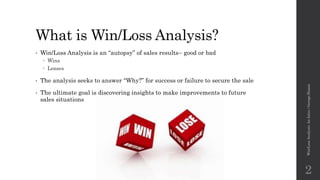
• Win/Loss Analysis is an “autopsy” of sales results– good or bad
 Wins
 Losses
• The analysis seeks to answer “Why?” for success or failure to secure the sale
• The ultimate goal is discovering insights to make improvements to future
sales situations
Win/LossAnalysis:AnIntro/GeorgeSloane
2
Where to Start?
• Sales and finance data
• Your sales team
• Clients, prospects, and suspects
• Your competition
Win/LossAnalysis:AnIntro/GeorgeSloane
3
What Do We Really Want to Know?
• Why did we win or lose?
• Where are the best opportunities
coming from?
• What do our best opportunities “look”
like?
• Are we pursuing the “right”
opportunities?
• Who should we pursue?
• What are our strengths or
weaknesses?
• How are we perceived?
• What do we “really” offer?
• What is salesperson’s relationship and
actual process?
• What is our sales process?
• What criteria are most important in
the request for proposal (RFP)
process?
• Who were the decision makers
involved?
• Who else competed for this business?
• What resources went into the win or
loss?
• Pricing and margins--Is the business
really profitable?
Win/LossAnalysis:AnIntro/GeorgeSloane
4
What Measurement Dimensions?
• Dollars
• Counts
• Sources
• Timing
• Sales team reason for the win or loss
• Client/prospect reason for the win or
loss
• Characteristics
 Industry
 Client/prospect revenue size
 Client/prospect other demographics
 Geographics
 Products/Services
Win/LossAnalysis:AnIntro/GeorgeSloane
5
Tools to Use
• Customer Relationship Management (CRM) system
 Salesforce.com or similar tracking system used by the sales team to collect data
• Excel or other data analysis tool
 Pivot tables make slicing and dicing the data easier
• Powerpoint or other presentation tool
 Present a deck to senior management, operations heads, sales team, and marketing
Win/LossAnalysis:AnIntro/GeorgeSloane
6
We Analyzed it . . . Now What?
• Use common sense and good judgement:
 Share the results with all relevant stakeholders
 Make recommendations and plans to do or seek out more of the successful
 Make a plan to downplay or improve the weak spots
 Move away from or abandon the low-to-no probability business
 Be prepared to try new approaches
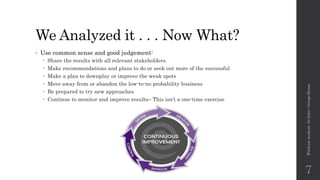
 Continue to monitor and improve results– This isn’t a one-time exercise
Win/LossAnalysis:AnIntro/GeorgeSloane
7
Thank You!
This Slide Concludes This Review
Win/LossAnalysis:AnIntro/GeorgeSloane
8
• For More Information, Please Contact George Sloane at:
• AnalyticDesignGuy.com website
• LinkedIn
• Twitter
• Facebook
• Google+
• Slideshare
• Goodreads
• Gmail: gsloane.business@gmail.com
• Phone: (203) 981-4488

Win/Loss Analysis

  • 1.
    Win/Loss Analysis A BriefIntroduction to Sales Win/Loss Analysis
  • 2.
    What is Win/LossAnalysis? • Win/Loss Analysis is an “autopsy” of sales results– good or bad  Wins  Losses • The analysis seeks to answer “Why?” for success or failure to secure the sale • The ultimate goal is discovering insights to make improvements to future sales situations Win/LossAnalysis:AnIntro/GeorgeSloane 2
  • 3.
    Where to Start? •Sales and finance data • Your sales team • Clients, prospects, and suspects • Your competition Win/LossAnalysis:AnIntro/GeorgeSloane 3
  • 4.
    What Do WeReally Want to Know? • Why did we win or lose? • Where are the best opportunities coming from? • What do our best opportunities “look” like? • Are we pursuing the “right” opportunities? • Who should we pursue? • What are our strengths or weaknesses? • How are we perceived? • What do we “really” offer? • What is salesperson’s relationship and actual process? • What is our sales process? • What criteria are most important in the request for proposal (RFP) process? • Who were the decision makers involved? • Who else competed for this business? • What resources went into the win or loss? • Pricing and margins--Is the business really profitable? Win/LossAnalysis:AnIntro/GeorgeSloane 4
  • 5.
    What Measurement Dimensions? •Dollars • Counts • Sources • Timing • Sales team reason for the win or loss • Client/prospect reason for the win or loss • Characteristics  Industry  Client/prospect revenue size  Client/prospect other demographics  Geographics  Products/Services Win/LossAnalysis:AnIntro/GeorgeSloane 5
  • 6.
    Tools to Use •Customer Relationship Management (CRM) system  Salesforce.com or similar tracking system used by the sales team to collect data • Excel or other data analysis tool  Pivot tables make slicing and dicing the data easier • Powerpoint or other presentation tool  Present a deck to senior management, operations heads, sales team, and marketing Win/LossAnalysis:AnIntro/GeorgeSloane 6
  • 7.
    We Analyzed it. . . Now What? • Use common sense and good judgement:  Share the results with all relevant stakeholders  Make recommendations and plans to do or seek out more of the successful  Make a plan to downplay or improve the weak spots  Move away from or abandon the low-to-no probability business  Be prepared to try new approaches  Continue to monitor and improve results– This isn’t a one-time exercise Win/LossAnalysis:AnIntro/GeorgeSloane 7
  • 8.
    Thank You! This SlideConcludes This Review Win/LossAnalysis:AnIntro/GeorgeSloane 8 • For More Information, Please Contact George Sloane at: • AnalyticDesignGuy.com website • LinkedIn • Twitter • Facebook • Google+ • Slideshare • Goodreads • Gmail: gsloane.business@gmail.com • Phone: (203) 981-4488