Goldminers of the Digital Age:
How Libraries Are Selecting,
Presenting, and Distributing
Metadata via Institutional
Repositories
Eli Windchy
VP, Consulting Services
bepress
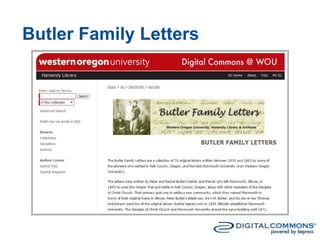
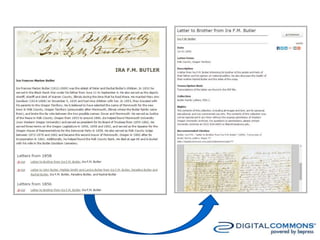
Butler Family Letters
Bepress
Founded in 1999 by scholars from UC Berkeley
Provider of Digital Commons
Former publisher of academic journals
- known for liberal re-use and guest access
policies
Serving scholars and almost 400 institutions
Wide range of subject expertise and types of
scholarship
What Is an Institutional Repository?
"...a set of services that a university offers
to members of its community for the
management and dissemination of digital
materials created by the institution and its
community members."
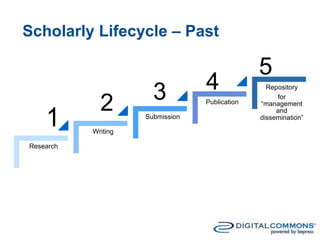
Scholarly Lifecycle – Past
Research
Writing
Submission
Publication
Repository
for
“management
and
dissemination”
2 3 4
5
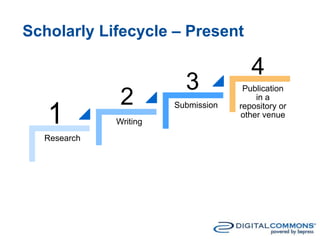
Scholarly Lifecycle – Present
Research
Writing
Submission
Publication
in a
repository or
other venue
2
3
4
Let’s Begin
1. Prospecting for metadata
2. Toolkit for metadata
3. Legacy - where does the metadata go?
4. ROMI - return on metadata investment
- Sheldon Shufelt, 1850
"It is found along the banks of the streams & in the beds
of the same, & in almost every little ravine putting into the
streams. And often from 10 to 50 ft. from the beds up the
bank. We sometimes have to dig several feet deep before
we find any, in other places all the dirt & clay will pay to
wash, but generally the clay pays best. If there is no clay,
then it is found down on the rock. All the lumps are found
on the rock--& most of the fine gold. We tell when it will
pay by trying the dirt with a pan. This is called prospecting
here.”
Part 1: Prospecting
Part 1: Prospecting
Where to Begin Collecting Metadata?
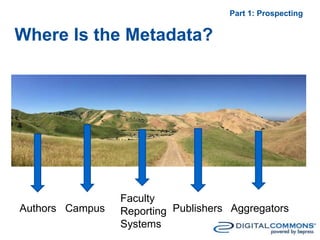
Faculty
Reporting
Systems
Where Is the Metadata?
Part 1: Prospecting
Authors Campus Publishers Aggregators
Gaps Arise From
Part 1: Prospecting
• Interdependent but not interlocking needs
• Real world exceptions
• Fluid nature, constant state of system
realignment
Bridge the Gap!
Focus and Reiterate the Library’s Goals
Part 1: Prospecting
• Provide services to campus?
• Global readership?
• Contribution to the field?
And Build Bridges to More Content
Part 1: Prospecting
Libraries are using bepress to capture a
wider array of materials, the way the
library wants it
Articles
Books
Conference
proceedings
Course catalogs
Data
ETDs
Grants
Images
Lab notes
Lectures
Monographs
Multimedia
Newspapers and
newsletters
Presentations
Reports
Special
collections
Syllabi
Symposia
Working papers
Yearbooks
Advantages of the Wider Bridge
Part 1: Prospecting
1. Richer, descriptive metadata, straight from the
authors
2. > Intake = < fixing later
3. Relationships outside the library
4. Closer alignment with library and potentially
university’s strategic goals
How Can Vendors Support
Libraries?
Part 1: Prospecting
• Success-as-a-Service model
• Economies of scale
• Mass representation
Part Two: Tools
“The gold will be a bit harder to get to, but modern
technology provides many advantages the old-time
prospectors couldn't fathom.”
“Sutter [Gold Mining Co.] plans to use gravity
floatation to recover the gold out and will not use
toxic chemicals on site.”
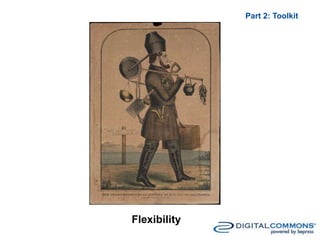
Flexibility
Part 2: Toolkit
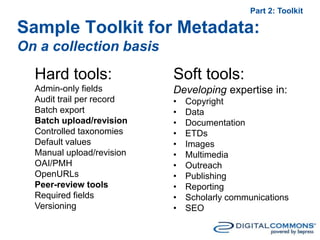
Part 2: Toolkit
Hard tools:
Admin-only fields
Audit trail per record
Batch export
Batch upload/revision
Controlled taxonomies
Default values
Manual upload/revision
OAI/PMH
OpenURLs
Peer-review tools
Required fields
Versioning
Sample Toolkit for Metadata:
On a collection basis
Soft tools:
Developing expertise in:
• Copyright
• Data
• Documentation
• ETDs
• Images
• Multimedia
• Outreach
• Publishing
• Reporting
• Scholarly communications
• SEO
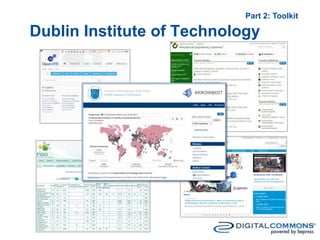
Dublin Institute of Technology
Part 2: Toolkit
Scholarly gyre: imagine those are stars
are golden nuggets
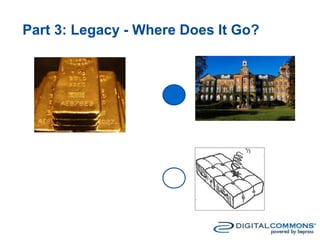
Part 3: Legacy - Where Does It Go?
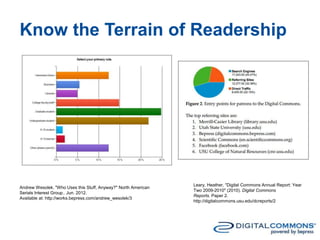
Andrew Wesolek. "Who Uses this Stuff, Anyway?" North American
Serials Interest Group.. Jun. 2012.
Available at: http://works.bepress.com/andrew_wesolek/3
Leary, Heather, "Digital Commons Annual Report: Year
Two 2009-2010" (2010). Digital Commons
Reports. Paper 2.
http://digitalcommons.usu.edu/dcreports/2
Know the Terrain of Readership
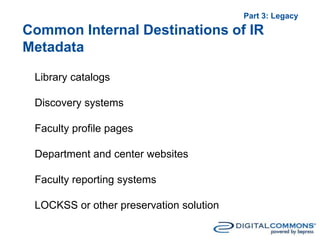
Common Internal Destinations of IR
Metadata
Library catalogs
Discovery systems
Faculty profile pages
Department and center websites
Faculty reporting systems
LOCKSS or other preservation solution
Part 3: Legacy
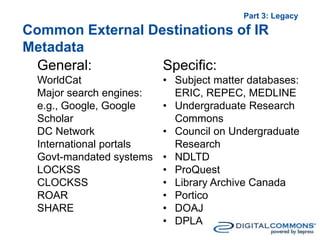
Common External Destinations of IR
Metadata
General:
WorldCat
Major search engines:
e.g., Google, Google
Scholar
DC Network
International portals
Govt-mandated systems
LOCKSS
CLOCKSS
ROAR
SHARE
Part 3: Legacy
Specific:
• Subject matter databases:
ERIC, REPEC, MEDLINE
• Undergraduate Research
Commons
• Council on Undergraduate
Research
• NDLTD
• ProQuest
• Library Archive Canada
• Portico
• DOAJ
• DPLA
Metadata for Legacy
Part 3: Legacy
 Optimize for search engines = big audiences
 Choose destinations strategically
 Batch revise, as warranted
 Check reports to gauge your success.
Add/remove destinations.
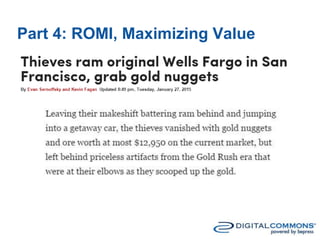
Part 4: ROMI, Maximizing Value
Thieves ram original Wells Fargo in San Francisco,
grab gold nuggets
Part 4: ROMI
Presentation and Promotion? But
I’m Not a Publisher!
• Metadata can’t do it alone
• Think of presentation and promotion as usability
and readership
• You’ll get the hang of it! Enlist help.
• Professional design: includes good accessibility
standards and support for mobile devices
• Best practices for SEO
• Campus or other promotions periodically
• Reports, internal and external – examples
available at
http://digitalcommons.bepress.com/usagereports/
Part 4: ROMI
Key Attributes
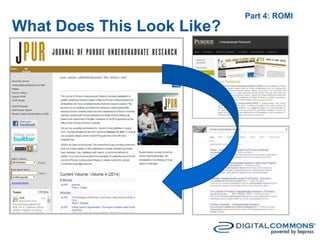
What Does This Look Like?
Part 4: ROMI
Thank you!
Eli Windchy
VP, Consulting Services, bepress
ewindchy@bepress.com
510-665-1200, ext. 136

Goldminers of the Digital Age: How Libraries are Selecting, Presenting, and Distributing Metadata via Institutional Repositories / Eli Windchy, VP, Consulting Services, depress

  • 1.
    Goldminers of theDigital Age: How Libraries Are Selecting, Presenting, and Distributing Metadata via Institutional Repositories Eli Windchy VP, Consulting Services bepress
  • 2.
  • 4.
    Bepress Founded in 1999by scholars from UC Berkeley Provider of Digital Commons Former publisher of academic journals - known for liberal re-use and guest access policies Serving scholars and almost 400 institutions Wide range of subject expertise and types of scholarship
  • 5.
    What Is anInstitutional Repository? "...a set of services that a university offers to members of its community for the management and dissemination of digital materials created by the institution and its community members."
  • 6.
    Scholarly Lifecycle –Past Research Writing Submission Publication Repository for “management and dissemination” 2 3 4 5
  • 7.
    Scholarly Lifecycle –Present Research Writing Submission Publication in a repository or other venue 2 3 4
  • 8.
    Let’s Begin 1. Prospectingfor metadata 2. Toolkit for metadata 3. Legacy - where does the metadata go? 4. ROMI - return on metadata investment
  • 9.
    - Sheldon Shufelt,1850 "It is found along the banks of the streams & in the beds of the same, & in almost every little ravine putting into the streams. And often from 10 to 50 ft. from the beds up the bank. We sometimes have to dig several feet deep before we find any, in other places all the dirt & clay will pay to wash, but generally the clay pays best. If there is no clay, then it is found down on the rock. All the lumps are found on the rock--& most of the fine gold. We tell when it will pay by trying the dirt with a pan. This is called prospecting here.” Part 1: Prospecting Part 1: Prospecting Where to Begin Collecting Metadata?
  • 10.
    Faculty Reporting Systems Where Is theMetadata? Part 1: Prospecting Authors Campus Publishers Aggregators
  • 11.
    Gaps Arise From Part1: Prospecting • Interdependent but not interlocking needs • Real world exceptions • Fluid nature, constant state of system realignment
  • 12.
    Bridge the Gap! Focusand Reiterate the Library’s Goals Part 1: Prospecting • Provide services to campus? • Global readership? • Contribution to the field?
  • 13.
    And Build Bridgesto More Content Part 1: Prospecting Libraries are using bepress to capture a wider array of materials, the way the library wants it Articles Books Conference proceedings Course catalogs Data ETDs Grants Images Lab notes Lectures Monographs Multimedia Newspapers and newsletters Presentations Reports Special collections Syllabi Symposia Working papers Yearbooks
  • 14.
    Advantages of theWider Bridge Part 1: Prospecting 1. Richer, descriptive metadata, straight from the authors 2. > Intake = < fixing later 3. Relationships outside the library 4. Closer alignment with library and potentially university’s strategic goals
  • 15.
    How Can VendorsSupport Libraries? Part 1: Prospecting • Success-as-a-Service model • Economies of scale • Mass representation
  • 16.
    Part Two: Tools “Thegold will be a bit harder to get to, but modern technology provides many advantages the old-time prospectors couldn't fathom.” “Sutter [Gold Mining Co.] plans to use gravity floatation to recover the gold out and will not use toxic chemicals on site.”
  • 17.
  • 18.
    Part 2: Toolkit Hardtools: Admin-only fields Audit trail per record Batch export Batch upload/revision Controlled taxonomies Default values Manual upload/revision OAI/PMH OpenURLs Peer-review tools Required fields Versioning Sample Toolkit for Metadata: On a collection basis Soft tools: Developing expertise in: • Copyright • Data • Documentation • ETDs • Images • Multimedia • Outreach • Publishing • Reporting • Scholarly communications • SEO
  • 19.
    Dublin Institute ofTechnology Part 2: Toolkit
  • 20.
    Scholarly gyre: imaginethose are stars are golden nuggets
  • 21.
    Part 3: Legacy- Where Does It Go?
  • 22.
    Andrew Wesolek. "WhoUses this Stuff, Anyway?" North American Serials Interest Group.. Jun. 2012. Available at: http://works.bepress.com/andrew_wesolek/3 Leary, Heather, "Digital Commons Annual Report: Year Two 2009-2010" (2010). Digital Commons Reports. Paper 2. http://digitalcommons.usu.edu/dcreports/2 Know the Terrain of Readership
  • 23.
    Common Internal Destinationsof IR Metadata Library catalogs Discovery systems Faculty profile pages Department and center websites Faculty reporting systems LOCKSS or other preservation solution Part 3: Legacy
  • 24.
    Common External Destinationsof IR Metadata General: WorldCat Major search engines: e.g., Google, Google Scholar DC Network International portals Govt-mandated systems LOCKSS CLOCKSS ROAR SHARE Part 3: Legacy Specific: • Subject matter databases: ERIC, REPEC, MEDLINE • Undergraduate Research Commons • Council on Undergraduate Research • NDLTD • ProQuest • Library Archive Canada • Portico • DOAJ • DPLA
  • 25.
    Metadata for Legacy Part3: Legacy  Optimize for search engines = big audiences  Choose destinations strategically  Batch revise, as warranted  Check reports to gauge your success. Add/remove destinations.
  • 26.
    Part 4: ROMI,Maximizing Value Thieves ram original Wells Fargo in San Francisco, grab gold nuggets
  • 27.
    Part 4: ROMI Presentationand Promotion? But I’m Not a Publisher! • Metadata can’t do it alone • Think of presentation and promotion as usability and readership • You’ll get the hang of it! Enlist help.
  • 28.
    • Professional design:includes good accessibility standards and support for mobile devices • Best practices for SEO • Campus or other promotions periodically • Reports, internal and external – examples available at http://digitalcommons.bepress.com/usagereports/ Part 4: ROMI Key Attributes
  • 29.
    What Does ThisLook Like? Part 4: ROMI
  • 30.
    Thank you! Eli Windchy VP,Consulting Services, bepress ewindchy@bepress.com 510-665-1200, ext. 136