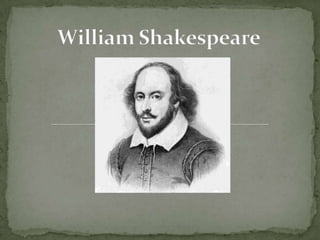
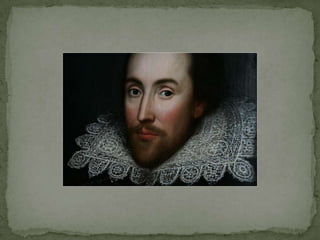
William Shakespeare was an English poet and playwright, widely
regarded as the greatest writer in the English language and the
world's pre-eminent dramatist. He is often called England's
national poet and the "Bard of Avon". His surviving
works, including some collaborations, consist of about
38 plays, 154 sonnets, two long narrative poems, and several
other poems. His plays have been translated into every major
living language and are performed more often than those of any
other playwright.
Shakespeare was born and brought up in Stratford-upon-Avon. At the
age of 18, he married Anne Hathaway, with whom he had three
children: Susanna, and twins Hamnet and Judith. Shakespeare
produced most of his known work between 1589 and 1613. His early
plays were mainly comedies and histories, genres he raised to the peak
of sophistication and artistry by the end of the 16th century. He then
wrote mainly tragedies until about 1608, including Hamlet, King
Lear, Othello, and Macbeth, considered some of the finest works in the
English language. In his last phase, he wrote tragicomedies, also
known as romances, and collaborated with other playwrights.
William Shakespeare was the son of John
Shakespeare, an alderman and a successful glover originally
from Snitterfield, and Mary Arden, the daughter of an affluent
landowning farmer. He was born in Stratford-upon-Avon and
baptised there on 26 April 1564. His actual birthdate remains
unknown, but is traditionally observed on 23 April, St George's
Day. This date, which can be traced back to an 18th-century
scholar's mistake, has proved appealing to biographers, since
Shakespeare died 23 April 1616. He was the third child of eight and
the eldest surviving son.
Although no attendance records for the period survive, most
biographers agree that Shakespeare was probably educated at
the King's New School in Stratford, a free school chartered in
1553, about a quarter-mile from his home. Grammar
schools varied in quality during the Elizabethan era, but the
grammar curriculum was standardised by royal decree throughout
England, and the school would have provided an intensive
education in Latin grammar based upon Latin classical authors.
Poems
In 1593 and 1594, when the theatres were closed because
of plague, Shakespeare published two narrative poems on erotic
themes, Venus and Adonis and The Rape of Lucrece. He dedicated them
to Henry Wriothesley, Earl of Southampton. InVenus and Adonis, an
innocent Adonis rejects the sexual advances of Venus; while in The Rape
of Lucrece, the virtuous wife Lucrece is raped by the lustful Tarquin.
Influenced by Ovid's Metamorphoses, the poems show the guilt and
moral confusion that result from uncontrolled lust. Both proved popular
and were often reprinted during Shakespeare's lifetime. A third narrative
poem, A Lover's Complaint, in which a young woman laments her
seduction by a persuasive suitor, was printed in the first edition of
the Sonnets in 1609. Most scholars now accept that Shakespeare wrote A
Lover's Complaint. Critics consider that its fine qualities are marred by
leaden effects. The Phoenix and the Turtle, printed in Robert Chester's
1601 Love's Martyr, mourns the deaths of the legendary phoenix and his
lover, the faithful turtle dove. In 1599, two early drafts of sonnets 138 and
144 appeared in The Passionate Pilgrim, published under Shakespeare's
name but without his permission.
Sonnets
Published in 1609, the Sonnets were the last of Shakespeare's non-
dramatic works to be printed. Scholars are not certain when each of the
154 sonnets was composed, but evidence suggests that Shakespeare wrote
sonnets throughout his career for a private readership. Even before the
two unauthorised sonnets appeared in The Passionate Pilgrim in
1599, Francis Meres had referred in 1598 to Shakespeare's "sugred Sonnets
among his private friends". Few analysts believe that the published
collection follows Shakespeare's intended sequence. He seems to have
planned two contrasting series: one about uncontrollable lust for a
married woman of dark complexion (the "dark lady"), and one about
conflicted love for a fair young man (the "fair youth"). It remains unclear
if these figures represent real individuals, or if the authorial "I" who
addresses them represents Shakespeare
himself, though Wordsworth believed that with the sonnets "Shakespeare
unlocked his heart“.
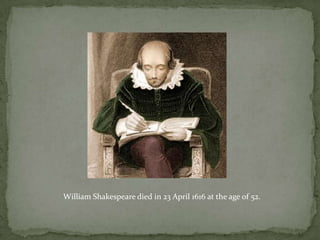
William Shakespeare died in 23 April 1616 at the age of 52.
Adam Mantadakis, Helen Ioannidi, Lena Perpiraki, Silda Zyla
THE
END

William shakespeare Αδαμ, Ελενη,Σιλντα, Ελενη

  • 2.
    William Shakespeare wasan English poet and playwright, widely regarded as the greatest writer in the English language and the world's pre-eminent dramatist. He is often called England's national poet and the "Bard of Avon". His surviving works, including some collaborations, consist of about 38 plays, 154 sonnets, two long narrative poems, and several other poems. His plays have been translated into every major living language and are performed more often than those of any other playwright.
  • 3.
    Shakespeare was bornand brought up in Stratford-upon-Avon. At the age of 18, he married Anne Hathaway, with whom he had three children: Susanna, and twins Hamnet and Judith. Shakespeare produced most of his known work between 1589 and 1613. His early plays were mainly comedies and histories, genres he raised to the peak of sophistication and artistry by the end of the 16th century. He then wrote mainly tragedies until about 1608, including Hamlet, King Lear, Othello, and Macbeth, considered some of the finest works in the English language. In his last phase, he wrote tragicomedies, also known as romances, and collaborated with other playwrights.
  • 5.
    William Shakespeare wasthe son of John Shakespeare, an alderman and a successful glover originally from Snitterfield, and Mary Arden, the daughter of an affluent landowning farmer. He was born in Stratford-upon-Avon and baptised there on 26 April 1564. His actual birthdate remains unknown, but is traditionally observed on 23 April, St George's Day. This date, which can be traced back to an 18th-century scholar's mistake, has proved appealing to biographers, since Shakespeare died 23 April 1616. He was the third child of eight and the eldest surviving son. Although no attendance records for the period survive, most biographers agree that Shakespeare was probably educated at the King's New School in Stratford, a free school chartered in 1553, about a quarter-mile from his home. Grammar schools varied in quality during the Elizabethan era, but the grammar curriculum was standardised by royal decree throughout England, and the school would have provided an intensive education in Latin grammar based upon Latin classical authors.
  • 6.
    Poems In 1593 and1594, when the theatres were closed because of plague, Shakespeare published two narrative poems on erotic themes, Venus and Adonis and The Rape of Lucrece. He dedicated them to Henry Wriothesley, Earl of Southampton. InVenus and Adonis, an innocent Adonis rejects the sexual advances of Venus; while in The Rape of Lucrece, the virtuous wife Lucrece is raped by the lustful Tarquin. Influenced by Ovid's Metamorphoses, the poems show the guilt and moral confusion that result from uncontrolled lust. Both proved popular and were often reprinted during Shakespeare's lifetime. A third narrative poem, A Lover's Complaint, in which a young woman laments her seduction by a persuasive suitor, was printed in the first edition of the Sonnets in 1609. Most scholars now accept that Shakespeare wrote A Lover's Complaint. Critics consider that its fine qualities are marred by leaden effects. The Phoenix and the Turtle, printed in Robert Chester's 1601 Love's Martyr, mourns the deaths of the legendary phoenix and his lover, the faithful turtle dove. In 1599, two early drafts of sonnets 138 and 144 appeared in The Passionate Pilgrim, published under Shakespeare's name but without his permission.
  • 8.
    Sonnets Published in 1609,the Sonnets were the last of Shakespeare's non- dramatic works to be printed. Scholars are not certain when each of the 154 sonnets was composed, but evidence suggests that Shakespeare wrote sonnets throughout his career for a private readership. Even before the two unauthorised sonnets appeared in The Passionate Pilgrim in 1599, Francis Meres had referred in 1598 to Shakespeare's "sugred Sonnets among his private friends". Few analysts believe that the published collection follows Shakespeare's intended sequence. He seems to have planned two contrasting series: one about uncontrollable lust for a married woman of dark complexion (the "dark lady"), and one about conflicted love for a fair young man (the "fair youth"). It remains unclear if these figures represent real individuals, or if the authorial "I" who addresses them represents Shakespeare himself, though Wordsworth believed that with the sonnets "Shakespeare unlocked his heart“.
  • 9.
    William Shakespeare diedin 23 April 1616 at the age of 52.
  • 10.
    Adam Mantadakis, HelenIoannidi, Lena Perpiraki, Silda Zyla
  • 11.