Wide spectral band beam analysis
Written by Oren Aharon, Duma Optronics Ltd
ABSTRACT
The reality in laser beam profiling is that measurements are performed over a wide spectrum of wavelengths and power
ranges. Many applications use multiple laser wavelengths with very different power levels, a fact which dictates a need
for a better measuring tool.
Rapid progress in the fiber laser area has increased the demand for lasers in the wavelength range of 900 - 1030 nm,
while the telecommunication market has increased the demand for wavelength range of 1300nm - 1600 nm, on the other
hand the silicone chip manufacturing and mass production requirements tend to lower the laser wavelength towards the
190nm region. In many cases there is a need to combine several lasers together in order to perform a specific task. A
typical application is to combine one visible laser for pointing, with a different laser for material processing with a very
different wavelength and power level. The visible laser enables accurate pointing before the second laser is operated.
The beam profile of the intensity distribution is an important parameter that indicates how a laser beam will behave in an
application.
Currently a lab, where many different lasers are used, will find itself using various laser beam profilers from several
vendors with different specifications and accuracies.
It is the propose of this article to present a technological breakthrough in the area of detectors, electronics and optics
allowing intricate measurements of lasers with different wavelength and with power levels that vary many orders of
magnitude by a single beam profiler.
KEYWORDS: Beam profiling, Beam Analysis, Wide spectrum wavelength, wavelength 190nm to 3000nm, High
power measurements, Material processing, Medical lasers, Laser Designator.
1. THE MEASUREMENT CHALLENGE IN VARIOUS APPLICATIONS
A combination of several lasers each having a different wavelength is increasingly built for applications where the main
laser is invisible or dangerous to the naked eye.
Of special interest are lasers lasing at 1550nm and above. Those lasers have a relative high retinal safety. Since these
lasers are considered safe at much higher power levels than other traditional IR lasers, they are gaining popularity in
many fields such as; laser range finding in military applications, cosmetic applications and communication. These lasers
although being eye safe are invisible to the naked eye and require a visible laser to propagate along their axis for marking
purposes.
Following are typical applications in several fields such as medical, industrial and military applications.
1.1. Medical applications
1.1.1. 1550nm and cosmetic nonablative procedures.
The use of the 1550nm wavelength has proven effective for treating several skin disorders. The
rejuvenating and healing effects of the 1550nm wavelength are significant. Applying the laser to the skin
will induce controlled damage. When the induced damaged heals it will result in reduced scarring and
increased skin durability and tightness. For aiming the non visible laser to a specific area, a low power
laser of about 1mwatt which is aligned and collinear to the main beam is used.
1.1.2. UV applications
On the other hand, light in the UV range permits various types of non-thermal ("cold") processing such as
laser eye surgery, here alignment tolerances of the aiming visible laser are very important and require
special care.
1.2. Industrial applications
Using a laser in material processing and other industrial applications has a long history with continuous
impressive growth. Of special interest are the fiber based lasers due to their high power lasers and their
versatility. This geometry results in high photon conversion efficiency, as well as a rugged and compact
design. Because of its wide spread usage and popularity, I will concentrate our discussion on this family of
lasers.
The fiber-based laser design is highly adaptable. It can be adapted to do anything from welding heavy sheets of
metal to producing femtosecond pulses.
The fiber laser is usually based on a silica glass core with a rare earth dopant within. The primary dopants are
ytterbium and erbium. Ytterbium has center wavelengths ranging from about 1030 to 1080 nm and can emit
using pump diodes, emitting in the 940 nm range can make the photon deficit very small.
Erbium fiber lasers emit at 1530 to 1620 nm, which is an eye-safe wavelength range. This can be frequency-
doubled to generate light at 780 nm—a wavelength that's not available from fiber lasers in other ways. And
finally, ytterbium can be added to erbium so that the ytterbium absorbs pump light and transfers that energy to
erbium. Thulium is another dopant that emits even deeper into the near-infrared (NIR; 1750 to 2100 nm), and
is thus another eye-safe material.
The following table summarizes the main wavelength span of lasers for material processing
Active element Output Pump bands Photon conversion
Neodymium (solid state) 1064 to 1088 nm 808 nm 76%
Ytterbium 1030 to 1100 nm 910, 940, 975 nm Over 90% at 940/1030
Erbium 1550nm band 980 and 1480 nm 95% or 63%
Yb-Er Erbium Ytterbium
Thulium 1750 to 2100 nm 793 nm 2 out / 1 in
Table 1: Photon conversion efficiencies
The industrial market is now the largest market for fiber lasers; much of them being used at the kilowatt-class
CW power level. Particularly interesting is their use in automotive work. However pulsed laser are very
common as well and of particular interest are also UV laser intended to perform accurate delicate processing.
1.2.1. UV laser for industrial applications
Industrial processes range from the removal of sub micrometer thick layers of material or micro drilling
for applications such as drilling holes for ink-jet printers. Ablation can achieve extremely small feature
sizes down to less than one micron with great precision. It allows removal of incremental layers, making
it ideal for micromachining, micro drilling, sputtering thin films (PLD), surface cleaning and stripping of
plastics, ceramics and metals. All industrial applications are characterized by a visible low power lasers
which is used for aiming prior to main laser activation.
1.3. Military application
Lasers are used on the modern battlefield in many applications, from detecting the range of an object to
designating a target for another weapon system to attack. The most common battlefield lasers operate at 850
nm, 1060 nm, and approximately 1500 nm. The first two laser types are visible to current night vision goggles.
The 1550 nm laser, a modern eye-safe wavelength device, is not visible.
A Laser Designator and Rangefinder for ground, airborne and naval applications. The Laser Designator and
Range Finder module was designed to be easily fitted into very small Electro-Optical systems and payloads.
Several units of the new module have been integrated into new Ground Targeting and Designating System
(GTADS).
DART45 offers a 45mJ (milliJoule), very low divergence Laser Designator as well as an eye-safe Rangefinder
which enables high performance in a very lightweight and compact package. Its design is based on diode-
pumped advanced Nd:YAG laser, compatible for all US and NATO laser-guided munitions.
Many military laser systems are bore-sighted to a visible or infrared imager center crosshair. On the battlefield,
precision is difficult to ensure as deployed systems go through wear and tear.
2. THE NEED
Lasers, high and low power are becoming more commonly used in a variety of applications spanning from medical
application through industrial and military uses. Frequently there is a need for combining or aligning two beams together
in order to improve overall performance or to allow visual aiming and checking before activating main laser. The
wavelength of used lasers is usually from deep UV to 1600 nm, longer wavelength have their application but are not
commonly used.
The metrology market is lagging behind the measurement needs both on wavelength coverage with a single instrument
as well as the dynamic range of these instruments. At the moment there is no single instrument capable of measuring
from deep UV up to and above1600nm. Ideally, the measurements need is not only over a wide spectrum of
wavelengths, but also from very faint beams in the nanowatt region up to the kilowatts region. Applications with mixed
wavelength beams are often with one is kilowatts and the second is miliwatts.
To summarize, an ideal measuring beam profiler will have the following initial specifications:
Wavelength range 190-1600nm
Chip size 1/2"
Laser power dynamic range 1nWatt-5KWatt
Beam measurement accuracy 2%
Laser type CW or PULSED
3. WIDE SPECTRAL BAND BEAM ANALYZER
Introduced by Duma Optronics the new BeamOn WSR(wide spectral range) is ideal for performing just that. Based on a
combination of new sensing mosaic element with high gain low noise electronics on one hand, and advanced cooled
sampling technology at other hand, intricate measurements of dual wavelength high power laser are now possible.
Measurements where one laser may have a wavelength in 1550nm region and high power and the second for instance the
marker can be measured together both for profile and relative location with a single instrument . The beam analyzer
provides an accurate profile providing instant readings of focus spot size and beam position of single or multiple beams.
4. BEAM SAMPLING TECHNOLOGIES
Recent developments of advanced non polarizing beam sampling device allow real time measurement of power, beam
profile, position and stability as a function of time. The sampled beam is an exact replica of the original beam with
reduced power. Power reduction is about three orders of magnitude when compared to the original beam. The beam
sampler has three ports one for input, second for sampled beam output and third for deflected main beam. The sampled
beam is directed towards a laser beam profiler while the main beam is usually damped to a beam damp. As for the beam
path, the focused beam incidents the beam sampler input port where by reflection its power is greatly reduced, a second
reflection further reduces the beam power and restores the beam original polarization. Further the sampled beam exits
through the second port and reaches a beam profiling detection area. Due to its special technology and its accurate real
time power measurement capability, we will present the case of multiple knife edge scanning profiling, although the
technology of beam sampling is applicable to many profiling methods.
Main beam sampling features are:
None distorting
Polarization preserving
Constant sampling ratio independent of incoming beam power
Actively Cooled
ACTUAL MEASUREMENT AND SYSTEM SPECIFICATIONS
For industrial application a frequent application will be to align a high power laser with characteristics and
specifications as demonstrated in following figures 1 and 2 with a low power visible laser in the range of a
few milliwats. Due to its high dynamic range the WSR system will be successful in measuring both beams
simultaneouslly.
Figure 1: BeamOn WSR camera with automated filter wheel Drawing 1: BeamOn WSR with SAM3-HP air cooled beam
sampler for high power laser analyzing
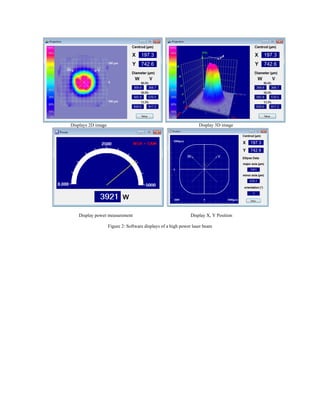
Typical results for 4000watts measurements are presented in figure 2. Here we see a measurement of 3921 watts, beam
profiles in perpendicular directions, one of 930 microns and the second of 917 microns. The laser power and profile were
measured from about 400 watts to about 4000watts. There are several noticeable interesting things as a direct result of
the measurement:
1. Real time profile and power measurements were demonstrated at a rate of 5 times per second.
2. Profiles and position were very stable during the power up procedure.
VW profile display: Displays as VW profile of a specified region. Overlays not only measurement data but also Gaussian fit
curves (red line).
Displays 2D image Display 3D image
Display power measurement Display X, Y Position
Figure 2: Software displays of a high power laser beam
Further real time measurements covering a wide spectral range towards the communication wavelength are demonstrated
in the following pictures of an 1550 laser and further more a combination of 1550nm with a visible pointing laser
simultaneously on same system.
6. BREAKING THE 1600nm BARRIER
The short wavelength infrared (SWIR) which ranges from 1.4micron to 3.0micron posses a special measurement
challenge, due to the lack of adequate high resolution detector. Although the above described instrument is adequate for
measurement of 1530nm to 1560nm range which is a dominant spectral region for long distance telecommunication,
there are many applications using longer wavelengths laser, such as Thulium-YAG 1.99micron, Holmium-YAG
2.1micron, Erbium-YAG 2.94 micron and other variable wavelengths lasers. These lasers find their applications in the
medical field.
Responding to the market needs we continued our research towards further expansion of the WSR measurement system
and initial results show very encouraging response in this region. Today we are working on defining the exact sensitivity
values, as well as the minimum and maximum response and damage thresholds.
Following are initial measurements performed on two representing lasers in this wavelength region.
The first laser is Holmium-YAG 2.1micron which is the most widely used arthroscopic laser system.
In figure 3 you can observe amazing resolution in the region of 1micron. The beam analyzed was a pulsed laser of
250mW average power, 10Hz reputation rate and a pulse width of 250 µsec, the camera used was Duma’s BeamOn
WSR
-Sensor active area: 6.47mm wide x 4.83mm high.
-Pixel size: 8.6 μm (H) X 8.3 μm (V)
- Resolution (H x V pixels): 752 x 582.
-Shutter speeds: 1/50x256sec to 1/100,000 sec, 17 steps manually, or automatic.
-Gain control: 6dB to 41dB 2dB steps manually, or automatic.
Figure 3: Holmium-YAG 2.1micron laser, 250mW, 10Hz, 250µsec pulses.
The second laser is Erbium-YAG 2.94 micron which is used in the medical and dentistry fields.
The beam analyzed was a pulsed laser of 300mW average power, 10Hz reputation rate and a pulse width of 250 µsec, the
camera used was Duma’s BeamOn WSR.
Figure 4: Erbium-YAG 2.94 micron laser, 300mW, 10Hz, 250µsec pulses.
CONCLUSIONS
A practical real time method of measuring lasers over a wide span of wavelength was demonstrated. The new instrument
covers the wavelength range of most application oriented lasers with a single mosaic detector sensitive from 190nm to
1600nm and with a very wide dynamic range. Moreover due to recent advances in cooled beam sampling technology the
relation between two beams one with very high power and the second for marking could be measured and aligned
together with high accuracies due to the fact that a single measuring element is used. This may open new applications for
using green lasers for marking.
The latest experiments imply a widening of the spectral range up to 3micron.

Wide

  • 1.
    Wide spectral bandbeam analysis Written by Oren Aharon, Duma Optronics Ltd ABSTRACT The reality in laser beam profiling is that measurements are performed over a wide spectrum of wavelengths and power ranges. Many applications use multiple laser wavelengths with very different power levels, a fact which dictates a need for a better measuring tool. Rapid progress in the fiber laser area has increased the demand for lasers in the wavelength range of 900 - 1030 nm, while the telecommunication market has increased the demand for wavelength range of 1300nm - 1600 nm, on the other hand the silicone chip manufacturing and mass production requirements tend to lower the laser wavelength towards the 190nm region. In many cases there is a need to combine several lasers together in order to perform a specific task. A typical application is to combine one visible laser for pointing, with a different laser for material processing with a very different wavelength and power level. The visible laser enables accurate pointing before the second laser is operated. The beam profile of the intensity distribution is an important parameter that indicates how a laser beam will behave in an application. Currently a lab, where many different lasers are used, will find itself using various laser beam profilers from several vendors with different specifications and accuracies. It is the propose of this article to present a technological breakthrough in the area of detectors, electronics and optics allowing intricate measurements of lasers with different wavelength and with power levels that vary many orders of magnitude by a single beam profiler. KEYWORDS: Beam profiling, Beam Analysis, Wide spectrum wavelength, wavelength 190nm to 3000nm, High power measurements, Material processing, Medical lasers, Laser Designator. 1. THE MEASUREMENT CHALLENGE IN VARIOUS APPLICATIONS A combination of several lasers each having a different wavelength is increasingly built for applications where the main laser is invisible or dangerous to the naked eye. Of special interest are lasers lasing at 1550nm and above. Those lasers have a relative high retinal safety. Since these lasers are considered safe at much higher power levels than other traditional IR lasers, they are gaining popularity in many fields such as; laser range finding in military applications, cosmetic applications and communication. These lasers although being eye safe are invisible to the naked eye and require a visible laser to propagate along their axis for marking purposes. Following are typical applications in several fields such as medical, industrial and military applications. 1.1. Medical applications 1.1.1. 1550nm and cosmetic nonablative procedures. The use of the 1550nm wavelength has proven effective for treating several skin disorders. The rejuvenating and healing effects of the 1550nm wavelength are significant. Applying the laser to the skin will induce controlled damage. When the induced damaged heals it will result in reduced scarring and increased skin durability and tightness. For aiming the non visible laser to a specific area, a low power laser of about 1mwatt which is aligned and collinear to the main beam is used. 1.1.2. UV applications On the other hand, light in the UV range permits various types of non-thermal ("cold") processing such as laser eye surgery, here alignment tolerances of the aiming visible laser are very important and require special care. 1.2. Industrial applications Using a laser in material processing and other industrial applications has a long history with continuous impressive growth. Of special interest are the fiber based lasers due to their high power lasers and their versatility. This geometry results in high photon conversion efficiency, as well as a rugged and compact
  • 2.
    design. Because ofits wide spread usage and popularity, I will concentrate our discussion on this family of lasers. The fiber-based laser design is highly adaptable. It can be adapted to do anything from welding heavy sheets of metal to producing femtosecond pulses. The fiber laser is usually based on a silica glass core with a rare earth dopant within. The primary dopants are ytterbium and erbium. Ytterbium has center wavelengths ranging from about 1030 to 1080 nm and can emit using pump diodes, emitting in the 940 nm range can make the photon deficit very small. Erbium fiber lasers emit at 1530 to 1620 nm, which is an eye-safe wavelength range. This can be frequency- doubled to generate light at 780 nm—a wavelength that's not available from fiber lasers in other ways. And finally, ytterbium can be added to erbium so that the ytterbium absorbs pump light and transfers that energy to erbium. Thulium is another dopant that emits even deeper into the near-infrared (NIR; 1750 to 2100 nm), and is thus another eye-safe material. The following table summarizes the main wavelength span of lasers for material processing Active element Output Pump bands Photon conversion Neodymium (solid state) 1064 to 1088 nm 808 nm 76% Ytterbium 1030 to 1100 nm 910, 940, 975 nm Over 90% at 940/1030 Erbium 1550nm band 980 and 1480 nm 95% or 63% Yb-Er Erbium Ytterbium Thulium 1750 to 2100 nm 793 nm 2 out / 1 in Table 1: Photon conversion efficiencies The industrial market is now the largest market for fiber lasers; much of them being used at the kilowatt-class CW power level. Particularly interesting is their use in automotive work. However pulsed laser are very common as well and of particular interest are also UV laser intended to perform accurate delicate processing. 1.2.1. UV laser for industrial applications Industrial processes range from the removal of sub micrometer thick layers of material or micro drilling for applications such as drilling holes for ink-jet printers. Ablation can achieve extremely small feature sizes down to less than one micron with great precision. It allows removal of incremental layers, making it ideal for micromachining, micro drilling, sputtering thin films (PLD), surface cleaning and stripping of plastics, ceramics and metals. All industrial applications are characterized by a visible low power lasers which is used for aiming prior to main laser activation. 1.3. Military application Lasers are used on the modern battlefield in many applications, from detecting the range of an object to designating a target for another weapon system to attack. The most common battlefield lasers operate at 850 nm, 1060 nm, and approximately 1500 nm. The first two laser types are visible to current night vision goggles. The 1550 nm laser, a modern eye-safe wavelength device, is not visible. A Laser Designator and Rangefinder for ground, airborne and naval applications. The Laser Designator and Range Finder module was designed to be easily fitted into very small Electro-Optical systems and payloads. Several units of the new module have been integrated into new Ground Targeting and Designating System (GTADS). DART45 offers a 45mJ (milliJoule), very low divergence Laser Designator as well as an eye-safe Rangefinder which enables high performance in a very lightweight and compact package. Its design is based on diode- pumped advanced Nd:YAG laser, compatible for all US and NATO laser-guided munitions. Many military laser systems are bore-sighted to a visible or infrared imager center crosshair. On the battlefield, precision is difficult to ensure as deployed systems go through wear and tear. 2. THE NEED Lasers, high and low power are becoming more commonly used in a variety of applications spanning from medical application through industrial and military uses. Frequently there is a need for combining or aligning two beams together in order to improve overall performance or to allow visual aiming and checking before activating main laser. The
  • 3.
    wavelength of usedlasers is usually from deep UV to 1600 nm, longer wavelength have their application but are not commonly used. The metrology market is lagging behind the measurement needs both on wavelength coverage with a single instrument as well as the dynamic range of these instruments. At the moment there is no single instrument capable of measuring from deep UV up to and above1600nm. Ideally, the measurements need is not only over a wide spectrum of wavelengths, but also from very faint beams in the nanowatt region up to the kilowatts region. Applications with mixed wavelength beams are often with one is kilowatts and the second is miliwatts. To summarize, an ideal measuring beam profiler will have the following initial specifications: Wavelength range 190-1600nm Chip size 1/2" Laser power dynamic range 1nWatt-5KWatt Beam measurement accuracy 2% Laser type CW or PULSED 3. WIDE SPECTRAL BAND BEAM ANALYZER Introduced by Duma Optronics the new BeamOn WSR(wide spectral range) is ideal for performing just that. Based on a combination of new sensing mosaic element with high gain low noise electronics on one hand, and advanced cooled sampling technology at other hand, intricate measurements of dual wavelength high power laser are now possible. Measurements where one laser may have a wavelength in 1550nm region and high power and the second for instance the marker can be measured together both for profile and relative location with a single instrument . The beam analyzer provides an accurate profile providing instant readings of focus spot size and beam position of single or multiple beams. 4. BEAM SAMPLING TECHNOLOGIES Recent developments of advanced non polarizing beam sampling device allow real time measurement of power, beam profile, position and stability as a function of time. The sampled beam is an exact replica of the original beam with reduced power. Power reduction is about three orders of magnitude when compared to the original beam. The beam sampler has three ports one for input, second for sampled beam output and third for deflected main beam. The sampled beam is directed towards a laser beam profiler while the main beam is usually damped to a beam damp. As for the beam path, the focused beam incidents the beam sampler input port where by reflection its power is greatly reduced, a second reflection further reduces the beam power and restores the beam original polarization. Further the sampled beam exits through the second port and reaches a beam profiling detection area. Due to its special technology and its accurate real time power measurement capability, we will present the case of multiple knife edge scanning profiling, although the technology of beam sampling is applicable to many profiling methods. Main beam sampling features are: None distorting Polarization preserving Constant sampling ratio independent of incoming beam power Actively Cooled
  • 4.
    ACTUAL MEASUREMENT ANDSYSTEM SPECIFICATIONS For industrial application a frequent application will be to align a high power laser with characteristics and specifications as demonstrated in following figures 1 and 2 with a low power visible laser in the range of a few milliwats. Due to its high dynamic range the WSR system will be successful in measuring both beams simultaneouslly. Figure 1: BeamOn WSR camera with automated filter wheel Drawing 1: BeamOn WSR with SAM3-HP air cooled beam sampler for high power laser analyzing Typical results for 4000watts measurements are presented in figure 2. Here we see a measurement of 3921 watts, beam profiles in perpendicular directions, one of 930 microns and the second of 917 microns. The laser power and profile were measured from about 400 watts to about 4000watts. There are several noticeable interesting things as a direct result of the measurement: 1. Real time profile and power measurements were demonstrated at a rate of 5 times per second. 2. Profiles and position were very stable during the power up procedure. VW profile display: Displays as VW profile of a specified region. Overlays not only measurement data but also Gaussian fit curves (red line).
  • 5.
    Displays 2D imageDisplay 3D image Display power measurement Display X, Y Position Figure 2: Software displays of a high power laser beam
  • 6.
    Further real timemeasurements covering a wide spectral range towards the communication wavelength are demonstrated in the following pictures of an 1550 laser and further more a combination of 1550nm with a visible pointing laser simultaneously on same system.
  • 7.
    6. BREAKING THE1600nm BARRIER The short wavelength infrared (SWIR) which ranges from 1.4micron to 3.0micron posses a special measurement challenge, due to the lack of adequate high resolution detector. Although the above described instrument is adequate for measurement of 1530nm to 1560nm range which is a dominant spectral region for long distance telecommunication, there are many applications using longer wavelengths laser, such as Thulium-YAG 1.99micron, Holmium-YAG 2.1micron, Erbium-YAG 2.94 micron and other variable wavelengths lasers. These lasers find their applications in the medical field. Responding to the market needs we continued our research towards further expansion of the WSR measurement system and initial results show very encouraging response in this region. Today we are working on defining the exact sensitivity values, as well as the minimum and maximum response and damage thresholds. Following are initial measurements performed on two representing lasers in this wavelength region. The first laser is Holmium-YAG 2.1micron which is the most widely used arthroscopic laser system. In figure 3 you can observe amazing resolution in the region of 1micron. The beam analyzed was a pulsed laser of 250mW average power, 10Hz reputation rate and a pulse width of 250 µsec, the camera used was Duma’s BeamOn WSR -Sensor active area: 6.47mm wide x 4.83mm high. -Pixel size: 8.6 μm (H) X 8.3 μm (V) - Resolution (H x V pixels): 752 x 582. -Shutter speeds: 1/50x256sec to 1/100,000 sec, 17 steps manually, or automatic. -Gain control: 6dB to 41dB 2dB steps manually, or automatic. Figure 3: Holmium-YAG 2.1micron laser, 250mW, 10Hz, 250µsec pulses. The second laser is Erbium-YAG 2.94 micron which is used in the medical and dentistry fields. The beam analyzed was a pulsed laser of 300mW average power, 10Hz reputation rate and a pulse width of 250 µsec, the camera used was Duma’s BeamOn WSR.
  • 8.
    Figure 4: Erbium-YAG2.94 micron laser, 300mW, 10Hz, 250µsec pulses. CONCLUSIONS A practical real time method of measuring lasers over a wide span of wavelength was demonstrated. The new instrument covers the wavelength range of most application oriented lasers with a single mosaic detector sensitive from 190nm to 1600nm and with a very wide dynamic range. Moreover due to recent advances in cooled beam sampling technology the relation between two beams one with very high power and the second for marking could be measured and aligned together with high accuracies due to the fact that a single measuring element is used. This may open new applications for using green lasers for marking. The latest experiments imply a widening of the spectral range up to 3micron.