A run on rain gardens -- Wisconsin Natural Resources magazine, February 2003                      Page 1 of 5


                     February 2003

                     A run on rain gardens

                     Capturing water and attracting wildlife.

                     Natasha Kassulke

                     Rain gardens made one Maryland community
                                      famous
                                                                              Contents

                     The term “rain garden” is catchy              Where the law meets the land
                     enough to intrigue garden clubs and
                                                                   Cities on the spot
                     scientists alike.
                                                                   On the home front
                     Rain gardens don't require much             Stem stormwater from the start
                     space, can be built in various shapes
                     and readily added to existing               A run on rain gardens

                     buildings. The gardens fill with a few
                     inches of rain and allow the water to
                     slowly filter into the ground rather than run into a storm sewer. A
                     rain garden allows about 30 percent more water to soak into the
                     ground compared to a conventional lawn.

                     Roger Bannerman, a DNR nonpoint source monitoring researcher
                     and rain garden advocate, is working on at least eight rain garden
                     designs. His passion for these gardens has made him a popular
                     speaker on the topic. Neighborhood groups have adopted his rain
                     garden enthusiasm. Groups like the Friends of Pheasant Branch
                     and Friends of Lake Wingra host workshops.

                     The result is that rain gardens are growing up and out. Gardens
                     have been installed in Poynette. The city of West Bend has a large
                     residential area rain garden.

                     A home in the Savannah Village development of Waunakee has a
                     rain garden that was featured in a Parade of Homes.

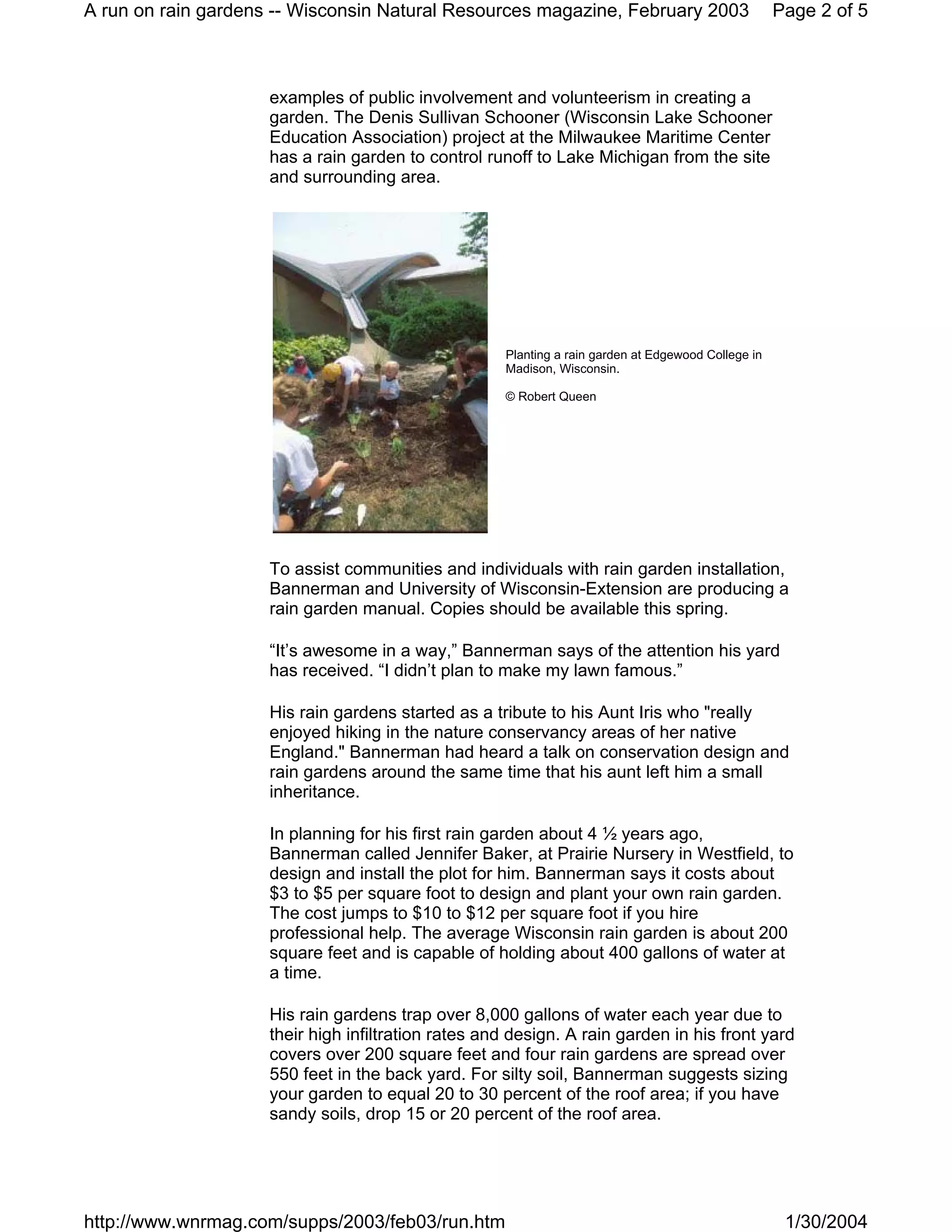
                     Rain gardens planted at Edgewood College and the Willy Street Co-
                     op grocery store in a Madison residential neighborhood are good


http://www.wnrmag.com/supps/2003/feb03/run.htm                                                     1/30/2004
A run on rain gardens -- Wisconsin Natural Resources magazine, February 2003                         Page 2 of 5


                     examples of public involvement and volunteerism in creating a
                     garden. The Denis Sullivan Schooner (Wisconsin Lake Schooner
                     Education Association) project at the Milwaukee Maritime Center
                     has a rain garden to control runoff to Lake Michigan from the site
                     and surrounding area.


                                                     Planting a rain garden at Edgewood College in
                                                     Madison, Wisconsin.

                                                     © Robert Queen


                     To assist communities and individuals with rain garden installation,
                     Bannerman and University of Wisconsin-Extension are producing a
                     rain garden manual. Copies should be available this spring.

                     “It’s awesome in a way,” Bannerman says of the attention his yard
                     has received. “I didn’t plan to make my lawn famous.”

                     His rain gardens started as a tribute to his Aunt Iris who "really
                     enjoyed hiking in the nature conservancy areas of her native
                     England." Bannerman had heard a talk on conservation design and
                     rain gardens around the same time that his aunt left him a small
                     inheritance.

                     In planning for his first rain garden about 4 ½ years ago,
                     Bannerman called Jennifer Baker, at Prairie Nursery in Westfield, to
                     design and install the plot for him. Bannerman says it costs about
                     $3 to $5 per square foot to design and plant your own rain garden.
                     The cost jumps to $10 to $12 per square foot if you hire
                     professional help. The average Wisconsin rain garden is about 200
                     square feet and is capable of holding about 400 gallons of water at
                     a time.

                     His rain gardens trap over 8,000 gallons of water each year due to
                     their high infiltration rates and design. A rain garden in his front yard
                     covers over 200 square feet and four rain gardens are spread over
                     550 feet in the back yard. For silty soil, Bannerman suggests sizing
                     your garden to equal 20 to 30 percent of the roof area; if you have
                     sandy soils, drop 15 or 20 percent of the roof area.


http://www.wnrmag.com/supps/2003/feb03/run.htm                                                        1/30/2004
A run on rain gardens -- Wisconsin Natural Resources magazine, February 2003                          Page 3 of 5


                     Use rope to outline the garden boundaries. Call your utility
                     company’s Digger’s Hotline to locate any buried utility corridors
                     before you start digging. Then, within your outline, dig the garden
                     four to eight inches deep leaving a level bottom to allow water to
                     spread out. The lawn should slope gently upward from the garden
                     to the house and be positioned to trap water from a downspout.

                     Bannerman’s gardens attract finches and woodpeckers, butterflies,
                     dragonflies and native bees. Other people might want to attract bats
                     to control night flying insects such as mosquitoes and moths. His
                     gardens emphasize flowers – blazing stars and cone flowers.
                     Aesthetically, it helps to use flowers that bloom at different times for
                     continual growing season color.

                     Plant transplants may cost more, but you can arrange them to
                     produce any effect you want. Consider native plants in rain gardens,
                     too. They tend to grow better than introduced species because they
                     have evolved under local growing conditions. Native plants are less
                     prone to disease and, once established, require less watering and
                     fertilizer than non-native.


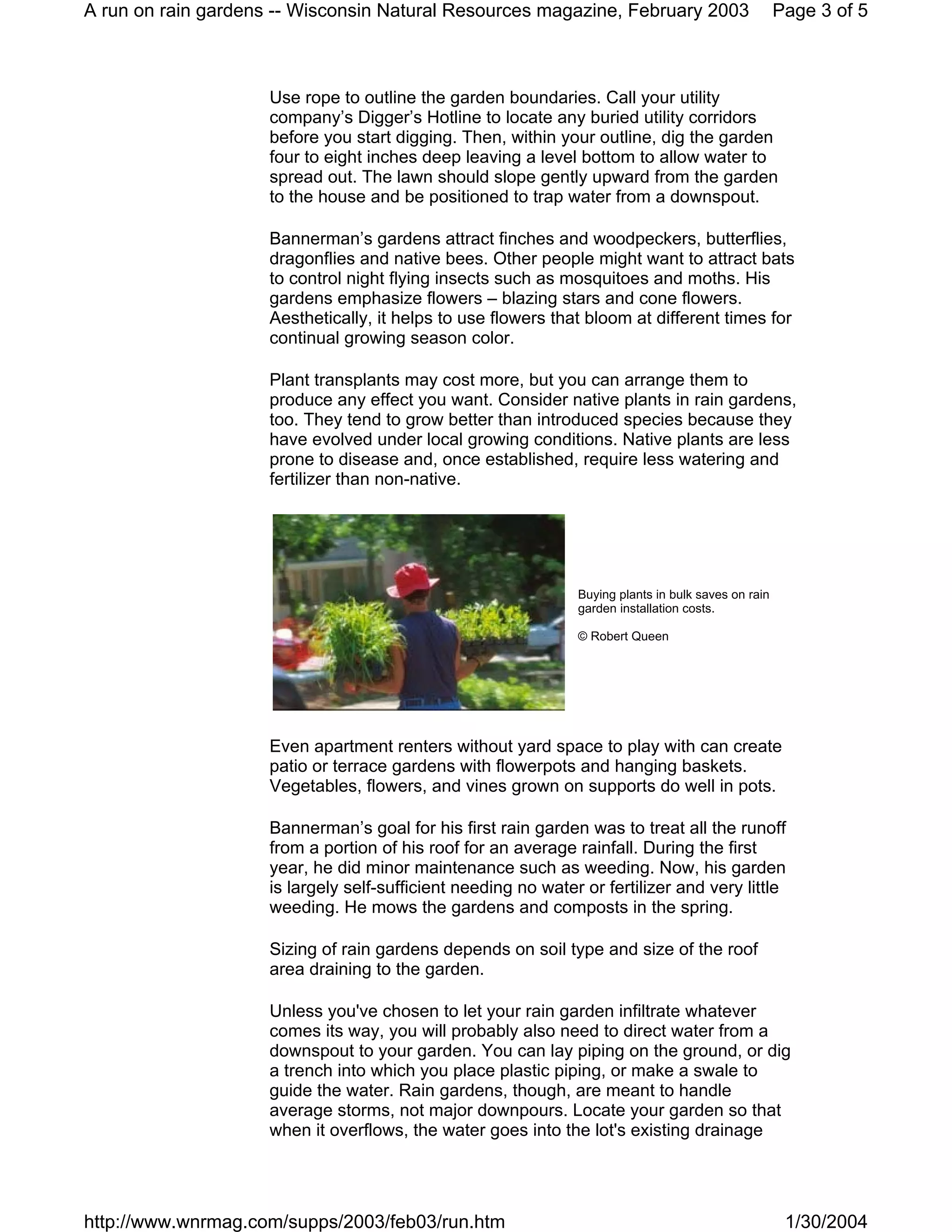
                                                                Buying plants in bulk saves on rain
                                                                garden installation costs.

                                                                © Robert Queen


                     Even apartment renters without yard space to play with can create
                     patio or terrace gardens with flowerpots and hanging baskets.
                     Vegetables, flowers, and vines grown on supports do well in pots.

                     Bannerman’s goal for his first rain garden was to treat all the runoff
                     from a portion of his roof for an average rainfall. During the first
                     year, he did minor maintenance such as weeding. Now, his garden
                     is largely self-sufficient needing no water or fertilizer and very little
                     weeding. He mows the gardens and composts in the spring.

                     Sizing of rain gardens depends on soil type and size of the roof
                     area draining to the garden.

                     Unless you've chosen to let your rain garden infiltrate whatever
                     comes its way, you will probably also need to direct water from a
                     downspout to your garden. You can lay piping on the ground, or dig
                     a trench into which you place plastic piping, or make a swale to
                     guide the water. Rain gardens, though, are meant to handle
                     average storms, not major downpours. Locate your garden so that
                     when it overflows, the water goes into the lot's existing drainage


http://www.wnrmag.com/supps/2003/feb03/run.htm                                                         1/30/2004
A run on rain gardens -- Wisconsin Natural Resources magazine, February 2003                           Page 4 of 5


                     pattern. An outlet furrow to your garden can direct excess water to a
                     safe location.

                     But rain gardens are not appropriate for every lawn. Soil type
                     makes a difference. Some soils hold water creating a mosquito
                     breeding grounds. Sand drains the fastest with ponding limited to a
                     few hours. Clay soils drain slow and may stay wet for days. To test
                     the infiltration, dig a hole, fill it with water and time how long the
                     water sits. If the water is still there after 24 hours, it may not be the
                     right site for a rain garden.

                     Once you have an idea of how your site drains, you can work with
                     what you've got or increase your soil's permeability.

                     "Mixing compost or mulch into your soil," says Bannerman, "really
                     increases the infiltration later."

                     If you want to work with poor drainage conditions, you should
                     choose highly water-tolerant plants and make your depression
                     shallower so that it doesn't retain as much water.

                     Bannerman also warns against planting a rain garden on top of a
                     septic tank drainfield, which could overload the system. He
                     recommends keeping a 10-foot distance from the foundation to
                     avoid flooding your basement.

                     For new developments, rain gardens can be built into the design
                     plan and the cost comes down when plants are bought in bulk. An
                     added benefit is that rain gardens reduce the amount of lawn to
                     mow.


                                         Rain gardens made one Maryland
                                                community famous


                      Somerset, an 80-acre subdivision in Prince George’s County, Md., features
                      about 200 homes on 10,000-square-foot lots, with prices starting around
                      $160,000. Roads here blend into grassed swales. Landscaping contrasts with
                      the curbs, gutters, and sidewalks of neighboring communities.

                      But Someset’s unique character really revolves around rain gardens -- each lot
                      has a 300- to 400-foot rain garden -- located at low lot points.

                      “It (rain gardens) was an innovative idea when we started it 11 years ago,”
                      explains Larry Coffman, associate director for programs and planning with Prince
                      George’s County Department of Environmental Resources.

                      Coffman is widely regarded as the “father of rain gardens” and Somerset is often
                      cited as an example of storm water management at work.

                      For years, bioretention for storm water management was acceptable at
                      commercial and industrial sites with limited space, and in places where installing
                      and maintaining oil and water separators and storm water ponds would have
                      been expensive. Using bioretention in residential locations, was a newer
                      concept.


http://www.wnrmag.com/supps/2003/feb03/run.htm                                                             1/30/2004
A run on rain gardens -- Wisconsin Natural Resources magazine, February 2003                            Page 5 of 5


                       Coffman helped design a plan to replace the ponds, curbs, gutters, and
                       sidewalks with gardens on each lot and create open drainage swales. Hanifin
                       Associates, consultants to Prince George's County, dubbed the storm water
                       facilities "rain gardens."

                       Each garden costs about $500 -- $150 for excavation and $350 for plants. About
                       $100,000 was needed to install rain gardens at Somerset, in comparison to
                       nearly $400,000 -- not including the expense of curbs, gutters, and sidewalks --
                       for conventional detention ponds.

                       “We built a couple hundred rain gardens and about 98 percent of them are still
                       there,” Coffman says.

                       Flow monitoring at Somerset shows that the gardens curbed runoff.

                       For small storms we’ve seen a 75 to 80 percent reduction in flow,” Coffman says.
                       He would now like to see a wider suite of low impact design (LID) measures
                       installed at Somerset.

                       Coffman also speculates that the gardens have helped sell homes. Research
                       shows that LID designed lots elsewhere demand $10,000 more per lot compared
                       to conventional lot designs. LID designs also save in terms of maintenance
                       costs.

                       “The houses at Somerset are sold-out and continue to sell quickly when on the
                       market,” he says. “Nature sells.”


                     WI Department of Natural Resources || legal notices || top of page

                     Need this information in an alternative format? Call 1-608-266-1510.

                     Revised on: 01/30/2004 11:23:15
                     Contact: WNR Webmaster


http://www.wnrmag.com/supps/2003/feb03/run.htm                                                            1/30/2004

WI: A Run on Rain Gardens

  • 1.
    A run onrain gardens -- Wisconsin Natural Resources magazine, February 2003 Page 1 of 5 February 2003 A run on rain gardens Capturing water and attracting wildlife. Natasha Kassulke Rain gardens made one Maryland community famous Contents The term “rain garden” is catchy Where the law meets the land enough to intrigue garden clubs and Cities on the spot scientists alike. On the home front Rain gardens don't require much Stem stormwater from the start space, can be built in various shapes and readily added to existing A run on rain gardens buildings. The gardens fill with a few inches of rain and allow the water to slowly filter into the ground rather than run into a storm sewer. A rain garden allows about 30 percent more water to soak into the ground compared to a conventional lawn. Roger Bannerman, a DNR nonpoint source monitoring researcher and rain garden advocate, is working on at least eight rain garden designs. His passion for these gardens has made him a popular speaker on the topic. Neighborhood groups have adopted his rain garden enthusiasm. Groups like the Friends of Pheasant Branch and Friends of Lake Wingra host workshops. The result is that rain gardens are growing up and out. Gardens have been installed in Poynette. The city of West Bend has a large residential area rain garden. A home in the Savannah Village development of Waunakee has a rain garden that was featured in a Parade of Homes. Rain gardens planted at Edgewood College and the Willy Street Co- op grocery store in a Madison residential neighborhood are good http://www.wnrmag.com/supps/2003/feb03/run.htm 1/30/2004
  • 2.
    A run onrain gardens -- Wisconsin Natural Resources magazine, February 2003 Page 2 of 5 examples of public involvement and volunteerism in creating a garden. The Denis Sullivan Schooner (Wisconsin Lake Schooner Education Association) project at the Milwaukee Maritime Center has a rain garden to control runoff to Lake Michigan from the site and surrounding area. Planting a rain garden at Edgewood College in Madison, Wisconsin. © Robert Queen To assist communities and individuals with rain garden installation, Bannerman and University of Wisconsin-Extension are producing a rain garden manual. Copies should be available this spring. “It’s awesome in a way,” Bannerman says of the attention his yard has received. “I didn’t plan to make my lawn famous.” His rain gardens started as a tribute to his Aunt Iris who "really enjoyed hiking in the nature conservancy areas of her native England." Bannerman had heard a talk on conservation design and rain gardens around the same time that his aunt left him a small inheritance. In planning for his first rain garden about 4 ½ years ago, Bannerman called Jennifer Baker, at Prairie Nursery in Westfield, to design and install the plot for him. Bannerman says it costs about $3 to $5 per square foot to design and plant your own rain garden. The cost jumps to $10 to $12 per square foot if you hire professional help. The average Wisconsin rain garden is about 200 square feet and is capable of holding about 400 gallons of water at a time. His rain gardens trap over 8,000 gallons of water each year due to their high infiltration rates and design. A rain garden in his front yard covers over 200 square feet and four rain gardens are spread over 550 feet in the back yard. For silty soil, Bannerman suggests sizing your garden to equal 20 to 30 percent of the roof area; if you have sandy soils, drop 15 or 20 percent of the roof area. http://www.wnrmag.com/supps/2003/feb03/run.htm 1/30/2004
  • 3.
    A run onrain gardens -- Wisconsin Natural Resources magazine, February 2003 Page 3 of 5 Use rope to outline the garden boundaries. Call your utility company’s Digger’s Hotline to locate any buried utility corridors before you start digging. Then, within your outline, dig the garden four to eight inches deep leaving a level bottom to allow water to spread out. The lawn should slope gently upward from the garden to the house and be positioned to trap water from a downspout. Bannerman’s gardens attract finches and woodpeckers, butterflies, dragonflies and native bees. Other people might want to attract bats to control night flying insects such as mosquitoes and moths. His gardens emphasize flowers – blazing stars and cone flowers. Aesthetically, it helps to use flowers that bloom at different times for continual growing season color. Plant transplants may cost more, but you can arrange them to produce any effect you want. Consider native plants in rain gardens, too. They tend to grow better than introduced species because they have evolved under local growing conditions. Native plants are less prone to disease and, once established, require less watering and fertilizer than non-native. Buying plants in bulk saves on rain garden installation costs. © Robert Queen Even apartment renters without yard space to play with can create patio or terrace gardens with flowerpots and hanging baskets. Vegetables, flowers, and vines grown on supports do well in pots. Bannerman’s goal for his first rain garden was to treat all the runoff from a portion of his roof for an average rainfall. During the first year, he did minor maintenance such as weeding. Now, his garden is largely self-sufficient needing no water or fertilizer and very little weeding. He mows the gardens and composts in the spring. Sizing of rain gardens depends on soil type and size of the roof area draining to the garden. Unless you've chosen to let your rain garden infiltrate whatever comes its way, you will probably also need to direct water from a downspout to your garden. You can lay piping on the ground, or dig a trench into which you place plastic piping, or make a swale to guide the water. Rain gardens, though, are meant to handle average storms, not major downpours. Locate your garden so that when it overflows, the water goes into the lot's existing drainage http://www.wnrmag.com/supps/2003/feb03/run.htm 1/30/2004
  • 4.
    A run onrain gardens -- Wisconsin Natural Resources magazine, February 2003 Page 4 of 5 pattern. An outlet furrow to your garden can direct excess water to a safe location. But rain gardens are not appropriate for every lawn. Soil type makes a difference. Some soils hold water creating a mosquito breeding grounds. Sand drains the fastest with ponding limited to a few hours. Clay soils drain slow and may stay wet for days. To test the infiltration, dig a hole, fill it with water and time how long the water sits. If the water is still there after 24 hours, it may not be the right site for a rain garden. Once you have an idea of how your site drains, you can work with what you've got or increase your soil's permeability. "Mixing compost or mulch into your soil," says Bannerman, "really increases the infiltration later." If you want to work with poor drainage conditions, you should choose highly water-tolerant plants and make your depression shallower so that it doesn't retain as much water. Bannerman also warns against planting a rain garden on top of a septic tank drainfield, which could overload the system. He recommends keeping a 10-foot distance from the foundation to avoid flooding your basement. For new developments, rain gardens can be built into the design plan and the cost comes down when plants are bought in bulk. An added benefit is that rain gardens reduce the amount of lawn to mow. Rain gardens made one Maryland community famous Somerset, an 80-acre subdivision in Prince George’s County, Md., features about 200 homes on 10,000-square-foot lots, with prices starting around $160,000. Roads here blend into grassed swales. Landscaping contrasts with the curbs, gutters, and sidewalks of neighboring communities. But Someset’s unique character really revolves around rain gardens -- each lot has a 300- to 400-foot rain garden -- located at low lot points. “It (rain gardens) was an innovative idea when we started it 11 years ago,” explains Larry Coffman, associate director for programs and planning with Prince George’s County Department of Environmental Resources. Coffman is widely regarded as the “father of rain gardens” and Somerset is often cited as an example of storm water management at work. For years, bioretention for storm water management was acceptable at commercial and industrial sites with limited space, and in places where installing and maintaining oil and water separators and storm water ponds would have been expensive. Using bioretention in residential locations, was a newer concept. http://www.wnrmag.com/supps/2003/feb03/run.htm 1/30/2004
  • 5.
    A run onrain gardens -- Wisconsin Natural Resources magazine, February 2003 Page 5 of 5 Coffman helped design a plan to replace the ponds, curbs, gutters, and sidewalks with gardens on each lot and create open drainage swales. Hanifin Associates, consultants to Prince George's County, dubbed the storm water facilities "rain gardens." Each garden costs about $500 -- $150 for excavation and $350 for plants. About $100,000 was needed to install rain gardens at Somerset, in comparison to nearly $400,000 -- not including the expense of curbs, gutters, and sidewalks -- for conventional detention ponds. “We built a couple hundred rain gardens and about 98 percent of them are still there,” Coffman says. Flow monitoring at Somerset shows that the gardens curbed runoff. For small storms we’ve seen a 75 to 80 percent reduction in flow,” Coffman says. He would now like to see a wider suite of low impact design (LID) measures installed at Somerset. Coffman also speculates that the gardens have helped sell homes. Research shows that LID designed lots elsewhere demand $10,000 more per lot compared to conventional lot designs. LID designs also save in terms of maintenance costs. “The houses at Somerset are sold-out and continue to sell quickly when on the market,” he says. “Nature sells.” WI Department of Natural Resources || legal notices || top of page Need this information in an alternative format? Call 1-608-266-1510. Revised on: 01/30/2004 11:23:15 Contact: WNR Webmaster http://www.wnrmag.com/supps/2003/feb03/run.htm 1/30/2004