A how-to manual 
for homeowners
Your personal contribution to cleaner water 
Homeowners in many parts of the country are catching on to rain gardens – land-scaped 
areas planted to wild flowers and other native vegetation that soak up rain water, 
mainly from the roof of a house or other building. The rain garden fills with a few inches 
of water after a storm and the water slowly filters into the ground rather than running off 
to a storm drain. Compared to a conventional patch of lawn, a rain garden allows about 
30% more water to soak into the ground. 
Why are rain gardens important? As cities and suburbs grow and replace forests and 
agricultural land, increased stormwater runoff from impervious surfaces becomes a 
problem. Stormwater runoff from developed areas increases flooding; carries pollutants 
from streets, parking lots and even lawns into local streams and lakes; and leads to costly 
municipal improvements in stormwater treatment structures. 
By reducing stormwater runoff, rain gardens can be a valuable part of changing these 
trends. While an individual rain garden may seem like a small thing, collectively they 
produce substantial neighborhood and community environmental benefits. Rain gardens 
work for us in several ways: 
g Increasing the amount of water that filters into the ground, which 
recharges local and regional aquifers; 
g Helping protect communities from flooding and drainage problems; 
g Helping protect streams and lakes from pollutants carried by 
urban stormwater – lawn fertilizers and pesticides, oil and 
other fluids that leak from cars, and numerous 
harmful substances that wash off roofs and 
paved areas; 
g Enhancing the beauty of yards and neighborhoods; 
g Providing valuable habitat for birds, butterflies 
and many beneficial insects. 
2
Frequently asked questions 
Does a rain garden form a pond? 
No. The rain water will soak in so the rain garden is dry 
between rainfalls. (Note: some rain gardens can be 
designed to include a permanent pond, but that type of 
rain garden is not addressed in this publication). 
Are they a breeding ground for mosquitoes? 
No. Mosquitoes need 7 to 12 days to lay and hatch eggs, 
and standing water in the rain garden will last for a few 
hours after most storms. Mosquitoes are more likely to lay 
eggs in bird baths, storm sewers, and lawns than in a 
sunny rain garden. Also rain gardens attract dragonflies, 
which eat mosquitoes! 
Do they require a lot of maintenance? 
Rain gardens can be maintained with little effort after the 
plants are established. Some weeding and watering will be 
needed in the first two years, and perhaps some thinning 
in later years as the plants mature. 
Is a rain garden expensive? 
It doesn’t have to be. A family and a 
few friends can provide the labor. The 
main cost will be purchasing the plants, 
and even this cost can be minimized by 
using some native plants that might 
already exist in the yard or in a 
neighbor’s yard. 
Who should use this 
manual? 
This manual provides 
homeowners and landscape 
professionals with the 
information needed to 
design and build rain 
gardens on residential lots. 
Guidelines presented in this 
manual can also be used to 
treat roof runoff at com-mercial 
and institutional 
sites. However, the manual 
should not be used to 
design rain gardens for 
parking lots, busy streets 
and other heavily used 
paved areas where 
stormwater would require 
pretreatment before 
entering a rain garden. 
Rain Gardens – A how-to manual for homeowners 3
Sizing and Siting the Rain Garden 
• • • • • Step 1 
This section of the manual covers rain gar-den 
basics – where to put the rain garden, 
how big to make it, how deep to dig it, and 
what kind of soils and slope are best. Following 
the instructions in this section is the best way 
to ensure a successful rain garden project. 
If you already know the size you want your rain 
garden to be, then skip ahead to the section 
about building the rain garden. However, take time read the pointers about location, and 
do find the slope of the lawn. If the location has a slope more than about 12%, it’s best to 
pick a different location because of the effort it will take to create a level rain garden. 
Where should the rain garden go? 
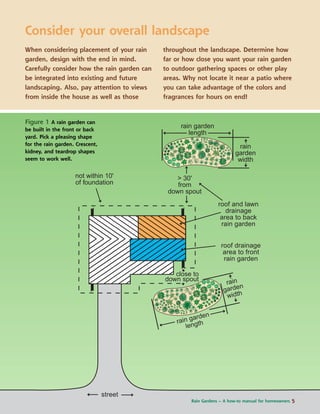
Home rain gardens can be in one of two places – near the house to catch only roof runoff or farther out on 
the lawn to collect water from the lawn and roof. (Figure 1 shows the possible locations on a residential lot.) 
To help decide where to put a rain garden, consider these points: 
• The rain garden should be at least 10 feet from the house so infiltrating water doesn’t 
seep into the foundation. 
• Do not place the rain garden directly over a septic system. 
• It may be tempting to put the rain garden in a part of the yard where water already 
ponds. Don’t! The goal of a rain garden is to encourage infiltration, and your yard’s wet 
patches show where infiltration is slow. 
• It is better to build the rain garden in full or partial sun, not directly under a big tree. 
• Putting the rain garden in a flatter part of the yard will make digging much easier. 
For example, a rain garden 10 feet wide on a 10% slope must be 12 inches deep to be 
level, unless you import topsoil or use cut and fill. 
4 
An extension of PVC pipe helps direct downspout water 
to this rain garden.
Consider your overall landscape 
not within 10' 
of foundation 
throughout the landscape. Determine how 
far or how close you want your rain garden 
to outdoor gathering spaces or other play 
areas. Why not locate it near a patio where 
you can take advantage of the colors and 
fragrances for hours on end! 
> 30' 
from 
down spout 
street 
roof and lawn 
drainage 
area to back 
rain garden 
roof drainage 
area to front 
rain garden 
rain garden 
length 
rain 
garden 
width 
rain 
garden 
width 
close to 
down spout 
rain garden 
length 
When considering placement of your rain 
garden, design with the end in mind. 
Carefully consider how the rain garden can 
be integrated into existing and future 
landscaping. Also, pay attention to views 
from inside the house as well as those 
Rain Gardens – A how-to manual for homeowners 5 
Figure 1 A rain garden can 
be built in the front or back 
yard. Pick a pleasing shape 
for the rain garden. Crescent, 
kidney, and teardrop shapes 
seem to work well.
6 
> 10' 
from 
foundation 
< 12% 
slope 
Figure 2 Rain gardens should 
be located at least 10 feet from 
the house, on a gentle slope 
that catches downspout water. 
How big should the rain garden be? 
The surface area of the rain garden can be almost any size, but time and cost will always be important con-siderations 
in sizing decisions. Any reasonably sized rain garden will provide some stormwater runoff control. 
A typical residential rain garden ranges from 100 to 300 square feet. Rain gardens can be smaller than 100 
square feet, but very small gardens have little plant variety. If a rain garden is larger than 300 square feet it 
takes a lot more time to dig, is more difficult to make level, and could be hard on your budget. 
The size of the rain garden will depend on 
• how deep the garden will be, 
• what type of soils the garden will be planted in, and 
• how much roof and/or lawn will drain to the garden. 
This information, along with the sizing factor from the tables on 
page 9, will determine the surface area of the rain garden. 
berm 
berm 
street 
> 30' 
from 
down spout 
close 
to 
down 
spout 
Guidelines are not rules… 
The sizing guidelines 
described in this manual are 
based on a goal of controlling 
100% of the runoff for the 
average rainfall year while 
keeping the size of the rain 
garden reasonable. Establish-ing 
a 100% runoff goal helps 
compensate for some of the 
errors that creep into the 
design and construction of 
any rain garden. 
If you follow the guidelines in 
the manual and decide the 
calculated surface area is just 
too large for your goals, it is 
perfectly acceptable to make 
the rain garden smaller. The 
rain garden can be up to 30% 
smaller and still control almost 
90% of the annual runoff. On 
the other hand, it is fine to 
make the rain garden bigger 
than the guidelines indicate. 
Digging with a rented backhoe.
How Deep Should the Rain Garden Be? 
A typical rain garden is between four and eight inches deep. A rain garden more than eight inches deep 
might pond water too long, look like a hole in the ground, and present a tripping hazard for somebody 
stepping into it. A rain garden much less than four inches deep will need an excessive amount of surface 
area to provide enough water storage to infiltrate the larger storms. 
No matter what the depth of 
downhill 
the rain garden, the goal is to 
stake 
keep the garden level. Digging 
a very shallow rain garden on a 
steep lawn will require bringing 
in extra topsoil to bring the 
height 
downslope part of the garden 
up to the same height as the 
up-slope part of the garden. As 
the slope gets steeper, it is easi-er 
to dig the rain garden a little 
deeper to make it level. 
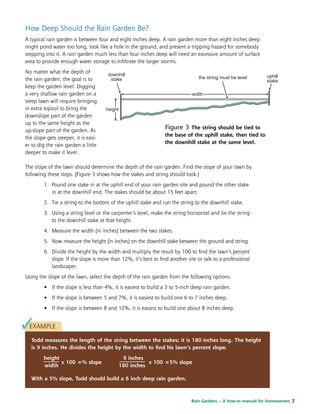
The slope of the lawn should determine the depth of the rain garden. Find the slope of your lawn by 
following these steps. (Figure 3 shows how the stakes and string should look.) 
1. Pound one stake in at the uphill end of your rain garden site and pound the other stake 
in at the downhill end. The stakes should be about 15 feet apart. 
2. Tie a string to the bottom of the uphill stake and run the string to the downhill stake. 
3. Using a string level or the carpenter’s level, make the string horizontal and tie the string 
x 100 =5% slope 
Rain Gardens – A how-to manual for homeowners 7 
to the downhill stake at that height. 
4. Measure the width (in inches) between the two stakes. 
5. Now measure the height (in inches) on the downhill stake between the ground and string. 
6. Divide the height by the width and multiply the result by 100 to find the lawn’s percent 
slope. If the slope is more than 12%, it’s best to find another site or talk to a professional 
landscaper. 
Using the slope of the lawn, select the depth of the rain garden from the following options: 
• If the slope is less than 4%, it is easiest to build a 3 to 5-inch deep rain garden. 
• If the slope is between 5 and 7%, it is easiest to build one 6 to 7 inches deep. 
• If the slope is between 8 and 12%, it is easiest to build one about 8 inches deep. 
EXAMPLE 
Todd measures the length of the string between the stakes; it is 180 inches long. The height 
is 9 inches. He divides the height by the width to find his lawn’s percent slope. 
height 
x 100 =% slope 
width 
9 inches 
180 inches 
With a 5% slope, Todd should build a 6 inch deep rain garden. 
the string must be level uphill 
stake 
width 
Figure 3 The string should be tied to 
the base of the uphill stake, then tied to 
the downhill stake at the same level. 
✓
What type of soils are on the rain garden site? 
After choosing a rain garden depth, identify the lawn’s soil type as sandy, silty, or clayey. Sandy soils have 
the fastest infiltration; clayey soils have the slowest. Since clayey soils take longer to absorb water, rain 
gardens in clayey soil must be bigger than rain gardens in sandy or silty soil. If the soil feels very gritty and 
coarse, you probably have sandy soil. If your soil is smooth but not sticky, you have silty soil. If it is very 
sticky and clumpy, you probably have clayey soil. 
Rain gardens more than 30 feet from the downspout 
1. If there is a significant area of lawn uphill that will also drain to the rain garden, add 
this lawn area to the roof drainage area. First find the roof drainage area using the steps 
above for a rain garden less than 30’ from the downspout. 
2. Next find the area of the lawn that will drain to the rain garden. Stand where your rain 
garden will be and look up toward the house. Identify the part of the lawn sloping into 
the rain garden. 
3. Measure the length and width of the uphill lawn, and multiply them to find the lawn area. 
4. Add the lawn area to the roof drainage area to find the total drainage area. 
8 
How big is the area draining to the rain garden? 
The next step in choosing your rain garden size is to find the area that will drain to the rain garden. As the 
size of the drainage area increases so should the size of the rain garden. There is some guesswork in deter-mining 
the size of a drainage area, especially if a large part of the lawn is up-slope from the proposed garden 
site. Use the suggestions below to estimate the drainage area without spending a lot of time. 
Rain gardens less than 30 feet from the downspout 
1. In this case, where the rain garden is close to the house, almost all water will come from 
the roof downspout. Walk around the house and estimate what percent of the roof feeds 
to that downspout. Many houses have four downspouts, each taking about 25% of the 
roof’s runoff. 
2. Next find your home’s footprint, the area of the first floor. If you don’t already know it, 
use a tape measure to find your house’s length and width. Multiply the two together to 
find the approximate area of your roof. 
3. Finally, multiply the roof area by the percent of the roof that feeds to the rain garden 
downspout. This is the roof drainage area. 
EXAMPLE 
Todd’s house is 60 feet by 40 feet, so the roof area is 2400 square feet. He estimates that 
the downspout collects water from 25% of the roof, so he multiplies 2400 by 0.25 to get a 
downspout drainage area of 600 square feet. 
Roof Area: 60 ft by 40 ft = 2400 square ft. 
Drainage Area: 2400 square ft. x 0.25 = 600 square ft. 
. If the rain garden 
is far from the 
house, and you 
don’t want a swale 
or downspout 
cutting across the 
lawn, run a PVC 
pipe underground 
from the down-spout 
to the rain 
garden. In this 
case do calculations 
as for a rain 
garden less than 
30 feet from the 
house. 
✓
Using the Rain Garden Size Factors 
Having estimated the drainage area, soil type, and depth for your rain garden, use Table 1 or Table 2 to 
determine the rain garden’s surface area. Use Table 1 if the rain garden is less than 30 feet from the down-spout, 
1. Find the size factor for the soil type and rain garden depth. 
2. Multiply the size factor by the drainage area. This number is the recommended rain 
Rain Gardens – A how-to manual for homeowners 9 
and use Table 2 if it is more than 30 feet from the downspout. 
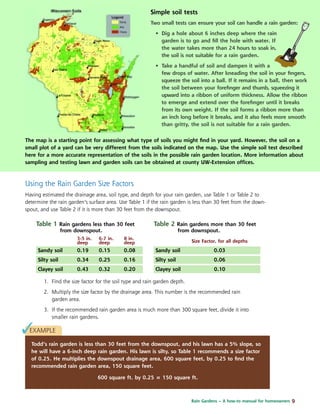
Table 1 Rain gardens less than 30 feet 
from downspout. 
3-5 in. 6-7 in. 8 in. 
deep deep deep 
Sandy soil 0.19 0.15 0.08 
Silty soil 0.34 0.25 0.16 
Clayey soil 0.43 0.32 0.20 
EXAMPLE 
Todd’s rain garden is less than 30 feet from the downspout, and his lawn has a 5% slope, so 
he will have a 6-inch deep rain garden. His lawn is silty, so Table 1 recommends a size factor 
of 0.25. He multiplies the downspout drainage area, 600 square feet, by 0.25 to find the 
recommended rain garden area, 150 square feet. 
600 square ft. by 0.25 = 150 square ft. 
garden area. 
3. If the recommended rain garden area is much more than 300 square feet, divide it into 
smaller rain gardens. 
Table 2 Rain gardens more than 30 feet 
from downspout. 
Size Factor, for all depths 
Sandy soil 0.03 
Silty soil 0.06 
Clayey soil 0.10 
✓ 
Simple soil tests 
Two small tests can ensure your soil can handle a rain garden: 
• Dig a hole about 6 inches deep where the rain 
garden is to go and fill the hole with water. If 
the water takes more than 24 hours to soak in, 
the soil is not suitable for a rain garden. 
• Take a handful of soil and dampen it with a 
few drops of water. After kneading the soil in your fingers, 
squeeze the soil into a ball. If it remains in a ball, then work 
the soil between your forefinger and thumb, squeezing it 
upward into a ribbon of uniform thickness. Allow the ribbon 
to emerge and extend over the forefinger until it breaks 
from its own weight. If the soil forms a ribbon more than 
an inch long before it breaks, and it also feels more smooth 
than gritty, the soil is not suitable for a rain garden. 
The map is a starting point for assessing what type of soils you might find in your yard. However, the soil on a 
small plot of a yard can be very different from the soils indicated on the map. Use the simple soil test described 
here for a more accurate representation of the soils in the possible rain garden location. More information about 
sampling and testing lawn and garden soils can be obtained at county UW-Extension offices.
Runoff flows into a new rain garden (shown before plants are fully grown). 
How long and how wide should the 
rain garden be? 
Before building the rain garden, think about how it will catch 
water. Runoff will flow out of a downspout and should spread 
evenly across the entire length of the rain garden. The rain 
garden must be as level as possible so water doesn’t pool at 
one end and spill over before it has a chance to infiltrate. 
The longer side of the rain garden should face upslope; that is, the length of the rain garden should be 
perpendicular to the slope and the downspout. This way the garden catches as much water as possible. 
However, the rain garden should still be wide enough for the water to spread evenly over the whole bottom 
and to provide the space to plant a variety of plants. A good rule of thumb is that the rain garden should be 
about twice as long (perpendicular to the slope) as it is wide. 
When choosing the width of the garden, think about the slope of the lawn. Wide rain gardens and rain 
gardens on steep slopes will need to be dug very deep at one end in order to be level. If the rain garden is 
too wide, it may be necessary to bring in additional soil to fill up the downhill half. Experience shows that 
making a rain garden about 10 feet wide is a good compromise between the effect of slope and how deep 
the rain garden should be. A rain garden should have a maximum width of about 15 feet, especially for 
lawns with more than about an 8 percent slope. 
To determine the length of the rain garden: 
1. Pick the best rain garden width for your lawn and landscaping. 
2. Divide the size of your rain garden by the width to find your rain garden’s length. 
10 
Choose a size that is best 
for your yard 
Remember that these are only 
guidelines. The size of the 
rain garden also depends on 
how much money you want to 
spend, how much room you 
have in your yard, and how 
much runoff you want to con-trol. 
Again, you can reduce 
the size of your rain garden 
by as much as 30% and still 
control almost 90% of the 
runoff. If the sizing table sug-gests 
that the rain garden be 
200 square feet, but there is 
only enough room for a 
140-square-foot rain garden, 
that’s fine. A smaller rain gar-den 
will usually work to con-trol 
most stormwater runoff, 
although some bigger storms 
might over-top the berm. 
✓ 
EXAMPLE 
Todd wants a 10-foot wide rain garden, so he divides 150 by 10 to find the rain garden 
length, 15 feet. 
rain garden area 
= length 
width 
150 ft2 
= 15 ft 
10 ft
A note 
on tools 
The following 
tools will help in 
building the rain 
garden. Some of 
the tools are 
optional. 
•Tape measure 
•Shovels 
•Rakes 
•Trowels 
•Carpenter’s 
level 
•Wood stakes, 
at least 2 ft 
long 
•String 
•2x4 board, at 
least 6 ft long 
(optional) 
•Small backhoe 
with cater-pillar 
treads 
(optional) 
Building the Rain Garden 
Now that the size and place for the rain garden are set, it’s 
time to get a shovel and start digging. Working alone, it will take 
about six hours to dig an average-size rain garden. If friends help it 
will go much faster, possibly only an hour or two. 
Rain Gardens – A how-to manual for homeowners 11 
• • • • • Step 2 
.If you are building the 
rain garden into an 
existing lawn, digging 
time can be reduced 
by killing the grass 
first. A chemical such 
as Round-Up can be 
used, but a more 
environmentally 
friendly approach is 
to place black plastic 
over the lawn until 
the grass dies. Also, 
the best time to build 
the rain garden is in 
the spring. It will be 
easier to dig, and the 
plants are more likely 
to thrive. 
Before you start digging, call 
Digger’s Hotline at 1-800-242-8511.
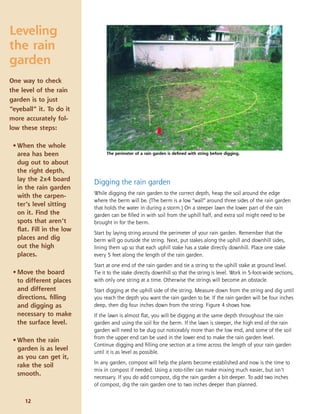
Digging the rain garden 
While digging the rain garden to the correct depth, heap the soil around the edge 
where the berm will be. (The berm is a low “wall” around three sides of the rain garden 
that holds the water in during a storm.) On a steeper lawn the lower part of the rain 
garden can be filled in with soil from the uphill half, and extra soil might need to be 
brought in for the berm. 
Start by laying string around the perimeter of your rain garden. Remember that the 
berm will go outside the string. Next, put stakes along the uphill and downhill sides, 
lining them up so that each uphill stake has a stake directly downhill. Place one stake 
every 5 feet along the length of the rain garden. 
Start at one end of the rain garden and tie a string to the uphill stake at ground level. 
Tie it to the stake directly downhill so that the string is level. Work in 5-foot-wide sections, 
with only one string at a time. Otherwise the strings will become an obstacle. 
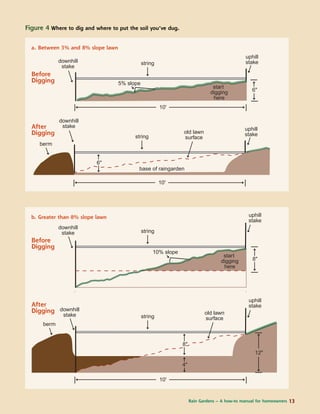
Start digging at the uphill side of the string. Measure down from the string and dig until 
you reach the depth you want the rain garden to be. If the rain garden will be four inches 
deep, then dig four inches down from the string. Figure 4 shows how. 
If the lawn is almost flat, you will be digging at the same depth throughout the rain 
garden and using the soil for the berm. If the lawn is steeper, the high end of the rain 
garden will need to be dug out noticeably more than the low end, and some of the soil 
from the upper end can be used in the lower end to make the rain garden level. 
Continue digging and filling one section at a time across the length of your rain garden 
until it is as level as possible. 
In any garden, compost will help the plants become established and now is the time to 
mix in compost if needed. Using a roto-tiller can make mixing much easier, but isn’t 
necessary. If you do add compost, dig the rain garden a bit deeper. To add two inches 
of compost, dig the rain garden one to two inches deeper than planned. 
Leveling 
the rain 
garden 
One way to check 
the level of the rain 
garden is to just 
“eyeball” it. To do it 
more accurately fol-low 
these steps: 
•When the whole 
area has been 
dug out to about 
the right depth, 
lay the 2x4 board 
in the rain garden 
with the carpen-ter’s 
12 
level sitting 
on it. Find the 
spots that aren’t 
flat. Fill in the low 
places and dig 
out the high 
places. 
•Move the board 
to different places 
and different 
directions, filling 
and digging as 
necessary to make 
the surface level. 
•When the rain 
garden is as level 
as you can get it, 
rake the soil 
smooth. 
The perimeter of a rain garden is defined with string before digging.
6" 
Rain Gardens – A how-to manual for homeowners 13 
10' 
downhill 
stake 
string 
start 
digging 
here 
uphill 
stake 
5% slope 
string 
base of raingarden 
uphill 
stake 
downhill 
stake 
old lawn 
surface 
Before 
Digging 
After 
Digging 
berm 
10' 
6" 
8" 
downhill 
stake string 
start 
digging 
here 
uphill 
stake 
10% slope 
10' 
8" 
12" 
4" 
downhill 
stake string 
uphill 
stake 
berm 
old lawn 
surface 
Figure 4 Where to dig and where to put the soil you’ve dug. 
a. Between 3% and 8% slope lawn 
b. Greater than 8% slope lawn 
Before 
Digging 
After 
Digging
uphill uphill 
Figure 5 The top of the downhill part of the berm 
should come up to the same elevation as the entry 
to the rain garden at the uphill end. 
14 
berm 
downspout 
downhill 
Making the Berm 
Water flowing intro the rain garden will naturally try to 
On a gentle slope, soil from digging out the garden 
run off the downhill edge. A berm is needed to keep 
can be used to create the berm. This rain garden is 
4 inches deep. 
the water in the garden, The berm is a “wall” across the 
bottom and up the sides of the rain garden. The berm will need to be highest at the downhill side. Up the 
sides of the rain garden, the berm will become lower and gradually taper off by the time it reaches the top 
of the rain garden. Figure 5 shows how the berm should look. 
On a flat slope there should be plenty of soil from digging out the rain garden to use for a berm. On a 
steeper slope, most of the soil from the uphill part of the rain garden was probably used to fill in the down-hill 
half, and soil will have to be brought in from somewhere else. After shaping the berm into a smooth 
ridge about a foot across, stomp on it. It is very important to have a well-compacted berm, so stomp hard. 
The berm should have very gently sloping sides; this helps smoothly integrate the rain garden with the 
surrounding lawn and also makes the berm less susceptible to erosion. 
To prevent erosion, cover the berm with mulch or plant grass. Use straw or erosion-control mat to protect 
the berm from erosion while the grass is taking root. 
If you don’t want to plant grass or mulch over the outside of the berm, you can also plant dry-tolerant 
prairie species. Some potential berm species are prairie dropseed, little bluestem, prairie smoke, blue-eyed 
grass, prairie phlox, and shooting star. 
Note: If the downspout is a few feet from the entry to the rain garden, make sure the water runs into the 
garden by either digging a shallow grass swale or attaching an extension to the downspout.
Tips for designing an attractive rain garden 
While rain gardens are a highly functional way to help protect water quality, they are also 
gardens and should be an attractive part of your yard and neighborhood. Think of the 
rain garden in the context of your home’s overall landscape design. Here are a few tips: 
When choosing native plants for the garden, it is important to consider the height of each 
plant, bloom time and color, and its overall texture. Use plants that bloom at different 
times to create a long flowering season. Mix heights, shapes, and textures to give the 
garden depth and dimension. This will keep the rain garden looking interesting even when 
few wildflowers are in bloom. 
When laying plants out, randomly clump individual species in groups of 3 to 7 plants to 
provide a bolder statement of color. Make sure to repeat these individual groupings to 
create repetition and cohesion in a planting. This will provide a more traditional formal 
look to the planting. 
Try incorporating a diverse mixture of sedges, rushes, and grasses with your flowering 
species (forbs). This creates necessary root competition that will allow plants to follow 
their normal growth patterns and not outgrow or out-compete other species. In natural 
areas, a diversity of plant types not only adds beauty but also create a thick underground 
root matrix that keeps the entire plant community in balance. In fact, 80% of the plant 
mass in native prairie communities is underground. Once the rain garden has matured and 
your sedges, rushes and grasses have established a deep, thick root system, there will be 
less change in species location from year to year, and weeds will naturally decline. 
Finally, consider enhancing the rain garden by using local or existing stone, ornamental 
fences, trails, garden benches, or additional wildflower plantings. This will help give the 
new garden an intentional and cohesive look and provide a feeling of neatness that the 
neighbors will appreciate. 
Rain Gardens – A how-to manual for homeowners 15
• • • • • Step 3 
16 
Planting and Maintaining 
the Rain Garden 
Planting the rain garden is the fun part! A number of planting 
designs and lists of suggested plants are included at the end of this 
publication. Use these for ideas, but don’t be afraid to be creative – 
there’s no single best way to plant a rain garden. Anyone who has 
ever done any gardening will have no problem planting a 
rain garden, but a few basic reminders are listed below. 
Planting the rain garden 
Select plants that have a well established root system. Usually one 
or two-year-old plants will have root systems that are beginning to 
circle or get matted. (Note: use only nursery-propagated plants; do 
not collect plants from the wild). 
Make sure to have at least a rough plan for which plants will be 
planted where. Lay out the plants as planned one foot apart in a grid 
pattern, keeping them in containers if possible until they are actually 
planted to prevent drying out before they get in the ground. 
Dig each hole twice as wide as the plant plug and deep enough 
to keep the crown of the young plant level with the existing grade 
(just as it was growing in the cell pack or container). Make sure the 
crown is level and then fill the hole and firmly tamp around the 
roots to avoid air pockets. 
Apply double-shredded mulch evenly over the bed approximately two 
inches thick, but avoid burying the crowns of the new transplants. 
Mulching is usually not necessary after the second growing season 
unless the “mulched look” is desired. 
Stick plant labels next to each individual grouping. This will help 
identify the young native plants from non-desirable species (weeds) 
as you weed the garden. 
As a general rule plants need one inch of water per week. Water 
immediately after planting and continue to water twice a week 
(unless rain does the job) until the plugs are established. You should 
not have to water your rain garden once the plants are established. 
Plugs can be planted anytime during the growing season as long as 
they get adequate water. 
Fire safety 
Make sure burning is allowed 
in your locale. If so, be sure to 
notify the local fire department 
and obtain a burn permit if 
needed. It’s also wise – not to 
mention neighborly – to make 
sure the neighbors know that 
you’re burning and that all 
safety precautions are being 
taken. Basic fire precautions 
include: 
• Make sure there is a 
fire-break (non-burn-able 
area, such as turf-grass) 
at least 10-feet 
wide surrounding the 
area to be burned. 
• Never burn on 
windy days. 
• Never leave an 
actively burning fire 
unattended. 
• Keep a garden hose 
handy in case fire strays 
where it is not wanted. 
Also have a metal leaf 
rake in hand to beat 
out flames that creep 
beyond the burn zone.
Rain Gardens – A how-to manual for homeowners 17 
Maintaining the rain garden 
Weeding will be needed the first couple of years. Remove by 
hand only those plants you are certain are weeds. Try to get out 
all the roots of the weedy plants. Weeds may not be a problem in 
the second season, depending on the variety and tenacity of 
weeds present. In the third year and beyond, the native grasses, 
sedges, rushes, and wildflowers will begin to mature and will 
out-compete the weeds. Weeding isolated patches might still be 
needed on occasion. 
After each growing season, the stems and seedheads can be left 
for winter interest, wildlife cover and bird food. Once spring 
arrives and new growth is 4-6-inches tall, cut all tattered plants 
back. If the growth is really thick, hand-cut the largest plants and 
then use a string trimmer to mow the planting back to a height of 
six to eight inches. Dead plant material can also be removed with 
a string trimmer or weed whacker (scythe) and composted or dis-posed 
of as appropriate. 
The best way to knock back weeds and stimulate native plant 
growth is to burn off the dead plant material in the rain garden. 
However, burning is banned in most municipalities. Another 
option is to mow the dead plant material. If the mowing deck of 
your lawn mower can be raised to a height of six inches or so, go 
ahead and simply mow your rain garden. Then, rake up and 
compost or properly dispose of the dead plant material. 
If the mower deck won’t raise that high, use a string trimmer or 
weed-eater to cut the stems at a height of 6-8 inches. On thicker 
stems, such as cup plant, goldenrods and some asters, a string 
trimmer may not be strong enough. For these, use hand clippers 
or pruning shears to cut the individual stems. 
What does a rain 
garden cost? 
The cost of a rain garden will vary 
depending on who does the work 
and where the plants come from. If 
you grow your own plants or bor-row 
plants from neighbors there 
can be very little or no cost at all. 
If you do all the work but use pur-chased 
prairie plants, a rain garden 
will cost approximately $3 to $5 
per square foot. If a landscaper 
does everything, it will cost approx-imately 
$10 to $12 per square 
foot. 
It might seem easiest to sow 
native wildflower seed over the 
garden, but experience shows that 
seeding a rain garden has its prob-lems. 
Protecting the seeds from 
wind, flooding, weeds, and garden 
pests is very difficult, and the rain 
garden will be mostly weeds for 
the first two years. Growing plugs 
from seed indoors or dividing a 
friend’s plants is much better. If 
you grow plugs, start them about 
four months before moving them 
to the rain garden. When the roots 
have filled the pot and the plants 
are healthy, they may be planted in 
the rain garden
18 
Rain Garden Designs and Plant Lists 
The following pages contain conceptual planting designs and plant lists for rain gardens 
with varying sun and soil conditions. Keep in mind that design possibilities for rain 
gardens are almost limitless. Many landscape nurseries, particularly those specializing in 
native plants and landscaping, can provide other ideas, designs and suggested plants. 
The following eight designs and plant 
lists have been provided by Applied 
Ecological Services, Inc., Brodhead, WI. .
Rain Gardens – A how-to manual for homeowners 19 
10 feet 
wide; 
full to 
partial 
shade 
with clay 
soils 
20 feet 
wide; 
full to 
partial 
shade 
with clay 
soils
10 feet 
wide; 
full to 
partial 
shade 
with silty 
& sandy 
soils 
20 feet 
wide; 
full to 
partial 
shade 
with silty 
& sandy 
soils 
20
Rain Gardens – A how-to manual for homeowners 21 
10 feet 
wide; 
full to 
partial 
sun 
with clay 
soils 
20 feet 
wide; 
full to 
partial 
sun 
with clay 
soils
10 feet 
wide; 
full to 
partial 
sun with 
silt and 
sandy 
soils 
20 feet 
wide; 
full to 
partial 
sun with 
silt and 
sandy 
soils 
22
The following three designs and plant 
lists have been provided by Prairie 
Nursery, Inc., Westfield, WI . 
Rain Gardens – A how-to manual for homeowners 23
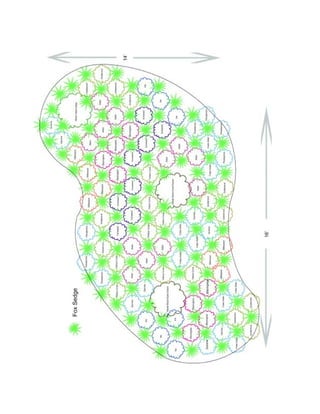
RAIN GARDEN FOR CLAY SOILS AND FULL SUN 
AREA: 192 Square Feet 
Designed to thrive through conditions of periodic water infiltrations as well as dry periods 
Designed to control 45% of annual runoff from an average sized rooftop (500 to 700 square feet) 
Install at least 10’ from your foundation, in-line with a down-spout and/or downslope to intercept the rooftop water 
Depth of the garden designed to be 3.5” to 4” deep to hold about 200 gallons of water during periods of heavy rainfall 
BLOOM BLOOM 
LATIN NAME COMMON NAME AMT TIME COLOR HEIGHT SPACING 
Asclepias incarnata Red Milkweed 7 early summer red 3’-5’ 1’ 
Baptisia lactea White False Indigo 1 early summer white 3’-5’ 2’ 
Iris versicolor Blue Flag Iris 7 early summer blue 2’-3’ 1’ 
Penstemon digitalis Smooth Penstemon 7 early summer white 2’-3’ 1’ 
Liatris pycnostachya Prairie Blazingstar 8 summer pink 3’-5’ 1’ 
Parthenium integrifolium Wild Quinine 8 summer white 3’-5’ 1’ 
Ratibida pinnata Yellow Coneflower 8 summer yellow 3’-6’ 1’ 
Boltonia asteroides False Aster 8 late summer white/pink 2’-4’ 1’ 
Rudbeckia subtomentosa Sweet Black-Eyed Susan 2 late summer yellow 4’-6’ 2’ 
Vernonia fasciculata Ironweed 8 late summer magenta 4’-6’ 1’ 
Aster novae-angliae New England Aster 12 fall pink/purple 3’-6’ 1’ 
Solidago rigida Stiff Goldenrod 12 fall yellow 3’-5’ 1’ 
Carex vulpinoidea Fox Sedge 96 1’-3’ 1’ 
184 plants 
Rain Gardens – A how-to manual for homeowners 25
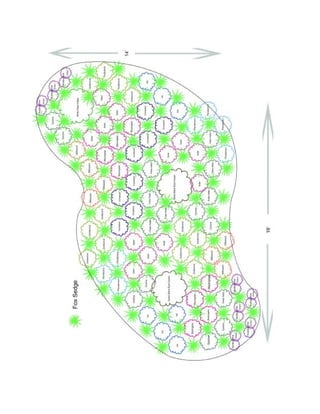
RAIN GARDEN FOR LOAM TO SANDY/LOAM SOILS AND FULL SUN 
AREA: 192 Square Feet 
Designed to thrive through conditions of periodic water infiltrations as well as dry periods 
Designed to control 90% of annual runoff from an average sized rooftop (500 to 700 square feet) 
Install at least 10' from your foundation, in-line with a down-spout and/or downslope to intercept the rooftop water 
Depth of the garden designed to be 3.5" to 4" deep to hold about 400 gallons of water during periods of heavy rainfall 
BLOOM BLOOM 
LATIN NAME COMMON NAME AMT TIME COLOR HEIGHT SPACING 
Asclepias incarnata Red Milkweed 7 early summer red 3'-5' 1' 
Baptisia lactea White False Indigo 1 early summer white 3'-5' 2' 
Iris versicolor Blue Flag Iris 7 early summer blue 2'-3' 1' 
Penstemon digitalis Smooth Penstemon 7 early summer white 2'-3' 1' 
Allium cernuum Nodding Pink Onion 16 summer pink 1'-2' 6" 
Liatris pycnostachya Prairie Blazingstar 8 summer pink 3'-5' 1' 
Parthenium integrifolium Wild Quinine 8 summer white 3'-5' 1' 
Boltonia asteroides False Aster 8 late summer white/pink 2'-4' 1' 
Rudbeckia subtomentosa Sweet Black-Eyed Susan 2 late summer yellow 4'-6' 2' 
Vernonia fasciculata Ironweed 8 late summer magenta 4'-6' 1' 
Aster novae-angliae New England Aster 12 fall pink/purple 3'-6' 1' 
Solidago ohioensis Ohio Goldenrod 12 fall yellow 3'-4' 1' 
Carex vulpinoidea Fox Sedge 96 1'-3' 1' 
192 plants 
Rain Gardens – A how-to manual for homeowners 27
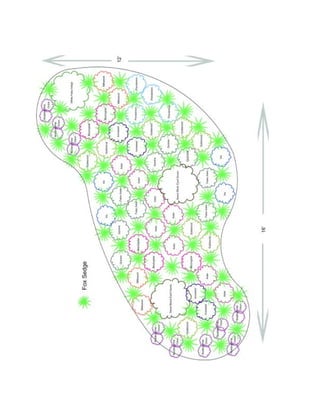
RAIN GARDEN FOR SANDY SOILS AND FULL SUN 
AREA: 128 Square Feet 
Designed to thrive through conditions of periodic water infiltrations as well as dry periods 
Designed to control 90% of annual runoff from an average sized rooftop (500 to 700 square feet) 
Install at least 10' from your foundation, in-line with a down-spout and/or downslope to intercept the rooftop water 
Depth of the garden designed to be 3.5" to 4" deep to hold about 400 gallons of water during periods of heavy rainfall 
BLOOM BLOOM 
LATIN NAME COMMON NAME AMT TIME COLOR HEIGHT SPACING 
Asclepias incarnata Red Milkweed 4 early summer red 3'-5' 1' 
Baptisia lactea White False Indigo 1 early summer white 3'-5' 2' 
Iris versicolor Blue Flag Iris 4 early summer blue 2'-3' 1' 
Penstemon digitalis Smooth Penstemon 4 early summer white 2'-3' 1' 
Allium cernuum Nodding Pink Onion 18 summer pink 1'-2' 6" 
Liatris pycnostachya Prairie Blazingstar 5 summer pink 3'-5' 1' 
Parthenium integrifolium Wild Quinine 5 summer white 3'-5' 1' 
Boltonia asteroides False Aster 4 late summer white/pink 2'-4' 1' 
Rudbeckia subtomentosa Sweet Black-Eyed Susan 2 late summer yellow 4'-6' 2' 
Vernonia fasciculata Ironweed 4 late summer magenta 4'-6' 1' 
Aster novae-angliae New England Aster 8 fall pink/purple 3'-6' 1' 
Solidago ohioensis Ohio Goldenrod 8 fall yellow 3'-4' 1' 
Carex vulpinoidea Fox Sedge (sedge) 64 1'-3' 1' 
128 plants 
Rain Gardens – A how-to manual for homeowners 29
30 
Special Rain Garden Locations 
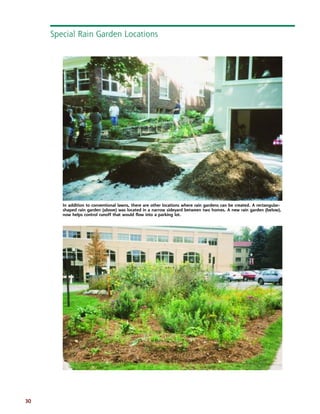
In addition to conventional lawns, there are other locations where rain gardens can be created. A rectangular-shaped 
rain garden (above) was located in a narrow sideyard between two homes. A new rain garden (below), 
now helps control runoff that would flow into a parking lot.
Rain garden designs and 
plant lists provided by John 
Gishnock, Applied Ecological 
Services, Inc. (pages 19-22) 
and Jennifer Baker, Prairie 
Nursery Inc. (pages 24-29). 
Rain Gardens – A how-to manual for homeowners 31
A how-to manual for homeowners 
This publication developed by Roger Bannerman, Wisconsin Department of Natural Resources 
and Ellen Considine, U.S. Geological Survey. Special thanks to John Gishnock, Applied Ecological Services, Inc., 
Jennifer Baker, Prairie Nursery Inc. and Joyce Powers, CRM Ecosystems Inc. 
Photos by Roger Bannerman, Wisconsin Department of Natural Resources. 
Layout design/production by Jeffrey Strobel, and editorial assistance by Bruce Webendorfer, University of 
Wisconsin–Extension Environmental Resources Center. 
This publication is available from county UW-Extension offices, Cooperative Extension Publications, 1-877-947-7827 
and from DNR Service Centers. 
The publication can also be viewed and printed from pdf format on the web at clean-water.uwex.edu/pubs/raingarden 
Copyright 2003 by the Board of Regents of the University of Wisconsin System. University of Wisconsin–Extension is an EEO/Affirmative Action employer 
and provides equal opportunities in employment and programming, including Title IX and ADA requirements. 
University of Wisconsin–Extension 
UWEX Publication GWQ037 
1-06-03-5M-100-S 
Wisconsin Department of Natural Resources 
DNR Publication PUB-WT-776 2003 
A frosted rain garden 
in autumn.

Wisconsin Rain Gardens: A How to Manual for Homeowners

  • 1.
    A how-to manual for homeowners
  • 2.
    Your personal contributionto cleaner water Homeowners in many parts of the country are catching on to rain gardens – land-scaped areas planted to wild flowers and other native vegetation that soak up rain water, mainly from the roof of a house or other building. The rain garden fills with a few inches of water after a storm and the water slowly filters into the ground rather than running off to a storm drain. Compared to a conventional patch of lawn, a rain garden allows about 30% more water to soak into the ground. Why are rain gardens important? As cities and suburbs grow and replace forests and agricultural land, increased stormwater runoff from impervious surfaces becomes a problem. Stormwater runoff from developed areas increases flooding; carries pollutants from streets, parking lots and even lawns into local streams and lakes; and leads to costly municipal improvements in stormwater treatment structures. By reducing stormwater runoff, rain gardens can be a valuable part of changing these trends. While an individual rain garden may seem like a small thing, collectively they produce substantial neighborhood and community environmental benefits. Rain gardens work for us in several ways: g Increasing the amount of water that filters into the ground, which recharges local and regional aquifers; g Helping protect communities from flooding and drainage problems; g Helping protect streams and lakes from pollutants carried by urban stormwater – lawn fertilizers and pesticides, oil and other fluids that leak from cars, and numerous harmful substances that wash off roofs and paved areas; g Enhancing the beauty of yards and neighborhoods; g Providing valuable habitat for birds, butterflies and many beneficial insects. 2
  • 3.
    Frequently asked questions Does a rain garden form a pond? No. The rain water will soak in so the rain garden is dry between rainfalls. (Note: some rain gardens can be designed to include a permanent pond, but that type of rain garden is not addressed in this publication). Are they a breeding ground for mosquitoes? No. Mosquitoes need 7 to 12 days to lay and hatch eggs, and standing water in the rain garden will last for a few hours after most storms. Mosquitoes are more likely to lay eggs in bird baths, storm sewers, and lawns than in a sunny rain garden. Also rain gardens attract dragonflies, which eat mosquitoes! Do they require a lot of maintenance? Rain gardens can be maintained with little effort after the plants are established. Some weeding and watering will be needed in the first two years, and perhaps some thinning in later years as the plants mature. Is a rain garden expensive? It doesn’t have to be. A family and a few friends can provide the labor. The main cost will be purchasing the plants, and even this cost can be minimized by using some native plants that might already exist in the yard or in a neighbor’s yard. Who should use this manual? This manual provides homeowners and landscape professionals with the information needed to design and build rain gardens on residential lots. Guidelines presented in this manual can also be used to treat roof runoff at com-mercial and institutional sites. However, the manual should not be used to design rain gardens for parking lots, busy streets and other heavily used paved areas where stormwater would require pretreatment before entering a rain garden. Rain Gardens – A how-to manual for homeowners 3
  • 4.
    Sizing and Sitingthe Rain Garden • • • • • Step 1 This section of the manual covers rain gar-den basics – where to put the rain garden, how big to make it, how deep to dig it, and what kind of soils and slope are best. Following the instructions in this section is the best way to ensure a successful rain garden project. If you already know the size you want your rain garden to be, then skip ahead to the section about building the rain garden. However, take time read the pointers about location, and do find the slope of the lawn. If the location has a slope more than about 12%, it’s best to pick a different location because of the effort it will take to create a level rain garden. Where should the rain garden go? Home rain gardens can be in one of two places – near the house to catch only roof runoff or farther out on the lawn to collect water from the lawn and roof. (Figure 1 shows the possible locations on a residential lot.) To help decide where to put a rain garden, consider these points: • The rain garden should be at least 10 feet from the house so infiltrating water doesn’t seep into the foundation. • Do not place the rain garden directly over a septic system. • It may be tempting to put the rain garden in a part of the yard where water already ponds. Don’t! The goal of a rain garden is to encourage infiltration, and your yard’s wet patches show where infiltration is slow. • It is better to build the rain garden in full or partial sun, not directly under a big tree. • Putting the rain garden in a flatter part of the yard will make digging much easier. For example, a rain garden 10 feet wide on a 10% slope must be 12 inches deep to be level, unless you import topsoil or use cut and fill. 4 An extension of PVC pipe helps direct downspout water to this rain garden.
  • 5.
    Consider your overalllandscape not within 10' of foundation throughout the landscape. Determine how far or how close you want your rain garden to outdoor gathering spaces or other play areas. Why not locate it near a patio where you can take advantage of the colors and fragrances for hours on end! > 30' from down spout street roof and lawn drainage area to back rain garden roof drainage area to front rain garden rain garden length rain garden width rain garden width close to down spout rain garden length When considering placement of your rain garden, design with the end in mind. Carefully consider how the rain garden can be integrated into existing and future landscaping. Also, pay attention to views from inside the house as well as those Rain Gardens – A how-to manual for homeowners 5 Figure 1 A rain garden can be built in the front or back yard. Pick a pleasing shape for the rain garden. Crescent, kidney, and teardrop shapes seem to work well.
  • 6.
    6 > 10' from foundation < 12% slope Figure 2 Rain gardens should be located at least 10 feet from the house, on a gentle slope that catches downspout water. How big should the rain garden be? The surface area of the rain garden can be almost any size, but time and cost will always be important con-siderations in sizing decisions. Any reasonably sized rain garden will provide some stormwater runoff control. A typical residential rain garden ranges from 100 to 300 square feet. Rain gardens can be smaller than 100 square feet, but very small gardens have little plant variety. If a rain garden is larger than 300 square feet it takes a lot more time to dig, is more difficult to make level, and could be hard on your budget. The size of the rain garden will depend on • how deep the garden will be, • what type of soils the garden will be planted in, and • how much roof and/or lawn will drain to the garden. This information, along with the sizing factor from the tables on page 9, will determine the surface area of the rain garden. berm berm street > 30' from down spout close to down spout Guidelines are not rules… The sizing guidelines described in this manual are based on a goal of controlling 100% of the runoff for the average rainfall year while keeping the size of the rain garden reasonable. Establish-ing a 100% runoff goal helps compensate for some of the errors that creep into the design and construction of any rain garden. If you follow the guidelines in the manual and decide the calculated surface area is just too large for your goals, it is perfectly acceptable to make the rain garden smaller. The rain garden can be up to 30% smaller and still control almost 90% of the annual runoff. On the other hand, it is fine to make the rain garden bigger than the guidelines indicate. Digging with a rented backhoe.
  • 7.
    How Deep Shouldthe Rain Garden Be? A typical rain garden is between four and eight inches deep. A rain garden more than eight inches deep might pond water too long, look like a hole in the ground, and present a tripping hazard for somebody stepping into it. A rain garden much less than four inches deep will need an excessive amount of surface area to provide enough water storage to infiltrate the larger storms. No matter what the depth of downhill the rain garden, the goal is to stake keep the garden level. Digging a very shallow rain garden on a steep lawn will require bringing in extra topsoil to bring the height downslope part of the garden up to the same height as the up-slope part of the garden. As the slope gets steeper, it is easi-er to dig the rain garden a little deeper to make it level. The slope of the lawn should determine the depth of the rain garden. Find the slope of your lawn by following these steps. (Figure 3 shows how the stakes and string should look.) 1. Pound one stake in at the uphill end of your rain garden site and pound the other stake in at the downhill end. The stakes should be about 15 feet apart. 2. Tie a string to the bottom of the uphill stake and run the string to the downhill stake. 3. Using a string level or the carpenter’s level, make the string horizontal and tie the string x 100 =5% slope Rain Gardens – A how-to manual for homeowners 7 to the downhill stake at that height. 4. Measure the width (in inches) between the two stakes. 5. Now measure the height (in inches) on the downhill stake between the ground and string. 6. Divide the height by the width and multiply the result by 100 to find the lawn’s percent slope. If the slope is more than 12%, it’s best to find another site or talk to a professional landscaper. Using the slope of the lawn, select the depth of the rain garden from the following options: • If the slope is less than 4%, it is easiest to build a 3 to 5-inch deep rain garden. • If the slope is between 5 and 7%, it is easiest to build one 6 to 7 inches deep. • If the slope is between 8 and 12%, it is easiest to build one about 8 inches deep. EXAMPLE Todd measures the length of the string between the stakes; it is 180 inches long. The height is 9 inches. He divides the height by the width to find his lawn’s percent slope. height x 100 =% slope width 9 inches 180 inches With a 5% slope, Todd should build a 6 inch deep rain garden. the string must be level uphill stake width Figure 3 The string should be tied to the base of the uphill stake, then tied to the downhill stake at the same level. ✓
  • 8.
    What type ofsoils are on the rain garden site? After choosing a rain garden depth, identify the lawn’s soil type as sandy, silty, or clayey. Sandy soils have the fastest infiltration; clayey soils have the slowest. Since clayey soils take longer to absorb water, rain gardens in clayey soil must be bigger than rain gardens in sandy or silty soil. If the soil feels very gritty and coarse, you probably have sandy soil. If your soil is smooth but not sticky, you have silty soil. If it is very sticky and clumpy, you probably have clayey soil. Rain gardens more than 30 feet from the downspout 1. If there is a significant area of lawn uphill that will also drain to the rain garden, add this lawn area to the roof drainage area. First find the roof drainage area using the steps above for a rain garden less than 30’ from the downspout. 2. Next find the area of the lawn that will drain to the rain garden. Stand where your rain garden will be and look up toward the house. Identify the part of the lawn sloping into the rain garden. 3. Measure the length and width of the uphill lawn, and multiply them to find the lawn area. 4. Add the lawn area to the roof drainage area to find the total drainage area. 8 How big is the area draining to the rain garden? The next step in choosing your rain garden size is to find the area that will drain to the rain garden. As the size of the drainage area increases so should the size of the rain garden. There is some guesswork in deter-mining the size of a drainage area, especially if a large part of the lawn is up-slope from the proposed garden site. Use the suggestions below to estimate the drainage area without spending a lot of time. Rain gardens less than 30 feet from the downspout 1. In this case, where the rain garden is close to the house, almost all water will come from the roof downspout. Walk around the house and estimate what percent of the roof feeds to that downspout. Many houses have four downspouts, each taking about 25% of the roof’s runoff. 2. Next find your home’s footprint, the area of the first floor. If you don’t already know it, use a tape measure to find your house’s length and width. Multiply the two together to find the approximate area of your roof. 3. Finally, multiply the roof area by the percent of the roof that feeds to the rain garden downspout. This is the roof drainage area. EXAMPLE Todd’s house is 60 feet by 40 feet, so the roof area is 2400 square feet. He estimates that the downspout collects water from 25% of the roof, so he multiplies 2400 by 0.25 to get a downspout drainage area of 600 square feet. Roof Area: 60 ft by 40 ft = 2400 square ft. Drainage Area: 2400 square ft. x 0.25 = 600 square ft. . If the rain garden is far from the house, and you don’t want a swale or downspout cutting across the lawn, run a PVC pipe underground from the down-spout to the rain garden. In this case do calculations as for a rain garden less than 30 feet from the house. ✓
  • 9.
    Using the RainGarden Size Factors Having estimated the drainage area, soil type, and depth for your rain garden, use Table 1 or Table 2 to determine the rain garden’s surface area. Use Table 1 if the rain garden is less than 30 feet from the down-spout, 1. Find the size factor for the soil type and rain garden depth. 2. Multiply the size factor by the drainage area. This number is the recommended rain Rain Gardens – A how-to manual for homeowners 9 and use Table 2 if it is more than 30 feet from the downspout. Table 1 Rain gardens less than 30 feet from downspout. 3-5 in. 6-7 in. 8 in. deep deep deep Sandy soil 0.19 0.15 0.08 Silty soil 0.34 0.25 0.16 Clayey soil 0.43 0.32 0.20 EXAMPLE Todd’s rain garden is less than 30 feet from the downspout, and his lawn has a 5% slope, so he will have a 6-inch deep rain garden. His lawn is silty, so Table 1 recommends a size factor of 0.25. He multiplies the downspout drainage area, 600 square feet, by 0.25 to find the recommended rain garden area, 150 square feet. 600 square ft. by 0.25 = 150 square ft. garden area. 3. If the recommended rain garden area is much more than 300 square feet, divide it into smaller rain gardens. Table 2 Rain gardens more than 30 feet from downspout. Size Factor, for all depths Sandy soil 0.03 Silty soil 0.06 Clayey soil 0.10 ✓ Simple soil tests Two small tests can ensure your soil can handle a rain garden: • Dig a hole about 6 inches deep where the rain garden is to go and fill the hole with water. If the water takes more than 24 hours to soak in, the soil is not suitable for a rain garden. • Take a handful of soil and dampen it with a few drops of water. After kneading the soil in your fingers, squeeze the soil into a ball. If it remains in a ball, then work the soil between your forefinger and thumb, squeezing it upward into a ribbon of uniform thickness. Allow the ribbon to emerge and extend over the forefinger until it breaks from its own weight. If the soil forms a ribbon more than an inch long before it breaks, and it also feels more smooth than gritty, the soil is not suitable for a rain garden. The map is a starting point for assessing what type of soils you might find in your yard. However, the soil on a small plot of a yard can be very different from the soils indicated on the map. Use the simple soil test described here for a more accurate representation of the soils in the possible rain garden location. More information about sampling and testing lawn and garden soils can be obtained at county UW-Extension offices.
  • 10.
    Runoff flows intoa new rain garden (shown before plants are fully grown). How long and how wide should the rain garden be? Before building the rain garden, think about how it will catch water. Runoff will flow out of a downspout and should spread evenly across the entire length of the rain garden. The rain garden must be as level as possible so water doesn’t pool at one end and spill over before it has a chance to infiltrate. The longer side of the rain garden should face upslope; that is, the length of the rain garden should be perpendicular to the slope and the downspout. This way the garden catches as much water as possible. However, the rain garden should still be wide enough for the water to spread evenly over the whole bottom and to provide the space to plant a variety of plants. A good rule of thumb is that the rain garden should be about twice as long (perpendicular to the slope) as it is wide. When choosing the width of the garden, think about the slope of the lawn. Wide rain gardens and rain gardens on steep slopes will need to be dug very deep at one end in order to be level. If the rain garden is too wide, it may be necessary to bring in additional soil to fill up the downhill half. Experience shows that making a rain garden about 10 feet wide is a good compromise between the effect of slope and how deep the rain garden should be. A rain garden should have a maximum width of about 15 feet, especially for lawns with more than about an 8 percent slope. To determine the length of the rain garden: 1. Pick the best rain garden width for your lawn and landscaping. 2. Divide the size of your rain garden by the width to find your rain garden’s length. 10 Choose a size that is best for your yard Remember that these are only guidelines. The size of the rain garden also depends on how much money you want to spend, how much room you have in your yard, and how much runoff you want to con-trol. Again, you can reduce the size of your rain garden by as much as 30% and still control almost 90% of the runoff. If the sizing table sug-gests that the rain garden be 200 square feet, but there is only enough room for a 140-square-foot rain garden, that’s fine. A smaller rain gar-den will usually work to con-trol most stormwater runoff, although some bigger storms might over-top the berm. ✓ EXAMPLE Todd wants a 10-foot wide rain garden, so he divides 150 by 10 to find the rain garden length, 15 feet. rain garden area = length width 150 ft2 = 15 ft 10 ft
  • 11.
    A note ontools The following tools will help in building the rain garden. Some of the tools are optional. •Tape measure •Shovels •Rakes •Trowels •Carpenter’s level •Wood stakes, at least 2 ft long •String •2x4 board, at least 6 ft long (optional) •Small backhoe with cater-pillar treads (optional) Building the Rain Garden Now that the size and place for the rain garden are set, it’s time to get a shovel and start digging. Working alone, it will take about six hours to dig an average-size rain garden. If friends help it will go much faster, possibly only an hour or two. Rain Gardens – A how-to manual for homeowners 11 • • • • • Step 2 .If you are building the rain garden into an existing lawn, digging time can be reduced by killing the grass first. A chemical such as Round-Up can be used, but a more environmentally friendly approach is to place black plastic over the lawn until the grass dies. Also, the best time to build the rain garden is in the spring. It will be easier to dig, and the plants are more likely to thrive. Before you start digging, call Digger’s Hotline at 1-800-242-8511.
  • 12.
    Digging the raingarden While digging the rain garden to the correct depth, heap the soil around the edge where the berm will be. (The berm is a low “wall” around three sides of the rain garden that holds the water in during a storm.) On a steeper lawn the lower part of the rain garden can be filled in with soil from the uphill half, and extra soil might need to be brought in for the berm. Start by laying string around the perimeter of your rain garden. Remember that the berm will go outside the string. Next, put stakes along the uphill and downhill sides, lining them up so that each uphill stake has a stake directly downhill. Place one stake every 5 feet along the length of the rain garden. Start at one end of the rain garden and tie a string to the uphill stake at ground level. Tie it to the stake directly downhill so that the string is level. Work in 5-foot-wide sections, with only one string at a time. Otherwise the strings will become an obstacle. Start digging at the uphill side of the string. Measure down from the string and dig until you reach the depth you want the rain garden to be. If the rain garden will be four inches deep, then dig four inches down from the string. Figure 4 shows how. If the lawn is almost flat, you will be digging at the same depth throughout the rain garden and using the soil for the berm. If the lawn is steeper, the high end of the rain garden will need to be dug out noticeably more than the low end, and some of the soil from the upper end can be used in the lower end to make the rain garden level. Continue digging and filling one section at a time across the length of your rain garden until it is as level as possible. In any garden, compost will help the plants become established and now is the time to mix in compost if needed. Using a roto-tiller can make mixing much easier, but isn’t necessary. If you do add compost, dig the rain garden a bit deeper. To add two inches of compost, dig the rain garden one to two inches deeper than planned. Leveling the rain garden One way to check the level of the rain garden is to just “eyeball” it. To do it more accurately fol-low these steps: •When the whole area has been dug out to about the right depth, lay the 2x4 board in the rain garden with the carpen-ter’s 12 level sitting on it. Find the spots that aren’t flat. Fill in the low places and dig out the high places. •Move the board to different places and different directions, filling and digging as necessary to make the surface level. •When the rain garden is as level as you can get it, rake the soil smooth. The perimeter of a rain garden is defined with string before digging.
  • 13.
    6" Rain Gardens– A how-to manual for homeowners 13 10' downhill stake string start digging here uphill stake 5% slope string base of raingarden uphill stake downhill stake old lawn surface Before Digging After Digging berm 10' 6" 8" downhill stake string start digging here uphill stake 10% slope 10' 8" 12" 4" downhill stake string uphill stake berm old lawn surface Figure 4 Where to dig and where to put the soil you’ve dug. a. Between 3% and 8% slope lawn b. Greater than 8% slope lawn Before Digging After Digging
  • 14.
    uphill uphill Figure5 The top of the downhill part of the berm should come up to the same elevation as the entry to the rain garden at the uphill end. 14 berm downspout downhill Making the Berm Water flowing intro the rain garden will naturally try to On a gentle slope, soil from digging out the garden run off the downhill edge. A berm is needed to keep can be used to create the berm. This rain garden is 4 inches deep. the water in the garden, The berm is a “wall” across the bottom and up the sides of the rain garden. The berm will need to be highest at the downhill side. Up the sides of the rain garden, the berm will become lower and gradually taper off by the time it reaches the top of the rain garden. Figure 5 shows how the berm should look. On a flat slope there should be plenty of soil from digging out the rain garden to use for a berm. On a steeper slope, most of the soil from the uphill part of the rain garden was probably used to fill in the down-hill half, and soil will have to be brought in from somewhere else. After shaping the berm into a smooth ridge about a foot across, stomp on it. It is very important to have a well-compacted berm, so stomp hard. The berm should have very gently sloping sides; this helps smoothly integrate the rain garden with the surrounding lawn and also makes the berm less susceptible to erosion. To prevent erosion, cover the berm with mulch or plant grass. Use straw or erosion-control mat to protect the berm from erosion while the grass is taking root. If you don’t want to plant grass or mulch over the outside of the berm, you can also plant dry-tolerant prairie species. Some potential berm species are prairie dropseed, little bluestem, prairie smoke, blue-eyed grass, prairie phlox, and shooting star. Note: If the downspout is a few feet from the entry to the rain garden, make sure the water runs into the garden by either digging a shallow grass swale or attaching an extension to the downspout.
  • 15.
    Tips for designingan attractive rain garden While rain gardens are a highly functional way to help protect water quality, they are also gardens and should be an attractive part of your yard and neighborhood. Think of the rain garden in the context of your home’s overall landscape design. Here are a few tips: When choosing native plants for the garden, it is important to consider the height of each plant, bloom time and color, and its overall texture. Use plants that bloom at different times to create a long flowering season. Mix heights, shapes, and textures to give the garden depth and dimension. This will keep the rain garden looking interesting even when few wildflowers are in bloom. When laying plants out, randomly clump individual species in groups of 3 to 7 plants to provide a bolder statement of color. Make sure to repeat these individual groupings to create repetition and cohesion in a planting. This will provide a more traditional formal look to the planting. Try incorporating a diverse mixture of sedges, rushes, and grasses with your flowering species (forbs). This creates necessary root competition that will allow plants to follow their normal growth patterns and not outgrow or out-compete other species. In natural areas, a diversity of plant types not only adds beauty but also create a thick underground root matrix that keeps the entire plant community in balance. In fact, 80% of the plant mass in native prairie communities is underground. Once the rain garden has matured and your sedges, rushes and grasses have established a deep, thick root system, there will be less change in species location from year to year, and weeds will naturally decline. Finally, consider enhancing the rain garden by using local or existing stone, ornamental fences, trails, garden benches, or additional wildflower plantings. This will help give the new garden an intentional and cohesive look and provide a feeling of neatness that the neighbors will appreciate. Rain Gardens – A how-to manual for homeowners 15
  • 16.
    • • •• • Step 3 16 Planting and Maintaining the Rain Garden Planting the rain garden is the fun part! A number of planting designs and lists of suggested plants are included at the end of this publication. Use these for ideas, but don’t be afraid to be creative – there’s no single best way to plant a rain garden. Anyone who has ever done any gardening will have no problem planting a rain garden, but a few basic reminders are listed below. Planting the rain garden Select plants that have a well established root system. Usually one or two-year-old plants will have root systems that are beginning to circle or get matted. (Note: use only nursery-propagated plants; do not collect plants from the wild). Make sure to have at least a rough plan for which plants will be planted where. Lay out the plants as planned one foot apart in a grid pattern, keeping them in containers if possible until they are actually planted to prevent drying out before they get in the ground. Dig each hole twice as wide as the plant plug and deep enough to keep the crown of the young plant level with the existing grade (just as it was growing in the cell pack or container). Make sure the crown is level and then fill the hole and firmly tamp around the roots to avoid air pockets. Apply double-shredded mulch evenly over the bed approximately two inches thick, but avoid burying the crowns of the new transplants. Mulching is usually not necessary after the second growing season unless the “mulched look” is desired. Stick plant labels next to each individual grouping. This will help identify the young native plants from non-desirable species (weeds) as you weed the garden. As a general rule plants need one inch of water per week. Water immediately after planting and continue to water twice a week (unless rain does the job) until the plugs are established. You should not have to water your rain garden once the plants are established. Plugs can be planted anytime during the growing season as long as they get adequate water. Fire safety Make sure burning is allowed in your locale. If so, be sure to notify the local fire department and obtain a burn permit if needed. It’s also wise – not to mention neighborly – to make sure the neighbors know that you’re burning and that all safety precautions are being taken. Basic fire precautions include: • Make sure there is a fire-break (non-burn-able area, such as turf-grass) at least 10-feet wide surrounding the area to be burned. • Never burn on windy days. • Never leave an actively burning fire unattended. • Keep a garden hose handy in case fire strays where it is not wanted. Also have a metal leaf rake in hand to beat out flames that creep beyond the burn zone.
  • 17.
    Rain Gardens –A how-to manual for homeowners 17 Maintaining the rain garden Weeding will be needed the first couple of years. Remove by hand only those plants you are certain are weeds. Try to get out all the roots of the weedy plants. Weeds may not be a problem in the second season, depending on the variety and tenacity of weeds present. In the third year and beyond, the native grasses, sedges, rushes, and wildflowers will begin to mature and will out-compete the weeds. Weeding isolated patches might still be needed on occasion. After each growing season, the stems and seedheads can be left for winter interest, wildlife cover and bird food. Once spring arrives and new growth is 4-6-inches tall, cut all tattered plants back. If the growth is really thick, hand-cut the largest plants and then use a string trimmer to mow the planting back to a height of six to eight inches. Dead plant material can also be removed with a string trimmer or weed whacker (scythe) and composted or dis-posed of as appropriate. The best way to knock back weeds and stimulate native plant growth is to burn off the dead plant material in the rain garden. However, burning is banned in most municipalities. Another option is to mow the dead plant material. If the mowing deck of your lawn mower can be raised to a height of six inches or so, go ahead and simply mow your rain garden. Then, rake up and compost or properly dispose of the dead plant material. If the mower deck won’t raise that high, use a string trimmer or weed-eater to cut the stems at a height of 6-8 inches. On thicker stems, such as cup plant, goldenrods and some asters, a string trimmer may not be strong enough. For these, use hand clippers or pruning shears to cut the individual stems. What does a rain garden cost? The cost of a rain garden will vary depending on who does the work and where the plants come from. If you grow your own plants or bor-row plants from neighbors there can be very little or no cost at all. If you do all the work but use pur-chased prairie plants, a rain garden will cost approximately $3 to $5 per square foot. If a landscaper does everything, it will cost approx-imately $10 to $12 per square foot. It might seem easiest to sow native wildflower seed over the garden, but experience shows that seeding a rain garden has its prob-lems. Protecting the seeds from wind, flooding, weeds, and garden pests is very difficult, and the rain garden will be mostly weeds for the first two years. Growing plugs from seed indoors or dividing a friend’s plants is much better. If you grow plugs, start them about four months before moving them to the rain garden. When the roots have filled the pot and the plants are healthy, they may be planted in the rain garden
  • 18.
    18 Rain GardenDesigns and Plant Lists The following pages contain conceptual planting designs and plant lists for rain gardens with varying sun and soil conditions. Keep in mind that design possibilities for rain gardens are almost limitless. Many landscape nurseries, particularly those specializing in native plants and landscaping, can provide other ideas, designs and suggested plants. The following eight designs and plant lists have been provided by Applied Ecological Services, Inc., Brodhead, WI. .
  • 19.
    Rain Gardens –A how-to manual for homeowners 19 10 feet wide; full to partial shade with clay soils 20 feet wide; full to partial shade with clay soils
  • 20.
    10 feet wide; full to partial shade with silty & sandy soils 20 feet wide; full to partial shade with silty & sandy soils 20
  • 21.
    Rain Gardens –A how-to manual for homeowners 21 10 feet wide; full to partial sun with clay soils 20 feet wide; full to partial sun with clay soils
  • 22.
    10 feet wide; full to partial sun with silt and sandy soils 20 feet wide; full to partial sun with silt and sandy soils 22
  • 23.
    The following threedesigns and plant lists have been provided by Prairie Nursery, Inc., Westfield, WI . Rain Gardens – A how-to manual for homeowners 23
  • 25.
    RAIN GARDEN FORCLAY SOILS AND FULL SUN AREA: 192 Square Feet Designed to thrive through conditions of periodic water infiltrations as well as dry periods Designed to control 45% of annual runoff from an average sized rooftop (500 to 700 square feet) Install at least 10’ from your foundation, in-line with a down-spout and/or downslope to intercept the rooftop water Depth of the garden designed to be 3.5” to 4” deep to hold about 200 gallons of water during periods of heavy rainfall BLOOM BLOOM LATIN NAME COMMON NAME AMT TIME COLOR HEIGHT SPACING Asclepias incarnata Red Milkweed 7 early summer red 3’-5’ 1’ Baptisia lactea White False Indigo 1 early summer white 3’-5’ 2’ Iris versicolor Blue Flag Iris 7 early summer blue 2’-3’ 1’ Penstemon digitalis Smooth Penstemon 7 early summer white 2’-3’ 1’ Liatris pycnostachya Prairie Blazingstar 8 summer pink 3’-5’ 1’ Parthenium integrifolium Wild Quinine 8 summer white 3’-5’ 1’ Ratibida pinnata Yellow Coneflower 8 summer yellow 3’-6’ 1’ Boltonia asteroides False Aster 8 late summer white/pink 2’-4’ 1’ Rudbeckia subtomentosa Sweet Black-Eyed Susan 2 late summer yellow 4’-6’ 2’ Vernonia fasciculata Ironweed 8 late summer magenta 4’-6’ 1’ Aster novae-angliae New England Aster 12 fall pink/purple 3’-6’ 1’ Solidago rigida Stiff Goldenrod 12 fall yellow 3’-5’ 1’ Carex vulpinoidea Fox Sedge 96 1’-3’ 1’ 184 plants Rain Gardens – A how-to manual for homeowners 25
  • 27.
    RAIN GARDEN FORLOAM TO SANDY/LOAM SOILS AND FULL SUN AREA: 192 Square Feet Designed to thrive through conditions of periodic water infiltrations as well as dry periods Designed to control 90% of annual runoff from an average sized rooftop (500 to 700 square feet) Install at least 10' from your foundation, in-line with a down-spout and/or downslope to intercept the rooftop water Depth of the garden designed to be 3.5" to 4" deep to hold about 400 gallons of water during periods of heavy rainfall BLOOM BLOOM LATIN NAME COMMON NAME AMT TIME COLOR HEIGHT SPACING Asclepias incarnata Red Milkweed 7 early summer red 3'-5' 1' Baptisia lactea White False Indigo 1 early summer white 3'-5' 2' Iris versicolor Blue Flag Iris 7 early summer blue 2'-3' 1' Penstemon digitalis Smooth Penstemon 7 early summer white 2'-3' 1' Allium cernuum Nodding Pink Onion 16 summer pink 1'-2' 6" Liatris pycnostachya Prairie Blazingstar 8 summer pink 3'-5' 1' Parthenium integrifolium Wild Quinine 8 summer white 3'-5' 1' Boltonia asteroides False Aster 8 late summer white/pink 2'-4' 1' Rudbeckia subtomentosa Sweet Black-Eyed Susan 2 late summer yellow 4'-6' 2' Vernonia fasciculata Ironweed 8 late summer magenta 4'-6' 1' Aster novae-angliae New England Aster 12 fall pink/purple 3'-6' 1' Solidago ohioensis Ohio Goldenrod 12 fall yellow 3'-4' 1' Carex vulpinoidea Fox Sedge 96 1'-3' 1' 192 plants Rain Gardens – A how-to manual for homeowners 27
  • 29.
    RAIN GARDEN FORSANDY SOILS AND FULL SUN AREA: 128 Square Feet Designed to thrive through conditions of periodic water infiltrations as well as dry periods Designed to control 90% of annual runoff from an average sized rooftop (500 to 700 square feet) Install at least 10' from your foundation, in-line with a down-spout and/or downslope to intercept the rooftop water Depth of the garden designed to be 3.5" to 4" deep to hold about 400 gallons of water during periods of heavy rainfall BLOOM BLOOM LATIN NAME COMMON NAME AMT TIME COLOR HEIGHT SPACING Asclepias incarnata Red Milkweed 4 early summer red 3'-5' 1' Baptisia lactea White False Indigo 1 early summer white 3'-5' 2' Iris versicolor Blue Flag Iris 4 early summer blue 2'-3' 1' Penstemon digitalis Smooth Penstemon 4 early summer white 2'-3' 1' Allium cernuum Nodding Pink Onion 18 summer pink 1'-2' 6" Liatris pycnostachya Prairie Blazingstar 5 summer pink 3'-5' 1' Parthenium integrifolium Wild Quinine 5 summer white 3'-5' 1' Boltonia asteroides False Aster 4 late summer white/pink 2'-4' 1' Rudbeckia subtomentosa Sweet Black-Eyed Susan 2 late summer yellow 4'-6' 2' Vernonia fasciculata Ironweed 4 late summer magenta 4'-6' 1' Aster novae-angliae New England Aster 8 fall pink/purple 3'-6' 1' Solidago ohioensis Ohio Goldenrod 8 fall yellow 3'-4' 1' Carex vulpinoidea Fox Sedge (sedge) 64 1'-3' 1' 128 plants Rain Gardens – A how-to manual for homeowners 29
  • 30.
    30 Special RainGarden Locations In addition to conventional lawns, there are other locations where rain gardens can be created. A rectangular-shaped rain garden (above) was located in a narrow sideyard between two homes. A new rain garden (below), now helps control runoff that would flow into a parking lot.
  • 31.
    Rain garden designsand plant lists provided by John Gishnock, Applied Ecological Services, Inc. (pages 19-22) and Jennifer Baker, Prairie Nursery Inc. (pages 24-29). Rain Gardens – A how-to manual for homeowners 31
  • 32.
    A how-to manualfor homeowners This publication developed by Roger Bannerman, Wisconsin Department of Natural Resources and Ellen Considine, U.S. Geological Survey. Special thanks to John Gishnock, Applied Ecological Services, Inc., Jennifer Baker, Prairie Nursery Inc. and Joyce Powers, CRM Ecosystems Inc. Photos by Roger Bannerman, Wisconsin Department of Natural Resources. Layout design/production by Jeffrey Strobel, and editorial assistance by Bruce Webendorfer, University of Wisconsin–Extension Environmental Resources Center. This publication is available from county UW-Extension offices, Cooperative Extension Publications, 1-877-947-7827 and from DNR Service Centers. The publication can also be viewed and printed from pdf format on the web at clean-water.uwex.edu/pubs/raingarden Copyright 2003 by the Board of Regents of the University of Wisconsin System. University of Wisconsin–Extension is an EEO/Affirmative Action employer and provides equal opportunities in employment and programming, including Title IX and ADA requirements. University of Wisconsin–Extension UWEX Publication GWQ037 1-06-03-5M-100-S Wisconsin Department of Natural Resources DNR Publication PUB-WT-776 2003 A frosted rain garden in autumn.