54 REMAKE LEARNING PLAYBOOK
In 2010, Children’s Museum director Jane Werner and Drew Davidson from
Carnegie Mellon’s Entertainment Technology Center (ETC), got to chatting
at a network event. They started discussing the Maker Movement and the
ways in which increasing access to physical and digital tools and techniques
may enable children and youth to express their interests and make almost
anything. They wondered what would happen if they developed a space in the
Children’s Museum of Pittsburgh where visitors could explore, imagine and
create through making as a learning process. Not only would it enhance the
educational value of the Museum’s offerings, it would bring more children and
families through the doors and encourage them to stay for longer.
In partnership with the ETC and the University of Pittsburgh Center for
Learning in Out-of-School Environments (UPCLOSE), the Children’s Museum
began prototyping programs in electronics, sewing, woodworking, and
digital media and studying how children and families engaged in hands-on
maker learning.
Dr. Lisa Brahms is the Director of Learning and Research at the Museum.
Dr. Brahms began her work in the Museum as an UPCLOSE research fellow
studying the development of MAKESHOP from its earliest stage to its current
status as a permanent exhibit for hands-on learning. She now leads the effort
to understand and develop the Museum as a place of informal learning.
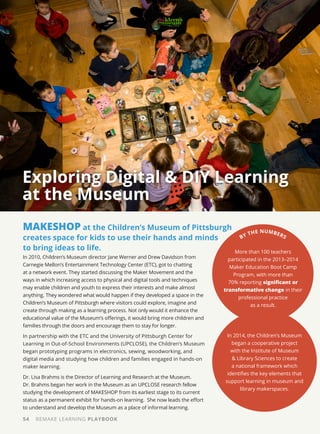
Exploring Digital & DIY Learning
at the Museum
MAKESHOP at the Children’s Museum of Pittsburgh
creates space for kids to use their hands and minds
to bring ideas to life.
BY THE NUMBERS
More than 100 teachers
participated in the 2013–2014
Maker Education Boot Camp
Program, with more than
70% reporting significant or
transformative change in their
professional practice
as a result.
In 2014, the Children’s Museum
began a cooperative project
with the Institute of Museum
& Library Sciences to create
a national framework which
identifies the key elements that
support learning in museum and
library makerspaces.
PLAYBOOK.REMAKELEARNING.ORG 55
Four years later, MAKESHOP is a fully-staffed, permanent exhibit
offering ongoing programs for children, youth, adults, and educators.
Tailoring the visitors’ experiences to their interests, MAKESHOP
encourages exploration, creativity, and play by offering access to the
materials, tools, and processes of making.
The purpose of MAKESHOP is to challenge and nurture creativity by
offering experiences with real materials and real tools that match
visitors’ interests. The people, or educators are key to the ongoing
success of MAKESHOP, and identifying educators who are also skilled
makers has proved essential. MAKESHOP educators continue to work
hard to prototype how access to various tools, materials, process and
ideas affect the design of visitor learning experiences and facilitation.
The results of MAKESHOP’s careful process have been significant.
At the Children’s Museum, attendance is up since MAKESHOP’s
inception, and the average age of child-visitors has increased.
Families’ engagement is noticeably deeper and prolonged. Through
partnerships and outreach with schools, libraries and out-of-school
learning sites, the Children’s Museum has helped these organizations
grow educator capacity and integrate making in meaningful ways.
Through its annual Maker Educator Boot Camp, the Museum has
provided educators with maker-based professional development
opportunities that can be put to use in the classroom. MAKESHOP
has also partnered with the Maker Education Initiative to host and
train Maker Corps members who can facilitate
making experiences across the region.
Now MAKESHOP is reaching beyond
the walls of the Museum, working
with schools and out-of-school
educators to develop engaging,
effective, and evidence-based
maker learning opportunities
for a diverse array of the
region’s kids.
“MAKESHOP has really made us think
differently about what it means to be a
museum and the role of museums in
people’s lives.”
JANE WERNER, EXECUTIVE DIRECTOR,
CHILDREN’S MUSEUM OF PITTSBURGH
CASESTUDY:MAKESHOP
NETWORK IN ACTION
COORDINATE: NETWORK
RESEARCH GATHERS
EVIDENCE OF WHAT’S
WORKING FOR SHARING
WITH OTHER REGIONS.
In the spirit of sharing resources,
the Learning and Research team
has worked with MAKESHOP staff
to identify seven core learning
practices that empirically
describe children’s engagement
in MAKESHOP—inquire, tinker,
seek and share resources,
hack and repurpose, express
intention, develop fluency, and
“simplify to complexify”—creating
a common language around
making as a learning process.
This important network
research has created definitions
to help maker educators both in
the Remake Learning Network
and elsewhere deepen their
understanding of making
and translate the practices of
MAKESHOP to other contexts.
In 2012, the Children’s
Museum received a
$440,000 grant from IMLS
to conduct foundational
research on family learning
in museum makerspaces.

Remake-Learning-Playbook_Case-Study-MAKESHOP

  • 1.
    54 REMAKE LEARNINGPLAYBOOK In 2010, Children’s Museum director Jane Werner and Drew Davidson from Carnegie Mellon’s Entertainment Technology Center (ETC), got to chatting at a network event. They started discussing the Maker Movement and the ways in which increasing access to physical and digital tools and techniques may enable children and youth to express their interests and make almost anything. They wondered what would happen if they developed a space in the Children’s Museum of Pittsburgh where visitors could explore, imagine and create through making as a learning process. Not only would it enhance the educational value of the Museum’s offerings, it would bring more children and families through the doors and encourage them to stay for longer. In partnership with the ETC and the University of Pittsburgh Center for Learning in Out-of-School Environments (UPCLOSE), the Children’s Museum began prototyping programs in electronics, sewing, woodworking, and digital media and studying how children and families engaged in hands-on maker learning. Dr. Lisa Brahms is the Director of Learning and Research at the Museum. Dr. Brahms began her work in the Museum as an UPCLOSE research fellow studying the development of MAKESHOP from its earliest stage to its current status as a permanent exhibit for hands-on learning. She now leads the effort to understand and develop the Museum as a place of informal learning. Exploring Digital & DIY Learning at the Museum MAKESHOP at the Children’s Museum of Pittsburgh creates space for kids to use their hands and minds to bring ideas to life. BY THE NUMBERS More than 100 teachers participated in the 2013–2014 Maker Education Boot Camp Program, with more than 70% reporting significant or transformative change in their professional practice as a result. In 2014, the Children’s Museum began a cooperative project with the Institute of Museum & Library Sciences to create a national framework which identifies the key elements that support learning in museum and library makerspaces.
  • 2.
    PLAYBOOK.REMAKELEARNING.ORG 55 Four yearslater, MAKESHOP is a fully-staffed, permanent exhibit offering ongoing programs for children, youth, adults, and educators. Tailoring the visitors’ experiences to their interests, MAKESHOP encourages exploration, creativity, and play by offering access to the materials, tools, and processes of making. The purpose of MAKESHOP is to challenge and nurture creativity by offering experiences with real materials and real tools that match visitors’ interests. The people, or educators are key to the ongoing success of MAKESHOP, and identifying educators who are also skilled makers has proved essential. MAKESHOP educators continue to work hard to prototype how access to various tools, materials, process and ideas affect the design of visitor learning experiences and facilitation. The results of MAKESHOP’s careful process have been significant. At the Children’s Museum, attendance is up since MAKESHOP’s inception, and the average age of child-visitors has increased. Families’ engagement is noticeably deeper and prolonged. Through partnerships and outreach with schools, libraries and out-of-school learning sites, the Children’s Museum has helped these organizations grow educator capacity and integrate making in meaningful ways. Through its annual Maker Educator Boot Camp, the Museum has provided educators with maker-based professional development opportunities that can be put to use in the classroom. MAKESHOP has also partnered with the Maker Education Initiative to host and train Maker Corps members who can facilitate making experiences across the region. Now MAKESHOP is reaching beyond the walls of the Museum, working with schools and out-of-school educators to develop engaging, effective, and evidence-based maker learning opportunities for a diverse array of the region’s kids. “MAKESHOP has really made us think differently about what it means to be a museum and the role of museums in people’s lives.” JANE WERNER, EXECUTIVE DIRECTOR, CHILDREN’S MUSEUM OF PITTSBURGH CASESTUDY:MAKESHOP NETWORK IN ACTION COORDINATE: NETWORK RESEARCH GATHERS EVIDENCE OF WHAT’S WORKING FOR SHARING WITH OTHER REGIONS. In the spirit of sharing resources, the Learning and Research team has worked with MAKESHOP staff to identify seven core learning practices that empirically describe children’s engagement in MAKESHOP—inquire, tinker, seek and share resources, hack and repurpose, express intention, develop fluency, and “simplify to complexify”—creating a common language around making as a learning process. This important network research has created definitions to help maker educators both in the Remake Learning Network and elsewhere deepen their understanding of making and translate the practices of MAKESHOP to other contexts. In 2012, the Children’s Museum received a $440,000 grant from IMLS to conduct foundational research on family learning in museum makerspaces.