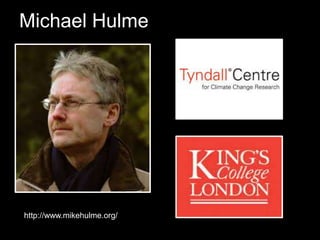

Michael Hulme 
http://www.mikehulme.org/
A good place to look for wisdom… is 
where you least expect to find it: in 
the minds of your opponents. 
Jonathan Haidt, 2006
Main Point 
It’s not just how to 
communicate. 
It’s about what to 
communicate and how 
those arenas intersect. 
 Religion 
 Economics 
 Politics 
 International 
Relations 
 Science and 
Technology 
 Engineering 
 Sociology 
 Psychology 
 Community Health 
 Risk Management 
Etc….
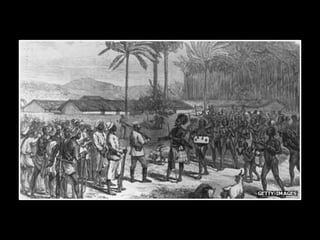
The Social Meanings of Climate 
“Ideas about climate are always situated in a time 
and a place.” 
Meteorological vs. Metaphorical 
Local knowledge vs. climate scientists 
Climate change used in different ideologies: 
- Racism 
- Control of the environment 
- Instability 
- Wild
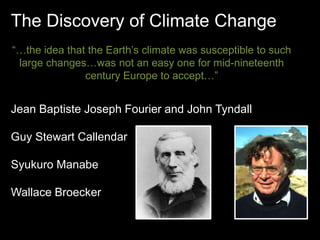
The Discovery of Climate Change 
“…the idea that the Earth’s climate was susceptible to such 
large changes…was not an easy one for mid-nineteenth 
century Europe to accept…” 
Jean Baptiste Joseph Fourier and John Tyndall 
Guy Stewart Callendar 
Syukuro Manabe 
Wallace Broecker
The Performance of Science 
“We disagree about science because we have 
different understandings of the relationship of 
scientific evidence to other things.” 
What kinds of questions are scientists asked to 
answer? 
Limits to the science 
- It will always be incomplete 
- Requires trust and participation 
- Acknowledging what science can and can’t tell us.
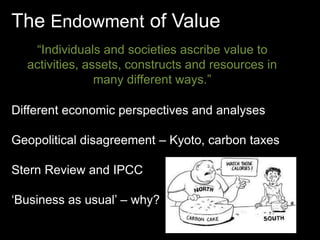
The Endowment of Value 
“Individuals and societies ascribe value to 
activities, assets, constructs and resources in 
many different ways.” 
Different economic perspectives and analyses 
Geopolitical disagreement – Kyoto, carbon taxes 
Stern Review and IPCC 
‘Business as usual’ – why?
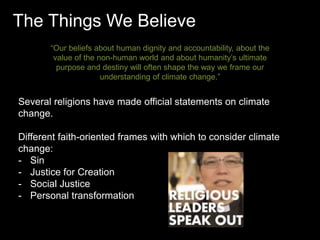
The Things We Believe 
“Our beliefs about human dignity and accountability, about the 
value of the non-human world and about humanity’s ultimate 
purpose and destiny will often shape the way we frame our 
understanding of climate change.” 
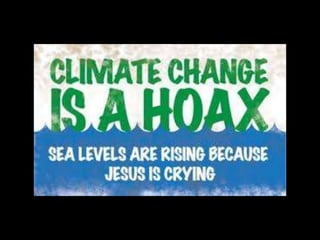
Several religions have made official statements on climate 
change. 
Different faith-oriented frames with which to consider climate 
change: 
- Sin 
- Justice for Creation 
- Social Justice 
- Personal transformation
The Things We Fear 
“No two people necessarily have the same perception 
of a given risk and certainly do not necessarily 
evaluate its significance for individual or collective 
behavior the same way.” 
Why is risk perception different? 
- People will reflect their worldview onto the information. 
- Social amplification 
- Framing 
- Media coverage 
- Basically, this entire class.
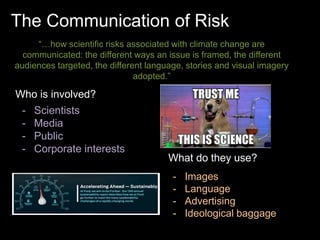
The Communication of Risk 
“…how scientific risks associated with climate change are 
communicated: the different ways an issue is framed, the different 
audiences targeted, the different language, stories and visual imagery 
adopted.” 
- Scientists 
- Media 
- Public 
- Corporate interests 
- Images 
- Language 
- Advertising 
- Ideological baggage 
Who is involved? 
What do they use?
The Challenges of Development 
“Our belief in the idea of ‘progress’ and our views of development are 
powerful shapers of our attitudes towards climate change.” 
Sustainable development – How do we get there? 
What does that even mean? 
Considerations: 
Poverty – Global North and Global South 
International legal system – global trade barriers 
Population 
- Carbon neutral development 
- Trade and mobility changes 
- Biofuels and other innovation
The Way We Govern 
“Who exactly has the right to govern climate, who exactly should 
exercise authority over the climate system?...How are other non-government 
interests represented?” 
UN Security Council 2007 – Climate change is a security issue. 
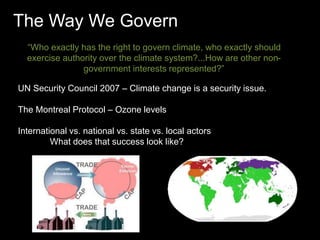
The Montreal Protocol – Ozone levels 
International vs. national vs. state vs. local actors 
What does that success look like?
Beyond Climate Change 
“Climate change is everywhere. Not only are the physical climates of the world 
everywhere changing, but just as importantly the idea of climate change is now 
to be found active across the full parade of human endeavors, institutions, 
practices, and stories.” 
Climate Change vs. climate change 
Mirror and Magnifying glass 
Attribution of all global problems to climate change 
(Mega-problem awaiting a mega-solution)
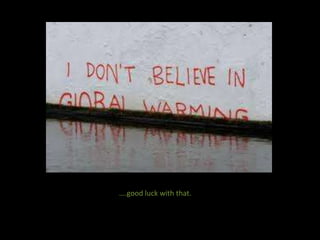
….good luck with that.

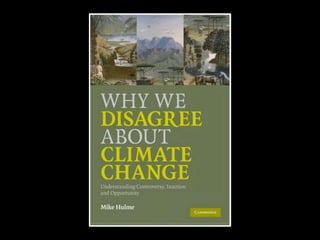
Why We Disagree About Climate Change - Book Review

  • 2.
  • 3.
    A good placeto look for wisdom… is where you least expect to find it: in the minds of your opponents. Jonathan Haidt, 2006
  • 4.
    Main Point It’snot just how to communicate. It’s about what to communicate and how those arenas intersect.  Religion  Economics  Politics  International Relations  Science and Technology  Engineering  Sociology  Psychology  Community Health  Risk Management Etc….
  • 5.
    The Social Meaningsof Climate “Ideas about climate are always situated in a time and a place.” Meteorological vs. Metaphorical Local knowledge vs. climate scientists Climate change used in different ideologies: - Racism - Control of the environment - Instability - Wild
  • 7.
    The Discovery ofClimate Change “…the idea that the Earth’s climate was susceptible to such large changes…was not an easy one for mid-nineteenth century Europe to accept…” Jean Baptiste Joseph Fourier and John Tyndall Guy Stewart Callendar Syukuro Manabe Wallace Broecker
  • 8.
    The Performance ofScience “We disagree about science because we have different understandings of the relationship of scientific evidence to other things.” What kinds of questions are scientists asked to answer? Limits to the science - It will always be incomplete - Requires trust and participation - Acknowledging what science can and can’t tell us.
  • 10.
    The Endowment ofValue “Individuals and societies ascribe value to activities, assets, constructs and resources in many different ways.” Different economic perspectives and analyses Geopolitical disagreement – Kyoto, carbon taxes Stern Review and IPCC ‘Business as usual’ – why?
  • 11.
    The Things WeBelieve “Our beliefs about human dignity and accountability, about the value of the non-human world and about humanity’s ultimate purpose and destiny will often shape the way we frame our understanding of climate change.” Several religions have made official statements on climate change. Different faith-oriented frames with which to consider climate change: - Sin - Justice for Creation - Social Justice - Personal transformation
  • 13.
    The Things WeFear “No two people necessarily have the same perception of a given risk and certainly do not necessarily evaluate its significance for individual or collective behavior the same way.” Why is risk perception different? - People will reflect their worldview onto the information. - Social amplification - Framing - Media coverage - Basically, this entire class.
  • 15.
    The Communication ofRisk “…how scientific risks associated with climate change are communicated: the different ways an issue is framed, the different audiences targeted, the different language, stories and visual imagery adopted.” - Scientists - Media - Public - Corporate interests - Images - Language - Advertising - Ideological baggage Who is involved? What do they use?
  • 16.
    The Challenges ofDevelopment “Our belief in the idea of ‘progress’ and our views of development are powerful shapers of our attitudes towards climate change.” Sustainable development – How do we get there? What does that even mean? Considerations: Poverty – Global North and Global South International legal system – global trade barriers Population - Carbon neutral development - Trade and mobility changes - Biofuels and other innovation
  • 17.
    The Way WeGovern “Who exactly has the right to govern climate, who exactly should exercise authority over the climate system?...How are other non-government interests represented?” UN Security Council 2007 – Climate change is a security issue. The Montreal Protocol – Ozone levels International vs. national vs. state vs. local actors What does that success look like?
  • 18.
    Beyond Climate Change “Climate change is everywhere. Not only are the physical climates of the world everywhere changing, but just as importantly the idea of climate change is now to be found active across the full parade of human endeavors, institutions, practices, and stories.” Climate Change vs. climate change Mirror and Magnifying glass Attribution of all global problems to climate change (Mega-problem awaiting a mega-solution)
  • 19.