Ruby
Who am I?
1- Bunlong Van
2- Sreyleap Lay,
3- Chhon Meily

Work @yoolk

Blog: https://wowcode.wordpress.com/

Email: bunlong.van@gmail.com
History
- Ruby was conceived on February 24, 1993 by Yukihiro Matsumoto who wished
  to create a new language that balanced functional programming with
  imperative programming.

-purpose of Ruby language help every programmer in the world to be productive,
 and to enjoy programming, and to be happy
What is Ruby?
- Ruby is a dynamic, reflective, general-purpose object-oriented programming
  language that combines syntax inspired by Perl with Smalltalk-like features.

- Interpreted Script Language

- Ruby was first designed and developed in the mid-1990s by Yukihiro „Matz‟
  Matsumoto in Japan.

- The standard 1.8.7 implementation is written in C.
Good point of Ruby
Reduce code

  • Java
       public class HelloWorld {
            public static void main(String args[]) {
                      System.out.println(“Hello World”);
            }
       }


  • Ruby
      puts “Hellow World”
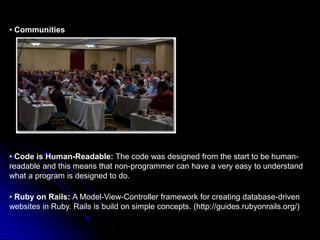
• Communities


• Code is Human-Readable: The code was designed from the start to be human-
readable and this means that non-programmer can have a very easy to understand
what a program is designed to do.

• Ruby on Rails: A Model-View-Controller framework for creating database-driven
websites in Ruby. Rails is build on simple concepts. (http://guides.rubyonrails.org/)
• RubyGems: A package manager for the Ruby programming language that
provides a standard format for distributing Ruby programs and libraries (in a self-
contained format called a “gem”), a tool designed to easily manage the installation
of gems, and a server for distributing them. (http://rubygems.org/)

• Command-line: The interactive Ruby shell is a unique feature that allows
developers to maintain and experiment with commands. There is no need to write
webpages and check their functionality in a browser.

• Object-Oriented-Programming (OOP): Object-Oriented-Programming is a
necessity for clean and maintainable code. However, In Ruby, everything is an object
.
  Ex: 5.class #=> Fixnum
      “Ruby” #=>.class String
      nil.class #=> NilClass
      Fixnum.class #=> Class
• Ruby is free

• Encourage testing

   - Test::Unit builds in into standard library
   - Other tools: Rspec, …

Ruby online resources:

   - Try Ruby - http://tryruby.org
   - Hackety Hack - http://hackety.com/
   - Ruby Monk – http://rubymonk.com/
   - New Boston Videos - http://thenewboston.org/list.php?cat=50
   - Ruby Notes - http://rubylearning.com/satishtalim/tutorial.html
   - Ruby Documentation - http://www.ruby-lang.org/en/ & http://ruby-doc.org/
   - Ruby Conference Videos - http://confreaks.com/events
   - Ruby Koans - http://koans.heroku.com/
   - Ruby Regex – http://rubular.com/
   - Ruby Online Quiz/ Exam - http://rexaminator.com/
   - Nettuts+ Ruby for Newbies Sessions –
     http://net.tutsplus.com/sessions/ruby-for-newbies

Why ruby

  • 1.
  • 2.
    Who am I? 1-Bunlong Van 2- Sreyleap Lay, 3- Chhon Meily Work @yoolk Blog: https://wowcode.wordpress.com/ Email: bunlong.van@gmail.com
  • 3.
    History - Ruby wasconceived on February 24, 1993 by Yukihiro Matsumoto who wished to create a new language that balanced functional programming with imperative programming. -purpose of Ruby language help every programmer in the world to be productive, and to enjoy programming, and to be happy
  • 4.
    What is Ruby? -Ruby is a dynamic, reflective, general-purpose object-oriented programming language that combines syntax inspired by Perl with Smalltalk-like features. - Interpreted Script Language - Ruby was first designed and developed in the mid-1990s by Yukihiro „Matz‟ Matsumoto in Japan. - The standard 1.8.7 implementation is written in C.
  • 5.
    Good point ofRuby Reduce code • Java public class HelloWorld { public static void main(String args[]) { System.out.println(“Hello World”); } } • Ruby puts “Hellow World”
  • 6.
    • Communities • Codeis Human-Readable: The code was designed from the start to be human- readable and this means that non-programmer can have a very easy to understand what a program is designed to do. • Ruby on Rails: A Model-View-Controller framework for creating database-driven websites in Ruby. Rails is build on simple concepts. (http://guides.rubyonrails.org/)
  • 7.
    • RubyGems: Apackage manager for the Ruby programming language that provides a standard format for distributing Ruby programs and libraries (in a self- contained format called a “gem”), a tool designed to easily manage the installation of gems, and a server for distributing them. (http://rubygems.org/) • Command-line: The interactive Ruby shell is a unique feature that allows developers to maintain and experiment with commands. There is no need to write webpages and check their functionality in a browser. • Object-Oriented-Programming (OOP): Object-Oriented-Programming is a necessity for clean and maintainable code. However, In Ruby, everything is an object . Ex: 5.class #=> Fixnum “Ruby” #=>.class String nil.class #=> NilClass Fixnum.class #=> Class
  • 8.
    • Ruby isfree • Encourage testing - Test::Unit builds in into standard library - Other tools: Rspec, … Ruby online resources: - Try Ruby - http://tryruby.org - Hackety Hack - http://hackety.com/ - Ruby Monk – http://rubymonk.com/ - New Boston Videos - http://thenewboston.org/list.php?cat=50 - Ruby Notes - http://rubylearning.com/satishtalim/tutorial.html - Ruby Documentation - http://www.ruby-lang.org/en/ & http://ruby-doc.org/ - Ruby Conference Videos - http://confreaks.com/events - Ruby Koans - http://koans.heroku.com/ - Ruby Regex – http://rubular.com/ - Ruby Online Quiz/ Exam - http://rexaminator.com/ - Nettuts+ Ruby for Newbies Sessions – http://net.tutsplus.com/sessions/ruby-for-newbies