Exploring Natural Language
Processing in Ruby
Kevin Dias!
Tokyo Rubyist Meetup - April 9th, 2015
Rubyで自然言語処理の世界を探求してみよう
Developer at
Twitter: @diasks2!
GitHub: diasks2
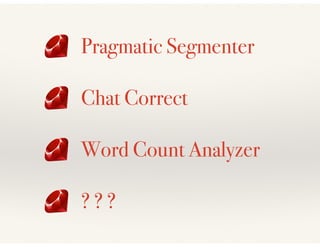
Pragmatic Segmenter
Chat Correct
Word Count Analyzer
? ? ?
Pragmatic Segmenter
A rule-based sentence boundary
detection gem that works out-of-the-box
across many languages.
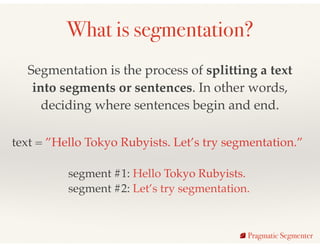
What is segmentation?
Segmentation is the process of splitting a text
into segments or sentences. In other words,
deciding where sentences begin and end.
Pragmatic Segmenter
text = ”Hello Tokyo Rubyists. Let’s try segmentation.”
segment #1: Hello Tokyo Rubyists.
segment #2: Let’s try segmentation.
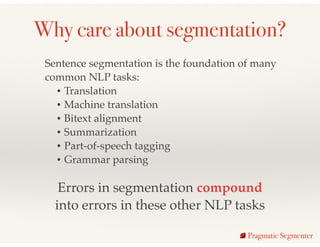
Why care about segmentation?
Pragmatic Segmenter
Sentence segmentation is the foundation of many
common NLP tasks:!
• Translation!
• Machine translation!
• Bitext alignment!
• Summarization!
• Part-of-speech tagging!
• Grammar parsing
Errors in segmentation compound
into errors in these other NLP tasks
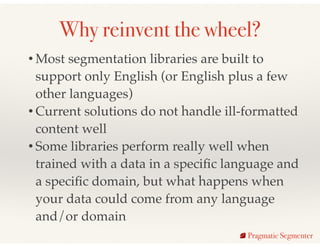
Why reinvent the wheel?
Pragmatic Segmenter
• Most segmentation libraries are built to
support only English (or English plus a few
other languages)!
• Current solutions do not handle ill-formatted
content well!
• Some libraries perform really well when
trained with a data in a specific language and
a specific domain, but what happens when
your data could come from any language
and/or domain
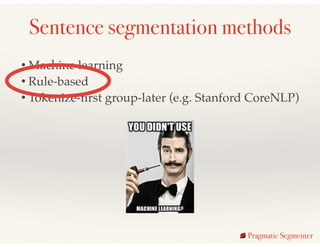
Sentence segmentation methods
Pragmatic Segmenter
• Machine learning !
• Rule-based!
• Tokenize-first group-later (e.g. Stanford CoreNLP)
How can we achieve the following
in Ruby1?
string = “Hello world. Let’s try segmentation.”
Desired output: [“Hello world.”, “Let’s try segmentation.”]
Pragmatic Segmenter1 Using the core or standard library (no gems)
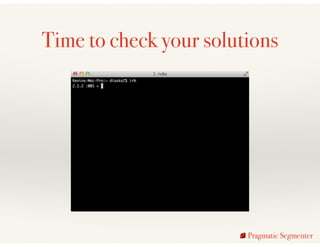
Time to check your solutions
Pragmatic Segmenter
Some potential answers
• string.scan(/[^.]+[.]/).map(&:strip)!
• string.scan(/(?<=s|A)[^.]+[.]/)!
• string.split(/(?<=.)s*/)!
• string.split(/(?<=.)/).map(&:strip)!
• string.split('.').map { |segment| segment.strip.insert(-1, '.') }!
• … your answer
Pragmatic Segmenter
Let’s change the original string
string = “Hello from Mt. Fuji. Let’s try segmentation.”
Desired output: [“Hello from Mt. Fuji.”, “Let’s try segmentation.”]
Pragmatic Segmenter
Uh oh…
string = “Hello from Mt. Fuji. Let’s try segmentation.”
=> [“Hello from Mt.”, “Fuji.”, “Let’s try segmentation.”]
string.scan(/[^.]+[.]/).map(&:strip)
Pragmatic Segmenter
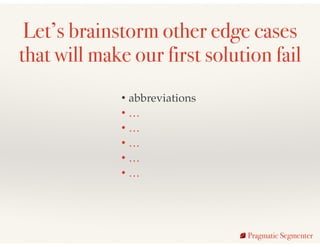
Let’s brainstorm other edge cases
that will make our first solution fail
• abbreviations!
• …!
• …!
• …!
• …!
• …
Pragmatic Segmenter
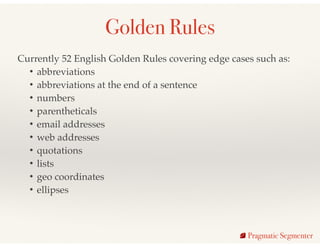
Golden Rules
Pragmatic Segmenter
Currently 52 English Golden Rules covering edge cases such as:!
• abbreviations!
• abbreviations at the end of a sentence!
• numbers!
• parentheticals!
• email addresses!
• web addresses!
• quotations!
• lists!
• geo coordinates!
• ellipses
Rubyists like to keep it DRY
Pragmatic Segmenter
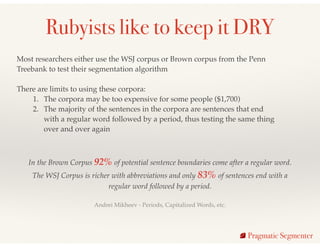
Most researchers either use the WSJ corpus or Brown corpus from the Penn
Treebank to test their segmentation algorithm!
!
There are limits to using these corpora:!
1. The corpora may be too expensive for some people ($1,700)!
2. The majority of the sentences in the corpora are sentences that end
with a regular word followed by a period, thus testing the same thing
over and over again
In the Brown Corpus 92% of potential sentence boundaries come after a regular word.
The WSJ Corpus is richer with abbreviations and only 83% of sentences end with a
regular word followed by a period.!
!
Andrei Mikheev - Periods, Capitalized Words, etc.
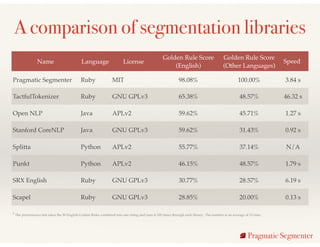
A comparison of segmentation libraries
Pragmatic Segmenter
Name Language License
Golden Rule Score !
(English)
Golden Rule Score
(Other Languages)
Speed
Pragmatic Segmenter Ruby MIT 98.08% 100.00% 3.84 s
TactfulTokenizer Ruby GNU GPLv3 65.38% 48.57% 46.32 s
Open NLP Java APLv2 59.62% 45.71% 1.27 s
Stanford CoreNLP Java GNU GPLv3 59.62% 31.43% 0.92 s
Splitta Python APLv2 55.77% 37.14% N/A
Punkt Python APLv2 46.15% 48.57% 1.79 s
SRX English Ruby GNU GPLv3 30.77% 28.57% 6.19 s
Scapel Ruby GNU GPLv3 28.85% 20.00% 0.13 s
† The performance test takes the 50 English Golden Rules combined into one string and runs it 100 times through each library. The number is an average of 10 runs.
The Holy Grail
Pragmatic Segmenter
A.M. / P.M. as non sentence boundary and sentence boundary
At 5 a.m. Mr. Smith went to the bank. He left the bank at 6 P.M. Mr. Smith then went to the store.
Golden Rule #18
All tested segmentation libraries failed this spec
["At 5 a.m. Mr. Smith went to the bank.", "He left the bank at 6 P.M.", "Mr. Smith then went to the store."]
Chat Correct
A Ruby gem that shows the errors
and error types when a correct
English sentence is diffed with an
incorrect English sentence.
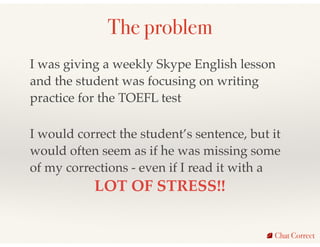
The problem
Chat Correct
I was giving a weekly Skype English lesson
and the student was focusing on writing
practice for the TOEFL test
I would correct the student’s sentence, but it
would often seem as if he was missing some
of my corrections - even if I read it with a
LOT OF STRESS!!
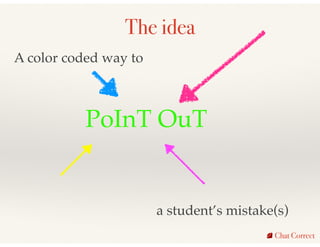
The idea
Chat Correct
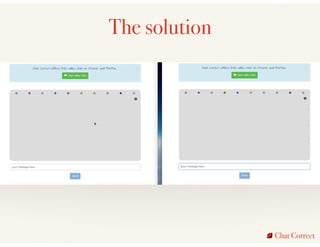
A color coded way to
a student’s mistake(s)
PoInT OuT
The solution
Chat Correct
Word Count Analyzer
Analyzes a string for potential areas
of the text that might cause word
count discrepancies depending on
the tool used.
The problem
Word Count Analyzer
• Translation is typically billed on a per
word basis!
• Different tools often report different
word counts
I wanted to understand what was
causing these differences in word count
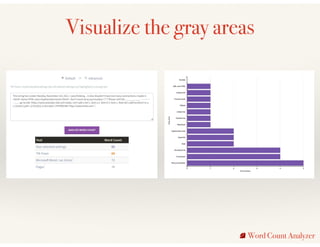
Word count gray areas
Word Count Analyzer
Common word count gray areas include:!
• Ellipses!
• Hyperlinks!
• Contractions!
• Hyphenated Words!
• Dates!
• Numbers!
• Numbered Lists!
• XML and HTML tags!
• Forward slashes and backslashes!
• Punctuation
Visualize the gray areas
Word Count Analyzer
? ? ?
A bitext alignment (aka parallel text
alignment) tool with a focus on high
accuracy
What’s it used for?
• Translation memory!
• Machine translation
? ? ?
Bitext alignment
Current commercial state-of-the-art!
• Gale-Church sentence-length information plus
dictionary if available (e.g. hunalign)!
? ? ?
Areas for improvement
? ? ?
•Early misalignment compounds into
errors throughout!
•Accuracy may suffer for non-Roman
languages unless the algorithm is
properly tuned!
•Does not handle cross alignments
nor uneven alignments
A method for higher accuracy
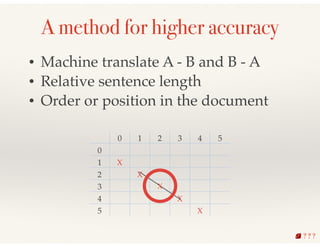
• Machine translate A - B and B - A!
• Relative sentence length!
• Order or position in the document
? ? ?
0 1 2 3 4 5
0
1 X
2 X
3
4 X
5 X
X
The trade-offs
Pros!
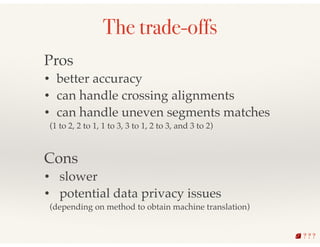
• better accuracy!
• can handle crossing alignments!
• can handle uneven segments matches !
(1 to 2, 2 to 1, 1 to 3, 3 to 1, 2 to 3, and 3 to 2)
? ? ?
Cons!
• slower!
• potential data privacy issues !
(depending on method to obtain machine translation)
Small framework for thinking about new
problems
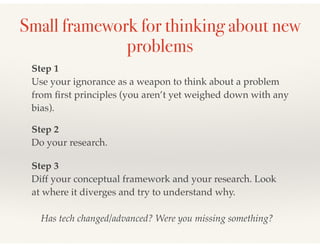
Step 1!
Use your ignorance as a weapon to think about a problem
from first principles (you aren’t yet weighed down with any
bias).
Step 3!
Diff your conceptual framework and your research. Look
at where it diverges and try to understand why.!
!
Has tech changed/advanced? Were you missing something?
Step 2!
Do your research.
Ruby NLP Resources
https://github.com/diasks2/ruby-nlp

Exploring Natural Language Processing in Ruby

  • 1.
    Exploring Natural Language Processingin Ruby Kevin Dias! Tokyo Rubyist Meetup - April 9th, 2015 Rubyで自然言語処理の世界を探求してみよう
  • 2.
  • 3.
  • 4.
    Pragmatic Segmenter A rule-basedsentence boundary detection gem that works out-of-the-box across many languages.
  • 5.
    What is segmentation? Segmentationis the process of splitting a text into segments or sentences. In other words, deciding where sentences begin and end. Pragmatic Segmenter text = ”Hello Tokyo Rubyists. Let’s try segmentation.” segment #1: Hello Tokyo Rubyists. segment #2: Let’s try segmentation.
  • 6.
    Why care aboutsegmentation? Pragmatic Segmenter Sentence segmentation is the foundation of many common NLP tasks:! • Translation! • Machine translation! • Bitext alignment! • Summarization! • Part-of-speech tagging! • Grammar parsing Errors in segmentation compound into errors in these other NLP tasks
  • 7.
    Why reinvent thewheel? Pragmatic Segmenter • Most segmentation libraries are built to support only English (or English plus a few other languages)! • Current solutions do not handle ill-formatted content well! • Some libraries perform really well when trained with a data in a specific language and a specific domain, but what happens when your data could come from any language and/or domain
  • 8.
    Sentence segmentation methods PragmaticSegmenter • Machine learning ! • Rule-based! • Tokenize-first group-later (e.g. Stanford CoreNLP)
  • 9.
    How can weachieve the following in Ruby1? string = “Hello world. Let’s try segmentation.” Desired output: [“Hello world.”, “Let’s try segmentation.”] Pragmatic Segmenter1 Using the core or standard library (no gems)
  • 10.
    Time to checkyour solutions Pragmatic Segmenter
  • 11.
    Some potential answers •string.scan(/[^.]+[.]/).map(&:strip)! • string.scan(/(?<=s|A)[^.]+[.]/)! • string.split(/(?<=.)s*/)! • string.split(/(?<=.)/).map(&:strip)! • string.split('.').map { |segment| segment.strip.insert(-1, '.') }! • … your answer Pragmatic Segmenter
  • 12.
    Let’s change theoriginal string string = “Hello from Mt. Fuji. Let’s try segmentation.” Desired output: [“Hello from Mt. Fuji.”, “Let’s try segmentation.”] Pragmatic Segmenter
  • 13.
    Uh oh… string =“Hello from Mt. Fuji. Let’s try segmentation.” => [“Hello from Mt.”, “Fuji.”, “Let’s try segmentation.”] string.scan(/[^.]+[.]/).map(&:strip) Pragmatic Segmenter
  • 14.
    Let’s brainstorm otheredge cases that will make our first solution fail • abbreviations! • …! • …! • …! • …! • … Pragmatic Segmenter
  • 15.
    Golden Rules Pragmatic Segmenter Currently52 English Golden Rules covering edge cases such as:! • abbreviations! • abbreviations at the end of a sentence! • numbers! • parentheticals! • email addresses! • web addresses! • quotations! • lists! • geo coordinates! • ellipses
  • 16.
    Rubyists like tokeep it DRY Pragmatic Segmenter Most researchers either use the WSJ corpus or Brown corpus from the Penn Treebank to test their segmentation algorithm! ! There are limits to using these corpora:! 1. The corpora may be too expensive for some people ($1,700)! 2. The majority of the sentences in the corpora are sentences that end with a regular word followed by a period, thus testing the same thing over and over again In the Brown Corpus 92% of potential sentence boundaries come after a regular word. The WSJ Corpus is richer with abbreviations and only 83% of sentences end with a regular word followed by a period.! ! Andrei Mikheev - Periods, Capitalized Words, etc.
  • 17.
    A comparison ofsegmentation libraries Pragmatic Segmenter Name Language License Golden Rule Score ! (English) Golden Rule Score (Other Languages) Speed Pragmatic Segmenter Ruby MIT 98.08% 100.00% 3.84 s TactfulTokenizer Ruby GNU GPLv3 65.38% 48.57% 46.32 s Open NLP Java APLv2 59.62% 45.71% 1.27 s Stanford CoreNLP Java GNU GPLv3 59.62% 31.43% 0.92 s Splitta Python APLv2 55.77% 37.14% N/A Punkt Python APLv2 46.15% 48.57% 1.79 s SRX English Ruby GNU GPLv3 30.77% 28.57% 6.19 s Scapel Ruby GNU GPLv3 28.85% 20.00% 0.13 s † The performance test takes the 50 English Golden Rules combined into one string and runs it 100 times through each library. The number is an average of 10 runs.
  • 18.
    The Holy Grail PragmaticSegmenter A.M. / P.M. as non sentence boundary and sentence boundary At 5 a.m. Mr. Smith went to the bank. He left the bank at 6 P.M. Mr. Smith then went to the store. Golden Rule #18 All tested segmentation libraries failed this spec ["At 5 a.m. Mr. Smith went to the bank.", "He left the bank at 6 P.M.", "Mr. Smith then went to the store."]
  • 19.
    Chat Correct A Rubygem that shows the errors and error types when a correct English sentence is diffed with an incorrect English sentence.
  • 20.
    The problem Chat Correct Iwas giving a weekly Skype English lesson and the student was focusing on writing practice for the TOEFL test I would correct the student’s sentence, but it would often seem as if he was missing some of my corrections - even if I read it with a LOT OF STRESS!!
  • 21.
    The idea Chat Correct Acolor coded way to a student’s mistake(s) PoInT OuT
  • 22.
  • 23.
    Word Count Analyzer Analyzesa string for potential areas of the text that might cause word count discrepancies depending on the tool used.
  • 24.
    The problem Word CountAnalyzer • Translation is typically billed on a per word basis! • Different tools often report different word counts I wanted to understand what was causing these differences in word count
  • 25.
    Word count grayareas Word Count Analyzer Common word count gray areas include:! • Ellipses! • Hyperlinks! • Contractions! • Hyphenated Words! • Dates! • Numbers! • Numbered Lists! • XML and HTML tags! • Forward slashes and backslashes! • Punctuation
  • 26.
    Visualize the grayareas Word Count Analyzer
  • 27.
    ? ? ? Abitext alignment (aka parallel text alignment) tool with a focus on high accuracy
  • 28.
    What’s it usedfor? • Translation memory! • Machine translation ? ? ?
  • 29.
    Bitext alignment Current commercialstate-of-the-art! • Gale-Church sentence-length information plus dictionary if available (e.g. hunalign)! ? ? ?
  • 30.
    Areas for improvement ?? ? •Early misalignment compounds into errors throughout! •Accuracy may suffer for non-Roman languages unless the algorithm is properly tuned! •Does not handle cross alignments nor uneven alignments
  • 31.
    A method forhigher accuracy • Machine translate A - B and B - A! • Relative sentence length! • Order or position in the document ? ? ? 0 1 2 3 4 5 0 1 X 2 X 3 4 X 5 X X
  • 32.
    The trade-offs Pros! • betteraccuracy! • can handle crossing alignments! • can handle uneven segments matches ! (1 to 2, 2 to 1, 1 to 3, 3 to 1, 2 to 3, and 3 to 2) ? ? ? Cons! • slower! • potential data privacy issues ! (depending on method to obtain machine translation)
  • 33.
    Small framework forthinking about new problems Step 1! Use your ignorance as a weapon to think about a problem from first principles (you aren’t yet weighed down with any bias). Step 3! Diff your conceptual framework and your research. Look at where it diverges and try to understand why.! ! Has tech changed/advanced? Were you missing something? Step 2! Do your research.
  • 34.