Workin’ on the Rails Road Obie Fernandez Original presentation delivered to the Object Technology User Group St. Paul / Minneapolis September 20 th  2005
Agenda Introduction to Ruby Programming Ruby on Rails Fundamentals and Interactive Demonstration Break Working in Ruby and Rails Is Rails Ready for Prime Time? Questions and Answers
Questions and Slides Ask questions at any time Slides and samples will be available online at  obiefernandez.com I’ll show that address and others again at the end
Introduction to Ruby Programming “ Smalltalk was one of the main influences for Ruby. Whenever you find a main difference between Perl and Ruby there's a good chance to find this feature in Smalltalk.”  RubyGarden
What is Ruby? Object-Oriented scripting language Conceptual similarities to Smalltalk Many system and text manipulation features like Perl Emphasis on simplicity and design elegance
Ruby is a Dynamic Language Completely Object-Oriented All data is an object, no exceptions Operators are methods Dynamic Behavior Possible to add new classes, add or redefine methods at runtime An instance of one class can behave differently than another instance of the same class at runtime
Powerful Features Single Inheritance, but… Modules provide namespaces and allow ‘mixin’ capability A module is a collection of methods and constants Ruby has blocks Code surrounded by do…end or { … } They are true closures; get variable bindings Are passed to methods quite often
Ruby Variables Don’t need declaration Variable scope determined by naming convention foo  … local variable @foo … instance variable $foo … global variable Foo or FOO … constant
Variable Assignment An assignment sets the  rvalue  to the  lvalue Then it returns the that value as the result of the assignment expression Assigning to a variable or constant   is hardwired into Ruby Assigning to an object attribute is a method call Parallel assignment
Strings String Instances usually created with literal expressions Sequences of 8-bit bytes Printable characters or not, doesn’t matter Over 75 standard methods Symbol Denoted by colon, like :foobar Basically an interned string, always the same instance no matter where used in codebase
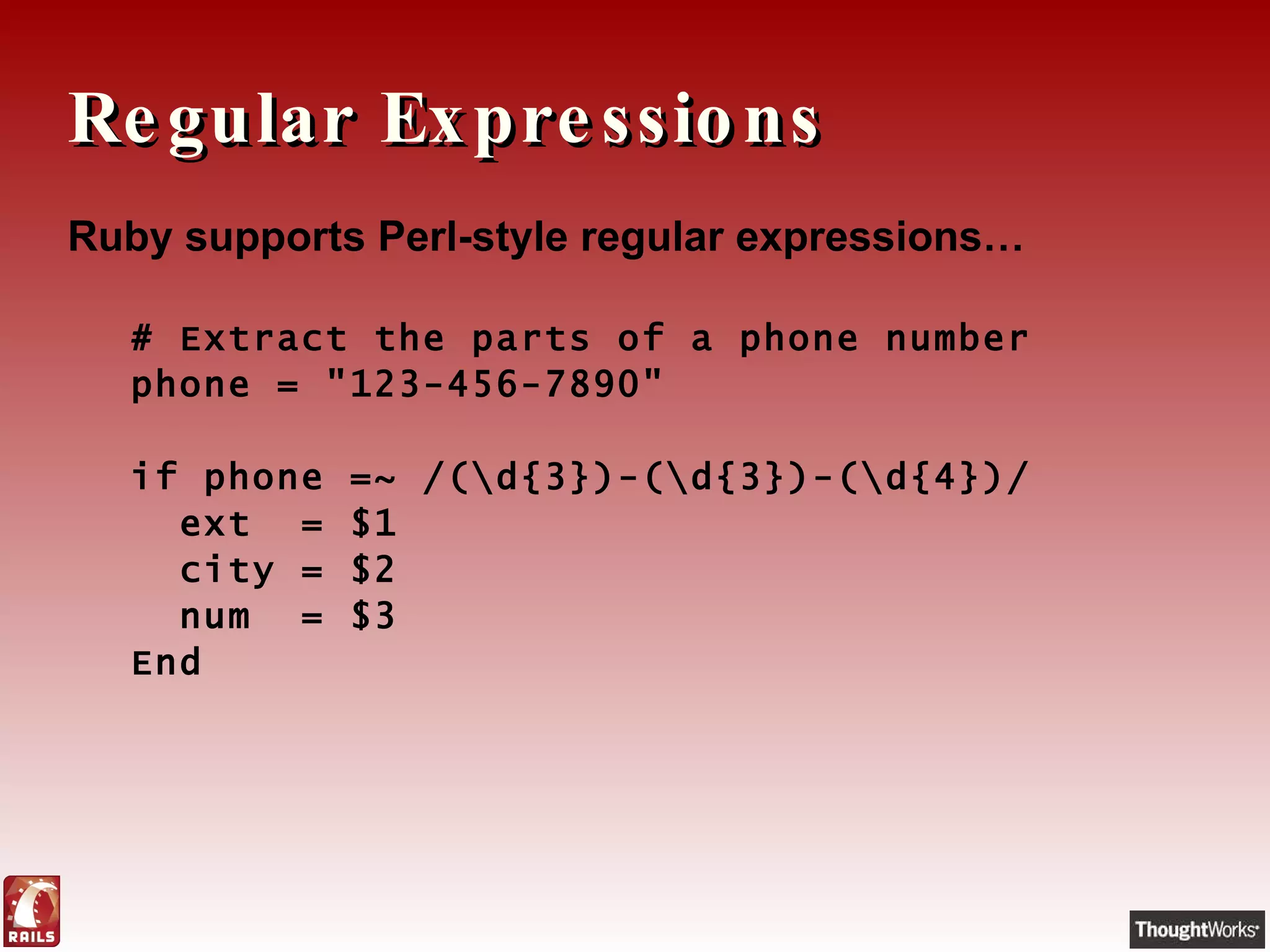
Regular Expressions Ruby supports Perl-style regular expressions… # Extract the parts of a phone number phone = "123-456-7890"   if phone =~ /(\d{3})-(\d{3})-(\d{4})/    ext  = $1    city = $2    num  = $3 End
Arrays and Hashes Array Ordered collection of references Literal is list of objects between square brackets Hash Used extensively in practice Any type of object can be used as index Elements are not ordered Literal form is key/value pairs enclosed in {…} using  => to map keys to values
Numerics Integer Small integers are Fixnum, up to size of a native machine word minus 1 bit Big integers are Bignum, up to size of available memory Conversion happens automatically Float Real numbers Uses native double-precision floating-point representation
Ruby Methods Only way to change an object’s state Use def keyword and start with lowercase letter Use trailing ? for queries and ! for  dangerous  methods Use trailing = for methods that take assignment
Writing Methods Default values for parameters supported Variable-length argument lists by placing an asterisk on the last parameter Methods accept blocks implicitly or via the last parameter being prefixed with an ampersand Every called method returns the value of the last expression. Explicit use of return statement is optional
Calling Methods Specify receiver, name of method Parameters and block optional Parentheses optional Leaving off receiver defaults to current object No ‘keyword arguments’ but commonly accomplished with hashes
Access Control Determined dynamically Public is the default except for initialize method Protected Access by any instance of class Includes subclasses Private methods can be called only in the context of the current object
Conditionals Boolean expressions Any value that is not  nil  or the constant  false  is true && and || operators are shorcircuiting defined? operator checks its parameter ||= is a common idiom to assign a default value to a nil element
If and Unless Similar to other languages -  if ,  then ,  elsif ,  else ,  end unless  is negated form then is mandatory only on a single-line if statement tack on to end of normal statement to use as conditional modifiers
Iterators while  and  until  are built-in for … in is syntactic sugar, translated automatically to a call to the  each  iterator method Other iterators are  times ,  upto ,  downto , and  step  and work with numerics
Exceptions Ruby has hierarchy of exceptions Catch them using  begin ,  rescue ,  ensure , and  end Define multiple rescue clauses or specify more than one exception to catch as parameters Exception object is available as $! or use hash notation to assign variable names on the rescue clause Use  retry  after attempting to fix an exception to rerun the begin clause Throw exceptions in your own code by using a  raise  statement Subclass  StandardError  or one of its children
Memory Model Garbage Collection True mark-and-sweep Works with all Ruby objects Multithreading In-process inside the interpreter Completely portable Some negatives like not taking advantage of multi-processor hosts
More Language Features Portable OS independent threading Can load extension libraries dynamically Library support RubyGems package manager Tons of high-quality open source libraries available at RubyForge (similar to CPAN for Perl)
Ruby Tools The following tools are included with the Ruby distribution debugger irb – interactive ruby shell benchmark profiler rdoc
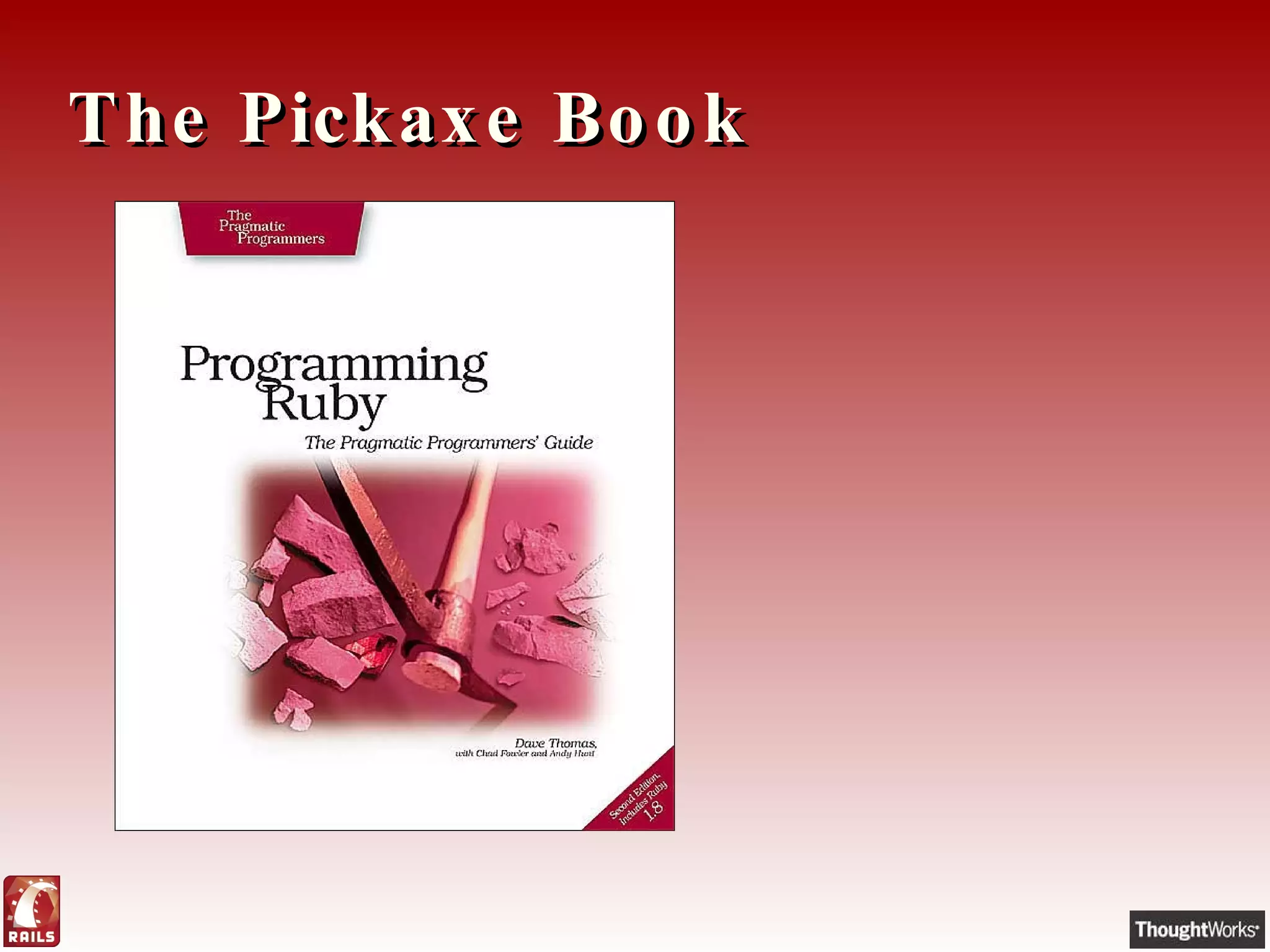
The Pickaxe Book
Ruby on Rails Fundamentals “ Rails is a full-stack, open-source web framework in Ruby for writing real-world applications with joy and less code than most frameworks spend doing XML sit-ups” Rails Creator - David H.  Hansson
What Is Rails? ‘ Kitchen Sink’ MVC Web Application Framework written in Ruby ActiveRecord API ActionController API Templating Engine Scripts and lots of other stuff…
Big Productivity Gains Convention over configuration Everything is in Ruby Imposes strong design constraints  Generators for creating code skeletons and scaffolding
Rails Models ActiveRecord Model Classes Encapsulate persistence logic Contain business rules Tightly coupled to database tables Declare relationships to each other
ActiveRecord Basics Extend ActiveRecord::Base Don’t declare properties Declare relationships to other models with the following ‘macros’ belongs_to has_many has_and_belongs_to_many (joins)
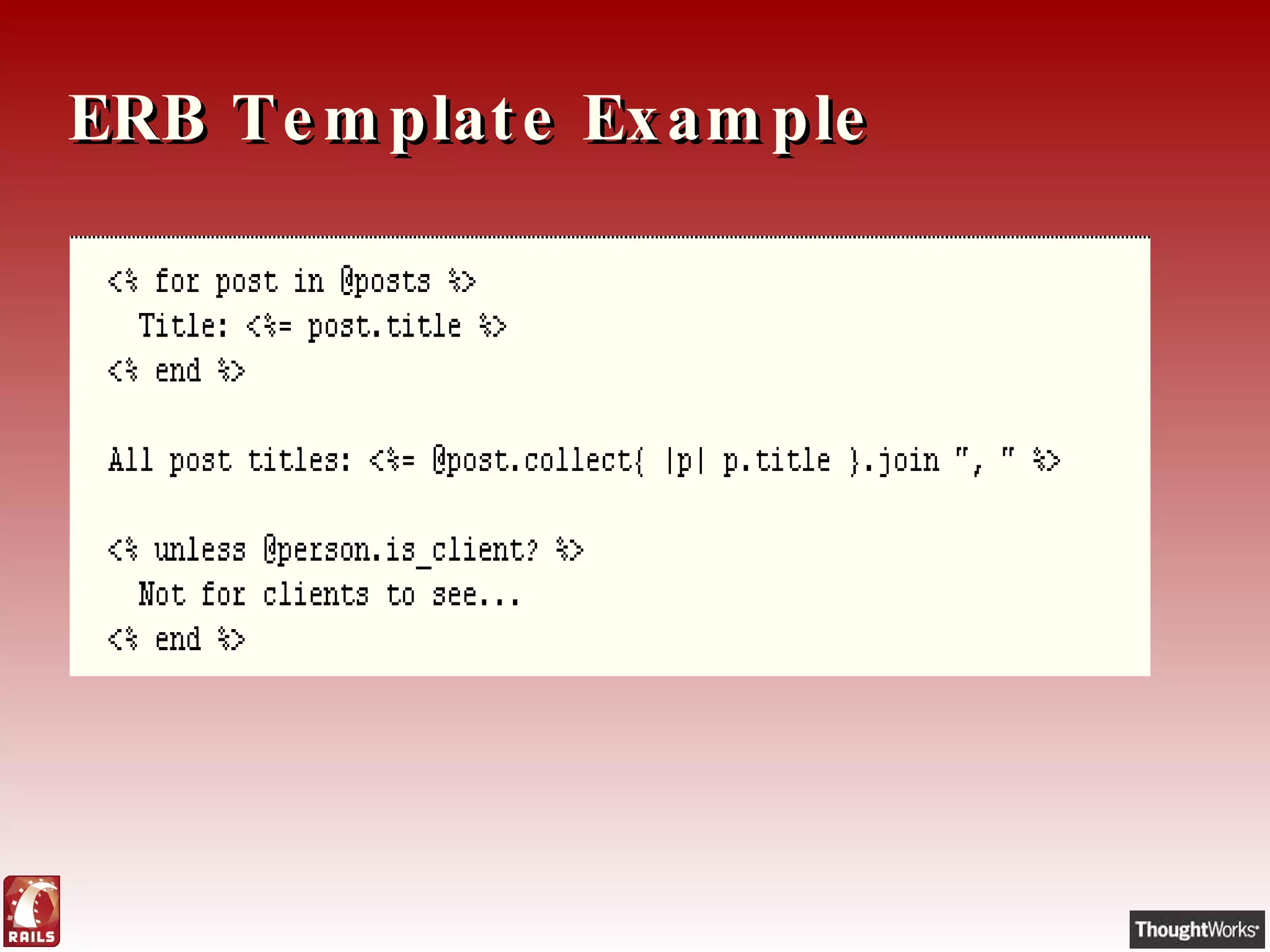
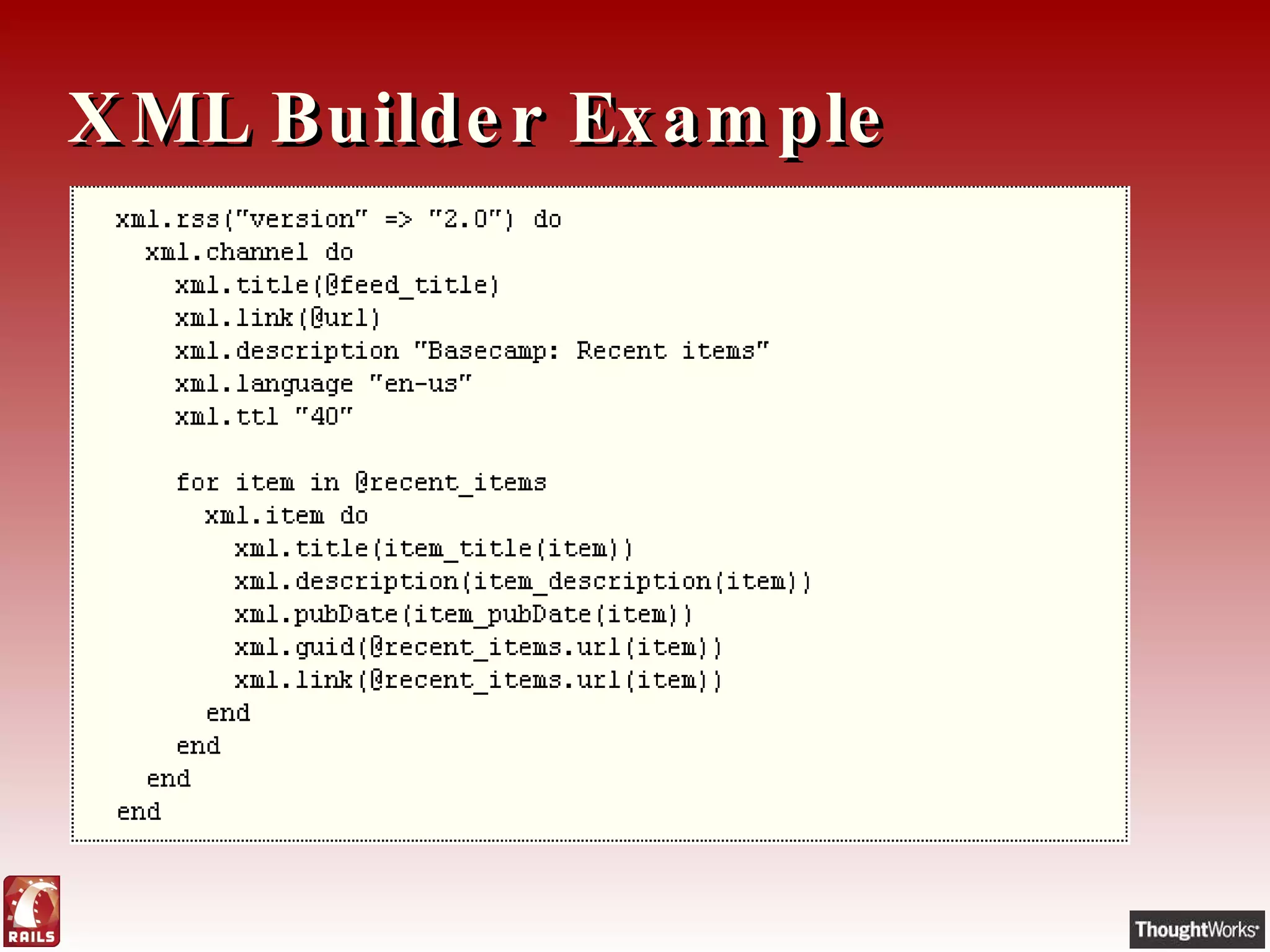
Rails Views User interface done with templates HTML with Ruby snippets in .rhtml files Easy XML generation in .rxml files Lots of HTML and AJAX helper methods Sophisticated layout and ‘partials’ functionality
ERB Template Example
XML Builder Example
Rails Controllers Process requests via action methods that map to URL Interact with model classes Set any data needed by view as field variables Select view to render or redirect
Controller Basics Extend ActionController:Base Request parameters in ‘params’ Naming conventions mean Rails can translate paramaters into a hashtable Handles multi-dimensional data in forms pretty easily Web session in ‘session’ hash Redirect scope available in ‘flash’ hash for next request only
Actually Working with Ruby on Rails Based on real-world project experience
Real Productivity Gains Possible Your results may vary! How many developers on team? Proficient with Ruby? Proficient with Rails? Greenfield project or trying to adapt to legacy data sources?
Rails Doesn’t Make Data Modeling Any Easier Stabilize your schema before ramping up UI development Bootstrap your db schema with a migration script Write an exampledb rake task
Speaking of Rake Dependency-based programming So much better than Ant you’ll want to use it on all your projects Martin Fowler wrote a great article about it at  http://martinfowler.com/articles/rake.html
Not much IDE support… No Intellij for Ruby and none on the horizon for awhile Current Ruby editors are kind of crappy Eclipse RDT is starting to improve but not there yet (IMHO) The nature of dynamically-typed languages means you might want to just use a good text-editor instead
…  how to deal with it Testing, testing, testing Use IRB, the interactive console Pair-programming very useful Keep Pickaxe and Rails books handy  ri – command-line documentation
Unit Tests Crucial Once you start getting beyond CRUD features you better unit test The lack of static typing will get you if you’re not used to it It’s a big namespace so watch out for your code colliding with Rails methods or magic
Learning Ruby Think about syntax, cause your editor won’t Learn to use the debugger instead of ‘puts’ing around Blocks are very powerful. Learn how to use them
Learning Rails Don’t overcommit based on initial enthusiasm Easy to get started, but there is a learning curve Read the Rails book
You’ll Write Less Code Let Rails do the heavy lifting for you under the scenes Ruby is significantly less verbose than Java and C# Take advantage of… Convention over configuration Ruby lends itself to writing DSL
Don’t Repeat Yourself Refactor, refactor, refactor! Move repetitive view code into helpers Consolidate common page chunks into partials Rails has A LOT of built-in functionality (which you won’t know about as a beginner)
Don’t Reinvent the Wheel Form helpers are your friend Rails ‘acts_as’ methods are very useful Look for RAA and RubyForge libraries, particularly to integrate to web services
ActiveRecord Reminder “ When you have this static view of the database, expressed in terms of  n  classes to match your  n  tables, then you tend to solve your problems in those precise terms, because the code generated by the O/R code generation tools will encourage (and perhaps even enforce) such behavior.” -  Brad Wilson
Take Advantage of ActiveRecord Flexibility Remember ActiveRecord works at runtime and doesn’t enforce those static views of your data The ActiveRecord pattern itself encourages addition of meaningful finder methods like find_specials Custom SQL queries can cause additional columns to get “tacked on” to returned objects without extra effort.  (like for aggregate and other types of calculated columns defined in your SQL select statement)
Belongs_to Table Must Have the Foreign Key This can really trip you up, even though it’s repeated multiple times in the docs The term “belongs to” is admittedly confusing Consider it as “references” or “has reference to”
Don’t Abuse HABTM Speaking from experience… has_and_belongs_to_many can be pretty difficult to understand and use effectively Prefer simple has_many/belongs_to relationships where possible Once you start adding attributes to the join table, ask yourself if that join actually wants to be a first-class object
ActionMailer Notes ActionMailer works great for sending email, particularly the integration with templating Receiving email is still nightmarish depending on your platform configuration
AJAX is Easier With Rails but… Some of the documentation is poor You still have to understand JavaScript to use it effectively There are definite “dos and don’ts” around where and why to use AJAX
Other Gotchas Learning where it’s okay to use symbols instead of strings tricky Lots of methods take hash of parameters and it’s easy to mistype one ‘ Whiny Nil’ is annoying
Are Ruby and Rails Ready for Prime Time? No simple answers, so let’s discuss it…
The Future of Ruby “ It sure looks like more than a fad to me. ” - Tim Bray 10 years of continual development and refinement will continue Ruby 2.0 is on the horizon No Microsoft or Sun Microsystems stupidity to ruin things   Compare with Python adoption rates Dynamic languages in general gaining wider acceptance in the enterprise
Road to Rails 1.0 80 issues pending  (as of 9/20/2005) http://dev.rubyonrails.com/report/9   Internationalization tops the list Several issues address developer-friendliness with error messages and unknown parameters to API calls Minor bugs with acts_as_ features RC might be available in October ‘05
Softer Issues Am I ready for a new language and development style? Is my team ready? Is my company ready? Do I have the right projects?
Common Apprehensions Mostly concerns about ‘-ilities’ Maintainability Future availability of Ruby programmers? Quality/readability of code? Platform support? Scalability Horizontal vs. Vertical scaling Performance concerns
Is Ruby better than..? Better  at what ? Some situations need one tool, other situations another tool. Performance-wise Ruby is probably slower than Java or C# in real-world situations Is it worth worrying about relative performance?
Pragmatic Dave on J2EE “ Using the full might of a J2EE stack to write a small stand-alone application is using a sledgehammer to crack a nut.  But I keep hearing the sound of nuts being pulverized as developers seem to think that using anything other than J2EE is somehow unprofessional.”
More Pragmatic Dave “ I’d rather write in a language that let’s me focus on the application, and which lets me express myself clearly and effectively.” “ A better algorithm will easily gain back any marginal performance hit I take for using a slower language.” Posted on  http://blogs.pragprog.com/
J2EE Backlash Fueling Interest in Rails “ Enterprise Java, has grown into a complex behemoth that consists of layer upon layer of complexity”   David Geary, author of the best-selling book on Java Server Faces (JSF)
Web 2.0 and Rails Fast time-to-market Tight integration with AJAX libraries New emphasis on focused, interoperable applications Less time coding infrastructure means more emphasis on clean design and elegance in all aspects of the application
When should I use Rails? Small developer-focused applications Opportunities to do parallel development as proof of productivity impact Once you are comfortable with Ruby and Rails programming
When not to use Rails! Really large applications Dealing with legacy databases.  Hibernate is much better for “schemas-from-hell” Unenthusiastic or mediocre developers won’t “get it”
The Right Developer Attitude is Crucial  “ Agile teams  get  Ruby on Rails sooner than traditional ones” Ruby on Rails increases productivity and sheer joy of development  Reality is some programmers simply don’t care about that
Ruby on Rails and Consulting Businesses Expect web design shops to continue moving into Rails and away from PHP (it’s just too much better not to do so) Faster  projects with  less people  means larger consulting firms might have trouble adapting!
Future of Ruby on Rails Ruby is what makes Rails special, the interest in general Ruby programming will continue to expand rapidly Tons of similar projects popping up, but none with mindshare and critical mass of Rails project Integration of dynamic languages such as Ruby with Semantic Web technologies such as RDF holds significant promise
Questions and Comments
In Conclusion… Thank you for coming to the presentation! Rails has a large enthusiastic community at  rubyonrails.org ThoughtWorks is seeking Ruby on Rails enterprise projects I blog regularly about Rails and agile enterprise topics at  obiefernandez.com I love getting email…  [email_address]

Workin ontherailsroad

  • 1.
    Workin’ on theRails Road Obie Fernandez Original presentation delivered to the Object Technology User Group St. Paul / Minneapolis September 20 th 2005
  • 2.
    Agenda Introduction toRuby Programming Ruby on Rails Fundamentals and Interactive Demonstration Break Working in Ruby and Rails Is Rails Ready for Prime Time? Questions and Answers
  • 3.
    Questions and SlidesAsk questions at any time Slides and samples will be available online at obiefernandez.com I’ll show that address and others again at the end
  • 4.
    Introduction to RubyProgramming “ Smalltalk was one of the main influences for Ruby. Whenever you find a main difference between Perl and Ruby there's a good chance to find this feature in Smalltalk.” RubyGarden
  • 5.
    What is Ruby?Object-Oriented scripting language Conceptual similarities to Smalltalk Many system and text manipulation features like Perl Emphasis on simplicity and design elegance
  • 6.
    Ruby is aDynamic Language Completely Object-Oriented All data is an object, no exceptions Operators are methods Dynamic Behavior Possible to add new classes, add or redefine methods at runtime An instance of one class can behave differently than another instance of the same class at runtime
  • 7.
    Powerful Features SingleInheritance, but… Modules provide namespaces and allow ‘mixin’ capability A module is a collection of methods and constants Ruby has blocks Code surrounded by do…end or { … } They are true closures; get variable bindings Are passed to methods quite often
  • 8.
    Ruby Variables Don’tneed declaration Variable scope determined by naming convention foo … local variable @foo … instance variable $foo … global variable Foo or FOO … constant
  • 9.
    Variable Assignment Anassignment sets the rvalue to the lvalue Then it returns the that value as the result of the assignment expression Assigning to a variable or constant is hardwired into Ruby Assigning to an object attribute is a method call Parallel assignment
  • 10.
    Strings String Instancesusually created with literal expressions Sequences of 8-bit bytes Printable characters or not, doesn’t matter Over 75 standard methods Symbol Denoted by colon, like :foobar Basically an interned string, always the same instance no matter where used in codebase
  • 11.
    Regular Expressions Rubysupports Perl-style regular expressions… # Extract the parts of a phone number phone = "123-456-7890"   if phone =~ /(\d{3})-(\d{3})-(\d{4})/    ext  = $1    city = $2    num  = $3 End
  • 12.
    Arrays and HashesArray Ordered collection of references Literal is list of objects between square brackets Hash Used extensively in practice Any type of object can be used as index Elements are not ordered Literal form is key/value pairs enclosed in {…} using => to map keys to values
  • 13.
    Numerics Integer Smallintegers are Fixnum, up to size of a native machine word minus 1 bit Big integers are Bignum, up to size of available memory Conversion happens automatically Float Real numbers Uses native double-precision floating-point representation
  • 14.
    Ruby Methods Onlyway to change an object’s state Use def keyword and start with lowercase letter Use trailing ? for queries and ! for dangerous methods Use trailing = for methods that take assignment
  • 15.
    Writing Methods Defaultvalues for parameters supported Variable-length argument lists by placing an asterisk on the last parameter Methods accept blocks implicitly or via the last parameter being prefixed with an ampersand Every called method returns the value of the last expression. Explicit use of return statement is optional
  • 16.
    Calling Methods Specifyreceiver, name of method Parameters and block optional Parentheses optional Leaving off receiver defaults to current object No ‘keyword arguments’ but commonly accomplished with hashes
  • 17.
    Access Control Determineddynamically Public is the default except for initialize method Protected Access by any instance of class Includes subclasses Private methods can be called only in the context of the current object
  • 18.
    Conditionals Boolean expressionsAny value that is not nil or the constant false is true && and || operators are shorcircuiting defined? operator checks its parameter ||= is a common idiom to assign a default value to a nil element
  • 19.
    If and UnlessSimilar to other languages - if , then , elsif , else , end unless is negated form then is mandatory only on a single-line if statement tack on to end of normal statement to use as conditional modifiers
  • 20.
    Iterators while and until are built-in for … in is syntactic sugar, translated automatically to a call to the each iterator method Other iterators are times , upto , downto , and step and work with numerics
  • 21.
    Exceptions Ruby hashierarchy of exceptions Catch them using begin , rescue , ensure , and end Define multiple rescue clauses or specify more than one exception to catch as parameters Exception object is available as $! or use hash notation to assign variable names on the rescue clause Use retry after attempting to fix an exception to rerun the begin clause Throw exceptions in your own code by using a raise statement Subclass StandardError or one of its children
  • 22.
    Memory Model GarbageCollection True mark-and-sweep Works with all Ruby objects Multithreading In-process inside the interpreter Completely portable Some negatives like not taking advantage of multi-processor hosts
  • 23.
    More Language FeaturesPortable OS independent threading Can load extension libraries dynamically Library support RubyGems package manager Tons of high-quality open source libraries available at RubyForge (similar to CPAN for Perl)
  • 24.
    Ruby Tools Thefollowing tools are included with the Ruby distribution debugger irb – interactive ruby shell benchmark profiler rdoc
  • 25.
  • 26.
    Ruby on RailsFundamentals “ Rails is a full-stack, open-source web framework in Ruby for writing real-world applications with joy and less code than most frameworks spend doing XML sit-ups” Rails Creator - David H. Hansson
  • 27.
    What Is Rails?‘ Kitchen Sink’ MVC Web Application Framework written in Ruby ActiveRecord API ActionController API Templating Engine Scripts and lots of other stuff…
  • 28.
    Big Productivity GainsConvention over configuration Everything is in Ruby Imposes strong design constraints Generators for creating code skeletons and scaffolding
  • 29.
    Rails Models ActiveRecordModel Classes Encapsulate persistence logic Contain business rules Tightly coupled to database tables Declare relationships to each other
  • 30.
    ActiveRecord Basics ExtendActiveRecord::Base Don’t declare properties Declare relationships to other models with the following ‘macros’ belongs_to has_many has_and_belongs_to_many (joins)
  • 31.
    Rails Views Userinterface done with templates HTML with Ruby snippets in .rhtml files Easy XML generation in .rxml files Lots of HTML and AJAX helper methods Sophisticated layout and ‘partials’ functionality
  • 32.
  • 33.
  • 34.
    Rails Controllers Processrequests via action methods that map to URL Interact with model classes Set any data needed by view as field variables Select view to render or redirect
  • 35.
    Controller Basics ExtendActionController:Base Request parameters in ‘params’ Naming conventions mean Rails can translate paramaters into a hashtable Handles multi-dimensional data in forms pretty easily Web session in ‘session’ hash Redirect scope available in ‘flash’ hash for next request only
  • 36.
    Actually Working withRuby on Rails Based on real-world project experience
  • 37.
    Real Productivity GainsPossible Your results may vary! How many developers on team? Proficient with Ruby? Proficient with Rails? Greenfield project or trying to adapt to legacy data sources?
  • 38.
    Rails Doesn’t MakeData Modeling Any Easier Stabilize your schema before ramping up UI development Bootstrap your db schema with a migration script Write an exampledb rake task
  • 39.
    Speaking of RakeDependency-based programming So much better than Ant you’ll want to use it on all your projects Martin Fowler wrote a great article about it at http://martinfowler.com/articles/rake.html
  • 40.
    Not much IDEsupport… No Intellij for Ruby and none on the horizon for awhile Current Ruby editors are kind of crappy Eclipse RDT is starting to improve but not there yet (IMHO) The nature of dynamically-typed languages means you might want to just use a good text-editor instead
  • 41.
    … howto deal with it Testing, testing, testing Use IRB, the interactive console Pair-programming very useful Keep Pickaxe and Rails books handy ri – command-line documentation
  • 42.
    Unit Tests CrucialOnce you start getting beyond CRUD features you better unit test The lack of static typing will get you if you’re not used to it It’s a big namespace so watch out for your code colliding with Rails methods or magic
  • 43.
    Learning Ruby Thinkabout syntax, cause your editor won’t Learn to use the debugger instead of ‘puts’ing around Blocks are very powerful. Learn how to use them
  • 44.
    Learning Rails Don’tovercommit based on initial enthusiasm Easy to get started, but there is a learning curve Read the Rails book
  • 45.
    You’ll Write LessCode Let Rails do the heavy lifting for you under the scenes Ruby is significantly less verbose than Java and C# Take advantage of… Convention over configuration Ruby lends itself to writing DSL
  • 46.
    Don’t Repeat YourselfRefactor, refactor, refactor! Move repetitive view code into helpers Consolidate common page chunks into partials Rails has A LOT of built-in functionality (which you won’t know about as a beginner)
  • 47.
    Don’t Reinvent theWheel Form helpers are your friend Rails ‘acts_as’ methods are very useful Look for RAA and RubyForge libraries, particularly to integrate to web services
  • 48.
    ActiveRecord Reminder “When you have this static view of the database, expressed in terms of n classes to match your n tables, then you tend to solve your problems in those precise terms, because the code generated by the O/R code generation tools will encourage (and perhaps even enforce) such behavior.” - Brad Wilson
  • 49.
    Take Advantage ofActiveRecord Flexibility Remember ActiveRecord works at runtime and doesn’t enforce those static views of your data The ActiveRecord pattern itself encourages addition of meaningful finder methods like find_specials Custom SQL queries can cause additional columns to get “tacked on” to returned objects without extra effort. (like for aggregate and other types of calculated columns defined in your SQL select statement)
  • 50.
    Belongs_to Table MustHave the Foreign Key This can really trip you up, even though it’s repeated multiple times in the docs The term “belongs to” is admittedly confusing Consider it as “references” or “has reference to”
  • 51.
    Don’t Abuse HABTMSpeaking from experience… has_and_belongs_to_many can be pretty difficult to understand and use effectively Prefer simple has_many/belongs_to relationships where possible Once you start adding attributes to the join table, ask yourself if that join actually wants to be a first-class object
  • 52.
    ActionMailer Notes ActionMailerworks great for sending email, particularly the integration with templating Receiving email is still nightmarish depending on your platform configuration
  • 53.
    AJAX is EasierWith Rails but… Some of the documentation is poor You still have to understand JavaScript to use it effectively There are definite “dos and don’ts” around where and why to use AJAX
  • 54.
    Other Gotchas Learningwhere it’s okay to use symbols instead of strings tricky Lots of methods take hash of parameters and it’s easy to mistype one ‘ Whiny Nil’ is annoying
  • 55.
    Are Ruby andRails Ready for Prime Time? No simple answers, so let’s discuss it…
  • 56.
    The Future ofRuby “ It sure looks like more than a fad to me. ” - Tim Bray 10 years of continual development and refinement will continue Ruby 2.0 is on the horizon No Microsoft or Sun Microsystems stupidity to ruin things  Compare with Python adoption rates Dynamic languages in general gaining wider acceptance in the enterprise
  • 57.
    Road to Rails1.0 80 issues pending (as of 9/20/2005) http://dev.rubyonrails.com/report/9 Internationalization tops the list Several issues address developer-friendliness with error messages and unknown parameters to API calls Minor bugs with acts_as_ features RC might be available in October ‘05
  • 58.
    Softer Issues AmI ready for a new language and development style? Is my team ready? Is my company ready? Do I have the right projects?
  • 59.
    Common Apprehensions Mostlyconcerns about ‘-ilities’ Maintainability Future availability of Ruby programmers? Quality/readability of code? Platform support? Scalability Horizontal vs. Vertical scaling Performance concerns
  • 60.
    Is Ruby betterthan..? Better at what ? Some situations need one tool, other situations another tool. Performance-wise Ruby is probably slower than Java or C# in real-world situations Is it worth worrying about relative performance?
  • 61.
    Pragmatic Dave onJ2EE “ Using the full might of a J2EE stack to write a small stand-alone application is using a sledgehammer to crack a nut. But I keep hearing the sound of nuts being pulverized as developers seem to think that using anything other than J2EE is somehow unprofessional.”
  • 62.
    More Pragmatic Dave“ I’d rather write in a language that let’s me focus on the application, and which lets me express myself clearly and effectively.” “ A better algorithm will easily gain back any marginal performance hit I take for using a slower language.” Posted on http://blogs.pragprog.com/
  • 63.
    J2EE Backlash FuelingInterest in Rails “ Enterprise Java, has grown into a complex behemoth that consists of layer upon layer of complexity” David Geary, author of the best-selling book on Java Server Faces (JSF)
  • 64.
    Web 2.0 andRails Fast time-to-market Tight integration with AJAX libraries New emphasis on focused, interoperable applications Less time coding infrastructure means more emphasis on clean design and elegance in all aspects of the application
  • 65.
    When should Iuse Rails? Small developer-focused applications Opportunities to do parallel development as proof of productivity impact Once you are comfortable with Ruby and Rails programming
  • 66.
    When not touse Rails! Really large applications Dealing with legacy databases. Hibernate is much better for “schemas-from-hell” Unenthusiastic or mediocre developers won’t “get it”
  • 67.
    The Right DeveloperAttitude is Crucial “ Agile teams get Ruby on Rails sooner than traditional ones” Ruby on Rails increases productivity and sheer joy of development Reality is some programmers simply don’t care about that
  • 68.
    Ruby on Railsand Consulting Businesses Expect web design shops to continue moving into Rails and away from PHP (it’s just too much better not to do so) Faster projects with less people means larger consulting firms might have trouble adapting!
  • 69.
    Future of Rubyon Rails Ruby is what makes Rails special, the interest in general Ruby programming will continue to expand rapidly Tons of similar projects popping up, but none with mindshare and critical mass of Rails project Integration of dynamic languages such as Ruby with Semantic Web technologies such as RDF holds significant promise
  • 70.
  • 71.
    In Conclusion… Thankyou for coming to the presentation! Rails has a large enthusiastic community at rubyonrails.org ThoughtWorks is seeking Ruby on Rails enterprise projects I blog regularly about Rails and agile enterprise topics at obiefernandez.com I love getting email… [email_address]

Editor's Notes

  • #2 <rdf:RDF xmlns="http://web.resource.org/cc/" xmlns:dc="http://purl.org/dc/elements/1.1/" xmlns:rdf="http://www.w3.org/1999/02/22-rdf-syntax-ns#"> <Work> <dc:title>Workin’ on the Rails Road</dc:title> <dc:date>2005</dc:date> <dc:description>Powerpoint Presentation: Introduction to Ruby and Ruby on Rails given to the Agile Atlanta user group on 5/10/2005 </dc:description> <dc:creator><Agent> <dc:title>Obed Fernandez</dc:title> </Agent></dc:creator> <dc:rights><Agent> <dc:title>Obed Fernandez</dc:title> </Agent></dc:rights> <license rdf:resource="http://creativecommons.org/licenses/by-sa/2.0/" /> </Work> <License rdf:about="http://creativecommons.org/licenses/by-sa/2.0/"> <permits rdf:resource="http://web.resource.org/cc/Reproduction" /> <permits rdf:resource="http://web.resource.org/cc/Distribution" /> <requires rdf:resource="http://web.resource.org/cc/Notice" /> <requires rdf:resource="http://web.resource.org/cc/Attribution" /> <permits rdf:resource="http://web.resource.org/cc/DerivativeWorks" /> <requires rdf:resource="http://web.resource.org/cc/ShareAlike" /> </License> </rdf:RDF>
  • #5 Based on experience, I suggest that presenters open up an IRB session and use actual Ruby code snippets to illustrate the concepts presented in this section of the presentation. I left out code examples, which makes a dry run through the slides an exercise in audience boredom and/or perplexment. -Obie
  • #27 At this point, you should fire up some console windows and an editor and begin to write a Rails application. This will allow the audience to see the concepts realized and demonstrate the actual productivity of the platform. -Obie