G. H. Raisoni College of Engineering
Department of Computer Science and Engineering
Blockchain Technology
End Sem Exam
Session: 2018-19
Report on
Supply Chain Management using
Blockchain
1
What is Block Chain Technology?
A blockchain is essentially a distributed database of records or public ledger of
all transactions or digital events that have been executed and shared among
participating parties. Each transaction in the public ledger is verified by
consensus of a majority of the participants in the system. And, once entered,
information can never be erased. The blockchain contains a certain and
verifiable record of every single transaction ever made. To use a basic analogy,
it is easy to steal a cookie from a cookie jar, kept in a secluded place than
stealing the cookie from a cookie jar kept in a marketplace, being observed by
thousands of people. In the report, it distinguishes between multiple types of
blockchains and explains the two biggest platforms, namely Bitcoin and
Ethereum. While introducing those two platforms we explain the most
important technology and algorithms used such as proof of work concept.
Some of the security issues and solutions are also covered. We conclude with
some concrete Ethereum based applications that demonstrate the usage of
blockchain technology beyond cryptocurrency and illustrate current
developments in this field.
2
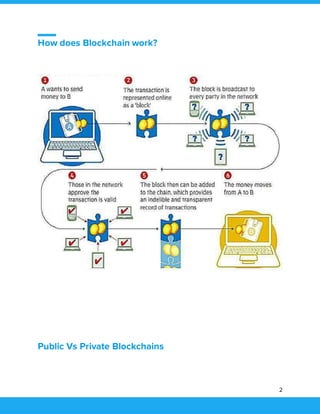
How does Blockchain work?
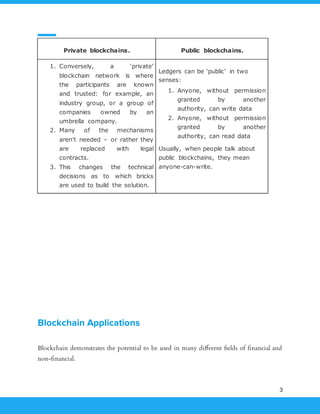
Public Vs Private Blockchains
3
Private blockchains. Public blockchains.
1. Conversely, a ‘private’
blockchain network is where
the participants are known
and trusted: for example, an
industry group, or a group of
companies owned by an
umbrella company.
2. Many of the mechanisms
aren’t needed – or rather they
are replaced with legal
contracts.
3. This changes the technical
decisions as to which bricks
are used to build the solution.
Ledgers can be ‘public’ in two
senses:
1. Anyone, without permission
granted by another
authority, can write data
2. Anyone, without permission
granted by another
authority, can read data
Usually, when people talk about
public blockchains, they mean
anyone-can-write.
Blockchain Applications
Blockchain demonstrates the potential to be used in many different fields of financial and
non-financial.
4
Financial institutions
and banks no longer see blockchain technology as a threat to traditional business
models. The world’s biggest banks are in fact looking for opportunities in this area by
doing research on innovative blockchain applications. In a recent interview, Rain Lohmus
of Estonia’s LHV bank told that they found Blockchain to be the most tested and secure
for some banking and finance-related applications.
Non-Financial applications
opportunities are also endless. We can envision putting proof of the existence of all legal
documents, health records, and royalty payments in the music industry, notary, private
securities and marriage licenses in the blockchain. By storing the fingerprint of the digital
asset instead of storing the digital asset itself, the anonymity or privacy objective can be
achieved.
Blockchain—Risks and Opportunities
Having rapidly outgrown its early roots in cryptocurrencies (such as bitcoin)
Blockchain now has the potential to:
● Simplify and enhance transparency in core business functions such as
supply chain management, auditing, tax, compliance and back-office
operations
● Rapidly increase the volume of automated transactions
● Help reduce fraud through enhanced identity management
However,while Blockchain has the potentialto revolutionize the way we do
business, boards must also consider some of the associated challenges with
the adoption of the technology such as:
5
● Regulatoryand legal environments are still under development and as
such is open for interpretation
● Implementing and standardizing Blockchain requires significant
investment, including legacy system integrationand retraining of the
workforce where appropriate
● A lack of real-world enterprise testing and the rapid development of
Blockchain platforms make it difficult to stay ahead of the curve
Problems Identified
If blockchain technology allows us to more securely and transparently track
all types of transactions, imagine the possibilities it presents across the
supply chain.
6
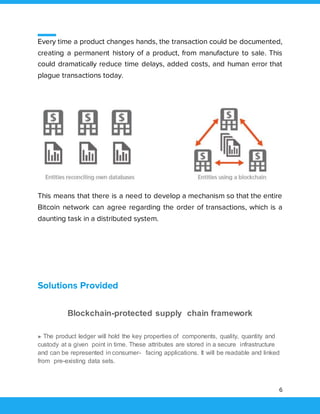
Every time a product changes hands, the transaction could be documented,
creating a permanent history of a product, from manufacture to sale. This
could dramatically reduce time delays, added costs, and human error that
plague transactions today.
This means that there is a need to develop a mechanism so that the entire
Bitcoin network can agree regarding the order of transactions, which is a
daunting task in a distributed system.
Solutions Provided
Blockchain-protected supply chain framework
► The product ledger will hold the key properties of components, quality, quantity and
custody at a given point in time. These attributes are stored in a secure infrastructure
and can be represented in consumer- facing applications. It will be readable and linked
from pre-existing data sets.
7
► Every relevant participant also will be an interested party in performing a quality
assessment, auditing the network and getting verification from the relevant performing
party. Participants are producers, manufacturers, registrars, standards organizations,
customers, certifiers and auditors.
A blockchain solution provides:
► Brand value for products
► Decentralized, the technology-shared
architecture
► Establishment of mutual trustless trust
Impact:
► Incomprehensible network of
product trace
► Supply chain mass contamination of products
► Counterfeit parts in product inception
Blockchain can provide secure IoT digital marketplace
► Blockchain provides secure, machine-to-machine communication and distribution of
smartly produced data.
► Its decentralized server adds a layer of security to file storage and transfer,
determines roles and permissions, provides trustless peer-to-peer messaging, and
offers secure and distributed data sharing and healthy equipment coordination.
► It can facilitate tracking production, distribution and consumption, and automatically
detect problems to initiate a cost-effective response rapidly.
8
Impact:
► Data gathered in IoT network is futile
► Centralized cloud infrastructure
► Manual tracking of production, distribution and consumption
A blockchain solution provides:
► Safe distribution of smartly produced data
► Secure transfer of financially sensitive information
► Automatic installation of service requests
Blockchain can provide information around the origin of
goods
► Blockchain provides an immutable, trusted and shared record of transaction data.
► With its verifiable and decentralized nature, retailers and manufacturers can track the
origin and location of a product at any point along the supply chain at any given time.
► Blockchain could eliminate the burden on one trusted centralized party when dealing
with multiple parties in multiple jurisdictions that are exchanging multiple physical
goods and multiple documents and settlements by decentralizing the authority.
Impact:
9
► Lack of confidence in retailer
► Possibility for contamination
► Potential for mislabelling of goods
A blockchain solution provides:
► Reassurance to customers, particularly those with requirements, e.g., kosher and
halal
► Helps avoid public relations disasters
► Helps maintain status as an ethical retailer
This mathematical puzzle is not trivial to solve and the complexity of the
problem can be adjusted so that on average it takes ten minutes for a node
in the Bitcoin network to make a right guess and generate a block. There is
very small probability that more than one block will be generated in the
system at a given time. First node, to solve the problem, broadcasts the
block to rest of the network. Occasionally, however, more than one block
will be solved at the same time, leading to several possible branches.
However, the math of solving is very complicated and hence the blockchain
quickly stabilizes, meaning that every node is in agreement about the
ordering of blocks a few backs from the end of the chain. The nodes
10
donating their computing resources to solve the puzzle and generate block
are called “miner” nodes” and are financially awarded for their efforts.
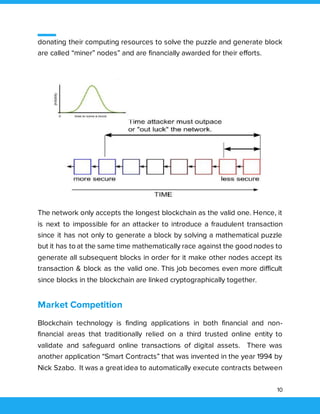
The network only accepts the longest blockchain as the valid one. Hence, it
is next to impossible for an attacker to introduce a fraudulent transaction
since it has not only to generate a block by solving a mathematical puzzle
but it has to at the same time mathematically race against the good nodes to
generate all subsequent blocks in order for it make other nodes accept its
transaction & block as the valid one. This job becomes even more difficult
since blocks in the blockchain are linked cryptographically together.
Market Competition
Blockchain technology is finding applications in both financial and non-
financial areas that traditionally relied on a third trusted online entity to
validate and safeguard online transactions of digital assets. There was
another application “Smart Contracts” that was invented in the year 1994 by
Nick Szabo. It was a great idea to automatically execute contracts between
11
participating parties. However, it did not find usage until the notion of
cryptocurrencies or programmable payments came into existence. Now two
programs blockchain and the smart contract can work together to trigger
payments when a preprogrammed condition of a contractual agreement is
triggered. Smart Contracts are really the killer application of the
cryptocurrency world.
Smart contracts are contracts which are automatically enforced by computer
protocols. Using blockchain technology it has become much easier to
register, verify and execute Smart Contracts. Open source companies like
Ethereum and Codius are enabling Smart Contracts using blockchain
technology. Many companies which operate on bitcoin and blockchain
technologies are supporting Smart Contracts. Many cases where assets are
transferred only on meeting certain conditions which require Lawyers to
create a contract and Banks to provide Escrow service can be replaced by
Smart Contracts.
Ethereum has created a lot of excitement for its programmable platform
capabilities. Ethereum allows anyone to create their own cryptocurrency and
use that to execute, pay for smart contracts. Ethereum itself has its own
cryptocurrency (ether) which is used to pay for the services. Ethereum is
already powering a wide range of early applications in areas such as
Governance, autonomous banks, keyless access, crowdfunding, financial
derivatives trading and settlement using smart contracts.
12
Conclusion
Much of the thought leadership regarding blockchains in financial services
has focused on the context of Western Europe and the US but little has
been explored within Asia. This is ironic given in the US, trust across state
lines is high and uniform; in Europe, the market is more closely aligned by
regulation. But Asia is still behind in terms of levels of trust enabling greater
economic activity. Asia’s geopolitical context is unique globally – the region
consists of loosely coupled countries who want to trade with each other, yet
levels of trust between countries are disparate, preventing the region from
realising its potential.
We believe that the most transformative blockchains will be those that can
work across geopolitical boundaries. Southeast Asia has the most potential
that can be unlocked with this technology, but we acknowledge that it may
also be the hardest blockchains to implement.
We now have the technology for trust. With political will, investment, and
industry collaboration, we believe that blockchains can improve the way
business is done in Southeast Asia and increase economic prosperity as a
result.

Supply Chain Management using Blockchain

  • 1.
    G. H. RaisoniCollege of Engineering Department of Computer Science and Engineering Blockchain Technology End Sem Exam Session: 2018-19 Report on Supply Chain Management using Blockchain
  • 2.
    1 What is BlockChain Technology? A blockchain is essentially a distributed database of records or public ledger of all transactions or digital events that have been executed and shared among participating parties. Each transaction in the public ledger is verified by consensus of a majority of the participants in the system. And, once entered, information can never be erased. The blockchain contains a certain and verifiable record of every single transaction ever made. To use a basic analogy, it is easy to steal a cookie from a cookie jar, kept in a secluded place than stealing the cookie from a cookie jar kept in a marketplace, being observed by thousands of people. In the report, it distinguishes between multiple types of blockchains and explains the two biggest platforms, namely Bitcoin and Ethereum. While introducing those two platforms we explain the most important technology and algorithms used such as proof of work concept. Some of the security issues and solutions are also covered. We conclude with some concrete Ethereum based applications that demonstrate the usage of blockchain technology beyond cryptocurrency and illustrate current developments in this field.
  • 3.
    2 How does Blockchainwork? Public Vs Private Blockchains
  • 4.
    3 Private blockchains. Publicblockchains. 1. Conversely, a ‘private’ blockchain network is where the participants are known and trusted: for example, an industry group, or a group of companies owned by an umbrella company. 2. Many of the mechanisms aren’t needed – or rather they are replaced with legal contracts. 3. This changes the technical decisions as to which bricks are used to build the solution. Ledgers can be ‘public’ in two senses: 1. Anyone, without permission granted by another authority, can write data 2. Anyone, without permission granted by another authority, can read data Usually, when people talk about public blockchains, they mean anyone-can-write. Blockchain Applications Blockchain demonstrates the potential to be used in many different fields of financial and non-financial.
  • 5.
    4 Financial institutions and banksno longer see blockchain technology as a threat to traditional business models. The world’s biggest banks are in fact looking for opportunities in this area by doing research on innovative blockchain applications. In a recent interview, Rain Lohmus of Estonia’s LHV bank told that they found Blockchain to be the most tested and secure for some banking and finance-related applications. Non-Financial applications opportunities are also endless. We can envision putting proof of the existence of all legal documents, health records, and royalty payments in the music industry, notary, private securities and marriage licenses in the blockchain. By storing the fingerprint of the digital asset instead of storing the digital asset itself, the anonymity or privacy objective can be achieved. Blockchain—Risks and Opportunities Having rapidly outgrown its early roots in cryptocurrencies (such as bitcoin) Blockchain now has the potential to: ● Simplify and enhance transparency in core business functions such as supply chain management, auditing, tax, compliance and back-office operations ● Rapidly increase the volume of automated transactions ● Help reduce fraud through enhanced identity management However,while Blockchain has the potentialto revolutionize the way we do business, boards must also consider some of the associated challenges with the adoption of the technology such as:
  • 6.
    5 ● Regulatoryand legalenvironments are still under development and as such is open for interpretation ● Implementing and standardizing Blockchain requires significant investment, including legacy system integrationand retraining of the workforce where appropriate ● A lack of real-world enterprise testing and the rapid development of Blockchain platforms make it difficult to stay ahead of the curve Problems Identified If blockchain technology allows us to more securely and transparently track all types of transactions, imagine the possibilities it presents across the supply chain.
  • 7.
    6 Every time aproduct changes hands, the transaction could be documented, creating a permanent history of a product, from manufacture to sale. This could dramatically reduce time delays, added costs, and human error that plague transactions today. This means that there is a need to develop a mechanism so that the entire Bitcoin network can agree regarding the order of transactions, which is a daunting task in a distributed system. Solutions Provided Blockchain-protected supply chain framework ► The product ledger will hold the key properties of components, quality, quantity and custody at a given point in time. These attributes are stored in a secure infrastructure and can be represented in consumer- facing applications. It will be readable and linked from pre-existing data sets.
  • 8.
    7 ► Every relevantparticipant also will be an interested party in performing a quality assessment, auditing the network and getting verification from the relevant performing party. Participants are producers, manufacturers, registrars, standards organizations, customers, certifiers and auditors. A blockchain solution provides: ► Brand value for products ► Decentralized, the technology-shared architecture ► Establishment of mutual trustless trust Impact: ► Incomprehensible network of product trace ► Supply chain mass contamination of products ► Counterfeit parts in product inception Blockchain can provide secure IoT digital marketplace ► Blockchain provides secure, machine-to-machine communication and distribution of smartly produced data. ► Its decentralized server adds a layer of security to file storage and transfer, determines roles and permissions, provides trustless peer-to-peer messaging, and offers secure and distributed data sharing and healthy equipment coordination. ► It can facilitate tracking production, distribution and consumption, and automatically detect problems to initiate a cost-effective response rapidly.
  • 9.
    8 Impact: ► Data gatheredin IoT network is futile ► Centralized cloud infrastructure ► Manual tracking of production, distribution and consumption A blockchain solution provides: ► Safe distribution of smartly produced data ► Secure transfer of financially sensitive information ► Automatic installation of service requests Blockchain can provide information around the origin of goods ► Blockchain provides an immutable, trusted and shared record of transaction data. ► With its verifiable and decentralized nature, retailers and manufacturers can track the origin and location of a product at any point along the supply chain at any given time. ► Blockchain could eliminate the burden on one trusted centralized party when dealing with multiple parties in multiple jurisdictions that are exchanging multiple physical goods and multiple documents and settlements by decentralizing the authority. Impact:
  • 10.
    9 ► Lack ofconfidence in retailer ► Possibility for contamination ► Potential for mislabelling of goods A blockchain solution provides: ► Reassurance to customers, particularly those with requirements, e.g., kosher and halal ► Helps avoid public relations disasters ► Helps maintain status as an ethical retailer This mathematical puzzle is not trivial to solve and the complexity of the problem can be adjusted so that on average it takes ten minutes for a node in the Bitcoin network to make a right guess and generate a block. There is very small probability that more than one block will be generated in the system at a given time. First node, to solve the problem, broadcasts the block to rest of the network. Occasionally, however, more than one block will be solved at the same time, leading to several possible branches. However, the math of solving is very complicated and hence the blockchain quickly stabilizes, meaning that every node is in agreement about the ordering of blocks a few backs from the end of the chain. The nodes
  • 11.
    10 donating their computingresources to solve the puzzle and generate block are called “miner” nodes” and are financially awarded for their efforts. The network only accepts the longest blockchain as the valid one. Hence, it is next to impossible for an attacker to introduce a fraudulent transaction since it has not only to generate a block by solving a mathematical puzzle but it has to at the same time mathematically race against the good nodes to generate all subsequent blocks in order for it make other nodes accept its transaction & block as the valid one. This job becomes even more difficult since blocks in the blockchain are linked cryptographically together. Market Competition Blockchain technology is finding applications in both financial and non- financial areas that traditionally relied on a third trusted online entity to validate and safeguard online transactions of digital assets. There was another application “Smart Contracts” that was invented in the year 1994 by Nick Szabo. It was a great idea to automatically execute contracts between
  • 12.
    11 participating parties. However,it did not find usage until the notion of cryptocurrencies or programmable payments came into existence. Now two programs blockchain and the smart contract can work together to trigger payments when a preprogrammed condition of a contractual agreement is triggered. Smart Contracts are really the killer application of the cryptocurrency world. Smart contracts are contracts which are automatically enforced by computer protocols. Using blockchain technology it has become much easier to register, verify and execute Smart Contracts. Open source companies like Ethereum and Codius are enabling Smart Contracts using blockchain technology. Many companies which operate on bitcoin and blockchain technologies are supporting Smart Contracts. Many cases where assets are transferred only on meeting certain conditions which require Lawyers to create a contract and Banks to provide Escrow service can be replaced by Smart Contracts. Ethereum has created a lot of excitement for its programmable platform capabilities. Ethereum allows anyone to create their own cryptocurrency and use that to execute, pay for smart contracts. Ethereum itself has its own cryptocurrency (ether) which is used to pay for the services. Ethereum is already powering a wide range of early applications in areas such as Governance, autonomous banks, keyless access, crowdfunding, financial derivatives trading and settlement using smart contracts.
  • 13.
    12 Conclusion Much of thethought leadership regarding blockchains in financial services has focused on the context of Western Europe and the US but little has been explored within Asia. This is ironic given in the US, trust across state lines is high and uniform; in Europe, the market is more closely aligned by regulation. But Asia is still behind in terms of levels of trust enabling greater economic activity. Asia’s geopolitical context is unique globally – the region consists of loosely coupled countries who want to trade with each other, yet levels of trust between countries are disparate, preventing the region from realising its potential. We believe that the most transformative blockchains will be those that can work across geopolitical boundaries. Southeast Asia has the most potential that can be unlocked with this technology, but we acknowledge that it may also be the hardest blockchains to implement. We now have the technology for trust. With political will, investment, and industry collaboration, we believe that blockchains can improve the way business is done in Southeast Asia and increase economic prosperity as a result.