Why is AI so uncomfortable?
A THERAPY SESSION
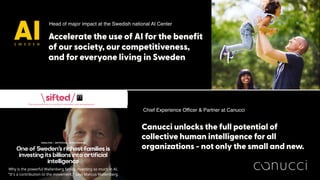
Head of major impact at the Swedish national AI Center
Accelerate the use of AI for the benefit
of our society, our competitiveness,
and for everyone living in Sweden
Chief Experience Officer & Partner at Canucci
Canucci unlocks the full potential of
collective human intelligence for all
organizations - not only the small and new.
This session may make
you uncomfortable
1
May trigger escape
behaviours
2
Acceptance is the
road to change
3
Warning, uncomfortable messages ahead
3 opening statements
Real
understanding
of AI is still
insanely low.
Of the potential &
implications
3 opening statements
A million
excuses to avoid
actual use of AI.
Ethics anyone?
Regulations?
AI Strategies? Check!
3 opening statements
The biggest
obstacle to
understanding
AI is that it is so
uncomfortable.
3 opening statements
A lot of talk 

about the impact 

it will have
AI
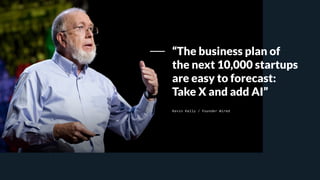
“The business plan of 

the next 10,000 startups 

are easy to forecast: 

Take X and add AI”
Kevin Kelly / Founder Wired
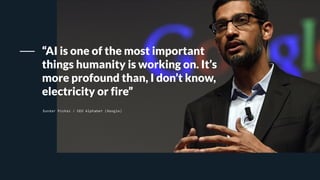
Sundar Pichai / CEO Alphabet (Google)
“AI is one of the most important
things humanity is working on. It’s
more profound than, I don’t know,
electricity or fire”
Everyone is going
apeshit with
excitement, right?
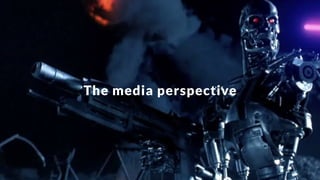
The media perspective
“Let’s talk more about ethics”
Is it ethical to
stall when people
are dying?
Is it ethical to
stall when people
are dying?
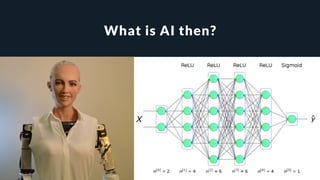
What is AI then?
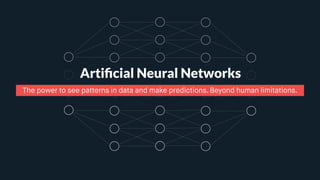
Artificial Neural Networks
The power to see patterns in data and make predictions. Beyond human limitations.
Peltarion - the operational AI platform
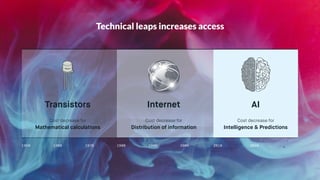
Technical leaps increases access
Internet
Cost decrease for

Distribution of information
AI
1950 1960 1970 1980 1990 2000 2010
Transistors
Cost decrease for

Mathematical calculations
Cost decrease for

Intelligence & Predictions
2020
Peltarion - the operational AI platform
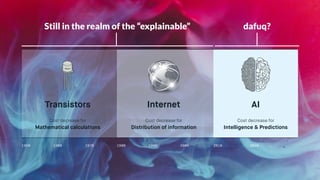
Still in the realm of the “explainable”
Internet
Cost decrease for

Distribution of information
AI
1950 1960 1970 1980 1990 2000 2010
Transistors
Cost decrease for

Mathematical calculations
Cost decrease for

Intelligence & Predictions
2020
dafuq?
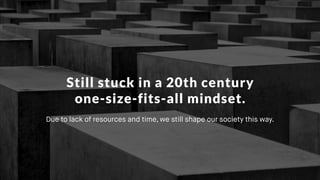
Still stuck in a 20th century
one-size-fits-all mindset.
Due to lack of resources and time, we still shape our society this way.
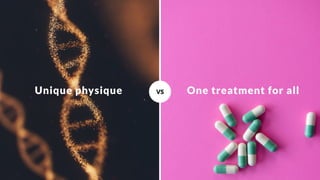
Unique physique One treatment for all
VS
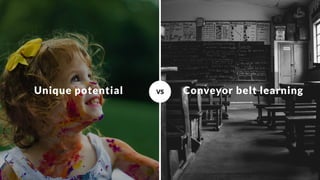
Unique potential Conveyor belt learning
VS
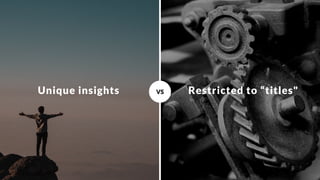
Unique insights Restricted to “titles"
VS
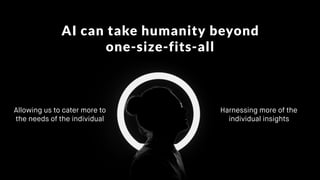
AI can take humanity beyond
one-size-fits-all
Allowing us to cater more to
the needs of the individual
Harnessing more of the
individual insights
So what’s making it so hard
to take those steps?
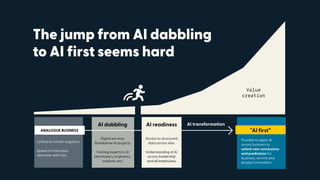
AI dabbling
Limited to human cognition.
Speed of innovation
decrease with size.
Digital services.
Standalone AI projects.
Training experts in AI

(developers, engineers,
analysts, etc)
AI transformation
Possible to apply AI
across business to
unlock new conclusions
and predictions for
business, service and
product innovation.
ANALOGUE BUSINESS "AI first”
Access to structured
data across silos.
Understanding of AI
across leadership
and all employees.
AI readiness
The jump from AI dabbling
to AI first seems hard
Value
creation
AI is NOT primarily 

a technical challenge
Embracing AI requires
personal transformation
The key is for us humans to
change how we view our
roles in the future
Most people base a large part of
their personal identity on their
professional titles
I am a Lawyer, CEO, Doctor… or even scientist.
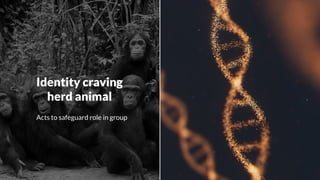
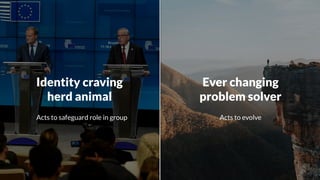
Identity craving
herd animal
Acts to safeguard role in group
Identity craving
herd animal
Acts to safeguard role in group
Identity craving
herd animal
Acts to safeguard role in group
We value 

ourselves based on
our ability to be
give predictions
(to the group)
We have an inner
narcissistic belief
that WE are
irreplaceable


(in the group)
Giving up the safety of our identities and
be be in a state of constant change.


Really uncomfortable for most of us.
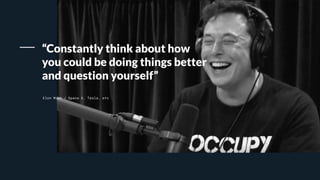
Elon Musk / Space X, Tesla, etc
“Constantly think about how
you could be doing things better
and question yourself”
Change is associated with loss of safety
It’s in our nature to resist that
!
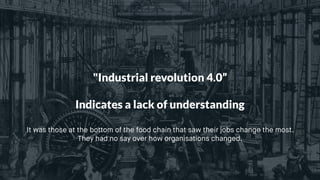
"Industrial revolution 4.0”
Indicates a lack of understanding
It was those at the bottom of the food chain that saw their jobs change the most.
They had no say over how organisations changed.
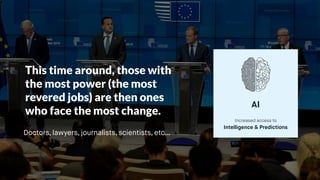
This time around, those with
the most power (the most
revered jobs) are then ones
who face the most change.
AI
Increased access to

Intelligence & Predictions
Doctors, lawyers, journalists, scientists, etc…
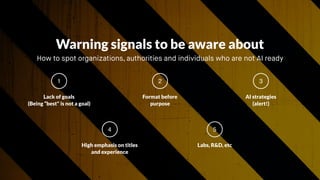
Lack of goals 

(Being “best" is not a goal)
1
Format before
purpose
2
AI strategies

(alert!)
3
Warning signals to be aware about
How to spot organizations, authorities and individuals who are not AI ready 
High emphasis on titles
and experience
4
Labs, R&D, etc

5
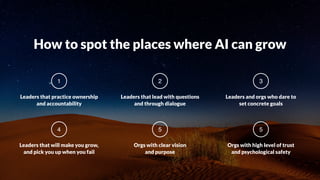
Leaders that practice ownership
and accountability
1
Leaders that lead with questions
and through dialogue
2
Leaders and orgs who dare to
set concrete goals
3
How to spot the places where AI can grow
Leaders that will make you grow,
and pick you up when you fail
4
Orgs with clear vision
and purpose
5 5
Orgs with high level of trust
and psychological safety
Acts to evolve
Identity craving
herd animal
Acts to safeguard role in group
Ever changing
problem solver
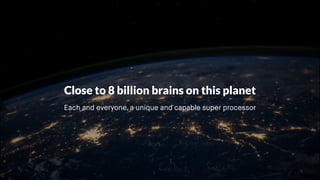
Close to 8 billion brains on this planet
Each and everyone, a unique and capable super processor
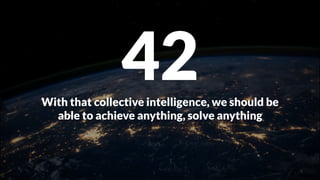
With that collective intelligence, we should be
able to achieve anything, solve anything
42
We fail to put our cognitive power

to collective use
As soon as we grow beyond the size of a village,
it's like pouring glue into the system.
To make large groups to function we have to severely
limit people’s potential and the collective intelligence.
We box unique fantastic individuals into titles and role descriptions. Our
sharing of information is not much more effective than smoke signals. 
At Canucci we use the power of AI to identify
patterns in large organizations to give us insights
about what is holding is us back, the common
denominators, the blockers and enablers
And put those insights (removing fear and opinions that cloud facts) in the
hands of both CEO and all employees - to unify the collective intelligence and
direct energy increasingly in the right direction - to accelerate transformation.
One crucial area is to use the power of AI to take healthcare beyond simply
making people survive, and instead reach for supporting everyone to better
fulfil their potential in life.
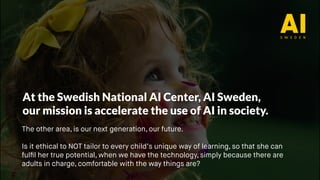
At the Swedish National AI Center, AI Sweden,
our mission is accelerate the use of AI in society.
At the Swedish National AI Center, AI Sweden,
our mission is accelerate the use of AI in society.
The other area, is our next generation, our future.
Is it ethical to NOT tailor to every child’s unique way of learning, so that she can
fulfil her true potential, when we have the technology, simply because there are
adults in charge, comfortable with the way things are?
Embrace the uncomfortable
kye@ai.se

Why is AI so uncomfortable - A therapy session

  • 1.
    Why is AIso uncomfortable? A THERAPY SESSION
  • 2.
    Head of majorimpact at the Swedish national AI Center Accelerate the use of AI for the benefit of our society, our competitiveness, and for everyone living in Sweden Chief Experience Officer & Partner at Canucci Canucci unlocks the full potential of collective human intelligence for all organizations - not only the small and new.
  • 3.
    This session maymake you uncomfortable 1 May trigger escape behaviours 2 Acceptance is the road to change 3 Warning, uncomfortable messages ahead
  • 4.
  • 5.
    Real understanding of AI isstill insanely low. Of the potential & implications 3 opening statements
  • 6.
    A million excuses toavoid actual use of AI. Ethics anyone? Regulations? AI Strategies? Check! 3 opening statements
  • 7.
    The biggest obstacle to understanding AIis that it is so uncomfortable. 3 opening statements
  • 8.
    A lot oftalk 
 about the impact 
 it will have AI
  • 9.
    “The business planof 
 the next 10,000 startups 
 are easy to forecast: 
 Take X and add AI” Kevin Kelly / Founder Wired
  • 10.
    Sundar Pichai /CEO Alphabet (Google) “AI is one of the most important things humanity is working on. It’s more profound than, I don’t know, electricity or fire”
  • 11.
    Everyone is going apeshitwith excitement, right?
  • 12.
  • 13.
    “Let’s talk moreabout ethics”
  • 14.
    Is it ethicalto stall when people are dying?
  • 15.
    Is it ethicalto stall when people are dying?
  • 16.
  • 17.
    Artificial Neural Networks Thepower to see patterns in data and make predictions. Beyond human limitations.
  • 18.
    Peltarion - theoperational AI platform Technical leaps increases access Internet Cost decrease for
 Distribution of information AI 1950 1960 1970 1980 1990 2000 2010 Transistors Cost decrease for
 Mathematical calculations Cost decrease for
 Intelligence & Predictions 2020
  • 19.
    Peltarion - theoperational AI platform Still in the realm of the “explainable” Internet Cost decrease for
 Distribution of information AI 1950 1960 1970 1980 1990 2000 2010 Transistors Cost decrease for
 Mathematical calculations Cost decrease for
 Intelligence & Predictions 2020 dafuq?
  • 20.
    Still stuck ina 20th century one-size-fits-all mindset. Due to lack of resources and time, we still shape our society this way.
  • 21.
    Unique physique Onetreatment for all VS
  • 22.
    Unique potential Conveyorbelt learning VS
  • 23.
  • 24.
    AI can takehumanity beyond one-size-fits-all Allowing us to cater more to the needs of the individual Harnessing more of the individual insights
  • 25.
    So what’s makingit so hard to take those steps?
  • 26.
    AI dabbling Limited tohuman cognition. Speed of innovation decrease with size. Digital services. Standalone AI projects. Training experts in AI
 (developers, engineers, analysts, etc) AI transformation Possible to apply AI across business to unlock new conclusions and predictions for business, service and product innovation. ANALOGUE BUSINESS "AI first” Access to structured data across silos. Understanding of AI across leadership and all employees. AI readiness The jump from AI dabbling to AI first seems hard Value creation
  • 27.
    AI is NOTprimarily 
 a technical challenge
  • 28.
  • 29.
    The key isfor us humans to change how we view our roles in the future
  • 30.
    Most people basea large part of their personal identity on their professional titles I am a Lawyer, CEO, Doctor… or even scientist.
  • 31.
    Identity craving herd animal Actsto safeguard role in group
  • 32.
    Identity craving herd animal Actsto safeguard role in group
  • 33.
    Identity craving herd animal Actsto safeguard role in group
  • 34.
    We value 
 ourselvesbased on our ability to be give predictions (to the group) We have an inner narcissistic belief that WE are irreplaceable 
 (in the group)
  • 35.
    Giving up thesafety of our identities and be be in a state of constant change.
 
 Really uncomfortable for most of us.
  • 36.
    Elon Musk /Space X, Tesla, etc “Constantly think about how you could be doing things better and question yourself”
  • 37.
    Change is associatedwith loss of safety It’s in our nature to resist that !
  • 38.
    "Industrial revolution 4.0” Indicatesa lack of understanding It was those at the bottom of the food chain that saw their jobs change the most. They had no say over how organisations changed.
  • 39.
    This time around,those with the most power (the most revered jobs) are then ones who face the most change. AI Increased access to
 Intelligence & Predictions Doctors, lawyers, journalists, scientists, etc…
  • 40.
    Lack of goals
 (Being “best" is not a goal) 1 Format before purpose 2 AI strategies
 (alert!) 3 Warning signals to be aware about How to spot organizations, authorities and individuals who are not AI ready  High emphasis on titles and experience 4 Labs, R&D, etc
 5
  • 41.
    Leaders that practiceownership and accountability 1 Leaders that lead with questions and through dialogue 2 Leaders and orgs who dare to set concrete goals 3 How to spot the places where AI can grow Leaders that will make you grow, and pick you up when you fail 4 Orgs with clear vision and purpose 5 5 Orgs with high level of trust and psychological safety
  • 42.
    Acts to evolve Identitycraving herd animal Acts to safeguard role in group Ever changing problem solver
  • 44.
    Close to 8billion brains on this planet Each and everyone, a unique and capable super processor
  • 45.
    With that collectiveintelligence, we should be able to achieve anything, solve anything 42
  • 46.
    We fail toput our cognitive power
 to collective use
  • 47.
    As soon aswe grow beyond the size of a village, it's like pouring glue into the system.
  • 48.
    To make largegroups to function we have to severely limit people’s potential and the collective intelligence. We box unique fantastic individuals into titles and role descriptions. Our sharing of information is not much more effective than smoke signals. 
  • 49.
    At Canucci weuse the power of AI to identify patterns in large organizations to give us insights about what is holding is us back, the common denominators, the blockers and enablers And put those insights (removing fear and opinions that cloud facts) in the hands of both CEO and all employees - to unify the collective intelligence and direct energy increasingly in the right direction - to accelerate transformation.
  • 50.
    One crucial areais to use the power of AI to take healthcare beyond simply making people survive, and instead reach for supporting everyone to better fulfil their potential in life. At the Swedish National AI Center, AI Sweden, our mission is accelerate the use of AI in society.
  • 51.
    At the SwedishNational AI Center, AI Sweden, our mission is accelerate the use of AI in society. The other area, is our next generation, our future. Is it ethical to NOT tailor to every child’s unique way of learning, so that she can fulfil her true potential, when we have the technology, simply because there are adults in charge, comfortable with the way things are?
  • 52.