H O W A I I S C H A N G I N G T H E W O R L D
Exploring the Impact, Benefits, and Challenges
W H AT I S A R T I F I C I A L
I N T E L L I G E N C E ?
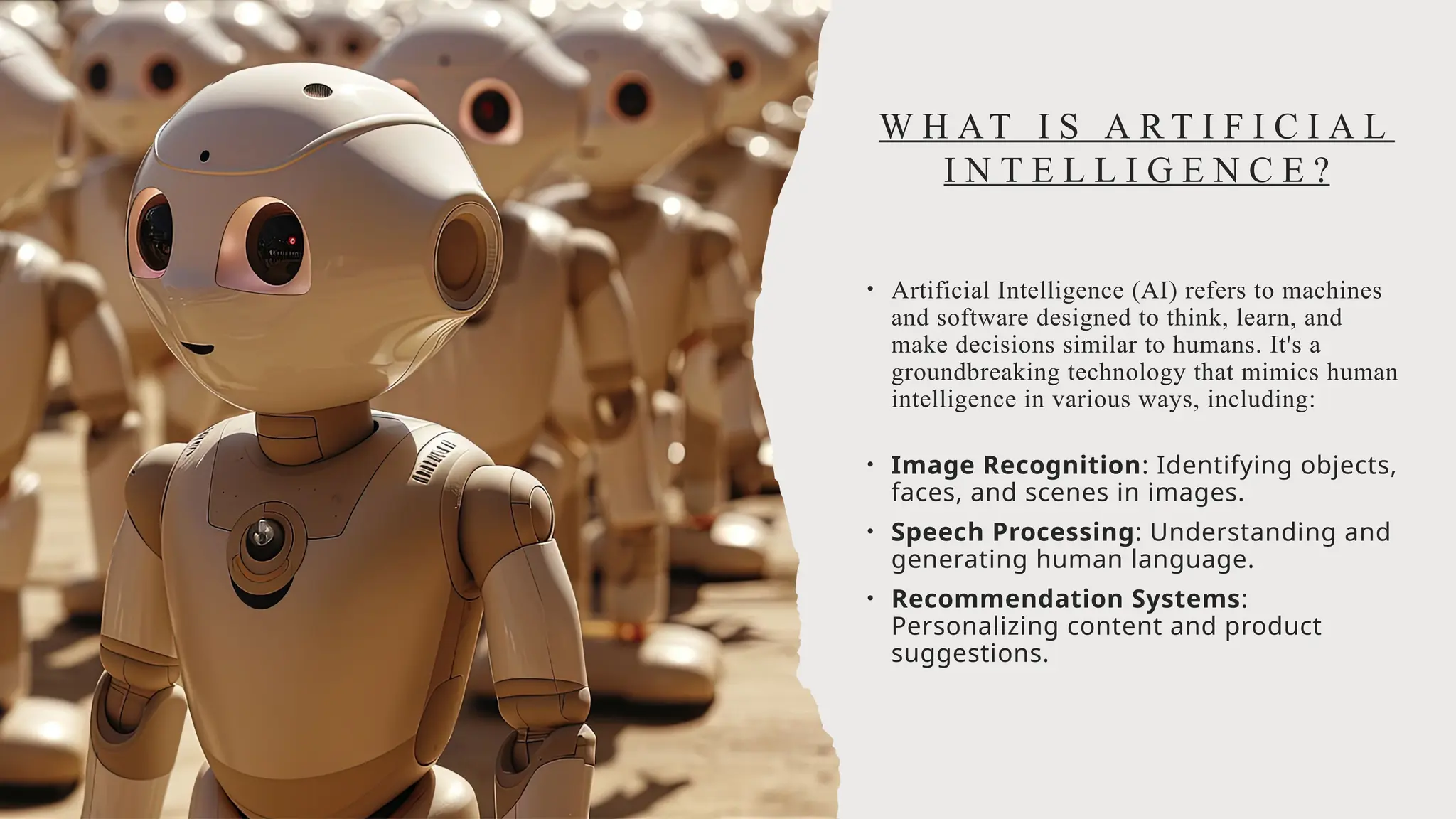
• Artificial Intelligence (AI) refers to machines
and software designed to think, learn, and
make decisions similar to humans. It's a
groundbreaking technology that mimics human
intelligence in various ways, including:
• Image Recognition: Identifying objects,
faces, and scenes in images.
• Speech Processing: Understanding and
generating human language.
• Recommendation Systems:
Personalizing content and product
suggestions.
W H A T I N D U S T R I E S W I L L
A I I M P A C T T H E M O S T ?
• There’s virtually no major
industry that modern AI hasn’t
already affected. Here are a few
of the industries undergoing the
greatest changes as a result of
AI.
• AI in Education
• AI in Healthcare
• AI in Transportation
• AI in Media and Entertainment
• AI in E-commerce
• AI In Agriculture
A I I N
E D U C A T I O N
• Personalized Learning: AI customizes
learning experiences based on
individual student needs, helping each
student progress at their own pace.
• Enhanced Tools: AI digitizes
textbooks and supports learning with
tools like plagiarism detection,
making educational resources more
accessible and efficient.
• Emotional Insight: Through facial
recognition, AI can gauge student
emotions, helping teachers identify
who may be struggling or disengaged.
• Future Potential: As AI evolves, it will
continue to shape education, adapting
to students' needs in real time to
enhance learning outcomes.
A I I N H E A L T H C A R E
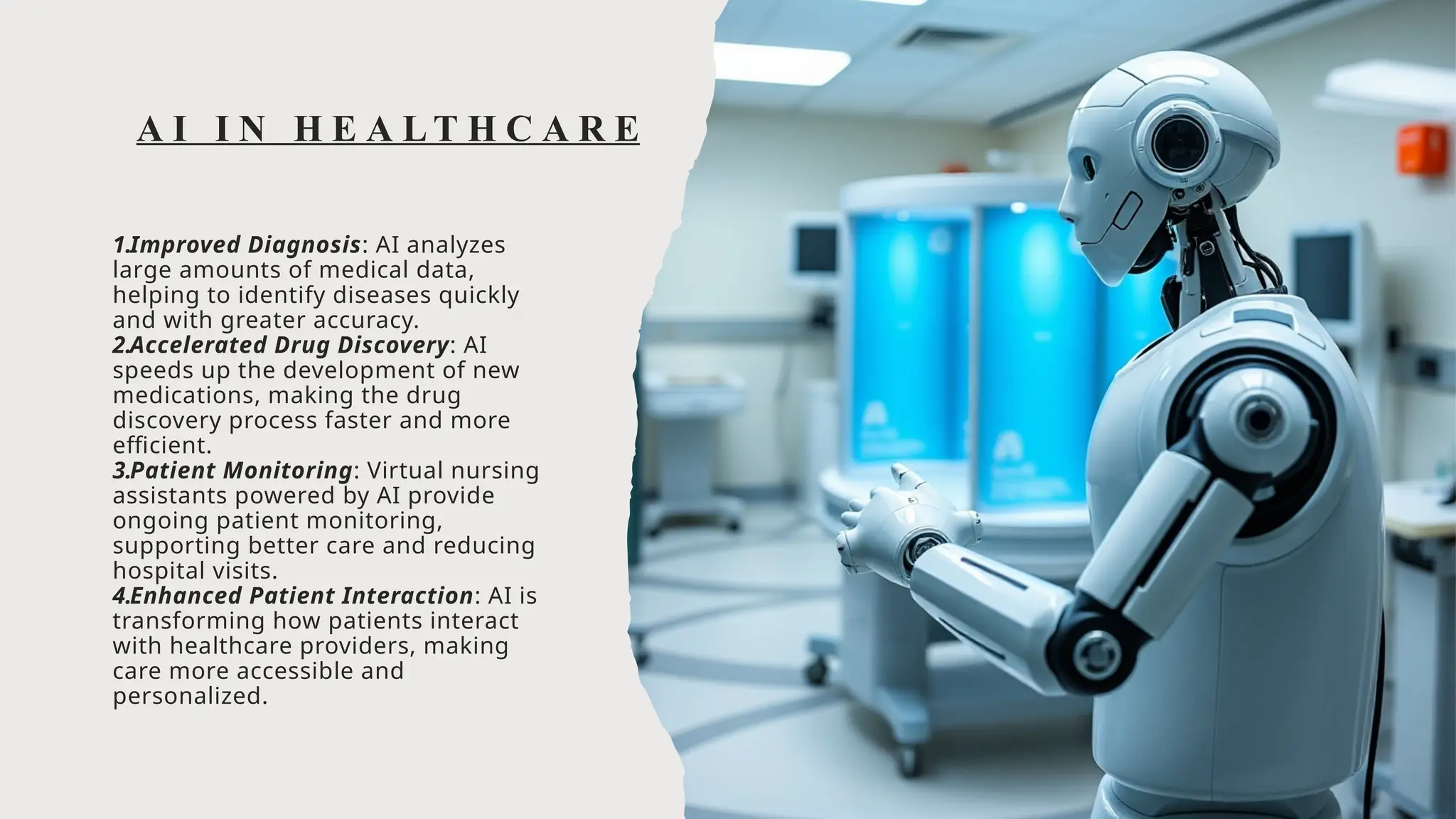
1.Improved Diagnosis: AI analyzes
large amounts of medical data,
helping to identify diseases quickly
and with greater accuracy.
2.Accelerated Drug Discovery: AI
speeds up the development of new
medications, making the drug
discovery process faster and more
efficient.
3.Patient Monitoring: Virtual nursing
assistants powered by AI provide
ongoing patient monitoring,
supporting better care and reducing
hospital visits.
4.Enhanced Patient Interaction: AI is
transforming how patients interact
with healthcare providers, making
care more accessible and
personalized.
A I I N
T R A N S P O R T A T I O N
•Autonomous Vehicles: AI powers self-driving cars
to improve safety by making real-time navigation
and driving decisions, potentially reducing
accidents caused by human error.
•Traffic & Public Transport Optimization: AI
manages traffic lights, predicts traffic patterns, and
optimizes public transport routes, reducing
congestion and enhancing commuter experience.
•Logistics & Supply Chain: AI optimizes delivery
routes and fleet management, using predictive
maintenance and demand forecasting to increase
efficiency and cut costs.
•Aviation & Maritime Advancements: AI enhances
air and sea travel with route optimization,
autonomous ships, and predictive maintenance,
reducing delays and environmental impact.
•Sustainable & Smart Infrastructure: AI supports
sustainable transport by reducing emissions,
enabling electric vehicle infrastructure, and
assisting in proactive maintenance of roads and
bridges.
A I I N M E D I A A N D
E N T E R T A I N M E N T
•Content Creation & Personalization: AI
generates personalized recommendations for
movies, music, and articles, enhancing user
engagement on platforms like Netflix and
Spotify.
•Automated Content Production: AI assists in
generating scripts, music compositions, and
even visual effects, enabling faster production
and creative experimentation.
•Enhanced Visual & Audio Experiences: AI-
powered tools improve visual effects, audio
enhancement, and image resolution, creating
high-quality media experiences for audiences.
•Audience Analysis & Trend Prediction: AI
analyzes viewer data to predict trends and
preferences, helping content creators and
marketers target audiences more effectively.
•Interactive & Immersive Experiences: AI
enables interactive experiences like virtual
reality (VR) and augmented reality (AR), as well
as real-time personalization in gaming and live
events.
A I I N
E - C O M M E R C E
•Personalized Recommendations: AI
analyzes browsing and purchase behavior
to suggest relevant products, enhancing
customer engagement and boosting sales.
•Chatbots & Customer Support: AI-
powered chatbots provide 24/7 support,
answering customer questions and
assisting with purchases in real time.
•Inventory & Demand Forecasting: AI
predicts demand and manages inventory
efficiently, reducing stockouts and
overstock situations.
•Visual Search & Product Discovery: AI
enables visual search, allowing customers
to find products by uploading images, and
improving the overall shopping experience.
•Fraud Detection & Security: AI detects
fraudulent transactions and enhances
cybersecurity, helping to protect both
businesses and customers.
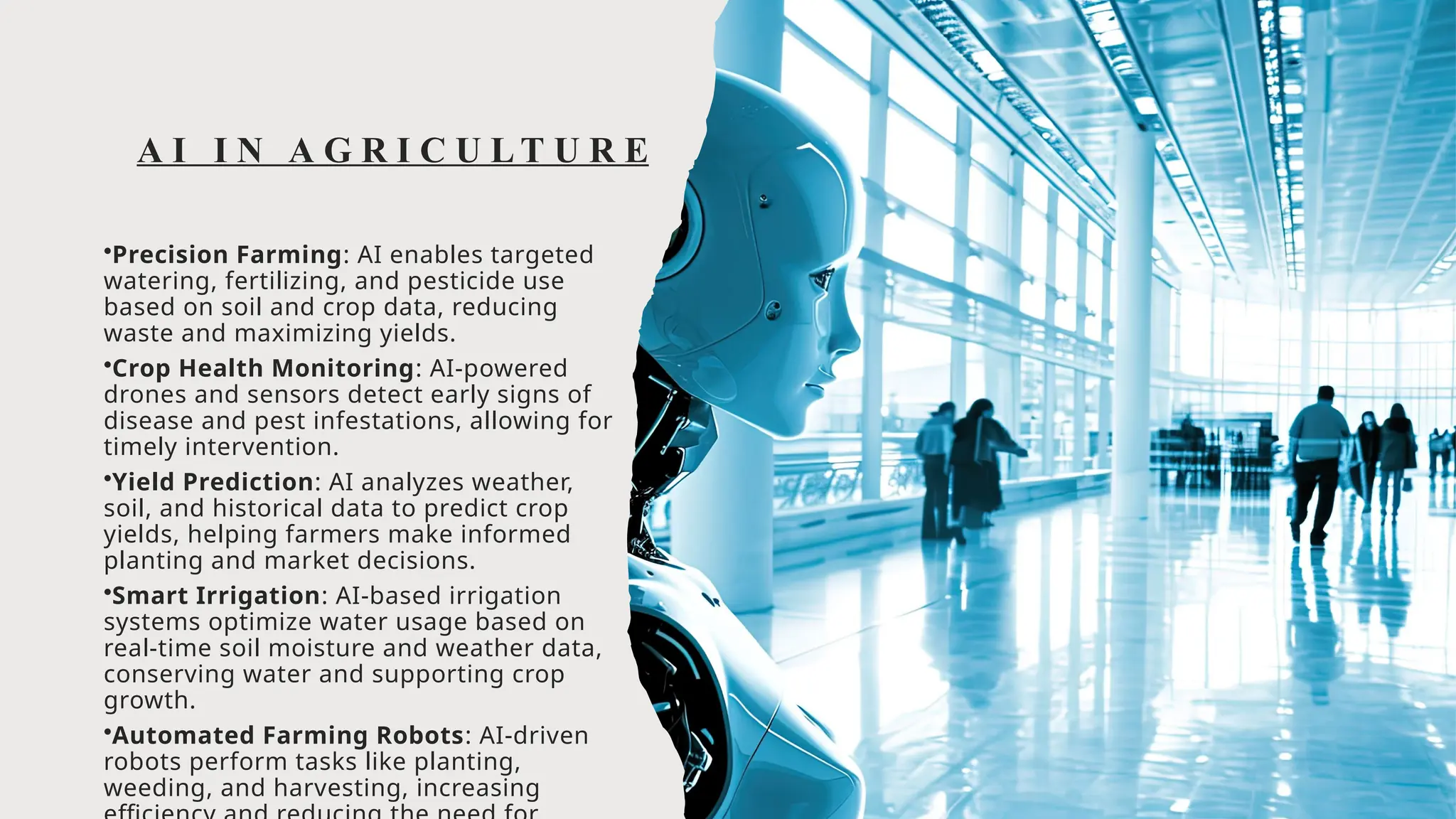
A I I N A G R I C U L T U R E
•Precision Farming: AI enables targeted
watering, fertilizing, and pesticide use
based on soil and crop data, reducing
waste and maximizing yields.
•Crop Health Monitoring: AI-powered
drones and sensors detect early signs of
disease and pest infestations, allowing for
timely intervention.
•Yield Prediction: AI analyzes weather,
soil, and historical data to predict crop
yields, helping farmers make informed
planting and market decisions.
•Smart Irrigation: AI-based irrigation
systems optimize water usage based on
real-time soil moisture and weather data,
conserving water and supporting crop
growth.
•Automated Farming Robots: AI-driven
robots perform tasks like planting,
weeding, and harvesting, increasing
C H A L L E N G E S O F
A I
•Data Privacy – AI systems need large
amounts of personal data, raising concerns
about how that data is stored, shared, and
protected.
•Bias and Fairness – AI can inherit biases
from its training data, leading to unfair
decisions that affect areas like hiring,
finance, and law enforcement.
•Lack of Explainability – Many AI models,
especially complex ones, are "black boxes,"
making it difficult to understand or explain
their decisions.
•Job Displacement – Automation through
AI may lead to job loss in certain
industries, creating a need for reskilling
and new workforce policies.
•Ethical and Legal Issues – Clear
regulations and accountability frameworks
are often lacking, making it challenging to
govern AI responsibly, especially in
sensitive areas like autonomous vehicles
T H E F U T U R E O F A I
•Enhanced Personalization – AI will drive
hyper-personalized experiences in fields like
marketing, healthcare, and education,
offering tailored solutions based on
individual preferences and needs.
•AI in Healthcare – The future of AI in
healthcare includes advancements in
diagnosis, treatment, and drug discovery,
enabling faster, more accurate medical care
and potentially life-saving innovations.
•Autonomous Systems – AI-powered
autonomous vehicles, drones, and robots are
expected to become more reliable,
transforming industries like transportation,
logistics, and manufacturing.
•Improved Human-AI Collaboration – AI
will increasingly work alongside humans,
enhancing productivity by automating
repetitive tasks and allowing humans to
focus on creative, strategic, and complex
problem-solving.
•Ethical and Transparent AI – As AI
C O N C L U S I O N :
In conclusion, AI is transforming industries
across the globe, from healthcare and
agriculture to finance, education, and beyond.
Its applications are driving efficiency, enabling
new innovations, and improving decision-
making by harnessing the power of data. While
challenges like ethical concerns, bias, and
transparency remain, ongoing advancements
and responsible development promise a future
where AI plays a positive, supportive role in
enhancing human capabilities. Embracing AI
responsibly and ethically will allow us to unlock
its full potential for a more efficient,
personalized, and connected world.

HOW AI IS CHANGING AND AFFECTINGTHE WORLD.

  • 1.
    H O WA I I S C H A N G I N G T H E W O R L D Exploring the Impact, Benefits, and Challenges
  • 2.
    W H ATI S A R T I F I C I A L I N T E L L I G E N C E ? • Artificial Intelligence (AI) refers to machines and software designed to think, learn, and make decisions similar to humans. It's a groundbreaking technology that mimics human intelligence in various ways, including: • Image Recognition: Identifying objects, faces, and scenes in images. • Speech Processing: Understanding and generating human language. • Recommendation Systems: Personalizing content and product suggestions.
  • 3.
    W H AT I N D U S T R I E S W I L L A I I M P A C T T H E M O S T ? • There’s virtually no major industry that modern AI hasn’t already affected. Here are a few of the industries undergoing the greatest changes as a result of AI. • AI in Education • AI in Healthcare • AI in Transportation • AI in Media and Entertainment • AI in E-commerce • AI In Agriculture
  • 4.
    A I IN E D U C A T I O N • Personalized Learning: AI customizes learning experiences based on individual student needs, helping each student progress at their own pace. • Enhanced Tools: AI digitizes textbooks and supports learning with tools like plagiarism detection, making educational resources more accessible and efficient. • Emotional Insight: Through facial recognition, AI can gauge student emotions, helping teachers identify who may be struggling or disengaged. • Future Potential: As AI evolves, it will continue to shape education, adapting to students' needs in real time to enhance learning outcomes.
  • 5.
    A I IN H E A L T H C A R E 1.Improved Diagnosis: AI analyzes large amounts of medical data, helping to identify diseases quickly and with greater accuracy. 2.Accelerated Drug Discovery: AI speeds up the development of new medications, making the drug discovery process faster and more efficient. 3.Patient Monitoring: Virtual nursing assistants powered by AI provide ongoing patient monitoring, supporting better care and reducing hospital visits. 4.Enhanced Patient Interaction: AI is transforming how patients interact with healthcare providers, making care more accessible and personalized.
  • 6.
    A I IN T R A N S P O R T A T I O N •Autonomous Vehicles: AI powers self-driving cars to improve safety by making real-time navigation and driving decisions, potentially reducing accidents caused by human error. •Traffic & Public Transport Optimization: AI manages traffic lights, predicts traffic patterns, and optimizes public transport routes, reducing congestion and enhancing commuter experience. •Logistics & Supply Chain: AI optimizes delivery routes and fleet management, using predictive maintenance and demand forecasting to increase efficiency and cut costs. •Aviation & Maritime Advancements: AI enhances air and sea travel with route optimization, autonomous ships, and predictive maintenance, reducing delays and environmental impact. •Sustainable & Smart Infrastructure: AI supports sustainable transport by reducing emissions, enabling electric vehicle infrastructure, and assisting in proactive maintenance of roads and bridges.
  • 7.
    A I IN M E D I A A N D E N T E R T A I N M E N T •Content Creation & Personalization: AI generates personalized recommendations for movies, music, and articles, enhancing user engagement on platforms like Netflix and Spotify. •Automated Content Production: AI assists in generating scripts, music compositions, and even visual effects, enabling faster production and creative experimentation. •Enhanced Visual & Audio Experiences: AI- powered tools improve visual effects, audio enhancement, and image resolution, creating high-quality media experiences for audiences. •Audience Analysis & Trend Prediction: AI analyzes viewer data to predict trends and preferences, helping content creators and marketers target audiences more effectively. •Interactive & Immersive Experiences: AI enables interactive experiences like virtual reality (VR) and augmented reality (AR), as well as real-time personalization in gaming and live events.
  • 8.
    A I IN E - C O M M E R C E •Personalized Recommendations: AI analyzes browsing and purchase behavior to suggest relevant products, enhancing customer engagement and boosting sales. •Chatbots & Customer Support: AI- powered chatbots provide 24/7 support, answering customer questions and assisting with purchases in real time. •Inventory & Demand Forecasting: AI predicts demand and manages inventory efficiently, reducing stockouts and overstock situations. •Visual Search & Product Discovery: AI enables visual search, allowing customers to find products by uploading images, and improving the overall shopping experience. •Fraud Detection & Security: AI detects fraudulent transactions and enhances cybersecurity, helping to protect both businesses and customers.
  • 9.
    A I IN A G R I C U L T U R E •Precision Farming: AI enables targeted watering, fertilizing, and pesticide use based on soil and crop data, reducing waste and maximizing yields. •Crop Health Monitoring: AI-powered drones and sensors detect early signs of disease and pest infestations, allowing for timely intervention. •Yield Prediction: AI analyzes weather, soil, and historical data to predict crop yields, helping farmers make informed planting and market decisions. •Smart Irrigation: AI-based irrigation systems optimize water usage based on real-time soil moisture and weather data, conserving water and supporting crop growth. •Automated Farming Robots: AI-driven robots perform tasks like planting, weeding, and harvesting, increasing
  • 10.
    C H AL L E N G E S O F A I •Data Privacy – AI systems need large amounts of personal data, raising concerns about how that data is stored, shared, and protected. •Bias and Fairness – AI can inherit biases from its training data, leading to unfair decisions that affect areas like hiring, finance, and law enforcement. •Lack of Explainability – Many AI models, especially complex ones, are "black boxes," making it difficult to understand or explain their decisions. •Job Displacement – Automation through AI may lead to job loss in certain industries, creating a need for reskilling and new workforce policies. •Ethical and Legal Issues – Clear regulations and accountability frameworks are often lacking, making it challenging to govern AI responsibly, especially in sensitive areas like autonomous vehicles
  • 11.
    T H EF U T U R E O F A I •Enhanced Personalization – AI will drive hyper-personalized experiences in fields like marketing, healthcare, and education, offering tailored solutions based on individual preferences and needs. •AI in Healthcare – The future of AI in healthcare includes advancements in diagnosis, treatment, and drug discovery, enabling faster, more accurate medical care and potentially life-saving innovations. •Autonomous Systems – AI-powered autonomous vehicles, drones, and robots are expected to become more reliable, transforming industries like transportation, logistics, and manufacturing. •Improved Human-AI Collaboration – AI will increasingly work alongside humans, enhancing productivity by automating repetitive tasks and allowing humans to focus on creative, strategic, and complex problem-solving. •Ethical and Transparent AI – As AI
  • 12.
    C O NC L U S I O N : In conclusion, AI is transforming industries across the globe, from healthcare and agriculture to finance, education, and beyond. Its applications are driving efficiency, enabling new innovations, and improving decision- making by harnessing the power of data. While challenges like ethical concerns, bias, and transparency remain, ongoing advancements and responsible development promise a future where AI plays a positive, supportive role in enhancing human capabilities. Embracing AI responsibly and ethically will allow us to unlock its full potential for a more efficient, personalized, and connected world.