AI & Automation: The
Future of Work
The workplace is evolving rapidly as artificial intelligence and
automation reshape our professional landscape. This
transformation brings both challenges and opportunities.
Let's explore how AI is changing the way we work and what it
means for our future.
by Ozías Rondón
The AI Revolution
1 Machine Learning Breakthroughs
Algorithms now learn from data without explicit
programming. They improve through experience and
feedback.
2 Deep Learning Advances
Neural networks can process complex patterns. They enable
image recognition, natural language processing, and more.
3 Widespread Industry Impact
From healthcare to finance, AI is transforming operations. It's
changing how businesses function and compete.
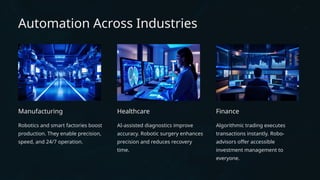
Automation Across Industries
Manufacturing
Robotics and smart factories boost
production. They enable precision,
speed, and 24/7 operation.
Healthcare
AI-assisted diagnostics improve
accuracy. Robotic surgery enhances
precision and reduces recovery
time.
Finance
Algorithmic trading executes
transactions instantly. Robo-
advisors offer accessible
investment management to
everyone.
AI in the Workplace
Enhanced
Productivity
AI automates routine
tasks. Workers focus on
higher-value activities
requiring creativity and
judgment.
Data-Driven
Decisions
AI analyzes vast
amounts of information
quickly. It identifies
patterns humans might
miss.
Personalized Experiences
Customer interactions become more relevant. AI tailors
services to individual preferences and behaviors.
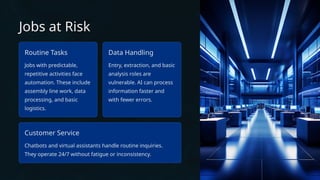
Jobs at Risk
Routine Tasks
Jobs with predictable,
repetitive activities face
automation. These include
assembly line work, data
processing, and basic
logistics.
Data Handling
Entry, extraction, and basic
analysis roles are
vulnerable. AI can process
information faster and
with fewer errors.
Customer Service
Chatbots and virtual assistants handle routine inquiries.
They operate 24/7 without fatigue or inconsistency.
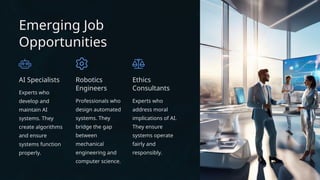
Emerging Job
Opportunities
AI Specialists
Experts who
develop and
maintain AI
systems. They
create algorithms
and ensure
systems function
properly.
Robotics
Engineers
Professionals who
design automated
systems. They
bridge the gap
between
mechanical
engineering and
computer science.
Ethics
Consultants
Experts who
address moral
implications of AI.
They ensure
systems operate
fairly and
responsibly.
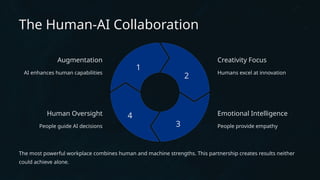
The Human-AI Collaboration
Augmentation
AI enhances human capabilities
1
Creativity Focus
Humans excel at innovation
2
Emotional Intelligence
People provide empathy
3
Human Oversight
People guide AI decisions
4
The most powerful workplace combines human and machine strengths. This partnership creates results neither
could achieve alone.
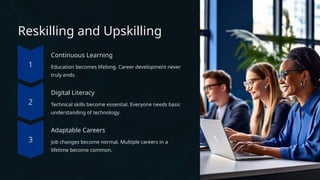
Reskilling and Upskilling
Continuous Learning
Education becomes lifelong. Career development never
truly ends.
Digital Literacy
Technical skills become essential. Everyone needs basic
understanding of technology.
Adaptable Careers
Job changes become normal. Multiple careers in a
lifetime become common.
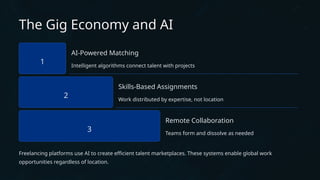
The Gig Economy and AI
1
AI-Powered Matching
Intelligent algorithms connect talent with projects
2
Skills-Based Assignments
Work distributed by expertise, not location
3
Remote Collaboration
Teams form and dissolve as needed
Freelancing platforms use AI to create efficient talent marketplaces. These systems enable global work
opportunities regardless of location.
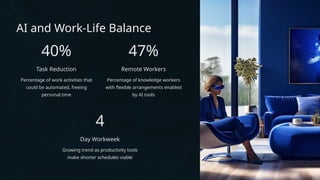
AI and Work-Life Balance
40%
Task Reduction
Percentage of work activities that
could be automated, freeing
personal time
47%
Remote Workers
Percentage of knowledge workers
with flexible arrangements enabled
by AI tools
4
Day Workweek
Growing trend as productivity tools
make shorter schedules viable
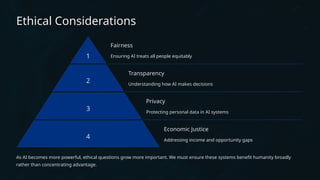
Ethical Considerations
1
Fairness
Ensuring AI treats all people equitably
2
Transparency
Understanding how AI makes decisions
3
Privacy
Protecting personal data in AI systems
4
Economic Justice
Addressing income and opportunity gaps
As AI becomes more powerful, ethical questions grow more important. We must ensure these systems benefit humanity broadly
rather than concentrating advantage.
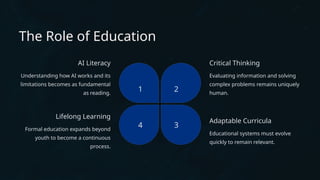
The Role of Education
AI Literacy
Understanding how AI works and its
limitations becomes as fundamental
as reading.
1
Critical Thinking
Evaluating information and solving
complex problems remains uniquely
human.
2
Adaptable Curricula
Educational systems must evolve
quickly to remain relevant.
3
Lifelong Learning
Formal education expands beyond
youth to become a continuous
process.
4
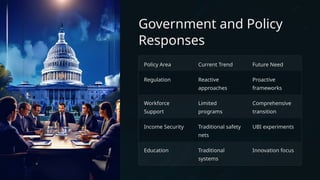
Government and Policy
Responses
Policy Area Current Trend Future Need
Regulation Reactive
approaches
Proactive
frameworks
Workforce
Support
Limited
programs
Comprehensive
transition
Income Security Traditional safety
nets
UBI experiments
Education Traditional
systems
Innovation focus
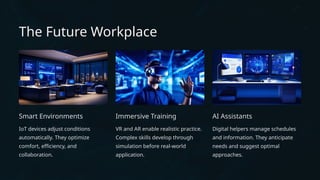
The Future Workplace
Smart Environments
IoT devices adjust conditions
automatically. They optimize
comfort, efficiency, and
collaboration.
Immersive Training
VR and AR enable realistic practice.
Complex skills develop through
simulation before real-world
application.
AI Assistants
Digital helpers manage schedules
and information. They anticipate
needs and suggest optimal
approaches.
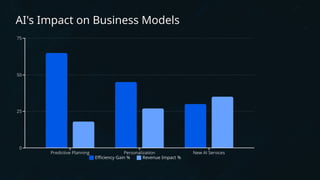
AI's Impact on Business Models
Efficiency Gain % Revenue Impact %
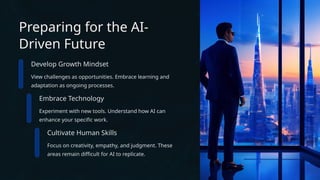
Preparing for the AI-
Driven Future
Develop Growth Mindset
View challenges as opportunities. Embrace learning and
adaptation as ongoing processes.
Embrace Technology
Experiment with new tools. Understand how AI can
enhance your specific work.
Cultivate Human Skills
Focus on creativity, empathy, and judgment. These
areas remain difficult for AI to replicate.
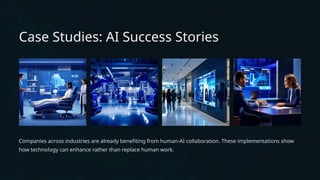
Case Studies: AI Success Stories
Companies across industries are already benefiting from human-AI collaboration. These implementations show
how technology can enhance rather than replace human work.
Challenges and
Opportunities
1 Digital Divide
Not everyone has equal
access to technology.
Rural and underserved
communities risk falling
further behind.
2 Inclusive
Development
AI systems must work for
diverse populations.
Representation in
development teams
becomes crucial.
3 Innovation Balance
Progress must consider societal impact. The fastest solution
isn't always the best one.
Call to Action: Optimize Your Digital
Workspace
System Performance
Issues
Unused programs slow computers
dramatically. They consume
resources and create conflicts.
Productivity suffers with every
delay and crash.
Best Converting Windows
Uninstaller
This powerful tool safely removes
unnecessary software. It cleans
registry entries and eliminates
leftover files. Your system runs
faster immediately.
Productivity Boost
A clean system is more efficient.
You'll work faster with fewer
interruptions. Prepare for AI tools
by optimizing your current
technology.
Take the Next Step
Visit Our Website
Explore the Best
Converting Windows
Uninstaller at:
https://42adbh9hce-82mij
6dmd1ng9oy.hop.clickban
k.net
Streamline Your
Workspace
Remove unnecessary
programs that slow your
computer. Create an
optimized environment
ready for AI tools.
Future-Proof Your Career
Start with your digital tools. A clean, efficient system is your
first step toward embracing the AI-driven future.