Download as PDF, PPTX

![Great native types
i = 1234
name = 'Johannes Lundberg'
startups = [ 'Kundo', '46elks' ]
options = {
'port': 12345,
'logpath': '../debug.log'
}](https://image.slidesharecdn.com/whyilovepython-150512145403-lva1-app6891/85/Why-I-love-Python-5-320.jpg)
![Native types are objects
>>> startups.sort()
>>> startups
['46elks', 'Kundo']
s = 'Rxc3xa4kenskapsxc3xa5r'
print s.decode('utf-8')
Räkenskapsår
options.has_key('logpath')
name.split(' ')[-1]
(123).bit_length](https://image.slidesharecdn.com/whyilovepython-150512145403-lva1-app6891/85/Why-I-love-Python-6-320.jpg)
![dir()
>>> dir(’Pycon Sweden 2015’)
['capitalize', 'center', 'count', 'decode',
'encode', 'endswith', 'expandtabs', 'find',
'format', 'index', 'isalnum', 'isalpha',
'isdigit', 'islower', 'isspace', 'istitle',
'isupper', 'join', 'ljust', 'lower',
'lstrip', 'partition', 'replace', 'rfind',
'rindex', 'rjust', 'rpartition', 'rsplit',
'rstrip', 'split', 'splitlines',
'startswith', 'strip', 'swapcase', 'title',
'translate', 'upper', 'zfill']](https://image.slidesharecdn.com/whyilovepython-150512145403-lva1-app6891/85/Why-I-love-Python-7-320.jpg)
![Functions as first-class citizens
def writelog(s):
pass
if options.has_key('logpath'):
f = open(options['logpath'],'wb')
writelog = f.write](https://image.slidesharecdn.com/whyilovepython-150512145403-lva1-app6891/85/Why-I-love-Python-8-320.jpg)
![OOP is not mandatory
players = []
for line in open('players.txt'):
if not line.startswith('#'):
players.append( line.strip() )](https://image.slidesharecdn.com/whyilovepython-150512145403-lva1-app6891/85/Why-I-love-Python-9-320.jpg)
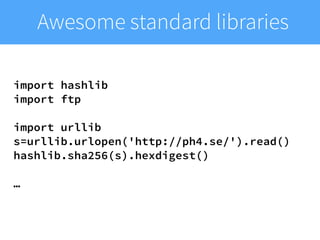
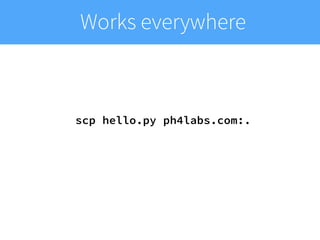

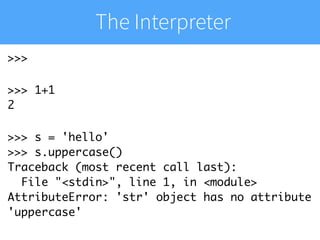
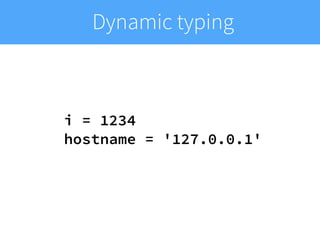
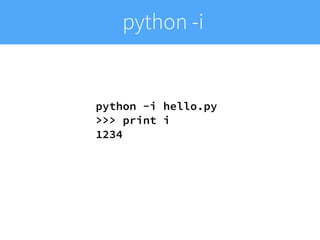
The document discusses the author's affection for Python, highlighting its features like dynamic typing, native types, and first-class functions. It includes code snippets demonstrating Python's capabilities, such as error handling, string manipulation, and file operations. Additionally, it mentions the simplicity and versatility of using Python in various applications.


![How Big Brands are Taking Your Traffic in Alberta [Data Inside].pptx](https://cdn.slidesharecdn.com/ss_thumbnails/howbigbrandsaretakingyourtrafficinalbertadatainside-260123180142-42d276f3-thumbnail.jpg?width=640&height=640&fit=bounds)


