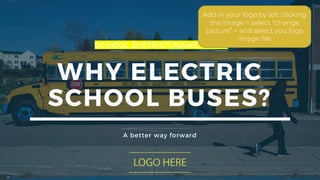



SCHOOL DISTRICT/NAME HERE
WHY ELECTRIC
SCHOOL BUSES?
A better way forward
Add in your logo by left clicking
the image > select “change
picture” > and select you logo
image file
Why Electric
School Buses
Presentation
Template
Information on the downfalls of
diesel buses, the benefits of
electric school buses, and key
next steps on moving forward.
WHAT DOES THIS DECK
INCLUDE?
Administrative or transportation
leads looking to educate
stakeholders on the benefits of
electric school buses.
WHO IS THIS DESIGNED
FOR?
Delete this slide before
presenting.
Why Electric
School Buses
Presentation
Template
1. Identify the goals of the presentation and
select the relevant slides in this deck
that can help you convey that message.
2. Read the instruction callout on each slide,
update the slide contents as needed, and
then delete the callout.
3. Enter “Slide Show” mode by clicking on
the Slide Show icon in the bottom right.
4. Update and add any content outside of
the instructions to help convey
your message.
5. Review speaker notes on each slide for
talking points or additional information.
6. Put this presentation in your
school’s standard template (if applicable)
and delete this slide before presenting.
7. If you have suggestions or comments,
please contact our team on our website
at https://www.wri.org/initiatives/electric-
school-bus-initiative
HOW TO USE THIS?
Delete this slide before
presenting.
THE HIGH COST OF DIESEL BUSES
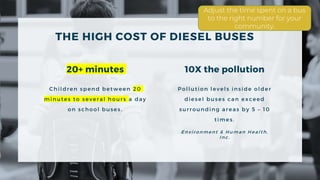
10X the pollution
Pollution levels inside older
diesel buses can exceed
surrounding areas by 5 – 10
times.
20+ minutes
Children spend between 20
minutes to several hours a day
on school buses.
THE HIGH COST OF DIESEL BUSES
E n v ir o n m e n t & H u m a n H e a l t h ,
I n c .
Adjust the time spent on a bus
to the right number for your
community.
THE HIGH COST OF DIESEL BUSES
NOx CO PM VOCs
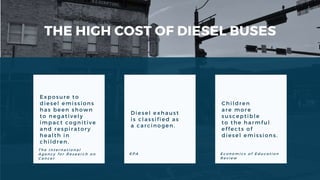
Diesel exhaust
is classified as
a carcinogen.
E P A
Exposure to
diesel emissions
has been shown
to negatively
impact cognitive
and respiratory
health in
children.
T h e I n t e r n a t i o n a l
A g e n c y f o r R e s e a r c h o n
C a n c e r
Children
are more
susceptible
to the harmful
effects of
diesel emissions.
E c o n o m i c s o f E d u c a t i o n
R e v i e w
Exposure to
diesel emissions
has been shown
to negatively
impact cognitive
and respiratory
health in
children.
T h e I n t e r n a t i o n a l
A g e n c y f o r R e s e a r c h o n
C a n c e r
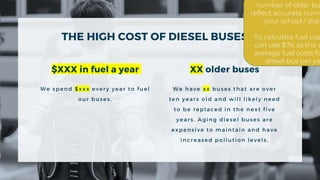
XX older buses
We have xx buses that are over
ten years old and will likely need
to be replaced in the next five
years. Aging diesel buses are
expensive to maintain and have
increased pollution levels.
$XXX in fuel a year
We spend $xxx every year to fuel
our buses.
THE HIGH COST OF DIESEL BUSES
number of older bu
reflect accurate numb
your school / distr
To calculate fuel cos
can use $7K as the a
average fuel costs fo
diesel bus per ye
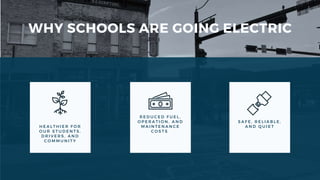
WHY SCHOOLS ARE GOING ELECTRIC
S A F E , R E L I A B L E ,
A N D Q U I E T
H E A L T H I E R F O R
O U R S T U D E N T S ,
D R I V E R S , A N D
C O M M U N I T Y
R E D U C E D F U E L ,
O P E R A T I O N , A N D
M A I N T E N A N C E
C O S T S
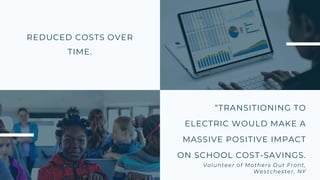
REDUCED COSTS OVER
TIME.
“TRANSITIONING TO
ELECTRIC WOULD MAKE A
MASSIVE POSITIVE IMPACT
ON SCHOOL COST-SAVINGS.
Volunteer of Mothers Out Front,
Westchester, NY
REDUCED FUEL COSTS
Charging costs
compared to
fueling costs are
reduced by 40 –
75%.
Electric school
buses are more
efficient to
operate
compared to
diesel buses.
Electric school
buses can save
schools $6,000
annually in fuel
and maintenance
costs.
T h e C l i n t o n G l o b a l
I n i t i a t i v e
F u e l e c o n o m y . g o v
A l t e r n a t i v e F u e l D a t a
C e n t e r
BENEFITS OF ELECTRIC
Stable electric
prices make
fueling and
operational costs
more predictable
for school
districts.
Nearly 70% of
spending on
electricity
remains within
local and
regional
economies.
Opportunities for
vehicle-to-grid
and vehicle-to-
building
integration can
improve school
district
resilience.
S o u t h e r n A l l i a n c e f o r
C l e a n E n e r g y
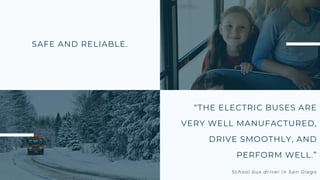
“THE ELECTRIC BUSES ARE
VERY WELL MANUFACTURED,
DRIVE SMOOTHLY, AND
PERFORM WELL.”
School bus driver in San Diego
SAFE AND RELIABLE.
MAINTENANCE SAVINGS
Fewer moving
parts in an
electric school
bus engine vs. a
diesel engine
means less to
repair.
Maintenance
savings of up to
60% over diesel
school buses.
Fleet staff must
be trained and
supported
through the
transition to
realize these
savings.
S c h o o l B u s F l e e t D o m i n i o n E n e r g y
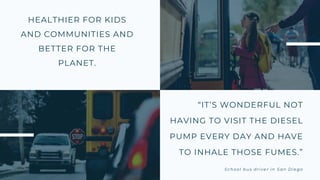
HEALTHIER FOR KIDS
AND COMMUNITIES AND
BETTER FOR THE
PLANET.
“IT’S WONDERFUL NOT
HAVING TO VISIT THE DIESEL
PUMP EVERY DAY AND HAVE
TO INHALE THOSE FUMES.”
School bus driver in San Diego
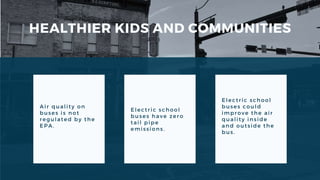
HEALTHIER KIDS AND COMMUNITIES
Air quality on
buses is not
regulated by the
EPA.
Electric school
buses have zero
tail pipe
emissions.
Electric school
buses could
improve the air
quality inside
and outside the
bus.
Full electrification has a
big impact
E l e c t r i f y i n g t h e e n t i r e f l e e t o f U . S .
s c h o o l b u s e s w o u l d a v o i d a l m o s t 7 . 5
m i l l i o n m e t r i c t o n s o f C O 2 e m i s s i o n s
p e r y e a r ,
Electric Buses Reduce
GHGs
W i t h c l e a n e l e c t r i c i t y , e l e c t r i c s c h o o l
b u s e s ' w e l l - t o - w h e e l e n e r g y e m i s s i o n s
c o u l d b e o v e r 9 9 % l o w e r t h a n d i e s e l
s c h o o l b u s e s .
W o r l d R e s o u r c e I n s t it u t e
BETTER FOR THE PLANET
If you select the fol
please delete t
Based on AFLEET Tool 2020, 480,000 school buses, 15,000 miles per year. This is a conservative estimate,
assuming all ESBs would use today's U.S. average electricity mix, but emissions reductions would be higher with a
cleaner future electricity mix. This assumes a baseline where all school buses are diesel, excluding CNG and
propane buses. Including more lower-emitting fossil fuel buses in the baseline scenario would reduce the relative
emissions reductions potential of ESBS.
Full electrification has a
big impact
E l e c t r i f y i n g t h e e n t i r e f l e e t o f U . S .
s c h o o l b u s e s c o u l d a v o i d a l m o s t 7 . 5
m i l l i o n m e t r i c t o n s o f C O 2 e m i s s i o n s
p e r y e a r ,
We could save xx% of GHG
B y c o n v e r t i n g o u t f l e e t t o e l e c t r i c
s c h o o l b u s e s w e c o u l d s a v e x x % o f
G H G a n n u a l l y .
P r e l i m i n a r y a n a l y s i s b y W o r l d
R e s o u r c e I n s t i t u t e .
BETTER FOR THE PLANET
Impact. To genera
savings refer to
notes.
You can calculate
savings he
https://afleet.es.an
emissions-calc
Based on AFLEET Tool 2020, 480,000 school buses, 15,000 miles per year. This is a conservative estimate,
assuming all ESBs would use today's U.S. average electricity mix, but emissions reductions would be higher with a
cleaner future electricity mix. This assumes a baseline where all school buses are diesel, excluding CNG and
propane buses. Including more lower-emitting fossil fuel buses in the baseline scenario would reduce the relative
emissions reductions potential of ESBS.
WHERE WE GO FROM HERE
ELECTRIC
SCHOOL BUSES
CAN MEET
[INSERT NAME]
DISTRICT’S NEEDS
There are different heating
options to accommodate cold
climates.
COLD-WEATHER FRIENDLY
We can evaluate optimal
charging to meet route needs.
CHARGING OPTIONS
Our average route is xx miles and
the battery range for Type C is 135
- 210 miles.
RANGE ALIGNMENT
Add the average milage for
routes.
Remove cold-weather point if
this does not apply to your
location.
LEADING SCHOOL
DISTRICTS ARE
MOVING TOWARD
ELECTRIC
SCHOOL BUSES
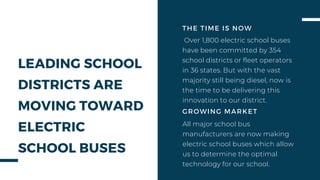
All major school bus
manufacturers are now making
electric school buses which allow
us to determine the optimal
technology for our school.
GROWING MARKET
Over 1,800 electric school buses
have been committed by 354
school districts or fleet operators
in 36 states. But with the vast
majority still being diesel, now is
the time to be delivering this
innovation to our district.
THE TIME IS NOW
W o r l d R e s o u r c e I n s t it u t e
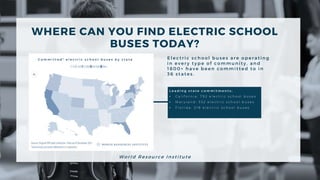
WHERE CAN YOU FIND ELECTRIC SCHOOL
BUSES TODAY?
E l e c t r i c s c h o o l b u s e s a r e o p e r a t i n g
i n e v e r y t y p e o f c o m m u n i t y , a n d
1 8 0 0 + h a v e b e e n c o m m i t t e d t o i n
3 6 s t a t e s .
L e a d i n g s t a t e c o m m i t m e n t s :
• C a l i f o r n i a : 7 9 2 e l e c t r i c s c h o o l b u s e s
• M a r y l a n d : 3 3 2 e l e c t r i c s c h o o l b u s e s
• F l o r i d a : 2 1 8 e l e c t r i c s c h o o l b u s e s
C o m m i t t e d * e l e c t r i c s c h o o l b u s e s b y s t a t e
ACCESSING
FUNDING TO
BRING ELECTRIC
BUSES INTO OUR
FLEET
The upfront cost of an electric
school bus is 3 x more than a
diesel bus but there is record
funding available to bring down
the costs.
LEVERAGING FUNDING TO
OFFSET COSTS
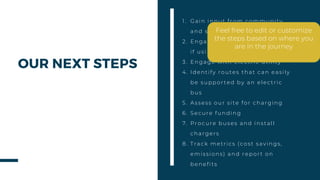
OUR NEXT STEPS
1. Gain input from community
and school stakeholders
2. Engage school bus contractor
if using one
3. Engage with electric utility
4. Identify routes that can easily
be supported by an electric
bus
5. Assess our site for charging
6. Secure funding
7. Procure buses and install
chargers
8. Track metrics (cost savings,
emissions) and report on
benefits
Feel free to edit or customize
the steps based on where you
are in the journey
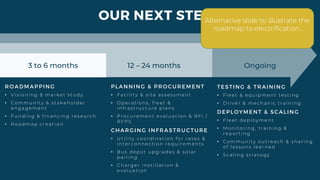
3 to 6 months
ROADMAPPING
• V i s i o n i n g & m a r k e t s t u d y
• C o m m u n i t y & s t a k e h o l d e r
e n g a g e m e n t
• F u n d i n g & f i n a n c i n g r e s e a r c h
• R o a d m a p c r e a t i o n
12 – 24 months
PLANNING & PROCUREMENT
• F a c i l i t y & s i t e a s s e s s m e n t
• O p e r a t i o n s , f l e e t &
i n f r a s t r u c t u r e p l a n s
• P r o c u r e m e n t e v a l u a t i o n & R F I /
R F P S
CHARGING INFRASTRUCTURE
• U t i l i t y c o o r d i n a t i o n f o r r a t e s &
i n t e r c o n n e c t i o n r e q u i r e m e n t s
• B u s d e p o t u p g r a d e s & s o l a r
p a i r i n g
• C h a r g e r i n s t i l l a t i o n &
e v a l u a t i o n
TESTING & TRAINING
• F l e e t & e q u i p m e n t t e s t i n g
• D r i v e r & m e c h a n i c t r a i n i n g
DEPLOYMENT & SCALING
• F l e e t d e p l o y m e n t
• M o n i t o r i n g , t r a i n i n g &
r e p o r t i n g
• C o m m u n i t y o u t r e a c h & s h a r i n g
o f l e s s o n s l e a r n e d
• S c a l i n g s t r a t e g y
Ongoing
OUR NEXT STEPS
Alternative slide to illustrate the
roadmap to electrification.
HERE TO HELP
WRI
Name
Email
Phone number
VEIC
Name
Email
Phone number
THANK YOU

Why Electric School Buses

  • 1.
    SCHOOL DISTRICT/NAME HERE WHYELECTRIC SCHOOL BUSES? A better way forward Add in your logo by left clicking the image > select “change picture” > and select you logo image file
  • 2.
    Why Electric School Buses Presentation Template Informationon the downfalls of diesel buses, the benefits of electric school buses, and key next steps on moving forward. WHAT DOES THIS DECK INCLUDE? Administrative or transportation leads looking to educate stakeholders on the benefits of electric school buses. WHO IS THIS DESIGNED FOR? Delete this slide before presenting.
  • 3.
    Why Electric School Buses Presentation Template 1.Identify the goals of the presentation and select the relevant slides in this deck that can help you convey that message. 2. Read the instruction callout on each slide, update the slide contents as needed, and then delete the callout. 3. Enter “Slide Show” mode by clicking on the Slide Show icon in the bottom right. 4. Update and add any content outside of the instructions to help convey your message. 5. Review speaker notes on each slide for talking points or additional information. 6. Put this presentation in your school’s standard template (if applicable) and delete this slide before presenting. 7. If you have suggestions or comments, please contact our team on our website at https://www.wri.org/initiatives/electric- school-bus-initiative HOW TO USE THIS? Delete this slide before presenting.
  • 4.
    THE HIGH COSTOF DIESEL BUSES
  • 5.
    10X the pollution Pollutionlevels inside older diesel buses can exceed surrounding areas by 5 – 10 times. 20+ minutes Children spend between 20 minutes to several hours a day on school buses. THE HIGH COST OF DIESEL BUSES E n v ir o n m e n t & H u m a n H e a l t h , I n c . Adjust the time spent on a bus to the right number for your community.
  • 6.
    THE HIGH COSTOF DIESEL BUSES NOx CO PM VOCs Diesel exhaust is classified as a carcinogen. E P A Exposure to diesel emissions has been shown to negatively impact cognitive and respiratory health in children. T h e I n t e r n a t i o n a l A g e n c y f o r R e s e a r c h o n C a n c e r Children are more susceptible to the harmful effects of diesel emissions. E c o n o m i c s o f E d u c a t i o n R e v i e w Exposure to diesel emissions has been shown to negatively impact cognitive and respiratory health in children. T h e I n t e r n a t i o n a l A g e n c y f o r R e s e a r c h o n C a n c e r
  • 7.
    XX older buses Wehave xx buses that are over ten years old and will likely need to be replaced in the next five years. Aging diesel buses are expensive to maintain and have increased pollution levels. $XXX in fuel a year We spend $xxx every year to fuel our buses. THE HIGH COST OF DIESEL BUSES number of older bu reflect accurate numb your school / distr To calculate fuel cos can use $7K as the a average fuel costs fo diesel bus per ye
  • 8.
    WHY SCHOOLS AREGOING ELECTRIC
  • 9.
    WHY SCHOOLS AREGOING ELECTRIC S A F E , R E L I A B L E , A N D Q U I E T H E A L T H I E R F O R O U R S T U D E N T S , D R I V E R S , A N D C O M M U N I T Y R E D U C E D F U E L , O P E R A T I O N , A N D M A I N T E N A N C E C O S T S
  • 10.
    REDUCED COSTS OVER TIME. “TRANSITIONINGTO ELECTRIC WOULD MAKE A MASSIVE POSITIVE IMPACT ON SCHOOL COST-SAVINGS. Volunteer of Mothers Out Front, Westchester, NY
  • 11.
    REDUCED FUEL COSTS Chargingcosts compared to fueling costs are reduced by 40 – 75%. Electric school buses are more efficient to operate compared to diesel buses. Electric school buses can save schools $6,000 annually in fuel and maintenance costs. T h e C l i n t o n G l o b a l I n i t i a t i v e F u e l e c o n o m y . g o v A l t e r n a t i v e F u e l D a t a C e n t e r
  • 12.
    BENEFITS OF ELECTRIC Stableelectric prices make fueling and operational costs more predictable for school districts. Nearly 70% of spending on electricity remains within local and regional economies. Opportunities for vehicle-to-grid and vehicle-to- building integration can improve school district resilience. S o u t h e r n A l l i a n c e f o r C l e a n E n e r g y
  • 13.
    “THE ELECTRIC BUSESARE VERY WELL MANUFACTURED, DRIVE SMOOTHLY, AND PERFORM WELL.” School bus driver in San Diego SAFE AND RELIABLE.
  • 14.
    MAINTENANCE SAVINGS Fewer moving partsin an electric school bus engine vs. a diesel engine means less to repair. Maintenance savings of up to 60% over diesel school buses. Fleet staff must be trained and supported through the transition to realize these savings. S c h o o l B u s F l e e t D o m i n i o n E n e r g y
  • 15.
    HEALTHIER FOR KIDS ANDCOMMUNITIES AND BETTER FOR THE PLANET. “IT’S WONDERFUL NOT HAVING TO VISIT THE DIESEL PUMP EVERY DAY AND HAVE TO INHALE THOSE FUMES.” School bus driver in San Diego
  • 16.
    HEALTHIER KIDS ANDCOMMUNITIES Air quality on buses is not regulated by the EPA. Electric school buses have zero tail pipe emissions. Electric school buses could improve the air quality inside and outside the bus.
  • 17.
    Full electrification hasa big impact E l e c t r i f y i n g t h e e n t i r e f l e e t o f U . S . s c h o o l b u s e s w o u l d a v o i d a l m o s t 7 . 5 m i l l i o n m e t r i c t o n s o f C O 2 e m i s s i o n s p e r y e a r , Electric Buses Reduce GHGs W i t h c l e a n e l e c t r i c i t y , e l e c t r i c s c h o o l b u s e s ' w e l l - t o - w h e e l e n e r g y e m i s s i o n s c o u l d b e o v e r 9 9 % l o w e r t h a n d i e s e l s c h o o l b u s e s . W o r l d R e s o u r c e I n s t it u t e W o r l d R e s o u r c e I n s t it u t e BETTER FOR THE PLANET If you select the fol please delete t Based on AFLEET Tool 2020, 480,000 school buses, 15,000 miles per year. This is a conservative estimate, assuming all ESBs would use today's U.S. average electricity mix, but emissions reductions would be higher with a cleaner future electricity mix. This assumes a baseline where all school buses are diesel, excluding CNG and propane buses. Including more lower-emitting fossil fuel buses in the baseline scenario would reduce the relative emissions reductions potential of ESBS.
  • 18.
    Full electrification hasa big impact E l e c t r i f y i n g t h e e n t i r e f l e e t o f U . S . s c h o o l b u s e s c o u l d a v o i d a l m o s t 7 . 5 m i l l i o n m e t r i c t o n s o f C O 2 e m i s s i o n s p e r y e a r , We could save xx% of GHG B y c o n v e r t i n g o u t f l e e t t o e l e c t r i c s c h o o l b u s e s w e c o u l d s a v e x x % o f G H G a n n u a l l y . P r e l i m i n a r y a n a l y s i s b y W o r l d R e s o u r c e I n s t i t u t e . BETTER FOR THE PLANET Impact. To genera savings refer to notes. You can calculate savings he https://afleet.es.an emissions-calc Based on AFLEET Tool 2020, 480,000 school buses, 15,000 miles per year. This is a conservative estimate, assuming all ESBs would use today's U.S. average electricity mix, but emissions reductions would be higher with a cleaner future electricity mix. This assumes a baseline where all school buses are diesel, excluding CNG and propane buses. Including more lower-emitting fossil fuel buses in the baseline scenario would reduce the relative emissions reductions potential of ESBS.
  • 19.
    WHERE WE GOFROM HERE
  • 20.
    ELECTRIC SCHOOL BUSES CAN MEET [INSERTNAME] DISTRICT’S NEEDS There are different heating options to accommodate cold climates. COLD-WEATHER FRIENDLY We can evaluate optimal charging to meet route needs. CHARGING OPTIONS Our average route is xx miles and the battery range for Type C is 135 - 210 miles. RANGE ALIGNMENT Add the average milage for routes. Remove cold-weather point if this does not apply to your location.
  • 21.
    LEADING SCHOOL DISTRICTS ARE MOVINGTOWARD ELECTRIC SCHOOL BUSES All major school bus manufacturers are now making electric school buses which allow us to determine the optimal technology for our school. GROWING MARKET Over 1,800 electric school buses have been committed by 354 school districts or fleet operators in 36 states. But with the vast majority still being diesel, now is the time to be delivering this innovation to our district. THE TIME IS NOW
  • 22.
    W o rl d R e s o u r c e I n s t it u t e WHERE CAN YOU FIND ELECTRIC SCHOOL BUSES TODAY? E l e c t r i c s c h o o l b u s e s a r e o p e r a t i n g i n e v e r y t y p e o f c o m m u n i t y , a n d 1 8 0 0 + h a v e b e e n c o m m i t t e d t o i n 3 6 s t a t e s . L e a d i n g s t a t e c o m m i t m e n t s : • C a l i f o r n i a : 7 9 2 e l e c t r i c s c h o o l b u s e s • M a r y l a n d : 3 3 2 e l e c t r i c s c h o o l b u s e s • F l o r i d a : 2 1 8 e l e c t r i c s c h o o l b u s e s C o m m i t t e d * e l e c t r i c s c h o o l b u s e s b y s t a t e
  • 23.
    ACCESSING FUNDING TO BRING ELECTRIC BUSESINTO OUR FLEET The upfront cost of an electric school bus is 3 x more than a diesel bus but there is record funding available to bring down the costs. LEVERAGING FUNDING TO OFFSET COSTS
  • 24.
    OUR NEXT STEPS 1.Gain input from community and school stakeholders 2. Engage school bus contractor if using one 3. Engage with electric utility 4. Identify routes that can easily be supported by an electric bus 5. Assess our site for charging 6. Secure funding 7. Procure buses and install chargers 8. Track metrics (cost savings, emissions) and report on benefits Feel free to edit or customize the steps based on where you are in the journey
  • 25.
    3 to 6months ROADMAPPING • V i s i o n i n g & m a r k e t s t u d y • C o m m u n i t y & s t a k e h o l d e r e n g a g e m e n t • F u n d i n g & f i n a n c i n g r e s e a r c h • R o a d m a p c r e a t i o n 12 – 24 months PLANNING & PROCUREMENT • F a c i l i t y & s i t e a s s e s s m e n t • O p e r a t i o n s , f l e e t & i n f r a s t r u c t u r e p l a n s • P r o c u r e m e n t e v a l u a t i o n & R F I / R F P S CHARGING INFRASTRUCTURE • U t i l i t y c o o r d i n a t i o n f o r r a t e s & i n t e r c o n n e c t i o n r e q u i r e m e n t s • B u s d e p o t u p g r a d e s & s o l a r p a i r i n g • C h a r g e r i n s t i l l a t i o n & e v a l u a t i o n TESTING & TRAINING • F l e e t & e q u i p m e n t t e s t i n g • D r i v e r & m e c h a n i c t r a i n i n g DEPLOYMENT & SCALING • F l e e t d e p l o y m e n t • M o n i t o r i n g , t r a i n i n g & r e p o r t i n g • C o m m u n i t y o u t r e a c h & s h a r i n g o f l e s s o n s l e a r n e d • S c a l i n g s t r a t e g y Ongoing OUR NEXT STEPS Alternative slide to illustrate the roadmap to electrification.
  • 26.
    HERE TO HELP WRI Name Email Phonenumber VEIC Name Email Phone number
  • 27.

Editor's Notes

  • #6 Presenter Speaking Notes: Our students are spending up to xx minutes / hours on buses every week. A report from Environment and Human Health Inc. found that pollution levels inside older buses can exceed surrounding areas by up to ten times. Source: https://www.ehhi.org/reports/diesel/dieselintro.pdf
  • #7 Presenter Speaking Notes: There is no known safe level of diesel exposure for children. According to the EPA and numerous other studies, children are more susceptible to the harmful effects of diesel emission because they have higher breathing rates and their lungs are still developing. In addition to being a known carcinogen, exposure to diesel emissions has been shown to impact cognitive and development respiratory health in children. Causing illnesses that result in absences and leading to cognitive impairment. Sources: https://www.epa.gov/dera/reducing-diesel-emissions-school-buses https://cpb-us-w2.wpmucdn.com/sites.gsu.edu/dist/f/528/files/2019/08/Bus_EER.pd https://www.ncbi.nlm.nih.gov/pmc/articles/PMC4835031/
  • #8 Presenter Speaking Notes: The downfalls of diesel buses also extend to the costs to maintain buses. [insert name of school district] spend roughly $xxx on fuel each year to run our fleet. Additionally, we have an aging fleet. The usually diesel bus is retired at 16 years. Meaning that we have xxx buses that will need to be replaced in the next five years of less. What’s more, older buses are expensive to keep on the road and have increased pollution levels. Data verification for fueling amount: The average school bust travels 12,000 miles annually and gets ~7 miles per gallon. At ~$3.50 per gallon that's about $7,000 annually on fuel per bus.) Source for average retirement age for buses: According to a survey by 'School Bus Fleet,' the average school bus us 9 years old and retired at 16 years.
  • #9 Presenter Speaking Notes: So let’s talk about why schools are going electric.
  • #10 Presenter Speaking Notes: There are three main reasons we see more and more schools transitioning to electric school buses. Electric school buses are cheaper over time. They are safe and reliable. They are healthier for our students and our community.
  • #11 Presenter Speaking Notes: First we are going to talk about costs. Source: https://thehudsonindependent.com/electric-school-buses-to-roll-out-for-westchester/
  • #12 Presenter Speaking Notes: The costs to charge an electric school bus versus fuel a diesel bus is 40 – 75% lower. Electric school buses are more efficient to operate, meaning 77-90% of the electrical energy pulled from the grid (or elsewhere) is used to power the vehicle's wheels. In internal combustion engines, most of the energy stored in the gasoline or diesel is lost to heat and friction. Only about 25-40% of the energy stored in the diesel is used to power the vehicle's wheels. The Clinton Global Initiative has found the Electric School Buses can save schools $6K annual in both fuel and maintenance costs. Sources: Charging costs: https://afdc.energy.gov/fuels/prices.html) Anecdotal data from schools districts with ESBs: https://www.nytimes.com/2020/01/22/business/energy-environment/electric-school-buses.html https://www.etransenergy.com/Thought-Leadership/Electric-School-Bus-Fleet Efficiency: https://www.fueleconomy.gov/feg/evtech.shtml https://theicct.org/the-ever-improving-efficiency-of-the-diesel-engine/
  • #13 Presenter Speaking Notes: Electric prices are more stable which allow us to have more predictable costs. Electric investments also stay within our community. Finally, electric school bus batteries can feed electricity back into nearby buildings and the electric grid, increasing community resilience and the value of the buses to schools and local utilities.’ Sources: Nearly 70% > https://cleanenergy.org/blog/electric-vehicles-could-add-47-billion-annually-to-southeast-economy and also: https://www.mdpi.com/2032-6653/8/4/996/pdf  
  • #15 Presenter Speaking Notes: Diesel buses are known for being difficult and expensive to maintain. With electric buses there are fewer moving parts so there is less to break and repair. This leads to maintenance savings of up to 60%. To ensure our school realizes these savings we will want to support fleet staff through the transition to electric school buses. Sources: https://www.schoolbusfleet.com/10139866/electric-school-bus-maintenance-key-similarities-differences https://news.dominionenergy.com/2020-01-16-Dominion-Energy-Moves-Forward-with-Electric-School-Bus-Program; Lion Bus predicts maintenance savings of 60% over diesel Thomas Bus predicts savings of $4,400 annually The Clinton Global Initiative predicts savings of $4,400 annually (cited here: https://uspirg.org/sites/pirg/files/reports/US_EL%20buses%202021%20scrn.pdf).
  • #17 Presenter Speaking Notes: Electric school buses do not emit tail pipe emissions improving the air quality within and outside the bus.
  • #18 Presenter Speaking Notes: With clean electricity, ESBs well-to-wheel energy emissions could be over 99% lower than diesel school buses. Converting all U.S. school buses to electric today would avoid almost 7.5 million metric tons of CO2 emissions per year, which is equal to taking more than 1.6 million cars off the road, and a decrease of 61% compared to an all-diesel school bus fleet. Source: Vermont ANR predicts GHG savings of 97% Egrid provides a range of emissions factors associated with electricity generation: https://www.epa.gov/egrid;
  • #19 Presenter Speaking Notes: By converting our fleet to electric school buses we could save xx GHG annually. Converting all U.S. school buses to electric today would avoid almost 7.5 million metric tons of CO2 emissions per year, which is equal to taking more than 1.6 million cars off the road, and a decrease of 61% compared to an all-diesel school bus fleet.
  • #21 Presenter Speaking Notes: Electric school buses meet the needs of our school / district. Our typically routes fall within the range of the buses. There are options to meet the needs of cold climates like ours and we will determine the best charging scenarios to meet our unique needs.
  • #22 Presenter Speaking Notes: 24 states have deployed electric school buses. Mention if ESBs have been deployed in your state (CA, MA, NY, MN, WA, ND, MI and coming soon VA, NJ, VT, MD, ME, IL, IN, WI, AZ, NM, OK, TN, AL, GA, NC, MO, OR). But 90 – 95% of buses are still diesel. Moving to electric school buses now shows our school a commitment to innovating and improving. Operationally, it is easier to covert to electric buses not. All major school bus manufactures are making ESBs, giving us options to select the best technology for our school.
  • #23 Presenter Speaking Notes: By converting our fleet to electric school buses we could save xx GHG annually. Converting all U.S. school buses to electric today would avoid almost 7.5 million metric tons of CO2 emissions per year, which is equal to taking more than 1.6 million cars off the road, and a decrease of 61% compared to an all-diesel school bus fleet.
  • #24 Presenter Speaking Notes: Electric school buses are more expensive than diesel buses but there is more and more funding being allocated to bring down the upfront costs of a bus.
  • #25 Presenter Speaking Notes: Here are our key next steps in moving forward.
  • #26 Presenter Speaking Notes: Electric school buses are more expensive than diesel buses but there is more and more funding being allocated to bring down the upfront costs of a bus.