
Why Analytics Matters
Chad Richeson
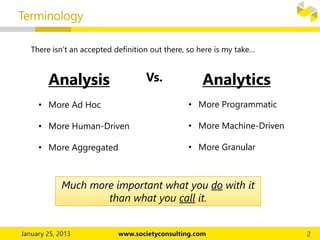
Terminology
Analysis AnalyticsVs.
There isn’t an accepted definition out there, so here is my take…
• More Ad Hoc
• More Human-Driven
• More Aggregated
• More Programmatic
• More Machine-Driven
• More Granular
Much more important what you do with it
than what you call it.
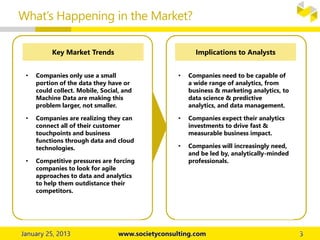
Implications to AnalystsKey Market Trends
What’s Happening in the Market?
• Companies need to be capable of
a wide range of analytics, from
business & marketing analytics, to
data science & predictive
analytics, and data management.
• Companies expect their analytics
investments to drive fast &
measurable business impact.
• Companies will increasingly need,
and be led by, analytically-minded
professionals.
• Companies only use a small
portion of the data they have or
could collect. Mobile, Social, and
Machine Data are making this
problem larger, not smaller.
• Companies are realizing they can
connect all of their customer
touchpoints and business
functions through data and cloud
technologies.
• Competitive pressures are forcing
companies to look for agile
approaches to data and analytics
to help them outdistance their
competitors.
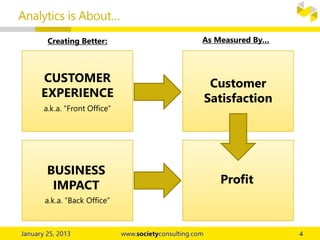
Analytics is About…
BUSINESS
IMPACT
a.k.a. “Back Office”
Customer
Satisfaction
As Measured By…
Profit
CUSTOMER
EXPERIENCE
Creating Better:
a.k.a. “Front Office”
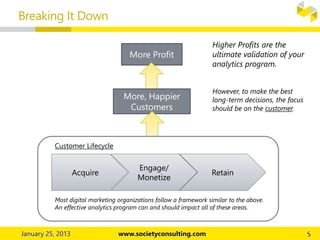
More Profit
More, Happier
Customers
Customer Lifecycle
Breaking It Down
Higher Profits are the
ultimate validation of your
analytics program.
However, to make the best
long-term decisions, the focus
should be on the customer.
Acquire
Engage/
Monetize
Retain
Most digital marketing organizations follow a framework similar to the above.
An effective analytics program can and should impact all of these areas.
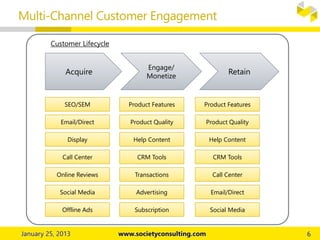
Multi-Channel Customer Engagement
Customer Lifecycle
Acquire
Engage/
Monetize
Retain
SEO/SEM
Email/Direct
Display
Call Center
Online Reviews
Product Features
Product Quality
Help Content
Transactions
AdvertisingSocial Media
Offline Ads Subscription
CRM Tools
Product Features
Product Quality
Help Content
Call Center
Email/Direct
Social Media
CRM Tools
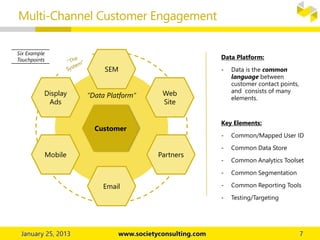
Multi-Channel Customer Engagement
Data Platform:
- Data is the common
language between
customer contact points,
and consists of many
elements.
Key Elements:
- Common/Mapped User ID
- Common Data Store
- Common Analytics Toolset
- Common Segmentation
- Common Reporting Tools
- Testing/Targeting
Touchpoints
“Data Platform”
SEM
Web
Site
Email
Display
Ads
Mobile
Customer
Partners
Six Example
Touchpoints
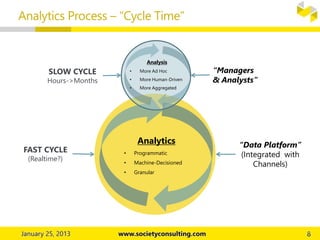
Analytics Process – “Cycle Time”
“Managers
& Analysts”
SLOW CYCLE
Hours->Months
Analytics
• Programmatic
• Machine-Decisioned
• Granular
Analysis
• More Ad Hoc
• More Human-Driven
• More Aggregated
“Data Platform”
(Integrated with
Channels)
FAST CYCLE
(Realtime?)
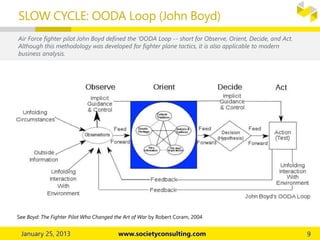
SLOW CYCLE: OODA Loop (John Boyd)
Air Force fighter pilot John Boyd defined the ‘OODA Loop -- short for Observe, Orient, Decide, and Act.
Although this methodology was developed for fighter plane tactics, it is also applicable to modern
business analysis.
See Boyd: The Fighter Pilot Who Changed the Art of War by Robert Coram, 2004
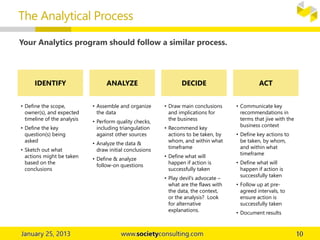
Your Analytics program should follow a similar process.
The Analytical Process
• Define the scope,
owner(s), and expected
timeline of the analysis
• Define the key
question(s) being
asked
• Sketch out what
actions might be taken
based on the
conclusions
IDENTIFY
• Assemble and organize
the data
• Perform quality checks,
including triangulation
against other sources
• Analyze the data &
draw initial conclusions
• Define & analyze
follow-on questions
ANALYZE
• Draw main conclusions
and implications for
the business
• Recommend key
actions to be taken, by
whom, and within what
timeframe
• Define what will
happen if action is
successfully taken
• Play devil’s advocate –
what are the flaws with
the data, the context,
or the analysis? Look
for alternative
explanations.
DECIDE
• Communicate key
recommendations in
terms that jive with the
business context
• Define key actions to
be taken, by whom,
and within what
timeframe
• Define what will
happen if action is
successfully taken
• Follow up at pre-
agreed intervals, to
ensure action is
successfully taken
• Document results
ACT
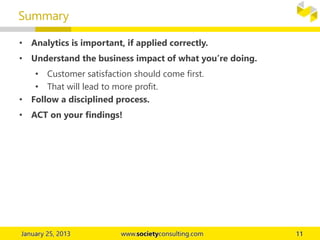
• Analytics is important, if applied correctly.
• Understand the business impact of what you’re doing.
• Customer satisfaction should come first.
• That will lead to more profit.
• Follow a disciplined process.
• ACT on your findings!
Summary

Why analytics matters

  • 1.
  • 2.
    Terminology Analysis AnalyticsVs. There isn’tan accepted definition out there, so here is my take… • More Ad Hoc • More Human-Driven • More Aggregated • More Programmatic • More Machine-Driven • More Granular Much more important what you do with it than what you call it.
  • 3.
    Implications to AnalystsKeyMarket Trends What’s Happening in the Market? • Companies need to be capable of a wide range of analytics, from business & marketing analytics, to data science & predictive analytics, and data management. • Companies expect their analytics investments to drive fast & measurable business impact. • Companies will increasingly need, and be led by, analytically-minded professionals. • Companies only use a small portion of the data they have or could collect. Mobile, Social, and Machine Data are making this problem larger, not smaller. • Companies are realizing they can connect all of their customer touchpoints and business functions through data and cloud technologies. • Competitive pressures are forcing companies to look for agile approaches to data and analytics to help them outdistance their competitors.
  • 4.
    Analytics is About… BUSINESS IMPACT a.k.a.“Back Office” Customer Satisfaction As Measured By… Profit CUSTOMER EXPERIENCE Creating Better: a.k.a. “Front Office”
  • 5.
    More Profit More, Happier Customers CustomerLifecycle Breaking It Down Higher Profits are the ultimate validation of your analytics program. However, to make the best long-term decisions, the focus should be on the customer. Acquire Engage/ Monetize Retain Most digital marketing organizations follow a framework similar to the above. An effective analytics program can and should impact all of these areas.
  • 6.
    Multi-Channel Customer Engagement CustomerLifecycle Acquire Engage/ Monetize Retain SEO/SEM Email/Direct Display Call Center Online Reviews Product Features Product Quality Help Content Transactions AdvertisingSocial Media Offline Ads Subscription CRM Tools Product Features Product Quality Help Content Call Center Email/Direct Social Media CRM Tools
  • 7.
    Multi-Channel Customer Engagement DataPlatform: - Data is the common language between customer contact points, and consists of many elements. Key Elements: - Common/Mapped User ID - Common Data Store - Common Analytics Toolset - Common Segmentation - Common Reporting Tools - Testing/Targeting Touchpoints “Data Platform” SEM Web Site Email Display Ads Mobile Customer Partners Six Example Touchpoints
  • 8.
    Analytics Process –“Cycle Time” “Managers & Analysts” SLOW CYCLE Hours->Months Analytics • Programmatic • Machine-Decisioned • Granular Analysis • More Ad Hoc • More Human-Driven • More Aggregated “Data Platform” (Integrated with Channels) FAST CYCLE (Realtime?)
  • 9.
    SLOW CYCLE: OODALoop (John Boyd) Air Force fighter pilot John Boyd defined the ‘OODA Loop -- short for Observe, Orient, Decide, and Act. Although this methodology was developed for fighter plane tactics, it is also applicable to modern business analysis. See Boyd: The Fighter Pilot Who Changed the Art of War by Robert Coram, 2004
  • 10.
    Your Analytics programshould follow a similar process. The Analytical Process • Define the scope, owner(s), and expected timeline of the analysis • Define the key question(s) being asked • Sketch out what actions might be taken based on the conclusions IDENTIFY • Assemble and organize the data • Perform quality checks, including triangulation against other sources • Analyze the data & draw initial conclusions • Define & analyze follow-on questions ANALYZE • Draw main conclusions and implications for the business • Recommend key actions to be taken, by whom, and within what timeframe • Define what will happen if action is successfully taken • Play devil’s advocate – what are the flaws with the data, the context, or the analysis? Look for alternative explanations. DECIDE • Communicate key recommendations in terms that jive with the business context • Define key actions to be taken, by whom, and within what timeframe • Define what will happen if action is successfully taken • Follow up at pre- agreed intervals, to ensure action is successfully taken • Document results ACT
  • 11.
    • Analytics isimportant, if applied correctly. • Understand the business impact of what you’re doing. • Customer satisfaction should come first. • That will lead to more profit. • Follow a disciplined process. • ACT on your findings! Summary