WORLD HUMANITARIAN SUMMIT PACIFIC CONSULTATIONS
INTERNATIONAL RED CROSS RED CRESCENT MOVEMENT FINDINGS AND RECOMMENDATIONS
Introduction
This report presents the findings and recommendations arising from the Red Cross Red Crescent World Humanitarian
Summit (WHS) consultations in the Pacific region. Consultations were held with men, women and young people in
disaster and conflict affected communities and with Red Cross Red Crescent volunteers, members and staff.
As the world’s largest humanitarian network with a significant presence in Pacific communities, the International Red
Cross and Red Crescent Movement is in a unique position to contribute to the World Humanitarian Summit consul-
tations. Through Red Cross National Societies we are present in 14 Pacific countries and eight overseas territories.
Over 3500 volunteers and more than 100 Red Cross staff work across the small island states, providing assistance to
communities affected by a wide range of disasters and situations of violence.1
The valuable community, volunteer and staff insights collected in this report will inform the dialogue at the Pacific
regional consultation meeting in Auckland, New Zealand, in June 2015. This meeting is the seventh in a series of re-
gional consultations leading up to the 2016 World Humanitarian Summit.
1
Australian Red Cross delivers its community based activities through 34,989 volunteers and 2,962 staff. In New Zealand 15,390 Red Cross volunteers
and 475 staff provide services throughout the territory.
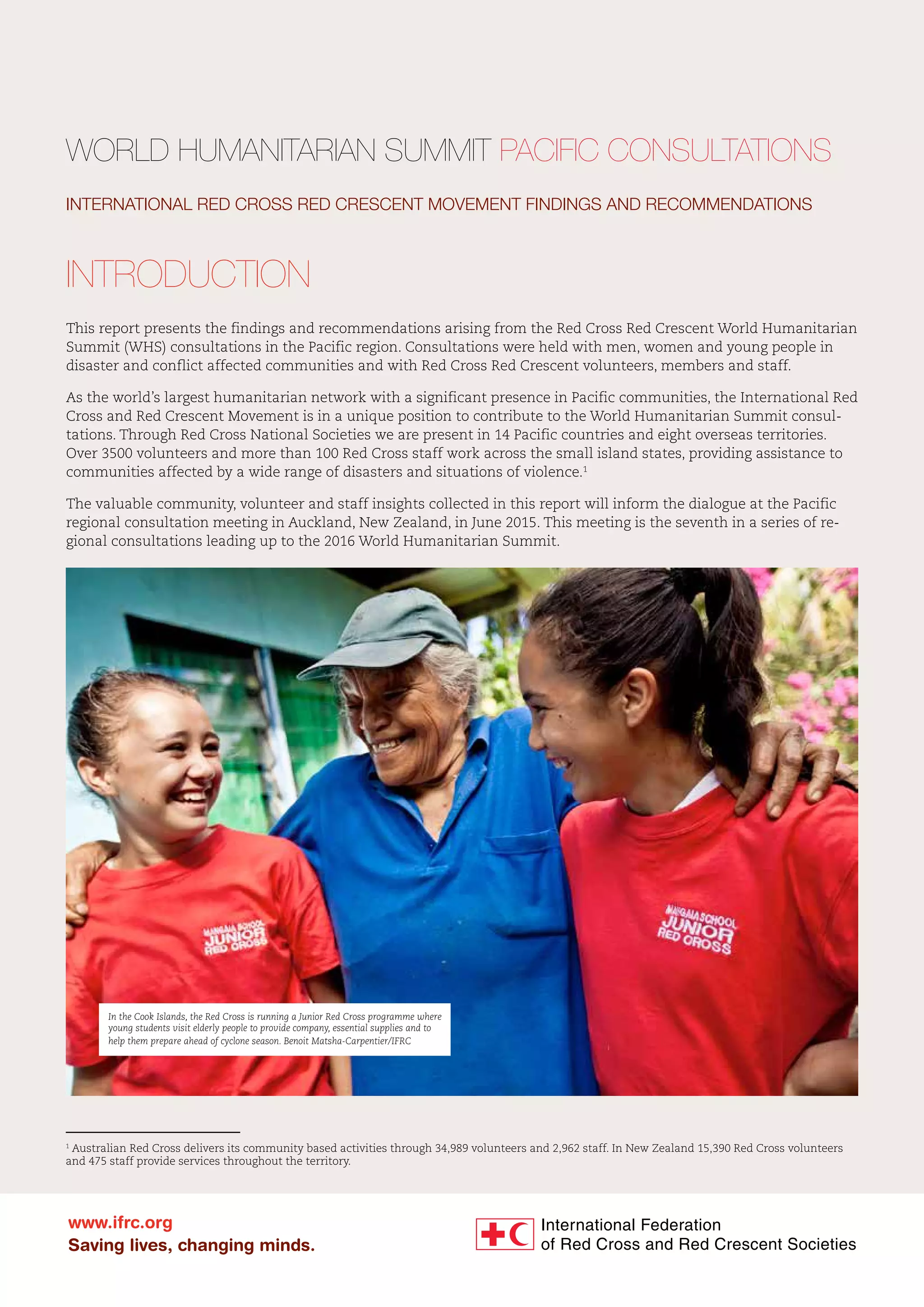
In the Cook Islands, the Red Cross is running a Junior Red Cross programme where
young students visit elderly people to provide company, essential supplies and to
help them prepare ahead of cyclone season. Benoit Matsha-Carpentier/IFRC
www.ifrc.org
Saving lives, changing minds.
WORLD HUMANITARIAN SUMMIT PACIFIC CONSULTATIONS
INTERNATIONAL RED CROSS RED CRESCENT MOVEMENT FINDINGS AND RECOMMENDATIONS
2
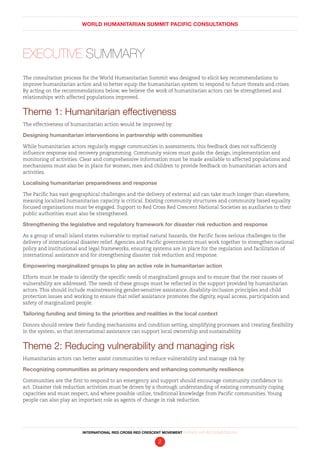
The consultation process for the World Humanitarian Summit was designed to elicit key recommendations to
improve humanitarian action and to better equip the humanitarian system to respond to future threats and crises.
By acting on the recommendations below, we believe the work of humanitarian actors can be strengthened and
relationships with affected populations improved.
Theme 1: Humanitarian effectiveness
The effectiveness of humanitarian action would be improved by:
Designing humanitarian interventions in partnership with communities
While humanitarian actors regularly engage communities in assessments, this feedback does not sufficiently
influence response and recovery programming. Community voices must guide the design, implementation and
monitoring of activities. Clear and comprehensive information must be made available to affected populations and
mechanisms must also be in place for women, men and children to provide feedback on humanitarian actors and
activities.
Localising humanitarian preparedness and response
The Pacific has vast geographical challenges and the delivery of external aid can take much longer than elsewhere,
meaning localized humanitarian capacity is critical. Existing community structures and community based equality
focused organisations must be engaged. Support to Red Cross Red Crescent National Societies as auxiliaries to their
public authorities must also be strengthened.
Strengthening the legislative and regulatory framework for disaster risk reduction and response
As a group of small island states vulnerable to myriad natural hazards, the Pacific faces serious challenges to the
delivery of international disaster relief. Agencies and Pacific governments must work together to strengthen national
policy and institutional and legal frameworks, ensuring systems are in place for the regulation and facilitation of
international assistance and for strengthening disaster risk reduction and response.
Empowering marginalized groups to play an active role in humanitarian action
Efforts must be made to identify the specific needs of marginalized groups and to ensure that the root causes of
vulnerability are addressed. The needs of these groups must be reflected in the support provided by humanitarian
actors. This should include mainstreaming gender-sensitive assistance, disability-inclusion principles and child
protection issues and working to ensure that relief assistance promotes the dignity, equal access, participation and
safety of marginalized people.
Tailoring funding and timing to the priorities and realities in the local context
Donors should review their funding mechanisms and condition setting, simplifying processes and creating flexibility
in the system, so that international assistance can support local ownership and sustainability.
Theme 2: Reducing vulnerability and managing risk
Humanitarian actors can better assist communities to reduce vulnerability and manage risk by:
Recognizing communities as primary responders and enhancing community resilience
Communities are the first to respond to an emergency and support should encourage community confidence to
act. Disaster risk reduction activities must be driven by a thorough understanding of existing community coping
capacities and must respect, and where possible utilize, traditional knowledge from Pacific communities. Young
people can also play an important role as agents of change in risk reduction.
Executive Summary
WORLD HUMANITARIAN SUMMIT PACIFIC CONSULTATIONS
INTERNATIONAL RED CROSS RED CRESCENT MOVEMENT FINDINGS AND RECOMMENDATIONS
3
Ensuring early warning systems have a people centered approach
To be effective early warning systems must be understandable, trusted and relevant to communities. In the Pacific,
this means working in partnership with communities and adopting a diverse range of communications methods in
order to ensure messages reach more people, more swiftly.
Increasing resources for disaster risk reduction
Investing in disaster risk reduction will reduce the exposure to natural hazards faced by vulnerable communities and
is proven to be cost effective in preventing future losses. Humanitarian actors need to collectively work together with
governments to ensure disaster risk reduction is integrated in development planning.
Theme 3: Transformation through innovation
Humanitarian actors could embrace innovation to better respond to the specific humanitarian challenges in the
region by:
Encouraging the use of modern telecommunication methods and satellite technology
The Pacific region must utilize technological advances and mobile technology to improve early warning systems and
rapid disaster assessments. Technology can also improve the region’s data collection and information management.
Theme 4: Serving the needs of people in conflict
Humanitarian actors in the Pacific could better serve the needs of people in conflict by:
Maintaining principled humanitarian action
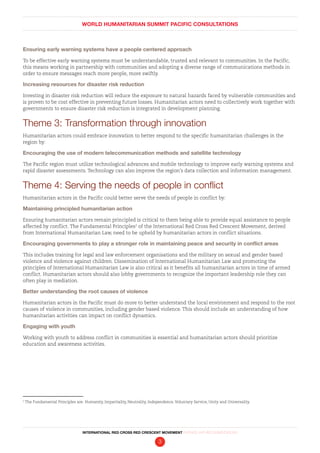
Ensuring humanitarian actors remain principled is critical to them being able to provide equal assistance to people
affected by conflict. The Fundamental Principles2
of the International Red Cross Red Crescent Movement, derived
from International Humanitarian Law, need to be upheld by humanitarian actors in conflict situations.
Encouraging governments to play a stronger role in maintaining peace and security in conflict areas
This includes training for legal and law enforcement organisations and the military on sexual and gender based
violence and violence against children. Dissemination of International Humanitarian Law and promoting the
principles of International Humanitarian Law is also critical as it benefits all humanitarian actors in time of armed
conflict. Humanitarian actors should also lobby governments to recognize the important leadership role they can
often play in mediation.
Better understanding the root causes of violence
Humanitarian actors in the Pacific must do more to better understand the local environment and respond to the root
causes of violence in communities, including gender based violence. This should include an understanding of how
humanitarian activities can impact on conflict dynamics.
Engaging with youth
Working with youth to address conflict in communities is essential and humanitarian actors should prioritize
education and awareness activities.
2
The Fundamental Principles are: Humanity, Impartiality, Neutrality, Independence, Voluntary Service, Unity and Universality.
WORLD HUMANITARIAN SUMMIT PACIFIC CONSULTATIONS
INTERNATIONAL RED CROSS RED CRESCENT MOVEMENT FINDINGS AND RECOMMENDATIONS
4
Methodology
The World Humanitarian Summit Pacific regional consultation process was guided by a Steering Committee,
including the International Red Cross Red Crescent Movement.
The questions for communities were collectively formulated by the Steering Committee and used consistently across
all community consultations3
. The consultation process was conducted through community focus groups and face-
to-face interviews. To ensure we accurately reflected the diverse needs of the Pacific region, attention was paid to
ensuring we captured the opinions of communities affected by differing types of disasters and also to those affected
by armed conflict and situations of violence. Community groups engaged a cross section of men, women, youth, the
elderly and community leaders.
3
With the exception of Samoa where our focus was on the issue of gender based violence in disasters.
Gender
Community Breakdown
Total respondents 494
Community Consultations
Total
Communities
33
Fiji 8				 		 Tuvalu 3	 Vanuatu 2
Cook Islands 1	 	 Federated States of Micronesia 1
Papua New Guinea 10		 	 Samoa 1	 Tonga 7
Age
under
18
35
and over
30518-34
143
46
257
Male
237
Female
WORLD HUMANITARIAN SUMMIT PACIFIC CONSULTATIONS
INTERNATIONAL RED CROSS RED CRESCENT MOVEMENT FINDINGS AND RECOMMENDATIONS
5
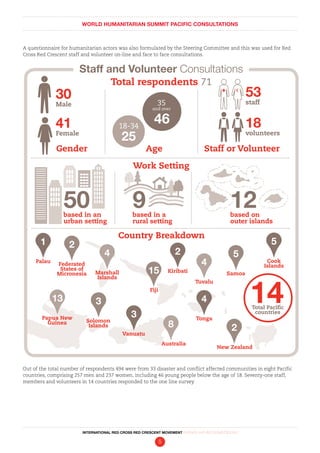
A questionnaire for humanitarian actors was also formulated by the Steering Committee and this was used for Red
Cross Red Crescent staff and volunteer on-line and face to face consultations.
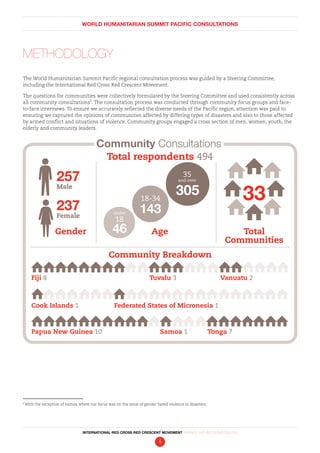
Out of the total number of respondents 494 were from 33 disaster and conflict affected communities in eight Pacific
countries, comprising 257 men and 237 women, including 46 young people below the age of 18. Seventy-one staff,
members and volunteers in 14 countries responded to the one line survey.
Gender
Country Breakdown
Total respondents 71
Staff and Volunteer Consultations
Staff or VolunteerAge
35
and over
4618-34
25
14
53
staff
18
volunteers
Work Setting
based on
outer islands
8 2
13 3
3
5
5
15
1
4
2
4
4
2
Australia
New Zealand
Papua New
Guinea Solomon
Islands
Vanuatu
Cook
Islands
Samoa
Fiji
Palau
Tonga
Kiribati
Tuvalu
Marshall
Islands
Federated
States of
Micronesia
Total Pacific
countries
based in a
rural setting
9based in an
urban setting
50
30
Male
41
Female
12
WORLD HUMANITARIAN SUMMIT PACIFIC CONSULTATIONS
INTERNATIONAL RED CROSS RED CRESCENT MOVEMENT FINDINGS AND RECOMMENDATIONS
6
THEME 1: HUMANITARIAN EFFECTIVENESS
Designing humanitarian interventions in partnership with communities
Community consultations confirmed humanitarian assistance, particularly relief support following disasters or
conflict, was useful and appreciated. However, feedback suggests more could be done to ensure the support provided
is appropriate. Consultations confirmed community information was regularly gathered during assessments, yet how
the data is utilized and how planned activities are communicated back to communities is an issue. Communities in
Vanuatu stated that organizations “asked questions but didn’t always listen to what we are saying”, while in Papua
New Guinea communities felt relief support was often not adequate due to many people having large families,
potentially leading to confusion and tension in families and communities. This was also echoed by staff respondents,
with one person saying humanitarian support should be “in the form that is requested and not what is in the disaster
response package.” Another member of staff also said organizations must avoid going into affected communities “with
the mentality that we know what the people need and how to assist them.”
To address these issues humanitarian actors must significantly improve communication with disaster and conflict
affected populations and ensure mechanisms are in place for men, women and children to provide feedback on
humanitarian actors and activities. Community feedback reflected the need for improved two-way communications,
in which communities could ask questions and feedback on activities. In Tuvalu for example, when asked how
communities wanted to receive information they were clear this should be done through more consultations with
communities.
It was noted by staff that donor accountability often takes priority over activities which support beneficiary
accountability as “humanitarian actors spend more time on upward accountability because their principal source of
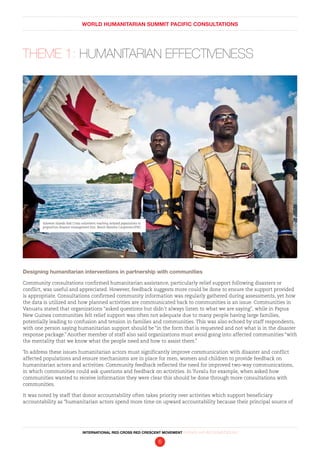
Solomon Islands Red Cross volunteers reaching isolated populations to
preposition disaster management kits. Benoit Matsha-Carpentier/IFRC
WORLD HUMANITARIAN SUMMIT PACIFIC CONSULTATIONS
INTERNATIONAL RED CROSS RED CRESCENT MOVEMENT FINDINGS AND RECOMMENDATIONS
7
funding is from international donors.” However as stressed by communities in Tonga “decision making should focus
on the people who are suffering.”
Recognizing that beneficiary communications and accountability activities build community trust in the partner
organization was also stressed as important by staff. One respondent said “humanitarian actors need to take the time
to listen and understand communities before disaster strikes so that when they do there is a level of understanding
and trust that can be used as a platform for providing the right kind of support for that community.”
“Every island is different, every community is different. Communities must be involved in the development
of the recovery plans and policies and if governance is to be effective, they must be part of the governance
mechanisms”
Staff Consultation, Cook Islands
Localising humanitarian preparedness and response
The Pacific has vast geographical challenges and the delivery of external aid can take much longer than elsewhere,
therefore localized humanitarian capacity is critical. Working through community based organisations and local
networks is vital to effective humanitarian action in the region. Staff and volunteers reflected that the Red Cross
Red Crescent approach of utilizing a strong community volunteer base facilitates rapid-assessments and timely
assistance, especially on outer islands and isolated rural communities. National Societies play an important role
in supplementing public humanitarian services through their “auxiliary role” as independent, neutral, impartial
humanitarian networks of grass roots members, volunteers and youth. Staff respondents called for greater
recognition for the role of National Societies with one person stating that they are “first in and last out.” Another staff
respondent said that the added value of the Red Cross presence in communities is that it is “always there.”
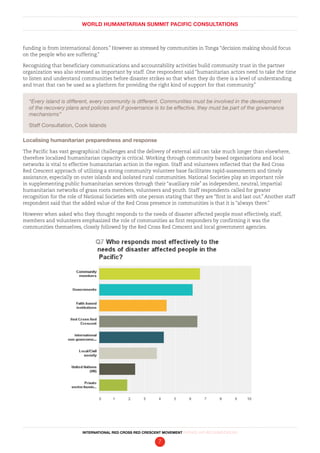
However when asked who they thought responds to the needs of disaster affected people most effectively, staff,
members and volunteers emphasized the role of communities as first responders by confirming it was the
communities themselves, closely followed by the Red Cross Red Crescent and local government agencies.
WORLD HUMANITARIAN SUMMIT PACIFIC CONSULTATIONS
INTERNATIONAL RED CROSS RED CRESCENT MOVEMENT FINDINGS AND RECOMMENDATIONS
8
Strengthening regional leadership during an international response was also highlighted as important by staff, with
many proposing a regional disaster fund and response team. Respondents felt this mechanism would facilitate
shared learning and preparedness activities, and allow countries to respond faster.
Strengthening the legislative and regulatory framework for disaster risk reduction and response
As a group of isolated, small island states vulnerable to myriad natural hazards, the Pacific is presented with serious
challenges to the delivery of international disaster relief. Agencies and Pacific governments must work together
to strengthen national policy and institutional and legal frameworks, ensuring there are systems in place for the
regulation and facilitation of international assistance and strengthening risk reduction approaches. Staff feedback
highlighted the important role governments play in facilitating humanitarian assessments and response and noted
that without governments’ prompt appeal for assistance, it is difficult to operate and provide assistance in a timely
manner. While all Pacific island countries have disaster laws in place, these laws need to be strengthened to better
regulate international humanitarian action and ensure risk reduction approaches are formalized. A huge global
response and influx of international actors can be overwhelming for any country, particularly small island states.
One respondent said “we saw this recently with Cyclone Pam where the massive international response in Vanuatu
threatened to overwhelm the national capacities to respond.” In the Cook Islands, a Red Cross leader reflected
that the government had addressed these issues by reviewing their legal frameworks regulating international
humanitarian assistance in 2012.
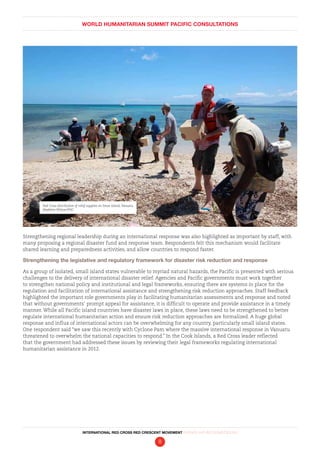
Red Cross distribution of relief supplies on Emae Island,Vanuatu.
Madeline Wilson/IFRC
WORLD HUMANITARIAN SUMMIT PACIFIC CONSULTATIONS
INTERNATIONAL RED CROSS RED CRESCENT MOVEMENT FINDINGS AND RECOMMENDATIONS
9
Empowering marginalized groups to play an active role in humanitarian action
Efforts must be made to identify the specific needs of marginalized groups, and to ensure that the needs of these
groups are reflected in the support provided by humanitarian actors. This should include mainstreaming gender-
sensitive assistance, disability-inclusion principles and child protection issues and working to ensure relief assistance
promotes the dignity, equal access, participation and safety of marginalized people.
Consultation with women and girls affected by disasters showed that in some cases there had been very limited
engagement with them regarding the type of emergency assistance provided to their families. When asked if their
views were sought during the response in Papua New Guinea respondents said “no, only men make the decisions
for anything that arises.” Staff and volunteers echoed this sentiment and noted traditional and social structures
in the Pacific favor participation by men. Increased efforts must be made to understand the gender dynamics of
communities, which can only be achieved through direct access to diverse groups of men, women, boys and girls.
The connection between violence against women and disasters was also raised by staff. They emphasized the
importance of mainstreaming protection issues through assessments, pre-positioning of age/gender appropriate
assistance packages and planning and capacity-building for humanitarian actors at all levels. The need to include
local violence against women response groups, whether formal or informal, in preparedness and response planning
was also highlighted by one staff member. Humanitarian actors are obliged to act in preparation for a rise in gender
based violence after disasters, and therefore local response agencies need to be supported and equipped to cope with
additional referrals and complex cases.
Addressing the needs of other vulnerable groups, including ensuring accessible and dignified relief for the elderly
and persons with mobility disabilities, must also be improved. Respondents emphasized two main areas where these
groups are particularly disenfranchised. The first relates to evacuation routes and services in evacuation centers, and
the second relates to the integration of their needs in long term development planning. One respondent from Tuvalu
noted “the mode of transport used for evacuating vulnerable groups is primitive, like using wheel barrows or man
shoulder to carry people to the second floor.” Such approaches can undermine dignity or cause injury.
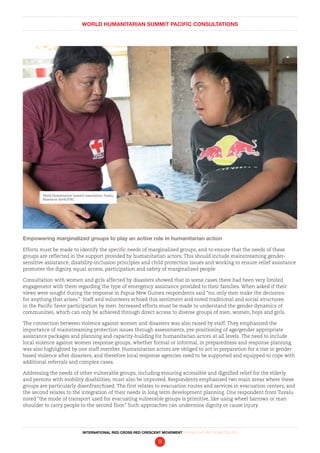
World Humanitarian Summit consultation, Tuvalu.
Rosemarie North/IFRC
WORLD HUMANITARIAN SUMMIT PACIFIC CONSULTATIONS
INTERNATIONAL RED CROSS RED CRESCENT MOVEMENT FINDINGS AND RECOMMENDATIONS
10
Another group highlighted by staff respondents as vulnerable are internally displaced populations as they frequently
lack protection from laws and policies, making it more difficult to find durable solutions to their displacement.
Both disasters and climate change are causing internal displacement in many countries in the region and displaced
populations often find integration into their host community difficult, due to the lack of available resources
(including land). This leads to populations living marginal existences and exposes them to further hazards and
human rights violations.
“If we need immediate assistance it takes too long when our opinions go through men. We [women] are
different. We have different needs”
Community Consultation with women, Vanuatu
Tailoring funding and timing to the priorities and realities in the local context
Staff respondents highlighted the short-term and conditioned nature of international aid funds which often results
in pre-packaged projects that do not fit local priorities. They also pointed to the short time frames from donors for
designing programmes, the lack of support for exploring with communities the different options for action and the
complexity and variety of donor proposal and reporting formats. Some said that the increasing demands for upward
accountability in the delivery of assistance have resulted in decisions and choices being located at the top of the aid
chain. As the aid system has become more organized it has become more difficult for recipient communities to have
a voice in decision making. Respondents requested that donors review their policy and condition setting, simplifying
and making conditions more flexible, so that international assistance can support local ownership and sustainability.
One respondent noted the influence of the media in shaping donor priorities in the Pacific. By covering certain
disasters, media skews attention and resources to those contexts. However, other humanitarian and development
issues that require longer-term and sustained attention receive much less media focus and donor attention,
especially protection issues.
“Because of media attention, resourcing sudden onset disaster relief operations is more straightforward than
sourcing resources for developing grassroots volunteer networks that are essential to risk reduction and
preparedness in the region”
Staff consultation, Fiji
Micronesia Red Cross transport emergency relief items to
Chuuk following Typhoon. Maysak/IFRC
WORLD HUMANITARIAN SUMMIT PACIFIC CONSULTATIONS
INTERNATIONAL RED CROSS RED CRESCENT MOVEMENT FINDINGS AND RECOMMENDATIONS
11
THEME 2: REDUCING VULNERABILITY AND
MANAGING RISK
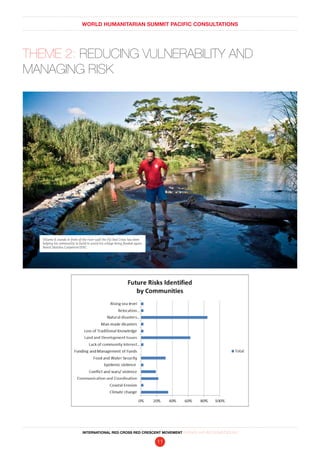
Viliame K stands in front of the river wall the Fiji Red Cross has been
helping his community to build to avoid his village being flooded again.
Benoit Matsha-Carpentier/IFRC
WORLD HUMANITARIAN SUMMIT PACIFIC CONSULTATIONS
INTERNATIONAL RED CROSS RED CRESCENT MOVEMENT FINDINGS AND RECOMMENDATIONS
12
Recognizing communities as the primary responders and enhancing community resilience
Communities are the first to respond to an emergency and support should encourage community confidence to
act and local ownership, which will enhance resilience. Community consultations consistently showed that people
actively share resources and organize their local response. In Papua New Guinea communities discussed the support
host families had provided with one person saying “host families helped people live through the difficult period.”
In response, affected communities explained how they had tried to help the host community by taking on casual
work and helping to cultivate land plots, work which was unpopular among the locals. Those who received external
assistance also described sharing their items with people not on the beneficiary list. In Vanuatu, communities
explained how they organized a water committee to help manage their limited water resources during the dry season
and in Tuvalu communities explained that during a disaster it was relatives who had stepped in to lend families
clothes and to share food and water.
Disaster risk reduction activities should be driven by a thorough understanding of community coping capacities and
should also respect, and utilize where possible, traditional knowledge from Pacific communities. The importance
and value of traditional ways of coping was highlighted in many community consultations. In response to water
shortages, communities in Mangaia in the Cook Islands said “we need to go back to our traditional knowledge of
accessing water and ask our elders, how they managed in days of old.”
“We observe the height of bird nests on the tree branches. If birds create their nests on the lower branches,
it means that a cyclone is coming. If they create them on the higher branches, it indicates that a flood is
possible”
Staff respondent, Fiji
Baseline surveys were referenced as particularly crucial in this respect with one member of staff explaining “we use
the baseline to ask the community what traditional practices they employ to identify when a cyclone is coming or
when heavy rain may be on its way. Usually people tell us about monitoring the behavior of birds and animals. We
encourage communities to also consider weather updates from the Met service to complement these traditional
systems.”
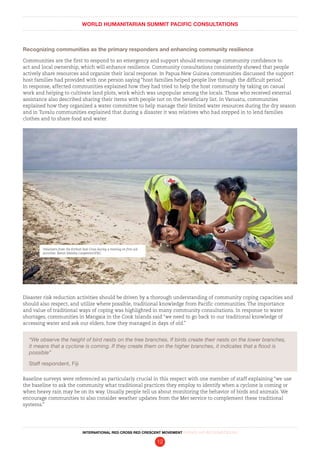
Volunteers from the Kiribati Red Cross during a training on first aid
activities. Benoit Matsha-Carpentier/IFRC
WORLD HUMANITARIAN SUMMIT PACIFIC CONSULTATIONS
INTERNATIONAL RED CROSS RED CRESCENT MOVEMENT FINDINGS AND RECOMMENDATIONS
13
Staff also reflected on the high levels of existing resilience and knowledge in communities and suggested the role of
the Red Cross is to recognise and find ways to enhance such resilience. Staff in Fiji said affected communities must
be supported to help themselves and to make their own decisions, which necessitates a two way dialogue between
communities and humanitarian actors. They cited an example of building a community hall which the community
could then determine how to use and which could serve multi-purpose functions. The community then decided the
hall should become an evacuation centre.
In Papua New Guinea volunteers said positive change in communities “starts with each and every one of us in our
own community”. Staff also said safety and resilience requires dramatic behaviour change and this only becomes
possible when the public can see “everyone is doing it.” Staff and volunteers suggested a greater focus on skills
development in supporting partner communities to enhance their resilience.
As climate change brings new weather conditions the need to work with communities to help them adapt to
the changing context was also raised by one staff respondent. They stated that this work would need to include
governments, community members and leaders as “climate change and disasters are everyone’s business.”
“We did our best to rebuild our homes or some type of shelter to stay in. Whatever was usable we used,
trying to live each day as it came, always trying to see the positive in everything”
Community consultation, Federated States of Micronesia
Ensuring early warning systems have a people centered approach
To be effective early warning systems must be understandable, trusted and relevant to communities. In the Pacific,
this means working in partnership with communities and adopting a diverse range of communications methods
in order to ensure messages reach more people, more swiftly. Many communities and humanitarian actors have
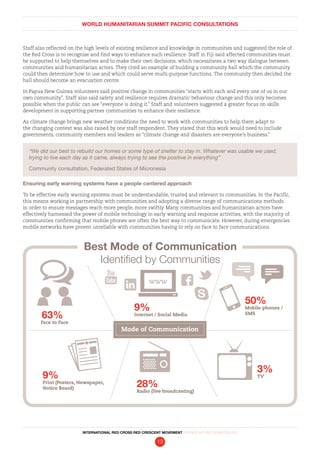
effectively harnessed the power of mobile technology in early warning and response activities, with the majority of
communities confirming that mobile phones are often the best way to communicate. However, during emergencies
mobile networks have proven unreliable with communities having to rely on face to face communications.
Best Mode of Communication
Identified by Communities
3%
TV
63%
Face to Face
9%
Internet / Social Media
50%
Mobile phones /
SMS
9%
Print (Posters, Newspaper,
Notice Board)
28%
Radio (live broadcasting)
Mode of Communication
WORLD HUMANITARIAN SUMMIT PACIFIC CONSULTATIONS
INTERNATIONAL RED CROSS RED CRESCENT MOVEMENT FINDINGS AND RECOMMENDATIONS
14
Communities in Tuvalu stressed the need for satellite phones during emergencies while Vanuatu communities
said there was no mobile reception for two to three weeks following cyclone Pam and no radio. Communities
in Fiji reported a similar experience during tropical cyclone Amy. The need for a mixture of new and traditional
communications was reinforced by community feedback from Papua New Guinea where a community member
said the best way to share and receive information is through the mobile network for fast reception and by sending
a runner to the nearest village. It was also noted that for people with hearing and literacy issues communication
approaches need to be adapted to ensure accessibility by all.
In Tuvalu, when asked how humanitarian assistance could be improved during times of disaster, one community
responded by saying they needed improved and reliable weather forecasts and they “need to be well informed when
there is a warning.” Vanuatu communities also requested workshops to help communities understand the disaster
preparedness messages they received including weather and climate information, demonstrating the continued
importance of face to face contact and the simplification of scientific information into user friendly messages.
Staff consultations also reflected the importance of sharing weather related information with communities in an
accessible way. Feedback showed many Red Cross Societies are currently working on this by engaging with their
national Met Services to improve weather and climate messaging. One staff respondent said community level
workshops were vital to improving disaster preparedness communications and pointed out these were already
happening in Cook Islands, Tuvalu, Tonga and Samoa. The respondent said “the most important aspect of the
programme is that we have facilitated a direct conversation between the Met office and communities. When Met
officials visit communities they can see for themselves how people want to receive information.”
One member of staff raised the impact of climate change on early warning systems and traditional knowledge,
stating that community workshops and engagement will “only be needed more and more as traditional knowledge
linked with weather predictions is eroded by changes to weather patterns.”
“The meteorological office sometimes uses scientific words and it’s hard to work out the meaning”
Community Consultation, Vanuatu
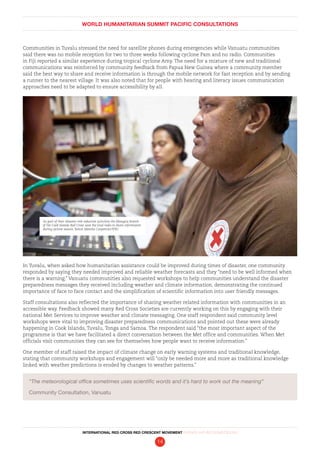
As part of their disaster risk reduction activities the Mangaia branch
of the Cook Islands Red Cross uses the local radio to share information
during cyclone season. Benoit Matsha-Carpentier/IFRC
WORLD HUMANITARIAN SUMMIT PACIFIC CONSULTATIONS
INTERNATIONAL RED CROSS RED CRESCENT MOVEMENT FINDINGS AND RECOMMENDATIONS
15
Increasing resources for disaster risk reduction
Humanitarian actors need to work collectively and with governments to coordinate longer term, sustainable solutions
for disaster risk reduction, especially effective early warning. Investing in early warning systems remains a priority
with many staff reporting that it is key to saving lives. Staff respondents agreed this would require a shift from the
traditional model of emergency relief to a greater focus on disaster risk reduction. The limited resources available
for this area was noted by staff respondents, with many stressing the importance of humanitarian actors and donors
agreeing on allocating more funds to risk reduction activities.
One staff member suggested disaster risk reduction can be sustained through fostering local entrepreneurship, such
as pre-positioned stock management in collaboration with local store owners, and work to develop local supplies.
Other respondents stressed that risk reduction measures can be simple and low cost, stating that communities could
reduce some risks by harnessing the skills and resources available in the community. Staff respondents from Fiji
gave examples of programmes which provided communities with basic support such as seasonal weather calendars
and river gauges to enable them to track and monitor weather related emergencies. This approach was particularly
successful according to the staff respondents as “the support provided is low cost but it enables the community
to identify and monitor the risks themselves and to then develop their village disaster plan for managing and
responding to these risks.”
Some staff respondents pointed to the fact that disaster risk reduction was now playing a bigger role than ever
before, as governments learnt from previous disasters. One said that “in the run up to cyclone Pam, governments
in the Pacific took the threat seriously and began disaster preparedness warnings and messages early. This made a
real difference in terms of loss of lives and loss of homes. Clearly we know disaster preparedness works and we are
gradually learning we must increase our efforts and resources in this area.”
As one member of staff stated “we know it saves lives, it’s doesn’t have to cost a lot, why are we not doing more of it?”
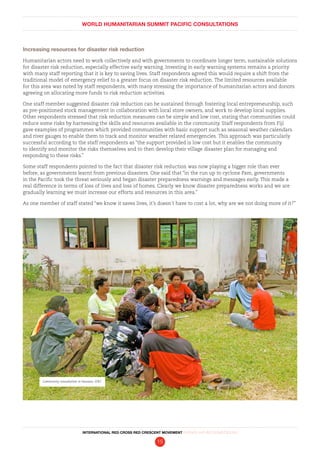
Community consultation in Vanuatu. IFRC
WORLD HUMANITARIAN SUMMIT PACIFIC CONSULTATIONS
INTERNATIONAL RED CROSS RED CRESCENT MOVEMENT FINDINGS AND RECOMMENDATIONS
16
THEME 3: TRANSFORMATION THROUGH
INNOVATION
Encouraging use of modern telecommunication methods and satellite technology
The Pacific region must utilize technological advances and mobile technology to help facilitate emergency operations
and to improve the quality of disaster warning information disseminated to the public. Information, Communication,
and Technology are areas which could be greatly improved. Staff mentioned the long term support from New Zealand
Red Cross for the use of satellite phones and said these phone had often been the only communication lifeline with
isolated outer islands. Red Cross Red Crescent and other actors are also currently piloting the use of mobile phones
for consistent and rapid disaster assessment information both using the mobile network but also independent of it.
Staff responses also suggested improving the humanitarian information management systems in the region. Some
noted that weak disaster data collection and monitoring systems can hinder humanitarian action and the design of
solid, evidence-based programming. Data management systems could be improved by modernizing data collection
methods and linking to government data collection. Respondents called for a multi-actor information management
team to gather, analyse, and disseminate data to all government and humanitarian actors to use in programming.
Initiatives such as the government of New Zealand program on digitalization of demographic data was highlighted as
good practice.
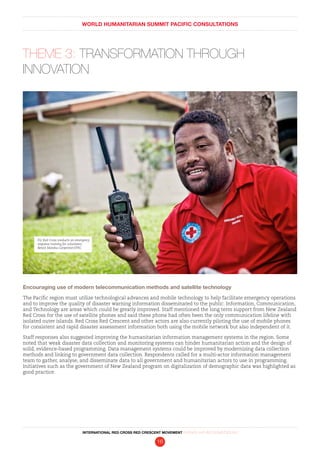
Fiji Red Cross conducts an emergency
response training for volunteers.
Benoit Matsha-Carpentier/IFRC
WORLD HUMANITARIAN SUMMIT PACIFIC CONSULTATIONS
INTERNATIONAL RED CROSS RED CRESCENT MOVEMENT FINDINGS AND RECOMMENDATIONS
17
THEME 4: SERVING THE NEEDS OF PEOPLE IN
CONFLICT
Maintaining principled humanitarian action
Staff feedback stressed that adhering to humanitarian principles and providing principle-based humanitarian
services is the key to effective humanitarian action in conflict areas. Respondents noted that the Fundamental
Principles of the International Red Cross Red Crescent Movement, derived from International Humanitarian Law, need
to be upheld by humanitarian actors in conflict situations. They said adhering to the principles facilitates access to a
wider range of people and ensures the provision of impartial assistance. Staff cautioned that without respecting those
principles, humanitarian work is at risk of politicization, which negatively impacts on access to those most in need.
Communities also commented on the need for actors to be neutral, impartial and inclusive. They raised the issue of
some organizations and faith-based institutions only distributing to their members, excluding others in the same
community who may be more vulnerable, which contributes to undermining the impartiality of humanitarian
assistance.
Encouraging governments to play a stronger role in maintaining peace and security in conflict areas
Humanitarian actors should offer awareness raising and training opportunities to legal and law enforcement agencies
and the military on sexual and gender based violence and violence against children, as these are pre-existing and
prevalent forms of community and interpersonal violence in the Pacific region, as elsewhere in the world. Further,
where governments have existing strategies to tackle these issues, such policies need to be resourced and continued
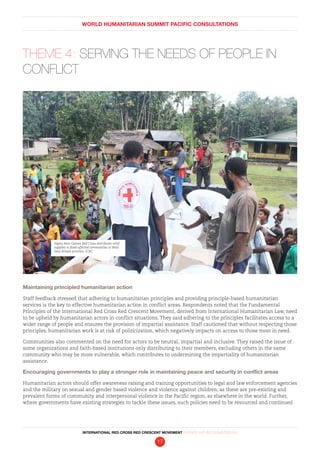
Papua New Guinea Red Cross distributes relief
supplies to flood-affected communities in West
New Britain province. ICRC
WORLD HUMANITARIAN SUMMIT PACIFIC CONSULTATIONS
INTERNATIONAL RED CROSS RED CRESCENT MOVEMENT FINDINGS AND RECOMMENDATIONS
18
even in times of broader crisis. Dissemination of International Humanitarian Law and promoting the principles of
International Humanitarian Law is also critical as it benefits all humanitarian actors in time of armed conflict.
Communities called on governments and potentially humanitarian agencies to play a more active role in all forms
of conflict mediation, conflict prevention (including gender based violence prevention) and peace-building. They said
this role is often played by faith-based organizations and requested other humanitarian organizations also engage.
They believe Red Cross Red Crescent National Societies especially, because of their principle of neutrality and good
relations with all factions, should assist in identifying community mediators. Others suggested they form peace-
keeping committees that would ensure protection against violence.
Respondents among staff cautioned against getting involved in political issues as it would affect the neutrality and
credibility of humanitarian actors. Governments, they added, had the primary responsibility of maintaining peace
and stability in their countries. They did state however, that it is their role to assist in identifying human rights or
International Humanitarian Law violations and shedding light on them. They remarked that often humanitarian
actors witness atrocities and it is their moral duty to report on these violations.
On situations of violence against women and children, community respondents and volunteers perceived that there
are no national mechanisms in place to monitor or address those issues, showing that even where these strategies
exist they are not known at local level.
“There is no sign of anyone from the Government of from other organizations interested in achieving peace in
this conflict”
Community consultation, Papua New Guinea
Better understanding of the root causes of violence
Communities in some countries noted that conflict is an important issue which could escalate if not properly
addressed. Identified causes of conflict in the region include ethnic disputes, resource-related conflicts including food
security and land tenure, and violence against women and children. Many are also concerned about climate change
and its role in exacerbating or generating future conflicts in the region. Staff respondents felt protection of victims of
violence is an area of special concern, and more should be done to address it.
Humanitarian actors in the Pacific must do more to better understand the local environment and respond to the root
causes of violence in communities. This must include an understanding of how humanitarian activities can impact
on conflict dynamics. In Papua New Guinea communities gave examples of both the positive and negative impact
humanitarian support can generate. For instance communities explained that after the distribution of relief kits
the risk of tribal fighting re-occurring was lower and respondents also said that if humanitarian agencies helped to
build houses, people would be protective of their homes and would avoid becoming involved in conflict which could
jeopardize them. However a community member also noted that in families in which a man had more than wife,
there had been many fights between wives over who received which items in the standardized family kit, such as
dignity materials and sanitary items for women. As stated by a staff member in the online survey, more needs to be
done to better understand the situation and the local environment.
“Build permanent housing for all those affected by the conflict so they will feel responsible to protect their
homes and not fight. The cost of building and setting up houses will make locals stop to think before they
fight, burn and destroy their homes”
Community consultation, Papua New Guinea
WORLD HUMANITARIAN SUMMIT PACIFIC CONSULTATIONS
INTERNATIONAL RED CROSS RED CRESCENT MOVEMENT FINDINGS AND RECOMMENDATIONS
19
Engaging with youth
Working with youth to address conflict in communities is critical and humanitarian actors should prioritize
education and awareness activities. In Papua New Guinea communities felt humanitarian organizations had a
role to play in educating young people not to get involved in fights. This was particularly pertinent as a number of
communities reported school children carrying bush knives to school for protection each day.
Youth are also key agents of behaviour change in their communities and positive stories of young men engaging in
peacebuilding, through actively engaging with men not to use violence as a coping strategy, were also noted. Hence,
youth can be agents of peace building and can contribute to reduced recourse to violence, starting with reducing
violence in intra-family relationships and the primary prevention of violence; stopping it before it eventuates.
“In order to change people I have to change myself …I started measuring myself, you have to be really honest
with yourself to assess yourself – if you are not honest with yourself then it will not solve your vulnerability”
Red Cross Youth Volunteer, Papua New Guinea
Caption
Sexual and Gender Based Violence in
Disasters - Urgent and understudied
From 21 May - 6 June 2015, IFRC field based research was conducted in collaboration with the Samoa Red Cross as
part of a 10-country research study into sexual and gender based violence (SGBV) after disasters. The qualitative
research collected in-depth information about experiences of SGBV following the 2009 earthquake and tsunami and
Cyclone Evan in 2012. In total 29 individual interviews, two focus group discussions with women of the affected areas,
and a short questionnaire with directly affected secondary students were conducted, and transcripts were analysed.
The study represents the views of affected populations and those that are involved in the provision of services related
to disaster and/or SGBV. The research is due for publication late 2015, preliminary findings indicate:
	 Prevalence of intimate partner violence increases after a natural disaster, particularly in those family settings
where partner differences are generally solved by violent behaviour. Economic problems and heightened
frustrations after being affected by a natural disaster increases this pattern and the abuse;
	 Women, girls and children (and some men) who were displaced by disaster in Samoa were at higher risk of
SGBV than those who managed to stay at home in their communities. This applies specifically for affected
persons in an urban area, living in crowded shelters, with inadequate shower and toilet facilities;
	 In urban shelter settings, young single women and children were most vulnerable to SGBV, particularly where
parents would leave young people unaccompanied in the shelters during day time to clean up and reconstruct
their damaged houses;
	 In affected rural communities those most vulnerable to SGVB after a natural disaster are young married
women with limited economic power, low education and who have moved into the community of their
husbands. Their social status is low and they are not inclined to speak out on SGBV acts, due to the potential
repercussion for the husbands’ family such as being criticised or in worst case being expelled from the
community;
	 Cases of sexual violence, abuse and intimate partner violence did occur after the disaster, but were likely not
to be officially recorded by case workers and service providers due to increasing caseloads, chaos and limited
resources during response times. Furthermore, if recorded there are no provisions to link these records to the
overall data collection for a particular disaster;
	 Most victims of SGVB are unlikely to seek out help particularly in the aftermath of a disaster. Seeking help
within traditional structures increases chances of not only the victim being exposed but the whole family
being scrutinised by the community and possibly expelled. In the aftermath of a disaster, traditional support
structures that provide psychosocial care and mediation in cases of SGBV are weakened and are not always
supported by humanitarian actors;
	 Whilst service providers know how to deal with SGBV cases in a normal setting they have not been trained to
specifically strategise, target and respond to SGBV in emergency settings.
WORLD HUMANITARIAN SUMMIT PACIFIC CONSULTATIONS
For more information on the World Humanitarian Summit Pacific Consultations please contact:
Aurélia Balpe
Head of IFRC Regional Office, Pacific
aurelia.balpe@ifrc.org
INTERNATIONAL RED CROSS RED CRESCENT MOVEMENT FINDINGS AND RECOMMENDATIONS
20

WHS Report 250615 REV01

  • 1.
    WORLD HUMANITARIAN SUMMITPACIFIC CONSULTATIONS INTERNATIONAL RED CROSS RED CRESCENT MOVEMENT FINDINGS AND RECOMMENDATIONS Introduction This report presents the findings and recommendations arising from the Red Cross Red Crescent World Humanitarian Summit (WHS) consultations in the Pacific region. Consultations were held with men, women and young people in disaster and conflict affected communities and with Red Cross Red Crescent volunteers, members and staff. As the world’s largest humanitarian network with a significant presence in Pacific communities, the International Red Cross and Red Crescent Movement is in a unique position to contribute to the World Humanitarian Summit consul- tations. Through Red Cross National Societies we are present in 14 Pacific countries and eight overseas territories. Over 3500 volunteers and more than 100 Red Cross staff work across the small island states, providing assistance to communities affected by a wide range of disasters and situations of violence.1 The valuable community, volunteer and staff insights collected in this report will inform the dialogue at the Pacific regional consultation meeting in Auckland, New Zealand, in June 2015. This meeting is the seventh in a series of re- gional consultations leading up to the 2016 World Humanitarian Summit. 1 Australian Red Cross delivers its community based activities through 34,989 volunteers and 2,962 staff. In New Zealand 15,390 Red Cross volunteers and 475 staff provide services throughout the territory. In the Cook Islands, the Red Cross is running a Junior Red Cross programme where young students visit elderly people to provide company, essential supplies and to help them prepare ahead of cyclone season. Benoit Matsha-Carpentier/IFRC www.ifrc.org Saving lives, changing minds.
  • 2.
    WORLD HUMANITARIAN SUMMITPACIFIC CONSULTATIONS INTERNATIONAL RED CROSS RED CRESCENT MOVEMENT FINDINGS AND RECOMMENDATIONS 2 The consultation process for the World Humanitarian Summit was designed to elicit key recommendations to improve humanitarian action and to better equip the humanitarian system to respond to future threats and crises. By acting on the recommendations below, we believe the work of humanitarian actors can be strengthened and relationships with affected populations improved. Theme 1: Humanitarian effectiveness The effectiveness of humanitarian action would be improved by: Designing humanitarian interventions in partnership with communities While humanitarian actors regularly engage communities in assessments, this feedback does not sufficiently influence response and recovery programming. Community voices must guide the design, implementation and monitoring of activities. Clear and comprehensive information must be made available to affected populations and mechanisms must also be in place for women, men and children to provide feedback on humanitarian actors and activities. Localising humanitarian preparedness and response The Pacific has vast geographical challenges and the delivery of external aid can take much longer than elsewhere, meaning localized humanitarian capacity is critical. Existing community structures and community based equality focused organisations must be engaged. Support to Red Cross Red Crescent National Societies as auxiliaries to their public authorities must also be strengthened. Strengthening the legislative and regulatory framework for disaster risk reduction and response As a group of small island states vulnerable to myriad natural hazards, the Pacific faces serious challenges to the delivery of international disaster relief. Agencies and Pacific governments must work together to strengthen national policy and institutional and legal frameworks, ensuring systems are in place for the regulation and facilitation of international assistance and for strengthening disaster risk reduction and response. Empowering marginalized groups to play an active role in humanitarian action Efforts must be made to identify the specific needs of marginalized groups and to ensure that the root causes of vulnerability are addressed. The needs of these groups must be reflected in the support provided by humanitarian actors. This should include mainstreaming gender-sensitive assistance, disability-inclusion principles and child protection issues and working to ensure that relief assistance promotes the dignity, equal access, participation and safety of marginalized people. Tailoring funding and timing to the priorities and realities in the local context Donors should review their funding mechanisms and condition setting, simplifying processes and creating flexibility in the system, so that international assistance can support local ownership and sustainability. Theme 2: Reducing vulnerability and managing risk Humanitarian actors can better assist communities to reduce vulnerability and manage risk by: Recognizing communities as primary responders and enhancing community resilience Communities are the first to respond to an emergency and support should encourage community confidence to act. Disaster risk reduction activities must be driven by a thorough understanding of existing community coping capacities and must respect, and where possible utilize, traditional knowledge from Pacific communities. Young people can also play an important role as agents of change in risk reduction. Executive Summary
  • 3.
    WORLD HUMANITARIAN SUMMITPACIFIC CONSULTATIONS INTERNATIONAL RED CROSS RED CRESCENT MOVEMENT FINDINGS AND RECOMMENDATIONS 3 Ensuring early warning systems have a people centered approach To be effective early warning systems must be understandable, trusted and relevant to communities. In the Pacific, this means working in partnership with communities and adopting a diverse range of communications methods in order to ensure messages reach more people, more swiftly. Increasing resources for disaster risk reduction Investing in disaster risk reduction will reduce the exposure to natural hazards faced by vulnerable communities and is proven to be cost effective in preventing future losses. Humanitarian actors need to collectively work together with governments to ensure disaster risk reduction is integrated in development planning. Theme 3: Transformation through innovation Humanitarian actors could embrace innovation to better respond to the specific humanitarian challenges in the region by: Encouraging the use of modern telecommunication methods and satellite technology The Pacific region must utilize technological advances and mobile technology to improve early warning systems and rapid disaster assessments. Technology can also improve the region’s data collection and information management. Theme 4: Serving the needs of people in conflict Humanitarian actors in the Pacific could better serve the needs of people in conflict by: Maintaining principled humanitarian action Ensuring humanitarian actors remain principled is critical to them being able to provide equal assistance to people affected by conflict. The Fundamental Principles2 of the International Red Cross Red Crescent Movement, derived from International Humanitarian Law, need to be upheld by humanitarian actors in conflict situations. Encouraging governments to play a stronger role in maintaining peace and security in conflict areas This includes training for legal and law enforcement organisations and the military on sexual and gender based violence and violence against children. Dissemination of International Humanitarian Law and promoting the principles of International Humanitarian Law is also critical as it benefits all humanitarian actors in time of armed conflict. Humanitarian actors should also lobby governments to recognize the important leadership role they can often play in mediation. Better understanding the root causes of violence Humanitarian actors in the Pacific must do more to better understand the local environment and respond to the root causes of violence in communities, including gender based violence. This should include an understanding of how humanitarian activities can impact on conflict dynamics. Engaging with youth Working with youth to address conflict in communities is essential and humanitarian actors should prioritize education and awareness activities. 2 The Fundamental Principles are: Humanity, Impartiality, Neutrality, Independence, Voluntary Service, Unity and Universality.
  • 4.
    WORLD HUMANITARIAN SUMMITPACIFIC CONSULTATIONS INTERNATIONAL RED CROSS RED CRESCENT MOVEMENT FINDINGS AND RECOMMENDATIONS 4 Methodology The World Humanitarian Summit Pacific regional consultation process was guided by a Steering Committee, including the International Red Cross Red Crescent Movement. The questions for communities were collectively formulated by the Steering Committee and used consistently across all community consultations3 . The consultation process was conducted through community focus groups and face- to-face interviews. To ensure we accurately reflected the diverse needs of the Pacific region, attention was paid to ensuring we captured the opinions of communities affected by differing types of disasters and also to those affected by armed conflict and situations of violence. Community groups engaged a cross section of men, women, youth, the elderly and community leaders. 3 With the exception of Samoa where our focus was on the issue of gender based violence in disasters. Gender Community Breakdown Total respondents 494 Community Consultations Total Communities 33 Fiji 8 Tuvalu 3 Vanuatu 2 Cook Islands 1 Federated States of Micronesia 1 Papua New Guinea 10 Samoa 1 Tonga 7 Age under 18 35 and over 30518-34 143 46 257 Male 237 Female
  • 5.
    WORLD HUMANITARIAN SUMMITPACIFIC CONSULTATIONS INTERNATIONAL RED CROSS RED CRESCENT MOVEMENT FINDINGS AND RECOMMENDATIONS 5 A questionnaire for humanitarian actors was also formulated by the Steering Committee and this was used for Red Cross Red Crescent staff and volunteer on-line and face to face consultations. Out of the total number of respondents 494 were from 33 disaster and conflict affected communities in eight Pacific countries, comprising 257 men and 237 women, including 46 young people below the age of 18. Seventy-one staff, members and volunteers in 14 countries responded to the one line survey. Gender Country Breakdown Total respondents 71 Staff and Volunteer Consultations Staff or VolunteerAge 35 and over 4618-34 25 14 53 staff 18 volunteers Work Setting based on outer islands 8 2 13 3 3 5 5 15 1 4 2 4 4 2 Australia New Zealand Papua New Guinea Solomon Islands Vanuatu Cook Islands Samoa Fiji Palau Tonga Kiribati Tuvalu Marshall Islands Federated States of Micronesia Total Pacific countries based in a rural setting 9based in an urban setting 50 30 Male 41 Female 12
  • 6.
    WORLD HUMANITARIAN SUMMITPACIFIC CONSULTATIONS INTERNATIONAL RED CROSS RED CRESCENT MOVEMENT FINDINGS AND RECOMMENDATIONS 6 THEME 1: HUMANITARIAN EFFECTIVENESS Designing humanitarian interventions in partnership with communities Community consultations confirmed humanitarian assistance, particularly relief support following disasters or conflict, was useful and appreciated. However, feedback suggests more could be done to ensure the support provided is appropriate. Consultations confirmed community information was regularly gathered during assessments, yet how the data is utilized and how planned activities are communicated back to communities is an issue. Communities in Vanuatu stated that organizations “asked questions but didn’t always listen to what we are saying”, while in Papua New Guinea communities felt relief support was often not adequate due to many people having large families, potentially leading to confusion and tension in families and communities. This was also echoed by staff respondents, with one person saying humanitarian support should be “in the form that is requested and not what is in the disaster response package.” Another member of staff also said organizations must avoid going into affected communities “with the mentality that we know what the people need and how to assist them.” To address these issues humanitarian actors must significantly improve communication with disaster and conflict affected populations and ensure mechanisms are in place for men, women and children to provide feedback on humanitarian actors and activities. Community feedback reflected the need for improved two-way communications, in which communities could ask questions and feedback on activities. In Tuvalu for example, when asked how communities wanted to receive information they were clear this should be done through more consultations with communities. It was noted by staff that donor accountability often takes priority over activities which support beneficiary accountability as “humanitarian actors spend more time on upward accountability because their principal source of Solomon Islands Red Cross volunteers reaching isolated populations to preposition disaster management kits. Benoit Matsha-Carpentier/IFRC
  • 7.
    WORLD HUMANITARIAN SUMMITPACIFIC CONSULTATIONS INTERNATIONAL RED CROSS RED CRESCENT MOVEMENT FINDINGS AND RECOMMENDATIONS 7 funding is from international donors.” However as stressed by communities in Tonga “decision making should focus on the people who are suffering.” Recognizing that beneficiary communications and accountability activities build community trust in the partner organization was also stressed as important by staff. One respondent said “humanitarian actors need to take the time to listen and understand communities before disaster strikes so that when they do there is a level of understanding and trust that can be used as a platform for providing the right kind of support for that community.” “Every island is different, every community is different. Communities must be involved in the development of the recovery plans and policies and if governance is to be effective, they must be part of the governance mechanisms” Staff Consultation, Cook Islands Localising humanitarian preparedness and response The Pacific has vast geographical challenges and the delivery of external aid can take much longer than elsewhere, therefore localized humanitarian capacity is critical. Working through community based organisations and local networks is vital to effective humanitarian action in the region. Staff and volunteers reflected that the Red Cross Red Crescent approach of utilizing a strong community volunteer base facilitates rapid-assessments and timely assistance, especially on outer islands and isolated rural communities. National Societies play an important role in supplementing public humanitarian services through their “auxiliary role” as independent, neutral, impartial humanitarian networks of grass roots members, volunteers and youth. Staff respondents called for greater recognition for the role of National Societies with one person stating that they are “first in and last out.” Another staff respondent said that the added value of the Red Cross presence in communities is that it is “always there.” However when asked who they thought responds to the needs of disaster affected people most effectively, staff, members and volunteers emphasized the role of communities as first responders by confirming it was the communities themselves, closely followed by the Red Cross Red Crescent and local government agencies.
  • 8.
    WORLD HUMANITARIAN SUMMITPACIFIC CONSULTATIONS INTERNATIONAL RED CROSS RED CRESCENT MOVEMENT FINDINGS AND RECOMMENDATIONS 8 Strengthening regional leadership during an international response was also highlighted as important by staff, with many proposing a regional disaster fund and response team. Respondents felt this mechanism would facilitate shared learning and preparedness activities, and allow countries to respond faster. Strengthening the legislative and regulatory framework for disaster risk reduction and response As a group of isolated, small island states vulnerable to myriad natural hazards, the Pacific is presented with serious challenges to the delivery of international disaster relief. Agencies and Pacific governments must work together to strengthen national policy and institutional and legal frameworks, ensuring there are systems in place for the regulation and facilitation of international assistance and strengthening risk reduction approaches. Staff feedback highlighted the important role governments play in facilitating humanitarian assessments and response and noted that without governments’ prompt appeal for assistance, it is difficult to operate and provide assistance in a timely manner. While all Pacific island countries have disaster laws in place, these laws need to be strengthened to better regulate international humanitarian action and ensure risk reduction approaches are formalized. A huge global response and influx of international actors can be overwhelming for any country, particularly small island states. One respondent said “we saw this recently with Cyclone Pam where the massive international response in Vanuatu threatened to overwhelm the national capacities to respond.” In the Cook Islands, a Red Cross leader reflected that the government had addressed these issues by reviewing their legal frameworks regulating international humanitarian assistance in 2012. Red Cross distribution of relief supplies on Emae Island,Vanuatu. Madeline Wilson/IFRC
  • 9.
    WORLD HUMANITARIAN SUMMITPACIFIC CONSULTATIONS INTERNATIONAL RED CROSS RED CRESCENT MOVEMENT FINDINGS AND RECOMMENDATIONS 9 Empowering marginalized groups to play an active role in humanitarian action Efforts must be made to identify the specific needs of marginalized groups, and to ensure that the needs of these groups are reflected in the support provided by humanitarian actors. This should include mainstreaming gender- sensitive assistance, disability-inclusion principles and child protection issues and working to ensure relief assistance promotes the dignity, equal access, participation and safety of marginalized people. Consultation with women and girls affected by disasters showed that in some cases there had been very limited engagement with them regarding the type of emergency assistance provided to their families. When asked if their views were sought during the response in Papua New Guinea respondents said “no, only men make the decisions for anything that arises.” Staff and volunteers echoed this sentiment and noted traditional and social structures in the Pacific favor participation by men. Increased efforts must be made to understand the gender dynamics of communities, which can only be achieved through direct access to diverse groups of men, women, boys and girls. The connection between violence against women and disasters was also raised by staff. They emphasized the importance of mainstreaming protection issues through assessments, pre-positioning of age/gender appropriate assistance packages and planning and capacity-building for humanitarian actors at all levels. The need to include local violence against women response groups, whether formal or informal, in preparedness and response planning was also highlighted by one staff member. Humanitarian actors are obliged to act in preparation for a rise in gender based violence after disasters, and therefore local response agencies need to be supported and equipped to cope with additional referrals and complex cases. Addressing the needs of other vulnerable groups, including ensuring accessible and dignified relief for the elderly and persons with mobility disabilities, must also be improved. Respondents emphasized two main areas where these groups are particularly disenfranchised. The first relates to evacuation routes and services in evacuation centers, and the second relates to the integration of their needs in long term development planning. One respondent from Tuvalu noted “the mode of transport used for evacuating vulnerable groups is primitive, like using wheel barrows or man shoulder to carry people to the second floor.” Such approaches can undermine dignity or cause injury. World Humanitarian Summit consultation, Tuvalu. Rosemarie North/IFRC
  • 10.
    WORLD HUMANITARIAN SUMMITPACIFIC CONSULTATIONS INTERNATIONAL RED CROSS RED CRESCENT MOVEMENT FINDINGS AND RECOMMENDATIONS 10 Another group highlighted by staff respondents as vulnerable are internally displaced populations as they frequently lack protection from laws and policies, making it more difficult to find durable solutions to their displacement. Both disasters and climate change are causing internal displacement in many countries in the region and displaced populations often find integration into their host community difficult, due to the lack of available resources (including land). This leads to populations living marginal existences and exposes them to further hazards and human rights violations. “If we need immediate assistance it takes too long when our opinions go through men. We [women] are different. We have different needs” Community Consultation with women, Vanuatu Tailoring funding and timing to the priorities and realities in the local context Staff respondents highlighted the short-term and conditioned nature of international aid funds which often results in pre-packaged projects that do not fit local priorities. They also pointed to the short time frames from donors for designing programmes, the lack of support for exploring with communities the different options for action and the complexity and variety of donor proposal and reporting formats. Some said that the increasing demands for upward accountability in the delivery of assistance have resulted in decisions and choices being located at the top of the aid chain. As the aid system has become more organized it has become more difficult for recipient communities to have a voice in decision making. Respondents requested that donors review their policy and condition setting, simplifying and making conditions more flexible, so that international assistance can support local ownership and sustainability. One respondent noted the influence of the media in shaping donor priorities in the Pacific. By covering certain disasters, media skews attention and resources to those contexts. However, other humanitarian and development issues that require longer-term and sustained attention receive much less media focus and donor attention, especially protection issues. “Because of media attention, resourcing sudden onset disaster relief operations is more straightforward than sourcing resources for developing grassroots volunteer networks that are essential to risk reduction and preparedness in the region” Staff consultation, Fiji Micronesia Red Cross transport emergency relief items to Chuuk following Typhoon. Maysak/IFRC
  • 11.
    WORLD HUMANITARIAN SUMMITPACIFIC CONSULTATIONS INTERNATIONAL RED CROSS RED CRESCENT MOVEMENT FINDINGS AND RECOMMENDATIONS 11 THEME 2: REDUCING VULNERABILITY AND MANAGING RISK Viliame K stands in front of the river wall the Fiji Red Cross has been helping his community to build to avoid his village being flooded again. Benoit Matsha-Carpentier/IFRC
  • 12.
    WORLD HUMANITARIAN SUMMITPACIFIC CONSULTATIONS INTERNATIONAL RED CROSS RED CRESCENT MOVEMENT FINDINGS AND RECOMMENDATIONS 12 Recognizing communities as the primary responders and enhancing community resilience Communities are the first to respond to an emergency and support should encourage community confidence to act and local ownership, which will enhance resilience. Community consultations consistently showed that people actively share resources and organize their local response. In Papua New Guinea communities discussed the support host families had provided with one person saying “host families helped people live through the difficult period.” In response, affected communities explained how they had tried to help the host community by taking on casual work and helping to cultivate land plots, work which was unpopular among the locals. Those who received external assistance also described sharing their items with people not on the beneficiary list. In Vanuatu, communities explained how they organized a water committee to help manage their limited water resources during the dry season and in Tuvalu communities explained that during a disaster it was relatives who had stepped in to lend families clothes and to share food and water. Disaster risk reduction activities should be driven by a thorough understanding of community coping capacities and should also respect, and utilize where possible, traditional knowledge from Pacific communities. The importance and value of traditional ways of coping was highlighted in many community consultations. In response to water shortages, communities in Mangaia in the Cook Islands said “we need to go back to our traditional knowledge of accessing water and ask our elders, how they managed in days of old.” “We observe the height of bird nests on the tree branches. If birds create their nests on the lower branches, it means that a cyclone is coming. If they create them on the higher branches, it indicates that a flood is possible” Staff respondent, Fiji Baseline surveys were referenced as particularly crucial in this respect with one member of staff explaining “we use the baseline to ask the community what traditional practices they employ to identify when a cyclone is coming or when heavy rain may be on its way. Usually people tell us about monitoring the behavior of birds and animals. We encourage communities to also consider weather updates from the Met service to complement these traditional systems.” Volunteers from the Kiribati Red Cross during a training on first aid activities. Benoit Matsha-Carpentier/IFRC
  • 13.
    WORLD HUMANITARIAN SUMMITPACIFIC CONSULTATIONS INTERNATIONAL RED CROSS RED CRESCENT MOVEMENT FINDINGS AND RECOMMENDATIONS 13 Staff also reflected on the high levels of existing resilience and knowledge in communities and suggested the role of the Red Cross is to recognise and find ways to enhance such resilience. Staff in Fiji said affected communities must be supported to help themselves and to make their own decisions, which necessitates a two way dialogue between communities and humanitarian actors. They cited an example of building a community hall which the community could then determine how to use and which could serve multi-purpose functions. The community then decided the hall should become an evacuation centre. In Papua New Guinea volunteers said positive change in communities “starts with each and every one of us in our own community”. Staff also said safety and resilience requires dramatic behaviour change and this only becomes possible when the public can see “everyone is doing it.” Staff and volunteers suggested a greater focus on skills development in supporting partner communities to enhance their resilience. As climate change brings new weather conditions the need to work with communities to help them adapt to the changing context was also raised by one staff respondent. They stated that this work would need to include governments, community members and leaders as “climate change and disasters are everyone’s business.” “We did our best to rebuild our homes or some type of shelter to stay in. Whatever was usable we used, trying to live each day as it came, always trying to see the positive in everything” Community consultation, Federated States of Micronesia Ensuring early warning systems have a people centered approach To be effective early warning systems must be understandable, trusted and relevant to communities. In the Pacific, this means working in partnership with communities and adopting a diverse range of communications methods in order to ensure messages reach more people, more swiftly. Many communities and humanitarian actors have effectively harnessed the power of mobile technology in early warning and response activities, with the majority of communities confirming that mobile phones are often the best way to communicate. However, during emergencies mobile networks have proven unreliable with communities having to rely on face to face communications. Best Mode of Communication Identified by Communities 3% TV 63% Face to Face 9% Internet / Social Media 50% Mobile phones / SMS 9% Print (Posters, Newspaper, Notice Board) 28% Radio (live broadcasting) Mode of Communication
  • 14.
    WORLD HUMANITARIAN SUMMITPACIFIC CONSULTATIONS INTERNATIONAL RED CROSS RED CRESCENT MOVEMENT FINDINGS AND RECOMMENDATIONS 14 Communities in Tuvalu stressed the need for satellite phones during emergencies while Vanuatu communities said there was no mobile reception for two to three weeks following cyclone Pam and no radio. Communities in Fiji reported a similar experience during tropical cyclone Amy. The need for a mixture of new and traditional communications was reinforced by community feedback from Papua New Guinea where a community member said the best way to share and receive information is through the mobile network for fast reception and by sending a runner to the nearest village. It was also noted that for people with hearing and literacy issues communication approaches need to be adapted to ensure accessibility by all. In Tuvalu, when asked how humanitarian assistance could be improved during times of disaster, one community responded by saying they needed improved and reliable weather forecasts and they “need to be well informed when there is a warning.” Vanuatu communities also requested workshops to help communities understand the disaster preparedness messages they received including weather and climate information, demonstrating the continued importance of face to face contact and the simplification of scientific information into user friendly messages. Staff consultations also reflected the importance of sharing weather related information with communities in an accessible way. Feedback showed many Red Cross Societies are currently working on this by engaging with their national Met Services to improve weather and climate messaging. One staff respondent said community level workshops were vital to improving disaster preparedness communications and pointed out these were already happening in Cook Islands, Tuvalu, Tonga and Samoa. The respondent said “the most important aspect of the programme is that we have facilitated a direct conversation between the Met office and communities. When Met officials visit communities they can see for themselves how people want to receive information.” One member of staff raised the impact of climate change on early warning systems and traditional knowledge, stating that community workshops and engagement will “only be needed more and more as traditional knowledge linked with weather predictions is eroded by changes to weather patterns.” “The meteorological office sometimes uses scientific words and it’s hard to work out the meaning” Community Consultation, Vanuatu As part of their disaster risk reduction activities the Mangaia branch of the Cook Islands Red Cross uses the local radio to share information during cyclone season. Benoit Matsha-Carpentier/IFRC
  • 15.
    WORLD HUMANITARIAN SUMMITPACIFIC CONSULTATIONS INTERNATIONAL RED CROSS RED CRESCENT MOVEMENT FINDINGS AND RECOMMENDATIONS 15 Increasing resources for disaster risk reduction Humanitarian actors need to work collectively and with governments to coordinate longer term, sustainable solutions for disaster risk reduction, especially effective early warning. Investing in early warning systems remains a priority with many staff reporting that it is key to saving lives. Staff respondents agreed this would require a shift from the traditional model of emergency relief to a greater focus on disaster risk reduction. The limited resources available for this area was noted by staff respondents, with many stressing the importance of humanitarian actors and donors agreeing on allocating more funds to risk reduction activities. One staff member suggested disaster risk reduction can be sustained through fostering local entrepreneurship, such as pre-positioned stock management in collaboration with local store owners, and work to develop local supplies. Other respondents stressed that risk reduction measures can be simple and low cost, stating that communities could reduce some risks by harnessing the skills and resources available in the community. Staff respondents from Fiji gave examples of programmes which provided communities with basic support such as seasonal weather calendars and river gauges to enable them to track and monitor weather related emergencies. This approach was particularly successful according to the staff respondents as “the support provided is low cost but it enables the community to identify and monitor the risks themselves and to then develop their village disaster plan for managing and responding to these risks.” Some staff respondents pointed to the fact that disaster risk reduction was now playing a bigger role than ever before, as governments learnt from previous disasters. One said that “in the run up to cyclone Pam, governments in the Pacific took the threat seriously and began disaster preparedness warnings and messages early. This made a real difference in terms of loss of lives and loss of homes. Clearly we know disaster preparedness works and we are gradually learning we must increase our efforts and resources in this area.” As one member of staff stated “we know it saves lives, it’s doesn’t have to cost a lot, why are we not doing more of it?” Community consultation in Vanuatu. IFRC
  • 16.
    WORLD HUMANITARIAN SUMMITPACIFIC CONSULTATIONS INTERNATIONAL RED CROSS RED CRESCENT MOVEMENT FINDINGS AND RECOMMENDATIONS 16 THEME 3: TRANSFORMATION THROUGH INNOVATION Encouraging use of modern telecommunication methods and satellite technology The Pacific region must utilize technological advances and mobile technology to help facilitate emergency operations and to improve the quality of disaster warning information disseminated to the public. Information, Communication, and Technology are areas which could be greatly improved. Staff mentioned the long term support from New Zealand Red Cross for the use of satellite phones and said these phone had often been the only communication lifeline with isolated outer islands. Red Cross Red Crescent and other actors are also currently piloting the use of mobile phones for consistent and rapid disaster assessment information both using the mobile network but also independent of it. Staff responses also suggested improving the humanitarian information management systems in the region. Some noted that weak disaster data collection and monitoring systems can hinder humanitarian action and the design of solid, evidence-based programming. Data management systems could be improved by modernizing data collection methods and linking to government data collection. Respondents called for a multi-actor information management team to gather, analyse, and disseminate data to all government and humanitarian actors to use in programming. Initiatives such as the government of New Zealand program on digitalization of demographic data was highlighted as good practice. Fiji Red Cross conducts an emergency response training for volunteers. Benoit Matsha-Carpentier/IFRC
  • 17.
    WORLD HUMANITARIAN SUMMITPACIFIC CONSULTATIONS INTERNATIONAL RED CROSS RED CRESCENT MOVEMENT FINDINGS AND RECOMMENDATIONS 17 THEME 4: SERVING THE NEEDS OF PEOPLE IN CONFLICT Maintaining principled humanitarian action Staff feedback stressed that adhering to humanitarian principles and providing principle-based humanitarian services is the key to effective humanitarian action in conflict areas. Respondents noted that the Fundamental Principles of the International Red Cross Red Crescent Movement, derived from International Humanitarian Law, need to be upheld by humanitarian actors in conflict situations. They said adhering to the principles facilitates access to a wider range of people and ensures the provision of impartial assistance. Staff cautioned that without respecting those principles, humanitarian work is at risk of politicization, which negatively impacts on access to those most in need. Communities also commented on the need for actors to be neutral, impartial and inclusive. They raised the issue of some organizations and faith-based institutions only distributing to their members, excluding others in the same community who may be more vulnerable, which contributes to undermining the impartiality of humanitarian assistance. Encouraging governments to play a stronger role in maintaining peace and security in conflict areas Humanitarian actors should offer awareness raising and training opportunities to legal and law enforcement agencies and the military on sexual and gender based violence and violence against children, as these are pre-existing and prevalent forms of community and interpersonal violence in the Pacific region, as elsewhere in the world. Further, where governments have existing strategies to tackle these issues, such policies need to be resourced and continued Papua New Guinea Red Cross distributes relief supplies to flood-affected communities in West New Britain province. ICRC
  • 18.
    WORLD HUMANITARIAN SUMMITPACIFIC CONSULTATIONS INTERNATIONAL RED CROSS RED CRESCENT MOVEMENT FINDINGS AND RECOMMENDATIONS 18 even in times of broader crisis. Dissemination of International Humanitarian Law and promoting the principles of International Humanitarian Law is also critical as it benefits all humanitarian actors in time of armed conflict. Communities called on governments and potentially humanitarian agencies to play a more active role in all forms of conflict mediation, conflict prevention (including gender based violence prevention) and peace-building. They said this role is often played by faith-based organizations and requested other humanitarian organizations also engage. They believe Red Cross Red Crescent National Societies especially, because of their principle of neutrality and good relations with all factions, should assist in identifying community mediators. Others suggested they form peace- keeping committees that would ensure protection against violence. Respondents among staff cautioned against getting involved in political issues as it would affect the neutrality and credibility of humanitarian actors. Governments, they added, had the primary responsibility of maintaining peace and stability in their countries. They did state however, that it is their role to assist in identifying human rights or International Humanitarian Law violations and shedding light on them. They remarked that often humanitarian actors witness atrocities and it is their moral duty to report on these violations. On situations of violence against women and children, community respondents and volunteers perceived that there are no national mechanisms in place to monitor or address those issues, showing that even where these strategies exist they are not known at local level. “There is no sign of anyone from the Government of from other organizations interested in achieving peace in this conflict” Community consultation, Papua New Guinea Better understanding of the root causes of violence Communities in some countries noted that conflict is an important issue which could escalate if not properly addressed. Identified causes of conflict in the region include ethnic disputes, resource-related conflicts including food security and land tenure, and violence against women and children. Many are also concerned about climate change and its role in exacerbating or generating future conflicts in the region. Staff respondents felt protection of victims of violence is an area of special concern, and more should be done to address it. Humanitarian actors in the Pacific must do more to better understand the local environment and respond to the root causes of violence in communities. This must include an understanding of how humanitarian activities can impact on conflict dynamics. In Papua New Guinea communities gave examples of both the positive and negative impact humanitarian support can generate. For instance communities explained that after the distribution of relief kits the risk of tribal fighting re-occurring was lower and respondents also said that if humanitarian agencies helped to build houses, people would be protective of their homes and would avoid becoming involved in conflict which could jeopardize them. However a community member also noted that in families in which a man had more than wife, there had been many fights between wives over who received which items in the standardized family kit, such as dignity materials and sanitary items for women. As stated by a staff member in the online survey, more needs to be done to better understand the situation and the local environment. “Build permanent housing for all those affected by the conflict so they will feel responsible to protect their homes and not fight. The cost of building and setting up houses will make locals stop to think before they fight, burn and destroy their homes” Community consultation, Papua New Guinea
  • 19.
    WORLD HUMANITARIAN SUMMITPACIFIC CONSULTATIONS INTERNATIONAL RED CROSS RED CRESCENT MOVEMENT FINDINGS AND RECOMMENDATIONS 19 Engaging with youth Working with youth to address conflict in communities is critical and humanitarian actors should prioritize education and awareness activities. In Papua New Guinea communities felt humanitarian organizations had a role to play in educating young people not to get involved in fights. This was particularly pertinent as a number of communities reported school children carrying bush knives to school for protection each day. Youth are also key agents of behaviour change in their communities and positive stories of young men engaging in peacebuilding, through actively engaging with men not to use violence as a coping strategy, were also noted. Hence, youth can be agents of peace building and can contribute to reduced recourse to violence, starting with reducing violence in intra-family relationships and the primary prevention of violence; stopping it before it eventuates. “In order to change people I have to change myself …I started measuring myself, you have to be really honest with yourself to assess yourself – if you are not honest with yourself then it will not solve your vulnerability” Red Cross Youth Volunteer, Papua New Guinea Caption
  • 20.
    Sexual and GenderBased Violence in Disasters - Urgent and understudied From 21 May - 6 June 2015, IFRC field based research was conducted in collaboration with the Samoa Red Cross as part of a 10-country research study into sexual and gender based violence (SGBV) after disasters. The qualitative research collected in-depth information about experiences of SGBV following the 2009 earthquake and tsunami and Cyclone Evan in 2012. In total 29 individual interviews, two focus group discussions with women of the affected areas, and a short questionnaire with directly affected secondary students were conducted, and transcripts were analysed. The study represents the views of affected populations and those that are involved in the provision of services related to disaster and/or SGBV. The research is due for publication late 2015, preliminary findings indicate:  Prevalence of intimate partner violence increases after a natural disaster, particularly in those family settings where partner differences are generally solved by violent behaviour. Economic problems and heightened frustrations after being affected by a natural disaster increases this pattern and the abuse;  Women, girls and children (and some men) who were displaced by disaster in Samoa were at higher risk of SGBV than those who managed to stay at home in their communities. This applies specifically for affected persons in an urban area, living in crowded shelters, with inadequate shower and toilet facilities;  In urban shelter settings, young single women and children were most vulnerable to SGBV, particularly where parents would leave young people unaccompanied in the shelters during day time to clean up and reconstruct their damaged houses;  In affected rural communities those most vulnerable to SGVB after a natural disaster are young married women with limited economic power, low education and who have moved into the community of their husbands. Their social status is low and they are not inclined to speak out on SGBV acts, due to the potential repercussion for the husbands’ family such as being criticised or in worst case being expelled from the community;  Cases of sexual violence, abuse and intimate partner violence did occur after the disaster, but were likely not to be officially recorded by case workers and service providers due to increasing caseloads, chaos and limited resources during response times. Furthermore, if recorded there are no provisions to link these records to the overall data collection for a particular disaster;  Most victims of SGVB are unlikely to seek out help particularly in the aftermath of a disaster. Seeking help within traditional structures increases chances of not only the victim being exposed but the whole family being scrutinised by the community and possibly expelled. In the aftermath of a disaster, traditional support structures that provide psychosocial care and mediation in cases of SGBV are weakened and are not always supported by humanitarian actors;  Whilst service providers know how to deal with SGBV cases in a normal setting they have not been trained to specifically strategise, target and respond to SGBV in emergency settings. WORLD HUMANITARIAN SUMMIT PACIFIC CONSULTATIONS For more information on the World Humanitarian Summit Pacific Consultations please contact: Aurélia Balpe Head of IFRC Regional Office, Pacific aurelia.balpe@ifrc.org INTERNATIONAL RED CROSS RED CRESCENT MOVEMENT FINDINGS AND RECOMMENDATIONS 20