WWhhoo RRuulleess?? 
Lesson Activities
GRAPHIC 
ORGANIZERS 
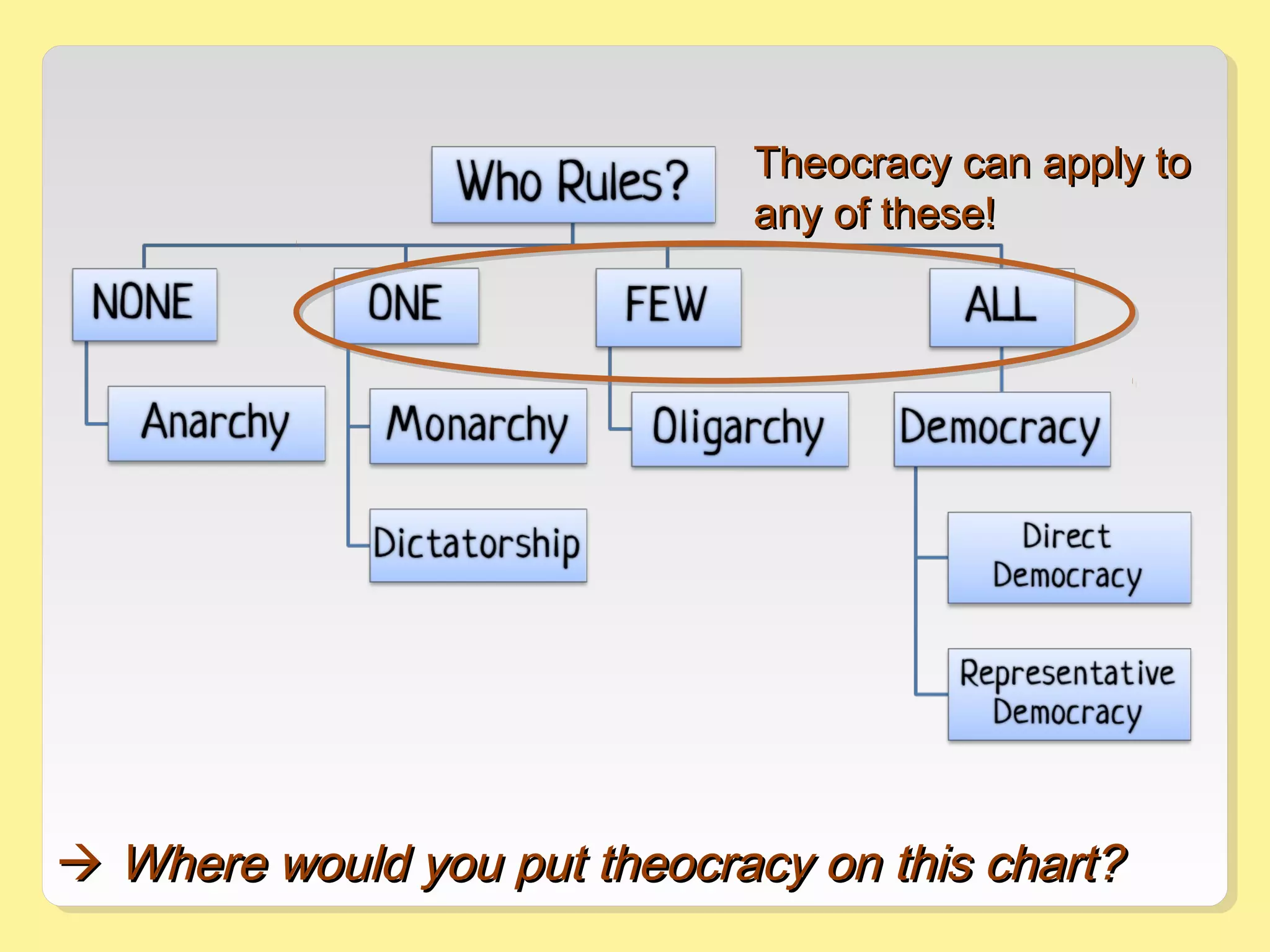
Who Rules?
TThheeooccrraaccyy ccaann aappppllyy ttoo 
aannyy ooff tthheessee!! 
 Where wwoouulldd yyoouu ppuutt tthheeooccrraaccyy oonn tthhiiss cchhaarrtt??
MINI-QUIZ 
Do You Know Your Forms of Government?
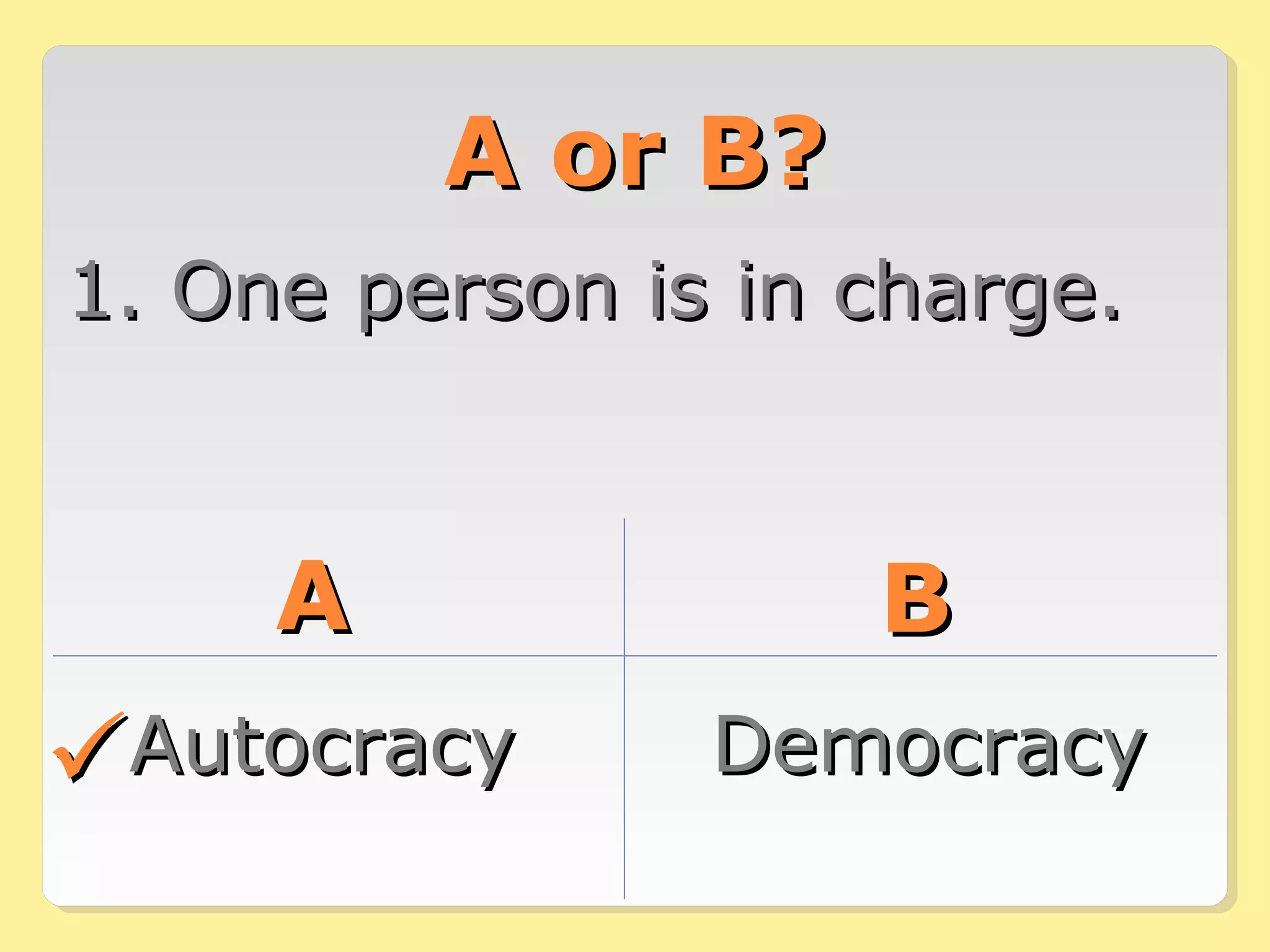
AA oorr BB?? 
11.. OOnnee ppeerrssoonn iiss iinn cchhaarrggee.. 
AA BB 
AAuuttooccrraaccyy DDeemmooccrraaccyy
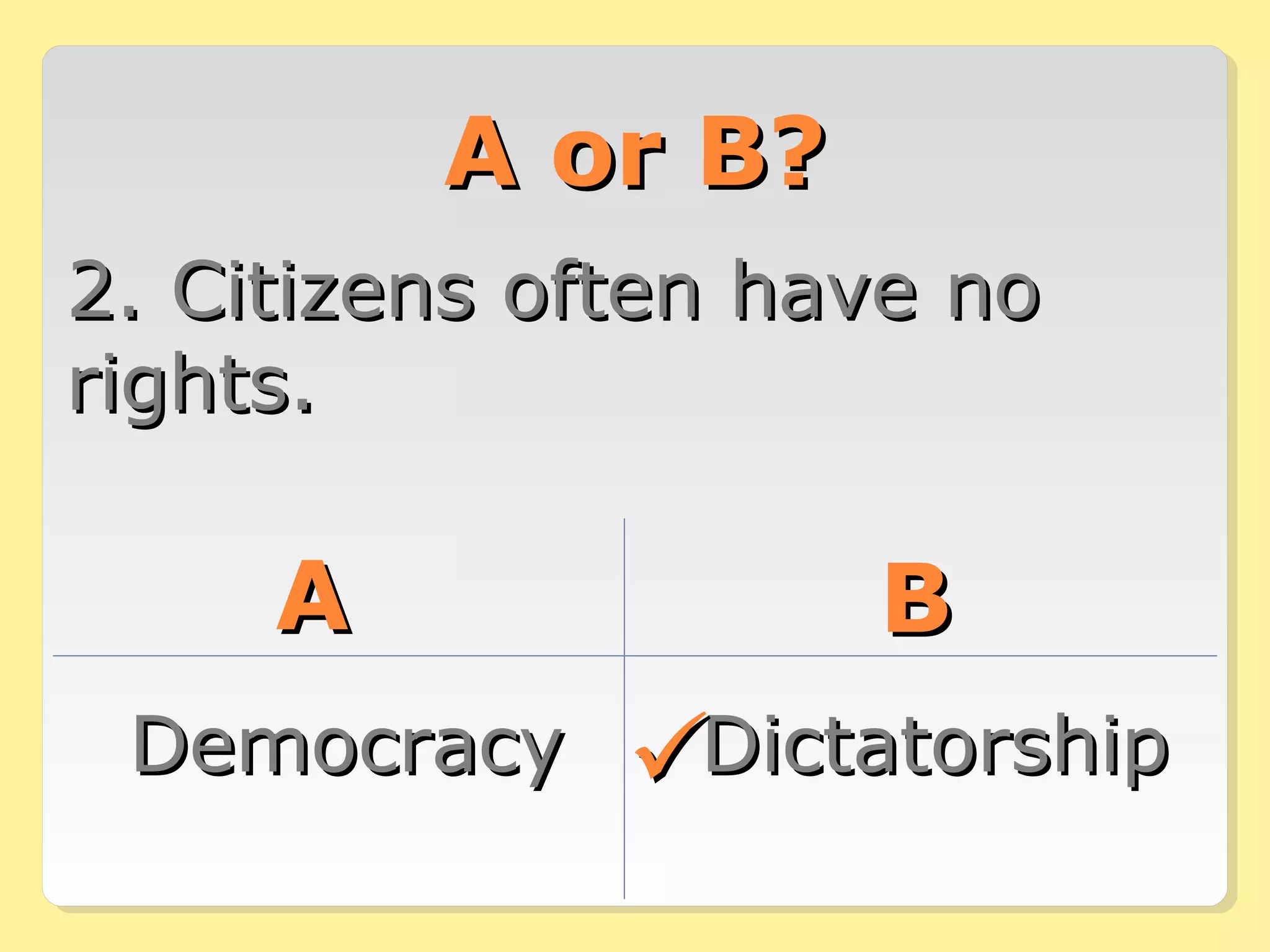
AA oorr BB?? 
22.. CCiittiizzeennss oofftteenn hhaavvee nnoo 
rriigghhttss.. 
AA BB 
DDeemmooccrraaccyy DDiiccttaattoorrsshhiipp
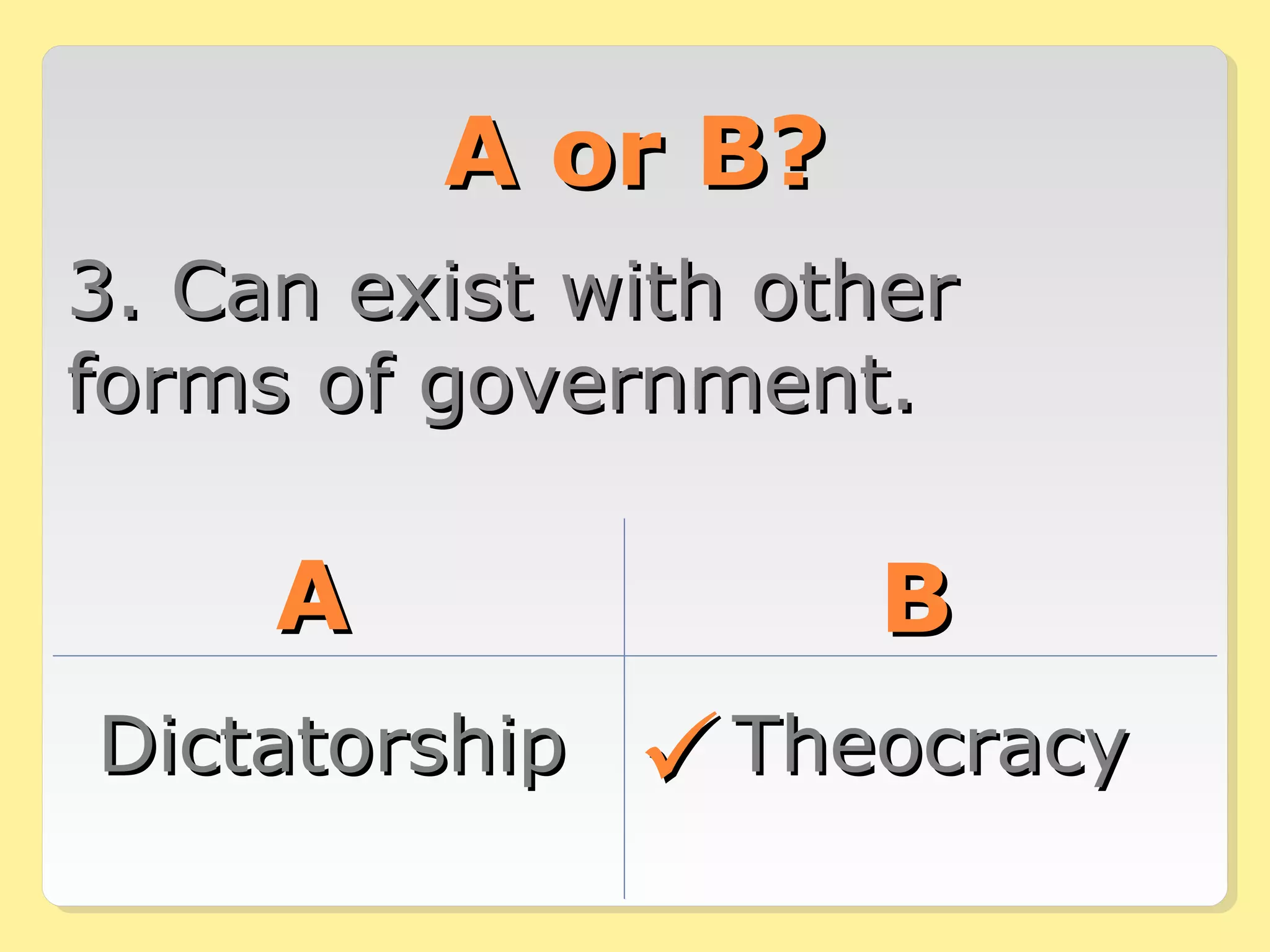
AA oorr BB?? 
33.. CCaann eexxiisstt wwiitthh ootthheerr 
ffoorrmmss ooff ggoovveerrnnmmeenntt.. 
AA BB 
DDiiccttaattoorrsshhiipp TThheeooccrraaccyy
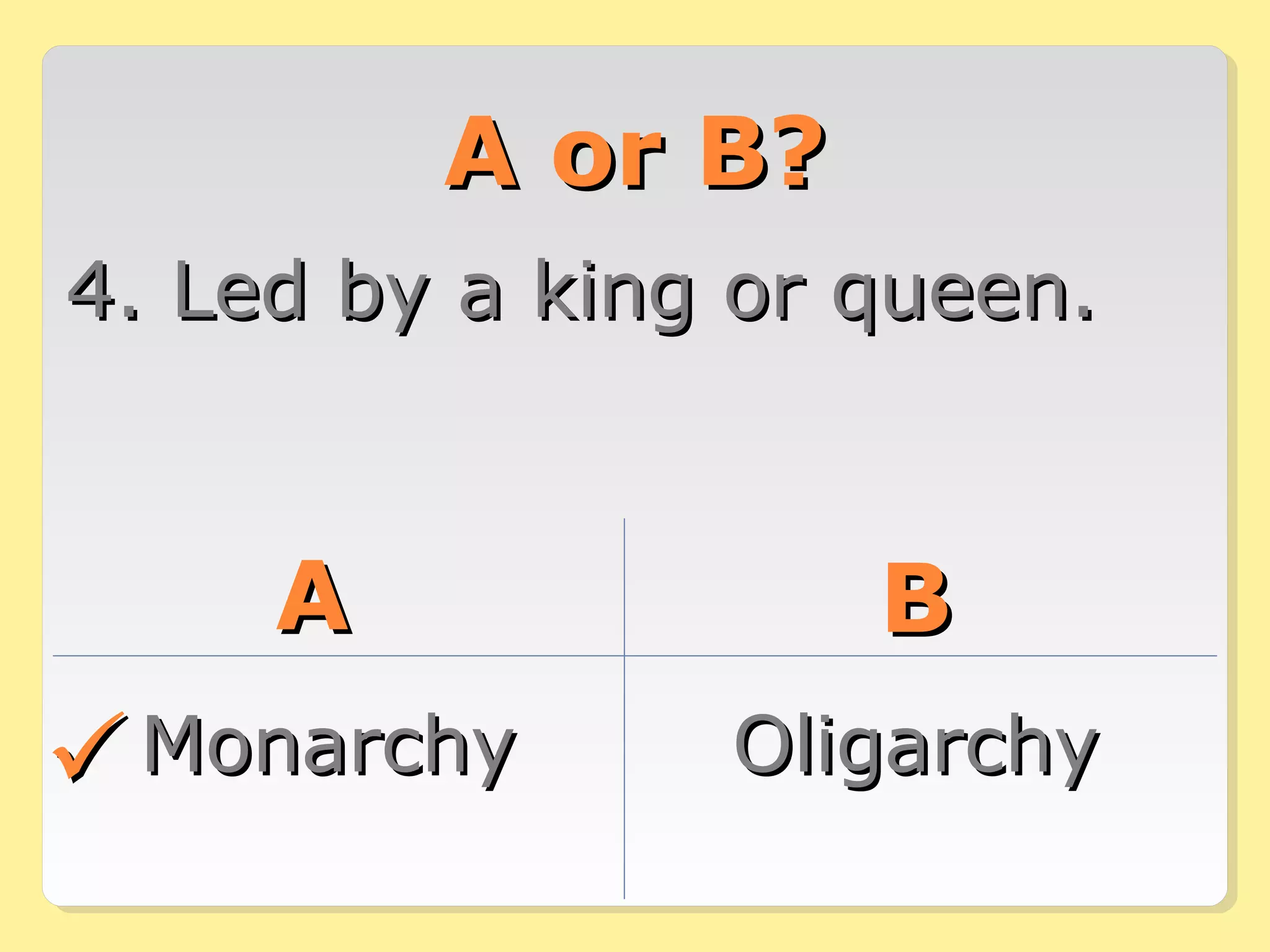
AA oorr BB?? 
44.. LLeedd bbyy aa kkiinngg oorr qquueeeenn.. 
AA BB 
MMoonnaarrcchhyy OOlliiggaarrcchhyy
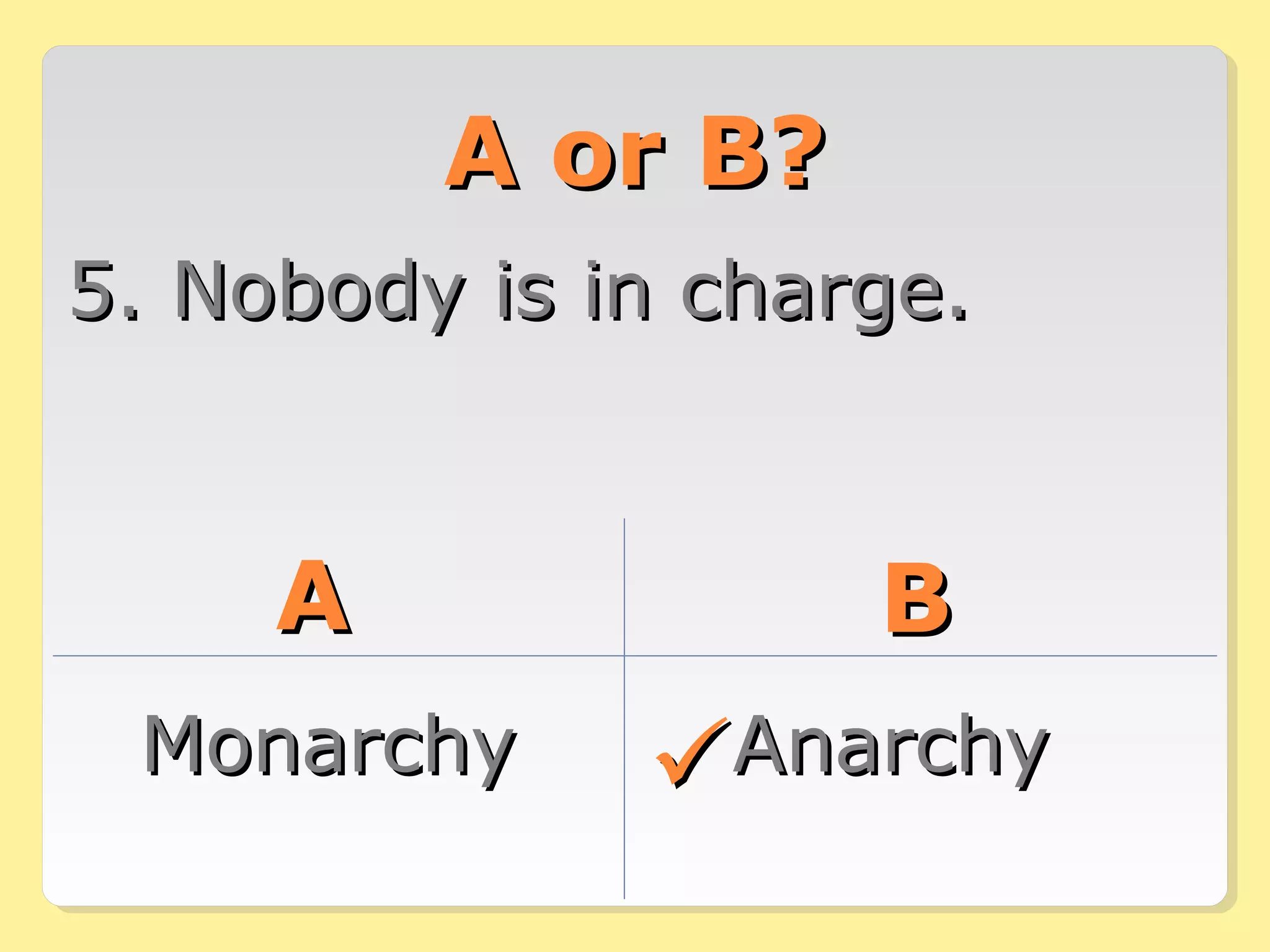
AA oorr BB?? 
55.. NNoobbooddyy iiss iinn cchhaarrggee.. 
AA BB 
MMoonnaarrcchhyy AAnnaarrcchhyy
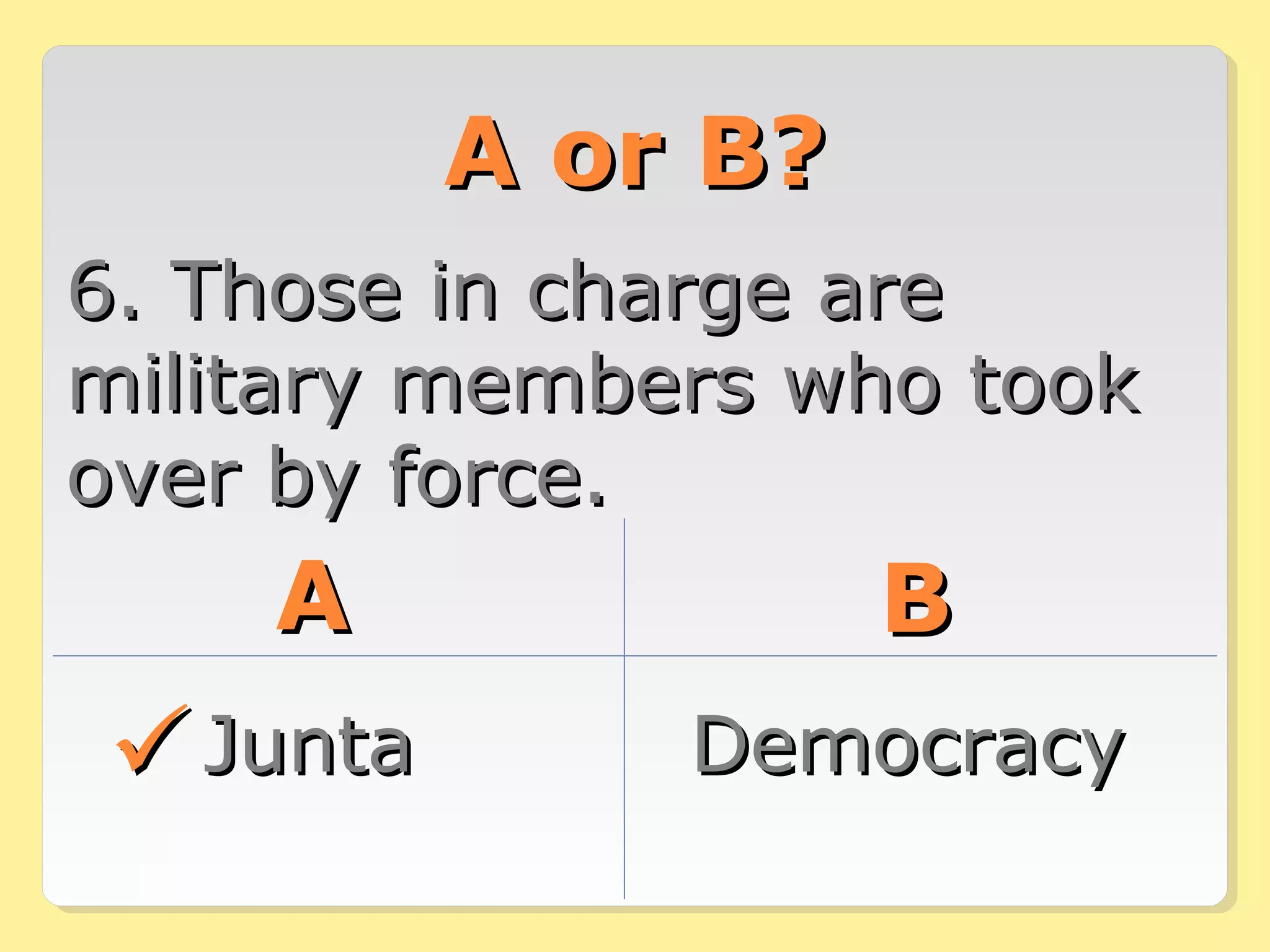
AA oorr BB?? 
66.. TThhoossee iinn cchhaarrggee aarree 
mmiilliittaarryy mmeemmbbeerrss wwhhoo ttooookk 
oovveerr bbyy ffoorrccee.. 
AA BB 
JJuunnttaa DDeemmooccrraaccyy
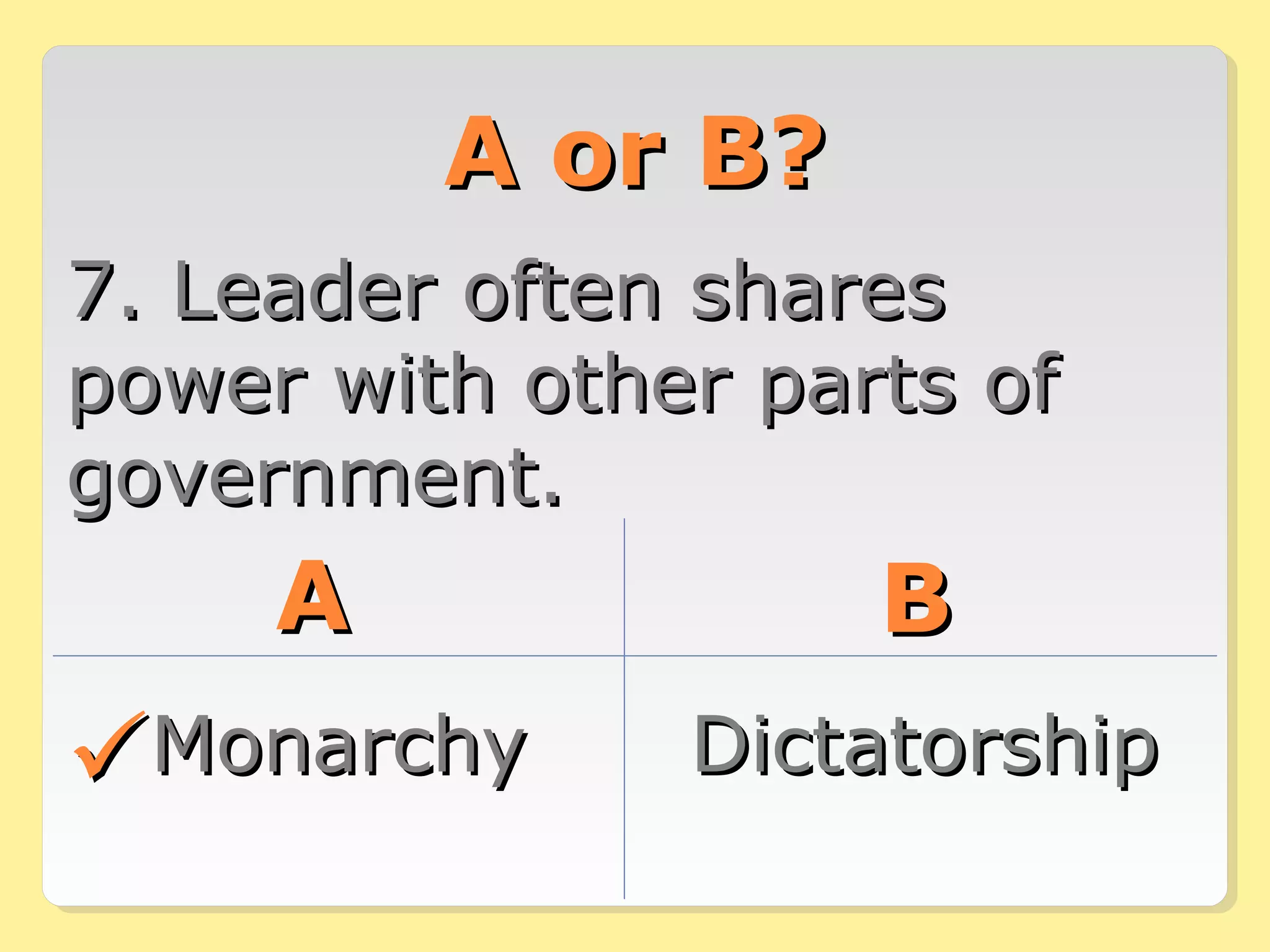
AA oorr BB?? 
77.. LLeeaaddeerr oofftteenn sshhaarreess 
ppoowweerr wwiitthh ootthheerr ppaarrttss ooff 
ggoovveerrnnmmeenntt.. 
AA BB 
MMoonnaarrcchhyy DDiiccttaattoorrsshhiipp
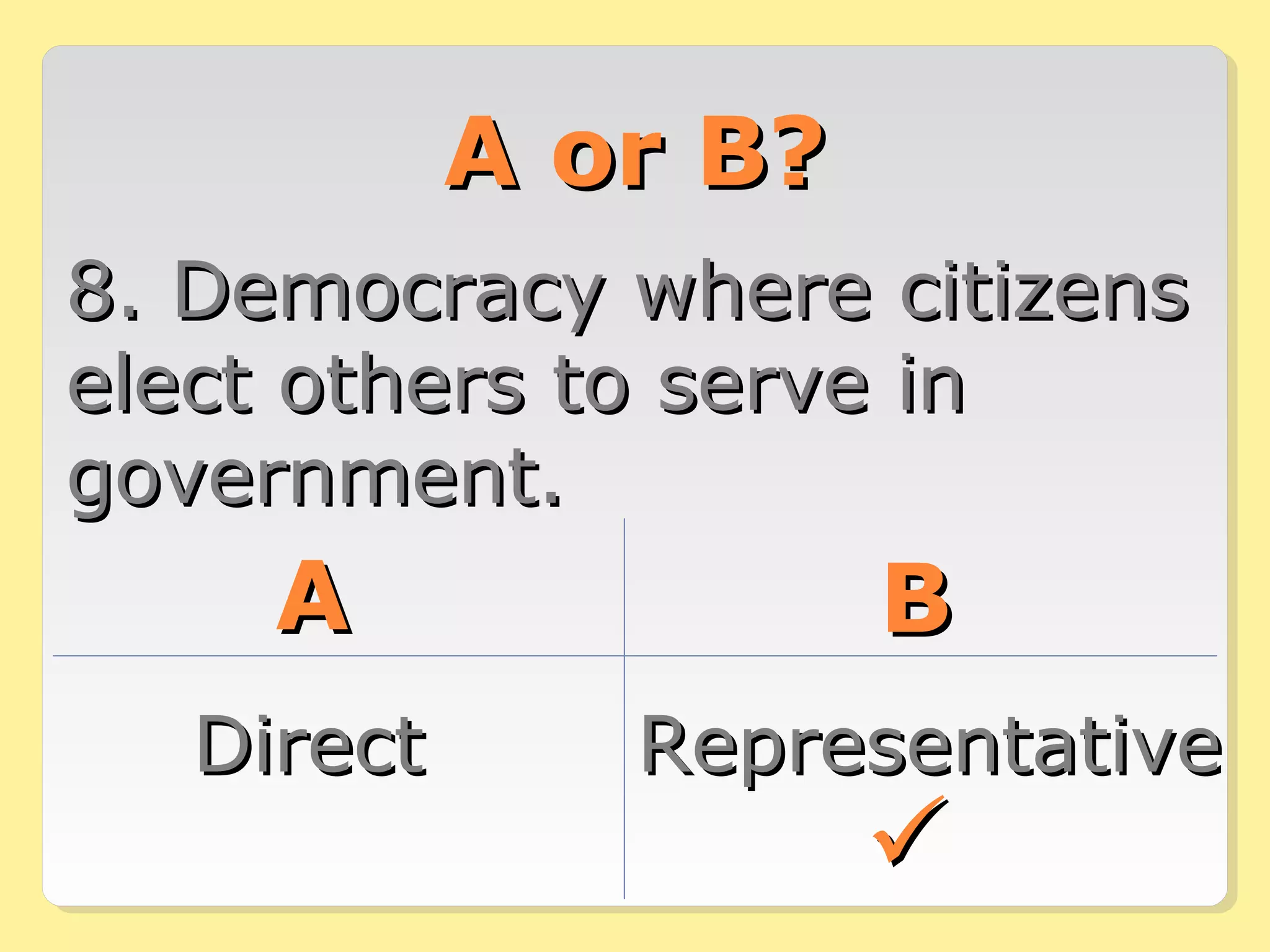
AA oorr BB?? 
88.. DDeemmooccrraaccyy wwhheerree cciittiizzeennss 
eelleecctt ootthheerrss ttoo sseerrvvee iinn 
ggoovveerrnnmmeenntt.. 
AA BB 
DDiirreecctt RReepprreesseennttaattiivvee 

AA oorr BB?? 
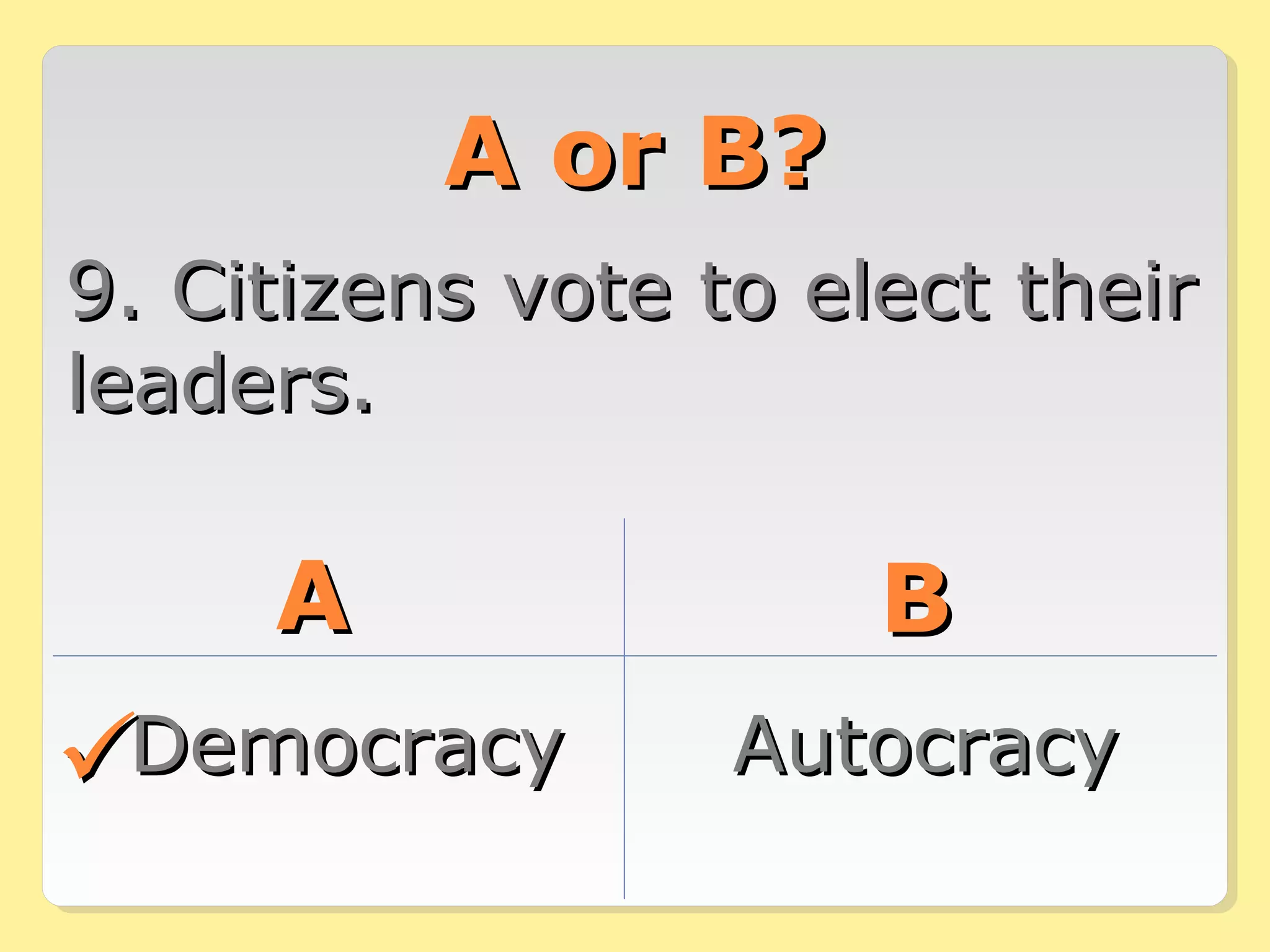
99.. CCiittiizzeennss vvoottee ttoo eelleecctt tthheeiirr 
lleeaaddeerrss.. 
AA BB 
DDeemmooccrraaccyy AAuuttooccrraaccyy
AA oorr BB?? 
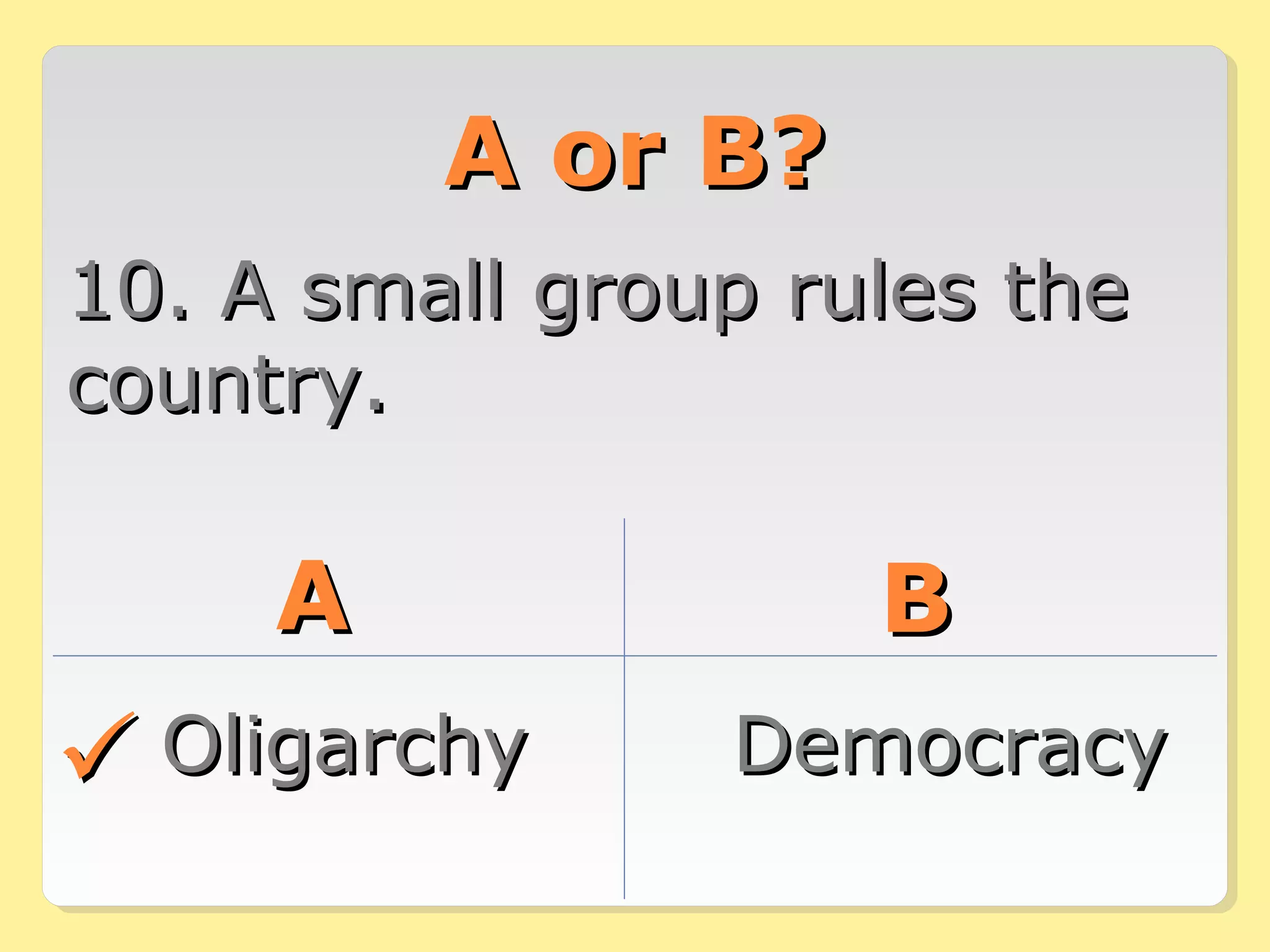
1100.. AA ssmmaallll ggrroouupp rruulleess tthhee 
ccoouunnttrryy.. 
AA BB 
OOlliiggaarrcchhyy DDeemmooccrraaccyy
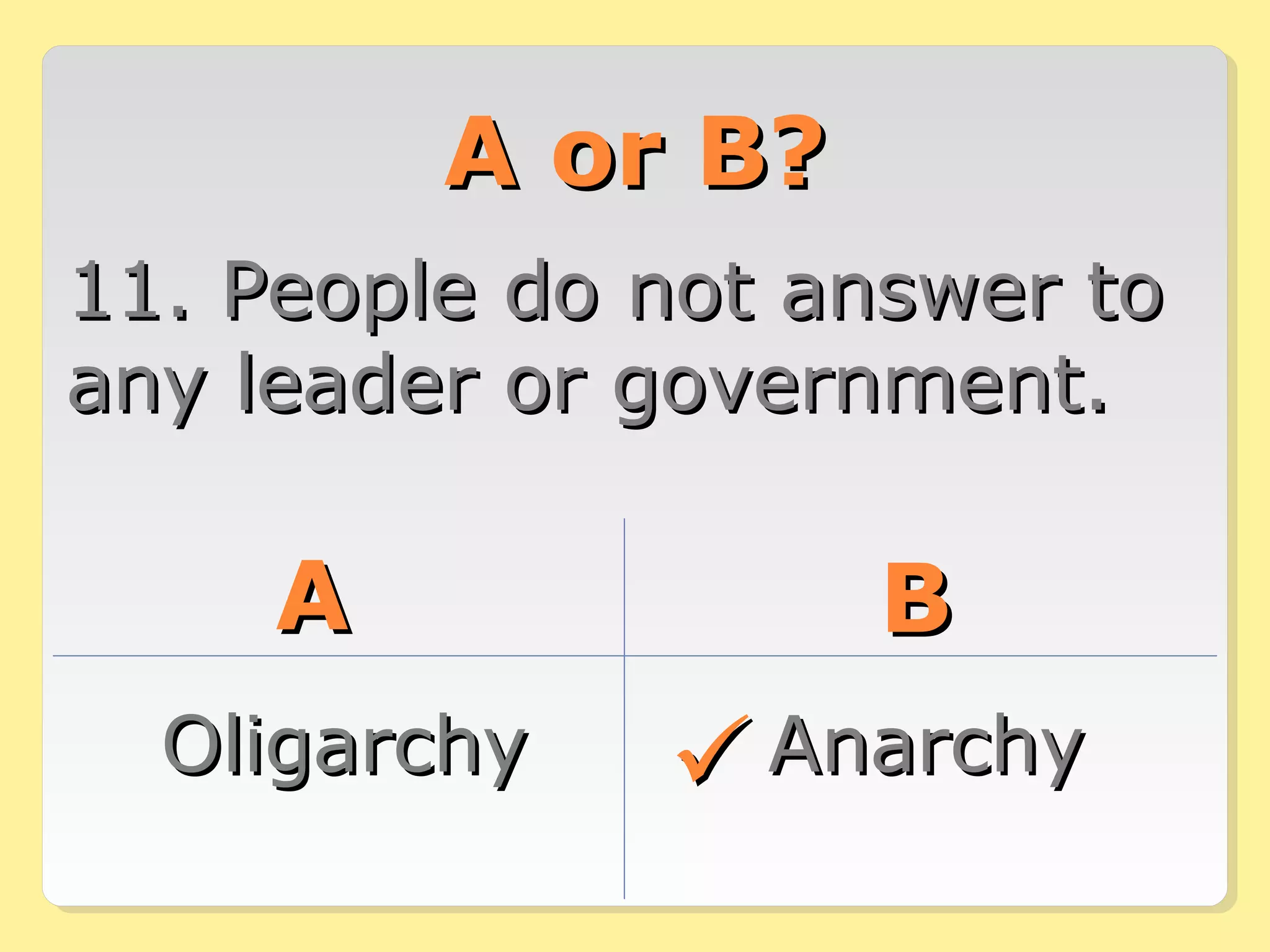
AA oorr BB?? 
1111.. PPeeooppllee ddoo nnoott aannsswweerr ttoo 
aannyy lleeaaddeerr oorr ggoovveerrnnmmeenntt.. 
AA BB 
OOlliiggaarrcchhyy AAnnaarrcchhyy
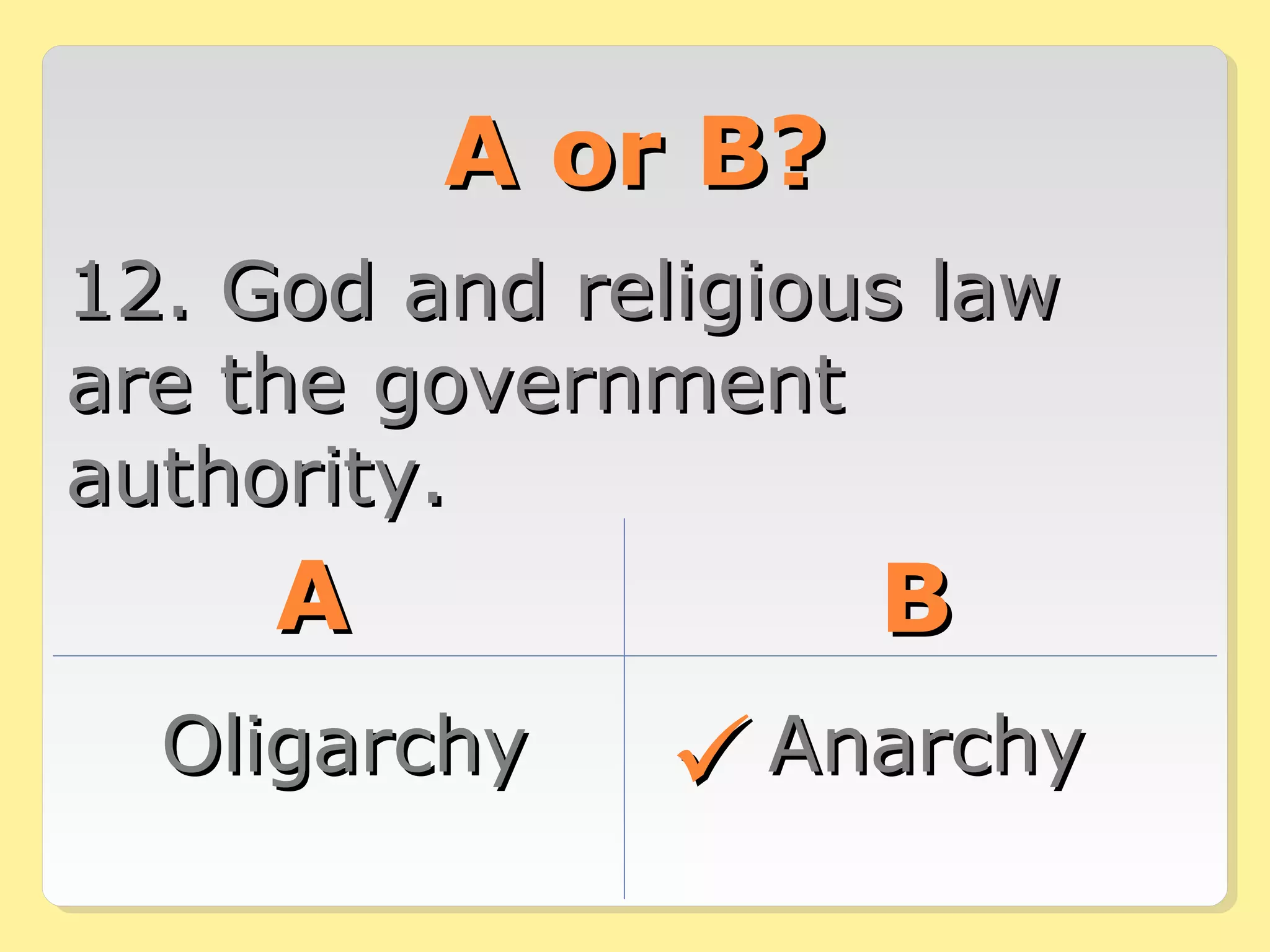
AA oorr BB?? 
1122.. GGoodd aanndd rreelliiggiioouuss llaaww 
aarree tthhee ggoovveerrnnmmeenntt 
aauutthhoorriittyy.. 
AA BB 
OOlliiggaarrcchhyy AAnnaarrcchhyy
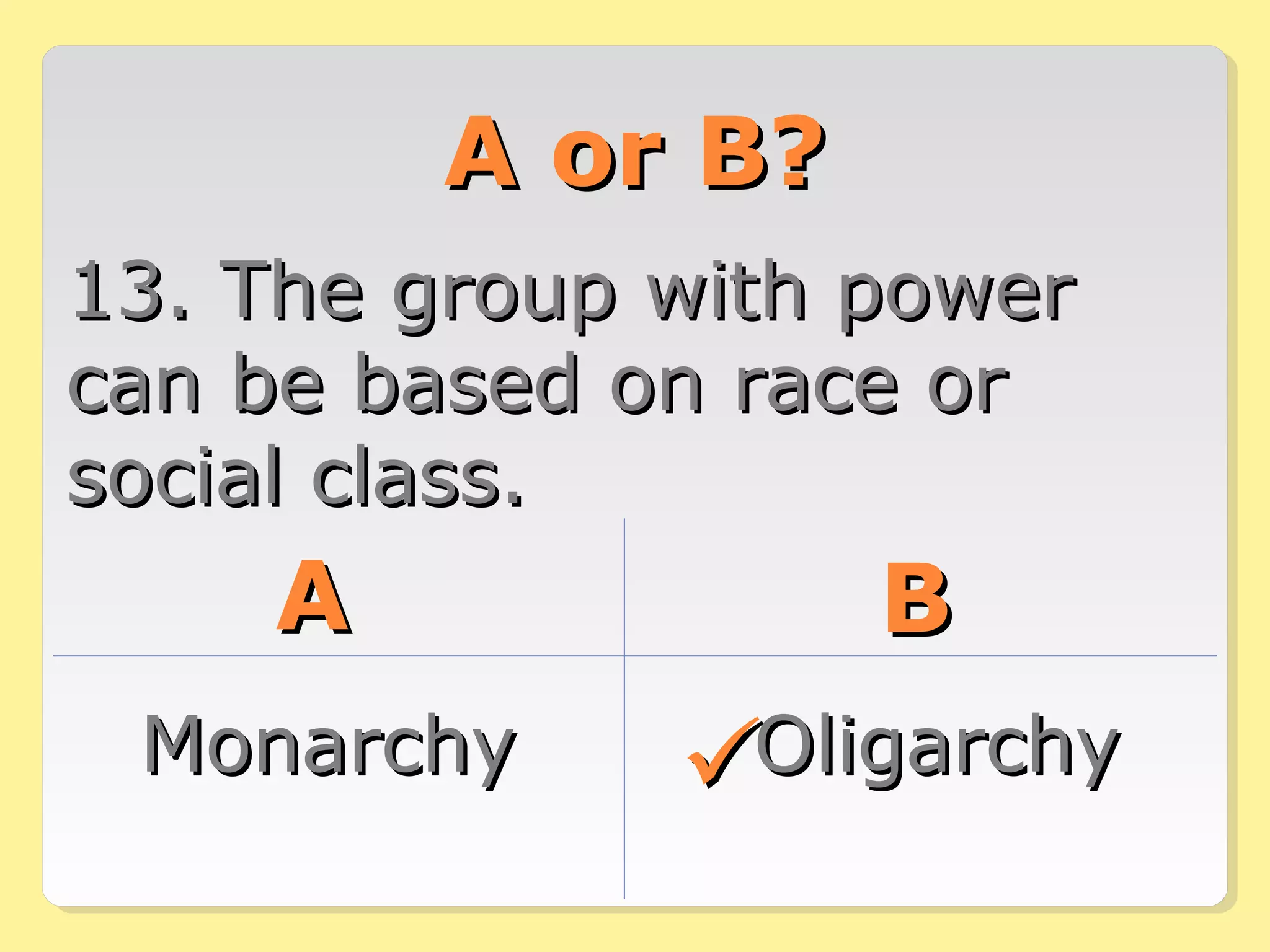
AA oorr BB?? 
1133.. TThhee ggrroouupp wwiitthh ppoowweerr 
ccaann bbee bbaasseedd oonn rraaccee oorr 
ssoocciiaall ccllaassss.. 
AA BB 
MMoonnaarrcchhyy OOlliiggaarrcchhyy
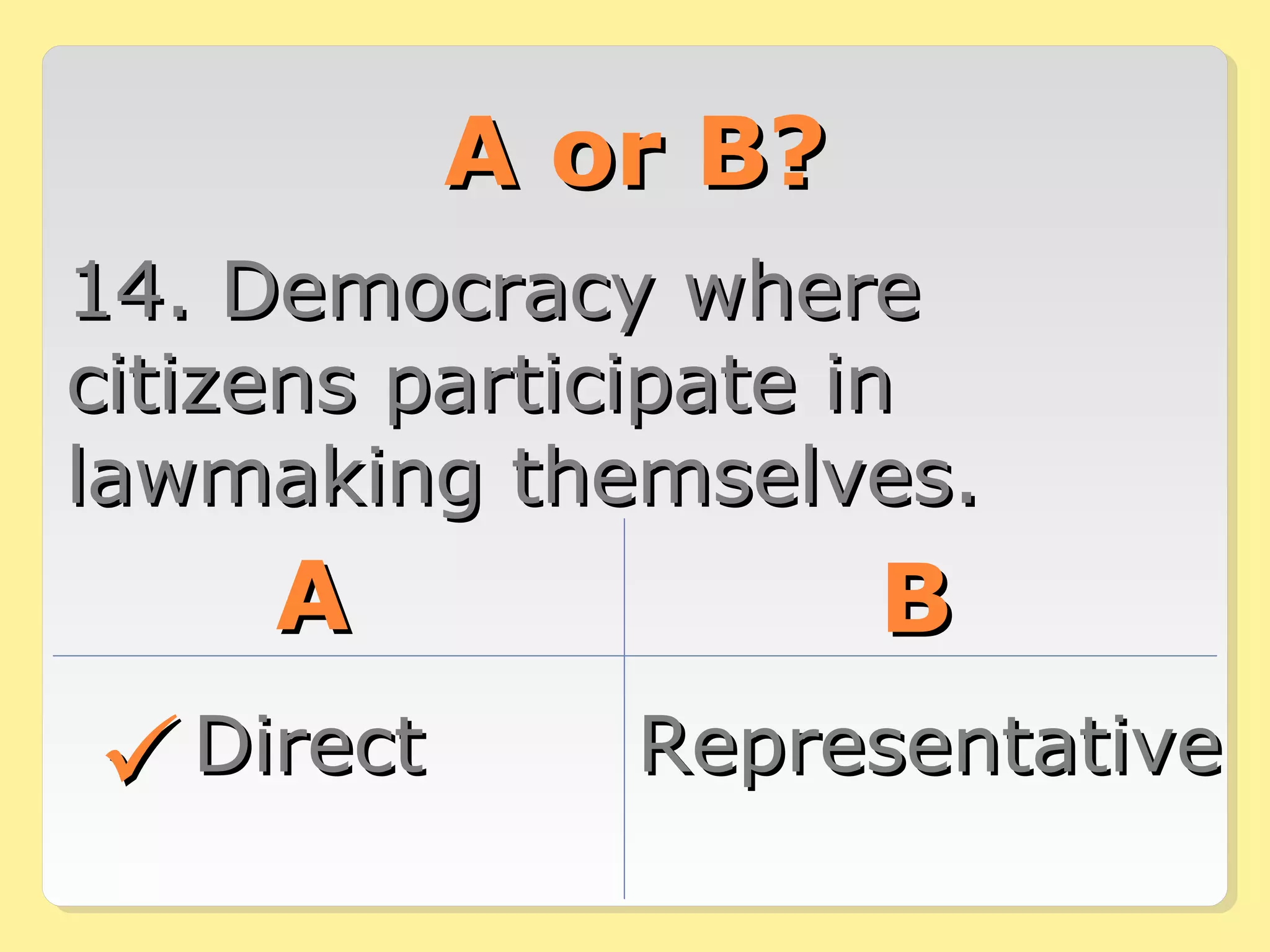
AA oorr BB?? 
1144.. DDeemmooccrraaccyy wwhheerree 
cciittiizzeennss ppaarrttiicciippaattee iinn 
llaawwmmaakkiinngg tthheemmsseellvveess.. 
AA BB 
DDiirreecctt RReepprreesseennttaattiivvee
ACTIVITY A 
Identify That Government!
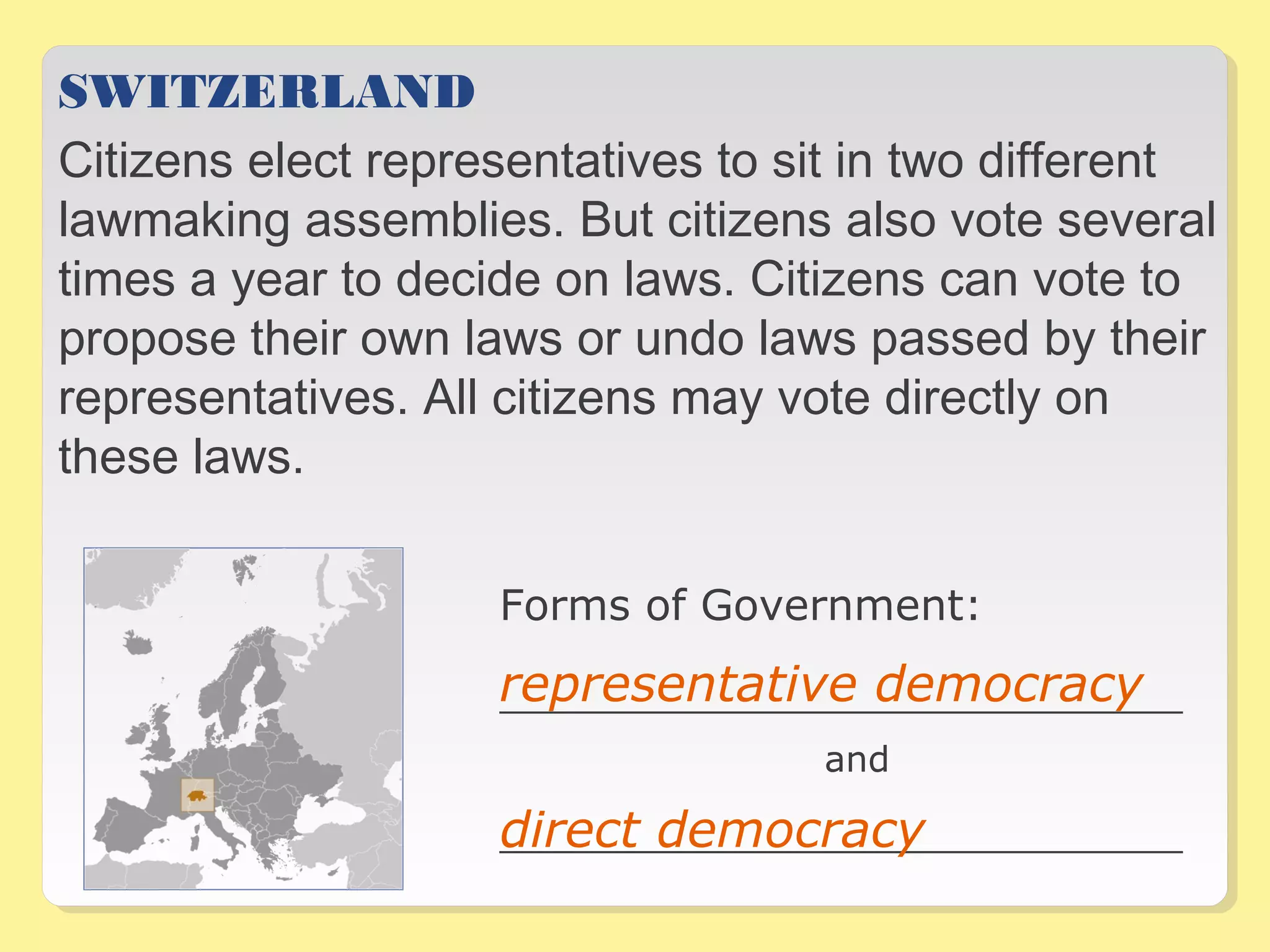
SWITZERLAND 
Citizens elect representatives to sit in two different 
lawmaking assemblies. But citizens also vote several 
times a year to decide on laws. Citizens can vote to 
propose their own laws or undo laws passed by their 
representatives. All citizens may vote directly on 
these laws. 
Forms of Government: 
representative democracy 
__________________________________ 
and 
direct democracy 
__________________________________
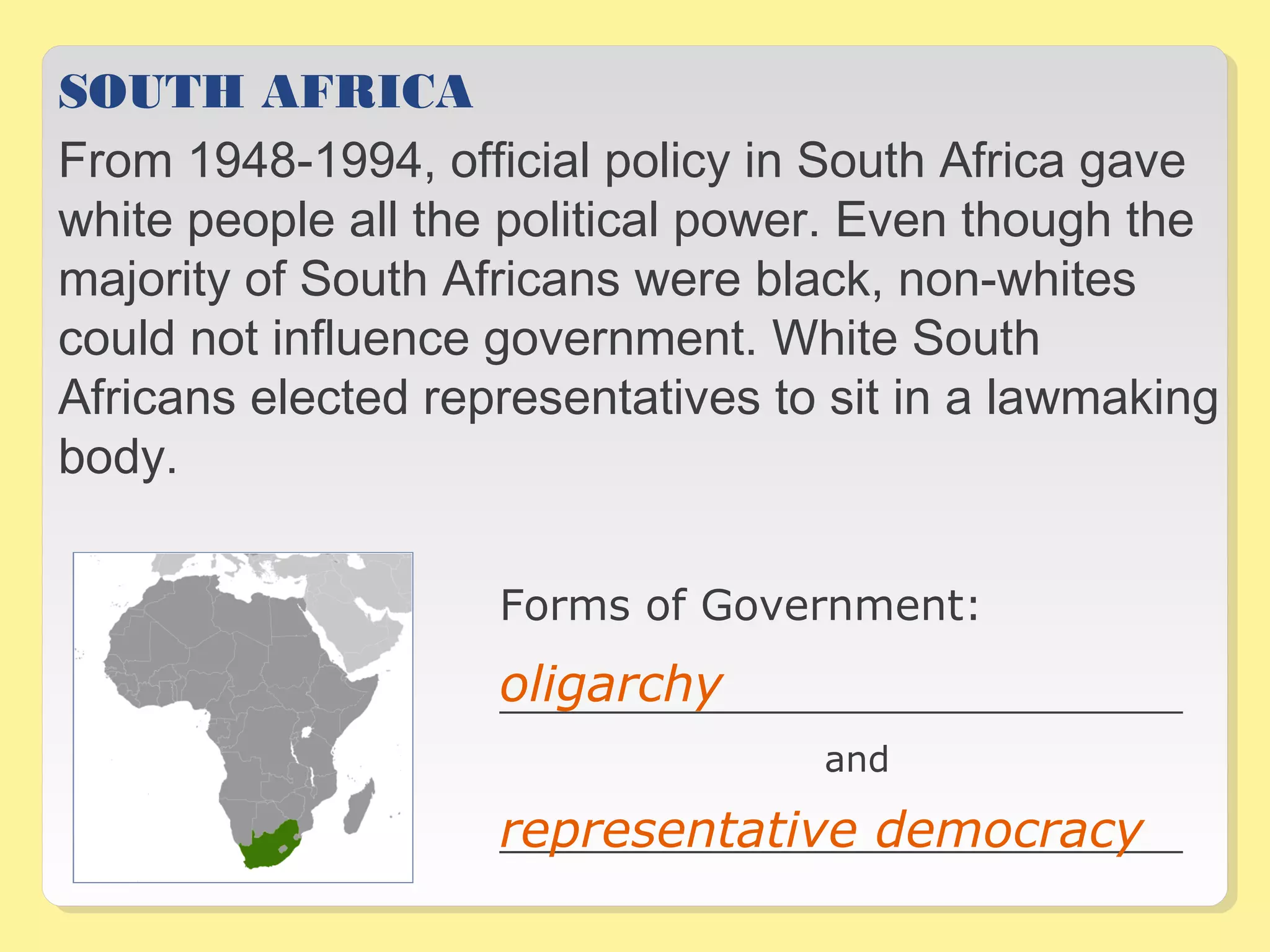
SOUTH AFRICA 
From 1948-1994, official policy in South Africa gave 
white people all the political power. Even though the 
majority of South Africans were black, non-whites 
could not influence government. White South 
Africans elected representatives to sit in a lawmaking 
body. 
Forms of Government: 
oligarchy 
__________________________________ 
and 
representative democracy 
__________________________________
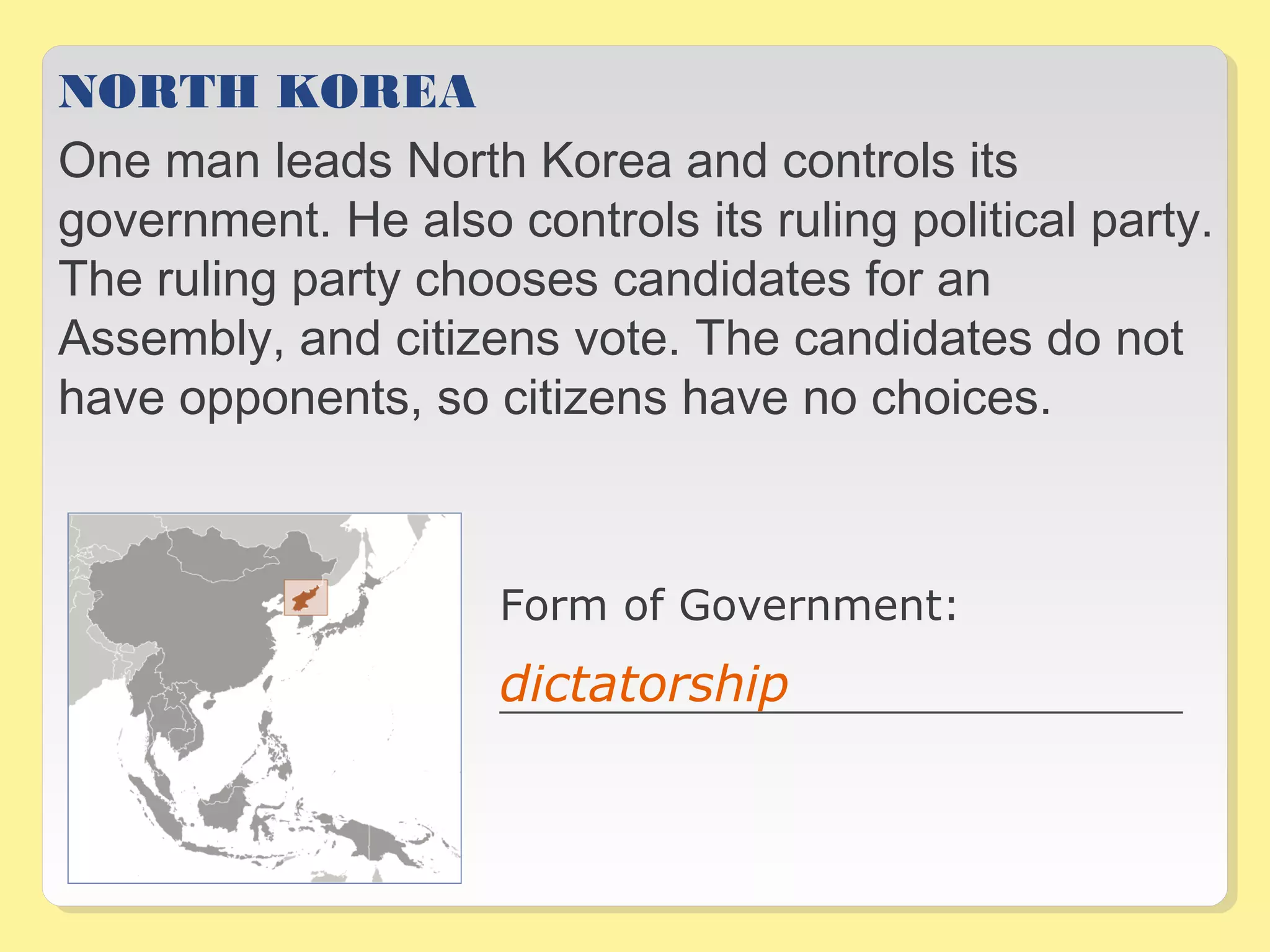
NORTH KOREA 
One man leads North Korea and controls its 
government. He also controls its ruling political party. 
The ruling party chooses candidates for an 
Assembly, and citizens vote. The candidates do not 
have opponents, so citizens have no choices. 
Form of Government: 
_________________________________dictatorship _
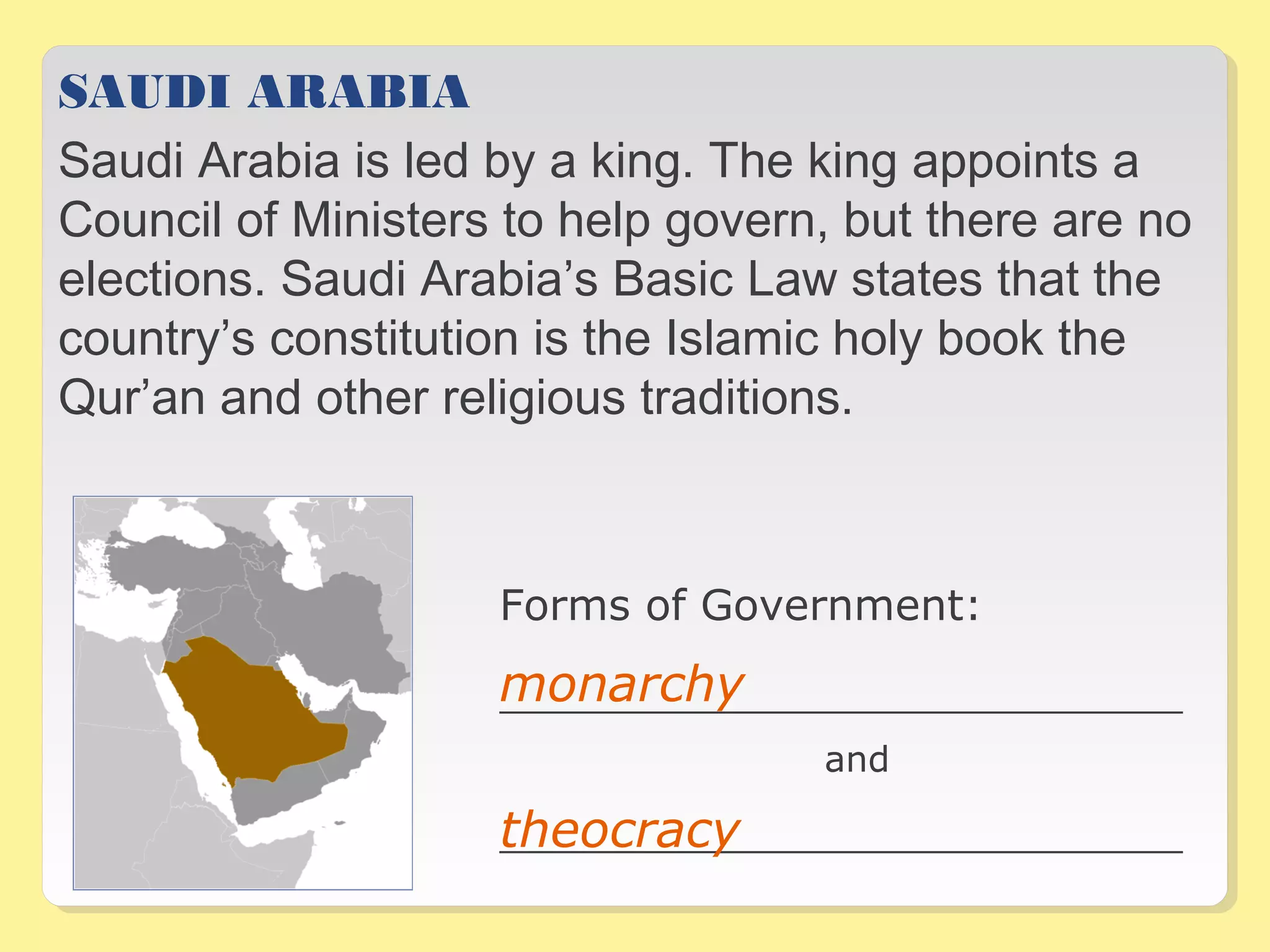
SAUDI ARABIA 
Saudi Arabia is led by a king. The king appoints a 
Council of Ministers to help govern, but there are no 
elections. Saudi Arabia’s Basic Law states that the 
country’s constitution is the Islamic holy book the 
Qur’an and other religious traditions. 
Forms of Government: 
monarchy 
__________________________________ 
and 
theocracy 
__________________________________
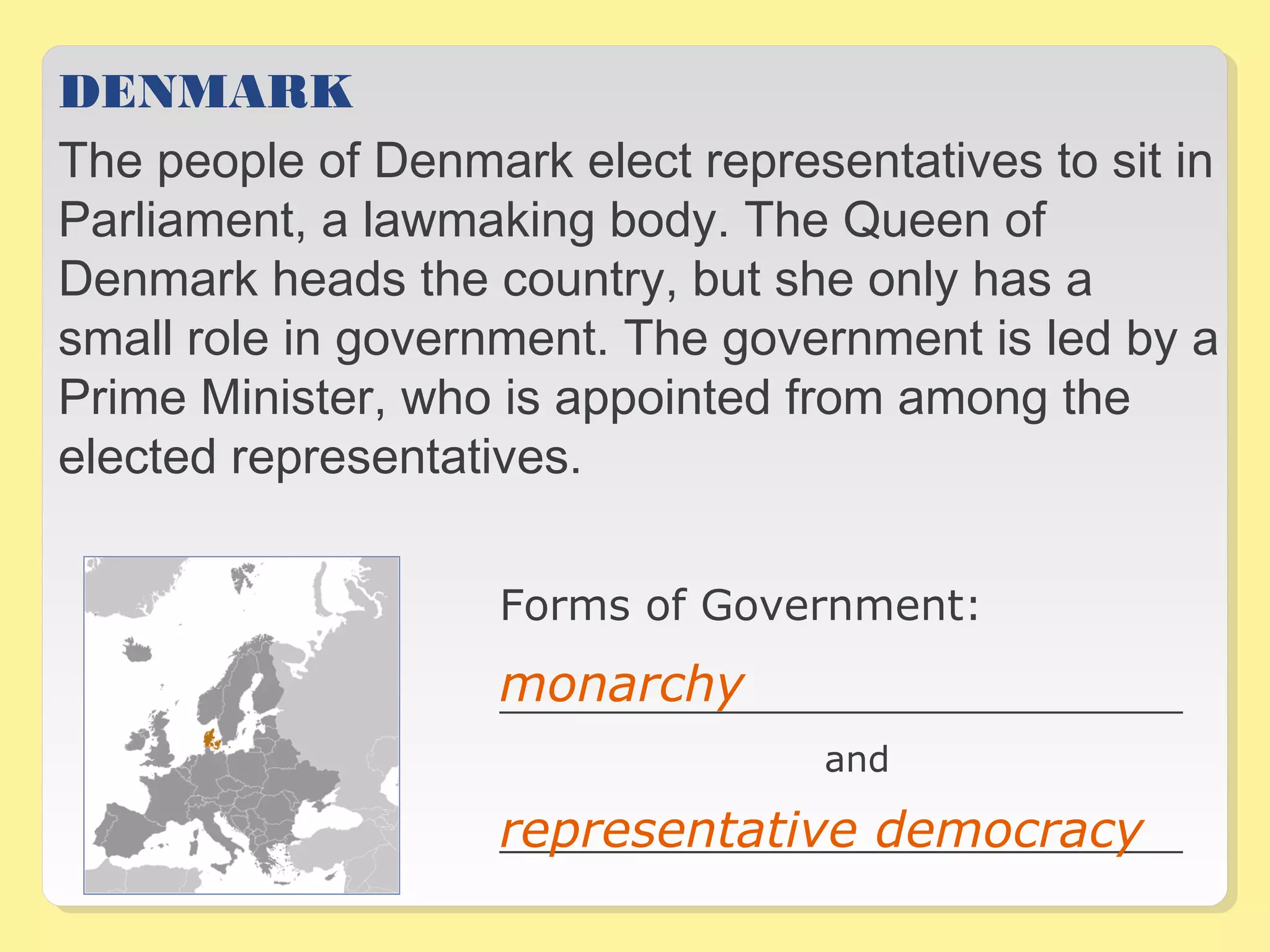
DENMARK 
The people of Denmark elect representatives to sit in 
Parliament, a lawmaking body. The Queen of 
Denmark heads the country, but she only has a 
small role in government. The government is led by a 
Prime Minister, who is appointed from among the 
elected representatives. 
Forms of Government: 
monarchy 
__________________________________ 
and 
representative democracy 
__________________________________
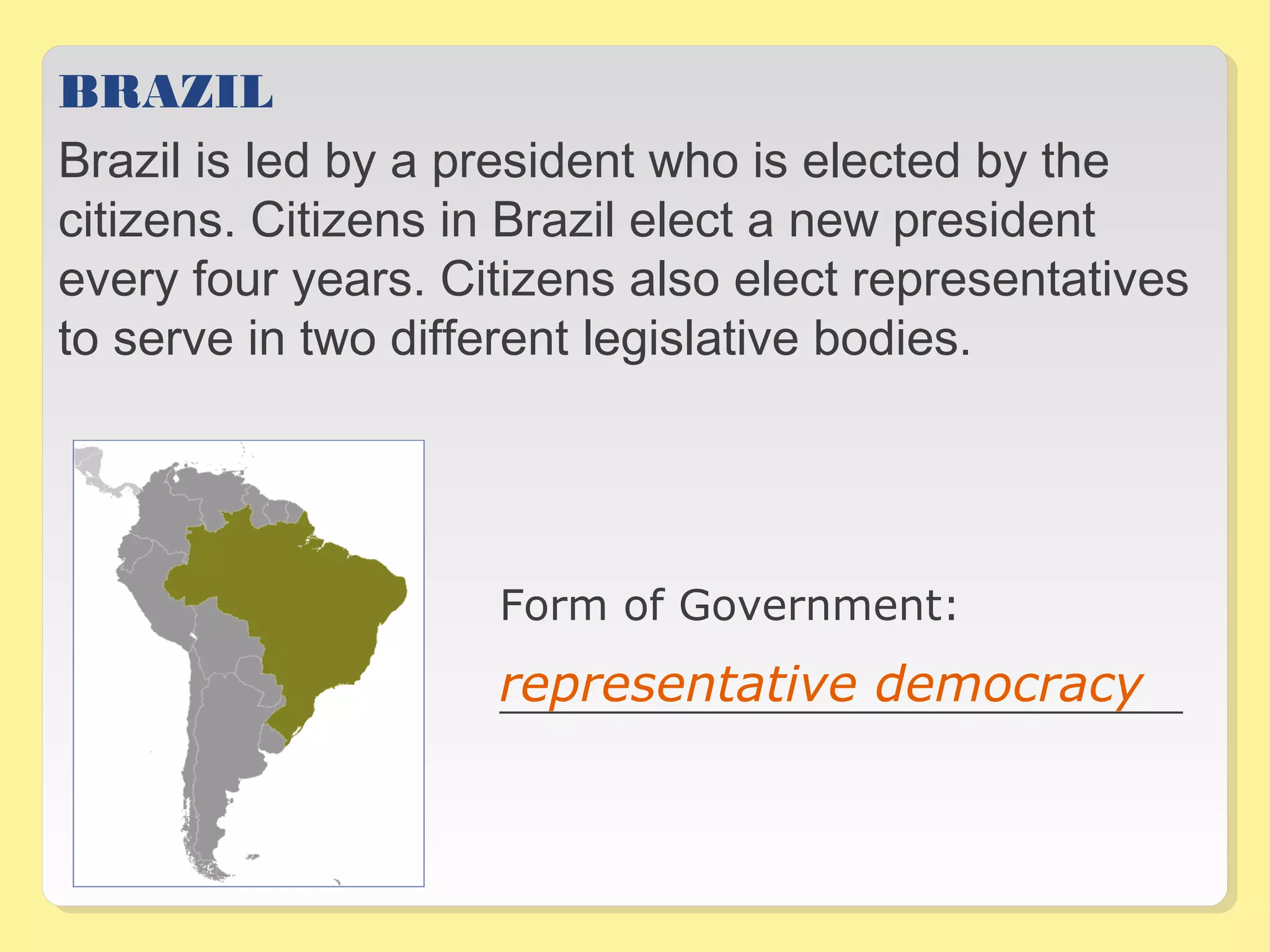
BRAZIL 
Brazil is led by a president who is elected by the 
citizens. Citizens in Brazil elect a new president 
every four years. Citizens also elect representatives 
to serve in two different legislative bodies. 
Form of Government: 
_________________________________representative democracy _
ACTIVITY B 
True or False?
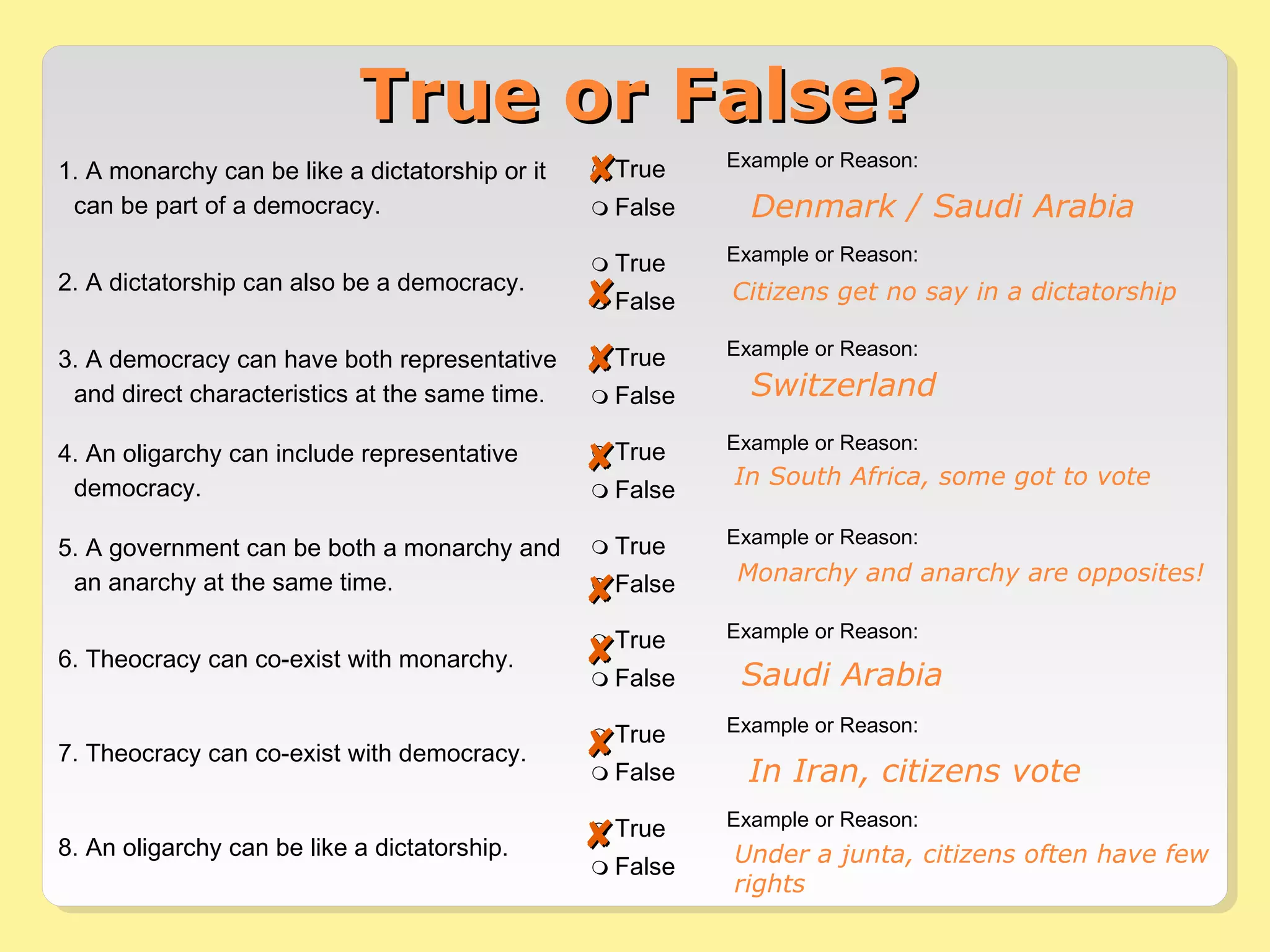
TTrruuee oorr FFaallssee?? 
1. A monarchy can be like a dictatorship or it 
can be part of a democracy. 
 True 
 False 
Example or Reason: 
2. A dictatorship can also be a democracy.  True 
 False 
Example or Reason: 
3. A democracy can have both representative 
and direct characteristics at the same time. 
 True 
 False 
Example or Reason: 
4. An oligarchy can include representative 
democracy. 
 True 
 False 
Example or Reason: 
5. A government can be both a monarchy and 
an anarchy at the same time. 
 True 
 False 
Example or Reason: 
6. Theocracy can co-exist with monarchy.  True 
 False 
Example or Reason: 
7. Theocracy can co-exist with democracy.  True 
 False 
Example or Reason: 
8. An oligarchy can be like a dictatorship.  True 
 False 
Example or Reason: 
 
Denmark / Saudi Arabia 
 Citizens get no say in a dictatorship 
 Switzerland 
 In South Africa, some got to vote 
 Monarchy and anarchy are opposites! 
 Saudi Arabia 
 In Iran, citizens vote 
 Under a junta, citizens often have few 
rights
ACTIVITY C 
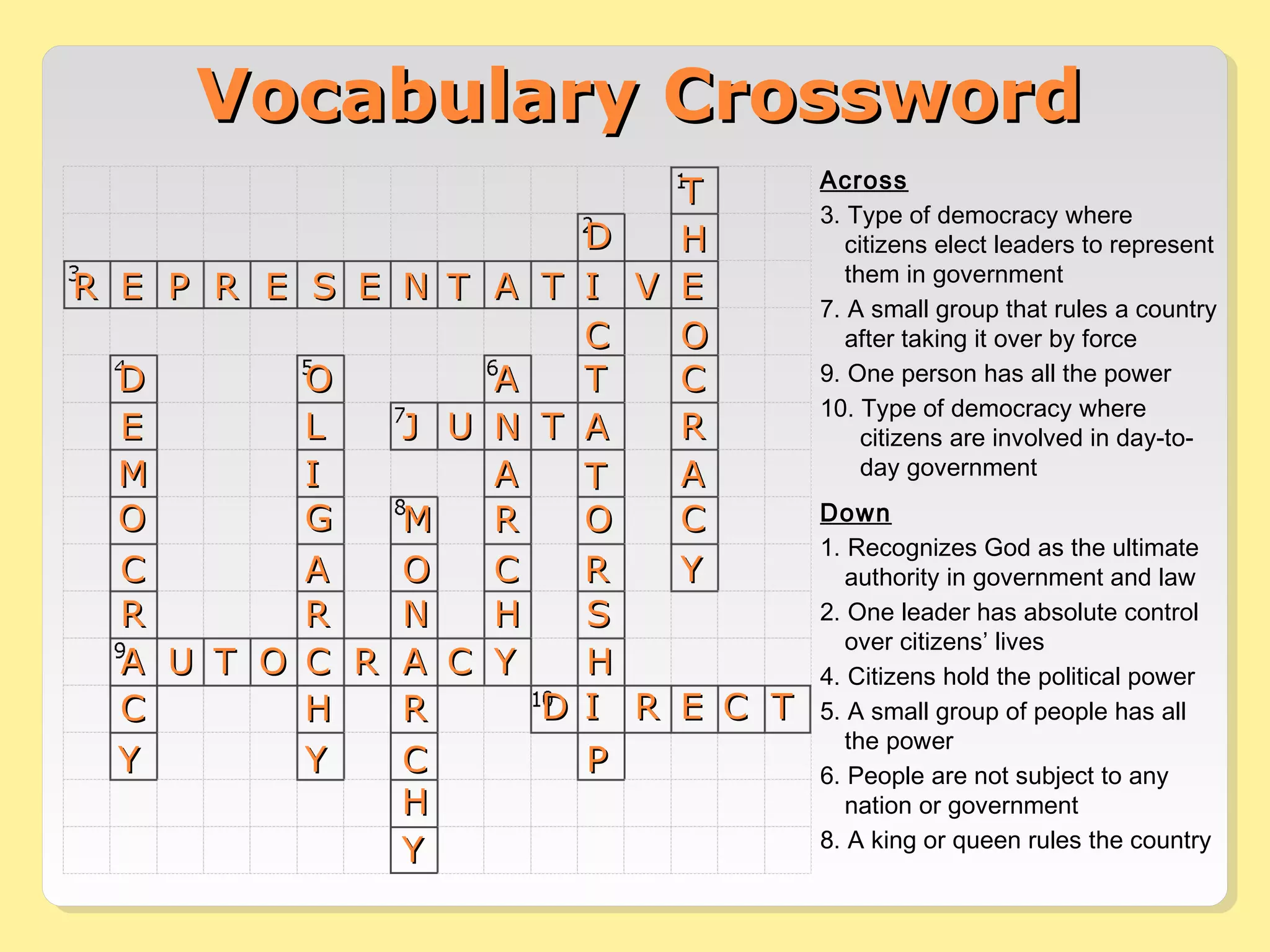
Vocabulary Crossword
VVooccaabbuullaarryy CCrroosssswwoorrdd 
Across 
3. Type of democracy where 
citizens elect leaders to represent 
them in government 
7. A small group that rules a country 
after taking it over by force 
9. One person has all the power 
10. Type of democracy where 
citizens are involved in day-to-day 
government 
Down 
1. Recognizes God as the ultimate 
authority in government and law 
2. One leader has absolute control 
over citizens’ lives 
4. Citizens hold the political power 
5. A small group of people has all 
the power 
6. People are not subject to any 
nation or government 
8. A king or queen rules the country 
DD 
TT 
HH 
RR EE PP RR EE SS EE NN TT AA TT II VV EE 
OO 
CC 
RR 
AA 
CC 
CC 
TT 
AA 
TT 
OO 
RR YY 
SS 
DD II 
PP 
RR EE CC TT 
OO 
LL 
AA 
JJ UU NN 
TT 
I 
MM GG I 
HH 
AA 
RR 
CC 
HH 
OO 
NN 
AA 
RR 
CC 
AA 
RR 
OO CC 
RR 
HH 
YY 
HH 
YY 
CC YY 
CC 
RR 
AA 
CC 
YY 
UU TT 
DD 
EE 
MM 
OO

Who rules

  • 1.
  • 2.
  • 3.
    TThheeooccrraaccyy ccaann aappppllyyttoo aannyy ooff tthheessee!!  Where wwoouulldd yyoouu ppuutt tthheeooccrraaccyy oonn tthhiiss cchhaarrtt??
  • 4.
    MINI-QUIZ Do YouKnow Your Forms of Government?
  • 5.
    AA oorr BB?? 11.. OOnnee ppeerrssoonn iiss iinn cchhaarrggee.. AA BB AAuuttooccrraaccyy DDeemmooccrraaccyy
  • 6.
    AA oorr BB?? 22.. CCiittiizzeennss oofftteenn hhaavvee nnoo rriigghhttss.. AA BB DDeemmooccrraaccyy DDiiccttaattoorrsshhiipp
  • 7.
    AA oorr BB?? 33.. CCaann eexxiisstt wwiitthh ootthheerr ffoorrmmss ooff ggoovveerrnnmmeenntt.. AA BB DDiiccttaattoorrsshhiipp TThheeooccrraaccyy
  • 8.
    AA oorr BB?? 44.. LLeedd bbyy aa kkiinngg oorr qquueeeenn.. AA BB MMoonnaarrcchhyy OOlliiggaarrcchhyy
  • 9.
    AA oorr BB?? 55.. NNoobbooddyy iiss iinn cchhaarrggee.. AA BB MMoonnaarrcchhyy AAnnaarrcchhyy
  • 10.
    AA oorr BB?? 66.. TThhoossee iinn cchhaarrggee aarree mmiilliittaarryy mmeemmbbeerrss wwhhoo ttooookk oovveerr bbyy ffoorrccee.. AA BB JJuunnttaa DDeemmooccrraaccyy
  • 11.
    AA oorr BB?? 77.. LLeeaaddeerr oofftteenn sshhaarreess ppoowweerr wwiitthh ootthheerr ppaarrttss ooff ggoovveerrnnmmeenntt.. AA BB MMoonnaarrcchhyy DDiiccttaattoorrsshhiipp
  • 12.
    AA oorr BB?? 88.. DDeemmooccrraaccyy wwhheerree cciittiizzeennss eelleecctt ootthheerrss ttoo sseerrvvee iinn ggoovveerrnnmmeenntt.. AA BB DDiirreecctt RReepprreesseennttaattiivvee 
  • 13.
    AA oorr BB?? 99.. CCiittiizzeennss vvoottee ttoo eelleecctt tthheeiirr lleeaaddeerrss.. AA BB DDeemmooccrraaccyy AAuuttooccrraaccyy
  • 14.
    AA oorr BB?? 1100.. AA ssmmaallll ggrroouupp rruulleess tthhee ccoouunnttrryy.. AA BB OOlliiggaarrcchhyy DDeemmooccrraaccyy
  • 15.
    AA oorr BB?? 1111.. PPeeooppllee ddoo nnoott aannsswweerr ttoo aannyy lleeaaddeerr oorr ggoovveerrnnmmeenntt.. AA BB OOlliiggaarrcchhyy AAnnaarrcchhyy
  • 16.
    AA oorr BB?? 1122.. GGoodd aanndd rreelliiggiioouuss llaaww aarree tthhee ggoovveerrnnmmeenntt aauutthhoorriittyy.. AA BB OOlliiggaarrcchhyy AAnnaarrcchhyy
  • 17.
    AA oorr BB?? 1133.. TThhee ggrroouupp wwiitthh ppoowweerr ccaann bbee bbaasseedd oonn rraaccee oorr ssoocciiaall ccllaassss.. AA BB MMoonnaarrcchhyy OOlliiggaarrcchhyy
  • 18.
    AA oorr BB?? 1144.. DDeemmooccrraaccyy wwhheerree cciittiizzeennss ppaarrttiicciippaattee iinn llaawwmmaakkiinngg tthheemmsseellvveess.. AA BB DDiirreecctt RReepprreesseennttaattiivvee
  • 19.
    ACTIVITY A IdentifyThat Government!
  • 20.
    SWITZERLAND Citizens electrepresentatives to sit in two different lawmaking assemblies. But citizens also vote several times a year to decide on laws. Citizens can vote to propose their own laws or undo laws passed by their representatives. All citizens may vote directly on these laws. Forms of Government: representative democracy __________________________________ and direct democracy __________________________________
  • 21.
    SOUTH AFRICA From1948-1994, official policy in South Africa gave white people all the political power. Even though the majority of South Africans were black, non-whites could not influence government. White South Africans elected representatives to sit in a lawmaking body. Forms of Government: oligarchy __________________________________ and representative democracy __________________________________
  • 22.
    NORTH KOREA Oneman leads North Korea and controls its government. He also controls its ruling political party. The ruling party chooses candidates for an Assembly, and citizens vote. The candidates do not have opponents, so citizens have no choices. Form of Government: _________________________________dictatorship _
  • 23.
    SAUDI ARABIA SaudiArabia is led by a king. The king appoints a Council of Ministers to help govern, but there are no elections. Saudi Arabia’s Basic Law states that the country’s constitution is the Islamic holy book the Qur’an and other religious traditions. Forms of Government: monarchy __________________________________ and theocracy __________________________________
  • 24.
    DENMARK The peopleof Denmark elect representatives to sit in Parliament, a lawmaking body. The Queen of Denmark heads the country, but she only has a small role in government. The government is led by a Prime Minister, who is appointed from among the elected representatives. Forms of Government: monarchy __________________________________ and representative democracy __________________________________
  • 25.
    BRAZIL Brazil isled by a president who is elected by the citizens. Citizens in Brazil elect a new president every four years. Citizens also elect representatives to serve in two different legislative bodies. Form of Government: _________________________________representative democracy _
  • 26.
    ACTIVITY B Trueor False?
  • 27.
    TTrruuee oorr FFaallssee?? 1. A monarchy can be like a dictatorship or it can be part of a democracy.  True  False Example or Reason: 2. A dictatorship can also be a democracy.  True  False Example or Reason: 3. A democracy can have both representative and direct characteristics at the same time.  True  False Example or Reason: 4. An oligarchy can include representative democracy.  True  False Example or Reason: 5. A government can be both a monarchy and an anarchy at the same time.  True  False Example or Reason: 6. Theocracy can co-exist with monarchy.  True  False Example or Reason: 7. Theocracy can co-exist with democracy.  True  False Example or Reason: 8. An oligarchy can be like a dictatorship.  True  False Example or Reason:  Denmark / Saudi Arabia  Citizens get no say in a dictatorship  Switzerland  In South Africa, some got to vote  Monarchy and anarchy are opposites!  Saudi Arabia  In Iran, citizens vote  Under a junta, citizens often have few rights
  • 28.
  • 29.
    VVooccaabbuullaarryy CCrroosssswwoorrdd Across 3. Type of democracy where citizens elect leaders to represent them in government 7. A small group that rules a country after taking it over by force 9. One person has all the power 10. Type of democracy where citizens are involved in day-to-day government Down 1. Recognizes God as the ultimate authority in government and law 2. One leader has absolute control over citizens’ lives 4. Citizens hold the political power 5. A small group of people has all the power 6. People are not subject to any nation or government 8. A king or queen rules the country DD TT HH RR EE PP RR EE SS EE NN TT AA TT II VV EE OO CC RR AA CC CC TT AA TT OO RR YY SS DD II PP RR EE CC TT OO LL AA JJ UU NN TT I MM GG I HH AA RR CC HH OO NN AA RR CC AA RR OO CC RR HH YY HH YY CC YY CC RR AA CC YY UU TT DD EE MM OO

Editor's Notes

  • #2 How far should government go to maintain order, provide public goods, and promote equality. In the U.S. (as in every other nations), citizens, scholars, and politicians have different answers. At one end is a belief that govt. should do everything…… At the other is the belief that govt. should not exist. These ideologies from most govt. to least govt. and those that ball in between we will look at today.
  • #4 A theocracy ("theo-" = God, "-cracy" = government) is a government operated under divine rule, or the pretense of divine rule. In practice, this term refers to a government operated by religious authorities who claim unlimited power in the name of God or other supernatural forces. There are many governments--including the United States--in which leaders invoke God, or claim to be inspired by God, or claim to obey the will of God. This does not, in practice, make a government a theocracy. What makes a government a theocracy is when lawmakers actually believe that leaders are governed by the will of God, and write laws predicated on this belief.
  • #6 An Autocracy, in which one individual has the power to make all important decisions. The concentration of power in the hands of one person (usually a monarch) was a more common form of government in earlier historical periods. Some countries are still ruled autocratically, such as Iran. An autocracy is a government controlled by one person with absolute power. As unlimited power doesn't usually bring out the best in people, autocracies are often brutal regimes. 6 Different types... 1. monarchy an autocracy governed by a monarch who usually inherits the authority 2. parliamentary monarchy a monarchy having a parliament 3. kingdom a monarchy with a king or queen as head of state 4. empire a monarchy with an emperor as head of state 5. police state a country that maintains repressive control over the people by means of police (especially secret police)
  • #7 Dictatorship implies absolute power — one person who takes control — of a political situation, a family, a classroom or even a camping expedition. In government, a dictatorship leaves no room for input from anyone who is not the top guy or gal. In a dictatorship, one person keeps repeating the same command: "My way or the highway."
  • #8 government operated by religious authorities who claim unlimited power in the name of God or other supernatural forces.
  • #9 A system of government in which one person reigns, usually a king or queen. The authority, or crown, in a monarchy is generally inherited.
  • #10 Anarchism (anarchy) values freedom above all else. Because all govt. involves some restriction on personal freedom (example: forcing people to drive on one side of the road), a pure anarchist would object even to traffic laws. It is not a popular philosophy, but it does have supporters. In July 2989, more than 1,500 anarchist from around the world convened in San Francisco. The conference featured more than on hundred workshops on history, philosophy, culture, sexually, and the environment. But the older organizers who wanted to discuss history and debate philosophy had shaved herds and marked they with a fluorescent streak. As at their previous conventions in Chico in 1986, this one erupted in rioting that broke store windows.
  • #11 Junta - hu̇n-tə (Hunta) When a government is overthrown, the coalition or group that forms and takes control is called a junta. If the military has seized control, as so often happens, then the group is called a military junta. Junta is pronounced with an initial h sound, which gives you a clue to its origins. It’s from the Spanish junta, for a military or political group ruling the country after it has been taken over
  • #12 A system of government in which one person reigns, usually a king or queen. The authority, or crown, in a monarchy is generally inherited. The ruler, or monarch, is often only the head of state, not the head of government. Many monarchies, such as Britain are actually governed by parliaments. Monarchies could be an absolute monarchy and constitutional monarchy.)
  • #13 In a representative democracy, citizens participate in government by election public officials to make decisions on their behalf. Elected officials are expected to represent the voter’s views and interests that is, to serve as the agents of the citizens and to act for them.
  • #14 Democracy means rule by the people. Most scholars believe that the U.S. Britain, France, and other countries in Western Europe are genuine democracies. It emphasizes the procedure that enable the people to govern…meeting to discuss issues, voting in elections, running for pubic office.
  • #15 Oligarchy (ol-i-gahr-kee) a form of government in which all power is vested in a few persons or in a dominant class or clique; government by the few. 2. a state or organization so ruled. 3. the persons or class so ruling. At one time, the nobility or the major landowners commonly ruled as an aristocracy. Today, a military leaders are often the rulers in a countries governed by an oligarchy.
  • #16 Anarchism (anarchy) values freedom above all else.
  • #17 Anarchism (anarchy) values freedom above all else. general lawlessness and disorder, especially when thought to result from an absence or failure of government
  • #18 Oligarchy (ol-i-gahr-kee) a form of government in which all power is vested in a few persons or in a dominant class or clique; government by the few. Today, a military leaders are often the rulers in a countries governed by an oligarchy.
  • #19 direct democracy" refers to citizens making policy & law decisions in person, without going through representatives & legislature
  • #21 Representative democracy………citizens participate in government by electing public officials to make decisions on their behalf. Direct democracy……. Example of direct democracy? A: Town meetings in the northeast. in small towns in Vermont and New Hampshire, where every resident who shows up to the meeting can vote on the issues. Pros and cons of a direct democracy?? I would say the pros are people having their say, but a big con is that the average person doesn't know what they're talking about.
  • #22 Oligarchy …..few persons or in a dominant class or clique; government by the few. Representative democracy………citizens participate in government by electing public officials to make decisions on their behalf.
  • #23 Dictatorship implies absolute power — one person who takes control — of a political situation, a family, a classroom or even a camping expedition.
  • #24 Monarchy…..King or Queen who inherits the position Theocracy…..a government operated by religious authorities who claim unlimited power in the name of God or other supernatural forces.
  • #25 Monarchy ….A system of government in which one person reigns, usually a king or queen. The authority, or crown, in a monarchy is generally inherited. The ruler, or monarch, is often only the head of state, not the head of government. Many monarchies, such as Britain are actually governed by parliaments. Representative democracy………citizens participate in government by electing public officials to make decisions on their behalf.
  • #26 Representative democracy………citizens participate in government by electing public officials to make decisions on their behalf.