When Mobile (Android) met Cloud

Sandeep Bhanot
Senior Developer Evangelist, Salesforce.com

    @cloudysan
Safe Harbor
Safe harbor statement under the Private Securities Litigation Reform Act of 1995:

This presentation may contain forward-looking statements that involve risks, uncertainties, and assumptions. If any such
uncertainties materialize or if any of the assumptions proves incorrect, the results of salesforce.com, inc. could differ
materially from the results expressed or implied by the forward-looking statements we make. All statements other than
statements of historical fact could be deemed forward-looking, including any projections of product or service availability,
subscriber growth, earnings, revenues, or other financial items and any statements regarding strategies or plans of
management for future operations, statements of belief, any statements concerning new, planned, or upgraded services or
technology developments and customer contracts or use of our services.

The risks and uncertainties referred to above include – but are not limited to – risks associated with developing and delivering
new functionality for our service, new products and services, our new business model, our past operating losses, possible
fluctuations in our operating results and rate of growth, interruptions or delays in our Web hosting, breach of our security
measures, the outcome of intellectual property and other litigation, risks associated with possible mergers and acquisitions,
the immature market in which we operate, our relatively limited operating history, our ability to expand, retain, and motivate
our employees and manage our growth, new releases of our service and successful customer deployment, our limited history
reselling non-salesforce.com products, and utilization and selling to larger enterprise customers. Further information on
potential factors that could affect the financial results of salesforce.com, inc. is included in our annual report on Form 10-Q
for the most recent fiscal quarter ended July 31, 2011. This documents and others containing important disclosures are
available on the SEC Filings section of the Investor Information section of our Web site.

Any unreleased services or features referenced in this or other presentations, press releases or public statements are not
currently available and may not be delivered on time or at all. Customers who purchase our services should make the
purchase decisions based upon features that are currently available. Salesforce.com, inc. assumes no obligation and does
not intend to update these forward-looking statements.
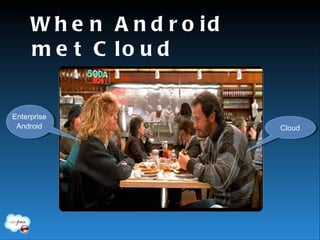
When Android met Cloud


Enterprise
 Android                      Cloud
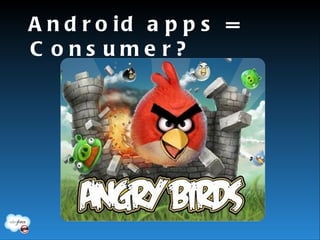
Android apps = Consumer?
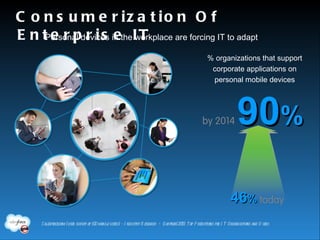
Consumerization Of Enterprise IT
    Personal devices in the workplace are forcing IT to adapt

                                                                                      % organizations that support
                                                                                       corporate applications on
                                                                                       personal mobile devices


                                                                                                     90%

                                                                                                  46%
   Salesforce.com (user survey of 672 mobile users) + Industry Research • Gartner(2011): Top Predictions for IT Organizations and Users
Why Cloud?
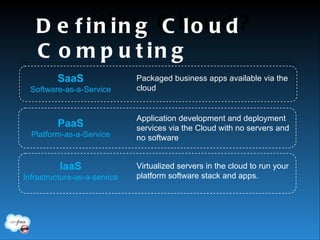
   Defining Cloud Computing

         SaaS                 Packaged business apps available via the
  Software-as-a-Service       cloud


                              Application development and deployment
         PaaS                 services via the Cloud with no servers and
  Platform-as-a-Service       no software


          IaaS                Virtualized servers in the cloud to run your
Infrastructure-as-a-service   platform software stack and apps.
Why Cloud?


Time to Market
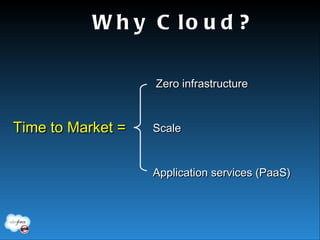
Why Cloud?

                   Zero infrastructure


Time to Market =   Scale


                   Application services (PaaS)
Why Cloud?

1. Zero infrastructure


2. Scale


3. Application services (PaaS)
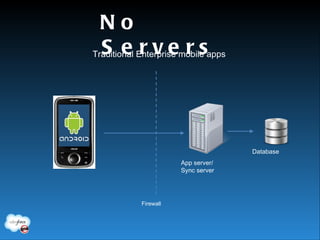
No Servers
Traditional Enterprise mobile apps


                                     Database
                       App server/
                       Sync server


            Firewall
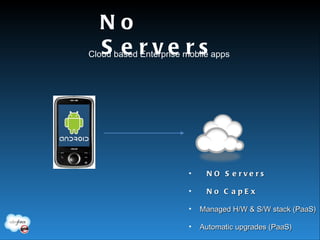
No Servers
Cloud based Enterprise mobile apps


                        •   NO Servers

                        •   No CapEx

                        •   Managed H/W & S/W stack (PaaS)

                        •   Automatic upgrades (PaaS)
Why Cloud?

1. Zero infrastructure


2. Scale


3. Application services (PaaS)
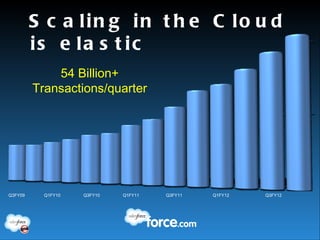
Scaling in the Cloud is elastic

             54 Billion+
         Transactions/quarter


Q3FY09     Q1FY10   Q3FY10   Q1FY11   Q3FY11   Q1FY12   Q3FY12
Why Cloud?

1. Zero infrastructure


2. Scale


3. Application services (PaaS)
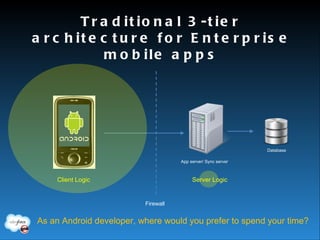
Traditional 3-tier architecture for Enterprise
                 mobile apps


                                                                Database

                                      App server/ Sync server


     Client Logic                          Server Logic


                           Firewall


 As an Android developer, where would you prefer to spend your time?
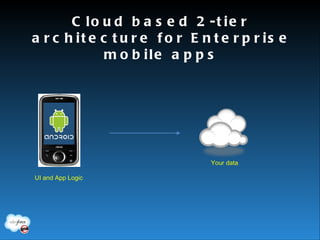
Cloud based 2-tier architecture for
            Enterprise mobile apps


                                Your data

UI and App Logic
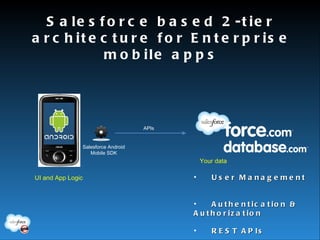
Salesforce based 2-tier architecture for
          Enterprise mobile apps


                                        APIs


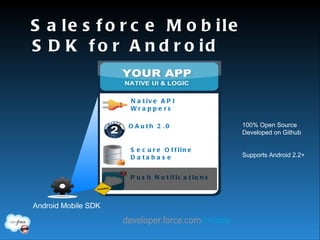
                   Salesforce Android
                      Mobile SDK
                                                   Your data

UI and App Logic                               •     User Management

                                               •     Authentication & Authorization

                                               •     REST APIs
Lets build an app!
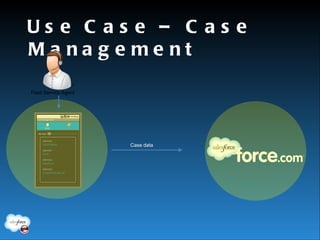
Use Case – Case Management


Field Service Agent


                      Case data
Setup
1.   git clone https://github.com/forcedotcom/SalesforceMobileSDK-Android.git


2.   Import SDK into your Android project


3.   Implement SDK ‘scaffolding’
OAuth 2.0 Authentication
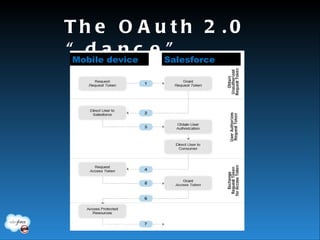
The OAuth 2.0 “dance”
Mobile device   Salesforce
User Authorization
Assessing data – REST API
Secure offline storage
Other Application Services
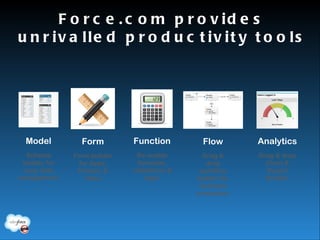
Force.com provides unrivalled productivity
                  tools


   Model           Form         Function          Flow         Analytics
Schema builder   Form builder    Re-usable      Drag & drop    Drag & drop
 for easy data    for Apps,      formulas,        workflow       Chart &
 management       Portals, &    validations &    builder for     Report
                    Sites            logic        business       Builder
                                                 processes
Recap

1. Zero infrastructure
  •   No HW/SW to configure or manage

  •   Automatic upgrades

2. Scale
  •   Elastic scaling in the Cloud

3. Application services
  •   API, Security, Offline etc.

  •   Geolocation

  •   Additional backend services (Integration, Email notifications etc)
Next steps


http://developer.force.com/join
Resources

http://developer.force.com/


http://wiki.developerforce.com/page/Mobile_SDK


http://wiki.developerforce.com/page/Getting_Started_with_the_M
obile_SDK_for_Android


                        @cloudysan

When Mobile (Android) met Cloud

  • 1.
    When Mobile (Android)met Cloud Sandeep Bhanot Senior Developer Evangelist, Salesforce.com @cloudysan
  • 2.
    Safe Harbor Safe harborstatement under the Private Securities Litigation Reform Act of 1995: This presentation may contain forward-looking statements that involve risks, uncertainties, and assumptions. If any such uncertainties materialize or if any of the assumptions proves incorrect, the results of salesforce.com, inc. could differ materially from the results expressed or implied by the forward-looking statements we make. All statements other than statements of historical fact could be deemed forward-looking, including any projections of product or service availability, subscriber growth, earnings, revenues, or other financial items and any statements regarding strategies or plans of management for future operations, statements of belief, any statements concerning new, planned, or upgraded services or technology developments and customer contracts or use of our services. The risks and uncertainties referred to above include – but are not limited to – risks associated with developing and delivering new functionality for our service, new products and services, our new business model, our past operating losses, possible fluctuations in our operating results and rate of growth, interruptions or delays in our Web hosting, breach of our security measures, the outcome of intellectual property and other litigation, risks associated with possible mergers and acquisitions, the immature market in which we operate, our relatively limited operating history, our ability to expand, retain, and motivate our employees and manage our growth, new releases of our service and successful customer deployment, our limited history reselling non-salesforce.com products, and utilization and selling to larger enterprise customers. Further information on potential factors that could affect the financial results of salesforce.com, inc. is included in our annual report on Form 10-Q for the most recent fiscal quarter ended July 31, 2011. This documents and others containing important disclosures are available on the SEC Filings section of the Investor Information section of our Web site. Any unreleased services or features referenced in this or other presentations, press releases or public statements are not currently available and may not be delivered on time or at all. Customers who purchase our services should make the purchase decisions based upon features that are currently available. Salesforce.com, inc. assumes no obligation and does not intend to update these forward-looking statements.
  • 3.
    When Android metCloud Enterprise Android Cloud
  • 4.
    Android apps =Consumer?
  • 5.
    Consumerization Of EnterpriseIT Personal devices in the workplace are forcing IT to adapt % organizations that support corporate applications on personal mobile devices 90% 46% Salesforce.com (user survey of 672 mobile users) + Industry Research • Gartner(2011): Top Predictions for IT Organizations and Users
  • 6.
    Why Cloud? Defining Cloud Computing SaaS Packaged business apps available via the Software-as-a-Service cloud Application development and deployment PaaS services via the Cloud with no servers and Platform-as-a-Service no software IaaS Virtualized servers in the cloud to run your Infrastructure-as-a-service platform software stack and apps.
  • 7.
  • 8.
    Why Cloud? Zero infrastructure Time to Market = Scale Application services (PaaS)
  • 9.
    Why Cloud? 1. Zeroinfrastructure 2. Scale 3. Application services (PaaS)
  • 10.
    No Servers Traditional Enterprisemobile apps Database App server/ Sync server Firewall
  • 11.
    No Servers Cloud basedEnterprise mobile apps • NO Servers • No CapEx • Managed H/W & S/W stack (PaaS) • Automatic upgrades (PaaS)
  • 12.
    Why Cloud? 1. Zeroinfrastructure 2. Scale 3. Application services (PaaS)
  • 13.
    Scaling in theCloud is elastic 54 Billion+ Transactions/quarter Q3FY09 Q1FY10 Q3FY10 Q1FY11 Q3FY11 Q1FY12 Q3FY12
  • 14.
    Why Cloud? 1. Zeroinfrastructure 2. Scale 3. Application services (PaaS)
  • 15.
    Traditional 3-tier architecturefor Enterprise mobile apps Database App server/ Sync server Client Logic Server Logic Firewall As an Android developer, where would you prefer to spend your time?
  • 16.
    Cloud based 2-tierarchitecture for Enterprise mobile apps Your data UI and App Logic
  • 17.
    Salesforce based 2-tierarchitecture for Enterprise mobile apps APIs Salesforce Android Mobile SDK Your data UI and App Logic • User Management • Authentication & Authorization • REST APIs
  • 18.
  • 19.
    Use Case –Case Management Field Service Agent Case data
  • 20.
    Setup 1. git clone https://github.com/forcedotcom/SalesforceMobileSDK-Android.git 2. Import SDK into your Android project 3. Implement SDK ‘scaffolding’
  • 21.
  • 22.
    The OAuth 2.0“dance” Mobile device Salesforce
  • 23.
  • 24.
  • 25.
  • 26.
  • 27.
    Force.com provides unrivalledproductivity tools Model Form Function Flow Analytics Schema builder Form builder Re-usable Drag & drop Drag & drop for easy data for Apps, formulas, workflow Chart & management Portals, & validations & builder for Report Sites logic business Builder processes
  • 28.
    Recap 1. Zero infrastructure • No HW/SW to configure or manage • Automatic upgrades 2. Scale • Elastic scaling in the Cloud 3. Application services • API, Security, Offline etc. • Geolocation • Additional backend services (Integration, Email notifications etc)
  • 29.
  • 30.

Editor's Notes

  • #4 Maybe a venn diagram to illustrate these definitions better?
  • #5 Maybe a venn diagram to illustrate these definitions better?
  • #6 More and more, enterprises are having to respond to users bringing their own devices. This trend is setting very high expectations for users. Because a phone is such a personal device, people are passionate about which device they use. Users want the same capabilities in their work device as they have in their personal device. It’s hard to go to an older phone once you’re used to the next generation touch experience. ----------------------------------------------- 5 YEARS AGO: • If you wanted mobile e-mail, you got a BlackBerry and you were happy. That was the cool thing. 3 YEARS AGO: • iPhone was introduced. • People started carrying an iPhone AND a BlackBerry, which became tiresome. • Apple enhanced iPhone’s enterprise features – so people began moving to one device. TODAY: • Android and iPhone are the dominant platforms, while BlackBerry and VMware are working on mobile Virtual machines. • One section of your phone is personal, one is corporate. • Admins can wipe out the data from the business applications, leaving your personal notes, photos, and messages on the phone. CONCLUSION: New normal is to bring your phone to work and get access to the network. It’s a headache for IT, but that’s reality.
  • #7 Maybe a venn diagram to illustrate these definitions better?
  • #8 Maybe a venn diagram to illustrate these definitions better?
  • #9 Maybe a venn diagram to illustrate these definitions better?
  • #10 Maybe a venn diagram to illustrate these definitions better?
  • #11 Maybe a venn diagram to illustrate these definitions better?
  • #12 Maybe a venn diagram to illustrate these definitions better?
  • #13 Maybe a venn diagram to illustrate these definitions better?
  • #14 Maybe a venn diagram to illustrate these definitions better?
  • #15 Maybe a venn diagram to illustrate these definitions better?
  • #16 Maybe a venn diagram to illustrate these definitions better?
  • #17 Maybe a venn diagram to illustrate these definitions better?
  • #18 Maybe a venn diagram to illustrate these definitions better?
  • #19 Maybe a venn diagram to illustrate these definitions better?
  • #20 Maybe a venn diagram to illustrate these definitions better?
  • #21 Maybe a venn diagram to illustrate these definitions better?
  • #22 Maybe a venn diagram to illustrate these definitions better?
  • #23 Maybe a venn diagram to illustrate these definitions better?
  • #24 Maybe a venn diagram to illustrate these definitions better?
  • #25 Maybe a venn diagram to illustrate these definitions better?
  • #26 Maybe a venn diagram to illustrate these definitions better?
  • #27 Maybe a venn diagram to illustrate these definitions better?
  • #28 Maybe a venn diagram to illustrate these definitions better?
  • #29 Our point and click tools provide citizen developers with a high productivity environment, based on industry standard design patterns and approaches for cloud applications
  • #30 Maybe a venn diagram to illustrate these definitions better?
  • #31 Maybe a venn diagram to illustrate these definitions better?
  • #32 Maybe a venn diagram to illustrate these definitions better?