Language & Culture
Aiden Yeh, Ph.D.
Wenzao University

http://media.namx.org/images/editorial/2010/03/0329/v_pradhan_language/v_pradhan_language_500x279.jpg

When a Language Dies
http://www.theatlantic.com/national/archive/2009/11/whats-lost-when-a-language-dies/29886/

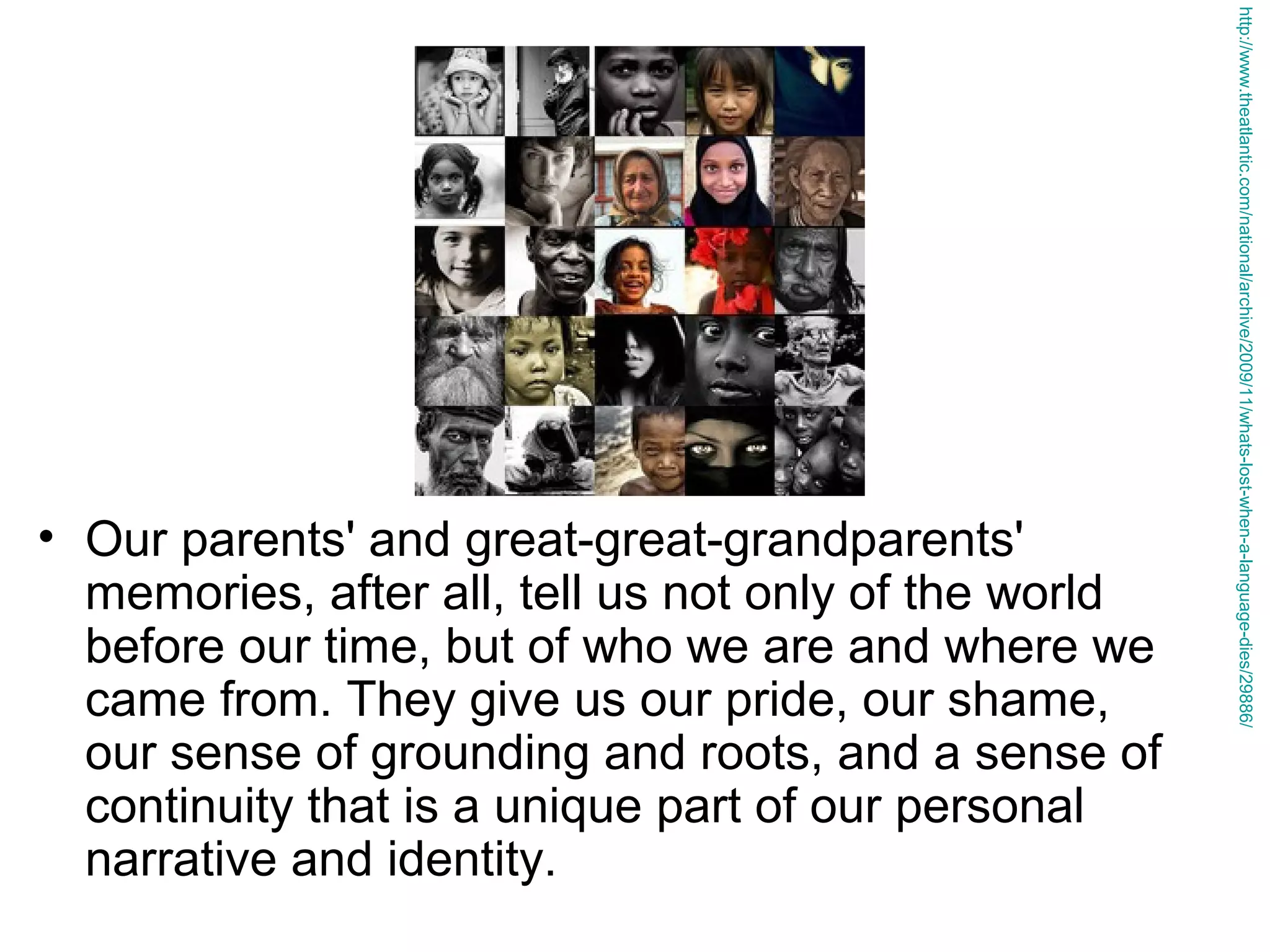
• Our parents' and great-great-grandparents'
memories, after all, tell us not only of the world
before our time, but of who we are and where we
came from. They give us our pride, our shame,
our sense of grounding and roots, and a sense of
continuity that is a unique part of our personal
narrative and identity.
http://www.theatlantic.com/national/archive/2009/11/whats-lost-when-a-language-dies/29886/

• But what about the language those
ancestors spoke? Is that an important part
of the picture, as well? And does it need to
be kept "alive" in the same sense that we
want their stories remembered and retold?
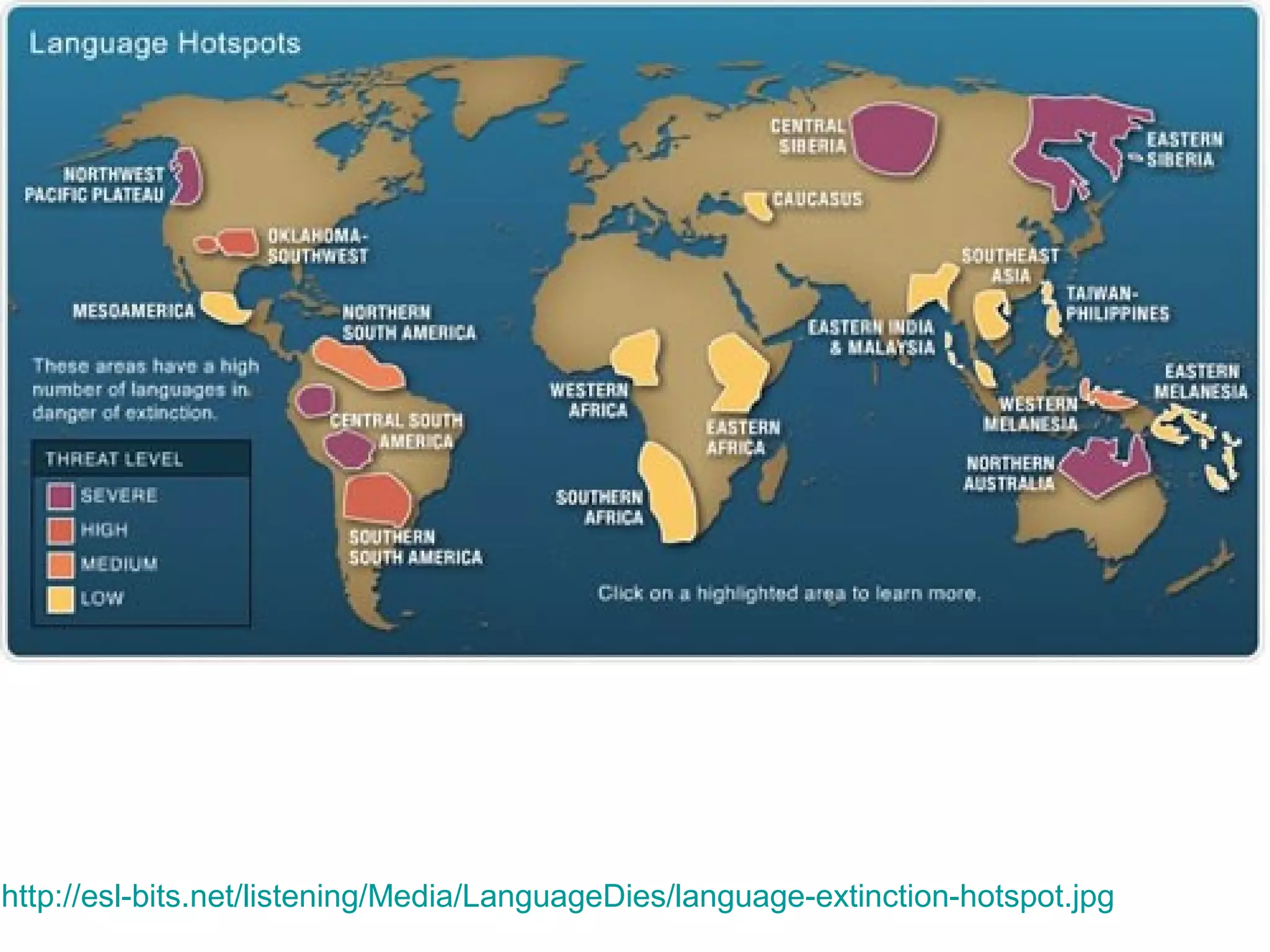
http://esl-bits.net/listening/Media/LanguageDies/language-extinction-hotspot.jpg
Expert/critic

• Pamela Serota Cote, whose doctoral
research at the University of San
Francisco focused on Breton language
and identity, argues that looking at
language as only a practical tool or as an
outside connoisseur, as McWhorter does,
misses the central importance of language
to personal narrative and identity.

http://www.theatlantic.com/national/archive/2009/11/whats-lost-when-a-language-dies/2988
• "We understand things, events, ourselves
and others through a process of
interpretation, which occurs in language,"

http://www.theatlantic.com/national/archive/2009/11/whats-lost-when-a-language-dies/2988
The loss of heritage
• Because language discloses cultural and
historical meaning, the loss of language is
a loss of that link to the past. Without a
link to the past, people in a culture lose a
sense of place, purpose and path; one
must know where one came from to know
where one is going.

http://www.theatlantic.com/national/archive/2009/11/whats-lost-when-a-language-dies/2988
To weaken or destroy

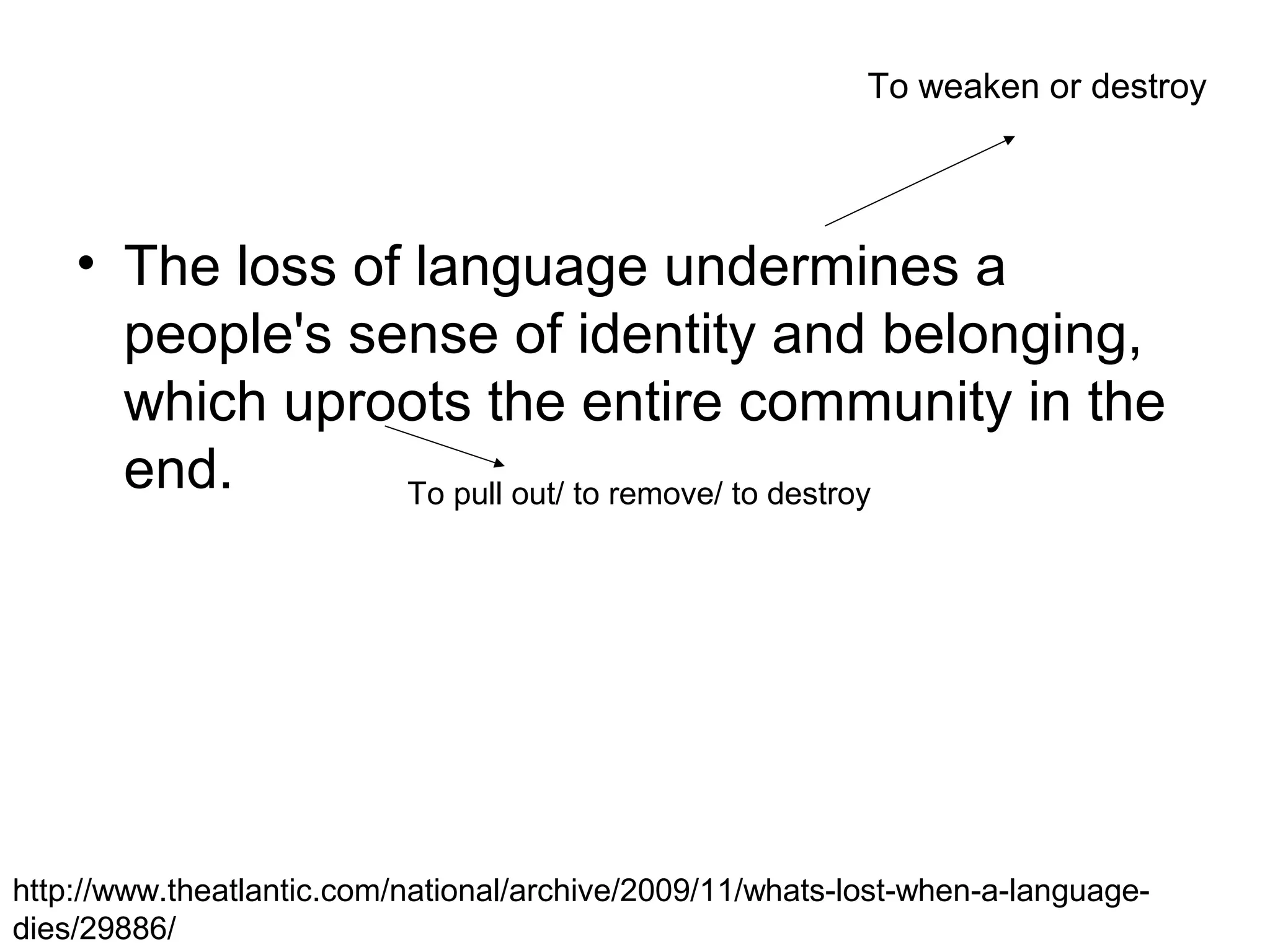
• The loss of language undermines a
people's sense of identity and belonging,
which uproots the entire community in the
end.
To pull out/ to remove/ to destroy

http://www.theatlantic.com/national/archive/2009/11/whats-lost-when-a-languagedies/29886/
• Sometimes language dies because an
entire population dies out. That's still a
loss, just as every plant and animal that
becomes extinct is a loss to the richness
of the planet's tapestry of existence.

http://www.theatlantic.com/national/archive/2009/11/whats-lost-when-a-language-dies/2988
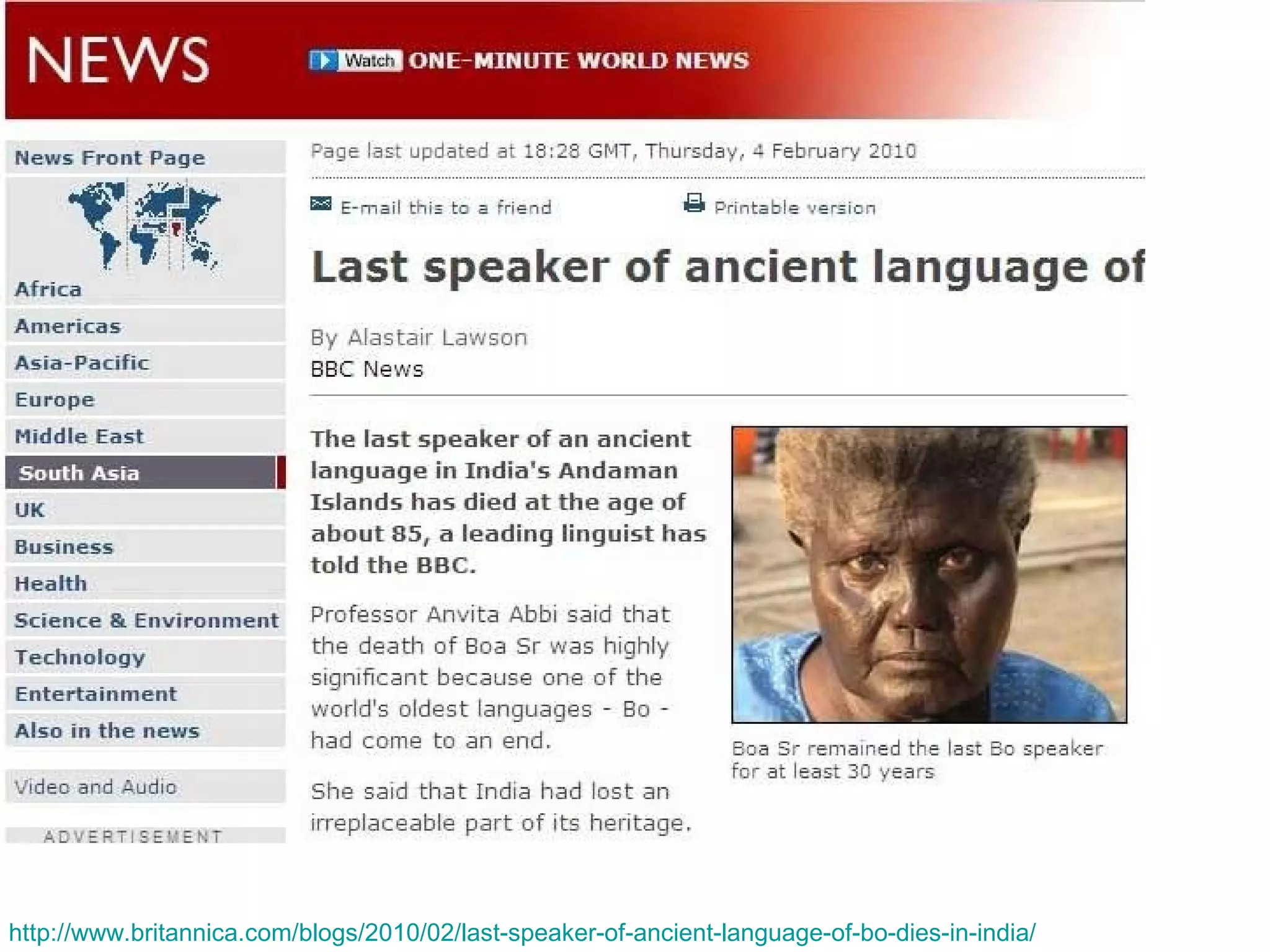
http://www.britannica.com/blogs/2010/02/last-speaker-of-ancient-language-of-bo-dies-in-india/
To decrease in strength

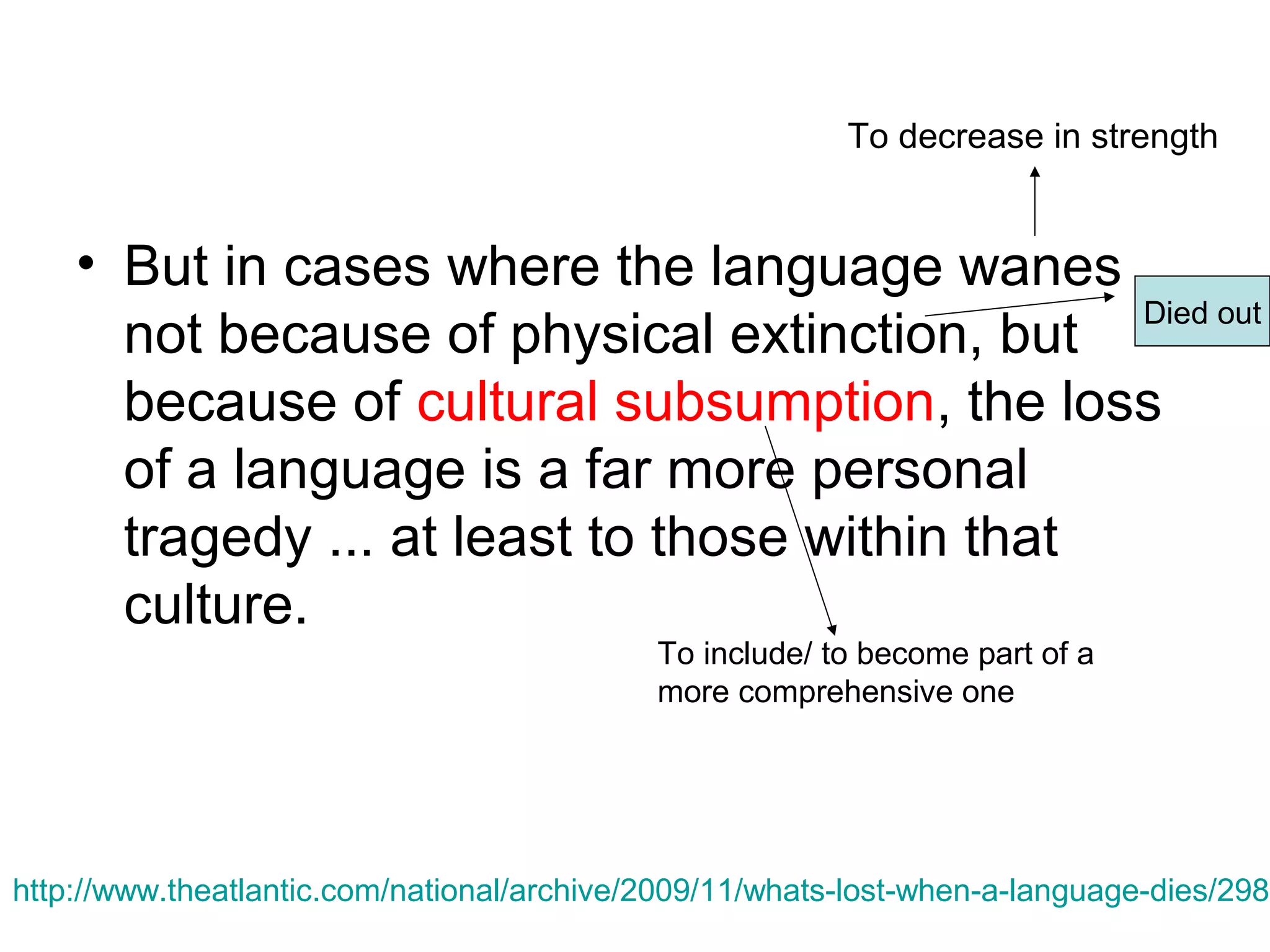
• But in cases where the language wanes
Died out
not because of physical extinction, but
because of cultural subsumption, the loss
of a language is a far more personal
tragedy ... at least to those within that
culture.
To include/ to become part of a
more comprehensive one

http://www.theatlantic.com/national/archive/2009/11/whats-lost-when-a-language-dies/2988
• For someone inside a lost or dying culture,
a language can be like the memories of
our grandparents--not required, or even
convenient, for efficiency of operation in a
modern, globalized world, but essential for
our sense of roots, security, identity, pride,
continuity and wholeness.

http://www.theatlantic.com/national/archive/2009/11/whats-lost-when-a-language-dies/2988
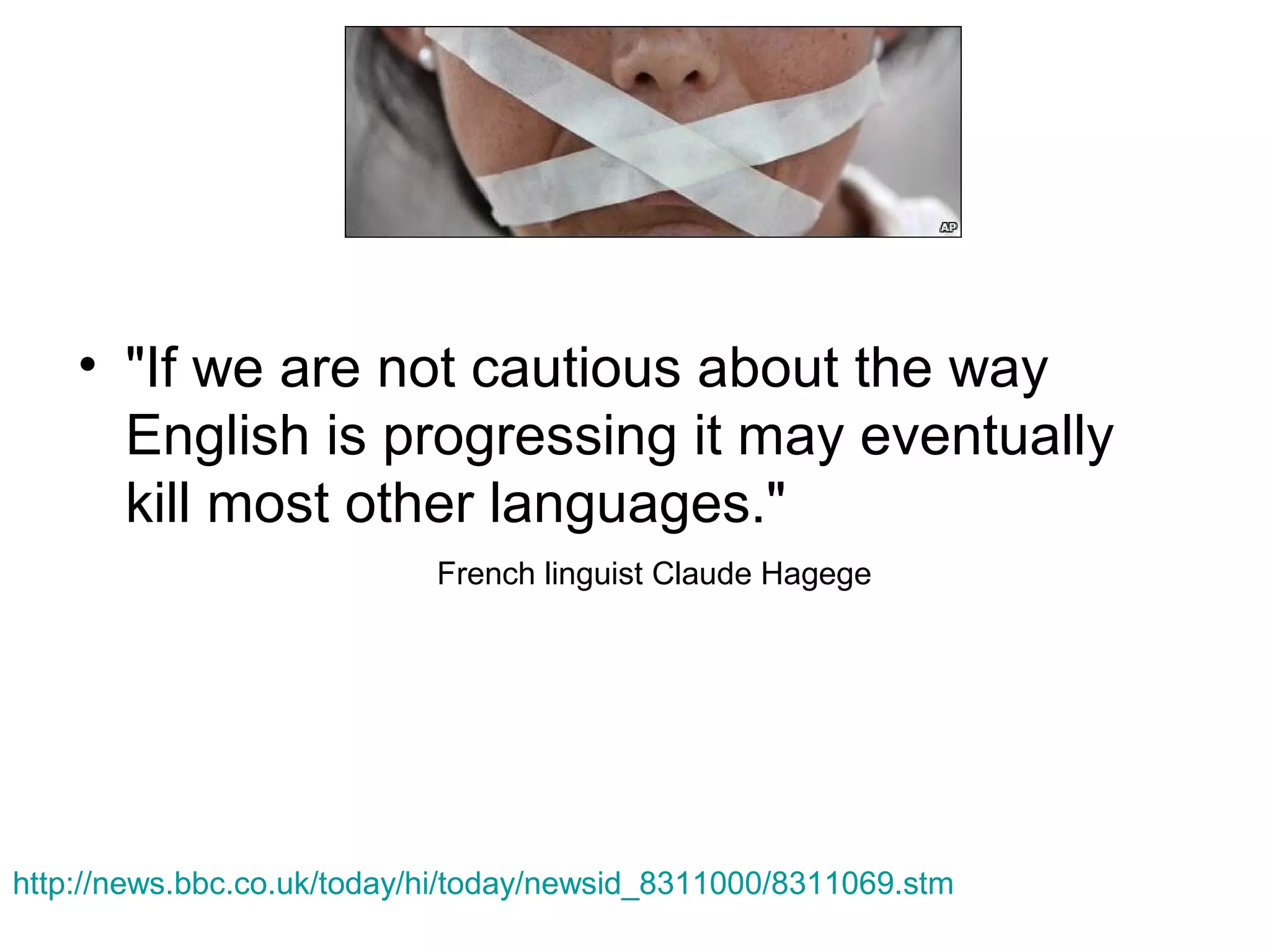
• "If we are not cautious about the way
English is progressing it may eventually
kill most other languages."
French linguist Claude Hagege

http://news.bbc.co.uk/today/hi/today/newsid_8311000/8311069.stm
http://effiehsiao.pixnet.net/album/video/33616356
• "What we lose is essentially an enormous
cultural heritage, the way of expressing
the relationship with nature, with the world,
between themselves in the framework of
their families, their kin people," says Mr
Hagege.

http://news.bbc.co.uk/today/hi/today/newsid_8311000/8311069.stm
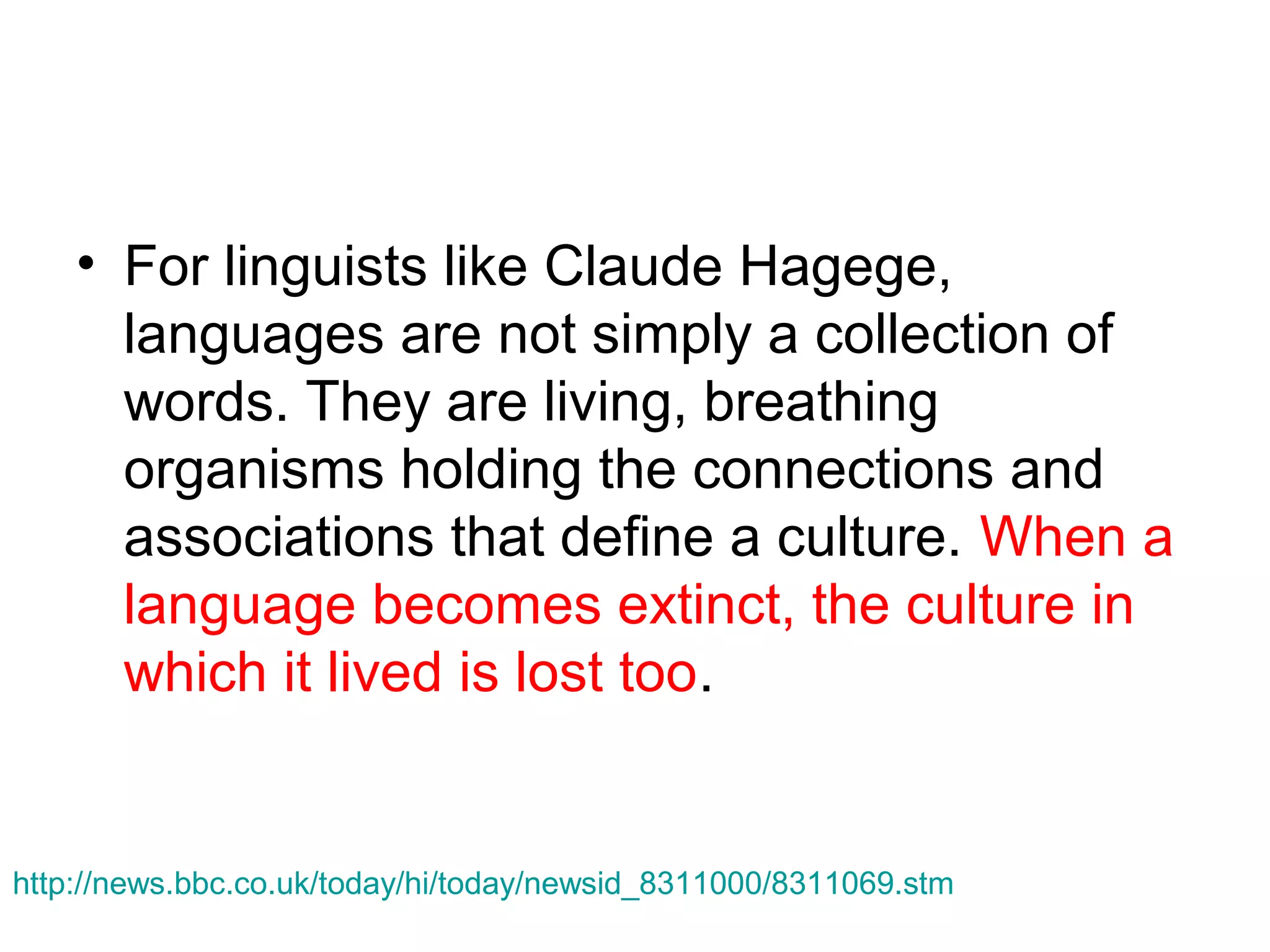
• For linguists like Claude Hagege,
languages are not simply a collection of
words. They are living, breathing
organisms holding the connections and
associations that define a culture. When a
language becomes extinct, the culture in
which it lived is lost too.

http://news.bbc.co.uk/today/hi/today/newsid_8311000/8311069.stm
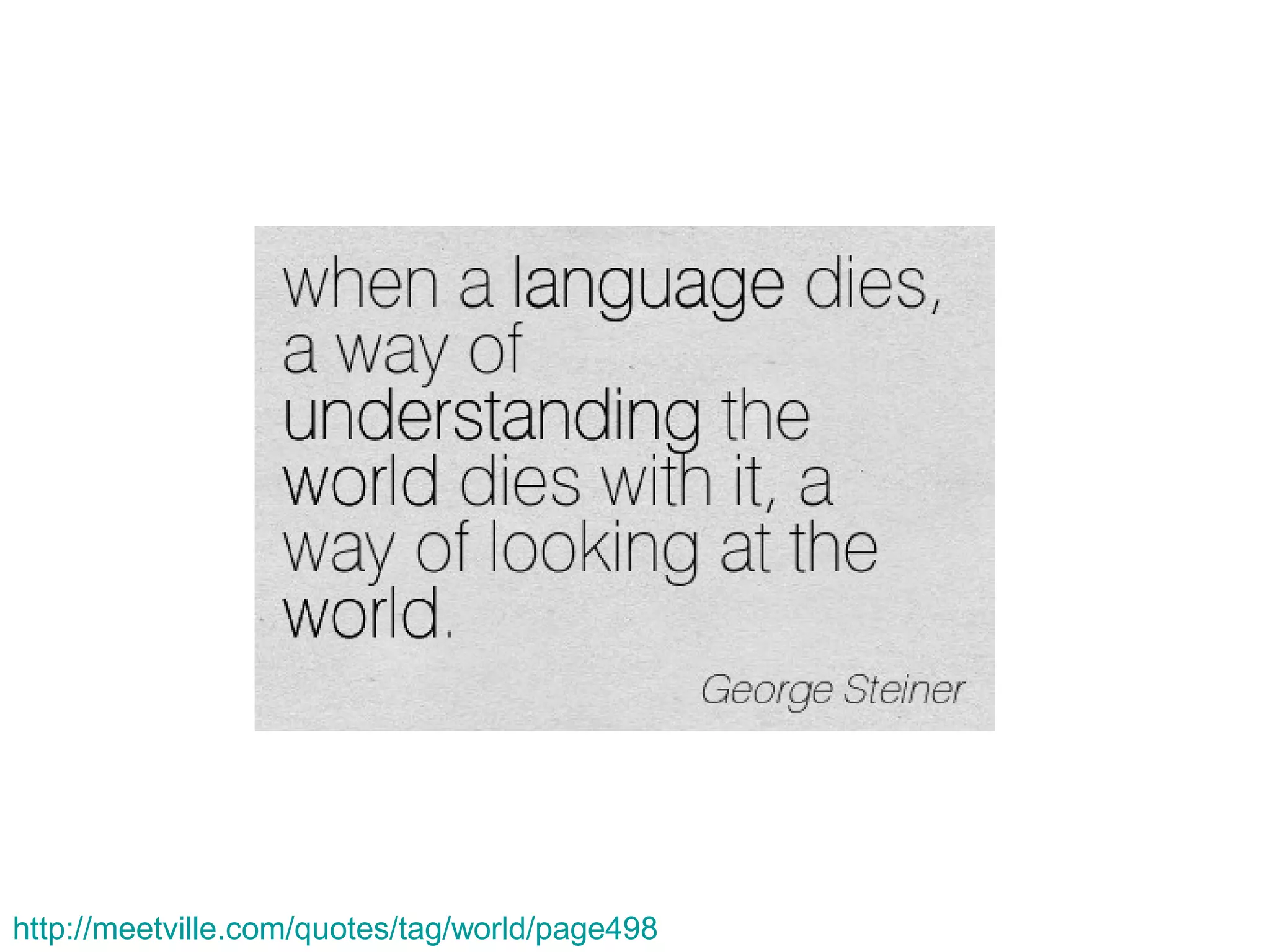
http://meetville.com/quotes/tag/world/page498
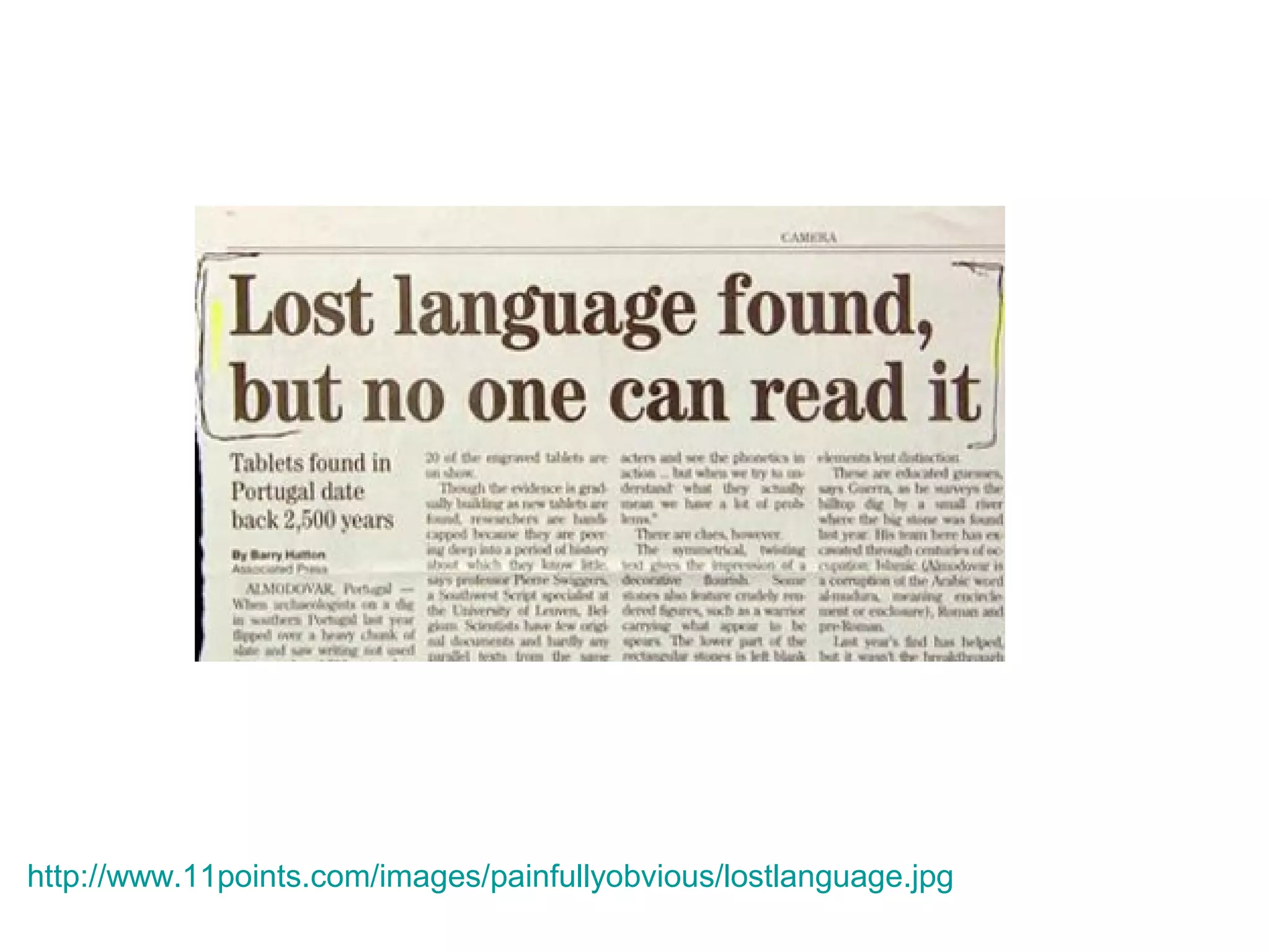
http://www.11points.com/images/painfullyobvious/lostlanguage.jpg
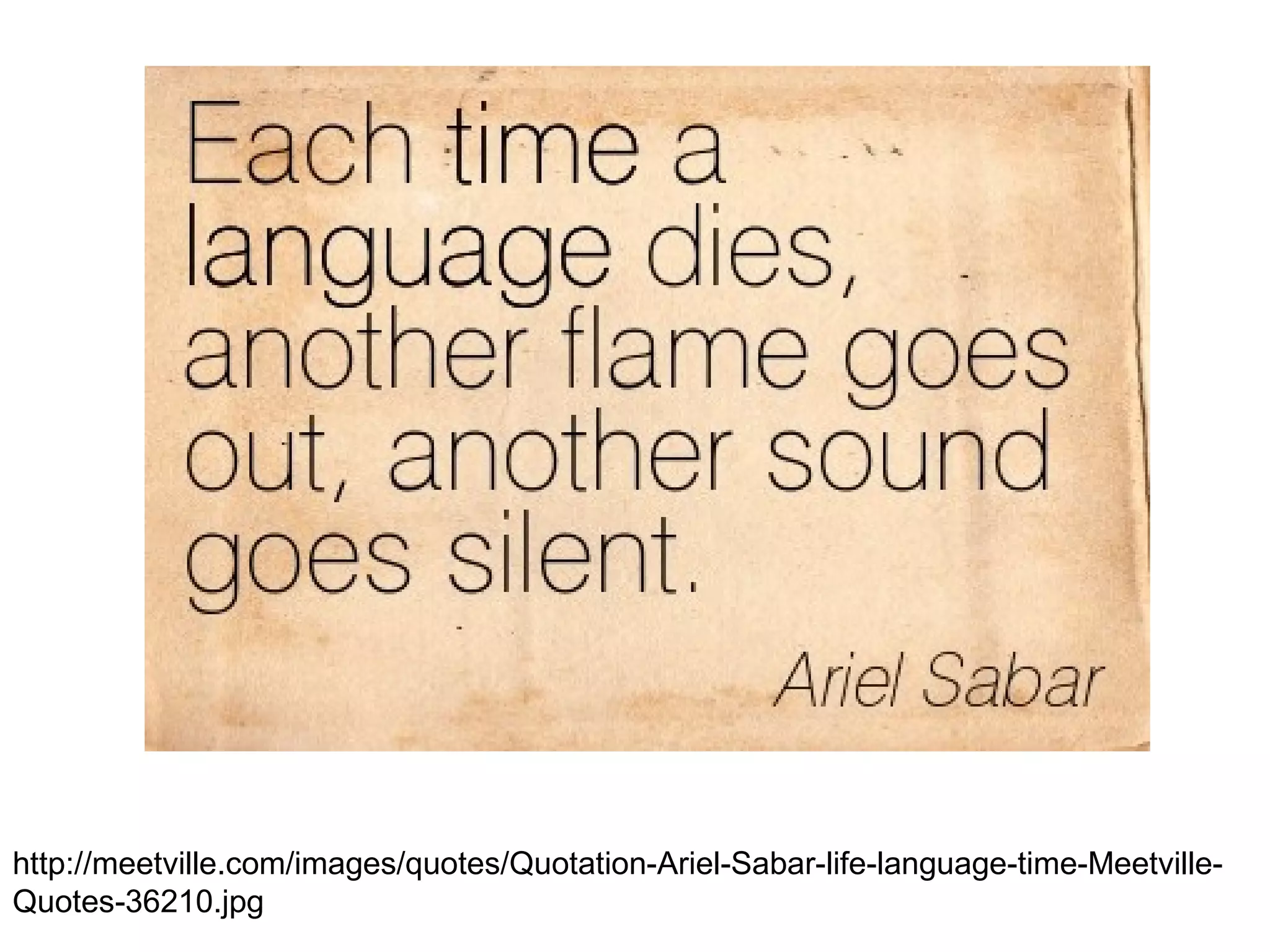
http://meetville.com/images/quotes/Quotation-Ariel-Sabar-life-language-time-MeetvilleQuotes-36210.jpg

When a language dies- lecture notes for Language & Culture

  • 1.
    Language & Culture AidenYeh, Ph.D. Wenzao University http://media.namx.org/images/editorial/2010/03/0329/v_pradhan_language/v_pradhan_language_500x279.jpg When a Language Dies
  • 2.
    http://www.theatlantic.com/national/archive/2009/11/whats-lost-when-a-language-dies/29886/ • Our parents'and great-great-grandparents' memories, after all, tell us not only of the world before our time, but of who we are and where we came from. They give us our pride, our shame, our sense of grounding and roots, and a sense of continuity that is a unique part of our personal narrative and identity.
  • 3.
    http://www.theatlantic.com/national/archive/2009/11/whats-lost-when-a-language-dies/29886/ • But whatabout the language those ancestors spoke? Is that an important part of the picture, as well? And does it need to be kept "alive" in the same sense that we want their stories remembered and retold?
  • 5.
  • 6.
    Expert/critic • Pamela SerotaCote, whose doctoral research at the University of San Francisco focused on Breton language and identity, argues that looking at language as only a practical tool or as an outside connoisseur, as McWhorter does, misses the central importance of language to personal narrative and identity. http://www.theatlantic.com/national/archive/2009/11/whats-lost-when-a-language-dies/2988
  • 7.
    • "We understandthings, events, ourselves and others through a process of interpretation, which occurs in language," http://www.theatlantic.com/national/archive/2009/11/whats-lost-when-a-language-dies/2988
  • 8.
    The loss ofheritage • Because language discloses cultural and historical meaning, the loss of language is a loss of that link to the past. Without a link to the past, people in a culture lose a sense of place, purpose and path; one must know where one came from to know where one is going. http://www.theatlantic.com/national/archive/2009/11/whats-lost-when-a-language-dies/2988
  • 9.
    To weaken ordestroy • The loss of language undermines a people's sense of identity and belonging, which uproots the entire community in the end. To pull out/ to remove/ to destroy http://www.theatlantic.com/national/archive/2009/11/whats-lost-when-a-languagedies/29886/
  • 10.
    • Sometimes languagedies because an entire population dies out. That's still a loss, just as every plant and animal that becomes extinct is a loss to the richness of the planet's tapestry of existence. http://www.theatlantic.com/national/archive/2009/11/whats-lost-when-a-language-dies/2988
  • 11.
  • 12.
    To decrease instrength • But in cases where the language wanes Died out not because of physical extinction, but because of cultural subsumption, the loss of a language is a far more personal tragedy ... at least to those within that culture. To include/ to become part of a more comprehensive one http://www.theatlantic.com/national/archive/2009/11/whats-lost-when-a-language-dies/2988
  • 13.
    • For someoneinside a lost or dying culture, a language can be like the memories of our grandparents--not required, or even convenient, for efficiency of operation in a modern, globalized world, but essential for our sense of roots, security, identity, pride, continuity and wholeness. http://www.theatlantic.com/national/archive/2009/11/whats-lost-when-a-language-dies/2988
  • 14.
    • "If weare not cautious about the way English is progressing it may eventually kill most other languages." French linguist Claude Hagege http://news.bbc.co.uk/today/hi/today/newsid_8311000/8311069.stm
  • 15.
  • 16.
    • "What welose is essentially an enormous cultural heritage, the way of expressing the relationship with nature, with the world, between themselves in the framework of their families, their kin people," says Mr Hagege. http://news.bbc.co.uk/today/hi/today/newsid_8311000/8311069.stm
  • 17.
    • For linguistslike Claude Hagege, languages are not simply a collection of words. They are living, breathing organisms holding the connections and associations that define a culture. When a language becomes extinct, the culture in which it lived is lost too. http://news.bbc.co.uk/today/hi/today/newsid_8311000/8311069.stm
  • 18.
  • 19.
  • 20.