GROUP 1
Paloma AGUERA, Lynne AYOUB, Guillaume BAROIN, Marie CASTANIER,
Simon LALLOZ, Maya MAKAREM
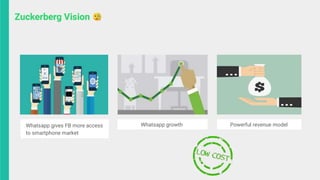
Whatsapp growth Powerful revenue modelWhatsapp gives FB more access
to smartphone market
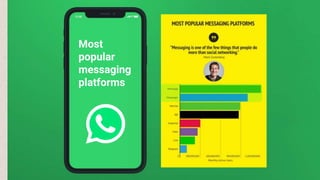
Most
popular
messaging
platforms
Ads
announcement
In Status section
Aug
2018
Status Feature & In-
App payments
Copied other SM feature.
Payments in India only
early
2017
Acton left
Disagreements with
WhatsApp’s
monetization
Sept
2017
WhatsApp Business
Launch for small
businesses
Jan
2018
Co-founder left
Both founders now left
WhatsApp: no one is
preventing Zuckerberg
from monetizing
Jan
2018
Fb fined €110M
By EU competition
regulators
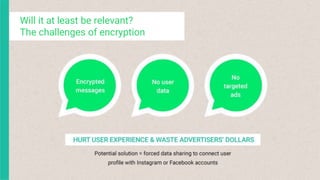
Will it at least be relevant?
The challenges of encryption
4.
Problem
Statement
WhatsApp
still doesn’t
make money
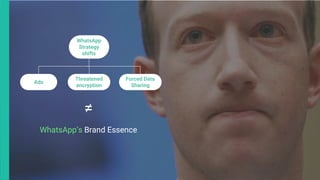
WhatsApp
Strategy
shifts
Threatened
encryption
Ads
≠
WhatsApp’s Brand Essence
Forced Data
Sharing
How will users
perceive this
shift?
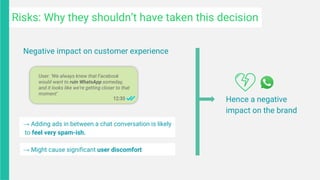
Risks: Why they shouldn’t have taken this decision
Negative impact on customer experience
→ Adding ads in between a chat conversation is likely
to feel very spam-ish.
→ Might cause significant user discomfort
Hence a negative
impact on the brand
User: ’We always knew that Facebook
would want to ruin WhatsApp someday,
and it looks like we’re getting closer to that
moment’
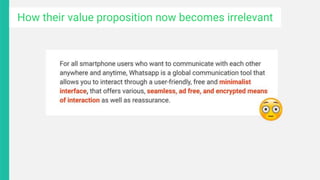
How their value proposition now becomes irrelevant
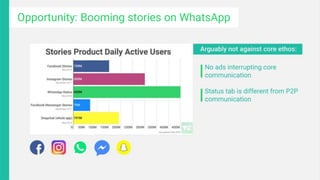
Opportunity: Booming stories on WhatsApp
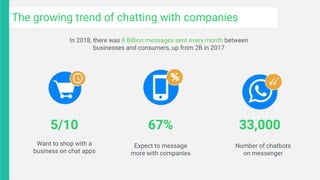
In 2018, there was 8 Billion messages sent every month between
businesses and consumers, up from 2B in 2017
5/10
Want to shop with a
business on chat apps
67%
Expect to message
more with companies
33,000
Number of chatbots
on messenger
The growing trend of chatting with companies
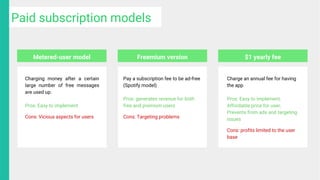
Charging money after a certain
large number of free messages
are used up.
Pros: Easy to implement
Cons: Vicious aspects for users
Pay a subscription fee to be ad-free
(Spotify model)
Pros: generates revenue for both
free and premium users
Cons: Targeting problems
Charge an annual fee for having
the app
Pros: Easy to implement,
Affordable price for user,
Prevents from ads and targeting
issues
Cons: profits limited to the user
base
Metered-user model Freemium version $1 yearly fee
Paid subscription models
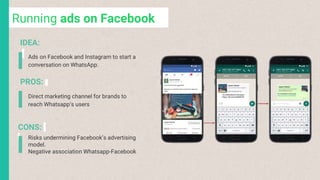
Running ads on Facebook
Ads on Facebook and Instagram to start a
conversation on WhatsApp.
Risks undermining Facebook’s advertising
model.
Negative association Whatsapp-Facebook
IDEA:
PROS:
CONS:
Direct marketing channel for brands to
reach Whatsapp’s users
7.
Recommendation
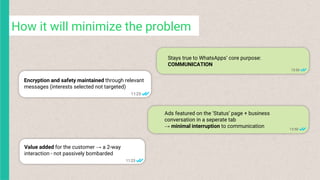
Ads featured on the ‘Status’ page + business
conversation in a seperate tab
→ minimal interruption to communication
Value added for the customer → a 2-way
interaction - not passively bombarded
How it will minimize the problem
Stays true to WhatsApps’ core purpose:
COMMUNICATION
Encryption and safety maintained through relevant
messages (interests selected not targeted)
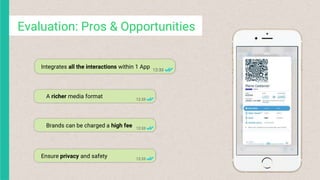
Evaluation: Pros & Opportunities
Integrates all the interactions within 1 App
Brands can be charged a high fee
A richer media format
Ensure privacy and safety
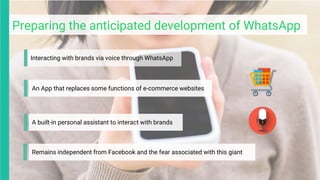
Preparing the anticipated development of WhatsApp
Interacting with brands via voice through WhatsApp
An App that replaces some functions of e-commerce websites
A built-in personal assistant to interact with brands
Remains independent from Facebook and the fear associated with this giant
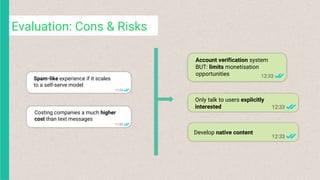
Evaluation: Cons & Risks
Spam-like experience if it scales
to a self-serve model
Costing companies a much higher
cost than text messages
Account verification system
BUT: limits monetisation
opportunities
Only talk to users explicitly
interested
Develop native content
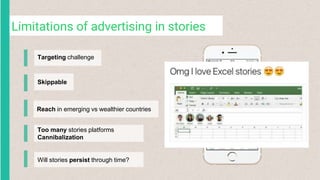
Limitations of advertising in stories
Targeting challenge
Skippable
Reach in emerging vs wealthier countries
Too many stories platforms
Cannibalization
Will stories persist through time?
Implementation plan
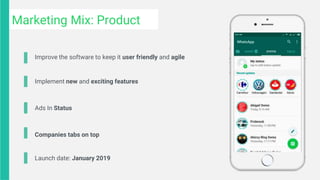
Improve the software to keep it user friendly and agile
Implement new and exciting features
Ads In Status
Companies tabs on top
Marketing Mix: Product
Launch date: January 2019
Marketing Mix
Price: Users
The App remains free for
users, as per WhatsApp’s
core brand essence to bring
the world closer
Marketing Mix
Price: Advertisers
CPC: between 20 cents and $2 per
click
CPM: around $5 per 1,000 visitors on
average.
CPC: average of $1.86, but can be
over $5.00 depending on ad quality,
competition...
CPM: about $7.19
CPC: average of $2.5, higher than
competitors because qualified
leads
CPM: about $5, relatively cheap
because awareness is not the
primary function
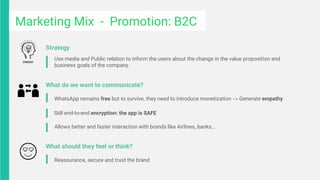
Marketing Mix - Promotion: B2C
WhatsApp remains free but to survive, they need to introduce monetization → Generate empathy
Still end-to-end encryption: the app is SAFE
Allows better and faster interaction with brands like Airlines, banks…
What do we want to communicate?
Use media and Public relation to inform the users about the change in the value proposition and
business goals of the company.
Strategy
Reassurance, secure and trust the brand
What should they feel or think?
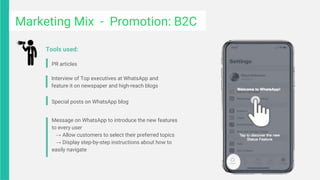
PR articles
Interview of Top executives at WhatsApp and
feature it on newspaper and high-reach blogs
Tools used:
Special posts on WhatsApp blog
Message on WhatsApp to introduce the new features
to every user
→ Allow customers to select their preferred topics
→ Display step-by-step instructions about how to
easily navigate
Marketing Mix - Promotion: B2C
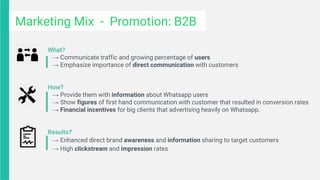
What?
→ Communicate traffic and growing percentage of users
→ Emphasize importance of direct communication with customers
How?
→ Provide them with information about Whatsapp users
→ Show figures of first hand communication with customer that resulted in conversion rates
→ Financial incentives for big clients that advertising heavily on Whatsapp.
Results?
→ Enhanced direct brand awareness and information sharing to target customers
→ High clickstream and impression rates
Marketing Mix - Promotion: B2B
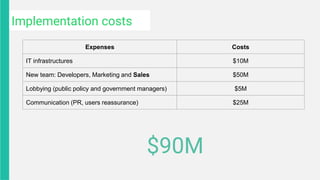
Implementation costs
Expenses Costs
IT infrastructures $10M
New team: Developers, Marketing and Sales $50M
Lobbying (public policy and government managers) $5M
Communication (PR, users reassurance) $25M
$90M
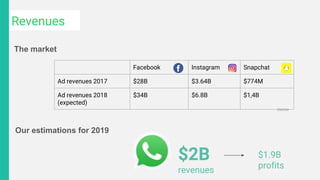
Facebook Instagram Snapchat
Ad revenues 2017 $28B $3.64B $774M
Ad revenues 2018
(expected)
$34B $6.8B $1,4B
The market
Our estimations for 2019
$2B
revenues
Revenues
$1.9B
profits
Statista
Thank you!

Whatsapp Brand Building

  • 1.
    GROUP 1 Paloma AGUERA,Lynne AYOUB, Guillaume BAROIN, Marie CASTANIER, Simon LALLOZ, Maya MAKAREM
  • 11.
    Whatsapp growth Powerfulrevenue modelWhatsapp gives FB more access to smartphone market
  • 12.
  • 14.
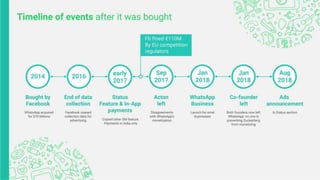
    Ads announcement In Status section Aug 2018 StatusFeature & In- App payments Copied other SM feature. Payments in India only early 2017 Acton left Disagreements with WhatsApp’s monetization Sept 2017 WhatsApp Business Launch for small businesses Jan 2018 Co-founder left Both founders now left WhatsApp: no one is preventing Zuckerberg from monetizing Jan 2018 Fb fined €110M By EU competition regulators
  • 17.
    Will it atleast be relevant? The challenges of encryption
  • 18.
  • 19.
  • 20.
  • 21.
  • 24.
    Risks: Why theyshouldn’t have taken this decision Negative impact on customer experience → Adding ads in between a chat conversation is likely to feel very spam-ish. → Might cause significant user discomfort Hence a negative impact on the brand User: ’We always knew that Facebook would want to ruin WhatsApp someday, and it looks like we’re getting closer to that moment’
  • 25.
    How their valueproposition now becomes irrelevant
  • 26.
  • 27.
    In 2018, therewas 8 Billion messages sent every month between businesses and consumers, up from 2B in 2017 5/10 Want to shop with a business on chat apps 67% Expect to message more with companies 33,000 Number of chatbots on messenger The growing trend of chatting with companies
  • 29.
    Charging money aftera certain large number of free messages are used up. Pros: Easy to implement Cons: Vicious aspects for users Pay a subscription fee to be ad-free (Spotify model) Pros: generates revenue for both free and premium users Cons: Targeting problems Charge an annual fee for having the app Pros: Easy to implement, Affordable price for user, Prevents from ads and targeting issues Cons: profits limited to the user base Metered-user model Freemium version $1 yearly fee Paid subscription models
  • 30.
    Running ads onFacebook Ads on Facebook and Instagram to start a conversation on WhatsApp. Risks undermining Facebook’s advertising model. Negative association Whatsapp-Facebook IDEA: PROS: CONS: Direct marketing channel for brands to reach Whatsapp’s users
  • 31.
  • 33.
    Ads featured onthe ‘Status’ page + business conversation in a seperate tab → minimal interruption to communication Value added for the customer → a 2-way interaction - not passively bombarded How it will minimize the problem Stays true to WhatsApps’ core purpose: COMMUNICATION Encryption and safety maintained through relevant messages (interests selected not targeted)
  • 34.
    Evaluation: Pros &Opportunities Integrates all the interactions within 1 App Brands can be charged a high fee A richer media format Ensure privacy and safety
  • 35.
    Preparing the anticipateddevelopment of WhatsApp Interacting with brands via voice through WhatsApp An App that replaces some functions of e-commerce websites A built-in personal assistant to interact with brands Remains independent from Facebook and the fear associated with this giant
  • 36.
    Evaluation: Cons &Risks Spam-like experience if it scales to a self-serve model Costing companies a much higher cost than text messages Account verification system BUT: limits monetisation opportunities Only talk to users explicitly interested Develop native content
  • 37.
    Limitations of advertisingin stories Targeting challenge Skippable Reach in emerging vs wealthier countries Too many stories platforms Cannibalization Will stories persist through time?
  • 39.
  • 40.
    Improve the softwareto keep it user friendly and agile Implement new and exciting features Ads In Status Companies tabs on top Marketing Mix: Product Launch date: January 2019
  • 41.
    Marketing Mix Price: Users TheApp remains free for users, as per WhatsApp’s core brand essence to bring the world closer
  • 42.
    Marketing Mix Price: Advertisers CPC:between 20 cents and $2 per click CPM: around $5 per 1,000 visitors on average. CPC: average of $1.86, but can be over $5.00 depending on ad quality, competition... CPM: about $7.19 CPC: average of $2.5, higher than competitors because qualified leads CPM: about $5, relatively cheap because awareness is not the primary function
  • 43.
    Marketing Mix -Promotion: B2C WhatsApp remains free but to survive, they need to introduce monetization → Generate empathy Still end-to-end encryption: the app is SAFE Allows better and faster interaction with brands like Airlines, banks… What do we want to communicate? Use media and Public relation to inform the users about the change in the value proposition and business goals of the company. Strategy Reassurance, secure and trust the brand What should they feel or think?
  • 44.
    PR articles Interview ofTop executives at WhatsApp and feature it on newspaper and high-reach blogs Tools used: Special posts on WhatsApp blog Message on WhatsApp to introduce the new features to every user → Allow customers to select their preferred topics → Display step-by-step instructions about how to easily navigate Marketing Mix - Promotion: B2C
  • 45.
    What? → Communicate trafficand growing percentage of users → Emphasize importance of direct communication with customers How? → Provide them with information about Whatsapp users → Show figures of first hand communication with customer that resulted in conversion rates → Financial incentives for big clients that advertising heavily on Whatsapp. Results? → Enhanced direct brand awareness and information sharing to target customers → High clickstream and impression rates Marketing Mix - Promotion: B2B
  • 46.
    Implementation costs Expenses Costs ITinfrastructures $10M New team: Developers, Marketing and Sales $50M Lobbying (public policy and government managers) $5M Communication (PR, users reassurance) $25M $90M
  • 47.
    Facebook Instagram Snapchat Adrevenues 2017 $28B $3.64B $774M Ad revenues 2018 (expected) $34B $6.8B $1,4B The market Our estimations for 2019 $2B revenues Revenues $1.9B profits Statista
  • 48.

Editor's Notes

  • #2 https://factordaily.com/whatsapp-monetisation/
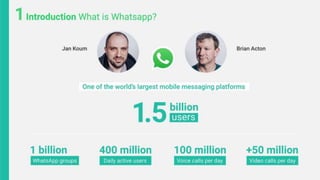
  • #3 One of the world’s largest mobile messaging platforms, which helped disrupt the telecom business. WhatsApp paved the way for other messaging apps and made instant messaging affordable and the standard of communication. 1.5 billion users 450 million daily active users 100 million voice calls/day 1 billion users / day over 50 mill video calls / day 1 billion WhatsApp groups
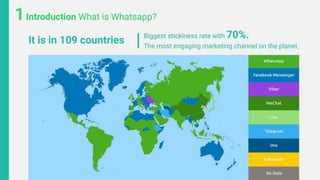
  • #4 → the product, the user base, the countries, the penetration 1.5 billion users, still growing a lot. a 98% open rate. That makes WhatsApp the most engaging marketing channel on the planet. Biggest stickiness rate with 70% There are 42 billion messages sent through WhatsApp each day, and 109 countries across the world turn to WhatsApp as their primary messaging app. Has been bought by facebook for 23$ but still doesn’t make any revenue. How can this
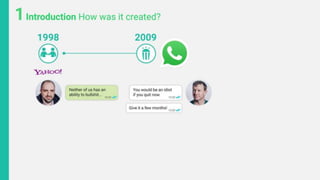
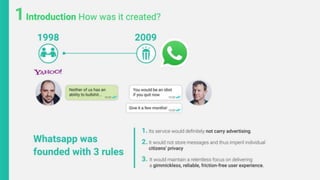
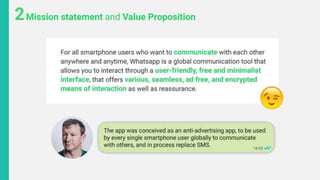
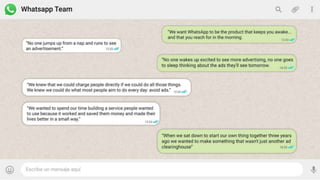
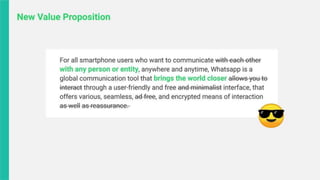
  • #9 For all smartphone users who want to communicate with each other anywhere and anytime, Whatsapp is a global communication tool that allows you to interact through a user-friendly, free and minimalist interface, that offers various, seamless, ad free, and encrypted means of interaction as well as reassurance. “The app was conceived as an anti-advertising app, to be used by every single smartphone user globally to communicate with others, and in process replace SMS”
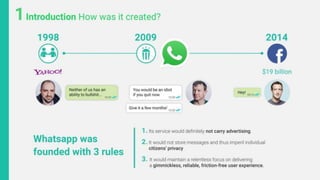
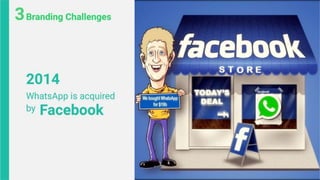
  • #11 2014: WhatsApp is acquired by Facebook FOR 23B$
  • #12 WhatsApp's growth is gobbling up user messaging and connection time that once could have belonged to Facebook. Now those users and their time do belong to Facebook. So buying WhatsApp allows Facebook to both own "the next Facebook" and prevent "the next Facebook" from eating Facebook's lunch. Five years after its founding, the company has 450 million active monthly users, of which a staggering ~315 million use it every day. WhatsApp is adding 1 million new users a day — 1 million! Facebook thinks WhatsApp could have 1 billion users in a few years, and this estimate seems conservative. (Facebook itself only has 1.2 billion users.) WhatsApp also does a lot more than "text-messaging." It allows users to send photos, videos, and voicemails to each other. In short, it allows users to do a lot of what Facebook does. So, again, Facebook really does appear to be buying "the next Facebook." WhatsApp ostensibly charges its users $1 per year after the first year. ("Ostensibly" because I've never heard of anyone actually paying this $1). Assuming most current users end up paying the $1/year, that's a potential revenue stream of several hundred million dollars a year from WhatsApp's current revenue model alone. WhatsApp currently has only 55 employees. Assuming an all-in cost of $200,000 per employee, that's a total cost base of $11 million. Let's assume WhatsApp grows to, say, 300 employees over the next few years. Then it will have a cost base of only $50-$75 million. Meanwhile, if the company's growth trajectory continues, it could easily be pulling in more than $1 billion a year of revenue in a few years. Almost all of that would be profit.
  • #13 With this figure we can see he was totally right. As he says, messaging is one of the few things that people do more than social networking.
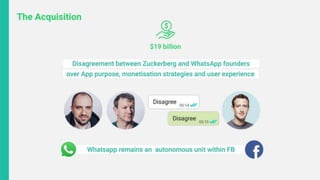
  • #14 Disagreement between Zuckerberg and WhatsApp founders over App purpose, monetisation strategies and user experience
  • #15 https://populartimelines.com/t/32058867/WhatsApp
  • #21 Facebook forced data sharing between WhatsApp and Facebook’s other products, which has largely diluted the anti-advertising stance of WhatsApp, leaving the founders of the company disillusioned and bitter, and exiting their own company and product. This data sharing included a key data point of mobile number and certain other characteristics such as last seen, device identifier, operating system, and likely the mobile numbers of people one is chatting with etc.
  • #22 Since it has been acquired by Facebook, Zuckerberg wants to change Whatsapp’s strategy on two main dimensions. First, by moving from an ad-free application to an app that includes Ads. Second, by putting an end to encrypted messages and collecting and analysing user data. How will the users perceive these shifts knowing that it is breaking the essence of the brand and the reasons why they downloaded/use the App?
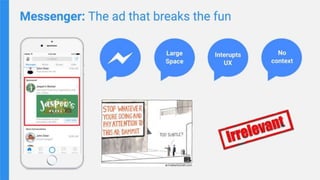
  • #24 They’re simply too large for the interface they’re invading, the image larger than any other element of the design. As soon as you open the app, smack dab in the middle of the most-used main interface: an ad that takes up more of the screen than the content you opened the app to access. The ads use the same targeting as other Facebook ads — no snooping in your messaging content yet. So if you’ve liked a bunch of retailer pages, you’ll probably see those, along with stuff in the same categories. That’s something, I guess, but who’s going to suddenly decide to browse men’s shoes at Timberland instead of responding to a message, which they opened the app to do? https://www.youtube.com/watch?v=Hsl7OeVIhGU#action=share
  • #25 Consumer reaction: We always knew that Facebook would want to ruin WhatsApp someday, and it looks like we’re getting closer to that moment. In case of a normal P2P messaging experience, adding ads in between a chat conversation is likely to feel very spam-ish and might cause significant user discomfort As the founder mentioned in a post, there are alternative ways to monetize: “Starting this year, we will test tools that allow you to use WhatsApp to communicate with businesses and organizations that you want to hear from. That could mean communicating with your bank about whether a recent transaction was fraudulent, or with an airline about a delayed flight. We all get these messages elsewhere today – through text messages and phone calls – so we want to test new tools to make this easier to do on WhatsApp, while still giving you an experience without third-party ads and spam.” → like WeChat = built a super-app ecosystem of taxi, payments, e-commerce etc. on top of the messaging experience. Tencent is one of the biggest gaming companies globally and uses messaging as a social layer to help users discover and play games with their friends and communities. The problem isnt that FB wants to advertise via whatsapp, the problem is FB compromised whatsapp’s core value of user privacy by forcing the user to share their data Since Stories ads are currently skippable, users are able to skip past them very easily. While it seems likely that advertising on WhatsApp Status would be a winner in the long term for Facebook, the absolute revenue numbers may be lower in the short term until the emerging markets catch up.
  • #27  Whatsapp statu has the highest daily active users worldwide, before instagram and snapchat. Not fundamentally against WhatsApp’s core ethos: Stories are public feed where a user’s privacy isn’t violated and introducing advertising won’t feel like spam. Since putting ads on WhatsApp Status doesn’t interrupt the P2P communication between two users, it can be argued that it isn’t truly breaking WhatsApp’s core philosophy. If ads have to happen, placing them in Status would be the least intrusive way of doing so,
  • #29 GUILLAUME Now let’s see other monetization alternatives that would be possible for WhatsApp
  • #30 GUILLAUME First, a paid subscription model. There could be three types of them. Metered-user model: It would consist on charging money after a certain large number of free messages. This would be quite easy to implement The problem is that it would probably harm users’ feeling towards the app because it might seems quite vicious and it makes people feel less free. Second: a freemium version. It would be like Spotify, I guess I don’t need to explain it much. This would allow making money on both free and premium users but it will also involve the problem of how to target users with the appropriate ads without harming their privacy. Finally, a yearly fee to pay to enjoy the app. It would be easy to implement, affordable for user and wouldn’t raise the question of targeting. However, the profit would be limited to the size of the user base. Each of the models has its interesting pros and cons but the main reason we chose not going for any of them is that we consider Whatsapp has to remain 100% free for users to keep up with its volume and not affect the core values too much.
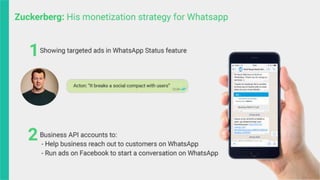
  • #31 GUILLAUME A second idea for monetization would be running ads on facebook that link to whatsapp. Business would be able to run ads on Facebook or Instagram to start a conversation with their customers on WhatsApp. THey would be able to enjoy direct marketing opportunities like sending personalized deals, offers and content. However it might harm facebook’s advertising model since once businesses have generated enough conversations, they might no more be incentivized to advertise on FB. Which would mean less revenue for facebook. . Also, similar initiative on Facebook Messenger hasn’t seen much success And finally, with this model, whatsapp would be more associated to Facebook in user’s mind. Although it’s not a secret that Whatsapp is now own by Zückerberg, it seems it is not something that is meant to be obvious in users’ mind (comparing to instagram for example).
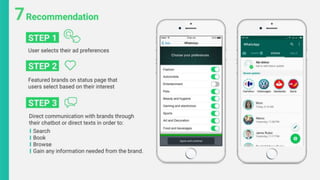
  • #33 Introduce a list of company categories after Whatsapp update that will introduce new ads and allow customers to select their personal preferences → Therefore, allowing companies to target without using third party data. Featured brands appear on status page and can be selected based on interest of the users. Once selected, customers can communicate directly with brands through their chatbot or direct texts in order to: Search Book Browse Gain any information needed from the brand. Benefits: Insure privacy and safety → since targeting is done by customer not by facebook Keep core proposition of “communication” and not shifting away from original brand purpose. Control: Potential spamming proglem. To avoid this, WhatsApp would have to ensure that WhatsApp business API accounts are manually approved only to high-quality businesses. While this last step may ensure quality, it also means monetisation may remain limited. Idea of wechat: Subscription account (1msg max per day) Non-subscription account (specic sub-section which never sends any notications or alerts to users. If a user is explicitly interested in a business, s/he can go inside the sub-section and then consume the content and messages sent by the businesses)
  • #34 Customer able to search, book, after sale services
  • #35 Much better reach (= more money charge to company) receive alerts and messages related to the booking on WhatsApp : Customers will usually gets the ticket or booking details in a richer media format such as image rather than a plain SMS text.
  • #36 We think the success of any communication app in the future will be based on how many things users can do on one application, from voice commands, to e-commerce, to personal assistance by communicating with companies directly… so we believe this recommendation is the first step to leading Whatsapp in that direction.
  • #37 Cons: Costing companies a much higher cost than SMS Risk of devolving into a very spam-like experience for the end-users (if this scales to a self-serve model similar to how Facebook Pages or Twitter accounts with a self-serve advertising model are currently run). Fake news To avoid this, WhatsApp would have to ensure that WhatsApp business API accounts are manually approved only to high-quality businesses. While this last step may ensure quality, it also means monetisation may remain limited. Idea of wechat: Subscription account (1msg max per day) Non-subscription account (specic sub-section which never sends any notications or alerts to users. If a user is explicitly interested in a business, s/he can go inside the sub-section and then consume the content and messages sent by the businesses)
  • #38 Cons: Targeting challenge : Requires data from users to avoid poorly targeted ads. WhatsApp doesn’t have any targeting information such as age, gender, interests, behavioural data, etc. Running ads without any targeting would hurt the experience of WhatsApp users, and also waste advertiser’s marketing dollars. With the data forced, challenge of having people connecting their number with facebook: Facebook will know pretty much everything about most of its WhatsApp users to show them perfectly targeted ads on WhatsApp Status and thereby violating their user privacy and the core ethos. Since Stories ads are currently skippable, users are able to skip past them very easily.--> fewer monetization opportunity. Will that lead Whatsapp to implement unskippable ads that will irritate the user? Even though the usage of WhatsApp Status seems healthy, a major base of WhatsApp users is in emerging markets such as India, Brazil, Mexico, Indonesia, Russia, Spain etc. The advertising revenues in these markets are likely to be lower on a per-user basis compared to developed markets such as the US, Germany, Japan etc. where WhatsApp has fewer users. So while it seems likely that advertising on WhatsApp Status would be a winner in the long term for Facebook, the absolute revenue numbers may be lower in the short term until the emerging markets catch up Snapchat, instagram, facebook, whatsapp… stories everywhere. Question of the viability of the model: no place for every social media. (seems to work well now but..) What fundamentally broke Facebook’s promise of independence at the time of WhatsApp acquisition isn’t introducing advertising on WhatsApp Status, but instead when Facebook compromised WhatsApp’s core value of user privacy by forcing data sharing on it. While forcing data sharing is vital to Facebook’s plans to make more money from WhatsApp, the step also had deeper ramications. Despite being an end- to-end encrypted network, Facebook today knows pretty much everything about most of its WhatsApp users to show them perfectly targeted ads on WhatsApp Status and thereby violating their user privacy.
  • #47 Now let’s take a brief look at our different costs for launching that. We want to invest $10M to build the IT infrastructures that will allow implementing the new business solution A new team will have to be hired including devs, marketers and especially sales forces to push brands to advertise on the new platform. Then, even if this new project aims to be more GDPR-friendly, Zuckerberg might have to invest a further $5M in lobyying activities. Last year, Facebook invested 11M on lobbying efforts, hiring public policy managers and politics and government manager to defend the company’s missions and goals in Washington Finally, a communication plan to communicate the benefit of the new features of the application and to reassure users about the safety of the application (Magazines, PR articles, blogs …) (20 Million/ year)
  • #48 Looking at the trends on the market, we found out the following advertising revenues generated by Facebook Instagram and Snapchat in 2017 and 2018. Considering whatsapp’s huge user base and even staying very moderated on the first year performances, we can estimate the advertising revenue at $2B for year 2019, which would constitute a lot of profits directly in first year.
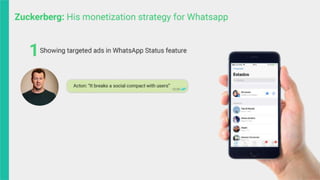
  • #53 1st option: Advertising on whatsapp status (like on IG)