What's on the SAT
READING and WRITING
Evidence-Based Reading and Writing
(EBRW)
Component Time Allotted
(minutes)
Number of
Questions/Tasks
Reading and Writing 64 (two 32-minute
modules)
54
How SAT is structured
The first module contains:
easy*
medium**
hard questions***
The difficulty of the second module depends on how students
perform on the first module.
What the Passages Are Like
Range from 25 to 150 words, representing
• US and World Literature
• History
• Social Studies
• Science
What the Questions Are Like
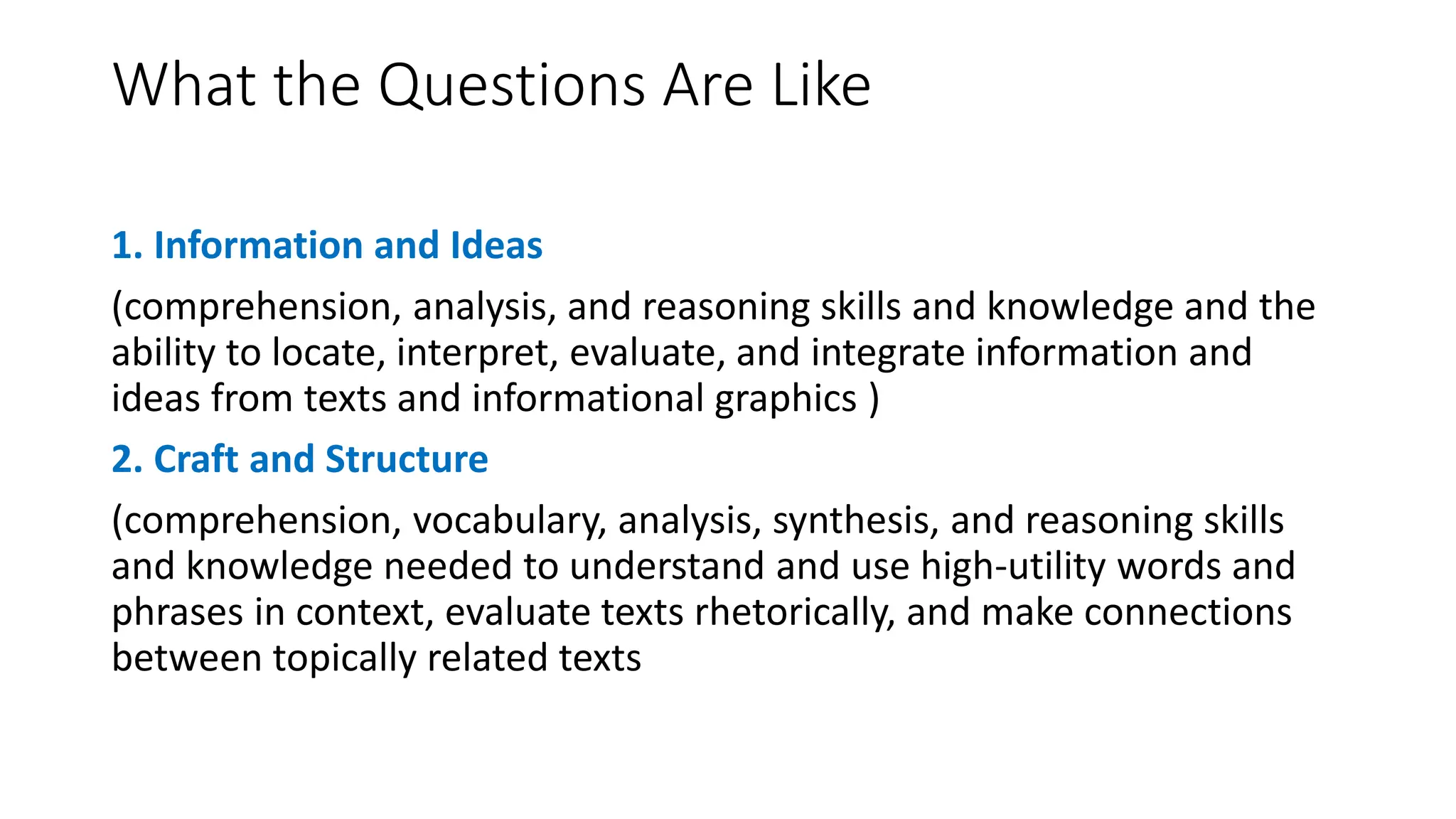
1. Information and Ideas
(comprehension, analysis, and reasoning skills and knowledge and the
ability to locate, interpret, evaluate, and integrate information and
ideas from texts and informational graphics )
2. Craft and Structure
(comprehension, vocabulary, analysis, synthesis, and reasoning skills
and knowledge needed to understand and use high-utility words and
phrases in context, evaluate texts rhetorically, and make connections
between topically related texts
What the Questions Are Like
3. Expression of Ideas
(the ability to revise texts to improve the effectiveness of written
expression and to meet specific rhetorical goals)
4. Standard English Conventions
(the ability to edit text to conform to core conventions of Standard
English sentence structure, usage, and punctuation)
• The Reading questions fall into seven categories:
• Vocabulary
• Purpose
• Dual Texts
• Retrieval
• Main Idea
• Claims
• Conclusions
• Not every module will contain all seven categories, but the categories that
do appear will be in that order. Typically, 13-17 of the Reading and Writing
questions will be Reading.
• The remaining 10-14 questions are Writing questions. There are three
categories of Writing questions:
• Vocabulary
• Transitions
• Rhetorical Synthesis
• As with the Reading questions, the Writing questions always appear
in this order.

What's on the SAT? The Structure and Content.

  • 1.
    What's on theSAT READING and WRITING
  • 2.
    Evidence-Based Reading andWriting (EBRW) Component Time Allotted (minutes) Number of Questions/Tasks Reading and Writing 64 (two 32-minute modules) 54
  • 3.
    How SAT isstructured The first module contains: easy* medium** hard questions*** The difficulty of the second module depends on how students perform on the first module.
  • 4.
    What the PassagesAre Like Range from 25 to 150 words, representing • US and World Literature • History • Social Studies • Science
  • 5.
    What the QuestionsAre Like 1. Information and Ideas (comprehension, analysis, and reasoning skills and knowledge and the ability to locate, interpret, evaluate, and integrate information and ideas from texts and informational graphics ) 2. Craft and Structure (comprehension, vocabulary, analysis, synthesis, and reasoning skills and knowledge needed to understand and use high-utility words and phrases in context, evaluate texts rhetorically, and make connections between topically related texts
  • 6.
    What the QuestionsAre Like 3. Expression of Ideas (the ability to revise texts to improve the effectiveness of written expression and to meet specific rhetorical goals) 4. Standard English Conventions (the ability to edit text to conform to core conventions of Standard English sentence structure, usage, and punctuation)
  • 7.
    • The Readingquestions fall into seven categories: • Vocabulary • Purpose • Dual Texts • Retrieval • Main Idea • Claims • Conclusions • Not every module will contain all seven categories, but the categories that do appear will be in that order. Typically, 13-17 of the Reading and Writing questions will be Reading.
  • 8.
    • The remaining10-14 questions are Writing questions. There are three categories of Writing questions: • Vocabulary • Transitions • Rhetorical Synthesis • As with the Reading questions, the Writing questions always appear in this order.